WO2022137987A1 - 積層体及び医療機器 - Google Patents
積層体及び医療機器 Download PDFInfo
- Publication number
- WO2022137987A1 WO2022137987A1 PCT/JP2021/043515 JP2021043515W WO2022137987A1 WO 2022137987 A1 WO2022137987 A1 WO 2022137987A1 JP 2021043515 W JP2021043515 W JP 2021043515W WO 2022137987 A1 WO2022137987 A1 WO 2022137987A1
- Authority
- WO
- WIPO (PCT)
- Prior art keywords
- group
- compound
- laminate according
- layer
- alkoxide compound
- Prior art date
- Legal status (The legal status is an assumption and is not a legal conclusion. Google has not performed a legal analysis and makes no representation as to the accuracy of the status listed.)
- Ceased
Links
Images



Classifications
-
- C—CHEMISTRY; METALLURGY
- C08—ORGANIC MACROMOLECULAR COMPOUNDS; THEIR PREPARATION OR CHEMICAL WORKING-UP; COMPOSITIONS BASED THEREON
- C08J—WORKING-UP; GENERAL PROCESSES OF COMPOUNDING; AFTER-TREATMENT NOT COVERED BY SUBCLASSES C08B, C08C, C08F, C08G or C08H
- C08J9/00—Working-up of macromolecular substances to porous or cellular articles or materials; After-treatment thereof
- C08J9/26—Working-up of macromolecular substances to porous or cellular articles or materials; After-treatment thereof by elimination of a solid phase from a macromolecular composition or article, e.g. leaching out
-
- C—CHEMISTRY; METALLURGY
- C08—ORGANIC MACROMOLECULAR COMPOUNDS; THEIR PREPARATION OR CHEMICAL WORKING-UP; COMPOSITIONS BASED THEREON
- C08J—WORKING-UP; GENERAL PROCESSES OF COMPOUNDING; AFTER-TREATMENT NOT COVERED BY SUBCLASSES C08B, C08C, C08F, C08G or C08H
- C08J7/00—Chemical treatment or coating of shaped articles made of macromolecular substances
- C08J7/04—Coating
- C08J7/042—Coating with two or more layers, where at least one layer of a composition contains a polymer binder
- C08J7/0423—Coating with two or more layers, where at least one layer of a composition contains a polymer binder with at least one layer of inorganic material and at least one layer of a composition containing a polymer binder
-
- B—PERFORMING OPERATIONS; TRANSPORTING
- B32—LAYERED PRODUCTS
- B32B—LAYERED PRODUCTS, i.e. PRODUCTS BUILT-UP OF STRATA OF FLAT OR NON-FLAT, e.g. CELLULAR OR HONEYCOMB, FORM
- B32B27/00—Layered products comprising a layer of synthetic resin
- B32B27/28—Layered products comprising a layer of synthetic resin comprising synthetic resins not wholly covered by any one of the sub-groups B32B27/30 - B32B27/42
- B32B27/283—Layered products comprising a layer of synthetic resin comprising synthetic resins not wholly covered by any one of the sub-groups B32B27/30 - B32B27/42 comprising polysiloxanes
-
- C—CHEMISTRY; METALLURGY
- C08—ORGANIC MACROMOLECULAR COMPOUNDS; THEIR PREPARATION OR CHEMICAL WORKING-UP; COMPOSITIONS BASED THEREON
- C08G—MACROMOLECULAR COMPOUNDS OBTAINED OTHERWISE THAN BY REACTIONS ONLY INVOLVING UNSATURATED CARBON-TO-CARBON BONDS
- C08G79/00—Macromolecular compounds obtained by reactions forming a linkage containing atoms other than silicon, sulfur, nitrogen, oxygen, and carbon with or without the latter elements in the main chain of the macromolecule
-
- C—CHEMISTRY; METALLURGY
- C08—ORGANIC MACROMOLECULAR COMPOUNDS; THEIR PREPARATION OR CHEMICAL WORKING-UP; COMPOSITIONS BASED THEREON
- C08J—WORKING-UP; GENERAL PROCESSES OF COMPOUNDING; AFTER-TREATMENT NOT COVERED BY SUBCLASSES C08B, C08C, C08F, C08G or C08H
- C08J7/00—Chemical treatment or coating of shaped articles made of macromolecular substances
- C08J7/04—Coating
- C08J7/0427—Coating with only one layer of a composition containing a polymer binder
-
- C—CHEMISTRY; METALLURGY
- C08—ORGANIC MACROMOLECULAR COMPOUNDS; THEIR PREPARATION OR CHEMICAL WORKING-UP; COMPOSITIONS BASED THEREON
- C08J—WORKING-UP; GENERAL PROCESSES OF COMPOUNDING; AFTER-TREATMENT NOT COVERED BY SUBCLASSES C08B, C08C, C08F, C08G or C08H
- C08J7/00—Chemical treatment or coating of shaped articles made of macromolecular substances
- C08J7/04—Coating
- C08J7/043—Improving the adhesiveness of the coatings per se, e.g. forming primers
-
- C—CHEMISTRY; METALLURGY
- C08—ORGANIC MACROMOLECULAR COMPOUNDS; THEIR PREPARATION OR CHEMICAL WORKING-UP; COMPOSITIONS BASED THEREON
- C08J—WORKING-UP; GENERAL PROCESSES OF COMPOUNDING; AFTER-TREATMENT NOT COVERED BY SUBCLASSES C08B, C08C, C08F, C08G or C08H
- C08J9/00—Working-up of macromolecular substances to porous or cellular articles or materials; After-treatment thereof
- C08J9/0061—Working-up of macromolecular substances to porous or cellular articles or materials; After-treatment thereof characterized by the use of several polymeric components
-
- C—CHEMISTRY; METALLURGY
- C08—ORGANIC MACROMOLECULAR COMPOUNDS; THEIR PREPARATION OR CHEMICAL WORKING-UP; COMPOSITIONS BASED THEREON
- C08J—WORKING-UP; GENERAL PROCESSES OF COMPOUNDING; AFTER-TREATMENT NOT COVERED BY SUBCLASSES C08B, C08C, C08F, C08G or C08H
- C08J9/00—Working-up of macromolecular substances to porous or cellular articles or materials; After-treatment thereof
- C08J9/36—After-treatment
-
- C—CHEMISTRY; METALLURGY
- C08—ORGANIC MACROMOLECULAR COMPOUNDS; THEIR PREPARATION OR CHEMICAL WORKING-UP; COMPOSITIONS BASED THEREON
- C08J—WORKING-UP; GENERAL PROCESSES OF COMPOUNDING; AFTER-TREATMENT NOT COVERED BY SUBCLASSES C08B, C08C, C08F, C08G or C08H
- C08J9/00—Working-up of macromolecular substances to porous or cellular articles or materials; After-treatment thereof
- C08J9/36—After-treatment
- C08J9/365—Coating
-
- C—CHEMISTRY; METALLURGY
- C09—DYES; PAINTS; POLISHES; NATURAL RESINS; ADHESIVES; COMPOSITIONS NOT OTHERWISE PROVIDED FOR; APPLICATIONS OF MATERIALS NOT OTHERWISE PROVIDED FOR
- C09D—COATING COMPOSITIONS, e.g. PAINTS, VARNISHES OR LACQUERS; FILLING PASTES; CHEMICAL PAINT OR INK REMOVERS; INKS; CORRECTING FLUIDS; WOODSTAINS; PASTES OR SOLIDS FOR COLOURING OR PRINTING; USE OF MATERIALS THEREFOR
- C09D183/00—Coating compositions based on macromolecular compounds obtained by reactions forming in the main chain of the macromolecule a linkage containing silicon, with or without sulfur, nitrogen, oxygen, or carbon only; Coating compositions based on derivatives of such polymers
- C09D183/14—Coating compositions based on macromolecular compounds obtained by reactions forming in the main chain of the macromolecule a linkage containing silicon, with or without sulfur, nitrogen, oxygen, or carbon only; Coating compositions based on derivatives of such polymers in which at least two but not all the silicon atoms are connected by linkages other than oxygen atoms
-
- C—CHEMISTRY; METALLURGY
- C08—ORGANIC MACROMOLECULAR COMPOUNDS; THEIR PREPARATION OR CHEMICAL WORKING-UP; COMPOSITIONS BASED THEREON
- C08G—MACROMOLECULAR COMPOUNDS OBTAINED OTHERWISE THAN BY REACTIONS ONLY INVOLVING UNSATURATED CARBON-TO-CARBON BONDS
- C08G77/00—Macromolecular compounds obtained by reactions forming a linkage containing silicon with or without sulfur, nitrogen, oxygen or carbon in the main chain of the macromolecule
- C08G77/48—Macromolecular compounds obtained by reactions forming a linkage containing silicon with or without sulfur, nitrogen, oxygen or carbon in the main chain of the macromolecule in which at least two but not all the silicon atoms are connected by linkages other than oxygen atoms
- C08G77/58—Metal-containing linkages
-
- C—CHEMISTRY; METALLURGY
- C08—ORGANIC MACROMOLECULAR COMPOUNDS; THEIR PREPARATION OR CHEMICAL WORKING-UP; COMPOSITIONS BASED THEREON
- C08J—WORKING-UP; GENERAL PROCESSES OF COMPOUNDING; AFTER-TREATMENT NOT COVERED BY SUBCLASSES C08B, C08C, C08F, C08G or C08H
- C08J2201/00—Foams characterised by the foaming process
- C08J2201/04—Foams characterised by the foaming process characterised by the elimination of a liquid or solid component, e.g. precipitation, leaching out, evaporation
- C08J2201/046—Elimination of a polymeric phase
-
- C—CHEMISTRY; METALLURGY
- C08—ORGANIC MACROMOLECULAR COMPOUNDS; THEIR PREPARATION OR CHEMICAL WORKING-UP; COMPOSITIONS BASED THEREON
- C08J—WORKING-UP; GENERAL PROCESSES OF COMPOUNDING; AFTER-TREATMENT NOT COVERED BY SUBCLASSES C08B, C08C, C08F, C08G or C08H
- C08J2300/00—Characterised by the use of unspecified polymers
- C08J2300/10—Polymers characterised by the presence of specified groups, e.g. terminal or pendant functional groups
- C08J2300/106—Polymers characterised by the presence of specified groups, e.g. terminal or pendant functional groups containing nitrogen atoms
-
- C—CHEMISTRY; METALLURGY
- C08—ORGANIC MACROMOLECULAR COMPOUNDS; THEIR PREPARATION OR CHEMICAL WORKING-UP; COMPOSITIONS BASED THEREON
- C08J—WORKING-UP; GENERAL PROCESSES OF COMPOUNDING; AFTER-TREATMENT NOT COVERED BY SUBCLASSES C08B, C08C, C08F, C08G or C08H
- C08J2300/00—Characterised by the use of unspecified polymers
- C08J2300/22—Thermoplastic resins
-
- C—CHEMISTRY; METALLURGY
- C08—ORGANIC MACROMOLECULAR COMPOUNDS; THEIR PREPARATION OR CHEMICAL WORKING-UP; COMPOSITIONS BASED THEREON
- C08J—WORKING-UP; GENERAL PROCESSES OF COMPOUNDING; AFTER-TREATMENT NOT COVERED BY SUBCLASSES C08B, C08C, C08F, C08G or C08H
- C08J2355/00—Characterised by the use of homopolymers or copolymers, obtained by polymerisation reactions only involving carbon-to-carbon unsaturated bonds, not provided for in groups C08J2323/00 - C08J2353/00
- C08J2355/02—Acrylonitrile-Butadiene-Styrene [ABS] polymers
-
- C—CHEMISTRY; METALLURGY
- C08—ORGANIC MACROMOLECULAR COMPOUNDS; THEIR PREPARATION OR CHEMICAL WORKING-UP; COMPOSITIONS BASED THEREON
- C08J—WORKING-UP; GENERAL PROCESSES OF COMPOUNDING; AFTER-TREATMENT NOT COVERED BY SUBCLASSES C08B, C08C, C08F, C08G or C08H
- C08J2363/00—Characterised by the use of epoxy resins; Derivatives of epoxy resins
-
- C—CHEMISTRY; METALLURGY
- C08—ORGANIC MACROMOLECULAR COMPOUNDS; THEIR PREPARATION OR CHEMICAL WORKING-UP; COMPOSITIONS BASED THEREON
- C08J—WORKING-UP; GENERAL PROCESSES OF COMPOUNDING; AFTER-TREATMENT NOT COVERED BY SUBCLASSES C08B, C08C, C08F, C08G or C08H
- C08J2383/00—Characterised by the use of macromolecular compounds obtained by reactions forming in the main chain of the macromolecule a linkage containing silicon with or without sulfur, nitrogen, oxygen, or carbon only; Derivatives of such polymers
- C08J2383/04—Polysiloxanes
-
- C—CHEMISTRY; METALLURGY
- C08—ORGANIC MACROMOLECULAR COMPOUNDS; THEIR PREPARATION OR CHEMICAL WORKING-UP; COMPOSITIONS BASED THEREON
- C08J—WORKING-UP; GENERAL PROCESSES OF COMPOUNDING; AFTER-TREATMENT NOT COVERED BY SUBCLASSES C08B, C08C, C08F, C08G or C08H
- C08J2463/00—Characterised by the use of epoxy resins; Derivatives of epoxy resins
-
- C—CHEMISTRY; METALLURGY
- C08—ORGANIC MACROMOLECULAR COMPOUNDS; THEIR PREPARATION OR CHEMICAL WORKING-UP; COMPOSITIONS BASED THEREON
- C08J—WORKING-UP; GENERAL PROCESSES OF COMPOUNDING; AFTER-TREATMENT NOT COVERED BY SUBCLASSES C08B, C08C, C08F, C08G or C08H
- C08J2471/00—Characterised by the use of polyethers obtained by reactions forming an ether link in the main chain; Derivatives of such polymers
- C08J2471/02—Polyalkylene oxides
-
- C—CHEMISTRY; METALLURGY
- C08—ORGANIC MACROMOLECULAR COMPOUNDS; THEIR PREPARATION OR CHEMICAL WORKING-UP; COMPOSITIONS BASED THEREON
- C08J—WORKING-UP; GENERAL PROCESSES OF COMPOUNDING; AFTER-TREATMENT NOT COVERED BY SUBCLASSES C08B, C08C, C08F, C08G or C08H
- C08J2483/00—Characterised by the use of macromolecular compounds obtained by reactions forming in the main chain of the macromolecule a linkage containing silicon with or without sulfur, nitrogen, oxygen, or carbon only; Derivatives of such polymers
- C08J2483/04—Polysiloxanes
Definitions
- the present invention relates to a laminate and a medical device.
- Patent Document 1 describes curing of a silicone resin composition containing an organopolysiloxane having a specific structure, an organosilicon compound having a specific structure, an inorganic filler having a specific refractive index and a hand gap, and a phosphoric acid-based catalyst.
- a laminate having a membrane on a support is described. According to the technique described in Patent Document 1, the laminate is said to have high reflectance of ultraviolet rays, can enhance the sterilizing effect, and has high durability against ultraviolet rays in a sterilizing treatment using ultraviolet rays.
- Patent Documents 2 to 4 describe a laminate having a siloxane compound-containing layer on a substrate.
- Medical devices used to examine or treat the human body are required to have a high degree of cleanliness, and must be cleaned and disinfected with chemicals after each use.
- medical devices inserted or applied into blood vessels, trachea, gastrointestinal tracts, other body cavities or tissues are required to have a high level of cleanliness beyond disinfection in order to prevent bacterial infection.
- sterilization treatment sterilization treatment with EOG (ethylene oxide gas) is widely performed, and application of hydrogen peroxide plasma treatment is also desired.
- EOG ethylene oxide gas
- the surface of medical devices subjected to such sterilization treatment is often composed of a single-layer or multi-layered polymer-coated layer, and the polymer-coated layer is coated on the underlying substrate in close contact with the substrate. Has been done.
- the constituent materials of the laminate are deteriorated, and the adhesion between the polymer layers or the polymer layers constituting the laminate and the base material is improved. Decreases. This decrease in adhesion causes a decrease in the performance of medical devices. Therefore, high sterilization durability is required for the components of medical devices.
- An object of the present invention is to provide a laminated body having excellent sterilization durability and suitable as a constituent member of a medical device, and a medical device provided with the laminated body.
- the present inventors have repeatedly studied the formation of a polymer coating layer in a laminated body.
- an intermediate layer is provided between the base material and the polymer coating layer, and the intermediate layer has a porous layer (porous layer) containing a siloxane compound, and further, the porous layer is contained in the siloxane compound constituting the porous layer.
- the above-mentioned problems are solved by incorporating a component derived from a compound having a reactive functional group and a hydrolyzable group independently, or a component derived from a compound having a hydrolyzable group having a reactive functional group. I found out what I could do.
- the present invention has been further studied and completed based on these findings.
- ⁇ 1> It has a base material, an intermediate layer on the base material, and a polymer coating layer on the intermediate layer, and the intermediate layer has a porous layer containing a siloxane compound, and the siloxane compound is a reactive functional group.
- the porous layer has an average pore diameter of 50 nm to 100 ⁇ m.
- ⁇ 3> The laminate according to ⁇ 2>, wherein the porous layer has an average pore diameter of 100 nm to 10 ⁇ m.
- the reactive functional group contains at least one of an amino group, a (meth) acryloyl group, a mercapto group, a phosphorus atom-containing group and an acyl group. ..
- the intermediate layer is the porous layer
- the siloxane compound contained in the porous layer is at least one of an alkoxysilane compound and a hydroxysilane compound, a silane coupling agent, a titanium alkoxide compound, a zirconium alkoxide compound, and an aluminum alkoxide compound.
- a silane coupling agent a titanium alkoxide compound, a zirconium alkoxide compound, and an aluminum alkoxide compound.
- the siloxane compound contained in the porous layer is a dehydration condensate of at least one of an alkoxysilane compound and a hydroxysilane compound and a silane coupling agent, and the silane coupling agent has the above reactive functional group, ⁇ 5.
- the laminate according to. ⁇ 7> The laminate according to any one of ⁇ 1> to ⁇ 6>, wherein the base material contains at least one of iron, a non-ferrous metal, an inorganic material other than a metal, and an organic material.
- ⁇ 8> The laminate according to ⁇ 7>, wherein the non-ferrous metal contains at least one of aluminum, titanium, magnesium, nickel, copper, lead, zinc, tin, chromium, tungsten, cobalt and at least one of these two alloys.
- the inorganic material other than the above metal contains at least one of glass and ceramics.
- the organic material contains at least one of a thermoplastic resin and a thermosetting resin.
- the intermediate layer has the porous layer and the primer layer on the porous layer.
- the reactive functional group of the primer layer is at least one of an amino group, a (meth) acryloyl group, an epoxy group, a mercapto group, an acid anhydride group, a phosphorus atom-containing group, a hydroxy group, a carboxy group, a sulfonyl group and an acyl group.
- ⁇ 14> The laminate according to any one of ⁇ 11> to ⁇ 13>, wherein the primer layer contains at least one of a silane coupling agent, a titanium alkoxide compound, an aluminum alkoxide compound, and a zirconium alkoxide compound.
- the primer layer contains at least one of a titanium alkoxide compound, an aluminum alkoxide compound, and a zirconium alkoxide compound.
- the primer layer contains a titanium alkoxide compound.
- R 2a represents a hydrogen atom, an alkyl group, a cycloalkyl group, an acyl group, an alkenyl group, an aryl group, a phosphonate group, or -SO 2 RS1 .
- RS1 indicates a substituent.
- m1 is an integer of 0 to 3.
- R 1b represents a hydrogen atom, an alkyl group, a cycloalkyl group, an acyl group, an aryl group, or an unsaturated aliphatic group.
- R 2b represents a hydrogen atom, an alkyl group, a cycloalkyl group, an acyl group, an alkenyl group, an aryl group, a phosphonate group, or -SO 2 RS2 .
- RS2 indicates a substituent.
- m2 is an integer of 0 to 2.
- R 1c represents a hydrogen atom, an alkyl group, a cycloalkyl group, an acyl group, an aryl group, or an unsaturated aliphatic group.
- R 2c represents a hydrogen atom, an alkyl group, a cycloalkyl group, an acyl group, an alkenyl group, an aryl group, a phosphonate group, or -SO 2 RS3 .
- RS3 indicates a substituent.
- m3 is an integer of 0 to 3.
- ⁇ 22> The laminate according to ⁇ 21>, wherein at least one of OR 2c in the general formulas (e) and (f) has an acetonate structure, an acetate structure or a lactoto structure.
- the polymer coating layer contains at least one of a thermoplastic polymer and a thermosetting polymer.
- the polymer coating layer contains a thermoplastic polymer.
- the "metal alkoxide compound (specifically, for example, an aluminum alkoxide compound, a zirconium alkoxide compound and a titanium alkoxide compound described later) is a compound having a structure in which at least one alkoxy group is bonded to a metal atom. Means. This alkoxy group may have a substituent. The substituent may be monovalent or divalent (eg, an alkylidene group). Further, two alkoxy groups bonded to one metal atom may be bonded to each other to form a ring. In the present specification, when there are a plurality of substituents, linking groups, etc.
- substituents, etc. indicated by a specific reference numeral, or when a plurality of substituents, etc. are specified simultaneously or selectively, respectively. It means that the substituents and the like may be the same or different from each other. Further, even if it is not particularly specified, it means that when a plurality of substituents or the like are adjacent to each other, they may be linked to each other or condensed to form a ring. Substituents not specified as substituted or unsubstituted in the present specification (the same applies to linking groups) are meant to have any substituents as long as they have a desired effect. .. This is also synonymous with compounds that do not specify substitution or no substitution.
- this carbon number means the carbon number of the whole group. That is, when this group is in the form of further having a substituent, it means the total number of carbon atoms including this substituent.
- the term "reactive functional group” is used in a broader sense than usual. That is, it means that it includes a group that causes a reaction with another group to form a covalent bond or the like, and a group that causes an interaction (ionic interaction, hydrogen bond, etc.) with another group. ..
- the unsubstituted alkoxy group does not have a structure having a reactive functional group.
- the laminate of the present invention has excellent sterilization durability and is suitable as a constituent member of medical equipment.
- the medical device of the present invention using this laminated body as a constituent member has excellent sterilization durability.
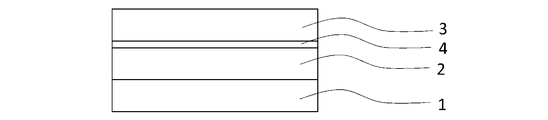
- FIG. 1 is a vertical sectional view schematically showing an embodiment of the laminated body of the present invention.
- FIG. 2 is a vertical sectional view schematically showing an embodiment of the laminated body of the present invention, which is different from FIG. 1.
- FIG. 3 is a vertical sectional view schematically showing an embodiment of the laminated body of the present invention, which is different from FIGS. 1 and 2.
- FIG. 4 is a vertical sectional view schematically showing an embodiment of the laminated body of the present invention, which is different from FIGS. 1 to 3.
- the laminate of the present invention has a base material, an intermediate layer on the base material, and a polymer coating layer on the intermediate layer, the intermediate layer has a porous layer, and the porous layer is a reactive functional group. It contains a siloxane compound having at least one of a constituent component derived from a compound having a hydrolyzable group and a constituent component derived from a compound having a hydrolyzable group having a reactive functional group.
- the laminate of the present invention in the form shown in FIG.
- a porous layer containing a constituent component derived from a compound having a reactive functional group and a hydrolyzable group or a siloxane compound having a constituent component derived from a compound having a hydrolyzable group having a reactive functional group is referred to as "a porous layer.” It may also be referred to as a "siloxane compound-containing porous layer”.
- the laminate of the present invention has excellent sterility durability.
- the reason for this is not clear, but in addition to the interaction between the polymer coating layer 3 and the reactive functional group contained in the siloxane compound-containing porous layer 2, the anchor effect that penetrates into the pores of the siloxane compound-containing porous layer 2 is one of the causes. Is presumed to be.
- the hydrolyzable group having a reactive functional group is hydrolyzed in the synthesis of the siloxane compound and separated from the compound, and almost all of them are contained in the porous layer in a free state. It is considered that the free compound derived from the reactive functional group effectively contributes to the adhesion between the porous layer and the layer adjacent to the porous layer through the interaction based on its polarity. Be done.
- the base material of the present invention is not particularly limited, and those used for constituent members of ordinary medical devices can be widely adopted.
- the base material preferably contains at least one of iron, a non-ferrous metal, an inorganic material other than metal, and an organic material.
- the above iron shall also include alloys of iron and non-ferrous metals. Examples of such alloys include stainless steel.
- non-ferrous metal examples include aluminum, titanium, magnesium, nickel, copper, lead, zinc, tin, chromium, tungsten, cobalt, vanadium and gold, and at least two alloys thereof, and aluminum, titanium, and magnesium.
- nickel, copper, lead, zinc, tin, chromium, tungsten and cobalt, and at least two alloys thereof are preferred.
- Examples of inorganic materials other than the above metals include glass and glass ceramics.
- Examples of the glass include sodium soda glass, Pyrex (registered trademark) glass, quartz glass and non-alkali glass.
- Examples of the ceramics include alumina, zirconia, silicon carbide and silicon nitride.
- thermoplastic resins examples include thermoplastic resins and thermosetting resins.
- thermoplastic resin examples include thermoplastic polyimide resin, thermoplastic polyamide resin, polyetherimide resin, polyphenylene ether resin, polycarbonate resin, polyethylene terephthalate resin, polyethylene naphthalate resin, polyphenylene sulfide resin, polyether ether ketone resin, and poly.
- polyolefin resins such as ether sulfone resin, acrylic resin, polyethylene resin and polypropylene resin, polymethylpentene resin, and thermoplastic polycycloolefin such as thermoplastic polynorbornene.
- thermosetting resin examples include thermosetting polyimide resin, thermosetting polyamide resin, polyamideimide resin, epoxy resin, phenol resin, polystyrene resin, ABS resin (acrylonitrile-butadiene-styrene copolymer resin), and acrylonitrile-.
- thermosetting resins such as styrene copolymer resins and thermosetting polycycloolefins such as thermosetting polynorbornene.
- thermosetting polymer and a thermoplastic polymer contained in a polymer coating layer described later can also be adopted. That is, in the laminate of the present invention, the base material and the polymer coating layer can be made of the same polymer.
- the physical properties of the base material such as flexibility and rigidity can be appropriately determined according to the medical device to which the laminate is applied.
- the thickness of the base material can be, for example, 0.1 to 50 mm, and may be 0.5 to 10 mm.
- the content of at least one of iron, non-ferrous metal, an inorganic material other than metal, and an organic material contained in the base material is not particularly limited, and can be, for example, 80% by mass or more, and 90% by mass or more. Preferably, it may be 100% by mass.
- the intermediate layer constituting the laminate of the present invention has a siloxane compound-containing porous layer (porous layer).
- the siloxane compound-containing porous layer has a large number of pores (pores) in the layer. Examples of the shape of the hole include a spherical body and an ellipsoidal body.
- the holes may be independent holes or may be continuous holes in which independent holes are connected.
- the average pore size in the siloxane compound-containing porous layer is not particularly limited, and from the viewpoint of sterility durability, for example, 50 nm to 100 ⁇ m is preferable, 100 nm to 10 ⁇ m is more preferable, 500 nm to 5 ⁇ m is more preferable, and 800 nm to 2.5 ⁇ m is preferable. More preferred.
- the average pore diameter is a value determined by the method described in Examples described later.
- the porosity of the siloxane compound-containing porous layer is not particularly limited, and is preferably 10 to 80%, more preferably 20 to 60%, still more preferably 30 to 50%, for example.
- the "porosity” is the ratio of the volume of the pores to the volume of the entire porous layer including the pores, and is a value determined by the method described in Examples below.
- the average layer thickness of the siloxane compound-containing porous layer is not particularly limited, and is, for example, preferably 0.01 to 1000 ⁇ m, more preferably 0.05 to 500 ⁇ m, more preferably 0.03 to 100 ⁇ m, and further preferably 0.1 to 50 ⁇ m. preferable.
- the average layer thickness is a value determined by the method described in Examples described later.
- the siloxane compound contained in the siloxane compound-containing porous layer has a component derived from a compound having a reactive functional group and a hydrolyzable group, or a component derived from a compound having a hydrolyzable group having a reactive functional group. ..
- the above reactive functional group is not particularly limited, and from the viewpoint of sterility durability, for example, it is preferable to have a reactive functional group other than the hydroxy group.
- the reactive functional group include an amino group, a (meth) acryloyl group, a mercapto group (sulfanyl group), a phosphorus atom-containing group and an acyl group. From the viewpoint of sterility durability, the reactive functional group is preferably an amino group, a mercapto group and a phosphorus atom-containing group.
- the phosphorus atom-containing group means a monovalent substituent having at least one phosphorus atom.
- the phosphorus atom contained in the phosphorus atom-containing group is preferably 2 to 10, more preferably 2 to 5, and even more preferably 2 or 3.
- the molecular weight of the phosphorus atom-containing group is not particularly limited, and is, for example, 100 to 300.
- a phosphorus atom-containing group is meant to include a form having a substituent as part of its structure.
- Examples of the phosphorus atom-containing group include a monovalent substituent having a phosphonic acid group at the terminal.
- Preferred specific examples of the phosphorus atom-containing group include, for example, a monovalent organic group having an oxygen atom bonded to a titanium atom, which is described later in TI-2, TI-3, TI-4 and TI-5.
- the molecular weight of the acyl group is not particularly limited, and is, for example, 40 to 300.
- R include an alkyl or aryl group, and an alkyl group is preferable.
- the alkyl group may be linear, branched or cyclic.
- the number of carbon atoms of this alkyl group is preferably 1 to 30, more preferably 1 to 20, preferably 1 to 10, and preferably 1 to 6.
- Specific examples of the alkyl group include methyl, ethyl, isopropyl, butyl, cyclopentyl and heptadecyl. It is also preferable that the acyl group is contained as an acyloxy group.
- the ratio of the constituents derived from the compound having a reactive functional group and the hydrolyzable group and the constituents derived from the compound having the hydrolyzable group having the reactive functional group to all the constituents of the siloxane compound is the total.
- it can be 0.1 to 30 mol%, preferably 0.5 to 5 mol%.
- the siloxane compound contained in the siloxane compound-containing porous layer is a compound having a siloxane bond (repeated structure of [—Si—O]).
- siloxane compound for example, at least one of an alkoxysilane compound and a hydroxysilane compound and at least one of a silane coupling agent, a titanium alkoxide compound, a zirconium alkoxide compound and an aluminum alkoxide compound are hydrolyzed after a hydrolysis reaction. It is an oligomer or a polymer obtained by the above.
- These silane coupling agents, titanium alkoxide compounds, zirconium alkoxide compounds and aluminum alkoxide compounds have the above-mentioned reactive functional groups.
- the alkoxysilane compound is a silane compound having at least one alkoxy group, and may have a hydroxy group.
- the hydroxysilane compound is a silane compound having a hydroxy group and does not have an alkoxy group.
- the alkyl group in the alkoxy group may be linear, branched or cyclic.
- the number of carbon atoms of this alkyl group is preferably 1 to 30, more preferably 1 to 20, further preferably 1 to 10, and even more preferably 1 or 2.
- Specific examples of the alkyl group include methyl, ethyl, isopropyl, butyl and cyclopentyl.
- the alkoxysilane compound and the hydroxysilane compound do not have a reactive functional group other than the hydroxy group.
- alkoxysilane compound examples include a tetraalkoxysilane compound, a trialkoxysilane compound, and a dialkoxysilane compound.
- the tetraalkoxysilane is not particularly limited, and examples thereof include tetramethoxysilane, tetraethoxysilane, tetrapropoxysilane, tetraisopropoxysilane, and tetrabutoxysilane.
- the trialkoxysilane compound is not particularly limited, and examples thereof include methyltrimethoxysilane, methyltriethoxysilane, phenyltrimethoxysilane, and phenyltriethoxysilane.
- the dialkoxysilane compound is not particularly limited, and examples thereof include dimethyldimethoxysilane and dimethyldiethoxysilane.
- the hydroxysilane compound is not particularly limited, and examples thereof include a compound obtained by hydrolyzing an alkoxy group of the above alkoxysilane compound into a hydroxy group.
- the weight average molecular weight of the siloxane compound is not particularly limited, and is preferably 100 to 2000, more preferably 150 to 500, for example.
- the weight average molecular weight or number average molecular weight of the compounds described in the present specification is determined as follows.
- the weight average molecular weight or the number average molecular weight can be measured as a polystyrene-equivalent molecular weight by gel permeation chromatography (GPC).
- GPC gel permeation chromatography
- a GPC device HLC-8220 (trade name, manufactured by Tosoh Co., Ltd.) is used, tetrahydrofuran is used as an eluent, G3000HXL + G2000HXL (both trade names, manufactured by Tosoh Co., Ltd.) are used as columns, and the flow rate is 1 mL / at 23 ° C. At min, it can be detected by RI.
- the laminate of the present invention means that the porous layer containing a siloxane compound has reacted with at least one of the base material and the polymer coating layer.
- the siloxane compound-containing porous layer may exist when the reactive functional group or its free material contained in the porous layer reacts with the constituent metal of the base material or reacts with the group on the surface of the polymer coating layer. Is.
- the laminate of the present invention has a primer layer, the reactive functional group contained in the porous layer or a free substance thereof may be present by reacting with a compound or the like contained in the primer layer.
- the content of the siloxane compound in the siloxane compound-containing porous layer is preferably 50% by mass or more, more preferably 70% by mass or more, still more preferably 80% by mass or more, still more preferably 90% by mass or more.
- the siloxane compound-containing layer may be a layer made of a siloxane compound.
- the siloxane compound-containing layer may contain a component other than the siloxane compound as long as the effect of the present invention is not impaired, and as such a component, for example, a metal alkoxide other than the metal alkoxide used for forming the siloxane compound, a binder resin, etc. Stabilizers (surfactants and antioxidants) can be mentioned.
- the polymer contained in the polymer coating layer is not particularly limited, and examples thereof include thermoplastic polymers and thermosetting polymers, and thermoplastic polymers are preferable.
- thermoplastic polymer examples include thermoplastic elastomers and thermoplastic resins.
- thermoplastic elastomer examples include polyamide elastomers, polyester elastomers, fluoroelastomers, polyurethane elastomers and polyolefin elastomers.
- thermoplastic resin examples include the thermoplastic resin contained in the above-mentioned "base material”. Further, acrylic resin, polyamide resin and the like can also be used.
- thermosetting polymer examples include thermosetting elastomers and thermosetting resins.
- thermosetting elastomer examples include silicone elastomers, urethane elastomers, diene rubbers, crosslinked olefin elastomers and crosslinked fluoroelastomers.
- thermosetting resin examples include the thermosetting resin contained in the above-mentioned "base material”. Further, epoxy resin, phenol resin and unsaturated polyester resin can also be used.
- the polymer coating layer may contain components other than the polymer as long as the effects of the present invention are not impaired.
- the thickness of the polymer coating layer can be appropriately determined depending on the medical device to which the laminate is applied, and may be, for example, 0.1 to 50 mm, or 0.3 to 10 mm.
- the laminate of the present invention preferably has a primer layer on the siloxane compound-containing porous layer as the intermediate layer.
- the primer layer preferably contains a compound having a reactive functional group, and the reactive functional group is an amino group, a (meth) acryloyl group, an epoxy group, a mercapto group, etc. It preferably contains at least one of an acid anhydride group, a phosphorus atom-containing group, a hydroxy group, a carboxy group, a sulfonyl group and an acyl group.
- the reactive functional group is a hydroxy group is also preferable.
- the primer layer is at least an amino group, a (meth) acryloyl group, an epoxy group, a mercapto group, an acid anhydride group, a phosphorus atom-containing group, a carboxy group, a sulfonyl group and an acyl group. It is preferable that the primer layer contains at least one of an amino group, a phosphorus atom-containing group, a carboxy group, a sulfonyl group and an acyl group, and a hydroxy group. , At least one of an amino group, a phosphorus atom-containing group and a carboxy group and a hydroxy group are more preferable.
- the primer layer preferably contains at least one of a silane coupling agent, a titanium alkoxide compound, an aluminum alkoxide compound and a zirconium alkoxide compound, and the titanium alkoxide compound, the aluminum alkoxide compound and the zirconium are preferable. It is more preferable to contain at least one alkoxide compound, and even more preferably to contain a titanium alkoxide compound.
- silane coupling agent As the silane coupling agent used in the present invention, a normal silane coupling agent applicable as a primer layer of a constituent member of a medical device can be widely adopted.
- the silane coupling agent preferably has no siloxane bond and contains groups other than methyl, ethyl, methoxy and ethoxy (eg, amino group, vinyl group, propyl group, acid anhydride group, epoxy group, mercapto group). It is preferable to have.
- titanium alkoxide compound As the titanium alkoxide compound (preferably a titanium coupling agent) used in the present invention, a normal titanium alkoxide compound applicable as a primer layer of a constituent member of a medical device can be widely adopted.
- the titanium alkoxide compound preferably contains at least one compound represented by the following general formula (a) or (b), and more preferably contains at least one compound represented by the following general formula (a). preferable.
- the ratio of the total content of the compounds represented by the following general formulas (a) or (b) in the titanium alkoxide compound is not particularly limited, and can be, for example, 60% by mass or more, and 80% by mass or more. It is preferably 90% by mass or more, more preferably 95% by mass or more, and may be 100% by mass.
- R 1a represents a hydrogen atom, an alkyl group, a cycloalkyl group, an acyl group, an aryl group, or an unsaturated aliphatic group.
- an alkyl group, a cycloalkyl group, an acyl group, an aryl group and an unsaturated aliphatic group for example, an alkyl group, a cycloalkyl group, an acyl group, an aryl group and an unsaturated fatty group which can be taken as R 1b of the general formula (c) described later.
- a family group can be adopted.
- R 2a represents a hydrogen atom, an alkyl group, a cycloalkyl group, an acyl group, an alkenyl group, an aryl group, a phosphonate group, or -SO 2 RS1 .
- RS1 indicates a substituent.
- an alkyl group, a cycloalkyl group, an acyl group, an alkenyl group, an aryl group and a phosphonate group for example, an alkyl group, a cycloalkyl group, an acyl group, an alkenyl group, an aryl group, which can be adopted as R 2b of the general formula (c) described later, A phosphonate group can be adopted.
- the substituent that can be adopted as RS1 for example, the substituent that can be adopted as RS2 of the above general formula (c) can be adopted.
- M1 is an integer from 0 to 3.
- the compound represented by the above general formula (a) or (b) preferably contains at least one atom of N, P and S.
- N When the compound represented by the general formula (a) or (b) has N, it is preferable to have this N as an amino group.
- P When the compound represented by the general formula (a) or (b) has P, it is preferable to have this P as a phosphate group (phosphoric acid group) or a phosphonate group (phosphonic acid group).
- the compound represented by the general formula (a) or (b) has S, it is preferable to have this S as a sulfonyl group (-SO 2- ).
- the compound represented by the above general formula (a) or (b) has an acyl group as R 2a , that is, has an acetate structure described later as OR 2a .
- titanium alkoxide compound used in the present invention is not limited thereto.
- Alkoxide compound As the aluminum alkoxide compound (preferably an aluminum coupling agent) used in the present invention, an ordinary aluminum alkoxide compound applicable as a primer layer for a constituent member of a medical device can be widely adopted.
- the aluminum alkoxide compound preferably contains at least one compound represented by the following general formula (c) or (d), and more preferably contains at least one compound represented by the following general formula (c). preferable.
- the ratio of the total content of the compounds represented by the following general formula (c) or (d) in the aluminum alkoxide compound is not particularly limited, and can be, for example, 60% by mass or more, and 80% by mass or more. It is preferably 90% by mass or more, more preferably 95% by mass or more, and may be 100% by mass.
- R 1b represents a hydrogen atom, an alkyl group, a cycloalkyl group, an acyl group, an aryl group, or an unsaturated aliphatic group.
- the alkyl group that can be taken as R 1b includes a linear alkyl group, a branched alkyl group, and an aralkyl group.
- the alkyl group preferably has 1 to 20 carbon atoms, more preferably 1 to 15 carbon atoms, further preferably 1 to 10 carbon atoms, particularly preferably 1 to 8 carbon atoms, and preferably 7 to 30 carbon atoms in the case of an aralkyl group.
- this alkyl group examples include, for example, methyl, ethyl, propyl, isopropyl, butyl, sec-butyl, isobutyl, tert-butyl, pentyl, hexyl, heptyl, octyl, decyl, tridecyl, octadecyl, benzyl, and phenethyl. Can be mentioned. It is also preferable that the alkyl group that can be taken as R 1b has an oxylan ring.
- the number of ring members of the cycloalkyl group (cycloalkyl group having a structure in which an oxylan ring is condensed) in the epoxy cycloalkylalkyl group that can be taken as R 1b is preferably 4 to 8, more preferably 5 or 6, and 6 (that is, epoxy). It is a cyclohexyl group), which is more preferable.
- the alkyl group that can be obtained as R 1b preferably has a group selected from an amino group, an isocyanato group, a mercapto group, an ethylenically unsaturated group, and an acid anhydride group.
- the cycloalkyl group that can be obtained as R 1b preferably has 3 to 20 carbon atoms, more preferably 3 to 15 carbon atoms, still more preferably 3 to 10 carbon atoms, and particularly preferably 3 to 8 carbon atoms.
- Preferred specific examples of this cycloalkyl group include, for example, cyclopropyl, cyclopentyl, and cyclohexyl.
- the acyl group that can be obtained as R 1b preferably has 2 to 40 carbon atoms, more preferably 2 to 30 carbon atoms, further preferably 2 to 20 carbon atoms, and particularly preferably 2 to 18 carbon atoms.
- the aryl group that can be obtained as R 1b preferably has 6 to 20 carbon atoms, more preferably 6 to 15 carbon atoms, further preferably 6 to 12 carbon atoms, and particularly preferably 6 to 10 carbon atoms.
- Preferred specific examples of this aryl group include, for example, phenyl and naphthyl, with phenyl being even more preferred.
- the unsaturated aliphatic group that can be obtained as R 1b preferably has 1 to 5 carbon-carbon unsaturated bonds, more preferably 1 to 3, further preferably 1 or 2, and particularly preferably 1. preferable.
- the unsaturated aliphatic group may contain a heteroatom, and is preferably a hydrocarbon group.
- the number of carbon atoms is preferably 2 to 20, more preferably 2 to 15, further preferably 2 to 10, further preferably 2 to 8, and preferably 2 to 5. ..
- the unsaturated aliphatic group is more preferably an alkenyl group or an alkynyl group.
- R 1b is preferably a hydrogen atom, an alkyl group, a cycloalkyl group, or an aryl group, and more preferably an alkyl group or a cycloalkyl group.
- the compound of the general formula (c) has two or more R 1b , the two R 1b may be connected to each other to form a ring.
- R 2b represents a hydrogen atom, an alkyl group, a cycloalkyl group, an acyl group, an alkenyl group, an aryl group, a phosphonate group (phosphonic acid group), or -SO 2 RS2 .
- RS2 indicates a substituent.
- the alkyl group, cycloalkyl group, acyl group, and aryl group that can be taken as R 2b are synonymous with the alkyl group, cycloalkyl group, acyl group, and aryl group that can be taken as R 1b , respectively, and the preferred form of each group. Is the same. Further, it is also preferable that the alkyl group that can be taken as R 2b has an amino group as a substituent.
- the alkenyl group that can be taken as R 2b includes a linear alkenyl group and a branched alkenyl group.
- the carbon number of this alkenyl group is preferably 2 to 18, more preferably 2 to 7, and even more preferably 2 to 5.
- Preferred specific examples of this alkenyl group include, for example, vinyl, allyl, butenyl, pentenyl and hexenyl.
- the alkenyl group is preferably a substituted alkenyl group.
- RP1 and RP2 indicate a hydrogen atom or a substituent, and the substituent is preferably an alkyl group or a phosphonate group.
- the alkyl group that can be taken as RP1 and RP2 has the same meaning as the alkyl group that can be taken as R1b described above, and the preferred form of the alkyl group is also the same.
- the phosphonate group that can be taken as RP1 and RP2 is synonymous with the phosphonate group that can be taken as R2b , and the preferred form is also the same.
- the RP1 and RP2 constituting the phosphonate group are preferably an alkyl group.
- the phosphonate group that can be taken as R 2b it is preferable that both RP1 and RP2 are alkyl groups, or RP1 is a hydrogen atom and RP2 is a phosphonate group. Since the phosphonate group is tautomerized with the phosphite group (phosphorous acid group), the phosphonate group in the present invention means to include the phosphite group.
- the substituent R S2 is preferably an alkyl group or an aryl group.
- Preferred forms of the alkyl group and the aryl group that can be taken as RS2 include the above-mentioned preferred forms of the alkyl group and the aryl group that can be taken as R1b , respectively. Of these, phenyl having an alkyl group as a substituent is preferable for RS2 .
- the preferred form of this alkyl group is the same as the preferred form of the alkyl group that can be taken as R 1b described above.
- the two R 2b may be connected to each other to form a ring.
- the two R 2b may be linked to each other to form a ring.
- M2 is an integer from 0 to 2.
- OR 2b has an acetonato structure.
- This acetonato structure means a structure in which one hydrogen ion is removed from acetone or a compound having a structure in which acetone has a substituent and is coordinated with Al. The coordinate atom coordinated to this Al is usually an oxygen atom.
- a structure coordinated to Al as a coordinating atom (that is, an acetylacetonato structure) is preferable.
- the above-mentioned "having an acetylacetone structure as a basic structure” means that, in addition to the above-mentioned acetylacetone structure, a structure in which a hydrogen atom of the above-mentioned acetylacetone structure is substituted with a substituent is included.
- Examples of the form in which OR 2b has an acetonato structure include compounds AL-1 and AL-2, which will be described later. In the above general formulas (c) and (d), it is preferable that at least one of OR 2b has an acetato structure.
- the acetic acid structure is obtained by removing one hydrogen ion from acetic acid or an acetic acid ester or a compound having a substituent (including a form in which the methyl group of acetic acid has an alkyl group as a substituent).
- the coordinate atom coordinated to this Al is usually an oxygen atom.
- alkyl group which may be an alkyl group having 1 to 10 carbon atoms, and more preferably an alkyl group having 1 to 4 carbon atoms.)
- a structure in which one ion is removed and an oxygen atom is coordinated to Al as a coordinating atom is preferable.
- the above-mentioned "based on the alkylacetate-acetate structure” means that, in addition to the above-mentioned alkylacetate-acetate structure, the above-mentioned structure in which the hydrogen atom of the alkylacetate-acetate structure is substituted with a substituent is included.
- OR 2b has an acetato structure include compounds AL-2, AL-3, and AL-4, which will be described later.
- Each group that can be taken as R 1b or R 2b may have an anionic group having a counter cation (salt-type substituent) as a substituent.
- the anionic group means a group capable of forming an anion.
- Examples of the anionic group having a counter cation include a carboxylic acid ion group having an ammonium ion as a counter cation.
- the counter cation may be present in the compound represented by the above general formula (c) or (d) so that the charge of the entire compound becomes 0. This also applies to the compound represented by the above-mentioned general formula (a) or (b) and the compound represented by the general formula (e) or (f) described later.
- zirconium alkoxide compound As the zirconium alkoxide compound (preferably a zirconium coupling agent) used in the present invention, a normal zirconium alkoxide compound applicable as a primer layer for a constituent member of a medical device can be widely adopted.
- the zirconium alkoxide compound preferably contains at least one compound represented by the following general formula (e) or (f), and more preferably contains at least one compound represented by the following general formula (e). preferable.
- the ratio of the total content of the compounds represented by the following general formula (e) or (f) in the zirconium alkoxide compound is not particularly limited, and can be, for example, 60% by mass or more, and 80% by mass or more. It is preferably 90% by mass or more, more preferably 95% by mass or more, and may be 100% by mass.
- R 1c represents a hydrogen atom, an alkyl group, a cycloalkyl group, an acyl group, an aryl group, or an unsaturated aliphatic group.
- an alkyl group, a cycloalkyl group, an acyl group, an aryl group and an unsaturated aliphatic group for example, an alkyl group, a cycloalkyl group, an acyl group, an aryl group and an unsaturated fat which can be taken as R 1b of the above general formula (c).
- a family group can be adopted.
- R 2c represents a hydrogen atom, an alkyl group, a cycloalkyl group, an acyl group, an alkenyl group, an aryl group, a phosphonate group, or -SO 2 RS3 .
- RS3 indicates a substituent.
- an alkyl group, a cycloalkyl group, an acyl group, an alkenyl group, an aryl group and a phosphonate group for example, an alkyl group, a cycloalkyl group, an acyl group, an alkenyl group, an aryl group, which can be obtained as R 2b of the above general formula (c), A phosphonate group can be adopted.
- the substituent that can be adopted as RS2 for example, the substituent that can be adopted as RS2 of the above general formula (c) can be adopted.
- M3 is an integer from 0 to 3.
- OR 2c has an acetonato structure.
- This acetonato structure is synonymous with the acetonato structure described by the general formula (c).
- Examples of the form in which OR 2c has an acetonato structure include compounds ZR-1 and ZR-3, which will be described later.
- at least one of OR 2c has an acetato structure.
- This acetato structure is synonymous with the acetato structure described by the general formula (c).
- ZR-4 described later can be mentioned.
- OR 2c has a lacto structure.
- This lactato structure means a structure in which a lactic acid ion (lactoto) is used as a basic structure, and one hydrogen ion is removed from the basic structure to coordinate with Zr.
- the above-mentioned "having a lactic acid ion as a basic structure” means that, in addition to the above-mentioned lactic acid ion, a structure in which a hydrogen atom of the above-mentioned lactic acid ion is substituted with a substituent is included.
- zirconium alkoxide compound used in the present invention is not limited thereto.
- Tetrapropoxyzirconium also known as zirconium tetra n-propoxide
- tetrabutoxyzirconium also known as zirconium tetran-butoxide
- zirconium tetraacetylacetonate zirconium tributoxymonoacetylacetonate
- zirconium dibutoxybis acetylacetonate
- zirconium tributoxymonostearate also known as zirconium stearate tri-n-butoxide
- zirconium lactate ammonium salt zirconium mono
- the molecular weights of the silane coupling agent, the titanium alkoxide compound, the aluminum alkoxide compound and the zirconium alkoxide compound used in the present invention are not particularly limited, and are preferably 100 to 2000, more preferably 200 to 500, for example.
- a polymer silane coupling agent can also be used.
- the content of the compound having a reactive functional group, preferably the silane coupling agent and the metal alkoxide compound in the primer layer is not particularly limited, and the total content is preferably 90% by mass or more, more preferably 95% by mass or more. 97% by mass or more is more preferable, 99% by mass or more is particularly preferable, and 100% by mass can be used.
- the silane coupling agent, the aluminum alkoxide compound, the zirconium alkoxide compound, and the titanium alkoxide compound contained in the primer layer may be one kind or two or more kinds, respectively.
- the primer layer contains additives such as a surfactant, a thickener, a leveling agent, a stabilizer and an antifoaming agent within a range that does not impair the effects of the present invention. You may be doing it.
- the primer layer may be a single layer or a plurality of layers, and is preferably a single layer.
- the primer layer contains at least one of a silane coupling agent, a titanium alkoxide compound, an aluminum alkoxide compound and a zirconium alkoxide compound
- a silane coupling agent a titanium alkoxide compound, an aluminum alkoxide compound and a zirconium alkoxide compound.
- At least one is contained in a porous layer containing a siloxane compound or in a state of reacting with a substrate, and at least one of a sisilane coupling agent, a titanium alkoxide compound, an aluminum alkoxide compound and a zirconium alkoxide compound is a polymer coating layer. It means to include the form contained in the state of reacting with.
- the silane coupling agent, titanium alkoxide compound, aluminum alkoxide compound and zirconium alkoxide compound is hydrolyzed to expose the hydroxy group, which reacts with the constituent metal of the siloxane compound-containing porous layer or the base material. Or it may be present by reacting with a group on the surface of the polymer coating layer.
- the thickness of the primer layer is much thinner than that of a normal adhesive layer, and is not limited, but is preferably 1 nm to 100 nm. That is, the primer layer is different from the adhesive layer, which requires a certain layer thickness and softness for adhesion between the substrate and the polymer coating layer. In FIG. 2, for convenience of explanation, the primer layer is shown as a thick layer.
- Medical devices to which the laminate of the present invention can be applied include, for example, catheters, applicators, X-ray machines, electrosurgical devices, active treatment devices, ultrasonic diagnostic devices, and endoscopes. Can be mentioned.
- the siloxane compound-containing porous layer can be formed on at least one surface of the base material through the steps (i) and (ii) below.
- a silica composition is prepared by dehydrating and condensing an alkoxysilane compound with at least one of a silane coupling agent, a titanium alkoxide compound, a zirconium alkoxide compound and an aluminum alkoxide compound in the presence of a pore-forming agent.
- the silica composition After applying the silica composition on the substrate, the silica composition is dried (or heated) to form a coating film, and further heated at a high temperature to decompose and remove the pore-forming agent to form pores in the coating film. To form.
- step (i) at least one of the above-mentioned alkoxysilane compound and hydroxysilane compound, at least one of the above-mentioned silane coupling agent, titanium alkoxide compound, zirconium alkoxide compound and aluminum alkoxide compound, a pore-forming agent and a solvent.
- a silica composition is obtained by dehydrating and condensing an alkoxysilane compound with at least one of a silane coupling agent, a titanium alkoxide compound, a zirconium alkoxide compound and an aluminum alkoxide compound in a mixed solution containing the above.
- an alkoxysilane compound is mixed with at least one of a silane coupling agent, a titanium alkoxide compound, a zirconium alkoxide compound and an aluminum alkoxide compound, a pore-forming agent and a solvent containing water, and if necessary, a catalyst described below is added. While mixing this, the alkoxysilane compound is dehydrated and condensed in the presence of a pore-forming agent, and if necessary, concentrated or diluted with a solvent to obtain a silica composition.
- the reaction conditions (reaction temperature, reaction time) of the dehydration condensation reaction may be according to a conventional method.
- the total silica content (content of the dehydration condensation reaction product, that is, the siloxane compound) in the silica composition is preferably 0.05% by mass or more, more preferably 0.1% by mass or more, and more preferably 0.5. More preferably, it is more than 1% by mass, and even more preferably 1% by mass or more.
- the total silica content is preferably 70% by mass or less, more preferably 50% by mass or less, further preferably 40% by mass or less, still more preferably 20% by mass or less.
- the pore-forming agent one that is encapsulated in silica and can be decomposed and removed by heating can be used.
- the pore-forming agent include surfactants.
- a nonionic surfactant an anionic surfactant, a cationic surfactant and an amphoteric surfactant can be used, a nonionic surfactant is preferable, and a nonionic surfactant having a polymer structure is preferable. More preferred.
- the surfactant is a polymer, its number average molecular weight is, for example, 300 to 5000.
- the content of the surfactant in the silica composition is preferably 0.1% by mass or more, more preferably 1% by mass or more, further preferably 1.2% by mass or more, still more preferably 1.4% by mass or more.
- the content is preferably 50% by mass or less, more preferably 40% by mass or less, and particularly preferably 30% by mass or less.
- water or a combination of water and a water-soluble organic solvent is preferable.
- the water-soluble organic solvent include methanol, ethanol, 1-propanol, 2-propanol, 2-methyl-1-propanol, 1-butanol, 2-butanol, t-butanol, 1-pentanol and the like having 1 to 1 carbon atoms.
- Alcohol compounds such as monohydric alcohols of 4, dihydric alcohols of 1 to 4 carbon atoms, polyhydric alcohols such as glycerin and pentaerythritol; methyl acetate, ethyl acetate, isobutyl acetate, diethylene glycol, ethylene glycol monomethyl ether, ethylene glycol dimethyl ether, Ethers or esters of the above alcohol compounds such as 2-ethoxyethanol, propylene glycol monomethyl ether, propylene glycol methyl ether acetate; ketone compounds such as acetone and methyl ethyl ketone; formamide, N-methylformamide, N-ethylformamide, N, N -Dimethylformamide, N, N-diethylformamide, N-methylacetamide, N-ethylacetamide, N, N-dimethylacetamide, N, N-diethylacetamide, N-methylpyrrolidone, N-formylmorpholin, N
- Silica compositions usually contain a catalyst.
- a catalyst any substance that promotes the hydrolysis and dehydration condensation reaction of the alkoxysilane compound can be used.
- Acids such as acids; amine compounds such as ammonia, butylamine, dibutylamine, triethylamine; bases such as pyridine; Lewis acids such as the acetylacetone complex of aluminum; and the like.
- the catalyst include a metal chelate compound. Examples of the metal species of this metal chelate compound include titanium, aluminum, zirconium, tin, antimony and the like.
- the silica composition contains at least one of the above-mentioned alkoxysilane compound, silane coupling agent, titanium alkoxide compound, zirconium alkoxide compound and aluminum alkoxide compound, an organic solvent, and a surfactant, as long as the effects of the present invention are not impaired. It may contain components other than water and a catalyst.
- the base material is immersed in the silica composition obtained in the above step (i), and then the base material is taken out and dried to form a coating film.
- the surfactant can be decomposed and removed at a high temperature (for example, 250 ° C. or higher) to obtain a substrate having a porous layer containing a siloxane compound.
- the average pore size and porosity of the siloxane compound-containing porous layer can be controlled by the type of raw material, the mixing ratio of the raw material, the reaction conditions (for example, drying or heating temperature and heating time), and the like.
- a part of the base material (a part of the surface of the base material on the side where the siloxane compound-containing porous layer is formed) is covered with the siloxane compound-containing porous layer as long as the effect of the present invention is not impaired.
- There may be unbroken portions ie, there may be voids in a portion of the porous layer).
- a primer layer is formed on the siloxane compound-containing porous layer after the siloxane compound-containing porous layer is formed.
- the primer layer at least one of the above-mentioned silane coupling agent, titanium alkoxide compound, zirconium alkoxide compound and aluminum alkoxide compound is dissolved in a solvent to prepare a coating liquid, and this coating liquid is applied to a porous layer containing a siloxane compound.
- the coating film is dried by a conventional method (for example, a high temperature of about 100 ° C.).
- an alcohol solvent such as methanol or ethanol
- a ketone solvent such as acetone or methyl ethyl ketone
- an ester solvent such as ethyl acetate
- a hydrocarbon solvent such as toluene, or a mixture thereof
- an acid catalyst such as water or acetic acid with these solvents in order to promote the hydrolysis of the silane coupling agent, the titanium alkoxide compound, the zirconium alkoxide compound and the aluminum alkoxide compound.
- the coating liquid may be prepared to be acidic (for example, pH 1 to 4 at 25 ° C.) or alkaline (for example, pH 9 to 11 at 25 ° C.).
- the content of the silane coupling agent, the titanium alkoxide compound, the zirconium alkoxide compound and the aluminum alkoxide compound in the coating liquid is not particularly limited, and can be, for example, 0.01 to 2% by mass in total, 0.05. It is preferably by mass or more and less than 1.5% by mass, and more preferably 0.1% by mass or more and less than 1.0% by mass.
- the coating liquid may contain at least one of a silane coupling agent, a titanium alkoxide compound, a zirconium alkoxide compound and an aluminum alkoxide compound, a solvent, a pH adjuster, a surfactant, a catalyst and the like.
- the coating liquid is more preferably composed of at least one of a silane coupling agent, a titanium alkoxide compound, a zirconium alkoxide compound and an aluminum alkoxide compound, and a solvent.
- a part of the siloxane compound-containing layer may not be covered with the primer layer (that is, a part of the primer layer is defective, as long as the effect of the present invention is not impaired. May be.).
- the polymer coating layer can be formed, for example, by pressure bonding while heating on a siloxane compound-containing porous layer or primer layer.
- the polymer coating layer can be formed under the conditions of the melting point of the polymer + 5 to 30 ° C. and 1 to 100 MPa.
- the polymer coating layer can be formed on the substrate by extrusion coating.
- Stainless steel (SUS304) base material It is a stainless steel (SUS304) metal plate having a length of 80 mm, a width of 20 mm, and a thickness of 2 mm, and a passivation layer is formed on the surface by annealing treatment (heat treatment). This was degreased with acetone and then immersed in a 1N sodium hydroxide aqueous solution at 50 ° C. for 3 minutes for washing. Then, after rinsing with distilled water three times, the substrate was prepared by drying in an oven heated to 100 ° C. for 10 minutes.
- the size of the base material other than the stainless steel base material shown in Table 3 is 80 mm in length ⁇ 20 mm in width ⁇ 2 mm in thickness.
- the glass base material JIS R3503 (trade name) quartz glass manufactured by Standard Test Piece Co., Ltd. was used and pretreated in the same manner as the above stainless steel base material.
- As the ceramic base material stabilized zirconia "PSZ200" (trade name) manufactured by AS ONE Corporation was used.
- As the ABS resin base material a sheet obtained by injection molding "130" (trade name) manufactured by Techno-UMG Co., Ltd. was used, and the surface was cleaned with ethanol.
- As the epoxy resin base material an epoxy resin sheet manufactured by Standard Testpiece Co., Ltd. was used, and the surface was cleaned with ethanol.
- a nonionic surfactant polyethylene oxide-polypropylene oxide-polyethylene oxide triblock polymer, "PLULONIC (registered trademark) L-31" (trade name) manufactured by BASF, number average molecular weight (Mn) 1 , 100
- Mn number average molecular weight
- This mixture (B) was diluted 25-fold with 1-butanol and filtered through a filter having an opening of 0.45 ⁇ m to obtain a silica composition (C) (solid content 1.0%).
- the washed stainless steel substrate was immersed in the silica composition (C) for 5 minutes, then pulled up and air-dried at 40 ° C. for 30 minutes. By heating this substrate in an oven at 300 ° C. for 5 hours, the nonionic surfactant is thermally decomposed and removed, and the siloxane compound-containing porous layer (L-1) having a reactive functional group (amino group) is removed.
- a base material having the above was prepared.
- the reactive functional group in this porous layer is derived from the raw material used for the synthesis of the siloxane compound, and means that the reactive functional group exists in a free state by hydrolysis.
- ⁇ Preparation of a base material having a siloxane compound-containing layer (R-1) having no reactive functional group In the preparation of the base material having the siloxane compound-containing porous layer (L-1) having the reactive functional group, the siloxane compound-containing porous layer (L-1) having the reactive functional group is used except that TI-1 is not used. ), A substrate having a siloxane compound-containing layer (R-1) having no reactive functional group in the raw material compound was prepared. The average pore size of the siloxane compound-containing layer (R-1) having no reactive functional group in the raw material compound was 1.1 ⁇ m, the porosity was 15%, and the average layer thickness was 280 nm.
- the siloxane compound-containing porous layer (L-1) having the reactive functional group is used except that a nonionic surfactant is not used.
- a substrate having a siloxane compound-containing layer (R-2) having no pores was prepared in the same manner as the substrate having -1). No pores were observed in the siloxane compound-containing layer (R-2) having no pores.
- the average layer thickness of the siloxane compound-containing layer (R-2) having no pores was 240 nm.
- the average pore size, porosity and average layer thickness of the siloxane compound-containing porous layer were measured and calculated as follows. The measurement results are shown in Table 1 below. ⁇ Average hole diameter, porosity> A substrate having a porous layer containing a siloxane compound, which was placed in an oven set at 150 ° C. for 4 hours and then allowed to stand at room temperature with a desiccator, was used for the measurement. The measurement was carried out by a mercury intrusion method using a porosimeter (“Poresizer 9320” (commercial item) manufactured by Micromeritics).
- the initial pressure was 20 kPa
- the measurement pore diameter was 3 nm to 400 ⁇ m
- the measurement mode boosting (press-fitting) process the measurement cell volume was about 6 cm 3
- the mercury contact angle was 130 °
- the mercury surface tension was 484 dyn / cm.
- the average layer thickness of the siloxane compound-containing porous layer was calculated as follows.
- the above-mentioned laminated body was randomly cut at 5 points, and the cross section of each siloxane compound-containing porous layer was observed with a scanning electron microscope (S-5500 (trade name), manufactured by Hitachi High-Technologies) at a magnification of 50,000.
- S-5500 scanning electron microscope
- the thickness of each cross section of the siloxane compound-containing porous layer (one of the two siloxane compound-containing porous layers formed) formed on one side of the substrate was obtained.
- the average value from the obtained five thickness values was taken as the average layer thickness.
- Siloxane compound-containing porous layer A siloxane compound-containing porous layer having a reactive functional group, L-31: PLURONIC L-31 (trade name, manufactured by BASF) L-64: PLURONIC L-64 (trade name, manufactured by BASF) L-121: PLURONIC L-121 (trade name, manufactured by BASF) L-123: PLURONIC L-123 (trade name, manufactured by BASF) F-108: PLURONIC F-108 (trade name, manufactured by BASF) Number average molecular weight Mn: Number average molecular weight of nonionic surfactant
- ⁇ Forming of Primer Layer 150 g of ethanol, 350 g of water, and 1.0 g of isopropyltri (N-aminoethyl-aminoethyl) titanate ("Plenact 44" (trade name) manufactured by Ajinomoto Fine-Techno Co., Ltd., TI-1 in Table 3 below) were mixed at room temperature. It was used as a coating liquid for forming a primer layer.
- the siloxane compound-containing porous layer (L-3) having the above reactive functional group is immersed in the primer layer forming coating liquid for 1 minute, pulled up into the air, air-dried for 10 minutes, and then placed in an oven at 150 ° C. 10 Heat dried for minutes. In this way, a substrate having a siloxane compound-containing porous layer and a primer layer in this order was prepared. Similarly, a substrate having the siloxane compound-containing porous layer and the primer layer shown in Table 2 in this order was prepared.
- Example ratio Comparative example
- the reactive functional group of the "siloxane compound-containing porous layer the reactive functional group possessed by the raw material compound is described.
- a silane coupling agent a titanium alkoxide compound, an aluminum alkoxide compound, a reactive functional group of the zirconium alkoxide compound, and a hydrolyzable group are partially hydrolyzed. Describes the hydroxy group and the like formed.
- A-1) Polyamide elastomer (trade name: Pevacs 4533, manufactured by Arkema)
- E-1 Polyester elastomer (trade name: Perprene P-40B, manufactured by Toyobo Co., Ltd.)
- F-1) Fluorine-containing elastomer (trade name: Daiel T-530, manufactured by Daikin Industries, Ltd.)
- P-1) Polyolefin Elastomer (Product name: Zelas MC707, manufactured by Mitsubishi Chemical Corporation)
- P-2) Polypropylene resin (trade name: Novatec PP MA3, manufactured by Japan Polyethylene Corporation)
- P-3) Polymethylpentene resin (trade name: TPX DX231, manufactured by Mitsui Chemicals, Inc.)
- TI-1 Tianium alkoxide compound
- TI-1 Isopropyltri (N-aminoethyl-aminoethyl) titanate (Ajinomoto Fine-Techno "Plenact 44")
- TI-2 Dioctylvis (ditridecyl) phosphate titanate (trade name: Plenact 46B, manufactured by Ajinomoto Fine-Techno)
- TI-8 Isopropyltriisostearoyl titanate (trade name: Plenact TTS, manufactured by Ajinomoto Fine-Techno)
- TI-10 n-Butyl titanate dimer (trade name: Olga Chix TA-23, manufactured by Matsumoto Fine Chemical Co., Ltd.)
- Aluminum alkoxide compound (Aluminum alkoxide compound) (AL-1): Aluminum Tris Acetylacetone (Product name: Organix AL-3100, manufactured by Matsumoto Fine Chemical Co., Ltd.)
- A-2 Aluminum Bisethylacetate Acetate Monoacetylacetone (Product name: Organix AL-3200, manufactured by Matsumoto Fine Chemical Co., Ltd.)
- A-3 Aluminum Trisethylacetacetate (trade name: Organix AL-3215, manufactured by Matsumoto Fine Chemical Co., Ltd.)
- A-4 Aluminum Octadecylacetacetate diisopropilate (trade name: Plenact AL-M, manufactured by Ajinomoto Fine Techno Co., Ltd.)
- ZR-1 Zirconium Tetra Acetylacetone (Product Name: Olga Chix ZC-150, manufactured by Matsumoto Fine Chemical Co., Ltd.)
- ZR-2 Zirconium Lactate Ammonium Salt (Product Name: Olga Chix ZC-300, manufactured by Matsumoto Fine Chemical Co., Ltd.)
- ZR-5 Zirconium tetra n-butoxide (trade name: Olgatics ZA-65, manufactured by Matsumoto Fine Chemical Co., Ltd.)
- Silane coupling agent (Silane coupling agent) (SI-1): N-2- (Aminoethyl) -3-aminopropylmethyldimethoxysilane (trade name: KBM-603, manufactured by Shin-Etsu Chemical Co., Ltd.)
- SI-2 3-Aminopropyltrimethoxysilane (trade name: KBM-903, manufactured by Shin-Etsu Chemical Co., Ltd.)
- SI-3) 3-Trimethoxysilylpropyl succinic acid anhydride (trade name: X-12-967C, manufactured by Shin-Etsu Chemical Co., Ltd.)
- SI-4 (3-methacryloxypropyl) Trimethoxysilane (trade name: KBM-503, manufactured by Shin-Etsu Chemical Co., Ltd.)
- SI-5 3-glycidoxypropyltrimethoxysilane
- SI-6 3-glycidoxypropyltrimethoxysilane
- the laminate of Comparative Example 1 does not have the siloxane compound-containing porous layer and the primer layer specified in the present invention.
- the laminate of Comparative Example 1 is inferior in ethylene oxide gas sterilization durability and hydrogen peroxide gas sterilization durability.
- the laminate of Comparative Example 2 does not have the siloxane compound-containing porous layer specified in the present invention.
- the laminate of Comparative Example 2 is inferior in ethylene oxide gas sterilization durability.
- the laminate of Comparative Example 3 has a siloxane compound-containing layer on the substrate, but the siloxane compound contained in this layer does not have a reactive functional group. Further, the laminate of Comparative Example 3 does not have the primer layer specified in the present invention.
- the laminate of Comparative Example 3 is inferior in ethylene oxide gas sterilization durability and hydrogen peroxide gas sterilization durability.
- the laminate of Comparative Example 4 has a siloxane compound-containing layer on the substrate, but the siloxane compound contained in this layer does not have a reactive functional group.
- the laminate of Comparative Example 4 has a primer layer specified in the present invention, but is inferior in hydrogen peroxide gas sterilization durability.
- the laminates of Comparative Examples 6 to 8 have a siloxane compound-containing layer on the substrate, but the siloxane compound contained in this layer does not have a reactive functional group.
- the laminates of Comparative Examples 6 to 8 have the primer layer specified in the present invention, but are inferior in ethylene oxide gas sterilization durability and hydrogen peroxide gas sterility durability.
- the laminates of Comparative Examples 5, 9 and 10 have a siloxane compound-containing layer on the substrate, but this layer is not porous.
- the laminates of Comparative Examples 5, 9 and 10 have the primer layer specified in the present invention, but are inferior in ethylene oxide gas sterilization durability and hydrogen peroxide gas sterility durability.
- the laminates of the present invention of Examples 1 to 60 are excellent in ethylene oxide gas sterilization durability and hydrogen peroxide gas sterilization durability.
- Base material Porous layer containing siloxane compound (intermediate layer) 3 Polymer coating layer 4 Primer layer (intermediate layer)
Landscapes
- Chemical & Material Sciences (AREA)
- Chemical Kinetics & Catalysis (AREA)
- Organic Chemistry (AREA)
- Health & Medical Sciences (AREA)
- Medicinal Chemistry (AREA)
- Polymers & Plastics (AREA)
- Engineering & Computer Science (AREA)
- Materials Engineering (AREA)
- Inorganic Chemistry (AREA)
- Life Sciences & Earth Sciences (AREA)
- Wood Science & Technology (AREA)
- Laminated Bodies (AREA)
Priority Applications (3)
| Application Number | Priority Date | Filing Date | Title |
|---|---|---|---|
| CN202180082195.7A CN116685461A (zh) | 2020-12-24 | 2021-11-29 | 层叠体及医疗器械 |
| JP2022572011A JP7785698B2 (ja) | 2020-12-24 | 2021-11-29 | 積層体及び医療機器 |
| US18/325,120 US12617912B2 (en) | 2020-12-24 | 2023-05-30 | Laminate and medical device |
Applications Claiming Priority (2)
| Application Number | Priority Date | Filing Date | Title |
|---|---|---|---|
| JP2020215765 | 2020-12-24 | ||
| JP2020-215765 | 2020-12-24 |
Related Child Applications (1)
| Application Number | Title | Priority Date | Filing Date |
|---|---|---|---|
| US18/325,120 Continuation US12617912B2 (en) | 2020-12-24 | 2023-05-30 | Laminate and medical device |
Publications (1)
| Publication Number | Publication Date |
|---|---|
| WO2022137987A1 true WO2022137987A1 (ja) | 2022-06-30 |
Family
ID=82157663
Family Applications (1)
| Application Number | Title | Priority Date | Filing Date |
|---|---|---|---|
| PCT/JP2021/043515 Ceased WO2022137987A1 (ja) | 2020-12-24 | 2021-11-29 | 積層体及び医療機器 |
Country Status (3)
| Country | Link |
|---|---|
| JP (1) | JP7785698B2 (https=) |
| CN (1) | CN116685461A (https=) |
| WO (1) | WO2022137987A1 (https=) |
Cited By (1)
| Publication number | Priority date | Publication date | Assignee | Title |
|---|---|---|---|---|
| CN115746306A (zh) * | 2022-11-23 | 2023-03-07 | 武汉鼎业环保工程技术有限公司 | 一种改性聚硅氧烷及其制备方法 |
Citations (3)
| Publication number | Priority date | Publication date | Assignee | Title |
|---|---|---|---|---|
| JP2015096326A (ja) * | 2013-10-11 | 2015-05-21 | 住友電工プリントサーキット株式会社 | フッ素樹脂基材の製造方法及びプリント配線板の製造方法 |
| WO2017038779A1 (ja) * | 2015-09-02 | 2017-03-09 | 日立化成株式会社 | エアロゲル積層複合体及び断熱材 |
| JP2018130853A (ja) * | 2017-02-14 | 2018-08-23 | 凸版印刷株式会社 | バリアフィルム及びそれを用いた波長変換シート |
Family Cites Families (4)
| Publication number | Priority date | Publication date | Assignee | Title |
|---|---|---|---|---|
| EP1897921B1 (en) * | 2005-06-24 | 2014-07-16 | Nippon Kasei Chemical Company Limited | Coating composition, process for production thereof, resin moldings and process for production of the moldings |
| JP5352940B2 (ja) * | 2005-12-28 | 2013-11-27 | 住友ベークライト株式会社 | 樹脂組成物、積層体、配線板および配線板の製造方法 |
| JP6769307B2 (ja) * | 2017-01-05 | 2020-10-14 | 凸版印刷株式会社 | 光学積層体及び波長変換シート |
| WO2019065772A1 (ja) * | 2017-09-29 | 2019-04-04 | 富士フイルム株式会社 | 塗布組成物、積層体及び太陽電池モジュール、並びに積層体の製造方法 |
-
2021
- 2021-11-29 JP JP2022572011A patent/JP7785698B2/ja active Active
- 2021-11-29 WO PCT/JP2021/043515 patent/WO2022137987A1/ja not_active Ceased
- 2021-11-29 CN CN202180082195.7A patent/CN116685461A/zh active Pending
Patent Citations (3)
| Publication number | Priority date | Publication date | Assignee | Title |
|---|---|---|---|---|
| JP2015096326A (ja) * | 2013-10-11 | 2015-05-21 | 住友電工プリントサーキット株式会社 | フッ素樹脂基材の製造方法及びプリント配線板の製造方法 |
| WO2017038779A1 (ja) * | 2015-09-02 | 2017-03-09 | 日立化成株式会社 | エアロゲル積層複合体及び断熱材 |
| JP2018130853A (ja) * | 2017-02-14 | 2018-08-23 | 凸版印刷株式会社 | バリアフィルム及びそれを用いた波長変換シート |
Cited By (2)
| Publication number | Priority date | Publication date | Assignee | Title |
|---|---|---|---|---|
| CN115746306A (zh) * | 2022-11-23 | 2023-03-07 | 武汉鼎业环保工程技术有限公司 | 一种改性聚硅氧烷及其制备方法 |
| WO2024109021A1 (zh) * | 2022-11-23 | 2024-05-30 | 武汉鼎业安环科技集团有限公司 | 一种改性聚硅氧烷及其制备方法 |
Also Published As
| Publication number | Publication date |
|---|---|
| JP7785698B2 (ja) | 2025-12-15 |
| JPWO2022137987A1 (https=) | 2022-06-30 |
| CN116685461A (zh) | 2023-09-01 |
| US20230303789A1 (en) | 2023-09-28 |
Similar Documents
| Publication | Publication Date | Title |
|---|---|---|
| JP5250813B2 (ja) | 撥水処理方法および撥水性シリカ層を有する基材 | |
| CN100485008C (zh) | 可加热固化的聚硅氧烷弹性体的底漆 | |
| US8277929B2 (en) | Method for modifying surface of substrate, substrate having modified surface, and method for producing same | |
| US20050008763A1 (en) | Antimicrobial coatings for medical applications | |
| JP2013213181A5 (https=) | ||
| KR20200062294A (ko) | 발수발유 부재 및 발수발유 부재의 제조 방법 | |
| WO2017188214A1 (ja) | 高い接着性を有する非水溶性自立性薄膜 | |
| EP3824882B1 (en) | Addition reaction-curable silicone adhesive composition for skin patch and adhesive tape for skin patch | |
| EP4026872B1 (en) | Acoustic lens composition, acoustic lens, acoustic wave probe, ultrasonic probe, acoustic wave measuring apparatus, ultrasonic diagnostic apparatus, photoacoustic wave measuring apparatus, and methods for producing ultrasonic endoscope and acoustic wave probe | |
| WO2022137987A1 (ja) | 積層体及び医療機器 | |
| Günther et al. | PDMS-urethanesil hybrid multifunctional materials: combining CO2 use and sol–gel processing | |
| Wynne et al. | Silicones | |
| JPH07178159A (ja) | 注射針 | |
| CN103687676B (zh) | 绝缘膜被覆金属箔 | |
| US12617912B2 (en) | Laminate and medical device | |
| JP2003041122A (ja) | 皮膜形成性シリコーン樹脂組成物 | |
| WO2020090781A1 (ja) | シリコーン粘着剤組成物の製造方法 | |
| JP2019112539A (ja) | 表面処理剤組成物 | |
| JP2019518852A (ja) | 金属非プロトン性オルガノシランオキシド化合物を含有する配合物 | |
| JP7162121B2 (ja) | 内視鏡用接着剤及びその硬化物、並びに内視鏡及びその製造方法 | |
| CN111201338B (zh) | 表面处理剂、以及具有表面处理覆膜的金属材料及其制造方法 | |
| JP2009035620A (ja) | シリコーン塗料組成物とその製造方法 | |
| JP2012219195A (ja) | 無機ナノ粒子含有シリコーン皮膜とその製造方法 | |
| CN115996830A (zh) | 内窥镜用挠性管、内窥镜型医疗器材及它们的制造方法 | |
| CN116583774B (zh) | 内窥镜用挠性管、内窥镜型医疗器械以及它们的制造方法 |
Legal Events
| Date | Code | Title | Description |
|---|---|---|---|
| 121 | Ep: the epo has been informed by wipo that ep was designated in this application |
Ref document number: 21908097 Country of ref document: EP Kind code of ref document: A1 |
|
| ENP | Entry into the national phase |
Ref document number: 2022572011 Country of ref document: JP Kind code of ref document: A |
|
| WWE | Wipo information: entry into national phase |
Ref document number: 202180082195.7 Country of ref document: CN |
|
| NENP | Non-entry into the national phase |
Ref country code: DE |
|
| 122 | Ep: pct application non-entry in european phase |
Ref document number: 21908097 Country of ref document: EP Kind code of ref document: A1 |