WO2022124402A1 - アクリル系樹脂組成物、及び樹脂フィルム - Google Patents
アクリル系樹脂組成物、及び樹脂フィルム Download PDFInfo
- Publication number
- WO2022124402A1 WO2022124402A1 PCT/JP2021/045605 JP2021045605W WO2022124402A1 WO 2022124402 A1 WO2022124402 A1 WO 2022124402A1 JP 2021045605 W JP2021045605 W JP 2021045605W WO 2022124402 A1 WO2022124402 A1 WO 2022124402A1
- Authority
- WO
- WIPO (PCT)
- Prior art keywords
- weight
- film
- resin composition
- acrylic resin
- acrylic
- Prior art date
- Legal status (The legal status is an assumption and is not a legal conclusion. Google has not performed a legal analysis and makes no representation as to the accuracy of the status listed.)
- Ceased
Links
Images

Classifications
-
- C—CHEMISTRY; METALLURGY
- C08—ORGANIC MACROMOLECULAR COMPOUNDS; THEIR PREPARATION OR CHEMICAL WORKING-UP; COMPOSITIONS BASED THEREON
- C08L—COMPOSITIONS OF MACROMOLECULAR COMPOUNDS
- C08L33/00—Compositions of homopolymers or copolymers of compounds having one or more unsaturated aliphatic radicals, each having only one carbon-to-carbon double bond, and only one being terminated by only one carboxyl radical, or of salts, anhydrides, esters, amides, imides or nitriles thereof; Compositions of derivatives of such polymers
- C08L33/04—Homopolymers or copolymers of esters
- C08L33/06—Homopolymers or copolymers of esters of esters containing only carbon, hydrogen and oxygen, which oxygen atoms are present only as part of the carboxyl radical
- C08L33/10—Homopolymers or copolymers of methacrylic acid esters
- C08L33/12—Homopolymers or copolymers of methyl methacrylate
-
- B—PERFORMING OPERATIONS; TRANSPORTING
- B29—WORKING OF PLASTICS; WORKING OF SUBSTANCES IN A PLASTIC STATE IN GENERAL
- B29C—SHAPING OR JOINING OF PLASTICS; SHAPING OF MATERIAL IN A PLASTIC STATE, NOT OTHERWISE PROVIDED FOR; AFTER-TREATMENT OF THE SHAPED PRODUCTS, e.g. REPAIRING
- B29C41/00—Shaping by coating a mould, core or other substrate, i.e. by depositing material and stripping-off the shaped article; Apparatus therefor
- B29C41/003—Shaping by coating a mould, core or other substrate, i.e. by depositing material and stripping-off the shaped article; Apparatus therefor characterised by the choice of material
-
- B—PERFORMING OPERATIONS; TRANSPORTING
- B29—WORKING OF PLASTICS; WORKING OF SUBSTANCES IN A PLASTIC STATE IN GENERAL
- B29C—SHAPING OR JOINING OF PLASTICS; SHAPING OF MATERIAL IN A PLASTIC STATE, NOT OTHERWISE PROVIDED FOR; AFTER-TREATMENT OF THE SHAPED PRODUCTS, e.g. REPAIRING
- B29C41/00—Shaping by coating a mould, core or other substrate, i.e. by depositing material and stripping-off the shaped article; Apparatus therefor
- B29C41/24—Shaping by coating a mould, core or other substrate, i.e. by depositing material and stripping-off the shaped article; Apparatus therefor for making articles of indefinite length
-
- C—CHEMISTRY; METALLURGY
- C08—ORGANIC MACROMOLECULAR COMPOUNDS; THEIR PREPARATION OR CHEMICAL WORKING-UP; COMPOSITIONS BASED THEREON
- C08F—MACROMOLECULAR COMPOUNDS OBTAINED BY REACTIONS ONLY INVOLVING CARBON-TO-CARBON UNSATURATED BONDS
- C08F2/00—Processes of polymerisation
- C08F2/12—Polymerisation in non-solvents
- C08F2/16—Aqueous medium
- C08F2/22—Emulsion polymerisation
- C08F2/24—Emulsion polymerisation with the aid of emulsifying agents
- C08F2/26—Emulsion polymerisation with the aid of emulsifying agents anionic
-
- C—CHEMISTRY; METALLURGY
- C08—ORGANIC MACROMOLECULAR COMPOUNDS; THEIR PREPARATION OR CHEMICAL WORKING-UP; COMPOSITIONS BASED THEREON
- C08F—MACROMOLECULAR COMPOUNDS OBTAINED BY REACTIONS ONLY INVOLVING CARBON-TO-CARBON UNSATURATED BONDS
- C08F220/00—Copolymers of compounds having one or more unsaturated aliphatic radicals, each having only one carbon-to-carbon double bond, and only one being terminated by only one carboxyl radical or a salt, anhydride ester, amide, imide or nitrile thereof
- C08F220/02—Monocarboxylic acids having less than ten carbon atoms; Derivatives thereof
- C08F220/10—Esters
- C08F220/12—Esters of monohydric alcohols or phenols
- C08F220/14—Methyl esters, e.g. methyl (meth)acrylate
-
- C—CHEMISTRY; METALLURGY
- C08—ORGANIC MACROMOLECULAR COMPOUNDS; THEIR PREPARATION OR CHEMICAL WORKING-UP; COMPOSITIONS BASED THEREON
- C08J—WORKING-UP; GENERAL PROCESSES OF COMPOUNDING; AFTER-TREATMENT NOT COVERED BY SUBCLASSES C08B, C08C, C08F, C08G or C08H
- C08J5/00—Manufacture of articles or shaped materials containing macromolecular substances
- C08J5/18—Manufacture of films or sheets
-
- C—CHEMISTRY; METALLURGY
- C08—ORGANIC MACROMOLECULAR COMPOUNDS; THEIR PREPARATION OR CHEMICAL WORKING-UP; COMPOSITIONS BASED THEREON
- C08K—Use of inorganic or non-macromolecular organic substances as compounding ingredients
- C08K5/00—Use of organic ingredients
- C08K5/36—Sulfur-, selenium-, or tellurium-containing compounds
- C08K5/41—Compounds containing sulfur bound to oxygen
- C08K5/42—Sulfonic acids; Derivatives thereof
-
- C—CHEMISTRY; METALLURGY
- C08—ORGANIC MACROMOLECULAR COMPOUNDS; THEIR PREPARATION OR CHEMICAL WORKING-UP; COMPOSITIONS BASED THEREON
- C08L—COMPOSITIONS OF MACROMOLECULAR COMPOUNDS
- C08L33/00—Compositions of homopolymers or copolymers of compounds having one or more unsaturated aliphatic radicals, each having only one carbon-to-carbon double bond, and only one being terminated by only one carboxyl radical, or of salts, anhydrides, esters, amides, imides or nitriles thereof; Compositions of derivatives of such polymers
- C08L33/04—Homopolymers or copolymers of esters
- C08L33/06—Homopolymers or copolymers of esters of esters containing only carbon, hydrogen and oxygen, which oxygen atoms are present only as part of the carboxyl radical
- C08L33/10—Homopolymers or copolymers of methacrylic acid esters
-
- C—CHEMISTRY; METALLURGY
- C08—ORGANIC MACROMOLECULAR COMPOUNDS; THEIR PREPARATION OR CHEMICAL WORKING-UP; COMPOSITIONS BASED THEREON
- C08L—COMPOSITIONS OF MACROMOLECULAR COMPOUNDS
- C08L51/00—Compositions of graft polymers in which the grafted component is obtained by reactions only involving carbon-to-carbon unsaturated bonds; Compositions of derivatives of such polymers
- C08L51/06—Compositions of graft polymers in which the grafted component is obtained by reactions only involving carbon-to-carbon unsaturated bonds; Compositions of derivatives of such polymers grafted on to homopolymers or copolymers of aliphatic hydrocarbons containing only one carbon-to-carbon double bond
-
- G—PHYSICS
- G02—OPTICS
- G02B—OPTICAL ELEMENTS, SYSTEMS OR APPARATUS
- G02B5/00—Optical elements other than lenses
- G02B5/30—Polarising elements
-
- B—PERFORMING OPERATIONS; TRANSPORTING
- B29—WORKING OF PLASTICS; WORKING OF SUBSTANCES IN A PLASTIC STATE IN GENERAL
- B29K—INDEXING SCHEME ASSOCIATED WITH SUBCLASSES B29B, B29C OR B29D, RELATING TO MOULDING MATERIALS OR TO MATERIALS FOR MOULDS, REINFORCEMENTS, FILLERS OR PREFORMED PARTS, e.g. INSERTS
- B29K2033/00—Use of polymers of unsaturated acids or derivatives thereof as moulding material
- B29K2033/04—Polymers of esters
- B29K2033/12—Polymers of methacrylic acid esters, e.g. PMMA, i.e. polymethylmethacrylate
-
- C—CHEMISTRY; METALLURGY
- C08—ORGANIC MACROMOLECULAR COMPOUNDS; THEIR PREPARATION OR CHEMICAL WORKING-UP; COMPOSITIONS BASED THEREON
- C08L—COMPOSITIONS OF MACROMOLECULAR COMPOUNDS
- C08L2203/00—Applications
- C08L2203/16—Applications used for films
-
- C—CHEMISTRY; METALLURGY
- C08—ORGANIC MACROMOLECULAR COMPOUNDS; THEIR PREPARATION OR CHEMICAL WORKING-UP; COMPOSITIONS BASED THEREON
- C08L—COMPOSITIONS OF MACROMOLECULAR COMPOUNDS
- C08L2207/00—Properties characterising the ingredient of the composition
- C08L2207/53—Core-shell polymer
Definitions
- the present invention relates to an acrylic resin composition used for producing a film by a solution casting method, and a resin film produced by a solution casting method using the composition.
- TAC Triacetyl Cellulose
- TAC Triacetyl Cellulose
- Patent Document 1 describes whitening of the film obtained by optimizing conditions such as the amount of residual solvent and temperature in the drying process when the acrylic resin is produced by the solution casting method, and bubbles generated in the film. The technique of suppressing the above is disclosed.
- Patent Document 2 by using an acrylic polymer obtained by suspension polymerization in the presence of a suspension polymerization dispersant having a specific structure by a solution casting method, optical properties and dimensional stability are obtained. , There is a disclosure that a film having excellent adhesiveness can be obtained.
- the present invention is an acrylic resin composition used for producing a film by the solution casting method, and the transparency of the dope containing the composition is improved and the solution casting is performed. It is an object of the present invention to provide an acrylic resin composition capable of suppressing foaming marks on the surface of an acrylic resin film produced by the method.
- the present inventor has focused on components other than the main polymer contained in the acrylic resin composition (so-called auxiliary raw materials in the production of the main polymer and components called impurities), and the components thereof.
- auxiliary raw materials in the production of the main polymer and components called impurities components other than the main polymer contained in the acrylic resin composition
- impurities components other than the main polymer contained in the acrylic resin composition
- the transparency of the dope containing this acrylic resin composition is improved, and foaming marks are generated on the surface of the acrylic resin film produced by the solution casting method during film formation and drying. We found it difficult and came to complete the present invention.
- the present invention comprises an acrylic polymer containing 30 to 100% by weight of a methyl methacrylate unit and 0 to 70% by weight of another monomer unit copolymerizable therewith, and an ionic emulsifier.
- the present invention relates to an acrylic resin composition for producing a film by a solution casting method, wherein the content of the ionic emulsifier is 0.1 part by weight to 10 parts by weight with respect to 100 parts by weight of the acrylic polymer.
- the ionic emulsifier is a sulfonate.
- the sulfonate comprises at least one selected from the group consisting of lithium salts, sodium salts, and potassium salts.
- the sulfonate is a dialkyl sulfosuccinate, an alkane sulfonate, an alpha olefin sulfonate, an alkylbenzene sulfonate, a naphthalene sulfonate-formaldehyde condensate, an alkylnaphthalene sulfonate, and N-methyl.
- a dialkyl sulfosuccinate an alkane sulfonate, an alpha olefin sulfonate, an alkylbenzene sulfonate, a naphthalene sulfonate-formaldehyde condensate, an alkylnaphthalene sulfonate, and N-methyl.
- the other copolymerizable monomeric unit is a (meth) acrylic acid ester unit (excluding methyl methacrylate) having 1 to 20 carbon atoms in the ester moiety, and / or a maleimide unit. including.
- the content of the other copolymerizable monomer unit is 0.1% by weight to 50% by weight based on the total amount of the constituent units of the acrylic polymer.
- the acrylic resin composition may further contain 1 part by weight to 50 parts by weight of the graft copolymer having a core-shell structure with respect to 100 parts by weight of the acrylic polymer.
- the acrylic polymer has a weight average molecular weight of 500,000 or more.
- the haze of the solution dope containing the acrylic resin composition at a concentration of 5% by weight in a mixed solvent of 95% by weight of methylene chloride and 5% by weight of methanol is 5% or less.
- the present invention also relates to a resin film obtained by molding the acrylic resin composition by a solution casting method.
- the haze of the resin film is 2% or less.
- the resin film is a film for protecting the laminate on the surface of another base material.
- the resin film is a polarizing element protective film.
- the present invention relates to a polarizing plate formed by laminating a polarizing element and the resin film, and also relates to a display device including the polarizing plate.
- the present invention is a method for producing the acrylic resin composition, in which emulsion polymerization or suspension polymerization is carried out in the presence of an ionic emulsifier to obtain a mixed solution containing the acrylic polymer and water. It also relates to a manufacturing method including a step and a step of performing a drying operation on the mixed liquid without performing a cleaning operation. Furthermore, the present invention also relates to a method for producing a resin film, which comprises a step of forming a film of a dope containing the acrylic resin composition and a solvent by a solution casting method.
- the solvent contains 1-25% by weight of alcohol.
- the alcohol is ethanol and / or methanol.
- the present invention is an acrylic resin composition used for producing a film by the liquid casting method, and the transparency of the dope containing the composition is improved, and the acrylic resin composition is manufactured by the liquid casting method. It is possible to provide an acrylic resin composition capable of suppressing foaming marks on the surface of the acrylic resin film.
- the acrylic resin film produced by the solution casting method using the acrylic resin composition according to the present invention is a film having excellent appearance and high transparency, with less foaming marks on the film surface during film formation and drying. Can be. Since such an acrylic resin film has few optical defects and high light extraction efficiency, it can be suitably used as an optical film for a liquid crystal display member, particularly as a polarizing element protective film.
- the acrylic resin composition of the present invention comprises an acrylic polymer containing 30 to 100% by weight of a methyl methacrylate unit and 0 to 70% by weight of another monomer unit copolymerizable therewith. It contains at least an ionic emulsifier, and the content of the ionic emulsifier is 0.1 part by weight to 10 parts by weight with respect to 100 parts by weight of the acrylic polymer.
- a resin film is produced by the solution casting method, foaming marks due to the drying step are less likely to occur, and a highly transparent film can be obtained.
- the acrylic polymer contained in the acrylic resin composition according to the present embodiment comprises 30 to 100% by weight of a methyl methacrylate unit and 0 to 70% by weight of another monomer unit copolymerizable therewith.
- the unit is.
- the acrylic polymer may contain 30% by weight or more of methyl methacrylate unit in the total amount of the constituent units of the polymer, but preferably contains 50% by weight or more, preferably 60% by weight. % Or more is more preferable, 70% by weight or more is further preferable, and 80% by weight or more is particularly preferable.
- the upper limit is preferably 99.9% by weight or less, more preferably 99% by weight or less, further preferably 97% by weight or less, and 95% by weight. The following is particularly preferable. From the viewpoint of processability and appearance, it is preferable that the acrylic polymer does not contain a polyfunctional monomer unit having two or more polymerizable functional groups in the molecule.
- Examples of other monomer units that can be copolymerized with the methyl methacrylate unit include ethyl methacrylate, propyl methacrylate, butyl methacrylate, cyclohexyl methacrylate, 2-ethylhexyl methacrylate, benzyl methacrylate, and methacrylic acid.
- a (meth) acrylic acid ester unit having 1 to 20 carbon atoms in the ester moiety (excluding methyl methacrylate), a vinyl array unit, and / or a maleimide unit is preferable, and the ester moiety has 1 carbon atom.
- -20 (meth) acrylic acid ester units (excluding methyl methacrylate) and / or maleimide units are particularly preferred. These monomers may be used alone or in combination of two or more.
- the acrylic resin composition according to this embodiment is used for producing an acrylic resin film by using a solution casting method. Therefore, as the other copolymerizable monomer unit, it is preferable to include a drying-promoting comonomer that increases the volatilization rate of the solvent as a structural unit.
- a drying-accelerating comonomer unit having good heat resistance and capable of increasing the volatilization rate of the solvent a maleimide unit, a primary or secondary hydrocarbon group having an ester moiety of 2 to 8 carbon atoms, Alternatively, a methacrylic acid ester unit which is an aromatic hydrocarbon group, a methacrylic acid ester unit which is a saturated hydrocarbon group having 7 to 16 carbon atoms whose ester moiety has a fused ring structure, and a linear or linear ester moiety containing an ether bond. It is preferably at least one selected from the group consisting of a methacrylic acid ester unit as a branched group and a vinyl array unit.
- maleimide unit examples include N-phenylmaleimide, N-benzylmaleimide, N-cyclohexylmaleimide, N-methylmaleimide and the like, and N-phenylmaleimide, N-benzylmaleimide and N-cyclohexylmaleimide are preferable.
- Examples of the methacrylic acid ester unit in which the ester moiety is a primary or secondary hydrocarbon group having 2 to 8 carbon atoms or an aromatic hydrocarbon group include ethyl methacrylate, propyl methacrylate, and n methacrylic acid.
- ethyl methacrylate, propyl methacrylate, and n methacrylic acid examples include ethyl methacrylate, propyl methacrylate, and n methacrylic acid.
- -Butyl, hexyl methacrylate, cyclohexyl methacrylate, 2-ethylhexyl methacrylate, octyl methacrylate, phenyl methacrylate, benzyl methacrylate and the like can be mentioned.
- Examples of the methacrylic acid ester unit in which the ester moiety is a saturated hydrocarbon group having 7 to 16 carbon atoms having a fused ring structure include dicyclopentanyl methacrylate and isobornyl methacrylate.
- the saturated hydrocarbon group preferably has 8 to 14 carbon atoms, more preferably 9 to 12 carbon atoms.
- the fused ring structure is not particularly limited, but is preferably a structure in which two five-membered rings are fused by three consecutive carbon atoms.
- Examples of the methacrylic acid ester unit in which the ester moiety is a linear or branched group containing an ether bond include 2-methoxyethyl methacrylate.
- vinyl arene unit examples include styrene, ⁇ -methylstyrene, monochlorostyrene, dichlorostyrene and the like. Of these, styrene is preferable.
- the acrylic polymer is not particularly limited as long as it contains 0 to 70% by weight of the other copolymerizable monomer unit in the total amount of the constituent units of the polymer.
- the acrylic polymer preferably contains 0.1% by weight or more of the other copolymerizable monomer unit by 1 weight. % Or more is more preferable, 3% by weight or more is further preferable, and 5% by weight or more is particularly preferable.
- the upper limit is preferably 50% by weight or less, more preferably 40% by weight or less, further preferably 30% by weight or less, and particularly preferably 20% by weight or less.
- the main chain has a ring structure.
- the ring structure include a glutarimide ring structure, a lactone ring structure, a maleic anhydride-derived structure, a maleimide ring structure (including an N-substituted maleimide-derived structure), and a glutaric anhydride ring structure.
- an acrylic resin containing a (meth) acrylic acid structural unit in the molecule can also be mentioned.
- a maleimide acrylic resin an acrylic resin in which an unsubstituted or N-substituted maleimide compound is copolymerized as a copolymerization component
- a glutarimide acrylic resin an acrylic resin in which an unsubstituted or N-substituted maleimide compound is copolymerized as a copolymerization component
- a glutarimide acrylic resin an acrylic resin in which an unsubstituted or N-substituted maleimide compound is copolymerized as a copolymerization component
- a glutarimide acrylic resin a lactone ring-containing acrylic resin
- the aromatic ring of the styrene-containing acrylic polymer obtained by polymerizing a carboxyl group-containing acrylic resin or methacrylic resin, a styrene monomer and another monomer copolymerizable therewith is partially hydrogenated.
- Examples thereof include a partially hydrogenated styrene unit-containing acrylic polymer, an acrylic polymer having a cyclic acid anhydride structure such as a glutaric acid anhydride structure and a maleic acid anhydride-derived structure, and the like.
- the glutarimide ring structure and the maleimide ring structure are particularly preferable because the heat resistance of the acrylic resin film can be effectively improved and the balance with the optical characteristics is excellent. These may be used in combination, and optical properties, high thermal stability, and solvent resistance can be imparted to the acrylic polymer.
- the weight average molecular weight of the acrylic polymer is not particularly limited, but is preferably 400,000 to 4 million from the viewpoint that the obtained acrylic resin film becomes tough and can be balanced with good film forming properties. , 800,000 to 3.5 million is more preferable, 800,000 to 3 million is even more preferable, and 1 million to 3 million is particularly preferable.
- the weight average molecular weight may be 800,000 to 2.5 million or 800,000 to 2 million. Further, in the case of forming a film by melt extrusion, it is necessary to melt the acrylic polymer to lower the viscosity, so that the molecular weight of the polymer needs to be relatively low.
- the film is formed by the solution casting method, it is possible to easily form a film even if the polymer has a high molecular weight.
- the weight average molecular weight of the acrylic polymer may be 500,000 or more.
- the weight average molecular weight can be calculated by the standard polystyrene conversion method using gel permeation chromatography (GPC).
- the acrylic polymer preferably has excellent heat resistance, and the glass transition temperature can be used as an index showing the heat resistance.
- the acrylic polymer preferably exhibits a glass transition temperature of 110 ° C. or higher, more preferably 114 ° C. or higher, further preferably 115 ° C. or higher, further preferably 119 ° C. or higher, particularly preferably 122 ° C. or higher, and 125 ° C. The above is the most preferable.
- the method for producing the acrylic polymer according to the present embodiment is not particularly limited as long as it can exhibit the effects of the present invention, but the degree of freedom in structural design of the acrylic polymer, the simplicity of polymerization, the productivity, etc. From the viewpoint of the above, it is preferable to produce by an emulsion polymerization method or a suspension polymerization method.
- an acrylic resin film is produced by the solution casting method
- foaming marks are less likely to occur on the surface or inside of the film during film formation drying, and an ionic emulsifier is present from the viewpoint of obtaining a highly transparent film with excellent appearance.
- an ionic emulsifier is present from the viewpoint of obtaining a highly transparent film with excellent appearance.
- the maleimide monomer remaining without reacting in the polymerization process tends to be hydrolyzed to discolor the acrylic polymer. Since the residual maleimide monomer can be effectively reduced, it is preferable to produce it by using an emulsion polymerization method.
- the acrylic resin composition according to this embodiment contains an ionic emulsifier.
- the ionic emulsifier may be one in which the ionic emulsifier used in the emulsion polymerization remains in the acrylic polymer during the production of the acrylic polymer.
- the acrylic resin composition according to the present embodiment it is preferable to carry out only the drying operation without performing the washing operation on the reaction system after the emulsion polymerization is completed. Since the acrylic polymer recovered only by the drying operation contains an ionic emulsifier, the acrylic resin composition according to the present embodiment can be formed.
- the ionic emulsifier used in the emulsion polymerization remains as it is in the obtained acrylic polymer, so that the total amount of the ionic emulsifier used in the emulsion polymerization and the ions in the acrylic resin composition are present.
- the content of the system emulsifier is substantially equal.
- the ionic emulsifier may be added all at once or sequentially.
- the acrylic resin composition according to the present embodiment contains a residual emulsifier, since the emulsifier is an ionic emulsifier, foaming marks on the film surface can be suppressed. On the other hand, when a nonionic (nonionic) emulsifier remains and is contained in the resin composition, foaming marks are likely to occur on the film surface.
- the ionic emulsifier may be any of a cationic emulsifier, an anionic emulsifier, and an amphoteric emulsifier. Of these, anionic emulsifiers are preferred. However, the nonionic (nonionic) emulsifier is not included in the ionic emulsifier.
- the type of the ionic emulsifier is not particularly limited as long as it is used to provide an acrylic resin composition capable of exhibiting the effects of the invention, and known ones can be used.
- Examples thereof include carboxylate, sulfonate, sulfate ester type, phosphate ester type, etc., but since it is possible to highly suppress foaming marks during film formation drying and it is also excellent in polymerization stability, sulfonate is used. Esters are preferred.
- dialkyl sulfosuccinate alkane sulfonate, alpha olefin sulfonate, alkyl benzene sulfonate, naphthalene sulfonate-formaldehyde condensate, alkyl naphthalene sulfonate, N-methyl-N-acyl taurine.
- Examples include salt and the like.
- dialkyl sulfosuccinate or alkylbenzene sulfonate is preferable.
- sulfonates are not particularly limited as long as they can exhibit the effects of the present invention, and may be lithium salts, sodium salts, potassium salts, calcium salts, magnesium salts and the like.
- the sulfonate is present as a salt of these monovalent cations, the salt is dissolved in the alcohol component in the dope solvent even if the salt remains in the acrylic resin composition, and the solution is doped. Since it is considered that the salt is finely dispersed inside, foaming can be suppressed to a micro level.
- the sulfonate is a salt formed from a calcium ion salt or a polyvalent cation such as a magnesium salt, it tends to be insoluble in the alcohol component. Therefore, for example, the polymerized latex produced by emulsification polymerization is coagulated. After coagulating and heat-treating with the agent, the formed slurry particles are washed using a known washing method so that the salt content in the acrylic resin composition is reduced to some extent. This is preferable from the viewpoint of suppressing foaming marks during film formation and drying.
- the ionic emulsifier is preferably 0.1 part by weight to 10 parts by weight with respect to 100 parts by weight of the acrylic polymer. From the viewpoint of suppressing foaming marks during film formation drying and having an excellent balance with polymerization stability, it is more preferably 0.3 parts by weight to 7 parts by weight, and 0.4 parts by weight to 6 parts by weight. It is more preferably 0.5 parts by weight to 5 parts by weight, particularly preferably 0.8 parts by weight to 3 parts by weight, and most preferably 1 part by weight to 3 parts by weight. preferable. When it is contained in an amount of more than 10 parts by weight, the effect of suppressing foaming marks in the acrylic resin film is reduced, and the transparency of the acrylic resin film may be lowered. In addition, physical properties other than foaming properties, for example, the thermal stability of the acrylic resin film may decrease, or salt may bleed into the metal roll during film formation by the solution casting method, which may contaminate the metal roll.
- the polymerization initiator for polymerizing the acrylic polymer known ones can be used, and for example, persulfates such as potassium persulfate, sodium persulfate, and ammonium persulfate; tertiary butyl hydroper. Oxide, tertiary butyl peroxyisopropyl carbonate, cumene hydroperoxide, paramentan hydroperoxide, 1,1,3,3-tetramethylbutylhydroperoxide, di8,5,5-trimethylhexanoyl peroxide, di Examples thereof include organic peroxides such as lauroyl peroxide and benzoyl peroxide.
- persulfates such as potassium persulfate, sodium persulfate, and ammonium persulfate
- These initiators may be polymerized by cleaving the polymerization initiator only by a thermal decomposition mechanism to generate radicals, or as described in Examples of Patent No. 3960631, ferrous sulfate or the like. It may be used as a redox initiator that generates radicals at a low temperature in combination with an oxidizing agent of the above and a reducing agent such as formaldehyde sulfoxylate sodium. Coloring can be suppressed by combining these depending on the composition of the acrylic polymer.
- a known chain transfer agent may be used when polymerizing the acrylic polymer.
- the chain transfer agent include thioglycolic acid esters such as alkyl mercaptan, alkyl sulfide, alkyl disulfide, and 2-ethylhexyl thioglycolate, mercapto acids such as ⁇ -methylstyrene dimer and ⁇ -mercaptopropionic acid, benzyl mercaptan, and thiophenol.
- Aromatic mercaptans such as thiocresol and thionaphthol.
- the acrylic resin composition according to the present embodiment may further contain a graft copolymer having a core-shell structure. Further, when forming the dope in the solution casting method, the acrylic resin composition and the graft copolymer having a core-shell structure may be added to the solvent, respectively.
- the graft copolymer having a core-shell structure can impart mechanical strength such as bending resistance and crack resistance to the acrylic resin film.
- the graft copolymer having a core-shell structure is referred to as a multi-stage polymer, a multi-layer structure polymer, or a core-shell type polymer.
- These polymers are polymers having a polymer layer (shell layer) obtained by polymerizing a monomer mixture in the presence of crosslinked polymer particles (core layer).
- the core layer and the shell layer may each be composed of one layer, or may be composed of two or more layers.
- Such a graft copolymer is not particularly limited, and known ones can be appropriately used.
- a monomer mixture containing acrylic acid ester as a main component and a cross-linking agent are polymerized to form an acrylic acid ester-based rubber-like polymer, and in the presence of the acrylic acid ester-based rubber-like polymer, methacrylic acid is formed.
- examples thereof include a graft copolymer obtained by polymerizing a monomer mixture containing an acid ester as a main component.
- the graft copolymer can be produced by ordinary emulsion polymerization using a known emulsifier, but is soluble in alcohol from the viewpoint of suppressing foaming marks during film formation drying of the acrylic resin film. It is preferably produced by emulsion polymerization using an ionic emulsifier. Further, for example, when the graft copolymer is granulated using a coagulant such as calcium chloride or magnesium chloride, the ionic emulsifier is present as a salt of polyvalent cations. Therefore, it is preferable to wash the graft copolymer using a known washing method to reduce the salt content in the graft copolymer from the viewpoint of suppressing foaming marks of the resin film.
- the blending ratio of the acrylic polymer and the graft copolymer having a core-shell structure in the acrylic resin composition is 1 part by weight to 50 parts by weight with respect to 100 parts by weight of the acrylic polymer. It is preferably 5 parts by weight to 40 parts by weight, and particularly preferably 7 parts by weight to 30 parts by weight.
- the strength improving effect can be obtained by blending the graft copolymer having a core-shell structure. Further, when it is 50 parts by weight or less, the acrylic resin film is excellent in heat resistance and elastic modulus, and the processability at the time of film formation is good.
- graft copolymer that does not easily swell when dissolved and dispersed in the solvent used for solution doping.
- a graft copolymer having a high crosslink density of a crosslinked polymer in the core layer suppresses solvent intrusion into the core layer and suppresses swelling of the graft copolymer, so that the density of molecular chains in the shell layer decreases.
- it is considered that good particle dispersibility is exhibited.
- the acrylic resin composition according to the present embodiment contains an ionic emulsifier, when it contains graft copolymer particles having a core-shell structure, mutual aggregation of the graft copolymer particles is suppressed and good dispersion is achieved. Indicates the state. It also contributes to the improvement of the stability of solution dope over time (aggregation is unlikely to occur even after long-term storage).
- the acrylic resin composition may be appropriately mixed with a light stabilizer, an ultraviolet absorber, a heat stabilizer, an antioxidant, a matting agent, a light diffusing agent, and the like.
- a light stabilizer an ultraviolet absorber
- a heat stabilizer an antioxidant
- a matting agent a light diffusing agent
- Known additives such as colorants, dyes, pigments, antistatic agents, heat ray reflective materials, lubricants, plasticizers, fillers, or acrylonitrile / styrene resin, methyl methacrylate / styrene resin, styrene / maleic anhydride resin, etc.
- Fluorine resins such as styrene resin, polycarbonate resin, polyvinyl acetal resin, cellulose acylate resin, polyvinylidene fluoride and alkyl (meth) acrylate resin, silicone resin, polyolefin resin, polyethylene terephthalate resin, polybutylene terephthalate resin.
- a solution dope may be prepared by appropriately mixing a low molecular weight compound having a double refractive property described in the publication and having a molecular weight of 5000 or less, preferably 1000 or less.
- the acrylic resin composition according to the present embodiment is used for producing a resin film by using a solution casting method. Specifically, a solution dope prepared by dissolving the acrylic resin composition in a so-called good solvent that dissolves well is prepared, and then the prepared dope is cast on the surface of the support and then the solvent is evaporated. By allowing the resin film to be produced, a resin film can be produced.
- the type of the good solvent is not particularly limited as long as it dissolves the acrylic resin composition, but it may be a chlorine-based organic solvent such as methylene chloride, methyl acetate, ethyl acetate, acetone, methyl ethyl ketone, tetrahydrofuran or the like.
- a non-chlorine organic solvent can be mentioned as an example.
- methylene chloride can be mentioned as a suitable example because the acrylic resin composition can be dissolved well.
- alcohol which is a poor solvent
- a good solvent for example, a linear or branched aliphatic alcohol having 1 to 4 carbon atoms can be used. Of these, ethanol and / or methanol are preferable.
- the amount of the alcohol added is preferably 1 to 25% by weight, more preferably 2 to 20% by weight, still more preferably 3 to 15% by weight, based on the total amount of the solvent added to the dope.
- a method for preparing a solution dope first, a pellet containing another component such as an acrylic resin composition and, in some cases, a graft copolymer is prepared, and then the pellet is mixed with a solvent to make each component a solvent.
- a method of preparing a solution dope that is dissolved and dispersed in a solution a method of preparing a solution dope by adding and mixing each component to a solvent, or a method of preparing two or more kinds of dope preparation liquids and mixing these preparation liquids.
- a method of preparing a solution dope by doing so can be mentioned.
- the pellets are mixed with a solvent to provide a solution dope in which each component is dissolved and dispersed in the solvent.
- the method for producing is preferable from the viewpoint that the components in the solution dope can be uniformly mixed and dispersed.
- the obtained solution dope has a small amount of insoluble matter and is excellent in transparency at the stage of solution dope, so that foaming marks are less likely to occur on the film surface during film forming and drying, and a highly transparent resin film can be obtained. Is necessary for.
- the presence or absence of insoluble matter in the alcohol component, which causes foaming marks, can be detected in advance by evaluating the transparency of the solution dope.
- the acrylic resin composition is dissolved in a solvent having a certain good solvent / poor solvent alcohol composition at a certain solid content concentration.
- a method of measuring the haze of the prepared solution dope There is a method of measuring the haze of the prepared solution dope.
- the acrylic resin composition according to the present embodiment has a dope haze of 5% or less in which the composition is dissolved in a mixed solvent of 95% by weight of methylene chloride and 5% by weight of methanol at a concentration of 5% by weight. Is preferable.
- the acrylic resin composition capable of producing a solution dope with a low haze is less likely to generate foaming marks on the film surface during film formation and drying, and has excellent transparency in appearance. High film can be obtained.
- the dope dissolution step can also be carried out by appropriately adjusting the temperature and pressure. After the dissolution step, the resulting solution dope can also be filtered or defoamed.
- the solution dope is sent to the pressure die by a liquid feed pump, and the solution dope is flowed from the slit of the pressure die to the surface (mirror surface) of a support such as an endless belt or a drum made of metal or synthetic resin. Roll to form a dope film.
- the formed dope film is heated on the support to evaporate the solvent to form a film.
- the temperature conditions for evaporating the solvent can be appropriately determined according to the boiling point of the solvent used.
- the film thus obtained is peeled off from the support. After that, the obtained film may be appropriately subjected to a drying step, a heating step, a stretching step, or the like.
- the resin film according to this embodiment is formed by a solution casting method using the above-mentioned solution dope.
- the thickness of the resin film is not particularly limited, but is preferably 5 to 200 ⁇ m, more preferably 5 to 100 ⁇ m.
- the thickness of the resin film is 200 ⁇ m or less, the cooling after molding becomes uniform, so that the optical characteristics tend to be uniform and the drying speed tends to be high.
- the thickness of the resin film is 5 ⁇ m or more, the resin film is easy to handle and tends to have an excellent function as a protective film.
- the resin film preferably has a haze of 2% or less, more preferably 1.5% or less, more preferably 1% or less, and more preferably 0.8 when measured at a film thickness of 40 ⁇ m. % Or less, more preferably 0.6% or less, and particularly preferably 0.4% or less.
- a haze 2% or less, more preferably 1.5% or less, more preferably 1% or less, and more preferably 0.8 when measured at a film thickness of 40 ⁇ m. % Or less, more preferably 0.6% or less, and particularly preferably 0.4% or less.
- the resin film obtained by molding the acrylic resin composition according to the present embodiment by a solution casting method is preferably a film for protecting a laminate on the surface of another substrate, more preferably an optical film, and particularly preferably. It can be used as a protector protective film.
- the optical isotropic property is small.
- the absolute value of the in-plane phase difference is preferably 10 nm or less, more preferably 5 nm or less, and particularly preferably 3 nm or less.
- the absolute value of the phase difference in the thickness direction is preferably 50 nm or less, more preferably 20 nm or less, further preferably 10 nm or less, and particularly preferably 5 nm or less.
- a resin film having such a phase difference can be suitably used as a polarizing element protective film included in a polarizing plate of a liquid crystal display device.
- the phase difference is an index value calculated based on birefringence
- the in-plane phase difference (Re) and the thickness direction phase difference (Rth) can be calculated by the following equations, respectively.
- both the in-plane phase difference (Re) and the thickness direction phase difference (Rth) are zero.
- the extension direction (orientation direction of the polymer chain) in the plane is the X-axis
- the direction perpendicular to the X-axis is the Y-axis
- the thickness direction of the molded body is the Z-axis.
- d represents the thickness of the molded product
- nx-ny represents the orientation birefringence.
- the MD direction of the molded body is the X-axis, but in the case of a stretch-molded body, the stretching direction is the X-axis.
- the resin film obtained by molding the acrylic resin composition according to the present embodiment by the solution casting method preferably has an orientation birefringence of -2.6 ⁇ 10 -4 to 2.6 ⁇ 10 -4 . , -1.7 ⁇ 10 -4 to 1.7 ⁇ 10 -4 , more preferably ⁇ 1.0 ⁇ 10 -4 to 1.0 ⁇ 10 -4 , and ⁇ 0. It is particularly preferably 5 ⁇ 10 -4 to 0.5 ⁇ 10 -4 , and most preferably ⁇ 0.2 ⁇ 10 -4 to 0.2 ⁇ 10 -4 .
- the orientation birefringence is within the above range, stable optical characteristics can be obtained without causing birefringence during molding. It is also very suitable as an optical film used for liquid crystal displays and the like.
- the resin film obtained by molding the acrylic resin composition according to the present embodiment by the solution casting method preferably has a photoelastic constant of -6 ⁇ 10 -12 to 6 ⁇ 10 -12 Pa -1 . It is more preferably 4 ⁇ 10 -12 to 4 ⁇ 10 -12 Pa -1 , further preferably -2 ⁇ 10 -12 to 2 ⁇ 10 -12 Pa -1 , and -1 ⁇ 10 -12 to -1 ⁇ 10 -12. It is more preferably 1 ⁇ 10 -12 Pa -1 , particularly preferably ⁇ 0.5 ⁇ 10 -12 to 0.5 ⁇ 10 -12 Pa -1 , and ⁇ 0.2 ⁇ 10 -12 . Most preferably, it is ⁇ 0.2 ⁇ 10 -12 Pa -1 .
- photoelastic birefringence is birefringence caused by elastic deformation (strain) of a polymer in a molded body when stress is applied to the molded body, and is actually light peculiar to the polymer.
- strain elastic deformation
- the degree of photoelastic birefringence of the material can be evaluated.
- stress is applied to the polymer material and birefringence is measured when elastic strain occurs.
- the proportionality constant between the obtained birefringence and stress is the photoelastic constant.
- Weight average molecular weight (Mw) The weight average molecular weight (Mw) of the acrylic polymer was calculated by a standard polystyrene conversion method using gel permeation chromatography (GPC).
- GPC column a polystyrene cross-linked gel-filled column (model: Shodex GPC K-806M, manufactured by Showa Denko KK) was used, and chloroform was used as the GPC solvent.
- the sample solution was prepared by dissolving 5 mg of the resin powder of the acrylic resin composition in 2 ml of chloroform, and the column temperature was set to 40 ° C.
- volume average particle diameter of bead-shaped particles Using Microtrac MT3300EXII (manufactured by Nikkiso Co., Ltd.), the volume average particle diameter of bead-shaped particles was determined based on the principle of the laser diffraction scattering method.
- the glass transition temperature (Tg) of the acrylic polymer was measured using a differential scanning calorimeter (DSC, model: Q1000, manufactured by TA instruments). The sample was placed under a nitrogen stream and heated to 200 ° C. at a heating rate of 10 ° C./min, then rapidly cooled to 40 ° C., and again heated to 200 ° C. at a heating rate of 10 ° C./min. For the glass transition observed during the second temperature rise, the average of the extra glass transition start temperature and the extra glass transition end temperature was calculated, and this value was taken as the glass transition temperature (Tg).
- DSC differential scanning calorimeter
- the surface of the film part held by the metal frame was observed with an optical microscope.
- the degree of film foaming was large, the film portion directly exposed to hot air became cloudy (foamed) in the drying oven, suggesting that the drying conditions were harsh.
- the film portion gripped by the metal frame was relatively suppressed from foaming even under harsh drying conditions, and it was possible to accurately detect the occurrence of foaming marks in an accelerated test.
- the state of the foam marks on the film surface observed with an optical microscope was visually evaluated on a scale of 1 (bad) to 5 (good) based on the following indexes. 1 (Effervescent marks are observed on the entire surface) 2 (Although not the entire surface, foaming marks are observed, and the number is large) 3 (Effervescent marks are observed on the surface, but the number is small) 4 (Slight foaming marks are observed on the surface, but the surface is generally clean) 5 (Very clean surface with no foam marks on the surface)
- MMA Methyl methacrylate
- BMA n-butyl 2-EHMA methacrylate: 2-ethylhexyl methacrylate
- PhMI N-phenylmaleimide
- DSS Sodium dioctylsulfosuccinate
- DBS Sodium dodecylbenzenesulfonate
- NPS Sodium persulfate
- SFS Sodium sulfoxylate / Formaldehyde
- ED Ethylenediamine 4acetic acid / 2-sodium FeSO 4 : Ferrous sulfate / heptahydrate
- 2-EHTG 2-Ethylhexyl thioglycolate
- LPO Lauroyl peroxide t-BHP:
- Example 1 Production of acrylic polymer A
- An 8-liter glass reactor equipped with a paddle-type stirrer was charged with 143 parts of deionized water, 0.01 part of sodium hydroxide, and 0.005 part of DSS. Next, the mixture was stirred at 175 rpm, and the temperature was raised to 80 ° C. while substituting nitrogen in the reactor. After reaching 80 ° C., NPS: 0.03 part and NDS: 0.001 part were charged. Then, a monomer mixture consisting of MMA: 90 parts, BMA: 10 parts, and 2-EHTG: 0.015 parts was continuously added to the reactor over 80 minutes to carry out the reaction.
- the weight average molecular weight of the acrylic polymer A was 1 million, and the methanol solubility of the DSS used in the polymerization was ⁇ (soluble).
- the acrylic polymer A-containing resin composition contains 0.5 part by weight of DSS with respect to 100 parts by weight of the acrylic polymer A.
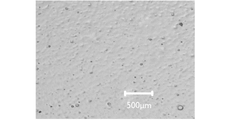
- FIG. 1 shows a micrograph of the surface of the film to be evaluated during the evaluation of foamability.
- Example 2 Production of acrylic polymer B
- Polymerization was carried out in the same manner as in Example 1 except that the amount of DSS continuously added to the reactor was changed to 4.995 parts to obtain a polymerized latex.
- the polymerization conversion was 99.7% and the average particle size was 4300 ⁇ .
- a white powdery acrylic polymer B-containing resin composition was obtained in the same manner as in Example 1.
- the weight average molecular weight of the acrylic polymer B was 1.1 million.
- the acrylic polymer B-containing resin composition contains 5.0 parts by weight of DSS with respect to 100 parts by weight of the acrylic polymer B.
- the methanol solubility test of the surfactant, the haze of the solution dope, the foamability of the film, and the haze of the film were evaluated in the same manner as in Example 1. The results are shown in Table 1.
- Example 3 Production of acrylic polymer C
- Polymerization was carried out in the same manner as in Example 2 except that DSS was changed to DBS to obtain a polymerized latex.
- a white powdery acrylic polymer C-containing resin composition was obtained in the same manner as in Example 2.
- the weight average molecular weight of the acrylic polymer C was 900,000.
- the acrylic polymer C-containing resin composition contains 5.0 parts by weight of DBS with respect to 100 parts by weight of the acrylic polymer C.
- the methanol solubility test of the surfactant, the haze of the solution dope, the foamability of the film, and the haze of the film were evaluated in the same manner as in Example 1. The results are shown in Table 1.
- Example 4 Production of acrylic polymer D
- An 8-liter glass reactor equipped with a paddle-type stirrer was charged with 143 parts of deionized water, 0.01 part of sodium hydroxide, and 0.15 parts of DSS. Next, the mixture was stirred at 175 rpm, and the temperature was raised to 85 ° C. while substituting nitrogen in the reactor. After reaching 85 ° C., NPS: 0.022 part and SFS: 0.0005 part were charged. Then, a monomer mixture consisting of MMA: 85 parts, 2-EHMA: 5 parts, and PhMI: 10 parts was continuously added to the reactor over 80 minutes to carry out the reaction.
- the polymerization conversion was 99.9% and the average particle size was 2000 ⁇ .
- the obtained polymerized latex was evaporated to dryness in a drying oven at 75 ° C. for 12 hours to obtain a white powdery acrylic polymer D-containing resin composition.
- the weight average molecular weight of the acrylic polymer D was 1.75 million.
- the acrylic polymer D-containing resin composition contains 1.0 part by weight of DSS with respect to 100 parts by weight of the acrylic polymer D.
- the methanol solubility test of the surfactant, the haze of the solution dope, the foamability of the film, and the haze of the film were evaluated in the same manner as in Example 1. The results are shown in Table 1.
- Example 5 Production of acrylic polymer E
- Polymerization was carried out in the same manner as in Example 2 except that DSS was changed to PSF to obtain a polymerized latex.
- a white powdery acrylic polymer E-containing resin composition was obtained in the same manner as in Example 2.
- the weight average molecular weight of the acrylic polymer E was 1 million.
- the acrylic polymer E-containing resin composition contains 5.0 parts by weight of PSF with respect to 100 parts by weight of the acrylic polymer E.
- the methanol solubility test of the surfactant, the haze of the solution dope, the foamability of the film, and the haze of the film were evaluated in the same manner as in Example 1. The results are shown in Table 1.
- the suspended slurry containing the bead-like particles was evaporated to dryness in a drying oven at 50 ° C. for 24 hours to obtain an acrylic polymer F-containing resin composition.
- the weight average molecular weight of the acrylic polymer F was 1 million.
- the acrylic polymer F-containing resin composition contains 0.4 parts by weight of HPMC with respect to 100 parts by weight of the acrylic polymer F.
- HPMC is a nonionic surfactant and does not correspond to an ionic emulsifier.
- the methanol solubility test of the surfactant, the haze of the solution dope, the foamability of the film, and the haze of the film were evaluated in the same manner as in Example 1. The results are shown in Table 1. Further, FIG. 2 shows a micrograph of the surface of the film to be evaluated during the evaluation of foamability.
- the acrylic polymers A to E-containing resin compositions of Examples 1 to 5 have a solution-doped haze of 5% or less, and the acrylic is formed by forming a film of the composition by a solution casting method. It can be seen that the foamability of the based resin film is very good, and a film having a beautiful appearance can be obtained. Further, it can be seen that the haze of the acrylic resin film is 2% or less, and a highly transparent film is obtained. Such an acrylic resin film having a beautiful appearance and high transparency can be suitably applied to an optical film such as a polarizing element protective film.
- the acrylic polymer F-containing resin composition of Comparative Example 1 containing no ionic emulsifier and containing a non-ionic surfactant had a solution-doped haze of more than 5%, and the composition was used.
- the foamability of the acrylic resin film formed by the solution casting method was evaluated low, and a film with a beautiful appearance could not be obtained.
Landscapes
- Chemical & Material Sciences (AREA)
- Health & Medical Sciences (AREA)
- Chemical Kinetics & Catalysis (AREA)
- Medicinal Chemistry (AREA)
- Polymers & Plastics (AREA)
- Organic Chemistry (AREA)
- Engineering & Computer Science (AREA)
- Physics & Mathematics (AREA)
- Mechanical Engineering (AREA)
- General Physics & Mathematics (AREA)
- Optics & Photonics (AREA)
- Manufacturing & Machinery (AREA)
- Materials Engineering (AREA)
- Compositions Of Macromolecular Compounds (AREA)
- Moulding By Coating Moulds (AREA)
- Polarising Elements (AREA)
Abstract
Description
特許文献1には、アクリル樹脂を溶液流延法でフィルム製造する際、乾燥工程での残留溶媒量や温度等の条件を最適化することによって、得られるフィルムの白化や、フィルムに発生する気泡を抑制する技術が開示されている。
好ましくは、前記イオン系乳化剤が,スルホン酸塩である。
好ましくは、前記スルホン酸塩が、リチウム塩、ナトリウム塩、及び、カリウム塩からなる群より選択される少なくとも1種を含む。
好ましくは、前記スルホン酸塩が、ジアルキルスルホコハク酸塩、アルカンスルホン酸塩、アルファオレフィンスルホン酸塩、アルキルベンゼンスルホン酸塩、ナフタレンスルホン酸塩-ホルムアルデヒド縮合物、アルキルナフタレンスルホン酸塩、及び、N-メチル-N-アシルタウリン塩からなる群より選択される少なくとも1種を含む。
好ましくは、前記共重合可能な他の単量体単位が、エステル部位の炭素数が1~20である(メタ)アクリル酸エステル単位(ただし、メタクリル酸メチルを除く)、及び/又は、マレイミド単位を含む。
好ましくは、前記共重合可能な他の単量体単位の含有量が、前記アクリル系重合体の構成単位全量のうち0.1重量%~50重量%である。
前記アクリル系樹脂組成物は、前記アクリル系重合体100重量部に対して、コア・シェル構造を有するグラフト共重合体1重量部~50重量部をさらに含んでもよい。
好ましくは、前記アクリル系重合体の重量平均分子量が50万以上である。
好ましくは、塩化メチレン95重量%とメタノール5重量%の混合溶媒中に、前記アクリル系樹脂組成物を5重量%濃度で含む溶液ドープのヘイズが、5%以下である。
また本発明は、前記アクリル系樹脂組成物を溶液流延法で成形してなる樹脂フィルムにも関する。
好ましくは、前記樹脂フィルムのヘイズが2%以下である。
好ましくは、前記樹脂フィルムが、他基材表面への積層保護用フィルムである。
好ましくは、前記樹脂フィルムが、偏光子保護フィルムである。
さらに本発明は、偏光子と、前記樹脂フィルムを積層してなる偏光板にも関し、また、前記偏光板を含む、ディスプレイ装置にも関する。
また、本発明は、前記アクリル系樹脂組成物を製造する方法であって、イオン系乳化剤の存在下で乳化重合又は懸濁重合を実施し、前記アクリル系重合体と水を含む混合液を得る工程、及び前記混合液に対して、洗浄操作を実施することなく、乾燥操作を実施する工程、を含む、製造方法にも関する。
さらにまた、本発明は、前記アクリル系樹脂組成物と溶媒を含むドープを溶液流延法でフィルム成形する工程を含む、樹脂フィルムの製造方法にも関する。
好ましくは、前記溶媒は、アルコールを1~25重量%含む。
好ましくは、前記アルコールが、エタノール及び/又はメタノールである。
本発明に係るアクリル系樹脂組成物を用いて溶液流延法で製造したアクリル系樹脂フィルムは、フィルム表面に製膜乾燥時の発泡痕が生じにくく、外観に優れており、透明性の高いフィルムであり得る。このようなアクリル系樹脂フィルムは、光学欠陥が少なく、光取出し効率が高いため、液晶表示部材用の光学フィルム、特に、偏光子保護フィルムとして好適に用いることができる。
本発明のアクリル系樹脂組成物は、メタクリル酸メチル単位30~100重量%、及び、これと共重合可能な他の単量体単位0~70重量%を構成単位とするアクリル系重合体と、イオン系乳化剤とを少なくとも含み、前記イオン系乳化剤の含有量が前記アクリル系重合体100重量部に対して0.1重量部~10重量部である。このような組成とすることによって、溶液流延法で樹脂フィルムを作製する際、乾燥工程による発泡痕が生じにくく、透明性の高いフィルムを得ることができる。
本実施形態に係るアクリル系樹脂組成物に含まれるアクリル系重合体は、メタクリル酸メチル単位30~100重量%、及び、これと共重合可能な他の単量体単位0~70重量%を構成単位とする。
また、溶融押出によって製膜する場合には、アクリル系重合体を溶融させて粘度を下げる必要があるため、重合体の分子量を比較的低くする必要がある。しかし、本実施形態では溶液流延法によって製膜するため、重合体が高分子量のものであっても容易に成膜が可能である。この観点から、前記アクリル系重合体の重量平均分子量は50万以上であってもよい。
重量平均分子量は、ゲルパーミエーションクロマトグラフィー(GPC)を用い、標準ポリスチレン換算法により算出することができる。
本実施形態に係るアクリル系重合体の製造方法は、発明の効果を発現しうる方法であれば特に限定されないが、アクリル系重合体の構造設計の自由度や、重合の簡便さ、生産性等の観点から、乳化重合法又は懸濁重合法により製造されることが好ましい。
特に、主鎖にマレイミド環構造を含むアクリル系重合体においては、重合過程で反応せずに残存したマレイミドモノマーが加水分解してアクリル系重合体を変色させる傾向にある。効果的に残存マレイミドモノマーを減少させることができるため、乳化重合法を用いて製造することが好ましい。
そこで、本実施形態に係るアクリル系樹脂組成物を製造する際には、乳化重合が終了した後の反応系に対して、洗浄操作を実施せず、乾燥操作のみを実施することが好ましい。乾燥操作のみによって回収されたアクリル系重合体はイオン系乳化剤を含んでいるため、本実施形態に係るアクリル系樹脂組成物を構成することができる。
前記イオン系乳化剤の種類は、発明の効果を発現しうるアクリル系樹脂組成物を提供するために使用されるものであれば特に限定はされず、公知のものを使用することができる。例えばカルボン酸塩、スルホン酸塩、硫酸エステル型、リン酸エステル型などが挙げられるが、製膜乾燥時の発泡痕を高度に抑制することができる上、重合安定性にも優れることから、スルホン酸塩が好ましい。
本実施形態に係るアクリル系樹脂組成物は、コア・シェル構造を有するグラフト共重合体をさらに含むものであっても良い。また、溶液流延法においてドープを形成する時に、前記アクリル系樹脂組成物とコア・シェル構造を有するグラフト共重合体をそれぞれ、溶媒に添加しても良い。コア・シェル構造を有するグラフト共重合体は、アクリル系樹脂フィルムに、耐折り曲げ性や耐割れ性等の機械的強度を付与することができる。
また、例えば、グラフト共重合体が塩化カルシウムや塩化マグネシウム等の凝固剤を用いて造粒される場合には、前記イオン系乳化剤が多価陽イオンの塩として存在することになる。そのため、グラフト共重合体を公知の洗浄方法を用いて洗浄し、グラフト共重合体中の塩の含有量を低減しておくことが、樹脂フィルムの発泡痕を抑制する観点からは好ましい。
溶液流延法を用いてアクリル系樹脂フィルムを製造する際、前記アクリル系樹脂組成物に、適宜、光安定剤、紫外線吸収剤、熱安定剤、酸化防止剤、艶消し剤、光拡散剤、着色剤、染料、顔料、帯電防止剤、熱線反射材、滑剤、可塑剤、フィラー等の公知の添加剤、又は、アクリロニトリル・スチレン樹脂、メタクリル酸メチル・スチレン樹脂、スチレン・無水マレイン酸樹脂などのスチレン系樹脂、ポリカーボネート樹脂、ポリビニルアセタール樹脂、セルロースアシレート樹脂、ポリフッ化ビニリデンやポリフッ化アルキル(メタ)アクリレート樹脂などのフッ素系樹脂、シリコーン系樹脂、ポリオレフィン系樹脂、ポリエチレンテレフタレート樹脂、ポリブチレンテレフタレート樹脂等、その他の樹脂、また、形成されるフィルムの配向複屈折を調整する意味合いで、特許第3648201号公報や、特許第4336586号公報に記載の複屈折性を有する無機微粒子や、特許第3696649号公報に記載の複屈折性を有する、分子量5000以下、好ましくは、1000以下の低分子化合物を適宜、混合させて溶液ドープを作製してもよい。
本実施形態に係るアクリル系樹脂組成物は、溶液流延法を用いて樹脂フィルムを製造するために使用される。具体的には、前記アクリル系樹脂組成物が良好に溶解する、いわゆる良溶媒へ溶解させて作製した溶液ドープを調製し、その後、作製したドープを支持体表面に流延した後、溶剤を蒸発させることにより、樹脂フィルムを製造することができる。
前記アルコールを添加することで、ドープの乾燥効率が上がるほか、蒸発するアルコールがフィルム内に存在していた箇所に多数の空隙を作り、フィルムを疎膜化する結果、偏光子等の他基材との密着性に優れたフィルムを得ることができる。
前記アルコールの添加量は、ドープに添加する溶媒総量中、1~25重量%であることが好ましく、2~20重量%がより好ましく、3~15重量%がさらに好ましい。
本実施形態に係る樹脂フィルムは、前述した溶液ドープを用い、溶液流延法により形成される。樹脂フィルムの厚みは特に限定されないが、5~200μmであることが好ましく、5~100μmであることがより好ましい。樹脂フィルムの厚みが200μm以下であると、成形後の冷却が均一となるため、光学特性が均一になったり、乾燥速度が速くなる傾向がある。また、樹脂フィルムの厚みが5μm以上であると、樹脂フィルムの取り扱いが容易となり、保護膜としての機能に優れる傾向がある。
Re=(nx-ny)×d
Rth=((nx+ny)/2-nz)×d
上記式中において、nx、ny、およびnzは、それぞれ面内において伸張方向(ポリマー鎖の配向方向)をX軸、X軸に垂直な方向をY軸、成形体の厚さ方向をZ軸とし、それぞれの軸方向の屈折率を表す。また、dは成形体の厚さを表し、nx-nyは配向複屈折を表す。なお、成形体のMD方向をX軸とするが、延伸成形体の場合は延伸方向をX軸とする。
アクリル系重合体の重量平均分子量(Mw)は、ゲルパーミエーションクロマトグラフィー(GPC)を用いた標準ポリスチレン換算法により算出した。GPCカラムとして、ポリスチレン架橋ゲルを充填したもの(型式:Shodex GPC K-806M、昭和電工株式会社製)を、GPC溶媒としてクロロホルムを用いた。試料溶液は、アクリル系樹脂組成物の樹脂粉末5mgをクロロホルム2mlに溶解させて調製し、カラム温度は40℃に設定した。
Microtrac UPA150(日機装株式会社製)を使用し、動的光散乱法の原理に基づき、アクリル系重合体の重合ラテックスの体積平均粒子径を求めた。
Microtrac MT3300EXII(日機装株式会社製)を使用し、レーザー回折散乱法の原理に基づき、ビーズ状粒子の体積平均粒子径を求めた。
アクリル系重合体のガラス転移温度(Tg)は、示差走査熱量計(DSC、型式:Q1000、TA instruments製)を用いて測定した。試料を窒素気流下におき、10℃/分の昇温速度で、200℃まで加熱した後、40℃まで急冷し、再度、10℃/分の昇温速度で、200℃まで加熱した。二度目の昇温中に観測されたガラス転移に対して、補外ガラス転移開始温度と、補外ガラス転移終了温度の平均を求め、この数値をガラス転移温度(Tg)とした。
アクリル系重合体の製造で使用する界面活性剤を15mg計量し(液体のものは蒸発乾固させて乾燥粉末を取得)、10mlのメタノールへ加え、目視でメタノールへの溶解性を確認した。溶解性の指標は以下とした。
〇(可溶)
△(溶解するが、時間がかかる)
×(不溶)
「〇(可溶)」は、界面活性剤の乾燥粉末をメタノールに加え、振とうすると、速やかにメタノールに溶解することを意味する。一方、「△(溶解するが、時間がかかる)」は、界面活性剤の乾燥粉末をメタノールに加えた後、しばらくは変化が認められないが、しばらく振とうを続けると、徐々に溶解し、最終的には溶解することを意味する。また、「×(不溶)」は、振とうを続けても溶解しないことを意味する。
塩化メチレン:メタノール=95:5の重量比からなる混合溶媒を調製し、この混合溶媒に、固形分濃度が5重量%となるように、アクリル系樹脂組成物の粉末を加えた後、スターラーチップで攪拌、混合し、溶液ドープを作製した。得られた溶液ドープを、脱泡後、ヘイズメーター(日本電色工業株式会社製 HAZE MeterNDH4000)を用い、塩化メチレン:メタノール=95:5の重量比からなる混合溶媒を標準サンプルとしてセットゼロした後、ヘイズ測定した。
塩化メチレン:メタノール=80:20の重量比からなる混合溶媒を調製し、この溶媒に、固形分濃度が10重量%となるように、アクリル系樹脂組成物を加えた後、スターラーチップで攪拌、混合し、溶液ドープを作製した。次に、バーコーターを用いて、ガラス板上に1.1mmの厚みで該溶液ドープを溶液流延法で製膜し、10分間保持した。次に得られたフィルムを素早く5.5cm×5.5cmのサイズにカットし、6cm×6cmの金枠に把持させた状態で、190℃の乾燥オーブンに入れ、10分間乾燥させた。
1(表面全体に発泡痕が認められる)
2(表面全体ではないが、発泡痕が認められ、その数も多い)
3(表面に発泡痕が認められるが、その数は少ない)
4(表面に僅かに発泡痕が認められるが、概ね綺麗な表面)
5(表面に発泡痕が無く、非常に綺麗な表面)
塩化メチレン:メタノール=80:20の重量比からなる溶媒を作製し、この溶媒に、固形分濃度が10重量%となるように、アクリル系樹脂組成物を加えた後、スターラーチップで攪拌、混合し、溶液ドープを作製した。次に、バーコーターを用いて、ガラス板上に1.1mmの厚みで該溶液ドープを溶液流延法で製膜し、10分間保持した。フィルムをガラス板から剥がして厚みを測定したところ、フィルムの平均膜厚は40μmであった。得られたフィルムのヘイズを、ヘイズメーター(スガ試験機株式会社製HZ-V3)を用い、JIS K7105に記載の方法にて測定した。
MMA:メタクリル酸メチル
BMA:メタクリル酸n-ブチル
2-EHMA:メタクリル酸2-エチルヘキシル
PhMI:N-フェニルマレイミド
DSS:ジオクチルスルホコハク酸ナトリウム
DBS:ドデシルベンゼンスルホン酸ナトリウム
NPS:過硫酸ナトリウム
NDS:ピロ亜硫酸ナトリウム
SFS:スルホキシル酸ナトリウム・ホルムアルデヒド
ED:エチレンジアミン4酢酸・2ナトリウム
FeSO4:硫酸第一鉄・7水和物
2-EHTG:チオグリコール酸2-エチルヘキシル
LPO:過酸化ラウロイル
t-BHP:t-ブチルハイドロパーオキサイド
PSF:半硬化牛脂肪酸カリウム
HPMC:ヒドロキシプロピルメチルセルロース
パドル型撹拌機を備えた8リットルガラス製反応器に、脱イオン水:143部、水酸化ナトリウム:0.01部、DSS:0.005部を仕込んだ。次に175rpmで攪拌し、反応器内を窒素置換しながら、80℃に昇温した。80℃到達後、NPS:0.03部、NDS:0.001部を仕込んだ。その後、MMA:90部、BMA:10部、2-EHTG:0.015部からなる単量体混合物を、80分間かけて連続的に反応器に加え、反応を行った。また、単量体混合物の添加から15分目に、単量体混合物の添加と追随する形でDSS:0.495部を滴下し、連続的に反応器に加えた。なお、単量体混合物の添加開始から50分目に200rpmへ、また、70分目に240rpmへ攪拌数を上げた。単量体混合物の添加終了後、60分間、反応を継続し、重合を完結させ重合ラテックスを得た。重合転化率は99.5%、平均粒子径は4500Åであった。次に、得られた重合ラテックスを75℃の乾燥オーブンで12時間、蒸発乾固させ、白色粉末状のアクリル系重合体A含有樹脂組成物を得た。アクリル系重合体Aの重量平均分子量は100万であり、重合で使用したDSSのメタノール溶解性は〇(可溶)であった。アクリル系重合体A含有樹脂組成物は、アクリル系重合体A 100重量部に対してDSSを0.5重量部含有する。
連続的に反応器に加えるDSSの量を4.995部に変更した以外は、実施例1と同様の方法で重合を行い、重合ラテックスを得た。重合転化率は99.7%、平均粒子径は4300Åであった。得られた重合ラテックスを用いて実施例1と同様の方法で、白色粉末状のアクリル系重合体B含有樹脂組成物を得た。アクリル系重合体Bの重量平均分子量は110万であった。アクリル系重合体B含有樹脂組成物は、アクリル系重合体B 100重量部に対してDSSを5.0重量部含有する。界面活性剤のメタノール溶解性試験、溶液ドープのヘイズ、フィルムの発泡性、及びフィルムのヘイズを実施例1と同様にして評価を行った。結果を表1に示す。
DSSをDBSに変更した以外は、実施例2と同様の方法で重合を行い、重合ラテックスを得た。得られた重合ラテックスを用い、実施例2と同様の方法で、白色粉末状のアクリル系重合体C含有樹脂組成物を得た。アクリル系重合体Cの重量平均分子量は90万であった。アクリル系重合体C含有樹脂組成物は、アクリル系重合体C 100重量部に対してDBSを5.0重量部含有する。界面活性剤のメタノール溶解性試験、溶液ドープのヘイズ、フィルムの発泡性、及びフィルムのヘイズを実施例1と同様にして評価を行った。結果を表1に示す。
パドル型撹拌機を備えた8リットルガラス製反応器に、脱イオン水:143部、水酸化ナトリウム:0.01部、DSS:0.15部を仕込んだ。次に175rpmで攪拌し、反応器内を窒素置換しながら、85℃に昇温した。85℃到達後、NPS:0.022部、SFS:0.0005部を仕込んだ。その後、MMA:85部、2-EHMA:5部、PhMI:10部からなる単量体混合物を、80分間かけて連続的に反応器に加え、反応を行った。また、単量体混合物の添加から15分目に、単量体混合物の添加と追随する形でDSS:0.55部を滴下し、連続的に反応器に加えた。なお、単量体混合物の添加開始から55分目に200rpmへ、また、70分目に240rpmへ攪拌数を上げた。単量体混合物の添加終了後、ED:0.0055部、FeSO4:0.0015部の混合水溶液、SFS:0.03部、DSS:0.3部、t-BHP:0.03部、を順に反応器に添加した。その後、60分間、反応を継続し、重合を完結させ、重合ラテックスを得た。重合転化率は99.9%、平均粒子径は2000Åであった。次に、得られた重合ラテックスを75℃の乾燥オーブンで12時間、蒸発乾固させ、白色粉末状のアクリル系重合体D含有樹脂組成物を得た。アクリル系重合体Dの重量平均分子量は175万であった。アクリル系重合体D含有樹脂組成物は、アクリル系重合体D 100重量部に対してDSSを1.0重量部含有する。界面活性剤のメタノール溶解性試験、溶液ドープのヘイズ、フィルムの発泡性、及びフィルムのヘイズを実施例1と同様にして評価を行った。結果を表1に示す。
DSSをPSFに変更した以外は、実施例2と同様の方法で重合を行い、重合ラテックスを得た。得られた重合ラテックスを用い、実施例2と同様の方法で、白色粉末状のアクリル系重合体E含有樹脂組成物を得た。アクリル系重合体Eの重量平均分子量は100万であった。アクリル系重合体E含有樹脂組成物は、アクリル系重合体E 100重量部に対してPSFを5.0重量部含有する。界面活性剤のメタノール溶解性試験、溶液ドープのヘイズ、フィルムの発泡性、及びフィルムのヘイズを実施例1と同様にして評価を行った。結果を表1に示す。
パドル型撹拌機を備えた8リットルガラス製反応器に、脱イオン水:170部、無水リン酸水素2ナトリウム:0.1部を仕込んだ。次に300rpmで攪拌し、反応器内を窒素置換しながら、40℃に昇温した。LPO:0.3部を反応器に仕込んだ後、MMA:90部、BMA:10部、2-EHTG:0.02部からなる単量体混合物を、30分間かけて連続的に反応器に加えた。単量体混合物の添加終了から30分後に、HPMC(メトローズ60SH50:信越化学工業株式会社製)0.4部を、30分間かけて連続的に反応器に仕込んだ。30分後、反応器内を昇温し、内温が65℃に到達した時点から反応を開始させた。反応開始から100分目に、反応器の内温は最大85℃まで到達し、その後、内温は緩やかに低下した。その後、反応器の内温を95℃まで昇温し、60分間保持して重合を完結させた。得られたビーズ状粒子の体積平均粒子径は50μmであった。ビーズ状粒子を含む懸濁スラリーを、50℃の乾燥オーブンで24時間、蒸発乾固させ、アクリル系重合体F含有樹脂組成物を得た。アクリル系重合体Fの重量平均分子量は100万であった。アクリル系重合体F含有樹脂組成物は、アクリル系重合体F 100重量部に対してHPMCを0.4重量部含有する。尚、HPMCは非イオン系の界面活性剤であり、イオン系乳化剤には該当しない。界面活性剤のメタノール溶解性試験、溶液ドープのヘイズ、フィルムの発泡性、及びフィルムのヘイズを実施例1と同様にして評価を行った。結果を表1に示す。また、発泡性評価の際に評価対象のフィルム表面を撮影した顕微鏡写真を図2に示す。

一方、イオン系乳化剤を含まず、非イオン系の界面活性剤を含有する比較例1のアクリル系重合体F含有樹脂組成物は、溶液ドープのヘイズが5%を超えており、該組成物を溶液流延法で製膜したアクリル系樹脂フィルムの発泡性は低い評価で、外観美麗なフィルムを得ることができなかった。
Claims (19)
- メタクリル酸メチル単位30~100重量%、及び、これと共重合可能な他の単量体単位0~70重量%を構成単位とするアクリル系重合体と、イオン系乳化剤とを含み、前記イオン系乳化剤の含有量が前記アクリル系重合体100重量部に対して0.1重量部~10重量部である、溶液流延法によるフィルム製造用アクリル系樹脂組成物。
- 前記イオン系乳化剤が,スルホン酸塩である、請求項1に記載の溶液流延法によるフィルム製造用アクリル系樹脂組成物。
- 前記スルホン酸塩が、リチウム塩、ナトリウム塩、及び、カリウム塩からなる群より選択される少なくとも1種を含む、請求項2に記載の溶液流延法によるフィルム製造用アクリル系樹脂組成物。
- 前記スルホン酸塩が、ジアルキルスルホコハク酸塩、アルカンスルホン酸塩、アルファオレフィンスルホン酸塩、アルキルベンゼンスルホン酸塩、ナフタレンスルホン酸塩-ホルムアルデヒド縮合物、アルキルナフタレンスルホン酸塩、及び、N-メチル-N-アシルタウリン塩からなる群より選択される少なくとも1種を含む、請求項2又は3に記載の溶液流延法によるフィルム製造用アクリル系樹脂組成物。
- 前記共重合可能な他の単量体単位が、エステル部位の炭素数が1~20である(メタ)アクリル酸エステル単位(ただし、メタクリル酸メチルを除く)、及び/又は、マレイミド単位を含む、請求項1~4のいずれか1項に記載の溶液流延法によるフィルム製造用アクリル系樹脂組成物。
- 前記共重合可能な他の単量体単位の含有量が、前記アクリル系重合体の構成単位全量のうち0.1重量%~50重量%である、請求項1~5のいずれか1項に記載の溶液流延法によるフィルム製造用アクリル系樹脂組成物。
- 前記アクリル系重合体100重量部に対して、コア・シェル構造を有するグラフト共重合体1重量部~50重量部をさらに含む、請求項1~6のいずれか1項に記載の溶液流延法によるフィルム製造用アクリル系樹脂組成物。
- 前記アクリル系重合体の重量平均分子量が50万以上である、請求項1~7のいずれか1項に記載の溶液流延法によるフィルム製造用アクリル系樹脂組成物。
- 塩化メチレン95重量%とメタノール5重量%の混合溶媒中に、前記アクリル系樹脂組成物を5重量%濃度で含む溶液ドープのヘイズが、5%以下である、請求項1~8のいずれか1項に記載の溶液流延法によるフィルム製造用アクリル系樹脂組成物。
- 請求項1~9のいずれか1項に記載のアクリル系樹脂組成物を溶液流延法で成形してなる樹脂フィルム。
- 前記樹脂フィルムのヘイズが2%以下である、請求項10に記載の樹脂フィルム。
- 前記樹脂フィルムが、他基材表面への積層保護用フィルムである、請求項10又は11に記載の樹脂フィルム。
- 前記樹脂フィルムが、偏光子保護フィルムである、請求項10~12のいずれか1項に記載の樹脂フィルム。
- 偏光子と、請求項13に記載の樹脂フィルムを積層してなる偏光板。
- 請求項14に記載の偏光板を含む、ディスプレイ装置。
- 請求項1~9のいずれか1項に記載のアクリル系樹脂組成物を製造する方法であって、
イオン系乳化剤の存在下で乳化重合又は懸濁重合を実施し、前記アクリル系重合体と水を含む混合液を得る工程、及び
前記混合液に対して、洗浄操作を実施することなく、乾燥操作を実施する工程、を含む、製造方法。 - 請求項1~9のいずれか1項に記載のアクリル系樹脂組成物と溶媒を含むドープを溶液流延法でフィルム成形する工程を含む、樹脂フィルムの製造方法。
- 前記溶媒は、アルコールを1~25重量%含む、請求項17に記載の樹脂フィルムの製造方法。
- 前記アルコールが、エタノール及び/又はメタノールである、請求項18に記載の樹脂フィルムの製造方法。
Priority Applications (3)
| Application Number | Priority Date | Filing Date | Title |
|---|---|---|---|
| CN202180083076.3A CN116615487A (zh) | 2020-12-11 | 2021-12-10 | 丙烯酸系树脂组合物和树脂薄膜 |
| JP2022568350A JPWO2022124402A1 (ja) | 2020-12-11 | 2021-12-10 | |
| US18/332,448 US20230312905A1 (en) | 2020-12-11 | 2023-06-09 | Acrylic resin composition and resin film |
Applications Claiming Priority (2)
| Application Number | Priority Date | Filing Date | Title |
|---|---|---|---|
| JP2020-206288 | 2020-12-11 | ||
| JP2020206288 | 2020-12-11 |
Related Child Applications (1)
| Application Number | Title | Priority Date | Filing Date |
|---|---|---|---|
| US18/332,448 Continuation US20230312905A1 (en) | 2020-12-11 | 2023-06-09 | Acrylic resin composition and resin film |
Publications (1)
| Publication Number | Publication Date |
|---|---|
| WO2022124402A1 true WO2022124402A1 (ja) | 2022-06-16 |
Family
ID=81974562
Family Applications (1)
| Application Number | Title | Priority Date | Filing Date |
|---|---|---|---|
| PCT/JP2021/045605 Ceased WO2022124402A1 (ja) | 2020-12-11 | 2021-12-10 | アクリル系樹脂組成物、及び樹脂フィルム |
Country Status (4)
| Country | Link |
|---|---|
| US (1) | US20230312905A1 (ja) |
| JP (1) | JPWO2022124402A1 (ja) |
| CN (1) | CN116615487A (ja) |
| WO (1) | WO2022124402A1 (ja) |
Cited By (1)
| Publication number | Priority date | Publication date | Assignee | Title |
|---|---|---|---|---|
| WO2024122626A1 (ja) * | 2022-12-08 | 2024-06-13 | 株式会社カネカ | アクリル樹脂粉粒体およびフィルム |
Citations (7)
| Publication number | Priority date | Publication date | Assignee | Title |
|---|---|---|---|---|
| JPH06172466A (ja) * | 1992-05-26 | 1994-06-21 | Dainippon Ink & Chem Inc | 共重合体樹脂水性分散液 |
| JP2007077180A (ja) * | 2005-09-09 | 2007-03-29 | Dai Ichi Kogyo Seiyaku Co Ltd | 乳化重合用乳化剤組成物 |
| JP2017052921A (ja) * | 2015-09-11 | 2017-03-16 | 株式会社カネカ | フィルム |
| WO2017200032A1 (ja) * | 2016-05-19 | 2017-11-23 | 株式会社クラレ | メタクリル樹脂組成物および成形体 |
| JP2019006865A (ja) * | 2017-06-22 | 2019-01-17 | 株式会社クラレ | メタクリル樹脂組成物 |
| WO2020067218A1 (ja) * | 2018-09-28 | 2020-04-02 | 株式会社クラレ | アクリルフィルムの製造方法 |
| JP2020147697A (ja) * | 2019-03-14 | 2020-09-17 | 株式会社クラレ | アクリル系樹脂フィルム及びその製造方法 |
Family Cites Families (6)
| Publication number | Priority date | Publication date | Assignee | Title |
|---|---|---|---|---|
| US7709572B2 (en) * | 2007-10-13 | 2010-05-04 | Konica Minolta Opto, Inc. | Optical film, polarizing plate and display device using the same, and manufacturing method thereof |
| EP2439232B1 (en) * | 2009-06-01 | 2016-02-10 | Kaneka Corporation | Processability improver for foam molding and vinyl chloride resin composition containing same |
| WO2012005208A1 (ja) * | 2010-07-06 | 2012-01-12 | コニカミノルタオプト株式会社 | 光学フィルム用ドープの製造方法、光学フィルムの製造方法、光学フィルム、偏光板、及び液晶表示装置 |
| JP7201607B2 (ja) * | 2017-10-16 | 2023-01-10 | 株式会社カネカ | 粉体成形用塩化ビニル系樹脂組成物、塩化ビニル系樹脂成形体及び積層体 |
| WO2019167471A1 (ja) * | 2018-02-27 | 2019-09-06 | 株式会社カネカ | 溶液流延法によるフィルム製造用樹脂組成物及びドープ |
| WO2022131365A1 (ja) * | 2020-12-17 | 2022-06-23 | 株式会社カネカ | グラフト共重合体及び樹脂フィルム |
-
2021
- 2021-12-10 CN CN202180083076.3A patent/CN116615487A/zh active Pending
- 2021-12-10 JP JP2022568350A patent/JPWO2022124402A1/ja active Pending
- 2021-12-10 WO PCT/JP2021/045605 patent/WO2022124402A1/ja not_active Ceased
-
2023
- 2023-06-09 US US18/332,448 patent/US20230312905A1/en active Pending
Patent Citations (7)
| Publication number | Priority date | Publication date | Assignee | Title |
|---|---|---|---|---|
| JPH06172466A (ja) * | 1992-05-26 | 1994-06-21 | Dainippon Ink & Chem Inc | 共重合体樹脂水性分散液 |
| JP2007077180A (ja) * | 2005-09-09 | 2007-03-29 | Dai Ichi Kogyo Seiyaku Co Ltd | 乳化重合用乳化剤組成物 |
| JP2017052921A (ja) * | 2015-09-11 | 2017-03-16 | 株式会社カネカ | フィルム |
| WO2017200032A1 (ja) * | 2016-05-19 | 2017-11-23 | 株式会社クラレ | メタクリル樹脂組成物および成形体 |
| JP2019006865A (ja) * | 2017-06-22 | 2019-01-17 | 株式会社クラレ | メタクリル樹脂組成物 |
| WO2020067218A1 (ja) * | 2018-09-28 | 2020-04-02 | 株式会社クラレ | アクリルフィルムの製造方法 |
| JP2020147697A (ja) * | 2019-03-14 | 2020-09-17 | 株式会社クラレ | アクリル系樹脂フィルム及びその製造方法 |
Cited By (1)
| Publication number | Priority date | Publication date | Assignee | Title |
|---|---|---|---|---|
| WO2024122626A1 (ja) * | 2022-12-08 | 2024-06-13 | 株式会社カネカ | アクリル樹脂粉粒体およびフィルム |
Also Published As
| Publication number | Publication date |
|---|---|
| US20230312905A1 (en) | 2023-10-05 |
| CN116615487A (zh) | 2023-08-18 |
| JPWO2022124402A1 (ja) | 2022-06-16 |
Similar Documents
| Publication | Publication Date | Title |
|---|---|---|
| JP6986510B2 (ja) | 樹脂組成物、その成形体及びフィルム | |
| JP6871154B2 (ja) | アクリル系樹脂組成物、その成形体及びフィルム | |
| US11066544B2 (en) | Optical resin composition and molded article | |
| US10184019B2 (en) | Optical thermoplastic resin and formed body | |
| TW201525048A (zh) | 光學用樹脂組合物及膜 | |
| TWI646141B (zh) | Optical resin composition and film | |
| JP6331680B2 (ja) | 樹脂組成物およびフィルム | |
| JP6753682B2 (ja) | 光学フィルムおよびその製造方法 | |
| CN103314020A (zh) | 甲基丙烯酸甲酯聚合物的制造方法 | |
| JP7145150B2 (ja) | フィルム製造用ドープ、及びフィルムの製造方法 | |
| WO2022124402A1 (ja) | アクリル系樹脂組成物、及び樹脂フィルム | |
| JP5433328B2 (ja) | 位相差フィルム | |
| JP7834656B2 (ja) | グラフト共重合体及び樹脂フィルム | |
| JP6913668B2 (ja) | グラフト共重合体、および、それを含有するアクリル系樹脂組成物 | |
| JP7787761B2 (ja) | 樹脂フィルムの製造方法 | |
| JP2024082369A (ja) | アクリル樹脂の製造方法 | |
| WO2024122626A1 (ja) | アクリル樹脂粉粒体およびフィルム | |
| KR101110607B1 (ko) | 위상차 필름 | |
| TW201445191A (zh) | 光學薄膜及影像顯示裝置 |
Legal Events
| Date | Code | Title | Description |
|---|---|---|---|
| 121 | Ep: the epo has been informed by wipo that ep was designated in this application |
Ref document number: 21903498 Country of ref document: EP Kind code of ref document: A1 |
|
| ENP | Entry into the national phase |
Ref document number: 2022568350 Country of ref document: JP Kind code of ref document: A |
|
| WWE | Wipo information: entry into national phase |
Ref document number: 202180083076.3 Country of ref document: CN |
|
| NENP | Non-entry into the national phase |
Ref country code: DE |
|
| 122 | Ep: pct application non-entry in european phase |
Ref document number: 21903498 Country of ref document: EP Kind code of ref document: A1 |