WO2022124241A1 - ゴム組成物及びタイヤ - Google Patents
ゴム組成物及びタイヤ Download PDFInfo
- Publication number
- WO2022124241A1 WO2022124241A1 PCT/JP2021/044587 JP2021044587W WO2022124241A1 WO 2022124241 A1 WO2022124241 A1 WO 2022124241A1 JP 2021044587 W JP2021044587 W JP 2021044587W WO 2022124241 A1 WO2022124241 A1 WO 2022124241A1
- Authority
- WO
- WIPO (PCT)
- Prior art keywords
- rubber
- group
- carbon atoms
- resin
- mass
- Prior art date
- Legal status (The legal status is an assumption and is not a legal conclusion. Google has not performed a legal analysis and makes no representation as to the accuracy of the status listed.)
- Ceased
Links
Classifications
-
- B—PERFORMING OPERATIONS; TRANSPORTING
- B60—VEHICLES IN GENERAL
- B60C—VEHICLE TYRES; TYRE INFLATION; TYRE CHANGING; CONNECTING VALVES TO INFLATABLE ELASTIC BODIES IN GENERAL; DEVICES OR ARRANGEMENTS RELATED TO TYRES
- B60C1/00—Tyres characterised by the chemical composition or the physical arrangement or mixture of the composition
-
- C—CHEMISTRY; METALLURGY
- C08—ORGANIC MACROMOLECULAR COMPOUNDS; THEIR PREPARATION OR CHEMICAL WORKING-UP; COMPOSITIONS BASED THEREON
- C08C—TREATMENT OR CHEMICAL MODIFICATION OF RUBBERS
- C08C19/00—Chemical modification of rubber
- C08C19/22—Incorporating nitrogen atoms into the molecule
-
- C—CHEMISTRY; METALLURGY
- C08—ORGANIC MACROMOLECULAR COMPOUNDS; THEIR PREPARATION OR CHEMICAL WORKING-UP; COMPOSITIONS BASED THEREON
- C08C—TREATMENT OR CHEMICAL MODIFICATION OF RUBBERS
- C08C19/00—Chemical modification of rubber
- C08C19/25—Incorporating silicon atoms into the molecule
-
- C—CHEMISTRY; METALLURGY
- C08—ORGANIC MACROMOLECULAR COMPOUNDS; THEIR PREPARATION OR CHEMICAL WORKING-UP; COMPOSITIONS BASED THEREON
- C08K—Use of inorganic or non-macromolecular organic substances as compounding ingredients
- C08K3/00—Use of inorganic substances as compounding ingredients
- C08K3/01—Use of inorganic substances as compounding ingredients characterized by their specific function
- C08K3/013—Fillers, pigments or reinforcing additives
-
- C—CHEMISTRY; METALLURGY
- C08—ORGANIC MACROMOLECULAR COMPOUNDS; THEIR PREPARATION OR CHEMICAL WORKING-UP; COMPOSITIONS BASED THEREON
- C08L—COMPOSITIONS OF MACROMOLECULAR COMPOUNDS
- C08L15/00—Compositions of rubber derivatives
-
- C—CHEMISTRY; METALLURGY
- C08—ORGANIC MACROMOLECULAR COMPOUNDS; THEIR PREPARATION OR CHEMICAL WORKING-UP; COMPOSITIONS BASED THEREON
- C08L—COMPOSITIONS OF MACROMOLECULAR COMPOUNDS
- C08L23/00—Compositions of homopolymers or copolymers of unsaturated aliphatic hydrocarbons having only one carbon-to-carbon double bond; Compositions of derivatives of such polymers
- C08L23/02—Compositions of homopolymers or copolymers of unsaturated aliphatic hydrocarbons having only one carbon-to-carbon double bond; Compositions of derivatives of such polymers not modified by chemical after-treatment
- C08L23/18—Homopolymers or copolymers of hydrocarbons having four or more carbon atoms
- C08L23/20—Homopolymers or copolymers of hydrocarbons having four or more carbon atoms having four to nine carbon atoms
-
- C—CHEMISTRY; METALLURGY
- C08—ORGANIC MACROMOLECULAR COMPOUNDS; THEIR PREPARATION OR CHEMICAL WORKING-UP; COMPOSITIONS BASED THEREON
- C08L—COMPOSITIONS OF MACROMOLECULAR COMPOUNDS
- C08L9/00—Compositions of homopolymers or copolymers of conjugated diene hydrocarbons
- C08L9/06—Copolymers with styrene
- C08L9/08—Latex
Definitions
- the present invention relates to a rubber composition and a tire.
- tires are desired to have improved handling performance (hereinafter referred to as "WET performance") on wet road surfaces.
- WET performance improved handling performance
- Techniques for enhancing the WET performance of the tire include the use of styrene-butadiene rubber as the rubber component and the inclusion of silica in the rubber composition.
- Patent Document 1 describes WET performance and low heat generation by containing a specific styrene / alkylene block copolymer in the rubber composition. A technique for achieving both of these is disclosed.
- the rubber component contains a polymer with a high glass transition point (high Tg polymer) added to enhance WET performance, and the point of achieving wear resistance and better low heat generation is not mentioned. The improvement was desired.
- an object of the present invention is to provide a rubber composition having low heat generation, excellent WET performance and wear resistance, and a tire having greatly improved rolling resistance, WET performance and wear resistance.
- the gist of the present invention for solving the above-mentioned problems is as follows.
- the rubber composition of the present invention contains a rubber component, a filler, and a resin, and the rubber component is a two-ended alkoxysilane-modified styrene-butadiene rubber, a one-ended alkoxysilane-modified styrene-butadiene rubber, and an emulsified styrene-butadiene rubber.
- the mass ratio of the content of the modified styrene-butadiene rubber to the content of the emulsified styrene-butadiene rubber is less than 1.7 (modified SBR / emulsified SBR ⁇ 1.7).
- the tire of the present invention is characterized in that the rubber composition of the present invention described above is used. With the above configuration, excellent rolling resistance, WET performance and wear resistance can be realized.
- the present invention it is possible to provide a rubber composition having low heat generation, excellent WET performance and wear resistance. Further, according to the present invention, it is possible to provide a tire with greatly improved rolling resistance, WET performance and wear resistance.
- the rubber composition of the present invention is a rubber composition containing a rubber component, a filler, and a resin.
- a rubber component a rubber component that is a rubber component that is a rubber component that is a rubber component that is a rubber component that is a rubber component that is a rubber component that is a rubber component that is a rubber component that is a rubber component that is a rubber component that is a rubber component that is a rubber component that has a rubber component.
- the rubber composition of the present invention contains a rubber component.
- the rubber components include a two-ended alkoxysilane-modified styrene-butadiene rubber (hereinafter, may be referred to as "both-ended alkoxysilane-modified SBR") and a one-ended alkoxysilane-modified styrene-butadiene rubber (hereinafter, "one-ended alkoxysilane-modified”). It may contain at least SBR) and emulsified styrene-butadiene rubber (hereinafter, may be referred to as “emulsified SBR”).
- the two-terminal alkoxysilane-modified SBR and the one-terminal alkoxysilane-modified SBR may be collectively referred to as "modified styrene-butadiene rubber" or "modified SBR".
- modified SBR such as a double-ended alkoxysilane-modified SBR or a single-ended alkoxysilane-modified SBR as the rubber component
- the dispersibility of the filler in the rubber composition can be enhanced, so that the WET performance can be improved. Low heat generation and wear resistance can be improved without deterioration.
- the rubber composition of the present invention can achieve both low heat generation, WET performance and wear resistance at a high level.
- the "alkoxysilane modification" of the one-terminal alkoxysilane-modified SBR and the two-terminal alkoxysilane-modified SBR is a general term for modifying groups having at least one alkoxy group and at least one silane atom. Further, it is preferable that the alkoxysilane modifying group of the modified SBR further has a nitrogen atom.
- the nitrogen atom for example, a primary amino group, a primary amino group protected by a hydrolyzable protective group, an onium salt residue of the primary amine, an isocyanate group, a thioisocyanate group, an imine group, and an imine residue.
- It has a functional group selected from the group consisting of, and is composed of a monovalent hydrocarbon group having 1 to 30 carbon atoms including a linear, branched, alicyclic or aromatic ring, or an oxygen atom, a sulfur atom and a phosphorus atom.
- a monovalent hydrocarbon group having 1 to 30 carbon atoms including a linear, branched, alicyclic or aromatic ring, or an oxygen atom, a sulfur atom and a phosphorus atom examples thereof include monovalent hydrocarbon groups having 1 to 30 carbon atoms including linear, branched, alicyclic or aromatic rings, which may contain at least one selected heteroatom.
- the modified SBR is composed of the one-ended alkoxysilane-modified SBR and the two-ended alkoxysilane-modified SBR (one end or both ends of styrene-butadiene rubber (SBR) is alkoxysilane-modified). This is because the rubber component has a high affinity for the filler and the dispersibility of the filler in the rubber composition can be enhanced. Further, as a method for modifying the modified SBR, for example, various modifying agents are reacted with the terminal of the SBR having an active terminal according to the method described in International Publication No. 2003/046020 and Japanese Patent Application Laid-Open No. 2007-217562. Can be manufactured by.
- the glass transition point (Tg) of the double-ended alkoxysilane-modified SBR is about ⁇ 45 ° C. to ⁇ 15 ° C.
- Tg of the double-ended alkoxysilane-modified SBR is high, the affinity with the filler is high, and more excellent dispersibility of the filler can be obtained.
- the glass transition point (Tg) of the one-terminal alkoxysilane-modified SBR is about ⁇ 60 ° C. to ⁇ 30 ° C.
- the one-ended alkoxysilane-modified SBR is medium, it is possible to achieve a balance between wear resistance, low heat generation, and WET performance.
- the modification agent for obtaining the one-terminal alkoxysilane-modified SBR and the two-terminal alkoxysilane-modified SBR is not particularly limited, but a modification agent containing a compound represented by the following formula (1) is used. Is preferable.
- a conjugated diene-based polymer modified with a modifier containing a compound represented by the formula (1) containing an oligosiloxane as a filler-affinitive acting group and a tertiary amino group as the rubber component.
- Dispersibility of fillers such as silica can be enhanced.
- the rubber composition of the present invention is greatly improved in low heat generation property and the dispersibility of the filler is improved, so that other physical properties such as wear resistance are not deteriorated.
- R 1 to R 8 are independently alkyl groups having 1 to 20 carbon atoms; and L 1 and L 2 are independently alkylene groups having 1 to 20 carbon atoms. Is a group; n is an integer of 2-4.
- R 1 to R 4 may be independently substituted or unsubstituted alkyl groups having 1 to 20 carbon atoms, and when the above R1 to R 4 are substituted. , Independently, an alkyl group having 1 to 10 carbon atoms, a cycloalkyl group having 3 to 10 carbon atoms, an alkoxy group having 1 to 10 carbon atoms, a cycloalkoxy group having 4 to 10 carbon atoms, and an aryl having 6 to 12 carbon atoms.
- Ra is an alkyl group with 1 to 9 carbon atoms
- R1 to R4 may be substituted or unsubstituted alkyl groups having 1 to 10 carbon atoms, and more specifically, the R1 to R4 may be independently substituted or unsubstituted, respectively. It may be an alkyl group having 1 to 6 carbon atoms.
- R 5 to R 8 are independently substituted or unsubstituted alkyl groups having 1 to 20 carbon atoms, and specifically, substituted or unsubstituted alkyl groups having 1 to 10 carbon atoms.
- Alkyl group of, more specifically, a substituted or unsubstituted alkyl group having 1 to 6 carbon atoms may be used, and when substituted, it may be substituted with a substituent as described above in R1 to R4. ..
- R5 to R8 are not alkyl groups but hydrolyzable substituents, the bonds of N - R5R6 and N- R7R8 are hydrolyzed to NH in the presence of water to process the polymer. It can adversely affect sexuality.
- R 1 to R 4 may be a methyl group or an ethyl group
- R 5 to R 8 may be an alkyl group having 1 to 10 carbon atoms. can.
- the amino group in the compound represented by the formula (1) that is, N - R5 R6 and N- R7R8 are preferably tertiary amino groups.
- the tertiary amino group makes it possible to have further excellent processability when the compound represented by the formula (1) is used as a denaturing agent. If a protecting group for protecting an amino group is bound to R 5 to R 8 or hydrogen is bound, it may be difficult to realize the effect of the compound represented by the formula (1). There is sex. When hydrogen is bonded, the anion reacts with hydrogen in the modification process and loses reactivity, making the modification reaction itself impossible.
- the deprotected primary or secondary amino group is deprotected by hydrolysis during post-processing in the state of being bound to the primary or secondary amino group, and the deprotected primary or secondary amino group causes a high viscosity of the formulation during the subsequent compounding. , May cause deterioration of workability.
- L 1 and L 2 in the compound represented by the above formula (1) are independently substituted or unsubstituted alkylene groups having 1 to 20 carbon atoms. More specifically, L 1 and L 2 are independently alkylene groups having 1 to 10 carbon atoms, and more specifically, alkylene groups having 1 to 6 carbon atoms such as a methylene group, an ethylene group or a propylene group. Can be the basis.
- the bond between Si and N may be broken during the subsequent treatment step, and the secondary amino group generated at this time may be washed away by water during the post-treatment.
- the modified conjugated diene-based polymer produced with high properties it is difficult to bond with the silica filler due to the amino group member that promotes the bond with the silica filler, and as a result, the dispersion effect of the dispersant is reduced. There is.
- each of L 1 and L 2 has 1 to 3 carbon atoms such as a methylene group, an ethylene group or a propylene group, respectively.
- the alkylene group of the above is more preferable, and more specifically, it can be a propylene group.
- L 1 and L 2 can be substituted with a substituent as described above in R1 to R4.
- the compound represented by the formula (1) is preferably, for example, any one of the compounds represented by the following formulas (1a) to (1e). This is because better low heat generation can be realized.
- the alkoxysilane structure is bonded to the activated terminal of the conjugated diene polymer, while the Si—O—Si structure and three or more bonded to the terminal are bonded.
- the amino group of the above promotes the bond between the filler and the modified conjugated diene polymer as compared with the conventional modifier containing one amino group in the molecule. Can be done.
- the degree of binding of the activated end of the conjugated diene polymer is uniform and the change in the molecular weight distribution is observed before and after the coupling, the molecular weight distribution does not become larger than before even after the coupling and is constant.
- the physical properties of the modified conjugated diene polymer itself are not deteriorated, the aggregation of the filler in the rubber composition can be prevented, and the dispersibility of the filler can be improved, so that the processability of the rubber composition can be improved. can.
- reaction formula (1) The compound represented by the formula (1) can be produced through a condensation reaction represented by the following reaction formula 1. (Reaction formula 1)
- R1 to R8, L1 and L2, and n are the same as those defined in the above-mentioned formula (1), and R'and R'' are used in the condensation reaction. Any substituent that has no effect.
- the R'and R'' can be independently the same as any one of R 1 to R 4 .
- the reaction of the reaction formula 1 is carried out under acid conditions, and the acid can be used without limitation as long as it is generally used for the condensation reaction. Those skilled in the art can select the optimum acid according to various process variables such as the type of reactor in which the reaction is carried out, the starting material, and the reaction temperature.
- the modified SBR modified by the modifying agent containing the compound represented by the formula (1) has a narrow molecular weight distribution of 1.1 to 3.0: Mw / Mn (also referred to as polydispersity index (PDI)). be able to. If the molecular weight distribution of the modified SBR is more than 3.0 or less than 1.1, the tensile properties and viscoelasticity may deteriorate when applied to the rubber composition. Considering the remarkable effect of improving the tensile properties and viscoelasticity of the polymer by controlling the molecular weight distribution of the modified SBR, the molecular weight distribution of the modified SBR is preferably 1.3 to 2.0.
- the modified SBR is similar to the molecular weight distribution of the styrene-butadiene rubber before the modification by using the modifying agent.
- the molecular weight distribution of the modified SBR can be calculated from the ratio (Mw / Mn) of the weight average molecular weight (Mw) to the logarithmic average molecular weight (Mn).
- the number average molecular weight (Mn) is a common average of individual polymer molecular weights calculated by measuring the molecular weights of n polymer molecules and dividing by n to obtain the total of these molecular weights.
- the weight average molecular weight (Mw) represents the molecular weight distribution of the polymer composition.
- the average total molecular weight can be expressed in grams (g / mol) per mole.
- the weight average molecular weight and the number average molecular weight are polystyrene-equivalent molecular weights analyzed by gel permeation chromatography (GPC), respectively.
- the modified SBR satisfies the above-mentioned condition of molecular weight distribution, and at the same time, has a number average molecular weight (Mn) of 50,000 g / mol to 2,000,000 g / mol, and more specifically, 200,000 g / mol or more. It can be 800,000 g / mol.
- the modified SBR has a weight average molecular weight (Mw) of 100,000 g / mol to 4,000,000 g / mol, and more specifically, it can be 300,000 g / mol to 1,500,000 g / mol.
- the weight average molecular weight (Mw) of the modified SBR is less than 100,000 g / mol or the number average molecular weight (Mn) is less than 50,000 g / mol, there is a risk of deterioration of tensile properties when applied to the rubber composition. There is.
- the weight average molecular weight (Mw) exceeds 4,000,000 g / mol or the number average molecular weight (Mn) exceeds 2,000,000 g / mol, the workability of the rubber composition is reduced due to the deterioration of the processability of the modified SBR. It may be aggravated, difficult to knead, and it may be difficult to sufficiently improve the physical properties of the rubber composition.
- the modified SBR according to an embodiment of the present invention is made of rubber when the conditions of weight average molecular weight (Mw) and number average molecular weight (Mn) are simultaneously satisfied with the molecular weight distribution. It is possible to improve the viscoelasticity and processability of the rubber composition at the time of application to the composition in a well-balanced manner.
- the modified SBR may have a Mooney viscosity (MV) at 100 ° C. of 40 to 140, specifically 60 to 100.
- MV Mooney viscosity
- the Mooney viscosity can be measured with a Mooney viscometer, for example, Monsanto's MV2000E at 100 ° C. using a RotorSpeed 20.02 rpm, Large Rotor.
- the sample used at this time can be left at room temperature (23 ⁇ 3 ° C.) for 30 minutes or more, and then 27 ⁇ 3 g is collected and filled inside the die cavity, and the platen can be operated for measurement.
- the one-terminal alkoxysilane-modified SBR is modified by a modifying agent containing a compound represented by the formula (1) at one end, while the other end is represented by the formula (3). It can also be further modified by a denaturing agent containing the compound. Since the dispersibility of the filler in the rubber composition can be further improved, both low heat generation and wear resistance can be achieved at a higher level.
- R 1 to R 3 are independently hydrogen; an alkyl group having 1 to 30 carbon atoms; an alkenyl group having 2 to 30 carbon atoms; an alkynyl group having 2 to 30 carbon atoms; a carbon number of carbon atoms.
- 1 to 30 heteroalkyl groups 2 to 30 carbons heteroalkenyl groups; 2 to 30 carbons heteroalkynyl groups; 5 to 30 carbons cycloalkyl groups; 6 to 30 carbons aryl groups; or carbons It is a heterocyclic group of 3 to 30, and R4 is a single bond; an alkylene group having 1 to 20 carbon atoms substituted or unsubstituted as a substituent; a cyclo having 5 to 20 carbon atoms substituted or unsubstituted as a substituent.
- n is an integer of 1 to 5
- at least one of R 5 is the following chemical formula (3a) or chemical formula (3b).
- n is an integer of 2 to 5
- it is a group of action represented, and a plurality of R5s may be the same as or different from each other.
- R 6 is an alkylene group having 1 to 20 carbon atoms substituted or unsubstituted as a substituent; a cycloalkylene group having 5 to 20 carbon atoms substituted or unsubstituted as a substituent; or a substituent.
- R7 and R8 are carbons substituted or unsubstituted by an alkyl group having 1 to 10 carbon atoms, a cycloalkyl group having 5 to 10 carbon atoms, or an aryl group having 6 to 20 carbon atoms independently of each other.
- Alkyl group Heteroalkenyl group with 2 to 30 carbons; Heteroalkynyl group with 2 to 30 carbons; Cycloalkyl group with 5 to 30 carbons; Aryl group with 6 to 30 carbons; If X is an N, O or S atom and X is O or S, then R9 is absent.
- R 10 is an alkylene group having 1 to 20 carbon atoms substituted or unsubstituted as a substituent; a cycloalkylene group having 5 to 20 carbon atoms substituted or unsubstituted as a substituent; or a substituent.
- R 11 and R 12 are groups, independently of each other, an alkyl group having 1 to 30 carbon atoms; an alkenyl group having 2 to 30 carbon atoms; an alkynyl group having 2 to 30 carbon atoms; a heteroalkyl group having 1 to 30 carbon atoms. Heteroalkenyl group with 2 to 30 carbon atoms; Heteroalkynyl group with 2 to 30 carbon atoms; Cycloalkyl group with 5 to 30 carbon atoms; Aryl group with 6 to 30 carbon atoms; be.
- R 1 to R 3 are independently hydrogen; an alkyl group having 1 to 10 carbon atoms; an alkenyl group having 2 to 10 carbon atoms; or 2 to 10 carbon atoms.
- R4 is a single-bonded; or unsubstituted alkylene group having 1 to 10 carbon atoms
- R5 is an alkyl group having 1 to 10 carbon atoms; an alkenyl group having 2 to 10 carbon atoms.
- R 6 has an unsubstituted carbon number of 1 to 10.
- R 7 and R 8 are alkylene groups that are independent of each other and have 1 to 10 carbon atoms, and R 7 is an alkyl group having 1 to 10 carbon atoms; cycloalkyl having 5 to 20 carbon atoms.
- the compound represented by the above formula (3) can be a compound represented by the following formulas (3-1) to (3-3).
- the modifier containing the compound represented by the formula (3) is used as the modification initiator.
- the formula (3) can be added to the styrene-butadiene rubber.
- the rubber component contains emulsified SBR in addition to the modified SBR.
- the emulsified SBR is a styrene-butadiene rubber synthesized by emulsion polymerization.
- the emulsified SBR is synthesized by emulsion polymerization.
- a radically polymerizable monomer is emulsified in water using an emulsifying agent, and a radical initiator is added to the obtained emulsion. It can be obtained by a method that undergoes a step of radical polymerization.
- the emulsion can be prepared by a known method using an emulsifier.
- the emulsifier is not particularly limited, and known materials can be used, and examples thereof include fatty acid salts and rosin salts.
- Examples of the fatty acid salt and rosinate include potassium salts such as capric acid, lauric acid and myristic acid, or sodium salts.
- the emulsion polymerization can be carried out by a known method using a radical polymerization initiator.
- the radical polymerization initiator is not particularly limited, and known materials can be used. Examples thereof include a redox-based initiator such as paramenthane hydroperoxide and a persulfate such as ammonium persulfate.
- the temperature of emulsion polymerization may be appropriately changed depending on the type of radical initiator used, but is preferably 0 to 50 ° C, more preferably 0 to 20 ° C.
- the emulsion polymerization can be stopped by adding a polymerization terminator to the polymerization system.
- the polymerization terminator is not particularly limited, and known materials can be used. For example, N, N'-dimethyldithiocarbamate, diethylhydroxylamine, hydroquinone and the like can be mentioned.
- the content of the modified SBR with respect to the content of the emulsified styrene-butadiene rubber is required to be less than 1.7 by mass ratio (modified SBR / emulsified SBR ⁇ 1.7).
- the content of the emulsified SBR is higher than the content of the modified SBR (satisfying the modified SBR / emulsified SBR ⁇ 1.7), so that the dispersibility and low heat generation of the filler are improved and the wear resistance is improved. It is possible to surely suppress the deterioration of the property and the deterioration of the WET performance.
- the mass ratio of the content of the modified SBR to the content of the emulsified SBR is preferably less than 1.7 (modified SBR / emulsified SBR ⁇ 1.7).
- the mass ratio of the content of the modified SBR to the content of the emulsified SBR is 0.1 or more (modified SBR / emulsified SBR ⁇ 0.1). Is preferable.
- the rubber component in addition to the above-mentioned modified SBR and emulsified SBR, the rubber component further includes natural rubber (NR), polybutadiene rubber (BR), polyisoprene rubber (IR), and butyl rubber (IIR).
- NR natural rubber
- BR polybutadiene rubber
- IR polyisoprene rubber
- IIR butyl rubber
- Ethylene-propylene copolymer and other rubber components can be contained, and among these, at least one of natural rubber, polyisoprene rubber and polybutadiene rubber is contained as other rubber components. It is preferable to do so.
- These rubber components may be used alone or as a blend of two or more.
- the rubber composition of the present invention further contains a filler in addition to the rubber component described above.
- a filler in addition to the rubber component described above.
- the content of the filler is not particularly limited, but is preferably 10 parts by mass or more, more preferably 20 parts by mass or more with respect to 100 parts by mass of the rubber component. It is more preferably 30 parts by mass or more, more preferably 160 parts by mass or less, more preferably 140 parts by mass or less, and 120 parts by mass or less with respect to 100 parts by mass of the rubber component. Is more preferable. This is because it is possible to realize better low heat generation and wear resistance by optimizing the amount of the filler, and when the content is 10 parts by mass or more, sufficient wear resistance can be obtained. When the content is 160 parts by mass or less, deterioration of low heat generation can be suppressed.
- the type of the filler may be any reinforcing filler usually used in the rubber field, and for example, water such as carbon black, silica, and hygilite (aluminum hydroxide produced by the Bayer process using bauxite as a raw material). Examples thereof include aluminum oxide, talc, clay and titanium oxide.
- the filler preferably contains an inorganic filler having an average particle diameter of 0.4 ⁇ m or more, and contains an inorganic filler having an average particle diameter of 0.5 ⁇ m or more, from the viewpoint of realizing more excellent low heat generation and WET performance. Is more preferable. From the viewpoint of surely suppressing the decrease in wear resistance, the particle size of the filler is preferably 2 ⁇ m or less.
- the filler preferably contains at least one of silica and aluminum hydroxide among the above-mentioned fillers.
- the interaction with the rubber component becomes particularly high, and low heat generation and wear resistance can be achieved at a higher level.
- the reinforcing filler contains both the silica and the aluminum hydroxide.
- silica is not particularly limited.
- wet silica hydro silicic acid
- dry silica anhydrous silicic acid
- calcium silicate aluminum silicate and the like
- wet silica is preferable.
- These silicas may be used alone or in combination of two or more.
- precipitated silica can be used as the wet silica.
- Precipitated silica means that the reaction solution is allowed to react in a relatively high temperature, neutral to alkaline pH range at the initial stage of production to grow silica primary particles, and then controlled to the acidic side to aggregate the primary particles. It is the silica obtained as a result of making it.
- the pre-silica has a CTAB (cetyltrimethylammonium bromide) specific surface area of preferably 50 m 2 / g or more, preferably 350 m 2 / g or less.
- CTAB cetyltrimethylammonium bromide
- the content thereof is not particularly limited, but is preferably 50 parts by mass or more, and more preferably 60 parts by mass or more with respect to 100 parts by mass of the rubber component. It is preferable, and it is preferably 100 parts by mass or less, and more preferably 90 parts by mass or less with respect to 100 parts by mass of the rubber component. This is because by optimizing the amount of the filler, it is possible to realize better low heat generation and wear resistance without deteriorating other performance, and the silica content is 100 mass by mass of the rubber component. Sufficient wear resistance is obtained when the amount is 20 parts by mass or more, and when the silica content is 150 parts by mass or less with respect to 100 parts by mass of the rubber component, the workability is high. Deterioration can be suppressed.
- the filler preferably contains carbon black in addition to the silica and the hygilite. This is because better reinforcement and wear resistance can be realized.
- the carbon black include carbon blacks such as GPF, FEF, SRF, HAF, ISAF, IISAF, and SAF grade.
- the content of the carbon black is preferably 2 parts by mass or more, and more preferably 4 parts by mass or more with respect to 100 parts by mass of the rubber component. preferable. This is because the wear resistance of the rubber composition can be further improved by setting the content of the carbon black to 2 parts by mass or more with respect to 100 parts by mass of the rubber component. Further, the content of the carbon black is preferably 150 parts by mass or less, more preferably 90 parts by mass or less, and further preferably 70 parts by mass or less with respect to 100 parts by mass of the rubber component. preferable. By setting the content of the carbon black to 150 parts by mass or less with respect to 100 parts by mass of the rubber component, it is possible to further improve low heat generation and workability while maintaining a high level of wear resistance. ..
- the rubber composition of the present invention contains a resin in addition to the above-mentioned rubber component and filler. By including the resin in the rubber composition, the WET performance when applied to a tire can be enhanced.
- the content of the resin needs to be 2 parts by mass or more with respect to 100 parts by mass of the rubber component, and is preferably 4 parts by mass or more. This is because the WET performance can be further improved when the content of the resin is 2 parts by mass or more with respect to 100 parts by mass of the rubber component.
- the content of the thermoplastic resin is preferably 10 parts by mass or less with respect to 100 parts by mass of the rubber component, preferably 8 parts by mass, from the viewpoint of suppressing deterioration of low heat generation and wear resistance of the rubber composition. It is more preferable that the amount is less than or equal to the part.
- the resin examples include thermoplastic resins such as C5 resin, C5 - C9 resin, C9 resin, dicyclopentadiene resin, terpenephenol resin, terpene resin, rosin resin, and alkylphenol resin.
- thermoplastic resins such as C5 resin, C5 - C9 resin, C9 resin, dicyclopentadiene resin, terpenephenol resin, terpene resin, rosin resin, and alkylphenol resin.
- thermoplastic resin contains at least one of a C5 resin, a C5 - C9 resin, a C9 resin, a dicyclopentadiene resin, a terpenephenol resin, a terpene resin, a rosin resin, and an alkylphenol resin
- WET performance can be further improved.
- the resin may be used alone or in combination of two or more.
- the C5 resin refers to a C5 synthetic petroleum resin
- the C5 resin includes, for example, a C5 fraction obtained by thermal decomposition of naphtha in the petroleum chemical industry , such as AlCl 3, BF 3 , and the like.
- Examples thereof include an aliphatic petroleum resin obtained by polymerization using the Friedelcrafts type catalyst of.
- the C5 distillate usually contains an olefin hydrocarbon such as 1 - pentene, 2-pentene, 2-methyl-1-butene, 2-methyl-2-butene, 3-methyl-1-butene, 2-.
- Diolefin hydrocarbons such as methyl-1,3-butadiene, 1,2-pentadiene, 1,3-pentadiene and 3-methyl-1,2-butadiene are included.
- C5 resin a commercially available product can be used.
- Escolets (registered trademark) 1000 series which is an aliphatic petroleum resin manufactured by ExxonMobil Chemical Corporation, and an aliphatic petroleum manufactured by Nippon Zeon Corporation.
- “Quinton (registered trademark) 100 series” which are petroleum resins, "A100, B170, M100, R100", “T-REZ RA100” manufactured by Tonen Chemical Corporation and the like can be mentioned.
- the C5- C9 - based resin refers to a C5- C9 - based synthetic petroleum resin
- the C5- C9 - based resin includes, for example, a petroleum - derived C5 fraction and a C9 fraction.
- AlCl 3 , BF 3 , etc. and examples thereof include solid polymers obtained by polymerization using Friedelcraft type catalysts, more specifically, styrene, vinyltoluene, ⁇ -methylstyrene, inden, etc. as main components. Examples thereof include copolymers that are used.
- the C 5 -C 9 series resin a resin having a small amount of C 9 or more components is preferable from the viewpoint of compatibility with the rubber component.
- C 9 or more means that the components of C 9 or more in the total amount of the resin are less than 50% by mass, preferably 40% by mass or less.
- a commercially available product can be used as the C5 - C9 resin.
- the product name "Quinton (registered trademark) G100B” manufactured by Nippon Zeon Co., Ltd.
- ECR213 ExxonMobil Chemical Corporation
- Product name "T-REZ RD104" manufactured by Tonen Chemical Corporation
- the main monomers of the C9 resin are vinyltoluene, alkylstyrene, and inden, which are C9 distillates produced by-product together with basic petrochemical raw materials such as ethylene and propylene by, for example, thermal decomposition of naphtha in the petrochemical industry. It is a resin obtained by polymerizing an aromatic having 9 carbon atoms.
- specific examples of the C9 fraction obtained by thermal decomposition of naphtha include vinyltoluene, ⁇ -methylstyrene, ⁇ -methylstyrene, ⁇ -methylstyrene, o-methylstyrene, p-methylstyrene, indene and the like. Can be mentioned.
- the C 9 -based resin is a C 8 fraction such as styrene, a C 10 fraction such as methyl indene, 1,3-dimethylstyrene, etc., and further, naphthalene, vinyl naphthalene, vinyl anthracene, p. -Tert-Butylstyrene or the like is also used as a raw material, and these C8 to C10 fractions and the like can be obtained as a mixture by copolymerization with, for example, a Friedelcrafts type catalyst.
- the C9 -based resin may be a modified petroleum resin modified with a compound having a hydroxyl group, an unsaturated carboxylic acid compound, or the like.
- Commercially available products can be used as the C9 -based resin.
- the trade names "Nisseki Neopolymer (registered trademark) L-90" and “Nisseki” Examples thereof include “Neopolymer (registered trademark) 120", “Nisseki Neopolymer (registered trademark) 130", and “Nisseki Neopolymer (registered trademark) 140" (manufactured by JX Nikko Nisseki Energy Co., Ltd.).
- the dicyclopentadiene resin is a petroleum resin produced by using dicyclopentadiene as a main raw material, which is obtained by dimerizing cyclopentadiene.
- dicyclopentadiene resin a commercially available product can be used. For example, among the trade names "Quinton (registered trademark) 1000 series", which is an alicyclic petroleum resin manufactured by Nippon Zeon Corporation, "1105, 1325, 1340 "and the like.
- the terpene phenol resin can be obtained, for example, by reacting terpenes with various phenols using a Friedel-Crafts type catalyst, or by further condensing with formarin.
- the raw material terpenes are not particularly limited, and monoterpene hydrocarbons such as ⁇ -pinene and limonene are preferable, those containing ⁇ -pinene are more preferable, and ⁇ -pinene is particularly preferable.
- terpene phenol resin for example, trade names "Tamanol 803L”, “Tamanol 901” (manufactured by Arakawa Chemical Industry Co., Ltd.), and trade name “YS Polystar (registered trademark) U” series.
- the terpene resin is a turpentine oil obtained at the same time as obtaining rosin from a pine tree, or a solid resin obtained by blending a polymerization component separated from the turpentine and polymerizing using a Friedelcrafts type catalyst.
- ⁇ -pinene resin, ⁇ -pinene resin and the like can be mentioned.
- Commercially available products can be used as the terpene resin.
- the product name "YS Resin” series PX-1250, TR-105, etc.
- the product name "Picolite” series manufactured by Hercules Co., Ltd. A115, S115, etc.
- the rosin resin is a residue remaining after collecting balsams such as pine fat (pine tar), which is the sap of a plant of the pine family, and distilling terepine essential oil.
- Natural resins as the main component modified resins obtained by modifying them, rosin, etc., and hydrogenated resins. Examples thereof include natural resin rosins, their polymerized rosins and partially hydrogenated rosins; glycerin ester rosins, their partially hydrogenated rosins, fully hydrogenated rosins and polymerized rosins; pentaerythritol ester rosins, their partially hydrogenated rosins and polymerized rosins. ..
- Examples of the natural resin rosin include raw pine rosin, gum rosin contained in tall oil, tall oil rosin, and wood rosin.
- Commercially available products can be used as the rosin resin, for example, the product name "Neotoll 105" (manufactured by Harima Kasei Co., Ltd.), the product name "SN Tuck 754" (manufactured by Sannopco Co., Ltd.), and the product name "Lime Resin”. No.
- the alkylphenol resin is obtained, for example, by a condensation reaction between alkylphenol and formaldehyde under a catalyst.
- a commercially available product can be used as the alkylphenol resin.
- the product name "Hitanol 1502P” alkylphenol formaldehyde resin, manufactured by Hitachi Chemical Co., Ltd.
- the product name "Tackiroll 201” alkylphenol formaldehyde resin, Taoka Chemical Industry Co., Ltd.
- the rubber composition of the present invention in addition to each of the above-mentioned components, other components can be appropriately selected and blended as long as the effects of the present invention are not impaired, as long as the purpose or necessity is sufficient.
- Other components include, for example, anti-aging agents, cross-linking accelerators, cross-linking agents, cross-linking accelerators, silane coupling agents, softeners, stearic acid, ozone deterioration inhibitors, and surfactants commonly used in the rubber industry. Additives such as activators can be added as appropriate.
- anti-aging agent known ones can be used and are not particularly limited.
- a phenol-based anti-aging agent an imidazole-based anti-aging agent, an amine-based anti-aging agent, and the like can be mentioned.
- These anti-aging agents may be used alone or in combination of two or more.
- cross-linking accelerator known ones can be used and are not particularly limited.
- thiazole-based vulcanization accelerators such as 2-mercaptobenzothiazole and dibenzothiadyldisulfide; N-cyclohexyl-2-benzothiadylsulfenamide, Nt-butyl-2-benzothiadylsulfenamide and the like.
- Sulfur amide-based vulcanization accelerator guanidine-based vulcanization accelerator such as diphenylguanidine; tetramethylthium disulfide, tetraethyl thiuram disulfide, tetrabutyl thiuram disulfide, tetradodecyl thiuram disulfide, tetraoctyl thiuram disulfide, tetrabenzyl thiuram disulfide, di Examples thereof include a thiuram-based vulcanization accelerator such as pentamethylene thiuram tetrasulfide; a dithiocarbamate-based vulcanization accelerator such as zinc dimethyldithiocarbamate; and zinc dialkyldithiophosphate.
- a thiuram-based vulcanization accelerator such as pentamethylene thiuram tetrasulfide
- the cross-linking agent is also not particularly limited.
- sulfur As the cross-linking accelerator, known ones can be used, and the present invention is not particularly limited.
- thiazole-based vulcanization accelerators such as 2-mercaptobenzothiazole and dibenzothiadyldisulfide; N-cyclohexyl-2-benzothiadylsulfenamide, Nt-butyl-2-benzothiadylsulfenamide and the like.
- Sulfur amide-based vulcanization accelerator guanidine-based vulcanization accelerator such as diphenylguanidine; tetramethylthium disulfide, tetraethyl thiuram disulfide, tetrabutyl thiuram disulfide, tetradodecyl thiuram disulfide, tetraoctyl thiuram disulfide, tetrabenzyl thiuram disulfide, di Examples thereof include a thiuram-based vulcanization accelerator such as pentamethylene thiuram tetrasulfide; a dithiocarbamate-based vulcanization accelerator such as zinc dimethyldithiocarbamate; and zinc dialkyldithiophosphate.
- a thiuram-based vulcanization accelerator such as pentamethylene thiuram tetrasulfide
- the cross-linking promoting aid examples include zinc oxide (ZnO) and fatty acids.
- the fatty acid may be saturated or unsaturated, linear or branched, and the carbon number of the fatty acid is not particularly limited, but for example, a fatty acid having 1 to 30, preferably 15 to 30 carbon atoms. More specifically, cyclohexaneic acid (cyclohexanecarboxylic acid), naphthenic acid such as alkylcyclopentane having a side chain; hexanoic acid, octanoic acid, decanoic acid (including branched carboxylic acid such as neodecanoic acid), dodecanoic acid, tetradecane.
- cyclohexaneic acid cyclohexanecarboxylic acid
- naphthenic acid such as alkylcyclopentane having a side chain
- hexanoic acid, octanoic acid decanoic acid (including branche
- Saturated fatty acids such as acid, hexadecanoic acid and octadecanoic acid (stearic acid); unsaturated fatty acids such as methacrylic acid, oleic acid, linoleic acid and linolenic acid; resin acids such as rosin, tall oil acid and avietic acid. These may be used alone or in combination of two or more. In the present invention, zinc oxide and stearic acid can be preferably used.
- silane coupling agent examples include bis (3-triethoxysilylpropyl) tetrasulfide, bis (3-triethoxysilylpropyl) trisulfide, bis (3-triethoxysilylpropyl) disulfide, and bis (2-tri).
- Ethoxysilylethyl) tetrasulfide bis (3-trimethoxysilylpropyl) tetrasulfide, bis (2-trimethoxysilylethyl) tetrasulfide, 3-mercaptopropyltrimethoxysilane, 3-mercaptopropyltriethoxysilane, 2-mercapto Ethyltrimethoxysilane, 2-mercaptoethyltriethoxysilane, 3-trimethoxysilylpropyl-N, N-dimethylthiocarbamoyltetrasulfide, 3-triethoxysilylpropyl-N, N-dimethylthiocarbamoyltetrasulfide, 2-tri Ethoxysilylethyl-N, N-dimethylthiocarbamoyltetrasulfide, 3-trimethoxysilylpropylbenzothiazolyltetrasulf
- the softener examples include naphthenic base oil, paraffin-based base oil, aroma-based base oil and the like.
- the content of the softener is preferably 2 to 30 parts by mass with respect to 100 parts by mass of the rubber component. If the content of the softener exceeds 30 parts by mass with respect to 100 parts by mass of the rubber component, the softener may seep out to the surface of the rubber product or the wear resistance may decrease. In addition, since it interacts with the tetrazine moiety in the modified rubber component and shields it, the reactivity is lowered, and there is a possibility that the low loss performance and the wear resistance are lowered.
- a naphthenic base oil or a paraffinic base oil it is preferable to use a naphthenic base oil.
- the aroma oil has a large amount of aromatic components, has a high affinity with the chemical as an aromatic compound, and further inhibits the reaction with the polymer, which is not preferable.
- naphthenic base oils and paraffinic base oils have the effect of diffusing into the polymer and helping to react, and oils having a lower pour point diffuse into the polymer better.
- the classification of the naphthenic base oil, the paraffin-based base oil, and the aroma-based base oil is determined by the CA value, CP value, and CN value.
- the naphthenic base oil is classified into TDAE, SRAE, RAE, Black Oil and the like. Further, spindle oil and paraffin oil are classified as the paraffin-based base oil. Furthermore, a mixed oil in which the naphthenic base oil and the naphthenic asphalt are mixed can also obtain a preferable effect.
- the timing of blending these lubricating oils is not particularly limited, and may be, for example, oil-expanded at the stage of manufacturing the rubber component or added when the rubber composition is kneaded.
- the rubber composition of the present invention is prepared by blending the filler and the resin with the rubber component, kneading the other components appropriately selected, extruding or rolling, and then vulcanizing. Can be manufactured.
- the kneading conditions are not particularly limited, and are intended for various conditions such as the input volume of the kneading device, the rotation speed of the rotor, the ram pressure, the kneading temperature, the kneading time, and the type of the kneading device. It can be appropriately selected accordingly.
- the kneading device include a Banbury mixer, an intermix, a kneader, a roll, etc., which are usually used for kneading a rubber composition.
- the heating conditions are not particularly limited, and various conditions such as the heating temperature, the heating time, and the heating device can be appropriately selected according to the purpose.
- the heat-heating device include a heat-heating roll machine and the like, which are usually used for heating the rubber composition.
- extrusion conditions are not particularly limited, and various conditions such as extrusion time, extrusion speed, extrusion device, and extrusion temperature can be appropriately selected according to the purpose.
- the extruder include an extruder used for extruding a rubber composition for a tire.
- the extrusion temperature can be determined as appropriate.
- the equipment, method, conditions, etc. for performing the vulcanization there are no particular restrictions on the equipment, method, conditions, etc. for performing the vulcanization, and it can be appropriately selected according to the purpose.
- the device for vulcanization include a molding vulcanizer using a mold used for vulcanizing a rubber composition for a tire.
- the temperature is, for example, about 100 to 190 ° C.
- the tire of the present invention is characterized by using the rubber composition of the present invention described above.
- the rubber composition of the present invention as a tire material, the obtained tire can greatly improve rolling resistance, WET performance and wear resistance.
- the above-mentioned rubber composition is applied to any member, and among such tire members, it is particularly preferable to apply the rubber composition to a tread.
- a tire using the rubber composition for a tread can realize a high level of reinforcing property (and thus wear resistance, steering stability, etc.) in addition to the effect of reducing rolling resistance.
- the gas filled in the tire of the present invention include normal or air with a different oxygen partial pressure, or an inert gas such as nitrogen.
- the "modified SBR-1" and “modified SBR-2" in Table 1 were prepared under the following conditions.
- a styrene solution in which 60% by mass of styrene is dissolved in n-hexane is added to 7.99 kg / h in n-hexane, and 1, in n-hexane.
- a 1,3-butadiene solution in which 3-butadiene was dissolved in 60% by mass was dissolved in 10.55 kg / h, n-hexane 49.11 kg / h, and 1,2-butadiene was dissolved in n-hexane at 2.0% by mass.
- the temperature of the second reactor is maintained at 65 ° C.
- the temperature of the third reactor is maintained at 65 ° C.
- an IR1520 (BASF) solution dissolved in 30% by mass as an antioxidant in the polymerization solution discharged from the third reactor is injected at a rate of 167 g / h and stirred.
- SBR is obtained by putting the obtained polymer in warm water heated by steam and stirring it to remove the solvent.
- the styrene content was 41% by mass
- the vinyl content of the butadiene portion was 45%
- the weight average molecular weight Mw was 440,000
- the molecular weight distribution MWD was 1.6.
- the first reaction solution was injected into the first continuous channel into the continuous reactor using a mass flow meter at a injection rate of 1.0 g / min for the second continuous.
- the second reaction solution is injected into the equation channel at an injection rate of 1.0 g / min.
- the temperature of the continuous reactor is maintained at -10 ° C
- the internal pressure is maintained at 3 bar using a back pressure regulator
- the residence time in the reactor is adjusted to be within 10 minutes. do.
- the reaction is terminated to obtain a denaturation initiator.
- styrene solution in which styrene is dissolved in n-hexane at 60% by weight is 7.99 kg / h in the first reactor, and 1,3 in n-hexane.
- the solution was 10 g / h, and the solution prepared by dissolving 2,2- (di-2 (tetrahydrofuryl) propane in 10% by weight in n-hexane as a polar additive was 10.0 g / h, and the modification started in the above production example.
- the agent is injected at a rate of 292.50 g / h.
- the temperature of the first unit reactor is maintained at 50 ° C., and when the polymerization conversion rate reaches 43%, the first reaction is carried out through the transfer pipe.
- the polymer is transferred from the vessel to the second reactor.
- a 1,3-butadiene solution in which 1,3-butadiene is dissolved in n-hexane at a rate of 60% by weight is injected into the second reactor at a rate of 0.95 kg / h.
- the temperature of the second reactor is maintained at 65 ° C., and when the polymerization conversion rate becomes 95% or more, the polymer is transferred from the second reactor to the third reactor through the transfer pipe. do.
- the temperature of the third reactor is maintained at 65 ° C.
- an IR1520 (BASF) solution dissolved in 30% by weight as an antioxidant in the polymerization solution discharged from the third reactor is injected at a rate of 170 g / h and stirred.
- the obtained polymer is placed in warm water heated with steam and stirred to remove the solvent, thereby obtaining a modified SBR-1 having both ends modified.
- the amount of oil spread of the obtained modified SBR-1 is 5 parts by mass with respect to 100 parts by mass of the modified SBR-1.
- modified SBR-3 in Table 1 was prepared under the following conditions. (Preparation of modified SBR-3) To a dry, nitrogen-substituted 800 mL pressure-resistant glass container, add 1,3-butadiene cyclohexane solution and styrene cyclohexane solution to 67.5 g of 1,3-butadiene and 7.5 g of styrene, and add 2,2. -Add 0.09 mmol of ditetrahydrofurylpropane, add 0.7 mmol of n-butyllithium, and then carry out polymerization at 50 ° C. for 1.5 hours.
- Example 2 and Comparative Example 1 the prototype tires were mounted on the test vehicle, and in the actual vehicle test on the wet road surface, braking on the wet road surface at a speed of 80 km / hour on the test course. After measuring the distance, calculate the inverse of the braking distance. The evaluation is expressed as an exponential value with the reciprocal of the braking distance of Comparative Example 1 as 100, and the results are shown in Table 1. The larger the index value, the better the wet grip property. In Comparative Examples 1 to 6, Examples 1 and 3 to 6, the rubber composition of each sample was vulcanized at 145 ° C.
- Example 2 Low heat generation
- rolling resistance is measured based on JIS D 4234: 2009 using prototype tires.
- the evaluation is expressed in scientific notation from the obtained rolling resistance value by the following formula, and the results are shown in Table 1.
- Rolling resistance index [(Rolling resistance value of tire of Comparative Example 1) / (Rolling resistance value of prototype tire)] ⁇ 100
- Comparative Examples 1 to 6 Examples 1 and 3 to 6, the rubber composition of each sample was vulcanized at 145 ° C.
- Abrasion resistance A sample of each rubber composition is vulcanized at 145 ° C. for 30 minutes to prepare a vulcanized product of the rubber composition.
- the vulcanized product is used to evaluate wear resistance at 23 ° C. according to the standard test conditions of the Rambone wear test specified in JIS K 6264-2: 2005.
- the evaluation is expressed exponentially with the reciprocal of the wear amount of Comparative Example 1 as 100, and the results are shown in Table 1. The larger the index value, the better the wear resistance.
- the present invention it is possible to provide a rubber composition having low heat generation, excellent WET performance and wear resistance. Further, according to the present invention, it is possible to provide a tire with greatly improved rolling resistance, WET performance and wear resistance.
Landscapes
- Chemical & Material Sciences (AREA)
- Health & Medical Sciences (AREA)
- Chemical Kinetics & Catalysis (AREA)
- Medicinal Chemistry (AREA)
- Polymers & Plastics (AREA)
- Organic Chemistry (AREA)
- General Chemical & Material Sciences (AREA)
- Engineering & Computer Science (AREA)
- Mechanical Engineering (AREA)
- Compositions Of Macromolecular Compounds (AREA)
Abstract
本発明は、低発熱性、WET性能及び耐摩耗性に優れたゴム組成物を提供することを目的とする。 上記課題を達成するべく、本発明は、ゴム成分と、充填剤と、樹脂と、を含み、前記ゴム成分が、両末端アルコキシシラン変性スチレンブタジエンゴム、片末端アルコキシシラン変性スチレンブタジエンゴム及び乳化スチレンブタジエンゴムを少なくとも含有し、前記乳化スチレンブタジエンゴムの含有量に対する変性スチレンブタジエンゴムの含有量の質量比が1.7未満(変性SBR/乳化SBR<1.7)であることを特徴とする。
Description
本発明は、ゴム組成物及びタイヤに関する。
近年、省エネルギーの社会的な要請及び環境問題への関心の高まりに伴う世界的な二酸化炭素排出規制の動きに関連して、自動車の低燃費化に対する要求はより高くなっている。このような低燃費性の要求に対応するため、タイヤ性能についても転がり抵抗の減少が求められてきている。タイヤの転がり抵抗を下げる手法としては、タイヤ構造の最適化による手法についても検討されてきたものの、ゴム組成物としてより発熱性の低い(低発熱性の)材料を用いることが一般的な手法として行われている。
また、タイヤは、上述した低燃費性の改善に加えて、湿潤路面におけるハンドリング性能(以下、「WET性能」という。)の向上が望まれている。タイヤのWET性能を高めるための技術としては、ゴム成分としてスチレンブタジエンゴムを用いることや、ゴム組成物中にシリカを含有させることが挙げられる。
ゴム組成物の低発熱性とWET性能とを両立させる技術として、例えば特許文献1には、ゴム組成物中に特定のスチレン・アルキレンブロック共重合体を含有させることによって、WET性能と低発熱性とを両立させる技術が開示されている。
上述した特許文献1の技術では、ゴム組成物の低発熱性とWET性能を両立することが可能となった。しかしながら、WET性能を高めるために加えたガラス転移点の高いポリマー(高Tgポリマー)をゴム成分中に含有しており、耐摩耗性や、より優れた低発熱性を実現する点については、されなる改善が望まれていた。
そのため、本発明は、低発熱性、WET性能及び耐摩耗性に優れたゴム組成物、さらに、転がり抵抗、WET性能及び耐摩耗性が大きく改善されたタイヤを提供することを目的とする。
上述した課題を解決するための、本発明の要旨は以下の通りである。
本発明のゴム組成物は、ゴム成分と、充填剤と、樹脂と、を含み、前記ゴム成分が、両末端アルコキシシラン変性スチレンブタジエンゴム、片末端アルコキシシラン変性スチレンブタジエンゴム及び乳化スチレンブタジエンゴムを少なくとも含有し、前記乳化スチレンブタジエンゴムの含有量に対する変性スチレンブタジエンゴムの含有量の質量比が1.7未満(変性SBR/乳化SBR<1.7)であることを特徴とする。
上記構成によって、優れた低発熱性、WET性能及び耐摩耗性を実現できる。
本発明のゴム組成物は、ゴム成分と、充填剤と、樹脂と、を含み、前記ゴム成分が、両末端アルコキシシラン変性スチレンブタジエンゴム、片末端アルコキシシラン変性スチレンブタジエンゴム及び乳化スチレンブタジエンゴムを少なくとも含有し、前記乳化スチレンブタジエンゴムの含有量に対する変性スチレンブタジエンゴムの含有量の質量比が1.7未満(変性SBR/乳化SBR<1.7)であることを特徴とする。
上記構成によって、優れた低発熱性、WET性能及び耐摩耗性を実現できる。
また、本発明のタイヤは、上述した本発明のゴム組成物を用いたことを特徴とする。
上記構成によって、優れた転がり抵抗、WET性能及び耐摩耗性を実現できる。
上記構成によって、優れた転がり抵抗、WET性能及び耐摩耗性を実現できる。
本発明によれば、低発熱性、WET性能及び耐摩耗性に優れたゴム組成物を提供できる。また、本発明によれば、転がり抵抗、WET性能及び耐摩耗性が大きく改善されたタイヤを提供できる。
以下、本発明の一実施形態について具体的に説明する。
<ゴム組成物>
本発明のゴム組成物は、ゴム成分と、充填剤と、樹脂と、を含むゴム組成物である。
以下に、本発明のゴム組成物を構成する各成分について説明する。
<ゴム組成物>
本発明のゴム組成物は、ゴム成分と、充填剤と、樹脂と、を含むゴム組成物である。
以下に、本発明のゴム組成物を構成する各成分について説明する。
(ゴム成分)
本発明のゴム組成物は、ゴム成分を含む。
そして、前記ゴム成分は、両末端アルコキシシラン変性スチレンブタジエンゴム(以下、「両末端アルコキシシラン変性SBR」ということがある。)、片末端アルコキシシラン変性スチレンブタジエンゴム(以下、「片末端アルコキシシラン変性SBR」ということがある。)及び乳化スチレンブタジエンゴム(以下、「乳化SBR」ということがある。)を少なくとも含有する。なお、前記両末端アルコキシシラン変性SBR及び前記片末端アルコキシシラン変性SBRの総称として、「変性スチレンブタジエンゴム」又は「変性SBR」ということがある。
前記ゴム成分として、両末端アルコキシシラン変性SBRや、片末端アルコキシシラン変性SBRのような変性SBRを含有することによって、ゴム組成物中の充填剤の分散性を高めることができるため、WET性能を悪化させることなく、低発熱性及び耐摩耗性を向上させることができる。また、前記ゴム成分として乳化SBRを含有し、前記変性ゴムとの含有比率を適正化することで、低発熱性及び耐摩耗性の低下を招くことなく、ゴム組成物のWET性能を高めることができる。その結果、本発明のゴム組成物は、低発熱性、WET性能及び耐摩耗性を高いレベルで両立できる。
本発明のゴム組成物は、ゴム成分を含む。
そして、前記ゴム成分は、両末端アルコキシシラン変性スチレンブタジエンゴム(以下、「両末端アルコキシシラン変性SBR」ということがある。)、片末端アルコキシシラン変性スチレンブタジエンゴム(以下、「片末端アルコキシシラン変性SBR」ということがある。)及び乳化スチレンブタジエンゴム(以下、「乳化SBR」ということがある。)を少なくとも含有する。なお、前記両末端アルコキシシラン変性SBR及び前記片末端アルコキシシラン変性SBRの総称として、「変性スチレンブタジエンゴム」又は「変性SBR」ということがある。
前記ゴム成分として、両末端アルコキシシラン変性SBRや、片末端アルコキシシラン変性SBRのような変性SBRを含有することによって、ゴム組成物中の充填剤の分散性を高めることができるため、WET性能を悪化させることなく、低発熱性及び耐摩耗性を向上させることができる。また、前記ゴム成分として乳化SBRを含有し、前記変性ゴムとの含有比率を適正化することで、低発熱性及び耐摩耗性の低下を招くことなく、ゴム組成物のWET性能を高めることができる。その結果、本発明のゴム組成物は、低発熱性、WET性能及び耐摩耗性を高いレベルで両立できる。
ここで、前記片末端アルコキシシラン変性SBR及び前記両末端アルコキシシラン変性SBRの「アルコキシシラン変性」とは、少なくとも1つのアルコキシ基と少なくとも1つのシラン原子を有する変性基の総称である。
また、前記変性SBRのアルコキシシラン変性基は、さらに窒素原子を有することが好ましい。前記窒素原子については、例えば、第一アミノ基、加水分解可能な保護基で保護された第一アミノ基、第一アミンのオニウム塩残基、イソシアネート基、チオイソシアネート基、イミン基、イミン残基、アミド基、加水分解可能な保護基で保護された第二アミノ基、環状第二アミノ基、環状第二アミンのオニウム塩残基、非環状第二アミノ基、非環状第二アミンのオニウム塩残基、イソシアヌル酸トリエステル残基、環状第三アミノ基、非環状第三アミノ基、ニトリル基、ピリジン残基、環状第三アミンのオニウム塩残基及び非環状第三アミンのオニウム塩残基からなる群から選択される官能基を有し、直鎖、分枝、脂環もしくは芳香族環を含む炭素数1~30の1価の炭化水素基、又は酸素原子、硫黄原子及びリン原子から選ばれる少なくとも1種のヘテロ原子を含んでいても良い、直鎖、分枝、脂環又は芳香族環を含む炭素数1~30の1価の炭化水素基が挙げられる。
また、前記変性SBRのアルコキシシラン変性基は、さらに窒素原子を有することが好ましい。前記窒素原子については、例えば、第一アミノ基、加水分解可能な保護基で保護された第一アミノ基、第一アミンのオニウム塩残基、イソシアネート基、チオイソシアネート基、イミン基、イミン残基、アミド基、加水分解可能な保護基で保護された第二アミノ基、環状第二アミノ基、環状第二アミンのオニウム塩残基、非環状第二アミノ基、非環状第二アミンのオニウム塩残基、イソシアヌル酸トリエステル残基、環状第三アミノ基、非環状第三アミノ基、ニトリル基、ピリジン残基、環状第三アミンのオニウム塩残基及び非環状第三アミンのオニウム塩残基からなる群から選択される官能基を有し、直鎖、分枝、脂環もしくは芳香族環を含む炭素数1~30の1価の炭化水素基、又は酸素原子、硫黄原子及びリン原子から選ばれる少なくとも1種のヘテロ原子を含んでいても良い、直鎖、分枝、脂環又は芳香族環を含む炭素数1~30の1価の炭化水素基が挙げられる。
前記変性SBRは、前記片末端アルコキシシラン変性SBR及び前記両末端アルコキシシラン変性SBRから構成されている(スチレンブタジエンゴム(SBR)の片末端又は両末端がアルコキシシラン変性されている)。これによって、ゴム成分が充填剤に対して高い親和性を有し、ゴム組成物における充填剤の分散性を高めることができるからである。
さらに、前記変性SBRの変性方法としては、例えば、国際公開第2003/046020号、特開2007-217562号公報に記載の方法に従って、活性末端を有するSBRの末端に、種々の変性剤を反応させることで製造できる。
さらに、前記変性SBRの変性方法としては、例えば、国際公開第2003/046020号、特開2007-217562号公報に記載の方法に従って、活性末端を有するSBRの末端に、種々の変性剤を反応させることで製造できる。
なお、前記両末端アルコキシシラン変性SBRについては、ガラス転移点(Tg)が、-45℃~-15℃程度である。前記両末端アルコキシシラン変性SBRのTgが高いことで、前記充填剤との親和性が高くなり、より優れた充填剤の分散性を得ることができる。
また、前記片末端アルコキシシラン変性SBRについては、ガラス転移点(Tg)が、-60℃~-30℃程度である。前記片末端アルコキシシラン変性SBRが中程度であることで、耐摩耗性や低発熱性とWET性能とのバランスを図ることができる。
また、前記片末端アルコキシシラン変性SBRについては、ガラス転移点(Tg)が、-60℃~-30℃程度である。前記片末端アルコキシシラン変性SBRが中程度であることで、耐摩耗性や低発熱性とWET性能とのバランスを図ることができる。
ここで、前記片末端アルコキシシラン変性SBR及び前記両末端アルコキシシラン変性SBRを得るための変性剤としては、特に限定はされないが、以下の式(1)で表される化合物を含む変性剤を用いることが好ましい。

前記ゴム成分として、充填剤親和性作用基であるオリゴシロキサン及び3級アミノ基を含んだ式(1)で表される化合物を含んだ変性剤によって変性させた共役ジエン系重合体を用いることによって、シリカ等の充填剤の分散性を高めることができる。その結果、本発明のゴム組成物は、低発熱性が大きく改善され、充填剤の分散性が改善されることから、耐摩耗性等の他の物性を低下させることもない。
なお、式(1)において、R1~R8は、それぞれ独立して、炭素数1~20のアルキル基であり;L1及びL2は、それぞれ独立して、炭素数1~20のアルキレン基であり;nは2~4の整数である。
具体的には、式(1)において、R1~R4は、それぞれ独立して置換又は非置換の炭素数1~20のアルキル基であってもよく、前記R1~R4が置換される場合、それぞれ独立して炭素数1~10のアルキル基、炭素数3~10のシクロアルキル基、炭素数1~10のアルコキシ基、炭素数4~10のシクロアルコキシ基、炭素数6~12のアリール基、炭素数6~12のアリールオキシ基、炭素数2~12のアルカノイルオキシ基(alkanoyl、RaCOO-、この時、Raは炭素数1~9のアルキル基である)、炭素数7~13のアラルキルオキシ基、炭素数7~13のアリールアルキル基、及び、炭素数7~13のアルキルアリール基からなる群から選択される1つ以上の置換基に置換され得る。
より具体的には、前記R1~R4は置換又は非置換の炭素数1~10のアルキル基であってもよく、さらに具体的に前記R1~R4は、それぞれ独立して置換又は非置換の、炭素数1~6のアルキル基であってもよい。
より具体的には、前記R1~R4は置換又は非置換の炭素数1~10のアルキル基であってもよく、さらに具体的に前記R1~R4は、それぞれ独立して置換又は非置換の、炭素数1~6のアルキル基であってもよい。
また、式(1)において、R5~R8は、それぞれ独立して置換又は非置換の炭素数1~20のアルキル基であり、具体的には、置換又は非置換の炭素数1~10のアルキル基、さらに具体的には、置換又は非置換の炭素数1~6のアルキル基であってもよく、置換される場合、先にR1~R4で説明したような置換基に置換され得る。前記R5~R8がアルキル基ではなく、加水分解可能な置換基の場合、N-R5R6及びN-R7R8の結合が水分存在下にN-Hに加水分解されて重合体の加工性に悪影響を及ぼし得る。
より具体的には、前記式(1)で表される化合物において、R1~R4はメチル基又はエチル基であり、R5~R8は炭素数1~10のアルキル基とすることができる。
本発明において、前記式(1)で表される化合物中のアミノ基、即ち、N-R5R6及びN-R7R8が、3級アミノ基であることが好ましい。前記3級アミノ基は、式(1)で表される化合物が変性剤として用いられた際、さらに優れた加工性を有するようにする。
なお、前記R5~R8にアミノ基を保護するための保護基が結合するか、又は、水素が結合する場合には、前記式(1)で表される化合物による効果の具現が難しい可能性がある。水素が結合する場合、変性過程で陰イオンが水素と反応して反応性を失うようになって変性反応自体が不可能となり、保護基が結合する場合、変性反応が行われるが、重合体末端に結合した状態で後加工時に加水分解によって脱保護されて1次又は2次アミノ基になり、脱保護された1次又は2次アミノ基は、その後の配合時に配合物の高粘度化を引き起こし、加工性低下の原因になるおそれがある。
なお、前記R5~R8にアミノ基を保護するための保護基が結合するか、又は、水素が結合する場合には、前記式(1)で表される化合物による効果の具現が難しい可能性がある。水素が結合する場合、変性過程で陰イオンが水素と反応して反応性を失うようになって変性反応自体が不可能となり、保護基が結合する場合、変性反応が行われるが、重合体末端に結合した状態で後加工時に加水分解によって脱保護されて1次又は2次アミノ基になり、脱保護された1次又は2次アミノ基は、その後の配合時に配合物の高粘度化を引き起こし、加工性低下の原因になるおそれがある。
また、前記式(1)で表される化合物中のL1及びL2は、それぞれ独立して置換又は非置換の炭素数1~20のアルキレン基である。
より具体的には、L1及びL2は、それぞれ独立して炭素数1~10のアルキレン基、さらに具体的には、メチレン基、エチレン基又はプロピレン基のような炭素数1~6のアルキレン基とすることができる。
より具体的には、L1及びL2は、それぞれ独立して炭素数1~10のアルキレン基、さらに具体的には、メチレン基、エチレン基又はプロピレン基のような炭素数1~6のアルキレン基とすることができる。
前記式(1)で表される化合物中のL1及びL2については、分子内のSi原子とN原子との間の距離が近いほどより優れた効果を奏する。ただし、SiがNと直接結合する場合、後の処理工程中にSiとNとの間の結合が切れるおそれがあり、この際に発生した2次アミノ基は後処理中に水により流失する可能性が高く、製造される変性共役ジエン系重合体では、シリカ充填剤との結合を促進するアミノ基の部材によってシリカ充填剤との結合が難しく、その結果、分散剤の分散効果が低下することがある。このようにSiとNとの間の結合の長さによる改善効果を考慮すると、前記L1及びL2は、それぞれ独立して、メチレン基、エチレン基又はプロピレン基のような炭素数1~3のアルキレン基であることがさらに好ましく、より具体的には、プロピレン基とすることができる。また、L1及びL2は、先にR1~R4で説明したような置換基に置換され得る。
また、前記式(1)で表される化合物は、例えば、下記式(1a)~(1e)で表される化合物のうちのいずれか1つであることが好ましい。より優れた低発熱性を実現できるためである。
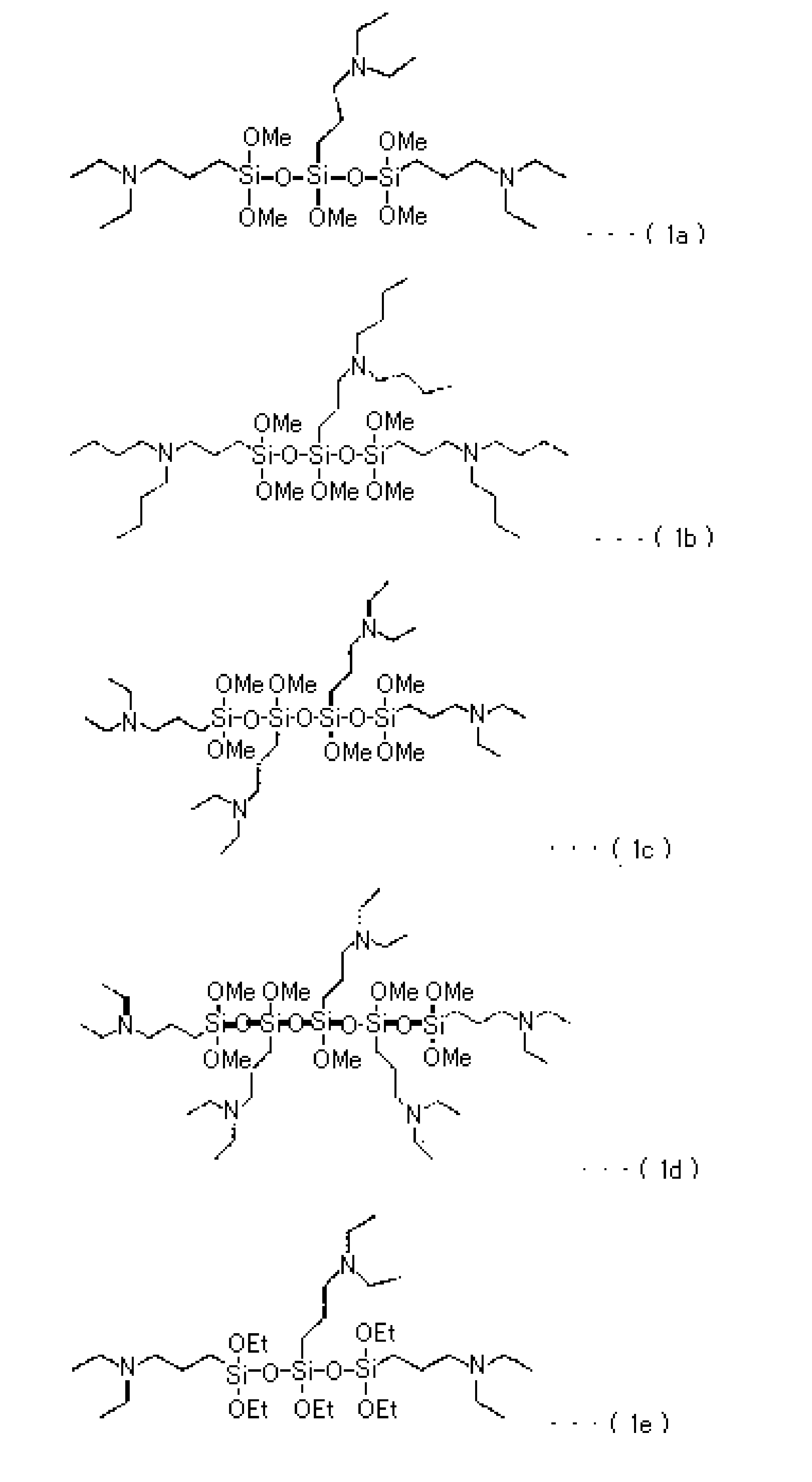
本発明の変性剤において、前記式(1)で表される化合物は、アルコキシシラン構造が共役ジエン系重合体活性化末端と結合する一方、Si-O-Si構造及び末端に結合した3つ以上のアミノ基が、シリカ等の充填剤に対して親和力を示すことによって、従来分子内一つのアミノ基を含む変性剤と比較して充填剤と変性共役ジエン系重合体との結合を促進させることができる。また、前記共役ジエン系重合体の活性化末端の結合程度が均一で、カップリング前後に分子量分布の変化を観察すると、カップリング後にも前に比べて分子量分布が大きくならずに一定である。そのため、変性共役ジエン系重合体自体の物性低下がなく、ゴム組成物内の充填剤の凝集を防ぎ、充填剤の分散性を高めることができるため、ゴム組成物の加工性を向上させることができる。これらの効果は、特に、ゴム組成物をタイヤに適用した際の燃費特性、摩耗特性及び制動特性をバランスよく改善させることが可能となる。
なお、前記式(1)で表される化合物は、下記反応式1で表される縮合反応を通じて製造され得る。
(反応式1)
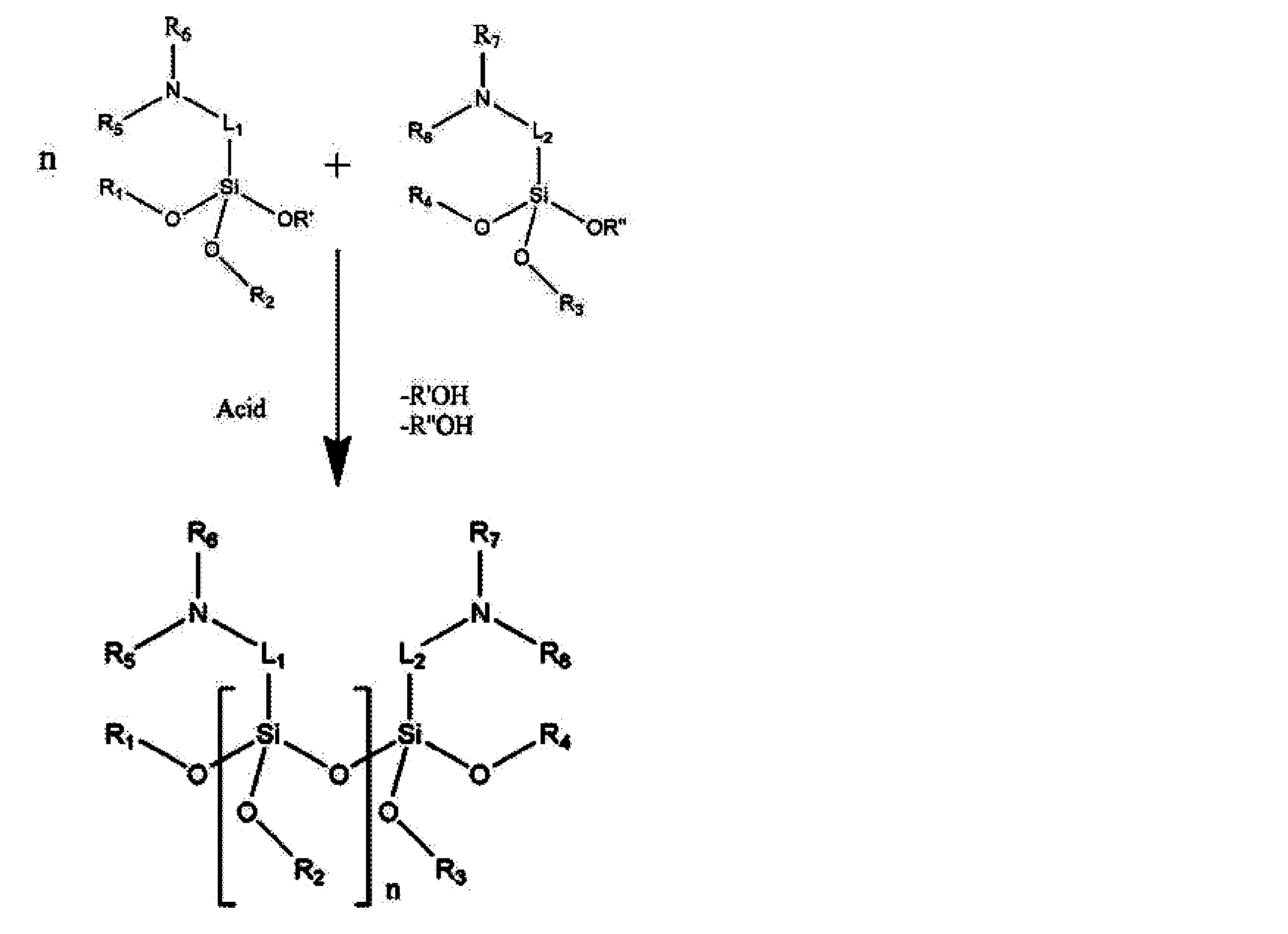
(反応式1)
前記反応式1において、R1~R8、L1及びL2、及びnは、上述した式(1)で定義されたものと同様であり、R’及びR’’は、前記縮合反応に影響を及ぼさない任意の置換基である。例えば、前記R’及びR’’は、それぞれ独立してR1~R4のいずれか1つと同一のものとすることができる。
前記反応式1の反応は、酸条件下で進められ、酸は一般に縮合反応に用いられるものであれば、制限なしに用いることができる。当業者は、前記反応が進められる反応器の種類、出発物質、反応温度などの多様な工程変数に合わせて最適な酸を選択することができる。
なお、前記式(1)で表される化合物を含む変性剤によって変性された変性SBRは、1.1~3.0の狭い分子量分布:Mw/Mn(多分散指数(PDI)ともいう)を有するものとすることができる。前記変性SBRの分子量分布が3.0を超えるか、1.1未満の場合、ゴム組成物へ適用時に引張特性及び粘弾性が低下するおそれがある。前記変性SBRの分子量分布の制御による、重合体の引張特性及び粘弾性改善の効果の顕著性を考慮すると、前記変性SBRの分子量分布を、1.3~2.0とすることが好ましい。なお、前記変性SBRは、前記変性剤を用いることによって、変性前のスチレンブタジエンゴムの分子量分布と類似する。
前記変性SBRの分子量分布は、重量平均分子量(Mw)対数平均分子量(Mn)の比(Mw/Mn)から計算され得る。このとき、前記数平均分子量(Mn)は、n個の重合体分子の分子量を測定し、これら分子量の総合を求めてnで割って計算した個別の重合体分子量の共通平均(commonaverage)であり、前記重量平均分子量(Mw)は高分子組成物の分子量分布を表す。全体分子量の平均は、モル当たりグラム(g/mol)で表すことができる。
また、本発明において、前記重量平均分子量及び数平均分子量は、それぞれゲル透過型クロマトグラフィ(GPC)で分析されるポリスチレン換算分子量である。
また、本発明において、前記重量平均分子量及び数平均分子量は、それぞれゲル透過型クロマトグラフィ(GPC)で分析されるポリスチレン換算分子量である。
また、前記変性SBRは、上記した分子量分布の条件を満たしていると同時に、数平均分子量(Mn)が50,000g/mol~2,000,000g/molであり、より具体的には、200,000g/mol~800,000g/molとすることができる。前記変性SBRは、重量平均分子量(Mw)が100,000g/mol~4,000,000g/molであり、より具体的には、300,000g/mol~1,500,000g/molとすることができる。
前記変性SBRの重量平均分子量(Mw)が100,000g/mol未満であるか、又は数平均分子量(Mn)が50,000g/mol未満の場合、ゴム組成物に適用する際の引張特性の低下のおそれがある。また、重量平均分子量(Mw)が4,000,000g/molを超えているか、数平均分子量(Mn)が2,000,000g/molを超える場合には、変性SBRの加工性の低下にゴム組成物の作業性が悪化し、混練が困難となり、ゴム組成物の物性を十分に向上させることは難しくなることがある。
より具体的には、本発明の一実施例に係る前記変性SBRは、前記分子量分布とともに、重量平均分子量(Mw)及び数平均分子量(Mn)の条件を同時に満たしている場合には、ゴム製の組成物に適用時のゴム組成物の粘弾性と加工性をバランスよく改善させることができる。
より具体的には、本発明の一実施例に係る前記変性SBRは、前記分子量分布とともに、重量平均分子量(Mw)及び数平均分子量(Mn)の条件を同時に満たしている場合には、ゴム製の組成物に適用時のゴム組成物の粘弾性と加工性をバランスよく改善させることができる。
前記変性SBRは、100℃でのムーニー粘度(mooney viscosity,MV)が、40~140、具体的には60~100であってもよい。前記範囲のムーニー粘度を有する時、より優れた加工性を示すことができる。
本発明において、前記ムーニー粘度は、ムーニー粘度計、例えば、Monsanto社のMV2000Eで100℃でRotorSpeed20.02rpm、LargeRotorを使って測定することができる。このとき用いられた試料は、室温(23±3℃)で30分以上放置した後、27±3gを採取してダイキャビティの内部に満たしておき、プラテンを作動させて測定することができる。
本発明において、前記ムーニー粘度は、ムーニー粘度計、例えば、Monsanto社のMV2000Eで100℃でRotorSpeed20.02rpm、LargeRotorを使って測定することができる。このとき用いられた試料は、室温(23±3℃)で30分以上放置した後、27±3gを採取してダイキャビティの内部に満たしておき、プラテンを作動させて測定することができる。
また、前記片末端アルコキシシラン変性SBRは、上述したように、一方の末端が式(1)で表される化合物を含む変性剤によって変性されるが、他方の末端が式(3)で表される化合物を含む変性剤によってさらに変性されることも可能である。ゴム組成物中の充填剤の分散性をさらに向上できるため、低発熱性及び耐摩耗性をより高いレベルで両立できる。



また、上記式(3)で表される化合物では、R1~R3は、互いに独立に水素;炭素数1~10のアルキル基;炭素数2~10のアルケニル基;又は炭素数2~10のアルキニル基であり、R4は、単一結合;又は非置換の炭素数1~10のアルキレン基であり、R5は、炭素数1~10のアルキル基;炭素数2~10のアルケニル基;炭素数2~10のアルキニル基;又は下記化学式(3a)又は化学式(3b)で表される作用基であり、上記化学式(3a)において、R6は、非置換の炭素数1~10のアルキレン基であり、R7及びR8は、互いに独立に非置換の炭素数1~10のアルキレン基であり、R7は、炭素数1~10のアルキル基;炭素数5~20のシクロアルキル基;炭素数6~20のアリール基;又は炭素数3~20の複素環基であり、上記化学式(3b)において、R10は、非置換の炭素数1~10のアルキレン基であり、R11及びR12は、互いに独立に炭素数1~10のアルキル基;炭素数5~20のシクロアルキル基;炭素数6~20のアリール基;又は炭素数3~20の複素環基であってもよい。
さらに、より具体的には、上記式(3)で表される化合物は、以下の式(3-1)~式(3-3)で表される化合物とすることができる。
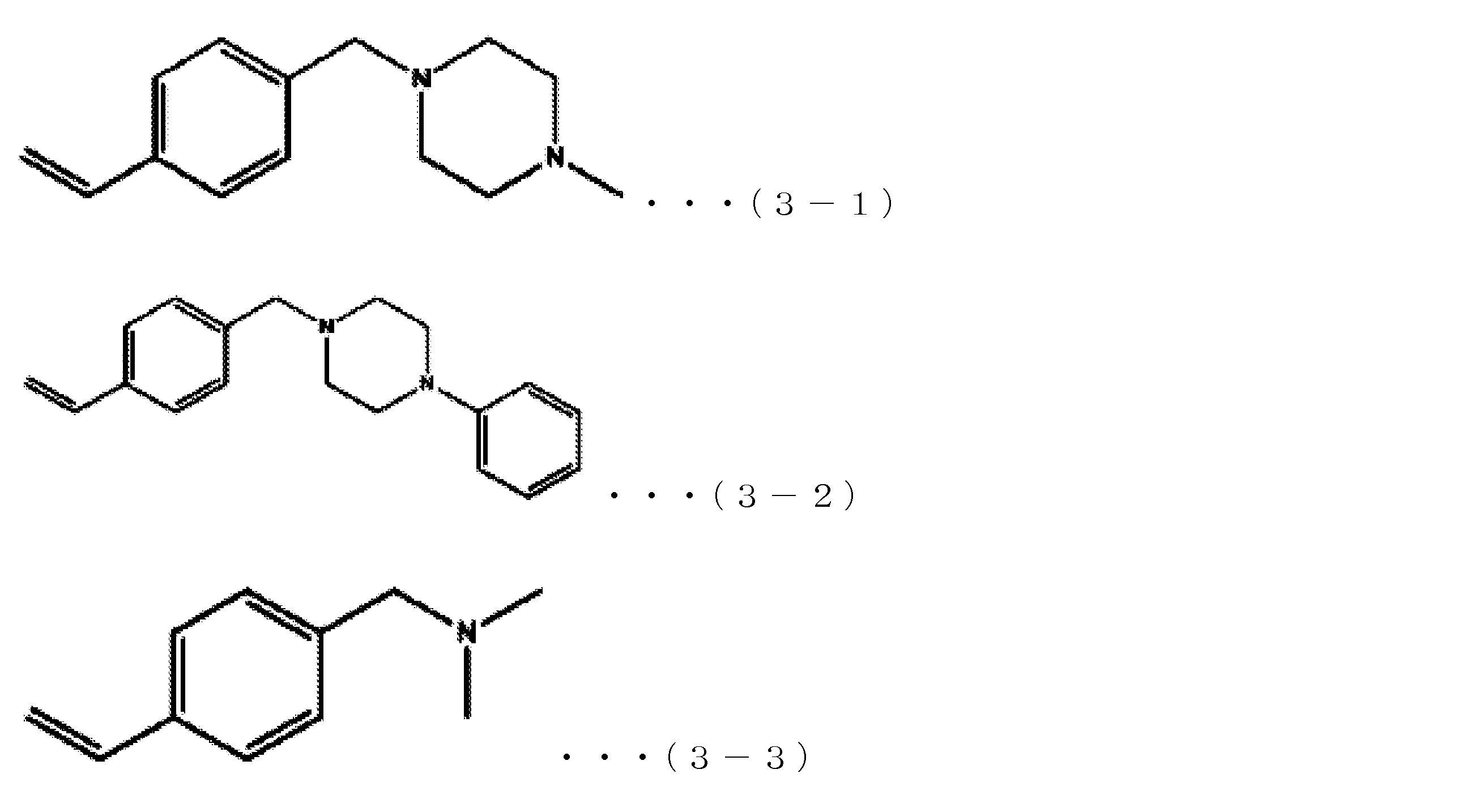
なお、前記スチレンブタジエンゴムを、上記式(3)で表される化合物を含む変性剤によって変性させる場合には、式(3)で表される化合物を含む変性剤を、変性開始剤として用いる。
具体的には、例えば、炭化水素溶媒中で、式(3)で表される化合物を含む変性剤の存在下にて、ブタジエン単量体及びスチレン単量体を重合させることで、式(3)で表される化合物由来の変性基を、前記スチレンブタジエンゴムに付与することができる。
具体的には、例えば、炭化水素溶媒中で、式(3)で表される化合物を含む変性剤の存在下にて、ブタジエン単量体及びスチレン単量体を重合させることで、式(3)で表される化合物由来の変性基を、前記スチレンブタジエンゴムに付与することができる。
また、前記ゴム成分は、前記変性SBRに加えて、乳化SBRを含有する。乳化SBRを含有することによって、ゴム組成物のWET性能を高めることができる。
ここで、乳化SBRとは、乳化重合によって合成されたスチレンブタジエンゴムである。
ここで、乳化SBRとは、乳化重合によって合成されたスチレンブタジエンゴムである。
本発明では、前記乳化SBRは乳化重合により合成されるが、例えば、変性剤の存在下、乳化剤を用いてラジカル重合性モノマーを水中に乳化させ、得られた乳化液にラジカル開始剤を添加してラジカル重合する工程を経る方法によって得ることができる。
なお、乳化液の調製は、乳化剤を用いて公知の方法で行うことができる。乳化剤としては特に限定されず、公知の材料を使用することができ、例えば、脂肪酸塩、ロジン酸塩などが挙げられる。脂肪酸塩、ロジン酸塩としては、カプリン酸、ラウリン酸、ミリスチン酸などのカリウム塩又はナトリウム塩などが挙げられる。
また、前記乳化重合はラジカル重合開始剤を用いる公知の方法で実施できる。ラジカル重合開始剤としては特に限定されず、公知の材料を使用することができ、例えば、パラメンタンヒドロペルオキシド等のレドックス系開始剤や、過硫酸アンモニウム等の過硫酸塩が挙げられる。
さらに、乳化重合の温度は使用するラジカル開始剤の種類によって、適宜変更すればよいが、好ましくは0~50℃、より好ましくは0~20℃である。
なお、乳化重合の停止は、重合系に重合停止剤を添加することによって行うことができる。重合停止剤としては、特に限定されず、公知の材料を使用することができる。例えば、N,N’-ジメチルジチオカルバメート、ジエチルヒドロキシルアミン、ヒドロキノン等が挙げられる。
さらに、乳化重合の温度は使用するラジカル開始剤の種類によって、適宜変更すればよいが、好ましくは0~50℃、より好ましくは0~20℃である。
なお、乳化重合の停止は、重合系に重合停止剤を添加することによって行うことができる。重合停止剤としては、特に限定されず、公知の材料を使用することができる。例えば、N,N’-ジメチルジチオカルバメート、ジエチルヒドロキシルアミン、ヒドロキノン等が挙げられる。
そして、本発明のゴム組成物では、前記乳化スチレンブタジエンゴムの含有量に対する前記変性SBRの含有量が、質量比で1.7未満(変性SBR/乳化SBR<1.7)であることを要する。
前記乳化SBRの含有量が前記変性SBRの含有量より多くなる(変性SBR/乳化SBR<1.7を満たす)ことで、前記充填剤の分散性及び低発熱性の改善を図りつつ、耐摩耗性の低下やWET性能の低下を確実に抑えることができる。同様の観点から、前記乳化SBRの含有量に対する前記変性SBRの含有量の質量比は、1.7未満(変性SBR/乳化SBR<1.7)であることが好ましい。なお、耐摩耗性の低下やWET性能の低下を抑える観点からは、前記乳化SBRの含有量に対する前記変性SBRの含有量の質量比は、0.1以上(変性SBR/乳化SBR≧0.1)であることが好ましい。
前記乳化SBRの含有量が前記変性SBRの含有量より多くなる(変性SBR/乳化SBR<1.7を満たす)ことで、前記充填剤の分散性及び低発熱性の改善を図りつつ、耐摩耗性の低下やWET性能の低下を確実に抑えることができる。同様の観点から、前記乳化SBRの含有量に対する前記変性SBRの含有量の質量比は、1.7未満(変性SBR/乳化SBR<1.7)であることが好ましい。なお、耐摩耗性の低下やWET性能の低下を抑える観点からは、前記乳化SBRの含有量に対する前記変性SBRの含有量の質量比は、0.1以上(変性SBR/乳化SBR≧0.1)であることが好ましい。
なお、本発明のゴム組成物において、前記ゴム成分は、上述した変性SBR及び乳化SBR以外に、さらに、天然ゴム(NR)、ポリブタジエンゴム(BR)、ポリイソプレンゴム(IR)、ブチルゴム(IIR)、エチレン-プロピレン共重合体等のゴム成分(その他のゴム成分)を含有することができ、これらの中でも、その他のゴム成分として、天然ゴム、ポリイソプレンゴム及びポリブタジエンゴムのうちの少なくとも一種を含有することが好ましい。これらゴム成分は、1種単独でも、2種以上のブレンドとして用いてもよい。
(充填剤)
本発明のゴム組成物は、上述したゴム成分に加えて、充填剤をさらに含む。
前記充填剤を、前記変性SBRを含有するゴム成分とともに用いることで、充填剤の分散性が高まり、ウェットグリップ性等の性能を高いレベルで維持しつつ、優れた低発熱性及び耐摩耗性を実現できる。
本発明のゴム組成物は、上述したゴム成分に加えて、充填剤をさらに含む。
前記充填剤を、前記変性SBRを含有するゴム成分とともに用いることで、充填剤の分散性が高まり、ウェットグリップ性等の性能を高いレベルで維持しつつ、優れた低発熱性及び耐摩耗性を実現できる。
ここで、前記充填剤の含有量は、特に限定されるものではないが、前記ゴム成分100質量部に対して10質量部以上であることが好ましく、20質量部以上であることがより好ましく、30質量部以上であることがさらに好ましく、また、前記ゴム成分100質量部に対して160質量部以下であることが好ましく、140質量部以下であることがより好ましく、120質量部以下であることがさらに好ましい。充填剤の量について適正化を図ることで、より優れた低発熱性及び耐摩耗性を実現できるためであり、含有量が10質量部以上の場合には、十分な耐摩耗性が得られ、含有量が160質量部以下の場合には、低発熱性の悪化を抑えることができる。
前記充填剤の種類については、ゴム分野で通常用いられる補強性充填剤であればよく、例えば、カーボンブラック、シリカ、ハイジライト(ボーキサイトを原料としてバイヤー法により製造された水酸化アルミニウム)等の水酸化アルミニウム、タルク、クレイ、酸化チタン等が挙げられる。
また、前記充填剤は、より優れた低発熱性及びWET性能を実現する観点から、平均粒子径0.4μm以上の無機充填剤を含むことが好ましく、平均粒子径0.5μm以上の無機充填剤を含むことがより好ましい。なお、耐摩耗性の低下を確実に抑制する観点からは、前記充填剤の粒径が2μm以下であることが好ましい。
さらに、前記充填剤は、上述した中でも、シリカ及び水酸化アルミニウムのうちの少なくとも一種を含むことが好ましい。前記これらの充填剤を含有することで、前記ゴム成分との相互作用が特に高くなり、より高いレベルで低発熱性及び耐摩耗性を両立できる。
また、さらに高いレベルで低発熱性及び耐摩耗性を両立させる観点から、前記補強性充填剤は、前記シリカ及び前記水酸化アルミニウムの両方を含むことがより好ましい。
また、さらに高いレベルで低発熱性及び耐摩耗性を両立させる観点から、前記補強性充填剤は、前記シリカ及び前記水酸化アルミニウムの両方を含むことがより好ましい。
前記シリカの種類については、特に限定はされない。例えば、湿式シリカ(含水ケイ酸)、乾式シリカ(無水ケイ酸)、ケイ酸カルシウム、ケイ酸アルミニウム等が挙げられ、これらの中でも、湿式シリカが好ましい。これらシリカは、1種単独で使用してもよいし、2種以上を併用してもよい。
さらに、前記湿式シリカは、沈降シリカを用いることができる。なお、沈降シリカとは、製造初期に、反応溶液を比較的高温、中性~アルカリ性のpH領域で反応を進めてシリカ一次粒子を成長させ、その後酸性側へ制御することで、一次粒子を凝集させる結果得られるシリカのことである。
さらに、前記湿式シリカは、沈降シリカを用いることができる。なお、沈降シリカとは、製造初期に、反応溶液を比較的高温、中性~アルカリ性のpH領域で反応を進めてシリカ一次粒子を成長させ、その後酸性側へ制御することで、一次粒子を凝集させる結果得られるシリカのことである。
また、前シリカは、CTAB(セチルトリメチルアンモニウムブロミド)比表面積が、好ましくは50m2/g以上であり、好ましくは350m2/g以下である。シリカのCTAB比表面積が50m2/g以上の場合、耐摩耗性を更に向上でき、また、シリカのCTAB比表面積が350m2/g以下の場合、低発熱性を改善できる。
また、前記充填剤がシリカを含有する場合、その含有量は特に限定はされないが、前記ゴム成分100質量部に対して50質量部以上であることが好ましく、60質量部以上であることがより好ましく、また、前記ゴム成分100質量部に対して100質量部以下であることが好ましく、90質量部以下であることがより好ましい。充填剤の量について適正化を図ることで、他の性能を悪化させることなく、より優れた低発熱性及び耐摩耗性を実現できるためであり、前記シリカの含有量が、前記ゴム成分100質量部に対して20質量部以上の場合には、十分な耐摩耗性が得られ、前記シリカの含有量が、前記ゴム成分100質量部に対して150質量部以下の場合には、加工性の悪化等を抑えることができる。
また、前記充填剤については、前記シリカや前記ハイジライトの他にも、カーボンブラックを含むことが好ましい。より優れた補強性や耐摩耗を実現できるからである。
ここで、前記カーボンブラックとしては、GPF、FEF、SRF、HAF、ISAF、IISAF、SAFグレード等のカーボンブラックが挙げられる。
ここで、前記カーボンブラックとしては、GPF、FEF、SRF、HAF、ISAF、IISAF、SAFグレード等のカーボンブラックが挙げられる。
なお、前記カーボンブラックの含有量は、よりすぐれた耐摩耗性を得る観点から、前記ゴム成分100質量部に対して、2質量部以上であることが好ましく、4質量部以上であることがより好ましい。前記カーボンブラックの含有量を、前記ゴム成分100質量部に対して2質量部以上とすることで、ゴム組成物の耐摩耗性をより向上できるためである。また、前記カーボンブラックの含有量は、前記ゴム成分100質量部に対して、150質量部以下であることが好ましく、90質量部以下であることがより好ましく、70質量部以下であることがさらに好ましい。前記カーボンブラックの含有量を、前記ゴム成分100質量部に対して150質量部以下とすることで、耐摩耗性を高いレベルで維持しつつ、低発熱性や加工性についてより改善できるためである。
(樹脂)
また、本発明のゴム組成物は、上述したゴム成分及び充填剤に加えて、樹脂を含む。
ゴム組成物中に樹脂を含むことによって、タイヤに適用した際のWET性能を高めることができる。
また、本発明のゴム組成物は、上述したゴム成分及び充填剤に加えて、樹脂を含む。
ゴム組成物中に樹脂を含むことによって、タイヤに適用した際のWET性能を高めることができる。
ここで、前記樹脂の含有量は、前記ゴム成分100質量部に対して、2質量部以上であることを要し、4質量部以上であることが好ましい。前記樹脂の含有量が前記ゴム成分100質量部に対して2質量部以上であれば、WET性能をより向上できるためである。また、前記熱可塑性樹脂の含有量は、ゴム組成物の低発熱性や耐摩耗性の悪化を抑える観点から、前記ゴム成分100質量部に対して10質量部以下とすることが好ましく、8質量部以下とすることがより好ましい。
前記樹脂としては、例えば、C5系樹脂、C5-C9系樹脂、C9系樹脂、ジシクロペンタジエン樹脂、テルペンフェノール樹脂、テルペン樹脂、ロジン樹脂、アルキルフェノール樹脂等の熱可塑性樹脂が挙げられ、これらの中でも、C5系樹脂、C5-C9系樹脂、C9系樹脂、ジシクロペンタジエン樹脂、テルペンフェノール樹脂、テルペン樹脂、ロジン樹脂、及び、アルキルフェノール樹脂から選択される少なくとも一種であることが好ましく、C5~C9系樹脂を少なくとも含有することがより好ましい。前記熱可塑性樹脂として、C5系樹脂、C5-C9系樹脂、C9系樹脂、ジシクロペンタジエン樹脂、テルペンフェノール樹脂、テルペン樹脂、ロジン樹脂、及び、アルキルフェノール樹脂の少なくとも一種を含む場合、WET性能を更に向上させることができる。なお、前記樹脂は、1種単独で用いてもよいし、2種以上を組み合わせて用いてもよい。
前記C5系樹脂とは、C5系合成石油樹脂を指し、該C5系樹脂としては、例えば、石油化学工業のナフサの熱分解によって得られるC5留分を、AlCl3、BF3等のフリーデルクラフツ型触媒を用いて重合して得られる脂肪族系石油樹脂が挙げられる。前記C5留分には、通常、1-ペンテン、2-ペンテン、2-メチル-1-ブテン、2-メチル-2-ブテン、3-メチル-1-ブテン等のオレフィン系炭化水素、2-メチル-1,3-ブタジエン、1,2-ペンタジエン、1,3-ペンタジエン、3-メチル-1,2-ブタジエン等のジオレフィン系炭化水素等が含まれる。なお、前記C5系樹脂としては、市販品を利用することができ、例えば、エクソンモービルケミカル社製脂肪族系石油樹脂である「エスコレッツ(登録商標)1000シリーズ」、日本ゼオン株式会社製脂肪族系石油樹脂である「クイントン(登録商標)100シリーズ」の内「A100、B170、M100、R100」、東燃化学社製「T-REZ RA100」等が挙げられる。
前記C5-C9系樹脂とは、C5-C9系合成石油樹脂を指し、該C5-C9系樹脂としては、例えば、石油由来のC5留分とC9留分とを、AlCl3、BF3等のフリーデルクラフツ型触媒を用いて重合して得られる固体重合体が挙げられ、より具体的には、スチレン、ビニルトルエン、α-メチルスチレン、インデン等を主成分とする共重合体等が挙げられる。該C5-C9系樹脂としては、C9以上の成分の少ない樹脂が、ゴム成分との相溶性の観点から好ましい。ここで、「C9以上の成分が少ない」とは、樹脂全量中のC9以上の成分が50質量%未満、好ましくは40質量%以下であることを言うものとする。前記C5-C9系樹脂としては、市販品を利用することができ、例えば、商品名「クイントン(登録商標)G100B」(日本ゼオン株式会社製)、商品名「ECR213」(エクソンモービルケミカル社製)、商品名「T-REZ RD104」(東燃化学社製)等が挙げられる。
前記C9系樹脂は、例えば、石油化学工業のナフサの熱分解により、エチレン、プロピレン等の石油化学基礎原料と共に副生するC9留分である、ビニルトルエン、アルキルスチレン、インデンを主要なモノマーとする炭素数9の芳香族を重合した樹脂である。ここで、ナフサの熱分解によって得られるC9留分の具体例としては、ビニルトルエン、α-メチルスチレン、β-メチルスチレン、γ-メチルスチレン、o-メチルスチレン、p-メチルスチレン、インデン等が挙げられる。該C9系樹脂は、C9留分と共に、C8留分であるスチレン等、C10留分であるメチルインデン、1,3-ジメチルスチレン等、更にはナフタレン、ビニルナフタレン、ビニルアントラセン、p-tert-ブチルスチレン等をも原料として用い、これらのC8~C10留分等を混合物のまま、例えばフリーデルクラフツ型触媒により共重合して得ることができる。また、前記C9系樹脂は、水酸基を有する化合物、不飽和カルボン酸化合物等で変性された変性石油樹脂であってもよい。なお、前記C9系樹脂としては、市販品を利用することができ、例えば、未変性C9系石油樹脂としては、商品名「日石ネオポリマー(登録商標)L-90」、「日石ネオポリマー(登録商標)120」、「日石ネオポリマー(登録商標)130」、「日石ネオポリマー(登録商標)140」(JX日鉱日石エネルギー株式会社製)等が挙げられる。
前記ジシクロペンタジエン樹脂は、シクロペンタジエンを二量体化して得られるジシクロペンタジエンを主原料に製造された石油樹脂である。前記ジシクロペンタジエン樹脂としては、市販品を利用することができ、例えば、日本ゼオン株式会社製脂環式系石油樹脂である商品名「クイントン(登録商標)1000シリーズ」の内「1105、1325、1340」等が挙げられる。
前記テルペンフェノール樹脂は、例えば、テルペン類と種々のフェノール類とを、フリーデルクラフツ型触媒を用いて反応させたり、又はさらにホルマリンで縮合する方法で得ることができる。原料のテルペン類としては特に制限はなく、α-ピネンやリモネン等のモノテルペン炭化水素が好ましく、α-ピネンを含むものがより好ましく、特にα-ピネンであることが好ましい。該テルペンフェノール樹脂としては、市販品を利用することができ、例えば、商品名「タマノル803L」、「タマノル901」(荒川化学工業株式会社製)、商品名「YSポリスター(登録商標)U」シリーズ、「YSポリスター(登録商標)T」シリーズ、「YSポリスター(登録商標)S」シリーズ、「YSポリスター(登録商標)G」シリーズ、「YSポリスター(登録商標)N」シリーズ、「YSポリスター(登録商標)K」シリーズ、「YSポリスター(登録商標)TH」シリーズ(ヤスハラケミカル株式会社製)等が挙げられる。
前記テルペン樹脂は、マツ属の木からロジンを得る際に同時に得られるテレピン油、或いは、これから分離した重合成分を配合し、フリーデルクラフツ型触媒を用いて重合して得られる固体状の樹脂であり、β-ピネン樹脂、α-ピネン樹脂等が挙げられる。該テルペン樹脂としては、市販品を利用することができ、例えば、ヤスハラケミカル株式会社製の商品名「YSレジン」シリーズ(PX-1250、TR-105等)、ハーキュリーズ社製の商品名「ピコライト」シリーズ(A115、S115等)等が挙げられる。
前記ロジン樹脂は、マツ科の植物の樹液である松脂(松ヤニ)等のバルサム類を集めてテレピン精油を蒸留した後に残る残留物で、ロジン酸(アビエチン酸、パラストリン酸、イソピマール酸等)を主成分とする天然樹脂、及びそれらを変性、水素添加等で加工した変性樹脂、水添樹脂である。例えば、天然樹脂ロジン、その重合ロジンや部分水添ロジン;グリセリンエステルロジン、その部分水添ロジンや完全水添ロジンや重合ロジン;ペンタエリスリトールエステルロジン、その部分水添ロジンや重合ロジン等が挙げられる。天然樹脂ロジンとして、生松ヤニやトール油に含まれるガムロジン、トール油ロジン、ウッドロジン等がある。前記ロジン樹脂としては、市販品を利用することができ、例えば、商品名「ネオトール105」(ハリマ化成株式会社製)、商品名「SNタック754」(サンノプコ株式会社製)、商品名「ライムレジンNo.1」、「ペンセルA」及び「ペンセルAD」(荒川化学工業株式会社製)、商品名「ポリペール」及び「ペンタリンC」(イーストマンケミカル株式会社製)、商品名「ハイロジン(登録商標)S」(大社松精油株式会社製)等が挙げられる。
前記アルキルフェノール樹脂は、例えば、アルキルフェノールとホルムアルデヒドとの触媒下における縮合反応によって得られる。該アルキルフェノール樹脂としては、市販品を利用することができ、例えば、商品名「ヒタノール1502P」(アルキルフェノールホルムアルデヒド樹脂、日立化成株式会社製)、商品名「タッキロール201」(アルキルフェノールホルムアルデヒド樹脂、田岡化学工業株式会社製)、商品名「タッキロール250-I」(臭素化アルキルフェノールホルムアルデヒド樹脂、田岡化学工業株式会社製)、商品名「タッキロール250-III」(臭素化アルキルフェノールホルムアルデヒド樹脂、田岡化学工業株式会社製)、商品名「R7521P」、「SP1068」、「R7510PJ」、「R7572P」及び「R7578P」(SI GROUP INC.製)等が挙げられる。
(その他の成分)
本発明のゴム組成物は、上述した各成分に加えて、本発明の効果を損なわない範囲で、目的ないし必要に応じて、その他の成分を適宜に選択して配合することができる。その他の成分としては、例えば、ゴム工業で通常使用されている、老化防止剤、架橋促進剤、架橋剤、架橋促進助剤、シランカップリング剤、軟化剤、ステアリン酸、オゾン劣化防止剤、界面活性剤等の添加剤を適宜配合することができる。
本発明のゴム組成物は、上述した各成分に加えて、本発明の効果を損なわない範囲で、目的ないし必要に応じて、その他の成分を適宜に選択して配合することができる。その他の成分としては、例えば、ゴム工業で通常使用されている、老化防止剤、架橋促進剤、架橋剤、架橋促進助剤、シランカップリング剤、軟化剤、ステアリン酸、オゾン劣化防止剤、界面活性剤等の添加剤を適宜配合することができる。
前記老化防止剤としては、公知のものを用いることができ、特に制限されない。例えば、フェノール系老化防止剤、イミダゾール系老化防止剤、アミン系老化防止剤等を挙げることができる。これら老化防止剤は、1種又は2種以上を併用することができる。
前記架橋促進剤としては、公知のものを用いることができ、特に制限されるものではない。例えば、2-メルカプトベンゾチアゾール、ジベンゾチアジルジスルフィド等のチアゾール系加硫促進剤;N-シクロヘキシル-2-ベンゾチアジルスルフェンアミド、N-t-ブチル-2-ベンゾチアジルスルフェンアミド等のスルフェンアミド系加硫促進剤;ジフェニルグアニジン等のグアニジン系加硫促進剤;テトラメチルチウラムジスルフィド、テトラエチルチウラムジスルフィド、テトラブチルチウラムジスルフィド、テトラドデシルチウラムジスルフィド、テトラオクチルチウラムジスルフィド、テトラベンジルチウラムジスルフィド、ジペンタメチレンチウラムテトラスルフィド等のチウラム系加硫促進剤;ジメチルジチオカルバミン酸亜鉛等のジチオカルバミン酸塩系加硫促進剤;ジアルキルジチオリン酸亜鉛等が挙げられる。
前記架橋剤についても、特に制限はされない。例えば、硫黄が挙げられる。
前記架橋促進剤についても、公知のものを用いることができ、特に制限されるものではない。例えば、2-メルカプトベンゾチアゾール、ジベンゾチアジルジスルフィド等のチアゾール系加硫促進剤;N-シクロヘキシル-2-ベンゾチアジルスルフェンアミド、N-t-ブチル-2-ベンゾチアジルスルフェンアミド等のスルフェンアミド系加硫促進剤;ジフェニルグアニジン等のグアニジン系加硫促進剤;テトラメチルチウラムジスルフィド、テトラエチルチウラムジスルフィド、テトラブチルチウラムジスルフィド、テトラドデシルチウラムジスルフィド、テトラオクチルチウラムジスルフィド、テトラベンジルチウラムジスルフィド、ジペンタメチレンチウラムテトラスルフィド等のチウラム系加硫促進剤;ジメチルジチオカルバミン酸亜鉛等のジチオカルバミン酸塩系加硫促進剤;ジアルキルジチオリン酸亜鉛等が挙げられる。
前記架橋促進剤についても、公知のものを用いることができ、特に制限されるものではない。例えば、2-メルカプトベンゾチアゾール、ジベンゾチアジルジスルフィド等のチアゾール系加硫促進剤;N-シクロヘキシル-2-ベンゾチアジルスルフェンアミド、N-t-ブチル-2-ベンゾチアジルスルフェンアミド等のスルフェンアミド系加硫促進剤;ジフェニルグアニジン等のグアニジン系加硫促進剤;テトラメチルチウラムジスルフィド、テトラエチルチウラムジスルフィド、テトラブチルチウラムジスルフィド、テトラドデシルチウラムジスルフィド、テトラオクチルチウラムジスルフィド、テトラベンジルチウラムジスルフィド、ジペンタメチレンチウラムテトラスルフィド等のチウラム系加硫促進剤;ジメチルジチオカルバミン酸亜鉛等のジチオカルバミン酸塩系加硫促進剤;ジアルキルジチオリン酸亜鉛等が挙げられる。
前記架橋促進助剤については、例えば、亜鉛華(ZnO)や脂肪酸等が挙げられる。脂肪酸としては、飽和若しくは不飽和、直鎖状若しくは分岐状のいずれの脂肪酸であってもよく、脂肪酸の炭素数も特に制限されないが、例えば炭素数1~30、好ましくは15~30の脂肪酸、より具体的にはシクロヘキサン酸(シクロヘキサンカルボン酸)、側鎖を有するアルキルシクロペンタン等のナフテン酸;ヘキサン酸、オクタン酸、デカン酸(ネオデカン酸等の分岐状カルボン酸を含む)、ドデカン酸、テトラデカン酸、ヘキサデカン酸、オクタデカン酸(ステアリン酸)等の飽和脂肪酸;メタクリル酸、オレイン酸、リノール酸、リノレン酸等の不飽和脂肪酸;ロジン、トール油酸、アビエチン酸等の樹脂酸などが挙げられる。これらは1種単独で用いてもよく、2種以上を併用してもよい。本発明においては、亜鉛華及びステアリン酸を好適に用いることができる。
前記シランカップリング剤については、例えば、ビス(3-トリエトキシシリルプロピル)テトラスルフィド、ビス(3-トリエトキシシリルプロピル)トリスルフィド、ビス(3-トリエトキシシリルプロピル)ジスルフィド、ビス(2-トリエトキシシリルエチル)テトラスルフィド、ビス(3-トリメトキシシリルプロピル)テトラスルフィド、ビス(2-トリメトキシシリルエチル)テトラスルフィド、3-メルカプトプロピルトリメトキシシラン、3-メルカプトプロピルトリエトキシシラン、2-メルカプトエチルトリメトキシシラン、2-メルカプトエチルトリエトキシシラン、3-トリメトキシシリルプロピル-N,N-ジメチルチオカルバモイルテトラスルフィド、3-トリエトキシシリルプロピル-N,N-ジメチルチオカルバモイルテトラスルフィド、2-トリエトキシシリルエチル-N,N-ジメチルチオカルバモイルテトラスルフィド、3-トリメトキシシリルプロピルベンゾチアゾリルテトラスルフィド、3-トリエトキシシリルプロピルベンゾリルテトラスルフィド、3-トリエトキシシリルプロピルメタクリレートモノスルフィド、3-トリメトキシシリルプロピルメタクリレートモノスルフィド、ビス(3-ジエトキシメチルシリルプロピル)テトラスルフィド、3-メルカプトプロピルジメトキシメチルシラン、ジメトキシメチルシリルプロピル-N,N-ジメチルチオカルバモイルテトラスルフィド、ジメトキシメチルシリルプロピルベンゾチアゾリルテトラスルフィド、3-オクタノイルチオプロピルトリエトキシシラン、3-メルカプトプロピルトリメトキシシラン、3-メルカプトプロピルトリエトキシシラン、ビニルトリエトキシシラン、ビニルトリメトキシシラン、3-アミノプロピルトリエトキシシラン、3-アミノプロピルトリメトキシシラン、3-メルカプトプロピルメチルジメトキシシラン、γ-グリシドキシプロピルトリメトキシシラン、γ-グリシドキシプロピルメチルジエトキシシラン、3-[エトキシビス(3,6,9,12,15-ペンタオキサオクタコサン-1-イルオキシ)シリル]-1-プロパンチオール(エボニック・デグッサ社製の商品名「Si363」)等が挙げられる。なお、これらのシランカップリング剤は、1種を単独で用いてもよく、2種以上組み合わせて用いてもよい。
前記軟化剤としては、例えば、ナフテン系ベースオイル、パラフィン系ベースオイル、アロマ系ベースオイル等が挙げられる。ここで、前記軟化剤の含有量は、前記ゴム成分100質量部に対し、2~30質量部配合することが好ましい。前記軟化剤の含有量がゴム成分100質量部に対して30質量部を超える場合、軟化剤がゴム製品の表面に滲み出るおそれや、耐摩耗性が低下したりするおそれがある。また、変性したゴム成分中のテトラジン部位と相互作用し、遮蔽してしまうため反応性が落ち、低ロス性能や耐摩耗性が低下するおそれもある。
さらに、上述した軟化剤の中でも、ナフテン系ベースオイル又はパラフィン系ベースオイルを用いることが好ましく、ナフテン系ベースオイルを用いることが最も好ましい。アロマオイルは、芳香族成分が多いため、芳香族化合物である当該薬品との親和性が高く、ポリマーとの反応をより阻害するため好ましくないためである。一方で、ナフテン系ベースオイルやパラフィン系ベースオイルは、ポリマー中に拡散し反応することを助ける効果があり、流動点が低いオイルの方がよくポリマー中に拡散するためである。
なお、前記ナフテン系ベースオイル、前記パラフィン系ベースオイル、前記アロマ系ベースオイルという分類については、CA値、CP値、CN値により決定される。例えば、前記ナフテン系ベースオイル前記分類されるのは、TDAE、SRAE、RAE、Black Oil等である。また、前記パラフィン系ベースオイルとして分類されるのは、スピンドルオイルヤやパラフィンオイルである。
さらにまた、前記ナフテン系ベースオイルと前記ナフテン系アスファルトを混合した混合油でも好ましい効果が得られる。
これらの潤滑油を配合するタイミングについては特に限定はされず、例えば、前記ゴム成分の製造の段階で 油展させてもよいし、ゴム組成物を混錬する際に、添加させてもよい。
さらに、上述した軟化剤の中でも、ナフテン系ベースオイル又はパラフィン系ベースオイルを用いることが好ましく、ナフテン系ベースオイルを用いることが最も好ましい。アロマオイルは、芳香族成分が多いため、芳香族化合物である当該薬品との親和性が高く、ポリマーとの反応をより阻害するため好ましくないためである。一方で、ナフテン系ベースオイルやパラフィン系ベースオイルは、ポリマー中に拡散し反応することを助ける効果があり、流動点が低いオイルの方がよくポリマー中に拡散するためである。
なお、前記ナフテン系ベースオイル、前記パラフィン系ベースオイル、前記アロマ系ベースオイルという分類については、CA値、CP値、CN値により決定される。例えば、前記ナフテン系ベースオイル前記分類されるのは、TDAE、SRAE、RAE、Black Oil等である。また、前記パラフィン系ベースオイルとして分類されるのは、スピンドルオイルヤやパラフィンオイルである。
さらにまた、前記ナフテン系ベースオイルと前記ナフテン系アスファルトを混合した混合油でも好ましい効果が得られる。
これらの潤滑油を配合するタイミングについては特に限定はされず、例えば、前記ゴム成分の製造の段階で 油展させてもよいし、ゴム組成物を混錬する際に、添加させてもよい。
なお、本発明のゴム組成物は、前記ゴム成分に、前記充填剤及び前記樹脂を配合し、さらに、適宜に選択したその他成分を混練りして、押出或いは圧延した後、加硫することにより製造することができる。
前記混練りの条件としては、特に制限はなく、混練り装置の投入体積やローターの回転速度、ラム圧等、及び混練り温度や混練り時間、混練り装置の種類等の諸条件について目的に応じて適宜に選択することができる。混練り装置としては、通常、ゴム組成物の混練りに用いるバンバリーミキサーやインターミックス、ニーダー、ロール等が挙げられる。
また、前記熱入れの条件についても、特に制限はなく、熱入れ温度や熱入れ時間、熱入れ装置等の諸条件について目的に応じて適宜に選択することができる。
該熱入れ装置としては、通常、ゴム組成物の熱入れに用いる熱入れロール機等が挙げられる。
該熱入れ装置としては、通常、ゴム組成物の熱入れに用いる熱入れロール機等が挙げられる。
さらに、上記押出の条件についても、特に制限はなく、押出時間や押出速度、押出装置、押出温度等の諸条件について目的に応じて適宜に選択することができる。押出装置としては、通常、タイヤ用ゴム組成物の押出に用いる押出機等が挙げられる。押出温度は、適宜に決定することができる。
さらにまた、前記加硫を行う装置や方式、条件等については、特に制限はなく、目的に応じて適宜に選択することができる。加硫を行う装置としては、通常、タイヤ用ゴム組成物の加硫に用いる金型による成形加硫機などが挙げられる。加硫の条件として、その温度は、例えば100~190℃程度である。
<タイヤ>
本発明のタイヤは、上述した本発明のゴム組成物を用いることを特徴とする。本発明のゴム組成物をタイヤ材料として用いることによって、得られるタイヤは、転がり抵抗、WET性能及び耐摩耗性を大きく改善することができる。
本発明のタイヤでは、具体的には、上述したゴム組成物を、いずれかの部材に適用するが、かかるタイヤ用部材の中でも、トレッドに適用することが特に好ましい。前記ゴム組成物をトレッドに用いたタイヤは、転がり抵抗の低減効果に加えて、補強性(ひいては耐摩耗性、操縦安定性等)を高いレベルで実現できる。なお、本発明のタイヤに充填する気体としては、通常の若しくは酸素分圧を変えた空気、又は窒素等の不活性ガスが挙げられる。
本発明のタイヤは、上述した本発明のゴム組成物を用いることを特徴とする。本発明のゴム組成物をタイヤ材料として用いることによって、得られるタイヤは、転がり抵抗、WET性能及び耐摩耗性を大きく改善することができる。
本発明のタイヤでは、具体的には、上述したゴム組成物を、いずれかの部材に適用するが、かかるタイヤ用部材の中でも、トレッドに適用することが特に好ましい。前記ゴム組成物をトレッドに用いたタイヤは、転がり抵抗の低減効果に加えて、補強性(ひいては耐摩耗性、操縦安定性等)を高いレベルで実現できる。なお、本発明のタイヤに充填する気体としては、通常の若しくは酸素分圧を変えた空気、又は窒素等の不活性ガスが挙げられる。
以下に、実施例を挙げて本発明をさらに詳しく説明するが、本発明は下記の実施例に何ら限定されるものではない。
<実施例1~6、比較例1~6>
表1の成分組成に従って、各ゴム組成物のサンプルを調製した。なお、各成分の配合量については、ゴム成分100質量部に対する質量部で示している。
表1の成分組成に従って、各ゴム組成物のサンプルを調製した。なお、各成分の配合量については、ゴム成分100質量部に対する質量部で示している。
なお、表1中の「変性SBR-1」及び「変性SBR-2」については、以下の条件によって作製した。
(SBRの作製)
3基の反応器が直列に連結された連続反応器のうち、第1基反応器に、n-ヘキサンにスチレンが60質量%で溶解したスチレン溶液を7.99kg/h、n-ヘキサンに1,3-ブタジエンが60質量%で溶解した1,3-ブタジエン溶液を10.55kg/h、n-ヘキサン49.11kg/h、n-ヘキサンに1,2-ブタジエンが2.0質量%で溶解した1,2-ブタジエン溶液を40g/h、極性添加剤としてn-ヘキサンに2,2-(ジ-2(テトラヒドロフリル)プロパンが10質量%で溶解した溶液を51.0g/h、n-ヘキサンにn-ブチルリチウムが10質量%で溶解したn-ブチルリチウム溶液を59.0g/hの速度に注入する。この時、第1基反応器の温度は50℃になるように維持する。
次いで、第2反応器にn-ヘキサンに1,3-ブタジエンが60質量%で溶解した1,3-ブタジエン溶液を0.95kg/hの速度で注入する。この時、第2基反応器の温度は65℃になるように維持する。
前記第2反応器で第3反応器に重合物を移送し、カップリング剤としてジクロロジメチルシラン溶解した溶液を第3反応器に投入する(カップリング剤:act. Li=1:1mol)。その後、第3反応器の温度は65℃になるように維持する。
そして、第3反応器から排出された重合溶液に酸化防止剤として30質量%で溶解したIR1520(BASF社)溶液を167g/hの速度で注入して攪拌する。その結果、得られる重合物をスチームで加熱された温水に入れて攪拌して溶媒を除去することで、SBRを得る。
また、得られるSBRのミクロ構造を測定した結果、スチレン含有量が41質量%、ブタジエン部分のビニル含有量が45%、重量平均分子量Mwが440,000、分子量分布MWDが1.6である。
(SBRの作製)
3基の反応器が直列に連結された連続反応器のうち、第1基反応器に、n-ヘキサンにスチレンが60質量%で溶解したスチレン溶液を7.99kg/h、n-ヘキサンに1,3-ブタジエンが60質量%で溶解した1,3-ブタジエン溶液を10.55kg/h、n-ヘキサン49.11kg/h、n-ヘキサンに1,2-ブタジエンが2.0質量%で溶解した1,2-ブタジエン溶液を40g/h、極性添加剤としてn-ヘキサンに2,2-(ジ-2(テトラヒドロフリル)プロパンが10質量%で溶解した溶液を51.0g/h、n-ヘキサンにn-ブチルリチウムが10質量%で溶解したn-ブチルリチウム溶液を59.0g/hの速度に注入する。この時、第1基反応器の温度は50℃になるように維持する。
次いで、第2反応器にn-ヘキサンに1,3-ブタジエンが60質量%で溶解した1,3-ブタジエン溶液を0.95kg/hの速度で注入する。この時、第2基反応器の温度は65℃になるように維持する。
前記第2反応器で第3反応器に重合物を移送し、カップリング剤としてジクロロジメチルシラン溶解した溶液を第3反応器に投入する(カップリング剤:act. Li=1:1mol)。その後、第3反応器の温度は65℃になるように維持する。
そして、第3反応器から排出された重合溶液に酸化防止剤として30質量%で溶解したIR1520(BASF社)溶液を167g/hの速度で注入して攪拌する。その結果、得られる重合物をスチームで加熱された温水に入れて攪拌して溶媒を除去することで、SBRを得る。
また、得られるSBRのミクロ構造を測定した結果、スチレン含有量が41質量%、ブタジエン部分のビニル含有量が45%、重量平均分子量Mwが440,000、分子量分布MWDが1.6である。
(変性開始剤の製造例)
真空乾燥させた4Lステンレススチール圧力容器を2つ用意する。最初の圧力容器にシクロヘキサン944g、下記化学式2-1で表される化合物161g及びテトラメチルエチレンジアミン86gを投入し、第1反応溶液を製造する。これと同時に、2番目の圧力容器に液状の20重量%n-ブチルリチウム318g及びシクロヘキサン874gを投入し、第2反応溶液を製造する。この時、下記の化学式(2-1)で表される化合物、n-ブチルリチウム及びテトラメチルエチレンジアミンのモル比は1:1:1である。各圧力容器の圧力は7barに維持させた状態で、質量流量計を用いて連続式反応器内に、第1連続式チャネルに第1反応溶液を1.0g/minの注入速度で、第2連続式チャネルに第2反応溶液を1.0g/minの注入速度でそれぞれ注入する。この時、連続式反応器の温度は-10℃を維持し、内部圧力はバックプレッシャレギュレータ(backpressure regulator)を用いて3barを維持し、反応器内の滞留時間は10分以内になるように調節する。反応を終了して変性開始剤を得る。

真空乾燥させた4Lステンレススチール圧力容器を2つ用意する。最初の圧力容器にシクロヘキサン944g、下記化学式2-1で表される化合物161g及びテトラメチルエチレンジアミン86gを投入し、第1反応溶液を製造する。これと同時に、2番目の圧力容器に液状の20重量%n-ブチルリチウム318g及びシクロヘキサン874gを投入し、第2反応溶液を製造する。この時、下記の化学式(2-1)で表される化合物、n-ブチルリチウム及びテトラメチルエチレンジアミンのモル比は1:1:1である。各圧力容器の圧力は7barに維持させた状態で、質量流量計を用いて連続式反応器内に、第1連続式チャネルに第1反応溶液を1.0g/minの注入速度で、第2連続式チャネルに第2反応溶液を1.0g/minの注入速度でそれぞれ注入する。この時、連続式反応器の温度は-10℃を維持し、内部圧力はバックプレッシャレギュレータ(backpressure regulator)を用いて3barを維持し、反応器内の滞留時間は10分以内になるように調節する。反応を終了して変性開始剤を得る。
(変性SBR-1の作成)
3基の反応器が直列に連結された連続反応器のうち第1基反応器に、n-ヘキサンにスチレンが60重量%で溶解したスチレン溶液を7.99kg/h、n-ヘキサンに1,3-ブタジエンが60重量%で溶解した1,3-ブタジエン溶液を10.55kg/h、n-ヘキサン47.66kg/h、n-ヘキサンに1,2-ブタジエンが2.0重量%で溶解した1,2-ブタジエン溶液を10g/h、極性添加剤としてn-ヘキサンに2,2-(ジ-2(テトラヒドロフリル)プロパンが10重量%で溶解した溶液を10.0g/h、上記製造例で製造された変性開始剤を292.50g/hの速度で注入する。この時、第1基反応器の温度は50℃となるように維持し、重合転換率が43%となった時、移送配管を通じて、第1反応器から第2反応器に重合物を移送する。
引き続き、第2反応器にn-ヘキサンに1,3-ブタジエンが60重量%で溶解した1,3-ブタジエン溶液を0.95kg/hの速度で注入する。この時、第2基反応器の温度は65℃となるように維持し、重合転換率が95%以上となった時、移送配管を通じて、第2反応器から第3反応器に重合物を移送する。
上記第2反応器から第3反応器に重合物を移送し、変性剤として下記式(1a)が溶解した溶液を第3反応器に投入する(変性剤:act. Li=1:1mol)。第3反応器の温度は65℃となるように維持する。

その後、第3反応器から排出された重合溶液に酸化防止剤として30重量%で溶解したIR1520(BASF社)溶液を、170g/hの速度で注入して攪拌する。その結果、得られる重合物をスチームで加熱された温水に入れて攪拌し、溶媒を除去することで、両末端が変性された変性SBR-1を得る。なお、得られた変性SBR-1の油展量は、前記変性SBR-1を100質量部に対して5質量部である。
3基の反応器が直列に連結された連続反応器のうち第1基反応器に、n-ヘキサンにスチレンが60重量%で溶解したスチレン溶液を7.99kg/h、n-ヘキサンに1,3-ブタジエンが60重量%で溶解した1,3-ブタジエン溶液を10.55kg/h、n-ヘキサン47.66kg/h、n-ヘキサンに1,2-ブタジエンが2.0重量%で溶解した1,2-ブタジエン溶液を10g/h、極性添加剤としてn-ヘキサンに2,2-(ジ-2(テトラヒドロフリル)プロパンが10重量%で溶解した溶液を10.0g/h、上記製造例で製造された変性開始剤を292.50g/hの速度で注入する。この時、第1基反応器の温度は50℃となるように維持し、重合転換率が43%となった時、移送配管を通じて、第1反応器から第2反応器に重合物を移送する。
引き続き、第2反応器にn-ヘキサンに1,3-ブタジエンが60重量%で溶解した1,3-ブタジエン溶液を0.95kg/hの速度で注入する。この時、第2基反応器の温度は65℃となるように維持し、重合転換率が95%以上となった時、移送配管を通じて、第2反応器から第3反応器に重合物を移送する。
上記第2反応器から第3反応器に重合物を移送し、変性剤として下記式(1a)が溶解した溶液を第3反応器に投入する(変性剤:act. Li=1:1mol)。第3反応器の温度は65℃となるように維持する。
(変性SBR-2の作製)
乾燥し、窒素置換した800mLの耐圧ガラス容器に、1,3-ブタジエンのシクロヘキサン溶液及びスチレンのシクロヘキサン溶液を、1,3-ブタジエン70.2g及びスチレン39.5gになるように加え、2,2-ジテトラヒドロフリルプロパン0.19mmolを加え、1.56mmolのn-ブチルリチウムを加えた後、50℃で1.5時間重合を行った。この際の重合転化率がほぼ100%となった重合反応系に対し、変性剤としてN-(1,3-ジメチルブチリデン)-3-トリエトキシシリル-1-プロパンアミンを1.40mmol添加し、50℃で30分間変性反応を行った。その後、2,6-ジ-t-ブチル-p-クレゾール(BHT)のイソプロパノール5質量%溶液2mLを加えて反応を停止させ、常法に従い乾燥して変性SBRを得た。得られた変性SBRのミクロ構造を測定した結果、結合スチレン量が35質量%である。
乾燥し、窒素置換した800mLの耐圧ガラス容器に、1,3-ブタジエンのシクロヘキサン溶液及びスチレンのシクロヘキサン溶液を、1,3-ブタジエン70.2g及びスチレン39.5gになるように加え、2,2-ジテトラヒドロフリルプロパン0.19mmolを加え、1.56mmolのn-ブチルリチウムを加えた後、50℃で1.5時間重合を行った。この際の重合転化率がほぼ100%となった重合反応系に対し、変性剤としてN-(1,3-ジメチルブチリデン)-3-トリエトキシシリル-1-プロパンアミンを1.40mmol添加し、50℃で30分間変性反応を行った。その後、2,6-ジ-t-ブチル-p-クレゾール(BHT)のイソプロパノール5質量%溶液2mLを加えて反応を停止させ、常法に従い乾燥して変性SBRを得た。得られた変性SBRのミクロ構造を測定した結果、結合スチレン量が35質量%である。
また、表1中の「変性SBR-3」については、以下の条件によって作製した。
(変性SBR-3の作製)
乾燥し、窒素置換した800mLの耐圧ガラス容器に、1,3-ブタジエンのシクロヘキサン溶液およびスチレンのシクロヘキサン溶液を、1,3-ブタジエン67.5g及びスチレン7.5gになるように加え、2,2-ジテトラヒドロフリルプロパン0.09mmolを加え、0.7mmolのn-ブチルリチウムを加えた後、50℃で1.5時間重合を行う。この際の重合転化率がほぼ100%となった重合反応系に対し、変性剤としてN,N-ビス(トリメチルシリル)-3-[ジエトキシ(メチル)シリル]プロピルアミンを0.63mmol添加し、50℃で30分間変性反応を行う。その後、2,6-ジ-t-ブチル-p-クレゾール(BHT)のイソプロパノール5質量%溶液2mLを加えて反応を停止させ、常法に従い乾燥することで、変性SBR-3を得る。得られた変性SBRのミクロ構造を測定した結果、結合スチレン量が10質量%、ブタジエン部分のビニル結合量が40%、ピーク分子量が200,000である。
(変性SBR-3の作製)
乾燥し、窒素置換した800mLの耐圧ガラス容器に、1,3-ブタジエンのシクロヘキサン溶液およびスチレンのシクロヘキサン溶液を、1,3-ブタジエン67.5g及びスチレン7.5gになるように加え、2,2-ジテトラヒドロフリルプロパン0.09mmolを加え、0.7mmolのn-ブチルリチウムを加えた後、50℃で1.5時間重合を行う。この際の重合転化率がほぼ100%となった重合反応系に対し、変性剤としてN,N-ビス(トリメチルシリル)-3-[ジエトキシ(メチル)シリル]プロピルアミンを0.63mmol添加し、50℃で30分間変性反応を行う。その後、2,6-ジ-t-ブチル-p-クレゾール(BHT)のイソプロパノール5質量%溶液2mLを加えて反応を停止させ、常法に従い乾燥することで、変性SBR-3を得る。得られた変性SBRのミクロ構造を測定した結果、結合スチレン量が10質量%、ブタジエン部分のビニル結合量が40%、ピーク分子量が200,000である。
<評価>
得られる実施例1~6、比較例1~6のゴム組成物のサンプルについて、以下の評価を行った。結果を表1に示す。
なお、実施例及び比較例のうち、比較例1及び実施例2のゴム組成物のサンプルについては、サンプルからそれぞれタイヤ(サイズ:235/50R18)を試作した。別のゴム組成物のサンプル(比較例1~7、実施例1及び3~5)については、タイヤの作製はせず、物性値からの推定評価を行っている。
得られる実施例1~6、比較例1~6のゴム組成物のサンプルについて、以下の評価を行った。結果を表1に示す。
なお、実施例及び比較例のうち、比較例1及び実施例2のゴム組成物のサンプルについては、サンプルからそれぞれタイヤ(サイズ:235/50R18)を試作した。別のゴム組成物のサンプル(比較例1~7、実施例1及び3~5)については、タイヤの作製はせず、物性値からの推定評価を行っている。
(1)WET性能
実施例2、比較例1については、試作タイヤを試験車に装着し、湿潤路面での実車試験にて、テストコースにて80km/時の速度にて湿潤路面上での制動距離を測定した後、制動距離の逆数を算出する。評価については、比較例1の制動距離の逆数を100として指数値で表し、結果を表1に示す。指数値が大きい程、ウェットグリップ性に優れることを示す。
なお、比較例1~6、実施例1及び3~6については、各サンプルのゴム組成物を145℃で33分間加硫して加硫ゴムを作製した後、該加硫ゴムの損失正接(tanδ)を、上島製作所製スペクトロメーター、温度0℃、初期歪2%、動歪1%、周波数52Hzの条件で測定する。評価は、比較例1のtanδの逆数を100として指数表示し、結果を表1に示す。指数値が大きいほどWET性能に優れる。
実施例2、比較例1については、試作タイヤを試験車に装着し、湿潤路面での実車試験にて、テストコースにて80km/時の速度にて湿潤路面上での制動距離を測定した後、制動距離の逆数を算出する。評価については、比較例1の制動距離の逆数を100として指数値で表し、結果を表1に示す。指数値が大きい程、ウェットグリップ性に優れることを示す。
なお、比較例1~6、実施例1及び3~6については、各サンプルのゴム組成物を145℃で33分間加硫して加硫ゴムを作製した後、該加硫ゴムの損失正接(tanδ)を、上島製作所製スペクトロメーター、温度0℃、初期歪2%、動歪1%、周波数52Hzの条件で測定する。評価は、比較例1のtanδの逆数を100として指数表示し、結果を表1に示す。指数値が大きいほどWET性能に優れる。
(2)低発熱性
実施例2、比較例1については、試作タイヤを用い、JIS D 4234:2009に基づき、転がり抵抗を測定する。評価については、得られた転がり抵抗値から、次式により指数表示し、結果を表1に示す。指数が大きいほど、転がり抵抗が小さく、指数値が大きいほど低燃費性に優れることを示す。
転がり抵抗指数=[(比較例1のタイヤの転がり抵抗値)/(試作タイヤの転がり抵抗値)]×100
なお、比較例1~6、実施例1及び3~6については、各サンプルのゴム組成物を145℃で33分間加硫して加硫ゴムを作製した後、該加硫ゴムの損失正接(tanδ)を、上島製作所製スペクトロメーター、温度40℃、初期歪2%、動歪1%、周波数52Hzの条件で測定する。評価は、比較例1のtanδの逆数を100として指数表示し、結果を表1に示す。指数値が大きいほど低ロス性に優れる。
実施例2、比較例1については、試作タイヤを用い、JIS D 4234:2009に基づき、転がり抵抗を測定する。評価については、得られた転がり抵抗値から、次式により指数表示し、結果を表1に示す。指数が大きいほど、転がり抵抗が小さく、指数値が大きいほど低燃費性に優れることを示す。
転がり抵抗指数=[(比較例1のタイヤの転がり抵抗値)/(試作タイヤの転がり抵抗値)]×100
なお、比較例1~6、実施例1及び3~6については、各サンプルのゴム組成物を145℃で33分間加硫して加硫ゴムを作製した後、該加硫ゴムの損失正接(tanδ)を、上島製作所製スペクトロメーター、温度40℃、初期歪2%、動歪1%、周波数52Hzの条件で測定する。評価は、比較例1のtanδの逆数を100として指数表示し、結果を表1に示す。指数値が大きいほど低ロス性に優れる。
(3)耐摩耗性
各ゴム組成物のサンプルを、145℃にて30分間加硫し、ゴム組成物の加硫物を作製する。その加硫物を用いて、JIS K 6264-2:2005に規定されるランボーン摩耗試験の標準試験条件により、23℃にて耐摩耗性を評価する。評価は、比較例1の摩耗量の逆数を100として指数表示し、結果を表1に示す。指数値が大きい程、耐摩耗性に優れることを示す。
各ゴム組成物のサンプルを、145℃にて30分間加硫し、ゴム組成物の加硫物を作製する。その加硫物を用いて、JIS K 6264-2:2005に規定されるランボーン摩耗試験の標準試験条件により、23℃にて耐摩耗性を評価する。評価は、比較例1の摩耗量の逆数を100として指数表示し、結果を表1に示す。指数値が大きい程、耐摩耗性に優れることを示す。

*1: 無変性低Tgスチレンブタジエンゴム、JSR株式会社製、商品名「JSR T0150」、結合スチレン量=45.0質量%、油添量=ゴム成分(無変性低Tgスチレンブタジエンゴム)100質量部に対して32質量部
*2: 無変性高Tgスチレンブタジエンゴム、JSR株式会社製、商品名「JSRT0143」、結合スチレン量=40.0質量%、油添量=ゴム成分(無変性高Tgスチレンブタジエンゴム)100質量部に対して37.5質量部
*3: 東ソー・シリカ社製 「NipSil(登録商標) AQ」、CTAB比表面積=165m2/g、BET比表面積=195m2/g
*4: CTAB比表面積=191m2/g、BET比表面積=245m2/g
*5: 旭カーボン社製 ISAF-HS、商品名「旭#78」
*6: 水酸化アルミニウム、昭和電工株式会社製 「ハイジライト(登録商標)」
*7: ビス(3-トリエトキシシリルプロピル)テトラスルフィド、エボニックデグッサ社製 「Si262」
*8: 三共油化工業株式会社社製 「A/O MIX」
*9: JXTGエネルギー株式会社製 「T-REZ RD104」
*10: ステアリン酸、ワックス、老化防止剤、亜鉛華、加硫促進剤及び硫黄の合計
*2: 無変性高Tgスチレンブタジエンゴム、JSR株式会社製、商品名「JSRT0143」、結合スチレン量=40.0質量%、油添量=ゴム成分(無変性高Tgスチレンブタジエンゴム)100質量部に対して37.5質量部
*3: 東ソー・シリカ社製 「NipSil(登録商標) AQ」、CTAB比表面積=165m2/g、BET比表面積=195m2/g
*4: CTAB比表面積=191m2/g、BET比表面積=245m2/g
*5: 旭カーボン社製 ISAF-HS、商品名「旭#78」
*6: 水酸化アルミニウム、昭和電工株式会社製 「ハイジライト(登録商標)」
*7: ビス(3-トリエトキシシリルプロピル)テトラスルフィド、エボニックデグッサ社製 「Si262」
*8: 三共油化工業株式会社社製 「A/O MIX」
*9: JXTGエネルギー株式会社製 「T-REZ RD104」
*10: ステアリン酸、ワックス、老化防止剤、亜鉛華、加硫促進剤及び硫黄の合計
表1の結果から、実施例の各サンプルについては、比較例の各サンプルに比べて、WET性能、低発熱及び耐摩耗性の結果がバランスよく優れていることがわかる。これは、変性SBRによるWET性能の向上や、シリカ等の充填剤の分散性が大きく向上したことによるものと考えられる。
本発明によれば、低発熱性、WET性能及び耐摩耗性に優れたゴム組成物を提供できる。また、本発明によれば、転がり抵抗、WET性能及び耐摩耗性が大きく改善されたタイヤを提供できる。
Claims (7)
- ゴム成分と、充填剤と、樹脂と、を含み、
前記ゴム成分が、両末端アルコキシシラン変性スチレンブタジエンゴム、片末端アルコキシシラン変性スチレンブタジエンゴム及び乳化スチレンブタジエンゴムを少なくとも含有し、
前記乳化スチレンブタジエンゴムの含有量に対する変性スチレンブタジエンゴムの含有量の質量比が1.7未満(変性SBR/乳化SBR<1.7)であることを特徴とする、ゴム組成物。 - 前記充填剤が、平均粒子径0.4μm以上の無機充填剤を含むことを特徴とする、請求項1に記載のゴム組成物。
- 前記充填剤が、シリカ及び水酸化アルミニウムのうちの少なくとも一種を含むことを特徴とする、請求項1又は2に記載のゴム組成物。
- 前記充填剤が、前記シリカを少なくとも含み、該シリカの含有量が、前記ゴム成分100質量部に対して50~100質量部であることを特徴とする、請求項3に記載のゴム組成物。
- 前記樹脂が、C5-C9系樹脂を含むことを特徴とする、請求項1~4のいずれか1項に記載のゴム組成物。
- 前記樹脂の含有量が、前記ゴム成分100質量部に対して2~10質量部であることを特徴とする、請求項1~5のいずれか1項に記載のゴム組成物。
- 請求項1~6のいずれか1項に記載のゴム組成物を用いたことを特徴とする、タイヤ。
Priority Applications (1)
| Application Number | Priority Date | Filing Date | Title |
|---|---|---|---|
| JP2022568250A JPWO2022124241A1 (ja) | 2020-12-09 | 2021-12-03 |
Applications Claiming Priority (2)
| Application Number | Priority Date | Filing Date | Title |
|---|---|---|---|
| JP2020204595 | 2020-12-09 | ||
| JP2020-204595 | 2020-12-09 |
Publications (1)
| Publication Number | Publication Date |
|---|---|
| WO2022124241A1 true WO2022124241A1 (ja) | 2022-06-16 |
Family
ID=81973218
Family Applications (1)
| Application Number | Title | Priority Date | Filing Date |
|---|---|---|---|
| PCT/JP2021/044587 Ceased WO2022124241A1 (ja) | 2020-12-09 | 2021-12-03 | ゴム組成物及びタイヤ |
Country Status (2)
| Country | Link |
|---|---|
| JP (1) | JPWO2022124241A1 (ja) |
| WO (1) | WO2022124241A1 (ja) |
Cited By (1)
| Publication number | Priority date | Publication date | Assignee | Title |
|---|---|---|---|---|
| WO2024106212A1 (ja) * | 2022-11-17 | 2024-05-23 | 信越化学工業株式会社 | アミノアルキルアルコキシジシロキサン化合物およびアミノアルキルアルコキシオリゴシロキサン化合物を含む組成物ならびにその製造方法 |
Citations (3)
| Publication number | Priority date | Publication date | Assignee | Title |
|---|---|---|---|---|
| JP2010058782A (ja) * | 2008-08-07 | 2010-03-18 | Sumitomo Rubber Ind Ltd | タイヤ |
| JP2010111753A (ja) * | 2008-11-05 | 2010-05-20 | Sumitomo Rubber Ind Ltd | ゴム組成物及びタイヤ |
| JP2017075277A (ja) * | 2015-10-16 | 2017-04-20 | 東洋ゴム工業株式会社 | ゴム組成物及び空気入りタイヤ |
-
2021
- 2021-12-03 WO PCT/JP2021/044587 patent/WO2022124241A1/ja not_active Ceased
- 2021-12-03 JP JP2022568250A patent/JPWO2022124241A1/ja active Pending
Patent Citations (3)
| Publication number | Priority date | Publication date | Assignee | Title |
|---|---|---|---|---|
| JP2010058782A (ja) * | 2008-08-07 | 2010-03-18 | Sumitomo Rubber Ind Ltd | タイヤ |
| JP2010111753A (ja) * | 2008-11-05 | 2010-05-20 | Sumitomo Rubber Ind Ltd | ゴム組成物及びタイヤ |
| JP2017075277A (ja) * | 2015-10-16 | 2017-04-20 | 東洋ゴム工業株式会社 | ゴム組成物及び空気入りタイヤ |
Cited By (3)
| Publication number | Priority date | Publication date | Assignee | Title |
|---|---|---|---|---|
| WO2024106212A1 (ja) * | 2022-11-17 | 2024-05-23 | 信越化学工業株式会社 | アミノアルキルアルコキシジシロキサン化合物およびアミノアルキルアルコキシオリゴシロキサン化合物を含む組成物ならびにその製造方法 |
| JPWO2024106212A1 (ja) * | 2022-11-17 | 2024-05-23 | ||
| JP7823771B2 (ja) | 2022-11-17 | 2026-03-04 | 信越化学工業株式会社 | アミノアルキルアルコキシジシロキサン化合物およびアミノアルキルアルコキシオリゴシロキサン化合物を含む組成物ならびにその製造方法 |
Also Published As
| Publication number | Publication date |
|---|---|
| JPWO2022124241A1 (ja) | 2022-06-16 |
Similar Documents
| Publication | Publication Date | Title |
|---|---|---|
| JP7403497B2 (ja) | 変性共役ジエン系重合体、およびそれを含むゴム組成物 | |
| JP6857742B2 (ja) | 変性共役ジエン系重合体の製造方法 | |
| JPWO2018186367A1 (ja) | ゴム組成物及びタイヤ | |
| JP6858179B2 (ja) | ゴム組成物 | |
| KR101759402B1 (ko) | 변성 공역디엔계 중합체, 이의 제조방법, 및 이를 포함하는 고무 조성물 | |
| KR102702145B1 (ko) | 고무 조성물 및 타이어 | |
| JP2024075734A (ja) | ゴム組成物及びタイヤ | |
| JP7000318B2 (ja) | ゴム組成物、及びタイヤ | |
| JP2022030649A (ja) | 共役ジエン系重合体組成物 | |
| JP7019818B2 (ja) | 官能化ポリマー、官能化ポリマーの調製プロセス、及び官能化ポリマーを含有するゴム組成物 | |
| WO2022249636A1 (ja) | タイヤ用ゴム組成物、トレッドゴム及びタイヤ | |
| JP2022532086A (ja) | 変性剤、およびそれを用いて製造された変性共役ジエン系重合体 | |
| JP2022054761A (ja) | 水添ランダム共重合体の製造方法 | |
| WO2022124241A1 (ja) | ゴム組成物及びタイヤ | |
| JP7314034B2 (ja) | ゴム組成物及びタイヤ | |
| WO2022124147A1 (ja) | ゴム組成物、ゴム組成物の製造方法及びタイヤ | |
| JP7821157B2 (ja) | ゴム組成物及びタイヤ | |
| WO2022249637A1 (ja) | タイヤ用ゴム組成物、トレッドゴム及びタイヤ | |
| WO2022249765A1 (ja) | タイヤ用ゴム組成物、トレッドゴム及びタイヤ | |
| WO2022249764A1 (ja) | タイヤ用ゴム組成物、トレッドゴム及びタイヤ | |
| JP2023513541A (ja) | 油展変性共役ジエン系重合体、その製造方法、及びそれを含むゴム組成物 | |
| JP7811203B2 (ja) | ゴム組成物及びタイヤ | |
| KR20220153928A (ko) | 고무 조성물 및 이의 제조방법 | |
| WO2020075831A1 (ja) | タイヤ |
Legal Events
| Date | Code | Title | Description |
|---|---|---|---|
| 121 | Ep: the epo has been informed by wipo that ep was designated in this application |
Ref document number: 21903344 Country of ref document: EP Kind code of ref document: A1 |
|
| ENP | Entry into the national phase |
Ref document number: 2022568250 Country of ref document: JP Kind code of ref document: A |
|
| NENP | Non-entry into the national phase |
Ref country code: DE |
|
| 122 | Ep: pct application non-entry in european phase |
Ref document number: 21903344 Country of ref document: EP Kind code of ref document: A1 |