WO2022113802A1 - 液晶ポリエステル繊維およびその製造方法 - Google Patents
液晶ポリエステル繊維およびその製造方法 Download PDFInfo
- Publication number
- WO2022113802A1 WO2022113802A1 PCT/JP2021/041909 JP2021041909W WO2022113802A1 WO 2022113802 A1 WO2022113802 A1 WO 2022113802A1 JP 2021041909 W JP2021041909 W JP 2021041909W WO 2022113802 A1 WO2022113802 A1 WO 2022113802A1
- Authority
- WO
- WIPO (PCT)
- Prior art keywords
- liquid crystal
- crystal polyester
- polyester fiber
- yarn
- heat
- Prior art date
- Legal status (The legal status is an assumption and is not a legal conclusion. Google has not performed a legal analysis and makes no representation as to the accuracy of the status listed.)
- Ceased
Links
Classifications
-
- D—TEXTILES; PAPER
- D01—NATURAL OR MAN-MADE THREADS OR FIBRES; SPINNING
- D01F—CHEMICAL FEATURES IN THE MANUFACTURE OF ARTIFICIAL FILAMENTS, THREADS, FIBRES, BRISTLES OR RIBBONS; APPARATUS SPECIALLY ADAPTED FOR THE MANUFACTURE OF CARBON FILAMENTS
- D01F8/00—Conjugated, i.e. bi- or multicomponent, artificial filaments or the like; Manufacture thereof
- D01F8/04—Conjugated, i.e. bi- or multicomponent, artificial filaments or the like; Manufacture thereof from synthetic polymers
- D01F8/14—Conjugated, i.e. bi- or multicomponent, artificial filaments or the like; Manufacture thereof from synthetic polymers with at least one polyester as constituent
-
- D—TEXTILES; PAPER
- D01—NATURAL OR MAN-MADE THREADS OR FIBRES; SPINNING
- D01F—CHEMICAL FEATURES IN THE MANUFACTURE OF ARTIFICIAL FILAMENTS, THREADS, FIBRES, BRISTLES OR RIBBONS; APPARATUS SPECIALLY ADAPTED FOR THE MANUFACTURE OF CARBON FILAMENTS
- D01F6/00—Monocomponent artificial filaments or the like of synthetic polymers; Manufacture thereof
- D01F6/58—Monocomponent artificial filaments or the like of synthetic polymers; Manufacture thereof from homopolycondensation products
- D01F6/62—Monocomponent artificial filaments or the like of synthetic polymers; Manufacture thereof from homopolycondensation products from polyesters
-
- D—TEXTILES; PAPER
- D01—NATURAL OR MAN-MADE THREADS OR FIBRES; SPINNING
- D01D—MECHANICAL METHODS OR APPARATUS IN THE MANUFACTURE OF ARTIFICIAL FILAMENTS, THREADS, FIBRES, BRISTLES OR RIBBONS
- D01D5/00—Formation of filaments, threads, or the like
- D01D5/08—Melt spinning methods
-
- C—CHEMISTRY; METALLURGY
- C08—ORGANIC MACROMOLECULAR COMPOUNDS; THEIR PREPARATION OR CHEMICAL WORKING-UP; COMPOSITIONS BASED THEREON
- C08G—MACROMOLECULAR COMPOUNDS OBTAINED OTHERWISE THAN BY REACTIONS ONLY INVOLVING UNSATURATED CARBON-TO-CARBON BONDS
- C08G63/00—Macromolecular compounds obtained by reactions forming a carboxylic ester link in the main chain of the macromolecule
- C08G63/02—Polyesters derived from hydroxycarboxylic acids or from polycarboxylic acids and polyhydroxy compounds
- C08G63/60—Polyesters derived from hydroxycarboxylic acids or from polycarboxylic acids and polyhydroxy compounds derived from the reaction of a mixture of hydroxy carboxylic acids, polycarboxylic acids and polyhydroxy compounds
- C08G63/605—Polyesters derived from hydroxycarboxylic acids or from polycarboxylic acids and polyhydroxy compounds derived from the reaction of a mixture of hydroxy carboxylic acids, polycarboxylic acids and polyhydroxy compounds the hydroxy and carboxylic groups being bound to aromatic rings
-
- C—CHEMISTRY; METALLURGY
- C08—ORGANIC MACROMOLECULAR COMPOUNDS; THEIR PREPARATION OR CHEMICAL WORKING-UP; COMPOSITIONS BASED THEREON
- C08G—MACROMOLECULAR COMPOUNDS OBTAINED OTHERWISE THAN BY REACTIONS ONLY INVOLVING UNSATURATED CARBON-TO-CARBON BONDS
- C08G63/00—Macromolecular compounds obtained by reactions forming a carboxylic ester link in the main chain of the macromolecule
- C08G63/78—Preparation processes
- C08G63/82—Preparation processes characterised by the catalyst used
- C08G63/83—Alkali metals, alkaline earth metals, beryllium, magnesium, copper, silver, gold, zinc, cadmium, mercury, manganese, or compounds thereof
-
- D—TEXTILES; PAPER
- D01—NATURAL OR MAN-MADE THREADS OR FIBRES; SPINNING
- D01D—MECHANICAL METHODS OR APPARATUS IN THE MANUFACTURE OF ARTIFICIAL FILAMENTS, THREADS, FIBRES, BRISTLES OR RIBBONS
- D01D5/00—Formation of filaments, threads, or the like
- D01D5/08—Melt spinning methods
- D01D5/084—Heating filaments, threads or the like, leaving the spinnerettes
-
- D—TEXTILES; PAPER
- D01—NATURAL OR MAN-MADE THREADS OR FIBRES; SPINNING
- D01F—CHEMICAL FEATURES IN THE MANUFACTURE OF ARTIFICIAL FILAMENTS, THREADS, FIBRES, BRISTLES OR RIBBONS; APPARATUS SPECIALLY ADAPTED FOR THE MANUFACTURE OF CARBON FILAMENTS
- D01F1/00—General methods for the manufacture of artificial filaments or the like
- D01F1/02—Addition of substances to the spinning solution or to the melt
- D01F1/10—Other agents for modifying properties
-
- D—TEXTILES; PAPER
- D01—NATURAL OR MAN-MADE THREADS OR FIBRES; SPINNING
- D01F—CHEMICAL FEATURES IN THE MANUFACTURE OF ARTIFICIAL FILAMENTS, THREADS, FIBRES, BRISTLES OR RIBBONS; APPARATUS SPECIALLY ADAPTED FOR THE MANUFACTURE OF CARBON FILAMENTS
- D01F6/00—Monocomponent artificial filaments or the like of synthetic polymers; Manufacture thereof
- D01F6/78—Monocomponent artificial filaments or the like of synthetic polymers; Manufacture thereof from copolycondensation products
- D01F6/84—Monocomponent artificial filaments or the like of synthetic polymers; Manufacture thereof from copolycondensation products from copolyesters
-
- D—TEXTILES; PAPER
- D01—NATURAL OR MAN-MADE THREADS OR FIBRES; SPINNING
- D01F—CHEMICAL FEATURES IN THE MANUFACTURE OF ARTIFICIAL FILAMENTS, THREADS, FIBRES, BRISTLES OR RIBBONS; APPARATUS SPECIALLY ADAPTED FOR THE MANUFACTURE OF CARBON FILAMENTS
- D01F6/00—Monocomponent artificial filaments or the like of synthetic polymers; Manufacture thereof
- D01F6/78—Monocomponent artificial filaments or the like of synthetic polymers; Manufacture thereof from copolycondensation products
- D01F6/86—Monocomponent artificial filaments or the like of synthetic polymers; Manufacture thereof from copolycondensation products from polyetheresters
-
- D—TEXTILES; PAPER
- D10—INDEXING SCHEME ASSOCIATED WITH SUBLASSES OF SECTION D, RELATING TO TEXTILES
- D10B—INDEXING SCHEME ASSOCIATED WITH SUBLASSES OF SECTION D, RELATING TO TEXTILES
- D10B2331/00—Fibres made from polymers obtained otherwise than by reactions only involving carbon-to-carbon unsaturated bonds, e.g. polycondensation products
- D10B2331/04—Fibres made from polymers obtained otherwise than by reactions only involving carbon-to-carbon unsaturated bonds, e.g. polycondensation products polyesters, e.g. polyethylene terephthalate [PET]
Definitions
- the present invention relates to a liquid crystal polyester fiber and a method for producing the same.
- the liquid crystal polyester fiber is a chemical fiber made of a polymer having a rigid molecular structure, and can be obtained by melt-spinning the liquid crystal polyester.
- the liquid crystal polyester fiber can exhibit extremely high mechanical properties by increasing the molecular weight of the polymer by solid-phase polymerization of the spun yarn obtained by melt-spinning by heat treatment. Heat treatment in the solid phase polymerization process requires high temperature and long time, but in order to improve productivity, many technologies have been studied to promote the polymerization reaction, such as increasing the molecular weight of liquid crystal polyester at low temperature and in a short time. It has been.
- Patent Document 1 Japanese Unexamined Patent Publication No. 2013-67779 includes a group consisting of terephthalic acid, a terephthalic acid derivative, a 2,6-naphthalenedicarboxylic acid and a 2,6-naphthalenedicarboxylic acid derivative.
- a method for producing a liquid crystal polyester by adding a specific heteroaromatic compound as a catalyst to melt and polycondensate is described, and such a production method describes. It is described that the reaction can proceed at a low temperature and in a short time.
- Patent Document 2 International Publication No. 2017/68867 describes a method for producing a total aromatic polyester in which polymerization is carried out using a fatty acid metal salt (specifically, potassium acetate) as a polymerization catalyst.
- a fatty acid metal salt specifically, potassium acetate
- Patent Documents 1 and 2 describe a polymerization catalyst at the time of melt polymerization in the production of liquid crystal polyester, but the solid phase after molding (for example, melt spinning) the liquid crystal polyester obtained by melt polymerization. None is described about the catalyst in the polymerization.
- a basic organic catalyst such as the complex aromatic compound described in Patent Document 1 is thermally decomposed by melt spinning of a liquid crystal polyester having a temperature higher than 250 ° C., and therefore should be used in the subsequent solid phase polymerization. I can't.
- the present invention has been made based on such a problem, and an object of the present invention is to provide a liquid crystal polyester fiber which can exhibit excellent mechanical properties by heat treatment at a low temperature and for a short time and has excellent heat aging resistance. ..
- the present invention can be configured in the following aspects.
- [Aspect 1] Liquid crystal polyester fiber containing at least one metal element selected from the group consisting of metal elements of Groups 8-11 of the Periodic Table (preferably at least one metal element selected from the group consisting of copper, cobalt, and palladium). ..
- [Aspect 2] The liquid crystal polyester fiber according to the first aspect, wherein the total content of the metal element is 1 to 1000 wt ppm (preferably 3 to 500 wt ppm, more preferably 5 to 200 wt ppm, still more preferably 10 to 100 wt ppm. ppm), liquid crystal polyester fiber.
- a method for producing a liquid crystal polyester fiber which comprises melt-spinning a resin composition containing (preferably at least one metal element selected from the group consisting of copper, cobalt, and palladium).
- the total content of the metal element in the resin composition is 1 to 1000 wt ppm (preferably 3 to 500 wt ppm, more preferably 5 to 200 wt ppm, still more preferably.
- a method for producing a liquid crystal polyester fiber which is 10 to 100 parts by weight (ppm).
- Method for manufacturing polyester fiber is 10 or 10
- the total carboxy terminal amount (total CEG amount) of the spun yarn is 5.0 meq / kg or less (preferably 4.0 meq / kg or less, more preferably 3.0 meq / kg).
- a method for producing a liquid crystal polyester fiber more preferably 2.5 meq / kg or less, still more preferably 2.0 meq / kg or less).
- a fiber structure configured by containing at least a part of the liquid crystal polyester fiber according to any one of aspects 1 to 6.
- liquid crystal polyester fiber refers to a fiber composed of liquid crystal polyester, and is a concept including both a spun yarn obtained by melt spinning and a heat-treated yarn obtained by heat-treating the spun yarn. Is shown.
- liquid crystal polyester fiber of the present invention excellent mechanical properties can be exhibited by heat treatment at a low temperature and for a short time. Further, the liquid crystal polyester fiber after the heat treatment is excellent in heat aging resistance.
- the liquid crystal polyester fiber of the present invention is composed of liquid crystal polyester.
- the liquid crystal polyester is composed of a repeating structural unit derived from, for example, an aromatic diol, an aromatic dicarboxylic acid, an aromatic hydroxycarboxylic acid, etc., and as long as the effect of the present invention is not impaired, the aromatic diol, the aromatic dicarboxylic acid, the aromatic
- the structural unit derived from hydroxycarboxylic acid is not particularly limited in terms of its chemical composition.
- the liquid crystal polyester may contain a structural unit derived from an aromatic diamine, an aromatic hydroxyamine or an aromatic aminocarboxylic acid as long as the effect of the present invention is not impaired.
- the example shown in Table 1 can be mentioned.
- m is an integer of 0 to 2
- Y in the formula is independently a hydrogen atom and a halogen atom (for example, a fluorine atom, in the range of 1 to the maximum number of substitutables, respectively.
- alkyl group eg, alkyl group with 1 to 4 carbon atoms such as methyl group, ethy
- More preferable structural units include the structural units shown in Examples (1) to (18) shown in Tables 2, 3 and 4 below.
- the structural unit in the formula is a structural unit capable of exhibiting a plurality of structures, two or more such structural units may be combined and used as the structural unit constituting the polymer.
- n is an integer of 1 or 2
- 2 independently have a hydrogen atom, a halogen atom (for example, a fluorine atom, a chlorine atom, a bromine atom, an iodine atom, etc.), an alkyl group (for example, a methyl group, an ethyl group, an isopropyl group, a t-butyl group, etc.).
- a halogen atom for example, a fluorine atom, a chlorine atom, a bromine atom, an iodine atom, etc.
- an alkyl group for example, a methyl group, an ethyl group, an isopropyl group, a t-butyl group, etc.
- Alkyl group having 1 to 4 carbon atoms alkoxy group (eg, methoxy group, ethoxy group, isopropoxy group, n-butoxy group, etc.), aryl group (eg, phenyl group, naphthyl group, etc.), aralkyl group (eg, aralkyl group).
- a benzyl group phenylmethyl group
- a phenethyl group phenylethyl group, etc.
- an aryloxy group for example, a phenoxy group, etc.
- an aralkyloxy group for example, a benzyloxy group, etc.
- a hydrogen atom, a chlorine atom, a bromine atom, or a methyl group is preferable.
- the liquid crystal polyester may preferably be a combination having a naphthalene skeleton as a constituent unit. It is particularly preferable to include both the structural unit (A) derived from hydroxybenzoic acid and the structural unit (B) derived from hydroxynaphthoic acid.
- the following formula (A) can be mentioned as the constituent unit (A)
- the following formula (B) can be mentioned as the constituent unit (B).
- the ratio of the unit (B) may be preferably in the range of 9/1 to 1/1, more preferably 7/1 to 1/1, and even more preferably 5/1 to 1/1.
- the total of the constituent units of (A) and (B) may be, for example, 65 mol% or more, more preferably 70 mol% or more, still more preferably 80 mol% with respect to all the constituent units. It may be% or more.
- liquid crystal polyester in which the constituent unit of (B) is 4 to 45 mol% is particularly preferable.
- the liquid crystal polyester contains a structural unit derived from 4-hydroxybenzoic acid as an aromatic hydroxycarboxylic acid, and may contain a structural unit derived from an aromatic dicarboxylic acid and a structural unit derived from an aromatic diol.
- a structural unit derived from 4-hydroxybenzoic acid as an aromatic hydroxycarboxylic acid
- an aromatic dicarboxylic acid and a structural unit derived from an aromatic diol.
- at least one selected from the group consisting of the following formula (C) and the following formula (D) may be used as the structural unit derived from the aromatic dicarboxylic acid, and the following formula may be used as the structural unit derived from the aromatic diol.
- At least one selected from the group consisting of (E) and the following formula (F) may be used.
- a structural unit (A) derived from 4-hydroxybenzoic acid (formula (A) above), a structural unit (C) derived from terephthalic acid as an aromatic dicarboxylic acid (formula (C) below), and isophthalic acid are preferable.
- the structural unit (D) (the following formula (D)
- the structural unit (E) derived from 4,4'-dihydroxybiphenyl as an aromatic diol (the following formula (E))
- the structural unit derived from hydroquinone the following formula (E)
- F) A liquid crystal polyester or the like containing (the following formula (F)) may be used.
- the liquid crystal polyester may contain a structural unit derived from 4-hydroxybenzoic acid, preferably 50 mol% or more, more preferably 53 mol% or more, still more preferably 60 mol% or more. You may.
- the upper limit of the content of the constituent unit derived from 4-hydroxybenzoic acid in the liquid crystal polyester is not particularly limited, but may be, for example, 90 mol% or less, preferably 88 mol% or less, and more preferably 85 mol%. It may be as follows.
- the melting point of the liquid crystal polyester preferably used in the present invention (hereinafter, may be referred to as Mp 0 ) is preferably in the range of 250 to 380 ° C, more preferably 255 to 370 ° C, still more preferably 260 to 360 ° C. , Even more preferably 260-330 ° C.
- the melting point referred to here is the main absorption peak temperature measured and observed by a differential scanning calorimeter (DSC; “TA3000” manufactured by Metler) in accordance with the JIS K 7121 test method.
- Thermoplastic polymers such as polyethylene terephthalate, modified polyethylene terephthalate, polyolefin, polycarbonate, polyamide, polyphenylene sulfide, polyether ether ketone, and fluororesin are added to the liquid crystal polyester as long as the effects of the present invention are not impaired. May be good. It may also contain various additives such as titanium oxide, kaolin, silica, barium oxide and other inorganic substances, carbon black, colorants such as dyes and pigments, antioxidants, ultraviolet absorbers and light stabilizers.
- the liquid crystal polyester fiber of the present invention contains at least one kind of metal element selected from the group consisting of metal elements of Groups 8 to 11 of the Periodic Table. It is preferably at least one kind of metal element selected from the group consisting of metal elements of Group 8 to 11 in the 4th to 6th period of the periodic table, and specifically, iron, ruthenium, osmium, cobalt, rhodium, iridium and nickel. , Platinum, platinum, copper, silver, and at least one metal element selected from the group consisting of gold.
- the spinning yarn of the liquid crystal polyester fiber containing such a metal element as a solid phase polymerization catalyst is excellent in low temperature and short time heat treatment. It is possible to express mechanical properties. Further, since these metal elements can selectively proceed the polymerization reaction and suppress the progress of side reactions that cause a decrease in strength other than the polymerization reaction to some extent, the liquid crystal polyester fiber containing such a metal element can be suppressed.
- the heat-treated yarn is excellent in heat-resistant aging property, that is, it can suppress deterioration of mechanical properties even if it is held for a long time in a high temperature environment.
- the metal element contained in the liquid crystal polyester fiber of the present invention may be at least one metal element selected from the group consisting of copper, cobalt, and palladium, more preferably from the viewpoint of promoting the polymerization reaction in solid phase polymerization. , More preferably copper.
- the above metal element may be contained as a metal compound having a structure in which a metal atom is bonded to a non-metal atom.
- the metal compound include formate, acetate, propionate, butyrate, valerate, capronate, enanthate, caprilate, pelargonate, capricate, laurate, and myristic acid.
- Salt palmitate, stearate, naphthenate, benzoate, oxalate, malonate, succinate, adipate, terephthalate, isophthalate, phthalate, salicylate, tartrate
- Organic acid salts such as salts, citrates, fluoroacetates, chloroacetates, bromoacetates, fluoropropionates, chloropropionates, bromopropionates; inorganic acid salts such as sulfates, carbonates and nitrates. Examples thereof include halides such as fluorides, chlorides, bromides and iodides; hydroxides; oxides; sulfides and the like.
- metal compounds may be used alone or in combination of two or more.
- organic acid salts, inorganic acid salts, halides, and hydroxides are preferable from the viewpoint of having a low melting point and improving dispersibility in fibers.
- the metal compound is not particularly limited as long as it is a metal compound that acts as a solid phase polymerization catalyst, but may be preferably a metal compound that acts as a catalyst for decarbonation of aromatic carboxylic acids, and promotes the polymerization reaction in solid phase polymerization. From the viewpoint of the above, it may be a metal complex compound in which a metal atom is coordinated and bonded to a ligand.
- the ligand is not particularly limited as long as it is a ligand capable of coordinating with a metal atom in a metal compound, but is a nitrogen-based ligand, an oxygen-based ligand, a carbon-based ligand, and a phosphorus-based coordination. Examples include children and sulfur-based ligands.
- an organic acid corresponding to the above-mentioned organic acid salt, an inorganic acid corresponding to the inorganic acid salt, a halogen corresponding to a halide, or the like may be coordinate-bonded with a metal atom as a ligand.
- the nitrogen-based ligand is not particularly limited as long as it is a ligand having a nitrogen atom that can coordinate with the metal atom, and for example, ammine (NH 3 ), aniline, diisopropylamine, triethylamine, triphenylamine, and the like.
- the oxygen-based ligand is not particularly limited as long as it is a ligand having an oxygen atom that can coordinate with the metal atom, and is, for example, dimethyl ether, diethyl ether, tetrahydrofuran, 1,4-dioxane, 1,2-.
- Ether-based ligands such as dimethoxyethane; alcohol-based ligands such as methanol, ethanol, phenol, 1,1'-vinaphthalene-2,2'-diol; carboxylat ( RCOO- ), oxalate (ox -2- ) , Acyl-based ligands such as acetylacetonate (acac); aqua (H 2 O); hydroxydo (OH ⁇ ); oxo (O 2- ) and the like.
- the carbon-based ligand is not particularly limited as long as it is a ligand having a carbon atom that can coordinate with the metal atom, and is, for example, an alkyl-based ligand such as methyl; an aryl-based ligand such as phenyl. Vinyl-based ligands; Alkinyl-based ligands; Calben-based ligands such as N-heterocyclic carben; Alken-based ligands such as ethylene and dibenzylideneacetone (dba); Acetylene, 2-phenylethynylbenzene, etc.
- dba dibenzylideneacetone
- Alkin-based ligands Alkin-based ligands; cyclopentadiene-based ligands such as cyclopentadiene and pentamethylcyclopentadiene; diene-based ligands such as 1,3-butadiene and 1,5-cyclooctadien (cod); benzene and cyclo Cyclic polyene-based ligands such as octatetraene; isocyanide-based ligands such as cyanomethylisocyanide and phenylisocyanide; carbonyl (CO) and the like can be mentioned.
- cyclopentadiene-based ligands such as cyclopentadiene and pentamethylcyclopentadiene
- diene-based ligands such as 1,3-butadiene and 1,5-cyclooctadien (cod)
- benzene and cyclo Cyclic polyene-based ligands such as oc
- the phosphorus-based ligand is not particularly limited as long as it is a ligand having a phosphorus atom that can coordinate with the metal atom, and is, for example, triphenylphosphine, tris (2-methylphenyl) phosphine, tris (2-).
- Methoxyphenyl) phosphine di-tert-butylphenylphosphine, trimethylphosphine, tri-tert-butylphosphine, tricyclohexylphosphine, bis (diphenylphosphine) methane (dppm), 1,2-bis (diphenylphosphine) ethane ( dppe), 1,3-bis (diphenylphosphine) propane (dpppp), 2,2'-bis (diphenylphosphine) -1,1'-binaphthyl (BINAP), 2-dicyclohexylphosphino-2', 6 '-Dimethoxybiphenyl (SPhos), 2-dicyclohexylphosphine-2', 4', 6'-triisopropylphosphine (XPhos), 2-dicyclohexylphosphino-2'-methylbiphenyl (MePhos), 2-dicyclohe
- the sulfur-based ligand is not particularly limited as long as it is a ligand having a sulfur atom that can be coordinated to the metal atom, but for example, a thiol-based ligand; a sulfoxide-based coordination such as dimethyl sulfoxide (DMSO). Child; sulfur-containing heteroaromatic ligand such as thiophene, dibenzothiophene, thiopyran; thiocyanide (SCN- ) ; sulfide (S -2- ) and the like.
- the preferred ligand varies depending on the type of metal atom, but in the case of copper, it is preferable that a nitrogen-based ligand is coordinated from the viewpoint of promoting the polymerization reaction in solid-phase polymerization, and a nitrogen-containing heteroaromatic-based ligand is preferable. It is more preferable that a coordinate or a nitrogen-based chelating ligand is coordinated, and it is further preferable that a nitrogen-containing heteroaromatic chelating ligand is coordinated.
- the chelate ligand is a ligand having a plurality of coordination constellations having two or more loci in the molecule, and the plurality of coordinating loci are in positions where they can be coordinated to one metal atom at the same time.
- nitrogen-based chelating ligand examples include ethylenediamine, diethylenetriamine, triethylenetetramine, tris (2-aminoethyl) amine, hexamethylenetetramine, bipyridine, terpyridine, phenanthroline, and derivatives thereof.
- the valence of copper in the copper compound may be either 0-valent, 1-valent or divalent, but it may be monovalent or divalent from the viewpoint of avoiding aggregation and localization in melt spinning. It is preferable, and more preferably monovalent from the viewpoint of promoting the polymerization reaction in solid phase polymerization.
- an oxygen-based ligand is coordinated, and an acyl-based ligand is coordinated, from the viewpoint of stability in the atmosphere during use and promotion of the polymerization reaction in solid-phase polymerization. It is more preferable to have.
- an oxygen-based ligand is coordinated from the viewpoint of stability in the atmosphere during use and promotion of polymerization reaction in solid-phase polymerization, and an acyl-based ligand (for example, carboxylat) is preferable. (Preferably acetato, trifluoroacetato)) is more preferably coordinated.
- the liquid crystal polyester fiber of the present invention can appropriately set the content of the metal element according to the type of the metal element, but for example, from the viewpoint of satisfactorily achieving both promotion of polymerization reaction and suppression of side reactions in solid phase polymerization.
- the above metal elements may be contained in a total amount of 1 to 1000 wt ppm, preferably 3 to 500 wt ppm, more preferably 5 to 200 wt ppm, still more preferably 10 to 100 wt ppm.
- the content of the metal element indicates the ratio of the total weight of the metal element to the total weight of the liquid crystal polyester fiber, and when the metal element is contained as the above-mentioned metal compound, the content in terms of metal atom is shown.
- the above-mentioned content of the metal element may be the content of the metal element in the components constituting the fiber itself, excluding the components adhering to the fiber surface such as the oil agent.
- the liquid crystal polyester fiber of the present invention may have a total content of alkali metal and alkaline earth metal of less than 100 ppm by weight, preferably 10 ppm by weight or less. It may be preferably 5% by weight or less, more preferably 1% by weight or less.
- the above-mentioned contents of the alkali metal and the alkaline earth metal are the contents of the alkali metal and the alkaline earth metal in the components constituting the fiber itself, excluding the components adhering to the fiber surface such as the oil agent. May be good.
- alkali metals refer to lithium, sodium, potassium, rubidium, cesium, and francium
- alkaline earth metals refer to beryllium, magnesium, calcium, strontium, barium, and radium.
- liquid crystal polyester fiber of the present invention may contain 50% by weight or more of the liquid crystal polyester, preferably 80% by weight or more, more preferably 90% by weight or more, still more preferably 95% by weight or more, still more preferably. May contain 99.9% by weight or more.
- the spinning yarn of the liquid crystal polyester fiber of the present invention may have a total carboxy terminal amount (total CEG amount) of 5.0 meq / kg or less.
- total CEG amount total carboxy terminal amount
- the relationship between the carboxy group present at the molecular terminal of the liquid crystal polyester and the reaction in solid phase polymerization is not clear, but reducing the amount of the carboxy group at the molecular terminal is one of the factors that activate the reaction in solid phase polymerization. It is considered that the spun raw yarn having a small total carboxy terminal amount can exhibit excellent mechanical characteristics by heat treatment at a low temperature and for a short time.
- the total carboxy-terminal amount (total CEG amount) of the spinning yarn of the liquid crystal polyester fiber is preferably 4.0 meq / kg or less, more preferably 3.0 meq / kg or less, still more preferably 2.5 meq / kg or less, still more. It may be preferably 2.0 meq / kg or less.
- the total carboxy terminal amount (total CEG amount) is a value measured by the method described in Examples described later, and is the amount of carboxy groups present at the molecular ends of the molecule mainly constituting the liquid crystal polyester fiber in 1 kg of the fiber. Is.
- a structural unit derived from a monomer having a carboxy group such as aromatic hydroxycarboxylic acid or aromatic dicarboxylic acid forms the polymer terminal. It may be a carboxy group that remains unreacted in the structural unit existing at the end of the polymer.
- the spinning yarn of the liquid crystal polyester fiber of the present invention may have a total one-sided end amount of 50 meq / kg or more, preferably 55 meq / kg or more, and more preferably 60 meq / kg or more. Further, it may be 200 meq / kg or less, preferably 100 meq / kg or less.
- the total amount at one end indicates the number of polymer chains and is used as an index for evaluating the molecular weight. The larger the total amount of one end, the smaller the molecular weight, and the smaller the total amount of one end, the larger the molecular weight.
- the total one-sided amount is the carboxy group terminal derived from hydroxycarboxylic acid and hydroxy with respect to 1 kg of liquid polyester fiber.
- the spinning yarn of the liquid crystal polyester fiber of the present invention can exhibit excellent mechanical characteristics by heat treatment at a low temperature and for a short time.
- the heat treatment of the spun yarn of the liquid crystal polyester fiber requires a long time (for example, about 20 hours) to improve the mechanical characteristics, and even when the heat treatment time is shortened, the solid phase polymerization proceeds. It is necessary to raise the heat treatment temperature step by step to heat-treat at a temperature higher than the melting point of the spun raw yarn by utilizing the fact that the melting point of the liquid crystal polyester fiber rises with the above.
- a heat-treated yarn having a strength of 18 cN / dtex or more can be obtained by heat treatment at a low temperature for a short time.
- the conditions for low temperature and short time vary depending on the heat treatment method and the amount of spun yarn to be subjected to the heat treatment.
- the strength of the heat-treated yarn may be 18 cN / dtex or more, preferably 20 cN / dtex or more, and more preferably 23 cN / dtex or more.
- the liquid crystal polyester fiber may be regarded as a spun yarn when the strength is 12 cN / dtex or less, and may be regarded as a heat-treated yarn when the strength exceeds 12 cN / dtex.
- the heat-treated yarn of the liquid crystal polyester fiber of the present invention may have a strength of 18 cN / dtex or more, preferably 20 cN / dtex or more, and more preferably 23 cN / dtex or more.
- the upper limit of the strength is not particularly limited, but may be, for example, about 40 cN / dtex.
- the strength of the liquid crystal polyester fiber means the tensile strength, which is a value measured by the method described in Examples described later.
- the heat-treated yarn of the liquid crystal polyester fiber of the present invention preferably has a high molecular weight from the viewpoint of improving mechanical properties such as strength, and for example, the total one-sided end weight may be 20 meq / kg or less, preferably 15 meq / kg or less. , More preferably 13 meq / kg or less.
- the lower limit of the total one-sided end amount is not particularly limited, but may be, for example, 3 meq / kg or more, preferably 5 meq / kg or more.
- the heat-treated yarn of the liquid crystal polyester fiber of the present invention may have a ketone bond amount of 0.05 mol% or less, preferably 0.04 mol% or less, and more preferably 0.02 mol, from the viewpoint of improving mechanical properties such as strength. It may be less than or equal to%.
- the ketone bond amount means the ratio of the molar amount of the ketone bond to the total molar amount of the ester bond and the ketone bond, and is a value measured by the method described in Examples described later. If the amount of ketone bonds is too large, the strength of the liquid crystal polyester fiber tends to decrease, probably because the linearity of the polymer decreases.
- the lower limit of the ketone bond amount is not particularly limited, but may be, for example, 0.005 mol% or more.
- the heat-treated yarn of the liquid crystal polyester fiber of the present invention may have a melting point of 290 to 400 ° C, preferably 300 to 380 ° C, and more preferably 305 to 350 ° C.
- the melting point of the liquid crystal polyester fiber rises from the melting point (Mp) of the spinning yarn by solid phase polymerization.
- the melting point of the liquid crystal polyester fiber is a value measured by the method described in Examples described later.
- the heat-treated yarn of the liquid crystal polyester fiber of the present invention is excellent in heat aging resistance, and the strong retention rate when heated at 250 ° C. for 100 hours may be 70% or more, preferably 80% or more, more preferably. It may be 85% or more. Further, the strong retention rate when heated at 250 ° C. for 300 hours may be 50% or more, preferably 60% or more, and more preferably 65% or more. Since the heat-treated yarn is preferably sufficiently high in strength by solid phase polymerization, the strong retention rate when heated at 250 ° C. for 100 hours or 300 hours may be 100% or less.
- the strong retention rate of the heat-treated yarn is a value measured by the method described in Examples described later.
- the single fiber fineness can be appropriately selected depending on the intended use, for example, the single fiber fineness may be 0.5 to 50 dtex, preferably 1.0 to 35 dtex, and more preferably 1.0 to 35 dtex. It may be 1.0 to 15 dtex, more preferably 1.5 to 10 dtex.
- the liquid crystal polyester fiber of the present invention may be a monofilament or a multifilament.
- the number of filaments can be appropriately selected depending on the intended use, for example, the number of filaments may be 5 to 5000, preferably 10 to 4000, and more preferably 30 to 3000. You may.
- the total fineness of the liquid crystal polyester fiber of the present invention can be appropriately selected depending on the intended use, for example, the total fineness may be 10 to 50,000 dtex, preferably 15 to 30,000 dtex, and more preferably 25 to 10000 dtex. May be good.
- the method for producing a liquid crystal polyester fiber of the present invention comprises at least a step of melt-spinning a resin composition containing a liquid crystal polyester and at least one metal element selected from the group consisting of metal elements of Groups 8 to 11 of the Periodic Table. You may be prepared.
- the resin composition may contain at least one metal element selected from the group consisting of the above-mentioned liquid crystal polyester and the metal elements of Groups 8 to 11 of the periodic table, and the form of the metal element is not particularly limited. , May be contained as the above-mentioned metal compound.
- the resin composition may contain, for example, a total of 1 to 1000 wt ppm of the above metal elements, preferably 3 to 500 wt ppm, from the viewpoint of achieving both promotion of polymerization reaction and suppression of side reactions in solid phase polymerization. , More preferably 5 to 200 wt ppm, still more preferably 10 to 100 wt ppm.
- the content of the metal element in the resin composition indicates the ratio of the total weight of the metal element to be added to the total weight of the resin composition including the liquid crystal polyester and the metal element to be added, and when the metal element is contained as the above-mentioned metal compound. Indicates the content in terms of metal atom.
- the metal compound may be the above-mentioned metal complex compound from the viewpoint of promoting the polymerization reaction in solid phase polymerization, and in that case, the ligand is already coordinated and bonded in the form of being mixed with the resin composition.
- the metal complex compound in the state may be added to the resin, or the metal compound and the compound forming the ligand may be added to the resin separately.
- the metal compound may be a compound having a melting point (Mp 0 ) + 30 ° C. or lower of the liquid crystal polyester from the viewpoint of improving the long-term operability of melt spinning and improving the dispersibility in the resin.
- the resin composition is heated and melted at a temperature equal to or higher than the melting point (Mp 0 ) of the liquid crystal polyester, but the reaction related to solid phase polymerization proceeds to some extent even at this stage due to the catalytic action of the metal element in the resin composition. Therefore, it is preferable to melt the metal compound together with the liquid crystal polyester in the resin composition to promote the reaction.
- the upper limit of the melting point of the metal compound is preferably Mp 0 + 20 ° C. or lower.
- the melting point of the metal compound is preferably 400 ° C. or lower, more preferably 350 ° C. or lower, from the viewpoint of processability.
- the lower limit of the melting point of the metal compound is not particularly limited, but it is preferably 100 ° C. or higher from the viewpoint of handleability in the vicinity of the melt spinning machine.
- Melt spinning can be performed by a known or conventional method.
- the resin composition may be melted in an extruder, discharged from a nozzle at a predetermined spinning temperature, and wound by a godet roller or the like. Can be done.
- the method for producing a liquid crystal polyester fiber of the present invention may further include a solid phase polymerization step of heat-treating the spinning yarn obtained by melt spinning. Since the spun yarn of the liquid crystal polyester fiber of the present invention can accelerate the reaction in the solid phase polymerization by the catalytic action of a specific metal element, the heat treatment in the solid phase polymerization step can be shortened at a low temperature.
- the spun raw yarn used in the solid phase polymerization step may have a total carboxy terminal amount (total CEG amount) of 5.0 meq / kg or less, preferably 4.0 meq / kg. It may be kg or less, more preferably 3.0 meq / kg or less, still more preferably 2.5 meq / kg or less, still more preferably 2.0 meq / kg or less.
- total CEG amount total carboxy terminal amount
- the metal element in the resin composition acts as a catalyst for the decarbonation reaction, or the molecule of the liquid crystal polyester. By desorbing carbon dioxide at the terminal carboxy group, the amount of the molecular terminal carboxy group can be reduced.
- the method of heat treatment in the solid phase polymerization step is not particularly limited, and may be, for example, a batch type heat treatment or a continuous heat treatment by transfer.
- the heat treatment may be performed in a state of being wrapped around a bobbin in a package shape, or in a skein shape or a tow shape, and the equipment can be simplified and the productivity can be improved. It is preferable to do so.
- the bobbin needs to withstand the temperature of solid phase polymerization, and is preferably made of a metal such as aluminum, brass, iron, or stainless steel.
- contact transfer for example, conveyor method, support roll method, heat treatment method in the form of a heated roller
- non-contact transfer roll-to-roll method
- the treatment path does not have to be a straight line, and the heat treatment may be performed by arranging a folding roller or a guide in the apparatus and appropriately changing the length, angle, curvature and the like of the treatment path.
- a known method can be used for the solid phase polymerization step, and examples thereof include means such as atmospheric heating and contact heating.
- the atmosphere air, an inert gas (for example, nitrogen, argon) or an atmosphere in which they are combined is preferably used.
- solid phase polymerization may be carried out under reduced pressure without any problem.
- the heat treatment temperature may be 230 ° C. or higher, preferably 240 ° C. or higher, and more preferably 250 ° C. or higher from the viewpoint of efficient strength improvement. Further, the heat treatment temperature may be lower than the melting point (Mp) of the spinning raw yarn to be subjected to the solid phase polymerization step in order to prevent melting, and is, for example, Mp-80 ° C or higher and lower than Mp ° C in the range of 230 ° C or higher. It may be Mp-50 ° C. or higher and lower than Mp ° C., and more preferably Mp-30 ° C. or higher and lower than Mp ° C.
- Mp melting point
- the first heat treatment temperature in the solid phase polymerization step is set to that of the spinning raw yarn.
- the temperature may be lower than the melting point (Mp), and from the viewpoint of efficient strength improvement, the heat treatment temperature is gradually increased according to the progress of solid phase polymerization, and the melting point at the time of subjecting to the solid phase polymerization step (spun raw yarn).
- the heat treatment may be performed at a temperature exceeding the melting point).
- the heat treatment time of the solid phase polymerization step can be appropriately set according to the heat treatment method and the heat treatment temperature.
- the heat treatment time is not particularly limited as long as the desired mechanical properties can be exhibited, but can be set from, for example, 15 minutes to 15 hours, preferably 30 minutes to 10 hours, and more preferably 1 to 8 hours.
- the heat treatment time may be, for example, 15 minutes to 3 hours.
- the heat treatment time here indicates a holding time at a predetermined heat treatment temperature.
- the strength ratio of the liquid crystal polyester fiber before and after the solid phase polymerization step may be 1.5 times or more, preferably 1.8 times or more, more preferably 2.0 times. It may be the above.
- the upper limit of the strength ratio of the liquid crystal polyester fiber before and after the solid phase polymerization step is not particularly limited, but may be, for example, 10 times or less.
- the strength ratio before and after the solid phase polymerization step is a value obtained by dividing the tensile strength of the liquid crystal polyester fiber after the solid phase polymerization step by the tensile strength of the liquid crystal polyester fiber (spun raw yarn) before the solid phase polymerization step. To say.
- a known oil may be applied before and after the solid phase polymerization step in order to improve the focusing property of the fiber and prevent fusion during heat treatment, and as described above, an alkali metal may be applied. And compounds containing alkaline earth metals may be added.
- the liquid crystal polyester fiber of the present invention can be suitably used for various fiber structures.
- the fiber structure include one-dimensional structures such as ropes and mixed yarns, and high-order processed products such as two-dimensional structures such as woven fabrics, knitted fabrics, and non-woven fabrics, and tension members (electric wires, optical fibers, heater wire core yarns).
- Cords for various electric products such as earphone cords), sail cloths, ropes, sling belts, sails, land nets, lifelines, fishing threads, fishing nets, ropes, and other textile products.
- the fiber structure may be composed of the liquid crystal polyester fiber alone, or may contain other constituent members as long as the effect of the present invention is not impaired.
- total fineness, single fiber fineness Based on JIS L 1013: 2010 8.3.1 A method, liquid crystal polyester fiber is lapped 1m x 100 laps (total 100m) using the measuring instrument "Wrap Reel by Motor Driven” manufactured by Daiei Kagaku Seiki Seisakusho Co., Ltd. The weight (g) was multiplied by 100 and measured twice per level, and the average value was taken as the total fineness (dtex) of the obtained liquid crystal polyester fiber. The quotient obtained by dividing this value by the number of filaments was taken as the single fiber fineness (dtex).
- the measurement was performed using the same device and pan as for measuring the melting point of the fiber. However, in order to remove the peak of hydrated water and residual solvent, nitrogen was flowed as a carrier gas at a flow rate of 100 mL / min, the temperature was raised from 25 ° C to 20 ° C / min to 150 ° C, held for 1 minute, and then -20 ° C. After the temperature was lowered to 25 ° C. at / min, the heat absorption peak that appeared at the lowest temperature was measured when the temperature was raised again from 25 ° C. to 20 ° C./min.
- a liquid for analysis was prepared by "microwave decomposition” described below, and the metal element content (weight ppm) was determined by ICP-MS measurement.
- -Microwave decomposition Microwave decomposition was performed using a microwave decomposition device "ETHOS-1" manufactured by Milestone General Co., Ltd. 0.1 g of a liquid crystal polyester fiber sample was weighed into a quartz insert, and 6 mL of nitric acid (1.42 mol / L) was added. Quartz inserts were placed in a decomposition container containing 5 mL of water and 2 mL of hydrogen peroxide (concentration 30 to 36% by weight), sealed, and microwave-decomposed.
- the volume was adjusted to 50 mL, and the filtrate filtered with a filter having a pore size of 0.45 ⁇ m was used for ICP-MS measurement.
- ICP-MS measurement Using the ICP-MS analyzer "Agient 7900" manufactured by Agilent Technologies, the metal element content of the sample liquid prepared by the above microwave decomposition was analyzed. Under the conditions of carrier gas flow rate of 0.7 L / min and RF output of 1500 W, measurement was performed three times from the same sample solution as compared with XSTC-622 (standard solution manufactured by SPEX), and the content of each metal element was calculated from the average value. Decided.
- the liquid crystal polyester fiber sample was taken out and rinsed twice for 40 minutes with 1 L of ion-exchanged water whose temperature was adjusted to 60 to 90 ° C.
- a liquid crystal polyester fiber sample was taken out and dried at 80 ° C. for 3 hours or more in an air atmosphere using a hot air dryer "DN63HI” manufactured by Yamato Kagaku Co., Ltd. to obtain a liquid crystal polyester fiber sample from which the oil was removed.
- Test strength With reference to JIS L 1013: 2010 8.5.1, using the autograph "AGS-100B” manufactured by Shimadzu Corporation, the test length is 10 cm and the tensile speed is 10 cm / min, 6 times per yarn sample.
- the tensile strength (cN / dtex) was calculated by dividing the average tensile strength (cN) by the total fineness (dtex) measured by the above method.
- the decomposition products do not change from the above, the decomposition products are separated by the HPLC method, and the peak area of the decomposition products having a carboxy group is compared with the calibration line prepared by the HPLC analysis of each standard to obtain the carboxy terminal amount derived from each monomer. (Meq / kg) was quantified.
- the amount of CEG derived from a monovalent carboxylic acid such as 4-hydroxybenzoic acid or 6-hydroxy-2-naphthoic acid can be obtained by quantifying 4-hydroxybenzoic acid or 6-hydroxy-2-naphthoic acid as it is.
- the amount of CEG derived from divalent carboxylic acids such as terephthalic acid, isophthalic acid and 6-naphthalenedicarboxylic acid is terephthalic acid monon-propylamide, isophthalic acid monon-propylamide and 2,6-naphthalenedicarboxylic acid monon-. It is obtained by quantifying a substance such as propylamide in which one carboxy group is amidated. The total of all carboxy-terminal amounts contained in each sample was taken as the total carboxy-terminal amount (total CEG amount) (meq / kg) of the sample.
- the liquid crystal polyester fiber sample is decomposed using n-propylamine, and the carboxy-terminal amount derived from hydroxycarboxylic acid and the carboxy group at the terminal derived from hydroxycarboxylic acid undergo a decarbonation reaction.
- the total amount of terminal amounts (meq / kg) produced was quantified.
- the terminal amount derived from 4-hydroxybenzoic acid is determined by quantifying 4-hydroxybenzoic acid and phenol, and the terminal amount derived from 6-hydroxy-2-naphthoic acid is 6-hydroxy-2-naphthoic acid.
- 2-naphthol is determined by quantification.
- the total terminal amount derived from hydroxycarboxylic acid is divided by the molar ratio of the constituent units derived from hydroxycarboxylic acid in the liquid crystal polyester of the sample. The value obtained was taken as the total terminal amount of the sample.
- the amount of ketone binding was calculated by the pyrolysis gas chromatography method described in Polymer Degradation and Stability, 76, 85-94 (2002). Specifically, a liquid crystal polyester fiber sample is heated in the coexistence of tetramethylammonium hydroxide (TMAH) using a pyrolysis device (“PY2020iD” manufactured by Frontier Lab Co., Ltd.), and gas is pyrolyzed / methylated. Was generated.
- TMAH tetramethylammonium hydroxide
- This gas is analyzed by gas chromatography (manufactured by Agilent Technologies, Ltd., "GC-6890N”), and the amount of ketone bond (mol%) is determined from the peak area derived from the ketone bond and the peak area derived from the ester bond. Calculated.
- the liquid crystal polyester fiber is wound 1 m x 50 laps (50 m in total) using the measuring instrument "Wrap Reel by Motor Driven” manufactured by Daiei Kagaku Seiki Seisakusho. I wrapped it around the skein. It was heated at 250 ° C. in an air atmosphere using a hot air dryer "DN63HI” manufactured by Yamato Kagaku Co., Ltd. Two skeins were prepared per sample, one heating time was 100 hours, and the other was 300 hours. At the time of heating, the skein was hung on an arbitrary metal rod passed to the upper part of the furnace so that there was no contact point other than the contact point with the metal rod.
- the average tensile strength (cN) of the heated sample was measured by the above-mentioned method using a portion other than the contact point with the metal rod.
- the ratio obtained by dividing this value by the average tensile strength (cN) before heating in the heat aging test and multiplying it by 100 was taken as the strong retention rate (%) at 250 ° C. for 100 hours and 300 hours.
- Copper acetate (I) manufactured by Fujifilm Wako Chemical Co., Ltd., melting point 271 ° C
- ⁇ liquid crystal polyester resin
- ⁇ liquid crystal polyester resin
- the blend of the resin chip and the polymerization catalyst thus obtained was dried with hot air at 120 ° C. for 4 hours or more, and then heated with a ⁇ 15 mm twin-screw extruder (“KZW15TW-45MG-NH (-700)” manufactured by Technobel Co., Ltd.). Melt extrusion was performed at a temperature of 300 ° C., and the resin composition was supplied to the spinning head while measuring with a gear pump. At this time, a decompression pump (Dry pump manufactured by Orion Machinery Co., Ltd., "KRF40A-V-01B”) is connected from the vent portion in the middle of the twin-screw extruder via a metal pipe, and the resin composition in the twin-screw extruder is not filled.
- a decompression pump (Dry pump manufactured by Orion Machinery Co., Ltd., "KRF40A-V-01B") is connected from the vent portion in the middle of the twin-screw extruder via a metal pipe, and the resin composition in
- the space was reduced to 60 kPa.
- the temperature of the spinning head from the extruder outlet at this time was set to 310 ° C.
- the spinning head is equipped with a spinneret having a hole diameter of 0.125 mm ⁇ , a land length of 0.175 mm, and a number of holes of 50. Spinning yarn of polyester fiber was obtained.
- a 2% by weight sodium dodecyl phosphate (Wako Pure Chemical Industries, Ltd., Wako first grade) aqueous solution was applied to the spinning yarn from an oiling guide arranged directly under the spinning cap. The amount of this aqueous solution applied was 1.4 g / min, and the adhesion ratio of sodium dodecyl phosphate to the spinning yarn was calculated to be 0.1% by weight.
- Example 2 Two types of reagents: copper iodide (I) (manufactured by Fujifilm Wako Pure Chemical Industries, Ltd., special grade reagent) and 1,10-phenanthroline (manufactured by Fujifilm Wako Chemical Industries, Ltd.) in the same molar amount as copper (I) iodide. To 1 mol of copper (I) iodide, add 5 L of acetonitrile (manufactured by Fujifilm Wako Pure Chemical Industries, Ltd., special grade reagent), stir in a suspension state for 1 hour, filter, and filter at 100 ° C. The mixture was dried for 3 hours to obtain an orange solid (melting point 300 ° C.).
- I copper iodide
- 1,10-phenanthroline manufactured by Fujifilm Wako Chemical Industries, Ltd.
- a spinning yarn and a heat-treated yarn of liquid crystal polyester fiber were obtained in the same manner as in Example 1 except that this solid was used as a polymerization catalyst instead of copper (I) acetate so as to have a copper atom equivalent of 50 ppm by weight. .. Table 5 shows the analysis results of the obtained liquid crystal polyester fibers (spun yarn and heat-treated yarn).
- Example 3 Implemented except that copper (II) acetate (manufactured by Fujifilm Wako Pure Chemical Industries, Ltd., Wako first grade, melting point 115 ° C.) was added as a polymerization catalyst instead of copper (I) acetate so as to be 50 wt ppm in terms of copper atom.
- Spinning raw yarn and heat-treated yarn of liquid crystal polyester fiber were obtained in the same manner as in Example 1.
- Table 5 shows the analysis results of the obtained liquid crystal polyester fibers (spun yarn and heat-treated yarn).
- Example 4 Copper (II) Sulfate pentahydrate (manufactured by Fujifilm Wako Pure Chemical Industries, Ltd., special grade reagent) and 1,10-phenanthroline (Fujifilm Wako Chemical) in double the molar amount of copper (II) sulfate pentahydrate. Add 5 L of acetonitrile (manufactured by Fujifilm Wako Pure Chemical Industries, Ltd., special grade reagent) to 1 mol of copper (II) sulfate pentahydrate, and stir in a suspension state. After 1 hour, it was filtered and dried at 100 ° C. for 3 hours to obtain a blue solid (melting point 294 ° C.).
- a spinning yarn and a heat-treated yarn of liquid crystal polyester fiber were obtained in the same manner as in Example 1 except that this solid was used as a polymerization catalyst instead of copper (I) acetate so as to have a copper atom equivalent of 50 ppm by weight. .. Table 5 shows the analysis results of the obtained liquid crystal polyester fibers (spun yarn and heat-treated yarn).
- Example 5 Cobalt acetate (II) tetrahydrate (manufactured by Fujifilm Wako Pure Chemical Industries, Ltd., Wako special grade, melting point 194 ° C.) was added as a polymerization catalyst in place of copper (I) acetate so as to be 50 ppm by weight in terms of cobalt atom.
- a spinning raw yarn and a heat-treated yarn of liquid crystal polyester fiber were obtained in the same manner as in Example 1 except for the above. Table 5 shows the analysis results of the obtained liquid crystal polyester fibers (spun yarn and heat-treated yarn).
- Example 6 Palladium acetate (II) (manufactured by Fujifilm Wako Pure Chemical Industries, Ltd., Wako special grade, melting point 205 ° C.) was added as a polymerization catalyst in place of copper (I) acetate so as to be 50 ppm by weight in terms of palladium atoms. Spinning raw yarn and heat-treated yarn of liquid crystal polyester fiber were obtained in the same manner as in Example 1. Table 5 shows the analysis results of the obtained liquid crystal polyester fibers (spun yarn and heat-treated yarn).
- Example 7 Spinning yarns and heat-treated yarns of liquid crystal polyester fibers were obtained in the same manner as in Example 1 except that the weight ratio of copper (I) acetate added to the resin was 5% by weight in terms of copper atoms. Table 5 shows the analysis results of the obtained liquid crystal polyester fibers (spun yarn and heat-treated yarn).
- Example 8 Spinning yarns and heat-treated yarns of liquid crystal polyester fibers were obtained in the same manner as in Example 1 except that the weight ratio of copper (I) acetate added to the resin was 500 ppm by weight in terms of copper atoms. Table 5 shows the analysis results of the obtained liquid crystal polyester fibers (spun yarn and heat-treated yarn).
- Example 9 Copper acetate (I) (manufactured by Fujifilm Wako Chemical Co., Ltd., melting point 271 ° C.) powder as a polymerization catalyst was added to the chips (granular molded body) of the liquid crystal polyester resin ( ⁇ ) described in Example 1 in terms of copper atoms. It was added to 500 ppm by weight and mixed well with a shaker. The blend of the resin chip and the polymerization catalyst thus obtained was dried with hot air at 120 ° C. for 4 hours or more, and then heated with a ⁇ 15 mm twin-screw extruder (“KZW15TW-45MG-NH (-700)” manufactured by Technobel Co., Ltd.).
- KZW15TW-45MG-NH (-700) manufactured by Technobel Co., Ltd.
- Melt extrusion was performed at a temperature of 300 ° C., and the resin composition was supplied to the tip die while measuring with a gear pump. At this time, a decompression pump (Dry pump manufactured by Orion Machinery Co., Ltd., "KRF40A-V-01B") is connected from the vent portion in the middle of the twin-screw extruder via a metal pipe, and the resin composition in the twin-screw extruder is not filled. The space was reduced to 60 kPa. At this time, the temperature of the tip die from the extruder outlet was set to 310 ° C.
- a decompression pump (Dry pump manufactured by Orion Machinery Co., Ltd., "KRF40A-V-01B") is connected from the vent portion in the middle of the twin-screw extruder via a metal pipe, and the resin composition in the twin-screw extruder is not filled. The space was reduced to 60 kPa. At this time, the temperature of the tip die from the extruder outlet was
- the resin With the tip die, the resin is discharged in a rod shape from a circular hole of ⁇ 3 mm at a discharge rate of 28 g / min, and while taking this at a winding speed of 5 m / min, the rod-shaped resin composition is cut with a rotary cutter so that the major axis is 5 mm or less.
- a resin composition chip was obtained in the above.
- the resin composition chip thus obtained (mixture equivalent to 500 wt ppm of copper element) and the chip of liquid crystal polyester resin ( ⁇ ) are mixed at a weight ratio of 1: 9, mixed well with a shaking device, and at 120 ° C. for 4 hours. The above was dried with hot air.
- the blend of the two types of chips thus obtained is melt-extruded with a ⁇ 15 mm twin-screw extruder (Technobel Co., Ltd., “KZW15TW-45MG-NH (-700)”) at a heater temperature of 300 ° C. and weighed with a gear pump. While doing so, the resin composition was supplied to the spinning head. At this time, a decompression pump (Dry pump manufactured by Orion Machinery Co., Ltd., "KRF40A-V-01B”) is connected from the vent portion in the middle of the twin-screw extruder via a metal pipe, and the resin composition in the twin-screw extruder is not filled. The space was reduced to 60 kPa.
- the temperature of the spinning head from the extruder outlet at this time was set to 310 ° C.
- the spinning head is equipped with a spinneret having a hole diameter of 0.125 mm ⁇ , a land length of 0.175 mm, and a number of holes of 50. Spinning yarn of polyester fiber was obtained.
- a 2% by weight sodium dodecyl phosphate (Wako Pure Chemical Industries, Ltd., Wako first grade) aqueous solution was applied to the spinning yarn from an oiling guide arranged directly under the spinning cap. The amount of this aqueous solution applied was 1.4 g / min, and the adhesion ratio of sodium dodecyl phosphate to the spinning yarn was calculated to be 0.1% by weight.
- Example 10 A spinning yarn was obtained in the same manner as in Example 1 except that a spinning cap having a hole diameter of 0.100 mm ⁇ , a land length of 0.140 mm, and a number of holes of 100 was used. Then, heat treatment was performed in the same manner as in Example 1 to obtain a heat-treated yarn. Table 5 shows the analysis results of the obtained liquid crystal polyester fibers (spun yarn and heat-treated yarn).
- Example 11 A spinning yarn was obtained in the same manner as in Example 1 except that a spinneret having a hole diameter of 0.150 mm ⁇ , a land length of 0.210 mm, and 20 holes was used. Then, heat treatment was performed in the same manner as in Example 1 to obtain a heat-treated yarn. Table 5 shows the analysis results of the obtained liquid crystal polyester fibers (spun yarn and heat-treated yarn).
- Example 12 A spinneret having a hole diameter of 0.125 mm ⁇ , a land length of 0.175 mm, and 20 holes was used, the resin composition was discharged at a discharge rate of 11.0 g / min, and an aqueous solution of sodium dodecyl phosphate was applied from an oiling guide. Spinning yarn was obtained in the same manner as in Example 1 except that the amount was 0.55 g / min. Then, heat treatment was performed in the same manner as in Example 1 to obtain a heat-treated yarn. Table 5 shows the analysis results of the obtained liquid crystal polyester fibers (spun yarn and heat-treated yarn).
- Example 5 a heat-treated yarn was obtained in the same manner as in Example 1 except that the heat-treated temperature of the spun yarn using a closed oven was set to 290 ° C. Table 5 shows the analysis results of the obtained liquid crystal polyester fibers (spun yarn and heat-treated yarn).
- Example 15 The spinning yarn of the liquid crystal polyester fiber and the spun yarn of the liquid crystal polyester fiber and the same as in Example 2 except that the weight ratio of adding the orange solid (copper iodide (I), 1,10-phenanthroline) to the resin was 10 wt ppm in terms of copper atom A heat-treated yarn was obtained.
- Table 5 shows the analysis results of the obtained liquid crystal polyester fibers (spun yarn and heat-treated yarn).
- Example 16 The spinning yarn of the liquid crystal polyester fiber and the spun yarn of the liquid crystal polyester fiber and the same as in Example 2 except that the weight ratio of adding the orange solid (copper iodide (I), 1,10-phenanthroline) to the resin was 10 wt ppm in terms of copper atom A heat-treated yarn was obtained.
- Table 5 shows the analysis results of the obtained liquid crystal polyester fibers (spun yarn and heat-treated yarn).
- Example 17 The spinning yarn of the liquid crystal polyester fiber and the spun yarn of the liquid crystal polyester fiber and the same as in Example 2 except that the weight ratio of adding the orange solid (copper iodide (I), 1,10-phenanthroline) to the resin was 30 ppm by weight in terms of copper atom. A heat-treated yarn was obtained. Table 5 shows the analysis results of the obtained liquid crystal polyester fibers (spun yarn and heat-treated yarn).
- Example 18 The spinning yarn of the liquid crystal polyester fiber and the spun yarn of the liquid crystal polyester fiber and the same as in Example 2 except that the weight ratio of adding the orange solid (copper iodide (I), 1,10-phenanthroline) to the resin was 70 wt ppm in terms of copper atom. A heat-treated yarn was obtained. Table 5 shows the analysis results of the obtained liquid crystal polyester fibers (spun yarn and heat-treated yarn).
- Example 19 The spinning yarn of the liquid crystal polyester fiber and the spun yarn of the liquid crystal polyester fiber and the same as in Example 2 except that the weight ratio of adding the orange solid (copper iodide (I), 1,10-phenanthroline) to the resin was 100 ppm by weight in terms of copper atom A heat-treated yarn was obtained.
- Table 5 shows the analysis results of the obtained liquid crystal polyester fibers (spun yarn and heat-treated yarn).
- Example 20 The spinning yarn of the liquid crystal polyester fiber and the spun yarn of the liquid crystal polyester fiber and the same as in Example 2 except that the weight ratio of adding the orange solid (copper iodide (I), 1,10-phenanthroline) to the resin was 150 ppm by weight in terms of copper atom. A heat-treated yarn was obtained. Table 5 shows the analysis results of the obtained liquid crystal polyester fibers (spun yarn and heat-treated yarn).
- Example 2 Liquid crystal in the same manner as in Example 1 except that potassium acetate (manufactured by Fujifilm Wako Pure Chemical Industries, Ltd., special grade reagent) was added as a polymerization catalyst instead of copper (I) acetate so as to be 50 wt ppm in terms of potassium atom. Spinning raw yarn and heat-treated yarn of polyester fiber were obtained. Table 5 shows the analysis results of the obtained liquid crystal polyester fibers (spun yarn and heat-treated yarn).
- potassium acetate manufactured by Fujifilm Wako Pure Chemical Industries, Ltd., special grade reagent
- Example 3 Example 1 except that N, N-dimethyl-4-aminopyridine (DMAP) (manufactured by Fujifilm Wako Pure Chemical Industries, Ltd., Wako special grade) was added as a polymerization catalyst in place of copper (I) acetate at a weight ratio of 1 wt%.
- DMAP N, N-dimethyl-4-aminopyridine
- Table 5 shows the analysis results of the obtained liquid crystal polyester fibers (spun yarn and heat-treated yarn).
- the spun yarns of Examples 1 to 20 contain a specific metal element, it is possible to obtain a high-strength heat-treated yarn by heat treatment at a low temperature and in a short time by its catalytic action. is made of. Further, since the specific metal element used in Examples 1 to 20 can selectively proceed the reaction in the solid phase polymerization and suppress the progress of the side reaction causing the decrease in strength, the heat treatment obtained is obtained.
- the yarn has excellent heat resistance and aging resistance.
- the spun yarn of Comparative Example 3 contains an organic catalyst used as a polymerization catalyst for synthesizing liquid crystal polyester, but probably because it was thermally decomposed during melt spinning, it is the same as in Comparative Example 1 which does not contain a catalyst.
- the solid phase polymerization has not sufficiently progressed, and a high-strength heat-treated yarn has not been obtained.
- solid-phase polymerization proceeds by heating in the test, and the strength is increased.
- the liquid crystal polyester fiber of the present invention can be used as various textile products such as ropes, nets, fishing nets, sling belts and tension members.
Landscapes
- Engineering & Computer Science (AREA)
- Chemical & Material Sciences (AREA)
- Textile Engineering (AREA)
- Chemical Kinetics & Catalysis (AREA)
- General Chemical & Material Sciences (AREA)
- Mechanical Engineering (AREA)
- Polymers & Plastics (AREA)
- Health & Medical Sciences (AREA)
- Medicinal Chemistry (AREA)
- Organic Chemistry (AREA)
- Manufacturing & Machinery (AREA)
- Polyesters Or Polycarbonates (AREA)
- Artificial Filaments (AREA)
Abstract
Description
〔態様1〕
周期表第8~11族の金属元素からなる群から選択される少なくとも一種の金属元素(好ましくは銅、コバルト、およびパラジウムからなる群から選択される少なくとも一種の金属元素)を含む、液晶ポリエステル繊維。
〔態様2〕
態様1に記載の液晶ポリエステル繊維であって、前記金属元素の含有量が合計1~1000重量ppm(好ましくは3~500重量ppm、より好ましくは5~200重量ppm、さらに好ましくは10~100重量ppm)である、液晶ポリエステル繊維。
〔態様3〕
態様1または2に記載の液晶ポリエステル繊維であって、前記金属元素が金属化合物として含有されており、前記金属化合物の融点が液晶ポリエステルの融点+30℃以下(好ましくは液晶ポリエステルの融点+20℃以下)である、液晶ポリエステル繊維。
〔態様4〕
態様1~3のいずれか一態様に記載の液晶ポリエステル繊維であって、強度が18cN/dtex以上(好ましくは20cN/dtex以上、より好ましくは23cN/dtex以上)である、液晶ポリエステル繊維。
〔態様5〕
態様1~4のいずれか一態様に記載の液晶ポリエステル繊維であって、全片末端量が20meq/kg以下(好ましくは3~15meq/kg、より好ましくは5~13meq/kg)である、液晶ポリエステル繊維。
〔態様6〕
態様1~5のいずれか一態様に記載の液晶ポリエステル繊維であって、ケトン結合量が0.05mol%以下(好ましくは0.04mol%以下、より好ましくは0.02mol%以下)である、液晶ポリエステル繊維。
〔態様7〕
態様1~6のいずれか一態様に記載の液晶ポリエステル繊維を製造する方法であって、液晶ポリエステルと、周期表第8~11族の金属元素からなる群から選択される少なくとも一種の金属元素(好ましくは銅、コバルト、およびパラジウムからなる群から選択される少なくとも一種の金属元素)とを含む樹脂組成物を溶融紡糸する、液晶ポリエステル繊維の製造方法。
〔態様8〕
態様7に記載の製造方法であって、前記樹脂組成物における前記金属元素の含有量が合計1~1000重量ppm(好ましくは3~500重量ppm、より好ましくは5~200重量ppm、さらに好ましくは10~100重量ppm)である、液晶ポリエステル繊維の製造方法。
〔態様9〕
態様7または8に記載の製造方法であって、前記金属元素が液晶ポリエステルの融点+30℃以下(好ましくは液晶ポリエステルの融点+20℃以下)の融点を有する化合物として前記樹脂組成物に含まれる、液晶ポリエステル繊維の製造方法。
〔態様10〕
態様7~9のいずれか一態様に記載の製造方法であって、前記溶融紡糸により得られた紡糸原糸を熱処理する、液晶ポリエステル繊維の製造方法。
〔態様11〕
態様10に記載の製造方法であって、前記紡糸原糸の全カルボキシ末端量(全CEG量)が5.0meq/kg以下(好ましくは4.0meq/kg以下、より好ましくは3.0meq/kg以下、さらに好ましくは2.5meq/kg以下、さらにより好ましくは2.0meq/kg以下)である、液晶ポリエステル繊維の製造方法。
〔態様12〕
態様1~6のいずれか一態様に記載の液晶ポリエステル繊維を少なくとも一部に含んで構成された繊維構造物。
本発明の液晶ポリエステル繊維は、液晶ポリエステルで構成される。液晶ポリエステルとしては、例えば芳香族ジオール、芳香族ジカルボン酸、芳香族ヒドロキシカルボン酸等に由来する反復構成単位からなり、本発明の効果を損なわない限り、芳香族ジオール、芳香族ジカルボン酸、芳香族ヒドロキシカルボン酸に由来する構成単位は、その化学的構成については特に限定されるものではない。また、本発明の効果を阻害しない範囲で、液晶ポリエステルは、芳香族ジアミン、芳香族ヒドロキシアミンまたは芳香族アミノカルボン酸に由来する構成単位を含んでいてもよい。例えば、好ましい構成単位としては、表1に示す例が挙げられる。

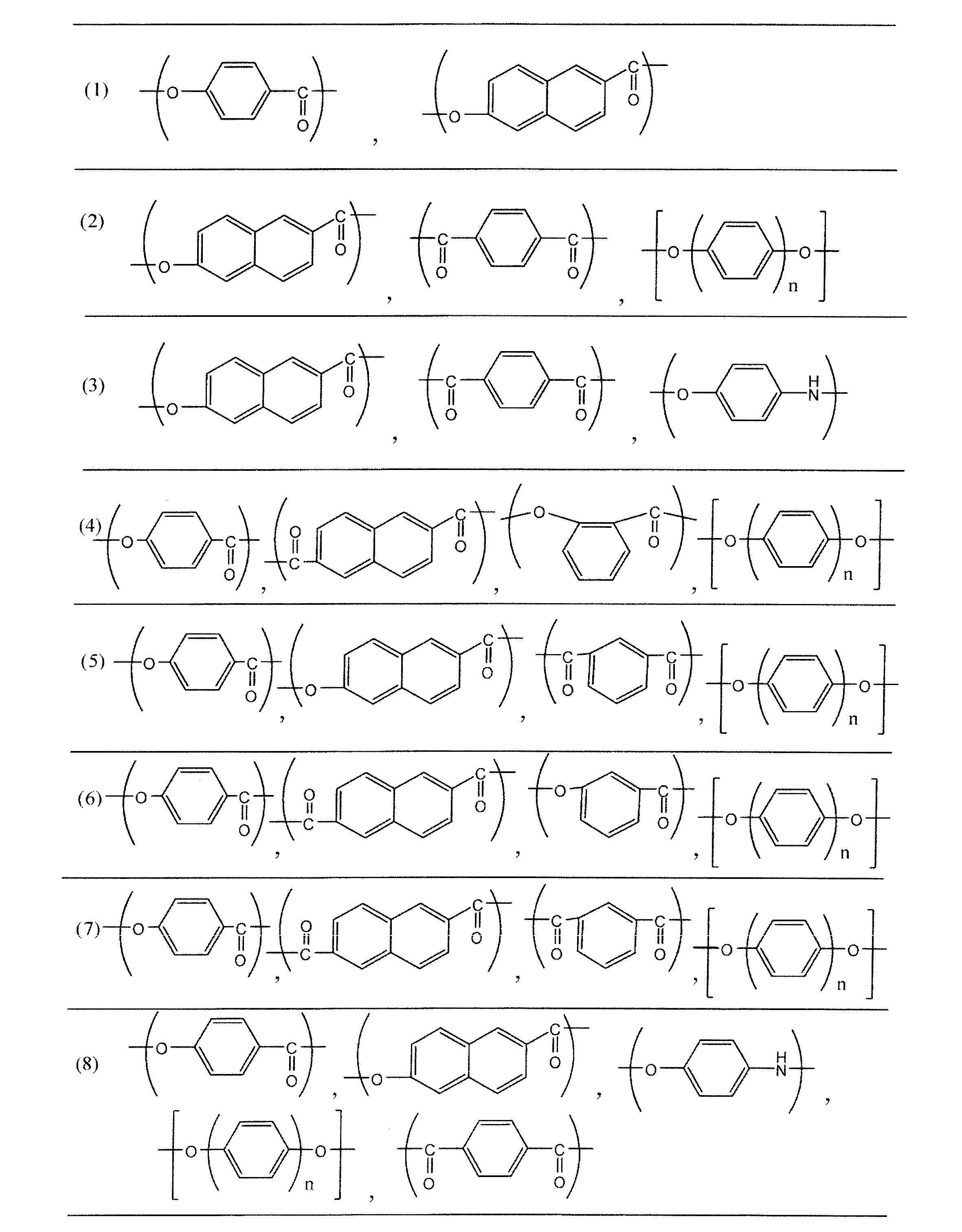
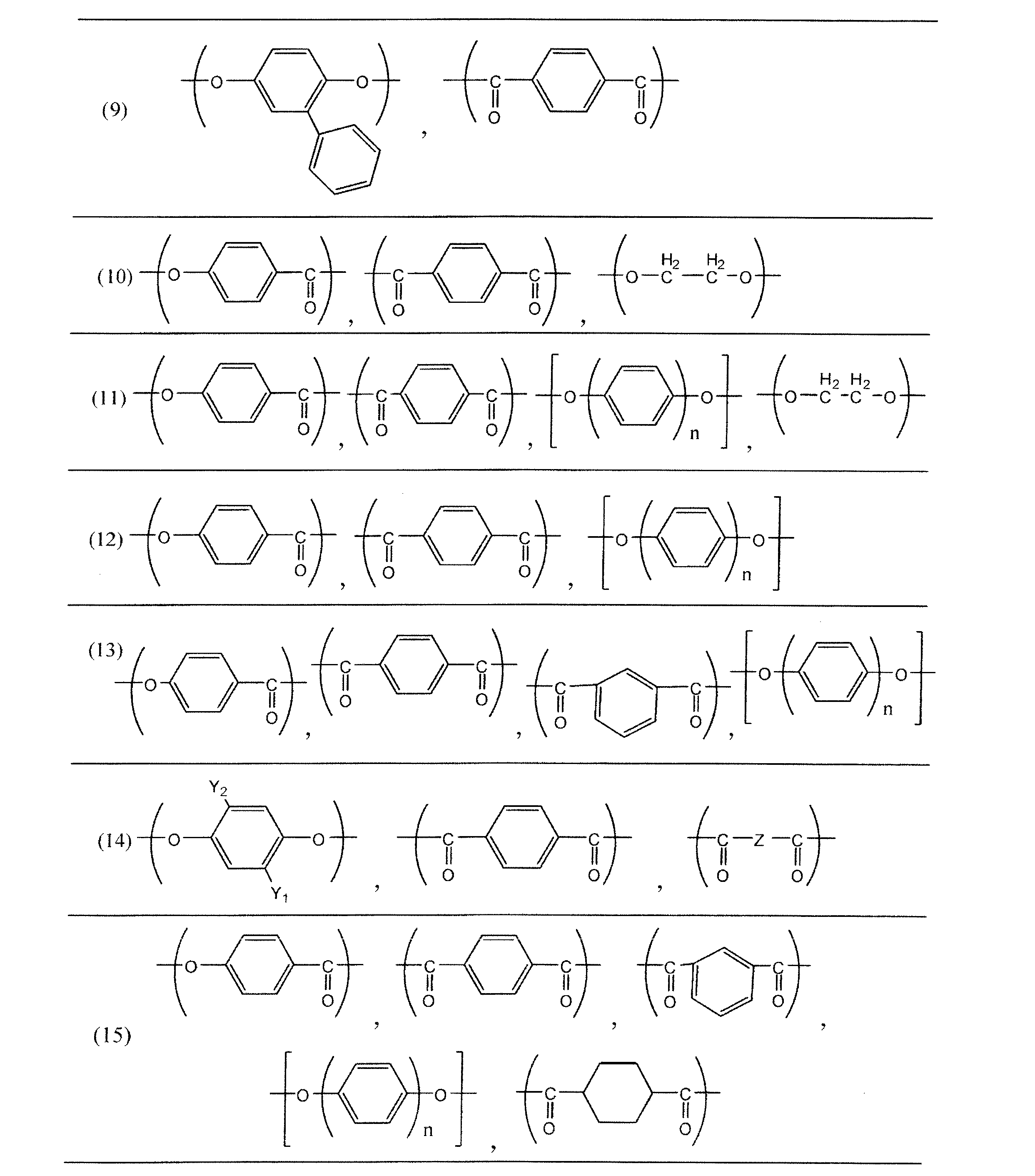

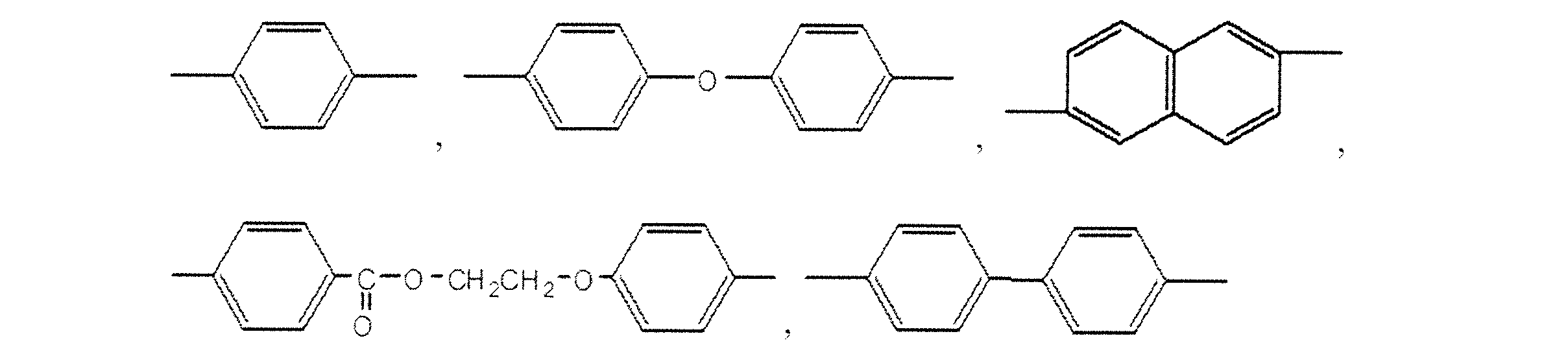



本発明の液晶ポリエステル繊維の製造方法は、液晶ポリエステルと、周期表第8~11族の金属元素からなる群から選択される少なくとも一種の金属元素とを含む樹脂組成物を溶融紡糸する工程を少なくとも備えていてもよい。
また、金属化合物の融点は、加工性の観点から400℃以下であることが好ましく、350℃以下であることがより好ましい。金属化合物の融点の下限値は特に限定されないが、溶融紡糸機近傍での取り扱い性の観点から、100℃以上であることが好ましい。
JIS L 1013:2010 8.3.1 A法に基づき、株式会社大栄科学精器製作所製検尺器「Wrap Reel by Motor Driven」を用いて液晶ポリエステル繊維を1周1m×100周(計100m)のカセに巻き、その重量(g)を100倍して1水準当たり2回の測定を行い、その平均値を、得られた液晶ポリエステル繊維の総繊度(dtex)とした。また、この値をフィラメント本数で除した商を単繊維繊度(dtex)とした。
JIS K 7121に準拠し、示差走査熱量計(DSC;メトラー社製、「TA3000」)を用いて測定し、観察される主吸収ピーク温度を融点とした。具体的には、前記DSC装置に、試料10~20mgをとりアルミ製パンへ封入した後、キャリヤーガスとして窒素を100mL/分の流量で流し、25℃から20℃/分で昇温したときの液晶ポリエステル由来の吸熱ピークを測定した。
上記繊維の融点測定と同じ装置、パンを使用し測定した。ただし、水和水や残存溶媒のピークを除くため、キャリヤーガスとして窒素を100mL/分の流量で流し、25℃から20℃/分で150℃まで昇温し、1分保持後、-20℃/分で25℃まで降温したのち、再度25℃から20℃/分で昇温したとき最も低温に現れる吸熱ピークを測定した。
以下に記載する「マイクロ波分解」により分析用液体を作製し、ICP-MS測定を行うことで金属元素含有量(重量ppm)を求めた。
・マイクロ波分解
マイルストーンゼネラル株式会社製マイクロ波分解装置「ETHOS-1」を用いてマイクロ波分解を行った。液晶ポリエステル繊維サンプル0.1gをクォーツインサートに量り取り、硝酸(1.42mol/L)6mLを加えた。水5mLと過酸化水素(濃度30~36重量%)2mLを入れた分解容器にクォーツインサートを入れて密閉しマイクロ波分解を行った。放冷後、50mLに定容し、孔径0.45μmフィルターでろ過したろ液をICP-MS測定に供した。
・ICP-MS測定
アジレント・テクノロジー社製ICP-MS分析装置「Agirent7900」を用いて上記マイクロ波分解にて作製したサンプル液の金属元素含有量を分析した。キャリヤーガス流量0.7L/min、RF出力1500Wの条件で、XSTC-622(SPEX社製標準液)と比較して同一サンプル液から3回測定を行い、その平均値から各金属元素含有量を決定した。
なお、繊維など油剤が付着しているサンプルにおいて、油剤が含む金属元素の影響が懸念される場合は、以下の方法で油剤除去を行ったのち、マイクロ波分解を行うと良い。
・油剤除去
イオン交換水1Lにノニオン系界面活性剤(松本油脂製薬株式会社製、アクチノールF-9)を2g溶解させた水溶液に100g以下の量の液晶ポリエステル繊維サンプルを入れ、60~90℃に温調を行い、40分振とうを行った。液晶ポリエステル繊維サンプルを取り出し、60~90℃に温調をしたイオン交換水1Lで40分×2回すすぎを行った。液晶ポリエステル繊維サンプルを取り出し、ヤマト科学株式会社製熱風乾燥機「DN63HI」を用いて空気雰囲気下、80℃で3時間以上乾燥を行い、油剤の除去された液晶ポリエステル繊維サンプルを得た。
JIS L 1013:2010 8.5.1を参考に、株式会社島津製作所製オートグラフ「AGS-100B」を用いて、試験長10cm、引張速度10cm/分の条件で、糸条1サンプルにつき6回の引張試験を行い、その平均引張強力(cN)を上述の方法で測定した総繊度(dtex)で割り、引張強度(cN/dtex)を算出した。
液晶ポリエステル繊維試料をd90=100μm以下になるまで凍結粉砕し、その粉砕試料に大過剰のn-プロピルアミンを加え、40℃で90分間加熱攪拌処理を行い、試料を分解した。この場合、高分子鎖の内部に存在したエステル結合はカルボン酸n-プロピルアミドとヒドロキシ基に分解され、高分子鎖の末端に存在したカルボキシ基(CEG)とヒドロキシ基はそのままカルボキシ基とヒドロキシ基から変化しないので、HPLC法により分解物を分離し、カルボキシ基を有する分解物のピーク面積を、それぞれの標品のHPLC分析により作成した検量線と比較することで各々のモノマー由来のカルボキシ末端量(meq/kg)を定量した。例えば、4-ヒドロキシ安息香酸や6-ヒドロキシ-2-ナフトエ酸といった一価のカルボン酸由来のCEG量は、そのまま4-ヒドロキシ安息香酸や6-ヒドロキシ-2-ナフトエ酸を定量することで求められ、テレフタル酸やイソフタル酸や6-ナフタレンジカルボン酸といった二価のカルボン酸由来のCEG量は、テレフタル酸モノn-プロピルアミドやイソフタル酸モノn-プロピルアミドや2,6-ナフタレンジカルボン酸モノn-プロピルアミドといった片方のカルボキシ基がアミド化した物質を定量することで求められる。各試料が含む全てのカルボキシ末端量の合計を、その試料の全カルボキシ末端量(全CEG量)(meq/kg)とした。
上記の全CEG量の測定と同様に、液晶ポリエステル繊維試料にn-プロピルアミンを用いて分解し、ヒドロキシカルボン酸由来のカルボキシ末端量、およびヒドロキシカルボン酸由来の末端のカルボキシ基が脱炭酸反応して生じる末端量の合計量(meq/kg)を定量した。例えば、4-ヒドロキシ安息香酸由来の末端量は、4-ヒドロキシ安息香酸およびフェノールを定量することで求められ、6-ヒドロキシ-2-ナフトエ酸由来の末端量は、6-ヒドロキシ-2-ナフトエ酸および2-ナフトールを定量することで求められる。ヒドロキシカルボン酸以外のジオールやジカルボン酸由来等の末端量を考慮するために、ヒドロキシカルボン酸由来の末端量の合計を、当該試料の液晶ポリエステル中のヒドロキシカルボン酸由来の構成単位のモル比で除した値を、その試料の全片末端量とした。
ケトン結合量は、Polymer Degradation and Stability、76、85-94(2002)に記載される、熱分解ガスクロマトグラフィー法によって算出した。具体的には、熱分解装置(フロンティア・ラボ株式会社製、「PY2020iD」)を用いて、液晶ポリエステル繊維試料を水酸化テトラメチルアンモニウム(TMAH)共存下で加熱し、熱分解/メチル化によりガスを発生させた。このガスをガスクロマトグラフィー(アジレント・テクノロジー株式会社製、「GC-6890N」)を用いて分析し、ケトン結合に由来するピーク面積およびエステル結合に由来するピーク面積からケトン結合量(mol%)を算出した。
糸条サンプルに80T/mのZ方向の撚りを掛けたのち、大栄科学精器製作所製検尺器「Wrap Reel by Motor Driven」を用いて液晶ポリエステル繊維を1周1m×50周(計50m)のカセに巻いた。ヤマト科学株式会社製熱風乾燥機「DN63HI」を用いて空気雰囲気下、250℃で加熱した。カセは1サンプルあたり2個作製し、1個の加熱時間は100時間とし、もう1個は300時間とした。加熱の際、カセは炉内上寄りに渡した任意の金属棒に掛けて、金属棒との接触点以外に接触箇所の無い状態とした。加熱後のサンプルは、金属棒との接触点以外の部分を用いて上述の方法で平均引張強力(cN)を測定した。この値を耐熱老化性試験の加熱前の平均引張強力(cN)で割った比に100を掛けた値を、250℃における100時間および300時間の強力保持率(%)とした。
下記式で示した構成単位(A)と(B)が(A)/(B)=73/27(mol比)で、アルカリ金属、アルカリ土類金属の含有率が合計10重量ppm以下である液晶ポリエステル樹脂(α)(Mp0:281℃)のチップ(粒状成型体)に対して、重合触媒として酢酸銅(I)(富士フイルムワコーケミカル株式会社製、融点271℃)粉末を銅原子換算で50重量ppm(樹脂チップおよび重合触媒の合計量に対する銅元素含有量)になるように加え、振とう装置でよく混ぜた。こうして得た樹脂チップと重合触媒のブレンド物を120℃で4時間以上熱風乾燥させたのち、Φ15mm二軸押出機(株式会社テクノベル製、「KZW15TW-45MG-NH(-700)」)にてヒーター温度300℃で溶融押出を行い、ギアポンプで計量しつつ紡糸頭に樹脂組成物を供給した。このとき二軸押出機の途中のベント部より金属管を介して減圧ポンプ(オリオン機械株式会社製ドライポンプ、「KRF40A-V-01B」)を接続し、二軸押出機内の樹脂組成物非充満空間を60kPaまで減圧を行った。またこのときの押出機出口から紡糸頭の温度は310℃とした。紡糸頭には孔径0.125mmφ、ランド長0.175mm、孔数50個の紡糸口金を備え、吐出量28g/分で樹脂組成物を吐出し、巻き取り速度1000m/分でボビンに巻き取り液晶ポリエステル繊維の紡糸原糸を得た。この際、紡糸口金直下に配置したオイリングガイドから、2重量%のドデシルリン酸ナトリウム(富士フイルム和光純薬工業株式会社製、和光一級)水溶液を紡糸原糸に付与した。この水溶液の付与量は1.4g/分であり、紡糸原糸に対するドデシルリン酸ナトリウムの付着比率は計算上0.1重量%であった。

ヨウ化銅(I)(富士フイルム和光純薬株式会社製、試薬特級)と、ヨウ化銅(I)と等モル量の1,10-フェナントロリン(富士フイルムワコーケミカル社製)の2種類の試薬を、ヨウ化銅(I)1モルに対し5Lのアセトニトリル(富士フイルム和光純薬株式会社製、試薬特級)に加え、懸濁液の状態で攪拌を1時間行ったのち、ろ過し、100℃で3時間乾燥を行い、橙色の固体(融点300℃)を得た。
この固体を酢酸銅(I)の代わりの重合触媒として、銅原子換算で50重量ppmになるように使用した以外は実施例1と同様にして液晶ポリエステル繊維の紡糸原糸および熱処理糸を得た。得られた液晶ポリエステル繊維(紡糸原糸および熱処理糸)の分析結果を表5に示す。
酢酸銅(I)の代わりの重合触媒として酢酸銅(II)(富士フイルム和光純薬株式会社製、和光一級、融点115℃)を銅原子換算で50重量ppmになるように加えた以外は実施例1と同様にして液晶ポリエステル繊維の紡糸原糸および熱処理糸を得た。得られた液晶ポリエステル繊維(紡糸原糸および熱処理糸)の分析結果を表5に示す。
硫酸銅(II)五水和物(富士フイルム和光純薬株式会社製、試薬特級)と、硫酸銅(II)五水和物に対し2倍モル量の1,10-フェナントロリン(富士フイルムワコーケミカル社製)の2種類の試薬を、硫酸銅(II)五水和物1モルに対し5Lのアセトニトリル(富士フイルム和光純薬株式会社製、試薬特級)に加え、懸濁液の状態で攪拌を1時間行ったのち、ろ過し、100℃で3時間乾燥を行い、青色の固体(融点294℃)を得た。
この固体を酢酸銅(I)の代わりの重合触媒として、銅原子換算で50重量ppmになるように使用した以外は実施例1と同様にして液晶ポリエステル繊維の紡糸原糸および熱処理糸を得た。得られた液晶ポリエステル繊維(紡糸原糸および熱処理糸)の分析結果を表5に示す。
酢酸銅(I)の代わりの重合触媒として酢酸コバルト(II)四水和物(富士フイルム和光純薬株式会社製、和光特級、融点194℃)をコバルト原子換算で50重量ppmになるように加えた以外は実施例1と同様にして液晶ポリエステル繊維の紡糸原糸および熱処理糸を得た。得られた液晶ポリエステル繊維(紡糸原糸および熱処理糸)の分析結果を表5に示す。
酢酸銅(I)の代わりの重合触媒として酢酸パラジウム(II)(富士フイルム和光純薬株式会社製、和光特級、融点205℃)をパラジウム原子換算で50重量ppmになるように加えた以外は実施例1と同様にして液晶ポリエステル繊維の紡糸原糸および熱処理糸を得た。得られた液晶ポリエステル繊維(紡糸原糸および熱処理糸)の分析結果を表5に示す。
酢酸銅(I)を樹脂に加える重量比率を銅原子換算で5重量ppmにした以外は実施例1と同様にして液晶ポリエステル繊維の紡糸原糸および熱処理糸を得た。得られた液晶ポリエステル繊維(紡糸原糸および熱処理糸)の分析結果を表5に示す。
酢酸銅(I)を樹脂に加える重量比率を銅原子換算で500重量ppmにした以外は実施例1と同様にして液晶ポリエステル繊維の紡糸原糸および熱処理糸を得た。得られた液晶ポリエステル繊維(紡糸原糸および熱処理糸)の分析結果を表5に示す。
実施例1に記載の液晶ポリエステル樹脂(α)のチップ(粒状成型体)に対して、重合触媒として酢酸銅(I)(富士フイルムワコーケミカル株式会社製、融点271℃)粉末を銅原子換算で500重量ppmになるように加え、振とう装置でよく混ぜた。こうして得た樹脂チップと重合触媒のブレンド物を120℃で4時間以上熱風乾燥させたのち、Φ15mm二軸押出機(株式会社テクノベル製、「KZW15TW-45MG-NH(-700)」)にてヒーター温度300℃で溶融押出を行い、ギアポンプで計量しつつ先端ダイスに樹脂組成物を供給した。このとき二軸押出機の途中のベント部より金属管を介して減圧ポンプ(オリオン機械株式会社製ドライポンプ、「KRF40A-V-01B」)を接続し、二軸押出機内の樹脂組成物非充満空間を60kPaまで減圧を行った。またこのときの押出機出口から先端ダイスの温度は310℃とした。先端ダイスではφ3mmの円形孔から吐出量28g/分で樹脂が棒状に吐出され、巻き取り速度5m/分でこれを引き取りつつ、長径5mm以下になるよう回転カッターで棒状樹脂組成物をカットすることで樹脂組成物チップを得た。こうして得た樹脂組成物チップ(銅元素500重量ppm相当混合)と、液晶ポリエステル樹脂(α)のチップとを、重量比1:9で混合し、振とう装置でよく混ぜ、120℃で4時間以上熱風乾燥させた。こうして得た2種類のチップのブレンド品を、Φ15mm二軸押出機(株式会社テクノベル製、「KZW15TW-45MG-NH(-700)」)にてヒーター温度300℃で溶融押出を行い、ギアポンプで計量しつつ紡糸頭に樹脂組成物を供給した。このとき二軸押出機の途中のベント部より金属管を介して減圧ポンプ(オリオン機械株式会社製ドライポンプ、「KRF40A-V-01B」)を接続し、二軸押出機内の樹脂組成物非充満空間を60kPaまで減圧を行った。またこのときの押出機出口から紡糸頭の温度は310℃とした。紡糸頭には孔径0.125mmφ、ランド長0.175mm、孔数50個の紡糸口金を備え、吐出量28g/分で樹脂組成物を吐出し、巻き取り速度1000m/分でボビンに巻き取り液晶ポリエステル繊維の紡糸原糸を得た。この際、紡糸口金直下に配置したオイリングガイドから、2重量%のドデシルリン酸ナトリウム(富士フイルム和光純薬工業株式会社製、和光一級)水溶液を紡糸原糸に付与した。この水溶液の付与量は1.4g/分であり、紡糸原糸に対するドデシルリン酸ナトリウムの付着比率は計算上0.1重量%であった。
次に、ここで得られた紡糸原糸4kgを、巻密度0.6g/cm3になるようアルミニウム製ボビンに巻き返し、密閉型オーブンを用いて窒素雰囲気下で25℃から250℃まで2時間で昇温し、250℃で3時間熱処理を行い、250℃から25℃まで2時間で降温し、液晶ポリエステル長繊維の熱処理糸を得た。得られた液晶ポリエステル繊維(紡糸原糸および熱処理糸)の分析結果を表5に示す。
孔径0.100mmφ、ランド長0.140mm、孔数100個の紡糸口金を用いたこと以外は実施例1と同様にして紡糸原糸を得た。その後、実施例1と同様に熱処理を行い、熱処理糸を得た。得られた液晶ポリエステル繊維(紡糸原糸および熱処理糸)の分析結果を表5に示す。
孔径0.150mmφ、ランド長0.210mm、孔数20個の紡糸口金を用いたこと以外は実施例1と同様にして紡糸原糸を得た。その後、実施例1と同様に熱処理を行い、熱処理糸を得た。得られた液晶ポリエステル繊維(紡糸原糸および熱処理糸)の分析結果を表5に示す。
孔径0.125mmφ、ランド長0.175mm、孔数20個の紡糸口金を用いたこと、吐出量11.0g/分で樹脂組成物を吐出したこと、およびオイリングガイドからのドデシルリン酸ナトリウム水溶液の付与量を0.55g/分にしたこと以外は実施例1と同様にして紡糸原糸を得た。その後、実施例1と同様に熱処理を行い、熱処理糸を得た。得られた液晶ポリエステル繊維(紡糸原糸および熱処理糸)の分析結果を表5に示す。
実施例1に記載の液晶ポリエステル樹脂(α)ではなく、下記式で示した各構成単位のmol比が(A)/(C)/(D)/(E)=65/10/5/20で、アルカリ金属、アルカリ土類金属の含有率が合計10重量ppm以下である液晶ポリエステル樹脂(β)(Mp0:348℃)を使用し、溶融押出を行う際の押出機ヒーター温度を360℃、押出機出口から紡糸頭の温度を360℃とした以外は、実施例1と同様にして紡糸原糸を得た。その後、密閉型オーブンを用いた紡糸原糸の熱処理温度を290℃とした以外は、実施例1と同様にして熱処理糸を得た。得られた液晶ポリエステル繊維(紡糸原糸および熱処理糸)の分析結果を表5に示す。
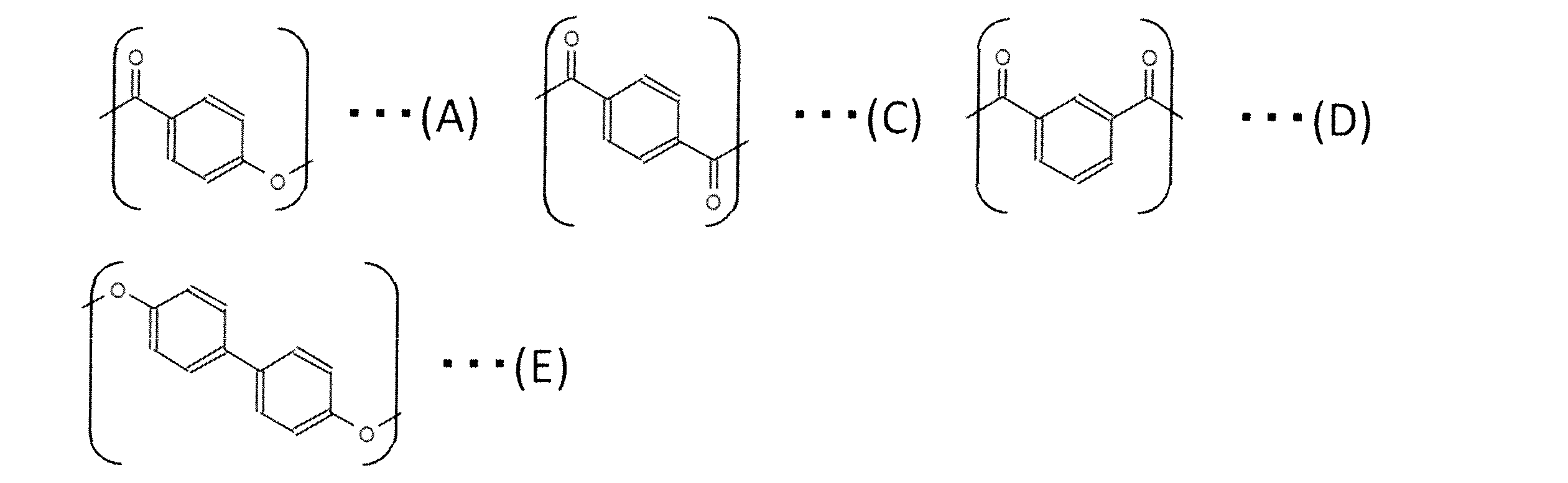
実施例1に記載の液晶ポリエステル樹脂(α)ではなく、下記式で示した各構成単位のmol比が(A)/(C)/(D)/(E)/(F)=54/15/8/16/7で、アルカリ金属、アルカリ土類金属の含有率が合計10重量ppm以下である液晶ポリエステル樹脂(γ)(Mp0:315℃)を使用し、溶融押出を行う際の押出機ヒーター温度を340℃、押出機出口から紡糸頭の温度を350℃とした以外は、実施例1と同様にして紡糸原糸を得た。その後、密閉型オーブンを用いた紡糸原糸の熱処理温度を260℃とした以外は、実施例1と同様にして熱処理糸を得た。得られた液晶ポリエステル繊維(紡糸原糸および熱処理糸)の分析結果を表5に示す。
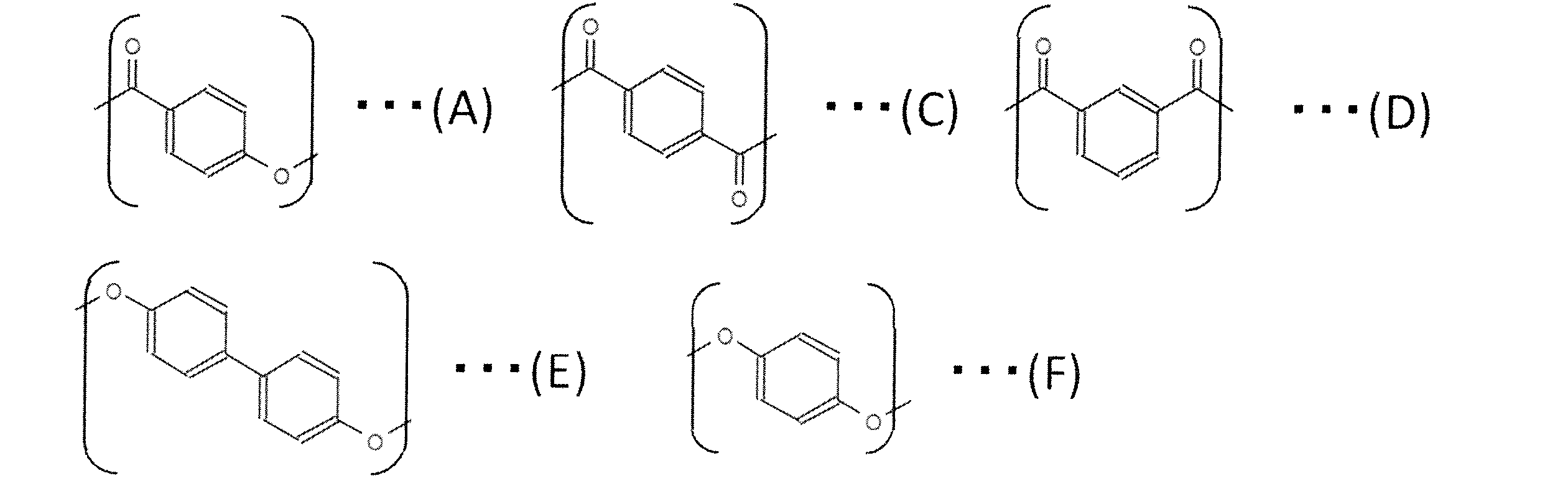
橙色の固体(ヨウ化銅(I)、1,10-フェナントロリン)を樹脂に加える重量比率を銅原子換算で10重量ppmにした以外は実施例2と同様にして液晶ポリエステル繊維の紡糸原糸および熱処理糸を得た。得られた液晶ポリエステル繊維(紡糸原糸および熱処理糸)の分析結果を表5に示す。
橙色の固体(ヨウ化銅(I)、1,10-フェナントロリン)を樹脂に加える重量比率を銅原子換算で10重量ppmにした以外は実施例2と同様にして液晶ポリエステル繊維の紡糸原糸および熱処理糸を得た。得られた液晶ポリエステル繊維(紡糸原糸および熱処理糸)の分析結果を表5に示す。
橙色の固体(ヨウ化銅(I)、1,10-フェナントロリン)を樹脂に加える重量比率を銅原子換算で30重量ppmにした以外は実施例2と同様にして液晶ポリエステル繊維の紡糸原糸および熱処理糸を得た。得られた液晶ポリエステル繊維(紡糸原糸および熱処理糸)の分析結果を表5に示す。
橙色の固体(ヨウ化銅(I)、1,10-フェナントロリン)を樹脂に加える重量比率を銅原子換算で70重量ppmにした以外は実施例2と同様にして液晶ポリエステル繊維の紡糸原糸および熱処理糸を得た。得られた液晶ポリエステル繊維(紡糸原糸および熱処理糸)の分析結果を表5に示す。
橙色の固体(ヨウ化銅(I)、1,10-フェナントロリン)を樹脂に加える重量比率を銅原子換算で100重量ppmにした以外は実施例2と同様にして液晶ポリエステル繊維の紡糸原糸および熱処理糸を得た。得られた液晶ポリエステル繊維(紡糸原糸および熱処理糸)の分析結果を表5に示す。
橙色の固体(ヨウ化銅(I)、1,10-フェナントロリン)を樹脂に加える重量比率を銅原子換算で150重量ppmにした以外は実施例2と同様にして液晶ポリエステル繊維の紡糸原糸および熱処理糸を得た。得られた液晶ポリエステル繊維(紡糸原糸および熱処理糸)の分析結果を表5に示す。
重合触媒を混合せず、液晶ポリエステル樹脂(α)のチップ単体を原料として紡糸を行った以外は実施例1と同様にして液晶ポリエステル繊維の紡糸原糸および熱処理糸を得た。得られた液晶ポリエステル繊維(紡糸原糸および熱処理糸)の分析結果を表5に示す。
酢酸銅(I)の代わりの重合触媒として酢酸カリウム(富士フイルム和光純薬株式会社製、試薬特級)をカリウム原子換算で50重量ppmになるように加えた以外は実施例1と同様にして液晶ポリエステル繊維の紡糸原糸および熱処理糸を得た。得られた液晶ポリエステル繊維(紡糸原糸および熱処理糸)の分析結果を表5に示す。
酢酸銅(I)の代わりの重合触媒としてN,N-ジメチル-4-アミノピリジン(DMAP)(富士フイルム和光純薬株式会社製、和光特級)を重量比1wt%で加えた以外は実施例1と同様にして液晶ポリエステル繊維の紡糸原糸および熱処理糸を得た。得られた液晶ポリエステル繊維(紡糸原糸および熱処理糸)の分析結果を表5に示す。
酢酸銅(I)の代わりの重合触媒として酢酸カリウム(富士フイルム和光純薬株式会社製、試薬特級)をカリウム原子換算で50重量ppmになるように加えた以外は実施例13と同様にして液晶ポリエステル繊維の紡糸原糸および熱処理糸を得た。得られた液晶ポリエステル繊維(紡糸原糸および熱処理糸)の分析結果を表5に示す。
酢酸銅(I)の代わりの重合触媒として酢酸カリウム(富士フイルム和光純薬株式会社製、試薬特級)をカリウム原子換算で50重量ppmになるように加えた以外は実施例14と同様にして液晶ポリエステル繊維の紡糸原糸および熱処理糸を得た。得られた液晶ポリエステル繊維(紡糸原糸および熱処理糸)の分析結果を表5に示す。

Claims (12)
- 周期表第8~11族の金属元素からなる群から選択される少なくとも一種の金属元素を含む、液晶ポリエステル繊維。
- 請求項1に記載の液晶ポリエステル繊維であって、前記金属元素の含有量が合計1~1000重量ppmである、液晶ポリエステル繊維。
- 請求項1または2に記載の液晶ポリエステル繊維であって、前記金属元素が金属化合物として含有されており、前記金属化合物の融点が液晶ポリエステルの融点+30℃以下である、液晶ポリエステル繊維。
- 請求項1~3のいずれか一項に記載の液晶ポリエステル繊維であって、強度が18cN/dtex以上である、液晶ポリエステル繊維。
- 請求項1~4のいずれか一項に記載の液晶ポリエステル繊維であって、全片末端量が20meq/kg以下である、液晶ポリエステル繊維。
- 請求項1~5のいずれか一項に記載の液晶ポリエステル繊維であって、ケトン結合量が0.05mol%以下である、液晶ポリエステル繊維。
- 請求項1~6のいずれか一項に記載の液晶ポリエステル繊維を製造する方法であって、液晶ポリエステルと、周期表第8~11族の金属元素からなる群から選択される少なくとも一種の金属元素とを含む樹脂組成物を溶融紡糸する、液晶ポリエステル繊維の製造方法。
- 請求項7に記載の製造方法であって、前記樹脂組成物における前記金属元素の含有量が合計1~1000重量ppmである、液晶ポリエステル繊維の製造方法。
- 請求項7または8に記載の製造方法であって、前記金属元素が液晶ポリエステルの融点+30℃以下の融点を有する化合物として前記樹脂組成物に含まれる、液晶ポリエステル繊維の製造方法。
- 請求項7~9のいずれか一項に記載の製造方法であって、前記溶融紡糸により得られた紡糸原糸を熱処理する、液晶ポリエステル繊維の製造方法。
- 請求項10に記載の製造方法であって、前記紡糸原糸の全カルボキシ末端量(全CEG量)が5.0meq/kg以下である、液晶ポリエステル繊維の製造方法。
- 請求項1~6のいずれか一項に記載の液晶ポリエステル繊維を少なくとも一部に含んで構成された繊維構造物。
Priority Applications (5)
| Application Number | Priority Date | Filing Date | Title |
|---|---|---|---|
| EP21897776.7A EP4253612A4 (en) | 2020-11-25 | 2021-11-15 | LIQUID CRYSTAL POLYESTER FIBERS AND METHOD FOR PRODUCING THE SAME |
| KR1020237019765A KR20230098896A (ko) | 2020-11-25 | 2021-11-15 | 액정 폴리에스테르 섬유 및 그 제조 방법 |
| CN202180079433.9A CN116601342A (zh) | 2020-11-25 | 2021-11-15 | 液晶聚酯纤维及其制造方法 |
| JP2022565239A JP7577129B2 (ja) | 2020-11-25 | 2021-11-15 | 液晶ポリエステル繊維およびその製造方法 |
| US18/200,678 US20230332334A1 (en) | 2020-11-25 | 2023-05-23 | Liquid crystal polyester fibers and method for producing same |
Applications Claiming Priority (2)
| Application Number | Priority Date | Filing Date | Title |
|---|---|---|---|
| JP2020-195469 | 2020-11-25 | ||
| JP2020195469 | 2020-11-25 |
Related Child Applications (1)
| Application Number | Title | Priority Date | Filing Date |
|---|---|---|---|
| US18/200,678 Continuation US20230332334A1 (en) | 2020-11-25 | 2023-05-23 | Liquid crystal polyester fibers and method for producing same |
Publications (1)
| Publication Number | Publication Date |
|---|---|
| WO2022113802A1 true WO2022113802A1 (ja) | 2022-06-02 |
Family
ID=81756007
Family Applications (1)
| Application Number | Title | Priority Date | Filing Date |
|---|---|---|---|
| PCT/JP2021/041909 Ceased WO2022113802A1 (ja) | 2020-11-25 | 2021-11-15 | 液晶ポリエステル繊維およびその製造方法 |
Country Status (7)
| Country | Link |
|---|---|
| US (1) | US20230332334A1 (ja) |
| EP (1) | EP4253612A4 (ja) |
| JP (1) | JP7577129B2 (ja) |
| KR (1) | KR20230098896A (ja) |
| CN (1) | CN116601342A (ja) |
| TW (1) | TWI888672B (ja) |
| WO (1) | WO2022113802A1 (ja) |
Cited By (4)
| Publication number | Priority date | Publication date | Assignee | Title |
|---|---|---|---|---|
| WO2023058563A1 (ja) * | 2021-10-08 | 2023-04-13 | 株式会社クラレ | 液晶ポリエステル繊維およびその製造方法 |
| WO2024128110A1 (ja) * | 2022-12-14 | 2024-06-20 | 株式会社クラレ | 溶融異方性芳香族ポリエステル繊維およびその製造方法 |
| EP4134473A4 (en) * | 2020-04-10 | 2024-09-25 | Kuraray Co., Ltd. | LIQUID CRYSTAL POLYESTER FIBRES AND PRODUCTION METHODS THEREOF |
| WO2024210040A1 (ja) | 2023-04-05 | 2024-10-10 | 株式会社クラレ | 液晶ポリエステル繊維 |
Citations (5)
| Publication number | Priority date | Publication date | Assignee | Title |
|---|---|---|---|---|
| WO2002022707A1 (fr) * | 2000-09-12 | 2002-03-21 | Toyo Boseki Kabushiki Kaisha | Catalyseur de polymerisation pour polyester, polyester ainsi obtenu, et procede de production de polyester |
| JP2013067779A (ja) | 2011-07-29 | 2013-04-18 | Sumitomo Chemical Co Ltd | 液晶ポリエステルの製造方法および液晶ポリエステル |
| WO2017068867A1 (ja) | 2015-10-21 | 2017-04-27 | ポリプラスチックス株式会社 | 全芳香族ポリエステル及びその製造方法 |
| JP2020105397A (ja) * | 2018-12-27 | 2020-07-09 | Jxtgエネルギー株式会社 | 液晶ポリマーおよび該液晶ポリマーを含む樹脂組成物からなる樹脂成形品 |
| WO2020204124A1 (ja) * | 2019-04-03 | 2020-10-08 | ポリプラスチックス株式会社 | 全芳香族ポリエステル及びポリエステル樹脂組成物 |
Family Cites Families (4)
| Publication number | Priority date | Publication date | Assignee | Title |
|---|---|---|---|---|
| KR101798267B1 (ko) * | 2013-12-31 | 2017-12-12 | 심천 워트 어드밴스드 머티리얼즈 주식회사 | 전방향족 액정 폴리에스테르 섬유 및 이의 제조 방법 |
| CN105801824A (zh) * | 2016-04-13 | 2016-07-27 | 金发科技股份有限公司 | 一种液晶聚酯组合物 |
| KR101988184B1 (ko) * | 2018-11-29 | 2019-06-12 | 세양폴리머주식회사 | 방사성이 향상된 전방향족 액정 폴리에스터 섬유 |
| EP4092172A4 (en) * | 2020-01-15 | 2024-04-03 | Kuraray Co., Ltd. | METAL-COVERED LIQUID CRYSTAL POLYESTER MULTIFILAMENT |
-
2021
- 2021-11-15 CN CN202180079433.9A patent/CN116601342A/zh active Pending
- 2021-11-15 EP EP21897776.7A patent/EP4253612A4/en active Pending
- 2021-11-15 JP JP2022565239A patent/JP7577129B2/ja active Active
- 2021-11-15 WO PCT/JP2021/041909 patent/WO2022113802A1/ja not_active Ceased
- 2021-11-15 KR KR1020237019765A patent/KR20230098896A/ko active Pending
- 2021-11-23 TW TW110143521A patent/TWI888672B/zh active
-
2023
- 2023-05-23 US US18/200,678 patent/US20230332334A1/en active Pending
Patent Citations (5)
| Publication number | Priority date | Publication date | Assignee | Title |
|---|---|---|---|---|
| WO2002022707A1 (fr) * | 2000-09-12 | 2002-03-21 | Toyo Boseki Kabushiki Kaisha | Catalyseur de polymerisation pour polyester, polyester ainsi obtenu, et procede de production de polyester |
| JP2013067779A (ja) | 2011-07-29 | 2013-04-18 | Sumitomo Chemical Co Ltd | 液晶ポリエステルの製造方法および液晶ポリエステル |
| WO2017068867A1 (ja) | 2015-10-21 | 2017-04-27 | ポリプラスチックス株式会社 | 全芳香族ポリエステル及びその製造方法 |
| JP2020105397A (ja) * | 2018-12-27 | 2020-07-09 | Jxtgエネルギー株式会社 | 液晶ポリマーおよび該液晶ポリマーを含む樹脂組成物からなる樹脂成形品 |
| WO2020204124A1 (ja) * | 2019-04-03 | 2020-10-08 | ポリプラスチックス株式会社 | 全芳香族ポリエステル及びポリエステル樹脂組成物 |
Non-Patent Citations (2)
| Title |
|---|
| POLYMER DEGRADATION AND STABILITY, vol. 76, 2002, pages 85 - 94 |
| See also references of EP4253612A4 |
Cited By (9)
| Publication number | Priority date | Publication date | Assignee | Title |
|---|---|---|---|---|
| EP4134473A4 (en) * | 2020-04-10 | 2024-09-25 | Kuraray Co., Ltd. | LIQUID CRYSTAL POLYESTER FIBRES AND PRODUCTION METHODS THEREOF |
| WO2023058563A1 (ja) * | 2021-10-08 | 2023-04-13 | 株式会社クラレ | 液晶ポリエステル繊維およびその製造方法 |
| EP4414486A4 (en) * | 2021-10-08 | 2025-10-22 | Kuraray Co | LIQUID CRYSTAL POLYESTER FIBERS AND PROCESS FOR PRODUCING THE SAME |
| WO2024128110A1 (ja) * | 2022-12-14 | 2024-06-20 | 株式会社クラレ | 溶融異方性芳香族ポリエステル繊維およびその製造方法 |
| JPWO2024128110A1 (ja) * | 2022-12-14 | 2024-06-20 | ||
| JP7745782B2 (ja) | 2022-12-14 | 2025-09-29 | 株式会社クラレ | 溶融異方性芳香族ポリエステル繊維およびその製造方法 |
| WO2024210040A1 (ja) | 2023-04-05 | 2024-10-10 | 株式会社クラレ | 液晶ポリエステル繊維 |
| KR20250172820A (ko) | 2023-04-05 | 2025-12-09 | 주식회사 쿠라레 | 액정 폴리에스테르 섬유 |
| EP4692433A1 (en) | 2023-04-05 | 2026-02-11 | Kuraray Co., Ltd. | Liquid crystal polyester fiber |
Also Published As
| Publication number | Publication date |
|---|---|
| JP7577129B2 (ja) | 2024-11-01 |
| EP4253612A1 (en) | 2023-10-04 |
| JPWO2022113802A1 (ja) | 2022-06-02 |
| CN116601342A (zh) | 2023-08-15 |
| EP4253612A4 (en) | 2024-11-20 |
| TWI888672B (zh) | 2025-07-01 |
| US20230332334A1 (en) | 2023-10-19 |
| KR20230098896A (ko) | 2023-07-04 |
| TW202231708A (zh) | 2022-08-16 |
Similar Documents
| Publication | Publication Date | Title |
|---|---|---|
| JP7577129B2 (ja) | 液晶ポリエステル繊維およびその製造方法 | |
| KR20110017505A (ko) | 폴리케톤으로부터 촉매를 제거하는 방법 | |
| TW200302236A (en) | Polyketone and process for producing the same | |
| TWI867123B (zh) | 聚酯樹脂及聚酯樹脂之製造方法 | |
| KR20120104389A (ko) | 황변 억제 폴리아미드 섬유 및 그 제조방법 | |
| Xu et al. | Fabrication of a PANI/CPs composite material: a feasible method to enhance the photocatalytic activity of coordination polymers | |
| KR20190012055A (ko) | 단일벽 탄소나노튜브 섬유의 제조방법 | |
| JP7577130B2 (ja) | 液晶ポリエステル樹脂組成物、液晶ポリエステル繊維、繊維構造体、および溶融成形体 | |
| CN102329289A (zh) | 一种联苯二酐的制备方法 | |
| KR100995465B1 (ko) | 2,6-나프탈렌디카르복실산 정제용 촉매, 그 제조방법 및 이를 이용한 정제공정 | |
| JPWO2015170688A1 (ja) | 金属担持多孔性配位高分子触媒 | |
| KR101611574B1 (ko) | 폴리케톤 멀티필라멘트 | |
| CN116490648A (zh) | 液晶聚酯树脂组合物、液晶聚酯纤维、纤维结构体及熔融成型体 | |
| JP3883898B2 (ja) | 高白度ポリエステル繊維 | |
| KR20100098363A (ko) | 불균일 구리 나노 촉매 및 그 제조방법 | |
| KR101756643B1 (ko) | 폴리케톤 섬유를 포함하는 폴리케톤 어망 | |
| KR101611577B1 (ko) | 폴리케톤 멀티필라멘트 | |
| KR100623849B1 (ko) | 2,6-나프탈렌디카르복실산의 제조방법 | |
| TW202505076A (zh) | 液晶聚酯纖維 | |
| Gerber et al. | The partial air oxidation of alkyl aromatic compounds catalysed by cobalt/bromide in carboxylic acids: mechanistic considerations | |
| TW202605019A (zh) | 液晶聚酯纖維及纖維結構體 | |
| KR101716201B1 (ko) | 폴리케톤 섬유로 이루어진 요트 돛 | |
| KR101611576B1 (ko) | 폴리케톤 멀티필라멘트 | |
| CN105121392A (zh) | 烯烃的制造方法 | |
| KR100551422B1 (ko) | 섬유용 개질 폴리아미드6 중합체의 제조방법 |
Legal Events
| Date | Code | Title | Description |
|---|---|---|---|
| 121 | Ep: the epo has been informed by wipo that ep was designated in this application |
Ref document number: 21897776 Country of ref document: EP Kind code of ref document: A1 |
|
| ENP | Entry into the national phase |
Ref document number: 2022565239 Country of ref document: JP Kind code of ref document: A |
|
| WWE | Wipo information: entry into national phase |
Ref document number: 202180079433.9 Country of ref document: CN |
|
| ENP | Entry into the national phase |
Ref document number: 20237019765 Country of ref document: KR Kind code of ref document: A |
|
| NENP | Non-entry into the national phase |
Ref country code: DE |
|
| ENP | Entry into the national phase |
Ref document number: 2021897776 Country of ref document: EP Effective date: 20230626 |