WO2022113716A1 - 二次電池の製造方法 - Google Patents
二次電池の製造方法 Download PDFInfo
- Publication number
- WO2022113716A1 WO2022113716A1 PCT/JP2021/041028 JP2021041028W WO2022113716A1 WO 2022113716 A1 WO2022113716 A1 WO 2022113716A1 JP 2021041028 W JP2021041028 W JP 2021041028W WO 2022113716 A1 WO2022113716 A1 WO 2022113716A1
- Authority
- WO
- WIPO (PCT)
- Prior art keywords
- exterior member
- shaped exterior
- cup
- lid
- secondary battery
- Prior art date
- Legal status (The legal status is an assumption and is not a legal conclusion. Google has not performed a legal analysis and makes no representation as to the accuracy of the status listed.)
- Ceased
Links
Images








Classifications
-
- H—ELECTRICITY
- H01—ELECTRIC ELEMENTS
- H01M—PROCESSES OR MEANS, e.g. BATTERIES, FOR THE DIRECT CONVERSION OF CHEMICAL ENERGY INTO ELECTRICAL ENERGY
- H01M10/00—Secondary cells; Manufacture thereof
- H01M10/05—Accumulators with non-aqueous electrolyte
- H01M10/058—Construction or manufacture
-
- H—ELECTRICITY
- H01—ELECTRIC ELEMENTS
- H01M—PROCESSES OR MEANS, e.g. BATTERIES, FOR THE DIRECT CONVERSION OF CHEMICAL ENERGY INTO ELECTRICAL ENERGY
- H01M10/00—Secondary cells; Manufacture thereof
- H01M10/04—Construction or manufacture in general
- H01M10/049—Processes for forming or storing electrodes in the battery container
-
- H—ELECTRICITY
- H01—ELECTRIC ELEMENTS
- H01M—PROCESSES OR MEANS, e.g. BATTERIES, FOR THE DIRECT CONVERSION OF CHEMICAL ENERGY INTO ELECTRICAL ENERGY
- H01M10/00—Secondary cells; Manufacture thereof
- H01M10/05—Accumulators with non-aqueous electrolyte
- H01M10/052—Li-accumulators
-
- H—ELECTRICITY
- H01—ELECTRIC ELEMENTS
- H01M—PROCESSES OR MEANS, e.g. BATTERIES, FOR THE DIRECT CONVERSION OF CHEMICAL ENERGY INTO ELECTRICAL ENERGY
- H01M50/00—Constructional details or processes of manufacture of the non-active parts of electrochemical cells other than fuel cells, e.g. hybrid cells
- H01M50/10—Primary casings; Jackets or wrappings
- H01M50/102—Primary casings; Jackets or wrappings characterised by their shape or physical structure
- H01M50/109—Primary casings; Jackets or wrappings characterised by their shape or physical structure of button or coin shape
-
- H—ELECTRICITY
- H01—ELECTRIC ELEMENTS
- H01M—PROCESSES OR MEANS, e.g. BATTERIES, FOR THE DIRECT CONVERSION OF CHEMICAL ENERGY INTO ELECTRICAL ENERGY
- H01M50/00—Constructional details or processes of manufacture of the non-active parts of electrochemical cells other than fuel cells, e.g. hybrid cells
- H01M50/10—Primary casings; Jackets or wrappings
- H01M50/147—Lids or covers
- H01M50/148—Lids or covers characterised by their shape
- H01M50/153—Lids or covers characterised by their shape for button or coin cells
-
- H—ELECTRICITY
- H01—ELECTRIC ELEMENTS
- H01M—PROCESSES OR MEANS, e.g. BATTERIES, FOR THE DIRECT CONVERSION OF CHEMICAL ENERGY INTO ELECTRICAL ENERGY
- H01M50/00—Constructional details or processes of manufacture of the non-active parts of electrochemical cells other than fuel cells, e.g. hybrid cells
- H01M50/10—Primary casings; Jackets or wrappings
- H01M50/147—Lids or covers
- H01M50/166—Lids or covers characterised by the methods of assembling casings with lids
- H01M50/169—Lids or covers characterised by the methods of assembling casings with lids by welding, brazing or soldering
-
- Y—GENERAL TAGGING OF NEW TECHNOLOGICAL DEVELOPMENTS; GENERAL TAGGING OF CROSS-SECTIONAL TECHNOLOGIES SPANNING OVER SEVERAL SECTIONS OF THE IPC; TECHNICAL SUBJECTS COVERED BY FORMER USPC CROSS-REFERENCE ART COLLECTIONS [XRACs] AND DIGESTS
- Y02—TECHNOLOGIES OR APPLICATIONS FOR MITIGATION OR ADAPTATION AGAINST CLIMATE CHANGE
- Y02E—REDUCTION OF GREENHOUSE GAS [GHG] EMISSIONS, RELATED TO ENERGY GENERATION, TRANSMISSION OR DISTRIBUTION
- Y02E60/00—Enabling technologies; Technologies with a potential or indirect contribution to GHG emissions mitigation
- Y02E60/10—Energy storage using batteries
-
- Y—GENERAL TAGGING OF NEW TECHNOLOGICAL DEVELOPMENTS; GENERAL TAGGING OF CROSS-SECTIONAL TECHNOLOGIES SPANNING OVER SEVERAL SECTIONS OF THE IPC; TECHNICAL SUBJECTS COVERED BY FORMER USPC CROSS-REFERENCE ART COLLECTIONS [XRACs] AND DIGESTS
- Y02—TECHNOLOGIES OR APPLICATIONS FOR MITIGATION OR ADAPTATION AGAINST CLIMATE CHANGE
- Y02P—CLIMATE CHANGE MITIGATION TECHNOLOGIES IN THE PRODUCTION OR PROCESSING OF GOODS
- Y02P70/00—Climate change mitigation technologies in the production process for final industrial or consumer products
- Y02P70/50—Manufacturing or production processes characterised by the final manufactured product
Definitions
- the present invention relates to a method for manufacturing a secondary battery.
- the present invention relates to a method for manufacturing a secondary battery including an electrode assembly including a positive electrode, a negative electrode and a separator.
- the secondary battery is a so-called storage battery, it can be repeatedly charged and discharged, and is used for various purposes.
- secondary batteries are used in mobile devices such as mobile phones, smartphones and notebook computers.
- the secondary battery comprises a positive electrode, a negative electrode, an electrode assembly 10'including a separator between them, and an exterior body 50'that encloses the electrode assembly 10'.
- the exterior body of the secondary battery is composed of, for example, two exterior members (cup-shaped member and lid-shaped member) connected to each other by a welded portion 20'.
- the stepped portion 54' provided at the end portion of the lid-shaped exterior member 52'is fitted to the stepped portion 55'provided at the end portion of the cup-shaped exterior member 51'. It can be formed by facing each other so as to meet each other and irradiating the facing portion 53'with a laser L'.
- the facing portion 53' is sealed without a gap from the viewpoint of improving the sealing property and preventing the intrusion of spatter 90'that may occur when the electrode assembly 10'is irradiated with the laser L'.
- the facing portion between the 55c' has a gap G'due to its morphology rather than the facing portion between the substantially horizontal planes 54b'and 55b', which are components of the stepped portions 54'and 55', respectively. It is easy to occur. Therefore, it is necessary to take measures such as highly accurate alignment adjustment so that a gap does not occur in the facing portions between the substantially vertical faces, but this is not preferable from the viewpoint of production efficiency.
- a main object of the present invention is to provide a method for manufacturing a secondary battery capable of easily ensuring the sealing property of the facing portion between the cup-shaped exterior member and the lid-shaped exterior member.
- the process of providing the electrode assembly in the cup-shaped exterior member The process of providing the lid-shaped exterior member so as to cover the opening of the cup-shaped exterior member, and the facing portion where the cup-shaped exterior member and the lid-shaped exterior member face each other are irradiated with a laser.
- Including the process of forming the weld The facing portion is formed by positioning the end face of the other end on the end face of one end of the cup-shaped exterior member and the lid-shaped exterior member, and each end face has a non-stepped form. , A method for manufacturing a secondary battery is provided.
- FIG. 1A is a schematic cross-sectional view showing a process of installing an electrode assembly on a cup-shaped exterior member in the method for manufacturing a secondary battery according to an embodiment of the present invention.
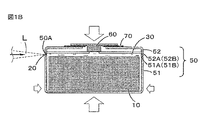
- FIG. 1B is a schematic cross-sectional view showing a process of forming a welded portion by laser irradiation in the method for manufacturing a secondary battery according to an embodiment of the present invention.
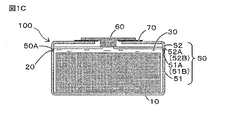
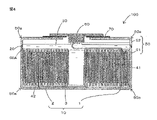
- FIG. 1C is a schematic cross-sectional view showing a secondary battery obtained according to the method for manufacturing a secondary battery according to an embodiment of the present invention.
- FIG. 2 is a schematic enlarged cross-sectional view of FIG. 1B.
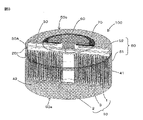
- FIG. 3 is a schematic perspective view showing a specific configuration of FIG. 1C.
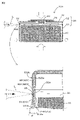
- FIG. 4 is a schematic cross-sectional view showing a specific configuration of FIG. 1C.
- FIG. 5 is a schematic cross-sectional view showing a process of forming a welded portion by using a lid-shaped exterior member having an inclined side surface at an end portion and a cup-shaped exterior member having an inclined end surface at an end portion. be.
- FIG. 6 is a schematic cross-sectional view showing a process of forming a welded portion by using a lid-shaped exterior member having an inclined side surface at an end and a cup-shaped exterior member having an inclined side surface at an end. be.
- FIG. 7 is a schematic perspective view showing a secondary battery obtained through the process of forming the welded portion shown in FIG. FIG.
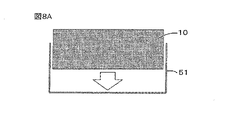
- FIG. 8A is a schematic cross-sectional view showing a process of installing an electrode assembly on a cup-shaped exterior member in the method for manufacturing a secondary battery according to another embodiment of the present invention.
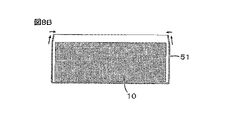
- FIG. 8B is a schematic cross-sectional view showing a step of drawing a cup-shaped exterior member end portion in the method for manufacturing a secondary battery according to another embodiment of the present invention.
- FIG. 8C is a schematic cross-sectional view showing a process of forming a welded portion by laser irradiation in the method for manufacturing a secondary battery according to another embodiment of the present invention.
- FIG. 8A is a schematic cross-sectional view showing a process of installing an electrode assembly on a cup-shaped exterior member in the method for manufacturing a secondary battery according to another embodiment of the present invention.
- FIG. 8B is a schematic cross-sectional view showing a step of drawing a cup-shaped exterior member end portion in the method for manufacturing a secondary battery according to another embodiment of the present invention.
- FIG. 8C is
- FIG. 9 is a schematic cross-sectional view showing a process of forming a welded portion by laser irradiation according to the method for manufacturing a secondary battery according to still another embodiment of the present invention.
- FIG. 10 is a schematic cross-sectional view showing a process of forming a welded portion by laser irradiation according to the method for manufacturing a secondary battery according to still another embodiment of the present invention. It is a top view.
- FIG. 11A is a cross-sectional view schematically showing an electrode constituent layer having a planar laminated structure.
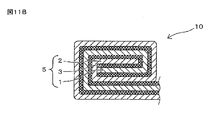
- FIG. 11B is a cross-sectional view schematically showing an electrode constituent layer having a wound structure.
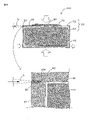
- FIG. 12A is a schematic cross-sectional view relating to a laser irradiation mode for a stepped facing portion between an end portion of a cup-shaped exterior member and an end portion of a lid-shaped exterior member (conventional technique).
- FIG. 12B is a schematic cross-sectional view relating to an embodiment in which a welded portion is formed through the laser irradiation embodiment of FIG. 12A (conventional technique).
- the "cross-sectional view” described directly or indirectly in the present specification is based on a virtual cross-section obtained by cutting out a secondary battery along the height direction.
- the "vertical direction” and “horizontal direction” used directly or indirectly in the present specification correspond to the vertical direction and the horizontal direction in the figure, respectively. Unless otherwise specified, the same sign or symbol shall indicate the same member / part or the same meaning.
- the stacking direction of the electrode assembly can correspond to the vertical direction
- the vertical downward direction ie, the direction in which gravity acts
- the reverse direction corresponds to the "upward direction”. It can be regarded as equivalent.
- the term "secondary battery” refers to a battery that can be repeatedly charged and discharged. Therefore, the secondary battery according to the present invention is not excessively bound by its name, and may include, for example, a power storage device.
- the secondary battery according to the embodiment of the present invention includes an electrode assembly in which electrode constituent layers including a positive electrode, a negative electrode and a separator are laminated.
- 11A and 11B illustrate the electrode assembly 10. As shown in FIGS. 11A and 11B, the positive electrode 1 and the negative electrode 2 are stacked with each other via the separator 3 to form an electrode constituent layer 5, and at least one such electrode constituent layer 5 is laminated to form an electrode assembly. The solid is composed.
- FIG. 11A has a planar laminated structure in which the electrode constituent layers 5 are laminated in a plane without being wound.
- FIG. 11B has a wound laminated structure in which the electrode constituent layer 5 is wound in a wound shape. That is, in FIG.
- the electrode constituent layer including the positive electrode, the negative electrode, and the separator arranged between the positive electrode and the negative electrode has a wound structure in which the electrode constituent layer is wound in a roll shape.
- an electrode assembly is enclosed in an exterior body together with an electrolyte (for example, a non-aqueous electrolyte).
- the structure of the electrode assembly is not necessarily limited to a two-dimensional laminated structure or a wound structure.
- a positive electrode, a separator and a negative electrode are laminated on a long film and then folded, so-called stack and. It may have a folding structure.
- the positive electrode is composed of at least a positive electrode material layer and a positive electrode current collector.
- a positive electrode material layer is provided on at least one side of the positive electrode current collector.
- the positive electrode material layer contains a positive electrode active material as an electrode active material.
- each of the plurality of positive electrodes in the electrode assembly may be provided with positive electrode material layers on both sides of the positive electrode current collector, or the positive electrode material layer may be provided on only one side of the positive electrode current collector. It may be the one that exists.
- the negative electrode is composed of at least a negative electrode material layer and a negative electrode current collector.
- a negative electrode material layer is provided on at least one side of the negative electrode current collector.
- the negative electrode material layer contains a negative electrode active material as an electrode active material.
- each of the plurality of negative electrodes in the electrode assembly may be provided with a negative electrode material layer on both sides of the negative electrode current collector, or a negative electrode material layer may be provided on only one side of the negative electrode current collector. It may be the one that exists.
- the electrode active materials contained in the positive and negative electrodes are substances that are directly involved in the transfer of electrons in the secondary battery, and are the main substances of the positive and negative electrodes that are responsible for charge / discharge, that is, the battery reaction. be. More specifically, ions are brought to the electrolyte due to the "positive electrode active material contained in the positive electrode material layer" and the "negative electrode active material contained in the negative electrode material layer", and such ions are transferred between the positive electrode and the negative electrode. The electrons are transferred and charged and discharged.
- the positive electrode material layer and the negative electrode material layer may be particularly layers capable of occluding and releasing lithium ions.
- the secondary battery according to the present invention may be a non-aqueous electrolyte secondary battery in which lithium ions move between the positive electrode and the negative electrode via the non-aqueous electrolyte to charge and discharge the battery.
- the secondary battery according to the present invention corresponds to a so-called "lithium ion battery", and the positive electrode and the negative electrode have a layer capable of storing and releasing lithium ions.
- the positive electrode active material of the positive electrode material layer is composed of, for example, granules
- a binder may be contained in the positive electrode material layer for more sufficient contact between particles and shape retention.
- a conductive auxiliary agent may be contained in the positive electrode material layer in order to facilitate the transfer of electrons that promote the battery reaction.
- the negative electrode active material of the negative electrode material layer is composed of, for example, granules, it may contain a binder for better contact between the particles and shape retention, and transfer of electrons to promote the battery reaction.
- a conductive auxiliary agent may be contained in the negative electrode material layer in order to facilitate the above.
- the positive electrode material layer and the negative electrode material layer can also be referred to as a “positive electrode mixture layer” and a “negative electrode mixture layer”, respectively, because of the form in which a plurality of components are contained.
- the positive electrode active material may be a substance that contributes to the occlusion and release of lithium ions.
- the positive electrode active material may be, for example, a lithium-containing composite oxide.
- the positive electrode active material may be a lithium transition metal composite oxide containing lithium and at least one transition metal selected from the group consisting of cobalt, nickel, manganese and iron. That is, in the positive electrode material layer of the secondary battery according to the present invention, such a lithium transition metal composite oxide is preferably contained as the positive electrode active material.
- the positive electrode active material may be lithium cobalt oxide, lithium nickel oxide, lithium manganate, lithium iron phosphate, or a part of the transition metal thereof replaced with another metal.
- Such a positive electrode active material may be contained as a single species, but may be contained in combination of two or more species.
- the binder that can be contained in the positive electrode material layer is not particularly limited, but is not particularly limited, but is limited to polyvinylidene fluoride, vinylidene fluoride-hexafluoropropylene copolymer, vinylidene fluoride-tetrafluoroethylene copolymer and polytetrafluoroethylene. At least one species selected from the group consisting of the above can be mentioned.
- the conductive auxiliary agent that can be contained in the positive electrode material layer is not particularly limited, but is limited to carbon black such as thermal black, furnace black, channel black, ketjen black and acetylene black, graphite, carbon nanotubes and vapor phase growth. At least one selected from carbon fibers such as carbon fibers, metal powders such as copper, nickel, aluminum and silver, and polyphenylene derivatives can be mentioned.
- the thickness dimension of the positive electrode material layer is not particularly limited, but may be 1 ⁇ m or more and 300 ⁇ m or less, for example, 5 ⁇ m or more and 200 ⁇ m or less.
- the thickness dimension of the positive electrode material layer is the thickness inside the secondary battery, and the average value of the measured values at any 10 points may be adopted.
- the negative electrode active material may be a substance that contributes to the occlusion and release of lithium ions. From this point of view, the negative electrode active material may be, for example, various carbon materials, oxides, and / or lithium alloys.
- Examples of various carbon materials for the negative electrode active material include graphite (natural graphite and / or artificial graphite), hard carbon, soft carbon, and / or diamond-like carbon.
- graphite has high electron conductivity and excellent adhesion to a negative electrode current collector.
- the oxide of the negative electrode active material at least one selected from the group consisting of silicon oxide, tin oxide, indium oxide, zinc oxide, lithium oxide and the like can be mentioned.
- the lithium alloy of the negative electrode active material may be any metal that can be alloyed with lithium, for example, Al, Si, Pb, Sn, In, Bi, Ag, Ba, Ca, Hg, Pd, Pt, Te, Zn, It may be a binary, ternary or higher alloy of a metal such as La and lithium. Such an oxide may be amorphous as its structural form. This is because deterioration due to non-uniformity such as grain boundaries or defects is less likely to occur.
- the binder that can be contained in the negative electrode material layer is not particularly limited, but is at least one selected from the group consisting of styrene-butadiene rubber, polyacrylic acid, polyvinylidene fluoride, polyimide-based resin, and polyamide-imide-based resin. Can be mentioned.
- the conductive auxiliary agent that can be contained in the negative electrode material layer is not particularly limited, but is limited to carbon black such as thermal black, furnace black, channel black, ketjen black and acetylene black, graphite, carbon nanotubes and vapor phase growth. At least one selected from carbon fibers such as carbon fibers, metal powders such as copper, nickel, aluminum and silver, and polyphenylene derivatives can be mentioned.
- the negative electrode material layer may contain a component derived from the thickener component (for example, carboxylmethyl cellulose) used at the time of manufacturing the battery.
- the thickness dimension of the negative electrode material layer is not particularly limited, but may be 1 ⁇ m or more and 300 ⁇ m or less, for example, 5 ⁇ m or more and 200 ⁇ m or less.
- the thickness dimension of the negative electrode material layer is the thickness inside the secondary battery, and the average value of the measured values at any 10 points may be adopted.
- the positive electrode current collector and the negative electrode current collector used for the positive electrode and the negative electrode are members that contribute to collecting and supplying electrons generated by the electrode active material due to the battery reaction.
- Such an electrode current collector may be a sheet-shaped metal member.
- the electrode current collector may have a perforated or perforated form.
- the current collector may be a metal leaf, a punching metal, a net, an expanded metal, or the like.
- the positive electrode current collector used for the positive electrode is preferably made of a metal foil containing at least one selected from the group consisting of aluminum, stainless steel, nickel and the like, and may be, for example, an aluminum foil.
- the negative electrode current collector used for the negative electrode is preferably made of a metal foil containing at least one selected from the group consisting of copper, stainless steel, nickel and the like, and may be, for example, a copper foil.
- the thickness dimensions of the positive electrode current collector and the negative electrode current collector are not particularly limited, but may be 1 ⁇ m or more and 100 ⁇ m or less, for example, 10 ⁇ m or more and 70 ⁇ m or less.
- the thickness dimension of the positive electrode current collector and the negative electrode current collector is the thickness inside the secondary battery, and the average value of the measured values at any 10 points may be adopted.
- the separator used for the positive electrode and the negative electrode is a member provided from the viewpoint of preventing a short circuit due to contact between the positive and negative electrodes and retaining the electrolyte.
- the separator is a member through which ions pass while preventing electronic contact between the positive electrode and the negative electrode.
- the separator is a porous or microporous insulating member, which has a film morphology due to its small thickness.
- a microporous film made of polyolefin may be used as a separator.
- the microporous membrane used as the separator may contain, for example, only polyethylene (PE) or polypropylene (PP) as the polyolefin.
- the separator may be a laminate composed of a "microporous membrane made of PE" and a "microporous membrane made of PP".
- the surface of the separator may be covered with an inorganic particle coat layer and / or an adhesive layer or the like.
- the surface of the separator may have adhesiveness.
- the separator should not be particularly bound by its name, and may be a solid electrolyte, a gel-like electrolyte, and / or insulating inorganic particles having the same function.
- Each thickness dimension of the separator is not particularly limited, but may be 1 ⁇ m or more and 100 ⁇ m or less, for example, 2 ⁇ m or more and 20 ⁇ m or less.
- the thickness dimension of the separator is the thickness inside the secondary battery (particularly the thickness between the positive electrode and the negative electrode), and the average value of the measured values at any 10 points may be adopted.
- an electrode assembly composed of an electrode constituent layer including a positive electrode, a negative electrode and a separator may be enclosed in an outer body together with an electrolyte.
- the electrolyte may be a "non-aqueous" electrolyte containing an organic electrolyte, an organic solvent, or the like, or may be a "water-based” electrolyte containing water.
- the electrolyte is preferably an "non-aqueous" electrolyte such as an organic electrolyte or an organic solvent.
- the electrolyte is a non-aqueous electrolyte.
- the electrolyte there will be metal ions emitted from the electrodes (positive electrode and / or negative electrode), and therefore the electrolyte may assist in the movement of the metal ions in the battery reaction.
- the electrolyte may be in the form of a liquid or a gel.
- a non-aqueous electrolyte is an electrolyte containing a solvent and a solute.
- the solvent may be an organic solvent.
- the specific organic solvent for the non-aqueous electrolyte may contain at least carbonate.
- Such carbonates may be cyclic carbonates and / or chain carbonates.
- the cyclic carbonates include at least one selected from the group consisting of propylene carbonate (PC), ethylene carbonate (EC), butylene carbonate (BC) and vinylene carbonate (VC). be able to.
- chain carbonates examples include at least one selected from the group consisting of dimethyl carbonate (DMC), diethyl carbonate (DEC), ethyl methyl carbonate (EMC) and dipropyl carbonate (DPC).
- DMC dimethyl carbonate
- DEC diethyl carbonate
- EMC ethyl methyl carbonate
- DPC dipropyl carbonate
- a combination of cyclic carbonates and chain carbonates may be used as the non-aqueous electrolyte, and for example, a mixture of ethylene carbonate and diethyl carbonate may be used.
- a Li salt such as LiPF 6 and / or LiBF 4 may be used as LiPF 6 and / or LiBF 4 may be used.
- the exterior body of the secondary battery is a member that encloses the electrode assembly in which the electrode constituent layers including the positive electrode, the negative electrode, and the separator are laminated.
- Such exteriors may be made of a metal such as stainless steel (SUS) and / or aluminum.
- stainless steel SUS
- stainless steel in this specification refers to stainless steel specified in, for example, “JIS G 0203 steel term", and may be chromium or an alloy steel containing chromium and nickel.
- the inventor of the present application has diligently studied a solution for easily ensuring the sealing property of the facing portion of the cup-shaped exterior member and the lid-shaped exterior member. As a result, a method for manufacturing a secondary battery according to an embodiment of the present invention has been devised.
- FIG. 1A is a schematic cross-sectional view showing a process of installing an electrode assembly on a cup-shaped exterior member in the method for manufacturing a secondary battery according to an embodiment of the present invention.
- FIG. 1B is a schematic cross-sectional view showing a process of forming a welded portion by laser irradiation in the method for manufacturing a secondary battery according to an embodiment of the present invention.
- FIG. 1C is a schematic cross-sectional view showing a secondary battery obtained according to the method for manufacturing a secondary battery according to an embodiment of the present invention.
- FIG. 2 is a schematic enlarged cross-sectional view of FIG. 1B.
- the "cup-shaped exterior member” is composed of a side wall or side surface corresponding to a body portion and a main surface (in a typical embodiment, for example, a bottom portion) continuous with the side wall or side surface portion, and a hollow portion is formed inside. It means such a member.
- the "cover-shaped exterior member” is a member provided so as to cover the cup-shaped member (preferably, a member that covers the cup-shaped member so as to extend over the side wall of the cup-shaped member). Means.
- the method for manufacturing a secondary battery according to an embodiment of the present invention mainly includes the following steps.
- (Iii) A step of irradiating a portion 50A where the cup-shaped exterior member 51 and the lid-shaped exterior member 52 face each other with a laser L to form a welded portion 20 see FIGS. 1B and 1C.
- the method for manufacturing a secondary battery according to an embodiment of the present invention is characterized in steps (ii) and (iii) of the above steps.
- the facing portion 50A is placed on the end face of one end of the cup-shaped exterior member 51 and the lid-shaped exterior member 52. It is formed by positioning the end faces of the end portions, and each end face has a non-stepped shape (see FIGS. 1B, 1C, and 2). That is, the facing portion 50A is formed by positioning the non-stepped end face of the other end on the non-stepped end face of one end of the cup-shaped exterior member 51 and the lid-shaped exterior member 52.
- the non-stepped end face 52A of the end of the lid-shaped exterior member 52 is positioned on the non-stepped end face 51A of the end of the cup-shaped exterior member 51 to form the facing portion 50A.
- the "end surface” as used herein is a surface constituting at least a part of an end portion of each exterior member forming a facing portion (that is, a boundary portion) between the cup-shaped exterior member 51 and the lid-shaped exterior member 52.
- the "non-stepped end face” as used herein is an end face that does not take a stepped shape (that is, a form composed of two faces having different heights and a surface connecting the ends of the two faces). As an example, there are an inclined shape, a horizontal plane shape, a curved surface shape, a tapered shape (tapered shape), a wavy shape, and the like.
- each end face of the other exterior member is not a surface extending in the direction of gravity.
- each end face can be said to be a surface extending in a direction different from the direction of gravity (that is, a non-vertical direction or a non-gravity direction).
- Each of the end faces of each exterior member may have a shape that is paired with each other. For example, when the end face of the cup-shaped exterior member 51 is inclined, the end face of the lid-shaped exterior member 52 may be inclined.
- Each of the end faces of each exterior member may be a face extending in the same direction.
- the end surface of the cup-shaped exterior member 51 is a surface extending in an inclined shape
- the end surface of the lid-shaped exterior member 52 extends in the same direction as the end surface of the cup-shaped exterior member 51 extends. It may be an existing surface. By taking such a form, it becomes easier to position the end face of the other exterior member on the end face of one exterior member.
- the facing portion 50A in the state where the facing portion 50A is formed, from the end face 52A which is a component of the end portion of the lid-shaped exterior member 52 to the end face 51A which is a component of the end portion of the cup-shaped exterior member 51. It is possible to apply a force such as gravity in the downward direction. As a result, it is possible to suppress the generation of a gap between the end faces 51A and 52A, which are the constituent elements of the respective ends of both exterior members, and as a result, the both end faces 51A and 52A can be brought into opposite contact with each other. Therefore, according to one embodiment of the present invention, it is possible to easily secure the sealing property of the facing portion 50A of the cup-shaped exterior member 51 and the lid-shaped exterior member 52.
- the following effects can be achieved by easily ensuring the sealing property of the facing portion 50A.
- the substantially horizontal planes 54b of the stepped portions 54'and 55' provided at the ends of the cup-shaped exterior member 51'and the lid-shaped exterior member 52'. Further measures were required to prevent a gap from being formed in the facing portion between the'and 55b'(see FIGS. 12A and 12B).
- As a countermeasure for example, high-precision alignment adjustment and high-dimensional precision cup-shaped exterior member 51'and lid-shaped exterior member 52'so that both stepped portions 54'and 55'can be in contact with each other without a gap. Production is required. Therefore, it takes time and cost to manufacture the equipment for realizing the highly accurate alignment adjustment, and further, it takes time and cost to manufacture the mold itself for obtaining the exterior member with high dimensional accuracy.
- the present invention it is possible to suppress the generation of a gap between the end faces 51A and 52A, which are components of the respective ends of both exterior members, so that high-precision alignment is performed as in the previous embodiment. No adjustment is required, as well as the production of cup-shaped and lid-shaped exterior members with high dimensional accuracy. Therefore, it is not necessary to spend time and cost on manufacturing equipment to realize highly accurate alignment adjustment, and it is also necessary to spend time and cost on manufacturing the mold itself to obtain an exterior member with high dimensional accuracy. There is no.
- the propagation of the irradiation heat energy of the laser L to the electrode assembly 10 can be suitably suppressed, and the thermal damage to the electrode assembly 10 and the intrusion of spatter that may occur when the welded portion 20 is formed can be suitably reduced. can.
- the cup-shaped and lid-shaped exterior members 51 and 52 are vertically oriented so as to sandwich the main surfaces of the cup-shaped and lid-shaped exterior members 51 and 52.
- Forces may be applied along (eg, in the direction of gravity).
- the main surfaces of the respective exterior members are sandwiched in the vertical direction (for example).
- a force may be applied along the direction of gravity).
- the force for sandwiching each of the main surfaces is a force for the end surfaces 51A and 52A of both exterior members to press each other against each other. Therefore, the end faces 51A and 52A can be closer to each other than when only the action of gravity or the like acts. By taking such a form, it is possible to further suppress the generation of a gap between the end faces 51A and 52A of both exterior members.
- FIG. 3 is a schematic perspective view showing a specific configuration of a secondary battery according to an embodiment of the present invention.
- FIG. 4 is a schematic cross-sectional view showing a specific configuration of a secondary battery according to an embodiment of the present invention.
- FIG. 3 is a schematic perspective view showing a specific configuration of FIG. 1C.
- FIG. 4 is a schematic cross-sectional view showing a specific configuration of FIG. 1C.
- the secondary battery 100 obtained by the above-mentioned manufacturing method according to the embodiment of the present invention includes an electrode assembly 10 and an exterior body 50 for accommodating the electrode assembly 10. It consists of having.
- the exterior body 50 includes a cup-shaped exterior member 51 and a lid-shaped exterior member 52 that are interconnected by a welded portion 20.
- the welded portion 20 is formed so as to connect the end portion of the cup-shaped exterior member 51 and the end portion of the lid-shaped exterior member 52.
- Laser L' is applied so that both the substantially lead surface and the approximately horizontal plane, which are the elements, are melted. Therefore, the size of the welded portion 20'(FIG. 12B) obtained after irradiation is relatively large.
- the output of the laser L can be suppressed during manufacturing and the laser L can be irradiated in a narrow range to form the welded portion 20.
- the size of the welded portion 20 can be reduced as compared with the welded portion 20'of the conventional secondary battery 100'.
- the small size of the welded portion 20 means that the thermal damage to the electrode assembly 10 during the formation of the welded portion 20 and the intrusion of spatter that may occur when the welded portion 20 is formed are suitably reduced. Therefore, it is possible to further stabilize the battery characteristics of the obtained secondary battery 100 as compared with the conventional secondary battery 100'.
- the size of the welded portion 20 of the secondary battery obtained by the manufacturing method of the present invention is smaller than that of the welded portion 20'of the conventional secondary battery 100'. Therefore, as shown in FIGS. 3 and 4, on both sides of the welded portion 20, the end face 52A, which is a component of the end portion of the lid-shaped exterior member 52, and the component of the end portion of the cup-shaped exterior member 51 are used. A facing contact region (cut) with a certain end surface 51A may remain. Also in this respect, the obtained secondary battery 100 has the above-mentioned appearance characteristics.
- the obtained secondary battery 100 can be a coin-type secondary battery.
- a coin-type secondary battery is typically substantially circular in plan view.
- the coin-type secondary battery does not have to have a substantially circular shape in a plan view, and may have an irregular shape including a linear portion in a part (for example, a D shape in a plan view).
- the shape of the electrode assembly 10 and / or the exterior body 50 containing the electrode assembly 10 in plan view may also be substantially circular.
- substantially circular as used herein is not limited to a perfect circle (that is, simply a "circle” or a "perfect circle”), but the curvature of the arc is locally different.
- the coin-type secondary battery may be a shape derived from a circle or a perfect circle such as an ellipse.
- the size of the coin-type secondary battery is typically small, and its thickness is smaller than the diameter or width of the coin-type secondary battery.
- the "coin type” is merely referred to by those skilled in the art as “coin type” because the above-mentioned appearance is similar to that of "coin type”. Therefore, for example, a button battery, a bean battery, or a cylindrical, flat, flat, flat, or cylindrical battery can be paraphrased in various ways depending on the appearance thereof. That is, if it has the shape and appearance as described above, it can be called a "coin type” secondary battery as an example.
- the facing portion 50A is formed by facing the end faces 51A and 52A in a single-sided form extending in one direction.
- the "end surface of the single surface form” refers to an end surface consisting of a single surface in a broad sense, and in a narrow sense, two or more continuous surfaces extending in different directions by having no bending point. Refers to an end face that is not composed of faces.
- the facing portion 50A can be formed by overlapping the end surface 51A of the cup-shaped exterior member 51 and the end surface 52A of the lid-shaped exterior member 52 with each other along the thickness direction.
- the facing portion 50A can be formed by overlapping the end surface 51A of the cup-shaped exterior member 51 and the end surface 52A of the lid-shaped exterior member 52 with each other along the thickness direction.
- the "thickness direction" is a direction along the thickness of the exterior member, and means, for example, a direction perpendicular to the surface forming the exterior member.
- the end surface 52A of the lid-shaped exterior member 52 and the end surface 51A of the cup-shaped exterior member 51 overlap each other in the thickness direction. Since the end faces overlap each other in the thickness direction, the cup-shaped and lid-shaped exterior members are difficult to move in the thickness direction. Therefore, after the lid-shaped exterior member 52 is provided so as to cover the opening of the cup-shaped exterior member 51, the lid-shaped exterior member 52 is in the thickness direction from a predetermined position until the laser L is irradiated. It becomes difficult to shift with respect to the welded portion 20, and it becomes easy to form the welded portion 20 at a predetermined position.
- the end faces 51A and 52A which are components of the end portion of each exterior member, may have an inclined form.
- the end surface 52A of the lid-shaped exterior member 52 and the end surface 51A of the cup-shaped exterior member 51 come into contact with each other as compared with the case where the lid-shaped exterior member 52 is composed of two surfaces such as a tapered shape. Will be. Therefore, a force such as gravity can be more preferably applied downward from the end surface 52A of the lid-shaped exterior member 52 to the end surface 51A of the cup-shaped exterior member 51, and a gap between the end surfaces 51A and 52A is generated. It can be suppressed more preferably.
- the end portions of the exterior members have side surfaces facing each other (that is, inner side surfaces 51Xa and outer surface 51Xb) and end surfaces connecting the side surfaces, and the end surfaces thereof.
- the end portions of the exterior members have inclined surfaces 51B and 52B that face each other and are substantially planar (that is, the inner side surface 51Xa and the outer side surface 51Xb) and connect the side surfaces.
- the "inclined surface” as used herein means that the thickness of the end portion forming the opening of the cup-shaped exterior member 51 and the lid-shaped exterior member 52 is the bottom portion (that is, the main surface side) in a cross-sectional view. It means a surface having a shape that becomes thinner as it approaches the opening side.
- the "inclined surface” as used herein means at least a part of the outer surface 51Xb of the end portion of the cup-shaped exterior member 51 and at least one of the inner side surface 52Xa of the end portion of the lid-shaped exterior member 52. Refers to a surface whose part is slope-shaped.
- the inclined surface 52B which is a component of the end portion of the lid-shaped exterior member 52, can be positioned directly above the inclined surface 51B, which is a component of the end portion of the cup-shaped exterior member 51.
- a force such as gravity can be applied substantially vertically downward from the inclined surface 52B of the lid-shaped exterior member 52 to the inclined surface 51B of the cup-shaped exterior member 51.
- the inclined surface 52B at the end of the lid-shaped exterior member 52 is positioned directly above the inclined surface 51B at the end of the cup-shaped exterior member 51. Therefore, if the thickness of the cup-shaped exterior member 51 and the lid-shaped exterior member 52, particularly at least the thickness of the lid-shaped exterior member 52 is made relatively thicker, the weight of the lid-shaped exterior member 52 increases by the increase in the thickness. Because of the increase, the force acting substantially vertically downward due to gravity etc. also increases. As a result, the gap between the inclined surfaces 51B and 52B can be further reduced, and the inclined surfaces 51B and 52B can be brought into contact with each other more effectively. Further, it can be expected that the strength of the exterior body composed of both exterior members is improved by making the thicknesses of the exterior members 51 and 52 relatively thicker.
- the inner side surface 51Xa of the cup-shaped exterior member and the lid-shaped exterior member are formed.
- the inner side surface 52Xa of the member may be on the same straight line or the same surface
- the outer surface 51Xb of the cup-shaped exterior member and the outer surface 52Xb of the lid-shaped exterior member may be on the same straight line or the same surface. ..
- the cup-shaped exterior member 51 and the lid-shaped exterior member 52 having substantially the same thickness can be used, respectively, so that the strength of the entire exterior body 50 composed of the cup-shaped and lid-shaped exterior members is balanced. Becomes better.
- the inclination angle ⁇ formed between the inclined surface 51B and the inner side surface 51Xa of the cup-shaped exterior member 51 is a lid for the opening of the cup-shaped exterior member 51.
- the insertion accuracy of the exterior member 52 it is preferably 10 degrees or more and 70 degrees or less, preferably 20 degrees or more and 60 degrees or less, and more preferably 30 degrees or more and 50 degrees or less, for example, 45 degrees.
- the insertion accuracy of the lid-shaped exterior member 52 into the opening of the cup-shaped exterior member 51 is high.
- the tilt angle may vary depending on the wall thickness of the can and the lid, the insertion accuracy, and the allowable length of the tilted portion, but within the above range, the lid-shaped exterior member to the opening of the cup-shaped exterior member 51
- the insertion accuracy of 52 can be improved.
- the inclined surfaces 51B and 52B at the ends of the cup-shaped and lid-shaped exterior members 51 and 52 can be formed by shearing such as chamfering.
- the cup-shaped and lid-shaped exterior members 51 and 52 can be manufactured by subjecting an exterior plate having a flat plate structure to drawing.
- the exterior member produced by drawing is superior in strength to the conventional lid-shaped exterior member having a flat plate structure due to its structure.
- the exterior body 50 made of cup-shaped and lid-shaped exterior members produced by drawing has a rounded r shape at the edge 50a of the exterior body. Therefore, the appearance can be made smoother than the edge 50a'of the exterior body of the conventional secondary battery as shown in FIG. 12, and it becomes easy to prevent the chipping due to an external impact.
- the inclined surface 51B of the cup-shaped exterior member 51 is formed on the outer surface 51Xb side, and the inclined surface 52B of the lid-shaped exterior member 52 is formed on the inner surface 52Xa side.
- the inclined surface 51B may be formed on the inner side surface 51Xa side, and the inclined surface 52B may be formed on the inner side surface 52Xa side.
- the secondary battery obtained by the formation also has the above-mentioned features exemplified exclusively with reference to FIG. 2 and the effects produced by the above-mentioned characteristics.
- the side surface 52X itself of one end of the cup-shaped exterior member 51 and the lid-shaped exterior member 52 may have an inclined form, and the other exterior member may have an end surface of the inclined form at the end. Yes (see Figure 5). Specifically, in the present embodiment, it is sufficient that the side surface itself of the end portion of one exterior member has an inclined form, and the other exterior member has the end portions facing each other and the side surface having a substantially planar shape. Any structure may be used as long as it has an inclined surface connecting the side surfaces.
- FIG. 5 is a schematic diagram showing a process of forming a welded portion 20 by using a lid-shaped exterior member 52 having an inclined side surface at an end portion and a cup-shaped exterior member 52 having an inclined end surface at an end portion. It is a sectional view.
- a case where the side surface of the end portion of the lid-shaped exterior member 52 itself has an inclined shape will be described with reference to FIG. 5.
- an inclined surface 51B is formed at an end located at an opening of a cup-shaped exterior member 51, and a side surface 52X of an inclined form of a lid-shaped exterior member 52 is formed on the inclined surface 51B. Is positioned.
- the side surface of the cup-shaped exterior member 51 extends substantially vertically from the main surface of the cup-shaped exterior member 51, and the inclined surface is provided at the end of the cup-shaped exterior member 51. ing.
- the side surface 52X of the lid-shaped exterior member is not perpendicular to the flat main surface of the lid-shaped exterior member 52, and has an inclined structure such that the opening size of the lid-shaped exterior member 52 becomes large.
- the side surface 52X of the lid-shaped exterior member is tilted at an inclination angle ⁇ with respect to a vertical line from the main surface of the lid-shaped exterior member 52.
- the tilt may be achieved by molding the exterior member by drawing or the like. Further, the inclination angle ⁇ may be adjusted at the time of drawing the exterior member.
- the side surface 52X of the inclined form of the lid-shaped exterior member 52 can be positioned on the inclined surface 51B at the end of the cup-shaped exterior member 51 before the laser L irradiation.
- a force such as gravity can be applied downward from the side surface 52X of the lid-shaped exterior member 52 in an inclined form to the inclined surface 51B of the cup-shaped exterior member 51.
- the end portion of the cup-shaped exterior member 51 has an inclined surface and the side surface of the lid-shaped exterior member 52 itself has an inclined form. Not limited. For example, even when the side surface of the end portion of the cup-shaped exterior member 51 itself has an inclined shape and the end portion of the lid-shaped exterior member has an inclined surface, it has the same characteristics as those in the above aspect and the effect produced by the same. Can be done.
- the inclined surface When an inclined surface that faces each other and connects a substantially flat side surface (for example, an inner side surface 51Xa and an outer surface 51Xb) and the side surface is provided at the end portion of the exterior member, the inclined surface is the end portion of the exterior member. It can be formed by shearing such as chamfering. When the end portion of the exterior member having a relatively thin thickness is sheared by chamfering or the like, the thickness of the formed inclined surface becomes very thin because the step of scraping off the end portion of the exterior member by the shearing process is performed. The formation of such a very thin inclined surface can be technically more difficult. According to this embodiment, one of the two exterior members whose side surface itself is inclined is used.
- the exterior member whose side surface itself has an inclined shape can be achieved by molding the exterior member by drawing or the like. That is, it is not necessary to use shearing or the like for molding the exterior member whose side surface itself has an inclined shape. Therefore, even if the exterior member has a relatively thin thickness, the exterior member whose side surface itself has an inclined shape can be obtained relatively easily. Therefore, as compared with the embodiment shown in FIG. 2, in addition to suppressing the generation of gaps in the facing portions 50A of the respective ends of both exterior members, the thickness (thickness) of one exterior member can be reduced. Therefore, it is possible to ensure a simple sealing property in the facing portion 50A of each end of the two exterior members, and to reduce the thickness and size of the obtained secondary battery 100.
- the inclination angle ⁇ formed between the inclined surface 51B and the inner side surface 51Xa of the cup-shaped exterior member 51 in a cross-sectional view is cup-shaped.
- the lid-shaped exterior member 52 is preferably 10 degrees or more and 70 degrees or less, preferably 20 degrees or more and 60 degrees or less, and more preferably 30 degrees or more and 50 degrees or less. For example, 45 degrees.
- the side surface 52X of the lid-shaped exterior member is lid-shaped.
- the exterior member 52 may have an inclined structure that is not perpendicular to the planar main surface but is open from the planar main surface by an angle of 90 + ⁇ degrees.
- both the side surface 51X at the end of the cup-shaped exterior member 51 and the side surface 52X at the end of the lid-shaped exterior member 52 can have an inclined form (see FIG. 6).
- FIG. 6 is a schematic cross-sectional view showing a process of forming a welded portion by using a lid-shaped exterior member having an inclined side surface at an end and a cup-shaped exterior member having an inclined side surface at an end.
- FIG. 7 is a schematic perspective view showing a secondary battery obtained through the process of forming the welded portion shown in FIG.
- the side surfaces 51X and 52X of the ends of both exterior members 51 and 52 both have a structure having an inclined form.
- the side surface 52X of the lid-shaped exterior member shown in FIG. 6 is inclined outward with respect to the main surface of the lid-shaped exterior member, as in the form shown in FIG. Further, a part of the side surface 51X of the cup-shaped exterior member is inclined inward with respect to the main surface of the cup-shaped exterior member. Specifically, the end portion of the side surface 51X of the cup-shaped exterior member is inclined inward so that the opening diameter of the cup-shaped exterior member 51 becomes smaller with respect to the extending direction of the side surface of the cup-shaped exterior member. There is.
- the side surface 51X of the cup-shaped exterior member is tilted at an inclination angle ⁇ with respect to a vertical line from the main surface of the cup-shaped exterior member 51.
- the side surface 52X of the lid-shaped exterior member is tilted at an inclination angle ⁇ with respect to a vertical line from the main surface of the lid-shaped exterior member 52.
- the tilt may be achieved by molding the exterior member by drawing or the like. Further, the inclination angle ⁇ may be adjusted at the time of drawing the exterior member.
- the side surface 52X of the inclined form of the lid-shaped exterior member 52 can be positioned on the side surface 51X of the inclined form of the end portion of the cup-shaped exterior member 51 before the laser L irradiation.
- a force such as gravity can be applied downward from the inclined side surface 52X of the lid-shaped exterior member 52 to the inclined side surface 51X of the cup-shaped exterior member 51.
- both side surfaces of the two exterior members are inclined.
- the exterior member whose side surface itself has an inclined shape may be achieved by molding the exterior member by drawing or the like. That is, it is not necessary to use shearing or the like for molding the exterior member whose side surface itself has an inclined shape. Therefore, even if the exterior member is relatively thin, the exterior member whose side surface itself has an inclined shape can be relatively easily obtained. Therefore, as compared with the embodiments shown in FIGS. 2 and 5, the thickness (thickness) of both exterior members can be reduced in addition to suppressing the generation of gaps in the facing portions 50A of the respective ends of both exterior members. can.
- the inclination angle ⁇ of the cup-shaped exterior member 51 is a lid-shaped exterior member to the opening of the cup-shaped exterior member 51 in a cross-sectional view. From the viewpoint of the insertion accuracy of 52, it is preferably 10 degrees or more and 70 degrees or less, preferably 20 degrees or more and 60 degrees or less, and more preferably 30 degrees or more and 50 degrees or less, for example, 45 degrees.
- the side surface 52X of the lid-shaped exterior member is the planar main surface of the lid-shaped exterior member 52.
- the structure may be inclined so as to be open by an angle of 90 + ⁇ degrees from the plane main surface instead of being perpendicular to the vertical surface.
- the thickness of both exterior members can be reduced, when the welded portion 20 is formed by using the laser L, the irradiation output of the laser can be reduced and the irradiation range can be narrowed to form the welded portion 20. Therefore, since the irradiation heat energy of the laser L can be smaller, the thermal damage to the electrode assembly 10 due to the irradiation heat of the laser can be further reduced.
- FIG. 8A is a schematic cross-sectional view showing a process of installing an electrode assembly on a cup-shaped exterior member among the methods for manufacturing a secondary battery according to another embodiment of the present invention.
- FIG. 8B is a schematic cross-sectional view showing a step of drawing a cup-shaped exterior member end portion in the method for manufacturing a secondary battery according to another embodiment of the present invention.
- FIG. 8C is a schematic cross-sectional view showing a process of forming a welded portion by laser irradiation in the method for manufacturing a secondary battery according to another embodiment of the present invention.
- the method for manufacturing a secondary battery according to an embodiment of the present invention mainly includes the following steps.
- a step of irradiating a portion 50A where the exterior member 51 and the lid-shaped exterior member 52 facing each other with a laser L to form a welded portion see FIG. 8C).
- step (ii) Since the method for manufacturing the secondary battery of the present invention has already been described with reference to FIGS. 1A to 1C, only the steps characteristic of the embodiments shown in FIGS. 1 to 1C will be described. Specifically, this embodiment is characterized by the above step (ii). The step (ii) will be described in more detail below with reference to FIG. 8B.
- the end portion located at the opening of the cup-shaped exterior member 51 is drawn to the cup-shaped exterior member 51.
- An inclined shape is provided on the side surface of the. Specifically, the side surface of the end portion of the cup-shaped exterior member 51 and the end portion of the lid-shaped exterior member 52 in an inclined form is locally drawn to partially cover a part of the planar extending surface of both exterior members. It is formed by bending it into a. In other words, a taper angle is provided on the side surface of the cup-shaped exterior member 51 at a portion close to the side surface of the lid-shaped exterior member 52.
- the cup-shaped exterior member 51 and the lid-shaped exterior member 51 are provided in the step of providing the lid-shaped exterior member 52 so as to cover the opening of the cup-shaped exterior member 51.
- the horizontal planes 51C and the horizontal planes 52C at the ends located at the respective openings of the 52 are brought close to each other. Even in such a case, it is possible to suppress the generation of a gap between the horizontal planes 51C and 52C at the ends of both exterior members 51 and 52, respectively.
- the molding of the lid-shaped exterior member 52 does not require drawing, and the molding of the cup-shaped exterior member 51 does not need to be drawn, which is a simpler manufacturing method. I can say.
- the welded portion 20 can be formed on the side surface of the exterior body 50 as shown in FIGS. 3 and 4.
- the present embodiment is not limited to this, and the following embodiments can also be adopted as long as it is possible to suppress the generation of a gap between the end faces of the respective ends of the two exterior members 51 and 52.
- the end of the opening of the cup-shaped exterior member 51 is provided not on the side surface but on the upper surface side, and the opening end of the cup-shaped exterior member 52 is directly opposed to the end portion.
- An inclined surface of the portion can be provided.
- the electrolytic solution 30 filled in the cup-shaped exterior member 51 is less likely to leak to the outside during the manufacturing process. be able to.
- the secondary battery according to the embodiment of the present invention can be used in various fields where storage is expected.
- the secondary battery of the present invention is used in the fields of electricity, information, and communication (for example, mobile phones, smartphones, laptop computers and digital cameras, activity meters, arm computers, etc.) in which electric / electronic devices are used.
- Electric / electronic devices for example, mobile phones, smartphones, laptop computers and digital cameras, activity meters, arm computers, etc.
- Electronic paper, etc. electrical / electronic equipment field including small electronic devices such as RFID tags, card-type electronic money, smart watches, etc.
- household / small industrial applications for example, electric tools, golf carts, households
- Industrial robots for / nursing / industrial robots large industrial applications (eg forklifts, elevators, bay port cranes), transportation systems (eg hybrid cars, electric cars, buses, trains, electrically assisted bicycles, electric) (Fields such as motorcycles)
- power system applications for example, various power generation, road conditioners, smart grids, general home-installed power storage systems, etc.
- medical applications medical equipment fields such as earphone hearing aids
- pharmaceutical applications dose management It can be used in fields such as systems), as well as in IoT fields, space / deep sea applications (for example, fields such as space explorers and submersible research vessels).
Landscapes
- Chemical & Material Sciences (AREA)
- Chemical Kinetics & Catalysis (AREA)
- Electrochemistry (AREA)
- General Chemical & Material Sciences (AREA)
- Engineering & Computer Science (AREA)
- Manufacturing & Machinery (AREA)
- Sealing Battery Cases Or Jackets (AREA)
Priority Applications (2)
| Application Number | Priority Date | Filing Date | Title |
|---|---|---|---|
| JP2022565195A JP7613480B2 (ja) | 2020-11-24 | 2021-11-08 | 二次電池の製造方法 |
| US18/128,459 US20230307713A1 (en) | 2020-11-24 | 2023-03-30 | Method for manufacturing secondary battery |
Applications Claiming Priority (2)
| Application Number | Priority Date | Filing Date | Title |
|---|---|---|---|
| JP2020-194710 | 2020-11-24 | ||
| JP2020194710 | 2020-11-24 |
Related Child Applications (1)
| Application Number | Title | Priority Date | Filing Date |
|---|---|---|---|
| US18/128,459 Continuation US20230307713A1 (en) | 2020-11-24 | 2023-03-30 | Method for manufacturing secondary battery |
Publications (1)
| Publication Number | Publication Date |
|---|---|
| WO2022113716A1 true WO2022113716A1 (ja) | 2022-06-02 |
Family
ID=81755822
Family Applications (1)
| Application Number | Title | Priority Date | Filing Date |
|---|---|---|---|
| PCT/JP2021/041028 Ceased WO2022113716A1 (ja) | 2020-11-24 | 2021-11-08 | 二次電池の製造方法 |
Country Status (3)
| Country | Link |
|---|---|
| US (1) | US20230307713A1 (https=) |
| JP (1) | JP7613480B2 (https=) |
| WO (1) | WO2022113716A1 (https=) |
Cited By (5)
| Publication number | Priority date | Publication date | Assignee | Title |
|---|---|---|---|---|
| CN116526030A (zh) * | 2023-06-08 | 2023-08-01 | 东莞市电的电子有限公司 | 一种电池结构及其制备方法 |
| WO2024046971A1 (en) * | 2022-08-31 | 2024-03-07 | Northvolt Ab | A cylindrical secondary cell comprising an enclosure with a brim and a lid with a flange |
| WO2024133544A1 (en) * | 2022-12-23 | 2024-06-27 | Northvolt Ab | Secondary cell |
| EP4407727A1 (en) * | 2023-01-24 | 2024-07-31 | Renata AG | A button battery |
| WO2024260818A1 (en) * | 2023-06-20 | 2024-12-26 | Northvolt Ab | Lid closure for a secondary cell |
Citations (5)
| Publication number | Priority date | Publication date | Assignee | Title |
|---|---|---|---|---|
| JPH09213286A (ja) * | 1996-01-30 | 1997-08-15 | Ricoh Co Ltd | 薄形リチウム電池および該電池の製造法 |
| JP2013093208A (ja) * | 2011-10-26 | 2013-05-16 | Toyota Industries Corp | 電池ケース |
| JP2016081830A (ja) * | 2014-10-21 | 2016-05-16 | 株式会社Gsユアサ | 蓄電素子の製造方法、及び、蓄電素子 |
| JP2018137214A (ja) * | 2017-02-21 | 2018-08-30 | ザ・スウォッチ・グループ・リサーチ・アンド・ディベロップメント・リミテッド | ボタンセル電池である電池及びかかる電池の製造方法 |
| WO2021149644A1 (ja) * | 2020-01-20 | 2021-07-29 | 株式会社村田製作所 | 二次電池およびその製造方法 |
Family Cites Families (2)
| Publication number | Priority date | Publication date | Assignee | Title |
|---|---|---|---|---|
| JP6024092B2 (ja) | 2011-10-26 | 2016-11-09 | 株式会社Gsユアサ | 金属容器の製造方法、金属容器、蓄電素子及び蓄電モジュール |
| WO2020104571A1 (de) * | 2018-11-23 | 2020-05-28 | Schott Ag | Elektrische durchführung glass-metall elektroden |
-
2021
- 2021-11-08 WO PCT/JP2021/041028 patent/WO2022113716A1/ja not_active Ceased
- 2021-11-08 JP JP2022565195A patent/JP7613480B2/ja active Active
-
2023
- 2023-03-30 US US18/128,459 patent/US20230307713A1/en active Pending
Patent Citations (5)
| Publication number | Priority date | Publication date | Assignee | Title |
|---|---|---|---|---|
| JPH09213286A (ja) * | 1996-01-30 | 1997-08-15 | Ricoh Co Ltd | 薄形リチウム電池および該電池の製造法 |
| JP2013093208A (ja) * | 2011-10-26 | 2013-05-16 | Toyota Industries Corp | 電池ケース |
| JP2016081830A (ja) * | 2014-10-21 | 2016-05-16 | 株式会社Gsユアサ | 蓄電素子の製造方法、及び、蓄電素子 |
| JP2018137214A (ja) * | 2017-02-21 | 2018-08-30 | ザ・スウォッチ・グループ・リサーチ・アンド・ディベロップメント・リミテッド | ボタンセル電池である電池及びかかる電池の製造方法 |
| WO2021149644A1 (ja) * | 2020-01-20 | 2021-07-29 | 株式会社村田製作所 | 二次電池およびその製造方法 |
Cited By (11)
| Publication number | Priority date | Publication date | Assignee | Title |
|---|---|---|---|---|
| WO2024046971A1 (en) * | 2022-08-31 | 2024-03-07 | Northvolt Ab | A cylindrical secondary cell comprising an enclosure with a brim and a lid with a flange |
| WO2024133544A1 (en) * | 2022-12-23 | 2024-06-27 | Northvolt Ab | Secondary cell |
| EP4407727A1 (en) * | 2023-01-24 | 2024-07-31 | Renata AG | A button battery |
| JP2024104725A (ja) * | 2023-01-24 | 2024-08-05 | レナタ・アーゲー | ボタン電池 |
| JP7676504B2 (ja) | 2023-01-24 | 2025-05-14 | レナタ・アーゲー | ボタン電池 |
| CN116526030A (zh) * | 2023-06-08 | 2023-08-01 | 东莞市电的电子有限公司 | 一种电池结构及其制备方法 |
| EP4475283A1 (en) * | 2023-06-08 | 2024-12-11 | Dongguan Lidea Electronics Co., Ltd | Battery structure and preparation method therefor |
| JP2024177039A (ja) * | 2023-06-08 | 2024-12-19 | 東莞市電的電子有限公司 | 電池構造及びその製造方法 |
| JP7835723B2 (ja) | 2023-06-08 | 2026-03-25 | 東莞市電的電子有限公司 | 電池構造及びその製造方法 |
| KR102946644B1 (ko) * | 2023-06-08 | 2026-03-31 | 둥관 리디어 일렉트로닉스 컴퍼니 리미티드 | 배터리 구조 및 그 제조방법 |
| WO2024260818A1 (en) * | 2023-06-20 | 2024-12-26 | Northvolt Ab | Lid closure for a secondary cell |
Also Published As
| Publication number | Publication date |
|---|---|
| US20230307713A1 (en) | 2023-09-28 |
| JPWO2022113716A1 (https=) | 2022-06-02 |
| JP7613480B2 (ja) | 2025-01-15 |
Similar Documents
| Publication | Publication Date | Title |
|---|---|---|
| JP7613480B2 (ja) | 二次電池の製造方法 | |
| US20230057980A1 (en) | Secondary battery and method for manufacturing the same | |
| JP6879358B2 (ja) | 二次電池 | |
| JP7414129B2 (ja) | 二次電池 | |
| WO2021149644A1 (ja) | 二次電池およびその製造方法 | |
| US20230387522A1 (en) | Method of manufacturing secondary battery | |
| US20240170731A1 (en) | Secondary battery and method of manufacturing the same | |
| US12249735B2 (en) | Secondary battery | |
| WO2022009830A1 (ja) | 二次電池およびその製造方法 | |
| WO2018155210A1 (ja) | 二次電池および二次電池の製造方法 | |
| US20230207988A1 (en) | Secondary battery and method of manufacturing the same | |
| JPWO2017208531A1 (ja) | 二次電池 | |
| US20230369652A1 (en) | Secondary battery and method of manufacturing secondary battery | |
| JP6849051B2 (ja) | 二次電池 | |
| JPWO2018131346A1 (ja) | 二次電池 | |
| WO2018131398A1 (ja) | 二次電池 | |
| JPWO2018105278A1 (ja) | 二次電池 | |
| JP6773133B2 (ja) | 二次電池 | |
| JP7582333B2 (ja) | 二次電池および二次電池の製造方法 | |
| WO2017208683A1 (ja) | 二次電池 | |
| WO2018163775A1 (ja) | 二次電池の製造方法 | |
| EP4142011A1 (en) | Secondary battery | |
| JPWO2018105276A1 (ja) | 二次電池 | |
| WO2017208534A1 (ja) | 二次電池 | |
| WO2022009997A1 (ja) | 二次電池 |
Legal Events
| Date | Code | Title | Description |
|---|---|---|---|
| 121 | Ep: the epo has been informed by wipo that ep was designated in this application |
Ref document number: 21897691 Country of ref document: EP Kind code of ref document: A1 |
|
| ENP | Entry into the national phase |
Ref document number: 2022565195 Country of ref document: JP Kind code of ref document: A |
|
| NENP | Non-entry into the national phase |
Ref country code: DE |
|
| 122 | Ep: pct application non-entry in european phase |
Ref document number: 21897691 Country of ref document: EP Kind code of ref document: A1 |