WO2022085690A1 - 樹脂組成物およびそれから得られた成形体 - Google Patents
樹脂組成物およびそれから得られた成形体 Download PDFInfo
- Publication number
- WO2022085690A1 WO2022085690A1 PCT/JP2021/038638 JP2021038638W WO2022085690A1 WO 2022085690 A1 WO2022085690 A1 WO 2022085690A1 JP 2021038638 W JP2021038638 W JP 2021038638W WO 2022085690 A1 WO2022085690 A1 WO 2022085690A1
- Authority
- WO
- WIPO (PCT)
- Prior art keywords
- resin
- resin composition
- bisphenol
- polyarylate
- resistance
- Prior art date
- Legal status (The legal status is an assumption and is not a legal conclusion. Google has not performed a legal analysis and makes no representation as to the accuracy of the status listed.)
- Ceased
Links
Images


Classifications
-
- C—CHEMISTRY; METALLURGY
- C08—ORGANIC MACROMOLECULAR COMPOUNDS; THEIR PREPARATION OR CHEMICAL WORKING-UP; COMPOSITIONS BASED THEREON
- C08G—MACROMOLECULAR COMPOUNDS OBTAINED OTHERWISE THAN BY REACTIONS ONLY INVOLVING UNSATURATED CARBON-TO-CARBON BONDS
- C08G63/00—Macromolecular compounds obtained by reactions forming a carboxylic ester link in the main chain of the macromolecule
- C08G63/02—Polyesters derived from hydroxycarboxylic acids or from polycarboxylic acids and polyhydroxy compounds
- C08G63/12—Polyesters derived from hydroxycarboxylic acids or from polycarboxylic acids and polyhydroxy compounds derived from polycarboxylic acids and polyhydroxy compounds
- C08G63/16—Dicarboxylic acids and dihydroxy compounds
- C08G63/18—Dicarboxylic acids and dihydroxy compounds the acids or hydroxy compounds containing carbocyclic rings
- C08G63/19—Hydroxy compounds containing aromatic rings
- C08G63/193—Hydroxy compounds containing aromatic rings containing two or more aromatic rings
-
- C—CHEMISTRY; METALLURGY
- C08—ORGANIC MACROMOLECULAR COMPOUNDS; THEIR PREPARATION OR CHEMICAL WORKING-UP; COMPOSITIONS BASED THEREON
- C08K—Use of inorganic or non-macromolecular organic substances as compounding ingredients
- C08K5/00—Use of organic ingredients
- C08K5/49—Phosphorus-containing compounds
-
- C—CHEMISTRY; METALLURGY
- C08—ORGANIC MACROMOLECULAR COMPOUNDS; THEIR PREPARATION OR CHEMICAL WORKING-UP; COMPOSITIONS BASED THEREON
- C08L—COMPOSITIONS OF MACROMOLECULAR COMPOUNDS
- C08L67/00—Compositions of polyesters obtained by reactions forming a carboxylic ester link in the main chain; Compositions of derivatives of such polymers
- C08L67/02—Polyesters derived from dicarboxylic acids and dihydroxy compounds
-
- C—CHEMISTRY; METALLURGY
- C08—ORGANIC MACROMOLECULAR COMPOUNDS; THEIR PREPARATION OR CHEMICAL WORKING-UP; COMPOSITIONS BASED THEREON
- C08L—COMPOSITIONS OF MACROMOLECULAR COMPOUNDS
- C08L67/00—Compositions of polyesters obtained by reactions forming a carboxylic ester link in the main chain; Compositions of derivatives of such polymers
- C08L67/02—Polyesters derived from dicarboxylic acids and dihydroxy compounds
- C08L67/03—Polyesters derived from dicarboxylic acids and dihydroxy compounds the dicarboxylic acids and dihydroxy compounds having the carboxyl- and the hydroxy groups directly linked to aromatic rings
-
- C—CHEMISTRY; METALLURGY
- C08—ORGANIC MACROMOLECULAR COMPOUNDS; THEIR PREPARATION OR CHEMICAL WORKING-UP; COMPOSITIONS BASED THEREON
- C08L—COMPOSITIONS OF MACROMOLECULAR COMPOUNDS
- C08L69/00—Compositions of polycarbonates; Compositions of derivatives of polycarbonates
Definitions
- the present invention relates to a resin composition having excellent heat resistance, scratch resistance, impact resistance and chemical resistance.
- Polyester resin is highly versatile because it has excellent properties such as heat resistance, mechanical strength, transparency, chemical resistance, and gas barrier properties, and is also easily available at a reasonable price.
- beverages and foods are available. It has been widely used for containers, packaging materials, molded products, films, etc.
- polycyclohexylenedimethylene methylene terephthalate resin containing terephthalic acid as an acid component and 1,4-cyclohexanedimethanol as a diol component has a high melting point of 290 ° C. and a high crystallization rate. It is widely used for injection molding applications where heat resistance is required.
- polyarylate resin is also known as a resin with high heat resistance.
- polyarylate resin since it is an amorphous resin, its chemical resistance is not always sufficient.
- the heat resistance of the polycyclohexylene dimethylene terephthalate resin is further improved by using a mixture of the polycyclohexylene methylene terephthalate resin and the polyarylate resin, and the heat resistance is required for electronic parts. It is disclosed to provide a usable biaxially stretched film.
- Patent Document 2 discloses that the heat resistance, impact resistance, etc. of the resin composition are improved by using a mixture of a polycyclohexylene methylene terephthalate resin and a polyarylate resin.
- Patent Document 3 discloses that a polyarylate resin containing a specific bisphenol component is excellent in organic solvent solubility and solution stability.
- polyester resins with high heat resistance such as polycyclohexylene methylene terephthalate
- polyester resins with high heat resistance are being considered for use not only in conventional film applications but also in automobile interior parts as new applications.
- automobile interior parts include instrument panels and door trim parts.
- Such parts are often used as plate-shaped resin parts that are colored black, so-called piano black, which is beautiful in design and has a high degree of luster.
- piano black which is beautiful in design and has a high degree of luster.
- fine scratches impair the design and gloss, so that it is required to have heat resistance, impact resistance and chemical resistance as well as scratch resistance.
- automobile parts are affected by various chemical substances and cause deterioration of resin materials and deterioration of design such as appearance and color, so chemical resistance is also required.
- the resin composition obtained in Patent Document 1 certainly has an excellent balance between heat resistance and chemical resistance, but has sufficient scratch resistance as a molded product. It was hard to say that.
- Patent Documents 2 and 3 have sufficient heat resistance, scratch resistance, impact resistance, and chemical resistance.
- An object of the present invention is to provide a resin composition having sufficiently excellent heat resistance, scratch resistance, impact resistance and chemical resistance.
- a molded product obtained from such a resin composition for example, when used as an automobile interior part, has a beautiful design and a high degree of luster. It is not easily scratched even after many years of use, and the glossiness is maintained for a long period of time.
- the gist of the present invention is as follows.
- the mass ratio (A / B) of the polycyclohexylene methylene terephthalate resin (A) and the polyarylate resin (B) is 10/90 to 50/50.
- ⁇ 5> The resin composition according to any one of ⁇ 1> to ⁇ 4>, further containing an organic phosphorus compound.
- ⁇ 6> The resin composition according to ⁇ 5>, wherein the organic phosphorus compound is at least one selected from the group consisting of a phosphate compound and a phosphite compound.
- ⁇ 10> A molded product obtained from the resin composition according to any one of ⁇ 1> to ⁇ 9>.
- ⁇ 11> An automobile part made of the molded body according to ⁇ 10>.
- ⁇ 12> An electronic device housing made of the molded body according to ⁇ 10>.
- the present invention it is possible to provide a resin composition having sufficiently excellent heat resistance, scratch resistance, impact resistance and chemical resistance, and a molded product obtained from the resin composition.
- the resin composition of the present invention contains a polycyclohexylene methylene terephthalate resin (A) and a polyarylate resin (B).
- the mass ratio (A / B) of the polycyclohexylene methylene terephthalate resin (A) and the polyarylate resin (B) needs to be 5/95 to 55/45 (particularly 10/90 to 50/50). From the viewpoint of further improving heat resistance, scratch resistance, impact resistance and chemical resistance (particularly scratch resistance), it is preferably 10/90 to 45/55, preferably 15/85 to 45/55. Is more preferable, and 20/80 to 40/60 is even more preferable.
- the content of the polycyclohexylenedimethylene methylene terephthalate resin (A) in the resin composition of the present invention is less than 5% by mass, the chemical resistance is inferior. In addition, impact resistance may decrease. If the content exceeds 55% by mass, the heat resistance is insufficient.
- scratch resistance refers to the microscopic size (for example, maximum height roughness) and visual recognition (for example, scratch appearance) of the scratch, and the gloss change (for example, gloss residual ratio) and color before and after rubbing. It is a characteristic that is comprehensively judged based on the evaluation result regarding the change (for example, color difference).
- Maximum height roughness is an indicator of the depth of scratches imparted by friction. The smaller the maximum height roughness is, the more preferable.
- the scratched appearance is a characteristic relating to the visual recognition of scratches imparted by friction. As for the scratched appearance, it is preferable that the scratch width is small and the scratches are small.
- the gloss residual rate is an index relating to the gloss retention rate remaining after rubbing.
- the color difference is an index related to the color change due to friction. The smaller the color difference, the more preferable.
- Impact resistance is a characteristic based on Charpy impact strength. The impact resistance is more preferable as the Charpy impact strength is larger.
- Chemical resistance is a characteristic that can withstand resin deterioration caused by a decrease in molecular weight due to ammonia. Chemical resistance is a characteristic that uses the solution viscosity retention rate before and after immersion as an index when the resin composition or its molded product is immersed in ammonia water. The higher the solution viscosity retention rate, the more preferable the chemical resistance.
- the polycyclohexylene methylene terephthalate resin (A) in the present invention is a polycondensate of a dicarboxylic acid component containing terphthalic acid and a glycol component containing cyclohexanedimethanol (particularly 1,4-cyclohexanedimethanol). ..
- the content of terephthalic acid in the dicarboxylic acid component is preferably 80 mol% or more, and the content of cyclohexanedimethanol (particularly 1,4-cyclohexanedimethanol) in the glycol component is also preferably 80 mol% or more.
- Polycyclohexylenedimethylene methylene terephthalate can be obtained from SK Chemical Company, Eastman Chemical Company.
- the cyclohexanedimethanol constituting the polycyclohexylenemethylene terephthalate resin (A) is, for example, 1,4-cyclohexanedimethanol, 1,3-cyclohexanedimethanol, 1,2-cyclohexanedimethanol or a mixture thereof. May be good. Cyclohexanedimethanol preferably contains 1,4-cyclohexanedimethanol, more preferably 1,4, from the viewpoint of further improving heat resistance, scratch resistance, impact resistance and chemical resistance (particularly scratch resistance). Contains only 4-cyclohexanedimethanol.
- the content of cyclohexanedimethanol is polycyclohexylene dimethylene from the viewpoint of further improving heat resistance, scratch resistance, impact resistance and chemical resistance (particularly scratch resistance). It is preferably 50 to 100 mol%, more preferably 60 to 100 mol%, still more preferably 80 to 100 mol%, and 90 to 90 mol% of the total glycol components constituting the terephthalate resin (A). It is particularly preferably ⁇ 100 mol%.
- glycol components other than 1,4-cyclohexanedimethanol include ethylene glycol, neopentyl glycol, diethylene glycol, triethylene glycol, polyethylene glycol, 1,2-propane glycol, 1,3-propane glycol, and 1,5-.
- examples thereof include pentane glycol, 1,6-hexane glycol, 3-methyl-1,5-pentane glycol, polytetramethylene glycol, and mixtures thereof.
- the dicarboxylic acid component constituting the polycyclohexylene dimethylene terephthalate resin (A) for example, aromatic dicarboxylic acids such as terephthalic acid and isophthalic acid, aliphatic dicarboxylic acids such as adipic acid, azelaic acid and sebacic acid are used. be able to. Above all, it is preferable to use terephthalic acid, isophthalic acid or a mixture thereof.
- the total content of terephthalic acid and isophthalic acid is preferably 50 to 100 mol%, preferably 60 to 100 mol%, based on the total dicarboxylic acid components constituting the polycyclohexylenedimethylene methylene terephthalate resin (A).
- the mixing ratio is 50/50 to 100 for terephthalic acid / isophthalic acid from the viewpoint of degree of polymerization and pelletization. It is preferably / 0 (mol%), more preferably 70/30 to 100/0 (mol%), and even more preferably 85/15 to 100/0 (mol%).
- the ultimate viscosity of the polycyclohexylene methylene terephthalate resin (A) has improved mechanical properties, fluidity and moldability during melt processing, as well as heat resistance, scratch resistance, impact resistance and chemical resistance (particularly scratch resistance). ), From the viewpoint of further improvement, it is preferably 0.5 to 1.2, more preferably 0.6 to 1.1, further preferably 0.8 to 1.1, and 0. It is particularly preferable that it is 9.9 to 1.1.
- a value measured using a solution of a polyester resin (particularly polycyclohexylene methylene terephthalate resin (A)) at a temperature of 20 ° C. and a concentration of 0.5 g / 100 mL is used.
- a solvent an equal amount mixture of phenol and ethane tetrachloride is used. Equivalent means equal volume.
- the polyarylate resin (B) used in the resin composition of the present invention is a polyester composed of a divalent phenol residue and an aromatic dicarboxylic acid residue.
- the polyarylate resin (B) may be referred to as a bisphenol compound represented by the general formula (1) (hereinafter, referred to as bisphenol Cs) as a divalent phenol component constituting the polyarylate resin (B). ) Is required to be contained. If the polyarylate resin (B) does not contain bisphenol Cs as a divalent phenol component, the scratch resistance will be inferior.
- bisphenol Cs bisphenol compound represented by the general formula (1)
- R 1 and R 2 each independently represent an alkyl group.
- the alkyl group include a hydrocarbon group having 1 to 10 carbon atoms (particularly a saturated hydrocarbon group), preferably a saturated hydrocarbon group having 1 to 6 carbon atoms, and more preferably a saturated hydrocarbon group having 1 to 4 carbon atoms.
- Hydrocarbon groups can be mentioned.
- R 1 and R 2 may be independently selected from the above range.
- R 1 and R 2 are preferably the same group, more preferably at the same time, a methyl group, an ethyl group, a propyl group or a butyl group.
- bisphenol Cs include 2,2-bis (3-methyl-4-hydroxyphenyl) propane (hereinafter, may be referred to as BisC) and 2,2-bis (3-ethyl-4-4). Hydroxyphenyl) propane and 2,2-bis (3-tert-butyl-4-hydroxyphenyl) propane can be mentioned.
- the bisphenol Cs preferably contain bisphenol C, and more preferably only bisphenol C, from the viewpoint of further improving heat resistance, scratch resistance, impact resistance and chemical resistance (particularly scratch resistance).
- the content of bisphenol C is contained in the total divalent phenol component constituting the polyarylate resin (B) from the viewpoint of further improving heat resistance, scratch resistance, impact resistance and chemical resistance (particularly scratch resistance). It is preferably 10 to 100 mol%, more preferably 30 to 100 mol%, further preferably 60 to 100 mol%, and sufficiently preferably 80 to 100 mol%, 90. It is particularly preferably ⁇ 100 mol%, and most preferably 100 mol%.
- bisphenols (divalent phenol components) other than bisphenol C include resorcinol, 2,2-bis (4-hydroxyphenyl) propane (bisphenol A), and 2,2-bis (4-hydroxy-3,5-). Dimethylphenyl) propane, 2,2-bis (4-hydroxy-3,5-dibromophenyl) propane, 2,2-bis (4-hydroxy-3,5-dichlorophenyl) propane, 4,4'-dihydroxydiphenylsulfone , 4,4'-dihydroxydiphenyl ether, 4,4'-dihydroxydiphenylsulfide, 4,4'-dihydroxydiphenylketone, 4,4'-dihydroxydiphenylmethane, 1,1-bis (4-hydroxyphenyl) -3,3 , 5-trimethylcyclohexane, 1,1-bis (4-hydroxyphenyl) cyclohexane and the like.
- Polyarylate resins composed of these compounds are amorphous and tend to be superior in heat resistance. These compounds may be used alone or in combination of two or more.
- the use of 2,2-bis (4-hydroxyphenyl) propane (bisphenol A) has heat resistance, scratch resistance, impact resistance and chemical resistance (particularly scratch resistance). From the viewpoint of further improvement, it is preferable, and it is preferable to use this by mixing it with bisphenol Cs (particularly 2,2-bis (4-hydroxy-3-methylphenyl) propane (bisphenol C)) in a specific ratio.
- the mixing ratio further improves heat resistance, scratch resistance, impact resistance and chemical resistance.
- bisphenol Cs / bisphenol A is preferably 20/80 to 100/0 (mol%), more preferably 30/70 to 95/5 (mol%), and 40/60 to 90. It is more preferably / 10 (mol%).
- the mixing ratio is 60 for bisphenol C / bisphenol A from the viewpoint of further improving scratch resistance.
- It is preferably / 40 to 100/0 (mol%), more preferably 70/30 to 100/0 (mol%), and further preferably 80/20 to 100/0 (mol%). It is preferably 90/10 to 100/0 (mol%), and most preferably 100/0 (mol%).
- Examples of the compound for introducing an aromatic dicarboxylic acid residue into the polyarylate resin (B) include terephthalic acid, isophthalic acid, phthalic acid, chlorphthalic acid, nitrophthalic acid, 2,5-naphthalenedicarboxylic acid, and 2 , 6-naphthalenedicarboxylic acid, 2,7-naphthalenedicarboxylic acid, 1,5-naphthalenedicarboxylic acid, methylterephthalic acid, 4,4'-biphenyldicarboxylic acid, 2,2'-biphenyldicarboxylic acid, 4,4'- Diphenylether dicarboxylic acid, 4,4'-diphenylmethane dicarboxylic acid, 4,4'-diphenylsulphondicarboxylic acid, 4,4'-diphenylisopropyridene dicarboxylic acid, 1,2-bis (4-carboxyphenoxy) ethane, 5-sodium Examples thereof include sulfo
- Examples of the derivative of the aromatic dicarboxylic acid include an esterified product and an acid chloride of an alkyl having 1 to 3 carbon atoms of the aromatic dicarboxylic acid. These compounds may be used alone or in combination of two or more. Of these, terephthalic acid, isophthalic acid, and derivatives thereof are preferable, and from the viewpoint of the balance between heat resistance and fluidity, it is particularly preferable to use a mixture of terephthalic acid or a derivative thereof and isophthalic acid or a derivative thereof.
- the mixed molar ratio (terephthalic acid / isophthalic acid) is arbitrary in the range of 100/0 to 0/100, but is preferably 90/10 to 10/90, more preferably 70/30 to 30/70. Particularly preferably, in the range of 55/45 to 45/55, the obtained polyarylate resin becomes amorphous and becomes more excellent in heat resistance.
- the logarithmic viscosity (that is, intrinsic viscosity) of the polyarylate resin (B) is not particularly limited, and may be, for example, 0.40 to 1.20 dL / g, particularly 0.40 to 1.10 dL / g.
- the polyarylate resin (B) has a logarithmic viscosity (that is, from the viewpoint of improving the balance between heat resistance and scratch resistance of the resin composition of the present invention and further improving heat resistance, scratch resistance, impact resistance and chemical resistance. Inherent viscosity) is preferably 0.40 to 0.75 dL / g, more preferably 0.45 to 0.65.
- the logarithmic viscosity (that is, intrinsic viscosity) of a solution in which 1.0 g of a sample is dissolved in 100 ml of 1,1,2,2-tetrachloroethane at a temperature of 25 ° C. is used.
- the resin composition of the present invention can further contain a polycarbonate resin (C).
- a polycarbonate resin (C) By using the polycarbonate resin (C), it is possible to improve the fluidity of the resin composition during molding.
- the resin composition of the present invention preferably further contains a polycarbonate resin (C) from the viewpoint of further improving heat resistance, scratch resistance, impact resistance and chemical resistance.
- the polycarbonate resin (C) is not particularly limited, and known ones can be used.
- Polycarbonate resin (C) is a polycarbonate ester formed by repeating bisphenol residues and carbonic acid residues.
- bisphenols for introducing bisphenol residues include 2,2-bis (4-hydroxyphenyl) propane, 2,2-bis (3,5-dibromo-4-hydroxyphenyl) propane, and 2,2.
- the raw material for introducing the carbonate residue include phosgene, diphenyl carbonate and the like.
- the logarithmic viscosity (that is, intrinsic viscosity) of the polycarbonate resin (C) is 0.3 to 0.7 from the viewpoint of further improving heat resistance, scratch resistance, impact resistance and chemical resistance (particularly scratch resistance). It is preferably 0.35 to 0.65, more preferably 0.4 to 0.6.
- the content of the polycarbonate resin (C) should be less than 30% by mass with respect to all the polymer components from the viewpoint of further improving heat resistance, scratch resistance, impact resistance and chemical resistance (particularly scratch resistance). Is more preferable, 5 to 25% by mass is more preferable, and 15 to 25% by mass is further preferable.
- the total polymer component is the total amount of the polycyclohexylene methylene terephthalate resin (A) and the polyarylate resin (B), and particularly when the polycarbonate resin (C) is further contained, the polycyclohexylene. It is the total amount of the silicate methylene terephthalate resin (A), the polyarylate resin (B), and the polycarbonate resin (C).
- the resin composition of the present invention may further contain an organic phosphorus compound and / or a non-phosphorus compound.
- an organic phosphorus compound and / or a non-phosphorus compound By containing the organic phosphorus compound, it is possible to suppress discoloration of the resin composition during molding.
- the organic phosphorus compound and the non-phosphorus compound are not particularly limited, and known compounds can be used.
- organic phosphorus compound used in the resin composition of the present invention for example, a phosphite compound, a phosphate compound, a phosphonite compound and the like can be used.
- a phosphite compound, a phosphate compound, a phosphonite compound and the like can be used.
- one or more selected from the group consisting of a phosphate compound and a phosphite compound is preferable, and a phosphate compound is more preferable, from the viewpoint of high heat-resistant discoloration effect.
- phosphite compound examples include, for example, bis (2,6-di-tert-butyl-4-methylphenyl) pentaerythritol diphosphite, trisnonylphosphite, trisphenylphosphite, tristridecylphosphite, and tris.
- phosphate compound examples include ethyl acid phosphate, butyl acid phosphate, butoxyethyl acid phosphate, 2-ethylhexyl acid phosphate, oleyl acid phosphate, tetracosyl acid phosphate and the like.
- the phosphonite compound include, for example, tetrakis (2,4-di-t-butylphenyl) [1,1-biphenyl] -4,4'-diylbisphosphonite (IRGAFOS P-EPQ manufactured by BASF) and tetrakis (TIRGAFOS P-EPQ manufactured by BASF). 2,4-Di-tert-butyl-5-methylphenyl) -4,4'-biphenylenediphosphonite) (GSY-P101 manufactured by Sakai Chemical Industry Co., Ltd.) and the like can be mentioned.
- a hindered phenol compound or the like can be used as the non-phosphorus compound.
- a hindered phenol compound for example, as a hindered phenol-based heat stabilizer, for example, Irganox 1010 (registered trademark) (BASF Japan, Inc., pentaerythritol tetrakis [3- (3', 5'-di-tert)) -Butyl-4'-hydroxyphenyl) propionate]), Irganox 1076 (registered trademark) (BASF Japan, Inc., octadecyl-3- (3,5-di-tert-butyl-4-hydroxyphenyl) propionate), Cyanox 1790 (registered) (Trademark) (Solvey, 1,3,5-tris (4-t-butyl-3-hydroxy-2,6-dimethylbenzyl) isocyanuric acid), Irganox1098 (registered trademark) (BASF Japan
- the resin composition of the present invention comprises organic phosphorus compounds (particularly phosphate compounds and phosphite compounds) and non-phosphorus compounds from the viewpoint of heat resistance, scratch resistance, impact resistance and chemical resistance (particularly from the viewpoint of further improving scratch resistance). It is preferable to contain one or more compounds selected from the group consisting of compounds (such as hindered phenol compounds), and more preferably organic phosphorus compounds (particularly a combination of a phosphate compound and a phosphite compound) and non-phosphorus compounds (a combination of phosphate compounds and phosphite compounds). Hindered phenol compound) is contained in the above.
- the content of the organic phosphorus compound is usually 0 to 0.5 parts by mass, preferably 0.01 to 0.3 parts by mass, and 0.02 to 0.2 parts by mass with respect to 100 parts by mass of the total polymer component. It is more preferably parts by mass, and even more preferably 0.03 to 0.1 parts by mass. When two or more kinds of organic phosphorus compounds are used, the total content thereof may be within the above range.
- the content of the phosphate compound is preferably 0.001 with respect to 100 parts by mass of all the polymer components from the viewpoint of further improving heat resistance, scratch resistance, impact resistance and chemical resistance (particularly scratch resistance). It is about 0.2 part by mass, more preferably 0.03 to 0.08 part by mass.
- the content of the phosphite compound is preferably 0. It is 01 to 0.3 parts by mass, more preferably 0.07 to 0.12 parts by mass.
- the content of non-phosphorus compounds is usually 0 to 0.4 parts by mass with respect to 100 parts by mass of all polymer components, and has heat resistance, scratch resistance, impact resistance and chemical resistance. From the viewpoint of further improving (particularly scratch resistance), it is preferably 0.001 to 0.2 parts by mass, and more preferably 0.03 to 0.08 parts by mass with respect to 100 parts by mass of the total polymer component. be.
- the resin composition of the present invention contains various additives such as antioxidants, flame retardants, inorganic fillers, pigments, dyes, etc. other than organophosphorus compounds and non-phosphorus compounds, as long as the characteristics are not impaired. You can also.
- the method for producing the resin composition of the present invention will be described.
- the method for producing the resin composition of the present invention is not particularly limited, and any method can be selected.
- a method for producing the resin composition for example, a method of mixing the polycyclohexylene methylene terephthalate resin (A) and the polyarylate resin (B) by means such as melt-kneading (hereinafter referred to as a melt-kneading method), polycyclohexylene.
- the resin composition of the present invention preferably has a pellet form obtained by a melt-kneading method from the viewpoints of heat resistance, scratch resistance, impact resistance and chemical resistance.
- the resin composition of the present invention is excellent in heat resistance, scratch resistance, impact resistance and chemical resistance, it can be used in the production of various molded products.
- the molded product produced from the resin composition of the present invention is particularly black-colored, as a so-called piano black specification design part, and can suppress scratches and maintain its aesthetic appearance even after long-term use.
- the present invention also provides a molded product.
- the molded product of the present invention is a molded product containing the above-mentioned resin composition, and more specifically, it can be produced by any known method using the above-mentioned resin composition (for example, pellets thereof).
- Examples of the method for producing the molded product of the present invention include an injection molding method and an extrusion molding method.
- Friction test A test based on JIS-K5701-1 using a Gakushin type friction tester (Friction tester II No428-6 manufactured by Yasuda Seiki Seisakusho Co., Ltd.) and a plate-shaped molded product described later. A friction test was performed under the conditions (load 4.9 N, stroke 100 mm, friction speed 30 reciprocations / minute, friction frequency 500 times). A cotton cloth (gold width No. 3) was used as the mating material.
- the surface appearance after the friction test was acquired as image data.
- the surface appearance was classified into four types based on the surface condition.
- the surface states corresponding to ⁇ , ⁇ and ⁇ are shown in FIGS. 1 to 3, respectively. Practically, it is preferably ⁇ or ⁇ , and more preferably ⁇ .
- ⁇ No scratches are found; ⁇ : A few minute scratches are observed (Fig. 1); ⁇ : Many fine scratches are observed (Fig. 2) (no problem in practical use); ⁇ : Many thick or deep scratches are observed (Fig. 3) (there is a problem in practical use).
- Heat resistance DTUL (deflection temperature under load) The measurement was performed at a load of 1.8 MPa according to ISO75-1 and -2.
- Organophosphorus compound / phosphate compound Butyl acid phosphate (manufactured by Johoku Chemical Co., Ltd., JP-504) -Phosphite compound: Bis (2,6-di-tert-butyl-4-methylphenyl) Pentaerythritol diphosphite (ADEKA, ADEKA STAB PEP-36)
- Non-phosphorus compound / hindered phenol compound Pentaerythritol tetrakis [3- (3', 5'-di-tert-butyl-4'-hydroxyphenyl) propionate] (BASF, Irganox 1010)
- Production example 7 Polyarylate (j) was obtained in the same manner as in Production Example 1 except that the amount of PTBP, which is a terminal blocking agent, was changed to 0.15 mol.
- Example 1 Polycyclohexylenemene methylene terephthalate resin (a) 50 parts by mass, polyallylate resin (d) 50 parts by mass obtained in Production Example 1, phosphate compound 0.06 parts by mass, phosphite compound 0.1 parts by mass, hindered phenol After batch mixing to make up 0.06 parts by mass of the compound, the compound was supplied to the main supply port of a twin-screw extruder (Toshiba Machine Co., Ltd., TEM-37BS) in the same direction using a continuous constant flow supply device manufactured by Kubota. Melting and kneading was performed at a resin temperature of 300 ° C.
- a twin-screw extruder Toshiba Machine Co., Ltd., TEM-37BS
- the resin composition taken in a strand shape from the nozzle was passed through a water bath to be cooled and solidified.
- the resin composition pellets were obtained by hot air drying at 100 ° C. for 12 hours.
- test pieces were molded at a resin temperature of 290 ° C. using an injection molding machine (FUNUC ROBOSHOT S-2000i100B, manufactured by FANUC Corporation), and various evaluations were performed.
- a plate-shaped molded product having a thickness of 50 mm ⁇ 90 mm ⁇ 2 mm was manufactured for the friction test.
- a dumbbell type test piece was manufactured for the heat resistance and impact resistance tests.
- a plate-shaped molded product having a size of 20 mm ⁇ 20 mm ⁇ 0.5 mm was produced.
- the core-side molded surface of the mold used in the friction test was a mirror surface with only # 8000.
- the dumbbell type test piece used in the impact resistance test was cut after molding to prepare a test piece for impact resistance measurement. The results are shown in Table 2.
- Examples 2 to 24, Comparative Examples 1 to 9 Using the polycyclohexylene methylene terephthalate resin, polyarylate resin, and polycarbonate resin as required, which are shown in Tables 2 to 4, the additives are contained in a predetermined ratio, and melt-kneading is performed under the same conditions as in Example 1. Each resin composition pellet was obtained. Using the obtained resin composition pellets, a plate-shaped molded product was obtained and various evaluations were performed. The results are shown in Tables 2, 3 and 4, respectively.
- the resin compositions obtained in Examples 1 to 24 were the resin compositions prescribed in the present application, they were excellent in heat resistance, scratch resistance, impact resistance and chemical resistance.
- the resin composition of the present invention preferably satisfies the following condition (X1) from the viewpoint of achieving scratch resistance of the evaluation result ⁇ or higher:
- Condition (X1): The mixing ratio of bisphenol C and bisphenol A in the polyarylate resin (B) is bisphenol C / bisphenol A 60/40 to 100/0 (particularly 80/20 to 100/0) (mol%). Is.
- the resin composition of the present invention preferably satisfies the following conditions (Y1) to (Y8) from the viewpoint of achieving the scratch resistance of the evaluation result ⁇ :
- the resin composition further contains a phosphate compound, a phosphite compound and a hindered phenol compound: Condition (Y6): The content of the phosphate compound is 0.03 to 0.08 parts by mass with respect to 100 parts by mass of the total polymer component: Condition (Y7): The content of the phosphite compound is 0.07 to 0.12 parts by mass with respect to 100 parts by mass of the total polymer component: Condition (Y8): The content of the hindered phenol compound is 0.03 to 0.08 parts by mass with respect to 100 parts by mass of all the polymer components.
- the resin composition of the present invention is excellent in heat resistance, scratch resistance, impact resistance and chemical resistance, specifically, automobile interior parts such as instrument panels and door trims; automobile exteriors such as front grills and fenders. Parts; Other housing parts for home appliances, electronic devices, etc .; It is useful for manufacturing panel parts such as building materials.
- the molded product containing the resin composition of the present invention is particularly useful as an electronic device housing and an automobile part.
- the electronic device housing is a housing (that is, a case) included in an electronic device such as a smartphone or a personal computer.
- the automobile parts include all parts used as the interior parts and the exterior parts of the automobile, and examples thereof include the above-mentioned automobile interior parts and the automobile exterior parts.
Landscapes
- Chemical & Material Sciences (AREA)
- Health & Medical Sciences (AREA)
- Chemical Kinetics & Catalysis (AREA)
- Medicinal Chemistry (AREA)
- Polymers & Plastics (AREA)
- Organic Chemistry (AREA)
- Compositions Of Macromolecular Compounds (AREA)
Abstract
本発明は、耐熱性、耐傷つき性、耐衝撃性および耐薬品性に優れた樹脂組成物を提供する。本発明は、ポリシクロヘキシレンジメチレンテレフタレート樹脂(A)、ポリアリレート樹脂(B)を含有する樹脂組成物であって、ポリシクロヘキシレンジメチレンテレフタレート樹脂(A)およびポリアリレート樹脂(B)を含有する樹脂組成物であって、前記ポリシクロヘキシレンジメチレンテレフタレート樹脂(A)と前記ポリアリレート樹脂(B)との質量比(A/B)が10/90~50/50であり、前記ポリアリレート樹脂(B)が、該ポリアリレート樹脂(B)を構成する二価フェノール成分として、特定のビスフェノール化合物を含有する樹脂組成物に関する。
Description
本発明は耐熱性、耐傷付き性、耐衝撃性および耐薬品性に優れた樹脂組成物に関する。
ポリエステル樹脂は、耐熱性、機械的強度、透明性、耐薬品性、ガスバリアー性などの性質に優れており、かつ価格的にも入手し易い事から、汎用性が高く、現在、飲料・食品用容器や包装材、成形品、フィルムなどに広く利用されてきた。中でも、酸成分としてテレフタル酸、ジオール成分として1,4-シクロヘキサンジメタノールをそれぞれ主成分とするポリシクロヘキシレンジメチレンテレフタレート樹脂は、融点が290℃と高く、また、結晶化速度が速い事から、耐熱性が必要とされる射出成形用途として広く使用されている。
一方、ポリアリレート樹脂も耐熱性の高い樹脂として知られている。しかしながら、非晶性樹脂であることから耐薬品性が必ずしも十分ではなかった。
例えば特許文献1では、ポリシクロヘキシレンジメチレンテレフタレート樹脂とポリアリレート樹脂を混合して用いることにより、ポリシクロヘキシレンジメチレンテレフタレート樹脂の耐熱性をさらに改善し、耐熱性の要求される電子部品用途で使用可能な二軸延伸フィルムを提供することが開示されている。
また例えば特許文献2では、ポリシクロヘキシレンジメチレンテレフタレート樹脂とポリアリレート樹脂を混合して用いることにより、樹脂組成物の耐熱性、耐衝撃性等が改善されることが開示されている。
また例えば特許文献3では、特定のビスフェノール成分を含むポリアリレート樹脂は有機溶媒溶解性および溶液安定性に優れることが開示されている。
近年ポリシクロヘキシレンジメチレンテレフタレート等、耐熱性の高いポリエステル樹脂は、従来のフィルム用途だけではなく、新たな用途として自動車内装部品として用いることが検討されている。自動車内装部品としては、例えば、インストルメントパネルやドアトリム部品が挙げられる。このような部品では、黒着色された、いわゆるピアノブラックと言われる意匠的に美麗で、高度な光沢感を有する板状樹脂部品として用いられることが多い。高意匠、高光沢を有する板状樹脂部品では微細な傷が意匠性、光沢性を損ねるため、耐熱性、耐衝撃性および耐薬品性を有しながら、耐傷つき性も有することが求められる。また、自動車部品は様々な化学物質による影響を受け、樹脂材料の劣化や外観・色味など意匠性の低下を起こすため、耐薬品性も必要となる。
以上のような観点で検討した結果、特許文献1で得られるような樹脂組成物は、確かに耐熱性と耐薬品性のバランスに優れたものであるが、成形体としての耐傷つき性が十分であるとは言い難かった。
特許文献2および3の樹脂組成物は、耐熱性、耐傷つき性、耐衝撃性および耐薬品性の全ての特性が十分であるとは言い難かった。
本発明は耐熱性、耐傷つき性、耐衝撃性および耐薬品性に十分に優れた樹脂組成物を提供することを目的とする。
このような樹脂組成物から得られる成形体は、例えば、自動車内装部品として使用した場合には、意匠的に美麗で、高度な光沢感を有するものとなる。長年の使用においても傷つきにくく、長期にわたって光沢感が維持されたものとなる。
このような樹脂組成物から得られる成形体は、例えば、自動車内装部品として使用した場合には、意匠的に美麗で、高度な光沢感を有するものとなる。長年の使用においても傷つきにくく、長期にわたって光沢感が維持されたものとなる。
本発明者らは、鋭意検討の結果、上記目的が達成できることを見出し、本発明に到達した。すなわち、本発明の要旨は以下のとおりである。
<1> ポリシクロヘキシレンジメチレンテレフタレート樹脂(A)およびポリアリレート樹脂(B)を含有する樹脂組成物であって、
前記ポリシクロヘキシレンジメチレンテレフタレート樹脂(A)と前記ポリアリレート樹脂(B)との質量比(A/B)が10/90~50/50であり、
前記ポリアリレート樹脂(B)が、該)ポリアリレート樹脂(B)を構成する二価フェノール成分として、一般式(1)で表されるビスフェノール化合物を含有する樹脂組成物:
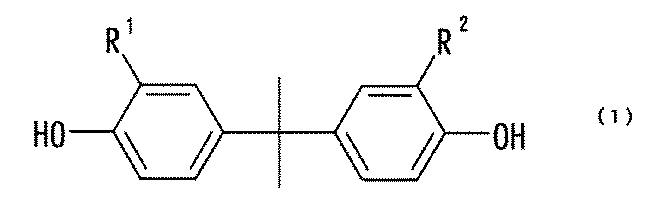
(一般式(1)において、R1およびR2はそれぞれ独立してアルキル基を表す)。
<2> 前記ポリアリレート樹脂(B)が、該ポリアリレート樹脂(B)を構成する二価フェノール成分として、さらにビスフェノールAを含有し、その混合比率が前記ビスフェノール化合物/ビスフェノールA=20/80~100/0(モル%)である、<1>に記載の樹脂組成物。
<3> さらに、ポリカーボネート樹脂(C)を含有する、<1>または<2>に記載の樹脂組成物。
<4> 前記ポリカーボネート(C)の対数粘度が0.4~0.6である、<3>に記載の樹脂組成物。
<5> さらに、有機リン化合物を含有する、<1>~<4>のいずれかに記載の樹脂組成物。
<6> 前記有機リン化合物がホスフェート化合物およびホスファイト化合物からなる群から選択される1種以上である、<5>に記載の樹脂組成物。
<7> さらに、非リン系化合物を含有する、<1>~<6>のいずれかに記載の樹脂組成物。
<8> さらに、ブチルアシッドホスフェート、ビス(2,6-ジ-tert-ブチル-4-メチルフェニル)ペンタエリスリトールジホスファイトおよびペンタエリスリトールテトラキス[3-(3’,5’-ジ-tert-ブチル-4’-ヒドロキシフェニル)プロピオナート]を含有する、<1>~<4>のいずれかに記載に樹脂組成物。
<9> 前記ポリアリレート樹脂(B)が、該ポリアリレート樹脂(B)を構成する二価フェノール成分として、さらにビスフェノールAを含有し、その混合比率が前記ビスフェノール化合物/ビスフェノールA=80/20~100/0(モル%)である、<1>~<8>のいずれかに記載の樹脂組成物。
<10> <1>~<9>のいずれかに記載の樹脂組成物から得られた成形体。
<11> <10>に記載の成形体よりなる自動車部品。
<12> <10>に記載の成形体よりなる電子機器筐体。
前記ポリシクロヘキシレンジメチレンテレフタレート樹脂(A)と前記ポリアリレート樹脂(B)との質量比(A/B)が10/90~50/50であり、
前記ポリアリレート樹脂(B)が、該)ポリアリレート樹脂(B)を構成する二価フェノール成分として、一般式(1)で表されるビスフェノール化合物を含有する樹脂組成物:
<2> 前記ポリアリレート樹脂(B)が、該ポリアリレート樹脂(B)を構成する二価フェノール成分として、さらにビスフェノールAを含有し、その混合比率が前記ビスフェノール化合物/ビスフェノールA=20/80~100/0(モル%)である、<1>に記載の樹脂組成物。
<3> さらに、ポリカーボネート樹脂(C)を含有する、<1>または<2>に記載の樹脂組成物。
<4> 前記ポリカーボネート(C)の対数粘度が0.4~0.6である、<3>に記載の樹脂組成物。
<5> さらに、有機リン化合物を含有する、<1>~<4>のいずれかに記載の樹脂組成物。
<6> 前記有機リン化合物がホスフェート化合物およびホスファイト化合物からなる群から選択される1種以上である、<5>に記載の樹脂組成物。
<7> さらに、非リン系化合物を含有する、<1>~<6>のいずれかに記載の樹脂組成物。
<8> さらに、ブチルアシッドホスフェート、ビス(2,6-ジ-tert-ブチル-4-メチルフェニル)ペンタエリスリトールジホスファイトおよびペンタエリスリトールテトラキス[3-(3’,5’-ジ-tert-ブチル-4’-ヒドロキシフェニル)プロピオナート]を含有する、<1>~<4>のいずれかに記載に樹脂組成物。
<9> 前記ポリアリレート樹脂(B)が、該ポリアリレート樹脂(B)を構成する二価フェノール成分として、さらにビスフェノールAを含有し、その混合比率が前記ビスフェノール化合物/ビスフェノールA=80/20~100/0(モル%)である、<1>~<8>のいずれかに記載の樹脂組成物。
<10> <1>~<9>のいずれかに記載の樹脂組成物から得られた成形体。
<11> <10>に記載の成形体よりなる自動車部品。
<12> <10>に記載の成形体よりなる電子機器筐体。
本発明によれば、耐熱性、耐傷つき性、耐衝撃性および耐薬品性に十分に優れた樹脂組成物およびそれから得られた成形体を提供することができる。
以下、本発明を詳細に説明する。
本発明の樹脂組成物は、ポリシクロヘキシレンジメチレンテレフタレート樹脂(A)およびポリアリレート樹脂(B)を含有する。
ポリシクロヘキシレンジメチレンテレフタレート樹脂(A)とポリアリレート樹脂(B)との質量比(A/B)は、5/95~55/45(特に10/90~50/50)であることが必要であり、耐熱性、耐傷付き性、耐衝撃性および耐薬品性(特に耐傷付き性)のさらなる向上の観点から、10/90~45/55であることが好ましく、15/85~45/55であることがより好ましく、20/80~40/60であることがさらに好ましい。
本発明の樹脂組成物におけるポリシクロヘキシレンジメチレンテレフタレート樹脂(A)の含有量が5質量%未満では、耐薬品性が劣ったものとなる。また耐衝撃性が低下することがある。当該含有量が55質量%を越えると、耐熱性が不足する。
本明細書中、耐傷つき性は、傷の微視的大きさ(例えば最大高さ粗さ)および目視的認識(例えば傷付き外観性)ならびに摩擦前後の光沢変化(例えば光沢残存率)および色彩変化(例えば色差)に関する評価結果に基づいて総合的に判断される特性である。
最大高さ粗さは、摩擦によって付与される傷の深さに関する指標である。最大高さ粗さは小さいほど好ましい。
傷付き外観性は、摩擦によって付与される傷の目視による認識に関する特性である。傷付き外観性は、傷幅が小さく、かつ傷が少ないほど好ましい。
光沢残存率は、摩擦後に残存する光沢の維持率に関する指標である。光沢残存率は大きいほど好ましい。
色差は、摩擦による色彩変化に関する指標である。色差は小さいほど好ましい。
耐衝撃性は、シャルピー衝撃強さに基づく特性である。耐衝撃性は、シャルピー衝撃強さが大きいほど好ましい。
耐薬品性は、アンモニアによる分子量低下に起因する樹脂劣化に耐え得る特性である。耐薬品性は、樹脂組成物またはその成形品をアンモニア水に浸漬したときの、浸漬前後の溶液粘度保持率を指標とする特性である。耐薬品性は、溶液粘度保持率が大きいほど好ましい。
最大高さ粗さは、摩擦によって付与される傷の深さに関する指標である。最大高さ粗さは小さいほど好ましい。
傷付き外観性は、摩擦によって付与される傷の目視による認識に関する特性である。傷付き外観性は、傷幅が小さく、かつ傷が少ないほど好ましい。
光沢残存率は、摩擦後に残存する光沢の維持率に関する指標である。光沢残存率は大きいほど好ましい。
色差は、摩擦による色彩変化に関する指標である。色差は小さいほど好ましい。
耐衝撃性は、シャルピー衝撃強さに基づく特性である。耐衝撃性は、シャルピー衝撃強さが大きいほど好ましい。
耐薬品性は、アンモニアによる分子量低下に起因する樹脂劣化に耐え得る特性である。耐薬品性は、樹脂組成物またはその成形品をアンモニア水に浸漬したときの、浸漬前後の溶液粘度保持率を指標とする特性である。耐薬品性は、溶液粘度保持率が大きいほど好ましい。
本発明におけるポリシクロヘキシレンジメチレンテレフタレート樹脂(A)は、テルフタル酸を含有するジカルボン酸成分と、シクロヘキサンジメタノール(特に1,4-シクロヘキサンジメタノール)を含有するグリコール成分との重縮合物である。ジカルボン酸成分中のテレフタル酸の含有量は80モル%以上であることが好ましく、グリコール成分中のシクロヘキサンジメタノール(特に1,4-シクロヘキサンジメタノール)の含有量も80モル%以上であることが好ましい。ポリシクロヘキシレンジメチレンテレフタレートは、SKケミカル社、イーストマンケミカルから入手することができる。
ポリシクロヘキシレンジメチレンテレフタレート樹脂(A)を構成するシクロヘキサンジメタノールは、例えば、1,4-シクロヘキサンジメタノール、1,3-シクロヘキサンジメタノール、1,2-シクロヘキサンジメタノールまたはそれらの混合物であってもよい。シクロヘキサンジメタノールは、耐熱性、耐傷付き性、耐衝撃性および耐薬品性(特に耐傷付き性)のさらなる向上の観点から、1,4-シクロヘキサンジメタノールを含むことが好ましく、より好ましくは1,4-シクロヘキサンジメタノールのみを含む。
ポリシクロヘキシレンジメチレンテレフタレート樹脂(A)を構成するグリコール成分として、シクロヘキサンジメタノールを含有しない場合、耐衝撃性が低下したり、耐熱性が低下する。
シクロヘキサンジメタノール(特に1,4-シクロヘキサンジメタノール)の含有量は、耐熱性、耐傷付き性、耐衝撃性および耐薬品性(特に耐傷付き性)のさらなる向上の観点から、ポリシクロヘキシレンジメチレンテレフタレート樹脂(A)を構成する全グリコール成分中、50~100モル%であることが好ましく、60~100モル%であることがよりに好ましく、80~100モル%であることがさらに好ましく、90~100モル%であることが特に好ましい。
1,4-シクロヘキサンジメタノール以外のグリコール成分としては、例えば、エチレングリコール、ネオペンチルグリコール、ジエチレングリコール、トリエチレングリコール、ポリエチレングリコール、1,2-プロパングリコール、1,3-プロパングリコール、1,5-ペンタングリコール、1,6-ヘキサングリコール、3-メチル-1,5-ペンタングリコール、ポリテトラメチレングリコール、およびそれらの混合物等を挙げることができる。
ポリシクロヘキシレンジメチレンテレフタレート樹脂(A)を構成するジカルボン酸成分としては、例えば、テレフタル酸、イソフタル酸等の芳香族ジカルボン酸、アジピン酸、アゼライン酸、セバシン酸等の脂肪族ジカルボン酸等を用いることができる。中でもテレフタル酸、イソフタル酸またはそれらの混合物を用いることが好ましい。テレフタル酸およびイソフタル酸の合計含有量は、ポリシクロヘキシレンジメチレンテレフタレート樹脂(A)を構成する全ジカルボン酸成分中、50~100モル%であることが好ましく、60~100モル%であることがより好ましく、80~100モル%であることがさらに好ましく、100モル%であることが特に好ましい。ポリシクロヘキシレンジメチレンテレフタレート樹脂(A)を構成するジカルボン酸成分としてテレフタル酸およびイソフタル酸を用いる場合、重合度とペレット化の観点から、その混合比率はテレフタル酸/イソフタル酸が50/50~100/0(モル%)であることが好ましく、70/30~100/0(モル%)であることがより好ましく、85/15~100/0(モル%)であることがさらに好ましい。
ポリシクロヘキシレンジメチレンテレフタレート樹脂(A)の極限粘度は、機械的特性、溶融加工時の流動性および成形性の向上ならびに耐熱性、耐傷付き性、耐衝撃性および耐薬品性(特に耐傷付き性)のさらなる向上の観点から、0.5~1.2であることが好ましく、0.6~1.1であることがより好ましく、0.8~1.1であることがさらに好ましく、0.9~1.1であることが特に好ましい。
極限粘度は、ポリエステル樹脂(特にポリシクロヘキシレンジメチレンテレフタレート樹脂(A))の温度20℃および濃度0.5g/100mLの溶液を用いて測定された値を用いている。溶媒は、フェノールと四塩化エタンとの等量混合物を用いている。等量とは等体積のことである。
本発明の樹脂組成物で用いるポリアリレート樹脂(B)は、二価フェノール残基および芳香族ジカルボン酸残基から構成されるポリエステルである。
本発明においてポリアリレート樹脂(B)は、当該ポリアリレート樹脂(B)を構成する二価フェノール成分として、特に一般式(1)で表されるビスフェノール化合物(以下、ビスフェノールC類と称することがある)を含有することを必要とする。ポリアリレート樹脂(B)が二価フェノール成分としてビスフェノールC類を含有しないと、耐傷つき性が劣るものとなる。

一般式(1)において、R1およびR2はそれぞれ独立してアルキル基を表す。アルキル基としては、例えば、炭素原子数1~10の炭化水素基(特に飽和炭化水素基)、好ましくは炭素原子数1~6の飽和炭化水素基、より好ましくは炭素原子数1~4の飽和炭化水素基が挙げられる。R1およびR2はそれぞれ独立して上記範囲内から選択されてもよい。R1およびR2は、好ましくは同じ基であり、より好ましくは同時に、メチル基、エチル基、プロピル基またはブチル基である。
ビスフェノールC類の具体例としては、例えば、2,2-ビス(3-メチル-4-ヒドロキシフェニル)プロパン(以下、BisCと称することがある)、2,2-ビス(3-エチル-4-ヒドロキシフェニル)プロパン、2,2-ビス(3-tert-ブチル-4-ヒドロキシフェニル)プロパンが挙げられる。ビスフェノールC類は、耐熱性、耐傷付き性、耐衝撃性および耐薬品性(特に耐傷付き性)のさらなる向上の観点から、ビスフェノールCを含むことが好ましく、より好ましくはビスフェノールCのみを含む。
ビスフェノールC類の含有量は、耐熱性、耐傷付き性、耐衝撃性および耐薬品性(特に耐傷付き性)のさらなる向上の観点から、ポリアリレート樹脂(B)を構成する全二価フェノール成分中、10~100モル%であることが好ましく、30~100モル%であることがより好ましく、60~100モル%であることがさらに好ましく、80~100モル%であることが十分に好ましく、90~100モル%であることが特に好ましく、100モル%であることが最も好ましい。
ビスフェノールC類以外のビスフェノール類(二価フェノール成分)としては、例えばレゾルシノール、2,2-ビス(4-ヒドロキシフェニル)プロパン(ビスフェノールA)、2,2-ビス(4-ヒドロキシ-3,5-ジメチルフェニル)プロパン、2,2-ビス(4-ヒドロキシ-3,5-ジブロモフェニル)プロパン、2,2-ビス(4-ヒドロキシ-3,5-ジクロロフェニル)プロパン、4,4’-ジヒドロキシジフェニルスルホン、4,4’-ジヒドロキシジフェニルエーテル、4,4’-ジヒドロキシジフェニルスルフィド、4,4’-ジヒドロキシジフェニルケトン、4,4’-ジヒドロキシジフェニルメタン、1,1-ビス(4-ヒドロキシフェニル)-3,3,5-トリメチルシクロヘキサン、1,1-ビス(4-ヒドロキシフェニル)シクロヘキサン等が挙げられる。これらの化合物からなるポリアリレート樹脂は非晶性で耐熱性により優れたものとなりやすい。これらの化合物は単独で使用してもよいし、あるいは2種類以上混合して使用してもよい。これらの化合物の中で、2,2-ビス(4-ヒドロキシフェニル)プロパン(ビスフェノールA)を使用することが、耐熱性、耐傷付き性、耐衝撃性および耐薬品性(特に耐傷付き性)のさらなる向上の観点から好ましく、最適にはこれをビスフェノールC類(特に2,2-ビス(4-ヒドロキシ-3-メチルフェニル)プロパン(ビスフェノールC))と特定比率で混合して用いることが好ましい。
ビスフェノールC類とビスフェノールAを混合して用いるか、またはビスフェノールAを用いることなくビスフェノールC類を用いる場合、その混合比率は、耐熱性、耐傷付き性、耐衝撃性および耐薬品性のさらなる向上の観点から、ビスフェノールC類/ビスフェノールAが20/80~100/0(モル%)であることが好ましく、30/70~95/5(モル%)であることがより好ましく、40/60~90/10(モル%)であることがさらに好ましい。ビスフェノールC類とビスフェノールAを混合して用いるか、またはビスフェノールAを用いることなくビスフェノールC類を用いる場合、その混合比率は、耐傷付き性のさらなる向上の観点から、ビスフェノールC類/ビスフェノールAが60/40~100/0(モル%)であることが好ましく、70/30~100/0(モル%)であることがより好ましく、80/20~100/0(モル%)であることがさらに好ましく、90/10~100/0(モル%)であることが特に好ましく、100/0(モル%)であることが最も好ましい。
ポリアリレート樹脂(B)に対し、芳香族ジカルボン酸残基を導入するための化合物としては、例えば、テレフタル酸、イソフタル酸、フタル酸、クロルフタル酸、ニトロフタル酸、2,5-ナフタレンジカルボン酸、2,6-ナフタレンジカルボン酸、2,7-ナフタレンジカルボン酸、1,5-ナフタレンジカルボン酸、メチルテレフタル酸、4,4’-ビフェニルジカルボン酸、2,2’-ビフェニルジカルボン酸、4,4’-ジフェニルエーテルジカルボン酸、4,4’-ジフェニルメタンジカルボン酸、4,4’-ジフェニルスルフォンジカルボン酸、4,4’-ジフェニルイソプロピリデンジカルボン酸、1,2-ビス(4-カルボキシフェノキシ)エタン、5-ナトリウムスルホイソフタル酸、ジフェン酸ならびにそれらの誘導体などが挙げられる。芳香族ジカルボン酸の誘導体として、例えば、上記芳香族ジカルボン酸の炭素数1~3のアルキルのエステル化物および酸塩化物が挙げられる。これらの化合物は単独で使用してもよいし、あるいは2種類以上混合して使用してもよい。なかでも、テレフタル酸、イソフタル酸、ならびにそれらの誘導体が好ましく、耐熱性と流動性のバランスの点から、テレフタル酸またはその誘導体とイソフタル酸またはその誘導体の両者を混合して用いることが特に好ましい。その場合、混合モル比率(テレフタル酸/イソフタル酸)は100/0~0/100の範囲の任意であるが、好ましくは90/10~10/90、より好ましくは70/30~30/70、特に好ましくは55/45~45/55の範囲とすると、得られるポリアリレート樹脂は非晶質となり、耐熱性により優れたものとなる。
ポリアリレート樹脂(B)の対数粘度(すなわちインヘレント粘度)は特に限定されず、例えば、0.40~1.20dL/g、特に0.40~1.10dL/gであってもよい。ポリアリレート樹脂(B)は、本発明の樹脂組成物の耐熱性および耐傷つき性のバランス向上ならびに耐熱性、耐傷付き性、耐衝撃性および耐薬品性のさらなる向上の観点から、対数粘度(すなわちインヘレント粘度)が0.40~0.75dL/gであることが好ましく、0.45~0.65であることがより好ましい。
対数粘度は、1,1,2,2-テトラクロロエタン100mlに試料1.0gを溶解した溶液の、温度25℃における対数粘度(すなわちインヘレント粘度)を用いている。
本発明の樹脂組成物は、さらにポリカーボネート樹脂(C)を含有させることができる。ポリカーボネート樹脂(C)を用いることで、樹脂組成物の成形加工時の流動性の改善を図ることができる。本発明の樹脂組成物は、耐熱性、耐傷付き性、耐衝撃性および耐薬品性のさらなる向上の観点から、さらにポリカーボネート樹脂(C)を含有することが好ましい。ポリカーボネート樹脂(C)は、特に限定はされず公知のものを用いることができる。
ポリカーボネート樹脂(C)は、ビスフェノール残基とカーボネート残基とが繰り返されてなるポリ炭酸エステルである。ビスフェノール残基を導入するためのビスフェノール類としては、例えば、2,2-ビス(4-ヒドロキシフェニル)プロパン、2,2-ビス(3,5-ジブロモ-4-ヒドロキシフェニル)プロパン、2,2-ビス(3,5-ジメチル-4-ヒドロキシフェニル)プロパン、1,1-ビス(4-ヒドロキシフェニル)シクロヘキサン、1,1-ビス(3,5-ジメチル-4-ヒドロキシフェニル)シクロヘキサン、1,1-ビス(4-ヒドロキシフェニル)デカン、1,3-または1,2-ビス(4-ヒドロキシフェニル)プロパン、1,1-ビス(4-ヒドロキシフェニル)シクロドデカン、4,4’-ジヒドロキシジフェニルエーテル、4,4’-ジチオジフェノール、4,4’-ジヒドロキシ-3,3’-ジクロロジフェニルエーテル、4,4’-ジヒドロキシ-2,5-ジヒドロキシジフェニルエーテル等が挙げられる。これらは単独で使用してもよいし、あるいは2種類以上混合して使用してもよい。これらの化合物の中でも少なくとも2,2-ビス(4-ヒドロキシフェニル)プロパンを使用することが好ましく、より好ましくは当該化合物を単独で使用する。カーボネート残基を導入するための原料としては、例えばホスゲン、あるいはジフェニルカーボネート等が挙げられる。
ポリカーボネート樹脂(C)の対数粘度(すなわちインヘレント粘度)は、耐熱性、耐傷付き性、耐衝撃性および耐薬品性(特に耐傷付き性)のさらなる向上の観点から、0.3~0.7であることが好ましく、0.35~0.65であることがより好ましく、0.4~0.6であることがより好ましい。
ポリカーボネート樹脂(C)の対数粘度は、ポリカーボネート樹脂(C)を用いること以外、ポリアリレート樹脂(B)の対数粘度の測定方法と同様の方法により測定された値を用いている。
ポリカーボネート樹脂(C)の含有量は、耐熱性、耐傷付き性、耐衝撃性および耐薬品性(特に耐傷付き性)のさらなる向上の観点から、全ポリマー成分に対し、30質量%未満で用いることが好ましく、5~25質量%であることがより好ましく、15~25質量%であることがさらに好ましい。
本明細書中、全ポリマー成分とは、ポリシクロヘキシレンジメチレンテレフタレート樹脂(A)とポリアリレート樹脂(B)の合計量のことであり、特にポリカーボネート樹脂(C)がさらに含まれる場合、ポリシクロヘキシレンジメチレンテレフタレート樹脂(A)とポリアリレート樹脂(B)とポリカーボネート樹脂(C)の合計量のことである。
本発明の樹脂組成物は、さらに有機リン化合物および/または非リン系化合物を含有してもよい。有機リン化合物を含有させることで、樹脂組成物の成形加工時の変色を抑制することができる。有機リン化合物および非リン系化合物は、特に限定はされず公知のものを用いることができる。
本発明の樹脂組成物で用いる有機リン化合物としては、例えば、ホスファイト化合物、ホスフェート化合物、ホスホナイト化合物等を用いることができる。中でも、耐熱変色性の効果が高い観点で、ホスフェート化合物およびホスファイト化合物からなる群から選択される1種以上が好ましく、ホスフェート化合物がより好ましい。
ホスファイト化合物の具体例として、例えば、ビス(2,6-ジ-tert-ブチル-4-メチルフェニル)ペンタエリスリトールジホスファイト、トリスノニルホスファイト、トリスフェニルホスファイト、トリストリデシルホスファイト、トリス(モノノニルフェニル)ホスファイト、トリス(モノ・ジノニルフェニル)ホスファイト、トリス(2,4-ジ-t-ブチルフェニル)ホスファイト、トリス(2-t-ブチルフェニル)ホスファイト、トリス(2,4-ジ-t-ブチル-5-メチルフェニル)ホスファイト、トリス(2,5-ジ-t-ブチルフェニル)ホスファイト、トリス(2-t-ブチルフェニル)ホスファイト、トリス[2-(1,1-ジメチルプロピル)フェニル]ホスファイト、トリス[2,4-ジ-(1,1-ジメチルプロピル)フェニル]ホスファイト、トリス(2-シクロヘキシルフェニル)ホスファイト、トリスフェニルホスファイト、トリス(オクチルチオエチル)ホスファイト、トリス(オクチルチオプロピル)ホスファイト、トリス(クレジルチオプロピル)ホスファイト、トリス(3,5-ジ-t-ブチル-4-ヒドロキシフェニル)ホスファイト、4,4’-ブチリデン-ビス(3-メチル-6-t-ブチルフェニル-ジ-トリデシル)ホスファイト、4,4’-ブチリデン-ビス(3-メチル-6-t-ブチルフェニル-ジ-オクチル)ホスファイト、1,1,3-トリス(2-メチル-4-ジトリデシルホスファイト5-t-ブチルフェニル)ブタン、ビス(2,4-ジ-t-ブチルフェニル)スピロペンタエリスリトールジホスファイト、ビス(2,6-ジ-t-ブチル-4-メチルフェニル)スピロペンタエリスリトール-ジホスファイト、ビス(2,6-ジ-t-ブチル-4-エチルフェニル)スピロペンタエリスリトール-ジホスファイト、ビス(2,4,6-トリ-t-ブチルフェニル)スピロペンタエリスリトール-ジホスファイト、ビス(ノニルフェニル)スピロペンタエリスリトール-ジホスファイト等が挙げられる。
ホスフェート化合物の具体例として、例えば、エチルアシッドホスフェート、ブチルアシッドホスフェート、ブトキシエチルアシッドホスフェート、2-エチルヘキシルアシッドホスフェート、オレイルアシッドホスフェート、テトラコシルアシッドホスフェート等が挙げられる。
ホスホナイト化合物の具体例として、例えば、テトラキス(2,4-ジ-t-ブチルフェニル)[1,1-ビフェニル]-4,4'-ジイルビスホスホナイト(BASF製IRGAFOS P-EPQ)、テトラキス(2,4-ジ-tert-ブチル-5-メチルフェニル)-4,4′-ビフェニレンジホスホナイト)(堺化学工業社製 GSY-P101)等が挙げられる。
非リン系化合物としては、ヒンダードフェノール化合物等を用いることができる。
ヒンダードフェノール化合物の具体例として、例えば、ヒンダードフェノール系熱安定剤としては、例えば、Irganox1010(登録商標)(BASFジャパン社製、ペンタエリスリトールテトラキス[3-(3’,5’-ジ-tert-ブチル-4’-ヒドロキシフェニル)プロピオナート])、Irganox1076(登録商標)(BASFジャパン社製、オクタデシル-3-(3,5-ジ-tert-ブチル-4-ヒドロキシフェニル)プロピオネート)、Cyanox1790(登録商標)(ソルベイ社製、1,3,5-トリス(4-t-ブチル-3-ヒドロキシ-2,6-ジメチルベンジル)イソシアヌル酸)、Irganox1098(登録商標)(BASFジャパン社製、N,N’-(ヘキサン-1,6-ジイル)ビス[3-(3,5-ジ-tert-ブチル-4-ヒドロキシフェニル)プロピオンアミド]、SumilizerGA-80(登録商標)(住友化学社製、3,9-ビス[2-{3-(3-t-ブチル-4-ヒドロキシ-5-メチルフェニル)プロピオニルオキシ}-1,1-ジメチルエチル]-2,4,8,10-テトラオキサスピロ[5.5]ウンデカン)が挙げられる。
ヒンダードフェノール化合物の具体例として、例えば、ヒンダードフェノール系熱安定剤としては、例えば、Irganox1010(登録商標)(BASFジャパン社製、ペンタエリスリトールテトラキス[3-(3’,5’-ジ-tert-ブチル-4’-ヒドロキシフェニル)プロピオナート])、Irganox1076(登録商標)(BASFジャパン社製、オクタデシル-3-(3,5-ジ-tert-ブチル-4-ヒドロキシフェニル)プロピオネート)、Cyanox1790(登録商標)(ソルベイ社製、1,3,5-トリス(4-t-ブチル-3-ヒドロキシ-2,6-ジメチルベンジル)イソシアヌル酸)、Irganox1098(登録商標)(BASFジャパン社製、N,N’-(ヘキサン-1,6-ジイル)ビス[3-(3,5-ジ-tert-ブチル-4-ヒドロキシフェニル)プロピオンアミド]、SumilizerGA-80(登録商標)(住友化学社製、3,9-ビス[2-{3-(3-t-ブチル-4-ヒドロキシ-5-メチルフェニル)プロピオニルオキシ}-1,1-ジメチルエチル]-2,4,8,10-テトラオキサスピロ[5.5]ウンデカン)が挙げられる。
本発明の樹脂組成物は、耐熱性、耐傷付き性、耐衝撃性および耐薬品性(特に耐傷付き性のさらなる向上の観点から、有機リン化合物(特にホスフェート化合物およびホスファイト化合物)ならびに非リン系化合物(等にヒンダードフェノール化合物)からなる群から選択される1種以上の化合物を含むことが好ましく、より好ましくは有機リン化合物(特にホスフェート化合物およびホスファイト化合物の組み合わせ)ならびに非リン系化合物(等にヒンダードフェノール化合物)を含有する。
有機リン化合物の含有量は通常、全ポリマー成分100質量部に対し、0~0.5質量部であり、0.01~0.3質量部であることが好ましく、0.02~0.2質量部であることがより好ましく、0.03~0.1質量部であることがさらに好ましい。2種以上の有機リン化合物を用いる場合、それらの合計含有量が上記範囲内であればよい。
特にホスフェート化合物の含有量は、耐熱性、耐傷付き性、耐衝撃性および耐薬品性(特に耐傷付き性)のさらなる向上の観点から、全ポリマー成分100質量部に対して、好ましくは0.001~0.2質量部であり、より好ましくは0.03~0.08質量部である。
特にホスファイト化合物の含有量は、耐熱性、耐傷付き性、耐衝撃性および耐薬品性(特に耐傷付き性)のさらなる向上の観点から、全ポリマー成分100質量部に対して、好ましくは0.01~0.3質量部であり、より好ましくは0.07~0.12質量部である。
非リン系化合物(特にヒンダードフェノール化合物)の含有量は通常、全ポリマー成分100質量部に対し、0~0.4質量部であり、耐熱性、耐傷付き性、耐衝撃性および耐薬品性(特に耐傷付き性)のさらなる向上の観点から、全ポリマー成分100質量部に対して、好ましくは0.001~0.2質量部であり、より好ましくは0.03~0.08質量部である。
本発明の樹脂組成物は、その特性を損なわない範囲で、有機リン化合物および非リン系化合物以外の酸化防止剤、難燃剤、無機充填材、顔料、染料等の各種添加剤等を含有させることもできる。
本発明の樹脂組成物の製造方法について説明をする。
本発明の樹脂組成物の製造方法は特に限定されず任意の方法を選択することができる。樹脂組成物の製造方法としては、例えば、ポリシクロヘキシレンジメチレンテレフタレート樹脂(A)とポリアリレート樹脂(B)を溶融混練等の手段で混合する方法(以下、溶融混練法という)、ポリシクロヘキシレンジメチレンテレフタレート樹脂(A)構成するモノマー成分、ポリアリレート樹脂(B)を構成するモノマー成分を混合した後、共重合体を得る方法(以下、重合法という)を挙げることができる。本発明の樹脂組成物は、耐熱性、耐傷つき性、耐衝撃性および耐薬品性の観点から、溶融混練法により得られるペレット形態を有することが好ましい。
本発明の樹脂組成物の製造方法は特に限定されず任意の方法を選択することができる。樹脂組成物の製造方法としては、例えば、ポリシクロヘキシレンジメチレンテレフタレート樹脂(A)とポリアリレート樹脂(B)を溶融混練等の手段で混合する方法(以下、溶融混練法という)、ポリシクロヘキシレンジメチレンテレフタレート樹脂(A)構成するモノマー成分、ポリアリレート樹脂(B)を構成するモノマー成分を混合した後、共重合体を得る方法(以下、重合法という)を挙げることができる。本発明の樹脂組成物は、耐熱性、耐傷つき性、耐衝撃性および耐薬品性の観点から、溶融混練法により得られるペレット形態を有することが好ましい。
本発明の樹脂組成物は、耐熱性、耐傷つき性、耐衝撃性および耐薬品性に優れるため、各種成形体の製造に用いることが出来る。本発明の樹脂組成物から製造された成形体は、特に黒着色した、いわゆるピアノブラック仕様である意匠部品として、長期の使用においても傷付きを抑制し、美観を維持することができる。
本発明は成形体も提供する。本発明の成形体は、上記した樹脂組成物を含む成形体であり、詳しくは、上記した樹脂組成物(例えばそのペレット)を用いて、公知のあらゆる方法により、製造することができる。本発明の成形体の製造方法として、例えば、射出成形法、押出成形法等を挙げることができる。
1.評価方法
(1)粘度
(1.1)インヘレント粘度(ηA)
ポリアリレート樹脂およびポリカーボネート樹脂を1,1,2,2-テトラクロロエタンに溶解し、濃度1g/dLの試料溶液を作製した。続いて、ウベローデ型粘度計を用い、25℃の温度にて試料溶液および溶媒の落下時間を測定し、以下の式を用いてインヘレント粘度(ηA)を求めた。
(1)粘度
(1.1)インヘレント粘度(ηA)
ポリアリレート樹脂およびポリカーボネート樹脂を1,1,2,2-テトラクロロエタンに溶解し、濃度1g/dLの試料溶液を作製した。続いて、ウベローデ型粘度計を用い、25℃の温度にて試料溶液および溶媒の落下時間を測定し、以下の式を用いてインヘレント粘度(ηA)を求めた。

(1.2)極限粘度
ポリエステル樹脂を、フェノールと四塩化エタンとの等量混合物を溶媒として溶解して調製された温度20℃および濃度0.5g/100mLの溶液を用いて測定された値を用いている。
ポリエステル樹脂を、フェノールと四塩化エタンとの等量混合物を溶媒として溶解して調製された温度20℃および濃度0.5g/100mLの溶液を用いて測定された値を用いている。
(2)摩擦試験
JIS-K5701-1に準拠し、学振型摩擦試験機(安田精機製作所社製、摩擦試験機II No428-6)を用いて、後述する板状成形体を用いて、試験条件(荷重4.9N、ストローク100mm、摩擦速度30往復/分、摩擦回数500回)にて、摩擦試験を行った。相手材として綿布(金巾3号)を用いた。
JIS-K5701-1に準拠し、学振型摩擦試験機(安田精機製作所社製、摩擦試験機II No428-6)を用いて、後述する板状成形体を用いて、試験条件(荷重4.9N、ストローク100mm、摩擦速度30往復/分、摩擦回数500回)にて、摩擦試験を行った。相手材として綿布(金巾3号)を用いた。
(3)線粗さ(耐傷付き性1)および傷付き外観性(耐傷付き性2)
(2)で行った摩擦試験後の板状成形体について、JIS B0601に準拠し、3D形状測定機(キーエンス社製、VR-3000型)を用い、摩擦面の線粗さを測定し、最大高さ(Rz)の算出を行った。最大高さ(Rz)は、0.03以下であることが必要である。
◎:Rz≦0.01(最良);
〇:0.01<Rz≦0.02(優良);
△:0.02<Rz≦0.03(実用上問題なし);
×:0.03<Rz(実用上問題あり)。
(2)で行った摩擦試験後の板状成形体について、JIS B0601に準拠し、3D形状測定機(キーエンス社製、VR-3000型)を用い、摩擦面の線粗さを測定し、最大高さ(Rz)の算出を行った。最大高さ(Rz)は、0.03以下であることが必要である。
◎:Rz≦0.01(最良);
〇:0.01<Rz≦0.02(優良);
△:0.02<Rz≦0.03(実用上問題なし);
×:0.03<Rz(実用上問題あり)。
また、摩擦試験後の表面外観を画像データとして取得した。なお、表面状態に基づき表面外観を4種の状態に区分した。その4種の状態のうち、○、△および×に対応する表面状態をそれぞれ図1~3に示す。実用的には、◎か〇であることが好ましく、◎であることがより好ましい。
◎:傷付きを認めない;
〇:微細な傷を少し認める(図1);
△:微細な傷を多く認める(図2)(実用上問題なし);
×:太いまたは深い傷を多く認める(図3)(実用上問題あり)。
◎:傷付きを認めない;
〇:微細な傷を少し認める(図1);
△:微細な傷を多く認める(図2)(実用上問題なし);
×:太いまたは深い傷を多く認める(図3)(実用上問題あり)。
(4)表面光沢度(耐傷付き性3)
(2)で行った摩擦試験後の板状成形体について、光沢計(日本電色工業社製、PG-II/IIM型)を用い、摩擦面の光沢度を測定した。なお、摩擦試験前の板状成形体についても同様の光沢度測定を行い、摩擦試験前後の光沢度より下記式により光沢残存率を算出した。
(2)で行った摩擦試験後の板状成形体について、光沢計(日本電色工業社製、PG-II/IIM型)を用い、摩擦面の光沢度を測定した。なお、摩擦試験前の板状成形体についても同様の光沢度測定を行い、摩擦試験前後の光沢度より下記式により光沢残存率を算出した。

◎:97%≦光沢残存率(最良);
〇:92%≦光沢残存率<97%(優良);
△:84%≦光沢残存率<92%(実用上問題なし);
×:光沢残存率<84%(実用上問題あり)。
〇:92%≦光沢残存率<97%(優良);
△:84%≦光沢残存率<92%(実用上問題なし);
×:光沢残存率<84%(実用上問題あり)。
(5)色差(耐傷付き性4)
(2)で行った摩擦試験後の板状成形体について、分光測色計(コニカミノルタ社製、CM-3700A型)を用い、摩擦面の色差△Eの測定を行った。なお、測定は反射色測定(D65光源、2°視野)とした。
(2)で行った摩擦試験後の板状成形体について、分光測色計(コニカミノルタ社製、CM-3700A型)を用い、摩擦面の色差△Eの測定を行った。なお、測定は反射色測定(D65光源、2°視野)とした。
◎:△E≦0.04(最良);
〇:0.04<△E≦0.20(優良);
△:0.20<△E≦0.40(実用上問題なし);
×:0.40<△E(実用上問題あり)。
〇:0.04<△E≦0.20(優良);
△:0.20<△E≦0.40(実用上問題なし);
×:0.40<△E(実用上問題あり)。
(6)耐傷付き性(総合)
耐傷つき性を、上記した、傷の微視的大きさ(線粗さ)および目視的認識(傷付き外観性)ならびに摩擦前後の光沢変化(光沢残存率)および色彩変化(色差)に関する評価結果(以下、「4つの評価結果」という)に基づいて総合的に判断した。
◎;4つの評価結果の全てが◎であった(最良);
○;4つの評価結果のうち最低の評価結果が○であった(優良);
△;4つの評価結果のうち最低の評価結果が△であった(実用上問題なし);
×;4つの評価結果のうち最低の評価結果が○であった(実用上問題あり)。
傷付き外観性の評価結果は、他の3つの評価結果のうちの最低の評価結果と一致していた。
耐傷つき性を、上記した、傷の微視的大きさ(線粗さ)および目視的認識(傷付き外観性)ならびに摩擦前後の光沢変化(光沢残存率)および色彩変化(色差)に関する評価結果(以下、「4つの評価結果」という)に基づいて総合的に判断した。
◎;4つの評価結果の全てが◎であった(最良);
○;4つの評価結果のうち最低の評価結果が○であった(優良);
△;4つの評価結果のうち最低の評価結果が△であった(実用上問題なし);
×;4つの評価結果のうち最低の評価結果が○であった(実用上問題あり)。
傷付き外観性の評価結果は、他の3つの評価結果のうちの最低の評価結果と一致していた。
(7)耐熱性:DTUL(荷重たわみ温度)
ISO75-1,-2に準じ、荷重1.8MPaにて測定した。
ISO75-1,-2に準じ、荷重1.8MPaにて測定した。
◎:117℃≦DTUL(最良);
〇:115℃≦DTUL<117℃(優良);
△:114℃≦DTUL<115℃(実用上問題なし);
×:DTUL<114℃(実用上問題あり)。
〇:115℃≦DTUL<117℃(優良);
△:114℃≦DTUL<115℃(実用上問題なし);
×:DTUL<114℃(実用上問題あり)。
(8)耐衝撃性(シャルピー衝撃強さ)
ISO179-1eAに準じて測定した。
ISO179-1eAに準じて測定した。
◎:18kJ/m2≦シャルピー衝撃強さ(最良);
〇:9kJ/m2≦シャルピー衝撃強さ<18kJ/m2(優良);
△:7kJ/m2≦シャルピー衝撃強さ<9kJ/m2(実用上問題なし);
×:シャルピー衝撃強さ<7kJ/m2(実用上問題あり)。
〇:9kJ/m2≦シャルピー衝撃強さ<18kJ/m2(優良);
△:7kJ/m2≦シャルピー衝撃強さ<9kJ/m2(実用上問題なし);
×:シャルピー衝撃強さ<7kJ/m2(実用上問題あり)。
(9)耐薬品性
関東化学社製アンモニア水(28%濃度)に成形品を72時間浸漬させ、浸漬後の成形品の溶液粘度を測定し、溶液粘度保持率を算出した。塩基性物質であるアンモニア水による樹脂劣化が起こると、分子量低下に起因する溶液粘度の低下が起こるため、溶液粘度保持率が高い方が好ましい。
関東化学社製アンモニア水(28%濃度)に成形品を72時間浸漬させ、浸漬後の成形品の溶液粘度を測定し、溶液粘度保持率を算出した。塩基性物質であるアンモニア水による樹脂劣化が起こると、分子量低下に起因する溶液粘度の低下が起こるため、溶液粘度保持率が高い方が好ましい。

◎:70%≦溶液粘度保持率(最良);
〇:50%≦溶液粘度保持率<70%(優良);
△:45%≦溶液粘度保持率<50%(実用上問題なし);
×:溶液粘度保持率<45%(実用上問題あり)。
〇:50%≦溶液粘度保持率<70%(優良);
△:45%≦溶液粘度保持率<50%(実用上問題なし);
×:溶液粘度保持率<45%(実用上問題あり)。
2.原料
(1)ポリシクロヘキシレンジメチレンテレフタレート樹脂
・ポリシクロヘキシレンジメチレンテレフタレート(a):EASTMAN Chemical社製、イーストマン コポリエステル13319、(極限粘度1.0)(TPA/IPA/CHDM=95/5/100モル%)
・ポリシクロヘキシレンジメチレンテレフタレート(b):EASTMAN Chemical社製、イースターDN003、(極限粘度0.7)(TPA/CHDM/EG=100/65/35モル%)
(1)ポリシクロヘキシレンジメチレンテレフタレート樹脂
・ポリシクロヘキシレンジメチレンテレフタレート(a):EASTMAN Chemical社製、イーストマン コポリエステル13319、(極限粘度1.0)(TPA/IPA/CHDM=95/5/100モル%)
・ポリシクロヘキシレンジメチレンテレフタレート(b):EASTMAN Chemical社製、イースターDN003、(極限粘度0.7)(TPA/CHDM/EG=100/65/35モル%)
(2)ポリシクロヘキシレンジメチレンテレフタレート樹脂以外のポリエステル樹脂
・ポリエステル(c):ユニチカ社製、NEH-2070(極限粘度0.88)(TPA/EG=100/100モル%)
・ポリエステル(c):ユニチカ社製、NEH-2070(極限粘度0.88)(TPA/EG=100/100モル%)
(3)ポリアリレート樹脂
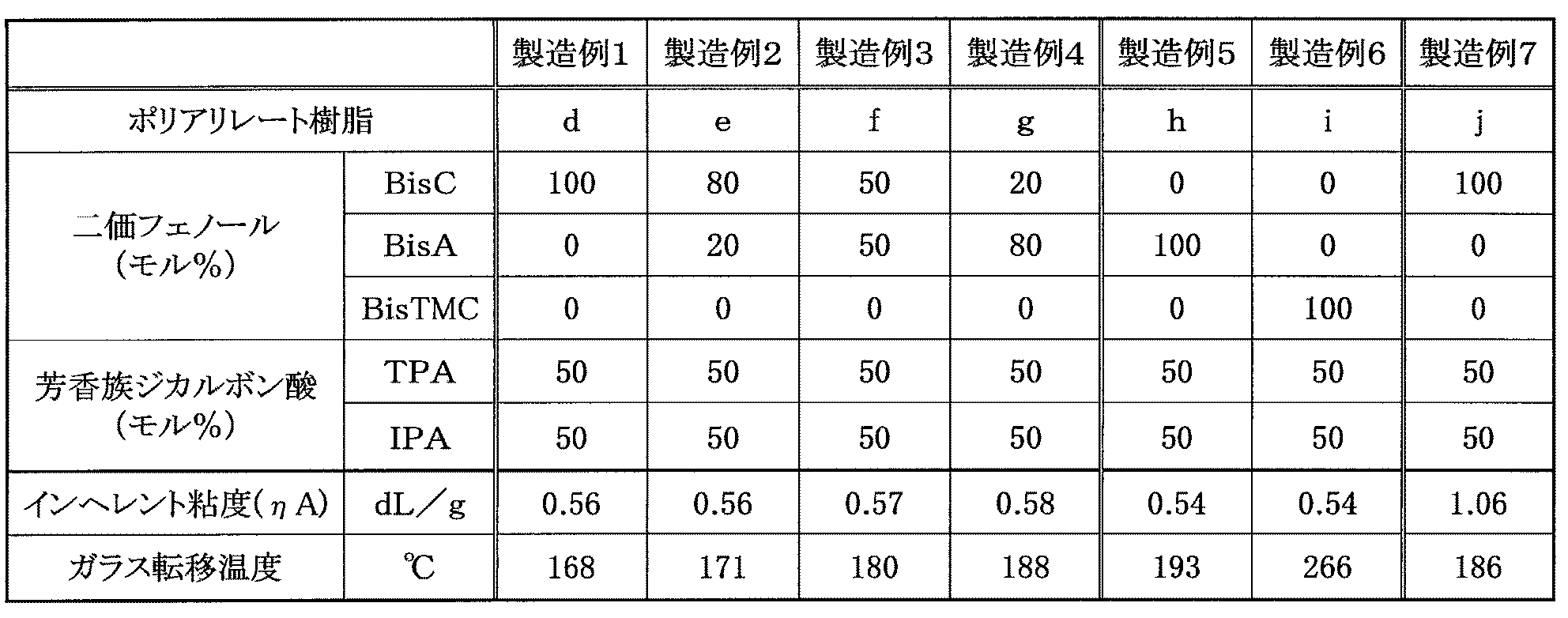
後述する製造例1~7で得られたポリアリレート樹脂(後述の表1参照)
・ポリアリレート(d):BisC/BisA=100/0モル%であるポリアリレート
・ポリアリレート(e):BisC/BisA=80/20モル%であるポリアリレート
・ポリアリレート(f):BisC/BisA=50/50モル%であるポリアリレート
・ポリアリレート(g):BisC/BisA=20/80モル%であるポリアリレート
・ポリアリレート(h):BisC/BisA=0/100モル%であるポリアリレート
・ポリアリレート(i):BisC/BisTMC=0/100モル%であるポリアリレート
・ポリアリレート(j):BisC/BisA=100/0モル%であるポリアリレート
後述する製造例1~7で得られたポリアリレート樹脂(後述の表1参照)
・ポリアリレート(d):BisC/BisA=100/0モル%であるポリアリレート
・ポリアリレート(e):BisC/BisA=80/20モル%であるポリアリレート
・ポリアリレート(f):BisC/BisA=50/50モル%であるポリアリレート
・ポリアリレート(g):BisC/BisA=20/80モル%であるポリアリレート
・ポリアリレート(h):BisC/BisA=0/100モル%であるポリアリレート
・ポリアリレート(i):BisC/BisTMC=0/100モル%であるポリアリレート
・ポリアリレート(j):BisC/BisA=100/0モル%であるポリアリレート
(4)ポリカーボネート樹脂
・ポリカーボネート(k):住化ポリカーボネート社製、SDポリカK200-30(対数粘度0.43)
・ポリカーボネート(l):住化ポリカーボネート社製、SDポリカK200-80(対数粘度0.38)
・ポリカーボネート(k):住化ポリカーボネート社製、SDポリカK200-30(対数粘度0.43)
・ポリカーボネート(l):住化ポリカーボネート社製、SDポリカK200-80(対数粘度0.38)
(5)有機リン化合物
・ホスフェート化合物:ブチルアシッドホスフェート(城北化学社製、JP-504)
・ホスファイト化合物:ビス(2,6-ジ-tert-ブチル-4-メチルフェニル)ペンタエリスリトールジホスファイト(ADEKA社製、アデカスタブPEP-36)
・ホスフェート化合物:ブチルアシッドホスフェート(城北化学社製、JP-504)
・ホスファイト化合物:ビス(2,6-ジ-tert-ブチル-4-メチルフェニル)ペンタエリスリトールジホスファイト(ADEKA社製、アデカスタブPEP-36)
(6)非リン系化合物
・ヒンダードフェノール化合物:ペンタエリスリトールテトラキス[3-(3’,5’-ジ-tert-ブチル-4’-ヒドロキシフェニル)プロピオナート](BASF社製、Irganox1010)
・ヒンダードフェノール化合物:ペンタエリスリトールテトラキス[3-(3’,5’-ジ-tert-ブチル-4’-ヒドロキシフェニル)プロピオナート](BASF社製、Irganox1010)
製造例1
水冷用ジャケットと攪拌装置を備えた内容積100Lの反応容器中に、水酸化ナトリウム850gを30Lのイオン交換水に溶解し、ついで2,2-ビス(3-メチル-4-ヒドロキシフェニル)プロパン(ビスフェノールC)6.00mol、および、p-tertブチルフェノール(以下PTBP)0.30molを溶解した。別の容器でテレフタル酸ジクロリド(以下TPC)3.08mol、イソフタル酸ジクロリド(以下IPC)3.08molをジクロロメタン18Lに溶解した。それぞれの液を20℃になるよう調節した後、前記水溶液を攪拌した反応容器中へ、ベンジルトリメチルアンモニウムクロライドの50%水溶液を15g添加し、さらに前記ジクロロメタン溶液を全量投入し、6時間攪拌を続けた後、攪拌機を停止した。静置分離後に水相を抜き出し、残ったジクロロメタン相に酢酸20gを添加した。その後、イオン交換水30Lを投入し、20分間攪拌してから再度静置して水相を抜き出した。この水洗操作を水相が中性になるまで繰り返した後、ジクロロメタン相を、ホモミキサーを装着した50℃の温水槽中に徐々に投入しながら塩化メチレンを蒸発させることで、粉末状のポリマーを析出させ、これを取り出して脱水・乾燥を行い、ポリアリレート樹脂(d)を得た。その結果を表1に示す。
水冷用ジャケットと攪拌装置を備えた内容積100Lの反応容器中に、水酸化ナトリウム850gを30Lのイオン交換水に溶解し、ついで2,2-ビス(3-メチル-4-ヒドロキシフェニル)プロパン(ビスフェノールC)6.00mol、および、p-tertブチルフェノール(以下PTBP)0.30molを溶解した。別の容器でテレフタル酸ジクロリド(以下TPC)3.08mol、イソフタル酸ジクロリド(以下IPC)3.08molをジクロロメタン18Lに溶解した。それぞれの液を20℃になるよう調節した後、前記水溶液を攪拌した反応容器中へ、ベンジルトリメチルアンモニウムクロライドの50%水溶液を15g添加し、さらに前記ジクロロメタン溶液を全量投入し、6時間攪拌を続けた後、攪拌機を停止した。静置分離後に水相を抜き出し、残ったジクロロメタン相に酢酸20gを添加した。その後、イオン交換水30Lを投入し、20分間攪拌してから再度静置して水相を抜き出した。この水洗操作を水相が中性になるまで繰り返した後、ジクロロメタン相を、ホモミキサーを装着した50℃の温水槽中に徐々に投入しながら塩化メチレンを蒸発させることで、粉末状のポリマーを析出させ、これを取り出して脱水・乾燥を行い、ポリアリレート樹脂(d)を得た。その結果を表1に示す。
製造例2~6
ビスフェノール(二価フェノール)を表1に示すものに変更した以外は、製造例1と同様にしてポリアリレート(e)、(f)、(g)、(h)および(i)をそれぞれ得た。その結果を表1に示す。
ビスフェノール(二価フェノール)を表1に示すものに変更した以外は、製造例1と同様にしてポリアリレート(e)、(f)、(g)、(h)および(i)をそれぞれ得た。その結果を表1に示す。
製造例7
末端封鎖剤であるPTBP量を0.15モルに変更する以外は、製造例1と同様にしてポリアリレート(j)を得た。
末端封鎖剤であるPTBP量を0.15モルに変更する以外は、製造例1と同様にしてポリアリレート(j)を得た。
実施例1
ポリシクロヘキシレンジメチレンテレフタレート樹脂(a)50質量部、製造例1で得たポリアリレート樹脂(d)50質量部、ホスフェート化合物0.06質量部、ホスファイト化合物0.1質量部、ヒンダードフェノール化合物0.06質量部となるよう一括混合した後、クボタ社製連続定流供給装置を用いて、同方向2軸押出機(東芝機械社製、TEM‐37BS)の主供給口に供給した。樹脂温度300℃、吐出量20kg/時で溶融混練を行い、ノズルからストランド状に引取った樹脂組成物を水浴にくぐらせて冷却固化した。ペレタイザーでカッティングした後、100℃で12時間熱風乾燥することによって樹脂組成物ペレットを得た。
得られた樹脂組成物ペレットを用い、射出成形機(ファナック株式会社製、FUNUC ROBOSHOT S-2000i100B)を用いて樹脂温度290℃で試験片の成形を行い、各種評価を行った。試験片としては、摩擦試験には50mm×90mm×2mm厚の板状成形体を製造した。耐熱性と耐衝撃性の試験にはダンベル型試験片を製造した。耐薬品性試験には20mm×20mm×0.5mmの板状成形体を製造した。なお、摩擦試験で使用した金型のコア側成形面は#8000のみがきをかけた鏡面仕様とした。耐衝撃性試験で使用するダンベル型試験片は成形後切削し、耐衝撃性測定用試験片を作製した。その結果を表2に示す。
ポリシクロヘキシレンジメチレンテレフタレート樹脂(a)50質量部、製造例1で得たポリアリレート樹脂(d)50質量部、ホスフェート化合物0.06質量部、ホスファイト化合物0.1質量部、ヒンダードフェノール化合物0.06質量部となるよう一括混合した後、クボタ社製連続定流供給装置を用いて、同方向2軸押出機(東芝機械社製、TEM‐37BS)の主供給口に供給した。樹脂温度300℃、吐出量20kg/時で溶融混練を行い、ノズルからストランド状に引取った樹脂組成物を水浴にくぐらせて冷却固化した。ペレタイザーでカッティングした後、100℃で12時間熱風乾燥することによって樹脂組成物ペレットを得た。
得られた樹脂組成物ペレットを用い、射出成形機(ファナック株式会社製、FUNUC ROBOSHOT S-2000i100B)を用いて樹脂温度290℃で試験片の成形を行い、各種評価を行った。試験片としては、摩擦試験には50mm×90mm×2mm厚の板状成形体を製造した。耐熱性と耐衝撃性の試験にはダンベル型試験片を製造した。耐薬品性試験には20mm×20mm×0.5mmの板状成形体を製造した。なお、摩擦試験で使用した金型のコア側成形面は#8000のみがきをかけた鏡面仕様とした。耐衝撃性試験で使用するダンベル型試験片は成形後切削し、耐衝撃性測定用試験片を作製した。その結果を表2に示す。
実施例2~24、比較例1~9
表2~4に記載のポリシクロヘキシレンジメチレンテレフタレート樹脂、ポリアリレート樹脂、必要に応じてポリカーボネート樹脂を用い、添加剤を所定比率で含有させ、実施例1と同様の条件で溶融混練を行い、各樹脂組成物ペレットを得た。得られた樹脂組成物ペレットを用い、板状成形体を得て各種評価を行った。その結果を表2、3、4にそれぞれ示す。
表2~4に記載のポリシクロヘキシレンジメチレンテレフタレート樹脂、ポリアリレート樹脂、必要に応じてポリカーボネート樹脂を用い、添加剤を所定比率で含有させ、実施例1と同様の条件で溶融混練を行い、各樹脂組成物ペレットを得た。得られた樹脂組成物ペレットを用い、板状成形体を得て各種評価を行った。その結果を表2、3、4にそれぞれ示す。
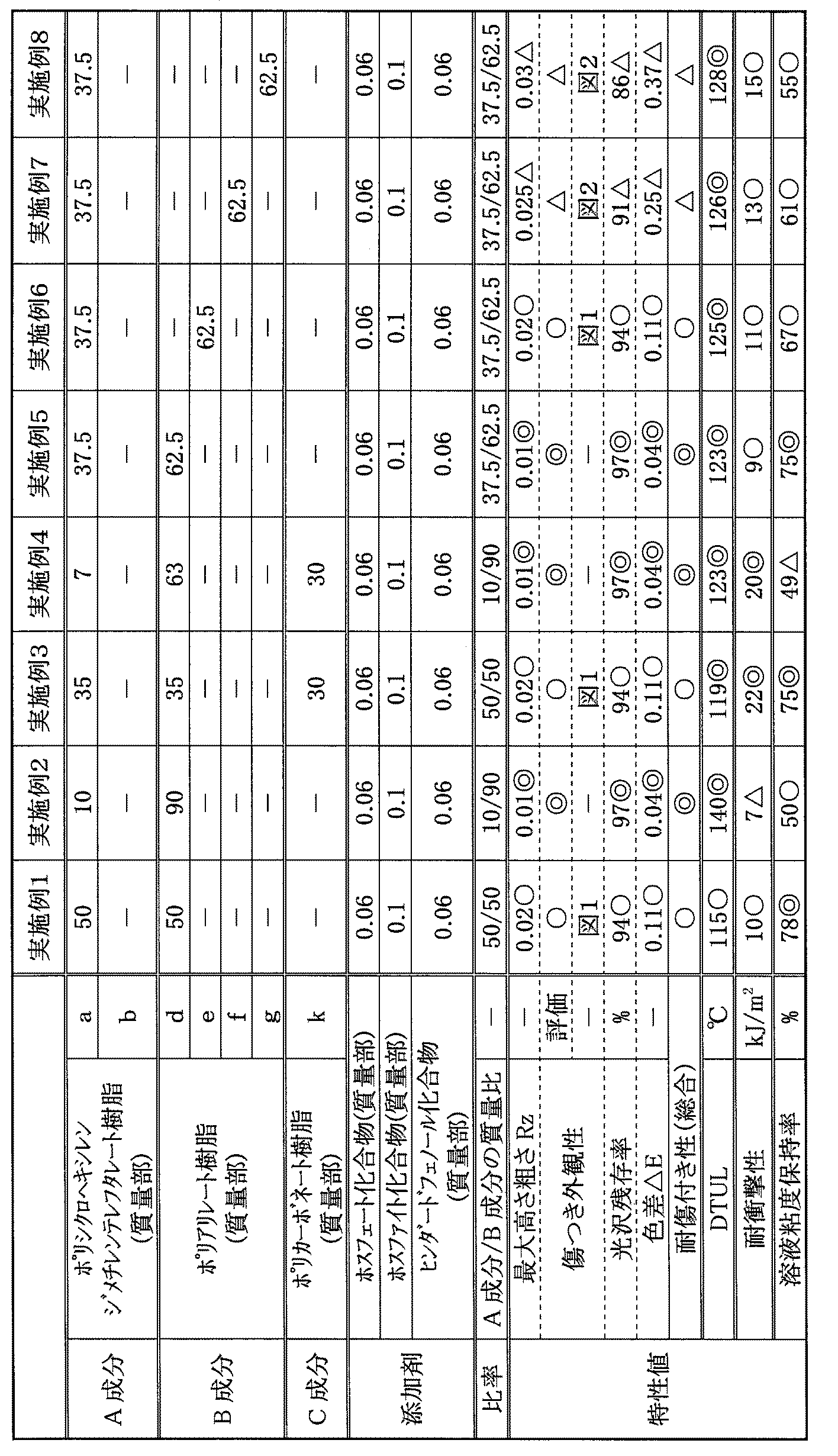
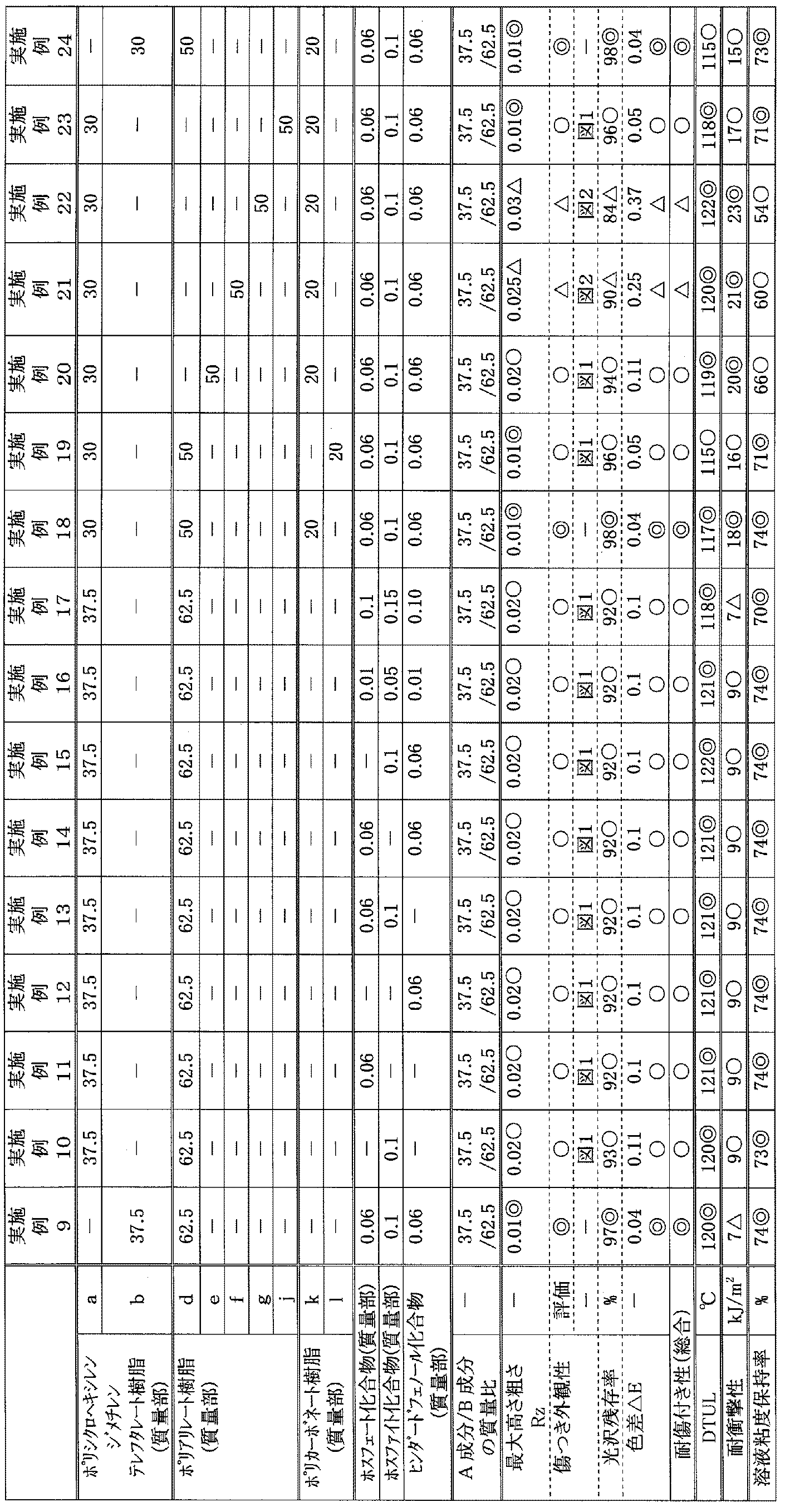

実施例1~24で得られた樹脂組成物は、本願所定の樹脂組成物としたため、耐熱性、耐傷付き性、耐衝撃性および耐薬品性に優れたものであった。
比較例1、3では、ポリシクロヘキシレンジメチレンテレフタレート樹脂の含有量が過多であったため、耐熱性が低下した。
比較例2、4では、ポリシクロヘキシレンジメチレンテレフタレート樹脂を含有しなかったため、耐薬品性試験での溶液粘度保持率が低下した。また、耐衝撃性が低下することがあった。
比較例5、6、9では、ポリアリレート樹脂として、ビスフェノールC類を含有しないものを用いたため、耐傷付き性が劣った。また、耐薬品性が低下することがあった。
比較例7、8では、ポリシクロヘキシレンジメチレンテレフタレート樹脂とは異なるポリエステル樹脂を用いたため、耐熱性または耐衝撃性が低下した。
本発明の樹脂組成物は、評価結果○以上の耐傷付き性を達成する観点から、以下の条件(X1)を満たすことが好ましいことが明らかである:
条件(X1):ポリアリレート樹脂(B)におけるビスフェノールC類およびビスフェノールAの混合比率がビスフェノールC類/ビスフェノールA=60/40~100/0(特に80/20~100/0)(モル%)である。
条件(X1):ポリアリレート樹脂(B)におけるビスフェノールC類およびビスフェノールAの混合比率がビスフェノールC類/ビスフェノールA=60/40~100/0(特に80/20~100/0)(モル%)である。
本発明の樹脂組成物は、評価結果◎の耐傷付き性を達成する観点から、以下の条件(Y1)~(Y8)を満たすことが好ましいことが明らかである:
条件(Y1):ポリシクロヘキシレンジメチレンテレフタレート樹脂(A)とポリアリレート樹脂(B)との質量比(A/B)が、5/95~45/55(特に10/90~45/55である;
条件(Y2):ポリアリレート樹脂(B)におけるビスフェノールC類およびビスフェノールAの混合比率がビスフェノールC類/ビスフェノールA=90/10~100/0(モル%)である;
条件(Y3):ポリアリレート樹脂(B)のインヘレント粘度が0.40~0.75dL/gである;
条件(Y4):樹脂組成物はさらに対数粘度0.4~0.6のポリカーボネート樹脂(C)を含有するか、または含有しない;詳しくは、樹脂組成物はポリカーボネート樹脂(C)を含有しないか、または含有するにしても対数粘度0.4~0.6のポリカーボネート樹脂(C)を含有する;
条件(Y5):樹脂組成物はさらにホスフェート化合物、ホスファイト化合物およびヒンダードフェノール化合物を含有する:
条件(Y6):ホスフェート化合物の含有量は、全ポリマー成分100質量部に対して、0.03~0.08質量部である:
条件(Y7):ホスファイト化合物の含有量は、全ポリマー成分100質量部に対して、0.07~0.12質量部である:
条件(Y8):ヒンダードフェノール化合物の含有量は、全ポリマー成分100質量部に対して、0.03~0.08質量部である。
条件(Y1):ポリシクロヘキシレンジメチレンテレフタレート樹脂(A)とポリアリレート樹脂(B)との質量比(A/B)が、5/95~45/55(特に10/90~45/55である;
条件(Y2):ポリアリレート樹脂(B)におけるビスフェノールC類およびビスフェノールAの混合比率がビスフェノールC類/ビスフェノールA=90/10~100/0(モル%)である;
条件(Y3):ポリアリレート樹脂(B)のインヘレント粘度が0.40~0.75dL/gである;
条件(Y4):樹脂組成物はさらに対数粘度0.4~0.6のポリカーボネート樹脂(C)を含有するか、または含有しない;詳しくは、樹脂組成物はポリカーボネート樹脂(C)を含有しないか、または含有するにしても対数粘度0.4~0.6のポリカーボネート樹脂(C)を含有する;
条件(Y5):樹脂組成物はさらにホスフェート化合物、ホスファイト化合物およびヒンダードフェノール化合物を含有する:
条件(Y6):ホスフェート化合物の含有量は、全ポリマー成分100質量部に対して、0.03~0.08質量部である:
条件(Y7):ホスファイト化合物の含有量は、全ポリマー成分100質量部に対して、0.07~0.12質量部である:
条件(Y8):ヒンダードフェノール化合物の含有量は、全ポリマー成分100質量部に対して、0.03~0.08質量部である。
本発明の樹脂組成物は、耐熱性、耐傷つき性、耐衝撃性および耐薬品性に優れるため、具体的には、インストルメントパネルやドアトリム等の自動車内装部品;フロントグリル、フェンダー等の自動車外装部品;その他家電、電子機器等の筐体部品;建材等のパネル部品の製造に用いることが有用である。
本発明の樹脂組成物を含む成形体は特に、電子機器筐体および自動車部品として有用である。
電子機器筐体はスマートフォン、パソコン等の電子機器に含まれる筐体(すなわちケース)のことである。
自動車部品は、自動車の内装部品および外装部品として使用されるあらゆる部品を包含し、例えば、上記した自動車内装部品および自動車外装部品が挙げられる。
電子機器筐体はスマートフォン、パソコン等の電子機器に含まれる筐体(すなわちケース)のことである。
自動車部品は、自動車の内装部品および外装部品として使用されるあらゆる部品を包含し、例えば、上記した自動車内装部品および自動車外装部品が挙げられる。
Claims (12)
- ポリシクロヘキシレンジメチレンテレフタレート樹脂(A)およびポリアリレート樹脂(B)を含有する樹脂組成物であって、
前記ポリシクロヘキシレンジメチレンテレフタレート樹脂(A)と前記ポリアリレート樹脂(B)との質量比(A/B)が10/90~50/50であり、
前記ポリアリレート樹脂(B)が、該)ポリアリレート樹脂(B)を構成する二価フェノール成分として、一般式(1)で表されるビスフェノール化合物を含有する樹脂組成物:

- 前記ポリアリレート樹脂(B)が、該ポリアリレート樹脂(B)を構成する二価フェノール成分として、さらにビスフェノールAを含有し、その混合比率が前記ビスフェノール化合物/ビスフェノールA=20/80~100/0(モル%)である、請求項1に記載の樹脂組成物。
- さらに、ポリカーボネート樹脂(C)を含有する、請求項1または2に記載の樹脂組成物。
- 前記ポリカーボネート(C)の対数粘度が0.4~0.6である、請求項3に記載の樹脂組成物。
- さらに、有機リン化合物を含有する、請求項1~4のいずれかに記載の樹脂組成物。
- 前記有機リン化合物がホスフェート化合物およびホスファイト化合物からなる群から選択される1種以上である、請求項5に記載の樹脂組成物。
- さらに、非リン系化合物を含有する、請求項1~6のいずれかに記載の樹脂組成物。
- さらに、ブチルアシッドホスフェート、ビス(2,6-ジ-tert-ブチル-4-メチルフェニル)ペンタエリスリトールジホスファイトおよびペンタエリスリトールテトラキス[3-(3’,5’-ジ-tert-ブチル-4’-ヒドロキシフェニル)プロピオナート]を含有する、請求項1~4のいずれかに記載に樹脂組成物。
- 前記ポリアリレート樹脂(B)が、該ポリアリレート樹脂(B)を構成する二価フェノール成分として、さらにビスフェノールAを含有し、その混合比率が前記ビスフェノール化合物/ビスフェノールA=80/20~100/0(モル%)である、請求項1~8のいずれかに記載の樹脂組成物。
- 請求項1~9のいずれかに記載の樹脂組成物から得られた成形体。
- 請求項10に記載の成形体よりなる自動車部品。
- 請求項10に記載の成形体よりなる電子機器筐体。
Priority Applications (1)
| Application Number | Priority Date | Filing Date | Title |
|---|---|---|---|
| JP2022557564A JPWO2022085690A1 (ja) | 2020-10-20 | 2021-10-19 |
Applications Claiming Priority (2)
| Application Number | Priority Date | Filing Date | Title |
|---|---|---|---|
| JP2020176319 | 2020-10-20 | ||
| JP2020-176319 | 2020-10-20 |
Publications (1)
| Publication Number | Publication Date |
|---|---|
| WO2022085690A1 true WO2022085690A1 (ja) | 2022-04-28 |
Family
ID=81290636
Family Applications (1)
| Application Number | Title | Priority Date | Filing Date |
|---|---|---|---|
| PCT/JP2021/038638 Ceased WO2022085690A1 (ja) | 2020-10-20 | 2021-10-19 | 樹脂組成物およびそれから得られた成形体 |
Country Status (2)
| Country | Link |
|---|---|
| JP (1) | JPWO2022085690A1 (ja) |
| WO (1) | WO2022085690A1 (ja) |
Citations (5)
| Publication number | Priority date | Publication date | Assignee | Title |
|---|---|---|---|---|
| JP2000159871A (ja) * | 1998-11-26 | 2000-06-13 | Unitika Ltd | 被膜形成用樹脂 |
| JP2002302596A (ja) * | 2001-04-06 | 2002-10-18 | Unitika Ltd | ポリアリレート樹脂組成物およびそれからなる成形品 |
| US20060269755A1 (en) * | 2005-05-31 | 2006-11-30 | Kwangjin Song | Polymeric films |
| JP2011132380A (ja) * | 2009-12-25 | 2011-07-07 | Unitika Ltd | ポリアリレート樹脂、ポリアリレート樹脂組成物および該ポリアリレート樹脂組成物からなる成形体 |
| JP2020050872A (ja) * | 2018-09-21 | 2020-04-02 | 三菱ケミカル株式会社 | ディスプレイ用フィルム、フォルダブルディスプレイ |
-
2021
- 2021-10-19 JP JP2022557564A patent/JPWO2022085690A1/ja active Pending
- 2021-10-19 WO PCT/JP2021/038638 patent/WO2022085690A1/ja not_active Ceased
Patent Citations (5)
| Publication number | Priority date | Publication date | Assignee | Title |
|---|---|---|---|---|
| JP2000159871A (ja) * | 1998-11-26 | 2000-06-13 | Unitika Ltd | 被膜形成用樹脂 |
| JP2002302596A (ja) * | 2001-04-06 | 2002-10-18 | Unitika Ltd | ポリアリレート樹脂組成物およびそれからなる成形品 |
| US20060269755A1 (en) * | 2005-05-31 | 2006-11-30 | Kwangjin Song | Polymeric films |
| JP2011132380A (ja) * | 2009-12-25 | 2011-07-07 | Unitika Ltd | ポリアリレート樹脂、ポリアリレート樹脂組成物および該ポリアリレート樹脂組成物からなる成形体 |
| JP2020050872A (ja) * | 2018-09-21 | 2020-04-02 | 三菱ケミカル株式会社 | ディスプレイ用フィルム、フォルダブルディスプレイ |
Also Published As
| Publication number | Publication date |
|---|---|
| JPWO2022085690A1 (ja) | 2022-04-28 |
Similar Documents
| Publication | Publication Date | Title |
|---|---|---|
| CN104220484B (zh) | 聚碳酸酯树脂、聚碳酸酯树脂组合物及其成型品 | |
| TW200837141A (en) | Flame retardancy polycarbonate resin composition | |
| JP6207816B2 (ja) | ポリカーボネート樹脂積層体 | |
| CN102822277B (zh) | 聚碳酸酯树脂组合物、其制造方法以及该树脂组合物的成型体 | |
| WO2021230132A1 (ja) | 組成物、ペレット、成形品および組成物の製造方法 | |
| CN117157359A (zh) | 用于生产半透明热塑性聚碳酸酯/聚甲基丙烯酸甲酯模塑料的组合物和方法 | |
| ES2742532T3 (es) | Composición de resina termoplástica y cuerpo moldeado que la utiliza | |
| CN109071787B (zh) | 聚(酯-碳酸酯)共聚物、由其形成的制品、和制备方法 | |
| KR20180078908A (ko) | 폴리카보네이트 수지 조성물 및 이로부터 형성된 성형품 | |
| JP6159137B2 (ja) | 帯電防止性ポリカーボネート樹脂組成物および成形品 | |
| KR20190100312A (ko) | 감소된 광택 및 우수한 내화학성을 갖는 조성물 및 열가소성 성형 배합물 | |
| JP2017186446A (ja) | 芳香族ポリカーボネート系樹脂組成物および光拡散性成形品 | |
| KR101486567B1 (ko) | 열가소성 수지 조성물 | |
| WO2022085690A1 (ja) | 樹脂組成物およびそれから得られた成形体 | |
| JP2009235361A (ja) | 難燃性ポリアリレート樹脂組成物 | |
| JP4811925B2 (ja) | 熱可塑性樹脂シート | |
| TWI910296B (zh) | 雙折射減低劑及熱塑性樹脂組成物 | |
| JPWO2019172216A1 (ja) | 無機強化熱可塑性ポリエステル樹脂組成物 | |
| JP2025509533A (ja) | ポリカーボネート組成物 | |
| JP5141054B2 (ja) | 樹脂組成物および樹脂成形体 | |
| US10364348B2 (en) | Thermoplastic resin composition and molded article comprising the same | |
| JP2003500489A (ja) | 圧縮成形法で製造された防炎性の押出品および成形品 | |
| JP4329199B2 (ja) | 熱可塑性樹脂組成物 | |
| JP2025065611A (ja) | 熱可塑性樹脂組成物およびそれからなる成形品 | |
| US10723876B2 (en) | Thermoplastic resin composition and molded article comprising the same |
Legal Events
| Date | Code | Title | Description |
|---|---|---|---|
| 121 | Ep: the epo has been informed by wipo that ep was designated in this application |
Ref document number: 21882831 Country of ref document: EP Kind code of ref document: A1 |
|
| ENP | Entry into the national phase |
Ref document number: 2022557564 Country of ref document: JP Kind code of ref document: A |
|
| NENP | Non-entry into the national phase |
Ref country code: DE |
|
| 122 | Ep: pct application non-entry in european phase |
Ref document number: 21882831 Country of ref document: EP Kind code of ref document: A1 |