WO2022085477A1 - 熱伝導性フィラー、熱伝導性複合材料、ワイヤーハーネス、および熱伝導性フィラーの製造方法 - Google Patents
熱伝導性フィラー、熱伝導性複合材料、ワイヤーハーネス、および熱伝導性フィラーの製造方法 Download PDFInfo
- Publication number
- WO2022085477A1 WO2022085477A1 PCT/JP2021/037265 JP2021037265W WO2022085477A1 WO 2022085477 A1 WO2022085477 A1 WO 2022085477A1 JP 2021037265 W JP2021037265 W JP 2021037265W WO 2022085477 A1 WO2022085477 A1 WO 2022085477A1
- Authority
- WO
- WIPO (PCT)
- Prior art keywords
- substance
- gel
- heat
- heat conductive
- filler
- Prior art date
- Legal status (The legal status is an assumption and is not a legal conclusion. Google has not performed a legal analysis and makes no representation as to the accuracy of the status listed.)
- Ceased
Links
Images

Classifications
-
- C—CHEMISTRY; METALLURGY
- C09—DYES; PAINTS; POLISHES; NATURAL RESINS; ADHESIVES; COMPOSITIONS NOT OTHERWISE PROVIDED FOR; APPLICATIONS OF MATERIALS NOT OTHERWISE PROVIDED FOR
- C09K—MATERIALS FOR MISCELLANEOUS APPLICATIONS, NOT PROVIDED FOR ELSEWHERE
- C09K5/00—Heat-transfer, heat-exchange or heat-storage materials, e.g. refrigerants; Materials for the production of heat or cold by chemical reactions other than by combustion
- C09K5/08—Materials not undergoing a change of physical state when used
- C09K5/14—Solid materials, e.g. powdery or granular
-
- C—CHEMISTRY; METALLURGY
- C03—GLASS; MINERAL OR SLAG WOOL
- C03C—CHEMICAL COMPOSITION OF GLASSES, GLAZES OR VITREOUS ENAMELS; SURFACE TREATMENT OF GLASS; SURFACE TREATMENT OF FIBRES OR FILAMENTS MADE FROM GLASS, MINERALS OR SLAGS; JOINING GLASS TO GLASS OR OTHER MATERIALS
- C03C11/00—Multi-cellular glass ; Porous or hollow glass or glass particles
- C03C11/002—Hollow glass particles
-
- C—CHEMISTRY; METALLURGY
- C03—GLASS; MINERAL OR SLAG WOOL
- C03C—CHEMICAL COMPOSITION OF GLASSES, GLAZES OR VITREOUS ENAMELS; SURFACE TREATMENT OF GLASS; SURFACE TREATMENT OF FIBRES OR FILAMENTS MADE FROM GLASS, MINERALS OR SLAGS; JOINING GLASS TO GLASS OR OTHER MATERIALS
- C03C17/00—Surface treatment of glass, not in the form of fibres or filaments, by coating
- C03C17/006—Surface treatment of glass, not in the form of fibres or filaments, by coating with materials of composite character
- C03C17/007—Surface treatment of glass, not in the form of fibres or filaments, by coating with materials of composite character containing a dispersed phase, e.g. particles, fibres or flakes, in a continuous phase
-
- C—CHEMISTRY; METALLURGY
- C03—GLASS; MINERAL OR SLAG WOOL
- C03C—CHEMICAL COMPOSITION OF GLASSES, GLAZES OR VITREOUS ENAMELS; SURFACE TREATMENT OF GLASS; SURFACE TREATMENT OF FIBRES OR FILAMENTS MADE FROM GLASS, MINERALS OR SLAGS; JOINING GLASS TO GLASS OR OTHER MATERIALS
- C03C17/00—Surface treatment of glass, not in the form of fibres or filaments, by coating
- C03C17/28—Surface treatment of glass, not in the form of fibres or filaments, by coating with organic material
- C03C17/32—Surface treatment of glass, not in the form of fibres or filaments, by coating with organic material with synthetic or natural resins
-
- C—CHEMISTRY; METALLURGY
- C08—ORGANIC MACROMOLECULAR COMPOUNDS; THEIR PREPARATION OR CHEMICAL WORKING-UP; COMPOSITIONS BASED THEREON
- C08K—Use of inorganic or non-macromolecular organic substances as compounding ingredients
- C08K7/00—Use of ingredients characterised by shape
- C08K7/02—Fibres or whiskers
- C08K7/04—Fibres or whiskers inorganic
- C08K7/06—Elements
-
- C—CHEMISTRY; METALLURGY
- C08—ORGANIC MACROMOLECULAR COMPOUNDS; THEIR PREPARATION OR CHEMICAL WORKING-UP; COMPOSITIONS BASED THEREON
- C08K—Use of inorganic or non-macromolecular organic substances as compounding ingredients
- C08K7/00—Use of ingredients characterised by shape
- C08K7/22—Expanded, porous or hollow particles
- C08K7/24—Expanded, porous or hollow particles inorganic
- C08K7/28—Glass
-
- C—CHEMISTRY; METALLURGY
- C08—ORGANIC MACROMOLECULAR COMPOUNDS; THEIR PREPARATION OR CHEMICAL WORKING-UP; COMPOSITIONS BASED THEREON
- C08K—Use of inorganic or non-macromolecular organic substances as compounding ingredients
- C08K9/00—Use of pretreated ingredients
- C08K9/02—Ingredients treated with inorganic substances
-
- C—CHEMISTRY; METALLURGY
- C08—ORGANIC MACROMOLECULAR COMPOUNDS; THEIR PREPARATION OR CHEMICAL WORKING-UP; COMPOSITIONS BASED THEREON
- C08K—Use of inorganic or non-macromolecular organic substances as compounding ingredients
- C08K9/00—Use of pretreated ingredients
- C08K9/04—Ingredients treated with organic substances
-
- C—CHEMISTRY; METALLURGY
- C08—ORGANIC MACROMOLECULAR COMPOUNDS; THEIR PREPARATION OR CHEMICAL WORKING-UP; COMPOSITIONS BASED THEREON
- C08K—Use of inorganic or non-macromolecular organic substances as compounding ingredients
- C08K9/00—Use of pretreated ingredients
- C08K9/08—Ingredients agglomerated by treatment with a binding agent
-
- C—CHEMISTRY; METALLURGY
- C08—ORGANIC MACROMOLECULAR COMPOUNDS; THEIR PREPARATION OR CHEMICAL WORKING-UP; COMPOSITIONS BASED THEREON
- C08L—COMPOSITIONS OF MACROMOLECULAR COMPOUNDS
- C08L101/00—Compositions of unspecified macromolecular compounds
-
- C—CHEMISTRY; METALLURGY
- C03—GLASS; MINERAL OR SLAG WOOL
- C03C—CHEMICAL COMPOSITION OF GLASSES, GLAZES OR VITREOUS ENAMELS; SURFACE TREATMENT OF GLASS; SURFACE TREATMENT OF FIBRES OR FILAMENTS MADE FROM GLASS, MINERALS OR SLAGS; JOINING GLASS TO GLASS OR OTHER MATERIALS
- C03C2217/00—Coatings on glass
- C03C2217/40—Coatings comprising at least one inhomogeneous layer
- C03C2217/43—Coatings comprising at least one inhomogeneous layer consisting of a dispersed phase in a continuous phase
- C03C2217/44—Coatings comprising at least one inhomogeneous layer consisting of a dispersed phase in a continuous phase characterized by the composition of the continuous phase
- C03C2217/445—Organic continuous phases
-
- C—CHEMISTRY; METALLURGY
- C03—GLASS; MINERAL OR SLAG WOOL
- C03C—CHEMICAL COMPOSITION OF GLASSES, GLAZES OR VITREOUS ENAMELS; SURFACE TREATMENT OF GLASS; SURFACE TREATMENT OF FIBRES OR FILAMENTS MADE FROM GLASS, MINERALS OR SLAGS; JOINING GLASS TO GLASS OR OTHER MATERIALS
- C03C2217/00—Coatings on glass
- C03C2217/40—Coatings comprising at least one inhomogeneous layer
- C03C2217/43—Coatings comprising at least one inhomogeneous layer consisting of a dispersed phase in a continuous phase
- C03C2217/46—Coatings comprising at least one inhomogeneous layer consisting of a dispersed phase in a continuous phase characterized by the dispersed phase
- C03C2217/465—Coatings comprising at least one inhomogeneous layer consisting of a dispersed phase in a continuous phase characterized by the dispersed phase having a specific shape
-
- C—CHEMISTRY; METALLURGY
- C03—GLASS; MINERAL OR SLAG WOOL
- C03C—CHEMICAL COMPOSITION OF GLASSES, GLAZES OR VITREOUS ENAMELS; SURFACE TREATMENT OF GLASS; SURFACE TREATMENT OF FIBRES OR FILAMENTS MADE FROM GLASS, MINERALS OR SLAGS; JOINING GLASS TO GLASS OR OTHER MATERIALS
- C03C2217/00—Coatings on glass
- C03C2217/40—Coatings comprising at least one inhomogeneous layer
- C03C2217/43—Coatings comprising at least one inhomogeneous layer consisting of a dispersed phase in a continuous phase
- C03C2217/46—Coatings comprising at least one inhomogeneous layer consisting of a dispersed phase in a continuous phase characterized by the dispersed phase
- C03C2217/47—Coatings comprising at least one inhomogeneous layer consisting of a dispersed phase in a continuous phase characterized by the dispersed phase consisting of a specific material
- C03C2217/475—Inorganic materials
-
- C—CHEMISTRY; METALLURGY
- C03—GLASS; MINERAL OR SLAG WOOL
- C03C—CHEMICAL COMPOSITION OF GLASSES, GLAZES OR VITREOUS ENAMELS; SURFACE TREATMENT OF GLASS; SURFACE TREATMENT OF FIBRES OR FILAMENTS MADE FROM GLASS, MINERALS OR SLAGS; JOINING GLASS TO GLASS OR OTHER MATERIALS
- C03C2217/00—Coatings on glass
- C03C2217/40—Coatings comprising at least one inhomogeneous layer
- C03C2217/43—Coatings comprising at least one inhomogeneous layer consisting of a dispersed phase in a continuous phase
- C03C2217/46—Coatings comprising at least one inhomogeneous layer consisting of a dispersed phase in a continuous phase characterized by the dispersed phase
- C03C2217/48—Coatings comprising at least one inhomogeneous layer consisting of a dispersed phase in a continuous phase characterized by the dispersed phase having a specific function
-
- C—CHEMISTRY; METALLURGY
- C03—GLASS; MINERAL OR SLAG WOOL
- C03C—CHEMICAL COMPOSITION OF GLASSES, GLAZES OR VITREOUS ENAMELS; SURFACE TREATMENT OF GLASS; SURFACE TREATMENT OF FIBRES OR FILAMENTS MADE FROM GLASS, MINERALS OR SLAGS; JOINING GLASS TO GLASS OR OTHER MATERIALS
- C03C2218/00—Methods for coating glass
- C03C2218/10—Deposition methods
- C03C2218/11—Deposition methods from solutions or suspensions
- C03C2218/113—Deposition methods from solutions or suspensions by sol-gel processes
-
- C—CHEMISTRY; METALLURGY
- C08—ORGANIC MACROMOLECULAR COMPOUNDS; THEIR PREPARATION OR CHEMICAL WORKING-UP; COMPOSITIONS BASED THEREON
- C08K—Use of inorganic or non-macromolecular organic substances as compounding ingredients
- C08K2201/00—Specific properties of additives
- C08K2201/001—Conductive additives
-
- C—CHEMISTRY; METALLURGY
- C08—ORGANIC MACROMOLECULAR COMPOUNDS; THEIR PREPARATION OR CHEMICAL WORKING-UP; COMPOSITIONS BASED THEREON
- C08K—Use of inorganic or non-macromolecular organic substances as compounding ingredients
- C08K2201/00—Specific properties of additives
- C08K2201/002—Physical properties
Definitions
- the present disclosure relates to a heat conductive filler, a heat conductive composite material, a wire harness, and a method for manufacturing the heat conductive filler.
- a heat conductive filler may be added to an organic polymer material for the purpose of improving heat dissipation and minimizing the effect of heat generation due to energization.
- the thermally conductive filler is often composed of an inorganic compound having high thermal conductivity such as alumina, aluminum nitride, and boron nitride.
- Patent Document 1 discloses a filler having a void portion inside and having a porosity within a predetermined range.
- Patent Document 2 boron nitride particles are dispersed in a resin as a matrix in the state of exfoliated flat particles generated by undergoing an exfoliation step of delaminating secondary particles which are a laminate of primary particles.
- Organic composite compositions are disclosed.
- Patent Document 3 discloses a high thermal conductive composite in which highly thermally conductive fillers having anisotropy in shape are in direct contact with each other to form a network structure in a matrix resin.
- Inorganic compounds such as alumina, aluminum nitride, and boron nitride exhibit high thermal conductivity, but have a large specific gravity, and when added as a filler to an organic polymer material or the like to form a composite material, the specific gravity of the composite material as a whole. It is difficult to achieve high thermal conductivity while keeping the temperature small.
- a filler made of an oxide such as alumina tends to have a large specific gravity.
- the amount of the inorganic compound added can be suppressed to a certain extent by devising the shape of the filler and the arrangement of the particles, but there is a limit. If the specific gravity of the filler itself can be reduced by examining the constituent materials of the filler, it is possible that the composite material to which the filler is added can achieve both weight reduction and high thermal conductivity at a higher level.
- a thermally conductive substance can be bonded to the surface of a hollow particle made of glass or the like via a chemical bond, it is expected that the layer of the thermally conductive substance can be firmly fixed to the hollow particle.
- the density of chemical bonds that can be formed directly on the surface of particles of inorganic compounds such as, etc. is limited, and the range affected by chemical bonds is limited to the very thin region of the interface between the particles and the heat conductive substance. Will be done.
- a heat conductive filler capable of exhibiting high heat conductivity while keeping the specific gravity small, a heat conductive composite material and a wire harness containing such a heat conductive filler, and such a heat conductivity. It is an object of the present invention to provide a method for producing a thermally conductive filler capable of producing a filler.
- the heat conductive filler of the present disclosure has a base particle and a coating layer that coats the base particle, and the coating layer is bonded to the surface of the base particle via a chemical bond.
- the heat conductive composite material of the present disclosure includes the heat conductive filler and the matrix material, and the heat conductive filler is dispersed in the matrix material.
- the wire harness of the present disclosure includes the heat conductive composite material.
- the method for producing a heat conductive filler of the present disclosure includes a gel preparation step of preparing the gel-like substance in a state in which the heat conductive substance is dispersed inside, and the heat conductivity prepared in the gel preparation step.
- the thermally conductive filler is produced, comprising a coating step of binding the gel-like substance in which the substance is dispersed to the surface of the substrate particles via a chemical bond.
- the thermally conductive filler according to the present disclosure is a thermally conductive filler capable of exhibiting high thermal conductivity while keeping the specific gravity small. Further, the heat conductive composite material and the wire harness according to the present disclosure include such a heat conductive filler. According to the method for producing a thermally conductive filler according to the present disclosure, such a thermally conductive filler can be produced.
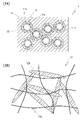
- FIG. 1A and 1B are schematic views illustrating the configuration of a thermally conductive filler and a thermally conductive composite material according to an embodiment of the present disclosure.
- FIG. 1A shows a thermally conductive composite material containing a thermally conductive filler
- FIG. 1B expands and describes a coating layer constituting the thermally conductive filler.
- FIG. 2 is a side view showing a wire harness according to an embodiment of the present disclosure.
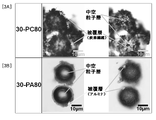
- 3A and 3B are optical micrographs of the fillers "30-PC80" and "30-PA80" prepared in the examples, respectively. The left photo focuses on the center of the filler particles, and the right photo focuses on the surface of the filler.
- the thermally conductive filler according to the present disclosure includes base particles and a coating layer that coats the base particles, and the coating layer is bonded to the surface of the base particles via a chemical bond.
- the gel-like substance that coats the surface of the base particle and the heat conduction dispersed in the layer of the gel-like substance have higher thermal conductivity and higher specific gravity than the base particle and the gel-like substance. Including sex substances.
- the heat conductive filler has a coating layer containing a heat conductive substance and a gel-like substance on the surface of the base particles.
- a substance having a smaller specific gravity than the heat conductive substance as the base particles, the specific gravity of the entire heat conductive filler can be reduced as compared with the case where the entire filler is composed of the heat conductive substance. Can be done.
- the heat conductive substance having a higher thermal conductivity than the base particles and contained in the coating layer contributes to the improvement of the heat conductivity of the filler.
- the gel-like substance constituting the coating layer is a highly viscous substance having a crosslinked structure, and can be dispersed in the viscous body to stably hold the thermally conductive substance.
- the heat-conducting material retained in the gel-like material provides a heat-conducting path within the layer of the coating layer of a single filler particle, between adjacent filler particles, and between other materials surrounding the filler particles. It forms and contributes to heat conduction.
- the thermal conductive filler particles as a whole have high thermal conductivity due to the contribution of the thermally conductive substance held by the gel-like substance. Can be demonstrated. Therefore, in the heat conductive filler, it is possible to secure high heat conductivity while keeping the specific gravity small.
- the gel-like substance constituting the coating layer is bonded to the surface of the base particle via a chemical bond, so that the coating layer is firmly fixed to the surface of the base particle. Since the gel-like substance constitutes a network by a crosslinked structure, the entire gel-like substance is firmly fixed to the base particles along the thickness direction of the coating layer together with the effect of chemical bonding with the base particles. The state is kept stable. Therefore, a layer of gel-like substance having a thickness sufficient to hold the amount of the heat conductive substance required to obtain high heat conductivity is firmly bonded to the surface of the base particle to form a small specific gravity. It is possible to stably obtain a heat conductive filler having high heat conductivity.
- the base particle may be hollow. Then, due to the presence of the hollow portion, the specific gravity of the base particles can be effectively reduced, and the effect of reducing the specific gravity of the heat conductive filler as a whole is excellent.
- the presence of the hollow portion reduces the thermal conductivity of the substrate particles, but by providing a coating layer containing a thermally conductive substance on the surface, high thermal conductivity is ensured as a whole of the thermally conductive filler. be able to.
- the base particle is configured as a hollow body of glass, and it is preferable that the surface has a functional group capable of forming a chemical bond with the functional group of the gel-like substance.
- the hollow body particles of glass those having a controlled particle size and shape can be obtained relatively easily and inexpensively.
- the gel-like substance constituting the coating layer should be stably bonded via chemical bonds. It is easy to make base particles that can be formed.
- the gel-like substance has a carbonyl group
- the base particle has a basic group on the surface
- the gel-like substance has a chemical bond between the carbonyl group and the basic group.
- Substances having many carbonyl groups such as polyacrylic acid, polyvinylpyrrolidone, and their derivatives, are known to constitute a gel, and can be suitably used as a gel-like substance constituting a coating layer. can. Since the carbonyl group can form a chemical bond with the basic group, by providing the basic group on the surface of the base particle, the coating layer is attached to the base particle via the chemical bond. Can be combined.
- the gel-like substance may contain an organic polymer having a carboxyl group as the carbonyl group.
- organic polymers having a carboxyl group such as polyacrylic acid
- many substances that form stable gels are known, and since they are highly versatile, they are gel-like substances that form a coating layer of a heat conductive filler. It can be suitably used as.
- the base particle may have a primary amino group as the basic group on the surface.
- the primary amino group can form an ionic bond with an acidic carbonyl group such as a carboxyl group to form a salt. Further, the primary amino group can form a covalent bond with a neutral carbonyl group such as a ketone group to form an amide bond or an imide bond. Therefore, by forming a primary amino group on the surface of the base particle, the gel-like substance having a carbonyl group can be firmly bonded to the base particle.
- the thermally conductive substance may be configured as particles having anisotropy in shape.
- a heat conductive substance often exhibits high heat conductivity due to its anisotropy in shape, but if it is used as it is as a heat conductive filler, anisotropy occurs in heat conduction and it is in any direction. It becomes difficult to effectively contribute to the improvement of thermal conductivity.
- anisotropy is less likely to occur in the orientation of the heat conductive substance, and heat conduction in each direction can be achieved. It can contribute to high uniformity. As a result, it is possible to obtain an excellent heat conductive filler that exhibits high heat conductivity in any direction.
- the heat conductive substance may be carbon fiber. While carbon fiber has high thermal conductivity, it has an elongated shape with high anisotropy. However, by forming a coating layer while being held by a gel-like substance, carbon fiber has high thermal conductivity in any direction. It provides a thermally conductive filler that exhibits properties.
- the heat conductive filler should have a specific gravity of 1.8 or less. Then, the low specific density of the heat conductive filler can be sufficiently ensured.
- the thermally conductive composite material according to the present disclosure includes the thermally conductive filler and the matrix material, and the thermally conductive filler is dispersed in the matrix material.
- the heat conductive composite material contains the heat conductive filler according to the embodiment of the present disclosure described above. Since the coating layer containing the gel-like substance and the thermally conductive substance is formed on the surface of the substrate particles, the thermally conductive filler keeps the specific gravity of the entire thermally conductive composite material small, while keeping the specific gravity small. The high thermal conductivity of the thermally conductive filler can be utilized to improve heat dissipation.
- the matrix material may contain an organic polymer.
- organic polymers have low thermal conductivity, by mixing the above-mentioned thermally conductive filler having a coating layer containing a thermally conductive substance, high heat dissipation is ensured as a whole of the thermally conductive composite material. Can be done.
- organic polymers have a relatively small specific gravity, but since the heat conductive filler to be mixed has a small specific gravity, the heat conductive composite is formed even when the heat conductive filler is added. The specific gravity of the material can be kept small.
- the heat conductive composite material should have a specific gravity of 1.4 or less. In this case, the specific gravity of the thermally conductive composite material as a whole can be suppressed sufficiently small.
- the thermally conductive composite material preferably has a thermal conductivity of 0.9 W / (m ⁇ K) or more at room temperature. In this case, the heat conductivity of the composite material as a whole is sufficiently high.
- the wire harness according to the present disclosure includes the heat conductive composite material.
- the wire harness contains the heat conductive composite material described above, it is possible to utilize high heat conductivity while keeping the specific gravity of the constituent members small. Therefore, high heat dissipation can be obtained while keeping the mass of the wire harness as a whole small. Therefore, even if heat is generated by energizing the electric wires constituting the wire harness while maintaining the light weight of the wire harness, the influence of the heat generation can be suppressed to a small value.
- the method for producing a heat conductive filler according to the present disclosure includes a gel preparation step of preparing the gel-like substance in a state in which the heat conductive substance is dispersed inside, and the heat conduction step prepared in the gel preparation step.
- the thermally conductive filler is produced, which comprises a coating step of binding the gel-like substance in which a sex substance is dispersed to the surface of the base particles via a chemical bond.
- the thermally conductive composite material according to the embodiment of the present disclosure is configured by comprising the thermally conductive filler according to the embodiment of the present disclosure.
- the wire harness according to the embodiment of the present disclosure is configured by including the heat conductive composite material according to the embodiment of the present disclosure.
- the thermally conductive filler according to the embodiment of the present disclosure can be produced by the production method according to the embodiment of the present disclosure.
- a certain component is a main component of a certain material means a state in which the component occupies 50% by mass or more with respect to the mass of all the components constituting the material.
- the "organic polymer” also includes those having a low degree of polymerization such as oligomers.
- thermally conductive filler (hereinafter, may be simply referred to as “filler”) according to an embodiment of the present disclosure will be described.
- the heat conductive filler 10 As shown in FIG. 1A, the heat conductive filler 10 according to the embodiment of the present disclosure has a base particle 11 and a coating layer 12, and is in the form of particles.
- the coating layer 12 covers the surface of the base particle 11.
- the coating layer 12 contains a gel-like substance 12a and a thermally conductive substance 12b, and the thermally conductive substance 12b is dispersed in the layer of the gel-like substance 12a.
- the gel-like substance 12a is bonded to the surface of the base particle 11 via a chemical bond, so that the coating layer 12 is fixed to the surface of the base particle 11.
- the constituent molecules are crosslinked by a bonding force such as a hydrogen bond to form a network-like network, which is in a highly viscous state. Particles of the heat conductive substance 12b are retained in the structure of the gel-like substance 12a.
- the heat conductive substance 12b has a higher thermal conductivity than the base particles 11 and the gel-like substance 12a. Further, the heat conductive substance 12b has a larger specific density than the base particles 11 and the gel-like substance 12a.
- the base particle 11 is preferably configured as a hollow body or a porous body, but a region not occupied by the solid substance such as a hollow portion of the hollow body and a pore portion of the porous body is contained in the particles. If present, the specific gravity and thermal conductivity of the substrate particles 11 are quantities defined for the entire particle, including regions not occupied by those solid materials.
- the filler 10 has a structure in which the coating layer 12 containing the heat conductive substance 12b is formed on the surface of the base particles 11, so that the base particles 11 occupy a large part of the volume of the filler 10. Become. Since the base particles 11 have a specific density smaller than that of the heat conductive substance 12b, the specific gravity of the filler as a whole is smaller than that in the case where the entire filler is composed of the heat conductive substance 12b.
- the coating layer 12 that covers the surface of the base particle 11 contains the heat conductive substance 12b having a high thermal conductivity, so that the heat conductivity of the filler 10 as a whole is enhanced.
- the particles of the heat conductive substance 12b dispersed in the layer of the coating layer 12 come into contact with each other in the layer, so that the heat conductivity is ensured inside the coating layer 12. .
- the coating layer 12 on the surface of the filler particles 10 comes into contact with the matrix material 2 surrounding the filler particles 10 and the coating layer 12 on the surface of the other filler particles 10.
- the heat conductive substance 12b contained in 12 contributes to heat conduction between the filler particles 10 and the matrix material 2 and between the filler particles 10. Since the coating layer 12 is provided only on the surface of the base particles 11, the volume of the filler particles 10 as a whole is secured by the base particles 11, and the heat conductivity is maintained by the small volume of the heat conductive substance 12b. Can be demonstrated. Adjacent filler particles 10 contact each other via the surface coating layer 12 to form a heat conduction path.
- the specific gravity of the filler 10 as a whole is preferably 1.8 or less, more preferably 1.5 or less, 1.2 or less.
- the specific gravity of the filler 10 as a whole Is 0.5 or more, more preferably 0.8 or more.
- the specific gravity of the filler 10 can be measured as the true density of the powdered filler 10 using, for example, a hydrometer.
- the base particle 11 has a smaller specific gravity than the heat conductive substance 12b contained in the coating layer 12.
- the specific structure and constituent materials of the base particle 11 are not particularly limited as long as they have such a specific gravity.
- the structure of the base particle 11 is a medium substance that occupies the entire area, a hollow body that has a hollow hollow portion that is not occupied by the solid substance, and a porous body that has many fine pores that are not occupied by the solid substance. Etc. can be exemplified.
- the base particle 11 is a hollow particle having a hollow portion 11a.
- the solid substance itself constituting the base particle 11 needs to have a specific gravity smaller than that of the heat conductive substance 12b.
- organic polymers such as various resins, elastomers and rubbers can be preferably exemplified. Since the base material particles 11 need to bond the gel-like substance 12a to the surface via a chemical bond, when the base material particles 11 are made of an organic polymer, they form a chemical bond with the functional group of the gel-like substance 12a. It is preferable that the organic polymer has a functional group that can be formed.
- the organic polymer may have such a functional group in the main chain, or may have a functional group introduced into the side chain by modification or the like.
- the base particle 11 When the base particle 11 has a region that is not occupied by a solid substance such as a hollow body or a porous body, the presence of these regions reduces the specific gravity of the base particle 11 as a whole, so that the base particle 11 is a solid body. Compared with the case, even if the solid substance itself as a constituent material of the base particle 11 has a high specific gravity (density), the specific gravity of the base particle 11 as a whole is maintained smaller than that of the thermally conductive substance 12b. can do. Therefore, as the base particle 11, one made of various constituent materials can be adopted. In particular, as shown in FIG.
- the base particle 11 when the base particle 11 is made of a hollow body, the hollow portion (cavity) 11a that is not occupied by the solid substance is completely surrounded by the shell 11b formed by the solid substance, and the base particle 11 Since it is maintained as a space shielded from the external environment of the base particle 11, a coating layer 12 having a clear layered structure is formed on the surface of the base particle 11, and a space not occupied by other substances (hollow portion 11a). ) Is easy to maintain the effect of reducing the specific gravity. From these viewpoints, the form in which the base particle 11 is formed as a hollow body is particularly preferable.
- the base particle 11 When the base particle 11 is formed as a hollow body or a porous body, various inorganic materials can be suitably adopted as the constituent material in addition to the organic polymer mentioned above in the case of the medium substance.
- examples of such an inorganic material include metals or inorganic compounds such as glass and ceramics.
- Various functional groups can be introduced into the surface of the inorganic material by surface treatment.
- the gel-like substance 12a can be bonded to the surface of the base particle 11 via a chemical bond between those functional groups and the functional group of the gel-like substance 12a.
- Glass can be mentioned as a preferable example of the inorganic material constituting the base particle 11 (shell 11b).
- glass has a relatively low specific gravity among various inorganic compounds and has high thermal conductivity as compared with organic polymers and the like, so that it is a material for the base particles 11 constituting the thermally conductive filler 10.
- the thermally conductive filler 10 When used as a medium, it shows a high effect on lowering the specific gravity and increasing the thermal conductivity of the thermally conductive filler 10.
- a technique for producing hollow particles using glass and controlling the particle size and shape has already been established, and the hollow particles of glass can be obtained at a lower cost than other types of hollow particles. be able to.
- the type of glass constituting the base material particles 11 is not particularly limited, and various types such as soda lime glass, silica glass, borate glass, borosilicate glass, soda lime borosilicate glass, lead glass, and phosphoric acid glass are used. Glass can be used. Among these glass types, as will be described later, silane coupling such as soda lime glass, silica glass, borosilicate glass, soda lime borosilicate glass, etc. so that functional groups can be introduced using a silane coupling agent. It is preferable to use a structure containing a silicon atom capable of forming a siloxane bond with the agent.
- the material constituting the base particle 11 may be only one kind, or two or more kinds may be used in combination by mixing or laminating.
- the base particle 11 has a functional group capable of forming a chemical bond with the functional group of the gel-like substance 12a on the surface.
- the type of the functional group contained in the base particle 11 is not particularly limited, and a functional group capable of reacting with the functional group of the gel-like substance 12a can be obtained according to the type of the functional group of the gel-like substance 12a. It suffices if the base particle 11 is provided on the surface.
- the chemical bond may be an electrostatic bond (ionic bond, hydrogen bond) or a covalent bond. When forming an electrostatic bond, a polar group having a polarity opposite to that of the polar group contained in the gel-like substance 12a may be present on the surface of the base particle 11.
- the polar group contained in the base particle 11 may be ionic or nonionic.
- the gel-like substance 12a and its raw material are in a negatively charged state, so it is preferable that a positively charged polar group is present on the surface of the base particle 11.
- a functional group capable of forming a chemical bond with the carbonyl group should be provided on the surface of the base particle 11.
- various gel-like substances 12a can be chemically bonded to the surface of the substrate particles 11.
- a functional group capable of forming a chemical bond with a carbonyl group a basic group can be mentioned.
- the basic group include an amino group, an amide group, an imide group and the like. Above all, it is preferable that an amino group, particularly a primary amino group, is present on the surface of the base particle 11. The formation of a chemical bond between these functional groups and the gel-like substance 12a will be described later with an example of the gel-like substance 12a.
- the distribution and introduction method of the functional group are not particularly limited. That is, even if the entire solid substance constituting the base particle 11 contains a compound having a polar group as a constituent material, it is composed of a material that does not substantially contain a functional group or contains only a very small amount.
- a functional group may be introduced only on the surface (and its vicinity) of the base particle 11 by surface treatment or the like. From the viewpoint of convenience in introducing a functional group to the surface of the base particle 11, when the base particle 11 is composed of an organic substance, the organic substance itself constituting the base particle 11 has a functional group.
- the functional group is exposed on the surface of the base particle 11.
- the base particle 11 is composed of an inorganic substance such as glass
- the base particle 11 is made of glass containing silicon or has a hydroxyl group on the surface, various functional groups can be easily introduced into the surface by using a silane coupling agent.
- the specific shape and particle size of the base particle 11 are not particularly limited. However, it is preferable to have a highly isotropic shape such as one that can be approximated to a sphere in terms of facilitating the formation of the coating layer 12 on the surface and enhancing the affinity with the matrix material 2.
- the particle size of the base particle 11 (median diameter D50; the same applies hereinafter) is preferably 1 ⁇ m or more, more preferably 5 ⁇ m or more, from the viewpoint of keeping the specific gravity of the filler 10 as a whole small.
- the particle size of the base particle 11 may be 100 ⁇ m or less, further 60 ⁇ m or less. preferable.
- the specific gravity of the base particle 11 is also small.
- the specific specific gravity of the base particle 11 is not particularly limited as long as the base particle 11 as a whole is smaller than the specific gravity of the heat conductive substance 12b, but the base material including the hollow portion 11a and the like is not particularly limited.
- the specific gravity (true density) of the particles 11 as a whole is, for example, 1.0 or less, preferably 0.5 or less.
- the specific gravity of the base particle 11 composed of a hollow body of an inorganic material such as glass or a solid body of an organic polymer is generally 0.1 or more. ..
- the gel-like substance 12a is bonded to the surface of the base particle 11 via a chemical bond in a state of covering the surface of the base particle 11.
- the heat conductive substance 12b is dispersed and held in the layer of the gel-like substance 12a.
- the gel-like substance 12a forms a bond between molecules and forms a network-like crosslinked structure.
- the bond forming the crosslinked structure may be a physical bond such as a van der Waals force, but a stronger chemical bond is preferable.
- the chemical bond may be an electrostatic bond such as an ionic bond or a hydrogen bond, or a covalent bond, but is an electrostatic bond from the viewpoint of ease of formation of the coating layer 12 and the like. It is preferable, and it is more preferable if it is a hydrogen bond from the viewpoint of the stability of the crosslinked structure.
- the gel-like substance 12a has a functional group capable of forming a chemical bond with a functional group on the surface of the base particle 11, and the gel-like substance 12a is a base material due to the chemical bond formed between the functional groups.
- the coating layer 12 is formed in a state of being bonded to the surface of the particles 11.
- the functional group forming a bond with the surface of the base particle 11 is different from the functional group involved in the cross-linking even if it is common to the functional group forming the cross-linked structure between the molecules. As a group, it may be contained in the molecule of the gel-like substance 12a.
- the common functional group is likely to be involved in both the cross-linking between the molecules and the binding to the substrate particles 11, and in the gel-like substance 12a having a carbonyl group, which will be described later, the carbonyl group is.
- a basic group such as an amino group
- the gel-like substance 12a is applied to the base particle 11 through the bond with the basic group. It can be bonded to the surface.
- the gel-like substance 12a is bonded to the surface of the base particle 11 via a chemical bond, so that the coating layer 12 is firmly fixed to the base particle 11.
- the direct effect of this chemical bond extends only to the interface between the coating layer 12 and the substrate particles 11 and in the immediate vicinity thereof, but in the gel-like substance 12a, the structure in the layer is continuous due to the crosslinked structure. ing. Therefore, the state in which the entire layer of the gel-like substance 12a is fixed to the base particle 11 is stably maintained due to the chemical bond at the interface and the crosslinked structure in the layer.
- the gel-like substance 12a forms a network structure and has high viscosity, as shown in FIG. 1B, when the particles of the heat conductive substance 12b are dispersed in the gel-like substance 12a, it becomes a gel-like substance.
- the state in which the heat conductive substance 12b is stably held in the layer of the substance 12a is maintained.
- the gel-like substance 12a often constitutes a gel in a state containing water or other polar solvents, but even if those polar solvents are removed, the heat conductive substance is contained in the structure of the gel-like substance 12a.
- the state in which 12b is dispersed and held is maintained.
- the particles of the heat conductive substance 12b dispersed in the gel-like substance 12a come into contact with each other, and a heat conduction path is formed between the particles, so that the coating layer 12 exhibits heat conductivity as a whole. It becomes a thing.
- the retention of the thermally conductive substance 12b inside the gel-like substance 12a does not require a chemical interaction, in order to disperse and retain the thermally conductive substance 12b in the layer of the gel-like substance 12a.
- the heat conductive substance 12b does not have to be compatible with the gel-like substance 12a.
- the thermally conductive substance 12b is not fixed to the surface of the substrate particles 11 by direct interaction with the surface of the substrate particles 11, the type of the thermally conductive substance 12b is the substrate particles. There are no restrictions on the 11 types.
- various heat conductive substances 12b are arranged on the surface of the base particle 11 in a state of being dispersed in the layer of the gel-like substance 12a without being limited by the constituent materials and shapes of the heat conductive substance 12b.
- the state can be stably maintained.
- the entire layer can be maintained in a state of being stably fixed to the surface of the base particle 11.
- increasing the content density of the thermally conductive substance 12b in the coating layer 12 is not limited by the formation density of chemical bonds and the like, and the gel-like substance 12a has thermal conductivity. As long as the substance 12b can be retained in the tissue, it can be done relatively easily.
- the coating layer 12 is formed with a thickness of 10:90 or more, more preferably 20:80 or more, and 30:70 or more in terms of the dry capacity].
- the above ratio is 80:20 or less, and further. It is better to suppress the thickness of the coating layer 12 to the extent that it becomes 70:30 or less.
- the drying capacity refers to the volume in a state where a liquid component such as a solvent such as water contained in the gel-like substance 12a is removed by drying or the like.
- the thickness value of the coating layer 12 is generally 1 ⁇ m or more, 5 ⁇ m or more, and 30 ⁇ m or less.
- the heat conductive substance 12b and the base particles 11 are added to the matrix material 2 in an independent state without using the gel-like substance 12a, a certain degree of heat conductivity improving effect can be obtained.
- the heat conductive substance 12b is dispersed in the matrix resin in a state of covering a very small area on the surface of the base particles 11 or in a state independent of the base particles 11. It will be.
- the gel-like substance 12a is used to stably hold the heat conductive substance 12b on the surface of the base particle 11, thereby forming the heat conductive substance 12b into a heat conductive path. Can be efficiently contributed to.
- the gel-like substance 12a constituting the coating layer 12 is not particularly limited as long as it has a functional group capable of forming a gel state and forming a chemical bond with a functional group on the surface of the base particle 11. ..
- the gel-like substance 12a constituting the coating layer 12 may be in a state of being swollen by taking in water or another solvent, or may be in a state of being removed by drying or extraction. .. From the viewpoint of stability and ease of handling of the filler 10, the gel-like substance 12a is preferably in a state in which the solvent has been removed.
- the gel-like substance 12a As a gel-like substance, many substances composed of a polymer having a carbonyl group are known, and in this embodiment as well, those substances can be suitably adopted as the gel-like substance 12a. Molecules having a carbonyl group tend to form a stable gel due to the fact that the carbonyl group has a high polarity and the like.
- a polymer having a carboxyl group such as polyacrylic acid
- a polymer having an amide group such as polyvinylpyrrolidone
- a derivative of those compounds swells with water or a highly polar solvent to form a stable gel state.
- Polymers with ketone groups also gel by swelling with polyethylene glycol (PEG).
- Specific examples of the polymer constituting the gel-like substance 12a include polyacrylic acid, polyacrylic acid salt, polyethylene acrylic acid copolymer, polyethylene acrylic acid copolymer salt, polyvinylpyrrolidone, carboxymethyl cellulose, carboxymethyl cellulose salt, alginate, and the like. Examples thereof include alginate.
- the gel-like substance 12a When the molecule constituting the gel-like substance 12a has a carbonyl group and a basic group such as an amino group is present on the surface of the base particle 11, a bond is formed between the carbonyl group and the basic group. As a result, the gel-like substance 12a can be stably bonded to the surface of the base material particles 11. For example, when the gel-like substance 12a has an acidic carbonyl group such as a carboxyl group, an ionic bond can be formed with the basic group of the base particle 11 to form a salt. On the other hand, when the gel-like substance 12a has a neutral carbonyl group such as a ketone group, a covalent bond can be formed with the basic group on the surface of the base particle 11. For example, when a primary amino group is present on the surface of the base particle 11, an amide bond or an imide bond is formed by the condensation reaction.
- the specific gravity and thermal conductivity that the gel-like substance 12a should have are not particularly specified, but the gel-like substance 12a is often composed of an organic substance and is a heat conductive substance composed of an inorganic substance. It has a specific gravity smaller than 12b.
- the specific gravity of the gel-like substance 12a is preferably 1.5 or less, preferably 1.2 or less, in the state of the raw material (gelled polymer) before gelation. Although no lower limit is set for the specific gravity, the specific gravity of the organic polymer capable of forming a gel is generally 0.5 or more. Since the gel-like substance 12a has a small specific density, the specific gravity of the filler 10 as a whole can be suppressed to a small value together with the effect of the small specific gravity of the base particles 11.
- the gel-like substance 12a is often composed of an organic substance, and its thermal conductivity is lower than that of the thermally conductive substance 12b.
- the heat conductive substance 12b is dispersed and held in the layer of the gel-like substance 12a to form a heat conduction path, so that high heat conductivity can be obtained as the entire coating layer 12.
- the thermally conductive substance 12b contained in the coating layer 12 has a higher thermal conductivity and a larger specific density than the base particles 11 and the gel-like substance 12a, and can be dispersed in the gel-like substance 12a.
- the type and shape are not particularly limited.
- the thermally conductive substance 12b is preferably composed of particles of an inorganic substance such as a metal, a metal compound, or a carbon material.
- the material constituting the heat conductive substance 12b include non-magnetic metals such as copper and aluminum, and alloys containing these elements as main components.
- metal compounds oxides, nitrides, carbides, oxynitrides, carbon nitrides, carbon oxides, hydroxides, borides containing metal elements (including cases of metalloids such as B and Si) are included.
- Etc., and metal silicates, aluminates, titanates and the like can be exemplified.
- Metal oxides include aluminum oxide, silicon oxide, magnesium oxide, iron oxide, beryllium oxide, titanium oxide, zirconium oxide, etc.
- Metal nitrides include aluminum nitride, silicon nitride, boron nitride, etc., and metal hydroxides.
- metal carbide such as aluminum hydroxide and magnesium hydroxide, silicon carbide and the like can be mentioned as a suitable example.
- carbon material that can constitute the heat conductive substance 12b graphite, carbon flak, carbon fiber, carbon nanotube, graphite, graphene, artificial diamond and the like can be mentioned.
- the heat conductive substance 12b contained in the coating layer 12 may be one kind or a plurality of kinds. Further, when a plurality of types of thermally conductive substances 12b are used, the thermally conductive substances 12b may be mixed or may form a complex.
- the thermally conductive substance 12b may be surface-treated with an organic substance or the like, but since the retention of the thermally conductive substance 12b by the gel-like substance 12a does not require a chemical interaction, the retention by the gel-like substance 12a From the viewpoint of enhancing the property, it is not necessary to apply a surface treatment to the heat conductive substance 12b.
- the heat conductive substance 12b is particularly preferable as the heat conductive substance 12b in terms of high thermal conductivity and the like.
- the heat conductive substance 12b is preferably configured as particles having anisotropy in shape such as plate-like, needle-like, rod-like, and fibrous. Particles of a metal compound or carbon material having anisotropy in shape often have high thermal conductivity in a specific direction due to the anisotropy. The high thermal conductivity of these particles is convenient for use as a thermally conductive material, but due to the anisotropy of the particle shape, the particles are oriented and distributed in a specific direction.
- the heat conductivity is excellent in a specific direction, but the heat conductivity in the other direction becomes low, and it is difficult to use it as a heat conductive material.
- the irregular shape is formed in the layer of the coating layer 12 and as the filler 10 as a whole.
- the particles of the heat conductive substance 12b having the above will be arranged in a random orientation without taking a specific orientation. Therefore, by utilizing the high thermal conductivity of the particles of the thermally conductive substance 12b having an irregular shape, it is possible to obtain the thermally conductive filler 10 having excellent thermal conductivity in an arbitrary direction instead of a specific direction.
- heat conductive substance 12b having an anisotropic shape and having high heat conductivity carbon fiber can be mentioned.
- the carbon fiber has an elongated shape with high anisotropy and has a large anisotropy in thermal conductivity.
- the large anisotropy can be eliminated.
- the particle size of the heat conductive substance 12b is not particularly limited, but from the viewpoint of exhibiting sufficiently high heat conductivity, it is preferable that the average particle size is 0.1 ⁇ m or more, and further 0.3 ⁇ m or more.
- the particle size of the heat conductive substance 12b is preferably 30 ⁇ m or less, and further 20 ⁇ m or less on average, from the viewpoint of dispersing and easily holding the gel-like substance 12a in the structure.
- the particle size of the heat conductive substance 12b is preferably smaller than the particle size of the base particle 11, and more preferably half or less of the particle size of the base particle 11.
- the particle size of the heat conductive substance 12b refers to an approximate diameter when the particles can be approximated to a sphere, and a major diameter (middle diameter) when the particles have a highly anisotropic shape such as a needle shape or a fibrous shape.
- the length of the long axis refers to an approximate diameter when the particles can be approximated to a sphere, and a major diameter (middle diameter) when the particles have a highly anisotropic shape such as a needle shape or a fibrous shape.
- the content of the heat conductive substance 12b in the coating layer 12 is not particularly limited, but the heat conductivity in the layer of the coating layer 12 is sufficiently high, and as a result, the filler 10 as a whole is sufficiently sufficient. From the viewpoint of exhibiting high thermal conductivity, the ratio of [dry capacity of gel-like substance 12a]: [dry capacity of heat conductive substance 12b] is 90:10 or more, and further 50:50 or more, 30:70 or more. It is preferable that the heat conductive substance 12b is contained in the amount of.
- the content of the heat conductive substance 12b is 1:99 or less, further 10:90 or less at the above ratio. It is good to suppress.
- thermally conductive filler 10 can be produced by carrying out a gel preparation step and a coating step.
- the base particles 11 Prior to manufacturing the heat conductive filler 10, the base particles 11 are prepared. Many solid particles of organic polymers, hollow particles of inorganic compounds such as glass, and porous particles are commercially available, and these particles may be appropriately used.
- the base particle 11 When the base particle 11 does not have a functional group capable of forming a chemical bond with the functional group of the gel-like substance 12a on the surface, the base particle 11 is subjected to surface treatment to form a functional group on the surface. Need to be introduced. As the surface treatment, a compound having a desired functional group may be bonded to the surface of the base particle 11 by a chemical reaction. At this time, another compound may be interposed between the compound having the functional group and the surface of the base particle 11. When the base particle 11 is composed of a substance containing a silicon atom such as glass or a substance having a hydroxyl group on the surface, a functional group is introduced into the surface of the base particle 11 by using a silane coupling agent. Is preferable.
- a mixed gel to be the coating layer 12 is prepared. That is, the gel-like substance 12a is prepared in a state where the heat conductive substance 12b is dispersed inside.
- the specific method is not particularly limited, but at the same time as forming the gel-like substance 12a by performing cross-linking formation and swelling on the raw material constituting the gel such as a gelled polymer, or at the same time.
- the particles of the heat conductive substance 12b may be dispersed in the gel-like substance 12a.
- the gelled polymer and the particles of the heat conductive substance 12b are used as a polar solvent such as water. It may be stirred in the contained solvent. At this time, a small amount of an aqueous metal salt solution may be added so that the gel-like substance 12a can be obtained in a salt state.
- the amount of the raw material to be the gel-like substance 12a and the heat-conducting substance 12b is [dry capacity of the gel-like substance 12a (gelled polymer)]: [dry capacity of the heat-conductive substance 12b]. ], It may be selected so that a desired value can be obtained.
- the surface of the base particle 11 is coated with the mixed gel prepared in the gel preparation step, and the gel-like substance 12a is further bonded to the surface of the base particle 11 via a chemical bond.
- the base particle 11 prepared with a predetermined functional group on the surface and the mixed gel prepared above may be mixed and kneaded.
- the base particle 11 and the mixed gel may be mixed in the solvent using a solvent that does not affect the gel property of the gel-like substance 12a or the modification of the functional group on the surface of the base particle 11. ..
- the mixed gel surrounds the surface of the base particle 11, and further, the functional group of the gel-like substance 12a constituting the mixed gel and the surface of the base particle 11.
- a chemical bond is formed with the functional group present in.
- operations such as heating and addition of a reactant may be appropriately performed.
- the heating temperature is preferably a temperature equal to or lower than the boiling point of the solvent used.
- the particles obtained through the coating step may be used as they are as the heat conductive filler 10, or may be used as the heat conductive filler 10 after appropriately removing the liquid component.
- the liquid component can be removed by heating under normal pressure or vacuum, air drying, or the like.
- a liquid component is present on the surface of the filler particles 10 in a state of being incorporated into the gel-like substance 12a, the liquid component volatilizes or flows during use of the filler 10, and the filler 10 is easy to handle. If there is a possibility of lowering the amount, it is preferable to remove the liquid component.
- the heat conductive composite material 1 includes the heat conductive filler 10 according to the embodiment of the present disclosure described above and the matrix material 2.
- the filler 10 is dispersed in the matrix material 2.
- the composite material 1 according to the present embodiment contains the heat conductive filler 10 having the coating layer 12 containing the heat conductive substance 12b on the surface of the base particles 11 described above, the composite material 1 has heat conductivity. Due to the high thermal conductivity of the substance 12b, the composite material 1 as a whole exhibits high thermal conductivity and excellent heat dissipation. At the same time, due to the effect of lowering the specific gravity of the heat conductive filler 10 by the base particles 11, the composite material 1 as a whole has a small specific gravity.
- the type of the matrix material 2 is not particularly limited, but the matrix material 2 preferably contains an organic polymer, and more preferably any one containing an organic polymer as a main component.
- the organic polymer constituting the matrix material 2 include various resins, thermoplastic elastomers, rubber and the like.
- a resin material it may be a curable resin, a thermoplastic resin, or a plastic soluble in a solvent, depending on the desired application.
- Examples of the types of resins constituting the matrix material 2 include olefin resins such as polyethylene and polypropylene, halogen resins such as polyvinyl chloride, polylactic acid, polystyrene resins, polyvinyl acetate, ABS resins, AS resins, and acrylics. Resins, methacrylic resins, polyamide resins, urethane resins, silicone resins, fluororesins, polyvinyl alcohols, polyimides, polyacetals, polycarbonates, modified polyphenylene ethers (PPE), polyethylene terephthalates, polybutylene terephthalates, polyphenylene sulfides, and epoxy resins, or theirs.
- olefin resins such as polyethylene and polypropylene
- halogen resins such as polyvinyl chloride, polylactic acid, polystyrene resins, polyvinyl acetate, ABS resins, AS resins, and acrylics.
- the matrix material 2 may contain only one type of organic polymer or may contain a plurality of organic polymers.
- the matrix material 2 is not in the form of a gel, but is appropriately cured to take a solid state at room temperature.
- the matrix material 2 may appropriately contain additives such as flame retardants, fillers, and colorants in addition to the organic polymer.
- the specific gravity of the matrix material 2 itself is not particularly limited, but the specific gravity of the matrix material 2 itself is suppressed to 1.5 or less from the viewpoint of suppressing the specific gravity of the composite material 1 to which the filler 10 is added to be small. Is preferable.
- the specific gravity of the matrix material 2 is not particularly limited, but when an organic polymer is used as the matrix material 2, the specific gravity is about 0.8 or more.
- the thermal conductivity of the matrix material 2 itself is not particularly limited, but the thermal conductivity of the matrix material 2 itself is determined from the viewpoint of ensuring high thermal conductivity of the composite material 1 to which the filler 10 is added as a whole. It is preferably 0.1 W / (m ⁇ K) or more.
- the thermal conductivity of the matrix material 2 is not particularly limited, but when an organic polymer is used as the matrix material 2, the thermal conductivity is approximately 0.6 W / (m ⁇ K) or less.
- the specific gravity of the matrix material 2 and the composite material 1 can be measured by a water substitution method or the like. Further, the thermal conductivity of these materials can be measured by a laser flash method, a hot wire method, or the like.
- the content of the filler 10 may be appropriately determined so that the desired specific gravity and thermal conductivity can be obtained for the composite material 1 as a whole. As the content of the filler 10 increases, the thermal conductivity of the composite material 1 increases. Therefore, the content of the filler 10 may be determined with the content at which the desired thermal conductivity can be obtained as the lower limit.
- the filler 10 is contained so that the thermal conductivity of the composite material 1 is 5 times or more, further 7 times or more, 10 times or more, and 15 times or more the thermal conductivity of the matrix material 2 to which the filler 10 is not added. You just have to decide the amount.
- the thermal conductivity of the composite material 1 is 0.9 W / (m ⁇ K) or more, further 1.5 W / (m ⁇ K) or more, 2.0 W / (m ⁇ K) or more, 3.0 W /
- the content of the filler 10 may be determined so as to be (m ⁇ K) or more.
- the upper limit of the content of the filler 10 in the composite material 1 is not particularly set, but the specific gravity of the composite material 1 is 1.3 times or less the specific gravity of the matrix material 2 to which the filler 10 is not added, and further 1.2 times.
- the content of the filler 10 may be determined so as to be suppressed to twice or less. More preferably, the specific gravity of the composite material 1 is equal to or less than the specific gravity of the matrix material 2 to which the filler 10 is not added. Alternatively, the content of the filler 10 may be determined so that the value of the specific gravity of the composite material 1 is suppressed to 1.8 or less, further 1.5 or less, and 1.3 or less. The smaller the specific gravity of the composite material 1, the more preferable it is, and the lower limit is not particularly set.
- the content of the filler 10 is defined by the ratio of the filler 10 to the entire composite material 1
- the content of the filler 10 is generally 10 from the viewpoint of sufficiently improving the thermal conductivity of the composite material 1. It may be 20% by volume or more, moreover, 20% by volume or more, and 30% by volume or more.
- the content of the heat conductive substance 12b itself may be 2% by volume or more, further 4% by volume or more, and 6% by volume or more.
- the content may be 60% by volume or less, or 50% by volume or less.
- the content of the heat conductive substance 12b itself may be 15% by volume or less, further 12% by volume or less.
- the composite material 1 according to the present embodiment has both high thermal conductivity and low specific gravity. Therefore, the present composite material 1 can be suitably used as a material constituting a member that is required to have both light weight and heat dissipation.
- the specific use of the composite material 1 is not particularly limited, but next, a case where the composite material 1 is used as a constituent material of a wire harness will be illustrated in detail.
- the composite material 1 according to the present embodiment can be manufactured by mixing the powdery filler 10 produced by the production method described above with the matrix material 2 at a predetermined blending ratio.
- the wire harness according to the present embodiment includes the heat conductive composite material 1 according to the embodiment of the present disclosure described above.
- the wire harness 5 is provided with a connector 52 including a connection terminal (not shown) at a terminal portion of an insulated wire 51 having an insulating coating on the outer periphery of the wire conductor.
- a plurality of insulated wires 51 may be bundled, and in this case, the tape 53 can be used as an exterior material for bundling the insulated wires 51.
- the composite material 1 according to the embodiment of the present disclosure described above can constitute various members that are required to have heat dissipation. It is preferable to mainly use the composite material 1 in which the filler 10 is added to the organic polymer as the matrix material 2 as the insulating member.
- an insulating member an insulating coating constituting the insulated wire 51, an exterior material such as a tape 53 or a protective tube arranged outside the insulated wire 51, and an adhesive used for bonding or stopping water between the constituent members.
- the connector housing and the like constituting the connector 52 can be exemplified.
- the composite material 1 may be arranged between the protective tube such as a corrugated tube and the insulated wire 51.
- thermally conductive filler having a coating layer on the surface of the substrate particles was prepared, and the state of the filler particles and the specific gravity and thermal conductivity of the composite material containing the filler were evaluated.
- samples are prepared and evaluated in the air at room temperature.
- base particle hollow glass particles having an amino group introduced on the surface were prepared. Specifically, hollow particles made of soda lime borosilicate glass (“Glass Bubbles iM16K” manufactured by 3M Co., Ltd .; median diameter 20 ⁇ m; specific gravity 0.46) were prepared as untreated glass hollow particles (GB). Then, 5 g of GB and 100 mL of acetone were placed in an eggplant flask, and the mixture was gently stirred and suspended at room temperature. Further, while continuing stirring, 0.5 g of 3-aminopropyltriethoxysilane (AP) ((C 2 H 5 O) 3 Si-C 3 H 6 -NH 2 ) was added to the suspension.
- AP 3-aminopropyltriethoxysilane
- substrate particles AP-GB surface-treated with aminopropyltriethoxysilane were obtained.
- Aminopropyltriethoxysilane is bonded to the surface of the hollow glass particles via a siloxane bond, and the amino group is bonded to the surface of the particles.
- -CF Carbon fiber (10 ⁇ m length, 150 nm diameter; Showa Denko Corporation vapor phase method carbon fiber VGCF)
- AlO ⁇ -alumina (0.5 ⁇ m diameter; manufactured by Fuji Film Wako Pure Chemical Industries, Ltd.)
- -MgO Magnesium oxide (7 to 15 ⁇ m diameter; manufactured by Ube Material Industries Ltd.)
- Table 1 summarizes the gelled polymer materials, thermally conductive substances, types and specific densities of substrate particles, and input amounts used to prepare each thermally conductive filler.
- the dry volume ratio of [gelled polymer]: [heat conductive substance] and the dry volume of [mixed gel]: [base particle] are calculated from the input amount and specific gravity. The ratio and the specific gravity of the filler particles are shown.
- the dry volume ratio of [gelled polymer]: [heat conductive substance] is calculated as a ratio obtained by converting the input amount of the gelled polymer material and the heat conductive substance into volume, and [mixed gel]: [base.
- the dry volume ratio of [material particles] is calculated as a ratio between the calculated total volume of the gelled polymer material and the heat conductive substance and the volume of the base particle, and is indicated by one effective digit for each.
- the specific gravity of the filler particles is calculated from the total input amount of each of the gelled polymer, the heat conductive substance, and the base particle, and the total of the calculated values of the volume. As will be described later based on the micrographs of FIGS. 3A and 3B, almost all of the gelled polymer material and the heat conductive substance used as raw materials form a mixed gel and cover the surface of the base particle. It has been confirmed that this is the case, and as described above, it has been shown that it is appropriate to calculate the dry volume ratio and the specific gravity of each component based on the input amount of each raw material.
- the specific gravity and thermal conductivity were measured for each of the cured resin test pieces prepared as the composite material above.
- the specific gravity was measured by the underwater substitution method.
- the thermal conductivity was measured by a laser flash method using a thermal conductivity device (“LFA447” manufactured by NETZSCH).
- the measurement direction of the thermal conductivity was the direction perpendicular to the surface of the cured resin test piece.
- FIGS. 3A and 3B show optical microscope images of the fillers "30-PC80" and "30-PA80", respectively.
- the image on the left is focused on the center of the particle, and the image on the right is focused on the surface of the particle.
- the substrate particles remain hollow, as can be seen in the image focused primarily on the center of the particles.
- the region observed as a slightly vague layer on the surface of the hollow base particle is formed in the coating layer formed by the mixed gel. It corresponds.
- the elongated structure observed like a large number of spines in the coating layer corresponds to the carbon fiber added as a heat conductive substance.
- a large number of point-like structures observed like dark shadows in the coating layer correspond to the alumina particles added as the heat conductive material.
- the prepared filler has a structure in which a coating layer made of a mixed gel in which a heat conductive substance is dispersed is formed on the surface of hollow particles as base particles. ,It is confirmed.
- the surface of the hollow particles is coated in a layered manner to form a coating layer, and the presence of the gel-like substance is not confirmed in any place other than the surface of the particles. That is, almost the entire amount of the mixed gel used as the raw material is in a state of covering the surface of the hollow base particle. From this, it was confirmed that a coating layer containing a heat conductive substance can be stably formed on the surface of the base particles by a manufacturing method in which the surface-treated base particles are mixed together with the mixed gel as described above. Will be done.
- Table 2 summarizes the measurement results of the composition and characteristics of the composite materials related to the samples A1 to A14 and the samples B1 to B7.
- the upper row shows the blending ratio of the filler and the matrix material (unit: mass%)
- the middle row shows the blending amount of the filler (unit: volume%) and the content of the heat conductive substance (unit: volume%). ..
- the content of the heat conductive substance is calculated from the volume ratio of the heat conductive substance in the filler and the blending amount of the filler in the composite material.
- the lower row summarizes the measurement results of specific gravity and thermal conductivity.
- Samples A1 to A14 are prepared by providing a coating layer in which a heat conductive substance is dispersed in a gel-like substance on the surface of the substrate particles into which an amino group has been introduced by surface treatment to form a filler and adding the sample to the matrix material. be.
- the specific gravity of the composite material is less than or equal to the specific density of the sample B1 to which the filler is not added, or with respect to the specific gravity of the sample B1, even though the filler is added up to 50% by volume. The increase is suppressed to 10% or less.
- the thermal conductivity is 1.5 W / (m ⁇ K) or more. These values correspond to 7 times or more the thermal conductivity of the sample B1 to which no filler is added. From this result, in the samples A1 to A14 to which the filler in which the coating layer in which the heat conductive substance was dispersed in the gel-like substance was provided on the surface of the substrate particles was added, the filler was hollow substrate particles having a low specific gravity. It can be seen that by including the filler, high thermal conductivity can be obtained as a whole of the composite material to which the filler is added, while keeping the specific gravity small.
- the coating layer stably retains the thermally conductive substance in the structure of the gel-like substance, and the gel-like substance forms a chemical bond with the base particles, so that the thermally conductive substance is dispersed. It can be interpreted that the state in which the base particles are coated by the coating layer exhibiting high thermal conductivity is stably formed. Particles of the heat conductive substance held dispersed in the gel-like substance come into contact with each other in the layer of the coating layer, so that a continuous heat conduction path is formed on the surface of each filler particle. it is conceivable that.
- the coating layers on the surface of the adjacent fillers come into contact with each other, and a heat conduction path is formed between the filler particles, which is highly effective in improving the heat conductivity. It is interpreted as a thing.
- sample B2 the surface-treated glass hollow particles themselves (AP-GB) are added to the matrix material, and the specific gravity is lower than that of sample B1 to which no filler is added.
- the filler does not contain a heat conductive substance, the thermal conductivity is not improved as compared with the sample B1.
- the thermal conductivity of the glass itself is about 1.0 W / (m ⁇ K), which is higher than the thermal conductivity of the matrix material, but it is a hollow particle and contains air, so inside the particle. It is interpreted that phonon scattering occurs and heat conduction through particles is less likely to occur.
- the hollow glass particles themselves cannot be used as a thermally conductive filler.
- the carbon fiber itself is added to the sample B3, and the alumina particles themselves are added to the sample B4 by 7.2% by volume, respectively.
- This addition amount is the same as that of the samples A1 to A5 as the content of the heat conductive substance.
- the thermal conductivity is 0.6 W / (m ⁇ K) or less.
- Samples B3 use the same thermal conductive substances as Samples A1 and A4, and Sample B4 uses the same thermal conductive substances as Samples A2 and A5, but the thermal conductivity obtained by Samples B3 and B4 is those of Samples A1 and A4. And, compared with the samples A2 and A5, it is as low as 1/4 or less.
- the carbon fiber used in sample B3 has high anisotropy in shape, and in the press-molded resin cured product test piece, the test piece is in a direction perpendicular to the measurement direction of thermal conductivity. Since the fiber axis direction is oriented in the in-plane direction of the test piece, a heat conduction path along the fiber axis direction, which is effective in improving the measured thermal conductivity, is effectively formed in the thickness direction of the test piece. It is considered that there is no such thing.
- the carbon fiber itself and the alumina itself are added alone as the heat conductive substances, but the blending amount is increased to 30% by volume.
- This blending amount is the same as that of the samples A1 to A5 as the filler blending amount (volume ratio occupied by the filler).
- the thermal conductivity is significantly improved as compared with the sample B1 to which no filler is added. This result indicates that the contact area between the filler particles increased and an effective heat conduction path was formed due to the increase in the amount of the heat conductive substance added as compared with the samples B3 and B4. There is.
- Samples B5 have the same thermal conductive substances as Samples A1 and A4, and Sample B6 has the same thermal conductive substances as Samples A2 and A5, and their pairs are compared with each other. Then, in the samples B5 and B6, although the content of the heat conductive substance is more than four times higher, the obtained thermal conductivity is compared with those samples A1 and A4 and samples A2 and A5. Therefore, it has not been improved, and in the sample B5 using the carbon fiber, the thermal conductivity is rather low.
- sample B7 the filler is composed of base particles and gel-like substances in addition to the heat conductive substance, but the base particles used are hollow glass particles that have not been surface-treated. There is.
- This sample B7 contains the same amount of carbon fibers as the samples A1 and A4 and the sample B3 as the heat conductive substance, but the heat conductivity of the sample B7 is the samples A1 and A4 using the gel-like substance. It is considerably smaller than the value of, and is close to the value of sample B3 to which carbon fiber is added alone as a heat conductive substance.
- the coating layer is firmly bonded to the surface of the base material particles via the chemical bond. It is considered that the condition has not been reached.
- the heat conductive substance is not stably maintained in the state of being dispersed in the gel-like substance and in the state of covering the surface of the base particles, but the base particles. It is considered that the surface is covered with a very small area of the surface of the particle, or is dispersed in the matrix resin independently of the substrate particles.
- samples A1 to A14 are compared with each other.
- the types of heat conductive substances used in the sets of samples A1 to A3 and the sets of samples A4 and A5 are different from each other. Comparing these samples with each other, the thermal conductivity of the samples A1 and A4 using carbon fibers as the thermally conductive substance is significantly higher than that of other samples using alumina particles and magnesium oxide particles. It's getting higher. This corresponds to the fact that carbon fiber has higher thermal conductivity than alumina and magnesium oxide.
- the carbon fibers have high anisotropy in shape, and as described for sample B3 above, they show high thermal conductivity in the direction along the oriented fiber axis direction, but in other directions. However, the effect of improving thermal conductivity is limited.
- the carbon fibers are randomly dispersed in the coating layer, and by blending with the matrix resin, the shape is anisotropic. It is possible to reduce the influence of the carbon fiber and exert excellent thermal conductivity in any direction.
- the type of gelled polymer material used is different between the set of samples A1 and A4 and the set of samples A2 and A5. However, when the thermal conductivity of each of these sets is compared, the thermal conductivity does not change significantly regardless of which gelled polymer material is used. From this, it can be said that the type of gel-like substance does not significantly affect the thermal conductivity of the obtained filler if the thermally conductive substance can be dispersed and retained.
- the amount of carbon fiber added as the heat conductive substance to the gel-like substance [gelled polymer]: [heat conductive substance] dried.
- the volume ratios are different from each other, and the contents of the heat conductive substances are correspondingly different from each other.
- the content of the heat conductive substance is higher in the order of samples A6, A7, A1, A8, A9, and the heat conductivity of the composite material is higher in that order. That is, the higher the content of the heat conductive substance in the filler, the higher the effect of improving the heat conductivity.
- the dry volume ratio of [gelled polymer]: [heat conductive substance] is 30:70, and in the region where the content of the heat conductive substance is higher than that, 2.0 W / ( High thermal conductivity of m ⁇ K) or higher is obtained.
- the contents of the heat conductive substances are mutual because the amount of the mixed gel used with respect to the base particles ([mixed gel]: dry volume ratio of [base particles]) is different from each other. Is different.
- the content is higher in the order of samples A12, A11, A1 and A10, and in that order, the specific gravity of the composite material is increased and the thermal conductivity is increased. That is, the larger the proportion of the coating layer in the filler and the thicker the coating layer is formed, the higher the effect of improving the thermal conductivity.
- the dry volume ratio of [mixed gel]: [base particle] is 30:70, and in a region where the ratio of the coating layer is larger than that, 2.0 W / (m ⁇ K) or more. High thermal conductivity is obtained.
- the amount of the filler added in the composite material is different from each other.
- the amount of the filler added is larger in the order of the samples A14, A1 and A13, and the specific gravity of the composite material is increased and the thermal conductivity is increased in that order. That is, the larger the amount of the filler added, the higher the effect of improving the thermal conductivity.
- High thermal conductivity of 2.0 W / (m ⁇ K) or more is obtained in the samples A1 and A14 in which the amount of the filler added exceeds 20% by volume.
- the filler compounding amount is increased to 50% by volume or more as in the sample A14, the effect of improving the thermal conductivity is limited.
Landscapes
- Chemical & Material Sciences (AREA)
- Chemical Kinetics & Catalysis (AREA)
- Organic Chemistry (AREA)
- Medicinal Chemistry (AREA)
- Polymers & Plastics (AREA)
- Health & Medical Sciences (AREA)
- Engineering & Computer Science (AREA)
- Materials Engineering (AREA)
- Life Sciences & Earth Sciences (AREA)
- Geochemistry & Mineralogy (AREA)
- General Chemical & Material Sciences (AREA)
- Combustion & Propulsion (AREA)
- Composite Materials (AREA)
- Dispersion Chemistry (AREA)
- Thermal Sciences (AREA)
- Physics & Mathematics (AREA)
- Compositions Of Macromolecular Compounds (AREA)
- Surface Treatment Of Glass (AREA)
Abstract
比重を小さく抑えながら、高い熱伝導性を発揮することができる熱伝導性フィラー、また、そのような熱伝導性フィラーを含んだ熱伝導性複合材料およびワイヤーハーネス、そのような熱伝導性フィラーを製造することができる熱伝導性フィラーの製造方法を提供する。 基材粒子11と、前記基材粒子11を被覆する被覆層12と、を有し、前記被覆層12は、前記基材粒子11の表面に、化学結合を介して結合されて、前記基材粒子11の表面を被覆するゲル状物質12aと、前記ゲル状物質12aの層内に分散された、前記基材粒子11および前記ゲル状物質12aよりも高い熱伝導率と大きな比重を有する熱伝導性物質12bと、を含む、熱伝導性フィラー10とする。また、前記熱伝導性フィラー10がマトリクス材料2中に分散されている、熱伝導性複合材料1とする。さらに、前記熱伝導性複合材料1を含む、ワイヤーハーネスとする。
Description
本開示は、熱伝導性フィラー、熱伝導性複合材料、ワイヤーハーネス、および熱伝導性フィラーの製造方法に関する。
電気電子部品を構成する絶縁性部材において、放熱性を高め、通電等による発熱の影響を小さく抑える目的で、有機ポリマー材料に、熱伝導性フィラーが添加される場合がある。熱伝導性フィラーは、多くの場合、アルミナや窒化アルミニウム、窒化ホウ素等、熱伝導性の高い無機化合物より構成される。
近年、自動車用エレクトロニクスをはじめとする種々の電気電子部品において、大電流化や集積化が進んでおり、通電時の発熱量が増大する傾向にある。その発熱の影響を抑制する手段として、例えば、自動車用ワイヤーハーネスであれば、電線をフラット化し、電線の表面積を増やすことや、電線を高熱伝導性の外装材に放熱効率が高くなるように接触させること等、部材の形状や構造の改良による放熱性の向上が進められている。一方で、電線被覆や電線外装材等、電気電子部品の絶縁性部材を構成する材料自体の熱伝導性を高めることも、放熱性の向上に重要である。
有機ポリマー材料等に、多量のフィラーを混合すれば、材料の熱伝導性を高めることができるが、無機化合物よりなるフィラーを多量に有機ポリマー材料に混合すると、材料の比重が大きくなってしまい、電気電子部品を軽量化することが難しくなる。自動車等の製品において、製品全体の軽量化の観点から、製品に搭載される電気電子部品の軽量化が重要となる。よって、熱伝導性フィラーを含む材料においても、軽量化が望まれる。そのための方法として、フィラーの添加量を少なく抑えることが試みられている。
フィラーの添加量を少なく抑えながら、高熱伝導性を維持することを目的として、フィラーの形状や粒子配置に関して、工夫がなされている。例えば、特許文献1では、内部に空隙部を有し、空隙率が所定の範囲とされたフィラーが開示されている。特許文献2では、マトリックスとしての樹脂中に、窒化ホウ素粒子を、一次粒子の積層体である二次粒子を層間剥離させる剥離工程を経ることにより生じた剥離扁平粒子の状態で分散させた、無機有機複合組成物が開示されている。特許文献3では、形状に異方性をもつ高熱伝導性フィラー同士が直接接触して、マトリックス樹脂中で網目構造を形成している高熱伝導性複合体が開示されている。
渡辺秀夫ら「表面改質処理によるナノシリカ中空粒子のポリマー中分散性の改善」、化学工学会 第40回秋季大会要旨集 K216、2008年9月
アルミナや窒化アルミニウム、窒化ホウ素に代表される無機化合物は、高い熱伝導性を示す一方、比重が大きく、フィラーとして有機ポリマー材料等に添加して複合材料とした際に、複合材料全体としての比重を小さく保ちながら、高熱伝導性を達成することは、難しい。特に、アルミナ等の酸化物よりなるフィラーは、比重が大きくなりやすい。特許文献1~3に記載されるように、フィラーの形状や粒子配置の工夫により、無機化合物の添加量をある程度少なく抑えることはできるが、限界がある。フィラーの構成材料を検討することで、フィラー自体の比重を低減することができれば、フィラーを添加した複合材料において、軽量化と高熱伝導性の両立を、さらに高度に達成できる可能性がある。
例えば、中空粒子等、比重の小さい材料と、高い熱伝導性を有する材料を複合してフィラーを形成することができれば、フィラー全体として、軽量性と高熱伝導性を両立できる可能性がある。ガラス等の中空粒子を他の材料と複合した材料が、特許文献8~10および非特許文献1等に開示されている。しかし、ガラス等無機化合物の粒子の表面に、熱伝導を担う物質の層を、強固に固着させ、かつ熱伝導性の発揮に十分な厚さで設けることは、容易ではない。ガラス等よりなる中空粒子の表面に熱伝導性物質を、化学結合を介して結合させることができれば、熱伝導性物質の層を中空粒子に強固に固定することができると期待されるが、ガラス等の無機化合物の粒子の表面に直接形成できる化学結合の密度は限られており、また、化学結合の影響が及ぶ範囲は、粒子と熱伝導性物質との間の界面のごく薄い領域に限られてしまう。
そこで、比重を小さく抑えながら、高い熱伝導性を発揮することができる熱伝導性フィラー、また、そのような熱伝導性フィラーを含んだ熱伝導性複合材料およびワイヤーハーネス、そのような熱伝導性フィラーを製造することができる熱伝導性フィラーの製造方法を提供することを課題とする。
本開示の熱伝導性フィラーは、基材粒子と、前記基材粒子を被覆する被覆層と、を有し、前記被覆層は、前記基材粒子の表面に、化学結合を介して結合されて、前記基材粒子の表面を被覆するゲル状物質と、前記ゲル状物質の層内に分散された、前記基材粒子および前記ゲル状物質よりも高い熱伝導率と大きな比重を有する熱伝導性物質と、を含む。
本開示の熱伝導性複合材料は、前記熱伝導性フィラーと、マトリクス材料と、を含み、前記熱伝導性フィラーが前記マトリクス材料中に分散されている。
本開示のワイヤーハーネスは、前記熱伝導性複合材料を含む。
本開示の熱伝導性フィラーの製造方法は、前記ゲル状物質を、前記熱伝導性物質を内部に分散させた状態で準備するゲル準備工程と、前記ゲル準備工程において準備した、前記熱伝導性物質が分散された前記ゲル状物質を、化学結合を介して前記基材粒子の表面に結合させる被覆工程と、を含んで、上記熱伝導性フィラーを製造する。
本開示にかかる熱伝導性フィラーは、比重を小さく抑えながら、高い熱伝導性を発揮することができる熱伝導性フィラーとなる。また、本開示にかかる熱伝導性複合材料およびワイヤーハーネスは、そのような熱伝導性フィラーを含んだものとなる。本開示にかかる熱伝導性フィラーの製造方法によれば、そのような熱伝導性フィラーを製造することができる。
[本開示の実施形態の説明]
最初に、本開示の実施形態を列記して説明する。
最初に、本開示の実施形態を列記して説明する。
本開示にかかる熱伝導性フィラーは、基材粒子と、前記基材粒子を被覆する被覆層と、を有し、前記被覆層は、前記基材粒子の表面に、化学結合を介して結合されて、前記基材粒子の表面を被覆するゲル状物質と、前記ゲル状物質の層内に分散された、前記基材粒子および前記ゲル状物質よりも高い熱伝導率と大きな比重を有する熱伝導性物質と、を含む。
上記熱伝導性フィラーは、基材粒子の表面に、熱伝導性物質とゲル状物質を含んだ被覆層を有している。基材粒子として、熱伝導性物質よりも比重の小さい物質を用いていることで、フィラー全体を熱伝導性物質より構成する場合と比較して、熱伝導性フィラー全体としての比重を小さくすることができる。一方、基材粒子よりも高い熱伝導率を有し、被覆層に含有される熱伝導性物質が、フィラーの熱伝導性の向上に寄与する。被覆層を構成するゲル状物質は、架橋構造を有する高粘性の物質であり、その粘性体の中に分散させて、熱伝導性物質を安定に保持することができる。ゲル状物質に保持された熱伝導性物質が、単一のフィラー粒子の被覆層の層内、また隣接するフィラー粒子の間、そしてフィラー粒子を囲む他の材料との間で、熱伝導パスを形成し、熱伝導に寄与するものとなる。このようにして、熱伝導率の低い基材粒子やゲル状物質を用いても、ゲル状物質に保持された熱伝導性物質の寄与により、熱伝導性フィラー粒子全体として、高い熱伝導性を発揮することができる。よって、熱伝導性フィラーにおいて、比重を小さく抑えながら、高い熱伝導性を確保することが可能となる。
さらに、被覆層を構成するゲル状物質が、基材粒子の表面に化学結合を介して結合されていることで、被覆層が、基材粒子の表面に強固に固着されたものとなる。ゲル状物質は、架橋構造によってネットワークを構成するため、基材粒子との間の化学結合による効果と合わせて、被覆層の厚み方向に沿って全体が、基材粒子に強固に固着され、その状態が安定に維持される。よって、高い熱伝導性を得るのに必要な量の熱伝導性物質を保持できるだけの厚さを有したゲル状物質の層を、基材粒子の表面に強固に結合させて形成し、小さい比重と高い熱伝導性を備えた熱伝導性フィラーを安定に得ることができる。
ここで、前記基材粒子は、中空状であるとよい。すると、中空部の存在により、基材粒子の比重を効果的に低減することができ、熱伝導性フィラー全体としての比重を小さくする効果に優れる。中空部の存在により、基材粒子の熱伝導率は低くなってしまうが、熱伝導性物質を含んだ被覆層を表面に設けることで、熱伝導性フィラー全体として、高い熱伝導性を確保することができる。
前記基材粒子は、ガラスの中空体として構成されており、前記ゲル状物質が有する官能基と化学結合を形成することができる官能基を、表面に有するとよい。ガラスの中空体粒子は、粒径や形状が制御されたものを、比較的容易かつ安価に入手することができる。また、ガラス粒子の表面には、シランカップリング剤を用いて、多様な官能基を高密度で導入しやすいため、化学結合を介して、被覆層を構成するゲル状物質を安定に結合させることのできる基材粒子としやすい。
前記ゲル状物質は、カルボニル基を有し、前記基材粒子は、表面に、塩基性基を有し、前記ゲル状物質は、前記カルボニル基と前記塩基性基の間の化学結合を介して、前記基材粒子の表面に結合されているとよい。ポリアクリル酸やポリビニルピロリドンおよびそれらの誘導体をはじめとして、多くのカルボニル基を有する物質が、ゲルを構成するものとして知られており、被覆層を構成するゲル状物質として、好適に利用することができる。カルボニル基は、塩基性基との間に、化学結合を形成することができるため、基材粒子の表面に塩基性基を設けておくことで、化学結合を介して、基材粒子に被覆層を結合させることができる。
この場合に、前記ゲル状物質は、前記カルボニル基としてカルボキシル基を有する有機ポリマーを含むとよい。ポリアクリル酸をはじめとして、カルボキシル基を有する有機ポリマーとしては、安定なゲルを形成する物質が多く知られており、汎用性も高いことから、熱伝導性フィラーの被覆層を構成するゲル状物質として、好適に利用することができる。
前記基材粒子は、表面に、前記塩基性基として、一級アミノ基を有するとよい。一級アミノ基は、カルボキシル基等、酸性のカルボニル基との間に、イオン結合を形成し、塩を構成することができる。また、一級アミノ基は、ケトン基等、中性のカルボニル基との間に、共有結合を形成し、アミド結合やイミド結合を形成することができる。よって、基材粒子の表面に一級アミノ基を形成しておくことで、カルボニル基を有するゲル状物質を、基材粒子に強固に結合させることができる。
前記熱伝導性物質は、形状に異方性を有する粒子として構成されているとよい。熱伝導性物質は、形状に異方性を有することにより、高い熱伝導性を示す場合も多いが、そのまま熱伝導性フィラーとして用いるとすれば、熱伝導に異方性が生じ、任意の方向の熱伝導性の向上に、効果的に寄与させることが難しくなる。しかし、そのように異方性の高い熱伝導性物質でも、ゲル状物質に分散して保持させることで、熱伝導性物質の配向に異方性が生じにくくなり、各方向の熱伝導に、均一性高く寄与させることができる。その結果、任意の方向に高い熱伝導性を示す、優れた熱伝導性フィラーとすることができる。
この場合に、前記熱伝導性物質は、炭素繊維であるとよい。炭素繊維は、高い熱伝導性を有する一方、異方性の高い細長い形状を有しているが、ゲル状物質に保持された状態で被覆層を構成することで、任意の方向に高い熱伝導性を示す、熱伝導性フィラーを与えるものとなる。
熱伝導性フィラーは、比重が1.8以下であるとよい。すると、熱伝導性フィラーの低比重性を、十分に確保することができる。
本開示にかかる熱伝導性複合材料は、前記熱伝導性フィラーと、マトリクス材料と、を含み、前記熱伝導性フィラーが前記マトリクス材料中に分散されている。
上記熱伝導性複合材料は、上記で説明した、本開示の実施形態にかかる熱伝導性フィラーを含有している。熱伝導性フィラーが、ゲル状物質と熱伝導性物質とを含む被覆層が、基材粒子の表面に形成されたものであることにより、熱伝導性複合材料全体としての比重を小さく抑えながら、熱伝導性フィラーが有する高い熱伝導性を利用して、放熱性を高めることができる。
ここで、前記マトリクス材料は、有機ポリマーを含むとよい。多くの有機ポリマーは、熱伝導性が低いが、熱伝導性物質を含んだ被覆層を有する上記熱伝導性フィラーを混合することで、熱伝導性複合材料全体として、高い放熱性を確保することができる。一方、有機ポリマーは、比重が比較的小さいものが多いが、混合する熱伝導性フィラーが、比重を小さく抑えられたものであることにより、熱伝導性フィラーを添加した状態でも、熱伝導性複合材料の比重を小さく抑えることができる。
前記熱伝導性複合材料は、比重が1.4以下であるとよい。この場合には、熱伝導性複合材料全体としての比重が、十分に小さく抑えられることになる。
前記熱伝導性複合材料は、室温における熱伝導率が、0.9W/(m・K)以上であるとよい。この場合には、熱伝導性複合材料全体として、十分に高い熱伝導性が確保されることになる。
本開示にかかるワイヤーハーネスは、前記熱伝導性複合材料を含んでいる。
上記ワイヤーハーネスは、上記で説明した熱伝導性複合材料を含んでいるため、構成部材の比重を小さく抑えながら、高熱伝導性を利用することができる。よって、ワイヤーハーネス全体としての質量を小さく抑えながら、高い放熱性が得られる。そのため、ワイヤーハーネスの軽量性を保ちながら、ワイヤーハーネスを構成する電線への通電等によって発熱が起こっても、その発熱の影響を、小さく抑えることができる。
本開示にかかる熱伝導性フィラーの製造方法は、前記ゲル状物質を、前記熱伝導性物質を内部に分散させた状態で準備するゲル準備工程と、前記ゲル準備工程において準備した、前記熱伝導性物質が分散された前記ゲル状物質を、化学結合を介して前記基材粒子の表面に結合させる被覆工程と、を含んで、前記熱伝導性フィラーを製造する。
上記製造方法によれば、基材粒子の表面に、ゲル状物質に熱伝導性物質が分散された被覆層を形成し、比重が小さく、かつ熱伝導性の高い熱伝導性フィラーを、簡便に製造することができる。
[本開示の実施形態の詳細]
以下に、本開示の実施形態にかかる熱伝導性フィラー、熱伝導性複合材料、ワイヤーハーネス、および熱伝導性フィラーの製造方法について、図面を用いて詳細に説明する。本開示の実施形態にかかる熱伝導性フィラーを含んで、本開示の実施形態にかかる熱伝導性複合材料が構成される。また、本開示の実施形態にかかる熱伝導性複合材料を含んで、本開示の実施形態にかかるワイヤーハーネスが構成される。さらに、本開示の実施形態にかかる熱伝導性フィラーを、本開示の実施形態にかかる製造方法によって、製造することができる。
以下に、本開示の実施形態にかかる熱伝導性フィラー、熱伝導性複合材料、ワイヤーハーネス、および熱伝導性フィラーの製造方法について、図面を用いて詳細に説明する。本開示の実施形態にかかる熱伝導性フィラーを含んで、本開示の実施形態にかかる熱伝導性複合材料が構成される。また、本開示の実施形態にかかる熱伝導性複合材料を含んで、本開示の実施形態にかかるワイヤーハーネスが構成される。さらに、本開示の実施形態にかかる熱伝導性フィラーを、本開示の実施形態にかかる製造方法によって、製造することができる。
本明細書において、各種物性値は、特記しない限り、室温、大気中にて計測されるものとする。また、本明細書において、ある成分が、ある材料の主成分であるとは、その成分が、その材料を構成する全成分の質量に対して、50質量%以上を占めている状態を指す。さらに、本明細書において、「有機ポリマー」には、オリゴマー等、低重合度のものも含む。
<熱伝導性フィラー>
まず、本開示の一実施形態にかかる熱伝導性フィラー(以下、単に「フィラー」と称する場合がある)について説明する。
まず、本開示の一実施形態にかかる熱伝導性フィラー(以下、単に「フィラー」と称する場合がある)について説明する。
(全体の構成)
図1Aに示すように、本開示の一実施形態にかかる熱伝導性フィラー10は、基材粒子11と、被覆層12とを有しており、粒子状となっている。被覆層12は、基材粒子11の表面を被覆している。
図1Aに示すように、本開示の一実施形態にかかる熱伝導性フィラー10は、基材粒子11と、被覆層12とを有しており、粒子状となっている。被覆層12は、基材粒子11の表面を被覆している。
図1Bに示すように、被覆層12は、ゲル状物質12aと、熱伝導性物質12bを含んでおり、熱伝導性物質12bが、ゲル状物質12aの層内に分散されている。ゲル状物質12aが、基材粒子11の表面に、化学結合を介して結合されることにより、被覆層12が基材粒子11の表面に固着されている。ゲル状物質12aにおいては、構成分子が、水素結合等の結合力により架橋されて、網目状のネットワークを形成し、粘性の高い状態となっている。そのゲル状物質12aの構造の中に、熱伝導性物質12bの粒子が、保持されている。
熱伝導性物質12bは、基材粒子11およびゲル状物質12aよりも、高い熱伝導率を有している。また、熱伝導性物質12bは、基材粒子11およびゲル状物質12aよりも、大きな比重を有している。後に説明するように、基材粒子11は、中空体や多孔体として構成されることが好ましいが、中空体の中空部および多孔体の孔部等、固体物質に占められない領域が粒子内に存在する場合には、基材粒子11の比重および熱伝導率は、それら固体物質に占められない領域も含めた、粒子全体に対して規定される量である。
フィラー10が、基材粒子11の表面に、熱伝導性物質12bを含む被覆層12が形成された構造をとることにより、フィラー10の体積の多くの部分を、基材粒子11が占めることになる。その基材粒子11が、熱伝導性物質12bよりも小さな比重を有していることにより、フィラー全体を熱伝導性物質12bより構成するとした場合よりも、フィラー全体としての比重が小さくなる。
一方、基材粒子11の表面を被覆する被覆層12は、高い熱伝導率を有する熱伝導性物質12bを含むことにより、フィラー10全体としての熱伝導性を高めるものとなる。図1Bに示すように、被覆層12の層内に分散された熱伝導性物質12bの粒子が、層内で相互に接触することにより、被覆層12の内部において、熱伝導性が確保される。さらに、図1Aに示すように、フィラー粒子10の表面の被覆層12が、そのフィラー粒子10を取り囲むマトリクス材料2や、他のフィラー粒子10の表面の被覆層12と接触することで、被覆層12に含まれる熱伝導性物質12bが、フィラー粒子10とマトリクス材料2の間、またフィラー粒子10の間の熱伝導に寄与する。基材粒子11の表面にのみ被覆層12が設けられているため、フィラー粒子10全体としての体積は、基材粒子11によって確保しながら、小体積の熱伝導性物質12bによって、熱伝導性を発揮することができる。隣接するフィラー粒子10が、表層の被覆層12を介して、相互に接触することによって、熱伝導パスを形成する。
フィラー10の質量の増加を避ける観点から、フィラー10全体としての比重は、1.8以下、さらに好ましくは1.5以下、1.2以下であるとよい。一方、比重を小さく抑えすぎることにより、十分な熱伝導性を確保するのに必要な量の熱伝導性物質12bを被覆層12に含有させられなくなることを避ける観点から、フィラー10全体としての比重は0.5以上、さらに好ましくは0.8以上であるとよい。フィラー10の比重は、例えば、比重計を用いて、粉末状のフィラー10の真密度として計測することができる。
(基材粒子)
基材粒子11は、上記のように、被覆層12に含有される熱伝導性物質12bよりも小さな比重を有している。そのような比重を有するものであれば、基材粒子11の具体的な構造や構成材料は、特に限定されるものではない。基材粒子11の構造としては、固体物質が全域を占める中実体、内部に固体物質に占められない空洞の中空部を有する中空体、固体物質に占められない微細な孔部を多数有する多孔体等を例示することができる。図1Aに示した形態では、基材粒子11が、中空部11aを有する中空粒子である場合を示している。
基材粒子11は、上記のように、被覆層12に含有される熱伝導性物質12bよりも小さな比重を有している。そのような比重を有するものであれば、基材粒子11の具体的な構造や構成材料は、特に限定されるものではない。基材粒子11の構造としては、固体物質が全域を占める中実体、内部に固体物質に占められない空洞の中空部を有する中空体、固体物質に占められない微細な孔部を多数有する多孔体等を例示することができる。図1Aに示した形態では、基材粒子11が、中空部11aを有する中空粒子である場合を示している。
基材粒子11が中実体より構成される場合には、基材粒子11を構成する固体物質自体が、熱伝導性物質12bよりも小さい比重を有している必要がある。そのような固体物質としては、各種樹脂、エラストマー、ゴム等の有機ポリマーを好適に例示することができる。基材粒子11は、化学結合を介して、表面にゲル状物質12aを結合させる必要があるため、基材粒子11が有機ポリマーよりなる場合に、ゲル状物質12aが有する官能基と化学結合を形成することができる官能基を、その有機ポリマーが有していることが好ましい。有機ポリマーは、主鎖中にそのような官能基を有するものであっても、変性等により、側鎖に官能基を導入されたものであってもよい。
基材粒子11が、中空体や多孔体等、固体物質に占められない領域を有する場合には、それらの領域の存在により、基材粒子11全体としての比重が小さくなるので、充実体である場合と比較して、基材粒子11の構成材としての固体物質自体が高い比重(密度)を有していても、基材粒子11全体としての比重を、熱伝導性物質12bよりも小さく維持することができる。よって、基材粒子11として、多様な構成材料よりなるものを採用することができる。特に、図1Aに示すように、基材粒子11が中空体よりなれば、固体物質に占められない中空部(空洞)11aが、固体物質がなす殻11bによって全体を包囲され、基材粒子11の外部の環境に対して遮断された空間として維持されるので、基材粒子11の表面に、明確な層状構造を取る被覆層12を形成し、他の物質に占められない空間(中空部11a)の確保による比重低減の効果を維持しやすい。これらの観点から、基材粒子11が中空体として構成される形態が、特に好適である。
中空体や多孔体として基材粒子11が構成される場合に、構成材料としては、上記で中実体の場合について挙げた有機ポリマーの他に、種々の無機材料を好適に採用することができる。そのような無機材料としては、金属、あるいはガラスやセラミックス等の無機化合物を挙げることができる。無機材料の表面には、表面処理により、種々の官能基を導入することができる。それらの官能基と、ゲル状物質12aが有する官能基との間の化学結合を介して、基材粒子11の表面にゲル状物質12aを結合させることができる。
基材粒子11(の殻11b)を構成する無機材料の好ましい例として、ガラスを挙げることができる。ガラスは、材料自体として、種々の無機化合物の中で比較的低い比重を有するとともに、有機ポリマー等と比べて高い熱伝導性を有するため、熱伝導性フィラー10を構成する基材粒子11の材料として用いることで、熱伝導性フィラー10の低比重化および高熱伝導化に、高い効果を示す。また、ガラスを用いて中空粒子を作製し、さらに粒径や形状を制御する技術が、既に確立されているうえ、ガラスの中空粒子は、他種の中空粒子と比較して、安価に入手することができる。基材粒子11を構成するガラスの種類は、特に限定されるものではなく、ソーダ石灰ガラス、シリカガラス、ホウ酸ガラス、ホウケイ酸ガラス、ソーダ石灰ホウケイ酸ガラス、鉛ガラス、リン酸ガラス等、種々のガラスを用いることができる。それらのガラス種の中でも、後述するように、シランカップリング剤を利用して官能基の導入を行えるように、ソーダ石灰ガラス、シリカガラス、ホウケイ酸ガラス、ソーダ石灰ホウケイ酸ガラス等、シランカップリング剤とシロキサン結合を形成しうるシリコン原子を構造中に含むものを用いることが好ましい。基材粒子11を構成する材料は、1種のみであっても、混合や積層によって、2種以上が併用されてもよい。
基材粒子11は、表面に、ゲル状物質12aが有する官能基と化学結合を形成することができる官能基を有している。基材粒子11が有する官能基の種類は、特に限定されるものではなく、ゲル状物質12aが有する官能基の種類に応じて、そのゲル状物質12aの官能基と反応可能な官能基を、基材粒子11が表面に備えていればよい。化学結合は、静電的結合(イオン結合、水素結合)であっても、共有結合であってもよい。静電的結合を形成する場合には、ゲル状物質12aが備える極性基と逆の極性を有する極性基が、基材粒子11の表面に存在していればよい。基材粒子11の有する極性基は、イオン性であっても、非イオン性であってもよい。多くの場合、ゲル状物質12aやその原料物質は、負電荷を帯びた状態にあるため、基材粒子11の表面には、正電荷を帯びた極性基が存在しているとよい。
後に説明するように、ゲルを構成する化合物として、カルボニル基を有するものが多く知られており、基材粒子11の表面に、カルボニル基と化学結合を形成することができる官能基を設けておけば、種々のゲル状物質12aを、基材粒子11の表面に化学結合させることができる。カルボニル基と化学結合を形成可能な官能基として、塩基性基を挙げることができる。塩基性基としては、アミノ基、アミド基、イミド基等が挙げられる。中でも、アミノ基、特に一級アミノ基が、基材粒子11の表面に存在していることが好ましい。これらの官能基と、ゲル状物質12aとの間における化学結合の形成については、後に、ゲル状物質12aの例示とともに説明する。
基材粒子11は、少なくとも表面に、ゲル状物質12aと結合形成可能な官能基を有していれば、官能基の分布および導入方法は、特に限定されるものではない。つまり、基材粒子11を構成する固体物質全体が、極性基を有する化合物を構成材料として含有するものであっても、官能基を実質的に含まない、あるいはごく少量しか含まない材料より構成された基材粒子11に対して、表面処理等によって、表面(およびその近傍)にのみ、官能基が導入されたものであってもよい。基材粒子11の表面への官能基の導入における簡便性の観点から、基材粒子11が有機物質より構成される場合には、基材粒子11を構成する有機物質自体が官能基を有し、その官能基が基材粒子11の表面に露出されたものとすることが好ましい。一方で、基材粒子11が、ガラスをはじめとして、無機物質より構成されている場合には、表面処理によって、官能基を表面部に導入することが好ましい。基材粒子11が、シリコンを含むガラスより構成される場合や、表面に水酸基を有する場合には、シランカップリング剤を用いることで、種々の官能基を簡便に表面に導入することができる。
基材粒子11の具体的な形状や粒径は、特に限定されるものではない。しかし、球体に近似できるもの等、等方性の高い形状を有している方が、被覆層12を表面に形成しやすくする、マトリクス材料2との親和性を高める等の点で、好ましい。基材粒子11の粒径(メジアン径D50;以下においても同じ)は、フィラー10全体としての比重を小さく抑えられるようにする等の観点から、1μm以上、さらには5μm以上であることが好ましい。一方、フィラー10が添加されるマトリクス材料2の特性への影響を小さく抑える、比表面積を大きくする等の観点から、基材粒子11の粒径は、100μm以下、さらには60μm以下であることが好ましい。
フィラー10全体としての比重を小さく抑える観点から、基材粒子11単体としての比重も小さい方が好ましい。基材粒子11の具体的な比重は、基材粒子11全体として、熱伝導性物質12bの比重より小さくなっていれば、特に限定されるものではないが、中空部11a等も含めた基材粒子11全体としての比重(真密度)で、例えば、1.0以下、好ましくは0.5以下であるとよい。基材粒子11の比重に特に下限は設けられないが、ガラス等の無機材料の中空体や、有機ポリマーの充実体より構成された基材粒子11の比重は、おおむね、0.1以上である。
(被覆層)
被覆層12においては、ゲル状物質12aが、基材粒子11の表面を被覆した状態で、基材粒子11の表面に化学結合を介して結合されている。そのゲル状物質12aの層内に、熱伝導性物質12bが分散されて保持されている。
被覆層12においては、ゲル状物質12aが、基材粒子11の表面を被覆した状態で、基材粒子11の表面に化学結合を介して結合されている。そのゲル状物質12aの層内に、熱伝導性物質12bが分散されて保持されている。
ゲル状物質12aは、分子間で結合を形成し、ネットワーク状の架橋構造を形成している。架橋構造を形成する結合は、ファンデルワールス力等の物理的結合であってもよいが、より強固な化学的結合であることが好ましい。化学的結合としては、イオン結合や水素結合等の静電的結合であっても、共有結合であってもよいが、被覆層12の形成の簡便性等の観点から、静電的結合であることが好ましく、架橋構造の安定性の観点から、水素結合であれば、さらに好ましい。
ゲル状物質12aは、基材粒子11の表面の官能基と化学結合を形成可能な官能基を備えており、両者の官能基の間に形成された化学結合によって、ゲル状物質12aが基材粒子11の表面に結合された状態で、被覆層12が構成される。ゲル状物質12aにおいて、基材粒子11の表面と結合を形成する官能基は、分子間で架橋構造を形成する官能基と共通のものであっても、架橋に与る官能基とは異なる官能基として、ゲル状物質12aの分子中に含有されてもよい。好ましくは、共通の官能基が、分子間の架橋と基材粒子11との結合の両方に関与するものであるとよく、後に説明するカルボニル基を有するゲル状物質12aにおいては、カルボニル基が、架橋構造における結合を形成するとともに、基材粒子11の表面にアミノ基等の塩基性基が存在する場合に、それら塩基性基との結合を介して、ゲル状物質12aを基材粒子11の表面に結合させるものとなりうる。
ゲル状物質12aが基材粒子11の表面に、化学結合を介して結合されることにより、被覆層12が基材粒子11に強固に固着された状態となる。この化学結合の直接的な影響は、被覆層12と基材粒子11の間の界面と、そのごく近傍にしか及ばないが、ゲル状物質12aは、層内の組織が、架橋構造によって連続している。よって、界面の化学結合と層内の架橋構造によって、ゲル状物質12aの層全体が基材粒子11に対して固着された状態が、安定に維持されることになる。
ゲル状物質12aが、ネットワーク構造を形成し、かつ高い粘性を有するものであることにより、図1Bに示すように、ゲル状物質12aに、熱伝導性物質12bの粒子を分散させると、ゲル状物質12aの層内に、熱伝導性物質12bが安定に保持された状態が維持される。ゲル状物質12aは、水やその他の極性溶媒を含んだ状態で、ゲルを構成することも多いが、それらの極性溶媒が除去されても、ゲル状物質12aの組織の中に熱伝導性物質12bが、分散されて保持された状態は、維持される。ゲル状物質12aに分散された熱伝導性物質12bの粒子が、粒子間で接触し、粒子間に熱伝導パスが形成されることで、被覆層12が、全体として、熱伝導性を発揮するものとなる。
ゲル状物質12aの内部での熱伝導性物質12bの保持には、化学的な相互作用が必要とされないので、熱伝導性物質12bをゲル状物質12aの層内で、分散、保持させるために、熱伝導性物質12bがゲル状物質12aに対して、相溶性を示すものである必要はない。また、熱伝導性物質12bが、基材粒子11の表面との直接の相互作用によって、基材粒子11の表面に固定されるものではないので、熱伝導性物質12bの種類が、基材粒子11の種類によって制限を受けることはない。つまり、熱伝導性物質12bの構成材料や形状によって制限されることなく、種々の熱伝導性物質12bを、ゲル状物質12aの層内に分散させた状態で、基材粒子11の表面に配置し、その状態を安定に保持することができる。また、熱伝導性向上等の観点から、被覆層12を厚く形成する場合でも、その層全体を、基材粒子11の表面に安定に固着された状態に、維持することができる。同様に、熱伝導性向上等の観点から、被覆層12における熱伝導性物質12bの含有密度を上げることも、化学結合の形成密度等に制限されることなく、ゲル状物質12aが熱伝導性物質12bを組織内に保持できる限りにおいて、比較的容易に行える。
被覆層12の厚さとしては、フィラー10全体として十分に高い熱伝導性を得る観点から、[ゲル状物質12aと熱伝導性物質12bを含む混合ゲルの乾燥容量]:[基材粒子11の乾燥容量]の比で、10:90以上、さらには20:80以上、30:70以上の厚さで、被覆層12が形成されていることが好ましい。一方、被覆層12が厚すぎることによる被覆層12の剥離や損傷、またそれらの現象に伴うマトリクス材料2へのフィラー10の混合の困難化を避ける観点から、上記比率が80:20以下、さらには70:30以下となる程度には、被覆層12の厚さを抑えておいた方がよい。ここで、乾燥容量とは、ゲル状物質12aに含まれる水をはじめとする溶媒等、液体成分を乾燥等によって除去した状態における体積を指す。被覆層12の厚さの値としては、おおむね、1μm以上、さらには5μm以上、また30μm以下であるとよい。
なお、ゲル状物質12aを用いることなく、熱伝導性物質12bと基材粒子11を、それぞれ独立した状態で、ともにマトリクス材料2に添加しても、ある程度の熱伝導性向上効果を得ることはできる。しかし、この場合には、熱伝導性物質12bは、基材粒子11の表面のごく小面積の領域を被覆した状態か、基材粒子11とは独立した状態で、マトリクス樹脂中に分散されることになる。本実施形態にかかるフィラー10のように、ゲル状物質12aを用いて、熱伝導性物質12bを基材粒子11の表面に安定に保持することで、熱伝導性物質12bを熱伝導パスの形成に効率的に寄与させることができる。
(ゲル状物質)
被覆層12を構成するゲル状物質12aは、ゲル状態を形成することができ、かつ基材粒子11の表面の官能基と化学結合を形成可能な官能基を有するものであれば、特に限定されない。フィラー10において、被覆層12を構成するゲル状物質12aは、水や他の溶媒を取り込んで膨潤した状態にあっても、それらの溶媒が、乾燥や抽出によって除去された状態にあってもよい。フィラー10の安定性や扱いやすさ等の観点から、ゲル状物質12aは、溶媒が除去された状態にあることが好ましい。
被覆層12を構成するゲル状物質12aは、ゲル状態を形成することができ、かつ基材粒子11の表面の官能基と化学結合を形成可能な官能基を有するものであれば、特に限定されない。フィラー10において、被覆層12を構成するゲル状物質12aは、水や他の溶媒を取り込んで膨潤した状態にあっても、それらの溶媒が、乾燥や抽出によって除去された状態にあってもよい。フィラー10の安定性や扱いやすさ等の観点から、ゲル状物質12aは、溶媒が除去された状態にあることが好ましい。
ゲル状物質としては、カルボニル基を有するポリマーより構成されるものが、多数知られており、本実施形態においても、ゲル状物質12aとして、それらの物質を好適に採用することができる。カルボニル基が高い極性を有すること等に起因して、カルボニル基を有する分子は、安定なゲルを形成しやすい。ここで、カルボニル基には、C=O結合を有する種々の官能基が含まれ、ケトン基の他、カルボキシル基、アミド基、エステル基等でありうる。例えば、ポリアクリル酸等、カルボキシル基を有するポリマーや、ポリビニルピロリドン等、アミド基を有するポリマー、あるいはそれらの化合物の誘導体は、水や高極性溶媒によって膨潤し、安定なゲル状態を形成する。ケトン基を有するポリマーも、ポリエチレングリコール(PEG)による膨潤で、ゲル化する。ゲル状物質12aを構成するポリマーの具体例としては、ポリアクリル酸、ポリアクリル酸塩、ポリエチレンアクリル酸共重合体、ポリエチレンアクリル酸共重合体塩、ポリビニルピロリドン、カルボキシメチルセルロース、カルボキシメチルセルロース塩、アルギン酸、アルギン酸塩等を挙げることができる。
ゲル状物質12aを構成する分子がカルボニル基を有する場合に、基材粒子11の表面に、アミノ基等の塩基性基が存在していれば、カルボニル基と塩基性基の間での結合形成により、ゲル状物質12aを、基材粒子11の表面に、安定に結合させることができる。例えば、ゲル状物質12aが、カルボキシル基等、酸性のカルボニル基を有する場合には、基材粒子11の塩基性基との間で、イオン結合を形成し、塩を形成することができる。一方、ゲル状物質12aが、ケトン基等、中性のカルボニル基を有する場合には、基材粒子11の表面の塩基性基との間に、共有結合を形成することができる。例えば、基材粒子11の表面に、一級アミノ基が存在する場合には、縮合反応により、アミド結合やイミド結合が形成される。
ゲル状物質12aが有すべき比重および熱伝導率は、特に指定されるものではないが、ゲル状物質12aは、多くの場合、有機物より構成されており、無機物より構成される熱伝導性物質12bよりも小さい比重を有している。ゲル状物質12aの比重は、ゲル化する前の原料物質(ゲル化高分子)の状態で、1.5以下、好ましくは1.2以下であるとよい。その比重に特に下限は設けられないが、ゲルを形成可能な有機ポリマーの比重は、おおむね、0.5以上である。ゲル状物質12aが小さい比重を有していることで、基材粒子11の比重が小さいことの効果と合わせて、フィラー10全体としての比重が小さく抑えられる。また、ゲル状物質12aは、多くの場合、有機物より構成されており、その熱伝導率は、熱伝導性物質12bよりも低い。しかし、上記のように、熱伝導性物質12bがゲル状物質12aの層内に分散して保持され、熱伝導パスを形成することで、被覆層12全体として、高い熱伝導性が得られる。
(熱伝導性物質)
被覆層12に含有される熱伝導性物質12bは、基材粒子11およびゲル状物質12aよりも高い熱伝導率と、大きな比重を有し、かつゲル状物質12aに分散可能なものであれば、種類や形状を特に限定されるものではない。しかし、熱伝導率の高さとゲル状物質12aに対する分散性の観点から、熱伝導性物質12bは、金属、金属化合物、炭素材料等の無機物質の粒子として構成されていることが好ましい。
被覆層12に含有される熱伝導性物質12bは、基材粒子11およびゲル状物質12aよりも高い熱伝導率と、大きな比重を有し、かつゲル状物質12aに分散可能なものであれば、種類や形状を特に限定されるものではない。しかし、熱伝導率の高さとゲル状物質12aに対する分散性の観点から、熱伝導性物質12bは、金属、金属化合物、炭素材料等の無機物質の粒子として構成されていることが好ましい。
熱伝導性物質12bを構成する材料の具体例としては、金属として、銅やアルミニウム等の非磁性金属、およびそれらの元素を主成分とする合金を挙げることができる。また、金属化合物として、金属元素(B,Si等、半金属である場合も含む)を含んだ酸化物、窒化物、炭化物、酸窒化物、炭窒化物、炭酸化物、水酸化物、ホウ化物等、また、金属のシリケート、アルミネート、チタネート等を例示することができる。金属酸化物としては、酸化アルミニウム、酸化ケイ素、酸化マグネシウム、酸化鉄、酸化ベリリウム、酸化チタン、酸化ジルコニウム等、金属窒化物としては、窒化アルミニウム、窒化ケイ素、窒化ホウ素等、金属水酸化物としては、水酸化アルミニウム、水酸化マグネシウム等、金属炭化物としては、炭化ケイ素等を、好適な例として挙げることができる。さらに、熱伝導性物質12bを構成しうる炭素材料として、黒鉛、カーボンフラック、炭素繊維、カーボンナノチューブ、グラファイト、グラフェン、人工ダイヤモンド等が挙げられる。被覆層12に含有される熱伝導性物質12bは、1種であっても、複数種であってもよい。また、複数種の熱伝導性物質12bを用いる場合に、それらの熱伝導性物質12bは混在していても、あるいは複合体を形成していてもよい。熱伝導性物質12bは、有機物質等によって表面処理されていてもよいが、ゲル状物質12aによる熱伝導性物質12bの保持には、化学的相互作用は必要ないので、ゲル状物質12aによる保持性を高める観点から、熱伝導性物質12bに表面処理を施す必要はない。
上記で列挙したうち、熱伝導性の高さ等の点で、酸化アルミニウム、酸化マグネシウム等の金属酸化物、カーボンブラック、炭素繊維等の炭素材料が、熱伝導性物質12bとして特に好ましい。また、熱伝導性物質12bは、板状、針状、棒状、繊維状等、形状に異方性を有する粒子として構成されていることが好ましい。形状に異方性を有する金属化合物や炭素材料の粒子は、その異方性に起因して、特定の方向に高い熱伝導性を有していることが多い。それらの粒子が高い熱伝導性を有していることは、熱伝導性材料として用いるのに好都合であるが、粒子形状の異方性に起因して、粒子が特定の方向に配向して分布するとすれば、特定の方向には熱伝導性に優れるが、他の方向の熱伝導性は低くなってしまい、熱伝導性材料として利用しにくい。しかし本実施形態にかかるフィラー10においては、熱伝導性物質12bの粒子が、ゲル状物質12aに分散して保持されるので、被覆層12の層内において、またフィラー10全体として、異方形状を有する熱伝導性物質12bの粒子が、特定の配向をとらずにランダムな配向をとって配置されることになる。よって、異方形状を有する熱伝導性物質12bの粒子の高い熱伝導性を利用して、特定の方向ではなく、任意の方向への熱伝導性に優れた熱伝導性フィラー10とすることができる。異方形状をとり、高い熱伝導性を有する熱伝導性物質12bとして、炭素繊維を挙げることができる。炭素繊維は、細長い、異方性の高い形状を有しており、熱伝導性に大きな異方性を有するが、ゲル状物質12aに分散させることで、その大きな異方性を解消することができ、隣接する炭素繊維の間で熱伝導パスを形成することで、任意の方向に高い熱伝導性を発揮するものとなる。
熱伝導性物質12bの粒径は、特に限定されるものではないが、十分に高い熱伝導性を発揮させる観点から、平均で、0.1μm以上、さらには0.3μm以上であるとよい。一方、被覆層12において、ゲル状物質12aの組織内に分散させて保持しやすくする観点から、熱伝導性物質12bの粒径は、平均で、30μm以下、さらには20μm以下であるとよい。また、熱伝導性物質12bの粒径は、基材粒子11の粒径よりも小さいことが好ましく、基材粒子11の粒径の半分以下であると、より好ましい。ここで、熱伝導性物質12bの粒径とは、粒子を球形に近似できる場合には、近似直径を指し、針状、繊維状等、異方性の高い形状である場合には、長径(長軸の長さ)を指すものとする。
被覆層12における熱伝導性物質12bの含有量は、特に限定されるものではないが、被覆層12の層内での熱伝導性を十分に高くし、その結果として、フィラー10全体として十分に高い熱伝導性を発揮させる観点から、[ゲル状物質12aの乾燥容量]:[熱伝導性物質12bの乾燥容量]の比率で、90:10以上、さらには50:50以上、30:70以上の量で、熱伝導性物質12bが含有されているとよい。一方、ゲル状物質12aの組織の内部に、熱伝導性物質12bを安定に保持させる観点から、上記比率で、1:99以下、さらには10:90以下に、熱伝導性物質12bの含有量を抑えておくとよい。
<熱伝導性フィラーの製造方法>
次に、上記の熱伝導性フィラー10を製造することができる、本開示の一実施形態にかかる熱伝導性フィラーの製造方法について説明する。熱伝導性フィラー10は、ゲル準備工程と、被覆工程とを実施することで、製造することができる。
次に、上記の熱伝導性フィラー10を製造することができる、本開示の一実施形態にかかる熱伝導性フィラーの製造方法について説明する。熱伝導性フィラー10は、ゲル準備工程と、被覆工程とを実施することで、製造することができる。
熱伝導性フィラー10を製造するのに先立ち、基材粒子11を準備しておく。有機ポリマーの中実粒子や、ガラス等の無機化合物の中空粒子や多孔体粒子が、多く市販されており、それらの粒子を適宜利用すればよい。
基材粒子11が、表面に、ゲル状物質12aの官能基と化学結合を形成可能な官能基を有するものでない場合には、基材粒子11に対して表面処理を施し、表面に官能基を導入する必要がある。表面処理としては、所望の官能基を有する化合物を、化学反応によって、基材粒子11の表面に結合させればよい。この際、その官能基を有する化合物と、基材粒子11の表面との間に、別の化合物を介在させてもよい。基材粒子11が、ガラス等、シリコン原子を含む物質や、水酸基を表面に有する物質より構成される場合に、シランカップリング剤を用いて、官能基を基材粒子11の表面に導入することが好ましい。
ゲル準備工程においては、被覆層12となる混合ゲルを準備する。つまり、ゲル状物質12aを、内部に熱伝導性物質12bを分散させた状態で準備する。具体的な方法は特に限定されるものではないが、ゲル化高分子等、ゲルを構成する原料物質に対して、架橋形成および膨潤を行って、ゲル状物質12aを形成するのと同時に、あるいはゲル状物質12aを形成したうえで、そのゲル状物質12aの中に、熱伝導性物質12bの粒子を分散させればよい。例えば、水等の極性溶媒によって膨潤し、ゲル状物質12aとなるゲル化高分子を原料物質として用いる場合に、そのゲル化高分子と熱伝導性物質12bの粒子を、水等の極性溶媒を含んだ溶媒中で、攪拌すればよい。この際、少量の金属塩水溶液を添加して、ゲル状物質12aが塩の状態で得られるようにしてもよい。ゲル準備工程において、ゲル状物質12aとなる原料物質、および熱伝導性物質12bの添加量は、[ゲル状物質12a(ゲル化高分子)の乾燥容量]:[熱伝導性物質12bの乾燥容量]の比率として、所望の値が得られるように、選択すればよい。
被覆工程においては、ゲル準備工程において準備した混合ゲルで、基材粒子11の表面を被覆し、さらにゲル状物質12aを、化学結合を介して基材粒子11の表面に結合させる。この際、表面に所定の官能基を有する状態で準備した基材粒子11と、上記で調製した混合ゲルを混合・混練すればよい。あるいは、ゲル状物質12aのゲル性の低下や、基材粒子11の表面の官能基の変性等の影響を及ぼさない溶媒を用い、溶媒中で基材粒子11と混合ゲルを混合してもよい。これら混合・混練または溶媒中での混合の操作を経て、混合ゲルが基材粒子11の表面を取り囲み、さらに、混合ゲルを構成するゲル状物質12aが有する官能基と、基材粒子11の表面に存在する官能基との間に、化学結合が形成される。化学結合の形成を促進する目的で、適宜、加熱や反応剤の添加等の操作を行ってもよい。加熱温度は、使用する溶媒の沸点以下の温度とすることが好ましい。
被覆工程を経て得られた粒子は、そのまま、熱伝導性フィラー10として用いてもよいが、適宜、液体成分を除去したうえで、熱伝導性フィラー10として用いてもよい。液体成分の除去は、常圧または真空下での加熱、風乾等によって行うことができる。フィラー粒子10の表面に、ゲル状物質12aに取り込まれた状態等で、液体成分が存在する場合に、フィラー10の使用中に、その液体成分の揮発や流動が発生し、フィラー10の取り扱い性を下げる可能性があるならば、液体成分の除去を行っておく方が好ましい。
<熱伝導性複合材料>
次に、本開示の一実施形態にかかる熱伝導性複合材料(以下、単に複合材料と称する場合がある)について説明する。本実施形態にかかる熱伝導性複合材料1は、図1に示すように、上記で説明した本開示の実施形態にかかる熱伝導性フィラー10と、マトリクス材料2とを含んでいる。マトリクス材料2の中に、フィラー10が分散されている。
次に、本開示の一実施形態にかかる熱伝導性複合材料(以下、単に複合材料と称する場合がある)について説明する。本実施形態にかかる熱伝導性複合材料1は、図1に示すように、上記で説明した本開示の実施形態にかかる熱伝導性フィラー10と、マトリクス材料2とを含んでいる。マトリクス材料2の中に、フィラー10が分散されている。
本実施形態にかかる複合材料1は、上記で説明した基材粒子11の表面に、熱伝導性物質12bを含んだ被覆層12を有する熱伝導性フィラー10を含有しているため、熱伝導性物質12bの高熱伝導性により、複合材料1全体として、高い熱伝導性を示し、放熱性に優れたものとなる。同時に、基材粒子11による熱伝導性フィラー10の低比重化の効果により、複合材料1全体として、比重の小さいものとなる。
マトリクス材料2の種類は、特に限定されるものではないが、マトリクス材料2は、有機ポリマーを含むことが好ましく、有機ポリマーを主成分とするものであれば、より好ましい。マトリクス材料2を構成する有機ポリマーの具体例としては、各種樹脂、熱可塑性エラストマー、ゴム等を挙げることができる。マトリクス材料2として樹脂材料を用いる場合には、所望の用途に応じて、硬化性樹脂でも、熱可塑性樹脂でも、また溶剤に溶解可能なプラスチックでもよい。マトリクス材料2を構成する樹脂の種類としては、例えば、ポリエチレン、ポリプロピレン等のオレフィン系樹脂、ポリ塩化ビニル等のハロゲン系樹脂、ポリ乳酸、ポリスチレン系樹脂、ポリ酢酸ビニル、ABS樹脂、AS樹脂、アクリル樹脂、メタクリル樹脂、ポリアミド樹脂、ウレタン樹脂、シリコーン樹脂、フッ素樹脂、ポリビニルアルコール、ポリイミド、ポリアセタール、ポリカーボネート、変性ポリフェニレンエーテル(PPE)、ポリエチレンテレフタレート、ポリブチレンテレフタレート、ポリフェニレンスルフィド、およびエポキシ樹脂、またはこれらの樹脂同士の共重合体やポリマーアロイが挙げられる。マトリクス材料2は、有機ポリマーを1種のみ含むものであっても、複数含むものであってもよい。なお、マトリクス材料2は、ゲル状ではなく、適宜、硬化等を経て、室温で固体状態をとるものである。マトリクス材料2は、有機ポリマーの他に、難燃剤、充填剤、着色剤等の添加剤を適宜含んでいてもよい。
マトリクス材料2自体の比重も、特に限定されるものではないが、フィラー10を添加した複合材料1全体としての比重を小さく抑える観点から、マトリクス材料2自体の比重を1.5以下に抑えておくことが好ましい。マトリクス材料2の比重に特に下限は設けられないが、マトリクス材料2として有機ポリマーを用いる場合に、その比重は、おおむね0.8以上となる。また、マトリクス材料2自体の熱伝導率も特に限定されるものではないが、フィラー10を添加した複合材料1全体として、高い熱伝導率を確保する観点から、マトリクス材料2自体の熱伝導率を0.1W/(m・K)以上としておくことが好ましい。マトリクス材料2の熱伝導率に特に上限は設けられないが、マトリクス材料2として有機ポリマーを用いる場合に、その熱伝導率は、おおむね0.6W/(m・K)以下となる。なお、マトリクス材料2や複合材料1の比重は、水置換法等によって測定することができる。また、それらの材料の熱伝導率は、レーザーフラッシュ法、熱線法等により、測定することができる。
本実施形態にかかる複合材料1において、フィラー10の含有量は、複合材料1全体として、所望の比重と熱伝導性が得られるように、適宜定めればよい。フィラー10の含有量を多くするほど、複合材料1の熱伝導性が高くなるので、所望の熱伝導性が得られる含有量を下限として、フィラー10の含有量を定めればよい。例えば、複合材料1の熱伝導率が、フィラー10を添加しないマトリクス材料2の熱伝導率の5倍以上、さらには7倍以上、10倍以上、15倍以上となるように、フィラー10の含有量を定めればよい。あるいは、複合材料1の熱伝導率が、0.9W/(m・K)以上、さらには1.5W/(m・K)以上、2.0W/(m・K)以上、3.0W/(m・K)以上となるように、フィラー10の含有量を定めればよい。なお、複合材料1の熱伝導率は高いほど好ましいものではあるが、フィラー10の過剰な添加による比重の増大を避ける観点から、マトリクス材料2の熱伝導率の50倍以下、さらには30倍以下、また8.0W/(m・K)以下、さらには5.0W/(m・K)以下に留めておくとよい。
複合材料1におけるフィラー10の含有量の上限は、特に定められるものではないが、複合材料1の比重が、フィラー10を添加しないマトリクス材料2の比重の1.3倍以下、さらには1.2倍以下に抑えられるように、フィラー10の含有量を定めればよい。さらに好ましくは、複合材料1の比重が、フィラー10を添加しないマトリクス材料2の比重以下であるとよい。あるいは、複合材料1の比重の値が、1.8以下、さらには1.5以下、1.3以下に抑えられるように、フィラー10の含有量を定めればよい。なお、複合材料1の比重は、小さいほど好ましいものであり、下限は特に定められない。
フィラー10の含有量を、複合材料1全体にフィラー10が占める割合で規定する場合には、フィラー10の含有量は、複合材料1の熱伝導性の十分な向上を図る観点から、おおむね、10体積%以上、さらには20体積%以上、30体積%以上とすればよい。あるいは、熱伝導性物質12bそのものの含量として、2体積%以上、さらには4体積%以上、6体積%以上とすればよい。一方、複合材料1の比重の増大を抑える観点、多量のフィラー10の添加による熱伝導性向上効果の飽和を避ける観点から、60体積%以下、また50体積%以下とすればよい。あるいは、熱伝導性物質12bそのものの含量として、15体積%以下、さらには12体積%以下とすればよい。
以上のように、本実施形態にかかる複合材料1は、高熱伝導性と低比重を両立するものである。よって、本複合材料1は、軽量性と放熱性の両方が求められる部材を構成する材料として、好適に用いることができる。複合材料1の具体的な用途は特に限定されるものではないが、次に、ワイヤーハーネスの構成材料として用いる場合について、詳しく例示する。本実施形態にかかる複合材料1は、上記で説明した製造方法で製造した粉末状のフィラー10を、所定の配合比でマトリクス材料2に混合することにより、製造することができる。
<ワイヤーハーネス>
最後に、本開示の実施形態にかかるワイヤーハーネスについて説明する。本実施形態にかかるワイヤーハーネスは、上記で説明した本開示の実施形態にかかる熱伝導性複合材料1を含むものである。図2に示すように、ワイヤーハーネス5は、電線導体の外周に絶縁被覆を設けた絶縁電線51の端末部に、接続端子(不図示)を含んだコネクタ52が設けられたものである。ワイヤーハーネス5において、絶縁電線51が複数束ねられていてもよく、この場合に、絶縁電線51を束ねる外装材として、テープ53を用いることができる。
最後に、本開示の実施形態にかかるワイヤーハーネスについて説明する。本実施形態にかかるワイヤーハーネスは、上記で説明した本開示の実施形態にかかる熱伝導性複合材料1を含むものである。図2に示すように、ワイヤーハーネス5は、電線導体の外周に絶縁被覆を設けた絶縁電線51の端末部に、接続端子(不図示)を含んだコネクタ52が設けられたものである。ワイヤーハーネス5において、絶縁電線51が複数束ねられていてもよく、この場合に、絶縁電線51を束ねる外装材として、テープ53を用いることができる。
本実施形態にかかるワイヤーハーネス5において、上記で説明した本開示の実施形態にかかる複合材料1は、放熱性が求められる種々の部材を構成することができる。主に、マトリクス材料2としての有機ポリマーにフィラー10が添加された複合材料1を、絶縁性の部材として用いることが好ましい。そのような絶縁性の部材として、絶縁電線51を構成する絶縁被覆、絶縁電線51の外側に配置されるテープ53や保護管等の外装材、構成部材間の接着や止水に用いられる接着剤、コネクタ52を構成するコネクタハウジング等を例示することができる。また、コルゲートチューブ等の保護管と、絶縁電線51の間に、複合材料1を配置してもよい。
近年、自動車分野において、中でも電気自動車やハイブリッド車において、電線に流される電流が大きくなり、それに伴って、電線から発生する熱量が大きくなる傾向がある。また、多数の電線や電気接続部材が近接して配置されるようになってきている。これらの場合に、ワイヤーハーネス5を構成する各種部材が、高い放熱性を有することが、電線や電気接続部材からの発熱の影響を小さく抑える観点から、重要である。ワイヤーハーネス5において、そのように発熱の影響を受ける可能性のある部材を、高い熱伝導性を有する上記複合材料1を用いて構成することにより、効率的に放熱を行うことが可能となる。また、自動車分野において、構成部材の軽量化は重要な課題であり、比重が小さく抑えられた上記複合材料1を用いることで、ワイヤーハーネス5の軽量化にも貢献することができる。
以下、実施例を示す。本発明はこれら実施例によって限定されるものではない。ここでは、基材粒子の表面に被覆層を有する熱伝導性フィラーを作製し、フィラー粒子の状態、また、フィラーを含有する複合材料の比重および熱伝導性を評価した。以下、特記しない限り、試料の作製および評価は、大気中、室温にて行っている。
[試験方法]
(1)フィラーの作製
まず、基材粒子の表面に被覆層を有するフィラーとして複数のものを準備した。フィラーの作製に際し、原料粒子に表面処理を施すとともに、ゲル準備工程において、混合ゲルを調製したうえで、被覆工程において、原料粒子の表面に、被覆層を形成した。
(1)フィラーの作製
まず、基材粒子の表面に被覆層を有するフィラーとして複数のものを準備した。フィラーの作製に際し、原料粒子に表面処理を施すとともに、ゲル準備工程において、混合ゲルを調製したうえで、被覆工程において、原料粒子の表面に、被覆層を形成した。
(1-1)基材粒子の準備
基材粒子として、アミノ基を表面に導入したガラス中空粒子を準備した。具体的には、ソーダ石灰ホウケイ酸ガラス製中空粒子(スリーエム社製「グラスバブルズ iM16K」;メジアン径20μm;比重0.46)を未処理ガラス中空粒子(GB)として準備した。そして、5gのGBと、100mLのアセトンを、ナスフラスコに入れ、室温にて穏やかに攪拌し、懸濁させた。さらに、攪拌を続けながら、0.5gの3-アミノプロピルトリエトキシシラン(AP)((C2H5O)3Si-C3H6-NH2)を懸濁液に添加した。そのまま室温にて2時間攪拌後、冷却管を取り付け、200mLの純水を加えて、50℃で24時間攪拌した。その後、濾過・風乾し、さらに140℃のオーブンにて24時間加熱した。以上の工程により、アミノプロピルトリエトキシシランで表面処理された基材粒子(AP-GB)を得た。アミノプロピルトリエトキシシランは、シロキサン結合を介して、ガラス中空粒子の表面に結合され、粒子の表面にアミノ基が結合した状態となっている。
基材粒子として、アミノ基を表面に導入したガラス中空粒子を準備した。具体的には、ソーダ石灰ホウケイ酸ガラス製中空粒子(スリーエム社製「グラスバブルズ iM16K」;メジアン径20μm;比重0.46)を未処理ガラス中空粒子(GB)として準備した。そして、5gのGBと、100mLのアセトンを、ナスフラスコに入れ、室温にて穏やかに攪拌し、懸濁させた。さらに、攪拌を続けながら、0.5gの3-アミノプロピルトリエトキシシラン(AP)((C2H5O)3Si-C3H6-NH2)を懸濁液に添加した。そのまま室温にて2時間攪拌後、冷却管を取り付け、200mLの純水を加えて、50℃で24時間攪拌した。その後、濾過・風乾し、さらに140℃のオーブンにて24時間加熱した。以上の工程により、アミノプロピルトリエトキシシランで表面処理された基材粒子(AP-GB)を得た。アミノプロピルトリエトキシシランは、シロキサン結合を介して、ガラス中空粒子の表面に結合され、粒子の表面にアミノ基が結合した状態となっている。
(1-2)ゲル準備工程
ゲル状物質を形成する原料となるゲル化高分子材料として、以下のものを準備した。
・PAA:ポリアクリル酸(平均分子量 約1,000,000;富士フィルム和光純薬社製)
・EAA:(エチレン-アクリル酸共重合体;アクリル酸含有量 15質量%;シグマ・アルドリッチ社製)
ゲル状物質を形成する原料となるゲル化高分子材料として、以下のものを準備した。
・PAA:ポリアクリル酸(平均分子量 約1,000,000;富士フィルム和光純薬社製)
・EAA:(エチレン-アクリル酸共重合体;アクリル酸含有量 15質量%;シグマ・アルドリッチ社製)
また、熱伝導性物質として、以下のものを準備した。
・CF:炭素繊維(10μm長,150nm径;昭和電工社製 気相法炭素繊維 VGCF)
・AlO:α-アルミナ(0.5μm径;富士フィルム和光純薬社製)
・MgO:酸化マグネシウム(7~15μm径;宇部マテリアルズ社製)
・CF:炭素繊維(10μm長,150nm径;昭和電工社製 気相法炭素繊維 VGCF)
・AlO:α-アルミナ(0.5μm径;富士フィルム和光純薬社製)
・MgO:酸化マグネシウム(7~15μm径;宇部マテリアルズ社製)
表1に記載した投入量の各ゲル化高分子材料と、テトラヒドロフラン(THF)17mlと、純水33mlとを、ナスフラスコに投入し、還流管を取り付けたうえで、60℃で12時間攪拌し、ゲル化高分子を、溶解・分散させた。攪拌を続けながら、各熱伝導性物質を、表1に記載した投入量で投入し、再び還流管を取り付けて、60℃にて2時間攪拌し、熱伝導性物質を分散させた。このようにして、混合ゲルを調製した。
(1-3)被覆工程
上記ゲル準備工程で調製した混合ゲルの攪拌を続けながら、表1に記載した投入量の基材粒子(表面処理していないGBまたはAP-GB)を混合ゲル中に投入し、再び還流管を取り付けて、60℃にて2時間攪拌し、基材粒子を分散させた。その後、分散液を常温に冷却した。そして、別のビーカーに1Lのイソプロパノールを攪拌しながら、上記分散液を少しずつ加え、懸濁液とした。得られた懸濁液を吸引濾過し、得られた濾過物を80℃にて24時間乾燥した。このようにして、熱伝導性フィラーを得た。
上記ゲル準備工程で調製した混合ゲルの攪拌を続けながら、表1に記載した投入量の基材粒子(表面処理していないGBまたはAP-GB)を混合ゲル中に投入し、再び還流管を取り付けて、60℃にて2時間攪拌し、基材粒子を分散させた。その後、分散液を常温に冷却した。そして、別のビーカーに1Lのイソプロパノールを攪拌しながら、上記分散液を少しずつ加え、懸濁液とした。得られた懸濁液を吸引濾過し、得られた濾過物を80℃にて24時間乾燥した。このようにして、熱伝導性フィラーを得た。
下の表1に、各熱伝導性フィラーの調製に用いたゲル化高分子材料、熱伝導性物質、基材粒子の種類および比重、投入量をまとめる。表中には合わせて、それら投入量と比重から算出した値として、[ゲル化高分子]:[熱伝導性物質]の乾燥容量比、および[混合ゲル]:[基材粒子]の乾燥容量比、フィラー粒子の比重を示している。[ゲル化高分子]:[熱伝導性物質]の乾燥容量比は、ゲル化高分子材料と熱伝導性物質の投入量を体積に換算した比率として算出し、また[混合ゲル]:[基材粒子]の乾燥容量比は、算出したゲル化高分子材料および熱伝導性物質の体積の合計値と、基材粒子の体積の比率として算出し、それぞれ有効数字1桁で表示している。フィラー粒子の比重は、ゲル化高分子、熱伝導性物質、基材粒子のそれぞれの投入量の合計と、体積の計算値の合計から算出している。なお、図3A,3Bの顕微鏡写真に基づいて後に説明するように、原料として用いたゲル化高分子材料および熱伝導性物質のほぼ全量が、混合ゲルを形成し、基材粒子の表面を被覆した状態となることが、確認されており、上記のように、それぞれの原料の投入量に基づいて、各成分の乾燥容量比および比重を算出することの妥当性が示されている。

(2)複合材料の調製
上記で作製した各フィラーをマトリクス材料に分散させ、試料A1~A14および試料B1~B7にかかる複合材料を調製した。ここで、複合材料を構成するマトリクス材料は、以下の2液系エポキシ樹脂の硬化物とした。
・エポキシ主剤:ビスフェノールAのグリシジルエーテル(三菱化学社製「jER828」;エポキシ当量:190g/eq.)
・エポキシ硬化剤:アミンタイプ(三菱化学社製「ST12」;アミン価:345~385KOHmg/g)
上記で作製した各フィラーをマトリクス材料に分散させ、試料A1~A14および試料B1~B7にかかる複合材料を調製した。ここで、複合材料を構成するマトリクス材料は、以下の2液系エポキシ樹脂の硬化物とした。
・エポキシ主剤:ビスフェノールAのグリシジルエーテル(三菱化学社製「jER828」;エポキシ当量:190g/eq.)
・エポキシ硬化剤:アミンタイプ(三菱化学社製「ST12」;アミン価:345~385KOHmg/g)
後の表2に示す質量比で、各種フィラーとエポキシ主剤、エポキシ硬化剤を、常温にてメノウ乳鉢で混合し、常温真空下で1分間脱泡した。そして、混合物を、熱プレス成形機により、100℃にて10分間加熱し、硬化させた。硬化体のうち、目視にて気泡が確認されない部分を切り出して、樹脂硬化物試験片(10mm×10mm×1mm)を作製した。なお、試料B1については、フィラーを添加せず、エポキシ樹脂のみから樹脂硬化物試験片を作製した。
(3)フィラーの状態および複合材料の特性の評価
上記で作製した各フィラーを、流動パラフィンに分散させて、光学顕微鏡にて観察し、フィラー粒子の状態を評価した。
上記で作製した各フィラーを、流動パラフィンに分散させて、光学顕微鏡にて観察し、フィラー粒子の状態を評価した。
また、上記で複合材料として作製した各樹脂硬化物試験片に対して、比重および熱伝導率を測定した。比重は水中置換法によって測定した。熱伝導率は、熱伝導装置(NETZSCH社製「LFA447」)を用い、レーザーフラッシュ法にて測定した。熱伝導率の測定方向は、樹脂硬化物試験片の面に対し垂直方向とした。
[試験結果]
作製したフィラーの代表として、図3A,3Bにそれぞれ、フィラー「30-PC80」および「30-PA80」の光学顕微鏡像を示す。それぞれ、左側の像が、粒子の中心部に焦点を合わせたもの、右側の像が、粒子の表面部に焦点を合わせたものである。2種のフィラーのいずれにおいても、主に粒子の中心部に焦点を合わせた像で見られるように、基材粒子が、中空の状態を維持している。そして、主に粒子表面部に焦点を合わせた像で見られるように、中空の基材粒子の表面に、ややぼんやりとした層状に観測されている領域が、混合ゲルより形成された被覆層に対応している。「30-PC80」の像で、被覆層において、多数の棘のように観察される細長い構造が、熱伝導性物質として添加した炭素繊維に対応している。また、「30-PA80」の像で、被覆層において、暗い影のように観察される多数の点状の構造が、熱伝導性物質として添加したアルミナ粒子に対応している。
作製したフィラーの代表として、図3A,3Bにそれぞれ、フィラー「30-PC80」および「30-PA80」の光学顕微鏡像を示す。それぞれ、左側の像が、粒子の中心部に焦点を合わせたもの、右側の像が、粒子の表面部に焦点を合わせたものである。2種のフィラーのいずれにおいても、主に粒子の中心部に焦点を合わせた像で見られるように、基材粒子が、中空の状態を維持している。そして、主に粒子表面部に焦点を合わせた像で見られるように、中空の基材粒子の表面に、ややぼんやりとした層状に観測されている領域が、混合ゲルより形成された被覆層に対応している。「30-PC80」の像で、被覆層において、多数の棘のように観察される細長い構造が、熱伝導性物質として添加した炭素繊維に対応している。また、「30-PA80」の像で、被覆層において、暗い影のように観察される多数の点状の構造が、熱伝導性物質として添加したアルミナ粒子に対応している。
このように、顕微鏡像から、作製したフィラーにおいて、基材粒子としての中空粒子の表面に、熱伝導性物質が分散された混合ゲルよりなる被覆層が形成された構造が得られていることが、確認される。混合ゲルは、中空粒子の表面を、層状に被覆して、被覆層を形成しており、粒子の表面以外の箇所には、ゲル状物質の存在は確認されていない。つまり、原料として用いた混合ゲルのほぼ全量が、中空の基材粒子の表面を被覆した状態となっている。このことから、上記のように、表面処理した基材粒子を、混合ゲルとともに混合する製法によって、基材粒子の表面に熱伝導性物質を含有した被覆層を安定に形成しうることが、確認される。
図3Aの「30-PC80」の像では、上でも説明したように、被覆層において、細長い物質が、多数、表面に突出しており、この物質が、熱伝導性物質として添加した炭素繊維に対応付けられる。基材粒子の表面において、炭素繊維の突出方向は、ランダムになっており、炭素繊維が、ゲル状物質に分散されることで、特定の配向性を有さない状態となっている。
表2に、試料A1~A14および試料B1~B7にかかる複合材料ついて、組成と特性の計測結果をまとめる。上段には、フィラーおよびマトリクス材料の配合比(単位:質量%)を示し、中段には、フィラーの配合量(単位:体積%)と、熱伝導性物質の含量(単位:体積%)を示す。ここで、熱伝導性物質の含量は、フィラーにおける熱伝導性物質の体積割合と、複合材料におけるフィラーの配合量から算出したものである。下段には、比重および熱伝導率の計測結果をまとめている。
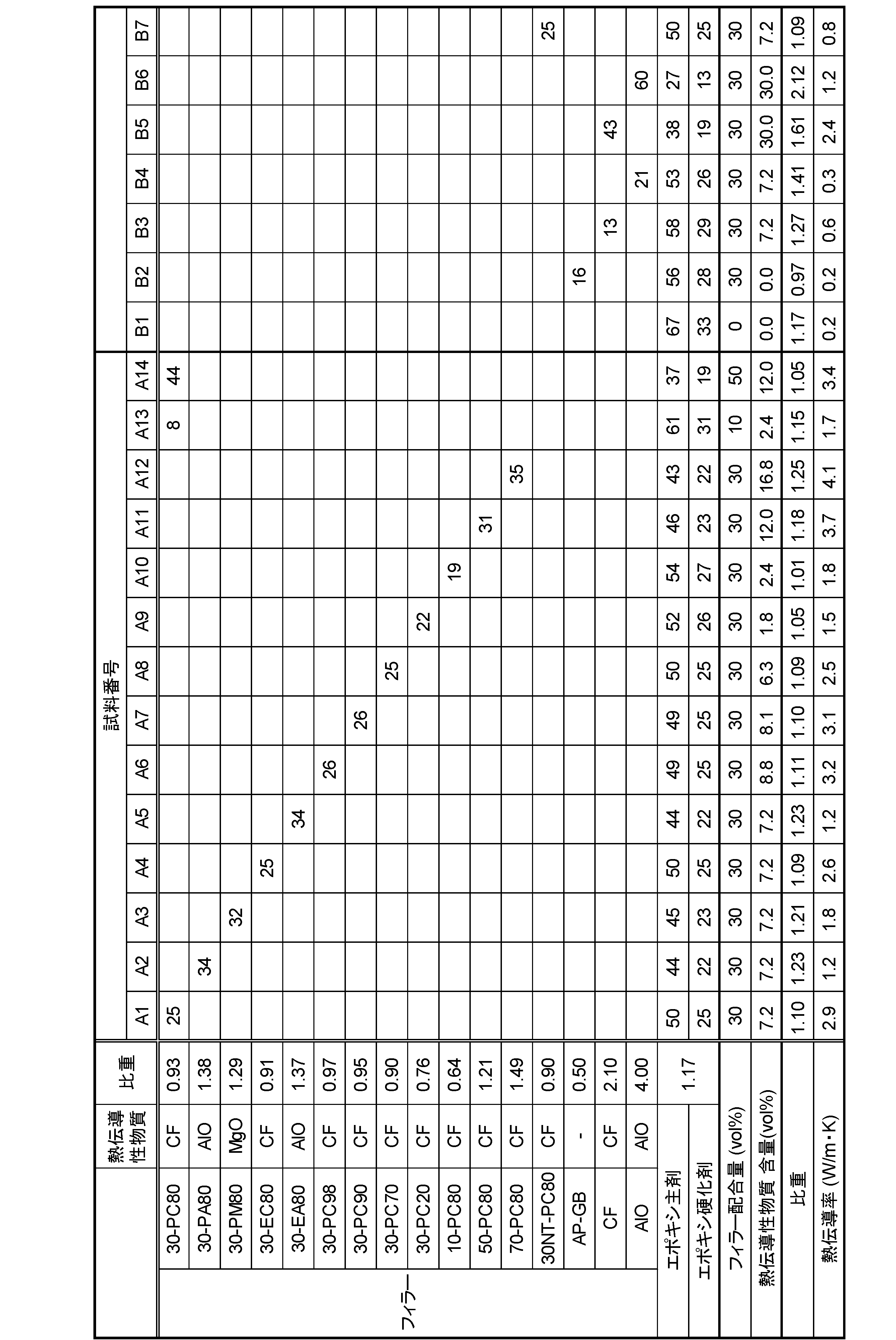
試料A1~A14は、表面処理によってアミノ基を導入した基材粒子の表面に、熱伝導性物質をゲル状物質に分散させた被覆層を設けてフィラーを構成し、マトリクス材料に添加したものである。それら試料A1~A14においては、フィラーを最大で50体積%も添加しているにもかかわらず、複合材料の比重が、フィラーを添加していない試料B1の比重以下、あるいは試料B1の比重に対して10%以下の増加に抑えられている。
そして、試料A1~A14では、いずれも、熱伝導率が、1.5W/(m・K)以上となっている。それらの値は、フィラーを添加していない試料B1の熱伝導率と比較して、7倍以上に相当する。この結果から、ゲル状物質に熱伝導性物質を分散させた被覆層を基材粒子の表面に設けたフィラーが添加された試料A1~A14においては、フィラーが低比重の中空の基材粒子を含むことにより、フィラーを添加した複合材料全体として、比重を小さく抑えながら、高い熱伝導率が得られることが分かる。被覆層が、ゲル状物質の組織の中に熱伝導性物質を安定に保持し、かつそのゲル状物質が、基材粒子との間に化学結合を形成することで、熱伝導性物質が分散され、高い熱伝導性を示す被覆層によって、基材粒子を被覆した状態が、安定に形成されているものと解釈できる。ゲル状物質に分散した状態で保持された熱伝導性物質の粒子が、被覆層の層内で相互に接触することで、各フィラー粒子の表面に、連続的な熱伝導パスが形成されていると考えられる。加えて、基材粒子が占める体積の効果により、隣接するフィラーの表面の被覆層が相互に接触して、フィラー粒子間にも熱伝導パスが形成され、熱伝導率の向上に高い効果を示すものと解釈される。
ここで、試料B2~B5について検討する。試料B2では、マトリクス材料に、表面処理したガラス中空粒子そのもの(AP-GB)を添加しており、フィラーを添加していない試料B1と比べて、比重が低下している。しかしフィラーが熱伝導性物質を含んでいないため、熱伝導率は、試料B1に比べて向上していない。ガラス自体の熱伝導率は、1.0W/(m・K)程度あり、マトリクス材料の熱伝導率よりも高いが、中空粒子となっており、空気が内包されているため、粒子の内部でフォノンの散乱が起こり、粒子を介した熱伝導が起こりにくくなっているものと解釈される。このように、ガラス中空粒子そのものは、熱伝導性フィラーとして利用することはできない。
熱伝導性物質として、試料B3では炭素繊維そのもの、試料B4ではアルミナ粒子そのものを、単体で、それぞれ7.2体積%添加している。この添加量は、試料A1~A5と熱伝導性物質の含量として同じである。しかし、これら試料B3,B4では、熱伝導率は0.6W/(m・K)以下となっている。試料B3は試料A1,A4と、試料B4は試料A2,A5と、用いている熱伝導性物質が同じであるが、試料B3,B4で得られている熱伝導率は、それら試料A1,A4および試料A2,A5と比較して、1/4以下と低くなっている。このことは、試料B3,B4では、フィラーが複合材料中で占める体積が小さいことにより、フィラー粒子間の接触面積が小さく、フィラー粒子間における熱伝導パスの形成が、有効に達成されないためであると考えられる。特に、試料B3で用いている炭素繊維は、形状に高い異方性を有しており、プレス成形した樹脂硬化物試験片においては、熱伝導率の測定方向と垂直な方向である、試験片の面内方向に繊維軸方向が配向するため、計測される熱伝導率の向上に効果を示す、繊維軸方向に沿った熱伝導パスが、試験片の厚さ方向に、有効に形成されていないと考えられる。
試料B5,B6においては、熱伝導性物質として、試料B3,B4と同様に、それぞれ炭素繊維そのもの、アルミナそのものを、単体で添加しているが、配合量を30体積%に増加させている。この配合量は、試料A1~A5と、フィラー配合量(フィラーが占める体積割合)として、同じになっている。これら試料B5,B6においては、フィラーを添加していない試料B1と比較して、熱伝導率が大幅に向上している。この結果は、試料B3,B4と比較して、熱伝導性物質の添加量が多くなったことで、フィラー粒子同士の接触面積が増大し、有効な熱伝導パスが形成されたことを示している。しかし、熱伝導性物質自体が占める体積が大きくなっていることにより、複合材料の比重が、試料B1の1.4倍近く、あるいはさらに大きくなっている。試料B5は試料A1,A4と、試料B6は試料A2,A5と、用いている熱伝導性物質が同じであり、それらの組を相互に比較する。すると、試料B5,B6においては、熱伝導性物質の含量が4倍以上に多くなっているにもかかわらず、得られている熱伝導率は、それら試料A1,A4および試料A2,A5と比較して、向上しておらず、炭素繊維を用いている試料B5においては、むしろ熱伝導率が低くなっている。このように、試料B3~B6の結果より、炭素繊維やアルミナ等、熱伝導性物質単独で構成されたフィラーを用いる場合には、低比重と高熱伝導を両立することは難しいと言える。特に、炭素繊維のように、形状の異方性の高い熱伝導性物質を単独で用いる場合には、その熱伝導性物質の異方的な配向を制御し、所望の方向に高い熱伝導性を達成することは、難しいと言える。
試料B7では、熱伝導性物質に加え、基材粒子およびゲル状物質を用いてフィラーを構成しているが、用いている基材粒子が、表面処理を施されていないガラス中空粒子となっている。この試料B7では、熱伝導性物質として、試料A1,A4および試料B3と同量の炭素繊維を含有しているが、試料B7の熱伝導率は、ゲル状物質を用いている試料A1,A4の値に比べてかなり小さくなっており、炭素繊維を単独で熱伝導性物質として添加している試料B3の値に近くなっている。この試料B7では、基材粒子が表面に、ゲル状物質と化学結合を形成可能な官能基を有していないため、被覆層が、化学結合を介して基材粒子の表面に強固に結合された状態とはなっていないと考えられる。そのことと対応して、試料B7では、熱伝導性物質が、ゲル状物質に分散された状態で、基材粒子の表面を被覆した状態に安定に維持されているのではなく、基材粒子の表面のごく小面積の領域を被覆しているか、基材粒子とは独立して、マトリクス樹脂中に分散しているものと考えられる。
最後に、試料A1~A14を相互に比較する。まず、試料A1~A3の組、また試料A4,A5の組では、相互に、用いている熱伝導性物質の種類が異なっている。これら試料を相互に比較すると、熱伝導性物質として炭素繊維を用いている試料A1,A4においては、アルミナ粒子や酸化マグネシウム粒子を用いている他の試料と比較して、熱伝導率が顕著に高くなっている。このことは、炭素繊維が、アルミナや酸化マグネシウムに比べて、高い熱伝導性を有していることに対応している。炭素繊維は、形状に高い異方性を有しており、上記で試料B3について説明したように、配向した繊維軸方向に沿った方向には高い熱伝導性を示すものの、それ以外の方向には、熱伝導性向上の効果は限定的となる。しかし、図3Aの顕微鏡像に示されるように、炭素繊維をゲル状物質に分散させることで、炭素繊維をランダムに被覆層内に分散させ、マトリクス樹脂に配合することにより、形状の異方性による影響を低減し、任意の方向に、優れた熱伝導性を発揮させることができる。
試料A1,A4の組、また試料A2,A5の組では、用いているゲル化高分子材料の種類が異なっている。しかし、それらの組で、それぞれ熱伝導率を比較すると、いずれのゲル化高分子材料を用いた場合でも、熱伝導率は大きくは変わっていない。このことから、熱伝導性物質を分散させて保持ことができれば、ゲル状物質の種類は、得られるフィラーの熱伝導性に、大きな影響を与えないと言える。
試料A1,A6~A9では、被覆層の原料として用いた混合ゲルにおいて、ゲル状物質に対する熱伝導性物質としての炭素繊維の添加量([ゲル化高分子]:[熱伝導性物質]の乾燥容量比)が相互に異なっており、それに対応して、熱伝導性物質の含量が相互に異なっている。熱伝導性物質の含量は、試料A6,A7,A1,A8,A9の順に多く、その順に、複合材料の熱伝導率が高くなっている。つまり、フィラーにおける熱伝導性物質の含量が多いほど、熱伝導性向上の効果が高くなる。試料A8では、[ゲル化高分子]:[熱伝導性物質]の乾燥容量比が30:70となっており、それ以上に熱伝導性物質の含有量が多い領域で、2.0W/(m・K)以上の高い熱伝導率が得られている。
試料A1,A10~A12では、基材粒子に対する混合ゲルの使用量([混合ゲル]:[基材粒子]の乾燥容量比)が相互に異なっていることにより、熱伝導性物質の含量が相互に異なっている。その含量は、試料A12,A11,A1,A10順に多く、その順に、複合材料の比重が大きくなるとともに、熱伝導率が高くなっている。つまり、フィラーにおいて、被覆層が占める割合が大きく、被覆層が厚く形成されるほど、熱伝導性向上の効果が高くなる。試料A1では、[混合ゲル]:[基材粒子]の乾燥容量比が30:70となっており、それ以上に被覆層が占める割合が大きい領域で、2.0W/(m・K)以上の高い熱伝導率が得られている。
試料A1,A13,A14では、複合材料におけるフィラーの添加量が相互に異なっている。試料A14,A1,A13の順に、フィラーの添加量が多く、その順に、複合材料の比重が大きくなるとともに、熱伝導率が高くなっている。つまり、フィラーを多量に添加するほど、熱伝導率向上の効果が高くなっている。フィラーの添加量が20体積%を超えている試料A1,A14で、2.0W/(m・K)以上の高い熱伝導率が得られている。ただし、試料A14のように、フィラー配合量を50体積%以上に大きくしても、熱伝導率向上の効果は限定的になってしまう。
以上、本開示の実施の形態について詳細に説明したが、本発明は上記実施の形態に何ら限定されるものではなく、本発明の要旨を逸脱しない範囲で種々の改変が可能である。
1 (熱伝導性)複合材料
10 (熱伝導性)フィラー
11 基材粒子(中空粒子)
11a 中空部
11b 殻
12 被覆層
12a ゲル状物質
12b 熱伝導性物質
2 マトリクス材料
5 ワイヤーハーネス
51 絶縁電線
52 コネクタ
53 テープ
10 (熱伝導性)フィラー
11 基材粒子(中空粒子)
11a 中空部
11b 殻
12 被覆層
12a ゲル状物質
12b 熱伝導性物質
2 マトリクス材料
5 ワイヤーハーネス
51 絶縁電線
52 コネクタ
53 テープ
Claims (15)
- 基材粒子と、
前記基材粒子を被覆する被覆層と、を有し、
前記被覆層は、
前記基材粒子の表面に、化学結合を介して結合されて、前記基材粒子の表面を被覆するゲル状物質と、
前記ゲル状物質の層内に分散された、前記基材粒子および前記ゲル状物質よりも高い熱伝導率と大きな比重を有する熱伝導性物質と、を含む、熱伝導性フィラー。 - 前記基材粒子は、中空状である、請求項1に記載の熱伝導性フィラー。
- 前記基材粒子は、ガラスの中空体として構成されており、前記ゲル状物質が有する官能基と化学結合を形成することができる官能基を、表面に有する、請求項2に記載の熱伝導性フィラー。
- 前記ゲル状物質は、カルボニル基を有し、
前記基材粒子は、表面に、塩基性基を有し、
前記ゲル状物質は、前記カルボニル基と前記塩基性基の間の化学結合を介して、前記基材粒子の表面に結合されている、請求項1から請求項3のいずれか1項に記載の熱伝導性フィラー。 - 前記ゲル状物質は、前記カルボニル基としてカルボキシル基を有する有機ポリマーを含む、請求項4に記載の熱伝導性フィラー。
- 前記基材粒子は、表面に、前記塩基性基として、一級アミノ基を有する、請求項4または請求項5に記載の熱伝導性フィラー。
- 前記熱伝導性物質は、形状に異方性を有する粒子として構成されている、請求項1から請求項6のいずれか1項に記載の熱伝導性フィラー。
- 前記熱伝導性物質は、炭素繊維である、請求項7に記載の熱伝導性フィラー。
- 比重が1.8以下である、請求項1から請求項8のいずれか1項に記載の熱伝導性フィラー。
- 請求項1から請求項9のいずれか1項に記載の熱伝導性フィラーと、マトリクス材料と、を含み、
前記熱伝導性フィラーが前記マトリクス材料中に分散されている、熱伝導性複合材料。 - 前記マトリクス材料は、有機ポリマーを含む、請求項10に記載の熱伝導性複合材料。
- 比重が1.4以下である、請求項10または請求項11に記載の熱伝導性複合材料。
- 室温における熱伝導率が、0.9W/(m・K)以上である、請求項10から請求項12のいずれか1項に記載の熱伝導性複合材料。
- 請求項10から請求項13のいずれか1項に記載の熱伝導性複合材料を含む、ワイヤーハーネス。
- 前記ゲル状物質を、前記熱伝導性物質を内部に分散させた状態で準備するゲル準備工程と、
前記ゲル準備工程において準備した、前記熱伝導性物質が分散された前記ゲル状物質を、化学結合を介して前記基材粒子の表面に結合させる被覆工程と、を含んで、
請求項1から請求項9のいずれか1項に記載の熱伝導性フィラーを製造する、熱伝導性フィラーの製造方法。
Priority Applications (2)
| Application Number | Priority Date | Filing Date | Title |
|---|---|---|---|
| CN202180070548.1A CN116348543B (zh) | 2020-10-20 | 2021-10-08 | 导热性填料、导热性复合材料、线束和导热性填料的制造方法 |
| US18/029,870 US20230365852A1 (en) | 2020-10-20 | 2021-10-08 | Thermally conductive filler, thermally-conductive composite material, wire harness, and method for manufacturing thermally conductive filler |
Applications Claiming Priority (2)
| Application Number | Priority Date | Filing Date | Title |
|---|---|---|---|
| JP2020176248A JP7471197B2 (ja) | 2020-10-20 | 2020-10-20 | 熱伝導性フィラー、熱伝導性複合材料、ワイヤーハーネス、および熱伝導性フィラーの製造方法 |
| JP2020-176248 | 2020-10-20 |
Publications (1)
| Publication Number | Publication Date |
|---|---|
| WO2022085477A1 true WO2022085477A1 (ja) | 2022-04-28 |
Family
ID=81290381
Family Applications (1)
| Application Number | Title | Priority Date | Filing Date |
|---|---|---|---|
| PCT/JP2021/037265 Ceased WO2022085477A1 (ja) | 2020-10-20 | 2021-10-08 | 熱伝導性フィラー、熱伝導性複合材料、ワイヤーハーネス、および熱伝導性フィラーの製造方法 |
Country Status (4)
| Country | Link |
|---|---|
| US (1) | US20230365852A1 (ja) |
| JP (3) | JP7471197B2 (ja) |
| CN (1) | CN116348543B (ja) |
| WO (1) | WO2022085477A1 (ja) |
Families Citing this family (2)
| Publication number | Priority date | Publication date | Assignee | Title |
|---|---|---|---|---|
| WO2025070764A1 (ja) * | 2023-09-29 | 2025-04-03 | 日東電工株式会社 | 複合粒子、混合物、複合材料、及び複合粒子を製造する方法 |
| CN119566293B (zh) * | 2024-12-03 | 2025-11-07 | 哈尔滨工业大学(深圳)(哈尔滨工业大学深圳科技创新研究院) | 基于金属气凝胶的复合热界面材料及其制备方法和应用 |
Citations (5)
| Publication number | Priority date | Publication date | Assignee | Title |
|---|---|---|---|---|
| JPH06254380A (ja) * | 1993-03-03 | 1994-09-13 | Toagosei Chem Ind Co Ltd | 複合マイクロバルーン |
| JPH09321185A (ja) * | 1996-05-31 | 1997-12-12 | Tokai Rubber Ind Ltd | 熱伝導性高分子シートの製法 |
| JP2011225882A (ja) * | 2011-05-09 | 2011-11-10 | Toyota Motor Corp | 熱伝導性絶縁樹脂成形体 |
| CN103756252A (zh) * | 2013-12-03 | 2014-04-30 | 惠州市昌亿新材料有限公司 | 一种热固性树脂基导热复合材料及其制备方法和应用 |
| JP2019183052A (ja) * | 2018-04-13 | 2019-10-24 | 株式会社Kri | 熱伝導性複合粒子およびこれを含む樹脂組成物 |
Family Cites Families (1)
| Publication number | Priority date | Publication date | Assignee | Title |
|---|---|---|---|---|
| JP2010013580A (ja) * | 2008-07-04 | 2010-01-21 | Toyota Industries Corp | 高熱伝導性複合体およびその製造方法 |
-
2020
- 2020-10-20 JP JP2020176248A patent/JP7471197B2/ja active Active
-
2021
- 2021-10-08 US US18/029,870 patent/US20230365852A1/en active Pending
- 2021-10-08 CN CN202180070548.1A patent/CN116348543B/zh active Active
- 2021-10-08 WO PCT/JP2021/037265 patent/WO2022085477A1/ja not_active Ceased
-
2024
- 2024-04-09 JP JP2024062572A patent/JP7717216B2/ja active Active
-
2025
- 2025-07-22 JP JP2025122038A patent/JP2025142230A/ja active Pending
Patent Citations (5)
| Publication number | Priority date | Publication date | Assignee | Title |
|---|---|---|---|---|
| JPH06254380A (ja) * | 1993-03-03 | 1994-09-13 | Toagosei Chem Ind Co Ltd | 複合マイクロバルーン |
| JPH09321185A (ja) * | 1996-05-31 | 1997-12-12 | Tokai Rubber Ind Ltd | 熱伝導性高分子シートの製法 |
| JP2011225882A (ja) * | 2011-05-09 | 2011-11-10 | Toyota Motor Corp | 熱伝導性絶縁樹脂成形体 |
| CN103756252A (zh) * | 2013-12-03 | 2014-04-30 | 惠州市昌亿新材料有限公司 | 一种热固性树脂基导热复合材料及其制备方法和应用 |
| JP2019183052A (ja) * | 2018-04-13 | 2019-10-24 | 株式会社Kri | 熱伝導性複合粒子およびこれを含む樹脂組成物 |
Also Published As
| Publication number | Publication date |
|---|---|
| JP7471197B2 (ja) | 2024-04-19 |
| CN116348543A (zh) | 2023-06-27 |
| JP2025142230A (ja) | 2025-09-30 |
| JP2024086833A (ja) | 2024-06-28 |
| JP7717216B2 (ja) | 2025-08-01 |
| JP2022067508A (ja) | 2022-05-06 |
| CN116348543B (zh) | 2025-11-28 |
| US20230365852A1 (en) | 2023-11-16 |
Similar Documents
| Publication | Publication Date | Title |
|---|---|---|
| CN111511679B (zh) | 六方氮化硼粉末及其生产方法和使用其的组合物和散热材料 | |
| JP7717216B2 (ja) | 熱伝導性フィラー、熱伝導性複合材料、ワイヤーハーネス、および熱伝導性フィラーの製造方法 | |
| JP6515030B2 (ja) | 剥離した窒化ホウ素を含む組成物およびその組成物を形成する方法 | |
| KR102821525B1 (ko) | 질화붕소 나노 재료, 및 수지 조성물 | |
| JP5103364B2 (ja) | 熱伝導性シートの製造方法 | |
| JP6169466B2 (ja) | 表面修飾粒子 | |
| JP5102179B2 (ja) | 熱伝導性組成物およびその製造方法 | |
| CN111492474A (zh) | 绝缘散热片 | |
| CN114901756B (zh) | 导热性硅酮树脂组合物、硬化物及导热性硅酮散热片材 | |
| TW200911924A (en) | Thermally conductive compound and process for producing the same | |
| Kim et al. | Fabrication of covalently linked exfoliated boron nitride nanosheet/multi-walled carbon nanotube hybrid particles for thermal conductive composite materials | |
| JP2020132827A (ja) | フィラー充填材及びその製造方法、並びに高熱伝導絶縁材及びその製造方法 | |
| TW202223064A (zh) | 導熱性片材及導熱性片材之製造方法 | |
| WO2022049902A1 (ja) | 熱伝導性シリコーン放熱材料 | |
| JP6786047B2 (ja) | 熱伝導シートの製造方法 | |
| WO2023188491A1 (ja) | 熱伝導性シリコーン組成物、熱伝導性シリコーンシート及びその製造方法 | |
| Lim et al. | Synchronously enhancing thermal conductivity and dielectric properties in epoxy composites via incorporation of functionalized boron nitride | |
| Zhu et al. | Three‐dimensional skeleton assembled by nickel foam/silicon carbide as filler in polyurethane composites with high thermal conductivity and electrical insulation | |
| JP7657873B2 (ja) | 熱伝導性フィラー、熱伝導性複合材料、ワイヤーハーネス、および熱伝導性フィラーの製造方法 | |
| CN114573867A (zh) | 一种碳纳米管-氮化硼球型导热填料及其制备方法与应用 | |
| WO2025070764A1 (ja) | 複合粒子、混合物、複合材料、及び複合粒子を製造する方法 | |
| KR20220169496A (ko) | 탄소 나노 튜브를 포함하는 복합 재료 조성물 |
Legal Events
| Date | Code | Title | Description |
|---|---|---|---|
| 121 | Ep: the epo has been informed by wipo that ep was designated in this application |
Ref document number: 21882618 Country of ref document: EP Kind code of ref document: A1 |
|
| NENP | Non-entry into the national phase |
Ref country code: DE |
|
| 122 | Ep: pct application non-entry in european phase |
Ref document number: 21882618 Country of ref document: EP Kind code of ref document: A1 |