WO2022075050A1 - 樹脂組成物、光ファイバ及び光ファイバの製造方法 - Google Patents
樹脂組成物、光ファイバ及び光ファイバの製造方法 Download PDFInfo
- Publication number
- WO2022075050A1 WO2022075050A1 PCT/JP2021/034401 JP2021034401W WO2022075050A1 WO 2022075050 A1 WO2022075050 A1 WO 2022075050A1 JP 2021034401 W JP2021034401 W JP 2021034401W WO 2022075050 A1 WO2022075050 A1 WO 2022075050A1
- Authority
- WO
- WIPO (PCT)
- Prior art keywords
- meth
- acrylamide
- urethane
- acrylate
- resin composition
- Prior art date
- Legal status (The legal status is an assumption and is not a legal conclusion. Google has not performed a legal analysis and makes no representation as to the accuracy of the status listed.)
- Ceased
Links
Images
Classifications
-
- C—CHEMISTRY; METALLURGY
- C08—ORGANIC MACROMOLECULAR COMPOUNDS; THEIR PREPARATION OR CHEMICAL WORKING-UP; COMPOSITIONS BASED THEREON
- C08F—MACROMOLECULAR COMPOUNDS OBTAINED BY REACTIONS ONLY INVOLVING CARBON-TO-CARBON UNSATURATED BONDS
- C08F290/00—Macromolecular compounds obtained by polymerising monomers on to polymers modified by introduction of aliphatic unsaturated end or side groups
- C08F290/02—Macromolecular compounds obtained by polymerising monomers on to polymers modified by introduction of aliphatic unsaturated end or side groups on to polymers modified by introduction of unsaturated end groups
- C08F290/06—Polymers provided for in subclass C08G
- C08F290/067—Polyurethanes; Polyureas
-
- C—CHEMISTRY; METALLURGY
- C09—DYES; PAINTS; POLISHES; NATURAL RESINS; ADHESIVES; COMPOSITIONS NOT OTHERWISE PROVIDED FOR; APPLICATIONS OF MATERIALS NOT OTHERWISE PROVIDED FOR
- C09D—COATING COMPOSITIONS, e.g. PAINTS, VARNISHES OR LACQUERS; FILLING PASTES; CHEMICAL PAINT OR INK REMOVERS; INKS; CORRECTING FLUIDS; WOODSTAINS; PASTES OR SOLIDS FOR COLOURING OR PRINTING; USE OF MATERIALS THEREFOR
- C09D175/00—Coating compositions based on polyureas or polyurethanes; Coating compositions based on derivatives of such polymers
- C09D175/04—Polyurethanes
- C09D175/14—Polyurethanes having carbon-to-carbon unsaturated bonds
- C09D175/16—Polyurethanes having carbon-to-carbon unsaturated bonds having terminal carbon-to-carbon unsaturated bonds
-
- C—CHEMISTRY; METALLURGY
- C03—GLASS; MINERAL OR SLAG WOOL
- C03C—CHEMICAL COMPOSITION OF GLASSES, GLAZES OR VITREOUS ENAMELS; SURFACE TREATMENT OF GLASS; SURFACE TREATMENT OF FIBRES OR FILAMENTS MADE FROM GLASS, MINERALS OR SLAGS; JOINING GLASS TO GLASS OR OTHER MATERIALS
- C03C25/00—Surface treatment of fibres or filaments made from glass, minerals or slags
- C03C25/10—Coating
- C03C25/104—Coating to obtain optical fibres
- C03C25/1065—Multiple coatings
-
- C—CHEMISTRY; METALLURGY
- C03—GLASS; MINERAL OR SLAG WOOL
- C03C—CHEMICAL COMPOSITION OF GLASSES, GLAZES OR VITREOUS ENAMELS; SURFACE TREATMENT OF GLASS; SURFACE TREATMENT OF FIBRES OR FILAMENTS MADE FROM GLASS, MINERALS OR SLAGS; JOINING GLASS TO GLASS OR OTHER MATERIALS
- C03C25/00—Surface treatment of fibres or filaments made from glass, minerals or slags
- C03C25/10—Coating
- C03C25/24—Coatings containing organic materials
- C03C25/26—Macromolecular compounds or prepolymers
- C03C25/32—Macromolecular compounds or prepolymers obtained otherwise than by reactions involving only carbon-to-carbon unsaturated bonds
- C03C25/326—Polyureas; Polyurethanes
-
- C—CHEMISTRY; METALLURGY
- C08—ORGANIC MACROMOLECULAR COMPOUNDS; THEIR PREPARATION OR CHEMICAL WORKING-UP; COMPOSITIONS BASED THEREON
- C08F—MACROMOLECULAR COMPOUNDS OBTAINED BY REACTIONS ONLY INVOLVING CARBON-TO-CARBON UNSATURATED BONDS
- C08F222/00—Copolymers of compounds having one or more unsaturated aliphatic radicals, each having only one carbon-to-carbon double bond, and at least one being terminated by a carboxyl radical and containing at least one other carboxyl radical in the molecule; Salts, anhydrides, esters, amides, imides, or nitriles thereof
- C08F222/10—Esters
- C08F222/1006—Esters of polyhydric alcohols or polyhydric phenols
- C08F222/106—Esters of polycondensation macromers
- C08F222/1065—Esters of polycondensation macromers of alcohol terminated (poly)urethanes, e.g. urethane(meth)acrylates
-
- C—CHEMISTRY; METALLURGY
- C08—ORGANIC MACROMOLECULAR COMPOUNDS; THEIR PREPARATION OR CHEMICAL WORKING-UP; COMPOSITIONS BASED THEREON
- C08G—MACROMOLECULAR COMPOUNDS OBTAINED OTHERWISE THAN BY REACTIONS ONLY INVOLVING UNSATURATED CARBON-TO-CARBON BONDS
- C08G18/00—Polymeric products of isocyanates or isothiocyanates
- C08G18/06—Polymeric products of isocyanates or isothiocyanates with compounds having active hydrogen
- C08G18/08—Processes
- C08G18/10—Prepolymer processes involving reaction of isocyanates or isothiocyanates with compounds having active hydrogen in a first reaction step
-
- C—CHEMISTRY; METALLURGY
- C08—ORGANIC MACROMOLECULAR COMPOUNDS; THEIR PREPARATION OR CHEMICAL WORKING-UP; COMPOSITIONS BASED THEREON
- C08G—MACROMOLECULAR COMPOUNDS OBTAINED OTHERWISE THAN BY REACTIONS ONLY INVOLVING UNSATURATED CARBON-TO-CARBON BONDS
- C08G18/00—Polymeric products of isocyanates or isothiocyanates
- C08G18/06—Polymeric products of isocyanates or isothiocyanates with compounds having active hydrogen
- C08G18/08—Processes
- C08G18/16—Catalysts
- C08G18/22—Catalysts containing metal compounds
- C08G18/24—Catalysts containing metal compounds of tin
- C08G18/244—Catalysts containing metal compounds of tin tin salts of carboxylic acids
- C08G18/246—Catalysts containing metal compounds of tin tin salts of carboxylic acids containing also tin-carbon bonds
-
- C—CHEMISTRY; METALLURGY
- C08—ORGANIC MACROMOLECULAR COMPOUNDS; THEIR PREPARATION OR CHEMICAL WORKING-UP; COMPOSITIONS BASED THEREON
- C08G—MACROMOLECULAR COMPOUNDS OBTAINED OTHERWISE THAN BY REACTIONS ONLY INVOLVING UNSATURATED CARBON-TO-CARBON BONDS
- C08G18/00—Polymeric products of isocyanates or isothiocyanates
- C08G18/06—Polymeric products of isocyanates or isothiocyanates with compounds having active hydrogen
- C08G18/28—Polymeric products of isocyanates or isothiocyanates with compounds having active hydrogen characterised by the compounds used containing active hydrogen
- C08G18/40—High-molecular-weight compounds
- C08G18/48—Polyethers
- C08G18/4825—Polyethers containing two hydroxy groups
-
- C—CHEMISTRY; METALLURGY
- C08—ORGANIC MACROMOLECULAR COMPOUNDS; THEIR PREPARATION OR CHEMICAL WORKING-UP; COMPOSITIONS BASED THEREON
- C08G—MACROMOLECULAR COMPOUNDS OBTAINED OTHERWISE THAN BY REACTIONS ONLY INVOLVING UNSATURATED CARBON-TO-CARBON BONDS
- C08G18/00—Polymeric products of isocyanates or isothiocyanates
- C08G18/06—Polymeric products of isocyanates or isothiocyanates with compounds having active hydrogen
- C08G18/28—Polymeric products of isocyanates or isothiocyanates with compounds having active hydrogen characterised by the compounds used containing active hydrogen
- C08G18/67—Unsaturated compounds having active hydrogen
- C08G18/675—Low-molecular-weight compounds
- C08G18/677—Low-molecular-weight compounds containing heteroatoms other than oxygen and the nitrogen of primary or secondary amino groups
- C08G18/678—Low-molecular-weight compounds containing heteroatoms other than oxygen and the nitrogen of primary or secondary amino groups containing nitrogen
-
- C—CHEMISTRY; METALLURGY
- C08—ORGANIC MACROMOLECULAR COMPOUNDS; THEIR PREPARATION OR CHEMICAL WORKING-UP; COMPOSITIONS BASED THEREON
- C08G—MACROMOLECULAR COMPOUNDS OBTAINED OTHERWISE THAN BY REACTIONS ONLY INVOLVING UNSATURATED CARBON-TO-CARBON BONDS
- C08G18/00—Polymeric products of isocyanates or isothiocyanates
- C08G18/06—Polymeric products of isocyanates or isothiocyanates with compounds having active hydrogen
- C08G18/70—Polymeric products of isocyanates or isothiocyanates with compounds having active hydrogen characterised by the isocyanates or isothiocyanates used
- C08G18/72—Polyisocyanates or polyisothiocyanates
- C08G18/74—Polyisocyanates or polyisothiocyanates cyclic
- C08G18/76—Polyisocyanates or polyisothiocyanates cyclic aromatic
- C08G18/7614—Polyisocyanates or polyisothiocyanates cyclic aromatic containing only one aromatic ring
- C08G18/7621—Polyisocyanates or polyisothiocyanates cyclic aromatic containing only one aromatic ring being toluene diisocyanate including isomer mixtures
-
- C—CHEMISTRY; METALLURGY
- C09—DYES; PAINTS; POLISHES; NATURAL RESINS; ADHESIVES; COMPOSITIONS NOT OTHERWISE PROVIDED FOR; APPLICATIONS OF MATERIALS NOT OTHERWISE PROVIDED FOR
- C09D—COATING COMPOSITIONS, e.g. PAINTS, VARNISHES OR LACQUERS; FILLING PASTES; CHEMICAL PAINT OR INK REMOVERS; INKS; CORRECTING FLUIDS; WOODSTAINS; PASTES OR SOLIDS FOR COLOURING OR PRINTING; USE OF MATERIALS THEREFOR
- C09D175/00—Coating compositions based on polyureas or polyurethanes; Coating compositions based on derivatives of such polymers
- C09D175/04—Polyurethanes
- C09D175/12—Polyurethanes from compounds containing nitrogen and active hydrogen, the nitrogen atom not being part of an isocyanate group
-
- C—CHEMISTRY; METALLURGY
- C09—DYES; PAINTS; POLISHES; NATURAL RESINS; ADHESIVES; COMPOSITIONS NOT OTHERWISE PROVIDED FOR; APPLICATIONS OF MATERIALS NOT OTHERWISE PROVIDED FOR
- C09D—COATING COMPOSITIONS, e.g. PAINTS, VARNISHES OR LACQUERS; FILLING PASTES; CHEMICAL PAINT OR INK REMOVERS; INKS; CORRECTING FLUIDS; WOODSTAINS; PASTES OR SOLIDS FOR COLOURING OR PRINTING; USE OF MATERIALS THEREFOR
- C09D4/00—Coating compositions, e.g. paints, varnishes or lacquers, based on organic non-macromolecular compounds having at least one polymerisable carbon-to-carbon unsaturated bond ; Coating compositions, based on monomers of macromolecular compounds of groups C09D183/00 - C09D183/16
-
- G—PHYSICS
- G02—OPTICS
- G02B—OPTICAL ELEMENTS, SYSTEMS OR APPARATUS
- G02B6/00—Light guides; Structural details of arrangements comprising light guides and other optical elements, e.g. couplings
- G02B6/02—Optical fibres with cladding with or without a coating
- G02B6/02395—Glass optical fibre with a protective coating, e.g. two layer polymer coating deposited directly on a silica cladding surface during fibre manufacture
Definitions
- the present disclosure relates to a resin composition for secondary coating of an optical fiber, an optical fiber, and a method for manufacturing the optical fiber.
- the optical fiber is provided with a coating resin layer for protecting the glass fiber which is an optical transmitter.
- the coating resin layer is composed of, for example, two layers, a primary resin layer in contact with the glass fiber and a secondary resin layer formed on the outer layer of the primary resin layer.
- urethane (meth) acrylate which is a reaction product of a polyol, a diisocyanate, and a hydroxyl group-containing (meth) acrylate
- Patent Documents 1 to 3 describe resin compositions for secondary coating containing urethane (meth) acrylate.
- the optical fiber according to one embodiment of the present disclosure includes a glass fiber including a core and a clad, a primary resin layer that is in contact with the glass fiber and coats the glass fiber, and a secondary resin layer that coats the primary resin layer.
- the resin layer contains a cured product of the above resin composition.
- the method for producing an optical fiber according to one embodiment of the present disclosure includes a coating step of applying the above resin composition to the outer periphery of a glass fiber including a core and a clad, and a coating step of applying ultraviolet rays after the coating step to apply the resin composition. It comprises a curing step of curing.
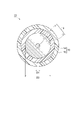
- FIG. 1 is a schematic cross-sectional view showing an example of an optical fiber according to the present embodiment.
- the secondary resin layer of the optical fiber has a high Young's modulus in order to enhance the microbend resistance. It is also important that the secondary resin layer of the optical fiber has excellent traumatic resistance in order to suppress appearance defects due to the occurrence of surface scraping.
- the above-mentioned conventional resin composition for secondary coating tends to be insufficiently cured, and the secondary resin layer formed. There is room for improvement in Young's modulus and trauma resistance.
- the present disclosure provides a resin composition capable of forming a secondary resin layer of an optical fiber having a high young rate and excellent trauma resistance even when the production speed of the optical fiber is high, and an optical fiber having excellent productivity.
- the purpose is.
- a resin composition capable of forming a secondary resin layer of an optical fiber having a high young rate and excellent trauma resistance even when the production speed of the optical fiber is high, and an optical fiber having excellent productivity are provided. Can be provided.
- the resin composition for secondary coating of an optical fiber contains a photopolymerizable compound containing urethane (meth) acrylamide and a photopolymerization initiator, and urethane (meth) acrylamide is urethane-bonded. Has a (meth) acrylamide group at at least one end of the.
- a resin composition can form a secondary resin layer having a high Young's modulus and excellent trauma resistance even when the production speed of the optical fiber is high, and the productivity of the optical fiber can be improved.
- urethane (meth) acrylamide is applied to both ends of a urethane oligomer having a (meth) acrylamide group at one end of a urethane bond and a urethane bond. It may contain a urethane oligomer having a (meth) acrylamide group or a mixture thereof.
- a urethane oligomer having a (meth) acrylamide group at one end of a urethane bond comprises a urethane oligomer having a (meth) acrylamide group at one end of the urethane bond and a (meth) acryloyloxy group at the other end. But it may be.
- the number average molecular weight of urethane (meth) acrylamide may be 500 or more and 6000 or less.
- the content of urethane (meth) acrylamide is 5 parts by mass or more and 60 parts by mass or less based on 100 parts by mass of the total amount of the resin composition. May be.
- the photopolymerizable compound may further contain (meth) acrylic acid ester.
- the (meth) acrylic acid ester may contain (meth) acrylate having a bisphenol skeleton.
- the optical fiber according to one aspect of the present disclosure includes a glass fiber including a core and a clad, a primary resin layer that is in contact with the glass fiber and coats the glass fiber, and a secondary resin layer that coats the primary resin layer.
- the secondary resin layer contains a cured product of the above-mentioned resin composition.
- Such an optical fiber includes a secondary resin layer having a high Young's modulus and excellent trauma resistance, and is excellent in productivity.
- the method for producing an optical fiber according to one aspect of the present disclosure includes a coating step of applying the above-mentioned resin composition to the outer periphery of a glass fiber including a core and a cladding, and a resin composition by irradiating ultraviolet rays after the coating step. It is provided with a curing step of curing.
- Such an optical fiber manufacturing method can form a secondary resin layer having a high Young's modulus and excellent trauma resistance even when the manufacturing speed is high, and can manufacture an optical fiber having excellent productivity.
- (meth) acrylamide means acrylamide or its corresponding methamide. The same applies to similar expressions such as (meth) acrylate.
- the resin composition according to the present embodiment contains a photopolymerizable compound containing urethane (meth) acrylamide and a photopolymerization initiator.
- Urethane (meth) acrylamide has a (meth) acrylamide group at at least one end of the urethane bond. Since the (meth) acrylamide group is superior in photopolymerizability to the (meth) acryloyloxy group, urethane (meth) acrylamide has a faster curing rate than urethane (meth) acrylate and improves the productivity of optical fibers. Can be made to.
- Urethane (meth) acrylamide has a urethane oligomer having a (meth) acrylamide group at one end of the urethane bond and urethane bonds at both ends of the urethane bond from the viewpoint of forming a secondary resin layer having a higher young rate and better trauma resistance. It may contain a urethane oligomer having a (meth) acrylamide group or a mixture thereof.
- the urethane (meth) acrylamide preferably contains a urethane oligomer having (meth) acrylamide at both ends of the urethane bond.
- the urethane oligomer having (meth) acrylamide groups at both ends of the urethane bond may be a reaction product of a polyol, a diisocyanate, and N-hydroxyalkyl (meth) acrylamide.
- a urethane oligomer having a (meth) acrylamide group at one end of a urethane bond comprises a urethane oligomer having a (meth) acrylamide group at one end of the urethane bond and a (meth) acryloyloxy group at the other end. But it may be.
- Such a urethane oligomer may be a reaction product of a polyol, a diisocyanate, an N-hydroxyalkyl (meth) acrylamide, and a hydroxyl group-containing (meth) acrylate.
- polystyrene resin examples include a polyether polyol, a polyester polyol, a polycaprolactone polyol, a polycarbonate polyol, a polybutadiene polyol, and a bisphenol A / ethylene oxide-added diol.
- polyether polyol examples include polytetramethylene ether glycol, polyethylene glycol, and polypropylene glycol. These polyols may be used alone or in combination of two or more.
- the Young's modulus and the elongation at break of the secondary resin layer it is preferable to use at least one selected from the group consisting of polypropylene glycol, polytetramethylene ether glycol, and polycarbonate polyol as the polyol.
- the number average molecular weight (Mn) of the polyol is preferably 300 or more and 2500 or less, more preferably 400 or more and 2400 or less, still more preferably 500 or more and 2300 or less, from the viewpoint of forming a tough secondary resin layer.
- urethane (meth) acrylamide preferably comprises a structural unit derived from a polyol having a number average molecular weight of 300 or more and 2500 or less, and comprises a structural unit derived from a polyol having a number average molecular weight of 400 or more and 2400 or less. It is more preferable to include a structural unit derived from a polyol having a number average molecular weight of 500 or more and 2300 or less.
- diisocyanate examples include 2,4-tolylene diisocyanate, 2,6-tolylene diisocyanate, isophorone diisocyanate, dicyclohexylmethane diisocyanate, diphenylmethane diisocyanate, hexamethylene diisocyanate, xylylene diisocyanate, hydrogenated xylylene diisocyanate, 1 , 5-Naphthalenediocyanate, norbornene diisocyanate, 1,5-pentamethylene diisocyanate, tetramethylxylylene diisocyanate and trimethylhexamethylene diisocyanate. These diisocyanates may be used alone or in combination of two or more.
- N-hydroxyalkyl (meth) acrylamide examples include N-hydroxymethyl (meth) acrylamide, N-hydroxyethyl (meth) acrylamide, and N, N-dimethylol (meth) acrylamide. These N-hydroxyalkyl (meth) acrylamides may be used alone or in combination of two or more. From the viewpoint of forming a secondary resin layer having a higher Young's modulus and more excellent trauma resistance, it is preferable to use N-hydroxyethyl acrylamide as the N-hydroxyalkyl (meth) acrylamide.
- Examples of the hydroxyl group-containing (meth) acrylate include 2-hydroxyethyl (meth) acrylate, 2-hydroxypropyl (meth) acrylate, 2-hydroxybutyl (meth) acrylate, caprolactone (meth) acrylate, and 2-hydroxy-3-.
- Examples thereof include propandi (meth) acrylate and pentaerythritol tri (meth) acrylate.
- hydroxyl group-containing (meth) acrylates may be used alone or in combination of two or more.
- the hydroxyl group-containing (meth) acrylate it is preferable to use at least one selected from the group consisting of 2-hydroxyethyl (meth) acrylate, 2-hydroxypropyl (meth) acrylate, and 2-hydroxybutyl (meth) acrylate.
- urethane (meth) acrylamide for example, a polyol is reacted with a diisocyanate to obtain a prepolymer having an isocyanate group at the end (hereinafter, also referred to as “NCO-terminal prepolymer”), and then N-hydroxyalkyl.
- NCO-terminal prepolymer a prepolymer having an isocyanate group at the end
- a method of reacting a polyol a method of simultaneously reacting a polyol with a diisocyanate and N-hydroxyalkyl (meth) acrylamide (if necessary, a hydroxyl group-containing (meth) acrylate) can be mentioned.
- the hydroxyl group (OH) of the polyol is reacted with the isocyanate group (NCO) of the diisocyanate, and then N-hydroxyalkyl (meth) acrylamide (hydroxyl group-containing (meth) acrylate, if necessary).
- NCO isocyanate group
- N-hydroxyalkyl (meth) acrylamide hydroxyl group-containing (meth) acrylate, if necessary.
- the diisocyanate is reacted with N-hydroxyalkyl (meth) acrylamide (if necessary, a hydroxyl group-containing (meth) acrylate), and then the polyol is reacted.
- the method is preferred.
- urethane (meth) acrylamide preparation of urethane (meth) acrylamide will be described with specific examples.
- polypropylene glycol is used as the polyol
- 2,4-tolylene diisocyanate as the diisocyanate
- N-hydroxyethylacrylamide as the N-hydroxyalkyl (meth) acrylamide
- 2-hydroxyethyl acrylate as the hydroxyl group-containing (meth) acrylate.
- polypropylene glycol is reacted with 2,4-tolylene diisocyanate to synthesize an NCO-terminated prepolymer.
- N-hydroxyethyl acrylamide and 2-hydroxyethyl acrylate are reacted with the NCO-terminated prepolymer to synthesize a urethane oligomer containing urethane acrylamide.
- the urethane oligomer to be synthesized can be represented as a mixture of urethane acrylamide of the following formulas (1) and (2) and urethane acrylate of the formula (3).
- the following formulas (4) to (6) are by-products called adducts contained in the reactants and function as one kind of monomer.
- Am is a residue of N-hydroxyethyl acrylamide
- Ac is a residue of 2-hydroxyethyl acrylate
- U is a urethane bond
- I is a residue of 2,4-tolylene diisocyanate
- P is polypropylene. Represents a residue of glycol
- n is an integer of 1 or more.
- the molar ratio (NCO / OH) of the isocyanate group (NCO) of the diisocyanate to the hydroxyl group (OH) of the polyol when reacting the polyol with the diisocyanate is preferably 1.1 or more and 6.0 or less, preferably 1.2 or more. 5.0 or less is more preferable, 1.3 or more and 4.0 or less is further preferable, and 1.4 or more and 3.0 or less is particularly preferable.
- NCO / OH may be 1.5 or more and 1.7 or more or 1.9 or more, and may be 2.5 or less, 2.3 or less or 2.1 or less.
- the molar ratio of the hydroxyl group of N-hydroxyalkyl (meth) acrylamide to NCO of the NCO-terminated prepolymer is preferably 0.10 or more and 1.15 or less, more preferably 0.20 or more and 1.10 or less, and 0.30 or more and 1 .10 or less is more preferable, 0.40 or more and 1.10 or less are particularly preferable, and 0.50 or more and 1.10 or less are extremely preferable.
- the molar ratio of the hydroxyl group of N-hydroxyalkyl (meth) acrylamide to NCO of the NCO-terminated prepolymer may be 0.60 or more, 0.70 or more, 0.80 or more, or 0.90 or more.
- the molar ratio of the hydroxyl group of the hydroxyl group-containing (meth) acrylate to the NCO of the NCO-terminated prepolymer is preferably 0 or more and 0.95 or less, more preferably 0 or more and 0.90 or less, further preferably 0 or more and 0.80 or less, and 0. More than 0.70 or less is particularly preferable, and 0 or more and 0.60 or less is extremely preferable.
- the ratio of the total number of moles of hydroxyl groups in N-hydroxyalkyl (meth) acrylamide and hydroxyl group-containing (meth) acrylate to the number of moles of NCO in the NCO-terminated prepolymer is preferably 1.00 or more and 1.15 or less, preferably 1.03 or more. 1.10 or less is more preferable.
- an organotin compound and an amine compound can be used as a catalyst for synthesizing urethane (meth) acrylamide.
- the organotin compound include dibutyltin dilaurate, dibutyltin diacetate, dibutyltinmalate, dibutyltinbis (2-ethylhexyl mercaptoacetate), dibutyltinbis (isooctyl mercaptoacetate) and dibutyltin oxide.
- These catalysts may be used alone or in combination of two or more. From the viewpoint of availability or catalytic performance, it is preferable to use dibutyltin dilaurate or dibutyltin diacetate as the catalyst.
- the Mn of urethane (meth) acrylamide is preferably 500 or more and 6000 or less, more preferably 600 or more and 5500 or less, further preferably 700 or more and 5000 or less, and particularly preferably 1000 or more and 4000 or less.
- the Mn of urethane (meth) acrylamide may be 1500 or more or 2000 or more, or 3500 or less or 3000 or less.
- the content of urethane (meth) acrylamide is 5 parts by mass or more and 60 parts by mass or less based on 100 parts by mass of the total amount of the resin composition from the viewpoint of forming a secondary resin layer having a higher Young's modulus and excellent trauma resistance. It is preferably 10 parts by mass or more and 55 parts by mass or less, and further preferably 15 parts by mass or more and 50 parts by mass or less.
- the photopolymerizable compound according to this embodiment may further contain urethane (meth) acrylate.
- Urethane (meth) acrylate is a urethane oligomer having a (meth) acryloyloxy group.
- Urethane (meth) acrylate can be obtained by reacting a polyol, a diisocyanate, and a hydroxyl group-containing (meth) acrylate by a conventional method.
- the polyol, diisocyanate and hydroxyl group-containing (meth) acrylate used for the synthesis of urethane (meth) acrylate are not particularly limited, but may be selected from the compounds exemplified in the above-mentioned synthesis of urethane (meth) acrylamide.
- the photopolymerizable compound according to the present embodiment may further contain a photopolymerizable compound having no urethane bond (hereinafter referred to as "monomer").
- the monomer include (meth) acrylic acid ester, N-vinyl compound, and (meth) acrylamide compound.
- the monomer may be a monofunctional monomer having one photopolymerizable ethylenically unsaturated group, or may be a polyfunctional monomer having two or more photopolymerizable ethylenically unsaturated groups.
- the photopolymerizable compound it is preferable to use a (meth) acrylic acid ester as a monomer from the viewpoint of imparting appropriate toughness to the secondary resin layer.
- a (meth) acrylic acid ester examples include a monofunctional (meth) acrylic acid ester and a polyfunctional (meth) acrylic acid ester.
- the (meth) acrylic acid ester one type may be used alone, or two or more types may be used in combination.
- Examples of the monofunctional (meth) acrylic acid ester include methyl (meth) acrylate, ethyl (meth) acrylate, propyl (meth) acrylate, n-butyl (meth) acrylate, s-butyl (meth) acrylate, and t-.
- polyfunctional (meth) acrylic acid ester examples include ethylene glycol di (meth) acrylate, polyethylene glycol di (meth) acrylate, polypropylene glycol di (meth) acrylate, neopentyl glycol di (meth) acrylate, and tripropylene glycol.
- the (meth) acrylic acid ester preferably contains a bisphenol skeleton-containing (meth) acrylate.
- the content of the bisphenol skeleton-containing (meth) acrylic acid ester may be 10 parts by mass or more, 15 parts by mass or more, or 20 parts by mass or more, based on 100 parts by mass of the total amount of the resin composition, and is 70 parts by mass or less, 65 parts by mass. It may be 3 parts by mass or less, 60 parts by mass or less, 55 parts by mass or less, or 50 parts by mass or less.
- the content of the (meth) acrylic acid ester may be 40 parts by mass or more, 45 parts by mass or more, 50 parts by mass or more, or 60 parts by mass or more, based on 100 parts by mass of the total amount of the resin composition, and is 95 parts by mass.
- it may be 90 parts by mass or less, 85 parts by mass or less, or 80 parts by mass or less.
- N-vinyl compound examples include N-vinylpyrrolidone, N-vinylcaprolactam, N-vinylmethyloxazolidinone, N-vinylimidazole, and N-vinyl-N-methylacetamide.
- the curing rate of the resin composition can be further improved.
- the content of the N-vinyl compound is preferably 0 parts by mass or more and 30 parts by mass or less, and more preferably 1 part by mass or more and 20 parts by mass or less, based on 100 parts by mass of the total amount of the resin composition.
- Examples of the (meth) acrylamide compound include dimethyl (meth) acrylamide, diethyl (meth) acrylamide, (meth) acryloylmorpholine, hydroxymethyl (meth) acrylamide, hydroxyethyl (meth) acrylamide, isopropyl (meth) acrylamide, and dimethyl.
- the curing rate of the resin composition can be further improved.
- the content of the (meth) acrylamide compound is preferably 0 parts by mass or more and 30 parts by mass or less, and more preferably 1 part by mass or more and 20 parts by mass or less, based on 100 parts by mass of the total amount of the resin composition.
- the photopolymerization initiator according to the present embodiment can be appropriately selected from known radical photopolymerization initiators and used.
- the photopolymerization initiator include 1-hydroxycyclohexylphenylketone (trade name: Omnirad 184, manufactured by IGM Resins), 2,2-dimethoxy-2-phenylacetophenone (trade name: Omnirad 651, manufactured by IGM Resins), and the like.
- the photopolymerization initiator one type may be used alone, or two or more types may be mixed and used. From the viewpoint of excellent quick-curing property of the resin composition, the photopolymerization initiator preferably contains at least one selected from 2,4,6-trimethylbenzoyldiphenylphosphine oxide and 1-hydroxycyclohexylphenylketone.
- the content of the photopolymerization initiator is preferably 0.2 parts by mass or more and 5 parts by mass or less, more preferably 0.3 parts by mass or more and 4 parts by mass or less, more preferably 0.4, based on 100 parts by mass of the total amount of the resin composition. It is more preferably 3 parts by mass or more and 3 parts by mass or less.
- the resin composition according to the present embodiment may further contain a photoacid generator, a leveling agent, an antifoaming agent, an antioxidant, an ultraviolet absorber and the like.
- an onium salt having an A + B - structure may be used.
- the photoacid generator include sulfonium salts such as CPI-100P, CPI-110P (manufactured by Sun Appro Co., Ltd.), Omnicat 270, Omnicat 290 (manufactured by IGM Resins); Omnicat 250 (manufactured by IGM Resins), WPI-113. , WPI-116, WPI-124, WPI-169, WPI-170 (manufactured by Fujifilm Wako Pure Chemical Industries, Ltd.) and the like.
- the viscosity of the resin composition according to the present embodiment at 25 ° C. is preferably 0.5 Pa ⁇ s or more and 10 Pa ⁇ s or less, preferably 1 Pa ⁇ s or more and 9 Pa ⁇ s or less, from the viewpoint of coatability. Is more preferable.
- the viscosity of the resin composition at 25 ° C. was determined by using a B-type viscometer (“Digital Viscometer DV-II” manufactured by Brookfield). It can be measured under the conditions of 18. and the rotation speed of 10 rpm.
- the optical fiber according to the present embodiment includes a glass fiber including a core and a clad, a primary resin layer that is in contact with the glass fiber and coats the glass fiber, and a secondary resin layer that coats the primary resin layer.
- FIG. 1 is a schematic cross-sectional view showing an example of an optical fiber according to the present embodiment.
- the optical fiber 10 includes a glass fiber 13 including a core 11 and a clad 12, and a coated resin layer 16 including a primary resin layer 14 provided on the outer periphery of the glass fiber 13 and a secondary resin layer 15 covering the primary resin layer 14. It is equipped with.
- the clad 12 surrounds the core 11.
- the core 11 and the clad 12 mainly contain glass such as quartz glass.
- glass such as quartz glass.
- quartz glass or pure quartz glass to which germanium is added can be used for the core 11, and pure quartz glass or pure quartz glass can be used for the clad 12.
- Fluorized quartz glass to which fluorine is added can be used.
- the outer diameter (D2) of the glass fiber 13 is about 100 ⁇ m to 125 ⁇ m, and the diameter (D1) of the core 11 constituting the glass fiber 13 is about 7 ⁇ m to 15 ⁇ m.
- the thickness of the coating resin layer 16 is usually about 22 ⁇ m to 70 ⁇ m.
- the thickness of each of the primary resin layer 14 and the secondary resin layer 15 may be about 5 ⁇ m to 50 ⁇ m.
- the thickness of each layer of the primary resin layer 14 and the secondary resin layer 15 may be about 10 ⁇ m to 50 ⁇ m.
- the thickness of the primary resin layer 14 may be 35 ⁇ m
- the thickness of the secondary resin layer 15 may be 25 ⁇ m.
- the outer diameter of the optical fiber 10 may be about 245 ⁇ m to 265 ⁇ m.
- the thickness of each layer of the primary resin layer 14 and the secondary resin layer 15 may be about 8 ⁇ m to 38 ⁇ m.
- the thickness of the primary resin layer 14 may be 25 ⁇ m
- the thickness of the secondary resin layer 15 may be 10 ⁇ m.
- the outer diameter of the optical fiber 10 may be about 173 ⁇ m to 221 ⁇ m.
- the thickness of each layer of the primary resin layer 14 and the secondary resin layer 15 may be about 5 ⁇ m to 32 ⁇ m.
- the thickness of the primary resin layer 14 may be 25 ⁇ m
- the thickness of the secondary resin layer 15 may be 10 ⁇ m.
- the outer diameter of the optical fiber 10 may be about 144 ⁇ m to 174 ⁇ m.
- the secondary resin layer 15 contains a cured product of the resin composition according to the present embodiment.
- the secondary resin layer 15 can be formed by curing the resin composition according to the present embodiment.
- Such a secondary resin layer 15 has a high Young's modulus and is excellent in trauma resistance.
- the Young's modulus of the secondary resin layer is preferably 800 MPa or more at 23 ° C. ⁇ 2 ° C., more preferably 1000 MPa or more, still more preferably 1200 MPa or more.
- the upper limit of the Young's modulus of the secondary resin layer is not particularly limited, but may be 3000 MPa or less, 2500 MPa or less, or 2000 MPa or less at 23 ° C. ⁇ 2 ° C. from the viewpoint of imparting appropriate toughness to the secondary resin layer.
- the Young's modulus of the secondary resin layer can be measured by the following method. First, the optical fiber is immersed in a mixed solvent of acetone and ethanol, and only the coating resin layer is extracted in a tubular shape. At this time, the primary resin layer and the secondary resin layer are integrated, but the Young's modulus of the primary resin layer is 1/1000 to 1/10000 of the Young's modulus of the secondary resin layer, so that the Young's modulus of the primary resin layer is It can be ignored. Next, after removing the solvent from the coated resin layer by vacuum drying, a tensile test (tensile speed is 1 mm / min) is performed at 23 ° C., and the Young's modulus can be obtained by a secant type with a 2.5% strain.
- the Tg of the secondary resin layer is preferably 70 ° C. or higher, more preferably 75 ° C. or higher. From the viewpoint of suppressing an increase in transmission loss at a low temperature of the optical fiber, the Tg of the secondary resin layer is preferably 105 ° C. or lower, more preferably 95 ° C. or lower.
- the primary resin layer 14 can be formed by curing, for example, a resin composition containing a photopolymerizable compound containing urethane (meth) acrylate, a photopolymerization initiator, and the like.
- the resin composition forming the primary resin layer has a composition different from that of the resin composition for secondary coating.
- the resin composition for the primary coating can be prepared by using a conventionally known technique.
- the resin composition for the primary coating may contain urethane (meth) acrylamide.
- urethane (meth) acrylamide examples include a polyol, a diisocyanate, a reaction product of N-hydroxyalkyl (meth) acrylamide, and a polyol, a diisocyanate, N-hydroxyalkyl (meth) acrylamide, and methanol. Reactants can be mentioned.
- the Young's modulus of the primary resin layer is preferably 0.8 MPa or less at 23 ° C. ⁇ 2 ° C., and more preferably 0.5 MPa or less.
- the Young's modulus of the primary resin layer exceeds 0.8 MPa, the external force tends to be easily transmitted to the glass fiber, and the increase in transmission loss due to microbend tends to increase.
- multiple optical fibers are arranged in parallel and integrated with a ribbon resin to form an optical fiber ribbon.
- the resin composition according to the present disclosure can also be used as a resin for ribbons. This makes it possible to improve the slipperiness and wear resistance of the surface when an external force is applied to the optical fiber ribbon.
- the method for manufacturing an optical fiber according to the present embodiment includes a coating step of applying the resin composition according to the present embodiment to the outer periphery of a glass fiber including a core and a clad, and a resin composition by irradiating ultraviolet rays after the coating step. Includes a curing step of curing an object.
- the resin composition according to the present embodiment is not directly applied to the glass fiber, but the resin composition for primary coating is directly applied to the glass fiber. That is, in the coating step, a primary coating that is in contact with the glass fiber and a secondary coating that is not in contact with the glass fiber are formed by the resin composition according to the present embodiment.
- the method for manufacturing an optical fiber according to the present embodiment is that the resin composition according to the present embodiment is used as the resin composition for secondary coating, so that the manufacturing speed of the optical fiber is high (for example, the linear speed is 3000 m / m /). Even if it is more than a minute), a secondary resin layer having a high young rate and excellent trauma resistance can be formed, and an optical fiber having excellent productivity can be manufactured.
- HEAA N-hydroxyethylacrylamide
- A-2) Mn2900 urethane acrylamide is the same as the above (A-1) synthesis except that Mn1000 polypropylene glycol (PPG1000, manufactured by Sanyo Chemical Industries, Ltd., trade name: Sanniks PP-1000) is used instead of PPG600. (A-2) was obtained.
- PPG1000 polypropylene glycol
- Sanniks PP-1000 polypropylene glycol
- (A-3) Mn5500 urethane acrylamide is the same as the above (A-1) synthesis except that Mn2000 polypropylene glycol (PPG2000, manufactured by Sanyo Chemical Industries, Ltd., trade name: Sanniks PP-2000) is used instead of PPG600. (A-3) was obtained.
- HEAA HEAA was added so that the molar ratio of OH of HEAA (HEAA / NCO) to NCO of the NCO-terminated prepolymer was 0.55, and the molar ratio of OH of 2-hydroxyethyl acrylate (HEA) (HEA / NCO) was added.
- Urethane acrylamide (A-4) of Mn5400 was obtained in the same manner as in the above synthesis (A-3) except that HEA was added so that NCO) became 0.5.
- HEAA HEAA / NCO
- Methanol Methanol was added so as to have a value of .4, and the mixture was reacted at 60 ° C. for 1 hour to obtain urethane acrylamide Z of Mn11300.
- Mn of the polyol is a value described in the catalog of each product.
- Mn of urethane acrylamide and urethane acrylate using ACQUITY APC RI system manufactured by Waters, sample concentration: 0.2% by mass THF solution, injection amount: 20 ⁇ L, sample temperature: 15 ° C., mobile phase: THF, XT for organic solvent.
- Resin composition for primary coating 70 parts by mass of urethane oligomer Z, 18 parts by mass of nonylphenol polyethylene glycol acrylate (manufactured by Toa Synthetic Co., Ltd., trade name "Aronix M-113"), 10 parts by mass of N-vinylcaprolactum, 1 part by mass of Omnirad TPO, 3 -Acryloxypropyltrimethoxysilane was mixed in an amount of 1 part by mass to prepare a resin composition for primary coating.
- a resin composition for primary coating and a resin composition for secondary coating were applied to the outer peripheral surface of the glass fiber 13 having a diameter of 125 ⁇ m, respectively.
- each resin composition was cured by irradiating with ultraviolet rays to form a coated resin layer 16 including a primary resin layer 14 and a secondary resin layer 15, and an optical fiber 10 was produced.
- the thickness of the primary resin layer 14 was 35 ⁇ m
- the thickness of the secondary resin layer 15 was 25 ⁇ m.
- the optical fiber was manufactured by changing the linear speed to 2500 m / min and 3000 m / min and 3500 m / min, respectively.
Landscapes
- Chemical & Material Sciences (AREA)
- Organic Chemistry (AREA)
- Chemical Kinetics & Catalysis (AREA)
- Polymers & Plastics (AREA)
- Health & Medical Sciences (AREA)
- Medicinal Chemistry (AREA)
- Life Sciences & Earth Sciences (AREA)
- Materials Engineering (AREA)
- Engineering & Computer Science (AREA)
- Physics & Mathematics (AREA)
- Wood Science & Technology (AREA)
- General Life Sciences & Earth Sciences (AREA)
- General Chemical & Material Sciences (AREA)
- Geochemistry & Mineralogy (AREA)
- Optics & Photonics (AREA)
- General Physics & Mathematics (AREA)
- Macromonomer-Based Addition Polymer (AREA)
- Paints Or Removers (AREA)
Priority Applications (4)
| Application Number | Priority Date | Filing Date | Title |
|---|---|---|---|
| JP2022555342A JP7852503B2 (ja) | 2020-10-05 | 2021-09-17 | 樹脂組成物、光ファイバ及び光ファイバの製造方法 |
| EP21877351.3A EP4227334A4 (en) | 2020-10-05 | 2021-09-17 | Resin composition, optical fiber, and method for producing optical fiber |
| CN202180065580.0A CN116234844A (zh) | 2020-10-05 | 2021-09-17 | 树脂组合物、光纤以及光纤的制造方法 |
| US18/029,404 US20230357480A1 (en) | 2020-10-05 | 2021-09-17 | Resin composition, optical fiber, and method for producing optical fiber |
Applications Claiming Priority (2)
| Application Number | Priority Date | Filing Date | Title |
|---|---|---|---|
| JP2020-168361 | 2020-10-05 | ||
| JP2020168361 | 2020-10-05 |
Publications (1)
| Publication Number | Publication Date |
|---|---|
| WO2022075050A1 true WO2022075050A1 (ja) | 2022-04-14 |
Family
ID=81126816
Family Applications (1)
| Application Number | Title | Priority Date | Filing Date |
|---|---|---|---|
| PCT/JP2021/034401 Ceased WO2022075050A1 (ja) | 2020-10-05 | 2021-09-17 | 樹脂組成物、光ファイバ及び光ファイバの製造方法 |
Country Status (6)
| Country | Link |
|---|---|
| US (1) | US20230357480A1 (https=) |
| EP (1) | EP4227334A4 (https=) |
| JP (1) | JP7852503B2 (https=) |
| CN (1) | CN116234844A (https=) |
| TW (1) | TW202222982A (https=) |
| WO (1) | WO2022075050A1 (https=) |
Families Citing this family (1)
| Publication number | Priority date | Publication date | Assignee | Title |
|---|---|---|---|---|
| CN115916721B (zh) * | 2020-06-24 | 2025-04-08 | 住友电气工业株式会社 | 树脂组合物、光纤以及光纤的制造方法 |
Citations (5)
| Publication number | Priority date | Publication date | Assignee | Title |
|---|---|---|---|---|
| JPS63239139A (ja) * | 1987-03-26 | 1988-10-05 | Nitto Electric Ind Co Ltd | 光学ガラスフアイバ用被覆材料 |
| JP2009203360A (ja) * | 2008-02-28 | 2009-09-10 | Jsr Corp | ケーブル被覆材用液状硬化性組成物 |
| JP2009237284A (ja) * | 2008-03-27 | 2009-10-15 | Jsr Corp | 液状硬化性樹脂組成物 |
| JP2016522428A (ja) * | 2013-04-15 | 2016-07-28 | コーニング インコーポレイテッド | 小さい直径の光ファイバ |
| JP2020168361A (ja) | 2019-04-01 | 2020-10-15 | キヤノンメディカルシステムズ株式会社 | 医用画像処理装置およびプログラム |
Family Cites Families (35)
| Publication number | Priority date | Publication date | Assignee | Title |
|---|---|---|---|---|
| AU8132398A (en) * | 1997-06-18 | 1999-01-04 | Dsm N.V. | Radiation-curable optical fiber coatings having reduced yellowing and fast cure speed |
| EP1073685B1 (en) * | 1998-03-26 | 2006-08-30 | Sun Chemical Corporation | Water compatible energy curable compositions containing maleimide derivatives |
| US6835758B2 (en) * | 1998-11-14 | 2004-12-28 | Sun Chemical Corporation | Water compatible energy curable compositions containing malemide derivatives |
| US6489015B1 (en) * | 1998-11-17 | 2002-12-03 | Dai Nippon Printing Co., Ltd. | Hardcoat film and antireflection film |
| JP3741196B2 (ja) * | 2000-04-24 | 2006-02-01 | 信越化学工業株式会社 | 液状放射線硬化型樹脂組成物並びに光ファイバ用被覆組成物及び光ファイバ |
| CN1531557A (zh) * | 2001-04-06 | 2004-09-22 | ���ǻ�ѧ��˾ | 使用反应性部分二封端的二苯基甲烷多元醇低聚物的光学纤维组件,及其制造和使用方法 |
| JP2002338640A (ja) * | 2001-05-17 | 2002-11-27 | Nippon Shokubai Co Ltd | ラジカル硬化性樹脂組成物、硬化方法およびその製造方法 |
| US20100210745A1 (en) * | 2002-09-09 | 2010-08-19 | Reactive Surfaces, Ltd. | Molecular Healing of Polymeric Materials, Coatings, Plastics, Elastomers, Composites, Laminates, Adhesives, and Sealants by Active Enzymes |
| EP1561765A4 (en) * | 2002-11-08 | 2007-07-04 | Mitsubishi Chem Corp | RADIATION-HARDENING RESIN COMPOSITION AND HARDENED PRODUCT THEREOF |
| US7257299B2 (en) * | 2005-11-30 | 2007-08-14 | Corning Incorporated | Optical fiber ribbon with improved stripability |
| ATE498594T1 (de) * | 2006-12-14 | 2011-03-15 | Dsm Ip Assets Bv | Strahlungshärtbare d1378 ca-grundierbeschichtung für optische fasern |
| RU2434914C2 (ru) * | 2006-12-14 | 2011-11-27 | ДСМ Ай Пи ЭССЕТС Б.В. | Отверждаемое излучением первичное покрытие d 1368 cr для оптического волокна |
| JP5285297B2 (ja) * | 2008-02-22 | 2013-09-11 | Jsr株式会社 | 液状硬化性樹脂組成物 |
| US20120128313A1 (en) * | 2009-10-09 | 2012-05-24 | Xiaosong Wu | Radiation curable coating for optical fiber |
| CN103755130A (zh) * | 2009-10-09 | 2014-04-30 | 帝斯曼知识产权资产管理有限公司 | 多层膜压延法 |
| JP5788672B2 (ja) * | 2009-12-28 | 2015-10-07 | Jsr株式会社 | 放射線硬化性樹脂組成物 |
| JP5240799B2 (ja) * | 2010-11-25 | 2013-07-17 | 富士フイルム株式会社 | インクセット、インクジェット記録方法、及び、インクジェット記録装置 |
| WO2014059516A1 (en) * | 2012-10-19 | 2014-04-24 | Saltworks Technologies Inc. | Acrylamide-based crosslinking monomers, their preparation, and uses thereof |
| JP6087187B2 (ja) * | 2013-03-27 | 2017-03-01 | 第一工業製薬株式会社 | エネルギー線硬化型樹脂組成物 |
| CN105431497A (zh) * | 2013-08-12 | 2016-03-23 | 巴斯夫欧洲公司 | 包含n-乙烯基噁唑烷酮的喷墨印刷油墨 |
| WO2015141537A1 (ja) | 2014-03-17 | 2015-09-24 | Kjケミカルズ株式会社 | ウレタンオリゴマー及びそれを含有する活性エネルギー線硬化性樹脂組成物 |
| JP6277142B2 (ja) * | 2015-02-02 | 2018-02-07 | 富士フイルム株式会社 | 機能性複合フィルムおよび量子ドットフィルム |
| KR101924553B1 (ko) * | 2015-09-15 | 2018-12-03 | 케이제이 케미칼즈 가부시키가이샤 | 우레탄변성 (메타)아크릴아미드 화합물 및 이를 함유하는 활성에너지선 경화성 수지 조성물 |
| KR102150773B1 (ko) * | 2015-09-16 | 2020-09-01 | 케이제이 케미칼즈 가부시키가이샤 | (메트)아크릴아미드계 우레탄 올리고머 및 그것을 함유하는 활성 에너지선 경화성 수지 조성물 |
| JP2017141125A (ja) * | 2016-02-09 | 2017-08-17 | ディーエスエム アイピー アセッツ ビー.ブイ. | 放射線硬化性樹脂組成物 |
| JP2017141126A (ja) * | 2016-02-09 | 2017-08-17 | ディーエスエム アイピー アセッツ ビー.ブイ. | 放射線硬化性樹脂組成物 |
| JP6473705B2 (ja) * | 2016-03-10 | 2019-02-20 | 富士フイルム株式会社 | ガスバリアフィルムおよび波長変換フィルム |
| BR112019015727B1 (pt) * | 2017-02-10 | 2023-03-28 | Basf Se | Composição, uso de uma composição, e, método para impressão |
| GB2562169B (en) * | 2017-04-24 | 2021-06-23 | Fujifilm Speciality Ink Systems Ltd | LED-curable inkjet ink |
| GB2561984B (en) * | 2017-04-24 | 2021-12-22 | Fujifilm Speciality Ink Systems Ltd | LED-curable inkjet ink |
| EP3680103B1 (en) * | 2017-09-06 | 2024-11-13 | Mitsubishi Gas Chemical Company, Inc. | High-hardness molding resin sheet and molded article using same |
| EP3691901A1 (en) * | 2017-10-02 | 2020-08-12 | Basf Se | Uv curable compositions with controlled mechanical and chemical properties, methods, and articles therefrom |
| JP7140182B2 (ja) * | 2018-02-13 | 2022-09-21 | 住友電気工業株式会社 | 紫外線硬化型樹脂組成物及び光ファイバ |
| WO2020064523A1 (en) * | 2018-09-24 | 2020-04-02 | Basf Se | Uv curable composition for use in 3d printing |
| JP7367698B2 (ja) | 2018-11-16 | 2023-10-24 | 住友電気工業株式会社 | 樹脂組成物及び光ファイバ |
-
2021
- 2021-09-17 CN CN202180065580.0A patent/CN116234844A/zh active Pending
- 2021-09-17 JP JP2022555342A patent/JP7852503B2/ja active Active
- 2021-09-17 US US18/029,404 patent/US20230357480A1/en active Pending
- 2021-09-17 EP EP21877351.3A patent/EP4227334A4/en active Pending
- 2021-09-17 WO PCT/JP2021/034401 patent/WO2022075050A1/ja not_active Ceased
- 2021-09-24 TW TW110135560A patent/TW202222982A/zh unknown
Patent Citations (5)
| Publication number | Priority date | Publication date | Assignee | Title |
|---|---|---|---|---|
| JPS63239139A (ja) * | 1987-03-26 | 1988-10-05 | Nitto Electric Ind Co Ltd | 光学ガラスフアイバ用被覆材料 |
| JP2009203360A (ja) * | 2008-02-28 | 2009-09-10 | Jsr Corp | ケーブル被覆材用液状硬化性組成物 |
| JP2009237284A (ja) * | 2008-03-27 | 2009-10-15 | Jsr Corp | 液状硬化性樹脂組成物 |
| JP2016522428A (ja) * | 2013-04-15 | 2016-07-28 | コーニング インコーポレイテッド | 小さい直径の光ファイバ |
| JP2020168361A (ja) | 2019-04-01 | 2020-10-15 | キヤノンメディカルシステムズ株式会社 | 医用画像処理装置およびプログラム |
Non-Patent Citations (1)
| Title |
|---|
| See also references of EP4227334A4 |
Also Published As
| Publication number | Publication date |
|---|---|
| JP7852503B2 (ja) | 2026-04-28 |
| TW202222982A (zh) | 2022-06-16 |
| EP4227334A1 (en) | 2023-08-16 |
| JPWO2022075050A1 (https=) | 2022-04-14 |
| US20230357480A1 (en) | 2023-11-09 |
| EP4227334A4 (en) | 2024-04-03 |
| CN116234844A (zh) | 2023-06-06 |
Similar Documents
| Publication | Publication Date | Title |
|---|---|---|
| JP7582209B2 (ja) | 樹脂組成物、光ファイバ及び光ファイバの製造方法 | |
| JPH01115964A (ja) | 光フアイバー被覆用組成物 | |
| JP7658371B2 (ja) | 樹脂組成物、光ファイバ及び光ファイバの製造方法 | |
| JP7779263B2 (ja) | 樹脂組成物、光ファイバ及び光ファイバの製造方法 | |
| JP7582208B2 (ja) | 樹脂組成物、光ファイバ及び光ファイバの製造方法 | |
| JP7697474B2 (ja) | 樹脂組成物、光ファイバ及び光ファイバの製造方法 | |
| JP7852503B2 (ja) | 樹脂組成物、光ファイバ及び光ファイバの製造方法 | |
| KR101519099B1 (ko) | 광섬유 코팅 조성물 및 이를 적용한 광섬유 | |
| EP4177283A1 (en) | Resin composition, optical fiber, and method for producing optical fiber | |
| JP7677327B2 (ja) | 樹脂組成物、樹脂組成物の製造方法、光ファイバ及び光ファイバの製造方法 | |
| JP7582210B2 (ja) | 樹脂組成物、光ファイバ及び光ファイバの製造方法 | |
| JP7582207B2 (ja) | 樹脂組成物、光ファイバ及び光ファイバの製造方法 | |
| JP2004217823A (ja) | 液状放射線硬化型樹脂組成物、光ファイバ用被覆組成物及び光ファイバ | |
| CN121064429A (zh) | 一种新型超支化结构uv树脂及其制备方法和应用 | |
| JP5429832B2 (ja) | ウレタン(メタ)アクリレート化合物 | |
| JP2002145970A (ja) | 液状放射線硬化型樹脂組成物 | |
| JP2005036193A (ja) | 液状硬化性樹脂組成物、その硬化体、及び硬化体の製造法 |
Legal Events
| Date | Code | Title | Description |
|---|---|---|---|
| 121 | Ep: the epo has been informed by wipo that ep was designated in this application |
Ref document number: 21877351 Country of ref document: EP Kind code of ref document: A1 |
|
| ENP | Entry into the national phase |
Ref document number: 2022555342 Country of ref document: JP Kind code of ref document: A |
|
| NENP | Non-entry into the national phase |
Ref country code: DE |
|
| ENP | Entry into the national phase |
Ref document number: 2021877351 Country of ref document: EP Effective date: 20230508 |