WO2022074993A1 - 動力伝達装置 - Google Patents
動力伝達装置 Download PDFInfo
- Publication number
- WO2022074993A1 WO2022074993A1 PCT/JP2021/032963 JP2021032963W WO2022074993A1 WO 2022074993 A1 WO2022074993 A1 WO 2022074993A1 JP 2021032963 W JP2021032963 W JP 2021032963W WO 2022074993 A1 WO2022074993 A1 WO 2022074993A1
- Authority
- WO
- WIPO (PCT)
- Prior art keywords
- oil
- motor
- gear
- box
- rotation axis
- Prior art date
- Legal status (The legal status is an assumption and is not a legal conclusion. Google has not performed a legal analysis and makes no representation as to the accuracy of the status listed.)
- Ceased
Links
Images










Classifications
-
- F—MECHANICAL ENGINEERING; LIGHTING; HEATING; WEAPONS; BLASTING
- F16—ENGINEERING ELEMENTS AND UNITS; GENERAL MEASURES FOR PRODUCING AND MAINTAINING EFFECTIVE FUNCTIONING OF MACHINES OR INSTALLATIONS; THERMAL INSULATION IN GENERAL
- F16H—GEARING
- F16H57/00—General details of gearing
- F16H57/04—Features relating to lubrication or cooling or heating
- F16H57/0434—Features relating to lubrication or cooling or heating relating to lubrication supply, e.g. pumps; Pressure control
- F16H57/0441—Arrangements of pumps
-
- F—MECHANICAL ENGINEERING; LIGHTING; HEATING; WEAPONS; BLASTING
- F16—ENGINEERING ELEMENTS AND UNITS; GENERAL MEASURES FOR PRODUCING AND MAINTAINING EFFECTIVE FUNCTIONING OF MACHINES OR INSTALLATIONS; THERMAL INSULATION IN GENERAL
- F16H—GEARING
- F16H57/00—General details of gearing
- F16H57/02—Gearboxes; Mounting gearing therein
- F16H57/021—Shaft support structures, e.g. partition walls, bearing eyes, casing walls or covers with bearings
-
- F—MECHANICAL ENGINEERING; LIGHTING; HEATING; WEAPONS; BLASTING
- F16—ENGINEERING ELEMENTS AND UNITS; GENERAL MEASURES FOR PRODUCING AND MAINTAINING EFFECTIVE FUNCTIONING OF MACHINES OR INSTALLATIONS; THERMAL INSULATION IN GENERAL
- F16H—GEARING
- F16H57/00—General details of gearing
- F16H57/04—Features relating to lubrication or cooling or heating
- F16H57/0402—Cleaning of lubricants, e.g. filters or magnets
- F16H57/0404—Lubricant filters
-
- F—MECHANICAL ENGINEERING; LIGHTING; HEATING; WEAPONS; BLASTING
- F16—ENGINEERING ELEMENTS AND UNITS; GENERAL MEASURES FOR PRODUCING AND MAINTAINING EFFECTIVE FUNCTIONING OF MACHINES OR INSTALLATIONS; THERMAL INSULATION IN GENERAL
- F16H—GEARING
- F16H57/00—General details of gearing
- F16H57/04—Features relating to lubrication or cooling or heating
- F16H57/0457—Splash lubrication
-
- F—MECHANICAL ENGINEERING; LIGHTING; HEATING; WEAPONS; BLASTING
- F16—ENGINEERING ELEMENTS AND UNITS; GENERAL MEASURES FOR PRODUCING AND MAINTAINING EFFECTIVE FUNCTIONING OF MACHINES OR INSTALLATIONS; THERMAL INSULATION IN GENERAL
- F16H—GEARING
- F16H57/00—General details of gearing
- F16H57/04—Features relating to lubrication or cooling or heating
- F16H57/048—Type of gearings to be lubricated, cooled or heated
- F16H57/0482—Gearings with gears having orbital motion
- F16H57/0483—Axle or inter-axle differentials
-
- F—MECHANICAL ENGINEERING; LIGHTING; HEATING; WEAPONS; BLASTING
- F16—ENGINEERING ELEMENTS AND UNITS; GENERAL MEASURES FOR PRODUCING AND MAINTAINING EFFECTIVE FUNCTIONING OF MACHINES OR INSTALLATIONS; THERMAL INSULATION IN GENERAL
- F16H—GEARING
- F16H57/00—General details of gearing
- F16H57/04—Features relating to lubrication or cooling or heating
- F16H57/048—Type of gearings to be lubricated, cooled or heated
- F16H57/0493—Gearings with spur or bevel gears
- F16H57/0495—Gearings with spur or bevel gears with fixed gear ratio
-
- H—ELECTRICITY
- H02—GENERATION; CONVERSION OR DISTRIBUTION OF ELECTRIC POWER
- H02K—DYNAMO-ELECTRIC MACHINES
- H02K7/00—Arrangements for handling mechanical energy structurally associated with dynamo-electric machines, e.g. structural association with mechanical driving motors or auxiliary dynamo-electric machines
- H02K7/006—Structural association of a motor or generator with the drive train of a motor vehicle
-
- H—ELECTRICITY
- H02—GENERATION; CONVERSION OR DISTRIBUTION OF ELECTRIC POWER
- H02K—DYNAMO-ELECTRIC MACHINES
- H02K9/00—Arrangements for cooling or ventilating
- H02K9/19—Arrangements for cooling or ventilating for machines with closed casing and closed-circuit cooling using a liquid cooling medium, e.g. oil
-
- H—ELECTRICITY
- H02—GENERATION; CONVERSION OR DISTRIBUTION OF ELECTRIC POWER
- H02K—DYNAMO-ELECTRIC MACHINES
- H02K9/00—Arrangements for cooling or ventilating
- H02K9/26—Structural association of machines with devices for cleaning or drying cooling medium, e.g. with filters
-
- B—PERFORMING OPERATIONS; TRANSPORTING
- B60—VEHICLES IN GENERAL
- B60K—ARRANGEMENT OR MOUNTING OF PROPULSION UNITS OR OF TRANSMISSIONS IN VEHICLES; ARRANGEMENT OR MOUNTING OF PLURAL DIVERSE PRIME-MOVERS IN VEHICLES; AUXILIARY DRIVES FOR VEHICLES; INSTRUMENTATION OR DASHBOARDS FOR VEHICLES; ARRANGEMENTS IN CONNECTION WITH COOLING, AIR INTAKE, GAS EXHAUST OR FUEL SUPPLY OF PROPULSION UNITS IN VEHICLES
- B60K1/00—Arrangement or mounting of electrical propulsion units
- B60K2001/001—Arrangement or mounting of electrical propulsion units one motor mounted on a propulsion axle for rotating right and left wheels of this axle
-
- F—MECHANICAL ENGINEERING; LIGHTING; HEATING; WEAPONS; BLASTING
- F16—ENGINEERING ELEMENTS AND UNITS; GENERAL MEASURES FOR PRODUCING AND MAINTAINING EFFECTIVE FUNCTIONING OF MACHINES OR INSTALLATIONS; THERMAL INSULATION IN GENERAL
- F16H—GEARING
- F16H37/00—Combinations of mechanical gearings, not provided for in groups F16H1/00 - F16H35/00
- F16H37/02—Combinations of mechanical gearings, not provided for in groups F16H1/00 - F16H35/00 comprising essentially only toothed or friction gearings
- F16H37/06—Combinations of mechanical gearings, not provided for in groups F16H1/00 - F16H35/00 comprising essentially only toothed or friction gearings with a plurality of driving or driven shafts; with arrangements for dividing torque between two or more intermediate shafts
- F16H37/08—Combinations of mechanical gearings, not provided for in groups F16H1/00 - F16H35/00 comprising essentially only toothed or friction gearings with a plurality of driving or driven shafts; with arrangements for dividing torque between two or more intermediate shafts with differential gearing
- F16H37/0806—Combinations of mechanical gearings, not provided for in groups F16H1/00 - F16H35/00 comprising essentially only toothed or friction gearings with a plurality of driving or driven shafts; with arrangements for dividing torque between two or more intermediate shafts with differential gearing with a plurality of driving or driven shafts
- F16H37/0813—Combinations of mechanical gearings, not provided for in groups F16H1/00 - F16H35/00 comprising essentially only toothed or friction gearings with a plurality of driving or driven shafts; with arrangements for dividing torque between two or more intermediate shafts with differential gearing with a plurality of driving or driven shafts with only one input shaft
- F16H37/082—Combinations of mechanical gearings, not provided for in groups F16H1/00 - F16H35/00 comprising essentially only toothed or friction gearings with a plurality of driving or driven shafts; with arrangements for dividing torque between two or more intermediate shafts with differential gearing with a plurality of driving or driven shafts with only one input shaft and additional planetary reduction gears
-
- F—MECHANICAL ENGINEERING; LIGHTING; HEATING; WEAPONS; BLASTING
- F16—ENGINEERING ELEMENTS AND UNITS; GENERAL MEASURES FOR PRODUCING AND MAINTAINING EFFECTIVE FUNCTIONING OF MACHINES OR INSTALLATIONS; THERMAL INSULATION IN GENERAL
- F16H—GEARING
- F16H48/00—Differential gearings
- F16H48/06—Differential gearings with gears having orbital motion
- F16H48/08—Differential gearings with gears having orbital motion comprising bevel gears
-
- F—MECHANICAL ENGINEERING; LIGHTING; HEATING; WEAPONS; BLASTING
- F16—ENGINEERING ELEMENTS AND UNITS; GENERAL MEASURES FOR PRODUCING AND MAINTAINING EFFECTIVE FUNCTIONING OF MACHINES OR INSTALLATIONS; THERMAL INSULATION IN GENERAL
- F16H—GEARING
- F16H57/00—General details of gearing
- F16H57/04—Features relating to lubrication or cooling or heating
- F16H57/042—Guidance of lubricant
- F16H57/0421—Guidance of lubricant on or within the casing, e.g. shields or baffles for collecting lubricant, tubes, pipes, grooves, channels or the like
- F16H57/0423—Lubricant guiding means mounted or supported on the casing, e.g. shields or baffles for collecting lubricant, tubes or pipes
-
- F—MECHANICAL ENGINEERING; LIGHTING; HEATING; WEAPONS; BLASTING
- F16—ENGINEERING ELEMENTS AND UNITS; GENERAL MEASURES FOR PRODUCING AND MAINTAINING EFFECTIVE FUNCTIONING OF MACHINES OR INSTALLATIONS; THERMAL INSULATION IN GENERAL
- F16H—GEARING
- F16H57/00—General details of gearing
- F16H57/04—Features relating to lubrication or cooling or heating
- F16H57/0467—Elements of gearings to be lubricated, cooled or heated
- F16H57/0476—Electric machines and gearing, i.e. joint lubrication or cooling or heating thereof
-
- F—MECHANICAL ENGINEERING; LIGHTING; HEATING; WEAPONS; BLASTING
- F16—ENGINEERING ELEMENTS AND UNITS; GENERAL MEASURES FOR PRODUCING AND MAINTAINING EFFECTIVE FUNCTIONING OF MACHINES OR INSTALLATIONS; THERMAL INSULATION IN GENERAL
- F16H—GEARING
- F16H57/00—General details of gearing
- F16H57/04—Features relating to lubrication or cooling or heating
- F16H57/0467—Elements of gearings to be lubricated, cooled or heated
- F16H57/0479—Gears or bearings on planet carriers
-
- H—ELECTRICITY
- H02—GENERATION; CONVERSION OR DISTRIBUTION OF ELECTRIC POWER
- H02K—DYNAMO-ELECTRIC MACHINES
- H02K7/00—Arrangements for handling mechanical energy structurally associated with dynamo-electric machines, e.g. structural association with mechanical driving motors or auxiliary dynamo-electric machines
- H02K7/10—Structural association with clutches, brakes, gears, pulleys or mechanical starters
- H02K7/116—Structural association with clutches, brakes, gears, pulleys or mechanical starters with gears
Definitions
- the present invention relates to a power transmission device.
- Patent Document 1 discloses a power transmission device for an electric vehicle.
- the power transmission device has a gear mechanism (planetary reduction gear and differential mechanism).
- a strainer that filters the oil supplied to the gear mechanism and supplies it to the oil pump is arranged on the outer peripheral side (radial outer side) of the gear mechanism.
- the rotation of the gear mechanism may scoop up the oil on the outer peripheral side of the gear mechanism, reducing the amount of oil near the suction port of the strainer. If the oil pump sucks oil when the amount of oil near the suction port is reduced, it may suck in air.
- the power transmission device in a certain aspect of the present invention is With the motor With the gear mechanism connected to the downstream of the motor, A drive shaft connected to the downstream of the gear mechanism and arranged through the inner circumference of the motor, With a pump where oil is sucked through the pump inlet, It has a plate having facing surfaces facing the gear mechanism in the axial direction, and has. The pump inlet is arranged adjacent to the plate on the back surface side of the facing surface.
- the air suction of the oil pump can be reduced.
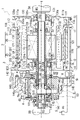
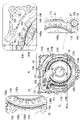
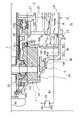
- FIG. 1 is a skeleton diagram of a power transmission device according to an embodiment.
- FIG. 2 is a schematic cross-sectional view of the power transmission device.
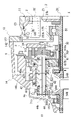
- FIG. 3 is an enlarged view around the planetary reduction gear of the power transmission device.
- FIG. 4 is an enlarged view around the differential mechanism of the power transmission device.
- FIG. 5 is an exploded perspective view of the differential mechanism of the power transmission device.
- FIG. 6 is a diagram illustrating an oil catch portion.
- FIG. 7 is a diagram illustrating an oil catch portion.
- FIG. 8 is a diagram illustrating an oil catch portion.
- FIG. 9 is a diagram illustrating an oil catch portion.
- FIG. 10 is a diagram illustrating an oil catch portion.
- FIG. 11 is a diagram illustrating an oil catch portion.
- FIG. 1 is a skeleton diagram of a power transmission device according to an embodiment.
- FIG. 2 is a schematic cross-sectional view of the power transmission device.
- FIG. 3 is an enlarged view around
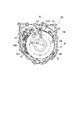
- FIG. 12 is a diagram illustrating a plate member.
- FIG. 13 is a diagram illustrating a plate member.
- FIG. 14 is a view of the fourth box as viewed from the motor side.
- FIG. 15 is a view of the fourth box as viewed from the motor side.
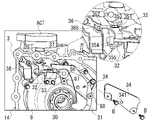
- FIG. 16 is a diagram illustrating a park lock mechanism.
- FIG. 17 is a diagram illustrating a park lock mechanism.
- FIG. 18 is a diagram illustrating a park lock mechanism.
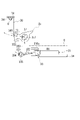
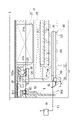
- FIG. 19 is an enlarged view around the strainer below the main body box.
- FIG. 20 is a schematic view showing the arrangement of strainers when the main body box is viewed from above in the vertical direction.
- FIG. 21 is a diagram showing the arrangement of the strainer according to the modified example 1.
- FIG. 20 is a schematic view showing the arrangement of strainers when the main body box is viewed from above in the vertical direction.
- FIG. 21 is a diagram showing the arrangement of the strainer according to the modified example 1.
- FIG. 22 is a schematic view showing the arrangement of strainers when the main body box is viewed from above in the vertical direction.
- FIG. 23 is a schematic diagram showing the arrangement of the strainer according to the modified example 2.
- FIG. 24 is a diagram showing a configuration example of the oil pump according to the modified example 3.
- FIG. 25 is a diagram showing a configuration example of the oil pump according to the modified example 3.
- FIG. 26 is a diagram showing a configuration example of the oil pump according to the modified example 3.
- the second element (part, part, etc.) connected to the first element (part, part, etc.) and the second element (part, part, etc.) connected downstream of the first element (part, part, etc.) Etc.), the second element (parts, parts, etc.) connected upstream of the first element (parts, parts, etc.) means that the first element and the second element are connected so as to be able to transmit power. Means.
- the power input side is upstream and the power output side is downstream.
- the first element and the second element may be connected via other elements (clutch, other gear mechanism, etc.).
- “Overlapping when viewed from a predetermined direction” means that a plurality of elements are lined up in a predetermined direction, and is synonymous with the case of describing "overlapping in a predetermined direction".
- the "predetermined direction” is, for example, an axial direction, a radial direction, a gravity direction, a vehicle traveling direction (vehicle forward direction, vehicle reverse direction), and the like.
- not overlapping when viewed from a predetermined direction and “offset when viewed from a predetermined direction” mean that a plurality of elements are not arranged in a predetermined direction, and "overlap in a predetermined direction". It is synonymous with the case of describing "not” or “offset in a predetermined direction”.
- the "predetermined direction” is, for example, an axial direction, a radial direction, a gravity direction, a vehicle traveling direction (vehicle forward direction, vehicle reverse direction), and the like.
- the first element (part, part, etc.) is located between the second element (part, part, etc.) and the third element (part, part, etc.) when viewed from a predetermined direction," is observed from the predetermined direction. This means that it can be observed that the first element is between the second element and the third element.
- the "predetermined direction" is an axial direction, a radial direction, a gravity direction, a vehicle traveling direction (vehicle forward direction, vehicle reverse direction), and the like.
- vehicle forward direction vehicle reverse direction
- the first element is between the second element and the third element when viewed from a predetermined direction
- the first element is the second element when viewed from a predetermined direction in the description of the specification. It can be considered that there is a sentence explaining that it is between the element and the third element.
- Axial direction means the axial direction of the rotating shaft of the parts constituting the power transmission device.
- the "radial direction” means a direction orthogonal to the axis of rotation of the components constituting the power transmission device.
- the parts are, for example, a motor, a gear mechanism, a differential gear mechanism, and the like.
- FIG. 1 is a skeleton diagram illustrating a power transmission device 1 according to the present embodiment.
- FIG. 2 is a schematic cross-sectional view illustrating the power transmission device 1 according to the present embodiment.
- FIG. 3 is an enlarged view around the planetary reduction gear 4 of the power transmission device 1.
- FIG. 4 is an enlarged view of the power transmission device 1 around the differential mechanism 5.
- the power transmission device 1 includes a motor 2, a planetary reduction gear 4 (reduction mechanism) that decelerates the output rotation of the motor 2 and inputs it to the differential mechanism 5 (differential gear), and a drive shaft DA. , DB, and a park lock mechanism 3.
- the planetary reduction gear 4 and the differential mechanism 5 are gear mechanisms.
- the park lock mechanism 3, the planetary reduction gear 4, the differential mechanism 5, the drive shaft DA, and the DB (drive shaft) are along the transmission path of the output rotation around the rotation shaft X of the motor 2. And are provided.
- the vehicle on which the power transmission device 1 is mounted via the drive shaft DA and DB It is transmitted to the left and right drive wheels W and W.
- the planetary reduction gear 4 is connected to the downstream of the motor 2
- the differential mechanism 5 is connected to the downstream of the planetary reduction gear 4
- the drive shafts DA and DB are downstream of the differential mechanism 5. It is connected to the.
- the main body box 10 (box) of the power transmission device 1 has a first box 11 for accommodating the motor 2 and a second box 12 externally attached to the first box 11.
- the main body box 10 has a third box 13 assembled to the first box 11 and a fourth box 14 assembled to the second box 12.
- the first box 11 has a cylindrical support wall portion 111 and a flange-shaped joint portion 112 provided at one end 111a of the support wall portion 111.
- the first box 11 is provided with the support wall portion 111 oriented along the rotation axis X of the motor 2, and the motor 2 is housed inside the support wall portion 111.
- the joint portion 112 is provided in a direction orthogonal to the rotation axis X, and is formed with an outer diameter larger than that of the support wall portion 111.
- the second box 12 includes a cylindrical peripheral wall portion 121, a flange-shaped joint portion 122 provided at one end 121a of the peripheral wall portion 121, and a flange-shaped joint portion 123 provided at the other end 121b of the peripheral wall portion 121. ,have.
- the peripheral wall portion 121 is formed with an inner diameter that can be extrapolated to the support wall portion 111 of the first box 11.
- the first box 11 and the second box 12 are assembled to each other by extrapolating the peripheral wall portion 121 of the second box 12 to the support wall portion 111 of the first box 11.
- the joint portion 122 on the one end 121a side of the peripheral wall portion 121 is in contact with the joint portion 112 of the first box 11 from the rotation axis X direction. These joints 122 and 112 are connected to each other by bolts (not shown).
- a plurality of concave grooves 111b are provided on the outer periphery of the support wall portion 111.
- the plurality of concave grooves 111b are provided at intervals in the rotation axis X direction.
- Each of the concave grooves 111b is provided over the entire circumference in the circumferential direction around the rotation axis X.
- the peripheral wall portion 121 of the second box 12 is externally inserted into the support wall portion 111 of the first box 11.
- the opening of the concave groove 111b is closed by the peripheral wall portion 121.
- a plurality of cooling passages CP through which the coolant CL passes are formed between the support wall portion 111 and the peripheral wall portion 121.
- a coolant CL introduction port 124a is provided on the joint portion 122 side of the peripheral wall portion 121, and a coolant CL discharge port 124b is provided on the joint portion 123 side.
- the introduction port 124a and the discharge port 124b are holes that penetrate the peripheral wall portion 121 in the radial direction of the rotation axis X, and a pipe (not shown) through which the coolant CL passes is connected to each of them.
- the coolant CL circulates in a pipe (not shown) arranged inside the vehicle by a water pump (not shown).
- the coolant CL is introduced into the cooling path CP from the introduction port 124a and cools the oil OL in the motor chamber Sa described later.
- ring grooves 111c and 111c are formed on both sides of the region where the concave groove 111b is provided.
- Seal rings 113 and 113 are fitted and attached to the ring grooves 111c and 111c. These seal rings 113 are pressed against the inner circumference of the peripheral wall portion 121 extrapolated to the support wall portion 111 to seal the gap between the outer circumference of the support wall portion 111 and the inner circumference of the peripheral wall portion 121.
- the other end 121b of the second box 12 is provided with a beam portion 120 extending from the joint portion 123 toward the inner diameter side.
- the beam portion 120 is provided in a direction orthogonal to the rotation axis X.
- An opening 120a through which the drive shaft DA is inserted is provided in a region of the beam portion 120 that intersects with the rotation axis X.
- a cylindrical motor support portion 125 surrounding the opening 120a is provided on the surface of the beam portion 120 on the motor 2 side (right side in the drawing).
- the motor support portion 125 is inserted inside the coil end 253b described later.
- the motor support portion 125 faces the end portion 21b of the rotor core 21 with a gap in the rotation axis X direction.
- a bearing B1 is supported on the inner circumference of the motor support portion 125.
- the outer circumference of the motor shaft 20 is supported by the motor support portion 125 via the bearing B1.
- a plurality of openings 120b extending in the radial direction of the rotation axis X are formed between the motor support portion 125 and the joint portion 123.
- the plurality of openings 120b are provided at intervals in the circumferential direction of the rotation axis X.
- the inside of the second box 12 and the fourth box 14 communicate with each other through the opening 120b.
- FIG. 2 is shown so that the vertical direction with respect to the mounted state of the power transmission device 1 in the vehicle is along the vertical direction in the figure.
- the peripheral wall portion 121 of the second box 12 is thicker in the radial direction in the lower region in the vertical direction than in the upper region.
- An oil reservoir 128 is provided in this radial thick region so as to penetrate in the rotation axis X direction.
- the oil reservoir 128 communicates with the axial oil passage 138 provided in the joint 132 of the third box 13 via the communication hole 112a provided in the joint 112 of the first box 11.
- the third box 13 has a wall portion 130 orthogonal to the rotation axis X.
- a joint portion 132 forming a ring shape when viewed from the rotation axis X direction is provided on the outer peripheral portion of the wall portion 130.
- the third box 13 is located on the opposite side (right side in the figure) of the differential mechanism 5 when viewed from the first box 11.
- the joint portion 132 of the third box 13 is joined to the joint portion 112 of the first box 11 from the rotation axis X direction.
- the third box 13 and the first box 11 are connected to each other by bolts (not shown). In this state, in the first box 11, the opening of the support wall portion 111 on the joint portion 122 side (right side in the drawing) is closed by the third box 13.
- an insertion hole 130a for the drive shaft DA is provided in the central portion of the wall portion 130.
- a lip seal RS is provided on the inner circumference of the insertion hole 130a.
- a lip portion (not shown) is elastically brought into contact with the outer periphery of the drive shaft DA.
- the gap between the inner circumference of the insertion hole 130a and the outer circumference of the drive shaft DA is sealed by the lip seal RS.
- a peripheral wall portion 131 surrounding the insertion hole 130a is provided on the surface of the wall portion 130 on the first box 11 side (left side in the drawing).
- a drive shaft DA is supported on the inner circumference of the peripheral wall portion 131 via a bearing B4.
- a motor support portion 135 is provided on the motor 2 side (left side in the drawing) when viewed from the peripheral wall portion 131.
- the motor support portion 135 has a cylindrical shape that surrounds the rotation shaft X at intervals.
- a cylindrical connection wall 136 is connected to the outer periphery of the motor support portion 135.
- the connecting wall 136 is formed with an outer diameter larger than that of the peripheral wall portion 131 on the wall portion 130 side (right side in the drawing).
- the connection wall 136 is provided in a direction along the rotation axis X, and extends in a direction away from the motor 2.
- the connection wall 136 connects the motor support portion 135 and the wall portion 130 of the third box 13.
- the motor support portion 135 is supported by the third box 13 via the connection wall 136.
- One end 20a side of the motor shaft 20 penetrates the inside of the motor support portion 135 from the motor 2 side to the peripheral wall portion 131 side.
- a bearing B1 is supported on the inner circumference of the motor support portion 135.
- the outer circumference of the motor shaft 20 is supported by the motor support portion 135 via the bearing B1.
- connection wall 136 is provided with an opening 136a.
- the space (internal space Sc) surrounded by the connecting wall 136 communicates with the motor chamber Sa described later through the opening 136a.
- the fourth box 14 has a peripheral wall portion 141 surrounding the outer periphery of the planetary reduction gear 4 and the differential mechanism 5, and a flange-shaped joint portion 142 provided at the end portion of the peripheral wall portion 141 on the second box 12 side. are doing.
- the fourth box 14 is located on the differential mechanism 5 side (left side in the figure) when viewed from the second box 12.
- the joint portion 142 of the fourth box 14 is joined to the joint portion 123 of the second box 12 from the rotation axis X direction.
- the fourth box 14 and the second box 12 are connected to each other by bolts (not shown).
- a motor chamber Sa accommodating the motor 2 and a gear chamber Sb accommodating the planetary reduction gear 4 and the differential mechanism 5 are formed inside the main body box 10 of the power transmission device 1.
- the motor chamber Sa is formed between the beam portion 120 of the second box 12 and the wall portion 130 of the third box 13 in the first box 11.
- the gear chamber Sb is formed between the beam portion 120 of the second box 12 in the fourth box 14 and the peripheral wall portion 141 of the fourth box 14.
- the motor chamber Sa and the gear chamber Sb communicate with each other through the opening 120b of the beam portion 120.
- An oil OL for lubricating the motor 2, the planetary reduction gear 4, the differential mechanism 5, and the like is sealed inside the main body box 10.
- an oil storage section OP for storing oil OL is formed in the motor chamber Sa and the gear chamber Sb.
- the oil OL of the oil storage portion OP can also flow into the above-mentioned internal space Sc through the opening 136a.
- a plate member 8 (plate) is provided inside the gear chamber Sb.
- the plate member 8 is fixed to the fourth box 14 with bolts B.
- the plate member 8 divides the gear chamber Sb into a first gear chamber Sb1 accommodating the planetary reduction gear 4 and the differential mechanism 5, and a second gear chamber Sb2 accommodating the park lock mechanism 3.
- the second gear chamber Sb2 is located between the first gear chamber Sb1 and the motor chamber Sa in the X direction of the rotation axis.
- the second gear chamber Sb2 communicates with the motor chamber Sa via the opening 120b of the beam portion 120.
- the motor 2 has a motor shaft 20, a rotor core 21 (rotor), and a stator core 25 (stator).
- the motor shaft 20 has a cylindrical shape.
- the drive shaft DA is arranged so as to penetrate the inner circumference of the motor shaft 20.
- the rotor core 21 has a cylindrical shape and is externally attached to the motor shaft 20.
- the stator core 25 is a fixed body located on the radial outer side of the rotor core 21.
- the stator core 25 surrounds the outer circumference of the rotor core 21 at intervals.
- bearings B1 and B1 are extrapolated and fixed on both sides of the rotor core 21.
- the bearing B1 located on the one end 20a side (right side in the drawing) of the motor shaft 20 when viewed from the rotor core 21 is supported on the inner circumference of the motor support portion 135 of the third box 13.
- the bearing B1 located on the other end 20b side is supported by the inner circumference of the cylindrical motor support portion 125 of the second box 12.
- the motor support portions 135 and 125 are arranged on the inner diameter side of the coil ends 253a and 253b, which will be described later, with one end 21a and the other end 21b of the rotor core 21 facing each other with a gap in the rotation axis X direction. ing.
- the rotor core 21 is formed by laminating a plurality of silicon steel plates. Each of the silicon steel plates is extrapolated to the motor shaft 20 in a state where the relative rotation with the motor shaft 20 is restricted.
- the silicon steel plate has a ring shape when viewed from the rotation axis X direction of the motor shaft 20. On the outer peripheral side of the silicon steel plate, magnets of N pole and S pole (not shown) are alternately provided in the circumferential direction around the rotation axis X.
- the stator core 25 surrounding the outer periphery of the rotor core 21 is formed by laminating a plurality of electromagnetic steel sheets.
- the stator core 25 is fixed to the inner circumference of the cylindrical support wall portion 111 of the first box 11.
- Each of the electrical steel sheets has a yoke portion 251, a teeth portion 252, and a coil 253.
- the yoke portion 251 has a ring shape and is fixed to the inner circumference of the support wall portion 111.
- the tooth portion 252 projects from the inner circumference of the yoke portion 251 toward the rotor core 21.
- the coil 253 is formed by winding a winding (not shown) across a plurality of tooth portions 252.
- a known copper wire or the like can be used for the winding forming the coil 253.
- the coil 253 may have a configuration in which windings are distributedly wound around each of a plurality of teeth portions 252 protruding toward the rotor core 21, or a configuration in which windings are centrally wound.
- the length of the coil 253 in the rotation axis X direction is set to be longer than that of the rotor core 21.
- coil ends 253a and 253b located at both ends of the coil 253 in the rotation axis X direction project from the rotor core 21 in the rotation axis X direction, respectively.
- the coil ends 253a and 253b have a symmetrical shape with the tooth portion 252 interposed therebetween.
- the other end 20b side of the motor shaft 20 penetrates the opening 120a provided in the beam portion 120 (motor support portion 125) of the second box 12 to the differential mechanism 5 side (left side in the figure), and the fourth box 14 Located inside.
- the other end 20b of the motor shaft 20 faces the side gear 54A, which will be described later, with a gap in the rotation axis X direction inside the fourth box 14.
- a step portion 201 is provided in a region located in the fourth box 14 of the motor shaft 20.
- the region from the stepped portion 201 of the motor shaft 20 to the vicinity of the other end 20b is a fitting portion 202 provided with a spline on the outer periphery.
- a park gear 30 of the park lock mechanism 3 and a sun gear 41 are spline-fitted on the outer periphery of the fitting portion 202.
- One side surface of the park gear 30 in the rotation axis X direction is in contact with the step portion 201.
- One end 410a of the cylindrical base 410 of the sun gear 41 is in contact with the other side surface of the park gear 30 in the rotation axis X direction.
- a nut N screwed to the other end 20b of the motor shaft 20 is in pressure contact with the other end 410b of the base portion 410 from the rotation axis X direction.
- the sun gear 41 and the park gear 30 are provided so as to be sandwiched between the nut N and the stepped portion 201 so as to be non-rotatable with respect to the motor shaft 20.
- the sun gear 41 has a tooth portion 411 on the outer periphery of the motor shaft 20 on the other end 20b side.
- a large-diameter gear portion 431 of the stepped pinion gear 43 meshes with the outer periphery of the tooth portion 411.
- the stepped pinion gear 43 has a large-diameter gear portion 431 that meshes with the sun gear 41 and a small-diameter gear portion 432 that has a smaller diameter than the large-diameter gear portion 431.
- the stepped pinion gear 43 is a gear component in which a large-diameter gear portion 431 and a small-diameter gear portion 432 are integrally provided side by side in the direction of the axis X1 parallel to the rotation axis X.
- the large-diameter gear portion 431 is formed with an outer diameter R1 larger than the outer diameter R2 of the small-diameter gear portion 432.
- the stepped pinion gear 43 is provided in a direction along the axis X1.
- the large-diameter gear portion 431 of the stepped pinion gear 43 is located on the motor 2 side (on the right side in the figure).
- the outer circumference of the small diameter gear portion 432 meshes with the inner circumference of the ring gear 42.
- the ring gear 42 has a ring shape that surrounds the rotation shaft X at intervals.
- a plurality of engaging teeth 421 protruding outward in the radial direction are provided on the outer periphery of the ring gear 42.
- the plurality of engaging teeth 421 are provided at intervals in the circumferential direction around the rotation axis X.
- the engaging teeth 421 provided on the outer periphery of the ring gear 42 are spline-fitted to the tooth portions 146a provided on the support wall portion 146 of the fourth box 14.
- the ring gear 42 is restricted from rotating around the rotation axis X.
- the stepped pinion gear 43 has a through hole 430 that penetrates the inner diameter side of the large diameter gear portion 431 and the small diameter gear portion 432 in the axis X1 direction.
- the stepped pinion gear 43 is rotatably supported via needle bearings NB and NB on the outer periphery of the pinion shaft 44 penetrating the through hole 430.
- an in-shaft oil passage 440 is provided inside the pinion shaft 44.
- the in-shaft oil passage 440 penetrates from one end 44a of the pinion shaft 44 to the other end 44b along the axis X1.
- the pinion shaft 44 is provided with oil holes 442 and 443 that communicate the in-shaft oil passage 440 and the outer periphery of the pinion shaft 44.
- the pinion shaft 44 is provided with an introduction path 441 for introducing the oil OL into the in-shaft oil passage 440.
- the introduction path 441 communicates with the oil passage 781 in the case formed at the base 71 of the second case portion 7, which will be described later.
- the oil OL scraped up by the differential case 50 flows into the oil passage 781 in the case.
- the oil OL that moves to the outer diameter side due to the centrifugal force due to the rotation of the differential case 50 flows into the oil passage 781 in the case.
- the oil OL that has flowed from the oil passage 781 in the case into the introduction passage 441 flows into the in-shaft oil passage 440 of the pinion shaft 44.
- the oil OL that has flowed into the in-shaft oil passage 440 is discharged radially outward from the oil holes 442 and 443.
- the oil OL discharged from the oil holes 442 and 443 lubricates the needle bearing NB extrapolated to the pinion shaft 44.
- a through hole 444 is provided on the other end 44b side of the region where the introduction path 441 is provided.
- the through hole 444 penetrates the pinion shaft 44 in the diameter line direction.
- the pinion shaft 44 is provided with the through hole 444 and the insertion hole 782 on the second case portion 7 side, which will be described later, in phase with each other around the axis X1.
- the positioning pin P inserted into the insertion hole 782 penetrates the through hole 444 of the pinion shaft 44.
- the pinion shaft 44 is supported on the second case portion 7 side in a state where rotation around the axis X1 is restricted.
- the region protruding from the stepped pinion gear 43 is the first shaft portion 445.
- the first shaft portion 445 is supported by a support hole 61a provided in the first case portion 6 of the differential case 50.
- the region protruding from the stepped pinion gear 43 is the second shaft portion 446.
- the second shaft portion 446 is supported by a support hole 71a provided in the second case portion 7 of the differential case 50.
- first shaft portion 445 means a region on the one end 44a side of the pinion shaft 44 where the stepped pinion gear 43 is not extrapolated.
- the second shaft portion 446 means a region on the other end 44b side of the pinion shaft 44 where the stepped pinion gear 43 is not extrapolated.
- the length of the second shaft portion 446 of the pinion shaft 44 in the axis X1 direction is longer than the length of the first shaft portion 445 in the axis X1 direction.
- FIG. 5 is an exploded perspective view of the differential mechanism 5.
- the differential case 50 of the differential mechanism 5 is formed by assembling the first case portion 6 and the second case portion 7 in the rotation axis X direction.
- the first case portion 6 and the second case portion 7 of the differential case 50 have a function as a carrier for supporting the pinion shaft 44 of the planetary reduction gear 4.
- Three pinion mate gears 52 and three pinion mate shafts 51 are provided between the first case portion 6 and the second case portion 7 of the differential case 50.
- the pinion mate shaft 51 functions as a support shaft for supporting the pinion mate gear 52.
- the pinion mate shafts 51 are provided at equal intervals in the circumferential direction around the rotation axis X.
- the ends of each of the pinion mate shafts 51 on the inner diameter side are connected to each other by a common connecting portion 510.
- the pinion mate gear 52 is extrapolated to each of the pinion mate shafts 51.
- Each of the pinion mate gears 52 is in contact with the connecting portion 510 from the radial outside of the rotating shaft X. In this state, each of the pinion mate gears 52 is rotatably supported by the pinion mate shaft 51.
- the side gear 54A is located on one side of the connecting portion 510 in the rotation axis X direction, and the side gear 54B is located on the other side.
- the side gear 54A is rotatably supported by the first case portion 6.
- the side gear 54B is rotatably supported by the second case portion 7.
- the side gear 54A meshes with the pinion mate gear 52 from one side in the rotation axis X direction.
- the side gear 54B meshes with the pinion mate gear 52 from the other side in the rotation axis X direction.
- the first case portion 6 has a ring-shaped base portion 61.
- An opening 60 is provided in the central portion of the base portion 61.
- a tubular wall portion 611 surrounding the opening 60 is provided on the surface of the base portion 61 opposite to the second case portion 7 (on the right side in the drawing).
- the outer periphery of the cylinder wall portion 611 is supported by the plate member 8 via the bearing B3 (bearing).
- three connecting beams 62 extending toward the second case portion 7 are provided on the surface of the base portion 61 on the second case portion 7 side.
- the connecting beams 62 are provided at equal intervals in the circumferential direction around the rotation axis X.
- the connecting beam 62 has a base portion 63 orthogonal to the base portion 61 and a connecting portion 64 wider than the base portion 63.
- a support groove 65 for supporting the pinion mate shaft 51 is provided on the tip surface of the connecting portion 64.
- An arc portion 641 is formed on the inner diameter side (rotation shaft X side) of the connecting portion 64 in a shape along the outer circumference of the pinion mate gear 52. The arc portion 641 supports the outer circumference of the pinion mate gear 52.
- the gear support portion 66 is connected to the boundary portion between the base portion 63 and the connecting portion 64.
- the gear support portion 66 is provided in a direction orthogonal to the rotation axis X.
- the gear support portion 66 has a through hole 660 in the central portion. The through hole 660 is externally inserted into the tubular wall 541 of the side gear 54A.
- the base 61 is provided with a support hole 61a.
- the support hole 61a is extrapolated to one end 44a of the pinion shaft 44.
- the second case portion 7 has a ring-shaped base portion 71.
- a through hole 70 that penetrates the base 71 in the thickness direction is provided in the central portion of the base 71.
- a slit 710 that penetrates the base 71 in the thickness direction is provided on the inner diameter side of the peripheral wall portion 73.
- a protruding wall 711 is provided between the slits 710 and 710 adjacent to each other in the circumferential direction around the axis of rotation.
- the protruding wall 711 extends linearly in the radial direction of the rotation axis X.
- the protruding wall 711 is provided so as to straddle the peripheral wall portion 73 on the outer diameter side and the tubular wall portion 72 on the inner diameter side.
- bolt accommodating portions 76, 76 recessed on the inner side of the paper surface are provided between the support holes 71a, 71a adjacent to each other in the circumferential direction around the rotation axis X.
- a bolt insertion hole 77 is opened inside the bolt accommodating portion 76. The insertion hole 77 penetrates the base 71 in the thickness direction (rotation axis X direction).
- a connecting portion 74 projecting to the first case portion 6 side is provided on the surface of the base portion 71 on the first case portion 6 side (right side in the drawing).
- a support groove 75 for supporting the pinion mate shaft 51 is provided on the tip surface of the connecting portion 74.
- An arc portion 741 along the outer circumference of the pinion mate gear 52 is provided on the inner diameter side (rotation shaft X side) of the connecting portion 74. The arc portion 741 supports the outer circumference of the pinion mate gear 52.
- a cylindrical cylindrical wall portion 540 is provided on the back surface of the side gear 54B.
- the washer 55 is extrapolated to the cylinder wall portion 540.
- the base 71 of the second case 7 is provided with a guide 78 protruding toward the first case 6 (right side in the drawing).
- the pinion shaft 44 is inserted into the support hole 71a of the guide portion 78 from the first case portion 6 side.
- the bearing B2 is extrapolated to the cylinder wall portion 72 of the second case portion 7.
- the bearing B2 extrapolated to the cylinder wall portion 72 is held by the support portion 145 of the fourth box 14, and the cylinder wall portion 72 of the differential case 50 can be rotated by the fourth box 14 via the bearing B2. It is supported.
- a drive shaft DB penetrating the opening 145a of the fourth box 14 is inserted into the support portion 145 from the rotation axis X direction.
- the drive shaft DB is rotatably supported by the support portion 145.
- a lip seal RS is fixed to the inner circumference of the opening 145a.
- the lip portion (not shown) of the lip seal RS is elastically in contact with the outer periphery of the cylinder wall portion 540 of the side gear 54B extrapolated to the drive shaft DB. As a result, the gap between the outer circumference of the cylinder wall portion 540 of the side gear 54B and the inner circumference of the opening 145a is sealed.
- the first case portion 6 of the differential case 50 is supported by the plate member 8 via a bearing B3 (bearing) extrapolated to the cylinder wall portion 611.
- a drive shaft DA penetrating the insertion hole 130a of the third box 13 is inserted into the inside of the first case portion 6 from the direction of the rotation axis.
- the drive shaft DA is provided across the motor shaft 20 of the motor 2 and the inner diameter side of the sun gear 41 of the planetary reduction gear 4 in the rotation axis X direction.
- the side gears 54A and 54B are spline-fitted on the outer periphery of the tips of the drive shafts DA and DB.
- the side gears 54A and 54B and the drive shafts DA and DB are integrally rotatably connected around the rotation axis X.
- the side gears 54A and 54B are arranged to face each other with a gap in the rotation axis X direction.
- a connecting portion 510 of the pinion mate shaft 51 is located between the side gears 54A and 54B.
- the pinion mate gear 52 is supported by each of the pinion mate shafts 51.
- the pinion mate gear 52 is assembled to the side gear 54A located on one side in the rotation axis X direction and the side gear 54B located on the other side in a state where the teeth are meshed with each other.
- the lower side of the differential case 50 is located in the oil storage unit OP with the power transmission device 1 mounted on the vehicle.
- the oil OL when the connecting beam 62 is located on the lowermost side, the oil OL is stored up to the height at which the connecting beam 62 is located in the oil storage portion OP.
- the oil OL of the oil storage unit OP is scraped up by the differential case 50 that rotates around the rotation axis X when the output rotation of the motor 2 is transmitted.
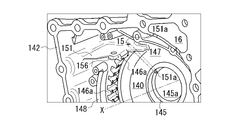
- FIG. 6 to 11 are views for explaining the oil catch portion 15.
- FIG. 6 is a plan view of the fourth box 14 as viewed from the third box 13 side.
- FIG. 7 is a perspective view of the oil catch portion 15 shown in FIG. 6 as viewed from diagonally above.
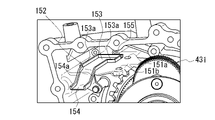
- FIG. 8 is a plan view of the fourth box 14 as viewed from the third box 13 side.
- FIG. 8 shows a state in which the differential case 50 is arranged.
- FIG. 9 is a perspective view of the oil catch portion 15 shown in FIG. 8 as viewed from diagonally above.
- FIG. 10 is a schematic view of a cross section taken along the line AA in FIG. FIG.
- FIG. 11 is a schematic diagram illustrating the positional relationship between the oil catch portion 15 and the differential case 50 (first case portion 6, second case portion 7) when the power transmission device 1 is viewed from above.
- hatching is added to clarify the positions of the joint portion 142 of the fourth box 14 and the support wall portion 146. Further, in FIGS. 6 and 8, the plate member 8 is not shown.
- the fourth box 14 when viewed from the rotation axis X direction is provided with a support wall portion 146 that surrounds the central opening 145a at intervals.
- the inside of the support wall portion 146 (rotation axis X) is the accommodating portion 140 of the differential case 50.
- a space for the oil catch portion 15 and a space for the breather chamber 16 are formed in the upper part of the fourth box 14.
- a communication port 147 is provided in a region intersecting with the vertical line VL.
- the communication port 147 communicates the oil catch portion 15 with the accommodating portion 140 of the differential case 50.
- the oil catch portion 15 and the breather chamber 16 are located on one side (left side in the figure) and the other side (right side in the figure) of the vertical line VL orthogonal to the rotation axis X, respectively.
- the oil catch portion 15 is arranged at a position offset from the vertical line VL passing through the rotation center (rotation axis X) of the differential case 50. Looking at the oil catch portion 15 from above, the oil catch portion 15 is arranged at a position offset from directly above the differential case 50.
- the vertical line VL is a vertical line VL based on the installation state of the power transmission device 1 in the vehicle.
- the vertical line VL seen from the rotation axis X direction is orthogonal to the rotation axis X.
- the horizontal line HL is a horizontal line HL based on the installation state of the power transmission device 1 in the vehicle.
- the horizontal line HL when viewed from the rotation axis X direction is orthogonal to the rotation axis X.
- the oil catch portion 15 is formed so as to extend to the back side of the paper surface from the support wall portion 146.
- a support base portion 151 (shelf portion) is provided on the lower edge of the oil catch portion 15 so as to project toward the front side of the paper surface.
- the support base portion 151 is provided on the front side of the paper surface with respect to the support wall portion 146, and is provided in a range from the joint portion 142 of the fourth box 14 to the back side of the paper surface.
- a communication port 147 is provided on the vertical VL side (right side in the figure) of the oil catch portion 15 when viewed from the rotation axis X direction.
- the communication port 147 is formed by cutting out a part of the support wall portion 146.
- the communication port 147 when viewed from the rotation axis X direction is provided in a range that crosses the vertical line VL from the breather chamber 16 side (right side in the figure) to the oil catch portion 15 side (left side in the figure).
- the differential case 50 rotates in the counterclockwise direction CCW around the rotation axis X when viewed from the third box 13 side. .. Therefore, the oil catch portion 15 is located on the downstream side in the rotation direction of the differential case 50.
- the width of the communication port 147 in the circumferential direction is wider on the left side of the vertical line VL than on the right side.
- the left side of the communication port 147 across the vertical line VL is the downstream side in the rotation direction of the differential case 50
- the right side is the upstream side.
- the outer peripheral position of the rotary orbit of the second shaft portion 446 of the pinion shaft 44 and the outer peripheral position of the rotary orbit of the large diameter gear portion 431 are offset in the radial direction of the rotary shaft X. ing.
- the outer peripheral position of the rotary track of the second shaft portion 446 is located on the inner diameter side of the outer peripheral position of the rotary track of the large diameter gear portion 431. Therefore, the second shaft portion 446 has a spatial margin on the outer diameter side.
- the oil catch portion 15 is provided by utilizing this space, and the space inside the main body box 10 can be effectively used.
- the second shaft portion 446 projects to the back side of the small diameter gear portion 432 when viewed from the motor 2.
- a peripheral member of the second shaft portion 446 (for example, the guide portion 78 of the differential case 50 that supports the second shaft portion 446) is located close to the oil catch portion 15.
- the oil OL lubricating oil
- an end portion on the outer diameter side of the oil hole 151a is opened on the inner side of the support base portion 151.
- the oil hole 151a extends in the fourth box 14 toward the inner diameter side.
- the end portion of the oil hole 151a on the inner diameter side is open to the inner circumference of the support portion 145.
- the end portion of the support portion 145 on the inner diameter side of the oil hole 151a is open between the lip seal RS and the bearing B2.
- an oil guide 152 is mounted on the support base portion 151.
- the oil guide 152 has a catch portion 153 and a guide portion 154 extending from the catch portion 153 to the first box 11 side (front side of the paper surface in FIG. 8).
- the support base portion 151 is located at a position overlapping a part of the differential case 50 (first case portion 6, second case portion 7) on the radial outside of the rotation axis X when viewed from above. It is provided so as to avoid interference with the attached pinion gear 43 (large diameter gear portion 431).
- the catch portion 153 is provided at a position overlapping the second shaft portion 446 of the pinion shaft 44 when viewed from the radial direction of the rotation shaft X.
- the guide portion 154 is provided at a position where the first shaft portion 445 of the pinion shaft 44 and the large diameter gear portion 431 overlap each other.
- a notch portion 155 is provided in the wall portion 153a.
- the cutout portion 155 is provided in a region facing the oil hole 151a. A part of the oil OL stored in the catch portion 153 is discharged from the notch portion 155 toward the oil hole 151a.
- the guide portion 154 is inclined in a downward direction as the distance from the catch portion 153 increases.
- Wall portions 154a and 154a are provided on both sides of the guide portion 154 in the width direction.
- the wall portions 154a and 154a are provided over the entire length of the guide portion 154 in the longitudinal direction.
- the wall portions 154a and 154a are connected to the wall portion 153a surrounding the outer periphery of the catch portion 153. A part of the oil OL stored in the catch portion 153 is also discharged to the guide portion 154 side.
- the guide portion 154 extends to the second box 12 side at a position avoiding interference with the differential case 50 (see FIG. 2).
- the tip 154b of the guide portion 154 is located above the park lock mechanism 3 (see FIG. 2).
- the oil OL that has reached the tip 154b of the guide portion 154 falls downward and is supplied to the park lock mechanism 3 (see FIG. 2).
- a radial oil passage 137 is provided between the joint portions 132 of the wall portions 130 of the third box 13.
- the radial oil passage 137 communicates with the axial oil passage 138 provided in the joint portion 132.
- the axial oil passage 138 communicates with the oil reservoir 128 provided at the lower part of the second box 12 via the communication hole 112a provided at the joint portion 112 of the first box 11.
- the oil sump portion 128 penetrates the inside of the peripheral wall portion 121 in the rotation axis X direction and communicates with the oil storage portion OP of the motor chamber Sa and the gear chamber Sb.
- the disk-shaped plate member 8 is provided in a direction orthogonal to the rotation axis X. As described above, the plate member 8 divides the gear chamber Sb in the fourth box 14 into the first gear chamber Sb1 on the differential case 50 side and the second gear chamber Sb2 on the motor 2 side.
- FIG. 12 and 13 are views illustrating the plate member 8.
- FIG. 12 is a plan view of the plate member 8 as viewed from the motor 2 side.
- FIG. 13 is a schematic view of a cross section taken along the line AA in FIG.
- the plate member 8 has a surface 80a and a surface 80b.
- the surface 80b faces the planetary reduction gear 4 and the differential case 50 (see FIG. 2), which are gear mechanisms.
- the opposite surface 80a (back surface) faces the motor 2 (see FIG. 2).
- the plate member 8 has a ring-shaped base 80 when viewed from the motor 2 side.
- a ring-shaped support portion 801 that surrounds the through hole 800 is provided in the central portion of the base portion 80.
- connection pieces 81, 82, 83, 84 are provided on the outer peripheral edge 80c of the base 80.
- Each of the connecting pieces 81, 82, 83, 84 extends radially outward from the outer peripheral edge 80c of the base 80.
- Bolt holes 81a, 82a, 83a, 84a are provided in the connection pieces 81, 82, 83, and 84, respectively.
- connection piece 81 is provided at a position intersecting the vertical line VL on the upper portion of the plate member 8.
- the connecting piece 81 extends along the vertical line VL in a direction away from the base 80.
- one connection piece 82 and one 83 are provided on the upper side and the lower side of the horizontal line HL, respectively. These connection pieces 82, 83 also extend away from the base 80.
- connection piece 84 is provided below the horizontal line HL.
- the connection piece 84 projects downward from a position below the horizon HL, passing through the lower edge of the connection piece 83 and intersecting a straight line HLa parallel to the horizon HL.
- connection piece 85 On the other side of the vertical line VL (right side in FIG. 12), the connection piece 85 is provided above the horizontal line HL.
- the connection piece 85 is provided in an arc shape having a width in the circumferential direction around the rotation axis X.
- a bolt hole 85a is provided at a position of the connection piece 85 near the vertical line VL.
- a support pin 85b is provided at a position closer to the horizon HL. The support pin 85b projects toward the front side of the paper surface.
- a support boss 86 for a stopper pin 861 (see FIG. 17) is provided on the surface 80a (see FIG. 13) on the motor 2 side of the plate member 8.
- the support boss 86 is provided with a hole 86a (see FIG. 12) through which the stopper pin 861 is inserted.
- the support boss 86 is provided below the connection piece 81 located on the vertical line VL and adjacent to the connection piece 81.
- a mounting boss 87 is provided below the support boss 86.
- the mounting boss 87 is provided at a position where it passes through the support pin 85b and intersects the straight line HLb parallel to the above-mentioned horizontal line HL.
- the mounting boss 87 projects to the front side of the paper surface from the support boss 86.
- a mounting boss 88 paired with the mounting boss 87 is provided below the support pin 85b in the vertical VL direction.
- a mounting portion 89 of the support 33 which will be described later, is provided on the side opposite to the support pin 85b (on the left side in the drawing) when viewed from the mounting boss 87.
- the mounting portion 89 is provided with two bolt holes 89a and 89a adjacent to each other in the horizontal line direction.
- FIG. 14 is a view of the fourth box 14 as viewed from the motor 2 side, and is a diagram illustrating the arrangement of the step portions 148d, 149d, and 17d that support the outer peripheral edge of the plate member 8.
- FIG. 14 in order to clarify the positions of the peripheral wall portions 148, 149 and the arcuate wall portion 17, and the positions of the step portions 148d, 149d, and 17d, they are shown with hatching.
- FIG. 15 is a view of the fourth box 14 as viewed from the motor 2 side, and is a diagram illustrating a state in which the plate member 8 is attached.
- the peripheral wall portion 148 and 149 are provided in the fourth box 14 when viewed from the rotation axis X direction.
- the peripheral wall portions 148 and 149 are provided on the outer diameter side of the region of the support wall portion 146 where the tooth portions 146a are provided.
- the peripheral wall portions 148 and 149 are formed in an arc shape centered on the rotation axis X.
- the peripheral wall portion 148 is located below the oil catch portion 15 described above in the vertical VL direction.
- the peripheral wall portion 148 when viewed from the rotation axis X direction is provided in a range that crosses the horizontal line HL passing through the rotation axis X from the upper side to the lower side.
- the upper end portion 148a of the peripheral wall portion 148 is located in the vicinity of the support base portion 151.
- the lower end 148b of the peripheral wall portion 148 is located in the vicinity of the straight line HLa.
- the inner circumference 148c of the peripheral wall portion 148 when viewed from the rotation axis X direction has an arc shape along the outer periphery of the plate member 8 (base portion 80) described above.
- the inner diameter of the inner circumference 148c of the peripheral wall portion 148 is slightly larger than the outer diameter of the plate member 8.
- the inner diameter of the inner circumference 148c and the outer diameter of the plate member 8 are based on the rotation axis X.
- a stepped portion 148d recessed on the back side of the paper surface is provided inside the peripheral wall portion 148.
- a boss portion 18 having a bolt hole 18a is formed integrally with the peripheral wall portion 148.
- the boss portion 18 is provided in the vicinity of the upper end portion 148a side of the peripheral wall portion 148 and the lower end portion 148b.
- the boss portions 18 and 18 project to the front side of the paper surface from the peripheral wall portion 148.
- the peripheral wall portion 149 is located below the breather chamber 16 described above.
- the peripheral wall portion 149 is located on the back side of the paper surface with respect to the wall portion 160 that divides the breather chamber 16.
- the upper end portion 149a of the peripheral wall portion 149 when viewed from the rotation axis X direction is connected to the boss portion 18 on the vertical line VL.
- a side wall portion 159 extending toward the oil catch portion 15 is further connected to the boss portion 18.
- the lower end 149b of the peripheral wall portion 149 is connected to the peripheral wall portion 141 of the fourth box 14 on the lower side of the breather chamber 16.
- the inner circumference 149c of the peripheral wall portion 149 when viewed from the rotation axis X direction has an arc shape along the outer periphery of the plate member 8 (base portion 80) described above.
- the inner diameter of the inner circumference 149c of the peripheral wall portion 149 is slightly larger than the outer diameter of the plate member 8.
- the inner diameter of the inner circumference 149c and the outer diameter of the plate member 8 are based on the rotation axis X.
- a stepped portion 149d recessed on the inner side of the paper surface is provided inside the peripheral wall portion 149.
- boss portions 18 and 18 having bolt holes 18a are integrally formed with the peripheral wall portion 149.
- the boss portions 18 and 18 are provided at intervals in the circumferential direction around the rotation axis X.
- the boss portion 18 is provided on the outer periphery of the upper end portion 148a of the peripheral wall portion 149 and the outer periphery of the region located below the breather chamber 16. The boss portions 18 and 18 project to the front side of the paper surface from the peripheral wall portion 149.
- an arc-shaped wall portion 17 is provided in a region below the breather chamber 16 and below the horizontal line HL.
- the arc-shaped wall portion 17 is provided at a position shifted in phase by approximately 180 ° with respect to the peripheral wall portion 148 in the circumferential direction around the rotation axis X.
- the inner circumference 17c of the arcuate wall portion 17 when viewed from the rotation axis X direction has an arc shape along the outer periphery of the plate member 8 (base portion 80) described above.
- the inner diameter of the inner circumference 17c of the arc-shaped wall portion 17 is slightly larger than the outer diameter of the plate member 8.
- the inner diameter of the inner circumference 17c and the outer diameter of the plate member 8 are based on the rotation axis X.
- a boss portion 18 having a bolt hole 18a is formed at a position intersecting the straight line HLa described above. The boss portion 18 projects toward the front side of the paper surface with respect to the arc-shaped wall portion 17.
- a step portion 17d is provided on the inner circumference of the boss portion 18 so as to project in the rotation axis X direction.
- the outer peripheral edge of the plate member 8 (base 80) is attached to the peripheral wall portions 148, 149 step portions 148d, 149d, and the arc-shaped wall portion 17 step portion. It is brought into contact with 17d from the rotation axis X direction. Subsequently, the plate member 8 is fixed to the fourth box 14 by screwing the bolt B penetrating the bolt holes 81a to 85a of the connection pieces 81 to 85 into the bolt holes 18a of the corresponding boss portion 18 ( See FIGS. 15 and 16).
- FIG. 16 is a perspective view of the fourth box 14 provided with the park lock mechanism 3 as viewed from diagonally above.
- FIG. 17 is a plan view of the fourth box 14 provided with the park lock mechanism 3 as viewed from the motor 2 side.
- FIG. 18 is a view of the park lock mechanism 3 as viewed from above.
- the park lock mechanism 3 includes a park gear 30, a park pole 31, a park rod 32, a support 33, a holder 34, a manual plate 35, a detent spring 36, a manual shaft 37, and the like. have.
- the park lock mechanism 3 is a park-by-wire type park lock mechanism.
- the park lock mechanism 3 rotates the manual shaft 37 around the rotation axis Y (see FIG. 18) by the actuator ACT. Let me.
- the park gear 30, the park pole 31, the park rod 32, the support 33, and the holder 34 are located on the motor 2 side (lower side in FIG. 18) of the plate member 8.
- the manual plate 35, the detent spring 36, and the manual shaft 37 are located on the opposite side.
- the holder 34 is a plate-shaped member.
- the holder 34 includes a protrusion 341 for supporting the park pole 31. As shown in FIGS. 16 and 17, the park pole 31 is supported by the plate member 8 via the holder 34.
- the park pole 31 is an integral part having a first plate-shaped portion 310 having an insertion hole 310d and a second plate-shaped portion 311 having a claw portion 311c.
- a protrusion 341 on the holder 34 side is inserted into the insertion hole 310d of the park pole 31.
- the park pole 31 is rotatably supported by the protrusion 341.
- the park pole 31 is rotatable around an axis X2 parallel to the axis of rotation X.
- the first plate-shaped portion 310 when viewed from the rotation axis X direction extends upward from the region supported by the protrusion 341 along the straight line Lx1 orthogonal to the axis X2.
- the first plate-shaped portion 310 extends to a position substantially the same height as the support boss 86 of the plate member 8, and then bends in a direction away from the breather chamber 16 (to the left in the figure).
- the region beyond the bent portion 310e extends along the straight line Lx2.
- the tip end side of this region is the operated portion 310c operated by the cam 320 of the park rod 32.
- the operated portion 310c is mounted on the cam 320 supported by the support 33.
- a claw portion 311c is provided at the lower portion of the second plate-shaped portion 311 when viewed from the rotation axis X direction.
- the claw portion 311c is an engaging portion with the park gear 30.
- the claw portion 311c is formed so as to bulge from the lower portion of the second plate-shaped portion 311 toward the rotation axis X side.
- a locking hole 310f is provided on the side of the insertion hole 310d.
- One end of the spring Sp extrapolated to the support pin 85b of the plate member 8 is engaged with the locking hole 310f.
- the park pole 31 is always urged in the direction of separating the claw portion 311c from the park gear 30 (counterclockwise direction in FIG. 17: see the arrow) by the urging force acting from the spring Sp.
- the first plate-shaped portion 310 of the park pole 31 is arranged between the holder 34 and the plate member 8 in the rotation axis X direction.
- the second plate-shaped portion 311 is located on the motor 2 side (on the right side in the figure) with respect to the first plate-shaped portion 310.
- the second plate-shaped portion 311 extends downward with the inner diameter side of the holder 34.
- the park rod 32 is provided so as to be orthogonal to the rotation axis X and along the straight line Lx3 passing above the horizontal line HL when viewed from the rotation axis X direction.
- the park rod 32 is provided with the tip side on which the cam 320 is extrapolated toward the park pole 31 side (breather chamber 16 side).
- the cam 320 is inserted between the support 33 and the operated portion 310c of the park pole 31.
- the engaging position is a position where the claw portion 311c is engaged with the outer periphery of the park gear 30.
- the park pole 31 When the park rod 32 is displaced in the direction of pulling out the cam 320 (leftward in FIG. 18) from between the support 33 and the operated portion 310c of the park pole 31, the park pole 31 is displaced by the urging force of the spring Sp. It rotates in the counterclockwise direction at 17.
- the park pole 31 rotated in the counterclockwise direction is arranged at the detached position.
- the detachment position is a position where the claw portion 311c is detached from the outer periphery of the park gear 30.
- the other end 32b of the park rod 32 is supported by the connecting portion 355 of the manual plate 35.
- the park rod 32 is provided so as to be displaced in the axial direction while being prevented from falling off from the connecting portion 355.
- the manual plate 35 has a base portion 351 and an arm portion 353 and an engaging portion 352.
- the base 351 is externally attached to the manual shaft 37.
- the arm portion 353 and the engaging portion 352 extend from the outer periphery of the base portion 351 in the radial direction of the rotation axis Y of the manual shaft 37.
- the base portion 351 is fixed to the manual shaft 37 in a state where the relative rotation with the manual shaft 37 is restricted.
- the arm portion 353 extends from the outer periphery of the base portion 351 in a direction approaching the motor 2. When viewed from the radial direction of the rotation shaft X, the arm portion 353 crosses the outer diameter side of the plate member 8 toward the motor 2.
- the tip end side of the arm portion 353 is bent to the lower side (rotation shaft) side, and then the connecting portion 355 is connected to the support portion 354 fixed to the upper surface.
- the base end portion 361 of the detent spring 36 in the longitudinal direction is fixed to the fourth box 14 with bolts B.
- the tip end side of the detent spring 36 provided with the roller 365 can be elastically displaced in the radial direction of the base portion 351 of the manual plate 35.
- the tip end side of the detent spring 36 is in pressure contact with the outer periphery (recess) of the base portion 351 of the manual plate 35.
- the manual shaft 37 rotates around the rotation axis Y in conjunction with the switching of the traveling mode / parking mode of the vehicle equipped with the power transmission device 1.
- the manual plate 35 fixed to the manual shaft 37 also rotates around the rotation axis Y.
- the arm portion 353 extending from the base portion 351 of the manual plate 35 and the connecting portion 355 fixed to the support portion 354 at the tip of the arm portion 353 are displaced in the circumferential direction around the rotation axis Y.
- the park rod 32 connected to the connecting portion 355 is also displaced in the longitudinal direction of the park rod 32.
- the plate member 8 is arranged so as to be sandwiched between the motor 2 and the gear mechanism including the planetary reduction gear 4 and the differential mechanism 5 in the rotation axis X direction (axial direction).
- a strainer 90 is arranged adjacent to the plate member 8.
- adjacent means a state in which the strainer 90 is arranged near the plate member 8.
- the strainer 90 may be in contact with the plate member 8 or may be arranged at a distance from the plate member 8.
- FIG. 2 schematically shows the strainer 90.
- the strainer 90 is fixed in the main body box 10 by a fixture or the like (not shown).
- FIG. 19 is an enlarged view around the strainer 90 below the main body box 10.
- FIG. 20 is a schematic view showing the arrangement of the strainer 90 when the main body box 10 is viewed from above in the vertical direction.
- the strainer 90 is arranged on the surface 80a (opposing surface) side of the plate member 8.
- the surface 80a of the plate member 8 is a surface facing the motor 2 at a distance in the rotation axis X direction.
- the surface 80a is the back surface of the surface 80 facing the planetary reduction gear 4 and the differential mechanism 5 (gear mechanism).
- the strainer 90 is arranged so as to overlap the plate member 8 in the X direction of the rotation axis.
- the strainer 90 is arranged below the main body box 10 between the plate member 8 and the stator core 25 of the motor 2. That is, the strainer 90 is arranged in the second gear chamber Sb2, and is separated from the planetary reduction gear 4 and the differential mechanism 5 arranged in the first gear chamber Sb1 by a plate member 8.
- the strainer 90 includes a main body 91 and a suction port 92 (pump inlet).
- the main body 91 is, for example, a hollow container, and a filter F for filtering oil OL is arranged inside.
- the suction port 92 can be, for example, a tubular member that projects downward from the lower surface of the main body 91.
- the suction port 92 is immersed in the oil OL of the oil storage portion OP. That is, the suction port 92 is submerged in oil.
- the oil OL is introduced into the main body 91 via the suction port 92.
- the suction port 92 of the strainer 90 is provided on the motor 2 side of the main body 91.
- the longitudinal direction of the main body 91 of the strainer 90 intersects the rotation axis X direction and extends along the axis Y1 direction orthogonal to the vertical direction. That is, the strainer 90 extends in a direction (axis Y1 direction) between the motor 2 and the gear mechanism (planetary reduction gear 4 and the differential mechanism 5) to avoid interference with each other.
- the main body 91 of the strainer 90 is arranged offset from the planetary reduction gear 4 and the differential mechanism 5 in the rotation axis X direction.
- the main body 91 of the strainer 90 is located on the outer diameter side of the planetary reduction gear 4 and the differential mechanism 5, and is arranged offset from the planetary reduction gear 4 and the differential mechanism 5 in the radial direction of the rotation axis X. .. In other words, the main body 91 of the strainer 90 does not overlap with the planetary reduction gear 4 and the differential mechanism 5 (gear mechanism) in the radial direction of the rotation axis X.
- the second gear chamber Sb2 in which the strainer 90 is arranged communicates with the motor chamber Sa in which the motor 2 is arranged via the opening 120b.
- the main body 91 of the strainer 90 is located near the coil end 251b of the motor 2 and is located below the coil end 251b in the vertical direction.
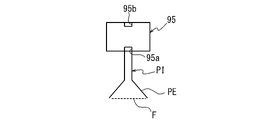
- the strainer 90 is connected to the suction port 95a of the oil pump 95 (pump) provided outside the main body box 10 via the piping PI.
- the oil pump 95 for example, an electric oil pump driven by a motor (not shown) can be used.
- the discharge port 95b of the oil pump 95 is provided in oil holes Ha, Hb, Hc (see FIG. 2) formed in the upper part of the main body box 10 via pipes (not shown), an oil passage, etc. arranged inside the vehicle. You are connected.
- the oil hole Ha is the upper part of the fourth box 14 and is formed on the outer diameter side of the differential case 50.
- the oil hole Hb is the upper part of the second box 12 and is formed on the outer diameter side of the coil end 251b of the motor 2.
- the oil hole Hc is formed in the upper part of the third box 13 in the vicinity of the coil end 253a of the motor 2.
- a planetary reduction gear 4 As shown in FIG. 1, in the power transmission device 1, a planetary reduction gear 4, a differential mechanism 5, a drive shaft DA, and a DB are provided along a transmission path of the output rotation of the motor 2.
- the sun gear 41 is an input unit for the output rotation of the motor 2.
- the differential case 50 that supports the stepped pinion gear 43 is the output unit of the input rotation.
- the stepped pinion gear 43 (large diameter gear portion 431, small diameter gear portion 432) rotates around the axis X1 by the rotation input from the sun gear 41 side. do.
- the small-diameter gear portion 432 of the stepped pinion gear 43 meshes with the ring gear 42 fixed to the inner circumference of the fourth box 14. Therefore, the stepped pinion gear 43 revolves around the rotation axis X while rotating around the axis X1.
- the outer diameter R2 of the small diameter gear portion 432 is smaller than the outer diameter R1 of the large diameter gear portion 431 (see FIG. 3).
- the differential case 50 first case portion 6, second case portion 7) that supports the stepped pinion gear 43 rotates around the rotation axis X at a rotation speed lower than the rotation input from the motor 2 side. Therefore, the rotation input to the sun gear 41 of the planetary reduction gear 4 is greatly decelerated by the stepped pinion gear 43. The decelerated rotation is output to the differential case 50 (differential mechanism 5).
- an oil storage section OP in which the oil OL for lubrication is stored is formed inside the motor chamber Sa and the gear chamber Sb.
- the oil OL stored in the oil storage unit OP is scraped up by the rotation of the motor 2 to cool the motor 2. Further, a part of the scraped oil OL also flows into the internal space Sc through the opening 136a of the connection wall 136, and lubricates the bearings B1 and B4.
- the oil OL stored in the oil storage unit OP is scraped up by the differential case 50 that rotates around the rotation axis X. Due to the oil OL scraped up, the meshing portion between the sun gear 41 and the large diameter gear portion 431, the meshing portion between the small diameter gear portion 432 and the ring gear 42, and the meshing portion between the pinion mate gear 52 and the side gears 54A and 54B. Is lubricated.
- the differential case 50 rotates in the counterclockwise direction CCW about the rotation axis X when viewed from the third box 13 side.
- An oil catch portion 15 is provided on the upper portion of the fourth box 14.
- the oil catch portion 15 is located on the downstream side in the rotation direction of the differential case 50.
- Most of the oil OL scraped up by the differential case 50 flows into the oil catch portion 15 and is supplied to the oil guide 152 mounted on the support base portion 151 in the oil catch portion 15.
- a part of the oil OL supplied to the oil guide 152 falls from the tip 154b and lubricates the park gear 30 and the like (see FIG. 3) of the park lock mechanism 3 located below.
- the strainer 90 is arranged in the oil storage portion OP in the second gear chamber Sb2.
- the oil OL of the oil storage unit OP is sucked through the suction port 92 of the strainer 90.
- the oil OL introduced into the main body 91 of the strainer 90 passes through the filter F to filter impurities.
- the filtered oil OL is sucked into the suction port 95a of the oil pump 95 via the pipe PI and discharged from the discharge port 95b.
- the oil OL discharged from the discharge port 95b is supplied to the oil holes Ha, Hb, and Hc (see FIG. 2) inside the main body box 10, respectively.
- the oil OL supplied to the oil hole Ha is supplied to the planetary reduction gear 4 and the differential case 50 in the fourth box 14.
- the oil OL supplied to the oil hole Hb is supplied to the coil end 253b side of the motor 2 and the park lock mechanism 3.
- the oil OL supplied to the oil hole Hc is supplied to the coil end 253a side of the motor 2.
- the power transmission device 1 includes a mechanism for filtering and circulating the oil OL used for lubrication and cooling of each component.
- the planetary reduction gear 4 and the differential mechanism 5 are arranged so as to face the surface 80b of the plate member 8 in the rotation axis X direction.
- the suction port 95a of the strainer 90 is arranged adjacent to the plate member 8 on the surface 80a side which is the facing surface of the surface 80b of the plate member 8. That is, the suction port 95a of the strainer 90 is arranged in a space (second gear chamber Sb2) separated from the space (first gear chamber Sb1) in which the planetary reduction gear 4 and the differential mechanism 5 which are gear mechanisms are arranged. ing.
- the suction port 92 of the strainer 90 is located in the vicinity of the differential case 50.
- the differential case 50 rotates to scrape up the oil OL of the oil storage portion OP, the amount of oil in the vicinity of the differential case 50 may decrease. If the oil pump 95 is operated in this state, the suction port 92 of the strainer 90 sucks air, which may affect the suction performance of the oil pump 95.
- the first gear chamber Sb1 and the second gear chamber Sb2 are adjacent to each other, but are separated by a plate member 8. Therefore, although the strainer 90 of the second gear chamber Sb2 is located near the differential case 50, even if the differential case 50 scoops up the oil OL, the amount of oil in the vicinity of the suction port 92 of the strainer 90 is not easily affected. .. As a result, it is possible to reduce the suction of air by the suction port 92. Further, since the strainer 90 is arranged offset with respect to the differential case 50 in the rotation axis X direction and the radial direction of the rotation axis X, the influence of the oil OL of the differential case 50 being scraped up can be further reduced. .. Further, it is possible to prevent the strainer 90 from interfering with the differential case 50 which is a rotating body.
- the second gear chamber Sb2 in which the strainer 90 is arranged and the motor chamber Sa communicate with each other through the opening 120b of the beam portion 120.
- the oil OL heated by the stator core 25 of the motor 2 which is a heat source is discharged from the opening 120b (discharge port) and stored in the oil storage section OP of the second gear chamber Sb2. Therefore, the suction port 92 of the strainer 90 located in the second gear chamber Sb2 can easily suck the oil OL warmed by the stator core 25. At low temperatures, the viscosity of the oil OL tends to increase.
- the suction port 92 of the strainer 90 By arranging the suction port 92 of the strainer 90 near the motor 2, the increase in the viscosity of the oil OL near the suction port 92 can be reduced and the suction performance of the oil pump 95 can be improved even at a low temperature. Further, the strainer 90 is located near the coil end 251b of the motor 2 and is located below the coil end 251b in the vertical direction. Therefore, the oil OL heated by the coil end 251b tends to move to the strainer 90 side due to gravity.
- the power transmission device 1 has the following configuration.
- the power transmission device 1 is Motor 2 and The planetary reduction gear 4 and the differential mechanism 5 (gear mechanism) connected to the downstream of the motor 2 and A drive shaft DA (drive shaft) connected to the downstream of the planetary reduction gear 4 and the differential mechanism 5 (gear mechanism) and arranged so as to penetrate the inner circumference of the motor 2.
- An oil pump 95 in which oil OL is sucked through the suction port 92 (pump inlet) of the strainer 90, and It has a planetary reduction gear 4 and a differential mechanism 5 (gear mechanism), and a plate member 8 (plate) having a surface 80b (opposing surface) facing the rotation axis X direction (axial direction).
- the suction port 92 (pump inlet) of the strainer 90 is arranged adjacent to the plate member 8 (plate) on the surface 80a (back surface of the facing surface) side.
- the plate member 8 separates the space where the planetary reduction gear 4 and the differential mechanism 5 (gear mechanism) are arranged from the space where the suction port 92 (pump inlet) of the strainer 90 is arranged.
- the power transmission device 1 having a drive shaft DA (drive shaft) arranged so as to penetrate the inner circumference of the motor 2 has an advantage that expansion in the radial direction can be reduced.
- a drive shaft DA drive shaft
- the power transmission device 1 tends to expand in the radial direction of the rotation shaft X, and the advantage of the configuration in which the drive shaft DA is arranged so as to penetrate the inner circumference of the motor 2 tends to be diminished.
- the method of the embodiment in which the space is separated by the plate member 8 reduces the amount of oil in the vicinity of the suction port 92 while taking advantage of the configuration in which the drive shaft DA is arranged so as to penetrate the inner circumference of the motor 2. Can be reduced.
- the "pump inlet” is in contact with the oil sump, that is, is immersed in the oil sump and is connected to the suction port 95a of the oil pump 95.
- the suction port 92 of the strainer 90 corresponds to the “pump inlet”.
- the suction port 95a of the oil pump 95 is in direct contact with (immersed in) the oil sump, the suction port 95a of the oil pump 95 corresponds to the "pump inlet”. This case will be described in Modification 1 described later.
- the “gear mechanism” is the entire mechanism including the gears.
- the gear mechanism includes a planetary reduction gear 4 and a differential mechanism 5 (differential gear).
- Connected downstream means that there is a connection relationship in which power is transmitted from the parts arranged upstream to the parts arranged downstream.
- planetary reduction gear 4 connected downstream of the motor 2 means that power is transmitted from the motor 2 to the planetary reduction gear 4.
- a gear mechanism may be connected downstream of the motor 2 via a transmission mechanism, a clutch, or the like.
- the power of the motor 2 is transmitted to the gear mechanism via the speed change mechanism, the clutch, and the like.
- the speed change mechanism is a mechanism having a speed change function, and includes, for example, a stepped speed change mechanism and a stepless speed change mechanism.
- a “power transmission device” is a power train device (transmission, speed reducer, etc.) equipped with a rotary electric machine.
- the plate member 8 (plate) is arranged so as to be sandwiched between the motor 2 and the planetary reduction gear 4 and the differential mechanism 5 (gear mechanism) in the rotation axis X direction (axial direction).
- the plate member 8 is arranged on the motor 2 side with respect to the planetary reduction gear 4 and the differential mechanism 5, and the suction port 92 of the strainer 90 is arranged between the motor 2 and the plate member 8.
- the suction port 92 (pump inlet) is arranged at a position close to the motor 2 which is a heat source, the oil OL around the suction port 92 is heated by the motor 2.
- the oil pump 95 can easily suck the oil OL even at a low temperature where the viscosity of the oil OL tends to be high, and the suction performance of the oil pump 95 can be improved.
- the pump inlet is configured as a suction port 92 of the strainer 90.
- the capacity of the oil OL to be filtered can be increased according to the volume of the strainer 90. This makes it easier to adjust the discharge amount of the oil OL of the oil pump 95, so that the power transmission device 1 can provide an efficient oil OL circulation mechanism.
- the main body 91 of the strainer 90 does not overlap the planetary reduction gear 4 and the differential mechanism 5 (gear mechanism) in the radial direction (diameter direction) of the rotating shaft X.
- the power transmission device 1 has a bearing B3 (bearing) supported by the plate member 8 (plate).
- the planetary reduction gear 4 and the differential mechanism 5 are supported by the plate member 8 (plate) via the bearing B3 (bearing).
- the outer periphery of the cylinder wall portion 611 of the first case portion 6 of the differential case 50 is supported by the plate member 8 via the bearing B3.
- the bearing B3 By imparting the function of supporting the bearing B3 to the plate member 8, it is not necessary to provide another member for supporting the bearing B3, and the number of parts of the power transmission device 1 can be reduced. That is, it is not necessary to provide another member to support the bearing.
- the power transmission device 1 has a park pole 31 supported by a plate member 8 (plate). By imparting the function of supporting the park pole 31 of the park lock mechanism 3 to the plate member 8, it is not necessary to separately provide a member for supporting the park pole 31, and the number of parts of the power transmission device 1 can be reduced.
- the gear mechanism includes a planetary reduction gear 4. As described above, the gear mechanism means the entire mechanism including the gear, but in the embodiment, the planetary reduction gear 4 is included as the gear mechanism.
- FIG. 21 is a diagram showing the arrangement of the strainer 90 according to the modified example 1.
- FIG. 22 is a schematic view showing the arrangement of the strainer 90 when the main body box 10 is viewed from above in the vertical direction.
- the strainer 90 is arranged between the planetary reduction gear 4 and the differential mechanism 5 and the motor 2 (see FIG. 19). Further, the longitudinal direction of the main body 91 of the strainer 90 extends in the axis Y1 direction intersecting the rotation axis X (see FIG. 20).
- the strainer 90 is arranged in the oil reservoir 128 provided under the motor chamber Sa.
- the suction port 92 is located in the vicinity of the second gear chamber Sb2 in the oil reservoir 128.
- the main body 91 of the strainer 90 overlaps the motor 2 on the radial side of the rotation axis X on the lower side of the motor 2.
- the main body 91 is separated from the planetary reduction gear 4 and the differential mechanism 5 by the plate member 8.
- the main body 91 does not overlap the planetary reduction gear 4 and the differential mechanism 5 in the radial direction of the rotation shaft X.
- the longitudinal direction of the main body 91 of the strainer 90 extends along the rotation axis X direction.
- the main body 91 of the strainer 90 is slid and arranged on the outer circumference (outside in the radial direction) of the motor 2 to reduce the expansion of the power transmission device 1 in the rotation axis X direction. be able to.
- the capacity of the strainer 90 can also be secured by extending the longitudinal direction of the main body portion 91 in the rotation axis X direction.
- the main body 91 extends not only to the stator core 25 of the motor 2 but also to a position where it overlaps with the rotor core 21, but the present invention is not limited to this.
- the main body 91 may be arranged so as to extend at least to a position where it overlaps with the stator core 25.
- the oil OL used for cooling and lubricating the motor 2 is discharged from the opening 120b.
- a part of the discharged oil OL flows into the oil reservoir 128 through the second gear chamber Sb2. Therefore, as in the embodiment, in the first modification, the oil OL heated by the motor 2 which is the heat source is sucked into the suction port 92 of the strainer.
- the oil pump 95 can easily suck the oil OL even at a low temperature where the viscosity of the oil OL tends to be high, and the discharge performance of the oil pump 95 can be improved.
- the power transmission device 1 of the modified example 1 has the following configuration.
- the motor 2 has a rotor core 21 (rotor) and a stator core 25 (stator) located outside the rotary axis X of the rotor core 21 (rotor) in the radial direction (diameter direction).
- the main body 91 of the strainer 90 overlaps the motor 2 and the rotation axis X on the radial (diameter) outer side.
- the main body 91 of the strainer 90 overlaps the rotor core 21 (rotor) of the motor 2 and the radial (diameter) outer side of the rotation shaft X.
- the capacity of the strainer 90 is increased and the performance of filtering oil OL is improved. Can be improved.
- FIG. 23 is a schematic diagram showing the arrangement of the strainer 90 according to the modified example 2. As shown in FIG. 23, in the modification 2, a plate member 900 is provided separately from the planetary reduction gear 4 and the plate member 8 arranged between the differential mechanism 5 and the motor 2, and the strainer 90 is used as the plate member 900. It is placed adjacent to.
- the plate member 900 is arranged on the opposite side of the planetary reduction gear 4 and the differential mechanism 5 from the plate member 8.
- the surface 900a of the plate member 900 faces the planetary reduction gear 4 and the differential case 50.
- the strainer 90 is arranged on the surface 900b side, which is the surface on the back side of the surface 900a. Similar to the embodiment, the strainer 90 is connected to the oil pump 95 by a pipe PI or the like.
- An oil storage portion OP is also formed in the space on the surface 900b side inside the main body box 10, and the suction port 92 of the strainer 90 is submerged in oil. By operating the oil pump 95, the suction port 92 sucks the oil OL.
- the plate member 900 separates the space where the planetary reduction gear 4 and the differential mechanism 5 which are gear mechanisms are arranged and the space where the suction port 92 of the strainer 90 which is a pump inlet is arranged. There is.
- the main body 91 of the strainer 90 does not overlap the planetary reduction gear 4 and the differential mechanism 5 in the radial direction of the rotation axis X. Therefore, as in the embodiment, in the second modification, the decrease in the amount of oil due to the scraping of the differential case 50 of the differential mechanism 5 is reduced in the vicinity of the suction port 92 of the strainer 90. This makes it possible to reduce the air suction of the oil pump 95.
- Modification 3 24 to 26 are views showing a configuration example of the oil pump 95 according to the modified example 3.
- the mechanism for filtering and circulating the oil OL in the power transmission device 1 is composed of an oil pump 95 and a strainer 90 has been described (see FIG. 2).
- the circulation mechanism of the oil OL is not limited to the example of the embodiment, and for example, the strainer 90 may be omitted.
- the filter F for filtering impurities may be arranged inside the pipe PI connected to the suction port 95a of the oil pump 95.
- the oil pump 95 when the oil pump 95 is driven, the oil OL is sucked from the end PE of the pipe PI, passes through the filter F, and is sucked into the suction port 95a of the oil pump 95. That is, the end PE of the pipe PI corresponds to the "pump inlet".
- FIG. 25 is also an example in which the end PE of the pipe PI corresponds to the “pump inlet” as in FIG. 24, but in FIG. 25, the diameter of the end PE of the pipe PI is enlarged and the filter F is applied to the end PE. Is placed. By configuring as shown in FIG. 25, the size of the filter F can be increased.
- the oil pump 95 and the piping PI may be arranged in the second gear chamber Sb2 (see FIG. 19).
- only a part of the piping PI including the end PE may be arranged in the second gear chamber Sb2, and the oil pump 95 may be arranged outside the main body box 10.
- FIG. 26 is an example in which the piping is also omitted, and the filter F for filtering the oil OL is directly arranged at the suction port 95a of the oil pump 95.
- the oil pump 95 can be arranged in the second gear chamber Sb2 (see FIG. 19).
- FIGS. 24 to 26 can be applied not only to the embodiments but also to the first and second modifications.
- the oil pump 95 and the piping PI When applied to the first modification (see FIG. 21), the oil pump 95 and the piping PI may be arranged in the oil reservoir 128. Alternatively, only a part of the piping PI including the end PE may be arranged in the oil reservoir 128, and the oil pump 95 may be arranged outside the main body box 10.
- the oil pump 95 and the piping PI may be arranged on the surface 900b side of the plate member 900 in the main body box 10. Alternatively, only a part of the piping PI including the end PE may be arranged on the surface 900b side of the plate member 900, and the oil pump 95 may be arranged outside the main body box 10.
- an electric oil pump is used as the oil pump 95
- a mechanical oil pump may be used.
- the mechanical oil pump may be arranged, for example, in the motor chamber Sa of the main body box 10 and may be driven by utilizing the rotation of the motor 2.
- Power transmission device 2 Motor 4: Planetary reduction gear (gear mechanism) 5: Differential mechanism (gear mechanism) 8,900: Plate member (plate) 8a: Surface (opposing surface) 8b: Surface (rear surface of facing surface) 90: Strainer 91: Main body 92: Suction port (pump inlet) 95: Oil pump (pump) DA, DB: Drive shaft (drive shaft) B3: Bearing
Landscapes
- Engineering & Computer Science (AREA)
- General Engineering & Computer Science (AREA)
- Mechanical Engineering (AREA)
- Power Engineering (AREA)
- General Details Of Gearings (AREA)
Priority Applications (4)
| Application Number | Priority Date | Filing Date | Title |
|---|---|---|---|
| EP21877296.0A EP4228127A4 (en) | 2020-10-07 | 2021-09-08 | Power transmission device |
| CN202180052456.0A CN115917937A (zh) | 2020-10-07 | 2021-09-08 | 动力传递装置 |
| JP2022555315A JP7551266B2 (ja) | 2020-10-07 | 2021-09-08 | 動力伝達装置 |
| US18/042,046 US12215776B2 (en) | 2020-10-07 | 2021-09-08 | Power transmission device |
Applications Claiming Priority (2)
| Application Number | Priority Date | Filing Date | Title |
|---|---|---|---|
| JP2020169854 | 2020-10-07 | ||
| JP2020-169854 | 2020-10-07 |
Publications (1)
| Publication Number | Publication Date |
|---|---|
| WO2022074993A1 true WO2022074993A1 (ja) | 2022-04-14 |
Family
ID=81126459
Family Applications (1)
| Application Number | Title | Priority Date | Filing Date |
|---|---|---|---|
| PCT/JP2021/032963 Ceased WO2022074993A1 (ja) | 2020-10-07 | 2021-09-08 | 動力伝達装置 |
Country Status (5)
| Country | Link |
|---|---|
| US (1) | US12215776B2 (https=) |
| EP (1) | EP4228127A4 (https=) |
| JP (1) | JP7551266B2 (https=) |
| CN (1) | CN115917937A (https=) |
| WO (1) | WO2022074993A1 (https=) |
Families Citing this family (2)
| Publication number | Priority date | Publication date | Assignee | Title |
|---|---|---|---|---|
| EP4228130A4 (en) * | 2020-10-07 | 2024-02-28 | Jatco Ltd | POWER TRANSMISSION DEVICE |
| JP2023048350A (ja) * | 2021-09-28 | 2023-04-07 | 日本電産株式会社 | モータ、駆動装置 |
Citations (2)
| Publication number | Priority date | Publication date | Assignee | Title |
|---|---|---|---|---|
| JP2015132315A (ja) * | 2014-01-10 | 2015-07-23 | 日産自動車株式会社 | モータ駆動ユニットの油送構造 |
| JP2019152320A (ja) | 2018-03-06 | 2019-09-12 | アイシン・エィ・ダブリュ株式会社 | 駆動伝達装置 |
Family Cites Families (11)
| Publication number | Priority date | Publication date | Assignee | Title |
|---|---|---|---|---|
| JP5064043B2 (ja) * | 2007-01-25 | 2012-10-31 | 本田技研工業株式会社 | 車両の駆動装置 |
| JP4485566B2 (ja) * | 2007-11-13 | 2010-06-23 | 本田技研工業株式会社 | モータ式動力装置 |
| US8049384B2 (en) * | 2009-06-19 | 2011-11-01 | GM Global Technology Operations LLC | Electronic drive unit |
| WO2011101911A1 (ja) | 2010-02-19 | 2011-08-25 | トヨタ自動車株式会社 | 動力伝達装置の潤滑構造 |
| US8896166B2 (en) * | 2010-02-19 | 2014-11-25 | Magna Powertrain Ag | Electric drive unit |
| JP5290217B2 (ja) * | 2010-02-25 | 2013-09-18 | トヨタ自動車株式会社 | 車両用動力伝達装置 |
| JP4981152B2 (ja) * | 2010-04-20 | 2012-07-18 | トヨタ自動車株式会社 | 車両用オイルポンプ |
| JP2012082930A (ja) * | 2010-10-14 | 2012-04-26 | Toyota Motor Corp | 電気自動車用駆動装置 |
| JP5087697B2 (ja) * | 2011-05-26 | 2012-12-05 | 本田技研工業株式会社 | 車両駆動装置 |
| DE102012112377A1 (de) * | 2012-12-17 | 2014-06-18 | Linde Material Handling Gmbh | Antriebsachse für eine mobile Arbeitsmaschine |
| CN107020936B (zh) * | 2017-06-06 | 2024-01-30 | 荣成市荣佳动力有限公司 | 一种电动汽车动力总成及其应用 |
-
2021
- 2021-09-08 JP JP2022555315A patent/JP7551266B2/ja active Active
- 2021-09-08 WO PCT/JP2021/032963 patent/WO2022074993A1/ja not_active Ceased
- 2021-09-08 US US18/042,046 patent/US12215776B2/en active Active
- 2021-09-08 CN CN202180052456.0A patent/CN115917937A/zh active Pending
- 2021-09-08 EP EP21877296.0A patent/EP4228127A4/en active Pending
Patent Citations (2)
| Publication number | Priority date | Publication date | Assignee | Title |
|---|---|---|---|---|
| JP2015132315A (ja) * | 2014-01-10 | 2015-07-23 | 日産自動車株式会社 | モータ駆動ユニットの油送構造 |
| JP2019152320A (ja) | 2018-03-06 | 2019-09-12 | アイシン・エィ・ダブリュ株式会社 | 駆動伝達装置 |
Non-Patent Citations (1)
| Title |
|---|
| See also references of EP4228127A4 |
Also Published As
| Publication number | Publication date |
|---|---|
| US12215776B2 (en) | 2025-02-04 |
| JPWO2022074993A1 (https=) | 2022-04-14 |
| CN115917937A (zh) | 2023-04-04 |
| EP4228127A1 (en) | 2023-08-16 |
| JP7551266B2 (ja) | 2024-09-17 |
| US20230304571A1 (en) | 2023-09-28 |
| EP4228127A4 (en) | 2024-04-03 |
Similar Documents
| Publication | Publication Date | Title |
|---|---|---|
| JP7551267B2 (ja) | 動力伝達装置 | |
| JP7066311B2 (ja) | 動力伝達装置 | |
| JP7073030B2 (ja) | 動力伝達装置 | |
| JP7596050B2 (ja) | 動力伝達装置 | |
| CN114901971B (zh) | 动力传递装置 | |
| WO2022074993A1 (ja) | 動力伝達装置 | |
| WO2022074995A1 (ja) | 動力伝達装置 | |
| US11859707B2 (en) | Power transmission device | |
| JP7573932B2 (ja) | 動力伝達装置 | |
| WO2022074994A1 (ja) | 動力伝達装置 | |
| JP7118578B2 (ja) | 動力伝達装置 | |
| JP7073031B2 (ja) | 動力伝達装置 | |
| WO2021137280A1 (ja) | 動力伝達装置 | |
| JP2021124183A (ja) | 動力伝達装置 | |
| JP2021110333A (ja) | 動力伝達装置 | |
| WO2021137279A1 (ja) | 動力伝達装置 | |
| JP2021110336A (ja) | 動力伝達装置 | |
| JP2021124184A (ja) | 動力伝達装置 | |
| JP2021110334A (ja) | 動力伝達装置 |
Legal Events
| Date | Code | Title | Description |
|---|---|---|---|
| 121 | Ep: the epo has been informed by wipo that ep was designated in this application |
Ref document number: 21877296 Country of ref document: EP Kind code of ref document: A1 |
|
| ENP | Entry into the national phase |
Ref document number: 2022555315 Country of ref document: JP Kind code of ref document: A |
|
| NENP | Non-entry into the national phase |
Ref country code: DE |
|
| ENP | Entry into the national phase |
Ref document number: 2021877296 Country of ref document: EP Effective date: 20230508 |