WO2022071165A1 - 光学部材、その製造方法、および配光素子 - Google Patents
光学部材、その製造方法、および配光素子 Download PDFInfo
- Publication number
- WO2022071165A1 WO2022071165A1 PCT/JP2021/035207 JP2021035207W WO2022071165A1 WO 2022071165 A1 WO2022071165 A1 WO 2022071165A1 JP 2021035207 W JP2021035207 W JP 2021035207W WO 2022071165 A1 WO2022071165 A1 WO 2022071165A1
- Authority
- WO
- WIPO (PCT)
- Prior art keywords
- layer
- resin composition
- light
- optical member
- region
- Prior art date
- Legal status (The legal status is an assumption and is not a legal conclusion. Google has not performed a legal analysis and makes no representation as to the accuracy of the status listed.)
- Ceased
Links
Images







Classifications
-
- G—PHYSICS
- G02—OPTICS
- G02B—OPTICAL ELEMENTS, SYSTEMS OR APPARATUS
- G02B6/00—Light guides; Structural details of arrangements comprising light guides and other optical elements, e.g. couplings
- G02B6/0001—Light guides; Structural details of arrangements comprising light guides and other optical elements, e.g. couplings specially adapted for lighting devices or systems
- G02B6/0011—Light guides; Structural details of arrangements comprising light guides and other optical elements, e.g. couplings specially adapted for lighting devices or systems the light guides being planar or of plate-like form
- G02B6/0033—Means for improving the coupling-out of light from the light guide
- G02B6/005—Means for improving the coupling-out of light from the light guide provided by one optical element, or plurality thereof, placed on the light output side of the light guide
-
- G—PHYSICS
- G02—OPTICS
- G02B—OPTICAL ELEMENTS, SYSTEMS OR APPARATUS
- G02B6/00—Light guides; Structural details of arrangements comprising light guides and other optical elements, e.g. couplings
- G02B6/0001—Light guides; Structural details of arrangements comprising light guides and other optical elements, e.g. couplings specially adapted for lighting devices or systems
- G02B6/0011—Light guides; Structural details of arrangements comprising light guides and other optical elements, e.g. couplings specially adapted for lighting devices or systems the light guides being planar or of plate-like form
- G02B6/0033—Means for improving the coupling-out of light from the light guide
- G02B6/0035—Means for improving the coupling-out of light from the light guide provided on the surface of the light guide or in the bulk of it
- G02B6/0038—Linear indentations or grooves, e.g. arc-shaped grooves or meandering grooves, extending over the full length or width of the light guide
-
- G—PHYSICS
- G02—OPTICS
- G02B—OPTICAL ELEMENTS, SYSTEMS OR APPARATUS
- G02B6/00—Light guides; Structural details of arrangements comprising light guides and other optical elements, e.g. couplings
- G02B6/0001—Light guides; Structural details of arrangements comprising light guides and other optical elements, e.g. couplings specially adapted for lighting devices or systems
- G02B6/0011—Light guides; Structural details of arrangements comprising light guides and other optical elements, e.g. couplings specially adapted for lighting devices or systems the light guides being planar or of plate-like form
- G02B6/0033—Means for improving the coupling-out of light from the light guide
- G02B6/0035—Means for improving the coupling-out of light from the light guide provided on the surface of the light guide or in the bulk of it
-
- B—PERFORMING OPERATIONS; TRANSPORTING
- B32—LAYERED PRODUCTS
- B32B—LAYERED PRODUCTS, i.e. PRODUCTS BUILT-UP OF STRATA OF FLAT OR NON-FLAT, e.g. CELLULAR OR HONEYCOMB, FORM
- B32B5/00—Layered products characterised by the non- homogeneity or physical structure, i.e. comprising a fibrous, filamentary, particulate or foam layer; Layered products characterised by having a layer differing constitutionally or physically in different parts
- B32B5/18—Layered products characterised by the non- homogeneity or physical structure, i.e. comprising a fibrous, filamentary, particulate or foam layer; Layered products characterised by having a layer differing constitutionally or physically in different parts characterised by features of a layer of foamed material
-
- B—PERFORMING OPERATIONS; TRANSPORTING
- B32—LAYERED PRODUCTS
- B32B—LAYERED PRODUCTS, i.e. PRODUCTS BUILT-UP OF STRATA OF FLAT OR NON-FLAT, e.g. CELLULAR OR HONEYCOMB, FORM
- B32B7/00—Layered products characterised by the relation between layers; Layered products characterised by the relative orientation of features between layers, or by the relative values of a measurable parameter between layers, i.e. products comprising layers having different physical, chemical or physicochemical properties; Layered products characterised by the interconnection of layers
- B32B7/02—Physical, chemical or physicochemical properties
- B32B7/023—Optical properties
-
- B—PERFORMING OPERATIONS; TRANSPORTING
- B32—LAYERED PRODUCTS
- B32B—LAYERED PRODUCTS, i.e. PRODUCTS BUILT-UP OF STRATA OF FLAT OR NON-FLAT, e.g. CELLULAR OR HONEYCOMB, FORM
- B32B7/00—Layered products characterised by the relation between layers; Layered products characterised by the relative orientation of features between layers, or by the relative values of a measurable parameter between layers, i.e. products comprising layers having different physical, chemical or physicochemical properties; Layered products characterised by the interconnection of layers
- B32B7/04—Interconnection of layers
- B32B7/12—Interconnection of layers using interposed adhesives or interposed materials with bonding properties
-
- F—MECHANICAL ENGINEERING; LIGHTING; HEATING; WEAPONS; BLASTING
- F21—LIGHTING
- F21S—NON-PORTABLE LIGHTING DEVICES; SYSTEMS THEREOF; VEHICLE LIGHTING DEVICES SPECIALLY ADAPTED FOR VEHICLE EXTERIORS
- F21S2/00—Systems of lighting devices, not provided for in main groups F21S4/00 - F21S10/00 or F21S19/00, e.g. of modular construction
-
- G—PHYSICS
- G02—OPTICS
- G02B—OPTICAL ELEMENTS, SYSTEMS OR APPARATUS
- G02B5/00—Optical elements other than lenses
- G02B5/003—Light absorbing elements
-
- G—PHYSICS
- G02—OPTICS
- G02B—OPTICAL ELEMENTS, SYSTEMS OR APPARATUS
- G02B5/00—Optical elements other than lenses
- G02B5/20—Filters
- G02B5/208—Filters for use with infrared or ultraviolet radiation, e.g. for separating visible light from infrared and/or ultraviolet radiation
-
- G—PHYSICS
- G02—OPTICS
- G02B—OPTICAL ELEMENTS, SYSTEMS OR APPARATUS
- G02B6/00—Light guides; Structural details of arrangements comprising light guides and other optical elements, e.g. couplings
- G02B6/0001—Light guides; Structural details of arrangements comprising light guides and other optical elements, e.g. couplings specially adapted for lighting devices or systems
- G02B6/0011—Light guides; Structural details of arrangements comprising light guides and other optical elements, e.g. couplings specially adapted for lighting devices or systems the light guides being planar or of plate-like form
- G02B6/0033—Means for improving the coupling-out of light from the light guide
- G02B6/005—Means for improving the coupling-out of light from the light guide provided by one optical element, or plurality thereof, placed on the light output side of the light guide
- G02B6/0053—Prismatic sheet or layer; Brightness enhancement element, sheet or layer
-
- G—PHYSICS
- G02—OPTICS
- G02B—OPTICAL ELEMENTS, SYSTEMS OR APPARATUS
- G02B6/00—Light guides; Structural details of arrangements comprising light guides and other optical elements, e.g. couplings
- G02B6/0001—Light guides; Structural details of arrangements comprising light guides and other optical elements, e.g. couplings specially adapted for lighting devices or systems
- G02B6/0011—Light guides; Structural details of arrangements comprising light guides and other optical elements, e.g. couplings specially adapted for lighting devices or systems the light guides being planar or of plate-like form
- G02B6/0065—Manufacturing aspects; Material aspects
-
- F—MECHANICAL ENGINEERING; LIGHTING; HEATING; WEAPONS; BLASTING
- F21—LIGHTING
- F21Y—INDEXING SCHEME ASSOCIATED WITH SUBCLASSES F21K, F21L, F21S and F21V, RELATING TO THE FORM OR THE KIND OF THE LIGHT SOURCES OR OF THE COLOUR OF THE LIGHT EMITTED
- F21Y2115/00—Light-generating elements of semiconductor light sources
- F21Y2115/10—Light-emitting diodes [LED]
-
- F—MECHANICAL ENGINEERING; LIGHTING; HEATING; WEAPONS; BLASTING
- F21—LIGHTING
- F21Y—INDEXING SCHEME ASSOCIATED WITH SUBCLASSES F21K, F21L, F21S and F21V, RELATING TO THE FORM OR THE KIND OF THE LIGHT SOURCES OR OF THE COLOUR OF THE LIGHT EMITTED
- F21Y2115/00—Light-generating elements of semiconductor light sources
- F21Y2115/30—Semiconductor lasers
-
- G—PHYSICS
- G02—OPTICS
- G02B—OPTICAL ELEMENTS, SYSTEMS OR APPARATUS
- G02B2207/00—Coding scheme for general features or characteristics of optical elements and systems of subclass G02B, but not including elements and systems which would be classified in G02B6/00 and subgroups
- G02B2207/107—Porous materials, e.g. for reducing the refractive index
-
- G—PHYSICS
- G02—OPTICS
- G02B—OPTICAL ELEMENTS, SYSTEMS OR APPARATUS
- G02B6/00—Light guides; Structural details of arrangements comprising light guides and other optical elements, e.g. couplings
- G02B6/0001—Light guides; Structural details of arrangements comprising light guides and other optical elements, e.g. couplings specially adapted for lighting devices or systems
- G02B6/0011—Light guides; Structural details of arrangements comprising light guides and other optical elements, e.g. couplings specially adapted for lighting devices or systems the light guides being planar or of plate-like form
- G02B6/0033—Means for improving the coupling-out of light from the light guide
- G02B6/0035—Means for improving the coupling-out of light from the light guide provided on the surface of the light guide or in the bulk of it
- G02B6/0036—2-D arrangement of prisms, protrusions, indentations or roughened surfaces
Definitions
- the present invention relates to an optical member, a manufacturing method thereof, and a light distribution element.
- Patent Document 1 selectively selects waveguide mode light from a light guide layer by forming a variable refractive index light extraction layer on the light guide layer in which two regions having different refractive indexes are geometrically arranged. The method of extraction is disclosed. The two regions of the variable refractive index light extraction layer with different refractive indexes are formed by selectively printing nanovoided polymer materials with different refractive indexes.
- Patent Document 2 discloses a method for forming a light extraction layer having two regions having different refractive indexes, which is simpler than the method described in Patent Document 1.
- a pressure-sensitive adhesive layer is formed on the porous layer, the pressure-sensitive adhesive layer is irradiated with laser light in a predetermined pattern, and the porous layer is formed with the melted pressure-sensitive adhesive.
- Patent Document 2 All the contents disclosed in Patent Document 2 are incorporated herein by reference.
- the light extraction layer in Patent Document 2 may be referred to as a “photobonding layer”.
- extracting light in Patent Document 2 may be referred to as “extracting light” or “combining light”.
- an object of the present invention is to provide a method for forming an optical bond layer (light extraction layer) having a relatively high-definition pattern more efficiently than a conventional method, and further, to provide such an optical bond layer. It is an object of the present invention to provide an optical member having such an optical member, a method for manufacturing the same, and a light distribution element having such an optical member.
- the first layer having a porous structure and It has a second layer in contact with the first main surface of the first layer, and has.
- the second layer contains a resin composition and has a transmittance of 5% or more and 85% or less with respect to the first light in the wavelength range of more than 800 nm and 2000 nm or less.
- the first layer is an optical member including a first region having the porous structure and a second region in which the voids of the porous structure are filled with the resin composition.
- the second layer contains the resin composition and contains A method for producing an optical member, wherein the first layer includes a first region having the porous structure and a second region in which the voids of the porous structure are filled with the resin composition.
- a porous layer having a porous structure and an infrared absorbing resin composition layer containing a resin composition and having a transmittance of 5% or more and 85% or less for a first light in a wavelength range of more than 800 nm and 2000 nm or less.
- Step A to prepare the laminate and The resin composition contained in the infrared absorbing resin composition layer in the predetermined region by selectively irradiating only the predetermined region of the infrared absorbing resin composition layer of the laminated body with the first light.
- a production method comprising a step B of filling an object into the voids of the porous structure of the porous layer.
- Item 12 The production method according to Item 12, wherein the infrared absorbing resin composition layer comprises the resin composition and the coloring material that absorbs the first light.
- step A includes a step A1 for forming the infrared absorbing resin composition layer on the porous layer.
- step A1 includes a step of forming the infrared absorbing resin composition layer using a material in which the resin composition and the coloring material are mixed.
- the step A1 includes the step of forming a resin composition layer formed of the resin composition and forming a colorant layer containing the colorant on the resin composition layer, according to item 14. Production method.
- the resin composition contains a photocurable resin and contains.
- a method for forming a light extraction layer having a relatively high-definition pattern more efficiently than before is provided, and further, an optical member having such a light extraction layer and a method for manufacturing the same.
- a light distribution element having such an optical member is provided.
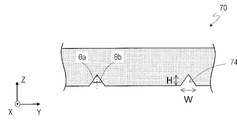
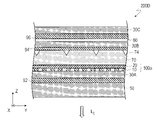
- FIG. 1 It is a schematic cross-sectional view which shows one step of the manufacturing process of an optical member 100. It is a schematic cross-sectional view which shows one step of the manufacturing process of an optical member 100. It is a schematic cross-sectional view which shows one step of the manufacturing process of an optical member 100. It is a schematic cross-sectional view which shows one step of the manufacturing process of an optical member 100. It is sectional drawing which shows typically the structure of the light distribution element sample. It is a schematic cross-sectional view of the shaping film 70. It is a schematic sectional drawing which shows the recess 74 of the shaping film 70. It is a figure which shows the cross-sectional SEM image of the optical member obtained in Example 3. FIG. It is a schematic sectional drawing of the light distribution element 200C by embodiment of this invention. It is a schematic cross-sectional view of the light distribution element 200D.
- optical member a method for manufacturing the optical member, and a light distribution element including the optical member according to the embodiment of the present invention will be described.
- the embodiments of the present invention are not limited to those exemplified below.
- the optical member according to the embodiment of the present invention can take out the light propagating in the light guide layer from the main surface of the light guide layer or guide the light to the optical member arranged so as to be in contact with the main surface. Directing the light propagating through the light guide layer to an optical member arranged so as to be in contact with the main surface of the light guide layer is called optical coupling, and the layer that acts in such a manner is called an optical coupling layer.
- the optical member according to the embodiment of the present invention is suitably used, for example, as the optical coupling layer of the light guide member described in Japanese Patent Application No. 2020-127530 (filed date: July 28, 2020) by the applicant of the present application. Be done.
- the optical coupling layer may be provided between the light guide layer and the direction changing layer.
- the redirection layer has, for example, a plurality of internal spaces forming an interface that directs light toward the main surface side of the redirection layer by internal total internal reflection.
- the turning layer having such an internal space may be, for example, the light distribution structure disclosed in International Publication No. 2019/087118.
- the direction changing layer may be a known prism sheet. All disclosures of Japanese Patent Application No. 2020-127530 and International Publication No. 2019/087118 are incorporated herein by reference in their entirety.
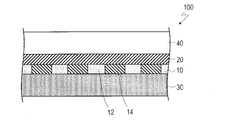
- FIG. 1 shows a schematic cross-sectional view of the optical member 100 according to the embodiment of the present invention.
- the optical member 100 has a first layer 10 having a porous structure and a second layer 20 in contact with the first main surface of the first layer 10.
- the second layer 20 contains a resin composition and has a transmittance of 5% or more and 85% or less for the first light in the wavelength range of more than 800 nm and 2000 nm or less.
- the first layer 10 includes a first region 12 having a porous structure and a second region 14 in which the voids of the porous structure are filled with the resin composition.
- the optical member according to the embodiment of the present invention may have a base material layer 30 that supports the first layer 10 having a porous structure, as in the optical member 100 exemplified here. Further, when the second layer 20 has adhesiveness, it may have a release sheet (separator) 40 of the second layer 20 arranged on the opposite side of the first layer 10. The substrate layer 30 and / or the release sheet 40 may be omitted.
- the second layer 20 contains a resin composition and has a transmittance of 5% or more and 85% or less for the first light in the wavelength range of more than 800 nm and 2000 nm or less. That is, since the second layer 20 absorbs the first light (near infrared rays), it can be efficiently heated by irradiating the first light. As a result, the resin composition in the region irradiated with the first light of the second layer 20 is melted, and the voids of the porous structure of the first layer 10 are selectively filled with the resin composition. ..
- the first region 12 having a porous structure has a refractive index smaller than that of the second region 14 in which the voids of the porous structure are filled with the resin composition.
- n 1 can be, for example, 1.30 or less
- n 2 can be, for example, 1.43 or more
- n 3 can be, for example, 1.45 or more.
- the first layer 10 can be formed of, for example, a silica porous body.
- the porosity of the silica porous body is more than 0% and less than 100%.
- the porosity is preferably 40% or more, more preferably 50% or more, and even more preferably 55% or more in order to obtain a low refractive index.
- the upper limit of the porosity is not particularly limited, but is preferably 95% or less, more preferably 85% or less from the viewpoint of strength.
- the refractive index of silica is preferably 1.41 or more and 1.43 or less, for example.
- the second layer 20 can be formed of various resin compositions.
- the refractive index of a general resin is approximately 1.45 or more and 1.70 or less.
- the resin composition may contain a photocurable resin.
- the refractive index n 2 of the second region 14 is controlled by adjusting the porosity of the porous structure contained in the first layer 10 and the refractive index n 3 of the resin composition contained in the second layer 20. be able to.
- is preferably 0.1 or less. It is possible to suppress the occurrence of total internal reflection at the interface between the second layer 20 and the second region 14 of the first layer 10.
- a first layer 10 that functions as an optical coupling layer can be obtained.
- the optical coupling layer is arranged between the two optical layers, for example, between the light guide layer and the direction change layer, and guides a part of the light propagating through the light guide layer to the direction change layer.
- the redirection layer has, for example, an interface (or surface) that imparts a component in the layer normal direction to the propagating light.
- the direction changing layer can be, for example, a prism sheet.
- the transmittance of the second layer 20 with respect to the first light is more preferably 70% or less, further preferably 65% or less.
- organic matter absorbs infrared rays so that infrared spectroscopy is used for its identification.
- the wavelength range (fingerprint region) of infrared rays used for identification of organic substances is 400 cm -1 to 4000 cm -1 in wave number and 2.5 ⁇ m to 25 ⁇ m in wavelength, and general organic substances are infrared rays having a wavelength of 2 ⁇ m (20000 nm) or less. Almost no absorption.
- An organic substance that absorbs infrared rays may be called an infrared absorbing dye.
- the resin composition of the second layer 20 includes, for example, a resin composition that hardly absorbs the first light and a coloring material that absorbs the first light.
- the colorant may contain a dye (or dye), and the colorant may contain a pigment.
- the dye (or dye) refers to a coloring material that is soluble in a solvent (for example, water or alcohol), and the pigment refers to a coloring material that is insoluble or sparingly soluble in a solvent.
- the atomic group that absorbs the first light may be chemically (that is, by a chemical bond) introduced into the resin itself contained in the resin composition.
- the first light is preferably in the wavelength range of 900 nm or more and 1500 nm or less, and more preferably 1200 nm or less.
- the first light is preferably laser light, preferably emitted from a solid-state laser. LEDs can also be used.
- the half width of the first light is, for example, 100 nm or less.
- the amount of light irradiation required to form the second region may be adjusted by adjusting the intensity of the irradiated light, the irradiation time, and the like. Further, if necessary, a condensing optical system such as a lens may be used.
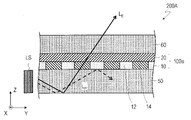
- the light distribution element 200A shown in FIG. 2 has an optical member 100a and a light guide layer 50 arranged on the first layer 10 side of the optical member 100a.
- the base material layer 60 is arranged on the side of the optical member 100a opposite to the light guide layer 50.
- the base material layer 60 can be replaced with, for example, a direction changing layer (for example, a prism sheet).
- a direction changing layer for example, a prism sheet.
- the base material layer 60 can be formed of the same material as the light guide layer 50.
- the first layer 10, the second layer 20, the light guide layer 50, and the base material layer 60 of the optical member 100a have a main surface parallel to the XY plane.
- the light emitted from the light source LS toward the light receiving end surface (not shown) of the light guide layer 50 propagates in the light guide layer 50 in the Y direction (fluorinated light LP ).
- a part of the light incident on the light guide layer 50 is optically coupled (taken out) to the base material layer 60 by the optical member 100a and emitted in the Z direction (emitted light LE ).
- the light propagation direction has a variation (distribution) from the Y direction
- the light emission direction also has a variation (distribution) from the Z direction.
- the X direction is orthogonal to the Y and Z directions.
- the light LP propagating in the light guide layer 50 is totally internally reflected at the interface between the light guide layer 50 and the first region 12 of the first layer 10 and the interface between the light guide layer 50 and air, and is totally reflected in the Y direction. Propagate to. Of the light incident on the light guide layer 50, the light incident on the interface between the light guide layer 50 and the second region 14 of the first layer 10 is not totally internally reflected and is not reflected internally by the second layer 20. And, it passes through the base material layer 60 and is emitted from the light distribution element 200A.
- the arrangement of the optical member is not limited to the example of FIG. 2, and the second layer 20 of the optical member 100b is arranged on the light guide layer 50 side as in the light distribution element 200B shown in FIG. 3, and the base material layer 60 is arranged.
- the first layer 10 of the optical member 100b may be arranged on the side.
- the light LP propagating in the light guide layer 50 is totally internally reflected at the interface between the second layer 20 and the first region 12 of the first layer 10, and is totally reflected inside the second layer 20 and the first layer 10.
- the light incident on the interface with the second region 14 of the layer passes through the second region 14 of the first layer 10 and the base material layer 60 without being totally internally reflected, and is transmitted from the light distribution element 200B. It is emitted.
- the light guide layer 50 is taken out by the optical member 100a (base material layer 60). It is possible to control the light distribution (emission intensity distribution, emission angle distribution, etc.) of the light (which is optically coupled with).
- the arrangement of the first region 12 and the second region 14 in the first layer 10 is appropriately set according to the required light distribution.
- a plurality of rectangular second regions 14a long in the X direction are arranged in the first region 12a at intervals along the Y direction. Further, the distance between the second regions 14a of the plurality of rectangles is narrowed along the Y direction. That is, the density of the second region 14a is arranged so as to increase along the Y direction. This is because the light incident on the light guide layer from the light source (not shown) arranged on the left side of FIG. 4A and propagating in the Y direction is uniformly emitted in the Z direction regardless of the distance from the light source.
- a plurality of circular second regions 14b are discretely arranged in the first region 12b.
- a plurality of second regions 14b arranged in a row in the X direction are arranged corresponding to the second region 14a of the rectangle long in the X direction in FIG. 4A. Further, the density of the second region 14b is arranged so as to increase along the Y direction.
- the arrangement of the first region 12 and the second region 14 in the first layer 10 can be variously modified.
- the individual shapes of the second region 14 are not limited to rectangles and circles, but may be various shapes. Further, the rectangular second region 14a and the circular second region 14b can be used in combination.
- the shape and dimensions of the second region 14, the in-plane density of the first layer 10 and the occupancy in the first layer 10 can be appropriately changed depending on the purpose and application in which the optical member is used.
- the major axis of each of the second regions 14 is preferably 100 ⁇ m or less, and more preferably 70 ⁇ m or less.
- the diameter of the circle is preferably 100 ⁇ m or less. It is possible to prevent the second region 14 from being visually recognized in an application in which a device provided with an optical member is observed at a relatively short distance such as a mobile display or a small signage.
- the light guide layer may typically be made of a film or plate of resin (preferably a transparent resin).
- the resin may be a thermoplastic resin or a photocurable resin.
- the thermoplastic resin may be, for example, a (meth) acrylic resin such as polymethyl methacrylate (PMMA) or polyacrylonitrile, a polycarbonate (PC) resin, a polyester resin such as PET, or a cellulose resin such as triacetyl cellulose (TAC). Cyclic polyolefin resin and polystyrene resin.
- a photocurable resin such as an epoxy acrylate resin or a urethane acrylate resin is preferably used. These resins may be used alone or in combination of two or more.
- the thickness of the light guide layer can be, for example, 100 ⁇ m or more and 100 mm or less.
- the thickness of the light guide layer is preferably 50 mm or less, more preferably 30 mm or less, and further preferably 10 mm or less.
- the refractive index n GP of the light guide layer is, for example, a value in the range of ⁇ 0.1 to +0.1 with respect to the refractive index n 3 of the second layer, and the lower limit is preferably 1.43 or more. Yes, more preferably 1.47 or more. On the other hand, the upper limit of the refractive index of the light guide layer is 1.7.
- the refractive index nGP of the light guide layer is the first of the light guide layer and the first layer when the first region of the first layer is arranged so as to be in direct contact with the light guide layer (see FIG. 2).
- Light is set to be totally internally reflected at the interface with the region. Further, when the first region of the first layer is arranged in the light guide layer via the second layer (see FIG. 3), the light is completely inside at the interface between the second layer and the first region.
- the refractive index n 1 of the first region and the refractive index n 3 of the second layer are set so as to be reflected, and the internal total reflection is unlikely to occur at the interface between the light guide layer and the second region.
- the refractive index n GP of the light layer and the refractive index n 2 of the second region are set.
- the light guide layer As the light guide layer, a conventional light guide layer having an uneven shape on the surface can be used, but a light guide layer having a substantially flat surface like the light guide layer 50 shown in FIGS. 2 and 3 can be used. It can be suitably used. Since the optical member 100 functioning as the optical coupling layer according to the embodiment of the present invention has a substantially flat main surface, it can be easily laminated with the light guide layer 50 having a substantially flat surface. And can be easily laminated with other optical elements having a substantially flat surface. A substantially flat surface means that light is not refracted or diffusely reflected due to the uneven shape of the surface.
- the first layer has a porous structure.
- the first layer can be formed from a porous layer.
- the porous layer preferably used as the first layer includes silica particles, silica particles having fine pores, substantially spherical particles such as silica hollow nanoparticles, and fibrous particles such as cellulose nanofibers, alumina nanofibers, and silica nanofibers. Includes flat particles such as nanoclay composed of bentonite.
- the porous layer is a porous body formed by directly chemically bonding particles (for example, fine pore particles) to each other.
- the particles constituting the porous layer may be bonded to each other via a small amount (for example, the mass or less of the particles) of one binder component.
- the porosity and refractive index of the porous layer can be adjusted by adjusting the particle size, particle size distribution, etc. of the particles constituting the porous layer.
- Examples of the method for obtaining the porous layer include the method for forming a low refractive index layer described in International Publication No. 2019/146628, JP-A-2010-189212, JP-A-2008-040171, and JP-A-2006. Examples thereof include the methods described in JP-A-101175, WO2004 / 113966, JP-A-2017-054111, JP-A-2018-123233 and JP-A-2018-1232299 and their references. All of the disclosures of these publications are incorporated herein by reference.
- a silica porous body can be preferably used as the porous layer.
- the silica porous body is produced, for example, by the following method. Silicon compound; a method for hydrolyzing and polycondensing at least one of hydrolyzable silanes and / or silsesquioxane, and its partial hydrolysates and dehydration condensates, porous particles and / or hollow fine particles.
- the method to be used the method of forming an aerogel layer using the springback phenomenon, the gel-like silicon compound obtained by the sol-gel method is pulverized, and the obtained pulverized micropore particles are chemically bonded to each other by a catalyst or the like. Examples thereof include a method using a bonded pulverized gel.
- the porous layer is not limited to the silica porous body, and the production method is not limited to the exemplified production method, and any production method may be used.
- Sylsesquioxane is a silicon compound having (RSiO 1.5 , R is a hydrocarbon group) as a basic constituent unit, and is strictly different from silica having SiO 2 as a basic constituent unit, but has a siloxane bond. Since it has a network structure cross-linked with silica in common with silica, a porous body containing silsesquioxane as a basic constituent unit is also referred to as a silica porous body or a silica-based porous body here.
- the silica porous body may be composed of fine pore particles of a gel-like silicon compound bonded to each other.
- the fine pore particles of the gel-like silicon compound include pulverized bodies of the gel-like silicon compound.
- the silica porous body can be formed, for example, by applying a coating liquid containing a pulverized body of a gel-like silicon compound to a base material.
- the pulverized gel-like silicon compound can be chemically bonded (for example, siloxane bond) by the action of a catalyst, light irradiation, heating, or the like.
- the lower limit of the thickness of the porous layer (first layer) may be larger than, for example, the wavelength of light used. Specifically, the lower limit is, for example, 0.3 ⁇ m or more.
- the upper limit of the thickness of the first layer is not particularly limited, but is, for example, 5 ⁇ m or less, more preferably 3 ⁇ m or less. When the thickness of the first layer is within the above range, the unevenness of the surface does not become large enough to affect the lamination, so that it is easy to combine or laminate with other members.
- the refractive index of the porous layer that is, the refractive index n 1 of the first region of the first layer is preferably 1.30 or less. Internal total internal reflection is likely to occur at the interface in contact with the first region, that is, the critical angle can be reduced.
- the refractive index n1 in the first region is more preferably 1.25 or less, further preferably 1.18 or less, and particularly preferably 1.15 or less.
- the lower limit of n 1 is not particularly limited, but 1.05 or more is preferable from the viewpoint of mechanical strength.
- the porosity of the porous layer that is, the lower limit of the porosity of the first region of the first layer is, for example, 40% or more, preferably 50% or more, more preferably 55% or more, 70. % Or more is more preferable.
- the upper limit of the porosity of the porous layer is, for example, 90% or less, more preferably 85% or less.
- the refractive index of the first region can be set to an appropriate range.
- the porosity can be calculated from, for example, the value of the refractive index measured by an ellipsometer from the Lorentz-Lorenz's formula (Lorentz-Lorenz's formula).
- the membrane density of the porous layer that is, the membrane density of the first region of the first layer is, for example, 1 g / cm 3 or more, preferably 10 g / cm 3 or more, and more preferably 15 g / cm 3 . That is all.
- the film density is, for example, 50 g / cm 3 or less, preferably 40 g / cm 3 or less, more preferably 30 g / cm 3 or less, and further preferably 2.1 g / cm 3 or less.
- the range of the film density is, for example, 5 g / cm 3 or more and 50 g / cm 3 or less, preferably 10 g / cm 3 or more and 40 g / cm 3 or less, and more preferably 15 g / cm 3 or more and 30 g / cm 3 or less. .. Alternatively, the range is, for example, 1 g / cm 3 or more and 2.1 g / cm 3 or less.
- Membrane density can be measured by known methods.
- the second region of the first layer is formed by filling the voids of the porous layer with the resin composition contained in the second layer.
- the refractive index n 2 in the second region has a relationship between the refractive index n 1 in the first region and the refractive index n 3 in the second layer, n 1 ⁇ n 2 , and n 1 ⁇ n 3 . Fulfill. When n 2 satisfies this relationship, it is possible to suppress light scattering due to reflection and refraction at the interface between the first region and the second region in the plane direction of the first layer.
- the lower limit of n 2 is, for example, more than 1.30, preferably 1.35 or more, and more preferably 1.40 or more.
- the first and second regions of the first layer are formed from a common porous layer. That is, the first layer has a continuous porous structure throughout the first and second regions. Assuming that the refractive index of the material constituting the matrix portion of the porous layer (the portion other than the voids of the porous layer) is n M , the refractive index of the porous layer, that is, the refractive index n 1 of the first region is n M. The refractive index n 2 in the second region is determined by the void ratio and the refractive index of air. Determined by filling rate.
- n M is, for example, 1.41 or more and 1.43 or less, and the refractive index of the resin is larger than n M (for example, 1. In the case of 45 or more and 1.70 or less), the relationship of n 1 ⁇ n 2 ⁇ n 3 is obtained.
- the second region of the first layer is formed by filling the voids with the resin composition, the adhesion to other optical elements (for example, the light guide layer) of the first layer is improved. be able to.
- the mechanical strength of the first layer can be improved. In particular, when the resin composition has adhesiveness (including adhesiveness), the effect of improving the adhesiveness and the mechanical strength is great.
- the lower limit of the refractive index n 3 of the second layer is, for example, 1.45 or more, preferably 1.47 or more.
- the upper limit of the refractive index n 3 of the second layer is not particularly limited, but is, for example, 1.70 or less.
- the refractive index (n 3 ) of the second layer is an optical element (eg, a light guide layer, a substrate layer) arranged in contact with (or via an adhesive layer) the second layer from an optical point of view. , Or the direction-changing layer), preferably having a value equal to or close to the refractive index.
- the difference between the refractive index of the second layer and the refractive index of the optical element close to the second layer is preferably 0.1 or less, more preferably 0.05 or less.
- the thickness of the second layer is not particularly limited as long as it has enough strength to hold the first layer, but the lower limit is, for example, 1 ⁇ m or more, preferably 5 ⁇ m or more, and more preferably 10 ⁇ m or more. Is.
- the upper limit of the thickness of the second layer is, for example, 200 ⁇ m or less, preferably 150 ⁇ m or less.
- the second layer is formed using the resin composition.
- the resin composition has a transmittance of 5% or more and 85% or less with respect to the first light in the wavelength range of more than 800 nm and 2000 nm or less.
- the resin composition includes, for example, a resin composition that hardly absorbs the first light and a coloring material that absorbs the first light.
- the resin composition preferably has adhesiveness, and particularly preferably has pressure-sensitive adhesiveness (that is, adhesiveness).
- a pressure-sensitive adhesive can be suitably used as the resin composition forming the second layer.
- the pressure-sensitive adhesive has a storage elastic modulus that does not penetrate into the voids of the porous structure in the first region of the first layer under normal temperature and normal pressure conditions or heating conditions such as an aging step described later.
- it is preferable that the voids are melted or softened by irradiation with the first light and penetrate into the voids of the porous structure, and the voids can be filled with the resin composition.
- the lower limit of the storage elastic modulus of the pressure-sensitive adhesive is, for example, preferably 1.0 ⁇ 105 ( Pa) or more, and more preferably 1.2 ⁇ 105 ( Pa) or more.
- the upper limit of the storage elastic modulus of the pressure-sensitive adhesive is, for example, 1.0 ⁇ 106 (Pa) or less.
- the molecular weight (mass average molecular weight) of the resin composition is not particularly limited as long as the resin composition can penetrate into the voids of the porous structure, but the resin composition has, for example, a molecular weight of 100,000 or less, 70,000 or less, and 50,000 or less. Hereinafter, it contains 30,000 or less or 10,000 or less components.
- pressure-sensitive adhesive generally available pressure-sensitive adhesives can be widely used as long as they have the above-mentioned characteristics.
- acrylic, urethane, ester, and silicone pressure-sensitive adhesives can be used.
- it may be a rubber-based (for example, polybutadiene-based, nitrile-based, chloroprene-based) pressure-sensitive adhesive.
- the acrylic pressure-sensitive adhesive typically contains a (meth) acrylic polymer as a main component (base polymer).
- the (meth) acrylic polymer can be contained in the pressure-sensitive adhesive in a proportion of, for example, 50% by mass or more, preferably 70% by mass or more, and more preferably 90% by mass or more in the solid content of the pressure-sensitive adhesive.
- the (meth) acrylic polymer contains an alkyl (meth) acrylate as a main component as a monomer unit.
- (meth) acrylate means acrylate and / or methacrylate. Examples of the alkyl group of the alkyl (meth) acrylate include a linear or branched alkyl group having 1 to 18 carbon atoms.
- the average number of carbon atoms of the alkyl group is preferably 3 to 9.
- the monomers constituting the (meth) acrylic polymer include a carboxyl group-containing monomer, a hydroxyl group-containing monomer, an amide group-containing monomer, an aromatic ring-containing (meth) acrylate, and a heterocyclic ring-containing (meth).
- examples thereof include comonomer such as acrylate.
- the comonomer is preferably a hydroxyl group-containing monomer and / or a heterocyclic-containing (meth) acrylate, and more preferably N-acryloyl morpholine.
- the acrylic pressure sensitive adhesive may preferably contain a silane coupling agent and / or a cross-linking agent.
- silane coupling agent include epoxy group-containing silane coupling agents.
- cross-linking agent include isocyanate-based cross-linking agents and peroxide-based cross-linking agents. Details of such a pressure-sensitive adhesive are described in, for example, Japanese Patent No. 4140736, and all the disclosure contents of the patent gazette are incorporated herein by reference.
- the method for producing an optical member according to an embodiment of the present invention includes a porous layer having a porous structure and a resin composition, and has a transmittance of 5% or more and 85% for a first light in a wavelength range of more than 800 nm and 2000 nm or less. % Or less, by preparing a laminate with the infrared absorbing resin composition layer and selectively irradiating only a predetermined region of the infrared absorbing resin composition layer of the laminate with the first light. It includes a step of filling the voids of the porous structure of the porous layer with the resin composition contained in the infrared absorbing resin composition layer in a predetermined region.
- the step of preparing the laminated body may be a step of manufacturing the laminated body, or may be a step of preparing the manufactured laminated body.
- the step of preparing the laminate includes, for example, a step of forming an infrared absorbing resin composition layer on the porous layer.
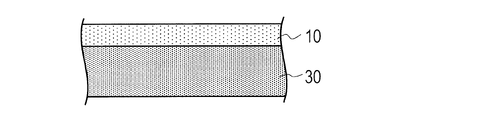
- An example of a method for manufacturing the optical member 100 will be described with reference to FIGS. 5A, 5B, 5C, and 5D.
- 5A, 5B, 5C and 5D are schematic cross-sectional views showing one step of the manufacturing process of the optical member 100, respectively.
- a porous layer 10 having a porous structure to be the first layer 10 is formed on the base material layer 30.
- the base material layer 30 is, for example, a polymer film.
- a porous layer 10 made of a silica porous body is formed on the base material layer 30, for example.
- the porous layer 10 is formed by the known method described above.
- the infrared absorbing resin composition layer 20 to be the second layer 20 is formed on the release sheet (separator) 40.
- the infrared absorbing resin composition layer and the second layer are designated by the same reference numeral 20.
- the infrared absorbing resin composition layer 20 contains the resin composition and has a transmittance of 5% or more and 85% or less for the first light in the wavelength range of more than 800 nm and 2000 nm or less.
- the infrared absorbing resin composition layer 20 can be formed, for example, by using a material in which a resin composition and a coloring material that absorbs first light are mixed.
- the resin composition may hardly absorb the first light.
- a resin composition layer formed of the resin composition may be formed, and a coloring material layer containing a coloring material that absorbs the first light may be formed on the resin composition layer.
- the resin composition layer and the coloring material layer on the resin composition layer form the infrared absorbing resin composition layer.
- the radical initiator (AIBN, BPO, etc.) and acrylic acid remaining in the adhesive may deteriorate the coloring material and reduce the function of absorbing near infrared rays (first light).
- a part or all of the colorant laminated on the resin composition layer may permeate and diffuse into the resin composition to be integrated with the resin composition.
- the coloring material either a dye (dye) type or a pigment type can be used.
- a dye system is preferable in that it can be uniformly distributed in a resin composition (for example, a pressure-sensitive adhesive).
- the coloring material a material that absorbs light in the wavelength range of 900 nm or more and 1500 nm or less is preferable.
- Specific examples thereof include phthalocyanine type, azo type, phenylenediamine type, anthraquinone type, naphthoquinone type and cyanine type. These may be used alone or in combination of two or more. Of these, a phenylenediamine type having a high transmittance for visible light is preferable.
- a diimonium compound can be preferably used as the phenylenediamine-based dye.
- the infrared absorbing resin composition layer 20 is arranged on the porous layer 10.
- an example of manufacturing the optical member 100 by using the film-shaped base material layer 30 and the release sheet 40 is shown.
- the method of arranging the infrared absorbing resin composition layer 20 on the porous layer 10 by stacking the films on top of each other is excellent in mass productivity.
- the step of forming the infrared absorbing resin composition layer 20 on the porous layer 10 is not limited to this, and various methods known as methods for forming a resin layer (for example, a pressure-sensitive adhesive layer) (various methods). A coating method, a printing method, etc.) can be used.
- the first light is preferably laser light, and is preferably emitted from a solid-state laser.
- the lower limit of the transmittance of the infrared absorbing resin composition layer 20 with respect to the first light, that is, the laser light used is preferably 5% or more, 10% or more, 20% or more or 30% or more, and the upper limit thereof is It is preferably 85% or less, 80% or less, 75% or less, or 70% or less.
- the infrared absorbing resin composition layer 20 more preferably has a transmittance of 20% or more and 75% or less, and further preferably has a transmittance of 30% or more and 70% or less with respect to the first light.
- the resin composition in the irradiated region can be selectively and efficiently heated.
- the first layer 10 having the second region 14 arranged in a relatively high-definition pattern is formed.
- the spatial intensity distribution of the laser beam preferably has a Gaussian distribution or a top hat distribution, but this is not the case.
- the beam shape may be circular or rectangular. Condensing may be performed using a condensing optical system such as an objective lens.
- the focal diameter spot diameter
- the focal diameter is preferably in the range of 10 ⁇ m or more and 150 ⁇ m or less, and more preferably in the range of 30 ⁇ m or more and 100 ⁇ m or less.
- the focal diameter is set to 150 ⁇ m or less, it is possible to suppress a decrease in energy density and promote desired pattern formation (formation of a second region). Further, as the number of pulses that can be emitted per unit time increases, the number of patterns that can be formed per unit time increases, which leads to an improvement in productivity.
- a pulse laser it is preferable to use a pulse laser, and it is preferable to use a laser having a pulse width on the order of nanoseconds to microseconds. If the pulse width is too short, heat generation may not be accompanied, but if the pulse width is in the above range, the photochemical reaction is accompanied by heat generation, so that the energy injection time is sufficient and the desired pattern can be formed. .. Further, within this pulse width range, the formation of one pattern can be completed in a short time, which is preferable from the viewpoint of productivity.
- the repetition frequency of the pulsed laser light is not particularly limited, but it is preferable from the viewpoint of productivity, and it can be appropriately adjusted in the range of 10 kHz to 5,000 kHz.
- Examples of the laser oscillator type satisfying the above requirements include, but are not limited to, a YAG laser, a YLF laser, a YVO4 laser, a fiber laser, and a semiconductor laser.
- the irradiation conditions of the laser light can be set to any suitable conditions, but the energy density is preferably 1 J / cm 2 or more and 20 J / cm 2 or less. If the energy density is within this range, the energy is sufficient to form a desired pattern, and transpiration and thermal decomposition of the irradiated object can be suppressed.
- a galvano scanner a polygon scanner, or a scanner unit in which they are combined.
- a scanner unit By using such a scanner unit, it is possible to form a pattern in a scanning speed range of 0.01 m / sec to 170 m / sec in the scanning direction of the laser beam.
- the pitch of the pattern can be arbitrarily set by adjusting the repetition frequency of the laser pulse according to the scanning speed, and can be set in the range of, for example, 10 ⁇ m to 500 ⁇ m.
- the pattern pitch in the scanning direction and the vertical direction can be appropriately adjusted by controlling the relative positional relationship between the scanner unit and the irradiated object.
- Such control is performed by using a precision stage having a drive shaft, for example, by adsorbing and fixing a single-wafer irradiated object on the stage surface and irradiating it with laser light while feeding it at regular intervals in the direction perpendicular to the scanning direction.
- the pattern can be formed at the desired pitch.
- a pattern can be formed by using a scanner unit where the wound long raw fabric is intermittently or continuously conveyed by a roll-to-roll transfer method.
- Refractive index After forming the first layer on the acrylic film, it is cut into a size of 50 mm ⁇ 50 mm, and the first layer is formed on the surface of a glass plate (thickness: 3 mm) via a pressure-sensitive adhesive layer. It was pasted on. The central portion (about 20 mm in diameter) of the back surface of the glass plate was painted with black magic to prepare a sample that does not reflect on the back surface of the glass plate. The above sample was set in an ellipsometer (manufactured by JA Woollam Japan: VASE), and the refractive index was measured under the conditions of a wavelength of 500 nm and an incident angle of 50 degrees or more and 80 degrees or less.
- Example 2 Light Extraction Effect
- MTMS methyltrimethoxysilane
- DMSO dimethyl sulfoxide
- a homogenizer manufactured by SMTE, trade name “UH-50” was used, and 1.85 g of the gel compound and IPA in the mixed solution D were placed in a 5 cc screw bottle. After weighing 15 g, pulverization was performed for 2 minutes under the conditions of 50 W and 20 kHz.
- the gelled silicon compound in the mixed solution D was pulverized, so that the mixed solution D'became a sol solution of the pulverized product.
- the volume average particle size showing the variation in the particle size of the pulverized material contained in the mixed solution D' was confirmed by a dynamic light scattering type nanotrack particle size analyzer (UPA-EX150 type manufactured by Nikkiso Co., Ltd.) and found to be 0.50 to. It was 0.70.
- this sol solution (mixed solution C')
- 0.062 g of a 1.5 mass% concentration MEK (methyl ethyl ketone) solution of a photobase generator (Wako Pure Chemical Industries, Ltd .: trade name WPBG266) was added.
- a 5% concentration MEK solution of bis (trimethoxysilyl) ethane was added at a ratio of 0.036 g to obtain a coating liquid for forming a porous layer (a liquid containing fine pore particles).
- the coating liquid for forming a porous layer contains a silica porous body containing silsesquioxane as a basic structure.
- the coating liquid was applied (coated) on the surface of an acrylic resin film (thickness: 40 ⁇ m) prepared according to Production Example 1 of JP2012-234163 to form a coating film.
- the coating film is treated at a temperature of 100 ° C. for 1 minute and dried, and the dried coating film is further irradiated with UV at a light irradiation amount (energy) of 300 mJ / cm 2 using light having a wavelength of 360 nm.
- a laminated body (acrylic film with a silica porous layer) in which a porous layer (silica porous body formed by chemical bonding of silica fine pore particles) was formed on the acrylic resin film was obtained.
- the refractive index of the porous layer was 1.15.
- Pt-Pd was coated on the surface of the pressure-sensitive adhesive with a magnetron sputtering (E-1030) manufactured by Hitachi High-Technologies Corporation in a state where the separator was peeled off to expose the surface of the dye pressure-sensitive adhesive for 10 seconds.
- a protective film formed by carbon deposit
- FIB processing was formed on the surface of the pressure-sensitive adhesive by FIB-SEM (Helios G4 UX) manufactured by Nippon FEI Co., Ltd. at room temperature. Further, the sample was cooled to -160 ° C.
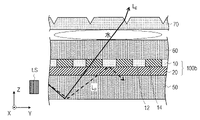
- FIG. 6 schematically shows the configuration of the light distribution element sample used for evaluating the light extraction effect.
- the optical member 100b is arranged on the resin plate 50, and the separator 60 is arranged on the optical member 100b.
- the uneven shaping film 70 was placed on the separator 60 via water, and the distribution of the emitted light LE was visually evaluated.
- a concavo-convex shaped film was produced according to the method described in Japanese Patent Publication No. 2013-524288. Specifically, the surface of a polymethyl methacrylate (PMMA) film is coated with lacquer (Fine Cure RM-64 manufactured by Sanyo Kasei Kogyo Co., Ltd.), an optical pattern is embossed on the surface of the film containing the lacquer, and then the lacquer is applied. The desired unevenness shaping film was produced by curing. The total thickness of the uneven shaping film was 130 ⁇ m, and the haze was 0.8%.
- PMMA polymethyl methacrylate
- lacquer Feine Cure RM-64 manufactured by Sanyo Kasei Kogyo Co., Ltd.
- FIG. 7A shows a plan view of a part of the manufactured uneven shape shaping film 70 as viewed from the uneven surface side. Further, a cross-sectional view taken along the line 7B-7B'of the uneven shaping film of FIG. 7A is shown in FIG. 7B.
- a plurality of recesses 74 having a length L of 80 ⁇ m, a width W of 14 ⁇ m, and a depth H of 10 ⁇ m and having a triangular cross section were arranged at intervals of a width E (155 ⁇ m) in the X-axis direction. Further, the patterns of such recesses 74 are arranged at intervals of a width D (100 ⁇ m) in the Y-axis direction.
- the density of the recesses 74 on the surface of the uneven shaping film was 3612 pieces / cm 2 . Both ⁇ a and ⁇ b in FIG. 7B were 41 °, and the occupied area ratio of the recess 74 when the film was viewed in a plan view from the uneven surface side was 4.05%.
- Examples 1 to 6 and Comparative Examples 1 and 2 will be shown to explain the characteristics of the optical member according to the embodiment of the present invention.
- Table 1 summarizes the configurations and characteristics of the optical members of Examples 1 to 6 and Comparative Examples 1 and 2.
- Example 1 As the infrared absorbing resin composition layer (second layer), a laminated structure of an adhesive layer (resin composition layer) containing no dye and a dye layer formed on the adhesive layer was used. 0.2 mass of dye-based dye CIR-RL (phenylenediamine-based diimonium compound) manufactured by Nippon Carlit Co., Ltd. with respect to 100 parts by mass of solvent (MIBK / EtOH / H 2 O, mass ratio 1: 9: 1). Partial addition was made to prepare a dye solution.
- CIR-RL phenylenediamine-based diimonium compound
- the surface of the exposed acrylic pressure-sensitive adhesive is exposed by peeling off one of the double-sided pressure-sensitive adhesive A (PET separator / acrylic pressure-sensitive adhesive A / PET separator, thickness 38 ⁇ m / 10 ⁇ m / 38 ⁇ m) manufactured by the method described below.
- the above-mentioned dye solution was applied thereto, a film was formed with a wet thickness of 33 ⁇ m, and the mixture was placed in a heating oven set at 100 ° C. for 2 minutes and dried to obtain a dye layer.
- the transmittance of the laminated body of the optical adhesive layer and the dye layer with respect to the laser light having a wavelength of 1064 nm was 49%.
- a laminate of an optical adhesive layer and a dye layer is attached to the main surface of the porous layer of the laminate (acrylic film with a silica porous layer) obtained in Production Example 1, and the outer shape is cut to a size of 100 mm to form an optical member.
- a test piece for fabrication was obtained.
- the obtained test piece was fixed to a vacuum suction stage and irradiated with a near-infrared nanosecond pulse fiber laser under the following conditions to prepare an optical member.
- Laser oscillator JenLas fiber ns 20 manufactured by Jenoptik Wavelength: 1064 nm
- Objective lens f ⁇ lens (f82mm)
- Galvano Scanner intelliScan14 manufactured by ScanLab Beam intensity distribution: Gaussian Spot size: ⁇ 60 ⁇ m Repeat frequency: 12.5kHz Scan speed: 2500 mm / sec Pattern pitch: 200 ⁇ m
- Example 2 As the infrared absorbing resin composition layer (second layer), the acrylic pressure-sensitive adhesive B produced by the method described below was used. The transmittance of the acrylic pressure-sensitive adhesive B layer for laser light having a wavelength of 1064 nm was 41%.
- One of the separators of the double-sided adhesive B (PET separator / acrylic adhesive B / PET separator, thickness 38 ⁇ m / 10 ⁇ m / 38 ⁇ m) was peeled off, and the laminate obtained in Production Example 1 (acrylic film with a porous silica layer) was peeled off. ) was attached to the main surface of the porous layer to prepare a test piece for manufacturing an optical member in the same manner as described in Example 1.
- the obtained test piece was fixed to a vacuum suction stage and irradiated with a near-infrared nanosecond pulse fiber laser under the following conditions to prepare an optical member.
- Laser oscillator JenLas fiber ns 20 manufactured by Jenoptik Wavelength: 1064 nm
- Objective lens f ⁇ lens (f82mm)
- Galvano Scanner intelliScan14 manufactured by ScanLab Beam intensity distribution: Shaped into a rectangular beam by DOE Spot size: 60 ⁇ m on each side of the square Repeat frequency: 12.5kHz Scan speed: 2500 mm / sec Pattern pitch: 200 ⁇ m
- Example 3 In Examples 3 to 6 shown below, as in Example 1, the infrared absorbing resin composition layer (second layer) is formed on the adhesive layer (resin composition layer) containing no dye and the adhesive layer. A laminated structure with the dye layer was used.
- a dye solution was prepared by adding 0.52 parts by mass of a dye-based dye CIR-RL (phenylenediamine-based diimonium compound) manufactured by Nippon Carlit Co., Ltd. to 100 parts by mass of a solvent (MIBK). ..
- a dye-based dye CIR-RL phenylenediamine-based diimonium compound manufactured by Nippon Carlit Co., Ltd.
- one of the separators of the double-sided pressure-sensitive adhesive A was peeled off to the surface of the exposed acrylic pressure-sensitive adhesive.
- the above dye solution was applied, a film was formed with a wet thickness of 33 ⁇ m, and the film was placed in a heating oven set at 100 ° C. for 2 minutes to dry to obtain a dye layer.
- the transmittance of the laminated body of the optical adhesive layer and the dye layer with respect to the laser light having a wavelength of 1060 nm was 28%.
- the obtained test piece was fixed to a vacuum suction stage and irradiated with a near-infrared nanosecond pulse fiber laser under the following conditions to prepare an optical member.
- Laser oscillator SPI's redENERGY G4 Wavelength: 1060 nm
- Scanner Next Scan Technology LSE310 (f350mm)
- Beam intensity distribution Gaussian Spot size: ⁇ 55 ⁇ m
- Repeat frequency 500kHz
- Scan speed 50 m / sec
- Pattern pitch 100 ⁇ m
- Power 55W Pulse energy: 110 ⁇ J Energy density: 4.6J / cm 2
- Example 4 In Example 4, a test piece was produced in the same manner as in Example 3. However, in Example 4, 0.43 parts by mass of a dye-based dye CIR-RL (phenylenediamine-based diimonium compound) manufactured by Nippon Carlit Co., Ltd. was added to 100 parts by mass of the solvent (MIBK) to prepare a dye solution. Prepared. The transmittance of the laminated body of the optical adhesive layer and the dye layer with respect to the laser light having a wavelength of 1060 nm was 37%.
- CIR-RL phenylenediamine-based diimonium compound manufactured by Nippon Carlit Co., Ltd.
- the obtained test piece was fixed to a vacuum suction stage and irradiated with a near-infrared nanosecond pulse fiber laser under the following conditions to prepare an optical member.
- Laser oscillator SPI's redENERGY G4 Wavelength: 1060 nm
- Scanner Next Scan Technology LSE310 (f350mm)
- Beam intensity distribution Gaussian Spot size: ⁇ 55 ⁇ m
- Repeat frequency 500kHz
- Scan speed 100 m / sec
- Pattern pitch 200
- Power 86W Pulse energy: 172 ⁇ J Energy density: 7.2J / cm 2
- Example 5 In Example 5, the same test piece as in Example 4 was used. The transmittance of the laminated body of the optical adhesive layer and the dye layer with respect to the laser light having a wavelength of 1060 nm was 37%.
- the obtained test piece was fixed to a vacuum suction stage and irradiated with a near-infrared nanosecond pulse fiber laser under the following conditions to prepare an optical member.
- Laser oscillator SPI's redENERGY G4 Wavelength: 1060 nm
- Scanner Next Scan Technology LSE310 (f350mm)
- Beam intensity distribution Gaussian Spot size: ⁇ 55 ⁇ m
- Repeat frequency 500kHz
- Scan speed 100 m / sec
- Pattern pitch 200 ⁇ m
- Power 148W Pulse energy: 296 ⁇ J Energy density: 12.5J / cm 2
- Example 6 In Example 6, the same test piece as in Example 3 was used. The transmittance of the laminated body of the optical adhesive layer and the dye layer with respect to the laser light having a wavelength of 1060 nm was 28%.
- the obtained test piece was fixed to a vacuum suction stage and irradiated with a near-infrared nanosecond pulse fiber laser under the following conditions to prepare an optical member.
- Laser oscillator SPI's redENERGY G4 Wavelength: 1060 nm
- Scanner Next Scan Technology LSE310 (f350mm)
- Beam intensity distribution Gaussian Spot size: ⁇ 55 ⁇ m
- Repeat frequency 500kHz
- Scan speed 100 m / sec
- Pattern pitch 200
- Power 86W Pulse energy: 172 ⁇ J Energy density: 7.2J / cm 2
- the acrylic pressure-sensitive adhesive A (PET separator / acrylic pressure-sensitive adhesive A / PET separator, thickness 38 ⁇ m / 10 ⁇ m / 38 ⁇ m) produced by the method described below was used as a laminate (acrylic with a porous layer) shown in Production Example 1. It was attached to the main surface of the porous layer of the film), and the outer shape was cut to a size of 100 mm to obtain a test piece.
- the transmittance of the acrylic pressure-sensitive adhesive A layer for laser light having a wavelength of 9400 nm was 42%.
- the test piece was fixed to the vacuum suction stage and irradiated with a CO 2 laser under the following conditions to prepare an optical member.
- Laser oscillator Coherent Diamond J-3 Wavelength: 9.4 ⁇ m
- Objective lens f ⁇ lens (f120 mm)
- Galvano Scanner Canon Digital Galvano Scanner Beam Intensity Distribution: Gaussian Condensing Spot Size: ⁇ 87 ⁇ m Z offset amount: -1.6 mm (from focus position) Repeat frequency: 5kHz Scan speed: 1000 mm / sec Pattern pitch: 200 ⁇ m
- the size (diameter) of the formed pattern was 270 ⁇ m, which was larger than that of the examples. It is considered that this is because the wavelength of the laser beam is 9.4 ⁇ m and the wavelength band of the far infrared ray is used, so that the pattern size becomes larger than the size of the laser spot to be irradiated due to the influence of heat. Further, when the wavelength is long, it is difficult to obtain a smaller spot size from the viewpoint of the wavelength dependence of the spot size.
- Comparative Example 2 In order to obtain a smaller spot, the test piece of Comparative Example 1 was irradiated with a near-infrared nanosecond pulse fiber laser under the following conditions, and an attempt was made to fabricate an optical member.
- the transmittance of the acrylic pressure-sensitive adhesive A layer for laser light having a wavelength of 1064 nm was 89%.
- Laser oscillator JenLas fiber ns 20 manufactured by Jenoptik Wavelength: 1064 nm
- Objective lens f ⁇ lens (f82mm)
- Galvano Scanner intelliScan14 manufactured by ScanLab Beam intensity distribution: Shaped into a rectangular beam by DOE Spot size: 60 ⁇ m on each side of the square Repeat frequency: 12.5kHz Scan speed: 2.5 m / sec Pattern pitch: 200 ⁇ m
- Power 4.5W Pulse energy: 360 ⁇ J Energy density: 10.0J / cm 2
- the pattern was not formed and the light extraction effect was not exhibited. It is considered that this is because the transmittance of the adhesive layer of the test piece to the laser light is too high (absorption is too small).
- the second region can be formed by adjusting the irradiation conditions of the laser beam, but the efficiency and the accuracy of the pattern are lowered.
- the acrylic adhesive used in Examples and Comparative Examples was manufactured by the following method.
- Acrylic polymer solution From 100 parts by mass of the solid content of the obtained acrylic polymer solution, 0.25 parts by mass of dibenzoyl peroxide (1 minute half-life: 130 ° C.) as a cross-linking agent, and a trimethylolpropane adduct of tolylene diisocyanate.
- a system adhesive solution A was prepared.
- the acrylic pressure-sensitive adhesive solution A is applied to one side of a polyethylene terephthalate (PET) film (manufactured by Mitsubishi Chemical Corporation, thickness: 38 ⁇ m) treated with silicone, and the thickness of the pressure-sensitive adhesive layer after drying becomes 10 ⁇ m. And dried at 150 ° C. for 3 minutes to form an adhesive layer.
- the adhesive layer was bonded to the PET film with the silicone-treated surface facing the adhesive layer side to prepare a double-sided adhesive tape.
- the following light distribution element can be obtained.
- FIG. 9 is a schematic cross section of the light distribution element 200C according to the embodiment of the present invention
- FIG. 10 is a schematic cross section of the light distribution element 200D according to the embodiment of the present invention.
- the light distribution element 200C shown in FIG. 9 includes base material layers 30A, 30B, 30C, a shaping film 70, and adhesive layers 92, 94, 96. are doing.
- the shaping film 70 and the adhesive layer 94 form a direction changing layer having a plurality of internal spaces 74.
- the base material layers 30A, 30B, 30C, the shaping film 70, the low refractive index layer 80, and the adhesive layer 92 are provided. , 94, 96 and so on.
- the low refractive index layer 80 is formed of, for example, a porous layer like the first layer described above.
- the shaping film 70 and the adhesive layer 94 form a direction changing layer having a plurality of internal spaces 74.
- the light distribution element 200C shown in FIG. 9 emits light incident on the light guide layer 50 to the upper part of the figure, whereas the light distribution element 200D shown in FIG. 10 changes direction in the low refractive index layer 80. Since the light guided from the layer is totally internally reflected, the light incident on the light guide layer 50 is emitted toward the lower part of the figure.
- the light distribution element is mass-produced by the roll-to-roll method or the roll-to-sheet method by adopting a structure in which the laminated body laminated on the plurality of base material layers is bonded by the adhesive layer. be able to.
- the thicknesses of the base material layers 30A, 30B, and 30C are independently, for example, 1 ⁇ m or more and 1000 ⁇ m or less, preferably 10 ⁇ m or more and 100 ⁇ m or less, and more preferably 20 ⁇ m or more and 80 ⁇ m.
- the refractive index of the substrate layers 30A, 30B, and 30C is preferably 1.40 or more and 1.70 or less, and more preferably 1.43 or more and 1.65 or less, respectively.
- the thicknesses of the adhesive layers 92, 94, and 96 are independently, for example, 0.1 ⁇ m or more and 100 ⁇ m or less, preferably 0.3 ⁇ m or more and 100 ⁇ m or less, and more preferably 0.5 ⁇ m or more and 50 ⁇ m or less.
- the refractive indexes of the adhesive layers 92, 94, and 96 are independently, preferably 1.42 or more and 1.60 or less, and more preferably 1.47 or more and 1.58 or less.
- the refractive index of the adhesive layers 92, 94, 96 is preferably close to the refractive index of the light guide layer 50 or the shaped film 70 with which the adhesive layers 92, 94, 96 are in contact, and the absolute value of the difference in refractive index is 0.2 or less. Is preferable.
- the optical member of the present invention is a light distribution element together with a light guide layer or the like, and is used as a front light, a backlight, window / facade lighting, signage, signal lighting, window lighting, wall lighting, tabletop lighting, solar application, decorative illumination, etc. It can be applied to public or general lighting such as light shields, light masks, and roof lighting.
- the optical member of the present invention is suitably used as a component of a front light of a reflective display, which is an example of signage.
- Base material layer 50 Light guide layer 60: Base material Layer 70: Concavo-convex shaping film 74: Recessed portion, internal space 100, 100a, 100b: Optical member 200A, 200B, 200C, 200D: Light distribution element
Landscapes
- Physics & Mathematics (AREA)
- General Physics & Mathematics (AREA)
- Optics & Photonics (AREA)
- Engineering & Computer Science (AREA)
- Manufacturing & Machinery (AREA)
- General Engineering & Computer Science (AREA)
- Health & Medical Sciences (AREA)
- Toxicology (AREA)
- Laminated Bodies (AREA)
- Planar Illumination Modules (AREA)
Priority Applications (5)
| Application Number | Priority Date | Filing Date | Title |
|---|---|---|---|
| CN202180066770.4A CN116234688A (zh) | 2020-09-29 | 2021-09-24 | 光学构件、其制造方法及配光元件 |
| EP21875467.9A EP4224054A4 (en) | 2020-09-29 | 2021-09-24 | OPTICAL ELEMENT, ITS MANUFACTURING METHOD AND LIGHT DISTRIBUTION TERMINAL |
| KR1020237011308A KR20230077734A (ko) | 2020-09-29 | 2021-09-24 | 광학 부재, 그 제조 방법, 및 배광 소자 |
| JP2022553918A JP7771072B2 (ja) | 2020-09-29 | 2021-09-24 | 光学部材、その製造方法、および配光素子 |
| US18/028,616 US20230341608A1 (en) | 2020-09-29 | 2021-09-24 | Optical member, manufacturing method therefor, and light distribution element |
Applications Claiming Priority (2)
| Application Number | Priority Date | Filing Date | Title |
|---|---|---|---|
| JP2020-163478 | 2020-09-29 | ||
| JP2020163478 | 2020-09-29 |
Publications (1)
| Publication Number | Publication Date |
|---|---|
| WO2022071165A1 true WO2022071165A1 (ja) | 2022-04-07 |
Family
ID=80951620
Family Applications (1)
| Application Number | Title | Priority Date | Filing Date |
|---|---|---|---|
| PCT/JP2021/035207 Ceased WO2022071165A1 (ja) | 2020-09-29 | 2021-09-24 | 光学部材、その製造方法、および配光素子 |
Country Status (7)
| Country | Link |
|---|---|
| US (1) | US20230341608A1 (https=) |
| EP (1) | EP4224054A4 (https=) |
| JP (1) | JP7771072B2 (https=) |
| KR (1) | KR20230077734A (https=) |
| CN (1) | CN116234688A (https=) |
| TW (1) | TWI912377B (https=) |
| WO (1) | WO2022071165A1 (https=) |
Cited By (2)
| Publication number | Priority date | Publication date | Assignee | Title |
|---|---|---|---|---|
| WO2023189036A1 (ja) * | 2022-03-31 | 2023-10-05 | 日東電工株式会社 | 光学部材の製造方法 |
| WO2023189633A1 (ja) * | 2022-03-31 | 2023-10-05 | 日東電工株式会社 | 光学部材および光学素子 |
Citations (18)
| Publication number | Priority date | Publication date | Assignee | Title |
|---|---|---|---|---|
| JP2004113966A (ja) | 2002-09-27 | 2004-04-15 | Kurashiki Seni Kako Kk | 生分解性空気清浄用フィルター |
| JP2006011175A (ja) | 2004-06-28 | 2006-01-12 | Pentax Corp | 反射防止膜を有する光学素子及びその製造方法 |
| JP2007305544A (ja) * | 2006-05-15 | 2007-11-22 | Mitsubishi Rayon Co Ltd | 面光源装置用導光板およびそれを用いた面光源装置 |
| JP2008040171A (ja) | 2006-08-07 | 2008-02-21 | Pentax Corp | セルフクリーニング効果を有する反射防止膜を設けた光学素子及びその製造方法 |
| JP4140736B2 (ja) | 2006-03-15 | 2008-08-27 | 日東電工株式会社 | 粘着型光学フィルム、積層光学フィルムおよび画像表示装置 |
| WO2008129727A1 (ja) * | 2007-04-13 | 2008-10-30 | Sharp Kabushiki Kaisha | バックライト装置、及び表示装置 |
| JP2010189212A (ja) | 2009-02-17 | 2010-09-02 | Shinshu Univ | 多孔質シリカ膜およびその製造方法 |
| JP2012234163A (ja) | 2011-04-22 | 2012-11-29 | Nitto Denko Corp | 光学積層体 |
| JP2013061428A (ja) * | 2011-09-12 | 2013-04-04 | Dainippon Printing Co Ltd | 光学シートおよび光学シートを備えた映像表示装置 |
| WO2014031726A1 (en) | 2012-08-24 | 2014-02-27 | 3M Innovative Properties Company | Variable index light extraction layer and method of making the same |
| JP2017054111A (ja) | 2015-09-07 | 2017-03-16 | 日東電工株式会社 | 低屈折率層、積層フィルム、低屈折率層の製造方法、積層フィルムの製造方法、光学部材および画像表示装置 |
| JP2018123299A (ja) | 2017-01-31 | 2018-08-09 | 日東電工株式会社 | 低屈折率層含有粘接着シート、低屈折率層含有粘接着シートの製造方法、および光学デバイス |
| JP2018123233A (ja) | 2017-01-31 | 2018-08-09 | 日東電工株式会社 | 空隙層、空隙層含有粘接着シート、空隙層の製造方法、空隙層含有粘接着シートの製造方法、および光学デバイス |
| WO2019087118A1 (en) | 2017-11-01 | 2019-05-09 | Nitto Denko Corporation | Light distribution structure and element, related method and uses |
| JP2019087118A (ja) | 2017-11-09 | 2019-06-06 | 三菱電機株式会社 | 車載制御装置 |
| WO2019146628A1 (ja) | 2018-01-26 | 2019-08-01 | 日東電工株式会社 | Led照明器具用フィルム、led照明器具 |
| WO2019182100A1 (ja) | 2018-03-22 | 2019-09-26 | 日東電工株式会社 | 光学部材及びその製造方法 |
| JP2020127530A (ja) | 2019-02-07 | 2020-08-27 | 京楽産業.株式会社 | 遊技機 |
Family Cites Families (4)
| Publication number | Priority date | Publication date | Assignee | Title |
|---|---|---|---|---|
| JP3529456B2 (ja) * | 1994-10-26 | 2004-05-24 | 三菱鉛筆株式会社 | スタンプ用印版の作製法 |
| JP2004148800A (ja) * | 2002-09-05 | 2004-05-27 | Ube Ind Ltd | レーザー溶着用材料及びレーザー溶着方法 |
| JP4853710B2 (ja) * | 2006-11-22 | 2012-01-11 | 住友金属鉱山株式会社 | レーザー溶着用光吸収樹脂組成物及び光吸収樹脂成形体、並びに光吸収樹脂成形体の製造方法 |
| JP2013231878A (ja) * | 2012-04-27 | 2013-11-14 | Fujifilm Corp | 硬化層又は硬化パターンの形成方法、及び、カラーフィルタの製造方法、並びに、これらを用いて製造されるカラーフィルタ、固体撮像素子、及び、液晶表示装置 |
-
2021
- 2021-09-24 JP JP2022553918A patent/JP7771072B2/ja active Active
- 2021-09-24 EP EP21875467.9A patent/EP4224054A4/en active Pending
- 2021-09-24 US US18/028,616 patent/US20230341608A1/en not_active Abandoned
- 2021-09-24 CN CN202180066770.4A patent/CN116234688A/zh active Pending
- 2021-09-24 WO PCT/JP2021/035207 patent/WO2022071165A1/ja not_active Ceased
- 2021-09-24 KR KR1020237011308A patent/KR20230077734A/ko active Pending
- 2021-09-28 TW TW110136034A patent/TWI912377B/zh active
Patent Citations (18)
| Publication number | Priority date | Publication date | Assignee | Title |
|---|---|---|---|---|
| JP2004113966A (ja) | 2002-09-27 | 2004-04-15 | Kurashiki Seni Kako Kk | 生分解性空気清浄用フィルター |
| JP2006011175A (ja) | 2004-06-28 | 2006-01-12 | Pentax Corp | 反射防止膜を有する光学素子及びその製造方法 |
| JP4140736B2 (ja) | 2006-03-15 | 2008-08-27 | 日東電工株式会社 | 粘着型光学フィルム、積層光学フィルムおよび画像表示装置 |
| JP2007305544A (ja) * | 2006-05-15 | 2007-11-22 | Mitsubishi Rayon Co Ltd | 面光源装置用導光板およびそれを用いた面光源装置 |
| JP2008040171A (ja) | 2006-08-07 | 2008-02-21 | Pentax Corp | セルフクリーニング効果を有する反射防止膜を設けた光学素子及びその製造方法 |
| WO2008129727A1 (ja) * | 2007-04-13 | 2008-10-30 | Sharp Kabushiki Kaisha | バックライト装置、及び表示装置 |
| JP2010189212A (ja) | 2009-02-17 | 2010-09-02 | Shinshu Univ | 多孔質シリカ膜およびその製造方法 |
| JP2012234163A (ja) | 2011-04-22 | 2012-11-29 | Nitto Denko Corp | 光学積層体 |
| JP2013061428A (ja) * | 2011-09-12 | 2013-04-04 | Dainippon Printing Co Ltd | 光学シートおよび光学シートを備えた映像表示装置 |
| WO2014031726A1 (en) | 2012-08-24 | 2014-02-27 | 3M Innovative Properties Company | Variable index light extraction layer and method of making the same |
| JP2017054111A (ja) | 2015-09-07 | 2017-03-16 | 日東電工株式会社 | 低屈折率層、積層フィルム、低屈折率層の製造方法、積層フィルムの製造方法、光学部材および画像表示装置 |
| JP2018123299A (ja) | 2017-01-31 | 2018-08-09 | 日東電工株式会社 | 低屈折率層含有粘接着シート、低屈折率層含有粘接着シートの製造方法、および光学デバイス |
| JP2018123233A (ja) | 2017-01-31 | 2018-08-09 | 日東電工株式会社 | 空隙層、空隙層含有粘接着シート、空隙層の製造方法、空隙層含有粘接着シートの製造方法、および光学デバイス |
| WO2019087118A1 (en) | 2017-11-01 | 2019-05-09 | Nitto Denko Corporation | Light distribution structure and element, related method and uses |
| JP2019087118A (ja) | 2017-11-09 | 2019-06-06 | 三菱電機株式会社 | 車載制御装置 |
| WO2019146628A1 (ja) | 2018-01-26 | 2019-08-01 | 日東電工株式会社 | Led照明器具用フィルム、led照明器具 |
| WO2019182100A1 (ja) | 2018-03-22 | 2019-09-26 | 日東電工株式会社 | 光学部材及びその製造方法 |
| JP2020127530A (ja) | 2019-02-07 | 2020-08-27 | 京楽産業.株式会社 | 遊技機 |
Non-Patent Citations (1)
| Title |
|---|
| See also references of EP4224054A4 |
Cited By (2)
| Publication number | Priority date | Publication date | Assignee | Title |
|---|---|---|---|---|
| WO2023189036A1 (ja) * | 2022-03-31 | 2023-10-05 | 日東電工株式会社 | 光学部材の製造方法 |
| WO2023189633A1 (ja) * | 2022-03-31 | 2023-10-05 | 日東電工株式会社 | 光学部材および光学素子 |
Also Published As
| Publication number | Publication date |
|---|---|
| JPWO2022071165A1 (https=) | 2022-04-07 |
| KR20230077734A (ko) | 2023-06-01 |
| CN116234688A (zh) | 2023-06-06 |
| TW202233403A (zh) | 2022-09-01 |
| TWI912377B (zh) | 2026-01-21 |
| EP4224054A1 (en) | 2023-08-09 |
| EP4224054A4 (en) | 2024-10-23 |
| JP7771072B2 (ja) | 2025-11-17 |
| US20230341608A1 (en) | 2023-10-26 |
Similar Documents
| Publication | Publication Date | Title |
|---|---|---|
| US11391880B2 (en) | Optical member and method for producing same | |
| TWI387501B (zh) | 光學薄膜之切斷方法及光學薄膜 | |
| JP7496444B2 (ja) | 光取り出し部材 | |
| KR20200115507A (ko) | Led 조명 기구용 필름, led 조명 기구 | |
| JP6371502B2 (ja) | 光学フィルムの製造方法 | |
| TW200810868A (en) | Optical film cutting method and optical film | |
| KR102587273B1 (ko) | 양면 점착제층이 형성된 광학 적층체 | |
| WO2022071165A1 (ja) | 光学部材、その製造方法、および配光素子 | |
| KR20120008463A (ko) | 광 산란 시트 및 그 제조 방법 | |
| TW201245370A (en) | Polarizing plate using photo-curable adhesive and laminated optical member | |
| EP3893047B1 (en) | Optical laminate | |
| WO2023053879A1 (ja) | レーザ加工方法、光学シートの製造方法およびレーザ加工装置 | |
| KR102669736B1 (ko) | 양면 점착제층이 형성된 광학 적층체 | |
| WO2023189036A1 (ja) | 光学部材の製造方法 | |
| TW202346926A (zh) | 光學構件及光學元件 | |
| JP2024154277A (ja) | 光学部材およびその製造方法 | |
| JP2019148744A (ja) | 偏光板およびその製造方法 | |
| TW202339941A (zh) | 光學構件、其製造方法及光學元件 | |
| JP2024044465A (ja) | 水槽 | |
| CN110698996A (zh) | 一种光透微纳薄膜及其制造方法 |
Legal Events
| Date | Code | Title | Description |
|---|---|---|---|
| 121 | Ep: the epo has been informed by wipo that ep was designated in this application |
Ref document number: 21875467 Country of ref document: EP Kind code of ref document: A1 |
|
| ENP | Entry into the national phase |
Ref document number: 2022553918 Country of ref document: JP Kind code of ref document: A |
|
| ENP | Entry into the national phase |
Ref document number: 20237011308 Country of ref document: KR Kind code of ref document: A |
|
| NENP | Non-entry into the national phase |
Ref country code: DE |
|
| ENP | Entry into the national phase |
Ref document number: 2021875467 Country of ref document: EP Effective date: 20230502 |