WO2022070451A1 - 水処理用組成物、水処理方法、水処理用組成物の製造方法、および冷却水系処理方法 - Google Patents
水処理用組成物、水処理方法、水処理用組成物の製造方法、および冷却水系処理方法 Download PDFInfo
- Publication number
- WO2022070451A1 WO2022070451A1 PCT/JP2021/001087 JP2021001087W WO2022070451A1 WO 2022070451 A1 WO2022070451 A1 WO 2022070451A1 JP 2021001087 W JP2021001087 W JP 2021001087W WO 2022070451 A1 WO2022070451 A1 WO 2022070451A1
- Authority
- WO
- WIPO (PCT)
- Prior art keywords
- water
- composition
- water treatment
- salt
- saccharin
- Prior art date
- Legal status (The legal status is an assumption and is not a legal conclusion. Google has not performed a legal analysis and makes no representation as to the accuracy of the status listed.)
- Ceased
Links
Classifications
-
- C—CHEMISTRY; METALLURGY
- C02—TREATMENT OF WATER, WASTE WATER, SEWAGE, OR SLUDGE
- C02F—TREATMENT OF WATER, WASTE WATER, SEWAGE, OR SLUDGE
- C02F1/00—Treatment of water, waste water, or sewage
- C02F1/50—Treatment of water, waste water, or sewage by addition or application of a germicide or by oligodynamic treatment
-
- C—CHEMISTRY; METALLURGY
- C07—ORGANIC CHEMISTRY
- C07D—HETEROCYCLIC COMPOUNDS
- C07D249/00—Heterocyclic compounds containing five-membered rings having three nitrogen atoms as the only ring hetero atoms
- C07D249/16—Heterocyclic compounds containing five-membered rings having three nitrogen atoms as the only ring hetero atoms condensed with carbocyclic rings or ring systems
- C07D249/18—Benzotriazoles
-
- C—CHEMISTRY; METALLURGY
- C07—ORGANIC CHEMISTRY
- C07D—HETEROCYCLIC COMPOUNDS
- C07D275/00—Heterocyclic compounds containing 1,2-thiazole or hydrogenated 1,2-thiazole rings
- C07D275/04—Heterocyclic compounds containing 1,2-thiazole or hydrogenated 1,2-thiazole rings condensed with carbocyclic rings or ring systems
- C07D275/06—Heterocyclic compounds containing 1,2-thiazole or hydrogenated 1,2-thiazole rings condensed with carbocyclic rings or ring systems with hetero atoms directly attached to the ring sulfur atom
Definitions
- the present invention is a water treatment composition that can be applied to water treatment such as a film treatment using a turbidity film or a reverse osmosis membrane, a water treatment method using the water treatment composition, and a water treatment composition thereof.
- the present invention relates to a method for treating a cooling water system using the composition for treating water thereof.
- a bactericidal agent for suppressing biofouling in membrane treatment using a turbid film or reverse osmosis membrane, cooling water system, other water system, etc. it is more oxidized than organic slime inhibitor or organic slime inhibitor.
- Inorganic slime inhibitors that are powerful, that is, have a high immediate effect, are used.
- hypochlorite such as sodium hypochlorite, hypobromous acid and the like are mainly used.
- the agent When a bactericide is added in a membrane treatment or water treatment such as a cooling water system, it is desired that the agent is a liquid and has high storage stability of the active ingredient. If the agent is a solid substance, the pump may be blocked, making it difficult to inject the disinfectant. Further, if the drug has low storage stability, the amount of the active ingredient of the bactericidal component decreases during the injection of the bactericidal agent, and the bactericidal activity decreases. As a result, a biofilm is formed in the water treatment system, which causes problems such as blockage of the film and reduction of the thermal efficiency of the heat exchanger.
- Patent Document 1 contains a compound that generates hypochlorous acid or hypobromous acid in water, and a mold stain cleaning agent containing at least one selected from saccharin, sodium saccharin, potassium saccharin and hydrates thereof as active ingredients. Is described.
- An object of the present invention is a liquid water treatment composition having good storage stability and high bactericidal performance, a water treatment method using the water treatment composition, a method for producing the water treatment composition, and water thereof. It is an object of the present invention to provide a cooling water system treatment method using a treatment composition.
- the present invention comprises at least one of saccharin and a salt thereof, at least one of hypochlorous acid and a salt thereof, and an alkali metal hydroxide, and has a pH of 12.5 or higher. It is a composition for treatment.
- the molar ratio of at least one of the saccharin and its salt to at least one active chlorine of the hypochlorous acid and its salt is in the range of 1.0 to 2.0. It is preferable to have.
- the effective chlorine content of at least one of the hypochlorous acid and its salt in the water treatment composition is in the range of 1 to 4.8% by weight asCl 2 . Is preferable.
- the water treatment composition further contains an azole compound.
- the present invention is a water treatment method for treating water using the water treatment composition.
- the present invention is a method for producing the above-mentioned water treatment composition, in which at least one of saccharin and a salt thereof, at least one of hypochlorite and a salt thereof, and an alkali are mixed and mixed.
- a method for producing a composition for water treatment which comprises a mixing step of preparing the mixture, and a stirring and standing step of stirring or allowing the mixture to stand for at least 1 to 7 days after the mixing step.
- the present invention is a cooling water system treatment method in which the water treatment composition is added to the cooling water system water.
- the present invention is a cooling water system treatment method in which the water treatment composition and an azole compound are added to the cooling water system water.
- the water treatment composition is added to the cooling water system water in an amount of 0.1 to 100 mgCl / L, and the azole compound is added in an amount of 0.1 to 10 mg / L. It is preferable to do so.
- a water treatment composition which is liquid, has good storage stability, and has high bactericidal performance, a water treatment method using the water treatment composition, a method for producing the water treatment composition, and a water treatment use thereof. It is possible to provide a cooling water system treatment method using a composition.
- the present embodiment is an example of carrying out the present invention, and the present invention is not limited to the present embodiment.
- the water treatment composition according to the embodiment of the present invention contains at least one of saccharin and a salt thereof, at least one of hypochlorous acid and a salt thereof, and a hydroxide of an alkali metal.
- the pH of the composition is 12.5 or higher.
- the present inventors have added an alkali metal hydroxide to at least one of saccharin and a salt thereof and at least one of hypochlorous acid and a salt thereof so that the pH is 12.5 or higher. By doing so, it was found that a composition for water treatment, which is a liquid and has good storage stability and high bactericidal performance, can be obtained.
- the water treatment composition according to the present embodiment is a liquid preparation in which solid matter hardly precipitates even at room temperature (25 ⁇ 5 ° C.), and is a preparation having a long-lasting bactericidal ability and good storage stability. be.
- containing at least one of saccharin and its salt and at least one of hypochlorous acid and its salt means “at least one of saccharin and its salt”.
- reaction of at least one of saccharin and its salt with at least one of hypochlorous acid and its salt Includes the case of "including product”.
- the higher the pH the faster the rate of formation of the bound chlorine compound between at least one of saccharin and its salt and at least one of hypochlorous acid and its salt, so that the pH is 12.5 or higher. Further, pH 13.0 or higher is preferable.
- the pH of the water treatment composition according to the present embodiment is 12.5 or higher, preferably 13.0 or higher.
- the storage stability of the effective chlorine is significantly improved.
- the pH of the water treatment composition is less than 12.5, the storage stability of the effective chlorine in the composition is significantly lowered.
- Saccharin is a compound also called o-benzoic acid sulfimide, and acts as a chlorine stabilizer in the water treatment composition according to the present embodiment.
- the saccharin salt include saccharin alkali metal salts such as saccharin sodium and saccharin potassium, and saccharin alkaline earth metal salts such as saccharin calcium. Saccharin and its salts may be used alone or in combination of two or more. As saccharin and its salt, saccharin and sodium saccharin are preferable because they are compounds listed in the list of food additives.
- hypochlorous acid examples include sodium hypochlorite, alkali metal hypochlorous acid such as potassium hypochlorite, and alkaline earth metal salt hypochlorous acid such as calcium hypochlorite. Can be mentioned. Hypochlorous acid and its salts may be used alone or in combination of two or more. As the hypochlorous acid and its salt, sodium hypochlorite is preferable from the viewpoint of handleability and the like.
- alkali metal hydroxides examples include sodium hydroxide, potassium hydroxide and the like.
- the molar ratio of at least one of saccharin and its salt to at least one effective chlorine of hypochlorous acid and its salt may be in the range of 1.0 to 2.0. It is preferably in the range of 1.1 to 1.5, more preferably.
- the storage stability of the active chlorine in the composition is reduced. In some cases, if it exceeds 2.0, it may not be possible to obtain a formulation stabilizing effect commensurate with the blending amount, which may be uneconomical.
- the effective chlorine content of at least one of hypochlorous acid and a salt thereof in the water treatment composition is preferably in the range of 1 to 6% by weight asCl 2 from 1 to 1. More preferably, it is in the range of 4.8% by weight asCl 2 . If the effective chlorine content of at least one of hypochlorous acid and its salt in the water treatment composition is less than 1% by weight asCl 2 , the bactericidal effect may be insufficient, and 6% by weight asCl If it exceeds 2 , solid matter may precipitate immediately after preparation or during storage.
- the content of the hydroxide of the alkali metal as the pH adjuster may be an amount such that the final pH of the composition is 12.5 or more, and the final pH of the composition is preferably 13.
- the amount may be 0.0 or more.
- the composition for water treatment may contain a solvent such as water.
- a solvent such as water.
- a solid substance may precipitate, which may occur during storage.
- the blending amount of the water content in the water treatment composition is preferably in the range of 30 to 99% by mass, and 45 to 90% by mass with respect to the total mass of the water treatment composition. It is more preferably in the range. If the water content in the water treatment composition is less than 30% by mass, solid content may precipitate, and if it exceeds 99% by mass, the effective chlorine concentration becomes low and the amount of added chemicals increases. Addition efficiency may decrease.
- the water treatment composition may contain a scale dispersant in addition to the above-mentioned components.
- the scale dispersant is for suppressing the generation of scale by chelating hardness components such as calcium ions and magnesium ions involved in scale generation to increase the solubility of the ions in water.
- this scale dispersant examples include polyacrylic acid, a copolymer of acrylic acid and acrylamide, polymaleic acid, phosphinic acid, phosphinocarboxylic acid, ethylenediamine tetraacetic acid, nitrilotriacetic acid, and salts thereof.
- the scale dispersant may be used alone or in combination of two or more.
- the content of the scale dispersant is, for example, in the range of 1 to 50% by mass with respect to the total mass of the water treatment composition.
- the water treatment composition according to the embodiment of the present invention contains at least one of saccharin and a salt thereof, at least one of hypochlorous acid and a salt thereof, an alkali, and an azole compound.
- the pH of the composition may be 12.5 or higher.
- an azole compound When hypochlorous acid or a salt thereof is applied to a cooling water system such as a cooling tower, an azole compound may be added as an anticorrosive agent for copper-based metals such as copper alloys. It was found that effective chlorine is unlikely to remain when sunlight is applied to water in which an azole compound and hypochlorous acid or a salt thereof are mixed. Although the principle is unknown, it is conceivable that the morphology of the azole-based compound changes due to sunlight, and the morphologically changed azole-based compound consumes the effective chlorine of hypochlorous acid or a salt thereof.
- the water treatment composition according to the present embodiment is a liquid preparation in which solid matter hardly precipitates even at room temperature (25 ⁇ 5 ° C.), and is a preparation having a long-lasting bactericidal ability and good storage stability. be.
- the water treatment composition according to the present embodiment contains at least one of hypochlorous acid and a salt thereof and an azole compound, and even if it is added to water and then irradiated with sunlight, the effective chlorine disappears. Hateful.
- azole compound examples include benzotriazole, triltriazole, aminotriazole, carboxybenzotriazole, nitrobenzotriazole and the like, and these may be used alone or in combination of two or more. ..
- benzotriazole and tolyltriazole are preferable from the viewpoint of copper corrosion suppressing performance and the like.
- the content of the azole compound is, for example, in the range of 0.1 to 30% by mass and preferably in the range of 0.1 to 10% by mass with respect to the total mass of the water treatment composition. If the content of the azole compound is less than 0.1% by mass with respect to the total mass of the water treatment composition, the corrosion suppressing effect of copper may be insufficient, and if it exceeds 30% by mass, the preparation Solids may precipitate immediately after or during storage.
- ⁇ Manufacturing method of water treatment composition In the method for producing a water treatment composition according to the present embodiment, at least one of saccharin and a salt thereof, at least one of hypochlorous acid and a salt thereof, and a hydroxide of an alkali metal are mixed. Includes a mixing step to prepare the mixture. In the method for producing a water treatment composition according to the present embodiment, at least one of saccharin and a salt thereof, at least one of hypochlorous acid and a salt thereof, and a hydroxide of an alkali metal are mixed. It is preferable to include a mixing step of preparing the mixture, and a stirring and standing step of stirring or allowing the mixture to stand for at least 1 to 7 days after the mixing step.
- the method for producing a water treatment composition according to the present embodiment includes at least one of saccharin and a salt thereof, at least one of hypochlorous acid and a salt thereof, an alkali metal hydroxide, and an azole system. It may include a mixing step of mixing the compound and the compound to prepare a mixture.
- the method for producing a water treatment composition according to the present embodiment includes at least one of saccharin and a salt thereof, at least one of hypochlorous acid and a salt thereof, an alkali metal hydroxide, and an azole system. It is preferable to include a mixing step of mixing the compound and the mixture to prepare a mixture, and a stirring and standing step of stirring or allowing the mixture to stand for at least 1 to 7 days after the mixing step.
- the mixture is stirred or allowed to stand for at least 1-7 days to bind chlorine by a binding reaction between at least one of saccharin and its salt and at least one of hypochlorous acid and its salt. It is considered that the generation of can be sufficiently performed.
- the mixing order in the production of the water treatment composition is, for example, (1) water, at least one of alkali metal hydroxide, saccharin and a salt thereof, and at least one of hypochloric acid and a salt thereof.
- Alkali metal hydroxides, hypochlorous acid and at least one of its salts, and saccharin and at least one of its salts can be formulated in the order of formulation, but not limited to these methods. It is more preferable that the mixing order is (1) or (3).
- heat of dissolution may be generated after the addition of the alkali metal hydroxide, the alkali metal after blending at least one of saccharin and its salt or at least one of hypochlorite and its salt.
- the hydroxide of the above When the hydroxide of the above is added, the water temperature rises due to the heat of dissolution, so that cooling time is required and manufacturing time may be required.
- the composition for water treatment includes, for example, water or the like, at least one of saccharin and a salt thereof, at least one of hypochlorous acid and a salt thereof, an azole compound as required, and a pH of 12 .. Obtained by mixing with an alkali metal hydroxide so as to be 5 or more, stirring or allowing to stand at a predetermined temperature (for example, 0 to 40 ° C.) for a predetermined time (for example, 1 to 7 days). Be done.
- the order of addition of at least one of saccharin and its salt and at least one of hypochlorous acid and its salt may be either, but from the viewpoint of low gas generation and the like, saccharin and its salt are added to water or the like. After adding at least one of hypochlorous acid, it is preferable to add at least one of hypochlorous acid and a salt thereof.
- the water treatment method according to the embodiment of the present invention is a method for treating water using the above-mentioned water treatment composition. That is, the water treatment method according to the present embodiment contains at least one of saccharin and a salt thereof, at least one of hypochlorous acid and a salt thereof, and a hydroxide of an alkali metal, and has a pH. It is a method of treating water using a composition for water treatment which is 12.5 or more.
- the above-mentioned water treatment composition may be added to an aqueous system to which slime or the like is attached and brought into contact with the slime-attached portion or the like.
- the cooling water system treatment method according to the embodiment of the present invention is a method for treating a cooling water system using the above water treatment composition containing an azole compound. That is, the cooling water system treatment method according to the present embodiment includes at least one of saccharin and its salt, at least one of hypochlorous acid and its salt, an alkali metal hydroxide, and an azole compound. , And a method for treating a cooling water system using a water treatment composition having a pH of 12.5 or higher. For example, the above water treatment composition may be added to the water of the cooling water system.
- the cooling water system treatment method according to the embodiment of the present invention is a method for treating a cooling water system using the above water treatment composition and an azole compound. That is, the cooling water system treatment method according to the present embodiment contains at least one of saccharin and a salt thereof, at least one of hypochlorous acid and a salt thereof, and a hydroxide of an alkali metal, and has a pH.
- This is a method for treating a cooling water system using a composition for water treatment having a salt content of 12.5 or more and an azole compound.
- the above water treatment composition and the azole compound may be added to the cooling water system water.
- the present inventors have added hypochlorous acid and at least one of its salts and an azole compound to the water of the cooling water system by the cooling water system treatment method according to the present embodiment, even if the water is irradiated with sunlight. It was found that effective chlorine is not easily lost.
- the above water treatment composition may be added to the water to be treated of the water system by a chemical injection pump or the like.
- the above water treatment composition containing an azole compound, or the above water treatment composition and an azole compound are added to the cooling water system water by a chemical injection pump or the like.
- a "water treatment composition containing an azole compound” may be added to the cooling water system water by a chemical injection pump or the like, or the “water treatment composition” and the “azole compound” may be separately added to the cooling water system. It may be added to the water of the above, or the "water treatment composition” and the “azole compound” may be mixed with each other by a chemical injection pump or the like and then added to the cooling water system water. ..
- the amount of the water treatment composition added to the water-based water to be treated or the cooling water-based water may be determined according to the type of the target water and the like, and is not particularly limited.
- the water-based treatment is performed. It may be added so that the total chlorine concentration is in the range of 0.5 to 500 mgCl / L in water or water of the cooling water system, and it is preferable to add it in the range of 5 to 200 mgCl / L. If the total chlorine concentration is less than 0.5 mgCl / L, the slime suppressing effect may not be sufficient, and if it exceeds 500 mgCl / L, the metal material in the system may be corroded.
- the water treatment composition containing at least one of saccharin and a salt thereof, hypochloric acid and at least one of a salt thereof, an alkali metal hydroxide and an azole compound in cooling water system water is 0. .
- the azole compound When added in an amount of 1 to 100 mgCl / L, the azole compound is preferably present in the cooling water system in an amount of 0.1 to 10 mg / L, preferably in an amount of 0.1 to 5 mg / L. It is more preferable to do so. If the amount of the azole compound is less than 0.1 mg / L, the effect of suppressing the corrosion of copper may be insufficient, and if it exceeds 10 mg / L, the effect of stabilizing the formulation cannot be obtained to match the blending amount. It can be an economy.
- the above-mentioned water treatment composition containing at least one of saccharin and a salt thereof, hypochloric acid and at least one of a salt thereof and an alkali metal hydroxide in the water of the cooling water system is 0.1. It is preferable to add the azole compound in an amount of about 100 mgCl / L, and more preferably in an amount of 0.1 to 5 mg / L. If the amount of the azole compound is less than 0.1 mg / L, the effect of suppressing the corrosion of copper may be insufficient, and if it exceeds 10 mg / L, the effect of stabilizing the formulation cannot be obtained to match the blending amount. It can be an economy.
- the pH of the water to be treated or the water of the cooling water system is, for example, in the range of 6 to 14, preferably in the range of 8 to 13. If the pH of the water to be treated or the water of the cooling water system is less than 6, the metal material in the system may be corroded, and if it exceeds 14, the reverse osmosis membrane is deteriorated in slime suppression of the reverse osmosis membrane. In some cases.
- the temperature of the water to be treated or the water of the cooling water system may be any temperature as long as it can exert the slime suppressing effect, and is not particularly limited, but is, for example, in the range of 5 to 60 ° C. and 10 to 40. It is preferably in the range of ° C.
- the above water treatment composition may be continuously added to the water to be treated or the water of the cooling water system, or may be added intermittently.
- the above water treatment composition When used for a separation membrane such as a reverse osmosis membrane, the above water treatment composition may be added continuously or intermittently to the water to be treated of the separation membrane or the like.
- the separation membrane is not particularly limited, and examples thereof include a reverse osmosis membrane (RO membrane), a nanofiltration membrane (NF membrane), a microfiltration membrane (MF membrane), and an ultrafiltration membrane (UF membrane).
- RO membrane reverse osmosis membrane
- NF membrane nanofiltration membrane
- MF membrane microfiltration membrane
- UF membrane ultrafiltration membrane
- the free halogen concentration and the total halogen concentration were obtained by diluting the sample 20,000 times and using a multi-item water quality analyzer DR / 4000 manufactured by HACH to measure the effective chlorine (DPD (diethyl-p-). It was measured by the phenylenediamine) method).
- DPD diethyl-p-
- phenylenediamine phenylenediamine
- the molar ratio of saccharin or its salt to the effective chlorine of hypochlorite in the examples is the amount of substance of saccharin or its salt (mol:) with respect to the amount of effective chlorine (mol: A) of sodium hypochlorite. It is a value calculated by B), and is a value (B / A) obtained by dividing the value of B by A.
- Example 1 Examination of pH of composition>
- 2.2% by weight of sodium hydroxide was mixed with 15% by weight (wt%) of pure water, 15.5% by weight of sodium hypochlorite and dihydrate was added, and the mixture was dissolved and then 12% by weight.
- Sodium hypochlorite was mixed in an amount of 30.0% by weight, pure water: 37.3% by weight was added to make 100% by weight, and the mixture was allowed to stand at room temperature (25 ⁇ 5 ° C.) for 4 days for formulation. After allowing to stand for 4 days, the pH of the composition and the effective halogen concentration (effective chlorine equivalent concentration) were measured.
- the pH of the composition was 13.5, and the effective halogen concentration (effective chlorine equivalent concentration) was 3.6% by weight asCl 2 .
- the properties of the pharmaceutical product after being allowed to stand at room temperature (25 ⁇ 5 ° C.) for 4 days were visually confirmed and judged according to the following criteria. Further, as a storage stability test, the composition was stored at 40 ° C. and the decomposition rate (%) of residual chlorine after 14 days was measured. The results are shown in Table 1.
- Example 2 the pharmaceuticals were formulated by the same method except that the amount of sodium hydroxide in Example 1 was 0.5% by weight, and pure water was added so as to finally have 100% by weight.
- the evaluation was performed in the same manner as in Example 1.
- the pH of the composition was 13.0, and the effective halogen concentration (effective chlorine equivalent concentration) was 3.6% by weight asCl 2 .
- the results are shown in Table 1.
- Example 3 the saccharin sodium dihydrate of Example 2 was formulated by the same method except that the amount was 18.4% by weight, and pure water was added so as to finally have 100% by weight.
- the evaluation was performed in the same manner as in Example 1.
- the pH of the composition was 12.5, and the effective halogen concentration (effective chlorine equivalent concentration) was 3.6% by weight asCl 2 .
- the results are shown in Table 1.
- compositions of Examples 1, 2 and 3 had good storage stability after storage at 40 ° C. for 14 days, but the composition of Comparative Example 1 had a significantly reduced storage stability. It can be seen that it is necessary to raise the pH of the product to 12.5 or higher in order to maintain storage stability. In addition, the compositions of Example 1, Example 2, and Example 3 were all liquid products immediately after the formulation, and almost no precipitate was observed.
- Examples 4 to 9, Comparative Examples 2 to 6 Examination of molar ratio of saccharin>
- the composition was prepared so as to have the composition shown in Table 2.
- the preparation method is as follows: water is mixed so that the total number is 100% by weight, sodium hydroxide is mixed, saccharin or sodium saccharin dihydrate is mixed as a stabilizer as shown in Table 2, and then 12 weight is used.
- % Sodium hypochlorite was mixed as shown in Table 2. After allowing to stand at room temperature (25 ⁇ 5 ° C.) for 4 days, the pH of the composition and the effective halogen concentration (effective chlorine equivalent concentration) were measured, the properties of the pharmaceutical product were visually confirmed, and the determination was made according to the above criteria. Further, as a storage stability test, the composition was stored at 40 ° C. and the decomposition rate (%) of residual chlorine after 14 days was measured. The results are shown in Table 2.
- Comparative Examples 2 to 4 are formulated at room temperature according to the compounding ratio of Examples 1 to 3 of Patent Document 1
- Comparative Examples 5 and 6 are prepared at room temperature according to the compounding ratio of Examples 41 and 43 of Patent Document 1. The product was formulated in.
- compositions of Comparative Examples 2 and 6 the stability of the active ingredient was remarkably lowered, and the storage stability after storage at 40 ° C. for 14 days was poor.
- the compositions of Comparative Examples 3 to 5 could not be formulated because a precipitate was formed after the formulation and the product did not become a liquid product.
- Residual amount of effective chlorine is 50% or more
- Residual amount of effective chlorine is 10% or more and less than 50%
- Residual amount of effective chlorine is less than 10%
- Examples 13 to 16 Combined use of polymer> Sagamihara well water was measured in a glass bottle, and the polymer was further added in a predetermined amount as shown in Table 5.
- PAA acrylic acid homopolymer
- AABI acrylic acid-based binary copolymer of acrylic acid and 2-acrylamide-2-methylpropanesulfonic acid.
- PMAA is a maleic acid homopolymer (weight average molecular weight 1,000)
- AATER is acrylic acid, 2-acrylamide-2-methylpropanesulfonic acid, and alkyl.
- composition A It is an acrylic acid-based ternary copolymer with acrylamide (weight average molecular weight 4,500).
- composition A 1 mgCl / L of composition A as a composition for water treatment
- the mixture was covered and allowed to stand in a place exposed to sunlight.
- the amount of residual effective chlorine was measured.
- the residual effective chlorine was evaluated according to the following criteria. The results are shown in Table 5.
- Residual amount of effective chlorine is 50% or more
- Residual amount of effective chlorine is 10% or more and less than 50%
- Residual amount of effective chlorine is less than 10%
- the composition of the example was obtained as a liquid, a composition for water treatment having good storage stability and high bactericidal performance. Further, it was found that the composition of the example added hypochlorite and an azole compound to the water of the cooling water system, and the effective chlorine was not easily eliminated even when irradiated with sunlight. Furthermore, it was found that the composition of the example made it difficult for the effective chlorine to disappear even when the hypochlorite and the polymer were added to the water of the cooling water system and exposed to sunlight.
Landscapes
- Chemical & Material Sciences (AREA)
- Organic Chemistry (AREA)
- Life Sciences & Earth Sciences (AREA)
- Hydrology & Water Resources (AREA)
- Engineering & Computer Science (AREA)
- Environmental & Geological Engineering (AREA)
- Water Supply & Treatment (AREA)
- Thiazole And Isothizaole Compounds (AREA)
- Agricultural Chemicals And Associated Chemicals (AREA)
Abstract
液体で保存安定性が良好であり、殺菌性能が高い水処理用組成物、その水処理用組成物を用いる水処理方法、その水処理用組成物の製造方法、その水処理用組成物を用いる冷却水系処理方法を提供する。サッカリンおよびその塩のうちの少なくとも1つと、次亜塩素酸およびその塩のうちの少なくとも1つと、アルカリ金属の水酸化物と、を含み、pHが12.5以上である水処理用組成物である。
Description
本発明は、除濁膜や逆浸透膜等を用いる膜処理等の水処理に適用することができる水処理用組成物、その水処理用組成物を用いる水処理方法、その水処理用組成物の製造方法、および、その水処理用組成物を用いる冷却水系処理方法に関する。
従来、除濁膜や逆浸透膜等を用いる膜処理、冷却水系、その他の水系等における生物付着等を抑制するための殺菌剤として、有機系スライム抑制剤や、有機系スライム抑制剤よりも酸化力がある、すなわち即効効果の高い、無機系スライム抑制剤が用いられている。無機系スライム抑制剤としては、主に次亜塩素酸ナトリウム等の次亜塩素酸塩や、次亜臭素酸塩等が使用される。
膜処理や冷却水系等の水処理において殺菌剤を添加する場合、液体で、かつ有効成分の保存安定性が高い薬剤であることが望まれる。固形物が析出する薬剤であると、ポンプが閉塞してしまい殺菌剤の注入が困難となる場合がある。また、保存安定性が低い薬剤であると、殺菌剤の注入中に殺菌成分の有効成分の量が低下し、殺菌力が低下する。その結果、水処理系内にバイオフィルムが形成され、例えば、膜を閉塞したり、熱交換器の熱効率が低下するという問題が発生する。
特許文献1には、水中で次亜塩素酸または次亜臭素酸を発生する化合物と、サッカリン、サッカリンナトリウム、サッカリンカリウムおよびこれらの水和物から選ばれる一種以上を有効成分として含有するカビ汚れ洗浄剤が記載されている。
しかし、特許文献1のカビ汚れ洗浄剤では、サッカリンに次亜塩素酸塩を混合すると室温でも固形物が析出して液体の薬剤が得られ難い、また保存安定性が低く、有効成分である有効塩素が低減し、殺菌性能に持続性がないという問題点があった。
本発明の目的は、液体で保存安定性が良好であり、殺菌性能が高い水処理用組成物、その水処理用組成物を用いる水処理方法、その水処理用組成物の製造方法、その水処理用組成物を用いる冷却水系処理方法を提供することにある。
本発明は、サッカリンおよびその塩のうちの少なくとも1つと、次亜塩素酸およびその塩のうちの少なくとも1つと、アルカリ金属の水酸化物と、を含み、pHが12.5以上である、水処理用組成物である。
前記水処理用組成物において、前記次亜塩素酸およびその塩のうちの少なくとも1つの有効塩素に対する前記サッカリンおよびその塩のうちの少なくとも1つのモル比が、1.0~2.0の範囲であることが好ましい。
前記水処理用組成物において、前記水処理用組成物中の前記次亜塩素酸およびその塩のうちの少なくとも1つの有効塩素配合量が、1~4.8重量%asCl2の範囲であることが好ましい。
前記水処理用組成物において、さらにアゾール系化合物を含むことが好ましい。
本発明は、前記水処理用組成物を用いて水を処理する、水処理方法である。
本発明は、前記水処理用組成物の製造方法であって、サッカリンおよびその塩のうちの少なくとも1つと、次亜塩素酸およびその塩のうちの少なくとも1つと、アルカリと、を混合して混合物を調製する混合工程と、前記混合工程の後に、前記混合物を少なくとも1~7日間撹拌または静置する撹拌静置工程と、を含む、水処理用組成物の製造方法である。
本発明は、前記水処理用組成物を冷却水系の水に添加する、冷却水系処理方法である。
本発明は、前記水処理用組成物と、アゾール系化合物とを冷却水系の水に添加する冷却水系処理方法である。
前記冷却水系処理方法において、前記冷却水系の水に、前記水処理用組成物を0.1~100mgCl/Lの量で添加し、前記アゾール系化合物を0.1~10mg/Lの量で添加することが好ましい。
本発明により、液体で保存安定性が良好であり、殺菌性能が高い水処理用組成物、その水処理用組成物を用いる水処理方法、その水処理用組成物の製造方法、その水処理用組成物を用いる冷却水系処理方法を提供することができる。
本発明の実施の形態について以下説明する。本実施形態は本発明を実施する一例であって、本発明は本実施形態に限定されるものではない。
<水処理用組成物>
本発明の実施形態に係る水処理用組成物は、サッカリンおよびその塩のうちの少なくとも1つと、次亜塩素酸およびその塩のうちの少なくとも1つと、アルカリ金属の水酸化物と、を含み、組成物のpHが12.5以上である。
本発明の実施形態に係る水処理用組成物は、サッカリンおよびその塩のうちの少なくとも1つと、次亜塩素酸およびその塩のうちの少なくとも1つと、アルカリ金属の水酸化物と、を含み、組成物のpHが12.5以上である。
本発明者らは、サッカリンおよびその塩のうちの少なくとも1つと、次亜塩素酸およびその塩のうちの少なくとも1つとに、pHが12.5以上になるようにアルカリ金属の水酸化物を配合することによって、液体で保存安定性が良好であり、殺菌性能が高い水処理用組成物が得られることを見出した。本実施形態に係る水処理用組成物は、室温(25±5℃)でも固形物がほとんど析出することのない液体の製剤であり、殺菌能力の持続性のある保存安定性が良好な製剤である。
なお、本明細書において、「サッカリンおよびその塩のうちの少なくとも1つと、次亜塩素酸およびその塩のうちの少なくとも1つとを含む」とは、「サッカリンおよびその塩のうちの少なくとも1つと、次亜塩素酸およびその塩のうちの少なくとも1つとの混合物を含む」場合の他に、「サッカリンおよびその塩のうちの少なくとも1つと、次亜塩素酸およびその塩のうちの少なくとも1つとの反応生成物を含む」場合を包含する。また、pHが高いほどサッカリンおよびその塩のうちの少なくとも1つと次亜塩素酸およびその塩のうちの少なくとも1つとの結合塩素化合物の生成速度が早くなるため、pHは12.5以上であり、さらにpH13.0以上が好ましい。
本実施形態に係る水処理用組成物のpHは、12.5以上であり、好ましくはpH13.0以上である。組成物のpHが12.5以上であることによって、有効塩素の保存安定性が著しく向上する。水処理用組成物のpHが12.5未満であると、組成物中の有効塩素の保存安定性が著しく低下する。
サッカリンは、o-安息香酸スルフィミドとも呼ばれる化合物であり、本実施形態に係る水処理用組成物において塩素の安定化剤として作用する。サッカリンの塩としては、例えば、サッカリンナトリウム、サッカリンカリウム等のサッカリンアルカリ金属塩、サッカリンカルシウム等のサッカリンアルカリ土類金属塩等が挙げられる。サッカリンおよびその塩は、1種を単独で用いても、2種以上を組み合わせて用いてもよい。サッカリンおよびその塩としては、食品添加物リストに記載されている化合物である等の点から、サッカリン、サッカリンナトリウムが好ましい。
次亜塩素酸の塩としては、例えば、次亜塩素酸ナトリウム、次亜塩素酸カリウム等の次亜塩素酸アルカリ金属塩、次亜塩素酸カルシウム等の次亜塩素酸アルカリ土類金属塩等が挙げられる。次亜塩素酸およびその塩は、1種を単独で用いても、2種以上を組み合わせて用いてもよい。次亜塩素酸およびその塩としては、取り扱い性等の点から、次亜塩素酸ナトリウムが好ましい。
アルカリ金属の水酸化物としては、水酸化ナトリウム、水酸化カリウム等が挙げられる。
水処理用組成物において、次亜塩素酸およびその塩のうちの少なくとも1つの有効塩素に対するサッカリンおよびその塩のうちの少なくとも1つのモル比が、1.0~2.0の範囲であることが好ましく、1.1~1.5の範囲であることがより好ましい。次亜塩素酸およびその塩のうちの少なくとも1つの有効塩素に対するサッカリンおよびその塩のうちの少なくとも1つのモル比が1.0未満であると、組成物中の有効塩素の保存安定性が低下する場合があり、2.0を超えると、配合量に見合うほどの製剤安定化効果が得られず不経済になる場合がある。
水処理用組成物において、水処理用組成物中の次亜塩素酸およびその塩のうちの少なくとも1つの有効塩素配合量が、1~6重量%asCl2の範囲であることが好ましく、1~4.8重量%asCl2の範囲であることがより好ましい。水処理用組成物中の次亜塩素酸およびその塩のうちの少なくとも1つの有効塩素配合量が1重量%asCl2未満であると、殺菌効果が不十分となる場合があり、6重量%asCl2を超えると、製剤直後または保存中に固形物が析出する場合がある。
水処理用組成物において、pH調整剤であるアルカリ金属の水酸化物の含有量は、組成物の最終pHが12.5以上となる量であればよく、好ましくは組成物の最終pHが13.0以上となる量であればよい。
水処理用組成物は、水等の溶媒を含んでもよい。水処理用組成物において、水分を所定量含有しないと固形物が析出し、保管中に沈殿が生じる場合がある。水処理用組成物において、水処理用組成物中の水分の配合量は、水処理用組成物の全質量に対して30~99質量%の範囲であることが好ましく、45~90質量%の範囲であることがより好ましい。水処理用組成物中の水分量が30質量%未満であると、固形分が析出する場合があり、99質量%を超えると、有効塩素濃度が低濃度となり、添加薬剤量が増えて薬剤の添加効率が低下する場合がある。
水処理用組成物は、前述した成分に加えて、スケール分散剤を含んでもよい。スケール分散剤は、スケール発生に関与するカルシウムイオンやマグネシウムイオン等の硬度成分等をキレート化して水中における当該イオンの溶解度を高めることにより、スケールの発生を抑制するためのものである。
このスケール分散剤としては、例えば、ポリアクリル酸、アクリル酸とアクリルアミドの共重合体、ポリマレイン酸、ホスフィン酸、ホスフィノカルボン酸、エチレンジアミン四酢酸、ニトリロトリ酢酸や、これらの塩等が挙げられる。スケール分散剤は、1種を単独で用いても、2種以上を組み合わせて用いてもよい。
スケール分散剤を含有する場合、スケール分散剤の含有量は、例えば、水処理用組成物の全質量に対して1~50質量%の範囲である。
本発明の実施形態に係る水処理用組成物は、サッカリンおよびその塩のうちの少なくとも1つと、次亜塩素酸およびその塩のうちの少なくとも1つと、アルカリと、アゾール系化合物と、を含み、組成物のpHが12.5以上であるものであってもよい。
次亜塩素酸またはその塩を冷却塔等の冷却水系に適用する場合、銅合金等の銅系金属用の防食剤としてアゾール系化合物を添加することがあるが、本発明者らの検討により、アゾール系化合物と次亜塩素酸またはその塩とが混合した水中に日光が照射されると有効塩素が残存し難いことが判明した。原理については不明であるが、日光によりアゾール系化合物の形態が変わり、形態が変わったアゾール系化合物によって次亜塩素酸またはその塩の有効塩素を消費してしまうことが考えられる。
本発明者らは、サッカリンおよびその塩のうちの少なくとも1つと、次亜塩素酸およびその塩のうちの少なくとも1つと、アゾール系防食剤とに、pHが12.5以上になるようにアルカリ金属の水酸化物を配合することによって、液体で保存安定性が良好であり、殺菌性能が高く、防食性能を有する水処理用組成物が得られることを見出した。本実施形態に係る水処理用組成物は、室温(25±5℃)でも固形物がほとんど析出することのない液体の製剤であり、殺菌能力の持続性のある保存安定性が良好な製剤である。本実施形態に係る水処理用組成物は、次亜塩素酸およびその塩のうちの少なくとも1つとアゾール系化合物とを含み、水中に添加された後に日光が照射されても、有効塩素が消失されにくい。
アゾール系化合物としては、例えば、ベンゾトリアゾール、トリルトリアゾール、アミノトリアゾール、カルボキシベンゾトリアゾール、ニトロベンゾトリアゾール等が挙げられ、これらは1種を単独で用いても、2種以上を組み合わせて用いてもよい。アゾール系化合物としては、銅の腐食抑制性能等の点から、ベンゾトリアゾール、トリルトリアゾールが好ましい。
アゾール系化合物の含有量は、例えば、水処理用組成物の全質量に対して0.1~30質量%の範囲であり、0.1~10質量%の範囲であることが好ましい。アゾール系化合物の含有量が水処理用組成物の全質量に対して0.1質量%未満であると、銅の腐食抑制効果が不十分となる場合があり、30質量%を超えると、製剤直後または保存中に固形物が析出する場合がある。
<水処理用組成物の製造方法>
本実施形態に係る水処理用組成物の製造方法は、サッカリンおよびその塩のうちの少なくとも1つと、次亜塩素酸およびその塩のうちの少なくとも1つと、アルカリ金属の水酸化物と、を混合して混合物を調製する混合工程を含む。本実施形態に係る水処理用組成物の製造方法は、サッカリンおよびその塩のうちの少なくとも1つと、次亜塩素酸およびその塩のうちの少なくとも1つと、アルカリ金属の水酸化物と、を混合して混合物を調製する混合工程と、混合工程の後に、混合物を少なくとも1~7日間撹拌または静置する撹拌静置工程と、を含むことが好ましい。
本実施形態に係る水処理用組成物の製造方法は、サッカリンおよびその塩のうちの少なくとも1つと、次亜塩素酸およびその塩のうちの少なくとも1つと、アルカリ金属の水酸化物と、を混合して混合物を調製する混合工程を含む。本実施形態に係る水処理用組成物の製造方法は、サッカリンおよびその塩のうちの少なくとも1つと、次亜塩素酸およびその塩のうちの少なくとも1つと、アルカリ金属の水酸化物と、を混合して混合物を調製する混合工程と、混合工程の後に、混合物を少なくとも1~7日間撹拌または静置する撹拌静置工程と、を含むことが好ましい。
本実施形態に係る水処理用組成物の製造方法は、サッカリンおよびその塩のうちの少なくとも1つと、次亜塩素酸およびその塩のうちの少なくとも1つと、アルカリ金属の水酸化物と、アゾール系化合物と、を混合して混合物を調製する混合工程を含んでもよい。本実施形態に係る水処理用組成物の製造方法は、サッカリンおよびその塩のうちの少なくとも1つと、次亜塩素酸およびその塩のうちの少なくとも1つと、アルカリ金属の水酸化物と、アゾール系化合物と、を混合して混合物を調製する混合工程と、混合工程の後に、混合物を少なくとも1~7日間撹拌または静置する撹拌静置工程と、を含むことが好ましい。
混合工程の後に、混合物を少なくとも1~7日間撹拌または静置することによって、サッカリンおよびその塩のうちの少なくとも1つと、次亜塩素酸およびその塩のうちの少なくとも1つとの結合反応による結合塩素の生成を十分に行うことができると考えられる。
水処理用組成物の製造のときの混合順序は、例えば、(1)水、アルカリ金属の水酸化物、サッカリンおよびその塩のうちの少なくとも1つ、次亜塩素酸およびその塩のうちの少なくとも1つの配合順序、または(2)水、サッカリンおよびその塩のうちの少なくとも1つ、アルカリ金属の水酸化物、次亜塩素酸およびその塩のうちの少なくとも1つの配合順序、または(3)水、アルカリ金属の水酸化物、次亜塩素酸およびその塩のうちの少なくとも1つ、サッカリンおよびその塩のうちの少なくとも1つの配合順序で製剤が可能であるが、これらの方法に限らない。(1)または(3)の混合順序であることがより好ましい。アルカリ金属の水酸化物を添加後、溶解熱が発生することがあるため、サッカリンおよびその塩のうちの少なくとも1つ、または次亜塩素酸およびその塩のうちの少なくとも1つを配合後にアルカリ金属の水酸化物を添加すると、溶解熱で水温が上昇するため、冷却時間が必要であり製造時間を要することがある。
水処理用組成物は、例えば、水等に、サッカリンおよびその塩のうちの少なくとも1つと、次亜塩素酸およびその塩のうちの少なくとも1つと、必要に応じてアゾール系化合物と、pHが12.5以上になるようにアルカリ金属の水酸化物と、を混合し、所定の温度(例えば、0~40℃)で所定の時間(例えば、1~7日間)、撹拌または静置して得られる。サッカリンおよびその塩のうちの少なくとも1つと次亜塩素酸およびその塩のうちの少なくとも1つの添加順序はどちらでもよいが、ガス発生が少ない等の点から、水等に、サッカリンおよびその塩のうちの少なくとも1つを添加した後、次亜塩素酸およびその塩のうちの少なくとも1つを添加することが好ましい。
<水処理方法および冷却水系処理方法>
本発明の実施形態に係る水処理方法は、上記水処理用組成物を用いて水を処理する方法である。すなわち、本実施形態に係る水処理方法は、サッカリンおよびその塩のうちの少なくとも1つと、次亜塩素酸およびその塩のうちの少なくとも1つと、アルカリ金属の水酸化物と、を含み、pHが12.5以上である水処理用組成物を用いて水を処理する方法である。例えば、上記水処理用組成物を、スライム等が付着した水系に添加して、スライム付着部位等と接触させればよい。
本発明の実施形態に係る水処理方法は、上記水処理用組成物を用いて水を処理する方法である。すなわち、本実施形態に係る水処理方法は、サッカリンおよびその塩のうちの少なくとも1つと、次亜塩素酸およびその塩のうちの少なくとも1つと、アルカリ金属の水酸化物と、を含み、pHが12.5以上である水処理用組成物を用いて水を処理する方法である。例えば、上記水処理用組成物を、スライム等が付着した水系に添加して、スライム付着部位等と接触させればよい。
本発明の実施形態に係る冷却水系処理方法は、アゾール系化合物を含む上記水処理用組成物を用いて冷却水系を処理する方法である。すなわち、本実施形態に係る冷却水系処理方法は、サッカリンおよびその塩のうちの少なくとも1つと、次亜塩素酸およびその塩のうちの少なくとも1つと、アルカリ金属の水酸化物と、アゾール系化合物と、を含み、pHが12.5以上である水処理用組成物を用いて冷却水系を処理する方法である。例えば、上記水処理用組成物を、冷却水系の水に添加すればよい。
また、本発明の実施形態に係る冷却水系処理方法は、上記水処理用組成物とアゾール系化合物とを用いて冷却水系を処理する方法である。すなわち、本実施形態に係る冷却水系処理方法は、サッカリンおよびその塩のうちの少なくとも1つと、次亜塩素酸およびその塩のうちの少なくとも1つと、アルカリ金属の水酸化物と、を含み、pHが12.5以上である水処理用組成物と、アゾール系化合物と、を用いて冷却水系を処理する方法である。例えば、上記水処理用組成物とアゾール系化合物とを、冷却水系の水に添加すればよい。
本発明者らは、本実施形態に係る冷却水系処理方法によって、冷却水系の水に次亜塩素酸およびその塩のうちの少なくとも1つとアゾール系化合物とを添加し、日光が照射されても、有効塩素が消失されにくいことを見出した。
本実施形態に係る水処理方法では、水系の被処理水等の中に、薬注ポンプ等により、上記水処理用組成物を添加すればよい。
本実施形態に係る冷却水系処理方法では、冷却水系の水中に、薬注ポンプ等により、アゾール系化合物を含む上記水処理用組成物、または上記水処理用組成物とアゾール系化合物とを添加すればよい。薬注ポンプ等により、「アゾール系化合物を含む水処理用組成物」を冷却水系の水に添加してもよいし、「水処理用組成物」と「アゾール系化合物」とを別々に冷却水系の水に添加してもよいし、または、薬注ポンプ等により、「水処理用組成物」と「アゾール系化合物」とを原液同士で混合してから冷却水系の水に添加してもよい。
水系として、各種工場のボイラ水系、給水系等の水系流路内、逆浸透膜等の分離膜等に付着したスライムの生成を抑制することができる。また、各種工場の冷却水系におけるスライムの生成を抑制することができる。
水系の被処理水または冷却水系の水への上記水処理用組成物の添加量としては、対象となる水の種類等に応じて決めればよく、特に制限はないが、例えば、水系の被処理水または冷却水系の水において全塩素濃度として0.5~500mgCl/Lの範囲となるように添加すればよく、5~200mgCl/Lの範囲となるように添加することが好ましい。添加量が全塩素濃度として0.5mgCl/L未満であると、スライムの抑制効果が十分ではない場合があり、500mgCl/Lを超えると、系内の金属材質を腐食させる場合がある。
冷却水系の水に、サッカリンおよびその塩のうちの少なくとも1つと次亜塩素酸およびその塩のうちの少なくとも1つとアルカリ金属の水酸化物とアゾール系化合物とを含む上記水処理用組成物を0.1~100mgCl/Lの量で添加したときに、冷却水系の水中にアゾール系化合物が0.1~10mg/Lの量で存在することが好ましく、0.1~5mg/Lの量で存在することがより好ましい。アゾール系化合物が0.1mg/L未満であると、銅の腐食抑制効果が不十分となる場合があり、10mg/Lを超えると、配合量に見合うほどの製剤安定化効果が得られず不経済になる場合がある。
また、冷却水系の水に、サッカリンおよびその塩のうちの少なくとも1つと次亜塩素酸およびその塩のうちの少なくとも1つとアルカリ金属の水酸化物とを含む上記水処理用組成物を0.1~100mgCl/Lの量で添加し、アゾール系化合物を0.1~10mg/Lの量で添加することが好ましく、0.1~5mg/Lの量で添加することがより好ましい。アゾール系化合物が0.1mg/L未満であると、銅の腐食抑制効果が不十分となる場合があり、10mg/Lを超えると、配合量に見合うほどの製剤安定化効果が得られず不経済になる場合がある。
水系の被処理水または冷却水系の水のpHは、例えば、6~14の範囲であり、8~13の範囲であることが好ましい。水系の被処理水または冷却水系の水のpHが6未満であると、系内の金属材質を腐食させる場合があり、14を超えると、逆浸透膜のスライム抑制においては逆浸透膜を劣化させる場合がある。
水系の被処理水または冷却水系の水の温度としては、スライム抑制効果を発揮することができる温度であればよく、特に制限はないが、例えば、5~60℃の範囲であり、10~40℃の範囲であることが好ましい。
上記水処理用組成物は、水系の被処理水または冷却水系の水に対して、連続的に添加してもよいし、間欠的に添加してもよい。
逆浸透膜等の分離膜に用いる場合、上記水処理用組成物は、分離膜の被処理水等に対して、連続的に添加してもよいし、間欠的に添加してもよい。
分離膜としては、特に制限はないが、逆浸透膜(RO膜)、ナノろ過膜(NF膜)、精密ろ過膜(MF膜)、限外ろ過膜(UF膜)等が挙げられる。これらのうち、特に分離膜として逆浸透膜(RO膜)を用いる場合に、本実施形態に係る水処理用組成物を好適に適用することができる。
以下、実施例および比較例を挙げ、本発明をより具体的に詳細に説明するが、本発明は、以下の実施例に限定されるものではない。
実施例、比較例において、遊離ハロゲン濃度および全ハロゲン濃度は、試料を2万倍希釈し、HACH社の多項目水質分析計DR/4000を用いて、有効塩素測定法(DPD(ジエチル-p-フェニレンジアミン)法)により測定した。なお、遊離臭素濃度および全臭素濃度は、遊離塩素濃度、全塩素濃度として値を求めた後、塩素と臭素の分子量から算出した値を用いた。
実施例中の次亜塩素酸塩の有効塩素に対するサッカリンまたはその塩のモル比とは、次亜塩素酸ナトリウムの有効塩素量(モル:A)に対してサッカリンまたはその塩の物質量(モル:B)を算出した値であり、Bの値をAで割った値(B/A)である。
<実施例1,2,3、比較例1:組成物のpHの検討>
実施例1では、純水:15重量%(wt%)に水酸化ナトリウムを2.2重量%混合し、サッカリンナトリウム・2水和物を15.5重量%添加し、溶解した後、12重量%次亜塩素酸ナトリウムを30.0重量%混合し、純水:37.3重量%を加えて100重量%とし、室温(25±5℃)で4日間静置して製剤化を行った。4日間静置した後に組成物のpH、有効ハロゲン濃度(有効塩素換算濃度)を測定した。組成物のpHは13.5、有効ハロゲン濃度(有効塩素換算濃度)は3.6重量%asCl2であった。また、室温(25±5℃)で4日間静置した後の製剤の性状を目視にて確認し、下記基準で判定した。さらに、保存安定性試験として組成物を40℃で保管して14日後の残留塩素の分解率(%)を測定した。結果を表1に示す。
実施例1では、純水:15重量%(wt%)に水酸化ナトリウムを2.2重量%混合し、サッカリンナトリウム・2水和物を15.5重量%添加し、溶解した後、12重量%次亜塩素酸ナトリウムを30.0重量%混合し、純水:37.3重量%を加えて100重量%とし、室温(25±5℃)で4日間静置して製剤化を行った。4日間静置した後に組成物のpH、有効ハロゲン濃度(有効塩素換算濃度)を測定した。組成物のpHは13.5、有効ハロゲン濃度(有効塩素換算濃度)は3.6重量%asCl2であった。また、室温(25±5℃)で4日間静置した後の製剤の性状を目視にて確認し、下記基準で判定した。さらに、保存安定性試験として組成物を40℃で保管して14日後の残留塩素の分解率(%)を測定した。結果を表1に示す。
(製剤化直後性状)
〇:沈殿物なし
×:沈殿物あり
〇:沈殿物なし
×:沈殿物あり
実施例2では、実施例1の水酸化ナトリウムの量を0.5重量%とした以外は同様の方法で製剤化し、最終的に100重量%となるように純水を配合した。実施例1と同様にして評価を行った。組成物のpHは13.0、有効ハロゲン濃度(有効塩素換算濃度)は3.6重量%asCl2であった。結果を表1に示す。
実施例3では、実施例2のサッカリンナトリウム二水和物の量を18.4重量%とした以外は同様の方法で製剤化し、最終的に100重量%となるように純水を配合した。実施例1と同様にして評価を行った。組成物のpHは12.5、有効ハロゲン濃度(有効塩素換算濃度)は3.6重量%asCl2であった。結果を表1に示す。
比較例1では、実施例2の配合で水酸化ナトリウムを添加せずに塩酸(35重量%)を添加して、最終的に100重量%となるように純水を配合した。実施例1と同様にして評価を行った。組成物のpHは12.0、有効ハロゲン濃度(有効塩素換算濃度)は3.6重量%asCl2であった。結果を表1に示す。

実施例1、実施例2および実施例3の組成物は、40℃14日保管後の保存安定性は良好であったが、比較例1の組成物では、保存安定性が著しく低下したため、組成物のpHを12.5以上にすることが保存安定性を保つために必要であることがわかる。また、実施例1、実施例2および実施例3の組成物は、いずれも製剤化直後に液体品となり、沈殿物はほとんど見られなかった。
<実施例4~9、比較例2~6:サッカリンのモル比の検討>
表2の組成になるように組成物を調製した。調製方法は、水を総和数が100重量%になるように混合した後、水酸化ナトリウムを混合し、安定化剤としてサッカリンまたはサッカリンナトリウム・2水和物を表2の通り混合した後、12重量%次亜塩素酸ナトリウムを表2の通り混合した。室温(25±5℃)で4日間静置した後、組成物のpH、有効ハロゲン濃度(有効塩素換算濃度)を測定し、製剤の性状を目視にて確認し、上記基準で判定した。さらに、保存安定性試験として組成物を40℃で保管して14日後の残留塩素の分解率(%)を測定した。結果を表2に示す。
表2の組成になるように組成物を調製した。調製方法は、水を総和数が100重量%になるように混合した後、水酸化ナトリウムを混合し、安定化剤としてサッカリンまたはサッカリンナトリウム・2水和物を表2の通り混合した後、12重量%次亜塩素酸ナトリウムを表2の通り混合した。室温(25±5℃)で4日間静置した後、組成物のpH、有効ハロゲン濃度(有効塩素換算濃度)を測定し、製剤の性状を目視にて確認し、上記基準で判定した。さらに、保存安定性試験として組成物を40℃で保管して14日後の残留塩素の分解率(%)を測定した。結果を表2に示す。
なお、比較例2~4は、特許文献1の実施例1~3の配合率に従って室温で製剤化を行い、比較例5,6は、特許文献1の実施例41,43の配合率に従って室温で製剤化を行った。
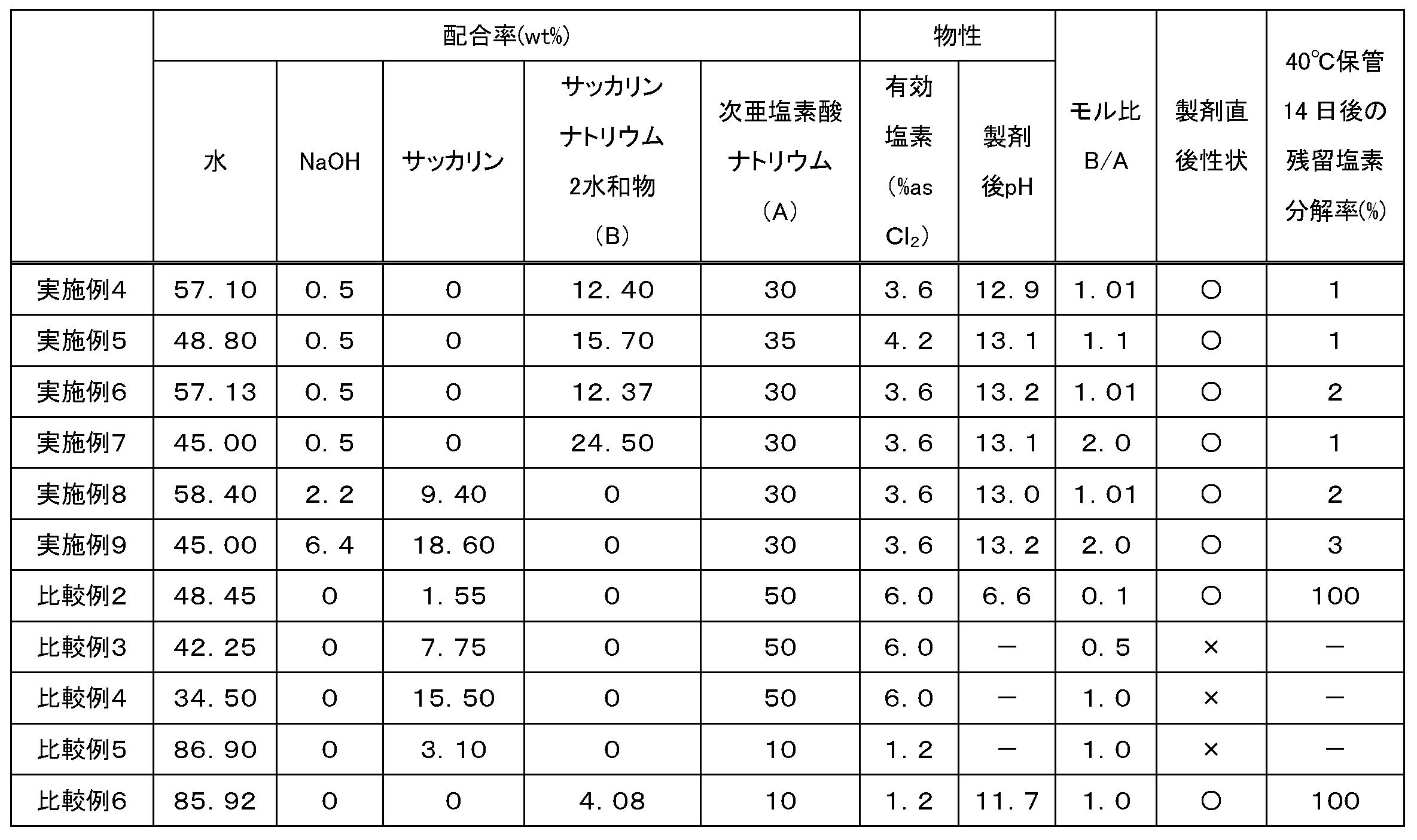
実施例4~9の組成物は、いずれも製剤化直後に液体品となり、沈殿物はほとんど見られず、40℃14日保管後の保存安定性も良好であった。
一方、比較例2,6の組成物は、有効成分の安定性が著しく低下し、40℃14日保管後の保存安定性が悪かった。比較例3~5の組成物は、製剤後に沈殿物が生じて液体品とならず製剤化できなかった。
<殺菌試験>
脱塩ろ過をした相模原井水に普通ブイヨンを添加し、一般細菌数が106CFU/mLとなるように模擬水を調製した。300mLビーカに調製した模擬水300mLを入れ、表1に記載の実施例3および比較例1の40℃14日保管後の組成物をそれぞれ全塩素換算の添加濃度が合計0.6mg/LasCl2になるように添加し、デジタルスターラにより250rpmで撹拌した。全ての組成物を添加してから24時間後、72時間後に、処理した水を所定量採取するとともに、有効塩素を失活させるためにチオ硫酸ナトリウムを添加後、スリーエム株式会社製ペトリフィルム(商標)培地大腸菌群数測定用ACプレートにより一般細菌数(CFU/mL)の測定を行った。殺菌試験の評価を下記基準で行った。結果を表3に示す。
脱塩ろ過をした相模原井水に普通ブイヨンを添加し、一般細菌数が106CFU/mLとなるように模擬水を調製した。300mLビーカに調製した模擬水300mLを入れ、表1に記載の実施例3および比較例1の40℃14日保管後の組成物をそれぞれ全塩素換算の添加濃度が合計0.6mg/LasCl2になるように添加し、デジタルスターラにより250rpmで撹拌した。全ての組成物を添加してから24時間後、72時間後に、処理した水を所定量採取するとともに、有効塩素を失活させるためにチオ硫酸ナトリウムを添加後、スリーエム株式会社製ペトリフィルム(商標)培地大腸菌群数測定用ACプレートにより一般細菌数(CFU/mL)の測定を行った。殺菌試験の評価を下記基準で行った。結果を表3に示す。
(殺菌試験の評価)
〇:72時間後の一般細菌数が1000(CFU/mL)未満
×:72時間後の一般細菌数が1000(CFU/mL)以上
〇:72時間後の一般細菌数が1000(CFU/mL)未満
×:72時間後の一般細菌数が1000(CFU/mL)以上
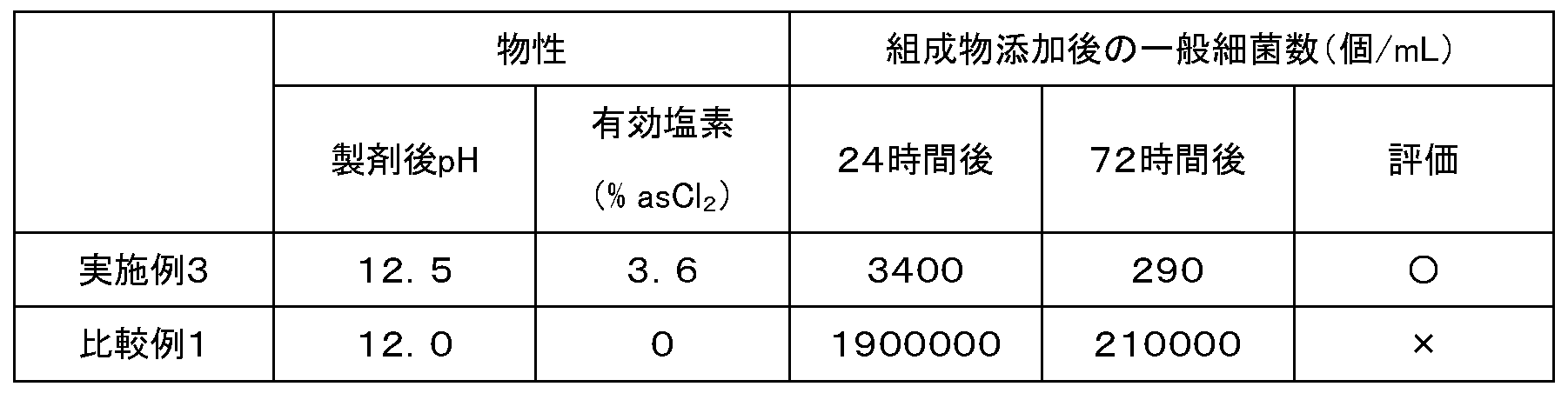
比較例1の組成物のように組成物のpHが12.5未満と低く、保存安定性が低い組成物で有効塩素がほとんど残存していない組成物を添加しても殺菌力がほとんどなく、実施例3のようなpHが12.5以上の組成物は持続性のある殺菌力があることがわかった。
<実施例10~12、比較例7~9:アゾール系化合物の併用>
[組成物Aの調製]
純水:31.45重量%に水酸化ナトリウム:6.4重量%を混合した後、サッカリン:22.2重量%を混合した。溶解後、12重量%次亜塩素酸ナトリウム:40.0重量%を混合し、室温(25±5℃)で4日間静置した。4日間静置した後の組成物のpHは13.5、有効ハロゲン濃度(有効塩素換算濃度)は4.8重量%asCl2であった。
[組成物Aの調製]
純水:31.45重量%に水酸化ナトリウム:6.4重量%を混合した後、サッカリン:22.2重量%を混合した。溶解後、12重量%次亜塩素酸ナトリウム:40.0重量%を混合し、室温(25±5℃)で4日間静置した。4日間静置した後の組成物のpHは13.5、有効ハロゲン濃度(有効塩素換算濃度)は4.8重量%asCl2であった。
相模原井水をガラス瓶に測り入れ、さらに表4の通りベンゾトリアゾールを所定量になるように添加し、水処理用組成物として組成物Aまたは12重量%次亜塩素酸ナトリウムを1mgCl/L添加後、蓋をして日光が照射される場所に静置した。2時間日光を照射後、残存する有効塩素量を測定した。残存有効塩素の評価を下記基準で行った。結果を表4に示す。
(残存有効塩素の評価の評価)
〇:有効塩素残存量が50%以上
△:有効塩素残存量が10%以上50%未満
×:有効塩素残存量が10%未満
〇:有効塩素残存量が50%以上
△:有効塩素残存量が10%以上50%未満
×:有効塩素残存量が10%未満
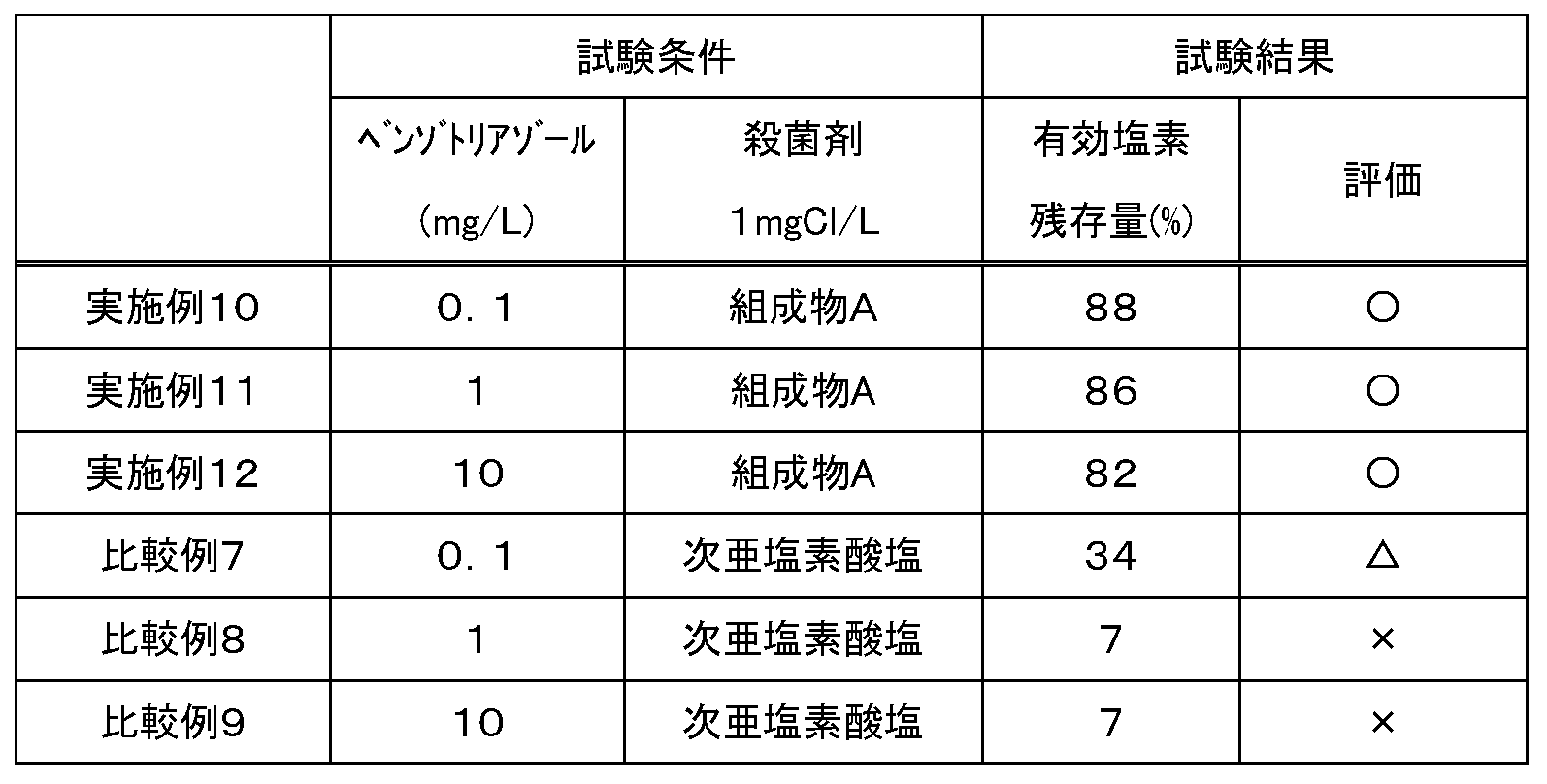
実施例10~12では、組成物Aとベンゾトリアゾールとを水中で混合し、日光が照射された場合でも、有効塩素の消失が少なかった。一方、比較例7~9では、次亜塩素酸塩とベンゾトリアゾールとを水中で混合した場合、有効塩素が消失しやすく、特に次亜塩素酸塩と1mg/L以上のベンゾトリアゾールとを水中で混合した場合、有効塩素がより消失しやすいことがわかった。実施例10~12では、日光の照射下で組成物Aとベンゾトリアゾールとを併用しても、有効塩素の消失が少ないため殺菌性能を維持することができ、かつ、防食性能を発揮することがわかった。比較例7~9では、日光の照射下で次亜塩素酸塩とベンゾトリアゾールとを併用すると、有効塩素が消失するため殺菌性能を維持することができないことがわかった。
<実施例13~16:ポリマーの併用>
相模原井水をガラス瓶に測り入れ、さらに表5の通りポリマーを所定量になるように添加した。なお、「PAA」は、アクリル酸単独重合体(重量平均分子量4,500)、「AABI」は、アクリル酸と、2-アクリルアミド-2-メチルプロパンスルホン酸とのアクリル酸系二元共重合体(重量平均分子量4,500)、「PMAA」は、マレイン酸単独重合体(重量平均分子量1,000)、「AATER」は、アクリル酸と、2-アクリルアミド-2-メチルプロパンスルホン酸と、アルキルアクリルアミドとのアクリル酸系三元共重合体(重量平均分子量4,500)である。水処理用組成物として組成物Aを1mgCl/L添加後、蓋をして日光が照射される場所に静置した。日光を2時間照射後、残存する有効塩素量を測定した。残存有効塩素の評価を下記基準で行った。結果を表5に示す。
相模原井水をガラス瓶に測り入れ、さらに表5の通りポリマーを所定量になるように添加した。なお、「PAA」は、アクリル酸単独重合体(重量平均分子量4,500)、「AABI」は、アクリル酸と、2-アクリルアミド-2-メチルプロパンスルホン酸とのアクリル酸系二元共重合体(重量平均分子量4,500)、「PMAA」は、マレイン酸単独重合体(重量平均分子量1,000)、「AATER」は、アクリル酸と、2-アクリルアミド-2-メチルプロパンスルホン酸と、アルキルアクリルアミドとのアクリル酸系三元共重合体(重量平均分子量4,500)である。水処理用組成物として組成物Aを1mgCl/L添加後、蓋をして日光が照射される場所に静置した。日光を2時間照射後、残存する有効塩素量を測定した。残存有効塩素の評価を下記基準で行った。結果を表5に示す。
(残存有効塩素の評価)
〇:有効塩素残存量が50%以上
△:有効塩素残存量が10%以上50%未満
×:有効塩素残存量が10%未満
〇:有効塩素残存量が50%以上
△:有効塩素残存量が10%以上50%未満
×:有効塩素残存量が10%未満
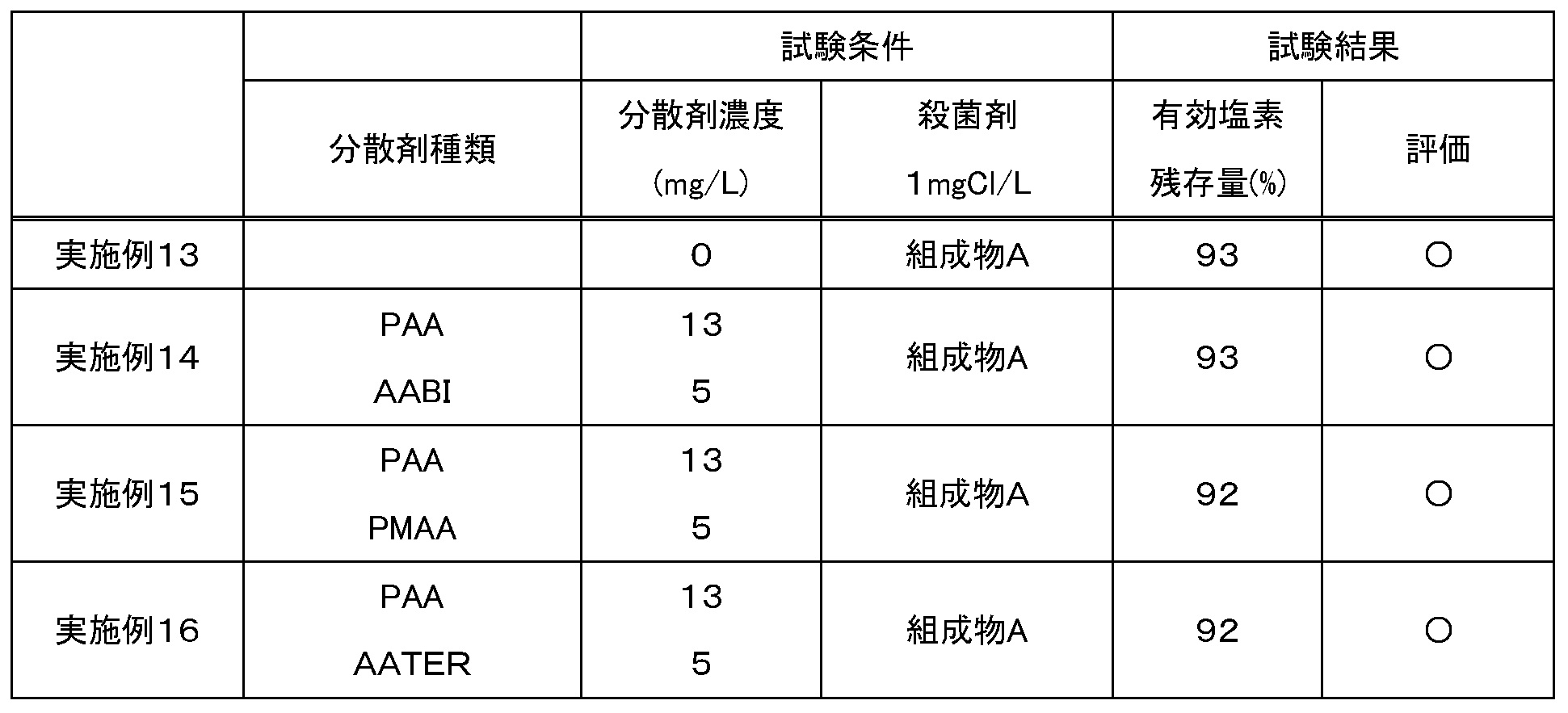
実施例13,14,15,16では、組成物Aとポリマーを水中で混合し、日光が照射された場合でも、有効塩素の消失が少なかった。
このように、実施例の組成物によって、液体で保存安定性が良好であり、殺菌性能が高い水処理用組成物が得られた。また、実施例の組成物によって、冷却水系の水に次亜塩素酸塩とアゾール系化合物とを添加し、日光が照射されても、有効塩素が消失されにくいことがわかった。さらに、実施例の組成物によって、冷却水系の水に次亜塩素酸塩とポリマーとを添加し、日光が照射されても、有効塩素が消失されにくいことがわかった。
Claims (9)
- サッカリンおよびその塩のうちの少なくとも1つと、次亜塩素酸およびその塩のうちの少なくとも1つと、アルカリ金属の水酸化物と、を含み、pHが12.5以上であることを特徴とする水処理用組成物。
- 請求項1に記載の水処理用組成物であって、
前記次亜塩素酸およびその塩のうちの少なくとも1つの有効塩素に対する前記サッカリンおよびその塩のうちの少なくとも1つのモル比が、1.0~2.0の範囲であることを特徴とする水処理用組成物。 - 請求項1または2に記載の水処理用組成物であって、
前記水処理用組成物中の前記次亜塩素酸およびその塩のうちの少なくとも1つの有効塩素配合量が、1~4.8重量%asCl2の範囲であることを特徴とする水処理用組成物。 - 請求項1~3のいずれか1項に記載の水処理用組成物であって、
さらにアゾール系化合物を含むことを特徴とする水処理用組成物。 - 請求項1~4のいずれか1項に記載の水処理用組成物を用いて水を処理することを特徴とする水処理方法。
- 請求項1~4のいずれか1項に記載の水処理用組成物の製造方法であって、
サッカリンおよびその塩のうちの少なくとも1つと、次亜塩素酸およびその塩のうちの少なくとも1つと、アルカリと、を混合して混合物を調製する混合工程と、
前記混合工程の後に、前記混合物を少なくとも1~7日間撹拌または静置する撹拌静置工程と、
を含むことを特徴とする水処理用組成物の製造方法。 - 請求項1~4のいずれか1項に記載の水処理用組成物を冷却水系の水に添加することを特徴とする冷却水系処理方法。
- 請求項1~3のいずれか1項に記載の水処理用組成物と、アゾール系化合物とを冷却水系の水に添加することを特徴とする冷却水系処理方法。
- 請求項8に記載の冷却水系処理方法であって、
前記冷却水系の水に、前記水系処理用組成物を0.1~100mgCl/Lの量で添加し、前記アゾール系化合物を0.1~10mg/Lの量で添加することを特徴とする冷却水系処理方法。
Applications Claiming Priority (2)
| Application Number | Priority Date | Filing Date | Title |
|---|---|---|---|
| JP2020166187A JP2023162464A (ja) | 2020-09-30 | 2020-09-30 | 水処理用組成物、水処理方法、水処理用組成物の製造方法、および冷却水系処理方法 |
| JP2020-166187 | 2020-09-30 |
Publications (1)
| Publication Number | Publication Date |
|---|---|
| WO2022070451A1 true WO2022070451A1 (ja) | 2022-04-07 |
Family
ID=80950057
Family Applications (1)
| Application Number | Title | Priority Date | Filing Date |
|---|---|---|---|
| PCT/JP2021/001087 Ceased WO2022070451A1 (ja) | 2020-09-30 | 2021-01-14 | 水処理用組成物、水処理方法、水処理用組成物の製造方法、および冷却水系処理方法 |
Country Status (2)
| Country | Link |
|---|---|
| JP (1) | JP2023162464A (ja) |
| WO (1) | WO2022070451A1 (ja) |
Cited By (1)
| Publication number | Priority date | Publication date | Assignee | Title |
|---|---|---|---|---|
| CN117623484A (zh) * | 2022-08-31 | 2024-03-01 | 兆联实业股份有限公司 | 含三唑系化合物废水的处理方法 |
Citations (3)
| Publication number | Priority date | Publication date | Assignee | Title |
|---|---|---|---|---|
| WO2004026770A1 (en) * | 2002-09-19 | 2004-04-01 | Nalco Company | Stabilized bromine and chlorine mixture, method of manufacture and uses thereof for biofouling control |
| JP2006206608A (ja) * | 2001-08-28 | 2006-08-10 | Kurita Water Ind Ltd | 殺菌殺藻剤組成物 |
| WO2016158633A1 (ja) * | 2015-03-31 | 2016-10-06 | 栗田工業株式会社 | 逆浸透膜処理システムの運転方法及び逆浸透膜処理システム |
-
2020
- 2020-09-30 JP JP2020166187A patent/JP2023162464A/ja active Pending
-
2021
- 2021-01-14 WO PCT/JP2021/001087 patent/WO2022070451A1/ja not_active Ceased
Patent Citations (3)
| Publication number | Priority date | Publication date | Assignee | Title |
|---|---|---|---|---|
| JP2006206608A (ja) * | 2001-08-28 | 2006-08-10 | Kurita Water Ind Ltd | 殺菌殺藻剤組成物 |
| WO2004026770A1 (en) * | 2002-09-19 | 2004-04-01 | Nalco Company | Stabilized bromine and chlorine mixture, method of manufacture and uses thereof for biofouling control |
| WO2016158633A1 (ja) * | 2015-03-31 | 2016-10-06 | 栗田工業株式会社 | 逆浸透膜処理システムの運転方法及び逆浸透膜処理システム |
Cited By (1)
| Publication number | Priority date | Publication date | Assignee | Title |
|---|---|---|---|---|
| CN117623484A (zh) * | 2022-08-31 | 2024-03-01 | 兆联实业股份有限公司 | 含三唑系化合物废水的处理方法 |
Also Published As
| Publication number | Publication date |
|---|---|
| JP2023162464A (ja) | 2023-11-09 |
Similar Documents
| Publication | Publication Date | Title |
|---|---|---|
| JP4966936B2 (ja) | 分離膜用スライム防止剤組成物、膜分離方法および分離膜用スライム防止剤組成物の製造方法 | |
| TWI527933B (zh) | 用於控制產業系統中銅排放及銅合金腐蝕之組合物及方法 | |
| TWI309555B (ja) | ||
| JP5835967B2 (ja) | スライム剥離剤およびスライム剥離方法 | |
| WO2015029504A1 (ja) | 次亜臭素酸安定化組成物の製造方法、次亜臭素酸安定化組成物、および分離膜のスライム抑制方法 | |
| JP2016120457A (ja) | ろ過処理システムおよびろ過処理方法 | |
| JP2009154113A (ja) | 水系水の殺菌処理方法 | |
| CN105960481B (zh) | 磷酸酒石酸和其盐用于导水系统中的水处理的用途 | |
| TW201827347A (zh) | 利用逆滲透膜的水處理方法及水處理裝置 | |
| KR102506078B1 (ko) | 부식 및 스케일을 억제하기 위한 조성물 및 방법 | |
| CN112174342B (zh) | 一种缓蚀阻垢剂及其制备方法 | |
| WO2022070451A1 (ja) | 水処理用組成物、水処理方法、水処理用組成物の製造方法、および冷却水系処理方法 | |
| JP4321733B2 (ja) | 次亜塩素酸塩を含有する安定な水処理剤組成物 | |
| JP6478455B2 (ja) | 水系の殺菌方法 | |
| JP2003267811A (ja) | スライム剥離剤、スライム剥離剤組成物およびスライム剥離方法 | |
| JP5829309B1 (ja) | スライム防止用組成物 | |
| JP5938874B2 (ja) | 船舶バラスト水処理剤及びこれを用いた船舶バラスト水の処理方法 | |
| JP5281465B2 (ja) | 殺菌殺藻剤組成物、水系の殺菌殺藻方法および殺菌殺藻剤組成物の製造方法 | |
| JP4383614B2 (ja) | 次亜塩素酸塩を含有する安定な水処理剤組成物 | |
| KR940000562B1 (ko) | 스케일 방지제 | |
| JP6835106B2 (ja) | 水処理剤 | |
| JP2002001353A (ja) | 冷却水系の処理方法 | |
| JP2025086564A (ja) | 水処理組成物及び水処理方法 | |
| JP2013094766A (ja) | 船舶バラスト水処理剤及びこれを用いた船舶バラスト水の処理方法 | |
| KR102874005B1 (ko) | 수처리제 |
Legal Events
| Date | Code | Title | Description |
|---|---|---|---|
| 121 | Ep: the epo has been informed by wipo that ep was designated in this application |
Ref document number: 21874759 Country of ref document: EP Kind code of ref document: A1 |
|
| NENP | Non-entry into the national phase |
Ref country code: DE |
|
| 122 | Ep: pct application non-entry in european phase |
Ref document number: 21874759 Country of ref document: EP Kind code of ref document: A1 |
|
| NENP | Non-entry into the national phase |
Ref country code: JP |