WO2022054897A1 - エポキシ樹脂用硬化剤組成物、エポキシ樹脂組成物及び塗料 - Google Patents
エポキシ樹脂用硬化剤組成物、エポキシ樹脂組成物及び塗料 Download PDFInfo
- Publication number
- WO2022054897A1 WO2022054897A1 PCT/JP2021/033260 JP2021033260W WO2022054897A1 WO 2022054897 A1 WO2022054897 A1 WO 2022054897A1 JP 2021033260 W JP2021033260 W JP 2021033260W WO 2022054897 A1 WO2022054897 A1 WO 2022054897A1
- Authority
- WO
- WIPO (PCT)
- Prior art keywords
- epoxy resin
- curing agent
- agent composition
- component
- water
- Prior art date
- Legal status (The legal status is an assumption and is not a legal conclusion. Google has not performed a legal analysis and makes no representation as to the accuracy of the status listed.)
- Ceased
Links
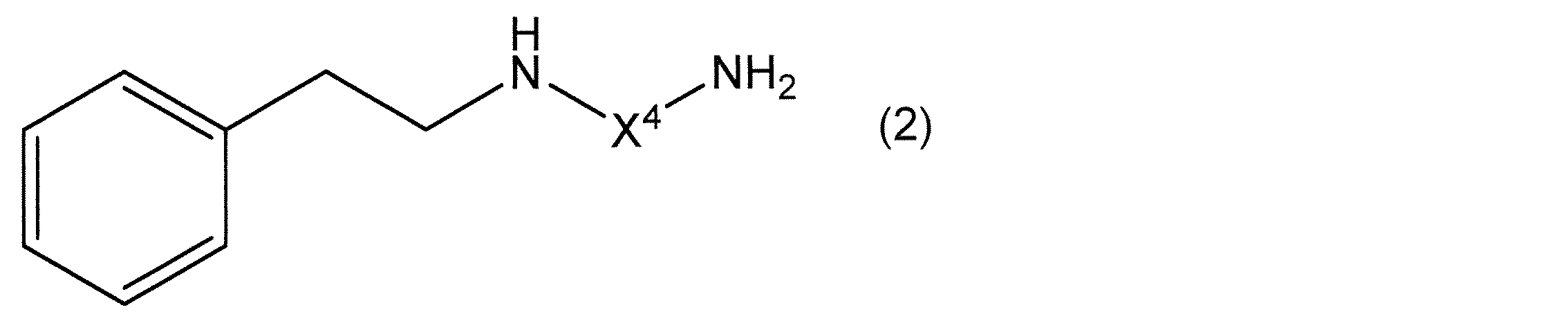
- 0 N*NCCc1ccccc1 Chemical compound N*NCCc1ccccc1 0.000 description 4
Classifications
-
- C—CHEMISTRY; METALLURGY
- C08—ORGANIC MACROMOLECULAR COMPOUNDS; THEIR PREPARATION OR CHEMICAL WORKING-UP; COMPOSITIONS BASED THEREON
- C08G—MACROMOLECULAR COMPOUNDS OBTAINED OTHERWISE THAN BY REACTIONS ONLY INVOLVING UNSATURATED CARBON-TO-CARBON BONDS
- C08G59/00—Polycondensates containing more than one epoxy group per molecule; Macromolecules obtained by polymerising compounds containing more than one epoxy group per molecule using curing agents or catalysts which react with the epoxy groups
- C08G59/18—Macromolecules obtained by polymerising compounds containing more than one epoxy group per molecule using curing agents or catalysts which react with the epoxy groups ; e.g. general methods of curing
- C08G59/40—Macromolecules obtained by polymerising compounds containing more than one epoxy group per molecule using curing agents or catalysts which react with the epoxy groups ; e.g. general methods of curing characterised by the curing agents used
- C08G59/50—Amines
- C08G59/56—Amines together with other curing agents
- C08G59/60—Amines together with other curing agents with amides
-
- C—CHEMISTRY; METALLURGY
- C08—ORGANIC MACROMOLECULAR COMPOUNDS; THEIR PREPARATION OR CHEMICAL WORKING-UP; COMPOSITIONS BASED THEREON
- C08L—COMPOSITIONS OF MACROMOLECULAR COMPOUNDS
- C08L63/00—Compositions of epoxy resins; Compositions of derivatives of epoxy resins
-
- C—CHEMISTRY; METALLURGY
- C09—DYES; PAINTS; POLISHES; NATURAL RESINS; ADHESIVES; COMPOSITIONS NOT OTHERWISE PROVIDED FOR; APPLICATIONS OF MATERIALS NOT OTHERWISE PROVIDED FOR
- C09D—COATING COMPOSITIONS, e.g. PAINTS, VARNISHES OR LACQUERS; FILLING PASTES; CHEMICAL PAINT OR INK REMOVERS; INKS; CORRECTING FLUIDS; WOODSTAINS; PASTES OR SOLIDS FOR COLOURING OR PRINTING; USE OF MATERIALS THEREFOR
- C09D163/00—Coating compositions based on epoxy resins; Coating compositions based on derivatives of epoxy resins
-
- C—CHEMISTRY; METALLURGY
- C09—DYES; PAINTS; POLISHES; NATURAL RESINS; ADHESIVES; COMPOSITIONS NOT OTHERWISE PROVIDED FOR; APPLICATIONS OF MATERIALS NOT OTHERWISE PROVIDED FOR
- C09D—COATING COMPOSITIONS, e.g. PAINTS, VARNISHES OR LACQUERS; FILLING PASTES; CHEMICAL PAINT OR INK REMOVERS; INKS; CORRECTING FLUIDS; WOODSTAINS; PASTES OR SOLIDS FOR COLOURING OR PRINTING; USE OF MATERIALS THEREFOR
- C09D5/00—Coating compositions, e.g. paints, varnishes or lacquers, characterised by their physical nature or the effects produced; Filling pastes
- C09D5/02—Emulsion paints including aerosols
Definitions
- the present invention relates to a curing agent composition for an epoxy resin, an epoxy resin composition, and a coating material. More specifically, the present invention relates to an epoxy resin curing agent composition containing two or more kinds of amine compounds having a specific skeleton, an epoxy resin composition containing the epoxy resin curing agent composition, and a coating material containing the epoxy resin composition. ..
- Epoxy resin exhibits excellent properties when used as an adhesive, paint, electrical insulation material, and civil engineering and building material. Among them, because of its excellent water resistance, chemical resistance, and corrosion resistance, it is often used for paints for automobiles, railroad vehicles, buildings, ships, electric machines, coatings on the inside of drinking water cans, and the like.
- Epoxy resins and curing agents used in paints have often used solvents in order to reduce the viscosity from the viewpoint of workability.
- volatile solvents such as toluene and xylene
- Patent Document 1 discloses a modified amine obtained by reacting a polyamine with methyl acrylate. This modified amine has an amide bond and has good compatibility with water, but when the epoxy resin is cured with this modified amine alone, there is a problem in the water resistance of the cured product.
- the cured agent composition becomes turbid due to the combined amine compound, or the amine compound crystallizes.
- the compatibility between the amine compounds used in the curing agent composition is insufficient, and there are problems in the storage stability of the curing agent composition and the workability when used as the curing agent composition.
- Patent Document 2 discloses a curing agent for an aqueous epoxy resin containing a reaction composition containing a reaction product of styrene and an amine compound. This curing agent had good compatibility with the water-based epoxy resin, but there was a problem in the water resistance and corrosion resistance of the epoxy cured product obtained by using this curing agent.
- the problem to be solved by the present invention is that the curing agent composition maintains transparency, has good workability, and has good compatibility with an aqueous epoxy resin, and can be obtained by reacting with an epoxy resin. It is an object of the present invention to provide a curing agent composition for an epoxy resin having excellent water resistance and corrosion resistance.
- the present inventors have diligently studied, and a curing agent composition containing a specific amine compound (A) component and (B) component in a specific mass ratio range has become the (A) component and the (B) component. It has transparency due to good compatibility between the amine compounds used, and also has good compatibility with water-based epoxy resins. It is obtained by curing an epoxy resin composition containing this curing agent composition and an epoxy resin. We have found that the cured product is excellent in water resistance and corrosion resistance, and have reached the present invention. That is, the present invention is selected from the group consisting of the component (A), which is a compound represented by the following general formula (1), and the compounds represented by the following general formulas (2) and (3).
- a curing agent composition for an epoxy resin which comprises at least one component (B) and has a mass ratio of the component (A) to the component (B) of 7: 3 to 9: 1.
- R 1 and R 2 each independently represent a hydrogen atom or a methyl group
- X 1 to X 3 each independently represent a residue obtained by removing two amino groups from a polyamine compound
- n represents a residue. Represents an integer from 0 to 10.
- X 4 represents a residue obtained by removing two amino groups from the polyamine compound.
- x represents an integer of 1 to 6
- y represents an integer of 1 to 40
- z represents an integer of 1 to 6.
- the curing agent composition of the present invention has good workability and compatibility with a water-based epoxy resin while maintaining transparency, and is excellent in water resistance and corrosion resistance of a cured product obtained by curing an epoxy resin. Therefore, it is useful as a curing agent composition for epoxy resins with reduced burden on the environment. Further, the epoxy resin composition obtained from the curing agent composition of the present invention and the epoxy resin is particularly useful as a paint used for vehicles such as automobiles and railways, buildings, ships, and electric machines.
- the curing agent composition of the present invention that can be used as a curing agent composition for an epoxy resin contains the component (A) and the component (B) described below.
- the component (A) is a compound represented by the following general formula (1).
- R 1 and R 2 each independently represent a hydrogen atom or a methyl group
- X 1 to X 3 each independently represent a residue obtained by removing two amino groups from a polyamine compound
- n represents a residue. Represents an integer from 0 to 10.
- R 1 and R 2 in the general formula (1) a hydrogen atom is preferable from the viewpoint of easy production of this compound.
- the residues represented by X 1 to X 3 in the general formula (1) obtained by removing two amino groups from the polyamine compound are particularly limited as long as the polyamine compound is a compound having two or more amino groups.
- aliphatic polyamines such as ethylenediamine, diethylenetriamine, triethylenetetramine, tetraethylenepentamine, polyoxypropylenediamine, polyoxypropylenetriamine; aromatic ring-containing fats such as m-xylylene diamine and p-xylylene diamine.
- Aromatic polyamines such as biphenylenediamine, mensendiamine, bis (4-amino-3-methyldicyclohexyl) methane, diaminodicyclohexylmethane, bis (aminomethyl) cyclohexane, N-aminoethylpiperazine, 3,9-bis (3-aminopropyl) ) -2,4,8,10-Tetraoxaspiro [5.5] Alicyclic polyamines such as undecane; m-phenylenediamine, p-phenylenediamine, tolylen-2,4-diamine, tolylen-2,6- Mononuclear polyamines such as diamine, mesityylene-2,4-diamine, mesitylen-2,6-diamine, 3,5-diethyltolylen-2,4-diamine, 3,5-diethyltrilen-2,6-diamine Aromatic polyamines such as bipheny
- the carbon number of the polyamine compound is not particularly limited, but it is preferably a compound having 2 to 30 carbon atoms, more preferably a compound having 2 to 20 carbon atoms, and a compound having 4 to 12 carbon atoms. It is more preferable to have.
- aliphatic polyamines aromatic ring-containing aliphatic polyamines, and alicyclic polyamines are preferable from the viewpoint of water resistance and corrosion resistance of the cured product obtained by using the curing agent composition of the present invention.
- -Xylylene diamine and isophorone diamine are more preferable, and m-xylylene diamine is particularly preferable.
- a single compound may be used, or two or more kinds may be reacted in combination.
- X 1 to X 3 may all be the same, any one of X 1 to X 3 may be different, or all may be different, but the water resistance and corrosion resistance of the obtained cured product and the general formula (1). ), It is preferable that they are all the same from the viewpoint of facilitating the production of the compounds represented by).
- a compound in which n is an integer of 0 to 10 represented by the general formula (1) is usually a mixture containing compounds having different numerical values of n.
- the average value of n in the mixture is preferably 0 to 5, more preferably 0 to 3, and 0 to 1 from the viewpoints that the viscosity of the curing agent composition is lowered and the workability is improved and the curability is improved. More preferably, 1 is particularly preferable.
- a plurality of X 2 and R 2 existing may be the same or different from each other, but from the viewpoint of facilitating the production of this compound, X 2 and R 2 are It is preferable that they are the same.
- the compound represented by the general formula (1) can be produced by a known method, and for example, (meth) acrylic acid, (meth) acrylic acid ester, or (meth) acrylic acid may be produced with respect to the polyamine compound. ) It can be obtained by reacting with a halide of acrylic acid (hereinafter referred to as (meth) acrylic acid-based compound).
- (meth) acrylic acid means methacrylic acid or acrylic acid.
- the average value of n can be determined by adjusting the molar ratio of each compound when the polyamine compound and the (meth) acrylic acid compound are reacted.
- the molar ratio is preferably 0.1 to 0.9 mol, more preferably 0.2 to 0.8 mol, still more preferably 0.5 to 0.75 mol, relative to 1 mol of the polyamine compound.
- Examples of the (meth) acrylic acid ester include methyl (meth) acrylate, ethyl (meth) acrylate, butyl (meth) acrylate, 2-ethylhexyl (meth) acrylate, and lauryl (meth) acrylate.
- Examples thereof include tridecyl acrylate, stearyl (meth) acrylate, cyclohexyl (meth) acrylate, benzyl (meth) acrylate, and isobonyl (meth) acrylate.
- halogen in the above-mentioned (meth) acrylic acid halide examples include fluorine, chlorine, bromine, and iodine.
- the above (meth) acrylic acid-based compound may be used alone or in combination of two or more. From the viewpoint of low cost and easy production, it is preferable to use one (meth) acrylic acid compound alone, more preferably (meth) acrylic acid ester, and particularly preferably methyl acrylate.
- component (B) is at least one compound selected from the group consisting of the compounds represented by the following general formulas (2) and (3).
- X 4 represents a residue obtained by removing two amino groups from the polyamine compound.
- x represents an integer of 1 to 6
- y represents an integer of 1 to 40
- z represents an integer of 1 to 6.
- the polyamine compound at the residue of the polyamine compound represented by X4 in the general formula ( 2 ) excluding two amino groups is a compound having two or more amino groups.
- the polyamine compounds exemplified in the above description of X 1 to X 3 are not particularly limited, and examples thereof include polyamine compounds. From the viewpoint of water resistance and corrosion resistance of the cured product obtained by using the curing agent composition of the present invention, aliphatic polyamines, aromatic ring-containing aliphatic polyamines, and alicyclic polyamines are preferable, and m-xylylene diamine and isophorone diamine are preferable. More preferably, m-xylylene diamine is particularly preferable.
- the compound represented by the general formula (2) can be obtained by reacting styrene with the above polyamine compound using a basic catalyst, if necessary.
- the molar ratio of styrene to the polyamine compound in the reaction is preferably 0.5 to 1.5, more preferably 0.8 to 1.2.
- the compounds in which x in the general formula (3) represents a number from 1 to 6, y represents a number from 1 to 40, and z represents a number from 1 to 6 are usually x, y,. It is a mixture of compounds having different numerical values of z.
- the average values of x and z are preferably 1 to 4 independently from the viewpoint of the balance between the physical properties of the cured product obtained by using the curing agent composition and the water solubility.
- the average value of the total value of x + z is preferably 3 to 5.
- the average value of y is preferably 5 to 15 from the viewpoint of the balance between the physical properties of the cured product obtained by using the curing agent composition and the water solubility.
- the component (B) is represented by the general formula (2) in that a curing agent composition having better compatibility with the component (A) and excellent in transparency in appearance and storage condition can be obtained. Compounds are preferred.
- component (B) a commercially available product may be used, and examples thereof include Gascamin 240 manufactured by Mitsubishi Gas Chemical Company, Inc., Jeffamine ED-600 manufactured by Huntsman, and the like.
- the curing agent composition of the present invention is characterized in that the mass ratio of the component (A) to the component (B) is 7: 3 to 9: 1. From the viewpoint of further improving the performance of the cured product obtained by using it as a curing agent composition, the mass ratio is more preferably 7.5: 2.5 to 8.5: 1.5. When the mass ratio of the component (A) to the component (B) is outside the range of 7: 3 to 9: 1, when the component (A) and the component (B) are mixed, they do not dissolve in each other and become turbid. It is not preferable because the performance such as water resistance and corrosion resistance of the cured product is significantly deteriorated.
- the curing agent composition of the present invention may contain an amine-based curing agent other than the component (A) and the component (B).
- examples of such an amine-based curing agent include polyamine compounds exemplified in the above explanations of X 1 to X 3 .
- the amine-based curing agent also corresponds to the unreacted polyamine compound at the time of production of the component (A) and the component (B).
- the curing agent composition of the present invention contains an amine-based curing agent other than the component (A) and the component (B), the content of the amine-based curing agent other than the component (A) and the component (B) is the curing.
- 1 to 20 parts by mass is preferable with respect to 100 parts by mass of the total mass of the component (A) and the component (B), and 1 to 10 parts are preferable. Parts by mass are more preferred.
- the curing agent composition of the present invention may contain a curing accelerator from the viewpoint of improving curability.
- the curing accelerator include trimethylamine, ethyldimethylamine, propyldimethylamine, N, N'-dimethylpiperazine, pyridine, picolin, 1,8-diazabiscyclo (5,4,0) undecene-1 (DBU), and benzyl.
- Tertiary amines such as dimethylamine, 2- (dimethylaminomethyl) phenol, 2,4,6-tris (dimethylaminomethyl) phenol; butylphenol, phenol novolac, o-cresol novolak, p-cresolnovolac, t-butylphenol Pphenols such as novolak and dicyclopentadiencresol; p-toluenesulfonic acid, 1-aminopyrrolidine salt of thiocyanic acid (manufactured by Otsuka Chemical Co., Ltd .; NR-S), salicylic acid, thiourea and the like can be mentioned.
- the content of the curing accelerator when the curing agent composition of the present invention contains the above-mentioned curing accelerator is the component (A) from the viewpoint of the balance between the curability of the curing agent composition and the transparent appearance.
- the component (B) With respect to 100 parts by mass of the total mass of the components (B), 1 to 20 parts by mass is preferable, and 1 to 10 parts by mass is more preferable.
- the curing agent composition of the present invention may be diluted with a solvent. It is preferable not to use the above solvent in consideration of the environment as much as possible, but when it is used, it is preferable to use a solvent having low volatility in order to reduce the viscosity of the curing agent composition and improve workability. ..
- a solvent include an alcohol solvent such as methyl cellosolve, butyl cellosolve, and propylene glycol monomethyl ether, an ester solvent such as propylene glycol monomethyl ether acetate, and a nitrogen atom such as dimethylformamide, dimethylacetamide, and N-methylpyrrolidone.
- examples thereof include a solvent and a solvent containing a sulfur atom such as dimethyl sulfoxide.
- the content is preferably 1 to 30% by mass, more preferably 5 to 25% by mass, based on the total mass of the curing agent composition. preferable.
- the total content of the component (A) and the component (B) is the total mass of the curing agent composition from the viewpoint of transparency, workability and curability of the curing agent composition. It is preferably 60 to 100% by mass, more preferably 70 to 100% by mass, and even more preferably 75 to 100% by mass.
- the components (A) and (B), and other optionally used amine-based curing agents, curing accelerators, solvents, etc. are mixed together, and the like. There are no particular restrictions on the manufacturing method.
- the epoxy resin composition of the present invention contains the above-mentioned curing agent composition and an epoxy resin.
- the epoxy resin include polyglycidyl ether compounds of mononuclear polyvalent phenol compounds such as hydroquinone, resorcin, pyrocatechol, and fluoroglucosinol; dihydroxynaphthalene, biphenol, methylenebisphenol (bisphenol F), methylenebis (orthocresol), and the like.
- Echilidene bisphenol isopropylidene bisphenol (bisphenol A), isopropyridenebis (orthocresol), tetrabromobisphenol A, 1,3-bis (4-hydroxycumylbenzene), 1,4-bis (4-hydroxycumylbenzene) ), 1,1,3-Tris (4-hydroxyphenyl) butane, 1,1,2,2-tetra (4-hydroxyphenyl) ethane, thiobisphenol, sulfobisphenol, oxybisphenol, phenol novolak, orthocresol novolak, Polyglycidyl ether compounds of polynuclear polyvalent phenolic compounds such as ethylphenol novolak, butylphenol novolak, octylphenol novolak, resorcinnovolak, terpenphenol; ethylene glycol, propylene glycol, butylene glycol, hexanediol, polyglycol, thiodiglycol, dicycl
- Polyglycidyl ethers of polyhydric alcohols such as dimethanol, 2,2-bis (4-hydroxycyclohexylpropane (bisphenol A hydride), glycerin, trimethylolpropane, pentaerythritol, sorbitol, bisphenol A-alkylene oxide adduct; Maleic acid, fumaric acid, itaconic acid, succinic acid, glutaric acid, suberic acid, adipic acid, azelaic acid, sebacic acid, dimer acid, trimeric acid, phthalic acid, isophthalic acid, terephthalic acid, trimellitic acid, trimesic acid, pyro Monopolymers or copolymers of aliphatic, aromatic or alicyclic polybasic acids such as merit acids, tetrahydrophthalic acid, hexahydrophthalic acid, endomethylene tetrahydrophthalic acid and glycidyl methacrylates; N, N -
- epoxy resins listed above polyglycidyl ether compounds of polynuclear polyhydric phenol compounds and polyglycidyl ethers of polyhydric alcohols are preferable, and bisphenol type, from the viewpoint of improving the water resistance and corrosion resistance of the obtained cured product.
- Epoxy resins are more preferred. One type of these epoxy resins may be used, or two or more types may be used in combination.
- the above epoxy resin may be used as it is, or may be dispersed in water or emulsified (hereinafter, the epoxy resin dispersed or emulsified in water is referred to as a water-based epoxy resin).
- the method of dispersing and emulsifying in water include a method of putting an epoxy resin in water, adding a surfactant, and dispersing or emulsifying by a known method using a disper, a homomixer or the like.
- surfactant examples include general anionic and nonionic surfactants, primary amine salts, secondary amine salts, tertiary amine salts, quaternary amine salts and pyridinium salts.
- Cationic surfactants such as, betaine type, sulfate ester type, sulfonic acid type and the like can be used.
- anionic surfactant examples include alkyl sulfates such as sodium dodecyl sulfate, potassium dodecyl sulfate, and ammonium dodecyl sulfate, and polyoxyethylene ether sulfates such as sodium dodecyl polyglycol ether sulfate and ammonium polyoxyethylene alkyl ether sulfate.
- Alkyl sulfonates such as sodium sulforicinolate, alkali metal salt of sulfonated paraffin, ammonium salt of sulfonated paraffin; fatty acid salts such as sodium laurate, triethanolamine oleate, triethanolamine aviatete; sodium benzenesulfonate, Alkali aryl sulfonates such as alkali metal sulfates of alkaliphenol hydroxyethylene can be used.
- examples thereof include salts, N-acylamino acid salts, N-acylmethyltaurine salts and the like.
- nonionic surfactant for example, fatty acid partial esters of polyhydric alcohols such as sorbitan monolaurate and sorbitan monoolate, polyoxyethylene glycol fatty acid esters, and polyglycerin fatty acid esters can be used. Further, ethylene oxide and / or propylene oxide adduct of alcohol having 1 to 18 carbon atoms, ethylene oxide and / or propylene oxide adduct of alkylphenol, ethylene oxide and / or propylene oxide adduct of alkylene glycol and / or alkylenediamine may be used. Can be mentioned.
- the alcohols having 1 to 18 carbon atoms constituting the nonionic surfactant are, for example, methanol, ethanol, propanol, 2-propanol, butanol, 2-butanol, 3rd butanol, amyl alcohol, isoamyl alcohol, 3rd amyl alcohol, and the like.
- the alkylphenol is, for example, phenol, methylphenol, 2,4-dithiary butylphenol, 2,5-dithary butylphenol, 3,5-dithirth butylphenol, 4- (1,3-tetramethylbutyl) phenol. , 4-isooctylphenol, 4-nonylphenol, 4-third octylphenol, 4-dodecylphenol, 2- (3,5-dimethylheptyl) phenol, 4- (3,5-dimethylheptyl) phenol, naphthol, bisphenol A, And bisphenol F and the like.
- the alkylene glycol is, for example, ethylene glycol, 1,2-propanediol, 1,3-propanediol, 2-methyl-1,3-propanediol, 2-butyl-2-ethyl-1,3-propanediol, and the like.
- the alkylene diamine is, for example, a compound in which the alcoholic hydroxyl group of the alkylene glycol described above is replaced with an amino group.
- ethylene oxide and the propylene oxide adduct either a random adduct or a block adduct can be used.
- Examples of the cationic surfactant include lauryltrimethylammonium chloride, stearyltrimethylammonium chloride, distearyldimethylammonium chloride, didecyldimethylammonium chloride, laurylbenzyldimethylammonium chloride, didecyldimethylammonium chloride, alkylpyridinium bromide and imidazole. Examples include ammonium laurate.
- amphoteric tenside examples include coconut oil fatty acid amidopropyldimethylacetate betaine, lauryldimethylaminomino acid betaine, 2-alkyl-N-carboxymethyl-N-hydroxymethylimidazolinium betaine, laurylhydroxysulfobetaine, and lauroylamide ethyl.
- Betain-type amphoteric tenside agents such as hydroxyethylcarboxymethyl betaine and metal salts of hydroxypropyl phosphate, amino acid-type amphoteric tenside agents such as ⁇ -laurylaminopropionic acid metal salts, sulfate ester-type amphoteric tenside agents and sulfonic acids. Examples thereof include amphoteric tenside agents.
- the content of the epoxy resin in the water-based epoxy resin is preferably 20 to 80% by mass, more preferably 30 to 70% by mass, based on the total mass of the water-based epoxy resin.
- water-based epoxy resin for example, jER series W2801, W2821R70, W3435R67, W8735R70, W1155R55, W5654R45 manufactured by Mitsubishi Chemical Corporation, ADEKA Resin EM-101-50 manufactured by ADEKA Corporation, DIC ( EPICLON EXA-8610 manufactured by Huntsman, Araldite series PZ 3901, PZ 3921, PZ 3961-1 made by Huntsman, DER 915, DER 917 made by Olin, EPIREZ series Resin 3520-WY-55, Resin 6520 made by Hexion. 53 etc. can be used.
- jER series W2801, W2821R70, W3435R67, W8735R70, W1155R55, W5654R45 manufactured by Mitsubishi Chemical Corporation
- ADEKA Resin EM-101-50 manufactured by ADEKA Corporation DIC ( EPICLON EXA-8610 manufactured by Huntsman, Araldite series PZ 3901, PZ 3921, PZ 3961-1
- the content of water in the epoxy resin composition is preferably 10 to 60% by mass from the viewpoint of achieving both workability and reduction of environmental load. It is more preferably 15 to 50% by mass.
- the compounding amount of the curing agent composition of the present invention and the epoxy resin is such that the active hydrogen equivalent in the curing agent composition is 0. It is preferably 4 to 2.0 equivalents, more preferably 0.5 to 1.5 equivalents, and even more preferably 0.6 to 1.0 equivalents.
- the active hydrogen equivalent in the curing agent composition with respect to 1 equivalent of the epoxy group in the epoxy resin is less than 0.4 equivalent, or more than 2.0 equivalent, or when the epoxy resin composition does not cure. There is.
- the method for producing the epoxy resin composition of the present invention is not particularly limited, for example, the curing agent composition and the water-based epoxy resin are mixed together.
- the paint of the present invention contains the epoxy resin composition of the present invention, that is, the curing agent composition of the present invention and the epoxy resin as essential components, but contains additives as necessary to improve the performance as a paint.
- additives include, for example, inorganic fillers, wetting agents, dispersants, defoaming agents, viscosity modifiers, thickeners, leveling agents, anti-dripping agents, pH regulators, cross-linking agents, stabilizers, anti-corrosion agents. Examples thereof include a force viscous agent, an antifreeze agent, a film forming aid, an antioxidant, a flash last inhibitor, a coupling agent, a chelating agent, and a wetting improver.
- the curing agent composition of the present invention As the coating material of the present invention, the curing agent composition of the present invention, the epoxy resin, and the epoxy resin composition containing an additive used optionally may be used as they are, but water, a solvent, etc. may be used in order to improve workability. You may dilute the paint with. When the epoxy resin composition is diluted to form a paint, it is preferable to dilute it with water from the viewpoint of environmental friendliness.
- the total mass of the curing agent composition and the epoxy resin when diluted is preferably 10 to 50% by mass, more preferably 15 to 40% by mass.
- the paint of the present invention is a paint capable of protecting a base material by applying it to a base material such as metal, wood, plastic, stone, slate, concrete, and mortar. Further, the paint of the present invention can also be used as an anticorrosive paint for preventing corrosion of the base material. Among these, when the paint of the present invention is used as an anticorrosive paint for a base material containing a metal, it is preferable that the paint contains a rust preventive pigment.
- Examples of the rust preventive pigment include zinc powder, scaly zinc powder, zinc alloy powder, zinc phosphate compound, calcium phosphate compound, aluminum phosphate compound, magnesium phosphate compound, zinc phosphite compound, and the like.
- zinc-based rust preventive pigments such as zinc powder, scaly zinc powder, zinc alloy powder, and zinc phosphate-based compounds are preferable from the viewpoint of high rust preventive ability.
- the content of the rust preventive pigment is preferably 1 to 100 parts by mass, more preferably 5 to 90 parts by mass, based on 100 parts by mass of the total mass of the curing agent composition and the epoxy resin. It is more preferably 10 to 80 parts by mass.
- the above-mentioned curing agent composition, epoxy resin, optionally used additive, rust-preventive pigment, water, solvent and the like may be mixed together, and the curing agent composition or the curing agent composition may be mixed in advance.
- the epoxy resin may be diluted with water and then the remaining components may be added, and there is no limitation on the production method.
- additives and rust preventive pigments used in the paints listed above decompose when exposed to water for a long period of time, and some generate hydrogen gas. Therefore, when these additives or rust preventive pigments are used in a water-containing system, such as when a water-based epoxy resin is used as the epoxy resin, it is desirable to add them immediately before using the paint.
- the curing agent composition of the present invention does not contain water substantially, the above-mentioned additives and rust preventive pigments are added in advance to the curing agent composition and stored, and the curing agent composition is added at once immediately before using the paint. It is preferable because a paint can be produced.
- a curing agent composition containing an additive and a rust preventive pigment can be prepared in advance improves workability because of the ease of weighing at the time of manufacturing the paint.
- the painting means when the paint of the present invention is used as an anticorrosion paint is not particularly limited, and known painting means such as spray painting, roller painting, brush painting, iron painting, spatula painting and the like can be used. Further, the dry film thickness formed from the anticorrosion coating material is not particularly limited, and can exemplify the range of 30 to 300 ⁇ m.
- ⁇ Curing agent composition> (A) Component [Production Example 1] 522.5 g of m-xylylenediamine and 219.7 g of methyl acrylate were added to a 2 L glass flask and reacted at 90 to 100 ° C. for 1 hour. Then, the mixture was heated to 150 to 160 ° C., and was subjected to normal pressure and reduced pressure to remove methanol generated during the reaction to obtain a curing agent A-1.
- X 1 to X 3 are residues obtained by removing two amino groups from the m-xylylenediamine, and R 1 and R 2 are hydrogen atoms, and n. Is 0 to 3, and the average value of n is 1.0.
- Component G-240 Gascamine 240 (a reaction product of styrene and m-xylylenediamine, in which X4 is a compound obtained by removing two amino groups from m-xylylenediamine in the above general formula (2). Active hydrogen equivalent: 103 g / eq., Manufactured by Mitsubishi Gas Chemical Company, Inc.)
- ED-600 Jeffamine ED-600 (in the general formula (3), x and z are 1 to 6, respectively, the average value of the sum of x and z is 3.6, and y is 5 to 15.
- D-400 Jeffamine D-400 (polypropylene oxide-added polyether polyamine, manufactured by Huntsman).
- M-1000 Jeffamine M-1000 (polyethylene oxide-polyethylene oxide-added polyether monoamine, manufactured by Huntsman)
- EHC-30 ADEKA HANDNER EHC-30 (aromatic tertiary amine, manufactured by ADEKA Corporation)
- P-1000 Epomin P-1000 (polyethyleneimine, manufactured by Nippon Shokubai Co., Ltd.)
- Examples 1 to 4, Comparative Examples 1 to 6 With the compounding ratio as shown in Table 1, in Examples 1 to 4, the mass ratio of the curing agent A-1 as the component (A) and the amine compound as the component (B) is 7: 3 to 9: 1.
- the curing agent composition was prepared by mixing so as to be within the range of. Further, as Comparative Examples 1 to 4, the curing agent A-1 was mixed with an amine compound or an imine compound other than the components (A) and (B), and as Comparative Examples 5 and 6, the curing agent A-1 and the curing agent A-1 were mixed. , The amine compound which is the component (B) was mixed at a mass ratio outside the above range to prepare a curing agent composition. The appearance of each curing agent composition was confirmed, and those having a transparent appearance were evaluated as acceptable, and those showing separation, crystallization, turbidity, etc. in the curing agent composition were evaluated as rejected.
- the curing agent compositions of Examples 1 to 4 have excellent compatibility between the amine compounds used as the component (A) and the component (B), have a transparent appearance, and are preserved. It was found that the state was also good, but the curing agent compositions of Comparative Examples 1 to 6 caused separation, crystallization, and turbidity between the amine compounds or between the amine compound and the imine compound, and the work in the storage state and use. It turned out to be problematic in sex.
- Example 5 The epoxy resin composition of Example 5 was prepared as follows. [Example 5] To a 200 mL beaker, add 64 g of the curing agent A-1 as the component (A), 16 g of G-240 as the component (B), and 20 g of propylene glycol monomethyl ether as the diluting solvent, and stir for 5 minutes to obtain the curing agent composition X. Prepared. The theoretical value of the active hydrogen equivalent of the curing agent composition X is 110 g / eq. Is.
- epoxy resin adecaredin EM-101-50 (solid BPA type epoxy resin emulsion, epoxy equivalent: 1075 g / eq., Epoxy resin content 47% by mass, manufactured by ADEKA Co., Ltd.) and the above-mentioned curing agent composition X are used.
- the ratio of the active hydrogen equivalent in the curing agent composition X to the epoxy equivalent in the epoxy resin (active hydrogen equivalent / epoxy equivalent) was 0.8, and the mixture was mixed to prepare an epoxy resin composition.
- ⁇ Tack free time> The epoxy resin composition was applied to a glass plate to a thickness of 100 ⁇ m and then stored at 25 ° C., and the time during which the epoxy resin composition did not adhere to the finger was measured by the tactile sensation with a finger.
- ⁇ Pencil hardness> The epoxy resin composition is applied to a steel sheet (SPCC-SB) to a thickness of 100 ⁇ m, allowed to stand at 25 ° C. for 4 days, dried to form a cured product, and then coated according to JIS K 5600-5-4.
- the lead of the pencil was applied to the surface of the (cured product) at an angle of about 45 °, and the lead was strongly pressed against the surface of the test coating plate so as not to break, and the lead was moved forward at a uniform speed by about 10 mm.
- the hardness symbol of the hardest pencil that did not tear the coating film was defined as pencil hardness.
- the epoxy resin composition is applied to a steel plate (SPCC-SB) to a thickness of 100 ⁇ m, allowed to stand at 25 ° C. for 4 days, and dried to form a cured product. A cut was made in the shape of a mesh with a cutter, the adhesive tape was crimped, and the mixture was allowed to stand for 5 minutes. Then, the adhesive tape was peeled off and the number of peeled squares out of 25 squares was measured.
- the epoxy resin composition is applied to a glass plate to a thickness of 100 ⁇ m, allowed to stand at 25 ° C. for 4 days, dried to form a cured product, and then immersed in water at 25 ° C. for 1 day to obtain a coating film (cured). I checked the appearance of the thing). Those without bleaching were rejected, and those with bleaching were rejected.
- the epoxy resin composition was applied to a pre-weighed glass plate to a thickness of 100 ⁇ m, allowed to stand at 25 ° C. for 4 days, dried to form a cured product, and then a coating film (cured product) was formed.
- the glass plate (test piece) was weighed. Then, the test piece was immersed in water at 50 ° C. for one day, and the test piece after wiping off the water droplets on the surface was weighed. Then, the water absorption rate was calculated from each weighing value by the following formula.
- ⁇ Corrosion resistance> The epoxy resin composition was applied to a sandblasted steel sheet (SS400) to a thickness of 100 ⁇ m, allowed to stand at 25 ° C. for 4 days, dried to form a cured product, and then the coating film (cured product) was cross-cut. Then, in accordance with JIS Z 2371, a salt spray test was conducted at 35 ° C. for 72 hours, and the occurrence of red rust on the coated surface was confirmed and evaluated as follows. ⁇ : Almost no red rust is seen except in the cross-cut part ⁇ : Red rust is seen on a part of the coated surface ⁇ : Red rust is seen on the entire coated surface
- the epoxy resin composition of Example 5 using the curing agent composition of the present invention had good evaluations including water resistance and corrosion resistance of the cured product. It was found that the cured products of the epoxy resin compositions of Comparative Examples 7 to 9 in which the curing agent composition of the present invention was not used were not satisfactory in any of the evaluations.
Landscapes
- Chemical & Material Sciences (AREA)
- Organic Chemistry (AREA)
- Life Sciences & Earth Sciences (AREA)
- Medicinal Chemistry (AREA)
- Polymers & Plastics (AREA)
- Chemical Kinetics & Catalysis (AREA)
- Health & Medical Sciences (AREA)
- Engineering & Computer Science (AREA)
- Materials Engineering (AREA)
- Wood Science & Technology (AREA)
- Dispersion Chemistry (AREA)
- Epoxy Resins (AREA)
- Paints Or Removers (AREA)
Abstract
Description



エポキシ樹脂用硬化剤組成物として用いることができる本発明の硬化剤組成物は、以下に説明する(A)成分と、(B)成分と、を含む。

また、上記ポリアミン化合物の炭素数は特に限定されないが、炭素数が2~30の化合物であることが好ましく、炭素数2~20の化合物であることがより好ましく、炭素数4~12の化合物であることが更に好ましい。

本発明の硬化剤組成物が上記硬化促進剤を含む場合の硬化促進剤の含有量としては、硬化剤組成物の硬化性と外観を透明に保持することのバランスの観点から、(A)成分と(B)成分の合計質量100質量部に対して、1~20質量部が好ましく、1~10質量部がより好ましい。
本発明のエポキシ樹脂組成物は、上記硬化剤組成物と、エポキシ樹脂と、を含有する。エポキシ樹脂としては、例えば、ハイドロキノン、レゾルシン、ピロカテコール、フロログルクシノール等の単核多価フェノール化合物のポリグリシジルエーテル化合物;ジヒドロキシナフタレン、ビフェノール、メチレンビスフェノール(ビスフェノールF)、メチレンビス(オルトクレゾール)、エチリデンビスフェノール、イソプロピリデンビスフェノール(ビスフェノールA)、イソプロピリデンビス(オルトクレゾール)、テトラブロモビスフェノールA、1,3-ビス(4-ヒドロキシクミルベンゼン)、1,4-ビス(4-ヒドロキシクミルベンゼン)、1,1,3-トリス(4-ヒドロキシフェニル)ブタン、1,1,2,2-テトラ(4-ヒドロキシフェニル)エタン、チオビスフェノール、スルホビスフェノール、オキシビスフェノール、フェノールノボラック、オルソクレゾールノボラック、エチルフェノールノボラック、ブチルフェノールノボラック、オクチルフェノールノボラック、レゾルシンノボラック、テルペンフェノール等の多核多価フェノール化合物のポリグリシジルエーテル化合物;エチレングリコール、プロピレングリコール、ブチレングリコール、ヘキサンジオール、ポリグリコール、チオジグリコール、ジシクロペンタジエンジメタノール、2,2-ビス(4-ヒドロキシシクロヘキシルプロパン(水素化ビスフェノールA)、グリセリン、トリメチロールプロパン、ペンタエリスリトール、ソルビトール、ビスフェノールA-アルキレンオキシド付加物などの多価アルコール類のポリグリシジルエーテル;マレイン酸、フマル酸、イタコン酸、コハク酸、グルタル酸、スベリン酸、アジピン酸、アゼライン酸、セバシン酸、ダイマー酸、トリマー酸、フタル酸、イソフタル酸、テレフタル酸、トリメリット酸、トリメシン酸、ピロメリット酸、テトラヒドロフタル酸、ヘキサヒドロフタル酸、エンドメチレンテトラヒドロフタル酸等の脂肪族、芳香族又は脂環族多塩基酸のグリシジルエステル類及びグリシジルメタクリレートの単独重合体又は共重合体;N,N-ジグリシジルアニリン、ビス(4-(N-メチル-N-グリシジルアミノ)フェニル)メタン、ジグリシジルオルトトルイジン、N,N-ビス(2,3-エポキシプロピル)-4-(2,3-エポキシプロポキシ)-2-メチルアニリン、N,N-ビス(2,3-エポキシプロピル)-4-(2,3-エポキシプロポキシ)アニリン、N,N,N’,N’-テトラ(2,3-エポキシプロピル)-4,4’-ジアミノジフェニルメタン等のグリシジルアミノ基を有するエポキシ化合物;ビニルシクロヘキセンジエポキシド、ジシクロペンタンジエンジエポキサイド、3,4-エポキシシクロヘキシルメチル-3,4-エポキシシクロヘキサンカルボキシレート、3,4-エポキシ-6-メチルシクロヘキシルメチル-6-メチルシクロヘキサンカルボキシレート、ビス(3,4-エポキシ-6-メチルシクロヘキシルメチル)アジペート等の環状オレフィン化合物のエポキシ化物;エポキシ化ポリブタジエン、エポキシ化スチレン-ブタジエン共重合物等のエポキシ化共役ジエン重合体、トリグリシジルイソシアヌレート等の複素環化合物が挙げられる。
本発明の塗料は、本発明のエポキシ樹脂組成物、即ち本発明の硬化剤組成物とエポキシ樹脂を必須成分として含むが、塗料としての性能を向上させるために必要に応じて添加剤を含有してもよい。そのような添加剤としては、例えば、無機充填剤、湿潤剤、分散剤、消泡剤、粘性調整剤、増粘剤、レベリング剤、垂れ防止剤、pH調整剤、架橋剤、安定剤、防力ビ剤、凍結防止剤、成膜助剤、酸化防止剤、フラッシュラスト防止剤、カップリング剤、キレート剤、濡れ向上剤等が挙げられる。
・(A)成分
[製造例1]
2Lガラスフラスコにメタキシリレンジアミンを522.5g、アクリル酸メチルを219.7g加え90~100℃で1時間反応させた。その後、150~160℃まで加温を行い、常圧にて、及び減圧することにより、反応時に生成するメタノールを除去し、硬化剤A-1を得た。硬化剤A-1は、上記一般式(1)において、X1~X3がメタキシリレンジアミンから2つのアミノ基を除いた残基であり、R1及びR2が水素原子であり、nが0~3であり、nの平均値が1.0である化合物である。
G-240:ガスカミン240(スチレンとメタキシリレンジアミンの反応生成物であって、上記一般式(2)においてX4がメタキシリレンジアミンから2つのアミノ基を除いた化合物、活性水素当量:103g/eq.、三菱ガス化学(株)製)
ED-600:ジェファーミン ED-600(一般式(3)において、xとzがそれぞれ1~6であり、xとzの和の平均値が3.6であり、yが5~15であり、yの平均値が9であるポリエーテルポリアミン、活性水素当量:132g/eq.、Huntsman製)
D-400:ジェファーミン D-400(ポリプロピレンオキシド付加型ポリエーテルポリアミン、Huntsman製)
M-1000:ジェファーミン M-1000(ポリエチレンオキシド-ポリプロピレンオキシド付加型ポリエーテルモノアミン、Huntsman製)
EHC-30:アデカハードナー EHC-30(芳香族3級アミン、(株)ADEKA製)
P-1000:エポミン P-1000(ポリエチレンイミン、(株)日本触媒製)
表1に示す通りの配合比で、実施例1~4として、(A)成分である硬化剤A-1と、(B)成分であるアミン化合物とを質量比が7:3~9:1の範囲となるように混合し、硬化剤組成物を調製した。また、比較例1~4として、硬化剤A-1と、(A)成分及び(B)成分以外のアミン化合物又はイミン化合物とを混合し、比較例5及び6として、硬化剤A-1と、(B)成分であるアミン化合物とを上記範囲外の質量比で混合して、硬化剤組成物をそれぞれ調製した。各硬化剤組成物について、外観を確認し、外観が透明であるものを合格とし、硬化剤組成物に分離、結晶化、濁りなどが見られるものを不合格と評価した。

以下のように、実施例5のエポキシ樹脂組成物を調製した。
[実施例5]
200mLビーカーに、(A)成分として硬化剤A-1を64g、(B)成分としてG-240を16g、希釈溶剤として、プロピレングリコールモノメチルエーテルを20g加え5分間攪拌して硬化剤組成物Xを調製した。硬化剤組成物Xの活性水素当量の理論値は110g/eq.である。
エポキシ樹脂として、アデカレジン EM-101-50(固形BPA型エポキシ樹脂エマルション、エポキシ当量:1075g/eq.、エポキシ樹脂含有量47質量%、(株)ADEKA製)と、上記硬化剤組成物Xとを、硬化剤組成物X中の活性水素当量とエポキシ樹脂中のエポキシ当量の比(活性水素当量/エポキシ当量)が0.8となるように、混合し、エポキシ樹脂組成物を調製した。
200mLビーカーに硬化剤A-1を70g、水を30g加え5分間攪拌して硬化剤組成物A-2を得た。硬化剤組成物A-2の活性水素当量の理論値は121g/eq.である。上記硬化剤組成物Xの代わりに、硬化剤組成物A-2を用いた以外は、実施例5と同様に、エポキシ樹脂組成物を調製した。
上記硬化剤組成物Xの代わりに、G-240(活性水素当量:103g/eq.)を用いた以外は、実施例5と同様に、エポキシ樹脂組成物を調製した。
上記硬化剤組成物Xの代わりに、ED-600(活性水素当量:132g/eq.)を用いた以外は、実施例5と同様に、エポキシ樹脂組成物を調製した。
エポキシ樹脂組成物をガラス板に厚さ100μmで塗布した後25℃にて保管をし、指による触感においてエポキシ樹脂組成物が指に付着しなくなった時間を測定した。
エポキシ樹脂組成物を鋼板(SPCC-SB)に厚さ100μmで塗布し、25℃で4日間静置、乾燥させて硬化物を形成した後、JIS K 5600-5-4に準拠し、塗膜(硬化物)の表面に対し約45°の角度に鉛筆の芯を当て、芯が折れない程度に強く試験塗板面に押し付けながら前方に均一な速さで約10mm動かした。塗膜が破れなかったもっとも硬い鉛筆の硬度記号を鉛筆硬度とした。
エポキシ樹脂組成物を鋼板(SPCC-SB)に厚さ100μmで塗布し、25℃で4日間静置、乾燥させて硬化物を形成した後、塗膜(硬化物)に2mm幅25マスの碁盤目状にカッターで切れ目を入れ、粘着テープを圧着させ5分間静置した。その後、粘着テープを引き剥がし25マスのうち剥がれたマス目の数を計測した。
エポキシ樹脂組成物をガラス板に厚さ100μmで塗布し、25℃で4日間静置、乾燥させて硬化物を形成した後、25℃の水に1日浸漬させ、浸漬後の塗膜(硬化物)の外観を確認した。白化がないものを合格とし、白化があるものを不合格とした。
エポキシ樹脂組成物を予め秤量しておいたガラス板に厚さ100μmで塗布し、25℃で4日間静置、乾燥させて、硬化物を形成した後、塗膜(硬化物)が形成されたガラス板(試験片)を秤量した。その後、試験片を50℃の水に1日浸漬させ、表面の水滴をふき取った後の試験片を秤量した。そして、各秤量値から以下の式により、吸水率を計算した。
〔{(浸漬後の試験片の秤量値-ガラス板の秤量値)/(浸漬前の試験片の秤量値-ガラス板の秤量値)}×100〕-100(%)
吸水率が0%に近い程、良好な結果であると評価した。なお、吸水率がマイナス表記である場合は、硬化物中の成分がブリードアウトしたことにより質量が減少したと考えられる。
エポキシ樹脂組成物をサンドブラスト処理した鋼板(SS400)に厚さ100μmで塗布し、25℃で4日間静置、乾燥させて硬化物を形成した後、塗膜(硬化物)をクロスカットした。その後、JIS Z 2371に準拠し、35℃、72時間塩水噴霧試験を行い、塗布表面における赤錆の発生を下記の通りに確認、評価を行った。
〇:クロスカット部以外にほとんど赤錆が見られない
△:塗布面の一部に赤錆が見られる
×:塗布面全体に赤錆が見られる

Claims (11)
- 下記一般式(1)で表される化合物である(A)成分と、下記一般式(2)及び一般式(3)で表される化合物からなる群から選択される少なくとも1種である(B)成分と、を含み、(A)成分と(B)成分の質量比が、7:3~9:1である、エポキシ樹脂用硬化剤組成物。



- 前記一般式(1)中、X1~X3がメタキシレンジアミンから2つのアミノ基を除いた残基である、請求項1に記載のエポキシ樹脂用硬化剤組成物。
- (B)成分が前記一般式(2)で表される化合物である、請求項1又は2に記載のエポキシ樹脂用硬化剤組成物。
- 請求項1~3の何れか一項に記載のエポキシ樹脂用硬化剤組成物と、エポキシ樹脂と、を含むエポキシ樹脂組成物。
- 前記エポキシ樹脂が、水に分散又は乳化された水系エポキシ樹脂である、請求項4に記載のエポキシ樹脂組成物。
- 請求項4又は5のエポキシ樹脂組成物を硬化させて得られる硬化物。
- 請求項4又は5に記載のエポキシ樹脂組成物を含む塗料。
- 請求項7に記載の塗料を基材に塗布することを含む、基材の腐食を防止する方法。
- 基材の腐食を防止するための、請求項7に記載の塗料の使用。
- 請求項1~3のいずれか一項に記載のエポキシ樹脂用硬化剤組成物をエポキシ樹脂に添加することを含む、前記エポキシ樹脂を硬化させて得られる硬化物の耐水性及び耐食性を向上させる方法。
- エポキシ樹脂を硬化させて得られる硬化物の耐水性及び耐食性を向上させるための、請求項1~3のいずれか一項に記載のエポキシ樹脂用硬化剤組成物の使用。
Priority Applications (2)
| Application Number | Priority Date | Filing Date | Title |
|---|---|---|---|
| JP2022548348A JPWO2022054897A1 (ja) | 2020-09-14 | 2021-09-10 | |
| CN202180062663.4A CN116601236B (zh) | 2020-09-14 | 2021-09-10 | 环氧树脂用固化剂组合物、环氧树脂组合物以及涂料 |
Applications Claiming Priority (2)
| Application Number | Priority Date | Filing Date | Title |
|---|---|---|---|
| JP2020-153731 | 2020-09-14 | ||
| JP2020153731 | 2020-09-14 |
Publications (1)
| Publication Number | Publication Date |
|---|---|
| WO2022054897A1 true WO2022054897A1 (ja) | 2022-03-17 |
Family
ID=80632190
Family Applications (1)
| Application Number | Title | Priority Date | Filing Date |
|---|---|---|---|
| PCT/JP2021/033260 Ceased WO2022054897A1 (ja) | 2020-09-14 | 2021-09-10 | エポキシ樹脂用硬化剤組成物、エポキシ樹脂組成物及び塗料 |
Country Status (3)
| Country | Link |
|---|---|
| JP (1) | JPWO2022054897A1 (ja) |
| CN (1) | CN116601236B (ja) |
| WO (1) | WO2022054897A1 (ja) |
Citations (11)
| Publication number | Priority date | Publication date | Assignee | Title |
|---|---|---|---|---|
| US5075503A (en) * | 1990-09-04 | 1991-12-24 | Texaco Chemical Company | Hydrazine terminated polyoxyalkylene amines |
| JP2003342084A (ja) * | 2002-05-28 | 2003-12-03 | Mitsubishi Gas Chem Co Inc | コンクリートの防食方法 |
| JP2004042031A (ja) * | 2002-05-16 | 2004-02-12 | Mitsubishi Gas Chem Co Inc | 金属の防錆方法 |
| JP2006052240A (ja) * | 2004-08-09 | 2006-02-23 | Toho Earthtech Inc | 集束繊維シート接着用組成物およびそれを用いた対象物の補強方法 |
| JP2006070125A (ja) * | 2004-09-01 | 2006-03-16 | Asahi Denka Kogyo Kk | エポキシ樹脂用硬化剤組成物 |
| JP2014506953A (ja) * | 2011-03-04 | 2014-03-20 | スリーエム イノベイティブ プロパティズ カンパニー | ポリエーテルハイブリッドエポキシ硬化剤 |
| JP2015533862A (ja) * | 2012-08-23 | 2015-11-26 | ヘンケル・アクチェンゲゼルシャフト・ウント・コムパニー・コマンディットゲゼルシャフト・アウフ・アクチェンHenkel AG & Co.KGaA | 2成分(2k)貼り合わせ用接着剤 |
| WO2017187346A1 (en) * | 2016-04-27 | 2017-11-02 | 3M Innovative Properties Company | Curable epoxy compositions |
| WO2018096868A1 (ja) * | 2016-11-24 | 2018-05-31 | 三菱瓦斯化学株式会社 | 水系エポキシ樹脂用硬化剤、水系エポキシ樹脂組成物及びその硬化物 |
| KR102120821B1 (ko) * | 2018-12-12 | 2020-06-09 | 한국화학연구원 | 분지형 아민계 경화제, 이를 포함하는 에폭시 수지 조성물 및 이의 경화물 |
| KR20200072358A (ko) * | 2018-12-12 | 2020-06-22 | 한국화학연구원 | 자동차용 이액형 접착제 조성물, 이의 경화물 및 자동차 소재 접착방법 |
Family Cites Families (4)
| Publication number | Priority date | Publication date | Assignee | Title |
|---|---|---|---|---|
| JPH09227658A (ja) * | 1996-02-26 | 1997-09-02 | Asahi Denka Kogyo Kk | 水性エポキシ樹脂用硬化剤 |
| JP4008286B2 (ja) * | 2002-05-07 | 2007-11-14 | 株式会社Adeka | 水性エポキシ樹脂用変性剤 |
| WO2016208344A1 (ja) * | 2015-06-26 | 2016-12-29 | 三菱瓦斯化学株式会社 | 耐薬品性を有する塗膜 |
| JP7118544B2 (ja) * | 2018-09-13 | 2022-08-16 | 関西ペイント株式会社 | シーラー塗料組成物 |
-
2021
- 2021-09-10 JP JP2022548348A patent/JPWO2022054897A1/ja active Pending
- 2021-09-10 CN CN202180062663.4A patent/CN116601236B/zh active Active
- 2021-09-10 WO PCT/JP2021/033260 patent/WO2022054897A1/ja not_active Ceased
Patent Citations (11)
| Publication number | Priority date | Publication date | Assignee | Title |
|---|---|---|---|---|
| US5075503A (en) * | 1990-09-04 | 1991-12-24 | Texaco Chemical Company | Hydrazine terminated polyoxyalkylene amines |
| JP2004042031A (ja) * | 2002-05-16 | 2004-02-12 | Mitsubishi Gas Chem Co Inc | 金属の防錆方法 |
| JP2003342084A (ja) * | 2002-05-28 | 2003-12-03 | Mitsubishi Gas Chem Co Inc | コンクリートの防食方法 |
| JP2006052240A (ja) * | 2004-08-09 | 2006-02-23 | Toho Earthtech Inc | 集束繊維シート接着用組成物およびそれを用いた対象物の補強方法 |
| JP2006070125A (ja) * | 2004-09-01 | 2006-03-16 | Asahi Denka Kogyo Kk | エポキシ樹脂用硬化剤組成物 |
| JP2014506953A (ja) * | 2011-03-04 | 2014-03-20 | スリーエム イノベイティブ プロパティズ カンパニー | ポリエーテルハイブリッドエポキシ硬化剤 |
| JP2015533862A (ja) * | 2012-08-23 | 2015-11-26 | ヘンケル・アクチェンゲゼルシャフト・ウント・コムパニー・コマンディットゲゼルシャフト・アウフ・アクチェンHenkel AG & Co.KGaA | 2成分(2k)貼り合わせ用接着剤 |
| WO2017187346A1 (en) * | 2016-04-27 | 2017-11-02 | 3M Innovative Properties Company | Curable epoxy compositions |
| WO2018096868A1 (ja) * | 2016-11-24 | 2018-05-31 | 三菱瓦斯化学株式会社 | 水系エポキシ樹脂用硬化剤、水系エポキシ樹脂組成物及びその硬化物 |
| KR102120821B1 (ko) * | 2018-12-12 | 2020-06-09 | 한국화학연구원 | 분지형 아민계 경화제, 이를 포함하는 에폭시 수지 조성물 및 이의 경화물 |
| KR20200072358A (ko) * | 2018-12-12 | 2020-06-22 | 한국화학연구원 | 자동차용 이액형 접착제 조성물, 이의 경화물 및 자동차 소재 접착방법 |
Also Published As
| Publication number | Publication date |
|---|---|
| CN116601236B (zh) | 2025-08-05 |
| JPWO2022054897A1 (ja) | 2022-03-17 |
| CN116601236A (zh) | 2023-08-15 |
Similar Documents
| Publication | Publication Date | Title |
|---|---|---|
| AU2007323759B2 (en) | Epoxy resins comprising a cycloaliphatic diamine curing agent | |
| US9631047B2 (en) | Curing agents for low-emission epoxy resin products | |
| US11319405B2 (en) | Curing agent for water-based epoxy resin, water-based epoxy resin composition, and cured product thereof | |
| JP5850239B2 (ja) | 水性防食塗料および防食塗膜 | |
| JP6535335B2 (ja) | 低放出性エポキシ樹脂製品用のアミン | |
| EP3110870B2 (en) | Furan-based amines as curing agents for epoxy resins in low voc applications | |
| TWI882955B (zh) | 水系環氧樹脂用硬化劑、水系環氧樹脂組成物及其硬化物 | |
| KR102928572B1 (ko) | 수계 에폭시 수지 조성물 및 그의 경화물 | |
| US20160009853A1 (en) | Composition and method of making water borne epoxy hardener for use in two-component epoxy self levelling compounds with long pot life, fast cure and low shrinkage characteristics | |
| EP2931781B1 (en) | Modified epoxy resins | |
| JP4858149B2 (ja) | エポキシ樹脂用硬化剤組成物及びエポキシ樹脂組成物 | |
| JP7388267B2 (ja) | エポキシ樹脂組成物及びその硬化物 | |
| JP2013072073A (ja) | アミン系硬化剤、アミン系硬化剤を含有するエポキシ樹脂組成物及びその硬化物 | |
| JP2013006956A (ja) | アミン系硬化剤、アミン系硬化剤を含有するエポキシ樹脂組成物及びその硬化物 | |
| WO2022054897A1 (ja) | エポキシ樹脂用硬化剤組成物、エポキシ樹脂組成物及び塗料 | |
| JP2013510942A (ja) | アミン付加物 | |
| JP2023069175A (ja) | 化合物、硬化剤組成物、エポキシ樹脂組成物、及び硬化物 |
Legal Events
| Date | Code | Title | Description |
|---|---|---|---|
| 121 | Ep: the epo has been informed by wipo that ep was designated in this application |
Ref document number: 21866854 Country of ref document: EP Kind code of ref document: A1 |
|
| ENP | Entry into the national phase |
Ref document number: 2022548348 Country of ref document: JP Kind code of ref document: A |
|
| WWE | Wipo information: entry into national phase |
Ref document number: 202180062663.4 Country of ref document: CN |
|
| NENP | Non-entry into the national phase |
Ref country code: DE |
|
| 122 | Ep: pct application non-entry in european phase |
Ref document number: 21866854 Country of ref document: EP Kind code of ref document: A1 |
|
| WWG | Wipo information: grant in national office |
Ref document number: 202180062663.4 Country of ref document: CN |