WO2022054812A1 - 水素化ポリシラン化合物の製造方法 - Google Patents
水素化ポリシラン化合物の製造方法 Download PDFInfo
- Publication number
- WO2022054812A1 WO2022054812A1 PCT/JP2021/032918 JP2021032918W WO2022054812A1 WO 2022054812 A1 WO2022054812 A1 WO 2022054812A1 JP 2021032918 W JP2021032918 W JP 2021032918W WO 2022054812 A1 WO2022054812 A1 WO 2022054812A1
- Authority
- WO
- WIPO (PCT)
- Prior art keywords
- compound
- reducing agent
- cyclic
- production method
- solvent
- Prior art date
- Legal status (The legal status is an assumption and is not a legal conclusion. Google has not performed a legal analysis and makes no representation as to the accuracy of the status listed.)
- Ceased
Links
Classifications
-
- C—CHEMISTRY; METALLURGY
- C01—INORGANIC CHEMISTRY
- C01B—NON-METALLIC ELEMENTS; COMPOUNDS THEREOF; METALLOIDS OR COMPOUNDS THEREOF NOT COVERED BY SUBCLASS C01C
- C01B33/00—Silicon; Compounds thereof
- C01B33/08—Compounds containing halogen
- C01B33/107—Halogenated silanes
- C01B33/10778—Purification
-
- C—CHEMISTRY; METALLURGY
- C01—INORGANIC CHEMISTRY
- C01B—NON-METALLIC ELEMENTS; COMPOUNDS THEREOF; METALLOIDS OR COMPOUNDS THEREOF NOT COVERED BY SUBCLASS C01C
- C01B33/00—Silicon; Compounds thereof
- C01B33/04—Hydrides of silicon
Definitions
- the present invention relates to a method for producing a hydrogenated polysilane compound using a reducing agent. More specifically, the present invention relates to a method for producing a cyclic hydride silane compound.
- Thin-film silicon is used for solar cells, semiconductors, etc., and conventionally, the thin-film silicon is manufactured by a vapor deposition film forming method (CVD method) using monosilane or the like as a raw material.
- CVD method vapor deposition film forming method
- Other methods for producing the silicon film include a CVD method using a hydrided polysilane compound (cyclic hydride) as a raw material, a hydrided polysilane compound (cyclic hydride) on a substrate, and a polymer prepared by photopolymerization.
- a method of applying a solution as a solute and firing it to produce thin film silicon has been reported.
- Non-Patent Document 1 describes the diethyl ether of [(Et 2 NCH 2 CH 2 ) 2 NEt ⁇ H 2 SiCl] 2 [Si 6 Cl 14 ], which is a salt of a cyclic halosilane compound.
- a diethyl ether solution of LiAlH 4 is added to the solution to carry out a reduction reaction, then the solid matter is removed from the reaction product by filtration, washed with diethyl ether, the filtrate is concentrated under vacuum, and the crude product is pentane. It is described that the pentane extract was washed by adding 9N sulfuric acid, the organic layer was dried with Na 2 SO 4 , filtered, and then distilled under reduced pressure to produce cyclohexasilane. Has been done.
- a salt of a cyclic halosilane compound is brought into contact with an aluminum halide compound (for example, a Lewis acid compound) to obtain a cyclic halosilane compound, and the obtained cyclic halosilane compound is used as metallic hydrogen.
- an aluminum halide compound for example, a Lewis acid compound
- a method of contacting with a compound to reduce the amount of the compound is known (Patent Document 1).
- the hydrided polysilane compound (cyclic hydride) is prepared by allowing, for example, a perphenylcyclosilane mixture and a Lewis acid compound to coexist, bubbling hydrogen chloride gas into the obtained dispersion, and then producing a cyclic halosilane compound. It is known that it is prepared by a method of reacting with lithium aluminum hydride which is a reducing agent (Patent Document 2).
- Patent Document 2 a cyclic hydride silane compound obtained by reducing a cyclic halosilane compound with a metal hydride and then purifying it by concentration or distillation is formed together with an aluminum complex, but contains a large amount of aluminum compound. Since the presence of a large amount of aluminum affects the electrical characteristics of the thin film, the amount of the aluminum compound is reduced by washing with water.
- the hydride polysilane compound (preferably cyclic hydride silane compound) is prepared using a halosilane raw material and a reducing agent, whereas the hydride polysilane compound (preferably cyclic hydride silane compound) is reduced.
- Agent-derived components eg, aluminum-containing components derived from reducing agents
- aluminum-containing components used in halosilane raw material synthesis and not derived from reducing agents eg, aluminum-containing components derived from Lewis acid compounds
- an object of the present invention is to reduce process troubles using a halosilane raw material and a reducing agent, and to produce a high-quality hydrogenated polysilane compound.
- a more detailed example of the process trouble is as follows.
- Agent-derived components eg, aluminum-containing components derived from reducing agents
- aluminum-containing components used in the synthesis of halosilane raw materials and not derived from reducing agents eg, aluminum-containing components derived from Lewis acid compounds
- reducing agent reaction generation It was found by the studies of the inventors that the substance sticks to the transportation route.
- one aspect of the present invention is used for synthesizing a component derived from a reducing agent (for example, an aluminum-containing component derived from a reducing agent) and a halosilane raw material in a method for producing a cyclic hydrogenated silane by reducing a cyclic halosilane compound.
- a reducing agent for example, an aluminum-containing component derived from a reducing agent
- a halosilane raw material in a method for producing a cyclic hydrogenated silane by reducing a cyclic halosilane compound.
- the purpose is to provide.
- Patent Document 2 a mixture of perphenylcyclosilane and an aluminum halide compound is in contact with chlorine gas and then reacted with a reducing agent, but the aluminum complex is precipitated as a residue in the reactor and reduced. Stirring of the reaction or the like may not proceed smoothly or may be stopped, and the aluminum complex may react with water in the air to generate hydrogen chloride gas.
- Patent Document 1 there is room for efficiently separating the aluminum complex derived from the halogenated aluminum compound and the reducing agent to improve the productivity of the cyclic hydride silane compound.
- An object of one aspect of the present invention is to safely and easily handle an aluminum complex produced by a reaction between a salt of a cyclic halosilane compound and an aluminum halide compound or a reaction between a cyclic halosilane compound and a reducing agent, and the amount of aluminum is reduced. It is an object of the present invention to provide a method for producing a cyclic hydride silane compound, which can obtain a cyclic hydride silane compound with high purity.
- An object of one aspect of the present invention is to provide a method for producing a hydrogenated polysilane compound, which can stably and efficiently produce a hydrogenated polysilane compound without producing a solid residue even when subjected to a reduction reaction. There is something in it.
- the gist of the present invention that has solved the above problems is as follows. [1] Select from a polyhalosilane compound (C1) containing a Si—Si bond and a Si—X bond (X represents a halogen atom) in the molecule, a salt of the polyhalosilane compound (C2), and a complex of the polyhalosilane compound (C3). A reduction reaction step (P1) in which one or more halosilane raw materials (C0) and a reducing agent (R2) are brought into contact with each other.
- the reducing agent (R2) and / or the reaction product of the reducing agent (R2) contained in the reaction mixture of the reducing reaction step (P1) is subjected to one or more treatments selected from the following (T1) to (T4).
- a method for producing a hydrogenated polysilane compound (CX), which comprises removing it. (T1) Solid-liquid separation step (T2) Step of separating reaction solution, its concentrate or their cleaning solution (T3) Step of contacting with acidic aqueous solution (T4) Step of distilling hydrogenated polysilane compound (CX) [2]
- T1 Solid-liquid separation step
- T3 Step of separating reaction solution, its concentrate or their cleaning solution
- T4 Step of contacting with acidic aqueous solution
- the solvent is used so that the amount of the halosilane raw material (C0) used is 0.01 mol or more and 5.0 mol or less with respect to 1 L of the solvent, [9] to The production method according to any one of [12]. [14] The production method according to any one of [1] to [13], wherein the molar concentration of the halosilane raw material (C0) in the reduction reaction step (P1) is 0.150 mol / L or more.
- the ratio of the molar concentration of the halosilane raw material (C0) in the reduction reaction step (P1) to the number of silicon atoms contained in the halosilane raw material (C0) is 0.90 mol / L or more [1] to [14].
- the manufacturing method according to any one of. [16] The reaction mixture of the reduction reaction step (P1) contains the hydrogenated polysilane (CX) and the reaction product of the reducing agent (B) and / or the reducing agent (B) [1] to [15]. ] The manufacturing method described in any one of. [17] The production method according to [16], wherein the reactant of the reduction reaction step (P1) contains a reactant of the reducing agent (B), and the reactant comprises an aluminum complex.
- the production method according to any one of [1] to [25], which is at least two selected from the step of separating the liquid and the step of contacting with the (T3) acidic aqueous solution.
- the treatment for removing the reactants of the reducing agent (R2) and / or the reducing agent (R2) is the (T1) solid-liquid separation step, and the (T2) reaction solution, a concentrated solution thereof, or a concentrated solution thereof. It comprises two steps of separating the cleaning liquid, or includes two steps of separating the (T2) reaction liquid, its concentrated liquid or their cleaning liquid, and the step of contacting with the (T3) acidic aqueous solution.
- the manufacturing method according to [26].
- the step of contacting the layer containing the mixture or the hydride polysilane compound (CX) obtained in the contact step between the (T3X) reaction solution and the acidic aqueous solution with water is further included [19].
- the step of contacting the layer containing the mixture or the hydride polysilane compound (CX) obtained in the contact step between the (T3X) reaction solution and the acidic aqueous solution with water is further included [19].
- the step of contacting the layer containing the mixture or the hydride polysilane compound (CX) obtained in the contact step between the (T3X) reaction solution and the acidic aqueous solution with water is further included [19].
- the step of contacting the layer containing the mixture or the hydride polysilane compound (CX) obtained in the contact step between the (T3X) reaction solution and the acidic aqueous solution with water is further included [19].
- [36] A step in which the salt (C2) of the polyhalosilane compound as the halosilane raw material (C0) contacts the halogenated monosilane compound (C4) with at least one (R1) selected from the phosphonium salt and the ammonium salt (R1).
- the complex (C3) of the polyhalosilane compound as the halosilane raw material (C0) is obtained by the step (P5) of contacting the halogenated monosilane compound (C4) with the coordination compound, [1] to [30].
- the cyclic hydrogenated silane compound is cyclohexasilane.
- the polyhalosilane compound (C1) is a cyclic halosilane compound
- the hydrogenated polysilane (CX) is a cyclic hydride silane compound.
- the production method according to any one of [1] to [42], wherein the step (T3X) of contacting the reaction solution of the reduction reaction step (P1) with the acidic aqueous solution is performed as the step of contacting with the acidic aqueous solution (T3).
- the halosilane raw material (C0) is a cyclic halosilane compound
- the obtained polysilane hydride (CX) is a cyclic hydride silane compound.
- the cyclic halosilane compound is produced by the step (P3) of bringing the salt (C21) of the polyhalosilane compound and the aluminum halide compound into contact with each other in the presence of a solvent (S2).
- the contact of the produced cyclic halosilane compound in the reduction reaction step (P1) is carried out in the presence of the solvent (S1).
- the reducing agent (R2) is a metal hydride (E), and the reactant of the reducing agent (R2) contains an aluminum complex.
- the aluminum complex is selected from the (T1) filtration step as a solid-liquid separation step, (T2) a step of separating a reaction solution, a concentrated solution thereof or a cleaning solution thereof, and (T3) a step of contacting with an acidic aqueous solution.
- the production method according to any one of [1] to [30], [36], and [39] to [42], which are removed by at least two or more treatments.
- the halosilane raw material (C0) is a polyhalosilane compound (C1).
- the reducing agent (R2) and / or the reaction product of the reducing agent (R2) is a liquid at a temperature of 30 ° C.
- the contact of the reduction reaction step (P1) is carried out in a batch reactor in the presence of the solvent (S1).
- the process of removing the reactants of the reducing agent (R2) and / or the reducing agent (R2) brings the (T3) reducing agent (R2) and / or the reactants of the reducing agent (R2) into contact with an acidic aqueous solution.
- the production method according to any one of [1] to [35] and [39] to [42], which is at least one of the steps and the step of distilling the (T4) hydrogenated polysilane compound (CX).
- the step (B) of bringing the reduction reaction solution obtained in the step (A) into contact with the acidic aqueous solution A method for producing a cyclic hydrogenated silane compound having the above.
- the salt of the cyclic halosilane compound is obtained by the step (D) of contacting the halogenated monosilane compound with at least one selected from a phosphonium salt and an ammonium salt, according to [46] or [47].
- the solvent is used so that the total amount of the cyclic halosilane compound or the like used with respect to 1 L of the solvent is 0.01 mol or more and 5.0 mol or less, [46] to [51].
- [55] The method for producing a cyclic hydride silane compound according to [54], wherein the aluminum complex is a complex of aluminum or an aluminum halide and an ether-based solvent.
- [56] The preparation of the cyclic hydrogenated silane compound according to any one of [46] to [55], wherein the step (A) is carried out in the presence of at least one selected from a hydrocarbon solvent or an ether solvent.
- Method. The reducing agent is at least one selected from aluminum hydride compounds, boron hydride compounds, silicon hydride compounds, tin hydride compounds and transition metal hydride compounds, [46] to [56].
- Step 1 in which the salt (A) of the cyclic halosilane compound and the aluminum halide compound (B) are brought into contact with each other in the solvent (C) to produce the cyclic halosilane compound (D).
- Step 2 of contacting the cyclic halosilane compound (D) with the metal hydride (E) in the solvent (F) to obtain a composition containing the cyclic hydride silane compound (G) and the aluminum complex (H), and the aluminum.
- Step 3 to separate the complex (H) Including
- the step of separating the aluminum complex (H) is at least two of (a) a filtration step, (b) a step of separating a reaction solution, a concentrated solution thereof or a washing solution thereof, and (c) a step of washing with an acidic aqueous solution.
- a method for producing a cyclic hydride silane compound which comprises one or more. [60] The production method according to [59], further comprising distilling the cyclic hydrogenated silane compound (G). [61] The production method according to [59] or [60], wherein the molar concentration of the cyclic halosilane compound (D) in the step 2 is 0.150 mol / L or more.
- the step of separating the aluminum complex (H) is (a) a step of separating a reaction solution, a concentrated solution thereof or a cleaning solution thereof and (b) a filtration step, or (a) a reaction solution and a concentrated solution thereof.
- a polyhalosilane compound (A) containing a Si—Si bond and a Si—X bond (X represents a halogen atom) in a molecule a reducing agent (B), and a solvent (C).
- a method for producing a hydrogenated polysilane compound (D) from a composition containing The reducing agent (B) and / or the reaction product of the reducing agent (B) is a liquid at a temperature of 30 ° C.
- the reaction product of the reducing agent (B) and / or the reducing agent (B) is removed by mixing with an acidic aqueous solution.
- Process and / or (Ii) A step of extracting the hydrogenated polysilane compound (D) by distillation, A method for producing a hydrogenated polysilane compound, which comprises.
- [68] The method for producing a polysilane hydride compound according to [67], wherein the reducing agent (B) is either an aluminum hydride compound or a boron hydride compound.
- [69] Hydrogenation in which the reducing agent (B) has Al-R 1 (R 1 is an alkyl group which may be branched) or Al-OR 2 (R 2 is an alkyl group which may be branched).
- a component derived from a reducing agent for example, an aluminum-containing component derived from a reducing agent
- an aluminum-containing component used for synthesizing a halosilane raw material and not derived from a reducing agent for example, derived from a Lewis acid compound. Since the aluminum-containing component) and the reducing agent reaction product can be prevented from sticking to the production equipment, it becomes possible to safely or efficiently produce a hydrogenated polysilane compound (such as a cyclic hydrogenated silane compound).
- a reaction between a salt of a polyhalosilane compound such as a salt of a cyclic halosilane compound
- a Lewis acid compound such as an aluminum halide compound
- a polyhalosilane compound such as a salt of a cyclic halosilane compound or a cyclic halosilane compound.
- the Lewis acid compound generated by the reaction between the compound and the reducing agent and the complex derived from the reducing agent (aluminum complex, etc.) can be handled safely and easily, and the amount of metal derived from the Lewis acid compound and the reducing agent (aluminum amount, etc.) has been reduced.
- a hydride polysilane compound (such as a cyclic hydride silane compound) can be obtained with high purity. According to one aspect of the present invention, a hydrogenated polysilane compound can be stably and efficiently produced without producing a solid residue even when subjected to a reduction reaction.
- the method for producing a hydride polysilane compound (CX) of the present invention is a polyhalosilane compound (C1) containing a Si—Si bond and a Si—X bond (X represents a halogen atom) in the molecule, and a salt of the polyhalosilane compound (C2). ), And a reduction reaction step (P1) in which one or more halosilane raw materials (C0) selected from the complex (C3) of the polyhalosilane compound are brought into contact with the reducing agent (R2).
- the reducing agent (R2) and / or the reaction product of the reducing agent (R2) contained in the reaction mixture of the reducing reaction step (P1) is subjected to one or more treatments selected from the following (T1) to (T4).
- T1 Solid-liquid separation step
- T2 Step of separating the reaction solution, its concentrate or their cleaning solution
- T3 The step of contacting with an acidic aqueous solution
- T4 The step of distilling the hydrogenated polysilane compound (CX)
- a reducing agent for example, an aluminum-containing component derived from the reducing agent
- aluminum used for synthesizing the halosilane raw material and not derived from the reducing agent are used. It solves the problems caused by the contained components (for example, the aluminum-containing component derived from the Lewis acid compound) and the reaction product derived from the reducing agent (residue generation, adhesion to pipes), and causes process troubles due to the halosilane raw material and the reducing agent. Can be reduced.
- the halosilane raw material (C0) is a polyhalosilane compound (C1) containing a Si—Si bond and a Si—X bond (X represents a halogen atom) in the molecule, a salt of the polyhalosilane compound (C2), and a complex of the polyhalosilane compound (C2).
- X represents a halogen atom
- One or more selected from C3) preferably a polyhalosilane compound (C1), a salt of the polyhalosilane compound (C2), or a complex of the polyhalosilane compound (C3).
- the polyhalosilane compound (C1), the salt of the polyhalosilane compound (C2), and the complex of the polyhalosilane compound (C3) may be used alone or in combination of two or more.
- the polyhalosilane compound (C1) (also referred to as polyhalosilane compound (A)) used in the present invention contains a Si—Si bond and a Si—X bond (X represents a halogen atom) in the molecule.
- the polyhalosilane compound (C1) may be a cyclic compound containing a halogen atom and a silicon atom in the molecule, or may be a chain compound.
- the number of silicon atoms contained in the polyhalosilane compound (C1) is not particularly limited, but is preferably 3 or more, more preferably 4 or more, further preferably 5 or more, still preferably 8 or less, more preferably 7 or less, and 6 or less. Is even more preferable.
- the polyhalosilane compound (C1) is a chain compound, it may have a linear structure or a branched structure.
- the polyhalosilane compound is more preferably a cyclic halosilane compound (free cyclic halosilane compound). It is more preferable that the cyclic halosilane compound has a structure (cyclic halosilane structure) in which silicon atoms are connected to form a monoprime ring and a halogen atom is bonded to at least one silicon atom constituting the monoprime ring. ..
- the number of silicon atoms constituting the monoprime ring is not particularly limited, but is preferably 3 or more, more preferably 4 or more, further preferably 5 or more, further preferably 8 or less, more preferably 7 or less, and further preferably 6 or less.
- the cyclic halosilane compound may contain a silicon atom that does not form a monoprime ring.
- a substituent containing a silicon atom for example, a silyl group
- halogen atom is bonded to the monoelement ring formed from the silicon atom, and more preferably, one or two halogen atoms are bonded to each of the silicon atoms constituting the monoelement ring (). Preferably two) are combined.
- the halogen atom is preferably a chlorine atom, a bromine atom, an iodine atom, or a fluorine atom, more preferably a chlorine atom or a bromine atom, and even more preferably a chlorine atom.
- the free cyclic halosilane means a non-complex type cyclic halosilane such as Si 5 Cl 10 or Si 6 Cl 12 or Si 6 Cl 11 H in which a part is substituted with a hydrogen atom.
- the polyhalosilane compound (preferably a cyclic halosilane compound) may contain a silicon atom that does not form a monocyclic ring, and for example, a substituent containing a silicon atom in the silicon atom that constitutes the monoelement ring (for example, silyl). The group etc.) may be bonded. However, if a silicon atom that does not form a monoelement ring is contained, the polyhalosilane compound (preferably the cyclic halosilane compound) obtained during storage of the salt of the cyclic halosilane compound or the cyclic halosilane compound is reduced to form a hydride polysilane compound (preferably a cyclic halosilane compound).
- the amount of silane gas generated tends to increase and the yield of the cyclic hydride silane compound tends to decrease. It is preferable that there is no such thing.
- At least one halogen atom is bonded to the monoelement ring formed from the silicon atom, and one or two halogen atoms are bonded to each of the silicon atoms constituting the monoelement ring. Is more preferable, and it is further preferable that two halogen atoms are bonded to each of the silicon atoms constituting the monoelement ring.
- the polyhalosilane compound of the present invention (preferably a cyclic halosilane compound) can be represented by, for example, the following general formula (1).
- X 1 and X 2 independently represent halogen atoms
- n represents a number from 0 to 5
- a represents a number from 1 to 2n
- a is the number of halogen atoms directly bonded to the Si atom contained in the ring structure
- b is the number of hydrogen atoms directly bonded to the Si atom contained in the ring structure
- c is the number of -SiX 2 d He groups that are directly attached to the Si atom contained in the ring structure.
- the ring structure contained in the cyclic halosilane compound of the present invention is a 6-membered ring structure containing 6 Si atoms.
- d is the number of halogen atoms bonded to the Si atom in each -SiX 2 d He group
- e is the number of hydrogen atoms bonded to the Si atom in each -SiX 2 d He group. It is a number.
- n is preferably 2 or more, and preferably 4 or less.
- a is preferably 10 or more, and preferably 14 or less.
- c is preferably 1 or less, and more preferably 0.
- d is more preferably 3.
- examples of the halogen atom of X 1 and X 2 include a chlorine atom, a bromine atom, an iodine atom and a fluorine atom, preferably a chlorine atom and a bromine atom, and more preferably a chlorine atom. be. If there are multiple X 1s and / or X 2 , they may be the same or different.
- Examples of the polyhalosilane compound (preferably cyclic halosilane compound) of the present invention include decachlorocyclopentasilane, trichlorosilyl-nonachlorocyclopentasilane, dodecachlorocyclohexasilane, trichlorosilyl-undecachlorocyclohexasilane, and tetradecacyclohepta.
- Preferred examples thereof include silane, trichlorosilyl-tridecachlorocyclohexasilane, Si 5 Cl 9 -Si 5 Cl 9 , Si 6 Cl 11 -Si 6 Cl 11 , Si 7 Cl 13 -Si 7 Cl 13 , and the like. Cyclopentasilane or dodecachlorocyclohexasilane are more preferred.
- the polyhalosilane compound (C1) as the halosilane raw material (C0) is preferably produced by the step (P3) of bringing the salt (C21) of the polyhalosilane compound into contact with the Lewis acid compound (R3).
- the cyclic halosilane compound is obtained by the step (E) of contacting a salt of the cyclic halosilane compound with a Lewis acid compound.
- the Lewis acid compound (R3) is preferably a metal halide compound.
- the metal elements constituting the halogenated metal compound include group 13 elements such as boron, aluminum, gallium, indium and tallium, group 11 elements such as copper, silver and gold, group 4 elements such as titanium and zirconium, iron and zinc. , Calcium and the like.
- Specific examples of the Lewis acid compound include boron halides such as boron trifluoride, boron trichloride and boron tribromide; aluminum halides such as aluminum chloride and aluminum bromide; halogens such as gallium chloride and gallium bromide.
- the Lewis acid compound (R3) is more preferably an aluminum halide compound (also referred to as an aluminum halide compound (B)).
- Examples of the aluminum halide compound include a Lewis acid compound such as an aluminum fluoride compound, an aluminum chloride compound, an aluminum bromide compound, and an aluminum iodide compound.
- the aluminum halide compound is preferably aluminum chloride or aluminum bromide, and more preferably an aluminum chloride compound from the viewpoint of reactivity and ease of control of the reaction.
- titanium halides such as titanium chloride and titanium bromide
- halogenated zirconium such as zirconium chloride and zirconium bromide
- copper halides such as copper chloride and copper bromide
- halogens such as silver chloride and silver bromide.
- Silver chemicals such as gold chloride and gold bromide; boron halides such as boron trifluoride, boron trichloride, boron tribromide; gallium halides such as gallium chloride and gallium bromide; indium chloride, odor Halogenated indium such as indium oxide; Talium halide such as tallium chloride and talium bromide; Calcium halide such as calcium chloride and calcium bromide; Iron halide such as iron chloride and iron bromide; Zinc chloride and zinc bromide Such as zinc halide; etc.
- the amount of the Lewis acid compound used in the step (P3) or the step (E) may be appropriately adjusted according to the reactivity between the salt of the polyhalosilane compound (preferably the cyclic halosilane compound) and the Lewis acid compound, for example. , 0.5 mol or more, more preferably 1.5 mol or more, more preferably 20 mol or less, still more preferably 10 mol or less, based on 1 mol of the salt of the polyhalosilane compound (preferably cyclic halosilane compound). ..
- the contact between the salt (C21) of the polyhalosilane compound and the aluminum halide compound may be carried out in the presence of a solvent (S2) or a dispersion medium (hereinafter, these are simply referred to as a solvent).
- a solvent S2
- a dispersion medium hereinafter, these are simply referred to as a solvent
- the solvent (S2) (hereinafter, may be referred to as a solvent (C) or a reaction solvent (I)) is preferably an organic solvent.
- the solvent (S2) is preferably one or more selected from the group consisting of a hydrocarbon solvent, an ether solvent and a halogenated hydrocarbon solvent.
- examples of the solvent (S2) include aliphatic hydrocarbon solvents such as hexane, heptane, octane, nonane and decane; aromatic hydrocarbon solvents such as benzene and toluene; and hydrocarbon solvents such as diethyl ether and dibutyl ether.
- Hydrocarbon Hydrocarbon, cyclopentylmethyl ether, diisopropyl ether, methyl tertiary butyl ether and the like; hydrocarbon solvents such as dichloromethane, dichloroethane and the like.
- a hydrocarbon solvent is preferable, and an aliphatic hydrocarbon solvent is preferable, and hexane and heptane are more preferable, particularly from the viewpoint of separation from the metal salt after the reaction. Only one kind of these organic solvents may be used, or two or more kinds thereof may be used in combination.
- the reaction solvent may be purified by distillation, dehydration or the like before the reaction in order to remove water and dissolved oxygen contained therein.
- the amount of the solvent (S2) used is preferably 1 to 1000 parts by mass, more preferably 10 to 800 parts by mass, based on 100 parts by mass of the total amount of the salt of the polyhalosilane compound (preferably the cyclic halosilane compound) and the aluminum halide compound. More preferably, it is 100 to 600 parts by mass.
- the amount of the solvent used is not particularly limited, but usually, the concentration of the salt of the polyhalosilane compound (preferably the cyclic halosilane compound) is 0.005 mol / L or more and 10 mol / L or less.
- the more preferable concentration is 0.01 mol / L or more and 5 mol / L or less, the more preferable concentration is 0.05 mol / L or more and 3 mol / L or less, and the more preferable concentration is 0.05 mol / L or more. It is 1 mol / L or less.
- the reaction temperature may be appropriately adjusted according to the reactivity, but for example, ⁇ 80 ° C. or higher is preferable, ⁇ 50 ° C. or higher is more preferable, and ⁇ 30 ° C. or higher is further preferable. It is preferable, and it is preferably 200 ° C. or lower, more preferably 150 ° C. or lower, still more preferably 100 ° C. or lower.
- the reaction time of the step (P3) or the step (E) may be appropriately set according to the reaction temperature and the degree of progress of the reaction. For example, 1 hour or more is preferable, 2 hours or more is more preferable, and 3 hours or more is preferable. The above is more preferable.
- the above time can be, for example, 24 hours or less. The above time is more preferably 20 hours or less, further preferably 15 hours or less.
- Heating and / or stirring may be performed to promote the above reaction.
- the atmosphere at the time of carrying out the reaction is not particularly limited, but the oxygen concentration in the atmosphere is such that the oxidation reaction of the polyhalosilane compound (preferably cyclic halosilane compound) and its salt is suppressed. It is preferably 9% by volume or less, more preferably 5% by volume or less, further preferably 3% by volume or less, and particularly preferably 1% by volume or less. Further, from the viewpoint of suppressing the hydrolysis of the polyhalosilane compound (preferably cyclic halosilane compound) and its salt, the water concentration of the atmosphere is preferably 2000 ppm (volume basis) or less, more preferably 1500 ppm (volume basis) or less, and 1000 ppm (volume basis).
- the step (E) may be performed in an atmosphere of an inert gas (for example, nitrogen gas or argon gas) or may be performed in a light-shielded environment.
- an inert gas for example, nitrogen gas or argon gas
- the method for contacting the salt of the polyhalosilane compound (preferably the cyclic halosilane compound) with the Lewis acid compound is not particularly limited, and for example, (1) the polyhalosilane compound (preferably the cyclic halosilane compound). ) And the solution (or dispersion) of the salt of the polyhalosilane compound (preferably cyclic halosilane compound) and the solution (or dispersion) of the Lewis acid compound by dissolving or dispersing each of the salt and the Lewis acid compound in the solvent in advance.
- a method of adding a Lewis acid compound to a solution (or dispersion) of a salt of a compound (preferably a cyclic halosilane compound), (4) a salt of a polyhalosilane compound (preferably a cyclic halosilane compound) and a Lewis acid compound are charged therein, and a solvent thereof is charged therein. And the like.
- the salt of the polyhalosilane compound (preferably cyclic halosilane compound) used in the step (P3) or the step (E) can be produced, for example, in the step (P4) or the step (D) described later.
- the reaction solution of the step (P4) or the step (D) may be used as it is as the solution (or dispersion) of the salt of the polyhalosilane compound (preferably the cyclic halosilane compound), but the step (P4) or After the step (D), a solution (or dispersion) that has undergone solid-liquid separation or solvent substitution may be used.
- the salt of the polyhalosilane compound (preferably cyclic halosilane compound) used in the step (P3) or the step (E) includes a method of contacting the halosilane compound with an ammonium salt or a phosphonium salt, or a halosilane compound and a tertiary polyamine.
- a salt of a polyhalosilane compound (preferably a cyclic halosilane compound) obtained by any method such as a method of contacting the two can be used.
- step (P3) or step (E) as a method of adding a salt of a polyhalosilane compound (preferably a cyclic halosilane compound) or a Lewis acid compound, one or both may be added all at once, but one or both. Is preferably added sequentially. As the sequential addition, it may be added in divided portions, but it is preferable to add it continuously.
- the step (P3) or the step (E) may be a batch type reaction or a continuous type reaction.
- the step (P3) or the step (E) is carried out by a batch reaction, it is carried out by sequentially adding a Lewis acid compound to a solution (or dispersion) of a salt of a polyhalosilane compound (preferably a cyclic halosilane compound). Is preferable.
- Examples of the salt (C21) of the polyhalosilane compound include the same compounds as those described later, but the salt (C21) of the polyhalosilane compound which is the raw material of the production step (P3) of the polyhalosilane compound (C1) is halogenated. It may be obtained by the step (P31) of contacting the monosilane compound (C4) with at least one (R1) selected from the phosphonium salt and the ammonium salt.
- the halogenated monosilane compound (C4) is a trihalogenated silane such as trichlorosilane, tribromosilane, triiodosilane, or trifluorosilane; a dihalogenated silane such as dichlorosilane, dibromosilane, diiodosilane, or difluorosilane; tetrachlorosilane, tetra. Tetrahalogenated silanes such as bromosilane, tetraiodosilane, and tetrafluorosilane; and the like can be mentioned. Among these, trihalogenated silane is preferable, and trichlorosilane is more preferable.
- a salt of a polyhalosilane compound containing a ring (preferably a cyclic halosilane compound) can be obtained.
- the salt of the obtained polyhalosilane compound (preferably a cyclic halosilane compound) has a phosphonium ion or an ammonium ion as a counter cation (that is, a phosphonium salt or an ammonium salt), and the counter cation does not contain a silicon atom. It is advantageous because it is possible to suppress the generation of silane gas derived from the counter cation in the above step.
- the phosphonium salt is preferably a quaternary phosphonium salt, and a salt represented by the following formula (2) is preferably mentioned.
- the ammonium salt is preferably a quaternary ammonium salt, and a salt represented by the following formula (3) is preferably mentioned.
- the embodiments of R 1 to R 4 and preferred embodiments have the same meanings as those of the formulas (4) and (5) described later, and A ⁇ is 1 Indicates a valence anion.
- the monovalent anion represented by A- includes halide ions (eg, Cl- , Br- , I- , etc.), borate ions (eg, BF 4- ) , and the like. Examples thereof include phosphorus-based anions (for example, PF 6- ) . Among these, Cl- , Br-, and I- are preferable, and Cl- and Br- are particularly preferable , from the viewpoint of easy availability.
- Either one of the phosphonium salt and the ammonium salt may be used, or both may be used.
- As the phosphonium salt only one kind may be used, or two or more kinds may be used in combination. Only one type of ammonium salt may be used, or two or more types may be used in combination.
- a coupling agent other than the phosphonium salt and the ammonium salt may be used in combination.
- Other coupling agents include, for example, N, N, N', N'', N''-pentaethyldiethylenetriamine (pedeta), N, N, N', N'-tetraethylethylenediamine (Teeda (Teeda).
- Examples thereof include tertiary polyamines such as teeda)) and onium salts other than phosphonium salts and ammonium salts.
- the handleability of the salt of the obtained polyhalosilane compound tends to be improved. Therefore, for example, the amount of other coupling agents used is the total amount of the phosphonium salt and the ammonium salt used. It is preferably 0 to 10 mol%.
- a salt of a polyhalosilane compound (preferably a cyclic halosilane compound) can be obtained, and in particular, 6-membered silicon monopoly can be obtained.
- a salt of a polyhalosilane compound (preferably a cyclic halosilane compound) containing a ring and containing no silicon atom other than the silicon atom forming the monocyclic ring can be easily obtained.
- trichlorosilane is used as the halogenated monosilane compound and a compound in which R 1 to R 4 in the formula (2) is a phenyl group and A ⁇ is a chloride ion (Cl ⁇ ) is used as the phosphonium salt, it is dodeca.
- Chlorodihydrocyclohexasilane dianion salt [Ph 4 P + ] 2 [Si 6 H 2 Cl 12 2- ]
- Trideca chlorohydrocyclohexasilane dianion salt [Ph 4 P + ] 2 [Si 6 HCl] 13 2- ]
- tetradecachlorocyclohexasilane dianion salt [Ph 4 P + ] 2 [Si 6 Cl 14 2- ]
- a salt consisting of is obtained.
- the amount of the phosphonium salt and / or the ammonium salt used in the step (P31) is preferably 0.01 mol or more, preferably 0.05 mol or more, based on 1 mol of the halosilane compound.
- the above is more preferable, 0.08 mol or more is further preferable, 1.0 mol or less is more preferable, 0.7 mol or less is more preferable, and 0.5 mol or less is further preferable. If the amount of phosphonium salt and / or ammonium salt is too small, the yield of the salt of the cyclic halosilane compound tends to decrease.
- the step (P31) is preferably performed in the presence of a basic compound.
- the basic compound include (mono-, di-, tri-, poly-) amine compounds, and among them, monoamine compounds are preferably used. Specifically, for example, triethylamine, tripropylamine, tributylamine, trioctylamine, triisobutylamine, triisopentylamine, diethylmethylamine, diisopropylethylamine, dimethylbutylamine, dimethyl-2-ethylhexylamine, diisopropyl-2- Ethylhexylamine, methyldioctylamine and the like are preferable, and tributylamine and diisopropylethylamine are particularly preferable.
- the basic compound only one kind may be used, or two or more kinds may be used in combination.
- the amount of the basic compound used in the step (P31) may be appropriately set according to the kind and the like, and for example, with respect to 1 mol of the halogenated monosilane compound. , 0.1 mol or more is preferable, 0.2 mol or more is more preferable, 0.4 mol or more is further preferable, 2 mol or less is preferable, 1.8 mol or less is more preferable, and 1.5 mol or less is further preferable. preferable. Within the above range, the yield of the salt of the polyhalosilane compound (preferably the cyclic halosilane compound) tends to improve.
- the amount (total amount) of the basic compounds (di, tri-, poly-amine) used is 1 mol of the halogenated monosilane compound. On the other hand, it is preferably 0.5 mol or less, more preferably 0.4 mol or less, still more preferably 0.3 mol or less.
- the step (P31) is a polyether compound such as 1,1-dimethoxyethane and 1,2-diphenoxyetane; a polythioether compound; 1,2-bis (dimethylphosphino) ethane and 1,3-bis (diphenylphos). Fino) It may be carried out in the presence of a chelate-type ligand such as a polydentate phosphine compound such as propane. By performing the step (P31) in the presence of a chelate-type ligand, the yield of the salt of the polyhalosilane compound (preferably the cyclic halosilane compound) tends to be improved.
- a chelate-type ligand such as a polydentate phosphine compound such as propane.
- the amount of the chelate-type ligand to be used may be appropriately set, but for example, it may be used in an amount of 0.01 mol or more, 0.05 mol or more, or 0.1 mol or more with respect to 1 mol of the halogenated monosilane compound. good. Further, it may be used in an amount of 50 mol or less, 40 mol or less, or 30 mol or less with respect to 1 mol of the halogenated monosilane compound.
- the step (P31) is preferably performed in the presence of a solvent.
- a solvent it is preferable to use an organic solvent.
- a solvent that does not interfere with the cyclization coupling reaction is preferable, and for example, a halogenated hydrocarbon solvent such as chloroform, dichloromethane, 1,2-dichloroethane, diethyl ether, tetrahydrofuran, cyclopentylmethyl ether, diisopropyl ether, etc.
- Ethereal solvents such as methyl tertiary butyl ether and aprotonic polar solvents such as acetonitrile, ethyl acetate, N, N-dimethylformamide and the like are preferable.
- chlorinated hydrocarbon solvents such as chloroform, dichloromethane and 1,2-dichloroethane are preferably used, and dichloromethane and 1,2-dichloroethane are particularly preferable.
- the amount of the solvent used in the step (P31) is not particularly limited, but it is usually preferable to adjust the concentration of the polyhalosilane compound (preferably cyclic halosilane compound) to 0.5 to 10 mol / L, which is more preferable. Is 0.8 to 8 mol / L, and a more preferable concentration is 1 to 5 mol / L.
- the reaction temperature in the step (P31) may be appropriately adjusted according to the reactivity, for example, about 0 to 120 ° C., preferably about 15 to 70 ° C.
- the reaction temperature means the liquid temperature in the reactor.
- a medium for temperature adjustment may be circulated in a jacket provided around the reactor, but the reaction temperature is not limited to this. It may be appropriately set according to the reaction temperature and the degree of progress of the reaction. For example, 1 hour or more is preferable, 2 hours or more is more preferable, 3 hours or more is further preferable, 48 hours or less is preferable, and 24 hours or less is more preferable. preferable.
- stirring may be performed at the same time as heating in order to accelerate the reaction.
- the reaction in the step (P31) is preferably carried out under substantially anhydrous conditions, and is preferably carried out in an atmosphere of a dry gas (particularly, an inert gas such as nitrogen gas or argon gas).
- the method for contacting the halogenated monosilane compound with at least one selected from the phosphonium salt and the ammonium salt is arbitrary, and is, for example, selected from (1) the phosphonium salt and the ammonium salt.
- the step (P31) is preferably performed by the method (1) above.
- one or both of the halogenated monosilane compound is preliminarily in the solvent before contacting the halogenated monosilane compound with at least one selected from the phosphonium salt and the ammonium salt. It may be dissolved or dispersed in. Preferably, at least one selected from a phosphonium salt and an ammonium salt is previously dissolved or dispersed in a solvent.
- the salt of the polyhalosilane compound (preferably cyclic halosilane compound) obtained in the step (P31) can be isolated from the reaction solution by using purification means such as solid-liquid separation, distillation, crystallization and extraction.
- purification means such as solid-liquid separation, distillation, crystallization and extraction.
- the substituents R1 to R4 of the phosphonium salt or ammonium salt are an alkyl group or an aryl group
- the salt of the polysilane compound preferably a cyclic halosilane compound
- the salt of the halosilane compound can be easily purified by solid-liquid separation.
- the solid-liquid separation means at this time is not particularly limited, and known solid-liquid separation means such as filtration, precipitation separation, centrifugation, and decantation can be used.
- a salt of a polyhalosilane compound (preferably a cyclic halosilane compound) has a ring structure containing one or more Si elements, an anion moiety containing one or more Si-halogen element bonds, and a countercation moiety.
- the ring structure may have a substituent (hereinafter, a salt of the cyclic halosilane compound of the present invention).
- the number of Si elements in one molecule in the salt of the polyhalosilane compound (preferably cyclic halosilane compound) of the present invention is preferably 3 or more, more preferably 4 or more or 5 or more, and 14 or less.
- the salt of the cyclic halosilane compound of the present invention is a compound which contains a silicon monoelement ring, has a structure in which a halogen atom is bonded to at least one silicon atom constituting the monoelement ring, and forms a salt. It is preferable to have.
- the halogen atom include a fluorine atom, a chlorine atom, a bromine atom and an iodine atom.
- the salt of the polyhalosilane compound may contain any structure as a counter cation moiety.
- the counter-cation site include oniums (for example, phosphonium ion and ammonium ion); N, N, N', N'', N''-pentaethyldiethylenetriamine (pedeta) and SiH 2 Cl +. , N, N, N', N'-tetraethylethylenediamine (teeda, SiH 2 Cl + , etc., polyamine, SiH 2 Cl + , etc.).
- the salt of the polyhalosilane compound is preferably a phosphonium salt or an ammonium salt.
- the salt of the polyhalosilane compound preferably a cyclic halosilane compound
- R 1 to R 4 independently represent a hydrogen atom, an alkyl group which may have a substituent, and an aryl group which may have a substituent.
- R 1 to R 4 may be different from each other, but it is preferable that they are all the same group.
- Preferred examples of the alkyl group include alkyl groups having 1 to 16 carbon atoms such as a methyl group, an ethyl group, a propyl group, a butyl group, a pentyl group, a hexyl group, a heptyl group, an octyl group and a cyclohexyl group.
- R 1 to R 4 tend to easily produce a salt of a high-purity polyhalosilane compound (preferably a cyclic halosilane compound), it is preferably an alkyl group or an aryl group, and particularly in the case of the formula (4). Is more preferably an aryl group, and in the case of the formula (5), an alkyl group is more preferable.
- a counter cation ammonium ion is preferable to phosphonium ion.
- a halogenated monosilane compound For example, by contacting a halogenated monosilane compound with at least one of a phosphonium salt and an ammonium salt, a cyclization coupling reaction of the halogenated monosilane compound occurs, and a ring formed by connecting silicon atoms of the halogenated monosilane compound is formed.
- a salt of the containing polyhalosilane compound (preferably a cyclic halosilane compound) can be obtained.
- the salt of the obtained polyhalosilane compound (preferably a cyclic halosilane compound) has a phosphonium ion or an ammonium ion as a counter cation (that is, a phosphonium salt or an ammonium salt), and the counter cation does not contain a silicon atom. It is advantageous because it is possible to suppress the generation of silane gas derived from the counter cation in the above step.
- the salt of the polyhalosilane compound (preferably a cyclic halosilane compound) of the present invention may be represented by, for example, the following general formula (6).
- X 1 and X 2 each independently represent a halogen atom
- L represents an anionic ligand
- p is an integer of -2 to -1 as the valence of the ligand L.
- K represents a counter cation
- q represents an integer of +1 to +2 as the valence of the counter cation K
- n represents an integer of 0 to 5
- a, b, and c are integers of 0 to 2n + 6, respectively.
- n represents the number of silicon atoms constituting the monoelement ring, and the value thereof is an integer of 0 to 5, preferably 1 or more, more preferably 2 or more, and preferably 4 or less. 3 or less is more preferable. It is particularly preferable that n is 3, that is, the compound represented by the formula (6) is preferably a 6-membered silicon single ring.
- X 1 represents a halogen atom bonded to a silicon atom constituting a ring
- X 2 represents a halogen atom of a silyl group bonded to a silicon atom constituting the ring.
- the halogen atom of X 1 and X 2 include a fluorine atom, a chlorine atom, a bromine atom and an iodine atom, preferably a chlorine atom or a bromine atom, and more preferably a chlorine atom.
- the plurality of X 1s may be the same or different.
- the plurality of X 2s may be the same or different.
- a represents the number of halogen atoms bonded to the silicon atom constituting the ring
- b represents the number of hydrogen atoms bonded to the silicon atom constituting the ring
- c represents the silicon constituting the ring.
- d represents the number of halogen atoms of the silyl group bonded to the silicon atom constituting the ring
- e represents the number of hydrogen atoms of the silyl group bonded to the silicon atom constituting the ring.
- the plurality of silyl groups bonded to the silicon atoms constituting the ring may be the same or different.
- a is preferably 10 or more, and more preferably 14 or less.
- c is preferably 1 or less, and more preferably 0.
- d is more preferably 3.
- c is 0 in the above formula (6), side reactions such as a coupling reaction can be suppressed when the compound is reacted with the aluminum halide compound, or a polyhalosilane compound (preferably a cyclic halosilane compound).
- the storage stability of the salt and the polyhalosilane compound (preferably cyclic halosilane compound) produced from the salt is improved, or the obtained polyhalosilane compound (preferably cyclic halosilane compound) is reduced to hydride the polysilane compound (preferably cyclic hydrogen).
- the generation of silane gas can be suppressed in the step of producing the silane compound) and the yield of the polysilane hydride compound (preferably the cyclic hydride silane compound) can be increased. Further, it is particularly preferable that a is 2n + 6 and b and c are 0.
- L represents an anionic ligand coordinated to a silicon atom constituting the ring
- p represents the valence of the ligand L (an integer of -2 to -1)
- m Represents the number of ligands L (+1 to +2).
- the anionic ligand include halide ion, nitrate ion, cyanide ion and the like.
- K represents a counter cation
- q represents a valence of the counter cation K (an integer of +1 to +2), and depends on the valence and number of the ligand L and the valence of the counter cation K. Then, the values of s and t are determined respectively.
- Examples of the counter-cation K include oniums (for example, phosphonium ion, ammonium ion, etc.), polyamine / SiH 2 Cl + (for example, pedeta / SiH 2 Cl + , Teeda / SiH 2 Cl + , etc.) and the like.
- the polyhalosilane compound preferably the cyclic halosilane compound
- the salt of the polyhalosilane compound preferably the cyclic halosilane compound
- the phosphonium ion represented by the above formula (4) or the ammonium ion represented by the above formula (5) is preferable.
- R 1 to R 4 in the above formula (4) and R 5 to R 8 in the above formula (5) independently represent a hydrogen atom, an alkyl group, and an aryl group, respectively.
- R 1 to R 4 may be different from each other, but it is preferable that they are all the same group.
- R 5 to R 8 may be different from each other, but it is preferable that they are all the same group.
- the alkyl groups of R 1 to R 4 and R 5 to R 8 include methyl group, ethyl group, propyl group, butyl group, pentyl group, hexyl group, heptyl group, octyl group, cyclohexyl group and the like.
- Alkyl groups having 1 to 16 carbon atoms are preferably mentioned, and alkyl groups having 1 to 8 carbon atoms are more preferable.
- Examples of the aryl groups of R 1 to R 4 and R 5 to R 8 include aryl groups having 6 to 18 carbon atoms such as phenyl groups and naphthyl groups, and aryl groups having 6 to 12 carbon atoms are more preferable. ..
- the R 1 to R 4 and the R 5 to R 8 are preferably an alkyl group or an aryl group, more preferably an aryl group in the case of the formula (4), and an alkyl in the case of the formula (5). Groups are more preferred.
- the salt of the polyhalosilane compound (preferably cyclic halosilane compound) represented by the above formula (6)
- the salt of the polyhalosilane compound preferably the cyclic halosilane compound
- the salt of the polyhalosilane compound is reacted with the aluminum halide compound to generate by-products and spontaneously ignite. Since the production of silane gas, which is a gas, is suppressed, a polyhalosilane compound (preferably a cyclic halosilane compound) can be easily produced. Further, the obtained polyhalosilane compound (preferably a cyclic halosilane compound) can be reduced to efficiently produce a hydrogenated polysilane compound (preferably a cyclic hydrogenated silane compound).
- X 1 , R 1 to R 4 , R 5 to R 8 , n and a have the same meanings as described above, and X 3 represents a halogen atom.
- X 3 exists in the form of an ion in the above formula (7) and the above formula (8), and is a halide ion.
- halogen atom of X 3 examples include a fluorine atom, a chlorine atom, a bromine atom and an iodine atom, preferably a chlorine atom or a bromine atom, and more preferably a chlorine atom.
- the plurality of X 3s may be the same or different.
- X 1 and the above X 3 may be the same or different.
- a hydrogenated polysilane compound preferably a cyclic hydrogenated silane compound
- n represents an integer of 0 to 5 and a represents an integer of 1 to 2n + 6, but it is particularly preferable that n is 3, in which case a is 6.
- n represents an integer of 0 to 5 and a represents an integer of 1 to 2n + 6, but it is particularly preferable that n is 3, in which case a is 6.
- the above is preferable, 9 or more is more preferable, and 12 or more is particularly preferable.
- the salt of the polyhalosilane compound may be obtained by contacting a halosilane compound (preferably monosilane halide, more preferably trihalogenated silane, further preferably trichlorosilane) with a tertiary polyamine, or halosilane. It may be produced by contacting the compound with at least one of a phosphonium salt (preferably a quaternary phosphonium salt) and an ammonium salt (preferably a quaternary ammonium salt), and the halosilane compound and the phosphonium salt and the ammonium salt may be produced. It is preferable to produce the compound by bringing it into contact with at least one of the above (hereinafter, also referred to as a cyclization coupling step).
- a halosilane compound preferably monosilane halide, more preferably trihalogenated silane, further preferably trichlorosilane
- a tertiary polyamine or halosilane. It may be produced by contacting
- dodecachlorodihydrocyclohexasilane dianion salt for example, [Ph 4 P + ] 2 [Si 6 H 2 Cl 12 ] 2-
- Tridecachlorohydrocyclohexasilane dianion salt eg, [Ph 4 P + ] 2 [Si 6 HCl 13 ] 2-
- tetradecachlorocyclohexasilane dianion salt eg, [Ph 4 P + ] 2 [ A salt composed of a dianion and a phosphonium ion of a polyhalosilane compound (preferably a cyclic halosilane compound) such as Si 6 Cl 14 ] 2-
- a salt composed of a dianion and a phosphonium ion of a polyhalosilane compound preferably a cyclic halosilane compound
- dodecachlorodihydrocyclohexasilane dianion salt for example, [Et 4 N + ] 2 [Si 6 H 2 Cl 12 ] 2-
- Tridecachlorohydrocyclohexasilane dianion salt eg, [Et 4 N + ] 2 [Si 6 HCl 13 ] 2-
- tetradecachlorocyclohexasilane dianion salt eg, [Et 4 N + ] 2
- a salt composed of a dianion of a polyhalosilane compound (preferably a cyclic halosilane compound) and an ammonium ion, such as Si 6 Cl 14 ] 2- ) can be obtained.
- the cyclization coupling step is a chelate type such as a polyether compound (preferably 1,2-dimethoxyethane), a polythioether compound, or a polydentate phosphine compound (preferably 1,2-bis (diphenylphosphino) ethane). It may be done in the presence of a ligand.
- a polyether compound preferably 1,2-dimethoxyethane
- a polythioether compound preferably 1,2-bis (diphenylphosphino) ethane.
- the cyclization coupling step may be performed in the presence of a basic compound.
- the basic compound include (mono-, di-, tri-, poly-) amine compounds, and among them, monoamine compounds are preferably used. Specifically, for example, triethylamine, tripropylamine, tributylamine, trioctylamine, triisobutylamine, triisopentylamine, diethylmethylamine, diisopropylethylamine, dimethylbutylamine, dimethyl-2-ethylhexylamine, diisopropyl-2- Ethylhexylamine, methyldioctylamine and the like are preferable, and tributylamine is particularly preferable.
- the basic compound only one kind may be used, or two or more kinds may be used in combination.
- the salt of the polyhalosilane compound may be purified as necessary prior to the reaction with the aluminum halide compound.
- purifying the salt of the polyhalosilane compound (preferably a cyclic halosilane compound) to increase its purity the formation of by-products can be suppressed by the reaction with the aluminum halide compound.
- the salt of the polyhalosilane compound (preferably a cyclic halosilane compound) may be purified by a known purification method such as solid-liquid separation, distillation (solvent distillation), crystallization, and extraction.
- the solid-liquid separation means at this time is not particularly limited, and known solid-liquid separation means such as filtration, precipitation separation, centrifugation, and decantation can be used.
- the salt (C2) of the polyhalosilane compound as the halosilane raw material (C0) is obtained by contacting the halogenated monosilane compound (C4) with at least one (R1) selected from the phosphonium salt and the ammonium salt (P4). May be obtained.
- the step (P4) may be performed in the same manner as described above.
- the salt of the cyclic halosilane compound is obtained by contacting the halogenated monosilane compound with at least one selected from a phosphonium salt and an ammonium salt (D).
- the complex of the cyclic halosilane compound contains a ring structure containing one or more Si elements and a bond of one or more Si-halogen elements, and may contain at least one coordination compound, and the ring structure may contain the ring structure. It may have a substituent.
- the number of Si elements in one molecule in the complex of the polyhalosilane compound (preferably cyclic halosilane compound) of the present invention is preferably 3 or more, more preferably 5 or more, and preferably 14 or less. , 7 or less is more preferable.
- the complex of the polyhalosilane compound (preferably a cyclic halosilane compound) of the present invention preferably contains a silicon monoprime ring.
- a polyhalosilane compound complex (preferably cyclic halosilane) containing at least one coordination compound selected from the group consisting of the following (i) and (ii) is preferable. It is preferably a neutral complex).
- a polyhalosilane compound complex (preferably a cyclic halosilane neutral complex) represented by the following general formula (9) is preferably exemplified.
- the heterocyclic compound needs to have an unshared electron pair in the ring, and the unshared electron pair is coordinated to the cyclic silane to form a polyhalosilane compound complex (cyclic halosilane neutral complex).
- a heterocyclic compound include one or more substituted or unsubstituted heterocyclic compounds containing N, O, S or P having an unshared electron pair in the ring.
- heterocyclic compound examples include pyridines, imidazoles, pyrazoles, oxazoles, thiazoles, imidazolines, pyrazines, thiophenes, furans and the like, and specific examples thereof include N, N-dimethyl-4-. Aminopyridine, tetrahydrothiophene, tetrahydrofuran and the like can be mentioned.
- the complex (C3) of the polyhalosilane compound as the halosilane raw material (C0) may be obtained by the step (P5) of bringing the halogenated monosilane compound (C4) into contact with the coordination compound.
- the coordination compound is preferably at least one selected from the group consisting of the above (i) and (ii).
- the method for producing a hydrogenated polysilane compound of the present invention may include a step of cyclizing a halogenated monosilane compound in the presence of at least one of the coordinating compounds selected from the above (i) and (ii). ..
- the halogenated monosilane compound the above-mentioned compound can be used.
- the cyclization reaction is preferably carried out in the presence of a tertiary amine.
- tertiary amine examples include triethylamine, tripropylamine, tributylamine, trioctylamine, triisobutylamine, triisopentylamine, diethylmethylamine, diisopropylethylamine (DIPEA), dimethylbutylamine and dimethyl-2-ethylhexylamine. , Diisopropyl-2-ethylhexylamine, methyldioctylamine and the like are preferable. When a tertiary amine is used, only one kind may be used, or two or more kinds may be used in combination.
- the amount of the coordination compound, the halogenated monosilane compound, and the tertiary amine used in the cyclization step may be appropriately determined.
- the coordination compound is preferably used in an amount of 1 mol or more, more preferably 2 mol or more, preferably 50 mol or less, and preferably 10 mol or less with respect to 1 mol of the halogenated monosilane compound. More preferred. Further, it is preferable to use 0.5 to 4 mol of the tertiary amine with respect to 1 mol of the halogenated monosilane compound, and it is particularly preferable to use the same mol.
- the cyclization step can be carried out in an organic solvent, if necessary.
- organic solvent examples include halogenated hydrocarbon solvents (eg, chloroform, dichloromethane, 1,2-dichloroethane, etc.), ether solvents (eg, diethyl ether, tetrahydrofuran, cyclopentyl methyl ether, diisopropyl ether, methyl tertiary butyl ether, etc.). ), Aprotonic polar solvents such as acetonitrile and ethyl acetate are preferred.
- chlorinated hydrocarbon solvents such as chloroform, dichloromethane and 1,2-dichloroethane are preferable, and dichloromethane and 1,2-dichloroethane are particularly preferable.
- organic solvents only one kind may be used, or two or more kinds may be used in combination.
- the amount of the organic solvent used is not particularly limited, but it is usually preferable to adjust the concentration of the halogenated monosilane compound to be 0.5 to 10 mol / L, and a more preferable concentration is 0.8 to 8 mol / L. A more preferable concentration is 1 to 5 mol / L.
- the reaction temperature in the cyclization step can be appropriately set according to the reactivity, and is, for example, about 0 to 120 ° C, preferably about 15 to 70 ° C.
- the halosilane raw material (C0) is preferably a polyhalosilane compound (C1). It is more preferable that the polyhalosilane compound (C1) is a cyclic halosilane compound, and the hydrogenated polysilane (CX) described later is a cyclic hydride silane compound. In one aspect of the present invention, one or more selected from the cyclic halosilane compound, the salt of the cyclic halosilane compound, and the complex of the cyclic halosilane compound are brought into contact with the reducing agent (also referred to as step (A)).
- the reducing agent also referred to as step (A)
- a free cyclic halosilane compound (non-complex type cyclic halosilane) is reacted by contacting a salt of the cyclic halosilane compound (also referred to as cyclic halosilane compound (D)) with an aluminum halide compound to cause a reaction.
- the compound can be obtained together with the residue (aluminum complex).
- Such a non-complex type cyclic halosilane compound has higher solvent solubility than the complex type cyclic halosilane compound.
- the reduction reaction of the cyclic halosilane compound can be carried out at a high concentration, and the cyclic hydride silane compound can be efficiently produced. can.
- the cyclic halosilane compound represented by the following formula (10) is obtained from the salt of the cyclic halosilane compound represented by the above formula (6). Can be done.
- n is preferably 0 to 5, more preferably 1 or more, further preferably 2 or more, preferably 4 or less, and more preferably 3 or less.
- n is particularly preferably 3, that is, it is preferably a 6-membered silicon monoprime ring.
- examples of the halogen atoms of X 1 and X 2 include a chlorine atom, a bromine atom, an iodine atom and a fluorine atom, preferably a chlorine atom and a bromine atom, and more preferably a chlorine atom.
- the plurality of X 1s may be the same or different.
- the plurality of X 2s may be the same or different.
- c is preferably an integer of 0 to n + 5, a is an integer of n + 6 to 2n + 6, and b and c are more preferably integers of 0 to n. It is particularly preferable that a is 2n + 6 and b and c are 0.
- the cyclic halosilane compound obtained by the reaction of the salt of the cyclic halosilane compound with the Lewis acid compound may be purified as necessary in order to remove impurities.
- known means such as solid-liquid separation, distillation (solvent distillation), crystallization, extraction and the like can be used.
- the reducing agent (R2) (also referred to as the reducing agent (B)) used for contact with the halosilane raw material (C0) in the reduction reaction step (P1) (also referred to as step (A) or step 2) is particularly limited. However, neutral or ionic hydride compounds and the like are exemplified, and metal hydrides (also referred to as metal hydrides (E)) are preferable.
- the reducing agent (R2) is more preferably at least one selected from an aluminum hydride compound, a boron hydride compound, a silicon hydride compound, a tin hydride compound and a transition metal hydride compound, and the aluminum hydride compound, And any of the boron hydride compounds are more preferred.
- the aluminum hydride compound include lithium aluminum hydride (LiAlH 4 ; LAH), diisobutylaluminum hydride (DIBAL), and bis (2-methoxyethoxy) aluminum sodium hydride [“Red-Al” (Sigma Aldrich). Company's registered trademark)], etc. are exemplified.
- the sodium borohydride compound include sodium borohydride, lithium triethylborohydride, nickel borohydride, zinc borohydride and the like.
- Specific examples of the silicon hydride compound include triethylsilane and triisopropylsilane.
- Examples of the tin hydride compound include tributyltin hydride and the like.
- the reducing agent (R2) may be used alone or in combination of two or more.
- the amount of the reducing agent (R2) used in the reduction reaction step (P1) may be appropriately set.
- a hydride compound for one silicon-halogen bond contained in a halosilane raw material (C0) (preferably a cyclic halosilane compound).
- the equivalent of hydride is preferably 0.5 equivalents or more, more preferably 0.8 equivalents or more, further preferably 0.9 equivalents or more, preferably 15 equivalents or less, more preferably 5 equivalents or less, and 2 equivalents. The following is more preferable.
- the amount of the reducing agent (R2) used is more preferably 1.0 to 50 equivalents, still more preferably 1.0 to 30 equivalents, particularly preferably 1.0 to 15 equivalents, and most preferably 1.
- the reactant of the reducing agent (R2) and / or the reducing agent (R2) is preferably solid at a temperature of 30 ° C., more preferably an aluminum hydride compound, and lithium hydride. Aluminum is more preferred.
- the reducing agent (R2) and / or the reaction product of the reducing agent (R2) is preferably liquid at a temperature of 30 ° C.
- the reducing agent (R2) is an aluminum hydride compound.
- a boron hydride compound more preferably Al-R 1 (R 1 is an alkyl group that may be branched) or Al-OR 2 (R 2 is an alkyl group that may be branched). ) Is more preferably an aluminum hydride compound.
- R 1 and R 2 include linear alkyl groups such as methyl group, ethyl group, butyl group, propyl group, hexyl group, heptyl group, octyl group, nonyl group and decyl group; isopropyl group, isobutyl group and t-. Examples thereof include a branched chain alkyl group such as a butyl group, an s-butyl group, a neopentyl group and a (2-ethyl) hexyl group.
- the carbon atoms of R 1 and R 2 are, for example, 1 to 10, preferably 1 to 8, more preferably 1 to 6, and even more preferably 1 to 4.
- the aluminum hydride compound may have a plurality of R 1 and R 2 , respectively, and in that case, R 1 and R 2 may be the same or different from each other.
- the reactants of the reducing agent (R2) and the reducing agent (R2) are preferably liquid at a temperature of 30 ° C., of the aluminum hydride compound having Al-R 1 and the aluminum hydride compound having Al-R 1 .
- the reaction product is more preferably liquid at a temperature of 30 ° C.
- the reaction product of the diisobutylaluminum hydride compound and the diisobutylaluminum hydride compound is further preferably liquid at a temperature of 30 ° C.
- the melting point of the reducing agent (R2) is preferably 30 ° C. or lower, more preferably 25 ° C. or lower, still more preferably 20 ° C. or lower, still more preferably 15 ° C. or lower, and particularly preferably 10 ° C. or lower. It is preferably ⁇ 150 ° C. or higher or ⁇ 100 ° C. or higher.
- the melting point of the reactant of the reducing agent (R2) may be the same as the melting point of the reducing agent (R2), but is preferably 70 ° C. or lower, more preferably 65 ° C. or lower, still more preferably 60 ° C. or lower, still more. It is preferably 55 ° C. or lower, preferably ⁇ 110 ° C. or higher, or ⁇ 60 ° C. or higher.
- the contact of the reduction reaction step (P1) is preferably carried out in the presence of a solvent (S1) (hereinafter, may be referred to as a solvent (F) or a reaction solvent (II)).
- the solvent (S1) is preferably an organic solvent, and more preferably contains at least one selected from a hydrocarbon solvent or an ether solvent.
- the solvent (S1) may contain an ether solvent, or the solvent (S1) may contain a hydrocarbon solvent. These solvents may be similar to those described above. At least one or more of the solvent (S1) and the solvent (S2) may be an ether solvent.
- the solvent (S1) is preferably a solvent for the reducing agent (R2), and the solvent (S2) is preferably a solvent for a polyhalosilane compound (preferably a cyclic halosilane compound (D)) for the reduction reaction. In some cases, both the solvent (S2) and the solvent (S1) may be present.
- the reduction reaction step (P1) may be carried out in the presence of one kind or two or more kinds of solvents.
- the solvent may be any one that dissolves any one or more of the reaction raw materials and / or any one or more of the reaction products.
- the reaction solvent (II) used in the reduction step is preferably purified by distillation, dehydration or the like before the reaction in order to remove water and dissolved oxygen contained therein.
- the amount of the solvent (S1) used may be any amount as long as it is the amount of the reducing agent used, and is preferably 1 to 10000 parts by mass, more preferably 100 to 100 parts by mass with respect to 100 parts by mass of the reducing agent. It is 5000 parts by mass, more preferably 400 to 2000 parts by mass.
- the solvent is used so that the amount of the halosilane raw material (C0) (preferably a cyclic halosilane compound) used is 0.01 mol or more and 5.0 mol or less with respect to 1 L of the solvent. May be good.
- the amount of the solvent used in the reduction reaction step (P1) it is preferable that the total amount of the halosilane raw material (C0) (preferably the cyclic halosilane compound) and the like used is 0.01 mol or more with respect to 1 L of the solvent. It is more preferably 0.05 mol or more, further preferably 0.10 mol or more, preferably 5.0 mol or less, more preferably 3.0 mol or less, and 1.0. It is more preferably mol or less.
- the efficiency of the reduction reaction tends to be improved.
- the total concentration of the halosilane raw material (C0) (preferably cyclic halosilane compound) and the like and the hydride polysilane compound (preferably cyclic hydride silane compound) with respect to the reaction solution is 0.01 mol / mol /. It is preferably L or more, more preferably 0.05 mol / L or more, further preferably 0.10 mol / L or more, and preferably 5.0 mol / L or less, 3 It is more preferably 0.0 mol / L or less, and further preferably 1.0 mol / L or less. When the reaction is carried out within the above range, the efficiency of the reduction reaction tends to improve.
- the reaction temperature in the reduction reaction step (P1) may be appropriately adjusted according to the reactivity, but for example, ⁇ 60 ° C. or higher is preferable, ⁇ 40 ° C. or higher is more preferable, ⁇ 20 ° C. or higher is further preferable, and more. It is preferably 150 ° C. or lower, more preferably 100 ° C. or lower, further preferably 80 ° C. or lower, and particularly preferably 70 ° C. or lower.
- the reaction time may be appropriately adjusted according to the degree of progress of the reaction. For example, 10 minutes or more is preferable, 1 hour or more is more preferable, 2 hours or more is further preferable, 72 hours or less is preferable, and 48 hours or less is preferable. Is more preferable, and 24 hours or less is further preferable.
- the reduction reaction step (P1) is preferably carried out in an atmosphere of an inert gas such as nitrogen gas or argon gas.
- the halosilane raw material (C0) preferably a cyclic halosilane compound
- a halosilane raw material (C0) preferably a cyclic halosilane compound or the like and one of the reducing agent are dissolved or dispersed in the solvent.
- the reduction reaction step (P1) as a method of adding a halosilane raw material (C0) (preferably a cyclic halosilane compound) or a reducing agent to the reaction system, one or both may be added all at once, but one or both. It is preferable to add both sequentially. As the sequential addition, it may be added in divided portions, but it is preferable to add it continuously.
- the reduction reaction step (P1) may be a batch type reaction or a continuous type reaction using a continuous layer reactor such as a CSRT or a tubular reactor such as a microreactor or a flow reactor.
- the molar concentration of the halosilane raw material (C0) (preferably also referred to as a cyclic halosilane compound or the cyclic halosilane compound (D)) in the reduction reaction step (P1) (also referred to as the molar concentration of the cyclic halosilane compound (D) in the step 2) is.
- the hydride polysilane compound preferably cyclic hydride silane compound
- it is preferably 0.150 mol / L or more, more preferably 0.155 mol / L or more, still more preferably 0.160 mol / L.
- a halosilane raw material (C0) preferably a cyclic halosilane compound (solution or dispersion) or a reducing agent (preferably metal hydride) (solution or dispersion) may be added all at once, continuously. It may be added in a targeted or stepwise manner.
- the molar concentration of the cyclic halosilane compound in step 2 may be the molar concentration of the total amount of the cyclic halosilane compound used in step 2 with respect to the total amount of the solvent used in step 2.
- the ratio is preferably 0.90 mol / L or more, more preferably 0.95 mol / L or more, further preferably 1.00 mol / L or more, preferably 5.00 mol / L or less, and more preferably 4.90 mol. It is / L or less, more preferably 4.80 mol / L or less.
- the ratio may be a value that simultaneously satisfies the above-mentioned molar concentration of the halosilane raw material (C0) (preferably a cyclic halosilane compound), and can be applied in the case of batch addition, continuous addition, or divided addition.
- C0 halosilane raw material
- the reduction reaction step (P1) may be carried out in a batch reactor, or the reduction reaction step (P1) may be carried out in a continuous reaction apparatus.
- the reaction mixture (also referred to as a reduction reaction solution) in the reduction reaction step (P1) contains the hydrogenated polysilane (CX) and the reaction product of the reducing agent (R2) and / or the reducing agent (R2), and is preferable. Includes a cyclic hydrogenated silane compound and an aluminum complex.
- the reaction product in the reduction reaction step (P1) may contain a reaction product of the reducing agent (R2), and the reaction product may contain an aluminum complex.
- the aluminum complex is preferably a complex of aluminum or an aluminum halide and an ether solvent.
- the reducing agent (R2) and / or the reaction product of the reducing agent (R2) contained in the reaction mixture of the reducing reaction step (P1) is subjected to one or more treatments selected from the following (T1) to (T4).
- Remove. T1 Solid-liquid separation step (T2) Step of separating the reaction solution, its concentrate or their cleaning solution (T3) The step of contacting with an acidic aqueous solution (T4) The step of distilling the hydrogenated polysilane compound (CX)
- the solid-liquid separation step (T1) is preferably a filtration step.
- the filtration step may be filtration performed at normal pressure and temperature, or may be filtration performed at varying pressure or temperature. Examples of the filtration include natural filtration, vacuum filtration, pressure filtration, centrifugal filtration, hot filtration and the like. For filtration, filter paper, glass fiber filter, membrane filter, filtration plate and the like can be used.
- the filtration step is preferably performed on the upper layer or the lower layer in the reaction solution, the concentrated solution thereof or the cleaning solution thereof, and more preferably on the reaction solution, the concentrated solution thereof or the lower layer in the cleaning solution thereof. preferable.
- the aluminum complex may not be sufficiently removed only by the filtration step.
- the liquid separation may be an operation of extracting or taking out a layer containing a desired substance from a plurality of generated layers, and may be an operation of separating the reaction liquid layer-separated during the reaction, an acidic aqueous solution, water, a solvent or the like. Those that separate the layer separated when washed, those that separate the layer separated by concentration or dilution, temperature change or pressure change, and those that separate the layer by adding an additive that promotes layer separation. It does not matter whether the liquid is separated or the like.
- the liquid separation is not particularly limited, and for example, the liquid may be separated by a known method, and examples thereof include a liquid separation by a decantation operation and a liquid separation by a funnel.
- the reaction solution is a composition containing a hydride polysilane compound (preferably a cyclic hydride silane compound, also referred to as a cyclic hydride silane compound (G)) and an aluminum complex (also referred to as an aluminum complex (H)), and the concentrated solution is a concentrated solution.
- a hydride polysilane compound preferably a cyclic hydride silane compound, also referred to as a cyclic hydride silane compound (G)
- an aluminum complex also referred to as an aluminum complex (H)
- the concentrated solution is a concentrated solution.
- the solvent contained in the composition is volatilized by depressurizing or heating the composition, and the cleaning solution is a solution after contacting the reaction solution or its concentrated solution with an acidic aqueous solution, as described later. be.
- the reaction solution produced in the reduction reaction step (P1) may be concentrated and recovered.
- the upper layer may be recovered by separating the solution after concentrating the volume to 80% or more, more preferably 90% or more, still more preferably 95% or more of the original volume.
- the reaction solution may be separated into a plurality of layers by concentration.
- the plurality of layers include, for example, (i) an upper layer and a lower layer, (ii) an upper layer, an intermediate layer, a lower layer, and the like.
- Concentration may be an operation of volatilizing the solvent contained in the reaction solution by changing the temperature, pressure, or the like, and examples thereof include decompression treatment and heat treatment.
- the liquid separation may be an operation of extracting or taking out a layer containing a desired substance from a plurality of layers, and examples thereof include liquid separation by a decantation operation and liquid separation by a funnel.
- the upper layer preferably contains hydrogenated polysilane (preferably a cyclic hydrogenated silane compound), and the lower layer preferably contains an aluminum complex.
- the lower layer may be concentrated under reduced pressure and subjected to filtration to remove the aluminum complex, and the lower layer from which the aluminum complex has been removed may be used together with the upper layer in the next step (preferably a distillation step).
- the step of contacting with the acidic aqueous solution (T3) is a step of bringing the reaction solution of the reduction reaction step (P1) (also referred to as the reduction reaction solution obtained in step (A)) into contact with the acidic aqueous solution (T3X, step (B). ))).
- the step of washing with an acidic aqueous solution may be any operation as long as the reaction solution or its concentrated solution is brought into contact with the acidic aqueous solution.
- the reaction solution containing a hydride polysilane compound (preferably a cyclic hydride silane compound) or a concentrated solution thereof is brought into contact with the acidic aqueous solution by using a hydride polysilane compound (preferably a cyclic hydride silane compound). It is preferable to drop at least one of the containing reaction solution or the concentrated solution thereof and the acidic aqueous solution.
- a reducing agent preferably a metal hydride
- the aqueous solution may become basic due to the reaction with the reducing agent (metal hydride) and decompose the hydride polysilane compound, so wash with the acidic aqueous solution. It is preferable to do so.
- the following three embodiments are preferable in the case of dropping one or both of the reaction solution containing a hydrogenated polysilane compound (preferably a cyclic hydrogenated silane compound) or a concentrated solution thereof and an acidic aqueous solution. That is, A) a reaction solution containing a hydride polysilane compound (preferably a cyclic hydride silane compound) or a concentrated solution thereof is charged in the reactor, and an acidic aqueous solution is added dropwise thereto. B) Acidity in the reactor.
- a hydrogenated polysilane compound preferably a cyclic hydrogenated silane compound
- a reaction solution containing a silane compound) or a concentrated solution thereof and an acidic aqueous solution are simultaneously or sequentially added dropwise.
- the aspect of B) is preferable, that is, it is preferable to drop the reaction solution containing the hydrogenated polysilane compound (preferably the cyclic hydrogenated silane compound) or the concentrated solution thereof into an acidic aqueous solution.
- the upper layer and the lower layer in the reaction solution or the concentrated solution thereof may be separated by a step of separating the reaction solution or the concentrated solution thereof before contacting with the acidic aqueous solution.
- the concentration of the acidic substance in the acidic aqueous solution in the step (T3) of contacting with the acidic aqueous solution is preferably 0.01% by mass or more, more preferably 0.1% by mass or more, and 0.5% by mass. It is more preferably 1% by mass or more, further preferably 60% by mass or less, further preferably 50% by mass or less, and further preferably 40% by mass or less. It is more preferably 20% by mass or less, further preferably 15% by mass or less, and particularly preferably 10% by mass or less. In the above case, the adhesion of the component derived from the reducing agent to the manufacturing equipment tends to be further suppressed.
- the amount of the acidic aqueous solution used is preferably 1 to 10000 parts by mass, more preferably 10 to 5000 parts by mass, still more preferably 20 parts by mass with respect to 100 parts by mass of the reaction product of the reducing agent (R2) and / or the reducing agent (R2). ⁇ 3000 parts by mass.
- the lower limit of the amount of the acidic aqueous solution used may be 100 parts by mass or more, 200 parts by mass or more, or 300 parts by mass or more.
- the acidic substance is not particularly limited, and examples thereof include organic acids and inorganic acids.
- the acidic aqueous solution in the step (T3) of contacting with the acidic aqueous solution is selected from hydrochloric acid, sulfuric acid, nitric acid, and phosphoric acid. It is preferable to include at least one of them.
- a preferred acidic aqueous solution is an aqueous solution of sulfuric acid.
- the step of contacting with the acidic aqueous solution it is preferable to sequentially add at least one of the reduction reaction solution and the acidic aqueous solution to the reactor at the time of contact between the reduction reaction solution and the acidic aqueous solution.
- the residue of the reducing agent contained in the reduction reaction solution tends to be decomposed while suppressing the formation of the solid residue, and the generated heat generation and the generated acidity tend to be decomposed. Since gas and hydrogen gas can also be controlled by the addition rate, an effect leading to improvement in productivity can be obtained.
- the acidic aqueous solution used in the step of contacting with the acidic aqueous solution is preferably degassed in advance in order to remove dissolved oxygen.
- Degassing may be performed by bubbling an inert gas such as nitrogen or argon into an acidic aqueous solution, or by repeating depressurization and replacement with an inert gas such as nitrogen or argon several times, and normal pressure.
- the operation may be performed by boiling under reduced pressure, the operation may be performed by irradiating ultrasonic waves, or the operation may be performed by combining two or more of these.
- the reactor used in the step of contacting with the acidic aqueous solution is provided with a stirring means.
- the stirring means may be a dynamic stirring means such as a stirring blade or a static stirring means such as a static mixer.
- the reaction temperature may be appropriately adjusted, but for example, ⁇ 80 ° C. or higher is preferable, ⁇ 50 ° C. or higher is more preferable, ⁇ 30 ° C. or higher is further preferable, and 200 ° C. or lower is preferable. It is more preferably 150 ° C. or lower, and even more preferably 100 ° C. or lower.
- the mixture of the reduction reaction solution and the acidic aqueous solution may be separated into an aqueous phase and an organic phase (also referred to as an oil layer).
- a solution containing (preferably a cyclic hydride silane compound) may be taken out by liquid separation.
- the separated organic layer may be further contacted with an aqueous acid solution or water and separated into the aqueous layer and the organic layer again. Further, the separated organic phase may be further dehydrated.
- a chemical desiccant of an inorganic salt such as sodium sulfate or magnesium sulfate may be used, or a physical desiccant such as alumina silicate (zeolite) such as Molecular Sieves may be used.
- zeolite alumina silicate
- the contact step (T3X) between the reaction solution and the acidic aqueous solution is performed without going through the solid-liquid separation step after the reduction reaction step (P1).
- the adhesion of the component derived from the reducing agent to the manufacturing equipment tends to be further suppressed.
- "contacting the reduction reaction solution obtained in the reduction reaction step (P1) with an acidic aqueous solution” means that the reduction reaction solution obtained in the reduction reaction step (P1) is substantially a solid-liquid separation step. It means that it is brought into contact with an acidic aqueous solution without passing through.
- Substantially not going through the solid-liquid separation step means that, for example, 10% by mass or more, preferably 5% by mass or more of the solid content is not separated from the reduction reaction solution obtained in the reduction reaction step (P1). It is more preferable that the contact step with the acidic aqueous solution is carried out following the reduction reaction step (P1).
- the contact step with the acidic aqueous solution it is more preferable to bring the reduction reaction solution into contact with the acidic aqueous solution without going through the concentration step.
- the solvent may be distilled off before contacting with the acid aqueous solution, but if it is excessively concentrated, the precipitated solid may adhere to the upper part of the concentrating pot or the cooler, so the solid content concentration is 30% by mass. It is preferable to concentrate as follows. When both the reduction reaction step (P1) and the contact step (T3) between the reduction reaction solution and the acidic aqueous solution are carried out by a batch type reaction, the reduction reaction step (P1) and the contact step between the reduction reaction solution and the acidic aqueous solution are performed.
- the contact step (T3) between the (T3X) reaction solution and the acidic aqueous solution is performed without both the separation and concentration of the reaction solution after the reduction reaction step (P1).
- the reduction reaction solution obtained in the reduction reaction step (P1) preferably contains a hydride polysilane compound (preferably a cyclic hydride silane compound) and an aluminum complex (also referred to as an aluminum complex (H)), and the aluminum complex.
- a hydride polysilane compound preferably a cyclic hydride silane compound
- an aluminum complex also referred to as an aluminum complex (H)
- the aluminum complex is more preferably a complex of aluminum or an aluminum halide and an ether solvent.
- the aluminum complex is preferably a salt of the halogenated aluminum compound formed by contacting the halogenated aluminum compound with the solvent (S1) (preferably an ether solvent), and has 50 mass by mass containing the halogenated aluminum compound salt as a main component. % Or more (preferably 60% by mass or more, more preferably 70% by mass or more, still more preferably 80% by mass or more, still more preferably 90% by mass or more).
- Step of distilling (T4) hydrogenated polysilane compound (CX)> a mixture containing a hydrogenated polysilane compound and a reducing agent and / or a reaction product of the reducing agent is distilled to take out the hydrogenated polysilane compound.
- a step (C) of distilling a cyclic hydrogenated silane compound also referred to as a cyclic hydrogenated silane compound (G) is included.
- the distillation method is not particularly limited, and examples thereof include simple distillation, precision distillation, molecular distillation, thin film evaporation, flash distillation, and combinations thereof.
- Distillation may be one or both of atmospheric distillation and vacuum distillation, and is preferably atmospheric distillation or vacuum distillation, more preferably vacuum distillation.
- When the distillation is carried out under reduced pressure for example, it can be carried out at preferably 5 to 400 Pa, more preferably 10 to 350 Pa, still more preferably 10 to 300 Pa.
- the temperature conditions are preferably 20 to 80 ° C, more preferably 30 to 65 ° C.
- the method of distillation under reduced pressure is not particularly limited, and the distillation may be carried out in a known distillation column or under light-shielding conditions.
- the distillation step may be performed twice or more.
- the distillation step may be batch distillation or continuous distillation.
- the above distillation is preferably carried out by dividing the fraction into a plurality of fractions, and only an appropriate fraction may be selected from the obtained fractions.
- a purification step other than the distillation step such as a crystallization step, may be included.
- a hydride polysilane compound preferably a cyclic hydride silane compound having a reduced amount of aluminum can be obtained with high purity. be able to.
- the solution containing the purified hydride polysilane compound is further purified by distillation, but the solution containing hydride polysilane compound (preferably cyclic hydride silane compound) is concentrated as necessary and then high.
- Concentrated polysilane hydride compounds preferably cyclic hydrided silane compounds, more preferably cyclohexasilane
- This distillation is preferably vacuum distillation.
- the method of distillation under reduced pressure is not particularly limited, and the distillation may be carried out in a known distillation column or under light-shielding conditions. The above distillation is preferably carried out by dividing the fraction into a plurality of fractions, and only an appropriate fraction may be selected from the obtained fractions.
- the distillation may be performed twice or more.
- a solution containing a hydride polysilane compound preferably a cyclic hydride silane compound
- hydride polysilane compound preferably cyclic hydrogen
- Distillate silane compound) (particularly cyclohexasilane)
- this recovered distillate is distilled again under reduced pressure to hydride polysilane compound (preferably cyclic hydride silane compound).
- a distillate having an appropriate content particularly cyclohexasilane
- any one of the above (T1) to (T4) may be used, or two or more selected from the above (T1) to (T4) may be used.
- a step of contacting the (T3X) reaction solution with an acidic aqueous solution and a step of distilling the (T4) hydrogenated polysilane compound (CX) may be performed.
- the treatment for removing the reactant of the reducing agent (R2) and / or the reducing agent (R2) is to separate the (T1) solid-liquid separation step, (T2) reaction solution, its concentrate, or a cleaning solution thereof. It is preferable that the number is at least two selected from the step and the step of contacting with the (T3) acidic aqueous solution.
- the treatment for removing the reactants of the reducing agent (R2) and / or the reducing agent (R2) is the solid-liquid separation step of the above (T1) and the reaction solution (T2), a concentrated solution thereof or a cleaning solution thereof. It is more preferable to include two steps of (T2), a step of separating the reaction solution, a concentrated solution thereof or a cleaning solution thereof, and a step of contacting with (T3) an acidic aqueous solution.
- a salt (A) of a cyclic halosilane compound and an aluminum halide compound (B) are brought into contact with each other in a solvent (C) to obtain a cyclic halosilane compound (D).
- Step 1 of formation the step of contacting the cyclic halosilane compound (D) with the metal hydride (E) in the solvent (F) to obtain a composition containing the cyclic hydride silane compound (G) and the aluminum complex (H).
- step 3 for separating the aluminum complex (H) are included, and the step of separating the aluminum complex (H) divides (a) a filtration step, (b) a reaction solution, a concentrated solution thereof, or a cleaning solution thereof. It is characterized by having at least two or more steps of liquefying and (c) washing with an acidic aqueous solution.
- the feature of the above invention is that at least two or more of a filtration step, a reaction solution, a step of separating a concentrated solution thereof or a cleaning solution thereof, and a step of cleaning with an acidic aqueous solution are used (and preferably) for separating the aluminum complex. Distillation), and by combining these, it is possible to safely and easily handle the aluminum complex formed by the reaction between the salt of the cyclic halosilane compound and the aluminum halide compound, and the cyclic hydride silane compound with a reduced amount of aluminum. Can be obtained with high purity.
- the step of separating the aluminum complex (H) is (a) a step of separating a reaction solution, a concentrated solution thereof or a washing solution thereof, and (b) a filtration step, or (a) a reaction solution.
- the step of separating the concentrated solution or the cleaning solution thereof and (c) the step of cleaning with an acidic aqueous solution are preferable.
- a step of separating the upper and lower layers formed by the reaction solution, the concentrated solution thereof or their cleaning solution, (b) the step of filtering the obtained lower layer, or (c) the reaction solution or the concentrated solution thereof is an acidic aqueous solution.
- the step of cleaning with (a) and the step of separating the upper layer and the lower layer formed by the washed cleaning liquid are more preferable.
- the lower layer obtained by the liquid separation may be subjected to a filtration step, and the filtered lower layer may be combined with the upper layer. After these steps, it is more preferable to further perform a step of distilling the (T4) hydrogenated polysilane compound (CX).
- the treatment for removing the reactant of the reducing agent (R2) and / or the reducing agent (R2) is the reaction of the (T3) reducing agent (R2) and / or the reducing agent (R2). It may be at least one of a step of contacting the substance with an acidic aqueous solution and / or a step of distilling the (T4) hydrogenated polysilane compound (CX).
- a step of contacting the layer containing the mixture or the hydropolysilane compound (CX) obtained in the contact step between the (T3X) reaction solution and the acidic aqueous solution with water may be further included. It may be repeated a plurality of times.
- the acid derived from the acidic aqueous solution contained in the mixture can be removed, and corrosion of the storage container and generation of acid gas can be prevented.
- such a step may be able to remove a trace amount of metal contained in the mixture (particularly, a polysilane hydride compound).
- Examples of the layer containing the hydrogenated polysilane compound (CX) include an organic layer among the aqueous layer and the organic layer (oil layer) contained in the mixture obtained in the contact step between the (T3X) reaction solution and the acidic aqueous solution.
- the organic layer can be obtained by separating the mixture, volatilizing the solvent of the mixture, or the like.
- the amount of water used per washing is preferably 1 to 100 parts by mass with respect to 100 parts by mass of the mixture obtained in the contact step between the (T3X) reaction solution and the acidic aqueous solution or the polysilane hydride compound (CX). It is 10000 parts by mass, more preferably 10 to 5000 parts by mass, and further preferably 20 to 3000 parts by mass.
- the reducing agent and the reaction product of the reducing agent are further removed.
- the hydride polysilane compound (preferably also referred to as a cyclic hydride silane compound or a cyclic hydride silane compound (G)) includes a ring structure containing one or more Si elements and one or more Si—H bonds.
- the ring structure may have a substituent.
- the number of Si elements in one molecule is preferably 3 or more, more preferably 5 or more, and 14 or less. Is preferable, and 7 or less is more preferable.
- the hydrogenated polysilane compound (preferably a cyclic hydrogenated silane compound) of the present invention preferably contains a silicon monoelement ring.
- the hydrogenated polysilane compound (preferably a cyclic hydrogenated silane compound) of the present invention can be represented by, for example, the following general formula (11).
- a is the number of halogen atoms directly bonded to the Si atom contained in the ring structure
- b is the number of hydrogen atoms directly bonded to the Si atom contained in the ring structure
- c is the number of -SiX 2 d He groups that are directly attached to the Si atom contained in the ring structure.
- the ring structure contained in the hydrogenated polysilane compound (preferably a cyclic hydrogenated silane compound) of the present invention is a 6-membered ring structure containing 6 Si atoms.
- d is the number of halogen atoms bonded to the Si atom in each -SiX 2 d He group
- e is the number of hydrogen atoms bonded to the Si atom in each -SiX 2 d He group. It is a number.
- n is preferably 2 or more, and preferably 4 or less.
- b is preferably 10 or more, and preferably 14 or less.
- c is preferably 1 or less, and more preferably 0.
- e is more preferably 3.
- examples of the halogen atom of X 1 and X 2 include a chlorine atom, a bromine atom, an iodine atom and a fluorine atom, preferably a chlorine atom and a bromine atom, and more preferably a chlorine atom. be. If there are multiple X 1s and / or X 2 , they may be the same or different.
- the hydride polysilane compound (preferably a cyclic hydride silane compound, also referred to as a cyclic hydride silane compound (G)) has a monocyclic ring composed of a series of silicon atoms, and is composed of a silicon atom and a hydrogen atom. It may be a compound.
- the cyclic hydride silane compound may have a hydrogen atom bonded to all the substituted positions of the silicon atom constituting the monoelement ring, or an unsubstituted silyl group bonded to the silicon atom constituting the monoelement ring. It may be. However, from the viewpoint of storage stability, it is preferable that the silicon atom other than the silicon atom constituting the monoprime ring is not contained.
- the generation of silane gas derived from the counter cation of the salt is not generated and the generation of silane gas can be suppressed as a whole, so that the cyclic hydrogenated silane compound can be obtained in high yield. It can be easily obtained.
- the cyclic hydride silane compound obtained in the reduction step is preferably a compound represented by the following formula (12). Si z H 2z (12)
- z represents the number of silicon atoms constituting the monoelement ring, and z is preferably 3 or more, more preferably 4 or more, further preferably 5 or more, still preferably 8 or less, and 7 or less. More preferably, 6 or less is further preferable.
- the cyclic hydride silane compound is an oxygen-free substance. Therefore, the reduction step is preferably performed in an atmosphere of an inert gas such as nitrogen gas or argon gas.
- Examples of the hydride polysilane compound (preferably cyclic hydride silane compound) of the present invention include cyclopentasilane, silylcyclopentasilane, cyclohexasilane, silylcyclohexasilane, cycloheptasilane, silylcycloheptasilane, and Si 5 H 9 .
- -Si 5 H 9 , Si 6 H 11 -Si 6 H 11 , Si 7 H 13 -Si 7 H 13 , etc. are preferably exemplified, and cyclopentasilane or cyclohexasilane is more preferable, and cyclohexasilane is used. It is even more preferable to have.
- the hydrogenated polysilane compound may have pyrophoricity.
- the content of cyclohexasilane is preferably 97% by mass or more, more preferably 97.5% by mass or more, still more preferably 98.0% by mass or more in 100% by mass of the cyclic hydride silane compound. It is preferably 100% by mass or less, but may be 99.9% by mass or less or 99.7% by mass or less.
- the content may be based on the area% obtained from gas chromatographic analysis.
- the polyhalosilane compound (C1) is a cyclic halosilane compound
- the hydrogenated polysilane (CX) is a cyclic hydrogenated silane compound.
- T3 a step of contacting with the acidic aqueous solution (T3)
- T3X a step (T3X) of bringing the reaction solution of the reduction reaction step (P1) into contact with the acidic aqueous solution can be mentioned.
- a hydrogenated polysilane compound such as a cyclic hydrogenated silane compound.
- the halosilane raw material (C0) is a cyclic halosilane compound
- the obtained polysilane hydride (CX) is a cyclic hydrogenated silane compound.
- the cyclic halosilane compound is produced by the step (P3) of bringing the salt (C21) of the polyhalosilane compound and the aluminum halide compound into contact with each other in the presence of a solvent (S2).
- the contact of the produced cyclic halosilane compound in the reduction reaction step (P1) is carried out in the presence of the solvent (S1).
- the reducing agent (R2) is a metal hydride (E), and the reactant of the reducing agent (R2) contains an aluminum complex.
- the aluminum complex is selected from the (T1) filtration step as a solid-liquid separation step, (T2) a step of separating a reaction solution, a concentrated solution thereof or a cleaning solution thereof, and (T3) a step of contacting with an acidic aqueous solution. It may also be removed by at least two or more treatments.
- a salt of a polyhalosilane compound such as a salt of a cyclic halosilane compound
- a Lewis acid compound such as an aluminum halide compound
- a polyhalosilane compound such as a salt of a cyclic halosilane compound or a cyclic halosilane compound
- a reducing agent such as an aluminum halide compound
- the halosilane raw material (C0) is a polyhalosilane compound (C1).
- the reducing agent (R2) and / or the reaction product of the reducing agent (R2) is a liquid at a temperature of 30 ° C.
- the contact of the reduction reaction step (P1) is carried out in a batch reactor in the presence of the solvent (S1).
- the treatment for removing the reactant of the reducing agent (R2) and / or the reducing agent (R2) brings the (T3) reducing agent (R2) and / or the reactant of the reducing agent (R2) into contact with an acidic aqueous solution. It is also mentioned that it is at least one of a step and a step of distilling the (T4) hydrogenated polysilane compound (CX).
- one aspect of the present invention is a polyhalosilane containing a Si—Si bond and a Si—X bond (X represents a halogen atom) in a molecule in a batch reactor.
- the reactant of (B) is liquid at a temperature of 30 ° C., and after at least contacting the polyhalosilane compound (A) with the reducing agent (B), (i) the reducing agent (B) and / or the above. It comprises a step of removing the reactant of the reducing agent (B) by mixing with an acidic aqueous solution, and / or (ii) a step of taking out the hydrogenated polysilane compound (D) by distillation.
- the reaction product of the reducing agent (B) and / or the reducing agent (B) is a liquid
- the solid residue is obtained by contacting with an acidic aqueous solution and by extracting the hydrogenated polysilane compound by distillation. It is possible to safely and stably prepare a hydrogenated polysilane compound with almost no occurrence.
- the reaction product of the reducing agent includes an aluminum-containing compound (for example, an aluminum salt, a complex thereof) and the like.
- the reaction field for producing the hydrogenated polysilane compound is a batch reactor in which the compound is supplied, reacted, and taken out in order.
- the batch reactor is not particularly limited as long as a hydride polysilane compound can be prepared, but is composed of, for example, metal, glass, preferably glass, stainless steel, titanium, copper, nickel, aluminum, and alloys thereof.
- the batch reactor may have a tank structure, a kettle, a flask, a beaker, or the like so that supply, reaction, removal, etc. can be carried out in order.
- the cross section of the tank structure may be a polygon such as an ellipse, a circle, a semicircle, a triangle, or a quadrangle, or a combination thereof.
- the amount of the polyhalosilane compound and the reducing agent added may be appropriately adjusted so that the compounds react stoichiometrically, for example, the amount (concentration) of the polyhalosilane compound used, the amount (concentration) of the reducing agent used, and the polyhalosilane compound.
- the solvent that can be used in the above, the amount thereof used, and the temperature of the batch reactor may be as described later.
- the polyhalosilane compound (A) preferably contains a cyclic halosilane compound containing no salt or complex, more preferably contains a compound represented by the formula (10), and contains dodecabromocyclohexasilane and dodecachlorocyclohexasilane. It is even more preferable to include dodecachlorocyclohexasilane, and even more preferably to include dodecachlorocyclohexasilane.
- the polyhalosilane compound (A) may contain one or more of the above cyclic halosilane compounds.
- a salt of the cyclic halosilane compound, a complex of the cyclic halosilane compound, or the like may be used instead of the cyclic halosilane compound.
- the reaction solution prepared with the polyhalosilane compound (A) may be used as it is, or the polyhalosilane compound may be once purified or the polyhalosilane compound may be dissolved in a predetermined solvent.
- the polyhalosilane compound (A) may be a composition together with a solvent or the like (also referred to as a first composition).
- the content of the polyhalosilane compound (A) is preferably 1 to 80% by mass, more preferably 2 to 60% by mass, still more preferably 3 to 50% by mass, and particularly preferably 5 to 5 to 100% by mass in the first composition. It is 40% by mass.
- the rest of the first composition may be a solvent described later.
- the reducing agent (B) may be a composition together with a solvent or the like (also referred to as a second composition).
- the content of the reducing agent (B) is preferably 5 to 80% by mass, more preferably 10 to 50% by mass, still more preferably 15 to 40% by mass, and particularly preferably 15 to 40% by mass in 100% by mass of the second composition (2). Is 20 to 30% by mass.
- the rest of the second composition may be a solvent described below.
- the polyhalosilane compound (preferably a salt of cyclic halosilane, a free cyclic halosilane, a cyclic halosilane neutral complex, more preferably a free cyclic halosilane, etc.) can be contacted with a reducing agent (reduction step) to form a hydrogenated polysilane compound.
- a reducing agent reduction step
- the solvent (C) may be an organic solvent, and examples thereof include hydrocarbon solvents such as hexane and toluene; ether solvents such as diethyl ether, tetrahydrofuran, cyclopentyl methyl ether, diisopropyl ether and methyl tertiary butyl ether; and the like. Be done. One type of these organic solvents may be used, or two or more types may be used in combination. Further, the solvent (C) preferably contains a hydrocarbon solvent.
- the organic solvent solution obtained when producing the polyhalosilane compound may be used as it is as the first composition, or the organic solvent is distilled off from the organic solvent solution containing the cyclic halosilane to obtain a new solution.
- An organic solvent may be added to prepare the first composition.
- the organic solvent used in the first composition and the second composition preferably undergoes purification such as distillation or dehydration before the reaction in order to remove water and dissolved oxygen contained therein.
- the solvent used in the first composition is more preferably a hydrocarbon solvent
- the solvent used in the second composition is more preferably a hydrocarbon solvent.
- the amount of the organic solvent used is preferably adjusted so that the concentration of the polyhalosilane compound (cyclic halosilane compound) is 0.01 to 1 mol / L, more preferably 0.02 to 0.7 mol / L, and further preferably 0.02 to 0.7 mol / L. Is 0.03 to 0.5 mol / L.
- the concentration of the polyhalosilane compound (preferably cyclic halosilane compound) in the first composition containing the solvent is preferably 0.01 mol / L or more, more preferably 0.02 mol / L or more, still more preferably 0.04 mol / L or more. Particularly preferably, it is 0.05 mol / L or more. If the concentration of the polyhalosilane compound is too low, the amount of solvent increases and the productivity tends to decrease. On the other hand, the upper limit of the concentration of the polyhalosilane compound is preferably 1 mol / L or less, more preferably 0.8 mol / L or less, still more preferably 0.5 mol / L or less.
- the lower limit of the temperature of the batch reactor is preferably ⁇ 100 ° C. or higher, more preferably ⁇ 70 ° C. or higher, still more preferably ⁇ 20 ° C. or higher, still more preferably ⁇ 0 ° C. or higher.
- the upper limit of the temperature of the batch reactor is preferably + 150 ° C. or lower, more preferably + 100 ° C. or lower, still more preferably + 50 ° C. or lower, still more preferably + 30 ° C. or lower, and particularly preferably + 20 ° C. or lower.
- the reaction time may be appropriately determined according to the amount of the first composition and the second composition used and the degree of progress of the reaction, and is usually 10 minutes or more as the time for obtaining the minimum necessary amount of the hydrogenated polysilane compound. It is 30 hours or less, preferably 20 minutes or more and 15 hours or less, and more preferably 30 minutes or more and 5 hours or less.
- the reaction time does not have to be in the above range, in which case the desired product may be further scaled up and prepared by further reacting over time.
- the reactor is preferably equipped with a stirrer.
- the reactor also includes a stirrer.
- the hydrogenated polysilane compound (A) is produced from the following embodiments.
- the hydrogenated polysilane compound (D) is prepared by bringing the polyhalosilane compound (A) and the reducing agent (B) into contact with each other at least (preferably, the polyhalosilane compound (A), the reducing agent (B), and the solvent (C). (After contacting), the reaction of the polyhalosilane compound (A) with the reducing agent (B) in the presence of a reactant of the reducing agent (B) and / or the reducing agent (B) (preferably in the presence of the solvent (C)). The product) is removed by mixing with an acidic aqueous solution.
- the mixed solution After mixing the reactants of the reducing agent (B) and / or the reducing agent (B) with the acidic aqueous solution, the mixed solution is subjected to a liquid separation, and contains the reactants of the reducing agent (B) and / or the reducing agent (B). It is preferable to remove the layer to obtain a layer containing the hydrogenated polysilane compound (D).
- the liquid separation may be an operation of extracting or taking out a layer containing a desired substance from a plurality of generated layers, and examples thereof include liquid separation by a decantation operation and liquid separation by a funnel.
- the hydrogenated polysilane compound (D) is prepared by contacting the polyhalosilane compound (A) with the reducing agent (B) at least (preferably, the polyhalosilane compound (A), the reducing agent (B), and the solvent (C). After contacting), the contacted mixture is obtained by subjecting it to distillation. It is preferable that the mixture after contact is subjected to reduced pressure or heating to distill off the solvent, and the composition from which the solvent has been distilled off is distilled (preferably vacuum distillation) as described later.
- the hydrogenated polysilane compound (D) is prepared by contacting the polyhalosilane compound (A) with the reducing agent (B) at least (preferably, the polyhalosilane compound (A), the reducing agent (B), and the solvent (C). After contacting), the reactants of the reducing agent (B) and / or the reducing agent (B) are removed by mixing with an acidic aqueous solution, and the obtained solution is subjected to distillation.
- the mixed solution After mixing the reactants of the reducing agent (B) and / or the reducing agent (B) with the acidic aqueous solution, the mixed solution is subjected to a liquid separation, and contains the reactants of the reducing agent (B) and / or the reducing agent (B). It is preferable to remove the layer to obtain a layer containing the hydrogenated polysilane compound (D), subject the layer to reduced pressure or heating as necessary to distill off the solvent, and then distill the layer. In the embodiment including the above (ii), the filtration step may not be performed.
- the reaction of the reducing agent (B) and / or the reducing agent (B) when the reaction product of the reducing agent (B) and / or the reducing agent (B) is brought into contact with the acidic aqueous solution It is preferable to drop at least one of the substance and the acidic aqueous solution.
- the reducing agent (B) and / or the reduction is carried out with almost no formation of a solid residue. Since the reactant of the agent (B) can be decomposed and the generated heat generation can be suppressed by the dropping rate or the like, an effect leading to improvement in productivity can be obtained.
- C) a mode in which the reactant of the reducing agent and / or the reducing agent and the acidic aqueous solution are dropped simultaneously or sequentially in the reactor.
- the embodiment B) is preferable, that is, the reducing agent and / or the reaction product of the reducing agent is preferably added dropwise to the acidic aqueous solution.
- the acidic aqueous solution, its concentration, its usage amount, the reducing agent, its usage amount, and the solvent used for them may be as described above.
- the reducing agent and / or the reaction product of the reducing agent is decomposed by mixing the reducing agent and / or the reaction product of the reducing agent with the acidic aqueous solution. Further, the mixture may be separated into an aqueous phase and an organic phase (also referred to as an oil layer), or a solution containing a hydrogenated polysilane compound may be taken out by separation by separating the organic phase.
- the method for producing a hydrogenated polysilane compound of the present invention may include any step in addition to the above steps (hereinafter, also referred to as "other steps").
- Other steps include a solid-liquid separation step, a liquid-liquid separation step, an extraction step, a cleaning step, a purification step, a concentration step, a dilution step, and the like.
- the cyclic hydride silane compound obtained by the method for producing a cyclic hydride silane compound of the present invention is used as a raw material for chemical vapor deposition (CVD) and atomic layer deposition (ALD) to produce a silicon-containing film. Can be done.
- the CVD is not particularly limited and can be used for thermal CVD, optical CVD, plasma CVD, epitaxial CVD and the like.
- cyclic hydride silane compound obtained by the method for producing a cyclic hydride silane compound of the present invention can be photopolymerized, a silicon-containing film can be produced by a liquid phase process.
- the purity of the cyclic hydride silane compound obtained by the production method of the present invention is 100% by mass of the cyclic hydride silane compound. Among them, it is preferably 97.5% by mass or more, more preferably 98.0% by mass or more, further preferably 98.5% by mass or more, and preferably 100% by mass as much as possible, but 99. It may be 9% by mass or less or 99.7% by mass or less.
- cyclohexasilane is in the above range.
- the concentration of aluminum contained in the cyclic hydrogenated silane compound of the present invention or the cyclic hydride compound-containing composition of the present invention is preferably 3000 ppm or less, more preferably 2500 ppm or less, still more preferably 2000 ppm or less, still more preferably 1500 ppm or less. It is preferably 0.01 ppb or more.
- Example 1-1 (1. Production example of a salt of a cyclic halosilane compound) After replacing the inside of a 2L four-necked flask equipped with a thermometer, a condenser, a dropping funnel and a stirrer with nitrogen gas, 123.5 g (0.59 mol) of tetraethylammonium bromide and 490.0 g of tributylamine were placed in this flask. (2.64 mol) and 702.7 g of dichloromethane were added.
- reaction solution was slowly added dropwise to a 10% aqueous sulfuric acid solution cooled to 0 ° C. After stirring at room temperature for 30 minutes, a colorless and transparent solution containing no solid in both the organic layer and the aqueous layer was obtained. After allowing to stand, the organic layer was recovered by removing the aqueous layer by liquid separation, and the organic layer was concentrated under reduced pressure to obtain 5.7 g of a crude product. At this time, no solid adhesion was confirmed on the upper part of the concentrator or the cooler for solvent condensation.
- this crude product was purified by vacuum distillation in a 100 mL glass distillation apparatus to obtain 2.8 g of colorless and transparent cyclohexasilane having an area purity of 98% by gas chromatography (GC). At this time, no solid adhered to the upper part of the distillation apparatus after distillation, the condenser for condensation, and the like. Further, as a result of analysis by gas chromatography (GC) and NMR, no aluminum complex (complex of aluminum chloride and diethyl ether solvent) was detected in the obtained distilled product. Further, when the amount of chlorine in the distillate was confirmed using an ion chromatograph device (manufactured by DIONEX, "ICS-2000”), it was 4 ppm.
- the reaction solution containing the salt of the obtained solid residue was transferred to a filter and filtered under a nitrogen atmosphere to remove the salt of the produced solid residue. Adhesion of solid residue was observed in the transfer pipe. Next, the solvent was distilled off from the obtained filtrate under reduced pressure, and the mixture was concentrated until the amount of the solution was halved to obtain a concentrated solution consisting of an upper layer containing cyclohexasilane and a lower layer containing a solid residue. At this time, solid adhesion was confirmed on the upper part of the concentrator and the cooler for solvent condensation.
- the production method of the present invention can prevent components derived from the reducing agent from sticking to the production equipment, efficiently remove impurities derived from the reducing agent, etc., and efficiently perform cyclic hydrogenation. It became clear that silane can be produced.
- Aluminum content measurement analyzer Multi-type ICP emission spectroscopic analyzer (ICPE-9000 manufactured by Shimadzu Corporation) The pretreatment was performed by the following procedure. First, in a glove box under a nitrogen atmosphere, 50 ⁇ L of a cyclic hydride compound was placed in a PFA (polytetrafluoroethylene) container having a capacity of 100 mL, and then 2500 ⁇ L of 12.5% TMAH (hydrotetramethylammonium aqueous solution) was placed. .. The lid was lightly closed and allowed to stand overnight to inactivate it. After standing overnight, the mixture was diluted with 5% HNO 3 45 mL and allowed to stand overnight to complete the pretreatment. The Al content of the pretreated cyclic hydrogenated silane compound was measured with ICPE-9000 manufactured by Shimadzu Corporation.
- PFA polytetrafluoroethylene
- TMAH hydrotetramethylammonium aqueous solution
- GC FID method Analyzer GC2014 manufactured by Shimadzu Corporation
- Example 2-1 (1) Example of Production of Salt (A) of Cyclic Halosilane Compound After replacing the inside of a 300 mL four-necked flask equipped with a thermometer, condenser, dropping funnel and agitator with nitrogen gas, tetraethylammonium bromide 123 is placed in this flask. 5.5 g (0.59 mol), 490.0 g (2.64 mol) of tributylamine and 702.7 g of dichloromethane were added.
- the reaction solution was separated into two layers by reduced pressure, and the lower layer contained an aluminum complex (H).
- This lower layer was separated by liquid separation, concentrated under reduced pressure until the hexane concentration became 5% or less, and then filtered to remove the precipitated aluminum complex (H).
- the lower layer from which the aluminum complex (H) has been removed is mixed with the upper layer, purified by distillation, and subjected to gas chromatography as a cyclic hydride silane compound (G) with an area purity of 99% and an aluminum concentration of 1300 ppm. 1.6 g was obtained.
- Example 2-2 (3) Production Example of Cyclic Hydrogenated Silane Compound (G) Hexane of the cyclic halosilane compound (D) obtained in Example 2-1 (2) above was placed in a 100 mL three-necked flask equipped with a dropping funnel and a stirrer. 25 g of the solution was added. After replacing the inside of the flask with nitrogen gas, while stirring the solution in the flask, a diethyl ether solution of lithium aluminum hydride (concentration: about 1.0 mol) as a metal hydride (E) from the dropping funnel under the condition of 0 ° C. / L) 76 mL was gradually added dropwise, and then the mixture was stirred at 25 ° C.
- a diethyl ether solution of lithium aluminum hydride (concentration: about 1.0 mol) as a metal hydride (E) from the dropping funnel under the condition of 0 ° C. / L) 76 mL was gradually added dropwise, and then the mixture was
- reaction solution was separated into two layers, and the lower layer contained an aluminum complex (H).
- This two-layer separated solution is slowly added dropwise to a 5% sulfuric acid aqueous solution, and after stirring for 10 minutes, the lower layer of the two-layer separated layer is extracted, the upper layer is distilled and purified, and gas chromatographed as a cyclic hydride silane compound (G). Chromatography gave 1.6 g of cyclohexasilane having an area purity of 99% and an aluminum concentration of 160 ppm.
- Example 3-1 After replacing the inside of a 300 mL three-necked flask equipped with a dropping funnel and a stirrer with nitrogen, 24.5 g of a hexane solution of 7% by mass of dodecachlorocyclohexasilane was added. While stirring the solution in the flask, 40 mL of 1.0 mol / L hydride diisobutylaluminum hexane solution (manufactured by WAKO) was gradually added dropwise from the dropping funnel as a reducing agent under 0 ° C. conditions, and then at room temperature 3 Stir for hours.
- 1.0 mol / L hydride diisobutylaluminum hexane solution manufactured by WAKO
- reaction solution was slowly added dropwise to 100 mL of a degassed 10 mass% sulfuric acid aqueous solution to inactivate the reaction.
- the oil layer was taken out by liquid separation, dehydrated with magnesium sulfate, filtered, and analyzed by gas chromatography. As a result, the yield of cyclohexasilane was 78%. No solid precipitation was observed during the reaction and during inactivation. After distilling off the solvent from this oil layer, cyclohexasilane was isolated by performing vacuum distillation at 35 ° C. and 200 Pa.
- Example 4 Lithium aluminum hydride (12.0 g) and dibutyl ether (68 mL) were placed in a 500 mL three-necked flask equipped with a dropping funnel and a stirrer under a nitrogen atmosphere, and the inside of the flask was cooled to 0 ° C. while stirring. .. A heptane solution (169.0 g) of dodecachlorocyclohexasilane in an amount of 35% by mass was added to the dropping funnel, and the mixture was slowly added dropwise so that the temperature in the flask did not exceed 10 ° C., and then the mixture was stirred at room temperature.
- a degassed 10% by mass aqueous sulfuric acid solution (290 mL) was added to a nitrogen-substituted 1 L eggplant flask, and the reduction reaction solution was added dropwise over 1.5 hours while cooling to 0 ° C. to inactivate the reaction. After removing the aqueous layer by liquid separation, the obtained oil layer was washed twice with 50 mL of water. After distilling off the solvent from this oil layer, it is distilled under reduced pressure at 35 ° C. and 200 Pa to obtain 10.1 g of cyclohexasilane having an area purity of 99% and an aluminum concentration of 10 ppm (detection limit) or less by gas chromatography. rice field.
- Cyclic hydride silane compounds with a reduced amount of aluminum and high purity are useful as silicon raw materials used in, for example, solar cells and semiconductors. Further, in the semiconductor field, it can be used for the production of SiGe compounds and the production of SiGe films by mixing or reacting with Ge compounds.
Landscapes
- Chemical & Material Sciences (AREA)
- Organic Chemistry (AREA)
- Inorganic Chemistry (AREA)
- Silicon Compounds (AREA)
Abstract
Description
そこで、本発明は、ハロシラン原料及び還元剤を用いた工程トラブルを低減し、高品質な水素化ポリシラン化合物を製造することを目的とする。
よって、本発明の一態様は、環状ハロシラン化合物を還元して環状水素化シランを製造する方法において、還元剤に由来する成分(例えば、還元剤に由来するアルミニウム含有成分)、ハロシラン原料合成に使用され還元剤に由来しないアルミニウム含有成分(例えば、ルイス酸化合物に由来するアルミニウム含有成分)、還元剤反応生成物が製造設備に固着することを抑制し、効率良く環状水素化シランを製造する方法を提供することを目的とする。
[1]分子内にSi-Si結合とSi-X結合(Xはハロゲン原子を表す)とを含むポリハロシラン化合物(C1)、ポリハロシラン化合物の塩(C2)、およびポリハロシラン化合物の錯体(C3)から選択される1種以上であるハロシラン原料(C0)と、還元剤(R2)とを接触させる還元反応工程(P1)と、
還元反応工程(P1)の反応混合物に含まれる、前記還元剤(R2)および/または前記還元剤(R2)の反応物を以下の(T1)~(T4)から選ばれる1つ以上の処理によって除去することを特徴とする水素化ポリシラン化合物(CX)の製造方法。
(T1)固液分離工程
(T2)反応液、その濃縮液又はそれらの洗浄液を分液する工程
(T3)酸性水溶液と接触する工程
(T4)水素化ポリシラン化合物(CX)を蒸留する工程
[2]前記還元反応工程(P1)をバッチ式リアクターで行う、[1]に記載の製造方法。
[3]前記還元反応工程(P1)を連続式反応装置で行う、[1]に記載の製造方法。
[4]前記還元剤(R2)が金属水素化物(E)である、[1]~[3]のいずれかに記載の製造方法。
[5]前記還元剤(R2)が、水素化アルミニウム化合物、水素化ホウ素化合物、水素化ケイ素化合物、水素化スズ化合物および水素化遷移金属化合物から選ばれる少なくとも1種である、[1]~[4]のいずれかに記載の製造方法。
[6]前記還元剤(R2)および/または前記還元剤(R2)の反応物が、温度30℃で液体である、[1]~[5]のいずれかに記載の製造方法。
[7]前記還元剤(R2)が、水素化アルミニウム化合物、および水素化ホウ素化合物のいずれかである[6]に記載の製造方法。
[8]前記還元剤(R2)が、Al-R1(R1は分岐していてもよいアルキル基)もしくはAl-OR2(R2は分岐していてもよいアルキル基)を有する水素化アルミニウム化合物である[6]又は[7]に記載の製造方法。
[9]前記還元反応工程(P1)の接触が溶媒(S1)の存在下で行われる、[1]~[8]のいずれかに記載の製造方法。
[10]前記溶媒(S1)が、炭化水素系溶媒またはエーテル系溶媒から選ばれる少なくとも1つを含む[9]に記載の製造方法。
[11]前記溶媒(S1)がエーテル系溶媒を含む[9]に記載の製造方法。
[12]前記溶媒(S1)が炭化水素系溶媒を含む[9]に記載の製造方法。
[13]前記還元反応工程(P1)において溶媒を、溶媒1Lに対する、前記ハロシラン原料(C0)の使用量が0.01モル以上、5.0モル以下になるように使用する、[9]~[12]のいずれかに記載の製造方法。
[14]前記還元反応工程(P1)におけるハロシラン原料(C0)のモル濃度が0.150mol/L以上である[1]~[13]のいずれかに記載の製造方法。
[15]前記還元反応工程(P1)におけるハロシラン原料(C0)のモル濃度/前記ハロシラン原料(C0)に含まれるケイ素原子数の比が0.90mol/L以上である[1]~[14]のいずれかに記載の製造方法。
[16]前記還元反応工程(P1)の反応混合物が、前記水素化ポリシラン(CX)と前記還元剤(B)および/または前記還元剤(B)の反応物とを含む[1]~[15]のいずれかに記載の製造方法。
[17]前記還元反応工程(P1)の反応物が還元剤(B)の反応物を含み、該反応物がアルミニウム錯体を含む[16]に記載の製造方法。
[18]前記アルミニウム錯体が、アルミニウムもしくはアルミニウムハロゲン化物と、エーテル系溶媒との錯体である、[17]に記載の製造方法。
[19]前記(T3)酸性水溶液と接触する工程が、還元反応工程(P1)の反応液を酸性水溶液と接触させる工程(T3X)である[1]~[18]のいずれかに記載の製造方法。
[20]前記反応液と酸性水溶液との接触工程(T3X)を、前記還元反応工程(P1)の後に固液分離工程を経ずに行う、[19]に記載の環状水素化シラン化合物の製造方法。
[21]前記(T3X)反応液と酸性水溶液との接触工程を、前記還元反応工程(P1)の後の反応液の分液及び濃縮の両方を経ずに行う、[20]に記載の製造方法。
[22]前記(T3X)反応液と酸性水溶液との接触工程と、前記(T4)水素化ポリシラン化合物(CX)を蒸留する工程とを行う、[19]~[21]のいずれかに記載の製造方法。
[23]前記酸性水溶液と接触する工程(T3)の酸性水溶液における酸性物質の濃度が1質量%以上、60質量%以下である、[1]~[22]のいずれかに記載の製造方法。
[24]前記酸性水溶液と接触する工程(T3)の酸性水溶液が、塩酸、硫酸、硝酸、およびリン酸から選択される少なくとも1つを含む、[1]~[23]のいずれかに記載の製造方法。
[25]前記固液分離工程(T1)が濾過工程である[1]~[24]のいずれかに記載の製造方法。
[26]前記還元剤(R2)および/または前記還元剤(R2)の反応物を除去する処理が、前記(T1)固液分離工程、前記(T2)反応液、その濃縮液又はそれらの洗浄液を分液する工程、及び前記(T3)酸性水溶液と接触する工程から選ばれる少なくとも2つ以上である、[1]~[25]のいずれかに記載の製造方法。
[27]前記還元剤(R2)および/または前記還元剤(R2)の反応物を除去する処理が、前記(T1)固液分離工程、及び前記(T2)反応液、その濃縮液又はそれらの洗浄液を分液する工程の2つを含む、或いは前記(T2)反応液、その濃縮液又はそれらの洗浄液を分液する工程、及び前記(T3)酸性水溶液と接触する工程の2つを含む、[26]に記載の製造方法。
[28]さらに前記(T4)水素化ポリシラン化合物(CX)を蒸留する工程を行う[26]又は[27]に記載の製造方法。
[29]前記還元剤(R2)及び/又は前記還元剤(R2)の反応物を除去する処理が、前記(T3)還元剤(R2)及び/又は前記還元剤(R2)の反応物を酸性水溶液と接触する工程、及び/又は前記(T4)水素化ポリシラン化合物(CX)を蒸留する工程の少なくとも1つである[1]~[25]のいずれかに記載の製造方法。
[30]蒸留工程の前に、前記(T3X)反応液と酸性水溶液との接触工程で得られた混合物または水素化ポリシラン化合物(CX)を含む層を、水と接触させる工程をさらに含む[19]~[29]のいずれかに記載の製造方法。
[31]前記ハロシラン原料(C0)としてのポリハロシラン化合物(C1)が、ポリハロシラン化合物の塩(C21)とルイス酸化合物(R3)とを接触させる工程(P3)によって生成される[1]~[30]のいずれかに記載の製造方法。
[32]前記ルイス酸化合物(R3)がハロゲン化アルミニウム化合物である、[31]に記載の製造方法。
[33]前記ポリハロシラン化合物の塩(C21)とハロゲン化アルミニウム化合物の接触が、溶媒(S2)の存在下で行われる、[32]に記載の製造方法。
[34]前記溶媒(S2)が、炭化水素系溶媒、エーテル系溶媒及びハロゲン化炭化水素系溶媒からなる群から選択される1種以上である、[33]に記載の製造方法。
[35]前記ポリハロシラン化合物(C1)の生成工程(P3)の原料である前記ポリハロシラン化合物の塩(C21)が、ハロゲン化モノシラン化合物(C4)と、ホスホニウム塩およびアンモニウム塩から選択される少なくとも1つ(R1)とを接触させる工程(P31)により得られる、[31]~[34]のいずれかに記載の製造方法。
[36]前記ハロシラン原料(C0)としてのポリハロシラン化合物の塩(C2)が、ハロゲン化モノシラン化合物(C4)と、ホスホニウム塩およびアンモニウム塩から選択される少なくとも1つ(R1)とを接触させる工程(P4)により得られる、[1]~[30]のいずれかに記載の製造方法。
[37]前記ハロシラン原料(C0)としてのポリハロシラン化合物の錯体(C3)が、ハロゲン化モノシラン化合物(C4)と、配位化合物とを接触させる工程(P5)により得られる、[1]~[30]のいずれかに記載の製造方法。
[38]前記配位化合物は、下記(i)及び(ii)からなる群より選択される少なくとも1種である、[37]に記載の製造方法。
(i)XRh(XがP、P=O、Nのときはh=3であり、Rは同一または異なって置換または無置換のアルキル基またはアリール基を表し、XがS、S=O、Oのときはh=2であり、Rは同一または異なって置換または無置換のアルキル基またはアリール基を表す。但し、XRh中のアミノ基の数は0または1である。)として表される化合物
(ii)環中に非共有電子対を有するN、O、SまたはPを含む置換または無置換の複素環化合物
[39]前記ハロシラン原料(C0)がポリハロシラン化合物(C1)である[1]~[38]のいずれかに記載の製造方法。
[40]前記ポリハロシラン化合物(C1)が環状ハロシラン化合物であり、前記水素化ポリシラン(CX)が環状水素化シラン化合物である[1]~[39]のいずれかに記載の製造方法。
[41]前記環状水素化シラン化合物が、シクロペンタシラン又はシクロヘキサシランを含む[40]に記載の製造方法。
[42]前記環状水素化シラン化合物が、シクロヘキサシランである[40]に記載の製造方法。
[43]前記ポリハロシラン化合物(C1)が環状ハロシラン化合物であり、前記水素化ポリシラン(CX)が環状水素化シラン化合物であり、
前記(T3)酸性水溶液と接触する工程として、還元反応工程(P1)の反応液を酸性水溶液と接触させる工程(T3X)を行う[1]~[42]のいずれかに記載の製造方法。
[44]前記ハロシラン原料(C0)が環状ハロシラン化合物であり、得られる前記水素化ポリシラン(CX)が環状水素化シラン化合物であり、
前記環状ハロシラン化合物が、ポリハロシラン化合物の塩(C21)とハロゲン化アルミニウム化合物とを溶媒(S2)の存在下で接触させる工程(P3)によって生成され、
生成された環状ハロシラン化合物の前記還元反応工程(P1)の接触が溶媒(S1)の存在下で行われ、
前記還元剤(R2)が金属水素化物(E)であり、還元剤(R2)の反応物がアルミニウム錯体を含み、
該アルミニウム錯体が、前記(T1)固液分離工程としてのろ過工程、(T2)反応液、その濃縮液又はそれらの洗浄液を分液する工程、及び(T3)酸性水溶液と接触する工程から選ばれる少なくとも2つ以上の処理によって除去される[1]~[30]、[36]、[39]~[42]のいずれかに記載の製造方法。
[45]前記ハロシラン原料(C0)がポリハロシラン化合物(C1)であり、
前記還元剤(R2)および/または前記還元剤(R2)の反応物が、温度30℃で液体であり、
前記還元反応工程(P1)の接触が溶媒(S1)の存在下、バッチ式リアクターで行われ、
前記還元剤(R2)および/または前記還元剤(R2)の反応物を除去する処理が、(T3)還元剤(R2)および/または前記還元剤(R2)の反応物を酸性水溶液と接触する工程、及び(T4)水素化ポリシラン化合物(CX)を蒸留する工程の少なくとも1つである[1]~[35]、[39]~[42]のいずれかに記載の製造方法。
[46]環状ハロシラン化合物、環状ハロシラン化合物の塩、および環状ハロシラン化合物の錯体から選択される1種以上と、還元剤とを接触させる工程(A)と、
前記工程(A)で得られた還元反応液を酸性水溶液と接触させる工程(B)と、
を有する環状水素化シラン化合物の製造方法。
[47]環状水素化シラン化合物を蒸留する工程(C)を含む、[46]に記載の環状水素化シラン化合物の製造方法。
[48]前記環状ハロシラン化合物の塩が、ハロゲン化モノシラン化合物と、ホスホニウム塩およびアンモニウム塩から選択される少なくとも1つとを接触させる工程(D)により得られる、[46]または[47]に記載の環状水素化シラン化合物の製造方法。
[49]前記環状ハロシラン化合物が、環状ハロシラン化合物の塩と、ルイス酸化合物とを接触させる工程(E)により得られる、[46]~[48]のいずれかに記載の環状水素化シラン化合物の製造方法。
[50]前記酸性水溶液における酸性物質の濃度が1質量%以上、60質量%以下である、[46]~[49]のいずれかに記載の環状水素化シラン化合物の製造方法。
[51]前記酸性水溶液が、塩酸、硫酸、硝酸、およびリン酸から選択される少なくとも1つを含む、[46]~[50]のいずれかに記載の環状水素化シラン化合物の製造方法。
[52]前記工程(A)において溶媒を、溶媒1Lに対する環状ハロシラン化合物等の合計の使用量が0.01モル以上、5.0モル以下になるように使用する、[46]~[51]のいずれかに記載の環状水素化シラン化合物の製造方法。
[53]前記工程(B)が、前記工程(A)の後に固液分離工程を経ずに行う、[46]~[52]のいずれかに記載の環状水素化シラン化合物の製造方法。
[54]前記還元反応液が、環状水素化シラン化合物とアルミニウム錯体とを含む、[1]~[53]のいずれかに記載の環状水素化シラン化合物の製造方法。
[55]前記アルミニウム錯体が、アルミニウムもしくはアルミニウムハロゲン化物と、エーテル系溶媒との錯体である、[54]に記載の環状水素化シラン化合物の製造方法。
[56]前記工程(A)が、炭化水素系溶媒またはエーテル系溶媒から選ばれる少なくとも1つの存在下で行われる、[46]~[55]のいずれかに記載の環状水素化シラン化合物の製造方法。
[57]前記還元剤が、水素化アルミニウム化合物、水素化ホウ素化合物、水素化ケイ素化合物、水素化スズ化合物および水素化遷移金属化合物から選ばれる少なくとも1種である、[46]~[56]のいずれかに記載の環状水素化シラン化合物の製造方法。
[58]前記環状水素化シラン化合物が、シクロヘキサシランおよび/またはシクロペンタシランを含む、[46]~[57]のいずれかに記載の環状水素化シラン化合物の製造方法。
[59]環状ハロシラン化合物の塩(A)とハロゲン化アルミニウム化合物(B)を溶媒(C)中で接触させ、環状ハロシラン化合物(D)を生成する工程1、
前記環状ハロシラン化合物(D)と金属水素化物(E)を溶媒(F)中で接触させ、環状水素化シラン化合物(G)とアルミニウム錯体(H)を含む組成物を得る工程2、及び
前記アルミニウム錯体(H)を分離する工程3
を含み、
前記アルミニウム錯体(H)を分離する工程が、(a)濾過工程、(b)反応液、その濃縮液又はそれらの洗浄液を分液する工程、及び(c)酸性水溶液で洗浄する工程の少なくとも2つ以上であることを特徴とする環状水素化シラン化合物の製造方法。
[60]前記環状水素化シラン化合物(G)を蒸留することをさらに含む[59]に記載の製造方法。
[61]前記工程2における環状ハロシラン化合物(D)のモル濃度が0.150mol/L以上である[59]又は[60]に記載の製造方法。
[62]前記工程2における環状ハロシラン化合物(D)のモル濃度/前記環状ハロシラン化合物(D)に含まれるケイ素原子数の比が0.90mol/L以上である[59]~[61]のいずれかに記載の製造方法。
[63]前記アルミニウム錯体(H)を分離する工程が、(a)反応液、その濃縮液又はそれらの洗浄液を分液する工程及び(b)濾過工程、或いは(a)反応液、その濃縮液又はそれらの洗浄液を分液する工程及び(c)酸性水溶液で洗浄する工程である[59]~[62]のいずれかに記載の製造方法。
[64]前記溶媒(C)及び前記溶媒(F)の少なくとも1つ以上がエーテル系溶媒である[59]~[63]のいずれかに記載の製造方法。
[65]前記環状水素化シラン化合物(G)が、シクロペンタシラン又はシクロヘキサシランを含む[59]~[64]のいずれかに記載の製造方法。
[66]前記環状水素化シラン化合物(G)が、シクロヘキサシランである[65]に記載の製造方法。
[67]バッチ式リアクターにおいて、分子内にSi-Si結合とSi-X結合(Xはハロゲン原子を表す)とを含むポリハロシラン化合物(A)と、還元剤(B)と、溶媒(C)とを含む組成物から水素化ポリシラン化合物(D)を製造する方法であって、
前記還元剤(B)および/または前記還元剤(B)の反応物が、温度30℃で液体であり、
(i)前記ポリハロシラン化合物(A)と前記還元剤(B)とを少なくとも接触させた後、前記還元剤(B)および/または前記還元剤(B)の反応物を酸性水溶液との混合により除く工程、および/または、
(ii)前記水素化ポリシラン化合物(D)を蒸留により取り出す工程、
を含むことを特徴とする水素化ポリシラン化合物の製造方法。
[68]前記還元剤(B)が、水素化アルミニウム化合物、および水素化ホウ素化合物のいずれかである[67]に記載の水素化ポリシラン化合物の製造方法。
[69]前記還元剤(B)が、Al-R1(R1は分岐していてもよいアルキル基)もしくはAl-OR2(R2は分岐していてもよいアルキル基)を有する水素化アルミニウム化合物である[67]もしくは[68]に記載の水素化ポリシラン化合物の製造方法。
[70]前記溶媒(C)が炭化水素系溶媒を含む[67]~[69]のいずれかに記載の水素化ポリシラン化合物の製造方法。
[71]前記水素化ポリシラン化合物(D)がシクロペンタシラン又はシクロヘキサシランを含む[67]~[70]のいずれかに記載の水素化ポリシラン化合物の製造方法。
本発明の一態様によれば、還元剤に由来する成分(例えば、還元剤に由来するアルミニウム含有成分)、ハロシラン原料合成に使用され還元剤に由来しないアルミニウム含有成分(例えば、ルイス酸化合物に由来するアルミニウム含有成分)、還元剤反応生成物が製造設備に固着することを抑制できるため、安全もしくは効率的に水素化ポリシラン化合物(環状水素化シラン化合物など)を製造することが可能となる。
本発明の一態様によれば、ポリハロシラン化合物の塩(環状ハロシラン化合物の塩など)とルイス酸化合物(ハロゲン化アルミニウム化合物など)との反応やポリハロシラン化合物(環状ハロシラン化合物や環状ハロシラン化合物の塩など)と還元剤との反応により生成するルイス酸化合物や還元剤由来の錯体(アルミニウム錯体など)を安全かつ簡便に取り扱い、かつルイス酸化合物や還元剤由来の金属量(アルミニウム量など)が低減された水素化ポリシラン化合物(環状水素化シラン化合物など)を高純度で得ることができる。
本発明の一態様によれば、還元反応に供しても固体残渣をほとんど生じることがなく、水素化ポリシラン化合物を安定的にかつ効率的に製造することができる。
なお、以下において記載する本発明の個々の好ましい形態を2つ以上組み合わせたものもまた、本発明の好ましい形態である。
還元反応工程(P1)の反応混合物に含まれる、前記還元剤(R2)および/または前記還元剤(R2)の反応物を以下の(T1)~(T4)から選ばれる1つ以上の処理によって除去することを特徴とする。
(T1)固液分離工程
(T2)反応液、その濃縮液又はそれらの洗浄液を分液する工程
(T3)酸性水溶液と接触する工程
(T4)水素化ポリシラン化合物(CX)を蒸留する工程
ハロシラン原料(C0)は、分子内にSi-Si結合とSi-X結合(Xはハロゲン原子を表す)とを含むポリハロシラン化合物(C1)、ポリハロシラン化合物の塩(C2)、およびポリハロシラン化合物の錯体(C3)から選択される1種以上であり、好ましくはポリハロシラン化合物(C1)、ポリハロシラン化合物の塩(C2)、又はポリハロシラン化合物の錯体(C3)である。
ポリハロシラン化合物(C1)、ポリハロシラン化合物の塩(C2)、及びポリハロシラン化合物の錯体(C3)は、それぞれ1種であってもよく、2種以上で使用してもよい。
本発明で使用されるポリハロシラン化合物(C1)(ポリハロシラン化合物(A)ともいう)は、分子内にSi-Si結合とSi-X結合(Xはハロゲン原子を表す)とを含む。
ポリハロシラン化合物(C1)は、分子内にハロゲン原子とケイ素原子を含む環状化合物であってもよく鎖状化合物であってもよい。
ポリハロシラン化合物(C1)に含まれるケイ素原子の数は、特に限定されないが、3以上が好ましく、4以上がより好ましく、5以上がさらに好ましく、また8以下が好ましく、7以下がより好ましく、6以下がさらに好ましい。
ポリハロシラン化合物(C1)が鎖状化合物である場合には、直鎖構造であっても良く、分岐構造であっても良い。
フリーの環状ハロシランとは、例えば、Si5Cl10やSi6Cl12あるいは一部が水素原子で置換されたSi6Cl11Hなどの非錯体型の環状ハロシランを意味する。

例えば、nが3の場合には、本発明の環状ハロシラン化合物に含まれる環構造はSi原子を6つ含む6員環構造である。dは、それぞれの、-SiX2 dHe基において、Si原子に結合するハロゲン原子の数であり、eは、それぞれの、-SiX2 dHe基において、Si原子に結合する水素原子の数である。
本発明の一態様において、前記環状ハロシラン化合物は、環状ハロシラン化合物の塩と、ルイス酸化合物とを接触させる工程(E)により得られる。
ハロゲン化金属化合物を構成する金属元素としては、ホウ素、アルミニウム、ガリウム、インジウム、タリウム等の13族元素、銅、銀、金等の11族元素、チタン、ジルコニウム等の4族元素、鉄、亜鉛、カルシウム等が挙げられる。
ルイス酸化合物としては、具体的に、三フッ化ホウ素、三塩化ホウ素、三臭化ホウ素等のハロゲン化ホウ素;塩化アルミニウム、臭化アルミニウム等のハロゲン化アルミニウム;塩化ガリウム、臭化ガリウム等のハロゲン化ガリウム;塩化インジウム、臭化インジウム等のハロゲン化インジウム;塩化タリウム、臭化タリウム等のハロゲン化タリウム;塩化銅、臭化銅等のハロゲン化銅;塩化銀、臭化銀等のハロゲン化銀;塩化金、臭化金等のハロゲン化金;塩化チタン、臭化チタン等のハロゲン化チタン;塩化ジルコニウム、臭化ジルコニウムなどのハロゲン化ジルコニウム;塩化鉄、臭化鉄等のハロゲン化鉄;塩化亜鉛、臭化亜鉛などのハロゲン化亜鉛;塩化カルシウム、臭化カルシウム等のハロゲン化カルシウム;等が挙げられる。
なかでも、ルイス酸化合物は(R3)は、ハロゲン化アルミニウム化合物(ハロゲン化アルミニウム化合物(B)ともいう)であることがより好ましい。
具体的には、塩化チタン、臭化チタン等のハロゲン化チタン;塩化ジルコニウム、臭化ジルコニウムなどのハロゲン化ジルコニウム;塩化銅、臭化銅等のハロゲン化銅;塩化銀、臭化銀等のハロゲン化銀;塩化金、臭化金等のハロゲン化金;三フッ化ホウ素、三塩化ホウ素、三臭化ホウ素等のハロゲン化ホウ素;塩化ガリウム、臭化ガリウム等のハロゲン化ガリウム;塩化インジウム、臭化インジウム等のハロゲン化インジウム;塩化タリウム、臭化タリウム等のハロゲン化タリウム;塩化カルシウム、臭化カルシウム等のハロゲン化カルシウム;塩化鉄、臭化鉄等のハロゲン化鉄;塩化亜鉛、臭化亜鉛などのハロゲン化亜鉛;等が挙げられる。
前記溶媒(S2)は、炭化水素系溶媒、エーテル系溶媒及びハロゲン化炭化水素系溶媒からなる群から選択される1種以上であることが好ましい。前記溶媒(S2)としては、ヘキサン、ヘプタン、オクタン、ノナン、デカンなどの脂肪族炭化水素系溶媒;ベンゼン、トルエンなどの芳香族炭化水素系溶媒;等の炭化水素系溶媒;ジエチルエーテル、ジブチルエーテル、テトラヒドロフラン、シクロペンチルメチルエーテル、ジイソプロピルエーテル、メチルターシャリーブチルエーテル等のエーテル系溶媒;ジクロロメタン、ジクロロエタン等のハロゲン化炭素系溶媒等が挙げられる。これらの中でも炭化水素系溶媒が好ましく、特に反応後の金属塩との分離の点から、脂肪族炭化水素系溶媒が好ましく、ヘキサンやヘプタンがより好ましい。これらの有機溶媒は1種のみを用いてもよいし2種以上を併用してもよい。なお反応溶媒は、その中に含まれる水や溶存酸素を取り除くため、反応前に蒸留や脱水等の精製を施しておいても良い。
工程(P3)又は工程(E)は、バッチ式の反応でも良く、連続式の反応でも良い。工程(P3)又は工程(E)をバッチ式の反応で行う場合には、ポリハロシラン化合物(好ましくは環状ハロシラン化合物)の塩の溶液(または分散液)に、ルイス酸化合物を逐次添加することにより行うことが好ましい。
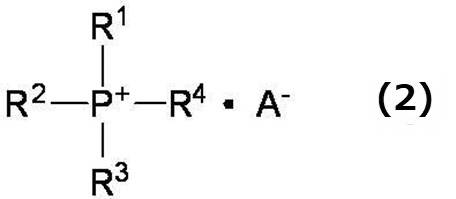
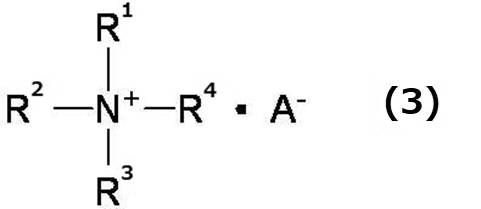
好ましくは、ホスホニウム塩およびアンモニウム塩から選択される少なくとも1つを予め溶媒中に溶解または分散させておくことが好ましい。
本発明において、ポリハロシラン化合物(好ましくは環状ハロシラン化合物)の塩は、1以上のSi元素を含む環構造と、1以上のSi-ハロゲン元素の結合とを含むアニオン部位と、対カチオン部位とを有するものであればよく、該環構造は置換基を有していても良い(以下、本発明の環状ハロシラン化合物の塩)とも言う。本発明のポリハロシラン化合物(好ましくは環状ハロシラン化合物)の塩における、1分子中のSi元素の数は、3以上であることが好ましく、4以上又は5以上であることがより好ましく、14以下であることが好ましく、8以下又は7以下であることがより好ましく、6以下であることがさらに好ましい。本発明の環状ハロシラン化合物の塩は、ケイ素単素環を含み、該単素環を構成する少なくとも1つのケイ素原子にハロゲン原子が結合した構造を有しており、塩を形成している化合物であることが好ましい。ハロゲン原子としては、フッ素原子、塩素原子、臭素原子、ヨウ素原子が挙げられる。
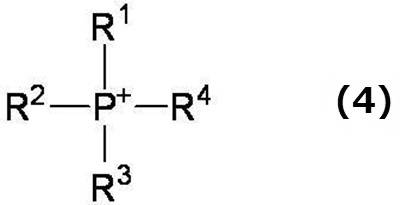
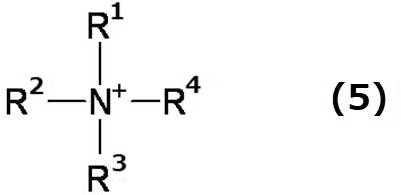
なおR1~R4は、高純度のポリハロシラン化合物(好ましくは環状ハロシラン化合物)の塩を製造しやすい傾向にあることから、アルキル基またはアリール基であることが好ましく、特に式(4)の場合はアリール基がより好ましく、式(5)の場合はアルキル基がより好ましい。また、対カチオンとしては、アンモニウムイオンの方がホスホニウムイオンよりも好ましい。
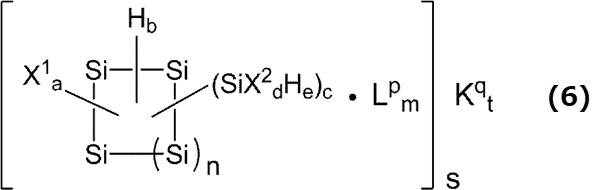
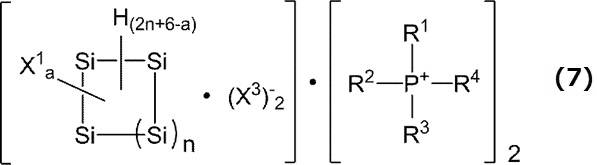
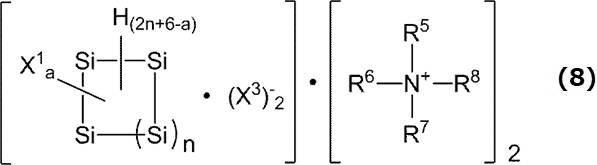
本発明の一態様において、前記環状ハロシラン化合物の塩は、ハロゲン化モノシラン化合物と、ホスホニウム塩およびアンモニウム塩から選択される少なくとも1つとを接触させる工程(D)により得られる。
本発明において、環状ハロシラン化合物の錯体は、1以上のSi元素を含む環構造と、1以上のSi-ハロゲン元素の結合とを含み、少なくとも1つの配位化合物を含めばよく、該環構造は置換基を有していても良い。本発明のポリハロシラン化合物(好ましくは環状ハロシラン化合物)の錯体における、1分子中のSi元素の数は、3以上であることが好ましく、5以上であることがより好ましく、14以下であることが好ましく、7以下であることがより好ましい。本発明のポリハロシラン化合物(好ましくは環状ハロシラン化合物)の錯体は、ケイ素単素環を含むことが好ましい。
(i)XRh(XがP、P=O、Nのときはh=3であり、Rは同一または異なって置換または無置換のアルキル基またはアリール基を表し、XがS、S=O、Oのときはh=2であり、Rは同一又は異なって前記と同じ基を意味する。但し、XRh中のアミノ基の数は0または1である。)として表される化合物、
(ii)環中に非共有電子対を有するN、O、SまたはPを含む置換または無置換の複素環化合物。
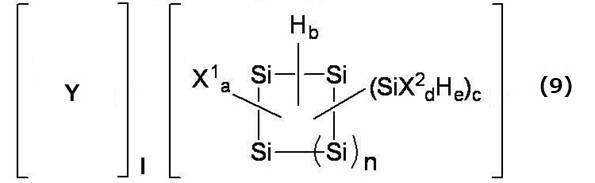
(i)の化合物の具体例としては、トリフェニルホスフィン(PPh3)、トリフェニルホスフィンオキシド(Ph3P=O)、トリス(4-メトキシフェニル)ホスフィン(P(MeOPh)3)、トリフェニルアミン等のXがP、P=O、Nの化合物;ジメチルスルホキシド等のXがS=Oの化合物等が挙げられる。
(ii)複素環化合物においては、環中に非共有電子対を有していることが必要であり、この非共有電子対が環状シランに配位してポリハロシラン化合物錯体(環状ハロシラン中性錯体)を形成する。このような複素環化合物としては、環中に非共有電子対を有するN,O,SまたはPを含む置換または無置換の複素環化合物1種以上が挙げられる。複素環化合物が有していてもよい置換基は、上記したXがP、P=Oである場合のRがアルキル基またはアリール基の場合に有していてもよい置換基と同じである。複素環化合物としては、ピリジン類、イミダゾール類、ピラゾール類、オキサゾール類、チアゾール類、イミダゾリン類、ピラジン類、チオフェン類、フラン類等が挙げられ、具体例としては、N,N-ジメチル-4-アミノピリジン、テトラヒドロチオフェン、テトラヒドロフラン等が挙げられる。
この配位化合物は、上記(i)及び(ii)からなる群より選択される少なくとも1種であることが好ましい。
環化反応は、3級アミンの存在下で行うことが好ましい。第3級アミンとしては、例えば、トリエチルアミン、トリプロピルアミン、トリブチルアミン、トリオクチルアミン、トリイソブチルアミン、トリイソペンチルアミン、ジエチルメチルアミン、ジイソプロピルエチルアミン(DIPEA)、ジメチルブチルアミン、ジメチル-2-エチルヘキシルアミン、ジイソプロピル-2-エチルヘキシルアミン、メチルジオクチルアミン等が好ましく挙げられる。第3級アミンを使用する場合には、1種のみを使用してもよいし、2種以上を併用してもよい。
環化工程は、必要に応じて有機溶媒中で実施できる。この有機溶媒としては、例えば、ハロゲン化炭化水素系溶媒(例えばクロロホルム、ジクロロメタン、1,2-ジクロロエタン等)、エーテル系溶媒(例えばジエチルエーテル、テトラヒドロフラン、シクロペンチルメチルエーテル、ジイソプロピルエーテル、メチルターシャリーブチルエーテル等)、アセトニトリル、酢酸エチル等の非プロトン性極性溶媒が好ましく挙げられる。これらの中でも、クロロホルム、ジクロロメタン、1,2-ジクロロエタン等の塩素化炭化水素系溶媒が好ましく、特にジクロロメタンや1,2-ジクロロエタンが好ましい。なおこれら有機溶媒は、1種のみを使用してもよいし、2種以上を併用してもよい。有機溶媒の使用量は、特に制限されないが、通常、ハロゲン化モノシラン化合物の濃度が0.5~10mol/Lとなるように調整することが好ましく、より好ましい濃度は0.8~8mol/L、さらに好ましい濃度は1~5mol/Lである。
本発明の一態様において、環状ハロシラン化合物、環状ハロシラン化合物の塩、および環状ハロシラン化合物の錯体から選択される1種以上と、還元剤とを接触させる(工程(A)ともいう)。
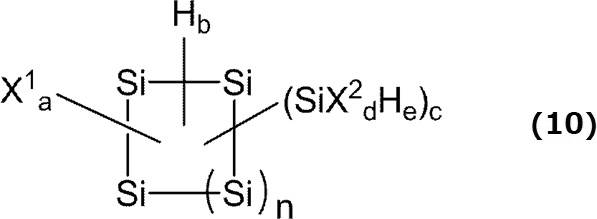
還元反応工程(P1)(工程(A)、工程2ともいう)において、ハロシラン原料(C0)との接触に使用される還元剤(R2)(還元剤(B)ともいう)としては、特に制限はないが、中性もしくはイオン性のヒドリド化合物等が例示され、金属水素化物(金属水素化物(E)ともいう)であることが好ましい。
還元剤(R2)は、水素化アルミニウム化合物、水素化ホウ素化合物、水素化ケイ素化合物、水素化スズ化合物および水素化遷移金属化合物から選ばれる少なくとも1種であることがより好ましく、水素化アルミニウム化合物、および水素化ホウ素化合物のいずれかであることがさらに好ましい。水素化アルミニウム化合物としては、具体的には水素化リチウムアルミニウム(LiAlH4;LAH)、水素化ジイソブチルアルミニウム(DIBAL)、水素化ビス(2-メトキシエトキシ)アルミニウムナトリウム[「Red-Al」(シグマアルドリッチ社の登録商標)]等が例示される。水素化ホウ素化合物としては、具体的には水素化ホウ素ナトリウム、水素化トリエチルホウ素リチウム、水素化ホウ素ニッケル、水素化ホウ素亜鉛等が例示される。水素化ケイ素化合物としては、具体的にはトリエチルシラン、トリイソプロピルシラン等が例示される。水素化スズ化合物としては、水素化トリブチルスズ等が例示される。還元剤(R2)は、1種であってもよく2種以上を併用してもよい。
R1及びR2としては、メチル基、エチル基、ブチル基、プロピル基、ヘキシル基、ヘプチル基、オクチル基、ノニル基、デシル基等の直鎖状アルキル基;イソプロピル基、イソブチル基、t-ブチル基、s-ブチル基、ネオペンチル基、(2-エチル)ヘキシル基等の分岐鎖状アルキル基等が挙げられる。
R1及びR2の炭素数は、例えば1~10、好ましくは1~8、より好ましくは1~6、さらに好ましくは1~4である。
水素化アルミニウム化合物は、R1及びR2をそれぞれ複数有していてもよく、その場合、R1及びR2はそれぞれ同一であってもよく異なっていてもよい。
還元剤(R2)の反応物の融点は、還元剤(R2)の融点と同様であってもよいが、好ましくは70℃以下、より好ましくは65℃以下、さらに好ましくは60℃以下、さらにより好ましくは55℃以下であり、好ましくは-110℃以上又は-60℃以上である。
溶媒(S1)は、有機溶媒であることが好ましく、炭化水素系溶媒またはエーテル系溶媒から選ばれる少なくとも1つを含むことがより好ましい。
前記溶媒(S1)は、エーテル系溶媒を含んでいてもよいし、前記溶媒(S1)は炭化水素系溶媒を含んでいてもよい。これらの溶媒は、上述したものと同様であってもよい。
前記溶媒(S1)及び前記溶媒(S2)の少なくとも1つ以上は、エーテル系溶媒であってもよい。
前記溶媒(S1)は、還元剤(R2)の溶媒であることが好ましく、前記溶媒(S2)は、ポリハロシラン化合物(好ましくは環状ハロシラン化合物(D))の溶媒であることが好ましく、還元反応の際には、前記溶媒(S2)と前記溶媒(S1)が共に存在してもよい。
還元反応工程(P1)は、1種または2種以上の溶媒の存在下で行っても良い。なお、本発明において、溶媒とは、反応原料のいずれか1種以上および/または反応生成物のいずれか1種以上を溶解するものであればよい。なお、還元工程で用いる反応溶媒(II)は、その中に含まれる水や溶存酸素を取り除くため、反応前に蒸留や脱水等の精製を施しておくことが好ましい。
還元反応工程(P1)における溶媒の使用量としては、溶媒1Lに対し、前記ハロシラン原料(C0)(好ましくは環状ハロシラン化合物)等の合計の使用量が0.01モル以上であることが好ましく、0.05モル以上であることがより好ましく、0.10モル以上であることがさらに好ましく、5.0モル以下であることが好ましく、3.0モル以下であることがより好ましく、1.0モル以下であることがさらに好ましい。溶媒を、上記範囲で使用して反応を行う場合、還元反応の効率が向上する傾向にある。
還元反応工程(P1)は、バッチ式の反応でも良く、CSTRのような連続層型反応器やマイクロリアクターやフローリアクターのような管型反応器などを用いた連続式の反応でも良い。
ここで、ハロシラン原料(C0)(好ましくは環状ハロシラン化合物)(の溶液または分散液)や、還元剤(好ましくは金属水素化物)(の溶液または分散液)を一括で添加しても良く、連続的もしくは段階的に添加しても良い。その場合、工程2における環状ハロシラン化合物のモル濃度は、工程2で使用する溶剤の総量に対する、工程2で使用する環状ハロシラン化合物の総量のモル濃度であっても良い。
当該比は、ハロシラン原料(C0)(好ましくは環状ハロシラン化合物)の上記モル濃度を同時満足するような値であってもよく、一括添加もしくは連続添加または分割添加のいずれの場合にも適用できる。
前記還元反応工程(P1)の反応物は、還元剤(R2)の反応物を含み、該反応物はアルミニウム錯体を含み得る。
前記アルミニウム錯体は、アルミニウムもしくはアルミニウムハロゲン化物と、エーテル系溶媒との錯体であることが好ましい。
(T1)固液分離工程
(T2)反応液、その濃縮液又はそれらの洗浄液を分液する工程
(T3)酸性水溶液と接触する工程
(T4)水素化ポリシラン化合物(CX)を蒸留する工程
前記固液分離工程(T1)は、濾過工程であることが好ましい。
濾過工程は、通常の圧力及び温度で行う濾過であってもよく、圧力又は温度を変化させて行う濾過であってもよい。
濾過としては、自然濾過、減圧濾過、加圧濾過、遠心濾過、熱時濾過等が挙げられる。
濾過では、濾紙、ガラス繊維フィルター、メンブレンフィルター、濾過板等を使用することができる。
本発明の一態様において、濾過工程は、反応液、その濃縮液又はそれらの洗浄液中の上層又は下層について行うことが好ましく、反応液、その濃縮液又はそれらの洗浄液中の下層について行うことがより好ましい。
本発明の一態様において、濾過工程のみでは、アルミニウム錯体を十分除くことができない場合がある。
分液は、生じた複数の層から所望の物質を含む層を抽出する又は取り出す操作であればよく、反応中に層分離した反応液を分液するもの、酸性水溶液、水、もしくは溶剤等で洗浄したときに層分離した層を分液するもの、濃縮や希釈、温度変化や圧力変化などで層分離した層を分液するもの、層分離を促進する添加剤の添加により層分離した層を分液するもの等のいずれであっても構わない。分液は、特に限定されず、例えば公知の方法で分液すればよく、例えばデカンテーション操作による分液、漏斗による分液等が挙げられる。
反応液は濃縮により、複数の層に分離してもよい。
複数の層には、例えば、(i)上層及び下層、(ii)上層、中間層及び下層等が含まれる。
濃縮は、温度や圧力等を変化させることにより、反応液に含まれる溶媒を揮発させる操作であればよく、例えば減圧処理、加熱処理等が挙げられる。
分液は、複数の層から所望の物質を含む層を抽出する又は取り出す操作であればよく、例えばデカンテーション操作による分液、漏斗による分液等が挙げられる。
前記(T3)酸性水溶液と接触する工程は、還元反応工程(P1)の反応液(工程(A)で得られた還元反応液ともいう)を酸性水溶液と接触させる工程(T3X、(工程(B)ともいう))であることが好ましい。酸性水溶液で洗浄する工程は、反応液又はその濃縮液と酸性水溶液を接触させる操作であればよい。
酸性水溶液で洗浄する場合、水素化ポリシラン化合物(好ましくは環状水素化シラン化合物)を含む反応液又はその濃縮液と酸性水溶液との接触は、水素化ポリシラン化合物(好ましくは環状水素化シラン化合物)を含む反応液又はその濃縮液と、酸性水溶液との少なくともいずれか一方を滴下することが好ましい。このように水素化ポリシラン化合物(好ましくは環状水素化シラン化合物)を含む反応液又はその濃縮液及び酸性水溶液の一方又は両方を滴下することにより、水洗浄に比べて還元剤(好ましくは金属水素化物)をより穏和に失活することができ、生じる発熱を滴下速度などで調節することができる。また、酸性水溶液の代わりに水(中性)を用いた場合、還元剤(金属水素化物)との反応により水溶液が塩基性になり水素化ポリシラン化合物を分解する虞があるため、酸性水溶液で洗浄することが好ましい。
本発明の一態様において、酸性水溶液と接触させる前に、反応液又はその濃縮液は分液する工程により、反応液又はその濃縮液中の上層と下層を分離してもよい。
酸性水溶液と接触する工程において、還元反応液ならびに酸性水溶液の一方または両方を滴下する場合の好ましい態様としては、上記A)~C)と同様のものが挙げられる。
酸性水溶液と接触する工程で使用する酸性水溶液は、溶存酸素を除くために、予め脱気しておくことが好ましい。脱気は窒素やアルゴン等の不活性ガスを酸性水溶液中にバブリングする操作で行ってもよく、減圧と窒素やアルゴン等の不活性ガスによる置換を数回繰り返す操作で行ってもよく、常圧もしくは減圧下で煮沸する操作で行ってもよく、超音波を照射する操作で行ってもよく、またこれらを2つもしくはそれ以上組み合わせた操作で行ってもよい。
また、分取した有機相にさらに脱水処理を行ってもよい。脱水処理は、硫酸ナトリウムや硫酸マグネシウム等の無機塩の化学的乾燥剤を用いてもよく、モレキュラーシーブスのようなアルミナケイ酸塩(ゼオライト)等の物理的乾燥剤を用いてもよい。
上記の場合、還元剤に由来する成分の製造設備への固着がより抑制される傾向にある。なお、本発明において「還元反応工程(P1)で得られた還元反応液を酸性水溶液と接触させる」とは、還元反応工程(P1)で得られた還元反応液を実質的に固液分離工程を経ずに、酸性水溶液と接触させることを意味する。実質的に固液分離工程を経ないとは、例えば固形分の10質量%以上、好ましくは5質量%以上を還元反応工程(P1)で得られた還元反応液から分離しないことである。酸性水溶液との接触工程は、還元反応工程(P1)に引き続き実施することがより好ましい。
還元反応工程(P1)と還元反応液と酸性水溶液との接触工程(T3)のいずれもバッチ式の反応で行う場合には、還元反応工程(P1)と還元反応液と酸性水溶液との接触工程(T3)とを同じ反応器(反応釜)で実施することが好ましい。また、還元反応工程(P1)と還元反応液と酸性水溶液との接触工程(T3)のどちらも、もしくはいずれか一方を連続式での反応で行う場合には、マイクロリアクターやフローリアクターで実施することが好ましい。
本工程は、水素化ポリシラン化合物と、還元剤および/又は還元剤の反応物とを含む混合物を蒸留して、水素化ポリシラン化合物を取り出す。
本発明の一態様において、環状水素化シラン化合物(環状水素化シラン化合物(G)ともいう)を蒸留する工程(C)を含む。
蒸留は、常圧蒸留及び減圧蒸留の一方又は両方であってもよく、常圧蒸留又は減圧蒸留であることが好ましく、減圧蒸留であることがより好ましい。
蒸留は減圧下で行なう場合、例えば、好ましくは5~400Pa、より好ましくは10~350Pa、さらに好ましくは10~300Paで行うことができる。温度条件としては、好ましくは20~80℃、より好ましくは30~65℃である。
減圧蒸留する方法は特に限定されず、公知の蒸留塔で行えばよく、遮光条件下で行ってもよい。蒸留工程は2回以上行っても良い。
蒸留工程はバッチ蒸留でも良く、連続蒸留でも良い。上記蒸留は、留分を複数に分けて行うことが好ましく、得られた留分のうち、適切な留分のみを選択してもよい。
任意であるが、晶析工程など、蒸留工程以外の精製工程を含んでも良い。
アルミニウム錯体を分離してから、水素化ポリシラン化合物(好ましくは環状水素化シラン化合物)を蒸留することにより、アルミニウム量が低減した水素化ポリシラン化合物(好ましくは環状水素化シラン化合物)を高純度で得ることができる。
中でも、前記(T3X)反応液と酸性水溶液との接触工程と、前記(T4)水素化ポリシラン化合物(CX)を蒸留する工程とを行ってもよい。
前記還元剤(R2)および/または前記還元剤(R2)の反応物を除去する処理は、前記(T1)固液分離工程、及び(T2)反応液、その濃縮液又はそれらの洗浄液を分液する工程の2つを含む、或いは(T2)反応液、その濃縮液又はそれらの洗浄液を分液する工程、及び(T3)酸性水溶液と接触する工程の2つを含むことがより好ましい。
(a)反応液、その濃縮液又はそれらの洗浄液が形成する上層及び下層を分液する工程並びに(b)得られた下層を濾過する工程、或いは(c)反応液又はその濃縮液を酸性水溶液で洗浄する工程並びに(a)洗浄した洗浄液が形成する上層及び下層を分液する工程がより好ましい。
分液で得られた下層は、濾過工程に供してもよく、濾過した下層は、上層と合わせてもよい。
これらの工程の後に、さらに前記(T4)水素化ポリシラン化合物(CX)を蒸留する工程を行うことがさらに好ましい。
水素化ポリシラン化合物(CX)を含む層としては、(T3X)反応液と酸性水溶液との接触工程で得られた混合物に含まれる水層及び有機層(油層)のうち、有機層が挙げられる。
当該有機層は、当該混合物の分液、当該混合物の溶媒の揮発等により得ることができる。
本発明において、水素化ポリシラン化合物(好ましくは環状水素化シラン化合物、環状水素化シラン化合物(G)ともいう)とは、1以上のSi元素を含む環構造と、1以上のSi-H結合とを有するものであればよく、該環構造は置換基を有していても良い。本発明の水素化ポリシラン化合物(好ましくは環状水素化シラン化合物)における、1分子中のSi元素の数は、3以上であることが好ましく、5以上であることがより好ましく、14以下であることが好ましく、7以下であることがより好ましい。本発明の水素化ポリシラン化合物(好ましくは環状水素化シラン化合物)は、ケイ素単素環を含むことが好ましい。
本発明の水素化ポリシラン化合物(好ましくは環状水素化シラン化合物)は、例えば下記一般式(11)で表すことができる。
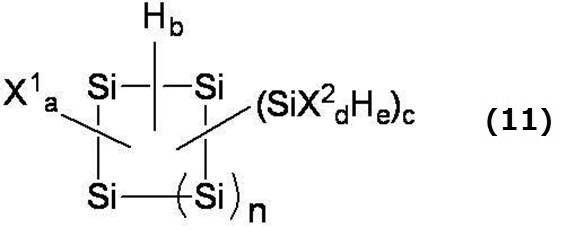
例えば、nが3の場合には、本発明の水素化ポリシラン化合物(好ましくは環状水素化シラン化合物)に含まれる環構造はSi原子を6つ含む6員環構造である。dは、それぞれの、-SiX2 dHe基において、Si原子に結合するハロゲン原子の数であり、eは、それぞれの、-SiX2 dHe基において、Si原子に結合する水素原子の数である。
SizH2z (12)
当該含有量は、ガスクロマトグラフィー分析から得られる面積%に基づくものであってもよい。
前記(T3)酸性水溶液と接触する工程として、還元反応工程(P1)の反応液を酸性水溶液と接触させる工程(T3X)を行うことが挙げられる。
かかる方法によれば、還元剤に由来する成分が製造設備に固着することを抑制できるため、安全もしくは効率的に水素化ポリシラン化合物(環状水素化シラン化合物など)を製造することが可能となる。
前記環状ハロシラン化合物が、ポリハロシラン化合物の塩(C21)とハロゲン化アルミニウム化合物とを溶媒(S2)の存在下で接触させる工程(P3)によって生成され、
生成された環状ハロシラン化合物の前記還元反応工程(P1)の接触が溶媒(S1)の存在下で行われ、
前記還元剤(R2)が金属水素化物(E)であり、還元剤(R2)の反応物がアルミニウム錯体を含み、
該アルミニウム錯体が、前記(T1)固液分離工程としてのろ過工程、(T2)反応液、その濃縮液又はそれらの洗浄液を分液する工程、及び(T3)酸性水溶液と接触する工程から選ばれる少なくとも2つ以上の処理によって除去されることも挙げられる。
かかる方法によれば、ポリハロシラン化合物の塩(環状ハロシラン化合物の塩など)とルイス酸化合物(ハロゲン化アルミニウム化合物など)との反応やポリハロシラン化合物(環状ハロシラン化合物や環状ハロシラン化合物の塩など)と還元剤との反応により生成するルイス酸化合物や還元剤由来の錯体(アルミニウム錯体など)を安全かつ簡便に取り扱い、かつルイス酸化合物や還元剤由来の金属量(アルミニウム量など)が低減された水素化ポリシラン化合物(環状水素化シラン化合物など)を高純度で得ることができる。
前記還元剤(R2)および/または前記還元剤(R2)の反応物が、温度30℃で液体であり、
前記還元反応工程(P1)の接触が溶媒(S1)の存在下、バッチ式リアクターで行われ、
前記還元剤(R2)および/または前記還元剤(R2)の反応物を除去する処理が、(T3)還元剤(R2)および/または前記還元剤(R2)の反応物を酸性水溶液と接触する工程、及び(T4)水素化ポリシラン化合物(CX)を蒸留する工程の少なくとも1つであることも挙げられる。
本発明において、還元剤の反応物には、アルミニウム含有化合物(例えばアルミニウム塩、その錯体)等が含まれる。
ポリハロシラン化合物(A)は、上記環状ハロシラン化合物を1種または2種以上を含んでいてもよい。
ポリハロシラン化合物(A)では、環状ハロシラン化合物の代わりに、環状ハロシラン化合物の塩又は環状ハロシラン化合物の錯体等が使用されてもよい。
ポリハロシラン化合物(A)は、上記ポリハロシラン化合物(A)を調製した反応液をそのまま使用してよく、ポリハロシラン化合物を一旦精製したもの、ポリハロシラン化合物を所定の溶媒に溶解させたものであってもよい。
還元剤(B)の含有量は、第二組成物(2)100質量%中、好ましくは5~80質量%、より好ましくは10~50質量%、さらに好ましくは15~40質量%、特に好ましくは20~30質量%である。第二組成物の残りは、後述する溶媒であってもよい。
第一組成物に用いる溶媒は、炭化水素系溶媒であることがより好ましく、第二組成物に用いる溶媒は、炭化水素系溶媒であることがより好ましい。
当該反応時間は、上記範囲でなくてもよく、その場合、さらに経時的に反応させて所望生成物をスケールアップして調製してもよい。
水素化ポリシラン化合物(D)は、ポリハロシラン化合物(A)と還元剤(B)とを少なくとも接触させた後(好ましくはポリハロシラン化合物(A)と、還元剤(B)と、溶媒(C)とを接触させた後)、還元剤(B)および/または還元剤(B)の反応物(好ましくは溶媒(C)の存在下での、ポリハロシラン化合物(A)と、還元剤(B)との反応物)を酸性水溶液との混合により除いて得られる。
還元剤(B)および/または還元剤(B)の反応物と酸性水溶液との混合後、混合液を分液に供し、還元剤(B)および/または還元剤(B)の反応物を含む層を除き、水素化ポリシラン化合物(D)を含む層を得ることが好ましい。
分液は、生じた複数の層から所望の物質を含む層を抽出する又は取り出す操作であればよく、例えばデカンテーション操作による分液、漏斗による分液等が挙げられる。
水素化ポリシラン化合物(D)は、ポリハロシラン化合物(A)と還元剤(B)とを少なくとも接触させた後(好ましくはポリハロシラン化合物(A)と、還元剤(B)と、溶媒(C)とを接触させた後)、接触後の混合物を蒸留に供して得られる。
接触後の混合物は、減圧または加熱に供して溶媒を留去し、溶媒を留去した組成物を後述する様に蒸留(好ましくは減圧蒸留)することが好ましい。
水素化ポリシラン化合物(D)は、ポリハロシラン化合物(A)と還元剤(B)とを少なくとも接触させた後(好ましくはポリハロシラン化合物(A)と、還元剤(B)と、溶媒(C)とを接触させた後)、還元剤(B)および/または還元剤(B)の反応物を酸性水溶液との混合により除き、得られる溶液を蒸留に供して得られる。
還元剤(B)および/または還元剤(B)の反応物と酸性水溶液との混合後、混合液を分液に供し、還元剤(B)および/または還元剤(B)の反応物を含む層を除き、水素化ポリシラン化合物(D)を含む層を得、当該層を必要に応じて減圧または加熱に供して溶媒を留去し、蒸留することが好ましい。
上記(ii)を含む態様において、濾過工程は行わなくてもよい。
本発明の水素化ポリシラン化合物の製造方法は、上記の工程の他、任意の工程を含んでいても良い(以下、「その他の工程」ともいう)。その他の工程としては、固液分離工程、液液分離工程、抽出工程、洗浄工程、精製工程、濃縮工程、希釈工程等である。
本発明の環状水素化シラン化合物の製造方法で得られた環状水素化シラン化合物は、化学気相成長法(CVD)や、原子層堆積(ALD)の原料として用い、シリコン含有膜を製造することができる。CVDとしては、特に制限は無く、熱CVD、光CVD、プラズマCVD、エピタキシャルCVD等に使用することができる。
(1.環状ハロシラン化合物の塩の製造例)
温度計、コンデンサー、滴下ロートおよび撹拌装置を備えた2L四つ口フラスコ内を窒素ガスで置換した後、このフラスコ内に、テトラエチルアンモニウムブロマイド123.5g(0.59mol)と、トリブチルアミン490.0g(2.64mol)と、ジクロロメタン702.7gとを入れた。次いでフラスコ内の溶液を撹拌しながら、25℃条件下において、滴下ロートよりトリクロロシラン238.1g(1.76mol)とジクロロメタン117.2gからなる溶液をゆっくりと滴下した。滴下終了後、そのまま2時間撹拌し、引き続き50℃で6時間加熱しながら撹拌することにより、環化カップリング反応を行った。反応後、得られた固体をろ過および精製して、環状ハロシラン化合物の塩を102.7g得た。
窒素雰囲気下、撹拌装置を備えた300mL三つ口フラスコに、上記(1)で得られた白色固体15.0gと粉末状の塩化アルミニウム(AlCl3)4.6gを入れ、さらに溶媒としてヘキサン98.7gを加えた。遮光した状態で、室温条件下、3時間撹拌して反応させたのち、ろ過、濃縮を行い環状ハロシラン化合物のヘキサン溶液(濃度:約37質量%)を得た。
滴下ロートおよび撹拌装置を備えた300mL三つ口フラス内を窒素ガスで置換した後、上記実施例1-1(2)で得られた環状ハロシラン化合物のヘキサン溶液49gを入れた。フラスコ内の溶液を撹拌しながら、0℃条件下において、滴下ロートより水素化リチウムアルミニウムのジエチルエーテル溶液(濃度:約1.0mol/L)100mLを徐々に滴下し、次いで25℃で1時間撹拌することにより、還元反応を行った。反応後、得られた反応液を0℃に冷却した10%硫酸水溶液へゆっくりと滴下した。室温で30分撹拌すると有機層および水層共に固体を含まない無色透明溶液を得た。静置した後、分液により水層を除いて有機層を回収し、有機層を減圧下にて濃縮することで5.7gの粗生成物を得た。この時、濃縮器の上部や溶媒凝縮用の冷却器等には固体の付着は確認されなかった。
さらに、この粗生成物を100mLガラス製蒸留装置で減圧蒸留により精製することで、ガスクロマトグラフィー(GC)で面積純度98%である無色透明のシクロヘキサシランを2.8g得た。この時、蒸留後の蒸留装置の上部や凝縮用の冷却器等には固体の付着は無かった。
また、ガスクロマトグラフィー(GC)とNMRによる分析の結果、得られた蒸留品中にはアルミニウム錯体(アルミニウム塩化物とジエチルエーテル溶媒との錯体)は検出されなかった。
さらに、イオンクロマトグラフ装置(DIONEX製、「ICS-2000」)を用いて留出液中の塩素量を確認したところ4ppmであった。
(環状水素化シラン化合物の比較製造例)
滴下ロートおよび撹拌装置を備えた500mL三つ口フラスコ内を窒素ガスで置換した後、上記実施例1-1(2)と同じ条件で得られた環状ハロシラン化合物のヘキサン溶液136.1gを入れた。フラスコ内の溶液を攪拌しながら、0℃条件下において、滴下ロートより水素化リチウムアルミニウムのジエチルエーテル溶液(濃度:約1.0mol/L)314mLを徐々に滴下し、次いで25℃で1時間撹拌することにより、還元反応を行った。
反応後、得られた固体残渣の塩を含む反応液を濾過器に移送し、窒素雰囲気下において濾過し、生成した固体残渣の塩を取り除いた。尚、移送用の配管内には固体残渣の付着が見られた。
次に得られた濾液から減圧下で溶媒を留去して、液量が半分になるまで濃縮し、シクロヘキサシランを含む上層と固体残渣を含む下層から成る濃縮液を得た。この時、濃縮器の上部や溶媒凝縮用の冷却器等には固体の付着が確認された。
次にこの濃縮液を濾過により固液分離し、得られた濾液をさらに減圧下で濃縮し、再び生じた固体残渣を含む下層を除くために濾過を行うことで11.6gの粗生成物を得た。さらにこの粗生成物の内、8.4gを100mLガラス製蒸留装置で減圧蒸留により精製することで、ガスクロマトグラフィー(GC)で面積純度98%のシクロヘキサシランを6.9g得た。
この時、蒸留後の蒸留装置の上部や凝縮用の冷却器等には、固体の付着が確認された。
さらに、イオンクロマトグラフ装置(DIONEX製、「ICS-2000」)を用いて、留出液中の塩素量を測定したところ2900ppm検出された。
分析装置:マルチタイプICP発光分光分析装置(島津製作所製ICPE-9000)
前処理は次の手順で行った。まず、窒素雰囲気下のグローブボックス内で、容量100mLのPFA(ポリテトラフルオロエチレン)容器に環状水素化シラン化合物を50μL入れ、次いで12.5%TMAH(水素化テトラメチルアンモニウム水溶液)を2500μL入れた。蓋を軽く閉めて1晩静置し、失活させた。1晩静置後、5%HNO3 45mLで希釈し、更に1晩静置して前処理を終了した。
前処理した環状水素化シラン化合物のAl量を、島津製作所製ICPE-9000で測定した。
窒素雰囲気下のグローブボックス内で、得られた環状水素化シラン化合物をシクロペンチルメチルエーテルで約1%に希釈し、その溶液をガスクロマトグラフィー(GC)により測定した。環状水素化シラン化合物の含有量は面積百分率法により算出した。
(ガスクロマトグラフィー(GC)分析方法)
測定方法:GC FID法
分析装置:島津製作所社製 GC2014
カラム:DB-5MS 0.25μm(Film)×0.25mm(Diam)×30m(Length)(Agilent Technologies)
気化室温度:250度
検出器温度:280度
昇温条件:50度5分保持、20度/分で250度まで昇温、10度/分で280度に昇温10分保持
(1)環状ハロシラン化合物の塩(A)の製造例
温度計、コンデンサー、滴下ロートおよび撹拌装置を備えた300mL四つ口フラスコ内を窒素ガスで置換した後、このフラスコ内に、テトラエチルアンモニウムブロマイド123.5g(0.59mol)と、トリブチルアミン490.0g(2.64mol)と、ジクロロメタン702.7gとを入れた。次いでフラスコ内の溶液を撹拌しながら、25℃条件下において、滴下ロートよりトリクロロシラン238.1g(1.76mol)とジクロロメタン117.2gからなる溶液をゆっくりと滴下した。滴下終了後、そのまま2時間撹拌し、引き続き50℃で6時間加熱しながら撹拌することにより、環化カップリング反応を行った。反応後、得られた固体をろ過および精製して、環状ハロシラン化合物の塩(A)を102.7g得た。
窒素雰囲気下、撹拌装置を備えた300mL三つ口フラスコに、上記(1)で得られた白色固体15.0gとハロゲン化アルミニウム化合物(B)である粉末状の塩化アルミニウム(AlCl3)4.6gを入れ、さらに溶媒(C)であるヘキサン98.7gを加えた。遮光した状態で、室温条件下、3時間撹拌して反応させたのち、ろ過、濃縮を行い環状ハロシラン化合物(D)のヘキサン溶液(濃度:約40質量%)を得た。
滴下ロートおよび撹拌装置を備えた100mL三つ口フラスコに、上記(2)で得られた環状ハロシラン化合物(D)のヘキサン溶液25gを入れた。フラスコ内を窒素ガスで置換した後、フラスコ内の溶液を撹拌しながら、0℃条件下において、滴下ロートより金属水素化物(E)として水素化リチウムアルミニウムのジエチルエーテル溶液(濃度:約1.0mol/L)76mLを徐々に滴下し、次いで25℃で1時間撹拌することにより、還元反応を行った。反応後、減圧により反応液は二層に分離しており、下層にはアルミニウム錯体(H)が含まれていた。この下層を分液により分離して、ヘキサン濃度が5%以下になるまで減圧濃縮してからろ過を行い、析出したアルミニウム錯体(H)を除去した。アルミニウム錯体(H)が除去された下層は上層と混合して、蒸留精製して、環状水素化シラン化合物(G)としてガスクロマトグラフィーで面積純度99%、アルミニウム濃度が1300ppmであるシクロヘキサシラン1.6gを得た。
(3)環状水素化シラン化合物(G)の製造例
滴下ロートおよび撹拌装置を備えた100mL三つ口フラスコに、上記実施例2-1(2)で得られた環状ハロシラン化合物(D)のヘキサン溶液25gを入れた。フラスコ内を窒素ガスで置換した後、フラスコ内の溶液を撹拌しながら、0℃条件下において、滴下ロートより金属水素化物(E)として水素化リチウムアルミニウムのジエチルエーテル溶液(濃度:約1.0mol/L)76mLを徐々に滴下し、次いで25℃で1時間撹拌することにより、還元反応を行った。反応後、得られた反応液は二層に分離しており、下層にはアルミニウム錯体(H)が含まれていた。この二層分離した液をゆっくりと5%硫酸水溶液へ滴下し、10分間攪拌後に、二層分離した層の下層を抜き出し、上層を蒸留精製して、環状水素化シラン化合物(G)としてガスクロマトグラフィーで面積純度99%、アルミニウム濃度が160ppmであるシクロヘキサシラン1.6gを得た。
滴下ロートおよび撹拌装置を備えた300mL三つ口フラスコ内を窒素で置換したのち、7質量%のドデカクロロシクロヘキサシランのヘキサン溶液24.5gを入れた。フラスコ内の溶液を撹拌しながら、0℃条件下において、滴下ロートより還元剤として1.0mol/L水素化ジイソブチルアルミニウム・ヘキサン溶液(WAKO社製)40mLを徐々に滴下し、次いで室温にて3時間撹拌した。反応後、反応液を脱気した10質量%の硫酸水溶液100mLにゆっくり滴下し、反応を失活させた。分液により油層を取り出し、硫酸マグネシウムにより脱水した後ろ過し、ガスクロマトグラフィーで分析したところ、シクロヘキサシランの収率は78%であった。反応中および失活の際に、固体の析出は見られなかった。この油層から溶媒を留去したのち、35℃、200Paで減圧蒸留を行うことで、シクロヘキサシランを単離した。
滴下ロートおよび撹拌装置を備えた100mL三つ口フラスコに、10質量%のドデカクロロシクロヘキサシランのヘキサン溶液100.0gを入れた。フラスコ内を窒素ガスで置換した後、フラスコ内の溶液を撹拌しながら、0℃条件下において、滴下ロートより還元剤として水素化リチウムアルミニウムのジエチルエーテル溶液(濃度:約1.0mol/L)38mLを徐々に滴下し、次いで20℃で3時間撹拌することによって還元反応を行った。反応後、白色固体の析出が見られた。得られた反応液を窒素雰囲気下においてろ過することで生成した塩を取り除き、得られたろ液についてガスクロマトグラフィーを用いて分析したところ、シクロヘキサシランが生成していることを確認した(収率90%)。
窒素雰囲気下、滴下ロートおよび撹拌装置を備えた500mL三つ口フラスコ内に、水素化リチウムアルミニウム(12.0g)とジブチルエーテル(68mL)を入れ、フラスコ内を撹拌しながら、0℃に冷却した。滴下ロートに35質量%のドデカクロロシクロヘキサシランのヘプタン溶液(169.0g)を加え、フラスコ内の温度が10℃を超えないようにゆっくり滴下し、その後室温にて撹拌した。窒素置換した1Lナスフラスコに脱気した10質量%の硫酸水溶液(290mL)を加え、0℃に冷却しながら還元反応液を1.5時間かけて滴下し、反応を失活させた。分液により水層を除去した後、得られた油層を50mLの水で2回洗浄した。この油層から溶媒を留去したのち、35℃、200Paで減圧蒸留を行うことで、ガスクロマトグラフィーで面積純度99%、アルミニウム濃度が10ppm(検出限界)以下であるシクロヘキサシラン10.1gを得た。
Claims (45)
- 分子内にSi-Si結合とSi-X結合(Xはハロゲン原子を表す)とを含むポリハロシラン化合物(C1)、ポリハロシラン化合物の塩(C2)、およびポリハロシラン化合物の錯体(C3)から選択される1種以上であるハロシラン原料(C0)と、還元剤(R2)とを接触させる還元反応工程(P1)と、
還元反応工程(P1)の反応混合物に含まれる、前記還元剤(R2)および/または前記還元剤(R2)の反応物を以下の(T1)~(T4)から選ばれる1つ以上の処理によって除去することを特徴とする水素化ポリシラン化合物(CX)の製造方法。
(T1)固液分離工程
(T2)反応液、その濃縮液又はそれらの洗浄液を分液する工程
(T3)酸性水溶液と接触する工程
(T4)水素化ポリシラン化合物(CX)を蒸留する工程 - 前記還元反応工程(P1)をバッチ式リアクターで行う、請求項1に記載の製造方法。
- 前記還元反応工程(P1)を連続式反応装置で行う、請求項1に記載の製造方法。
- 前記還元剤(R2)が金属水素化物(E)である、請求項1~3のいずれかに記載の製造方法。
- 前記還元剤(R2)が、水素化アルミニウム化合物、水素化ホウ素化合物、水素化ケイ素化合物、水素化スズ化合物および水素化遷移金属化合物から選ばれる少なくとも1種である、請求項1~4のいずれかに記載の製造方法。
- 前記還元剤(R2)および/または前記還元剤(R2)の反応物が、温度30℃で液体である、請求項1~5のいずれかに記載の製造方法。
- 前記還元剤(R2)が、水素化アルミニウム化合物、および水素化ホウ素化合物のいずれかである請求項6に記載の製造方法。
- 前記還元剤(R2)が、Al-R1(R1は分岐していてもよいアルキル基)もしくはAl-OR2(R2は分岐していてもよいアルキル基)を有する水素化アルミニウム化合物である請求項6又は7に記載の製造方法。
- 前記還元反応工程(P1)の接触が溶媒(S1)の存在下で行われる、請求項1~8のいずれかに記載の製造方法。
- 前記溶媒(S1)が、炭化水素系溶媒またはエーテル系溶媒から選ばれる少なくとも1つを含む請求項9に記載の製造方法。
- 前記溶媒(S1)がエーテル系溶媒を含む請求項9に記載の製造方法。
- 前記溶媒(S1)が炭化水素系溶媒を含む請求項9に記載の製造方法。
- 前記還元反応工程(P1)において溶媒を、溶媒1Lに対する、前記ハロシラン原料(C0)の使用量が0.01モル以上、5.0モル以下になるように使用する、請求項9~12のいずれかに記載の製造方法。
- 前記還元反応工程(P1)におけるハロシラン原料(C0)のモル濃度が0.150mol/L以上である請求項1~13のいずれかに記載の製造方法。
- 前記還元反応工程(P1)におけるハロシラン原料(C0)のモル濃度/前記ハロシラン原料(C0)に含まれるケイ素原子数の比が0.90mol/L以上である請求項1~14のいずれかに記載の製造方法。
- 前記還元反応工程(P1)の反応混合物が、前記水素化ポリシラン(CX)と前記還元剤(B)および/または前記還元剤(B)の反応物とを含む請求項1~15のいずれかに記載の製造方法。
- 前記還元反応工程(P1)の反応物が還元剤(B)の反応物を含み、該反応物がアルミニウム錯体を含む請求項16に記載の製造方法。
- 前記アルミニウム錯体が、アルミニウムもしくはアルミニウムハロゲン化物と、エーテル系溶媒との錯体である、請求項17に記載の製造方法。
- 前記(T3)酸性水溶液と接触する工程が、還元反応工程(P1)の反応液を酸性水溶液と接触させる工程(T3X)である請求項1~18のいずれかに記載の製造方法。
- 前記反応液と酸性水溶液との接触工程(T3X)を、前記還元反応工程(P1)の後に固液分離工程を経ずに行う、請求項19に記載の環状水素化シラン化合物の製造方法。
- 前記(T3X)反応液と酸性水溶液との接触工程を、前記還元反応工程(P1)の後の反応液の分液及び濃縮の両方を経ずに行う、請求項20に記載の製造方法。
- 前記(T3X)反応液と酸性水溶液との接触工程と、前記(T4)水素化ポリシラン化合物(CX)を蒸留する工程とを行う、請求項19~21のいずれかに記載の製造方法。
- 前記酸性水溶液と接触する工程(T3)の酸性水溶液における酸性物質の濃度が1質量%以上、60質量%以下である、請求項1~22のいずれかに記載の製造方法。
- 前記酸性水溶液と接触する工程(T3)の酸性水溶液が、塩酸、硫酸、硝酸、およびリン酸から選択される少なくとも1つを含む、請求項1~23のいずれかに記載の製造方法。
- 前記固液分離工程(T1)が濾過工程である請求項1~24のいずれかに記載の製造方法。
- 前記還元剤(R2)および/または前記還元剤(R2)の反応物を除去する処理が、前記(T1)固液分離工程、前記(T2)反応液、その濃縮液又はそれらの洗浄液を分液する工程、及び前記(T3)酸性水溶液と接触する工程から選ばれる少なくとも2つ以上である、請求項1~25のいずれかに記載の製造方法。
- 前記還元剤(R2)および/または前記還元剤(R2)の反応物を除去する処理が、前記(T1)固液分離工程、及び前記(T2)反応液、その濃縮液又はそれらの洗浄液を分液する工程の2つを含む、或いは前記(T2)反応液、その濃縮液又はそれらの洗浄液を分液する工程、及び前記(T3)酸性水溶液と接触する工程の2つを含む、請求項26に記載の製造方法。
- さらに前記(T4)水素化ポリシラン化合物(CX)を蒸留する工程を行う請求項26又は27に記載の製造方法。
- 前記還元剤(R2)及び/又は前記還元剤(R2)の反応物を除去する処理が、前記(T3)還元剤(R2)及び/又は前記還元剤(R2)の反応物を酸性水溶液と接触する工程、及び/又は前記(T4)水素化ポリシラン化合物(CX)を蒸留する工程の少なくとも1つである請求項1~25のいずれかに記載の製造方法。
- 蒸留工程の前に、前記(T3X)反応液と酸性水溶液との接触工程で得られた混合物または水素化ポリシラン化合物(CX)を含む層を、水と接触させる工程をさらに含む請求項19~29のいずれかに記載の製造方法。
- 前記ハロシラン原料(C0)としてのポリハロシラン化合物(C1)が、ポリハロシラン化合物の塩(C21)とルイス酸化合物(R3)とを接触させる工程(P3)によって生成される請求項1~30のいずれかに記載の製造方法。
- 前記ルイス酸化合物(R3)がハロゲン化アルミニウム化合物である、請求項31に記載の製造方法。
- 前記ポリハロシラン化合物の塩(C21)とハロゲン化アルミニウム化合物の接触が、溶媒(S2)の存在下で行われる、請求項32に記載の製造方法。
- 前記溶媒(S2)が、炭化水素系溶媒、エーテル系溶媒及びハロゲン化炭化水素系溶媒からなる群から選択される1種以上である、請求項33に記載の製造方法。
- 前記ポリハロシラン化合物(C1)の生成工程(P3)の原料である前記ポリハロシラン化合物の塩(C21)が、ハロゲン化モノシラン化合物(C4)と、ホスホニウム塩およびアンモニウム塩から選択される少なくとも1つ(R1)とを接触させる工程(P31)により得られる、請求項31~34のいずれかに記載の製造方法。
- 前記ハロシラン原料(C0)としてのポリハロシラン化合物の塩(C2)が、ハロゲン化モノシラン化合物(C4)と、ホスホニウム塩およびアンモニウム塩から選択される少なくとも1つ(R1)とを接触させる工程(P4)により得られる、請求項1~30のいずれかに記載の製造方法。
- 前記ハロシラン原料(C0)としてのポリハロシラン化合物の錯体(C3)が、ハロゲン化モノシラン化合物(C4)と、配位化合物とを接触させる工程(P5)により得られる、請求項1~30のいずれかに記載の製造方法。
- 前記配位化合物は、下記(i)及び(ii)からなる群より選択される少なくとも1種である、請求項37に記載の製造方法。
(i)XRh(XがP、P=O、Nのときはh=3であり、Rは同一または異なって置換または無置換のアルキル基またはアリール基を表し、XがS、S=O、Oのときはh=2であり、Rは同一または異なって置換または無置換のアルキル基またはアリール基を表す。但し、XRh中のアミノ基の数は0または1である。)として表される化合物
(ii)環中に非共有電子対を有するN、O、SまたはPを含む置換または無置換の複素環化合物 - 前記ハロシラン原料(C0)がポリハロシラン化合物(C1)である請求項1~38のいずれかに記載の製造方法。
- 前記ポリハロシラン化合物(C1)が環状ハロシラン化合物であり、前記水素化ポリシラン(CX)が環状水素化シラン化合物である請求項1~39のいずれかに記載の製造方法。
- 前記環状水素化シラン化合物が、シクロペンタシラン又はシクロヘキサシランを含む請求項40に記載の製造方法。
- 前記環状水素化シラン化合物が、シクロヘキサシランである請求項40に記載の製造方法。
- 前記ポリハロシラン化合物(C1)が環状ハロシラン化合物であり、前記水素化ポリシラン(CX)が環状水素化シラン化合物であり、
前記(T3)酸性水溶液と接触する工程として、還元反応工程(P1)の反応液を酸性水溶液と接触させる工程(T3X)を行う請求項1~42のいずれかに記載の製造方法。 - 前記ハロシラン原料(C0)が環状ハロシラン化合物であり、得られる前記水素化ポリシラン(CX)が環状水素化シラン化合物であり、
前記環状ハロシラン化合物が、ポリハロシラン化合物の塩(C21)とハロゲン化アルミニウム化合物とを溶媒(S2)の存在下で接触させる工程(P3)によって生成され、
生成された環状ハロシラン化合物の前記還元反応工程(P1)の接触が溶媒(S1)の存在下で行われ、
前記還元剤(R2)が金属水素化物(E)であり、還元剤(R2)の反応物がアルミニウム錯体を含み、
該アルミニウム錯体が、前記(T1)固液分離工程としての濾過工程、(T2)反応液、その濃縮液又はそれらの洗浄液を分液する工程、及び(T3)酸性水溶液と接触する工程から選ばれる少なくとも2つ以上の処理によって除去される請求項1~30、36、39~42のいずれかに記載の製造方法。 - 前記ハロシラン原料(C0)がポリハロシラン化合物(C1)であり、
前記還元剤(R2)および/または前記還元剤(R2)の反応物が、温度30℃で液体であり、
前記還元反応工程(P1)の接触が溶媒(S1)の存在下、バッチ式リアクターで行われ、
前記還元剤(R2)および/または前記還元剤(R2)の反応物を除去する処理が、(T3)還元剤(R2)および/または前記還元剤(R2)の反応物を酸性水溶液と接触する工程、及び(T4)水素化ポリシラン化合物(CX)を蒸留する工程の少なくとも1つである請求項1~35、39~42のいずれかに記載の製造方法。
Priority Applications (2)
| Application Number | Priority Date | Filing Date | Title |
|---|---|---|---|
| US18/024,818 US20230357028A1 (en) | 2020-09-08 | 2021-09-07 | Method for producing hydrogenated polysilane compound |
| KR1020237011313A KR20230058708A (ko) | 2020-09-08 | 2021-09-07 | 수소화 폴리실란 화합물의 제조 방법 |
Applications Claiming Priority (6)
| Application Number | Priority Date | Filing Date | Title |
|---|---|---|---|
| JP2020150657A JP7580983B2 (ja) | 2020-09-08 | 2020-09-08 | 環状水素化ポリシラン化合物の製造方法 |
| JP2020-150656 | 2020-09-08 | ||
| JP2020150656A JP7580982B2 (ja) | 2020-09-08 | 2020-09-08 | 環状水素化シラン化合物の製造方法 |
| JP2020-150657 | 2020-09-08 | ||
| JP2021-059690 | 2021-03-31 | ||
| JP2021059690A JP7621162B2 (ja) | 2021-03-31 | 2021-03-31 | 環状水素化シラン化合物の製造方法 |
Publications (1)
| Publication Number | Publication Date |
|---|---|
| WO2022054812A1 true WO2022054812A1 (ja) | 2022-03-17 |
Family
ID=80631881
Family Applications (1)
| Application Number | Title | Priority Date | Filing Date |
|---|---|---|---|
| PCT/JP2021/032918 Ceased WO2022054812A1 (ja) | 2020-09-08 | 2021-09-07 | 水素化ポリシラン化合物の製造方法 |
Country Status (4)
| Country | Link |
|---|---|
| US (1) | US20230357028A1 (ja) |
| KR (1) | KR20230058708A (ja) |
| TW (1) | TWI877411B (ja) |
| WO (1) | WO2022054812A1 (ja) |
Citations (3)
| Publication number | Priority date | Publication date | Assignee | Title |
|---|---|---|---|---|
| JP2016500361A (ja) * | 2012-12-21 | 2016-01-12 | エボニック デグサ ゲーエムベーハーEvonik Degussa GmbH | ハロゲン含有の高級シラン化合物の水素化方法 |
| JP2019006623A (ja) * | 2017-06-22 | 2019-01-17 | 株式会社日本触媒 | 水素化シランおよびアルミニウム含有残渣の失活処理方法 |
| JP2019156689A (ja) * | 2018-03-15 | 2019-09-19 | 株式会社日本触媒 | ポリシラン組成物、及びヘテロ元素導入ポリシラン組成物の製造方法 |
Family Cites Families (9)
| Publication number | Priority date | Publication date | Assignee | Title |
|---|---|---|---|---|
| US5942637A (en) * | 1998-03-30 | 1999-08-24 | North Dakota State University Research Foundation | Compounds containing tetradecachlorocyclohexasilane dianion |
| US7498015B1 (en) | 2004-02-27 | 2009-03-03 | Kovio, Inc. | Method of making silane compositions |
| US8535760B2 (en) * | 2009-09-11 | 2013-09-17 | Air Products And Chemicals, Inc. | Additives to silane for thin film silicon photovoltaic devices |
| EP2528864B1 (en) * | 2010-01-28 | 2017-03-29 | Ndsu Research Foundation | Method of producing cyclohexasilane compounds |
| US8975428B2 (en) * | 2011-06-03 | 2015-03-10 | Emory University | Dirhodium catalyst compositions and synthetic processes related thereto |
| US9617161B2 (en) * | 2012-12-25 | 2017-04-11 | Nippon Shokubai Co., Ltd. | Method for producing cyclohexasilane |
| JP6588315B2 (ja) * | 2015-11-26 | 2019-10-09 | 株式会社日本触媒 | 環状水素化シラン化合物の製造方法 |
| US10544171B2 (en) * | 2018-03-13 | 2020-01-28 | Nippon Shokubai Co., Ltd | Process for producing cyclic hydrogenated silane compound |
| KR20210146329A (ko) * | 2019-03-29 | 2021-12-03 | 더 코어텍 그룹 아이앤씨. | 사이클로실란 제조 방법 |
-
2021
- 2021-09-07 US US18/024,818 patent/US20230357028A1/en active Pending
- 2021-09-07 KR KR1020237011313A patent/KR20230058708A/ko not_active Ceased
- 2021-09-07 WO PCT/JP2021/032918 patent/WO2022054812A1/ja not_active Ceased
- 2021-09-08 TW TW110133349A patent/TWI877411B/zh active
Patent Citations (3)
| Publication number | Priority date | Publication date | Assignee | Title |
|---|---|---|---|---|
| JP2016500361A (ja) * | 2012-12-21 | 2016-01-12 | エボニック デグサ ゲーエムベーハーEvonik Degussa GmbH | ハロゲン含有の高級シラン化合物の水素化方法 |
| JP2019006623A (ja) * | 2017-06-22 | 2019-01-17 | 株式会社日本触媒 | 水素化シランおよびアルミニウム含有残渣の失活処理方法 |
| JP2019156689A (ja) * | 2018-03-15 | 2019-09-19 | 株式会社日本触媒 | ポリシラン組成物、及びヘテロ元素導入ポリシラン組成物の製造方法 |
Also Published As
| Publication number | Publication date |
|---|---|
| KR20230058708A (ko) | 2023-05-03 |
| TWI877411B (zh) | 2025-03-21 |
| US20230357028A1 (en) | 2023-11-09 |
| TW202216594A (zh) | 2022-05-01 |
Similar Documents
| Publication | Publication Date | Title |
|---|---|---|
| JP6349246B2 (ja) | 環状シラン中性錯体の製造方法および環状水素化シランもしくは環状有機シランの製造方法 | |
| JP6588315B2 (ja) | 環状水素化シラン化合物の製造方法 | |
| JP7055674B2 (ja) | ポリシラン組成物、及びヘテロ元素導入ポリシラン組成物の製造方法 | |
| JP6954773B2 (ja) | 水素化シランおよびアルミニウム含有残渣の失活処理方法 | |
| JP6346555B2 (ja) | 環状ハロシラン中性錯体 | |
| WO2015093592A1 (ja) | 環状シラン中性錯体、その製造方法および環状水素化シランもしくは環状有機シランの製造方法 | |
| JP2017160115A (ja) | 環状シラン組成物 | |
| JP7022512B2 (ja) | ハロゲン元素含有量の少ないシクロヘキサシラン | |
| JP2021091592A (ja) | 水素化ポリシラン化合物の製造方法 | |
| TWI877411B (zh) | 氫化聚矽烷化合物的製造方法 | |
| JP7621162B2 (ja) | 環状水素化シラン化合物の製造方法 | |
| JP7104584B2 (ja) | 水素化シラン組成物 | |
| JP7580982B2 (ja) | 環状水素化シラン化合物の製造方法 | |
| JP7580983B2 (ja) | 環状水素化ポリシラン化合物の製造方法 | |
| JP7007934B2 (ja) | 環状水素化シランの製造方法 | |
| JP7229817B2 (ja) | 環状水素化シラン化合物の製造方法 | |
| JP7033035B2 (ja) | 水素化シラン組成物 | |
| JP6588320B2 (ja) | 環状ハロシラン化合物およびその製造方法、ならびに環状シラン化合物の製造方法 | |
| JP6664917B2 (ja) | 環状ハロシラン化合物およびその製造方法、取扱方法、ならびに環状シラン化合物の製造方法 | |
| JP2020147476A (ja) | 環状ハロシラン化合物の製造方法 |
Legal Events
| Date | Code | Title | Description |
|---|---|---|---|
| 121 | Ep: the epo has been informed by wipo that ep was designated in this application |
Ref document number: 21866771 Country of ref document: EP Kind code of ref document: A1 |
|
| ENP | Entry into the national phase |
Ref document number: 20237011313 Country of ref document: KR Kind code of ref document: A |
|
| NENP | Non-entry into the national phase |
Ref country code: DE |
|
| 122 | Ep: pct application non-entry in european phase |
Ref document number: 21866771 Country of ref document: EP Kind code of ref document: A1 |
|
| WWR | Wipo information: refused in national office |
Ref document number: 1020237011313 Country of ref document: KR |