WO2022049684A1 - 遠心送風機 - Google Patents
遠心送風機 Download PDFInfo
- Publication number
- WO2022049684A1 WO2022049684A1 PCT/JP2020/033334 JP2020033334W WO2022049684A1 WO 2022049684 A1 WO2022049684 A1 WO 2022049684A1 JP 2020033334 W JP2020033334 W JP 2020033334W WO 2022049684 A1 WO2022049684 A1 WO 2022049684A1
- Authority
- WO
- WIPO (PCT)
- Prior art keywords
- impeller
- centrifugal blower
- bell mouth
- wall surface
- protrusion
- Prior art date
- Legal status (The legal status is an assumption and is not a legal conclusion. Google has not performed a legal analysis and makes no representation as to the accuracy of the status listed.)
- Ceased
Links
Images








Classifications
-
- F—MECHANICAL ENGINEERING; LIGHTING; HEATING; WEAPONS; BLASTING
- F04—POSITIVE - DISPLACEMENT MACHINES FOR LIQUIDS; PUMPS FOR LIQUIDS OR ELASTIC FLUIDS
- F04D—NON-POSITIVE-DISPLACEMENT PUMPS
- F04D29/00—Details, component parts, or accessories
- F04D29/26—Rotors specially for elastic fluids
- F04D29/28—Rotors specially for elastic fluids for centrifugal or helico-centrifugal pumps for radial-flow or helico-centrifugal pumps
Definitions
- the present disclosure relates to a centrifugal blower equipped with a scroll casing provided with a bell mouth.
- the centrifugal blower is equipped with a bell mouth on the surface of the scroll casing that houses the impeller. Noise generated in the scroll casing of the centrifugal blower due to the rotation of the impeller or the operation of the drive motor is radiated to the outside of the scroll casing through the bell mouth.
- the outer peripheral surface of the bell mouth is provided with a plurality of protrusions extending in the direction of the rotation axis of the impeller at intervals in the rotation direction of the impeller, thereby suppressing the re-suction flow and improving the fan efficiency.
- An improved centrifugal blower is disclosed.
- Centrifugal blowers are required to improve not only fan efficiency but also quietness.
- the centrifugal blower disclosed in Patent Document 1 contributes to the improvement of fan efficiency, but no measures have been taken to reduce noise.
- the present disclosure has been made in view of the above, and an object of the present disclosure is to obtain a centrifugal blower that achieves both low noise and high efficiency.
- the centrifugal blower includes a drive motor, an impeller fixed to the motor shaft of the drive motor, and an impeller and blades that rotate around the rotation axis of the motor shaft.
- the inner wall surface of the bell mouth facing the inside of the scroll casing is provided with an undulating portion extending in the rotation direction of the impeller. The undulations are formed on the inner wall surface of the bell mouth by the undulations.
- the centrifugal blower according to the present disclosure has the effect of achieving both low noise and high efficiency.
- FIG. 1 Perspective view of the centrifugal blower according to the first embodiment Sectional drawing of the centrifugal blower which concerns on Embodiment 1.
- Top view of the centrifugal blower according to the first embodiment The figure which shows the fluid analysis result of the internal flow of the centrifugal blower which concerns on Embodiment 1.
- centrifugal blower according to the embodiment will be described in detail below based on the drawings.
- FIG. 1 is a perspective view of the centrifugal blower according to the first embodiment.
- FIG. 2 is a cross-sectional view of the centrifugal blower according to the first embodiment.
- FIG. 2 schematically shows a cross section along the line II-II in FIG.
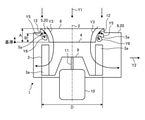
- the centrifugal blower 1 according to the first embodiment includes a drive motor 10 and an impeller 3 fixed to a motor shaft 11 of the drive motor 10. Further, the centrifugal blower 1 guides the bell mouth 5 that takes air into the impeller 3, the airflow port 6a that blows out the airflow Y2 generated by the impeller 3, and the airflow Y1 generated by the impeller 3 to the outlet 6a.
- the scroll casing 20 is provided with a tongue portion 7 and a casing main body 6 for accommodating the impeller 3.
- the bell mouth 5 has a suction port 4 into which the mainstream Y3 flowing into the impeller 3 from the upstream side flows into the impeller 3, and a large-diameter mouth surface 8 arranged on the upstream side of the mainstream Y3 with respect to the suction port 4.
- the impeller 3 includes a boss portion 9 fixed to the motor shaft 11 and blades 3a installed on the peripheral portion of the boss portion 9.
- a protrusion 12 extending in the rotation direction of the impeller 3 is provided on the wall surface facing the inside of the scroll casing 20 over the entire circumference.
- the protrusion 12 has a rotationally symmetric shape with the rotation shaft 2 of the motor shaft 11 as the central axis.
- the wall surface facing the inside of the scroll casing 20 is referred to as an “inner wall surface”.
- a protrusion 12 extending in the rotation direction of the impeller 3 is provided on the inner wall surface of the bell mouth 5, and the protrusion 12 forms an undulation on the inner wall surface of the bell mouth 5.
- the protrusion 12 extends in the rotation direction of the impeller 3" means that the protrusion 12 has a shape in which the dimension in the rotation direction of the impeller 3 is longer than the dimension in the rotation axis direction of the impeller 3. means.
- the protrusion 12 is an undulation forming portion that forms an undulation on the inner wall surface of the bell mouth 5.
- the undulation of the inner wall surface of the bell mouth 5 is high at the portion of the protrusion 12 which is the undulation forming portion, and is low at the adjacent portion 5a of the inner wall surface of the bell mouth 5 adjacent to the undulation forming portion.
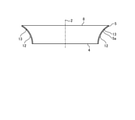
- FIG. 3 is a diagram showing a cross-sectional shape of a bell mouth and a protrusion of the centrifugal blower according to the first embodiment.
- the suction port 4 of the bell mouth 5 as a reference, the distance between the suction port 4 of the bell mouth 5 and the large-diameter mouth surface 8 is defined as the bell mouth distance A, and the suction port 4 of the bell mouth 5 and the suction port 4 of the protrusion 12 are on the side.
- the distance from the end is defined as the protrusion distance B.
- C be the protruding length of the protrusion 12.
- the blade outer diameter of the impeller 3 is D.
- the protrusion 12 is integrated with the bell mouth 5, the shape is based on the fact that the resin is molded with a mold.
- the protrusion length C is the blade outer diameter D in consideration of the effect described later that the protrusion 12 brings while avoiding a sudden change in the plate thickness of the bell mouth 5 when considering the molding of the bell mouth 5 by the resin. It is said to be 1.1% of.
- the protrusion length C of the protrusion 12 is dimensionlessly determined by the blade outer diameter D.
- the tip of the protrusion 12 is not a sharp shape but a rounded shape so as not to cause turbulence of the air flow.
- the mainstream Y3 formed by the rotation of the impeller 3 passes through the bell mouth 5 and is sucked into the scroll casing 20.
- the mainstream Y3 sucked into the scroll casing 20 heads for the outlet 6a.
- the impeller 3 rotates to form secondary flows Y5 and Y6 that flow in a direction different from that of the mainstream Y3.
- a loss occurs inside the centrifugal blower 1 and an increase in noise and a fan. It leads to a decrease in efficiency.
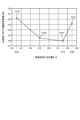
- FIG. 4 is a diagram showing the noise reduction effect of the centrifugal blower according to the first embodiment.
- the horizontal axis of FIG. 4 is a value obtained by dividing the protrusion distance B by the bellmouth distance A.
- B / A 0.85 is synonymous with providing the protrusion 12 at a position of 85% of the bell mouth distance A.
- the vertical axis of FIG. 4 shows the noise reduction effect when compared with the centrifugal blower according to the comparative example not provided with the protrusion 12.
- the path of the secondary flow Y5 flowing in a direction different from that of the mainstream Y3 can be cut off, and the protrusion 12 can be cut off as compared with the case where the protrusion 12 is not provided.
- the secondary flow Y6 is less likely to occur on the downstream side of 12. That is, as compared with the case where the protrusion 12 is not provided, the vortex that causes the turbulence of the airflow is less likely to occur, and the secondary loss due to the turbulence of the airflow is less likely to occur. Further, by providing the protrusion 12, the interference between the vortices is suppressed, so that both low noise and high efficiency can be achieved at the same time.
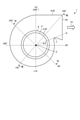
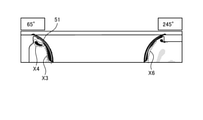
- FIG. 5 is a plan view of the centrifugal blower according to the first embodiment.
- FIGS. 6 and 7 are diagrams showing the fluid analysis result of the internal flow of the centrifugal blower according to the first embodiment.
- 8 and 9 are diagrams showing the fluid analysis result of the internal flow of the centrifugal blower according to the comparative example of the first embodiment.
- the fluid analysis results are shown using the second invariant of the velocity gradient tensor, which indicates the strength of the vortex.
- the unit of the second invariant of the velocity gradient tensor is [/ s 2 ].
- the distribution of vortices indicates that the closer the color is to black, the stronger the vortex, and the closer the color is to white, the weaker the vortex.
- the black color is 100000 / s 2 and the white color is 0 / s 2 .
- a strong vortex X5 is formed along the wall surface of the bell mouth 5.
- the range of occurrence is suppressed by the protrusion 12.
- the strong vortex X6 along the wall surface of the bell mouth 51 is formed along the wall surface over a wide range.
- the vortex generated in the vicinity of the bell mouth 5 is a strong vortex X7 and a strong vortex. It is separated from X8 by a protrusion 12.
- the range of generation of the vortex X10 of the centrifugal blower 1 according to the first embodiment including the protrusion 12 is that of the centrifugal blower according to the comparative example not provided with the protrusion 12.
- the centrifugal blower according to the comparative example looks wider than the generation range of the vortex X11, the vortex X12 and the vortex X13, in the centrifugal blower according to the comparative example, three vortices X11, the vortex X12 and the vortex X13 are generated, and the distance between the vortices is short, so that there are a plurality of vortices.
- the vortex is interfering.
- a plurality of strong vortices X11, vortices X12 and vortices X13 are generated on the surface of the inner wall surface of the bell mouth 51 and interfere with each other to have unsteadiness. It is easy to predict that the number of vortices will increase, leading to an increase in noise sources and an increase in energy loss.
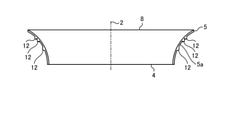
- FIG. 10 is a diagram showing a first modification of the centrifugal blower according to the first embodiment.
- three protrusions 12 are formed on the inner wall surface of the bell mouth 5 at intervals in the axial direction of the motor shaft 11.
- a plurality of protrusions 12 may be provided on the inner wall surface of the bell mouth 5.
- an example in which three protrusions 12 are provided is shown, but the number of protrusions 12 may be two or four or more.
- FIG. 11 is a diagram showing a second modification of the centrifugal blower according to the first embodiment.
- a groove 13 extending in the rotational direction of the impeller 3 is formed on the inner wall surface of the bell mouth 5 instead of the protrusion 12.
- the groove 13 "extends in the rotation direction of the impeller 3" means that the groove 13 has a shape in which the dimension in the rotation direction of the impeller 3 is longer than the dimension in the rotation axis direction of the impeller 3. means.
- the groove 13 is an undulation forming portion that forms undulations on the inner wall surface of the bell mouth 5.
- the undulation of the inner wall surface of the bell mouth 5 is low in the portion of the groove 13 which is the undulation forming portion, and is high in the adjacent portion 5a of the inner wall surface of the bell mouth 5 adjacent to the undulation forming portion.
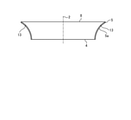
- FIG. 12 is a diagram showing a cross-sectional shape of a bell mouth and a groove in a second modification of the centrifugal blower according to the first embodiment.
- the suction port 4 of the bell mouth 5 as a reference, the distance between the suction port 4 of the bell mouth 5 and the large-diameter mouth surface 8 is defined as the bell mouth distance A, and the suction port 4 of the bell mouth 5 and the suction port 4 of the groove 13 are on the side.
- the distance from the end is defined as the groove distance E.
- the depth of the groove 13 is defined as F.
- the depth F of the groove 13 is the blade outer diameter D in consideration of the effect of the groove 13 while avoiding a sudden change in the plate thickness of the bell mouth 5 when considering the molding of the bell mouth 5 by the resin. It is said to be 1.1% of. That is, the centrifugal blower 1 according to the second modification of the first embodiment has the same as the centrifugal blower 1 according to the first embodiment, except that the convex direction due to the protrusion 12 and the concave direction due to the groove 13 are opposite to each other. The same is true.
- the groove 13 is formed on the inner wall surface of the bell mouth 5 to form a vortex due to the undulations of the inner wall surface. Resistance is generated and continuity cannot be maintained, and the loss due to the secondary flow generated inside the centrifugal blower 1 is improved.
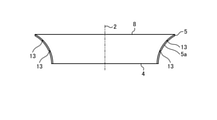
- FIG. 13 is a diagram showing a third modification of the centrifugal blower according to the first embodiment.
- the third modification two grooves 13 are formed on the inner wall surface of the bell mouth 5 at intervals in the axial direction of the motor shaft 11. Even when a plurality of grooves 13 are formed, the continuity of the vortices generated near the inner wall surface of the bell mouth 5 is not maintained, and the loss due to the secondary flow generated inside the centrifugal blower 1 is improved.
- an example in which two grooves 13 are formed is shown, but the number of grooves 13 may be three or more.
- FIG. 14 is a diagram showing a fourth modification of the centrifugal blower according to the first embodiment.
- the inner wall surface of the bell mouth 5 is provided with protrusions 12 and grooves 13 extending in the rotational direction of the impeller 3, and the protrusions 12 and grooves 13 cause undulations on the inner wall surface of the bell mouth 5. It is formed. That is, the protrusion 12 and the groove 13 extending in the rotation direction of the impeller 3 are undulation forming portions that form undulations on the inner wall surface of the bell mouth 5.
- the undulation of the inner wall surface of the bell mouth 5 is high in the portion of the protrusion 12 which is the undulation forming portion around the protrusion 12, and is low in the adjacent portion 5a of the inner wall surface of the bell mouth 5 adjacent to the undulation forming portion. It has become.
- the undulation of the inner wall surface of the bell mouth 5 is low in the portion of the groove 13 which is the undulation forming portion around the groove 13, and the adjacent portion 5a of the inner wall surface of the bell mouth 5 adjacent to the undulation forming portion. It is getting higher.
- the protrusions 12 and the grooves 13 are formed one by one, but at least one of the protrusions 12 and the grooves 13 may be formed in plurality.
- FIG. 15 is a diagram showing the effect of improving the fan efficiency of the centrifugal blower according to the first embodiment.
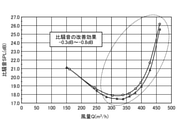
- FIG. 16 is a diagram showing the effect of improving the specific noise of the centrifugal blower according to the first embodiment.
- FIG. 17 is a diagram showing the effect of improving the static pressure of the centrifugal blower according to the first embodiment.
- the horizontal axis indicates the air volume.
- the vertical axis shows the fan efficiency.
- the vertical axis indicates the specific noise.
- the vertical axis shows the static pressure of the fan.
- the plots marked with triangles represent the centrifugal blower 1 according to the first embodiment, and the plots marked with circles represent the centrifugal blower according to the comparative example.
- the centrifugal blower 1 according to the first embodiment has an improved fan efficiency of 0.7 points to 1.6 points at the same air volume as compared with the centrifugal blower according to the comparative example. Further, the centrifugal blower 1 according to the first embodiment has a specific noise smaller than 0.3 dB to 0.8 dB as compared with the centrifugal blower according to the comparative example. Further, the centrifugal blower 1 according to the first embodiment has an improved static pressure of 3% to 12% as compared with the centrifugal blower according to the comparative example.
- the centrifugal blower 1 according to the first embodiment and the centrifugal blower 1 according to each modification are improved in fan efficiency and static pressure by forming at least one of a protrusion 12 and a groove 13 on the inner wall surface of the bell mouth 5. Noise reduction is realized. That is, the centrifugal blower 1 according to the first embodiment can achieve both low noise and high efficiency.
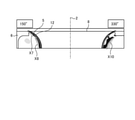
- Embodiment 2 The centrifugal blower 1 according to the second embodiment is different from the centrifugal blower 1 according to the first embodiment in that a protrusion 12 extending in the rotation direction of the impeller 3 is provided partially instead of the entire circumference.
- the same reference numerals are given to the portions common to the centrifugal blower 1 according to the first embodiment, and duplicate description will be omitted.
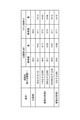
- FIG. 18 is a diagram showing the noise reduction effect and the fan efficiency improvement effect of the centrifugal blower according to the second embodiment. All the measured values in FIG. 18 are numerical values at the open point.
- the specific noise and the fan efficiency in FIG. 18 are the differences from the centrifugal blower according to the comparative example not provided with the protrusion 12, respectively.
- the noise reduction effect was the highest when the protrusion 12 was provided in the range of ⁇ 70 ° ⁇ ⁇ ⁇ 20 °.
- the improvement value of the specific noise by providing the protrusion 12 in the range of ⁇ 70 ° ⁇ ⁇ ⁇ 20 ° is 0.57 dB.
- the range of ⁇ 70 ° ⁇ ⁇ ⁇ 20 ° is close to the tongue portion 7 and the outlet 6a, and the non-stationarity of the secondary flow tends to be strong, so that the noise reduction effect of the protrusion 12 is remarkable.
- the improvement value of the specific noise by providing the protrusion 12 in the range of 200 ° ⁇ ⁇ ⁇ 290 ° is 0.53 dB.
- the improvement value of the specific noise by providing the protrusion 12 in the range of 20 ° ⁇ ⁇ ⁇ 110 ° is 0.51 dB.
- the improvement value of the specific noise by providing the protrusion 12 in the range of 110 ° ⁇ ⁇ ⁇ 200 ° is 0.17 dB. Since the range of 110 ° ⁇ ⁇ ⁇ 200 ° is far from the tongue portion 7 and the outlet 6a, the non-stationarity of the vortex is weak and the noise reduction effect of the protrusion 12 is small.
- the protrusion 12 may be provided in two or more ranges.
- the protrusion 12 may be provided in both the range of ⁇ 70 ° ⁇ ⁇ ⁇ 20 ° and the range of 200 ° ⁇ ⁇ ⁇ 290 °.
- the centrifugal blower 1 has a protrusion 12 extending in the rotation direction of the impeller 3 and a groove extending in the rotation direction of the impeller 3 in a part of the inner wall surface of the bell mouth 5 around the rotation axis 2. Since at least one of 13 is formed, it is possible to realize low noise and high efficiency.
- FIG. 19 is a cross-sectional view of the centrifugal blower according to the third embodiment.
- FIG. 19 schematically shows a cross section of the centrifugal blower 1 according to the third embodiment.
- the centrifugal blower 1 according to the first embodiment is a single suction type equipped with one bell mouth 5, whereas the centrifugal blower 1 according to the third embodiment is a double suction type provided with two bell mouths 5. It differs from the centrifugal blower 1 according to the first embodiment in a certain point.
- the same reference numerals are given to the portions common to the centrifugal blower 1 according to the first embodiment, and duplicate description will be omitted.
- the centrifugal blower 1 according to the third embodiment which is a double suction type, is provided with protrusions 12 extending in the rotational direction of the impeller 3 on the inner wall surface of each of the two bell mouths 5, and the two bell mouths are provided by the protrusions 12. Ups and downs are formed on the inner wall surface of each of 5.
- the protrusion 12 is an undulation forming portion that forms an undulation on the inner wall surface of the bell mouth 5.
- the undulation of the inner wall surface of the bell mouth 5 is high at the portion of the protrusion 12 which is the undulation forming portion, and is low at the adjacent portion 5a of the inner wall surface of the bell mouth 5 adjacent to the undulation forming portion. Since the centrifugal blower 1 according to the third embodiment is provided with protrusions 12 on the inner wall surface of each of the two bell mouths 5, it is possible to achieve both low noise and high efficiency.
- a groove 13 may be provided in at least one of the bell mouths 5. That is, by forming at least one of the protrusion 12 and the groove 13 on the inner wall surface of each of the two bell mouths 5, it is possible to realize low noise and high efficiency.
- the configuration shown in the above embodiment is an example of the content, can be combined with another known technique, and a part of the configuration is omitted or changed without departing from the gist. It is also possible.
Landscapes
- Engineering & Computer Science (AREA)
- Mechanical Engineering (AREA)
- General Engineering & Computer Science (AREA)
- Structures Of Non-Positive Displacement Pumps (AREA)
Priority Applications (2)
| Application Number | Priority Date | Filing Date | Title |
|---|---|---|---|
| JP2022546788A JP7387013B2 (ja) | 2020-09-02 | 2020-09-02 | 遠心送風機 |
| PCT/JP2020/033334 WO2022049684A1 (ja) | 2020-09-02 | 2020-09-02 | 遠心送風機 |
Applications Claiming Priority (1)
| Application Number | Priority Date | Filing Date | Title |
|---|---|---|---|
| PCT/JP2020/033334 WO2022049684A1 (ja) | 2020-09-02 | 2020-09-02 | 遠心送風機 |
Publications (1)
| Publication Number | Publication Date |
|---|---|
| WO2022049684A1 true WO2022049684A1 (ja) | 2022-03-10 |
Family
ID=80491877
Family Applications (1)
| Application Number | Title | Priority Date | Filing Date |
|---|---|---|---|
| PCT/JP2020/033334 Ceased WO2022049684A1 (ja) | 2020-09-02 | 2020-09-02 | 遠心送風機 |
Country Status (2)
| Country | Link |
|---|---|
| JP (1) | JP7387013B2 (https=) |
| WO (1) | WO2022049684A1 (https=) |
Citations (2)
| Publication number | Priority date | Publication date | Assignee | Title |
|---|---|---|---|---|
| JPS6141899U (ja) * | 1985-07-17 | 1986-03-17 | 三菱電機株式会社 | 送風機 |
| JPH0337398A (ja) * | 1989-07-04 | 1991-02-18 | Matsushita Seiko Co Ltd | 多翼ファン |
-
2020
- 2020-09-02 WO PCT/JP2020/033334 patent/WO2022049684A1/ja not_active Ceased
- 2020-09-02 JP JP2022546788A patent/JP7387013B2/ja active Active
Patent Citations (2)
| Publication number | Priority date | Publication date | Assignee | Title |
|---|---|---|---|---|
| JPS6141899U (ja) * | 1985-07-17 | 1986-03-17 | 三菱電機株式会社 | 送風機 |
| JPH0337398A (ja) * | 1989-07-04 | 1991-02-18 | Matsushita Seiko Co Ltd | 多翼ファン |
Also Published As
| Publication number | Publication date |
|---|---|
| JPWO2022049684A1 (https=) | 2022-03-10 |
| JP7387013B2 (ja) | 2023-11-27 |
Similar Documents
| Publication | Publication Date | Title |
|---|---|---|
| KR102323777B1 (ko) | 송풍장치 및 이를 포함하는 공기조화기의 실외기 | |
| US7163371B2 (en) | Centrifugal fan | |
| AU2007209185B2 (en) | Improved impeller and fan | |
| US8870541B2 (en) | Centrifugal multiblade fan | |
| CN105793576B (zh) | 离心风扇 | |
| CN111656019B (zh) | 轴流送风机 | |
| CN107850083A (zh) | 送风机和搭载有该送风机的空调装置 | |
| US8038391B2 (en) | Vortex blower | |
| CN210152981U (zh) | 送风机 | |
| AU2007234497A1 (en) | Multiblade centrifugal blower | |
| CN115727008B (zh) | 进风圈和油烟机 | |
| JP2012140881A (ja) | 多翼送風機 | |
| US12140155B2 (en) | Blower | |
| JP6932295B1 (ja) | 送風機 | |
| JP7387027B2 (ja) | 遠心送風機 | |
| WO2022049684A1 (ja) | 遠心送風機 | |
| JP2006125229A (ja) | シロッコファン | |
| JP7413973B2 (ja) | 送風機 | |
| WO2020115872A1 (ja) | 遠心送風機 | |
| JP7466707B2 (ja) | 遠心送風機 | |
| JP2004353665A (ja) | 多翼遠心送風機 | |
| JPS6165097A (ja) | 軸流フアン | |
| WO2018173803A1 (ja) | 送風装置 | |
| WO2018138808A1 (ja) | 遠心送風機 |
Legal Events
| Date | Code | Title | Description |
|---|---|---|---|
| 121 | Ep: the epo has been informed by wipo that ep was designated in this application |
Ref document number: 20952423 Country of ref document: EP Kind code of ref document: A1 |
|
| ENP | Entry into the national phase |
Ref document number: 2022546788 Country of ref document: JP Kind code of ref document: A |
|
| NENP | Non-entry into the national phase |
Ref country code: DE |
|
| 122 | Ep: pct application non-entry in european phase |
Ref document number: 20952423 Country of ref document: EP Kind code of ref document: A1 |