WO2022045232A1 - 固体状チタン触媒成分、オレフィン重合用触媒、オレフィンの重合方法およびプロピレン重合体 - Google Patents
固体状チタン触媒成分、オレフィン重合用触媒、オレフィンの重合方法およびプロピレン重合体 Download PDFInfo
- Publication number
- WO2022045232A1 WO2022045232A1 PCT/JP2021/031282 JP2021031282W WO2022045232A1 WO 2022045232 A1 WO2022045232 A1 WO 2022045232A1 JP 2021031282 W JP2021031282 W JP 2021031282W WO 2022045232 A1 WO2022045232 A1 WO 2022045232A1
- Authority
- WO
- WIPO (PCT)
- Prior art keywords
- group
- substituted
- catalyst component
- unsubstituted
- solid titanium
- Prior art date
- Legal status (The legal status is an assumption and is not a legal conclusion. Google has not performed a legal analysis and makes no representation as to the accuracy of the status listed.)
- Ceased
Links
- 0 Cc1ccccc1*(C(C1C2OC(c3c[s]cc3)=O)c3c1cccc3)C2OC(c1c[s]cc1)=O Chemical compound Cc1ccccc1*(C(C1C2OC(c3c[s]cc3)=O)c3c1cccc3)C2OC(c1c[s]cc1)=O 0.000 description 4
- GPJYXZCFRXXAAX-BQNRHSTOSA-N CC(C(C(C1OC(c2ccc[nH]2)=O)OC(c2ccc[nH]2)=O)c2ccccc2)[C@@]1(C)c1ccccc1C Chemical compound CC(C(C(C1OC(c2ccc[nH]2)=O)OC(c2ccc[nH]2)=O)c2ccccc2)[C@@]1(C)c1ccccc1C GPJYXZCFRXXAAX-BQNRHSTOSA-N 0.000 description 1
- HONPVOFMIGTICH-UHFFFAOYSA-N CC(C(C1OC(c2c[nH]cc2)=O)OC(c2c[nH]cc2)=O)c2ccccc2C1c1ccccc1C Chemical compound CC(C(C1OC(c2c[nH]cc2)=O)OC(c2c[nH]cc2)=O)c2ccccc2C1c1ccccc1C HONPVOFMIGTICH-UHFFFAOYSA-N 0.000 description 1
- CWMJQPNRCUSDIU-ZDIDPRFDSA-N CC(C)[C@](CC[C@]1(C)[C@H]2OC(c3ccccc3)=O)([C@@H]2OC(c2ccccc2)=O)c2c1cccc2 Chemical compound CC(C)[C@](CC[C@]1(C)[C@H]2OC(c3ccccc3)=O)([C@@H]2OC(c2ccccc2)=O)c2c1cccc2 CWMJQPNRCUSDIU-ZDIDPRFDSA-N 0.000 description 1
- DWPSJIARDIIOAX-ALNDXVPUSA-N CC(C)c1c([C@@H](C[C@@H]2[C@@H]3OC(c4ccccc4)=O)[C@H]3OC(c3ccccc3)=O)c2ccc1 Chemical compound CC(C)c1c([C@@H](C[C@@H]2[C@@H]3OC(c4ccccc4)=O)[C@H]3OC(c3ccccc3)=O)c2ccc1 DWPSJIARDIIOAX-ALNDXVPUSA-N 0.000 description 1
- JASADDLNYVMLLP-BPMMKKSESA-N CC(C/C=C\C=C/C([C@@H]1c2ccccc2[C@@H]1C1OC(c2c[n](C)cn2)=O)=C)C1OC(c1c[n](C)cn1)=O Chemical compound CC(C/C=C\C=C/C([C@@H]1c2ccccc2[C@@H]1C1OC(c2c[n](C)cn2)=O)=C)C1OC(c1c[n](C)cn1)=O JASADDLNYVMLLP-BPMMKKSESA-N 0.000 description 1
- SNUQCVONTACTCW-AKPOCHNHSA-N CC(C1OC(c2c(C)cc(C)cc2C)=O)c2ccccc2C2c3ccccc3[C@@H]2C1OC(c1c(C)cc(C)cc1C)=O Chemical compound CC(C1OC(c2c(C)cc(C)cc2C)=O)c2ccccc2C2c3ccccc3[C@@H]2C1OC(c1c(C)cc(C)cc1C)=O SNUQCVONTACTCW-AKPOCHNHSA-N 0.000 description 1
- SVZRXNUAGVHUOF-DJYUBJSZSA-N CC(C1OC(c2cc(C)cc(C)c2)=O)c2ccccc2[C@@H]2c3ccccc3[C@@H]2C1OC(c1cc(C)cc(C)c1)=O Chemical compound CC(C1OC(c2cc(C)cc(C)c2)=O)c2ccccc2[C@@H]2c3ccccc3[C@@H]2C1OC(c1cc(C)cc(C)c1)=O SVZRXNUAGVHUOF-DJYUBJSZSA-N 0.000 description 1
- PCLWXAVPPOLLPY-PJYWLYPCSA-N CC1([C@@H]([C@@H]2OC(c3ccccc3)=O)OC(c3ccccc3)=O)OC2(C)c2ccccc12 Chemical compound CC1([C@@H]([C@@H]2OC(c3ccccc3)=O)OC(c3ccccc3)=O)OC2(C)c2ccccc12 PCLWXAVPPOLLPY-PJYWLYPCSA-N 0.000 description 1
- CGJPNFOSJVSHDC-UHFFFAOYSA-N CCC(COC(c1ccccc1)=O)OC(c1ccccc1)=O Chemical compound CCC(COC(c1ccccc1)=O)OC(c1ccccc1)=O CGJPNFOSJVSHDC-UHFFFAOYSA-N 0.000 description 1
- NZIQUNGTPIYHAP-UHFFFAOYSA-N CCCC(C)c1ccccc1C(OC(C1C)C(OC(c2ccccc2C(C)CCC)=O)=C(c2ccccc2C)c2c1cccc2)=O Chemical compound CCCC(C)c1ccccc1C(OC(C1C)C(OC(c2ccccc2C(C)CCC)=O)=C(c2ccccc2C)c2c1cccc2)=O NZIQUNGTPIYHAP-UHFFFAOYSA-N 0.000 description 1
- RZANKEGPIFIIBB-OWSROJQPSA-N CCCC(C)c1ccccc1C(OC([C@H]1c2ccccc2[C@H]1c1ccccc1C1C)C1OC(c1ccccc1C(CCC)N)=O)=O Chemical compound CCCC(C)c1ccccc1C(OC([C@H]1c2ccccc2[C@H]1c1ccccc1C1C)C1OC(c1ccccc1C(CCC)N)=O)=O RZANKEGPIFIIBB-OWSROJQPSA-N 0.000 description 1
- XXWZUMUWKSWUKM-HZRCOOLBSA-N C[C@@H](CCC1)C([C@@H](C2)[C@H]3OC(c4ccccc4)=O)C1[C@H]2[C@@H]3OC(c1ccccc1)=O Chemical compound C[C@@H](CCC1)C([C@@H](C2)[C@H]3OC(c4ccccc4)=O)C1[C@H]2[C@@H]3OC(c1ccccc1)=O XXWZUMUWKSWUKM-HZRCOOLBSA-N 0.000 description 1
- UZJOWUAVBUHNHP-WIESWWSZSA-N C[C@@](C1C([C@H](C(c2ccccc2C)OC)[C@@H]2OC(c3ccccc3)=O)C=CC=CC1)([C@H]2OC(c1ccccc1)=O)OC Chemical compound C[C@@](C1C([C@H](C(c2ccccc2C)OC)[C@@H]2OC(c3ccccc3)=O)C=CC=CC1)([C@H]2OC(c1ccccc1)=O)OC UZJOWUAVBUHNHP-WIESWWSZSA-N 0.000 description 1
- OMLKZKDGATVNQA-UHFFFAOYSA-N Cc1ccccc1C(C(C1C2OC(c3cnc[n]3C)=O)c3c1cccc3)C2OC(c1cnc[n]1C)=O Chemical compound Cc1ccccc1C(C(C1C2OC(c3cnc[n]3C)=O)c3c1cccc3)C2OC(c1cnc[n]1C)=O OMLKZKDGATVNQA-UHFFFAOYSA-N 0.000 description 1
- JXUSSZXXZIJFDP-ROUUACIJSA-N O=C(c1ccccc1)O[C@@H](CCCC1)[C@H]1OC(c1ccccc1)=O Chemical compound O=C(c1ccccc1)O[C@@H](CCCC1)[C@H]1OC(c1ccccc1)=O JXUSSZXXZIJFDP-ROUUACIJSA-N 0.000 description 1
- WYTHBZLEGZLXLV-UHFFFAOYSA-N O=C(c1ncccc1)OC(C(C1c2ccccc22)OC(c3ccccn3)=O)C2c2c1cccc2 Chemical compound O=C(c1ncccc1)OC(C(C1c2ccccc22)OC(c3ccccn3)=O)C2c2c1cccc2 WYTHBZLEGZLXLV-UHFFFAOYSA-N 0.000 description 1
Images


Classifications
-
- C—CHEMISTRY; METALLURGY
- C08—ORGANIC MACROMOLECULAR COMPOUNDS; THEIR PREPARATION OR CHEMICAL WORKING-UP; COMPOSITIONS BASED THEREON
- C08F—MACROMOLECULAR COMPOUNDS OBTAINED BY REACTIONS ONLY INVOLVING CARBON-TO-CARBON UNSATURATED BONDS
- C08F4/00—Polymerisation catalysts
- C08F4/06—Metallic compounds other than hydrides and other than metallo-organic compounds; Boron halide or aluminium halide complexes with organic compounds containing oxygen
- C08F4/16—Metallic compounds other than hydrides and other than metallo-organic compounds; Boron halide or aluminium halide complexes with organic compounds containing oxygen of silicon, germanium, tin, lead, titanium, zirconium or hafnium
-
- C—CHEMISTRY; METALLURGY
- C08—ORGANIC MACROMOLECULAR COMPOUNDS; THEIR PREPARATION OR CHEMICAL WORKING-UP; COMPOSITIONS BASED THEREON
- C08F—MACROMOLECULAR COMPOUNDS OBTAINED BY REACTIONS ONLY INVOLVING CARBON-TO-CARBON UNSATURATED BONDS
- C08F110/00—Homopolymers of unsaturated aliphatic hydrocarbons having only one carbon-to-carbon double bond
- C08F110/04—Monomers containing three or four carbon atoms
- C08F110/06—Propene
-
- C—CHEMISTRY; METALLURGY
- C08—ORGANIC MACROMOLECULAR COMPOUNDS; THEIR PREPARATION OR CHEMICAL WORKING-UP; COMPOSITIONS BASED THEREON
- C08F—MACROMOLECULAR COMPOUNDS OBTAINED BY REACTIONS ONLY INVOLVING CARBON-TO-CARBON UNSATURATED BONDS
- C08F10/00—Homopolymers and copolymers of unsaturated aliphatic hydrocarbons having only one carbon-to-carbon double bond
- C08F10/04—Monomers containing three or four carbon atoms
- C08F10/06—Propene
-
- C—CHEMISTRY; METALLURGY
- C08—ORGANIC MACROMOLECULAR COMPOUNDS; THEIR PREPARATION OR CHEMICAL WORKING-UP; COMPOSITIONS BASED THEREON
- C08F—MACROMOLECULAR COMPOUNDS OBTAINED BY REACTIONS ONLY INVOLVING CARBON-TO-CARBON UNSATURATED BONDS
- C08F4/00—Polymerisation catalysts
- C08F4/42—Metals; Metal hydrides; Metallo-organic compounds; Use thereof as catalyst precursors
- C08F4/44—Metals; Metal hydrides; Metallo-organic compounds; Use thereof as catalyst precursors selected from light metals, zinc, cadmium, mercury, copper, silver, gold, boron, gallium, indium, thallium, rare earths or actinides
- C08F4/60—Metals; Metal hydrides; Metallo-organic compounds; Use thereof as catalyst precursors selected from light metals, zinc, cadmium, mercury, copper, silver, gold, boron, gallium, indium, thallium, rare earths or actinides together with refractory metals, iron group metals, platinum group metals, manganese, rhenium technetium or compounds thereof
- C08F4/62—Refractory metals or compounds thereof
- C08F4/64—Titanium, zirconium, hafnium or compounds thereof
- C08F4/646—Catalysts comprising at least two different metals, in metallic form or as compounds thereof, in addition to the component covered by group C08F4/64
- C08F4/6465—Catalysts comprising at least two different metals, in metallic form or as compounds thereof, in addition to the component covered by group C08F4/64 containing silicium
-
- C—CHEMISTRY; METALLURGY
- C08—ORGANIC MACROMOLECULAR COMPOUNDS; THEIR PREPARATION OR CHEMICAL WORKING-UP; COMPOSITIONS BASED THEREON
- C08F—MACROMOLECULAR COMPOUNDS OBTAINED BY REACTIONS ONLY INVOLVING CARBON-TO-CARBON UNSATURATED BONDS
- C08F4/00—Polymerisation catalysts
- C08F4/42—Metals; Metal hydrides; Metallo-organic compounds; Use thereof as catalyst precursors
- C08F4/44—Metals; Metal hydrides; Metallo-organic compounds; Use thereof as catalyst precursors selected from light metals, zinc, cadmium, mercury, copper, silver, gold, boron, gallium, indium, thallium, rare earths or actinides
- C08F4/60—Metals; Metal hydrides; Metallo-organic compounds; Use thereof as catalyst precursors selected from light metals, zinc, cadmium, mercury, copper, silver, gold, boron, gallium, indium, thallium, rare earths or actinides together with refractory metals, iron group metals, platinum group metals, manganese, rhenium technetium or compounds thereof
- C08F4/62—Refractory metals or compounds thereof
- C08F4/64—Titanium, zirconium, hafnium or compounds thereof
- C08F4/647—Catalysts containing a specific non-metal or metal-free compound
- C08F4/649—Catalysts containing a specific non-metal or metal-free compound organic
- C08F4/6494—Catalysts containing a specific non-metal or metal-free compound organic containing oxygen
-
- C—CHEMISTRY; METALLURGY
- C08—ORGANIC MACROMOLECULAR COMPOUNDS; THEIR PREPARATION OR CHEMICAL WORKING-UP; COMPOSITIONS BASED THEREON
- C08F—MACROMOLECULAR COMPOUNDS OBTAINED BY REACTIONS ONLY INVOLVING CARBON-TO-CARBON UNSATURATED BONDS
- C08F4/00—Polymerisation catalysts
- C08F4/42—Metals; Metal hydrides; Metallo-organic compounds; Use thereof as catalyst precursors
- C08F4/44—Metals; Metal hydrides; Metallo-organic compounds; Use thereof as catalyst precursors selected from light metals, zinc, cadmium, mercury, copper, silver, gold, boron, gallium, indium, thallium, rare earths or actinides
- C08F4/60—Metals; Metal hydrides; Metallo-organic compounds; Use thereof as catalyst precursors selected from light metals, zinc, cadmium, mercury, copper, silver, gold, boron, gallium, indium, thallium, rare earths or actinides together with refractory metals, iron group metals, platinum group metals, manganese, rhenium technetium or compounds thereof
- C08F4/62—Refractory metals or compounds thereof
- C08F4/64—Titanium, zirconium, hafnium or compounds thereof
- C08F4/65—Pretreating the metal or compound covered by group C08F4/64 before the final contacting with the metal or compound covered by group C08F4/44
- C08F4/651—Pretreating with non-metals or metal-free compounds
-
- C—CHEMISTRY; METALLURGY
- C08—ORGANIC MACROMOLECULAR COMPOUNDS; THEIR PREPARATION OR CHEMICAL WORKING-UP; COMPOSITIONS BASED THEREON
- C08F—MACROMOLECULAR COMPOUNDS OBTAINED BY REACTIONS ONLY INVOLVING CARBON-TO-CARBON UNSATURATED BONDS
- C08F4/00—Polymerisation catalysts
- C08F4/42—Metals; Metal hydrides; Metallo-organic compounds; Use thereof as catalyst precursors
- C08F4/44—Metals; Metal hydrides; Metallo-organic compounds; Use thereof as catalyst precursors selected from light metals, zinc, cadmium, mercury, copper, silver, gold, boron, gallium, indium, thallium, rare earths or actinides
- C08F4/60—Metals; Metal hydrides; Metallo-organic compounds; Use thereof as catalyst precursors selected from light metals, zinc, cadmium, mercury, copper, silver, gold, boron, gallium, indium, thallium, rare earths or actinides together with refractory metals, iron group metals, platinum group metals, manganese, rhenium technetium or compounds thereof
- C08F4/62—Refractory metals or compounds thereof
- C08F4/64—Titanium, zirconium, hafnium or compounds thereof
- C08F4/65—Pretreating the metal or compound covered by group C08F4/64 before the final contacting with the metal or compound covered by group C08F4/44
- C08F4/652—Pretreating with metals or metal-containing compounds
- C08F4/654—Pretreating with metals or metal-containing compounds with magnesium or compounds thereof
- C08F4/6543—Pretreating with metals or metal-containing compounds with magnesium or compounds thereof halides of magnesium
- C08F4/6545—Pretreating with metals or metal-containing compounds with magnesium or compounds thereof halides of magnesium and metals of C08F4/64 or compounds thereof
-
- C—CHEMISTRY; METALLURGY
- C08—ORGANIC MACROMOLECULAR COMPOUNDS; THEIR PREPARATION OR CHEMICAL WORKING-UP; COMPOSITIONS BASED THEREON
- C08F—MACROMOLECULAR COMPOUNDS OBTAINED BY REACTIONS ONLY INVOLVING CARBON-TO-CARBON UNSATURATED BONDS
- C08F2410/00—Features related to the catalyst preparation, the catalyst use or to the deactivation of the catalyst
- C08F2410/04—Dual catalyst, i.e. use of two different catalysts, where none of the catalysts is a metallocene
-
- C—CHEMISTRY; METALLURGY
- C08—ORGANIC MACROMOLECULAR COMPOUNDS; THEIR PREPARATION OR CHEMICAL WORKING-UP; COMPOSITIONS BASED THEREON
- C08F—MACROMOLECULAR COMPOUNDS OBTAINED BY REACTIONS ONLY INVOLVING CARBON-TO-CARBON UNSATURATED BONDS
- C08F2500/00—Characteristics or properties of obtained polyolefins; Use thereof
- C08F2500/12—Melt flow index or melt flow ratio
-
- C—CHEMISTRY; METALLURGY
- C08—ORGANIC MACROMOLECULAR COMPOUNDS; THEIR PREPARATION OR CHEMICAL WORKING-UP; COMPOSITIONS BASED THEREON
- C08F—MACROMOLECULAR COMPOUNDS OBTAINED BY REACTIONS ONLY INVOLVING CARBON-TO-CARBON UNSATURATED BONDS
- C08F2500/00—Characteristics or properties of obtained polyolefins; Use thereof
- C08F2500/34—Melting point [Tm]
-
- C—CHEMISTRY; METALLURGY
- C08—ORGANIC MACROMOLECULAR COMPOUNDS; THEIR PREPARATION OR CHEMICAL WORKING-UP; COMPOSITIONS BASED THEREON
- C08F—MACROMOLECULAR COMPOUNDS OBTAINED BY REACTIONS ONLY INVOLVING CARBON-TO-CARBON UNSATURATED BONDS
- C08F2500/00—Characteristics or properties of obtained polyolefins; Use thereof
- C08F2500/35—Crystallinity, e.g. soluble or insoluble content as determined by the extraction of the polymer with a solvent
-
- Y—GENERAL TAGGING OF NEW TECHNOLOGICAL DEVELOPMENTS; GENERAL TAGGING OF CROSS-SECTIONAL TECHNOLOGIES SPANNING OVER SEVERAL SECTIONS OF THE IPC; TECHNICAL SUBJECTS COVERED BY FORMER USPC CROSS-REFERENCE ART COLLECTIONS [XRACs] AND DIGESTS
- Y02—TECHNOLOGIES OR APPLICATIONS FOR MITIGATION OR ADAPTATION AGAINST CLIMATE CHANGE
- Y02P—CLIMATE CHANGE MITIGATION TECHNOLOGIES IN THE PRODUCTION OR PROCESSING OF GOODS
- Y02P20/00—Technologies relating to chemical industry
- Y02P20/50—Improvements relating to the production of bulk chemicals
- Y02P20/52—Improvements relating to the production of bulk chemicals using catalysts, e.g. selective catalysts
Definitions
- the present invention relates to a solid titanium catalyst component, an olefin polymerization catalyst containing the solid titanium catalyst component, an olefin polymerization method using the olefin polymerization catalyst, and a propylene polymer.
- a titanium compound supported by an active magnesium halide is contained as a catalyst used for producing an ethylene / ⁇ -olefin homopolymer or an olefin polymer such as an ethylene / ⁇ -olefin copolymer.
- Catalysts are known.
- polymerization and “copolymerization” may be collectively referred to as “polymerization”.
- Such a catalyst for olefin polymerization examples include a catalyst containing titanium tetrachloride and titanium trichloride, which is called a Ziegler-Natta catalyst, a solid titanium catalyst component composed of magnesium, titanium, halogen and an electron donor, and an organic metal. Catalysts composed of compounds are widely known.
- the latter catalyst shows high activity in the polymerization of ⁇ -olefins such as propylene and 1-butene in addition to ethylene.
- ⁇ -olefins such as propylene and 1-butene in addition to ethylene.
- the obtained ⁇ -olefin polymer may have high stereoregularity.
- a solid titanium catalyst component carrying an electron donor selected from a carboxylic acid ester typified by a phthalic acid ester, and an aluminum-alkyl compound as a co-catalyst component It has been reported that excellent polymerization activity and steric specificity are exhibited when a catalyst composed of a silicon compound having at least one Si-OR (R is a hydrocarbon group in the formula) is used. (For example, Patent Document 1). In addition to phthalic acid esters, many electron donors such as polyvalent ether compounds are being studied.
- Patent Document 2 As a study using an ester compound as an electron donor, a catalyst containing a carboxylic acid ester having a divalent or higher ester group is also disclosed (for example, Patent Document 2). The applicant also reports that an ester compound having a special cyclic structure imparts a polyolefin having a wide molecular weight distribution with high activity (Patent Document 3).
- Patent Document 4 As a catalyst for giving a polyolefin having a wide molecular weight distribution, a catalyst using a substituted succinic acid ester as an electron donor has been reported. The applicant also reports a catalyst containing a polyvalent carboxylic acid ester having a special cyclic structure (Patent Document 4).
- polypropylene (propylene polymer), which is a representative polymer of olefins having 3 or more carbon atoms, has the potential to exhibit heat resistance and rigidity comparable to general-purpose engineering plastics while having a hydrocarbon structure.
- polyolefin which has a hydrocarbon structure, has a relatively low impact on the environment because it produces less toxic gas when it is discarded by combustion or when it is thermally recycled (a recycling method that recovers combustion heat energy with electric power, etc.). It is also a material.
- the subject of the present invention is a solid titanium catalyst component, a catalyst for olefin polymerization, and a method for polymerizing an olefin, which can produce an olefin polymer having higher stereoregularity and excellent molecular weight distribution than before with high activity. Is to provide.
- the present invention relates to, for example, the following [1] to [15].
- n1 to n4 are independently integers of 0 to 2, m is 0 or 1, x is an integer of 0 to 10, and the relationship of m + x ⁇ 1 is satisfied.
- R 1 and R 2 are independently substituted or unsubstituted hydrocarbon groups having 1 to 20 carbon atoms, and R 3 to R 16 and R are independently substituted or unsubstituted carbon atoms, respectively. It is a hydrocarbon group of the number 1 to 20, or a halogen atom, and the hydrogen atom, carbon atom, or both of R 1 to R 16 and R can be derived from a nitrogen atom, an oxygen atom, a phosphorus atom, a halogen atom, and a silicon atom.
- R 3 to R 16 and R may be bonded to each other to form a monocyclic or polycyclic ring, or adjacent substituents may be directly bonded to form a multiple bond.
- C a , C b and C c are carbon atoms, and the carbon-carbon bond of the cyclic structure formed from C a , C b and C c is a multiple bond in which Rs bonded to adjacent carbons are directly bonded to each other. Bonds may be formed.
- A is a single bond or a divalent binding group having a chain of 1 to 3 atoms in length between two free radicals.
- the site where two or more of R 3 to R 16 and R are bonded to each other to form a monocycle or a polycycle has a structure containing a carbon-carbon double bond.
- the site where two or more of R 3 to R 16 and R are bonded to each other to form a monocyclic or polycyclic further includes a monocyclic or polycyclic structure [1].
- the solid titanium catalyst component (I) according to.
- R 3 to R 16 are independently hydrogen atoms, substituted or unsubstituted alkyl groups, substituted or unsubstituted alkenyl groups, substituted or unsubstituted cycloalkyl groups, substituted or unsubstituted cycloalkoxy groups, respectively. , Substituted or unsubstituted alkoxy group, substituted or unsubstituted alkenyloxy group, substituted or unsubstituted cycloalkyloxy group, substituted or unsubstituted cycloalkenyloxy group, substituted or unsubstituted aryl group, substituted or unsubstituted.
- the solid titanium catalyst component (I) according to [1], which is an aryloxy group, a substituted or unsubstituted heteroaryl group, or a substituted or unsubstituted heteroaryloxy group.
- R is independently a hydrogen atom, a substituted or unsubstituted alkyl group, a substituted or unsubstituted alkenyl group, a substituted or unsubstituted cycloalkyl group, a substituted or unsubstituted cycloalkoxy group, a substituted or absent.
- a catalyst for olefin polymerization which comprises.
- the catalyst for olefin polymerization according to [11] which further comprises an electron donor (III).
- An olefin polymerization method comprising polymerizing an olefin in the presence of the catalyst for olefin polymerization according to the above [11] or [12].
- melt flow rate (MFR) determined under the condition that the measurement temperature is 230 ° C. is in the range of 0.01 g / 10 minutes or more and 1000 g / 10 minutes or less.
- the maximum temperature (Tm-maxv) at which the endothermic is zero in the differential scanning calorimetry (DSC) at a temperature rise condition of 10 ° C./min is 169.0 ° C. or higher and 220 ° C. or lower.
- an olefin polymer having extremely high stereoregularity exhibiting characteristics characterized by a high melting point and molecular weight dependence of heat of fusion, and having a wide molecular weight distribution can be produced with high activity.
- the catalyst for olefin polymerization and the polymerization method of olefin, it can be expected that an olefin polymer having higher heat resistance as well as moldability and rigidity can be produced, for example. ..
- FIG. 1 It is a DSC measurement (second temperature rise condition) chart of the polymer of Example 1.
- FIG. 2 It is a DSC measurement (condition at the time of temperature lowering) chart of the polymer of Example 1.
- FIG. 2 It is a DSC measurement (second temperature rise condition) chart of the polymer of Example 2.
- FIG. 2 It is a DSC measurement (condition at the time of temperature lowering) chart of the polymer of Example 2.
- FIG. It is a DSC measurement (second temperature rise condition) chart of the polymer of the comparative example 1.
- FIG. It It is a DSC measurement (condition at the time of temperature lowering) chart of the polymer of the comparative example 1.
- FIG. It is a DSC measurement (condition at the time of the second temperature rise) chart of the polymer of the comparative example 2.
- FIG. It is a DSC measurement (condition at the time of lowering temperature) chart of the polymer of the comparative example 2.
- FIG. 2 It is a DSC measurement (condition at the time of
- Solid titanium catalyst component (I) contains titanium, magnesium, halogen and a polyvalent ester compound having a special cyclic structure (hereinafter, also referred to as “cyclic polyvalent ester group-containing compound (a)”). It is characterized by that.
- cyclic polyvalent ester group-containing compound (a) is represented by the following formula (1).
- n1 to n4 are independently integers of 0 to 2, m is 0 or 1, x is an integer of 0 to 10, and the relationship of m + x ⁇ 1 is satisfied.
- R 1 and R 2 are independently substituted or unsubstituted hydrocarbon groups having 1 to 20 carbon atoms
- R 3 to R 16 and R are independently substituted or unsubstituted carbon atoms, respectively. It is a hydrocarbon group of the number 1 to 20, or a halogen atom
- the hydrogen atom, carbon atom, or both of R 1 to R 16 and R can be derived from a nitrogen atom, an oxygen atom, a phosphorus atom, a halogen atom, and a silicon atom. It may be substituted with at least one atom selected from the group.
- Two or more of R 3 to R 16 and R may be bonded to each other to form a monocyclic or polycyclic ring, or adjacent substituents may be directly bonded to form a multiple bond.
- C a , C b and C c are carbon atoms, and the carbon-carbon bond of the cyclic structure formed from C a , C b and C c is a multiple bond in which Rs bonded to adjacent carbons are directly bonded to each other. Bonds may be formed.
- A is a single bond or a divalent binding group having a chain of 1 to 3 atoms in length between two free radicals.
- n1 to n4 are numerical values related to the size of the annular structure. It is preferably 0 to 1, and more preferably 0.
- the above-mentioned numerical values of n1 to n4 may be the same or different from each other. It is possible to select according to the purpose. It is particularly preferable that n1 and n2 are 0. Further, it is particularly preferable that n3 and n4 are 0.
- the above m is a numerical value mainly related to the chain structure of the monocyclic structure site, and the above x is a numerical value related to the size of the so-called terminal cyclic structure far from the ester group.
- m is 0 or 1, preferably 0.
- x is 0 to 10, and a preferable upper limit value is 8, more preferably 6, and even more preferably 5.
- the lower limit of x is 0 as described above, but when x is a natural number, the preferable lower limit is 2.
- m + x ⁇ 1 is satisfied. This indicates that when m is 0, a cyclic structure containing carbons of C a , C b and C c is indispensable, and when m is 1, of C a , C b and C c . It means that the structure may not have a cyclic structure containing carbon. Note that C a , C b , and C c all refer to carbon atoms, and a, b, and c are symbols for specifying the position.
- the upper limit of m + x is preferably 10, more preferably 8, still more preferably 6, and particularly preferably 5.
- R 1 and R 2 are independently substituted or unsubstituted hydrocarbon groups having 1 to 20 carbon atoms. It is preferably a hydrocarbon having an aryl group and having 6 to 20 carbon atoms, and may have a structure containing a heteroatom as described later.
- R 3 to R 16 and R are independently hydrogen atoms, substituted or unsubstituted hydrocarbon groups having 1 to 20 carbon atoms, or halogen atoms.
- the hydrogen atom, carbon atom or both in R 1 to R 16 and R described above are partially replaced by at least one atom selected from the group consisting of a nitrogen atom, an oxygen atom, a phosphorus atom, a halogen atom and a silicon atom. It may have been. That is, R 1 to R 16 and R include embodiments of hydrocarbon groups containing nitrogen, oxygen, phosphorus, halogens and silicon.
- the element may be substituted in one place or in a plurality of places.
- the cyclic structure of the above formula (1) may include an aryl structure.
- R 1 and R 2 may be combined with each other to form a ring structure.
- a substituent selected from the group R 1 and R 2 and a substituent selected from the group consisting of R 3 to R 16 and R may be bonded to each other to form a ring structure.
- At least one substituent of R and R 3 to R 16 is a substituent other than hydrogen from the viewpoint of balance of activity, stereoregularity and other performance. Further, it may be preferable that one or more of the carbon atoms forming the cyclic structure are quaternary carbons.
- R 3 to R 16 and R also include an embodiment in which they are combined with each other to form a cyclic structure.
- the site forming the ring may have either a monocyclic structure or a polycyclic structure.
- the site forming the ring is preferably a structure having a double structure or a further ring structure. More preferably, the further cyclic structure is a structure containing a double bond.
- the double bond is more preferably a carbon-carbon double bond.
- the carbon-carbon double bond includes an aromatic structure.
- the specific structure of the portion forming this ring is the same as the specific structure of A described later.
- the above hydrocarbon group is a monovalent hydrocarbon group having 1 to 20 carbon atoms, preferably 1 to 10, more preferably 2 to 8, still more preferably 4 to 8, and particularly preferably 4 to 6. .
- Examples of the hydrocarbon group include a methyl group, an ethyl group, an n-propyl group, an isopropyl group, an n-butyl group, an isobutyl group, a hexyl group, a heptyl group, an octyl group, a 2-ethylhexyl group, a decyl group and a dodecyl group.
- Substituent or unsubstituted aryl groups such as tetradecyl group, hexadecyl group, octadecyl group, eicosyl group, cyclohexyl group, phenyl group, substituted or unsubstituted cycloalkenyl group, aliphatic hydrocarbon group, alicyclic hydrocarbon group, Examples include aromatic hydrocarbon groups.
- the alicyclic hydrocarbon group and the aromatic hydrocarbon group may contain a substituent.
- n-butyl group, isobutyl group, hexyl group, octyl group, phenyl group and the like are preferable, and further, n-butyl group, isobutyl group and phenyl group are preferable.
- R 1 to R 16 and R may be hydrocarbon groups containing nitrogen, oxygen, phosphorus, halogens and silicon.
- substituents can be selected from known structures. More specifically, a carbonyl structure-containing group such as a carboxylic acid ester group, an aldehyde group, an acetyl group, or an oxycarbonylalkyl group, an alkoxy group, a substituted or unsubstituted alkoxy group, a substituted or unsubstituted alkenyloxy group, or a substituent.
- an unsubstituted or unsubstituted cycloalkyloxy group a substituted or unsubstituted cycloalkoxyoxy group, a substituted or unsubstituted aryloxy group, a substituted or unsubstituted heteroaryl group, a substituted or unsubstituted heteroaryloxy group, or a syroxy group.
- Etc. can be given as a suitable example.
- R 3 to R 16 and R are hydrogen atoms, substituted or unsubstituted alkyl groups, substituted or unsubstituted alkenyl groups, substituted or unsubstituted cycloalkyl groups, substituted or unsubstituted cycloalkoxy groups, and the like.
- a above is a single bond or a divalent binding group having a chain of 1 to 3 atoms in length between two free radicals.
- A is preferably a divalent group selected from the groups represented by the following general formula group (2).
- the above hydrogen atoms, substituted or unsubstituted alkyl groups, substituted or unsubstituted cycloalkyl groups, substituted or unsubstituted aryl groups, or substituted or unsubstituted heteroaryl groups are the above-mentioned R 1 to R 16 and R.
- the same structure as the various substituents shown in the above can be exemplified.
- R 2'to R 7' may be bonded to each other to form a monocyclic or polycyclic bond, and adjacent substituents are directly bonded to each other to form a multiple bond (double bond or triple bond). It may be formed.
- a double bond may be preferable, and further, a carbon-carbon double bond may be preferable.
- the following structure can be exemplified.
- R 1'to R 7' can also be bonded to the above-mentioned R 1 to R 16 and R to form a ring structure, and preferably to be bonded to the above-mentioned R 3 to R 16 and R to form a ring.
- the structure can be formed.
- Specific examples of the skeleton of the ring containing A as described above include a norbornane skeleton and an admantyl skeleton.
- a As such a cyclic polyvalent ester group-containing compound (a), the following structure can be exemplified.
- some of the structural formulas of the following exemplified compounds have stereoisomers, and some of them even specify the isomer structure, but they may also include isomer structures not exemplified.
- the methyl group is represented as "Me”
- the ethyl group is represented as “Et”
- the propyl group is represented as “Pr”
- the butyl group is represented as "Bu”
- the phenyl group is represented as "Ph”.
- a compound having a double bond (including an aromatic structure) in the ring structure may be preferable from the viewpoint of, for example, the function of adjusting the molecular weight by hydrogen. Further, it may be preferable that the carbon atom to which R 3 to R 16 and R are bonded has a structure containing quaternary carbon.
- cyclic skeletons such as anthracene are connected as a basic skeleton.
- the cyclic structure preferably contains a double bond. Further, it is preferable that one or more of them are aromatic rings.
- the above compound preferably has a structure in which the carbon at the bridgehead position has a substituent other than hydrogen.
- a preferred embodiment of the substituent is the above-mentioned hydrocarbon group or heteroatom-containing hydrocarbon group.
- the heteroatom in the heteroatom-containing hydrocarbon group a group 16 element of the periodic table such as oxygen and sulfur is a preferable example, and oxygen is more preferable.
- the hetero atom-containing hydrocarbon group is preferably an alkoxy group.
- the carbon atom at the bridgehead position refers to a carbon atom that shares two or more rings.
- the carbon to which R 11 and R 12 are bonded in the structural formula of the formula (1) is the carbon at the bridgehead position.
- the melt flow rate is relatively high. It tends to be easy to obtain a polymer. Further, at this time, it is preferable because the polymerization activity and stereospecificity of the solid titanium catalyst component do not decrease in many cases. Such properties are advantageous, for example, when the polymer is used as a raw material for an injection molded product.
- the compound having a diester structure as described above contains isomers such as cis and trans derived from the OCOR 1 group and the OCOR 2 group in the formula (1), and any structure is used for the purpose of the present invention. Has a matching effect. More preferably, it is a cis form. The higher the content of the cis-form, the higher the activity and the stereoregularity of the obtained polymer tend to be.
- these compounds may be used alone or in combination of two or more. Further, as long as the object of the present invention is not impaired, these cyclic polyvalent ester group-containing compounds (a) may be used in combination with the catalyst component (b) and the catalyst component (c) described later.
- the cyclic polyvalent ester group-containing compound (a) may be formed in the process of preparing the solid titanium catalyst component (I). For example, when preparing the solid titanium catalyst component (I), a step of substantially contacting the anhydrous carboxylic acid, the carboxylic acid halide, etc. corresponding to the catalyst component (a) with the corresponding polyol is provided.
- the cyclic polyvalent ester group-containing compound (a) can also be contained in the solid titanium catalyst component.
- the cyclic polyvalent ester group-containing compound (a) used in the present invention has a structure in which rings are linked as described above, it is presumed that the compound has appropriate rigidity as a compound and the displacement of the structure is relatively small. Therefore, when the cyclic polyvalent ester group-containing compound (a) is coordinated with the titanium compound or magnesium compound described later, it maintains a stable structure and has stereospecificity as a catalyst during the olefin polymerization reaction and polymerization reaction activity. It is considered that there is little fluctuation. From these viewpoints, it is considered that a polymer having high stereoregularity is given with high activity.
- the method of the present invention is a polymer having a wide molecular weight distribution. Can be manufactured. This is because, in the case of the cyclic polyvalent ester group-containing compound (a), there is a high possibility that the minute fluctuation of the cyclic structure and the combination of the fluctuations of each ring structure have a high influence on the molecular weight of the obtained polymer.
- the present inventor speculates that having a plurality of ring structures may cause a variety of combinations of conformational structures (for example, chair type, boat type, etc.) that can be taken by each ring.
- a magnesium compound and a titanium compound are used for the preparation of the solid titanium catalyst component (I) of the present invention.
- Magnesium halides such as magnesium chloride and magnesium bromide
- Alkoxy magnesium halides such as methoxymagnesium chloride, ethoxymagnesium chloride, and phenoxymagnesium chloride
- Alkoxy magnesium such as ethoxymagnesium, isopropoxymagnesium, butoxymagnesium, 2-ethylhexoxymagnesium
- Allyloxymagnesium such as Phenoxymagnesium
- Known magnesium compounds such as carboxylates of magnesium such as magnesium stearate can be mentioned.
- magnesium compounds may be used alone or in combination of two or more. Further, these magnesium compounds may be a complex compound with another metal, a compound compound or a mixture with another metal compound.
- a magnesium compound containing a halogen is preferable.
- Magnesium halide especially magnesium chloride, is preferably used.
- alkoxymagnesium such as ethoxymagnesium is also preferably used.
- the magnesium compound may be derived from another substance, for example, one obtained by contacting an organic magnesium compound such as Grignard reagent with titanium halide, silicon halide, alcohol halide or the like. good.
- Ti (OR') g X 4-g (R'is a hydrocarbon group, X is a halogen atom, and g is 0 ⁇ g ⁇ 4.)
- R' is a hydrocarbon group, X is a halogen atom, and g is 0 ⁇ g ⁇ 4.
- Titanium tetrahalogenates such as TiCl 4 , TiBr 4 ; Ti (OCH 3 ) Cl 3 , Ti (OC 2 H 5 ) Cl 3 , Ti (On-C 4 H 9 ) Cl 3 , Ti (OC 2 H 5 ) Br 3 , Ti (O-iso-C 4 ) H 9 ) Trihalogenated alkoxytitanium such as Br 3 ; Dihalogenated alkoxytitanium such as Ti (OCH 3 ) 2 Cl 2 , Ti (OC 2 H 5 ) 2 Cl 2 ; Monohalogenated alkoxytitanium such as Ti (OCH 3 ) 3 Cl, Ti (On-C 4 H 9 ) 3 Cl, Ti (OC 2 H 5 ) 3 Br; Examples thereof include tetraalkoxytitanium such as Ti (OCH 3 ) 4 , Ti (OC 2 H 5 ) 4 , Ti (OC 4 H 9 ) 4 , and Ti (O-2-ethylhexyl) 4
- titanium tetrahalogenated is preferable, and titanium tetrachloride is particularly preferable.
- These titanium compounds may be used alone or in combination of two or more. Examples of the magnesium compound and the titanium compound as described above include compounds described in detail in Patent Document 1 and Patent Document 2.
- the solid titanium catalyst component (I) used in the present invention a known method can be used without limitation except that the cyclic polyvalent ester group-containing compound (a) is used.
- Specific preferred methods include, for example, the following methods (P-1) to (P-4).
- a solid adduct composed of a magnesium compound and a catalyst component (b), a cyclic polyvalent ester group-containing compound (a), and a liquid titanium compound are suspended in the coexistence of an inert hydrocarbon solvent.
- the reaction temperature is preferably in the range of ⁇ 30 ° C. to 150 ° C., more preferably ⁇ 25 ° C. to 130 ° C., and even more preferably ⁇ 25 ° C. to 120 ° C.
- the above-mentioned solid titanium catalyst component can be produced in the presence of a known medium, if necessary.
- a known medium include aromatic hydrocarbons such as toluene having a slight polarity, known aliphatic hydrocarbons such as heptane, octane, decane, and cyclohexane, and alicyclic hydrocarbon compounds, among which fats are used.
- Group hydrocarbons are a preferred example.
- the effect of obtaining a polymer having a wide molecular weight distribution can be compatible with the activity and the stereoregularity of the obtained polymer at a higher level.
- Catalyst component (b) As the catalyst component (b) used for forming the solid adduct or the liquid magnesium compound, a known compound capable of solubilizing the magnesium compound in a temperature range of about room temperature to 300 ° C. is preferable, for example, an alcohol. , Aldehydes, amines, carboxylic acids and mixtures thereof and the like are preferred. Examples of these compounds include compounds described in detail in Patent Document 1 and Patent Document 2.
- Fatty alcohols such as methanol, ethanol, propanol, butanol, isobutanol, ethylene glycol, 2-methylpentanol, 2-ethylbutanol, n-heptanol, n-octanol, 2-ethylhexanol, decanol, dodecanol; Alicyclic alcohols such as cyclohexanol, methylcyclohexanol; Aromatic alcohols such as benzyl alcohol and methyl benzyl alcohol; Examples thereof include aliphatic alcohols having an alkoxy group such as n-butyl cell solve.
- Examples of the carboxylic acid include organic carboxylic acids having 7 or more carbon atoms such as caprylic acid and 2-ethylhexanoic acid.
- Examples of the aldehyde include aldehydes having 7 or more carbon atoms such as capric aldehyde and 2-ethylhexyl aldehyde.
- amines include amines having 6 or more carbon atoms such as heptylamine, octylamine, nonylamine, laurylamine, and 2-ethylhexylamine.
- the above alcohols are preferable, and ethanol, propanol, butanol, isobutanol, hexanol, 2-ethylhexanol, decanol and the like are particularly preferable.
- the amount of the magnesium compound and the catalyst component (b) used when preparing the above-mentioned solid adduct or the magnesium compound in a liquid state varies depending on the type, contact conditions, etc., but the magnesium compound is the catalyst component ( b) It is used in an amount of 0.1 to 20 mol / liter, preferably 0.5 to 5 mol / liter per unit volume. Further, if necessary, a medium inactive for the solid adduct can be used in combination. As the above-mentioned medium, known hydrocarbon compounds such as heptane, octane, and decane are preferable examples.
- the composition ratio of the magnesium of the obtained solid adduct or the liquid magnesium compound to the catalyst component (b) varies depending on the type of the compound used and cannot be unconditionally specified, but it can be determined with respect to 1 mol of magnesium in the magnesium compound.
- the catalyst component (b) is preferably 2.0 mol or more, more preferably 2.2 mol or more, further preferably 2.6 mol or more, particularly preferably 2.7 mol or more, and preferably 5 mol or less. Is the range of.
- the solid titanium catalyst component (I) of the present invention is further referred to as a compound having two or more ether bonds via an aromatic carboxylic acid ester and / or a plurality of carbon atoms (hereinafter, also referred to as “catalyst component (c)”). .) May be included.
- the solid titanium catalyst component (I) of the present invention contains the catalyst component (c), it may be possible to enhance the activity and stereoregularity and further widen the molecular weight distribution.
- catalyst component (c) known aromatic carboxylic acid esters and polyether compounds which are conventionally preferably used as catalysts for olefin polymerization, for example, compounds described in Patent Document 2 and JP-A-2001-354714. Can be used without limitation.
- aromatic carboxylic acid ester examples include aromatic polyvalent carboxylic acid esters such as phthalates, as well as aromatic carboxylic acid monoesters such as benzoic acid esters and toluic acid esters.
- aromatic polyvalent carboxylic acid esters are preferable, and phthalates are more preferable.
- phthalates phthalate alkyl esters such as ethyl phthalate, n-butyl phthalate, isobutyl phthalate, hexyl phthalate, and heptyl phthalate are preferable, and diisobutyl phthalate is particularly preferable.
- polyether compound more specifically, a compound represented by the following formula (3) can be mentioned.
- m is an integer of 1 ⁇ m ⁇ 10, more preferably an integer of 3 ⁇ m ⁇ 10, and R 11 , R 12 , and R 31 to R 36 are independently hydrogen. It is an atom or a substituent having at least one element selected from carbon, hydrogen, oxygen, fluorine, chlorine, bromine, iodine, nitrogen, sulfur, phosphorus, boron and silicon.
- R 11 and R 12 may be the same or different from each other. Any R 11 , R 12 , R 31 to R 36 , preferably R 11 and R 12 , may jointly form a ring other than the benzene ring.
- Such compounds include 1-substituted dialkoxypropanes such as 2-isopropyl-1,3-dimethoxypropane , 2-s-butyl-1,3-dimethoxypropane , 2 - cumyl-1,3-dimethoxypropane; 2-Isopropyl-2-isobutyl-1,3-dimethoxypropane , 2,2-dicyclohexyl-1,3-dimethoxypropane , 2 - methyl-2-isopropyl-1,3-dimethoxypropane , 2-methyl-2-cyclohexyl -1,3-Dimethoxypropane , 2 - methyl-2 - isobutyl-1,3-dimethoxypropane , 2,2-diisobutyl-1,3-dimethoxypropane , 2,2-bis (cyclohexylmethyl) -1,3- Dimethoxypropane, 2,2-diisobutylmethyl
- Trialkoxy alkanes 2 , 2-Diisobutyl-1 , 3-dimethoxy4-cyclohexenyl, 2-isopropyl-2-isoamyl-1 , 3-dimethoxy4-cyclohexenyl , 2-cyclohexyl-2-methoxymethyl-1,3-dimethoxy4- Cyclohexenyl, 2-isopropyl-2-methoxymethyl-1,3-dimethoxy4-cyclohexenyl , 2-isobutyl-2-methoxymethyl-1, 3 -dimethoxy4-cyclohexenyl, 2-cyclohexyl-2-ethoxymethyl- Di , such as 1,3-dimethoxy4-cyclohexenyl, 2-isopropyl-2-ethoxymethyl-1,3-dimethoxy4-cyclohexenyl , 2-isobutyl-2-ethoxymethyl-1,3-dimethoxy4-cyclohex
- 1,3-diethers are preferable, and in particular, 2-isopropyl-2-isobutyl-1,3-dimethoxypropane , 2,2-diisobutyl-1,3-dimethoxypropane and 2 - isopropyl-2-isopentyl are preferable.
- -1,3 - Dimethoxypropane , 2,2 - dicyclohexyl-1,3-dimethoxypropane , 2,2 - bis (cyclohexylmethyl) 1,3-dimethoxypropane are preferred. These compounds may be used alone or in combination of two or more.
- the above-mentioned cyclic polyvalent ester group-containing compound (a), catalyst component (b), and catalyst component (c) may be considered to belong to a component called an electron donor by the person concerned.
- the above-mentioned electron donor component has an effect of enhancing the stereoregularity of the obtained polymer while maintaining the high activity of the catalyst, an effect of controlling the composition distribution of the obtained copolymer, and the grain shape of the catalyst particles. It is known to exhibit the effect of a flocculant that controls the particle size.
- the cyclic multivalent ester group-containing compound (a) of the present invention has an effect that the molecular weight distribution can be further controlled by the electron donor.
- the halogen / titanium (atomic ratio) that is, the number of moles of halogen atoms / the number of moles of titanium atoms
- the cyclic polyvalent ester group-containing compound (a) / titanium (molar ratio) that is, the number of moles of the cyclic polyvalent ester group-containing compound (a) / the number of moles of titanium atoms
- the catalyst component (b) and the catalyst component (c) preferably have a catalyst component (b) / titanium atom (molar ratio) of 0 to 100, preferably 0 to 10, and the catalyst component (c) / titanium atom ( The molar ratio) is preferably 0 to 100, preferably 0 to 10.
- the magnesium / titanium (atomic ratio) (that is, the number of moles of magnesium atoms / the number of moles of titanium atoms) is preferably 2 to 100, preferably 4 to 50.
- the content of components that may be contained in addition to the above-mentioned cyclic polyvalent ester group-containing compound (a), for example, the catalyst component (b) and the catalyst component (c), is preferably a cyclic polyvalent ester group-containing compound ( a) 20% by weight or less, more preferably 10% by weight or less with respect to 100% by weight.
- solid titanium catalyst component (I) for example, EP585869A1 (European Patent Application Publication No. 0585869), Patent Document 2, etc., except that the cyclic polyvalent ester group-containing compound (a) is used.
- the conditions described in 1 can be preferably used.
- the catalyst for olefin polymerization according to the present invention is The above-mentioned solid titanium catalyst component (I) according to the present invention and It is characterized by containing an organic metal compound catalyst component (II) containing a metal element selected from Group 1, Group 2, and Group 13 of the periodic table.
- organometallic compound catalyst component (II) a compound containing a Group 13 metal, for example, an organoaluminum compound, a complex alkylated product of a Group 1 metal and aluminum, an organometallic compound of a Group 2 metal, or the like is used. Can be done. Among these, organoaluminum compounds are preferable. Specifically, as the organometallic compound catalyst component (II), the organometallic compound catalyst component described in the known literature such as EP585869A1 can be mentioned as a preferable example.
- the catalyst for olefin polymerization of the present invention may contain an electron donor (III), if necessary, together with the above-mentioned organometallic compound catalyst component (II).
- the electron donor (III) is preferably an organosilicon compound.
- the organosilicon compound for example, a compound represented by the following general formula (4) can be exemplified.
- R S n Si (OR ”) 4-n ⁇ ⁇ ⁇ (4)
- RS and R are hydrocarbon groups, and n is an integer of 0 ⁇ n ⁇ 4.
- organosilicon compound represented by the general formula (4) as described above include diisopropyldimethoxysilane, t-butylmethyldimethoxysilane, t-butylmethyldiethoxysilane, and t-amylmethyldiethoxysilane.
- vinyltriethoxysilane diphenyldimethoxysilane, dicyclohexyldimethoxysilane, cyclohexylmethyldimethoxysilane, and dicyclopentyldimethoxysilane are preferably used.
- the silane compound represented by the following formula (5) described in International Publication No. 2004/016662 pamphlet is also a preferable example of the organosilicon compound.
- Ra is a hydrocarbon group having 1 to 6 carbon atoms, and examples of Ra include unsaturated or saturated aliphatic hydrocarbon groups having 1 to 6 carbon atoms, which are particularly preferable. Hydrocarbon groups having 2 to 6 carbon atoms can be mentioned.
- Specific examples include a methyl group, an ethyl group, an n-propyl group, an iso-propyl group, an n-butyl group, an iso-butyl group, a sec-butyl group, an n-pentyl group, an iso-pentyl group, a cyclopentyl group, and n-.
- Examples thereof include a hexyl group and a cyclohexyl group, and among these, an ethyl group is particularly preferable.
- R b is a hydrocarbon group or hydrogen having 1 to 12 carbon atoms
- examples of R b include unsaturated or saturated aliphatic hydrocarbon groups or hydrogen having 1 to 12 carbon atoms. .. Specific examples include a hydrogen atom, a methyl group, an ethyl group, an n-propyl group, an iso-propyl group, an n-butyl group, an iso-butyl group, a sec-butyl group, an n-pentyl group, an iso-pentyl group, and a cyclopentyl group. , N-hexyl group, cyclohexyl group, octyl group and the like, and among these, ethyl group is particularly preferable.
- R c is a hydrocarbon group having 1 to 12 carbon atoms
- examples of R c include unsaturated or saturated aliphatic hydrocarbon groups having 1 to 12 carbon atoms or hydrogen. Specific examples include a methyl group, an ethyl group, an n-propyl group, an iso-propyl group, an n-butyl group, an iso-butyl group, a sec-butyl group, an n-pentyl group, an iso-pentyl group, a cyclopentyl group, and n-. Examples thereof include a hexyl group, a cyclohexyl group, and an octyl group, and among these, an ethyl group is particularly preferable.
- Specific examples of the compound represented by the above formula (5) include dimethylaminotriethoxysilane, diethylaminotriethoxysilane, diethylaminotrimethoxysilane, diethylaminotriethoxysilane, diethylaminotri-n-propoxysilane, and din-propylamino.
- Examples thereof include triethoxysilane, methyl n-propylaminotriethoxysilane, t-butylaminotriethoxysilane, ethyl n-propylaminotriethoxysilane, ethyliso-propylaminotriethoxysilane, and methylethylaminotriethoxysilane.
- RN is a cyclic amino group, and examples of the cyclic amino group include a perhydroquinolino group, a perhydroisoquinolino group, and 1,2,3,4 - tetrahydroquinolino groups. Examples thereof include a 1,2,3,4-tetrahydroisoquinolino group and an octamethyleneimino group.
- the compound represented by the above formula (6) include (perhydroquinolino) triethoxysilane, (perhydroisoquinolino) triethoxysilane, and (1,2,3,4-tetrahydroquinolino) tri. Examples thereof include ethoxysilane, (1,2,3,4-tetrahydroisoquinolino) triethoxysilane, octamethyleneiminotriethoxysilane and the like. These organosilicon compounds can also be used in combination of two or more.
- Other useful compounds as the electron donor (III) include the aromatic carboxylic acid ester and / or a compound having two or more ether bonds via a plurality of carbon atoms (the catalyst component (c)).
- the polyether compound described as an example of is also mentioned as a preferable example.
- 1,3-diethers are preferable , and 2-isopropyl-2-isobutyl-1,3-dimethoxypropane 2,2-diisobutyl-1,3 - dimethoxypropane and 2 - isopropyl are particularly preferable.
- 2-isopentyl-1,3 - dimethoxypropane 2,2-dicyclohexyl-1,3-dimethoxypropane , 2,2 - bis (cyclohexylmethyl) 1,3-dimethoxypropane are preferred.
- the catalyst for olefin polymerization of the present invention may contain other components useful for olefin polymerization, if necessary, in addition to the above-mentioned components.
- examples of other components include carriers such as silica, antistatic agents and the like, particle aggregating agents, storage stabilizers and the like.
- the olefin polymerization method according to the present invention is characterized in that olefin polymerization is carried out using the catalyst for olefin polymerization of the present invention.
- polymerization may include the meaning of copolymerization such as random copolymerization and block copolymerization in addition to homopolymerization.
- the present polymerization in the presence of a prepolymerization catalyst obtained by prepolymerizing ⁇ -olefin in the presence of the olefin polymerization catalyst of the present invention.
- This prepolymerization is carried out by prepolymerizing the ⁇ -olefin in an amount of 0.1 to 1000 g, preferably 0.3 to 500 g, particularly preferably 1 to 200 g per 1 g of the olefin polymerization catalyst.
- the catalyst can be used at a concentration higher than the concentration of the catalyst in the system in the main polymerization.
- concentration of the solid titanium catalyst component (I) in the prepolymerization is usually about 0.001 to 200 mmol, preferably about 0.01 to 50 mmol, particularly preferably 0, in terms of titanium atoms per liter of the liquid medium. It is preferably in the range of 1 to 20 mmol.
- the amount of the organic metal compound catalyst component (II) in the prepolymerization may be such that 0.1 to 1000 g, preferably 0.3 to 500 g of the polymer is produced per 1 g of the solid titanium catalyst component (I).
- the amount is usually about 0.1 to 300 mol, preferably about 0.5 to 100 mol, and particularly preferably 1 to 50 mol, per 1 mol of titanium atom in the solid titanium catalyst component (I). Is desirable.
- the electron donor (III) or the like can be used, if necessary, and these components are 0.1 to 1 mol per mole of the titanium atom in the solid titanium catalyst component (I). It is used in an amount of 50 mol, preferably 0.5 to 30 mol, more preferably 1 to 10 mol.
- Prepolymerization can be carried out under mild conditions by adding an olefin and the above-mentioned catalyst component to an inert hydrocarbon medium.
- the inert hydrocarbon medium used is specifically, Fat group hydrocarbons such as propane, butane, pentane, hexane, heptane, octane, decane, dodecane, kerosene; Alicyclic hydrocarbons such as cycloheptane, methylcycloheptane, 4-cycloheptane, and methyl4-cycloheptane; Aromatic hydrocarbons such as benzene, toluene and xylene; Halogenated hydrocarbons such as ethylene chloride and chlorobenzene, Alternatively, a mixture thereof and the like can be mentioned.
- the prepolymerization is preferably performed in a batch system.
- the prepolymerization can be carried out using the olefin itself as a solvent, or the prepolymerization can be carried out in a state where there is substantially no solvent. In this case, it is preferable to carry out the prepolymerization continuously.
- the olefin used in the prepolymerization may be the same as or different from the olefin used in the main polymerization described later, and specifically, propylene is preferable.
- the temperature at the time of prepolymerization is usually preferably in the range of about ⁇ 20 to + 100 ° C., preferably about ⁇ 20 to + 80 ° C., and more preferably 0 to + 40 ° C.
- olefins having 3 to 20 carbon atoms, such as propylene, 1-butene, 1-pentene, 1-hexene, and the like.
- Linear olefins such as 1-octene, 1-decene, 1-dodecene, 1-tetradecene, 1-hexadecene, 1-octadecene, 1-eikosen, 4-methyl-1-pentene, 3-methyl-1-pentene and so on.
- 3-Methyl-1-butene and the like can be mentioned, with propylene, 1-butene, 1-pentene, 4-methyl-1-pentene and 3-methyl-1-butene being preferred. Further, propylene, 1-butene, 4-methyl-1-pentene and 3-methyl-1-butene are particularly preferable from the viewpoint that the advantages of a polymer having a wide molecular weight distribution are easily exhibited in a highly rigid resin.
- Aromatic vinyl compounds such as ethylene, styrene, and allylbenzene; alicyclic vinyl compounds such as vinylcyclohexane and vinylcycloheptane can also be used together with these ⁇ -olefins.
- a compound having a polyunsaturated bond such as a conjugated diene such as a diene such as cyclopentene, cycloheptene, norbornene, tetracyclododecene, isoprene and butadiene or a non-conjugated diene should be used as a polymerization raw material together with ethylene and ⁇ -olefin. You can also.
- the above-mentioned olefin and other olefins may be a conventional compound derived from petroleum (crude oil) or a compound derived from natural gas. Further, it may be a compound derived from a native or cultivated plant, which is commonly referred to as a bio-raw material.
- the above-mentioned bio-derived compounds tend to have a higher content of 14 C, which is a carbon isotope, than compounds derived from petroleum or natural gas.
- all carbon-containing compounds such as the above-mentioned inert hydrocarbons and ester compounds may also be bio-derived compounds.
- ethylene and aromatic vinyl compounds are preferable.
- other olefins such as ethylene may be used in combination as long as it is a small amount, for example, 10% by weight or less, preferably 5% by weight or less, out of 100% by weight of the total amount of olefins.
- the prepolymerization and the main polymerization can be carried out by any of a liquid phase polymerization method such as a bulk polymerization method, a dissolution polymerization and a suspension polymerization method, or a vapor phase polymerization method.
- a liquid phase polymerization method such as a bulk polymerization method, a dissolution polymerization and a suspension polymerization method, or a vapor phase polymerization method.
- the above-mentioned inert hydrocarbon used in the prepolymerization can be used as the reaction solvent, or an olefin which is a liquid at the reaction temperature can be used.
- the solid titanium catalyst component (I) is usually about 0.0001 to 0.5 mmol, preferably about 0, in terms of titanium atoms per liter of polymerization volume. It is used in an amount of .005 to 0.1 mmol.
- the organic metal compound catalyst component (II) is usually about 1 to 2000 mol, preferably about 5 to 500 mol, more preferably 10 to 1 mol, based on 1 mol of the titanium atom in the prepolymerization catalyst component in the polymerization system. It is used in an amount of 350 mol, more preferably 30 to 350 mol, and particularly preferably 50 to 350 mol.
- the electron donor (III), if used, is 0.001 to 50 mol, preferably 0.01 to 30 mol, particularly preferably 0, relative to the organometallic compound catalyst component (II). Used in an amount of 0.05-20 mol.
- the catalyst for olefin polymerization containing the solid titanium catalyst component of the present invention has the characteristic of being able to obtain a polymer having high stereoregularity, but the amount of the electron donor (III) used is By adjusting the above, it is possible to obtain a polymer having the same stereoregularity as that of a known propylene polymer, or to obtain a flexible propylene polymer. That is, the catalyst for olefin polymerization of the present invention is a useful catalyst capable of producing a general-purpose level propylene polymer.
- the polymerization temperature of the olefin is usually about 20 to 200 ° C, preferably about 30 to 100 ° C, and more preferably 50 to 90 ° C.
- the pressure is usually set to normal pressure to 10 MPa, preferably 0.20 to 5 MPa).
- the polymerization can be carried out by any of a batch type, a semi-continuous type and a continuous type. Further, the polymerization can be carried out in two or more stages by changing the reaction conditions. By performing such multi-stage polymerization, it is possible to further widen the molecular weight distribution of the olefin polymer.
- the polymer of the olefin thus obtained may be any of a homopolymer, a random copolymer, a block copolymer and the like.
- the decane-insoluble component content is 70% or more, preferably 85% or more, particularly preferably 90% or more.
- a high-quality propylene-based polymer can be obtained.
- a polyolefin having a wide molecular weight distribution can be obtained even with a small number of stages of polymerization, for example, single-stage polymerization, without performing multi-stage polymerization.
- the ratio of the component having a high molecular weight is higher than that of the conventional olefin polymer having the same melt flow rate (MFR), and (particularly called a solid component).
- MFR melt flow rate
- a solid component melt flow rate
- Polypropylene obtained by using the conventional solid titanium catalytic component containing magnesium, titanium, halogen and electron donor is an index of the molecular weight distribution obtained by GPC measurement, for example, in the region where MFR is 1 to 10 g / 10 minutes.
- MFR is 1 to 10 g / 10 minutes.
- Mw / Mn value is 5 or less and the Mz / Mw value is less than 3.5, preferably less than 4, but when the olefin polymerization method of the present invention is used, the same polymerization conditions as described above can be used.
- An olefin polymer having an Mw / Mn value of 6 to 30, preferably 7 to 20, can be obtained.
- an olefin polymer having an Mz / Mw value of 4 to 15, more preferably 4.5 to 10 can be obtained.
- a polymer having a high Mz / Mw value is often obtained.
- a polymer having a wide molecular weight distribution can be obtained without performing multi-stage polymerization, so that there is a possibility that the polymer production apparatus can be made simpler. Further, when applied to the conventional multi-stage polymerization method, it is expected that a polymer having higher melt tension and moldability can be obtained.
- the polymer obtained by these methods is relatively complicated in work. May not be sufficient in improving melt tension and moldability. It is presumed that this is because polymers having different molecular weights are basically difficult to mix.
- the polymer obtained by the olefin polymerization method of the present invention has a high melt tension and excellent moldability because a polymer having a very wide range of different molecular weights is mixed at the catalytic level, that is, at the nano level. It is expected that there will be.
- the polymer obtained by the olefin polymerization method of the present invention has high stereoregularity. Therefore, the olefin polymer obtained by the method of the present invention tends to have a high melting point.
- the melting point is usually determined by the differential scanning calorimetry (DSC) method.
- the olefin polymer obtained by the method of the present invention tends to have a wide molecular weight distribution, particularly a large Mz, and therefore tends to have a distribution spreading toward the high molecular weight side. Since the olefin polymer has different molecular motility depending on the molecular weight, in the case of a polymer having a wide molecular weight distribution, the chart obtained by the DSC measurement is not a monomodal shape but a multimodal shape or a broad shape. In some cases.
- the low molecular weight polymer since it is more difficult to crystallize as an ultra-high molecular weight body, it is possible that the wide shape on the low temperature side in the DSC measurement method is due to the ultra-high molecular weight body. Further, when the polymer spreads to the low molecular weight side, the low molecular weight polymer generally has a high crystallinity, but tends to have a low heat of fusion. Therefore, ⁇ H measured as heat of fusion (heat of crystallization) may also tend to be low.
- the DSC chart of the propylene polymer obtained by using the method of the present invention tends to have a relatively small spread to the low temperature side and a high ⁇ H. It is possible that the polymer obtained by the method of the present invention tends to crystallize easily and spread less to the low temperature side because the components in the ultra-high molecular weight region have high stereoregularity.
- the polymer obtained by the method of the present invention exhibits a molecular weight distribution having a certain extent even on the low molecular weight side.
- the low molecular weight component tends to have a weak crystal structure and a low melting point due to its low molecular weight. Since the propylene polymer obtained by the method of the present invention has high stereoregularity of low molecular weight components, it is possible to show a DSC chart with little spread on the low temperature side.
- the propylene polymer obtained by the method of the present invention may have high stereoregularity regardless of its molecular weight region. Therefore, the heat of fusion is high and the crystallinity is relatively high.
- the propylene polymer obtained by the method of the present invention can be used for various known uses.
- it since its high heat resistance and rigidity are expected, it is suitable for various injection molded body applications, more specifically, automobile members, home appliance members, and the like.
- it due to the wide molecular weight distribution, it can be used for various sheets, films and the like.
- it is also suitable for use as a separator for lithium-ion batteries and capacitors.
- it can be publicly used for a stamping molded body, a calendar molded body, a rotary molded body and the like.
- the propylene polymer of the present invention has a melt flow rate (MFR) of 0.01 g / 10 minutes or more and 1000 g / 10 minutes or less, which is determined under the condition that the measurement temperature is 230 ° C., according to the ATM1238 standard.
- MFR melt flow rate
- the above-mentioned preferable lower limit value is 0.05 g / 10 minutes, more preferably 0.10 g / 10 minutes, and further preferably 0.12 g / 10 minutes.
- the preferred upper limit is 900 g / 10 minutes, more preferably 800 g / 10 minutes, and even more preferably 750 g / 10 minutes.
- the melt fluidity of the polymer is too low, and the moldability and productivity may not be sufficient.
- the viscosity in the molten state may be too low to maintain the shape and the shape may be insufficient, or the strength and heat resistance of the molded body may be insufficient.
- the propylene polymer of the present invention tends to have high heat resistance, and shows a characteristic chart on the high temperature side when measured by differential scanning calorimetry (DSC). Specifically, the maximum temperature (Tm-maxv) at which the endothermic is zero in the differential scanning calorimetry (DSC) under the heating condition of 10 ° C./min is 169.0 ° C. or higher and 220 ° C. or lower.
- Tm-maxv the maximum temperature at which the endothermic is zero in the differential scanning calorimetry (DSC) under the heating condition of 10 ° C./min is 169.0 ° C. or higher and 220 ° C. or lower.
- Tm melting point
- the propylene-based polymer of the present invention tends to have a high melting point, but tends to show a shape that gently extends to a higher temperature side. That is, since it is suggested that there is a polymer that is difficult to melt even in a high temperature region, it is highly possible that the polymer has high heat resistance. The reason for exhibiting such a feature is unknown, but the present inventors speculate as follows.
- the propylene polymer of the present invention has a high content of the super high molecular weight polymer, and the super high molecular weight polymer has a higher steric regularity than the conventional propylene polymer, so that it is easy to crystallize.
- the ultra-high molecular weight polymer also functions as a crystallization nucleating agent, and polymers in a higher molecular weight region (a region that tends to be difficult to crystallize due to decreased molecular motility) can be easily crystallized. It is considered that the phenomenon of heat of fusion based on crystals is also observed on the high temperature side as described above.
- the preferable lower limit of Tm-maxv is 169.5 ° C, more preferably 170.0 ° C, still more preferably 170.5 ° C, and particularly preferably 171.0 ° C.
- the preferred upper limit is 215 ° C, more preferably 210 ° C, still more preferably 205 ° C, and particularly preferably 200 ° C.
- a propylene polymer that meets the above requirements tends to have a high amount of heat of melting as a polymer. Therefore, the propylene polymer of the present invention can be expected to have high heat resistance. If the lower limit of Tm-maxv is lower than the above value, the heat resistance of the polymer may be low, for example, the heat distortion temperature (HDT) may be low. On the other hand, if the lower limit of Tm-maxv is higher than the above value, a high temperature is required for melting and flowing, and a large amount of energy (calorific value) may be required at the time of molding.
- HDT heat distortion temperature
- the propylene polymer of the present invention is essential to satisfy two or more of the following requirements (p), (q) and (r).
- P Mz / Mw determined by gel permeation chromatography (GPC) is 3.50 or more and 5.65 or less.
- Q The difference between Mw / Mn and Mz / Mw determined by GPC is 8.3 or less.
- R The decane-soluble component content (C10sol.) (/% by Weight) and MFR (/ (g / 10 minutes)) satisfy the following relational expression.
- the propylene polymer of the present invention has Mz / Mw determined by GPC of 3.50 or more and 5.65 or less.
- Mz indicates the Z average molecular weight
- Mw indicates the weight average molecular weight.
- a polymer having a high Mz / Mw value can be considered as an index showing that the molecular weight distribution tends to spread toward the high molecular weight side.
- the Mz / Mw of a normal propylene-based polymer is often less than 3.5, preferably less than 4.0. That is, even a propylene polymer having a wide molecular weight distribution tends to spread easily toward a low molecular weight side.
- the propylene polymer of the present invention tends to have a spread on the high molecular weight side. It can be easily expected that the high content of such an ultra-high molecular weight substance may increase the impact resistance.
- the propylene polymer of the present invention may have high heat resistance for the reasons described in (Tm-maxv) above.
- the preferable lower limit of Mz / Mw of the propylene polymer of the present invention is 3.70, more preferably 3.80, still more preferably 3.90, and particularly preferably 4.00.
- the preferable upper limit value is 5.63, more preferably 5.62, still more preferably 5.61, and particularly preferably 5.60.
- the content of the ultrahigh molecular weight substance tends to be low.
- the ultra-high molecular weight polymer may cause fisheye generation, for example, when trying to obtain a film molded product.
- a polymer having an excessively high molecular weight tends to be difficult to crystallize because its molecular motion is slowed down, that is, it tends to have low crystallinity. That is, the heat resistance may be insufficient. It is also possible that it is difficult to function as a crystallization nucleating agent.
- Mw is a weight average molecular weight and Mn is a number average molecular weight.
- Mw / Mn is a well-known index of molecular weight distribution, but it can be considered as an index that tends to show the spread of distribution toward the low molecular weight side as compared with Mz / Mw.
- the difference between Mw / Mn and Mz / Mw determined by GPC is an index indicating that the balance between the spread of the molecular weight distribution toward the low molecular weight side and the spread toward the high molecular weight side is within an appropriate range.
- the preferred upper limit of the above difference is 8.00, more preferably 7.90, still more preferably 7.80, and particularly preferably 7.70.
- the Mw / Mn value often shows a larger value than the Mz / Mn value, so this requirement (q) is calculated by the formula of "Mw / Mn-Mz / Mw".
- the preferred lower limit is 3.10, more preferably 3.50, still more preferably 4.00, and particularly preferably 4.60.
- Mz / Mw shows a larger value than Mw / Mn. That is, "Mw / Mn-Mz / Mw" may show a negative value.
- the numerical difference between the two may be extremely small.
- the absolute value of Mw / Mn-Mz / Mw is in the range of 0 or more and 2.0 or less. In this case, the more preferable lower limit value is 1.5, more preferably 1.0, and particularly preferably 0.5.
- the content of the ultra-high molecular weight component is too high or too low, and fish eyes as described above are likely to occur, or the ultra-high molecular weight substance as described later. It may be difficult to develop the effect as a crystallization nucleating agent.
- the content of low molecular weight components may become too high, and the melting point and heat of melting may decrease.
- the content of the low molecular weight substance tends to decrease, the heat resistance tends to be high, and the impact resistance can be expected to be improved. ..
- the preferred range of the Mw / Mn value is 5.5 or more and 13.70 or less.
- a more preferable lower limit value is 5.80, still more preferably 5.90, and particularly preferably 6.00.
- a more preferable upper limit value is 13.60, and a more preferable value is 13.50.
- Mz, Mw, and Mn in the above requirements (p) and (q) are values determined by the GPC measurement method of the examples described later.
- the above-mentioned decane-soluble component content is a value calculated by the measurement method described in Examples described later.
- the decane-soluble component content is known as an index of the stereoregularity of an olefin polymer such as a propylene polymer, but the value may be affected by the molecular weight of the olefin polymer.
- the term "4/3 ⁇ Log (MFR)" is mainly set for the purpose of mitigating the influence of this molecular weight.
- (C10sol.) -4/3 x Log (MFR) is also an index of the stereoregularity of the olefin polymer. Since the lower limit of the decan-soluble component content is zero, it is obvious that the index "(C10sol.) -4/3 x Log (MFR)" can be a negative value. ..
- the preferable upper limit of the value of the above "(C10sol.) -4/3 ⁇ Log (MFR)" is 2.2, more preferably 2.1, still more preferably 2.0, and particularly preferably 1.9. .. If the value of this index exceeds 2.30, there are many by-products of sticky components, which may cause stickiness or the like in the molded product using this polymer, or may reduce the crystallinity of this polymer. be.
- the content of low molecular weight components may increase, so that the value of the requirement (r) tends to be large.
- the propylene polymer of the present invention has stereoregularity. In addition to being high, satisfying the above requirements (p) and (q) can be considered as one of the factors that can suppress this value low.
- the propylene polymer of the present invention preferably satisfies all of the above requirements (p), (q), (r), but the above requirements (p), (q), (r).
- the requirement (q) an essential requirement.
- the requirement (p) an essential requirement. That is, the highly important requirements may differ depending on the application for which the propylene polymer of the present invention is used.
- the propylene polymer of the present invention also satisfies the following requirement (s) similar to the requirement determined by the DSC measurement described above.
- S The temperature (Tm-maxt) at the intersection of the tangent of the endothermic curve and the baseline in the temperature region of Tm or more of the chart obtained by differential scanning calorimetry (DSC) at a temperature rise condition of 10 ° C./min. It is 168.1 ° C. or higher and 210 ° C. or lower.
- the requirement (s) is used by the present inventors as an index showing, for example, that the phenomenon in which heat of fusion is likely to occur even in the high temperature region is more remarkable.
- the essential meaning of this indicator is similar to the requirements specified in DSC above, and the presumed reason for such a phenomenon to occur is also the same.
- the more preferable lower limit of Tm-maxt is 168.3 ° C, more preferably 168.5 ° C, and particularly preferably 168.7 ° C.
- a more preferable upper limit value is 205 ° C., further preferably 200 ° C., and particularly preferably 195 ° C.
- the propylene polymer of the present invention can also be a composition in which a known additive or a polymer is used in combination.
- the additive include a heat-resistant stabilizer, a light-resistant stabilizer, an acid component absorber, a slip agent, a photovolatile agent, a tackifier, a molding aid, a crystallization nucleating agent, and the like.
- fillers such as glass fiber, talc, mica, and carbon fiber can also be used in combination.
- pigments and colorants such as amide-based and alkylene oxide-based antistatic agents and pigments such as carbon black can be used.
- Examples of other polymers include known elastomer components such as olefin-based copolymers, olefin-based thermoplastic elastomers, styrene-based thermoplastic elastomers, natural rubbers, isoprene rubbers, polyene-based rubbers such as butadiene rubbers, and butyl rubbers. Examples thereof include elastomer components containing heteroatoms such as chloroprene rubber and silicone-based rubber. In addition, a scratch resistant agent such as (meth) acrylate resin can also be used in combination. Of course, two or more of the above components may be used in combination.
- the propylene polymer of the present invention can be obtained by polymerizing the above-mentioned propylene derived from petroleum (crude oil), propylene derived from natural gas, that is, propylene derived from a conventional raw material called fossil fuel, and propylene derived from a bio raw material. ..
- propylene derived from a biomaterial When propylene derived from a biomaterial is used, the 14 C content of the corresponding propylene polymer tends to be higher than that obtained using propylene derived from a conventional material (which is self-evident). ).
- Such a propylene polymer of the present invention can be produced, for example, by using the above-mentioned method for producing the olefin polymer of the present invention, that is, the catalyst for olefin polymerization of the present invention.
- the catalyst for olefin polymerization of the present invention may be a propylene polymer produced by another catalyst for olefin polymerization.
- such a preferable use of the propylene polymer of the present invention is the same as the above-mentioned use.
- the present invention will be described with reference to Examples, but the present invention is not limited to these Examples.
- the bulk specific gravity, melt flow rate, decan-soluble (insoluble) component amount, molecular weight distribution, final melting point, melting point, crystallization temperature, heat of fusion and the like of the propylene polymer were measured by the following methods.
- Amount of decan-soluble (insoluble) component Soluble in a glass measuring container of about 3 grams of propylene polymer (measured to the unit of 10-4 grams; this weight is expressed as b (gram) in the formula below), 500 ml of decane, and decane. A small amount of a heat-resistant stabilizer was charged, and the temperature was raised to 150 ° C. in 2 hours while stirring with a stirrer under a nitrogen atmosphere to dissolve the propylene polymer. It was slowly cooled to °C. The liquid containing the precipitate of the obtained propylene polymer was filtered under reduced pressure with a glass filter of 25G-4 standard manufactured by Iwata Glass Co., Ltd.
- Decane-soluble component content 100 x (500 x a) / (100 x b)
- Decane insoluble component content 100-100 x (500 x a) / (100 x b)
- Mobile phase medium o-dichlorobenzene (containing 0.025% dibutylated hydroxytoluene (BHT) as an antioxidant)
- Flow velocity 1.0 ml / min
- Measurement temperature 140 ° C
- Method for preparing a calibration curve A standard polystyrene sample manufactured by Tosoh Corporation was used.
- Tm Melting point of the polymer
- Tm melting point
- Tc crystallization temperature
- ⁇ H heat of fusion
- the peak temperature was adopted as the melting point (Tm) and the amount of heat absorbed was adopted as the amount of heat of fusion ( ⁇ H).
- Tm melting point
- ⁇ H amount of heat of fusion
- the calorific value at the time of cooling (lowering the temperature) is also described as the heat of melting ( ⁇ H).
- the final melting point (Tmf) of the polymer in the present invention was measured by a differential scanning calorimeter (DSC) with a DSC8000 apparatus manufactured by PerkinElmer. Samples 3-10 mg were sealed in an aluminum pan and heated from room temperature to 240 ° C. at 80 ° C./min. The sample was held at 240 ° C. for 1 minute and then cooled to 0 ° C. at 80 ° C./min. After holding at 0 ° C. for 1 minute, the sample was heated to 150 ° C. at 80 ° C./min and held for 5 minutes. Finally, the sample is heated to 180 ° C. at 1.35 ° C./min, and the intersection of the tangent of the inflection on the high temperature side of the peak obtained in this final heating test and the baseline is adopted as the final melting point (Tmf). did.
- DSC differential scanning calorimeter
- Tmf can be considered as one parameter for evaluating the ease of crystallization of the polymer in the ultrahigh molecular weight region, which tends to be difficult to crystallize, the crystal structure, and the like. More specifically, it can be considered that the higher the value of Tmf, the stronger the ultra-high molecular weight polymer component and the easier it is to form crystals with high heat resistance.
- Example 1 ⁇ Preparation of solid titanium catalyst component [ ⁇ 1]> After sufficiently replacing a 1 L glass container with nitrogen, 85.8 g of anhydrous magnesium chloride, 321 g of decane and 352 g of 2-ethylhexyl alcohol were added, and the mixture was heated and reacted at 130 ° C. for 3 hours to prepare a uniform solution. 241 g of this solution and 6.43 g of ethyl benzoate were added to a glass container, and the mixture was stirred and mixed at 50 ° C. for 1 hour.
- the entire amount of the uniform solution was added dropwise to 100 ml of titanium tetrachloride kept at -20 ° C for 45 minutes under stirring at a stirring rotation speed of 350 rpm. did.
- the temperature of this mixed solution was raised to 80 ° C. over 3.8 hours, and when the temperature reached 80 ° C., 0.97 g of the following compound 1 was added to the mixed solution.
- the temperature was raised to 120 ° C. over 40 minutes again, and the temperature was kept at the same temperature for 35 minutes under stirring.
- the solid titanium catalyst component [ ⁇ 1] prepared by the above operation was stored as a decanter slurry, and a part of the solid titanium catalyst component [ ⁇ 1] was dried for the purpose of examining the catalyst composition.
- the composition of the solid titanium catalyst component [ ⁇ 1] thus obtained was 0.28% by mass of titanium, 1.7% by mass of magnesium, and 0.12% by mass of 2-ethylhexyl alcohol residue.
- Tables 1 and 2 show the activity, bulk specific density, MFR, amount of decane-soluble components, Tm, Tm-maxv, Tm-maxt, Tmf, MWD (difference between Mw / Mn and Mz / Mw) and the like.
- Example 2 ⁇ Preparation of solid titanium catalyst component [ ⁇ 2]> A solid titanium catalyst component [ ⁇ 2] was obtained in the same manner as in Example 1 except that 0.91 g of the following compound 2 was used instead of 0.97 g of compound 1.
- Example 3 ⁇ Preparation of solid titanium catalyst component [ ⁇ 3]> A solid titanium catalyst component [ ⁇ 3] was obtained in the same manner as in Example 1 except that 1.10 g of the following compound 3 was used instead of 0.97 g of compound 1.
- Example 4 ⁇ Preparation of solid titanium catalyst component [ ⁇ 4]> A solid titanium catalyst component [ ⁇ 4] was obtained in the same manner as in Example 1 except that 1.19 g of the following compound 4 was used instead of 0.97 g of compound 1.
- Example 5 ⁇ Preparation of solid titanium catalyst component [ ⁇ 5]> A solid titanium catalyst component [ ⁇ 5] was obtained in the same manner as in Example 1 except that 1.11 g of the following compound 5 was used instead of 0.97 g of compound 1.
- Example 6 ⁇ Preparation of solid titanium catalyst component [ ⁇ 6]> A solid titanium catalyst component [ ⁇ 6] was obtained in the same manner as in Example 1 except that 1.12 g of the following compound 6 was used instead of 0.97 g of compound 1.
- Example 7 ⁇ Preparation of solid titanium catalyst component [ ⁇ 7]> A solid titanium catalyst component [ ⁇ 7] was obtained in the same manner as in Example 1 except that 0.91 g of the following compound 6 was used instead of 0.97 g of compound 1.
- Example 8 ⁇ Preparation of solid titanium catalyst component [ ⁇ 8]> A solid titanium catalyst component [ ⁇ 8] was obtained in the same manner as in Example 1 except that 1.07 g of the following compound 8 was used instead of 0.97 g of compound 1.
- Example 9 ⁇ Preparation of solid titanium catalyst component [ ⁇ 9]> A solid titanium catalyst component [ ⁇ 9] was obtained in the same manner as in Example 1 except that 1.13 g of the following compound 9 was used instead of 0.97 g of compound 1.
- Example 10 ⁇ Preparation of solid titanium catalyst component [ ⁇ 10]> A solid titanium catalyst component [ ⁇ 10] was obtained in the same manner as in Example 1 except that 1.13 g of the following compound 10 was used instead of 0.97 g of compound 1.
- Example 11 ⁇ Preparation of solid titanium catalyst component [ ⁇ 11]> A solid titanium catalyst component [ ⁇ 11] was obtained in the same manner as in Example 1 except that 1.07 g of the following compound 11 was used instead of 0.97 g of compound 1.
- Example 12 ⁇ Preparation of solid titanium catalyst component [ ⁇ 12]> A solid titanium catalyst component [ ⁇ 12] was obtained in the same manner as in Example 1 except that 1.85 g of the following compound 12 was used instead of 0.97 g of compound 1.
- the entire amount of the uniform solution was added dropwise to 80 ml of titanium tetrachloride kept at -20 ° C for 45 minutes under stirring at a stirring rotation speed of 350 rpm. did.
- the temperature of this mixed solution was raised to 80 ° C. over 3.8 hours, and when the temperature reached 80 ° C., 1.88 g of the following compound 13 was added to the mixed solution.
- the temperature was raised to 120 ° C. over 40 minutes again, and the temperature was kept at the same temperature for 35 minutes under stirring.
- the solid part was collected by hot filtration, the solid part was resuspended in 80 ml of titanium tetrachloride, and then the heating reaction was carried out again at 120 ° C. for 35 minutes. After completion of the reaction, the solid part was collected again by hot filtration and washed thoroughly with decane at 100 ° C. and decane at room temperature until no free titanium compound was detected in the washing liquid.
- the solid titanium catalyst component [ ⁇ 13] prepared by the above operation was stored as a decanter slurry.
- Example 14 ⁇ Preparation of solid titanium catalyst component [ ⁇ 14]> A solid titanium catalyst component [ ⁇ 14] was obtained in the same manner as in Example 1 except that 1.01 g of the following compound 14 was used instead of 0.97 g of compound 1.
- Example 15 ⁇ Preparation of solid titanium catalyst component [ ⁇ 15]> A solid titanium catalyst component [ ⁇ 15] was prepared in the same manner as in Example 13 except for the following operations. -Instead of compound 13, 0.77 g of compound 12 was added at 80 ° C. -Instead of raising the temperature from 80 ° C. to 120 ° C. over 40 minutes, the temperature was raised from 80 ° C. to 100 ° C. over 20 minutes. -Instead of resuspending in titanium tetrachloride and heating at 120 ° C. for 35 minutes, resuspending in titanium tetrachloride and heating at 100 ° C. for 35 minutes.
- Example 16 ⁇ Preparation of solid titanium catalyst component [ ⁇ 16]> A solid titanium catalyst component [ ⁇ 16] was obtained in the same manner as in Example 1 except that 1.13 g of the following compound 16 was used instead of 0.97 g of compound 1.
- Example 17 ⁇ Preparation of solid titanium catalyst component [ ⁇ 17]> A solid titanium catalyst component [ ⁇ 17] was obtained in the same manner as in Example 1 except that 1.16 g of the following compound 17 was used instead of 0.97 g of compound 1.
- Example 18 ⁇ Preparation of solid titanium catalyst component [ ⁇ 18]> A solid titanium catalyst component [ ⁇ 18] was obtained in the same manner as in Example 1 except that 1.20 g of the following compound 18 was used instead of 0.97 g of compound 1.
- Example 19 ⁇ Preparation of solid titanium catalyst component [ ⁇ 19]> A solid titanium catalyst component [ ⁇ 19] was obtained in the same manner as in Example 1 except that 1.01 g of the following compound 19 was used instead of 0.97 g of compound 1.
- Example 20 ⁇ Preparation of solid titanium catalyst component [ ⁇ 20]> A solid titanium catalyst component [ ⁇ 20] was obtained in the same manner as in Example 1 except that 0.86 g of the following compound 20 was used instead of 0.97 g of compound 1.
- Example 21 ⁇ Preparation of solid titanium catalyst component [ ⁇ 21]> A solid titanium catalyst component [ ⁇ 21] was obtained in the same manner as in Example 1 except that 0.93 g of the following compound 21 was used instead of 0.97 g of compound 1.
- Example 22 ⁇ Preparation of solid titanium catalyst component [ ⁇ 22]> A solid titanium catalyst component [ ⁇ 22] was obtained in the same manner as in Example 1 except that 2.16 g of the following compound 22 was used instead of 0.97 g of compound 1.
- Example 23 ⁇ Preparation of solid titanium catalyst component [ ⁇ 23]> A solid titanium catalyst component [ ⁇ 23] was obtained in the same manner as in Example 1 except that 1.05 g of the following compound 23 was used instead of 0.97 g of compound 1.
- Example 24 ⁇ Preparation of solid titanium catalyst component [ ⁇ 24]> A solid titanium catalyst component [ ⁇ 24] was obtained in the same manner as in Example 1 except that 1.28 g of the following compound 24 was used instead of 0.97 g of compound 1.
- Example 25 ⁇ Preparation of solid titanium catalyst component [ ⁇ 25]> A solid titanium catalyst component [ ⁇ 25] was obtained in the same manner as in Example 1 except that 1.56 g of the following compound 25 was used instead of 0.97 g of compound 1.
- Example 26 ⁇ Preparation of solid titanium catalyst component [ ⁇ 26]> A solid titanium catalyst component [ ⁇ 26] was obtained in the same manner as in Example 1 except that 1.56 g of the following compound 26 was used instead of 0.97 g of compound 1.
- Example 27 ⁇ Preparation of solid titanium catalyst component [ ⁇ 27]> A solid titanium catalyst component [ ⁇ 27] was obtained in the same manner as in Example 1 except that 1.43 g of the following compound 27 was used instead of 0.97 g of compound 1.
- Example 28 ⁇ Preparation of solid titanium catalyst component [ ⁇ 28]> After sufficiently replacing a 1 L glass container with nitrogen, 85.8 g of anhydrous magnesium chloride, 321 g of decane and 352 g of 2-ethylhexyl alcohol were added, and the mixture was heated and reacted at 130 ° C. for 3 hours to prepare a uniform solution. 241 g of this solution and 6.43 g of ethyl benzoate were added to a glass container, and the mixture was stirred and mixed at 50 ° C. for 1 hour.
- the entire amount of the uniform solution was added dropwise to 80 ml of titanium tetrachloride kept at -20 ° C for 45 minutes under stirring at a stirring rotation speed of 350 rpm. did.
- the temperature of this mixed solution was raised to 80 ° C. over 3.8 hours, and when the temperature reached 80 ° C., 1.08 g of the following compound 28 was added to the mixed solution.
- the temperature was raised to 120 ° C. over 40 minutes again, and the temperature was kept at the same temperature for 35 minutes under stirring.
- the solid part was collected by hot filtration, the solid part was resuspended in 80 ml of titanium tetrachloride, and then the heating reaction was carried out again at 120 ° C. for 35 minutes. After completion of the reaction, the solid part was collected again by hot filtration and washed thoroughly with decane at 100 ° C. and decane at room temperature until no free titanium compound was detected in the washing liquid.
- the solid titanium catalyst component [ ⁇ 28] prepared by the above operation was stored as a decanter slurry.
- Example 29 ⁇ Preparation of solid titanium catalyst component [ ⁇ 29]> A solid titanium catalyst component [ ⁇ 29] was obtained in the same manner as in Example 1 except that 0.97 g of the following compound 29 was used instead of 0.97 g of compound 1.
- Example 30 ⁇ Preparation of solid titanium catalyst component [ ⁇ 30]> After sufficiently replacing a 1 L glass container with nitrogen, 85.8 g of anhydrous magnesium chloride, 321 g of decane and 352 g of 2-ethylhexyl alcohol were added, and the mixture was heated and reacted at 130 ° C. for 3 hours to prepare a uniform solution. 241 g of this solution and 6.43 g of ethyl benzoate were added to a glass container, and the mixture was stirred and mixed at 50 ° C. for 1 hour.
- the entire amount of the uniform solution was added dropwise to 75 ml of titanium tetrachloride kept at -20 ° C for 45 minutes under stirring at a stirring rotation speed of 350 rpm. did.
- the temperature of this mixed solution was raised to 80 ° C. over 3.8 hours, and when the temperature reached 80 ° C., 0.83 g of the following compound 30 was added to the mixed solution.
- the temperature was raised to 120 ° C. over 40 minutes again, and the temperature was kept at the same temperature for 35 minutes under stirring.
- the solid part was collected by hot filtration, the solid part was resuspended in 75 ml of titanium tetrachloride, and then the heating reaction was carried out again at 120 ° C. for 35 minutes. After completion of the reaction, the solid part was collected again by hot filtration and washed thoroughly with decane at 100 ° C. and decane at room temperature until no free titanium compound was detected in the washing liquid.
- the solid titanium catalyst component [ ⁇ 30] prepared by the above operation was stored as a decanter slurry.
- the entire amount of the uniform solution was added dropwise to 75 ml of titanium tetrachloride kept at -20 ° C for 45 minutes under stirring at a stirring rotation speed of 350 rpm. did.
- the temperature of this mixed solution was raised to 80 ° C. over 3.8 hours, and when the temperature reached 80 ° C., 0.83 g of the following compound 31 was added to the mixed solution.
- the temperature was raised to 120 ° C. over 40 minutes again, and the temperature was kept at the same temperature for 35 minutes under stirring.
- the solid part was collected by hot filtration, the solid part was resuspended in 75 ml of titanium tetrachloride, and then the heating reaction was carried out again at 120 ° C. for 35 minutes. After completion of the reaction, the solid part was collected again by hot filtration and washed thoroughly with decane at 100 ° C. and decane at room temperature until no free titanium compound was detected in the washing liquid.
- the solid titanium catalyst component [ ⁇ 31] prepared by the above operation was stored as a decanter slurry.
- Example 32 ⁇ Preparation of solid titanium catalyst component [ ⁇ 32]> A solid titanium catalyst component [ ⁇ 32] was obtained in the same manner as in Example 1 except that 1.33 g of the following compound 32 was used instead of 0.97 g of compound 1.
- Example 33 ⁇ Main polymerization>
- the solid titanium catalyst component [ ⁇ 7] was changed from 0.0032 mmol (titanium atom equivalent) to 0.0024 mmol (titanium atom equivalent), and the amount of triethylaluminum used was changed from 0.4 mmol to 0.3 mmol.
- Propylene was polymerized in the same manner as in Example 7 except that cyclohexylmethyldimethoxysilane was not used. The results were as follows.
- the olefin polymerization catalyst containing the solid titanium catalyst component of the present invention can adjust the steric regularity of the obtained polymer without a decrease in polymerization activity depending on the polymerization conditions.
Landscapes
- Chemical & Material Sciences (AREA)
- Health & Medical Sciences (AREA)
- Chemical Kinetics & Catalysis (AREA)
- Medicinal Chemistry (AREA)
- Polymers & Plastics (AREA)
- Organic Chemistry (AREA)
- Engineering & Computer Science (AREA)
- Materials Engineering (AREA)
- Emergency Medicine (AREA)
- Transition And Organic Metals Composition Catalysts For Addition Polymerization (AREA)
- Addition Polymer Or Copolymer, Post-Treatments, Or Chemical Modifications (AREA)
Abstract
Description
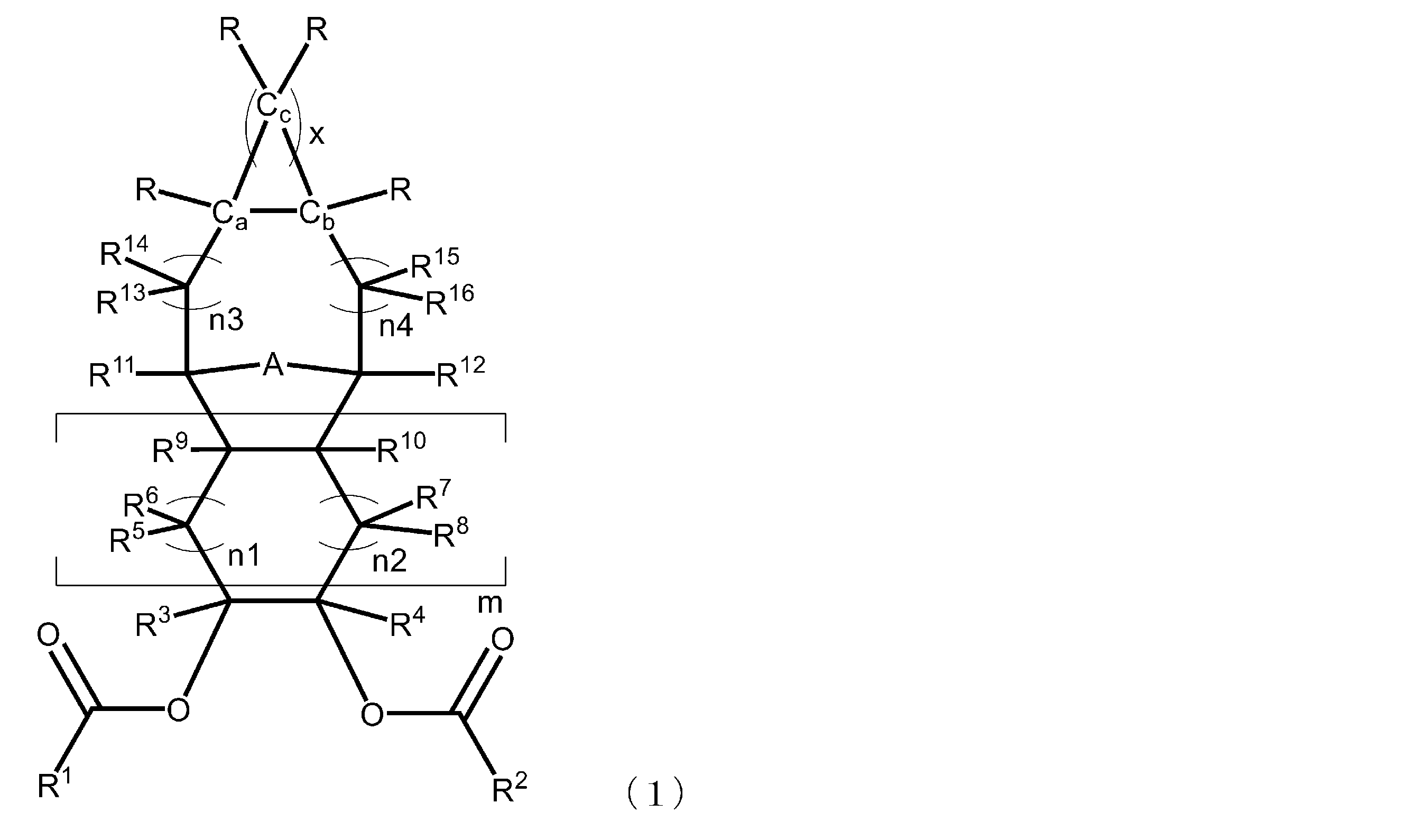
R1およびR2は、それぞれ独立に、置換もしくは無置換の炭素数1~20の炭化水素基であり、R3~R16およびRは、それぞれ独立に、水素原子、置換もしくは無置換の炭素数1~20の炭化水素基、またはハロゲン原子であり、R1~R16およびRの水素原子、炭素原子、またはその両方は、窒素原子、酸素原子、リン原子、ハロゲン原子、およびケイ素原子からなる群より選ばれる少なくとも1種の原子で置換されていてもよい。R3~R16およびRの2つ以上が互いに結合して単環または多環を形成してもよく、隣接する置換基が直接結合した多重結合を形成してもよい。
Aは単結合か、または二つのフリーラジカルの間に1~3原子の長さの鎖を有する二価の結合基である。]

[6] n1およびn2が1である、[1]に記載の固体状チタン触媒成分(I)。
[7] n3およびn4が0である、[1]に記載の固体状チタン触媒成分(I)
[8] R1およびR2が、置換もしくは無置換のアルキル基、置換もしくは無置換のアルケニル基、置換もしくは無置換のシクロアルキル基、置換もしくは無置換のアリール基、または置換もしくは無置換のヘテロアリール基である、[1]に記載の固体状チタン触媒成分(I)。
[12] さらに電子供与体(III)を含む、[11]に記載のオレフィン重合用触媒。
[13] 前記[11]または[12]に記載のオレフィン重合用触媒の存在下にオレフィンの重合を行うことを特徴とするオレフィン重合方法。
昇温条件が10℃/分での示差走査熱量測定(DSC)での吸熱がゼロとなる最高温度(Tm-maxv)が169.0℃以上、220℃以下であり、
下記要件(p)、(q)および(r)の内、2要件以上を満たすことを特徴とするプロピレン重合体:
(p)ゲルパーミエーションクロマトグラフィー(GPC)で決定されるMz/Mwが、3.50以上、5.65以下である;
(q)GPCで決定されるMw/MnとMz/Mwとの差が、8.3以下である;
(r)デカン可溶成分含有率(C10sol.)(/重量%)と、MFR(/(g/10分))とが、以下の関係式を満たす。
(C10sol.)-4/3 × Log(MFR)≦2.30
(s)昇温条件が10℃/分での示差走査熱量測定(DSC)で得られるチャートのTm以上の温度領域での吸熱曲線の接線とベースラインとの交点の温度(Tm-maxt)が、168.1℃以上、210℃以下である。
[固体状チタン触媒成分(I)]
本発明に係る固体状チタン触媒成分(I)は、チタン、マグネシウム、ハロゲンおよび特殊な環状構造を有する多価エステル化合物(以下「環状多価エステル基含有化合物(a)」ともいう。)を含むことを特徴としている。
前記環状多価エステル基含有化合物(a)は、下記式(1)で表される。

Aは単結合か、または二つのフリーラジカルの間に1~3原子の長さの鎖を有する二価の結合基である。]
上記のR1~R16およびRにおける水素原子、炭素原子またはその両方は、窒素原子、酸素原子、リン原子、ハロゲン原子およびケイ素原子からなる群より選ばれる少なくとも1種の原子によって部分的に置換されていてもよい。すなわち、R1~R16およびRは、窒素、酸素、リン、ハロゲンおよびケイ素が含まれる炭化水素基の態様を含む。前記の元素は1か所あるいは複数個所置換されてもよい。

上記の水素原子、置換もしくは無置換のアルキル基、置換もしくは無置換のシクロアルキル基、置換もしくは無置換のアリール基、または置換もしくは無置換のヘテロアリール基は、前記のR1~R16およびRで示した各種の置換基と同様の構造を例示することができる。

上記のようなAを含む環の骨格として具体的には、ノルボルナン骨格、アドマンチル骨格などが挙げられる。
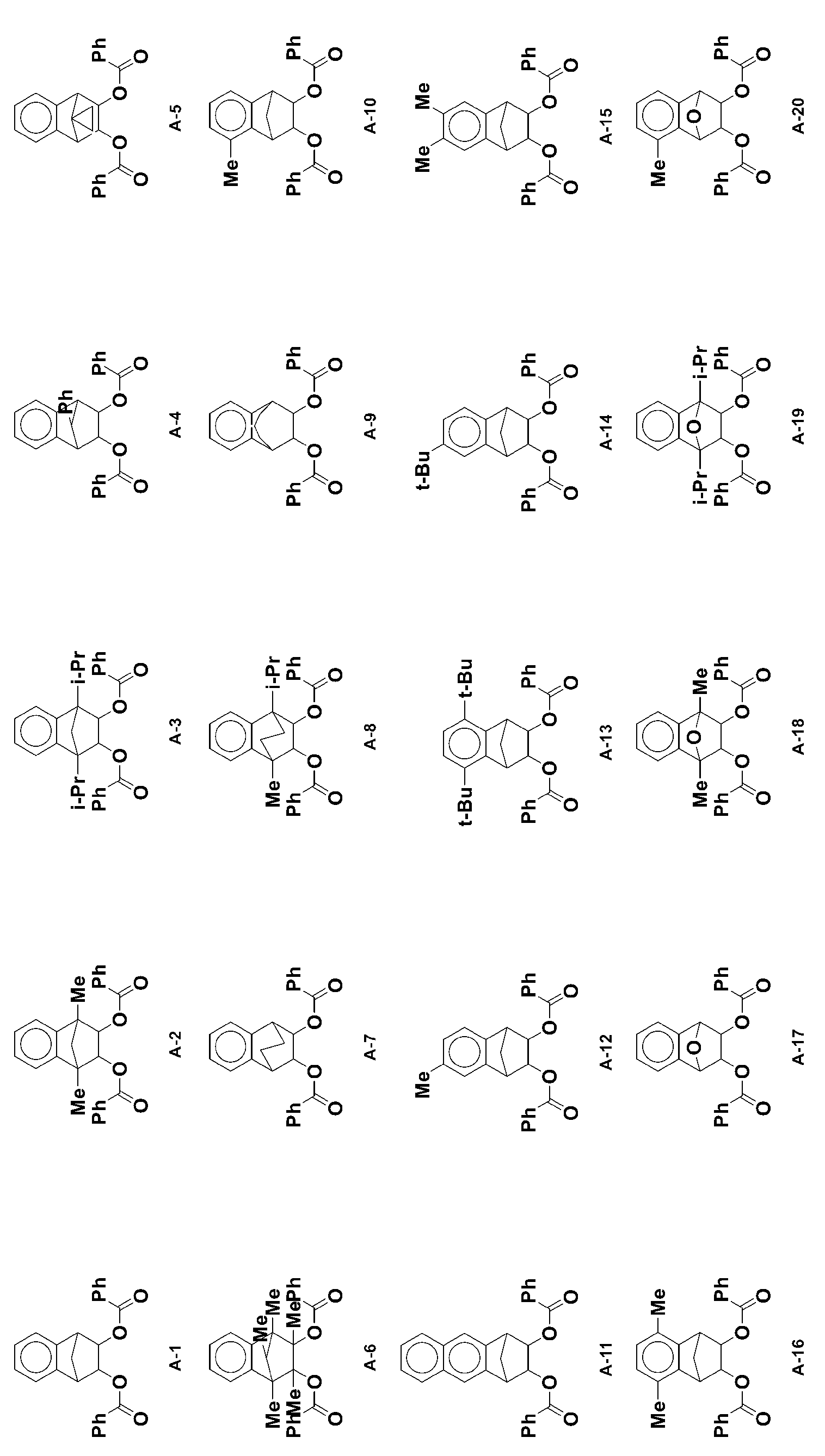

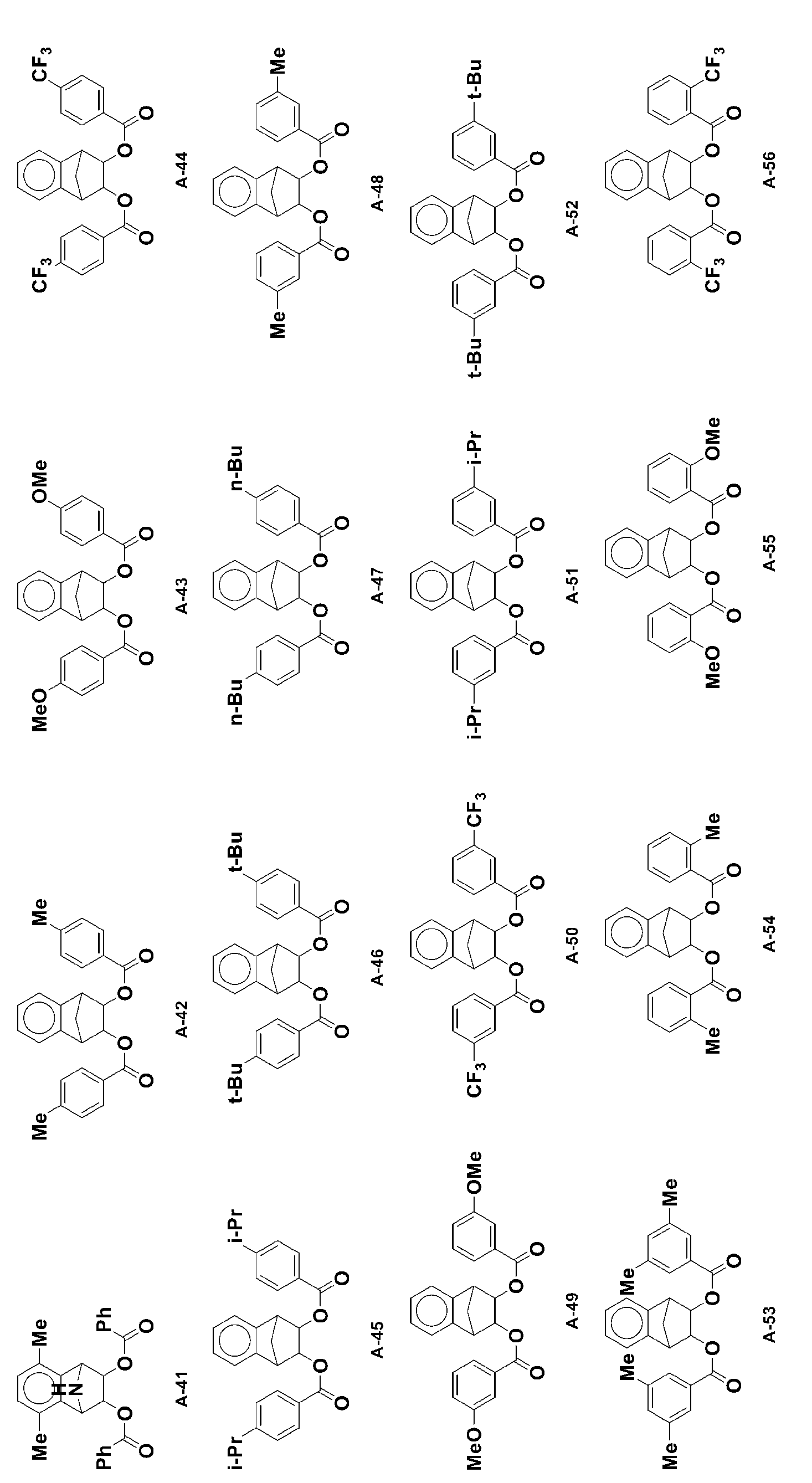
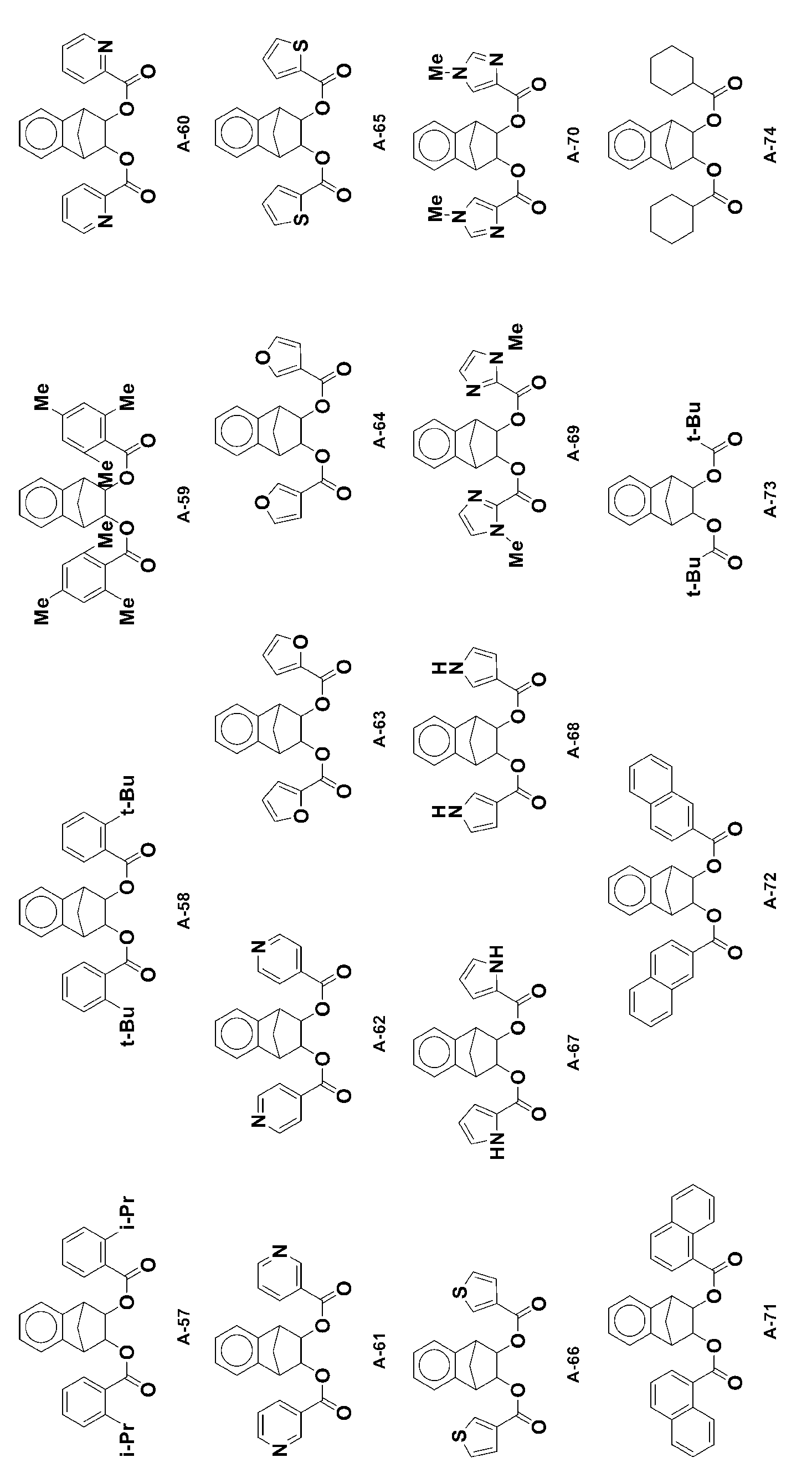
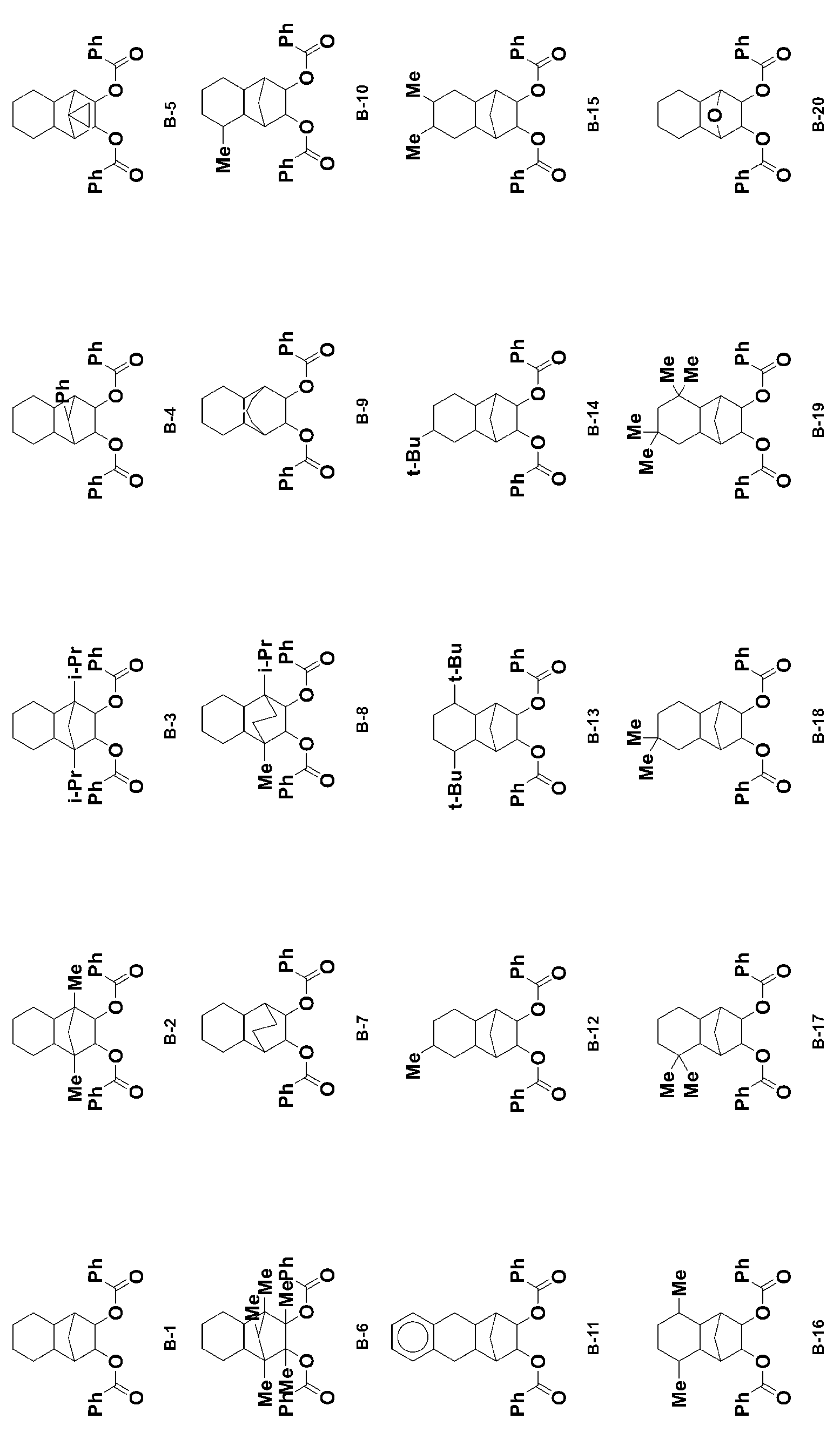


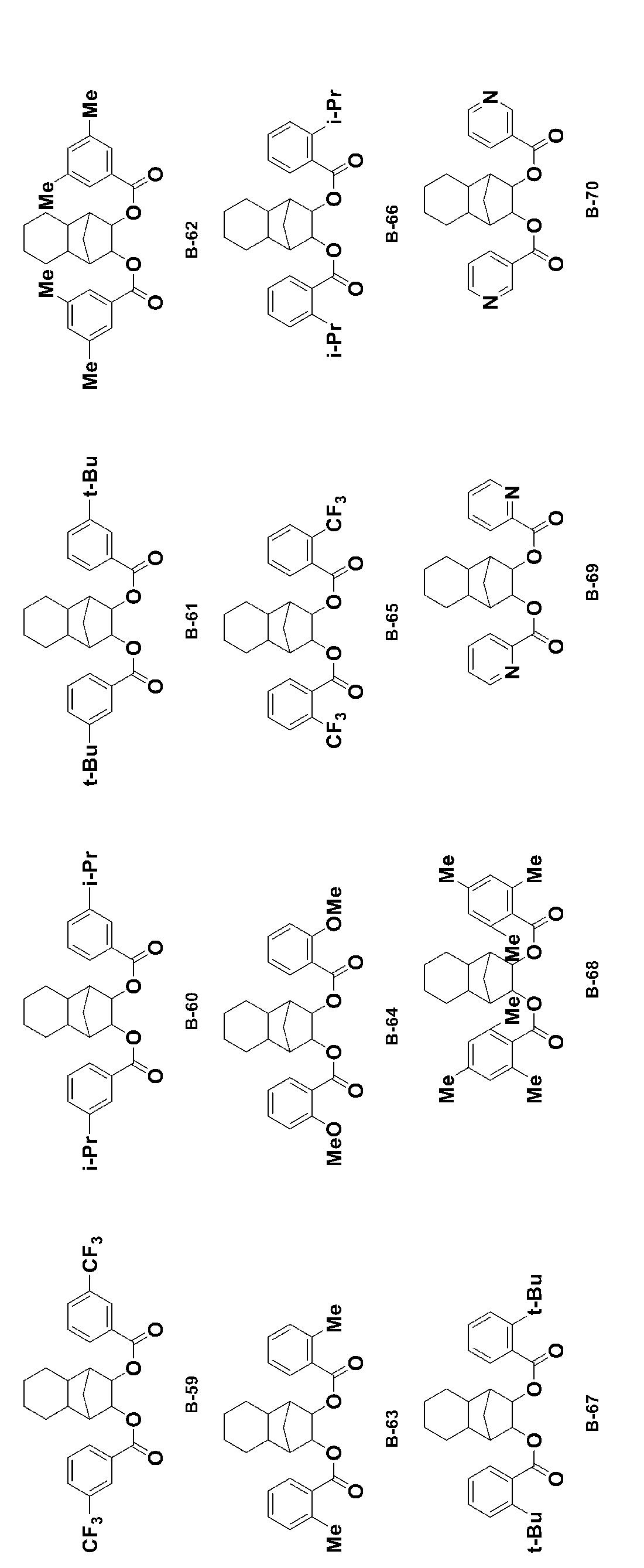


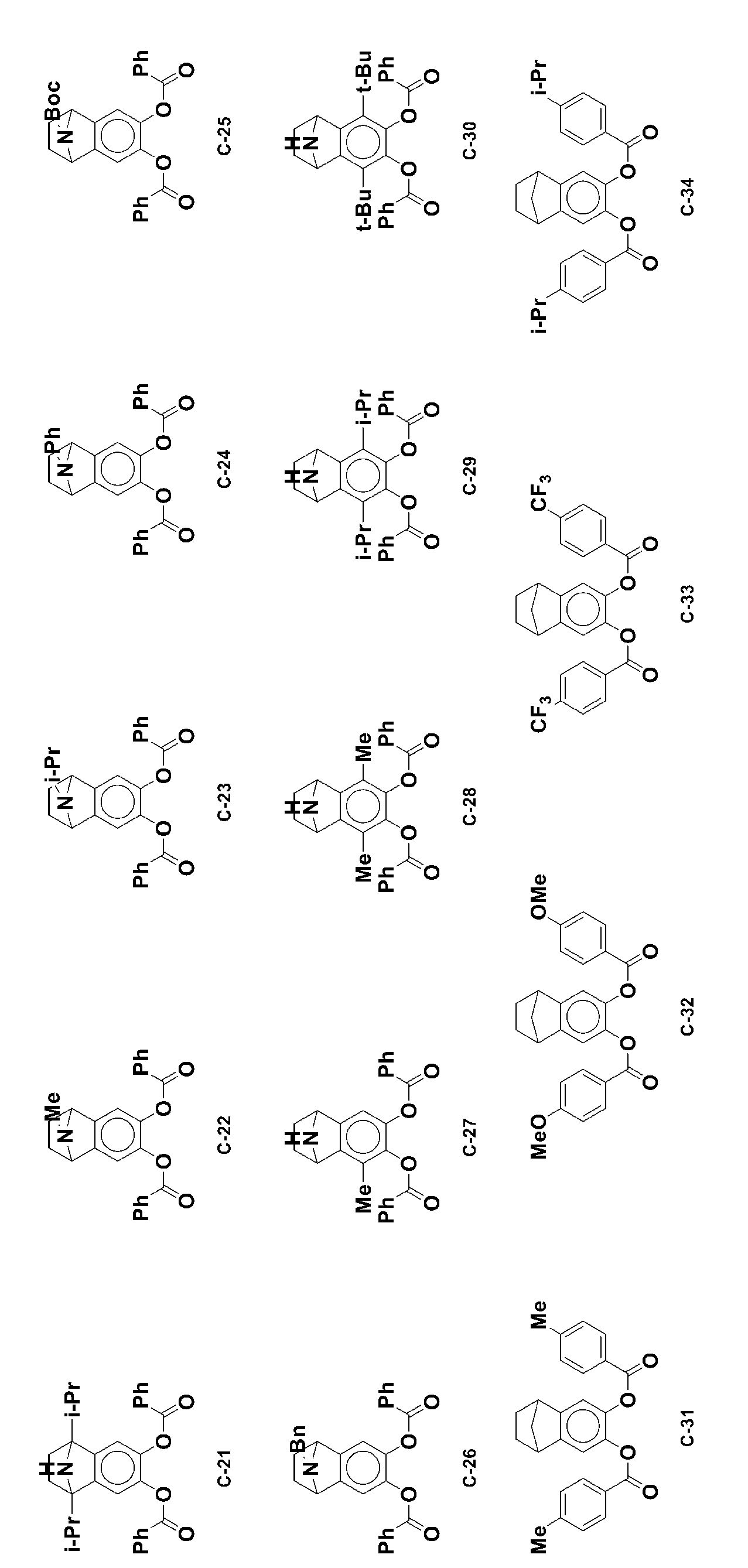
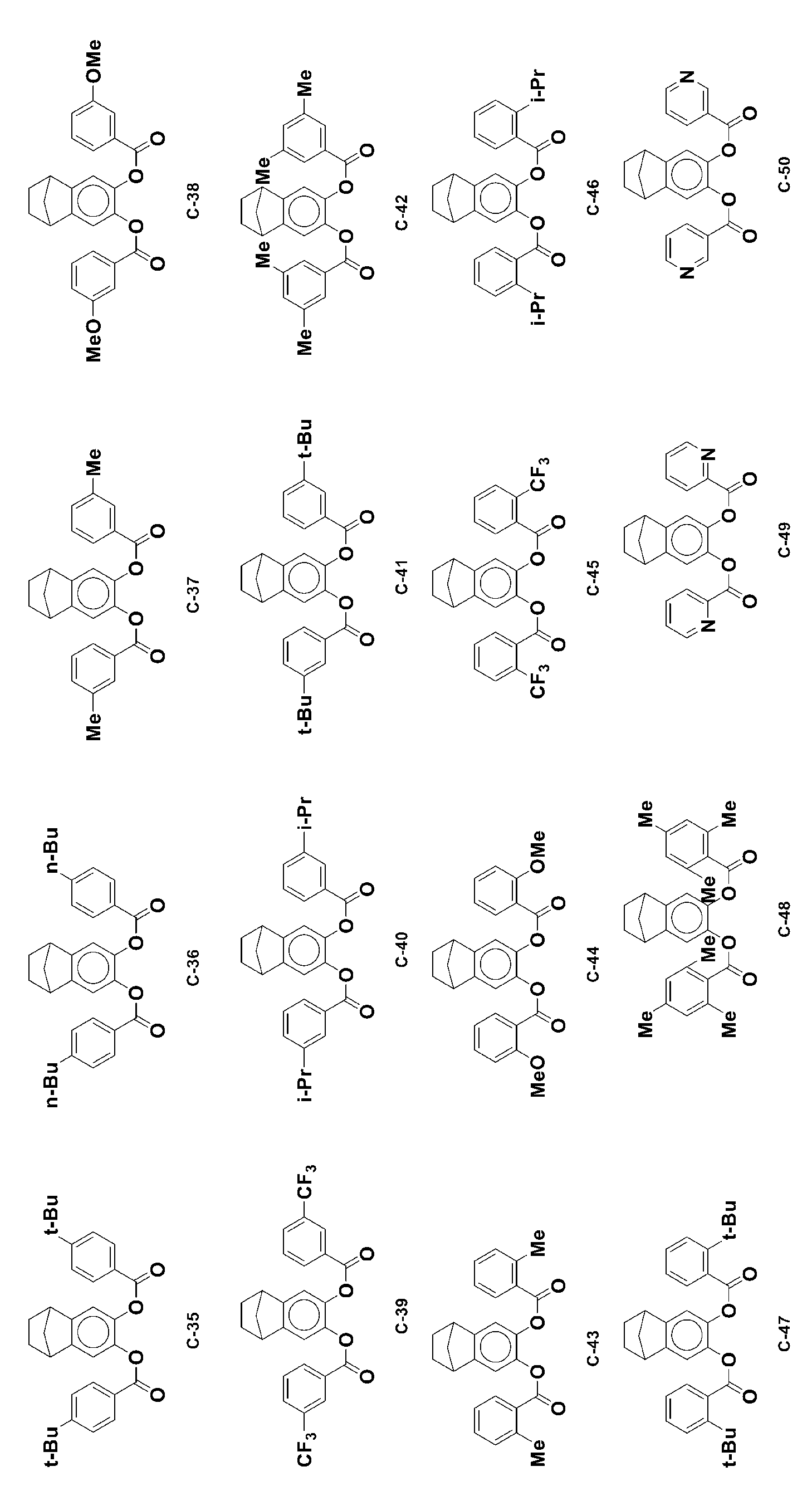
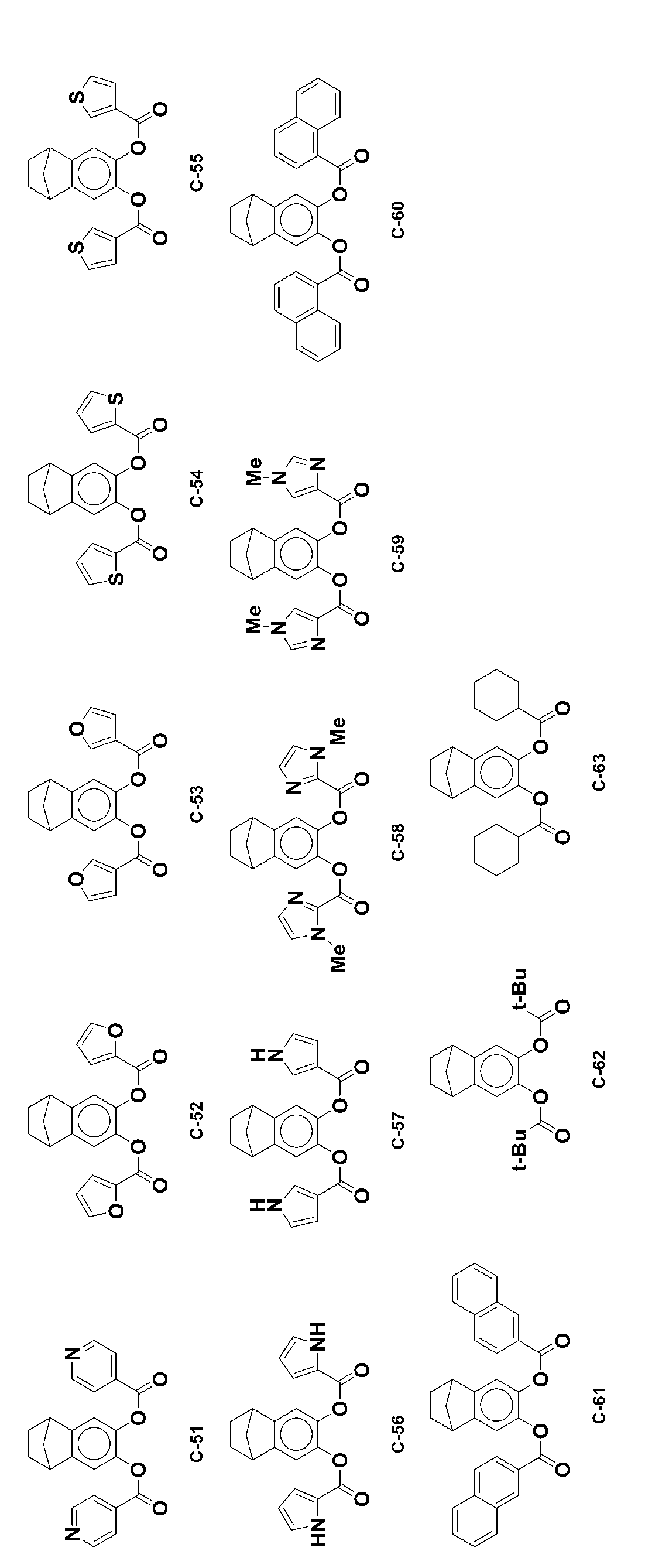
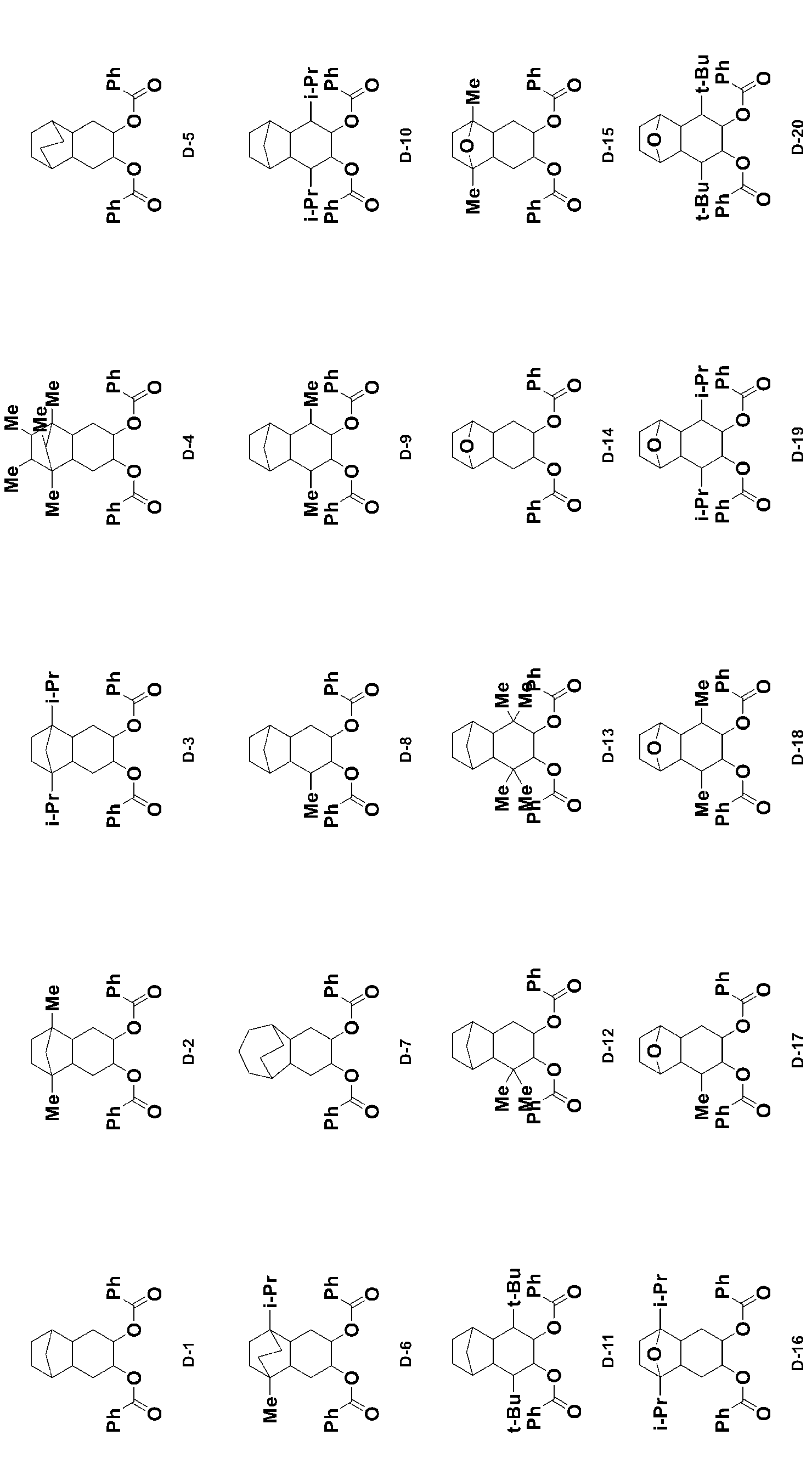


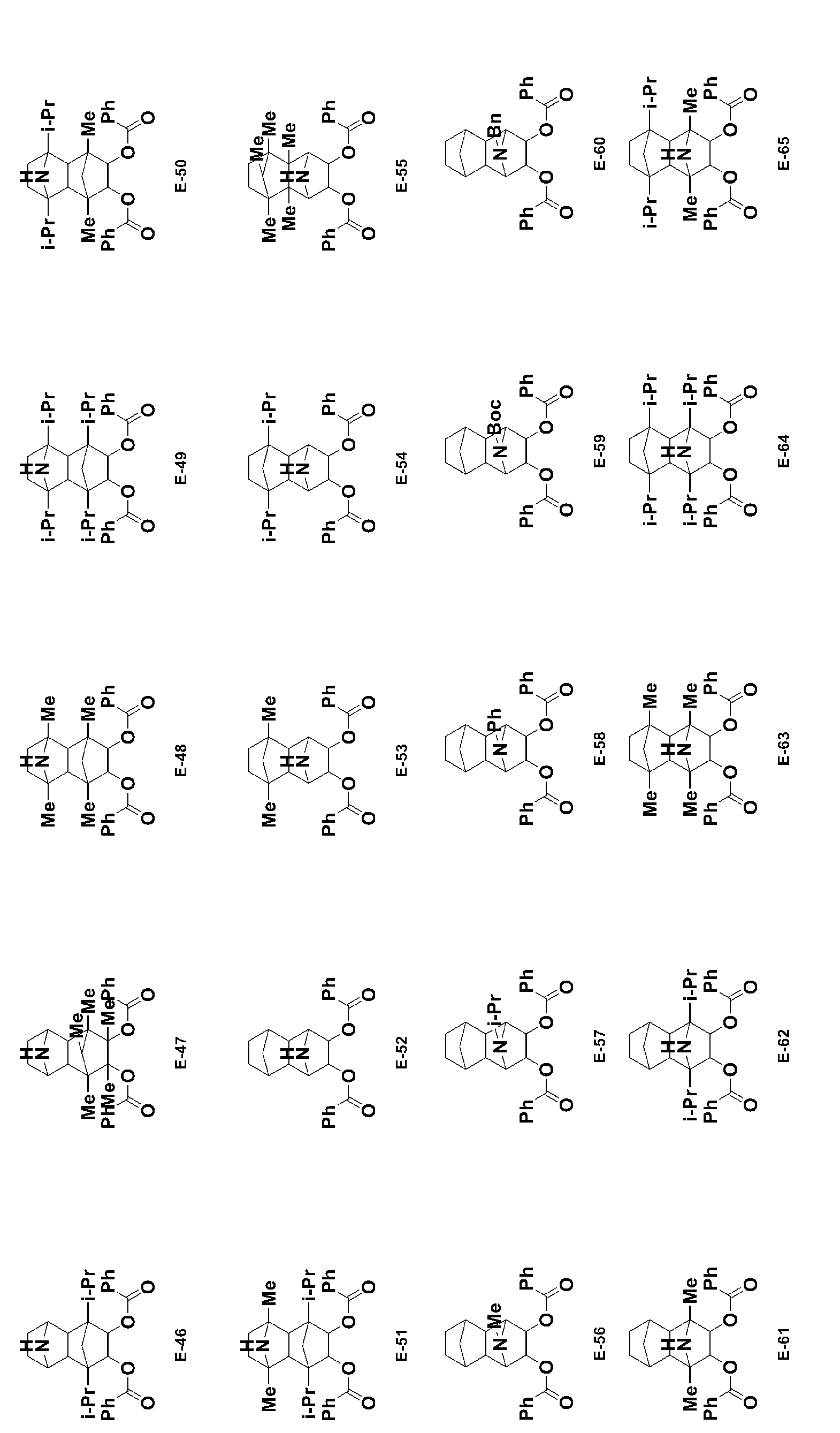
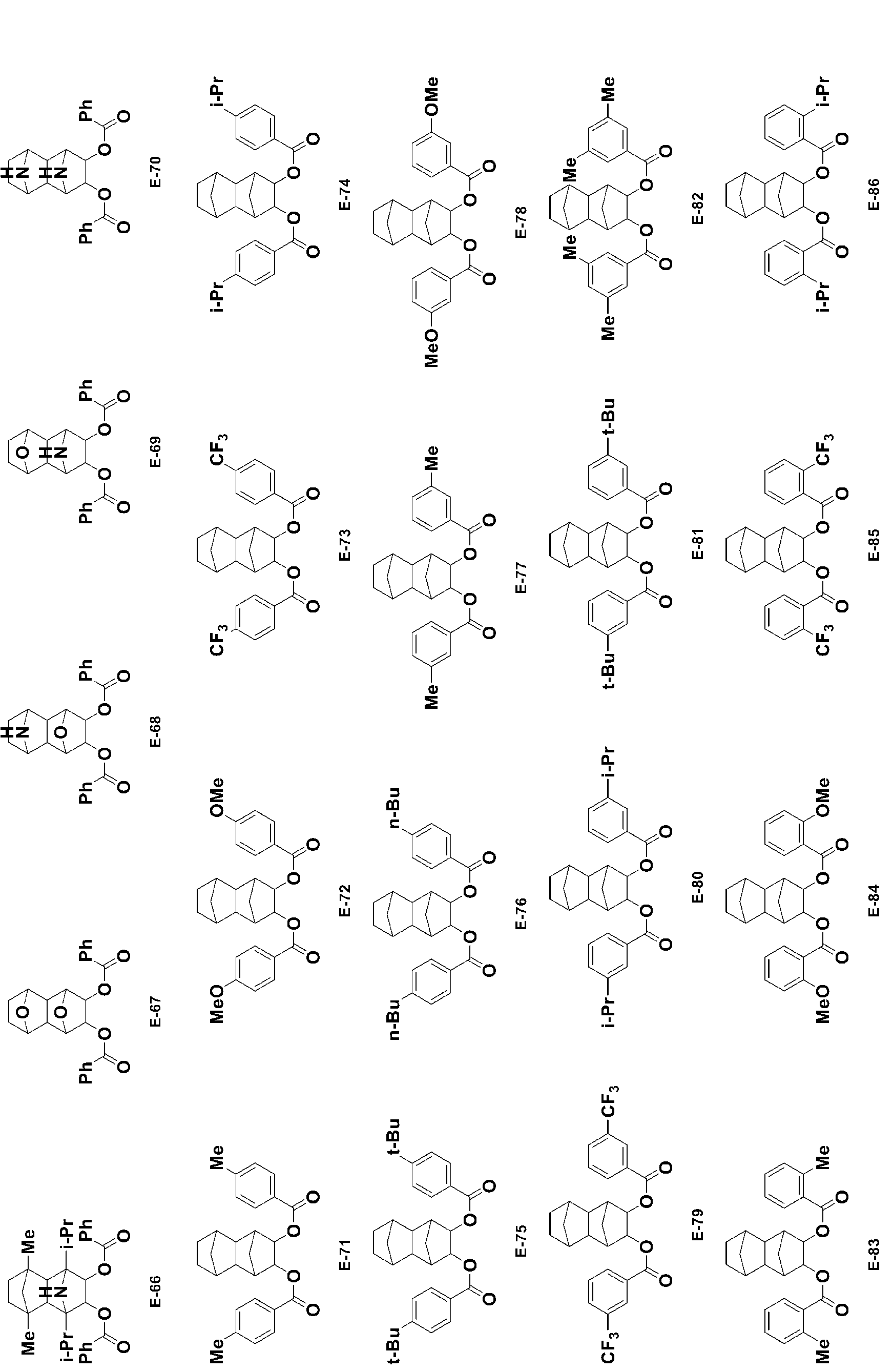

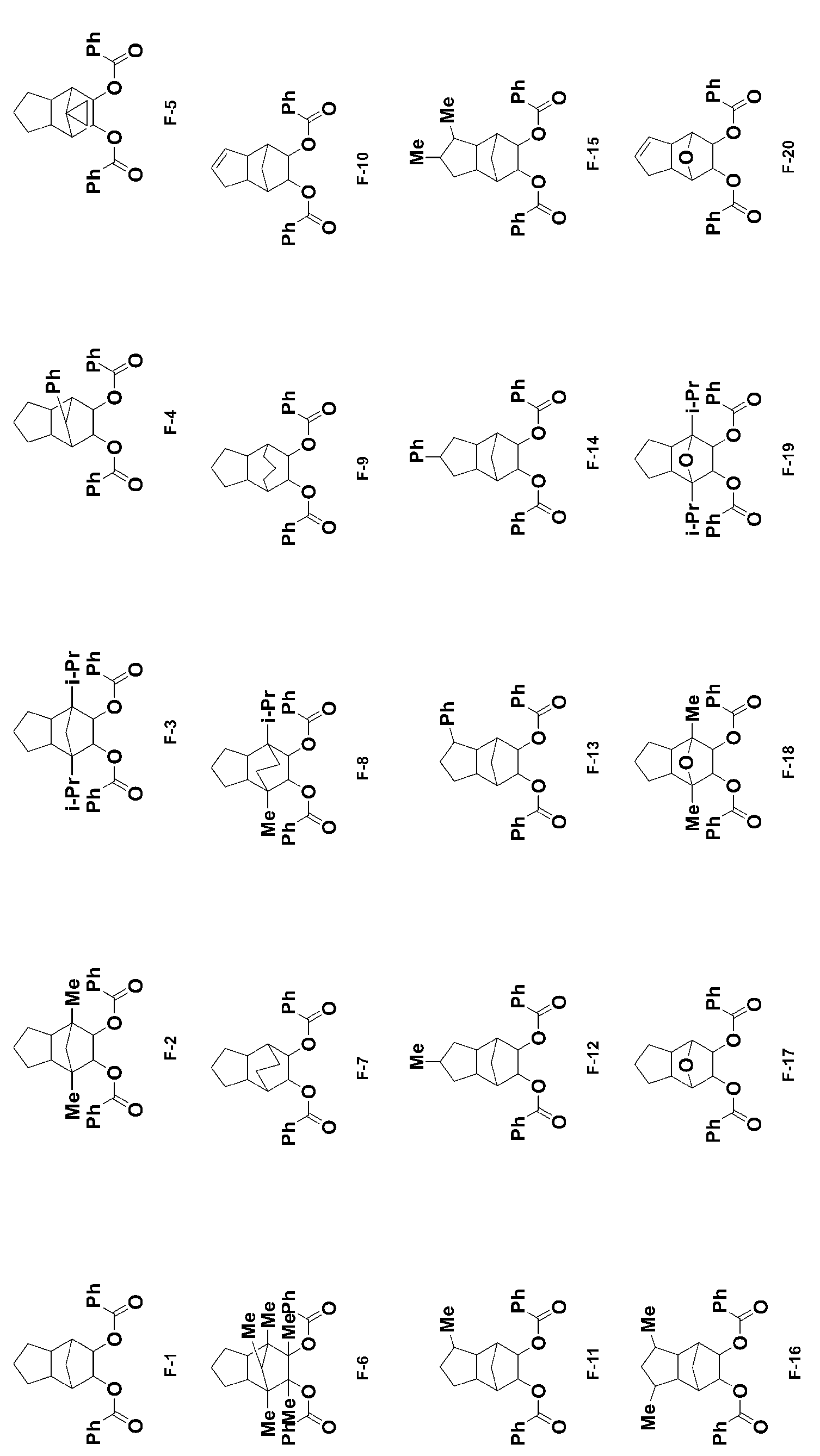
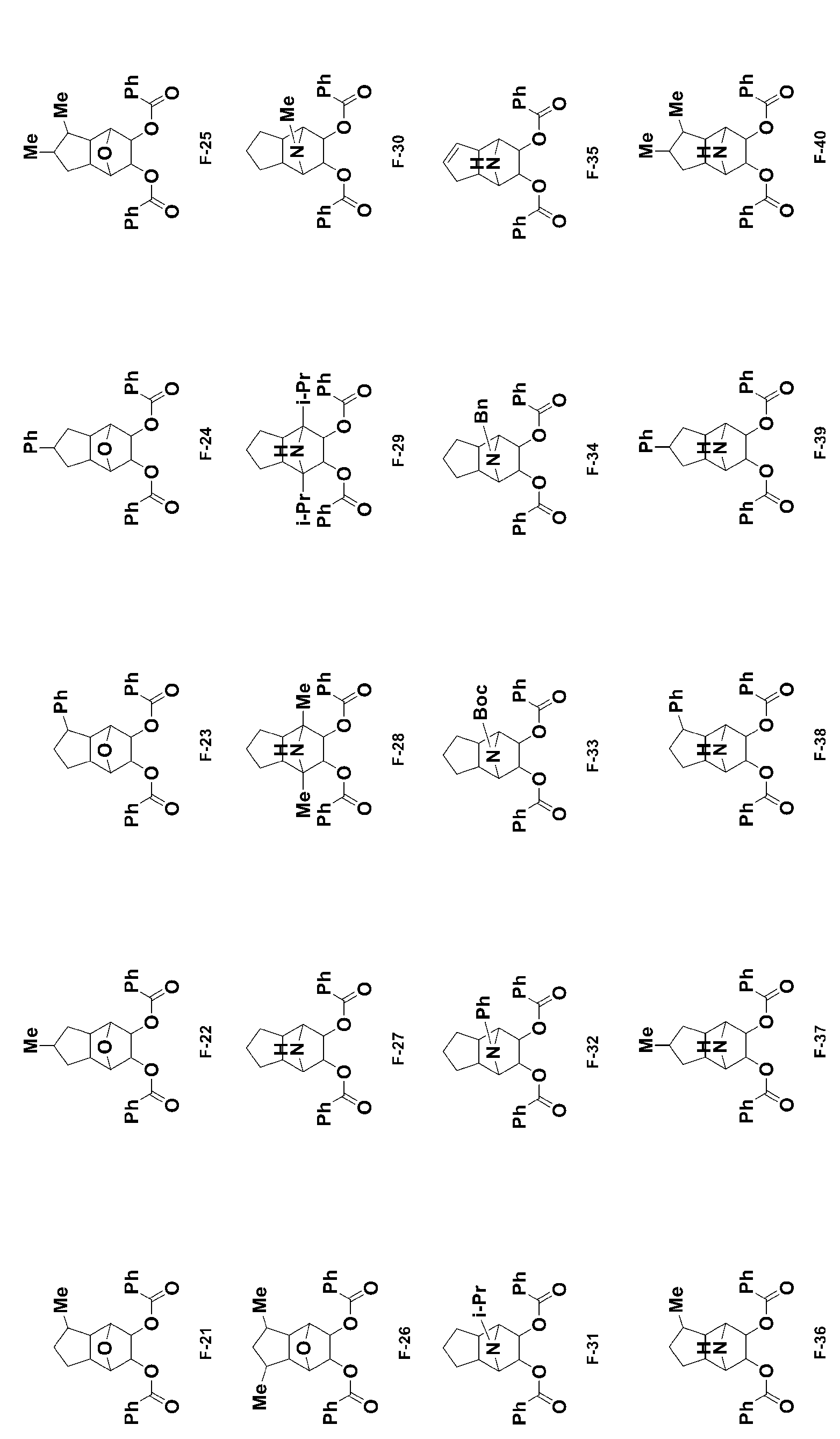

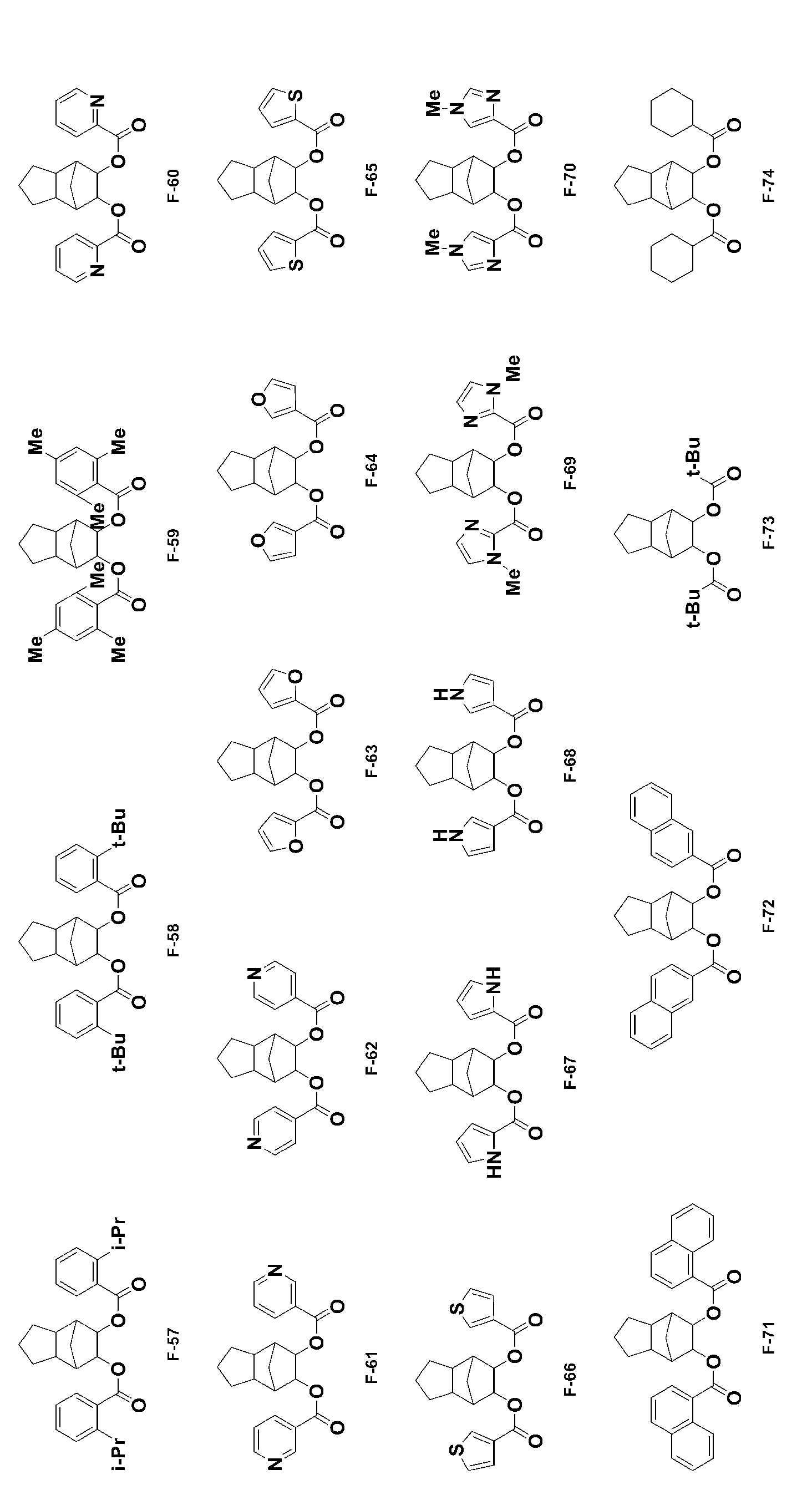
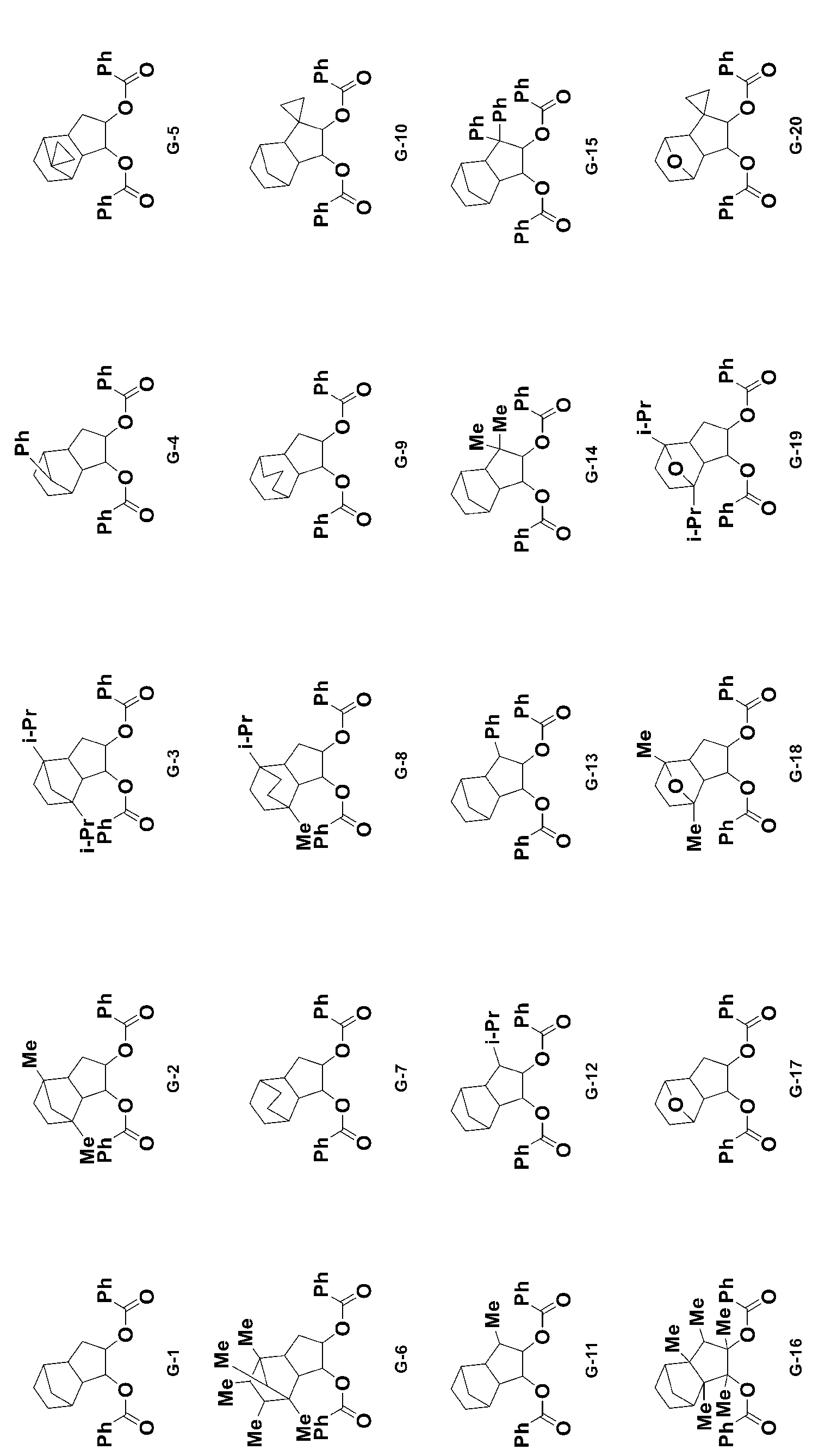


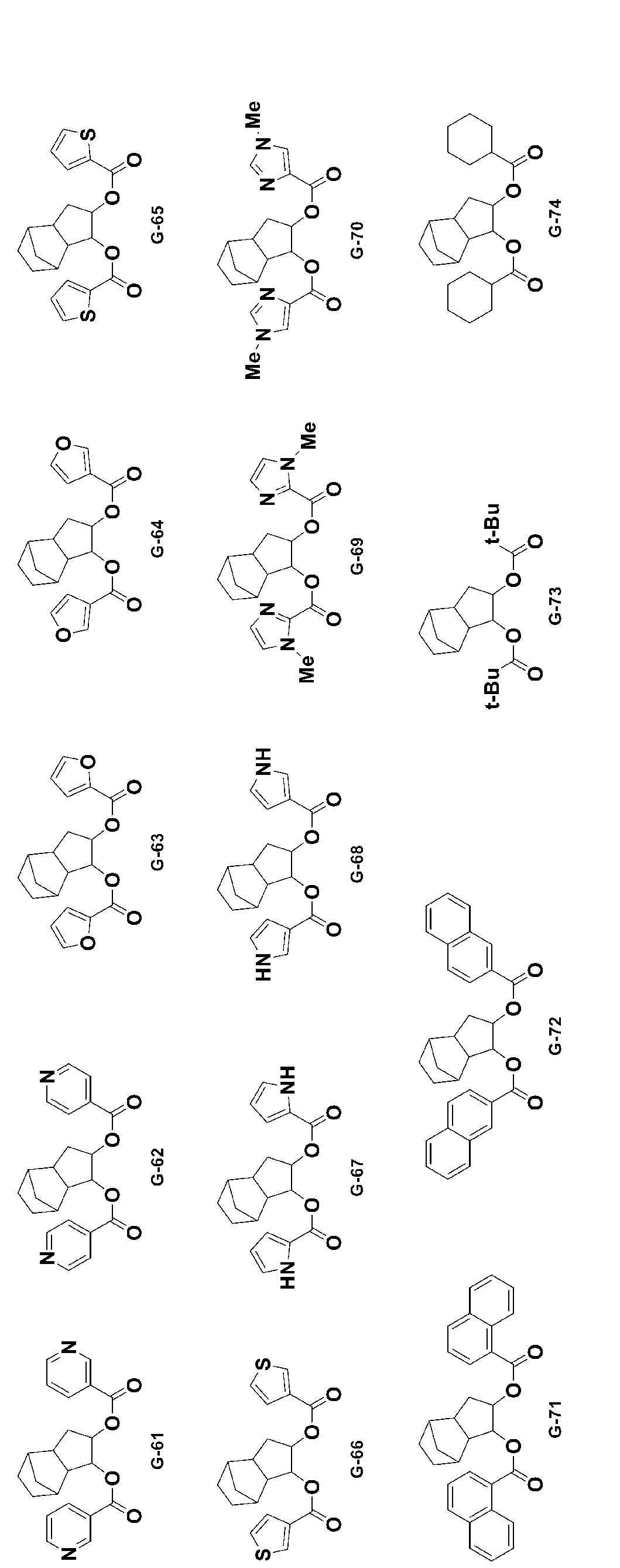

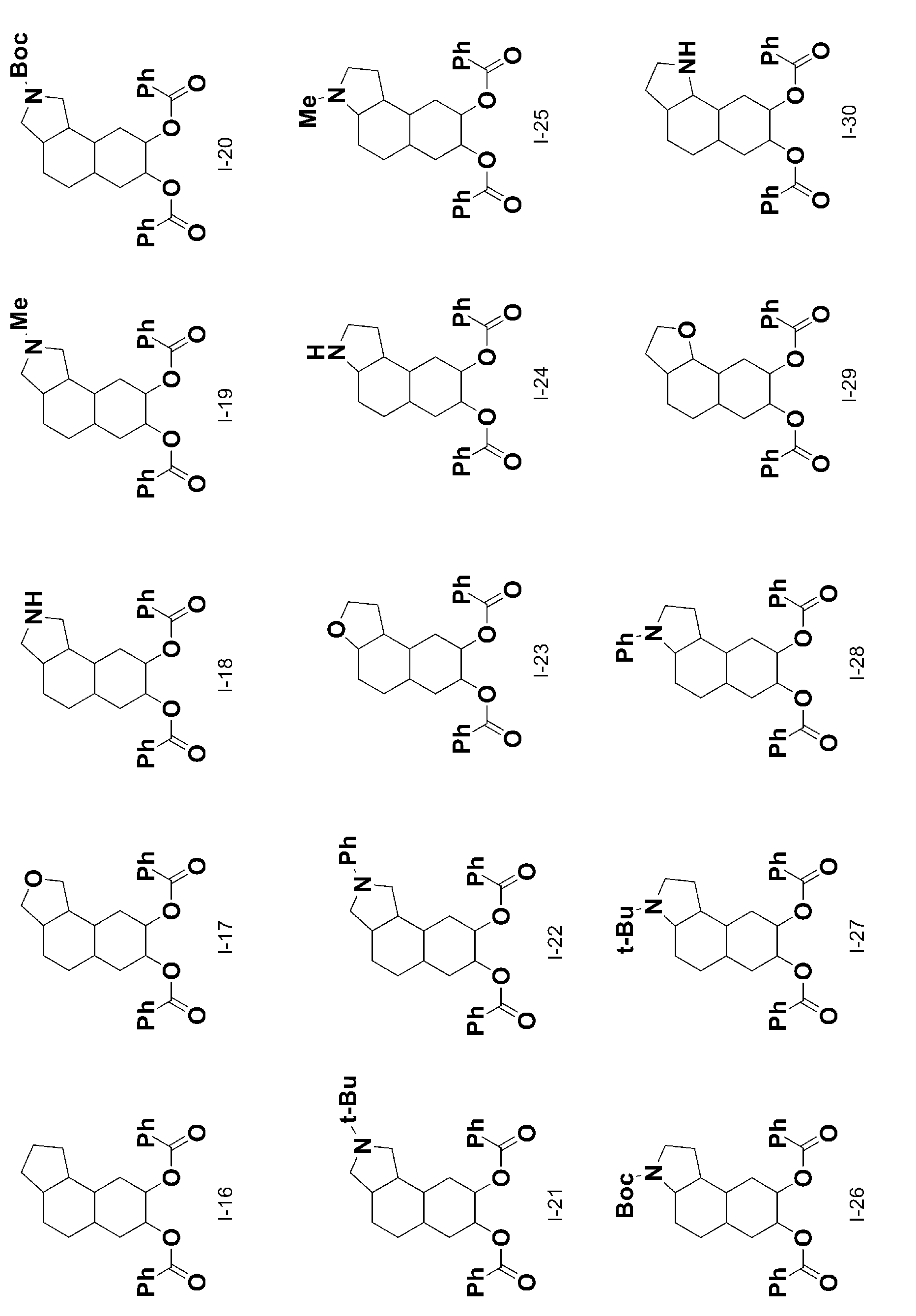


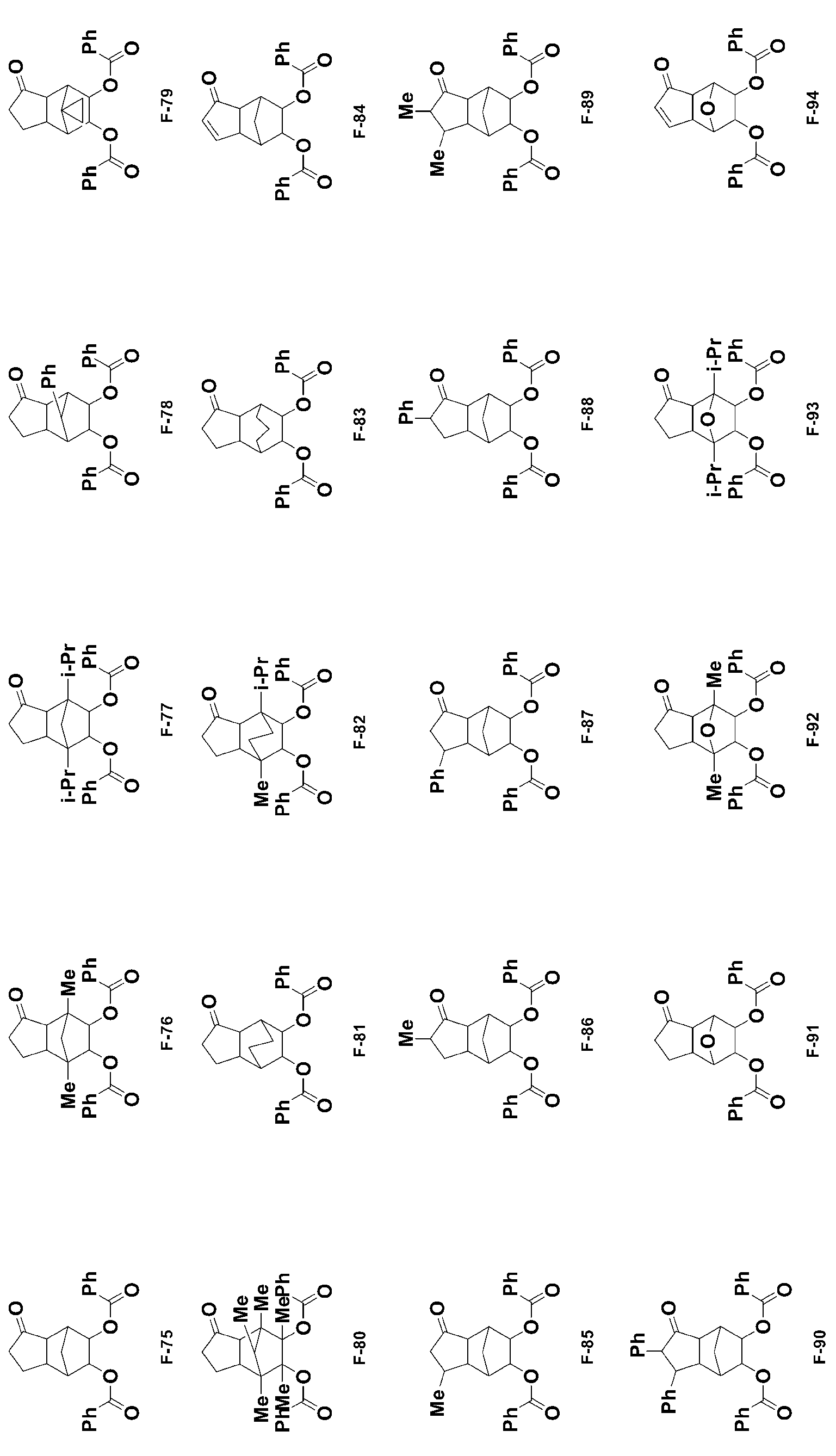
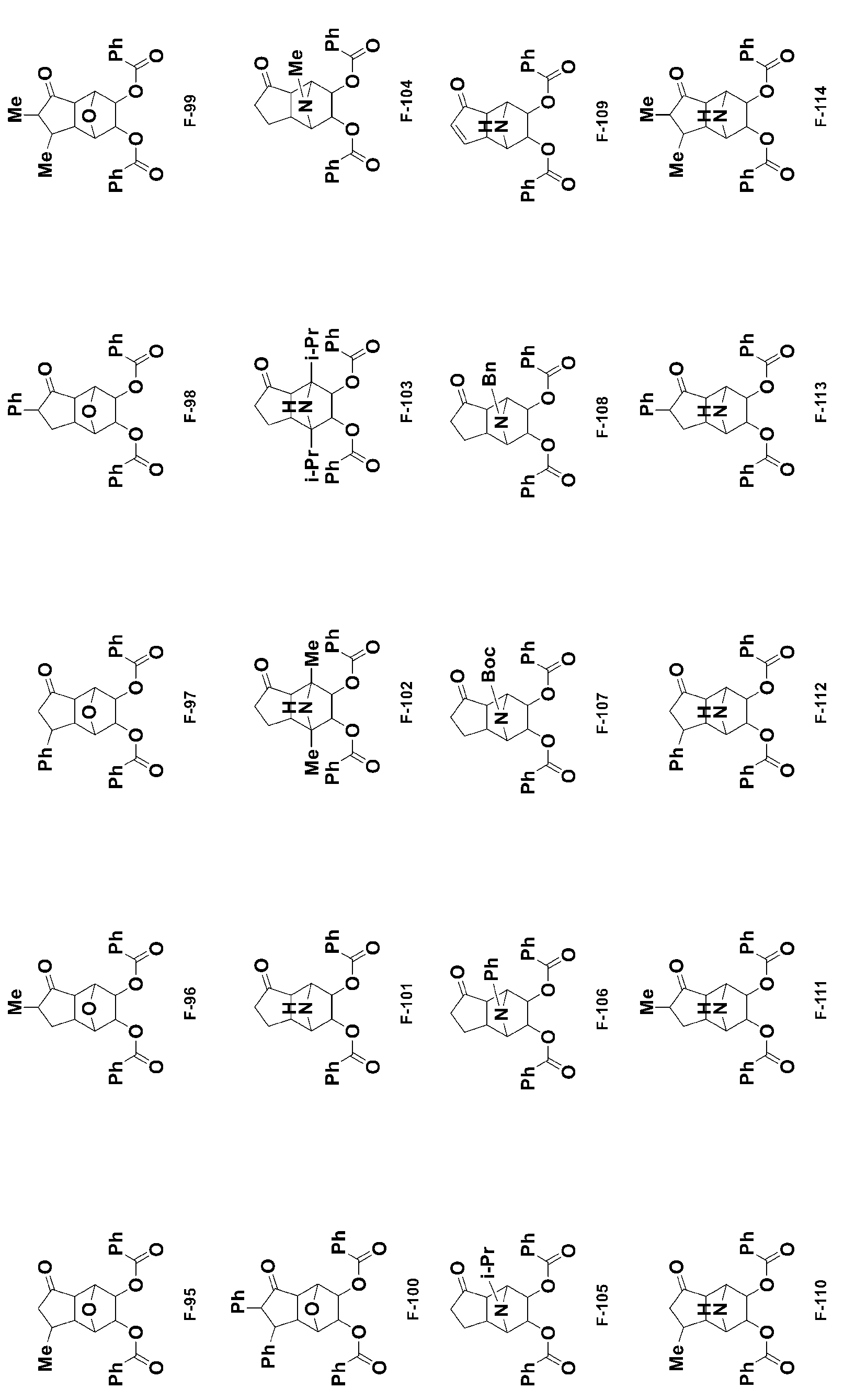


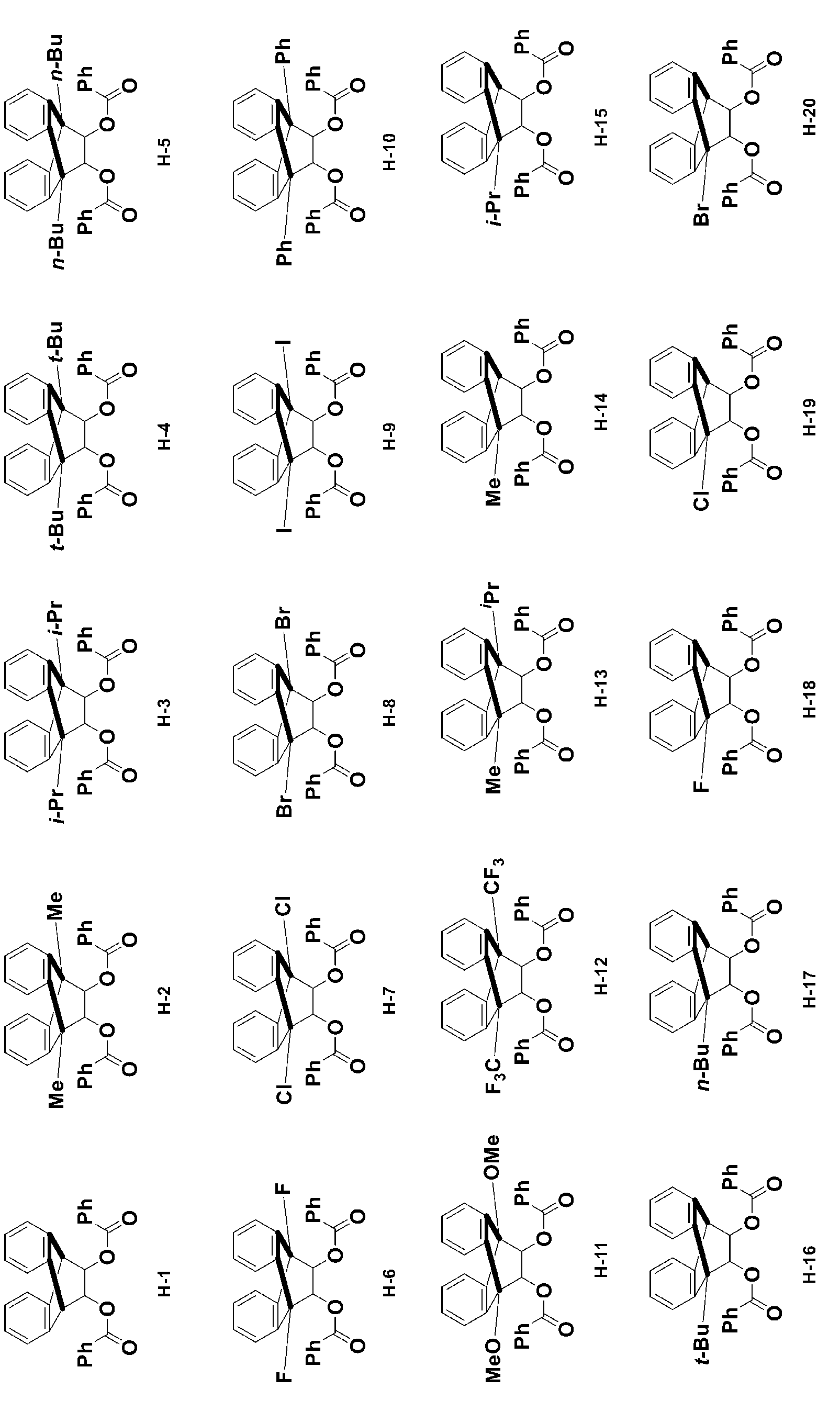


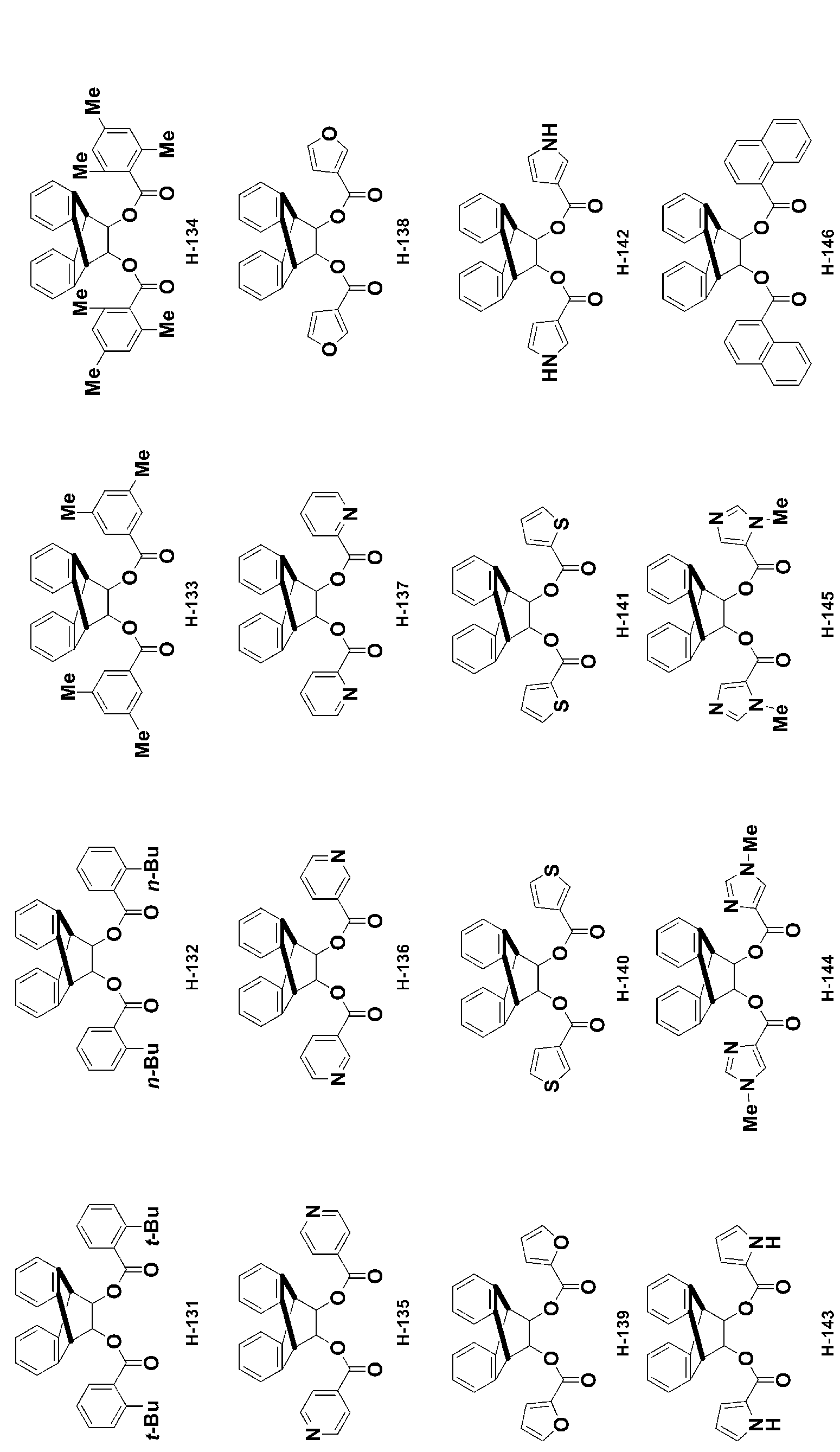
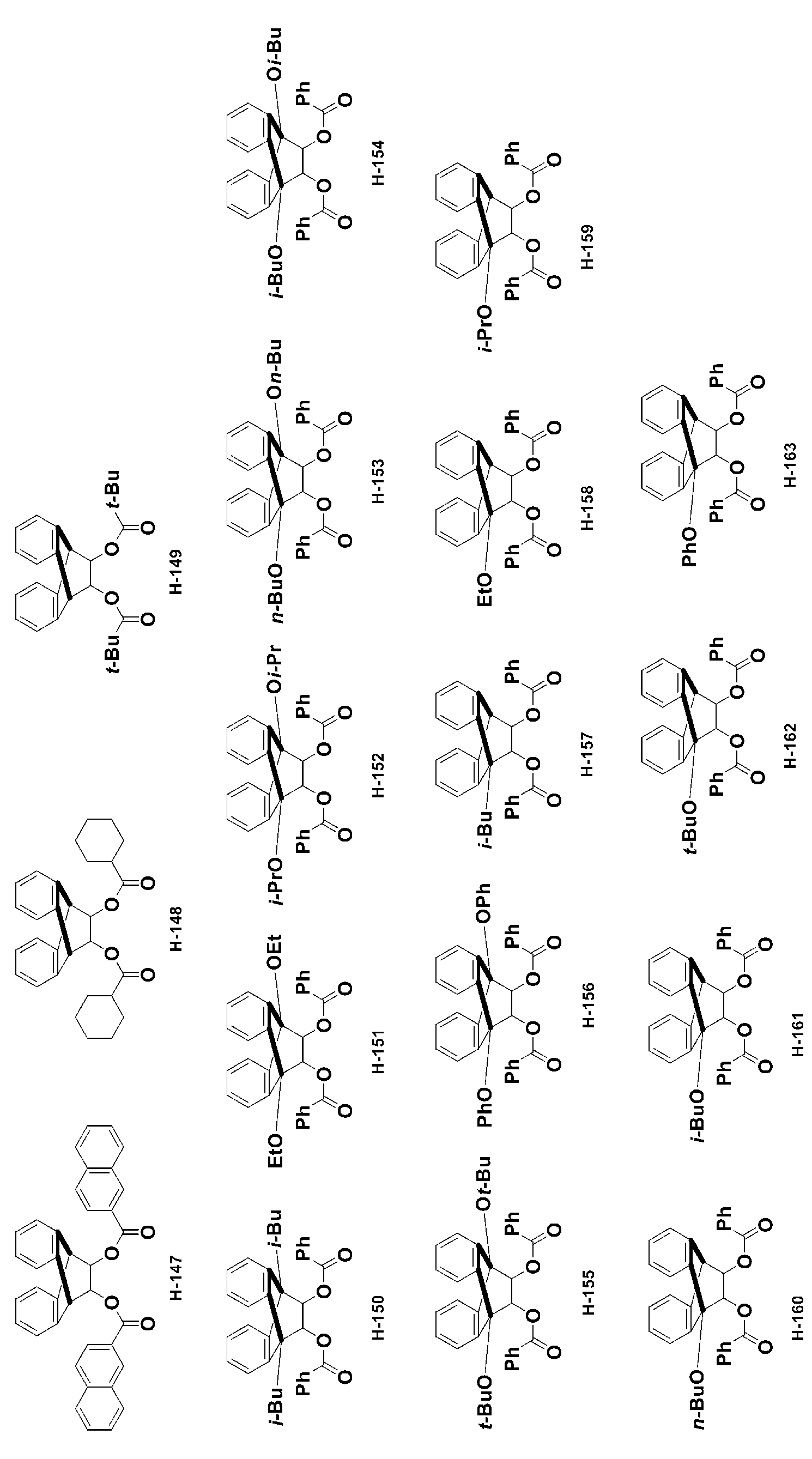

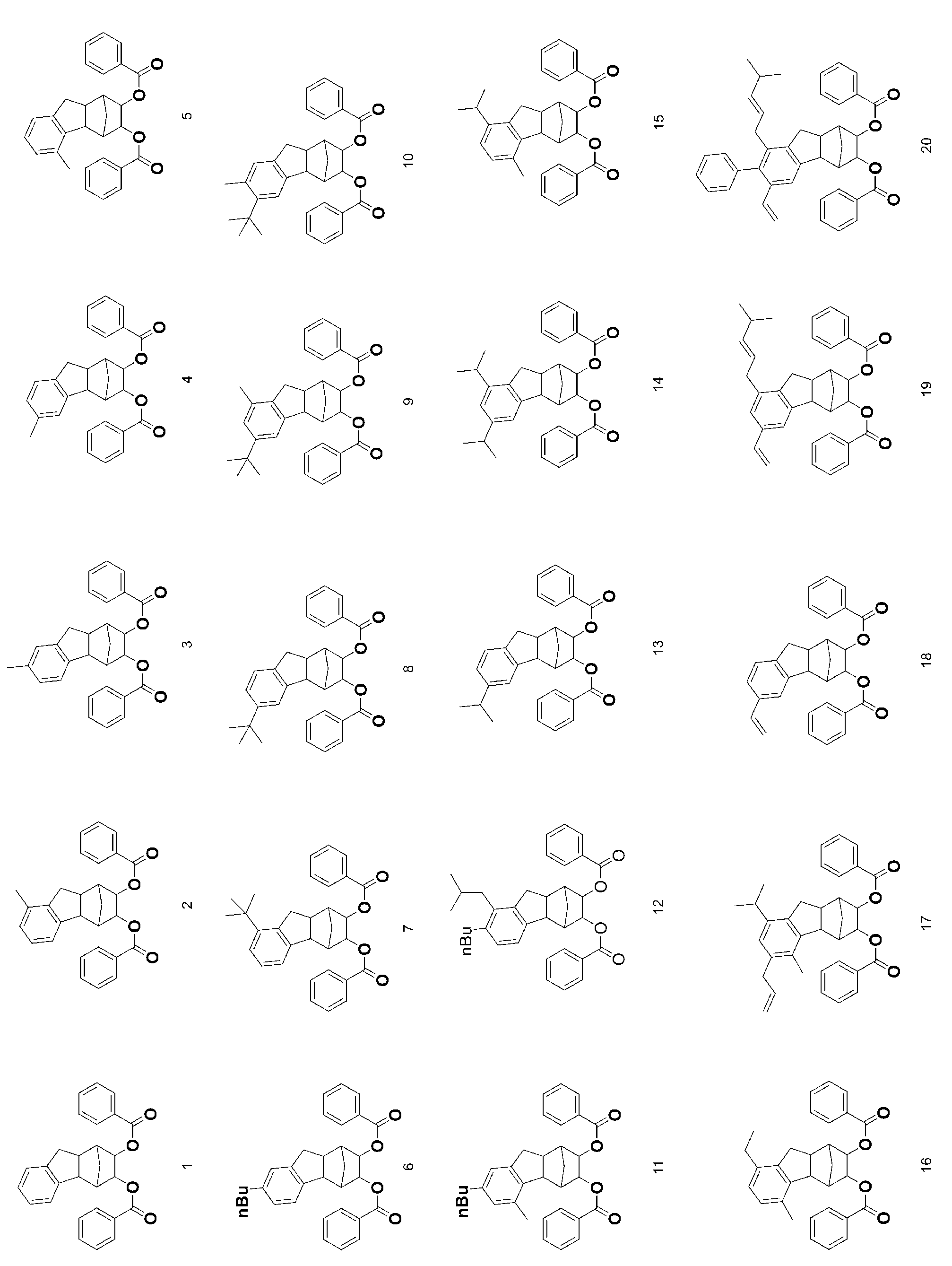

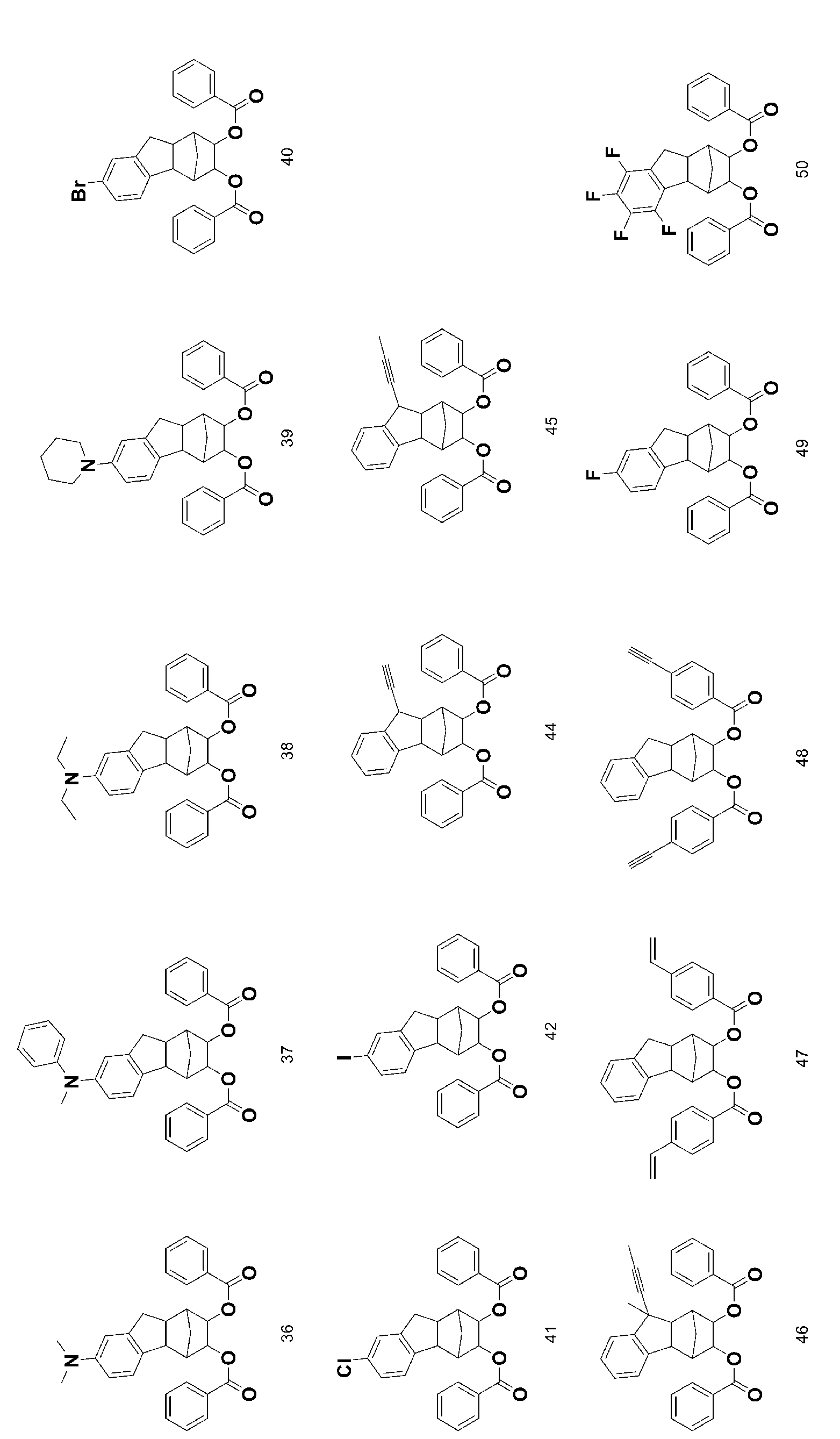

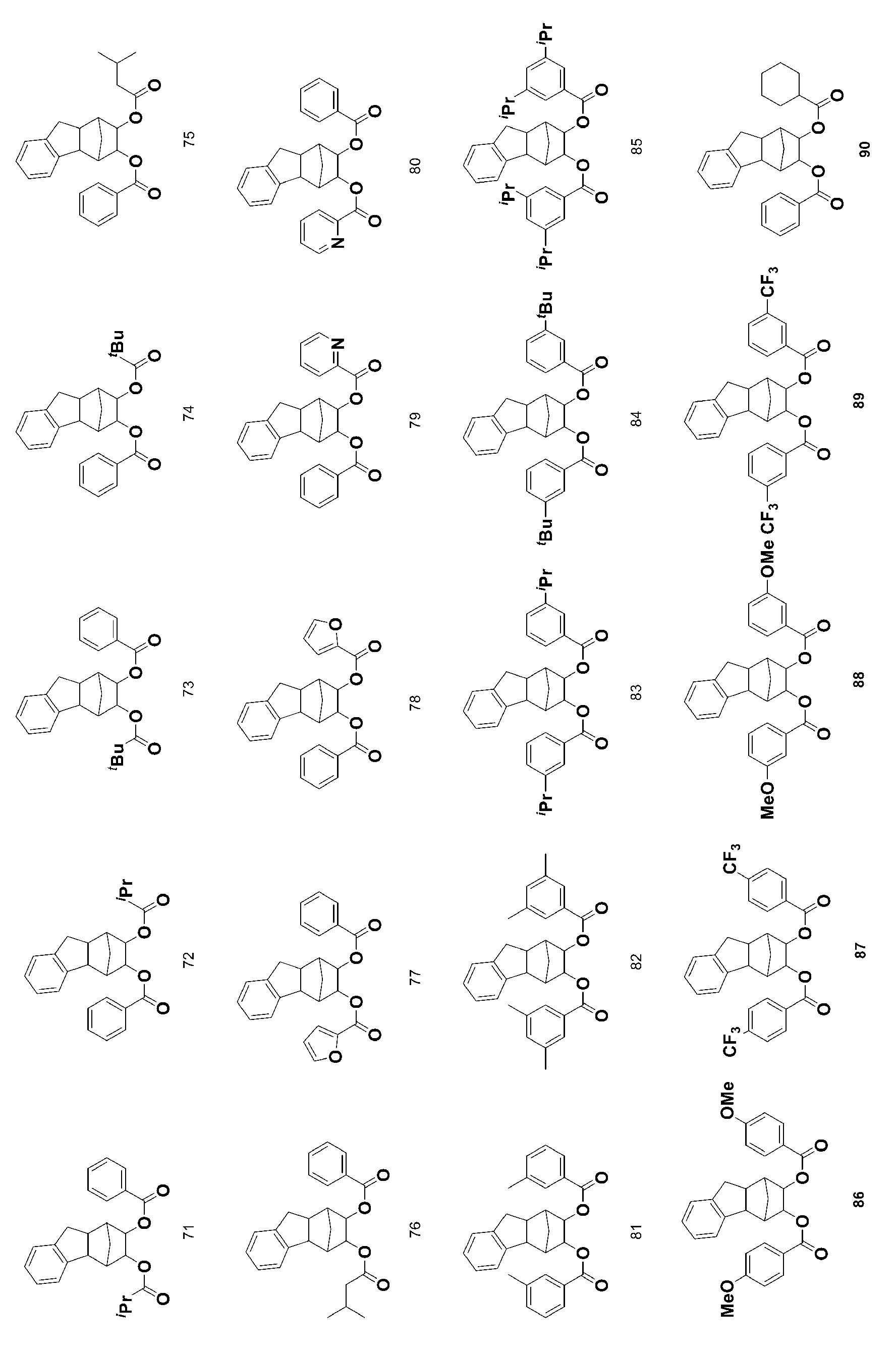


また、R3~R16およびRが結合する炭素原子が4級炭素を含む構造であることが好ましい場合がある。
このようなマグネシウム化合物としては、具体的には、
塩化マグネシウム、臭化マグネシウムなどのハロゲン化マグネシウム;
メトキシ塩化マグネシウム、エトキシ塩化マグネシウム、フェノキシ塩化マグネシウムなどのアルコキシマグネシウムハライド;
エトキシマグネシウム、イソプロポキシマグネシウム、ブトキシマグネシウム、2-エチルヘキソキシマグネシウムなどのアルコキシマグネシウム;
フェノキシマグネシウムなどのアリーロキシマグネシウム;
ステアリン酸マグネシウムなどのマグネシウムのカルボン酸塩
などの公知のマグネシウム化合物を挙げることができる。
チタン化合物としては、たとえば一般式;
Ti(OR’)gX4-g
(R’は炭化水素基であり、Xはハロゲン原子であり、gは0≦g≦4である。)
で示される4価のチタン化合物を挙げることができる。より具体的には、
TiCl4、TiBr4などのテトラハロゲン化チタン;
Ti(OCH3)Cl3、Ti(OC2H5)Cl3、Ti(O-n-C4H9)Cl3、Ti(OC2H5)Br3、Ti(O-iso-C4H9)Br3などのトリハロゲン化アルコキシチタン;
Ti(OCH3)2Cl2、Ti(OC2H5)2Cl2などのジハロゲン化アルコキシチタン;
Ti(OCH3)3Cl、Ti(O-n-C4H9)3Cl、Ti(OC2H5)3Brなどのモノハロゲン化アルコキシチタン;
Ti(OCH3)4、Ti(OC2H5)4、Ti(OC4H9)4、Ti(O-2-エチルヘキシル)4などのテトラアルコキシチタン
などを挙げることができる。
上記の様なマグネシウム化合物およびチタン化合物としては、たとえば特許文献1や特許文献2などに詳細に記載されている化合物も挙げることができる。
また、上記の固体状チタン触媒成分の製造には、必要に応じて公知の媒体の存在下に行うこともできる。上記の媒体としては、やや極性を有するトルエンなどの芳香族炭化水素やヘプタン、オクタン、デカン、シクロヘキサンなどの公知の脂肪族炭化水素、脂環族炭化水素化合物が挙げられるが、これらの中では脂肪族炭化水素が好ましい例として挙げられる。
上記の固体状付加物や液状状態のマグネシウム化合物の形成に用いられる触媒成分(b)としては、室温~300℃程度の温度範囲で上記のマグネシウム化合物を可溶化できる公知の化合物が好ましく、たとえばアルコール、アルデヒド、アミン、カルボン酸およびこれらの混合物などが好ましい。これらの化合物としては、たとえば特許文献1や特許文献2に詳細に記載されている化合物を挙げることができる。
メタノール、エタノール、プロパノール、ブタノール、イソブタノール、エチレングリコール、2-メチルペンタノール、2-エチルブタノール、n-ヘプタノール、n-オクタノール、2-エチルヘキサノール、デカノール、ドデカノールのような脂肪族アルコール;
シクロヘキサノール、メチルシクロヘキサノールのような脂環族アルコール;
ベンジルアルコール、メチルベンジルアルコールなどの芳香族アルコール;
n-ブチルセルソルブなどのアルコキシ基を有する脂肪族アルコール
などを挙げることができる。
本発明の固体状チタン触媒成分(I)は、さらに、芳香族カルボン酸エステルおよび/または複数の炭素原子を介して2個以上のエーテル結合を有する化合物(以下「触媒成分(c)」ともいう。)を含んでいてもよい。本発明の固体状チタン触媒成分(I)が触媒成分(c)を含んでいると活性や立体規則性を高めたり、分子量分布をより広げることができる場合がある。

2-イソプロピル-1,3-ジメトキシプロパン、2-s-ブチル-1,3-ジメトキシプロパン、2-クミル-1,3-ジメトキシプロパン等の1置換ジアルコキシプロパン類;
2-イソプロピル-2-イソブチル-1,3-ジメトキシプロパン、2,2-ジシクロヘキシル-1,3-ジメトキシプロパン、2-メチル-2-イソプロピル-1,3-ジメトキシプロパン、2-メチル-2-シクロヘキシル-1,3-ジメトキシプロパン、2-メチル-2-イソブチル-1,3-ジメトキシプロパン、2,2-ジイソブチル-1,3-ジメトキシプロパン、2,2-ビス(シクロヘキシルメチル)-1,3-ジメトキシプロパン、2,2-ジイソブチル-1,3-ジエトキシプロパン、2,2-ジイソブチル-1,3-ジブトキシプロパン、2,2-ジ-s-ブチル-1,3-ジメトキシプロパン、2,2-ジネオペンチル-1,3-ジメトキシプロパン、2-イソプロピル-2-イソペンチル-1,3-ジメトキシプロパン、2-シクロヘキシル-2-シクロヘキシルメチル-1,3-ジメトキシプロパン等の2置換ジアルコキシプロパン類;
2,3-ジシクロヘキシル-1,4-ジエトキシブタン、2,3-ジシクロヘキシル-1,4-ジエトキシブタン、2,3-ジイソプロピル-1,4-ジエトキシブタン、2,4-ジフェニル-1,5-ジメトキシペンタン、2,5-ジフェニル-1,5-ジメトキシヘキサン、2,4-ジイソプロピル-1,5-ジメトキシペンタン、2,4-ジイソブチル-1,5-ジメトキシペンタン、2,4-ジイソアミル-1,5-ジメトキシペンタン等のジアルコキシアルカン類;
2-メチル-2-メトキシメチル-1,3-ジメトキシプロパン、2-シクロヘキシル-2-エトキシメチル-1,3-ジエトキシプロパン、2-シクロヘキシル-2-メトキシメチル-1,3-ジメトキシプロパン等のトリアルコキシアルカン類;
2,2-ジイソブチル-1,3-ジメトキシ4-シクロヘキセニル、2-イソプロピル-2-イソアミル-1,3-ジメトキシ4-シクロヘキセニル、2-シクロヘキシル-2-メトキシメチル-1,3-ジメトキシ4-シクロヘキセニル、2-イソプロピル-2-メトキシメチル-1,3-ジメトキシ4-シクロヘキセニル、2-イソブチル-2-メトキシメチル-1,3-ジメトキシ4-シクロヘキセニル、2-シクロヘキシル-2-エトキシメチル-1,3-ジメトキシ4-シクロヘキセニル、2-イソプロピル-2-エトキシメチル-1,3-ジメトキシ4-シクロヘキセニル、2-イソブチル-2-エトキシメチル-1,3-ジメトキシ4-シクロヘキセニル等のジアルコキシシクロアルカン類
などを例示することができる。
これらの化合物は、1種単独で用いてもよく、2種以上を組み合わせて用いてもよい。
本発明で用いられる固体状チタン触媒成分(I)において、ハロゲン/チタン(原子比)(すなわち、ハロゲン原子のモル数/チタン原子のモル数)は、2~100、好ましくは4~90であることが望ましく、
環状多価エステル基含有化合物(a)/チタン(モル比)(すなわち、環状多価エステル基含有化合物(a)のモル数/チタン原子のモル数)は、0.01~100、好ましくは0.2~10であることが望ましく、
触媒成分(b)や触媒成分(c)は、触媒成分(b)/チタン原子(モル比)が0~100、好ましくは0~10であることが望ましく、触媒成分(c)/チタン原子(モル比)が0~100、好ましくは0~10であることが望ましい。
また、前述した環状多価エステル基含有化合物(a)以外に含まれてもよい成分、たとえば触媒成分(b)、触媒成分(c)の含有量は、好ましくは環状多価エステル基含有化合物(a)100重量%に対して20重量%以下であり、より好ましくは10重量%以下である。
本発明に係るオレフィン重合用触媒は、
上記の本発明に係る固体状チタン触媒成分(I)と、
周期表の第1族、第2族および第13族から選ばれる金属元素を含む有機金属化合物触媒成分(II)と
を含むことを特徴としている。
前記有機金属化合物触媒成分(II)としては、第13族金属を含む化合物、たとえば、有機アルミニウム化合物、第1族金属とアルミニウムとの錯アルキル化物、第2族金属の有機金属化合物などを用いることができる。これらの中でも有機アルミニウム化合物が好ましい。
有機金属化合物触媒成分(II)としては具体的には、前記EP585869A1等の公知の文献に記載された有機金属化合物触媒成分を好ましい例として挙げることができる。
また、本発明のオレフィン重合用触媒は、上記の有機金属化合物触媒成分(II)と共に、必要に応じて電子供与体(III)を含んでいてもよい。電子供与体(III)として好ましくは、有機ケイ素化合物が挙げられる。この有機ケイ素化合物としては、たとえば下記一般式(4)で表される化合物を例示できる。
式(4)中、RSおよびR”は炭化水素基であり、nは0<n<4の整数である。
Si(ORa)3(NRbRc) ・・・(5)
式(5)中、Raは、炭素数1~6の炭化水素基であり、Raとしては、炭素数1~6の不飽和あるいは飽和脂肪族炭化水素基などが挙げられ、特に好ましくは炭素数2~6の炭化水素基が挙げられる。具体例としてはメチル基、エチル基、n-プロピル基、iso-プロピル基、n-ブチル基、iso-ブチル基、sec-ブチル基、n-ペンチル基、iso-ペンチル基、シクロペンチル基、n-ヘキシル基、シクロヘキシル基等が挙げられ、これらの中でもエチル基が特に好ましい。
RNNSi(ORa)3 (6)
式(6)中、RNNは、環状アミノ基であり、この環状アミノ基として、例えば、パーヒドロキノリノ基、パーヒドロイソキノリノ基、1,2,3,4-テトラヒドロキノリノ基、1,2,3,4-テトラヒドロイソキノリノ基、オクタメチレンイミノ基等が挙げられる。
これらの有機ケイ素化合物は、2種以上組み合わせて用いることもできる。
なお、本発明のオレフィン重合用触媒は、上記のような各成分以外にも必要に応じてオレフィン重合に有用な他の成分を含んでいてもよい。この他の成分としては、たとえば、シリカなどの担体、帯電防止剤等、粒子凝集剤、保存安定剤などが挙げられる。
本発明に係るオレフィン重合方法は、本発明のオレフィン重合用触媒を用いてオレフィン重合を行うことを特徴としている。本発明において、「重合」には、ホモ重合の他、ランダム共重合、ブロック共重合などの共重合の意味が含まれることがある。
予備重合における前記固体状チタン触媒成分(I)の濃度は、液状媒体1リットル当り、チタン原子換算で、通常約0.001~200ミリモル、好ましくは約0.01~50ミリモル、特に好ましくは0.1~20ミリモルの範囲とすることが望ましい。
この場合、用いられる不活性炭化水素媒体としては、具体的には、
プロパン、ブタン、ペンタン、ヘキサン、ヘプタン、オクタン、デカン、ドデカン、灯油などの脂肪族炭化水素;
シクロヘプタン、メチルシクロヘプタン、4-シクロヘプタン、メチル4-シクロヘプタンなどの脂環族炭化水素;
ベンゼン、トルエン、キシレンなどの芳香族炭化水素;
エチレンクロリド、クロルベンゼンなどのハロゲン化炭化水素、
あるいはこれらの混合物などを挙げることができる。
予備重合の際の温度は、通常約-20~+100℃、好ましくは約-20~+80℃、さらに好ましくは0~+40℃の範囲であることが望ましい。
本重合(polymerization)において使用することができる(すなわち、重合される)オレフィンとしては、炭素原子数が3~20のα-オレフィン、たとえば、プロピレン、1-ブテン、1-ペンテン、1-ヘキセン、1-オクテン、1-デセン、1-ドデセン、1-テトラデセン、1-ヘキサデセン、1-オクタデセン、1-エイコセンなどの直鎖状オレフィンや、4-メチル-1-ペンテン、3-メチル-1-ペンテン、3-メチル-1-ブテン等の分岐状オレフィンを挙げることができ、プロピレン、1-ブテン、1-ペンテン、4-メチル-1-ペンテン、3-メチル-1-ブテンが好ましい。また、剛性の高い樹脂において分子量分布の広い重合体のメリットが発現し易い観点から、プロピレン、1-ブテン、4-メチル-1-ペンテン、3-メチル-1-ブテンが特に好ましい。
本重合がスラリー重合の反応形態を採る場合、反応溶媒としては、上述の予備重合時に用いられる不活性炭化水素を用いることもできるし、反応温度において液体であるオレフィンを用いることもできる。
本発明における本重合において、オレフィンの重合温度は、通常、約20~200℃、好ましくは約30~100℃、より好ましくは50~90℃である。圧力は、通常、常圧~10MPa、好ましくは0.20~5MPa)に設定される。本発明の重合方法においては、重合を、回分式、半連続式、連続式の何れの方法においても行うことができる。さらに重合を、反応条件を変えて二段以上に分けて行うこともできる。このような多段重合を行えば、オレフィン重合体の分子量分布を更に広げることが可能である。
上記のようなオレフィン重合用触媒を用いてオレフィンの重合、特にプロピレンの重合を行うと、デカン不溶成分含有率が70%以上、好ましくは85%以上、特に好ましくは90%以上である立体規則性の高いプロピレン系重合体が得られる。
本発明の方法で得られるプロピレン重合体は、低分子量成分の立体規則性が高いので、低温側の広がりが少ないDSCチャートを示す可能性も考えられる。
これらの観点から、本発明の方法で得られるプロピレン重合体は、その分子量領域に依らず立体規則性が高い可能性が考えられる。このため、融解熱が高く、相対的に高い結晶化度を示すのであろう。
本発明のプロピレン重合体は、ASTM1238規格に準じ、測定温度が230℃の条件で決定されるメルトフローレート(MFR)が、0.01g/10分以上、1000g/10分以下の範囲である。
(p)ゲルパーミエーションクロマトグラフィー(GPC)で決定されるMz/Mwが、3.50以上、5.65以下である。
(q)GPCで決定されるMw/MnとMz/Mwとの差が、8.3以下である。
(r)デカン可溶成分含有率(C10sol.)(/重量%)と、MFR(/(g/10分))とが、以下の関係式を満たす。
(C10sol.)-4/3 × Log(MFR)≦2.30
<要件(p)>
本発明のプロピレン重合体は、GPCで決定されるMz/Mwが、3.50以上、5.65以下である。
本発明のプロピレン重合体は、GPCで決定されるMw/MnとMz/Mwとの差が、8.3以下である。
通常、Mw/Mn値の方が、Mz/Mn値よりも大きな数値を示すことが多いので、この要件(q)は、「Mw/Mn-Mz/Mw」の式で計算する。この場合、好ましい下限値は、3.10であり、より好ましくは3.50であり、さらに好ましくは4.00であり、特に好ましくは4.60である。
本発明のプロピレン重合体は、デカン可溶成分含有率(C10sol.)(/重量%)と、MFR(/(g/10分))とが、以下の関係式を満たす。
(C10sol.)-4/3 × Log(MFR)≦2.30
(s)昇温条件が10℃/分での示差走査熱量測定(DSC)で得られるチャートのTm以上の温度領域での吸熱曲線の接線とベースラインとの交点の温度(Tm-maxt)が、168.1℃以上、210℃以下である。
上記の成分は、勿論、2種以上を併用してもよい。
以下の実施例において、プロピレン重合体の嵩比重、メルトフローレート、デカン可溶(不溶)成分量、分子量分布、最終融点、融点、結晶化温度、融解熱量等は下記の方法によって測定した。
JIS K-6721に従って測定した。
(2)メルトフローレート(MFR):
ASTM D1238Eに準拠し、測定温度はプロピレン重合体の場合、230℃とした。
ガラス製の測定容器にプロピレン重合体約3グラム(10-4グラムの単位まで測定した。また、この重量を、下式においてb(グラム)と表した。)、デカン500ml、およびデカンに可溶な耐熱安定剤を少量装入し、窒素雰囲気下、スターラーで攪拌しながら2時間で150℃に昇温してプロピレン重合体を溶解させ、150℃で2時間保持した後、8時間かけて23℃まで徐冷した。得られたプロピレン重合体の析出物を含む液を、磐田ガラス社製25G-4規格のグラスフィルターにて減圧濾過した。濾液の100mlを採取し、これを減圧乾燥してデカン可溶成分の一部を得て、この重量を10-4グラムの単位まで測定した(この重量を、下式においてa(グラム)と表した。)。この操作の後、デカン可溶成分量を下記式によって決定した。
デカン不溶成分含有率=100 - 100 × (500 × a) / (100 × b)
ゲル浸透クロマトグラフ:東ソー株式会社製 HLC-8321 GPC/HT型
検出器:示差屈折計
カラム:東ソー株式会社製 TSKgel GMH6-HT x 2本およびTSKgel GMH6-HTL x 2本を直列接続した(カラムのサイズ(全て同サイズ):7.5mmI.D.×30cm)。
移動相媒体:o-ジクロロベンゼン(酸化防止剤として0.025%のジブチヒドロキシトルエン(BHT)を含む)
流速:1.0ml/分
測定温度:140℃
検量線の作成方法:東ソー社製標準ポリスチレンサンプルを使用した。
サンプル溶液量:0.4ml
サンプリング間隔:1秒
の条件で測定し、得られたクロマトグラムを公知の方法によって解析することで重量平均分子量(Mw)、数平均分子量(Mn)、Z平均分子量(Mz)、および分子量分布(MWD)の指標であるMw/Mn値、Mz/Mw値を算出した。1サンプル当たりの測定時間は60分であった。
本発明における重合体の融点(Tm)、結晶化温度(Tc)、融解熱量(ΔH)は、パーキンエルマー社製DSC8000装置で示差走査熱量計(DSC)により測定した。試料3~10mgをアルミニウムパン中に密封し、室温から100℃/分で200℃まで加熱した。その試料を、200℃で5分間保持し、次いで10℃/分で30℃まで冷却した。この冷却試験で、ピーク温度を結晶化温度(Tc)とした。続いて30℃で5分間置いた後、その試料を10℃/分で200℃まで2度目に加熱した。この2度目の加熱試験で、ピーク温度を融点(Tm)、吸熱量を融解熱量(ΔH)として採用した。また、融解熱量として、前記冷却(降温)時の発熱量も融解熱量(ΔH)として併記した。
前記2度目の加熱試験の工程で、吸熱曲線とベースラインとの交点の最も高い温度を上記の指標とした。この指標は、例えば超高分子量重合体が高結晶化していることに起因すると考えることができる。超高分子量重合体成分は、分子鎖の動きが遅いため、その成分の結晶性が高い程、DSC測定では高温でも吸熱ピークを示すと考えられることから、本発明ではこの指標を用いている。
上記(6)での吸熱ピークが終息する領域での吸熱曲線の接線を常法のデータ処理方法で作成し、その接線とベースラインとの交点を上記温度とした。吸熱ピークがなだらかな形状程、この温度は高くなる傾向がある。前記のような形状は、例えば高結晶化した超高分子量体が多いことに起因すると考えることができる。
<固体状チタン触媒成分[α1]の調製>
1Lのガラス容器を十分窒素置換した後、無水塩化マグネシウム85.8g、デカン321gおよび2-エチルヘキシルアルコール352gを入れ、130℃で3時間加熱反応させて均一溶液とした。この溶液241gと安息香酸エチル6.43gをガラス容器に加え、50℃にて1時間攪拌混合を行った。

内容積2リットルの重合器に、室温で500gのプロピレンおよび水素1NLを加えた後、ヘプタン7mlトリエチルアルミニウム0.5ミリモル、シクロヘキシルメチルジメトキシシラン0.10ミリモル、および固体状チタン触媒成分[α1]0.004ミリモル(チタン原子換算)を25℃で10分間混合した混合液を加え、速やかに重合器内を70℃まで昇温した。70℃で1.5時間重合した後、少量のメタノールにて反応停止し、プロピレンをパージした。さらに得られた重合体粒子を80℃で一晩、減圧乾燥した。活性、嵩比重、MFR、デカン可溶成分量、Tm、Tm-maxv、Tm-maxt、Tmf、MWD(Mw/MnとMz/Mwとの差)等を表1、表2に示す。
<固体状チタン触媒成分[α2]の調製>
0.97gの化合物1の代わりに0.91gの下記化合物2を用いた以外は実施例1と同様にして固体状チタン触媒成分[α2]を得た。
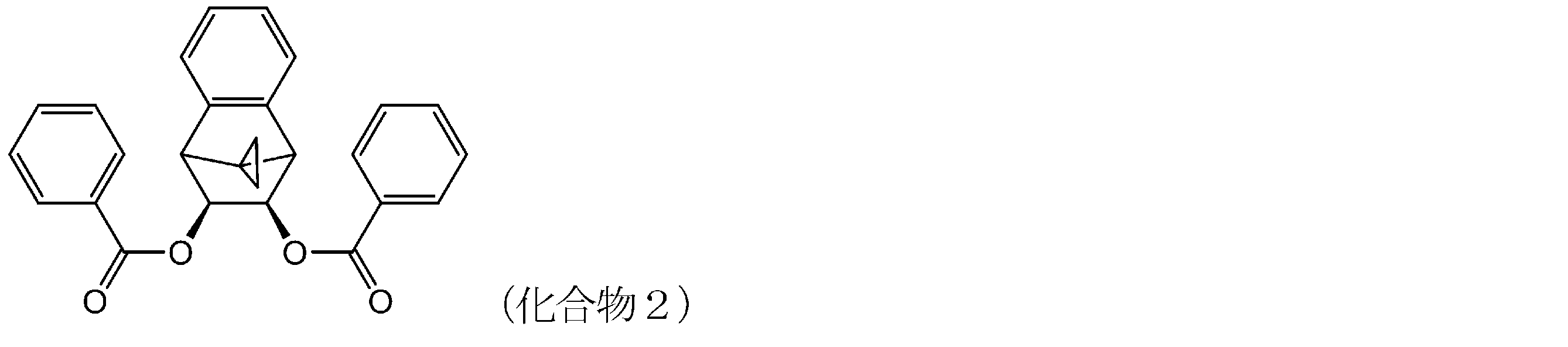
固体状チタン触媒成分[α1]の代わりに固体状チタン触媒成分[α2]を用いた以外は実施例1と同様にプロピレンの重合を行った。結果を表1、表2に示す。
<固体状チタン触媒成分[α3]の調製>
0.97gの化合物1の代わりに1.10gの下記化合物3を用いた以外は実施例1と同様にして固体状チタン触媒成分[α3]を得た。

固体状チタン触媒成分[α1]の代わりに固体状チタン触媒成分[α3]0.0032ミリモル(チタン原子換算)を用い、トリエチルアルミニウムの使用量を0.5ミリモルから0.4ミリモルに変更し、シクロヘキシルメチルジメトキシシランの使用量を0.10ミリモルから0.08ミリモルに変更した以外は実施例1と同様にプロピレンの重合を行った。結果を表1、表2に示す。
<固体状チタン触媒成分[α4]の調製>
0.97gの化合物1の代わりに1.19gの下記化合物4を用いた以外は実施例1と同様にして固体状チタン触媒成分[α4]を得た。
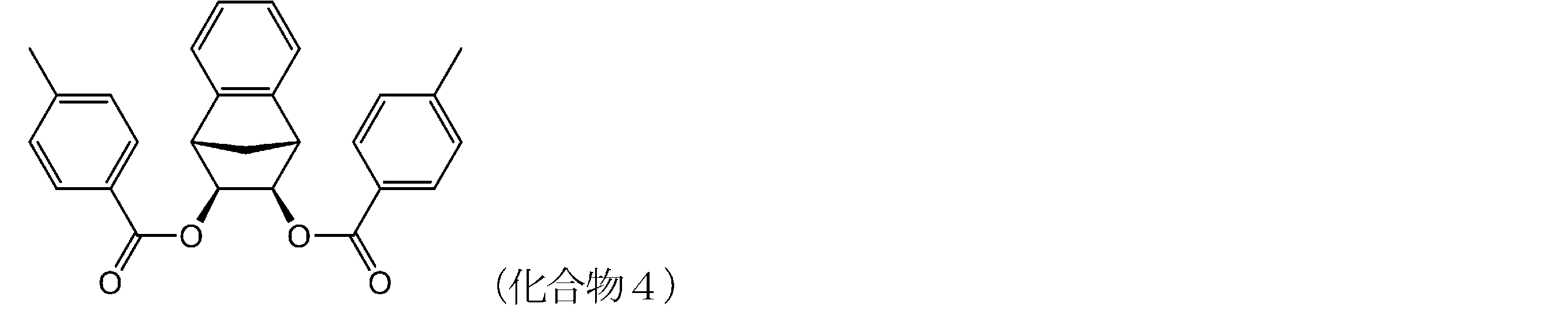
固体状チタン触媒成分[α1]の代わりに固体状チタン触媒成分[α4]0.0032ミリモル(チタン原子換算)を用い、トリエチルアルミニウムの使用量を0.5ミリモルから0.4ミリモルに変更し、シクロヘキシルメチルジメトキシシランの使用量を0.10ミリモルから0.08ミリモルに変更した以外は実施例1と同様にプロピレンの重合を行った。結果を表1、表2に示す。
<固体状チタン触媒成分[α5]の調製>
0.97gの化合物1の代わりに1.11gの下記化合物5を用いた以外は実施例1と同様にして固体状チタン触媒成分[α5]を得た。

固体状チタン触媒成分[α1]の代わりに固体状チタン触媒成分[α5]0.0032ミリモル(チタン原子換算)を用い、トリエチルアルミニウムの使用量を0.5ミリモルから0.4ミリモルに変更し、シクロヘキシルメチルジメトキシシランの使用量を0.10ミリモルから0.08ミリモルに変更した以外は実施例1と同様にプロピレンの重合を行った。結果を表1、表2に示す。
<固体状チタン触媒成分[α6]の調製>
0.97gの化合物1の代わりに1.12gの下記化合物6を用いた以外は実施例1と同様にして固体状チタン触媒成分[α6]を得た。
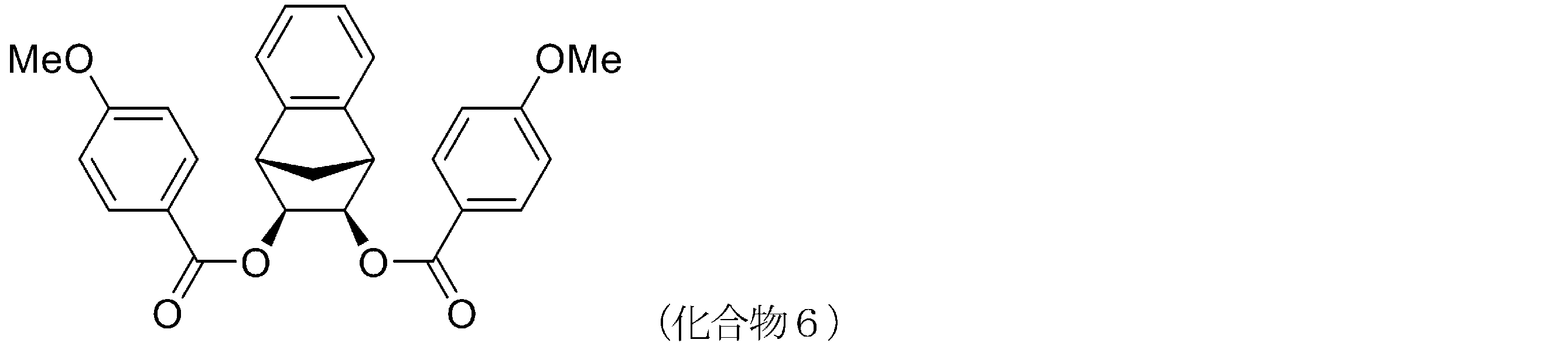
固体状チタン触媒成分[α1]の代わりに固体状チタン触媒成分[α6]0.0032ミリモル(チタン原子換算)を用い、トリエチルアルミニウムの使用量を0.5ミリモルから0.4ミリモルに変更し、シクロヘキシルメチルジメトキシシランの使用量を0.10ミリモルから0.08ミリモルに変更した以外は実施例1と同様にプロピレンの重合を行った。結果を表1、表2に示す。
<固体状チタン触媒成分[α7]の調製>
0.97gの化合物1の代わりに0.91gの下記化合物6を用いた以外は実施例1と同様にして固体状チタン触媒成分[α7]を得た。

固体状チタン触媒成分[α1]の代わりに固体状チタン触媒成分[α7]0.0032ミリモル(チタン原子換算)を用い、トリエチルアルミニウムの使用量を0.5ミリモルから0.4ミリモルに変更し、シクロヘキシルメチルジメトキシシランの使用量を0.10ミリモルから0.08ミリモルに変更した以外は実施例1と同様にプロピレンの重合を行った。結果を表1、表2に示す。
<固体状チタン触媒成分[α8]の調製>
0.97gの化合物1の代わりに1.07gの下記化合物8を用いた以外は実施例1と同様にして固体状チタン触媒成分[α8]を得た。

固体状チタン触媒成分[α1]の代わりに固体状チタン触媒成分[α8]0.0032ミリモル(チタン原子換算)を用い、トリエチルアルミニウムの使用量を0.5ミリモルから0.4ミリモルに変更し、シクロヘキシルメチルジメトキシシランの使用量を0.10ミリモルから0.08ミリモルに変更した以外は実施例1と同様にプロピレンの重合を行った。結果を表1、表2に示す。
<固体状チタン触媒成分[α9]の調製>
0.97gの化合物1の代わりに1.13gの下記化合物9を用いた以外は実施例1と同様にして固体状チタン触媒成分[α9]を得た。
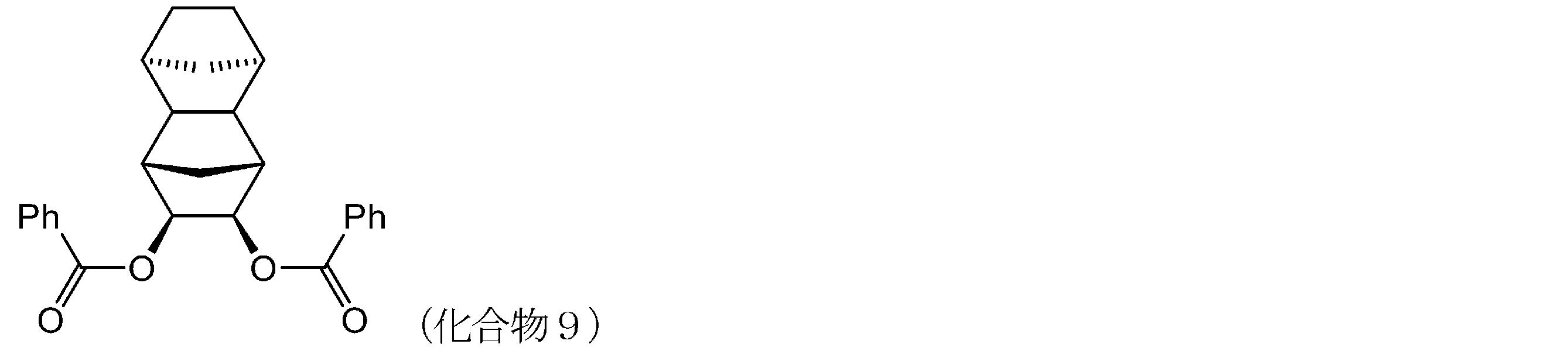
固体状チタン触媒成分[α1]の代わりに固体状チタン触媒成分[α9]0.0032ミリモル(チタン原子換算)を用い、トリエチルアルミニウムの使用量を0.5ミリモルから0.4ミリモルに変更し、シクロヘキシルメチルジメトキシシランの使用量を0.10ミリモルから0.08ミリモルに変更した以外は実施例1と同様にプロピレンの重合を行った。結果を表1、表2に示す。
<固体状チタン触媒成分[α10]の調製>
0.97gの化合物1の代わりに1.13gの下記化合物10を用いた以外は実施例1と同様にして固体状チタン触媒成分[α10]を得た。

固体状チタン触媒成分[α1]の代わりに固体状チタン触媒成分[α10]0.0032ミリモル(チタン原子換算)を用い、トリエチルアルミニウムの使用量を0.5ミリモルから0.4ミリモルに変更し、シクロヘキシルメチルジメトキシシランの使用量を0.10ミリモルから0.08ミリモルに変更した以外は実施例1と同様にプロピレンの重合を行った。結果を表1、表2に示す。
<固体状チタン触媒成分[α11]の調製>
0.97gの化合物1の代わりに1.07gの下記化合物11を用いた以外は実施例1と同様にして固体状チタン触媒成分[α11]を得た。

固体状チタン触媒成分[α1]の代わりに固体状チタン触媒成分[α11]0.0032ミリモル(チタン原子換算)を用い、トリエチルアルミニウムの使用量を0.5ミリモルから0.4ミリモルに変更し、シクロヘキシルメチルジメトキシシランの使用量を0.10ミリモルから0.08ミリモルに変更した以外は実施例1と同様にプロピレンの重合を行った。結果を表1、表2に示す。
<固体状チタン触媒成分[α12]の調製>
0.97gの化合物1の代わりに1.85gの下記化合物12を用いた以外は実施例1と同様にして固体状チタン触媒成分[α12]を得た。

固体状チタン触媒成分[α1]の代わりに固体状チタン触媒成分[α12]0.0032ミリモル(チタン原子換算)を用い、トリエチルアルミニウムの使用量を0.5ミリモルから0.4ミリモルに変更し、シクロヘキシルメチルジメトキシシランの使用量を0.10ミリモルから0.08ミリモルに変更した以外は実施例1と同様にプロピレンの重合を行った。結果を表1に示す。
<固体状チタン触媒成分[α13]の調製>
1Lのガラス容器を十分窒素置換した後、無水塩化マグネシウム85.8g、デカン321gおよび2-エチルヘキシルアルコール352gを入れ、130℃で3時間加熱反応させて均一溶液とした。この溶液241gと安息香酸エチル6.43gをガラス容器に加え、50℃にて1時間攪拌混合を行った。
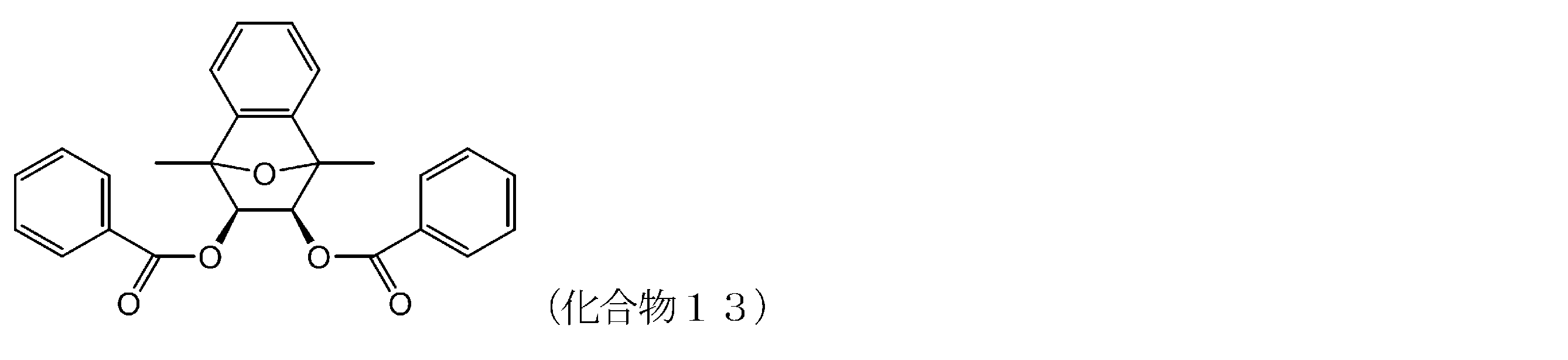
固体状チタン触媒成分[α1]の代わりに固体状チタン触媒成分[α13]0.0032ミリモル(チタン原子換算)を用い、トリエチルアルミニウムの使用量を0.5ミリモルから0.4ミリモルに変更し、シクロヘキシルメチルジメトキシシランの使用量を0.10ミリモルから0.08ミリモルに変更した以外は実施例1と同様にプロピレンの重合を行った。結果を表1に示す。
<固体状チタン触媒成分[α14]の調製>
0.97gの化合物1の代わりに1.01gの下記化合物14を用いた以外は実施例1と同様にして固体状チタン触媒成分[α14]を得た。
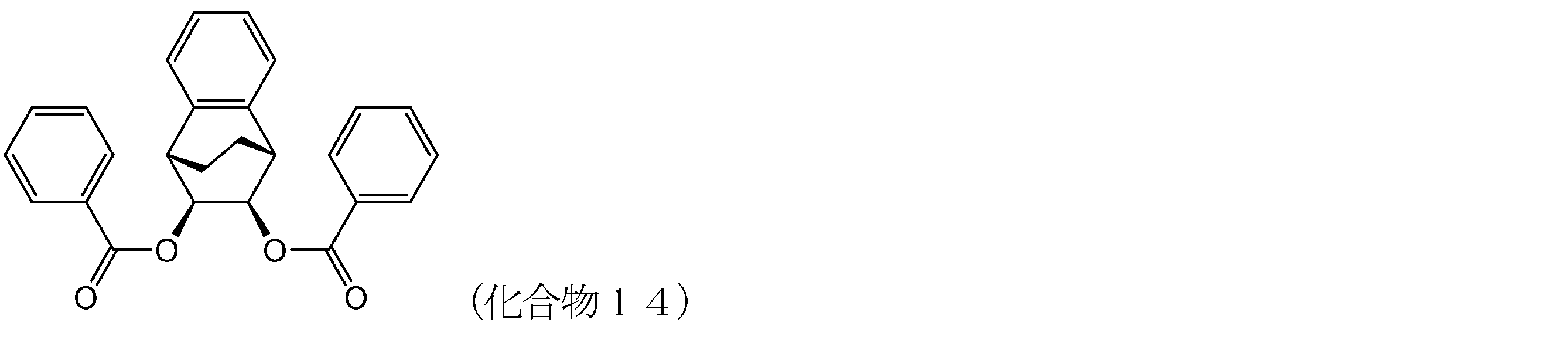
固体状チタン触媒成分[α1]の代わりに固体状チタン触媒成分[α14]0.0032ミリモル(チタン原子換算)を用い、トリエチルアルミニウムの使用量を0.5ミリモルから0.4ミリモルに変更し、シクロヘキシルメチルジメトキシシランの使用量を0.10ミリモルから0.08ミリモルに変更した以外は実施例1と同様にプロピレンの重合を行った。結果を表1、表2に示す。
<固体状チタン触媒成分[α15]の調製>
下記の操作以外は、実施例13と同様にして固体状チタン触媒成分[α15]を調製した。
・化合物13の代わりに化合物12を80℃で0.77g添加した。
・80℃から40分かけて120℃に昇温する代わりに、80℃から20分かけて100℃に昇温した。
・四塩化チタンで再懸濁して120℃で35分加熱する代わりに、四塩化チタンで再懸濁して100℃で35分加熱した。
固体状チタン触媒成分[α1]の代わりに固体状チタン触媒成分[α15]0.0032ミリモル(チタン原子換算)を用い、トリエチルアルミニウムの使用量を0.5ミリモルから0.4ミリモルに変更し、シクロヘキシルメチルジメトキシシランの使用量を0.10ミリモルから0.08ミリモルに変更した以外は実施例1と同様にプロピレンの重合を行った。結果を表1に示す。
<固体状チタン触媒成分[β1]の調製>
0.97gの化合物1の代わりに1.51gの下記化合物-c1を用いた以外は実施例1と同様にして固体状チタン触媒成分[β1]を得た。

固体状チタン触媒成分[α1]の代わりに固体状チタン触媒成分[β1]0.0032ミリモル(チタン原子換算)を用い、トリエチルアルミニウムの使用量を0.5ミリモルから0.4ミリモルに変更し、シクロヘキシルメチルジメトキシシランの使用量を0.10ミリモルから0.08ミリモルに変更した以外は実施例1と同様にプロピレンの重合を行った。結果を表1、表2に示す。
<固体状チタン触媒成分[β2]の調製>
0.97gの化合物1の代わりに1.51gの下記化合物-c2を用いた以外は実施例1と同様にして固体状チタン触媒成分[β2]を得た。

固体状チタン触媒成分[α1]の代わりに固体状チタン触媒成分[β2]0.0032ミリモル(チタン原子換算)を用い、トリエチルアルミニウムの使用量を0.5ミリモルから0.4ミリモルに変更し、シクロヘキシルメチルジメトキシシランの使用量を0.10ミリモルから0.08ミリモルに変更した以外は実施例1と同様にプロピレンの重合を行った。結果を表1、表2に示す。
<固体状チタン触媒成分[β3]の調製>
0.97gの化合物1の代わりに1.61gの下記化合物-c3を用いた以外は実施例1と同様にして固体状チタン触媒成分[β3]を得た。

固体状チタン触媒成分[α1]の代わりに固体状チタン触媒成分[β3]0.0032ミリモル(チタン原子換算)を用い、トリエチルアルミニウムの使用量を0.5ミリモルから0.4ミリモルに変更し、シクロヘキシルメチルジメトキシシランの使用量を0.10ミリモルから0.08ミリモルに変更した以外は実施例1と同様にプロピレンの重合を行った。結果を表1、表2に示す。
<固体状チタン触媒成分[β4]の調製>
0.97gの化合物1の代わりに1.64gの下記化合物-c4を用いた以外は実施例1と同様にして固体状チタン触媒成分[β4]を得た。

固体状チタン触媒成分[α1]の代わりに固体状チタン触媒成分[β4]0.0032ミリモル(チタン原子換算)を用い、トリエチルアルミニウムの使用量を0.5ミリモルから0.4ミリモルに変更し、シクロヘキシルメチルジメトキシシランの使用量を0.10ミリモルから0.08ミリモルに変更した以外は実施例1と同様にプロピレンの重合を行った。結果を表1、表2に示す。
<固体状チタン触媒成分[β5]の調製>
0.97gの化合物1の代わりに1.64gの下記化合物-c5を用いた以外は実施例1と同様にして固体状チタン触媒成分[β5]を得た。

固体状チタン触媒成分[α1]の代わりに固体状チタン触媒成分[β5]0.0032ミリモル(チタン原子換算)を用い、トリエチルアルミニウムの使用量を0.5ミリモルから0.4ミリモルに変更し、シクロヘキシルメチルジメトキシシランの使用量を0.10ミリモルから0.08ミリモルに変更した以外は実施例1と同様にプロピレンの重合を行った。結果を表1、表2に示す。
<固体状チタン触媒成分[α16]の調製>
0.97gの化合物1の代わりに1.13gの下記化合物16を用いた以外は実施例1と同様にして固体状チタン触媒成分[α16]を得た。
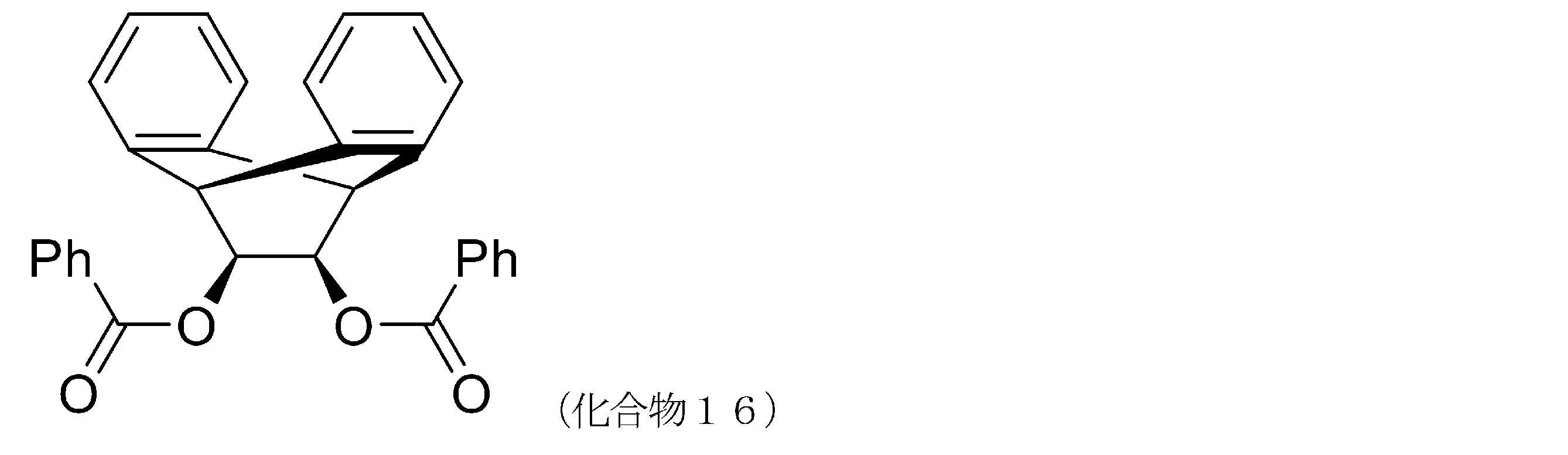
固体状チタン触媒成分[α1]の代わりに固体状チタン触媒成分[α16]0.0032ミリモル(チタン原子換算)を用い、トリエチルアルミニウムの使用量を0.5ミリモルから0.4ミリモルに変更し、シクロヘキシルメチルジメトキシシランの使用量を0.10ミリモルから0.08ミリモルに変更した以外は実施例1と同様にプロピレンの重合を行った。結果を表1、表2に示す。
<固体状チタン触媒成分[α17]の調製>
0.97gの化合物1の代わりに1.16gの下記化合物17を用いた以外は実施例1と同様にして固体状チタン触媒成分[α17]を得た。
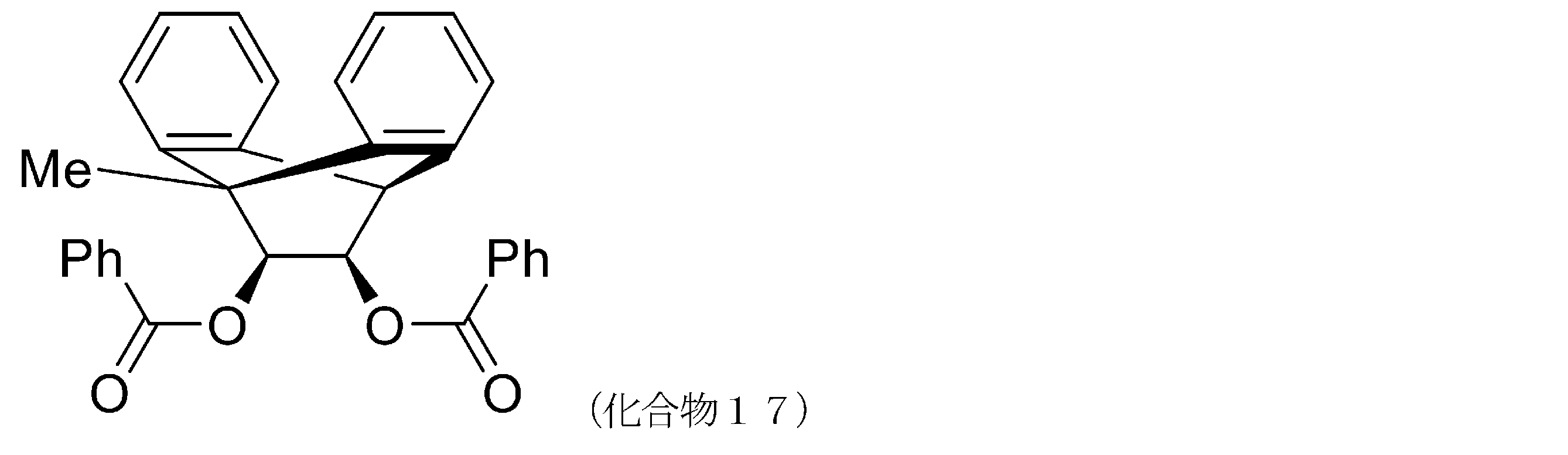
固体状チタン触媒成分[α1]の代わりに固体状チタン触媒成分[α17]0.0028ミリモル(チタン原子換算)を用い、トリエチルアルミニウムの使用量を0.5ミリモルから0.35ミリモルに変更し、シクロヘキシルメチルジメトキシシランの使用量を0.10ミリモルから0.07ミリモルに変更した以外は実施例1と同様にプロピレンの重合を行った。結果を表1、表2に示す。
<固体状チタン触媒成分[α18]の調製>
0.97gの化合物1の代わりに1.20gの下記化合物18を用いた以外は実施例1と同様にして固体状チタン触媒成分[α18]を得た。
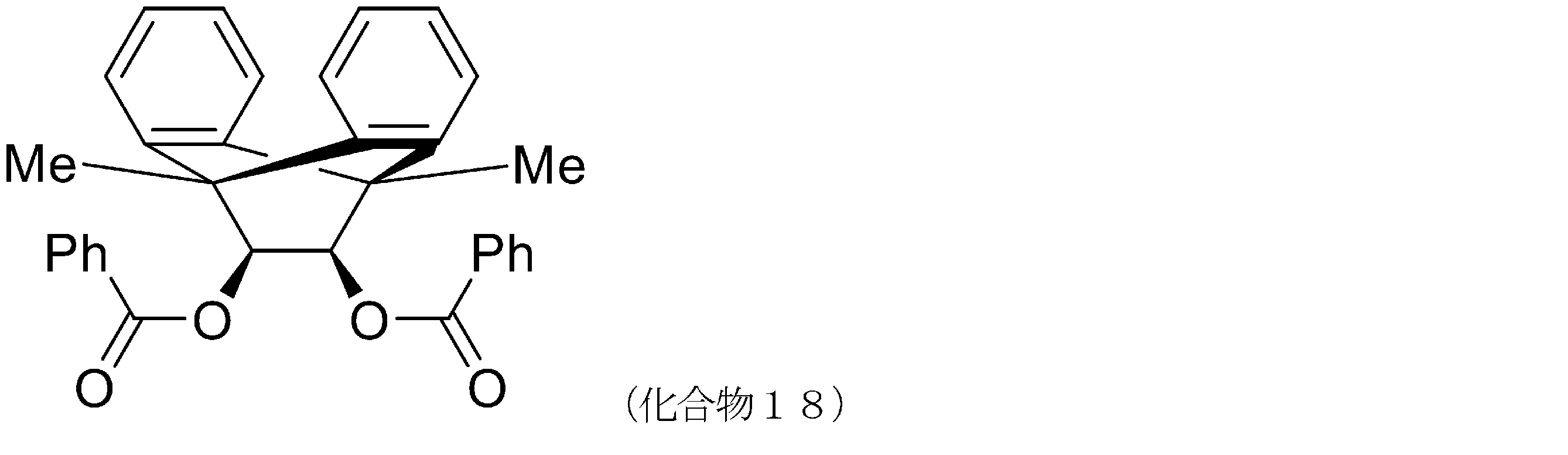
固体状チタン触媒成分[α1]の代わりに固体状チタン触媒成分[α18]0.0028ミリモル(チタン原子換算)を用い、トリエチルアルミニウムの使用量を0.5ミリモルから0.35ミリモルに変更し、シクロヘキシルメチルジメトキシシランの使用量を0.10ミリモルから0.07ミリモルに変更した以外は実施例1と同様にプロピレンの重合を行った。結果を表1、表2に示す。
<固体状チタン触媒成分[α19]の調製>
0.97gの化合物1の代わりに1.01gの下記化合物19を用いた以外は実施例1と同様にして固体状チタン触媒成分[α19]を得た。
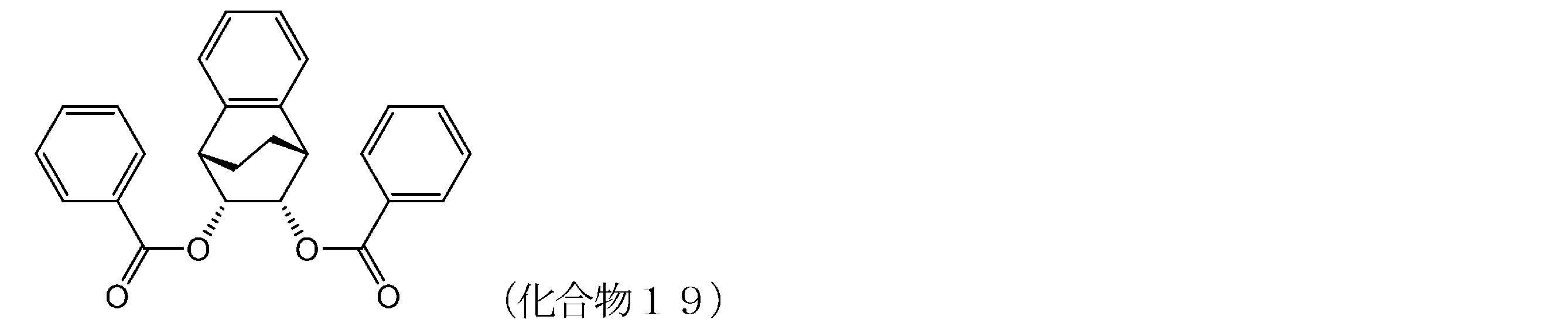
固体状チタン触媒成分[α1]の代わりに固体状チタン触媒成分[α19]0.0032ミリモル(チタン原子換算)を用い、トリエチルアルミニウムの使用量を0.5ミリモルから0.4ミリモルに変更し、シクロヘキシルメチルジメトキシシランの使用量を0.10ミリモルから0.08ミリモルに変更した以外は実施例1と同様にプロピレンの重合を行った。結果を表1、表2に示す。
<固体状チタン触媒成分[α20]の調製>
0.97gの化合物1の代わりに0.86gの下記化合物20を用いた以外は実施例1と同様にして固体状チタン触媒成分[α20]を得た。
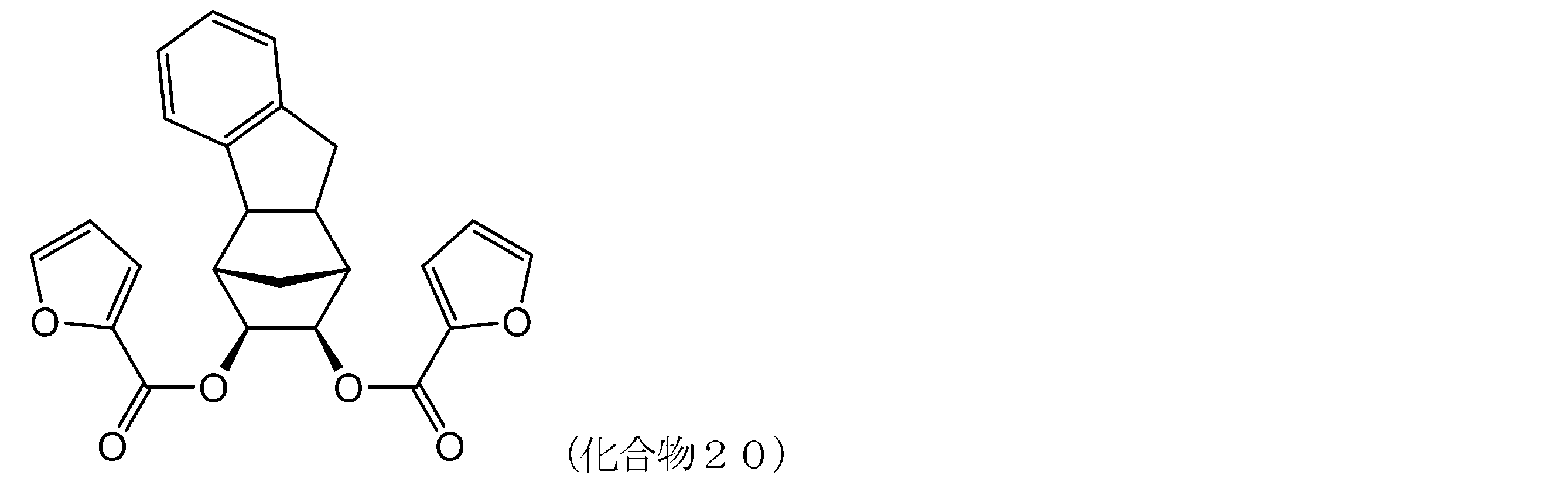
固体状チタン触媒成分[α1]の代わりに固体状チタン触媒成分[α20]0.0032ミリモル(チタン原子換算)を用い、トリエチルアルミニウムの使用量を0.5ミリモルから0.4ミリモルに変更し、シクロヘキシルメチルジメトキシシランの使用量を0.10ミリモルから0.08ミリモルに変更した以外は実施例1と同様にプロピレンの重合を行った。結果を表1、表2に示す。
<固体状チタン触媒成分[α21]の調製>
0.97gの化合物1の代わりに0.93gの下記化合物21を用いた以外は実施例1と同様にして固体状チタン触媒成分[α21]を得た。
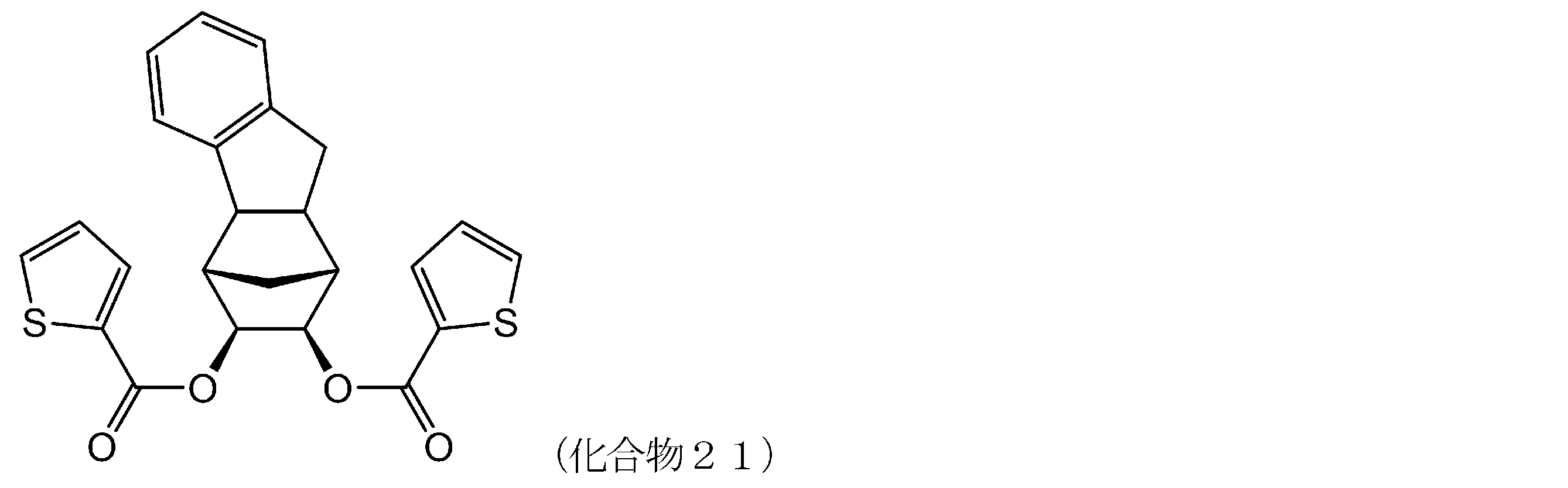
固体状チタン触媒成分[α1]の代わりに固体状チタン触媒成分[α21]0.0032ミリモル(チタン原子換算)を用い、トリエチルアルミニウムの使用量を0.5ミリモルから0.4ミリモルに変更し、シクロヘキシルメチルジメトキシシランの使用量を0.10ミリモルから0.08ミリモルに変更した以外は実施例1と同様にプロピレンの重合を行った。結果を表1、表2に示す。
<固体状チタン触媒成分[α22]の調製>
0.97gの化合物1の代わりに2.16gの下記化合物22を用いた以外は実施例1と同様にして固体状チタン触媒成分[α22]を得た。
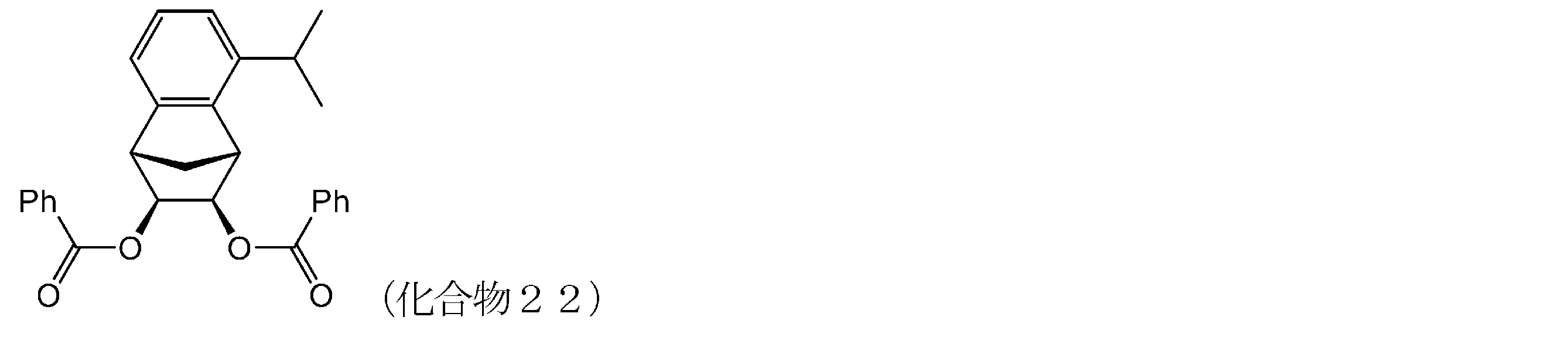
固体状チタン触媒成分[α1]の代わりに固体状チタン触媒成分[α22]0.0032ミリモル(チタン原子換算)を用い、トリエチルアルミニウムの使用量を0.5ミリモルから0.4ミリモルに変更し、シクロヘキシルメチルジメトキシシランの使用量を0.10ミリモルから0.08ミリモルに変更した以外は実施例1と同様にプロピレンの重合を行った。結果を表1、表2に示す。
<固体状チタン触媒成分[α23]の調製>
0.97gの化合物1の代わりに1.05gの下記化合物23を用いた以外は実施例1と同様にして固体状チタン触媒成分[α23]を得た。
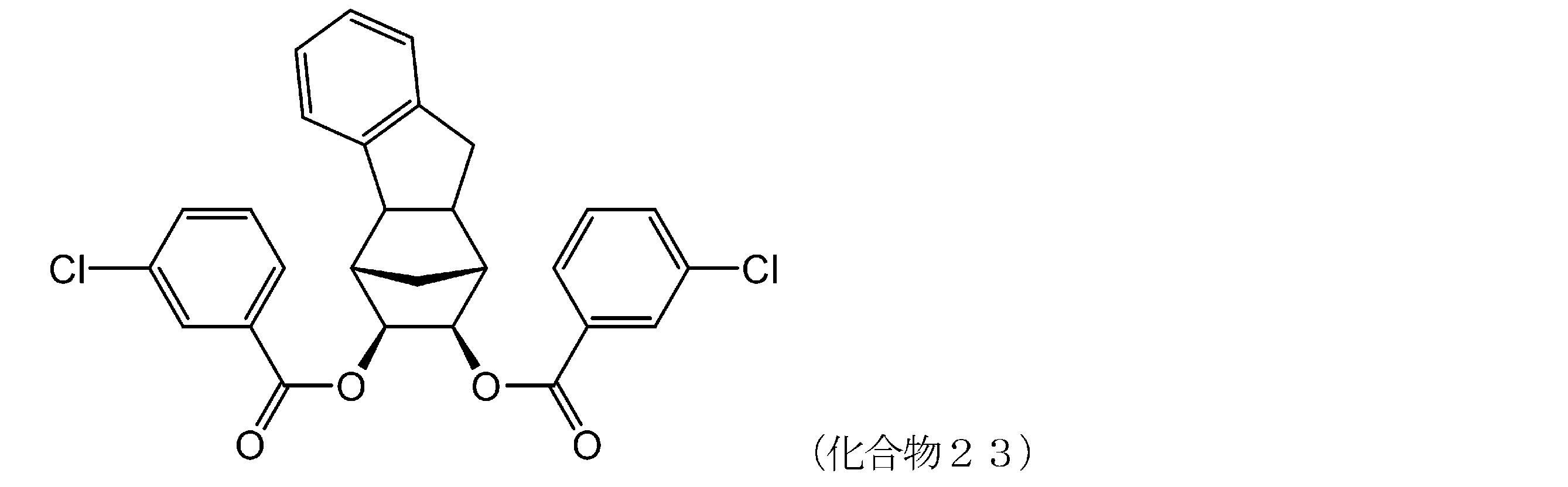
固体状チタン触媒成分[α1]の代わりに固体状チタン触媒成分[α23]0.0032ミリモル(チタン原子換算)を用い、トリエチルアルミニウムの使用量を0.5ミリモルから0.4ミリモルに変更し、シクロヘキシルメチルジメトキシシランの使用量を0.10ミリモルから0.08ミリモルに変更した以外は実施例1と同様にプロピレンの重合を行った。結果を表1、表2に示す。
<固体状チタン触媒成分[α24]の調製>
0.97gの化合物1の代わりに1.28gの下記化合物24を用いた以外は実施例1と同様にして固体状チタン触媒成分[α24]を得た。
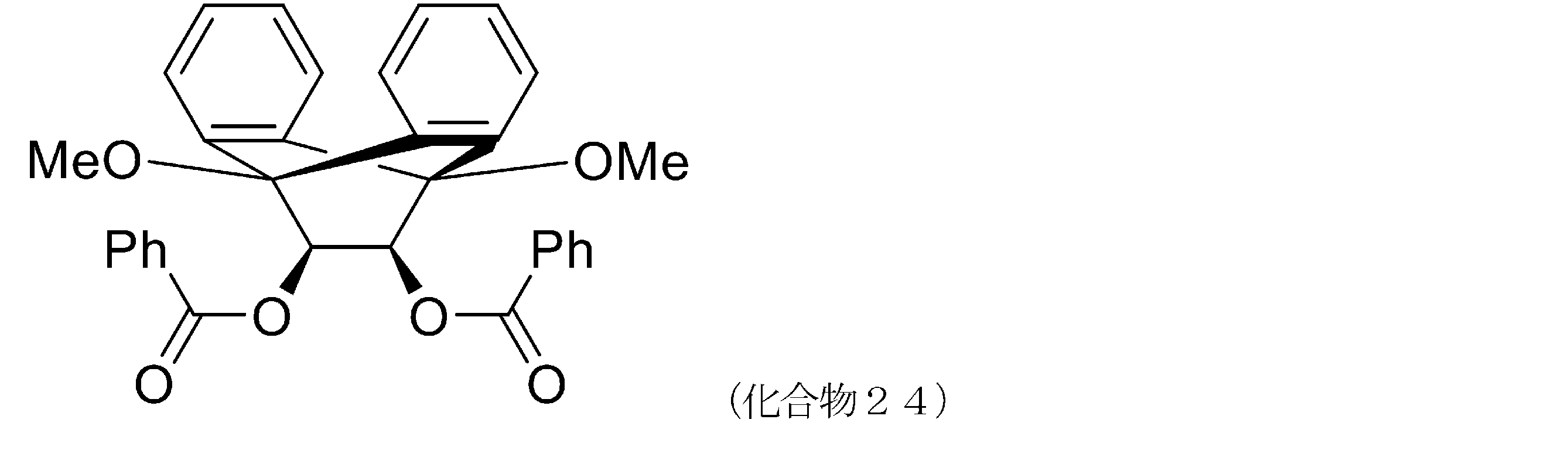
固体状チタン触媒成分[α1]の代わりに固体状チタン触媒成分[α24]0.0028ミリモル(チタン原子換算)を用い、トリエチルアルミニウムの使用量を0.5ミリモルから0.35ミリモルに変更し、シクロヘキシルメチルジメトキシシランの使用量を0.10ミリモルから0.07ミリモルに変更した以外は実施例1と同様にプロピレンの重合を行った。結果を表1、表2に示す。
<固体状チタン触媒成分[α25]の調製>
0.97gの化合物1の代わりに1.56gの下記化合物25を用いた以外は実施例1と同様にして固体状チタン触媒成分[α25]を得た。
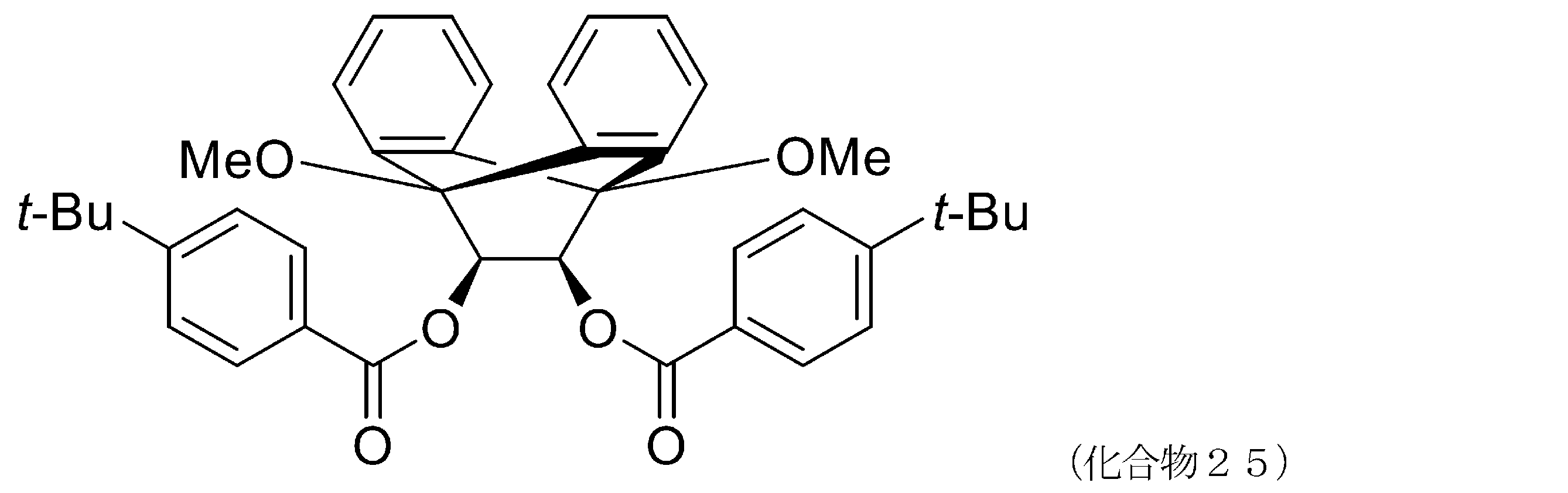
固体状チタン触媒成分[α1]の代わりに固体状チタン触媒成分[α25]0.002ミリモル(チタン原子換算)を用い、トリエチルアルミニウムの使用量を0.5ミリモルから0.25ミリモルに変更し、シクロヘキシルメチルジメトキシシランの使用量を0.10ミリモルから0.05ミリモルに変更した以外は実施例1と同様にプロピレンの重合を行った。結果を表1、表2に示す。
<固体状チタン触媒成分[α26]の調製>
0.97gの化合物1の代わりに1.56gの下記化合物26を用いた以外は実施例1と同様にして固体状チタン触媒成分[α26]を得た。
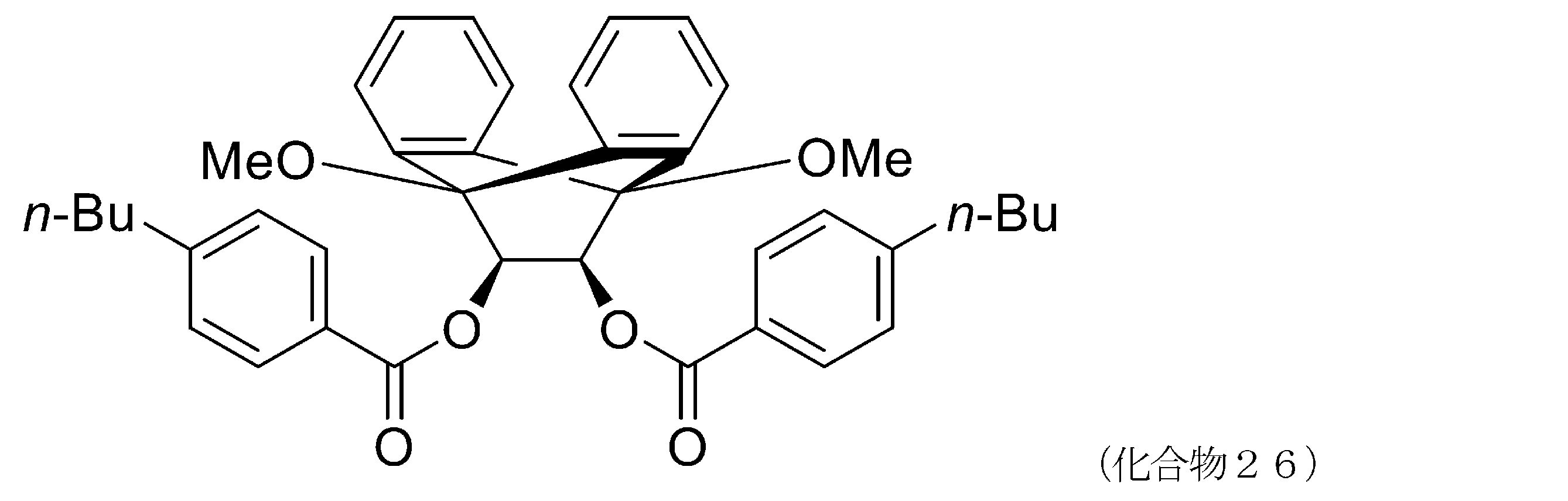
固体状チタン触媒成分[α1]の代わりに固体状チタン触媒成分[α26]0.002ミリモル(チタン原子換算)を用い、トリエチルアルミニウムの使用量を0.5ミリモルから0.25ミリモルに変更し、シクロヘキシルメチルジメトキシシランの使用量を0.10ミリモルから0.05ミリモルに変更した以外は実施例1と同様にプロピレンの重合を行った。結果を表1、表2に示す。
<固体状チタン触媒成分[α27]の調製>
0.97gの化合物1の代わりに1.43gの下記化合物27を用いた以外は実施例1と同様にして固体状チタン触媒成分[α27]を得た。
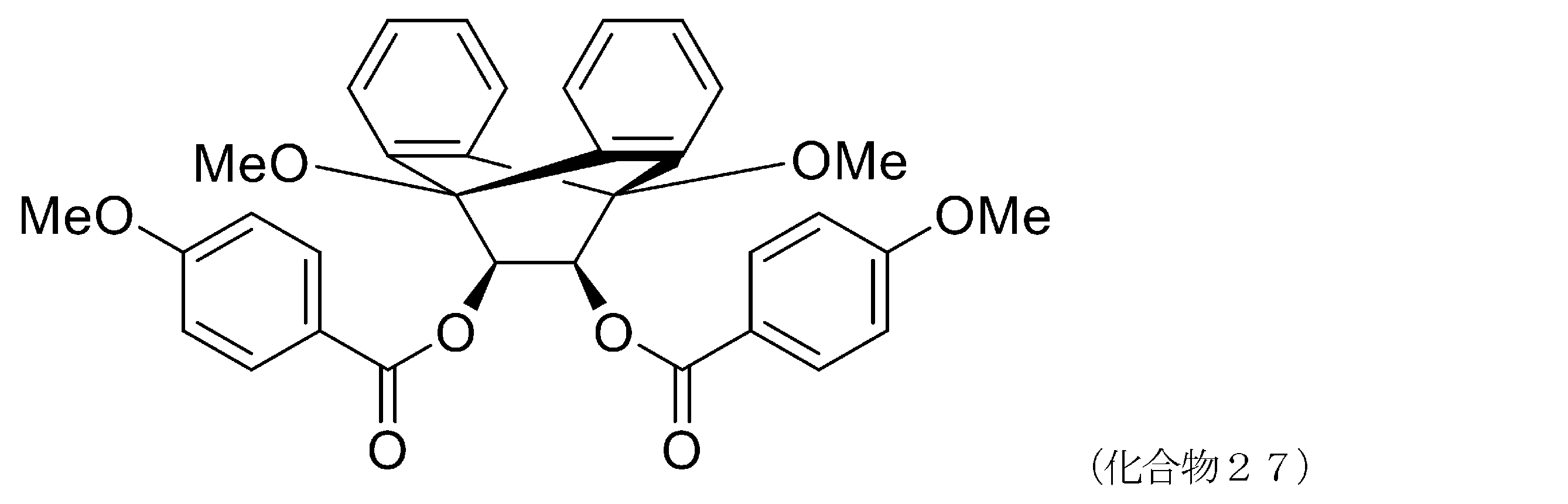
固体状チタン触媒成分[α1]の代わりに固体状チタン触媒成分[α27]0.002ミリモル(チタン原子換算)を用い、トリエチルアルミニウムの使用量を0.5ミリモルから0.25ミリモルに変更し、シクロヘキシルメチルジメトキシシランの使用量を0.10ミリモルから0.05ミリモルに変更した以外は実施例1と同様にプロピレンの重合を行った。結果を表1、表2に示す。
<固体状チタン触媒成分[α28]の調製>
1Lのガラス容器を十分窒素置換した後、無水塩化マグネシウム85.8g、デカン321gおよび2-エチルヘキシルアルコール352gを入れ、130℃で3時間加熱反応させて均一溶液とした。この溶液241gと安息香酸エチル6.43gをガラス容器に加え、50℃にて1時間攪拌混合を行った。

固体状チタン触媒成分[α1]の代わりに固体状チタン触媒成分[α28]0.002ミリモル(チタン原子換算)を用い、トリエチルアルミニウムの使用量を0.5ミリモルから0.25ミリモルに変更し、シクロヘキシルメチルジメトキシシランの使用量を0.10ミリモルから0.05ミリモルに変更した以外は実施例1と同様にプロピレンの重合を行った。結果を表1、表2に示す。
<固体状チタン触媒成分[α29]の調製>
0.97gの化合物1の代わりに0.97gの下記化合物29を用いた以外は実施例1と同様にして固体状チタン触媒成分[α29]を得た。

固体状チタン触媒成分[α1]の代わりに固体状チタン触媒成分[α29]0.0032ミリモル(チタン原子換算)を用い、トリエチルアルミニウムの使用量を0.5ミリモルから0.4ミリモルに変更し、シクロヘキシルメチルジメトキシシランの使用量を0.10ミリモルから0.08ミリモルに変更した以外は実施例1と同様にプロピレンの重合を行った。結果を表1、表2に示す。
<固体状チタン触媒成分[α30]の調製>
1Lのガラス容器を十分窒素置換した後、無水塩化マグネシウム85.8g、デカン321gおよび2-エチルヘキシルアルコール352gを入れ、130℃で3時間加熱反応させて均一溶液とした。この溶液241gと安息香酸エチル6.43gをガラス容器に加え、50℃にて1時間攪拌混合を行った。
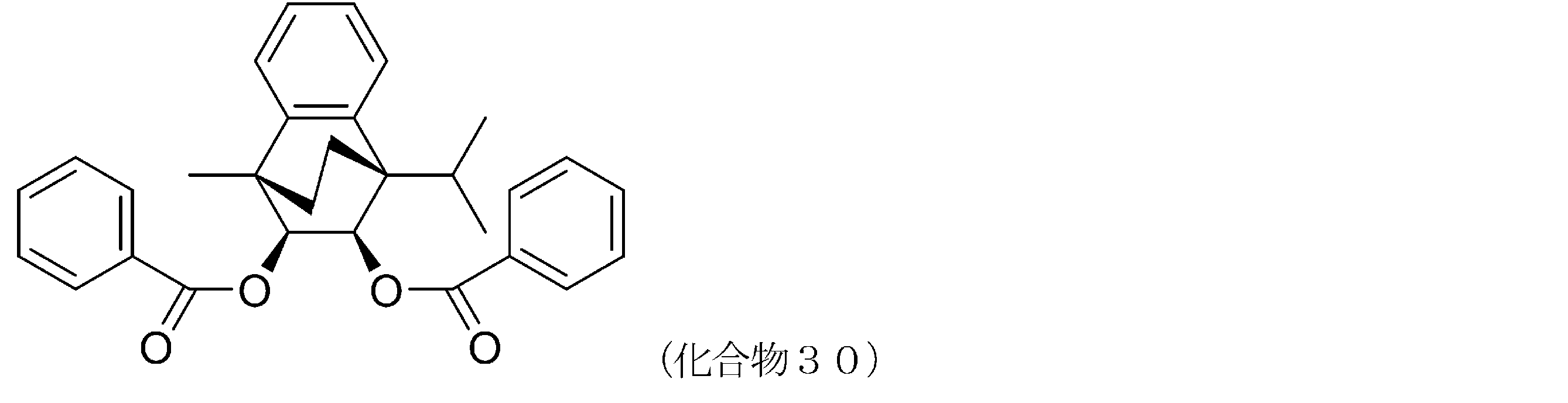
固体状チタン触媒成分[α1]の代わりに固体状チタン触媒成分[α30]0.0028ミリモル(チタン原子換算)を用い、トリエチルアルミニウムの使用量を0.5ミリモルから0.35ミリモルに変更し、シクロヘキシルメチルジメトキシシランの使用量を0.10ミリモルから0.07ミリモルに変更した以外は実施例1と同様にプロピレンの重合を行った。結果を表1に示す。
<固体状チタン触媒成分[α31]の調製>
1Lのガラス容器を十分窒素置換した後、無水塩化マグネシウム85.8g、デカン321gおよび2-エチルヘキシルアルコール352gを入れ、130℃で3時間加熱反応させて均一溶液とした。この溶液241gと安息香酸エチル6.43gをガラス容器に加え、50℃にて1時間攪拌混合を行った。

固体状チタン触媒成分[α1]の代わりに固体状チタン触媒成分[α31]0.0028ミリモル(チタン原子換算)を用い、トリエチルアルミニウムの使用量を0.5ミリモルから0.35ミリモルに変更し、シクロヘキシルメチルジメトキシシランの使用量を0.10ミリモルから0.07ミリモルに変更した以外は実施例1と同様にプロピレンの重合を行った。結果を表1、表2に示す。
<固体状チタン触媒成分[α32]の調製>
0.97gの化合物1の代わりに1.33gの下記化合物32を用いた以外は実施例1と同様にして固体状チタン触媒成分[α32]を得た。

固体状チタン触媒成分[α1]の代わりに固体状チタン触媒成分[α32]0.0028ミリモル(チタン原子換算)を用い、トリエチルアルミニウムの使用量を0.5ミリモルから0.35ミリモルに変更し、シクロヘキシルメチルジメトキシシランの使用量を0.10ミリモルから0.07ミリモルに変更した以外は実施例1と同様にプロピレンの重合を行った。結果を表1、表2に示す。
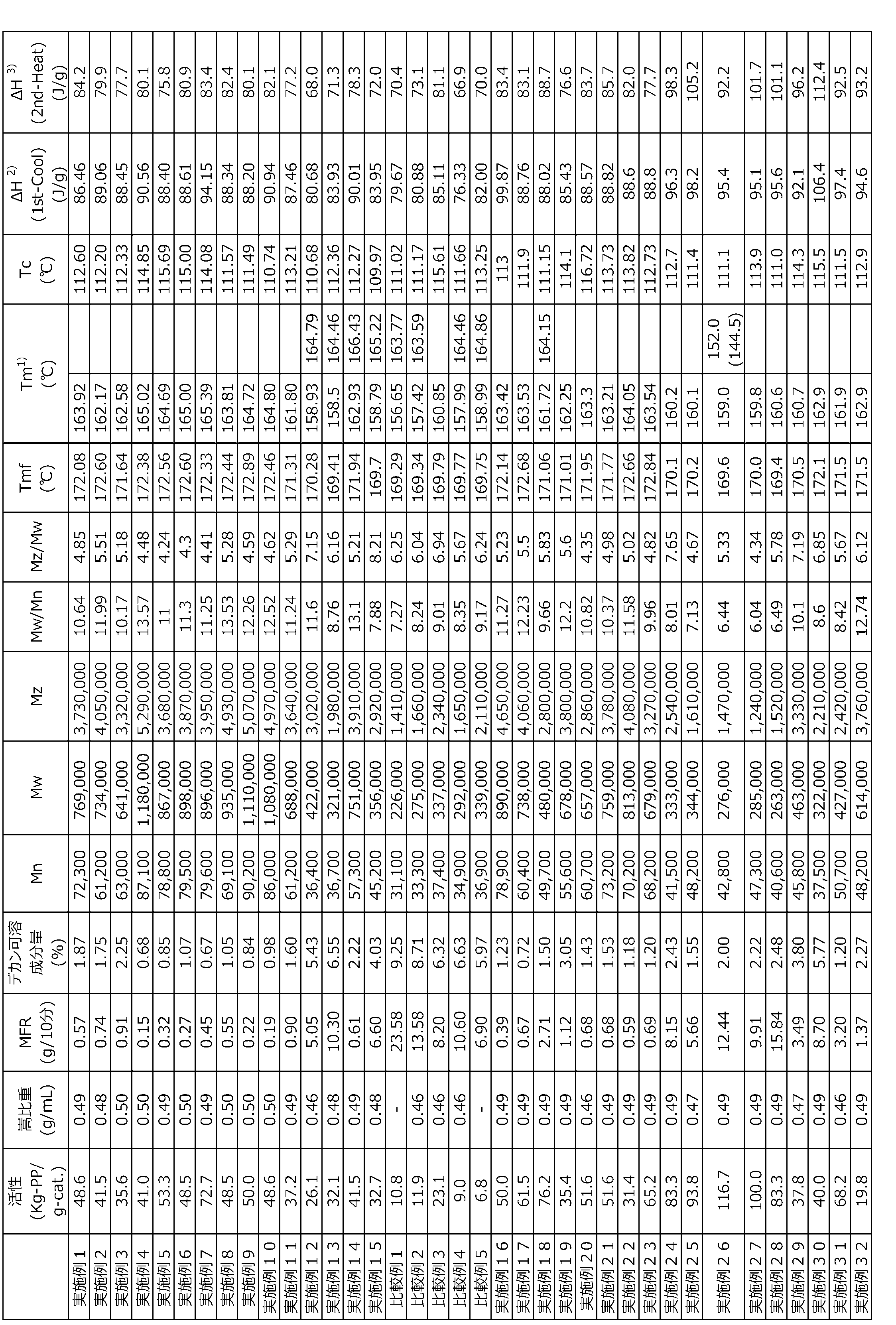
1)左側:メイン融点ピーク、右側:サブ融点ピーク
2)DSC測定における降温時の発熱量(結晶化エネルギーの指標)
3)DSC測定における、2回目の昇温(10℃/分)時の吸熱量(融解熱の指標)
以下の表2は、前記課題の解決手段の(14)項の内容に対応する実験結果の表である。
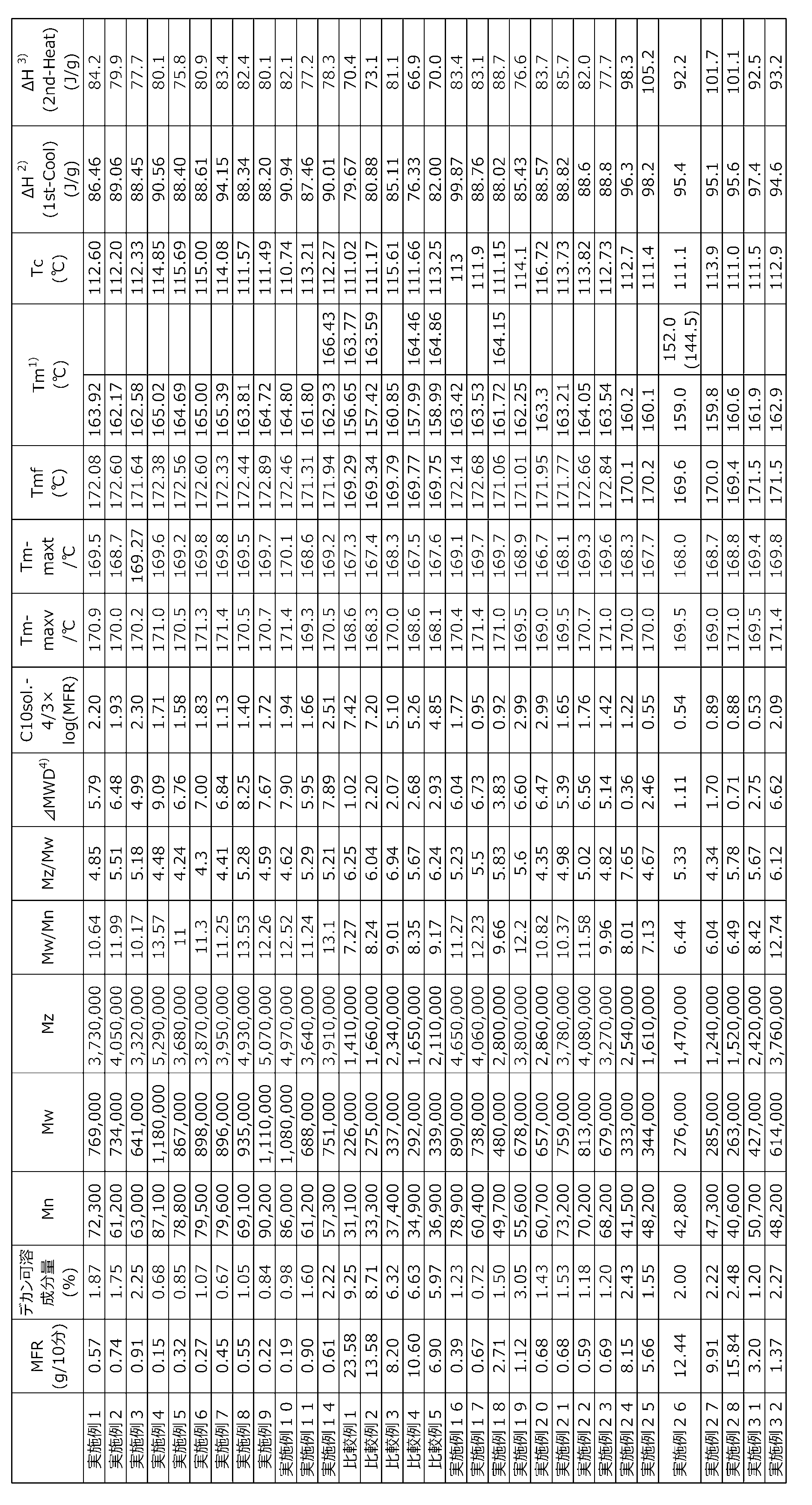
1)左側:メイン融点ピーク、右側:サブ融点ピーク
2)DSC測定における降温時の発熱量(結晶化エネルギーの指標)
3)DSC測定における、2回目の昇温(10℃/分)時の吸熱量(融解熱の指標)
4)(Mw/Mn)-(Mz/Mw)の値
<本重合>
固体状チタン触媒成分[α7]を0.0032ミリモル(チタン原子換算)から0.0024ミリモル(チタン原子換算)に変更し、トリエチルアルミニウムの使用量を0.4ミリモルから0.3ミリモルに変更し、シクロヘキシルメチルジメトキシシランを用いなかった以外は実施例7と同様にプロピレンの重合を行った。結果は以下の通りであった。
MFR : 2.4g/10分
デカン可溶成分含有率: 8.33重量%
上記の通り、本願発明の固体状チタン触媒成分を含むオレフィン重合用触媒は、重合条件によって重合活性の低下無しに得られる重合体の立体規則性を調整することも可能であることが分かる。
Claims (15)
- チタン、マグネシウム、ハロゲンおよび下記式(1)で表される環状多価エステル基含有化合物(a)を含むことを特徴とする固体状チタン触媒成分(I)。

R1およびR2は、それぞれ独立に、置換もしくは無置換の炭素数1~20の炭化水素基であり、R3~R16およびRは、それぞれ独立に、水素原子、置換もしくは無置換の炭素数1~20の炭化水素基、またはハロゲン原子であり、R1~R16およびRの水素原子、炭素原子、またはその両方は、窒素原子、酸素原子、リン原子、ハロゲン原子、およびケイ素原子からなる群より選ばれる少なくとも1種の原子で置換されていてもよい。R3~R16およびRの2つ以上が互いに結合して単環または多環を形成してもよく、隣接する置換基が直接結合した多重結合を形成してもよい。
Ca、CbおよびCcは炭素原子であり、Ca、CbおよびCcから形成される環状構造の炭素-炭素結合は、隣り合う炭素に結合するR同士が直接結合して、多重結合を形成してもよい。
Aは単結合か、または二つのフリーラジカルの間に1~3原子の長さの鎖を有する二価の結合基である。] - 前記式(1)において、R3~R16およびRの2つ以上が互いに結合して単環または多環を形成する部位が、炭素-炭素の二重結合を含む構造である、請求項1に記載の固体状チタン触媒成分(I)。
- 前記式(1)において、R3~R16およびRの2つ以上が互いに結合して単環または多環を形成する部位が、さらに単環または多環構造を含む、請求項1に記載の固体状チタン触媒成分(I)。
- Aが、下記一般式群(2)に示す基から選ばれる二価の基である、請求項1に記載の固体状チタン触媒成分(I)。

- xが2~6である、請求項1に記載の固体状チタン触媒成分(I)。
- n1およびn2が1である、請求項1に記載の固体状チタン触媒成分(I)。
- n3およびn4が0である、請求項1に記載の固体状チタン触媒成分(I)
- R1およびR2が、置換もしくは無置換のアルキル基、置換もしくは無置換のアルケニル基、置換もしくは無置換のシクロアルキル基、置換もしくは無置換のアリール基、または置換もしくは無置換のヘテロアリール基である、請求項1に記載の固体状チタン触媒成分(I)。
- R3~R16が、それぞれ独立に、水素原子、置換もしくは無置換のアルキル基、置換もしくは無置換のアルケニル基、置換もしくは無置換のシクロアルキル基、置換もしくは無置換のシクロアルケニル基、置換もしくは無置換のアルコキシ基、置換もしくは無置換のアルケニルオキシ基、置換もしくは無置換のシクロアルキルオキシ基、置換もしくは無置換のシクロアルケニルオキシ基、置換もしくは無置換のアリール基、置換もしくは無置換のアリールオキシ基、置換もしくは無置換のヘテロアリール基、または置換もしくは無置換のヘテロアリールオキシ基である、請求項1に記載の固体状チタン触媒成分(I)。
- Rが、それぞれ独立に、水素原子、置換もしくは無置換のアルキル基、置換もしくは無置換のアルケニル基、置換もしくは無置換のシクロアルキル基、置換もしくは無置換のシクロアルケニル基、置換もしくは無置換のアルコキシ基、置換もしくは無置換のアルケニルオキシ基、置換もしくは無置換のシクロアルキルオキシ基、置換もしくは無置換のシクロアルケニルオキシ基、置換もしくは無置換のアリール基、置換もしくは無置換のアリールオキシ基、置換もしくは無置換のヘテロアリール基、または置換もしくは無置換のヘテロアリールオキシ基である、請求項1に記載の固体状チタン触媒成分(I)
- 請求項1に記載の固体状チタン触媒成分(I)と、周期表の第1族、第2族及び第13族から選ばれる金属元素を含む有機金属化合物触媒成分(II)とを含むことを特徴とするオレフィン重合用触媒。
- さらに電子供与体(III)を含む、請求項11に記載のオレフィン重合用触媒。
- 請求項11または12に記載のオレフィン重合用触媒の存在下にオレフィンの重合を行うことを特徴とするオレフィン重合方法。
- ASTM1238規格に準じ、測定温度が230℃の条件で決定されるメルトフローレート(MFR)が、0.01g/10分以上、1000g/10分以下の範囲であり、
昇温条件が10℃/分での示差走査熱量測定(DSC)での吸熱がゼロとなる最高温度(Tm-maxv)が169.0℃以上、220℃以下であり、
下記要件(p)、(q)および(r)の内、2要件以上を満たすことを特徴とするプロピレン重合体:
(p)ゲルパーミエーションクロマトグラフィー(GPC)で決定されるMz/Mwが、3.50以上、5.65以下である;
(q)GPCで決定されるMw/MnとMz/Mwとの差が、8.3以下である;
(r)デカン可溶成分含有率(C10sol.)(/重量%)と、MFR(/(g/10分))とが、以下の関係式を満たす。
(C10sol.)-4/3 × Log(MFR)≦2.30 - さらに下記要件(s)を満たす、請求項14に記載のプロピレン重合体:
(s)昇温条件が10℃/分での示差走査熱量測定(DSC)で得られるチャートのTm以上の温度領域での吸熱曲線の接線とベースラインとの交点の温度(Tm-maxt)が、168.1℃以上、210℃以下である。
Priority Applications (7)
| Application Number | Priority Date | Filing Date | Title |
|---|---|---|---|
| KR1020237006347A KR102928882B1 (ko) | 2020-08-26 | 2021-08-26 | 고체상 타이타늄 촉매 성분, 올레핀 중합용 촉매, 올레핀의 중합 방법 및 프로필렌 중합체 |
| CN202180052871.6A CN116057079A (zh) | 2020-08-26 | 2021-08-26 | 固体状钛催化剂成分、烯烃聚合用催化剂、烯烃的聚合方法和丙烯聚合物 |
| EP21861654.8A EP4206238A4 (en) | 2020-08-26 | 2021-08-26 | SOLID TITANIUM CATALYST COMPONENT, OLEFIN POLYMERIZATION CATALYST, OLEFIN POLYMERIZATION PROCESS AND PROPYLENE POLYMER |
| KR1020267004559A KR20260025429A (ko) | 2020-08-26 | 2021-08-26 | 고체상 타이타늄 촉매 성분, 올레핀 중합용 촉매, 올레핀의 중합 방법 및 프로필렌 중합체 |
| JP2022545693A JP7466661B2 (ja) | 2020-08-26 | 2021-08-26 | 固体状チタン触媒成分、オレフィン重合用触媒、オレフィンの重合方法およびプロピレン重合体 |
| US18/022,478 US12534544B2 (en) | 2020-08-26 | 2021-08-26 | Solid titanium catalyst component, olefin polymerization catalyst, olefin polymerization method, and propylene polymer |
| BR112023003504-0A BR112023003504B1 (pt) | 2020-08-26 | 2021-08-26 | Componente catalisador sólido de titânio, catalisador de polimerização de olefinas, método de polimerização de olefinas e polímero de propileno |
Applications Claiming Priority (2)
| Application Number | Priority Date | Filing Date | Title |
|---|---|---|---|
| JP2020142571 | 2020-08-26 | ||
| JP2020-142571 | 2020-08-26 |
Publications (1)
| Publication Number | Publication Date |
|---|---|
| WO2022045232A1 true WO2022045232A1 (ja) | 2022-03-03 |
Family
ID=80353343
Family Applications (1)
| Application Number | Title | Priority Date | Filing Date |
|---|---|---|---|
| PCT/JP2021/031282 Ceased WO2022045232A1 (ja) | 2020-08-26 | 2021-08-26 | 固体状チタン触媒成分、オレフィン重合用触媒、オレフィンの重合方法およびプロピレン重合体 |
Country Status (6)
| Country | Link |
|---|---|
| US (1) | US12534544B2 (ja) |
| EP (1) | EP4206238A4 (ja) |
| JP (1) | JP7466661B2 (ja) |
| KR (2) | KR20260025429A (ja) |
| CN (1) | CN116057079A (ja) |
| WO (1) | WO2022045232A1 (ja) |
Cited By (3)
| Publication number | Priority date | Publication date | Assignee | Title |
|---|---|---|---|---|
| JPWO2022045231A1 (ja) * | 2020-08-26 | 2022-03-03 | ||
| WO2024204845A1 (ja) | 2023-03-30 | 2024-10-03 | 三井化学株式会社 | 固体状チタン触媒成分、オレフィン重合用触媒およびオレフィンの重合方法 |
| WO2024204844A1 (ja) | 2023-03-31 | 2024-10-03 | 三井化学株式会社 | 固体状チタン触媒成分、オレフィン重合用触媒、オレフィンの重合方法 |
Families Citing this family (1)
| Publication number | Priority date | Publication date | Assignee | Title |
|---|---|---|---|---|
| CN116635432A (zh) * | 2020-12-21 | 2023-08-22 | 三井化学株式会社 | 固体状钛催化剂成分、烯烃聚合用催化剂、烯烃的聚合方法和丙烯聚合物 |
Citations (9)
| Publication number | Priority date | Publication date | Assignee | Title |
|---|---|---|---|---|
| JPS5763310A (en) | 1980-08-13 | 1982-04-16 | Montedison Spa | Ingredient and catalyst for olefin polymerization |
| EP0585869A1 (en) | 1992-08-31 | 1994-03-09 | Mitsui Petrochemical Industries, Ltd. | Solid titanium catalyst component for olefin polymerization, process for preparing the same, catalyst for olefin polymerization and process for olefin polymerization |
| JP2001354714A (ja) | 1990-04-13 | 2001-12-25 | Mitsui Chemicals Inc | オレフィン重合用固体状チタン触媒成分、オレフィン重合用触媒およびオレフィンの重合方法 |
| WO2004016662A1 (ja) | 2002-08-19 | 2004-02-26 | Ube Industries, Ltd. | α−オレフィンの重合又は共重合に用いられるα−オレフィンの重合又は重合用触媒、その触媒成分及びその触媒を用いたα−オレフィン重合方法 |
| JP2005517746A (ja) | 2002-02-07 | 2005-06-16 | チャイナ ペトロレウム アンド ケミカル コーポレーション | オレフィン重合用の固形触媒成分、それを含んでなる触媒、およびその使用 |
| WO2006077946A1 (ja) * | 2005-01-19 | 2006-07-27 | Mitsui Chemicals, Inc. | オレフィン重合体の製造方法および固体状チタン触媒成分 |
| WO2008010459A1 (en) | 2006-07-18 | 2008-01-24 | Mitsui Chemicals, Inc. | Solid titanium catalyst ingredient, catalyst for olefin polymerization, and method of olefin polymerization |
| CN101195668A (zh) * | 2006-12-06 | 2008-06-11 | 中国石油天然气股份有限公司 | 丙烯聚合用负载型主催化剂及其制备方法 |
| JP2010132904A (ja) * | 2008-12-03 | 2010-06-17 | Sued-Chemie Ag | 固体触媒用の電子供与体組成物、α−オレフィンの重合で用いられる固体触媒組成物、及び、固体触媒組成物を用いるα−オレフィン単位からなるポリマーの製造方法 |
Family Cites Families (14)
| Publication number | Priority date | Publication date | Assignee | Title |
|---|---|---|---|---|
| US2938049A (en) | 1956-10-04 | 1960-05-24 | Monsanto Chemicals | 9, 10-dihydro-11, 12-dioxy-9, 10-ethanoanthracene and esters thereof |
| WO1997045463A1 (en) | 1996-05-27 | 1997-12-04 | Mitsui Chemicals, Inc. | Crystalline polypropylene, process for preparing the same, polypropylene composition, and thermoformed article |
| US6403708B2 (en) | 1996-05-27 | 2002-06-11 | Mitsui Chemicals Inc | Crystalline polypropylenes, process for preparing thereof, polypropylene compositions, and thermoformed products |
| KR20060077945A (ko) | 2004-12-30 | 2006-07-05 | 삼성전자주식회사 | 반도체 소자의 정렬 키 패턴 형성 방법 |
| CN101107275B (zh) * | 2005-01-19 | 2011-06-22 | 三井化学株式会社 | 烯烃聚合物的制备方法及固体状钛催化剂成分 |
| US7888438B2 (en) * | 2005-01-19 | 2011-02-15 | Mitsui Chemicals, Inc. | Catalyst for olefin polymerization and process for olefin polymerization |
| US7315730B2 (en) | 2005-06-14 | 2008-01-01 | Motorola, Inc. | Architecture for a receiver front end having dual output low noise amplifier driving separate pre-selectors coupled to a transformer for single ended output |
| BRPI0713834B1 (pt) | 2006-07-28 | 2018-12-26 | Basell Poliolefine Italia Srl | polímeros de propileno |
| WO2009057747A1 (ja) * | 2007-11-01 | 2009-05-07 | Mitsui Chemicals, Inc. | 固体状チタン触媒成分、オレフィン重合用触媒およびオレフィンの重合方法 |
| WO2009069483A1 (ja) * | 2007-11-27 | 2009-06-04 | Mitsui Chemicals, Inc. | 固体状チタン触媒成分、オレフィン重合用触媒およびオレフィンの重合方法 |
| KR101235445B1 (ko) | 2010-01-13 | 2013-02-20 | 삼성토탈 주식회사 | 프로필렌 중합용 고체촉매의 제조 방법 |
| JP5766023B2 (ja) * | 2011-05-17 | 2015-08-19 | 株式会社プライムポリマー | 溶着成形用プロピレン系樹脂組成物およびそれから得られる溶着成形体 |
| JP2014114283A (ja) * | 2012-11-19 | 2014-06-26 | Fujifilm Corp | ポリフェノールの製造方法 |
| CN108250335A (zh) | 2018-01-12 | 2018-07-06 | 营口风光新材料股份有限公司 | 一种烯烃聚合催化剂及制备方法与应用 |
-
2021
- 2021-08-26 JP JP2022545693A patent/JP7466661B2/ja active Active
- 2021-08-26 CN CN202180052871.6A patent/CN116057079A/zh active Pending
- 2021-08-26 WO PCT/JP2021/031282 patent/WO2022045232A1/ja not_active Ceased
- 2021-08-26 US US18/022,478 patent/US12534544B2/en active Active
- 2021-08-26 KR KR1020267004559A patent/KR20260025429A/ko active Pending
- 2021-08-26 KR KR1020237006347A patent/KR102928882B1/ko active Active
- 2021-08-26 EP EP21861654.8A patent/EP4206238A4/en active Pending
Patent Citations (10)
| Publication number | Priority date | Publication date | Assignee | Title |
|---|---|---|---|---|
| JPS5763310A (en) | 1980-08-13 | 1982-04-16 | Montedison Spa | Ingredient and catalyst for olefin polymerization |
| JP2001354714A (ja) | 1990-04-13 | 2001-12-25 | Mitsui Chemicals Inc | オレフィン重合用固体状チタン触媒成分、オレフィン重合用触媒およびオレフィンの重合方法 |
| EP0585869A1 (en) | 1992-08-31 | 1994-03-09 | Mitsui Petrochemical Industries, Ltd. | Solid titanium catalyst component for olefin polymerization, process for preparing the same, catalyst for olefin polymerization and process for olefin polymerization |
| JP2005517746A (ja) | 2002-02-07 | 2005-06-16 | チャイナ ペトロレウム アンド ケミカル コーポレーション | オレフィン重合用の固形触媒成分、それを含んでなる触媒、およびその使用 |
| WO2004016662A1 (ja) | 2002-08-19 | 2004-02-26 | Ube Industries, Ltd. | α−オレフィンの重合又は共重合に用いられるα−オレフィンの重合又は重合用触媒、その触媒成分及びその触媒を用いたα−オレフィン重合方法 |
| WO2006077946A1 (ja) * | 2005-01-19 | 2006-07-27 | Mitsui Chemicals, Inc. | オレフィン重合体の製造方法および固体状チタン触媒成分 |
| WO2006077945A1 (ja) | 2005-01-19 | 2006-07-27 | Mitsui Chemicals, Inc. | 固体状チタン触媒成分、オレフィン重合用触媒およびオレフィン重合体の製造方法 |
| WO2008010459A1 (en) | 2006-07-18 | 2008-01-24 | Mitsui Chemicals, Inc. | Solid titanium catalyst ingredient, catalyst for olefin polymerization, and method of olefin polymerization |
| CN101195668A (zh) * | 2006-12-06 | 2008-06-11 | 中国石油天然气股份有限公司 | 丙烯聚合用负载型主催化剂及其制备方法 |
| JP2010132904A (ja) * | 2008-12-03 | 2010-06-17 | Sued-Chemie Ag | 固体触媒用の電子供与体組成物、α−オレフィンの重合で用いられる固体触媒組成物、及び、固体触媒組成物を用いるα−オレフィン単位からなるポリマーの製造方法 |
Non-Patent Citations (1)
| Title |
|---|
| See also references of EP4206238A4 |
Cited By (7)
| Publication number | Priority date | Publication date | Assignee | Title |
|---|---|---|---|---|
| JPWO2022045231A1 (ja) * | 2020-08-26 | 2022-03-03 | ||
| JP7575466B2 (ja) | 2020-08-26 | 2024-10-29 | 三井化学株式会社 | エステル化合物 |
| JP2024170534A (ja) * | 2020-08-26 | 2024-12-10 | 三井化学株式会社 | エステル化合物 |
| WO2024204845A1 (ja) | 2023-03-30 | 2024-10-03 | 三井化学株式会社 | 固体状チタン触媒成分、オレフィン重合用触媒およびオレフィンの重合方法 |
| EP4692133A1 (en) | 2023-03-30 | 2026-02-11 | Mitsui Chemicals, Inc. | Solid titanium catalyst component, catalyst for polymerizing olefin, and method for polymerizing olefin |
| WO2024204844A1 (ja) | 2023-03-31 | 2024-10-03 | 三井化学株式会社 | 固体状チタン触媒成分、オレフィン重合用触媒、オレフィンの重合方法 |
| EP4692134A1 (en) | 2023-03-31 | 2026-02-11 | Mitsui Chemicals, Inc. | Solid titanium catalyst component, catalyst for olefin polymerization, and method for polymerizing olefin |
Also Published As
| Publication number | Publication date |
|---|---|
| KR20230043931A (ko) | 2023-03-31 |
| JP7466661B2 (ja) | 2024-04-12 |
| JPWO2022045232A1 (ja) | 2022-03-03 |
| US20240067763A1 (en) | 2024-02-29 |
| US12534544B2 (en) | 2026-01-27 |
| EP4206238A1 (en) | 2023-07-05 |
| CN116057079A (zh) | 2023-05-02 |
| KR20260025429A (ko) | 2026-02-24 |
| KR102928882B1 (ko) | 2026-02-19 |
| EP4206238A4 (en) | 2024-11-27 |
| BR112023003504A2 (pt) | 2023-04-11 |
Similar Documents
| Publication | Publication Date | Title |
|---|---|---|
| JP5476431B2 (ja) | 固体状チタン触媒成分 | |
| JP7466661B2 (ja) | 固体状チタン触媒成分、オレフィン重合用触媒、オレフィンの重合方法およびプロピレン重合体 | |
| JP5159215B2 (ja) | ポリプロピレン樹脂からなるキャパシタフィルム用原反シート、キャパシタフィルム及びそれらの製造方法 | |
| CN101490101B (zh) | 固态钛催化剂成分、烯烃聚合用催化剂及烯烃聚合方法 | |
| JP2025072513A (ja) | プロピレン重合体 | |
| CN101107276B (zh) | 固体状钛催化剂成分、烯烃聚合用催化剂及烯烃聚合物的制备方法 | |
| RU2825733C1 (ru) | Твердый компонент титанового катализатора, катализатор полимеризации олефинов, способ полимеризации олефинов и полимер пропилена | |
| RU2827437C1 (ru) | Твердый компонент титанового катализатора, катализатор полимеризации олефинов, способ полимеризации олефинов и пропиленовый полимер | |
| KR20250144470A (ko) | 고체상 타이타늄 촉매 성분, 올레핀 중합용 촉매 및 올레핀의 중합 방법 | |
| JP2008024751A (ja) | 固体状チタン触媒成分、オレフィン重合用触媒およびオレフィン重合方法 | |
| EP4692134A1 (en) | Solid titanium catalyst component, catalyst for olefin polymerization, and method for polymerizing olefin | |
| KR20260061446A (ko) | 고체상 타이타늄 촉매 성분, 올레핀 중합용 촉매, 올레핀의 중합 방법 및 프로필렌 중합체 | |
| BR112023003504B1 (pt) | Componente catalisador sólido de titânio, catalisador de polimerização de olefinas, método de polimerização de olefinas e polímero de propileno | |
| JP2010111755A (ja) | オレフィン重合用触媒およびオレフィン重合体の製造方法 |
Legal Events
| Date | Code | Title | Description |
|---|---|---|---|
| 121 | Ep: the epo has been informed by wipo that ep was designated in this application |
Ref document number: 21861654 Country of ref document: EP Kind code of ref document: A1 |
|
| ENP | Entry into the national phase |
Ref document number: 2022545693 Country of ref document: JP Kind code of ref document: A |
|
| WWE | Wipo information: entry into national phase |
Ref document number: 18022478 Country of ref document: US |
|
| ENP | Entry into the national phase |
Ref document number: 20237006347 Country of ref document: KR Kind code of ref document: A |
|
| REG | Reference to national code |
Ref country code: BR Ref legal event code: B01A Ref document number: 112023003504 Country of ref document: BR |
|
| WWE | Wipo information: entry into national phase |
Ref document number: 202317015602 Country of ref document: IN |
|
| NENP | Non-entry into the national phase |
Ref country code: DE |
|
| ENP | Entry into the national phase |
Ref document number: 2021861654 Country of ref document: EP Effective date: 20230327 |
|
| ENP | Entry into the national phase |
Ref document number: 112023003504 Country of ref document: BR Kind code of ref document: A2 Effective date: 20230224 |
|
| WWE | Wipo information: entry into national phase |
Ref document number: 523442652 Country of ref document: SA |
|
| WWE | Wipo information: entry into national phase |
Ref document number: 523442652 Country of ref document: SA |
|
| WWE | Wipo information: entry into national phase |
Ref document number: 523442652 Country of ref document: SA |
|
| WWG | Wipo information: grant in national office |
Ref document number: 523442652 Country of ref document: SA |
|
| WWG | Wipo information: grant in national office |
Ref document number: 18022478 Country of ref document: US |
|
| WWD | Wipo information: divisional of initial pct application |
Ref document number: 1020267004559 Country of ref document: KR |
|
| WWP | Wipo information: published in national office |
Ref document number: 1020267004559 Country of ref document: KR |
|
| WWG | Wipo information: grant in national office |
Ref document number: 202317015602 Country of ref document: IN |