WO2022044355A1 - 粘着シート - Google Patents
粘着シート Download PDFInfo
- Publication number
- WO2022044355A1 WO2022044355A1 PCT/JP2020/047129 JP2020047129W WO2022044355A1 WO 2022044355 A1 WO2022044355 A1 WO 2022044355A1 JP 2020047129 W JP2020047129 W JP 2020047129W WO 2022044355 A1 WO2022044355 A1 WO 2022044355A1
- Authority
- WO
- WIPO (PCT)
- Prior art keywords
- pressure
- sensitive adhesive
- less
- weight
- adhesive layer
- Prior art date
- Legal status (The legal status is an assumption and is not a legal conclusion. Google has not performed a legal analysis and makes no representation as to the accuracy of the status listed.)
- Ceased
Links
Images


Classifications
-
- C—CHEMISTRY; METALLURGY
- C09—DYES; PAINTS; POLISHES; NATURAL RESINS; ADHESIVES; COMPOSITIONS NOT OTHERWISE PROVIDED FOR; APPLICATIONS OF MATERIALS NOT OTHERWISE PROVIDED FOR
- C09J—ADHESIVES; NON-MECHANICAL ASPECTS OF ADHESIVE PROCESSES IN GENERAL; ADHESIVE PROCESSES NOT PROVIDED FOR ELSEWHERE; USE OF MATERIALS AS ADHESIVES
- C09J7/00—Adhesives in the form of films or foils
- C09J7/30—Adhesives in the form of films or foils characterised by the adhesive composition
- C09J7/38—Pressure-sensitive adhesives [PSA]
- C09J7/381—Pressure-sensitive adhesives [PSA] based on macromolecular compounds obtained by reactions involving only carbon-to-carbon unsaturated bonds
- C09J7/385—Acrylic polymers
-
- B—PERFORMING OPERATIONS; TRANSPORTING
- B32—LAYERED PRODUCTS
- B32B—LAYERED PRODUCTS, i.e. PRODUCTS BUILT-UP OF STRATA OF FLAT OR NON-FLAT, e.g. CELLULAR OR HONEYCOMB, FORM
- B32B7/00—Layered products characterised by the relation between layers; Layered products characterised by the relative orientation of features between layers, or by the relative values of a measurable parameter between layers, i.e. products comprising layers having different physical, chemical or physicochemical properties; Layered products characterised by the interconnection of layers
- B32B7/04—Interconnection of layers
- B32B7/12—Interconnection of layers using interposed adhesives or interposed materials with bonding properties
-
- C—CHEMISTRY; METALLURGY
- C09—DYES; PAINTS; POLISHES; NATURAL RESINS; ADHESIVES; COMPOSITIONS NOT OTHERWISE PROVIDED FOR; APPLICATIONS OF MATERIALS NOT OTHERWISE PROVIDED FOR
- C09J—ADHESIVES; NON-MECHANICAL ASPECTS OF ADHESIVE PROCESSES IN GENERAL; ADHESIVE PROCESSES NOT PROVIDED FOR ELSEWHERE; USE OF MATERIALS AS ADHESIVES
- C09J11/00—Features of adhesives not provided for in group C09J9/00, e.g. additives
- C09J11/02—Non-macromolecular additives
- C09J11/04—Non-macromolecular additives inorganic
-
- C—CHEMISTRY; METALLURGY
- C09—DYES; PAINTS; POLISHES; NATURAL RESINS; ADHESIVES; COMPOSITIONS NOT OTHERWISE PROVIDED FOR; APPLICATIONS OF MATERIALS NOT OTHERWISE PROVIDED FOR
- C09J—ADHESIVES; NON-MECHANICAL ASPECTS OF ADHESIVE PROCESSES IN GENERAL; ADHESIVE PROCESSES NOT PROVIDED FOR ELSEWHERE; USE OF MATERIALS AS ADHESIVES
- C09J133/00—Adhesives based on homopolymers or copolymers of compounds having one or more unsaturated aliphatic radicals, each having only one carbon-to-carbon double bond, and at least one being terminated by only one carboxyl radical, or of salts, anhydrides, esters, amides, imides, or nitriles thereof; Adhesives based on derivatives of such polymers
- C09J133/04—Homopolymers or copolymers of esters
- C09J133/06—Homopolymers or copolymers of esters of esters containing only carbon, hydrogen and oxygen, the oxygen atom being present only as part of the carboxyl radical
- C09J133/08—Homopolymers or copolymers of acrylic acid esters
-
- C—CHEMISTRY; METALLURGY
- C09—DYES; PAINTS; POLISHES; NATURAL RESINS; ADHESIVES; COMPOSITIONS NOT OTHERWISE PROVIDED FOR; APPLICATIONS OF MATERIALS NOT OTHERWISE PROVIDED FOR
- C09J—ADHESIVES; NON-MECHANICAL ASPECTS OF ADHESIVE PROCESSES IN GENERAL; ADHESIVE PROCESSES NOT PROVIDED FOR ELSEWHERE; USE OF MATERIALS AS ADHESIVES
- C09J7/00—Adhesives in the form of films or foils
- C09J7/10—Adhesives in the form of films or foils without carriers
-
- C—CHEMISTRY; METALLURGY
- C09—DYES; PAINTS; POLISHES; NATURAL RESINS; ADHESIVES; COMPOSITIONS NOT OTHERWISE PROVIDED FOR; APPLICATIONS OF MATERIALS NOT OTHERWISE PROVIDED FOR
- C09J—ADHESIVES; NON-MECHANICAL ASPECTS OF ADHESIVE PROCESSES IN GENERAL; ADHESIVE PROCESSES NOT PROVIDED FOR ELSEWHERE; USE OF MATERIALS AS ADHESIVES
- C09J7/00—Adhesives in the form of films or foils
- C09J7/30—Adhesives in the form of films or foils characterised by the adhesive composition
-
- H—ELECTRICITY
- H05—ELECTRIC TECHNIQUES NOT OTHERWISE PROVIDED FOR
- H05B—ELECTRIC HEATING; ELECTRIC LIGHT SOURCES NOT OTHERWISE PROVIDED FOR; CIRCUIT ARRANGEMENTS FOR ELECTRIC LIGHT SOURCES, IN GENERAL
- H05B33/00—Electroluminescent light sources
- H05B33/02—Details
-
- C—CHEMISTRY; METALLURGY
- C08—ORGANIC MACROMOLECULAR COMPOUNDS; THEIR PREPARATION OR CHEMICAL WORKING-UP; COMPOSITIONS BASED THEREON
- C08K—Use of inorganic or non-macromolecular organic substances as compounding ingredients
- C08K3/00—Use of inorganic substances as compounding ingredients
- C08K3/18—Oxygen-containing compounds, e.g. metal carbonyls
- C08K3/20—Oxides; Hydroxides
- C08K3/22—Oxides; Hydroxides of metals
- C08K2003/2237—Oxides; Hydroxides of metals of titanium
- C08K2003/2241—Titanium dioxide
-
- C—CHEMISTRY; METALLURGY
- C08—ORGANIC MACROMOLECULAR COMPOUNDS; THEIR PREPARATION OR CHEMICAL WORKING-UP; COMPOSITIONS BASED THEREON
- C08K—Use of inorganic or non-macromolecular organic substances as compounding ingredients
- C08K3/00—Use of inorganic substances as compounding ingredients
- C08K3/02—Elements
- C08K3/04—Carbon
-
- C—CHEMISTRY; METALLURGY
- C09—DYES; PAINTS; POLISHES; NATURAL RESINS; ADHESIVES; COMPOSITIONS NOT OTHERWISE PROVIDED FOR; APPLICATIONS OF MATERIALS NOT OTHERWISE PROVIDED FOR
- C09J—ADHESIVES; NON-MECHANICAL ASPECTS OF ADHESIVE PROCESSES IN GENERAL; ADHESIVE PROCESSES NOT PROVIDED FOR ELSEWHERE; USE OF MATERIALS AS ADHESIVES
- C09J2203/00—Applications of adhesives in processes or use of adhesives in the form of films or foils
- C09J2203/326—Applications of adhesives in processes or use of adhesives in the form of films or foils for bonding electronic components such as wafers, chips or semiconductors
-
- C—CHEMISTRY; METALLURGY
- C09—DYES; PAINTS; POLISHES; NATURAL RESINS; ADHESIVES; COMPOSITIONS NOT OTHERWISE PROVIDED FOR; APPLICATIONS OF MATERIALS NOT OTHERWISE PROVIDED FOR
- C09J—ADHESIVES; NON-MECHANICAL ASPECTS OF ADHESIVE PROCESSES IN GENERAL; ADHESIVE PROCESSES NOT PROVIDED FOR ELSEWHERE; USE OF MATERIALS AS ADHESIVES
- C09J2301/00—Additional features of adhesives in the form of films or foils
- C09J2301/30—Additional features of adhesives in the form of films or foils characterized by the chemical, physicochemical or physical properties of the adhesive or the carrier
- C09J2301/302—Additional features of adhesives in the form of films or foils characterized by the chemical, physicochemical or physical properties of the adhesive or the carrier the adhesive being pressure-sensitive, i.e. tacky at temperatures inferior to 30°C
-
- C—CHEMISTRY; METALLURGY
- C09—DYES; PAINTS; POLISHES; NATURAL RESINS; ADHESIVES; COMPOSITIONS NOT OTHERWISE PROVIDED FOR; APPLICATIONS OF MATERIALS NOT OTHERWISE PROVIDED FOR
- C09J—ADHESIVES; NON-MECHANICAL ASPECTS OF ADHESIVE PROCESSES IN GENERAL; ADHESIVE PROCESSES NOT PROVIDED FOR ELSEWHERE; USE OF MATERIALS AS ADHESIVES
- C09J2301/00—Additional features of adhesives in the form of films or foils
- C09J2301/40—Additional features of adhesives in the form of films or foils characterized by the presence of essential components
- C09J2301/408—Additional features of adhesives in the form of films or foils characterized by the presence of essential components additives as essential feature of the adhesive layer
-
- C—CHEMISTRY; METALLURGY
- C09—DYES; PAINTS; POLISHES; NATURAL RESINS; ADHESIVES; COMPOSITIONS NOT OTHERWISE PROVIDED FOR; APPLICATIONS OF MATERIALS NOT OTHERWISE PROVIDED FOR
- C09J—ADHESIVES; NON-MECHANICAL ASPECTS OF ADHESIVE PROCESSES IN GENERAL; ADHESIVE PROCESSES NOT PROVIDED FOR ELSEWHERE; USE OF MATERIALS AS ADHESIVES
- C09J2433/00—Presence of (meth)acrylic polymer
Definitions
- the present invention relates to an adhesive sheet.
- a pressure-sensitive adhesive (also referred to as a pressure-sensitive adhesive; the same applies hereinafter) exhibits a soft solid state (viscous elastic body) in a temperature range near room temperature, and has a property of easily adhering to an adherend by pressure.
- adhesives are widely used in various applications for the purpose of joining, fixing, and protecting members in portable electronic devices such as mobile phones.
- an adhesive having a light-shielding adhesive layer for the purpose of preventing light leakage from a light source such as a backlight module of a liquid crystal display device in a portable electronic device such as a mobile phone or a self-luminous element such as organic EL (electroluminescence). Sheets are used.
- Patent Document 1 is mentioned as a document relating to this kind of technology.
- the adhesive sheet with limited light transmission as described above absorbs light with the adhesive sheet, thereby controlling the light.
- a pressure-sensitive adhesive sheet with limited light transmission it may be difficult to realize more accurate optical control because the light that has entered the pressure-sensitive adhesive is refracted and scattered in the pressure-sensitive adhesive. ..
- light rays such as infrared rays, visible light, and ultraviolet rays are emitted for the purpose of operating the devices, detecting nearby objects, detecting the ambient brightness (ambient light), and data communication.
- the used optical sensor is used.
- the refraction of light rays used in an optical sensor, and the ingress, refraction, and scattering of light rays from outside the device may affect the operating accuracy of the sensor or cause a poor response of the sensor. If the light transmission can be limited and the influence of the light entering the pressure-sensitive adhesive can be reduced, it is possible to achieve both light-shielding property and dimming property and high-precision optical control, which is significant.
- the present invention has been created in view of the above circumstances, and an object of the present invention is to provide a pressure-sensitive adhesive sheet having limited light transmission and reducing the amount of light entering the pressure-sensitive adhesive.
- an adhesive sheet having an adhesive layer is provided.
- the pressure-sensitive adhesive layer contains at least two types of colorants. Further, the pressure-sensitive adhesive layer has a light transmittance of 30% or less and a light reflectance of 8% or more. According to the above configuration, the pressure-sensitive adhesive layer has limited light transmission and can reduce the light entering the pressure-sensitive adhesive. According to such an adhesive sheet, it is possible to achieve both light-shielding property and dimming property and high-precision optical control.
- the content of the colorant in the pressure-sensitive adhesive layer is 1% by weight or more and 10% by weight or less.
- the pressure-sensitive adhesive layer comprises a black colorant as the first colorant and a metal oxide as the second colorant.
- a black colorant and a metal oxide in combination as a colorant it is possible to preferably achieve both a light transmittance of a predetermined value or less and a light reflectance of a predetermined value or more.
- the content of the metal oxide in the pressure-sensitive adhesive layer is 1% by weight or more and 6% by weight or less.
- the amount of the metal oxide is 1% by weight or more and 6% by weight or less, it is possible to improve the light reflectance while realizing the light transmittance of a predetermined value or less. Further, by setting the content of the metal oxide to 6% by weight or less, it is easy to maintain adhesive properties such as adhesive strength.
- the content of the black colorant in the pressure-sensitive adhesive layer is less than 2% by weight.
- the content of the black colorant in the pressure-sensitive adhesive layer is less than 2% by weight, it is possible to preferably achieve both a light transmittance of a predetermined value or less and a light reflectance of a predetermined value or more.
- the weight ratio (C1 / C2) of the amount C1 of the first colorant to the amount C2 of the second colorant is in the range 0.01-0.30.
- the pressure-sensitive adhesive layer disclosed here may be an acrylic pressure-sensitive adhesive layer containing an acrylic-based polymer as a base polymer.
- the techniques disclosed herein are preferably practiced in configurations with an acrylic pressure-sensitive adhesive layer.
- the thickness of the pressure-sensitive adhesive layer is in the range of 10-50 ⁇ m.
- the thickness of the pressure-sensitive adhesive layer is in the range of 10-50 ⁇ m.
- it is a substrateless double-sided adhesive pressure-sensitive adhesive sheet composed of the pressure-sensitive adhesive layer.
- the base material-less double-sided adhesive sheet can be made thinner because it does not have a base material, and can contribute to miniaturization and space saving of products to which the double-sided pressure-sensitive adhesive sheet is applied. Further, according to the base material-less pressure-sensitive adhesive sheet, the action of the pressure-sensitive adhesive layer such as adhesive strength and impact resistance can be maximized.
- the adhesive sheet disclosed herein can be preferably used for joining members of a portable electronic device.
- the portable electronic device since the portable electronic device may have a built-in optical sensor, it is possible to reduce the influence on the operation of the optical sensor by performing optical control using the adhesive sheet disclosed herein.
- the portable electronic device is required to prevent light leakage if it has a light source.
- it may be required to conceal the adherend or impart design. Therefore, it is particularly meaningful to apply the technique disclosed herein to perform optical control by suppressing the light entering the pressure-sensitive adhesive while limiting the light transmission.
- the term "adhesive” as used herein refers to a material that exhibits a soft solid state (viscoelastic body) in a temperature range near room temperature and has the property of easily adhering to an adherend by pressure. ..
- the pressure-sensitive adhesive here is generally defined as "C. A. Dahlquist,” Adhesion: Fundamental and Practice “, McLaren & Sons, (1966) P. 143", and generally has a complex tensile modulus E * (1 Hz). It can be a material having a property of satisfying ⁇ 107 dyne / cm 2 (typically, a material having the above-mentioned property at 25 ° C.).
- the pressure-sensitive adhesive sheet disclosed herein may be a pressure-sensitive adhesive sheet with a base material having the pressure-sensitive adhesive layer on one side or both sides of a non-peelable base material (supporting base material), and the pressure-sensitive adhesive layer may be peeled off. It may be a base material-less pressure-sensitive adhesive sheet (that is, a pressure-sensitive adhesive sheet having no non-peelable base material) such as a form held on a liner.
- the concept of the pressure-sensitive adhesive sheet as used herein may include what is called an pressure-sensitive adhesive tape, a pressure-sensitive adhesive label, a pressure-sensitive adhesive film, or the like.
- the pressure-sensitive adhesive sheet disclosed herein may be in the form of a roll or in the form of a single leaf. Alternatively, the pressure-sensitive adhesive sheet may be further processed into various shapes.
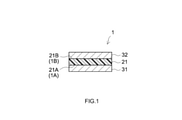
- FIG. 1 shows a configuration example of a double-sided adhesive type base material-less adhesive sheet (base material-less double-sided adhesive sheet).
- both sides 21A and 21B of the pressure-sensitive adhesive layer 21 without a base material (which are also the pressure-sensitive adhesive surfaces 1A and 1B of the pressure-sensitive adhesive sheet 1 respectively) have at least the pressure-sensitive adhesive layer side as a peeling surface. It has a structure protected by the release liners 31 and 32, respectively.
- the adhesive sheet has a structure in which one surface (adhesive surface, first adhesive surface) of the adhesive layer without a base material is protected by a release liner having both sides as release surfaces, and the adhesive sheet is wound.
- the other surface (adhesive surface, second adhesive surface) of the adhesive layer comes into contact with the back surface of the release liner, so that the second adhesive surface of the adhesive layer is also protected by the release liner. You may be able to do it.
- the technique disclosed herein can be preferably carried out in such a substrate-less form from the viewpoint of reducing the thickness of the pressure-sensitive adhesive sheet.
- the base material-less pressure-sensitive adhesive sheet is also advantageous in that it is easy to form a thin layer and can maximize the pressure-sensitive adhesive properties such as adhesive strength and impact resistance.
- the pressure-sensitive adhesive layer 21 contains at least two kinds of colorants, and the light transmittance is limited to 30% or less.
- the pressure-sensitive adhesive layer constituting the pressure-sensitive adhesive sheet disclosed herein has a light transmittance of 30% or less.
- the pressure-sensitive adhesive sheet having such a pressure-sensitive adhesive layer can have a light-shielding property suitable for preventing light leakage. Further, it is suitable for concealing the adherend and adjusting the appearance of the adherend through the adhesive sheet (for example, suppressing uneven appearance), and can impart designability.
- the light transmittance of the pressure-sensitive adhesive layer is preferably 28% or less, more preferably 25% or less, still more preferably 20% or less, and may be 18% or less, and in some preferred embodiments, the pressure-sensitive adhesive layer.
- the light transmittance of is less than 12%, may be less than 10%, may be less than 8.0%, may be less than 6.0%, may be less than 4.0%, may be less than 3.0%. good.
- the lower limit of the light transmittance is not particularly limited, and may be substantially 0%, that is, may be equal to or less than the detection limit, and may be 0.05% or more from the viewpoint of compatibility with the light reflectance described later. , 0.1% or more, 1.0% or more, 2.0% or more, 5.0% or more.
- the light transmittance of the pressure-sensitive adhesive layer is 8.0% or more, and may be 12% or more (for example, 15% or more).
- a pressure-sensitive adhesive layer having moderate light transmission is preferable from the viewpoint of maintaining the pressure-sensitive properties and productivity.
- the light transmittance of the pressure-sensitive adhesive layer can be measured by the method described in Examples described later.
- the light transmittance of the pressure-sensitive adhesive layer can be adjusted by adjusting the pressure-sensitive adhesive-containing component (for example, the type and amount of a colorant (preferably a black colorant)), the thickness of the pressure-sensitive adhesive layer, and the like.
- the light reflectance of the pressure-sensitive adhesive layer is 8.0% or more.
- the pressure-sensitive adhesive layer having a limited light transmittance as described above has a limited amount of light input, but even in such a pressure-sensitive adhesive layer, the light that has entered the pressure-sensitive adhesive is refracted and scattered in the pressure-sensitive adhesive. Therefore, it may be difficult to realize more accurate optical control.
- the light transmittance on the surface of the pressure-sensitive adhesive layer is set to 8% or more to reflect light on the pressure-sensitive adhesive surface and reduce the light entering the pressure-sensitive adhesive. It is possible to achieve both light-shielding and dimming properties and high-precision optical control.
- the light reflectance of the pressure-sensitive adhesive layer is preferably 9.0% or more, more preferably 10% or more, still more preferably 12% or more, and may be 14% or more (for example, 16% or more). Since the upper limit of the light reflectance is set in an appropriate range in relation to the light transmittance, it is not limited to a specific range, for example, it is less than 40%, may be 30% or less, and may be 20%. It may be less than or equal to (for example, 15% or less).
- the light reflectance of the pressure-sensitive adhesive layer can be measured by the method described in Examples described later.
- the light reflectance of the pressure-sensitive adhesive layer can be adjusted by the pressure-sensitive adhesive-containing component (for example, the type and amount of a colorant (preferably a metal oxide)).
- each adhesive layer surface (each adhesive surface; the first adhesive surface and the second adhesive surface) may be the same or different.
- one pressure-sensitive adhesive layer surface (for example, the first pressure-sensitive adhesive surface) may have the above-mentioned light reflectance, and the other.
- the light reflectance of the surface of the pressure-sensitive adhesive layer (for example, the second pressure-sensitive adhesive surface) may be less than 8%.
- the relative relationship between the light transmittance and the light reflectance of the pressure-sensitive adhesive layer is not particularly limited, and is appropriately set so as to have a better balance between the reduction of light transmittance and the reduction of the amount of light entering the pressure-sensitive adhesive layer.
- the ratio (R / T) of the light reflectance R to the light transmittance T of the pressure-sensitive adhesive layer is preferably 0.4 or more, preferably 0.5 or more, more preferably 1.0 or more. It is more preferably 2.0 or more, and particularly preferably 4.0 or more (for example, 4.5 or more).
- the upper limit of the ratio (R / T) is about 10 or less, and may be, for example, 5 or less. In an embodiment in which the pressure-sensitive adhesive layer is required to have a certain degree of light transmission, the ratio (R / T) may be less than 3, may be less than 2, or may be less than 1.
- the type of the pressure-sensitive adhesive constituting the pressure-sensitive adhesive layer is not particularly limited.
- the pressure-sensitive adhesives include acrylic polymers, rubber-based polymers (natural rubber, synthetic rubber, mixtures thereof, etc.), polyester-based polymers, urethane-based polymers, polyether polymers, silicone-based polymers, which can be used in the field of pressure-sensitive adhesives.
- One or more of various rubber-like polymers such as polyamide-based polymers and fluoropolymers may be contained as an adhesive polymer (hereinafter, also referred to as "base polymer” in the sense of a structural polymer forming an adhesive). ..
- a pressure-sensitive adhesive containing an acrylic polymer or a rubber-based polymer as a base polymer can be preferably adopted.
- a pressure-sensitive adhesive (acrylic pressure-sensitive adhesive) using an acrylic polymer as a base polymer is preferable.
- the technique disclosed herein is preferably carried out in an embodiment using an acrylic pressure-sensitive adhesive.
- the pressure-sensitive adhesive layer composed of the acrylic pressure-sensitive adhesive that is, the pressure-sensitive adhesive sheet having the acrylic-based pressure-sensitive adhesive layer will be mainly described, but the pressure-sensitive adhesive layer of the pressure-sensitive adhesive sheet disclosed herein is composed of the acrylic pressure-sensitive adhesive. It is not intended to be limited to acrylic.
- the “base polymer” of the pressure-sensitive adhesive refers to the main component of the rubber-like polymer contained in the pressure-sensitive adhesive, and is not interpreted in a limited manner other than this.
- the rubber-like polymer refers to a polymer that exhibits rubber elasticity in a temperature range near room temperature.
- the “main component” refers to a component contained in an amount of more than 50% by weight, unless otherwise specified.
- the "acrylic polymer” refers to a polymer containing a monomer unit derived from a monomer having at least one (meth) acryloyl group in one molecule as a monomer unit constituting the polymer.
- a monomer having at least one (meth) acryloyl group in one molecule is also referred to as an “acrylic monomer”. Therefore, the acrylic polymer in this specification is defined as a polymer containing a monomer unit derived from an acrylic monomer.
- a typical example of the acrylic polymer is an acrylic polymer in which the proportion of the acrylic monomer in the total monomer components used in the synthesis of the acrylic polymer is more than 50% by weight.
- “(meth) acryloyl” means acryloyl and methacryloyl comprehensively.
- “(meth) acrylate” means acrylate and methacrylate
- “(meth) acrylic” means acrylic and methacrylic, respectively.
- acrylic polymer As the acrylic polymer in the technique disclosed herein, for example, a polymer of a monomer raw material containing an alkyl (meth) acrylate as a main monomer and further containing a submonomer having copolymerizability with the main monomer is preferable.
- the main monomer means a component that occupies more than 50% by weight of the monomer composition in the above-mentioned monomer raw material.
- alkyl (meth) acrylate for example, a compound represented by the following formula (1) can be preferably used.
- CH 2 C (R 1 ) COOR 2 (1)
- R 1 in the above formula (1) is a hydrogen atom or a methyl group.
- R 2 is a chain alkyl group having 1 to 20 carbon atoms.
- such a range of the number of carbon atoms may be expressed as "C 1-20 ".
- the main monomer is an alkyl (meth) acrylate in which R 2 is a chain alkyl group of C 1-14 (for example, C 1-10 , typically C 4-8 ). It is appropriate to do.
- the main monomer is an alkyl acrylate in which R 1 is a hydrogen atom and R 2 is a chain alkyl group of C 4-8 (hereinafter, also simply referred to as C 4-8 alkyl acrylate). Is preferable.
- alkyl (meth) acrylate in which R 2 is a C 1-20 chain alkyl group are not particularly limited, but are, for example, methyl (meth) acrylate, ethyl (meth) acrylate, propyl (meth) acrylate, and isopropyl.
- Nonadecil (meth) acrylate Nonadecil (meth) acrylate, Eikosyl (meth) acrylate and the like.
- alkyl (meth) acrylates can be used alone or in combination of two or more.
- Preferable examples of alkyl (meth) acrylates include n-butyl acrylate (BA) and 2-ethylhexyl acrylate (2EHA).
- the proportion of alkyl (meth) acrylate in the monomer component constituting the acrylic polymer is typically more than 50% by weight, for example, 70% by weight or more, 85% by weight or more, and 90% by weight. It may be% by weight or more.
- the upper limit of the proportion of the alkyl (meth) acrylate is not particularly limited, but is preferably 99.5% by weight or less (for example, 99% by weight or less), or characteristics based on an accessory monomer such as a carboxy group-containing monomer (for example, agglomeration). From the viewpoint of preferably exerting force), it may be 98% by weight or less (for example, less than 97% by weight).
- the acrylic polymer may be substantially obtained by polymerizing only an alkyl (meth) acrylate.
- the proportion of C 4-8 alkyl acrylate in the alkyl (meth) acrylate contained in the monomer component is preferably 70% by weight or more. More preferably, it is 90% by weight or more.
- the acrylic polymer in the technique disclosed herein may be copolymerized with a submonomer.
- a carboxy group-containing monomer, a hydroxyl group (OH group) -containing monomer, an acid anhydride group-containing monomer, and an amide group are contained as auxiliary monomers that can introduce a functional group that can serve as a cross-linking base point into an acrylic polymer or contribute to the improvement of adhesive strength.
- auxiliary monomers include a monomer, an amino group-containing monomer, an epoxy group-containing monomer, a cyano group-containing monomer, a keto group-containing monomer, a monomer having a nitrogen atom-containing ring, an alkoxysilyl group-containing monomer, and an imide group-containing monomer.
- the submonomer one type may be used alone or two or more types may be used in combination.
- an acrylic polymer obtained by copolymerizing a carboxy group-containing monomer as the submonomer can be mentioned.
- the carboxy group-containing monomer include acrylic acid (AA), methacrylic acid (MAA), carboxyethyl (meth) acrylate, carboxypentyl (meth) acrylate, itaconic acid, maleic acid, fumaric acid, crotonic acid, and isocrotonic acid. Will be done. Of these, AA and MAA are preferable.
- an acrylic polymer obtained by copolymerizing a hydroxyl group-containing monomer as the submonomer can be mentioned.
- hydroxyl group-containing monomers include 2-hydroxyethyl (meth) acrylate, 2-hydroxypropyl (meth) acrylate, 3-hydroxypropyl (meth) acrylate, 2-hydroxybutyl (meth) acrylate, and 4-hydroxybutyl (meth).
- Hydroxyalkyl (meth) acrylates such as acrylates; polypropylene glycol mono (meth) acrylates; N-hydroxyethyl (meth) acrylamides and the like.
- preferred examples of the hydroxyl group-containing monomer include hydroxyalkyl (meth) acrylates in which the alkyl group is linear with 2 to 4 carbon atoms.
- the content of the functional group-containing monomer in the monomer component is not particularly limited.
- the content of the functional group-containing monomer in the monomer component can be, for example, 0.1% by weight or more, and 0.5% by weight or more. Is appropriate, and may be 1% by weight or more.
- the content of the functional group-containing monomer in the monomer component is 40% by weight or less, and 20% by weight or less. Is preferable, and it may be 10% by weight or less (for example, 5% by weight or less).
- the monomer component constituting the base polymer may contain a carboxy group-containing monomer.
- the monomer component contains a carboxy group-containing monomer, it becomes easy to obtain a pressure-sensitive adhesive sheet exhibiting good adhesive properties (cohesive force, etc.).
- it may be advantageous to improve the adhesion between the pressure-sensitive adhesive layer and the adherend.
- by copolymerizing an appropriate amount of a carboxy group-containing monomer even when a black colorant such as carbon black is blended in the pressure-sensitive adhesive, the colorant can be easily dispersed in the layer and the pressure-sensitive adhesive property can be improved. It can be preferably maintained.
- the content of the carboxy group-containing monomer in the monomer component constituting the base polymer is not particularly limited, and is, for example, 0.2% by weight or more of the monomer component. It can be (typically 0.5% by weight or more), 1% by weight or more is appropriate, and 2% by weight or more may be used, or 3% by weight or more may be used. A higher effect is exhibited by setting the content of the carboxy group-containing monomer to more than 3% by weight. In some embodiments, the content of the carboxy group-containing monomer can be 3.2% by weight or more of the monomer component, 3.5% by weight or more, or 4% by weight or more.
- the upper limit of the content of the carboxy group-containing monomer is not particularly limited, and may be, for example, 15% by weight or less, 12% by weight or less, or 10% by weight or less.
- the techniques disclosed herein have a carboxy group-containing monomer content of 7% by weight or less of the monomer component (typically less than 7% by weight, such as 6.8% by weight or less, or 6.0% by weight or less). It can also be preferably carried out in certain embodiments.
- the monomer component constituting the acrylic polymer may contain a copolymerization component other than the above-mentioned submonomer for the purpose of improving the cohesive force and the like.
- copolymerization components include vinyl ester-based monomers such as vinyl acetate, vinyl propionate, vinyl laurate; aromatic vinyl compounds such as styrene, substituted styrene ( ⁇ -methylstyrene, etc.), vinyl toluene; cyclohexyl (cyclohexyl).
- Cycloalkyl (meth) acrylates such as meta) acrylates, cyclopentyl (meth) acrylates, isobornyl (meth) acrylates; aryl (meth) acrylates (eg phenyl (meth) acrylates), aryloxyalkyl (meth) acrylates (eg phenoxyethyl (eg phenoxyethyl) Aromatic ring-containing (meth) acrylates such as meth) acrylates) and arylalkyl (meth) acrylates (eg, benzyl (meth) acrylates); olefinic monomers such as ethylene, propylene, isoprene, butadiene, and isobutylene; vinyl chloride, chloride.
- Chlorine-containing monomers such as vinylidene; isocyanate group-containing monomers such as 2- (meth) acryloyloxyethyl isocyanate; alkoxy group-containing monomers such as methoxyethyl (meth) acrylate and ethoxyethyl (meth) acrylate; Vinyl ether-based monomer; 2 or more (for example, 3 or more) polymerizable functional groups (for example, (meth) acryloyl group) in one molecule such as 1,6-hexanediol di (meth) acrylate and trimethyl propantri (meth) acrylate. ), And the like.
- the amount of the other copolymerization component may be appropriately selected depending on the purpose and application, and is not particularly limited, but is appropriately set to 0.05% by weight or more from the viewpoint of appropriately exerting the effect of use. , 0.5% by weight or more may be used. Further, from the viewpoint of facilitating the balance of adhesive performance, it is appropriate that the content of the other copolymerization component in the monomer component is 20% by weight or less, and 10% by weight or less (for example, 5% by weight or less). May be good.
- the technique disclosed herein may also be preferably carried out in an embodiment in which the monomer component is substantially free of other copolymerization components.
- the fact that the monomer component does not substantially contain other copolymerization components means that the other copolymerization components are not used at least intentionally, and the other copolymerization components are, for example, 0.01% by weight or less. To some extent, unintentional inclusion is acceptable.
- the copolymerization composition of the acrylic polymer is designed so that the glass transition temperature (Tg) of the polymer is about ⁇ 15 ° C. or lower (for example, about ⁇ 70 ° C. or higher and ⁇ 15 ° C. or lower).
- Tg of the acrylic polymer means the Tg obtained by the Fox formula based on the composition of the monomer component used for the synthesis of the polymer.
- the Fox formula is a relational formula between the Tg of the copolymer and the glass transition temperature Tgi of the homopolymer obtained by homopolymerizing each of the monomers constituting the copolymer.
- Tg is the glass transition temperature (unit: K) of the copolymer
- Wi is the weight fraction of the monomer i in the copolymer (copolymerization ratio based on the weight)
- Tgi is the monomer i. Represents the glass transition temperature (unit: K) of the homopolymer.
- the glass transition temperature of the homopolymer used for calculating Tg As the glass transition temperature of the homopolymer used for calculating Tg, the numerical values described in publicly known materials, specifically, "Polymer Handbook” (3rd edition, John Wiley & Sons, Inc., 1989) shall be used. .. For monomers for which multiple types of values are described in this document, the highest value is adopted. If it is not described in the Polymer Handbook, the value obtained by the measurement method described in JP-A-2007-51271 shall be used.
- the Tg of the acrylic polymer is about ⁇ 25 ° C. or lower, preferably about ⁇ 35 ° C. or lower, from the viewpoint of impact resistance and adhesion to the adherend. , More preferably about ⁇ 40 ° C. or lower.
- the Tg of the acrylic polymer is, for example, about ⁇ 70 ° C. or higher, may be about ⁇ 65 ° C. or higher, may be about ⁇ 60 ° C. or higher, or may be about ⁇ 55 ° C. or higher. good.
- the technique disclosed herein can be preferably carried out in an embodiment in which the Tg of the acrylic polymer is approximately ⁇ 65 ° C.
- the Tg of the acrylic polymer can be adjusted by appropriately changing the monomer composition (that is, the type and amount ratio of the monomers used in the synthesis of the polymer).
- the method for obtaining the acrylic polymer is not particularly limited, and various polymerization methods known as synthetic methods for the acrylic polymer, such as a solution polymerization method, an emulsion polymerization method, a bulk polymerization method, a suspension polymerization method, and a photopolymerization method. Can be adopted as appropriate.
- a solution polymerization method can be preferably adopted.
- the polymerization temperature at the time of solution polymerization can be appropriately selected depending on the type of the monomer and solvent used, the type of the polymerization initiator and the like, and is, for example, about 20 ° C. to 170 ° C. (typically 40 ° C. to 140 ° C.). °C).
- the solvent (polymerization solvent) used for solution polymerization can be appropriately selected from conventionally known organic solvents (toluene, ethyl acetate, etc.).
- the initiator used for the polymerization may be an azo-based polymerization initiator such as a conventionally known polymerization initiator (for example, 2,2'-azobisisobutyronitrile (AIBN)) or a peroxide-based initiator, depending on the type of the polymerization method. It can be appropriately selected from the initiator, etc.).
- the amount of the polymerization initiator used may be a normal amount, for example, about 0.005 to 1 part by weight (typically about 0.01 to 1 part by weight) with respect to 100 parts by weight of the monomer component. ) Can be selected.
- the weight average molecular weight (Mw) of the base polymer (preferably an acrylic polymer) in the technique disclosed herein is not particularly limited and may be, for example, in the range of approximately 10 ⁇ 10 4 to 500 ⁇ 10 4 .
- the Mw of the base polymer is approximately 30 ⁇ 10 4 to 200 ⁇ 10 4 (more preferably approximately 45 ⁇ 10 4 to 150 ⁇ 10 4 , typically approximately 65 ⁇ 10 4 to 130 ⁇ 10). It is preferably in the range of 4 ).
- Mw means a value in terms of standard polystyrene obtained by GPC (gel permeation chromatography).
- GPC gel permeation chromatography
- a model name “HLC-8320GPC” column: TSKgelGMH-H (S), manufactured by Tosoh Corporation
- the pressure-sensitive adhesive layer disclosed herein contains at least two types of colorants (first colorant and second colorant). By using two or more kinds of colorants, a pressure-sensitive adhesive layer satisfying a light transmittance of 30% or less and a light reflectance of 8% or more can be preferably realized.
- the colorant various materials that can be attenuated by absorbing light traveling in the pressure-sensitive adhesive layer and various materials that can reduce the amount of light entering the pressure-sensitive adhesive layer can be used.
- the colorant can be, for example, a colorant such as black, gray, white, red, blue, yellow, green, yellowish green, orange, purple, gold, silver, or pearl.
- the colorant can be typically contained in the pressure-sensitive adhesive layer in a dispersed state (may be in a dissolved state) in the constituent material of the pressure-sensitive adhesive layer.
- Conventionally known pigments and dyes can be used as the colorant.
- the pigment include inorganic pigments and organic pigments.
- the first colorant contained in the pressure-sensitive adhesive layer is not particularly limited, but is, for example, a component capable of absorbing and attenuating light traveling in the pressure-sensitive adhesive layer, and the colorant is contained in the pressure-sensitive adhesive layer. By doing so, it can be a component that reduces the light transmittance of the pressure-sensitive adhesive layer (hence, also referred to as a “light transmittance reducing component”). As such a first colorant, a black colorant can be preferably used because the light-shielding property can be efficiently adjusted with a small amount of the colorant.
- the black colorant examples include carbon black, graphite, aniline black, perylene black, cyanine black, titanium black, inorganic pigment hematite, activated carbon, molybdenum disulfide, chromium complex, anthraquinone colorant and the like.
- the black colorant one kind may be used alone or two or more kinds may be used in combination as appropriate.
- the pressure-sensitive adhesive layer contains carbon black particles as the first colorant.
- carbon black particles those generally called carbon black (furness black, channel black, acetylene black, thermal black, lamp black, pine smoke, etc.) can be used without particular limitation.
- carbon black particles it is also possible to use surface-modified carbon black particles having a functional group such as a carboxyl group, an amino group, a sulfonic acid group and a silicon-containing group (for example, an alkoxysilyl group and an alkylsilyl group).
- Such surface-modified carbon black particles are also referred to as self-dispersion type carbon black, and the addition of a dispersant becomes unnecessary or the addition amount thereof can be reduced.
- the carbon black particles may be used alone or in combination of two or more.
- a particulate colorant (pigment) can be preferably used.
- a colorant having an average particle size of about 10 nm or more for example, about 30 nm or more
- a particulate black colorant such as carbon black
- the average particle size is, for example, about 50 nm or more, may be about 100 nm or more, or may be about 150 nm or more.
- the upper limit of the average particle size of the colorant is not particularly limited, and may be, for example, about 3000 nm or less, and may be about 1000 nm or less.
- the average particle size of the colorant is preferably about 500 nm or less, preferably about 300 nm or less, more preferably about 250 nm or less, still more preferably 200 nm or less (for example, about 120 nm or less, further. Approximately 100 nm or less).
- the average particle size of the colorant in the present specification refers to a volume average particle size, and specifically, an integrated value of 50% in the particle size distribution measured by a particle size distribution measuring device based on a laser scattering / diffraction method. (50% volume average particle size; hereinafter, it may be abbreviated as D50 ).
- a particle size distribution measuring device for example, the product name “Microtrack MT3000II” manufactured by Microtrack Bell Co., Ltd. or an equivalent product thereof can be used.
- the form of addition of the colorant (preferably a black colorant such as carbon black particles) to the pressure-sensitive adhesive composition is not particularly limited.
- a colorant such as carbon black particles can be added to the pressure-sensitive adhesive composition in the form of a dispersion liquid in which the particles are dispersed in a dispersion medium.
- the dispersion medium constituting the dispersion is not particularly limited, and water (ion exchange water, back-penetration water, distilled water, etc.) and various organic solvents (alcohols such as ethanol; ketones such as acetone; butyl cellosolve, propylene glycol monomethyl) are not particularly limited.
- the dispersion liquid may contain the above-mentioned dispersant.
- the pressure-sensitive adhesive composition may contain a colorant (preferably a black colorant such as carbon black particles), and may also contain a dispersant.
- the content of the first colorant (preferably a black colorant such as carbon black particles) is appropriately set in consideration of the light-shielding property to be achieved, the dimming property, the required adhesive property, etc., and is specific. Not limited to range.
- the content of the first colorant may also differ depending on the type of pressure-sensitive adhesive, the shape and particle size of the first colorant, compatibility with the pressure-sensitive adhesive, and the like.
- the content of the first colorant in the pressure-sensitive adhesive layer is preferably about 0.01% by weight or more (for example, 0.05% by weight or more), and is preferably about 0.1% by weight from the viewpoint of light-shielding property.
- the content of the first colorant can be about 10% by weight or less, about 3% by weight or less is appropriate, and is not more than a predetermined value. From the viewpoint of achieving both a light transmittance and a light reflectance of a predetermined value or more, it is preferably about 2% by weight or less (typically less than 2% by weight), more preferably about 1% by weight or less, and further preferably.
- the second colorant contained in the pressure-sensitive adhesive layer is not particularly limited, but is, for example, a component capable of reducing the amount of light entering the pressure-sensitive adhesive layer, and the second colorant is contained in the pressure-sensitive adhesive layer. By doing so, it can be a component that enhances the light reflectance of the pressure-sensitive adhesive layer (hence, also referred to as a “light reflectance improving component”).
- a second colorant can be one or more selected from inorganic materials (eg metals, metal compounds), organic materials, organic-inorganic complexes.
- the second colorant examples include titanium oxide (titanium dioxide such as rutyl-type titanium dioxide and anatase-type titanium dioxide), zinc oxide, cerium oxide, aluminum oxide, silicon oxide, zirconium oxide, magnesium oxide, calcium oxide, and oxidation.
- Metal oxides such as tin, barium oxide, cesium oxide, and ittium oxide
- carbonate compounds such as magnesium carbonate, calcium carbonate (light calcium carbonate, heavy calcium carbonate, etc.), barium carbonate, zinc carbonate, etc .
- aluminum hydroxide, calcium hydroxide Hydroxides such as magnesium hydroxide and zinc hydroxide
- silicate compounds such as aluminum silicate, magnesium silicate and calcium silicate; barium sulfate, calcium sulfate, barium stearate, zinc oxide, zinc sulfide, talc, clay, kaolin, phosphoric acid.
- Inorganic materials such as titanium, mica, gypsum, white carbon, diatomaceous soil, bentonite, lithopon, zeolite, sericite, hydrohaloicite, etc., acrylic resin, polystyrene resin, polyurethane resin, amide resin, polycarbonate resin, etc.
- organic materials such as silicone-based resins, urea-formalin-based resins, and melamine-based resins. These can be what are referred to as white colorants.
- the second colorant may be used alone or in combination of two or more.
- the second colorant does not contain carbon black particles and can be defined as a colorant different from the carbon black particles. Typically, the second colorant does not include a light-absorbing black colorant.
- the pressure-sensitive adhesive layer comprises a metal oxide as a second colorant.
- the first colorant preferably a black colorant
- the metal oxide a material capable of achieving a desired light reflectance can be selected from the above-mentioned materials.
- Preferable examples include titanium oxide, zinc oxide, cerium oxide, aluminum oxide, silicon oxide, zirconium oxide, magnesium oxide and calcium oxide, among which titanium oxide, silicon oxide and zirconium oxide are preferable, and titanium oxide is particularly preferable. preferable.
- the metal oxide may be used alone or in combination of two or more.
- the average particle size of the second colorant is not particularly limited. Depending on the thickness of the pressure-sensitive adhesive layer, the type of pressure-sensitive adhesive, and the like, particles having an appropriate size that can achieve a desired improvement in light reflectance can be used.
- the average particle size of the second colorant can be, for example, about 1 nm or more, and about 5 nm or more is appropriate. From the viewpoint of the effect of containing the second colorant (for example, improvement of light reflectance), compatibility, handleability, etc., the average particle size of the second colorant is preferably about 10 nm or more, and may be about 20 nm or more. , It may be about 30 nm or more.
- the upper limit of the average particle size is preferably, for example, about 300 nm or less from the viewpoint of maintaining the adhesive properties, and is preferably less than 100 nm (for example, from the viewpoint of improving the light reflectance) containing the second colorant. 90 nm or less), more preferably about 70 nm or less, about 50 nm or less, or about 35 nm or less (for example, about 25 nm or less).
- the content of the second colorant (preferably a metal oxide) in the pressure-sensitive adhesive layer is appropriate in consideration of the effect of the second colorant-containing agent (for example, improvement of light reflectance) and the required pressure-sensitive adhesive properties. Is set to, and is not limited to a specific range.
- the content of the second colorant may also differ depending on the type of pressure-sensitive adhesive, the shape and particle size of the second colorant, compatibility with the pressure-sensitive adhesive, and the like.
- the content of the second colorant in the pressure-sensitive adhesive layer is preferably about 1% by weight or more, preferably about 2% by weight, from the viewpoint of effectively obtaining the effect of containing the second colorant (for example, improving the light reflectance).
- the content of the second colorant in the pressure-sensitive adhesive layer is approximately 20% by weight or less (for example, less than 20% by weight) from the viewpoint of compatibility with the pressure-sensitive adhesive component and maintenance of pressure-sensitive adhesive properties such as adhesive strength and impact resistance. It is suitable that it is about 10% by weight or less, preferably about 6% by weight or less, and may be about 5% by weight or less.
- the ratio of the amount C1 of the first colorant and the amount C2 of the second colorant is appropriately set so as to achieve both the desired light transmittance and the light reflectance, and is not limited to a specific range.
- the weight ratio (C1 / C2) of the amount C1 of the first colorant (preferably a black colorant) to the amount C2 of the second colorant (preferably a metal oxide) is 0.001. It may be 0.005 or more, 0.01 or more, 0.05 or more, 0.08 or more, and 0.10 or more (for example, 0.12 or more). The larger the weight ratio (C1 / C2), the more preferably the effect of adding the first colorant is exhibited.
- the weight ratio (C1 / C2) is 0.50 or less, may be 0.40 or less (for example, 0.35 or less), and is preferably 0.30 or less. It may be 0.20 or less, 0.15 or less, 0.12 or less, 0.09 or less, 0.06 or less (for example, 0.03 or less). The smaller the weight ratio (C1 / C2), the more preferably the effect of adding the second colorant is exhibited. In the embodiment in which the second colorant is a metal oxide, the light reflectance of the pressure-sensitive adhesive layer tends to be improved.
- the content of the black colorant and the colorant other than the metal oxide is not particularly limited.
- it can be less than 30% by weight, preferably less than 10% by weight, for example, less than 5.0% by weight, less than 3.0% by weight (for example, less than 2.0% by weight, and even 1). It can be less than% by weight).
- the technique disclosed herein can be carried out in an embodiment comprising a pressure-sensitive adhesive layer that is substantially free of colorants other than black colorants and metal oxides.
- substantially not contained means that it is not intentionally added, and for example, the content in the pressure-sensitive adhesive layer is 0.3% by weight or less (for example, 0.1% by weight or less, Typically 0.01% by weight or less).
- a material (particulate colorant) exemplified as the above-mentioned colorant can be surface-treated with a surface treatment agent.
- the surface treatment is not limited to a specific treatment because an appropriate treatment can be selected depending on the type of core particles, the type of dispersion medium, and the like.
- the pressure-sensitive adhesive composition disclosed herein may contain a component that contributes to improving the dispersibility of the colorant.
- the dispersibility-enhancing component may be, for example, a polymer, an oligomer, a liquid resin, a surfactant (anionic, cationic, nonionic, amphoteric surfactant) or the like.
- a surfactant anionic, cationic, nonionic, amphoteric surfactant
- the dispersibility improving component is preferably dissolved in the pressure-sensitive adhesive composition.
- the oligomer is, for example, a low molecular weight polymer of a monomer component containing one or more of the acrylic monomers as exemplified above (for example, Mw is less than about 10 ⁇ 10 4 , preferably less than 5 ⁇ 10 4 ).
- the liquid resin is, for example, a tackifier resin having a softening point of about 50 ° C. or lower, more preferably about 40 ° C. or lower (typically, a tackifier resin such as a rosin-based, terpene-based, or hydrocarbon-based resin, for example, hydrogenated rosin. It can be a methyl ester, etc.).
- a dispersibility improving component it is possible to suppress uneven dispersion of the colorant (for example, a particulate black colorant such as carbon black), and eventually to suppress color unevenness of the pressure-sensitive adhesive layer. Therefore, it is possible to form a pressure-sensitive adhesive layer having better appearance quality.
- the colorant for example, a particulate black colorant such as carbon black
- the form of addition of the dispersibility improving component is not particularly limited, and may be contained in a liquid containing a colorant (for example, a black colorant such as carbon black particles) before being blended in the pressure-sensitive adhesive composition, or the pressure-sensitive adhesive composition. It may be supplied into the product at the same timing as the colorant or before or after the addition of the colorant.
- a colorant for example, a black colorant such as carbon black particles
- the content of the dispersibility improving component is not particularly limited, and from the viewpoint of suppressing the influence on the adhesive properties (for example, the decrease in cohesiveness), about 20% by weight or less (preferably about 10% by weight or less) of the entire pressure-sensitive adhesive layer, and more. It is preferably 7% by weight or less, for example, about 5% by weight or less).
- the content of the dispersibility improving component can be about 10 times or less (preferably about 5 times or less, for example about 3 times or less) the weight of the colorant.
- the content thereof is about 0.2% by weight or more (typically about 0.5% by weight or more, preferably about 1) of the entire pressure-sensitive adhesive layer. Weight% or more) is appropriate.
- the content of the dispersibility improving component can be approximately 0.2 times or more (preferably approximately 0.5 times or more, for example 1 time or more) the weight of the colorant.
- the content (total amount, total content) of at least two kinds of colorants contained in the pressure-sensitive adhesive layer has both the desired light transmittance and the light reflectance, and also takes into consideration the required pressure-sensitive adhesive properties and the like. Properly set and not limited to a specific range.
- the total amount of the colorant in the pressure-sensitive adhesive layer is preferably about 1% by weight or more, preferably about 2% by weight or more, more preferably about 3% by weight or more, still more preferably about 4% by weight or more, and about 5% by weight. It may be% by weight or more.
- the total amount of the colorant in the pressure-sensitive adhesive layer can be approximately 30% by weight or less from the viewpoint of compatibility with the pressure-sensitive adhesive component and maintenance of adhesive properties such as adhesive strength and impact resistance, and is approximately 10% by weight.
- the following is appropriate, preferably about 6% by weight or less, and may be about 5% by weight or less.
- the pressure-sensitive adhesive layer in the technique disclosed herein may contain a pressure-sensitive adhesive resin. This makes it possible to increase the peel strength of the adhesive sheet.
- the pressure-sensitive adhesive resin include phenol-based pressure-sensitive adhesive resin, terpene-based pressure-sensitive adhesive resin, modified terpen-based pressure-sensitive adhesive resin, rosin-based pressure-sensitive adhesive resin, hydrocarbon-based pressure-sensitive adhesive resin, epoxy-based pressure-sensitive adhesive resin, and polyamide-based pressure-sensitive adhesive resin.
- One or more selected from various known pressure-sensitive adhesives such as an elastomer-based pressure-sensitive adhesive resin and a ketone-based pressure-sensitive adhesive resin can be used.
- a phenol-based tackifier resin, a terpene-based tackifier resin, and a modified terpene-based tackifier resin are preferable, and a phenol-based tackifier resin (preferably a terpene phenol resin) is more preferable.
- phenol-based tackifier resins include terpene phenolic resins, hydrogenated terpenephenolic resins, alkylphenolic resins and rosinphenolic resins.
- the terpene phenol resin refers to a polymer containing a terpene residue and a phenol residue, and is a copolymer of terpene and a phenol compound (terpene-phenol formaldehyde resin) and a homopolymer or copolymer of terpene. It is a concept that includes both phenol-modified ones (phenol-modified terpene resin).
- terpenes constituting such a terpene phenolic resin are monoterpenes such as ⁇ -pinene, ⁇ -pinene, and limonene (including d-form, l-form, and d / l-form (dipentene)).
- the hydrogenated terpene phenol resin refers to a hydrogenated terpene phenol resin having a structure obtained by hydrogenating such a terpene phenol resin. It is also called hydrogenated terpene phenolic resin.
- the alkylphenol resin is a resin (oil-based phenol resin) obtained from alkylphenol and formaldehyde. Examples of the alkylphenol resin include novolak type and resol type.
- the rosin phenolic resin is typically a phenolic variant of rosins or the various rosin derivatives described above (including rosin esters, unsaturated fatty acid modified rosins and unsaturated fatty acid modified rosin esters).
- the rosin phenol resin include a rosin phenol resin obtained by adding phenol to rosins or the above-mentioned various rosin derivatives with an acid catalyst and thermally polymerizing the resin.
- terpene-based tackifier resins include polymers of terpenes (typically monoterpenes) such as ⁇ -pinene, ⁇ -pinene, d-limonene, l-limonene, and dipentene. It may be a homopolymer of one kind of terpenes or a copolymer of two or more kinds of terpenes. Examples of the homopolymer of one kind of terpenes include ⁇ -pinene polymer, ⁇ -pinene polymer, dipentene polymer and the like.
- the modified terpene resin include modified terpene resins. Specific examples thereof include styrene-modified terpene resin and hydrogenated terpene resin.
- the softening point of the tackifying resin is not particularly limited. From the viewpoint of improving the cohesive force, in some embodiments, a tackifier resin having a softening point (softening temperature) of about 80 ° C. or higher (preferably about 100 ° C. or higher, for example, more than 105 ° C.) can be preferably adopted. In the technique disclosed herein, the total amount of the tackifier resin contained in the pressure-sensitive adhesive layer is 100% by weight, and more than 50% by weight (more preferably more than 70% by weight, for example, more than 90% by weight) has the softening point. It can be preferably carried out in the embodiment of the tackifier resin having.
- a phenol-based tackifier resin (terpene phenol resin or the like) having such a softening point can be preferably used.
- the tackifier resin may contain, for example, a terpene phenol resin having a softening point of about 135 ° C. or higher (further, about 140 ° C. or higher).
- the upper limit of the softening point of the tackifying resin is not particularly limited. From the viewpoint of improving the adhesion to the adherend, in some embodiments, a tackifier resin having a softening point of about 200 ° C. or lower (more preferably about 150 ° C. or lower, for example, less than 130 ° C.) can be preferably used.
- the softening point of the tackifier resin can be measured based on the softening point test method (ring ball method) specified in JIS K2207.
- the tackifier resin contains one or more phenol-based tackifier resins (typically terpene phenolic resins).
- the technique disclosed herein can be preferably carried out, for example, in an embodiment in which the total amount of the tackifier resin is 100% by weight, of which about 25% by weight or more (more preferably about 30% by weight or more) is a terpene phenol resin.
- Approximately 50% by weight or more of the total amount of the tackifier resin may be terpene phenol resin, and approximately 80% by weight or more (for example, approximately 90% by weight or more) may be terpene phenol resin.
- Substantially all of the tackifier resin eg, about 95-100% by weight, even about 99-100% by weight) may be terpene phenolic resin.
- the tackifier resin may include a tackifier resin having a hydroxyl value higher than 20 mgKOH / g. Of these, a tackifier resin having a hydroxyl value of 30 mgKOH / g or more is preferable. Hereinafter, a tackifier resin having a hydroxyl value of 30 mgKOH / g or more may be referred to as a “high hydroxyl value resin”. According to the tackifier resin containing such a high hydroxyl value resin, a pressure-sensitive adhesive layer having excellent adhesion to an adherend and high cohesive force can be realized.
- the tackifier resin may contain a high hydroxyl value resin having a hydroxyl value of 50 mgKOH / g or more (more preferably 70 mgKOH / g or more).
- a high hydroxyl value resin having a hydroxyl value of 50 mgKOH / g or more (more preferably 70 mgKOH / g or more).
- the value of the hydroxyl value the value measured by the potentiometric titration method specified in JIS K0070: 1992 can be adopted.
- the high hydroxyl value resin among the various tackifier resins described above, those having a hydroxyl value of a predetermined value or higher can be used.
- the high hydroxyl value resin one type can be used alone or two or more types can be used in combination.
- a phenolic tackifier resin having a hydroxyl value of 30 mgKOH / g or more can be preferably adopted.
- a terpene phenol resin having a hydroxyl value of at least 30 mgKOH / g is used as the tackifier resin.
- the terpene phenol resin is convenient because the hydroxyl value can be arbitrarily controlled by the copolymerization ratio of phenol.
- the upper limit of the hydroxyl value of the high hydroxyl value resin is not particularly limited. From the viewpoint of compatibility with the base polymer and the like, the hydroxyl value of the high hydroxyl value resin is preferably about 200 mgKOH / g or less, preferably about 180 mgKOH / g or less, more preferably about 160 mgKOH / g or less, still more preferably. It is about 140 mgKOH / g or less.
- the technique disclosed herein can be preferably carried out in an embodiment in which the tackifier resin contains a high hydroxyl value resin having a hydroxyl value of 30 to 160 mgKOH / g (for example, a phenol-based tackifier resin, preferably a terpene phenol resin).
- a high hydroxyl value resin having a hydroxyl value of 30 to 80 mgKOH / g (for example, 30 to 65 mgKOH / g) can be preferably adopted. In some other embodiments, a high hydroxyl value resin having a hydroxyl value of 70 to 140 mgKOH / g may be preferably adopted.
- the ratio of the high hydroxyl value resin (for example, terpene phenol resin) to the entire tackifier resin contained in the pressure-sensitive adhesive layer is, for example, about 25% by weight or more. It is preferably about 30% by weight or more, and more preferably about 50% by weight or more (for example, about 80% by weight or more, typically about 90% by weight or more). Substantially all of the tackifier resin (for example, about 95 to 100% by weight, further about 99 to 100% by weight) may be a high hydroxyl value resin.
- the amount of the pressure-sensitive adhesive resin used is not particularly limited, and may be appropriately set in the range of, for example, about 1 to 100 parts by weight with respect to 100 parts by weight of the base polymer. From the viewpoint of preferably exerting the effect of improving the peel strength, it is appropriate that the amount of the tackifier resin used for 100 parts by weight of the base polymer (for example, acrylic polymer) is 5 parts by weight or more, and 10 parts by weight or more. It is preferable that the amount is 15 parts by weight or more.
- the amount of the tackifier resin used for 100 parts by weight of the base polymer is 50 parts by weight or less, and even if it is 40 parts by weight or less. It may be 30 parts by weight or less.
- the pressure-sensitive adhesive composition used to form the pressure-sensitive adhesive layer may contain a cross-linking agent, if necessary.
- the type of the cross-linking agent is not particularly limited, and a conventionally known cross-linking agent can be appropriately selected and used.
- Examples of such a cross-linking agent include an isocyanate-based cross-linking agent, an epoxy-based cross-linking agent, an oxazoline-based cross-linking agent, an aziridine-based cross-linking agent, a melamine-based cross-linking agent, a peroxide-based cross-linking agent, a urea-based cross-linking agent, and a metal alkoxide-based cross-linking agent.
- Examples thereof include a cross-linking agent, a metal chelate-based cross-linking agent, a metal salt-based cross-linking agent, a carbodiimide-based cross-linking agent, a hydrazine-based cross-linking agent, an amine-based cross-linking agent, and a silane coupling agent.
- a cross-linking agent examples thereof include a cross-linking agent, a metal chelate-based cross-linking agent, a metal salt-based cross-linking agent, a carbodiimide-based cross-linking agent, a hydrazine-based cross-linking agent, an amine-based cross-linking agent, and a silane coupling agent.
- isocyanate-based cross-linking agents epoxy-based cross-linking agents, oxazoline-based cross-linking agents, aziridine-based cross-linking agents, and melamine-based cross-linking agents are preferable, isocyanate-based cross-linking
- an isocyanate-based cross-linking agent By using an isocyanate-based cross-linking agent, there is a tendency to obtain better impact resistance than other cross-linking systems while obtaining the cohesive force of the pressure-sensitive adhesive layer. Further, the use of an isocyanate-based cross-linking agent is advantageous in terms of improving the adhesive force to an adherend made of a polyester resin such as PET.
- the cross-linking agent may be used alone or in combination of two or more.
- polyfunctional isocyanate (a compound having an average of two or more isocyanate groups per molecule, including one having an isocyanurate structure) can be preferably used.
- the isocyanate-based cross-linking agent may be used alone or in combination of two or more.
- polyfunctional isocyanates examples include aliphatic polyisocyanates, alicyclic polyisocyanates, aromatic polyisocyanates and the like.
- aliphatic polyisocyanes include 1,2-ethylene diisocyanate; 1,2-tetramethylene diisocyanate, 1,3-tetramethylene diisocyanate, 1,4-tetramethylene diisocyanate and other tetramethylene diisocyanates; 1,2.
- -Hexamethylene diisocyanate such as hexamethylene diisocyanate, 1,3-hexamethylene diisocyanate, 1,4-hexamethylene diisocyanate, 1,5-hexamethylene diisocyanate, 1,6-hexamethylene diisocyanate, 2,5-hexamethylene diisocyanate;
- Examples thereof include 2-methyl-1,5-pentanediisocyanate, 3-methyl-1,5-pentanediisocyanate and lysine diisocyanate.
- alicyclic polyisocyanates include isophorone diisocyanates; 1,2-cyclohexyldiisocyanates, 1,3-cyclohexyldiisocyanates, 1,4-cyclohexyldiisocyanates and other cyclohexyldiisocyanates; 1,2-cyclopentyldiisocyanates, 1,3.
- -Cyclopentyl diisocyanate such as cyclopentyl diisocyanate; hydrogenated xylylene diisocyanate, hydrogenated tolylene diisocyanate, hydrogenated diphenylmethane diisocyanate, hydrogenated tetramethylxylylene diisocyanate, 4,4'-dicyclohexylmethane diisocyanate and the like.
- aromatic polyisocyanates include 2,4-toluene diisocyanate, 2,6-toluene diisocyanate, 4,4'-diphenylmethane diisocyanate, 2,4'-diphenylmethane diisocyanate, and 2,2'-diphenylmethane diisocyanate.
- polyfunctional isocyanate As a preferable polyfunctional isocyanate, a polyfunctional isocyanate having an average of 3 or more isocyanate groups per molecule is exemplified.
- trifunctional or higher functional isocyanates are bifunctional or trifunctional or higher functional isocyanate multimers (typically dimers or trimers), derivatives (eg, polyhydric alcohols and two or more molecules of polyfunctional isocyanates). It can be an addition reaction product), a polymer, or the like.
- diphenylmethane diisocyanate dimer or trimer diphenylmethane diisocyanate dimer or trimer, hexamethylene diisocyanate isocyanurate (isocyanurate structure trimer adduct), reaction product of trimethylolpropane and tolylene diisocyanate, trimethylolpropane and hexa.
- examples thereof include reaction products with methylene diisocyanate, polyfunctional isocyanates such as polymethylene polyphenyl isocyanate, polyether polyisocyanate, and polyester polyisocyanate.
- the amount of the isocyanate-based cross-linking agent used is not particularly limited. For example, it can be approximately 0.5 parts by weight or more with respect to 100 parts by weight of the base polymer. From the viewpoint of achieving both cohesive force and adhesion and impact resistance, the amount of the isocyanate-based cross-linking agent used per 100 parts by weight of the base polymer can be, for example, 1.0 part by weight or more, and 1.5 parts by weight. The above (typically 2.0 parts by weight or more, for example 2.5 parts by weight or more) may be used.
- the amount of the isocyanate-based cross-linking agent used is preferably 10 parts by weight or less with respect to 100 parts by weight of the base polymer, and may be 8 parts by weight or less. 5, 5 parts by weight or less (for example, 3 parts by weight or less) may be used.
- the isocyanate-based cross-linking agent is used in combination with an isocyanate-based cross-linking agent and at least one cross-linking agent having a different type of cross-linking functional group from the isocyanate-based cross-linking agent.
- a cross-linking agent other than the isocyanate-based cross-linking agent that is, a cross-linking agent having a different type of cross-linking reactive group from the isocyanate-based cross-linking agent; hereinafter also referred to as "non-isocyanate-based cross-linking agent").
- the pressure-sensitive adhesive layer in the technique disclosed herein is obtained by using the above-mentioned cross-linking agent in a form after the cross-linking reaction, a form before the cross-linking reaction, a form in which the cross-linking reaction is partially carried out, an intermediate or a composite form thereof, or the like. May contain.
- the cross-linking agent is typically contained in the pressure-sensitive adhesive layer exclusively in the form after the cross-linking reaction.
- non-isocyanate-based cross-linking agent that can be used in combination with the isocyanate-based cross-linking agent is not particularly limited, and can be appropriately selected and used from the above-mentioned cross-linking agents.
- the non-isocyanate cross-linking agent may be used alone or in combination of two or more.
- an epoxy-based cross-linking agent can be adopted as the non-isocyanate-based cross-linking agent.
- an isocyanate-based cross-linking agent and an epoxy-based cross-linking agent in combination it is easy to achieve both cohesiveness and impact resistance.
- the epoxy-based cross-linking agent a compound having two or more epoxy groups in one molecule can be used without particular limitation.
- An epoxy-based cross-linking agent having 3 to 5 epoxy groups in one molecule is preferable.
- the epoxy-based cross-linking agent may be used alone or in combination of two or more.
- epoxy-based cross-linking agent examples include, for example, N, N, N', N'-tetraglycidyl-m-xylenediolamine, 1,3-bis (N, N-diglycidylaminomethyl).
- Cyclohexane, 1,6-hexanediol diglycidyl ether, polyethylene glycol diglycidyl ether, polyglycerol polyglycidyl ether and the like can be mentioned.
- Commercially available epoxy-based cross-linking agents include Mitsubishi Gas Chemical Company's product name "TETRAD-C” and product name "TETRAD-X", DIC Corporation's product name "Epicron CR-5L", and Nagase Chemtex.
- the product name "Denacol EX-512", the product name "TEPIC-G” manufactured by Nissan Chemical Industries, Ltd., and the like can be mentioned.
- the amount of epoxy cross-linking agent used is not particularly limited.
- the amount of the epoxy-based cross-linking agent used should be, for example, more than 0 parts by weight and about 1 part by weight or less (typically about 0.001 to 0.5 parts by weight) with respect to 100 parts by weight of the base polymer. Can be done. From the viewpoint of suitably exhibiting the effect of improving the cohesive force, it is appropriate that the amount of the epoxy-based cross-linking agent used is approximately 0.002 parts by weight or more with respect to 100 parts by weight of the base polymer, and is approximately 0.005 parts by weight. More than parts are preferable, and about 0.008 parts by weight or more are more preferable.
- the amount of the epoxy-based cross-linking agent used is about 0.2 parts by weight or less with respect to 100 parts by weight of the base polymer, and is about 0.1 weight by weight.
- the amount is preferably less than about 0.05 parts by weight, more preferably less than about 0.05 parts by weight, still more preferably less than about 0.03 parts by weight (for example, about 0.025 parts by weight or less). Impact resistance tends to be improved by reducing the amount of the epoxy-based cross-linking agent used.
- the relationship between the content of the isocyanate-based cross-linking agent and the content of the non-isocyanate-based cross-linking agent is not particularly limited.
- the content of the non-isocyanate-based cross-linking agent can be, for example, approximately 1/50 or less of the content of the isocyanate-based cross-linking agent. From the viewpoint of more preferably achieving both adhesion to the adherend and cohesive force, the content of the non-isocyanate-based cross-linking agent should be about 1/75 or less of the content of the isocyanate-based cross-linking agent on a weight basis.
- the content of the non-isocyanate-based cross-linking agent is the same as that of the isocyanate-based cross-linking agent. It is appropriate that the content is about 1/1000 or more, for example, about 1/500 or more.
- the total amount (total amount) of the cross-linking agent used is not particularly limited. For example, it can be about 10 parts by weight or less with respect to 100 parts by weight of the base polymer (preferably acrylic polymer), preferably about 0.005 to 10 parts by weight, and more preferably about 0.01 to 5 parts by weight. You can select from the range of parts.
- the pressure-sensitive adhesive layer may contain a rust inhibitor.
- the rust preventive is not particularly limited, and is not particularly limited, and is an azole rust preventive, an amine compound, nitrites, ammonium benzoate, ammonium phthalate, ammonium stearate, ammonium palmitate, ammonium oleate, ammonium carbonate, dicyclohexylamine benzoate. Examples thereof include acid salts, urea, urotropin, thiourea, phenylcarbamate, cyclohexylammonium-N-cyclohexylcarbamate (CHC) and the like.
- the rust preventive may be used alone or in combination of two or more.
- an azole-based rust preventive can be preferably used.
- the azole-based rust preventive agent a five-membered ring aromatic compound containing two or more heteroatoms, wherein an azole-based compound in which at least one of the heteroatoms is a nitrogen atom is preferably used as an active ingredient.
- a preferable example of a compound that can be used as an azole-based rust preventive is a benzotriazole-based rust preventive containing a benzotriazole-based compound as an active ingredient.
- the benzotriazole-based compound include 1,2,3-benzotriazole, 5-methylbenzotriazole, 4-methylbenzotriazole, carboxybenzotriazole and the like.
- the content of the rust inhibitor is not particularly limited, and can be, for example, 0.01 part by weight or more (typically 0.05 part by weight or more) with respect to 100 parts by weight of the base polymer. From the viewpoint of obtaining a better metal corrosion prevention effect, the content may be 0.1 parts by weight or more, 0.3 parts by weight or more, or 0.5 parts by weight or more. On the other hand, from the viewpoint of enhancing the cohesive force of the pressure-sensitive adhesive, the content of the rust inhibitor is appropriately less than 8 parts by weight with respect to 100 parts by weight of the base polymer, and may be 5 parts by weight or less, and 2 parts by weight. It may be less than or equal to a part.
- the field of pressure-sensitive adhesives such as leveling agents, cross-linking aids, plasticizers, softeners, antistatic agents, antioxidants, ultraviolet absorbers, antioxidants, light stabilizers, etc., as required in the pressure-sensitive adhesive composition.
- Various additives commonly used in the above may be contained.
- conventionally known additives can be used by a conventional method and do not particularly characterize the present invention, and therefore detailed description thereof will be omitted.
- the pressure-sensitive adhesive layer (layer composed of a pressure-sensitive adhesive) disclosed herein is a water-based pressure-sensitive adhesive composition, a solvent-type pressure-sensitive adhesive composition, a hot-melt type pressure-sensitive adhesive composition, and active energy rays such as ultraviolet rays and electron beams. It can be a pressure-sensitive adhesive layer formed from an active energy ray-curable pressure-sensitive adhesive composition that cures by irradiation.
- the water-based pressure-sensitive adhesive composition refers to a pressure-sensitive adhesive composition in which a pressure-sensitive adhesive (sticking agent layer-forming component) is contained in a solvent containing water as a main component (water-based solvent), and is typically water-dispersed.
- a type pressure-sensitive adhesive composition (a composition in which at least a part of the pressure-sensitive adhesive is dispersed in water) or the like is included.
- the solvent-type pressure-sensitive adhesive composition refers to a pressure-sensitive adhesive composition in which the pressure-sensitive adhesive is contained in an organic solvent.
- the organic solvent contained in the solvent-type pressure-sensitive adhesive composition one kind or two or more kinds exemplified as the organic solvent (toluene, ethyl acetate, etc.) that can be used in the above-mentioned solution polymerization can be used without particular limitation.
- the technique disclosed herein can be preferably carried out in an embodiment including a pressure-sensitive adhesive layer formed from a solvent-type pressure-sensitive adhesive composition from the viewpoint of pressure-sensitive adhesive properties and the like. In the embodiment provided with the solvent-type pressure-sensitive adhesive layer formed from the solvent-type pressure-sensitive adhesive composition, the effect of improving the refractive index by the technique disclosed herein is preferably realized.
- a pressure-sensitive adhesive composition containing one or more of the components that can be contained in the pressure-sensitive adhesive layer disclosed herein.
- This pressure-sensitive adhesive composition it is possible to form a pressure-sensitive adhesive layer having a light transmittance of 30% or less and a light reflectance of 8% or more.
- the pressure-sensitive adhesive composition contains at least two types of colorants.
- a component typically a base polymer that may be contained in the above-mentioned pressure-sensitive adhesive layer may be contained.
- the content (% by weight) of each component that can be contained in the pressure-sensitive adhesive layer can be rephrased as the content (% by weight) based on the solid content (also referred to as the non-volatile content standard) in the pressure-sensitive adhesive composition. Since the details of the other pressure-sensitive adhesive compositions are as described in the pressure-sensitive adhesive layer, repeated description thereof will be omitted.
- the pressure-sensitive adhesive layer disclosed herein can be formed by a conventionally known method. For example, a method of forming a pressure-sensitive adhesive layer by applying a pressure-sensitive adhesive composition to a peelable surface (peeling surface) and drying it can be adopted. For a pressure-sensitive adhesive sheet having a support base material, for example, a method (direct method) of directly applying (typically applying) a pressure-sensitive adhesive composition to the support base material and drying the pressure-sensitive adhesive layer is applied. Can be adopted.
- a method in which a pressure-sensitive adhesive composition is applied to a peelable surface (peeling surface) and dried to form a pressure-sensitive adhesive layer on the surface, and the pressure-sensitive adhesive layer is transferred to a supporting substrate (transfer method). ) May be adopted.
- peeling surface for example, the surface of a peeling liner described later can be preferably used.
- the pressure-sensitive adhesive layer disclosed herein is typically formed continuously, but is not limited to such a form, and may have a regular or random pattern such as a dot shape or a striped shape. It may be a formed pressure-sensitive adhesive layer.
- the pressure-sensitive adhesive composition can be applied using a conventionally known coater such as a gravure roll coater, a die coater, or a bar coater. Alternatively, the pressure-sensitive adhesive composition may be applied by impregnation, a curtain coating method, or the like. From the viewpoint of promoting the crosslinking reaction and improving the production efficiency, it is preferable to dry the pressure-sensitive adhesive composition under heating.
- the drying temperature can be, for example, about 40 to 150 ° C., preferably about 60 to 130 ° C.
- aging may be further performed for the purpose of adjusting the component transfer in the pressure-sensitive adhesive layer, advancing the cross-linking reaction, alleviating the strain that may exist in the pressure-sensitive adhesive layer, and the like.
- the pressure-sensitive adhesive layer disclosed here may have a single-layer structure or may have a multi-layer structure of two or more layers. From the viewpoint of productivity and the like, the pressure-sensitive adhesive layer preferably has a single-layer structure.
- the thickness of the adhesive layer is not particularly limited. From the viewpoint of avoiding excessive thickening of the pressure-sensitive adhesive sheet, the thickness of the pressure-sensitive adhesive layer is preferably about 100 ⁇ m or less, preferably about 70 ⁇ m or less, and more preferably about 50 ⁇ m or less. The thickness of the pressure-sensitive adhesive layer can be about 35 ⁇ m or less, for example, it may be about 25 ⁇ m or less, and further may be about 15 ⁇ m or less. The thickness-limited pressure-sensitive adhesive layer can well meet the demand for thinner and lighter weight.
- the lower limit of the thickness of the pressure-sensitive adhesive layer is not particularly limited, and from the viewpoint of adhesion to the adherend, it is advantageous to set it to about 1 ⁇ m or more, and it is appropriate to set it to about 3 ⁇ m or more, preferably about 3 ⁇ m. It is 10 ⁇ m or more, more preferably about 15 ⁇ m or more, still more preferably about 20 ⁇ m or more, and may be about 30 ⁇ m or more, about 35 ⁇ m or more, or about 40 ⁇ m or more.
- By setting the thickness to a predetermined value or more it is possible to preferably realize a light transmittance of a predetermined value or less and a reflectivity of a predetermined value or more. In addition, it is easy to obtain desired adhesive properties (adhesive strength, impact resistance, etc.).
- the base material that supports (backs) the pressure-sensitive adhesive layer includes a resin film, paper, cloth, and rubber. Sheets, foam sheets, metal foils, composites thereof and the like can be used.
- resin films include polyethylene (PE), polypropylene (PP), ethylene / propylene copolymer and other polyolefin films; polyethylene terephthalates (PET) and other polyester films; vinyl chloride resin films; vinyl acetate resin films; polyimides. Resin film; polyamide resin film; fluororesin film; cellophane and the like.
- Examples of paper include Japanese paper, kraft paper, glassin paper, high-quality paper, synthetic paper, top coated paper and the like.
- Examples of the cloth include woven cloths and non-woven fabrics made by spinning various fibrous substances alone or by blending them.
- Examples of the fibrous material include cotton, sufu, Manila hemp, pulp, rayon, acetate fiber, polyester fiber, polyvinyl alcohol fiber, polyamide fiber, polyolefin fiber and the like.
- the rubber sheet include a natural rubber sheet, a butyl rubber sheet and the like.
- Examples of the foam sheet include a foamed polyurethane sheet, a foamed polychloroprene rubber sheet, and the like.
- Examples of the metal foil include aluminum foil, copper foil and the like.
- the non-woven fabric referred to here is a concept that mainly refers to a non-woven fabric for an adhesive sheet used in the field of adhesive tape and other adhesive sheets, and is typically a non-woven fabric produced by using a general paper machine. (Sometimes called "paper").
- the resin film referred to here is typically a non-porous resin sheet, and is a concept that is distinguished from, for example, a non-woven fabric (that is, does not include a non-woven fabric).
- the resin film may be a non-stretched film, a uniaxially stretched film, or a biaxially stretched film.
- a base film containing a resin film can be preferably used as the supporting base material constituting the pressure-sensitive adhesive sheet with a base material.
- the base film is typically an independently shape-maintainable (independent) member.
- the supporting substrate in the technique disclosed herein may be substantially composed of such a base film.
- the supporting base material may include an auxiliary layer in addition to the base film. Examples of the auxiliary layer include a colored layer, a reflective layer, an undercoat layer, an antistatic layer, and the like provided on the surface of the base film.
- the resin film is a film containing a resin material as a main component (for example, a component contained in the resin film in an amount of more than 50% by weight).
- resin films include polyethylene (PE), polypropylene (PP), ethylene / propylene copolymer and other polyolefin resin films; polyethylene terephthalate (PET), polybutylene terephthalate (PBT), polyethylene naphthalate (PEN) and the like.
- the resin film may be a rubber-based film such as a natural rubber film or a butyl rubber film.
- the polyester film is preferable from the viewpoint of handleability and processability, and a PET film is particularly preferable.
- the "resin film” is typically a non-porous sheet, and is a concept that is distinguished from so-called non-woven fabrics and woven fabrics (in other words, a concept excluding non-woven fabrics and woven fabrics). be.
- the supporting base material may be transparent, or may have light-shielding property or dimming property.
- the supporting substrate eg, a resin film
- the colorant conventionally known pigments and dyes can be used as well as the colorant that can be contained in the pressure-sensitive adhesive layer.
- the colorant is not particularly limited, and may be, for example, a colorant such as black, gray, white, red, blue, yellow, green, yellowish green, orange, purple, gold, silver, and pearl.
- the light-shielding property (for example, vertical light transmittance) can be efficiently adjusted with a small amount of the colorant, so that the black colorant can be preferably used as the colorant for the supporting base material.
- the black colorant include those exemplified as a colorant that can be contained in the pressure-sensitive adhesive layer.
- pigments having an average particle size of 10 nm to 500 nm, more preferably 10 nm to 120 nm eg, particulate black colorants such as carbon black
- the amount of the colorant used in the supporting base material is not particularly limited, and can be appropriately adjusted so as to impart desired optical characteristics. It is appropriate that the amount of the colorant used is about 0.1 to 30% by weight of the weight of the supporting base material, for example, 0.1 to 25% by weight (typically 0.1 to 20% by weight). Can be.
- the supporting base material may contain a filler (inorganic filler, organic filler, etc.), a dispersant (surfactant, etc.), an antioxidant, an antioxidant, an ultraviolet absorber, if necessary. , Antistatic agents, lubricants, plasticizers and other various additives may be blended.
- the blending ratio of the various additives is about less than 30% by weight (for example, less than 20% by weight, typically less than 10% by weight).
- the supporting base material (for example, a resin film) may have a single-layer structure or may have a multi-layer structure of two layers, three layers or more. From the viewpoint of shape stability, the supporting base material preferably has a single-layer structure. In the case of a multi-layer structure, it is preferable that at least one layer (preferably all layers) is a layer having a continuous structure of the above resin (for example, a polyester resin).
- the method for producing the supporting base material (typically, the resin film) may be appropriately adopted by a conventionally known method, and is not particularly limited. For example, conventionally known general film molding methods such as extrusion molding, inflation molding, T-die casting molding, and calender roll molding can be appropriately adopted.
- the supporting base material may be colored by a colored layer arranged on the surface of the base film (preferably a resin film).
- the base film may or may not contain a coloring agent.
- the colored layer may be arranged on one surface of the base film, or may be arranged on both surfaces, respectively. In the configuration in which the colored layers are arranged on both surfaces of the base film, the configurations of the colored layers may be the same or different.
- Such a colored layer can typically be formed by applying a colored layer forming composition containing a colorant and a binder to a base film.
- a colorant conventionally known pigments and dyes can be used as well as the colorant that can be contained in the pressure-sensitive adhesive layer or the resin film.
- the binder a material known in the field of paint or printing can be used without particular limitation.
- polyurethane, phenol resin, epoxy resin, urea melamine resin, polymethyl methacrylate and the like are exemplified.
- the composition for forming a colored layer may be, for example, a solvent type, an ultraviolet curable type, a thermosetting type or the like.
- the colored layer can be formed by using the means conventionally used for forming the colored layer without particular limitation. For example, a method of forming a colored layer (printing layer) by printing such as gravure printing, flexographic printing, and offset printing can be preferably adopted.
- the colored layer may have a single-layer structure in which the entire layer is composed of one layer, or may have a multi-layer structure including two layers, three layers or more sub-colored layers.
- a multi-layered colored layer including two or more sub-colored layers can be formed, for example, by repeatedly applying (for example, printing) a composition for forming a colored layer.
- the color and the blending amount of the colorant contained in each sub-colored layer may be the same or different.
- it is particularly meaningful to have a multi-layer structure from the viewpoint of preventing the occurrence of pinholes and increasing the reliability of light leakage prevention.
- the thickness of the entire colored layer is preferably about 1 ⁇ m to 10 ⁇ m, preferably about 1 ⁇ m to 7 ⁇ m, and can be, for example, about 1 ⁇ m to 5 ⁇ m.
- the thickness of each sub-colored layer is preferably about 1 ⁇ m to 2 ⁇ m.
- the thickness of the supporting base material is not particularly limited. From the viewpoint of avoiding the pressure-sensitive adhesive sheet from becoming excessively thick, the thickness of the supporting base material can be, for example, about 200 ⁇ m or less (for example, about 100 ⁇ m or less). Depending on the purpose and mode of use of the pressure-sensitive adhesive sheet, the thickness of the supporting base material may be about 70 ⁇ m or less, about 30 ⁇ m or less, or about 15 ⁇ m or less (for example, about 8 ⁇ m or less). The lower limit of the thickness of the supporting base material is not particularly limited. From the viewpoint of handleability (handleability) and processability of the pressure-sensitive adhesive sheet, the thickness of the supporting base material is preferably about 2 ⁇ m or more, preferably about 5 ⁇ m or more, for example, about 10 ⁇ m or more.
- the surface of the supporting base material may be subjected to conventionally known surface treatments such as corona discharge treatment, plasma treatment, ultraviolet irradiation treatment, acid treatment, alkali treatment, and application of an undercoat agent.
- a surface treatment may be a treatment for improving the adhesion between the supporting base material and the pressure-sensitive adhesive layer, in other words, the anchoring property of the pressure-sensitive adhesive layer on the supporting base material.
- the back surface of the supporting base material may be peeled off, if necessary.
- a general silicone-based, long-chain alkyl-based, fluorine-based or other peeling treatment agent is formed into a thin film of typically 0.01 ⁇ m to 1 ⁇ m (for example, 0.01 ⁇ m to 0.1 ⁇ m). It can be a process of giving. By performing such a peeling treatment, it is possible to obtain an effect such as facilitating the rewinding of the wound body in which the adhesive sheet is wound in a roll shape.
- a release liner can be used when forming an adhesive layer, producing an adhesive sheet, storing an adhesive sheet before use, distributing it, processing a shape, and the like.
- the release liner is not particularly limited, and is, for example, a release liner having a release treatment layer on the surface of a liner base material such as a resin film or paper, a fluoropolymer (polytetrafluoroethylene or the like), or a polyolefin resin (polyethylene, etc.).
- a release liner or the like made of a low adhesive material polypropylene or the like
- the peeling treatment layer may be formed by surface-treating the liner base material with a peeling treatment agent such as a silicone-based, long-chain alkyl-based, fluorine-based, or molybdenum sulfide.
- the 180-degree peel strength (adhesive strength) of the pressure-sensitive adhesive sheet disclosed herein may vary depending on the purpose of use and the place of application, and is not limited to a specific range. From the viewpoint of obtaining good adhesiveness to the adherend, it is appropriate that the adhesive strength of the pressure-sensitive adhesive sheet is, for example, about 1.0 N / 25 mm or more, preferably about 5.0 N / 25 mm or more, more preferably. Is approximately 10 N / 25 mm or more, and may be approximately 15 N / 25 mm or more.
- the pressure-sensitive adhesive layer contains at least two kinds of colorants, and realizes the above-mentioned pressure-sensitive adhesive force while having a light transmittance of a predetermined value or less and a light reflectance of a predetermined value or more.
- the upper limit of the adhesive strength is not particularly limited, and may be approximately 30 N / 25 mm or less (for example, 25 N / 25 mm or less).
- the adhesive strength can be measured by the method described in Examples described later. In the case of a double-sided adhesive sheet having adhesive surfaces on both sides, the adhesive strength on each surface may be the same or different.
- the pressure-sensitive adhesive sheet disclosed herein preferably exhibits a shear adhesive force of, for example, 1.0 MPa or more.
- the pressure-sensitive adhesive sheet exhibiting such a shearing adhesive force exhibits strong resistance to a force (that is, a shearing force) that tries to shift the adhesive interface, and thus is excellent in the holding performance of the adherend.
- the shear adhesive force of the pressure-sensitive adhesive sheet is preferably 1.8 MPa or more, more preferably 2.0 MPa or more, still more preferably 2.2 MPa or more.
- the upper limit of the shear adhesive force is not particularly limited, and generally, the higher the upper limit, the more preferable.
- the shear adhesive force may be, for example, 20 MPa or less, or 10 MPa or less. It may be 5 MPa or less, or 3 MPa or less.
- the shear adhesive force can be measured by the method described in Examples described later.
- the pressure-sensitive adhesive sheet preferably has a light transmittance of 30% or less.
- Such an adhesive sheet may have a light-shielding property suitable for preventing light leakage. Further, it is suitable for concealing the adherend and adjusting the appearance of the adherend through the adhesive sheet (for example, suppressing uneven appearance), and can impart designability.
- the light transmittance of the pressure-sensitive adhesive sheet is preferably 28% or less, more preferably 25% or less, still more preferably 20% or less, and may be 18% or less, and in some preferred embodiments, the light of the pressure-sensitive adhesive sheet.
- the transmittance is less than 12%, may be less than 10%, may be less than 8.0%, may be less than 6.0%, may be less than 4.0%, and may be less than 3.0%.
- the lower the light transmittance the better the light-shielding property and the hiding property.
- the lower limit of the light transmittance is not particularly limited, and may be substantially 0%, that is, may be equal to or less than the detection limit, may be 0.05% or more, may be 0.1% or more, and may be 1.0. It may be% or more, 2.0% or more, and 5.0% or more.
- the light transmittance of the pressure-sensitive adhesive sheet is 8.0% or more, and may be 12% or more (for example, 15% or more).
- a pressure-sensitive adhesive sheet having moderate light transmission is preferable from the viewpoint of maintaining the pressure-sensitive adhesive properties, productivity, and the like.
- the light transmittance of the adhesive sheet can be measured by the method described in Examples described later.
- the light transmittance of the pressure-sensitive adhesive sheet can be adjusted by adjusting the pressure-sensitive adhesive-containing component (for example, the type and amount of the colorant (preferably a black colorant)), the base material-containing component, the thickness of each layer, and the like.
- the light reflectance of the pressure-sensitive adhesive sheet is preferably 8.0% or more.
- the light transmittance on the surface of the pressure-sensitive adhesive sheet is set to 8% or more to reflect light on the pressure-sensitive adhesive surface and reduce the amount of light entering the pressure-sensitive adhesive. It is possible to achieve both light-shielding and dimming properties and high-precision optical control.
- the light reflectance of the pressure-sensitive adhesive sheet is preferably 9.0% or more, more preferably 10% or more, still more preferably 12% or more, and may be 14% or more (for example, 16% or more).
- the upper limit of the light reflectance is set in an appropriate range in relation to the light transmittance, it is not limited to a specific range, for example, it is less than 40%, may be 30% or less, and may be 20%. It may be less than or equal to (for example, 15% or less).
- the light reflectance of the adhesive sheet can be measured by the method described in Examples described later.
- the light reflectance of the pressure-sensitive adhesive sheet can be adjusted by the pressure-sensitive adhesive-containing component (for example, the type and amount of the colorant (preferably a metal oxide) used), the base material-containing component, and the like.
- each adhesive surface may be the same or different.
- the light transmittance and the light reflectance of the pressure-sensitive adhesive sheet are not particularly limited, and for example, the ratio (R / T) of the light reflectance R to the light transmittance T of the pressure-sensitive adhesive sheet is preferably 0.4 or more. It is preferably 0.5 or more, more preferably 1.0 or more, still more preferably 2.0 or more, and particularly preferably 4.0 or more (for example, 4.5 or more). Further, the upper limit of the ratio (R / T) is about 10 or less, and may be, for example, 5 or less. In the embodiment in which the pressure-sensitive adhesive sheet is required to have a certain degree of light transmission, the ratio (R / T) may be less than 3, may be less than 2, or may be less than 1.
- the total thickness of the pressure-sensitive adhesive sheet disclosed herein is not particularly limited.
- the total thickness of the pressure-sensitive adhesive sheet can be, for example, about 300 ⁇ m or less, and from the viewpoint of thinning, about 200 ⁇ m or less is appropriate, and it may be about 100 ⁇ m or less (for example, about 70 ⁇ m or less).
- the thickness of the pressure-sensitive adhesive sheet can be approximately 50 ⁇ m or less, and may be, for example, approximately 35 ⁇ m or less.
- the lower limit of the thickness of the adhesive sheet is not particularly limited, but can be about 1 ⁇ m or more, for example, about 3 ⁇ m or more is appropriate, preferably about 6 ⁇ m or more, more preferably about 10 ⁇ m or more (for example, about 15 ⁇ m). Above), more preferably about 20 ⁇ m or more.
- An adhesive sheet having a thickness of a predetermined value or more tends to be easy to handle, and also has excellent adhesiveness and impact resistance.
- the thickness of the pressure-sensitive adhesive layer is the total thickness of the pressure-sensitive adhesive sheet.
- the pressure-sensitive adhesive sheet disclosed herein is suitable for various applications in which light-shielding property and dimming property are required.
- some electronic devices such as portable electronic devices include light emitting elements for the purpose of displaying images, etc. Therefore, the adhesive sheet has limited light transmission (for example, light shielding property) in order to prevent light leakage and the like. ) Can be required. Further, it may be required to conceal the member or adjust the appearance by using the adhesive sheet.
- Adhesive sheets disclosed herein are suitable for such electronic devices.
- Non-limiting examples of the above-mentioned portable electronic devices include mobile phones, smartphones, tablet computers, laptop computers, various wearable devices (for example, wristwear type worn on the wrist like a wristwatch, clips, straps, etc.).
- Modular type to be attached to a part of eyewear type including glasses type (monocular type and binocular type, including head mount type), clothes type to be attached to shirts, socks, hats, etc. in the form of accessories, earphones (Earwear type, etc.
- portable means that it is not enough to be portable, but to have a level of portability that an individual (standard adult) can carry relatively easily. It shall mean.
- the electronic device include a personal computer (desktop type, notebook type, tablet type, etc.), a television, and the like. These may have a built-in display device (display device) such as a liquid crystal display or an organic EL.
- the adhesive sheet disclosed here can be used, for example, for the purpose of fixing the pressure-sensitive sensor to another member in the portable electronic device including the pressure-sensitive sensor among such portable electronic devices.
- the adhesive sheet is a device for indicating a position on the screen (typically a pen-type or mouse-type device) and a device for detecting the position, and is a plate corresponding to the screen (typically, a pen-type or mouse-type device).
- a pressure sensor to other members in an electronic device (typically a portable electronic device) that has the ability to specify an absolute position on a touch panel). Can be.
- the adhesive sheet disclosed here is suitable for applications arranged on the back surface of a display screen (display unit) of a touch panel display or the like in a portable electronic device.
- a display screen display unit
- the adhesive sheet disclosed here is suitable for applications arranged on the back surface of a display screen (display unit) of a touch panel display or the like in a portable electronic device.
- the adhesive sheet disclosed here is suitable for a portable electronic device having a built-in optical sensor.
- Various devices such as the above-mentioned portable electronic devices use infrared rays, visible rays, ultraviolet rays, and the like for the purpose of operating the devices, detecting nearby objects, detecting the ambient brightness (ambient light), and data communication. It may be equipped with an optical sensor.
- the optical sensor include an acceleration sensor, a proximity sensor, a luminance sensor (ambient light sensor), and the like.
- Such an optical sensor may have a light receiving element for light rays such as ultraviolet rays, visible rays, and infrared rays, and may have a light emitting element for specific light rays such as infrared rays.
- the photosensor may include a light emitting element and / or a light receiving element of a light ray in a specific wavelength region among the wavelength regions including ultraviolet rays, visible rays and infrared rays.
- the techniques disclosed herein are applied to control the light in the device and activate the sensor by limiting the entry of light that can be refracted and scattered within the pressure-sensitive adhesive layer. It is possible to prevent a decrease in accuracy.
- the material (adhesive material) to which the adhesive sheet disclosed herein is attached is not particularly limited, but for example, copper, silver, gold, iron, tin, palladium, aluminum, nickel, titanium, and the like.
- Metallic materials such as chromium, zinc, or alloys containing two or more of these, for example, polyimide resins, acrylic resins, polyether nitrile resins, polyether sulfone resins, polyester resins (PET resins, polyethylene). Naphthalate resin, etc.), Polyvinyl chloride resin, Polyphenylene sulfide resin, Polyether ether ketone resin, Polyamide resin (so-called aramid resin, etc.), Polyallylate resin, Polycarbonate resin, Liquid crystal polymer, etc.
- Examples thereof include materials (typically plastic materials), alumina, zirconia, soda glass, quartz glass, inorganic materials such as carbon, and the like.
- metal materials such as copper, aluminum and stainless steel, polyester resins such as PET, and resin materials such as polyimide resins, aramid resins and polyphenylene sulfide resins (typically plastic materials) are widely used.
- the above-mentioned material may be a material of a member constituting a product such as an electronic device.
- the pressure-sensitive adhesive sheet disclosed herein can be used by being attached to a member made of the above-mentioned material.
- the above-mentioned material may be a material constituting the above-mentioned fixed object (for example, a back surface member such as an electromagnetic wave shield or a reinforcing plate) such as the pressure-sensitive sensor and the display unit.
- the fixed object is an object to which the adhesive sheet is attached, that is, an adherend.
- the back surface member means, for example, a member arranged on the opposite side of the front surface (visual recognition side) of the pressure sensor and the display unit in a portable electronic device, for example, a display device shown in FIG. 3 described later. It may be a member or the like constituting the support portion 240 arranged on the back surface of the 200.
- the object to be fixed may be in either a single-layer structure or a multi-layer structure, and the surface (pasting surface) on which the pressure-sensitive adhesive sheet is attached may be subjected to various surface treatments.
- a back surface member having a thickness of 1 ⁇ m or more (typically 5 ⁇ m or more, for example, 60 ⁇ m or more, further 120 ⁇ m or more) and 1500 ⁇ m or less (for example, 800 ⁇ m or less) is used. Can be mentioned.
- the member or material to which the adhesive sheet is attached may have light transmission.
- the light beam of the sensor passes through the adherend and reaches the pressure-sensitive adhesive sheet, so that the effect of the technique disclosed herein (in the pressure-sensitive adhesive layer utilizing light reflectivity). It is easy to obtain the advantages of refraction of light and suppression of scattering.
- the light transmittance of the adherend may be larger than, for example, 50% and may be 70% or more.
- the adherend may have a light transmittance of 80% or higher, more preferably 90% or higher, and 95% or higher (eg, 95-100%).
- Such a material may be a resin film (for example, a polyester resin film such as a PET film) arranged on the back surface of an image display unit of various devices such as portable electronic devices.
- the pressure-sensitive adhesive sheet disclosed herein can be preferably used in such a manner that it is attached to an adherend (for example, a member) having a light transmittance of a predetermined value or more as described above.
- the light transmittance can be measured by the same method as the light transmittance of the pressure-sensitive adhesive layer.
- the laminated body including an adhesive sheet and a member to which the adhesive sheet is attached is provided.
- the laminate comprising the pressure-sensitive adhesive sheet is a laminate comprising the pressure-sensitive adhesive sheet and a metal member (first member).
- the member to which the pressure-sensitive adhesive sheet is attached may have the light transmittance of the adherend material described above.
- the laminated body including the pressure-sensitive adhesive sheet is a laminated body including the pressure-sensitive adhesive sheet and a member having light transmission property (second member).
- the laminate is a laminate comprising a metal member (first member), an adhesive sheet, and a light transmissive member (second member) in this order.
- the pressure-sensitive adhesive sheet is also referred to as a pressure-sensitive adhesive layer in the laminated body.
- FIG. 2 shows a configuration example of the laminated body.
- the laminated body 50 shown in FIG. 2 includes a first member 41, a base material-less adhesive sheet 1, and a second member 42 in this order. Specifically, in the laminated body 50, one adhesive surface (first adhesive surface) 1A of the base material-less adhesive sheet 1 is adhered to the first member 41, and the other adhesive surface of the adhesive sheet 1 (first adhesive surface) Second adhesive surface) 1B is adhered to the second member 42.
- both the first member 41 and the second member 42 have a sheet-like or plate-like shape, and the laminated body 50 has a multi-layer structure. Since the details of the members constituting the laminated body have been described as the above-mentioned members, materials, and adherends, the overlapping description will not be repeated.
- the first member 41 is a metal member, and the metal material exemplified as the above-mentioned adherend material is used.
- the metal member as the first member 41 is preferably an aluminum member or a stainless steel member, and more preferably a stainless steel member.
- the metal member can be well concealed.
- Such a metal member may be, for example, a member constituting the support portion 240 of the display device 200 shown in FIG. 3 described later.
- the second member 42 is a light-transmitting member and has the light transmittance of the above-mentioned light-transmitting adherend.
- the second member 42 is preferably a member made of a resin film, and more preferably a polyester-based resin film (more specifically, a PET-based resin film).
- the second member 42 may be, for example, a member arranged on the back surface side of the display unit in the display device.
- the pressure-sensitive adhesive sheet 1 is attached to the light-transmitting member as the second member 42, the light entering through the light-transmitting member can be reflected by the adhesive surface to reduce the amount of light entering the pressure-sensitive adhesive layer.
- the laminate 50 as described above can typically be a component of an organic EL display device, a liquid crystal display device, or the like.
- the laminate 50 is suitable for use, for example, to be arranged on the back surface of an image display unit (which may be a display unit such as a touch panel display) of various devices such as portable electronic devices.
- the pressure-sensitive adhesive sheet disclosed herein has limited light transmission and may be excellent in light-shielding property in a preferred embodiment. Therefore, various light sources such as LEDs (light emission diodes), self-luminous organic EL, and the like can be used. It is preferably used for electronic devices containing the light emitting element of. For example, it can be preferably used for an electronic device (typically a portable electronic device) provided with an organic EL display device or a liquid crystal display device that requires predetermined optical characteristics.
- FIG. 3 is an exploded perspective view schematically showing a configuration example of the display device.
- the display device 200 included in the portable electronic device 100 includes a display unit 220 composed of a cover member, an organic EL unit, and the like, and a support unit 240.
- the display device 200 is configured to further include an adhesive sheet 230.
- the adhesive sheet 230 is in the form of a double-sided adhesive sheet (double-sided adhesive sheet) for fixing the members constituting the display portion 220 and the support portion 240.
- the support portion 240 includes a substrate (a metal plate such as a stainless steel plate or an aluminum plate) and the like.
- the pressure-sensitive adhesive sheet disclosed herein is preferably used as a component of the display device as described above.
- a display device including a display unit including a cover member and an organic EL unit, and a support unit. An adhesive sheet is joined to the support portion, and an adhesive sheet is bonded to the support portion.
- the pressure-sensitive adhesive sheet has a pressure-sensitive adhesive layer containing at least two kinds of colorants.
- the pressure-sensitive adhesive layer is a display device having a light transmittance of 30% or less and a light reflectance of 8% or more.
- the display device according to the above [1] which has a built-in optical sensor including a light emitting element and / or a light receiving element of a light ray in a specific wavelength region among wavelength regions including ultraviolet rays, visible rays, and infrared rays.
- the weight ratio (C1 / C2) of the amount C1 of the first colorant and the amount C2 of the second colorant is in the range of 0.01 to 0.30, and the above [4] to [6].
- the display device described in any of. [8] The display device according to any one of [1] to [7] above, wherein the pressure-sensitive adhesive layer is an acrylic pressure-sensitive adhesive layer containing an acrylic polymer as a base polymer. [9] The display device according to any one of [1] to [8] above, wherein the thickness of the pressure-sensitive adhesive layer is in the range of 10 to 50 ⁇ m. [10] The display device according to any one of [1] to [9] above, which is a base material-less double-sided adhesive pressure-sensitive adhesive sheet composed of the pressure-sensitive adhesive layer.
- the pressure-sensitive adhesive layer has a pressure-sensitive adhesive layer containing at least two kinds of colorants, and has a pressure-sensitive adhesive layer.
- the pressure-sensitive adhesive layer is a pressure-sensitive adhesive sheet having a light transmittance of 30% or less and a light reflectance of 8% or more.
- the pressure-sensitive adhesive sheet according to the above [11] wherein the content of the colorant in the pressure-sensitive adhesive layer is 1% by weight or more and 10% by weight or less.
- the pressure-sensitive adhesive sheet has a pressure-sensitive adhesive layer containing at least two kinds of colorants.
- the pressure-sensitive adhesive layer is a laminated body having a light transmittance of 30% or less and a light reflectance of 8% or more.
- a laminate comprising a light-transmitting member (second member) and an adhesive sheet.
- the pressure-sensitive adhesive sheet has a pressure-sensitive adhesive layer containing at least two kinds of colorants.
- the pressure-sensitive adhesive layer is a laminated body having a light transmittance of 30% or less and a light reflectance of 8% or more.
- the pressure-sensitive adhesive sheet has a pressure-sensitive adhesive layer containing at least two kinds of colorants.
- the pressure-sensitive adhesive layer is a laminated body having a light transmittance of 30% or less and a light reflectance of 8% or more.
- a pressure-sensitive adhesive composition containing at least two kinds of colorants [37] The pressure-sensitive adhesive composition according to the above [36], wherein the content of the colorant in the pressure-sensitive adhesive composition is 1% by weight or more and 10% by weight or less based on the solid content. [38] The pressure-sensitive adhesive composition according to the above [36] or [37], wherein the pressure-sensitive adhesive composition contains a black colorant as a first colorant and a metal oxide as a second colorant. [39] The pressure-sensitive adhesive composition according to the above [38], wherein the content of the metal oxide in the pressure-sensitive adhesive composition is 1% by weight or more and 6% by weight or less based on the solid content.
- the weight ratio (C1 / C2) of the amount C1 of the first colorant and the amount C2 of the second colorant is in the range of 0.01 to 0.30, and the above [38] to [40].
- the pressure-sensitive adhesive composition according to any one of. [42] The pressure-sensitive adhesive composition according to any one of [36] to [41] above, wherein the pressure-sensitive adhesive composition contains an acrylic polymer as a base polymer.
- the light transmittance [%] of the pressure-sensitive adhesive layer and the pressure-sensitive adhesive sheet is the light transmittance (light transmittance at a wavelength of 550 nm) in the thickness direction of the pressure-sensitive adhesive layer and the pressure-sensitive adhesive sheet peeled off from the release liner, respectively, and is JIS K 7136. : Measured using a commercially available transmittance meter according to 2000. As the transmittance meter, a spectrophotometer manufactured by Hitachi, Ltd. (device name "U4150 type spectrophotometer”) or an equivalent product thereof is used.
- the light reflectance (%) on the surface of the pressure-sensitive adhesive layer and the surface of the pressure-sensitive adhesive sheet is determined by using a commercially available spectrophotometer to remove light having a wavelength of 550 nm from the release liner on one surface of the pressure-sensitive adhesive layer or the pressure-sensitive adhesive sheet (light). It is obtained by irradiating the surface of the reflectance measurement surface) and measuring the intensity of the light reflected on the surface irradiated with the light.
- a spectrophotometer manufactured by Hitachi, Ltd. (device name "U4150 type spectrophotometer”) can be used.
- the peel strength (adhesive strength) under the conditions of a tensile speed of 300 mm / min and a peeling angle of 180 degrees according to JIS Z 0237: 2000. ) Measure [N / 25 mm].
- a universal tensile compression tester for example, a "tensile compression tester, TG-1kN" manufactured by Minebea, or an equivalent product thereof is used.
- the PET film does not need to be lined.
- the non-adhesive surface of the sheet may be fixed to a stainless steel plate with an adhesive or the like, and the other may be measured in the same manner as described above.
- a universal tensile compression tester product name "TG-1kN", manufactured by Minebea
- Example 1 (Preparation of acrylic polymer)
- a reaction vessel equipped with a stirrer, a thermometer, a nitrogen gas introduction tube, a reflux condenser and a dropping funnel 95 parts of n-butyl acrylate (BA) and 5 parts of acrylic acid (AA) as monomer components were used as a polymerization solvent.
- AA acrylic acid
- 233 parts of ethyl acetate was charged, and the mixture was stirred for 2 hours while introducing nitrogen gas.
- 0.2 parts of 2,2'-azobisisobutyronitrile (AIBN) was added as a polymerization initiator, and solution polymerization was carried out at 60 ° C. for 8 hours to carry out acrylic.
- a solution of the system polymer A was obtained.
- the Mw of this acrylic polymer A was about 70 ⁇ 104 .
- Titanium oxide (TiO 2 ) particles product name "WHITE PASTE R-2228", manufactured by Dainichi Seika Kogyo Co., Ltd., average particle size 50 nm
- a second colorant metal oxide
- terpene phenol resin adheresive-imparting resin
- the trade name "YS Polystar T-115" manufactured by Yasuhara Chemical Co., Ltd., softening point of about 115 ° C., hydroxyl value of 30 to 60 mgKOH / g
- isocyanate-based cross-linking agent trade name "Coronate L” (75% ethyl acetate solution of trimethylolpropane / tolylene diisocyanate trimer adduct manufactured by Tosoh Corporation) was used.
- epoxy-based cross-linking agent the trade name “TETRAD-C” (manufactured by Mitsubishi Gas Chemical Company, 1,3-bis (N, N-diglycidylaminomethyl) cyclohexane) was used.
- the above pressure-sensitive adhesive composition is applied to the peel-off surface of a 38 ⁇ m-thick polyester peel-off liner (trade name “Diafoil MRF”, manufactured by Mitsubishi Polyester), dried at 100 ° C. for 2 minutes, and a 35 ⁇ m-thick pressure-sensitive adhesive. Formed a layer.
- a peeling surface of a polyester peeling liner (trade name "Diafoil MRF”, manufactured by Mitsubishi Polyester Co., Ltd.) having a thickness of 25 ⁇ m was bonded to this pressure-sensitive adhesive layer. In this way, a base material-less double-sided adhesive sheet having a thickness of 35 ⁇ m was obtained, in which both sides were protected by the above two polyester release liners.
- the pressure-sensitive adhesive composition according to each example was prepared in the same manner as in Example 1 except that the content was changed to .54% (Example 2), 4.48% (Example 3), and 2.33% (Example 4). Using the pressure-sensitive adhesive composition, a substrate-less double-sided pressure-sensitive adhesive sheet according to each example was produced.
- Acrylic polymer B was synthesized in the same manner as in the synthesis of acrylic polymer A except that the monomer composition was changed to 95 parts of 2-ethylhexyl acrylate (2EHA) and 5 parts of AA to obtain a solution of acrylic polymer B.
- 2EHA 2-ethylhexyl acrylate
- AA AA
- this acrylic polymer solution with respect to 100 parts of the acrylic polymer B contained in the solution, 20 parts of a terpenephenol resin, 10 parts of an acrylic oligomer, 3 parts of an isocyanate-based cross-linking agent and an epoxy as a cross-linking agent are used.
- a pressure-sensitive adhesive composition was prepared by adding the mixture in an amount of 3.65% and stirring and mixing.
- the terpenphenol resin the isocyanate-based cross-linking agent, the epoxy-based cross-linking agent, the carbon black particles, and the titanium oxide particles, those of the same type as those used in Example 1 were used.
- the acrylic oligomer one prepared by the following method was used.
- Examples 6 to 7 The content of carbon black particles in the pressure-sensitive adhesive layer was changed to 0.31% (Example 6) and 0.40% (Example 7), and the content of titanium oxide particles was changed to 5.10% (Example 6), 4 A pressure-sensitive adhesive composition according to each example was prepared in the same manner as in Example 5 except that the content was changed to .13% (Example 7), and the pressure-sensitive adhesive composition was used to prepare a substrate-less double-sided pressure-sensitive adhesive sheet according to each example. Was produced.
- Examples 8-9 The content of carbon black particles in the pressure-sensitive adhesive layer was changed to 0.43% (Example 8) and 0.88% (Example 9), and the content of titanium oxide particles was changed to 4.65% (Example 8), 2 A pressure-sensitive adhesive composition according to each example was prepared in the same manner as in Example 1 except that the content was changed to .29% (Example 9), and the pressure-sensitive adhesive composition was used to prepare a substrate-less double-sided pressure-sensitive adhesive sheet according to each example. Was produced.
- Example 10 to 11 The content of the carbon black particles in the pressure-sensitive adhesive layer was changed to 2.00% (Example 10) and 1.34% (Example 11) without using titanium oxide particles, and so on, in the same manner as in Example 1, respectively.
- the pressure-sensitive adhesive compositions according to the examples were prepared respectively, and the substrate-less double-sided pressure-sensitive adhesive sheets according to the examples were prepared using the pressure-sensitive adhesive compositions.
- Table 1 shows the outline of the pressure-sensitive adhesive according to each example and the evaluation results of light transmittance, light reflectance, adhesive strength and shear adhesive strength.
Landscapes
- Chemical & Material Sciences (AREA)
- Organic Chemistry (AREA)
- Inorganic Chemistry (AREA)
- Chemical Kinetics & Catalysis (AREA)
- Adhesive Tapes (AREA)
- Adhesives Or Adhesive Processes (AREA)
- Electroluminescent Light Sources (AREA)
- Laminated Bodies (AREA)
Abstract
Description
本出願は、2020年8月31日に出願された日本国特許出願2020-146095号に基づく優先権を主張しており、その出願の全内容は本明細書中に参照として組み入れられている。
ここに開示される粘着シートは、非剥離性の基材(支持基材)の片面または両面に上記粘着剤層を有する形態の基材付き粘着シートであってもよく、上記粘着剤層が剥離ライナーに保持された形態等の基材レスの粘着シート(すなわち、非剥離性の基材を有しない粘着シート)であってもよい。ここでいう粘着シートの概念には、粘着テープ、粘着ラベル、粘着フィルム等と称されるものが包含され得る。なお、ここに開示される粘着シートは、ロール状であってもよく、枚葉状であってもよい。あるいは、さらに種々の形状に加工された形態の粘着シートであってもよい。
(光透過率)
ここに開示される粘着シートを構成する粘着剤層は、光透過率が30%以下である。このような粘着剤層を有する粘着シートは、光漏れ防止に適した遮光性を有するものとなり得る。また、被着体の隠蔽や、粘着シート越しの被着体外観の調整(例えば外観ムラの抑制)に好適であり、意匠性を付与することができる。粘着剤層の光透過率は、好ましくは28%以下、より好ましくは25%以下、さらに好ましくは20%以下であり、18%以下であってもよく、いくつかの好ましい態様では、粘着剤層の光透過率は12%未満であり、10%未満であってもよく、8.0%未満でもよく、6.0%未満でもよく、4.0%未満でもよく、3.0%未満でもよい。光透過率が低いほど優れた遮光性や隠蔽性を発揮することができる。上記光透過率の下限は特に制限されず、実質的に0%、すなわち検出限界以下であってもよく、後述する光反射率との両立の観点から、0.05%以上であってもよく、0.1%以上でもよく、1.0%以上でもよく、2.0%以上でもよく、5.0%以上でもよい。いくつかの態様では、粘着剤層の光透過率は8.0%以上であり、12%以上(例えば15%以上)でもよい。ある程度の光透過率を有することで、被着体を適度に隠蔽したり、被着体(例えば金属材料)の外観を調整したり、被着体の質感を残した意匠性を付与することができる。適度に光透過性を有する粘着剤層は、粘着特性の維持や、生産性等の観点からも好ましい。
また、粘着剤層の光反射率は8.0%以上である。上記のように光透過率が制限された粘着剤層は、入光量が制限されているが、そのような粘着剤層においても、粘着剤に進入した光は粘着剤内で屈折し、散乱するため、より高精度の光学制御を実現することは難しい場合がある。粘着剤層の光透過率を制限することに加えて、粘着剤層表面における光反射率を8%以上にして当該粘着面で光を反射し、粘着剤に入光する光を減少させることで、遮光性や減光性と、高精度の光学制御とを両立することができる。粘着剤層の光反射率は、好ましくは9.0%以上、より好ましくは10%以上、さらに好ましくは12%以上であり、14%以上(例えば16%以上)でもよい。上記光反射率の上限は、光透過率との関係で適当な範囲に設定されるので、特定の範囲に限定されず、例えば40%未満であり、30%以下であってもよく、20%以下(例えば15%以下)でもよい。
(ベースポリマー)
ここに開示される技術において、粘着剤層を構成する粘着剤の種類は特に限定されない。上記粘着剤は、粘着剤の分野において用いられ得るアクリル系ポリマー、ゴム系ポリマー(天然ゴム、合成ゴム、これらの混合物等)、ポリエステル系ポリマー、ウレタン系ポリマー、ポリエーテル系ポリマー、シリコーン系ポリマー、ポリアミド系ポリマー、フッ素系ポリマー等の各種ゴム状ポリマーの1種または2種以上を粘着性ポリマー(粘着剤を形づくる構造ポリマーという意味で、以下「ベースポリマー」ともいう。)として含むものであり得る。粘着性能やコスト等の観点から、アクリル系ポリマーまたはゴム系ポリマーをベースポリマーとして含む粘着剤を好ましく採用し得る。なかでもアクリル系ポリマーをベースポリマーとする粘着剤(アクリル系粘着剤)が好ましい。ここに開示される技術は、アクリル系粘着剤を用いる態様で好ましく実施される。
また、「アクリル系ポリマー」とは、該ポリマーを構成するモノマー単位として、1分子中に少なくとも一つの(メタ)アクリロイル基を有するモノマーに由来するモノマー単位を含む重合物をいう。以下、1分子中に少なくとも一つの(メタ)アクリロイル基を有するモノマーを「アクリル系モノマー」ともいう。したがって、この明細書におけるアクリル系ポリマーは、アクリル系モノマーに由来するモノマー単位を含むポリマーとして定義される。アクリル系ポリマーの典型例として、該アクリル系ポリマーの合成に用いられる全モノマー成分のうちアクリル系モノマーの割合が50重量%より多いアクリル系ポリマーが挙げられる。
また、「(メタ)アクリロイル」とは、アクリロイルおよびメタクリロイルを包括的に指す意味である。同様に、「(メタ)アクリレート」とはアクリレートおよびメタクリレートを、「(メタ)アクリル」とはアクリルおよびメタクリルを、それぞれ包括的に指す意味である。
ここに開示される技術におけるアクリル系ポリマーとしては、例えば、アルキル(メタ)アクリレートを主モノマーとして含み、該主モノマーと共重合性を有する副モノマーをさらに含み得るモノマー原料の重合物が好ましい。ここで主モノマーとは、上記モノマー原料におけるモノマー組成の50重量%超を占める成分をいう。
CH2=C(R1)COOR2 (1)
ここで、上記式(1)中のR1は水素原子またはメチル基である。また、R2は炭素原子数1~20の鎖状アルキル基である。以下、このような炭素原子数の範囲を「C1-20」と表すことがある。粘着剤の貯蔵弾性率等の観点から、R2がC1-14(例えばC1-10、典型的にはC4-8)の鎖状アルキル基であるアルキル(メタ)アクリレートを主モノマーとすることが適当である。粘着特性の観点から、R1が水素原子であってR2がC4-8の鎖状アルキル基であるアルキルアクリレート(以下、単にC4-8アルキルアクリレートともいう。)を主モノマーとすることが好ましい。
ここに開示される技術におけるアクリル系ポリマーの一好適例として、上記副モノマーとしてカルボキシ基含有モノマーが共重合されたアクリル系ポリマーが挙げられる。カルボキシ基含有モノマーとしては、アクリル酸(AA)、メタクリル酸(MAA)、カルボキシエチル(メタ)アクリレート、カルボキシペンチル(メタ)アクリレート、イタコン酸、マレイン酸、フマル酸、クロトン酸、イソクロトン酸等が例示される。なかでも、AA、MAAが好ましい。
他の好適例として、上記副モノマーとして水酸基含有モノマーが共重合されたアクリル系ポリマーが挙げられる。水酸基含有モノマーの例としては、2-ヒドロキシエチル(メタ)アクリレート、2-ヒドロキシプロピル(メタ)アクリレート、3-ヒドロキシプロピル(メタ)アクリレート、2-ヒドロキシブチル(メタ)アクリレート、4-ヒドロキシブチル(メタ)アクリレート等のヒドロキシアルキル(メタ)アクリレート;ポリプロピレングリコールモノ(メタ)アクリレート;N-ヒドロキシエチル(メタ)アクリルアミド等が挙げられる。なかでも好ましい水酸基含有モノマーとして、アルキル基が炭素原子数2~4の直鎖状であるヒドロキシアルキル(メタ)アクリレートが挙げられる。
1/Tg=Σ(Wi/Tgi)
なお、上記Foxの式において、Tgは共重合体のガラス転移温度(単位:K)、Wiは該共重合体におけるモノマーiの重量分率(重量基準の共重合割合)、Tgiはモノマーiのホモポリマーのガラス転移温度(単位:K)を表す。
ここに開示される粘着剤層は、少なくとも2種類の着色剤(第1着色剤および第2着色剤)を含む。2種類以上の着色剤を使用することによって、光透過率30%以下、かつ光反射率8%以上を満足する粘着剤層を好ましく実現することができる。上記着色剤としては、粘着剤層内を進行する光を吸収することで減衰させ得る各種の材料や、粘着剤層内への入光量を減少させ得る各種の材料を用いることができる。着色剤は、例えば、黒色、灰色、白色、赤色、青色、黄色、緑色、黄緑色、橙色、紫色、金色、銀色、パール色等の着色剤であり得る。上記着色剤は、典型的には粘着剤層の構成材料中に分散した状態(溶解した状態であってもよい。)で該粘着剤層に含まれ得る。着色剤としては、従来公知の顔料や染料を用いることができる。顔料としては、無機顔料や有機顔料が挙げられる。
粘着剤層に含まれる第1着色剤は、特に限定されるものではないが、例えば、粘着剤層内を進行する光を吸収し減衰させ得る成分であり、当該着色剤を粘着剤層に含有させることで、粘着剤層の光透過率を減少する成分(したがって「光透過率低減成分」ともいう。)であり得る。そのような第1着色剤としては、少量の着色剤により遮光性を効率よく調節し得ることから、黒色着色剤を好ましく使用し得る。黒色着色剤の具体例としては、カーボンブラック、グラファイト、アニリンブラック、ペリレンブラック、シアニンブラック、チタンブラック、無機顔料ヘマタイト、活性炭、二硫化モリブデン、クロム錯体、アントラキノン系着色剤等が挙げられる。黒色着色剤は、1種を単独でまたは2種以上を適宜組み合わせて用いることができる。
粘着剤層に含まれる第2着色剤は、特に限定されるものではないが、例えば、粘着剤層内への入光量を減少させ得る成分であり、当該第2着色剤を粘着剤層に含有させることで、粘着剤層の光反射率を高める成分(したがって「光反射率向上成分」ともいう。)であり得る。そのような第2着色剤は、無機材料(例えば金属、金属化合物)、有機材料、有機-無機複合体のなかから選択される1種または2種以上であり得る。第2着色剤の具体例としては、酸化チタン(ルチル型二酸化チタン、アナターゼ型二酸化チタン等の二酸化チタン)、酸化亜鉛、酸化セリウム、酸化アルミニウム、酸化ケイ素、酸化ジルコニウム、酸化マグネシウム、酸化カルシウム、酸化スズ、酸化バリウム、酸化セシウム、酸化イットリウム等の金属酸化物;炭酸マグネシウム、炭酸カルシウム(軽質炭酸カルシウム、重質炭酸カルシウム等)、炭酸バリウム、炭酸亜鉛等の炭酸化合物;水酸化アルミニウム、水酸化カルシウム、水酸化マグネシウム、水酸化亜鉛等の水酸化物;珪酸アルミニウム、珪酸マグネシウム、珪酸カルシウム等の珪酸化合物;硫酸バリウム、硫酸カルシウム、ステアリン酸バリウム、亜鉛華、硫化亜鉛、タルク、クレー、カオリン、燐酸チタン、マイカ、石膏、ホワイトカーボン、珪藻土、ベントナイト、リトポン、ゼオライト、セリサイト、加水ハロイサイト等;等の無機材料や、アクリル系樹脂、ポリスチレン系樹脂、ポリウレタン系樹脂、アミド系樹脂、ポリカーボネート系樹脂、シリコーン系樹脂、尿素-ホルマリン系樹脂、メラミン系樹脂等の有機材料等が挙げられる。これらは、白色着色剤と称されるものであり得る。第2着色剤は、1種を単独でまたは2種以上を組み合わせて用いることができる。なお、第2着色剤は、カーボンブラック粒子を含まず、カーボンブラック粒子とは異なる着色剤として定義され得る。典型的には、第2着色剤には、光吸収性の黒色着色剤は含まれない。
ここに開示される技術における粘着剤層には、粘着付与樹脂を含有させることができる。これにより、粘着シートの剥離強度を高めることができる。粘着付与樹脂としては、フェノール系粘着付与樹脂、テルペン系粘着付与樹脂、変性テルペン系粘着付与樹脂、ロジン系粘着付与樹脂、炭化水素系粘着付与樹脂、エポキシ系粘着付与樹脂、ポリアミド系粘着付与樹脂、エラストマー系粘着付与樹脂、ケトン系粘着付与樹脂等の、公知の各種粘着付与樹脂から選択される1種または2種以上を用いることができる。なかでも、フェノール系粘着付与樹脂、テルペン系粘着付与樹脂、変性テルペン系粘着付与樹脂が好ましく、フェノール系粘着付与樹脂(好適にはテルペンフェノール樹脂)がより好ましい。
テルペンフェノール樹脂とは、テルペン残基およびフェノール残基を含むポリマーを指し、テルペン類とフェノール化合物との共重合体(テルペン-フェノール共重合体樹脂)と、テルペン類の単独重合体または共重合体をフェノール変性したもの(フェノール変性テルペン樹脂)との双方を包含する概念である。このようなテルペンフェノール樹脂を構成するテルペン類の好適例としては、α-ピネン、β-ピネン、リモネン(d体、l体およびd/l体(ジペンテン)を包含する。)等のモノテルペン類が挙げられる。水素添加テルペンフェノール樹脂とは、このようなテルペンフェノール樹脂を水素化した構造を有する水素添加テルペンフェノール樹脂をいう。水添テルペンフェノール樹脂と称されることもある。
アルキルフェノール樹脂は、アルキルフェノールとホルムアルデヒドから得られる樹脂(油性フェノール樹脂)である。アルキルフェノール樹脂の例としては、ノボラックタイプおよびレゾールタイプのものが挙げられる。
ロジンフェノール樹脂は、典型的には、ロジン類または上記の各種ロジン誘導体(ロジンエステル類、不飽和脂肪酸変性ロジン類および不飽和脂肪酸変性ロジンエステル類を包含する。)のフェノール変性物である。ロジンフェノール樹脂の例には、ロジン類または上記の各種ロジン誘導体にフェノールを酸触媒で付加させ熱重合する方法等により得られるロジンフェノール樹脂が含まれる。
なお、上記水酸基価の値としては、JIS K0070:1992に規定する電位差滴定法により測定される値を採用することができる。
ここに開示される技術において、粘着剤層の形成に用いられる粘着剤組成物は、必要に応じて架橋剤を含んでもよい。架橋剤の種類は特に制限されず、従来公知の架橋剤から適宜選択して用いることができる。そのような架橋剤としては、例えば、イソシアネート系架橋剤、エポキシ系架橋剤、オキサゾリン系架橋剤、アジリジン系架橋剤、メラミン系架橋剤、過酸化物系架橋剤、尿素系架橋剤、金属アルコキシド系架橋剤、金属キレート系架橋剤、金属塩系架橋剤、カルボジイミド系架橋剤、ヒドラジン系架橋剤、アミン系架橋剤、シランカップリング剤等が挙げられる。なかでも、イソシアネート系架橋剤、エポキシ系架橋剤、オキサゾリン系架橋剤、アジリジン系架橋剤、メラミン系架橋剤が好ましく、イソシアネート系架橋剤、エポキシ系架橋剤がより好ましく、イソシアネート系架橋剤が特に好ましい。イソシアネート系架橋剤の使用により、粘着剤層の凝集力を得つつ、他の架橋系よりも優れた耐衝撃性が得られる傾向がある。また、イソシアネート系架橋剤の使用は、例えば、PET等のポリエステル樹脂製の被着体に対する接着力改善の点で有利である。架橋剤は、1種を単独でまたは2種以上を組み合わせて用いることができる。
脂肪族ポリイソシアネート類の具体例としては、1,2-エチレンジイソシアネート;1,2-テトラメチレンジイソシアネート、1,3-テトラメチレンジイソシアネート、1,4-テトラメチレンジイソシアネート等のテトラメチレンジイソシアネート;1,2-ヘキサメチレンジイソシアネート、1,3-ヘキサメチレンジイソシアネート、1,4-ヘキサメチレンジイソシアネート、1,5-ヘキサメチレンジイソシアネート、1,6-ヘキサメチレンジイソシアネート、2,5-ヘキサメチレンジイソシアネート等のヘキサメチレンジイソシアネート;2-メチル-1,5-ペンタンジイソシアネート、3-メチル-1,5-ペンタンジイソシアネート、リジンジイソシアネート等が挙げられる。
いくつかの好ましい態様に係る粘着剤層は防錆剤を含み得る。防錆剤としては、特に限定されず、アゾール系防錆剤、アミン化合物、亜硝酸塩類、安息香酸アンモニウム、フタル酸アンモニウム、ステアリン酸アンモニウム、パルミチン酸アンモニウム、オレイン酸アンモニウム、炭酸アンモニウム、ジシクロヘキシルアミン安息香酸塩、尿素、ウロトロピン、チオ尿素、カルバミン酸フェニル、シクロヘキシルアンモニウム-N-シクロヘキシルカルバメート(CHC)等が挙げられる。防錆剤は、1種を単独でまたは2種以上を組み合わせて用いることができる。
粘着剤組成物には、必要に応じて、レベリング剤、架橋助剤、可塑剤、軟化剤、帯電防止剤、老化防止剤、紫外線吸収剤、酸化防止剤、光安定剤等の粘着剤の分野において一般的な各種の添加剤が含まれていてもよい。このような各種添加剤については、従来公知のものを常法により使用することができ、特に本発明を特徴づけるものではないので、詳細な説明は省略する。
ここに開示される粘着剤層(粘着剤からなる層)は、水系粘着剤組成物、溶剤型粘着剤組成物、ホットメルト型粘着剤組成物、紫外線や電子線等のような活性エネルギー線の照射により硬化する活性エネルギー線硬化型粘着剤組成物から形成された粘着剤層であり得る。水系粘着剤組成物とは、水を主成分とする溶媒(水系溶媒)中に粘着剤(粘着剤層形成成分)を含む形態の粘着剤組成物のことをいい、典型的には、水分散型粘着剤組成物(粘着剤の少なくとも一部が水に分散した形態の組成物)等と称されるものが含まれる。また、溶剤型粘着剤組成物とは、有機溶媒中に粘着剤を含む形態の粘着剤組成物のことをいう。溶剤型粘着剤組成物に含まれる有機溶媒としては、上述の溶液重合で用いられ得る有機溶媒(トルエンや酢酸エチル等)として例示した1種または2種以上を特に制限なく用いることができる。ここに開示される技術は、粘着特性等の観点から、溶剤型粘着剤組成物から形成された粘着剤層を備える態様で好ましく実施され得る。溶剤型粘着剤組成物から形成された溶剤型粘着剤層を備える態様において、ここに開示される技術による屈折率向上効果は好ましく実現される。
ここに開示される粘着剤層は、従来公知の方法によって形成することができる。例えば、剥離性を有する表面(剥離面)に粘着剤組成物を付与して乾燥させることにより粘着剤層を形成する方法を採用することができる。支持基材を有する構成の粘着シートでは、例えば、該支持基材に粘着剤組成物を直接付与(典型的には塗布)して乾燥させることにより粘着剤層を形成する方法(直接法)を採用することができる。また、剥離性を有する表面(剥離面)に粘着剤組成物を付与して乾燥させることにより該表面上に粘着剤層を形成し、その粘着剤層を支持基材に転写する方法(転写法)を採用してもよい。上記剥離面としては、例えば、後述する剥離ライナーの表面を好ましく利用し得る。なお、ここに開示される粘着剤層は典型的には連続的に形成されるが、このような形態に限定されるものではなく、例えば点状、ストライプ状等の規則的あるいはランダムなパターンに形成された粘着剤層であってもよい。
架橋反応の促進、製造効率向上等の観点から、粘着剤組成物の乾燥は加熱下で行うことが好ましい。乾燥温度は、例えば40~150℃程度とすることができ、60~130℃程度とすることが好ましい。粘着剤組成物を乾燥させた後、さらに、粘着剤層内における成分移行の調整、架橋反応の進行、粘着剤層内に存在し得る歪の緩和等を目的としてエージングを行ってもよい。
ここに開示される粘着シートが片面粘着タイプまたは両面粘着タイプの基材付き粘着シートの形態である態様において、粘着剤層を支持(裏打ち)する基材としては、樹脂フィルム、紙、布、ゴムシート、発泡体シート、金属箔、これらの複合体等を用いることができる。樹脂フィルムの例としては、ポリエチレン(PE)、ポリプロピレン(PP)、エチレン・プロピレン共重合体等のポリオレフィン製フィルム;ポリエチレンテレフタレート(PET)等のポリエステルフィルム;塩化ビニル樹脂フィルム;酢酸ビニル樹脂フィルム;ポリイミド樹脂フィルム;ポリアミド樹脂フィルム;フッ素樹脂フィルム;セロハン等が挙げられる。紙の例としては、和紙、クラフト紙、グラシン紙、上質紙、合成紙、トップコート紙等が挙げられる。布の例としては、各種繊維状物質の単独または混紡等による織布や不織布等が挙げられる。上記繊維状物質としては、綿、スフ、マニラ麻、パルプ、レーヨン、アセテート繊維、ポリエステル繊維、ポリビニルアルコール繊維、ポリアミド繊維、ポリオレフィン繊維等が例示される。ゴムシートの例としては、天然ゴムシート、ブチルゴムシート等が挙げられる。発泡体シートの例としては、発泡ポリウレタンシート、発泡ポリクロロプレンゴムシート等が挙げられる。金属箔の例としては、アルミニウム箔、銅箔等が挙げられる。
ここに開示される技術において、粘着剤層の形成、粘着シートの作製、使用前の粘着シートの保存、流通、形状加工等の際に、剥離ライナーを用いることができる。剥離ライナーとしては、特に限定されず、例えば、樹脂フィルムや紙等のライナー基材の表面に剥離処理層を有する剥離ライナーや、フッ素系ポリマー(ポリテトラフルオロエチレン等)やポリオレフィン系樹脂(ポリエチレン、ポリプロピレン等)の低接着性材料からなる剥離ライナー等を用いることができる。上記剥離処理層は、例えば、シリコーン系、長鎖アルキル系、フッ素系、硫化モリブデン等の剥離処理剤により上記ライナー基材を表面処理して形成されたものであり得る。
(粘着力)
ここに開示される粘着シートの180度剥離強度(粘着力)は、使用目的や適用箇所に応じて異なり得るので、特定の範囲に限定されない。被着体に対して良好な接着性を得る観点から、粘着シートの粘着力は、例えば凡そ1.0N/25mm以上とすることが適当であり、好ましくは凡そ5.0N/25mm以上、より好ましくは凡そ10N/25mm以上であり、凡そ15N/25mm以上であってもよい。ここに開示される技術によると、粘着剤層が少なくとも2種類の着色剤を含み、所定値以下の光透過率および所定値以上の光反射率を有しつつ、上記の粘着力を実現することができる。上記粘着力の上限は特に限定されず、凡そ30N/25mm以下(例えば25N/25mm以下)であってもよい。上記粘着力は、後述の実施例に記載の方法で測定することができる。両面に粘着面を有する両面粘着シートの場合、各面における粘着力は同じであってもよく、異なっていてもよい。
特に限定されるものではないが、ここに開示される粘着シートは、例えば1.0MPa以上のせん断接着力を示すことが好ましい。かかるせん断接着力を示す粘着シートは、接着界面をずらそうとする力(すなわち、せん断力)に対して強い抵抗を示すので、被着体の保持性能に優れる。より高い保持性能を発揮する観点から、粘着シートのせん断接着力は、好ましくは1.8MPa以上、より好ましくは2.0MPa以上、さらに好ましくは2.2MPa以上である。上記せん断接着力の上限は特に制限されず、一般的には高いほど好ましい。一方、所定値以下の光透過率と所定値以上の光反射率とを実現しやすくする観点から、いくつかの態様において、上記せん断接着力は、例えば20MPa以下であってよく、10MPa以下でもよく、5MPa以下でもよく、3MPa以下でもよい。上記せん断接着力は、後述の実施例に記載の方法で測定することができる。
特に限定されるものではないが、粘着シートは、光透過率が30%以下であることが好ましい。このような粘着シートは、光漏れ防止に適した遮光性を有するものとなり得る。また、被着体の隠蔽や、粘着シート越しの被着体外観の調整(例えば外観ムラの抑制)に好適であり、意匠性を付与することができる。粘着シートの光透過率は、好ましくは28%以下、より好ましくは25%以下、さらに好ましくは20%以下であり、18%以下であってもよく、いくつかの好ましい態様では、粘着シートの光透過率は12%未満であり、10%未満であってもよく、8.0%未満でもよく、6.0%未満でもよく、4.0%未満でもよく、3.0%未満でもよい。光透過率が低いほど優れた遮光性や隠蔽性を発揮することができる。上記光透過率の下限は特に制限されず、実質的に0%、すなわち検出限界以下であってもよく、0.05%以上であってもよく、0.1%以上でもよく、1.0%以上でもよく、2.0%以上でもよく、5.0%以上でもよい。いくつかの態様では、粘着シートの光透過率は8.0%以上であり、12%以上(例えば15%以上)でもよい。ある程度の光透過率を有することで、被着体を適度に隠蔽したり、被着体(例えば金属材料)の外観を調整したり、被着体の質感を残した意匠性を付与することができる。適度に光透過性を有する粘着シートは、粘着特性の維持や、生産性等の観点からも好ましい。
また、粘着シートの光反射率は8.0%以上であることが好ましい。粘着剤層の光透過率を制限することに加えて、粘着シート表面における光反射率を8%以上にして当該粘着面で光を反射し、粘着剤に入光する光を減少させることで、遮光性や減光性と、高精度の光学制御とを両立することができる。粘着シートの光反射率は、好ましくは9.0%以上、より好ましくは10%以上、さらに好ましくは12%以上であり、14%以上(例えば16%以上)でもよい。上記光反射率の上限は、光透過率との関係で適当な範囲に設定されるので、特定の範囲に限定されず、例えば40%未満であり、30%以下であってもよく、20%以下(例えば15%以下)でもよい。
ここに開示される粘着シート(粘着剤層を含み、支持基材を有する構成ではさらに支持基材を含むが、剥離ライナーは含まない。)の総厚さは特に限定されない。粘着シートの総厚さは、例えば凡そ300μm以下とすることができ、薄型化の観点から、凡そ200μm以下が適当であり、凡そ100μm以下(例えば凡そ70μm以下)であってもよい。いくつかの好ましい態様では、粘着シートの厚さは凡そ50μm以下とすることができ、例えば凡そ35μm以下であってもよい。粘着シートの厚さの下限は特に限定されないが、凡そ1μm以上とすることができ、例えば凡そ3μm以上とすることが適当であり、好ましくは凡そ6μm以上、より好ましくは凡そ10μm以上(例えば凡そ15μm以上)、さらに好ましくは凡そ20μm以上である。所定値以上の厚さを有する粘着シートは、取扱い性がよく、接着性、耐衝撃性にも優れる傾向がある。なお、基材レスの粘着シートでは、粘着剤層の厚さが粘着シートの総厚さとなる。
ここに開示される粘着シートは、遮光性や減光性が求められる各種用途に好適である。例えば、携帯電子機器等の電子機器のなかには、画像表示等の目的から発光要素を含むものがあるため、粘着シートには、光漏れ等を防止するため、制限された光透過性(例えば遮光性)が求められ得る。また、粘着シートを利用して、部材の隠蔽や外観の調整等が求められ得る。そのような電子機器に対して、ここに開示される粘着シートは好適である。
〔1〕 カバー部材および有機ELユニットを含む表示部と、支持部と、を含む表示装置であって、
前記支持部には、粘着シートが接合されており、
前記粘着シートは、少なくとも2種類の着色剤を含む粘着剤層を有しており、
前記粘着剤層は、光透過率が30%以下であり、かつ光反射率が8%以上である、表示装置。
〔2〕 紫外線、可視光線および赤外線を含む波長領域のうち特定の波長領域の光線の発光素子および/または受光素子を含む光センサを内蔵する、上記〔1〕に記載の表示装置。
〔3〕 前記粘着剤層における前記着色剤の含有量は1重量%以上10重量%以下である、上記〔1〕または〔2〕に記載の表示装置。
〔4〕 前記粘着剤層は、第1着色剤としての黒色着色剤と、第2着色剤としての金属酸化物とを含む、上記〔1〕~〔3〕のいずれかに記載の表示装置。
〔5〕 前記粘着剤層における前記金属酸化物の含有量は1重量%以上6重量%以下である、上記〔4〕に記載の表示装置。
〔6〕 前記粘着剤層における前記黒色着色剤の含有量は2重量%未満である、上記〔4〕または〔5〕に記載の表示装置。
〔7〕 前記第1着色剤の量C1と前記第2着色剤の量C2との重量比(C1/C2)は0.01~0.30の範囲である、上記〔4〕~〔6〕のいずれかに記載の表示装置。
〔8〕 前記粘着剤層は、ベースポリマーとしてアクリル系ポリマーを含むアクリル系粘着剤層である、上記〔1〕~〔7〕のいずれかに記載の表示装置。
〔9〕 前記粘着剤層の厚さは10~50μmの範囲内である、上記〔1〕~〔8〕のいずれかに記載の表示装置。
〔10〕 前記粘着剤層からなる基材レス両面接着性粘着シートである、上記〔1〕~〔9〕のいずれかに記載の表示装置。
前記粘着剤層は、光透過率が30%以下であり、かつ光反射率が8%以上である、粘着シート。
〔12〕 前記粘着剤層における前記着色剤の含有量は1重量%以上10重量%以下である、上記〔11〕に記載の粘着シート。
〔13〕 前記粘着剤層は、第1着色剤としての黒色着色剤と、第2着色剤としての金属酸化物とを含む、上記〔11〕または〔12〕に記載の粘着シート。
〔14〕 前記粘着剤層における前記金属酸化物の含有量は1重量%以上6重量%以下である、上記〔13〕に記載の粘着シート。
〔15〕 前記粘着剤層における前記黒色着色剤の含有量は2重量%未満である、上記〔13〕または〔14〕に記載の粘着シート。
〔16〕 前記第1着色剤の量C1と前記第2着色剤の量C2との重量比(C1/C2)は0.01~0.30の範囲である、上記〔13〕~〔15〕のいずれかに記載の粘着シート。
〔17〕 前記粘着剤層は、ベースポリマーとしてアクリル系ポリマーを含むアクリル系粘着剤層である、上記〔11〕~〔16〕のいずれかに記載の粘着シート。
〔18〕 前記粘着剤層の厚さは10~50μmの範囲内である、上記〔11〕~〔17〕のいずれかに記載の粘着シート。
〔19〕 前記粘着剤層からなる基材レス両面接着性粘着シートである、上記〔11〕~〔18〕のいずれかに記載の粘着シート。
〔20〕 携帯電子機器において部材の接合に用いられる、上記〔11〕~〔19〕のいずれかに記載の粘着シート。
前記粘着シートは、少なくとも2種類の着色剤を含む粘着剤層を有しており、
前記粘着剤層は、光透過率が30%以下であり、かつ光反射率が8%以上である、積層体。
〔22〕 光透過性を有する部材(第2部材)と、粘着シートと、を備える積層体であって、
前記粘着シートは、少なくとも2種類の着色剤を含む粘着剤層を有しており、
前記粘着剤層は、光透過率が30%以下であり、かつ光反射率が8%以上である、積層体。
〔23〕 金属部材(第1部材)と、粘着シートと、光透過性を有する部材(第2部材)とを、この順で備える積層体であって、
前記粘着シートは、少なくとも2種類の着色剤を含む粘着剤層を有しており、
前記粘着剤層は、光透過率が30%以下であり、かつ光反射率が8%以上である、積層体。
〔24〕 前記金属部材は、アルミニウム製部材またはステンレス鋼製部材である、上記〔21〕または〔23〕に記載の積層体。
〔25〕 前記光透過性を有する部材の光透過率は50%よりも大きい、上記〔22〕または〔23〕に記載の積層体。
〔26〕 前記光透過性を有する部材は、樹脂フィルムからなる、上記〔22〕、〔23〕または〔25〕に記載の積層体。
〔27〕 前記粘着剤層における前記着色剤の含有量は1重量%以上10重量%以下である、上記〔21〕~〔26〕のいずれかに記載の積層体。
〔28〕 前記粘着剤層は、第1着色剤としての黒色着色剤と、第2着色剤としての金属酸化物とを含む、上記〔21〕~〔27〕のいずれかに記載の積層体。
〔29〕 前記粘着剤層における前記金属酸化物の含有量は1重量%以上6重量%以下である、上記〔28〕に記載の積層体。
〔30〕 前記粘着剤層における前記黒色着色剤の含有量は2重量%未満である、上記〔28〕または〔29〕に記載の積層体。
〔31〕 前記第1着色剤の量C1と前記第2着色剤の量C2との重量比(C1/C2)は0.01~0.30の範囲である、上記〔28〕~〔30〕のいずれかに記載の積層体。
〔32〕 前記粘着剤層は、ベースポリマーとしてアクリル系ポリマーを含むアクリル系粘着剤層である、上記〔21〕~〔31〕のいずれかに記載の積層体。
〔33〕 前記粘着剤層の厚さは10~50μmの範囲内である、上記〔21〕~〔32〕のいずれかに記載の積層体。
〔34〕 前記粘着剤層からなる基材レス両面接着性粘着シートである、上記〔21〕~〔33〕のいずれかに記載の積層体。
〔35〕 携帯電子機器に用いられる、上記〔21〕~〔34〕のいずれかに記載の積層体。
〔37〕 前記粘着剤組成物における前記着色剤の含有量は、固形分基準で1重量%以上10重量%以下である、上記〔36〕に記載の粘着剤組成物。
〔38〕 前記粘着剤組成物は、第1着色剤としての黒色着色剤と、第2着色剤としての金属酸化物とを含む、上記〔36〕または〔37〕に記載の粘着剤組成物。
〔39〕 前記粘着剤組成物における前記金属酸化物の含有量は、固形分基準で1重量%以上6重量%以下である、上記〔38〕に記載の粘着剤組成物。
〔40〕 前記粘着剤組成物における前記黒色着色剤の含有量は、固形分基準で2重量%未満である、上記〔38〕または〔39〕に記載の粘着剤組成物。
〔41〕 前記第1着色剤の量C1と前記第2着色剤の量C2との重量比(C1/C2)は0.01~0.30の範囲である、上記〔38〕~〔40〕のいずれかに記載の粘着剤組成物。
〔42〕 前記粘着剤組成物は、ベースポリマーとしてアクリル系ポリマーを含む、上記〔36〕~〔41〕のいずれかに記載の粘着剤組成物。
〔43〕 光透過率が30%以下であり、かつ光反射率が8%以上である粘着剤層を形成するために用いられる、上記〔36〕~〔42〕のいずれかに記載の粘着剤組成物。
[光透過率]
粘着剤層および粘着シートの光透過率[%]は、それぞれ、剥離ライナーから剥がした粘着剤層および粘着シートの厚さ方向の光透過率(波長550nmの光透過率)であり、JIS K 7136:2000に準拠して、市販の透過率計を使用して測定される。透過率計としては、日立製作所製の分光光度計(装置名「U4150型分光光度計」)またはその相当品が用いられる。
粘着剤層表面および粘着シート表面の光反射率(%)は、市販の分光光度計を用いて、波長が550nmの光を、剥離ライナーから剥がした粘着剤層または粘着シートの一方の表面(光反射率測定表面)に照射して、光を照射した面で反射した光の強度を測定することにより求められる。分光光度計としては、例えば日立製作所製の分光光度計(装置名「U4150型分光光度計」)を用いることができる。
23℃、50%RHの測定環境下において、両面粘着シートの一方の粘着面に厚さ50μmのPETフィルムを貼り付けて裏打ちし、幅25mm、長さ100mmのサイズにカットして測定サンプルを作製する。作製した測定サンプルにつき、23℃、50%RHの環境下にて、上記測定サンプルの接着面をステンレス鋼板(SUS304BA板)の表面に、2kgのローラを1往復させて圧着する。これを同環境下に30分間放置した後、万能引張圧縮試験機を使用して、JIS Z 0237:2000に準じて、引張速度300mm/分、剥離角度180度の条件で、剥離強度(粘着力)[N/25mm]を測定する。万能引張圧縮試験機としては、例えばミネベア社製の「引張圧縮試験機、TG-1kN」またはその相当品が用いられる。なお、片面粘着シートの場合、上記PETフィルムの裏打ちは不要である。
粘着シート(両面粘着シート)を10mm×10mmのサイズにカットして測定サンプルを作製する。23℃、50%RHの環境下にて、上記測定サンプルの各粘着面を2枚のステンレス鋼板(SUS304BA板)の表面にそれぞれ重ねて2kgのローラを1往復させて圧着する。これを同環境下に2日間放置した後、引張試験機を用いて、引張速度10mm/分、剥離角度0度の条件で、せん断接着力[MPa]を測定する。片面接着性の粘着シート(片面粘着シート)の場合は、該シートの非粘着面を接着剤等でステンレス鋼板に固定し、その他は上記と同様にして測定すればよい。引張試験機としては、万能引張圧縮試験機(製品名「TG-1kN」、ミネベア社製)を使用することができる。
(アクリル系ポリマーの調製)
攪拌機、温度計、窒素ガス導入管、還流冷却器および滴下ロートを備えた反応容器に、モノマー成分としてのn-ブチルアクリレート(BA)95部およびアクリル酸(AA)5部と、重合溶媒としての酢酸エチル233部とを仕込み、窒素ガスを導入しながら2時間撹拌した。このようにして重合系内の酸素を除去した後、重合開始剤として0.2部の2,2’-アゾビスイソブチロニトリル(AIBN)を加え、60℃で8時間溶液重合してアクリル系ポリマーAの溶液を得た。このアクリル系ポリマーAのMwは約70×104であった。
上記アクリル系ポリマー溶液に、該溶液に含まれるアクリル系ポリマーA100部に対して、粘着付与樹脂としてテルペンフェノール樹脂20部と、架橋剤としてイソシアネート系架橋剤3部およびエポキシ系架橋剤0.01部とを加え、さらに第1着色剤(黒色着色剤)としてのカーボンブラック粒子(大日精化工業社製、商品名「ATDN101ブラック」、平均粒径350nm)を粘着剤層中に0.07%、第2着色剤(金属酸化物)としての酸化チタン(TiO2)粒子(製品名「WHITE PASTE R-2228」、大日精化工業社製、平均粒径50nm)を粘着剤層中に5.10%となるよう添加し、攪拌混合して粘着剤組成物を調製した。テルペンフェノール樹脂(粘着付与樹脂)としては、商品名「YSポリスターT-115」(ヤスハラケミカル社製、軟化点約115℃、水酸基価30~60mgKOH/g)を用いた。イソシアネート系架橋剤としては、商品名「コロネートL」(東ソー社製、トリメチロールプロパン/トリレンジイソシアネート3量体付加物の75%酢酸エチル溶液)を用いた。エポキシ系架橋剤としては、商品名「TETRAD-C」(三菱瓦斯化学社製、1,3-ビス(N,N-ジグリシジルアミノメチル)シクロへキサン)を用いた。
厚さ38μmのポリエステル製剥離ライナー(商品名「ダイアホイルMRF」、三菱ポリエステル社製)の剥離面に上記粘着剤組成物を塗布し、100℃で2分間乾燥させて、厚さ35μmの粘着剤層を形成した。この粘着剤層に、厚さ25μmのポリエステル製剥離ライナー(商品名「ダイアホイルMRF」、三菱ポリエステル社製)の剥離面を貼り合わせた。このようにして、両面が上記2枚のポリエステル製剥離ライナーで保護された厚さ35μmの基材レス両面粘着シートを得た。
粘着剤層中のカーボンブラック粒子の含有量を0.15%(例2)、0.57%(例3)、0.30%(例4)に変更し、酸化チタン粒子の含有量を4.54%(例2)、4.48%(例3)、2.33%(例4)に変更した他は例1と同様にして、各例に係る粘着剤組成物をそれぞれ調製し、該粘着剤組成物を用いて各例に係る基材レス両面粘着シートを作製した。
モノマー組成を2-エチルヘキシルアクリレート(2EHA)95部およびAA5部に変更した他はアクリル系ポリマーAの合成と同様の方法で、アクリル系ポリマーBを合成し、アクリル系ポリマーBの溶液を得た。このアクリル系ポリマー溶液に、該溶液に含まれるアクリル系ポリマーB100部に対して、粘着付与樹脂としてテルペンフェノール樹脂20部と、アクリル系オリゴマー10部と、架橋剤としてイソシアネート系架橋剤3部およびエポキシ系架橋剤0.03部とを加え、さらに第1着色剤(黒色着色剤)としてのカーボンブラック粒子を粘着剤層中に0.29%、第2着色剤としての酸化チタン粒子を粘着剤層中に3.65%となるよう添加し、攪拌混合して粘着剤組成物を調製した。テルペンフェノール樹脂、イソシアネート系架橋剤、エポキシ系架橋剤、カーボンブラック粒子、酸化チタン粒子としては、例1で使用したものと同種のものを用いた。
アクリル系オリゴマーとしては、次の方法で調製したものを用いた。具体的には、撹拌機、温度計、窒素ガス導入管、還流冷却器、滴下ロートを備えた反応容器に、シクロヘキシルメタクリレート(CHMA)95部およびAA5部と、重合開始剤としてのAIBN10部と、重合溶媒としてのトルエンとを仕込み、窒素気流中で1時間撹拌して重合系内の酸素を除去した後、85℃に昇温し、5時間反応させて固形分濃度50%のアクリル系オリゴマーを得た。得られたアクリル系オリゴマーのMwは3600であった。
得られた粘着剤組成物を用いた他は例1と同様にして、両面が上記2枚のポリエステル製剥離ライナーで保護された厚さ35μmの基材レス両面粘着シートを得た。
粘着剤層中のカーボンブラック粒子の含有量を0.31%(例6)、0.40%(例7)に変更し、酸化チタン粒子の含有量を5.10%(例6)、4.13%(例7)に変更した他は例5と同様にして、各例に係る粘着剤組成物をそれぞれ調製し、該粘着剤組成物を用いて各例に係る基材レス両面粘着シートを作製した。
粘着剤層中のカーボンブラック粒子の含有量を0.43%(例8)、0.88%(例9)に変更し、酸化チタン粒子の含有量を4.65%(例8)、2.29%(例9)に変更した他は例1と同様にして、各例に係る粘着剤組成物をそれぞれ調製し、該粘着剤組成物を用いて各例に係る基材レス両面粘着シートを作製した。
酸化チタン粒子を使用せず、粘着剤層中のカーボンブラック粒子の含有量を2.00%(例10)、1.34%(例11)に変更した他は例1と同様にして、各例に係る粘着剤組成物をそれぞれ調製し、該粘着剤組成物を用いて各例に係る基材レス両面粘着シートを作製した。

1A 粘着面、第1粘着面
1B 粘着面、第2粘着面
21 粘着剤層
21A 粘着面、第1粘着面
21B 粘着面、第2粘着面
31,32 剥離ライナー
Claims (16)
- 少なくとも2種類の着色剤を含む粘着剤層を有しており、
前記粘着剤層は、光透過率が30%以下であり、かつ光反射率が8%以上である、粘着シート。 - 前記粘着剤層における前記着色剤の含有量は1重量%以上10重量%以下である、請求項1に記載の粘着シート。
- 前記粘着剤層は、第1着色剤としての黒色着色剤と、第2着色剤としての金属酸化物とを含む、請求項1または2に記載の粘着シート。
- 前記粘着剤層における前記金属酸化物の含有量は1重量%以上6重量%以下である、請求項3に記載の粘着シート。
- 前記粘着剤層における前記黒色着色剤の含有量は2重量%未満である、請求項3または4に記載の粘着シート。
- 前記第1着色剤の量C1と前記第2着色剤の量C2との重量比(C1/C2)は0.01~0.30の範囲である、請求項3~5のいずれか一項に記載の粘着シート。
- 前記粘着剤層は、ベースポリマーとしてアクリル系ポリマーを含むアクリル系粘着剤層である、請求項1~6のいずれか一項に記載の粘着シート。
- 前記粘着剤層の厚さは10~50μmの範囲内である、請求項1~7のいずれか一項に記載の粘着シート。
- 前記粘着剤層からなる基材レス両面接着性粘着シートである、請求項1~8のいずれか一項に記載の粘着シート。
- 携帯電子機器において部材の接合に用いられる、請求項1~9のいずれか一項に記載の粘着シート。
- カバー部材および有機EL(electroluminescence)ユニットを含む表示部と、支持部と、を含む表示装置であって、
前記支持部には、粘着シートが接合されており、
前記粘着シートは、少なくとも2種類の着色剤を含む粘着剤層を有しており、
前記粘着剤層は、光透過率が30%以下であり、かつ光反射率が8%以上である、表示装置。 - 金属部材と、粘着シートと、を備える積層体であって、
前記粘着シートは、少なくとも2種類の着色剤を含む粘着剤層を有しており、
前記粘着剤層は、光透過率が30%以下であり、かつ光反射率が8%以上である、積層体。 - 光透過性を有する部材と、粘着シートと、を備える積層体であって、
前記粘着シートは、少なくとも2種類の着色剤を含む粘着剤層を有しており、
前記粘着剤層は、光透過率が30%以下であり、かつ光反射率が8%以上である、積層体。 - 少なくとも2種類の着色剤を含む、粘着剤組成物。
- 前記粘着剤組成物における前記着色剤の含有量は、固形分基準で1重量%以上10重量%以下である、請求項14に記載の粘着剤組成物。
- 前記粘着剤組成物は、第1着色剤としての黒色着色剤と、第2着色剤としての金属酸化物とを含む、請求項14または15に記載の粘着剤組成物。
Priority Applications (3)
| Application Number | Priority Date | Filing Date | Title |
|---|---|---|---|
| US18/023,613 US12522752B2 (en) | 2020-08-31 | 2020-12-17 | Pressure-sensitive adhesive sheet |
| KR1020237010700A KR102705746B1 (ko) | 2020-08-31 | 2020-12-17 | 점착 시트 |
| CN202080103626.9A CN116157479A (zh) | 2020-08-31 | 2020-12-17 | 粘合片 |
Applications Claiming Priority (2)
| Application Number | Priority Date | Filing Date | Title |
|---|---|---|---|
| JP2020146095A JP6884258B1 (ja) | 2020-08-31 | 2020-08-31 | 粘着シート |
| JP2020-146095 | 2020-08-31 |
Publications (1)
| Publication Number | Publication Date |
|---|---|
| WO2022044355A1 true WO2022044355A1 (ja) | 2022-03-03 |
Family
ID=76218167
Family Applications (1)
| Application Number | Title | Priority Date | Filing Date |
|---|---|---|---|
| PCT/JP2020/047129 Ceased WO2022044355A1 (ja) | 2020-08-31 | 2020-12-17 | 粘着シート |
Country Status (5)
| Country | Link |
|---|---|
| US (1) | US12522752B2 (ja) |
| JP (1) | JP6884258B1 (ja) |
| KR (1) | KR102705746B1 (ja) |
| CN (1) | CN116157479A (ja) |
| WO (1) | WO2022044355A1 (ja) |
Families Citing this family (2)
| Publication number | Priority date | Publication date | Assignee | Title |
|---|---|---|---|---|
| JP7469926B2 (ja) * | 2020-03-24 | 2024-04-17 | 日東電工株式会社 | 粘着シート |
| KR102713234B1 (ko) * | 2021-08-12 | 2024-10-04 | (주)이녹스첨단소재 | 디스플레이용 점착시트 및 이의 제조방법 |
Citations (8)
| Publication number | Priority date | Publication date | Assignee | Title |
|---|---|---|---|---|
| JPH0543846A (ja) * | 1991-08-13 | 1993-02-23 | Sekisui Chem Co Ltd | 着色された粘着テープもしくはシート |
| JPH10152658A (ja) * | 1996-11-25 | 1998-06-09 | Poratekuno:Kk | 粘着フィルム |
| JP2000313858A (ja) * | 1999-04-28 | 2000-11-14 | Sekisui Chem Co Ltd | 粘着シート |
| JP2005082634A (ja) * | 2003-09-04 | 2005-03-31 | Soken Chem & Eng Co Ltd | 機能性粘着シート及びそれを用いるフラットパネル型ディスプレイ装置 |
| JP2006152192A (ja) * | 2004-12-01 | 2006-06-15 | Sliontec Corp | ブチルゴム粘着剤及びそれを用いた粘着テープまたはシート |
| JP2006517874A (ja) * | 2003-02-14 | 2006-08-03 | アベリー・デニソン・コーポレイション | 感圧接着剤を有する自己巻きされた装飾用多層ドライペイント積層体のための示差剥離系 |
| JP2010505659A (ja) * | 2006-10-03 | 2010-02-25 | ザ プロクター アンド ギャンブル カンパニー | 表面に色を塗布するための物品及び方法 |
| JP2019052255A (ja) * | 2017-09-15 | 2019-04-04 | リンテック株式会社 | 粘着フィルム |
Family Cites Families (16)
| Publication number | Priority date | Publication date | Assignee | Title |
|---|---|---|---|---|
| JP3140722B2 (ja) | 1996-11-14 | 2001-03-05 | 株式会社スリオンテック | ブチルゴム粘着剤組成物及びそれを用いた粘着テープ又はシート |
| KR20050098939A (ko) | 2003-02-14 | 2005-10-12 | 애버리 데니슨 코포레이션 | 건조 페인트 전사 라미네이트의 압출 제조 방법 |
| US20040161564A1 (en) * | 2003-02-14 | 2004-08-19 | Truog Keith L. | Dry paint transfer laminate |
| DE102005027392A1 (de) * | 2005-06-13 | 2006-12-14 | Tesa Ag | Doppelseitige Haftklebebänder zur Herstellung von LC-Displays mit lichtreflektierenden und absorbierenden Eigenschaften |
| CN101588921A (zh) * | 2006-10-03 | 2009-11-25 | 宝洁公司 | 用于向表面上施加色彩的制品及方法 |
| JP5967688B2 (ja) | 2009-09-16 | 2016-08-10 | Dic株式会社 | 遮光性粘着剤組成物及び遮光性粘着テープ |
| JP2013245298A (ja) * | 2012-05-25 | 2013-12-09 | Nitto Denko Corp | 着色粘着シート |
| JP6140491B2 (ja) | 2012-08-07 | 2017-05-31 | 日東電工株式会社 | 両面粘着シート及び携帯電子機器 |
| US20140226085A1 (en) * | 2013-02-14 | 2014-08-14 | Nitto Denko Corporation | Pressure-sensitive adhesive composition, pressure-sensitive adhesive layer, pressure-sensitive adhesive sheet, optical component and touch panel |
| KR101736532B1 (ko) | 2013-10-29 | 2017-05-16 | 주식회사 엘지화학 | 점착제 조성물, 점착 시트 및 점착 테이프 |
| JP6513347B2 (ja) | 2014-07-07 | 2019-05-15 | 日東電工株式会社 | 粘着シート |
| JP6774806B2 (ja) * | 2015-09-18 | 2020-10-28 | 日東電工株式会社 | 粘着シート |
| JP6894673B2 (ja) | 2015-12-24 | 2021-06-30 | 日東電工株式会社 | 片面接着性粘着シート |
| JP6743855B2 (ja) | 2018-09-05 | 2020-08-19 | 王子ホールディングス株式会社 | 光学部材貼合用粘着シート及び積層体の製造方法 |
| KR102766407B1 (ko) | 2018-10-01 | 2025-02-13 | 삼성전자주식회사 | 냉장고, 서버 및 냉장고의 객체 인식 방법 |
| JP7215872B2 (ja) * | 2018-10-22 | 2023-01-31 | 日東電工株式会社 | 粘着シート |
-
2020
- 2020-08-31 JP JP2020146095A patent/JP6884258B1/ja active Active
- 2020-12-17 CN CN202080103626.9A patent/CN116157479A/zh active Pending
- 2020-12-17 KR KR1020237010700A patent/KR102705746B1/ko active Active
- 2020-12-17 WO PCT/JP2020/047129 patent/WO2022044355A1/ja not_active Ceased
- 2020-12-17 US US18/023,613 patent/US12522752B2/en active Active
Patent Citations (8)
| Publication number | Priority date | Publication date | Assignee | Title |
|---|---|---|---|---|
| JPH0543846A (ja) * | 1991-08-13 | 1993-02-23 | Sekisui Chem Co Ltd | 着色された粘着テープもしくはシート |
| JPH10152658A (ja) * | 1996-11-25 | 1998-06-09 | Poratekuno:Kk | 粘着フィルム |
| JP2000313858A (ja) * | 1999-04-28 | 2000-11-14 | Sekisui Chem Co Ltd | 粘着シート |
| JP2006517874A (ja) * | 2003-02-14 | 2006-08-03 | アベリー・デニソン・コーポレイション | 感圧接着剤を有する自己巻きされた装飾用多層ドライペイント積層体のための示差剥離系 |
| JP2005082634A (ja) * | 2003-09-04 | 2005-03-31 | Soken Chem & Eng Co Ltd | 機能性粘着シート及びそれを用いるフラットパネル型ディスプレイ装置 |
| JP2006152192A (ja) * | 2004-12-01 | 2006-06-15 | Sliontec Corp | ブチルゴム粘着剤及びそれを用いた粘着テープまたはシート |
| JP2010505659A (ja) * | 2006-10-03 | 2010-02-25 | ザ プロクター アンド ギャンブル カンパニー | 表面に色を塗布するための物品及び方法 |
| JP2019052255A (ja) * | 2017-09-15 | 2019-04-04 | リンテック株式会社 | 粘着フィルム |
Also Published As
| Publication number | Publication date |
|---|---|
| US12522752B2 (en) | 2026-01-13 |
| CN116157479A (zh) | 2023-05-23 |
| JP6884258B1 (ja) | 2021-06-09 |
| JP2022041074A (ja) | 2022-03-11 |
| KR20230058462A (ko) | 2023-05-03 |
| US20230312992A1 (en) | 2023-10-05 |
| KR102705746B1 (ko) | 2024-09-12 |
Similar Documents
| Publication | Publication Date | Title |
|---|---|---|
| JP6945090B1 (ja) | 粘着シート、表示装置および積層体 | |
| JP7537876B2 (ja) | 粘着シートおよび粘着剤組成物 | |
| WO2022054787A1 (ja) | 粘着シート | |
| JP7087162B2 (ja) | 粘着シート | |
| JP6884258B1 (ja) | 粘着シート | |
| WO2021153498A1 (ja) | 粘着シート | |
| WO2021157533A1 (ja) | 粘着シート | |
| KR102855216B1 (ko) | 박리 라이너 부착 양면 점착 시트 | |
| WO2021153497A1 (ja) | 粘着シート | |
| WO2021157534A1 (ja) | 粘着シート | |
| KR102942787B1 (ko) | 점착 시트 | |
| JP7727420B2 (ja) | 粘着シート、表示装置および積層体 | |
| JP7814113B2 (ja) | 粘着シート、表示装置、積層体および粘着剤組成物 | |
| WO2021193208A1 (ja) | 粘着シート |
Legal Events
| Date | Code | Title | Description |
|---|---|---|---|
| 121 | Ep: the epo has been informed by wipo that ep was designated in this application |
Ref document number: 20951604 Country of ref document: EP Kind code of ref document: A1 |
|
| ENP | Entry into the national phase |
Ref document number: 20237010700 Country of ref document: KR Kind code of ref document: A |
|
| NENP | Non-entry into the national phase |
Ref country code: DE |
|
| 122 | Ep: pct application non-entry in european phase |
Ref document number: 20951604 Country of ref document: EP Kind code of ref document: A1 |
|
| WWG | Wipo information: grant in national office |
Ref document number: 18023613 Country of ref document: US |