WO2022034810A1 - 回路基板用積層体 - Google Patents
回路基板用積層体 Download PDFInfo
- Publication number
- WO2022034810A1 WO2022034810A1 PCT/JP2021/028505 JP2021028505W WO2022034810A1 WO 2022034810 A1 WO2022034810 A1 WO 2022034810A1 JP 2021028505 W JP2021028505 W JP 2021028505W WO 2022034810 A1 WO2022034810 A1 WO 2022034810A1
- Authority
- WO
- WIPO (PCT)
- Prior art keywords
- copper plate
- nitride sintered
- laminate
- sintered substrate
- circuit board
- Prior art date
- Legal status (The legal status is an assumption and is not a legal conclusion. Google has not performed a legal analysis and makes no representation as to the accuracy of the status listed.)
- Ceased
Links
Images



Classifications
-
- H—ELECTRICITY
- H05—ELECTRIC TECHNIQUES NOT OTHERWISE PROVIDED FOR
- H05K—PRINTED CIRCUITS; CASINGS OR CONSTRUCTIONAL DETAILS OF ELECTRIC APPARATUS; MANUFACTURE OF ASSEMBLAGES OF ELECTRICAL COMPONENTS
- H05K1/00—Printed circuits
- H05K1/02—Details
- H05K1/03—Use of materials for the substrate
- H05K1/0306—Inorganic insulating substrates, e.g. ceramic, glass
-
- H—ELECTRICITY
- H05—ELECTRIC TECHNIQUES NOT OTHERWISE PROVIDED FOR
- H05K—PRINTED CIRCUITS; CASINGS OR CONSTRUCTIONAL DETAILS OF ELECTRIC APPARATUS; MANUFACTURE OF ASSEMBLAGES OF ELECTRICAL COMPONENTS
- H05K3/00—Apparatus or processes for manufacturing printed circuits
- H05K3/38—Improvement of the adhesion between the insulating substrate and the metal
- H05K3/389—Improvement of the adhesion between the insulating substrate and the metal by the use of a coupling agent, e.g. silane
-
- C—CHEMISTRY; METALLURGY
- C04—CEMENTS; CONCRETE; ARTIFICIAL STONE; CERAMICS; REFRACTORIES
- C04B—LIME, MAGNESIA; SLAG; CEMENTS; COMPOSITIONS THEREOF, e.g. MORTARS, CONCRETE OR LIKE BUILDING MATERIALS; ARTIFICIAL STONE; CERAMICS; REFRACTORIES; TREATMENT OF NATURAL STONE
- C04B37/00—Joining burned ceramic articles with other burned ceramic articles or other articles by heating
- C04B37/02—Joining burned ceramic articles with other burned ceramic articles or other articles by heating with metallic articles
-
- C—CHEMISTRY; METALLURGY
- C04—CEMENTS; CONCRETE; ARTIFICIAL STONE; CERAMICS; REFRACTORIES
- C04B—LIME, MAGNESIA; SLAG; CEMENTS; COMPOSITIONS THEREOF, e.g. MORTARS, CONCRETE OR LIKE BUILDING MATERIALS; ARTIFICIAL STONE; CERAMICS; REFRACTORIES; TREATMENT OF NATURAL STONE
- C04B37/00—Joining burned ceramic articles with other burned ceramic articles or other articles by heating
- C04B37/02—Joining burned ceramic articles with other burned ceramic articles or other articles by heating with metallic articles
- C04B37/023—Joining burned ceramic articles with other burned ceramic articles or other articles by heating with metallic articles characterised by the interlayer used
- C04B37/026—Joining burned ceramic articles with other burned ceramic articles or other articles by heating with metallic articles characterised by the interlayer used consisting of metals or metal salts
-
- H—ELECTRICITY
- H05—ELECTRIC TECHNIQUES NOT OTHERWISE PROVIDED FOR
- H05K—PRINTED CIRCUITS; CASINGS OR CONSTRUCTIONAL DETAILS OF ELECTRIC APPARATUS; MANUFACTURE OF ASSEMBLAGES OF ELECTRICAL COMPONENTS
- H05K1/00—Printed circuits
- H05K1/02—Details
- H05K1/0201—Thermal arrangements, e.g. for cooling, heating or preventing overheating
- H05K1/0203—Cooling of mounted components
-
- H—ELECTRICITY
- H05—ELECTRIC TECHNIQUES NOT OTHERWISE PROVIDED FOR
- H05K—PRINTED CIRCUITS; CASINGS OR CONSTRUCTIONAL DETAILS OF ELECTRIC APPARATUS; MANUFACTURE OF ASSEMBLAGES OF ELECTRICAL COMPONENTS
- H05K1/00—Printed circuits
- H05K1/02—Details
- H05K1/0271—Arrangements for reducing stress or warp in rigid printed circuit boards, e.g. caused by loads, vibrations or differences in thermal expansion
-
- H—ELECTRICITY
- H05—ELECTRIC TECHNIQUES NOT OTHERWISE PROVIDED FOR
- H05K—PRINTED CIRCUITS; CASINGS OR CONSTRUCTIONAL DETAILS OF ELECTRIC APPARATUS; MANUFACTURE OF ASSEMBLAGES OF ELECTRICAL COMPONENTS
- H05K3/00—Apparatus or processes for manufacturing printed circuits
- H05K3/0058—Laminating printed circuit boards onto other substrates, e.g. metallic substrates
- H05K3/0061—Laminating printed circuit boards onto other substrates, e.g. metallic substrates onto a metallic substrate, e.g. a heat sink
-
- H—ELECTRICITY
- H05—ELECTRIC TECHNIQUES NOT OTHERWISE PROVIDED FOR
- H05K—PRINTED CIRCUITS; CASINGS OR CONSTRUCTIONAL DETAILS OF ELECTRIC APPARATUS; MANUFACTURE OF ASSEMBLAGES OF ELECTRICAL COMPONENTS
- H05K3/00—Apparatus or processes for manufacturing printed circuits
- H05K3/38—Improvement of the adhesion between the insulating substrate and the metal
-
- C—CHEMISTRY; METALLURGY
- C04—CEMENTS; CONCRETE; ARTIFICIAL STONE; CERAMICS; REFRACTORIES
- C04B—LIME, MAGNESIA; SLAG; CEMENTS; COMPOSITIONS THEREOF, e.g. MORTARS, CONCRETE OR LIKE BUILDING MATERIALS; ARTIFICIAL STONE; CERAMICS; REFRACTORIES; TREATMENT OF NATURAL STONE
- C04B2235/00—Aspects relating to ceramic starting mixtures or sintered ceramic products
- C04B2235/02—Composition of constituents of the starting material or of secondary phases of the final product
- C04B2235/30—Constituents and secondary phases not being of a fibrous nature
- C04B2235/38—Non-oxide ceramic constituents or additives
- C04B2235/3852—Nitrides, e.g. oxynitrides, carbonitrides, oxycarbonitrides, lithium nitride, magnesium nitride
- C04B2235/3873—Silicon nitrides, e.g. silicon carbonitride, silicon oxynitride
- C04B2235/3882—Beta silicon nitrides
-
- C—CHEMISTRY; METALLURGY
- C04—CEMENTS; CONCRETE; ARTIFICIAL STONE; CERAMICS; REFRACTORIES
- C04B—LIME, MAGNESIA; SLAG; CEMENTS; COMPOSITIONS THEREOF, e.g. MORTARS, CONCRETE OR LIKE BUILDING MATERIALS; ARTIFICIAL STONE; CERAMICS; REFRACTORIES; TREATMENT OF NATURAL STONE
- C04B2235/00—Aspects relating to ceramic starting mixtures or sintered ceramic products
- C04B2235/02—Composition of constituents of the starting material or of secondary phases of the final product
- C04B2235/30—Constituents and secondary phases not being of a fibrous nature
- C04B2235/42—Non metallic elements added as constituents or additives, e.g. sulfur, phosphor, selenium or tellurium
- C04B2235/428—Silicon
-
- C—CHEMISTRY; METALLURGY
- C04—CEMENTS; CONCRETE; ARTIFICIAL STONE; CERAMICS; REFRACTORIES
- C04B—LIME, MAGNESIA; SLAG; CEMENTS; COMPOSITIONS THEREOF, e.g. MORTARS, CONCRETE OR LIKE BUILDING MATERIALS; ARTIFICIAL STONE; CERAMICS; REFRACTORIES; TREATMENT OF NATURAL STONE
- C04B2235/00—Aspects relating to ceramic starting mixtures or sintered ceramic products
- C04B2235/02—Composition of constituents of the starting material or of secondary phases of the final product
- C04B2235/50—Constituents or additives of the starting mixture chosen for their shape or used because of their shape or their physical appearance
- C04B2235/54—Particle size related information
- C04B2235/5418—Particle size related information expressed by the size of the particles or aggregates thereof
- C04B2235/5436—Particle size related information expressed by the size of the particles or aggregates thereof micrometer sized, i.e. from 1 to 100 micron
-
- C—CHEMISTRY; METALLURGY
- C04—CEMENTS; CONCRETE; ARTIFICIAL STONE; CERAMICS; REFRACTORIES
- C04B—LIME, MAGNESIA; SLAG; CEMENTS; COMPOSITIONS THEREOF, e.g. MORTARS, CONCRETE OR LIKE BUILDING MATERIALS; ARTIFICIAL STONE; CERAMICS; REFRACTORIES; TREATMENT OF NATURAL STONE
- C04B2235/00—Aspects relating to ceramic starting mixtures or sintered ceramic products
- C04B2235/65—Aspects relating to heat treatments of ceramic bodies such as green ceramics or pre-sintered ceramics, e.g. burning, sintering or melting processes
- C04B2235/658—Atmosphere during thermal treatment
- C04B2235/6587—Influencing the atmosphere by vaporising a solid material, e.g. by using a burying of sacrificial powder
-
- C—CHEMISTRY; METALLURGY
- C04—CEMENTS; CONCRETE; ARTIFICIAL STONE; CERAMICS; REFRACTORIES
- C04B—LIME, MAGNESIA; SLAG; CEMENTS; COMPOSITIONS THEREOF, e.g. MORTARS, CONCRETE OR LIKE BUILDING MATERIALS; ARTIFICIAL STONE; CERAMICS; REFRACTORIES; TREATMENT OF NATURAL STONE
- C04B2235/00—Aspects relating to ceramic starting mixtures or sintered ceramic products
- C04B2235/70—Aspects relating to sintered or melt-casted ceramic products
- C04B2235/74—Physical characteristics
- C04B2235/77—Density
-
- C—CHEMISTRY; METALLURGY
- C04—CEMENTS; CONCRETE; ARTIFICIAL STONE; CERAMICS; REFRACTORIES
- C04B—LIME, MAGNESIA; SLAG; CEMENTS; COMPOSITIONS THEREOF, e.g. MORTARS, CONCRETE OR LIKE BUILDING MATERIALS; ARTIFICIAL STONE; CERAMICS; REFRACTORIES; TREATMENT OF NATURAL STONE
- C04B2235/00—Aspects relating to ceramic starting mixtures or sintered ceramic products
- C04B2235/70—Aspects relating to sintered or melt-casted ceramic products
- C04B2235/96—Properties of ceramic products, e.g. mechanical properties such as strength, toughness, wear resistance
-
- C—CHEMISTRY; METALLURGY
- C04—CEMENTS; CONCRETE; ARTIFICIAL STONE; CERAMICS; REFRACTORIES
- C04B—LIME, MAGNESIA; SLAG; CEMENTS; COMPOSITIONS THEREOF, e.g. MORTARS, CONCRETE OR LIKE BUILDING MATERIALS; ARTIFICIAL STONE; CERAMICS; REFRACTORIES; TREATMENT OF NATURAL STONE
- C04B2235/00—Aspects relating to ceramic starting mixtures or sintered ceramic products
- C04B2235/70—Aspects relating to sintered or melt-casted ceramic products
- C04B2235/96—Properties of ceramic products, e.g. mechanical properties such as strength, toughness, wear resistance
- C04B2235/963—Surface properties, e.g. surface roughness
-
- C—CHEMISTRY; METALLURGY
- C04—CEMENTS; CONCRETE; ARTIFICIAL STONE; CERAMICS; REFRACTORIES
- C04B—LIME, MAGNESIA; SLAG; CEMENTS; COMPOSITIONS THEREOF, e.g. MORTARS, CONCRETE OR LIKE BUILDING MATERIALS; ARTIFICIAL STONE; CERAMICS; REFRACTORIES; TREATMENT OF NATURAL STONE
- C04B2237/00—Aspects relating to ceramic laminates or to joining of ceramic articles with other articles by heating
- C04B2237/02—Aspects relating to interlayers, e.g. used to join ceramic articles with other articles by heating
- C04B2237/12—Metallic interlayers
- C04B2237/122—Metallic interlayers based on refractory metals
-
- C—CHEMISTRY; METALLURGY
- C04—CEMENTS; CONCRETE; ARTIFICIAL STONE; CERAMICS; REFRACTORIES
- C04B—LIME, MAGNESIA; SLAG; CEMENTS; COMPOSITIONS THEREOF, e.g. MORTARS, CONCRETE OR LIKE BUILDING MATERIALS; ARTIFICIAL STONE; CERAMICS; REFRACTORIES; TREATMENT OF NATURAL STONE
- C04B2237/00—Aspects relating to ceramic laminates or to joining of ceramic articles with other articles by heating
- C04B2237/02—Aspects relating to interlayers, e.g. used to join ceramic articles with other articles by heating
- C04B2237/12—Metallic interlayers
- C04B2237/125—Metallic interlayers based on noble metals, e.g. silver
-
- C—CHEMISTRY; METALLURGY
- C04—CEMENTS; CONCRETE; ARTIFICIAL STONE; CERAMICS; REFRACTORIES
- C04B—LIME, MAGNESIA; SLAG; CEMENTS; COMPOSITIONS THEREOF, e.g. MORTARS, CONCRETE OR LIKE BUILDING MATERIALS; ARTIFICIAL STONE; CERAMICS; REFRACTORIES; TREATMENT OF NATURAL STONE
- C04B2237/00—Aspects relating to ceramic laminates or to joining of ceramic articles with other articles by heating
- C04B2237/30—Composition of layers of ceramic laminates or of ceramic or metallic articles to be joined by heating, e.g. Si substrates
- C04B2237/32—Ceramic
- C04B2237/36—Non-oxidic
- C04B2237/366—Aluminium nitride
-
- C—CHEMISTRY; METALLURGY
- C04—CEMENTS; CONCRETE; ARTIFICIAL STONE; CERAMICS; REFRACTORIES
- C04B—LIME, MAGNESIA; SLAG; CEMENTS; COMPOSITIONS THEREOF, e.g. MORTARS, CONCRETE OR LIKE BUILDING MATERIALS; ARTIFICIAL STONE; CERAMICS; REFRACTORIES; TREATMENT OF NATURAL STONE
- C04B2237/00—Aspects relating to ceramic laminates or to joining of ceramic articles with other articles by heating
- C04B2237/30—Composition of layers of ceramic laminates or of ceramic or metallic articles to be joined by heating, e.g. Si substrates
- C04B2237/32—Ceramic
- C04B2237/36—Non-oxidic
- C04B2237/368—Silicon nitride
-
- C—CHEMISTRY; METALLURGY
- C04—CEMENTS; CONCRETE; ARTIFICIAL STONE; CERAMICS; REFRACTORIES
- C04B—LIME, MAGNESIA; SLAG; CEMENTS; COMPOSITIONS THEREOF, e.g. MORTARS, CONCRETE OR LIKE BUILDING MATERIALS; ARTIFICIAL STONE; CERAMICS; REFRACTORIES; TREATMENT OF NATURAL STONE
- C04B2237/00—Aspects relating to ceramic laminates or to joining of ceramic articles with other articles by heating
- C04B2237/30—Composition of layers of ceramic laminates or of ceramic or metallic articles to be joined by heating, e.g. Si substrates
- C04B2237/40—Metallic
- C04B2237/407—Copper
-
- C—CHEMISTRY; METALLURGY
- C04—CEMENTS; CONCRETE; ARTIFICIAL STONE; CERAMICS; REFRACTORIES
- C04B—LIME, MAGNESIA; SLAG; CEMENTS; COMPOSITIONS THEREOF, e.g. MORTARS, CONCRETE OR LIKE BUILDING MATERIALS; ARTIFICIAL STONE; CERAMICS; REFRACTORIES; TREATMENT OF NATURAL STONE
- C04B2237/00—Aspects relating to ceramic laminates or to joining of ceramic articles with other articles by heating
- C04B2237/50—Processing aspects relating to ceramic laminates or to the joining of ceramic articles with other articles by heating
- C04B2237/60—Forming at the joining interface or in the joining layer specific reaction phases or zones, e.g. diffusion of reactive species from the interlayer to the substrate or from a substrate to the joining interface, carbide forming at the joining interface
-
- C—CHEMISTRY; METALLURGY
- C04—CEMENTS; CONCRETE; ARTIFICIAL STONE; CERAMICS; REFRACTORIES
- C04B—LIME, MAGNESIA; SLAG; CEMENTS; COMPOSITIONS THEREOF, e.g. MORTARS, CONCRETE OR LIKE BUILDING MATERIALS; ARTIFICIAL STONE; CERAMICS; REFRACTORIES; TREATMENT OF NATURAL STONE
- C04B2237/00—Aspects relating to ceramic laminates or to joining of ceramic articles with other articles by heating
- C04B2237/50—Processing aspects relating to ceramic laminates or to the joining of ceramic articles with other articles by heating
- C04B2237/70—Forming laminates or joined articles comprising layers of a specific, unusual thickness
- C04B2237/704—Forming laminates or joined articles comprising layers of a specific, unusual thickness of one or more of the ceramic layers or articles
-
- C—CHEMISTRY; METALLURGY
- C04—CEMENTS; CONCRETE; ARTIFICIAL STONE; CERAMICS; REFRACTORIES
- C04B—LIME, MAGNESIA; SLAG; CEMENTS; COMPOSITIONS THEREOF, e.g. MORTARS, CONCRETE OR LIKE BUILDING MATERIALS; ARTIFICIAL STONE; CERAMICS; REFRACTORIES; TREATMENT OF NATURAL STONE
- C04B2237/00—Aspects relating to ceramic laminates or to joining of ceramic articles with other articles by heating
- C04B2237/50—Processing aspects relating to ceramic laminates or to the joining of ceramic articles with other articles by heating
- C04B2237/70—Forming laminates or joined articles comprising layers of a specific, unusual thickness
- C04B2237/706—Forming laminates or joined articles comprising layers of a specific, unusual thickness of one or more of the metallic layers or articles
-
- C—CHEMISTRY; METALLURGY
- C04—CEMENTS; CONCRETE; ARTIFICIAL STONE; CERAMICS; REFRACTORIES
- C04B—LIME, MAGNESIA; SLAG; CEMENTS; COMPOSITIONS THEREOF, e.g. MORTARS, CONCRETE OR LIKE BUILDING MATERIALS; ARTIFICIAL STONE; CERAMICS; REFRACTORIES; TREATMENT OF NATURAL STONE
- C04B2237/00—Aspects relating to ceramic laminates or to joining of ceramic articles with other articles by heating
- C04B2237/50—Processing aspects relating to ceramic laminates or to the joining of ceramic articles with other articles by heating
- C04B2237/70—Forming laminates or joined articles comprising layers of a specific, unusual thickness
- C04B2237/708—Forming laminates or joined articles comprising layers of a specific, unusual thickness of one or more of the interlayers
-
- C—CHEMISTRY; METALLURGY
- C04—CEMENTS; CONCRETE; ARTIFICIAL STONE; CERAMICS; REFRACTORIES
- C04B—LIME, MAGNESIA; SLAG; CEMENTS; COMPOSITIONS THEREOF, e.g. MORTARS, CONCRETE OR LIKE BUILDING MATERIALS; ARTIFICIAL STONE; CERAMICS; REFRACTORIES; TREATMENT OF NATURAL STONE
- C04B2237/00—Aspects relating to ceramic laminates or to joining of ceramic articles with other articles by heating
- C04B2237/50—Processing aspects relating to ceramic laminates or to the joining of ceramic articles with other articles by heating
- C04B2237/72—Forming laminates or joined articles comprising at least two interlayers directly next to each other
-
- C—CHEMISTRY; METALLURGY
- C04—CEMENTS; CONCRETE; ARTIFICIAL STONE; CERAMICS; REFRACTORIES
- C04B—LIME, MAGNESIA; SLAG; CEMENTS; COMPOSITIONS THEREOF, e.g. MORTARS, CONCRETE OR LIKE BUILDING MATERIALS; ARTIFICIAL STONE; CERAMICS; REFRACTORIES; TREATMENT OF NATURAL STONE
- C04B35/00—Shaped ceramic products characterised by their composition; Ceramics compositions; Processing powders of inorganic compounds preparatory to the manufacturing of ceramic products
- C04B35/515—Shaped ceramic products characterised by their composition; Ceramics compositions; Processing powders of inorganic compounds preparatory to the manufacturing of ceramic products based on non-oxide ceramics
- C04B35/58—Shaped ceramic products characterised by their composition; Ceramics compositions; Processing powders of inorganic compounds preparatory to the manufacturing of ceramic products based on non-oxide ceramics based on borides, nitrides, i.e. nitrides, oxynitrides, carbonitrides or oxycarbonitrides or silicides
- C04B35/584—Shaped ceramic products characterised by their composition; Ceramics compositions; Processing powders of inorganic compounds preparatory to the manufacturing of ceramic products based on non-oxide ceramics based on borides, nitrides, i.e. nitrides, oxynitrides, carbonitrides or oxycarbonitrides or silicides based on silicon nitride
- C04B35/591—Shaped ceramic products characterised by their composition; Ceramics compositions; Processing powders of inorganic compounds preparatory to the manufacturing of ceramic products based on non-oxide ceramics based on borides, nitrides, i.e. nitrides, oxynitrides, carbonitrides or oxycarbonitrides or silicides based on silicon nitride obtained by reaction sintering
-
- C—CHEMISTRY; METALLURGY
- C04—CEMENTS; CONCRETE; ARTIFICIAL STONE; CERAMICS; REFRACTORIES
- C04B—LIME, MAGNESIA; SLAG; CEMENTS; COMPOSITIONS THEREOF, e.g. MORTARS, CONCRETE OR LIKE BUILDING MATERIALS; ARTIFICIAL STONE; CERAMICS; REFRACTORIES; TREATMENT OF NATURAL STONE
- C04B35/00—Shaped ceramic products characterised by their composition; Ceramics compositions; Processing powders of inorganic compounds preparatory to the manufacturing of ceramic products
- C04B35/622—Forming processes; Processing powders of inorganic compounds preparatory to the manufacturing of ceramic products
- C04B35/626—Preparing or treating the powders individually or as batches ; preparing or treating macroscopic reinforcing agents for ceramic products, e.g. fibres; mechanical aspects section B
- C04B35/62605—Treating the starting powders individually or as mixtures
- C04B35/6261—Milling
- C04B35/6262—Milling of calcined, sintered clinker or ceramics
-
- C—CHEMISTRY; METALLURGY
- C04—CEMENTS; CONCRETE; ARTIFICIAL STONE; CERAMICS; REFRACTORIES
- C04B—LIME, MAGNESIA; SLAG; CEMENTS; COMPOSITIONS THEREOF, e.g. MORTARS, CONCRETE OR LIKE BUILDING MATERIALS; ARTIFICIAL STONE; CERAMICS; REFRACTORIES; TREATMENT OF NATURAL STONE
- C04B35/00—Shaped ceramic products characterised by their composition; Ceramics compositions; Processing powders of inorganic compounds preparatory to the manufacturing of ceramic products
- C04B35/622—Forming processes; Processing powders of inorganic compounds preparatory to the manufacturing of ceramic products
- C04B35/626—Preparing or treating the powders individually or as batches ; preparing or treating macroscopic reinforcing agents for ceramic products, e.g. fibres; mechanical aspects section B
- C04B35/63—Preparing or treating the powders individually or as batches ; preparing or treating macroscopic reinforcing agents for ceramic products, e.g. fibres; mechanical aspects section B using additives specially adapted for forming the products, e.g.. binder binders
- C04B35/638—Removal thereof
-
- H—ELECTRICITY
- H05—ELECTRIC TECHNIQUES NOT OTHERWISE PROVIDED FOR
- H05K—PRINTED CIRCUITS; CASINGS OR CONSTRUCTIONAL DETAILS OF ELECTRIC APPARATUS; MANUFACTURE OF ASSEMBLAGES OF ELECTRICAL COMPONENTS
- H05K2201/00—Indexing scheme relating to printed circuits covered by H05K1/00
- H05K2201/06—Thermal details
- H05K2201/068—Thermal details wherein the coefficient of thermal expansion is important
Definitions
- the present invention relates to a laminated body for a circuit board used in various power modules.
- a power module has a structure in which a power semiconductor element or the like is mounted on a circuit board, and when a large current is passed through this circuit board, heat dissipation and insulation are required. A substrate is used.
- a metal nitride sintered substrate having high thermal conductivity specifically, an aluminum nitride sintered substrate or a silicon nitride sintered substrate is used for ceramics from the viewpoint of heat dissipation, and the metal plate is used.
- a copper plate with a low electrical resistance is used.
- the active metal brazing method is generally a method of printing a paste-like brazing material containing metal particles such as silver and copper, active metal particles such as titanium, a binder (resin), and a solvent on a metal nitride sintered substrate. This is a method for obtaining a metal nitride sintered substrate-metal laminate by heating to about 850 ° C. in a vacuum brazing furnace after coating with.
- an object of the present invention is to provide a laminated body having excellent heat dissipation, the etching solution used for patterning does not easily remain on the bonding interface, and the reliability as a product is excellent.
- the present inventors have made diligent studies to find out the cause of the above-mentioned problems.
- the active metal brazing method it was found that voids are likely to be generated at the bonding interface of the laminated body, which causes problems such as residual etching solution and deterioration of heat dissipation. ..
- the brazing material in which the metal particles are made into a paste is applied on the substrate, so that unnecessary resin and solvent are used during heat bonding. Need to be removed.
- the binder remains as a residue at the interface between the metal nitride sintered substrate and the metal, and voids, so-called voids, are generated at the interface between the metal nitride sintered substrate and the brazing material or the interface between the copper plate and the brazing material.
- the generation of voids was remarkable as compared with the case of a small size. That is, the present inventions have found that the above problems can be solved by reducing the voids at the bonding interface, and have completed the present invention.
- the present invention is the following [1] to [5].
- [1] A laminate of a metal nitride sintered substrate and a copper plate, the laminate having a size of a minimum length of 50 mm or more from the center of the surface to the peripheral edge, and the laminate is placed in the lamination direction.
- the thickness (t 1 ) of the metal nitride sintered substrate is 0.2 to 1.0 mm, and the thickness of the copper plate (t 2 ) with respect to the thickness (t 1 ) of the metal nitride sintered substrate.
- the present invention is a laminate of a metal nitride sintered substrate having few voids and a copper plate, heat dissipation is good, and the etching solution used for patterning the copper plate is less likely to remain at the bonding interface. Further, the large-sized laminated body enables mass production when the laminated body is individualized, and the manufacturing efficiency is improved.
- the laminated body for a circuit board of the present invention is a laminated body of a metal nitride sintered substrate and a copper plate, and the laminated body has a size of a minimum length of 50 mm or more from the center of the surface to the peripheral edge. From the vicinity of the bonding interface, specifically, from the bonding interface with respect to the measured length LI of the bonding interface between the metal nitride sintered substrate and the copper plate, which is measured on the cut surface obtained by cutting the laminate in the stacking direction.
- the void ratio X which is the ratio of the total length LB of voids having a diameter of 1 ⁇ m or more and confirmed within a width of 20 ⁇ m on the copper plate side , is 0.50% or less.
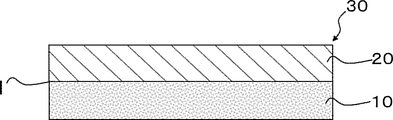
- FIG. 1 shows a circuit board laminate 30 which is an embodiment of the circuit board laminate of the present invention.
- the laminated circuit board 30 includes a metal nitride sintered substrate 10 and a copper plate 20 laminated on the surface of the metal nitride sintered substrate 10.
- the metal nitride sintered substrate 10 and the copper plate 20 are bonded to each other, and the void ratio X is equal to or less than a certain value in the vicinity of the bonding interface I as described later.
- the laminated body 30 for a circuit board of the present invention is measured on a cut surface obtained by cutting the laminated body in the stacking direction, and the bonding interface with respect to the measured length LI of the bonding interface between the metal nitride sintered substrate and the copper plate.
- the void ratio X which is the ratio of the total length LB (100 ⁇ LB / LI) of voids having a diameter of 1 ⁇ m or more confirmed in the vicinity, is 0.50% or less.
- the void ratio X is preferably 0.10% or less, and more preferably 0.03% or less.
- FIG. 2 schematically shows a cut surface obtained by cutting a circuit board laminate in the stacking direction. For the sake of explanation, hatching in the drawings is omitted. In addition, the void is enlarged. On the cut surface of FIG.
- the measured length i of the bonding interface I between the metal nitride sintered substrate 10 and the copper plate 20 is 200 ⁇ m from the viewing range, and when observing the 500 interfaces, the total length of the bonding interface is observed.
- LI is 100,000 ⁇ m (10 cm).
- the diameter of the void is the diameter if the shape of the void observed on the cut surface is a circular diameter, and if the shape is other than a circle, the diameter of the void is the linear distance of any two points on the circumference of the shape. It shall mean the maximum value.
- the vicinity of the bonding interface means a range of a width of 20 ⁇ m from the bonding interface to the copper plate side. Specifically, in FIG. 2, the region between the joining interface I and P located 20 ⁇ m on the copper plate side from the joining interface I is near the joining interface.
- the total length LB of voids having a diameter of 1 ⁇ m or more confirmed in the vicinity of the bonding interface is the projection of individual voids having a diameter of 1 ⁇ m or more observed in the total length LI of the bonding interface described above onto the bonding interface. It means the sum of lengths. For example, on the cut surface shown in FIG.
- bi represents the projected length of individual voids having a diameter of 1 ⁇ m or more confirmed in the vicinity of the joining interface onto the joining interface, and n is observed within the range of the measured total length LI of the joining interface.
- an ultrasonic flaw detector may be used to measure the void ratio, but the minimum diameter of the void measured by such a device is at most several tens of ⁇ m, and even a minute void having a diameter of 1 ⁇ m is included.
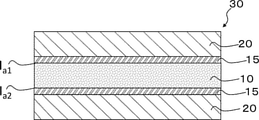
- the laminated circuit board 30 of the present invention may include a metal nitride sintered substrate 10 and copper plates 20 provided on both sides of the metal nitride sintered substrate 10, as shown in FIG. good.
- the measured length LI of the bonding interface is determined by SEM on the cut surface. For each of the observed front and back interface, the sum of the front and back (1000) of the number of measurement points (500) at one interface is multiplied by the measurement length per point.
- the metal nitride sintered substrate 10 and the copper plate 20 in the laminated circuit board layer 30 may be joined via a bonding layer 15.
- the measurement length LI of the bonding interface described above and the total length of voids having a diameter of 1 ⁇ m or more confirmed in the vicinity of the bonding interface are calculated by LB as a metal nitride. This is performed with reference to the bonding interface Ia between the sintered substrate 10 and the bonding layer 15.
- the thickness of the bonding layer 15 is thin, and when the bonding layer 15 is formed thin, the bonding layer may not be confirmed by SEM.
- LI and LB are measured with reference to the bonding interface I between the metal nitride sintered substrate 10 and the copper plate 20 observed by SEM, as in the case described with reference to FIG. Find the void rate X.
- copper plates 20 may be provided on both sides of the metal nitride sintered substrate 10 via a bonding layer 15.
- bonding interfaces I a1 and I a2 in FIG. 5
- I is the product of the sum of the front and back sides (1000) of the number of measurement points (500) at one interface and the measurement length per point for each of the front and back joint interfaces observed by SEM on the cut surface.
- the ratio of the total length LB of voids having a diameter of 1 ⁇ m or more confirmed in the region of the measured length LI of the bonding interface is the void ratio X.
- the circuit board laminate 30 of the present invention has a size in which the shortest length from the center C of the surface to the peripheral edge is 50 mm or more. Such a large circuit board laminate generally tends to have many voids at the junction interface, but the circuit board laminate of the present invention has very few voids as described above. Therefore, the productivity of the laminated body is excellent, the heat dissipation of the obtained laminated body is excellent, and the problem that the etching solution remains can be reduced.
- the shortest length from the center C to the peripheral edge of the surface of the laminate 30 is preferably 70 mm or more, more preferably 90 mm or more, and practically 110 mm or less from the viewpoint of further improving productivity. Is preferable.
- the center of the surface means the center in the shape (hereinafter also referred to as the surface shape) seen from above (or below) in the stacking direction of the circuit board laminate 30.
- FIG. 6 shows an example of a surface shape when the circuit laminate 30 is viewed from above in the stacking direction, and the shortest distance of a straight line connecting an arbitrary point on the peripheral edge of the surface shape from the center C of the surface shape is The shortest length d.
- the surface shape is a quadrangle such as a rectangle
- the center C is an intersection of diagonal lines, if it is a circle, it is the center of the circle, and if it is an ellipse, it is an intersection of a major axis and a minor axis.
- the center of the circumscribed circle of the surface shape is set as the center C in the present invention.
- the metal nitride sintered substrate in the present invention is not particularly limited, but from the viewpoint of heat dissipation, a silicon nitride sintered substrate, an aluminum nitride sintered substrate, or the like is preferable. Among them, a silicon nitride sintered substrate is more preferable because it has a high toughness value and is hard to break even with a thin substrate.
- the metal nitride sintered substrate can be obtained by firing silicon nitride powder, aluminum nitride powder, or the like.
- the thickness (t 1 ) of the metal nitride sintered substrate is not particularly limited, but is preferably 0.2 to 1.0 mm from the viewpoint of reducing the weight of the laminate for the circuit board.
- the metal oxide sintered substrate is not particularly limited as long as the shortest length from the center to the periphery of the surface of the laminate is 50 mm or more.
- the laminate can be individualized into small sizes after production, and the production efficiency is improved by first producing a large laminate. Further, according to the method for producing a laminated body of the present invention, which will be described later, a large laminated body can be obtained while reducing the voids at the bonding interface.
- the copper plate in the present invention oxygen-free copper, tough pitch copper, phosphor bronze and the like can be used without particular limitation, but oxygen-free copper having a good elongation rate is preferable from the viewpoint of stress after joining.
- the thickness of the copper plate (t 2 ) if the thickness of the metal nitride sintered substrate is thin, the metal nitride sintered substrate will crack due to the stress caused by the difference in thermal expansion during joining when the thick copper plates are joined.
- the thickness (t 2 ) of is selected so that the ratio (t 2 / t 1 ) of the thickness (t 2 ) of the copper plate to the thickness (t 1 ) of the metal nitride sintered substrate is 0.5 to 8.
- the thickness of the copper plate (t 2 ) means the thickness of the copper plate when the copper plate is provided on only one side of the metal nitride sintered substrate, and the copper plates are provided on both sides of the metal nitride sintered substrate. If so, it means the total thickness of the two copper plates.
- the size of the copper plate is the same as that of the metal oxide sintered substrate from the viewpoint of reducing voids at the bonding interface because multiple metal nitride sintered substrates and copper plates may be stacked at the time of joining in consideration of productivity. It is preferable to have.
- the metal nitride sintered substrate and the copper plate may be bonded via a bonding layer.
- the bonding layer contains a nitride of a reactive metal, whereby the metal nitride sintered substrate and the copper plate are more firmly bonded to each other.
- the reactive metal for example, titanium (Ti) is typical.
- nitride of the reactive metal will be described later in the description of the method for manufacturing the laminate for the circuit board, but constitutes the laminate for the circuit board or the reactive metal layer to be formed on the sintered metal nitride substrate. It is a reaction product of an active metal such as titanium and a nitrogen atom of a metal nitride sintered substrate.
- an antioxidant layer made of silver (Ag) or the like present on the surface of the layer made of active metal.
- the antioxidant layer diffuses into the copper plate and disappears in the process of joining, but the presence of the antioxidant layer in this way can prevent the oxidation of the active metal during the manufacture of the circuit board laminate.
- silver which is most preferably used as an antioxidant layer, may have an adverse effect when etching a copper plate or when plating a copper plate, and also tends to cause ion migration when the circuit is energized. It is more preferable to reduce the amount of silver contained in the copper plate near the bonding layer.
- the concentration of silver in the band of 20 ⁇ m in the thickness direction of the copper plate from the interface between the copper plate and the bonding layer is preferably 3% by mass or less, and more preferably 2% by mass or less.
- the silver concentration in the band of 20 ⁇ m in the thickness direction of the copper plate from the interface between the copper plate and the bonding layer is the concentration of silver at the interface between the copper plate and the bonding layer and the portion 20 ⁇ m away from the interface in the thickness direction of the copper plate. It is the average value with the concentration of silver.
- the concentration of silver can be measured by an electron probe microanalyzer (EPMA).
- the band of 20 ⁇ m in the thickness direction of the copper plate is 2 from the interface between the copper plate and the bonding layer.
- the silver concentration is preferably 3% by mass or less, and more preferably 2% by mass or less in both of the two bands.
- the bonding layer can be formed without using the active metal brazing method, so that the amount of silver contained in the copper plate near the bonding layer can be reduced to a certain level or less.
- the thickness of the bonding layer is not particularly limited, but is preferably 0.01 to 1 ⁇ m, more preferably 0.05 to 0.6 ⁇ m. When the thickness of the bonding layer is at least these lower limit values, the bonding strength becomes high, and when the thickness of the bonding layer is at least these upper limit values, good heat dissipation can be maintained.
- the method for manufacturing the laminate for a circuit board of the present invention is not particularly limited, but it is preferable to manufacture the laminate through the following steps from the viewpoint of reducing voids at the bonding interface.
- a method for manufacturing a suitable laminate for a circuit board in the present invention is It is a method for manufacturing a laminated body for a circuit board, which is a laminated body of a metal nitride sintered substrate and a copper plate.
- the metal nitride sintered substrate and the copper plate are laminated in a form in which the reactive metal layer is located between the metal nitride sintered substrate and the copper plate, and the reactive metal layer and the copper plate are laminated in a non-oxidizing atmosphere.
- the hot pressing step 3 in which a pressure is applied between the metal nitride sintered substrate and the copper plate at a temperature at which a reaction occurs between the metal nitride sintered substrate and the copper plate.
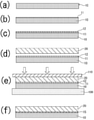
- FIG. 7 shows an embodiment of the method for manufacturing a laminate for a circuit board in the present invention, in which a metal nitride sintered substrate 10 and a copper plate 20 are bonded via a bonding layer 15 for a circuit board.
- a metal nitride sintered substrate 10 and a copper plate 20 are bonded via a bonding layer 15 for a circuit board.
- FIG. 7 (f) Each manufacturing process of the body is shown.
- Step 1 is a step of preparing a metal nitride sintered substrate 10 (FIG. 7 (a)) having a surface roughness (Ra) of 0.6 ⁇ m or less.
- the metal nitride sintered substrate 10 is not particularly limited, but a silicon nitride sintered substrate, an aluminum nitride sintered substrate, or the like is preferable from the viewpoint of heat dissipation. Among them, a silicon nitride sintered substrate is preferable because it has a high toughness value and is hard to break even with a thin substrate.
- These metal nitride sintered substrates 10 can be obtained by firing silicon nitride powder or aluminum nitride powder.
- the surface roughness (Ra) of the metal nitride sintered substrate is preferably 0.6 ⁇ m or less, and preferably 0.5 ⁇ m or less. When the surface roughness (Ra) is not more than these upper limit values, it becomes easy to suppress the formation of voids at the bonding interface.
- the arithmetic mean curvature (Spc) of the peaks of the surface of the metal nitride sintered substrate is preferably 4.5 [1 / mm] or less, and more preferably 4.2 [1 / mm] or less. ..
- Ra indicating the surface roughness and Spc indicating the state of the convex portion of the surface are specifically shown in Examples described later, but are non-contact three-dimensional measuring devices (trade name: VR-5000 manufactured by KEYENCE CORPORATION). It is a value obtained by using.
- the arithmetic mean curvature Spc of the mountain apex represents the average of the principal curvatures of the mountain apex on the surface.
- the following formula is a formula for calculating the arithmetic mean curvature Spc of the peak.
- z means the height component in the x and y coordinates
- n indicates the number of peaks
- the arithmetic mean curvature Spc of the peaks is the reciprocal of the radius of the approximate circle of the peaks of the surface uneven shape. Represents the average value of. The smaller this value is, the more rounded the apex of the mountain is, and the wider the shape is.
- the metal nitride sintered substrate 10 it is preferable to use a metal nitride sintered substrate 10 whose surface has not been polished after firing.
- the microscopic surface shape tends to be smoother when the so-called as-fire substrate as it is fired is used than the surface-polished metal nitride sintered substrate 10, and voids are formed at the bonding interface. It is preferable because it is difficult to generate.
- the metal nitride sintered substrate 10 whose surface roughness (Ra) is in the above range, which is the metal nitride sintered substrate 10 whose surface has not been polished after firing, and it is preferable to use the metal nitride sintered substrate 10 having a surface roughness (Ra).
- the metal nitride sintered substrate 10 in which both the arithmetic average curvature (Spc) of the peak and the peak are in the above range.
- the fact that the surface is not polished after firing means that the surface is not polished to smooth the surface of the metal nitride sintered substrate obtained by sintering the metal nitride powder. A blast treatment or the like for removing foreign substances such as a mold release agent attached may be performed.
- the method for manufacturing the metal nitride sintered substrate having the above surface characteristics is not particularly limited, but if a typical manufacturing method for the silicon nitride sintered substrate is shown as an example, the ⁇ conversion rate is 90% or more and the specific surface area is 7 to 7.
- a green sheet containing 20 m 2 / g, a silicon nitride powder having a crystal strain of 4.0 ⁇ 10 -4 or more and a sintering aid, and having a total content of aluminum elements adjusted to 800 ppm or less is used as an inert gas. Examples thereof include a method of sintering silicon nitride by heating to a temperature of 1200 to 1800 ° C.
- the G at the end of MPa and G in the pressure unit means the gauge pressure.
- the green sheet contains the specific silicon nitride powder and the sintering aid described below.
- the ⁇ conversion rate of the silicon nitride powder contained in the green sheet is 80% or more. Since the silicon nitride powder having a ⁇ conversion rate of 80% or more can be obtained without setting strict production conditions, it can be produced at a relatively low cost. Therefore, by using the silicon nitride powder having a high ⁇ -formation rate, it is possible to suppress the overall production cost of the silicon nitride sintered body. Further, by setting the ⁇ conversion rate high, the amount of oxygen taken in when the ⁇ -type silicon nitride particles undergo transformation into the ⁇ -type silicon nitride particles during firing can be further suppressed.
- the ⁇ conversion rate of the silicon nitride powder is preferably 85% or more, more preferably 90% or more.
- the ⁇ conversion rate of the silicon nitride powder is the ratio of the peak intensity of the ⁇ phase to the total of the ⁇ phase and the ⁇ phase in the silicon nitride powder [100 ⁇ (peak intensity of the ⁇ phase) / (peak intensity of the ⁇ phase + ⁇ phase). Peak intensity)], which is determined by powder X-ray diffraction (XRD) measurement using CuK ⁇ rays. More specifically, C.I. P. Gazzara and D. R. Messier: Ceram. Bull. , 56 (1977), 777-780, by calculating the weight ratio of the ⁇ phase and the ⁇ phase of the silicon nitride powder.
- the specific surface area of the silicon nitride powder is 7 to 20 m 2 / g.
- the specific surface area of the silicon nitride powder exceeds 20 m 2 / g, it becomes difficult to reduce the amount of dissolved oxygen, and when the specific surface area is less than 7 m 2 / g, a high-density and high-strength silicon nitride sintered body is used. Is difficult to obtain.
- the specific surface area of the silicon nitride powder is preferably 12 to 15 m 2 / g.
- the specific surface area means the BET specific surface area measured by using the BET one-point method by adsorbing nitrogen gas.
- crystal strain In the production of the silicon nitride sintered substrate of the present invention, it is preferable to use the silicon nitride powder having the above-mentioned characteristics and a crystal strain of 4.0 ⁇ 10 -4 or more. It is not clear how it acts on the formation of a network structure on the surface of the silicon nitride sintered substrate where such crystal strain is obtained, that is, the formation of pores, but according to the experiments by the present inventors, it is nitrided. It was confirmed that the integrated volume of the specific pores can be reduced by changing the crystal strain of the silicon powder to the larger side. The crystal strain was measured by the method shown in the examples.
- the silicon nitride powder is not particularly limited, but from the viewpoint of reducing the amount of solid solution oxygen, for example, it is preferable to use a high-purity raw material when producing the silicon nitride powder.
- silicon nitride powder is produced by the direct nitriding method, it is preferable to use silicon powder as a raw material to be used, which does not have a factor of dissolving oxygen inside, and specifically, it is derived from semiconductor grade silicon.
- silicon powder typified by cutting powder generated when the silicon is processed such as by cutting.
- the semiconductor grade silicon is typically polycrystalline silicon obtained by the so-called "Siemens method" in which high-purity trichlorosilane is reacted with hydrogen in a Belger type reaction vessel.
- the average particle size D50 of the silicon nitride powder is preferably 0.5 to 3 ⁇ m, more preferably 0.7 to 1.7 ⁇ m. When silicon nitride powder having such an average particle size is used, sintering becomes easier to proceed.
- the average particle size D 50 is a value on a 50% volume basis measured by a laser diffraction / scattering method.
- the proportion of particles having a particle size of 0.5 ⁇ m or less in the silicon nitride powder is preferably 20 to 50% by mass, and more preferably 20 to 40% by mass.
- the proportion of particles having a particle size of 1 ⁇ m or more in the silicon nitride powder is preferably 20 to 50% by mass, more preferably 20 to 40% by mass.
- the reason for this is not clear, but unlike ⁇ -type silicon nitride particles, ⁇ -type silicon nitride particles are less likely to undergo dissolution and reprecipitation during firing, and fine particles and coarse particles are balanced in a certain manner at the initial stage of firing. It is considered that it will be possible to obtain a more precise sintered body by preparing it.
- the amount of the silicon nitride powder in the green sheet is preferably 70% by mass or more, preferably 80% by mass or more based on the total amount of the green sheet.
- the method for producing the silicon nitride powder is not particularly limited as long as it is a method for obtaining the silicon nitride powder having the above-mentioned characteristics.
- Examples of the method for producing silicon nitride powder include a reduction nitriding method in which silica powder is used as a raw material and nitrogen gas is circulated to generate silicon nitride in the presence of carbon powder, and direct nitriding in which the silicon powder and nitrogen are reacted at a high temperature.
- a method, an imide decomposition method in which silicon halide is reacted with ammonia, or the like can be applied, but the direct nitriding method is preferable from the viewpoint of easy production of silicon nitride powder having the above-mentioned characteristics, and the direct nitriding method using the self-combustion method is particularly preferable.
- the method (combustion synthesis method) is more preferable.
- the combustion synthesis method is a method in which silicon powder is used as a raw material, a part of the raw material powder is forcibly ignited in a nitrogen atmosphere, and silicon nitride is synthesized by self-heating of the raw material compound.
- the combustion synthesis method is a known method, and for example, Japanese Patent Application Laid-Open No. 2000-264608, International Publication No. 2019/167879, and the like can be referred to.
- the crystal strain can be obtained by the above-mentioned combustion synthesis method having a large crystal strain to some extent, but the crystal strain can be further increased by further pulverizing.
- the pulverization method pulverization by a vibrating ball mill is preferable, and such pulverization is preferably performed for 5 to 15 hours.
- ⁇ Sintering aid> In the green sheet used for manufacturing the silicon nitride sintered substrate of the present invention, a known sintering aid can be used without particular limitation, but a sintering aid containing a compound having no oxygen bond may be used. This is preferable because it can prevent a decrease in the thermal conductivity of the obtained silicon nitride sintered substrate.
- Examples of the compound having no oxygen bond include a carbonitride-based compound containing a rare earth element or a magnesium element (hereinafter, also referred to as a specific carbonitride-based compound) and a nitride-based compound (hereinafter, a specific nitride). Also referred to as a system compound) is preferable.
- a specific carbonitride-based compound and a specific nitride-based compound it becomes easier to obtain a silicon nitride sintered body having a higher thermal conductivity more effectively.
- the specific carbonitride-based compound functions as a getter agent for adsorbing oxygen contained in the silicon nitride powder, and in the specific nitride-based compound, the total oxygen content of the silicon nitride sintered body is reduced as a result.
- a silicon nitride sintered body having high thermal conductivity can be obtained.
- the carbonitride-based compound containing a rare earth element as the rare earth element, Y (yttrium), La (lanthanum), Sm (samarium), Ce (cerium), Yb (ytterbium) and the like are preferable.
- Examples of carbonitride-based compounds containing rare earth elements include Y 2 Si 4 N 6 C, Yb 2 Si 4 N 6 C, Ce 2 Si 4 N 6 C, and the like, among which thermal conductivity is used. From the viewpoint of facilitating the acquisition of a silicon nitride sintered body having a high rate, Y 2 Si 4 N 6 C and Yb 2 Si 4 N 6 C are preferable.
- Examples of the carbonitride-based compound containing a magnesium element include MgSi 4 N 6 C and the like. Further, as a specific nitride compound containing a magnesium element, MgSiN 2 and the like can be mentioned. These specific carbonitride-based compounds and specific nitride-based compounds may be used alone or in combination of two or more. Among the above-mentioned carbonitride-based compounds containing rare earth elements or magnesium elements, particularly preferable compounds and specific nitride-based compounds are Y2 Si 4 N 6 C, Mg Si 4 N 6 C, and Mg Si N 2 .
- the sintering aid may further contain a metal oxide in addition to the above-mentioned compound having no oxygen bond.
- the sintering aid contains a metal oxide
- the silicon nitride powder can be easily sintered, and a more dense and high-strength sintered body can be easily obtained.
- the metal oxide include yttrium ( Y2O3) , magnesia (MgO), and ceria (CeO). Of these, itria is preferred.
- One type of metal oxide may be used alone, or two or more types may be used in combination.
- the mass ratio (oxygen-free compound / metal oxide) of the oxygen-free compound represented by the specific carbonitride-based compound and the metal oxide contained in the sintering aid is preferably 0. It is .2 to 4, more preferably 0.6 to 2. Within such a range, it becomes easy to obtain a silicon nitride sintered body that is dense and has high thermal conductivity.
- the content of the sintering aid in the green sheet is preferably 5 to 20 parts by mass, and more preferably 7 to 10 parts by mass with respect to 100 parts by mass of the silicon nitride powder.
- the green sheet can be molded using a binder.
- the green sheet is obtained by molding a molding composition described later into a sheet, drying it as necessary, and degreasing it under known conditions to remove the binder and to bake it.
- the binder is not particularly limited, and examples thereof include polyvinyl alcohol, polyvinyl butyral, methyl cellulose, alginic acid, polyethylene glycol, carboxymethyl cellulose, ethyl cellulose, and acrylic resin.
- the content of the binder used for producing the green sheet is preferably 1 to 30 parts by mass with respect to 100 parts by mass of the silicon nitride powder, and the ratio may be appropriately determined according to the molding method.
- the total content (mass) of the aluminum element in the green sheet is 800 ppm or less. That is, the green sheet used in the present invention has a very small amount of aluminum element, which makes it possible to obtain a silicon nitride sintered body having high thermal conductivity.
- the total content of aluminum elements in the green sheet is preferably 700 ppm or less, more preferably 600 ppm or less.
- the method for producing a green sheet used in the present invention is not particularly limited, and examples thereof include a method for molding a molding composition containing at least silicon nitride powder and a sintering aid by a known molding means.
- known molding means include a press molding method, an extrusion molding method, an injection molding method, a doctor blade method, and the like, and the doctor blade method is particularly preferable.
- the molding composition may contain a solvent from the viewpoint of ease of handling and molding.
- the solvent is not particularly limited, and examples thereof include organic solvents such as alcohols and hydrocarbons, water and the like, but in the present invention, it is preferable to use water.
- a green sheet by molding a molding composition containing silicon nitride powder, a sintering aid, and water.
- water is used as the solvent, the environmental load is reduced as compared with the case where an organic solvent is used, which is preferable.
- Firing is performed in an atmosphere of an inert gas.
- the “under the inert gas atmosphere” means, for example, under a nitrogen atmosphere or an argon atmosphere.
- firing is performed under a pressure of 0 MPa ⁇ G or more and less than 0.1 MPa ⁇ G.
- the pressure is preferably 0 MPa ⁇ G or more and 0.05 MPa ⁇ G or less. Since firing does not require high pressure, it can be performed in a batch furnace such as a muffle furnace or a tube furnace, or in a continuous furnace such as a pusher furnace.
- the green sheet is heated to a temperature of 1200 to 1800 ° C. and fired. If the temperature is less than 1200 ° C., the sintering of silicon nitride is difficult to proceed, and if the temperature exceeds 1800 ° C., the silicon nitride is easily decomposed. From this point of view, the heating temperature for firing is preferably 1600 to 1800 ° C.
- the firing time is not particularly limited, but is preferably about 3 to 20 hours.
- a degreasing step for removing organic components such as the binder.
- the degreasing conditions are not particularly limited, but may be, for example, by heating the green sheet to 450 to 650 ° C. in the air or in an inert atmosphere such as nitrogen or argon.
- a silicon nitride sintered substrate having the above-mentioned characteristic characteristics can be obtained.
- the silicon nitride substrate of the present invention is used as a silicon nitride sintered substrate by performing the blast treatment after firing to remove deposits such as a mold release material made of boron nitride powder that adheres.
- Step 2 is a reaction of forming a reaction metal layer containing a metal that reacts with the metal nitride sintered substrate 10 and the copper plate 20 on the surface of at least one of the metal nitride sintered substrate 10 and the copper plate 20.
- This is a metal layer film forming process.
- the reactive metal layer 11 is formed on the metal nitride sintered substrate 10 prepared in step 1 (FIG. 7 (b)).
- the reactive metal layer 11 contains a metal that reacts with the substrate and the copper plate at a high temperature, and as the metal, for example, titanium (Ti) is used. Titanium can be particularly preferably used because it forms an alloy with copper in the copper plate 20 and reacts with nitrogen in the metal nitride sintered substrate 10 to form titanium nitride (TiN).
- the reaction metal layer 11 is formed by, for example, a sputtering method, and its thickness is significantly thinner than that of the metal nitride sintered substrate 10, the copper plate 20, and the commonly used brazing material (active metal brazing material).
- the thickness thereof is, for example, 0.01 ⁇ m to 1.0 ⁇ m, preferably 0.01 to 0.1 ⁇ m, and more preferably 0.01 to 0.05 ⁇ m.
- the reactive metal layer 11 is used only for reacting with the metal nitride sintered substrate 10 and the copper plate 20 to form a bonded layer, and is preferably thin in order to thin the bonded layer. ..
- Titanium is easily oxidized in the atmosphere, but the above sputtering method is performed in a vacuum (in a reduced pressure atmosphere), and the oxidation of the reactive metal layer 11 during step 2 (reactive metal layer forming step) is suppressed. Will be done.
- the vacuum vapor deposition method may be used as another method capable of forming a thin film without oxidizing the reactive metal layer 11 as in the sputtering method.
- the antioxidant layer 12 is continuously formed on the reactive metal layer 11.
- the antioxidant layer 12 is made of a metal that is less likely to oxidize in the atmosphere than the reactive metal layer 11 and that allows the copper plate 20 and the reactive metal layer 11 to react with each other through the antioxidant layer 12 at high temperatures. Any of gold (Au), silver (Ag), copper (Cu), tin (Sn), platinum (Pt), and aluminum (Al) can be used for, and silver is particularly preferable.
- the antioxidant layer 12 is provided to suppress the oxidation of the reactive metal layer 11 in the atmosphere and the bonding is mainly formed by the reactive metal layer 11, the antioxidant layer 12 is formed by the reactive metal layer 11 and the copper plate 20. It is preferably thin enough to allow reaction with the side (alloy reaction).
- the thickness of the antioxidant layer 12 is not particularly limited, but is, for example, 0.1 to 1 ⁇ m, preferably 0.1 to 0.6 ⁇ m.
- the antioxidant layer 12 can be formed into a film by a sputtering method in the same manner as the reactive metal layer 11, the substrate 10 in a state where the reactive metal layer 11 is formed on the surface (FIG. 7 (b)) is placed in the atmosphere.
- the antioxidant layer 12 can be formed by a sputtering method in a vacuum (in a reduced pressure atmosphere) following the film formation of the reactive metal layer 11 (FIG. 7 (b)) without taking it out.
- Step 3 the metal nitride sintered substrate 10 and the copper plate 20 are laminated in a form in which the reactive metal layer 11 is located between the metal nitride sintered substrate 10 and the copper plate 20, and the metal nitride sintered substrate 10 and the copper plate 20 are laminated in a non-oxidizing atmosphere.
- This is a hot pressing step in which a pressure is applied between the substrate 10 and the copper plate 20 at a temperature at which a reaction occurs between the reactive metal layer 11, the copper plate 20, and the metal nitride sintered substrate 10.
- step 3 after the above-mentioned step 2, a copper plate 20 separate from the metal nitride sintered substrate 10 is prepared (FIG. 7 (d)), and this is the side of the substrate 10 on which the reactive metal layer 11 and the like are formed.
- hot pressing step is performed in which pressure is applied in the thickness direction and heating is performed (hot pressing step).
- the metal nitride sintered substrate 10 and the copper plate 20 are sandwiched by the hot press base 100 on the lower side and the spacer 110 on the upper side, and are pressed at a predetermined pressure.
- the atmosphere in the hot pressing step is preferably a non-oxidizing atmosphere (for example, in argon), and more preferably a vacuum.
- the degree of vacuum is preferably 0.01 Pa or less, more preferably 0.005 Pa or less before heating, and after adjusting to such a degree of vacuum, heating may be started at a temperature described later. Further, it is preferable to maintain the above-mentioned degree of vacuum even during the temperature rise. By adjusting to such a degree of vacuum, a laminated body having few voids can be obtained. In the method using an active metal brazing material, it is difficult to obtain the above-mentioned degree of vacuum because the binder component is decomposed during the temperature rise.
- the heating temperature that is, the temperature at which the reaction occurs between the reactive metal layer and the copper plate and the substrate is, for example, 600 ° C. to 1080 ° C., preferably 650 ° C.
- the rate of temperature rise when adjusting to such a temperature varies depending on various conditions such as the size of equipment, but is preferably 2 to 20 ° C./min from the viewpoint of productivity.
- a pressure is applied between the substrate and the copper plate.
- the pressure is preferably in the range of 1 MPa to 100 MPa. If the temperature and pressure are too low, joining is difficult, and if the temperature and pressure are too high, the shape and thickness of the copper plate 20 greatly fluctuate due to plastic deformation. For example, when the temperature exceeds 1080 ° C., melting of copper occurs.
- a bonding layer 15 formed by reacting the reactive metal layer 11 with the surrounding material is formed, whereby the copper plate 20 is bonded to the substrate 10.
- the bonding layer 15 is emphasized in FIG. 7, the thickness of the bonding layer 15 is actually negligible as compared with the thickness of the bonding layer formed when the brazing material is used. Become.
- the copper plate 20 is appropriately etched and patterned after the copper plate 20 is bonded to the substrate 10 as shown in FIG. 7 (f).
- the copper plate 20 is bonded to the upper surface side of the substrate 10, but another copper plate 20 can be similarly bonded to the lower surface side.
- the reactive metal layer 11 of FIG. 7 (b) and, if necessary, the antioxidant layer 12 of FIG. 7 (c) are similarly formed on the lower surface side, and the copper plate 20 is also provided on the lower surface side. Hot press should be performed in this state.
- the above patterning can be performed individually or simultaneously on the upper surface side and the lower surface side.
- the reaction metal layer 11 and the antioxidant layer 12 provided as needed are sequentially formed on the substrate 10, and then the copper plate 20 is bonded.
- the reactive metal layer 11 and the antioxidant layer 12 provided as needed may be sequentially formed on the surface facing the substrate 10 (the lower surface in FIG. 7).
- the copper plate 20 and the substrate 10 can be joined by performing the same hot pressing process as described above.
- the reactive metal layer 11 and the antioxidant layer 12 provided as needed may be formed on both the substrate 10 and the copper plate 20, respectively.
- the reactive metal layer 11 and the antioxidant layer 12 provided as needed are placed on only one of the substrate 10 and the copper plate 20. It is preferable to form it, and it is more preferable to form it only on the substrate 10 from the viewpoint of adhesion. Since the antioxidant layer 12 diffuses toward the copper plate during the reaction by hot pressing, it cannot be confirmed as a single layer.
- the copper plate 20 may be plastically deformed in the hot pressing process. Such plastic deformation affects the deformation and warpage of the circuit board after the circuit board is manufactured or when a subsequent thermal cycle is applied.
- plastic deformation occurs during cooling to room temperature after the hot press process, the stress of the copper plate 20 and the bonding layer 15 at room temperature is reduced, and the warp of this circuit board at room temperature can be reduced. Therefore, the temperature and pressure in the hot pressing process can be set not only according to the bonding condition but also according to the warping condition of the circuit board. That is, by causing the copper plate 20 to undergo plastic deformation during cooling from the hot press process, it is possible to reduce the warp (deformation) of the circuit board at room temperature.
- the pressure in the hot pressing step is such that the bonding layer 15 is formed as described above by the hot pressing step. You can also set the temperature. In this case, the above-mentioned antioxidant layer 12 is unnecessary. The same applies when the oxide layer can be removed by various treatments before the hot pressing step.
- the sputtering method it is easy to continuously form the antioxidant layer 12 and the reactive metal layer 11, thereby ensuring the oxidation of the reactive metal layer 11 before the hot pressing step. Since it can be suppressed, it is particularly preferable to sequentially form the reactive metal layer 11 and the antioxidant layer 12 by a sputtering method.
- the reactive metal layer 11 is titanium
- this situation also depends on the time interval from the reaction metal layer forming step to the hot pressing step. For example, if the time interval is several days or more, the antioxidant layer 12 is particularly effective, but if the time interval is negligibly short, the antioxidant layer 12 may not be formed.
- Titanium used as the reactive metal layer 11 reacts with copper constituting the copper plate 20, nitrogen constituting the substrate 10, and the like to form an alloy layer (bonding layer 15). Therefore, the bonding layer 15 is stably formed.
- Titanium is also present at the interface even when an active metal brazing material is used. However, since the titanium content is as low as about 1%, the situation is completely different, and it is not possible to obtain a bond using only the thin and strong bonding layer 15 as described above.
- the reactive metal layer 11 is made of titanium, but as long as the bonding layer 15 is formed in the same manner as above, the reactive metal layer 11 contains a material other than titanium. May be good. Similarly, other metals can be reacted as long as they can react with nitrogen of the substrate 10 and copper on the copper plate 20 side, and can form a thin film on the substrate 10 side or the copper plate 20 side as described above. It may be the main component of the metal layer 11.
- the thermal conductivity of titanium constituting the reactive metal layer 11 is significantly lower than that of copper constituting the copper plate 20. Therefore, if titanium remains thick as the reactive metal layer 11 in the bonding layer 15, the substantial thermal conductivity of the bonding layer 15 decreases. On the other hand, since it is only the portion of the reactive metal layer 11 that is alloyed by the reaction of titanium, the copper of the copper plate 20, and the nitrogen in the substrate 10, only the portion that contributes to the bonding is formed. In the above, it is preferable that the reactive metal layer 11 is thin, and it is preferable that there is little portion of titanium remaining in the reactive metal layer 11 as it is after the hot pressing step. Therefore, the thickness of the reactive metal layer 11 in FIG. 7 (c) is preferably 1 ⁇ m or less.
- the thermal conductivity of the circuit board becomes low. Further, in order to improve the throughput during manufacturing, it is preferable that the reactive metal layer 11 and the antioxidant layer 12 formed by the sputtering method are thin. On the other hand, even when the thickness of the reactive metal layer 11 is set to the lower limit of the thickness that can be controlled by the film formation by the sputtering method (for example, about 0.01 ⁇ m), a strong bond can be obtained. Further, when the thickness of the reactive metal layer 11 is less than 0.01 ⁇ m, it is difficult to control the film thickness, so that an effective film thickness cannot be uniformly obtained, and sufficient bonding strength is obtained. May be difficult.
- the thickness of the reactive metal layer 11 is preferably in the range of 0.01 to 1 ⁇ m.
- the difference in thermal expansion between the copper plate 20 and the substrate 10 becomes large, so that a large shear strain is generated between the copper plate 20 and the substrate 10. It is difficult for the bonding interface (bonding layer 15) to handle this shear strain only when the bonding layer 15 is thin, and it is difficult to obtain high bonding strength due to the bonding layer 15, but the pressure in the hot pressing process By adjusting the temperature and the temperature, the shrinkage and expansion of the copper plate 20 can be restrained, so that this shear strain can be reduced. That is, in the above manufacturing method, it is particularly important to set the pressure and temperature in the hot pressing process. At this time, by making the coefficient of thermal expansion of the spacer 110 used in FIG. 7 (e) close to the coefficient of thermal expansion of the substrate 10, this shear strain can be particularly reduced. It is particularly preferable to use a CIP material carbon plate as the material of such a spacer 110.
- the laminated body for a circuit board of the present invention can be manufactured through steps 1 to 3.
- the obtained circuit board laminate can be efficiently manufactured by patterning a copper plate before it is separated into individual pieces.
- a known method can be used for patterning.
- a pattern is drawn on the surface of a copper plate with a resist, copper is etched with a ferric chloride solution, and then the bonding layer is etched. Since the bonding layer contains a nitride of a reactive metal, it is usually possible to etch with fluorinated nitric acid using only the reactive metal, but in this bonding layer, an ammonium fluoride-ammonia-based etching solution is used.
- Void rate X The laminated circuit board laminates produced in Examples and Comparative Examples were cut by a dicing device, and then the cross section was polished. Observe the cross section with SEM (Electron Probe Microanalyzer JXA -8230 manufactured by JEOL Ltd.), and voids with a diameter of 1 ⁇ m or more confirmed in the region 20 ⁇ m from the junction interface to the copper plate side with respect to the measured length LI of the junction interface.
- the void ratio X was calculated by obtaining the ratio of the total length LB of.
- the total length of the void is calculated by measuring and integrating the projected length of the void in parallel with the substrate.
- Ra and Spc of silicon nitride sintered substrate The values specified in the international standard ISO 25178 surface texture (measurement of surface roughness) were used. That is, Ra and Spc are obtained by measuring an evaluation area of an arbitrary range of 1000 ⁇ m ⁇ 1000 ⁇ m of a silicon nitride sintered substrate using a non-contact three-dimensional measuring device (trade name: VR-5000 manufactured by KEYENCE CORPORATION). The value was set. Specifically, an area of an arbitrary range of 2 cm ⁇ 2 cm was determined, and evaluation areas of 1000 ⁇ m ⁇ 1000 ⁇ m were measured at at least 20 places in the area of the arbitrary range, and shown as an average value of the obtained values. ..
- Crystal strain of silicon nitride powder Calculated by the following procedure by powder X-ray diffraction (XRD) using CuK ⁇ ray. From the X-ray diffraction pattern obtained by scanning the X-ray detector in the range of 2 ⁇ of 15 to 80 ° in steps of 0.02 °, the ⁇ phases (101), (110), (200), (201) ) And (210) planes were calculated, and the integrated width was substituted into the Williamson-Hall equation of the following equation 2. The crystal strain ( ⁇ ) was calculated from the slope of a straight line obtained by the least squares method by plotting "2sin ⁇ / ⁇ " in the following equation 2 as the X-axis and " ⁇ cos ⁇ / ⁇ " as the Y-axis.
- XRD powder X-ray diffraction
- Silicon powder (semiconductor grade, average particle size 5 ⁇ m) and silicon nitride powder (average particle size 1.5 ⁇ m), which is a diluent, are mixed and used as raw material powder (Si: 80% by mass, Si 3N 4 : 20% by mass). )
- the raw material powder was filled in a reaction vessel to form a raw material powder layer.
- the reaction vessel was installed in a pressure-resistant closed reactor having an ignition device and a gas supply / discharge mechanism, the inside of the reactor was depressurized and degassed, and then nitrogen gas was supplied to replace the nitrogen. Then, nitrogen gas was gradually supplied, and the pressure was increased to 0.7 MPa.
- the bulk density of the raw material powder at the time when the predetermined pressure was reached (at the time of ignition) was 0.5 g / cm 3 .
- the end portion of the raw material powder in the reaction vessel was ignited and a combustion synthesis reaction was carried out to obtain a massive product made of silicon nitride.
- the obtained lumpy products were crushed by rubbing against each other, and then an appropriate amount was put into a vibrating ball mill to perform fine pulverization for 6 hours.
- a urethane lining was applied to the inside of the crusher as a measure to prevent heavy metal contamination, and a ball containing silicon nitride as a main component was used as the crushing medium.
- the molding composition was sheet-molded by the doctor blade method to obtain a green sheet.
- the above green sheet is placed in a firing container using boron nitride powder as a mold release material, degreased in dry air at a temperature of 550 ° C., and then placed in a firing furnace to have a nitrogen atmosphere and a pressure of 0.02 MPa ⁇ G.
- the obtained silicon nitride sintered substrate was obtained by blasting alumina abrasive grains having an average particle size of 500 ⁇ m with an air flow at a pressure of 0.3 MPa to remove foreign substances on the surface to obtain a silicon nitride sintered substrate.
- the mixture was heated to 850 ° C. while applying a load of 10 MPa to the copper plate and the silicon nitride sintered substrate.
- a laminate for a circuit board including a silicon nitride sintered substrate and a copper plate bonded to both sides of the substrate via a bonding layer was produced.
- the evaluation results are shown in Table 1.
- the Ti layer exists at the thickness as a layer of a Ti reactant containing a Ti nitride, and the Ag layer diffuses into a copper plate and disappears. confirmed.
- Example 2 A laminated body for a circuit board was produced in the same manner as in Example 1 except that the substrate size and the copper plate size were 110 mm ⁇ 110 mm. The evaluation results are shown in Table 1.
- the Ti layer exists at the thickness as a layer of a Ti reactant containing a Ti nitride, and the Ag layer diffuses into a copper plate and disappears. confirmed.
- Example 3 A laminated body for a circuit board was produced in the same manner as in Example 1 except that the thickness of the oxygen-free copper plate (copper plate) was 0.8 mm and the pressure during hot pressing was 15 MPa. The evaluation results are shown in Table 1. In the obtained laminated circuit board, the Ti layer exists at the thickness as a layer of a Ti reactant containing a Ti nitride, and the Ag layer diffuses into a copper plate and disappears. confirmed.
- the paste was dried and degreased in a nitrogen atmosphere at 320 ° C. for 5 minutes. Further, after laminating oxygen-free copper plates having the same size as the silicon nitride sintered substrate and having a thickness of 0.3 mm on both sides, a vacuum atmosphere is created to 0.005 Pa while applying a load of 0.1 kPa, and then the temperature is heated to 850 ° C. Then, a laminated body for a circuit board was produced. The evaluation results are shown in Table 1.
- Comparative Example 2 A laminated circuit board laminate was produced in the same manner as in Comparative Example 1 except that the size of the substrate was 110 mm ⁇ 110 mm and the size of the copper plate was 110 mm ⁇ 110 mm. The evaluation results are shown in Table 1.
- the laminated circuit board laminate shown in each embodiment had an extremely low void ratio X despite its large size. It was found that since the void ratio X is low, the heat dissipation is high, and the amount of the etching solution remaining during etching is small, so that the reliability of the product is improved.
Landscapes
- Engineering & Computer Science (AREA)
- Microelectronics & Electronic Packaging (AREA)
- Chemical & Material Sciences (AREA)
- Ceramic Engineering (AREA)
- Manufacturing & Machinery (AREA)
- Materials Engineering (AREA)
- Structural Engineering (AREA)
- Organic Chemistry (AREA)
- Inorganic Chemistry (AREA)
- Ceramic Products (AREA)
- Laminated Bodies (AREA)
Priority Applications (5)
| Application Number | Priority Date | Filing Date | Title |
|---|---|---|---|
| JP2022542798A JP7807377B2 (ja) | 2020-08-12 | 2021-07-30 | 回路基板用積層体 |
| KR1020237004222A KR102945124B1 (ko) | 2020-08-12 | 2021-07-30 | 회로 기판용 적층체 |
| EP21855889.8A EP4197990A4 (en) | 2020-08-12 | 2021-07-30 | LAMINATE FOR PRINTED CIRCUIT BOARD |
| CN202180056387.0A CN116075492B (zh) | 2020-08-12 | 2021-07-30 | 电路基板用层叠体 |
| US18/020,347 US12610461B2 (en) | 2020-08-12 | 2021-07-30 | Laminate for circuit board |
Applications Claiming Priority (2)
| Application Number | Priority Date | Filing Date | Title |
|---|---|---|---|
| JP2020136273 | 2020-08-12 | ||
| JP2020-136273 | 2020-08-12 |
Publications (1)
| Publication Number | Publication Date |
|---|---|
| WO2022034810A1 true WO2022034810A1 (ja) | 2022-02-17 |
Family
ID=80247215
Family Applications (1)
| Application Number | Title | Priority Date | Filing Date |
|---|---|---|---|
| PCT/JP2021/028505 Ceased WO2022034810A1 (ja) | 2020-08-12 | 2021-07-30 | 回路基板用積層体 |
Country Status (7)
| Country | Link |
|---|---|
| US (1) | US12610461B2 (https=) |
| EP (1) | EP4197990A4 (https=) |
| JP (1) | JP7807377B2 (https=) |
| KR (1) | KR102945124B1 (https=) |
| CN (1) | CN116075492B (https=) |
| TW (1) | TWI900631B (https=) |
| WO (1) | WO2022034810A1 (https=) |
Cited By (3)
| Publication number | Priority date | Publication date | Assignee | Title |
|---|---|---|---|---|
| WO2023120422A1 (ja) * | 2021-12-22 | 2023-06-29 | 株式会社トクヤマ | 窒化ケイ素粉末 |
| WO2024170531A1 (de) * | 2023-02-14 | 2024-08-22 | Rogers Germany Gmbh | Verfahren zur herstellung eines metall-keramik-substrats und ein metall-keramik-substrat hergestellt mit einem solchen verfahren |
| WO2025263517A1 (ja) * | 2024-06-19 | 2025-12-26 | 株式会社Niterra Materials | 接合体、セラミックス回路基板、および半導体装置 |
Families Citing this family (3)
| Publication number | Priority date | Publication date | Assignee | Title |
|---|---|---|---|---|
| WO2021111508A1 (ja) * | 2019-12-03 | 2021-06-10 | 日本碍子株式会社 | 接合基板及び接合基板の製造方法 |
| JP7610707B2 (ja) * | 2021-06-11 | 2025-01-08 | Ngkエレクトロデバイス株式会社 | 接合基板の製造方法および回路基板の製造方法 |
| DE102023126070A1 (de) * | 2023-09-26 | 2025-03-27 | Rogers Germany Gmbh | Verfahren zur Herstellung eines Metall-Keramik-Substrats und Metall-Keramik-Substrat |
Citations (5)
| Publication number | Priority date | Publication date | Assignee | Title |
|---|---|---|---|---|
| JPS60177635A (ja) * | 1984-02-24 | 1985-09-11 | Toshiba Corp | 良熱伝導性基板の製造方法 |
| JP2000264608A (ja) | 1999-03-23 | 2000-09-26 | Osamu Yamada | 燃焼合成反応によるBN、AlN又はSi3N4の製造方法 |
| JP2005252087A (ja) * | 2004-03-05 | 2005-09-15 | Hitachi Metals Ltd | セラミックス回路基板 |
| WO2013146789A1 (ja) * | 2012-03-26 | 2013-10-03 | 日立金属株式会社 | 窒化珪素焼結体基板及びその製造方法 |
| WO2019167879A1 (ja) | 2018-02-28 | 2019-09-06 | 株式会社トクヤマ | 窒化ケイ素粉末の製造方法 |
Family Cites Families (13)
| Publication number | Priority date | Publication date | Assignee | Title |
|---|---|---|---|---|
| US3723358A (en) * | 1971-02-22 | 1973-03-27 | Johnson & Son Inc S C | Fabric treating shampoo compositions |
| DE3924225C2 (de) | 1988-07-22 | 1994-01-27 | Mitsubishi Electric Corp | Verfahren zur Herstellung eines Keramik-Metall-Verbundsubstrats sowie Keramik-Metall-Verbundsubstrat |
| US9374893B2 (en) * | 2010-03-02 | 2016-06-21 | Tokuyama Corporation | Production method of metallized substrate |
| CN104011852B (zh) | 2011-12-20 | 2016-12-21 | 株式会社东芝 | 陶瓷铜电路基板和使用了陶瓷铜电路基板的半导体装置 |
| JP6456676B2 (ja) | 2014-09-10 | 2019-01-23 | Jx金属株式会社 | 金属セラミック接合基板及び、その製造方法 |
| JP6742073B2 (ja) | 2015-03-11 | 2020-08-19 | デンカ株式会社 | セラミックス回路基板 |
| JP6904088B2 (ja) | 2016-06-30 | 2021-07-14 | 三菱マテリアル株式会社 | 銅/セラミックス接合体、及び、絶縁回路基板 |
| JP6965768B2 (ja) | 2017-02-28 | 2021-11-10 | 三菱マテリアル株式会社 | 銅/セラミックス接合体、絶縁回路基板、及び、銅/セラミックス接合体の製造方法、絶縁回路基板の製造方法 |
| KR102516917B1 (ko) * | 2017-04-25 | 2023-03-31 | 덴카 주식회사 | 세라믹스 회로 기판 및 그 제조 방법과 그것을 사용한 모듈 |
| WO2019022133A1 (ja) * | 2017-07-25 | 2019-01-31 | デンカ株式会社 | セラミックス回路基板及びその製造方法 |
| DE102020111698A1 (de) | 2020-04-29 | 2021-11-04 | Rogers Germany Gmbh | Verfahren zur Herstellung eines Metall-Keramik-Substrats und ein Metall-Keramik-Substrat hergestellt mit einem solchen Verfahren |
| JP2023177635A (ja) * | 2022-06-02 | 2023-12-14 | 日本化薬株式会社 | 飛行体用安全装置および飛行体 |
| JP2025177635A (ja) | 2024-05-24 | 2025-12-05 | 三菱電機株式会社 | 入札曲線予測装置、入札曲線予測方法、及びプログラム |
-
2021
- 2021-07-30 EP EP21855889.8A patent/EP4197990A4/en active Pending
- 2021-07-30 JP JP2022542798A patent/JP7807377B2/ja active Active
- 2021-07-30 US US18/020,347 patent/US12610461B2/en active Active
- 2021-07-30 WO PCT/JP2021/028505 patent/WO2022034810A1/ja not_active Ceased
- 2021-07-30 KR KR1020237004222A patent/KR102945124B1/ko active Active
- 2021-07-30 CN CN202180056387.0A patent/CN116075492B/zh active Active
- 2021-08-09 TW TW110129276A patent/TWI900631B/zh active
Patent Citations (5)
| Publication number | Priority date | Publication date | Assignee | Title |
|---|---|---|---|---|
| JPS60177635A (ja) * | 1984-02-24 | 1985-09-11 | Toshiba Corp | 良熱伝導性基板の製造方法 |
| JP2000264608A (ja) | 1999-03-23 | 2000-09-26 | Osamu Yamada | 燃焼合成反応によるBN、AlN又はSi3N4の製造方法 |
| JP2005252087A (ja) * | 2004-03-05 | 2005-09-15 | Hitachi Metals Ltd | セラミックス回路基板 |
| WO2013146789A1 (ja) * | 2012-03-26 | 2013-10-03 | 日立金属株式会社 | 窒化珪素焼結体基板及びその製造方法 |
| WO2019167879A1 (ja) | 2018-02-28 | 2019-09-06 | 株式会社トクヤマ | 窒化ケイ素粉末の製造方法 |
Non-Patent Citations (2)
| Title |
|---|
| C.P. GAZZARAD.R. MESSIER, CERAM. BULL., vol. 56, 1977, pages 777 - 780 |
| See also references of EP4197990A4 |
Cited By (4)
| Publication number | Priority date | Publication date | Assignee | Title |
|---|---|---|---|---|
| WO2023120422A1 (ja) * | 2021-12-22 | 2023-06-29 | 株式会社トクヤマ | 窒化ケイ素粉末 |
| JP7337304B1 (ja) * | 2021-12-22 | 2023-09-01 | 株式会社トクヤマ | 窒化ケイ素粉末 |
| WO2024170531A1 (de) * | 2023-02-14 | 2024-08-22 | Rogers Germany Gmbh | Verfahren zur herstellung eines metall-keramik-substrats und ein metall-keramik-substrat hergestellt mit einem solchen verfahren |
| WO2025263517A1 (ja) * | 2024-06-19 | 2025-12-26 | 株式会社Niterra Materials | 接合体、セラミックス回路基板、および半導体装置 |
Also Published As
| Publication number | Publication date |
|---|---|
| CN116075492A (zh) | 2023-05-05 |
| JP7807377B2 (ja) | 2026-01-27 |
| JPWO2022034810A1 (https=) | 2022-02-17 |
| EP4197990A4 (en) | 2024-08-07 |
| KR102945124B1 (ko) | 2026-03-30 |
| TWI900631B (zh) | 2025-10-11 |
| EP4197990A1 (en) | 2023-06-21 |
| US12610461B2 (en) | 2026-04-21 |
| CN116075492B (zh) | 2024-06-11 |
| TW202216339A (zh) | 2022-05-01 |
| KR20230049628A (ko) | 2023-04-13 |
| US20230292433A1 (en) | 2023-09-14 |
Similar Documents
| Publication | Publication Date | Title |
|---|---|---|
| WO2022034810A1 (ja) | 回路基板用積層体 | |
| JP7219810B2 (ja) | 窒化珪素基板、窒化珪素-金属複合体、窒化珪素回路基板、及び、半導体パッケージ | |
| JP5339214B2 (ja) | 窒化珪素基板の製造方法および窒化珪素基板 | |
| JP2018184333A (ja) | 窒化珪素基板の製造方法、及び窒化珪素基板 | |
| JP3629783B2 (ja) | 回路基板 | |
| JP2002201075A (ja) | 窒化けい素セラミックス基板およびそれを用いた窒化けい素セラミックス回路基板並びにその製造方法 | |
| JP4997431B2 (ja) | 高熱伝導窒化ケイ素基板の製造方法 | |
| US20210005480A1 (en) | Multi-zone silicon nitride wafer heater assembly having corrosion protective layer, and methods of making and using the same | |
| JP2025105615A (ja) | 窒化珪素回路基板 | |
| CN112912356B (zh) | 氮化硅基板的制造方法以及氮化硅基板 | |
| EP1695948A1 (en) | High thermally conductive aluminum nitride sintered product | |
| JP5611554B2 (ja) | 高熱伝導性窒化アルミニウム焼結体、これを用いた基板、回路基板、および半導体装置、ならびに高熱伝導性窒化アルミニウム焼結体の製造方法 | |
| JP7339980B2 (ja) | 窒化ケイ素焼結体の製造方法 | |
| JP7278326B2 (ja) | 窒化ケイ素焼結体の製造方法 | |
| JP5073135B2 (ja) | 窒化アルミニウム焼結体、その製造方法及び用途 | |
| JP7831559B2 (ja) | 窒化シリコン用グリーンシート、および、窒化シリコン基板 | |
| JP2000124566A (ja) | メタライズ基板 | |
| CN121511221A (zh) | 金属/陶瓷接合体、钎焊材料、金属/陶瓷接合体的制造方法及钎焊材料的制造方法 | |
| JP2023030140A (ja) | 窒化珪素基板 | |
| JP6412886B2 (ja) | AlN基板 | |
| JP3810344B2 (ja) | 窒化アルミニウム焼結体、その製造方法及び用途 | |
| JPH07309663A (ja) | 窒化アルミニウム焼結体およびその製造方法 |
Legal Events
| Date | Code | Title | Description |
|---|---|---|---|
| 121 | Ep: the epo has been informed by wipo that ep was designated in this application |
Ref document number: 21855889 Country of ref document: EP Kind code of ref document: A1 |
|
| ENP | Entry into the national phase |
Ref document number: 2022542798 Country of ref document: JP Kind code of ref document: A |
|
| NENP | Non-entry into the national phase |
Ref country code: DE |
|
| ENP | Entry into the national phase |
Ref document number: 2021855889 Country of ref document: EP Effective date: 20230313 |