WO2022024941A1 - 光学フィルタ - Google Patents
光学フィルタ Download PDFInfo
- Publication number
- WO2022024941A1 WO2022024941A1 PCT/JP2021/027411 JP2021027411W WO2022024941A1 WO 2022024941 A1 WO2022024941 A1 WO 2022024941A1 JP 2021027411 W JP2021027411 W JP 2021027411W WO 2022024941 A1 WO2022024941 A1 WO 2022024941A1
- Authority
- WO
- WIPO (PCT)
- Prior art keywords
- wavelength
- transmittance
- dye
- spectral
- resin
- Prior art date
- Legal status (The legal status is an assumption and is not a legal conclusion. Google has not performed a legal analysis and makes no representation as to the accuracy of the status listed.)
- Ceased
Links
Images


Classifications
-
- G—PHYSICS
- G02—OPTICS
- G02B—OPTICAL ELEMENTS, SYSTEMS OR APPARATUS
- G02B5/00—Optical elements other than lenses
- G02B5/20—Filters
- G02B5/22—Absorbing filters
-
- G—PHYSICS
- G02—OPTICS
- G02B—OPTICAL ELEMENTS, SYSTEMS OR APPARATUS
- G02B5/00—Optical elements other than lenses
- G02B5/20—Filters
- G02B5/26—Reflecting filters
-
- G—PHYSICS
- G02—OPTICS
- G02B—OPTICAL ELEMENTS, SYSTEMS OR APPARATUS
- G02B5/00—Optical elements other than lenses
- G02B5/20—Filters
- G02B5/28—Interference filters
Definitions
- the present invention relates to an optical filter that transmits light in the visible wavelength region and blocks light in the near infrared wavelength region.
- visible light In an image pickup device using a solid-state image sensor, in order to reproduce color tones well and obtain a clear image, light in the visible region (hereinafter also referred to as “visible light”) is transmitted, and light in the near infrared wavelength region (hereinafter referred to as “visible light”) is transmitted.
- An optical filter that blocks also called “near-infrared light” is used.
- dielectric thin films having different refractive indexes are alternately laminated on one side or both sides of a transparent substrate (dielectric multilayer film), and reflection that reflects the light to be shielded by utilizing the interference of light is used.
- a transparent substrate dielectric multilayer film
- reflection that reflects the light to be shielded by utilizing the interference of light.
- type filters can be mentioned.
- An optical filter having a dielectric multilayer film should obtain a change in the spectral transmission curve depending on the incident angle and high reflectance at a high incident angle because the optical film thickness of the dielectric multilayer film changes depending on the incident angle of light.
- the problems are light loss that increases the transmittance of near-infrared light and noise due to near-infrared light reflected by the dielectric multilayer film.
- Patent Document 1 describes an optical filter provided with a layer containing a near-infrared absorbing dye in order to reduce the dependence on the incident angle.
- the optical filter described in Patent Document 1 has room for improvement in terms of transparency in the visible light region. Therefore, the present invention has a high transparency of visible light, particularly a shielding property of near-infrared light at a high incident angle such as light loss in terms of shielding property of near-infrared light while maintaining good transparency of blue light. It is an object of the present invention to provide an optical filter in which a decrease in the amount of light is suppressed.
- the present invention provides an optical filter having the following configuration.
- An optical filter including a base material and a dielectric multilayer film laminated as an outermost layer on at least one main surface side of the base material.
- the base material contains a resin film containing a dye (A) which is a near-infrared absorbing dye and a resin.
- the dye (A) has the following spectral characteristics (i-1) to (i-4) in the spectral transmittance curve of the coating film obtained by dissolving the dye (A) in the resin and coating it on an alkaline glass plate. ) Are all satisfied.
- the absolute value of the difference between IR50a and IR50b is 200 nm or more (i-3)
- the relationship between the absorbance A 440 at a wavelength of 440 nm and the absorbance A 700 at a wavelength of 700 nm is A 440 / A 700 ⁇ 0.14.
- the relationship between the absorbance A 490 at a wavelength of 490 nm and the absorbance A 700 at a wavelength of 700 nm is A 490 / A 700 ⁇ 0.10.
- the present invention has high transparency of visible light and high shielding property of near-infrared light, particularly high transmission of blue light, and deterioration of shielding property of near-infrared light at a high incident angle.
- Suppressed optical filters can be provided.
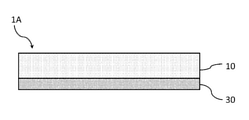
- FIG. 1 is a cross-sectional view schematically showing an example of an optical filter of one embodiment.
- FIG. 2 is a cross-sectional view schematically showing another example of the optical filter of one embodiment.
- FIG. 3 is a cross-sectional view schematically showing another example of the optical filter of one embodiment.
- FIG. 4 is a cross-sectional view schematically showing another example of the optical filter of one embodiment.
- FIG. 5 is a diagram showing a spectral transmittance curve in dichloromethane and a spectral transmittance curve in a cycloolefin resin of Compound 6.
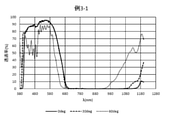
- FIG. 6 is a diagram showing a spectral transmittance curve of the optical filter of Example 3-1.
- the near-infrared absorbing dye may be abbreviated as "NIR dye” and the ultraviolet absorbing dye may be abbreviated as "UV dye”.
- NIR dye near-infrared absorbing dye
- UV dye ultraviolet absorbing dye
- the compound represented by the formula (I) is referred to as a compound (I).
- the dye composed of compound (I) is also referred to as dye (I), and the same applies to other dyes.
- the group represented by the formula (I) is also referred to as a group (I), and the same applies to the groups represented by other formulas.
- the internal transmittance is a transmittance obtained by subtracting the influence of interfacial reflection from the actually measured transmittance represented by the formula ⁇ measured transmittance / (100-reflectance) ⁇ ⁇ 100.
- the transmittance of the base material and the spectroscopy of the transmittance of the resin film including the case where the dye is contained in the resin are all "internal transmittance" even when it is described as "transmittance”.
- the transmittance measured by dissolving the dye in a solvent such as dichloromethane and the transmittance of the optical filter having the dielectric multilayer film are the measured transmittances.
- the absorbance is converted from the (internal) transmittance from the formula of -log10 ((internal) transmittance / 100).
- a transmittance of 90% or more means that the transmittance does not fall below 90% in the entire wavelength region, that is, the minimum transmittance is 90% or more in the wavelength region.
- a transmittance of 1% or less means that the transmittance does not exceed 1% in the entire wavelength region, that is, the maximum transmittance is 1% or less in the wavelength region. ..
- the average transmittance and the average internal transmittance in a specific wavelength range are arithmetic means of the transmittance and the internal transmittance for each 1 nm in the wavelength range.
- "-" representing a numerical range includes an upper and lower limit.
- the optical filter of one embodiment of the present invention includes a base material and a dielectric multilayer film laminated as an outermost layer on at least one main surface side of the base material.
- FIG. 1 are sectional views schematically showing an example of an optical filter of one embodiment.
- the optical filter 1A shown in FIG. 1 is an example in which the dielectric multilayer film 30 is provided on one main surface side of the base material 10.
- “having a specific layer on the main surface side of the base material” is not limited to the case where the layer is provided in contact with the main surface of the base material, and another function is provided between the base material and the layer. Including cases where layers are provided.
- the optical filter 1B shown in FIG. 2 is an example in which the dielectric multilayer film 30 is provided on both main surface sides of the base material 10.
- the optical filter 1C shown in FIG. 3 is an example in which the base material 10 has a support 11 and a resin film 12 laminated on one main surface side of the support 11.
- the optical filter 1C further has a dielectric multilayer film 30 on the resin film 12 and on the main surface side of the support 11 on which the resin film 12 is not laminated.
- the optical filter 1D shown in FIG. 4 is an example in which the base material 10 has a support 11 and a resin film 12 laminated on both main surface sides of the support 11.
- the optical filter 1D further has a dielectric multilayer film 30 on each resin film 12.
- the substrate contains the dye (A) and the resin.
- the substrate comprises a resin film containing the dye (A) and the resin.
- the dye (A) is a near infrared absorption (NIR) dye. Since the base material contains a dye that absorbs near-infrared rays, the absorption characteristics of the base material cause deterioration of spectral characteristics at high incident angles of the dielectric multilayer film, for example, light omission and noise in the near-infrared region. It can be suppressed.
- NIR near infrared absorption
- the dye (A) preferably has a maximum absorption wavelength of 600 to 900 nm in dichloromethane.
- the dye (A) exhibits specific spectral characteristics in the resin used for the base material. Specifically, the coating film obtained by dissolving the dye (A) in a resin and coating it on an alkaline glass plate satisfies all of the following spectral characteristics (i-1) to (i-4).
- the absolute value of the difference between IR50a and IR50b is 200 nm or more (i-3)
- the relationship between the absorbance A 440 at a wavelength of 440 nm and the absorbance A 700 at a wavelength of 700 nm is A 440 / A 700 ⁇ 0.14.
- the relationship between the absorbance A 490 at a wavelength of 490 nm and the absorbance A 700 at a wavelength of 700 nm is A 490 / A 700 ⁇ 0.10.
- This filter containing the dye (A) exhibiting the above spectral characteristics (i-1) to (i-4) in the resin is highly transparent while maintaining good transparency of visible light, particularly blue light.
- This is an optical filter in which the deterioration of the shielding property of near-infrared light at the incident angle is suppressed.
- the dielectric multilayer film can efficiently prevent light leakage in the wavelength band of 750 to 900 nm, where light with a high incident angle cannot be completely blocked and light leakage is likely to occur.
- the dye (A) itself has a broad absorption property in the resin, it is efficient only with the dye (A) while maintaining good transmittance in the visible light region without combining a plurality of types of NIR dyes. It can block the near infrared region.
- the near-infrared region can be widely shielded from light, but the transmittance in the visible light region tends to decrease at the same time. In the present invention, this can be avoided by using the dye (A).
- the absolute value of the spectral characteristic (i-1) is preferably 190 nm or more, more preferably 210 nm or more, and particularly preferably 230 nm or more. Further, the wider the absorption width is, the more preferable it is, so that the upper limit is not limited, but it is usually 270 nm or less.
- the absolute value in the spectral characteristic (i-2) is preferably 210 nm or more, more preferably 230 nm or more. Further, the wider the absorption width is, the more preferable it is, so that the upper limit is not limited, but it is usually 270 nm or less.
- the spectral characteristic (i-3) is preferably A 440 / A 700 ⁇ 0.11, and more preferably A 440 / A 700 ⁇ 0.10.
- the spectral characteristic (i-4) is preferably A 490 / A 700 ⁇ 0.08, and more preferably A 490 / A 700 ⁇ 0.07.
- the dye (A) further exhibits the following spectral characteristics (i-5) in the resin. That is, it is preferable that the coating film containing the dye (A) and the resin satisfies the following spectral characteristics (i-5).
- the product of the content of the dye (A) in the coating film and the thickness of the coating film is 20 (mass% ⁇ ⁇ m) or less.
- the spectral characteristic (i-5) is preferably 15 (mass% ⁇ ⁇ m) or less, more preferably 12 (mass% ⁇ ⁇ m) or less, and preferably 1 (mass% ⁇ ⁇ m) or more.
- the dye (A) further exhibits the following spectral characteristics (i-6) in the resin. That is, it is preferable that the coating film containing the dye (A) and the resin satisfies the following spectral characteristics (i-6).
- i-6 The relationship between A 570 at a wavelength of 570 nm and absorbance A 700 at a wavelength of 700 nm is A 570 / A 700 ⁇ 0.10. By satisfying the spectral characteristics (i-6), it means that the transparency of green light is excellent.
- the spectral characteristic (i-6) is preferably A 570 / A 700 ⁇ 0.05, and more preferably A 570 / A 700 ⁇ 0.03.
- the dye (A) further exhibits the following spectral characteristics (i-7) in the resin. That is, it is preferable that the coating film containing the dye (A) and the resin satisfies the following spectral characteristics (i-7).
- i-7 The relationship between the absorbance A 630 at a wavelength of 630 nm and the absorbance A 700 at a wavelength of 700 nm is A 630 / A 700 ⁇ 0.12. By satisfying the spectral characteristics (i-7), it means that the transparency of red light is excellent.
- the spectral characteristic (i-7) is preferably A 630 / A 700 ⁇ 0.11, and more preferably A 630 / A 700 ⁇ 0.08.
- the dye (A) further exhibits the following spectral characteristics (i-8) in the resin. That is, it is preferable that the coating film containing the dye (A) and the resin satisfies the following spectral characteristics (i-8).
- the average internal transmittance T 700-800 in the spectral transmittance curve having a wavelength of 700 to 800 nm is 2 to 25%. By satisfying the spectral characteristics (i-8), it means that light leakage of high incident light can be suppressed.
- the spectral characteristic (i-8) is preferably 2 to 20%, more preferably 2 to 18%.
- the dye (A) further satisfies the following properties (ii-1) and (ii-2).
- the shortest wavelength at which the transmittance is 30% at a wavelength of 600 to 900 nm is IR30a.
- the longest wavelength with a transmittance of 30% is IR30b (DIC)
- the shortest wavelength with a transmittance of 50% is IR50a (DIC)
- the longest wavelength with a transmittance of 50% is IR50b (DIC)
- the transmittance at a wavelength of 600 to 900 nm is 10%.
- the shortest wavelength with a transmittance of 30% is IR30a ( PO )
- the longest wavelength with a transmittance of 30% is IR30b (PO)
- the shortest wavelength with a transmittance of 50% is IR50a (PO) .
- IR50b (PO) When the longest wavelength with a rate of 50% is IR50b (PO) , (Ii-1)
- the absolute value of the difference between IR30a ( PO) and IR30b (PO) is 2.8 times or more the absolute value of the difference between IR30a ( DIC) and IR30b (DIC) (ii-2)
- IR50a ( ii-2) The absolute value of the difference between PO) and IR50b (PO) is at least three times the absolute value of the difference between IR50a ( DIC) and IR50b (DIC) , and the spectral characteristics (ii-1) and (ii-2) are satisfied.
- the dye (A) means that the absorption width in the resin is significantly wider than the absorption width in dichloromethane in the near-infrared light absorption band having a wavelength of 600 to 900 nm.
- the resin is the same as the resin contained in the base material.
- the absolute value of the spectral characteristic (ii-1) is more preferably 3 times or more, and particularly preferably 4 times or more.
- the absolute value of the spectral characteristics (ii-2) is more preferably 3.2 times or more, and particularly preferably 4 times or more.
- a cyanine dye is preferable, and an external salt-type cyanine dye having an anion group outside the molecule is more preferable. Since the external salt-type cyanine dye forms an associated state in the resin and the near-infrared light absorption band tends to be broadened, the above spectral characteristics (i-1) to (i-8), (ii-1) and (iii) -2) is easy to satisfy.
- the cyanine dye is preferably a compound represented by the following formula (A1) or a compound represented by the following formula (A2).
- R 101 to R 109 and R 121 to R 131 have an alkyl group or an alkoxy group having 1 to 15 carbon atoms or an alkoxy group having 5 to 20 carbon atoms, which may independently have a hydrogen atom, a halogen atom, and a substituent, respectively.
- R 110 to 114 and R 132 to 136 independently represent a hydrogen atom, a halogen atom, or an alkyl group or an alkoxy group having 1 to 15 carbon atoms, respectively.
- X - represents a monovalent anion.
- n1 and n2 are independently 0 or 1, respectively.
- the hydrogen atom bonded to the carbon ring containing-(CH 2 ) n1- and the carbon ring containing-(CH 2 ) n2- is a halogen atom and an alkyl group having 1 to 15 carbon atoms which may have a substituent. Alternatively, it may be substituted with an aryl group having 5 to 20 carbon atoms.
- R 102 to R 105 , R 108 , R 109 , R 122 to R 127 , R 130 and R 131 are independently hydrogen atoms and alkyl groups having 1 to 15 carbon atoms, respectively.
- An alkoxy group or an aryl group having 5 to 20 carbon atoms is preferable, and a hydrogen atom is more preferable from the viewpoint of obtaining a high visible light transmittance.
- R 110 to R 114 and R 132 to R 136 are preferably hydrogen atoms independently or alkyl groups having 1 to 15 carbon atoms, respectively, from the viewpoint of obtaining high visible light transmittance. From hydrogen atom is more preferable.
- R 106 , R 107 , R 128 and R 129 each independently contain a hydrogen atom, an alkyl group having 1 to 15 carbon atoms, or an aryl group having 5 to 20 carbon atoms (chain, cyclic or branched alkyl group). It may be), and a hydrogen atom or an alkyl group having 1 to 15 carbon atoms is more preferable. Further, R 106 and R 107 , and R 128 and R 129 preferably have the same group.
- R 101 and R 121 are preferably an alkyl group having 1 to 15 carbon atoms or an aryl group having 5 to 20 carbon atoms, and have a branch from the viewpoint of maintaining high visible light transmittance in a transparent resin as in a solution. Alkyl groups having 1 to 15 carbon atoms are more preferable.
- Examples of X- include I- , BF 4- , PF 6- , ClO 4- , an anion represented by the formula (X1) or (X2), and the like , preferably BF 4- or PF 6- . be.
- the portion of the dye (A1) excluding R 101 to R 114 is also referred to as a skeleton (A1). The same applies to other dyes.
- R 101 to R 114 and X ⁇ are the same as in the case of the formula (A1).
- R 115 to R 120 represent an alkyl group or an alkoxy group having 1 to 15 carbon atoms which may independently have a hydrogen atom, a halogen atom and a substituent, or an aryl group having 5 to 20 carbon atoms, respectively.
- Each of R 115 to R 120 is preferably a hydrogen atom, an alkyl group having 1 to 15 carbon atoms, or an aryl group having 5 to 20 carbon atoms (may include a chain, cyclic, or branched alkyl group).
- a hydrogen atom or an alkyl group having 1 to 15 carbon atoms is more preferable. Further, it is preferable that R 115 to R 120 have the same group.
- the compound having n2 of 1 is represented by the following formula (A21), and the compound having n2 of 0 is represented by the following formula (A22).
- R 121 to R 136 and X ⁇ are the same as in the case of the formula (A2).
- R 137 to R 142 represent an alkyl group or an alkoxy group having 1 to 15 carbon atoms which may independently have a hydrogen atom, a halogen atom and a substituent, or an aryl group having 5 to 20 carbon atoms, respectively.
- R 137 to R 142 are each independently a hydrogen atom, an alkyl group having 1 to 15 carbon atoms, or an aryl group having 5 to 20 carbon atoms (may include a chain, cyclic, or branched alkyl group), and hydrogen is preferable. Atoms or alkyl groups having 1 to 15 carbon atoms are more preferable. Further, it is preferable that R 137 to R 142 have the same group.
- R 132 -R 136 , R 137 -R 143 , R 122 -R 127 , R 132 -R 136 , and R 137 -R 140 in Table 4 are all described as "H" when they are hydrogen atoms.
- the dye (A11) includes (A11-1) to (A11-4) and (A11-9) to (A11-12) from the viewpoints of synthesis, solubility in resin, heat resistance, and light resistance. , (A11-17) to (A11-20) are preferable.
- the dye (A12) is (A12-1) to (A12-4), (A12-9) to (A12-12) from the viewpoint of synthesis, solubility in resin, heat resistance, and light resistance. , (A12-17) to (A12-20) are preferable.
- the dye (A21) is (A21-1) to (A21-4), (A21-9) to (A21-12) from the viewpoint of synthesis, solubility in resin, heat resistance, and light resistance. , (A21-17) to (A21-20) are preferable.
- the dye (A22) is (A22-1) to (A22-4), (A22-9) to (A22-12) from the viewpoint of synthesis, solubility in resin, heat resistance, and light resistance.
- (A22-17) to (A22-20) are preferable.
- (A22-17) to (A22-20) are preferable from the viewpoints of broadness, ability to block light from 700 to 850 nm in a wide band from the viewpoint of maximum absorption wavelength, and maintenance of high visible transmittance.
- the dye (A1) and the dye (A2) are, for example, Dies and pigments 73 (2007) 344-352 and J.M. It can be produced by the method described in Heterocyclic chem, 42,959 (2005).
- the resin film may contain one kind of dye (A1) and one kind of dye (A2) alone, or may contain two or more kinds in combination.
- the content of the dye (A) in the resin film is preferably 2 to 25 parts by mass, more preferably 2 to 20 parts by mass with respect to 100 parts by mass of the resin from the viewpoint of satisfying desired spectral characteristics without deteriorating the resin characteristics. It is a department.
- the substrate in the optical film of the present invention may further contain a dye (B) having a maximum absorption wavelength of 600 to 900 nm in dichloromethane in addition to the dye (A) as the NIR dye. This makes it possible to block near-infrared light more efficiently.
- the dye (B) includes squalylium dye, phthalocyanine dye, naphthalocyanine dye, dithiol metal complex dye, azo dye, polymethine dye, phthalide dye, naphthoquinone dye, anthro-laquinone dye, indophenol dye, pyrylium dye, thiopyrylium dye, and ku. At least one selected from the group consisting of a mouth conium pigment, a te-radihidoocolin pigment, a diphenylmethane pigment, an aminium pigment and a diinmonium pigment is preferable.
- the dye (B) preferably contains at least one dye selected from a squarylium dye, a phthalocyanine dye, and a diinmonium dye.
- the compound represented by the following formula (I) is preferable.
- R 24 and R 26 are independently hydrogen atom, halogen atom, hydroxyl group, alkyl group or alkoxy group having 1 to 6 carbon atoms, acyloxy group having 1 to 10 carbon atoms, -NR 27 R 28 (R 27 and R 27 and).
- R 28 is an independent hydrogen atom and an alkyl group having 1 to 20 carbon atoms
- R 30 may each have one or more hydrogen atoms substituted with a halogen atom, a hydroxyl group, a carboxy group, a sulfo group, or a cyano group, and is unsaturated between carbon atoms.
- K is 2 or 3).
- R 21 and R 22 , R 22 and R 25 , and R 21 and R 23 are linked to each other to form a heterocycle A, a heterocycle B, and a heterocycle C having 5 or 6 members, respectively, together with a nitrogen atom. May be good.
- R 21 and R 22 have a divalent group ⁇ Q— to which the hydrogen atom is bonded, such as an alkyl group having 1 to 6 carbon atoms, an aryl group having 6 to 10 carbon atoms, or an aryl group having 6 to 10 carbon atoms.
- a divalent group ⁇ Q— to which the hydrogen atom is bonded such as an alkyl group having 1 to 6 carbon atoms, an aryl group having 6 to 10 carbon atoms, or an aryl group having 6 to 10 carbon atoms.
- An alkylene group or an alkyleneoxy group which may be substituted with an acyloxy group having 1 to 10 carbon atoms which may have a substituent is shown.
- R 22 and R 25 when the heterocycle B is formed, and R 21 and R 23 when the heterocycle C is formed are divalent groups to which they are bonded-X1 - Y1 - and-, respectively.
- X 2 -Y 2- the side that binds to nitrogen is X 1 and X 2
- X 1 and X 2 are the groups represented by the following formulas (1x) or (2x), respectively
- Y 1 and Y 2 are the groups, respectively. It is a group represented by any of the following formulas (1y) to (5y).
- Y 1 and Y 2 may be single bonds, respectively, and in that case, oxygen atoms may be provided between carbon atoms. ..
- the four Zs are independently hydrogen atoms, hydroxyl groups, alkyl or alkoxy groups having 1 to 6 carbon atoms, or -NR 38 R 39 (R 38 and R 39 are independent, respectively. Indicates a hydrogen atom or an alkyl group having 1 to 20 carbon atoms).
- R 31 to R 36 are independent hydrogen atoms, an alkyl group having 1 to 6 carbon atoms or an aryl group having 6 to 10 carbon atoms, and R 37 is an alkyl group having 1 to 6 carbon atoms or 6 to 10 carbon atoms. Indicates an aryl group.
- R 27 , R 28 , R 29 , R 31 to R 37 , R 21 to R 23 when no heterocycle is formed, and R 25 are 5-membered rings coupled to any other of these. Alternatively, a 6-membered ring may be formed. R 31 and R 36 , and R 31 and R 37 may be directly coupled.
- R 21 and R 22 each independently have a hydrogen atom, an alkyl group or an allyl group having 1 to 6 carbon atoms which may have a substituent, or a substituent.
- An aryl group or an alaryl group having 6 to 11 carbon atoms which may be possessed is shown.
- R 23 and R 25 independently represent a hydrogen atom, a halogen atom, or an alkyl group or an alkoxy group having 1 to 6 carbon atoms.
- the compound represented by the formula (I-1) is preferable from the viewpoint of increasing the visible light transmittance.
- X 1 is preferably a group (2x), and Y 1 is preferably a single bond or a group (1y).
- R 31 to R 36 a hydrogen atom or an alkyl group having 1 to 3 carbon atoms is preferable, and a hydrogen atom or a methyl group is more preferable.
- Specific examples of ⁇ Y 1 ⁇ X 1 ⁇ include divalent organic groups represented by the formulas (11-1) to (12-3).
- R 21 independently contains the formula (1) from the viewpoint of solubility, heat resistance, and steepness of change near the boundary between the visible region and the near infrared region in the spectral transmittance curve.
- the group represented by 4-1) or the formula (4-2) is more preferable.
- R 71 to R 75 independently represent a hydrogen atom, a halogen atom, or an alkyl group having 1 to 4 carbon atoms.
- Compound (I) can be produced, for example, by the known methods described in US Pat. No. 5,543,086, US Patent Application Publication No. 2014/0061505, and International Publication No. 2014/088063.
- phthalocyanine pigment examples include the phthalocyanine pigment described in Japanese Patent No. 5884953 and International Publication No. 2019/168090.
- diinmonium dye examples include the diimmonium dye described in International Publication No. 2014/168189.
- the resin film may contain one type of dye (B) alone, or may contain two or more types in combination.
- the content of the dye (B) in the resin film is preferably 2 to 25 parts by mass, more preferably 2 to 20 parts by mass with respect to 100 parts by mass of the resin.
- the substrate may contain other dyes, such as UV dyes, in addition to the NIR dyes.
- UV dyes include oxazole-based, merocyanine-based, cyanine-based, naphthalimide-based, oxadiazole-based, oxazine-based, oxazolidine-based, naphthalic acid-based, styryl-based, anthracene-based, cyclic carbonyl-based, and triazole-based. Pigments can be mentioned.
- one type of UV dye may be used alone, or two or more types may be used in combination.
- the base material in this filter may have a single-layer structure or a multi-layer structure.
- the material of the base material may be an organic material or an inorganic material as long as it is a transparent material that transmits visible light of 400 to 700 nm, and is not particularly limited.
- a resin base material composed of a resin and a resin film containing the NIR dye (A) is preferable.
- the base material has a multi-layer structure, a composite base material in which a resin film containing the NIR dye (A) is laminated on at least one main surface of the support is preferable.
- the support is preferably made of a transparent resin or a transparent inorganic material.
- the resin in the resin layer is preferably a transparent resin.
- a polymer composed of an alicyclic compound is preferable from the viewpoint that the NIR dye (A) forms an associated state and the near-infrared light absorption band is easily broadened.
- examples of such a polymer include a cyclic alkane resin and a cyclic olefin resin, and one of these resins may be used alone or a mixture of two or more thereof may be used.
- the base material contains a NIR dye (B) or another dye
- these dyes may be contained in a resin film containing the NIR dye (A), or may be contained in another resin film.
- the transparent resin includes polyester resin, acrylic resin, epoxy resin, en-thiol resin, polycarbonate resin, polyether resin, polyarylate resin, polysulfone resin, polyether sulfone resin, and polyparaphenylene.
- One or more transparent resins selected from resins, polyarylene ether phosphine oxide resins, polyamide resins, polyimide resins, polyamideimide resins, polyolefin resins, cyclic olefin resins, polyurethane resins, polystyrene resins and the like are used.
- glass or a crystalline material is preferable.
- Glasses that can be used for the support include absorbent glass (near infrared absorber glass) containing copper ions in boiling phosphate glass, phosphate glass, etc., soda lime glass, borosilicate glass, non-alkali glass, etc. Examples include quartz glass.
- absorbent glass is preferable depending on the purpose, and phosphate-based glass and boiling phosphate-based glass are preferable from the viewpoint of absorbing infrared light. When it is desired to take in a large amount of red light (600 to 700 nm), alkaline glass, non-alkali glass, and quartz glass are preferable.
- the "phosphate-based glass” also includes silicate glass in which a part of the skeleton of the glass is composed of SiO 2 .
- alkali metal ions for example, Li ion and Na ion
- alkali ions having a small ion radius existing on the main surface of the glass plate are converted into alkali ions having a larger ion radius (for example) by ion exchange at a temperature below the glass transition point.
- crystal material examples include birefringent crystals such as quartz, lithium niobate, and sapphire.
- an inorganic material is preferable, and glass and sapphire are particularly preferable, from the viewpoint of shape stability related to long-term reliability such as spectral characteristics and mechanical characteristics, and handleability at the time of filter manufacturing.
- the dye (A), the resin or the raw material component of the resin, and each component to be blended as necessary are dissolved or dispersed in a solvent to prepare a coating liquid, and the coating liquid is applied to the support. It can be formed by working, drying, and then curing if necessary.
- the support may be a support included in the present filter, or may be a peelable support used only when forming a resin film.
- the solvent may be a dispersion medium that can be stably dispersed or a solvent that can be dissolved.
- the coating liquid may contain a surfactant for improving voids due to minute bubbles, dents due to adhesion of foreign substances, repelling in the drying process, and the like.
- a dip coating method, a cast coating method, a spin coating method or the like can be used for the coating of the coating liquid.
- a resin film is formed by applying the above coating liquid on the support and then drying it.
- further curing treatment such as heat curing and photocuring is performed.
- the resin film can also be manufactured in the form of a film by extrusion molding.
- the base material has a single-layer structure (resin base material) made of a resin film containing the dye (A)
- the resin film can be used as it is as the base material.
- the base material has a multi-layer structure (composite base material) having a support and a resin film containing a dye (A) laminated on at least one main surface of the support, this film is laminated on the support.
- a base material can be manufactured by integrating by thermocompression bonding or the like.
- the resin film may have one layer or two or more layers in the optical filter. When having two or more layers, each layer may have the same configuration or may be different.
- the thickness of the resin film is preferably 5 ⁇ m or less, more preferably 3 ⁇ m. It is as follows.
- the thickness of the resin film is preferably 0.5 ⁇ m or more.
- the total thickness of each layer is preferably 0.5 to 10 ⁇ m.
- the base material has a single-layer structure (resin base material) made of a resin film containing the dye (A)
- the thickness of the resin film is preferably 50 to 300 ⁇ m.
- the optical filter of the present invention can efficiently block near-infrared light over a wide range even if the dye content is low. Therefore, the resin film containing the dye (A) can be thinned.
- the shape of the base material is not particularly limited, and may be block-shaped, plate-shaped, or film-shaped.
- the thickness of the base material is preferably 300 ⁇ m or less from the viewpoint of reducing warpage during film formation of the dielectric multilayer film and reducing the profile of the optical filter, and is preferably 50 when the base material is a resin base material made of a resin film. It is about 300 ⁇ m, and when the base material is a composite base material including a support and a resin film, it is preferably 100 to 300 ⁇ m.
- the dielectric multilayer film is laminated as the outermost layer on at least one main surface side of the substrate.
- At least one of the dielectric multilayer films is designed as a near-infrared reflective layer (hereinafter, also referred to as an NIR reflective layer).
- the other side of the dielectric multilayer film is preferably designed as a NIR reflective layer, a reflective layer having a reflective region other than the near infrared region, or an antireflection layer.
- the NIR reflective layer is a dielectric multilayer film designed to shield light in the near infrared region.
- the NIR reflective layer has, for example, wavelength selectivity that transmits visible light and mainly reflects light in the near-infrared region other than the light-shielding region of the resin film.
- the reflection region of the NIR reflection layer may include a light-shielding region in the near-infrared region of the resin film.
- the NIR reflection layer is not limited to the NIR reflection characteristic, and may be appropriately designed to have specifications for further blocking light in a wavelength range other than the near-infrared region, for example, the near-ultraviolet region.
- the NIR reflective layer is composed of, for example, a dielectric multilayer film in which a low refractive index dielectric film (low refractive index film) and a high refractive index dielectric film (high refractive index film) are alternately laminated.
- the high refractive index film preferably has a refractive index of 1.6 or more, more preferably 2.2 to 2.5.
- Examples of the material of the high refractive index film include Ta 2 O 5 , TIO 2 , and Nb 2 O 5 . Of these, TiO 2 is preferable from the viewpoints of film formation property, reproducibility in refractive index and the like, stability and the like.
- the low refractive index film preferably has a refractive index of less than 1.6, more preferably 1.45 or more and less than 1.55.
- the material of the low refractive index film include SiO 2 , SiO x N y and the like. SiO 2 is preferable from the viewpoint of reproducibility, stability, economy and the like in terms of film forming property.
- the transmittance of the NIR reflective layer changes sharply in the boundary wavelength region between the transmissive region and the light-shielding region.
- the total number of laminated dielectric multilayer films constituting the reflective layer is preferably 15 or more, more preferably 25 or more, and even more preferably 30 or more.
- the total number of layers is preferably 100 layers or less, more preferably 75 layers or less, and even more preferably 60 layers or less.
- the film thickness of the reflective layer is preferably 2 to 10 ⁇ m as a whole.
- the NIR reflective layer can satisfy the requirements for miniaturization, and can suppress the dependence on the incident angle while maintaining high productivity.
- a vacuum film forming process such as a CVD method, a sputtering method or a vacuum vapor deposition method
- a wet film forming process such as a spray method or a dip method can be used.
- one layer may give a predetermined spectral characteristic, or two layers may give a predetermined spectral characteristic.
- each reflective layer may have the same configuration or a different configuration.
- it is usually composed of a plurality of reflective layers having different reflection bands.
- one is a near-infrared reflective layer that shields light in the short wavelength band of the near-infrared region, and the other is both the long-wavelength band and the near-ultraviolet region in the near-infrared region. It may be used as a near-infrared / near-ultraviolet reflective layer that shields the light of.
- the antireflection layer examples include a dielectric multilayer film, an intermediate refractive index medium, and a moth-eye structure in which the refractive index gradually changes. Of these, a dielectric multilayer film is preferable from the viewpoint of optical efficiency and productivity.
- the antireflection layer is obtained by alternately laminating dielectric films like the reflection layer.
- the optical filter of the present invention has the above configuration and satisfies all of the following spectral characteristics (iii-1) to (iii-7).
- (Iii-1) Average transmittance T440-490 (0deg) AVE in the spectral transmittance curve with a wavelength of 440 to 490 nm and an incident angle of 0 degrees is 85% or more (iii-2) with a wavelength of 440 to 490 nm and an incident angle of 30 degrees.
- Average transmittance T 440-490 (30 deg) in the spectral transmittance curve AVE is 85% or more (iii-3)
- AVE is 90% or more (iii-4) wavelength 500 to 570 nm, average transmittance T 500-570 ( 30 deg) in the spectral transmittance curve with an incident angle of 30 degrees 90% or more (iii-5) wavelength 700 to 850 nm, Maximum transmittance T 700-850 (0deg) MAX in the spectral transmittance curve with an incident angle of 0 degrees is 3% or less (iii-6) Wavelength 700 to 850 nm, maximum transmittance T 700 in a spectral transmittance curve with an incident angle of 30 degrees -850 (30 deg) MAX is 1% or less (iii-7) Maximum transmittance T 700-850 (60 deg) MAX in the spectral transmittance curve with a wavelength of 700 to 850 nm and an incident angle of 60 degrees is 1% or less.
- the spectral characteristics (iii-1) to (iii-4) By satisfying the spectral characteristics (iii-1) to (iii-4), an optical filter having excellent transparency in the visible light region, particularly blue light, can be obtained even for light having a high incident angle.
- the spectral characteristics (iii-1) and (iii-2) are preferably 86% or more.
- the spectral characteristics (iii-3) and (iii-4) are preferably 92% or more.
- the spectral characteristic (iii-5) is preferably 2% or less.
- the spectral characteristic (iii-6) is preferably 0.7% or less.
- the spectral characteristic (iii-7) is preferably 0.8% or less.
- the filter may include, for example, a component (layer) that provides absorption by inorganic fine particles or the like that controls the transmission and absorption of light in a specific wavelength range.
- the inorganic fine particles include ITO (Indium Tin Oxides), ATO (Antimony-topped Tin Oxides), cesium tungstate, and lanthanum boride.
- the ITO fine particles and the cesium tungstate fine particles have high visible light transmittance and have light absorption over a wide range in the infrared wavelength region exceeding 1200 nm, and thus can be used when such infrared light shielding properties are required. ..
- This filter can provide an image pickup device having excellent color reproducibility when used in an image pickup device such as a digital still camera, for example.
- An image pickup device using this filter includes a solid-state image pickup element, an image pickup lens, and this filter.
- This filter can be used, for example, by being arranged between an image pickup lens and a solid-state image pickup element, or by being directly attached to a solid-state image pickup element, an image pickup lens, or the like of an image pickup device via an adhesive layer.
- An ultraviolet-visible spectrophotometer (UH-4150 type manufactured by Hitachi High-Technologies Corporation) was used for the measurement of each spectral characteristic.
- the spectral characteristics when the incident angle is not particularly specified are values measured at an incident angle of 0 degrees (perpendicular to the optical filter).
- the dyes used in each example are as follows.
- Compounds 1-9 (cyanine compounds): Dyes and pigments73 (2007) p. It was synthesized with reference to the synthesis method described in 344-352.
- Compound 10 (Squarylium compound): Synthesized with reference to International Publication No. 2014/088063.
- Compound 11 (Squarylium compound): Synthesized with reference to Japanese Patent Application Laid-Open No. 2017-110209.
- Example 1-1 Spectral characteristics of NIR dye in resin> NIR dye compound 1 (7.5% by mass) and a polyimide resin (C-3G30G manufactured by Mitsubishi Gas Chemical Company, Inc.) diluted with an organic solvent (cyclohexanone) were mixed, and the polyimide solution and the dye were sufficiently dissolved.
- the obtained dye solution is applied to a glass substrate (alkaline glass, D263 manufactured by Shotto) using a spin coat, and sufficiently heated to remove the organic solvent to remove a dye-containing resin thin film (coating film) having a thickness of 1 ⁇ m. )created.
- Examples 1-2 to 1-18> Except for the fact that the NIR dye shown in the table below was used in place of the NIR dye compound 1 at the content shown in the table below, and one of the following resins was used in place of the polyimide resin, and the thickness of the thin film was set to the value shown in the table below.
- a dye-containing resin thin film was prepared in the same manner as in Example 1-1, and transmission spectroscopy was measured.
- Polyester resin Cycloolefin resin manufactured by Osaka Gas Chemical Co., Ltd .: ARTON F4520 manufactured by JSR Corporation The results are shown in the table below.
- Examples 1-10 to 1-14 are examples, and examples 1-1 to 1-9 and 1-15 to 1-18 are comparative examples.
- the external salt-type cyanine dye exhibited a wide range of absorption characteristics of near-infrared light while maintaining high transmittance of blue light in the alicyclic compound polymer. ..
- IR50 width and IR30 width were compared for solution spectroscopy and resin spectroscopy with the same NIR dye. Further, in FIG. 5, for compound 6, the solution spectroscopy of Example 2-4 and the resin spectroscopy of Example 2-11 are shown. The solid line is resin spectroscopy and the broken line is solution spectroscopy.
- IR50 width (PO) (nm) Absolute value of the difference between IR50a (PO) and IR50b (PO)
- Examples 2-1 to 2-7 are reference examples, Examples 2-8 to 2-12 are examples, and Examples 2-13 to 2-14 are comparative examples.
- Example 3-1 Spectral characteristics of optical filter>
- the NIR dye of Compound 11 was added to a polyimide resin (C-3G30G manufactured by Mitsubishi Gas Chemical Company) in an amount of 5.25% by mass based on the resin, and cyclohexanone was further added as a solvent to sufficiently dissolve the compound 11 (dye solution 1).
- 2% by mass of the NIR dye of Compound 6 was added to the cycloolefin resin (ARTON resin F4520 manufactured by JSR) with respect to the resin, and cyclohexanone was further added as a solvent to sufficiently dissolve the compound 6 (dye solution 2).
- An ultraviolet / infrared cut multilayer film having a transmission band of 400 nm to 700 nm was deposited on a glass substrate (alkaline glass, D263 manufactured by shotto).
- the dye solution 1 was spin-coated on the surface opposite to the ultraviolet / infrared cut multilayer film, and the resin film 1 having a thickness of 1 ⁇ m was applied.
- the dye solution 2 was spin-coated on the resin film 1 and the resin film 2 having a thickness of 1.6 ⁇ m was applied.
- a dielectric multilayer film (antireflection film) composed of SiO 2 and TiO 2 was formed by thin film deposition on a resin film composed of two layers to prepare an optical filter 3-1.
- Example 3-2 The optical filter 3-2 was produced in the same manner as in Example 3-1 except that the content of the compound 11 at the time of producing the resin film 1 was 5.5% by mass and the resin film 2 was not applied.
- Example 3-1 is an example, and Example 3-2 is a comparative example.
- the optical filter of Example 3-1 has high transmittance in the visible light region of 440 to 490 nm and 500 to 570 nm at both incident angles of 0 degrees and 30 degrees, and has a light-shielding property in the infrared light region after 700 nm.
- light leakage was reduced because the maximum transmittance was low even at oblique incident angles of 30 degrees and 60 degrees in the wavelength region of 700 to 850 nm.
- the optical filter of the present invention maintains good near-infrared light shielding and visible light transmission, particularly blue light transmission, while near-infrared light shielding, especially near high incident angles. It has good near-infrared light shielding characteristics in which deterioration of infrared light shielding is suppressed. In recent years, the performance has been improved, and it is useful for applications of information acquisition devices such as cameras and sensors for transport aircraft.
Landscapes
- Physics & Mathematics (AREA)
- General Physics & Mathematics (AREA)
- Optics & Photonics (AREA)
- Optical Filters (AREA)
- Laminated Bodies (AREA)
Priority Applications (3)
| Application Number | Priority Date | Filing Date | Title |
|---|---|---|---|
| JP2022540257A JP7647756B2 (ja) | 2020-07-29 | 2021-07-21 | 光学フィルタ |
| CN202180059451.0A CN116194810B (zh) | 2020-07-29 | 2021-07-21 | 滤光片 |
| JP2025034776A JP2025074326A (ja) | 2020-07-29 | 2025-03-05 | 光学フィルタ |
Applications Claiming Priority (2)
| Application Number | Priority Date | Filing Date | Title |
|---|---|---|---|
| JP2020-128621 | 2020-07-29 | ||
| JP2020128621 | 2020-07-29 |
Publications (1)
| Publication Number | Publication Date |
|---|---|
| WO2022024941A1 true WO2022024941A1 (ja) | 2022-02-03 |
Family
ID=80035533
Family Applications (1)
| Application Number | Title | Priority Date | Filing Date |
|---|---|---|---|
| PCT/JP2021/027411 Ceased WO2022024941A1 (ja) | 2020-07-29 | 2021-07-21 | 光学フィルタ |
Country Status (3)
| Country | Link |
|---|---|
| JP (2) | JP7647756B2 (https=) |
| CN (1) | CN116194810B (https=) |
| WO (1) | WO2022024941A1 (https=) |
Cited By (2)
| Publication number | Priority date | Publication date | Assignee | Title |
|---|---|---|---|---|
| WO2023095901A1 (ja) * | 2021-11-29 | 2023-06-01 | 三井化学株式会社 | 光学部品形成用樹脂組成物、成形体、および光学部品 |
| JP2024079641A (ja) * | 2022-11-30 | 2024-06-11 | エルエムエス・カンパニー・リミテッド | 吸収剤 |
Families Citing this family (2)
| Publication number | Priority date | Publication date | Assignee | Title |
|---|---|---|---|---|
| WO2022024941A1 (ja) * | 2020-07-29 | 2022-02-03 | Agc株式会社 | 光学フィルタ |
| CN116348794A (zh) * | 2020-10-21 | 2023-06-27 | Agc株式会社 | 滤光片 |
Citations (4)
| Publication number | Priority date | Publication date | Assignee | Title |
|---|---|---|---|---|
| WO2019022069A1 (ja) * | 2017-07-27 | 2019-01-31 | Jsr株式会社 | 近赤外線カットフィルターおよび該近赤外線カットフィルターを用いた装置 |
| WO2019151348A1 (ja) * | 2018-02-05 | 2019-08-08 | Agc株式会社 | 光学フィルタおよび撮像装置 |
| WO2019168090A1 (ja) * | 2018-03-02 | 2019-09-06 | Jsr株式会社 | 光学フィルター、カメラモジュールおよび電子機器 |
| JP2021081520A (ja) * | 2019-11-15 | 2021-05-27 | Agc株式会社 | 光学フィルタ、並びにこれを用いた光学装置及び指紋検出装置 |
Family Cites Families (1)
| Publication number | Priority date | Publication date | Assignee | Title |
|---|---|---|---|---|
| WO2022024941A1 (ja) * | 2020-07-29 | 2022-02-03 | Agc株式会社 | 光学フィルタ |
-
2021
- 2021-07-21 WO PCT/JP2021/027411 patent/WO2022024941A1/ja not_active Ceased
- 2021-07-21 JP JP2022540257A patent/JP7647756B2/ja active Active
- 2021-07-21 CN CN202180059451.0A patent/CN116194810B/zh active Active
-
2025
- 2025-03-05 JP JP2025034776A patent/JP2025074326A/ja active Pending
Patent Citations (4)
| Publication number | Priority date | Publication date | Assignee | Title |
|---|---|---|---|---|
| WO2019022069A1 (ja) * | 2017-07-27 | 2019-01-31 | Jsr株式会社 | 近赤外線カットフィルターおよび該近赤外線カットフィルターを用いた装置 |
| WO2019151348A1 (ja) * | 2018-02-05 | 2019-08-08 | Agc株式会社 | 光学フィルタおよび撮像装置 |
| WO2019168090A1 (ja) * | 2018-03-02 | 2019-09-06 | Jsr株式会社 | 光学フィルター、カメラモジュールおよび電子機器 |
| JP2021081520A (ja) * | 2019-11-15 | 2021-05-27 | Agc株式会社 | 光学フィルタ、並びにこれを用いた光学装置及び指紋検出装置 |
Cited By (5)
| Publication number | Priority date | Publication date | Assignee | Title |
|---|---|---|---|---|
| WO2023095901A1 (ja) * | 2021-11-29 | 2023-06-01 | 三井化学株式会社 | 光学部品形成用樹脂組成物、成形体、および光学部品 |
| JP2024079641A (ja) * | 2022-11-30 | 2024-06-11 | エルエムエス・カンパニー・リミテッド | 吸収剤 |
| TWI881564B (zh) * | 2022-11-30 | 2025-04-21 | 南韓商Lms股份有限公司 | 光學吸收劑及其組合物、光學吸收膜、濾光器、圖像捕獲裝置和紅外傳感器 |
| JP7669060B2 (ja) | 2022-11-30 | 2025-04-28 | エルエムエス・カンパニー・リミテッド | 吸収剤、組成物、吸収膜、光学フィルター、撮像装置、および赤外線センサー |
| US12566283B2 (en) * | 2022-11-30 | 2026-03-03 | Lms Co., Ltd. | Optical absorbent |
Also Published As
| Publication number | Publication date |
|---|---|
| JP2025074326A (ja) | 2025-05-13 |
| CN116194810B (zh) | 2026-03-17 |
| CN116194810A (zh) | 2023-05-30 |
| JPWO2022024941A1 (https=) | 2022-02-03 |
| JP7647756B2 (ja) | 2025-03-18 |
Similar Documents
| Publication | Publication Date | Title |
|---|---|---|
| JP7456525B2 (ja) | 光学フィルタおよび撮像装置 | |
| WO2022024941A1 (ja) | 光学フィルタ | |
| JP7070555B2 (ja) | 光学フィルタおよび撮像装置 | |
| WO2023008291A1 (ja) | 光学フィルタ | |
| JP7823708B2 (ja) | 光学フィルタ | |
| JPWO2020004641A1 (ja) | 光学フィルタおよび情報取得装置 | |
| JP7511103B2 (ja) | 光学フィルタ | |
| WO2022138252A1 (ja) | 光学フィルタ | |
| US20250370177A1 (en) | Optical filter | |
| WO2023282186A1 (ja) | 光学フィルタ | |
| JP7798133B2 (ja) | 光学フィルタ | |
| WO2023167062A1 (ja) | 光学フィルタ | |
| WO2023022118A1 (ja) | 光学フィルタ | |
| JP7775831B2 (ja) | 光学フィルタ | |
| JP7647757B2 (ja) | 光学フィルタ | |
| JP7552271B2 (ja) | 光学フィルタ | |
| WO2023127670A1 (ja) | 光学フィルタ | |
| TW202613250A (zh) | 濾光器 | |
| JP2022001928A (ja) | 光学フィルタ |
Legal Events
| Date | Code | Title | Description |
|---|---|---|---|
| 121 | Ep: the epo has been informed by wipo that ep was designated in this application |
Ref document number: 21850926 Country of ref document: EP Kind code of ref document: A1 |
|
| ENP | Entry into the national phase |
Ref document number: 2022540257 Country of ref document: JP Kind code of ref document: A |
|
| NENP | Non-entry into the national phase |
Ref country code: DE |
|
| 122 | Ep: pct application non-entry in european phase |
Ref document number: 21850926 Country of ref document: EP Kind code of ref document: A1 |