WO2022014374A1 - 封入方法 - Google Patents
封入方法 Download PDFInfo
- Publication number
- WO2022014374A1 WO2022014374A1 PCT/JP2021/025134 JP2021025134W WO2022014374A1 WO 2022014374 A1 WO2022014374 A1 WO 2022014374A1 JP 2021025134 W JP2021025134 W JP 2021025134W WO 2022014374 A1 WO2022014374 A1 WO 2022014374A1
- Authority
- WO
- WIPO (PCT)
- Prior art keywords
- methacrylate
- polymer layer
- acrylate
- encapsulation
- polymer
- Prior art date
- Legal status (The legal status is an assumption and is not a legal conclusion. Google has not performed a legal analysis and makes no representation as to the accuracy of the status listed.)
- Ceased
Links
Classifications
-
- C—CHEMISTRY; METALLURGY
- C09—DYES; PAINTS; POLISHES; NATURAL RESINS; ADHESIVES; COMPOSITIONS NOT OTHERWISE PROVIDED FOR; APPLICATIONS OF MATERIALS NOT OTHERWISE PROVIDED FOR
- C09J—ADHESIVES; NON-MECHANICAL ASPECTS OF ADHESIVE PROCESSES IN GENERAL; ADHESIVE PROCESSES NOT PROVIDED FOR ELSEWHERE; USE OF MATERIALS AS ADHESIVES
- C09J11/00—Features of adhesives not provided for in group C09J9/00, e.g. additives
- C09J11/02—Non-macromolecular additives
- C09J11/06—Non-macromolecular additives organic
-
- C—CHEMISTRY; METALLURGY
- C09—DYES; PAINTS; POLISHES; NATURAL RESINS; ADHESIVES; COMPOSITIONS NOT OTHERWISE PROVIDED FOR; APPLICATIONS OF MATERIALS NOT OTHERWISE PROVIDED FOR
- C09J—ADHESIVES; NON-MECHANICAL ASPECTS OF ADHESIVE PROCESSES IN GENERAL; ADHESIVE PROCESSES NOT PROVIDED FOR ELSEWHERE; USE OF MATERIALS AS ADHESIVES
- C09J133/00—Adhesives based on homopolymers or copolymers of compounds having one or more unsaturated aliphatic radicals, each having only one carbon-to-carbon double bond, and at least one being terminated by only one carboxyl radical, or of salts, anhydrides, esters, amides, imides, or nitriles thereof; Adhesives based on derivatives of such polymers
- C09J133/04—Homopolymers or copolymers of esters
-
- C—CHEMISTRY; METALLURGY
- C09—DYES; PAINTS; POLISHES; NATURAL RESINS; ADHESIVES; COMPOSITIONS NOT OTHERWISE PROVIDED FOR; APPLICATIONS OF MATERIALS NOT OTHERWISE PROVIDED FOR
- C09J—ADHESIVES; NON-MECHANICAL ASPECTS OF ADHESIVE PROCESSES IN GENERAL; ADHESIVE PROCESSES NOT PROVIDED FOR ELSEWHERE; USE OF MATERIALS AS ADHESIVES
- C09J201/00—Adhesives based on unspecified macromolecular compounds
-
- C—CHEMISTRY; METALLURGY
- C09—DYES; PAINTS; POLISHES; NATURAL RESINS; ADHESIVES; COMPOSITIONS NOT OTHERWISE PROVIDED FOR; APPLICATIONS OF MATERIALS NOT OTHERWISE PROVIDED FOR
- C09J—ADHESIVES; NON-MECHANICAL ASPECTS OF ADHESIVE PROCESSES IN GENERAL; ADHESIVE PROCESSES NOT PROVIDED FOR ELSEWHERE; USE OF MATERIALS AS ADHESIVES
- C09J7/00—Adhesives in the form of films or foils
- C09J7/20—Adhesives in the form of films or foils characterised by their carriers
-
- C—CHEMISTRY; METALLURGY
- C09—DYES; PAINTS; POLISHES; NATURAL RESINS; ADHESIVES; COMPOSITIONS NOT OTHERWISE PROVIDED FOR; APPLICATIONS OF MATERIALS NOT OTHERWISE PROVIDED FOR
- C09J—ADHESIVES; NON-MECHANICAL ASPECTS OF ADHESIVE PROCESSES IN GENERAL; ADHESIVE PROCESSES NOT PROVIDED FOR ELSEWHERE; USE OF MATERIALS AS ADHESIVES
- C09J7/00—Adhesives in the form of films or foils
- C09J7/20—Adhesives in the form of films or foils characterised by their carriers
- C09J7/22—Plastics; Metallised plastics
- C09J7/25—Plastics; Metallised plastics based on macromolecular compounds obtained otherwise than by reactions involving only carbon-to-carbon unsaturated bonds
-
- C—CHEMISTRY; METALLURGY
- C09—DYES; PAINTS; POLISHES; NATURAL RESINS; ADHESIVES; COMPOSITIONS NOT OTHERWISE PROVIDED FOR; APPLICATIONS OF MATERIALS NOT OTHERWISE PROVIDED FOR
- C09J—ADHESIVES; NON-MECHANICAL ASPECTS OF ADHESIVE PROCESSES IN GENERAL; ADHESIVE PROCESSES NOT PROVIDED FOR ELSEWHERE; USE OF MATERIALS AS ADHESIVES
- C09J7/00—Adhesives in the form of films or foils
- C09J7/30—Adhesives in the form of films or foils characterised by the adhesive composition
-
- G—PHYSICS
- G01—MEASURING; TESTING
- G01N—INVESTIGATING OR ANALYSING MATERIALS BY DETERMINING THEIR CHEMICAL OR PHYSICAL PROPERTIES
- G01N1/00—Sampling; Preparing specimens for investigation
- G01N1/28—Preparing specimens for investigation including physical details of (bio-)chemical methods covered elsewhere, e.g. G01N33/50, C12Q
-
- G—PHYSICS
- G02—OPTICS
- G02B—OPTICAL ELEMENTS, SYSTEMS OR APPARATUS
- G02B21/00—Microscopes
- G02B21/34—Microscope slides, e.g. mounting specimens on microscope slides
Definitions
- the present invention relates to an encapsulation method using a cover film.
- a cover film prepared by applying an adhesive on a transparent support in advance is adhered by superimposing it on a slide glass on which a few drops of an organic solvent capable of swelling or dissolving the adhesive are dropped and a subject is placed.
- encapsulation There is known a method of preparing a specimen for microscopic observation by allowing the sample to be encapsulated (hereinafter referred to as encapsulation).
- Patent Document 1 describes transparency, a refractive index similar to that of glass slides, rapid interaction with an activating solvent, compatibility with coloring chemicals used in specimens, and long-term stability under high temperature and high humidity conditions.
- a cover film showing the property is described, and limonene and the like are described as the encapsulating solvent in addition to xylene.
- Toluene, ethyl acetate, methyl acetate, acetone, and methyl ethyl ketone are described as the encapsulating solvent in addition to xylene, but all solvents other than xylene are difficult to handle due to their low boiling points and lack versatility.
- xylene In encapsulation using a cover film, xylene is generally widely used as an encapsulation solvent to dissolve the adhesive, but xylene is listed as a substance subject to the Women's Labor Standards Regulations, and it is preferable not to use it. Pinene, limonene, or alcan-based solvents are often used as alternatives to xylene, but there are cases where they cannot be sealed due to the low solubility of the cover film in the adhesive, and even if they can be sealed once, they adhere to each other. There was a problem that the property was poor and peeling occurred over time.
- An object of the present invention is to provide an encapsulation method using a cover film having high safety and high encapsulation.
- the encapsulating solvent contains an ester compound, and the boiling point of the ester compound is 80 to 170 ° C. , Encapsulation method.
- the polymers contained in the adhesive polymer layer are ethyl acrylate, n-butyl acrylate, methyl acrylate, cyclohexyl acrylate, benzyl acrylate, ethyl methacrylate, n-butyl methacrylate, isobutyl methacrylate, t-butyl methacrylate, methyl methacrylate, cyclohexyl methacrylate, and the like.
- the polymers contained in the adhesive polymer layer are ethyl acrylate, n-butyl acrylate, methyl acrylate, cyclohexyl acrylate, benzyl acrylate, ethyl methacrylate, n-butyl methacrylate, isobutyl methacrylate, t-butyl methacrylate, methyl methacrylate, cyclohexyl methacrylate, and the like.
- the encapsulation method according to [3] which comprises a repeating unit derived from a monomer selected from the group consisting of benzyl methacrylate, acetoacetoxyalkyl methacrylate, styrene and dimethylacrylamide.
- the encapsulation method according to any one of [1] to [8], wherein the adhesive polymer layer contains a silane coupling agent.
- the above-mentioned silane coupling agent is at least one selected from the group consisting of ⁇ -glycidoxypropyltrimethoxysilane and N- ⁇ - (aminoethyl) - ⁇ -aminopropylmethyldimethoxysilane, according to [9].
- Encapsulation method is at least one selected from the group consisting of ⁇ -glycidoxypropyltrimethoxysilane and N- ⁇ - (aminoethyl) - ⁇ -aminopropylmethyldimethoxysilane, according to [9].
- the numerical range indicated by using "-" indicates a range including the numerical values before and after "-" as the minimum value and the maximum value, respectively.
- the upper limit value or the lower limit value described in one numerical range may be replaced with the upper limit value or the lower limit value of the numerical range described in another stepwise description.
- the upper limit value or the lower limit value described in a certain numerical range may be replaced with the values shown in the examples.
- the amount of each component in the composition or layer is the sum of the plurality of substances present in the composition unless otherwise specified, when a plurality of substances corresponding to each component are present in the composition.
- the refractive index means the refractive index for light having a wavelength of 550 nm, which is measured by using an Abbe refractometer (“NAR-2T” manufactured by Atago Co., Ltd.) unless otherwise specified.
- the encapsulation method of the present invention includes a cover film provided with an adhesive polymer layer on a transparent support and an encapsulation solvent containing an ester compound having a boiling point in a specific range. It is characterized in that it is sealed using.
- the present inventors have obtained xylene, limonene, etc. by using an ester compound having a boiling point in a specific range as the encapsulating solvent in a film with an adhesive polymer layer and a method of encapsulating using an encapsulating solvent. It was found that even if the regulated substance of the above is not used, it can be preferably sealed while ensuring high safety.
- the base material and the cover film are formed by superimposing a cover film having a transparent support and an adhesive polymer layer on the surface of a base material (for example, slide glass) on which a subject is placed.
- the method of adhering can be mentioned.
- an encapsulating solvent is placed between the base material and the cover film, and the surface of the cover film on the adhesive polymer layer side is overlapped so as to face the base material.
- a laminate used for applications such as specimens for microscopic observation is produced.
- the method of arranging the encapsulation solvent between the base material and the cover film is not particularly limited, but a method of dropping the encapsulation solvent on the surface of the base material on which the subject to be encapsulated is placed is preferable. Further, the base material on which the subject is placed may be immersed in the encapsulating solvent, and after the immersion, the encapsulating solvent may be further dropped on the surface of the base material. In this case, the encapsulating solvent for immersing the base material and the encapsulating solvent dropped on the base material after immersion may be the same or different.
- the encapsulation method may be automated encapsulation performed using a known automatic encapsulation device.
- the encapsulating solvent refers to a solvent that can be mixed or dissolved with a polymer (hereinafter, also referred to as “adhesive polymer”) contained in the adhesive polymer layer of the cover film.
- adhesive polymer a polymer contained in the adhesive polymer layer of the cover film.
- the encapsulation method of the present invention is characterized in that the encapsulation solvent contains an ester compound having a boiling point in the range of 80 to 170 ° C. (hereinafter, also referred to as “specific ester compound”).
- the specific ester compound is not particularly limited as long as it is within the provisions of the present invention, and is, for example, propyl acetate, butyl acetate, isobutyl acetate, amyl acetate, 3-methylbutyl acetate, ethyl propionate, ethyl butyrate, ethyl isobutyrate and the like.
- Monocarboxylic acid ester of the volatility of the solvent is reduced, the odor when carrying out the encapsulation method can be further suppressed, and the quick-drying property is more excellent, that is, the solvent dries faster after encapsulation so that observation can be performed.
- an ester compound having a boiling point in the range of 120 to 150 ° C. is more preferable, from the viewpoint of shortening the time until the temperature becomes equal to.
- an ester compound having a boiling point in the range of 120 to 150 ° C. is more preferable, from the viewpoint of shortening the time until the temperature becomes equal to.
- 3-methylbutyl acetate is particularly preferable from the viewpoint of encapsulation.
- the specific ester compound may be used alone or in combination of two or more.
- the encapsulating solvent may contain a solvent other than the specific ester compound.
- the content of the specific ester compound in the encapsulating solvent is preferably 30% by mass or more, more preferably 50% by mass or more, still more preferably 80% by mass or more, based on the total mass of the encapsulating solvent.
- the upper limit is not particularly limited and may be 100% by mass with respect to the total mass of the encapsulating solvent. It is particularly preferable to use only the specific ester compound as the encapsulating solvent.
- the transparent support of the cover film is not particularly limited, and all known transparent supports can be used.
- “transparent” means that the transmittance of visible light (wavelength: 380 to 780 nm) is 60% or more.
- the transmittance is the ratio of transmitted light to incident light of the support.
- Examples of the material constituting the transparent support include cellulosic polymers such as triacetate cellulose (TAC) and diacetate cellulose, polyethylene terephthalate (PET), polycarbonate (PC) and polystyrene, and cellulosic polymers or polyethylene terephthalate ( PET) is preferable, and triacetate cellulose (TAC) is more preferable.
- the thickness of the transparent support is preferably 50 to 250 ⁇ m, more preferably 50 to 150 ⁇ m, still more preferably 100 to 150 ⁇ m.
- the refractive index of the transparent support is not particularly limited, but may be, for example, 1.440 to 1.600, and from the viewpoint of microscopic examination, the slide glass (refractive index 1.52 to 1.56) may be used. It is preferably close to 1.460 to 1.560.
- the surface of the transparent support may be provided with an undercoat layer well known in the photographic photosensitive materials industry. The transparent support may be subjected to surface treatment such as ultraviolet irradiation, corona discharge or glow discharge.
- the adhesive polymer layer (hereinafter, also simply referred to as “polymer layer”) contained in the cover film contains a polymer.
- polymer layer contains a polymer.
- the polymer constituting the polymer layer is a polymer that dissolves in the encapsulation solvent specified in the present application. By dissolving the polymer in the encapsulating solvent specified in the present application, the adhesiveness of the cover film to a substrate such as glass is improved. Further, it is preferable that the polymer constituting the polymer layer is swollen with the organic solvent used in the automatic encapsulation device.
- an acrylic resin is preferable because it has excellent solubility in the encapsulating solvent specified in the present application.
- the acrylic resin means a polymer having repeating units derived from an acrylate monomer and / or a methacrylate monomer.
- the acrylic resin is not particularly limited as long as it has a repeating unit derived from an acrylate monomer and / or a methacrylate monomer, and is a homopolymer of one kind of monomer selected from the group consisting of an acrylate monomer and a methacrylate monomer. It may be a copolymer of two or more kinds of monomers selected from the group consisting of an acrylate monomer and a methacrylate monomer.
- the acrylic resin has a common weight of at least one monomer selected from the group consisting of an acrylate monomer and a methacrylate monomer and at least one monomer other than the acrylate monomer and the methacrylate monomer (for example, an acrylamide monomer, a vinyl monomer, etc.). It may be a coalescence.
- the content of the repeating unit derived from the acrylate monomer and / or the methacrylate monomer is preferably 50% by mass or more, more preferably 70% by mass or more, and more preferably 90% by mass or more, based on all the repeating units of the acrylic resin. Is more preferable.
- the upper limit of the content of the repeating unit derived from the acrylate monomer and / or the methacrylate monomer is not particularly limited, and may be 100% by mass with respect to all the repeating units of the acrylic resin. It is particularly preferable that the acrylic resin has only repeating units derived from the acrylate monomer and / or the methacrylate monomer.
- the acrylic resin can be prepared by a known method, for example, by polymerizing at least one monomer selected from the group consisting of an acrylate monomer and a methacrylate monomer.
- Examples of the acrylate monomer and methacrylate monomer include alkyl acrylate and alkyl methacrylate.
- Alkyl groups in alkyl acrylates and alkyl methacrylates may further have substituents.
- Examples of the substituent include an aryl group, and a phenyl group is preferable.
- the number of carbon atoms of the alkyl group which may have a substituent in the alkyl acrylate and the alkyl methacrylate is preferably 1 to 15, more preferably 1 to 8, further preferably 1 to 5, and particularly preferably 1 to 3.
- alkyl acrylate examples include methyl acrylate, ethyl acrylate, n-propyl acrylate, i-propyl acrylate, n-butyl acrylate, i-butyl acrylate, t-butyl acrylate, cyclohexyl acrylate, lauryl acrylate, benzyl acrylate, and , Acetacetoxyalkyl acrylates and the like.
- alkyl methacrylate examples include methyl methacrylate, ethyl methacrylate, n-propyl methacrylate, i-propyl methacrylate, n-butyl methacrylate, i-butyl methacrylate, t-butyl methacrylate, cyclohexyl methacrylate, benzyl methacrylate, lauryl methacrylate, and , Acetoxyalkyl methacrylate.
- a polymer containing a repeating unit derived from at least one monomer selected from the group consisting of alkyl acrylate, alkyl methacrylate, styrene and acrylamide is particularly preferable in the encapsulation method specified in the present application. Is expressed.
- the above-mentioned alkyl acrylates and alkyl methacrylates have the same meanings as those already described.
- the above monomers include ethyl acrylate, n-butyl acrylate, methyl acrylate, cyclohexyl acrylate, benzyl acrylate, ethyl methacrylate, n-butyl methacrylate, i-butyl methacrylate, t-butyl methacrylate, methyl methacrylate, cyclohexyl methacrylate, and benzyl.
- examples thereof include methacrylate, styrene, lauryl methacrylate, lauryl acrylate, acetoacetoxyalkyl methacrylate, acetoacetoxyalkyl acrylate, dimethylacrylamide and isopropylacrylamide.
- a polymer containing a repeating unit derived from at least one monomer selected from the group consisting of dimethylacrylamide and dimethylacrylamide is preferable, and a polymer consisting of these repeating units is more preferable.
- a polymer containing a repeating unit derived from at least one monomer selected from the group consisting of ethyl acrylate, methyl methacrylate, benzyl acrylate, ethyl methacrylate, n-butyl methacrylate, and cyclohexyl methacrylate is more preferable, and these repeating units are more preferable.
- Polymers consisting of are particularly preferred.
- the refractive index of the polymer layer is preferably 1.45 to 1.56, which is close to that of glass (refractive index 1.52 to 1.56), and 1.46 to 1. .56 is more preferable, and 1.47 to 1.56 is even more preferable.
- the polymer constituting the polymer layer contains a repeating unit derived from at least one monomer selected from the group consisting of alkyl acrylates, alkyl methacrylates and styrenes. Is preferable.
- the number of carbon atoms of the alkyl group in the alkyl acrylate and the alkyl methacrylate is preferably 1 to 5, and more preferably 1 to 3.
- an acrylic resin composed of a combination of the repeating unit derived from the alkyl acrylate and the repeating unit derived from the alkyl methacrylate is preferable in that chips at the time of cutting can be further suppressed.
- the content of the repeating unit derived from the alkyl acrylate and the content of the repeating unit derived from the alkyl methacrylate in such an acrylic resin are preferably 20 to 80% by mass with respect to all the repeating units of the acrylic resin. , 30-70% by mass is more preferable.
- the total number of repeating units derived from alkyl acrylates and alkyl methacrylates having 1 to 5 carbon atoms in the alkyl group is 60 with respect to all the repeating units of the acrylic resin in that chips at the time of cutting can be further suppressed.
- Acrylic resin having an amount of about 100% by mass is more preferable, and acrylic resin having an amount of 75 to 100% by mass is further preferable.
- the adhesive polymer has a higher encapsulation property when the solubility in the encapsulation solvent specified in the present application is higher.
- Hansen solubility parameter Hansen SP value
- the adhesive polymer preferably has a hydrogen bond term dH of 1.0 to 9.0, more preferably 2.0 to 8.0, and 2.5 to 7.0 in the Hansen SP value. Is more preferable.
- the polarity term dP in the Hansen SP value is preferably 1.0 to 9.0, more preferably 2.0 to 8.0, and even more preferably 2.5 to 7.0. .. When it is within the above range, it is particularly preferable that the solvent tends to be close to the encapsulating solvent specified in the present application, and high solubility is exhibited.
- the weight average molecular weight (Mw) of the polymer is preferably 10,000 to 150,000, more preferably 30,000 to 100,000.
- the weight average molecular weight (Mw) is a column of TSKgel GMHxL, TSKgel G4000HxL, TSKgel G2000HxL and / or TSKgel Super HZM-N (all trade names manufactured by Toso Co., Ltd.) unless otherwise specified. It is a molecular weight converted by using a gel permeation chromatography (GPC) analyzer used, using THF (tetrahexyl) as a solvent, detecting with a differential refractometer, and using polystyrene as a standard substance.
- GPC gel permeation chromatography
- the polymer constituting the polymer layer may be used alone, or may be used by blending two or more kinds of polymers.
- each polymer is prevented from becoming turbid after the solvent evaporates. It is preferable to adjust the usage ratio as appropriate.
- the polymer layer may contain components other than the above polymer. Examples of the components other than the polymer that the polymer layer may contain include a silane coupling agent described later, a thickener such as inorganic particles, a solvent, and a plasticizer.
- the content of the polymer in the polymer layer is not particularly limited, but is preferably 85% by mass or more, more preferably 90% by mass or more, based on the total mass of the polymer layer.
- the upper limit may be 100% by mass or less, preferably 99.99% by mass or less, and more preferably 99.95% by mass or less.
- the amount of the polymer with respect to the surface area of the transparent support is preferably about 1 to 50 g / m 2 , more preferably 7 to 25 g / m 2 . If it is too small, the adhesiveness to the slide glass may decrease, and if it is too thick, the maneuverability of the cover film may decrease. Further, the thinner the polymer layer, the lower the adhesiveness and the smaller the stress applied at the time of cutting, so that blocking can be suppressed and the generation of chips at the time of cutting can be suppressed.
- the thickness of the polymer layer is not particularly limited, but 1 ⁇ m or more is preferable, and 10 ⁇ m or more is more preferable, because the adhesiveness to the slide glass is more excellent.
- the upper limit of the thickness of the polymer layer is preferably 40 ⁇ m or less, more preferably 30 ⁇ m or less, in that the cover film is more easily handled. From the viewpoint of suppressing blocking and suppressing the generation of chips during cutting, 20 ⁇ m or less is preferable, and 15 ⁇ m or less is more preferable.
- the method of providing the polymer layer on the transparent support is not particularly limited, and examples thereof include coating by a coater or a spray, casting, and transfer. Above all, it is preferable to apply a coating liquid obtained by dissolving a polymer in a solvent on a transparent support and then dry the coating film to form a polymer layer.
- a solvent that can dissolve the polymer and has a wettability so as not to generate "repellency" on the substrate is preferably used.
- solvents include toluene, ethyl acetate, butyl acetate, acetone, methyl ethyl ketone and xylene. If a material capable of dissolving the surface of the transparent support or a material capable of eluting low molecular weight components such as a plasticizer contained in the transparent support is used as the solvent used for the coating liquid, the polymer penetrates into the surface layer of the transparent support.
- the coating liquid used for forming the polymer layer preferably contains a solvent selected from the group consisting of ethyl acetate and butyl acetate, and more preferably contains ethyl acetate.
- the content of the solvent selected from the group consisting of ethyl acetate and butyl acetate in the coating liquid is not particularly limited, but all of the solvents contained in the coating liquid can further suppress the generation of chips when the cover film is cut.
- the mass 40% by mass or more is preferable, 60% by mass or more is more preferable, and 70% by mass or more is further preferable.
- the upper limit is not particularly limited and may be 100% by mass or less, but 90% by mass or less is preferable in that deformation of the base material can be further suppressed.
- the drying treatment performed in the drying step includes a method of leaving the coating film at room temperature (23 ° C.) for a predetermined time (for example, natural drying), blast drying by blowing gas onto the coating film, and heating means such as an oven. Heat drying for heating the coating film using the above, and a combination thereof can be mentioned.
- the drying step it is preferable to perform at least one of blast drying and heat drying, and it is more preferable to perform blast drying and heat drying in combination.
- the temperature of the gas used for blast drying is not particularly limited, but is preferably 50 to 160 ° C, more preferably 80 to 140 ° C.
- the airflow velocity (wind velocity) in the blast drying is not particularly limited, but is preferably 3 to 15 m / s, more preferably 5 to 10 m / s.
- the treatment time for blast drying is preferably 0.5 to 5 minutes. Examples of the gas used for blast drying include air and nitrogen. As described above, the coating film containing the polymer formed on the transparent support is blown and dried, and the above gas is used according to the type of the polymer constituting the polymer layer, the target average height Rc, and the like.
- the average height Rc of the surface of the polymer layer of the cover film can be adjusted by appropriately changing conditions such as temperature, air flow velocity, and drying time. For example, if the temperature of the gas is too low, it may be difficult to form irregularities on the surface of the polymer layer, and if the temperature of the gas is too high, it may be difficult to maintain the irregular shape formed on the surface. Further, the higher the velocity of the air flow, the larger the unevenness of the surface of the polymer layer, that is, the average height Rc tends to be.
- the temperature for heating and drying is not particularly limited, but is preferably 50 to 160 ° C.
- the heating time is preferably 0.5 to 5 minutes.
- the polymer layer may contain a silane coupling agent.
- the silane coupling agent has two or more different reactive groups in the molecule, at least one of the reactive groups is a reactive group that chemically bonds with an inorganic substance, and at least one of the other is an organic material. It is an organic silicon monomer that is a reactive group that chemically bonds.
- the polymer layer preferably contains a silane coupling agent. This is because even if the cover film is adhered to the cover glass and the sample is enclosed and then stored for a long period of time, the cover film is less likely to peel off from the glass, which is particularly remarkable in the encapsulation method specified in the present application. Even if the cover film is stored in a roll or laminated, it also has an effect that blocking is less likely to occur between the polymer layer and the back surface of the support.
- Preferred silane coupling agents include silane coupling agents represented by the following general formulas. YR-Si (CH 3 ) 3-n X n (In the formula, Y represents a vinyl group, a methacryl group, an epoxy group, an amino group, a mercapto group or a chloro group; R is a single bond, a methylene group, a polymethylene group or at least one methylene group placed in O, S or NH. Represents an alternative polymethylene group; X represents a chloro group, a methoxy group, an ethoxy group, a methoxyethoxy group, an acetoxy group, a methylvinyloxy group, or an amino group; n is 2 or 3. Note that a plurality of Xs are used. It may be the same or different.)
- silane coupling agent examples include vinyltrichlorosilane, vinyltris ( ⁇ -methoxyethoxy) silane, vinyltriethoxysilane, vinyltrimethoxysilane, ⁇ - (methacryloxypropyl) trimethoxysilane, and ⁇ - (3,4).
- the type of silane coupling agent used for the polymer layer is selected according to the organic material to be adhered to the glass, that is, the type of the polymer constituting the polymer layer. ..
- the method for incorporating the silane coupling agent in the polymer layer is not particularly limited, but for example, the silane coupling agent is added in advance to the coating liquid for forming the polymer layer, and the polymer and the silane coupling agent are contained on the transparent support.
- the first method of applying the coating liquid and drying the coating liquid is to apply a coating liquid obtained by dissolving a silane coupling agent in a solvent on the surface of the coating film or the polymer layer containing the polymer formed on the transparent support.
- a second method of coating and drying the coating film, and a coating liquid containing a polymer and a coating liquid obtained by dissolving a silane coupling agent in a solvent are simultaneously applied (multilayer coating) on a transparent support.
- a third method of drying the coating film can be mentioned.
- the above-mentioned second method and third method are preferable in that the silane coupling agent can be effectively utilized in a small amount.
- the first layer composed of the polymer and the second layer composed of the silane coupling agent are laminated. It has a layered structure consisting of That is, in the cover film formed by the above-mentioned second method and the third method, the transparent support, the first layer composed of the polymer and the second layer composed of the silane coupling agent are laminated in this order. It has a layered structure.
- the polymer layer composed of the first layer and the second layer is formed by performing the above-mentioned blast drying in the step of drying the coating film. It is possible to form an uneven shape having a desired average height Rc on the surface of the above.
- the solvent of the coating liquid obtained by dissolving the silane coupling agent in the solvent used in the second method and the third method is not particularly limited as long as the silane coupling agent can be dissolved, and for example, the above.
- Examples of the solvent that can dissolve the polymer of the above are listed. Of these, ethyl acetate is preferable because it is superior in improving adhesion.
- the content of the silane coupling agent contained in the polymer layer is preferably 0.1 mg / m 2 or more, preferably 5 to 25 mg / m 2 with respect to the surface area of the cover film. More preferred.
- the total film thickness of the polymer layer and the transparent support in the cover film is not particularly limited, but is preferably 250 ⁇ m or less, more preferably 200 ⁇ m or less, and further preferably 150 ⁇ m or less from the viewpoint of operability and microscopic examination during microscopic observation. preferable.
- the lower limit is preferably 50 ⁇ m or more from the viewpoint of handleability such as breakage resistance and encapsulation.
- the polymer layer preferably has an average height Rc of 1.0 ⁇ m or more on its surface.
- average height Rc hereinafter, also simply referred to as “average height Rc”
- the unevenness of the surface of the polymer layer becomes large, and the surface of the polymer layer and others Since the contact area with the member is small, blocking is less likely to occur in the polymer layer even when the cover film is rolled or laminated and stored for a long period of time.
- the "surface" of the polymer layer is intended to be the surface of the polymer layer opposite to the surface facing the transparent support.
- the average height Rc of the surface of the polymer layer means the average height of the roughness curve elements specified in JIS B0601: 2013.
- the average height Rc of the surface of the polymer layer is preferably 1.5 ⁇ m or more, and more preferably 2.0 ⁇ m or more, in that blocking can be further suppressed.
- the upper limit of the average height Rc is not particularly limited, but if the unevenness is large, a thicker polymer layer is required and the film thickness of the entire cover film becomes thicker. It is preferably 10.0 ⁇ m or less, more preferably 3.5 ⁇ m or less.
- the average height Rc of the surface of the polymer layer can be measured by image analysis using a laser microscope. For example, using "VK-9710" manufactured by KEYENCE, the average height of the unevenness in the sections was measured at 5 arbitrarily selected sections (length of 1056 ⁇ m) on the surface of the polymer layer. The average height Rc of the surface of the polymer layer is calculated by averaging the average heights of the sections.
- the method for adjusting the average height Rc on the surface of the polymer layer is not particularly limited as long as it is a method for forming irregularities on the surface of the polymer layer.
- a method for forming irregularities on the surface of the polymer layer for example, in the step of applying a coating liquid obtained by dissolving a polymer in the above solvent on a transparent support and then drying the coating film, a gas is blown to the coating film for air drying. And a method of pressing a release film having an uneven surface against the coating film or the polymer layer to transfer the shape of the unevenness to the coating film or the polymer layer.
- the viscosity of the coating liquid is adjusted by the polymer content in the coating liquid, the weight average molecular weight (Mw) of the polymer contained in the coating liquid, the glass transition temperature (Tg) of the polymer layer, the addition of a thickener, and the like. can.
- the glass transition temperature Tg of the polymer layer is preferably 80 ° C. or lower, more preferably 70 ° C. or lower, from the viewpoint of improving the brittleness of the film and further suppressing the generation of chips when the cover film is cut. 60 ° C. or lower is more preferable.
- the lower limit of the glass transition temperature Tg of the polymer layer is not particularly limited, but 20 ° C. or higher is preferable in that the viscoelasticity of the polymer layer is lowered, it becomes difficult to adhere to other members, and the blocking resistance is further improved. 45 ° C. or higher is more preferable.
- the glass transition temperature Tg of the polymer layer is measured by a differential scanning calorimetry (DSC) after collecting a sample of the polymer layer by a method such as peeling or scraping the polymer layer from the cover film. By doing so, it can be obtained. Further, the glass transition temperature Tg of the polymer layer can be adjusted by the type and content ratio of the polymer constituting the polymer layer.
- DSC differential scanning calorimetry
- the polymer layer may contain a thickener.
- the type of thickener contained in the polymer layer is not particularly limited, but is limited to polysaccharides, celluloses, acrylics, polyvinyl alcohol, polymer compounds such as diols and terpenes, inorganic particles such as silica particles and titania particles, and PMMA. Examples thereof include organic particles made of a polymer such as cellulose acetate (more preferably cellulose acetate butyrate or cellulose acetate phthalate) or silica particles.
- the surface of the inorganic particles is preferably hydrophobized in that the exudation (migration) of the hydrophilic material from the member in contact with the polymer layer can be suppressed.
- the sizes of the inorganic particles and the organic particles are not particularly limited, but if they are too large, scattering is likely to occur and the microscopic property may be deteriorated. Therefore, the average secondary particle diameter of the inorganic particles (the average particle diameter of the aggregates of the inorganic particles). ) Is preferably 1 ⁇ m or less. The lower limit is not particularly limited and may be 1 nm or more.
- the average secondary particle diameter of the inorganic particles and the organic particles can be measured by using a dynamic light scattering method (nanoSAQLA manufactured by Otsuka Electronics Co., Ltd.). Further, it is preferable that the refractive index of the inorganic particles and the organic particles is close to the refractive index of the polymer layer in that scattering can be prevented. More specifically, the refractive index of the inorganic particles and the organic particles is preferably 1.40 to 1.60.
- the polymer layer may contain a plasticizer.
- a plasticizer such as triphenyl phosphate, bisphenol A bis- (diphenyl phosphate), trimethyl phosphate, triethyl phosphate and diphenyl-2-methacryloyl ethyl phosphate; Plastics selected from the group consisting of adipic acid esters such as dioctyl adipate, dibutyl adipate and diisobutyl adipate; sebacic acid esters such as dioctyl sebacate; tris (2-ethylhexyl) trimellitate; dibutyl maleate; and glycerin triacetate. Agents are preferred.
- the content of each is not particularly limited, but from the viewpoint of more exerting the effect of each additive, it is 0 with respect to the total mass of the polymer. 5.5% by mass or more is preferable, 1% by mass or more is more preferable, and 3% by mass or more is further preferable. Above all, it is particularly preferable that the content of the thickener selected from the group consisting of the above-mentioned inorganic particles and organic particles contained in the polymer layer is in the above-mentioned range in that chips at the time of cutting can be further suppressed.
- the upper limit of the content of the additive is not particularly limited, but from the viewpoint of the adhesiveness of the polymer layer, it is preferably 20% by mass or less, more preferably 15% by mass or less, and 10% by mass or less with respect to the total mass of the polymer. More preferred.
- the back surface of the support ( A backing layer may be provided on the surface opposite to the surface on which the polymer layer is provided).
- the constituent material of the backing layer include synthetic polymers having a high glass transition temperature such as polystyrene and polymethylmethacrylate, and gelatin.
- the above-mentioned encapsulation method can be particularly preferably applied to the preparation of a specimen in a microscope having an automatic encapsulation device.
- the above-mentioned encapsulation method is not limited to the application to the preparation of the above-mentioned specimen, and can be applied to, for example, encapsulation of a thin film on a substrate, protection of a lower layer by laminating, and the like.
- the base material to which the cover film is attached may be glass or a film-shaped material (resin or the like).
- [Making cover film A] (Polymer synthesis) 60 parts by mass of ethyl acrylate, 150 parts by mass of methyl methacrylate, 90 parts by mass of cyclohexyl methacrylate, 98 parts by mass of toluene, ethyl acetate with respect to a mixture of 38 parts by mass of toluene and 25 parts by mass of ethyl acetate under a nitrogen atmosphere at 80 ° C.
- a mixed solution of 66 parts by mass and 1.8 parts by mass of azoisobutyronitrile was added over 2 hours. Then, the obtained mixed solution was reacted for 2 hours while maintaining 80 ° C.
- a polymer layer coating solution 1 and a silane coupling agent coating solution 1 are applied to a substrate (transparent support, refractive index: 1.481) made of transparent triacetate cellulose (TAC) having a thickness of 118 ⁇ m by an extrusion layer coating method. It was applied to form a coating.
- the coating amount of the polymer layer coating liquid 1 is an amount such that the film thickness after drying is 19 ⁇ m, and the coating amount of the silane coupling agent coating liquid 1 is the coating concentration of the silane coupling agent with respect to the surface area of the transparent support.
- the coating amount of the silane coupling agent coating liquid 1 is the coating concentration of the silane coupling agent with respect to the surface area of the transparent support.
- the formed coating film is blown and dried by applying warm air at 100 ° C.
- a cover film A composed of a transparent support and a polymer layer having a silane coupling agent layer on the surface side.
- the total film thickness of the transparent support and the polymer layer in the cover film A was 137 ⁇ m.
- the cover film B was produced.
- the total film thickness of the transparent support and the polymer layer in the cover film B was 137 ⁇ m.
- [Making cover film C] In the preparation of the polymer solution, 60 parts by mass of ethyl acrylate, 150 parts by mass of methyl methacrylate and 90 parts by mass of n-butyl methacrylate were used instead of 60 parts by mass of ethyl acrylate, 150 parts by mass of methyl methacrylate and 90 parts by mass of cyclohexyl methacrylate.
- a polymer solution 2 containing a polymer was prepared in the same manner as the cover film A except for the above.
- the weight average molecular weight Mw of the polymer contained in the polymer solution 2 was 70,000.
- a cover film C was produced in the same manner as the cover film A, except that the obtained polymer layer coating liquid 2 was used instead of the polymer layer coating liquid 1.
- the total film thickness of the transparent support and the polymer layer in the cover film C was 137 ⁇ m.
- silica particles (“Aerosil NX90S”, manufactured by EVONIK) are ultrasonically dispersed in ethyl acetate to adjust the concentration, and the content of silica particles having an average secondary particle size of 0.2 ⁇ m is 5% by mass.
- the silica-containing liquid 1 contained in the above was prepared.
- 118 parts by mass of toluene, 275 parts by mass of ethyl acetate, and 300 parts by mass of silica-containing liquid 1 are added to 608 parts by mass of the polymer solution 2 and mixed to prepare the polymer layer coating liquid 3. did.
- a cover film D was produced in the same manner as the cover film A, except that the obtained polymer layer coating liquid 3 was used in place of the polymer layer coating liquid 1.
- the total film thickness of the transparent support and the polymer layer in the cover film D was 137 ⁇ m.
- [Making cover film E] Similar to cover film A, the polymer was contained in the preparation of the polymer solution, except that 300 parts by mass of ethyl acrylate was used instead of 60 parts by mass of ethyl acrylate, 150 parts by mass of methyl methacrylate and 90 parts by mass of cyclohexyl methacrylate.
- the polymer solution 4 to be prepared was prepared.
- the weight average molecular weight Mw of the polymer contained in the polymer solution 4 was 70,000.
- the polymer layer coating liquid 4 was prepared by using the polymer solution 4 instead of the polymer solution 1, and the obtained polymer layer coating liquid 4 was used instead of the polymer layer coating liquid 1.
- the cover film E was produced.
- the total film thickness of the transparent support and the polymer layer in the cover film E was 137 ⁇ m.
- Table 1 shows the composition and physical properties of the produced cover films A to E.
- the "Monomer ratio (%)” column of "Polymer layer” the type of monomer used for synthesizing the polymer constituting the polymer layer and the ratio of the repeating unit derived from each monomer to the total repeating unit of the polymer. (Mass%) is shown.
- the “Ethyl acetate ratio (%) (in all solvents)” column shows the ratio (% by mass) of ethyl acetate to all the solvents contained in each polymer layer coating liquid.
- the “Blower drying condition” column shows the conditions of the blast drying treatment among the drying steps for drying the coating film of the polymer layer coating liquid, which were performed when each cover film was produced.
- the “total film thickness ( ⁇ m)” column shows the total film thickness (unit: ⁇ m) of the transparent support and the polymer layer of the produced cover film.
- the “silane coupling agent layer” column indicates the silane coupling agent used to form the silane coupling agent layer in the production of the cover film, and describes “none” when the silane coupling agent layer is not formed. do.
- the “Hansen solubility parameter” column indicates the silane coupling agent used to form the silane coupling agent layer in the production of the polymer layer cover film, and is described as “none” if the silane coupling agent layer is not formed. do.
- Example 1 (Encapsulation work) The slide glass dipped in 3-methylbutyl acetate, which is a pre-soaking solvent, is lifted from the dipping layer, 0.07 ml of 3-methylbutyl acetate is added dropwise to the slide glass, and the cover film A is semi-reciprocated at 0.05 MPa from above. And pasted together.
- evaluation The following evaluations were performed during and after the encapsulation work.
- Drying time The time from the completion of the encapsulation work until the adhesive dries and the film does not move (drying time) was measured, and the quick-drying property was evaluated based on the following criteria. 1: Drying time is within 3 minutes. 2: Drying time is within 5 minutes. 3: Drying time is within 10 minutes. 4: Drying time is within 15 minutes. 5: Drying time is over 15 minutes.
- Example 2 Comparative Examples 1 to 2
- the encapsulation test and each evaluation were carried out in the same manner as in Example 1 except that the pre-immersion solvent, the encapsulation solvent, and / or the cover film were changed as shown in Table 2.
- a mixed solvent of 3-methylbutyl acetate and acetone 3-methylbutyl acetate: acetone mass ratio: 7: 3) was used as the encapsulating solvent.
- the "pre-soaking solvent” column and the “solvent type” column of "encapsulating solvent” indicate the type of solvent used in each Example and each comparative example, and the “boiling point (° C.)” of “encapsulating solvent” is shown.
- ) Column indicates the boiling point (unit: ° C.) of the ester compound contained as the encapsulating solvent.
- the "Type” column of “Cover film” indicates the cover film used in each Example and each comparative example, and the “Hansen solubility parameter” column of “Cover film” indicates the polymer constituting the polymer layer of each cover film. The Hansen solubility parameter (Hansen SP value) is shown.
- the "silane coupling agent” column indicates the silane coupling agent used for forming the silane coupling agent layer in each Example and each comparative example, and if the cover film used does not have the silane coupling agent layer. Describe as "None”.
- Example 1 to 12 the coating concentration when the same amount of toluene, the same amount of ethyl acetate, and the silane coupling agent coating liquid was applied instead of the addition of toluene and ethyl acetate to each polymer solution.
- a polymer layer coating liquid containing a silane coupling agent was prepared by adding and mixing a mixed liquid of a silane coupling agent in an amount having the same coating concentration as the above, and in (preparation of a cover film), the polymer layer coating liquid was prepared.
- a cover film was produced in the same manner as in Examples 1 to 12 except that the above-mentioned single layer coating of the silane coupling agent-containing polymer layer coating liquid was performed.
- the encapsulation test was carried out, and it was confirmed that the performance was similar to that of Examples 1 to 12.
Landscapes
- Chemical & Material Sciences (AREA)
- Organic Chemistry (AREA)
- Physics & Mathematics (AREA)
- General Physics & Mathematics (AREA)
- Analytical Chemistry (AREA)
- General Health & Medical Sciences (AREA)
- Biochemistry (AREA)
- Life Sciences & Earth Sciences (AREA)
- Immunology (AREA)
- Pathology (AREA)
- Health & Medical Sciences (AREA)
- Optics & Photonics (AREA)
- Chemical Kinetics & Catalysis (AREA)
- Laminated Bodies (AREA)
Abstract
本発明は、安全性が高く、かつ、封入性が高いカバーフィルムを用いた封入方法を提供することを課題とする。 本発明の封入方法は、透明支持体上に接着剤ポリマー層が設けられたカバーフィルムと封入溶剤とを用いて行う封入方法であって、封入溶剤がエステル化合物を含み、エステル化合物の沸点が80~170℃である。
Description
本発明は、カバーフィルムを用いた封入方法に関する。
予め透明支持体上に接着剤を塗布して作製したカバーフィルムを、該接着剤を膨潤或いは溶解しうる有機溶剤が数滴滴下され、かつ被検体が載せられたスライドガラスに、重ね合わせて接着させる(以下、封入と呼ぶ)ことにより、顕微鏡観察用標本を作製する方法が知られている。
特許文献1には、透明性、スライドガラスと同様の屈折率、活性化溶剤との迅速な相互作用、標本で使用される着色薬品との相溶性、および高温高湿条件での長期間の安定性を示すカバーフィルムが記載されており、封入溶剤としてキシレンの他にリモネン等が記載されている。ところが、接着剤との親和性が低いために、キシレン以外の封入溶剤では封入性が悪化する。
また、特許文献2には、ロール状で保存しても接着剤層と支持体裏面との間にブロッキングが生じることなく、かつカバーガラスと接着して試料を封入した後長期間保存しても、経時変化によるフィルムの剥がれが生じない、自動封入に適する顕微鏡用カバーフィルムが記載されている。封入溶剤として、キシレンの他、トルエン、酢酸エチル、酢酸メチル、アセトン、メチルエチルケトンが記載されているが、キシレン以外の溶剤は、いずれも沸点が低い点で取り扱いにくく、汎用性に欠ける。
特許文献1には、透明性、スライドガラスと同様の屈折率、活性化溶剤との迅速な相互作用、標本で使用される着色薬品との相溶性、および高温高湿条件での長期間の安定性を示すカバーフィルムが記載されており、封入溶剤としてキシレンの他にリモネン等が記載されている。ところが、接着剤との親和性が低いために、キシレン以外の封入溶剤では封入性が悪化する。
また、特許文献2には、ロール状で保存しても接着剤層と支持体裏面との間にブロッキングが生じることなく、かつカバーガラスと接着して試料を封入した後長期間保存しても、経時変化によるフィルムの剥がれが生じない、自動封入に適する顕微鏡用カバーフィルムが記載されている。封入溶剤として、キシレンの他、トルエン、酢酸エチル、酢酸メチル、アセトン、メチルエチルケトンが記載されているが、キシレン以外の溶剤は、いずれも沸点が低い点で取り扱いにくく、汎用性に欠ける。
カバーフィルムを用いた封入では、接着剤を溶かす封入溶剤として一般的にキシレンが広く利用されているが、キシレンは女性労働基準規則の対象物質に挙げられており、使用しない方が好ましい。キシレンの代替としては、ピネン、リモネンまたはアルカン系の溶剤がよく用いられているが、しばしばカバーフィルムの接着剤に対する溶解性が低いことで封入できないケースがあり、また、一旦封入できたとしても密着性が悪く、経時で剥離を生じてしまう問題があった。
本発明は、安全性が高く、かつ、封入性が高いカバーフィルムを用いた封入方法を提供することを課題とする。
本発明者らは、上記課題について鋭意検討した結果、以下の構成により上記課題を解決できることを見出した。
〔1〕
透明支持体上に接着剤ポリマー層が設けられたカバーフィルムと封入溶剤とを用いて行う封入方法であって、上記封入溶剤がエステル化合物を含み、上記エステル化合物の沸点が80~170℃である、封入方法。
〔2〕
上記封入溶剤が、酢酸3-メチルブチルを含む、〔1〕に記載の封入方法。
〔3〕
上記接着剤ポリマー層に含まれるポリマーが、エチルアクリレート、n-ブチルアクリレート、メチルアクリレート、シクロヘキシルアクリレート、ベンジルアクリレート、エチルメタクリレート、n-ブチルメタクリレート、イソブチルメタクリレート、t-ブチルメタクリレート、メチルメタクリレート、シクロヘキシルメタクリレート、ベンジルメタクリレート、アセトアセトキシアルキルメタクリレート、スチレンおよびジメチルアクリルアミドからなる群より選ばれる少なくとも1種のモノマーに由来する繰り返し単位を含む、〔1〕または〔2〕に記載の封入方法。
〔4〕
上記接着剤ポリマー層に含まれるポリマーが、エチルアクリレート、n-ブチルアクリレート、メチルアクリレート、シクロヘキシルアクリレート、ベンジルアクリレート、エチルメタクリレート、n-ブチルメタクリレート、イソブチルメタクリレート、t-ブチルメタクリレート、メチルメタクリレート、シクロヘキシルメタクリレート、ベンジルメタクリレート、アセトアセトキシアルキルメタクリレート、スチレンおよびジメチルアクリルアミドからなる群より選ばれるモノマーに由来する繰り返し単位からなる、〔3〕に記載の封入方法。
〔5〕
上記透明支持体の屈折率が、1.460~1.560である、〔1〕~〔4〕のいずれかに記載の封入方法。
〔6〕
上記透明支持体を構成する材料が、トリアセテートセルロースである、〔1〕~〔5〕のいずれかに記載の封入方法。
〔7〕
上記透明支持体の厚さが、50~150μmである、〔1〕~〔6〕のいずれかに記載の封入方法。
〔8〕
上記接着剤ポリマー層と上記透明支持体の合計膜厚が150μm以下である、〔1〕~〔7〕のいずれかに記載の封入方法。
〔9〕
上記接着剤ポリマー層が、シランカップリング剤を含む、〔1〕~〔8〕のいずれかに記載の封入方法。
〔10〕
上記シランカップリング剤が、γ-グリシドキシプロピルトリメトキシシランおよびN-β-(アミノエチル)-γ-アミノプロピルメチルジメトキシシランからなる群より選ばれる少なくとも1種である、〔9〕に記載の封入方法。
透明支持体上に接着剤ポリマー層が設けられたカバーフィルムと封入溶剤とを用いて行う封入方法であって、上記封入溶剤がエステル化合物を含み、上記エステル化合物の沸点が80~170℃である、封入方法。
〔2〕
上記封入溶剤が、酢酸3-メチルブチルを含む、〔1〕に記載の封入方法。
〔3〕
上記接着剤ポリマー層に含まれるポリマーが、エチルアクリレート、n-ブチルアクリレート、メチルアクリレート、シクロヘキシルアクリレート、ベンジルアクリレート、エチルメタクリレート、n-ブチルメタクリレート、イソブチルメタクリレート、t-ブチルメタクリレート、メチルメタクリレート、シクロヘキシルメタクリレート、ベンジルメタクリレート、アセトアセトキシアルキルメタクリレート、スチレンおよびジメチルアクリルアミドからなる群より選ばれる少なくとも1種のモノマーに由来する繰り返し単位を含む、〔1〕または〔2〕に記載の封入方法。
〔4〕
上記接着剤ポリマー層に含まれるポリマーが、エチルアクリレート、n-ブチルアクリレート、メチルアクリレート、シクロヘキシルアクリレート、ベンジルアクリレート、エチルメタクリレート、n-ブチルメタクリレート、イソブチルメタクリレート、t-ブチルメタクリレート、メチルメタクリレート、シクロヘキシルメタクリレート、ベンジルメタクリレート、アセトアセトキシアルキルメタクリレート、スチレンおよびジメチルアクリルアミドからなる群より選ばれるモノマーに由来する繰り返し単位からなる、〔3〕に記載の封入方法。
〔5〕
上記透明支持体の屈折率が、1.460~1.560である、〔1〕~〔4〕のいずれかに記載の封入方法。
〔6〕
上記透明支持体を構成する材料が、トリアセテートセルロースである、〔1〕~〔5〕のいずれかに記載の封入方法。
〔7〕
上記透明支持体の厚さが、50~150μmである、〔1〕~〔6〕のいずれかに記載の封入方法。
〔8〕
上記接着剤ポリマー層と上記透明支持体の合計膜厚が150μm以下である、〔1〕~〔7〕のいずれかに記載の封入方法。
〔9〕
上記接着剤ポリマー層が、シランカップリング剤を含む、〔1〕~〔8〕のいずれかに記載の封入方法。
〔10〕
上記シランカップリング剤が、γ-グリシドキシプロピルトリメトキシシランおよびN-β-(アミノエチル)-γ-アミノプロピルメチルジメトキシシランからなる群より選ばれる少なくとも1種である、〔9〕に記載の封入方法。
本発明によれば、安全性が高く、かつ、封入性が高いカバーフィルムを用いた封入方法を提供できる。
以下、本発明について、詳細に説明する。
なお、本発明の実施形態に関する構成要件の説明は、本発明の代表的な実施態様に基づいてなされることがあるが、本発明はそのような実施態様に限定されるものではない。
なお、本発明の実施形態に関する構成要件の説明は、本発明の代表的な実施態様に基づいてなされることがあるが、本発明はそのような実施態様に限定されるものではない。
本明細書において、「~」を用いて示された数値範囲は、「~」の前後に記載される数値をそれぞれ最小値および最大値として含む範囲を示す。
本明細書に段階的に記載されている数値範囲において、ある数値範囲で記載された上限値または下限値は、他の段階的な記載の数値範囲の上限値または下限値に置き換えてもよい。また、本明細書に記載されている数値範囲において、ある数値範囲で記載された上限値または下限値は、実施例に示されている値に置き換えてもよい。
本明細書に段階的に記載されている数値範囲において、ある数値範囲で記載された上限値または下限値は、他の段階的な記載の数値範囲の上限値または下限値に置き換えてもよい。また、本明細書に記載されている数値範囲において、ある数値範囲で記載された上限値または下限値は、実施例に示されている値に置き換えてもよい。
本明細書において、「質量%」と「重量%」とは同義であり、「質量部」と「重量部」とは同義である。
本明細書において、2以上の好ましい態様の組み合わせは、より好ましい態様である。
本明細書において、組成物または層中の各成分の量は、組成物中に各成分に該当する物質が複数存在する場合、特に断らない限り、組成物中に存在する上記複数の物質の合計量を意味する。
本明細書において、屈折率は、特に断らない限り、アッベ屈折計(株式会社アタゴ製「NAR-2T」)を用いて測定される、波長550nmの光に対する屈折率を意味する。
本明細書において、2以上の好ましい態様の組み合わせは、より好ましい態様である。
本明細書において、組成物または層中の各成分の量は、組成物中に各成分に該当する物質が複数存在する場合、特に断らない限り、組成物中に存在する上記複数の物質の合計量を意味する。
本明細書において、屈折率は、特に断らない限り、アッベ屈折計(株式会社アタゴ製「NAR-2T」)を用いて測定される、波長550nmの光に対する屈折率を意味する。
[封入方法]
本発明の封入方法(以下、単に「封入方法」ともいう。)は、透明支持体上に接着剤ポリマー層が設けられたカバーフィルムと、沸点が特定の範囲にあるエステル化合物を含む封入溶剤とを用いて封入することを特徴とする。
本発明者らは、鋭意検討の結果、接着剤ポリマー層付きフィルムと、封入溶剤を用いて封入する方法において、封入溶剤として沸点が特定の範囲にあるエステル化合物を用いることにより、キシレンおよびリモネン等の規制物質を用いなくとも、高い安全性を確保した上で、好ましく封入できることを見出した。
本発明の封入方法(以下、単に「封入方法」ともいう。)は、透明支持体上に接着剤ポリマー層が設けられたカバーフィルムと、沸点が特定の範囲にあるエステル化合物を含む封入溶剤とを用いて封入することを特徴とする。
本発明者らは、鋭意検討の結果、接着剤ポリマー層付きフィルムと、封入溶剤を用いて封入する方法において、封入溶剤として沸点が特定の範囲にあるエステル化合物を用いることにより、キシレンおよびリモネン等の規制物質を用いなくとも、高い安全性を確保した上で、好ましく封入できることを見出した。
より具体的な封入方法としては、被検体が載せられた基材(例えばスライドガラス)の表面に透明支持体および接着剤ポリマー層を有するカバーフィルムを重ね合わせることにより、基材とカバーフィルムとを接着させる方法が挙げられる。その際、基材とカバーフィルムとの間に封入溶剤を配置し、カバーフィルムの接着剤ポリマー層側の表面が基材に対向するように重ね合わせる。これにより、顕微鏡観察用標本等の用途に用いられる積層体が作製される。
上記封入方法において、封入溶剤を基材とカバーフィルムとの間に配置する方法は特に制限されないが、封入溶剤を、封入したい被検体が載せられた基材の表面に滴下する方法が好ましい。また、事前に被検体が載せられた基材を封入溶剤中に浸漬し、浸漬後、基材の表面に更に封入溶剤を滴下してもよい。この場合、基材を浸漬する封入溶剤と、浸漬後の基材に滴下する封入溶剤とは、同一でも異なっていてもよい。
封入方法は、公知の自動封入装置を用いて行う自動化された封入であってもよい。
封入方法は、公知の自動封入装置を用いて行う自動化された封入であってもよい。
〔封入溶剤〕
本明細書において、封入溶剤とは、カバーフィルムの接着剤ポリマー層に含まれるポリマー(以下「接着剤ポリマー」ともいう。)と混和または溶解することが可能な溶剤を指す。
本発明の封入方法においては、封入溶剤が、沸点が80~170℃の範囲にあるエステル化合物(以下、「特定エステル化合物」ともいう。)を含むことを特徴とする。
本明細書において、封入溶剤とは、カバーフィルムの接着剤ポリマー層に含まれるポリマー(以下「接着剤ポリマー」ともいう。)と混和または溶解することが可能な溶剤を指す。
本発明の封入方法においては、封入溶剤が、沸点が80~170℃の範囲にあるエステル化合物(以下、「特定エステル化合物」ともいう。)を含むことを特徴とする。
特定エステル化合物は、本発明の規定内であれば特に制限されず、例えば、酢酸プロピル、酢酸ブチル、酢酸イソブチル、酢酸アミル、酢酸3-メチルブチル、プロピオン酸エチル、酪酸エチル、および、イソ酪酸エチル等のモノカルボン酸エステルが挙げられる。
また、溶剤の揮発性が低くなり、封入方法を実施する際の臭気をより抑制できる点、および、速乾性がより優れる点、即ち、封入した後の溶剤の乾燥が早くなり、観察ができるようになるまでの時間を短縮できる点から、沸点が100~150℃の範囲にあるエステル化合物が好ましく、沸点が120~150℃の範囲にエステル化合物がより好ましい。
特定エステル化合物としては、特に、封入性の観点から、酢酸3-メチルブチルが好ましい。
また、溶剤の揮発性が低くなり、封入方法を実施する際の臭気をより抑制できる点、および、速乾性がより優れる点、即ち、封入した後の溶剤の乾燥が早くなり、観察ができるようになるまでの時間を短縮できる点から、沸点が100~150℃の範囲にあるエステル化合物が好ましく、沸点が120~150℃の範囲にエステル化合物がより好ましい。
特定エステル化合物としては、特に、封入性の観点から、酢酸3-メチルブチルが好ましい。
特定エステル化合物は、1種単独で使用してもよく、2種以上を組み合わせて使用してもよい。封入溶剤は、特定エステル化合物以外の溶剤を含んでいてもよい。
封入溶剤における特定エステル化合物の含有量は、封入溶剤の全質量に対して、30質量%以上が好ましく、50質量%以上がより好ましく、80質量%以上が更に好ましい。上限は特に制限されず、封入溶剤の全質量に対して100質量%であってもよい。封入溶剤として特定エステル化合物のみを使用することが特に好ましい。
封入溶剤における特定エステル化合物の含有量は、封入溶剤の全質量に対して、30質量%以上が好ましく、50質量%以上がより好ましく、80質量%以上が更に好ましい。上限は特に制限されず、封入溶剤の全質量に対して100質量%であってもよい。封入溶剤として特定エステル化合物のみを使用することが特に好ましい。
以下、封入方法で用いられる、透明支持体上に接着剤ポリマー層が設けられたカバーフィルムについて説明する。
〔透明支持体〕
カバーフィルムが有する透明支持体としては、特に制限されず、公知の透明支持体は全て使用できる。
なお、本明細書において「透明」とは、可視光(波長:380~780nm)の透過率が60%以上であることを意味する。透過率とは、支持体の入射光に対する透過光の割合である。
透明支持体を構成する材料としては、例えば、トリアセテートセルロース(TAC)およびジアセテートセルロース等のセルロース系ポリマー、ポリエチレンテレフタレート(PET)、ポリカーボネート(PC)並びにポリスチレンが挙げられ、セルロース系ポリマーまたはポリエチレンテレフタレート(PET)が好ましく、トリアセテートセルロース(TAC)がより好ましい。
カバーフィルムが有する透明支持体としては、特に制限されず、公知の透明支持体は全て使用できる。
なお、本明細書において「透明」とは、可視光(波長:380~780nm)の透過率が60%以上であることを意味する。透過率とは、支持体の入射光に対する透過光の割合である。
透明支持体を構成する材料としては、例えば、トリアセテートセルロース(TAC)およびジアセテートセルロース等のセルロース系ポリマー、ポリエチレンテレフタレート(PET)、ポリカーボネート(PC)並びにポリスチレンが挙げられ、セルロース系ポリマーまたはポリエチレンテレフタレート(PET)が好ましく、トリアセテートセルロース(TAC)がより好ましい。
透明支持体の厚さは、50~250μmが好ましく、50~150μmがより好ましく、100~150μmが更に好ましい。
また、透明支持体の屈折率は、特に制限されないが、例えば1.440~1.600であってもよく、鏡検性の観点から、スライドガラス(屈折率1.52~1.56)に近い1.460~1.560であることが好ましい。
透明支持体の表面には、写真感光材料業界ではよく知られている下塗り層が設けられていてもよい。透明支持体には、紫外線照射、コロナ放電またはグロー放電等の表面処理が施されていてもよい。
また、透明支持体の屈折率は、特に制限されないが、例えば1.440~1.600であってもよく、鏡検性の観点から、スライドガラス(屈折率1.52~1.56)に近い1.460~1.560であることが好ましい。
透明支持体の表面には、写真感光材料業界ではよく知られている下塗り層が設けられていてもよい。透明支持体には、紫外線照射、コロナ放電またはグロー放電等の表面処理が施されていてもよい。
〔接着剤ポリマー層〕
カバーフィルムが有する接着剤ポリマー層(以下、単に「ポリマー層」ともいう。)は、ポリマーを含む。以下、ポリマー層を構成するポリマーについて説明する。
カバーフィルムが有する接着剤ポリマー層(以下、単に「ポリマー層」ともいう。)は、ポリマーを含む。以下、ポリマー層を構成するポリマーについて説明する。
<ポリマー>
ポリマー層を構成するポリマーは、本願規定の封入溶剤に溶解するポリマーである。ポリマーが、本願規定の封入溶剤で溶解することにより、ガラスなどの基板に対するカバーフィルムの接着性が向上する。また、ポリマー層を構成するポリマーは、自動封入装置に使用される有機溶剤で膨潤することが好ましい。
ポリマー層を構成するポリマーは、本願規定の封入溶剤に溶解するポリマーである。ポリマーが、本願規定の封入溶剤で溶解することにより、ガラスなどの基板に対するカバーフィルムの接着性が向上する。また、ポリマー層を構成するポリマーは、自動封入装置に使用される有機溶剤で膨潤することが好ましい。
ポリマーとしては、本願規定の封入溶剤に対する溶解性に優れる点で、アクリル樹脂が好ましい。
本明細書において、アクリル樹脂とは、アクリレートモノマーおよび/またはメタクリレートモノマーに由来する繰り返し単位を有する重合体を意味する。
アクリル樹脂としては、アクリレートモノマーおよび/またはメタクリレートモノマーに由来する繰り返し単位を有するものであれば、特に制限されず、アクリレートモノマーおよびメタクリレートモノマーからなる群より選ばれる1種のモノマーの単独重合体であってもよく、アクリレートモノマーおよびメタクリレートモノマーからなる群より選ばれる2種以上のモノマーの共重合体であってもよい。また、アクリル樹脂は、アクリレートモノマーおよびメタクリレートモノマーからなる群より選ばれる少なくとも1種のモノマーと、アクリレートモノマーおよびメタクリレートモノマー以外の少なくとも1種のモノマー(例えば、アクリルアミドモノマー、ビニルモノマーなど)との共重合体であってもよい。
アクリル樹脂において、アクリレートモノマーおよび/またはメタクリレートモノマーに由来する繰り返し単位の含有量は、アクリル樹脂の全繰り返し単位に対して、50質量%以上が好ましく、70質量%以上がより好ましく、90質量%以上が更に好ましい。アクリレートモノマーおよび/またはメタクリレートモノマーに由来する繰り返し単位の含有量の上限は特に制限されず、アクリル樹脂の全繰り返し単位に対して100質量%であってもよい。
アクリル樹脂としては、アクリレートモノマーおよび/またはメタクリレートモノマーに由来する繰り返し単位のみを有することが特に好ましい。
アクリル樹脂は、公知の方法により調製でき、例えば、アクリレートモノマーおよびメタクリレートモノマーからなる群より選ばれる少なくとも1種のモノマーを重合させることにより調製できる。
本明細書において、アクリル樹脂とは、アクリレートモノマーおよび/またはメタクリレートモノマーに由来する繰り返し単位を有する重合体を意味する。
アクリル樹脂としては、アクリレートモノマーおよび/またはメタクリレートモノマーに由来する繰り返し単位を有するものであれば、特に制限されず、アクリレートモノマーおよびメタクリレートモノマーからなる群より選ばれる1種のモノマーの単独重合体であってもよく、アクリレートモノマーおよびメタクリレートモノマーからなる群より選ばれる2種以上のモノマーの共重合体であってもよい。また、アクリル樹脂は、アクリレートモノマーおよびメタクリレートモノマーからなる群より選ばれる少なくとも1種のモノマーと、アクリレートモノマーおよびメタクリレートモノマー以外の少なくとも1種のモノマー(例えば、アクリルアミドモノマー、ビニルモノマーなど)との共重合体であってもよい。
アクリル樹脂において、アクリレートモノマーおよび/またはメタクリレートモノマーに由来する繰り返し単位の含有量は、アクリル樹脂の全繰り返し単位に対して、50質量%以上が好ましく、70質量%以上がより好ましく、90質量%以上が更に好ましい。アクリレートモノマーおよび/またはメタクリレートモノマーに由来する繰り返し単位の含有量の上限は特に制限されず、アクリル樹脂の全繰り返し単位に対して100質量%であってもよい。
アクリル樹脂としては、アクリレートモノマーおよび/またはメタクリレートモノマーに由来する繰り返し単位のみを有することが特に好ましい。
アクリル樹脂は、公知の方法により調製でき、例えば、アクリレートモノマーおよびメタクリレートモノマーからなる群より選ばれる少なくとも1種のモノマーを重合させることにより調製できる。
上記アクリレートモノマーおよびメタクリレートモノマーとしては、アルキルアクリレートおよびアルキルメタクリレートが挙げられる。
アルキルアクリレートおよびアルキルメタクリレートにおけるアルキル基は、置換基を更に有していてもよい。上記置換基としては、アリール基が挙げられ、フェニル基が好ましい。アルキルアクリレートおよびアルキルメタクリレートにおける置換基を有してもよいアルキル基の炭素数は、1~15が好ましく、1~8がより好ましく、1~5が更に好ましく、1~3が特に好ましい。
上記アルキルアクリレートの具体例としては、メチルアクリレート、エチルアクリレート、n-プロピルアクリレート、i-プロピルアクリレート、n-ブチルアクリレート、i-ブチルアクリレート、t-ブチルアクリレート、シクロヘキシルアクリレート、ラウリルアクリレート、ベンジルアクリレート、および、アセトアセトキシアルキルアクリレートが挙げられる。
上記アルキルメタクリレートの具体例としては、メチルメタクリレート、エチルメタクリレート、n-プロピルメタクリレート、i-プロピルメタクリレート、n-ブチルメタクリレート、i-ブチルメタクリレート、t-ブチルメタクリレート、シクロヘキシルメタクリレート、ベンジルメタクリレート、ラウリルメタクリレート、および、アセトアセトキシアルキルメタクリレートが挙げられる。
アルキルアクリレートおよびアルキルメタクリレートにおけるアルキル基は、置換基を更に有していてもよい。上記置換基としては、アリール基が挙げられ、フェニル基が好ましい。アルキルアクリレートおよびアルキルメタクリレートにおける置換基を有してもよいアルキル基の炭素数は、1~15が好ましく、1~8がより好ましく、1~5が更に好ましく、1~3が特に好ましい。
上記アルキルアクリレートの具体例としては、メチルアクリレート、エチルアクリレート、n-プロピルアクリレート、i-プロピルアクリレート、n-ブチルアクリレート、i-ブチルアクリレート、t-ブチルアクリレート、シクロヘキシルアクリレート、ラウリルアクリレート、ベンジルアクリレート、および、アセトアセトキシアルキルアクリレートが挙げられる。
上記アルキルメタクリレートの具体例としては、メチルメタクリレート、エチルメタクリレート、n-プロピルメタクリレート、i-プロピルメタクリレート、n-ブチルメタクリレート、i-ブチルメタクリレート、t-ブチルメタクリレート、シクロヘキシルメタクリレート、ベンジルメタクリレート、ラウリルメタクリレート、および、アセトアセトキシアルキルメタクリレートが挙げられる。
また、ポリマー層を構成するポリマーとしては、アルキルアクリレート、アルキルメタクリレート、スチレンおよびアクリルアミドからなる群より選ばれる少なくとも1種のモノマーに由来する繰り返し単位を含むポリマーが、本願規定の封入方法で特に好ましく効果が発現する。
上記のアルキルアクリレートおよびアルキルメタクリレートについては、既に説明したものと同義である。
上記のアルキルアクリレートおよびアルキルメタクリレートについては、既に説明したものと同義である。
上記モノマーの具体例としては、エチルアクリレート、n-ブチルアクリレート、メチルアクリレート、シクロヘキシルアクリレート、ベンジルアクリレート、エチルメタクリレート、n-ブチルメタクリレート、i-ブチルメタクリレート、t-ブチルメタクリレート、メチルメタクリレート、シクロヘキシルメタクリレート、ベンジルメタクリレート、スチレン、ラウリルメタクリレート、ラウリルアクリレート、アセトアセトキシアルキルメタクリレート、アセトアセトキシアルキルアクリレート、ジメチルアクリルアミドおよびイソプロピルアクリルアミドが挙げられる。
中でも、エチルアクリレート、n-ブチルアクリレート、メチルアクリレート、シクロヘキシルアクリレート、ベンジルアクリレート、エチルメタクリレート、n-ブチルメタクリレート、イソブチルメタクリレート、t-ブチルメタクリレート、メチルメタクリレート、シクロヘキシルメタクリレート、ベンジルメタクリレート、アセトアセトキシアルキルメタクリレート、スチレンおよびジメチルアクリルアミドからなる群より選ばれる少なくとも1種のモノマーに由来する繰り返し単位を含むポリマーが好ましく、これらの繰り返し単位からなるポリマーがより好ましい。
また、エチルアクリレート、メチルメタクリレート、ベンジルアクリレート、エチルメタクリレート、n-ブチルメタクリレート、および、シクロヘキシルメタクリレートからなる群より選ばれる少なくとも1種のモノマーに由来する繰り返し単位を含むポリマーが更に好ましく、これらの繰り返し単位からなるポリマーが特に好ましい。
中でも、エチルアクリレート、n-ブチルアクリレート、メチルアクリレート、シクロヘキシルアクリレート、ベンジルアクリレート、エチルメタクリレート、n-ブチルメタクリレート、イソブチルメタクリレート、t-ブチルメタクリレート、メチルメタクリレート、シクロヘキシルメタクリレート、ベンジルメタクリレート、アセトアセトキシアルキルメタクリレート、スチレンおよびジメチルアクリルアミドからなる群より選ばれる少なくとも1種のモノマーに由来する繰り返し単位を含むポリマーが好ましく、これらの繰り返し単位からなるポリマーがより好ましい。
また、エチルアクリレート、メチルメタクリレート、ベンジルアクリレート、エチルメタクリレート、n-ブチルメタクリレート、および、シクロヘキシルメタクリレートからなる群より選ばれる少なくとも1種のモノマーに由来する繰り返し単位を含むポリマーが更に好ましく、これらの繰り返し単位からなるポリマーが特に好ましい。
また、顕微鏡で観察する際の光学的な観点から、ポリマー層の屈折率は、ガラス(屈折率1.52~1.56)に近い1.45~1.56が好ましく、1.46~1.56がより好ましく、1.47~1.56が更に好ましい。
上記の屈折率を有するポリマー層の形成が容易である点では、ポリマー層を構成するポリマーとして、アルキルアクリレート、アルキルメタクリレートおよびスチレンからなる群より選ばれる少なくとも1種のモノマーに由来する繰り返し単位を含むことが好ましい。なお、上記の点で、アルキルアクリレートおよびアルキルメタクリレートにおけるアルキル基の炭素数は、1~5が好ましく、1~3がより好ましい。
上記の屈折率を有するポリマー層の形成が容易である点では、ポリマー層を構成するポリマーとして、アルキルアクリレート、アルキルメタクリレートおよびスチレンからなる群より選ばれる少なくとも1種のモノマーに由来する繰り返し単位を含むことが好ましい。なお、上記の点で、アルキルアクリレートおよびアルキルメタクリレートにおけるアルキル基の炭素数は、1~5が好ましく、1~3がより好ましい。
ポリマー層を構成するポリマーとしては、切断時の切り屑をより抑制できる点で、上記アルキルアクリレートに由来する繰り返し単位と、上記アルキルメタクリレートに由来する繰り返し単位との組合せからなるアクリル樹脂が好ましい。このようなアクリル樹脂におけるアルキルアクリレートに由来する繰り返し単位の含有量、および、アルキルメタクリレートに由来する繰り返し単位の含有量はいずれも、アクリル樹脂の全繰り返し単位に対して、20~80質量%が好ましく、30~70質量%がより好ましい。
中でも、切断時の切り屑を更に抑制できる点で、アルキル基の炭素数が1~5であるアルキルアクリレートおよびアルキルメタクリレートに由来する繰り返し単位の合計が、アクリル樹脂の全繰り返し単位に対して、60~100質量%であるアクリル樹脂がより好ましく、75~100質量%であるアクリル樹脂が更に好ましい。
中でも、切断時の切り屑を更に抑制できる点で、アルキル基の炭素数が1~5であるアルキルアクリレートおよびアルキルメタクリレートに由来する繰り返し単位の合計が、アクリル樹脂の全繰り返し単位に対して、60~100質量%であるアクリル樹脂がより好ましく、75~100質量%であるアクリル樹脂が更に好ましい。
本願規定の封入方法において、接着剤ポリマーは、本願規定の封入溶剤に対する溶解性がより高いと、高い封入性が得られる。本願規定の封入溶剤と近しいハンセン溶解度パラメーター(ハンセンSP値)を有することで、より高い溶解性が担保できる。そのため、接着剤ポリマーは、ハンセンSP値における水素結合項dHが1.0~9.0であることが好ましく、2.0~8.0であることがより好ましく、2.5~7.0であることが更に好ましい。また、ハンセンSP値における極性項dPが1.0~9.0であることが好ましく、2.0~8.0であることがより好ましく、2.5~7.0であることが更に好ましい。上記範囲にある場合、特に好ましく本願規定の封入溶剤と近しくなり易く、高い溶解性が発現する。
ポリマーの重量平均分子量(Mw)は、10000~150000が好ましく、30000~100000がより好ましい。
本明細書において、重量平均分子量(Mw)は、特に断りのない限り、TSKgel GMHxL、TSKgel G4000HxL、TSKgel G2000HxLおよび/またはTSKgel Super HZM-N(何れも東ソー(株)製の商品名)のカラムを使用したゲルパーミエーションクロマトグラフィ(GPC:Gel Permeation Chromatography)分析装置により、溶剤としてTHF(テトラヒドロフラン)を用い、示差屈折計により検出し、標準物質としてポリスチレンを用いて換算した分子量である。
本明細書において、重量平均分子量(Mw)は、特に断りのない限り、TSKgel GMHxL、TSKgel G4000HxL、TSKgel G2000HxLおよび/またはTSKgel Super HZM-N(何れも東ソー(株)製の商品名)のカラムを使用したゲルパーミエーションクロマトグラフィ(GPC:Gel Permeation Chromatography)分析装置により、溶剤としてTHF(テトラヒドロフラン)を用い、示差屈折計により検出し、標準物質としてポリスチレンを用いて換算した分子量である。
ポリマー層を構成するポリマーは、単独で使用してもよいが、2種以上のポリマーをブレンドして使用してもよい。2種以上のポリマーおよび後述する溶剤を含む塗布液を用いて透明支持体上にポリマー層を形成する際、溶剤が蒸発した後の皮膜(ポリマー層)に濁りが生じないように、各ポリマーの使用比率を適宜調整することが好ましい。
ポリマー層は、上記ポリマー以外の成分を含んでいてもよい。ポリマー層が含んでいてもよい上記ポリマー以外の成分としては、例えば、後述するシランカップリング剤、無機粒子などの増粘剤、溶剤、および、可塑剤が挙げられる。
ポリマー層におけるポリマーの含有量は、特に制限されないが、ポリマー層の全質量に対して、85質量%以上が好ましく、90質量%以上がより好ましい。上限は100質量%以下であってもよく、99.99質量%以下が好ましく、99.95質量%以下がより好ましい。
ポリマー層は、上記ポリマー以外の成分を含んでいてもよい。ポリマー層が含んでいてもよい上記ポリマー以外の成分としては、例えば、後述するシランカップリング剤、無機粒子などの増粘剤、溶剤、および、可塑剤が挙げられる。
ポリマー層におけるポリマーの含有量は、特に制限されないが、ポリマー層の全質量に対して、85質量%以上が好ましく、90質量%以上がより好ましい。上限は100質量%以下であってもよく、99.99質量%以下が好ましく、99.95質量%以下がより好ましい。
ポリマー層においては、透明支持体の表面の面積に対するポリマーの量が、およそ1~50g/m2であることが好ましく、7~25g/m2であることがより好ましい。少なすぎるとスライドガラスに対する接着性が低下する場合があり、厚すぎるとカバーフィルムの取り回し性が低下する場合がある。また、ポリマー層の厚みが薄いほど、接着性が低くなり、切断時にかかる応力が小さくなるため、ブロッキングを抑制でき、且つ、切断時の切り屑の発生を抑制できる。
ポリマー層の厚さは特に制限されないが、スライドガラスに対する接着性がより優れる点で、1μm以上が好ましく、10μm以上がより好ましい。ポリマー層の厚さの上限は、カバーフィルムの取り回し性がより優れる点で、40μm以下が好ましく、30μm以下がより好ましい。ブロッキングの抑制、および、切断時の切り屑発生の抑制の観点では、20μm以下が好ましく、15μm以下が更に好ましい。
ポリマー層の厚さは特に制限されないが、スライドガラスに対する接着性がより優れる点で、1μm以上が好ましく、10μm以上がより好ましい。ポリマー層の厚さの上限は、カバーフィルムの取り回し性がより優れる点で、40μm以下が好ましく、30μm以下がより好ましい。ブロッキングの抑制、および、切断時の切り屑発生の抑制の観点では、20μm以下が好ましく、15μm以下が更に好ましい。
ポリマー層を透明支持体上に設ける方法は、特に制限されず、コーターまたはスプレーによる塗布、キャストおよび転写等が挙げられる。中でも、溶剤にポリマーを溶解させてなる塗布液を透明支持体上に塗布した後、塗膜を乾燥してポリマー層を形成することが好ましい。
塗布液に使用する溶剤の種類は、ポリマーを溶解でき、かつ、基材上で「はじき」が発生しないような濡れ性があるものが好ましく用いられる。そのような溶剤としては、例えば、トルエン、酢酸エチル、酢酸ブチル、アセトン、メチルエチルケトンおよびキシレンが挙げられる。
塗布液に使用する溶剤として、透明支持体の表面を溶解できる材料、または、透明支持体に含まれる可塑剤などの低分子量成分を溶出できる材料を用いると、ポリマーが透明支持体の表層に侵入し、ポリマー層と透明支持体との密着力を上げることができ、ポリマー層の剥離を防止でき、切断時の切り屑発生を抑制できる。
上記の観点から、ポリマー層の形成に使用する塗布液は、酢酸エチルおよび酢酸ブチルからなる群より選択される溶剤を含むことが好ましく、酢酸エチルを含むことがより好ましい。
塗布液における酢酸エチルおよび酢酸ブチルからなる群より選択される溶剤の含有量は特に制限されないが、カバーフィルムの切断時における切り屑の発生を更に抑制できる点で、塗布液に含まれる溶剤の全質量に対して、40質量%以上が好ましく、60質量%以上がより好ましく、70質量%以上が更に好ましい。上限は特に制限されず、100質量%以下であってもよいが、基材の変形をより抑制できる点で、90質量%以下が好ましい。
塗布液に使用する溶剤として、透明支持体の表面を溶解できる材料、または、透明支持体に含まれる可塑剤などの低分子量成分を溶出できる材料を用いると、ポリマーが透明支持体の表層に侵入し、ポリマー層と透明支持体との密着力を上げることができ、ポリマー層の剥離を防止でき、切断時の切り屑発生を抑制できる。
上記の観点から、ポリマー層の形成に使用する塗布液は、酢酸エチルおよび酢酸ブチルからなる群より選択される溶剤を含むことが好ましく、酢酸エチルを含むことがより好ましい。
塗布液における酢酸エチルおよび酢酸ブチルからなる群より選択される溶剤の含有量は特に制限されないが、カバーフィルムの切断時における切り屑の発生を更に抑制できる点で、塗布液に含まれる溶剤の全質量に対して、40質量%以上が好ましく、60質量%以上がより好ましく、70質量%以上が更に好ましい。上限は特に制限されず、100質量%以下であってもよいが、基材の変形をより抑制できる点で、90質量%以下が好ましい。
透明支持体上に上記のポリマーを含む塗布液を塗布して塗膜を形成した後、得られた塗膜を乾燥して、溶剤を塗膜から除去する乾燥工程を行うことが好ましい。
乾燥工程において行う乾燥処理としては、塗膜を室温(23℃)下において所定時間放置する方法(例えば、自然乾燥)、塗膜に対してガスを吹きつける送風乾燥、および、オーブン等の加熱手段を用いて塗膜を加熱する加熱乾燥、並びに、これらの組合せが挙げられる。乾燥工程としては、送風乾燥および加熱乾燥のいずれかを少なくとも行うことが好ましく、送風乾燥と加熱乾燥とを組み合わせて行うことがより好ましい。
乾燥工程において行う乾燥処理としては、塗膜を室温(23℃)下において所定時間放置する方法(例えば、自然乾燥)、塗膜に対してガスを吹きつける送風乾燥、および、オーブン等の加熱手段を用いて塗膜を加熱する加熱乾燥、並びに、これらの組合せが挙げられる。乾燥工程としては、送風乾燥および加熱乾燥のいずれかを少なくとも行うことが好ましく、送風乾燥と加熱乾燥とを組み合わせて行うことがより好ましい。
送風乾燥に使用するガスの温度は特に制限されないが、50~160℃が好ましく、80~140℃がより好ましい。送風乾燥における気流の速度(風速)は特に制限されないが、3~15m/sが好ましく、5~10m/sがより好ましい。送風乾燥の処理時間は、0.5~5分間が好ましい。送風乾燥に使用するガスとしては、例えば、空気および窒素が挙げられる。
上記の通り、透明支持体上に形成されたポリマーを含む塗膜に対して送風乾燥を行い、ポリマー層を構成するポリマーの種類および目的とする平均高さRc等に応じて、上記のガスの温度、気流の速度および乾燥時間等の条件を適宜変更することにより、カバーフィルムが有するポリマー層の表面の平均高さRcを調整することができる。例えば、ガスの温度が低すぎると、ポリマー層の表面に凹凸が形成されにくい場合があり、ガスの温度が高すぎると、表面に形成された凹凸形状が維持されにくい場合がある。また、気流の速度が速いほど、ポリマー層の表面の凹凸、即ち、平均高さRcが大きくなる傾向がある。
加熱乾燥の温度は特に制限されないが、50~160℃が好ましい。また、加熱時間は、0.5~5分間が好ましい。
上記の通り、透明支持体上に形成されたポリマーを含む塗膜に対して送風乾燥を行い、ポリマー層を構成するポリマーの種類および目的とする平均高さRc等に応じて、上記のガスの温度、気流の速度および乾燥時間等の条件を適宜変更することにより、カバーフィルムが有するポリマー層の表面の平均高さRcを調整することができる。例えば、ガスの温度が低すぎると、ポリマー層の表面に凹凸が形成されにくい場合があり、ガスの温度が高すぎると、表面に形成された凹凸形状が維持されにくい場合がある。また、気流の速度が速いほど、ポリマー層の表面の凹凸、即ち、平均高さRcが大きくなる傾向がある。
加熱乾燥の温度は特に制限されないが、50~160℃が好ましい。また、加熱時間は、0.5~5分間が好ましい。
<シランカップリング剤>
カバーフィルムでは、ポリマー層がシランカップリング剤を含有してもよい。
ここで、シランカップリング剤とは、分子中に2個以上の異なる反応基を有し、反応基の少なくとも1つは無機質と化学結合する反応基であり、他の少なくとも1つは有機材料と化学結合する反応基である、有機珪素単量体である。
ポリマー層は、シランカップリング剤を含有することが好ましい。カバーフィルムをカバーガラスと接着して試料を封入した後、長期間保存しても、カバーフィルムのガラスからの剥がれが生じにくくなるためであり、本願規定の封入方法で特にそれが顕著である。
カバーフィルムをロール状でまたは積層して保存してもポリマー層と支持体裏面との間にブロッキングが更に生じにくくなる効果も有する。
カバーフィルムでは、ポリマー層がシランカップリング剤を含有してもよい。
ここで、シランカップリング剤とは、分子中に2個以上の異なる反応基を有し、反応基の少なくとも1つは無機質と化学結合する反応基であり、他の少なくとも1つは有機材料と化学結合する反応基である、有機珪素単量体である。
ポリマー層は、シランカップリング剤を含有することが好ましい。カバーフィルムをカバーガラスと接着して試料を封入した後、長期間保存しても、カバーフィルムのガラスからの剥がれが生じにくくなるためであり、本願規定の封入方法で特にそれが顕著である。
カバーフィルムをロール状でまたは積層して保存してもポリマー層と支持体裏面との間にブロッキングが更に生じにくくなる効果も有する。
好ましいシランカップリング剤としては、下記の一般式で表されるシランカップリング剤が挙げられる。
Y-R-Si(CH3)3-nXn
(式中、Yはビニル基、メタクリル基、エポキシ基、アミノ基、メルカプト基またはクロロ基を表し;Rは単結合、メチレン基、ポリメチレン基または少なくとも一つのメチレン基がO、SもしくはNHで置き代わったポリメチレン基を表し;Xはクロロ基、メトキシ基、エトキシ基、メトキシエトキシ基、アセトキシ基、メチルビニルオキシ基、またはアミノ基を表し;nは2または3である。なお、複数のXは同一であっても異なっていてもよい。)
Y-R-Si(CH3)3-nXn
(式中、Yはビニル基、メタクリル基、エポキシ基、アミノ基、メルカプト基またはクロロ基を表し;Rは単結合、メチレン基、ポリメチレン基または少なくとも一つのメチレン基がO、SもしくはNHで置き代わったポリメチレン基を表し;Xはクロロ基、メトキシ基、エトキシ基、メトキシエトキシ基、アセトキシ基、メチルビニルオキシ基、またはアミノ基を表し;nは2または3である。なお、複数のXは同一であっても異なっていてもよい。)
シランカップリング剤の具体例としては、ビニルトリクロロシラン、ビニルトリス(β-メトキシエトキシ)シラン、ビニルトリエトキシシラン、ビニルトリメトキシシラン、γ-(メタクリロキシプロピル)トリメトキシシラン、β-(3,4-エポキシシクロヘキシル)エチルトリメトキシシラン、γ-グリシドキシプロピルトリメトキシシラン、γ-グリシドキシプロピルメチルジエトキシシラン、N-β-(アミノエチル)-γ-アミノプロピルトリメトキシシラン、N-β-(アミノエチル)-γ-アミノプロピルメチルジメトキシシラン、γ-アミノプロピルトリエトキシシラン、N-フェニル-γ-アミノプロピルトリメトキシシラン、γ-メルカプトプロピルトリメトキシシラン、および、γ-クロロプロピルトリメトキシシランが挙げられ、γ-グリシドキシプロピルトリメトキシシラン、N-β-(アミノエチル)-γ-アミノプロピルメチルジメトキシシラン、N-β-(アミノエチル)-γ-アミノプロピルトリメトキシシラン、または、γ-アミノプロピルトリエトキシシランが好ましく、γ-グリシドキシプロピルトリメトキシシラン、または、N-β-(アミノエチル)-γ-アミノプロピルメチルジメトキシシランがより好ましい。
ポリマー層に使用するシランカップリング剤の種類は、ガラスと接着させたい有機材料、すなわちポリマー層を構成するポリマーの種類に応じて選定されるものであることは、当業者により容易に理解される。
ポリマー層にシランカップリング剤を含有させる方法は、特に制限されないが、例えば、ポリマー層形成用の塗布液に予めシランカップリング剤を添加し、透明支持体上にポリマーおよびシランカップリング剤を含む塗布液を塗布し、塗膜を乾燥させる第1の方法、透明支持体上に形成されたポリマーを含む塗膜またはポリマー層の表面に、溶剤にシランカップリング剤を溶解してなる塗布液を塗布し、塗膜を乾燥させる第2の方法、並びに、ポリマーを含む塗布液と、溶剤にシランカップリング剤を溶解してなる塗布液とを透明支持体上に同時に塗布(重層塗布)し、塗膜を乾燥させる第3の方法が挙げられる。
シランカップリング剤を少量かつ有効に活かすことができる点で、上記の第2の方法および第3の方法が好ましい。上記の第2の方法および第3の方法で形成されたシランカップリング剤を含有するポリマー層は、ポリマーで構成される第1層とシランカップリング剤で構成される第2層とが積層されてなる層構成を有する。即ち、上記の第2の方法および第3の方法で形成されたカバーフィルムは、透明支持体、ポリマーで構成される第1層およびシランカップリング剤で構成される第2層がこの順に積層されてなる層構成を有する。
また、上記の第1~第3の方法のいずれの場合であっても、塗膜を乾燥する工程において、上記の送風乾燥を行うことにより、第1層および第2層で構成されるポリマー層の表面に所望の平均高さRcを有する凹凸形状を形成することができる。
シランカップリング剤を少量かつ有効に活かすことができる点で、上記の第2の方法および第3の方法が好ましい。上記の第2の方法および第3の方法で形成されたシランカップリング剤を含有するポリマー層は、ポリマーで構成される第1層とシランカップリング剤で構成される第2層とが積層されてなる層構成を有する。即ち、上記の第2の方法および第3の方法で形成されたカバーフィルムは、透明支持体、ポリマーで構成される第1層およびシランカップリング剤で構成される第2層がこの順に積層されてなる層構成を有する。
また、上記の第1~第3の方法のいずれの場合であっても、塗膜を乾燥する工程において、上記の送風乾燥を行うことにより、第1層および第2層で構成されるポリマー層の表面に所望の平均高さRcを有する凹凸形状を形成することができる。
上記の第2の方法および第3の方法で使用する溶剤にシランカップリング剤を溶解させてなる塗布液の溶剤としては、シランカップリング剤を溶解可能であれば特に制限されず、例えば、上記のポリマーを溶解できる溶剤として挙げられた溶剤が挙げられる。中でも、密着性の改良により優れる点で、酢酸エチルが好ましい。
ポリマー層がシランカップリング剤を含む場合、ポリマー層に含まれるシランカップリング剤の含有量は、カバーフィルムの表面積に対して、0.1mg/m2以上が好ましく、5~25mg/m2がより好ましい。
ポリマー層がシランカップリング剤を含む場合、ポリマー層に含まれるシランカップリング剤の含有量は、カバーフィルムの表面積に対して、0.1mg/m2以上が好ましく、5~25mg/m2がより好ましい。
カバーフィルムにおけるポリマー層および透明支持体の合計膜厚は、特に制限されないが、250μm以下が好ましく、200μm以下がより好ましく、顕微鏡の観察時の操作性および鏡検性の観点から、150μm以下が更に好ましい。下限については、折れにくさ等のハンドリング性、および封入性の観点から、50μm以上が好ましい。
ポリマー層は、その表面の平均高さRcが1.0μm以上であることが好ましい。
ポリマー層の表面の平均高さRc(以下、単に「平均高さRc」とも記載する。)が1.0μm以上であることにより、ポリマー層の表面の凹凸が大きくなり、ポリマー層の表面と他の部材との接触面積が小さくなるため、カバーフィルムをロール状に巻いて、或いは、積層して長期間保管する場合であっても、ポリマー層においてブロッキングが発生しにくくなる。
なお、本明細書において、ポリマー層の「表面」とは、ポリマー層の透明支持体に対向する面とは反対側の表面を意図する。また、ポリマー層の表面の平均高さRcは、JIS B0601:2013に規定された粗さ曲線要素の平均高さを意味する。
ポリマー層の表面の平均高さRcは、ブロッキングを更に抑制できる点で、1.5μm以上が好ましく、2.0μm以上がより好ましい。平均高さRcの上限については特に制限されないが、凹凸が大きいとより厚いポリマー層が必要となり、カバーフィルム全体の膜厚が厚くなるため、顕微鏡のセットおよび/または焦点の合いやすさを考慮し、10.0μm以下が好ましく、3.5μm以下がより好ましい。
ポリマー層の表面の平均高さRc(以下、単に「平均高さRc」とも記載する。)が1.0μm以上であることにより、ポリマー層の表面の凹凸が大きくなり、ポリマー層の表面と他の部材との接触面積が小さくなるため、カバーフィルムをロール状に巻いて、或いは、積層して長期間保管する場合であっても、ポリマー層においてブロッキングが発生しにくくなる。
なお、本明細書において、ポリマー層の「表面」とは、ポリマー層の透明支持体に対向する面とは反対側の表面を意図する。また、ポリマー層の表面の平均高さRcは、JIS B0601:2013に規定された粗さ曲線要素の平均高さを意味する。
ポリマー層の表面の平均高さRcは、ブロッキングを更に抑制できる点で、1.5μm以上が好ましく、2.0μm以上がより好ましい。平均高さRcの上限については特に制限されないが、凹凸が大きいとより厚いポリマー層が必要となり、カバーフィルム全体の膜厚が厚くなるため、顕微鏡のセットおよび/または焦点の合いやすさを考慮し、10.0μm以下が好ましく、3.5μm以下がより好ましい。
ポリマー層の表面の平均高さRcは、レーザー顕微鏡を用いた画像解析により測定できる。例えば、キーエンス社製「VK-9710」を用いて、ポリマー層の表面において任意に選択した5か所(1056μmの長さ)の区間について、区間内の凹凸の平均高さを測定し、5か所の区間の平均高さを平均することにより、ポリマー層の表面の平均高さRcは算出される。
ポリマー層の表面の平均高さRcを調整する方法は、ポリマー層の表面に凹凸を形成する方法であれば、特に制限されない。そのような方法としては、例えば、上記の溶剤にポリマーを溶解させてなる塗布液を透明支持体上に塗布した後、塗膜を乾燥させる工程において、塗膜に対してガスを吹きつける送風乾燥を行う方法、および、上記塗膜またはポリマー層に対して表面に凹凸を有する離型フィルムを押し当てて、塗膜またはポリマー層に凹凸の形状を転写する方法が挙げられる。
ポリマー層の表面の平均高さRcを制御する方法としては、透明支持体上に塗布する塗布液の粘度を調整する方法も挙げられる。塗布液の粘度は、塗布液中のポリマー含有量、塗布液に含有されるポリマーの重量平均分子量(Mw)、ポリマー層のガラス転移温度(Tg)、および、増粘剤の添加などにより、調整できる。
ポリマー層において、膜の脆性を改善でき、カバーフィルムの切断時における切り屑の発生をより抑制できる観点から、ポリマー層のガラス転移温度Tgは、80℃以下が好ましく、70℃以下がより好ましく、60℃以下が更に好ましい。
一方、ポリマー層のガラス転移温度Tgの下限は特に制限されないが、ポリマー層の粘弾性が低下して他の部材と接着しにくくなり、ブロッキング耐性がより向上する点で、20℃以上が好ましく、45℃以上がより好ましい。
一方、ポリマー層のガラス転移温度Tgの下限は特に制限されないが、ポリマー層の粘弾性が低下して他の部材と接着しにくくなり、ブロッキング耐性がより向上する点で、20℃以上が好ましく、45℃以上がより好ましい。
ポリマー層のガラス転移温度Tgは、カバーフィルムからポリマー層を剥離または削り取るなどの方法でポリマー層のサンプルを採取した後、得られたサンプルを示差走査熱量計(DSC:Differential scanning calorimetry)で測定することにより、求めることができる。
また、ポリマー層のガラス転移温度Tgは、ポリマー層を構成するポリマーの種類および含有比率により調整できる。
また、ポリマー層のガラス転移温度Tgは、ポリマー層を構成するポリマーの種類および含有比率により調整できる。
ポリマー層は、増粘剤を含有してもよい。ポリマー層が含有する増粘剤の種類は、特に制限されないが、多糖類、セルロース類、アクリル、ポリビニルアルコール、ジオールおよびテルペンなどの高分子化合物、シリカ粒子およびチタニア粒子などの無機粒子、並びに、PMMAなどのポリマーからなる有機粒子が挙げられ、酢酸セルロース(より好ましくは酢酸酪酸セルロースもしくは酢酸フタル酸セルロース)またはシリカ粒子が好ましい。
ポリマー層に接している部材からの親水性材料の染み出し(マイグレーション)を抑制できる点で、無機粒子の表面は疎水化処理されていることが好ましい。
無機粒子および有機粒子のサイズは特に制限されないが、大きすぎると散乱が生じやすく鏡検性が悪化する場合があることから、無機粒子の平均2次粒子径(無機粒子の凝集体の平均粒子径)は、1μm以下が好ましい。下限値は特に制限されず、1nm以上であってよい。なお、無機粒子および有機粒子の平均2次粒子径は、動的光散乱法(大塚電子社製nanoSAQLA)を用いて測定できる。
また、散乱を防止できる点で、無機粒子および有機粒子の屈折率はポリマー層の屈折率に近いことが好ましい。より具体的には、無機粒子および有機粒子の屈折率は、1.40~1.60であることが好ましい。
無機粒子および有機粒子のサイズは特に制限されないが、大きすぎると散乱が生じやすく鏡検性が悪化する場合があることから、無機粒子の平均2次粒子径(無機粒子の凝集体の平均粒子径)は、1μm以下が好ましい。下限値は特に制限されず、1nm以上であってよい。なお、無機粒子および有機粒子の平均2次粒子径は、動的光散乱法(大塚電子社製nanoSAQLA)を用いて測定できる。
また、散乱を防止できる点で、無機粒子および有機粒子の屈折率はポリマー層の屈折率に近いことが好ましい。より具体的には、無機粒子および有機粒子の屈折率は、1.40~1.60であることが好ましい。
ポリマー層は、可塑剤を含有してもよい。ポリマー層が可塑剤を含有することにより、切断時の切り屑をより抑制でき、また、ポリマー層の脆性を改善することができる。
ポリマー層が含有してもよい可塑剤としては、特に制限されないが、例えば、トリフェニルホスフェート、ビスフェノールAビス-(ジフェニルホスフェート)、トリメチルホスフェート、トリエチルホスフェートおよびジフェニル-2-メタクリロイルエチルホスフェート等のホスフェート;アジピン酸ジオクチル、アジピン酸ジブチルおよびアジピン酸ジイソブチル等のアジピン酸エステル;セバシン酸ジオクチル等のセバシン酸エステル;トリス(2-エチルヘキシル)トリメリテート;ジブチルマレエート;並びに、グリセリントリアセテートからなる群より選択される可塑剤が好ましい。
ポリマー層が含有してもよい可塑剤としては、特に制限されないが、例えば、トリフェニルホスフェート、ビスフェノールAビス-(ジフェニルホスフェート)、トリメチルホスフェート、トリエチルホスフェートおよびジフェニル-2-メタクリロイルエチルホスフェート等のホスフェート;アジピン酸ジオクチル、アジピン酸ジブチルおよびアジピン酸ジイソブチル等のアジピン酸エステル;セバシン酸ジオクチル等のセバシン酸エステル;トリス(2-エチルヘキシル)トリメリテート;ジブチルマレエート;並びに、グリセリントリアセテートからなる群より選択される可塑剤が好ましい。
ポリマー層が、上記の増粘剤および/または可塑剤を含有する場合、それぞれの含有量は特に制限されないが、それぞれの添加剤の効果をより発揮させる観点から、ポリマーの全質量に対して0.5質量%以上が好ましく、1質量%以上がより好ましく、3質量%以上が更に好ましい。中でも、切断時の切り屑をより抑制できる点で、ポリマー層に含まれる上記の無機粒子および有機粒子からなる群より選択される増粘剤の含有量が、上記範囲であることが特に好ましい。ポリマー層が無機粒子および/または有機粒子を含有することにより切り屑の発生を抑制する詳細なメカニズムは明らかではないが、これらの粒子状材料の添加により、切断時のひびの成長が抑制されたためと推測される。
上記添加剤の含有量の上限は特に制限されないが、ポリマー層の接着性の観点から、ポリマーの全質量に対して20質量%以下が好ましく、15質量%以下がより好ましく、10質量%以下が更に好ましい。
上記添加剤の含有量の上限は特に制限されないが、ポリマー層の接着性の観点から、ポリマーの全質量に対して20質量%以下が好ましく、15質量%以下がより好ましく、10質量%以下が更に好ましい。
また、カバーフィルムの表面における傷を防止する、非常に高温の環境下で保存する際のブロッキングをより確実に防止する、あるいは、カバーフィルムのカーリングバランスをとるなどの目的で、支持体の裏面(ポリマー層を設ける面とは反対側の面)にバッキング層を設けてもよい。
バッキング層の構成物質としては、例えば、ポリスチレンおよびポリメチルメタクリレート等のガラス転移温度の高い合成ポリマー、並びに、ゼラチンが挙げられる。
バッキング層の構成物質としては、例えば、ポリスチレンおよびポリメチルメタクリレート等のガラス転移温度の高い合成ポリマー、並びに、ゼラチンが挙げられる。
〔用途〕
上記の封入方法により、顕微鏡観察用標本を作製することが好ましい。なかでも、上記の封入方法は、自動封入装置を有する顕微鏡における標本の作製に特に好ましく適用できる。
上記の封入方法は、上記標本の作製への適用に制限されず、例えば、基材上の薄膜の封入、および、ラミネートによる下層の保護等にも適用できる。また、カバーフィルムを貼り合せる基材は、ガラスであってもよいし、フィルム形状のもの(樹脂等)であってもよい。
上記の封入方法により、顕微鏡観察用標本を作製することが好ましい。なかでも、上記の封入方法は、自動封入装置を有する顕微鏡における標本の作製に特に好ましく適用できる。
上記の封入方法は、上記標本の作製への適用に制限されず、例えば、基材上の薄膜の封入、および、ラミネートによる下層の保護等にも適用できる。また、カバーフィルムを貼り合せる基材は、ガラスであってもよいし、フィルム形状のもの(樹脂等)であってもよい。
以下、本発明を実施例により更に具体的に説明するが、本発明はその主旨を越えない限り、以下の実施例に限定されるものではない。なお、特に断りのない限り、「部」および「%」は質量基準である。
[カバーフィルムAの作製]
(ポリマーの合成)
トルエン38質量部および酢酸エチル25質量部の混合物に対して、80℃、窒素雰囲気下にて、エチルアクリレート60質量部、メチルメタクリレート150質量部、シクロヘキシルメタクリレート90質量部、トルエン98質量部、酢酸エチル66質量部およびアゾイソブチロニトリル1.8質量部の混合溶液を2時間かけて添加した。その後、得られた混合液を、80℃を維持しながら、2時間反応させた。その後、上記混合液に、アゾイソブチロニトリル1.0質量部を添加し、90℃で、所定の重量平均分子量のポリマーが生成されるように重合反応を行った。その後、上記混合液に、酢酸エチル78質量部を添加することで、ポリマーを含有するポリマー溶液1を得た。得られたポリマーの重量平均分子量Mwは、70000であった。
(ポリマーの合成)
トルエン38質量部および酢酸エチル25質量部の混合物に対して、80℃、窒素雰囲気下にて、エチルアクリレート60質量部、メチルメタクリレート150質量部、シクロヘキシルメタクリレート90質量部、トルエン98質量部、酢酸エチル66質量部およびアゾイソブチロニトリル1.8質量部の混合溶液を2時間かけて添加した。その後、得られた混合液を、80℃を維持しながら、2時間反応させた。その後、上記混合液に、アゾイソブチロニトリル1.0質量部を添加し、90℃で、所定の重量平均分子量のポリマーが生成されるように重合反応を行った。その後、上記混合液に、酢酸エチル78質量部を添加することで、ポリマーを含有するポリマー溶液1を得た。得られたポリマーの重量平均分子量Mwは、70000であった。
(塗布液の調製)
ポリマー溶液1を608質量部に対し、トルエン118質量部および酢酸エチル560質量部を加えて混合し、ポリマー層塗布液1を得た。ポリマー層塗布液1に含まれる全ての溶剤に対する酢酸エチルの比率は、74質量%であった。
更に、シランカップリング剤KBM403(γ-グリシドキシプロピルトリメトキシシラン)(信越化学工業(株))0.11質量部に対し、酢酸エチル109.89質量部を加え、シランカップリング剤塗布液1を得た。
ポリマー溶液1を608質量部に対し、トルエン118質量部および酢酸エチル560質量部を加えて混合し、ポリマー層塗布液1を得た。ポリマー層塗布液1に含まれる全ての溶剤に対する酢酸エチルの比率は、74質量%であった。
更に、シランカップリング剤KBM403(γ-グリシドキシプロピルトリメトキシシラン)(信越化学工業(株))0.11質量部に対し、酢酸エチル109.89質量部を加え、シランカップリング剤塗布液1を得た。
(カバーフィルムの作製)
厚さ118μmの透明なトリアセテートセルロース(TAC)からなる基材(透明支持体、屈折率:1.481)に、ポリマー層塗布液1およびシランカップリング剤塗布液1を、エクストルージョン重層塗布方式で塗布し、塗膜を形成した。ポリマー層塗布液1の塗布量は、乾燥後の膜厚が19μmとなる量であり、シランカップリング剤塗布液1の塗布量は、透明支持体の表面の面積に対するシランカップリング剤の塗布濃度が13.5mg/m2となる量であった。
形成された塗膜に対して、乾燥工程として、100℃の温風を風速3.2m/sで2分間当てる送風乾燥処理を行った後、オーブンを用いて100℃で6分間加熱する加熱乾燥処理を行い、透明支持体と、表面側にシランカップリング剤層を有するポリマー層とからなるカバーフィルムAを作製した。カバーフィルムAにおける透明支持体およびポリマー層の合計膜厚は、137μmであった。
厚さ118μmの透明なトリアセテートセルロース(TAC)からなる基材(透明支持体、屈折率:1.481)に、ポリマー層塗布液1およびシランカップリング剤塗布液1を、エクストルージョン重層塗布方式で塗布し、塗膜を形成した。ポリマー層塗布液1の塗布量は、乾燥後の膜厚が19μmとなる量であり、シランカップリング剤塗布液1の塗布量は、透明支持体の表面の面積に対するシランカップリング剤の塗布濃度が13.5mg/m2となる量であった。
形成された塗膜に対して、乾燥工程として、100℃の温風を風速3.2m/sで2分間当てる送風乾燥処理を行った後、オーブンを用いて100℃で6分間加熱する加熱乾燥処理を行い、透明支持体と、表面側にシランカップリング剤層を有するポリマー層とからなるカバーフィルムAを作製した。カバーフィルムAにおける透明支持体およびポリマー層の合計膜厚は、137μmであった。
[カバーフィルムBの作製]
ポリマー層塗布液1およびシランカップリング剤塗布液1を、エクストルージョン重層塗布方式で塗布する代わりに、ポリマー層塗布液1を単層塗布し、塗膜を形成した以外は、カバーフィルムAと同様にして、カバーフィルムBを作製した。カバーフィルムBにおける透明支持体およびポリマー層の合計膜厚は、137μmであった。
ポリマー層塗布液1およびシランカップリング剤塗布液1を、エクストルージョン重層塗布方式で塗布する代わりに、ポリマー層塗布液1を単層塗布し、塗膜を形成した以外は、カバーフィルムAと同様にして、カバーフィルムBを作製した。カバーフィルムBにおける透明支持体およびポリマー層の合計膜厚は、137μmであった。
[カバーフィルムCの作製]
ポリマー溶液の調製において、エチルアクリレート60質量部、メチルメタクリレート150質量部およびシクロヘキシルメタクリレート90質量部の代わりに、エチルアクリレート60質量部、メチルメタクリレート150質量部およびn-ブチルメタクリレート90質量部を用いたこと以外は、カバーフィルムAと同様にして、ポリマーを含有するポリマー溶液2を調製した。ポリマー溶液2に含有されるポリマーの重量平均分子量Mwは、70000であった。
ポリマー溶液2を608質量部に対し、トルエン118質量部および酢酸エチル560質量部を加えて混合し、ポリマー層塗布液2を得た。ポリマー層塗布液2に含まれる全ての溶剤に対する酢酸エチルの比率は、74質量%であった。
得られたポリマー層塗布液2をポリマー層塗布液1の代わりに用いたこと以外は、カバーフィルムAと同様にして、カバーフィルムCを作製した。カバーフィルムCにおける透明支持体およびポリマー層の合計膜厚は、137μmであった。
ポリマー溶液の調製において、エチルアクリレート60質量部、メチルメタクリレート150質量部およびシクロヘキシルメタクリレート90質量部の代わりに、エチルアクリレート60質量部、メチルメタクリレート150質量部およびn-ブチルメタクリレート90質量部を用いたこと以外は、カバーフィルムAと同様にして、ポリマーを含有するポリマー溶液2を調製した。ポリマー溶液2に含有されるポリマーの重量平均分子量Mwは、70000であった。
ポリマー溶液2を608質量部に対し、トルエン118質量部および酢酸エチル560質量部を加えて混合し、ポリマー層塗布液2を得た。ポリマー層塗布液2に含まれる全ての溶剤に対する酢酸エチルの比率は、74質量%であった。
得られたポリマー層塗布液2をポリマー層塗布液1の代わりに用いたこと以外は、カバーフィルムAと同様にして、カバーフィルムCを作製した。カバーフィルムCにおける透明支持体およびポリマー層の合計膜厚は、137μmであった。
[カバーフィルムDの作製]
シリカ粒子(「Aerosil NX90S」、EVONIK社製)を酢酸エチル中で超音波分散処理し、濃度を調整することにより、平均2次粒子径が0.2μmであるシリカ粒子を5質量%の含有量で含有するシリカ含有液1を作製した。
ポリマー層塗布液の調製において、ポリマー溶液2を608質量部に対し、トルエン118質量部、酢酸エチル275質量部、およびシリカ含有液1を300質量部加えて混合し、ポリマー層塗布液3を調製した。ポリマー層塗布液3に含まれる全ての溶剤に対する酢酸エチルの比率は、74質量%であった。
得られたポリマー層塗布液3をポリマー層塗布液1の代わりに用いたこと以外は、カバーフィルムAと同様にして、カバーフィルムDを作製した。カバーフィルムDにおける透明支持体およびポリマー層の合計膜厚は、137μmであった。
シリカ粒子(「Aerosil NX90S」、EVONIK社製)を酢酸エチル中で超音波分散処理し、濃度を調整することにより、平均2次粒子径が0.2μmであるシリカ粒子を5質量%の含有量で含有するシリカ含有液1を作製した。
ポリマー層塗布液の調製において、ポリマー溶液2を608質量部に対し、トルエン118質量部、酢酸エチル275質量部、およびシリカ含有液1を300質量部加えて混合し、ポリマー層塗布液3を調製した。ポリマー層塗布液3に含まれる全ての溶剤に対する酢酸エチルの比率は、74質量%であった。
得られたポリマー層塗布液3をポリマー層塗布液1の代わりに用いたこと以外は、カバーフィルムAと同様にして、カバーフィルムDを作製した。カバーフィルムDにおける透明支持体およびポリマー層の合計膜厚は、137μmであった。
[カバーフィルムEの作製]
ポリマー溶液の調製において、エチルアクリレート60質量部、メチルメタクリレート150質量部およびシクロヘキシルメタクリレート90質量部の代わりに、エチルアクリレート300質量部を用いたこと以外は、カバーフィルムAと同様にして、ポリマーを含有するポリマー溶液4を調製した。ポリマー溶液4に含有されるポリマーの重量平均分子量Mwは、70000であった。
ポリマー溶液1の代わりにポリマー溶液4を使用してポリマー層塗布液4を調製し、得られたポリマー層塗布液4をポリマー層塗布液1の代わりに用いたこと以外は、カバーフィルムAと同様にして、カバーフィルムEを作製した。カバーフィルムEにおける透明支持体およびポリマー層の合計膜厚は、137μmであった。
ポリマー溶液の調製において、エチルアクリレート60質量部、メチルメタクリレート150質量部およびシクロヘキシルメタクリレート90質量部の代わりに、エチルアクリレート300質量部を用いたこと以外は、カバーフィルムAと同様にして、ポリマーを含有するポリマー溶液4を調製した。ポリマー溶液4に含有されるポリマーの重量平均分子量Mwは、70000であった。
ポリマー溶液1の代わりにポリマー溶液4を使用してポリマー層塗布液4を調製し、得られたポリマー層塗布液4をポリマー層塗布液1の代わりに用いたこと以外は、カバーフィルムAと同様にして、カバーフィルムEを作製した。カバーフィルムEにおける透明支持体およびポリマー層の合計膜厚は、137μmであった。
表1に、作製されたカバーフィルムA~Eの構成および物性を示す。
表中、「ポリマー層」の「モノマー比率(%)」欄は、ポリマー層を構成するポリマーの合成に使用したモノマーの種類、および、ポリマーの全繰り返し単位に対する各モノマーに由来する繰り返し単位の比率(質量%)を示す。
「酢酸エチル比率(%)(全溶剤中)」欄は、各ポリマー層塗布液に含まれる全ての溶剤に対する酢酸エチルの比率(質量%)を示す。
「送風乾燥条件」欄は、各カバーフィルムを作製する際に行った、ポリマー層塗布液の塗膜を乾燥させる乾燥工程のうち、送風乾燥処理の条件を示すものである。
「合計膜厚(μm)」欄は、作製されたカバーフィルムが有する透明支持体およびポリマー層のそれぞれの膜厚の合計(単位:μm)を示す。
「シランカップリング剤層」欄は、カバーフィルムの作製において、シランカップリング剤層の形成に用いたシランカップリング剤を示し、シランカップリング剤層を形成しなかった場合は「なし」と記載する。
「ハンセン溶解度パラメーター」欄は、ポリマー層カバーフィルムの作製において、シランカップリング剤層の形成に用いたシランカップリング剤を示し、シランカップリング剤層を形成しなかった場合は「なし」と記載する。
表中、「ポリマー層」の「モノマー比率(%)」欄は、ポリマー層を構成するポリマーの合成に使用したモノマーの種類、および、ポリマーの全繰り返し単位に対する各モノマーに由来する繰り返し単位の比率(質量%)を示す。
「酢酸エチル比率(%)(全溶剤中)」欄は、各ポリマー層塗布液に含まれる全ての溶剤に対する酢酸エチルの比率(質量%)を示す。
「送風乾燥条件」欄は、各カバーフィルムを作製する際に行った、ポリマー層塗布液の塗膜を乾燥させる乾燥工程のうち、送風乾燥処理の条件を示すものである。
「合計膜厚(μm)」欄は、作製されたカバーフィルムが有する透明支持体およびポリマー層のそれぞれの膜厚の合計(単位:μm)を示す。
「シランカップリング剤層」欄は、カバーフィルムの作製において、シランカップリング剤層の形成に用いたシランカップリング剤を示し、シランカップリング剤層を形成しなかった場合は「なし」と記載する。
「ハンセン溶解度パラメーター」欄は、ポリマー層カバーフィルムの作製において、シランカップリング剤層の形成に用いたシランカップリング剤を示し、シランカップリング剤層を形成しなかった場合は「なし」と記載する。
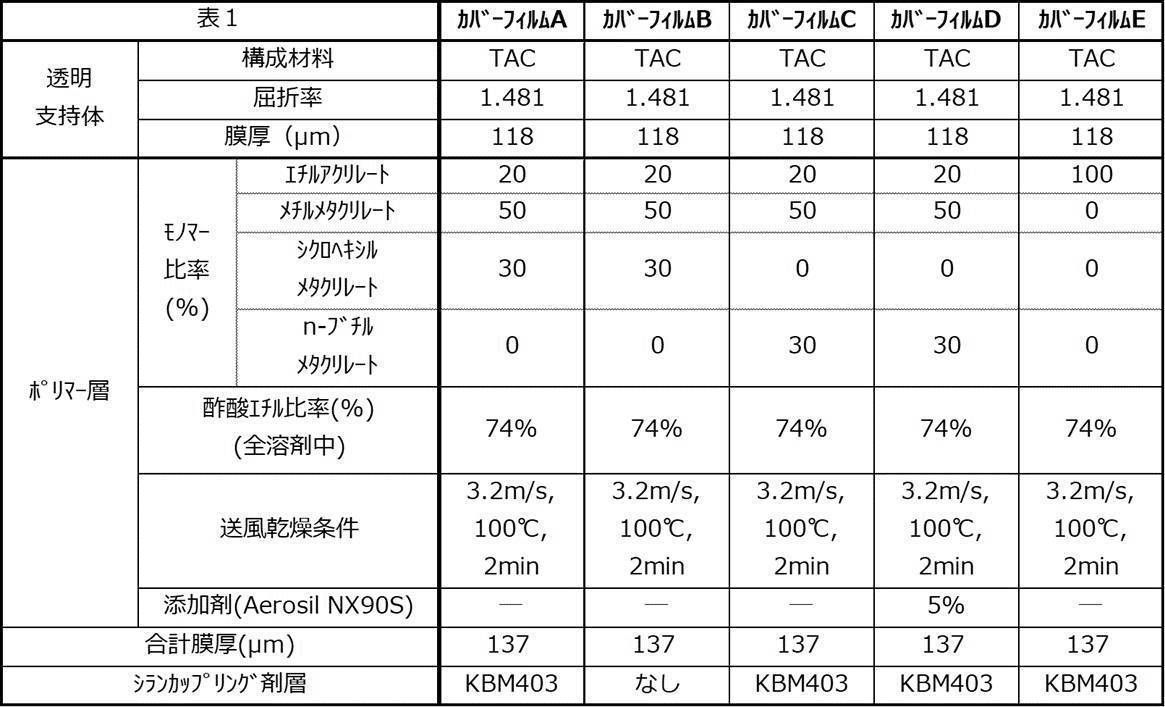
[実施例1]
(封入作業)
事前浸漬溶剤である酢酸3-メチルブチルに浸漬されたスライドガラスを浸漬層から引き揚げ、スライドガラスに対して酢酸3-メチルブチルを0.07ml滴下し、その上からカバーフィルムAを0.05MPaで半往復して貼り合せた。
(封入作業)
事前浸漬溶剤である酢酸3-メチルブチルに浸漬されたスライドガラスを浸漬層から引き揚げ、スライドガラスに対して酢酸3-メチルブチルを0.07ml滴下し、その上からカバーフィルムAを0.05MPaで半往復して貼り合せた。
(評価)
封入作業中および、封入作業後に以下の評価を行った。
封入作業中および、封入作業後に以下の評価を行った。
<封入性>
封入作業後10分後、貼り合せたフィルムを観察し、カバーフィルムのスライドガラスからの剥がれおよび気泡を確認した。観察結果から、以下の基準に基づいて封入性を評価した。
1: 剥がれおよび気泡がいずれもない。
2: 剥がれおよび/または気泡がごくわずかにある。
3: 剥がれおよび/または気泡がわずかにある。
4: 剥がれおよび/または気泡がややある。
5: 剥がれおよび/または気泡が多くある。
封入作業後10分後、貼り合せたフィルムを観察し、カバーフィルムのスライドガラスからの剥がれおよび気泡を確認した。観察結果から、以下の基準に基づいて封入性を評価した。
1: 剥がれおよび気泡がいずれもない。
2: 剥がれおよび/または気泡がごくわずかにある。
3: 剥がれおよび/または気泡がわずかにある。
4: 剥がれおよび/または気泡がややある。
5: 剥がれおよび/または気泡が多くある。
<速乾性>
封入作業が完了してから、接着剤が乾燥し、フィルムが動かなくなるまでの時間(乾燥時間)を測定し、以下の基準に基づいて速乾性を評価した。
1: 乾燥時間が3分間以内。
2: 乾燥時間が5分間以内。
3: 乾燥時間が10分間以内。
4: 乾燥時間が15分間以内。
5: 乾燥時間が15分間超。
封入作業が完了してから、接着剤が乾燥し、フィルムが動かなくなるまでの時間(乾燥時間)を測定し、以下の基準に基づいて速乾性を評価した。
1: 乾燥時間が3分間以内。
2: 乾燥時間が5分間以内。
3: 乾燥時間が10分間以内。
4: 乾燥時間が15分間以内。
5: 乾燥時間が15分間超。
<経時保管性>
40℃80%RHの環境下に7日間、貼り合せた試料を置いて、フィルム剥がれ加速試験を行った。加速試験後のカバーフィルムを目視で観察し、気泡および/または剥がれの増加の有無から、下記基準で経時保管性を評価した。
1: 気泡および剥がれの増加がいずれも観察されない
2: 気泡および/または剥がれの増加がわずかに観察される
3: 気泡および/または剥がれの増加が少し観察される
4: 気泡および/または剥がれの増加が観察される
5: 気泡および/または剥がれの増加が多く観察される
40℃80%RHの環境下に7日間、貼り合せた試料を置いて、フィルム剥がれ加速試験を行った。加速試験後のカバーフィルムを目視で観察し、気泡および/または剥がれの増加の有無から、下記基準で経時保管性を評価した。
1: 気泡および剥がれの増加がいずれも観察されない
2: 気泡および/または剥がれの増加がわずかに観察される
3: 気泡および/または剥がれの増加が少し観察される
4: 気泡および/または剥がれの増加が観察される
5: 気泡および/または剥がれの増加が多く観察される
[実施例2~12、比較例1~2]
表2記載のように事前浸漬溶剤、封入溶剤、および/または、カバーフィルムを変更した以外は実施例1と同様にして、封入テストおよび各評価を行った。
なお、実施例12では、封入溶剤として、酢酸3-メチルブチルおよびアセトンの混合溶剤(酢酸3-メチルブチル:アセトンの質量比が7:3)を使用した。
表2記載のように事前浸漬溶剤、封入溶剤、および/または、カバーフィルムを変更した以外は実施例1と同様にして、封入テストおよび各評価を行った。
なお、実施例12では、封入溶剤として、酢酸3-メチルブチルおよびアセトンの混合溶剤(酢酸3-メチルブチル:アセトンの質量比が7:3)を使用した。
下記表中、「事前浸漬溶剤」欄、および、「封入溶剤」の「溶剤種」欄は、各実施例および各比較例において使用した溶剤の種類を示し、「封入溶剤」の「沸点(℃)」欄は、封入溶剤として含まれるエステル化合物の沸点(単位:℃)を示す。
「カバーフィルム」の「種類」欄は、各実施例および各比較例において使用したカバーフィルムを示し、「カバーフィルム」の「ハンセン溶解度パラメーター」欄は、各カバーフィルムのポリマー層を構成するポリマーのハンセン溶解度パラメーター(ハンセンSP値)を示す。
「シランカップリング剤」欄は、各実施例および各比較例においてシランカップリング剤層の形成に用いたシランカップリング剤を示し、使用したカバーフィルムがシランカップリング剤層を有さない場合は「なし」と記載する。
「カバーフィルム」の「種類」欄は、各実施例および各比較例において使用したカバーフィルムを示し、「カバーフィルム」の「ハンセン溶解度パラメーター」欄は、各カバーフィルムのポリマー層を構成するポリマーのハンセン溶解度パラメーター(ハンセンSP値)を示す。
「シランカップリング剤」欄は、各実施例および各比較例においてシランカップリング剤層の形成に用いたシランカップリング剤を示し、使用したカバーフィルムがシランカップリング剤層を有さない場合は「なし」と記載する。
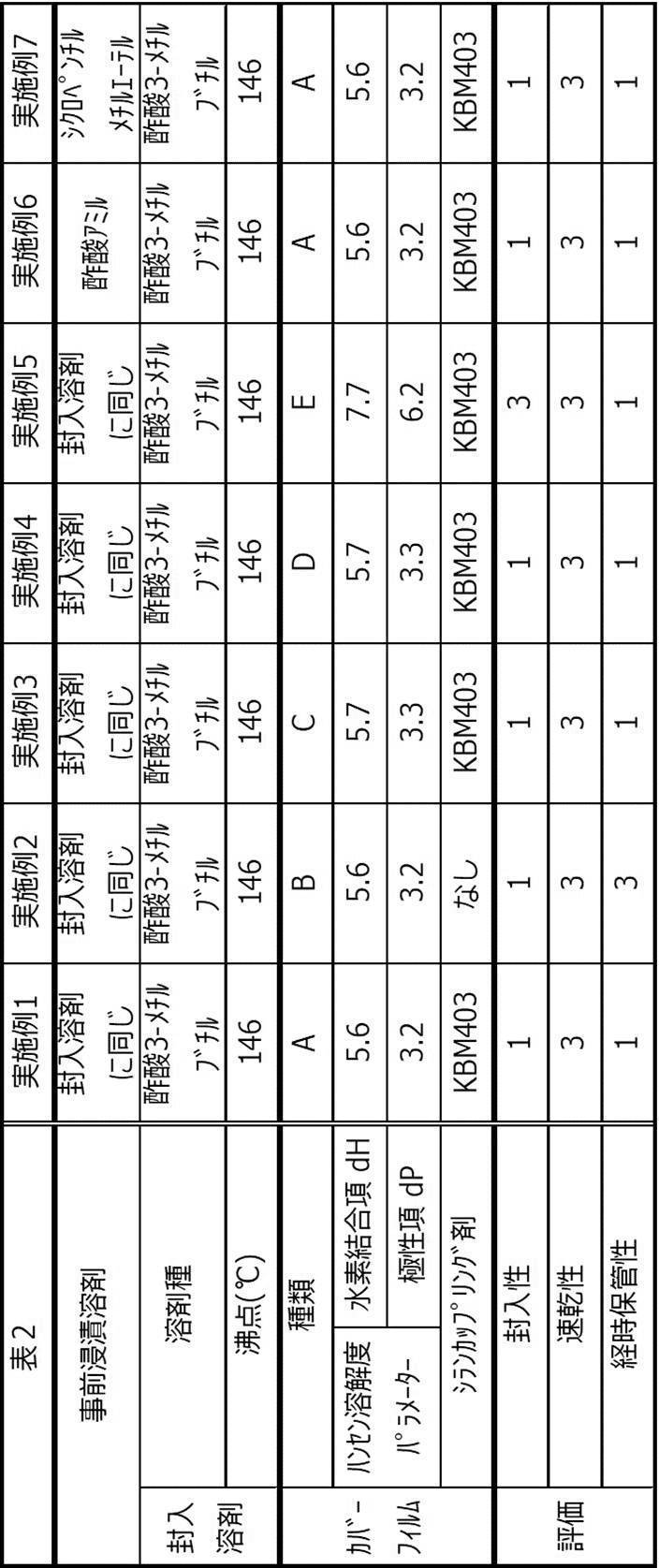
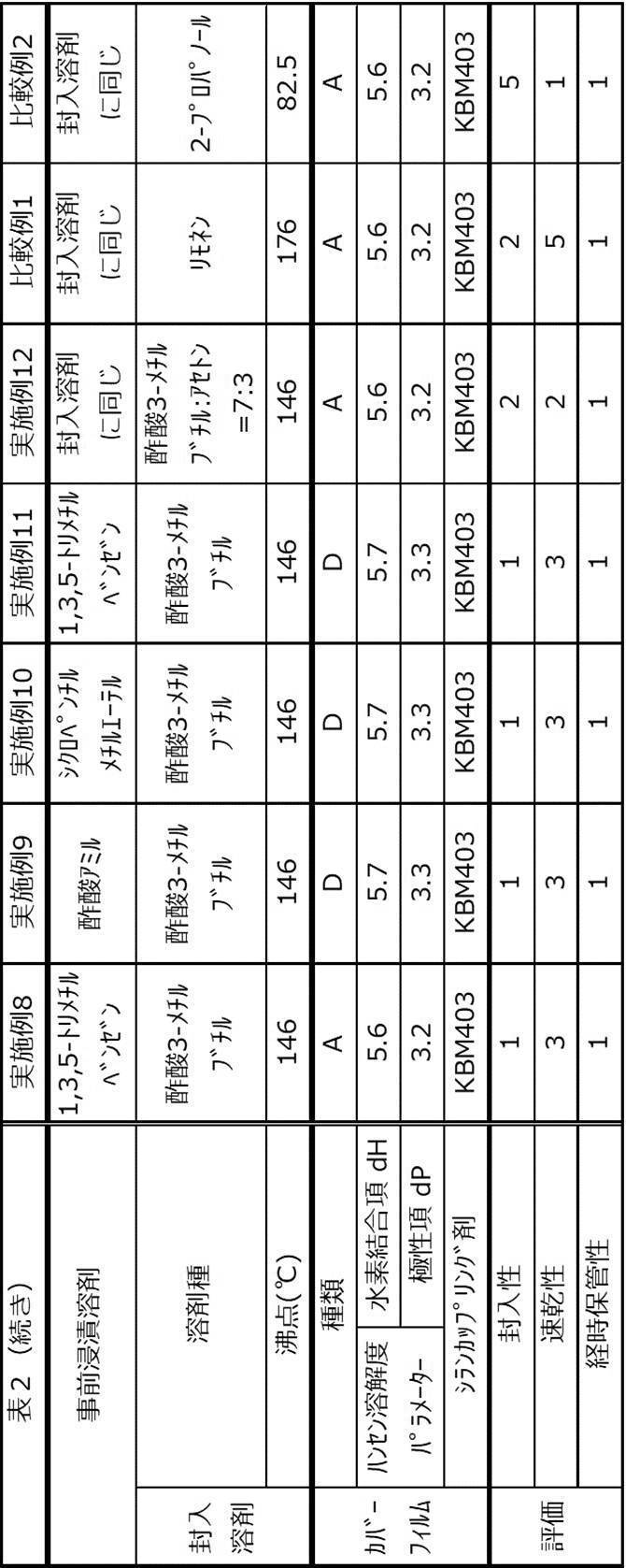
表1~表2に示す結果から、本発明の規定を満たす封入方法では、高い封入性が確認された。
また、実施例1~12において、各ポリマー溶液へのトルエンおよび酢酸エチルの添加に代えて、同量のトルエン、同量の酢酸エチル、および、シランカップリング剤塗布液を塗布した場合の塗布濃度と同じ塗布濃度となる量のシランカップリング剤の混合液を添加して混合し、シランカップリング剤含有ポリマー層塗布液を調製したこと、並びに、(カバーフィルムの作製)において、ポリマー層塗布液およびシランカップリング剤塗布液の重層塗布に代えて、上記のシランカップリング剤含有ポリマー層塗布液の単層塗布を行ったこと以外は、実施例1~12と同様にしてカバーフィルムを作製して封入テストを実施したが、実施例1~12と同様の性能を有することが確認された。
Claims (10)
- 透明支持体上に接着剤ポリマー層が設けられたカバーフィルムと封入溶剤とを用いて行う封入方法であって、
前記封入溶剤がエステル化合物を含み、
前記エステル化合物の沸点が80~170℃である、封入方法。 - 前記封入溶剤が、酢酸3-メチルブチルを含む、請求項1に記載の封入方法。
- 前記接着剤ポリマー層に含まれるポリマーが、エチルアクリレート、n-ブチルアクリレート、メチルアクリレート、シクロヘキシルアクリレート、ベンジルアクリレート、エチルメタクリレート、n-ブチルメタクリレート、イソブチルメタクリレート、t-ブチルメタクリレート、メチルメタクリレート、シクロヘキシルメタクリレート、ベンジルメタクリレート、アセトアセトキシアルキルメタクリレート、スチレンおよびジメチルアクリルアミドからなる群より選ばれる少なくとも1種のモノマーに由来する繰り返し単位を含む、請求項1または2に記載の封入方法。
- 前記接着剤ポリマー層に含まれるポリマーが、エチルアクリレート、n-ブチルアクリレート、メチルアクリレート、シクロヘキシルアクリレート、ベンジルアクリレート、エチルメタクリレート、n-ブチルメタクリレート、イソブチルメタクリレート、t-ブチルメタクリレート、メチルメタクリレート、シクロヘキシルメタクリレート、ベンジルメタクリレート、アセトアセトキシアルキルメタクリレート、スチレンおよびジメチルアクリルアミドからなる群より選ばれる少なくとも1種のモノマーに由来する繰り返し単位からなる、請求項3に記載の封入方法。
- 前記透明支持体の屈折率が、1.460~1.560である、請求項1~4のいずれか1項に記載の封入方法。
- 前記透明支持体を構成する材料が、トリアセテートセルロースである、請求項1~5のいずれか1項に記載の封入方法。
- 前記透明支持体の厚さが、50~150μmである、請求項1~6のいずれか1項に記載の封入方法。
- 前記接着剤ポリマー層と前記透明支持体の合計膜厚が150μm以下である、請求項1~7のいずれか1項に記載の封入方法。
- 前記接着剤ポリマー層が、シランカップリング剤を含む、請求項1~8のいずれか1項に記載の封入方法。
- 前記シランカップリング剤が、γ-グリシドキシプロピルトリメトキシシランおよびN-β-(アミノエチル)-γ-アミノプロピルメチルジメトキシシランからなる群より選ばれる少なくとも1種である、請求項9に記載の封入方法。
Applications Claiming Priority (2)
| Application Number | Priority Date | Filing Date | Title |
|---|---|---|---|
| JP2020120421 | 2020-07-14 | ||
| JP2020-120421 | 2020-07-14 |
Publications (1)
| Publication Number | Publication Date |
|---|---|
| WO2022014374A1 true WO2022014374A1 (ja) | 2022-01-20 |
Family
ID=79555357
Family Applications (1)
| Application Number | Title | Priority Date | Filing Date |
|---|---|---|---|
| PCT/JP2021/025134 Ceased WO2022014374A1 (ja) | 2020-07-14 | 2021-07-02 | 封入方法 |
Country Status (1)
| Country | Link |
|---|---|
| WO (1) | WO2022014374A1 (ja) |
Cited By (2)
| Publication number | Priority date | Publication date | Assignee | Title |
|---|---|---|---|---|
| WO2024070525A1 (ja) * | 2022-09-30 | 2024-04-04 | 富士フイルム株式会社 | カバーフィルム |
| CN119193075A (zh) * | 2024-10-17 | 2024-12-27 | 北京东杰华医医疗器械有限公司 | 一种快速固化的标本封胶及其制备方法 |
Citations (7)
| Publication number | Priority date | Publication date | Assignee | Title |
|---|---|---|---|---|
| JPS61254916A (ja) * | 1985-05-07 | 1986-11-12 | Mitsubishi Rayon Co Ltd | 顕微鏡用カバ−グラス |
| JPS6238408A (ja) * | 1985-08-13 | 1987-02-19 | Fuji Photo Film Co Ltd | 顕微鏡用カバ−フイルム |
| JPH1054942A (ja) * | 1996-08-09 | 1998-02-24 | Yasuhara Chem Kk | プレパラート用封入剤 |
| JPH11101943A (ja) * | 1997-09-29 | 1999-04-13 | Fuji Photo Film Co Ltd | 顕微鏡用カバーフイルム |
| JP2004506228A (ja) * | 2000-08-07 | 2004-02-26 | スリーエム イノベイティブ プロパティズ カンパニー | 顕微鏡用カバースリップ材 |
| JP2009514025A (ja) * | 2005-10-26 | 2009-04-02 | リー エイチ. アングロス, | 顕微鏡カバースリップおよびその使用 |
| US20180194913A1 (en) * | 2015-06-23 | 2018-07-12 | Island Polymer Industries Gmbh | Highly transparent coated cellulose triacetate film and dissolver medium |
-
2021
- 2021-07-02 WO PCT/JP2021/025134 patent/WO2022014374A1/ja not_active Ceased
Patent Citations (7)
| Publication number | Priority date | Publication date | Assignee | Title |
|---|---|---|---|---|
| JPS61254916A (ja) * | 1985-05-07 | 1986-11-12 | Mitsubishi Rayon Co Ltd | 顕微鏡用カバ−グラス |
| JPS6238408A (ja) * | 1985-08-13 | 1987-02-19 | Fuji Photo Film Co Ltd | 顕微鏡用カバ−フイルム |
| JPH1054942A (ja) * | 1996-08-09 | 1998-02-24 | Yasuhara Chem Kk | プレパラート用封入剤 |
| JPH11101943A (ja) * | 1997-09-29 | 1999-04-13 | Fuji Photo Film Co Ltd | 顕微鏡用カバーフイルム |
| JP2004506228A (ja) * | 2000-08-07 | 2004-02-26 | スリーエム イノベイティブ プロパティズ カンパニー | 顕微鏡用カバースリップ材 |
| JP2009514025A (ja) * | 2005-10-26 | 2009-04-02 | リー エイチ. アングロス, | 顕微鏡カバースリップおよびその使用 |
| US20180194913A1 (en) * | 2015-06-23 | 2018-07-12 | Island Polymer Industries Gmbh | Highly transparent coated cellulose triacetate film and dissolver medium |
Cited By (2)
| Publication number | Priority date | Publication date | Assignee | Title |
|---|---|---|---|---|
| WO2024070525A1 (ja) * | 2022-09-30 | 2024-04-04 | 富士フイルム株式会社 | カバーフィルム |
| CN119193075A (zh) * | 2024-10-17 | 2024-12-27 | 北京东杰华医医疗器械有限公司 | 一种快速固化的标本封胶及其制备方法 |
Similar Documents
| Publication | Publication Date | Title |
|---|---|---|
| WO2021187269A1 (ja) | カバーフィルム | |
| US6589650B1 (en) | Microscope cover slip materials | |
| WO2021187262A1 (ja) | カバーフィルム | |
| WO2013032121A1 (ko) | 반사 방지 필름의 제조 방법 | |
| WO2022014374A1 (ja) | 封入方法 | |
| US12305089B2 (en) | Sealing method | |
| WO2023054029A1 (ja) | カバーフィルム | |
| JPH11101943A (ja) | 顕微鏡用カバーフイルム | |
| TW201816045A (zh) | 接合用組成物、光學用接著劑及壓力感測器用接著劑 | |
| WO2025197817A1 (ja) | カバーフィルム | |
| US20250388773A1 (en) | Cover film | |
| US12600833B2 (en) | Cover film | |
| JP6884072B2 (ja) | 粘着剤組成物、積層体、及び表示装置 | |
| JP2010070609A (ja) | 貼り直しが容易な粘着テープ | |
| WO2025225288A1 (ja) | カバーフィルム | |
| WO2023054048A1 (ja) | カバーフィルム | |
| CN117757372B (zh) | 密封胶黏剂组合物、胶黏剂、胶带及其应用 | |
| WO2013032120A1 (ko) | 반사 방지 필름 | |
| WO2025192289A1 (ja) | カバーフィルム | |
| CN114667219B (zh) | 层叠体、层叠体的制造方法、防雾膜形成用组合物、防雾膜及防雾膜形成用组合物套组 | |
| WO2014071959A1 (en) | Cover slip materials for microscopy | |
| WO2024070525A1 (ja) | カバーフィルム | |
| JPH08140498A (ja) | 農業用被覆材 | |
| WO2025192438A1 (ja) | カバーフィルム | |
| WO2025192424A1 (ja) | カバーフィルム |
Legal Events
| Date | Code | Title | Description |
|---|---|---|---|
| 121 | Ep: the epo has been informed by wipo that ep was designated in this application |
Ref document number: 21841966 Country of ref document: EP Kind code of ref document: A1 |
|
| NENP | Non-entry into the national phase |
Ref country code: DE |
|
| 122 | Ep: pct application non-entry in european phase |
Ref document number: 21841966 Country of ref document: EP Kind code of ref document: A1 |
|
| NENP | Non-entry into the national phase |
Ref country code: JP |