WO2022014311A1 - 情報処理方法及び情報処理システム - Google Patents
情報処理方法及び情報処理システム Download PDFInfo
- Publication number
- WO2022014311A1 WO2022014311A1 PCT/JP2021/024336 JP2021024336W WO2022014311A1 WO 2022014311 A1 WO2022014311 A1 WO 2022014311A1 JP 2021024336 W JP2021024336 W JP 2021024336W WO 2022014311 A1 WO2022014311 A1 WO 2022014311A1
- Authority
- WO
- WIPO (PCT)
- Prior art keywords
- battery
- information
- life
- information processing
- unit
- Prior art date
- Legal status (The legal status is an assumption and is not a legal conclusion. Google has not performed a legal analysis and makes no representation as to the accuracy of the status listed.)
- Ceased
Links
Images
Classifications
-
- B—PERFORMING OPERATIONS; TRANSPORTING
- B60—VEHICLES IN GENERAL
- B60L—PROPULSION OF ELECTRICALLY-PROPELLED VEHICLES; SUPPLYING ELECTRIC POWER FOR AUXILIARY EQUIPMENT OF ELECTRICALLY-PROPELLED VEHICLES; ELECTRODYNAMIC BRAKE SYSTEMS FOR VEHICLES IN GENERAL; MAGNETIC SUSPENSION OR LEVITATION FOR VEHICLES; MONITORING OPERATING VARIABLES OF ELECTRICALLY-PROPELLED VEHICLES; ELECTRIC SAFETY DEVICES FOR ELECTRICALLY-PROPELLED VEHICLES
- B60L58/00—Methods or circuit arrangements for monitoring or controlling batteries or fuel cells, specially adapted for electric vehicles
- B60L58/10—Methods or circuit arrangements for monitoring or controlling batteries or fuel cells, specially adapted for electric vehicles for monitoring or controlling batteries
- B60L58/16—Methods or circuit arrangements for monitoring or controlling batteries or fuel cells, specially adapted for electric vehicles for monitoring or controlling batteries responding to battery ageing, e.g. to the number of charging cycles or the state of health [SoH]
-
- B—PERFORMING OPERATIONS; TRANSPORTING
- B60—VEHICLES IN GENERAL
- B60L—PROPULSION OF ELECTRICALLY-PROPELLED VEHICLES; SUPPLYING ELECTRIC POWER FOR AUXILIARY EQUIPMENT OF ELECTRICALLY-PROPELLED VEHICLES; ELECTRODYNAMIC BRAKE SYSTEMS FOR VEHICLES IN GENERAL; MAGNETIC SUSPENSION OR LEVITATION FOR VEHICLES; MONITORING OPERATING VARIABLES OF ELECTRICALLY-PROPELLED VEHICLES; ELECTRIC SAFETY DEVICES FOR ELECTRICALLY-PROPELLED VEHICLES
- B60L50/00—Electric propulsion with power supplied within the vehicle
- B60L50/50—Electric propulsion with power supplied within the vehicle using propulsion power supplied by batteries or fuel cells
- B60L50/60—Electric propulsion with power supplied within the vehicle using propulsion power supplied by batteries or fuel cells using power supplied by batteries
-
- B—PERFORMING OPERATIONS; TRANSPORTING
- B60—VEHICLES IN GENERAL
- B60L—PROPULSION OF ELECTRICALLY-PROPELLED VEHICLES; SUPPLYING ELECTRIC POWER FOR AUXILIARY EQUIPMENT OF ELECTRICALLY-PROPELLED VEHICLES; ELECTRODYNAMIC BRAKE SYSTEMS FOR VEHICLES IN GENERAL; MAGNETIC SUSPENSION OR LEVITATION FOR VEHICLES; MONITORING OPERATING VARIABLES OF ELECTRICALLY-PROPELLED VEHICLES; ELECTRIC SAFETY DEVICES FOR ELECTRICALLY-PROPELLED VEHICLES
- B60L58/00—Methods or circuit arrangements for monitoring or controlling batteries or fuel cells, specially adapted for electric vehicles
- B60L58/10—Methods or circuit arrangements for monitoring or controlling batteries or fuel cells, specially adapted for electric vehicles for monitoring or controlling batteries
- B60L58/12—Methods or circuit arrangements for monitoring or controlling batteries or fuel cells, specially adapted for electric vehicles for monitoring or controlling batteries responding to state of charge [SoC]
-
- G—PHYSICS
- G01—MEASURING; TESTING
- G01R—MEASURING ELECTRIC VARIABLES; MEASURING MAGNETIC VARIABLES
- G01R31/00—Arrangements for testing electric properties; Arrangements for locating electric faults; Arrangements for electrical testing characterised by what is being tested not provided for elsewhere
- G01R31/36—Arrangements for testing, measuring or monitoring the electrical condition of accumulators or electric batteries, e.g. capacity or state of charge [SoC]
- G01R31/392—Determining battery ageing or deterioration, e.g. state of health
-
- H—ELECTRICITY
- H01—ELECTRIC ELEMENTS
- H01M—PROCESSES OR MEANS, e.g. BATTERIES, FOR THE DIRECT CONVERSION OF CHEMICAL ENERGY INTO ELECTRICAL ENERGY
- H01M10/00—Secondary cells; Manufacture thereof
- H01M10/42—Methods or arrangements for servicing or maintenance of secondary cells or secondary half-cells
- H01M10/48—Accumulators combined with arrangements for measuring, testing or indicating the condition of cells, e.g. the level or density of the electrolyte
-
- H—ELECTRICITY
- H02—GENERATION; CONVERSION OR DISTRIBUTION OF ELECTRIC POWER
- H02J—ELECTRIC POWER NETWORKS; CIRCUIT ARRANGEMENTS OR SYSTEMS FOR SUPPLYING OR DISTRIBUTING ELECTRIC POWER; SYSTEMS FOR STORING ELECTRIC ENERGY
- H02J7/00—Circuit arrangements for charging or discharging batteries or for supplying loads from batteries
-
- B—PERFORMING OPERATIONS; TRANSPORTING
- B60—VEHICLES IN GENERAL
- B60L—PROPULSION OF ELECTRICALLY-PROPELLED VEHICLES; SUPPLYING ELECTRIC POWER FOR AUXILIARY EQUIPMENT OF ELECTRICALLY-PROPELLED VEHICLES; ELECTRODYNAMIC BRAKE SYSTEMS FOR VEHICLES IN GENERAL; MAGNETIC SUSPENSION OR LEVITATION FOR VEHICLES; MONITORING OPERATING VARIABLES OF ELECTRICALLY-PROPELLED VEHICLES; ELECTRIC SAFETY DEVICES FOR ELECTRICALLY-PROPELLED VEHICLES
- B60L2250/00—Driver interactions
- B60L2250/16—Driver interactions by display
-
- Y—GENERAL TAGGING OF NEW TECHNOLOGICAL DEVELOPMENTS; GENERAL TAGGING OF CROSS-SECTIONAL TECHNOLOGIES SPANNING OVER SEVERAL SECTIONS OF THE IPC; TECHNICAL SUBJECTS COVERED BY FORMER USPC CROSS-REFERENCE ART COLLECTIONS [XRACs] AND DIGESTS
- Y02—TECHNOLOGIES OR APPLICATIONS FOR MITIGATION OR ADAPTATION AGAINST CLIMATE CHANGE
- Y02E—REDUCTION OF GREENHOUSE GAS [GHG] EMISSIONS, RELATED TO ENERGY GENERATION, TRANSMISSION OR DISTRIBUTION
- Y02E60/00—Enabling technologies; Technologies with a potential or indirect contribution to GHG emissions mitigation
- Y02E60/10—Energy storage using batteries
-
- Y—GENERAL TAGGING OF NEW TECHNOLOGICAL DEVELOPMENTS; GENERAL TAGGING OF CROSS-SECTIONAL TECHNOLOGIES SPANNING OVER SEVERAL SECTIONS OF THE IPC; TECHNICAL SUBJECTS COVERED BY FORMER USPC CROSS-REFERENCE ART COLLECTIONS [XRACs] AND DIGESTS
- Y02—TECHNOLOGIES OR APPLICATIONS FOR MITIGATION OR ADAPTATION AGAINST CLIMATE CHANGE
- Y02T—CLIMATE CHANGE MITIGATION TECHNOLOGIES RELATED TO TRANSPORTATION
- Y02T10/00—Road transport of goods or passengers
- Y02T10/60—Other road transportation technologies with climate change mitigation effect
- Y02T10/70—Energy storage systems for electromobility, e.g. batteries
Definitions
- This disclosure relates to information processing methods and information processing systems.
- Patent Document 1 discloses a technique for calculating information on battery life (for example, battery capacity or replacement time) based on a detection result of a battery state.
- the object of the present disclosure is to provide a technique capable of calculating the life of a battery for driving an electric device according to the usage mode of the electric device while ensuring safety.
- the information processing apparatus acquires power consumption information indicating information corresponding to the power consumption per usage unit of the electric device driven by the battery, and the initial capacity of the battery is obtained.
- the first life of the battery is calculated based on the power consumption information and the initial capacity information, and the second life of the battery is set according to the characteristics of the battery.
- the battery is acquired and the shorter of the first life and the second life is output as the third life of the battery.
- Products purchased by mail-order sales using the Internet or the like are delivered to the customer's home or the like by a courier company.
- the courier company uses multiple trucks to deliver the parcel within the delivery area in charge.
- electric vehicles (EVs) equipped with battery-powered traction motors will become more widespread, and it is expected that the number of courier companies that deliver packages by EV trucks will increase.
- the battery of EV deteriorates according to the total mileage from the time of a new car.
- SoH State of Health
- SoH State of Health
- the allowable lower limit value is uniformly set by the battery maker, the car maker, or the like, and is set to, for example, "80%".
- the usage mode varies depending on the EV, and even after the SoH of the battery drops below the uniform permissible lower limit value, there may be no problem in practical use even if the EV is continuously used. For example, for EVs that are mainly used for short-distance operation and whose batteries are frequently charged, the power consumption per charge is small and the SoH required for the usage mode is small. Even if SoH drops below the allowable lower limit, there is no problem in practical use. Instead of replacing the EV every time the SoH drops to a uniform allowable lower limit value, the replacement cycle of the EV becomes longer by continuing to use the EV even after the SoH drops below the allowable lower limit value.
- TCO total cost of ownership
- the encoder device disclosed in Patent Document 1 includes a position detection unit that detects position information of a moving unit, a battery that supplies electric power to the position detection unit, a battery detection unit that detects the state of the battery, and the above. It includes a calculation unit that calculates the battery life information based on the detection result of the battery detection unit.
- the battery life information is supplied from the battery, the time until the discharge end voltage of the battery is reached, the remaining amount of the battery, the time during which the position detection unit can be operated by the electric power supplied from the battery, and the battery. It includes at least one of the times when the power is insufficient with respect to the power consumption of the position detection unit.
- Patent Document 1 does not disclose that the life of a battery is individually determined according to the usage mode of an electric device while considering the characteristics of the battery such as safety.
- the present inventor calculates the first life of the battery according to the usage mode of the electric device, obtains the second life of the battery according to the characteristics of the battery such as safety, and obtains the second life of the battery.
- We have come up with the present disclosure based on the finding that both reduction of TCO and ensuring safety can be achieved by deriving the battery life based on this information.
- the information processing apparatus acquires power consumption information indicating information corresponding to the power consumption per usage unit of the electric device driven by the battery, and the initial capacity of the battery is obtained.
- the first life of the battery is calculated based on the power consumption information and the initial capacity information, and the second life of the battery is set according to the characteristics of the battery.
- the battery is acquired and the shorter of the first life and the second life is output as the third life of the battery.
- the information processing device calculates the first life based on the power consumption per unit of use of the electric device and the initial capacity of the battery, and is set according to the characteristics of the battery such as safety.
- the second life is acquired, and the shorter of these is output as the battery life (third life). Therefore, the life of the battery can be derived according to the usage mode of the electric device while ensuring the safety. As a result, it is possible to achieve both reduction of total cost and ensuring safety.
- the electric device is a mobile body including a motor driven by the battery, and the information processing apparatus acquires the traveling information of the moving body as the power consumption information and includes the traveling information.
- the power consumption is calculated based on the travel distance information per usage unit of the moving body.
- the information processing apparatus acquires deterioration information indicating the degree of deterioration of the battery, calculates the remaining life of the battery based on the third life and the degree of deterioration, and outputs the remaining life. do.
- the information processing apparatus calculates the remaining life based on the difference between the degree of deterioration corresponding to the third life and the degree of deterioration indicated by the deterioration information.
- the information processing device causes the presenting device to present the third life or the remaining life.
- the presenting device present the third life or the remaining life, the user can grasp the life of the battery for each usage mode.
- the remaining life it is possible to provide the user with information that is intuitively easy for the user to understand.
- the information processing apparatus acquires the movement history information or the movement plan information of the moving body as the moving information.
- the information processing system includes a first acquisition unit that acquires power consumption information indicating information corresponding to the power consumption per unit of use of an electric device driven by a battery, and an initial capacity of the battery.
- a second acquisition unit for acquiring initial capacity information indicating the above, a calculation unit for calculating the first life of the battery based on the power consumption information and the initial capacity information, and a setting unit according to the characteristics of the battery. It is provided with a third acquisition unit for acquiring the second life of the battery, and an output unit for outputting the shorter of the first life and the second life as the third life of the battery.
- the calculation unit calculates the first life based on the power consumption per unit of use of the electric device and the initial capacity of the battery, and the third acquisition unit determines the characteristics of the battery such as safety.
- the second life set accordingly is acquired, and the output unit outputs the shorter of these as the battery life (third life). Therefore, the life of the battery can be derived according to the usage mode of the electric device while ensuring the safety. As a result, it is possible to achieve both reduction of total cost and ensuring safety.
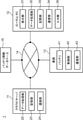
- FIG. 1 is a block diagram showing a configuration of an information processing system 1 according to the first embodiment of the present disclosure.
- the information processing system 1 is constructed as a management system of a courier company that delivers a package to a customer's home or the like by an electric vehicle (EV).
- this courier company has a plurality of business establishments in charge of each delivery area and a head office that controls these multiple business establishments.
- a local PC 12 is installed at the head office and each business office, and is connected to the cloud server 11.
- a plurality of vehicles 13 for delivering cargo are deployed at each business site.
- the cloud server 11, the local PC 12, and the vehicle 13 can communicate with each other via an arbitrary communication network 14 such as an IP network.
- the battery information database 15 is connected to the communication network 14.
- the battery information database 15 stores battery information indicating specifications of the battery 41 provided by a battery manufacturer, an analysis manufacturer, or the like.
- the specifications include at least the initial capacity FCC_init and the second life EoL_b, which will be described later.
- the cloud server 11 can access the battery information database 15 via the communication network 14.
- the moving body is a vehicle, but the moving body is not limited to this.
- the moving object may be an aircraft such as a drone, a ship, or a mobile robot.
- the cloud server 11 includes a data processing unit 22, a storage unit 23, and a communication unit 24.
- the local PC includes a display unit 31, a data processing unit 32, a storage unit 33, a communication unit 34, and an input unit 35.
- the display unit 31 is a liquid crystal display, an organic EL display, or the like.
- the data processing units 22 and 32 are processors such as a CPU.
- the storage units 23 and 33 are HDDs, SSDs, or the like.
- the communication units 24 and 34 are communication modules that perform data communication according to a predetermined communication standard such as IP.
- the input unit 35 is a mouse, a keyboard, or the like.
- the vehicle 13 is an EV truck or the like, and includes a battery 41, a control unit 42, and a communication unit 43.
- the battery 41 is a secondary battery such as a lithium ion battery for driving a traveling motor mounted on the vehicle 13.
- the control unit 42 is a BMS (Battery Management System) for performing operation control and state management of the battery 41.
- the communication unit 43 is a communication module that performs data communication according to a predetermined communication standard such as IP.
- the application target of the information processing system 1 is not limited to the home delivery business, but is arbitrary such as a taxi business, a rental car business, a car sharing business, or a driving agency business, which conducts a business using a plurality of EVs. It is a business of.
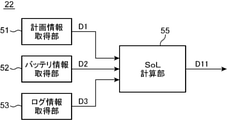
- FIG. 2 is a block diagram showing a function of the data processing unit 22 of the cloud server 11.
- the data processing unit 22 has a plan information acquisition unit 51, a battery information acquisition unit 52, a log information acquisition unit 53, and a SoL calculation unit 55. These functions may be realized by software by the CPU executing a program read from ROM or the like.
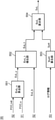
- FIG. 3 is a block diagram showing the configuration of the SoL calculation unit 55.
- the SoL calculation unit 55 includes an EoL_u calculation unit 551, an EoL_t derivation unit 552, a SoH calculation unit 553, and a SoL calculation unit 554.
- the EoL_u calculation unit 551 calculates the first life EoL_u of the battery 41 based on the initial capacity FCC_init input from the battery information acquisition unit 52 and the required capacity FCC_u input from the plan information acquisition unit 51.
- the initial capacity FCC_init is the capacity of the battery 41 when it is new, and is catalog information provided by the manufacturer of the battery 41 or the like.
- the required capacity FCC_u is power consumption information indicating the amount of power consumed per usage unit (per charge) of each vehicle 13 obtained according to the usage mode of each vehicle 13.
- the first life EoL_u is a life (End of Life) obtained according to the usage mode of each vehicle 13.
- EoL_u (FCC_u / FCC_init) x 100 ... (1)
- the first life EoL_u is calculated by performing the above calculation.
- the EoL_t derivation unit 552 derives the third life EoL_t, which is the life of the battery 41, based on the first life EoL_u input from the EoL_u calculation unit 551 and the second life EoL_b input from the battery information acquisition unit 52. do.
- the second life EoL_b is a limit value set by the manufacturer of the battery 41, the analysis manufacturer, or the like according to the battery characteristics such as safety.
- EoL_t max (EoL_u, EoL_b) ...
- the larger value (that is, the shorter life) of the first life EoL_u and the second life EoL_b is derived as the third life EoL_t.
- the SoH calculation unit 553 calculates the deterioration degree SoH of the battery 41 based on the charge / discharge history information of the battery 41 among the log information input from the log information acquisition unit 53.
- the SoL calculation unit 554 calculates the remaining life SoL of the battery 41 based on the third life EoL_t input from the EoL_t derivation unit 552 and the deterioration degree SoH input from the SoH calculation unit 553.
- the remaining life SoL is a deterioration index (State of Life) in which the degree of deterioration SoH is normalized by the third life EoL_t.
- the remaining life SoL is calculated by performing the following calculation, and the calculated remaining life SoL is output.
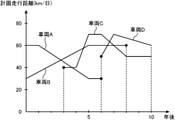
- FIG. 4 is a simplified diagram showing an example of travel plan information formulated at a certain business establishment.
- the planned mileage (km / day) per day is set for each of the plurality of vehicles 13 (four vehicles A to D in this example) every year.
- the optimum value of this planned mileage is determined by a predetermined prediction model based on the long-term business plan of the target business establishment, the deterioration characteristics of the battery 41 with respect to the total mileage, and the cost information including the driver labor cost and the vehicle purchase cost. It is calculated.
- Predictive models can be derived by machine learning using artificial intelligence. As the algorithm of the prediction model, path optimization by linear programming, a neural network, multiple regression analysis, or the like can be used.
- the planned mileage greatly increases or decreases every year even for the same vehicle 13 (for example, vehicle C).
- the graph for vehicle A disappears after 6 years. This indicates that the time to sell (or scrap) vehicle A is six years later.
- a graph relating to vehicle C appears three years later. This indicates that the time to purchase vehicle C is three years later.
- the travel plan information shown in FIG. 4 is transmitted from the local PC 12 to the cloud server 11 via the communication network 14 and stored in the storage unit 23. However, the travel plan information may be created by the cloud server 11.
- the plan information acquisition unit 51 acquires the required capacity FCC_u of each vehicle 13 based on the travel plan information read from the storage unit 23. Assuming that each vehicle 13 is charged every day at the business establishment, for example, the required capacity FCC_u of the vehicle A at present (0 years later) is a capacity equivalent to 60 km of travel.
- the plan information acquisition unit 51 inputs the required capacity FCC_u of each vehicle 13 acquired by converting the planned mileage into the power consumption amount into the SoL calculation unit 55 as data D1.
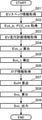
- FIG. 5 is a flowchart showing a flow of processing executed by the data processing unit 22 of the cloud server 11 in order to calculate the remaining life SoL of the EV.
- the battery information acquisition unit 52 When the cloud server 11 receives a request for calculating the remaining life SoL of a certain vehicle 13 from the local PC 12, the battery information acquisition unit 52 first receives EV spec information indicating the specifications of the vehicle 13 from the local PC 12 in step S01. Or, obtain it from a database provided by a car maker or the like.
- the specifications of the vehicle 13 include information indicating the type (model number, etc.) of the battery 41 mounted on the vehicle 13.
- step S02 the battery information acquisition unit 52 acquires the second life EoL_b and the initial capacity FCC_init regarding the battery 41 of the type specified in step S01 from the battery information database 15 by accessing the battery information database 15.
- the battery information acquisition unit 52 inputs the acquired second life EoL_b and initial capacity FCC_init to the SoL calculation unit 55 as data D2.
- the plan information acquisition unit 51 acquires the travel plan information about the target vehicle 13 by reading it from the storage unit 23. Further, the plan information acquisition unit 51 acquires the required capacity FCC_u for the target vehicle 13 based on the travel plan information, and inputs the required capacity FCC_u as data D1 to the SoL calculation unit 55. If the travel plan information for the target vehicle 13 has not been created, the plan information acquisition unit 51 receives the travel history information of the vehicle 13 from the vehicle 13 via the communication network 14, and the travel is performed. A future travel plan may be estimated from the transition tendency of the past travel distance included in the history information.
- step S04 the EoL_u calculation unit 551 uses the above equation based on the initial capacity FCC_init input as data D2 from the battery information acquisition unit 52 and the required capacity FCC_u input as data D1 from the plan information acquisition unit 51. By performing the calculation shown in (1), the first life EoL_u of the battery 41 is calculated.
- step S05 the EoL_t derivation unit 552 uses the above equation (2) based on the first life EoL_u input from the EoL_u calculation unit 551 and the second life EoL_b input as data D2 from the battery information acquisition unit 52. ) Is performed to derive the third life EoL_t of the battery 41.
- step S06 the log information acquisition unit 53 acquires log information from the target vehicle 13 via the communication network 14.
- the log information includes travel history information of the vehicle 13 and charge / discharge history information of the battery 41.
- the log information acquisition unit 53 inputs the acquired log information as data D3 to the SoL calculation unit 55.
- step S07 the SoH calculation unit 553 calculates the deterioration degree SoH of the battery 41 based on the charge / discharge history information of the battery 41 among the log information input from the log information acquisition unit 53.
- step S08 the SoL calculation unit 554 performs the calculation shown in the above equation (3) based on the third life EoL_t input from the EoL_t derivation unit 552 and the deterioration degree SoH input from the SoH calculation unit 553. To calculate the remaining life SoL of the battery 41.
- step S09 the SoL calculation unit 554 outputs the remaining life SoL calculated in step S08.
- the remaining life SoL output from the SoL calculation unit 554 is transmitted to the local PC 12 via the communication network 14, and information indicating the remaining life of the target vehicle 13 is displayed on the display unit 31.
- the remaining life SoL output from the SoL calculation unit 554 is transmitted to the target vehicle 13 via the communication network 14, and information indicating the remaining life of the vehicle 13 is displayed on a display that can be visually recognized by the driver of the vehicle 13. It may be displayed.
- audio output or the like may be used as a mode for presenting information indicating the remaining life.
- the third life EoL_t may be presented in place of the remaining life SoL or in addition to the remaining life SoL.
- the data processing unit 22 of the cloud server 11 (information processing device) has a required capacity FCC_u indicating the power consumption per usage unit (per charge) of the vehicle 13 and an initial capacity of the battery 41.
- the first life EoL_u is calculated based on the FCC_init.
- the data processing unit 22 acquires the second life EoL_b set according to the characteristics of the battery 41 such as safety.
- the data processing unit 22 derives the shorter of the first life EoL_u and the second life EoL_b as the life of the battery 41 (third life EoL_t). Therefore, the life of the battery 41 can be derived according to the usage mode of the vehicle 13 while ensuring safety. As a result, it is possible to achieve both reduction of total cost and ensuring safety.
- the present embodiment it is possible to appropriately manage the life of the EV or the battery 41 mounted on the EV based on the travel information (travel plan information or travel history information) of the EV as a moving body. ..
- the remaining life SoL is calculated based on the difference between the deterioration degree corresponding to the third life EoL_t and the deterioration degree SoH, and the remaining life SoL is compared from the viewpoint of the deterioration degree. Can be calculated.
- the life of the battery 41 for each usage mode can be grasped by the user by presenting the third life EoL_t or the remaining life SoL to the presenting device (display unit 31 or the like).
- the remaining life SoL it is possible to provide the user with information that is intuitively easy for the user to understand.
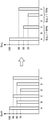
- FIG. 6 is a diagram showing an example of a display mode of the remaining life SoL.
- FIG. 6 shows the results for the six vehicles A to F.
- the graph on the left shows the display mode using the deterioration degree SoH of the battery 41, and the graph on the right shows the display mode using the remaining life SoL in which the deterioration degree SoH in the left figure is normalized by the third life EoL_t. ing.
- An example is shown in which the third life EoL_t of the vehicles A to C is 80% and the third life EoL_t of the vehicles D to F is 70%.
- the data processing unit 22 acquires the travel plan information or the travel history information of the vehicle 13 as the travel information (power consumption information). By using the travel plan information itself or by estimating the future travel plan information from the past travel history information, it is possible to appropriately acquire the travel information as the power consumption information.
- the cloud server 11 calculates the remaining life SoL of the battery 41 for the battery-powered EV, but the present invention is not limited to this example.
- the cloud server 11 may calculate the remaining life of an arbitrary electric device driven by a battery.
- the electric device is, for example, a power storage device.
- the power storage device may have a power generation function.
- the usage plan information of the electric device can be formulated as the power consumption information showing the total power consumption of the battery.
- the plan information acquisition unit 51 may estimate the usage plan information from the tendency based on the historical information indicating the past usage status of the electric device or the battery.
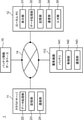
- FIG. 7 is a block diagram showing the configuration of the information processing system 1 according to the second embodiment of the present disclosure.
- the vehicle 13 shown in FIG. 1 has been replaced by the electric device 113.
- the electric device 113 has a battery 141, a control unit 142, and a communication unit 143.
- the battery 141, the control unit 142, and the communication unit 143 correspond to the battery 41, the control unit 42, and the communication unit 43 shown in FIG. 1, respectively.
- the cloud server 11 individually determines the life of the battery 141 (third life EoL_t or remaining life SoL) according to the usage mode of the electric device 113 while considering the characteristics of the battery 141 such as safety. Derived.
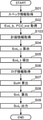
- FIG. 8 is a flowchart showing a flow of processing executed by the data processing unit 22 of the cloud server 11 in order to calculate the remaining life SoL of the electric device 113.
- the battery information acquisition unit 52 first receives spec information indicating the specifications of the electric device 113 in the local PC 12 in step S01. Obtained from or from a database provided by an electric machine manufacturer.
- the specifications of the electric device 113 include information indicating the type (model number, etc.) of the battery 141 mounted on the electric device 113.
- step S02 the battery information acquisition unit 52 acquires the second life EoL_b and the initial capacity FCC_init regarding the battery 141 of the type specified in step S01 from the battery information database 15 by accessing the battery information database 15.
- the battery information acquisition unit 52 inputs the acquired second life EoL_b and initial capacity FCC_init to the SoL calculation unit 55 as data D2.
- the plan information acquisition unit 51 acquires the usage plan information received from the local PC 12 for the target electric device 113 and stored in the storage unit 23 by reading it from the storage unit 23. Further, the plan information acquisition unit 51 acquires the required capacity FCC_u for the target electric device 113 based on the usage plan information, and inputs the required capacity FCC_u as data D1 to the SoL calculation unit 55. If the usage plan information for the target electric device 113 has not been created, the plan information acquisition unit 51 receives the usage history information of the electric device 113 from the electric device 113 via the communication network 14. , The future usage plan may be estimated from the transition tendency of the past power consumption included in the usage history information.
- step S04 the EoL_u calculation unit 551 uses the above equation based on the initial capacity FCC_init input as data D2 from the battery information acquisition unit 52 and the required capacity FCC_u input as data D1 from the plan information acquisition unit 51. By performing the calculation shown in (1), the first life EoL_u of the battery 141 is calculated.
- step S05 the EoL_t derivation unit 552 uses the above equation (2) based on the first life EoL_u input from the EoL_u calculation unit 551 and the second life EoL_b input as data D2 from the battery information acquisition unit 52. ) Is performed to derive the third life EoL_t of the battery 141.
- step S06 the log information acquisition unit 53 acquires log information from the target electric device 113 via the communication network 14.
- the log information includes usage history information of the electric device 113 and charge / discharge history information of the battery 141.
- the log information acquisition unit 53 inputs the acquired log information as data D3 to the SoL calculation unit 55.
- step S07 the SoH calculation unit 553 calculates the deterioration degree SoH of the battery 141 based on the charge / discharge history information of the battery 141 among the log information input from the log information acquisition unit 53.
- step S08 the SoL calculation unit 554 performs the calculation shown in the above equation (3) based on the third life EoL_t input from the EoL_t derivation unit 552 and the deterioration degree SoH input from the SoH calculation unit 553. To calculate the remaining life SoL of the battery 141.
- step S09 the SoL calculation unit 554 outputs the remaining life SoL calculated in step S08.
- the remaining life SoL output from the SoL calculation unit 554 is transmitted to the local PC 12 via the communication network 14, and information indicating the remaining life of the target electric device 113 is displayed on the display unit 31.
- the remaining life SoL output from the SoL calculation unit 554 is transmitted to the target electric device 113 via the communication network 14, and information indicating the remaining life of the electric device 113 can be visually recognized by the user of the electric device 113. It may be displayed on various displays. In addition to the above display, audio output or the like may be used as a mode for presenting information indicating the remaining life.
- the data processing unit 22 of the cloud server 11 (information processing device) has a required capacity FCC_u indicating the power consumption per usage unit (per charge) of the electric device 113, and an initial battery 141.
- the first life EoL_u is calculated based on the capacity FCC_init.
- the data processing unit 22 acquires the second life EoL_b set according to the characteristics of the battery 141 such as safety.
- the data processing unit 22 derives the shorter of the first life EoL_u and the second life EoL_b as the life of the battery 141 (third life EoL_t). Therefore, the life of the battery 141 can be derived according to the usage mode of the electric device 113 while ensuring safety. As a result, it is possible to achieve both reduction of total cost and ensuring safety.
- the technique according to the present disclosure is particularly useful with respect to a technique for deriving the life of the battery in any electric device such as an EV driven by the battery.
Landscapes
- Engineering & Computer Science (AREA)
- Power Engineering (AREA)
- Life Sciences & Earth Sciences (AREA)
- Mechanical Engineering (AREA)
- Transportation (AREA)
- Sustainable Energy (AREA)
- Sustainable Development (AREA)
- Electrochemistry (AREA)
- General Chemical & Material Sciences (AREA)
- Chemical Kinetics & Catalysis (AREA)
- Chemical & Material Sciences (AREA)
- Manufacturing & Machinery (AREA)
- Physics & Mathematics (AREA)
- General Physics & Mathematics (AREA)
- Secondary Cells (AREA)
- Electric Propulsion And Braking For Vehicles (AREA)
- Charge And Discharge Circuits For Batteries Or The Like (AREA)
Priority Applications (3)
| Application Number | Priority Date | Filing Date | Title |
|---|---|---|---|
| CN202180048674.7A CN115803984B (zh) | 2020-07-14 | 2021-06-28 | 信息处理方法以及信息处理系统 |
| JP2022536226A JP7634196B2 (ja) | 2020-07-14 | 2021-06-28 | 情報処理方法及び情報処理システム |
| US18/003,837 US12496932B2 (en) | 2020-07-14 | 2021-06-28 | Information processing method and information processing system |
Applications Claiming Priority (2)
| Application Number | Priority Date | Filing Date | Title |
|---|---|---|---|
| JP2020120550 | 2020-07-14 | ||
| JP2020-120550 | 2020-07-14 |
Publications (1)
| Publication Number | Publication Date |
|---|---|
| WO2022014311A1 true WO2022014311A1 (ja) | 2022-01-20 |
Family
ID=79555274
Family Applications (1)
| Application Number | Title | Priority Date | Filing Date |
|---|---|---|---|
| PCT/JP2021/024336 Ceased WO2022014311A1 (ja) | 2020-07-14 | 2021-06-28 | 情報処理方法及び情報処理システム |
Country Status (4)
| Country | Link |
|---|---|
| US (1) | US12496932B2 (enExample) |
| JP (1) | JP7634196B2 (enExample) |
| CN (1) | CN115803984B (enExample) |
| WO (1) | WO2022014311A1 (enExample) |
Families Citing this family (1)
| Publication number | Priority date | Publication date | Assignee | Title |
|---|---|---|---|---|
| GB2642427A (en) * | 2024-06-18 | 2026-01-14 | Altilium Metals Ltd | Container and method |
Citations (3)
| Publication number | Priority date | Publication date | Assignee | Title |
|---|---|---|---|---|
| JP2013181875A (ja) * | 2012-03-02 | 2013-09-12 | Honda Motor Co Ltd | 二次電池の劣化率算出方法、二次電池の寿命予測方法、二次電池の劣化率算出システムおよび二次電池の寿命予測システム |
| JP2016167336A (ja) * | 2015-03-09 | 2016-09-15 | 中国電力株式会社 | 蓄電池残寿命推定方法、蓄電池点検日決定方法、蓄電池残寿命推定装置、及び蓄電池残寿命推定システム |
| JP2019114450A (ja) * | 2017-12-25 | 2019-07-11 | トヨタ自動車株式会社 | 電池情報処理装置、電池製造支援装置、組電池、電池情報処理方法、及び組電池の製造方法 |
Family Cites Families (11)
| Publication number | Priority date | Publication date | Assignee | Title |
|---|---|---|---|---|
| DE10223557A1 (de) * | 2002-05-28 | 2003-12-18 | Braun Gmbh | Verfahren zur Pflege einer wiederaufladbaren Batterie |
| JP2006350424A (ja) * | 2005-06-13 | 2006-12-28 | Daikin Ind Ltd | 中古機器の利用計画情報を提供するシステムおよび方法 |
| KR20130102647A (ko) * | 2005-09-09 | 2013-09-17 | 에이일이삼 시스템즈 인코포레이티드 | 고속 충전 및 방전 능력과 낮은 임피던스 증가를 나타내는 리튬 2차 전지 |
| DE102010048187B4 (de) * | 2010-10-13 | 2020-08-13 | Phoenix Contact Gmbh & Co. Kg | Verfahren und Vorrichtung zum Überwachen der maximal verfügbaren Kapazität einer Batterie |
| JP5299440B2 (ja) * | 2011-01-13 | 2013-09-25 | 横河電機株式会社 | 経路設定装置、経路設定方法、管理装置、管理システム、及び記録媒体 |
| WO2014132332A1 (ja) * | 2013-02-26 | 2014-09-04 | 株式会社 日立製作所 | 劣化推定装置及び劣化推定方法 |
| JP2018054488A (ja) | 2016-09-29 | 2018-04-05 | 株式会社ニコン | エンコーダ装置、駆動装置、ステージ装置、及びロボット装置 |
| JP2019066433A (ja) * | 2017-10-05 | 2019-04-25 | 富士電機株式会社 | 無線通信装置及び無線通信システム |
| TWI669639B (zh) * | 2018-06-14 | 2019-08-21 | 宏碁股份有限公司 | 偵測觸控筆之電量的電子裝置 |
| CN109993270B (zh) * | 2019-03-27 | 2022-11-15 | 东北大学 | 基于灰狼群优化lstm网络的锂离子电池剩余寿命预测方法 |
| JP7556314B2 (ja) * | 2021-03-23 | 2024-09-26 | トヨタ自動車株式会社 | 電池管理システムおよび電池管理方法 |
-
2021
- 2021-06-28 CN CN202180048674.7A patent/CN115803984B/zh active Active
- 2021-06-28 US US18/003,837 patent/US12496932B2/en active Active
- 2021-06-28 WO PCT/JP2021/024336 patent/WO2022014311A1/ja not_active Ceased
- 2021-06-28 JP JP2022536226A patent/JP7634196B2/ja active Active
Patent Citations (3)
| Publication number | Priority date | Publication date | Assignee | Title |
|---|---|---|---|---|
| JP2013181875A (ja) * | 2012-03-02 | 2013-09-12 | Honda Motor Co Ltd | 二次電池の劣化率算出方法、二次電池の寿命予測方法、二次電池の劣化率算出システムおよび二次電池の寿命予測システム |
| JP2016167336A (ja) * | 2015-03-09 | 2016-09-15 | 中国電力株式会社 | 蓄電池残寿命推定方法、蓄電池点検日決定方法、蓄電池残寿命推定装置、及び蓄電池残寿命推定システム |
| JP2019114450A (ja) * | 2017-12-25 | 2019-07-11 | トヨタ自動車株式会社 | 電池情報処理装置、電池製造支援装置、組電池、電池情報処理方法、及び組電池の製造方法 |
Also Published As
| Publication number | Publication date |
|---|---|
| JP7634196B2 (ja) | 2025-02-21 |
| US20240025295A1 (en) | 2024-01-25 |
| CN115803984B (zh) | 2026-07-03 |
| CN115803984A (zh) | 2023-03-14 |
| US12496932B2 (en) | 2025-12-16 |
| JPWO2022014311A1 (enExample) | 2022-01-20 |
Similar Documents
| Publication | Publication Date | Title |
|---|---|---|
| US11644515B2 (en) | Method and device for operating an electrically drivable motor vehicle depending on a predicted state of health of an electrical energy store | |
| CN111942222B (zh) | 电池信息管理系统和电池信息管理方法 | |
| JP7354931B2 (ja) | 車両販売システム | |
| US11491892B2 (en) | Selection apparatus, selection method, and storage medium | |
| JP6911747B2 (ja) | 電池情報処理装置、電池製造支援装置、組電池、電池情報処理方法、及び組電池の製造方法 | |
| JP2022077515A (ja) | 電気車両のための充電インフラストラクチャ・システムの障害を検出するための方法およびシステム | |
| US20190111800A1 (en) | High coverage battery usage monitor | |
| TW202217704A (zh) | 電池租賃系統 | |
| JP7567760B2 (ja) | 車両保険システム、及び車両ディーラ端末 | |
| US12528355B2 (en) | Vehicle management method, vehicle management system, and computer system | |
| JP2023125246A (ja) | バッテリ劣化度予測装置 | |
| CN111208443A (zh) | 电池的劣化认证装置以及电池的劣化认证系统 | |
| CN118219924A (zh) | 车队级别电能存储装置维护方法和系统 | |
| US20130119944A1 (en) | Transmission of data relating to the operation of a battery powering a driving motor of a motor vehicle | |
| US20240169419A1 (en) | Leasing Method and Lease System, and Computer Apparatus | |
| US12393989B2 (en) | Method of managing electrically powered vehicle and system that manages electrically powered vehicle, and computer apparatus | |
| JP7526964B2 (ja) | 情報処理方法及び情報処理システム | |
| JP7634196B2 (ja) | 情報処理方法及び情報処理システム | |
| JP7607236B2 (ja) | 情報処理方法及び情報処理システム | |
| US20220219706A1 (en) | Information processing apparatus, computer readable medium, and information processing method | |
| WO2023160412A1 (zh) | 车载直流变直流变换器状态识别方法、装置、设备和介质 | |
| US20250158435A1 (en) | Method and system for controlling vehicle battery pack based on a battery health model defined using data-driven analysis | |
| CN118665260A (zh) | 电动车辆的虚拟里程表 | |
| CN120003277A (zh) | 用于监测电动车辆的电池系统的健康状态的系统和方法 | |
| WO2025062846A1 (ja) | タイヤ耐久予測装置、プログラム及びタイヤ耐久予測方法 |
Legal Events
| Date | Code | Title | Description |
|---|---|---|---|
| 121 | Ep: the epo has been informed by wipo that ep was designated in this application |
Ref document number: 21842919 Country of ref document: EP Kind code of ref document: A1 |
|
| ENP | Entry into the national phase |
Ref document number: 2022536226 Country of ref document: JP Kind code of ref document: A |
|
| WWE | Wipo information: entry into national phase |
Ref document number: 18003837 Country of ref document: US |
|
| NENP | Non-entry into the national phase |
Ref country code: DE |
|
| 122 | Ep: pct application non-entry in european phase |
Ref document number: 21842919 Country of ref document: EP Kind code of ref document: A1 |
|
| WWG | Wipo information: grant in national office |
Ref document number: 18003837 Country of ref document: US |