WO2022009672A1 - 細胞培養システム - Google Patents
細胞培養システム Download PDFInfo
- Publication number
- WO2022009672A1 WO2022009672A1 PCT/JP2021/023690 JP2021023690W WO2022009672A1 WO 2022009672 A1 WO2022009672 A1 WO 2022009672A1 JP 2021023690 W JP2021023690 W JP 2021023690W WO 2022009672 A1 WO2022009672 A1 WO 2022009672A1
- Authority
- WO
- WIPO (PCT)
- Prior art keywords
- cell culture
- medium
- container
- tube
- culture vessel
- Prior art date
- Legal status (The legal status is an assumption and is not a legal conclusion. Google has not performed a legal analysis and makes no representation as to the accuracy of the status listed.)
- Ceased
Links
Images



Classifications
-
- C—CHEMISTRY; METALLURGY
- C12—BIOCHEMISTRY; BEER; SPIRITS; WINE; VINEGAR; MICROBIOLOGY; ENZYMOLOGY; MUTATION OR GENETIC ENGINEERING
- C12M—APPARATUS FOR ENZYMOLOGY OR MICROBIOLOGY; APPARATUS FOR CULTURING MICROORGANISMS FOR PRODUCING BIOMASS, FOR GROWING CELLS OR FOR OBTAINING FERMENTATION OR METABOLIC PRODUCTS, i.e. BIOREACTORS OR FERMENTERS
- C12M27/00—Means for mixing, agitating or circulating fluids in the vessel
- C12M27/18—Flow directing inserts
-
- C—CHEMISTRY; METALLURGY
- C12—BIOCHEMISTRY; BEER; SPIRITS; WINE; VINEGAR; MICROBIOLOGY; ENZYMOLOGY; MUTATION OR GENETIC ENGINEERING
- C12M—APPARATUS FOR ENZYMOLOGY OR MICROBIOLOGY; APPARATUS FOR CULTURING MICROORGANISMS FOR PRODUCING BIOMASS, FOR GROWING CELLS OR FOR OBTAINING FERMENTATION OR METABOLIC PRODUCTS, i.e. BIOREACTORS OR FERMENTERS
- C12M29/00—Means for introduction, extraction or recirculation of materials, e.g. pumps
-
- C—CHEMISTRY; METALLURGY
- C12—BIOCHEMISTRY; BEER; SPIRITS; WINE; VINEGAR; MICROBIOLOGY; ENZYMOLOGY; MUTATION OR GENETIC ENGINEERING
- C12M—APPARATUS FOR ENZYMOLOGY OR MICROBIOLOGY; APPARATUS FOR CULTURING MICROORGANISMS FOR PRODUCING BIOMASS, FOR GROWING CELLS OR FOR OBTAINING FERMENTATION OR METABOLIC PRODUCTS, i.e. BIOREACTORS OR FERMENTERS
- C12M23/00—Constructional details, e.g. recesses, hinges
- C12M23/02—Form or structure of the vessel
- C12M23/06—Tubular
-
- C—CHEMISTRY; METALLURGY
- C12—BIOCHEMISTRY; BEER; SPIRITS; WINE; VINEGAR; MICROBIOLOGY; ENZYMOLOGY; MUTATION OR GENETIC ENGINEERING
- C12M—APPARATUS FOR ENZYMOLOGY OR MICROBIOLOGY; APPARATUS FOR CULTURING MICROORGANISMS FOR PRODUCING BIOMASS, FOR GROWING CELLS OR FOR OBTAINING FERMENTATION OR METABOLIC PRODUCTS, i.e. BIOREACTORS OR FERMENTERS
- C12M23/00—Constructional details, e.g. recesses, hinges
- C12M23/24—Gas permeable parts
-
- C—CHEMISTRY; METALLURGY
- C12—BIOCHEMISTRY; BEER; SPIRITS; WINE; VINEGAR; MICROBIOLOGY; ENZYMOLOGY; MUTATION OR GENETIC ENGINEERING
- C12M—APPARATUS FOR ENZYMOLOGY OR MICROBIOLOGY; APPARATUS FOR CULTURING MICROORGANISMS FOR PRODUCING BIOMASS, FOR GROWING CELLS OR FOR OBTAINING FERMENTATION OR METABOLIC PRODUCTS, i.e. BIOREACTORS OR FERMENTERS
- C12M23/00—Constructional details, e.g. recesses, hinges
- C12M23/34—Internal compartments or partitions
-
- C—CHEMISTRY; METALLURGY
- C12—BIOCHEMISTRY; BEER; SPIRITS; WINE; VINEGAR; MICROBIOLOGY; ENZYMOLOGY; MUTATION OR GENETIC ENGINEERING
- C12M—APPARATUS FOR ENZYMOLOGY OR MICROBIOLOGY; APPARATUS FOR CULTURING MICROORGANISMS FOR PRODUCING BIOMASS, FOR GROWING CELLS OR FOR OBTAINING FERMENTATION OR METABOLIC PRODUCTS, i.e. BIOREACTORS OR FERMENTERS
- C12M23/00—Constructional details, e.g. recesses, hinges
- C12M23/38—Caps; Covers; Plugs; Pouring means
-
- C—CHEMISTRY; METALLURGY
- C12—BIOCHEMISTRY; BEER; SPIRITS; WINE; VINEGAR; MICROBIOLOGY; ENZYMOLOGY; MUTATION OR GENETIC ENGINEERING
- C12M—APPARATUS FOR ENZYMOLOGY OR MICROBIOLOGY; APPARATUS FOR CULTURING MICROORGANISMS FOR PRODUCING BIOMASS, FOR GROWING CELLS OR FOR OBTAINING FERMENTATION OR METABOLIC PRODUCTS, i.e. BIOREACTORS OR FERMENTERS
- C12M23/00—Constructional details, e.g. recesses, hinges
- C12M23/40—Manifolds; Distribution pieces
-
- C—CHEMISTRY; METALLURGY
- C12—BIOCHEMISTRY; BEER; SPIRITS; WINE; VINEGAR; MICROBIOLOGY; ENZYMOLOGY; MUTATION OR GENETIC ENGINEERING
- C12M—APPARATUS FOR ENZYMOLOGY OR MICROBIOLOGY; APPARATUS FOR CULTURING MICROORGANISMS FOR PRODUCING BIOMASS, FOR GROWING CELLS OR FOR OBTAINING FERMENTATION OR METABOLIC PRODUCTS, i.e. BIOREACTORS OR FERMENTERS
- C12M23/00—Constructional details, e.g. recesses, hinges
- C12M23/44—Multiple separable units; Modules
-
- C—CHEMISTRY; METALLURGY
- C12—BIOCHEMISTRY; BEER; SPIRITS; WINE; VINEGAR; MICROBIOLOGY; ENZYMOLOGY; MUTATION OR GENETIC ENGINEERING
- C12M—APPARATUS FOR ENZYMOLOGY OR MICROBIOLOGY; APPARATUS FOR CULTURING MICROORGANISMS FOR PRODUCING BIOMASS, FOR GROWING CELLS OR FOR OBTAINING FERMENTATION OR METABOLIC PRODUCTS, i.e. BIOREACTORS OR FERMENTERS
- C12M23/00—Constructional details, e.g. recesses, hinges
- C12M23/48—Holding appliances; Racks; Supports
-
- C—CHEMISTRY; METALLURGY
- C12—BIOCHEMISTRY; BEER; SPIRITS; WINE; VINEGAR; MICROBIOLOGY; ENZYMOLOGY; MUTATION OR GENETIC ENGINEERING
- C12M—APPARATUS FOR ENZYMOLOGY OR MICROBIOLOGY; APPARATUS FOR CULTURING MICROORGANISMS FOR PRODUCING BIOMASS, FOR GROWING CELLS OR FOR OBTAINING FERMENTATION OR METABOLIC PRODUCTS, i.e. BIOREACTORS OR FERMENTERS
- C12M25/00—Means for supporting, enclosing or fixing the microorganisms, e.g. immunocoatings
- C12M25/02—Membranes; Filters
-
- C—CHEMISTRY; METALLURGY
- C12—BIOCHEMISTRY; BEER; SPIRITS; WINE; VINEGAR; MICROBIOLOGY; ENZYMOLOGY; MUTATION OR GENETIC ENGINEERING
- C12M—APPARATUS FOR ENZYMOLOGY OR MICROBIOLOGY; APPARATUS FOR CULTURING MICROORGANISMS FOR PRODUCING BIOMASS, FOR GROWING CELLS OR FOR OBTAINING FERMENTATION OR METABOLIC PRODUCTS, i.e. BIOREACTORS OR FERMENTERS
- C12M35/00—Means for application of stress for stimulating the growth of microorganisms or the generation of fermentation or metabolic products; Means for electroporation or cell fusion
- C12M35/08—Chemical, biochemical or biological means, e.g. plasma jet, co-culture
-
- C—CHEMISTRY; METALLURGY
- C12—BIOCHEMISTRY; BEER; SPIRITS; WINE; VINEGAR; MICROBIOLOGY; ENZYMOLOGY; MUTATION OR GENETIC ENGINEERING
- C12M—APPARATUS FOR ENZYMOLOGY OR MICROBIOLOGY; APPARATUS FOR CULTURING MICROORGANISMS FOR PRODUCING BIOMASS, FOR GROWING CELLS OR FOR OBTAINING FERMENTATION OR METABOLIC PRODUCTS, i.e. BIOREACTORS OR FERMENTERS
- C12M41/00—Means for regulation, monitoring, measurement or control, e.g. flow regulation
Definitions
- the present invention relates to a cell culture system.
- Patent Document 1 International Publication No. 2018/07793
- a cell culture vessel in which intestinal epithelial cells are seeded on a porous membrane is arranged in an anaerobic chamber, and the intestinal epithelial cells and bacteria contained in the medium are combined.
- a system for co-culturing the cells is disclosed.
- the present invention provides a cell culture system suitable for comparative analysis of each cell culture container.
- the cell culture system of the present invention includes a first pump, a first cell culture vessel, and a second cell culture vessel.
- the first cell culture vessel has a first medium circulation channel.
- the second cell culture vessel has a second medium circulation channel that is independent of the first medium circulation channel.
- the first medium circulation flow path and the second medium circulation flow path are fluidly connected to the first pump.
- the cell culture system of the present invention it is possible to perform comparative analysis for each cell culture container.
- cell culture system 100 Structure of cell culture system according to embodiment
- cell culture system 100 the configuration of the cell culture system (hereinafter referred to as “cell culture system 100”) according to the embodiment will be described.
- FIG. 1 is a perspective view of the cell culture system 100.
- the cell culture system 100 includes a base 10, a plurality of independent cell culture containers 20, a plurality of medium containers 30a and a medium container 30b, a rack 40, and a plurality of tubes 50a and tubes. It has 50b, a pump 60, and a plurality of lead wires 70a (not shown) and lead wires 70b (not shown). Note that only two pairs of tubes 50a and 50b are shown in FIG.
- the cell culture system 100 further includes a controller 80 (see FIG. 5), a transdermal electrical resistance measuring device 90 (see FIG. 5), and a chamber device 200 (see FIG. 5).
- the number of bases 10, the number of racks 40, and the number of pumps 60 may be plural.
- the number of the medium container 30a and the medium container 30b, the number of the tubes 50a and the tube 50b, and the number of the lead wires 70a and the lead wires 70b are equal to the number of the cell culture containers 20.
- the number of cell culture vessels 20 per base 10 is three. However, in FIG. 1, only a pair of tubes 50a and 50b is shown.
- the base 10 has a main body 11, a wiring board 12, a spring 13, and a ball 14.
- the main body 11 has an upper surface and a bottom surface.
- the bottom surface of the main body 11 is the opposite surface of the upper surface of the main body 11.
- a recess 11a is formed in the main body 11. In the recess 11a, the upper surface of the main body 11 is recessed toward the bottom surface side of the main body 11.
- the recess 11a extends along the longitudinal direction of the base 10 (main body 11).
- a hole 11b and a hole 11c are formed in the main body 11.
- the upper surface of the main body 11 is recessed toward the bottom surface side of the main body 11.
- the hole 11c is formed so as to communicate with the internal space of the main body 11.
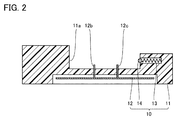
- FIG. 2 is a cross-sectional view of the base 10.
- a wiring board 12 is arranged in the internal space of the main body 11.
- the wiring board 12 is formed with the wiring 12a.
- the wiring board 12 has a plurality of protruding electrodes 12b and a plurality of protruding electrodes 12c.
- the number of protruding electrodes 12b and 12c is equal to the number of cell culture vessels 20.
- One end of the protruding electrode 12b and one end of the protruding electrode 12c are electrically connected to the wiring 12a.
- the other end of the protruding electrode 12b and the other end of the protruding electrode 12c project from the bottom surface of the recess 11a.
- the ball 14 is attached to the tip of the spring 13.
- the spring 13 is embedded in the base 10 so that the ball 14 attached to the tip thereof projects from the side surface of the recess 11a.
- FIG. 3 is a cross-sectional view of the cell culture vessel 20.
- the cell culture container 20 has a container body 21, a cell culture insert 22, a lid member 23, a lid member 24, and electrodes 25a and 25b.
- the first medium 26 is stored inside the container body 21.
- the container body 21 has an upper wall 21a, a bottom wall 21b, and a side wall 21c.
- the container body 21 is preferably made of a resin material.
- An opening 21aa is formed in the upper wall 21a.
- the opening 21aa penetrates the upper wall 21a along the thickness direction.
- the upper wall 21a may be formed separately from the bottom wall 21b and the side wall 21c.
- the bottom wall 21b faces the upper wall 21a at a distance.
- An electrode 21ba and an electrode 21bb are embedded in the bottom wall 21b.
- the electrode 21ba and the electrode 21bb are electrically connected to the first medium 26.
- the electrode 21ba and the electrode 21bb are exposed from the outer surface of the bottom wall 21b.
- the electrode 21ba and the electrode 21bb are electrically connected to the projecting electrode 12b and the projecting electrode 12c, respectively, when the container body 21 is arranged in the recess 11a.
- the side wall 21c is connected to the upper wall 21a and the bottom wall 21b.
- a recess 21ca is formed on the outer surface of the side wall 21c.
- the recess 21ca is formed at a position facing the ball 14 when the container body 21 is arranged in the recess 11a.
- the cell culture insert 22 has a tubular portion 22a and an oxygen permeable membrane 22b.
- the lower end side of the tubular portion 22a is closed by the membrane 22b.
- the upper end side of the tubular portion 22a is closed by the lid member 23.
- the lid member 23 is removable from the tubular portion 22a.
- the second medium 27 is stored inside the tubular portion 22a.
- the dissolved oxygen concentration of the second medium 27 is lower than the dissolved oxygen concentration of the first medium 26. That is, the first medium 26 is an aerobic medium, and the second medium 27 is an anaerobic medium.
- the second medium 27 contains, for example, anaerobic bacteria.
- the tubular portion 22a is inserted into the opening 21aa so that the lower end side thereof is inside the container body 21.
- the cell culture insert 22 is attached to the container body 21.
- the cell culture insert 22 is removable from the container body 21.
- the membrane 22b is, for example, a track etch film made of polycarbonate.
- the membrane 22b has a first main surface 22ba and a second main surface 22bb.
- the first main surface 22ba faces the inner side of the container body 21.
- the second main surface 22bb faces the inner side of the tubular portion 22a.
- the second main surface 22bb is the opposite surface of the first main surface 22ba.
- Cells are cultured on the second main surface 22bb. These cells are, for example, intestinal epithelial cells that form tight junctions on the second main surface 22bb. Specific examples of these cells include Caco-2 cells. Oxygen in the first medium 26 is supplied to the cells via the membrane 22b.
- the lid member 24 is detachably attached to the container body 21. This prevents the cell culture insert 22 from falling off from the container body 21.
- An opening is formed in the lid member 24, and the upper surface of the lid member 23 is exposed from the opening.
- the electrodes 25a and 25b are inserted into the lid member 23. One end of the electrode 25a and one end of the electrode 25b are electrically connected to the second medium 27. The other end of the electrode 25a and the other end of the electrode 25b are exposed from the lid member 23.
- the cell culture container 20 is detachably attached to the base 10. More specifically, the cell culture container 20 is attached to the base 10 by arranging the container body 21 in the recess 11a. By this attachment, the electrode 21ba and the electrode 21bb are electrically connected to the projecting electrode 12b and the projecting electrode 12c, respectively.
- the ball 14 comes into contact with the recess 21ca.
- the spring 13 generates an urging force toward the side wall 21c via the ball 14.
- the misalignment of the cell culture container 20 (container body 21) in the recess 11a is suppressed.
- FIG. 4 is a perspective view of the rack 40 attached to the base 10. In FIG. 4, the tube 50a and the tube 50b are not shown. As shown in FIG. 4, the rack 40 is detachably attached to the base 10. More specifically, the rack 40 has a support column 41. The rack 40 is attached to the base 10 by inserting the support column 41 into the hole 11b.
- the rack 40 is made of a magnetic material (soft magnetic material).
- the second medium 27 is stored in the medium container 30a.
- One end of the tube 50a is inserted into the lid member 23. As a result, the tube 50a and the inside of the tubular portion 22a are connected. The other end of the tube 50a is connected to the medium container 30a.
- One end of the tube 50b is inserted into the lid member 23. As a result, the tube 50b and the inside of the tubular portion 22a are connected.
- a pump 60 is attached to the tube 50a.
- the pump 60 sends the second medium 27 stored in the medium container 30a via the tube 50a into the inside of the tubular portion 22a.
- a pump 60 is attached to the tube 50b.
- the pump 60 sends the second medium 27 stored in the tubular portion 22a to the medium container 30b via the tube 50b. That is, by operating the pump 60, the second medium 27 stored inside the tubular portion 22a is replaced.
- the supply of the second medium 27 from the medium container 30a to the cell culture container 20 and the recovery of the second medium 27 from the cell culture container 20 to the medium container 30b are performed by one pump 60. It is possible to reduce the difference between the amount of medium supplied and the amount of medium recovered due to individual differences.
- the pump 60 is a pump capable of delivering the above liquid without coming into contact with the second medium 27.
- the pump 60 is, for example, a tube pump.
- the pump 60 is not limited to this.
- the pump 60 may be, for example, a syringe pump.
- the pump 60 has a magnet 61. Since the rack 40 is made of a magnetic material, the pump 60 can be attached to the rack 40 by a magnet 61 (see FIG. 4).
- the tube 50a is removable from the lid member 23 and the medium container 30a.
- the tube 50b is removable from the lid member 23 and the medium container 30b.
- the pump 60 is removable from the tube 50a.
- the tube 50a connected to each of the plurality of cell culture vessels 20 is preferably connected to one pump 60.
- the supply / recovery of the second medium 27 for one of the plurality of cell culture containers 20 (hereinafter referred to as the cell culture container 20A) and the plurality of cell culture containers 20 are used. Since the supply / recovery of the second medium 27 to the other one (hereinafter referred to as cell culture container 20B) is performed by one pump 60, the cell culture container 20A and the cell culture container 20B are used. , The same flow control can be performed.
- the cell culture vessel 20A and the cell culture vessel 20B may have the same culture conditions other than the flow rate (for example, the seeding amount of cells, the type of fungus, etc.). However, the culture conditions other than the flow rate may differ between the cell culture container 20A and the cell culture container 20B.
- the other one of the plurality of bases 10 is referred to as a base 10B.
- the rack 40 attached to the base 10A is referred to as a rack 40A.
- the rack 40 attached to the base 10B is referred to as a rack 40B.
- the pump 60 attached to the rack 40A is referred to as a pump 60A.
- the pump 60 attached to the rack 40B is referred to as a pump 60B.
- the flow rate control for the pump 60A may be different from the flow rate control for the pump B.
- the cell culture container 20 on the base 10A and the cell culture container 20 on the base 10B may have different culture conditions (for example, cell seeding amount, fungal type, etc.) other than the flow rate.
- the cell culture container 20 on the base 10A and the cell culture container 20 on the base 10B may have the same culture conditions other than the flow rate (for example, the seeding amount of cells, the type of fungus, etc.).
- One end of the lead wire 70a and one end of the lead wire 70b are electrically connected to the wiring board 12 (wiring 12a) through the hole 11c.
- One end of the lead wire 70a and one end of the lead wire 70b are preferably removable from the wiring board 12.
- the other end of the lead wire 70a and the other end of the lead wire 70b are detachably and electrically connected to the electrode 25a and the electrode 25b by, for example, an IC clip.
- the controller 80 controls the pump 60. More specifically, the controller 80 has a built-in microcontroller. This microcontroller generates a control signal according to the input contents from the operation buttons and the like of the controller 80, and transmits the control signal to the pump 60 via wiring (not shown). As a result, the pump 60 is controlled.
- the transdermal electrical resistance measuring device 90 is connected to the wiring board 12 via a wiring (not shown), and the electrode 21ba and the electrode 21bb are connected to the wiring board 12, the lead wire 70a, and the lead wire 70b. And the electric resistance value between the electrode 25a and the electrode 25b is measured. This measurement is performed, for example, by the four-terminal method.
- a plurality of signals are output from the wiring board 12. These plurality of outputs are input to one distributor.
- the distributor selects one of these plurality of outputs in time division and inputs it to the transdermal electrical resistance measuring device 90. This eliminates the need to prepare a plurality of transdermal electrical resistance measuring devices 90.
- the electrical resistance value between the electrode 21ba and the electrode 21bb and the electrode 25a and the electrode 25b varies depending on whether the cells cultured on the second main surface 22bb form a tight junction or not. Therefore, by measuring the above-mentioned electric resistance value, it is possible to determine whether or not the cells cultured on the second main surface 22bb form a tight junction.
- the cell culture system 100 may further have an oxygen sensor (not shown).
- the oxygen sensor is arranged on the path of the tube 50b, and is configured to be able to detect the dissolved oxygen concentration of the second medium 27 flowing through the tube 50b. Thereby, the cell culture system 100 can monitor the growth state of bacteria at the time of co-culture.
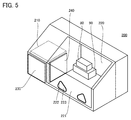
- FIG. 5 is a perspective view of the chamber device 200.
- the chamber device 200 has an airlock 210 and an anaerobic chamber 220.
- the airlock 210 and the outside of the chamber device 200 are separated from each other by an external door 230.
- the airlock 210 and the anaerobic chamber 220 are separated by an internal door 240.
- An anaerobic environment (environment with a low oxygen concentration) is maintained in the anaerobic chamber 220.
- the anaerobic chamber 220 has a front panel 221.
- An arm port 222 is formed on the front panel 221.
- the arm port 222 penetrates the front panel 221 and communicates with the internal space of the anaerobic chamber 220.
- Various operations can be performed in the anaerobic chamber 220 by inserting a hand into a sleeve (not shown) or a glove (not shown) attached to the arm port 222.
- the arm port 222 is closed by the arm port door 223.
- the external door 230 is opened, the object is placed in the airlock 210, and the external door 230 is closed.
- the inside of the airlock 210 is anaerobic.
- the internal door 240 is opened to move the object in the airlock 210 into the anaerobic chamber 220.
- the reverse operation of the above is performed.
- the base 10, the cell culture container 20, the medium container 30a and the medium container 30b, the rack 40, the tube 50a and the tube 50b, the pump 60, the lead wire 70a and the lead wire 70b, the controller 80, and the transdermal electrical resistance measuring device 90 are , Arranged in the anaerobic chamber 220.
- the controller 80 and the transdermal electrical resistance measuring device 90 are permanently installed in the anaerobic chamber 220.
- the base 10, the cell culture container 20, the medium container 30a and the medium container 30b, the rack 40, the tube 50a and the tube 50b, the pump 60, and the lead wire 70a and the lead wire 70b can be taken out from the anaerobic chamber 220. ing.
- the cell culture system 100 Since the cell culture system 100 has a plurality of cell culture containers 20 independent of each other, it is possible to perform comparative analysis for each cell culture container 20.
- a plurality of independent cell culture containers 20 are detachably attached to one base 10. Therefore, according to the cell culture system 100, since the plurality of independent cell culture containers 20 can be carried together with the base 10, the plurality of independent cell culture containers 20 can be easily taken out from the anaerobic chamber 220.
- the cell culture system 100 has a medium container 30a and a medium container 30b, a tube 50a and a tube 50b, and a pump 60. Therefore, according to the cell culture system 100, cells and bacteria can be co-cultured while exchanging the second medium 27 stored inside the tubular portion 22a.
- the rack 40 supporting the plurality of medium containers 30a and the medium containers 30b can be detachably attached to the base 10. Further, in the cell culture system 100, the pump 60 can be attached to the rack 40 by the magnet 61. Therefore, according to the cell culture system 100, the base 10, the cell culture container 20, the medium container 30a and the medium container 30b, the rack 40, the tube 50a and the tube 50b, and the pump 60 can be integrated and taken out from the anaerobic chamber 220. can.
- the container body 21, cell culture insert 22, medium container 30a and medium container 30b, tube 50a and tube 50b come into contact with the medium. Therefore, it is preferable that these parts are co-cultured using the cell culture system 100, then discarded and replaced with new parts. However, if these parts cannot be removed, these parts must also be sterilized by an autoclave or the like and then reused, which reduces the experimental efficiency.
- the cell culture insert 22 can be removed from the container body 21, and the lid member 23 can be removed from the cell culture insert 22.
- the tube 50a can be removed from the lid member 23 and the medium container 30a, and the tube 50b can be removed from the lid member 23 and the medium container 30b.
- the pump 60 can be removed from the tube 50a.
- the cell culture system 100 it is possible to separate the parts to be reused after sterilization and the parts to be discarded, so that the efficiency of the sterilization treatment can be improved and the experimental efficiency can be improved. be able to.
- the spring 13 since the spring 13 generates an urging force toward the side wall 21c via the ball 14, the misalignment of the cell culture container 20 in the recess 11a is suppressed. As a result, stable co-culture is possible even when the cell culture container 20 is liable to wobble by using a lightweight material (resin material or the like) for the container body 21.
- the cell culture system 100 since the electrical resistance value between the electrode 21ba and the electrode 21bb and the electrode 25a and the electrode 25b is measured by the transdermal electrical resistance measuring device 90, the cell culture system 100 is cultured on the second main surface 22bb. Co-culture can be promoted while monitoring the state of the cells.
- 10,10A, 10B base 11 body, 11a recess, 11b, 11c hole, 12 wiring board, 12a wiring, 12b, 12c protruding electrode, 13 spring, 14 balls, 20, 20A, 20B cell culture container, 21 container body , 21a upper wall, 21aa opening, 21b bottom wall, 21ba electrode, 21bb electrode, 21c side wall, 21ca recess, 22 cell culture insert, 22a tubular part, 22b membrane, 22ba first main surface, 22bb second main surface, 23 , 24 lid member, 25a, 25b electrode, 26 1st medium, 27 2nd medium, 30a, 30b medium container, 40 rack, 40A, 40B rack, 41 support, 50a, 50b tube, 60, 60A, 60B pump, 61 Magnet, 70a, 70b lead wire, 80 controller, 90 percutaneous electrical resistance measuring device, 100 cell culture system, 200 chamber device, 210 air lock, 220 anaerobic chamber, 221 front panel, 222 arm port, 223 arm port door, 230
Landscapes
- Health & Medical Sciences (AREA)
- Life Sciences & Earth Sciences (AREA)
- Chemical & Material Sciences (AREA)
- Engineering & Computer Science (AREA)
- Wood Science & Technology (AREA)
- Organic Chemistry (AREA)
- Bioinformatics & Cheminformatics (AREA)
- Zoology (AREA)
- Genetics & Genomics (AREA)
- Biotechnology (AREA)
- Biochemistry (AREA)
- Sustainable Development (AREA)
- Microbiology (AREA)
- General Engineering & Computer Science (AREA)
- General Health & Medical Sciences (AREA)
- Biomedical Technology (AREA)
- Clinical Laboratory Science (AREA)
- Analytical Chemistry (AREA)
- General Chemical & Material Sciences (AREA)
- Molecular Biology (AREA)
- Physiology (AREA)
- Cell Biology (AREA)
- Immunology (AREA)
- Apparatus Associated With Microorganisms And Enzymes (AREA)
Priority Applications (5)
| Application Number | Priority Date | Filing Date | Title |
|---|---|---|---|
| CN202180048630.4A CN115943203A (zh) | 2020-07-07 | 2021-06-23 | 细胞培养系统 |
| US18/014,876 US20230220323A1 (en) | 2020-07-07 | 2021-06-23 | Cell culture system |
| EP21836774.6A EP4180510A4 (en) | 2020-07-07 | 2021-06-23 | CELL CULTURE SYSTEM |
| JP2022535004A JPWO2022009672A1 (https=) | 2020-07-07 | 2021-06-23 | |
| JP2024090602A JP7786498B2 (ja) | 2020-07-07 | 2024-06-04 | 細胞培養システム |
Applications Claiming Priority (2)
| Application Number | Priority Date | Filing Date | Title |
|---|---|---|---|
| JP2020116946 | 2020-07-07 | ||
| JP2020-116946 | 2020-07-07 |
Publications (1)
| Publication Number | Publication Date |
|---|---|
| WO2022009672A1 true WO2022009672A1 (ja) | 2022-01-13 |
Family
ID=79552919
Family Applications (1)
| Application Number | Title | Priority Date | Filing Date |
|---|---|---|---|
| PCT/JP2021/023690 Ceased WO2022009672A1 (ja) | 2020-07-07 | 2021-06-23 | 細胞培養システム |
Country Status (5)
| Country | Link |
|---|---|
| US (1) | US20230220323A1 (https=) |
| EP (1) | EP4180510A4 (https=) |
| JP (2) | JPWO2022009672A1 (https=) |
| CN (1) | CN115943203A (https=) |
| WO (1) | WO2022009672A1 (https=) |
Cited By (1)
| Publication number | Priority date | Publication date | Assignee | Title |
|---|---|---|---|---|
| WO2024257513A1 (ja) | 2023-06-15 | 2024-12-19 | 株式会社島津製作所 | 細胞培養方法 |
Families Citing this family (2)
| Publication number | Priority date | Publication date | Assignee | Title |
|---|---|---|---|---|
| WO2023077096A1 (en) * | 2021-10-29 | 2023-05-04 | Nextern Innovation, Llc | Cell culture system with controlled gas transfer boundary conditions |
| CN117887572B (zh) * | 2023-12-01 | 2024-08-30 | 山东壹瑞特生物科技有限公司 | 一种人工肝系统细胞反应器快接结构 |
Citations (8)
| Publication number | Priority date | Publication date | Assignee | Title |
|---|---|---|---|---|
| JP2010075200A (ja) * | 2009-11-30 | 2010-04-08 | Hitachi Ltd | 細胞培養装置 |
| JP2015084686A (ja) * | 2013-10-29 | 2015-05-07 | オリンパス株式会社 | 細胞培養用ジグおよび自動培地交換システム |
| WO2016006680A1 (ja) * | 2014-07-10 | 2016-01-14 | オリンパス株式会社 | 細胞培養システム |
| WO2018079793A1 (ja) | 2016-10-28 | 2018-05-03 | 国立大学法人京都大学 | 嫌気性細菌などの細菌と上皮細胞との共培養装置及び共培養方法 |
| JP2018512853A (ja) * | 2015-04-22 | 2018-05-24 | バークレー ライツ,インコーポレイテッド | マイクロ流体デバイス用の培養ステーション |
| JP2019004723A (ja) * | 2017-06-21 | 2019-01-17 | 株式会社日立製作所 | 連続培養条件のスクリーニング方法および連続培養条件のスクリーニング装置 |
| WO2019191685A1 (en) * | 2018-03-30 | 2019-10-03 | Arizona Board Of Regents On Behalf Of The University Of Arizona | Workstation for automated control of an in vitro system |
| WO2019222333A1 (en) * | 2018-05-15 | 2019-11-21 | The University Of North Carolina At Chapel Hill | Devices, systems and apparatuses for generating self-sustaining hypoxic conditions and gaseous and non-gaseous chemical gradients for in vitro cell culture |
Family Cites Families (4)
| Publication number | Priority date | Publication date | Assignee | Title |
|---|---|---|---|---|
| JP5814594B2 (ja) * | 2011-04-13 | 2015-11-17 | 株式会社日立製作所 | 細胞培養装置 |
| JP5892216B1 (ja) * | 2014-09-17 | 2016-03-23 | 東洋製罐グループホールディングス株式会社 | 細胞培養システムにおける送液方法、及び細胞培養システム |
| JP7032263B2 (ja) * | 2017-10-25 | 2022-03-08 | シャープ株式会社 | 細胞刺激装置、細胞培養装置及び細胞刺激方法 |
| US11958050B2 (en) * | 2018-05-24 | 2024-04-16 | John Collins | Fluidic devices for closed cell culture applications under current good manufacturing practice |
-
2021
- 2021-06-23 EP EP21836774.6A patent/EP4180510A4/en active Pending
- 2021-06-23 WO PCT/JP2021/023690 patent/WO2022009672A1/ja not_active Ceased
- 2021-06-23 CN CN202180048630.4A patent/CN115943203A/zh active Pending
- 2021-06-23 JP JP2022535004A patent/JPWO2022009672A1/ja active Pending
- 2021-06-23 US US18/014,876 patent/US20230220323A1/en active Pending
-
2024
- 2024-06-04 JP JP2024090602A patent/JP7786498B2/ja active Active
Patent Citations (8)
| Publication number | Priority date | Publication date | Assignee | Title |
|---|---|---|---|---|
| JP2010075200A (ja) * | 2009-11-30 | 2010-04-08 | Hitachi Ltd | 細胞培養装置 |
| JP2015084686A (ja) * | 2013-10-29 | 2015-05-07 | オリンパス株式会社 | 細胞培養用ジグおよび自動培地交換システム |
| WO2016006680A1 (ja) * | 2014-07-10 | 2016-01-14 | オリンパス株式会社 | 細胞培養システム |
| JP2018512853A (ja) * | 2015-04-22 | 2018-05-24 | バークレー ライツ,インコーポレイテッド | マイクロ流体デバイス用の培養ステーション |
| WO2018079793A1 (ja) | 2016-10-28 | 2018-05-03 | 国立大学法人京都大学 | 嫌気性細菌などの細菌と上皮細胞との共培養装置及び共培養方法 |
| JP2019004723A (ja) * | 2017-06-21 | 2019-01-17 | 株式会社日立製作所 | 連続培養条件のスクリーニング方法および連続培養条件のスクリーニング装置 |
| WO2019191685A1 (en) * | 2018-03-30 | 2019-10-03 | Arizona Board Of Regents On Behalf Of The University Of Arizona | Workstation for automated control of an in vitro system |
| WO2019222333A1 (en) * | 2018-05-15 | 2019-11-21 | The University Of North Carolina At Chapel Hill | Devices, systems and apparatuses for generating self-sustaining hypoxic conditions and gaseous and non-gaseous chemical gradients for in vitro cell culture |
Non-Patent Citations (1)
| Title |
|---|
| See also references of EP4180510A4 |
Cited By (1)
| Publication number | Priority date | Publication date | Assignee | Title |
|---|---|---|---|---|
| WO2024257513A1 (ja) | 2023-06-15 | 2024-12-19 | 株式会社島津製作所 | 細胞培養方法 |
Also Published As
| Publication number | Publication date |
|---|---|
| US20230220323A1 (en) | 2023-07-13 |
| JP2024103723A (ja) | 2024-08-01 |
| CN115943203A (zh) | 2023-04-07 |
| EP4180510A1 (en) | 2023-05-17 |
| EP4180510A4 (en) | 2024-08-21 |
| JP7786498B2 (ja) | 2025-12-16 |
| JPWO2022009672A1 (https=) | 2022-01-13 |
Similar Documents
| Publication | Publication Date | Title |
|---|---|---|
| JP7786498B2 (ja) | 細胞培養システム | |
| CN112203765B (zh) | 用于进行电测量的设备 | |
| US6117291A (en) | Microperfusion chamber assembly with base comprising silver chloride coated silver | |
| CN103477223B (zh) | 用于电生理学分析的手持装置 | |
| CN110257240A (zh) | 核酸提取、扩增及检测一体试剂卡 | |
| US6541243B1 (en) | Perfusion chamber for electrophysiological testing of oocytes | |
| CN109313156B (zh) | 用于分析体液样本的测试系统 | |
| JP4858870B2 (ja) | 培養細胞の電気シグナル計測デバイスおよび該デバイスを用いる電気シグナル計測方法 | |
| WO2019191685A1 (en) | Workstation for automated control of an in vitro system | |
| US20120252110A1 (en) | Cell culture apparatus | |
| JP4441007B2 (ja) | 拡散可能な化学物質のためのモニタ | |
| KR20190079675A (ko) | 마이크로 플레이트 랩웨어의 관류 및 환경제어 방법 및 장치 | |
| JPWO2022009672A5 (https=) | ||
| US12559710B2 (en) | Liquid level and flow rate detection within a cell processing system | |
| JP7774285B2 (ja) | 培養デバイス、培養体製造方法、及び薬剤評価方法 | |
| US20180067098A1 (en) | Measuring apparatus | |
| JP2021153576A (ja) | 細胞培養分析装置およびこれを用いた細胞培養分析方法 | |
| CN222014107U (zh) | 在线活细胞分子动态分析系统 | |
| US20250101360A1 (en) | Method for monitoring at least one substance produced or consumed by a living entity | |
| JP4816111B2 (ja) | マイクロピペットおよびこれを利用した細胞測定システム | |
| WO2024062114A1 (en) | Cell culture electrification | |
| Yao | Development and Characterization of High-Throughput Screening Technologies for Studying the Effect of Varying Oxygen Environments on Cultured Cells | |
| JPWO2011045910A1 (ja) | 測定デバイス | |
| CN114107014A (zh) | 用于自动持续监测器官行为的芯片上器官平台的构建方法 | |
| JP2021153407A (ja) | センサユニットおよびこれを備えた細胞培養分析装置 |
Legal Events
| Date | Code | Title | Description |
|---|---|---|---|
| 121 | Ep: the epo has been informed by wipo that ep was designated in this application |
Ref document number: 21836774 Country of ref document: EP Kind code of ref document: A1 |
|
| ENP | Entry into the national phase |
Ref document number: 2022535004 Country of ref document: JP Kind code of ref document: A |
|
| NENP | Non-entry into the national phase |
Ref country code: DE |
|
| ENP | Entry into the national phase |
Ref document number: 2021836774 Country of ref document: EP Effective date: 20230207 |