WO2022004304A1 - ブレーズド回折光学素子、及びブレーズド回折光学素子の製造方法 - Google Patents
ブレーズド回折光学素子、及びブレーズド回折光学素子の製造方法 Download PDFInfo
- Publication number
- WO2022004304A1 WO2022004304A1 PCT/JP2021/021755 JP2021021755W WO2022004304A1 WO 2022004304 A1 WO2022004304 A1 WO 2022004304A1 JP 2021021755 W JP2021021755 W JP 2021021755W WO 2022004304 A1 WO2022004304 A1 WO 2022004304A1
- Authority
- WO
- WIPO (PCT)
- Prior art keywords
- blazed
- intermediate layer
- steep slope
- optical element
- slope
- Prior art date
- Legal status (The legal status is an assumption and is not a legal conclusion. Google has not performed a legal analysis and makes no representation as to the accuracy of the status listed.)
- Ceased
Links
Images








Classifications
-
- G—PHYSICS
- G02—OPTICS
- G02B—OPTICAL ELEMENTS, SYSTEMS OR APPARATUS
- G02B5/00—Optical elements other than lenses
- G02B5/18—Diffraction gratings
- G02B5/1847—Manufacturing methods
- G02B5/1857—Manufacturing methods using exposure or etching means, e.g. holography, photolithography, exposure to electron or ion beams
-
- G—PHYSICS
- G02—OPTICS
- G02B—OPTICAL ELEMENTS, SYSTEMS OR APPARATUS
- G02B3/00—Simple or compound lenses
- G02B3/02—Simple or compound lenses with non-spherical faces
- G02B3/08—Simple or compound lenses with non-spherical faces with discontinuous faces, e.g. Fresnel lens
-
- B—PERFORMING OPERATIONS; TRANSPORTING
- B29—WORKING OF PLASTICS; WORKING OF SUBSTANCES IN A PLASTIC STATE IN GENERAL
- B29D—PRODUCING PARTICULAR ARTICLES FROM PLASTICS OR FROM SUBSTANCES IN A PLASTIC STATE
- B29D11/00—Producing optical elements, e.g. lenses or prisms
- B29D11/00009—Production of simple or compound lenses
- B29D11/00269—Fresnel lenses
-
- B—PERFORMING OPERATIONS; TRANSPORTING
- B29—WORKING OF PLASTICS; WORKING OF SUBSTANCES IN A PLASTIC STATE IN GENERAL
- B29D—PRODUCING PARTICULAR ARTICLES FROM PLASTICS OR FROM SUBSTANCES IN A PLASTIC STATE
- B29D11/00—Producing optical elements, e.g. lenses or prisms
- B29D11/00865—Applying coatings; tinting; colouring
- B29D11/00884—Spin coating
-
- B—PERFORMING OPERATIONS; TRANSPORTING
- B29—WORKING OF PLASTICS; WORKING OF SUBSTANCES IN A PLASTIC STATE IN GENERAL
- B29D—PRODUCING PARTICULAR ARTICLES FROM PLASTICS OR FROM SUBSTANCES IN A PLASTIC STATE
- B29D11/00—Producing optical elements, e.g. lenses or prisms
- B29D11/02—Artificial eyes from organic plastic material
- B29D11/023—Implants for natural eyes
-
- G—PHYSICS
- G02—OPTICS
- G02C—SPECTACLES; SUNGLASSES OR GOGGLES INSOFAR AS THEY HAVE THE SAME FEATURES AS SPECTACLES; CONTACT LENSES
- G02C7/00—Optical parts
- G02C7/02—Lenses; Lens systems ; Methods of designing lenses
- G02C7/06—Lenses; Lens systems ; Methods of designing lenses bifocal; multifocal ; progressive
-
- A—HUMAN NECESSITIES
- A61—MEDICAL OR VETERINARY SCIENCE; HYGIENE
- A61F—FILTERS IMPLANTABLE INTO BLOOD VESSELS; PROSTHESES; DEVICES PROVIDING PATENCY TO, OR PREVENTING COLLAPSING OF, TUBULAR STRUCTURES OF THE BODY, e.g. STENTS; ORTHOPAEDIC, NURSING OR CONTRACEPTIVE DEVICES; FOMENTATION; TREATMENT OR PROTECTION OF EYES OR EARS; BANDAGES, DRESSINGS OR ABSORBENT PADS; FIRST-AID KITS
- A61F2/00—Filters implantable into blood vessels; Prostheses, i.e. artificial substitutes or replacements for parts of the body; Appliances for connecting them with the body; Devices providing patency to, or preventing collapsing of, tubular structures of the body, e.g. stents
- A61F2/02—Prostheses implantable into the body
- A61F2/14—Eye parts, e.g. lenses or corneal implants; Artificial eyes
- A61F2/16—Intraocular lenses
- A61F2/1613—Intraocular lenses having special lens configurations, e.g. multipart lenses; having particular optical properties, e.g. pseudo-accommodative lenses, lenses having aberration corrections, diffractive lenses, lenses for variably absorbing electromagnetic radiation, lenses having variable focus
- A61F2/1654—Diffractive lenses
-
- A—HUMAN NECESSITIES
- A61—MEDICAL OR VETERINARY SCIENCE; HYGIENE
- A61F—FILTERS IMPLANTABLE INTO BLOOD VESSELS; PROSTHESES; DEVICES PROVIDING PATENCY TO, OR PREVENTING COLLAPSING OF, TUBULAR STRUCTURES OF THE BODY, e.g. STENTS; ORTHOPAEDIC, NURSING OR CONTRACEPTIVE DEVICES; FOMENTATION; TREATMENT OR PROTECTION OF EYES OR EARS; BANDAGES, DRESSINGS OR ABSORBENT PADS; FIRST-AID KITS
- A61F2250/00—Special features of prostheses classified in groups A61F2/00 - A61F2/26 or A61F2/82 or A61F9/00 or A61F11/00 or subgroups thereof
- A61F2250/0014—Special features of prostheses classified in groups A61F2/00 - A61F2/26 or A61F2/82 or A61F9/00 or A61F11/00 or subgroups thereof having different values of a given property or geometrical feature, e.g. mechanical property or material property, at different locations within the same prosthesis
- A61F2250/0026—Special features of prostheses classified in groups A61F2/00 - A61F2/26 or A61F2/82 or A61F9/00 or A61F11/00 or subgroups thereof having different values of a given property or geometrical feature, e.g. mechanical property or material property, at different locations within the same prosthesis differing in surface structures
-
- G—PHYSICS
- G02—OPTICS
- G02B—OPTICAL ELEMENTS, SYSTEMS OR APPARATUS
- G02B5/00—Optical elements other than lenses
- G02B5/18—Diffraction gratings
- G02B5/1814—Diffraction gratings structurally combined with one or more further optical elements, e.g. lenses, mirrors, prisms or other diffraction gratings
-
- G—PHYSICS
- G02—OPTICS
- G02B—OPTICAL ELEMENTS, SYSTEMS OR APPARATUS
- G02B5/00—Optical elements other than lenses
- G02B5/18—Diffraction gratings
- G02B5/1876—Diffractive Fresnel lenses; Zone plates; Kinoforms
Definitions
- the technique of the present disclosure relates to a blazed diffractive optical element and a method for manufacturing a blazed diffractive optical element.
- Japanese Unexamined Patent Publication No. 2011-107586 discloses a diffractive optical element in which a plurality of diffraction gratings made of at least three types of materials are laminated.
- a plurality of diffraction gratings are made of materials M1A and M1B different from each other, and the lattice side edges of the grating portion are contacted or arranged close to each other in the lattice pitch direction.
- a first combination portion made of, and a second combination part made of two diffraction gratings made of materials M2A and M2B different from each other, in which at least one material is different from the material of the two diffraction gratings of the first combination part.
- the values of the refractive indexes N2Ad and N2Bd, and the Abbe numbers ⁇ 2A and ⁇ 2B are appropriately set.
- One embodiment according to the technique of the present disclosure is a blazed diffraction grating capable of suppressing ghosts caused by incident light as compared with the case where the first blazed member and the second blazed member are directly laminated.
- a method for manufacturing an element and a blazed diffraction optical element is provided.
- a first aspect according to the technique of the present disclosure is a blazed grating, which has a first blazed member and a second blazed member, and the first blazed member and the second blazed member function as a blazed diffraction grating.
- a lattice pair and an intermediate layer located between the first blazed member and the second blazed member are provided, the refractive index of the first blazed member is Na, the refractive index of the intermediate layer is N, and the second blazed member.
- This is a blazed grating optical element in which the magnitude relationship of Na> N> Nb is established when the refractive index of is Nb.
- the thickness of the intermediate layer is t
- ⁇ c is a critical angle, h ⁇ t.
- the first blazed member has a first sawtooth surface
- the second blazed member has a second sawtooth surface
- the first sawtooth surface and the second are complementary to the first aspect or the second aspect, in which the serrated surface is complementarily engaged with the intermediate layer.
- the first blazed member has a first sawtooth surface
- the second blazed member has a second sawtooth surface
- the first sawtooth surface has a first sawtooth surface.
- the 1st steep slope and the 1st gentle slope having a gentler slope than the 1st steep slope are formed
- the 2nd serrated surface is formed by the 2nd steep slope and the 2nd gentle slope having a gentler slope than the 2nd steep slope.
- a fifth aspect of the technique of the present disclosure is that the first serrated surface is formed by a first steep slope and a first gentle slope having a gentler slope than the first steep slope, and the second serrated surface is a second. It is composed of two steep slopes and a second gentle slope with a gentler slope than the second steep slope, and an intermediate layer is formed between the first serrated surface and the second serrated surface with the first steep slope and the second steep slope.
- the blazed diffraction optical element according to the third aspect is arranged between the two.
- a sixth aspect according to the technique of the present disclosure is that the first blazed member has a first serrated surface, the second blazed member has a second serrated surface, and the first serrated surface has a first sawtooth surface.
- the 1 steep slope and the 1st gentle slope having a gentler slope than the 1st steep slope are formed, and the 2nd serrated surface is formed by the 2nd steep slope and the 2nd gentle slope having a gentler slope than the 2nd steep slope.
- the thickness of the intermediate layer between the first serrated surface and the second serrated surface between the first steep slope and the second steep slope is t, and the lattice heights of the first blazed member and the second blazed member are defined as t.
- This is a blazed diffraction grating according to the first aspect in which the inequality of h ⁇ t ⁇ tan ⁇ c and the equation of ⁇ c asin (Nb / Na) are established when h is defined as h and ⁇ c is defined as a critical angle.
- a seventh aspect according to the technique of the present disclosure is that the first blazed member has a first reference plane, the second blazed member has a second reference plane, and the first steep slope and the first gentle slope have a first reference plane.
- the surface rising from the first reference plane, the second steep slope and the second gentle slope are the planes rising from the second reference plane, the first steep slope is perpendicular to the first reference plane, and the second The blazed diffraction grating according to any one of the fourth to sixth aspects, wherein the steep slope is perpendicular to the second reference plane.
- An eighth aspect according to the technique of the present disclosure is any one of the third to seventh aspects in which the first sawtooth surface and the second sawtooth surface are engaged with each other by the thickness of the intermediate layer. It is a blazed diffraction optical element which concerns on one aspect.
- a ninth aspect according to the technique of the present disclosure is any of the first to eighth aspects, wherein the intermediate layer is composed of a plurality of layers having a refractive index that becomes smaller from the first blazed member side to the second blazed member side. It is a blazed diffraction grating according to one aspect.
- a tenth aspect according to the technique of the present disclosure is a blazed diffraction optical element according to any one of the first to ninth aspects in which the intermediate layer is formed in a film shape.
- the eleventh aspect according to the technique of the present disclosure is the blazed diffraction according to any one of the first to tenth aspects in which the blaze angle of the first blaze member and the blaze angle of the second blaze member are the same. It is an optical element.
- a twelfth aspect according to the technique of the present disclosure is a blazed according to any one of the first to eleventh aspects in which the lattice height of the first blazed member and the lattice height of the second blazed member are the same. It is a diffraction optical element.
- a thirteenth aspect according to the technique of the present disclosure is a blazed diffraction grating, comprising a blazed member and a layer provided on the blazed member, and the refractive index of the layer is the refractive index of the blazed member.
- a fourteenth aspect according to the technique of the present disclosure is that the surrounding environment is anterior chamber water in the eye, and the refractive index of the layer is between the refractive index of the blazed member and the refractive index of the anterior chamber water.
- a blazed diffraction grating according to a thirteenth aspect is that the surrounding environment is anterior chamber water in the eye, and the refractive index of the layer is between the refractive index of the blazed member and the refractive index of the anterior chamber water.
- the refractive index of the anterior chamber water is A
- the refractive index of the surface layer is B
- the refractive index of the blazed member is C
- the magnitude relationship of A ⁇ B ⁇ C is established. It is a blazed diffraction optical element which concerns on the 14th aspect which holds.
- a seventeenth aspect according to the technique of the present disclosure is the fifteenth aspect or the fifteenth aspect in which the blazed member has a serrated surface and the layer is formed on the serrated surface in a shape corresponding to the serrated surface.
- the blazed diffraction grating according to the sixteenth aspect is the fifteenth aspect or the fifteenth aspect in which the blazed member has a serrated surface and the layer is formed on the serrated surface in a shape corresponding to the serrated surface.
- the eighteenth aspect according to the technique of the present disclosure is the blazed diffraction optical element according to the seventeenth aspect, wherein the serrated surface is formed of a steep slope and a gentle slope having a gentler slope than the steep slope.
- a nineteenth aspect according to the technique of the present disclosure is that the blazed member has a reference plane, the steep slope and the gentle slope are planes rising from the reference plane, and the steep slope is perpendicular to the reference plane.
- the blazed diffraction grating according to the eighteenth aspect is that the blazed member has a reference plane, the steep slope and the gentle slope are planes rising from the reference plane, and the steep slope is perpendicular to the reference plane.
- a twentieth aspect according to the technique of the present disclosure is a blazed diffraction according to any one of the 17th to 19th aspects in which the serrated surface and the anterior chamber water are in contact with each other with a difference in the thickness of the layer. It is an optical element.
- a twenty-first aspect according to the technique of the present disclosure is any one of the fourteenth to twenty-seventh aspects, wherein the surface layer is composed of a plurality of layers having a refractive index that increases from the anterior chamber water side to the blazed member side.
- the 22nd aspect according to the technique of the present disclosure is a blazed diffraction optical element according to any one of the 13th to 21st aspects in which the surface layer is formed in a film shape.
- a 23rd aspect according to the technique of the present disclosure is a method for manufacturing a blazed grating, which is intermediate between a step of forming a first blazed member and a step of forming an intermediate layer in a blazed portion of the first blazed member.
- a step of forming a second blazed member paired with the first blazed member on the side opposite to the first blazed member side of the layer is provided, the refractive index of the first blazed member is Na, and the refractive index of the intermediate layer is N.
- This is a method for manufacturing a blazed diffraction grating in which the magnitude relationship of Na> N> Nb is established when the refractive index of the second blazed member is Nb.
- the 24th aspect according to the technique of the present disclosure is the method for manufacturing a blazed diffraction optical element according to the 23rd aspect, in which the step of forming the intermediate layer is the step of forming the intermediate layer by using a spin coat.
- the thickness of the intermediate layer is t
- a 26th aspect according to the technique of the present disclosure is a step in which the first blazed member has a first sawtooth surface, the second blazed member has a second sawtooth surface, and the second blazed member is formed.
- the method for manufacturing a blazed diffraction grating according to any one of the 23rd to 25th embodiments wherein the first serrated surface and the second serrated surface are engaged with each other by shifting the thickness of the intermediate layer. be.
- vertical is an error generally allowed in the technical field to which the technology of the present disclosure belongs, in addition to the perfect verticality, which is contrary to the purpose of the technology of the present disclosure. It refers to the vertical in the sense that it includes an error that does not occur.
- orthogonality is an error generally allowed in the technical field to which the technique of the present disclosure belongs, in addition to the perfect orthogonality, which is contrary to the purpose of the technique of the present disclosure. It refers to orthogonality in the sense that it includes an error that does not occur.
- parallel is an error generally allowed in the technical field to which the technology of the present disclosure belongs, in addition to the perfect parallelism, which is contrary to the purpose of the technology of the present disclosure. It refers to parallelism in the sense that it includes an error that does not occur.
- identical is an error generally allowed in the technical field to which the technology of the present disclosure belongs, in addition to being completely the same, which is contrary to the purpose of the technology of the present disclosure. It refers to the same in the sense that it includes an error to the extent that it does not occur.
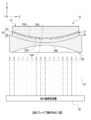
- the junction optical element 10 includes a pair of lenses and a laminated blazed diffraction optical element 12.
- the junction optical element 10 is used, for example, as a lens of an optical device (for example, a digital camera, a projector, a microscope, etc.) and a lens of a vision correction tool (for example, eyeglasses and contact lenses).
- the pair of lenses included in the junction optical element 10 is a glass lens and transmits ultraviolet UV rays (see FIGS. 8, 10 and 13).
- a plano-convex lens 14 see also FIG. 2
- a biconcave lens 16 see also FIG. 3
- a combination of a plano-convex lens 14 and a biconcave lens 16 is illustrated as a pair of lenses, but this is only an example, and the pair of lenses is a combination of other types of lenses (for example, a biconvex lens). It may be a combination with a plano-concave lens).
- the pair of lenses does not have to be made of glass, and may be made of resin.
- the thickness direction of the plano-convex lens 14 and the biconcave lens 16 is the Z direction
- the width direction of the plano-convex lens 14 and the biconcave lens 16 is the X direction
- the depth of the plano-convex lens 14 and the biconcave lens 16 in the figure The direction, that is, the direction orthogonal to the Z direction and the X direction will be described as the Y direction.
- the laminated blazed diffraction optical element 12 is an example of the "blazeed diffraction optical element" according to the technique of the present disclosure, and includes a blazed diffraction grating pair 18.
- the blazed diffraction grating pair 18 has a first blazed member 20 and a second blazed member 22, and functions as a diffraction grating by the first blazed member 20 and the second blazed member 22.
- the first blazed member 20 has a front surface and a back surface in the Z direction, and the back surface is joined to the convex surface 14A of the plano-convex lens 14 (see also FIG. 2).
- the surface of the first blazed member 20 is the first serrated surface 20A.
- the first sawtooth surface 20A is formed in a cross-sectional view sawtooth shape.
- the wedge-shaped grooves 26 are concentrically formed on the first sawtooth surface 20A.
- the second blazed member 22 has a front surface and a back surface in the Z direction, and the back surface is joined to one concave surface 16A (see also FIG. 3) of the biconcave lens 16.
- the surface of the second blazed member 22 is the second serrated surface 22A.
- the second sawtooth surface 22A is formed in a cross-sectional view sawtooth shape.
- the wedge-shaped grooves 28 are concentrically formed on the second serrated surface 22A.
- the laminated blazed diffraction optical element 12 includes an intermediate layer 24.
- the intermediate layer 24 is located between the first blazed member 20 and the second blazed member 22.
- the refractive index of the first blazed member 20 is Na
- the refractive index of the intermediate layer 24 is N
- the refractive index of the second blazed member 22 is Nb
- the magnitude relationship of "Na> N> Nb" is established.
- “1.58” is shown as an example of the refractive index Na
- "1.57” is shown as an example of the refractive index N
- “1.57” is shown as an example of the refractive index Nb.
- “1.56" is shown.
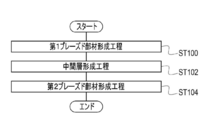
- FIG. 5 shows an example of a method for manufacturing the laminated blazed diffraction optical element 12.
- the manufacturing method shown in FIG. 5 includes a first blazed member forming step of step ST100, an intermediate layer forming step of step ST102, and a second blazed member forming step of step ST104.
- step ST100 the first blazed member 20 is formed.
- step ST102 the intermediate layer 24 is formed on the first serrated surface 20A of the first blazed member 20.
- the first serrated surface 20A is an example of a "blazed portion" according to the technique of the present disclosure.
- step ST104 a second blazed member 22 paired with the first blazed member 20 is formed on the side opposite to the first blazed member 20 side of the intermediate layer 24.
- the first blazed member forming step, the intermediate layer forming step, and the second blazed member forming step will be described in more detail.
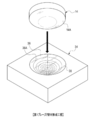
- the cavity 34 is used as an example, as shown in FIG.
- the cavity 34 is a mold for molding the first serrated surface 20A.
- a recess 36 is formed in the central portion of the cavity 34.
- the recess 36 is formed in a bowl shape.
- the surface of the recess 36 is a concentric surface 36A.
- the concentric surface 36A is a surface on which a wedge-shaped groove (for example, a groove corresponding to the wedge-shaped groove shown in FIG. 4) is formed concentrically around the center of the bottom of the recess 36.
- the size and shape of the concentric surface 36A corresponds to the second serrated surface 22A. That is, the concentric surface 36A is formed to have the same size and shape as the second serrated surface 22A.
- the liquid ultraviolet curable resin 38 for the first blazed member 20 is poured into the recess 36 so that air bubbles do not enter.
- the size and shape of the concentric surface 36A take into consideration the shrinkage rate of the ultraviolet curable resin 38 when the ultraviolet UV (see FIG. 8) is irradiated to the ultraviolet curable resin 38 in the recess 36 in a later step. It is designed to be.
- a plano-convex lens 14 is inserted into the recess 36 so that the convex surface 14A covers the recess 36. That is, the plano-convex lens 14 is submerged in the ultraviolet curable resin 38 in the recess 36 from the convex surface 14A in a state where the convex surface 14A faces the concentric surface 36A.
- the ultraviolet curable resin 38 overflowing from the recess 36 is wiped off.
- the ultraviolet irradiation device 40 receives ultraviolet UV rays from the plane 14B (the surface opposite to the convex surface 14A) side of the plano-convex lens 14. Irradiate.
- the ultraviolet UV is transmitted through the plano-convex lens 14 and irradiated to the ultraviolet curable resin 38 in the recess 36.
- the ultraviolet curable resin 38 is cured, and the first blazed member 20 is formed on the convex surface 14A (see FIGS. 1, 4, and 9).
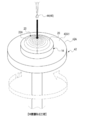
- the plano-convex lens 14 is taken out from the cavity 34. Then, as shown in FIG. 9, the plano-convex lens 14 is installed on the upper surface 42A1 of the disk base 42A of the spin coater 42 with the first sawtooth surface 20A facing upward. The center of the plane 14B (see FIG. 8) of the plano-convex lens 14 is aligned with the center of the top surface 42A1, and the plano-convex lens 14 is attached to the top surface 42A1.
- Examples of the method of attaching the plano-convex lens 14 to the upper surface 42A1 include a method of attaching by suction and / or a method of attaching by a pressing member.
- the liquid ultraviolet curable resin 44 for the intermediate layer 24 is dropped toward the center of the first serrated surface 20A.
- the ultraviolet curable resin 44 is preferably an acrylic or epoxy-based ultraviolet curable resin.
- a thermosetting resin may be applied instead of the ultraviolet curable resin. It is also possible to adjust the refractive index of the intermediate layer 24 by changing the substituent R of the methacrylate-based polymer. Further, the refractive index of the intermediate layer 24 may be adjusted by adjusting the mixing ratio of a plurality of types of materials.
- the disk base 42A is rotated at high speed in a state where the ultraviolet curable resin 44 is dropped toward the center of the first serrated surface 20A. Centrifugal force is applied to the ultraviolet curable resin 44 by the rotation of the disk base 42A, and the ultraviolet curable resin 44 is diffusely coated on the entire first serrated surface 20A.
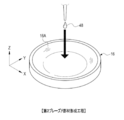
- the ultraviolet irradiation device 40 irradiates the entire ultraviolet curable resin 44 diffusely coated on the entire first serrated surface 20A with ultraviolet UV.
- the ultraviolet curable resin 44 is cured on the first sawtooth surface 20A, and the intermediate layer 24 is formed into a film on the first sawtooth surface 20A.
- the intermediate layer 24 is a single layer, one film forming step is sufficient, but when the intermediate layer 24 is made into multiple layers, the same film forming step is repeated for the number of layers. ..
- the plano-convex lens 14 is inserted into the concave surface 16A side of both concave lenses 16 so that the intermediate layer 24 covers the concave surface 16A. That is, the plano-convex lens 14 is submerged from the intermediate layer 24 in the ultraviolet curable resin 48 on the concave surface 16A side of both concave lenses 16 in a state where the intermediate layer 24 faces the concave surface 16A. The ultraviolet curable resin 48 overflowing from the concave surface 16A is wiped off.
- the ultraviolet irradiation device 50 reverses the other concave surface 16B (concave surface 16A) of the biconcave lens 16.
- (Side surface) Irradiate ultraviolet UV from the side.
- the ultraviolet UV is transmitted through the biconcave lens 16 and irradiated to the ultraviolet curable resin 48.
- the ultraviolet curable resin 48 is cured, and the second blazed member 22 is formed on the concave surface 16A.
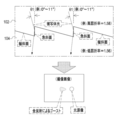
- ⁇ Conventional laminated blazed diffraction optical element> 14 and 15 show, as an example of the conventional diffractive optical element, a laminated blazed diffraction optical element that does not include an intermediate layer, that is, a laminated blazed diffraction optical element 100 in which a pair of blazed members are directly engaged. It is shown.
- the pair of blazed members are a first blazed member 102 corresponding to the first blazed member 20 and a second blazed member corresponding to the second blazed member 22. It is formed by a member 104.
- the first blazed member 102 has a first sawtooth surface 106 corresponding to the first sawtooth surface 20A.
- the first blazed member 102 has a first reference plane 102A.
- the first reference plane 102A is a virtually set plane, and is, for example, a plane parallel to the plane corresponding to the convex plane 14A (see FIG. 1).
- the first serrated surface 106 is formed by the first steep slope 106A and the second gentle slope 106B.
- the first gentle slope 106B is a surface having a gentler slope with respect to the first reference surface 102A than the first steep slope 106A.
- the first steep slope 106A is a plane perpendicular to the first reference plane 102A, and the height of the first steep slope 106A from the first reference plane 102A is the lattice height of the first blazed member 102.
- the first steep slope 106A does not have to be perpendicular to the first reference surface 102A. This is because, in the optical system used, the angle of the first steep slope 106A is appropriately determined so as to have the highest diffraction efficiency with respect to the direction of the main incident light beam.
- the second blazed member 104 has a second sawtooth surface 108 corresponding to the second sawtooth surface 22A.
- the second blazed member 102 has a second reference plane 104A.
- the second reference plane 104A is a virtually set plane, and is, for example, a plane parallel to the plane corresponding to the concave surface 16A (see FIG. 1).
- the second serrated surface 22A is formed by the second steep slope 108A and the second gentle slope 108B.
- the second gentle slope 108B is a surface having a gentler slope with respect to the second reference surface 104A than the second steep slope 108A.
- the second steep slope 108A is a plane perpendicular to the second reference plane 104A, and the height of the second steep slope 108A from the second reference plane 104A is the lattice height of the second blazed member 104.
- the first serrated surface 106 of the first blazed member 102 is directly engaged with the second serrated surface 108 of the second blazed member 104.
- the first steep slope 106A is in direct contact with the second steep slope 108A
- the first gentle slope 106B is in direct contact with the second gentle slope 108B.
- FIG. 14 and FIG. 15 for convenience of explanation, when it is not necessary to distinguish between the first steep slope 106A and the second steep slope 108A, it is referred to as a “steep slope” without a reference numeral and is referred to as a first gentle slope.
- a “gentle slope” without a reference numeral.
- the refractive index of the first blazed member 102 is higher than the refractive index of the second blazed member 104, and in the example shown in FIG. 14, "1.58" is shown as the refractive index of the first blazed member 102. 2 “1.56” is shown as the refractive index of the blazed member 104.
- the subject light is incident on the second blazed member 104 (layer having a refractive index of "1.56") from the first blazed member 102 (layer having a refractive index of "1.58”) via a gentle slope. Again, it is incident on the first blazed member 102 via the steep slope and then incident on the second blazed member 104 via the gentle slope.
- the subject light is refracted on the steep slope depending on the angle ⁇ 1 at which the subject light is incident on the steep slope. In the example shown in FIG. 14, the angle ⁇ 1 at which the subject light is incident on the steep slope is 5 degrees, and the angle ⁇ 2 at which the subject light is refracted on the steep slope is 7 degrees. As a result, a ghost due to the refraction of the subject light is reflected in the captured image obtained by being captured by the image sensor.
- the subject light transmitted from the first blazed member 102 through the gentle slope is incident on the steep slope, but in the example shown in FIG. 15, the subject light incident on the first blazed member 102 is incident on the gentle slope.
- the steep slope is directly irradiated without going through.
- the angle ⁇ 1 the subject light is totally reflected on the steep slope.
- the angle ⁇ 1 is in the range of 0 degrees or more and 11 degrees or less, the subject light is totally reflected on a steep slope.
- a ghost due to total reflection of the subject light is reflected in the captured image obtained by being captured by the image sensor.
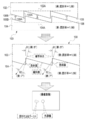
- the laminated blazed diffraction optical element 12 includes a blazed diffraction grating pair 18 and an intermediate layer 24.
- the intermediate layer 24 having a refractive index N is located between the first blazed member 20 having a refractive index Na and the second blazed member 22 having a refractive index Nb.
- a magnitude relationship of "Na>N>Nb" is established between the first blazed member 20 having a refractive index Na, the second blazed member 22 having a refractive index Nb, and the intermediate layer 24 having a refractive index N.
- first serrated surface 20A is formed by a first steep slope 20A1 and a first gentle slope 20A2 having a gentler slope than the first steep slope 20A1.
- the second serrated surface 22A is formed by a second steep slope 22A1 and a second gentle slope 22A2 having a gentler slope than the second steep slope 22A1.
- the intermediate layer 24 is arranged between the first serrated surface 20A and the second serrated surface 22A, and between the first steep slope 20A1 and the second steep slope 22A1.
- first serrated surface 20A and the second serrated surface 22A are complementarily engaged with each other via the intermediate layer 24. That is, the first sawtooth surface 20A and the second sawtooth surface 22A are engaged with each other via the intermediate layer 24 so that the first steep slope 20A1 and the second steep slope 22A1 are alternately arranged along the X direction. There is.
- first blazed member 20 has a first reference surface 52
- second blazed member 22 has a second reference surface 54
- the first reference plane 52 and the second reference plane 54 are virtually set planes.
- the first reference surface 52 is a surface parallel to the convex surface 14A (see FIG. 1)
- the second reference surface 54 is a surface parallel to the concave surface 16A (see FIG. 1).
- the first steep slope 20A1 and the first gentle slope 20A2 are surfaces rising from the first reference surface 52
- the second steep slope 22A1 and the second gentle slope 22A2 are surfaces rising from the second reference surface 54.
- the first steep slope 20A1 is perpendicular to the first reference plane 52
- the second steep slope 22A1 is perpendicular to the second reference plane 54.
- first serrated surface 20A and the second serrated surface 22A are engaged with each other with a deviation of the thickness of the intermediate layer 24. That is, the first serrated surface 20A and the second serrated surface 22A are engaged with each other via the intermediate layer 24.
- the blaze angle of the first blazed member 20 and the blaze angle of the second blazed member 22 are the same.
- the lattice height of the first blazed member 20 and the lattice height of the second blazed member are the same.
- the first blazed member 20 and the subject light are transmitted.
- the lattice height of the second blazed member 22 is h
- the thickness of the intermediate layer 24 is t
- the critical angle is ⁇ c
- the inequality of h ⁇ t ⁇ tan ⁇ , ⁇ c asin (Nb / Na), etc.
- the lattice height h and the thickness t of the intermediate layer 24 are determined so that the equation holds.
- the thickness t of the intermediate layer 24 represents the thickness between the first gentle slope 20A2 and the second gentle slope 22A2, and the thickness between the first steep slope 20A1 and the second steep slope 22A1.
- the critical angle is the minimum incident angle at which the subject light cannot be transmitted from the second blazed member 22 when the subject light is irradiated from the first blazed member 20 side of the laminated blazed diffraction optical element 12.
- the fact that the subject light cannot be transmitted means, for example, that the subject light is totally reflected between layers (mediums) having different refractive indexes and the subject light does not pass through the layers.
- the angle of incidence is a subject that is incident on the joint surface of adjacent layers (for example, the joint surface between the first blazed member 20 and the intermediate layer 24, and the joint surface between the intermediate layer 24 and the second blazed member 20). Refers to the angle of the optical path of light. In the example shown in FIG. 17, the angle of the optical path of the subject light incident on the joint surface of the adjacent layer is the angle with respect to the normal of the joint surface.
- the subject light is transmitted from the second medium side to the first medium.
- the critical angle ⁇ c between the first blazed member 20 and the intermediate layer 24 is larger than the critical angle ⁇ c between the first blazed member 20 and the second blazed member 22. Therefore, even if the angle of the optical path of the subject light incident on the intermediate layer 24 from the first blazed member 20 is equal to or more than the critical angle ⁇ c between the first blazed member 20 and the second blazed member 22, the first The subject light incident on the intermediate layer 24 from the blazed member 20 is refracted by the intermediate layer 24 without being totally reflected. The refracted subject light reaches the lower surface 56 (the joint surface (boundary surface) between the intermediate layer 24 and the second blazed member 22) in FIG. 17 of the intermediate layer 24 before reaching the second blazed member 22. Then, it is incident on the second blazed member 22 adjacent to the lower surface 56.
- the critical angle ⁇ c1 between the first blazed member 20 and the intermediate layer 24 is 83.6 degrees. Therefore, even if the subject light has an incident angle exceeding 79 degrees, which is the critical angle ⁇ c when the intermediate layer 24 does not exist, if the incident angle is smaller than 83.6 degrees, it is intermediate with the first blazed member 20. No total reflection with layer 24. That is, the subject light incident on the joint surface between the first blazed member 20 and the intermediate layer 24 is such that the first blazed member 20 and the intermediate layer 24 are in the range of 79 degrees ⁇ angle ⁇ ⁇ 83.6 degrees. It is incident on the intermediate layer 24 without total internal reflection at the joint surface. Then, the subject light incident on the intermediate layer 24 is incident on the second blazed member 22 from the lower surface 56 in the drawing of the intermediate layer 24.
- the laminated blazed diffraction grating 12 includes a blazed diffraction grating pair 18 that functions as a diffraction grating by the first blazed member 20 and the second blazed member 22, and the first blazed member 20 and the second blazed member 22. It is provided with an intermediate layer 24 located between the and. Then, a magnitude relationship of "Na> N> Nb" is established between the first blazed member 20 having a refractive index Na, the second blazed member 22 having a refractive index Nb, and the intermediate layer 24 having a refractive index N.
- the thickness of the intermediate layer 24 is t, and the critical angle is ⁇ c.
- the optimum lattice height and the optimum thickness of the intermediate layer 24 can be easily determined.
- the first serrated surface 20A and the second serrated surface 22A are complementarily engaged with each other via the intermediate layer 24. Therefore, according to this configuration, it is caused by the incident light as compared with the case where the first sawtooth surface 20A and the second sawtooth surface 22A are not complementarily engaged with each other via the intermediate layer 24. ghosts can be suppressed.
- the intermediate layer 24 is arranged between the first serrated surface 20A and the second serrated surface 22A and between the first steep slope 20A1 and the second steep slope 22A1. There is. Therefore, according to this configuration, it is caused by the light incident on the first steep slope 20A1 and the second steep slope 22A1 as compared with the case where the intermediate layer 24 is not arranged between the first steep slope 20A1 and the second steep slope 22A1. The ghost that occurs can be suppressed.
- the thickness of the intermediate layer 24 is set between the first steep slope 20A1 and the second steep slope 22A1 between the first serrated surface 20A and the second serrated surface 22A.
- a grid height at which ghosts are less likely to occur and as a thickness of the intermediate layer 24 between the first steep slope 20A1 and the second steep slope 22A1 where ghosts are less likely to occur as compared with the case where the thickness of the intermediate layer 24 between the two is determined.
- the optimum grid height and the optimum thickness of the intermediate layer 24 can be easily determined.
- the first steep slope 20A1 is perpendicular to the first reference surface 52
- the second steep slope 22A1 is perpendicular to the second reference surface 54. Therefore, according to this configuration, the first steep slope 20A1 is not perpendicular to the first reference surface 52 and the second steep slope 22A1 is not perpendicular to the second reference surface 52. And the ghost caused by the light incident on the second steep slope 22A1 can be suppressed.
- the first serrated surface 20A and the second serrated surface 22A are engaged with each other with a deviation of the thickness of the intermediate layer 24. Therefore, according to this configuration, the ghost caused by the incident light is compared with the case where the first sawtooth surface 20A and the second sawtooth surface 22A are not engaged with each other by the thickness of the intermediate layer 24. Can be suppressed.
- the intermediate layer 24 is formed in a film shape. Therefore, according to this configuration, it is possible to contribute to the thinning of the laminated blazed diffraction optical element 12.
- the blaze angle of the first blaze member 20 and the blaze angle of the second blazed member 22 are the same. Therefore, according to this configuration, ghosts caused by incident light can be suppressed as compared with the case where the blaze angle of the first blazed member 20 and the blaze angle of the second blazed member 22 are not uniform.
- the lattice height of the first blazed member 20 and the lattice height of the second blazed member are the same. Therefore, according to this configuration, ghosts caused by incident light can be suppressed as compared with the case where the lattice height of the first blazed member 20 and the lattice height of the second blazed member are not uniform.
- the intermediate layer forming step included in the manufacturing method of the laminated blazed diffraction optical element 12 includes a step of forming the intermediate layer 24 by using a spin coat. Therefore, according to this configuration, the intermediate layer 24 can be easily formed into a film having a uniform thickness as compared with the case where the intermediate layer 24 is vapor-deposited.
- the intermediate layer 24 is interposed between the entire surface of the first gentle slope 20A2 and the entire surface of the second gentle slope 22A2
- the technique of the present disclosure is not limited thereto. ..
- the intermediate layer 24 is interposed between at least the first steep slope 20A1 of the first sawtooth surface 20A and at least the second steep slope 22A1 of the second sawtooth surface 22A.
- ghosts caused by light incident on the first steep slope 20A1 and the second steep slope 22A1 are suppressed as compared with the case where the intermediate layer 24 is not arranged between the first steep slope 20A1 and the second steep slope 22A1. can do.
- the intermediate layer 24 is a single layer, but the technique of the present disclosure is not limited to this, and the intermediate layer 24 may have a multi-layered structure.
- the intermediate layer 24 is formed by the first layer 30 and the second layer 32.
- the first layer 30 and the second layer 32 are laminated.
- the first layer 30 is joined to the first sawtooth surface 20A
- the second layer 32 is joined to the second sawtooth surface 22A. That is, the first blazed member 20, the first layer 30, the second layer 32, and the second blazed member 22 are laminated in this order from the convex surface 14A (see FIG. 1) to the concave surface 16A (see FIG. 1).
- the refractive index of the first layer 30 is N1 and the refractive index of the second layer 32 is N2, the refractive index Na of the first blaze member 20, the refractive index N1 of the first layer 30, and the second layer 32.
- the magnitude relationship of "Na> N1> N2> Nb" is established between the refractive index N2 of the above and the refractive index Nb of the second blaze member.
- the refraction of the light incident on the intermediate layer 24 can be finely controlled stepwise as compared with the case where the intermediate layer 24 is composed of one layer.
- the first layer 30 and the second layer 32 are merely examples, and if there are a plurality of layers having a small refractive index from the first blazed member 20 side to the second blazed member 22 side, three or more layers are used. There may be. Further, the intermediate layer 24 does not need to be divided into a plurality of layers, and the refractive index may change continuously.
- the second blazed member 22 and the biconcave lens 16 are integrally bonded to the intermediate layer 24 by immersing the intermediate layer 24 in the biconcave lens 16 and irradiating the intermediate layer 24 with ultraviolet rays.
- the technique of the present disclosure is not limited to this. For example, using the molding cavity of the second blazed member 22, the second blazed member 22 is first joined to the intermediate layer 24, and then the concave surface 16A of both concave lenses 16 is attached to the second blazed member 22. It may be joined.
- ultraviolet UV may be irradiated from the plane 14B side of the plano-convex lens 14.
- ultraviolet UV having a wavelength that can be transmitted through the first blazed member 20 and the intermediate layer 24 may be irradiated.
- the ultraviolet curable resins 38, 44, 46 and 48 have been exemplified, but the technique of the present disclosure is not limited thereto.
- it may be a photocurable resin that cures in response to light having a wavelength different from that of ultraviolet rays, or it may be a thermosetting resin.
- a pair of lenses is applied to the junction optical element 10, but the technique of the present disclosure is not limited to this, and any optical element that transmits light is an optical element other than the lens. You may.
- the film forming method by spin coating is exemplified, but the technique of the present disclosure is not limited to this, and a film forming method by spray coating, inkjet or the like may be used.
- the intermediate layer 24 may be formed by using an inorganic material such as SiO2, TiO2, or MgF2. When coating an inorganic material, it is preferable to use thin film deposition or the like.
- the refractive index of the plurality of layers (mediums) formed from the first blazed member 20 to the second blazed member 22 on the side on which the subject light is incident is the second from the first blazed member 20 side.
- the technique of the present disclosure is not limited to this, and the technique is not limited to this, and extends from the second blazed member 22 side to the first blazed member 20 side regardless of the incident direction of the subject light. Even if the refractive index of the plurality of layers is reduced, the same effect as that of the above embodiment can be obtained.
- the junction optical element 10 has been described, but the technique of the present disclosure is not limited to this, and the technique of the present disclosure can be applied to a diffraction type multifocal intraocular lens.
- the diffractive multifocal intraocular lens 58 which is an example of the “blazeed diffraction optical element” according to the technique of the present disclosure, is located in the eyeball 60 (hereinafter, also referred to as “intraocular”). It is incorporated and used. For example, it is implanted in the eye instead of the crystalline lens, which is clouded by cataracts. In the example shown in FIG.
- a diffractive multifocal intraocular lens 58 is arranged instead of the crystalline lens.
- the surface of the diffractive multifocal intraocular lens 58 (the surface on the side in contact with the anterior chamber water) is covered with a blaze diffractive lattice.
- the surface of the diffractive multifocal intraocular lens 58 is in direct contact with the anterior chamber water (hereinafter, also referred to as “anterior chamber water”) 64 filled in the anterior chamber 62.
- the diffraction-type multifocal intraocular lens 58 includes a blazed member 66 and a surface layer 68.
- the blazed member 66 is a member corresponding to the second blazed member 22 described in the above embodiment
- the surface layer 68 is a member corresponding to the intermediate layer 24 described in the above embodiment.
- the surface layer 68 is an example of the “layer” according to the technique of the present disclosure.
- the blazed member 66 is formed with a sawtooth surface 66A corresponding to the second sawtooth surface 22A described in the above embodiment.
- the serrated surface 66A is formed by a steep slope 66A1 and a gentle slope 66A2.
- the steep slope 66A1 is a slope corresponding to the second steep slope 22A1 described in the above embodiment
- the gentle slope 66A2 is a slope corresponding to the second gentle slope 22A2 described in the above embodiment.
- the back surface 68A of the surface layer 68 is joined to the serrated surface 66A, and the surface 68B of the surface layer 68 is in contact with the anterior aqueous humor 64.
- the surface layer 68 is formed in a shape corresponding to the serrated surface 66A. That is, the surface 68B exists at a position offset from the sawtooth surface 66A to the anterior chamber water 64 side by the thickness t described in the above embodiment, and has the same shape (sawtooth shape) as the sawtooth surface 66A. It is formed. Therefore, the portion of the anterior aqueous humor 64 that comes into contact with the surface 68B has the same shape as the first serrated surface 20A described in the above embodiment.
- the refractive index of the anterior chamber water 64 is A (for example, about 1.34)
- the refractive index of the surface layer 68 is B
- the refractive index of the blaze member 66 is C
- the refractive index A of the anterior chamber water 64 and the surface layer 68 The refractive index B and the refractive index C are determined so that the magnitude relationship of "A ⁇ B ⁇ C" is established between the refractive index B of the above and the refractive index C of the blaze member 66. That is, the anterior chamber water 64 corresponds to the second blazed member 22 described in the first embodiment, the blazed member 66 corresponds to the first blazed member 20 described in the above embodiment, and the surface layer 68 corresponds to the above embodiment.
- the surface layer 68 may also have a multi-layered structure like the intermediate layer 24. Further, the surface layer 68 does not need to be divided into a plurality of layers, and the refractive index may change continuously. For example, in the surface layer 68, the refractive index is closer to the refractive index A of the anterior chamber water 64 toward the anterior chamber water side so that the refractive index from the anterior chamber water 64 to the blaze member 66 changes continuously, and the blaze member 66 side. The refractive index may be closer to the refractive index C of the surface layer 68 and may have a continuously changing refractive index distribution.
- a diffractive multifocal intraocular lens 58 may be applied to the eye model 70.
- the pseudo-anterior chamber 72 of the eyeball model 70 may be filled with a liquid 74 having the same refractive index as the anterior chamber water 64.
- the eyeball model 70 is an eyeball model used in an experimental stage for manufacturing a device (for example, an ophthalmic observation device or an ophthalmic laser treatment device) used for diagnosis or treatment of diabetic retinopathy or retinal detachment. It may be an eyeball model used for skill training for medical students or doctors to perform various ophthalmic operations or various examinations.
- a device for example, an ophthalmic observation device or an ophthalmic laser treatment device
- It may be an eyeball model used for skill training for medical students or doctors to perform various ophthalmic operations or various examinations.
- a and / or B is synonymous with "at least one of A and B". That is, “A and / or B” means that it may be only A, it may be only B, or it may be a combination of A and B. Further, in the present specification, when three or more matters are connected and expressed by "and / or", the same concept as “A and / or B" is applied.
Landscapes
- Health & Medical Sciences (AREA)
- Engineering & Computer Science (AREA)
- Ophthalmology & Optometry (AREA)
- Physics & Mathematics (AREA)
- Manufacturing & Machinery (AREA)
- General Physics & Mathematics (AREA)
- Optics & Photonics (AREA)
- Mechanical Engineering (AREA)
- General Health & Medical Sciences (AREA)
- Transplantation (AREA)
- Oral & Maxillofacial Surgery (AREA)
- Biomedical Technology (AREA)
- Heart & Thoracic Surgery (AREA)
- Vascular Medicine (AREA)
- Life Sciences & Earth Sciences (AREA)
- Animal Behavior & Ethology (AREA)
- Cardiology (AREA)
- Public Health (AREA)
- Veterinary Medicine (AREA)
- Diffracting Gratings Or Hologram Optical Elements (AREA)
- Eyeglasses (AREA)
- Prostheses (AREA)
Priority Applications (3)
| Application Number | Priority Date | Filing Date | Title |
|---|---|---|---|
| JP2022533786A JP7473648B2 (ja) | 2020-06-30 | 2021-06-08 | ブレーズド回折光学素子、及びブレーズド回折光学素子の製造方法 |
| CN202180042935.4A CN115769112B (zh) | 2020-06-30 | 2021-06-08 | 闪耀衍射光学元件及闪耀衍射光学元件的制造方法 |
| US18/060,967 US20230104387A1 (en) | 2020-06-30 | 2022-12-02 | Blazed diffractive optical element and method of manufacturing blazed diffractive optical element |
Applications Claiming Priority (2)
| Application Number | Priority Date | Filing Date | Title |
|---|---|---|---|
| JP2020113523 | 2020-06-30 | ||
| JP2020-113523 | 2020-06-30 |
Related Child Applications (1)
| Application Number | Title | Priority Date | Filing Date |
|---|---|---|---|
| US18/060,967 Continuation US20230104387A1 (en) | 2020-06-30 | 2022-12-02 | Blazed diffractive optical element and method of manufacturing blazed diffractive optical element |
Publications (1)
| Publication Number | Publication Date |
|---|---|
| WO2022004304A1 true WO2022004304A1 (ja) | 2022-01-06 |
Family
ID=79315236
Family Applications (1)
| Application Number | Title | Priority Date | Filing Date |
|---|---|---|---|
| PCT/JP2021/021755 Ceased WO2022004304A1 (ja) | 2020-06-30 | 2021-06-08 | ブレーズド回折光学素子、及びブレーズド回折光学素子の製造方法 |
Country Status (4)
| Country | Link |
|---|---|
| US (1) | US20230104387A1 (https=) |
| JP (1) | JP7473648B2 (https=) |
| CN (1) | CN115769112B (https=) |
| WO (1) | WO2022004304A1 (https=) |
Citations (5)
| Publication number | Priority date | Publication date | Assignee | Title |
|---|---|---|---|---|
| JP2009134223A (ja) * | 2007-12-03 | 2009-06-18 | Canon Inc | 回折光学素子およびそれを有する光学系 |
| JP2011107586A (ja) * | 2009-11-20 | 2011-06-02 | Canon Inc | 回折光学素子およびそれを有する光学系 |
| JP2018189863A (ja) * | 2017-05-10 | 2018-11-29 | キヤノン株式会社 | 回折光学素子及びそれを用いた光学系 |
| JP2019066756A (ja) * | 2017-10-04 | 2019-04-25 | キヤノン株式会社 | 回折光学素子を備えた光学系および光学機器 |
| JP2019534071A (ja) * | 2016-11-16 | 2019-11-28 | タトヴァム エルエルシーTatvum Llc | 拡張焦点深度を有する眼内レンズ |
Family Cites Families (6)
| Publication number | Priority date | Publication date | Assignee | Title |
|---|---|---|---|---|
| JPS62295001A (ja) * | 1986-06-14 | 1987-12-22 | Nippon Sheet Glass Co Ltd | 合成樹脂製多焦点球面レンズおよびその製法 |
| JP2006072169A (ja) * | 2004-09-06 | 2006-03-16 | Dainippon Printing Co Ltd | ブレーズ化回折光学素子 |
| JP5672542B2 (ja) * | 2011-02-07 | 2015-02-18 | 株式会社ニコン | 自由曲面プリズムを用いた回折光学系及び画像撮像装置 |
| EP3173050B1 (en) * | 2014-07-25 | 2020-02-19 | Musashino Lens Research, Inc. | Phakic intraocular lens |
| JP6698671B2 (ja) * | 2015-10-01 | 2020-05-27 | 株式会社メニコン | 回折型多焦点眼用レンズおよび回折型多焦点眼用レンズの製造方法 |
| JP6913035B2 (ja) * | 2016-02-09 | 2021-08-04 | 株式会社メニコン | 眼用回折多焦点レンズおよび眼用回折多焦点レンズの製造方法 |
-
2021
- 2021-06-08 CN CN202180042935.4A patent/CN115769112B/zh active Active
- 2021-06-08 JP JP2022533786A patent/JP7473648B2/ja active Active
- 2021-06-08 WO PCT/JP2021/021755 patent/WO2022004304A1/ja not_active Ceased
-
2022
- 2022-12-02 US US18/060,967 patent/US20230104387A1/en active Pending
Patent Citations (5)
| Publication number | Priority date | Publication date | Assignee | Title |
|---|---|---|---|---|
| JP2009134223A (ja) * | 2007-12-03 | 2009-06-18 | Canon Inc | 回折光学素子およびそれを有する光学系 |
| JP2011107586A (ja) * | 2009-11-20 | 2011-06-02 | Canon Inc | 回折光学素子およびそれを有する光学系 |
| JP2019534071A (ja) * | 2016-11-16 | 2019-11-28 | タトヴァム エルエルシーTatvum Llc | 拡張焦点深度を有する眼内レンズ |
| JP2018189863A (ja) * | 2017-05-10 | 2018-11-29 | キヤノン株式会社 | 回折光学素子及びそれを用いた光学系 |
| JP2019066756A (ja) * | 2017-10-04 | 2019-04-25 | キヤノン株式会社 | 回折光学素子を備えた光学系および光学機器 |
Also Published As
| Publication number | Publication date |
|---|---|
| CN115769112A (zh) | 2023-03-07 |
| CN115769112B (zh) | 2025-11-25 |
| JPWO2022004304A1 (https=) | 2022-01-06 |
| JP7473648B2 (ja) | 2024-04-23 |
| US20230104387A1 (en) | 2023-04-06 |
Similar Documents
| Publication | Publication Date | Title |
|---|---|---|
| KR102700185B1 (ko) | 등급화된 마이크로렌즈를 이용한 난시 렌즈 | |
| KR101174180B1 (ko) | 회절 광학 소자 | |
| US11222987B2 (en) | Optical receiver employing a metasurface collection lens having concentric belts or rings | |
| CN102791213B (zh) | 使用多面光学元件的多光斑激光外科手术探头 | |
| WO2021059887A1 (ja) | 眼鏡レンズおよびその製造方法 | |
| CN101268012A (zh) | 微小构造体及其制造方法 | |
| WO2008010560A1 (fr) | Système optique et oculaire | |
| JP2023526019A (ja) | 屈折光学系と回折接眼レンズ導波管ディスプレイの統合のための方法およびシステム | |
| WO2023143614A1 (zh) | 一种光组合器及显示装置 | |
| JP2020510245A (ja) | 低波面誤差圧電駆動式光学素子 | |
| KR20240008836A (ko) | 광학 요소를 포함하는 광학 물품의 개선된 코팅 방법 | |
| WO2022004304A1 (ja) | ブレーズド回折光学素子、及びブレーズド回折光学素子の製造方法 | |
| US20240160040A1 (en) | Mold manufacturing method, optical member manufacturing method, and spectacle lens | |
| TW201732351A (zh) | 光學鏡片組 | |
| JP2025502401A5 (https=) | ||
| JP4406605B2 (ja) | 眼用レンズ | |
| JP2008310160A (ja) | 眼鏡レンズ及び眼鏡レンズの製造方法 | |
| JP5737108B2 (ja) | 光ファイバユニット及びその製造方法 | |
| US20250144899A1 (en) | Method for manufacturing a spectacle lens | |
| WO2022227977A1 (zh) | 一种光学器件及光学系统 | |
| EP4392815A1 (en) | Method of fabricating molds for forming waveguides and related systems and methods using the waveguides | |
| CN222379954U (zh) | 一种微结构眼镜片及眼镜 | |
| CN111465890A (zh) | 用于具有优化的厚度的眼科镜片的确定方法 | |
| US20220317341A1 (en) | Split gradient index lens | |
| US8564882B2 (en) | Diffractive optical element and optical device |
Legal Events
| Date | Code | Title | Description |
|---|---|---|---|
| 121 | Ep: the epo has been informed by wipo that ep was designated in this application |
Ref document number: 21831985 Country of ref document: EP Kind code of ref document: A1 |
|
| ENP | Entry into the national phase |
Ref document number: 2022533786 Country of ref document: JP Kind code of ref document: A |
|
| NENP | Non-entry into the national phase |
Ref country code: DE |
|
| 122 | Ep: pct application non-entry in european phase |
Ref document number: 21831985 Country of ref document: EP Kind code of ref document: A1 |