WO2021235335A1 - アセトアミノフェンの製造方法 - Google Patents
アセトアミノフェンの製造方法 Download PDFInfo
- Publication number
- WO2021235335A1 WO2021235335A1 PCT/JP2021/018363 JP2021018363W WO2021235335A1 WO 2021235335 A1 WO2021235335 A1 WO 2021235335A1 JP 2021018363 W JP2021018363 W JP 2021018363W WO 2021235335 A1 WO2021235335 A1 WO 2021235335A1
- Authority
- WO
- WIPO (PCT)
- Prior art keywords
- reaction
- acetaminophen
- synthetic adsorbent
- catalyst
- metal
- Prior art date
- Legal status (The legal status is an assumption and is not a legal conclusion. Google has not performed a legal analysis and makes no representation as to the accuracy of the status listed.)
- Ceased
Links
Images

Classifications
-
- C—CHEMISTRY; METALLURGY
- C07—ORGANIC CHEMISTRY
- C07C—ACYCLIC OR CARBOCYCLIC COMPOUNDS
- C07C231/00—Preparation of carboxylic acid amides
- C07C231/10—Preparation of carboxylic acid amides from compounds not provided for in groups C07C231/02 - C07C231/08
-
- B—PERFORMING OPERATIONS; TRANSPORTING
- B01—PHYSICAL OR CHEMICAL PROCESSES OR APPARATUS IN GENERAL
- B01J—CHEMICAL OR PHYSICAL PROCESSES, e.g. CATALYSIS OR COLLOID CHEMISTRY; THEIR RELEVANT APPARATUS
- B01J23/00—Catalysts comprising metals or metal oxides or hydroxides, not provided for in group B01J21/00
- B01J23/38—Catalysts comprising metals or metal oxides or hydroxides, not provided for in group B01J21/00 of noble metals
- B01J23/40—Catalysts comprising metals or metal oxides or hydroxides, not provided for in group B01J21/00 of noble metals of the platinum group metals
- B01J23/44—Palladium
-
- B—PERFORMING OPERATIONS; TRANSPORTING
- B01—PHYSICAL OR CHEMICAL PROCESSES OR APPARATUS IN GENERAL
- B01J—CHEMICAL OR PHYSICAL PROCESSES, e.g. CATALYSIS OR COLLOID CHEMISTRY; THEIR RELEVANT APPARATUS
- B01J31/00—Catalysts comprising hydrides, coordination complexes or organic compounds
- B01J31/02—Catalysts comprising hydrides, coordination complexes or organic compounds containing organic compounds or metal hydrides
- B01J31/06—Catalysts comprising hydrides, coordination complexes or organic compounds containing organic compounds or metal hydrides containing polymers
-
- B—PERFORMING OPERATIONS; TRANSPORTING
- B01—PHYSICAL OR CHEMICAL PROCESSES OR APPARATUS IN GENERAL
- B01J—CHEMICAL OR PHYSICAL PROCESSES, e.g. CATALYSIS OR COLLOID CHEMISTRY; THEIR RELEVANT APPARATUS
- B01J35/00—Catalysts, in general, characterised by their form or physical properties
- B01J35/30—Catalysts, in general, characterised by their form or physical properties characterised by their physical properties
- B01J35/391—Physical properties of the active metal ingredient
- B01J35/394—Metal dispersion value, e.g. percentage or fraction
-
- B—PERFORMING OPERATIONS; TRANSPORTING
- B01—PHYSICAL OR CHEMICAL PROCESSES OR APPARATUS IN GENERAL
- B01J—CHEMICAL OR PHYSICAL PROCESSES, e.g. CATALYSIS OR COLLOID CHEMISTRY; THEIR RELEVANT APPARATUS
- B01J35/00—Catalysts, in general, characterised by their form or physical properties
- B01J35/60—Catalysts, in general, characterised by their form or physical properties characterised by their surface properties or porosity
- B01J35/61—Surface area
- B01J35/615—100-500 m2/g
-
- B—PERFORMING OPERATIONS; TRANSPORTING
- B01—PHYSICAL OR CHEMICAL PROCESSES OR APPARATUS IN GENERAL
- B01J—CHEMICAL OR PHYSICAL PROCESSES, e.g. CATALYSIS OR COLLOID CHEMISTRY; THEIR RELEVANT APPARATUS
- B01J35/00—Catalysts, in general, characterised by their form or physical properties
- B01J35/60—Catalysts, in general, characterised by their form or physical properties characterised by their surface properties or porosity
- B01J35/61—Surface area
- B01J35/617—500-1000 m2/g
-
- B—PERFORMING OPERATIONS; TRANSPORTING
- B01—PHYSICAL OR CHEMICAL PROCESSES OR APPARATUS IN GENERAL
- B01J—CHEMICAL OR PHYSICAL PROCESSES, e.g. CATALYSIS OR COLLOID CHEMISTRY; THEIR RELEVANT APPARATUS
- B01J35/00—Catalysts, in general, characterised by their form or physical properties
- B01J35/60—Catalysts, in general, characterised by their form or physical properties characterised by their surface properties or porosity
- B01J35/61—Surface area
- B01J35/618—Surface area more than 1000 m2/g
-
- B—PERFORMING OPERATIONS; TRANSPORTING
- B01—PHYSICAL OR CHEMICAL PROCESSES OR APPARATUS IN GENERAL
- B01J—CHEMICAL OR PHYSICAL PROCESSES, e.g. CATALYSIS OR COLLOID CHEMISTRY; THEIR RELEVANT APPARATUS
- B01J35/00—Catalysts, in general, characterised by their form or physical properties
- B01J35/60—Catalysts, in general, characterised by their form or physical properties characterised by their surface properties or porosity
- B01J35/63—Pore volume
- B01J35/633—Pore volume less than 0.5 ml/g
-
- B—PERFORMING OPERATIONS; TRANSPORTING
- B01—PHYSICAL OR CHEMICAL PROCESSES OR APPARATUS IN GENERAL
- B01J—CHEMICAL OR PHYSICAL PROCESSES, e.g. CATALYSIS OR COLLOID CHEMISTRY; THEIR RELEVANT APPARATUS
- B01J35/00—Catalysts, in general, characterised by their form or physical properties
- B01J35/60—Catalysts, in general, characterised by their form or physical properties characterised by their surface properties or porosity
- B01J35/63—Pore volume
- B01J35/635—0.5-1.0 ml/g
-
- B—PERFORMING OPERATIONS; TRANSPORTING
- B01—PHYSICAL OR CHEMICAL PROCESSES OR APPARATUS IN GENERAL
- B01J—CHEMICAL OR PHYSICAL PROCESSES, e.g. CATALYSIS OR COLLOID CHEMISTRY; THEIR RELEVANT APPARATUS
- B01J35/00—Catalysts, in general, characterised by their form or physical properties
- B01J35/60—Catalysts, in general, characterised by their form or physical properties characterised by their surface properties or porosity
- B01J35/63—Pore volume
- B01J35/638—Pore volume more than 1.0 ml/g
-
- B—PERFORMING OPERATIONS; TRANSPORTING
- B01—PHYSICAL OR CHEMICAL PROCESSES OR APPARATUS IN GENERAL
- B01J—CHEMICAL OR PHYSICAL PROCESSES, e.g. CATALYSIS OR COLLOID CHEMISTRY; THEIR RELEVANT APPARATUS
- B01J35/00—Catalysts, in general, characterised by their form or physical properties
- B01J35/60—Catalysts, in general, characterised by their form or physical properties characterised by their surface properties or porosity
- B01J35/64—Pore diameter
- B01J35/647—2-50 nm
-
- C—CHEMISTRY; METALLURGY
- C07—ORGANIC CHEMISTRY
- C07B—GENERAL METHODS OF ORGANIC CHEMISTRY; APPARATUS THEREFOR
- C07B61/00—Other general methods
-
- B—PERFORMING OPERATIONS; TRANSPORTING
- B01—PHYSICAL OR CHEMICAL PROCESSES OR APPARATUS IN GENERAL
- B01J—CHEMICAL OR PHYSICAL PROCESSES, e.g. CATALYSIS OR COLLOID CHEMISTRY; THEIR RELEVANT APPARATUS
- B01J2235/00—Indexing scheme associated with group B01J35/00, related to the analysis techniques used to determine the catalysts form or properties
-
- B—PERFORMING OPERATIONS; TRANSPORTING
- B01—PHYSICAL OR CHEMICAL PROCESSES OR APPARATUS IN GENERAL
- B01J—CHEMICAL OR PHYSICAL PROCESSES, e.g. CATALYSIS OR COLLOID CHEMISTRY; THEIR RELEVANT APPARATUS
- B01J35/00—Catalysts, in general, characterised by their form or physical properties
- B01J35/50—Catalysts, in general, characterised by their form or physical properties characterised by their shape or configuration
Definitions
- the present invention relates to a method for producing acetaminophen, which is useful as a pharmaceutical product.
- Acetaminophen is an antipyretic analgesic that has been used for a long time and is a highly safe drug that can be administered not only to adults but also to children.
- a batch-type reaction method has been known as a method for producing acetaminophen.
- a method is known in which paranitrophenol, acetic acid, and a metal catalyst are added to a reaction vessel, hydrogen is added, and the reaction is carried out at a high temperature to produce acetaminophen (Patent Document 1).
- Patent Document 1 it is difficult to control the reaction because the reaction temperature is high and a large amount of heat is generated when the catalyst is added. Therefore, a safer and more productive industrial manufacturing method is desired.
- An object of the present invention is to provide a method for continuously producing acetaminophen safely and inexpensively at a low reaction temperature and a low reaction pressure under high selectivity and good yield.
- the present inventor continuously passes a solution containing paracetamol, together with an acetylating agent and hydrogen, through a column packed with a catalyst in which a metal element is carried as a synthetic adsorbent, and causes a reaction, resulting in a low reaction pressure and a low reaction pressure. It has been found that acetaminophen can be safely and inexpensively obtained with high selectivity and good yield even at the reaction temperature.
- the present invention is characterized by the following.
- a method for producing acetaminophen by passing a solution containing paranitrophenol together with an acetylating agent and hydrogen through a column packed with a catalyst to carry out an acetaminolation reaction.
- a metal-supporting catalyst in which a metal element is supported on a synthetic adsorbent, wherein the reaction temperature of the acetaminolation reaction is 0 ° C. to 60 ° C. and the reaction pressure is 0.1 MPa to 1 MPa. Production method.
- acetaminophen can be continuously produced safely and inexpensively at a low reaction temperature and a low reaction pressure with high selectivity and good yield. can.
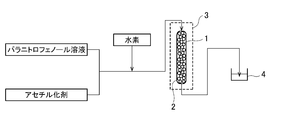
- FIG. 1 is a system diagram of a flow synthesis system showing an example of an embodiment of the method for producing acetaminophen of the present invention.
- FIG. 2 is a system diagram of a flow synthesis system including a back pressure valve showing another example of the embodiment of the method for producing acetaminophen of the present invention.
- acetaminophen a solution containing paranitrophenol (hereinafter, may be referred to as "paranitrophenol solution”) is continuously added to a column packed with a catalyst together with an acetylating agent and hydrogen.
- paranitrophenol solution a solution containing paranitrophenol
- metal-supporting catalyst of the present invention Is a metal-supporting catalyst in which a metal element is supported on a synthetic adsorbent (hereinafter, may be referred to as "metal-supporting catalyst of the present invention"), and the reaction temperature of the acetaminolation reaction is 0 ° C to 60 ° C.
- the reaction pressure is 0.1 MPa to 1 MPa.
- acetoaminoization process There is no particular limitation on the method for carrying out the acetoaminoization step of the present invention.
- a paranitrophenol solution is continuously passed through a reaction vessel 3 provided with a column 2 filled with the metal-supported catalyst 1 of the present invention together with an acetylating agent and hydrogen, and the column 2 is used.
- a flow in which paranitrophenol is continuously acetaminoylated by an acetylating agent and hydrogen in the presence of the metal-supporting catalyst of the present invention, and the reaction product solution containing acetaminophen flowing out from the column 2 is received in the recovery tank 4.
- a synthetic system method can be mentioned. The flow synthesis system of FIG.
- paranitrophenol which is a raw material for producing acetaminophen
- a commercially available product may be used, or a product obtained by applying a known method may be used.
- the solvent used for the para-nitrophenol solution is not particularly limited as long as it can dissolve para-nitrophenol and does not inhibit the progress of the reaction.
- the solvent include alcohol solvents such as methanol, ethanol and propanol; and carboxylic acid solvents such as formic acid, acetic acid and propionic acid. From the viewpoint of cost, reactivity and the like, methanol and acetic acid are preferable.
- One of these solvents may be used alone, or two or more of them may be mixed in any combination and ratio.
- the concentration of para-nitrophenol in the para-nitrophenol solution is not particularly limited as long as it does not interfere with the distribution to the column.
- the concentration of para-nitrophenol in the para-nitrophenol solution is usually 0.1% by mass to 80% by mass, preferably 10% by mass to 70% by mass, and particularly preferably 20% by mass to 60% by mass from the viewpoint of productivity and reactivity. It is mass%.
- the amount of hydrogen (hydrogen gas) used is not particularly limited as long as the reaction proceeds.
- the amount of hydrogen (hydrogen gas) used is usually 1 mol or more, preferably 3 mol or more, and usually 20 mol or less, preferably 10 mol or less, relative to 1 mol of paranitrophenol.
- Hydrogen may be continuously injected into a para-nitrophenol solution or a para-nitrophenol solution containing an acetylating agent in the flow path in front of the column 2 and mixed, or may be directly pressed into the column 2. .. Hydrogen may be used by dissolving a part or all of hydrogen in the solvent of the para-nitrophenol solution.
- Hydrogen can also be used by mixing it with an inert gas such as nitrogen, helium, or argon.
- an inert gas such as nitrogen, helium, or argon.
- the acetylating agent is not particularly limited as long as it can acetylate an amino group.
- the acetylating agent one or more kinds such as acetic anhydride and acetyl chloride are usually used. Acetic anhydride is preferred from the standpoint of cost and reactivity.
- the amount of the acetylating agent used is not particularly limited.
- the amount of the acetylating agent used is usually 1 mol to 10 mol, preferably 1 mol to 5 mol, and more preferably 1 mol to 2 mol with respect to 1 mol of paranitrophenol from the viewpoint of reactivity.
- the acetylating agent may be mixed in advance with the solution containing para-nitrophenol, or may be injected into the feeding channel of the para-nitrophenol solution before and / or after the column 2 to be continuous with the para-nitrophenol solution. Or it may be injected into the column 2 separately from the para-nitrophenol solution and continuously mixed with the para-nitrophenol solution in the column 2. From the viewpoint that the unstable intermediate can be rapidly converted to the desired product, it is preferable that the acetylating agent is continuously mixed with the paranitrophenol solution in the flow path in front of the column 2.
- the metal-supporting catalyst of the present invention is a catalyst in which a metal is immobilized by supporting a metal element on a synthetic adsorbent.
- the metal element that can be used in the metal-supported catalyst of the present invention is not particularly limited as long as it has an activity of reducing a nitro group.
- the metal element palladium (Pd), platinum (Pt), rhodium (Rh), ruthenium (Ru), Ag (silver) and a mixture of two or more thereof can be usually used.
- Pd alone or a mixture of Pd and at least one selected from Pt, Rh, Ru and Ag is preferable, and Pd and / or Pt, particularly Pd alone, is preferable from the viewpoint of catalytic performance. ..
- the lower limit of the content of the metal element in the metal-supported catalyst of the present invention is usually 0.1% by mass or more, preferably 1% by mass or more, and more preferably 3. It is by mass or more, particularly preferably 5% by mass or more, and the upper limit is usually 25% by mass or less, preferably 20% by mass or less, more preferably 15% by mass or less, and particularly preferably 10% by mass or less.
- the synthetic adsorbent is a porous synthetic adsorbent made of a porous organic polymer produced by chemical synthesis.
- polymer or copolymer As the synthetic adsorbent used in the present invention, an aromatic, substituted aromatic or acrylic polymer or copolymer (hereinafter, "polymer or copolymer” is referred to as “(co) polymer”). There is.).
- Examples of the aromatic (co) polymer include a styrene / divinylbenzene copolymer and a divinylbenzene polymer.
- Examples of the substituted aromatic (co) polymer include a bromostyrene / divinylbenzene copolymer.
- Examples of the acrylic (co) polymer include a methacrylic acid ester-based (co) polymer such as a methyl methacrylate / bis (methacrylic acid) ethylene glycol copolymer.
- aromatic (co) polymers are preferable, and styrene / divinylbenzene-based copolymers such as styrene / divinylbenzene copolymers and bromostyrene / divinylbenzene copolymers are more preferable, and styrene / divinylbenzene is more preferable.
- Copolymers are particularly preferred.
- the copolymer has a crosslinked structure insoluble in an organic solvent and is stable even in an acidic or alkaline solution.
- the synthetic adsorbent used in the present invention has little effect on the reaction, it does not have a functional group such as an ion exchange group, for example, an ion exchange capacity of less than 1 meq / g or a non-polar one. Those are preferable.
- the pore volume of the porous synthetic adsorbent used in the present invention is usually 0.1 mL / g to 3 mL / g, preferably 0.5 mL / g to 2 mL / g, and particularly preferably 1 mL, for the purpose of improving reactivity. It is / mL / g to 1.5 mL / g.
- BET specific surface area of the porous synthetic adsorbent for the purpose of improving the reactivity, usually 200m 2 / g ⁇ 2000m 2 / g, preferably from 300m 2 / g ⁇ 1500m 2 / g, more preferably 400m 2 / g ⁇ It is 1000 m 2 / g, particularly preferably 500 m 2 / g to 700 m 2 / g.
- the maximum frequency radius of the pores of the porous synthetic adsorbent is usually 1 nm to 50 nm, preferably 5 nm to 40 nm, and particularly preferably 10 nm to 30 nm for the purpose of improving reactivity.
- the synthetic adsorbent used in the present invention is preferably a porous synthetic adsorbent having relatively large pores.
- the pore volume, BET specific surface area and pore maximum frequency radius of the porous synthetic adsorbent can be measured by a nitrogen gas adsorption method according to a conventional method.
- the shape and size of the synthetic adsorbent are not particularly limited as long as they can be filled in the column and do not interfere with the flow of the reaction solution.
- As the synthetic adsorbent particulate, pellet, membrane, and columnar ones can be used, but particulate ones are more preferable from the viewpoint of filling property.
- the particle size of the particulate synthetic adsorbent is usually in the range of 1 ⁇ m to 2000 ⁇ m, preferably in the range of 3 ⁇ m to 2000 ⁇ m. From the viewpoint of industrial handling and the like, the particle size of the synthetic adsorbent is preferably in the range of 4 ⁇ m to 1000 ⁇ m, and the most frequent particle size is preferably 50 ⁇ m or more, preferably 150 ⁇ m or more, and particularly preferably 250 ⁇ m or more.
- the particle size of the synthetic adsorbent is the average particle size measured according to a conventional method by a laser diffraction type particle size distribution measurement method.
- Examples of the synthetic adsorbent used in the present invention include Diaion (registered trademark) HP20SS, HP20, HP21, Sepabeads (registered trademark) SP20SS manufactured by Mitsubishi Chemical Corporation; and Amberlite (registered trademark) XAD TM manufactured by Organo Corporation. 2.
- Commercially available products such as XAD TM 4 and XAD TM 7 HP can be used.
- HP20SS, HP20, and SP20SS are preferable from the viewpoint of reactivity.
- the metal-supporting catalyst of the present invention includes a catalyst in which Pd is carried on a synthetic adsorbent made of a styrene / divinylbenzene copolymer (hereinafter, may be referred to as “Pd / PS-DVB”) and styrene / divinylbenzene.
- Pd / PS-DVB a catalyst in which Pt is carried on a synthetic adsorbent made of a polymer
- Pt / PS-DVB styrene / divinylbenzene copolymer
- Pt / PS-DVB styrene / divinylbenzene copolymer
- Pt / PS-DVB styrene / divinylbenzene copolymer
- Pt / PS-DVB styrene / divinylbenzene copolymer
- Pt / PS-DVB styrene / diviny
- acetaminophen can be obtained with high efficiency, safety and low cost with high selectivity and good yield even at low pressure and low temperature.
- the metal-supported catalyst of the present invention can be produced by a conventionally known method such as the method described in JP-A-2008-114164.
- it can be produced by adding a synthetic adsorbent and a metal salt to an organic solvent, stirring sufficiently, and then filtering out the produced metal salt adsorbent synthetic adsorbent, washing with water and methanol, and drying. ..
- a flow synthesis system suitable for carrying out the method for producing acetaminophen of the present invention uses a reaction vessel having an inlet and an outlet, and "inputs raw materials from the inlet”, “reaction” and “recovery of products from the outlet”. Means a system that simultaneously performs "", and the concept is well known to those skilled in the art (for example, “Flow Microsynthesis” (Chemistry Dojin) 2014, p. 9).
- the column packed with the metal-supported catalyst of the present invention is a thin tubular.
- the material of the column according to the present invention is not particularly limited.
- the column material include glass, stainless steel (SUS), Hastelloy, and Teflon (registered trademark).
- the size of the column is not particularly limited as long as it is suitable for the reaction.
- a column having a diameter of 10 mm ⁇ a length of 100 mm, a column having a diameter of 10 mm ⁇ a length of 250 mm, or the like can be used as the column.
- Pd / PS-DVB Pd: 2.55 g, 0.9 mmol / g, styrene / divinylbenzene copolymer: Diaion (registered trademark) HP20, manufactured by Mitsubishi Chemical Co., Ltd.
- Pd / PS-DVB Pd: 2.55 g, 0.9 mmol / g, styrene / divinylbenzene copolymer: Diaion (registered trademark) HP20, Mitsubishi Chemical Co., Ltd. (Manufactured) is the most densely packed in a 10 mm ⁇ 250 mm SUS column.
- the tube used for the flow path for introducing and discharging the substrate, etc. to the column is not particularly limited.
- Specific examples of the tube include a Teflon (registered trademark) tube having an inner diameter of 1 mm.
- the introduction and discharge of the substrate, etc. into the column can be performed by sending liquid using a syringe pump, diaphragm pump, mass controller, or the like.
- a back pressure valve or an in-line analyzer may be provided in the flow path on the reaction product outflow side from the column.
- the reaction temperature of the acetoaminoization reaction of the present invention means the outside temperature of the column packed with the metal-supported catalyst of the present invention.
- the reaction temperature is usually 0 ° C. to 60 ° C., preferably 5 ° C. to 50 ° C., and particularly preferably 10 ° C. to 40 ° C. from the viewpoint of reactivity, productivity and the like. If the reaction temperature is lower than the above lower limit, the reactivity may decrease. If the reaction temperature is higher than the above upper limit, there is a risk that the yield and purity will decrease due to side reactions and the metal-supported catalyst of the present invention will deteriorate.
- the lower limit of the reaction stress of the acetoaminoization reaction of the present invention is usually 0.1 MPa or more, preferably 0.2 MPa or more, and the upper limit is usually 1 MPa or less, preferably 0.8 MPa or less, particularly preferably 0.6 MPa or less. be.
- the reaction pressure can be adjusted by applying back pressure to the flow path after passing through the column filled with the metal-supported catalyst of the present invention by using a back pressure valve or the like.
- the reaction time of the acetoaminoization reaction of the present invention means the time (retention time) at which the reaction solution stays in the column packed with the metal-supporting catalyst of the present invention, and varies depending on the reaction temperature and reaction pressure, but is usually 0. .1 to 60 seconds, preferably 0.1 to 30 seconds.
- Isolation of acetaminophen, which is a target product, from the reaction product solution obtained in the acetaminoization step of the present invention may be carried out by treatments such as neutralization, separation, concentration and filtration of the reaction product solution. It may be carried out by a known purification means such as crystallization and column chromatography.
- the present invention will be described in more detail by way of examples.
- the scope of the present invention is not limited to the following examples.
- the ratio of the supply rates (mL / min) of paranitrophenol, acetic anhydride and hydrogen gas is 1: 0.9: 67 unless otherwise specified.
- the reaction time is the time that the mixed solution stays in the column.
- each abbreviation represents the following compound.
- PAP Paraaminophenol APAP: Acetaminophen
- PAAPA 4-Acetamide phenylacetate
- PNP Paranitrophenol
- PNPA 4-Nitrophenylacetate MeOH: Methanol AcOH: Acetic acid
- Example 1 A reaction vessel was prepared by filling 2.55 g (Pd-supported amount: 0.24 g (2.3 mmol)) of Pd / HP20 (produced in Synthesis Example 1) in a SUS column having a diameter of 10 mm and a length of 100 mm. Acetaminophen was synthesized using the flow synthesis system shown in 2.
- This condition corresponds to a supply amount of 3.6 mol of hydrogen gas and a supply amount of 1.2 mol of acetic anhydride with respect to 1 mol of paranitrophenol.
- a Teflon tube and a back pressure valve were attached to the outlet of the reaction vessel, and the back pressure was set to 0.5 MPa.
- Table 3 shows the supply rate, reaction time, reaction pressure, and reaction temperature of the methanol solution of para-nitrophenol.
- Example 2 In Example 1, the reaction was carried out in the same manner as in Example 1 except that the solvent, reaction pressure, supply rate and reaction time of the para-nitrophenol solution were changed as shown in Table 3. The results of analysis of the obtained reaction product in the same manner as in Example 1 are summarized in Table 3.
- Example 1 instead of Pd / HP20, a catalyst in which Pd was supported on carbon (beads) (Pd / C (beads), manufactured by N.E.Chemcat) 4.4 g (Pd-supported amount: 0.24 g (2)). .3 mmol)) was used, and the reaction was carried out in the same manner as in Example 1 except that the supply rate and reaction time of the methanol solution of palladium on palladium were changed as shown in Table 3. The results of analysis of the obtained reaction product in the same manner as in Example 1 are summarized in Table 3.
- Example 1 and Comparative Examples 1 to 3 in Table 3 the use of Pd / HP 20 has a shorter reaction time, higher selectivity, and better than Pd / C used in the prior art.
- Acetaminophen can be efficiently obtained with a high yield.
- Examples 2 to 3 acetaminophen can be efficiently obtained with high selectivity and good yield even at a lower reaction pressure.
- the production of PAAPA can be suppressed by changing the solvent from methanol to acetic acid.
- Example 6 In Example 1, the column size was changed from 10 mm in diameter ⁇ 100 mm in length to 10 mm in diameter ⁇ 250 mm in length, and the amount of Pd / HP20 used was changed from 2.55 g to 6.38 g (use of Pd / HP20 with respect to the column volume).
- the reaction was carried out in the same manner as in Example 1 except that the reaction temperature, the reaction pressure and the supply rate of the methanol solution of para-nitrophenol were changed as shown in Table 4.
- Table 4 The results of analysis of the obtained reaction product in the same manner as in Example 1 are summarized in Table 4.
- Example 15 the column length is changed with respect to Example 3, and the same result can be obtained from Example 15 and Example 3 even if the column length is changed, that is, it depends on the column length. It turns out that there is no effect.
- Example 14 the reaction pressure was increased as compared with Example 12, and it can be seen from these results that the reactivity increases when the pressure is increased.
- the method for producing acetaminophen of the present invention does not require high-pressure reaction equipment, and is safe and inexpensive, with high selectivity and good yield under mild conditions of low reaction temperature and low reaction pressure.
- Acetaminophen, which is useful as a pharmaceutical product can be continuously produced from the above, which is industrially useful.
Landscapes
- Chemical & Material Sciences (AREA)
- Organic Chemistry (AREA)
- Engineering & Computer Science (AREA)
- Materials Engineering (AREA)
- Chemical Kinetics & Catalysis (AREA)
- Organic Low-Molecular-Weight Compounds And Preparation Thereof (AREA)
- Catalysts (AREA)
- Nanotechnology (AREA)
- Dispersion Chemistry (AREA)
Priority Applications (3)
| Application Number | Priority Date | Filing Date | Title |
|---|---|---|---|
| US17/999,152 US20230192596A1 (en) | 2020-05-18 | 2021-05-14 | Method for producing acetaminophen |
| JP2022524434A JP7690955B2 (ja) | 2020-05-18 | 2021-05-14 | アセトアミノフェンの製造方法 |
| CN202180028618.7A CN115397805B (zh) | 2020-05-18 | 2021-05-14 | 乙酰氨基酚的制造方法 |
Applications Claiming Priority (2)
| Application Number | Priority Date | Filing Date | Title |
|---|---|---|---|
| JP2020086766 | 2020-05-18 | ||
| JP2020-086766 | 2020-05-18 |
Publications (1)
| Publication Number | Publication Date |
|---|---|
| WO2021235335A1 true WO2021235335A1 (ja) | 2021-11-25 |
Family
ID=78709027
Family Applications (1)
| Application Number | Title | Priority Date | Filing Date |
|---|---|---|---|
| PCT/JP2021/018363 Ceased WO2021235335A1 (ja) | 2020-05-18 | 2021-05-14 | アセトアミノフェンの製造方法 |
Country Status (4)
| Country | Link |
|---|---|
| US (1) | US20230192596A1 (https=) |
| JP (1) | JP7690955B2 (https=) |
| CN (1) | CN115397805B (https=) |
| WO (1) | WO2021235335A1 (https=) |
Cited By (1)
| Publication number | Priority date | Publication date | Assignee | Title |
|---|---|---|---|---|
| JPWO2023090315A1 (https=) * | 2021-11-16 | 2023-05-25 |
Families Citing this family (1)
| Publication number | Priority date | Publication date | Assignee | Title |
|---|---|---|---|---|
| PL448814A1 (pl) * | 2024-06-13 | 2025-12-15 | Uniwersytet Im. Adama Mickiewicza W Poznaniu | Heterogeniczny katalizator platynowy dla procesów hydrosililowania, sposób jego wytwarzania oraz zastosowanie w procesach hydrosililowania |
Citations (7)
| Publication number | Priority date | Publication date | Assignee | Title |
|---|---|---|---|---|
| JPS5998048A (ja) * | 1982-11-04 | 1984-06-06 | モンサント・コンパニ− | N−アセチル−p−アミノフエノ−ルの製造方法 |
| JPH072746A (ja) * | 1993-04-30 | 1995-01-06 | Hoechst Celanese Corp | アシルアミノフェノールの製造方法 |
| JP2009213993A (ja) * | 2008-03-10 | 2009-09-24 | Japan Science & Technology Agency | 酸化反応用高分子担持金クラスター触媒、それを用いたカルボニル化合物の製法 |
| WO2011111672A1 (ja) * | 2010-03-10 | 2011-09-15 | 国立大学法人東京大学 | カルボン酸エステルの製造方法、触媒及びその製造方法 |
| CN102952032A (zh) * | 2011-08-18 | 2013-03-06 | 南通贝思特科技咨询有限公司 | 制备对乙酰氨基苯酚的方法 |
| JP2013067576A (ja) * | 2011-09-21 | 2013-04-18 | Jx Nippon Oil & Energy Corp | アミド化合物の製造方法とその触媒 |
| CN104628592A (zh) * | 2015-03-02 | 2015-05-20 | 河北工业大学 | 一种在乙酸溶液中硝基苯一步直接合成对乙酰氨基苯酚的方法 |
Family Cites Families (1)
| Publication number | Priority date | Publication date | Assignee | Title |
|---|---|---|---|---|
| CN102060729B (zh) * | 2010-12-28 | 2013-05-08 | 刘瑞平 | 一种连续性高效制备对乙酰氨基苯酚的方法 |
-
2021
- 2021-05-14 US US17/999,152 patent/US20230192596A1/en active Pending
- 2021-05-14 CN CN202180028618.7A patent/CN115397805B/zh active Active
- 2021-05-14 JP JP2022524434A patent/JP7690955B2/ja active Active
- 2021-05-14 WO PCT/JP2021/018363 patent/WO2021235335A1/ja not_active Ceased
Patent Citations (7)
| Publication number | Priority date | Publication date | Assignee | Title |
|---|---|---|---|---|
| JPS5998048A (ja) * | 1982-11-04 | 1984-06-06 | モンサント・コンパニ− | N−アセチル−p−アミノフエノ−ルの製造方法 |
| JPH072746A (ja) * | 1993-04-30 | 1995-01-06 | Hoechst Celanese Corp | アシルアミノフェノールの製造方法 |
| JP2009213993A (ja) * | 2008-03-10 | 2009-09-24 | Japan Science & Technology Agency | 酸化反応用高分子担持金クラスター触媒、それを用いたカルボニル化合物の製法 |
| WO2011111672A1 (ja) * | 2010-03-10 | 2011-09-15 | 国立大学法人東京大学 | カルボン酸エステルの製造方法、触媒及びその製造方法 |
| CN102952032A (zh) * | 2011-08-18 | 2013-03-06 | 南通贝思特科技咨询有限公司 | 制备对乙酰氨基苯酚的方法 |
| JP2013067576A (ja) * | 2011-09-21 | 2013-04-18 | Jx Nippon Oil & Energy Corp | アミド化合物の製造方法とその触媒 |
| CN104628592A (zh) * | 2015-03-02 | 2015-05-20 | 河北工业大学 | 一种在乙酸溶液中硝基苯一步直接合成对乙酰氨基苯酚的方法 |
Cited By (2)
| Publication number | Priority date | Publication date | Assignee | Title |
|---|---|---|---|---|
| JPWO2023090315A1 (https=) * | 2021-11-16 | 2023-05-25 | ||
| EP4434964A4 (en) * | 2021-11-16 | 2025-11-19 | Api Corp | ACETAMINOPHEN PRODUCTION PROCESS |
Also Published As
| Publication number | Publication date |
|---|---|
| US20230192596A1 (en) | 2023-06-22 |
| CN115397805A (zh) | 2022-11-25 |
| CN115397805B (zh) | 2025-05-30 |
| JPWO2021235335A1 (https=) | 2021-11-25 |
| JP7690955B2 (ja) | 2025-06-11 |
Similar Documents
| Publication | Publication Date | Title |
|---|---|---|
| EP3092072B1 (en) | A process for vapor-phase methanol carbonylation to methyl formate | |
| US11078149B2 (en) | Preparation and separation of a di-carboxylic acid-containing mixture | |
| JP7690955B2 (ja) | アセトアミノフェンの製造方法 | |
| JP2021102628A (ja) | 非イオン性造影剤の調製に有用な中間体の調製プロセス | |
| CN103694116B (zh) | 一种气相甲醇羰基化合成甲酸甲酯的方法 | |
| Pugin et al. | Mixtures of ionic liquids and water as a medium for efficient enantioselective hydrogenation and catalyst recycling | |
| CN101516822A (zh) | 从有机酸除去碘化合物的方法 | |
| MA Pereira | Immobilized ionic liquids in organic chemistry | |
| Baralt et al. | Hydrogenation of nitro compounds with an anthranilic acid polymer-bound catalyst | |
| Liu et al. | Selective hydrogenation of propadiene and propyne in propene with catalytic polymeric hollow-fiber reactor | |
| CN1964784A (zh) | 含有钯的催化剂及其制造方法 | |
| JP7180440B2 (ja) | 貴金属触媒、還元方法及び化合物の製造方法 | |
| US20250011278A1 (en) | Method for producing acetaminophen | |
| JP4424858B2 (ja) | 水素化エステルの製造方法、それに用いる水素化触媒および該触媒の製造方法 | |
| US7193120B2 (en) | Colloid-catalyzed gas transfer in supercritical phases | |
| CN115960107A (zh) | 一种基于微通道反应器的连续加氢脱苄合成taiw的方法 | |
| JP2003521525A (ja) | 化学プロセス | |
| JP7819757B2 (ja) | サリチル酸エステルの製造方法 | |
| CN101622217B (zh) | α,β-不饱和羧酸的制备方法 | |
| CN114539058A (zh) | 一种甲醇和低碳烯烃多相催化制甲酯类化合物的方法 | |
| JP7555187B2 (ja) | 酢酸の製造方法および酢酸製造装置 | |
| KR101444695B1 (ko) | 분지된 불포화 알데히드를 생산하기 위한 촉매 및 방법 | |
| Nikoshvili et al. | EFFECT OF THE REACTOR TYPE AND SOLVENT NATURE ON THE BEHAVIOR OF POLYMER-SUPPORTED PALLADIUM CATALYSTS OF SELECTIVE HYDROGENATION OF TRIPLE BOND | |
| SK29994A3 (en) | Method of hydrogenolytic reduction peroxide ozonolysis products | |
| CN116178127A (zh) | 一种烯烃和水或酸性水溶液制羧酸化合物反应的方法 |
Legal Events
| Date | Code | Title | Description |
|---|---|---|---|
| 121 | Ep: the epo has been informed by wipo that ep was designated in this application |
Ref document number: 21809762 Country of ref document: EP Kind code of ref document: A1 |
|
| ENP | Entry into the national phase |
Ref document number: 2022524434 Country of ref document: JP Kind code of ref document: A |
|
| NENP | Non-entry into the national phase |
Ref country code: DE |
|
| 122 | Ep: pct application non-entry in european phase |
Ref document number: 21809762 Country of ref document: EP Kind code of ref document: A1 |
|
| WWG | Wipo information: grant in national office |
Ref document number: 202180028618.7 Country of ref document: CN |