WO2021234922A1 - 電源管理装置、電源管理システム、電源管理方法、および、電源管理プログラム - Google Patents
電源管理装置、電源管理システム、電源管理方法、および、電源管理プログラム Download PDFInfo
- Publication number
- WO2021234922A1 WO2021234922A1 PCT/JP2020/020168 JP2020020168W WO2021234922A1 WO 2021234922 A1 WO2021234922 A1 WO 2021234922A1 JP 2020020168 W JP2020020168 W JP 2020020168W WO 2021234922 A1 WO2021234922 A1 WO 2021234922A1
- Authority
- WO
- WIPO (PCT)
- Prior art keywords
- server
- state
- power
- request signal
- signal
- Prior art date
- Legal status (The legal status is an assumption and is not a legal conclusion. Google has not performed a legal analysis and makes no representation as to the accuracy of the status listed.)
- Ceased
Links
Images





Classifications
-
- G—PHYSICS
- G06—COMPUTING OR CALCULATING; COUNTING
- G06F—ELECTRIC DIGITAL DATA PROCESSING
- G06F1/00—Details not covered by groups G06F3/00 - G06F13/00 and G06F21/00
- G06F1/26—Power supply means, e.g. regulation thereof
- G06F1/32—Means for saving power
-
- G—PHYSICS
- G06—COMPUTING OR CALCULATING; COUNTING
- G06F—ELECTRIC DIGITAL DATA PROCESSING
- G06F1/00—Details not covered by groups G06F3/00 - G06F13/00 and G06F21/00
- G06F1/26—Power supply means, e.g. regulation thereof
- G06F1/32—Means for saving power
- G06F1/3203—Power management, i.e. event-based initiation of a power-saving mode
- G06F1/3206—Monitoring of events, devices or parameters that trigger a change in power modality
-
- G—PHYSICS
- G06—COMPUTING OR CALCULATING; COUNTING
- G06F—ELECTRIC DIGITAL DATA PROCESSING
- G06F1/00—Details not covered by groups G06F3/00 - G06F13/00 and G06F21/00
- G06F1/26—Power supply means, e.g. regulation thereof
- G06F1/32—Means for saving power
- G06F1/3203—Power management, i.e. event-based initiation of a power-saving mode
- G06F1/3206—Monitoring of events, devices or parameters that trigger a change in power modality
- G06F1/3209—Monitoring remote activity, e.g. over telephone lines or network connections
-
- G—PHYSICS
- G06—COMPUTING OR CALCULATING; COUNTING
- G06F—ELECTRIC DIGITAL DATA PROCESSING
- G06F1/00—Details not covered by groups G06F3/00 - G06F13/00 and G06F21/00
- G06F1/26—Power supply means, e.g. regulation thereof
- G06F1/32—Means for saving power
- G06F1/3203—Power management, i.e. event-based initiation of a power-saving mode
- G06F1/3234—Power saving characterised by the action undertaken
- G06F1/3287—Power saving characterised by the action undertaken by switching off individual functional units in the computer system
-
- Y—GENERAL TAGGING OF NEW TECHNOLOGICAL DEVELOPMENTS; GENERAL TAGGING OF CROSS-SECTIONAL TECHNOLOGIES SPANNING OVER SEVERAL SECTIONS OF THE IPC; TECHNICAL SUBJECTS COVERED BY FORMER USPC CROSS-REFERENCE ART COLLECTIONS [XRACs] AND DIGESTS
- Y02—TECHNOLOGIES OR APPLICATIONS FOR MITIGATION OR ADAPTATION AGAINST CLIMATE CHANGE
- Y02D—CLIMATE CHANGE MITIGATION TECHNOLOGIES IN INFORMATION AND COMMUNICATION TECHNOLOGIES [ICT], I.E. INFORMATION AND COMMUNICATION TECHNOLOGIES AIMING AT THE REDUCTION OF THEIR OWN ENERGY USE
- Y02D10/00—Energy efficient computing, e.g. low power processors, power management or thermal management
Definitions
- the present invention relates to a power management device, a power management system, a power management method, and a power management program.
- Computers such as servers are compatible with power management standards in order to control their own power such as suspended state.
- APM Advanced Power Management
- BIOS Basic Input / Output System
- ACPI Advanced Configuration and Power Interface
- Non-Patent Document 1 defines the power supply state from S0 (startup state) to S5 (power off state) as the details of the ACPI standard. The larger the number after S, the higher the power saving effect, but the longer it takes to recover.
- S1 sep mode
- the CPU Central Processing Unit
- RAM Random Access Memory
- S3 suspend
- S5 power off
- S5 power off
- the WoL (Wake on LAN) function which activates the power supply of one computer by an instruction from another computer, is also widespread for the purpose of remote control of the computer.
- WoL defines the procedure for transitioning from S3 (suspend) or S5 (power off) to S0 (startup state).
- a WoL device that is always energized is mounted in advance on the computer to be started.
- the WoL device that detects the reception of the instruction packet (called a magic packet) from another computer shifts its own computer to S0 (started state).
- Non-Patent Document 2 describes a method for setting WoL.
- the request signal is, for example, a communication process for enabling communication from the requesting client to the requesting (returning) server.
- the main subject of the present invention is to perform power supply management that can respond to a request from another device with a short waiting time while maintaining a high power saving effect.
- the present invention is a power management device that maintains an operating state of a server whose power state is a power saving suspended state and an operating state in which power consumption is larger than the suspended state, regardless of the power state of the server. And When the request signal from the client to the server whose power state is suspended is received, it responds on its behalf. It is characterized by having a processing agent that transfers the request signal to the server in the operating state when the request signal from the client to the server in the operating state is received.
- the present invention it is possible to perform power supply management capable of responding to a request from another device with a short waiting time while maintaining a high power saving effect.
- TCP Transmission Control Protocol
- UDP User Datagram Protocol
- SCTP Stream Control Transmission Protocol
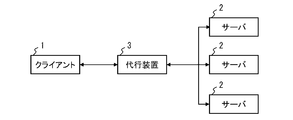
- FIG. 1 is a configuration diagram of a communication system.
- the communication system includes a client 1 that requests a service, a server 2 that provides a service, and a proxy device (power management device) 3 that responds to a service request from the client 1 on behalf of the server 2.
- the server 2 appropriately shifts to the suspended state to save power, and the proxy device 3 maintains the operating state (power supply state) even when the server 2 is in the suspended state.
- the server 2 and the proxy device 3 are used in combination, but the power consumption can be reduced as compared with the case where the server 2 alone is used. The reason is that by operating the proxy device 3 with lower performance while suspending the high-performance server 2, the sum of the power consumption of both is smaller than that of constantly operating only the server 2. be.
- the server 2 has an application processing unit 21 and a power supply control unit 22.
- the application processing unit 21 executes application processing for providing a service.
- the power supply control unit 22 controls the power supply state of the server 2, such as shifting from the suspended state to the operating state.
- the agency device 3 has a communication processing agency unit (processing agency unit) 31, a state control unit 32, and a buffer 33.
- the communication processing agency unit 31 responds to the service request from the client 1 on behalf of the suspended server 2 by executing at least a part of the communication processing for providing the service.
- the proxy communication process is, for example, a communication process that uses only an IP address or a MAC address, such as a connection process with the client 1.
- the state control unit 32 transmits various signals to the power supply control unit 22 according to the response content of the communication processing agency unit 31.
- the various signals are, for example, return signals for migrating the server 2 from the suspended state to the operating state (details are shown in FIG. 4). That is, the state control unit 32 can respond with a short waiting time while maintaining a high power saving effect by narrowing down to the timing when packet processing is required and returning the server 2.
- the buffer 33 temporarily stores an application processing task (received packet) to be executed when the server 2 is in the operating state according to the response content of the communication processing agency unit 31. That is, the task in the buffer 33 is taken over by the server 2 when the server 2 returns to the operating state. That is, even during a period in which the server 2 is in a suspended state and packet processing cannot be performed, the packet is stored in the buffer 33, so that packet loss does not occur.
- FIG. 2 is a configuration diagram showing a modified example of the communication system of FIG.
- the substitute device 3 of FIG. 1 includes a CPU and a memory, and is configured as an external device connected to the server 2.
- the substitute device 3 of FIG. 2 is built in the server 2 as a component that maintains the operating state even when the server 2 is in the suspended state.
- the components in the server are, for example, an SoC (System on Chip), an FPGA (Field-Programmable Gate Array) on a NIC (Network Interface Card), or an ASIC (Application Specific Integrated Circuit).
- the power supply control circuit mounted as the WOL device in the server 2 can also be diverted as the power supply control unit 22.
- the communication processing agency unit 31 of the agency device 3 transfers the request signal received from the client 1 to the application processing unit 21 via an internal bus such as PCI Express.
- FIG. 3 is a configuration diagram showing a modified example of the communication system of FIG.
- the substitute device 3 of FIG. 3 is arranged as an external device of the server 2 in the same manner as in FIG.
- the proxy device 3 in FIG. 3 is connected to a plurality of servers 2.
- the communication processing agency unit 31 of the agency device 3 distributes the request signal received from the client 1 to the operating server 2. If the running server 2 does not exist, a return signal is transmitted to at least one server 2 to promote the transition to the running server 2.
- FIG. 4 is a transition diagram of the power supply state of the server 2.
- the server 2 is in either the "suspended" state corresponding to S3 or S5 of the ACPI standard, the "recovering” state, or the "operating" state corresponding to S0 of the ACPI standard.
- the power saving suspended state requires less power consumption than the operating state.
- the state control unit 32 of the proxy device 3 transmits a return signal, a takeover signal, and a power saving signal to the power supply control unit 22 of the server 2 in order to change the power supply state of the server 2.
- the suspended server 2 receives the return signal and shifts to the recovering state. Therefore, the server 2 is provided with a WOL device, and the WOL device monitors the magic packet as a return signal. It should be noted that the application processing unit 21 is not yet operating regardless of whether the server 2 is in the suspended state or in the recovering state. Therefore, the task to the application processing unit 21 notified by the request signal from the client 1 is temporarily stored in the buffer 33 of the proxy device 3.
- the server 2 in the returning state shifts to the operating state.
- the application processing unit 21 operates, so that the tasks in the buffer 33 notified by the takeover signal can be sequentially processed.
- the server 2 in the recovering state receives the power saving signal and shifts to the suspend state. As a result, a power saving effect can be obtained.
- FIG. 5 is a hardware configuration diagram of the server 2 and the proxy device 3.
- the server 2 and the proxy device 3 are configured as a computer 900 having a CPU 901, a RAM 902, a ROM 903, an HDD 904, a communication I / F 905, an input / output I / F 906, and a media I / F 907, respectively.
- the communication I / F 905 is connected to an external communication device 915.
- the input / output I / F 906 is connected to the input / output device 916.
- the media I / F907 reads / writes data from the recording medium 917.
- the CPU 901 controls each processing unit by executing a program (also referred to as an application or an abbreviation thereof) read into the RAM 902.
- the program can also be distributed via a communication line, or recorded and distributed on a recording medium 917 such as a CD-ROM.
- FIG. 6 is a flowchart showing the processing when the server 2 is in the suspended state.
- the communication processing agency unit 31 receives the request signal from the client 1 (S10).
- the communication processing agency unit 31 confirms the content of the received request signal, and determines whether or not the processing of the server 2 (application processing unit 21) is unnecessary (S11).
- the request signal from the client 1 is classified into the following three categories. Yes in S11 is classification A, and No in S11 is classifications B and C. (Category A: All agency)
- a request signal that is completed only by the processing of the communication processing agency unit 31 and does not require the processing of the application processing unit 21.
- This request signal is, for example, an echo request for ping in ICMP, and the communication processing agent 31 only needs to execute processing on the communication protocol such as returning an echo response.
- This request signal is, for example, a SYN signal (Synchronize) in TCP
- the communication processing agency 31 returns an ACK + SYN (Acknowledge + Synchronize) signal
- the application processing unit 21 is to be established in response to the SYN signal. Allocate a memory area for the connection.
- Category C No proxy
- the communication processing agency unit 31 processes the request signal of (Category A: All agency) (S15). As a result, the request signal can be immediately responded to without returning the suspended server 2, so that a short-time response can be realized while maintaining the power saving effect.
- the state control unit 32 determines whether or not the server 2 is in the suspended state (S12). If Yes in S12, proceed to S16, and if No, proceed to S13. In S16, the state control unit 32 prompts the server 2 to return by transmitting a return signal to the power supply control unit 22 of the server 2 (transition from suspend ⁇ returning ⁇ operating). In S13, since the return signal has already been transmitted, the state control unit 32 determines whether or not the server 2 is in the recovering state (that is, whether it is operating). If Yes in S13, proceed to S17, and if No, proceed to S14.
- the communication processing agency unit 31 since the application processing unit 21 cannot be executed yet, the communication processing agency unit 31 temporarily stores the request signal of (classification B: partial agency) or (classification C: agency not possible) in the buffer 33. Here, with respect to (Category B: Partial agency), the communication processing agency unit 31 can execute a part of the processing (communication processing) that it can substitute in advance.
- the communication processing agent 31 since the server 2 is in the operating state, the communication processing agent 31 transfers the request signal to be received in the future to the application processing unit 21 of the server 2 to execute the processing of the application processing unit 21. Further, the communication processing agency unit 31 transmits a takeover signal including the request signal temporarily stored in the buffer 33 in S17 to the server 2, and causes the request signal accumulated during suspension or recovery to the application processing unit 21 after the fact. Let it be processed.
- FIG. 7 is a flowchart showing the processing when the server 2 is in the recovering state.
- the state control unit 32 determines whether or not the server 2 has transitioned during operation (S21). When the transition occurs during operation (Yes in S21), the communication processing agent 31 transmits the request signal stored in the buffer 33 to the server 2 as a takeover signal, and then clears the buffer 33 (S22).
- FIG. 8 is a flowchart showing processing when the server 2 is in an operating state.
- the communication processing agency unit 31 determines whether or not the period during which the request signal is not received is longer than the predetermined period (S31).
- the state control unit 32 transmits a power saving signal to the server to shift the state of the server 2 from the operating state to the suspended state (S32).
- the off-season period in which the request signal is not received can be effectively set as the power saving period.
- FIG. 9 is a sequence diagram showing TCP processing of the comparative example.
- the client 1z transmits the first SYN signal to the server 2z (S101).
- S101 the SYN signal of S101
- the server 2z shifts from returning to operating when the magic packet is received or the power button is pressed.
- the client 1z transmits (retransmits) the second SYN signal to the operating server 2z (S102). Since the SYN signal of S102 can be correctly recognized by the operating server 2z, the reply of the ACK + SYN signal (S103) and the reception of the ACK signal (S104) are normally performed as the subsequent TCP 3-way handshake process. Will be done. As described above, in the comparative example of FIG. 9, the packet loss of the first SYN signal causes the client 1z to be forced to wait for the second SYN signal.
- FIG. 10 is a sequence diagram showing the TCP processing of the present embodiment.
- the client 1 transmits a SYN signal to the proxy device 3 (S111).
- the proxy device 3 substitutes for the suspended server 2 and returns an ACK + SYN signal to the client 1 (S112).
- the reply process (classification B: partial substitution) of S112 is executed immediately without waiting for the server 2 to return to the operating state.
- the proxy device 3 stores the remaining processing on the server 2 side of the SYN signal of S111 in the buffer 33, and transmits a return signal to the server 2 (S121). As a result, the server 2 shifts from returning to operating. Then, the proxy device 3 transmits a takeover signal to the server 2 that has migrated during operation (S122), so that the remaining processing on the server 2 side stored in the buffer 33 is processed.
- the client 1 transmits an ACK signal, which is a response to S112, to the server 2 via the proxy device 3 (S113). Since the operating server 2 has already processed the tasks accumulated before the operation (suspended, resuming) by the takeover signal, the ACK signal of S113 can be immediately started. As described above, in the TCP processing of the present embodiment described with reference to FIG. 10, the proxy device 3 adjusts the power management between the client 1 and the server 2, so that the SYN signal is not packet-lossed and the server. The 3-way handshake process can be smoothly realized without making the client 1 aware of the power supply state (suspended, resuming, operating) of 2.
- FIG. 11 is a sequence diagram showing UDP processing of a comparative example.
- the client 1z transmits the first DATA signal to the suspended server 2z (S201), but the server 2z does not recognize it and the packet is lost. After that, the server 2z shifts from returning to operating when the magic packet is received or the power button is pressed.
- the client 1z transmits the second DATA signal to the returning server 2z (S202), but packet loss occurs as in the first time. Further, the client 1z transmits the third DATA signal to the server 2z (S203).
- the operating server 2z can be processed from the DATA signal of S203.
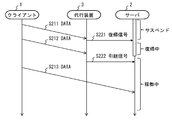
- FIG. 12 is a sequence diagram showing UDP processing of the present embodiment.
- a DATA signal of (Category C: No proxy)
- the client 1 transmits the first DATA signal to the proxy device 3 (S211). Since the proxy device 3 cannot process the DATA signal of S211 by itself, it stores it in the buffer 33 and transmits a return signal to the suspended server 2 (S221). As a result, the server 2 shifts from returning to operating.
- the client 1 transmits the second DATA signal to the proxy device 3 (S212), but since it cannot be immediately transferred to the returning server 2, it is stored in the buffer 33.
- the proxy device 3 transmits the takeover signal to the server 2 that has migrated during operation (S222), so that the server 2 processes the DATA signals of S211 and S212 stored in the buffer 33. Further, the client 1 transmits the third DATA signal via the proxy device 3 (S213). Since the operating server 2 processes the DATA signal before operation by the takeover signal of S222, the DATA signal of S213 can be immediately started.
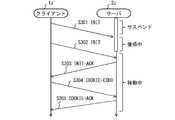
- FIG. 13 is a sequence diagram showing the TCPP processing of the comparative example.
- SCTP is a protocol that extends TCP shown in FIG. 9, and can deal with a denial of service (DoS) attack by SYN flood, which is a weak point of TCP. Therefore, in SNTP, cookies (COOKIE, identifier of connection request) are exchanged.
- DoS denial of service
- COOKIE identifier of connection request
- Client 1z sends the first INIT signal (initiation signal to start a new connection) to server 2z (S301).
- the INIT signal of S301 is not recognized by the server 2z because the server 2z is in the suspended state, and the packet is lost. After that, the server 2z shifts from returning to operating when the magic packet is received or the power button is pressed.
- the client 1z transmits (retransmits) the second INIT signal to the operating server 2z (S302).
- the INIT signal of S302 can be correctly recognized by the operating server 2z.
- the server 2z transmits an INIT-ACK signal with a cookie to the client 1z (S303).
- the client 1z transmits a COOKIE-ECHO signal including a cookie notified by the INIT-ACK signal to the server 2z (S304).
- the server 2z transmits a COOKIE-ACK signal to the client 1z (S305).
- the packet loss of the first INIT signal causes the client 1z to be forced to wait for the second INIT signal.
- FIG. 14 is a sequence diagram showing the TCPP processing of the present embodiment.
- the client 1 transmits an INIT signal to the proxy device 3 (S311).
- the proxy device 3 substitutes for the suspended server 2 and returns an INIT-ACK signal to the client 1 (S312).
- the reply process (classification B: partial substitution) of S312 is executed immediately without waiting for the server 2 to return to the operating state.
- the proxy device 3 stores the remaining processing on the server 2 side of the INIT signal of S311 in the buffer 33, and transmits a return signal to the server 2 (S321). As a result, the server 2 shifts from returning to operating. Then, the proxy device 3 transmits a takeover signal to the server 2 that has migrated during operation (S322), so that the remaining processing on the server 2 side stored in the buffer 33 is processed.
- the client 1 transmits a COOKIE-ECHO signal, which is a response to S312, to the server 2 via the proxy device 3 (S313). Since the operating server 2 has already processed the tasks accumulated before the operation (suspended, resuming) by the takeover signal, the COOKIE-ECHO signal of S313 can be immediately started. Then, the server 2 transmits a COOKIE-ACK signal, which is a response to S313, to the server 2 (S314). As a result, 4-way handshake processing can be smoothly realized without packet loss of the INIT signal.
- the present invention is a power management device that maintains an operating state of a server 2 whose power state is a power saving suspended state and an operating state in which power consumption is larger than the suspended state, regardless of the power state of the server 2.
- Substitute device 3 When it receives a request signal from the client 1 for the server 2 whose power supply state is suspended, it responds on its behalf. It is characterized by having a communication processing agent 31 that transfers the request signal to the server 2 in the operating state when the request signal from the client 1 to the server 2 in the operating state is received.
- the power supply management device (substitute device 3) further includes a state control unit 32.
- the communication processing agent 31 stores the processing of the received request signal in the buffer 33, and stores the processing of the received request signal in the buffer 33.
- the state control unit 32 receives a request signal and transmits a return signal for returning the power supply state of the server 2 to the operating state to the server 2, and after the power supply state of the server 2 shifts to the operating state, from the buffer 33. It is characterized in that a takeover signal for causing the server 2 to process the read request signal is transmitted to the server 2.
- the power supply management device (substitute device 3) further includes a state control unit 32.
- the communication processing agent 31 performs some processing that can be processed by itself with respect to the received request signal, and stores the remaining processing in the buffer 33.
- the state control unit 32 receives the request signal and transmits a return signal for returning the power supply state of the server 2 to the operating state to the server 2, and after the power supply state of the server 2 shifts to the operating state, from the buffer 33. It is characterized in that a takeover signal for causing the server 2 to process the remaining read processing is transmitted to the server 2.
- the server 2 when the period in which the state control unit 32 does not receive the request signal from the client 1 exceeds a predetermined period, the server 2 is provided with a power saving signal for shifting the power state of the server 2 to the suspended state. It is characterized by transmitting.
- the present invention is configured to include the power supply management device (substitute device 3) and the server 2.
- One power management device (substitute device 3) and one or more servers 2 are characterized in that they are configured as separate devices connected to each other by a network.
- the power management device (substitute device 3) can be easily expanded while using the existing server 2.
- the present invention is configured to include the power supply management device (substitute device 3) and the server 2.
- the power management device (substitute device 3) is arranged as a component in the server 2, maintains the operating state regardless of the power state of the server 2, and transfers the request signal via the internal bus in the server 2. It is characterized by.
- the function of the power management device (substitute device 3) can be added at low cost by utilizing the chassis of the server 2 as it is.
Landscapes
- Engineering & Computer Science (AREA)
- Theoretical Computer Science (AREA)
- General Engineering & Computer Science (AREA)
- Physics & Mathematics (AREA)
- General Physics & Mathematics (AREA)
- Computer Hardware Design (AREA)
- Computing Systems (AREA)
- Power Sources (AREA)
Priority Applications (3)
| Application Number | Priority Date | Filing Date | Title |
|---|---|---|---|
| US17/923,476 US20230280812A1 (en) | 2020-05-21 | 2020-05-21 | Power management device, power management system, power management method, and power management program |
| PCT/JP2020/020168 WO2021234922A1 (ja) | 2020-05-21 | 2020-05-21 | 電源管理装置、電源管理システム、電源管理方法、および、電源管理プログラム |
| JP2022524815A JP7424479B2 (ja) | 2020-05-21 | 2020-05-21 | 電源管理装置、電源管理システム、電源管理方法、および、電源管理プログラム |
Applications Claiming Priority (1)
| Application Number | Priority Date | Filing Date | Title |
|---|---|---|---|
| PCT/JP2020/020168 WO2021234922A1 (ja) | 2020-05-21 | 2020-05-21 | 電源管理装置、電源管理システム、電源管理方法、および、電源管理プログラム |
Publications (1)
| Publication Number | Publication Date |
|---|---|
| WO2021234922A1 true WO2021234922A1 (ja) | 2021-11-25 |
Family
ID=78707863
Family Applications (1)
| Application Number | Title | Priority Date | Filing Date |
|---|---|---|---|
| PCT/JP2020/020168 Ceased WO2021234922A1 (ja) | 2020-05-21 | 2020-05-21 | 電源管理装置、電源管理システム、電源管理方法、および、電源管理プログラム |
Country Status (3)
| Country | Link |
|---|---|
| US (1) | US20230280812A1 (https=) |
| JP (1) | JP7424479B2 (https=) |
| WO (1) | WO2021234922A1 (https=) |
Families Citing this family (2)
| Publication number | Priority date | Publication date | Assignee | Title |
|---|---|---|---|---|
| US12200480B2 (en) * | 2022-01-20 | 2025-01-14 | Verizon Patent And Licensing Inc. | Systems and methods for a quantum proxy server handover mechanism |
| CN115543055B (zh) * | 2022-11-28 | 2023-03-14 | 苏州浪潮智能科技有限公司 | 电源管理的控制权移交方法、装置、设备和存储介质 |
Citations (3)
| Publication number | Priority date | Publication date | Assignee | Title |
|---|---|---|---|---|
| JP2006235814A (ja) * | 2005-02-23 | 2006-09-07 | Canon Inc | 画像形成システム |
| JP2009289255A (ja) * | 2008-04-30 | 2009-12-10 | Silex Technology Inc | 省電力支援装置 |
| JP2016177497A (ja) * | 2015-03-19 | 2016-10-06 | 富士ゼロックス株式会社 | 節電制御装置、情報処理装置及びプログラム |
Family Cites Families (15)
| Publication number | Priority date | Publication date | Assignee | Title |
|---|---|---|---|---|
| US7107442B2 (en) * | 2003-08-20 | 2006-09-12 | Apple Computer, Inc. | Method and apparatus for implementing a sleep proxy for services on a network |
| US20050251855A1 (en) * | 2004-05-04 | 2005-11-10 | Hob Gmbh & Co. Kg | Client-server-communication system |
| US20070078959A1 (en) * | 2005-10-03 | 2007-04-05 | Yinghua Ye | Low-power proxy for providing content listings in ad-hoc, peer to peer networks |
| US8234510B2 (en) * | 2009-02-26 | 2012-07-31 | Broadcom Corporation | System and method for energy savings through emulation of wake on LAN in energy efficient ethernet |
| CN102460393B (zh) * | 2009-05-01 | 2014-05-07 | 思杰系统有限公司 | 用于在虚拟存储资源之间建立云桥的系统和方法 |
| JP5377091B2 (ja) | 2009-06-05 | 2013-12-25 | キヤノン株式会社 | 情報処理装置及びその制御方法 |
| JP5779894B2 (ja) | 2011-02-01 | 2015-09-16 | 村田機械株式会社 | 通信装置及び画像処理装置 |
| JP2013161381A (ja) | 2012-02-08 | 2013-08-19 | Canon Inc | 情報処理装置、情報処理装置の制御方法、及びプログラム |
| US9363240B2 (en) * | 2012-08-30 | 2016-06-07 | Excalibur Ip, Llc | Method and system for reducing network latency |
| JP2014203093A (ja) | 2013-04-01 | 2014-10-27 | 京セラドキュメントソリューションズ株式会社 | 画像処理システム及び画像形成装置 |
| JP5812539B2 (ja) | 2013-05-29 | 2015-11-17 | 京セラドキュメントソリューションズ株式会社 | 画像形成装置 |
| US9973965B2 (en) * | 2013-07-12 | 2018-05-15 | Seven Networks, Llc | Transport protocol layer optimization for managing signaling and power consumption |
| JP6316033B2 (ja) | 2014-03-14 | 2018-04-25 | キヤノン株式会社 | 情報処理装置及びその制御方法、記憶媒体 |
| GB2542173B (en) * | 2015-09-10 | 2019-08-14 | Openwave Mobility Inc | Method and apparatus for categorising a download of a resource |
| US10237079B2 (en) * | 2017-04-05 | 2019-03-19 | Cisco Technology, Inc. | Intelligent network sleep proxy for low power sleeping devices |
-
2020
- 2020-05-21 JP JP2022524815A patent/JP7424479B2/ja active Active
- 2020-05-21 WO PCT/JP2020/020168 patent/WO2021234922A1/ja not_active Ceased
- 2020-05-21 US US17/923,476 patent/US20230280812A1/en not_active Abandoned
Patent Citations (3)
| Publication number | Priority date | Publication date | Assignee | Title |
|---|---|---|---|---|
| JP2006235814A (ja) * | 2005-02-23 | 2006-09-07 | Canon Inc | 画像形成システム |
| JP2009289255A (ja) * | 2008-04-30 | 2009-12-10 | Silex Technology Inc | 省電力支援装置 |
| JP2016177497A (ja) * | 2015-03-19 | 2016-10-06 | 富士ゼロックス株式会社 | 節電制御装置、情報処理装置及びプログラム |
Also Published As
| Publication number | Publication date |
|---|---|
| JP7424479B2 (ja) | 2024-01-30 |
| US20230280812A1 (en) | 2023-09-07 |
| JPWO2021234922A1 (https=) | 2021-11-25 |
Similar Documents
| Publication | Publication Date | Title |
|---|---|---|
| US8898493B2 (en) | Architecture to enable energy savings in networked computers | |
| EP2204720B1 (en) | Reduced power state network processing | |
| US20110029659A1 (en) | Method and System for Network Proxy Services for Energy Efficient Networking | |
| JP5207198B2 (ja) | パケットを送受信する装置、プログラムおよびその方法 | |
| JP5377091B2 (ja) | 情報処理装置及びその制御方法 | |
| CN107919994B (zh) | 实现网络服务双机热备的方法及服务器 | |
| JP5704904B2 (ja) | データ処理装置、データ処理装置の制御方法及びプログラム | |
| US10581976B2 (en) | Transmission control of protocol state exchange for dynamic stateful service insertion | |
| US10313247B2 (en) | System, method, and device for network load balance processing | |
| US20140092418A1 (en) | Image forming device, management device, information processing system, and storage medium | |
| US20140082180A1 (en) | Information processor apparatus, information processing method, and recording medium | |
| US20180074566A1 (en) | Information processing apparatus, method for controlling the same, and non-transitory computer-readable storage medium | |
| JP7424479B2 (ja) | 電源管理装置、電源管理システム、電源管理方法、および、電源管理プログラム | |
| US8352623B2 (en) | System for energy efficient computer management environment via tightly integrated target status and directed work sessions | |
| KR20110046287A (ko) | 드라이버 패스트 페일오버를 통한 제로 패킷 손실의 에너지 효율적인 이더넷 링크 트랜지션 | |
| US8279790B2 (en) | Packet buffering based at least in part upon packet receipt time interval weighted moving average | |
| JP3906890B2 (ja) | ネットワーク装置 | |
| JP2015510334A (ja) | ネットワークアプリケーションプロキシシステム及び方法 | |
| JP2004126959A (ja) | 通信管理装置、情報処理装置、プログラム | |
| US10587428B2 (en) | Communication apparatus, method for controlling communication apparatus, and storage medium | |
| JP7110573B2 (ja) | 情報処理装置、情報処理プログラム及び情報処理方法 | |
| JP2014059726A (ja) | 情報処理装置 | |
| CN112039941B (zh) | 一种数据传输方法、设备及介质 | |
| CN118631639A (zh) | 一种分布式文件系统及其通信方法、装置和客户端设备 | |
| WO2025197097A1 (ja) | サーバ切替装置、サーバ切替システム、および、サーバ切替方法 |
Legal Events
| Date | Code | Title | Description |
|---|---|---|---|
| 121 | Ep: the epo has been informed by wipo that ep was designated in this application |
Ref document number: 20936975 Country of ref document: EP Kind code of ref document: A1 |
|
| ENP | Entry into the national phase |
Ref document number: 2022524815 Country of ref document: JP Kind code of ref document: A |
|
| NENP | Non-entry into the national phase |
Ref country code: DE |
|
| 122 | Ep: pct application non-entry in european phase |
Ref document number: 20936975 Country of ref document: EP Kind code of ref document: A1 |