WO2021220424A1 - ダイヤグラム変更装置、ダイヤグラム変更方法およびダイヤグラム変更プログラム - Google Patents
ダイヤグラム変更装置、ダイヤグラム変更方法およびダイヤグラム変更プログラム Download PDFInfo
- Publication number
- WO2021220424A1 WO2021220424A1 PCT/JP2020/018170 JP2020018170W WO2021220424A1 WO 2021220424 A1 WO2021220424 A1 WO 2021220424A1 JP 2020018170 W JP2020018170 W JP 2020018170W WO 2021220424 A1 WO2021220424 A1 WO 2021220424A1
- Authority
- WO
- WIPO (PCT)
- Prior art keywords
- constraint
- diagram
- change
- condition
- objective function
- Prior art date
- Legal status (The legal status is an assumption and is not a legal conclusion. Google has not performed a legal analysis and makes no representation as to the accuracy of the status listed.)
- Ceased
Links
Images


Classifications
-
- G—PHYSICS
- G06—COMPUTING OR CALCULATING; COUNTING
- G06T—IMAGE DATA PROCESSING OR GENERATION, IN GENERAL
- G06T11/00—Two-dimensional [2D] image generation
- G06T11/20—Drawing from basic elements
- G06T11/26—Drawing of charts or graphs
-
- B—PERFORMING OPERATIONS; TRANSPORTING
- B61—RAILWAYS
- B61L—GUIDING RAILWAY TRAFFIC; ENSURING THE SAFETY OF RAILWAY TRAFFIC
- B61L27/00—Central railway traffic control systems; Trackside control; Communication systems specially adapted therefor
- B61L27/10—Operations, e.g. scheduling or time tables
- B61L27/16—Trackside optimisation of vehicle or train operation
Definitions
- the present invention relates to a timetable changing device for changing a timetable, a method for changing a timetable, and a program for changing a timetable.
- Patent Document 1 describes an operation management support device that manages operations related to reducing train delays.
- the apparatus described in Patent Document 1 specifies a configuration to be modified in order to operate the train according to the modified timetable data based on the difference between the actual timetable data and the scheduled timetable data and the configuration information.
- an object of the present invention is to provide a timetable changing device, a timetable changing method, and a timetable changing program capable of giving an instruction for optimizing a changed timetable in a manner that can be intuitively recognized by humans.
- the diagram changing device has an output means for outputting a diagram to a display device, an input means for receiving designation of a change location and a change condition for the displayed diagram, and an object used for optimizing the diagram based on the designation. It is equipped with a constraint generation means that generates constraint of the function and a change proposal generation means that generates a change proposal of the diagram by optimizing the objective function based on the generated constraint, and the input means is provided for each change part.
- the specification of the change condition the specification of the hard constraint indicating the condition that must be satisfied or the specification of the soft constraint indicating the condition that increases the penalty according to the degree of not satisfying is accepted, and the constraint generation means depends on the hard constraint or the soft constraint. It is characterized in that the constraint is generated and the output means outputs the proposed modification of the watermark.
- the method for changing a diagram outputs a diagram to a display device, accepts the specification of the changed part and the changed condition for the displayed diagram, and when accepting the specification, it must be satisfied as the specification of the changed condition for each changed part.
- An objective function that accepts the specification of a hard constraint that indicates a condition or a soft constraint that indicates a condition that increases the penalty depending on the degree of non-satisfaction, and is used to optimize the diagram according to the hard constraint or soft constraint based on the specification.
- the diagram change program according to the present invention is used for output processing for outputting a diagram to a display device to a computer, input processing for accepting specification of a change part and change condition for the displayed diagram, and optimization of the diagram based on the specification.
- the change plan generation process that generates the change plan of the diagram is executed, and the changed part in the input process.
- a hard constraint that indicates a condition that must be satisfied or a soft constraint that indicates a condition that increases the penalty according to the degree of non-satisfaction is accepted, and the hard constraint or software is used in the constraint generation process. It is characterized in that a constraint corresponding to the constraint is generated and a proposal for changing the diagram is output in the output process.
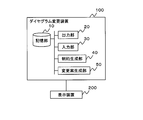
- FIG. 1 is a block diagram showing a configuration example of an embodiment of the watermark changing device according to the present invention.
- the diagram changing device 100 of the present embodiment includes a storage unit 10, an output unit 20, an input unit 30, a constraint generation unit 40, and a change proposal generation unit 50.
- the diagram changing device 100 is connected to the display device 200.
- the watermark changing device 100 of the present embodiment receives instructions from the user regarding the displayed contents. Therefore, it is preferable that the display device 200 used in the present embodiment has a function of displaying and also has a function of directly accepting input from the user. Examples of such a display device 200 include a pen tablet and a touch panel.
- the display device 200 itself does not have to accept the direct input.
- the cursor operation of the user using the pointing device may be displayed on the display device 200 to receive various instructions from the user.
- the storage unit 10 stores parameters, various information, and the like used for processing by the diagram changing device 100 of the present embodiment. Specifically, the storage unit 10 stores a predetermined operation timetable (hereinafter, referred to as a scheduled timetable). Further, the storage unit 10 stores the objective function used for the optimization process of the operation schedule.
- a predetermined operation timetable hereinafter, referred to as a scheduled timetable.
- the mode of the objective function used in this embodiment is arbitrary.
- the objective function may be, for example, an objective function generated by inverse reinforcement learning and inverse optimization, as used in methods widely known in operations research (eg, mixed integer programming problems). You may.
- the objective function may be represented by an Ising model handled by an annealing type quantum computer or the like.
- the output unit 20 outputs the target diagram (operation timetable) to the display device 200. Further, the output unit 20 of the present embodiment outputs the difference between the scheduled timetable and the scheduled timetable generated due to a delay or an obstacle.
- FIG. 2 is an explanatory diagram showing an example of an operation timetable displayed by the output unit 20. For example, it is assumed that the operation timetable D1 illustrated in FIG. 2 is a scheduled timetable. Here, when the operation timetable is disturbed due to a delay or failure, the output unit 20 outputs the operation timetable D2 including the difference d11 from the scheduled timetable.
- the range of the operation schedule output by the output unit 20 and the mode of the difference are arbitrary.
- the output unit 20 may output, for example, an operation timetable in a range including the difference, or may output an operation timetable in a range (time, station range, etc.) specified by the user. Further, the output unit 20 may output the difference in a mode (color change, highlighting, etc.) that can be distinguished from the scheduled timetable.
- the input unit 30 accepts the designation of the changed part and the changed condition for the output operation timetable.
- the changed part may be, for example, a part or all of a specific flight (train, aircraft, etc.), or may be a flight within a predetermined range.
- the change conditions include the specific content of the change (operating time, operating speed, etc.) for the changed part, as well as the strength of the restrictions to be met when making the change.
- the strength of constraints is roughly classified into two types. One is a constraint that must be satisfied, and the other is a constraint that causes some kind of penalty depending on the degree to which it is not satisfied. In the following description, the former constraint is referred to as a hard constraint, and the latter constraint is referred to as a soft constraint.
- the input unit 30 may accept the specification of the type of function that defines the degree of penalty (degree of softness) to be generated.
- the input unit 30 may directly accept the input of the function type, or may allow the user to select from a predetermined list of function types according to the degree of softness. The specific contents of the function type will be described later.
- FIG. 3 is an explanatory diagram showing an example of designation accepted by the input unit 30.
- the screen 201 shows an example in which the user has received the hard constraint instruction d12
- the screen 202 shows an example in which the user has received the soft constraint instruction d13.
- the instruction d12 represents a constraint that the specified range of flights is operated on time
- the instruction d13 is a constraint that the specified range is optimized so as not to be changed as much as possible. Represents.
- FIG. 3 illustrates a method of accepting a range specification of a changed part and accepting either a soft constraint or a hard constraint as a change condition for the specified range.
- the method in which the input unit 30 accepts the designation of the changed portion and the changed condition is not limited to the method illustrated in FIG. In order to identify the meaning of the change instruction given to the displayed operation timetable, it is sufficient to determine in advance the correspondence between the designation to the operation timetable and the content of the change meant by the designation.
- the specification of the hard constraint or the soft constraint is not limited to the specification on the screen, and may be specified by, for example, a button provided on the pen tablet.
- Specific change instruction operations include range input using a pen tablet or touch panel, click operation on the cursor displayed on the screen using a pointing device, and rectangle selection.
- the constraint generation unit 40 generates constraints of the objective function used for optimizing the operation schedule based on the designation of the changed part and the changed condition.
- the constraint generation unit 40 generates constraint conditions according to the above-mentioned hard constraint or soft constraint.
- the constraint generation unit 40 generates a constraint whose optimization condition is a hard constraint and whose objective function is a soft constraint.
- Hard constraints and soft constraints can be treated in the same way as features that are components of objective functions in, for example, inverse reinforcement learning and inverse optimization.
- x is a variable to be optimized. That is, generating a constraint equation is equivalent to generating a coefficient vector a and a scalar value b.
- the constraint generation unit 40 handles the hard constraint as an indispensable condition (that is, an optimization condition) for optimizing the objective function.
- the constraint generation unit 40 may generate a line format indicating a constraint according to the specification of the change location and the change condition as the optimization condition.
- the soft constraint is a constraint that causes some kind of penalty depending on the degree to which it is not satisfied.
- the constraint generation unit 40 may express the penalty by using a function f (a ⁇ x + b) that defines a penalty (degree of softness) generated according to the degree to which the constraint is not satisfied.
- the constraint generation unit 40 may use the function f illustrated in the following equation 1 as a constraint.
- a specific example of the type of function f in this case is the hinge function.
- a polynomial for (a ⁇ x + b), an exponential function and a logarithmic function, or a composite function thereof may be used for the non-negative part of the function f, such as a Heaviside step function. Discontinuous function may be used.
- the type of the function f may be predetermined or may be selected by the user via the input unit 30.
- the constraint generation unit 40 may use the function f illustrated in the following equation 2 as a constraint.
- the constraint generation unit 40 when the constraint generation unit 40 generates a soft constraint (that is, when a soft constraint is specified), the constraint is expressed by an equation or an inequality based on the specification of the changed part and the change condition. You may judge whether it is possible. Then, the constraint generation unit 40 may specify the function based on the determination result and the specification of the type of the function f, and generate a constraint in which the specified function is a component of the objective function.
- the change plan generation unit 50 generates a change plan of the operation schedule by optimizing the objective function based on the constraint generated by the constraint generation unit 40. Specifically, the change plan generation unit 50 generates a change plan of the operation schedule by optimizing the objective function including the soft constraint under the optimization conditions generated by the constraint generation unit 40.
- the mode of the change proposal generation unit 50 is arbitrary.
- the change proposal generation unit 50 may be realized by, for example, an optimization engine (optimization solver) that performs optimization processing based on a designated objective function and conditions (optimization conditions).
- the change proposal generation unit 50 may execute the optimization process on a quantum computer that solves the optimization problem by using, for example, quantum annealing. That is, when the objective function is represented by the Ising model, the optimization process may be performed using a quantum computer while generating a change plan of the operation schedule with a general computer.
- the output unit 20 When the change plan is generated by the change plan generation unit 50, the output unit 20 outputs the change plan of the generated operation schedule. For example, it is preferable that the output unit 20 causes the display device 200 to display the changed points from the scheduled timetable in a manner that can be distinguished from the scheduled timetable before the change.
- FIG. 4 is an explanatory diagram showing an example of outputting a proposed change of the operation schedule. In the example shown in FIG. 4, the changed part is shown by a dotted line.
- the input unit 30 may accept the designation of the changed part and the changed condition for the change plan of the operation schedule.
- the constraint generation unit 40 generates the constraint of the objective function based on the designation
- the change proposal generation unit 50 optimizes the objective function based on the generated constraint to change the operation schedule. Further proposed changes may be generated. By doing so, it becomes possible to create a change proposal in consideration of the part where the change is desired.
- the input unit 30 may accept not only the designation of the changed part and the change condition for the change plan of the operation timetable but also the designation of the fixed part which is not changed for the change plan of the operation timetable. Specifying a fixed location corresponds to a hard constraint. By accepting such a designation, it becomes possible to create an operation schedule that the user does not intentionally change even when recreating the change proposal.
- the output unit 20, the input unit 30, the constraint generation unit 40, and the change proposal generation unit 50 are computer processors (for example, CPU (Central Processing Unit), GPU (Graphics Processing)) that operate according to a program (diagram change program). It may be realized by Unit)).
- CPU Central Processing Unit
- GPU Graphics Processing
- the program may be stored in the storage unit 10, and the processor may read the program and operate as the output unit 20, the input unit 30, the constraint generation unit 40, and the change proposal generation unit 50 according to the program. .. Further, the functions of the output unit 20, the input unit 30, the constraint generation unit 40, and the change proposal generation unit 50 may be provided in the SaaS (Software as a Service) format.
- SaaS Software as a Service
- the output unit 20, the input unit 30, the constraint generation unit 40, and the change proposal generation unit 50 may be realized by dedicated hardware, respectively.
- a part of the change proposal generation unit 50 may be realized by a quantum computer.
- a part or all of each component of each device may be realized by a general-purpose or dedicated circuit (circuitry), a processor, or a combination thereof. These may be composed of a single chip or may be composed of a plurality of chips connected via a bus. A part or all of each component of each device may be realized by a combination of the above-mentioned circuit or the like and a program.
- each component of the output unit 20, the input unit 30, the constraint generation unit 40, and the change proposal generation unit 50 is realized by a plurality of information processing devices, circuits, or the like, a plurality of information processes are processed.
- the devices, circuits, and the like may be centrally arranged or distributed.
- the information processing device, the circuit, and the like may be realized as a form in which each of the client-server system, the cloud computing system, and the like is connected via a communication network.
- FIG. 5 is a flowchart showing an operation example of the watermark changing device 100 of the present embodiment.
- the output unit 20 outputs the current operation schedule to the display device 200 (step S11).
- the input unit 30 accepts the designation of the changed portion and the changed condition for the displayed operation timetable (step S12). Specifically, the input unit 30 accepts the designation of the soft constraint or the hard constraint for each changed part.
- the constraint generation unit 40 generates a constraint of the objective function based on the received designation (step S13).
- the change plan generation unit 50 generates a change plan of the operation schedule by optimizing the objective function based on the generated constraint (step S14). Then, the output unit 20 outputs a change plan of the operation schedule (step S15).
- the input unit 30 accepts the designation of the changed part and the change condition for the change plan of the operation schedule, and the constraint generation unit 40 generates the constraint of the objective function based on the designation, and the change plan generation unit Generates a further change plan of the operation timetable change plan by optimizing the objective function based on the constraint.
- the output unit 20 outputs the operation timetable to the display device 200, and the input unit 30 accepts the designation of the changed part and the changed condition for the displayed operation timetable. Then, the constraint generation unit 40 generates a constraint of the objective function based on the received designation, and the change proposal generation unit 50 optimizes the objective function based on the generated constraint, thereby changing the operation schedule. To generate. At that time, the input unit 30 accepts the specification of the hard constraint or the soft constraint as the specification of the change condition for each change part, and the constraint generation unit 40 generates the constraint according to the hard constraint or the soft constraint, and the output unit 20 outputs a change plan of the operation schedule. With such a configuration, it is possible to give an optimization instruction of the modified diagram in a manner that can be intuitively recognized by humans.
- FIG. 6 is an explanatory diagram showing an example in the case of changing the railway timetable.
- the output unit 20 outputs the railway timetable illustrated in FIG.
- the input unit 30 receives a change instruction for the timetable line d14 of a certain railway.
- the designated portion received by the input unit 30 is shown by a dotted line.
- each timetable is specified by a series of coordinates indicating which station (or the position between stations) is at which time.
- the line number symbol of the line used may be included in the designation of each timetable.
- the coordinates ⁇ (t 1 , A station), (t 2 , B station), (t 3 , C station), (t 4 , D station), (t 5 , E station) ⁇
- one diamond for example, a limited express train
- this change instruction is a hard specification.
- this change specification becomes an equation constraint on the variable of when the train arrives at each station.
- this change instruction is a software constraint.
- the constraint generation unit 40 generates a constraint (for example, f (a ⁇ x + b)) in the same manner as the hard constraint, then generates an objective function to which the generated constraint is directly added, and inputs it to the change proposal generation unit 50.
- the change plan generation unit 50 generates a change plan of the operation schedule by optimizing the objective function based on the input objective function and optimization conditions.
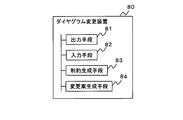
- FIG. 7 is a block diagram showing an outline of the watermark changing device according to the present invention.
- the diagram changing device 80 (for example, the diagram changing device 100) according to the present invention displays with an output means 81 (for example, an output unit 20) that outputs a diagram (for example, an operation timetable) to a display device (for example, a display device 200).
- the input means 82 (for example, the input unit 30) that accepts the designation of the changed part and the change condition for the made diagram, and the constraint generating means 83 (for example, the constraint generating means 83 that generates the constraint of the objective function used for optimizing the diagram based on the above designation.
- it is provided with a constraint generation unit 40) and a change proposal generation means 84 (for example, a change proposal generation unit 50) that generates a change proposal of the diagram by optimizing the objective function based on the generated constraint.
- the input means 82 accepts the designation of the hard constraint indicating the condition that must be satisfied or the soft constraint indicating the condition for increasing the penalty according to the degree of non-satisfaction as the specification of the change condition for each changed portion, and the constraint is applied.
- the generation means 83 generates a constraint according to a hard constraint or a soft constraint, and the output means 81 outputs a proposed modification of the watermark.
- the constraint generating means 83 generates a constraint having a hard constraint as an optimization condition and a soft constraint as a component of the objective function
- the change proposal generating means 84 has a purpose of including the soft constraint under the optimization condition. Proposals for changing the diagram may be generated by optimizing the function.
- the constraint generating means 83 may express a soft constraint with a penalty function that defines a penalty to be generated according to the degree to which the constraint is not satisfied.
- the input means 82 accepts the designation of the change location and the change condition for the change plan of the diagram operation timetable, the constraint generation means 83 generates the constraint of the objective function based on the designation, and the change plan generation means 84 generates the constraint.
- the input means 82 may accept the designation of the fixed portion that is not changed in response to the proposed modification of the diagram, and the constraint generating means 83 may generate the constraint of the objective function based on the above designation.
- a hard constraint indicating a condition that must be satisfied or a soft constraint indicating a condition for increasing the penalty according to the degree of not satisfying is accepted, and the constraint generating means is the hard constraint or the above.
- a diagram changing device characterized in that a constraint corresponding to a soft constraint is generated, and the output means outputs a proposed modification of the diagram.
- the constraint generating means generates a constraint in which the hard constraint is the optimization condition and the soft constraint is a component of the objective function, and the change proposal generating means uses the soft constraint under the optimization condition.
- the diagram change device according to Appendix 1, which generates a proposal for changing a diagram by optimizing the objective function to be included.
- Appendix 3 The watermark changing device according to Appendix 1 or Appendix 2, wherein the constraint generating means represents a soft constraint with a penalty function that defines a penalty to be generated according to the degree to which the constraint is not satisfied.
- the input means accepts the designation of the change part and the change condition for the change plan of the diagram operation timetable, the constraint generation means generates the constraint of the objective function based on the designation, and the change plan generation means is the above.
- the diagram changing device according to any one of Supplementary note 1 to Supplementary note 3, which generates a further modification plan of the above-mentioned diagram modification plan by optimizing the objective function based on the constraint.
- Appendix 5 The diagram changing device according to Appendix 4, wherein the input means accepts the designation of a fixed portion that is not changed for the proposed modification of the diagram, and the constraint generating means generates the constraint of the objective function based on the designation.
- (Appendix 6) Outputs the diagram to the display device, accepts the specification of the changed part and the changed condition for the displayed diagram, and when accepting the specification, indicates the condition that must be satisfied as the specification of the changed condition for each changed part.
- Appendix 7 A diagram by generating a constraint with a hard constraint as an optimization condition and a soft constraint as a component of the objective function, and optimizing the objective function including the soft constraint under the optimization condition. The method of changing the diagram according to Appendix 6 for generating the proposed change.
- (Appendix 8) Output processing for outputting a diagram to a display device on a computer, input processing for accepting designation of changes and change conditions for the displayed diagram, and an objective function used for optimizing the diagram based on the specifications.
- optimizing the objective function based on the constraint generation process that generates the constraint of For each location as the specification of the change condition, the specification of the hard constraint indicating the condition that must be satisfied or the specification of the soft constraint indicating the condition that increases the penalty according to the degree of not satisfying is accepted, and the hardware is specified in the constraint generation process.
- a program storage medium that stores a diagram change program for generating a constraint or a constraint according to the software constraint and outputting a change proposal of the diagram in the output process.
- Appendix 9 In the constraint generation process, the computer is made to generate a constraint in which the hard constraint is the optimization condition and the soft constraint is a component of the objective function, and in the change proposal generation process, under the optimization condition, the above.
- the program storage medium according to Appendix 8 for storing a diagram change program for generating a diagram change proposal by optimizing an objective function including soft constraints.
Landscapes
- Engineering & Computer Science (AREA)
- Mechanical Engineering (AREA)
- Physics & Mathematics (AREA)
- General Physics & Mathematics (AREA)
- Theoretical Computer Science (AREA)
- Management, Administration, Business Operations System, And Electronic Commerce (AREA)
- Train Traffic Observation, Control, And Security (AREA)
Priority Applications (3)
| Application Number | Priority Date | Filing Date | Title |
|---|---|---|---|
| JP2022518510A JP7355233B2 (ja) | 2020-04-28 | 2020-04-28 | ダイヤグラム変更装置、ダイヤグラム変更方法およびダイヤグラム変更プログラム |
| US17/920,430 US20230169706A1 (en) | 2020-04-28 | 2020-04-28 | Diagram modification device, diagram modification method, and diagram modification program |
| PCT/JP2020/018170 WO2021220424A1 (ja) | 2020-04-28 | 2020-04-28 | ダイヤグラム変更装置、ダイヤグラム変更方法およびダイヤグラム変更プログラム |
Applications Claiming Priority (1)
| Application Number | Priority Date | Filing Date | Title |
|---|---|---|---|
| PCT/JP2020/018170 WO2021220424A1 (ja) | 2020-04-28 | 2020-04-28 | ダイヤグラム変更装置、ダイヤグラム変更方法およびダイヤグラム変更プログラム |
Publications (1)
| Publication Number | Publication Date |
|---|---|
| WO2021220424A1 true WO2021220424A1 (ja) | 2021-11-04 |
Family
ID=78332334
Family Applications (1)
| Application Number | Title | Priority Date | Filing Date |
|---|---|---|---|
| PCT/JP2020/018170 Ceased WO2021220424A1 (ja) | 2020-04-28 | 2020-04-28 | ダイヤグラム変更装置、ダイヤグラム変更方法およびダイヤグラム変更プログラム |
Country Status (3)
| Country | Link |
|---|---|
| US (1) | US20230169706A1 (https=) |
| JP (1) | JP7355233B2 (https=) |
| WO (1) | WO2021220424A1 (https=) |
Cited By (1)
| Publication number | Priority date | Publication date | Assignee | Title |
|---|---|---|---|---|
| JP2023082606A (ja) * | 2021-12-02 | 2023-06-14 | 株式会社日立製作所 | 運行計画作成システム、運行計画作成方法、運行計画作成プログラム、及び輸送計画システム |
Citations (4)
| Publication number | Priority date | Publication date | Assignee | Title |
|---|---|---|---|---|
| JPH06107179A (ja) * | 1992-09-29 | 1994-04-19 | Hitachi Ltd | 列車ダイヤ作成方法と装置 |
| JPH07285439A (ja) * | 1994-04-19 | 1995-10-31 | Hitachi Ltd | 遺伝的アルゴリズム/ニューロによる列車ダイヤ作成装置及び作成方法 |
| JP2010285053A (ja) * | 2009-06-11 | 2010-12-24 | Hitachi Ltd | 運用計画再作成装置及び方法 |
| WO2016143606A1 (ja) * | 2015-03-06 | 2016-09-15 | 三菱電機株式会社 | 運転整理案自動作成装置および運転整理案自動作成方法 |
Family Cites Families (7)
| Publication number | Priority date | Publication date | Assignee | Title |
|---|---|---|---|---|
| US7627461B2 (en) * | 2004-05-25 | 2009-12-01 | Chevron U.S.A. Inc. | Method for field scale production optimization by enhancing the allocation of well flow rates |
| US20060200759A1 (en) * | 2005-03-04 | 2006-09-07 | Microsoft Corporation | Techniques for generating the layout of visual content |
| WO2010053469A1 (en) * | 2008-11-07 | 2010-05-14 | Utc Fire & Security Corporation | System and method for occupancy estimation and monitoring |
| US8554382B2 (en) * | 2010-09-28 | 2013-10-08 | Palo Alto Research Center Incorporated | Multivariable control of regulation and fast demand response in electrical grids |
| US10485988B2 (en) * | 2016-12-30 | 2019-11-26 | Varian Medical Systems International Ag | Interactive dose manipulation using prioritized constraints |
| US12066800B2 (en) * | 2018-01-30 | 2024-08-20 | Imubit Israel Ltd. | Control system with optimization of neural network predictor |
| JP7399627B2 (ja) * | 2019-04-25 | 2023-12-18 | 株式会社日立製作所 | ダイヤ作成装置、ダイヤ作成方法、及び自動車両制御システム |
-
2020
- 2020-04-28 WO PCT/JP2020/018170 patent/WO2021220424A1/ja not_active Ceased
- 2020-04-28 US US17/920,430 patent/US20230169706A1/en not_active Abandoned
- 2020-04-28 JP JP2022518510A patent/JP7355233B2/ja active Active
Patent Citations (4)
| Publication number | Priority date | Publication date | Assignee | Title |
|---|---|---|---|---|
| JPH06107179A (ja) * | 1992-09-29 | 1994-04-19 | Hitachi Ltd | 列車ダイヤ作成方法と装置 |
| JPH07285439A (ja) * | 1994-04-19 | 1995-10-31 | Hitachi Ltd | 遺伝的アルゴリズム/ニューロによる列車ダイヤ作成装置及び作成方法 |
| JP2010285053A (ja) * | 2009-06-11 | 2010-12-24 | Hitachi Ltd | 運用計画再作成装置及び方法 |
| WO2016143606A1 (ja) * | 2015-03-06 | 2016-09-15 | 三菱電機株式会社 | 運転整理案自動作成装置および運転整理案自動作成方法 |
Cited By (2)
| Publication number | Priority date | Publication date | Assignee | Title |
|---|---|---|---|---|
| JP2023082606A (ja) * | 2021-12-02 | 2023-06-14 | 株式会社日立製作所 | 運行計画作成システム、運行計画作成方法、運行計画作成プログラム、及び輸送計画システム |
| JP7677879B2 (ja) | 2021-12-02 | 2025-05-15 | 株式会社日立製作所 | 運行計画作成システム、運行計画作成方法、運行計画作成プログラム、及び輸送計画システム |
Also Published As
| Publication number | Publication date |
|---|---|
| US20230169706A1 (en) | 2023-06-01 |
| JPWO2021220424A1 (https=) | 2021-11-04 |
| JP7355233B2 (ja) | 2023-10-03 |
Similar Documents
| Publication | Publication Date | Title |
|---|---|---|
| Alizadehsalehi et al. | BIM/MR-Lean construction project delivery management system | |
| Bensmaine et al. | A new heuristic for integrated process planning and scheduling in reconfigurable manufacturing systems | |
| Beasley et al. | Displacement problem and dynamically scheduling aircraft landings | |
| JP5451086B2 (ja) | ワークフロー管理装置、方法、及び、プログラム | |
| Duran et al. | Robust airline scheduling with controllable cruise times and chance constraints | |
| He et al. | Dynamic priority rule-based forward-backward heuristic algorithm for resource levelling problem in construction project | |
| WO2024193628A1 (zh) | 信息处理方法、装置、电子设备和存储介质 | |
| JP6599065B1 (ja) | 機械学習モデル共創システム、機械学習モデル共創方法、及びプログラム | |
| Lin | Evental infrastructure: Momentous geographies of technoscience production | |
| JP7474378B1 (ja) | 文章作成支援システム、情報処理方法及びプログラム | |
| WO2021220424A1 (ja) | ダイヤグラム変更装置、ダイヤグラム変更方法およびダイヤグラム変更プログラム | |
| WO2021153158A1 (ja) | 多主体連携計画システムおよび多主体連携計画方法 | |
| KR20240119134A (ko) | 포인팅 장치와 키보드 액션을 사용하여 컴퓨터 제어 학습 | |
| Lusby et al. | A column generation-based heuristic for rostering with work patterns | |
| JP2010191758A (ja) | 検証支援プログラム、検証支援装置および検証支援方法 | |
| Cerekci et al. | Dynamic control of the batch processor in a serial-batch processor system with mean tardiness performance | |
| JP7090816B2 (ja) | 問題分解装置、問題分解方法、及び、問題分解プログラム | |
| WO2024148812A1 (zh) | 一种常用服务按钮展示方法及装置 | |
| CN118012563A (zh) | 资源分配方法、装置、介质及电子设备 | |
| JP2023135444A (ja) | 情報処理装置、情報処理システム、及び情報処理プログラム | |
| JPH08180110A (ja) | 業務プロセス定義方法 | |
| JP7677879B2 (ja) | 運行計画作成システム、運行計画作成方法、運行計画作成プログラム、及び輸送計画システム | |
| JP2023114546A (ja) | 効用モデル生成装置、効用モデル生成方法およびプログラム | |
| Čalnerytė et al. | Genetic optimization approach to construct schedule for service staff | |
| van Dijk et al. | Algorithmically-Assisted Schematic Transit Map Design: a System and Algorithmic Core for Fast Layout Iteration |
Legal Events
| Date | Code | Title | Description |
|---|---|---|---|
| 121 | Ep: the epo has been informed by wipo that ep was designated in this application |
Ref document number: 20934108 Country of ref document: EP Kind code of ref document: A1 |
|
| ENP | Entry into the national phase |
Ref document number: 2022518510 Country of ref document: JP Kind code of ref document: A |
|
| NENP | Non-entry into the national phase |
Ref country code: DE |
|
| 122 | Ep: pct application non-entry in european phase |
Ref document number: 20934108 Country of ref document: EP Kind code of ref document: A1 |