WO2021205919A1 - サーファクチン誘導体およびその塩 - Google Patents
サーファクチン誘導体およびその塩 Download PDFInfo
- Publication number
- WO2021205919A1 WO2021205919A1 PCT/JP2021/013070 JP2021013070W WO2021205919A1 WO 2021205919 A1 WO2021205919 A1 WO 2021205919A1 JP 2021013070 W JP2021013070 W JP 2021013070W WO 2021205919 A1 WO2021205919 A1 WO 2021205919A1
- Authority
- WO
- WIPO (PCT)
- Prior art keywords
- surfactin
- derivative
- salt
- group
- sodium
- Prior art date
- Legal status (The legal status is an assumption and is not a legal conclusion. Google has not performed a legal analysis and makes no representation as to the accuracy of the status listed.)
- Ceased
Links
Images




Classifications
-
- A—HUMAN NECESSITIES
- A61—MEDICAL OR VETERINARY SCIENCE; HYGIENE
- A61K—PREPARATIONS FOR MEDICAL, DENTAL OR TOILETRY PURPOSES
- A61K8/00—Cosmetics or similar toiletry preparations
- A61K8/18—Cosmetics or similar toiletry preparations characterised by the composition
- A61K8/30—Cosmetics or similar toiletry preparations characterised by the composition containing organic compounds
- A61K8/46—Cosmetics or similar toiletry preparations characterised by the composition containing organic compounds containing sulfur
-
- A—HUMAN NECESSITIES
- A61—MEDICAL OR VETERINARY SCIENCE; HYGIENE
- A61Q—SPECIFIC USE OF COSMETICS OR SIMILAR TOILETRY PREPARATIONS
- A61Q1/00—Make-up preparations; Body powders; Preparations for removing make-up
-
- A—HUMAN NECESSITIES
- A61—MEDICAL OR VETERINARY SCIENCE; HYGIENE
- A61Q—SPECIFIC USE OF COSMETICS OR SIMILAR TOILETRY PREPARATIONS
- A61Q19/00—Preparations for care of the skin
-
- C—CHEMISTRY; METALLURGY
- C07—ORGANIC CHEMISTRY
- C07K—PEPTIDES
- C07K7/00—Peptides having 5 to 20 amino acids in a fully defined sequence; Derivatives thereof
- C07K7/04—Linear peptides containing only normal peptide links
- C07K7/06—Linear peptides containing only normal peptide links having 5 to 11 amino acids
Definitions
- the present invention relates to a novel surfactin derivative and a salt thereof, and a surfactant containing the surfactin derivative or a salt thereof.
- Surfactin is a peptide produced by Bacillus subtilis, which is a biosurfactant that is highly degradable and safe because it is a peptide, has a low critical micelle concentration (CMC), and exhibits a strong surfactant action.
- CMC critical micelle concentration
- Non-Patent Document 1 Therefore, it is used as a surfactant in various fields from cosmetics to pharmaceutical preparations and antistatic agents (Patent Documents 1 to 3 and the like).
- surfactin has a long-chain aliphatic hydrocarbon group R as a hydrophobic group and a side chain carboxy group of aspartic acid and glutamic acid as a hydrophilic group, and thus functions as a surfactant.
- Japanese Unexamined Patent Publication No. 2003-128512 Japanese Unexamined Patent Publication No. 2003-146827 Japanese Unexamined Patent Publication No. 2006-07236 Japanese Unexamined Patent Publication No. 2019-186835
- an object of the present invention is to provide a novel surfactin derivative and a salt thereof that can be used as a surfactant even in a relatively low pH environment, and a surfactant containing the surfactin derivative or a salt thereof.
- the present inventors have conducted intensive studies to solve the above problems. As a result, they have found that by introducing a strong acid group using the carboxy group of surfactin, it can be used as a surfactant even in a relatively low pH environment, and completed the present invention. Hereinafter, the present invention will be shown.
- a surfactin derivative or a salt thereof which is represented by the following formula (I).
- X 1 indicates an amino acid residue selected from leucine, isoleucine, and valine.
- X 2 and X 3 represent a single bond or linker group
- R 1 represents a C 9-18 alkyl group
- R 2 and R 3 represent OH or a strong acid group selected from sulfino, sulfo, and sulfate groups.
- at least one of R 2 or R 3 is a strong acid group.
- a method for reducing the interfacial tension of a solution which comprises a step of dissolving the surfactin derivative according to any one of the above [1] to [4] or a salt thereof in the above solution. how to.
- a method for reducing the interfacial tension of a solution which comprises a step of dissolving the surfactin derivative represented by the above formula (I) or a salt thereof in the above solution.
- sodium surfactin begins to insolubilize in a solution having a pH of about 6, whereas it does not insolubilize at a pH of about 6, and can be used as a surfactant up to a pH of about 2. Is. Therefore, the present invention is industrially excellent as a technique for expanding the application range of surfactin, which is a safe and excellent surfactant.
- FIG. 1 shows the particle size distribution of particles contained in the sodium salt dispersion of the surfactin derivative according to the present invention, and the case where the dispersion of the sodium salt of the surfactin derivative according to the present invention is not irradiated with ultraviolet rays. It is a photograph of the case.
- FIG. 2 shows an absorption spectrum and a fluorescence spectrum of a dispersion of a sodium salt of a surfactin derivative according to the present invention.
- FIG. 3 is a graph showing the relationship between the concentration of the sodium salt dispersion of the surfactin derivative according to the present invention and the surface tension.
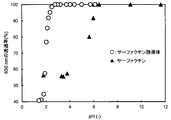
- FIG. 4 is a graph showing the relationship between the pH and light transmittance of a dispersion of sodium surfactin or a sodium salt of a surfactin derivative according to the present invention.
- FIG. 5 is an external photograph of the DMPC solution, a mixture of DMPC solution to which sodium surfactin and sodium surfactin derivative are added, and the mixture solution irradiated with ultraviolet light.
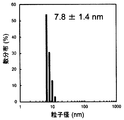
- FIG. 6 shows the particle size distribution of the particles contained in the nanodisc liquid.
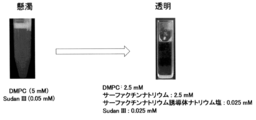
- FIG. 7 is an external photograph of a DMPC solution and a mixed solution in which sodium surfactin, a sodium surfactin derivative salt, and Sudan III, which is a hydrophobic dye, are added to the DMPC solution.
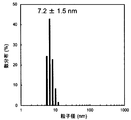
- FIG. 8 shows the particle size distribution of the particles contained in the nanodisc solution containing the hydrophobic dye Sudan III.
- FIG. 9 shows the measurement results of the fluorescence spectrum of the nanodisc solution containing the hydrophobic dye Sudan III.
- the surfactin derivative according to the present invention has a structure represented by the above formula (I).
- “compound represented by formula (x)” may be abbreviated as “compound (x)”.
- the amino acid residue as X 1 may be L-form or D-form, but L-form is preferable.
- surfactin derivative may be a mixture comprising R 1 are different from each other surfactin derivative 2 or more.
- C 9-18 alkyl group refers to a linear or branched monovalent saturated hydrocarbon group having 9 or more carbon atoms and 18 or less carbon atoms.
- N-tetradecyl n-pentadecylic, n-hexadecyl, n-heptadecyl, n-octadecyl and the like.
- the specific linker group is not particularly limited as long as it exhibits the above action, and is, for example, a C 1-6 alcandiyl group, a C 6-12 aromatic hydrocarbon group, an amino group (-NH-), and an ether group.
- linker group since it can be bonded to surfactin or a salt thereof by amidation or esterification of the carboxy group, the end on the carboxy group side may be an amino group (-NH-) or an ether group (-O-). preferable.
- the linker group contains a fluorescent group
- the surfactin derivative (I) has a fluorescent color-developing property, and structural analysis of an aggregate of the surfactin derivative (I) in a solvent and surfactin can be performed. It will be useful for examining the dynamics of the derivative (I).
- the fluorescent group include a naphthalenediyl group, a coumarindiyl group, a benzofrazandiyl group, a fluoresceindiyl group, an acridinediyl group, a pyrenedyl group and the like.
- It is a strong acid group selected from. That is, in the surfactin derivative (I) according to the present invention, a strong acid group is introduced into at least one of the two carboxy groups derived from surfactin via a linker group.
- the surfactin derivative (I) according to the present invention may be a salt.
- the counter cation forming the salt include alkali metal ions such as lithium ion, sodium ion and potassium ion, and ammonium ion.
- an alkali metal ion is preferable, a sodium ion or a potassium ion is more preferable, and a sodium ion is even more preferable.
- the ammonium ion and NH 4 + and quaternary ammonium ions include alkyl groups such as methyl, ethyl, n-propyl, isopropyl, n-butyl and t-butyl; aralkyl groups such as benzyl, methylbenzyl and phenylethyl; phenyl and toluyl. , Organic groups such as aryl groups such as xylyl.
- Examples of the quaternary ammonium ion include tetramethylammonium ion, tetraethylammonium ion, pyridinium ion and the like.
- the surfactin derivative (I) according to the present invention contains one carboxy group and one strong acid group, both of them may be in a salt state, or only one of them may be in a salt state. When only one is in the salt state, it is considered that the strong acid group is in the salt state from the difference in acidity.
- the surfactin derivative (I) having two strong acid groups may also have both strong acid groups in a salt state or only one in a salt state.
- the surfactin derivative (I) or a salt thereof can be easily synthesized by using a water-soluble surfactin salt such as sodium surfactin or a solid acid-type surfactin.
- Acid-type surfactins are prepared by dissolving a water-soluble surfactin salt such as sodium surfactin in water, precipitating by adjusting the pH of the aqueous solution to less than 2 with hydrochloric acid or the like, collecting by filtration, and washing with water or the like. Obtained by drying later.
- a water-soluble surfactin salt or an acid-type surfactin may be dissolved in a solvent and reacted with the compound having a strong acid group and a linker group in the presence of a condensing agent.
- the solvent include aprotonic polar solvents such as N, N-dimethylformamide, N, N-dimethylacetamide and dimethylsulfoxide; protonic polar solvents such as water, methanol and ethanol; and ketone solvents such as acetone and methyl ethyl ketone.
- An ester solvent such as ethyl acetate; a halogenated hydrocarbon solvent such as dichloromethane, chloroform, carbon tetrachloride; a nitrile solvent such as acetonitrile; an ether solvent such as diethyl ether and tetrahydrofuran; a mixed solvent thereof and the like can be used.
- a halogenated hydrocarbon solvent such as dichloromethane, chloroform, carbon tetrachloride
- a nitrile solvent such as acetonitrile
- an ether solvent such as diethyl ether and tetrahydrofuran
- a mixed solvent thereof and the like can be used.
- the number of strong acid groups introduced can be adjusted by adjusting the amount of the compound having a strong acid group and a linker group.
- the compound can be used in an amount of 0.8 times mol or more and 2.5 times mol or less with respect to 1 mol of a water-soluble surfactin salt or an acid type surfactin, and the molar ratio when one linker group is introduced can be used. It is preferably 0.9 times mol or more and 1.1 times mol or less.
- the strong acid group may be in a salt state. In this way, the number of strong acid groups to be introduced can be adjusted by the ratio of the above compound to the water-soluble surfactin salt or acid-type surfactin.
- the counter cation constituting the salt is preferably the same as the counter cation constituting the salt of the surfactin derivative (I) which is the target compound.
- the condensing agent may be appropriately selected.
- a strong acid group-containing compound having an amino group at the linker terminal and 4- (4,6-dimethoxy-1,3,5-triazine-) By using a triazine-based condensing agent such as 2-yl) -4-methylmorpholinium-chloride (DMT-MM), the amidation reaction between the carboxy group and the amino group can be selectively promoted.
- DMT-MM triazine-based condensing agent
- DMT-MM 2-yl) -4-methylmorpholinium-chloride
- the carboxy group of surfactin may be subjected to active esterification or acid chloride formation, and then reacted with a linker group having a strong acid group in the presence of a base. Further, the linker group may be introduced first, and then the strong acid group may be bonded to the introduced linker group.
- the reaction conditions may be appropriately adjusted.
- the reaction may be carried out until the consumption of the raw material compound can be confirmed by thin layer chromatography or the like, or the reaction time may be determined by a preliminary experiment. For example, 0 ° C. or higher and 150 ° C.
- the reaction can be carried out for 5 minutes or more and 24 hours or less below.
- the surfactin derivative (I), which is the target compound can be purified by a conventional method. For example, it can be purified by chromatography such as silica gel column chromatography.
- 1 mol or 2 mol of strong acid group can be introduced per 1 mol of surfactin.
- 1 mol of a strong acid group is introduced per 1 mol of surfactin, the reactivity of the aspartic acid side chain carboxy group and the glutamate side chain carboxy group of surfactin is almost the same, so that the obtained surfactin derivative (I) has the same reactivity.
- the introduction position of the strong acid group is approximately 1: 1 between the aspartic acid side chain carboxy group and the glutamate side chain carboxy group.
- the surfactant derivative (I) and its salt according to the present invention do not precipitate up to a pH of about 2, and therefore can be used even if the pH is 6 or less as long as it is in a composition of about 2 or more. Shows surface activity. Therefore, the surfactin derivative (I) and a salt thereof according to the present invention can be used as a surfactant in a wider range than surfactin, which is a safe and excellent surfactant.
- the surfactant refers to a compound that has a hydrophilic group and a hydrophobic group in its molecule and can reduce the interfacial tension of the solution by dissolving it in the solution.
- Example 1 Synthesis of a surfactin derivative salt having a sulfonic acid group
- sodium surfactin 5 g, 4.8 mmol
- 11N dilute hydrochloric acid 10 mL
- Acid type surfactin was precipitated.
- the precipitated acid-type surfactin was collected by filtration, washed with water, and then dried in a desiccator for 24 hours to obtain a white powder of acid-type surfactin (yield: 75%, yield: 3.6 g, 3). .6 mmol).
- Example 2 Synthesis of surfactin derivative salt having a sulfonic acid group
- Acid-type surfactin 400 mg, 0.40 mmol
- 5- (2-aminoethylamino) -1-naphthalene sulfonate sodium hydrate 123 mg, 0) .43 mmol
- DMT-MM 119 mg, 0.43 mmol
- Test Example 1 Confirmation of water solubility, etc. Purified water (5 mL) was placed in a test tube, and the surfactin derivative sodium salt (18 mg) obtained in Example 1 was further added and shaken. As a result, the sodium salt of the surfactin derivative could be dissolved in water. Further, the particle size distribution of the particles contained in the aqueous solution was measured using a dynamic light scattering measuring device (“DLS-7000” manufactured by Otsuka Electronics Co., Ltd.). The results are shown in FIG. As shown in FIG. 1, it was revealed that the sodium salt of the surfactin derivative forms a huge aggregate having an average particle size of 91.0 ⁇ 18.5 nm in water.
- DLS-7000 dynamic light scattering measuring device
- Test Example 2 Evaluation of Fluorescence Emission
- the sodium salt of the surfactin derivative of Example 1 was dissolved in water so that the concentration was 1.0 ⁇ 10 -4 M.
- the absorption spectrum of this solution was measured with an ultraviolet-visible spectrophotometer (“V-560” manufactured by JASCO Corporation). The results are shown in FIG. As shown in FIG. 2, an absorption peak derived from the naphthyl group of the sodium salt of the surfactin derivative was observed at 339 nm.
- FIG. 1 shows solution photographs with and without irradiation with light having a wavelength of 339 nm.
- FP-8500 manufactured by Nippon Spectroscopy Co., Ltd.
- Test Example 3 Evaluation of Surfactant
- the sodium salt of the surfactin derivative of Example 1 was dissolved in water so that the concentration was 2.5 ⁇ 10 -6 to 1.0 ⁇ 10 -3 M.
- Each aqueous solution was transferred to a planet, and the surface tension of the surfactin derivative sodium salt with respect to water was measured using a surface tension measuring device (“DY-500” manufactured by Kyowa Interface Science Co., Ltd.) by the Wilhelmy method.
- the results are shown in FIG.
- the sodium salt of the surfactin derivative of Example 1 was well dissolved in water at room temperature without precipitation to reduce the surface tension. That is, it showed surface activity. From the concentration at which the surface tension becomes a constant value in the graph of FIG. 3, the critical micelle concentration (CMC) is 7.7 ⁇ 10 -5 M, and the surface tension of water ( ⁇ CMC) at that time is 28.2 mN / m. Decided.
- CMC critical micelle concentration
- Test Example 4 In an acid-resistant vial of a surfactin derivative, the surfactin derivative sodium salt (10 mg) of Example 1 was dissolved in water (10 mL) to obtain an aqueous solution having a concentration of 1 mM. The pH of this aqueous solution was measured with a pH meter (“F-74” manufactured by HORIBA) and found to be 6.1. Dilute hydrochloric acid was gradually added to the above solution, and the effect of pH change on solubility was evaluated. The solubility was measured by measuring the transmitted light at 650 nm in the UV-vis spectrum with an ultraviolet-visible spectrophotometer (“V-560” manufactured by JASCO Corporation), and calculating the relative ratio with the amount of transmitted light of the initial aqueous solution as 100%.
- V-560 ultraviolet-visible spectrophotometer
- Example 5 Preparation of Nanodiscs First, liposomes to be precursors of nanodiscs were prepared. L- ⁇ -dipalmitoylphosphatidylcholine (hereinafter abbreviated as "DMPC") was weighed in a test tube, and DMPC was dissolved by adding chloroform. A lipid film was formed on the wall surface of the test tube by blowing nitrogen gas into the test tube while stirring with a vortex mixer to remove chloroform. After standing in a desiccator for 2 days, water was added and the mixture was hydrated at room temperature for 10 minutes. Then, a 5 mM DMPC liposome solution was prepared by stirring with a vortex mixer for 3 minutes. Separately, a surfactin aqueous solution was prepared.
- DMPC L- ⁇ -dipalmitoylphosphatidylcholine
- DMPC liposome aqueous solution and surfactin mixture were mixed with water to adjust the surfactin sodium and DMPC to 2.5 mM and the surfactin derivative sodium salt to 0.025 mM.
- the obtained mixed solution was irradiated with ultraviolet light of 365 nm.
- a photograph of each liquid is shown in FIG.
- the DMPC liposome solution was in a suspended state, but the turbidity was greatly reduced by adding surfactin sodium and a surfactin derivative sodium salt, and the solution became a transparent solution. From this, it was confirmed that nanodiscs were formed from DMPC, sodium surfactin, and sodium surfactin derivative. It was also confirmed that when the obtained nanodisc transparent solution was irradiated with ultraviolet light of 365 nm, it glowed blue.
- the obtained nanodisc transparent solution was subjected to dynamic light scattering measurement, and the diameter of the contained particles was determined. The results are shown in FIG. As shown in FIG. 6, the particle size of the formed nanodisks was estimated to be 7.8 ⁇ 1.4 nm.
- hydrophobic dyes in order to clarify the detailed structure of nanodiscs, we considered encapsulating hydrophobic dyes inside the nanodiscs. That is, when preparing liposomes as precursors of nanodiscs, the hydrophobic dye Sudan III was weighed in a test tube together with DMPC, and both were dissolved by adding chloroform. A lipid film was formed on the wall surface of the test tube by blowing nitrogen gas into the test tube while stirring with a vortex mixer to remove chloroform. After standing in a desiccator for 2 days, water was added and the mixture was hydrated at room temperature for 10 minutes. Then, the DMPC liposome solution containing Sudan III was prepared by stirring with a vortex mixer for 3 minutes.
- the obtained nanodisc transparent solution was subjected to dynamic light scattering measurement, and the diameter of the contained particles was determined.
- the results are shown in FIG.
- the particle size of the formed nanodisks was 7.2 ⁇ 1.5 nm, and no change was observed in the particle size before and after inclusion of Sudan III, so that the structure of the nanodisks was maintained. It is thought that there is.
Landscapes
- Health & Medical Sciences (AREA)
- Life Sciences & Earth Sciences (AREA)
- General Health & Medical Sciences (AREA)
- Chemical & Material Sciences (AREA)
- Animal Behavior & Ethology (AREA)
- Veterinary Medicine (AREA)
- Public Health (AREA)
- Organic Chemistry (AREA)
- Biophysics (AREA)
- Biochemistry (AREA)
- Epidemiology (AREA)
- Genetics & Genomics (AREA)
- Medicinal Chemistry (AREA)
- Molecular Biology (AREA)
- Proteomics, Peptides & Aminoacids (AREA)
- Birds (AREA)
- Dermatology (AREA)
- Peptides Or Proteins (AREA)
- Organic Low-Molecular-Weight Compounds And Preparation Thereof (AREA)
Priority Applications (1)
| Application Number | Priority Date | Filing Date | Title |
|---|---|---|---|
| JP2022514414A JP7744655B2 (ja) | 2020-04-08 | 2021-03-26 | サーファクチン誘導体およびその塩 |
Applications Claiming Priority (2)
| Application Number | Priority Date | Filing Date | Title |
|---|---|---|---|
| JP2020069954 | 2020-04-08 | ||
| JP2020-069954 | 2020-04-08 |
Publications (1)
| Publication Number | Publication Date |
|---|---|
| WO2021205919A1 true WO2021205919A1 (ja) | 2021-10-14 |
Family
ID=78023041
Family Applications (1)
| Application Number | Title | Priority Date | Filing Date |
|---|---|---|---|
| PCT/JP2021/013070 Ceased WO2021205919A1 (ja) | 2020-04-08 | 2021-03-26 | サーファクチン誘導体およびその塩 |
Country Status (2)
| Country | Link |
|---|---|
| JP (1) | JP7744655B2 (https=) |
| WO (1) | WO2021205919A1 (https=) |
Cited By (1)
| Publication number | Priority date | Publication date | Assignee | Title |
|---|---|---|---|---|
| CN118750447A (zh) * | 2024-06-12 | 2024-10-11 | 山东大学 | 一种低浓度单一表面活性剂自组装成囊泡的制备方法 |
Citations (3)
| Publication number | Priority date | Publication date | Assignee | Title |
|---|---|---|---|---|
| JPH0892279A (ja) * | 1994-09-21 | 1996-04-09 | Agency Of Ind Science & Technol | 直鎖状サーファクチン |
| WO2012043800A1 (ja) * | 2010-10-01 | 2012-04-05 | 株式会社カネカ | サーファクチン及びその塩の製造方法 |
| US20150037302A1 (en) * | 2012-01-27 | 2015-02-05 | Gfs Corporation Aus Pty Ltd | Method of producing biosurfactants |
-
2021
- 2021-03-26 JP JP2022514414A patent/JP7744655B2/ja active Active
- 2021-03-26 WO PCT/JP2021/013070 patent/WO2021205919A1/ja not_active Ceased
Patent Citations (3)
| Publication number | Priority date | Publication date | Assignee | Title |
|---|---|---|---|---|
| JPH0892279A (ja) * | 1994-09-21 | 1996-04-09 | Agency Of Ind Science & Technol | 直鎖状サーファクチン |
| WO2012043800A1 (ja) * | 2010-10-01 | 2012-04-05 | 株式会社カネカ | サーファクチン及びその塩の製造方法 |
| US20150037302A1 (en) * | 2012-01-27 | 2015-02-05 | Gfs Corporation Aus Pty Ltd | Method of producing biosurfactants |
Non-Patent Citations (1)
| Title |
|---|
| MORIKAWA, M ET AL.: "A study on the structure- function relationship of lipopeptide biosurfactants", BIOCHIMICA ET BIOPHYSICA ACTA, vol. 1488, 2000, pages 211 - 218, XP004277436, DOI: 10.1016/S1388-1981(00)00124-4 * |
Cited By (1)
| Publication number | Priority date | Publication date | Assignee | Title |
|---|---|---|---|---|
| CN118750447A (zh) * | 2024-06-12 | 2024-10-11 | 山东大学 | 一种低浓度单一表面活性剂自组装成囊泡的制备方法 |
Also Published As
| Publication number | Publication date |
|---|---|
| JPWO2021205919A1 (https=) | 2021-10-14 |
| JP7744655B2 (ja) | 2025-09-26 |
Similar Documents
| Publication | Publication Date | Title |
|---|---|---|
| RU2047643C1 (ru) | Материал для поляризующих покрытий | |
| CN106566532B (zh) | 两亲性的具有聚集诱导发光特性的发光物及其应用 | |
| CN112119083A (zh) | 具有连接体基团的聚合串联染料 | |
| JP7344982B2 (ja) | 化合物及びこれを用いた蛍光標識生体物質 | |
| CN117903297A (zh) | 化学选择性的巯基与烯基或炔基磷酰胺的偶联 | |
| WO2009065508A2 (en) | Water-soluble rylene dyes, methods for preparing the same and uses thereof as fluorescent labels for biomolecules | |
| Wang et al. | Ultrasonic preparation of near-infrared emission cluster-based YbIII and NdIII coordination materials: Ratiometric temperature sensing, selective antibiotics detection and “turn-on” discrimination of L-arginine | |
| US3937809A (en) | Addition compound of a nucleotide and an amino acid and the use thereof in protection against actinic radiation | |
| JP2019512573A (ja) | ポリフルオレノ[4,5−cde]オキセピンコンジュゲート及び分析物検出方法におけるそれらの使用 | |
| Hu et al. | Development of a visible light triggerable traceless staudinger ligation reagent | |
| US20120095187A1 (en) | Novel cyanine compound for labeling biomolecule and preparation method thereof | |
| JP7744655B2 (ja) | サーファクチン誘導体およびその塩 | |
| JP2025534068A5 (https=) | ||
| CN103260651A (zh) | 有高效能量传递和可调斯托克斯位移特征的掺杂有多种染料的二氧化硅纳米颗粒 | |
| KR101663465B1 (ko) | 생체 분자 표지를 위한 시아닌 염료 및 그 제조방법 | |
| CN103502253A (zh) | 具有光致发光性质的新化合物及其应用 | |
| US20070004919A1 (en) | Water-souluble, fluorescent perylenetetracarboxylic acid bisimides | |
| Fiorani et al. | Luminescent dansyl-based ionic liquids from amino acids and methylcarbonate onium salt precursors: synthesis and photobehaviour | |
| US20190338080A1 (en) | Dendrimeric metallacrowns | |
| Liu et al. | Fluorogenic probes for mitochondria and lysosomes via intramolecular photoclick reaction | |
| JPH0547556B2 (https=) | ||
| CN106995419A (zh) | 具有聚集诱导发光性质的荧光探针及其制备方法和用途 | |
| CN114315784A (zh) | 一种组氨酸标签荧光探针及其制备方法和应用 | |
| EP2178834A1 (fr) | Reactif pseudo peptidique trifonctionnel, ses utilisations et applications | |
| Zaitsev et al. | Photosensitive supramolecular systems based on amphiphilic crown ethers |
Legal Events
| Date | Code | Title | Description |
|---|---|---|---|
| 121 | Ep: the epo has been informed by wipo that ep was designated in this application |
Ref document number: 21784182 Country of ref document: EP Kind code of ref document: A1 |
|
| ENP | Entry into the national phase |
Ref document number: 2022514414 Country of ref document: JP Kind code of ref document: A |
|
| NENP | Non-entry into the national phase |
Ref country code: DE |
|
| 122 | Ep: pct application non-entry in european phase |
Ref document number: 21784182 Country of ref document: EP Kind code of ref document: A1 |