WO2021201277A1 - 蛋白質の脱アミド方法 - Google Patents
蛋白質の脱アミド方法 Download PDFInfo
- Publication number
- WO2021201277A1 WO2021201277A1 PCT/JP2021/014322 JP2021014322W WO2021201277A1 WO 2021201277 A1 WO2021201277 A1 WO 2021201277A1 JP 2021014322 W JP2021014322 W JP 2021014322W WO 2021201277 A1 WO2021201277 A1 WO 2021201277A1
- Authority
- WO
- WIPO (PCT)
- Prior art keywords
- protein
- deamidation
- enzyme
- reaction
- salts
- Prior art date
- Legal status (The legal status is an assumption and is not a legal conclusion. Google has not performed a legal analysis and makes no representation as to the accuracy of the status listed.)
- Ceased
Links
Images


Classifications
-
- C—CHEMISTRY; METALLURGY
- C12—BIOCHEMISTRY; BEER; SPIRITS; WINE; VINEGAR; MICROBIOLOGY; ENZYMOLOGY; MUTATION OR GENETIC ENGINEERING
- C12P—FERMENTATION OR ENZYME-USING PROCESSES TO SYNTHESISE A DESIRED CHEMICAL COMPOUND OR COMPOSITION OR TO SEPARATE OPTICAL ISOMERS FROM A RACEMIC MIXTURE
- C12P21/00—Preparation of peptides or proteins
-
- A—HUMAN NECESSITIES
- A23—FOODS OR FOODSTUFFS; TREATMENT THEREOF, NOT COVERED BY OTHER CLASSES
- A23J—PROTEIN COMPOSITIONS FOR FOODSTUFFS; WORKING-UP PROTEINS FOR FOODSTUFFS; PHOSPHATIDE COMPOSITIONS FOR FOODSTUFFS
- A23J3/00—Working-up of proteins for foodstuffs
- A23J3/30—Working-up of proteins for foodstuffs by hydrolysis
- A23J3/32—Working-up of proteins for foodstuffs by hydrolysis using chemical agents
- A23J3/34—Working-up of proteins for foodstuffs by hydrolysis using chemical agents using enzymes
-
- A—HUMAN NECESSITIES
- A23—FOODS OR FOODSTUFFS; TREATMENT THEREOF, NOT COVERED BY OTHER CLASSES
- A23L—FOODS, FOODSTUFFS OR NON-ALCOHOLIC BEVERAGES, NOT OTHERWISE PROVIDED FOR; PREPARATION OR TREATMENT THEREOF
- A23L33/00—Modifying nutritive qualities of foods; Dietetic products; Preparation or treatment thereof
- A23L33/10—Modifying nutritive qualities of foods; Dietetic products; Preparation or treatment thereof using additives
- A23L33/17—Amino acids, peptides or proteins
-
- A—HUMAN NECESSITIES
- A23—FOODS OR FOODSTUFFS; TREATMENT THEREOF, NOT COVERED BY OTHER CLASSES
- A23L—FOODS, FOODSTUFFS OR NON-ALCOHOLIC BEVERAGES, NOT OTHERWISE PROVIDED FOR; PREPARATION OR TREATMENT THEREOF
- A23L33/00—Modifying nutritive qualities of foods; Dietetic products; Preparation or treatment thereof
- A23L33/10—Modifying nutritive qualities of foods; Dietetic products; Preparation or treatment thereof using additives
- A23L33/17—Amino acids, peptides or proteins
- A23L33/185—Vegetable proteins
-
- A—HUMAN NECESSITIES
- A23—FOODS OR FOODSTUFFS; TREATMENT THEREOF, NOT COVERED BY OTHER CLASSES
- A23L—FOODS, FOODSTUFFS OR NON-ALCOHOLIC BEVERAGES, NOT OTHERWISE PROVIDED FOR; PREPARATION OR TREATMENT THEREOF
- A23L33/00—Modifying nutritive qualities of foods; Dietetic products; Preparation or treatment thereof
- A23L33/10—Modifying nutritive qualities of foods; Dietetic products; Preparation or treatment thereof using additives
- A23L33/17—Amino acids, peptides or proteins
- A23L33/19—Dairy proteins
-
- A—HUMAN NECESSITIES
- A23—FOODS OR FOODSTUFFS; TREATMENT THEREOF, NOT COVERED BY OTHER CLASSES
- A23L—FOODS, FOODSTUFFS OR NON-ALCOHOLIC BEVERAGES, NOT OTHERWISE PROVIDED FOR; PREPARATION OR TREATMENT THEREOF
- A23L5/00—Preparation or treatment of foods or foodstuffs, in general; Food or foodstuffs obtained thereby; Materials therefor
-
- A—HUMAN NECESSITIES
- A61—MEDICAL OR VETERINARY SCIENCE; HYGIENE
- A61K—PREPARATIONS FOR MEDICAL, DENTAL OR TOILETRY PURPOSES
- A61K38/00—Medicinal preparations containing peptides
- A61K38/16—Peptides having more than 20 amino acids; Gastrins; Somatostatins; Melanotropins; Derivatives thereof
- A61K38/43—Enzymes; Proenzymes; Derivatives thereof
- A61K38/46—Hydrolases (3)
- A61K38/50—Hydrolases (3) acting on carbon-nitrogen bonds, other than peptide bonds (3.5), e.g. asparaginase
-
- C—CHEMISTRY; METALLURGY
- C12—BIOCHEMISTRY; BEER; SPIRITS; WINE; VINEGAR; MICROBIOLOGY; ENZYMOLOGY; MUTATION OR GENETIC ENGINEERING
- C12N—MICROORGANISMS OR ENZYMES; COMPOSITIONS THEREOF; PROPAGATING, PRESERVING, OR MAINTAINING MICROORGANISMS; MUTATION OR GENETIC ENGINEERING; CULTURE MEDIA
- C12N9/00—Enzymes; Proenzymes; Compositions thereof; Processes for preparing, activating, inhibiting, separating or purifying enzymes
- C12N9/14—Hydrolases (3)
- C12N9/78—Hydrolases (3) acting on carbon to nitrogen bonds other than peptide bonds (3.5)
- C12N9/80—Hydrolases (3) acting on carbon to nitrogen bonds other than peptide bonds (3.5) acting on amide bonds in linear amides (3.5.1)
-
- A—HUMAN NECESSITIES
- A61—MEDICAL OR VETERINARY SCIENCE; HYGIENE
- A61K—PREPARATIONS FOR MEDICAL, DENTAL OR TOILETRY PURPOSES
- A61K38/00—Medicinal preparations containing peptides
-
- C—CHEMISTRY; METALLURGY
- C12—BIOCHEMISTRY; BEER; SPIRITS; WINE; VINEGAR; MICROBIOLOGY; ENZYMOLOGY; MUTATION OR GENETIC ENGINEERING
- C12Y—ENZYMES
- C12Y305/00—Hydrolases acting on carbon-nitrogen bonds, other than peptide bonds (3.5)
- C12Y305/01—Hydrolases acting on carbon-nitrogen bonds, other than peptide bonds (3.5) in linear amides (3.5.1)
- C12Y305/01044—Protein-glutamine glutaminase (3.5.1.44)
Definitions
- the present invention relates to deamidation of proteins. More specifically, the present invention relates to a protein deamidation method and its use, a protein improver used in a protein deamidation method, and the like.
- the deamidation reaction by protein deamidation enzyme is an enzymatic reaction, the reaction may be insufficient due to the influence of conditions such as substrate and reaction temperature. In other words, because it is an enzymatic reaction, the desired effect (improvement of protein functionality by deamidation, etc.) may not be obtained. Therefore, it is an object of the present invention to provide a method for promoting a deamidation reaction by a protein deamidating enzyme.
- a method for deamidating a protein which comprises allowing a protein deamidating enzyme to act on a protein in the presence of salts and / or polysaccharides.
- the protein improver according to [6] wherein the salts are phosphates, polyphosphates or citrates.
- a method for producing a deamidated protein which comprises the following steps: (1) A step of preparing a solution containing a protein and salts and / or polysaccharides, (2) A step of treating the prepared solution with a protein deamidating enzyme.
- a method for producing a food or pharmaceutical product which comprises the following steps: (1) A step of preparing a food raw material or a pharmaceutical raw material containing a protein, and a solution containing a salt and / or a polysaccharide. (2) A step of treating the prepared solution with a protein deamidating enzyme. [12] The production method according to [10] or [11], wherein the salts are at least one selected from the group consisting of carbonates, phosphates, hydrogen phosphates, polyphosphates, and citrates. .. [13] The production method according to any one of [10] to [12], wherein the polysaccharide is gellan gum.
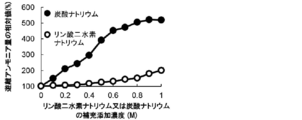
- Results of measuring the reaction efficiency of deamidation by reacting Z-Gln-Gly with protein glutaminase using a solution containing disodium hydrogen phosphate supplemented with sodium dihydrogen phosphate or sodium carbonate It is a figure which shows. It is a figure which shows the result of having measured the reaction effect of deamidation by reacting various substrate proteins with protein glutaminase using the solvent which added sodium carbonate supplement to the solution containing disodium hydrogen phosphate. It is a figure which shows the result of having measured the thermal stability of protein glutaminase in the solvent which supplemented and added sodium carbonate to the solution containing disodium hydrogen phosphate.
- the first aspect of the present invention relates to a method for deamidating a protein (protein deamidation method).
- the protein deamidation reaction is promoted by treating the protein raw material with a protein deamidating enzyme in the presence of salts and / or polysaccharides.
- the protein (substrate protein) subjected to the enzyme treatment in the present invention is not particularly limited as long as it is affected by the above-mentioned enzyme, and there are no particular restrictions on its origin, properties, etc., and it is a vegetable protein or an animal protein. , A protein derived from fungi, a protein derived from algae, or the like.
- Vegetable proteins are derived from beans such as soy beans, green peas, Lentils, chickpeas, black beans, and fava beans. Proteins, wheat, barley, swallow (Oat), rye, rice and other grain-derived proteins; almonds, peanuts and other nut-derived proteins; cannabis seeds (Hemp), chia seeds (Chia), Quinoa, amaranthus ( Examples include seed-derived proteins such as Amaranthus).
- the animal protein may be derived from either a mammal or an insect.
- protein derived from mammals include milk proteins such as casein and ⁇ -lactoglobulin; egg proteins such as ovalbumin; meat proteins such as myosin and actin; blood proteins such as serum albumin; tendon proteins such as gelatin and collagen. And so on.
- Insect-derived proteins include, for example, cricket-derived proteins.
- fungal-derived protein examples include yeast-derived protein, filamentous fungal-derived protein, fungal-derived protein (mushroom-derived mycoprotein, etc.) and the like.
- the target of deamidation is preferably a plant protein and an animal protein, and more preferably a plant protein.
- the substrate protein may be a chemically partially decomposed protein by an acid, an alkali or the like, an enzymatic partially decomposed protein by a protease or the like, a chemically modified protein by various reagents, a synthetic peptide or the like.
- the substrate protein may be used alone or in combination of two or more.
- the above-mentioned substrate proteins are subjected to the reaction in a solution, slurry or paste state, but the concentration thereof is not particularly limited, and the concentration is determined according to the desired properties and states of the target deamidated protein. do it. Moreover, not only an aqueous solution but also a solution, a slurry or a paste which became an emulsion with an oil and fat may be subjected to a reaction. Further, salts, sugars, proteins, fragrances, moisturizers, colorants and the like may be added to the substrate protein solution, slurry or paste, if necessary.
- the salts used in the present invention are preferably water-soluble salts.
- the type of water-soluble salts is not particularly limited, and for example, sulfates, hydrochlorides, nitrates, dioxides, phosphates, hydrogen phosphates, polyphosphates, thiosocyanates, thiosulfates, etc.
- Inorganic salts such as carbonates and hydrogen carbonates; organic acid salts such as acetates, tartrates, citrates and sorbates.
- the types of metal atoms constituting water-soluble salts are not particularly limited. For example, alkali metals such as sodium and potassium; alkaline earth metals such as magnesium and calcium; manganese, copper, zinc and the like. Other metals such as. Among these, alkali metals are preferable.
- the polyphosphate may be linear, branched, or cyclic, but is preferably cyclic.
- the degree of polymerization of the phosphoric acid of the polyphosphate is not particularly limited, and examples thereof include 2 to 1,000, preferably 3 to 100, more preferably 4 to 10, and even more preferably 5 to 7.
- the polyphosphates hexametaphosphates are preferable.
- the salts used in the present invention are preferably phosphates, hydrogen phosphates, polyphosphates, citrates, sorbates, and carbonates; more preferably potassium phosphate, dipotassium hydrogen phosphate, Examples thereof include disodium hydrogen phosphate, sodium dihydrogen phosphate, trisodium phosphate, sodium polyphosphate, trisodium citrate, and sodium carbonate.
- carbonate when carbonate is used as a salt, deamination of the substrate protein can be performed remarkably efficiently, and further, the thermal stability of the protein deamidating enzyme can be improved.
- salts may be used alone or in combination of two or more.
- An example of a combination of the two salts is a combination of a hydrogen phosphate salt and a carbonate.
- the ratio thereof is not particularly limited, but for example, the amount of the carbonate is 4 to 46 parts by weight, preferably 15 to 1 part by weight of the hydrogen phosphate. 43 parts by weight, more preferably 20 to 41 parts by weight.
- the polysaccharide used in the present invention is preferably a water-soluble polysaccharide.
- the type of water-soluble polysaccharide is not particularly limited, and for example, starch, dextrin, dextran, cellulose, xylan, tamarind seed gum, guar gum, tara gum, locust bean gum, arabic gum, caraginan, gellan gum (gellan gum). , Xanthan gum, Karaya gum, pectin, polygalacturonic acid, alginic acid and the like.
- These polysaccharides may be in the form of salts. Examples of the salt of the polysaccharide include alkali metal salts such as sodium salt and potassium salt.
- polysaccharides preferably acidic polysaccharides (polysaccharides having a carboxyl group in at least one of the constituent monosaccharides); more preferably caraginan, gellan gum, xanthan gum, karaya gum, pectin, polygalacturonic acid, alginic acid; Preferred is gellan gum.
- the protein deamidating enzyme referred to in the present invention is an enzyme that deamids the amide groups of glutamine residues and asparagine residues in proteins, and examples thereof include the following. (1) An enzyme that deamidates glutamine residues in a protein and converts it into glutamic acid (for example, protein glutaminase). (2) An enzyme that deamidates asparagine residues in a protein and converts it into aspartic acid (for example, protein asparaginase). (3) An enzyme that deimidates an arginine residue in a protein and converts it into citrulline (for example, arginine deiminase, protein arginine deiminase, peptidyl arginine deiminase).
- the deamidated protein has amphipathic properties and becomes an ideal surfactant, and the emulsifying power, emulsifying stability, foaming property, and foam stability of the protein are greatly improved.
- deamidation of a protein brings about improvement of various functional properties of the protein, and the use of the protein is dramatically increased.
- the hydrophobicity of the protein is increased and the higher-order structure of the protein is changed.
- protein deamidases examples include Chryseobacterium, Flavobacterium, Empedobacter, Sphingobacterium, Aureobacterium or Miloides.
- protein deamidating enzymes from the genus Myroides. These protein deamidating enzymes are disclosed in JP-A-2000-50887, JP-A-2001-218590, WO2006 / 075772 and the like.
- enzyme that deamidates the side chain of glutamine residues in a protein include protein glutaminase derived from the genus Chryseobacterium.
- enzymes that deamidates asparagine residues in proteins include the genus Luteimicrobium, the genus Agromyces, the genus Microbacterium, and the genus Leifsonia. Derived protein deamidating enzymes can be mentioned. These protein deamidating enzymes are disclosed, for example, in WO2015 / 133590.
- arginine deiminase derived from the genus Fusarium.
- the protein deamidating enzyme is disclosed in, for example, WO2008 / 00714.
- protein deamidating enzymes examples include protein glutaminase, more preferably protein glutaminase derived from the genus Chryseobacterium, and further preferably protein glutaminase derived from Chryseobacterium proteolyticum.
- the protein glutaminase derived from Chryseobacterium proteolyticum is commercially available as, for example, protein glutaminase "Amano" 500 (manufactured by Amano Enzyme Co., Ltd.), and the commercially available product can be used.
- the protein deamidating enzyme may be an enzyme modified by a protein engineering method.
- the protein deamidating enzyme one prepared from a culture solution of a microorganism producing the protein deamidating enzyme can be used.
- the microorganism used for the preparation of the protein deamidating enzyme is not particularly limited, but is a microorganism producing the enzyme, for example, Chryseobacterium, Flavobacterium, Empedobacter, Sphingobacterium, Aureo. Microorganisms belonging to the genus Bacterium or the genus Chryseobacterium can be used. Further, a microorganism into which a protein deamidating enzyme gene has been introduced by genetic engineering may be used. As a specific example of a microorganism suitable for preparing a protein deamidating enzyme, Chryseobacterium sp. No. 9670 belonging to the genus Chryseobacterium can be mentioned.
- a protein deamidating enzyme can be obtained from the culture solution or cells of the above microorganisms. That is, if it is a secretory protein, it can be recovered from the culture solution, and if it is not, it can be recovered from the cells.
- known protein separation and purification methods centrifugation, UF concentration, salting out, various chromatographys using ion exchange resins, etc.
- the culture solution can be centrifuged to remove bacterial cells, and then salting out, chromatography and the like can be combined to obtain the desired enzyme.
- the target enzyme When the enzyme is recovered from the cells, the target enzyme can be obtained by, for example, crushing the cells by pressure treatment, ultrasonic treatment, or the like, and then separating and purifying in the same manner as described above. In addition, after collecting the bacterial cells from the culture solution in advance by filtration, centrifugation or the like, the above series of steps (crushing, separation, purification of the bacterial cells) may be performed.
- the enzyme may be pulverized by a drying method such as freeze-drying or vacuum-drying, and at that time, an appropriate excipient or drying aid may be used.
- the protein deamidating enzyme used in the present invention is preferably purified and has high purity, but it may have any purity as long as it catalyzes a desired reaction. Further, those enzyme preparations may be those to which various salts, sugars, proteins, lipids and surfactants are added as enzyme stabilizers.
- the enzyme activity of protein glutaminase is measured by the method described below using Z-Gln-Gly (Benzyloxycarbonyl-L-glutaminylglycine) as a substrate.
- Z-Gln-Gly Benzyloxycarbonyl-L-glutaminylglycine
- ⁇ Activity measurement method Add 10 ⁇ l of enzyme solution to 100 ⁇ l of 176 mmol / l phosphate buffer (pH 6.5) containing 10 mmol / l Z-Gln-Gly, incubate at 37 ° C for 60 minutes, and then add 100 ⁇ l of 12% trichloroacetic acid solution. Stop the reaction.
- the supernatant is measured using the Ammonia Assay Kit (manufactured by Sigma-Aldrich) as follows (A1). Separately, use water instead of the enzyme solution and measure in the same manner (A2). Add 10 ⁇ l of supernatant and 190 ⁇ l of water to 100 ⁇ l of F-kit ammonia reagent 2, leave at room temperature for 5 minutes, and then measure the absorbance (E1) at 340 nm using 100 ⁇ l.
- Deamidation of proteins is performed by incubating a reaction solution containing proteins, salts and / or polysaccharides, and protein deamidating enzymes.
- the conditions for treatment with the protein deamidating enzyme are not particularly limited, and the protein concentration, reaction temperature, reaction pH, reaction time, and salt addition amount are not particularly limited throughout the preliminary experiment.
- the optimum reaction conditions may be set according to the enzyme to be used by adjusting (when adding salts), the amount of polysaccharide added (when adding polysaccharide), the amount of enzyme added (enzyme concentration), and the like.
- the protein mass is 0.1 to 30% by weight, preferably 0.5 to 20% by weight, and more preferably 0.9 to 11% by weight in the reaction solution.
- the amount of the enzyme is 0.01 to 1000 U, preferably 0.1 to 100 U, more preferably 0.5 to 20 U, still more preferably 1 to 10 U for the deamidating enzyme with respect to 1 g of the protein.
- the amount of salts in the reaction solution is 0.01 to 20% (W / V%), preferably 0.05 to 15% (W / V%), and more preferably 0.1 to 11% (W / V%).
- the amount of polysaccharide is 0.001 to 10% (W / V%), preferably 0.005 to 5% (W / V%), and more preferably 0.01 to 1% (W / V%) in the reaction solution.
- the reaction temperature is 5 to 80 ° C., preferably 20 to 70 ° C., more preferably 30 to 60 ° C.
- the pH of the reaction solution is 2-10, preferably 4-8.
- the reaction time is 10 seconds to 48 hours, preferably 10 minutes to 24 hours, more preferably 30 minutes to 12 hours, still more preferably 30 minutes to 4 hours. Under the above reaction conditions, a deamidated protein can be obtained.
- the conditions for these reactions are appropriately selected according to the physical characteristics of the protein, the salts to be used, the polysaccharide, and the protein deamidating enzyme. The optimum reaction conditions may be determined through preliminary experiments.
- the present invention also provides a method for producing a deamidated protein and a method for producing a food or pharmaceutical product containing the deamidated protein.
- a typical aspect of the method for producing a deamidated protein includes the following steps (1) and (2).
- a step of inactivating the protein deamidating enzyme may be added after the step (2).
- the specific conditions of the following steps (1) and (2) are as described in the column of "1.1. Protein deamidation method" above. (1) A step of preparing a solution containing a protein and salts and / or polysaccharides, (2) A step of treating the prepared solution with a protein deamidating enzyme.
- a typical aspect of a method for producing a food or a pharmaceutical product includes the following steps (1) and (2).
- a step of inactivating the protein deamidating enzyme may be added after the step (2).
- the specific conditions of the following steps (1) and (2) are as described in the column of "1.1. Protein deamidation method" above.
- a step of treating the prepared solution with a protein deamidating enzyme is described in the column of "1.1. Protein deamidation method" above.
- a solution prepared by adding salts and / or polysaccharides to vegetable milk prepared using vegetable protein can be mentioned.
- the deamidated protein produced by the method of the present invention has commercial value by itself. On the other hand, it is also useful as a material or material for various foods and beverages. Therefore, the present application also provides a food or beverage containing the deamidated protein obtained by the production method of the present invention.
- the foods and beverages here are not particularly limited.
- Examples of foods and beverages include processed marine products (chikuwa, kamaboko, hampen, sakiika, dried food, salted fish, fish sausage, boiled fish, canned food, etc.), processed meat products (ham, bacon, sausage, jerky, conbeef, molded meat, etc.) Etc.), processed vegetable products (canned vegetables / bottled products, processed tomato products, processed mushroom products, pickled vegetables, dried vegetables, boiled vegetables, etc.), noodles / breads (various noodles, bread, sweet bread, etc.), processed grain products (etc.) Cereals, oatmeal, museley, processed rice products, fu, barley tea, etc.), dairy products (milk, processed milk, milk drinks, concentrated milk, powdered milk, condensed milk, fermented milk, lactic acid bacteria drinks, yogurt, butter, cheese, ice cream, etc.
- processed marine products chikuwa, kamaboko, hampen, sakiika, dried food, salted fish, fish sausage, boiled fish, canned food, etc
- Processed fruit products (canned fruit / bottled, jam, marmalade, dried fruits, etc.), confectionery / desserts (biscuits, baked confectionery, rice confectionery, oil confectionery, Japanese confectionery, Western confectionery, semi-raw confectionery, Japanese dried confectionery, candy , Chocolates, chewing gum, snacks, jelly, cold drinks, etc.), beverages (soft drinks, carbonated beverages, fruit juice beverages, coffee beverages, vegetable juice beverages, tea beverages, non-alcoholic beverages, alcoholic beverages, etc.), seasonings (Dare, soup, dressing, sauce, etc.), soups, tofu, noodles, breads, alternative meat / dairy products (alternative cheese, alternative milk fermented foods), ruu (curry roux, stew ruu, etc.), nutritional supplements Foods and beverages (protein powders, protein beverages, supplements, nutritional drinks, etc.), pet animal foods, and pet animal nutritional supplements. Furthermore, it is used in a wide range of industries including cosmetics, medical products, materials for microcapsules, carriers such as
- the present invention also provides a protein improver that can be used for deamidation of proteins.
- the protein improver of the present invention is typically used in the protein deamidation method, the deamidation protein production method, or the food or pharmaceutical production method of the present invention.
- the protein improver of the present invention contains salts and / or polysaccharides as active ingredients in addition to the protein deamidating enzyme. Since the details of the protein deamidating enzyme, salts and polysaccharides are as described above, the description thereof will be omitted.
- the content of the protein deamidating enzyme is 1 to 2000 U, preferably 10 to 1500 U, and more preferably 50 to 1000 U per 1 g of the pharmaceutical product.
- the content of salts is 0.1 to 10 g, preferably 0.2 to 9 g, and more preferably 0.5 to 8 g per 1 U of protein deamidating enzyme.
- the amount of polysaccharide is 0.01 to 10 mg, preferably 0.05 to 5 mg, and more preferably 0.1 to 1 mg per 1 U of protein deamidating enzyme.
- the final form of the protein improver may be liquid or solid (including powder). In addition to the active ingredient, the protein improver may contain excipients, buffers, suspensions, stabilizers, preservatives, preservatives, physiological saline and the like.
- the ammonia liberated by protein glutaminase was quantified as follows.
- the reaction was stopped by treating the reaction solution at 85 ° C. for 10 minutes, 1 mL of the reaction solution was centrifuged (13,000 rpm, 10 min), and the obtained supernatant was diluted 100-fold with ultrapure water.
- Ammonia was quantified using Kit (Sigma-Aldrich). The amount of enzyme was 7.5 U of protein glutaminase (final concentration) per 1 g of substrate protein.
- the deamidation rate is calculated by dividing the amount of ammonia per 1 g of pea protein released by protein glutaminase by the amount of ammonia released by acid decomposition of 1 g of pea protein (reaction at 110 ° C for 24 hours in 6N hydrochloric acid (final concentration)). bottom.
- the deamidation rate was measured by performing an enzymatic reaction under the same conditions as described above, except that sodium citrate was not added.
- Example 2 It was investigated whether the deamidation reaction of protein glutaminase was promoted by the presence of inorganic salts. Same as Example 1 except that dipotassium hydrogen phosphate (DKP) 1.0% (W / V%) (final concentration) was used instead of sodium citrate 0.5% (W / V%) (final concentration). The reaction and evaluation were carried out by the method of. For comparison, the deamidation rate was measured by performing an enzymatic reaction under the same conditions as described above, except that dipotassium hydrogen phosphate was not added.
- DKP dipotassium hydrogen phosphate
- Example 3 The effects of the treated pH and the concentration of the inorganic salts were investigated with respect to the effect of promoting the deamidation reaction by the inorganic salts. Performed except that the pea protein was changed (in this example, the product name: PURIS Pea Protein 870, manufactured by PURIS Foods) was changed, and the treated pH and the concentration of dipotassium hydrogen phosphate (DKP) were changed. The reaction and evaluation were carried out in the same manner as in Example 2. The pH was adjusted using hydrochloric acid or sodium hydroxide.
- Example 4 We investigated whether the deamidation reaction of protein glutaminase was promoted by the presence of polysaccharides.
- the pea protein was changed (in this example, product name: PURIS Pea Protein 870, manufactured by PURIS Foods), and gellan gum 0.02% instead of sodium citrate 0.5% (W / V%) (final concentration).
- the reaction and evaluation were carried out in the same manner as in Example 1 except that (W / V%) (final concentration) was used.
- the deamidation rate was measured by performing an enzymatic reaction under the same conditions as described above, except that gellan gum was not added.
- Example 5 It was investigated whether the deamidation reaction of protein glutaminase is promoted by the coexistence of polysaccharides and inorganic salts.
- the deamidation rate was measured by performing an enzymatic reaction under the same conditions as described above, except that neither gellan gum nor DKP was added.
- DKP dipotassium hydrogen phosphate
- Example 7 A reaction of Z-Gln-Gly (Benzyloxycarbonyl-L-glutaminylglycine) with protein glutaminase was carried out using a solvent supplemented with sodium dihydrogen phosphate or sodium carbonate to a solution containing disodium hydrogen phosphate. The effect of supplemental addition of sodium hydrogen hydrogen or sodium carbonate on the reaction efficiency of deamidation was evaluated. Specifically, Z-Gln-Gly (final concentration 60 mM) was added to McKilvine buffer (pH 7.0, containing 16.5 mM disodium hydrogen phosphate and 1.8 mM citric acid), and then dihydrogen phosphate.
- McKilvine buffer pH 7.0, containing 16.5 mM disodium hydrogen phosphate and 1.8 mM citric acid
- a solution was prepared by supplementing with sodium or sodium carbonate (additional final concentration 0 to 1.0 M) and adjusting the pH to 7.0.
- To this solution was added 0.1 ml of an enzyme solution containing 0.13 U / ml of protein glutaminase (product name: protein glutaminase "Amano" 500, manufactured by Amano Enzyme Co., Ltd.), and the mixture was reacted at 37 ° C. for 20 minutes. Then, 1.0 ml of 0.4 M trichloroacetic acid solution was added to stop the reaction.
- the amount of ammonia liberated by protein glutaminase was measured using an ammonia measurement kit (product name: Ammonia Test Wako, manufactured by Fujifilm Wako Pure Chemical Industries, Ltd.).
- Ammonia Test Wako manufactured by Fujifilm Wako Pure Chemical Industries, Ltd.
- Sodium dihydrogen phosphate or sodium carbonate supplementation Sodium dihydrogen phosphate or sodium carbonate, with 100% free ammonia under conditions without addition (ie, containing only 16.5 mM disodium hydrogen phosphate as salts)
- the relative value of the amount of free ammonia when sodium was supplemented and added was determined.
- Example 8 The reaction efficiency of deamidation was evaluated by reacting various substrate proteins with protein glutaminase using a solvent supplemented with sodium carbonate to a solution containing disodium hydrogen phosphate.
- a solvent supplemented with sodium carbonate to a solution containing disodium hydrogen phosphate.
- McKilvine buffer pH 7.0, containing 16.5 mM disodium hydrogen phosphate and 1.8 mM citric acid
- egg albumin egg albumin, milk casein, chick bean protein, pea protein, soy protein, or wheat gluten.
- sodium carbonate final concentration 0.5 M
- Example 9 The thermal stability of protein glutaminase was evaluated using a solvent supplemented with sodium carbonate to a solution containing disodium hydrogen phosphate. Specifically, sodium carbonate (final concentration 1.0 M) was supplementarily added to McKilvine buffer (pH 7.0, containing 41.2 mM disodium hydrogen phosphate and 4.4 mM citric acid) to adjust the pH to 7.0. Add protein glutaminase (product name: protein glutaminase "Amano" 500, manufactured by Amano Enzyme Co., Ltd.) to the solution at 0.13 U / ml, and incubate at 50 ° C for 120 minutes or 60 ° C for 60 minutes to obtain protein.
- product name: protein glutaminase "Amano" 500 manufactured by Amano Enzyme Co., Ltd.
- the activity of glutaminase was measured over time.
- the activity of protein glutaminase was carried out by the method described above.
- the residual activity value of protein glutaminase was determined by setting the activity value of protein glutaminase before incubation as 100%. For comparison, the test was conducted under the same conditions as above, except that 1.0 M sodium carbonate was not added, and the activity of protein glutaminase was measured over time.
- the deamidation reaction can be promoted and the reaction efficiency can be expected to be improved.
- the deamidated protein obtained by the present invention has commercial value by itself, and can also be used as a material or material for various foods, beverages or pharmaceuticals. That is, the present invention is expected to be used and applied particularly in the fields of food / beverage and pharmaceuticals.
Landscapes
- Life Sciences & Earth Sciences (AREA)
- Chemical & Material Sciences (AREA)
- Health & Medical Sciences (AREA)
- Engineering & Computer Science (AREA)
- Organic Chemistry (AREA)
- Wood Science & Technology (AREA)
- Zoology (AREA)
- Bioinformatics & Cheminformatics (AREA)
- Genetics & Genomics (AREA)
- General Health & Medical Sciences (AREA)
- Biochemistry (AREA)
- General Engineering & Computer Science (AREA)
- Food Science & Technology (AREA)
- Nutrition Science (AREA)
- Polymers & Plastics (AREA)
- Microbiology (AREA)
- Molecular Biology (AREA)
- Biotechnology (AREA)
- Proteomics, Peptides & Aminoacids (AREA)
- Medicinal Chemistry (AREA)
- Chemical Kinetics & Catalysis (AREA)
- General Chemical & Material Sciences (AREA)
- Mycology (AREA)
- Biomedical Technology (AREA)
- Immunology (AREA)
- Public Health (AREA)
- Veterinary Medicine (AREA)
- Animal Behavior & Ethology (AREA)
- Epidemiology (AREA)
- Pharmacology & Pharmacy (AREA)
- Gastroenterology & Hepatology (AREA)
- Preparation Of Compounds By Using Micro-Organisms (AREA)
- Coloring Foods And Improving Nutritive Qualities (AREA)
Priority Applications (4)
| Application Number | Priority Date | Filing Date | Title |
|---|---|---|---|
| US17/995,282 US20230183771A1 (en) | 2020-04-03 | 2021-04-02 | Protein deamidation method |
| JP2022511160A JP7834636B2 (ja) | 2020-04-03 | 2021-04-02 | 蛋白質の脱アミド方法 |
| CN202180026033.1A CN115380116A (zh) | 2020-04-03 | 2021-04-02 | 蛋白质脱酰胺方法 |
| EP21781755.0A EP4130286A4 (en) | 2020-04-03 | 2021-04-02 | METHOD FOR DEAMIDATION OF PROTEINS |
Applications Claiming Priority (2)
| Application Number | Priority Date | Filing Date | Title |
|---|---|---|---|
| JP2020-067751 | 2020-04-03 | ||
| JP2020067751 | 2020-04-03 |
Publications (1)
| Publication Number | Publication Date |
|---|---|
| WO2021201277A1 true WO2021201277A1 (ja) | 2021-10-07 |
Family
ID=77929176
Family Applications (1)
| Application Number | Title | Priority Date | Filing Date |
|---|---|---|---|
| PCT/JP2021/014322 Ceased WO2021201277A1 (ja) | 2020-04-03 | 2021-04-02 | 蛋白質の脱アミド方法 |
Country Status (5)
| Country | Link |
|---|---|
| US (1) | US20230183771A1 (https=) |
| EP (1) | EP4130286A4 (https=) |
| JP (1) | JP7834636B2 (https=) |
| CN (1) | CN115380116A (https=) |
| WO (1) | WO2021201277A1 (https=) |
Cited By (9)
| Publication number | Priority date | Publication date | Assignee | Title |
|---|---|---|---|---|
| CN114836403A (zh) * | 2022-04-28 | 2022-08-02 | 江南大学 | 一种利用蛋白质谷氨酰胺酶改善糖酶催化性能的方法 |
| WO2023085315A1 (ja) * | 2021-11-09 | 2023-05-19 | 天野エンザイム株式会社 | 植物性タンパク質含有組成物の消化性向上剤 |
| WO2023085316A1 (ja) * | 2021-11-09 | 2023-05-19 | 天野エンザイム株式会社 | 組織化植物性タンパク質含有食品の製造方法 |
| WO2023090461A1 (ja) * | 2021-11-22 | 2023-05-25 | 天野エンザイム株式会社 | タンパク質脱アミド酵素 |
| WO2023150033A1 (en) * | 2022-02-02 | 2023-08-10 | Corn Products Development, Inc. | Edible compositions comprising deamidated legume protein isolates |
| WO2023149512A1 (ja) * | 2022-02-03 | 2023-08-10 | 天野エンザイム株式会社 | 酵素製剤 |
| JPWO2023190734A1 (https=) * | 2022-03-31 | 2023-10-05 | ||
| WO2023219172A1 (ja) * | 2022-05-12 | 2023-11-16 | 天野エンザイム株式会社 | 加工植物性タンパク質含有組成物の製造方法 |
| WO2024143546A1 (ja) * | 2022-12-28 | 2024-07-04 | 天野エンザイム株式会社 | 植物性タンパク質含有乾燥組成物の保液性向上方法、水懸濁時の起泡性向上方法、及び水懸濁時の乳化性向上方法 |
Families Citing this family (1)
| Publication number | Priority date | Publication date | Assignee | Title |
|---|---|---|---|---|
| EP3680330A4 (en) * | 2017-09-07 | 2021-09-01 | Amano Enzyme Inc. | STABILIZED DRY PROTEIN EMIDASE COMPOSITION |
Citations (9)
| Publication number | Priority date | Publication date | Assignee | Title |
|---|---|---|---|---|
| JP2000050887A (ja) | 1998-06-04 | 2000-02-22 | Amano Pharmaceut Co Ltd | 新規蛋白質脱アミド酵素、それをコ―ドする遺伝子、その製造法並びにその用途 |
| JP2001218590A (ja) | 1999-12-03 | 2001-08-14 | Amano Enzyme Inc | 新規蛋白質脱アミド酵素、それを生産する微生物、それをコードする遺伝子、その製造法及び用途 |
| WO2006075772A1 (ja) | 2005-01-13 | 2006-07-20 | Ajinomoto Co., Inc. | 乳製品及びその製造方法 |
| WO2008000714A1 (en) | 2006-06-26 | 2008-01-03 | Dsm Ip Assets B.V. | Peptidylarginine deiminase and uses thereof in the production of citrullinated proteins and peptides |
| WO2010035825A1 (ja) * | 2008-09-29 | 2010-04-01 | 味の素株式会社 | 改質乳の製造方法 |
| WO2015133590A1 (ja) | 2014-03-07 | 2015-09-11 | 味の素株式会社 | 新規タンパク質脱アミド酵素 |
| JP2019208371A (ja) * | 2018-05-31 | 2019-12-12 | 泰喜物産株式会社 | 新食感の豆腐または豆腐様食品およびこれらの製造方法 |
| EP3911177A1 (en) | 2019-01-18 | 2021-11-24 | Ripple Foods, PBC | Non-dairy analogs and beverages with deamidated plant proteins and processes for making such products |
| EP3930478A1 (en) | 2019-02-26 | 2022-01-05 | Amano Enzyme USA., Ltd. | Stable protein formulations |
Family Cites Families (3)
| Publication number | Priority date | Publication date | Assignee | Title |
|---|---|---|---|---|
| CN1304592C (zh) * | 2001-02-27 | 2007-03-14 | 天野酶株式会社 | 乳蛋白的脱酰胺化方法和乳蛋白的变性方法 |
| TW200942616A (en) * | 2008-03-14 | 2009-10-16 | Ajinomoto Kk | Method of denaturing protein with enzymes |
| FI127882B (en) * | 2013-12-05 | 2019-04-30 | Valio Oy | Process for the preparation of proteinaceous extruded foods |
-
2021
- 2021-04-02 WO PCT/JP2021/014322 patent/WO2021201277A1/ja not_active Ceased
- 2021-04-02 CN CN202180026033.1A patent/CN115380116A/zh active Pending
- 2021-04-02 US US17/995,282 patent/US20230183771A1/en active Pending
- 2021-04-02 JP JP2022511160A patent/JP7834636B2/ja active Active
- 2021-04-02 EP EP21781755.0A patent/EP4130286A4/en active Pending
Patent Citations (9)
| Publication number | Priority date | Publication date | Assignee | Title |
|---|---|---|---|---|
| JP2000050887A (ja) | 1998-06-04 | 2000-02-22 | Amano Pharmaceut Co Ltd | 新規蛋白質脱アミド酵素、それをコ―ドする遺伝子、その製造法並びにその用途 |
| JP2001218590A (ja) | 1999-12-03 | 2001-08-14 | Amano Enzyme Inc | 新規蛋白質脱アミド酵素、それを生産する微生物、それをコードする遺伝子、その製造法及び用途 |
| WO2006075772A1 (ja) | 2005-01-13 | 2006-07-20 | Ajinomoto Co., Inc. | 乳製品及びその製造方法 |
| WO2008000714A1 (en) | 2006-06-26 | 2008-01-03 | Dsm Ip Assets B.V. | Peptidylarginine deiminase and uses thereof in the production of citrullinated proteins and peptides |
| WO2010035825A1 (ja) * | 2008-09-29 | 2010-04-01 | 味の素株式会社 | 改質乳の製造方法 |
| WO2015133590A1 (ja) | 2014-03-07 | 2015-09-11 | 味の素株式会社 | 新規タンパク質脱アミド酵素 |
| JP2019208371A (ja) * | 2018-05-31 | 2019-12-12 | 泰喜物産株式会社 | 新食感の豆腐または豆腐様食品およびこれらの製造方法 |
| EP3911177A1 (en) | 2019-01-18 | 2021-11-24 | Ripple Foods, PBC | Non-dairy analogs and beverages with deamidated plant proteins and processes for making such products |
| EP3930478A1 (en) | 2019-02-26 | 2022-01-05 | Amano Enzyme USA., Ltd. | Stable protein formulations |
Non-Patent Citations (2)
| Title |
|---|
| MORIGUCHI, MITSUAKI: "Umami-enhancing enzyme Glutaminase", JOURNAL OF JAPAN SOY SAUCE RESEARCH INSTITUTE, vol. 28, no. 1, 1 January 2002 (2002-01-01), JP , pages 1 - 12, XP009535993, ISSN: 0286-7958 * |
| See also references of EP4130286A4 |
Cited By (11)
| Publication number | Priority date | Publication date | Assignee | Title |
|---|---|---|---|---|
| WO2023085315A1 (ja) * | 2021-11-09 | 2023-05-19 | 天野エンザイム株式会社 | 植物性タンパク質含有組成物の消化性向上剤 |
| WO2023085316A1 (ja) * | 2021-11-09 | 2023-05-19 | 天野エンザイム株式会社 | 組織化植物性タンパク質含有食品の製造方法 |
| WO2023090461A1 (ja) * | 2021-11-22 | 2023-05-25 | 天野エンザイム株式会社 | タンパク質脱アミド酵素 |
| WO2023150033A1 (en) * | 2022-02-02 | 2023-08-10 | Corn Products Development, Inc. | Edible compositions comprising deamidated legume protein isolates |
| WO2023149512A1 (ja) * | 2022-02-03 | 2023-08-10 | 天野エンザイム株式会社 | 酵素製剤 |
| JPWO2023190734A1 (https=) * | 2022-03-31 | 2023-10-05 | ||
| WO2023190734A1 (ja) * | 2022-03-31 | 2023-10-05 | 不二製油グループ本社株式会社 | 植物性蛋白質含有液状食品の製造方法 |
| CN114836403A (zh) * | 2022-04-28 | 2022-08-02 | 江南大学 | 一种利用蛋白质谷氨酰胺酶改善糖酶催化性能的方法 |
| CN114836403B (zh) * | 2022-04-28 | 2023-08-25 | 江南大学 | 一种利用蛋白质谷氨酰胺酶改善糖酶催化性能的方法 |
| WO2023219172A1 (ja) * | 2022-05-12 | 2023-11-16 | 天野エンザイム株式会社 | 加工植物性タンパク質含有組成物の製造方法 |
| WO2024143546A1 (ja) * | 2022-12-28 | 2024-07-04 | 天野エンザイム株式会社 | 植物性タンパク質含有乾燥組成物の保液性向上方法、水懸濁時の起泡性向上方法、及び水懸濁時の乳化性向上方法 |
Also Published As
| Publication number | Publication date |
|---|---|
| JPWO2021201277A1 (https=) | 2021-10-07 |
| JP7834636B2 (ja) | 2026-03-24 |
| EP4130286A1 (en) | 2023-02-08 |
| EP4130286A4 (en) | 2024-03-20 |
| US20230183771A1 (en) | 2023-06-15 |
| CN115380116A (zh) | 2022-11-22 |
Similar Documents
| Publication | Publication Date | Title |
|---|---|---|
| JP7834636B2 (ja) | 蛋白質の脱アミド方法 | |
| US20220338503A1 (en) | Method for producing plant protein concentrate | |
| US9259018B2 (en) | Partially hydrolysed cereal protein | |
| JP5749419B2 (ja) | 筋肉増強剤 | |
| JP2009540847A (ja) | ペプチジルアルギニンデイミナーゼ、およびシトルリン化タンパク質およびペプチド生成におけるその使用 | |
| US11685914B2 (en) | Stabilised dry protein deamidase composition | |
| US20240324621A1 (en) | Method for producing plant protein-processed product having improved food texture | |
| JP7171560B2 (ja) | ラクターゼ原末及びラクターゼ製剤 | |
| US20260076394A1 (en) | Method for producing processed plant protein-containing composition | |
| JP6171802B2 (ja) | 調味料の製造方法 | |
| AU2022353630A1 (en) | Method for producing peptide | |
| WO2022215689A1 (ja) | 加工ヘンプ飲食品又は食品素材の製造方法 | |
| WO2021066130A1 (ja) | 酵母エキスの製造方法 | |
| JP6778094B2 (ja) | カゼイン酵素分解物の製造方法及びカゼイン酵素分解物 | |
| US20250287975A1 (en) | Thickener for vegetable protein-containing composition | |
| WO2025053209A1 (ja) | ホスホジエステラーゼ及びその用途 | |
| WO2025254122A1 (ja) | 酵母エキスの製造方法 | |
| WO2023190529A1 (ja) | 乳タンパク質分解物の製造方法 | |
| HK40104640A (zh) | 肽的制造方法 | |
| JP2000239180A (ja) | カルシウム結晶化抑制作用を有する細菌の菌体から得られるタンパク質を有効成分とするカルシウム結晶化抑制・吸収促進剤及びこれを含有してなる飲食物並びに飼料 | |
| Smith | The optimisation of accelerated yogurt production |
Legal Events
| Date | Code | Title | Description |
|---|---|---|---|
| 121 | Ep: the epo has been informed by wipo that ep was designated in this application |
Ref document number: 21781755 Country of ref document: EP Kind code of ref document: A1 |
|
| ENP | Entry into the national phase |
Ref document number: 2022511160 Country of ref document: JP Kind code of ref document: A |
|
| WWE | Wipo information: entry into national phase |
Ref document number: 2021781755 Country of ref document: EP |
|
| ENP | Entry into the national phase |
Ref document number: 2021781755 Country of ref document: EP Effective date: 20221103 |
|
| NENP | Non-entry into the national phase |
Ref country code: DE |