WO2021186791A1 - アルミニウム加工油基油及びアルミニウム加工用潤滑油組成物 - Google Patents
アルミニウム加工油基油及びアルミニウム加工用潤滑油組成物 Download PDFInfo
- Publication number
- WO2021186791A1 WO2021186791A1 PCT/JP2020/042622 JP2020042622W WO2021186791A1 WO 2021186791 A1 WO2021186791 A1 WO 2021186791A1 JP 2020042622 W JP2020042622 W JP 2020042622W WO 2021186791 A1 WO2021186791 A1 WO 2021186791A1
- Authority
- WO
- WIPO (PCT)
- Prior art keywords
- aluminum
- component
- group
- less
- aluminum processing
- Prior art date
- Legal status (The legal status is an assumption and is not a legal conclusion. Google has not performed a legal analysis and makes no representation as to the accuracy of the status listed.)
- Ceased
Links
Classifications
-
- C—CHEMISTRY; METALLURGY
- C10—PETROLEUM, GAS OR COKE INDUSTRIES; TECHNICAL GASES CONTAINING CARBON MONOXIDE; FUELS; LUBRICANTS; PEAT
- C10M—LUBRICATING COMPOSITIONS; USE OF CHEMICAL SUBSTANCES EITHER ALONE OR AS LUBRICATING INGREDIENTS IN A LUBRICATING COMPOSITION
- C10M101/00—Lubricating compositions characterised by the base-material being a mineral or fatty oil
- C10M101/02—Petroleum fractions
-
- C—CHEMISTRY; METALLURGY
- C10—PETROLEUM, GAS OR COKE INDUSTRIES; TECHNICAL GASES CONTAINING CARBON MONOXIDE; FUELS; LUBRICANTS; PEAT
- C10M—LUBRICATING COMPOSITIONS; USE OF CHEMICAL SUBSTANCES EITHER ALONE OR AS LUBRICATING INGREDIENTS IN A LUBRICATING COMPOSITION
- C10M129/00—Lubricating compositions characterised by the additive being an organic non-macromolecular compound containing oxygen
- C10M129/02—Lubricating compositions characterised by the additive being an organic non-macromolecular compound containing oxygen having a carbon chain of less than 30 atoms
- C10M129/04—Hydroxy compounds
- C10M129/06—Hydroxy compounds having hydroxy groups bound to acyclic or cycloaliphatic carbon atoms
- C10M129/08—Hydroxy compounds having hydroxy groups bound to acyclic or cycloaliphatic carbon atoms containing at least 2 hydroxy groups
-
- C—CHEMISTRY; METALLURGY
- C10—PETROLEUM, GAS OR COKE INDUSTRIES; TECHNICAL GASES CONTAINING CARBON MONOXIDE; FUELS; LUBRICANTS; PEAT
- C10M—LUBRICATING COMPOSITIONS; USE OF CHEMICAL SUBSTANCES EITHER ALONE OR AS LUBRICATING INGREDIENTS IN A LUBRICATING COMPOSITION
- C10M129/00—Lubricating compositions characterised by the additive being an organic non-macromolecular compound containing oxygen
- C10M129/02—Lubricating compositions characterised by the additive being an organic non-macromolecular compound containing oxygen having a carbon chain of less than 30 atoms
- C10M129/04—Hydroxy compounds
- C10M129/10—Hydroxy compounds having hydroxy groups bound to a carbon atom of a six-membered aromatic ring
-
- C—CHEMISTRY; METALLURGY
- C10—PETROLEUM, GAS OR COKE INDUSTRIES; TECHNICAL GASES CONTAINING CARBON MONOXIDE; FUELS; LUBRICANTS; PEAT
- C10M—LUBRICATING COMPOSITIONS; USE OF CHEMICAL SUBSTANCES EITHER ALONE OR AS LUBRICATING INGREDIENTS IN A LUBRICATING COMPOSITION
- C10M169/00—Lubricating compositions characterised by containing as components a mixture of at least two types of ingredient selected from base-materials, thickeners or additives, covered by the preceding groups, each of these compounds being essential
- C10M169/04—Mixtures of base-materials and additives
-
- C—CHEMISTRY; METALLURGY
- C10—PETROLEUM, GAS OR COKE INDUSTRIES; TECHNICAL GASES CONTAINING CARBON MONOXIDE; FUELS; LUBRICANTS; PEAT
- C10M—LUBRICATING COMPOSITIONS; USE OF CHEMICAL SUBSTANCES EITHER ALONE OR AS LUBRICATING INGREDIENTS IN A LUBRICATING COMPOSITION
- C10M171/00—Lubricating compositions characterised by purely physical criteria, e.g. containing as base-material, thickener or additive, ingredients which are characterised exclusively by their numerically specified physical properties, i.e. containing ingredients which are physically well-defined but for which the chemical nature is either unspecified or only very vaguely indicated
- C10M171/02—Specified values of viscosity or viscosity index
-
- C—CHEMISTRY; METALLURGY
- C10—PETROLEUM, GAS OR COKE INDUSTRIES; TECHNICAL GASES CONTAINING CARBON MONOXIDE; FUELS; LUBRICANTS; PEAT
- C10M—LUBRICATING COMPOSITIONS; USE OF CHEMICAL SUBSTANCES EITHER ALONE OR AS LUBRICATING INGREDIENTS IN A LUBRICATING COMPOSITION
- C10M129/00—Lubricating compositions characterised by the additive being an organic non-macromolecular compound containing oxygen
- C10M129/02—Lubricating compositions characterised by the additive being an organic non-macromolecular compound containing oxygen having a carbon chain of less than 30 atoms
- C10M129/16—Ethers
-
- C—CHEMISTRY; METALLURGY
- C10—PETROLEUM, GAS OR COKE INDUSTRIES; TECHNICAL GASES CONTAINING CARBON MONOXIDE; FUELS; LUBRICANTS; PEAT
- C10M—LUBRICATING COMPOSITIONS; USE OF CHEMICAL SUBSTANCES EITHER ALONE OR AS LUBRICATING INGREDIENTS IN A LUBRICATING COMPOSITION
- C10M129/00—Lubricating compositions characterised by the additive being an organic non-macromolecular compound containing oxygen
- C10M129/02—Lubricating compositions characterised by the additive being an organic non-macromolecular compound containing oxygen having a carbon chain of less than 30 atoms
- C10M129/26—Carboxylic acids; Salts thereof
Definitions
- the present invention relates to an aluminum processing oil base oil and a lubricating oil composition for aluminum processing.
- Aluminum processing includes cutting processing, grinding processing, rolling processing, forging processing, pressing processing, drawing processing, rolling processing, etc., and these aluminum processing is usually performed using a lubricating oil composition.
- the main factors that impair the cleanliness of the aluminum surface after rolling of aluminum are stain (i) generated in the finishing process (thermal degreasing process) after rolling and stains due to wear powder of aluminum generated during processing. (Ii) can be mentioned.
- the factors that cause stain (i) in the thermal degreasing step after rolling are as follows.
- the rolled aluminum is wound into a coil and heat degreased for the purpose of removing the lubricating oil composition.
- the temperature at which the lubricating oil composition is removed reaches about 350 ° C. at which the lubricating oil composition completely evaporates, but the lubricating oil composition confined between the aluminum wound as the coil evaporates rapidly. It may not be possible.
- the lubricating oil composition is in a steamed state, undergoes oxidative deterioration, and is baked onto the aluminum surface.
- the lubricating oil composition baked on the aluminum surface becomes a stain called stain.
- the factors that cause stains (ii) due to the wear powder of aluminum generated during processing are as follows. Rolling of soft metals such as aluminum and aluminum alloys is more prone to wear debris than other metals. It is generally considered that the main cause of the generation of wear powder is adhesive wear caused by repeated adhesion and desorption of aluminum or the like to a work roll which is a tool during machining.
- Examples of the method of suppressing the generation of stain (i) include a method of adopting a base oil having a low boiling point and kinematic viscosity as the base oil contained in the lubricating oil composition. Further, as a method of suppressing the generation of stains (ii) due to abrasion powder, for example, a method of using an alcohol or an ester having a long carbon chain as a raw material of the lubricating oil composition can be mentioned.
- a mineral oil having an aromatic content of 10% by volume or less is used as a base oil, and further, it has a specific number average molecular weight.
- Lubricating oil compositions containing an oxygen-containing compound and a specific oily agent have been proposed (see, for example, Patent Document 1).
- stain (i) it may not be possible to suppress the generation of stain (i) simply by adopting a base oil having a low boiling point or kinematic viscosity as in a conventional lubricating oil composition. Further, when an alcohol or ester having a long carbon chain is used as an additive in the lubricating oil composition in order to suppress the generation of stains (ii) due to abrasion powder, stain (stain) (stain) due to the alcohol or ester having a long carbon chain. i) may occur more often.
- the lubricating oil composition described in Patent Document 1 also has room for further improvement in order to suppress the generation of stains.
- the present invention has been made in view of the above circumstances, and is an aluminum processing oil base oil capable of further suppressing the generation of stains in aluminum processing, and an aluminum processing lubrication containing the aluminum processing oil base oil.
- An object of the present invention is to provide an oil composition.
- the present inventors have conducted intensive studies focusing on the base oil contained in the lubricating oil composition.
- the difference between the initial distillation point and the 5% distillation temperature, which is the distillation property of the base oil, and the difference between the 95% distillation temperature and the end point are within a specific range.
- the above problems can be solved by setting the surface tension of the base oil at 25 ° C. or less to a specific value or less and setting the kinematic viscosity of the base oil at 40 ° C. within a specific range. It came to be completed.
- the difference between the 5% distillation temperature obtained by the normal pressure method of JIS K 2254 and the initial distillation point (5% distillation temperature-initial distillation point) is 13 ° C. or less.
- the difference between the end point determined by the normal pressure method of JIS K 2254 and the 95% distillation temperature (end point-95% distillation temperature) is 15 ° C. or less, and is determined by the method of JIS K 2241 25.
- An aluminum processing oil base oil having a surface tension of 28 mN / m or less at ° C. and a kinematic viscosity of 1.5 mm 2 / s or more and 7.0 mm 2 / s or less at 40 ° C.
- a second aspect of the present invention contains the aluminum processing oil base oil according to the first aspect of the present invention, and has a kinematic viscosity at 40 ° C. of 1.5 mm 2 / s or more and 7.0 mm 2 / s or less.
- a lubricating oil composition for aluminum processing is provided.
- the lubricating oil composition for aluminum processing according to the second aspect of the present invention may further contain 2,6-ditercious butyl-p-cresol (B).
- the lubricating oil composition for aluminum processing according to the second aspect of the present invention further comprises an ester (D1) having 7 to 26 carbon atoms obtained from a monohydric alcohol and a monobasic acid, and a monohydric alcohol (D2). It may contain one or more oily agents (D) selected from the group consisting of carboxylic acids (D3).
- the lubricating oil composition for aluminum processing according to the second aspect of the present invention further comprises a compound (C) having a hydroxy group and / or an ether bond (the compound (C) does not contain the oily agent (D)). May be contained.
- the compound (C) having a hydroxy group and / or an ether bond may be one or more compounds selected from the group consisting of dipropylene glycol, tripropylene glycol, and tetrapropylene glycol.
- the lubricating oil composition for aluminum processing according to the second aspect of the present invention may be used for cold rolling of aluminum.
- an aluminum processing oil base oil capable of further suppressing the generation of stains in aluminum processing
- an aluminum processing lubricating oil composition containing the aluminum processing oil base oil it is possible to provide an aluminum processing oil base oil capable of further suppressing the generation of stains in aluminum processing, and an aluminum processing lubricating oil composition containing the aluminum processing oil base oil.
- the initial distillation point, 5% distillation temperature, 95% distillation temperature, and end point mean values measured in accordance with the normal pressure method of JIS K 2254.
- the surface tension means a value measured in accordance with JIS K 2241 "Surface tension test method".
- the kinematic viscosity means a value measured in accordance with JIS K 2283-2000 "Crude oil and petroleum products-kinematic viscosity test method and viscosity index calculation method".
- the aromatic content means a value measured in accordance with the fluorescence indicator adsorption method of JIS K 2536 "Petroleum product-hydrocarbon type test”.
- the naphthen content and the paraffin content are determined by the molecular ionic strength obtained by mass spectrometry by FI ionization (using a glass reservoir). The measurement method is specifically shown below.
- Acceleration voltage 3.0 kV
- cathode voltage -5 to -6 kV
- resolution about 500
- emitter carbon
- emitter current 5 mA
- measurement range mass number 35 to 700
- auxiliary oven temperature 300 ° C
- separator temperature 300 ° C.
- main oven temperature 350 ° C.
- sample injection volume 1 ⁇ L.
- paraffins from the mass number (C n H 2n + 2) and naphthenes (C n H 2n, C n H 2n-2, C n H 2n-4 ...) Classify and organize into two types. Next, the fraction of the ionic strength of each type is obtained, and the content of each type with respect to the entire saturated hydrocarbon component is determined. Next, based on the content of the saturated hydrocarbon component, the contents of paraffin and naphthene with respect to the entire sample are determined.
- the first aspect of the present invention is the difference between the 5% distillation temperature obtained by the normal pressure method of JIS K 2254 and the initial distillation point (5% distillation temperature-initial distillation point) (hereinafter, simply "5% distillation”.
- surface tension (hereinafter, simply referred to as "surface tension") determined by the method of JIS K 2241 is 28 mN. It is an aluminum processing oil base oil having a kinematic viscosity at 40 ° C. of 1.5 mm 2 / s or more and 7.0 mm 2 / s or less.
- aluminum includes not only aluminum but also an aluminum alloy containing aluminum as a main component.
- the aluminum alloy include aluminum-copper (Al-Cu) -based alloy, aluminum-manganese (Al-Mn) -based alloy, aluminum-silicon (Al-Si) -based alloy, and aluminum-manganese-silicon (Al-Mn-Si).
- Al-Cu aluminum-copper
- Al-Mn aluminum-manganese
- Al-Si aluminum-silicon
- Al-Mn-Si aluminum-manganese-silicon
- Al-Mn-Si aluminum-manganese-silicon
- the aluminum processing oil base oil of the present embodiment may be used as it is for processing aluminum, and the base oil of the aluminum processing oil (for example, the lubricating oil composition for aluminum processing according to the second aspect of the present invention described later) ( It may be used as a raw material).
- the base oil of the aluminum processing oil for example, the lubricating oil composition for aluminum processing according to the second aspect of the present invention described later
- the aluminum processing oil base oil of the present embodiment has a kinematic viscosity at 40 ° C. of 1.5 mm 2 / s or more and 7.0 mm 2 / s or less.
- a kinematic viscosity at 40 ° C. is not more 1.5 mm 2 / s or more, preferably 1.55 mm 2 / s or more and 1.60 mm 2 / s or more Is more preferable, and 1.65 mm 2 / s or more is further preferable.
- the kinematic viscosity of the aluminum processing oil base oil of the present embodiment at 40 ° C. is 1.5 mm 2 / s or more, good workability can be obtained and the generation of wear debris can be suppressed.
- the kinematic viscosity of the aluminum processing oil base oil of the present embodiment at 40 ° C. is equal to or higher than the above preferable lower limit value, the effect is further improved.
- the aluminum processing oil base oil of the present embodiment has a kinematic viscosity at 40 ° C. of 7.0 mm 2 / s or less, preferably 6.5 mm 2 / s or less, and 6.0 mm 2 / s or less. Is more preferable, and 5.5 mm 2 / s or less is further preferable.
- the kinematic viscosity of the aluminum processing oil base oil of the present embodiment at 40 ° C. is 7.0 mm 2 / s or less, the generation of stains in the processing of aluminum can be suppressed. Further, when the kinematic viscosity of the aluminum processing oil base oil of the present embodiment at 40 ° C. is equal to or less than the above preferable upper limit value, the generation of stains in the processing of aluminum can be further suppressed.
- kinematic viscosity at 40 ° C. of processed aluminum base oil of the present embodiment is preferably no greater than 1.55 mm 2 / s or more 6.5mm 2 / s, 1.60mm 2 / s or more 6.0 mm 2 / more preferably s or less, and more preferably not more than 1.65 mm 2 / s or more 5.5 mm 2 / s.
- the aluminum processing oil base oil of the present embodiment has a "5% distillation temperature-initial distillation point" of 13 ° C. or lower and an “end point-95% distillation temperature” of 15 ° C. or lower.
- the aluminum processing oil base oil of the present embodiment has a "5% distillation temperature-initial distillation point" of 13 ° C. or lower, preferably 12 ° C. or lower, more preferably 10 ° C. or lower, and even more preferably 8 ° C. or lower.
- the "5% distillation temperature-initial distillation point" of the aluminum processing oil base oil of the present embodiment is 13 ° C. or lower, the initial evaporation of the aluminum processing oil base oil of the present embodiment proceeds smoothly. It is possible to suppress the generation of stains in the processing of aluminum. Further, when the "5% distillation temperature-initial distillation point" is equal to or less than the above-mentioned preferable upper limit value, the generation of stain can be further suppressed.
- the lower limit of the "5% distillation temperature-initial distillation point" of the aluminum processing oil base oil of the present embodiment is not particularly limited, but is preferably 1 ° C. or higher, for example.
- the aluminum processing oil base oil of the present embodiment has an "end point-95% distillation temperature" of 15 ° C. or lower, preferably 14.5 ° C. or lower, more preferably 14 ° C. or lower, and 13 More preferably, it is 5.5 ° C. or lower.
- the aluminum processing oil base oil of the present embodiment evaporates rapidly, so that oxidative deterioration is unlikely to occur. , The generation of stains can be suppressed. Further, when the "end point-95% distillation temperature" is equal to or less than the above-mentioned preferable upper limit value, the generation of stain can be further suppressed.
- the lower limit of the "end point-95% distillation temperature" of the aluminum processing oil base oil of the present embodiment is not particularly limited, but is preferably 1 ° C. or higher, for example.
- the "5% distillation temperature-initial distillation point” is 1 ° C. or higher and 13 ° C. or lower, and the "end point-95% distillation temperature” is 1 ° C. or higher and 15 ° C. or higher. It is preferably °C or less.
- the "5% distillation temperature-initial distillation point” is 1 ° C. or higher and 12 ° C. or lower
- the "end point-95% distillation temperature” is 1 ° C. or higher and 14 ° C. or higher. More preferably, it is 5.5 ° C. or lower.
- the "5% distillation temperature-initial distillation point” is 1 ° C. or higher and 10 ° C. or lower, and the "end point-95% distillation temperature” is 1 ° C. or higher and 14 ° C. or higher. More preferably, it is below ° C.
- the "5% distillation temperature-initial distillation point” is 1 ° C. or higher and 8 ° C. or lower
- the "end point-95% distillation temperature” is 1 ° C. or higher and 13 ° C. or higher. It is particularly preferable that the temperature is 5.5 ° C. or lower.
- the aluminum processing oil of the present embodiment When the "5% distillation temperature-initial distillation point" and “end point-95% distillation temperature” of the aluminum processing oil base oil of the present embodiment are within the above preferable ranges, the aluminum processing oil of the present embodiment
- the distillation curve of the base oil is a curve that is almost flat in both the low distillation range and the high distillation range. Therefore, both the light component near the initial distillate point and the heavy component near the end point in the aluminum processed oil base oil of the present embodiment evaporate smoothly, and the generation of stains can be further suppressed.
- the initial distillation point of the aluminum processing oil base oil of the present embodiment is preferably 170 ° C. or higher, more preferably 180 ° C. or higher, and even more preferably 190 ° C. or higher.
- the 5% distillation temperature of the aluminum processing oil base oil of the present embodiment is preferably 180 ° C. or higher, more preferably 190 ° C. or higher, and even more preferably 200 ° C. or higher. If the initial distillation point and the 5% distillation temperature of the aluminum processing oil base oil of the present embodiment are equal to or higher than the above-mentioned preferable values, the volatilization of the aluminum processing oil base oil of the present embodiment at room temperature should be sufficiently prevented. Can be done.
- the 95% distillation temperature of the aluminum processing oil base oil of the present embodiment is preferably 340 ° C. or lower, more preferably 330 ° C. or lower, and even more preferably 320 ° C. or lower.
- the end point of the aluminum processing oil base oil of the present embodiment is preferably 345 ° C. or lower, more preferably 335 ° C. or lower, and even more preferably 325 ° C. or lower.
- the aluminum processing oil base oil of the present embodiment is further removed in the thermal degreasing step after the aluminum processing. Since it becomes easy, the generation of stain can be further suppressed.
- the aluminum processing oil base oil of the present embodiment has, for example, a 5% distillation temperature of 180 ° C. or higher, a 95% distillation temperature of 340 ° C. or lower, and a "5% distillation temperature-initial distillation point". It is preferable that the temperature is 13 ° C. or lower and the “end point ⁇ 95% distillation temperature” is 15 ° C. or lower.
- the aluminum processing oil base oil of the present embodiment has, for example, a 5% distillation temperature of 190 ° C. or higher, a 95% distillation temperature of 330 ° C. or lower, and "5% distillation temperature-initial distillation point". However, it is more preferable that the temperature is 13 ° C. or lower and the “end point ⁇ 95% distillation temperature” is 15 ° C. or lower.
- the aluminum processing oil base oil of the present embodiment has, for example, a 5% distillation temperature of 200 ° C. or higher, a 95% distillation temperature of 320 ° C. or lower, and "5% distillation temperature-initial distillation point". However, it is more preferable that the temperature is 13 ° C. or lower and the “end point ⁇ 95% distillation temperature” is 15 ° C. or lower.
- the surface tension of the aluminum processing oil base oil of the present embodiment is 28 mN / m or less, preferably 27.8 mN / m or less, more preferably 27.6 mN / m or less, and 27.5 mN / m or less. It is more preferably m or less.
- the surface tension of the aluminum processing oil base oil of the present embodiment is 28 mN / m or less, the aluminum processing oil base oil of the present embodiment spreads uniformly on the aluminum and evaporates uniformly, so that stains are generated. It can be suppressed. Further, when the surface tension of the aluminum processing oil base oil of the present embodiment is equal to or less than the above-mentioned preferable upper limit value, the generation of stain can be further suppressed.
- the lower limit of the surface tension of the aluminum processing oil base oil of the present embodiment is not particularly limited, but is, for example, 23 mN / m or more.
- aluminum processing oil base oil of the present embodiment include mineral oil and synthetic oil.
- the lubricating oil fraction obtained by atmospheric distillation and vacuum distillation of crude oil is subjected to solvent removal, solvent extraction, hydrocracking, solvent removal, contact removal, and hydrogenation.
- examples thereof include paraffin-based or naphthen-based mineral oils obtained by applying one or more refining means of purification, sulfuric acid washing, and white clay treatment.
- the aromatic content of the mineral oil is preferably 10% by volume or less, more preferably 5% by volume or less, further preferably 3% by volume or less, particularly preferably 1% by volume or less, and 0.5% by volume or less. Is the most preferable.
- the lower limit of the aromatic content of mineral oil is not particularly limited, and is, for example, 0.1% by volume or more. However, the aromatic content of the mineral oil may be below the detection limit.
- the naphthenic content of the mineral oil is preferably 20% by volume or more, more preferably 25% by volume or more, and even more preferably 30% by volume or more.
- the naphthenic content of the mineral oil is preferably 90% by volume or less, more preferably 85% by volume or less, and even more preferably 80% by volume or less.
- the seizure resistance can be improved.
- the naphthenic content of the mineral oil is not more than the above-mentioned preferable upper limit value, the frictional force between the aluminum and the tool during aluminum processing can be reduced.
- the naphthenic content of the mineral oil is preferably 20% by volume or more and 90% by volume or less, more preferably 25% by volume or more and 85% by volume or less, and further preferably 30% by volume or more and 80% by volume or less.
- the paraffin content of the mineral oil is preferably 5% by volume or more, more preferably 10% by volume or more, and even more preferably 15% by volume or more.
- the paraffin content of the mineral oil is preferably 80% by volume or less, more preferably 75% by volume or less, and even more preferably 70% by volume or less.
- the paraffin content of the mineral oil is at least the above-mentioned preferable lower limit value, the frictional force between the aluminum and the tool during aluminum processing can be reduced. If the paraffin content of the mineral oil is not more than the above-mentioned preferable upper limit value, the seizure resistance can be improved.
- the paraffin content of the mineral oil is preferably 5% by volume or more and 80% by volume or less, more preferably 10% by volume or more and 75% by volume or less, and further preferably 15% by volume or more and 70% by volume or less.
- Synthetic oil As the synthetic oil, polyolefin, alkylbenzene and the like are preferably used.
- polyolefins examples include those obtained by homopolymerizing or copolymerizing olefin monomers having 2 to 16 carbon atoms, preferably 2 to 12 carbon atoms, and hydrides of these polymers.
- the olefin monomer may be any of ⁇ -olefin, internal olefin, linear olefin, and branched chain olefin.
- olefin monomers include ethylene, propylene, 1-butene, 2-butene, isobutene, pentene, hexene, heptene, octene, nonene, decene, undecene, dodecene, tridecene, tetradecene, pentadecene, and hexadecene. And a mixture thereof and the like.
- the above-mentioned polyolefin can be produced by a known method.
- it can be produced by a thermal reaction without a catalyst, or an organic peroxide catalyst such as benzoyl peroxide; aluminum chloride, aluminum chloride-polyhydric alcohol type, aluminum chloride-titanium tetrachloride type, aluminum chloride-alkyltin.
- Friedelcraft catalysts such as halide-based and boron fluoride; Cheegler-type catalysts such as organic aluminum chloride-titanium tetrachloride and organic aluminum-titanium tetrachloride; metallocenes such as aluminoxane-zirconosen and ionic compounds-zirconosen.
- Type catalyst To produce the desired polyolefin by homopolymerizing or copolymerizing the above olefins using a known catalyst such as an aluminum chloride-basic system, a boron fluoride-basic system or the like, a Lewis acid complex type catalyst. Can be done.
- alkyl group bonded to the benzene ring of alkylbenzene may be linear or branched.
- the number of carbon atoms is also not particularly limited, but the alkyl group bonded to the benzene ring of alkylbenzene is preferably an alkyl group having 1 to 40 carbon atoms.
- alkyl group having 1 to 40 carbon atoms include a methyl group, an ethyl group, a linear or branched propyl group, a linear or branched butyl group, and a linear or branched alkyl group.
- the number of alkyl groups in an alkylbenzene is usually 1 to 4, but from the viewpoint of stability and availability, an alkylbenzene having one or two alkyl groups, that is, monoalkylbenzene, dialkylbenzene, or a mixture thereof. Is most preferably used.
- Alkylbenzene may be used alone or as a mixture of two or more.
- the number average molecular weight of alkylbenzene is preferably 100 or more and 340 or less, and more preferably 130 or more and 320 or less.
- the above alkylbenzene can be produced by a known method.
- it can be produced by using an aromatic compound as a raw material and using an alkylating agent and an alkylation catalyst.
- the aromatic compound used as a raw material include benzene, toluene, xylene, ethylbenzene, methylethylbenzene, diethylbenzene, and mixtures thereof.
- Specific examples of the alkylating agent include lower monoolefins such as ethylene, propylene, butene, and isobutylene, preferably linear or branched olefins having 6 to 40 carbon atoms obtained by polymerization of propylene; wax.
- Heavy oil petroleum distillate, linear or branched olefin with 6-40 carbon atoms obtained by thermal decomposition of polyethylene, polypropylene, etc .; n-paraffin is separated from petroleum distillate such as kerosene, light oil, etc. , A linear olefin having 9 to 40 carbon atoms obtained by olefinizing this with a catalyst; a mixture thereof and the like can be mentioned.
- known catalysts such as Friedel-Crafts type catalysts such as aluminum chloride and zinc chloride; and acidic catalysts such as sulfuric acid, phosphoric acid, silicotung acid, hydrofluoric acid and active white clay are used. Can be mentioned.
- the above-mentioned mineral oil and / or synthetic oil may be used alone or in combination of two or more, but the mineral oil may be used alone. Or it is preferable to use a mixture of two or more.
- the ratio of the mineral oil in the aluminum processing oil base oil of the present embodiment is 50% by mass or more with respect to the total mass of the aluminum processing oil base oil of the present embodiment from the viewpoint of further suppressing the generation of stains in the processing of aluminum.
- the aluminum processing oil base oil of the present embodiment is a mineral oil
- the kinematic viscosity in the above can be controlled by the distillation conditions.
- the surface tension of the aluminum processing oil base oil of the present embodiment is the composition of the aluminum processing oil base oil of the present embodiment (normal paraffin content, isoparaffin content, naphthen content, aromatic content, carbon chain length, etc.). Can be controlled by. Specifically, the weaker the interaction between molecules, the smaller the surface tension. Therefore, the surface tension of the base oil containing a large amount of isoparaffin, naphthene, and aromatic content is lower than that of the base oil containing a large amount of normal paraffin. Tend.
- the aluminum processed oil base oil of the present embodiment can be obtained by separating the distillate obtained by atmospheric distillation and vacuum distillation of crude oil and controlling it so as to satisfy the above parameters, but the step is very high. It is complicated. Therefore, it is preferable to design the distillation column in advance so as to select a crude oil having a surface tension equal to or higher than the above-mentioned value and to obtain a base oil satisfying the above parameters.
- the design of the distillation column includes, for example, the design of the number of stages of the distillation column and the height of the distillation column.
- the aluminum processing oil base oil of the present embodiment is controlled so that the aluminum processing oil base oil does not remain on the aluminum surface in the thermal degreasing step, so that stain generation can be effectively suppressed. ..
- a second aspect of the present invention is a lubricating oil composition for aluminum processing, which contains the aluminum processing oil base oil according to the first aspect described above.
- Aluminum processing lubricating oil composition of the present embodiment is a kinematic viscosity of 1.5 mm 2 / s or more at 40 ° C., is preferably 1.55 mm 2 / s or more, with 1.60 mm 2 / s or more It is more preferably 1.65 mm 2 / s or more.
- the kinematic viscosity of the lubricating oil composition for aluminum processing of the present embodiment at 40 ° C. is equal to or higher than the above-mentioned preferable lower limit value, better workability can be obtained and the generation of wear debris can be further suppressed. can.
- the lubricating oil composition for aluminum processing of the present embodiment has a kinematic viscosity at 40 ° C. of 7.0 mm 2 / s or less, preferably 6.5 mm 2 / s or less, and 6.0 mm 2 / s or less. More preferably, it is more preferably 5.5 mm 2 / s or less.
- the kinematic viscosity of the lubricating oil composition for aluminum processing of the present embodiment at 40 ° C. is equal to or less than the above-mentioned preferable upper limit value, the generation of stains in the processing of aluminum can be further suppressed.
- kinematic viscosity at 40 ° C. of aluminum processing lubricating oil composition of the present embodiment 1.5 mm 2 / s or more 7.0mm and at 2 / s or less, 1.55 mm 2 / s or more 6.5 mm 2 / preferably s or less, more preferably at most 1.60 mm 2 / s or more 6.0 mm 2 / s, more preferably not more than 1.65 mm 2 / s or more 5.5 mm 2 / s.
- Aluminum processing lubricating oil composition of the present embodiment is a kinematic viscosity of 1.5 mm 2 / s or more at 40 ° C., is preferably 1.55 mm 2 / s or more, with 1.60 mm 2 / s or more It is more preferably 1.65 mm 2 / s or more.
- the kinematic viscosity of the lubricating oil composition for aluminum processing of the present embodiment at 40 ° C. is equal to or higher than the above-mentioned preferable lower limit value, better workability can be obtained and the generation of wear debris can be further suppressed. can.
- the lubricating oil composition for aluminum processing of the present embodiment has a kinematic viscosity at 40 ° C. of 7.0 mm 2 / s or less, preferably 6.5 mm 2 / s or less, and 6.0 mm 2 / s or less. More preferably, it is more preferably 5.5 mm 2 / s or less.
- the kinematic viscosity of the lubricating oil composition for aluminum processing of the present embodiment at 40 ° C. is equal to or less than the above-mentioned preferable upper limit value, the generation of stains in the processing of aluminum can be further suppressed.
- kinematic viscosity at 40 ° C. of aluminum processing lubricating oil composition of the present embodiment 1.5 mm 2 / s or more 7.0mm and at 2 / s or less, 1.55 mm 2 / s or more 6.5 mm 2 / preferably s or less, more preferably at most 1.60 mm 2 / s or more 6.0 mm 2 / s, more preferably not more than 1.65 mm 2 / s or more 5.5 mm 2 / s.
- the content of the aluminum processing oil base oil in the aluminum processing lubricating oil composition of the present embodiment is preferably 60% by mass or more, more preferably 65% by mass or more, based on the total amount of the aluminum processing lubricating oil composition. 70% by mass or more is more preferable.
- the content of the aluminum processing oil base oil is preferably 99.98% by mass or less, more preferably 99.96% by mass or less, based on the total amount of the lubricating oil composition for aluminum processing.
- Aluminum processing oil When the content of the base oil is within the above-mentioned preferable range, the generation of stains in the processing of aluminum can be further suppressed.
- the content of the aluminum processing oil base oil of the present embodiment in the lubricating oil composition for aluminum processing of the present embodiment is, for example, 60% by mass or more and 99% by mass or less with respect to the total amount of the lubricating oil composition for aluminum processing. It is preferable that 65% by mass or more and 99% by mass or less is more preferable, and 70% by mass or more and 98% by mass or less is further preferable.
- the lubricating oil composition for aluminum processing of the present embodiment may further contain a component (arbitrary component) other than the above-mentioned aluminum processing oil base oil of the present embodiment (hereinafter, also referred to as base oil (A)).
- a component (arbitrary component) other than the above-mentioned aluminum processing oil base oil of the present embodiment hereinafter, also referred to as base oil (A)
- examples of such an optional component include the number of carbon atoms obtained from the following 2,6-ditercious butyl-p-cresol (B) (hereinafter, also referred to as the component (B)), a monohydric alcohol and a monobasic acid.
- One or more oily agents (D) (hereinafter, also referred to as (D) component) selected from the group consisting of 7 to 26 esters (D1), monohydric alcohols (D2) and carboxylic acids (D3), hydroxy groups. And / or a compound (C) having an ether bond (hereinafter, also referred to as a component (C)) can be mentioned. However, the component (C) does not include the compound corresponding to the component (D) described above.
- ⁇ (B) component 2,6-ditercious butyl-p-cresol ⁇
- 2,6-ditercious butyl-p-cresol is used as an antioxidant in order to further suppress the generation of stains due to the oxidative deterioration of the base oil (A) described above. May be contained.
- the content of the component (B) is preferably 0.01% by mass or more, more preferably 0.03% by mass or more, still more preferably 0.04% by mass or more, based on the total amount of the lubricating oil composition for aluminum processing.
- the content of the component (B) is preferably 7% by mass or less, more preferably 5% by mass or less, still more preferably 3% by mass or less, based on the total amount of the lubricating oil composition for aluminum processing.
- the content of the component (B) is at least the above-mentioned preferable lower limit value, the generation of stain in the processing of aluminum can be further suppressed. Further, when the content of the component (B) is not more than the above preferable upper limit value, the solubility of the component (B) in the base oil (A) is further improved.
- the content of the component (B) is preferably, for example, 0.01% by mass or more and 7% by mass or less, more preferably 0.03% by mass or more and 5% by mass or less, based on the total amount of the lubricating oil composition for aluminum processing. More preferably, it is 0.04% by mass or more and 3% by mass or less.
- the lubricating oil composition for aluminum processing of the present embodiment contains other antioxidants other than the component (B), such as a phenol-based antioxidant, an amine-based antioxidant, and a sulfur-based antioxidant. However, from the viewpoint of further suppressing the generation of stains, it is preferable that it does not contain any antioxidant other than the component (B).
- the lubricating oil composition for aluminum processing of the present embodiment is an ester (D1) having 7 to 26 carbon atoms obtained from a monohydric alcohol and a monobasic acid from the viewpoint of further suppressing the generation of stains due to wear powder of aluminum. It is selected from the group consisting of monohydric alcohol (D2) (hereinafter, also referred to as (D2) component) and carboxylic acid (D3) (hereinafter, also referred to as (D3) component) (hereinafter, also referred to as (D1) component). It may contain one or more oily agents (D).
- -Component (D1) component Ester having 7 to 26 carbon atoms obtained from a monohydric alcohol and a monobasic acid
- the component (D1) is an ester having 7 to 26 carbon atoms obtained from a monohydric alcohol and a monobasic acid. Is.
- the monohydric alcohol used as a raw material for the monohydric alcohol (D1) component includes a monohydric alcohol having 1 to 25 carbon atoms, and the monohydric alcohol may be linear. It may be branched chain, saturated or unsaturated. Specific examples of the monohydric alcohol include methanol, ethanol, propanol, butanol, octanol (capryl alcohol), nonanol, decanol (caprin alcohol), undecanol, dodecanol (lauryl alcohol), tridecanol, tetradecanol (myristyl alcohol), and the like.
- Examples of the monobasic acid used as a raw material for the monobasic acid (D1) component include fatty acids, and specific examples thereof include fatty acids having 1 to 25 carbon atoms.
- the fatty acid may be linear or branched chain, and may be saturated or unsaturated.
- the fatty acid is preferably a fatty acid having 6 to 24 carbon atoms.
- Suitable specific examples include n-hexanoic acid, n-heptanoic acid, n-octanoic acid (capric acid), n-nonanoic acid, n-decanoic acid (capric acid), n-undecanoic acid, n-dodecanoic acid (n-dodecanoic acid).
- Lauric acid Lauric acid
- n-tridecanoic acid n-tetradecanoic acid (myristic acid), n-pentadecanoic acid, n-hexadecanoic acid (palmitic acid), n-heptadecanoic acid, n-octadecanoic acid (stearic acid), n-icosanoic acid
- Linear saturated fatty acids such as (arachidic acid), docosanoic acid (bechenic acid), tetracosanoic acid (lignoseric acid); isoheptanic acid, isooctanoic acid, isononanoic acid, isodecanoic acid, isoundecanoic acid, isododecanoic acid, isotoridecanic acid, iso Branched chain saturated fatty acids such as tetradecanoic acid, isopentadecanoic acid, isohexadecanoic acid, isohepta
- the component (D1) is preferably an ester (D11) (hereinafter, also referred to as a component (D11)) having 13 to 22 carbon atoms obtained from a monohydric alcohol and a monobasic acid.
- a component (D11) specifically, an ester having 13 to 22 carbon atoms obtained from a monovalent linear saturated alcohol and a linear saturated fatty acid is more preferable, and methyl laurate and ethyl laurate are preferable.
- Pentyl acid acid and hexyl palmitate are more preferable, and methyl laurate, butyl palmitate and butyl palmitate are particularly preferable.
- the component (D2) is a monohydric alcohol, and examples thereof include the same monohydric alcohol used as a raw material for the component (D1) described above.
- the component (D2) is preferably a monohydric alcohol (D21) having 12 to 14 carbon atoms (hereinafter, also referred to as a component (D21)), more preferably a monohydric alcohol having 12 or 14 carbon atoms, and dodecanol. (Lauryl alcohol) or tetradecanol (myristyl alcohol) is more preferred.
- the component (D3) is a carboxylic acid, and the carboxylic acid may be a monobasic acid or a polybasic acid, but a monobasic acid is preferable.
- the monobasic acid include the same monobasic acid used as a raw material for the component (D1).
- the component (D3) is preferably a fatty acid, and more preferably a fatty acid having 6 to 24 carbon atoms.
- lauric acid and oleic acid are preferable.
- the component (D) in the lubricating oil composition for aluminum processing of the present embodiment is preferably one or more oily agents selected from the group consisting of the components (D1) and (D2), and (D11).
- One or more oily agents selected from the group consisting of the component and the component (D21) are more preferable, and are selected from the group consisting of methyl laurate, butyl palmitate, dodecanol (lauryl alcohol) and tetradecanol (myristyl alcohol).
- One or more oily agents are more preferable.
- component (D) in the lubricating oil composition for aluminum processing of the present embodiment one type may be used alone, or two or more types may be mixed and used.
- the content of the component (D) in the lubricating oil composition for aluminum processing of the present embodiment is preferably 0.1% by mass or more, more preferably 0.2% by mass or more, based on the total amount of the lubricating oil composition for aluminum processing. It is preferable, and 0.5% by mass or more is more preferable.
- the content of the component (D) is preferably 15% by mass or less, more preferably 12% by mass or less, still more preferably 11% by mass or less, based on the total amount of the lubricating oil composition for aluminum processing.
- the content of the component (D) is at least the above-mentioned preferable lower limit value, the generation of stains due to the wear powder of aluminum can be further suppressed. Further, when the content of the component (D) is not more than the above-mentioned preferable upper limit value, the generation of stain in the processing of aluminum can be further suppressed.
- the content of the component (D) is preferably, for example, 0.1% by mass or more and 15% by mass or less, more preferably 0.2% by mass or more and 12% by mass or less, based on the total amount of the lubricating oil composition for aluminum processing. More preferably, it is 0.5% by mass or more and 11% by mass or less.
- the lubricating oil composition for aluminum processing of the present embodiment may contain a compound having a hydroxy group and / or an ether bond from the viewpoint of further suppressing the generation of stains due to wear powder of aluminum. Those corresponding to the above-mentioned component (D) are excluded from the component (C).
- the component (C) is not particularly limited as long as it is a compound having a hydroxy group, a compound having an ether bond, and a compound having a hydroxy group and an ether bond.
- the following components (C1) to (C8) can be mentioned.
- Component (C1) alkylene oxide adduct of polyhydric alcohol having 3 to 6 hydroxy groups having a number average molecular weight of 100 or more and less than 1000.
- Component (C2) Hydrocarbyl ether or hydrocarbyl ester of the component (C1).
- C3) Component: Polyalkylene glycol having a number average molecular weight of 100 or more and less than 1000 (C4) Component: Hydrocarbyl ether or hydrocarbyl ester of the component (C3) (C5) Component: Dihydric alcohol having 2 to 20 carbon atoms (C3) C6) Component: Hydrocarbyl ether or hydrocarbyl ester of the component (C5) (C7) Component: Trihydric alcohol having 3 to 20 carbon atoms (C8) Component: Hydrocarbyl ether or hydrocarbyl ester of the component (C7)
- the component (C1) is an alkylene oxide adduct of a polyhydric alcohol having 3 to 6 hydroxy groups having a number average molecular weight of 100 or more and less than 1000.
- the number average molecular weight means a value converted by comparing the retention time with a standard substance on a gas chromatogram. If the structure cannot be specified or a standard substance cannot be obtained, polystyrene obtained by gel permeation chromatography (GPC) (standard substance: polystyrene) using an APC XT column manufactured by Waters as the column and tetrahydrofuran as the mobile phase. Adopt the converted value.
- the polyhydric alcohol constituting the component (C1) has 3 to 6 hydroxy groups.
- Specific examples of the polyhydric alcohol include glycerin, polyglycerin (for example, diglycerin, triglycerin, tetraglycerin), trimethylolpropane (trimethylolethane, trimethylolpropane, trimethylolbutane, etc.) and 2 to 2 of these.
- Tetramer pentaerythritol, dipentaerythritol, 1,2,4-butanetriol, 1,3,5-pentanetriol, 1,2,6-hexanetriol, 1,2,3,4-butantetrol, Polyhydric alcohols such as sorbitol, sorbitan, sorbitol glycerin condensate, adonitol, arabitol, xylitol, mannitol, igylitol, taritol, zulcitol, and aritol; xylose, arabinose, ribose, ramnorth, glucose, fructose, galactose, mannose, sorbose, Examples thereof include sugars such as cellobiose, maltose, isomaltose, trehalose, and sucrose.
- Polyhydric alcohols such as sorbitol, sorbitan, sorbitol glycerin con
- the polyhydric alcohol constituting the component (C1) is selected from the group consisting of glycerin, trimethylolpropane, and sorbitol because of its excellent ability to adjust the amount of aluminum adhered to a tool (work roll, etc.). At least one of them is preferable.
- alkylene oxide constituting the component (C1) those having 2 to 6 carbon atoms, preferably 2 to 4 carbon atoms are used.
- Specific examples of the alkylene oxide having 2 to 6 carbon atoms include ethylene oxide, propylene oxide, 1,2-epoxybutane ( ⁇ -butylene oxide), 2,3-epoxybutane ( ⁇ -butylene oxide), 1, Included are 2-epoxy-1-methylpropane, 1,2-epoxyheptane, and 1,2-epoxyhexane.
- ethylene oxide, propylene oxide, and butylene oxide are preferable as the alkylene oxide constituting the component (C1) from the viewpoint of excellent ability to adjust the amount of aluminum adhered to the tool, and ethylene oxide and propylene oxide are preferable. More preferred.
- the polymerization form of the oxyalkylene group is not particularly limited, and either random copolymerization or block copolymerization may be used.
- an alkylene oxide to a polyhydric alcohol having 3 to 6 hydroxy groups it may be added to all the hydroxy groups or only some of the hydroxy groups, but it may be added to the tool. Adducts added to all hydroxy groups are preferable because they are excellent in adjusting the amount of aluminum adhesion.
- the component (C1) has a number average molecular weight of 100 or more and less than 1000, preferably 100 or more and less than 800.
- the number average molecular weight of the component (C1) is 100 or more, the solubility in the base oil (A) is further improved. Further, when the number average molecular weight of the component (C1) is less than 1000, the generation of stains in the processing of aluminum can be further suppressed.
- the component (C1) when an alkylene oxide is added to a polyhydric alcohol having 3 to 6 hydroxy groups, a reaction may be used so that the number average molecular weight is 100 or more and less than 1000.
- a mixture of an alkylene oxide adduct of a polyhydric alcohol having 3 to 6 hydroxy groups is obtained by an arbitrary method (including a commercially available product), and then the mixture is distilled or chromatographed to have a number average molecular weight of 100 or more and less than 1000. You may use the one separated so as to become.
- the above compounds may be used alone or as a mixture of two or more kinds.
- the component (C2) is the hydrocarbyl ether or hydrocarbyl ester of the above (C1).
- the component (C2) is obtained by hydrocarbyl etherification or esterification of a part or all of the terminal hydroxy groups of the component (C1).
- the hydrocarbyl represents a hydrocarbon group having 1 to 24 carbon atoms.
- Specific examples of the hydrocarbon group having 1 to 24 carbon atoms include a methyl group, an ethyl group, an n-propyl group, an isopropyl group, an n-butyl group, an isobutyl group, a sec-butyl group, a tert-butyl group, and a direct group.
- Branched tridecyl group linear or branched tetradecyl group, linear or branched pentadecyl group, linear or branched hexadecyl group, linear or branched chain Heptadecyl group, linear or branched octadecyl group, linear or branched nonadecyl group, linear or branched icosyl group, linear or branched icosyl group Alkyl groups having 1 to 24 carbon atoms such as henicosyl groups, linear or branched docosyl groups, linear or branched tricosyl groups, linear or branched tetracosyl groups; Vinyl group, linear or branched propenyl group, linear or branched butenyl group, linear or branched pentyl group, linear or branched hexenyl group, Linear or branched heptenyl group, linear or branched octenyl group, linear or branched nonen
- Aryl group having 6 to 10 carbon atoms such as phenyl group and naphthyl group: tolyl group (including all structural isomers), xsilyl group (including all structural isomers), ethylphenyl group (all structural isomers) Linear or branched propylphenyl group (including all structural isomers), linear or branched butylphenyl group (including all structural isomers), direct Chained or branched pentylphenyl groups (including all structural isomers), linear or branched hexylphenyl groups (including all structural isomers), linear or branched chains Heptylphenyl group (including all structural isomers), linear or branched octylphenyl group (including all structural isomers), linear or branched nonylphenyl group (including all structural isomers) Linear or branched decylphenyl group (including all structural isomers), linear or branched undecylphenyl
- the hydrocarbyl group constituting the component (C2) is a hydrocarbon group having 1 to 24 carbon atoms. Among them, a linear or branched alkyl group having 2 to 18 carbon atoms and a linear or branched alkyl group having 2 to 18 carbon atoms are excellent in adjusting the amount of aluminum adhesion to the tool. A linear or branched alkyl group having 3 to 12 carbon atoms and an oleyl group (residue obtained by removing the hydroxy group from the oleyl alcohol) are more preferable.
- the acid used for esterification usually includes a carboxylic acid.
- the carboxylic acid may be a monobasic acid or a polybasic acid.
- Examples of the monobasic acid include those similar to the monobasic acid of the component (D1) described above.
- the acid used for esterification is particularly preferably a saturated fatty acid having 8 to 20 carbon atoms, an unsaturated fatty acid having 8 to 20 carbon atoms, and a mixture thereof.
- the above compounds may be used alone or as a mixture of two or more kinds.
- the component (C3) is a polyalkylene glycol having a number average molecular weight of 100 or more and less than 1000, and specifically, an alkylene oxide having 2 to 6 carbon atoms, preferably 2 to 4 carbon atoms. Examples thereof include homopolymerized or copolymerized compounds.
- alkylene oxide having 2 to 6 carbon atoms include those listed as alkylene oxides constituting the component (C1).
- ethylene oxide, propylene oxide, butylene oxide and the like are preferable, ethylene oxide and propylene oxide are more preferable, and propylene oxide is further preferable, from the viewpoint of being excellent in adjusting the amount of aluminum adhesion to the tool.
- the polymerization form of the oxyalkylene group is not particularly limited, and either random copolymerization or block copolymerization may be used.
- the component (C3) has a number average molecular weight of 100 or more and less than 1000, preferably 120 or more and less than 700.
- the number average molecular weight is 100 or more, the solubility in the base oil (A) is further improved.
- the number average molecular weight is less than 1000, the generation of stains in the processing of aluminum can be further suppressed.
- component (C3) a component obtained by reacting the alkylene oxide so that the number average molecular weight becomes 100 or more and less than 1000 when polymerizing may be used. After obtaining a polyalkylene glycol mixture by an arbitrary method (including a commercially available product), the mixture may be separated by distillation or chromatography so that the number average molecular weight is 100 or more and less than 1000.
- the component (C3) is preferably a compound obtained by homopolymerizing propylene oxide, and is more preferably one or more compounds selected from the group consisting of dipropylene glycol, tripropylene glycol, and tetrapropylene glycol. preferable.
- the above compounds may be used alone or as a mixture of two or more kinds, but from the viewpoint of further suppressing the generation of stains due to abrasion powder of aluminum, as a mixture of two or more kinds. It is preferable to use it.
- the component (C3) specifically, it is particularly preferable that it is a mixture of any two or more of dipropylene glycol, tripropylene glycol, and tetrapropylene glycol.
- the component (C4) is a hydrocarbyl ether or a hydrocarbyl ester of the component (C3).
- the component (C4) is a polyalkylene glycol having a number average molecular weight of 100 or more and less than 1000, preferably 120 or more and less than 700, hydrocarbyl etherified or esterified.
- a component obtained by hydrocarbyl etherification or esterification of a part or all of the terminal hydroxy groups of the component (C3) can be used.
- hydrocarbyl group examples include groups similar to the hydrocarbyl group in the component (C2). Further, as the acid used for esterification, a specific acid similar to the acid used for esterification in the component (C2) can be mentioned.
- the above compounds may be used alone or as a mixture of two or more kinds.
- the component (C5) is a divalent alcohol having 2 to 20 carbon atoms, preferably a divalent alcohol having 3 to 18 carbon atoms.
- the component (C5) does not contain a compound having an ether bond in the molecule.
- component (C5) ethylene glycol, 1,3-propanediol, propylene glycol, 1,4-butanediol, 1,2-butanediol, 2-methyl-1,3-propanediol, 1 , 5-Pentanediol, Neopentyl glycol, 1,6-Hexanediol, 2-Ethyl-2-methyl-1,3-Propanediol, 2-Methyl-2,4-Pentanediol, 1,7-Heptanediol, 2-Methyl-2-propyl-1,3-propanediol, 2,2-diethyl-1,3-propanediol, 1,8-octanediol, 1,9-nonanediol, 2-butyl-2-ethyl-1,1 3-Propanediol, 1,10-decanediol, 1,11-undecane
- the component (C5) is 1,4-butanediol, 1,5-pentanediol, neopentyl glycol, 1,6-hexanediol, because it is excellent in adjusting the amount of aluminum adhesion to the tool.
- 2-Methyl-2,4-pentanediol, 2-ethyl-2-methyl-1,3-propanediol, 1,7-heptanediol, 1,8-octanediol, 1,9-nonanediol, 1,10 -Decandiol, 1,11-undecanediol, and 1,12-dodecanediol are preferred.
- the above compounds may be used alone or as a mixture of two or more kinds.
- the component (C6) is a hydrocarbyl ether or a hydrocarbyl ester of the component (C5).
- hydrocarbyl group examples include groups similar to the hydrocarbyl group in the component (C2). Further, as the acid used for esterification, a specific acid similar to the acid used for esterification in the component (C2) can be mentioned.
- the component (C6) when the component (C6) is a hydrocarbyl ester of the component (C5), the component (C6) may be an esterified one of the hydroxy groups at the terminal of the component (C5) (partial ester). , Both may be esterified (complete ester), but a partial ester is preferable because it is superior in adjusting the amount of aluminum adhesion.
- the above compounds may be used alone or as a mixture of two or more kinds.
- the component (C7) is a trihydric alcohol having 3 to 20 carbon atoms.
- the component (C7) is a trihydric alcohol having 3 to 20 carbon atoms, preferably 3 to 18 carbon atoms.
- the component (C7) does not contain a compound having an ether bond in the molecule.
- trihydric alcohol in the component (C7) include glycerin, 1,2,3-butanetriol, 1,2,4-butanetriol, 1,2,5-pentanthriol, 1,3,5-. Pentantriol, 1,2,3-pentantriol, 1,2,4-pentantriol, 1,2,6-hexanetriol, 1,2,3-hexanetriol, 1,2,4-hexanetriol, 1, 2,5-hexanetriol, 1,3,4-hexanetriol, 1,3,5-hexanetriol, 1,3,6-hexanetriol, 1,4,5-hexanetriol, 1,2,7-heptane Triol, 1,2,8-octanetriol, 1,2,9-nonantriol, 1,2,10-decantriol, 1,2,11-undecantriol, 1,2,12-dodecantriol, 1,2 , 13-Tridecantorol, 1,2,14-Tetradecantriol, 1,2,15-Pentadecantorol, 1,2,16-Hexa
- the component (C7) is excellent in adjusting the amount of aluminum adhesion to the tool, so 1,2,12-dodecanetriol, 1,2,13-tridecanetriol, 1,2,14- Tetradecanetriol, 1,2,15-pentadecanetriol, 1,2,16-hexadecanetriol, 1,2,17-heptadecanetriol, 1,2,18-octadecanetriol are preferred.
- the above compounds may be used alone or as a mixture of two or more kinds.
- the component (C8) is the hydrocarbyl ether or hydrocarbyl ester of (C7).
- hydrocarbyl group examples include groups similar to the hydrocarbyl group in the component (C2). Further, as the acid used for esterification, a specific acid similar to the acid used for esterification in the component (C2) can be mentioned.
- the component (C8) is a hydrocarbyl ester of the component (C7)
- the component (C8) is an esterified one or two of the terminal hydroxy groups of the component (C7) (partial ester). It may be present, or it may be an esterified product (complete ester), but it is preferably a partial ester because it is superior in adjusting the amount of aluminum adhesion.
- the above compounds may be used alone or as a mixture of two or more kinds.
- the content of the component (C) in the lubricating oil composition for aluminum processing of the present embodiment is preferably 0.005% by mass or more, more preferably 0.01% by mass or more, based on the total amount of the lubricating oil composition for aluminum processing. It is preferable, and 0.03% by mass or more is more preferable.
- the content of the component (C) is preferably 5% by mass or less, more preferably 2% by mass or less, further preferably 1.5% by mass or less, and 1.2% by mass, based on the total amount of the lubricating oil composition for aluminum processing. % Or less is particularly preferable.
- the content of the component (C) is at least the above-mentioned preferable lower limit value, the generation of stains due to the wear powder of aluminum can be further suppressed. Further, when the content of the component (C) is not more than the above preferable upper limit value, the solubility of the component (C) in the base oil (A) is improved.
- the content of the component (C) is preferably 0.005% by mass or more and 5% by mass or less, more preferably 0.01% by mass or more and 2% by mass or less, based on the total amount of the lubricating oil composition for aluminum processing. It is more preferably 0.03% by mass or more and 1.5% by mass or less, and particularly preferably 0.03% by mass or more and 1.2% by mass or less.
- the component (C) is preferably at least one of the above-mentioned components (C1) to (C8), and at least one of the components (C3), (C4), (C5), and (C8). It is more preferable that it is at least one of the component (C3), the component (C4) and the component (C8), and the component (C3) is particularly preferable.
- the ratio of the component (C3) to the component (C) is preferably 50% by mass or more, preferably 75% by mass or more, based on the total mass of the component (C) from the viewpoint of further suppressing the generation of stains due to the abrasion powder of aluminum. Is more preferable, and 100% by mass is further preferable.
- the lubricating oil composition for aluminum processing of the present embodiment further contains a linear olefin, an extreme pressure additive, a rust inhibitor, a corrosion inhibitor, a defoaming agent, etc., as long as the effects of the present invention are not impaired. May be good.
- linear olefin examples include a linear olefin having 6 to 40 carbon atoms, and among them, a linear olefin having 8 to 40 carbon atoms is preferable, and a linear olefin having 12 carbon atoms is preferable. -40 linear olefins are more preferred.
- the linear olefin may have one double bond or two or more double bonds in the molecule, but has one double bond. Is preferable. Further, the position of the double bond is not particularly limited, but since the obtained lubricating oil composition for aluminum processing is more excellent in lubricity, it has a double bond at the end, that is, n- ⁇ . -Preferably an olefin.
- linear olefin examples include 1-octene, 1-decene, 1-dodecene, 1-tetradecene, 1-hexadecene, 1-octadecene, 1-icosene, or a mixture of two or more thereof. ..
- linear olefin those obtained by various production methods can be used, and for example, an ethylene oligomer obtained by polymerizing ethylene by ordinary means can be used.
- the linear olefin may be used alone or as a mixture of two or more.
- the content of the linear olefin is, for example, preferably 1% by mass or more and 30% by mass or less, more preferably 3% by mass or more and 25% by mass or less, and 5% by mass or more, based on the total amount of the lubricating oil composition for aluminum processing. 20% by mass or less is even more preferable.
- the extreme pressure additive include a phosphorus compound such as tricresyl phosphate and an organometallic compound such as zinc dialkyldithiophosphate.
- anti-corrosion agent examples include salts of fatty acids such as oleic acid, sulfonates such as dinonylnaphthalene sulfonate, partial esters of polyhydric alcohols such as sorbitan monooleate, amines and derivatives thereof. Phosphoric acid esters and derivatives thereof and the like can be mentioned.
- corrosion inhibitor examples include benzotriazole and the like.
- defoaming agent examples include silicone-based defoaming agents.
- the lubricating oil composition for aluminum processing of the present embodiment specifically, the lubricating oil composition for aluminum processing containing the base oils (A) and (B) components, and the base oils (A) and (C) components are used.
- Lubricating oil composition for aluminum processing containing, lubricating oil composition for aluminum processing containing base oil (A) and (D) component, aluminum containing base oil (A), (B) component and (D) component
- Examples thereof include a lubricating oil composition for aluminum processing containing a component C).
- the lubricating oil composition for aluminum processing containing the base oils (A) and (B) components is preferable, and the lubricating oil for aluminum processing containing the base oils (A), (B) components and (D) components is preferable.
- the composition is more preferable, and the lubricating oil composition for aluminum processing containing the base oil (A), the component (B), the component (D) and the component (C) is further preferable.
- a lubricating oil composition for aluminum processing which comprises a base oil (A), a component (B), a component (D11) and / or a component (D12), and a component (C3), is preferable.
- the lubricating oil composition for aluminum processing of the present embodiment further contains the component (B) in addition to the base oil (A), the generation of stains in the processing of aluminum can be suppressed more effectively.
- the lubricating oil composition for aluminum processing of the present embodiment further contains the component (D) in addition to the base oil (A), in addition to being able to effectively suppress the generation of stains in the processing of aluminum, in addition to being able to effectively suppress the generation of stains. Dirt due to wear powder of aluminum generated during processing can be effectively suppressed.
- the lubricating oil composition for aluminum processing of the present embodiment further contains the component (B), the component (D) and the component (C) in addition to the base oil (A), stain is generated in the processing of aluminum. Can be more effectively suppressed, and stains due to wear powder of aluminum generated during processing can be suppressed more effectively.
- the lubricating oil composition for aluminum processing of the present embodiment exhibits a good effect when used when processing aluminum.
- Examples of the processing include cold rolling, drawing, ironing, drawing, pressing, cutting, and grinding.
- the lubricating oil composition for aluminum processing of the present embodiment exerts a good effect particularly when used when cold rolling aluminum. That is, the lubricating oil composition for aluminum processing of the present embodiment is preferably a lubricating oil composition for cold rolling of aluminum.
- the initial distillation point, 5% distillation temperature, 95% distillation temperature, and end point are values measured in accordance with the normal pressure method of JIS K 2254.
- the surface tension at 25 ° C. is a value measured according to the method of JIS K 2241.
- the kinematic viscosity at 40 ° C. is a value measured in accordance with JIS K 2283-2000 “Crude oil and petroleum products-kinematic viscosity test method and viscosity index calculation method”.
- Table 2 shows the aromatic content, naphthenic acid content, and paraffin content of the base oil used as the raw material of the lubricating oil composition for aluminum processing.
- the aromatic content of the base oil was measured in accordance with the fluorescence indicator adsorption method of JIS K 2536 “Petroleum products-hydrocarbon type test”.
- the ratios of the naphthen content and paraffin content of the base oil were determined based on the molecular ionic strength obtained by mass spectrometry by FI ionization (using a glass reservoir). The measurement method is specifically shown below.
- Acceleration voltage 3.0 kV
- cathode voltage -5 to -6 kV
- resolution about 500
- emitter carbon
- emitter current 5 mA
- measurement range mass number 35 to 700
- auxiliary oven temperature 300 ° C
- separator temperature 300 ° C.
- main oven temperature 350 ° C.
- sample injection volume 1 ⁇ L.
- paraffins C n H 2n + 2
- naphthenes C n H 2n , C n H 2n-2 , C n H 2n-
- Examples 1 to 35, Comparative Examples 1 to 5 Using each component shown in Table 1, the lubricating oil composition for aluminum processing of each example was prepared. In Examples 1 to 6 and Comparative Examples 1 to 5, the lubricating oil composition for aluminum processing comprises only the above base oil.
- Stain evaluation Two tests were performed by changing the amount of the lubricating oil composition for aluminum processing, and the stain was evaluated (stain evaluation 1 and stain evaluation 2). Stain evaluation 1 is an evaluation in which a good correlation is recognized with the degree of stain generation actually generated in rolled aluminum.
- the stain evaluation 2 is an evaluation assuming a case where an excess lubricating oil composition for aluminum processing adheres to aluminum, and is a stricter condition than the stain evaluation 1.
- test piece an aluminum plate (60 mm ⁇ 80 mm ⁇ 0.2 mm) made of A1050 material washed with a solvent and methanol was used in accordance with the adjustment of the test piece specified in JIS K 2241.
- the test piece was held horizontally, and 0.05 mL each of the lubricating oil composition for aluminum processing of each example was added dropwise to the central portion.
- another similar test piece was placed on the upper part of the test piece to which the lubricating oil composition for aluminum processing of each example was dropped, and further, a weight of 100 g was placed on the test piece. These were allowed to stand horizontally in an oven, heated from room temperature (25 ° C.) to 350 ° C.
- ⁇ Stain evaluation 2> Stain was evaluated in the same manner as in ⁇ Stain Evaluation 1> above, except that the dropping amount of the lubricating oil composition for aluminum processing in each example was changed to 0.3 mL. In addition, "-" indicates that evaluation has not been performed.
- Both the amount of aluminum in the aluminum processing lubricating oil composition of each example and the amount of wear debris adhering to the aluminum surface after rolling are converted into values when rolling 1 m 2 of the rolled material, and the sum of both (each example).
- the amount of aluminum in the aluminum processing lubricating oil composition + the amount of wear debris adhering to the surface of aluminum after rolling) was defined as the amount of wear debris generated.
- the results are shown in Tables 5 and 6 as "amount of wear debris generated (mg / m 2)".
- the lubricating oil composition for aluminum processing of the examples effectively suppresses the generation of stains.
- Examples 7 to 12 (particularly Examples 7 to 11) containing the component (B) effectively suppress the generation of stain even in the evaluation 2 of stain, which is a stricter condition.
- the lubricating oil compositions for aluminum processing of Examples 13 to 35 containing the component (D) and / or the component (C) in addition to the component (A) are effective in generating stains. Is suppressed. Furthermore, it can be seen that since the amount of wear debris generated is small, dirt due to wear powder of aluminum is effectively suppressed.
Landscapes
- Chemical & Material Sciences (AREA)
- Oil, Petroleum & Natural Gas (AREA)
- Chemical Kinetics & Catalysis (AREA)
- General Chemical & Material Sciences (AREA)
- Organic Chemistry (AREA)
- Engineering & Computer Science (AREA)
- Lubricants (AREA)
Abstract
JIS K 2254の常圧法によって求めた5%留出温度と、初留点との差(5%留出温度-初留点)が、13℃以下であり、かつ、JIS K 2254の常圧法によって求めた終点と、95%留出温度との差(終点-95%留出温度)が、15℃以下であり、JIS K 2241の方法により求められる25℃における表面張力が、28mN/m以下であり、40℃における動粘度が1.5mm2/s以上7.0mm2/s以下である、アルミニウム加工油基油。
Description
本発明は、アルミニウム加工油基油及びアルミニウム加工用潤滑油組成物に関する。
本願は、2020年3月16日に日本に出願された、特願2020-045405号に基づき優先権主張し、その内容をここに援用する。
本願は、2020年3月16日に日本に出願された、特願2020-045405号に基づき優先権主張し、その内容をここに援用する。
アルミニウム加工には、切削加工、研削加工、転造加工、鍛造加工、プレス加工、引き抜き加工、及び圧延加工等があり、通常、これらのアルミニウム加工は潤滑油組成物を用いて行われる。
近年、アルミニウム加工技術の進歩により、アルミニウム加工に用いられる潤滑油組成物に対しても、高い機能が求められている。
アルミニウムの加工においては、アルミニウムの良好な加工性に加えて、加工されたアルミニウムの表面がステインや摩耗紛などにより汚れていないこと、すなわち清浄であることも重要である。そのため、加工後のアルミニウム表面の汚れを防止することのできる潤滑油組成物が求められている。この要求は、アルミニウムの加工後の製品が、食品や薬品の容器に使用されることの多い圧延加工で特に重要である。ここで、アルミニウムの圧延加工とは、アルミニウムを板状又は板状よりもさらに薄い箔状にするための加工である。
アルミニウムの加工においては、アルミニウムの良好な加工性に加えて、加工されたアルミニウムの表面がステインや摩耗紛などにより汚れていないこと、すなわち清浄であることも重要である。そのため、加工後のアルミニウム表面の汚れを防止することのできる潤滑油組成物が求められている。この要求は、アルミニウムの加工後の製品が、食品や薬品の容器に使用されることの多い圧延加工で特に重要である。ここで、アルミニウムの圧延加工とは、アルミニウムを板状又は板状よりもさらに薄い箔状にするための加工である。
アルミニウムの圧延加工後のアルミニウム表面の清浄度を損なう主な要因としては、圧延加工後の仕上工程(熱脱脂工程)等で生じるステイン(i)と、加工中に発生したアルミニウムの摩耗紛による汚れ(ii)が挙げられる。
圧延加工後の熱脱脂工程において、ステイン(i)が生じる要因は以下の通りである。
圧延加工後のアルミニウムはコイル状に巻き取られ、潤滑油組成物の除去を目的に熱脱脂される。該潤滑油組成物を除去するときの温度は、潤滑油組成物が完全に蒸発する350℃程度に達するが、コイルとして巻き取られたアルミニウム間に閉じ込められた潤滑油組成物が、速やかに蒸発できない場合がある。その場合、該潤滑油組成物が蒸し焼き状態となり、酸化劣化を受け、アルミニウム表面に焼き付けられる。このアルミニウム表面に焼き付けられた潤滑油組成物が、ステインと呼ばれる汚れとなる。
圧延加工後のアルミニウムはコイル状に巻き取られ、潤滑油組成物の除去を目的に熱脱脂される。該潤滑油組成物を除去するときの温度は、潤滑油組成物が完全に蒸発する350℃程度に達するが、コイルとして巻き取られたアルミニウム間に閉じ込められた潤滑油組成物が、速やかに蒸発できない場合がある。その場合、該潤滑油組成物が蒸し焼き状態となり、酸化劣化を受け、アルミニウム表面に焼き付けられる。このアルミニウム表面に焼き付けられた潤滑油組成物が、ステインと呼ばれる汚れとなる。
加工中に発生したアルミニウムの摩耗紛による汚れ(ii)が生じる要因は以下の通りである。
アルミニウムやアルミニウム合金のような柔らかい金属の圧延では、他の金属に比べ摩耗紛が発生しやすい。該摩耗紛発生の主要因は、一般的にアルミニウム等が、加工中に工具であるワークロールに対して凝着および脱離を繰り返すことによって生じる凝着摩耗であると考えられている。
アルミニウムやアルミニウム合金のような柔らかい金属の圧延では、他の金属に比べ摩耗紛が発生しやすい。該摩耗紛発生の主要因は、一般的にアルミニウム等が、加工中に工具であるワークロールに対して凝着および脱離を繰り返すことによって生じる凝着摩耗であると考えられている。
ステイン(i)の発生を抑制する方法としては、例えば、潤滑油組成物に含有する基油として、沸点や動粘度が低い基油を採用する方法が挙げられる。
また、摩耗紛による汚れ(ii)の発生を抑制する方法としては、例えば、潤滑油組成物の原料として、炭素鎖が長いアルコールやエステルを採用する方法が挙げられる。
また、摩耗紛による汚れ(ii)の発生を抑制する方法としては、例えば、潤滑油組成物の原料として、炭素鎖が長いアルコールやエステルを採用する方法が挙げられる。
ステイン(i)及び摩耗紛による汚れ(ii)の発生を抑制する潤滑油組成物としては、例えば、芳香族分が10容量%以下の鉱油を基油とし、さらに、特定の数平均分子量を有する含酸素化合物と、特定の油性剤とを含有する潤滑油組成物が提案されている(例えば、特許文献1参照)。
従来の潤滑油組成物のように、単に沸点や動粘度が低い基油を採用するだけでは、ステイン(i)の発生を抑制することができない場合がある。
また、摩耗紛による汚れ(ii)の発生を抑制するために、潤滑油組成物の添加剤として、炭素鎖が長いアルコールやエステルを採用すると、該炭素鎖が長いアルコールやエステルが原因でステイン(i)がより発生する場合がある。
また、摩耗紛による汚れ(ii)の発生を抑制するために、潤滑油組成物の添加剤として、炭素鎖が長いアルコールやエステルを採用すると、該炭素鎖が長いアルコールやエステルが原因でステイン(i)がより発生する場合がある。
特許文献1に記載の潤滑油組成物についても、ステインの発生を抑制するために、さらなる改良の余地がある。
本発明は、上記事情に鑑みてなされたものであって、アルミニウムの加工におけるステインの発生をより抑制することができるアルミニウム加工油基油、及び該アルミニウム加工油基油を含有するアルミニウム加工用潤滑油組成物を提供することを課題とする。
本発明者らは、上記課題を解決するために、潤滑油組成物に含有される基油に着目して鋭意研究を重ねた。その結果、単に蒸留温度が低い基油を使うのではなく、基油の蒸留性状である初留点と5%留出温度の差、及び95%留出温度と終点の差、が特定の範囲以下である基油を使うことが特に重要であることを見出した。
さらに該基油の25℃における表面張力が特定の値以下であること、かつ、該基油の40℃における動粘度を特定の範囲にすることで、上記課題を解決できることを見出し、本発明を完成するに至った。
さらに該基油の25℃における表面張力が特定の値以下であること、かつ、該基油の40℃における動粘度を特定の範囲にすることで、上記課題を解決できることを見出し、本発明を完成するに至った。
すなわち、本発明の第1の態様は、JIS K 2254の常圧法によって求めた5%留出温度と、初留点との差(5%留出温度-初留点)が、13℃以下であり、かつ、JIS K 2254の常圧法によって求めた終点と、95%留出温度との差(終点-95%留出温度)が、15℃以下であり、JIS K 2241の方法により求められる25℃における表面張力が、28mN/m以下であり、40℃における動粘度が1.5mm2/s以上7.0mm2/s以下である、アルミニウム加工油基油である。
本発明の第2の態様は、本発明の第1の態様に係るアルミニウム加工油基油を含有し、40℃における動粘度が1.5mm2/s以上7.0mm2/s以下である、アルミニウム加工用潤滑油組成物である。
本発明の第2の態様に係るアルミニウム加工用潤滑油組成物は、さらに、2,6-ジターシャリーブチル-p-クレゾール(B)を含有していてもよい。
本発明の第2の態様に係るアルミニウム加工用潤滑油組成物は、さらに、1価アルコールと1塩基酸とから得られる炭素原子数7~26のエステル(D1)、1価アルコール(D2)及びカルボン酸(D3)からなる群から選択される1種以上の油性剤(D)を含有していてもよい。
本発明の第2の態様に係るアルミニウム加工用潤滑油組成物は、さらに、ヒドロキシ基及び/又はエーテル結合を有する化合物(C)(前記化合物(C)は前記油性剤(D)を含まない)を含有していてもよい。また、前記ヒドロキシ基及び/又はエーテル結合を有する化合物(C)は、ジプロピレングリコール、トリプロピレングリコール、及びテトラプロピレングリコールからなる群から選択される1種以上の化合物であってもよい。
本発明の第2の態様に係るアルミニウム加工用潤滑油組成物は、アルミニウムの冷間圧延に用いられてもよい。
本発明によれば、アルミニウムの加工におけるステインの発生をより抑制することができるアルミニウム加工油基油、及び該アルミニウム加工油基油を含有するアルミニウム加工用潤滑油組成物を提供することができる。
本明細書において、初留点、5%留出温度、95%留出温度、及び終点は、JIS K 2254の常圧法に準拠して測定される値を意味する。
本明細書において、表面張力は、JIS K 2241「表面張力試験方法」に準拠して測定される値を意味する。
本明細書において、動粘度は、JIS K 2283-2000「原油及び石油製品-動粘度試験方法及び粘度指数算出方法」に準拠して測定される値を意味する。
本明細書において、芳香族分とは、JIS K 2536「石油製品-炭化水素タイプ試験」の蛍光指示薬吸着法に準拠して測定された値を意味する。
本明細書において、ナフテン分、パラフィン分とは、FIイオン化(ガラスリザーバ使用)による質量分析法により得られた分子イオン強度をもって決定される。以下にその測定法を具体的に示す。
(1)直径18mm、長さ980mmの溶出クロマト用吸着管に、呼び径74~149μmのシリカゲル(富士シリシア化学(株)製grade923)120gを充填する。該シリカゲルは、約175℃、3時間の乾燥により活性化されたものである。
(2)該吸着管にn-ペンタン75mLを注入し、シリカゲルを予め湿らす。
(3)試料約2gを精秤し、等容量のn-ペンタンで希釈し、得られた試料溶液を該吸着管に注入する。
(4)試料溶液の液面がシリカゲル上端に達したとき、飽和炭化水素成分を分離するために、n-ペンタン140mLを注入し、吸着管の下端より溶出液を回収する。
(5)溶出液をロータリーエバポレーターにかけて溶媒を留去し、飽和炭化水素成分を得る。
(6)飽和炭化水素成分のタイプ分析を、質量分析計で行う。質量分析におけるイオン化方法としては、ガラスリザーバを使用したFIイオン化法が用いられ、質量分析計としては日本電子(株)製JMS-AX505Hを使用する。
(2)該吸着管にn-ペンタン75mLを注入し、シリカゲルを予め湿らす。
(3)試料約2gを精秤し、等容量のn-ペンタンで希釈し、得られた試料溶液を該吸着管に注入する。
(4)試料溶液の液面がシリカゲル上端に達したとき、飽和炭化水素成分を分離するために、n-ペンタン140mLを注入し、吸着管の下端より溶出液を回収する。
(5)溶出液をロータリーエバポレーターにかけて溶媒を留去し、飽和炭化水素成分を得る。
(6)飽和炭化水素成分のタイプ分析を、質量分析計で行う。質量分析におけるイオン化方法としては、ガラスリザーバを使用したFIイオン化法が用いられ、質量分析計としては日本電子(株)製JMS-AX505Hを使用する。
測定条件を以下に示す。
加速電圧:3.0kV、カソード電圧:-5~-6kV、分解能:約500、エミッター:カーボン、エミッター電流:5mA、測定範囲:質量数35~700、補助オーブン温度:300℃、セパレータ温度:300℃、主要オーブン温度:350℃、試料注入量:1μL。
加速電圧:3.0kV、カソード電圧:-5~-6kV、分解能:約500、エミッター:カーボン、エミッター電流:5mA、測定範囲:質量数35~700、補助オーブン温度:300℃、セパレータ温度:300℃、主要オーブン温度:350℃、試料注入量:1μL。
質量分析法によって得られた分子イオンを同位体補正した後、その質量数からパラフィン類(CnH2n+2)とナフテン類(CnH2n、CnH2n-2、CnH2n-4・・・)の2タイプに分類・整理する。次いで、各タイプのイオン強度の分率を求め、飽和炭化水素成分全体に対する各タイプの含有量を定める。次いで、飽和炭化水素成分の含有量をもとに、試料全体に対するパラフィン分、ナフテン分の各含有量を求める。
なお、FI法質量分析のタイプ分析法によるデータ処理の詳細は、「日石レビュー」第33巻第4号135~142頁の特に「2.2.3データ処理」の項に記載されている。
(アルミニウム加工油基油)
本発明の第1の態様は、JIS K 2254の常圧法によって求めた5%留出温度と、初留点との差(5%留出温度-初留点)(以下、単に「5%留出温度-初留点」ともいう)が、13℃以下であり、かつ、JIS K 2254の常圧法によって求めた終点と、95%留出温度との差(終点-95%留出温度)(以下、単に「終点-95%留出温度」ともいう)が、15℃以下であり、JIS K 2241の方法により求められる25℃における表面張力(以下、単に「表面張力」ともいう)が、28mN/m以下であり、40℃における動粘度が1.5mm2/s以上7.0mm2/s以下である、アルミニウム加工油基油である。
本発明の第1の態様は、JIS K 2254の常圧法によって求めた5%留出温度と、初留点との差(5%留出温度-初留点)(以下、単に「5%留出温度-初留点」ともいう)が、13℃以下であり、かつ、JIS K 2254の常圧法によって求めた終点と、95%留出温度との差(終点-95%留出温度)(以下、単に「終点-95%留出温度」ともいう)が、15℃以下であり、JIS K 2241の方法により求められる25℃における表面張力(以下、単に「表面張力」ともいう)が、28mN/m以下であり、40℃における動粘度が1.5mm2/s以上7.0mm2/s以下である、アルミニウム加工油基油である。
本明細書において、アルミニウムは、アルミニウムのみではなく、アルミニウムを主成分とするアルミニウム合金も含む。
該アルミニウム合金としては、アルミニウム-銅(Al-Cu)系合金、アルミニウム-マンガン(Al-Mn)系合金、アルミニウム-シリコン(Al-Si)系合金、アルミニウム-マンガン-シリコン(Al-Mn-Si)系合金、及びアルミニウム-亜鉛-マグネシウム(Al-Zn-Mg)系合金等が挙げられる。
該アルミニウム合金としては、アルミニウム-銅(Al-Cu)系合金、アルミニウム-マンガン(Al-Mn)系合金、アルミニウム-シリコン(Al-Si)系合金、アルミニウム-マンガン-シリコン(Al-Mn-Si)系合金、及びアルミニウム-亜鉛-マグネシウム(Al-Zn-Mg)系合金等が挙げられる。
本実施形態のアルミニウム加工油基油は、そのままアルミニウムの加工に用いてもよく、アルミニウム加工油(例えば、後述する本発明の第2の態様に係るアルミニウム加工用潤滑油組成物)の基油(原料)として用いてもよい。
本実施形態のアルミニウム加工油基油は、40℃における動粘度が1.5mm2/s以上7.0mm2/s以下である。
本実施形態のアルミニウム加工油基油は、40℃における動粘度が1.5mm2/s以上であり、1.55mm2/s以上であることが好ましく、1.60mm2/s以上であることがより好ましく、1.65mm2/s以上であることがさらに好ましい。
本実施形態のアルミニウム加工油基油の40℃における動粘度が、1.5mm2/s以上であると良好な加工性を得ることができ、また摩耗粉の発生を抑制することができる。さらに、本実施形態のアルミニウム加工油基油の40℃における動粘度が、上記好ましい下限値以上であれば、該効果がより向上する。
本実施形態のアルミニウム加工油基油の40℃における動粘度が、1.5mm2/s以上であると良好な加工性を得ることができ、また摩耗粉の発生を抑制することができる。さらに、本実施形態のアルミニウム加工油基油の40℃における動粘度が、上記好ましい下限値以上であれば、該効果がより向上する。
本実施形態のアルミニウム加工油基油は、40℃における動粘度が7.0mm2/s以下であり、6.5mm2/s以下であることが好ましく、6.0mm2/s以下であることがより好ましく、5.5mm2/s以下であることがさらに好ましい。
本実施形態のアルミニウム加工油基油の40℃における動粘度が、7.0mm2/s以下であれば、アルミニウムの加工におけるステインの発生を抑制することができる。さらに、本実施形態のアルミニウム加工油基油の40℃における動粘度が、上記好ましい上限値以下であれば、アルミニウムの加工におけるステインの発生をより抑制することができる。
本実施形態のアルミニウム加工油基油の40℃における動粘度が、7.0mm2/s以下であれば、アルミニウムの加工におけるステインの発生を抑制することができる。さらに、本実施形態のアルミニウム加工油基油の40℃における動粘度が、上記好ましい上限値以下であれば、アルミニウムの加工におけるステインの発生をより抑制することができる。
例えば、本実施形態のアルミニウム加工油基油の40℃における動粘度は、1.55mm2/s以上6.5mm2/s以下であることが好ましく、1.60mm2/s以上6.0mm2/s以下であることがより好ましく、1.65mm2/s以上5.5mm2/s以下であることがさらに好ましい。
本実施形態のアルミニウム加工油基油は、「5%留出温度-初留点」が、13℃以下であり、かつ、「終点-95%留出温度」が、15℃以下である。
本実施形態のアルミニウム加工油基油は、「5%留出温度-初留点」が、13℃以下であり、12℃以下が好ましく、10℃以下がより好ましく、8℃以下がさらに好ましい。
本実施形態のアルミニウム加工油基油の「5%留出温度-初留点」が、13℃以下であることにより、本実施形態のアルミニウム加工油基油の初期の蒸発がスムーズに進むため、アルミニウムの加工におけるステインの発生を抑制することができる。さらに、「5%留出温度-初留点」が、上記好ましい上限値以下であれば、よりステインの発生を抑制することができる。
本実施形態のアルミニウム加工油基油の「5%留出温度-初留点」の下限値は、特に限定されないが、例えば、1℃以上が好ましい。
本実施形態のアルミニウム加工油基油は、「終点-95%留出温度」が、15℃以下であり、14.5℃以下であることが好ましく、14℃以下であることがより好ましく、13.5℃以下であることがさらに好ましい。
本実施形態のアルミニウム加工油基油の「終点-95%留出温度」が、15℃以下であることにより、本実施形態のアルミニウム加工油基油が速やかに蒸発するため、酸化劣化が起こりにくく、ステインの発生を抑制することができる。さらに、「終点-95%留出温度」が、上記好ましい上限値以下であれば、ステインの発生をより抑制することができる。
本実施形態のアルミニウム加工油基油の「終点-95%留出温度」の下限値は、特に限定されないが、例えば、1℃以上が好ましい。
例えば、本実施形態のアルミニウム加工油基油は、「5%留出温度-初留点」が、1℃以上13℃以下であり、「終点-95%留出温度」が、1℃以上15℃以下であることが好ましい。
例えば、本実施形態のアルミニウム加工油基油は、「5%留出温度-初留点」が、1℃以上12℃以下であり、「終点-95%留出温度」が、1℃以上14.5℃以下であることがより好ましい。
例えば、本実施形態のアルミニウム加工油基油は、「5%留出温度-初留点」が、1℃以上10℃以下であり、「終点-95%留出温度」が、1℃以上14℃以下であることがさらに好ましい。
例えば、本実施形態のアルミニウム加工油基油は、「5%留出温度-初留点」が、1℃以上8℃以下であり、「終点-95%留出温度」が、1℃以上13.5℃以下であることが特に好ましい。
本実施形態のアルミニウム加工油基油の「5%留出温度-初留点」、及び「終点-95%留出温度」が、上記の好ましい範囲内である場合、本実施形態のアルミニウム加工油基油の蒸留曲線(横軸に留出量、縦軸に留出温度をとった蒸留曲線)は、低留出範囲、及び高留出範囲において、いずれも横ばいに近い曲線となる。そのため、本実施形態のアルミニウム加工油基油中の初留点付近の軽質分、および終点付近の重質分は、いずれもスムーズに蒸発し、ステインの発生をより抑制することができる。
本実施形態のアルミニウム加工油基油の初留点は、170℃以上であることが好ましく、180℃以上であることがより好ましく、190℃以上であることがさらに好ましい。
本実施形態のアルミニウム加工油基油の5%留出温度は、180℃以上であることが好ましく、190℃以上であることがより好ましく、200℃以上であることがさらに好ましい。
本実施形態のアルミニウム加工油基油の初留点及び5%留出温度が、上記の好ましい値以上であれば、室温での本実施形態のアルミニウム加工油基油の揮発を十分に防止することができる。
本実施形態のアルミニウム加工油基油の5%留出温度は、180℃以上であることが好ましく、190℃以上であることがより好ましく、200℃以上であることがさらに好ましい。
本実施形態のアルミニウム加工油基油の初留点及び5%留出温度が、上記の好ましい値以上であれば、室温での本実施形態のアルミニウム加工油基油の揮発を十分に防止することができる。
本実施形態のアルミニウム加工油基油の95%留出温度は、340℃以下であることが好ましく、330℃以下であることがより好ましく、320℃以下であることがさらに好ましい。
本実施形態のアルミニウム加工油基油の終点は、345℃以下であることが好ましく、335℃以下であることがより好ましく、325℃以下であることがさらに好ましい。
本実施形態のアルミニウム加工油基油の95%留出温度及び終点が、上記の好ましい値以下であれば、アルミニウム加工後の熱脱脂工程において、本実施形態のアルミニウム加工油基油をより除去しやすくなるため、ステイン発生をより抑制することができる。
本実施形態のアルミニウム加工油基油の95%留出温度及び終点が、上記の好ましい値以下であれば、アルミニウム加工後の熱脱脂工程において、本実施形態のアルミニウム加工油基油をより除去しやすくなるため、ステイン発生をより抑制することができる。
本実施形態のアルミニウム加工油基油は、例えば、5%留出温度が180℃以上であり、95%留出温度が340℃以下であり、「5%留出温度-初留点」が、13℃以下であり、かつ、「終点-95%留出温度」が、15℃以下であることが好ましい。
また、本実施形態のアルミニウム加工油基油は、例えば、5%留出温度が190℃以上であり、95%留出温度が330℃以下であり、「5%留出温度-初留点」が、13℃以下であり、かつ、「終点-95%留出温度」が、15℃以下であることがより好ましい。
また、本実施形態のアルミニウム加工油基油は、例えば、5%留出温度が200℃以上であり、95%留出温度が320℃以下であり、「5%留出温度-初留点」が、13℃以下であり、かつ、「終点-95%留出温度」が、15℃以下であることがさらに好ましい。
本実施形態のアルミニウム加工油基油の表面張力は、28mN/m以下であり、27.8mN/m以下であることが好ましく、27.6mN/m以下であることがより好ましく、27.5mN/m以下であることがさらに好ましい。
本実施形態のアルミニウム加工油基油の表面張力が、28mN/m以下であることにより、本実施形態のアルミニウム加工油基油がアルミニウム上で均一に広がり、均一に蒸発するため、ステインの発生を抑制することができる。さらに、本実施形態のアルミニウム加工油基油の表面張力が、上記好ましい上限値以下であれば、ステインの発生をより抑制することができる。
本実施形態のアルミニウム加工油基油の表面張力の下限値は、特に限定されないが、例えば、23mN/m以上である。
本実施形態のアルミニウム加工油基油として、具体的には、鉱油、合成油等が挙げられる。
≪鉱油≫
鉱油として、具体的には、原油を常圧蒸留及び減圧蒸留して得られた潤滑油留分に対して、溶剤脱れき、溶剤抽出、水素化分解、溶剤脱ろう、接触脱ろう、水素化精製、硫酸洗浄、白土処理の1種以上の精製手段を適用して得られる、パラフィン系又はナフテン系の鉱油等が挙げられる。
鉱油として、具体的には、原油を常圧蒸留及び減圧蒸留して得られた潤滑油留分に対して、溶剤脱れき、溶剤抽出、水素化分解、溶剤脱ろう、接触脱ろう、水素化精製、硫酸洗浄、白土処理の1種以上の精製手段を適用して得られる、パラフィン系又はナフテン系の鉱油等が挙げられる。
鉱油の芳香族分は、作業環境の観点から、10容量%以下が好ましく、5容量%以下がより好ましく、3容量%以下がさらに好ましく、1容量%以下が特に好ましく、0.5容量%以下が最も好ましい。
鉱油の芳香族分の下限値は、特に限定されず、例えば、0.1容量%以上である。ただし、鉱油の芳香族分は、検出限界以下であってもよい。
鉱油のナフテン分は、20容量%以上が好ましく、25容量%以上がより好ましく、30容量%以上がさらに好ましい。
鉱油のナフテン分は、90容量%以下が好ましく、85容量%以下がより好ましく、80容量%以下がさらに好ましい。
鉱油のナフテン分は、90容量%以下が好ましく、85容量%以下がより好ましく、80容量%以下がさらに好ましい。
鉱油のナフテン分が、上記好ましい下限値以上であれば、耐焼付性を向上させることができる。
鉱油のナフテン分が、上記好ましい上限値以下であれば、アルミニウム加工時のアルミニウムと工具との摩擦力を低減することができる。
鉱油のナフテン分が、上記好ましい上限値以下であれば、アルミニウム加工時のアルミニウムと工具との摩擦力を低減することができる。
例えば、鉱油のナフテン分は、20容量%以90容量%以下が好ましく、25容量%以上85容量%以下がより好ましく、30容量%以上80容量%以下がさらに好ましい。
鉱油のパラフィン分は、5容量%以上が好ましく、10容量%以上がより好ましく、15容量%以上がさらに好ましい。
鉱油のパラフィン分は、80容量%以下が好ましく、75容量%以下がより好ましく、70容量%以下がさらに好ましい。
鉱油のパラフィン分は、80容量%以下が好ましく、75容量%以下がより好ましく、70容量%以下がさらに好ましい。
鉱油のパラフィン分が、上記好ましい下限値以上であれば、アルミニウム加工時のアルミニウムと工具との摩擦力を低減することができる。
鉱油のパラフィン分が、上記好ましい上限値以下であれば、耐焼付性を向上させることができる。
鉱油のパラフィン分が、上記好ましい上限値以下であれば、耐焼付性を向上させることができる。
例えば、鉱油のパラフィン分は、5容量%以上80容量%以下が好ましく、10容量%以上75容量%以下がより好ましく、15容量%以上70容量%以下がさらに好ましい。
≪合成油≫
合成油としては、ポリオレフィン、アルキルベンゼン等が好適に使用される。
合成油としては、ポリオレフィン、アルキルベンゼン等が好適に使用される。
・ポリオレフィン
ポリオレフィンとしては、炭素原子数2~16、好ましくは炭素原子数2~12のオレフィンモノマーを単独重合又は共重合したもの、これらの重合体の水素化物等が挙げられる。該オレフィンモノマーは、α-オレフィン、内部オレフィン、直鎖状オレフィン、分岐鎖状オレフィンのうちのいずれであってもよい。このようなオレフィンモノマーとしては、具体的には、エチレン、プロピレン、1-ブテン、2-ブテン、イソブテン、ペンテン、ヘキセン、ヘプテン、オクテン、ノネン、デセン、ウンデセン、ドデセン、トリデセン、テトラデセン、ペンタデセン、ヘキサデセン及びこれらの混合物等が挙げられる。
ポリオレフィンとしては、炭素原子数2~16、好ましくは炭素原子数2~12のオレフィンモノマーを単独重合又は共重合したもの、これらの重合体の水素化物等が挙げられる。該オレフィンモノマーは、α-オレフィン、内部オレフィン、直鎖状オレフィン、分岐鎖状オレフィンのうちのいずれであってもよい。このようなオレフィンモノマーとしては、具体的には、エチレン、プロピレン、1-ブテン、2-ブテン、イソブテン、ペンテン、ヘキセン、ヘプテン、オクテン、ノネン、デセン、ウンデセン、ドデセン、トリデセン、テトラデセン、ペンタデセン、ヘキサデセン及びこれらの混合物等が挙げられる。
上記ポリオレフィンは公知の方法により製造することができる。例えば、無触媒による熱反応によって製造することができるほか、過酸化ベンゾイル等の有機過酸化物触媒;塩化アルミニウム、塩化アルミニウム-多価アルコール系、塩化アルミニウム-四塩化チタン系、塩化アルミニウム-アルキル錫ハライド系、フッ化ホウ素等のフリーデルクラフツ型触媒;有機塩化アルミニウム-四塩化チタン系、有機アルミニウム-四塩化チタン系等のチーグラー型触媒;アルミノキサン-ジルコノセン系、イオン性化合物-ジルコノセン系等のメタロセン型触媒;塩化アルミニウム-塩基系、フッ化ホウ素-塩基系等のルイス酸コンプレックス型触媒等の公知の触媒を用いて、上記のオレフィンを単独重合又は共重合させることによって目的のポリオレフィンを製造することができる。
・アルキルベンゼン
アルキルベンゼンのベンゼン環に結合するアルキル基は、直鎖状であっても、分枝鎖状であっても良い。また、炭素原子数についても特に限定されないが、アルキルベンゼンのベンゼン環に結合するアルキル基は、炭素原子数1~40のアルキル基が好ましい。
アルキルベンゼンのベンゼン環に結合するアルキル基は、直鎖状であっても、分枝鎖状であっても良い。また、炭素原子数についても特に限定されないが、アルキルベンゼンのベンゼン環に結合するアルキル基は、炭素原子数1~40のアルキル基が好ましい。
炭素原子数1~40のアルキル基としては、具体的には、メチル基、エチル基、直鎖状又は分岐鎖状のプロピル基、直鎖状又は分岐鎖状のブチル基、直鎖状又は分岐鎖状のペンチル基、直鎖状又は分岐鎖状のヘキシル基、直鎖状又は分岐鎖状のヘプチル基、直鎖状又は分岐鎖状のオクチル基、直鎖状又は分岐鎖状のノニル基、直鎖状又は分岐鎖状のデシル基、直鎖状又は分岐鎖状のウンデシル基、直鎖状又は分岐鎖状のドデシル基、直鎖状又は分岐鎖状のトリデシル基、直鎖状又は分岐鎖状のテトラデシル基、直鎖状又は分岐鎖状のペンタデシル基、直鎖状又は分岐鎖状のヘキサデシル基、直鎖状又は分岐鎖状のヘプタデシル基、直鎖状又は分岐鎖状のオクタデシル基、直鎖状又は分岐鎖状のノナデシル基、直鎖状又は分岐鎖状のイコシル基、直鎖状又は分岐鎖状のヘンイコシル基、直鎖状又は分岐鎖状のドコシル基、直鎖状又は分岐鎖状のトリコシル基、直鎖状又は分岐鎖状のテトラコシル基、直鎖状又は分岐鎖状のペンタコシル基、直鎖状又は分岐鎖状のヘキサコシル基、直鎖状又は分岐鎖状のヘプタコシル基、直鎖状又は分岐鎖状のオクタコシル基、直鎖状又は分岐鎖状のノナコシル基、直鎖状又は分岐鎖状のトリアコンチル基、直鎖状又は分岐鎖状のヘントリアコンチル基、直鎖状又は分岐鎖状のドトリアコンチル基、直鎖状又は分岐鎖状のトリトリアコンチル基、直鎖状又は分岐鎖状のテトラトリアコンチル基、直鎖状又は分岐鎖状のペンタトリアコンチル基、直鎖状又は分岐鎖状のヘキサトリアコンチル基、直鎖状又は分岐鎖状のヘプタトリアコンチル基、直鎖状又は分岐鎖状のオクタトリアコンチル基、直鎖状又は分岐鎖状のノナトリアコンチル基、直鎖状又は分岐鎖状のテトラコンチル基等が挙げられる。
アルキルベンゼン中のアルキル基の個数は通常1~4個であるが、安定性、入手可能性の点から1個又は2個のアルキル基を有するアルキルベンゼン、すなわち、モノアルキルベンゼン、ジアルキルベンゼン、又はこれらの混合物が最も好ましく用いられる。
アルキルベンゼンは、1種を単独で用いても、2種以上の混合物として用いてもよい。
アルキルベンゼンの数平均分子量は、100以上340以下が好ましく、130以上320以下がより好ましい。
アルキルベンゼンの数平均分子量は、100以上340以下が好ましく、130以上320以下がより好ましい。
上記アルキルベンゼンは公知の方法により製造することができる。例えば、芳香族化合物を原料とし、アルキル化剤及びアルキル化触媒を用いて製造することができる。
ここで、原料として使用される芳香族化合物として、具体的には、ベンゼン、トルエン、キシレン、エチルベンゼン、メチルエチルベンゼン、ジエチルベンゼン、これらの混合物等が挙げられる。
アルキル化剤として、具体的には、エチレン、プロピレン、ブテン、イソブチレン等の低級モノオレフィン、好ましくはプロピレンの重合によって得られる炭素原子数6~40の直鎖状又は分枝鎖状のオレフィン;ワックス、重質油、石油留分、ポリエチレン、ポリプロピレン等の熱分解によって得られる炭素原子数6~40の直鎖状又は分岐鎖状のオレフィン;灯油、軽油等の石油留分からn-パラフィンを分離し、これを触媒によりオレフィン化することによって得られる炭素原子数9~40の直鎖状オレフィン;これらの混合物等が挙げられる。
アルキル化の際のアルキル化触媒としては、塩化アルミニウム、塩化亜鉛等のフリーデルクラフツ型触媒;硫酸、リン酸、ケイタングステン酸、フッ化水素酸、活性白土等の酸性触媒などの公知の触媒が挙げられる。
ここで、原料として使用される芳香族化合物として、具体的には、ベンゼン、トルエン、キシレン、エチルベンゼン、メチルエチルベンゼン、ジエチルベンゼン、これらの混合物等が挙げられる。
アルキル化剤として、具体的には、エチレン、プロピレン、ブテン、イソブチレン等の低級モノオレフィン、好ましくはプロピレンの重合によって得られる炭素原子数6~40の直鎖状又は分枝鎖状のオレフィン;ワックス、重質油、石油留分、ポリエチレン、ポリプロピレン等の熱分解によって得られる炭素原子数6~40の直鎖状又は分岐鎖状のオレフィン;灯油、軽油等の石油留分からn-パラフィンを分離し、これを触媒によりオレフィン化することによって得られる炭素原子数9~40の直鎖状オレフィン;これらの混合物等が挙げられる。
アルキル化の際のアルキル化触媒としては、塩化アルミニウム、塩化亜鉛等のフリーデルクラフツ型触媒;硫酸、リン酸、ケイタングステン酸、フッ化水素酸、活性白土等の酸性触媒などの公知の触媒が挙げられる。
本実施形態のアルミニウム加工油基油は、上述した鉱油及び/又は合成油をそれぞれ1種単独で用いてもよく、2種以上を混合して用いてもよいが、鉱油を1種単独で用いるか又は2種以上を混合して用いることが好ましい。
本実施形態のアルミニウム加工油基油中の鉱油の割合は、アルミニウムの加工におけるステインの発生をより抑制する観点から、本実施形態のアルミニウム加工油基油の総質量に対し、50質量%以上が好ましく、75質量%以上がより好ましく、100質量%がさらに好ましい。
本実施形態のアルミニウム加工油基油が鉱油である場合、本実施形態のアルミニウム加工油基油の「5%留出温度-初留点」、「終点-95%留出温度」、及び40℃における動粘度は、蒸留条件によりコントロールすることができる。
また、本実施形態のアルミニウム加工油基油の表面張力は、本実施形態のアルミニウム加工油基油の組成(ノルマルパラフィン分、イソパラフィン分、ナフテン分、芳香族分、及び炭素鎖の長さ等)によりコントロールすることができる。具体的には、表面張力は分子間の相互作用が弱いほど小さくなるため、ノルマルパラフィン分が多い基油に比べて、イソパラフィン分、ナフテン分、及び芳香族分が多い基油は表面張力が低い傾向がある。
また、本実施形態のアルミニウム加工油基油の表面張力は、本実施形態のアルミニウム加工油基油の組成(ノルマルパラフィン分、イソパラフィン分、ナフテン分、芳香族分、及び炭素鎖の長さ等)によりコントロールすることができる。具体的には、表面張力は分子間の相互作用が弱いほど小さくなるため、ノルマルパラフィン分が多い基油に比べて、イソパラフィン分、ナフテン分、及び芳香族分が多い基油は表面張力が低い傾向がある。
本実施形態のアルミニウム加工油基油は、原油を常圧蒸留及び減圧蒸留して得られる蒸留物を分離し、上記パラメーターを満たすようにコントロールして得ることも可能であるが、その工程は非常に煩雑である。そのため、あらかじめ、表面張力が上述した値以上となるような原油を選定し、かつ、上記パラメーターを満たす基油を得るように、蒸留塔を設計することが好ましい。なお、蒸留塔の設計とは、例えば、蒸留塔の段数、塔高さの設計が挙げられる。
以上説明したように、本実施形態のアルミニウム加工油基油は、熱脱脂工程で該アルミニウム加工油基油が、アルミニウム表面に残存しないようにコントロールされているため、ステイン発生を効果的に抑制できる。
(アルミニウム加工用潤滑油組成物)
本発明の第2の態様は、上述した第1の態様に係るアルミニウム加工油基油を含有する、アルミニウム加工用潤滑油組成物である。
本発明の第2の態様は、上述した第1の態様に係るアルミニウム加工油基油を含有する、アルミニウム加工用潤滑油組成物である。
本実施形態のアルミニウム加工用潤滑油組成物は、40℃における動粘度が1.5mm2/s以上であり、1.55mm2/s以上であることが好ましく、1.60mm2/s以上であることがより好ましく、1.65mm2/s以上であることがさらに好ましい。
本実施形態のアルミニウム加工用潤滑油組成物の40℃における動粘度が、上記好ましい下限値以上であれば、より良好な加工性を得ることができ、また摩耗粉の発生をより抑制することができる。
本実施形態のアルミニウム加工用潤滑油組成物の40℃における動粘度が、上記好ましい下限値以上であれば、より良好な加工性を得ることができ、また摩耗粉の発生をより抑制することができる。
本実施形態のアルミニウム加工用潤滑油組成物は、40℃における動粘度が7.0mm2/s以下であり、6.5mm2/s以下であることが好ましく、6.0mm2/s以下であることがより好ましく、5.5mm2/s以下であることがさらに好ましい。
本実施形態のアルミニウム加工用潤滑油組成物の40℃における動粘度が、上記好ましい上限値以下であれば、アルミニウムの加工におけるステインの発生をより抑制することができる。
本実施形態のアルミニウム加工用潤滑油組成物の40℃における動粘度が、上記好ましい上限値以下であれば、アルミニウムの加工におけるステインの発生をより抑制することができる。
例えば、本実施形態のアルミニウム加工用潤滑油組成物の40℃における動粘度は、1.5mm2/s以上7.0mm2/s以下であり、1.55mm2/s以上6.5mm2/s以下であることが好ましく、1.60mm2/s以上6.0mm2/s以下であることがより好ましく、1.65mm2/s以上5.5mm2/s以下であることがさらに好ましい。
本実施形態のアルミニウム加工用潤滑油組成物は、40℃における動粘度が1.5mm2/s以上であり、1.55mm2/s以上であることが好ましく、1.60mm2/s以上であることがより好ましく、1.65mm2/s以上であることがさらに好ましい。
本実施形態のアルミニウム加工用潤滑油組成物の40℃における動粘度が、上記好ましい下限値以上であれば、より良好な加工性を得ることができ、また摩耗粉の発生をより抑制することができる。
本実施形態のアルミニウム加工用潤滑油組成物の40℃における動粘度が、上記好ましい下限値以上であれば、より良好な加工性を得ることができ、また摩耗粉の発生をより抑制することができる。
本実施形態のアルミニウム加工用潤滑油組成物は、40℃における動粘度が7.0mm2/s以下であり、6.5mm2/s以下であることが好ましく、6.0mm2/s以下であることがより好ましく、5.5mm2/s以下であることがさらに好ましい。
本実施形態のアルミニウム加工用潤滑油組成物の40℃における動粘度が、上記好ましい上限値以下であれば、アルミニウムの加工におけるステインの発生をより抑制することができる。
本実施形態のアルミニウム加工用潤滑油組成物の40℃における動粘度が、上記好ましい上限値以下であれば、アルミニウムの加工におけるステインの発生をより抑制することができる。
例えば、本実施形態のアルミニウム加工用潤滑油組成物の40℃における動粘度は、1.5mm2/s以上7.0mm2/s以下であり、1.55mm2/s以上6.5mm2/s以下であることが好ましく、1.60mm2/s以上6.0mm2/s以下であることがより好ましく、1.65mm2/s以上5.5mm2/s以下であることがさらに好ましい。
<アルミニウム加工油基油>
本実施形態のアルミニウム加工用潤滑油組成物におけるアルミニウム加工油基油の含有量は、アルミニウム加工用潤滑油組成物の全量に対して、60質量%以上が好ましく、65質量%以上がより好ましく、70質量%以上がさらに好ましい。
アルミニウム加工油基油の含有量は、アルミニウム加工用潤滑油組成物の全量に対して、99.98質量%以下が好ましく、99.96質量%以下がより好ましい。
アルミニウム加工油基油の含有量が上記の好ましい範囲内であれば、アルミニウムの加工におけるステインの発生をより抑制することができる。
本実施形態のアルミニウム加工用潤滑油組成物におけるアルミニウム加工油基油の含有量は、アルミニウム加工用潤滑油組成物の全量に対して、60質量%以上が好ましく、65質量%以上がより好ましく、70質量%以上がさらに好ましい。
アルミニウム加工油基油の含有量は、アルミニウム加工用潤滑油組成物の全量に対して、99.98質量%以下が好ましく、99.96質量%以下がより好ましい。
アルミニウム加工油基油の含有量が上記の好ましい範囲内であれば、アルミニウムの加工におけるステインの発生をより抑制することができる。
本実施形態のアルミニウム加工用潤滑油組成物における本実施形態のアルミニウム加工油基油の含有量は、例えば、アルミニウム加工用潤滑油組成物の全量に対して、60質量%以上99質量%以下が好ましく、65質量%以上99質量%以下がより好ましく、70質量%以上98質量%以下がさらに好ましい。
<任意成分>
本実施形態のアルミニウム加工用潤滑油組成物は、上述した本実施形態のアルミニウム加工油基油(以下、基油(A)ともいう)以外の成分(任意成分)をさらに含有してもよい。
かかる任意成分としては、例えば、以下に示す2,6-ジターシャリーブチル-p-クレゾール(B)(以下、(B)成分ともいう)、1価アルコールと1塩基酸とから得られる炭素原子数7~26のエステル(D1)、1価アルコール(D2)及びカルボン酸(D3)からなる群から選択される1種以上の油性剤(D)(以下、(D)成分ともいう)、ヒドロキシ基及び/又はエーテル結合を有する化合物(C)(以下、(C)成分ともいう)が挙げられる。ただし、(C)成分には上述した(D)成分に該当する化合物を含まない。
本実施形態のアルミニウム加工用潤滑油組成物は、上述した本実施形態のアルミニウム加工油基油(以下、基油(A)ともいう)以外の成分(任意成分)をさらに含有してもよい。
かかる任意成分としては、例えば、以下に示す2,6-ジターシャリーブチル-p-クレゾール(B)(以下、(B)成分ともいう)、1価アルコールと1塩基酸とから得られる炭素原子数7~26のエステル(D1)、1価アルコール(D2)及びカルボン酸(D3)からなる群から選択される1種以上の油性剤(D)(以下、(D)成分ともいう)、ヒドロキシ基及び/又はエーテル結合を有する化合物(C)(以下、(C)成分ともいう)が挙げられる。ただし、(C)成分には上述した(D)成分に該当する化合物を含まない。
≪(B)成分:2,6-ジターシャリーブチル-p-クレゾール≫
本実施形態のアルミニウム加工用潤滑油組成物は、上述した基油(A)の酸化劣化によるステインの発生をより抑制するために、酸化防止剤として、2,6-ジターシャリーブチル-p-クレゾールを含有してもよい。
本実施形態のアルミニウム加工用潤滑油組成物は、上述した基油(A)の酸化劣化によるステインの発生をより抑制するために、酸化防止剤として、2,6-ジターシャリーブチル-p-クレゾールを含有してもよい。
(B)成分の含有量は、アルミニウム加工用潤滑油組成物全量に対して、0.01質量%以上が好ましく、0.03質量%以上がより好ましく、0.04質量%以上がさらに好ましい。
(B)成分の含有量は、アルミニウム加工用潤滑油組成物全量に対して、7質量%以下が好ましく、5質量%以下がより好ましく、3質量%以下がさらに好ましい。
(B)成分の含有量が、上記好ましい下限値以上であれば、アルミニウムの加工におけるステインの発生をより抑制することができる。
また、(B)成分の含有量が、上記好ましい上限値以下であれば、(B)成分の基油(A)に対する溶解性がより向上する。
(B)成分の含有量は、アルミニウム加工用潤滑油組成物全量に対して、7質量%以下が好ましく、5質量%以下がより好ましく、3質量%以下がさらに好ましい。
(B)成分の含有量が、上記好ましい下限値以上であれば、アルミニウムの加工におけるステインの発生をより抑制することができる。
また、(B)成分の含有量が、上記好ましい上限値以下であれば、(B)成分の基油(A)に対する溶解性がより向上する。
(B)成分の含有量は、アルミニウム加工用潤滑油組成物全量に対して、例えば、0.01質量%以上7質量%以下が好ましく、0.03質量%以上5質量%以下がより好ましく、0.04質量%以上3質量%以下がさらに好ましい。
本実施形態のアルミニウム加工用潤滑油組成物は、(B)成分以外のフェノール系酸化防止剤、アミン系酸化防止剤、及び硫黄系酸化防止剤等の他の酸化防止剤を含有していてもよいが、ステインの発生をより抑制する観点から、(B)成分以外の他の酸化防止剤を含有していないことが好ましい。
≪(D)成分:油性剤≫
本実施形態のアルミニウム加工用潤滑油組成物は、アルミニウムの摩耗紛による汚れの発生をより抑制する観点から、1価アルコールと1塩基酸とから得られる炭素原子数7~26のエステル(D1)(以下、(D1)成分ともいう)、1価アルコール(D2)(以下、(D2)成分ともいう)及びカルボン酸(D3)(以下、(D3)成分ともいう)からなる群から選択される1種以上の油性剤(D)を含有してもよい。
本実施形態のアルミニウム加工用潤滑油組成物は、アルミニウムの摩耗紛による汚れの発生をより抑制する観点から、1価アルコールと1塩基酸とから得られる炭素原子数7~26のエステル(D1)(以下、(D1)成分ともいう)、1価アルコール(D2)(以下、(D2)成分ともいう)及びカルボン酸(D3)(以下、(D3)成分ともいう)からなる群から選択される1種以上の油性剤(D)を含有してもよい。
・(D1)成分:1価アルコールと1塩基酸とから得られる炭素原子数7~26のエステル
(D1)成分は、1価アルコールと1塩基酸とから得られる炭素原子数7~26のエステルである。
(D1)成分は、1価アルコールと1塩基酸とから得られる炭素原子数7~26のエステルである。
・・1価アルコール
(D1)成分の原料として使用される1価アルコールとしては、炭素原子数1~25の1価アルコールが挙げられ、該1価アルコールとしては、直鎖状であっても、分岐鎖状であってもよく、また、飽和であっても、不飽和であってもよい。
1価アルコールとして、具体的には、メタノール、エタノール、プロパノール、ブタノール、オクタノール(カプリルアルコール)、ノナノール、デカノール(カプリンアルコール)、ウンデカノール、ドデカノール(ラウリルアルコール)、トリデカノール、テトラデカノール(ミリスチルアルコール)、ペンタデカノール、ヘキサデカノール(セチルアルコール)、ヘプタデカノール、オクタデカノール(ステアリルアルコール)、ノナデカノール、エイコサノール(アラキジルアルコール)、ヘンエイコサノール、ドコサノール(ベへニルアルコール)、トリコサノール、テトラコサノール、ペンタコサノール等の直鎖状の飽和アルコール;2-エチルヘキサノール、イソステアリルアルコール、2-n-オクチル-1-ドデカノール等の分岐鎖状の飽和アルコール;シス-9-ヘキサデセン-1-オール(パルミトレイルアルコール)、9E-オクタデセン-1-オール(エライジルアルコール)、シス-9-オクタデセン-1-オール(オレイルアルコール)、9Z,12Z-オクタデカジエン-1-オール(リノレイルアルコール)等の直鎖状の不飽和アルコールなどが挙げられる。
(D1)成分の原料として使用される1価アルコールとしては、炭素原子数1~25の1価アルコールが挙げられ、該1価アルコールとしては、直鎖状であっても、分岐鎖状であってもよく、また、飽和であっても、不飽和であってもよい。
1価アルコールとして、具体的には、メタノール、エタノール、プロパノール、ブタノール、オクタノール(カプリルアルコール)、ノナノール、デカノール(カプリンアルコール)、ウンデカノール、ドデカノール(ラウリルアルコール)、トリデカノール、テトラデカノール(ミリスチルアルコール)、ペンタデカノール、ヘキサデカノール(セチルアルコール)、ヘプタデカノール、オクタデカノール(ステアリルアルコール)、ノナデカノール、エイコサノール(アラキジルアルコール)、ヘンエイコサノール、ドコサノール(ベへニルアルコール)、トリコサノール、テトラコサノール、ペンタコサノール等の直鎖状の飽和アルコール;2-エチルヘキサノール、イソステアリルアルコール、2-n-オクチル-1-ドデカノール等の分岐鎖状の飽和アルコール;シス-9-ヘキサデセン-1-オール(パルミトレイルアルコール)、9E-オクタデセン-1-オール(エライジルアルコール)、シス-9-オクタデセン-1-オール(オレイルアルコール)、9Z,12Z-オクタデカジエン-1-オール(リノレイルアルコール)等の直鎖状の不飽和アルコールなどが挙げられる。
・・1塩基酸
(D1)成分の原料として使用される1塩基酸としては、脂肪酸が挙げられ、具体的には、炭素原子数1~25の脂肪酸が挙げられる。該脂肪酸としては、直鎖状であっても、分岐鎖状であってもよく、また、飽和であっても、不飽和であってもよい。
該脂肪酸としては、上記の中でも、炭素原子数6~24の脂肪酸が好ましい。
(D1)成分の原料として使用される1塩基酸としては、脂肪酸が挙げられ、具体的には、炭素原子数1~25の脂肪酸が挙げられる。該脂肪酸としては、直鎖状であっても、分岐鎖状であってもよく、また、飽和であっても、不飽和であってもよい。
該脂肪酸としては、上記の中でも、炭素原子数6~24の脂肪酸が好ましい。
好適な具体例としては、n-ヘキサン酸、n-ヘプタン酸、n-オクタン酸(カプリル酸)、n-ノナン酸、n-デカン酸(カプリン酸)、n-ウンデカン酸、n-ドデカン酸(ラウリン酸)、n-トリデカン酸、n-テトラデカン酸(ミリスチン酸)、n-ペンタデカン酸、n-ヘキサデカン酸(パルミチン酸)、n-ヘプタデカン酸、n-オクタデカン酸(ステアリン酸)、n-イコサン酸(アラキジン酸)、ドコサン酸(ベヘン酸)、テトラコサン酸(リグノセリン酸)等の直鎖状の飽和脂肪酸;イソヘプタン酸、イソオクタン酸、イソノナン酸、イソデカン酸、イソウンデカン酸、イソドデカン酸、イソトリデカン酸、イソテトラデカン酸、イソペンタデカン酸、イソヘキサデカン酸、イソヘプタデカン酸、イソオクタデカン酸、イソイコサン酸等の分岐鎖状の飽和脂肪酸;9-テトラデセン酸(ミリストレイン酸)、9-ヘキサデセン酸(パルミトレイン酸)、9-オクタデセン酸(オレイン酸)、エイコセン酸、リノール酸(9,12-オクタデカジエン酸)等の不飽和脂肪酸;これらの脂肪酸を1種以上含む天然由来の脂肪酸(例えば、牛脂、ヤシ油)などが挙げられる。
(D1)成分は、上記の中でも、1価アルコールと1塩基酸とから得られる炭素原子数13~22のエステル(D11)(以下、(D11)成分ともいう)が好ましい。
(D11)成分として、具体的には、1価の直鎖状の飽和アルコールと直鎖状の飽和脂肪酸とから得られる炭素原子数13~22のエステルがより好ましく、ラウリン酸メチル、ラウリン酸エチル、ラウリン酸プロピル、ラウリン酸ブチル、ラウリン酸ペンチル、ラウリン酸ヘキシル、ラウリン酸ヘプチル、ラウリン酸オクチル、ラウリン酸ノニル、ラウリン酸デシル、パルミチン酸メチル、パルミチン酸エチル、パルミチン酸プロピル、パルミチン酸ブチル、パルミチン酸ペンチル、及びパルミチン酸ヘキシルがさらに好ましく、ラウリン酸メチル、及びパルミチン酸ブチル、ステアリン酸ブチルが特に好ましい。
(D11)成分として、具体的には、1価の直鎖状の飽和アルコールと直鎖状の飽和脂肪酸とから得られる炭素原子数13~22のエステルがより好ましく、ラウリン酸メチル、ラウリン酸エチル、ラウリン酸プロピル、ラウリン酸ブチル、ラウリン酸ペンチル、ラウリン酸ヘキシル、ラウリン酸ヘプチル、ラウリン酸オクチル、ラウリン酸ノニル、ラウリン酸デシル、パルミチン酸メチル、パルミチン酸エチル、パルミチン酸プロピル、パルミチン酸ブチル、パルミチン酸ペンチル、及びパルミチン酸ヘキシルがさらに好ましく、ラウリン酸メチル、及びパルミチン酸ブチル、ステアリン酸ブチルが特に好ましい。
・(D2)成分:1価アルコール
(D2)成分は、1価アルコールであり、上述した(D1)成分の原料として使用される1価アルコールと同様のものが挙げられる。
(D2)成分は、その中でも、炭素原子数12~14の1価アルコール(D21)(以下、(D21)成分ともいう)が好ましく、炭素原子数12又は14の1価アルコールがより好ましく、ドデカノール(ラウリルアルコール)又はテトラデカノール(ミリスチルアルコール)がさらに好ましい。
(D2)成分は、1価アルコールであり、上述した(D1)成分の原料として使用される1価アルコールと同様のものが挙げられる。
(D2)成分は、その中でも、炭素原子数12~14の1価アルコール(D21)(以下、(D21)成分ともいう)が好ましく、炭素原子数12又は14の1価アルコールがより好ましく、ドデカノール(ラウリルアルコール)又はテトラデカノール(ミリスチルアルコール)がさらに好ましい。
・(D3)成分:カルボン酸
(D3)成分は、カルボン酸であり、該カルボン酸は、1塩基酸でも、多塩基酸でも良いが、1塩基酸が好ましい。1塩基酸としては、(D1)成分の原料として使用される1塩基酸と同様のものが挙げられる。その中でも、(D3)成分は、脂肪酸が好ましく、炭素原子数6~24の脂肪酸がより好ましい。
(D3)成分として、具体的には、ラウリン酸、オレイン酸が好ましい。
(D3)成分は、カルボン酸であり、該カルボン酸は、1塩基酸でも、多塩基酸でも良いが、1塩基酸が好ましい。1塩基酸としては、(D1)成分の原料として使用される1塩基酸と同様のものが挙げられる。その中でも、(D3)成分は、脂肪酸が好ましく、炭素原子数6~24の脂肪酸がより好ましい。
(D3)成分として、具体的には、ラウリン酸、オレイン酸が好ましい。
本実施形態のアルミニウム加工用潤滑油組成物における(D)成分は、上記の中でも、(D1)成分及び(D2)成分からなる群から選択される1種以上の油性剤が好ましく、(D11)成分及び(D21)成分からなる群から選択される1種以上の油性剤がより好ましく、ラウリン酸メチル、パルミチン酸ブチル、ドデカノール(ラウリルアルコール)及びテトラデカノール(ミリスチルアルコール)からなる群から選択される1種以上の油性剤がさらに好ましい。
本実施形態のアルミニウム加工用潤滑油組成物における(D)成分は、1種を単独で用いてもよく、2種以上を混合して用いてもよい。
本実施形態のアルミニウム加工用潤滑油組成物における(D)成分の含有量は、アルミニウム加工用潤滑油組成物全量に対して、0.1質量%以上が好ましく、0.2質量%以上がより好ましく、0.5質量%以上がさらに好ましい。
(D)成分の含有量は、アルミニウム加工用潤滑油組成物全量に対して、15質量%以下が好ましく、12質量%以下がより好ましく、11質量%以下がさらに好ましい。
(D)成分の含有量が、上記好ましい下限値以上であれば、アルミニウムの摩耗紛による汚れの発生をより抑制することができる。
また、(D)成分の含有量が、上記好ましい上限値以下であれば、アルミニウムの加工におけるステインの発生をより抑制することができる。
(D)成分の含有量は、アルミニウム加工用潤滑油組成物全量に対して、15質量%以下が好ましく、12質量%以下がより好ましく、11質量%以下がさらに好ましい。
(D)成分の含有量が、上記好ましい下限値以上であれば、アルミニウムの摩耗紛による汚れの発生をより抑制することができる。
また、(D)成分の含有量が、上記好ましい上限値以下であれば、アルミニウムの加工におけるステインの発生をより抑制することができる。
(D)成分の含有量は、アルミニウム加工用潤滑油組成物全量に対して、例えば、0.1質量%以上15質量%以下が好ましく、0.2質量%以上12質量%以下がより好ましく、0.5質量%以上11質量%以下がさらに好ましい。
≪(C)成分:ヒドロキシ基及び/又はエーテル結合を有する化合物≫
本実施形態のアルミニウム加工用潤滑油組成物は、アルミニウムの摩耗紛による汚れの発生をより抑制する観点から、ヒドロキシ基及び/又はエーテル結合を有する化合物を含有してもよい。なお、上述した(D)成分に該当するものは、(C)成分から除かれる。
本実施形態のアルミニウム加工用潤滑油組成物は、アルミニウムの摩耗紛による汚れの発生をより抑制する観点から、ヒドロキシ基及び/又はエーテル結合を有する化合物を含有してもよい。なお、上述した(D)成分に該当するものは、(C)成分から除かれる。
(C)成分として、ヒドロキシ基を有する化合物、エーテル結合を有する化合物、ヒドロキシ基及びエーテル結合を有する化合物であれば、特に限定されない。例えば、下記に示す(C1)~(C8)成分が挙げられる。
(C1)成分:数平均分子量が100以上1000未満であるヒドロキシ基を3~6個有する多価アルコールのアルキレンオキサイド付加物
(C2)成分:前記(C1)成分のハイドロカルビルエーテル又はハイドロカルビルエステル
(C3)成分:数平均分子量が100以上1000未満のポリアルキレングリコール
(C4)成分:前記(C3)成分のハイドロカルビルエーテル又はハイドロカルビルエステル
(C5)成分:炭素原子数2~20の2価アルコール
(C6)成分:前記(C5)成分のハイドロカルビルエーテル又はハイドロカルビルエステル
(C7)成分:炭素原子数3~20の3価アルコール
(C8)成分:前記(C7)成分のハイドロカルビルエーテル又はハイドロカルビルエステル
(C2)成分:前記(C1)成分のハイドロカルビルエーテル又はハイドロカルビルエステル
(C3)成分:数平均分子量が100以上1000未満のポリアルキレングリコール
(C4)成分:前記(C3)成分のハイドロカルビルエーテル又はハイドロカルビルエステル
(C5)成分:炭素原子数2~20の2価アルコール
(C6)成分:前記(C5)成分のハイドロカルビルエーテル又はハイドロカルビルエステル
(C7)成分:炭素原子数3~20の3価アルコール
(C8)成分:前記(C7)成分のハイドロカルビルエーテル又はハイドロカルビルエステル
・(C1)成分
(C1)成分は、数平均分子量が100以上1000未満であるヒドロキシ基を3~6個有する多価アルコールのアルキレンオキサイド付加物である。
なお、本明細書において、数平均分子量とは、ガスクロマトグラムにて標準物質とのリテンションタイムを比較して換算した値を意味する。
なお、構造が特定できない場合又は標準物質が入手できない場合は、カラムにWaters社製 APC XTカラム、移動相にテトラヒドロフランを用いたゲルパーミエーションクロマトグラフィー(GPC)(標準物質:ポリスチレン)によって求めたポリスチレン換算値を採用する。
(C1)成分は、数平均分子量が100以上1000未満であるヒドロキシ基を3~6個有する多価アルコールのアルキレンオキサイド付加物である。
なお、本明細書において、数平均分子量とは、ガスクロマトグラムにて標準物質とのリテンションタイムを比較して換算した値を意味する。
なお、構造が特定できない場合又は標準物質が入手できない場合は、カラムにWaters社製 APC XTカラム、移動相にテトラヒドロフランを用いたゲルパーミエーションクロマトグラフィー(GPC)(標準物質:ポリスチレン)によって求めたポリスチレン換算値を採用する。
(C1)成分を構成する多価アルコールは、ヒドロキシ基を3~6個有する。
該多価アルコールとして、具体的には、グリセリン、ポリグリセリン(例えば、ジグリセリン、トリグリセリン、テトラグリセリン)、トリメチロールアルカン(トリメチロールエタン、トリメチロールプロパン、トリメチロールブタン等)及びこれらの2~4量体、ペンタエリスリトール、ジペンタエリスリトール、1,2,4-ブタントリオール、1,3,5-ペンタントリオール、1,2,6-ヘキサントリオール、1,2,3,4-ブタンテトロール、ソルビトール、ソルビタン、ソルビトールグリセリン縮合物、アドニトール、アラビトール、キシリトール、マンニトール、イジリトール、タリトール、ズルシトール、並びに、アリトール等の多価アルコール;キシロース、アラビノース、リボース、ラムノース、グルコース、フルクトース、ガラクトース、マンノース、ソルボース、セロビオース、マルトース、イソマルトース、トレハロース、シュクロース等の糖類などを挙げることができる。
該多価アルコールとして、具体的には、グリセリン、ポリグリセリン(例えば、ジグリセリン、トリグリセリン、テトラグリセリン)、トリメチロールアルカン(トリメチロールエタン、トリメチロールプロパン、トリメチロールブタン等)及びこれらの2~4量体、ペンタエリスリトール、ジペンタエリスリトール、1,2,4-ブタントリオール、1,3,5-ペンタントリオール、1,2,6-ヘキサントリオール、1,2,3,4-ブタンテトロール、ソルビトール、ソルビタン、ソルビトールグリセリン縮合物、アドニトール、アラビトール、キシリトール、マンニトール、イジリトール、タリトール、ズルシトール、並びに、アリトール等の多価アルコール;キシロース、アラビノース、リボース、ラムノース、グルコース、フルクトース、ガラクトース、マンノース、ソルボース、セロビオース、マルトース、イソマルトース、トレハロース、シュクロース等の糖類などを挙げることができる。
(C1)成分を構成する多価アルコールとしては、上記の中でも、工具(ワークロール等)へのアルミニウム凝着量の調整力に優れる点から、グリセリン、トリメチロールアルカン、及びソルビトールからなる群より選ばれる少なくとも1種が好ましい。
(C1)成分を構成するアルキレンオキサイドとしては、炭素原子数2~6、好ましくは炭素原子数2~4のものが用いられる。
炭素原子数2~6のアルキレンオキサイドとして、具体的には、エチレンオキサイド、プロピレンオキサイド、1,2-エポキシブタン(α-ブチレンオキサイド)、2,3-エポキシブタン(β-ブチレンオキサイド)、1,2-エポキシ-1-メチルプロパン、1,2-エポキシヘプタン、及び1,2-エポキシヘキサンが挙げられる。
炭素原子数2~6のアルキレンオキサイドとして、具体的には、エチレンオキサイド、プロピレンオキサイド、1,2-エポキシブタン(α-ブチレンオキサイド)、2,3-エポキシブタン(β-ブチレンオキサイド)、1,2-エポキシ-1-メチルプロパン、1,2-エポキシヘプタン、及び1,2-エポキシヘキサンが挙げられる。
(C1)成分を構成するアルキレンオキサイドとしては、上記の中でも、工具へのアルミニウムの凝着量の調整力に優れる点からエチレンオキサイド、プロピレンオキサイド、及びブチレンオキサイドが好ましく、エチレンオキサイド、及びプロピレンオキサイドがより好ましい。
2種以上のアルキレンオキサイドを用いた場合、オキシアルキレン基の重合形式に特に制限はなく、ランダム共重合でも、ブロック共重合でも良い。また、ヒドロキシ基を3~6個有する多価アルコールにアルキレンオキサイドを付加させる際は、全てのヒドロキシ基に付加させてもよいし、一部のヒドロキシ基のみに付加させてもよいが、工具へのアルミニウム凝着量の調整力に優れる点から全てのヒドロキシ基に付加させた付加物が好ましい。
(C1)成分は、数平均分子量が100以上1000未満であり、好ましくは、100以上800未満である。
(C1)成分の数平均分子量が100以上であれば、基油(A)に対する溶解性がより向上する。また、(C1)成分の数平均分子量が1000未満であれば、アルミニウムの加工におけるステインの発生をより抑制することができる。
(C1)成分の数平均分子量が100以上であれば、基油(A)に対する溶解性がより向上する。また、(C1)成分の数平均分子量が1000未満であれば、アルミニウムの加工におけるステインの発生をより抑制することができる。
(C1)成分は、ヒドロキシ基を3~6個有する多価アルコールにアルキレンオキサイドを付加させる際に、数平均分子量が100以上1000未満となるように反応させたものを用いても良い。ヒドロキシ基を3~6個有する多価アルコールのアルキレンオキサイド付加物の混合物を任意の方法(市販品を含む)で得た後、該混合物を、蒸留やクロマトによって、数平均分子量が100以上1000未満となるように分離したものを用いても良い。
(C1)成分としては、上記化合物をそれぞれ単独で用いても、2種以上の混合物として用いてもよい。
・(C2)成分
(C2)成分は、上記(C1)のハイドロカルビルエーテル又はハイドロカルビルエステルである。
(C2)成分は、上記(C1)のハイドロカルビルエーテル又はハイドロカルビルエステルである。
(C2)成分は、(C1)成分の末端ヒドロキシ基の一部又は全てを、ハイドロカルビルエーテル化又はエステル化させたものである。
本明細書において、ハイドロカルビル(ハイドロカルビル基)とは、炭素原子数1~24の炭化水素基を表す。
炭素原子数1~24の炭化水素基として、具体的には、メチル基、エチル基、n-プロピル基、イソプロピル基、n-ブチル基、イソブチル基、sec-ブチル基、tert-ブチル基、直鎖状又は分枝鎖状のペンチル基、直鎖状又は分枝鎖状のヘキシル基、直鎖状又は分枝鎖状のヘプチル基、直鎖状又は分枝鎖状のオクチル基、直鎖状又は分枝鎖状のノニル基、直鎖状又は分枝鎖状のデシル基、直鎖状又は分枝鎖状のウンデシル基、直鎖状又は分枝鎖状のドデシル基、直鎖状又は分枝鎖状のトリデシル基、直鎖状又は分枝鎖状のテトラデシル基、直鎖状又は分枝鎖状のペンタデシル基、直鎖状又は分枝鎖状のヘキサデシル基、直鎖状又は分枝鎖状のヘプタデシル基、直鎖状又は分枝鎖状のオクタデシル基、直鎖状又は分枝鎖状のノナデシル基、直鎖状又は分枝鎖状のイコシル基、直鎖状又は分枝鎖状のヘンイコシル基、直鎖状又は分枝鎖状のドコシル基、直鎖状又は分枝鎖状のトリコシル基、直鎖状又は分枝鎖状のテトラコシル基等の炭素原子数1~24のアルキル基;ビニル基、直鎖状又は分岐鎖状のプロペニル基、直鎖状又は分枝鎖状のブテニル基、直鎖状又は分枝鎖状のペンテニル基、直鎖状又は分枝鎖状のヘキセニル基、直鎖状又は分枝鎖状のヘプテニル基、直鎖状又は分枝鎖状のオクテニル基、直鎖状又は分枝鎖状のノネニル基、直鎖状又は分枝鎖状のデセニル基、直鎖状又は分枝鎖状のウンデセニル基、直鎖状又は分枝鎖状のドデセニル基、直鎖状又は分枝鎖状のトリデセニル基、直鎖状又は分枝鎖状のテトラデセニル基、直鎖状又は分枝鎖状のペンタデセニル基、直鎖状又は分枝鎖状のヘキサデセニル基、直鎖状又は分枝鎖状のヘプタデセニル基、直鎖状又は分枝鎖状のオクタデセニル基、直鎖状又は分枝鎖状のノナデセニル基、直鎖状又は分枝鎖状のイコセニル基、直鎖状又は分枝鎖状のヘンイコセニル基、直鎖状又は分枝鎖状のドコセニル基、直鎖状又は分枝鎖状のトリコセニル基、直鎖状又は分枝鎖状のテトラコセニル基等の炭素原子数2~24のアルケニル基;シクロペンチル基、シクロヘキシル基、シクロヘプチル基等の炭素原子数5~7のシクロアルキル基;メチルシクロペンチル基、ジメチルシクロペンチル基(全ての構造異性体を含む)、メチルエチルシクロペンチル基(全ての構造異性体を含む)、ジエチルシクロペンチル基(全ての構造異性体を含む)、メチルシクロヘキシル基、ジメチルシクロヘキシル基(全ての構造異性体を含む)、メチルエチルシクロヘキシル基(全ての構造異性体を含む)、ジエチルシクロヘキシル基(全ての構造異性体を含む)、メチルシクロヘプチル基、ジメチルシクロヘプチル基(全ての構造異性体を含む)、メチルエチルシクロヘプチル基(全ての構造異性体を含む)、ジエチルシクロヘプチル基(全ての構造異性体を含む)等の炭素原子数6~11のアルキルシクロアルキル基;フェニル基、ナフチル基等の炭素原子数6~10のアリール基:トリル基(全ての構造異性体を含む)、キシリル基(全ての構造異性体を含む)、エチルフェニル基(全ての構造異性体を含む)、直鎖状又は分枝鎖状のプロピルフェニル基(全ての構造異性体を含む)、直鎖状又は分枝鎖状のブチルフェニル基(全ての構造異性体を含む)、直鎖状又は分枝鎖状のペンチルフェニル基(全ての構造異性体を含む)、直鎖状又は分枝鎖状のヘキシルフェニル基(全ての構造異性体を含む)、直鎖状又は分枝鎖状のヘプチルフェニル基(全ての構造異性体を含む)、直鎖状又は分枝鎖状のオクチルフェニル基(全ての構造異性体を含む)、直鎖状又は分枝鎖状のノニルフェニル基(全ての構造異性体を含む)、直鎖状又は分枝鎖状のデシルフェニル基(全ての構造異性体を含む)、直鎖状又は分枝鎖状のウンデシルフェニル基(全ての構造異性体を含む)、直鎖状又は分枝鎖状のドデシルフェニル基(全ての構造異性体を含む)等の炭素原子数7~18のアルキルアリール基;ベンジル基、フェニルエチル基、フェニルプロピル基(プロピル基の異性体を含む)、フェニルブチル基(ブチル基の異性体を含む)、フェニルペンチル基(ペンチル基の異性体を含む)、フェニルヘキシル基(ヘキシル基の異性体を含む)等の炭素原子数7~12のアリールアルキル基などが挙げられる。
炭素原子数1~24の炭化水素基として、具体的には、メチル基、エチル基、n-プロピル基、イソプロピル基、n-ブチル基、イソブチル基、sec-ブチル基、tert-ブチル基、直鎖状又は分枝鎖状のペンチル基、直鎖状又は分枝鎖状のヘキシル基、直鎖状又は分枝鎖状のヘプチル基、直鎖状又は分枝鎖状のオクチル基、直鎖状又は分枝鎖状のノニル基、直鎖状又は分枝鎖状のデシル基、直鎖状又は分枝鎖状のウンデシル基、直鎖状又は分枝鎖状のドデシル基、直鎖状又は分枝鎖状のトリデシル基、直鎖状又は分枝鎖状のテトラデシル基、直鎖状又は分枝鎖状のペンタデシル基、直鎖状又は分枝鎖状のヘキサデシル基、直鎖状又は分枝鎖状のヘプタデシル基、直鎖状又は分枝鎖状のオクタデシル基、直鎖状又は分枝鎖状のノナデシル基、直鎖状又は分枝鎖状のイコシル基、直鎖状又は分枝鎖状のヘンイコシル基、直鎖状又は分枝鎖状のドコシル基、直鎖状又は分枝鎖状のトリコシル基、直鎖状又は分枝鎖状のテトラコシル基等の炭素原子数1~24のアルキル基;ビニル基、直鎖状又は分岐鎖状のプロペニル基、直鎖状又は分枝鎖状のブテニル基、直鎖状又は分枝鎖状のペンテニル基、直鎖状又は分枝鎖状のヘキセニル基、直鎖状又は分枝鎖状のヘプテニル基、直鎖状又は分枝鎖状のオクテニル基、直鎖状又は分枝鎖状のノネニル基、直鎖状又は分枝鎖状のデセニル基、直鎖状又は分枝鎖状のウンデセニル基、直鎖状又は分枝鎖状のドデセニル基、直鎖状又は分枝鎖状のトリデセニル基、直鎖状又は分枝鎖状のテトラデセニル基、直鎖状又は分枝鎖状のペンタデセニル基、直鎖状又は分枝鎖状のヘキサデセニル基、直鎖状又は分枝鎖状のヘプタデセニル基、直鎖状又は分枝鎖状のオクタデセニル基、直鎖状又は分枝鎖状のノナデセニル基、直鎖状又は分枝鎖状のイコセニル基、直鎖状又は分枝鎖状のヘンイコセニル基、直鎖状又は分枝鎖状のドコセニル基、直鎖状又は分枝鎖状のトリコセニル基、直鎖状又は分枝鎖状のテトラコセニル基等の炭素原子数2~24のアルケニル基;シクロペンチル基、シクロヘキシル基、シクロヘプチル基等の炭素原子数5~7のシクロアルキル基;メチルシクロペンチル基、ジメチルシクロペンチル基(全ての構造異性体を含む)、メチルエチルシクロペンチル基(全ての構造異性体を含む)、ジエチルシクロペンチル基(全ての構造異性体を含む)、メチルシクロヘキシル基、ジメチルシクロヘキシル基(全ての構造異性体を含む)、メチルエチルシクロヘキシル基(全ての構造異性体を含む)、ジエチルシクロヘキシル基(全ての構造異性体を含む)、メチルシクロヘプチル基、ジメチルシクロヘプチル基(全ての構造異性体を含む)、メチルエチルシクロヘプチル基(全ての構造異性体を含む)、ジエチルシクロヘプチル基(全ての構造異性体を含む)等の炭素原子数6~11のアルキルシクロアルキル基;フェニル基、ナフチル基等の炭素原子数6~10のアリール基:トリル基(全ての構造異性体を含む)、キシリル基(全ての構造異性体を含む)、エチルフェニル基(全ての構造異性体を含む)、直鎖状又は分枝鎖状のプロピルフェニル基(全ての構造異性体を含む)、直鎖状又は分枝鎖状のブチルフェニル基(全ての構造異性体を含む)、直鎖状又は分枝鎖状のペンチルフェニル基(全ての構造異性体を含む)、直鎖状又は分枝鎖状のヘキシルフェニル基(全ての構造異性体を含む)、直鎖状又は分枝鎖状のヘプチルフェニル基(全ての構造異性体を含む)、直鎖状又は分枝鎖状のオクチルフェニル基(全ての構造異性体を含む)、直鎖状又は分枝鎖状のノニルフェニル基(全ての構造異性体を含む)、直鎖状又は分枝鎖状のデシルフェニル基(全ての構造異性体を含む)、直鎖状又は分枝鎖状のウンデシルフェニル基(全ての構造異性体を含む)、直鎖状又は分枝鎖状のドデシルフェニル基(全ての構造異性体を含む)等の炭素原子数7~18のアルキルアリール基;ベンジル基、フェニルエチル基、フェニルプロピル基(プロピル基の異性体を含む)、フェニルブチル基(ブチル基の異性体を含む)、フェニルペンチル基(ペンチル基の異性体を含む)、フェニルヘキシル基(ヘキシル基の異性体を含む)等の炭素原子数7~12のアリールアルキル基などが挙げられる。
(C2)成分を構成するハイドロカルビル基は、炭素原子数1~24の炭化水素基である。その中でも、工具へのアルミニウム凝着量の調整力に優れる点から、炭素原子数2~18の直鎖状又は分岐鎖状のアルキル基、及び炭素原子数2~18の直鎖状又は分岐鎖状のアルケニル基が好ましく、炭素原子数3~12の直鎖状又は分岐鎖状のアルキル基、及びオレイル基(オレイルアルコールからヒドロキシ基を除いた残基)がより好ましい。
エステル化に用いる酸としては、通常、カルボン酸が挙げられる。このカルボン酸としては、1塩基酸でも多塩基酸でもよい。
1塩基酸としては、上述した(D1)成分の1塩基酸と同様のものが挙げられる。
エステル化に用いる酸としては、上記の中でも、特に炭素原子数8~20の飽和脂肪酸、又は炭素原子数8~20の不飽和脂肪酸、及びこれらの混合物が好ましい。
1塩基酸としては、上述した(D1)成分の1塩基酸と同様のものが挙げられる。
エステル化に用いる酸としては、上記の中でも、特に炭素原子数8~20の飽和脂肪酸、又は炭素原子数8~20の不飽和脂肪酸、及びこれらの混合物が好ましい。
(C2)成分としては、上記化合物をそれぞれ単独で用いても、2種以上の混合物として用いてもよい。
・(C3)成分
(C3)成分は、数平均分子量が100以上1000未満のポリアルキレングリコールであり、具体的には、炭素原子数2~6、好ましくは炭素原子数2~4のアルキレンオキサイドを単独重合又は共重合した化合物が挙げられる。
(C3)成分は、数平均分子量が100以上1000未満のポリアルキレングリコールであり、具体的には、炭素原子数2~6、好ましくは炭素原子数2~4のアルキレンオキサイドを単独重合又は共重合した化合物が挙げられる。
炭素原子数2~6のアルキレンオキサイドとしては、具体的には例えば、(C1)成分を構成するアルキレンオキサイドとして列挙したものが挙げられる。この中でも、工具へのアルミニウム凝着量の調整力に優れる点から、エチレンオキサイド、プロピレンオキサイド、ブチレンオキサイド等が好ましく、エチレンオキサイド、プロピレンオキサイドがより好ましく、プロピレンオキサイドがさらに好ましい。
なお、ポリアルキレングリコールの調製に2種以上のアルキレンオキサイドを用いた場合、オキシアルキレン基の重合形式に特に制限はなく、ランダム共重合でも、ブロック共重合でも良い。
さらに、(C3)成分は数平均分子量が100以上1000未満、好ましくは120以上700未満である。
数平均分子量が100以上であれば、基油(A)に対する溶解性がより向上する。
また、数平均分子量が1000未満であれば、アルミニウムの加工におけるステインの発生をより抑制することができる。
数平均分子量が100以上であれば、基油(A)に対する溶解性がより向上する。
また、数平均分子量が1000未満であれば、アルミニウムの加工におけるステインの発生をより抑制することができる。
なお、(C3)成分としては、アルキレンオキサイドを重合させる際に数平均分子量が100以上1000未満となるように反応させたものを用いても良い。ポリアルキレングリコール混合物を任意の方法(市販品を含む)で得た後、該混合物を、蒸留やクロマトによって、数平均分子量が100以上1000未満となるように分離したものを用いても良い。
(C3)成分としては、上記の中でも、プロピレンオキサイドを単独重合した化合物が好ましく、ジプロピレングリコール、トリプロピレングリコール、及びテトラプロピレングリコールからなる群から選択される1種以上の化合物であることがより好ましい。
(C3)成分としては、上記化合物をそれぞれ単独で用いても、2種以上の混合物として用いてもよいが、アルミニウムの摩耗紛による汚れの発生をより抑制する観点から、2種以上の混合物として用いることが好ましい。
(C3)成分として、具体的には、ジプロピレングリコール、トリプロピレングリコール、及びテトラプロピレングリコールのいずれか2種以上の混合物であることが特に好ましい。
(C3)成分として、具体的には、ジプロピレングリコール、トリプロピレングリコール、及びテトラプロピレングリコールのいずれか2種以上の混合物であることが特に好ましい。
・(C4)成分
(C4)成分は、前記(C3)成分のハイドロカルビルエーテル又はハイドロカルビルエステルである。
(C4)成分は、数平均分子量が100以上1000未満、好ましくは120以上700未満のポリアルキレングリコールを、ハイドロカルビルエーテル化又はエステル化させたものである。
(C4)成分としては、(C3)成分の末端ヒドロキシ基の一部又は全てを、ハイドロカルビルエーテル化又はエステル化させたものが使用できる。
(C4)成分は、前記(C3)成分のハイドロカルビルエーテル又はハイドロカルビルエステルである。
(C4)成分は、数平均分子量が100以上1000未満、好ましくは120以上700未満のポリアルキレングリコールを、ハイドロカルビルエーテル化又はエステル化させたものである。
(C4)成分としては、(C3)成分の末端ヒドロキシ基の一部又は全てを、ハイドロカルビルエーテル化又はエステル化させたものが使用できる。
ハイドロカルビル基として、具体的には、(C2)成分におけるハイドロカルビル基と同様の基が挙げられる。
また、エステル化に用いる酸として、具体的には、(C2)成分におけるエステル化に用いる酸と同様の酸が挙げられる。
また、エステル化に用いる酸として、具体的には、(C2)成分におけるエステル化に用いる酸と同様の酸が挙げられる。
(C4)成分としては、上記化合物をそれぞれ単独で用いても、2種以上の混合物として用いてもよい。
・(C5)成分
(C5)成分は、炭素原子数2~20の2価アルコールであり、好ましくは炭素原子数3~18の2価アルコールである。なお、(C5)成分には分子中にエーテル結合を有する化合物を含まない。
(C5)成分は、炭素原子数2~20の2価アルコールであり、好ましくは炭素原子数3~18の2価アルコールである。なお、(C5)成分には分子中にエーテル結合を有する化合物を含まない。
(C5)成分として、具体的には、エチレングリコール、1,3-プロパンジオール、プロピレングリコール、1,4-ブタンジオール、1,2-ブタンジオール、2-メチル-1,3-プロパンジオール、1,5-ペンタンジオール、ネオペンチルグリコール、1,6-ヘキサンジオール、2-エチル-2-メチル-1,3-プロパンジオール、2-メチル-2,4-ペンタンジオール、1,7-ヘプタンジオール、2-メチル-2-プロピル-1,3-プロパンジオール、2,2-ジエチル-1,3-プロパンジオール、1,8-オクタンジオール、1,9-ノナンジオール、2-ブチルー2-エチルー1,3-プロパンジオール、1,10-デカンジオール、1,11-ウンデカンジオール、1,12-ドデカンジオール、1,13-トリデカンジオール、1,14-テトラデカンジオール、1,15-ヘプタデカンジオール、1,16-ヘキサデカンジオール、1,17-ヘプタデカンジオール、1,18-オクタデカンジオール、1,19-ノナデカンジオール、1,20-イコサデカンジオール等が挙げられる。
(C5)成分は、上記の中でも、工具へのアルミニウム凝着量の調整力に優れる点から、1,4-ブタンジオール、1,5-ペンタンジオール、ネオペンチルグリコール、1,6-ヘキサンジオール、2-メチル-2,4-ペンタンジオール、2-エチル-2-メチル-1,3-プロパンジオール、1,7-ヘプタンジオール、1,8-オクタンジオール、1,9-ノナンジオール、1,10-デカンジオール、1,11-ウンデカンジオール、及び1,12-ドデカンジオールが好ましい。
(C5)成分としては、上記化合物をそれぞれ単独で用いても、2種以上の混合物として用いてもよい。
・(C6)成分
(C6)成分は、前記(C5)成分のハイドロカルビルエーテル又はハイドロカルビルエステルである。
(C6)成分は、前記(C5)成分のハイドロカルビルエーテル又はハイドロカルビルエステルである。
ハイドロカルビル基として、具体的には、(C2)成分におけるハイドロカルビル基と同様の基が挙げられる。
また、エステル化に用いる酸として、具体的には、(C2)成分におけるエステル化に用いる酸と同様の酸が挙げられる。
また、エステル化に用いる酸として、具体的には、(C2)成分におけるエステル化に用いる酸と同様の酸が挙げられる。
(C6)成分が、前記(C5)成分のハイドロカルビルエステルである場合、(C6)成分は、(C5)成分の末端のヒドロキシ基の一方をエステル化したもの(部分エステル)であっても良く、両方をエステル化したもの(完全エステル)であっても良いが、アルミニウム凝着量の調整力により優れることから、部分エステルであることが好ましい。
(C6)成分としては、上記化合物をそれぞれ単独で用いても、2種以上の混合物として用いてもよい。
・(C7)成分
(C7)成分は、炭素原子数3~20の3価アルコールである。
(C7)成分は、炭素原子数3~20、好ましくは炭素原子数3~18の3価アルコールである。なお、(C7)成分には分子中にエーテル結合を有する化合物を含まない。
(C7)成分は、炭素原子数3~20の3価アルコールである。
(C7)成分は、炭素原子数3~20、好ましくは炭素原子数3~18の3価アルコールである。なお、(C7)成分には分子中にエーテル結合を有する化合物を含まない。
(C7)成分における3価アルコールとして、具体的には、グリセリン、1,2,3-ブタントリオール、1,2,4-ブタントリオール、1,2,5-ペンタントリオール、1,3,5-ペンタントリオール、1,2,3-ペンタントリオール、1,2,4-ペンタントリオール、1,2,6-ヘキサントリオール、1,2,3-ヘキサントリオール、1,2,4-ヘキサントリオール、1,2,5-ヘキサントリオール、1,3,4-ヘキサントリオール、1,3,5-ヘキサントリオール、1,3,6-ヘキサントリオール、1,4,5-ヘキサントリオール、1,2,7-ヘプタントリオール、1,2,8-オクタントリオール、1,2,9-ノナントリオール、1,2,10-デカントリオール、1,2,11-ウンデカントリオール、1,2,12-ドデカントリオール、1,2,13-トリデカントリオール、1,2,14-テトラデカントリオール、1,2,15-ペンタデカントリオール、1,2,16-ヘキサデカントリオール、1,2,17-ヘプタデカントリオール、1,2,18-オクタデカントリオール、1,2,19-ノナデカントリオール、1,2,20-イコサントリオール等が挙げられる。
(C7)成分は、上記の中でも、工具へのアルミニウム凝着量の調整力に優れる点から、1,2,12-ドデカントリオール、1,2,13-トリデカントリオール、1,2,14-テトラデカントリオール、1,2,15-ペンタデカントリオール、1,2,16-ヘキサデカントリオール、1,2,17-ヘプタデカントリオール、1,2,18-オクタデカントリオールが好ましい。
(C7)成分としては、上記化合物をそれぞれ単独で用いても、2種以上の混合物として用いてもよい。
・(C8)成分
(C8)成分は、前記(C7)のハイドロカルビルエーテル又はハイドロカルビルエステルである。
(C8)成分は、前記(C7)のハイドロカルビルエーテル又はハイドロカルビルエステルである。
ハイドロカルビル基として、具体的には、(C2)成分におけるハイドロカルビル基と同様の基が挙げられる。
また、エステル化に用いる酸として、具体的には、(C2)成分におけるエステル化に用いる酸と同様の酸が挙げられる。
また、エステル化に用いる酸として、具体的には、(C2)成分におけるエステル化に用いる酸と同様の酸が挙げられる。
(C8)成分が、前記(C7)成分のハイドロカルビルエステルである場合、(C8)成分は、(C7)成分の末端のヒドロキシ基の一つ又は二つをエステル化したもの(部分エステル)であってもよく、全てをエステル化したもの(完全エステル)であってもよいが、アルミニウム凝着量の調整力により優れることから、部分エステルであることが好ましい。
(C8)成分としては、上記化合物をそれぞれ単独で用いても、2種以上の混合物として用いてもよい。
本実施形態のアルミニウム加工用潤滑油組成物における(C)成分の含有量は、アルミニウム加工用潤滑油組成物全量に対して、0.005質量%以上が好ましく、0.01質量%以上がより好ましく、0.03質量%以上がさらに好ましい。
(C)成分の含有量は、アルミニウム加工用潤滑油組成物全量に対して、5質量%以下が好ましく、2質量%以下がより好ましく、1.5質量%以下がさらに好ましく、1.2質量%以下が特に好ましい。
(C)成分の含有量は、アルミニウム加工用潤滑油組成物全量に対して、5質量%以下が好ましく、2質量%以下がより好ましく、1.5質量%以下がさらに好ましく、1.2質量%以下が特に好ましい。
(C)成分の含有量が、上記好ましい下限値以上であれば、アルミニウムの摩耗紛による汚れの発生をより抑制することができる。
また、(C)成分の含有量が、上記好ましい上限値以下であれば、(C)成分の基油(A)への溶解性が向上する。
また、(C)成分の含有量が、上記好ましい上限値以下であれば、(C)成分の基油(A)への溶解性が向上する。
(C)成分の含有量は、アルミニウム加工用潤滑油組成物全量に対して、例えば、0.005質量%以上5質量%以下が好ましく、0.01質量%以上2質量%以下がより好ましく、0.03質量%以上1.5質量%以下がさらに好ましく、0.03質量%以上1.2質量%以下が特に好ましい。
(C)成分は、上述した(C1)~(C8)成分の少なくとも1種であることが好ましく、(C3)成分、(C4)成分、(C5)成分、及び(C8)成分の少なくとも1種であることがより好ましく、(C3)成分、(C4)成分及び(C8)成分の少なくとも1種であることがさらに好ましく、(C3)成分であることが特に好ましい。
(C)成分中の(C3)成分の割合は、アルミニウムの摩耗紛による汚れの発生をより抑制する観点から、(C)成分の総質量に対し、50質量%以上が好ましく、75質量%以上がより好ましく、100質量%がさらに好ましい。
(C)成分中の(C3)成分の割合は、アルミニウムの摩耗紛による汚れの発生をより抑制する観点から、(C)成分の総質量に対し、50質量%以上が好ましく、75質量%以上がより好ましく、100質量%がさらに好ましい。
本実施形態のアルミニウム加工用潤滑油組成物は、本発明の効果を損なわない範囲で、直鎖状オレフィン、極圧添加剤、さび止め剤、腐食防止剤、消泡剤等をさらに含有してもよい。
・直鎖状オレフィン
直鎖状オレフィンとしては、例えば、炭素原子数6~40の直鎖状オレフィンが挙げられ、その中でも、炭素原子数8~40の直鎖状オレフィンが好ましく、炭素原子数12~40の直鎖状オレフィンがより好ましい。
直鎖状オレフィンとしては、例えば、炭素原子数6~40の直鎖状オレフィンが挙げられ、その中でも、炭素原子数8~40の直鎖状オレフィンが好ましく、炭素原子数12~40の直鎖状オレフィンがより好ましい。
直鎖状オレフィンは、分子内に二重結合を1つ有しているものであっても、2つ以上有しているものであっても良いが、二重結合を1つ有しているものが好ましい。
また、二重結合の位置についても特に制限はないが、得られるアルミニウム加工用潤滑油組成物がより潤滑性に優れることから、末端に二重結合を有していること、すなわち、n-α-オレフィンであることが好ましい。
また、二重結合の位置についても特に制限はないが、得られるアルミニウム加工用潤滑油組成物がより潤滑性に優れることから、末端に二重結合を有していること、すなわち、n-α-オレフィンであることが好ましい。
直鎖状オレフィンとして、具体的には、1-オクテン、1-デセン、1-ドデセン、1-テトラデセン、1-ヘキサデセン、1-オクタデセン、1-イコセン又はこれらの2種以上の混合物等が挙げられる。
直鎖状オレフィンとしては、様々な製法によって得たものを用いることができるが、例えばエチレンを通常の手段で重合させて得たエチレンオリゴマーを使用することができる。
直鎖状オレフィンは、1種単独で用いても、2種以上の混合物として用いてもよい。
直鎖状オレフィンの含有量は、アルミニウム加工用潤滑油組成物全量に対して、例えば、1質量%以上30質量%以下が好ましく、3質量%以上25質量%以下がより好ましく、5質量%以上20質量%以下がさらにより好ましい。
直鎖状オレフィンの含有量は、アルミニウム加工用潤滑油組成物全量に対して、例えば、1質量%以上30質量%以下が好ましく、3質量%以上25質量%以下がより好ましく、5質量%以上20質量%以下がさらにより好ましい。
・極圧添加剤
極圧添加剤として、具体的には、トリクレジルフォスフェート等のリン系化合物、及びジアルキルジチオリン酸亜鉛等の有機金属化合物が挙げられる。
極圧添加剤として、具体的には、トリクレジルフォスフェート等のリン系化合物、及びジアルキルジチオリン酸亜鉛等の有機金属化合物が挙げられる。
・さび止め剤
さび止め剤として、具体的には、オレイン酸などの脂肪酸の塩、ジノニルナフタレンスルホネートなどのスルホン酸塩、ソルビタンモノオレエートなどの多価アルコールの部分エステル、アミン及びその誘導体、リン酸エステル及びその誘導体等が挙げられる。
さび止め剤として、具体的には、オレイン酸などの脂肪酸の塩、ジノニルナフタレンスルホネートなどのスルホン酸塩、ソルビタンモノオレエートなどの多価アルコールの部分エステル、アミン及びその誘導体、リン酸エステル及びその誘導体等が挙げられる。
・腐食防止剤
腐食防止剤としては、ベンゾトリアゾール等が挙げられる。
腐食防止剤としては、ベンゾトリアゾール等が挙げられる。
・消泡剤
消泡剤としては、シリコーン系消泡剤等が挙げられる。
消泡剤としては、シリコーン系消泡剤等が挙げられる。
本実施形態のアルミニウム加工用潤滑油組成物として、具体的には、基油(A)及び(B)成分を含有するアルミニウム加工用潤滑油組成物、基油(A)及び(C)成分を含有するアルミニウム加工用潤滑油組成物、基油(A)及び(D)成分を含有するアルミニウム加工用潤滑油組成物、基油(A)、(B)成分及び(D)成分を含有するアルミニウム加工用潤滑油組成物、基油(A)、(B)成分及び(C)成分を含有するアルミニウム加工用潤滑油組成物、基油(A)、(B)成分、(D)成分及び(C)成分を含有するアルミニウム加工用潤滑油組成物が挙げられる。
上記の中でも、基油(A)及び(B)成分を含有するアルミニウム加工用潤滑油組成物が好ましく、基油(A)、(B)成分及び(D)成分を含有するアルミニウム加工用潤滑油組成物がより好ましく、基油(A)、(B)成分、(D)成分及び(C)成分を含有するアルミニウム加工用潤滑油組成物がさらに好ましい。
上記の中でも、基油(A)及び(B)成分を含有するアルミニウム加工用潤滑油組成物が好ましく、基油(A)、(B)成分及び(D)成分を含有するアルミニウム加工用潤滑油組成物がより好ましく、基油(A)、(B)成分、(D)成分及び(C)成分を含有するアルミニウム加工用潤滑油組成物がさらに好ましい。
より具体的には、基油(A)と、(B)成分と、(D11)成分及び/又は(D12)成分と、(C3)成分とからなるアルミニウム加工用潤滑油組成物が好ましい。
本実施形態のアルミニウム加工用潤滑油組成物が、基油(A)に加えて、さらに(B)成分を含有する場合、アルミニウムの加工におけるステイン発生をより効果的に抑制できる。
また、本実施形態のアルミニウム加工用潤滑油組成物が、基油(A)に加えて、さらに(D)成分を含有する場合、アルミニウムの加工におけるステイン発生を効果的に抑制できることに加えて、加工中に発生したアルミニウムの摩耗紛による汚れを効果的に抑制できる。
また、本実施形態のアルミニウム加工用潤滑油組成物が、基油(A)に加えて、さらに(B)成分、(D)成分及び(C)成分を含有する場合、アルミニウムの加工におけるステイン発生をより効果的に抑制でき、加工中に発生したアルミニウムの摩耗紛による汚れをより効果的に抑制できる。
本実施形態のアルミニウム加工用潤滑油組成物は、アルミニウムを加工する際に用いた場合、良好な効果を発揮するものである。該加工としては、冷間圧延、絞り、しごき、引き抜き、プレス、切削、研削加工等が挙げられる。
本実施形態のアルミニウム加工用潤滑油組成物は、特にアルミニウムを冷間圧延する際に用いると、良好な効果を発揮する。すなわち、本実施形態のアルミニウム加工用潤滑油組成物は、アルミニウム冷間圧延用潤滑油組成物であることが好ましい。
本実施形態のアルミニウム加工用潤滑油組成物は、特にアルミニウムを冷間圧延する際に用いると、良好な効果を発揮する。すなわち、本実施形態のアルミニウム加工用潤滑油組成物は、アルミニウム冷間圧延用潤滑油組成物であることが好ましい。
以下、本発明の効果を実施例及び比較例を用いて詳細に説明するが、本発明は下記の実施例に限定されるものではない。
アルミニウム加工用潤滑油組成物の原料として用いた基油(鉱油)の初留点(℃)、5%留出温度(℃)、「5%留出温度-初留点」、95%留出温度(℃)、終点(℃)、「終点-95%留出温度」、表面張力(mN/m)、及び40℃における動粘度(mm2/s)を表1に示す。
なお、初留点、5%留出温度、95%留出温度、及び終点は、JIS K 2254の常圧法に準拠して測定した値である。
25℃における表面張力は、JIS K 2241の方法に準拠して測定した値である。
40℃における動粘度は、JIS K 2283-2000「原油及び石油製品-動粘度試験方法及び粘度指数算出方法」に準拠して測定した値である。
25℃における表面張力は、JIS K 2241の方法に準拠して測定した値である。
40℃における動粘度は、JIS K 2283-2000「原油及び石油製品-動粘度試験方法及び粘度指数算出方法」に準拠して測定した値である。
また、アルミニウム加工用潤滑油組成物の原料として用いた基油の芳香族分、ナフテン分、及びパラフィン分を表2に示す。
なお、基油の芳香族分は、JIS K 2536「石油製品-炭化水素タイプ試験」の蛍光指示薬吸着法に準拠して測定した。
なお、基油の芳香族分は、JIS K 2536「石油製品-炭化水素タイプ試験」の蛍光指示薬吸着法に準拠して測定した。
基油のナフテン分及びパラフィン分は、FIイオン化(ガラスリザーバ使用)による質量分析法により得られた分子イオン強度をもって、これらの割合を決定した。
以下にその測定法を具体的に示す。
以下にその測定法を具体的に示す。
(1)直径18mm、長さ980mmの溶出クロマト用吸着管に、呼び径74~149μmのシリカゲル(富士シリシア化学(株)製grade923)120gを充填した。該シリカゲルは、約175℃、3時間の乾燥により活性化されたものである。
(2)該吸着管にn-ペンタン75mLを注入し、シリカゲルを予め湿らせた。
(3)各基油約2gを精秤し、等容量のn-ペンタンで希釈し、得られた試料溶液を該吸着管に注入した。
(4)n-ペンタンで希釈した各基油の液面がシリカゲル上端に達したとき、飽和炭化水素成分を分離するために、n-ペンタン140mLを注入し、吸着管の下端より溶出液を回収した。
(5)回収した溶出液をロータリーエバポレーターにかけて溶媒を留去し、飽和炭化水素成分を得た。
(6)飽和炭化水素成分のタイプ分析を、質量分析計で行った。
質量分析におけるイオン化方法としては、ガラスリザーバを使用したFIイオン化法が用いられ、質量分析計としては、日本電子社製、JMS-AX505Hを使用した。
(2)該吸着管にn-ペンタン75mLを注入し、シリカゲルを予め湿らせた。
(3)各基油約2gを精秤し、等容量のn-ペンタンで希釈し、得られた試料溶液を該吸着管に注入した。
(4)n-ペンタンで希釈した各基油の液面がシリカゲル上端に達したとき、飽和炭化水素成分を分離するために、n-ペンタン140mLを注入し、吸着管の下端より溶出液を回収した。
(5)回収した溶出液をロータリーエバポレーターにかけて溶媒を留去し、飽和炭化水素成分を得た。
(6)飽和炭化水素成分のタイプ分析を、質量分析計で行った。
質量分析におけるイオン化方法としては、ガラスリザーバを使用したFIイオン化法が用いられ、質量分析計としては、日本電子社製、JMS-AX505Hを使用した。
測定条件を以下に示す。
加速電圧:3.0kV、カソード電圧:-5~-6kV、分解能:約500、エミッター:カーボン、エミッター電流:5mA、測定範囲:質量数35~700、補助オーブン温度:300℃、セパレータ温度:300℃、主要オーブン温度:350℃、試料注入量:1μL。
加速電圧:3.0kV、カソード電圧:-5~-6kV、分解能:約500、エミッター:カーボン、エミッター電流:5mA、測定範囲:質量数35~700、補助オーブン温度:300℃、セパレータ温度:300℃、主要オーブン温度:350℃、試料注入量:1μL。
質量分析法によって得られた分子イオンを、同位体補正した後、その質量数からパラフィン類(CnH2n+2)とナフテン類(CnH2n、CnH2n-2、CnH2n-4・・・)の2タイプに分類・整理する。次いで、それぞれの各タイプのイオン強度の分率を求め、飽和炭化水素成分全体に対する各タイプの含有量を定めた。次いで、飽和炭化水素成分の含有量をもとに、各基油全体に対するパラフィン分、ナフテン分の各含有量を求めた。

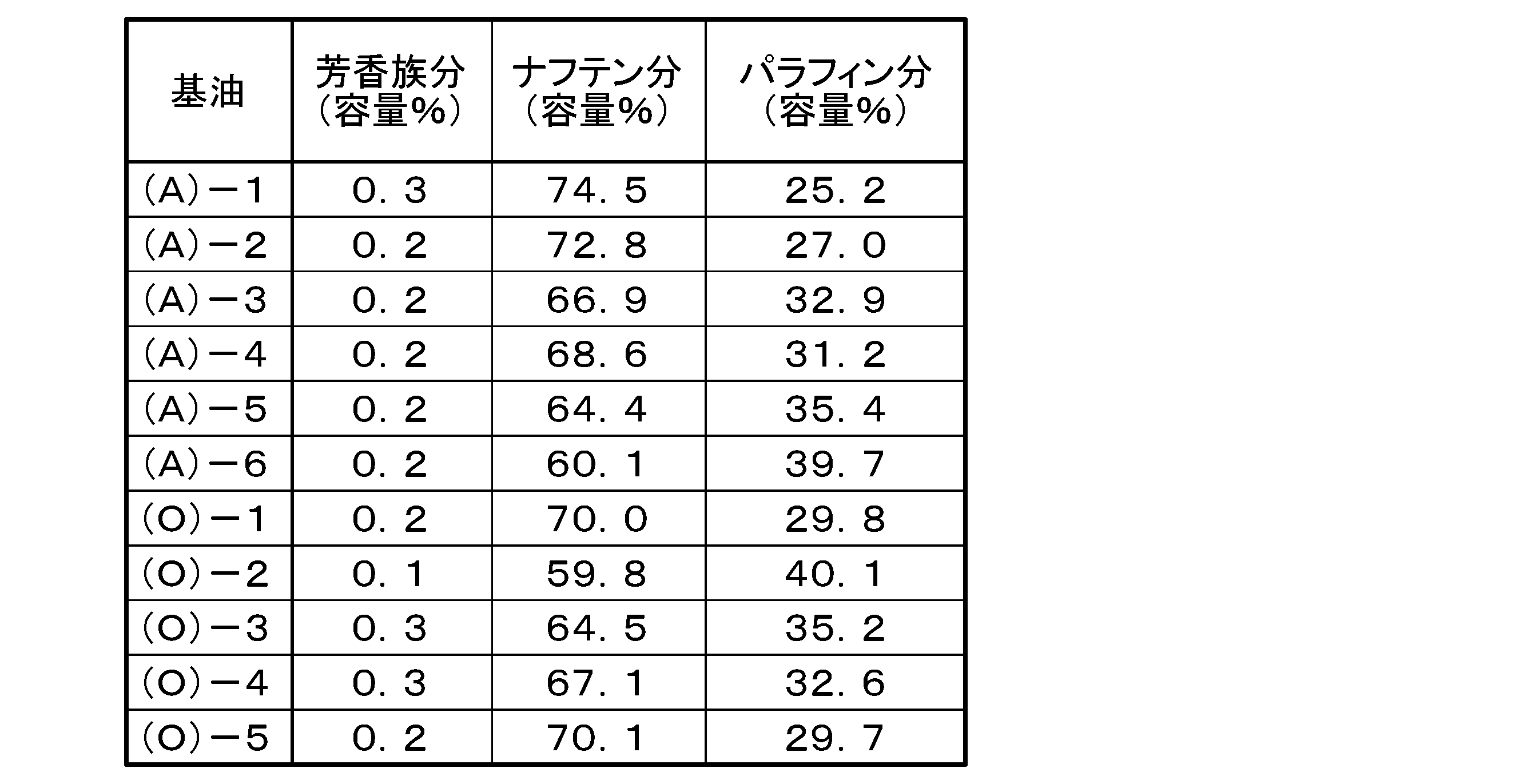
<アルミニウム加工用潤滑油組成物の調製>
(実施例1~35、比較例1~5)
表1に示す各成分を用いて、各例のアルミニウム加工用潤滑油組成物をそれぞれ調製した。
なお、実施例1~6及び比較例1~5においては、アルミニウム加工用潤滑油組成物は上記基油のみからなる。
(実施例1~35、比較例1~5)
表1に示す各成分を用いて、各例のアルミニウム加工用潤滑油組成物をそれぞれ調製した。
なお、実施例1~6及び比較例1~5においては、アルミニウム加工用潤滑油組成物は上記基油のみからなる。
[ステインの評価]
アルミニウム加工用潤滑油組成物の滴下量を変えて2つの試験を行い、ステインを評価した(ステインの評価1及びステインの評価2)。
ステインの評価1は、実際に圧延されたアルミウムに生じるステインの発生度合いと良い相関が認められている評価である。
ステインの評価2は、アルミニウムに過剰なアルミニウム加工用潤滑油組成物が付着した場合を想定した評価であり、ステインの評価1より厳しい条件である。
これらの結果を表3~6に示す。
アルミニウム加工用潤滑油組成物の滴下量を変えて2つの試験を行い、ステインを評価した(ステインの評価1及びステインの評価2)。
ステインの評価1は、実際に圧延されたアルミウムに生じるステインの発生度合いと良い相関が認められている評価である。
ステインの評価2は、アルミニウムに過剰なアルミニウム加工用潤滑油組成物が付着した場合を想定した評価であり、ステインの評価1より厳しい条件である。
これらの結果を表3~6に示す。
<ステインの評価1>
試験片としては、JIS K 2241に規定される試験片の調整に準拠し、溶剤及びメタノールにて洗浄したA1050材製のアルミ板(60mm×80mm×0.2mm)を用いた。
試験片を水平に保持し、中央部に各例のアルミニウム加工用潤滑油組成物を0.05mLずつ滴下した。その後、直ちに同様の別の試験片を、各例のアルミニウム加工用潤滑油組成物が滴下された試験片の上部に載せ、さらに、その上に100gの分銅を載せた。これらをオーブン内で水平に静置し、室温(25℃)から350℃まで90分かけて昇温し、350℃で60分間加熱した。その後、オーブンの電源を切り自然冷却させた。これらを室温(25℃)まで冷却した後、試験片同士で油剤を挟み込んだ面に生じるステイン(変色)を目視で評価した。
≪評価基準≫
JIS K 2241に規定されるさび発生の数え方に準拠し、ステインが生じた面積をA級からE級に分類し、評価した。A級を1点、B級を2点、C級を3点、D級を4点、E級を5点とし、1つのアルミニウム加工用潤滑油組成物に対し、同時に3回の試験を行った。3回の試験の平均点から、ステインの評価を以下の基準で行った。
A:1点
B:1点を超え2点以下
C:2点を超え3点以下
D:3点を超え4点以下
E:4点超
試験片としては、JIS K 2241に規定される試験片の調整に準拠し、溶剤及びメタノールにて洗浄したA1050材製のアルミ板(60mm×80mm×0.2mm)を用いた。
試験片を水平に保持し、中央部に各例のアルミニウム加工用潤滑油組成物を0.05mLずつ滴下した。その後、直ちに同様の別の試験片を、各例のアルミニウム加工用潤滑油組成物が滴下された試験片の上部に載せ、さらに、その上に100gの分銅を載せた。これらをオーブン内で水平に静置し、室温(25℃)から350℃まで90分かけて昇温し、350℃で60分間加熱した。その後、オーブンの電源を切り自然冷却させた。これらを室温(25℃)まで冷却した後、試験片同士で油剤を挟み込んだ面に生じるステイン(変色)を目視で評価した。
≪評価基準≫
JIS K 2241に規定されるさび発生の数え方に準拠し、ステインが生じた面積をA級からE級に分類し、評価した。A級を1点、B級を2点、C級を3点、D級を4点、E級を5点とし、1つのアルミニウム加工用潤滑油組成物に対し、同時に3回の試験を行った。3回の試験の平均点から、ステインの評価を以下の基準で行った。
A:1点
B:1点を超え2点以下
C:2点を超え3点以下
D:3点を超え4点以下
E:4点超
<ステインの評価2>
各例のアルミニウム加工用潤滑油組成物の滴下量を、0.3mLに変更したこと以外は、上記<ステインの評価1>と同様の方法でステインの評価を行った。
なお、「-」は、評価を行っていないことを示す。
各例のアルミニウム加工用潤滑油組成物の滴下量を、0.3mLに変更したこと以外は、上記<ステインの評価1>と同様の方法でステインの評価を行った。
なお、「-」は、評価を行っていないことを示す。
[摩耗粉発生量の評価]
下記の条件により、ワークロールで、長さ300mのアルミニウムコイルを3コイル連続で、各例(実施例13~35)のアルミニウム加工用潤滑油組成物を用いて、圧延した。圧延後のタンクに回収された各例のアルミニウム加工用潤滑油組成物中のアルミニウム量を、原子吸光法により測定し、各例のアルミニウム加工用潤滑油組成物中のアルミニウム濃度を求めた。
また、圧延後のアルミニウム表面に付着している摩耗粉を脱脂綿により拭き取り、拭き取った摩耗粉を原子吸光法により測定し、圧延後のアルミニウム表面に付着している摩耗粉量を求めた。
各例のアルミニウム加工用潤滑油組成物中のアルミニウム量、圧延後のアルミニウム表面に付着している摩耗粉量ともに、圧延材1m2を圧延する際の値として換算し、両者の合計(各例のアルミニウム加工用潤滑油組成物中のアルミニウム量+圧延後のアルミニウム表面に付着している摩耗粉量)を摩耗粉発生量とした。
圧延速度:300m/min
圧下率:50%
その結果を「摩耗粉発生量(mg/m2)」として、表5及び6に示す。
下記の条件により、ワークロールで、長さ300mのアルミニウムコイルを3コイル連続で、各例(実施例13~35)のアルミニウム加工用潤滑油組成物を用いて、圧延した。圧延後のタンクに回収された各例のアルミニウム加工用潤滑油組成物中のアルミニウム量を、原子吸光法により測定し、各例のアルミニウム加工用潤滑油組成物中のアルミニウム濃度を求めた。
また、圧延後のアルミニウム表面に付着している摩耗粉を脱脂綿により拭き取り、拭き取った摩耗粉を原子吸光法により測定し、圧延後のアルミニウム表面に付着している摩耗粉量を求めた。
各例のアルミニウム加工用潤滑油組成物中のアルミニウム量、圧延後のアルミニウム表面に付着している摩耗粉量ともに、圧延材1m2を圧延する際の値として換算し、両者の合計(各例のアルミニウム加工用潤滑油組成物中のアルミニウム量+圧延後のアルミニウム表面に付着している摩耗粉量)を摩耗粉発生量とした。
圧延速度:300m/min
圧下率:50%
その結果を「摩耗粉発生量(mg/m2)」として、表5及び6に示す。

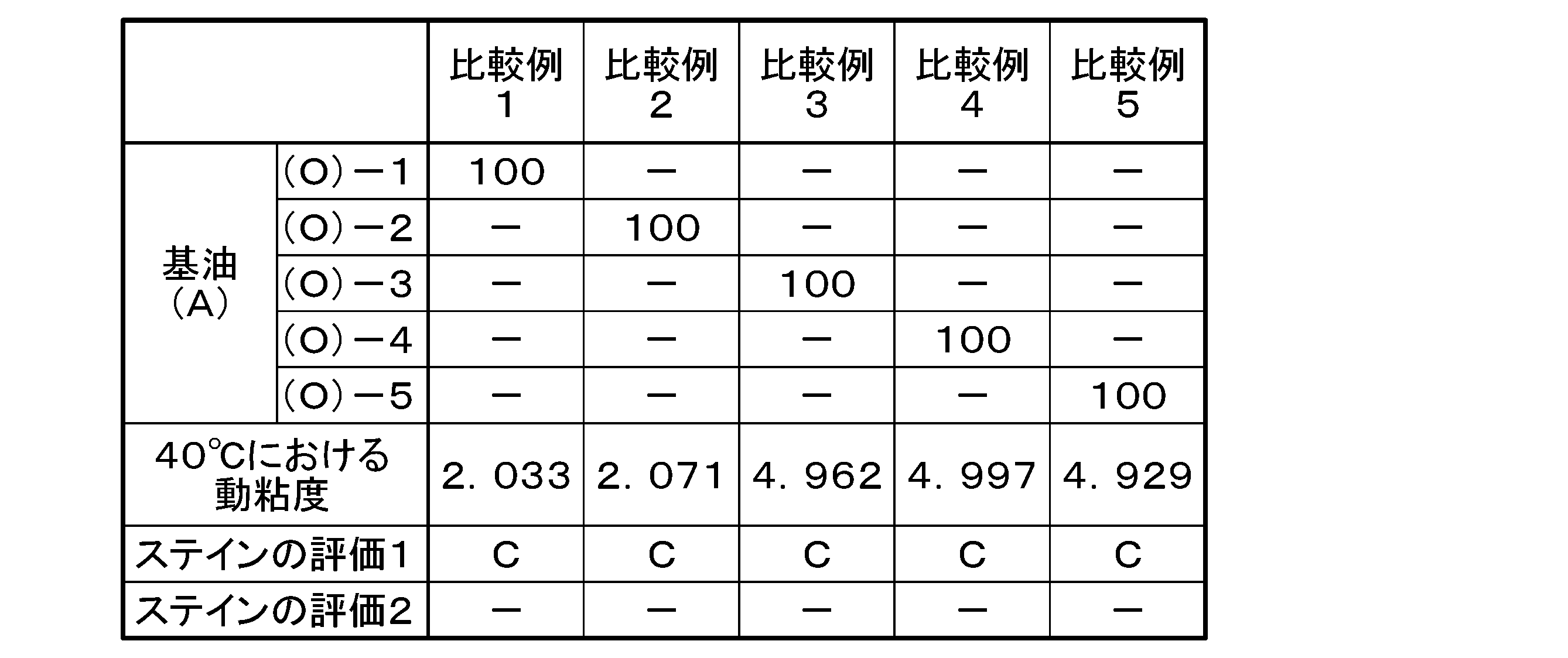
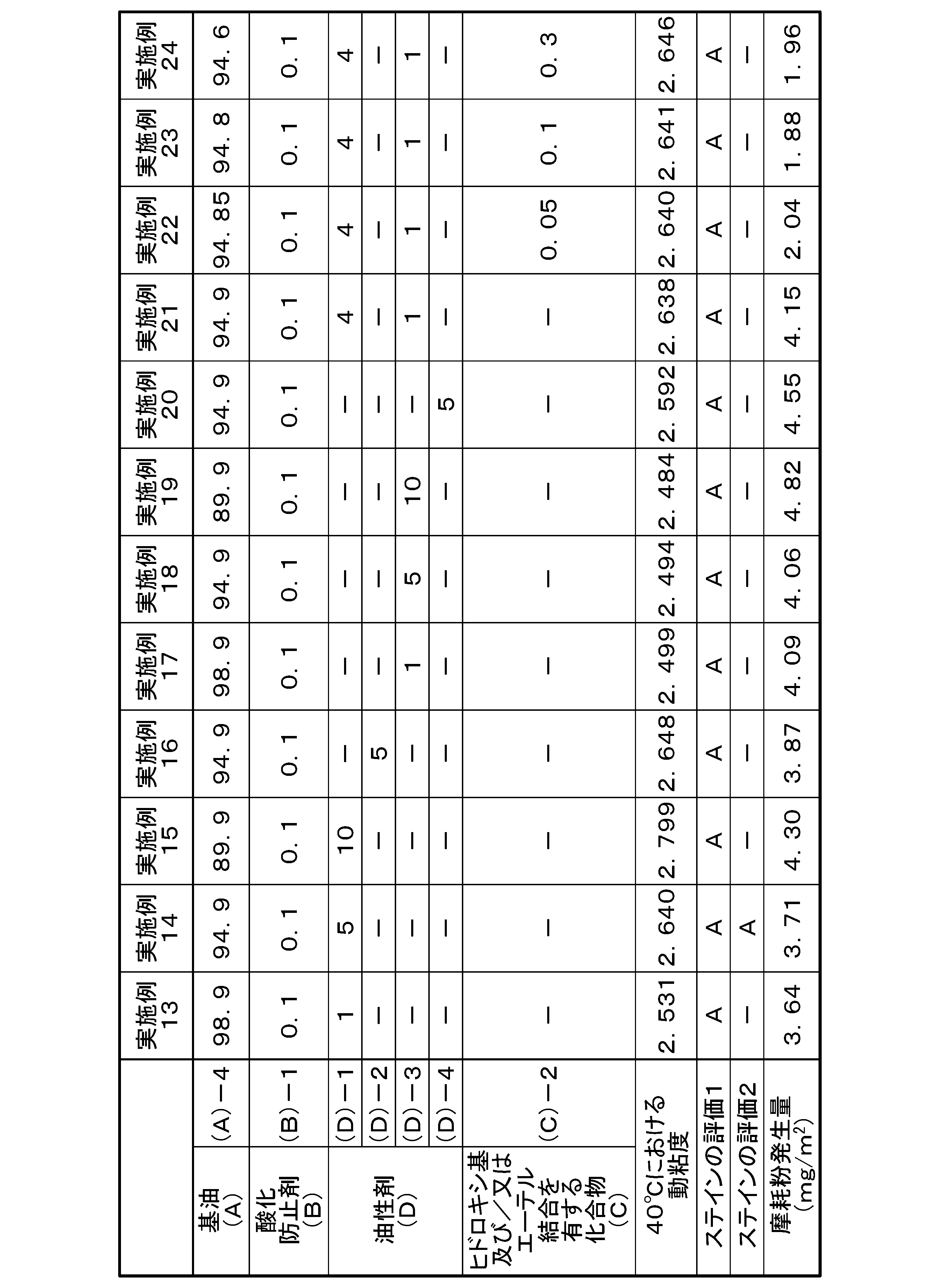
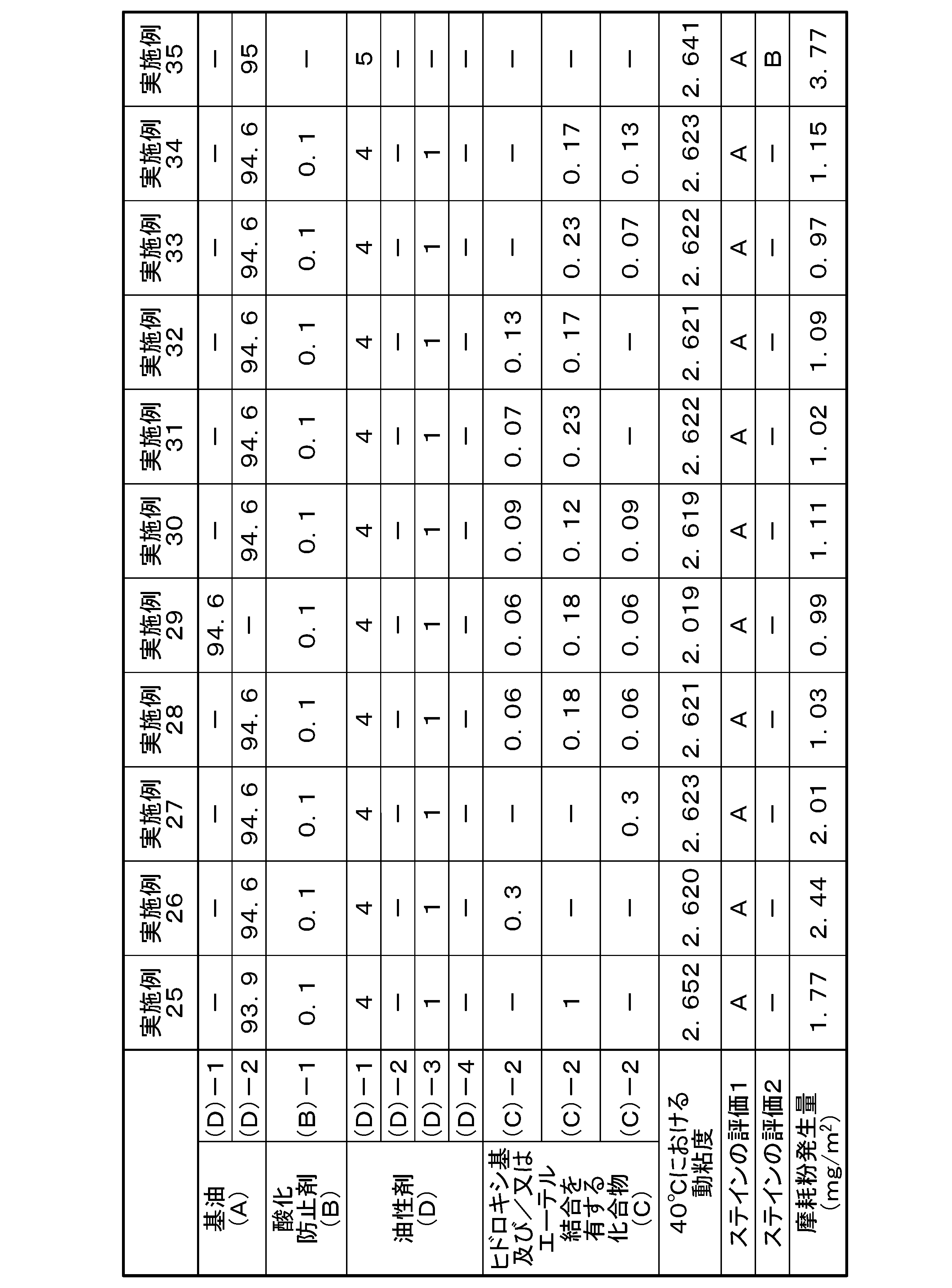
表3~6中、各略号はそれぞれ以下の意味を有する。表中の数値は、アルミニウム加工用潤滑油組成物の全量100質量%に対する含有量(質量%)である。
(A)-1~(A)~6、(O)-1~(O)-5:表1及び2に示す基油
(B)-1:2,6-ジターシャリーブチル-p-クレゾール
(D)-1:ラウリルアルコール
(D)-2:ミリスチルアルコール
(D)-3:ラウリン酸メチル
(D)-4:パルミチン酸ブチル
(B)-1:2,6-ジターシャリーブチル-p-クレゾール
(D)-1:ラウリルアルコール
(D)-2:ミリスチルアルコール
(D)-3:ラウリン酸メチル
(D)-4:パルミチン酸ブチル
(C)-1:ジプロピレングリコール
(C)-2:トリプロピレングリコール
(C)-3:テトラプロピレングリコール
(C)-2:トリプロピレングリコール
(C)-3:テトラプロピレングリコール
表3及び4に示すように、実施例のアルミニウム加工用潤滑油組成物は、ステイン発生を効果的に抑制している。また、(B)成分を含有する実施例7~12(特に実施例7~11)は、より厳しい条件であるステインの評価2においても、ステイン発生を効果的に抑制している。
表5及び6に示すように、(A)成分に加えて、(D)成分及び/又は(C)成分を含有する実施例13~35のアルミニウム加工用潤滑油組成物は、ステイン発生を効果的に抑制している。さらに、摩耗粉発生量が少ないため、アルミニウムの摩耗紛による汚れを効果的に抑制していることがわかる。
以上、本発明の好ましい実施例を説明したが、本発明はこれら実施例に限定されることはない。本発明の趣旨を逸脱しない範囲で、構成の付加、省略、置換、およびその他の変更が可能である。本発明は前述した説明によって限定されることはなく、添付のクレームの範囲によってのみ限定される。
Claims (7)
- JIS K 2254の常圧法によって求めた5%留出温度と、初留点との差(5%留出温度-初留点)が、13℃以下であり、かつ、JIS K 2254の常圧法によって求めた終点と、95%留出温度との差(終点-95%留出温度)が、15℃以下であり、
JIS K 2241の方法により求められる25℃における表面張力が、28mN/m以下であり、
40℃における動粘度が1.5mm2/s以上7.0mm2/s以下である、アルミニウム加工油基油。 - 請求項1に記載のアルミニウム加工油基油を含有し、
40℃における動粘度が1.5mm2/s以上7.0mm2/s以下である、アルミニウム加工用潤滑油組成物。 - さらに、2,6-ジターシャリーブチル-p-クレゾール(B)を含有する、請求項2に記載のアルミニウム加工用潤滑油組成物。
- さらに、1価アルコールと1塩基酸とから得られる炭素原子数7~26のエステル(D1)、1価アルコール(D2)及びカルボン酸(D3)からなる群から選択される1種以上の油性剤(D)を含有する、請求項2又は3に記載のアルミニウム加工用潤滑油組成物。
- さらに、ヒドロキシ基及び/又はエーテル結合を有する化合物(C)(前記化合物(C)は前記油性剤(D)を含まない)を含有する、請求項2~4のいずれか一項に記載のアルミニウム加工用潤滑油組成物。
- 前記ヒドロキシ基及び/又はエーテル結合を有する化合物(C)は、ジプロピレングリコール、トリプロピレングリコール、及びテトラプロピレングリコールからなる群から選択される1種以上の化合物である、請求項5に記載のアルミニウム加工用潤滑油組成物。
- アルミニウムの冷間圧延に用いられる、請求項2~6のいずれか一項に記載のアルミニウム加工用潤滑油組成物。
Priority Applications (1)
| Application Number | Priority Date | Filing Date | Title |
|---|---|---|---|
| CN202080098469.7A CN115298292B (zh) | 2020-03-16 | 2020-11-16 | 铝加工油基油和铝加工用润滑油组合物 |
Applications Claiming Priority (2)
| Application Number | Priority Date | Filing Date | Title |
|---|---|---|---|
| JP2020-045405 | 2020-03-16 | ||
| JP2020045405A JP6931728B1 (ja) | 2020-03-16 | 2020-03-16 | アルミニウム加工油基油及びアルミニウム加工用潤滑油組成物 |
Publications (1)
| Publication Number | Publication Date |
|---|---|
| WO2021186791A1 true WO2021186791A1 (ja) | 2021-09-23 |
Family
ID=77549892
Family Applications (1)
| Application Number | Title | Priority Date | Filing Date |
|---|---|---|---|
| PCT/JP2020/042622 Ceased WO2021186791A1 (ja) | 2020-03-16 | 2020-11-16 | アルミニウム加工油基油及びアルミニウム加工用潤滑油組成物 |
Country Status (3)
| Country | Link |
|---|---|
| JP (1) | JP6931728B1 (ja) |
| CN (1) | CN115298292B (ja) |
| WO (1) | WO2021186791A1 (ja) |
Cited By (1)
| Publication number | Priority date | Publication date | Assignee | Title |
|---|---|---|---|---|
| CN115401072A (zh) * | 2022-09-07 | 2022-11-29 | 江苏大亚铝业有限公司 | 8011铝合金坯料生产高延伸软管箔的工艺 |
Citations (5)
| Publication number | Priority date | Publication date | Assignee | Title |
|---|---|---|---|---|
| JPS59176398A (ja) * | 1983-03-28 | 1984-10-05 | マークテック株式会社 | 液体洗浄剤 |
| WO1998004657A1 (en) * | 1996-07-29 | 1998-02-05 | Exxon Research And Engineering Company | Lubricant for cold-rolling aluminium |
| JP2000169865A (ja) * | 1998-12-04 | 2000-06-20 | Nippon Mitsubishi Oil Corp | アルミニウム等の冷間圧延油組成物 |
| JP2015183120A (ja) * | 2014-03-25 | 2015-10-22 | Jx日鉱日石エネルギー株式会社 | アルミニウム加工油組成物 |
| EP3315587A1 (en) * | 2016-10-27 | 2018-05-02 | Total Marketing Services | Use of biodegradable hydrocarbon fluids for aluminium cold-rolling |
Family Cites Families (7)
| Publication number | Priority date | Publication date | Assignee | Title |
|---|---|---|---|---|
| JP2004315669A (ja) * | 2003-04-16 | 2004-11-11 | Nippon Oil Corp | アルミニウム加工用潤滑油 |
| CN102177227B (zh) * | 2008-10-07 | 2013-12-18 | 吉坤日矿日石能源株式会社 | 润滑油组合物及其制造方法 |
| FR2943070B1 (fr) * | 2009-03-12 | 2012-12-21 | Total Raffinage Marketing | Fluide hydrocarbone hydrodeparaffine utilise dans la fabrication de fluides industriels, agricoles ou a usage domestique |
| US9132421B2 (en) * | 2009-11-09 | 2015-09-15 | Shell Oil Company | Composition useful in the hydroprocessing of a hydrocarbon feedstock |
| JP7054330B2 (ja) * | 2017-02-03 | 2022-04-13 | Eneos株式会社 | 冷凍機油 |
| JP6892784B2 (ja) * | 2017-04-28 | 2021-06-23 | 出光興産株式会社 | 金属加工用潤滑油組成物 |
| US11046897B2 (en) * | 2018-06-07 | 2021-06-29 | Exxonmobil Research And Engineering Company | Naphtha hydrodesulfurization |
-
2020
- 2020-03-16 JP JP2020045405A patent/JP6931728B1/ja active Active
- 2020-11-16 WO PCT/JP2020/042622 patent/WO2021186791A1/ja not_active Ceased
- 2020-11-16 CN CN202080098469.7A patent/CN115298292B/zh active Active
Patent Citations (5)
| Publication number | Priority date | Publication date | Assignee | Title |
|---|---|---|---|---|
| JPS59176398A (ja) * | 1983-03-28 | 1984-10-05 | マークテック株式会社 | 液体洗浄剤 |
| WO1998004657A1 (en) * | 1996-07-29 | 1998-02-05 | Exxon Research And Engineering Company | Lubricant for cold-rolling aluminium |
| JP2000169865A (ja) * | 1998-12-04 | 2000-06-20 | Nippon Mitsubishi Oil Corp | アルミニウム等の冷間圧延油組成物 |
| JP2015183120A (ja) * | 2014-03-25 | 2015-10-22 | Jx日鉱日石エネルギー株式会社 | アルミニウム加工油組成物 |
| EP3315587A1 (en) * | 2016-10-27 | 2018-05-02 | Total Marketing Services | Use of biodegradable hydrocarbon fluids for aluminium cold-rolling |
Cited By (2)
| Publication number | Priority date | Publication date | Assignee | Title |
|---|---|---|---|---|
| CN115401072A (zh) * | 2022-09-07 | 2022-11-29 | 江苏大亚铝业有限公司 | 8011铝合金坯料生产高延伸软管箔的工艺 |
| CN115401072B (zh) * | 2022-09-07 | 2025-01-14 | 江苏大亚铝业有限公司 | 8011铝合金坯料生产高延伸软管箔的工艺 |
Also Published As
| Publication number | Publication date |
|---|---|
| JP6931728B1 (ja) | 2021-09-08 |
| JP2021147415A (ja) | 2021-09-27 |
| CN115298292A (zh) | 2022-11-04 |
| CN115298292B (zh) | 2023-08-29 |
Similar Documents
| Publication | Publication Date | Title |
|---|---|---|
| JP5102965B2 (ja) | 金属加工油組成物 | |
| JP4833487B2 (ja) | アルミニウム加工用潤滑油組成物 | |
| JP5604343B2 (ja) | 塑性加工用潤滑油組成物 | |
| JP6931728B1 (ja) | アルミニウム加工油基油及びアルミニウム加工用潤滑油組成物 | |
| JP4201101B2 (ja) | アルミニウム塑性加工用潤滑油 | |
| JP5071999B2 (ja) | 金属加工用潤滑油組成物 | |
| JP5415705B2 (ja) | 金属加工油組成物 | |
| JP2003165994A (ja) | 遷移金属用冷間圧延油組成物 | |
| JP2003096482A (ja) | アルミニウム加工用潤滑油組成物 | |
| JP2004315669A (ja) | アルミニウム加工用潤滑油 | |
| JP4335348B2 (ja) | 金属加工用潤滑油組成物 | |
| JP4111459B2 (ja) | アルミニウム用冷間圧延油 | |
| JP2000119679A (ja) | アルミ箔用冷間圧延油組成物 | |
| JP2003096481A (ja) | アルミニウム加工用潤滑油組成物 | |
| JP4111460B2 (ja) | アルミニウム塑性加工用潤滑油組成物 | |
| JP2000169865A (ja) | アルミニウム等の冷間圧延油組成物 | |
| KR100747394B1 (ko) | 금속 가공용 윤활유 조성물 | |
| JP4751077B2 (ja) | 潤滑油組成物 | |
| JP4257868B2 (ja) | アルミニウム用冷間圧延油の製造方法 | |
| JP2000080390A (ja) | アルミニウム等の条用圧延油組成物 | |
| JP4578925B2 (ja) | 冷間圧延油組成物及び冷間圧延方法 | |
| JP5584261B2 (ja) | 圧延油組成物 | |
| JP2005042033A (ja) | 圧延油組成物 | |
| JP2012224860A (ja) | 金属加工用潤滑油組成物 | |
| JP2026059386A (ja) | 金属加工油組成物 |
Legal Events
| Date | Code | Title | Description |
|---|---|---|---|
| 121 | Ep: the epo has been informed by wipo that ep was designated in this application |
Ref document number: 20925311 Country of ref document: EP Kind code of ref document: A1 |
|
| NENP | Non-entry into the national phase |
Ref country code: DE |
|
| 122 | Ep: pct application non-entry in european phase |
Ref document number: 20925311 Country of ref document: EP Kind code of ref document: A1 |