WO2021182565A1 - 光学用フィルム - Google Patents
光学用フィルム Download PDFInfo
- Publication number
- WO2021182565A1 WO2021182565A1 PCT/JP2021/009759 JP2021009759W WO2021182565A1 WO 2021182565 A1 WO2021182565 A1 WO 2021182565A1 JP 2021009759 W JP2021009759 W JP 2021009759W WO 2021182565 A1 WO2021182565 A1 WO 2021182565A1
- Authority
- WO
- WIPO (PCT)
- Prior art keywords
- optical film
- film
- resin
- colorant
- light transmittance
- Prior art date
- Legal status (The legal status is an assumption and is not a legal conclusion. Google has not performed a legal analysis and makes no representation as to the accuracy of the status listed.)
- Ceased
Links
Classifications
-
- C—CHEMISTRY; METALLURGY
- C08—ORGANIC MACROMOLECULAR COMPOUNDS; THEIR PREPARATION OR CHEMICAL WORKING-UP; COMPOSITIONS BASED THEREON
- C08J—WORKING-UP; GENERAL PROCESSES OF COMPOUNDING; AFTER-TREATMENT NOT COVERED BY SUBCLASSES C08B, C08C, C08F, C08G or C08H
- C08J5/00—Manufacture of articles or shaped materials containing macromolecular substances
- C08J5/18—Manufacture of films or sheets
-
- C—CHEMISTRY; METALLURGY
- C08—ORGANIC MACROMOLECULAR COMPOUNDS; THEIR PREPARATION OR CHEMICAL WORKING-UP; COMPOSITIONS BASED THEREON
- C08K—Use of inorganic or non-macromolecular organic substances as compounding ingredients
- C08K3/00—Use of inorganic substances as compounding ingredients
- C08K3/02—Elements
- C08K3/04—Carbon
-
- C—CHEMISTRY; METALLURGY
- C08—ORGANIC MACROMOLECULAR COMPOUNDS; THEIR PREPARATION OR CHEMICAL WORKING-UP; COMPOSITIONS BASED THEREON
- C08K—Use of inorganic or non-macromolecular organic substances as compounding ingredients
- C08K3/00—Use of inorganic substances as compounding ingredients
- C08K3/18—Oxygen-containing compounds, e.g. metal carbonyls
- C08K3/20—Oxides; Hydroxides
- C08K3/22—Oxides; Hydroxides of metals
-
- C—CHEMISTRY; METALLURGY
- C08—ORGANIC MACROMOLECULAR COMPOUNDS; THEIR PREPARATION OR CHEMICAL WORKING-UP; COMPOSITIONS BASED THEREON
- C08L—COMPOSITIONS OF MACROMOLECULAR COMPOUNDS
- C08L79/00—Compositions of macromolecular compounds obtained by reactions forming in the main chain of the macromolecule a linkage containing nitrogen with or without oxygen or carbon only, not provided for in groups C08L61/00 - C08L77/00
- C08L79/04—Polycondensates having nitrogen-containing heterocyclic rings in the main chain; Polyhydrazides; Polyamide acids or similar polyimide precursors
- C08L79/08—Polyimides; Polyester-imides; Polyamide-imides; Polyamide acids or similar polyimide precursors
Definitions
- the present invention relates to an optical film.
- colored films have been used for applications that require functions such as decoration, concealment, and shading.
- an electronic device by arranging a colored film at a predetermined position, the parts are fixed and protected, and at the same time, the appearance of the parts is blindfolded (hidden).
- the colored film may be used to conceal parts and at the same time enhance the design of the electronic device itself.
- Patent Document 1 discloses a method of providing a colored layer on a film to color the film.
- Patent Documents 2 and 3 disclose colored polyimide films using pigments and carbon black.
- the invention described in Patent Document 2 is an invention relating to a black polyimide film, and an object of the present invention is to provide a film exhibiting excellent light-shielding property and concealing property.
- the invention described in Patent Document 3 is also an invention relating to a black polyimide film.
- an optical transmittance of 1.0% or less can be obtained in the visible light range. The development of a film to have is being considered.
- Patent Document 1 has a problem that when a part of the film surface is scratched, the colored layer is destroyed and the hue changes only in that part.
- Patent Documents 2 and 3 have the main purpose of light-shielding property. Therefore, for example, when the film is attached to an image display device or the like, there is a problem that the image information cannot be recognized via the film. Colored films may be indispensable for applications that require designability and the like, and in such cases, development of a technique for improving visibility while improving designability is required.
- the present inventors have provided a colored optical film capable of exhibiting visibility and excellent design without impairing image displayability, and further scratch resistance. We proceeded with the study for the purpose of providing a colored optical film having excellent properties.
- the present invention has the following configuration.
- the colorant is at least one selected from metal oxides and carbon black.
- the haze of the optical film is 0.1-15% or An optical film having a total light transmittance of 30 to 90%.
- the haze of the optical film is 0.1 to 15%, the total light transmittance of the optical film is 30 to 90%, and the product of the haze and the total light transmittance is 180 or less, [1] ] Or [2].
- the present invention relates to an optical film containing a resin and a colorant in a single layer.
- the colorant is at least one selected from metal oxides and carbon black.
- the haze of the optical film of the present invention is 0.1 to 15%, or the total light transmittance of the optical film is 30 to 90%.
- the optical film having a colorant may be referred to as a colored film or a colored optical film.
- the optical film of the present invention is preferably an optical film constituting an optical member.
- the optical film of the present invention has the above-mentioned structure, for example, when it is used as a member constituting an image display device (display), its image displayability is not impaired. That is, the optical film of the present invention has excellent visibility. For example, even when the characters are used on the visible surface side of the display, the characters displayed on the display are prevented from blurring.
- the optical film of the present invention is also excellent in designability, and the designability of the adherend can be effectively enhanced.
- a black colorant is used for an optical film and the optical film is attached to a display or the like displaying a black screen
- the hue difference with peripheral members is reduced and the degree of black color development of the display is increased. Can be done.
- the degree of black color development of the display is enhanced by using the optical film of the present invention, so that the sense of unity with the surroundings is emphasized and the design is enhanced. ..
- the optical film of the present invention has succeeded in improving the design of the display and the like, but not deteriorating the visibility of the display and the like.
- the total light transmittance of the optical film in this embodiment is preferably 30% or more, more preferably 35% or more.
- the total light transmittance of the optical film is preferably 90% or less, more preferably 85% or less, further preferably 80% or less, still more preferably 75% or less. , 70% or less is even more preferable, and 65% or less is particularly preferable.
- the haze of the optical film in this embodiment is preferably 0.1% or more, and more preferably 0.5% or more.
- the haze of the optical film is preferably 15% or less, and more preferably 10% or less.
- the haze of the optical film is preferably 0.1 to 15%, and the total light transmittance of the optical film is preferably 30 to 90%.
- the haze of the optical film is preferably 0.1% or more, and more preferably 0.5% or more.
- the haze of the optical film is preferably 15% or less, and more preferably 10% or less.
- the total light transmittance of the optical film is preferably 30% or more, more preferably 35% or more.
- the total light transmittance of the optical film is preferably 90% or less, more preferably 85% or less, further preferably 80% or less, still more preferably 75% or less. , 70% or less is even more preferable, and 65% or less is particularly preferable.
- the product of the haze of the optical film and the total light transmittance in the present embodiment is preferably 180 or less, more preferably 175 or less, and further preferably 170 or less.
- the product of the total light transmittance and the haze value of the optical film is preferably 10 or more, and more preferably 30 or more.
- the total light transmittance of the optical film is preferably 40% or more and the haze is 6% or less, and the total light transmittance of the optical film is 90% or less and the haze is 0. It is preferably 1% or more.
- the display and the like can be more effectively blackened while the display is displayed. Etc. can be more effectively enhanced.
- the total light transmittance and haze of the optical film are values measured using an integrating sphere type light transmittance measuring device in accordance with JIS K7150.
- the measurement is performed three times, and the average value thereof is taken as a measured value.
- the optical film of this embodiment is also excellent in scratch resistance.
- the scratch resistance is excellent, the hue of the optical film around the scratch does not change even when the optical film is scratched. Therefore, for example, even when the optical film of the present embodiment is arranged on the surface of the adherend as a decorative layer, the optical film of the present embodiment can exhibit excellent scratch resistance. As a result, it becomes possible to maintain excellent designability for a long period of time.
- the thickness of the optical film is preferably 1 ⁇ m or more, and more preferably 5 ⁇ m or more.
- the thickness of the optical film is preferably 500 ⁇ m or less, more preferably 300 ⁇ m or less, and even more preferably 100 ⁇ m or less.
- the resin and the colorant are contained in a single layer. That is, in the optical film, the colorant is uniformly dispersed (distributed) in the resin constituting the film.
- a functional layer may be further provided on one surface side of the optical film.
- it contains a resin type different from the resin type contained in the optical film for the purpose of increasing the hardness of the surface of the optical film, imparting slipperiness, imparting stain resistance, and improving the adhesion when bonding other members.
- a functional layer can also be provided.
- the optical film of this embodiment contains a resin.
- the resin forming the optical film include cyclic olefin resins such as polyimide, polyamideimide, polyolefin, polyethylene terephthalate, polyacetal, polybutylene terephthalate, polyacetal, and cycloolefin polymer.
- the resin forming the optical film is preferably at least one selected from polyimide and polyamide-imide from the viewpoint of having bending resistance.
- the polyimide is preferably an imidized polyamic acid obtained by polymerizing diamine acid and acid dianhydride.
- the polyamide-imide is preferably a resin in which an amide group is introduced into the above-mentioned polyimide (hereinafter, the polyimide and the polyamide-imide may be collectively referred to as a resin such as polyimide).
- the resin such as polyimide include Neoprim (registered trademark) manufactured by Mitsubishi Gas Chemical Company, Ltd., KPI-MX300F manufactured by Kawamura Sangyo Co., Ltd., and the like. These resins, which have high transparency as an optical film, are superior in strength to other resins, and can be expected to be used as a substitute for glass, for example. Further, the optical film containing the above resin is also excellent in flexibility.
- the resin such as polyimide is preferably a resin in which chemical imidization (imidization of polyamic acid) is completed before film formation.
- a resin such as polyimide a method of imidizing by a heating step after film formation is also known, but the heating step requires a high temperature of 200 ° C. or higher. Therefore, chemical imidization before film formation is preferable to imidization by a heating step after film formation from the viewpoint of productivity improvement and energy saving.
- the polyamic acid which is a precursor before chemical imidization, has a problem that it takes a lot of labor to control the storage conditions and the like because the molecular weight of the polyamic acid decreases with time when stored at room temperature. For this reason as well, it is preferable to use a resin such as polyimide whose chemical imidization has been completed before the film is formed.
- the resin such as polyimide is preferably a resin that is soluble in an organic solvent.
- the resin soluble in an organic solvent means a resin having a solubility of 0.05 g / ml or more in the organic solvent used.
- the organic solvent include N, N-dimethylacetamide, N, N-dimethylformamide, N-methyl-2-pyrrolidone, gamma butyrolactone, 2-butanone, acetonitrile, acetone, ethyl acetate, butyl acetate, methyl ethyl ketone and the like. can.
- the solubility of the resin such as polyimide with respect to the organic solvent is preferably 0.1 g / ml or more, and more preferably 0.15 g / ml or more.
- the organic solvent include dimethylacetamide, gamma butyl lactone, acetone, ethyl acetate, butyl acetate, and methyl ethyl ketone.
- an optical film there is also a method of obtaining a continuous film by dropping a resin melted at a high temperature onto a surface of a metal drum or the like.
- the resin is soluble in an organic solvent
- an optical film can be obtained by applying a resin dissolved in the organic solvent to a different resin film or a support such as a metal belt and drying the resin.
- the thickness can be easily controlled, and it becomes easy to control the thickness to an arbitrary thickness even in small-scale production.
- uneven thickness of the film appears as uneven hue. Therefore, it is preferable to use a resin such as polyimide that is soluble in an organic solvent because hue unevenness is suppressed and a high-quality optical film can be easily obtained.
- the resin such as polyimide is more preferably a resin having a boiling point of 120 ° C. or lower and soluble in an organic solvent.
- the organic solvent having a boiling point of 120 ° C. or lower include ethyl acetate, methyl ethyl ketone, acetone and the like, and the solubility of the resin such as polyimide is preferably 0.1 g / ml or more with respect to these organic solvents.
- the solubility is more preferably 0.15 g / ml or more.
- Some polyimide resins and the like are soluble in gamma butyl lactone, dimethylacetamide, and the like as organic solvents, but some have a high boiling point of the organic solvent and are highly harmful to the human body. In this case, there is a problem that a spare time for heating is required and the productivity is inferior, the viewpoint of energy saving, and the working environment at the time of manufacturing are deteriorated.
- the above problem can be solved by using a resin that is soluble in an organic solvent having a boiling point of 120 ° C. or lower.
- the optical film of the present embodiment contains a colorant.
- the colorant is preferably at least one selected from metal oxides and carbon black, and more preferably metal oxides from the viewpoint of enhancing the design of the obtained film.
- the metal oxide is preferably a transition metal oxide, and particularly preferably a black metal oxide.
- the colorant may contain other colorants in addition to the metal oxide and carbon black as long as the desired effect of the present invention is not impaired.
- other colorants include black pigments such as aniline black and activated carbon, and dye-type colorants such as azo and anthraquinone.
- the metal oxide is preferably a transition metal oxide, more specifically, copper oxide, iron tetraoxide, manganese dioxide, titanium oxide, zinc oxide, zirconium oxide, barium titanate, potassium titanate, and titanoic acid.
- examples thereof include iron, copper-chromium oxide, copper-manganese oxide, copper-iron-manganese oxide, copper-chromium-manganese oxide or copper-iron-chromine oxide, titanium black and the like.
- a metal oxide whose metal type is selected from copper, iron and manganese as the metal oxide, the color change of the film occurs particularly even when the optical film is used in a high temperature and high humidity environment. It is more preferable because it becomes difficult.
- the color stability when used for a long period of time becomes good.
- the peripheral member of the optical film is often black.
- metal is used from the viewpoint of enhancing the sense of unity with the peripheral member.
- the oxide is preferably a black metal oxide. Further, when a black metal oxide is used as the colorant, the design of the screen can be improved even when the image display device such as a display is not lit, which is preferable.
- the colorant is fine particles, and the average particle size of the colorant is preferably 0.01 ⁇ m or more.
- the average particle size of the colorant is preferably 15 ⁇ m or less, more preferably 12 ⁇ m or less, further preferably 10 ⁇ m or less, and particularly preferably 5 ⁇ m or less.
- the average particle size r of the colorant is more preferably r ⁇ 0.5 t with respect to the thickness t of the optical film containing the colorant. Thereby, the coloring uniformity of the optical film can be further improved.
- the content of the colorant is preferably 0.01 part by mass or more, and more preferably 0.1 part by mass or more with respect to 100 parts by mass of the resin forming the optical film.
- the content of the colorant is preferably 10 parts by mass or less, and more preferably 5 parts by mass or less, with respect to 100 parts by mass of the resin forming the optical film.
- the colorant is preferably mixed with the resin forming the optical film in a state of being dispersed in the dispersed resin in order to improve the coloring uniformity of the optical film.
- the dispersion resin include polyester resin, urethane resin, acrylic resin, and polyether resin.
- the optical film of the present embodiment may contain an ultraviolet absorber.
- an optical film having an ultraviolet ray blocking function can be obtained.
- UV blocking function ultraviolet ray blocking function
- the ultraviolet absorber can be selected from those having a maximum absorption wavelength in the ultraviolet region. In the present invention, it is particularly preferable to use an ultraviolet absorber having a maximum absorption wavelength at a wavelength of 350 nm or more. Examples of the ultraviolet absorber having a maximum absorption wavelength of 350 nm or more include a compound represented by the following general formula (1) or (2).
- R 1 represents a hydrogen atom, a halogen atom, an alkoxy group having 1 to 4 carbon atoms, a nitro group or a cyano group
- R 2 represents a hydrogen atom or an alkyl group having 1 to 8 carbon atoms
- 3 represents an alkyl group-based structure.
- R 4 , R 5 and R 6 are hydrogen atoms, hydroxyl groups, alkyl group structures or halogen atoms, and not all of R 4 , R 5 and R 6 are hydrogen atoms.
- the alkyl group-based structure is a concept including a substituent mainly composed of an alkyl group such as a substituted or unsubstituted alkyl group or a substituted or unsubstituted alkoxy group.
- an ultraviolet absorber that improves compatibility by introducing an alkyl group having a large molecular weight into the aromatic ring of the basic skeleton and exhibits a liquid or oily substance at 23 ° C.
- showing liquidity or oiliness at 23 ° C. means a state in which the ultraviolet absorber alone is fluid even without a diluting solvent.
- a commercially available product can be used as the ultraviolet absorber.
- Examples of commercially available products include triazine-based UV absorbers (Tinubin 477) and benzotriazole-based UV absorbers (Tinubin 109, Tinubin 384-2, Tinubin PS) manufactured by BASF Japan Ltd.
- the content of the ultraviolet absorber is preferably 0.1 to 10 parts by mass, more preferably 0.5 to 8 parts by mass, and 1 to 1 to 8 parts by mass with respect to 100 parts by mass of the resin constituting the optical film. It is more preferably 6 parts by mass.
- the content of the ultraviolet absorber in the present embodiment is preferably adjusted to an amount such that the ultraviolet transmittance at a wavelength of 380 nm is less than 10%. That is, the ultraviolet transmittance of the optical film of the present invention at a wavelength of 380 nm is preferably less than 10%.
- the ultraviolet absorber may be used alone or in combination of two or more, and when two or more are used in combination, the total mass is preferably within the above range.
- the optical film of the present embodiment may contain components other than the above as long as the desired effects of the present invention are not impaired.
- examples of other components include known components such as antiblocking agents, antistatic agents, and antioxidants.
- the method for producing an optical film of the present embodiment preferably includes a step of applying a resin coating liquid containing a resin and a colorant to form a coating film, and a step of drying the coating film.
- the colorant is at least one selected from metal oxides and carbon black.
- the haze of the optical film produced by the above production method is 0.1 to 15%, or the total light transmittance of the optical film produced by the above production method is 30 to 90%. Further, the optical film haze produced by the above manufacturing method is 0.1 to 15%, the total light transmittance is 30 to 90%, and the product of the haze and the total light transmittance is 180 or less. preferable.
- the step of applying the resin coating liquid to form a coating film preferably includes a step of dissolving the resin in an organic solvent.
- the boiling point of the organic solvent that dissolves the resin is particularly preferably 120 ° C. or lower.
- a step of adding a colorant to the resin solution is provided after the step of dissolving the resin in an organic solvent.
- the resin and the colorant may be mixed with the organic solvent at the same time.
- organic solvent used in the step of applying the resin coating liquid to form the coating film for example, ethyl acetate, methyl ethyl ketone, acetone and the like are preferably used.
- the coating of the resin coating liquid containing the resin and the colorant can be carried out using a known coating device.
- the coating device include a blade coater, an air knife coater, a roll coater, a bar coater, a gravure coater, a micro gravure coater, a rod blade coater, a lip coater, a die coater, and a curtain coater.
- the support for applying the resin coating liquid include a metal plate and a resin film.
- the step of drying the coating film preferably includes a step of heating the wet coating film.
- a known heating device such as a heating furnace or an infrared lamp can be used to heat the coating film.
- the use of the optical film of the present embodiment is not particularly limited, but it is preferably used for an optical member.
- an adhesive sheet can be used to bond the optical film of the present embodiment to another member, and the film can be used in an image display device such as a display.
- the film can be used in an image display device such as a display.
- the optical film of the present embodiment is suitably used for an image display device such as a display.
- a display used in a smartphone, a personal computer, a navigation system for a vehicle, a portable game machine, or the like can be exemplified.
- the resin when a resin such as polyimide is used as the resin, it can be assumed to be used as a substitute for glass. In this case, an accident due to glass scattering when the image display device is damaged can be prevented and the weight of the member can be reduced. It is preferable because it can be used.
- a resin (trade name: KPI-MX300F, manufactured by Kawamura Sangyo Co., Ltd.) that has been chemically imidized and is supplied as a powder is dissolved in ethyl acetate with a propeller mixer to obtain a 15% by mass polyimide resin solution. rice field.
- Example 1 To 100 parts by mass of the polyimide resin in the polyimide resin solution, 0.1 parts by mass of copper, iron, and manganese oxide pigments (trade name: TM Black 3550, manufactured by Dainichiseika Kogyo Co., Ltd.) were added as colorants. Then, ethyl acetate was added so that the solid content concentration became 12% by mass to obtain a composition for forming a colored film.
- TM Black 3550 manufactured by Dainichiseika Kogyo Co., Ltd.
- the composition for forming a colored film was applied onto a polyethylene terephthalate film (trade name: Lumirror 250T60, manufactured by Toray Industries, Inc.) having a thickness of 250 ⁇ m.
- the coating was carried out using a doctor blade YD type manufactured by Yoshimitsu Seiki Co., Ltd. so that the thickness after drying was 25 ⁇ m. Then, it was dried in a hot air dryer at 100 ° C. for 5 minutes to remove the solvent, and peeled from the polyethylene terephthalate film to obtain a colored optical film.
- Example 2 A colored optical film was obtained in the same manner as in Example 1 except that the amount of the colorant added was changed to 0.6 parts by mass.
- Example 3 A colored optical film was obtained in the same manner as in Example 1 except that the amount of the colorant added was changed to 0.9 parts by mass.
- Example 4 A colored optical film was obtained in the same manner as in Example 1 except that the colorant was changed to carbon black (trade name: Multirack A 903, manufactured by Black Toyo Color Co., Ltd.) by 0.3 parts by mass.
- carbon black trade name: Multirack A 903, manufactured by Black Toyo Color Co., Ltd.
- Example 5 A colored optical film was obtained in the same manner as in Example 1 except that the colorant was changed to a copper pigment (trade name: Chromofine PB-15: 3) and the addition amount was changed to 0.1 parts by mass. rice field.
- a copper pigment trade name: Chromofine PB-15: 3
- Example 6 Instead of the polyimide resin solution, use a resin solution in which cyclic olefin resin (trade name: Arton (registered trademark) F4520) is dissolved in toluene so as to have a concentration of 15% by mass, and instead of adding ethyl acetate after adding the colorant, use toluene. A colored optical film was obtained in the same manner as in Example 2 except that it was added.
- cyclic olefin resin trade name: Arton (registered trademark) F4520
- Example 7 A colored optical film was obtained in the same manner as in Example 1 except that the colorant was changed to 0.63 parts by mass of a titanium oxide pigment (MHI Black # PD-376M manufactured by Mikuni Color Co., Ltd.).
- Comparative Example 3 Using black ink (trade name: FD O New Ink HF1, manufactured by Toyo Ink Co., Ltd.), the ink is uniformly spread on a roll with an RI printing machine (trade name: RI-3, manufactured by Ishikawajima Sangyo Kikai) to form a film. The amount of ink was adjusted so that the total light transmittance of No. 1 was the value shown in Table 1, and printing was performed on the transparent film obtained in Comparative Example 1. The printed film was left at room temperature for 3 days to obtain a colored optical film.
- black ink trade name: FD O New Ink HF1, manufactured by Toyo Ink Co., Ltd.
- RI-3 manufactured by Ishikawajima Sangyo Kikai
- optical films obtained in Examples and Comparative Examples were cut out in a size of 210 mm ⁇ 297 m and used as samples for measuring optical characteristics.
- the total light transmittance and haze of this sample were measured using an integrating sphere type light transmittance measuring device (NDH-5000, manufactured by Nippon Denshoku Kogyo Co., Ltd.) in accordance with JIS K 7150. This measurement was performed three times, and the average value was taken as the measured value.
- MOBk Black metal oxide
- MOBl Blue metal oxide
- CB Carbon black
- TBk Titanium oxide (black metal oxide)
- Example 11 For 100 parts by mass of the polyimide resin in the polyimide resin solution, 0.05 parts by mass of copper, iron, and manganese oxide pigments (trade name: TM Black 3550, manufactured by Dainichiseika Kogyo Co., Ltd.) as colorants.
- a composition for forming a colored film was obtained by adding 2 parts by mass of an ultraviolet absorber (manufactured by BASF Japan Ltd., trade name: Tinubin 477) and adding ethyl acetate so that the solid content concentration was 12% by mass. ..
- the composition for forming a colored film was applied onto a polyethylene terephthalate film (trade name: Lumirror 250T60, manufactured by Toray Industries, Inc.) having a thickness of 250 ⁇ m.
- the coating was carried out using a doctor blade YD type manufactured by Yoshimitsu Seiki Co., Ltd. so that the thickness after drying was 25 ⁇ m. Then, it was dried in a hot air dryer at 100 ° C. for 5 minutes to remove the solvent, and peeled from the polyethylene terephthalate film to obtain a colored optical film.
- Example 12 A colored optical film was obtained in the same manner as in Example 11 except that the amount of the colorant added was changed to 0.21 parts by mass.
- Example 13 A colored optical film was obtained in the same manner as in Example 11 except that the amount of the colorant added was changed to 0.33 parts by mass.
- Example 14 A colored optical film was obtained in the same manner as in Example 11 except that the colorant was changed to carbon black (trade name: Multilac A 903, manufactured by Black Toyo Color Co., Ltd.) by 0.08 parts by mass.
- Example 15 instead of the polyimide resin solution, a resin solution in which cyclic olefin resin (trade name: Arton (registered trademark) F4520) is dissolved in toluene so as to be 15% by mass is used, and ethyl acetate is added after adding a colorant and an ultraviolet absorber. A colored optical film was obtained in the same manner as in Example 11 except that toluene was added.
- cyclic olefin resin trade name: Arton (registered trademark) F4520
- Example 16 A colored optical film was obtained in the same manner as in Example 11 except that the colorant was changed to 0.44 parts by mass of a titanium oxide pigment (MHI Black # PD-376M manufactured by Mikuni Color Co., Ltd.).
- Comparative Example 13 Using black ink (trade name: FD O New Ink HF1, manufactured by Toyo Ink Co., Ltd.), the ink is uniformly spread on a roll with an RI printing machine (trade name: RI-3, manufactured by Ishikawajima Sangyo Kikai) to form a film. The amount of ink was adjusted so that the total light transmittance of No. 1 was the value shown in Table 1, and printing was performed on the transparent film obtained in Comparative Example 12. The printed film was left at room temperature for 3 days to obtain a colored optical film.
- black ink trade name: FD O New Ink HF1, manufactured by Toyo Ink Co., Ltd.
- RI-3 manufactured by Ishikawajima Sangyo Kikai
- Spectral transmittance at a wavelength of 380 nm was measured and evaluated according to the following evaluation criteria.
- MO Metal oxide
- CB Carbon black
- TBk Titanium oxide (black metal oxide)
- Example 101 0.06 parts by mass of copper, iron, and manganese oxide pigments (trade name: TM Black 3550, manufactured by Dainichiseika Kogyo Co., Ltd.) were added as colorants to 100 parts by mass of the polyimide resin in the polyimide resin solution. Then, ethyl acetate was added so that the solid content concentration became 12% by mass to obtain a composition for forming a colored film.
- TM Black 3550 manufactured by Dainichiseika Kogyo Co., Ltd.
- the composition for forming a colored film was applied onto a polyethylene terephthalate film (trade name: Lumirror 250T60, manufactured by Toray Industries, Inc.) having a thickness of 250 ⁇ m.
- the coating was carried out using a doctor blade YD type manufactured by Yoshimitsu Seiki Co., Ltd. so that the thickness after drying was 25 ⁇ m. Then, it was dried in a hot air dryer at 100 ° C. for 5 minutes to remove the solvent, and peeled from the polyethylene terephthalate film to obtain a colored optical film.
- Example 102 A colored optical film was obtained in the same manner as in Example 101 except that the amount of the colorant added was changed to 0.15 parts by mass.
- Example 103 A colored optical film was obtained in the same manner as in Example 101 except that the amount of the colorant added was changed to 0.3 parts by mass.
- Example 104 A colored optical film was obtained in the same manner as in Example 101 except that the colorant was changed to carbon black (trade name: Multilac A 903, manufactured by Black Toyo Color Co., Ltd.) by 0.04 parts by mass.
- carbon black trade name: Multilac A 903, manufactured by Black Toyo Color Co., Ltd.
- Example 105 Instead of the polyimide resin solution, use a resin solution in which cyclic olefin resin (trade name: Arton (registered trademark) F4520) is dissolved in toluene so as to have a concentration of 15% by mass, and instead of adding ethyl acetate after adding the colorant, use toluene. A colored optical film was obtained in the same manner as in Example 102 except that it was added.
- cyclic olefin resin trade name: Arton (registered trademark) F4520
- Example 106 A colored optical film was obtained in the same manner as in Example 101 except that the colorant was changed to 0.23 parts by mass of a titanium oxide pigment (MHI Black # PD-376M manufactured by Mikuni Color Co., Ltd.).
- Comparative Example 102 Using black ink (trade name: FD O New Ink HF1, manufactured by Toyo Ink Co., Ltd.), the ink is uniformly spread on a roll with an RI printing machine (trade name: RI-3, manufactured by Ishikawajima Sangyo Kikai) to form a film. The amount of ink was adjusted so that the total light transmittance of No. 1 was the value shown in Table 1, and printing was performed on the transparent film obtained in Comparative Example 101. The printed film was left at room temperature for 3 days to obtain a colored optical film.
- black ink trade name: FD O New Ink HF1, manufactured by Toyo Ink Co., Ltd.
- RI-3 manufactured by Ishikawajima Sangyo Kikai
- MO Metal oxide
- CB Carbon black
- TBk Titanium oxide (black metal oxide)
Landscapes
- Chemical & Material Sciences (AREA)
- Health & Medical Sciences (AREA)
- Chemical Kinetics & Catalysis (AREA)
- Medicinal Chemistry (AREA)
- Polymers & Plastics (AREA)
- Organic Chemistry (AREA)
- Engineering & Computer Science (AREA)
- Manufacturing & Machinery (AREA)
- Materials Engineering (AREA)
- Manufacture Of Macromolecular Shaped Articles (AREA)
Abstract
本発明は、画像表示性等を損なわない視認性と、優れた意匠性を発揮し得る着色光学用フィルムであって、さらに耐擦傷性にも優れた着色光学用フィルムを提供することを課題とする。本発明は、樹脂と着色剤とを単一層内に含む光学用フィルムであって、着色剤は、金属酸化物及びカーボンブラックから選択される少なくとも1種であり、光学用フィルムのヘーズが0.1~15%であるか、もしくは、光学用フィルムの全光線透過率が30~90%である、光学用フィルムに関する。
Description
本発明は、光学用フィルムに関する。
従来、着色フィルムは、装飾や隠蔽、遮光等の機能が求められる用途に用いられていた。例えば、電子機器においては、所定位置に着色フィルムを配することで、部品の固定や保護をすると同時に、部品の外観を目隠し(隠蔽)することが行われている。また、着色フィルムは、部品の隠蔽を行うと同時に、電子機器自体の意匠性を高めるために用いられる場合もある。
フィルムを着色する方法としては、従来様々な方法が提案されている。例えば、特許文献1には、フィルム上に着色層を設け、フィルムを着色する方法が開示されている。また、特許文献2及び3には、顔料やカーボンブラックを用いた着色ポリイミドフィルムが開示されている。なお、特許文献2に記載の発明は、黒色ポリイミドフィルムに関する発明であり、優れた遮光性及び隠蔽性を発揮するフィルムを提供することを目的としている。また、特許文献3に記載の発明も黒色ポリイミドフィルムに関する発明であり、ここでは、ポリイミド樹脂とカーボンブラック、遮光剤等を配合することで、可視光線範囲で1.0%以下の光学透過率を有するフィルムの開発が検討されている。
しかしながら、特許文献1に開示されている技術は、フィルム表面の一部が擦傷された場合、着色層が破壊され、その部分のみ色相が変化してしまうという課題を抱えている。
また、特許文献2及び3に開示されている技術は、遮光性を主目的とするものである。このため、例えば、画像表示装置等に該フィルムを貼合した場合、画像情報を当該フィルムを経由して認識することができないという問題がある。着色フィルムは、意匠性等が求められる用途には不可欠である場合もあり、このような場合に、意匠性を高めつつも視認性を向上させる技術の開発が求められている。
そこで本発明者らは、このような従来技術の課題を解決するために、画像表示性等を損なわない視認性と、優れた意匠性を発揮し得る着色光学用フィルムであって、さらに耐擦傷性にも優れた着色光学用フィルムを提供することを目的として検討を進めた。
具体的に、本発明は、以下の構成を有する。
[1] 樹脂と着色剤とを単一層内に含む光学用フィルムであって、
着色剤は、金属酸化物及びカーボンブラックから選択される少なくとも1種であり、
光学用フィルムのヘーズが0.1~15%であるか、もしくは、
光学用フィルムの全光線透過率が30~90%である、光学用フィルム。
[2] 光学用フィルムのヘーズが0.1~15%であり、かつ光学用フィルムの全光線透過率が30~90%である、[1]に記載の光学用フィルム。
[3] 光学用フィルムのヘーズが0.1~15%であり、光学用フィルムの全光線透過率が30~90%であり、ヘーズと全光線透過率の積が180以下である、[1]又は[2]に記載の光学用フィルム。
[4] 樹脂がポリイミド及びポリアミドイミドから選択される少なくとも1種を含有する、[1]~[3]のいずれかに記載の光学用フィルム。
[5] ポリイミド及びポリアミドイミドは、有機溶媒に可溶な樹脂である、[4]に記載の光学用フィルム。
[6] ポリイミド及びポリアミドイミドは、沸点が120℃以下の有機溶媒に可溶な樹脂である、[4]又は[5]に記載の光学用フィルム。
[7] 着色剤が金属酸化物である、[1]~[6]のいずれかに記載の光学用フィルム。
[8] 着色剤の平均粒子径が0.01~15μmである、[1]~[7]のいずれかに記載の光学用フィルム。
[9] 厚みが1~500μmである、[1]~[8]のいずれかに記載の光学用フィルム。
[10] 紫外線吸収剤をさらに含む、[1]~[9]のいずれかに記載の光学用フィルム。
着色剤は、金属酸化物及びカーボンブラックから選択される少なくとも1種であり、
光学用フィルムのヘーズが0.1~15%であるか、もしくは、
光学用フィルムの全光線透過率が30~90%である、光学用フィルム。
[2] 光学用フィルムのヘーズが0.1~15%であり、かつ光学用フィルムの全光線透過率が30~90%である、[1]に記載の光学用フィルム。
[3] 光学用フィルムのヘーズが0.1~15%であり、光学用フィルムの全光線透過率が30~90%であり、ヘーズと全光線透過率の積が180以下である、[1]又は[2]に記載の光学用フィルム。
[4] 樹脂がポリイミド及びポリアミドイミドから選択される少なくとも1種を含有する、[1]~[3]のいずれかに記載の光学用フィルム。
[5] ポリイミド及びポリアミドイミドは、有機溶媒に可溶な樹脂である、[4]に記載の光学用フィルム。
[6] ポリイミド及びポリアミドイミドは、沸点が120℃以下の有機溶媒に可溶な樹脂である、[4]又は[5]に記載の光学用フィルム。
[7] 着色剤が金属酸化物である、[1]~[6]のいずれかに記載の光学用フィルム。
[8] 着色剤の平均粒子径が0.01~15μmである、[1]~[7]のいずれかに記載の光学用フィルム。
[9] 厚みが1~500μmである、[1]~[8]のいずれかに記載の光学用フィルム。
[10] 紫外線吸収剤をさらに含む、[1]~[9]のいずれかに記載の光学用フィルム。
本発明によれば、優れた意匠性と視認性を有し、かつ耐擦傷性にも優れた着色光学用フィルムを得ることができる。
以下において、本発明について詳細に説明する。以下に記載する構成要件の説明は、代表的な実施形態や具体例に基づいてなされることがあるが、本発明はそのような実施形態に限定されるものではない。なお、本明細書において「~」を用いて表される数値範囲は「~」前後に記載される数値を下限値及び上限値として含む範囲を意味する。
(光学用フィルム)
本発明は、樹脂と着色剤とを単一層内に含む光学用フィルムに関する。ここで、着色剤は、金属酸化物及びカーボンブラックから選択される少なくとも1種である。また、本発明の光学用フィルムのヘーズは0.1~15%であるか、もしくは光学用フィルムの全光線透過率は30~90%である。なお、本明細書では、着色剤を有する光学用フィルムを着色フィルムもしくは着色光学用フィルムと呼ぶ場合もある。また、本発明の光学用フィルムは、光学部材を構成する光学用フィルムであることが好ましい。
本発明は、樹脂と着色剤とを単一層内に含む光学用フィルムに関する。ここで、着色剤は、金属酸化物及びカーボンブラックから選択される少なくとも1種である。また、本発明の光学用フィルムのヘーズは0.1~15%であるか、もしくは光学用フィルムの全光線透過率は30~90%である。なお、本明細書では、着色剤を有する光学用フィルムを着色フィルムもしくは着色光学用フィルムと呼ぶ場合もある。また、本発明の光学用フィルムは、光学部材を構成する光学用フィルムであることが好ましい。
本発明の光学用フィルムは、上記構成を有するものであるため、例えば、画像表示装置(ディスプレイ)を構成する部材として用いられた際には、その画像表示性を損なうことがない。すなわち、本発明の光学用フィルムは視認性に優れている。例えばディスプレイの視認面側に使用した場合であっても、ディスプレイ中に表示された文字が滲むことが防止される。
また、本発明の光学用フィルムは意匠性にも優れており、被着体の意匠性を効果的に高めることができる。例えば、光学用フィルムに黒色着色剤を使用し、黒画面を表示したディスプレイ等に該光学用フィルムを貼合した場合に、周辺部材との色相差を減少させ、ディスプレイの黒発色度合いを高めることができる。また、黒画面を表示していない状態のディスプレイであっても、本発明の光学用フィルムを使用することでディスプレイの黒発色度合が高まるため、周囲との統一感が強調されて意匠性が高まる。このように、本発明の光学用フィルムは、ディスプレイ等の意匠性を高めつつも、ディスプレイ等の視認性を低下させないことに成功したものである。
本実施形態における光学用フィルムの全光線透過率は、30%以上であることが好ましく、35%以上であることがより好ましい。また、光学用フィルムの全光線透過率は、90%以下であることが好ましく、85%以下であることがより好ましく、80%以下であることがさらに好ましく、75%以下であることが一層好ましく、70%以下であることがより一層に好ましく、65%以下であることが特に好ましい。光学用フィルムの全光線透過率を上記範囲内とすることにより、ディスプレイ等の発色度合いを高めて意匠性を付与しつつも、画像の視認性を維持することができる。
本実施形態における光学用フィルムのヘーズは、0.1%以上であることが好ましく、0.5%以上であることがより好ましい。また、光学用フィルムのヘーズは、15%以下であることが好ましく、10%以下であることがより好ましい。光学用フィルムのヘーズを上記範囲内とすることによりディスプレイ等の発色度合いを高めて意匠性を付与しつつも、画像の視認性を維持することができる。なお、ヘーズは、光学用フィルムを形成する樹脂の種類、ならびに着色剤の種類や量の調整することで、上記所望の範囲に制御することができる。
本実施形態においては、光学用フィルムのヘーズは0.1~15%であり、かつ光学用フィルムの全光線透過率は30~90%であることが好ましい。この場合も光学用フィルムのヘーズは0.1%以上であることが好ましく、0.5%以上であることがより好ましい。また、光学用フィルムのヘーズは、15%以下であることが好ましく、10%以下であることがより好ましい。さらに、光学用フィルムの全光線透過率は、30%以上であることが好ましく、35%以上であることがより好ましい。また、光学用フィルムの全光線透過率は、90%以下であることが好ましく、85%以下であることがより好ましく、80%以下であることがさらに好ましく、75%以下であることが一層好ましく、70%以下であることがより一層に好ましく、65%以下であることが特に好ましい。光学用フィルムのヘーズと全光線透過率を上記範囲内とすることにより、ディスプレイ等の発色度合いを高めて意匠性を付与しつつも、画像の視認性を維持することができる。
さらに、本実施形態における光学用フィルムのヘーズと全光線透過率の積は180以下であることが好ましく、175以下であることがより好ましく、170以下であることがさらに好ましい。なお、光学用フィルムの全光線透過率とヘーズ値の積は10以上であることが好ましく、30以上であることがより好ましい。中でも、光学用フィルムの全光線透過率が40%以上であり、かつヘーズが6%以下であることが好ましく、また、光学用フィルムの全光線透過率が90%以下であり、かつヘーズが0.1%以上であることが好ましい。全光線透過率とヘーズ値の積を上記範囲とし、かつ光学用フィルムの全光線透過率とヘーズを所定範囲内とすることにより、ディスプレイ等の黒発色度合いをより効果的に高めつつも、ディスプレイ等の視認性をより効果的に高めることができる。
光学用フィルムの全光線透過率及びヘーズは、JIS K 7150に準拠し、積分球式光線透過率測定装置を用いて測定した値である。本明細書において、光学用フィルムの全光線透過率を測定する際には、測定は3回行い、その平均値を測定値とする。
さらに、本実施形態の光学用フィルムは耐擦傷性にも優れている。耐擦傷性に優れている場合、光学用フィルムに傷をつけた場合であっても、傷周辺の光学用フィルムの色相がほぼ変化しない。このため、例えば、本実施形態の光学用フィルムを加飾層として被着体表面に配置した場合であっても、本実施形態の光学用フィルムは優れた耐擦傷性を発揮することができ、結果として、優れた意匠性を長期間に亘って維持することが可能となる。
光学用フィルムの厚みは、1μm以上であることが好ましく、5μm以上であることがより好ましい。また、光学用フィルムの厚みは、500μm以下であることが好ましく、300μm以下であることがより好ましく、100μm以下であることがさらに好ましい。光学用フィルムの厚みを上記上限値以下にすることで光学用フィルムの生産性低下を回避することができる。一方、光学用フィルムの厚みを上記下限値以上にすることで、フィルムとしての取り扱いをさらに容易にすることができる。
本実施形態の光学用フィルムおいては、樹脂と着色剤とが単一層内に含有されている。すなわち、光学用フィルムにおいて、フィルムを構成する樹脂中に着色剤は均一に分散(分布)している。
本実施形態においては、光学用フィルムのいずれか一方の面側に機能層をさらに設けてもよい。例えば、光学用フィルム表面の硬度を高める目的や、滑り性付与、耐汚染性付与、他部材貼合時の密着性向上の目的で、光学用フィルムに含まれる樹脂種とは異なる樹脂種を含む機能層を設けることもできる。
(樹脂)
本実施形態の光学用フィルムは樹脂を含む。光学用フィルムを形成する樹脂としては、ポリイミド、ポリアミドイミド、ポリオレフィン、ポリエチレンテレフタレート、ポリアセタール、ポリブチレンテレフタレート、ポリアセタール、シクロオレフィンポリマー等の環状オレフィン樹脂等を挙げることができる。中でも、光学用フィルムを形成する樹脂は、耐屈曲性を有する点から、ポリイミド及びポリアミドイミドから選択される少なくとも1種であることが好ましい。ここで、ポリイミドは、ジアミン酸と酸二無水物を重合していられるポリアミド酸のイミド化物であることが好ましい。ポリアミドイミドは、上記したポリイミドにアミド基が導入された樹脂であることが好ましい(以下、ポリイミド及びポリアミドイミドをまとめてポリイミド等樹脂と記載することがある)。ポリイミド等樹脂としては、例えば、三菱ガス化学株式会社製のネオプリム(登録商標)、河村産業株式会社製のKPI-MX300Fなどが例示できる。光学用フィルムとしての高い透明性を有するこれら樹脂は、他の樹脂と比較して強度に優れており、例えばガラス代替等での使用が想定できる。また、上記樹脂を含む光学用フィルムは屈曲性にも優れている。
本実施形態の光学用フィルムは樹脂を含む。光学用フィルムを形成する樹脂としては、ポリイミド、ポリアミドイミド、ポリオレフィン、ポリエチレンテレフタレート、ポリアセタール、ポリブチレンテレフタレート、ポリアセタール、シクロオレフィンポリマー等の環状オレフィン樹脂等を挙げることができる。中でも、光学用フィルムを形成する樹脂は、耐屈曲性を有する点から、ポリイミド及びポリアミドイミドから選択される少なくとも1種であることが好ましい。ここで、ポリイミドは、ジアミン酸と酸二無水物を重合していられるポリアミド酸のイミド化物であることが好ましい。ポリアミドイミドは、上記したポリイミドにアミド基が導入された樹脂であることが好ましい(以下、ポリイミド及びポリアミドイミドをまとめてポリイミド等樹脂と記載することがある)。ポリイミド等樹脂としては、例えば、三菱ガス化学株式会社製のネオプリム(登録商標)、河村産業株式会社製のKPI-MX300Fなどが例示できる。光学用フィルムとしての高い透明性を有するこれら樹脂は、他の樹脂と比較して強度に優れており、例えばガラス代替等での使用が想定できる。また、上記樹脂を含む光学用フィルムは屈曲性にも優れている。
ポリイミド等樹脂は、化学イミド化(ポリアミド酸のイミド化)がフィルム形成前に完了している樹脂であることが好ましい。ポリイミド等樹脂としては、フィルム形成後の加熱工程によりイミド化する手法も知られているが、当該加熱工程は200℃以上の高温が必要とされている。このため、フィルム形成後に加熱工程によりイミド化するよりも、フィルム形成前に化学イミド化する方が、生産性向上や省エネルギーの観点から好ましい。このように、本実施形態においては、イミド化をするための加熱工程を必要とせず、化学イミド化がフィルム形成前に完了している樹脂を使用することが好ましい。また、化学イミド化前の前駆体であるポリアミック酸は、室温保管では経時的に低分子量化が進行するため、保管条件等のコントロールに労力がかかるという問題もある。このことからも、ポリイミド等樹脂として、化学イミド化がフィルム形成前に完了している樹脂を用いることが好ましい。
ポリイミド等樹脂は、有機溶媒に可溶な樹脂であることが好ましい。本明細書において、有機溶媒に可溶な樹脂とは、使用する有機溶媒に対する樹脂の溶解度が0.05g/ml以上である樹脂を言う。有機溶媒としては、N,N-ジメチルアセトアミド、N,N-ジメチルホルムアミド、N-メチル-2-ピロリドン、ガンマブチロラクトン、2-ブタノン、アセトニトリル、アセトン、酢酸エチル、酢酸ブチル、メチルエチルケトン等を挙げることができる。中でも、生産性向上の観点から有機溶媒に対してポリイミド等樹脂の溶解度が0.1g/ml以上であることが好ましく、溶解度が0.15g/ml以上であることがより好ましい。この場合、有機溶媒としては、ジメチルアセトアミド、ガンマブチルラクトン、アセトン、酢酸エチル、酢酸ブチル、メチルエチルケトン等が例示できる。
光学用フィルムの形成方法としては、高温により溶解した樹脂を金属ドラム等の表面に落下させて連続フィルムを得る方法もある。しかし、有機溶媒に可溶な樹脂であれば、有機溶媒に溶解した樹脂を、異なる樹脂フィルムや金属ベルト等の支持体に塗工し、乾燥することにより光学用フィルムを得ることができる。この場合、厚みの制御が容易になり、小規模な生産においても任意の厚みにコントロールすることが容易になる。特に、着色フィルムにおいては、フィルムの厚みムラは色相のムラとなって発現してしまう。このため、有機溶媒に可溶なポリイミド等樹脂を用いることで、色相ムラが抑制され、高品質の光学用フィルムが得られ易くなるため好ましい。
ポリイミド等樹脂は、沸点が120℃以下の有機溶媒に可溶な樹脂であるとより好ましい。沸点が120℃以下の有機溶媒としては、酢酸エチル、メチルエチルケトン、アセトン等を挙げることができ、これらの有機溶媒に対しても、ポリイミド等樹脂の溶解度は0.1g/ml以上であることが好ましく、溶解度が0.15g/ml以上であることがより好ましい。なお、ポリイミド樹脂等は、有機溶媒としてガンマブチルラクトンやジメチルアセトアミド等に溶解するものもあるが、有機溶媒の沸点が高かったり、人体に対する有害性の高いものもある。この場合、加熱のための予備時間が必要で生産性が劣ることや、省エネルギーの観点、さらには製造時の作業環境が悪化する問題がある。沸点が120℃以下の有機溶媒に可溶な樹脂を用いることで、上記問題を解決することができる。
(着色剤)
本実施形態の光学用フィルムは、着色剤を含む。着色剤は、金属酸化物及びカーボンブラックから選択される少なくとも1種であることが好ましく、得られるフィルムの意匠性を高める観点から金属酸化物であることがより好ましい。また、金属酸化物は、遷移金属酸化物であることが好ましく、黒色金属酸化物であることが特に好ましい。着色剤として、黒色金属酸化物を用いることにより、光学用フィルムの視認性をより効果的に高めることができる。また、着色剤として、黒色金属酸化物を用いることにより、高温・高湿環境下において光学用フィルムを使用する場合においてもフィルムの色変化が生じにくくなり、長期間安定的に使用することができる。
本実施形態の光学用フィルムは、着色剤を含む。着色剤は、金属酸化物及びカーボンブラックから選択される少なくとも1種であることが好ましく、得られるフィルムの意匠性を高める観点から金属酸化物であることがより好ましい。また、金属酸化物は、遷移金属酸化物であることが好ましく、黒色金属酸化物であることが特に好ましい。着色剤として、黒色金属酸化物を用いることにより、光学用フィルムの視認性をより効果的に高めることができる。また、着色剤として、黒色金属酸化物を用いることにより、高温・高湿環境下において光学用フィルムを使用する場合においてもフィルムの色変化が生じにくくなり、長期間安定的に使用することができる。
なお、着色剤としては、本発明所望の効果を損なわない範囲で、金属酸化物及びカーボンブラックの他に、他の着色剤を含んでいてもよい。他の着色剤としては、例えば、アニリンブラック、活性炭等の黒顔料や、アゾ系やアンスラキノン系等の染料タイプの着色剤が挙げられる。
金属酸化物は遷移金属酸化物であることが好ましく、より具体的には、酸化銅、四三酸化鉄、二酸化マンガン、酸化チタン、酸化亜鉛、酸化ジルコニウム、チタン酸バリウム、チタン酸カリウム、チタン酸鉄、銅-クロム酸化物、銅-マンガン酸化物、銅-鉄-マンガン酸化物、銅-クロム-マンガン酸化物または銅-鉄-クロム酸化物、チタンブラック等を挙げることができる。中でも、金属酸化物として、金属種が銅、鉄及びマンガンから選択される金属酸化物を用いることで、高温・高湿環境下において光学用フィルムを使用する場合においてもフィルムの色変化が特に生じにくくなるためより好ましい。また、着色剤として上記種類を選択することで、長期間使用した際の着色安定性が良好となる。また、ディスプレイ等において意匠性を付与して高級感を演出する場合、光学用フィルムの周辺部材が黒であることが多く、このような場合には、周辺部材との統一感を高める観点から金属酸化物は黒色金属酸化物であることが好ましい。さらに、着色剤として黒色金属酸化物を用いた場合、ディスプレイ等の画像表示装置の非点灯時にも画面の意匠性を向上させることができるため好ましい。
着色剤は微粒子であり、着色剤の平均粒子径は0.01μm以上であることが好ましい。また、着色剤の平均粒子径は15μm以下であることが好ましく、12μm以下であることがより好ましく、10μm以下であることがさらに好ましく、5μm以下であることが特に好ましい。着色剤の平均粒子径を上記範囲内とすることにより、着色剤を含む光学用フィルムの視認性をより効果的に高めることができる。
着色剤の平均粒子径rは、着色剤を含む光学用フィルムの厚みtに対し、r<0.5tとすることがより好ましい。これにより、光学用フィルムの着色均一性をより高めることができる。
着色剤の含有量は、光学用フィルムを形成する樹脂100質量部に対して、0.01質量部以上であることが好ましく、0.1質量部以上であることがより好ましい。また、着色剤の含有量は、光学用フィルムを形成する樹脂100質量部に対して、10質量部以下であることが好ましく、5質量部以下であることがより好ましい。着色剤の含有量を上記範囲内とすることにより、意匠性と視認性をより効果的に高めることができる。また、着色剤の含有量を上記範囲内とすることにより、光学用フィルムの色相とヘーズを所望の範囲内とすることが容易となる。
なお、着色剤は、光学用フィルムの着色均一性を良好にするため、分散樹脂に分散した状態で、光学用フィルムを形成する樹脂と混合されることが好ましい。分散樹脂としては、例えば、ポリエステル樹脂、ウレタン樹脂、アクリル樹脂、ポリエーテル樹脂等を挙げることができる。
(紫外線吸収剤)
本実施形態の光学用フィルムは、紫外線吸収剤を含んでもよい。光学用フィルムが紫外線吸収剤を含有することにより、紫外線カット機能(UVカット機能)を有する光学用フィルムを得ることができる。これにより、光学用フィルムを画像表示装置等に用いた場合においては、紫外線による表示素子劣化等を回避することができる。
本実施形態の光学用フィルムは、紫外線吸収剤を含んでもよい。光学用フィルムが紫外線吸収剤を含有することにより、紫外線カット機能(UVカット機能)を有する光学用フィルムを得ることができる。これにより、光学用フィルムを画像表示装置等に用いた場合においては、紫外線による表示素子劣化等を回避することができる。
紫外線吸収剤は、紫外領域に極大吸収波長を有するものの中から選択することができる。本発明では、特に波長350nm以上に極大吸収波長を有する紫外線吸収剤を用いることが好ましい。波長350nm以上に極大吸収波長を有する紫外線吸収剤として、例えば下記一般式(1)または(2)で示される化合物を挙げることができる。

上式において、R1は、水素原子、ハロゲン原子、炭素数1~4のアルコキシ基、ニトロ基またはシアノ基を表し、R2は、水素原子または炭素数1~8のアルキル基を表し、R3は、アルキル基系構造体を表す。
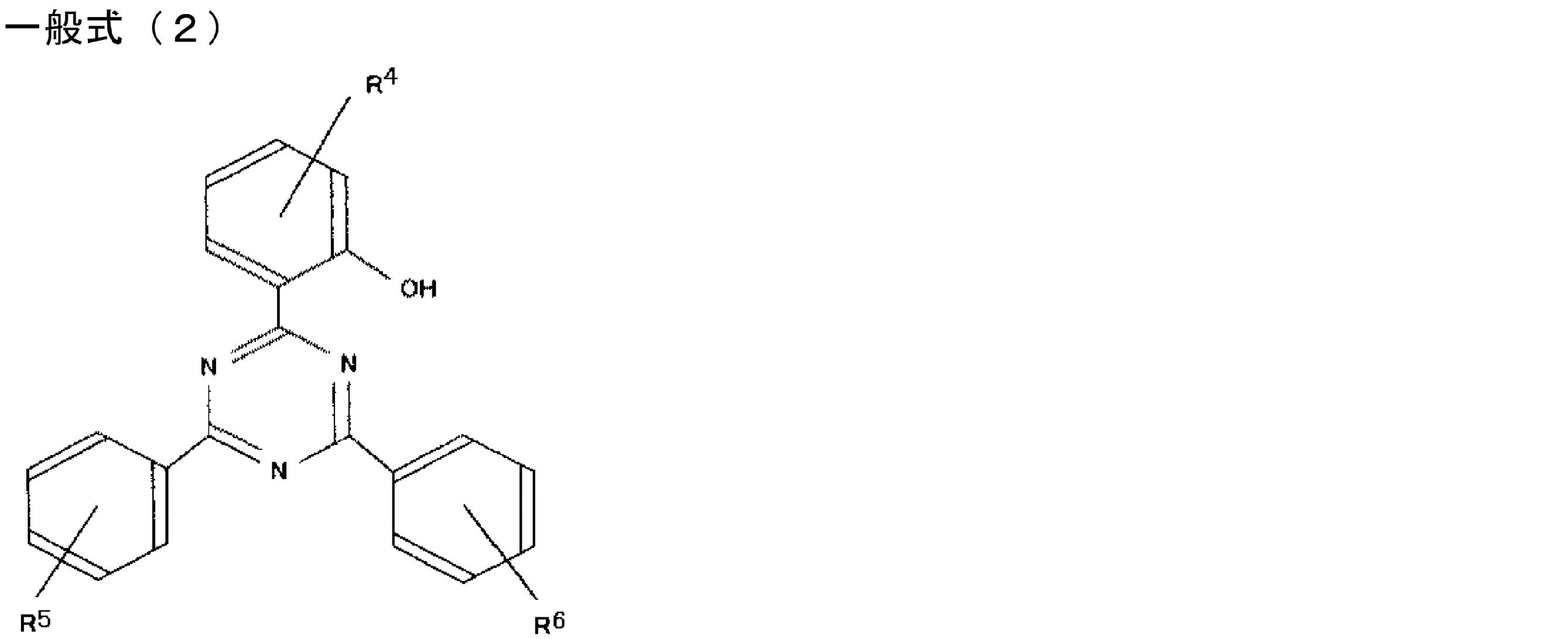
上式において、R4、R5およびR6は、水素原子、水酸基、アルキル基系構造体またはハロゲン原子であって、R4、R5およびR6のすべてが水素原子であることはない。なお、アルキル基系構造体とは、置換もしくは無置換のアルキル基や、置換もしくは無置換のアルコキシ基などのアルキル基を主とする置換基を含む概念である。
中でも、基本骨格の芳香環に分子量の大きなアルキル基を導入することにより相溶性を向上させ、23℃で液状または油状を示す紫外線吸収剤を、特に好ましく用いることができる。ここで、23℃で液状または油状を示すとは、希釈溶剤がなくても紫外線吸収剤のみで流動性がある状態を意味する。
紫外線吸収剤としては、市販品を使用できる。市販品の例としては、BASFジャパン(株)社製のトリアジン系紫外線吸収剤(チヌビン477)、ベンゾトリアゾール系紫外線吸収剤(チヌビン109、チヌビン384-2、チヌビンPS)等を挙げることができる。
紫外線吸収剤の含有量は、光学用フィルムを構成する樹脂100質量部に対して0.1~10質量部であることが好ましく、0.5~8質量部であることがより好ましく、1~6質量部であることがさらに好ましい。本実施形態における紫外線吸収剤の含有量は、波長380nmでの紫外線透過率が10%未満となる量に調整することが好ましい。すなわち、本発明の光学用フィルムの波長380nmでの紫外線透過率は10%未満であることが好ましい。上記紫外線吸収剤は1種類を単独で用いても2種類以上を併用してもよく、2種類以上を併用する場合は、合計質量が上記範囲内であることが好ましい。
(他の成分)
本実施形態の光学用フィルムは、本発明所望の効果を損なわない範囲で、上記以外の他の成分を含有してもよい。他の成分としては、ブロッキング防止剤、帯電防止剤、酸化防止剤等の公知の成分を挙げることができる。
本実施形態の光学用フィルムは、本発明所望の効果を損なわない範囲で、上記以外の他の成分を含有してもよい。他の成分としては、ブロッキング防止剤、帯電防止剤、酸化防止剤等の公知の成分を挙げることができる。
(着色剤を含む光学用フィルムの製造方法)
本実施形態の光学用フィルムの製造方法は、樹脂と着色剤を含む樹脂塗工液を塗工して塗膜を形成する工程と、該塗膜を乾燥する工程とを含むことが好ましい。ここで、着色剤は、金属酸化物及びカーボンブラックから選択される少なくとも1種である。また、上記製造方法で製造される光学用フィルムのヘーズは0.1~15%であるか、もしくは上記製造方法で製造される光学用フィルムの全光線透過率は30~90%である。さらに、上記製造方法で製造される光学用フィルムヘーズは0.1~15%であり、全光線透過率は30~90%であり、ヘーズと全光線透過率の積は180以下であることが好ましい。本実施形態においては、得られる光学用フィルムの色相均一性を向上させるために、樹脂と着色剤を含む樹脂塗工液を塗工することで光学用フィルムを形成することが好ましい。
本実施形態の光学用フィルムの製造方法は、樹脂と着色剤を含む樹脂塗工液を塗工して塗膜を形成する工程と、該塗膜を乾燥する工程とを含むことが好ましい。ここで、着色剤は、金属酸化物及びカーボンブラックから選択される少なくとも1種である。また、上記製造方法で製造される光学用フィルムのヘーズは0.1~15%であるか、もしくは上記製造方法で製造される光学用フィルムの全光線透過率は30~90%である。さらに、上記製造方法で製造される光学用フィルムヘーズは0.1~15%であり、全光線透過率は30~90%であり、ヘーズと全光線透過率の積は180以下であることが好ましい。本実施形態においては、得られる光学用フィルムの色相均一性を向上させるために、樹脂と着色剤を含む樹脂塗工液を塗工することで光学用フィルムを形成することが好ましい。
樹脂塗工液を塗工して塗膜を形成する工程は、樹脂を有機溶媒に溶解する工程を含むことが好ましい。この場合、樹脂を溶解する有機溶媒の沸点は120℃以下であることが特に好ましい。樹脂塗工液を塗工して塗膜を形成する工程では、樹脂を有機溶媒に溶解する工程の後に、樹脂溶液に着色剤を添加する工程が設けられることが好ましい。なお、樹脂塗工液を塗工して塗膜を形成する工程では、樹脂と着色剤を同時に有機溶媒に混合してもよい。
樹脂塗工液を塗工して塗膜を形成する工程で用いられる有機溶媒としては、例えば、酢酸エチル、メチルエチルケトン、アセトン等を用いることが好ましい。
樹脂と着色剤を含む樹脂塗工液の塗工は、公知の塗工装置を用いて実施できる。塗工装置としては、例えば、ブレードコーター、エアナイフコーター、ロールコーター、バーコーター、グラビアコーター、マイクログラビアコーター、ロッドブレードコーター、リップコーター、ダイコーター、カーテンコーター等が挙げられる。これらの中でも、支持体へ樹脂塗工液を塗工した後に所望の厚みに調整する計量工程を経ない、前計量方式の塗工装置を用いることが好ましい。これにより、光学用フィルムの表面均一性を低下させたり、筋状の傷を発生させたりすることを回避しやすくなる。なお、樹脂塗工液を塗工する支持体としては、金属板や樹脂フィルム等を挙げることができる。
塗膜を乾燥する工程では、湿潤塗膜を加熱する工程を含むことが好ましい。この場合、塗膜の加熱には、加熱炉、赤外線ランプ等の公知の加熱装置を用いることができる。
(用途)
本実施形態の光学用フィルムの用途は特に限定されるものではないが、光学部材用として用いられることが好ましい。例えば粘着シートを用いて本実施形態の光学用フィルムと他の部材と貼合し、ディスプレイ等の画像表示装置に用いることができる。これにより、周辺部材との色相の統一感を高めて意匠性を付与することができる。
本実施形態の光学用フィルムの用途は特に限定されるものではないが、光学部材用として用いられることが好ましい。例えば粘着シートを用いて本実施形態の光学用フィルムと他の部材と貼合し、ディスプレイ等の画像表示装置に用いることができる。これにより、周辺部材との色相の統一感を高めて意匠性を付与することができる。
中でも、本実施形態の光学用フィルムは、ディスプレイ等の画像表示装置に好適に用いられる。例えば、スマートフォン、パーソナルコンピューター、車両用ナビゲーションシステム、携帯型ゲーム機等に用いられるディスプレイが例示できる。
本実施形態においては、樹脂としてポリイミド等樹脂を用いた場合、ガラス代替としての用途も想定でき、この場合には画像表示装置破損時のガラス飛散による事故を防止できるとともに、部材の軽量化を図ることができるため好ましい。
以下に実施例と比較例を挙げて本発明の特徴をさらに具体的に説明する。以下の実施例に示す材料、使用量、割合、処理内容、処理手順等は、本発明の趣旨を逸脱しない限り適宜変更することができる。したがって、本発明の範囲は以下に示す具体例により限定的に解釈されるべきものではない。
<ポリイミド樹脂溶液の調製>
ポリイミド樹脂として、化学イミド化が完了し粉体で供給される樹脂(商品名:KPI-MX300F、河村産業株式会社製)を酢酸エチルにプロペラミキサーで溶解し、15質量%のポリイミド樹脂溶液を得た。
ポリイミド樹脂として、化学イミド化が完了し粉体で供給される樹脂(商品名:KPI-MX300F、河村産業株式会社製)を酢酸エチルにプロペラミキサーで溶解し、15質量%のポリイミド樹脂溶液を得た。
(実施例1)
ポリイミド樹脂溶液中のポリイミド樹脂100質量部に対して、着色剤として銅、鉄、マンガン系酸化物系顔料(商品名:TMブラック3550、大日精化工業株式会社製)を0.1質量部添加し、固形分濃度が12質量%となるように酢酸エチルを添加して着色フィルム形成用組成物を得た。
ポリイミド樹脂溶液中のポリイミド樹脂100質量部に対して、着色剤として銅、鉄、マンガン系酸化物系顔料(商品名:TMブラック3550、大日精化工業株式会社製)を0.1質量部添加し、固形分濃度が12質量%となるように酢酸エチルを添加して着色フィルム形成用組成物を得た。
上記着色フィルム形成用組成物を、厚み250μmのポリエチレンテレフタレートフィルム(商品名:ルミラー250T60、東レ株式会社製)上へ塗工した。塗工は、ヨシミツ精機株式会社製、ドクターブレードYD型を用いて、乾燥後の厚みが25μmとなるように行った。その後、熱風乾燥機にて100℃で5分間乾燥させて溶剤を除去し、ポリエチレンテレフタレートフィルムから剥離して着色光学用フィルムを得た。
(実施例2)
着色剤の添加量を0.6質量部に変更した以外は、実施例1と同様にして着色光学用フィルムを得た。
着色剤の添加量を0.6質量部に変更した以外は、実施例1と同様にして着色光学用フィルムを得た。
(実施例3)
着色剤の添加量を0.9質量部に変更した以外は、実施例1と同様にして着色光学用フィルムを得た。
着色剤の添加量を0.9質量部に変更した以外は、実施例1と同様にして着色光学用フィルムを得た。
(実施例4)
着色剤を、カーボンブラック(商品名:マルチラック A 903 ブラックトーヨーカラー株式会社製)0.3質量部に変更した以外は実施例1と同様にして着色光学用フィルムを得た。
着色剤を、カーボンブラック(商品名:マルチラック A 903 ブラックトーヨーカラー株式会社製)0.3質量部に変更した以外は実施例1と同様にして着色光学用フィルムを得た。
(実施例5)
着色剤を、銅系顔料(商品名:クロモファイン PB-15:3)に変更し、添加量を0.1質量部に変更した以外は、実施例1と同様にして着色光学用フィルムを得た。
着色剤を、銅系顔料(商品名:クロモファイン PB-15:3)に変更し、添加量を0.1質量部に変更した以外は、実施例1と同様にして着色光学用フィルムを得た。
(実施例6)
ポリイミド樹脂溶液に代え、環状オレフィン樹脂(商品名:アートン(登録商標)F4520)を15質量%となるようトルエンに溶解した樹脂溶液を使用し、着色剤添加後の酢酸エチル添加に代え、トルエンを添加した以外は、実施例2と同様にして着色光学用フィルムを得た。
ポリイミド樹脂溶液に代え、環状オレフィン樹脂(商品名:アートン(登録商標)F4520)を15質量%となるようトルエンに溶解した樹脂溶液を使用し、着色剤添加後の酢酸エチル添加に代え、トルエンを添加した以外は、実施例2と同様にして着色光学用フィルムを得た。
(実施例7)
着色剤を、酸化チタン顔料(御国色素(株)社製、MHIブラック#PD-367M)0.63質量部に変更した以外は実施例1と同様にして着色光学用フィルムを得た。
着色剤を、酸化チタン顔料(御国色素(株)社製、MHIブラック#PD-367M)0.63質量部に変更した以外は実施例1と同様にして着色光学用フィルムを得た。
(比較例1)
着色剤を添加しなかった以外は実施例1と同様にして光学用フィルムを得た。
着色剤を添加しなかった以外は実施例1と同様にして光学用フィルムを得た。
(比較例2)
着色剤添加量を、1.5質量部に変更した以外は、実施例1と同様にして着色光学用フィルムを得た。
着色剤添加量を、1.5質量部に変更した以外は、実施例1と同様にして着色光学用フィルムを得た。
(比較例3)
黒インキ(商品名:FD O ニュー 墨 HF1、東洋インキ株式会社製)を用い、RI印刷機(商品名:RI-3、石川島産業機械製)にてインキを均一にロール上に展開し、フィルムの全光線透過率が表1の値となるようにインキ量を調整し、比較例1で得られた透明フィルムに印刷した。印刷したフィルムを、常温にて3日放置し、着色光学用フィルムを得た。
黒インキ(商品名:FD O ニュー 墨 HF1、東洋インキ株式会社製)を用い、RI印刷機(商品名:RI-3、石川島産業機械製)にてインキを均一にロール上に展開し、フィルムの全光線透過率が表1の値となるようにインキ量を調整し、比較例1で得られた透明フィルムに印刷した。印刷したフィルムを、常温にて3日放置し、着色光学用フィルムを得た。
(評価)
<光学特性>
実施例及び比較例で得られた光学用フィルムを210mm×297mのサイズで切り出し、光学特性測定用サンプルとした。このサンプルの全光線透過率とヘーズを、JIS K 7150に準拠し、積分球式光線透過率測定装置(日本電色工業社製、NDH-5000)を用いて測定した。この測定は3回行い、平均値を測定値とした。
<光学特性>
実施例及び比較例で得られた光学用フィルムを210mm×297mのサイズで切り出し、光学特性測定用サンプルとした。このサンプルの全光線透過率とヘーズを、JIS K 7150に準拠し、積分球式光線透過率測定装置(日本電色工業社製、NDH-5000)を用いて測定した。この測定は3回行い、平均値を測定値とした。
<意匠性>
光学特性測定と同様にサンプルを作製し、ディスプレイ周辺部材が黒色である画像表示装置において、黒画面を表示したディスプレイ上にフィルム載せて評価した。ただし、実施例5のみ、着色フィルムは青く着色されており、ディスプレイ周辺部材が青色の画像表示装置を使用した。
A:何も乗せないときと比べ、周辺部材との色相が近く意匠性が向上した
C:変化無し
光学特性測定と同様にサンプルを作製し、ディスプレイ周辺部材が黒色である画像表示装置において、黒画面を表示したディスプレイ上にフィルム載せて評価した。ただし、実施例5のみ、着色フィルムは青く着色されており、ディスプレイ周辺部材が青色の画像表示装置を使用した。
A:何も乗せないときと比べ、周辺部材との色相が近く意匠性が向上した
C:変化無し
<白化抑制性>
光学特性測定と同様にサンプルを作製し、ディスプレイ周辺部材が黒色である画像表示装置において、消灯したディスプレイ上にフィルム載せ、太陽光下で評価した。ただし、実施例5のみ、着色フィルムは青く着色されており、ディスプレイ周辺部材が青色の画像表示装置を使用した。
A:何も乗せないときと比べ、画面の白色化が抑えられた
B:画面の白色化は抑えられたが、画面がやや赤みを帯びて白色化抑制効果がやや劣った
C:何も乗せないときと同様に、画面が白色化した
光学特性測定と同様にサンプルを作製し、ディスプレイ周辺部材が黒色である画像表示装置において、消灯したディスプレイ上にフィルム載せ、太陽光下で評価した。ただし、実施例5のみ、着色フィルムは青く着色されており、ディスプレイ周辺部材が青色の画像表示装置を使用した。
A:何も乗せないときと比べ、画面の白色化が抑えられた
B:画面の白色化は抑えられたが、画面がやや赤みを帯びて白色化抑制効果がやや劣った
C:何も乗せないときと同様に、画面が白色化した
<視認性>
光学特性測定と同様にサンプルを作製し、文字を表示したディスプレイ上に載せて評価した。
A:にじみ、ボケが見られない
C:にじみ、ボケが見られる
光学特性測定と同様にサンプルを作製し、文字を表示したディスプレイ上に載せて評価した。
A:にじみ、ボケが見られない
C:にじみ、ボケが見られる
<微小文字認識性>
光学特性測定と同様にサンプルを作製し、文字を表示したディスプレイ上に載せて評価した。評価は、上述した視認性の評価より小さい文字の視認性を確認するため、ディスプレイ上の文字サイズが2×2mmのサイズで行った。
A:にじみ、ボケが見られず、文字の認識が非常に容易である
B:にじみ、ボケが見られず、文字が認識できる
C:にじみ、ボケが見られ、文字の認識が困難である
光学特性測定と同様にサンプルを作製し、文字を表示したディスプレイ上に載せて評価した。評価は、上述した視認性の評価より小さい文字の視認性を確認するため、ディスプレイ上の文字サイズが2×2mmのサイズで行った。
A:にじみ、ボケが見られず、文字の認識が非常に容易である
B:にじみ、ボケが見られず、文字が認識できる
C:にじみ、ボケが見られ、文字の認識が困難である
<耐擦傷性>
実施例及び比較例で得られた光学用フィルムに対し、#320の耐水サンドペーパー(ソフト99コーポレーション製)を押し付け、10往復させた。サンドペーパー処理による傷発生個所のフィルム色相を下記基準で評価した。
A:傷の発生があっても、フィルム色相はほぼ変化がない
C:傷により着色程度が大きく変化し、フィルム色相変化が大きい
実施例及び比較例で得られた光学用フィルムに対し、#320の耐水サンドペーパー(ソフト99コーポレーション製)を押し付け、10往復させた。サンドペーパー処理による傷発生個所のフィルム色相を下記基準で評価した。
A:傷の発生があっても、フィルム色相はほぼ変化がない
C:傷により着色程度が大きく変化し、フィルム色相変化が大きい
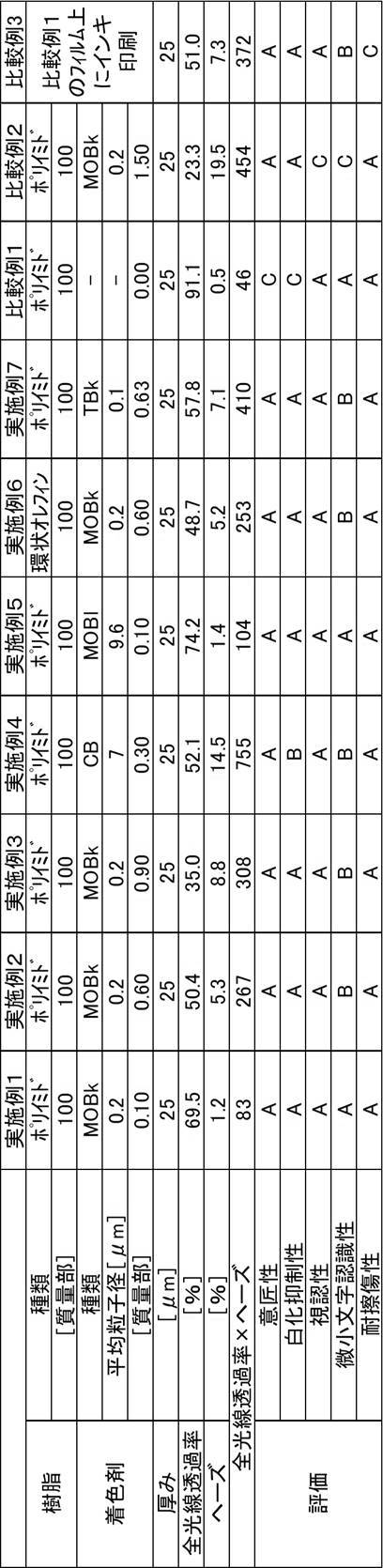
MOBk:黒色金属酸化物
MOBl:青色金属酸化物
CB:カーボンブラック
TBk:酸化チタン(黒色金属酸化物)
MOBl:青色金属酸化物
CB:カーボンブラック
TBk:酸化チタン(黒色金属酸化物)
(実施例11)
ポリイミド樹脂溶液中のポリイミド樹脂100質量部に対して、着色剤として銅、鉄、マンガン系酸化物系顔料(商品名:TMブラック3550、大日精化工業株式会社製)を0.05質量部、紫外線吸収剤(BASFジャパン(株)製、商品名:チヌビン477)を2質量部添加し、固形分濃度が12質量%となるように酢酸エチルを添加して着色フィルム形成用組成物を得た。
ポリイミド樹脂溶液中のポリイミド樹脂100質量部に対して、着色剤として銅、鉄、マンガン系酸化物系顔料(商品名:TMブラック3550、大日精化工業株式会社製)を0.05質量部、紫外線吸収剤(BASFジャパン(株)製、商品名:チヌビン477)を2質量部添加し、固形分濃度が12質量%となるように酢酸エチルを添加して着色フィルム形成用組成物を得た。
上記着色フィルム形成用組成物を、厚み250μmのポリエチレンテレフタレートフィルム(商品名:ルミラー250T60、東レ株式会社製)上へ塗工した。塗工は、ヨシミツ精機株式会社製、ドクターブレードYD型を用いて、乾燥後の厚みが25μmとなるように行った。その後、熱風乾燥機にて100℃で5分間乾燥させて溶剤を除去し、ポリエチレンテレフタレートフィルムから剥離して着色光学用フィルムを得た。
(実施例12)
着色剤の添加量を0.21質量部に変更した以外は、実施例11と同様にして着色光学用フィルムを得た。
着色剤の添加量を0.21質量部に変更した以外は、実施例11と同様にして着色光学用フィルムを得た。
(実施例13)
着色剤の添加量を0.33質量部に変更した以外は、実施例11と同様にして着色光学用フィルムを得た。
着色剤の添加量を0.33質量部に変更した以外は、実施例11と同様にして着色光学用フィルムを得た。
(実施例14)
着色剤を、カーボンブラック(商品名:マルチラック A 903 ブラックトーヨーカラー株式会社製)0.08質量部に変更した以外は実施例11と同様にして着色光学用フィルムを得た。
着色剤を、カーボンブラック(商品名:マルチラック A 903 ブラックトーヨーカラー株式会社製)0.08質量部に変更した以外は実施例11と同様にして着色光学用フィルムを得た。
(実施例15)
ポリイミド樹脂溶液に代え、環状オレフィン樹脂(商品名:アートン(登録商標)F4520)を15質量%となるようトルエンに溶解した樹脂溶液を使用し、着色剤及び紫外線吸収剤を添加後の酢酸エチル添加に代え、トルエンを添加した以外は、実施例11と同様にして着色光学用フィルムを得た。
ポリイミド樹脂溶液に代え、環状オレフィン樹脂(商品名:アートン(登録商標)F4520)を15質量%となるようトルエンに溶解した樹脂溶液を使用し、着色剤及び紫外線吸収剤を添加後の酢酸エチル添加に代え、トルエンを添加した以外は、実施例11と同様にして着色光学用フィルムを得た。
(実施例16)
着色剤を、酸化チタン顔料(御国色素(株)社製、MHIブラック#PD-367M)0.44質量部に変更した以外は実施例11と同様にして着色光学用フィルムを得た。
着色剤を、酸化チタン顔料(御国色素(株)社製、MHIブラック#PD-367M)0.44質量部に変更した以外は実施例11と同様にして着色光学用フィルムを得た。
(比較例11)
着色剤及び紫外線吸収剤を添加しなかった以外は実施例11と同様にして光学用フィルムを得た。
着色剤及び紫外線吸収剤を添加しなかった以外は実施例11と同様にして光学用フィルムを得た。
(比較例12)
着色剤を添加しなかった以外は実施例11と同様にして光学用フィルムを得た。
着色剤を添加しなかった以外は実施例11と同様にして光学用フィルムを得た。
(比較例13)
黒インキ(商品名:FD O ニュー 墨 HF1、東洋インキ株式会社製)を用い、RI印刷機(商品名:RI-3、石川島産業機械製)にてインキを均一にロール上に展開し、フィルムの全光線透過率が表1の値となるようにインキ量を調整し、比較例12で得られた透明フィルムに印刷した。印刷したフィルムを、常温にて3日放置し、着色光学用フィルムを得た。
黒インキ(商品名:FD O ニュー 墨 HF1、東洋インキ株式会社製)を用い、RI印刷機(商品名:RI-3、石川島産業機械製)にてインキを均一にロール上に展開し、フィルムの全光線透過率が表1の値となるようにインキ量を調整し、比較例12で得られた透明フィルムに印刷した。印刷したフィルムを、常温にて3日放置し、着色光学用フィルムを得た。
(評価)
<光学特性>
上述した方法と同様の方法で光学用フィルムの全光線透過率とヘーズを測定した。
<光学特性>
上述した方法と同様の方法で光学用フィルムの全光線透過率とヘーズを測定した。
<意匠性>
上述した方法と同様の方法で光学用フィルムの意匠性を評価した。
上述した方法と同様の方法で光学用フィルムの意匠性を評価した。
<白化抑制性>
上述した方法と同様の方法で光学用フィルムの白化抑制性を評価した。
上述した方法と同様の方法で光学用フィルムの白化抑制性を評価した。
<視認性>
光学特性測定と同様にサンプルを作製し、文字を表示したディスプレイ上に載せて評価した。
A:にじみ、ボケが見られない
B:にじみ、ボケが僅かにみられるが、実用上問題ない
C:にじみ、ボケが見られて文字が判読できない
光学特性測定と同様にサンプルを作製し、文字を表示したディスプレイ上に載せて評価した。
A:にじみ、ボケが見られない
B:にじみ、ボケが僅かにみられるが、実用上問題ない
C:にじみ、ボケが見られて文字が判読できない
<微小文字認識性>
光学特性測定と同様にサンプルを作製し、文字を表示したディスプレイ上に載せて評価した。評価は、上述した視認性の評価より小さい文字の視認性を確認するため、ディスプレイ上の文字サイズが2×2mmのサイズで行った。
A:にじみ、ボケが見られず、文字の認識が非常に容易である
B:にじみ、ボケが見られず、文字が認識できる
C:にじみ、ボケが見られ、文字の認識が困難である
光学特性測定と同様にサンプルを作製し、文字を表示したディスプレイ上に載せて評価した。評価は、上述した視認性の評価より小さい文字の視認性を確認するため、ディスプレイ上の文字サイズが2×2mmのサイズで行った。
A:にじみ、ボケが見られず、文字の認識が非常に容易である
B:にじみ、ボケが見られず、文字が認識できる
C:にじみ、ボケが見られ、文字の認識が困難である
<UVカット>
自記分光光度計(型式:UV-3100PC、島津製作所社製)を用い、波長380nmの分光透過率を測定し、以下の評価基準で評価した。
A:波長380nmの分光透過率が10%未満
C:波長380nmの分光透過率が10%以上
自記分光光度計(型式:UV-3100PC、島津製作所社製)を用い、波長380nmの分光透過率を測定し、以下の評価基準で評価した。
A:波長380nmの分光透過率が10%未満
C:波長380nmの分光透過率が10%以上
<耐擦傷性>
上述した方法と同様の方法で光学用フィルムの耐擦傷性を評価した。
上述した方法と同様の方法で光学用フィルムの耐擦傷性を評価した。
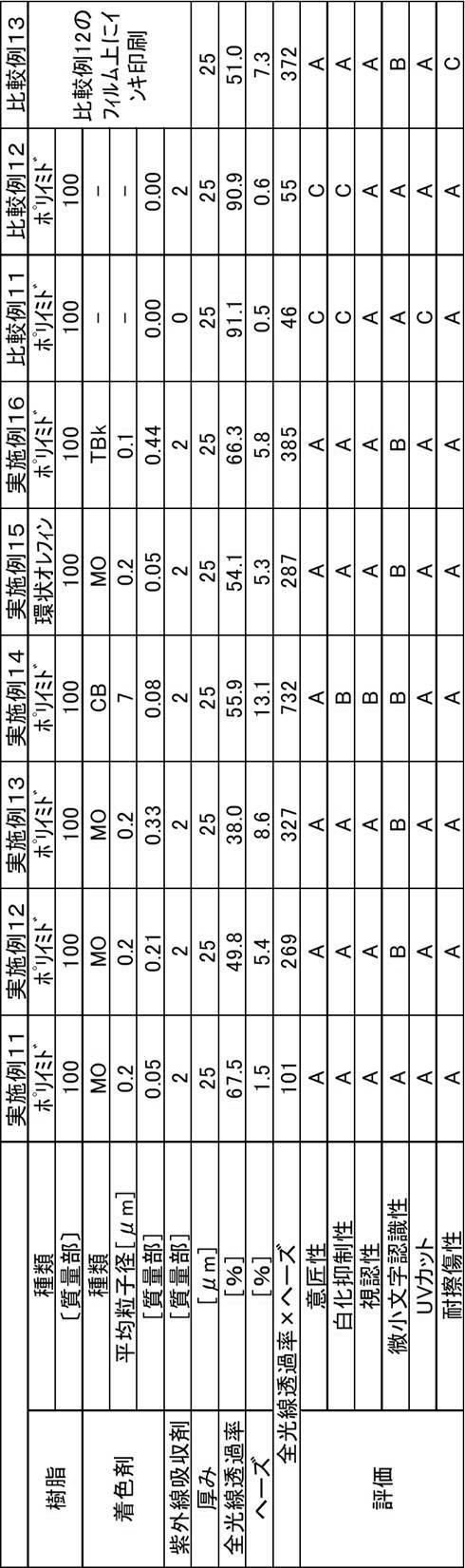
MO:金属酸化物
CB:カーボンブラック
TBk:酸化チタン(黒色金属酸化物)
CB:カーボンブラック
TBk:酸化チタン(黒色金属酸化物)
(実施例101)
ポリイミド樹脂溶液中のポリイミド樹脂100質量部に対して、着色剤として銅、鉄、マンガン系酸化物系顔料(商品名:TMブラック3550、大日精化工業株式会社製)を0.06質量部添加し、固形分濃度が12質量%となるように酢酸エチルを添加して着色フィルム形成用組成物を得た。
ポリイミド樹脂溶液中のポリイミド樹脂100質量部に対して、着色剤として銅、鉄、マンガン系酸化物系顔料(商品名:TMブラック3550、大日精化工業株式会社製)を0.06質量部添加し、固形分濃度が12質量%となるように酢酸エチルを添加して着色フィルム形成用組成物を得た。
上記着色フィルム形成用組成物を、厚み250μmのポリエチレンテレフタレートフィルム(商品名:ルミラー250T60、東レ株式会社製)上へ塗工した。塗工は、ヨシミツ精機株式会社製、ドクターブレードYD型を用いて、乾燥後の厚みが25μmとなるように行った。その後、熱風乾燥機にて100℃で5分間乾燥させて溶剤を除去し、ポリエチレンテレフタレートフィルムから剥離して着色光学用フィルムを得た。
(実施例102)
着色剤の添加量を0.15質量部に変更した以外は、実施例101と同様にして着色光学用フィルムを得た。
着色剤の添加量を0.15質量部に変更した以外は、実施例101と同様にして着色光学用フィルムを得た。
(実施例103)
着色剤の添加量を0.3質量部に変更した以外は、実施例101と同様にして着色光学用フィルムを得た。
着色剤の添加量を0.3質量部に変更した以外は、実施例101と同様にして着色光学用フィルムを得た。
(実施例104)
着色剤を、カーボンブラック(商品名:マルチラック A 903 ブラックトーヨーカラー株式会社製)0.04質量部に変更した以外は実施例101と同様にして着色光学用フィルムを得た。
着色剤を、カーボンブラック(商品名:マルチラック A 903 ブラックトーヨーカラー株式会社製)0.04質量部に変更した以外は実施例101と同様にして着色光学用フィルムを得た。
(実施例105)
ポリイミド樹脂溶液に代え、環状オレフィン樹脂(商品名:アートン(登録商標)F4520)を15質量%となるようトルエンに溶解した樹脂溶液を使用し、着色剤添加後の酢酸エチル添加に代え、トルエンを添加した以外は、実施例102と同様にして着色光学用フィルムを得た。
ポリイミド樹脂溶液に代え、環状オレフィン樹脂(商品名:アートン(登録商標)F4520)を15質量%となるようトルエンに溶解した樹脂溶液を使用し、着色剤添加後の酢酸エチル添加に代え、トルエンを添加した以外は、実施例102と同様にして着色光学用フィルムを得た。
(実施例106)
着色剤を、酸化チタン顔料(御国色素(株)社製、MHIブラック#PD-367M)0.23質量部に変更した以外は実施例101と同様にして着色光学用フィルムを得た。
着色剤を、酸化チタン顔料(御国色素(株)社製、MHIブラック#PD-367M)0.23質量部に変更した以外は実施例101と同様にして着色光学用フィルムを得た。
(比較例101)
着色剤を添加しなかった以外は実施例101と同様にして光学用フィルムを得た。
着色剤を添加しなかった以外は実施例101と同様にして光学用フィルムを得た。
(比較例102)
黒インキ(商品名:FD O ニュー 墨 HF1、東洋インキ株式会社製)を用い、RI印刷機(商品名:RI-3、石川島産業機械製)にてインキを均一にロール上に展開し、フィルムの全光線透過率が表1の値となるようにインキ量を調整し、比較例101で得られた透明フィルムに印刷した。印刷したフィルムを、常温にて3日放置し、着色光学用フィルムを得た。
黒インキ(商品名:FD O ニュー 墨 HF1、東洋インキ株式会社製)を用い、RI印刷機(商品名:RI-3、石川島産業機械製)にてインキを均一にロール上に展開し、フィルムの全光線透過率が表1の値となるようにインキ量を調整し、比較例101で得られた透明フィルムに印刷した。印刷したフィルムを、常温にて3日放置し、着色光学用フィルムを得た。
(評価)
<光学特性>
上述した方法と同様の方法で光学用フィルムの全光線透過率とヘーズを測定した。
<光学特性>
上述した方法と同様の方法で光学用フィルムの全光線透過率とヘーズを測定した。
<意匠性>
上述した方法と同様の方法で光学用フィルムの意匠性を評価した。
上述した方法と同様の方法で光学用フィルムの意匠性を評価した。
<白化抑制性>
上述した方法と同様の方法で光学用フィルムの白化抑制性を評価した。
上述した方法と同様の方法で光学用フィルムの白化抑制性を評価した。
<視認性>
光学特性測定と同様にサンプルを作製し、文字を表示したディスプレイ上に載せて評価した。
A:にじみ、ボケが見られない
B:にじみ、ボケが僅かにみられるが、実用上問題ない
C:にじみ、ボケが見られて文字が判読できない
光学特性測定と同様にサンプルを作製し、文字を表示したディスプレイ上に載せて評価した。
A:にじみ、ボケが見られない
B:にじみ、ボケが僅かにみられるが、実用上問題ない
C:にじみ、ボケが見られて文字が判読できない
<微小文字認識性>
光学特性測定と同様にサンプルを作製し、文字を表示したディスプレイ上に載せて評価した。評価は、上述した視認性の評価より小さい文字の視認性を確認するため、ディスプレイ上の文字サイズが2×2mmのサイズで行った。
A:にじみ、ボケが見られず、文字の認識が非常に容易である
B:にじみ、ボケが見られず、文字が認識できる
C:にじみ、ボケが見られ、文字の認識が困難である
光学特性測定と同様にサンプルを作製し、文字を表示したディスプレイ上に載せて評価した。評価は、上述した視認性の評価より小さい文字の視認性を確認するため、ディスプレイ上の文字サイズが2×2mmのサイズで行った。
A:にじみ、ボケが見られず、文字の認識が非常に容易である
B:にじみ、ボケが見られず、文字が認識できる
C:にじみ、ボケが見られ、文字の認識が困難である
<耐擦傷性>
上述した方法と同様の方法で光学用フィルムの耐擦傷性を評価した。
上述した方法と同様の方法で光学用フィルムの耐擦傷性を評価した。
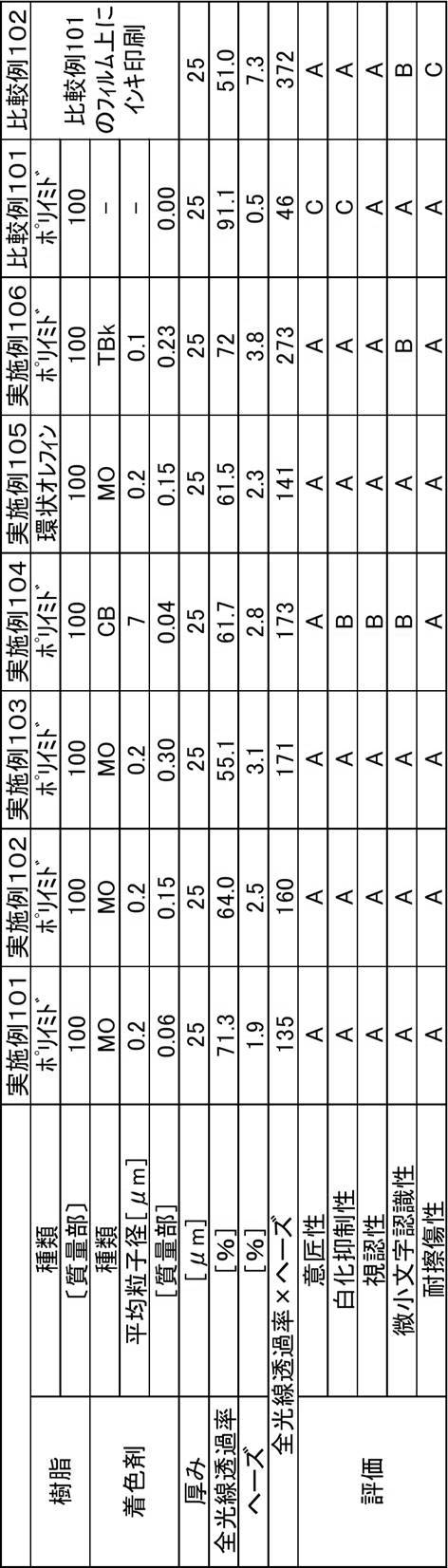
MO:金属酸化物
CB:カーボンブラック
TBk:酸化チタン(黒色金属酸化物)
CB:カーボンブラック
TBk:酸化チタン(黒色金属酸化物)
Claims (10)
- 樹脂と着色剤とを単一層内に含む光学用フィルムであって、
前記着色剤は、金属酸化物及びカーボンブラックから選択される少なくとも1種であり、
前記光学用フィルムのヘーズが0.1~15%であるか、もしくは、
前記光学用フィルムの全光線透過率が30~90%である、光学用フィルム。 - 前記光学用フィルムのヘーズが0.1~15%であり、かつ前記光学用フィルムの全光線透過率が30~90%である、請求項1に記載の光学用フィルム。
- 前記光学用フィルムのヘーズが0.1~15%であり、前記光学用フィルムの全光線透過率が30~90%であり、ヘーズと全光線透過率の積が180以下である、請求項1又は2に記載の光学用フィルム。
- 前記樹脂がポリイミド及びポリアミドイミドから選択される少なくとも1種を含有する、請求項1~3のいずれか1項に記載の光学用フィルム。
- 前記ポリイミド及び前記ポリアミドイミドは、有機溶媒に可溶な樹脂である、請求項4に記載の光学用フィルム。
- 前記ポリイミド及び前記ポリアミドイミドは、沸点が120℃以下の有機溶媒に可溶な樹脂である、請求項4又は5に記載の光学用フィルム。
- 前記着色剤が金属酸化物である、請求項1~6のいずれか1項に記載の光学用フィルム。
- 前記着色剤の平均粒子径が0.01~15μmである、請求項1~7のいずれか1項に記載の光学用フィルム。
- 厚みが1~500μmである、請求項1~8のいずれか1項に記載の光学用フィルム。
- 紫外線吸収剤をさらに含む、請求項1~9のいずれか1項に記載の光学用フィルム。
Applications Claiming Priority (6)
| Application Number | Priority Date | Filing Date | Title |
|---|---|---|---|
| JP2020-041989 | 2020-03-11 | ||
| JP2020041990A JP2021143255A (ja) | 2020-03-11 | 2020-03-11 | 光学用フィルム |
| JP2020-041990 | 2020-03-11 | ||
| JP2020041991A JP2021143256A (ja) | 2020-03-11 | 2020-03-11 | 光学用フィルム |
| JP2020041989A JP2021143254A (ja) | 2020-03-11 | 2020-03-11 | 光学用フィルム |
| JP2020-041991 | 2020-03-11 |
Publications (1)
| Publication Number | Publication Date |
|---|---|
| WO2021182565A1 true WO2021182565A1 (ja) | 2021-09-16 |
Family
ID=77671711
Family Applications (1)
| Application Number | Title | Priority Date | Filing Date |
|---|---|---|---|
| PCT/JP2021/009759 Ceased WO2021182565A1 (ja) | 2020-03-11 | 2021-03-11 | 光学用フィルム |
Country Status (2)
| Country | Link |
|---|---|
| TW (1) | TW202140644A (ja) |
| WO (1) | WO2021182565A1 (ja) |
Citations (6)
| Publication number | Priority date | Publication date | Assignee | Title |
|---|---|---|---|---|
| JPS63241804A (ja) * | 1987-03-30 | 1988-10-07 | 東レ株式会社 | 透明導電性フイルム |
| JP2004149548A (ja) * | 2000-06-28 | 2004-05-27 | Teijin Ltd | 光学用二軸配向ポリエステルフィルム、易接着フィルムおよび積層体 |
| JP2012167169A (ja) * | 2011-02-14 | 2012-09-06 | Mitsubishi Gas Chemical Co Inc | 着色遮光ポリイミドフィルム |
| JP2014145076A (ja) * | 2013-01-28 | 2014-08-14 | Taimide Technology Inc | 着色ポリイミド艶消し粉末を組み込んだポリイミドフィルム及びその製造 |
| JP2017125130A (ja) * | 2016-01-14 | 2017-07-20 | 三菱ケミカル株式会社 | 着色アクリル樹脂フィルム |
| JP2020037658A (ja) * | 2018-09-05 | 2020-03-12 | 王子ホールディングス株式会社 | 光学部材貼合用粘着シート |
-
2021
- 2021-03-11 TW TW110108727A patent/TW202140644A/zh unknown
- 2021-03-11 WO PCT/JP2021/009759 patent/WO2021182565A1/ja not_active Ceased
Patent Citations (6)
| Publication number | Priority date | Publication date | Assignee | Title |
|---|---|---|---|---|
| JPS63241804A (ja) * | 1987-03-30 | 1988-10-07 | 東レ株式会社 | 透明導電性フイルム |
| JP2004149548A (ja) * | 2000-06-28 | 2004-05-27 | Teijin Ltd | 光学用二軸配向ポリエステルフィルム、易接着フィルムおよび積層体 |
| JP2012167169A (ja) * | 2011-02-14 | 2012-09-06 | Mitsubishi Gas Chemical Co Inc | 着色遮光ポリイミドフィルム |
| JP2014145076A (ja) * | 2013-01-28 | 2014-08-14 | Taimide Technology Inc | 着色ポリイミド艶消し粉末を組み込んだポリイミドフィルム及びその製造 |
| JP2017125130A (ja) * | 2016-01-14 | 2017-07-20 | 三菱ケミカル株式会社 | 着色アクリル樹脂フィルム |
| JP2020037658A (ja) * | 2018-09-05 | 2020-03-12 | 王子ホールディングス株式会社 | 光学部材貼合用粘着シート |
Also Published As
| Publication number | Publication date |
|---|---|
| TW202140644A (zh) | 2021-11-01 |
Similar Documents
| Publication | Publication Date | Title |
|---|---|---|
| TW200524997A (en) | Near infrared absorptive adhesive composition and optical film | |
| JP7075713B2 (ja) | 分散体、着色層、着色膜、着色基材、着色合わせ基材、およびインク | |
| KR20100005443A (ko) | 반사외관이 우수하고 오염방지 기능을 가진 하드코팅필름 | |
| WO2021182565A1 (ja) | 光学用フィルム | |
| JP7669645B2 (ja) | 積層体 | |
| CN115701902A (zh) | 抗菌膜、触摸面板、抗菌膜的制造方法 | |
| JP2021143255A (ja) | 光学用フィルム | |
| JP4698420B2 (ja) | 近赤外線遮蔽用塗料、それから得られる近赤外線遮蔽積層体及びその製造方法 | |
| JPH0216042A (ja) | 蛍光発色シート | |
| JP2021143254A (ja) | 光学用フィルム | |
| JP2021143256A (ja) | 光学用フィルム | |
| WO2008050725A1 (fr) | Composition de teinture d'absorption de rayonnement infrarouge proche, et filtre d'absorption de rayonnement infrarouge proche et agent adhésif comportant une telle composition | |
| KR102503461B1 (ko) | 디자인패턴 칼라 거울 및 그 제조방법 | |
| JPH11335639A (ja) | 電子ディスプレイ用貼着フィルム | |
| CN106118556A (zh) | 一种表面广告用抗刮水晶膜的制备方法 | |
| TWI858233B (zh) | 透明構件貼合用黏著片 | |
| JPWO2024135628A5 (ja) | ||
| JPS6354484A (ja) | 着色裏印刷されたパ−ル調接着シ−ト | |
| JP6743856B2 (ja) | 光学部材貼合用粘着シート | |
| JP4469793B2 (ja) | 金属光輝性銀箔及び銀粉末 | |
| JPWO2019240003A1 (ja) | 光学特性制御フィルム及びそれを用いた表示装置 | |
| JP2009249602A (ja) | 赤外線吸収性粘着剤組成物、粘着フィルム、プラズマディスプレイパネル用光学フィルム及び多層光学フィルム | |
| KR20100028834A (ko) | 색감이 우수한 하드코팅필름 | |
| TW202442628A (zh) | 色素組成物、膜、濾光器及近紅外線吸收化合物 | |
| JPH1045785A (ja) | 新規ニッケル錯体化合物及び該化合物を用いた建材用近赤外線吸収樹脂成形物 |
Legal Events
| Date | Code | Title | Description |
|---|---|---|---|
| 121 | Ep: the epo has been informed by wipo that ep was designated in this application |
Ref document number: 21767511 Country of ref document: EP Kind code of ref document: A1 |
|
| NENP | Non-entry into the national phase |
Ref country code: DE |
|
| 122 | Ep: pct application non-entry in european phase |
Ref document number: 21767511 Country of ref document: EP Kind code of ref document: A1 |