WO2021166868A1 - アイロン - Google Patents
アイロン Download PDFInfo
- Publication number
- WO2021166868A1 WO2021166868A1 PCT/JP2021/005594 JP2021005594W WO2021166868A1 WO 2021166868 A1 WO2021166868 A1 WO 2021166868A1 JP 2021005594 W JP2021005594 W JP 2021005594W WO 2021166868 A1 WO2021166868 A1 WO 2021166868A1
- Authority
- WO
- WIPO (PCT)
- Prior art keywords
- temperature
- base surface
- iron
- iron according
- light
- Prior art date
- Legal status (The legal status is an assumption and is not a legal conclusion. Google has not performed a legal analysis and makes no representation as to the accuracy of the status listed.)
- Ceased
Links
Images






Classifications
-
- D—TEXTILES; PAPER
- D06—TREATMENT OF TEXTILES OR THE LIKE; LAUNDERING; FLEXIBLE MATERIALS NOT OTHERWISE PROVIDED FOR
- D06F—LAUNDERING, DRYING, IRONING, PRESSING OR FOLDING TEXTILE ARTICLES
- D06F75/00—Hand irons
- D06F75/08—Hand irons internally heated by electricity
- D06F75/26—Temperature control or indicating arrangements
-
- D—TEXTILES; PAPER
- D06—TREATMENT OF TEXTILES OR THE LIKE; LAUNDERING; FLEXIBLE MATERIALS NOT OTHERWISE PROVIDED FOR
- D06F—LAUNDERING, DRYING, IRONING, PRESSING OR FOLDING TEXTILE ARTICLES
- D06F75/00—Hand irons
- D06F75/08—Hand irons internally heated by electricity
- D06F75/24—Arrangements of the heating means within the iron; Arrangements for distributing, conducting or storing the heat
- D06F75/246—Arrangements of the heating means within the iron; Arrangements for distributing, conducting or storing the heat using infrared lamps
-
- H—ELECTRICITY
- H05—ELECTRIC TECHNIQUES NOT OTHERWISE PROVIDED FOR
- H05B—ELECTRIC HEATING; ELECTRIC LIGHT SOURCES NOT OTHERWISE PROVIDED FOR; CIRCUIT ARRANGEMENTS FOR ELECTRIC LIGHT SOURCES, IN GENERAL
- H05B1/00—Details of electric heating devices
- H05B1/02—Automatic switching arrangements specially adapted to apparatus ; Control of heating devices
- H05B1/0227—Applications
- H05B1/0252—Domestic applications
- H05B1/0255—Irons
-
- H—ELECTRICITY
- H05—ELECTRIC TECHNIQUES NOT OTHERWISE PROVIDED FOR
- H05B—ELECTRIC HEATING; ELECTRIC LIGHT SOURCES NOT OTHERWISE PROVIDED FOR; CIRCUIT ARRANGEMENTS FOR ELECTRIC LIGHT SOURCES, IN GENERAL
- H05B3/00—Ohmic-resistance heating
- H05B3/0033—Heating devices using lamps
- H05B3/0071—Heating devices using lamps for domestic applications
-
- G—PHYSICS
- G02—OPTICS
- G02B—OPTICAL ELEMENTS, SYSTEMS OR APPARATUS
- G02B5/00—Optical elements other than lenses
- G02B5/20—Filters
- G02B5/208—Filters for use with infrared or ultraviolet radiation, e.g. for separating visible light from infrared and/or ultraviolet radiation
Definitions
- This disclosure relates to irons.
- Patent Document 1 discloses a configuration of an iron that adjusts the amount of light emitted by a light emitter according to the color and temperature of clothing detected by a temperature sensor.
- the purpose of this disclosure is to provide an iron that can properly transfer heat to clothing.
- the iron according to the present disclosure is an iron including a light emitting body that emits light, a base surface that transmits the light, and a detection unit that detects the temperature of the base surface, and the base detected by the detection unit.
- a control unit that controls the output of the light emitter according to the surface temperature is provided.
- heat can be appropriately transferred to clothing.
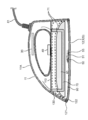
- FIG. 1 is a cross-sectional view of the iron of FIG.
- the block diagram which shows the electrical connection of the iron of FIG. Cross-sectional view of the iron of the comparative example.
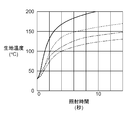
- the graph which shows the time-dependent change of the cloth temperature at the time of ironing using the iron of the comparative example.
- the graph which shows the time-dependent change of the dough temperature at the time of ironing using the iron of Embodiment 1.
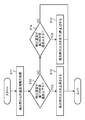
- FIG. 5 is a flowchart showing an example of the first control executed by the control unit of the iron of the second embodiment.
- the graph which shows the time-dependent change of the cloth temperature at the time of ironing with the iron stationary using the iron of Embodiment 2.
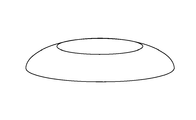
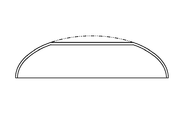
- the perspective view of the reflector of the iron of FIG. FIG. 3 is a cross-sectional view of the reflector of the iron of FIG.
- the figure which shows the light emitting body of the iron of FIG. The figure which shows another example of the light emitting body of the iron of FIG.
- One form of the iron according to the present disclosure is an iron including a light emitting body that emits light, a base surface that transmits the light, and a detection unit that detects the temperature of the base surface, and the detection unit detects the iron. It is provided with a control unit that controls the output of the light emitting body according to the temperature of the base surface.
- the temperature of the base surface has less variation than the temperature of clothing. According to the iron, since the output of the illuminant can be controlled according to the temperature of the base surface, heat can be suitably transferred to the clothes.
- a filter for suppressing the transmission of visible light is provided between the light emitting body and the base surface.
- the transmission of visible light through the base surface is suppressed. Therefore, the temperature on the clothes can be kept constant regardless of the color of the clothes. In addition, exposure to ultraviolet rays and glare on the human body can be alleviated.
- the filter reflects the visible light.
- the filter is a dichroic mirror.
- the transmission of ultraviolet light and visible light through the base surface is suppressed. Therefore, the temperature on the clothes can be kept constant regardless of the color of the clothes. In addition, exposure to ultraviolet rays and glare on the human body can be alleviated.
- a reflector that reflects the light toward the base surface is further provided, and the reflector is bowl-shaped and has a flat apex.
- the light of the illuminant can be output more preferably.
- the light from the illuminant can be irradiated to the fabric and the heat-resistant glass on the base surface with uniform intensity, and the wrinkle smoothing ability can be improved.
- the temperature distribution of the heat-resistant glass can be reduced and damage can be prevented.
- the illuminant is a halogen lamp or a carbon heater.
- a light emitter having a suitable output can be arranged with a simple configuration.
- heat-resistant glass with high infrared transmittance In order to efficiently irradiate the fabric with light, heat-resistant glass with high infrared transmittance is required. Quartz glass, sapphire glass, etc. are most suitable as heat-resistant glass with high infrared transmittance.
- these heat-resistant glasses are expensive and cannot be used for ironing. Therefore, an inexpensive heat-resistant glass having a high infrared transmittance of near-to-mid-infrared rays is used, and a halogen lamp or a carbon heater having the same emission wavelength is used as the light emitter.
- the fabric can be efficiently irradiated with light, and the ability to smooth out wrinkles can be exhibited.
- the cost is reduced and it can be used for ironing.
- the luminous body has a U-shape, a horseshoe shape, or a round shape.
- the effective light emitting range for the base surface is increased, and infrared rays can be irradiated to the tip of the base surface with uniform intensity. This enables ironing using the tip of the iron.
- the seal portion of the light emitting body is located outside the reflector.
- the variation in the irradiation intensity on the target fabric and the heat-resistant glass is further reduced, the wrinkle smoothing property can be improved, and the heat-resistant glass can be prevented from being damaged.
- the temperature rise of the seal portion can be prevented, and the life of the light emitting body can be extended.
- the base surface is composed of a glass body and a metal frame.
- the glass body is composed of heat-resistant glass.
- the infrared transmittance of the glass body is 50% or less at a wavelength of 2600 to 3500 nm.
- the glass body has a curved shape.
- the base surface has a curved shape, which makes it easier to lure the fabric when moving the iron.
- the pressure applied to the fabric creates a squeaky effect and improves wrinkle smoothing.
- the end of the glass body is sandwiched between the metal frames.
- the force of the hand is suitably transmitted to the glass body which is the hanging surface, and the wrinkle smoothing can be improved.
- prevention of glass breakage in the event of a collision with an obstacle is realized.
- a heat conductive heat-resistant bond, paint, or grease is applied to the interface between the glass body and the metal frame.
- the control unit raises the output of the light source if the temperature detected by the detection unit is within the first predetermined temperature, and the temperature of the base surface is the first temperature. If the temperature is equal to or higher than the second predetermined temperature higher than the predetermined temperature, the control for reducing or stopping the output of the light source is executed at predetermined intervals.
- the second predetermined temperature is a temperature at which the dough is not damaged
- the first predetermined temperature is a low temperature within 10 ° C. from the second predetermined temperature.
- the detection unit is composed of a thermistor, a resistance temperature detector, or a thermocouple, the detection unit is arranged between the light emitting body and the base surface, and the detection unit is , It is closely fixed to the base surface within a predetermined range from the center of the base surface.
- a predetermined range it is within ⁇ 50 mm from the central portion of the base surface.
- the optimum measurement can be performed in real time with one sensor without considering the variation in the temperature distribution of the base surface when the fabric is moved on the fabric whose temperature is not constant in an indefinite direction and at an indefinite speed. Thereby, the wrinkle smoothing performance can be stabilized.
- the detection unit and the lead wire connected to the detection unit are covered with an infrared reflecting member.
- the infrared reflective member is a tape, sheet or case made of aluminum, copper, brass, silver, gold, platinum, nickel, chromium, lead, or tin.
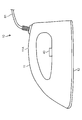
- the iron 10 has an ironing function for smoothing out wrinkles in clothes.
- the ironing function is a function of smoothing the wrinkles of clothes by applying heat and pressure of the iron 10 to the wrinkles of clothes.
- the main elements constituting the iron 10 are the housing 11 and the base surface 12.
- the housing 11 constitutes the appearance of the iron 10 and houses at least one of the other elements that make up the iron 10.
- the shape of the housing 11 is arbitrary, but it is preferable that the grip portion 11A is formed so as to be easily held by the user.
- the housing 11 is made of any material having excellent heat resistance. In one example, the material that makes up the housing 11 is polycarbonate.
- the housing 11 may be provided with a transparent portion (not shown) made of a transparent material in part or in whole so that the state of clothing at the time of ironing can be visually recognized.
- the inside of the housing 11 is separated by a partition plate 110.
- the housing 11 includes an opening that opens up an internal space.
- the base surface 12 is provided so as to substantially match the shape of the opening of the housing 11.
- the base surface 12 transfers heat and pressure to the garment.
- the base surface 12 is made of a material having excellent infrared transmission, heat resistance and thermal conductivity.
- the base surface 12 is composed of a glass body 120 made of heat-resistant glass and a metal frame 121. The end of the glass body 120 is sandwiched between metal frames 121.
- a heat conductive heat-resistant bond is applied to the contact surface between the glass body 120 and the metal frame 121.
- paint or grease may be used.
- the glass body 120 uses heat-resistant glass having a high transmittance of near-to-mid-infrared rays and a transmittance of 50% or less of infrared rays having a wavelength of 2600 to 3500 nm.
- inexpensive heat-resistant glass such as Shot Tempax glass can be used.
- tempered glass in consideration of the safety of glass breakage due to dropping or the like.
- the shape of the glass body 120 is preferably a curved shape in consideration of wrinkle stretching.
- the present invention is not limited to this, and the glass body 120 may be a flat plate.
- the iron 10 further includes a control unit 20, a storage unit 30, an operation unit 40, a detection unit 50, a power supply unit 60, and a light emitting body 70. At least one of the control unit 20, the storage unit 30, the operation unit 40, the detection unit 50, the power supply unit 60, and the light emitting body 70 is held inside the housing 11.
- the control unit 20 is composed of an arithmetic processing unit that executes a control program.
- the arithmetic processing unit is composed of, for example, one or both of a CPU (Central Processing Unit) and an MPU (Micro Processing Unit).
- the control unit 20 is configured to be able to communicate wirelessly or by wire with the storage unit 30, the operation unit 40, the detection unit 50, and the light emitter 70.
- the control unit 20 starts control when, for example, power is supplied from the power supply unit 60 and an operation signal from the operation unit 40 is input.
- the control unit 20 is provided in the housing 11 at a location away from the light emitting body 70 which is a heat generation source. In one example, the control unit 20 is provided at a location corresponding to the grip unit 11A.
- the storage unit 30 stores program information and control information for executing various controls executed by the control unit 20.
- the storage unit 30 includes, for example, a non-volatile memory and a volatile memory.
- the control information includes information corresponding to the type of clothing and the output amount of the light emitter 70 and information corresponding to the temperature of the base surface 12 and the temperature of the cloth of clothing.
- the type of garment is, for example, the material of the garment. Examples of garment materials are polyester, nylon, and cotton.
- the storage unit 30 is provided in the same control circuit as the control unit 20, for example.
- the operation unit 40 outputs, for example, an operation signal operated by the user to the control unit 20.
- the operation signal includes, for example, a signal relating to the adjustment of the amount of light emitted from the light emitting body 70, and a signal relating to the selection of the type of clothing or the washing display symbol of the new JIS (ISO3758).
- a part of the operation unit 40 is configured to project toward the outside of the housing 11 so that the user can easily operate the operation unit 40.
- the operation unit 40 is composed of, for example, a button, a switch, and a dial.
- the operation unit 40 may be configured by a touch panel.
- the detection unit 50 detects various information about the iron 10.
- the detection unit 50 detects, for example, temperature information.
- the detection unit 50 is composed of a thermistor. Not limited to this, a resistance temperature detector or a thermocouple may be used for the detection unit 50.
- the thermistor and the lead wire 51 connected to the thermistor are covered with an infrared reflecting member 55 (for example, aluminum tape) having a relatively high emissivity. This improves the measurement accuracy of the thermistor.
- heat conductive grease is applied between the thermistor and the base surface.
- An example of the temperature information detected by the detection unit 50 is the temperature of the base surface 12.
- the temperature information is output to the control unit 20 as an electric signal.
- the position where the detection unit 50 is provided is, for example, inside the housing 11 on the base surface 12.
- the center of the detection unit 50 coincides with the center of the illuminant 70 in the vertical direction of the iron 10.
- the detection unit 50 may be configured to detect the number of times the iron 10 has been used and the time it has been used.
- the power supply unit 60 supplies electric power to the control unit 20, the storage unit 30, the operation unit 40, the detection unit 50, and the light emitting body 70.
- the power supply unit 60 is an external power source such as a commercial power source.
- the power supply unit 60 may have a configuration of a secondary battery provided inside the housing 11. When the power supply unit 60 is an external power source, the iron 10 and the power supply unit 60 are connected by a power line 61.
- the illuminant 70 generates light and transfers heat to clothing.
- the light emitter 70 is composed of a halogen lamp or a carbon heater that generates heat by electricity.
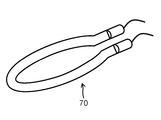
- the shape of the light emitter 70 is an arbitrary shape. In one example, the shape of the light emitter 70 is U-shaped as shown in FIG. 12A.
- the light emitting body 70 includes a lead wire 131 connected to the light emitting body 70 and a seal portion 130 through which the lead wire 131 is inserted.
- the shape of the light emitting body 70 may be a shape having a large light emitting area such as a horseshoe shape or a round shape in addition to the U shape.
- the effective light emitting region with respect to the base surface 12 is increased, and infrared rays can be irradiated to the tip of the base surface 12 with uniform intensity. Therefore, ironing using the tip of the iron becomes possible.
- the control unit 20 controls the amount of light emitted from the light emitter 70 by controlling the amount of power supplied from the power supply unit 60.
- a heat insulating member 71 is provided between the light emitting body 70 and the control unit 20.
- the heat insulating member 71 is made of, for example, glass wool or rock wool or urethane or polystyrene.
- the iron 10 further includes a reflector 80 and a filter 90.
- the reflector 80 and the filter 90 are provided in the housing 11.
- the reflector 80 is configured to efficiently transfer the light and heat of the light emitting body 70 to the base surface 12.
- the reflector 80 is preferably configured to reflect the light and heat of the illuminant 70 with respect to the entire base surface 12.
- the shape of the reflector 80 is a bowl-shaped shape in which the light emitting body 70 is provided in the center and the apex is flat.
- the surface of the reflector 80 is made of, for example, stainless steel or aluminum metal. Further, the seal portion 130 which is not the light emitting region of the light emitting body 70 is positioned outside the reflector 80.
- the filter 90 has a configuration that suppresses the light of a predetermined wavelength output from the light emitting body 70 from passing through the base surface 12.
- An example of a given light is visible light.
- the filter 90 is configured to reflect visible light so that visible light is not output from the base surface 12 or the amount of output is reduced.
- the shape of the filter 90 is configured to substantially match the shape of the base surface 12.
- the filter 90 is configured to come into contact with the light emitting body 70 side of the base surface 12.
- the filter 90 is composed of, for example, a dichroic mirror on which a dielectric multilayer film is vapor-deposited.
- the filter 90 may be configured to prevent ultraviolet rays from passing through the base surface 12.
- FIG. 10 is a graph of the transmittance of the dichroic mirror according to the present embodiment.
- FIG. 4 shows the configuration of the iron 10 of the comparative example.
- the iron 10 of the comparative example has the same configuration as the iron 10 of the first embodiment except that the filter 90 is not provided.
- the light transmitted through the base surface 12 includes visible light and ultraviolet light.
- the change over time in the temperature of the dough was measured with a separately prepared thermography camera and a thermocouple.
- the iron 10 includes a halogen lamp as the light emitter 70.
- the tester selected a cotton cloth as the type of clothing by operating the operation unit 40, and the control unit 20 controlled the illuminant 70 according to the cotton cloth.
- FIGS. 5 and 6 show the results for black clothing using cotton fabric.
- the dashed lines in FIGS. 5 and 6 show the results for blue garments made from cotton fabric.
- the alternate long and short dash lines in FIGS. 5 and 6 show the results for red clothing using cotton fabric.
- the alternate long and short dash lines in FIGS. 5 and 6 show the results for white garments made from cotton fabric.
- the user operates the operation unit 40 to start supplying power from the power supply unit 60.
- the user operates the operation unit 40 to select the type of clothing material to be ironed or the washing display symbol of the new JIS (ISO3758).
- the control unit 20 determines the output amount of the light emitting body 70 based on the information corresponding to the type of clothing stored in the storage unit 30 and the output amount of the light emitting body 70.
- Most of the light output from the light emitter 70 is directed to the base surface 12, and a part of the light is reflected by the reflector 80 and directed to the base surface 12.
- Visible light is reflected by the filter 90 provided on the light emitting body 70 side of the base surface 12.
- infrared rays pass through the filter 90 and are output from the base surface 12.
- the clothes are heated by infrared rays, and the user visually recognizes the state of the clothes from the transparent portion of the housing 11, and the base surface 12 of the iron 10 is pressed against the clothes to remove the wrinkles of the clothes.
- the infrared rays output from the illuminant 70 can keep the fabric temperature constant regardless of the color of the clothes. For this reason, variations in heating are unlikely to occur, and clothing is less likely to be scorched or insufficiently heated.
- the iron 10 of the second embodiment will be described with reference to FIGS. 7, 8 and 9.
- the iron 10 of the second embodiment is the same as the iron 10 of the first embodiment except that the control unit 20 executes the first control for controlling the output of the light emitter 70 based on the detection temperature of the detection unit 50. be. Therefore, a part or all of the description will be omitted for the same configuration.
- the control unit 20 executes the first control based on the temperature information detected from the detection unit 50.
- the temperature information is, for example, the temperature of the base surface 12. More specifically, the temperature information is the temperature of the glass body 120.
- the control unit 20 estimates the temperature of the dough as the detection temperature from, for example, the information indicating the correspondence between the temperature of the base surface 12 stored in the storage unit 30 and the temperature for each type of dough.
- the control unit 20 increases the output of the light emitter 70 when the detection temperature is equal to or lower than the first predetermined temperature. Further, when the temperature is equal to or higher than the second predetermined temperature higher than the first predetermined temperature, the output of the illuminant 70 is reduced.
- the first predetermined temperature is 190 ° C.
- the second predetermined temperature is 200 ° C. The difference between the first predetermined temperature and the second predetermined temperature was set to 10 ° C.
- the control unit 20 determines the output of the illuminant 70 from a table of the fabric type and fabric temperature of the clothing selected by the user.
- the table is stored in the storage unit 30 in advance.
- the control unit 20 acquires temperature information from the detection unit 50 in step S11.
- the control unit 20 estimates the detection temperature, which is the temperature of the cloth of the garment, with reference to the storage unit 30.
- the control unit 20 determines in step S12 whether or not the detected temperature is equal to or lower than the first predetermined temperature. When it is determined that the detected temperature is equal to or lower than the first predetermined temperature, the control unit 20 executes the process of step S13.
- the control unit 20 increases the output of the light emitting body 70 in step S13. Then, the control unit 20 ends the process.
- the control unit 20 executes the process of step S14.
- the control unit 20 determines in step S14 whether or not the detected temperature is equal to or higher than the second predetermined temperature.
- the control unit 20 executes the process of step S15.
- step S15 the control unit 20 reduces or stops the output of the light emitter 70. Then, the control unit 20 ends the process.
- the control unit 20 ends the process.
- the control unit 20 executes this control (also referred to as a first control) at predetermined intervals while power is being supplied from the power supply unit 60.
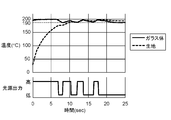
- FIG. 8 shows the dough temperature when the output of the light emitting body 70 is increased or decreased by controlling the base surface 12 (more specifically, the glass body 120) from the detection unit 50 based on the temperature information.
- the solid line is the temperature of the glass body 120
- the broken line is the temperature of the fabric.
- the first predetermined temperature is 190 ° C.
- the second predetermined temperature is 200 ° C.
- the iron 10 is allowed to elapse in a stationary state without moving.
- the output of the light emitter 70 is decreased when the temperature information of the detection unit 50 is 200 ° C.
- the output of the light emitter 70 is increased when the temperature information of the detection unit 50 is 190 ° C. or lower, which is the first predetermined temperature. I'm letting you. By executing this control, the increase in the dough temperature is suppressed even when the irradiation time is long.
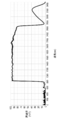
- FIG. 9 shows the temperature of the glass body 120 when the output of the light emitting body 70 is increased or decreased when the iron 10 is moved at a speed of 10 cm / sec.
- the conditions are the same as those shown in FIG. 8 except that the iron 10 is moved. Since the dough is not in a fixed position with respect to the iron when moving, the dough temperature is not displayed on the graph. When the temperature reaches 200 ° C. or higher, which is the second predetermined temperature by control, the output of the illuminant 70 is reduced. After that, as the iron 10 moves, the temperature of the glass body is immediately cooled by the fabric, so that the temperature information of the detection unit 50 becomes equal to or lower than the first predetermined temperature. This prevents the output of the light emitting body 70 from increasing and the output of the light emitting body 70 from decreasing for a long time. Therefore, the wrinkle smoothing ability is stably maintained.
- the user operates the operation unit 40 to start supplying power from the power supply unit 60.
- the user operates the operation unit 40 to select the type of fabric of the target clothing or the washing display symbol of the new JIS (ISO3758).
- the control unit 20 determines the output of the illuminant 70 from the stored table of the type of clothing fabric and the fabric temperature. Most of the light output from the light emitter 70 is directed to the base surface 12, and a part of the light is reflected by the reflector 80 and directed to the base surface 12. Visible light is reflected by the filter 90 provided on the light emitting body 70 side of the base surface 12. On the other hand, infrared rays pass through the filter 90 and are output from the base surface 12. Infrared heat heat heats clothing and removes wrinkles. The base surface 12 is heated as the wrinkles are removed.
- the detection unit 50 detects the temperature information, and the control unit 20 reduces or increases the output of the light emitter 70 based on the temperature information.
- the detection temperature is equal to or higher than the predetermined temperature
- the output of the illuminant 70 is reduced, so that the clothes are less likely to be scorched.
- the fabric temperature is estimated from the temperature of the base surface 12 having a small variation instead of detecting the clothing temperature having a large variation, it is not necessary to newly provide a sensor for measuring the temperature of the fabric. Therefore, the iron 10 is configured. Can be simplified.
- a thermistor is used for the detection unit 50 in consideration of the accuracy and real-time performance of the detection unit 50.
- the detection unit 50 is arranged between the light emitting body 70 and the glass body 120.
- the detection unit 50 sandwiched the heat conductive grease within a predetermined range from the central portion of the glass body 120 (for example, within ⁇ 50 mm from the central portion of the glass body 120) and fixed the detection unit 50 in close contact with the glass body 120.
- the thermistor and the lead wire 51 are covered with an infrared reflecting member 55 (for example, aluminum tape).
- the infrared reflecting member 55 reflects infrared rays to prevent the infrared rays from directly hitting the detection unit 50.
- the infrared reflecting member 55 is a tape, sheet or case made of a material having a relatively low emissivity.
- the material having a relatively low emissivity is, for example, aluminum, copper, brass, silver, gold, platinum, nickel, chromium, lead, tin, or the like.
- a mechanical temperature sensor is provided on the glass surface between the light emitting body 70 and the base surface 12 in order to prevent fabric damage, burning, and burns due to an abnormally high temperature state due to a failure or malfunction of the detection unit 40 or the control unit 20. Bimetal may be attached. This makes it possible to appropriately shut off the power supply.
- the iron 10 may further include a notification unit that notifies information currently detected by the detection unit 50.
- the notifying unit notifies the user of, for example, the temperature information of the dough estimated from the current temperature of the base surface 12 and the current temperature of the base surface 12.
- the power supply unit 60 of the iron 10 is a secondary battery, it may be configured to notify the remaining battery level of the current secondary battery.
- control unit 20 may perform control to increase the output of the light emitter 70 when the detection temperature is lower than the predetermined temperature by a threshold value or more.
- the threshold is, for example, 20 ° C.
- the irons related to this disclosure can be used as irons for removing wrinkles in commercial and household clothing.
Landscapes
- Engineering & Computer Science (AREA)
- Textile Engineering (AREA)
- Irons (AREA)
Priority Applications (4)
| Application Number | Priority Date | Filing Date | Title |
|---|---|---|---|
| CN202180015309.6A CN115103940A (zh) | 2020-02-21 | 2021-02-16 | 熨斗 |
| DE112021001149.9T DE112021001149T5 (de) | 2020-02-21 | 2021-02-16 | Bügeleisen |
| US17/792,579 US20230083794A1 (en) | 2020-02-21 | 2021-02-16 | Iron |
| JP2022501884A JPWO2021166868A1 (https=) | 2020-02-21 | 2021-02-16 |
Applications Claiming Priority (2)
| Application Number | Priority Date | Filing Date | Title |
|---|---|---|---|
| JP2020-028771 | 2020-02-21 | ||
| JP2020028771 | 2020-02-21 |
Publications (1)
| Publication Number | Publication Date |
|---|---|
| WO2021166868A1 true WO2021166868A1 (ja) | 2021-08-26 |
Family
ID=77392101
Family Applications (1)
| Application Number | Title | Priority Date | Filing Date |
|---|---|---|---|
| PCT/JP2021/005594 Ceased WO2021166868A1 (ja) | 2020-02-21 | 2021-02-16 | アイロン |
Country Status (5)
| Country | Link |
|---|---|
| US (1) | US20230083794A1 (https=) |
| JP (1) | JPWO2021166868A1 (https=) |
| CN (1) | CN115103940A (https=) |
| DE (1) | DE112021001149T5 (https=) |
| WO (1) | WO2021166868A1 (https=) |
Citations (5)
| Publication number | Priority date | Publication date | Assignee | Title |
|---|---|---|---|---|
| JPH04156899A (ja) * | 1990-10-18 | 1992-05-29 | Matsushita Electric Ind Co Ltd | 光熱源アイロン |
| JPH0759999A (ja) * | 1993-07-29 | 1995-03-07 | Philips Electronics Nv | 電気アイロン |
| JP2002267539A (ja) * | 2001-03-14 | 2002-09-18 | Matsushita Electric Ind Co Ltd | 光透過体温度センサー及びそれを用いた装置 |
| US20130227864A1 (en) * | 2010-11-17 | 2013-09-05 | Morphy Richards Limited | Iron sole plate |
| JP2019126452A (ja) * | 2018-01-23 | 2019-08-01 | マクセルホールディングス株式会社 | 整髪機器および髪の乾燥方法 |
Family Cites Families (6)
| Publication number | Priority date | Publication date | Assignee | Title |
|---|---|---|---|---|
| JPH0292530A (ja) * | 1988-09-29 | 1990-04-03 | Showa Electric Wire & Cable Co Ltd | 熱輻射体 |
| GB8928761D0 (en) * | 1989-12-20 | 1990-02-28 | Strix Ltd | Electric irons |
| US20040194546A1 (en) * | 2001-08-31 | 2004-10-07 | Masashi Kanehori | Capacitive humidity-sensor and capacitive humidity-sensor manufacturing method |
| US20080110870A1 (en) * | 2006-11-13 | 2008-05-15 | James Mirkes | Heated serving apparatus |
| US10407821B2 (en) * | 2012-07-10 | 2019-09-10 | Woodrow Scientific Ltd. | Methods and apparatus for laser cleaning |
| WO2015007755A2 (en) * | 2013-07-19 | 2015-01-22 | Koninklijke Philips N.V. | A light emitting device and a method for dimming a light emitting device |
-
2021
- 2021-02-16 JP JP2022501884A patent/JPWO2021166868A1/ja active Pending
- 2021-02-16 DE DE112021001149.9T patent/DE112021001149T5/de not_active Withdrawn
- 2021-02-16 CN CN202180015309.6A patent/CN115103940A/zh active Pending
- 2021-02-16 US US17/792,579 patent/US20230083794A1/en not_active Abandoned
- 2021-02-16 WO PCT/JP2021/005594 patent/WO2021166868A1/ja not_active Ceased
Patent Citations (5)
| Publication number | Priority date | Publication date | Assignee | Title |
|---|---|---|---|---|
| JPH04156899A (ja) * | 1990-10-18 | 1992-05-29 | Matsushita Electric Ind Co Ltd | 光熱源アイロン |
| JPH0759999A (ja) * | 1993-07-29 | 1995-03-07 | Philips Electronics Nv | 電気アイロン |
| JP2002267539A (ja) * | 2001-03-14 | 2002-09-18 | Matsushita Electric Ind Co Ltd | 光透過体温度センサー及びそれを用いた装置 |
| US20130227864A1 (en) * | 2010-11-17 | 2013-09-05 | Morphy Richards Limited | Iron sole plate |
| JP2019126452A (ja) * | 2018-01-23 | 2019-08-01 | マクセルホールディングス株式会社 | 整髪機器および髪の乾燥方法 |
Also Published As
| Publication number | Publication date |
|---|---|
| JPWO2021166868A1 (https=) | 2021-08-26 |
| US20230083794A1 (en) | 2023-03-16 |
| CN115103940A (zh) | 2022-09-23 |
| DE112021001149T5 (de) | 2022-12-01 |
Similar Documents
| Publication | Publication Date | Title |
|---|---|---|
| US5381509A (en) | Radiant electric space heater | |
| JP5063693B2 (ja) | 誘導加熱調理器 | |
| US11536460B2 (en) | Infrared radiant emitter | |
| JP6037854B2 (ja) | コンロ、コンロの運転方法、コンロで使用する加熱用容器の材料の推定方法及び加熱用容器の材料の推定方法 | |
| WO2021166868A1 (ja) | アイロン | |
| JP3560203B2 (ja) | 炊飯器 | |
| JP5311951B2 (ja) | 加熱調理器 | |
| JP7357230B2 (ja) | アイロン | |
| JPH04341785A (ja) | 加熱調理器 | |
| WO2022168596A1 (ja) | アイロン | |
| JP2022120473A (ja) | アイロン | |
| JP2022120472A (ja) | アイロン | |
| JP2913754B2 (ja) | アイロン | |
| JP3123479B2 (ja) | ハロゲンコンロ | |
| KR930004205B1 (ko) | 가열 조리기 | |
| US20230204219A1 (en) | Infrared radiant emitter and infrared heating apparatus including the same | |
| FI129495B (en) | Gas stove to prevent rusting of cookware | |
| JP2679325B2 (ja) | アイロン | |
| JPH02290421A (ja) | 加熱調理器 | |
| JP2964550B2 (ja) | 電気加熱調理器 | |
| KR970011173B1 (ko) | 가스렌지의 그릴 과열 방지장치 | |
| JP3469683B2 (ja) | 電気炊飯器 | |
| JPH03225119A (ja) | 調理器の制御装置 | |
| JP2004160203A (ja) | 炊飯器 | |
| JPH03225120A (ja) | 調理器の制御装置 |
Legal Events
| Date | Code | Title | Description |
|---|---|---|---|
| 121 | Ep: the epo has been informed by wipo that ep was designated in this application |
Ref document number: 21756943 Country of ref document: EP Kind code of ref document: A1 |
|
| ENP | Entry into the national phase |
Ref document number: 2022501884 Country of ref document: JP Kind code of ref document: A |
|
| 122 | Ep: pct application non-entry in european phase |
Ref document number: 21756943 Country of ref document: EP Kind code of ref document: A1 |