WO2021152736A1 - 監視システム、監視装置、監視方法、およびプログラム - Google Patents
監視システム、監視装置、監視方法、およびプログラム Download PDFInfo
- Publication number
- WO2021152736A1 WO2021152736A1 PCT/JP2020/003213 JP2020003213W WO2021152736A1 WO 2021152736 A1 WO2021152736 A1 WO 2021152736A1 JP 2020003213 W JP2020003213 W JP 2020003213W WO 2021152736 A1 WO2021152736 A1 WO 2021152736A1
- Authority
- WO
- WIPO (PCT)
- Prior art keywords
- person
- monitoring
- monitoring device
- feature amount
- image
- Prior art date
- Legal status (The legal status is an assumption and is not a legal conclusion. Google has not performed a legal analysis and makes no representation as to the accuracy of the status listed.)
- Ceased
Links
Images










Classifications
-
- G—PHYSICS
- G06—COMPUTING OR CALCULATING; COUNTING
- G06V—IMAGE OR VIDEO RECOGNITION OR UNDERSTANDING
- G06V20/00—Scenes; Scene-specific elements
- G06V20/50—Context or environment of the image
- G06V20/52—Surveillance or monitoring of activities, e.g. for recognising suspicious objects
-
- G—PHYSICS
- G06—COMPUTING OR CALCULATING; COUNTING
- G06T—IMAGE DATA PROCESSING OR GENERATION, IN GENERAL
- G06T7/00—Image analysis
- G06T7/70—Determining position or orientation of objects or cameras
-
- G—PHYSICS
- G06—COMPUTING OR CALCULATING; COUNTING
- G06V—IMAGE OR VIDEO RECOGNITION OR UNDERSTANDING
- G06V10/00—Arrangements for image or video recognition or understanding
- G06V10/70—Arrangements for image or video recognition or understanding using pattern recognition or machine learning
- G06V10/74—Image or video pattern matching; Proximity measures in feature spaces
- G06V10/761—Proximity, similarity or dissimilarity measures
-
- G—PHYSICS
- G06—COMPUTING OR CALCULATING; COUNTING
- G06V—IMAGE OR VIDEO RECOGNITION OR UNDERSTANDING
- G06V40/00—Recognition of biometric, human-related or animal-related patterns in image or video data
- G06V40/10—Human or animal bodies, e.g. vehicle occupants or pedestrians; Body parts, e.g. hands
- G06V40/16—Human faces, e.g. facial parts, sketches or expressions
- G06V40/161—Detection; Localisation; Normalisation
-
- G—PHYSICS
- G06—COMPUTING OR CALCULATING; COUNTING
- G06V—IMAGE OR VIDEO RECOGNITION OR UNDERSTANDING
- G06V40/00—Recognition of biometric, human-related or animal-related patterns in image or video data
- G06V40/10—Human or animal bodies, e.g. vehicle occupants or pedestrians; Body parts, e.g. hands
- G06V40/16—Human faces, e.g. facial parts, sketches or expressions
- G06V40/172—Classification, e.g. identification
-
- G—PHYSICS
- G06—COMPUTING OR CALCULATING; COUNTING
- G06V—IMAGE OR VIDEO RECOGNITION OR UNDERSTANDING
- G06V40/00—Recognition of biometric, human-related or animal-related patterns in image or video data
- G06V40/50—Maintenance of biometric data or enrolment thereof
-
- G—PHYSICS
- G08—SIGNALLING
- G08B—SIGNALLING SYSTEMS, e.g. PERSONAL CALLING SYSTEMS; ORDER TELEGRAPHS; ALARM SYSTEMS
- G08B21/00—Alarms responsive to a single specified undesired or abnormal condition and not otherwise provided for
- G08B21/18—Status alarms
- G08B21/24—Reminder alarms, e.g. anti-loss alarms
-
- G—PHYSICS
- G08—SIGNALLING
- G08B—SIGNALLING SYSTEMS, e.g. PERSONAL CALLING SYSTEMS; ORDER TELEGRAPHS; ALARM SYSTEMS
- G08B25/00—Alarm systems in which the location of the alarm condition is signalled to a central station, e.g. fire or police telegraphic systems
-
- G—PHYSICS
- G08—SIGNALLING
- G08B—SIGNALLING SYSTEMS, e.g. PERSONAL CALLING SYSTEMS; ORDER TELEGRAPHS; ALARM SYSTEMS
- G08B25/00—Alarm systems in which the location of the alarm condition is signalled to a central station, e.g. fire or police telegraphic systems
- G08B25/01—Alarm systems in which the location of the alarm condition is signalled to a central station, e.g. fire or police telegraphic systems characterised by the transmission medium
- G08B25/04—Alarm systems in which the location of the alarm condition is signalled to a central station, e.g. fire or police telegraphic systems characterised by the transmission medium using a single signalling line, e.g. in a closed loop
-
- H—ELECTRICITY
- H04—ELECTRIC COMMUNICATION TECHNIQUE
- H04N—PICTORIAL COMMUNICATION, e.g. TELEVISION
- H04N7/00—Television systems
- H04N7/18—Closed-circuit television [CCTV] systems, i.e. systems in which the video signal is not broadcast
-
- G—PHYSICS
- G06—COMPUTING OR CALCULATING; COUNTING
- G06V—IMAGE OR VIDEO RECOGNITION OR UNDERSTANDING
- G06V2201/00—Indexing scheme relating to image or video recognition or understanding
- G06V2201/07—Target detection
Definitions
- the present invention relates to a monitoring system, a monitoring device, a monitoring method, and a program.
- Patent Document 1 describes a system for monitoring a plant site.
- GPS Global Positioning System
- the present invention has been made in view of the above circumstances, and an object of the present invention is to reduce the risk of a person being harmed by another person.
- the first aspect concerns the surveillance system.
- the monitoring system related to the first aspect is At least one camera that captures the person in the area to be watched over, Image processing equipment and With a monitoring device,
- the monitoring device is A feature amount storage means that associates and stores the feature amount of the person to be watched over,
- a detection means for detecting that a person who is not the monitoring target approaches the person who is the monitoring target within a reference distance by causing the image processing device to process an image captured by the camera using the feature amount. It has an output means that outputs a predetermined output by using the detection result of the detection means.
- the second aspect relates to the monitoring device.
- the monitoring device related to the second aspect is A feature amount storage means for storing the feature amount of the person to be watched over, By processing the captured image using the feature amount, a detection means for detecting that a person who is not the monitoring target has approached the watching target person within a reference distance, and a detection means. It has an output means that outputs a predetermined output by using the detection result of the detection means.
- the third aspect relates to monitoring methods performed by at least one computer.
- the monitoring method related to the third aspect is The monitoring device
- the feature amount of the person to be watched is associated and stored in the feature amount storage means, By processing the captured image using the feature amount, it is detected that the person who is not the watching target has approached the watching target person within the reference distance. It is included that a predetermined output is performed using the detected result.
- this invention may be a program that causes at least one computer to execute the method of the third aspect, or a recording medium that can be read by a computer that records such a program. You may.
- This recording medium includes a non-temporary tangible medium.
- This computer program contains computer program code that causes the computer to perform its monitoring method on a monitoring device when executed by the computer.
- the various components of the present invention do not necessarily have to be independent of each other, and a plurality of components are formed as one member, and one component is formed of a plurality of members. It may be that a certain component is a part of another component, a part of a certain component overlaps with a part of another component, and the like.
- the order of description does not limit the order in which the plurality of procedures are executed. Therefore, when implementing the method and computer program of the present invention, the order of the plurality of procedures can be changed within a range that does not hinder the contents.
- the method of the present invention and the plurality of procedures of the computer program are not limited to being executed at different timings. Therefore, another procedure may occur during the execution of a certain procedure, a part or all of the execution timing of the certain procedure and the execution timing of the other procedure may overlap, and the like.
- the risk of a person being harmed by another person can be reduced.
- FIG. 1 It is a figure which shows typically the outline of the monitoring system which concerns on embodiment. It is a functional block diagram which shows the logical configuration example of the monitoring apparatus which concerns on embodiment. It is a block diagram which illustrates the hardware configuration of the computer which realizes each apparatus of the monitoring system which concerns on embodiment. It is a flowchart which shows the operation example of the monitoring apparatus of embodiment. It is a figure which shows the data structure example of the registration information. It is a figure which shows typically the configuration example of the monitoring system which concerns on embodiment. It is a functional block diagram which shows the logical configuration example of the monitoring apparatus which concerns on embodiment. It is a figure which shows an example of the suspicious person notification screen. It is a flowchart which shows an example of the operation of the monitoring apparatus which concerns on embodiment.
- acquisition means that the own device retrieves data or information stored in another device or storage medium (active acquisition), and is output to the own device from the other device. Includes at least one of entering data or information (passive acquisition).
- active acquisition include making a request or inquiry to another device and receiving the reply, and accessing and reading another device or storage medium.
- passive acquisition may be receiving information to be delivered (or transmitted, push notification, etc.).
- acquisition may be to select and acquire the received data or information, or to select and receive the delivered data or information.
- FIG. 1 is a diagram schematically showing an outline of the monitoring system 1 according to the embodiment.
- the surveillance system 1 processes an image captured by a surveillance camera 5 installed in the city, and a person 30 who does not belong to the group 20 approaches a person 22 who belongs to the group 20 which is registered in advance. If so, the user terminal 10 of the person 22 in the group 20 is notified of this.
- the observer of the monitoring center watches over the condition of Group 20 and the city.
- the person 22 to be watched over does not have to belong to the group 20, and may be an individual. In this case, it is monitored that a person other than the person to be watched approaches the person to be watched.
- the shooting location to be watched over is on the streets such as passages and roads, in open spaces, etc., but it may also include the inside of the facility.
- the shooting location is, for example, a place where an unspecified number of people gather. That is, the monitoring system 1 notifies the person 22 of the group 20 that a person 30 (a stranger) who does not belong to the group 20 is approaching to call attention, or the monitoring center also watches over the person 22. , It can reduce the risk of crimes for users and improve the security of the city.
- the shooting location may be a designated location. For example, it may be detected that a person such as a stalker approaches the person to be watched over without being noticed. That is, the shooting location may be a location including the area around the station used by the person to be watched over, the commuting route, the shopping district, the area around the house, and the like.
- the monitoring system 1 includes a monitoring device 100, a feature amount storage device 200, an image processing device 210, a user terminal 10, and at least one surveillance camera 5.
- the surveillance camera 5 may be specialized for the surveillance system 1, or may be, for example, a surveillance camera 5 that has been installed in the past.
- the surveillance camera 5 includes an image sensor such as a lens and a CCD (Charge Coupled Device) image sensor.
- the surveillance camera 5 may include a mechanism that follows the movement of a person entering the angle of view to control the orientation of the camera body and the lens, zoom control, focus, and the like.
- the image generated by the surveillance camera 5 is captured in real time and transmitted to the surveillance device 100.
- the image transmitted to the monitoring device 100 does not have to be directly transmitted from the monitoring camera 5, and may be an image delayed by a predetermined time.
- the image captured by the surveillance camera 5 may be temporarily stored in another storage device, and the surveillance device 100 may read the image from the storage device sequentially or at predetermined intervals.
- the image transmitted to the monitoring device 100 is preferably a moving image, but may be a frame image at predetermined intervals or a still image.
- the connection method between the surveillance camera 5 and the surveillance device 100 may be wireless or wired. In the case of wireless connection, it is assumed that the surveillance camera 5 and the surveillance device 100 each have a wireless communication function.
- the surveillance camera 5 may be a network camera such as an IP (Internet Protocol) camera.
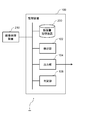
- FIG. 2 is a functional block diagram showing a logical configuration example of the monitoring device 100 of FIG.
- the monitoring device 100 includes a detection unit 102, an output unit 104, and a feature amount storage device 200.
- the feature amount storage device 200 stores the feature amount of the person to be watched in association with each other.
- the detection unit 102 detects that the person 30 who is not the object to be watched approaches the person 22 to be watched within the reference distance by processing the captured image using the feature amount. That is, the detection unit 102 determines that the person whose feature amount is not stored in the feature amount storage device 200 is a person other than the watching target (person 30 who is not the watching target).
- the output unit 104 outputs a predetermined value by using the detection result of the detection unit 102.
- the feature amount storage device 200 may store the feature amounts of people belonging to the same group 20 in association with each other.
- the feature amounts of people belonging to the same group 20 are stored in association with each other.
- the feature quantity storage device 200 may be a device provided inside the monitoring device 100, a device separate from the monitoring device 100, or a combination thereof.
- the feature quantity storage device 200 may be a plurality of storage devices.
- Group 20 is, for example, a group of tour guests who act together.
- the user of this monitoring system 1 performs user registration in advance and also performs group registration. Each registration information will be described later.
- FIG. 3 is a block diagram illustrating a hardware configuration of a computer 1000 that realizes the monitoring device 100, the image processing device 210, and the user terminal 10 of the monitoring system 1 shown in FIG.
- the computer 1000 has a bus 1010, a processor 1020, a memory 1030, a storage device 1040, an input / output interface 1050, and a network interface 1060.
- the bus 1010 is a data transmission path for the processor 1020, the memory 1030, the storage device 1040, the input / output interface 1050, and the network interface 1060 to transmit and receive data to and from each other.
- the method of connecting the processors 1020 and the like to each other is not limited to the bus connection.
- the processor 1020 is a processor realized by a CPU (Central Processing Unit), a GPU (Graphics Processing Unit), or the like.
- the memory 1030 is a main storage device realized by a RAM (Random Access Memory) or the like.
- the storage device 1040 is an auxiliary storage device realized by an HDD (Hard Disk Drive), an SSD (Solid State Drive), a memory card, a ROM (Read Only Memory), or the like.
- the storage device 1040 is a program that realizes each function of the monitoring device 100 of the monitoring system 1 (for example, detection unit 102, output unit 104, determination unit 106 described later, position information acquisition unit 108, reception unit 110, registration unit 112, etc.).
- the processor 1020 reads each of these program modules into the memory 1030 and executes them, each function corresponding to the program module is realized.
- the storage device 1040 also functions as a storage unit for storing various information used by the monitoring device 100.
- the feature quantity storage device 200 is included in the monitoring device 100, the storage device 1040 also functions as the feature quantity storage device 200.
- the program module may be recorded on a recording medium.
- the recording medium on which the program module is recorded includes a medium that can be used by the non-temporary tangible computer 1000, and the program code that can be read by the computer 1000 (processor 1020) may be embedded in the medium.
- the input / output interface 1050 is an interface for connecting the computer 1000 and various input / output devices.
- the network interface 1060 is an interface for connecting the computer 1000 to the communication network 3.
- the communication network 3 is, for example, a LAN (Local Area Network) or a WAN (Wide Area Network).
- the method of connecting the network interface 1060 to the communication network 3 may be a wireless connection or a wired connection. However, the network interface 1060 may not be used.
- the computer 1000 is connected to necessary equipment (for example, a surveillance camera 5, a display (not shown), a speaker (not shown), etc.) via the input / output interface 1050 or the network interface 1060.
- necessary equipment for example, a surveillance camera 5, a display (not shown), a speaker (not shown), etc.
- the monitoring system 1 is realized by the combination of the monitoring device 100, the user terminal 10, and the image processing device 210, it is realized by a plurality of computers 1000 constituting each of them.
- the monitoring device 100 is, for example, a server computer.
- the user terminal 10 is, for example, a smartphone, a tablet terminal, or the like.
- the image processing device 210 may be a device separate from the monitoring device 100, a device included inside the monitoring device 100, or a combination thereof.
- Each component of the monitoring device 100 of the present embodiment of FIG. 2 is realized by an arbitrary combination of hardware and software of the computer 1000 of FIG. And, it is understood by those skilled in the art that there are various modifications of the realization method and the device.
- the functional block diagram showing the monitoring device 100 of each embodiment shows blocks of logical functional units, not configurations of hardware units.
- a plurality of system configuration examples for realizing the monitoring device 100 can be considered, and examples are given below, but the present invention is not limited thereto.
- an application program for using the service provided by the monitoring system 1 is installed and started on the user terminal 10. The user can use the service of the monitoring system 1 by operating the application on the user terminal 10 and accessing the server computer of the monitoring device 100 from the user terminal 10. The monitoring system 1 can be used when the user registers the use of the service of this system in advance, registers the user information, and acquires the authentication information (user ID and password).
- each function of the monitoring device 100 (for example, the detection unit 102 and the output unit 104) shown in FIG. 2 and the like can be shared between the user terminal 10 and the monitoring device 100 (server device).
- the user terminal 10 realizes the user interface function of the monitoring device 100
- the monitoring device 100 (server device) realizes the main functions (for example, the detection unit 102 and the output unit 104).
- the user terminal 10 starts a predetermined browser and accesses a web page that provides the service of the monitoring system 1 via a communication network 3 such as the Internet.
- the monitoring system 1 can be used when the user registers the use of the service of this system in advance, registers the user information, and acquires the authentication information (user ID and password).
- the monitoring device 100 outputs the monitoring status of the user to a web page dedicated to the user and provides information.
- the computer 1000 may be a server device of a system such as SaaS (Software as a Service) that provides the service of the monitoring device 100.
- SaaS Software as a Service
- the user terminal 10 may access the server via a communication network 3 such as the Internet, and the monitoring device 100 may be realized by a program running on the server.
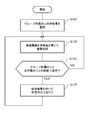
- FIG. 4 is a flowchart showing an operation example of the monitoring device 100 of the present embodiment.
- the feature amount storage device 200 stores the feature amounts of people belonging to the same group to be watched in association with each other (step S101).
- FIG. 5A is a diagram showing an example of the data structure of the user registration information 130. At least the identification information (user ID) that identifies the user and the feature amount are stored in the user registration information 130 in association with each other, and the user's name (or user name) may be associated with the password. ..
- FIG. 5B is a diagram showing an example of the data structure of the group registration information 132.
- the group registration information 132 associates the identification information (group ID) of the group 20 with the user IDs of at least two members of the group 20.
- the group registration information 132 may be stored in association with the feature amounts of at least two members of the group 20.
- the user registration information 130 and the group registration information 132 of FIG. 5 are stored in the feature amount storage device 200.
- the feature amount is a facial feature amount.
- it may be at least one feature quantity such as, for example, iris, vein, pinna, fingerprint, gait, back appearance (height, shoulder width, height, skeleton, etc.).
- the feature amount of the face extracted from the captured image obtained by the user at the time of registration is associated with the feature amount storage device 200.
- step S101 is executed as a preparation before starting monitoring. After that, it is not necessary to newly register the feature amount of the watching target person or delete the already registered feature amount of the watching target person.
- the normal process may be executed after step S101.
- the processing after step S101 is started, for example, when the user starts the application and then receives a monitoring start instruction from the user.
- the detection unit 102 processes the captured image acquired from the surveillance camera 5 into the image processing device 210 using the feature amount of the feature amount storage device 200 (feature amount of the user registration information 130 or the group registration information 132). (Step S103). Then, the detection unit 102 detects that the person 30 who does not belong to the same group 20 approaches the person 22 who belongs to the same group 20 within the reference distance (step S105).
- Step S107 when the output unit 104 detects that the person 30 who does not belong to the same group 20 approaches the person 22 who belongs to the same group 20 within the reference distance (YES in step S105), the output unit 104 outputs a predetermined output. (Step S107). On the other hand, when the person 30 who does not belong to the same group 20 does not approach the person 22 who belongs to the same group 20 within the reference distance (NO in step S105), the person returns to step S103 and continues watching. For example, this process ends by accepting the user's instruction to end the application.
- the predetermined output is, for example, to output to the user terminal 10 information indicating that the person 22 belonging to the same group 20 has approached within the reference distance. Further, the information may be output to the display (not shown) of the monitoring device 100.
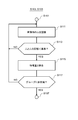
- step S101 in FIG. 4 for example, when an instruction from the user to start watching is received, this process is started.
- the detection unit 102 causes the image processing device 210 to recognize all the people in the image acquired from the surveillance camera 5 (step S111).
- the detection unit 102 measures the distance between each person in the image and another person in the vicinity, and determines whether or not the value is less than the reference value (step S113).
- a conversion coefficient (ratio) for converting the distance in the image for each shooting range into an actual distance is registered in advance.
- the detection unit 102 uses this conversion coefficient to convert the distance in the image into an actual distance and compare it with the reference distance.
- the detection unit 102 converts the reference distance into a scale of the distance in the image by using this conversion coefficient, and compares it with the distance in the shooting range.
- the reference distance may be set by the user.
- the reference distance may be set numerically or may be set by an index other than the numerical value (for example, near / standard / far). Furthermore, it may be possible to set it at the level of security. In places where security is poor, the reference distance may be set to a setting level farther than other places, and in places where security is good, the reference distance may be set to a setting level closer than other places. It may be specified by user operation using a GUI (Graphical User Interface) such as a slider on the operation screen on the user terminal 10.
- GUI Graphic User Interface
- the detection unit 102 extracts the feature amounts of the facial parts of the two people. Then, the detection unit 102 collates the image processing device 210 with the feature amount of the face image registered in the feature amount storage device 200 (step S115). As a result of the collation, when the feature amount having the similarity equal to or higher than the threshold value is registered in the feature amount storage device 200, the detection unit 102 determines that the feature amount belongs to the group 20 (NO in step S117). Then, the process returns to step S111 and continues watching. On the other hand, when the distance between people is equal to or greater than the standard (NO in step S113), the process returns to step S111 and continues watching.
- the detection unit 102 determines that the feature amount does not belong to the group 20 (YES in step S117). Then, the process proceeds to step S107 of FIG. 4, and the output unit 104 outputs a predetermined output.
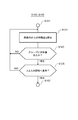
- this process is started when, for example, an instruction to start watching by the user is received after step S101 in FIG.
- the detection unit 102 extracts the feature amount of each person's face in the image acquired from the surveillance camera 5, and causes the image processing device 210 to collate the feature amount stored in the feature amount storage device 200. (Step S121).
- the detection unit 102 determines that the feature amount belongs to the group 20 (NO in step S123). In this case, the process returns to step S121 and continues watching.
- the detection unit 102 determines that the feature amount does not belong to the group 20 (YES in step S123). In this case, the process proceeds to step S125.
- the detection unit 102 determines whether or not the distance between the person determined not to belong to the group 20 and the person 22 in the group 20 closest to the person is closer than the reference distance (step S125). ..
- the distance conversion method may be the same as the method shown in FIG. Then, when the distance is less than the reference (YES in step S125), the process proceeds to step S107 in FIG. 4, and the output unit 104 outputs a predetermined output. If the distance is greater than or equal to the standard, that is, if the distance between the person 30 who does not belong to the group 20 and the person 22 who belongs to the group 20 is less than the standard (NO in step S125), the process returns to step S121 and is watched over. Continue.
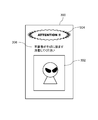
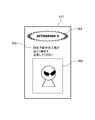
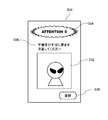
- FIG. 8 is a diagram showing an example of a suspicious person notification screen 300 displayed on a display (not shown) of the user terminal 10 by the output unit 104.
- the suspicious person notification screen 300 includes a person image display unit 302, an icon display unit 304, and a message display unit 306.
- the person image display unit 302 displays an image obtained by cutting out a region including the face of the person 30 from the captured image acquired from the surveillance camera 5. An image that calls attention to the user is displayed on the icon display unit 304. This image may be emphasized by animation or the like.
- the message display unit 306 displays a message telling the user that a person 30 who does not belong to the group 20 is approaching.
- a message telling the user that a suspicious person is approaching by voice may be output from a speaker (not shown).
- the application icon mark is displayed on the user terminal 10, the notification is output to the standby screen, and the LED (Light Emitting Diode) is displayed. At least one of blinking lighting display and vibration may be combined. The user may be able to select which output method to use.
- An image obtained by cutting out an area including the face of the person 30 from the captured image acquired from the surveillance camera 5 may be attached to the e-mail, and the alert occurrence date / time, place, group name, group registrant information, and the like may be included.
- the display of the monitoring device 100 at least the information of the group 20 subject to the notification and the image of the suspicious person are displayed. Further, the information of the place where the suspicious person is approaching may be displayed from the position information of the surveillance camera 5 that generated the image used for the collation.
- the detection unit 102 can detect that a person other than the person to be watched approaches the person to be watched within the reference distance by processing the captured image, and the output unit 104 outputs the detection result. can.
- the group 20 can be notified that a person other than the group 20 has approached. That is, by processing the image captured by the surveillance camera 5, the person to be watched and the person not to be watched, or the person belonging to the group 20 and the person not belonging to the group 20 are distinguished, and the person or group to be watched by another person. It is possible to detect the approach to 20 and notify the watching target person. Therefore, according to the present embodiment, it is possible to reduce the risk of being harmed by a stranger or a person who approaches the person without being noticed.
- FIG. 9 is a flowchart showing an example of the operation of the monitoring device 100.
- the flow of the present figure is started after a result of YES in any of the determinations of step S105 in FIG. 4, step S117 in FIG. 6, and step S125 in FIG.
- the output unit 104 is maintained for a reference time or longer (YES in step S131).
- a predetermined output is performed (step S107 in FIG. 4). If it is not maintained for the reference time or longer (NO in step S131), the process returns to any one of step S113 in FIG. 4, step S111 in FIG. 6, and step S121 in FIG. 7 to continue watching.
- the predetermined time may be changed by user operation.
- the predetermined output by the output unit 104 in step S107 is the same as that of the first embodiment.
- the predetermined output is not performed, so that the person 30 who is only temporarily nearby Can be prevented from being detected as a suspicious person.
- the same effect as that of the above embodiment can be obtained, and the accuracy of detecting the approach of a suspicious person can be further improved. That is, it is possible to suppress frequent notifications of the approach of a suspicious person and notify a truly dangerous state, so that it is possible to prevent a decrease in the user's sense of crisis due to frequent notifications.
- the monitoring system 1 of the present embodiment is the same as that of the above embodiment except that it has a configuration for determining whether or not a person who approaches the person to be watched is included in the predetermined list.
- FIG. 10 is a functional block diagram showing a logical configuration example of the monitoring system 1.
- the monitoring system 1 includes the same feature amount storage device 200, the detection unit 102, and the output unit 104 as the monitoring device 100 of the embodiment of FIG. 2, and further includes a determination unit 106.
- an example combined with the configuration of the first embodiment of FIG. 2 is shown, but it may be combined with at least one of the configurations of the other embodiments within a range that does not cause a contradiction. good.
- the determination unit 106 determines whether or not a person who approaches the same group 20 within the reference distance is included in a predetermined list (group-specific person list 142 or individual-specific person list 144).
- FIG. 11 is a diagram showing an example of a data structure of a predetermined list according to the present embodiment.
- FIG. 11A shows the specific person information 140.
- the specific person information 140 includes identification information (person ID) of a specific person and a feature amount in association with each other.
- Predetermined lists can be created by group or by individual.
- a person who is likely to be involved in a crime or the like for example, a wanted person, an antisocial force related person, a criminal record, a stalker, or the like may be registered.
- FIG. 11B is a diagram showing an example of the data structure of the group-specific person list 142.
- FIG. 11C is a diagram showing an example of the data structure of the individual person list 144.
- the group-specific person list 142 stores the identification information (group ID) of the group 20 in association with the person ID of the person to be monitored.
- the individual person list 144 stores the person ID of the person to be monitored in association with the user identification information (user ID).
- a person who wants to be monitored personally such as a stalker, can be specified.
- These lists may be set by user operation from the user terminal 10 of the user. Multiple lists may be selected, and at least one of the period, date and time, and region for which the list is valid may be specified. In this configuration, when the designated list satisfies the conditions (period, date and time, area, etc.) for which the designated list is valid, the determination unit 106 makes a determination using the list.
- FIG. 12 is a flowchart showing an operation example of the monitoring system 1. The flow of the present figure is started after a result of YES in any of the determinations of step S105 in FIG. 4, step S117 in FIG. 6, and step S125 in FIG.
- the determination unit 106 determines whether or not the non-watching person 30 who has approached the watching target group 20 within the reference distance is included in the predetermined list (step S141). When it is determined that the person 30 who has approached the group 20 to be protected within the reference distance is included in the predetermined list (YES in step S141), the output unit 104 further outputs information indicating that fact. (Step S143).
- FIG. 13 is a diagram showing an example of a warning screen 310 displayed on the display of the user terminal 10.
- the warning screen 310 includes the same person image display unit 302, icon display unit 304, and message display unit 306 as the suspicious person notification screen 300 of FIG. 8, but the message of the message display unit 306 is different.
- the message display unit 306 informs the user that a person included in the predetermined list is approaching the group 20, and displays a message calling attention.
- FIG. 13 shows an example of a message when the predetermined list is a wanted list (“There is a wanted person nearby. Please be careful.” Etc.).
- the messages displayed for each category can be switched.
- the category may be, for example, wanted, terrorists, gangsters, criminal records, stalkers, etc., but is not limited to these.
- the category may be a configuration that is specified in advance by the application and can be selected, or a configuration that can be newly input by the user. If you add a new category, you may be able to select or enter the message to display and set it.
- step S143 return to any of step S103 of FIG. 4, step S111 of FIG. 6, and step S121 of FIG. 7, and continue watching.
- step S143 is bypassed and step S103, FIG. Return to either step S111 of step 6 or step S121 of FIG. 7, and continue watching.
- a specific person to be monitored can be specified and notified by using a list such as by group or individual, by region, for a limited time, and for a limited time. Not only is the approaching person 30 a stranger, but the user can be notified of the operation of a person who is likely to be involved in a crime. According to the present embodiment, the same effect as that of the above-described embodiment can be obtained, and the possibility that the user can take more appropriate actions to protect himself / herself is increased, and the crime damage can be suppressed.
- the surveillance system 1 of the present embodiment is the same as that of the above embodiment except that it has a configuration of monitoring using a specific surveillance camera 5 among the plurality of surveillance cameras 5. Since the monitoring system 1 and the monitoring device 100 of the present embodiment have the same components as those of the first embodiment, they will be described with reference to FIGS. 1 and 2. However, it may be combined within a range that does not cause a contradiction with at least one of the configurations of the embodiments described later.
- the surveillance system 1 includes a plurality of surveillance cameras 5.
- the detection unit 102 causes the image processing device 210 to execute the processing on the captured image of the specific surveillance camera 5 among the plurality of surveillance cameras 5.
- FIG. 14A is a diagram showing an example of the data structure of the camera information 150.
- the camera information 150 at least one of the installation location of the surveillance camera 5, for example, the area identification information (area ID), the address, the longitude / latitude information, etc. is associated with the identification information (camera ID) of the surveillance camera 5.
- the area ID is associated.
- the area ID is associated with a predetermined area (for example, a dangerous area).
- the camera ID may be, for example, the IP address of the surveillance camera 5.
- FIG. 14B is a diagram showing an example of the data structure of the area list 152 by group.
- FIG. 14C is a diagram showing an example of the data structure of the individual area list 154.
- the area list 152 for each group stores the identification information (group ID) of the group 20 in association with the camera ID of the surveillance camera 5 used for surveillance.
- the area list 152 for each group may associate the area ID with the group ID.
- the area ID it is possible to collectively specify a plurality of surveillance cameras 5 installed in the area indicated by the designated area ID.
- the area ID and the camera ID may be combined and specified by a logical expression of logical product and logical sum.
- the individual area list 154 stores the identification information (user ID) of the user in association with the camera ID of the surveillance camera 5 used for surveillance.
- the area list 152 for each group may associate the area ID with the group ID.
- the area ID it is possible to collectively specify a plurality of surveillance cameras 5 installed in the area indicated by the designated area ID.
- the area ID and the camera ID may be combined and specified by a logical expression of logical product and logical sum.
- the detection unit 102 can perform image processing on the captured image of the surveillance camera 5 installed in a specific area, for example, a dangerous area, and detect a person 30 who does not belong to the group 20 approaching the group 20. ..
- the detection unit 102 refers to the group-specific area list 152 or the individual-specific area list 154.
- the surveillance camera 5 to be used for surveillance is specified, and the image processing device 210 is made to execute image processing on the captured image of the identified surveillance camera 5.
- Other operations are the same as those in the first embodiment.
- the same effect as that of the above embodiment can be obtained, and further, image processing can be performed on the captured image of the specific surveillance camera 5, that is, a specific area can be monitored. It is possible to focus on monitoring dangerous areas. Since the surveillance camera 5 used for monitoring is specified, the communication capacity for transmitting and receiving captured images and the processing load of the image processing device 210 can be reduced.
- the monitoring system 1 of the present embodiment is the same as that of the above embodiment except that it has a configuration in which image processing is executed when the position information of the group 20 satisfies the criteria.
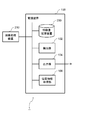
- FIG. 15 is a functional block diagram showing a logical configuration example of the monitoring system 1.
- the monitoring system 1 includes a feature amount storage device 200, a detection unit 102, and an output unit 104, which are the same as the monitoring device 100 of the embodiment of FIG. 2, and further includes a position information acquisition unit 108.
- an example combined with the configuration of the first embodiment of FIG. 2 is shown, but it may be combined with at least one of the configurations of the other embodiments within a range that does not cause a contradiction. good.
- the position information acquisition unit 108 acquires the position information of the group 20.
- the detection unit 102 causes the image processing device 210 to perform image processing when the position information satisfies the reference.
- the output unit 104 When the position information satisfies the standard, the output unit 104 further outputs information indicating that fact.
- the method of acquiring the position information of the group 20 is exemplified below, but is not limited thereto. A plurality of acquisition methods may be combined.
- the user terminal 10 is a terminal carried by at least one person in the group 20.
- the current position information acquired by using the GPS (Global Positioning System) function of the user terminal 10 is acquired from the user terminal 10.
- the information that the user terminal 10 has registered the location with the mobile phone base station is acquired from the base station.
- a GPS receiver other than the user terminal 10 carried by the user is registered, and the current position information is acquired.
- Image recognition processing is performed from the image captured by the surveillance camera 5, the person 22 (user) in the group 20 is tracked, and the position is estimated from the installation position of the surveillance camera 5 that is capturing the user.
- the user terminal 10 may have a function of the position information acquisition unit 108 and a function of determining whether or not the position information satisfies the standard. According to this configuration, it is not necessary to transmit the position information of the user terminal 10 to the server device of the monitoring center, so that the consumption of the communication capacity of the user terminal 10 can be suppressed.
- the criteria for location information are that the user's location has entered a predetermined area (for example, a dangerous area), or that the user has approached a specific location (for example, the location of a dangerous person) (within a predetermined distance).
- a predetermined area for example, a dangerous area
- a specific location for example, the location of a dangerous person
- FIG. 16 is a flowchart showing an operation example of the monitoring system 1.
- the flow of FIG. 16A is started after step S101 of FIG.
- the position information acquisition unit 108 acquires the position information of the group 20 (step S151).
- the detection unit 102 determines whether or not the position information satisfies the reference (step S153).
- the process proceeds to any one of step S103 in FIG. 4, step S111 in FIG. 6, and step S121 in FIG. 7 to start watching. If the position information does not satisfy the reference (NO in step S153), the process returns to step S151.
- step S153 in FIG. 16A when the determination in step S153 in FIG. 16A is YES, the output unit 104 notifies that the position information satisfies the predetermined reference. It may be (step S155). Then, the process may proceed to any one of step S103 of FIG. 4, step S111 of FIG. 6, and step S121 of FIG. 7 to start watching.
- the output by the output unit 104 can be screen-displayed on at least one of the user terminal 10 of the user of the group 20 and the display of the server device of the monitoring center, for example.
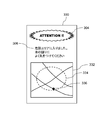
- FIG. 17 is a diagram showing an example of the entry notification screen 330 displayed on the user terminal 10.
- the entry notification screen 330 includes an icon display unit 304, a message display unit 306, and a map display unit 332.
- the icon display unit 304 and the message display unit 306 are the same as the suspicious person notification screen 300 of FIG. 8, but the messages displayed on the message display unit 306 are different.
- the message display unit 306 displays a message notifying the user that the group 20 has entered the dangerous area and calling attention.
- the map display unit 332 includes a danger area display unit 334 and a current position mark 336.
- the danger area display unit 334 the danger area in the map displayed on the map display unit 332 is indicated by a broken line.
- the broken line is an example, and various display methods such as color change and highlighting can be considered.
- the current position mark 336 is an image (black circle in the figure) showing the position information of the group 20, and is displayed at the corresponding position on the map.
- the output unit 104 may display the position information acquired by the position information acquisition unit 108 on the display of the server device of the monitoring center.
- FIG. 18 is a diagram showing an example of the monitoring screen 320 displayed on the display of the server device of the monitoring center.
- the monitoring screen 320 includes a map display unit 322, a danger area display unit 323, a current position mark 324, an alert generation information display unit 326, and an approach detection person image display unit 328.
- the map display unit 322 displays a map of the area including the group 20 to be watched over and the place where the user is.
- the danger area display unit 323 the danger area in the map displayed on the map display unit 322 is indicated by a broken line.
- the broken line is an example, and various display methods such as color change and highlighting can be considered.
- the current position mark 324 is an image (star mark in the figure) showing the position information of the group 20, and is displayed at the corresponding position on the map.
- the alert generation information display unit 326 displays the alert generation information as one of the predetermined outputs.
- the alert occurrence date / time, the place, and the name of the group 20 are displayed as the approach information of the suspicious person.
- the approach detection person image display unit 328 displays an image obtained by cutting out a region including the face of the person 30 from the captured image acquired from the surveillance camera 5.
- the current position of the person 30 may be displayed on the map of the map display unit 322 by distinguishing it with a mark different from the current position of the person to be watched over.
- the method of acquiring the position information of the person 30 may be the same as the method (4) of the method of acquiring the position information of the group 20 described above in the fifth embodiment.
- the position information of the group 20 to be watched over or the user can be acquired, and the image processing can be started when entering a specific area, for example, a dangerous area. Since the processing can be stopped, the processing load of the server device of the monitoring center can be reduced. In addition, since it is possible to notify the users of the group 20 or the server device of the monitoring center that they have entered the dangerous area, it is possible to call attention to the users and the manager of the monitoring center, and it is expected that the crime prevention effect will be improved.
- the monitoring system 1 of the present embodiment is the same as that of the above embodiment except that it has a configuration for registering a face image of a group 20 or a user to be monitored or a specific monitoring target person.
- FIG. 19 is a functional block diagram showing a logical configuration example of the monitoring device 100.
- the monitoring device 100 has the same configuration as at least one of the above embodiments, and further includes a reception unit 110 and a registration unit 112.
- the reception unit 110 presents a face image of a person 30 (a person whose feature amount is not registered in the feature amount storage device 200) that is not to be watched by the detection unit 102, and determines whether or not to register the face image. Let the operator select and accept the operator's input.
- the registration unit 112 registers the face image of the person who has accepted the registration of the face image.
- the operator is a user, a monitor of a monitoring center, an administrator, or the like.
- FIG. 20 is a diagram showing an example in which a registration button 308 is further provided on the suspicious person notification screen 300 of FIG.
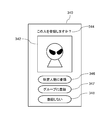
- the registration screen 340 of FIG. 21 includes a registration candidate image display unit 342, a message display unit 344, a specific person registration button 346, a group registration button 347, and an unregistered button 348.
- the registration candidate image display unit 342 displays a face image of a person who does not belong to the detected group.
- the message display unit 344 displays a message asking whether or not to register the person displayed on the registration candidate image display unit 342.
- the specific person registration button 346 accepts an operation of registering the person displayed on the registration candidate image display unit 342 as a specific person.
- the screen shifts to a screen for inputting person information (not shown), and after accepting the input, the registration unit 112 extracts the feature amount from the face image of the person and identifies the person in FIG. 11 (a).
- the person information is not particularly limited, but includes categories to be registered in the list described in the third embodiment and the like.
- the group registration button 347 accepts an operation of registering a person displayed on the registration candidate image display unit 342 as a member of the group.
- the screen shifts to a screen for inputting person information (not shown), and after accepting the input, the registration unit 112 extracts the feature amount from the face image of the person and the user in FIG. 5 (a).
- the unregistered button 348 accepts an instruction not to register the person displayed on the registration candidate image display unit 342.
- the registration screen 340 is closed. Before closing the registration screen 340, a message asking whether or not the image of the person displayed on the registration candidate image display unit 342 may be discarded may be displayed and confirmed.
- the registration screen 340 is displayed on the user terminal 10, but it may be displayed on the server device of the monitoring center and the registration process may be performed.
- a person who is not registered in the feature amount storage device 200 can be further registered as a specific person to be monitored or a member of the group 20.
- a feature amount storage means for storing the feature amount of the person to be watched over, By processing the captured image using the feature amount, a detection means for detecting that a person who is not the monitoring target has approached the watching target person within a reference distance, and a detection means.
- a monitoring device including an output means that outputs a predetermined output using the detection result of the detection means.
- a feature amount storage means that associates and stores the feature amounts of people belonging to the same group, A detection means for detecting that a person who does not belong to the same group approaches a person who belongs to the same group within a reference distance by processing an captured image using the feature amount.
- a monitoring device including an output means that outputs a predetermined output using the detection result of the detection means. 4. 3. 3. In the monitoring device described in The feature amount storage means stores the feature amount of the person to be watched over and stores the feature amount.
- the detection means is a monitoring device that detects that a person who is not the watch target has approached the watch target person within a reference distance. 5. 1 to 4.
- the output means A monitoring device that outputs the predetermined output when a person who is not the monitoring target approaches the watching target person within a reference distance for a reference time or longer. 6. 1. 1. In the monitoring device according to any one of 1 to 5. Further provided with a determination means for determining whether or not a person who approaches the person to be watched within the reference distance is included in the predetermined list. The output means A monitoring device that further outputs information indicating that when it is determined by the determination means that the approaching person is included in the predetermined list. 7. 6. In the monitoring device described in The predetermined list is a monitoring device created for each group or individual. 8. 1. 1. From 7.
- the detection means is a monitoring device that executes the above processing on an image captured by a specific camera among the plurality of cameras. 9. 1. 1. From 8. In the monitoring device described in any one of Further equipped with a location information acquisition means to acquire the location information of the person to be watched over, The detection means is a monitoring device that executes the above processing when the position information meets the criteria. 10. 9. In the monitoring device described in The output means is a monitoring device that further outputs information indicating that when the position information satisfies the standard. 11. 1. 1. To 10.
- a monitoring device In the monitoring device described in any one of A reception means that presents the detected face image of a person who is not the monitoring target, allows the operator to select whether or not to register the face image, and accepts the input of the operator.
- a monitoring device including a registration means for registering the face image of the person who has received the registration of the face image.
- the monitoring device is A feature amount storage means that associates and stores the feature amount of the person to be watched over, A detection means for detecting that a person who is not the monitoring target approaches the person who is the monitoring target within a reference distance by causing the image processing device to process an image captured by the camera using the feature amount.
- a monitoring system including an output means that outputs a predetermined output using the detection result of the detection means. 13. 10. In the monitoring system described in The feature amount storage means of the monitoring device stores the feature amounts of people belonging to the same group in association with each other as the monitoring target.
- the detection means of the monitoring device detects that a person who does not belong to the same group approaches a person who belongs to the same group within a reference distance by processing an captured image using the feature amount.
- Monitoring system. 14 A feature amount storage means that associates and stores the feature amounts of people belonging to the same group, A detection means for detecting that a person who does not belong to the same group approaches a person who belongs to the same group within a reference distance by processing an captured image using the feature amount.
- a monitoring device including an output means that outputs a predetermined output using the detection result of the detection means. 15. 14.
- the feature amount storage means stores the feature amount of the person to be watched over and stores the feature amount.
- the detection means is a monitoring device that detects that a person who is not the watch target has approached the watch target person within a reference distance. 16. 12. To 15. In the monitoring system described in any one of The output means of the monitoring device is A monitoring system that outputs the predetermined output when a person who is not the monitoring target approaches the watching target person within a reference distance and is maintained for a reference time or longer. 17. 12. From 16. In the monitoring system described in any one of The monitoring device is Further provided with a determination means for determining whether or not a person who approaches the person to be watched within the reference distance is included in the predetermined list. The output means of the monitoring device is A monitoring system that further outputs information indicating that when the determination means of the monitoring device determines that the approaching person is included in the predetermined list. 18. 17.
- the predetermined list is a monitoring system created for each group or individual. 19. 12. To 18.
- the detection means of the monitoring device is a monitoring system that executes the above processing on an image captured by a specific camera among the plurality of cameras. 20. 12. From 19.
- the detection means of the monitoring device is a monitoring system that causes the image processing device to perform the above processing when the position information satisfies a reference. 21. 20.
- the output means of the monitoring device is a monitoring system that further outputs information indicating that when the position information satisfies the reference.
- a reception means that presents the detected face image of a person who is not the monitoring target, allows the operator to select whether or not to register the face image, and accepts the input of the operator.
- a monitoring system including a registration means for registering the face image of the person who has received the registration of the face image.
- the monitoring device The feature amount of the person to be watched is associated and stored in the feature amount storage means, By processing the captured image using the feature amount, it is detected that the person who is not the watching target has approached the watching target person within the reference distance. A monitoring method in which a predetermined output is performed using the detected result. 24. 23. In the monitoring method described in The monitoring device As the monitoring target, the feature amounts of people belonging to the same group are associated and stored in the feature amount storage means. A monitoring method for detecting that a person who does not belong to the same group approaches a person who belongs to the same group within a reference distance by processing an captured image using the feature amount. 25.
- the monitoring device The features of people belonging to the same group are associated and stored in the feature storage means, By processing the captured image using the feature amount, it is detected that a person who does not belong to the same group approaches a person who belongs to the same group within a reference distance. A monitoring method in which a predetermined output is performed using the result of the detection. 26. 25. In the monitoring method described in The monitoring device The feature amount of the person to be watched is stored in the feature amount storage means, and the feature amount is stored. A monitoring method for detecting that a person who is not the person to be watched approaches the person to be watched within a reference distance. 27. 23. From 26.
- a monitoring method in which a person who is not the monitoring target outputs the predetermined output when the state in which the person who is not the monitoring target approaches the person to be monitored within a reference distance is maintained for a reference time or longer. 28. 23. From 27.
- the predetermined list is a monitoring method created for each group or individual. 30. 23. From 29.
- the face image of the detected person who is not the monitoring target is presented, the operator is made to select whether or not to register the face image, and the input of the operator is accepted.
- a procedure for associating the features of people belonging to the same group and storing them in the feature storage means A procedure for detecting that a person who does not belong to the same group approaches a person who belongs to the same group within a reference distance by processing an captured image using the feature amount.
- Surveillance system 3 Communication network 5 Surveillance camera 10 User terminal 20 Group 22 Person 30 Person 100 Monitoring device 102 Detection unit 104 Output unit 106 Judgment unit 108 Position information acquisition unit 110 Reception unit 112 Registration unit 130 User registration information 132 Group registration information 140 Specific person information 142 Person list by group 144 Person list by individual 150 Camera information 152 Area list by group 154 Area list by individual 200 Feature storage device 210 Image processor 300 Suspicious person notification screen 302 Person image display unit 304 Icon display unit 306 Message display unit 308 Registration button 310 Warning screen 320 Monitoring screen 322 Map display unit 323 Danger area display unit 324 Current position mark 326 Alert generation information display unit 328 Approach detection person image display unit 330 Entry notification screen 332 Map display unit 334 Danger area display Part 336 Current position mark 340 Registration screen 342 Registration candidate image display part 344 Message display part 346 Specific person registration button 347 Group registration button 348 Unregistered button 1000 Computer 1010 Bus 1020 Processor 1030 Memory 1040 Storage device 1050 In
Landscapes
- Engineering & Computer Science (AREA)
- Physics & Mathematics (AREA)
- General Physics & Mathematics (AREA)
- Theoretical Computer Science (AREA)
- Multimedia (AREA)
- Computer Vision & Pattern Recognition (AREA)
- General Health & Medical Sciences (AREA)
- Health & Medical Sciences (AREA)
- Human Computer Interaction (AREA)
- Business, Economics & Management (AREA)
- Emergency Management (AREA)
- Oral & Maxillofacial Surgery (AREA)
- Artificial Intelligence (AREA)
- Evolutionary Computation (AREA)
- Medical Informatics (AREA)
- Software Systems (AREA)
- Databases & Information Systems (AREA)
- Computing Systems (AREA)
- Signal Processing (AREA)
- Alarm Systems (AREA)
- Emergency Alarm Devices (AREA)
- Image Analysis (AREA)
Priority Applications (4)
| Application Number | Priority Date | Filing Date | Title |
|---|---|---|---|
| JP2021573696A JP7428191B2 (ja) | 2020-01-29 | 2020-01-29 | 監視システム、監視装置、監視方法、およびプログラム |
| US17/795,311 US12154342B2 (en) | 2020-01-29 | 2020-01-29 | Surveillance system, surveillance apparatus, surveillance method, and non-transitorycomputer-readable storage medium |
| PCT/JP2020/003213 WO2021152736A1 (ja) | 2020-01-29 | 2020-01-29 | 監視システム、監視装置、監視方法、およびプログラム |
| US18/916,948 US20250037472A1 (en) | 2020-01-29 | 2024-10-16 | Method and system for notifying information, and non-transitory computer-readable storage medium |
Applications Claiming Priority (1)
| Application Number | Priority Date | Filing Date | Title |
|---|---|---|---|
| PCT/JP2020/003213 WO2021152736A1 (ja) | 2020-01-29 | 2020-01-29 | 監視システム、監視装置、監視方法、およびプログラム |
Related Child Applications (2)
| Application Number | Title | Priority Date | Filing Date |
|---|---|---|---|
| US17/795,311 A-371-Of-International US12154342B2 (en) | 2020-01-29 | 2020-01-29 | Surveillance system, surveillance apparatus, surveillance method, and non-transitorycomputer-readable storage medium |
| US18/916,948 Continuation US20250037472A1 (en) | 2020-01-29 | 2024-10-16 | Method and system for notifying information, and non-transitory computer-readable storage medium |
Publications (1)
| Publication Number | Publication Date |
|---|---|
| WO2021152736A1 true WO2021152736A1 (ja) | 2021-08-05 |
Family
ID=77078711
Family Applications (1)
| Application Number | Title | Priority Date | Filing Date |
|---|---|---|---|
| PCT/JP2020/003213 Ceased WO2021152736A1 (ja) | 2020-01-29 | 2020-01-29 | 監視システム、監視装置、監視方法、およびプログラム |
Country Status (3)
| Country | Link |
|---|---|
| US (2) | US12154342B2 (https=) |
| JP (1) | JP7428191B2 (https=) |
| WO (1) | WO2021152736A1 (https=) |
Cited By (1)
| Publication number | Priority date | Publication date | Assignee | Title |
|---|---|---|---|---|
| US20230316889A1 (en) * | 2022-03-31 | 2023-10-05 | Honda Motor Co., Ltd. | Monitoring system and storage medium |
Families Citing this family (2)
| Publication number | Priority date | Publication date | Assignee | Title |
|---|---|---|---|---|
| CN117897737A (zh) * | 2021-10-11 | 2024-04-16 | 深圳市大疆创新科技有限公司 | 一种无人机监控方法、装置、无人机及监控设备 |
| US20240119472A1 (en) * | 2022-10-05 | 2024-04-11 | Insight Direct Usa, Inc. | Associating groups of consumers with transactions using video data and location information |
Citations (6)
| Publication number | Priority date | Publication date | Assignee | Title |
|---|---|---|---|---|
| JP2003141657A (ja) * | 2001-11-01 | 2003-05-16 | Takeshi Ikeda | 防犯システム |
| JP2008204219A (ja) * | 2007-02-21 | 2008-09-04 | Sharp Corp | 防犯システム、それに用いる不審者検出装置及び防犯サーバ |
| WO2014171061A1 (ja) * | 2013-04-19 | 2014-10-23 | パナソニック インテレクチュアル プロパティ コーポレーション オブ アメリカ | カメラ制御装置、カメラ制御方法およびカメラ制御システム |
| JP2018125587A (ja) * | 2017-01-30 | 2018-08-09 | キヤノン株式会社 | 情報処理装置、情報処理方法およびプログラム |
| JP2019149641A (ja) * | 2018-02-26 | 2019-09-05 | グローリー株式会社 | 監視システム、監視方法及び監視プログラム。 |
| JP2020017155A (ja) * | 2018-07-27 | 2020-01-30 | 株式会社システック | 携帯飛行監視端末、監視装置および監視方法 |
Family Cites Families (10)
| Publication number | Priority date | Publication date | Assignee | Title |
|---|---|---|---|---|
| JPH07296068A (ja) | 1994-04-25 | 1995-11-10 | Toshiba Corp | 避難誘導支援装置 |
| JP2009134488A (ja) | 2007-11-30 | 2009-06-18 | Toshiba Corp | プラント監視システム |
| US9092963B2 (en) | 2010-03-29 | 2015-07-28 | Qualcomm Incorporated | Wireless tracking device |
| TWI507661B (zh) * | 2013-07-03 | 2015-11-11 | Faraday Tech Corp | 影像監控系統及其方法 |
| JP6413310B2 (ja) | 2014-04-10 | 2018-10-31 | 富士通株式会社 | 見守り装置、表示方法及びプログラム |
| WO2016088401A1 (ja) | 2014-12-01 | 2016-06-09 | Lykaon株式会社 | 防犯システム |
| WO2017104372A1 (ja) * | 2015-12-18 | 2017-06-22 | 株式会社リコー | 画像処理装置、画像処理システム、画像処理方法およびプログラム |
| JP6177408B1 (ja) | 2016-10-18 | 2017-08-09 | オカムラ印刷株式会社 | 見守りシステム、見守り方法、情報取得装置、情報処理装置およびそれらの方法とプログラム |
| JP6346357B2 (ja) | 2017-07-11 | 2018-06-20 | オカムラ印刷株式会社 | 見守りシステム、見守り方法、情報取得装置、情報処理装置およびそれらの方法とプログラム |
| WO2020053953A1 (ja) * | 2018-09-11 | 2020-03-19 | 株式会社日立国際電気 | 照合システム及び照合サーバ |
-
2020
- 2020-01-29 WO PCT/JP2020/003213 patent/WO2021152736A1/ja not_active Ceased
- 2020-01-29 JP JP2021573696A patent/JP7428191B2/ja active Active
- 2020-01-29 US US17/795,311 patent/US12154342B2/en active Active
-
2024
- 2024-10-16 US US18/916,948 patent/US20250037472A1/en active Pending
Patent Citations (6)
| Publication number | Priority date | Publication date | Assignee | Title |
|---|---|---|---|---|
| JP2003141657A (ja) * | 2001-11-01 | 2003-05-16 | Takeshi Ikeda | 防犯システム |
| JP2008204219A (ja) * | 2007-02-21 | 2008-09-04 | Sharp Corp | 防犯システム、それに用いる不審者検出装置及び防犯サーバ |
| WO2014171061A1 (ja) * | 2013-04-19 | 2014-10-23 | パナソニック インテレクチュアル プロパティ コーポレーション オブ アメリカ | カメラ制御装置、カメラ制御方法およびカメラ制御システム |
| JP2018125587A (ja) * | 2017-01-30 | 2018-08-09 | キヤノン株式会社 | 情報処理装置、情報処理方法およびプログラム |
| JP2019149641A (ja) * | 2018-02-26 | 2019-09-05 | グローリー株式会社 | 監視システム、監視方法及び監視プログラム。 |
| JP2020017155A (ja) * | 2018-07-27 | 2020-01-30 | 株式会社システック | 携帯飛行監視端末、監視装置および監視方法 |
Cited By (1)
| Publication number | Priority date | Publication date | Assignee | Title |
|---|---|---|---|---|
| US20230316889A1 (en) * | 2022-03-31 | 2023-10-05 | Honda Motor Co., Ltd. | Monitoring system and storage medium |
Also Published As
| Publication number | Publication date |
|---|---|
| US12154342B2 (en) | 2024-11-26 |
| US20230050235A1 (en) | 2023-02-16 |
| JP7428191B2 (ja) | 2024-02-06 |
| US20250037472A1 (en) | 2025-01-30 |
| JPWO2021152736A1 (https=) | 2021-08-05 |
Similar Documents
| Publication | Publication Date | Title |
|---|---|---|
| US12273713B2 (en) | Security and public safety application for a mobile device | |
| JP6525229B1 (ja) | デジタルサーチ・セキュリティシステム、方法及びプログラム | |
| US11062160B2 (en) | Person monitoring system and person monitoring method | |
| US9843911B2 (en) | Remotely activated monitoring service | |
| US9084103B2 (en) | Analytic and tracking systems and methods using over-the-air identifiers of mobile devices | |
| CN114153343B (zh) | 一种健康码显示方法及电子设备 | |
| US9972324B2 (en) | Personal assistant application | |
| US9538384B2 (en) | Method and apparatus for a device management application | |
| US20250037472A1 (en) | Method and system for notifying information, and non-transitory computer-readable storage medium | |
| US9706380B1 (en) | Providing emergency notification and tracking data from a mobile device | |
| JP6590575B2 (ja) | コンテンツ提供方法、プログラム及び計算処理システム | |
| US11373499B2 (en) | Rescue system and rescue method, and server used for rescue system and rescue method | |
| CN110246292B (zh) | 家庭视频监控方法、装置及存储介质 | |
| WO2017201874A1 (zh) | 终端丢失提示方法及装置 | |
| JP2025100673A (ja) | システム、サーバ装置、サーバ装置の制御方法及びプログラム | |
| US20220130174A1 (en) | Image processing apparatus, control method, and non-transitory storage medium | |
| JP2012124658A (ja) | 特定人物検知システムおよび検知方法 | |
| Alkhateeb et al. | A multi agent-based system for securing university campus: Design and architecture | |
| JP6695844B2 (ja) | 連絡情報管理装置、連絡情報管理方法、連絡情報管理システム、及びプログラム | |
| JP2002237908A (ja) | インターネット等の双方向通信を利用した警備システム | |
| JP2011182172A (ja) | カメラ管理サーバ、防犯サービス管理方法および防犯サービス管理プログラム | |
| JP2025178922A (ja) | 監視装置、監視方法、プログラム、および監視システム | |
| KR101926191B1 (ko) | 증강현실을 이용한 정보 제공 장치 및 방법 | |
| JP2008021112A (ja) | 防犯システム、端末装置及び防犯方法 | |
| GB2536153A (en) | Tracking systems and methods using over-the-air identifiers of mobile devices |
Legal Events
| Date | Code | Title | Description |
|---|---|---|---|
| 121 | Ep: the epo has been informed by wipo that ep was designated in this application |
Ref document number: 20916967 Country of ref document: EP Kind code of ref document: A1 |
|
| ENP | Entry into the national phase |
Ref document number: 2021573696 Country of ref document: JP Kind code of ref document: A |
|
| NENP | Non-entry into the national phase |
Ref country code: DE |
|
| 122 | Ep: pct application non-entry in european phase |
Ref document number: 20916967 Country of ref document: EP Kind code of ref document: A1 |