WO2021149717A1 - 複合磁性粉体及びその製造方法 - Google Patents
複合磁性粉体及びその製造方法 Download PDFInfo
- Publication number
- WO2021149717A1 WO2021149717A1 PCT/JP2021/001830 JP2021001830W WO2021149717A1 WO 2021149717 A1 WO2021149717 A1 WO 2021149717A1 JP 2021001830 W JP2021001830 W JP 2021001830W WO 2021149717 A1 WO2021149717 A1 WO 2021149717A1
- Authority
- WO
- WIPO (PCT)
- Prior art keywords
- additive element
- iron
- magnetic powder
- iron oxide
- composite magnetic
- Prior art date
- Legal status (The legal status is an assumption and is not a legal conclusion. Google has not performed a legal analysis and makes no representation as to the accuracy of the status listed.)
- Ceased
Links
Images






Classifications
-
- C—CHEMISTRY; METALLURGY
- C01—INORGANIC CHEMISTRY
- C01G—COMPOUNDS CONTAINING METALS NOT COVERED BY SUBCLASSES C01D OR C01F
- C01G51/00—Compounds of cobalt
-
- G—PHYSICS
- G11—INFORMATION STORAGE
- G11B—INFORMATION STORAGE BASED ON RELATIVE MOVEMENT BETWEEN RECORD CARRIER AND TRANSDUCER
- G11B5/00—Recording by magnetisation or demagnetisation of a record carrier; Reproducing by magnetic means; Record carriers therefor
- G11B5/62—Record carriers characterised by the selection of the material
- G11B5/68—Record carriers characterised by the selection of the material comprising one or more layers of magnetisable material homogeneously mixed with a bonding agent
- G11B5/70—Record carriers characterised by the selection of the material comprising one or more layers of magnetisable material homogeneously mixed with a bonding agent on a base layer
- G11B5/706—Record carriers characterised by the selection of the material comprising one or more layers of magnetisable material homogeneously mixed with a bonding agent on a base layer characterised by the composition of the magnetic material
-
- G—PHYSICS
- G11—INFORMATION STORAGE
- G11B—INFORMATION STORAGE BASED ON RELATIVE MOVEMENT BETWEEN RECORD CARRIER AND TRANSDUCER
- G11B5/00—Recording by magnetisation or demagnetisation of a record carrier; Reproducing by magnetic means; Record carriers therefor
- G11B5/74—Record carriers characterised by the form, e.g. sheet shaped to wrap around a drum
- G11B5/78—Tape carriers
-
- G—PHYSICS
- G11—INFORMATION STORAGE
- G11B—INFORMATION STORAGE BASED ON RELATIVE MOVEMENT BETWEEN RECORD CARRIER AND TRANSDUCER
- G11B5/00—Recording by magnetisation or demagnetisation of a record carrier; Reproducing by magnetic means; Record carriers therefor
- G11B5/84—Processes or apparatus specially adapted for manufacturing record carriers
-
- H—ELECTRICITY
- H01—ELECTRIC ELEMENTS
- H01F—MAGNETS; INDUCTANCES; TRANSFORMERS; SELECTION OF MATERIALS FOR THEIR MAGNETIC PROPERTIES
- H01F1/00—Magnets or magnetic bodies characterised by the magnetic materials therefor; Selection of materials for their magnetic properties
- H01F1/01—Magnets or magnetic bodies characterised by the magnetic materials therefor; Selection of materials for their magnetic properties of inorganic materials
- H01F1/03—Magnets or magnetic bodies characterised by the magnetic materials therefor; Selection of materials for their magnetic properties of inorganic materials characterised by their coercivity
- H01F1/032—Magnets or magnetic bodies characterised by the magnetic materials therefor; Selection of materials for their magnetic properties of inorganic materials characterised by their coercivity of hard-magnetic materials
- H01F1/10—Magnets or magnetic bodies characterised by the magnetic materials therefor; Selection of materials for their magnetic properties of inorganic materials characterised by their coercivity of hard-magnetic materials non-metallic substances, e.g. ferrites, e.g. [(Ba,Sr)O(Fe2O3)6] ferrites with hexagonal structure
- H01F1/11—Magnets or magnetic bodies characterised by the magnetic materials therefor; Selection of materials for their magnetic properties of inorganic materials characterised by their coercivity of hard-magnetic materials non-metallic substances, e.g. ferrites, e.g. [(Ba,Sr)O(Fe2O3)6] ferrites with hexagonal structure in the form of particles
-
- H—ELECTRICITY
- H01—ELECTRIC ELEMENTS
- H01F—MAGNETS; INDUCTANCES; TRANSFORMERS; SELECTION OF MATERIALS FOR THEIR MAGNETIC PROPERTIES
- H01F41/00—Apparatus or processes specially adapted for manufacturing or assembling magnets, inductances or transformers; Apparatus or processes specially adapted for manufacturing materials characterised by their magnetic properties
- H01F41/02—Apparatus or processes specially adapted for manufacturing or assembling magnets, inductances or transformers; Apparatus or processes specially adapted for manufacturing materials characterised by their magnetic properties for manufacturing cores, coils, or magnets
Definitions
- This disclosure relates to a composite magnetic powder and a method for producing the same.
- examples of magnetic powder having a coercive force of 10 kOe or more include neodymium iron boron, samarium iron nitride, platinum iron, and epsilon-type iron oxide ( ⁇ -Fe 2 O 3 ) having a crystal structure.
- the magnetic particles when the magnetic particles are formed of neodymium iron boron, samarium iron nitride, etc., the ingot obtained by uniformly alloying neodymium iron boron, samarium iron nitride, etc. at high temperature is finally crushed. Because it is obtained from the above, there are many particles of micron order size.
- platinum iron a large amount of platinum group elements are contained as a main component, which increases resource risk and manufacturing cost.
- Non-Patent Document 2 describes that when the particle size of ⁇ -Fe 2 O 3 is 7.5 nm or more, the phase transition is ferromagnetic.
- Patent Documents 1, 2, 3 and non-patents Patent Documents 1, 2, 3 and non-patents. Reference 3 etc.).
- Patent Document 1 discloses a method of obtaining a coercive force of 31 kOe at room temperature by substituting a part of iron oxide with rhodium.
- Patent Document 2 a general formula ⁇ -Ga x Fe 2-x O 3 (where 0.10 ⁇ x ⁇ 0.67) is used in which a part of iron ions of ⁇ -Fe 2 O 3 is replaced with gallium ions.
- a method for producing the represented nanoparticles has been proposed.
- Patent Document 2 describes that the nanoparticles effectively and selectively absorb millimeter waves in a high frequency region from 30 GHz to 150 GHz depending on the amount of gallium substitution.
- Patent Document 3 describes that a rod-shaped ⁇ -Fe2O3 is obtained by adding an alkaline earth metal such as barium into iron compound particles in the synthesis of ⁇ -Fe2O3 as a shape-retaining agent.
- Patent Document 4 other elements are added to ⁇ -Fe 2 O 3 to reduce the particle size distribution and the content of particles that do not contribute to the magnetic recording characteristics, so that the coercive force distribution is narrow and magnetic recording is performed. It is disclosed that an iron-based oxide magnetic particle powder suitable for increasing the recording density of a medium can be obtained.
- Patent Document 4 the general formula ⁇ -A x B y C z Fe 2-xyz O 3 ( provided that, A is one or more divalent metal element selected Co, Ni, Mn, from Zn, B is Ti , Sn is one or more tetravalent metal elements selected from, C is one or more trivalent metal elements selected from In, Ga, Al, 0 ⁇ x ⁇ 1, 0 ⁇ y ⁇ 1, An iron-based oxide represented by 0 ⁇ z ⁇ 1) is used.
- Patent Document 5 by adhering one or two types of hydroxides or hydrous oxides of Al ion and Y ion to the iron-based oxide magnetic powder, solid-liquid separation in the production process is good. It is described that a surface-modified iron-based oxide magnetic particle powder having good dispersibility in a coating material and a small amount of water-soluble alkali metal elution can be obtained.
- Non-Patent Document 4 an attempt to increase the magnetization by doping ⁇ -iron oxide with cobalt by several% is reported.
- Patent Document 5 Patent documents relating to cobalt ferrite include magnetic powders and methods for producing them, magnetic recording media and methods for producing the same, and magnetic powders having a small variation in coercive force using radiation and methods for producing the same. Shown. (Patent Document 6)
- Patent Document 7 a glass component and a spinel ferrite component are melted and rapidly cooled to form an amorphous body, which is then heat-treated to produce magnetic particles. Further, in Non-Patent Document 6, CoFe 2 O 4 particles having an average particle size of 22.5 nm, a saturation magnetization of 69.9 emu / g, and a coercive force of 1785 Oe are synthesized by liquid phase synthesis.
- Patent Document 8 in a magnetic material containing epsilon iron oxide, in order to obtain a magnetic material having excellent magnetic properties, a step of coating supernormal magnetic Fe 3 O 4 with a silicon compound, and coating supernormal magnetic Fe 3 O 4 are described. After heat treatment in an oxidizing atmosphere to form a double phase of ⁇ -Fe 2 O 3 and ⁇ -Fe 2 O 3 , the heat-treated double phase of ⁇ -Fe 2 O 3 and ⁇ -Fe 2 O 3 is an alkaline solution. Provided are a method for producing a composite magnetic material and related techniques for extracting the silicon compound by dissolving the silicon compound.
- the composite magnetic powder as one embodiment of the present disclosure includes iron oxide, additive element A which is one or more elements of Co (cobalt) and Mn (manganese), and Zr (zirconium) and Hf (hafnium). ), Cs (cesium) and Ti (titanium), which is one or more elements of the additive element B.
- the composite magnetic powder of the present disclosure may further contain an additive element D, which is one or more of Sm (samarium) and Nd (neodymium).
- magnetism exchange including ⁇ -Fe 2 O 3 having a small particle size, adjustable magnetization and coercive force, and excellent distortion-free magnetic properties with sufficient coupling between the soft phase and the hard phase. It is possible to provide a composite magnetic powder having a nanocomposite magnet structure in which a bond has worked and a method for producing the same.
- the effect of the present disclosure is not limited to this, and any effect described in the present specification may be used.
- nanomagnet powder that has both high coercive force and residual magnetization and also improved maximum energy product is required.
- a composite magnetic material for a magnet in which a hard magnetic phase and a soft magnetic phase are connected by an exchange interaction is called an exchange spring magnet or a nanocomposite magnet, and has the following features.
- the magnetization of the soft magnetic phase and the hard magnetic phase are connected to each other by exchange interaction, so that the magnetization of the soft magnetic phase is prevented from being reversed by the reverse magnetic field, and the magnetization of the hard magnetic phase is hindered. It exhibits characteristics as if the soft magnetic phase does not exist.
- the hard magnetic phase and the soft magnetic phase are relative names, and the ⁇ iron oxide-based particles correspond to the hard magnetic phase, and the ferrite particles having a spinel structure with high magnetization correspond to the soft magnetic phase.
- the magnetization of the soft magnetic phase is easily reversed when a small reverse magnetic field is applied from the outside, and even if the magnetic field is returned to zero, it is reversed.
- the magnetization of the soft magnetic phase is irreversible. That is, the presence of the soft magnetic phase deteriorates the magnet characteristics. Therefore, when producing a high-performance magnet material, the soft magnetic phase is usually thoroughly removed.
- the exchange spring magnet since the magnetization of the soft magnetic phase is connected to the magnetization of the hard magnetic phase by the exchange interaction, it is supported by the magnetic anisotropy of the magnetization of the hard magnetic phase, and the reverse It does not easily reverse even when a magnetic field is applied.
- the soft magnetic phase has a higher magnetization than the hard magnetic phase, and the ⁇ -iron oxide-based particles, which are the low-magnetized hard magnetic phase, have high magnetization. It makes sense to composite spinel-type ferrite particles, which are the soft magnetic phases.
- the feature of the exchange spring magnet of the present disclosure is that there is no inflection point in the magnetic field region of the magnetic curve (a guideline is between 0 to 5 kOe and 10 k to 20 kOe), and a smooth trajectory is drawn. Despite the presence of the soft magnetic phase, it behaves as if it were a single magnet, and whether or not it has an inflection point in this region is whether or not it is an exchange spring magnet. It can be considered as one index of.
- particles containing iron oxide are heat-treated at a temperature at which ⁇ -Fe 2 O 3 is produced (for example, 850 to 1250 ° C.) to obtain particles having ⁇ -Fe 2 O 3. ..
- Particles having ⁇ -Fe 2 O 3 have excellent magnetic properties, but they are not sufficiently high in terms of saturation magnetization and require some improvement.
- none of the spinel-type iron oxide particles have a particle size of 40 nm or less and a high coercive force, and even if a powder containing both is prepared, it cannot be said that the spinel-type iron oxide particles sufficiently exhibit the function of exchange bonding. , It was a powder with a bending point (distortion) in the magnetic loop.
- An object of the present disclosure is to provide a composite magnetic powder having a nanocomposite magnet structure in which the magnetization and coercive force can be adjusted and there is no inflection point (distortion) in a magnetic loop, and a method for producing the same. At the same time, consideration is given to improving the magnetic anisotropy of the magnetic particles.
- the creators diligently studied the use of oxides in order to exhibit the characteristics that could not be achieved by conventional nanomagnetic materials in consideration of particle size, that is, the characteristics of high magnetization and high coercive force.
- a powder obtained by combining epsilon iron oxide and spinel-type iron oxide is used, magnetic coupling is achieved and a composite magnetic powder exhibiting a function suitable for the purpose can be obtained, and its composition and crystals are obtained.
- the present disclosure has been achieved by controlling the structure, microstructure and particle size, and establishing a method for producing the same. That is, the composite magnetic powder in one embodiment of the present disclosure contains epsilon-type iron oxide and spinel-type iron oxide, and further contains Zr and Hf, Cs, and Ti.
- the method for producing a composite magnetic powder in the present disclosure is a first compound containing an iron element containing one or more of iron nitrate, iron acetate and iron sulfate, and a second compound containing Co as the additive element A. And a third compound containing one or more of Zr, Hf, Cs and Ti as the additive element B are mixed to form a mixture, and then a silicon compound is added to the mixture to form the iron element. , The silica xerogel containing the additive element A and the additive element B in silica is produced, and the silica xerogel is heat-treated at 850 ° C. to 1250 ° C. for 4 hours to 50 hours to obtain epsilon-type iron oxide and the additive element.
- a composite magnetic powder containing A and the additive element B or to a first compound containing an iron element, which comprises, or contains one or more of iron nitrate, iron acetate and iron sulfate.
- a second compound containing Co as the additive element A a third compound containing one or more of Zr, Hf, Cs and Ti as the additive element B, and Sm and Nd as the additive element D.
- a silicon compound is added to the mixture to add the iron element, the additive element A, the additive element B, and the additive element D.
- silica xerogel contained in silica, and heat-treat the silica xerogel at 850 ° C to 1250 ° C for 4 to 50 hours, epsilon-type iron oxide, the additive element A, the additive element B, and the additive element D.
- the composite magnetic powder in the present disclosure contains epsilon-type iron oxide, spinel-type iron oxide, and an additive element, and the additive element is one or more of Zr, Hf, Cs, Ti, Sm, and Nd. Is.
- magnetism exchange including ⁇ -Fe 2 O 3 having a small particle size, adjustable magnetization and coercive force, and excellent distortion-free magnetic properties with sufficient coupling between the soft phase and the hard phase. It is possible to provide a composite magnetic powder having a nanocomposite magnet structure in which a bond has worked and a method for producing the same.
- the composite magnetic powder according to the embodiment includes “epsilon-type iron oxide (hereinafter, also referred to as ⁇ -Fe 2 O 3 ), spinel-type iron oxide, additive element A, and addition. It has a compound of "element B" and "silicon”.
- the additive element A is one or more elements of Co and Mn.
- the additive element A contained in the spinel-type iron oxide is preferably Co, and may contain Mn instead of Co. Alternatively, both Co and Mn may be contained as the additive element A contained in the spinel-type iron oxide.
- the content of the additive element A is preferably 1 to 30 atomic% when the atomic% of the iron in the iron oxide, the additive element A, the additive element B, and the additive element D is 100. More preferably, it is 3 to 20 atomic%.
- the additive element A may be contained in the magnetic particles in the form of a solid solution in ⁇ -Fe 2 O 3 or in the form of an oxide.
- the additive element B is one or more elements of Zr, Hf, Cs and Ti. Even if the additive element B is contained in the composite magnetic powder in the form of being dissolved in ⁇ -Fe 2 O 3 or a spinel-type oxide, or in the form of an oxide as a film or a bond on the surface of each magnetic particle. good.
- the content of the additive element B is preferably 1 to 15 atomic% when the atomic% of the iron in the iron oxide, the additive element A, the additive element B, and the additive element D is 100. More preferably, it is ⁇ 10 atomic%.
- the content of the additive element B is 1 atomic% or more, the effect of the additive element is exhibited. Therefore, even if the heat treatment for producing the composite magnetic powder according to the embodiment is performed at a low temperature, the composite magnetism according to the embodiment is performed. It is possible to generate ⁇ -Fe 2 O 3 that can exhibit excellent magnetic properties in the powder.
- the content B of the additive element is 20 atomic% or less, an increase in the proportion of non-magnetic substances such as the additive element is suppressed, so that the composite magnetic powder according to the embodiment can exhibit high magnetic properties. can.
- the additive element D is one or more elements of Sm and Nd. Even if the additive element D is contained in the composite magnetic powder in the form of being dissolved in ⁇ -Fe 2 O 3 or a spinel-type oxide, or in the form of an oxide as a film or a bond on the surface of each magnetic particle. good.
- the content of the additive element D is preferably 0 to 10 atomic% when the atomic% of the iron in the iron oxide, the additive element A, the additive element B, and the additive element D is 100. More preferably, it is ⁇ 5 atomic%.
- the content of the additive element D is 1 atomic% or more, the effect of the additive element is exhibited. Therefore, even if the heat treatment for producing the composite magnetic powder according to the embodiment is performed at a low temperature, ⁇ -Fe 2 O 3 capable of exhibiting excellent magnetic properties in the composite magnetic powder according to the embodiment is produced. Can be done.
- the content of the additive element D is 15 atomic% or less, an increase in the proportion of a non-magnetic substance such as the additive element D is suppressed, so that the composite magnetic powder according to the embodiment exhibits high magnetic properties. Can be done.
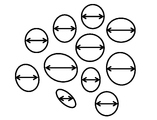
- the particle size of the magnetic particles For the particle size of the magnetic particles according to the embodiment, observe an arbitrary number (for example, 300) of magnetic particles with a transmission electron microscope (TEM), consider a line parallel to a certain direction as shown in FIG. 1, and consider the line. The longest length at which the particles were cut along the above was measured and used as the particle size, and the average of them was used as the average particle size.
- TEM transmission electron microscope
- the magnetic characteristics of the composite magnetic powder according to the embodiment can be confirmed by using, for example, a physical characteristic measuring device (Physical Property Measurement System: PPMS), an automatic magnetization characteristic measuring device (BH curve tracer), or the like.
- PPMS Physical Property Measurement System
- BH curve tracer automatic magnetization characteristic measuring device
- the composite magnetic powder according to the embodiment contains ⁇ -Fe 2 O 3 , spinel-type iron oxide, and a compound other than iron oxide containing additive element A or additive element B, and contains additive element A or additive element B.
- ⁇ -Fe 2 O 3 or spinel iron oxide be included in the form or in the form of oxides dissolved in the compound other than iron oxide, ⁇ -Fe 2 O 3 spinel type oxide iron and the additive element a or additional element It contains B in a composite state. As a result, it is possible to exhibit excellent magnetic characteristics having magnetic characteristics in which the magnetisms of the hard phase and the soft phase are exchanged and coupled.
- ⁇ Manufacturing method of composite magnetic powder> A method for producing a composite magnetic powder according to this embodiment will be described.
- silica xerogel containing a compound containing Fe element is heat-treated to ⁇ -Fe 2 O 3 or spinel-type iron oxide, or additive element A, additive element B or
- the spinel-type iron oxide contains cobalt and may further contain other elements such as Mn.
- the additive element B is any one or more of Zr, Hf, Cs, and Ti.
- the additive element D is one or more elements of Sm (samarium) and Nd (neodymium).
- the method for producing a composite magnetic powder of the present embodiment is a first compound containing an iron element containing any one or more of iron nitrate, iron acetate, or iron sulfate, and a first compound containing Co as an additive element A.
- a silicon compound is added to a solution containing the two compounds and a third compound containing the nitrate or acetate of the additive element B to produce a silica xerogel containing the iron element, the additive element A and the additive element B in silica.
- a composite magnetic powder containing epsilon-type iron oxide, spinel-type iron oxide particles, and an oxide of additive element A or additive element B by heat-treating the silica xerogel at 850 to 1250 ° C.
- a first compound containing an iron element containing any one or more of iron nitrate, iron acetate, or iron sulfate, and Co as an additive element A are used.
- a silicon compound is added to a solution containing the second compound containing the second compound, the third compound containing the nitrate or acetate of the additive element B, and the fourth compound containing the nitrate or acetate of the additive element D, and the iron element is added.
- the step of producing a composite magnetic powder containing iron particles and an oxide of the additive element A or the additive element B is included.
- the first compound containing an iron element, the second compound containing Co as the additive element A, and any of Zr, Hf, Cs, and Ti as the additive element B is mixed to prepare a solution containing the first compound, the second compound, and the third compound.
- the first compound containing an iron element, the second compound containing Co as the additive element A, and Zr, Hf, Cs, and Ti as the additive element B are used.
- a third compound containing any one or more elements and a fourth compound containing any one or more elements of Sm and Nd as additive elements D are mixed, and the first compound, the second compound, the third compound, and the third compound are mixed.
- a solution containing the four compounds is prepared.
- the solution containing the first compound and the second compound for example, an aqueous solution in which the iron element and the additive element are dissolved in water can be used.
- the first compound is a compound containing an iron element, and as the compound containing an iron element, iron oxide ( ⁇ -Fe 2 O 3 ) having an alpha crystal structure is contained in the composite magnetic powder according to the embodiment.
- iron sulfate (FeSO 4 ) is used from the viewpoint of suppressing the formation.
- the first compound contains any one or more of iron nitrate, iron acetate, or iron sulfate.
- a hydrate of a compound containing these iron elements can be used as the first compound.
- the second compound contains Co as the additive element A and may also contain Mn.
- the compound containing the additive element A for example, a nitrate containing the additive element A, an acetate, or the like is used. A hydrate of a compound containing the additive element A can be used.
- the content of the additive element A in the spinel-type iron oxide is preferably 1 to 30 atomic% when the atomic% of the total of iron, the additive element A, the additive element B and the additive element D is 100. Saturation magnetization can be controlled by the amount added.
- the third compound contains one or more of Zr, Hf, Cs, and Ti as the additive element B, and contains, for example, one or more nitrates or acetates containing the additive element B.
- a hydrate of a compound containing an additive element can be used.
- the content of the additive element B is preferably 1 to 15 atomic%, preferably 1.5 to 10 atoms, when the atomic% of the total of iron, the additive element A, the additive element B and the additive element D is 100. More preferably. When the content of the additive element is large, a non-magnetic substance is generated, which causes a decrease in magnetization.
- the fourth compound contains one or more of Sm and Nd as the additive element D, and for example, contains one or more nitrates or acetates containing the additive element D.
- a hydrate of a compound containing the additive element D can be used.
- the content of the additive element D is preferably 0 to 10 atomic% when the atomic% of the total of iron, the additive element A, the additive element B and the additive element D is 100, and is preferably 1 to 5 atomic%. More preferably. When the content of the additive element D is large, a non-magnetic substance is generated, which causes a decrease in magnetization.
- a silicon compound is added to a solution containing the first compound, the second compound, the third compound, and the fourth compound, and the iron element and the added element are contained in, for example, silica. To generate.
- Silicon compounds include trimethylmethoxysilane, trimethylethoxysilane, dimethyldimethoxysilane, dimethyldiethoxysilane, methyltrimethoxysilane, tetramethoxysilane, methyltriethoxysilane, tetraethoxysilane, methyldimethoxysilane, dimethylethoxysilane, and dimethylvinyl.
- methyltriethoxysilane or tetraethoxysilane is preferable from the viewpoint of the reactivity between the iron element and the additive element and the dispersibility of the iron element and the additive element.
- These silicon compounds may be used alone or in combination of two or more.
- the ratio (M1 / M2) of the number of moles (M1) of the silicon element to the number of moles (M2) when the atomic% of the total of the iron element, the additive element A and the additive element B is 100 is 2 to 5. It is preferable, and around 3 is more preferable.
- Alcohols such as ethanol and propanol may be added to the solution containing the first compound, the second compound, the third compound, the fourth compound and the silicon compound from the viewpoint of accelerating the hydrolysis reaction of the silicon compound.
- the types of silicon compounds there are generally hydrophobic silicon compounds. Therefore, when the solution containing the first compound and the second compound is an aqueous solution, it is preferable to add alcohols to the aqueous solution in order to hydrolyze the silicon compound and water.
- nitric acid may be added to the solution containing the first compound, the second compound, the third compound, the fourth compound and the silicon compound in order to promote the hydrolysis reaction between the silicon compound and water.
- a solution containing the first compound, the second compound, the third compound, the fourth compound, and the silicon compound and nitric acid is reacted at 60 to 80 ° C., for example, for 4 to 6 hours with stirring, whereby the silicon compound and water are reacted. It is possible to promote the hydrolysis reaction with.
- silica xerogel containing the iron element, the additive element A, the additive element B, and the additive element D in silica is produced.
- the heat treatment conditions are adjusted according to the composition of the magnetic particles, the (M1 / M2) ratio, the particle size, the desired magnetic properties, and the like.
- the obtained silica xerogel is heat-treated in the air at 850 to 1250 ° C. for 4 to 6 hours using, for example, an electric furnace to contain ⁇ -Fe 2 O 3 and additive elements.
- a composite magnetic powder is produced.
- spinel-type iron oxide is produced at a temperature lower than that of ⁇ -Fe 2 O 3. Further, by heat-treating for a long time up to 50 hours, the development of the crystal phase can be promoted.
- the heat treatment temperature is less than 850 ° C., ⁇ -Fe 2 O 3 is not sufficiently produced, and if the heat treatment temperature exceeds 1200 ° C., the amount of ⁇ -Fe 2 O 3 phase produced increases.
- the heat treatment time is less than 4 hours, ⁇ -Fe 2 O 3 capable of exhibiting excellent magnetic properties may not be sufficiently produced in the composite magnetic powder according to the embodiment, and the heat treatment time exceeds 6 hours. Although the amount of ⁇ -Fe 2 O 3 and spinel-type iron oxide produced may not change so much, it is possible to control magnetic properties such as coercive force with time in terms of crystal development.
- the remaining silica is dissolved and removed using an alkaline aqueous solution containing sodium hydroxide, potassium hydroxide and the like. You may.
- the composite magnetic powder according to the embodiment thus obtained has ⁇ -Fe 2 O 3 and spinnel-type iron oxide, additive element A and additive element B, and the additive element is ⁇ -Fe 2 O 3 Alternatively, it is contained in the form of solid solution in spinel-type iron oxide or in the form of oxide, and in a state where ⁇ -Fe 2 O 3 and spinel-type iron oxide, additive element A, additive element B and additive element D are combined.
- ⁇ -Fe 2 O 3 and spinel-type iron oxide, additive element A, additive element B and additive element D are combined.
- Examples of high-density magnetic recording media include magnetic tape, which is in the form of a tape.
- the manufacturing method is generally as follows, but is not particularly limited.
- a magnetic layer is formed on one side of the film, cut, wound on a bobbin called a reel, and mounted on a plastic container or the like.
- the magnetic layer is formed by coating, vapor deposition, sputtering, etc., and is formed on one side or both sides.
- the basic structure of the magnetic tape consists of a base film, which is the base of the tape, and a magnetic layer, which is a mixture of a binder (adhesive) and magnetic powder. When applying, the magnetic powder is mixed with an adhesive / adhesive substance and applied to the base film.
- the film-like or bulk magnetic layer using this magnetic powder can be applied as a radio wave absorber, and magnetic iron oxide that magnetically resonates in a high frequency band of millimeter waves or more is used as a radio wave absorbing material as a radio wave absorbing layer. Therefore, it is possible to convert radio waves in a high frequency band of several tens of gigahertz or more into heat by magnetic loss. In addition, it can handle a wide range of radio waves in combination with a conventional radio wave absorber that supports frequencies below millimeter waves.
- the radio wave absorbing layer is generally manufactured by mixing a resin binder and magnetic particles to form a film or bulk body, or molding only the magnetic particles and then applying pulsed electricity and pressurization. A bulk body nanocrystallized by a sintering device or the like is produced, but the present invention is not particularly limited.
- This magnetic powder can form a permanent magnet material by being mixed with a resin.
- the production method is not particularly limited, although the magnetic powder and the resin binder are kneaded to further disperse the magnetic particles, and further molding and processing are performed. These can be small motors used in AV equipment, OA equipment, automobile electrical components, etc., and bond magnets that can be used in magnet rolls of copiers, and the like.
- a bulk body nanocrystallized by a pulse energization pressure sintering apparatus or the like can be produced, but the present invention is not particularly limited. As a result, it can be used as a permanent magnet material for the sintered body.
- this magnetic powder can be used as a biomolecule labeling agent / drug carrier utilizing magnetic properties in combination with magnetic particles and biomolecules.
- Magnetic particles are materials that move when a magnetic force is applied from the outside.
- nano-sized magnetic particles can be absorbed in vivo and can be used as a carrier for a drug delivery system (DDS) that introduces a gene or drug complex into cells.
- DDS drug delivery system
- a drug is immobilized around magnetic particles and a standard protein is lifted.
- the method for producing these biomolecular labeling agents / drug carriers is to use a monomer, an emulsifier, a polymerization initiator, magnetic particles, and water to perform mixing and dispersion, to initiate polymerization, and to perform magnetism. After producing a polymer dispersion containing particles, genes and drugs are immobilized on the surface thereof, but the present invention is not particularly limited.
- Example 1 [Preparation of magnetic powder]
- iron nitrate nonahydrate as the first compound Fe (NO 3) 3 ⁇ 9H 2 O
- 14.54g is dissolved in water
- further cobalt nitrate hexahydrate as the second compound Co (NO 3) 2 ⁇ 6H 2 O) 0.93g
- the iron nitrate nonahydrate dissolved as a third compound It was added to the aqueous solution to dissolve it.
- the obtained aqueous solution and tetraethyl orthosilicate (TEOS) were mixed with ethanol.
- TEOS tetraethyl orthosilicate
- Nitric acid was added to this solution, the mixture was stirred at 40 ° C. for 2 hours, and then dried at 50 ° C.
- silica gel in which a compound of iron element, cobalt and zirconium was dispersed in silica was produced.
- this silica gel was heat-treated at about 1150 ° C. to produce a composite magnetic powder containing iron oxide, cobalt, and zirconium.
- the silica was removed by allowing the aqueous sodium hydroxide solution to stand at 70 ° C. for 24 hours.
- the composite magnetic powder was washed by repeating dispersion by ultrasonic waves in water and ethanol and solid-liquid separation by a centrifuge.
- Examples 2 to 8 as shown in Table 1, the amounts of iron nitrate nineahydrate and cobalt nitrate hexahydrate were changed to adjust the amount of cobalt as the additive element A from 3% to 20%. It was synthesized by the same operation except that it was done.
- Comparative Example 1 is Example 2
- Comparative Example 3 is Example 1
- Comparative Example 5 is Example 5
- Comparative Example 6 is Example 8, zirconium oxynitrate (dihydrate).
- the heat treatment temperature was further increased to 1200 ° C. without adding zirconium oxynitrate (dihydrate), and the subsequent operation was carried out in the same manner to obtain magnetic particles. Synthesized.
- the average particle size, crystallinity and magnetic properties of the composite magnetic powder after removal of silica were evaluated.
- Measurement of average particle size For the particle size of the magnetic particles according to the embodiment, observe an arbitrary number (for example, 300) of magnetic particles with a transmission electron microscope (TEM), consider a line parallel to a certain direction as shown in FIG. 1, and consider the line. The longest length at which the particles were cut along the above was measured and used as the particle size, and the average of them was used as the average particle size. By measuring in a certain direction, the difference in particle size due to the difference in measurement direction that occurs in rod-shaped particles can be ignored by measuring a large number of particles. As shown in FIG.
- the average particle size of the composite magnetic powder after removing silica was 5 to 40 nm, and the particle shape was spherical or slightly cylindrical. As shown in FIG. 3, the particle size decreased as the amount of cobalt increased. The particle size can be controlled by the amount of cobalt. In addition, although it has not been identified at present, a thin phase that joins the particles between the particles was observed as shown in FIG.
- the obtained composite magnetic powder after removing silica was subjected to XRD using an XRD apparatus (manufactured by PANalytical, Empyrean). The XRD measurement results of the composite magnetic powder obtained at each heat treatment temperature are shown in FIG.
- Co-K ⁇ rays were used as the X-ray source.
- the XRD peaks of ⁇ -Fe 2 O 3 are 32.3 °, 35.0 °, 38.3 °, 41.1 °, 42.7 °, 46.0 °, 47.1 °, 48.5. °, 53.6 °, 55.1 °, 57.6 °.
- the XRD peaks of spinel-type iron oxide are 21.3 °, 35.2 °, 41.5 °, 43.4 ° and 50.6 °. As the amount of cobalt increased, the ⁇ iron oxide phase decreased and the cobalt ferrite phase increased.
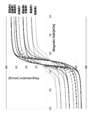
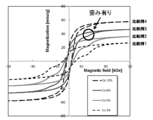
- FIGS. 6 and 7 show the magnetic properties of the composite magnetic powder after removal of silica.
- FIG. 6 is a magnetic curve of Examples 1 to 6 and is a distortion-free magnetic curve.
- FIG. 7 shows the magnetic curves of Comparative Examples 1 to 4. Distortion is seen. In order to show these in an easy-to-understand manner, FIGS.
- FIG. 8 and 9 show a curve obtained by differentiating the magnetic curve of Example 4 or Comparative Example 3.
- FIG. 10 shows the relationship between the amount of cobalt and the magnetic properties of Examples 1 to 8.
- the saturation magnetization increased and the coercive force gradually decreased. In this way, the saturation magnetization and coercive force can be controlled by the amount of cobalt.
- FIG. 11 shows the relationship between the particle size and the magnetic characteristics of Examples 1 to 8. As the particle size increased, the saturation magnetization decreased and the coercive force increased.
- Example 9 cobalt nitrate hexahydrate iron nitrate nonahydrate as the first compound (Fe (NO 3) 3 ⁇ 9H 2 O) 14.38g as was dissolved in water, further second compound ( Co (NO 3) 2 ⁇ 6H 2 O) 0.93g, and zirconium oxynitrate (2 hydrate) ZrO (NO 3) 2 ⁇ 2H 2 O 0.32g, is iron nitrate nonahydrate as a third compound It was added to the dissolved aqueous solution to dissolve it. Then, the obtained aqueous solution and tetraethyl orthosilicate (TEOS) were mixed with ethanol.
- TEOS tetraethyl orthosilicate
- Nitric acid was added to this solution, the mixture was stirred at 40 ° C. for 2 hours, and then dried at 50 ° C.
- silica gel in which a compound of iron element, cobalt and zirconium was dispersed in silica was produced.
- this silica gel was heat-treated at about 1150 ° C. to produce a composite magnetic powder containing iron oxide, cobalt, and zirconium.
- the silica was removed by allowing the aqueous sodium hydroxide solution to stand at 70 ° C. for 24 hours.
- FIG. 12 is an X-ray diffraction spectrum of the composite magnetic powder of Example 1, Example 9, Example 17, Example 25, and Example 27. Peaks of ⁇ -iron oxide and spinel-type cobalt iron oxide can be seen, respectively. Regardless of the amount of zirconium, each peak appears at the same angle without shifting, indicating that zirconium doping has little effect.
- FIG. 12 is an X-ray diffraction spectrum of the composite magnetic powder of Example 1, Example 9, Example 17, Example 25, and Example 27. Peaks of ⁇ -iron oxide and spinel-type cobalt iron oxide can be seen, respectively. Regardless of the amount of zirconium, each peak appears at the same angle without shifting, indicating that zirconium doping has little effect.
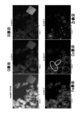
- Example 13 is a TEM photograph of Example 18 and a mapping diagram showing the abundance of each element (O, Si, Fe, Co, Zr).
- each element O, Si, Fe, Co, Zr.
- a place where cobalt is low and iron is high, and a place where both cobalt and iron are high are observed, and it can be seen that the existence is non-uniform in composition.
- zirconium there was a large amount of zirconium in the circled area in the zirconium display, and there was little iron in the iron display in that area.
- Example 28 In Example 28, cobalt nitrate hexahydrate iron nitrate nonahydrate as the first compound (Fe (NO 3) 3 ⁇ 9H 2 O) 14.06g as was dissolved in water, further second compound ( Co (NO 3) 2 ⁇ 6H 2 O) 0.93g, hafnium chloride as a third compound (HfCl 4) 0.64g, was dissolved by adding to an aqueous solution of iron nitrate nonahydrate was dissolved. Then, the obtained aqueous solution and tetraethyl orthosilicate (TEOS) were mixed with ethanol. Nitric acid was added to this solution, the mixture was stirred at 40 ° C.
- TEOS tetraethyl orthosilicate
- silica gel in which a compound of iron element, cobalt, and hafnium was dispersed in silica was produced.
- this silica gel was heat-treated at about 1150 ° C. to produce a composite magnetic powder containing iron oxide, cobalt, and hafnium.
- the silica was removed by allowing the aqueous sodium hydroxide solution to stand at 70 ° C. for 24 hours.
- the composite magnetic powder was washed by repeating dispersion by ultrasonic waves in water and ethanol and solid-liquid separation by a centrifuge.
- Example 29 In Example 29, cobalt nitrate hexahydrate iron nitrate nonahydrate as the first compound (Fe (NO 3) 3 ⁇ 9H 2 O) 14.06g as was dissolved in water, further second compound ( Co (NO 3) 2 ⁇ 6H 2 O) 0.93g, and the cesium nitrate (CsNO 3) 0.39 g, and dissolved by adding to an aqueous solution of iron nitrate nonahydrate was dissolved as a third compound. Then, the obtained aqueous solution and tetraethyl orthosilicate (TEOS) were mixed with ethanol. Nitric acid was added to this solution, the mixture was stirred at 40 ° C.
- TEOS tetraethyl orthosilicate
- silica gel in which a compound of iron element, cobalt, and cesium was dispersed in silica was produced.
- this silica gel was heat-treated at about 1150 ° C. to produce a composite magnetic powder containing iron oxide, cobalt, and cesium.
- the silica was removed by allowing the aqueous sodium hydroxide solution to stand at 70 ° C. for 24 hours.
- the composite magnetic powder was washed by repeating dispersion by ultrasonic waves in water and ethanol and solid-liquid separation by a centrifuge.
- Example 30 uses titanium isopropoxide ([(CH 3 ) 2 CHO] 4 Ti) instead of zirconium oxynitrate (dihydrate) in Example 16 and Example 31 in Example 18. In the subsequent operation, the magnetic powder was synthesized in the same manner.
- Example 18 instead of the zirconium oxynitrate (2 hydrate), using aluminum nitrate nonahydrate (Al (NO 3) 3 ⁇ 9H 2 O), subsequent operations in the same manner, the magnetic powder The body was synthesized.
- FIG. 14 shows a TEM photograph of Comparative Example 9.
- the particles are a mixture of 5 nm to 50 nm particles.
- FIG. 15 shows the X-ray diffraction spectrum of the magnetic powder of Comparative Example 9. ⁇ Iron oxide phase and cobalt ferrite phase can be seen.
- FIG. 16 shows the magnetic curve of Comparative Example 9. It has a saturation magnetization of 43.3 emu / g and a coercive force of 3.4 kOe, but the curve is distorted.
- FIG. 17 shows a curve obtained by differentiating the magnetic curve of Comparative Example 9. The exchange coupling is not working sufficiently because a peak indicating an inflection point is seen.
- the examples had an average particle size of 30 nm or less and the crystal phase was ⁇ -iron oxide or ferrite of the spener phase.
- the amount of cobalt was increased in both the examples and the comparative examples, the saturation magnetization and the residual magnetization increased and the coercive force decreased regardless of the amount of zirconia.
- the spinel phase increased as the amount of cobalt increased.
- the particle size of the comparative example was 20 nm or less.
- Example 32 After iron nitrate nonahydrate as the first compound (Fe (NO 3) 3 ⁇ 9H 2 O) 13.25g is dissolved in water, further cobalt nitrate hexahydrate as the second compound (Co (NO 3) 2 ⁇ 6H 2 O) 1.63g, samarium nitrate (6 a third zirconium oxynitrate (2 hydrate as a compound) ZrO (NO 3) 2 ⁇ 2H 2 O 0.22g, as a fourth compound hydrates) Sm (NO 3) 2 ⁇ 6H 2 O iron nitrate nonahydrate was dissolved was added to an aqueous solution obtained by dissolving.
- Example 33 the raw material was dissolved by adding an amount corresponding to the composition shown in Table 2 below, and the subsequent operation was the same as in Example 1 to synthesize a magnetic powder.
- Example 34 After iron nitrate nonahydrate as the first compound (Fe (NO 3) 3 ⁇ 9H 2 O) 14.06g is dissolved in water, further cobalt nitrate hexahydrate as the second compound (Co (NO 3) 2 ⁇ 6H 2 O) 0.93g, neodymium nitrate (6 a third zirconium oxynitrate (2 hydrate as a compound) ZrO (NO 3) 2 ⁇ 2H 2 O 0.21g, as a fourth compound hydrates) Nd (NO 3) 2 ⁇ 6H 2 O iron nitrate nonahydrate was dissolved was added to an aqueous solution obtained by dissolving.
- Example 35 Subsequent operations were the same as in Example 1, and a magnetic powder was synthesized.
- the raw materials were dissolved by adding an amount suitable for the composition shown in Table 2, and the subsequent operations were the same as in Example 1 to synthesize magnetic powder.
- FIG. 18 shows X-ray diffraction spectra of the composite magnetic powders of Example 33, Example 36, and Example 37. From the X-ray diffraction spectrum shown in FIG. 18, it was found that the cobalt ferrite phase occupies the majority and the ⁇ iron oxide phase is contained from the peak of 38.3 °. It was also confirmed that no peak of samarium oxide or neodymium oxide appearing around 36 ° was observed. With respect to the magnetic powders obtained in Examples 32 to 37, when the magnetic field was set to zero after reaching saturation in the ratio of elements, particle size, crystal phase confirmed from XRD, saturation magnetization of magnetic powder, and magnetic hysteresis. Table 2 shows the magnetization (residual magnetization), residual magnetization / saturation magnetization (square ratio), coercive force, heat treatment conditions, and the presence or absence of distortion of the magnetic curve.
- the temperature was raised to 1150 ° C. at a heating rate of 10 ° C./min, and under heat treatment conditions held for 6 hours, the temperature was changed in the range of 3% to 20% cobalt in the case of 2% zirconium (Examples 1 to 8).
- the particle size changes from 26.7 nm to 14.5 nm.
- the crystal phase was composed of an ⁇ phase and a spinel phase.
- the saturation magnetization can be changed from 23.6 emu / g to 71.4 emu / g, and the coercive force can be changed from 8.8 kOe to 2.4 kOe depending on the saturation magnetization.
- the square ratio obtained by dividing the residual magnetization by the saturation magnetization decreased from 3% to 14% in the amount of cobalt, but slightly increased to 0.42 above that.
- the square-shaped ratios of Examples 1 to 4 and Comparative Examples 1 to 3 and 5 with the same amount of cobalt were larger in Examples than in Comparative Examples.
- the example Compared with the conditions (Comparative Examples 1 to 6) in which the same additive element A is added without adding any additive element B to Examples 1 to 8, the example has a smaller saturation magnetization but a larger coercive force.
- the coercive force is 2.1 kOe or more. Further, in the example, no distortion is observed in the magnetic loop curve.
- the magnetic properties can be adjusted by the heat treatment temperature and the heat treatment time, and even if hafnium, cesium and titanium are used instead of zirconium, a product having a magnetic loop curve without distortion is obtained. On the other hand, when aluminum was added, it had distortion. Further, by changing the amount of the additive element A, changing the type and amount of the additive element B, and controlling the heat treatment conditions, a composite magnetic powder having various saturation magnetization and coercive force can be obtained.
- the configurations, methods, processes, shapes, materials, numerical values, etc. given in the above-described embodiments and experimental examples are merely examples, and if necessary, different configurations, methods, processes, shapes, materials, numerical values, etc. May be used.
- the magnetic recording medium of the present disclosure may include components other than the substrate, the base layer, the magnetic layer, the back layer, and the barrier layer.
- the chemical formulas of the compounds and the like are typical, and the general names of the same compounds are not limited to the stated valences and the like.
- the present technology can have the following configurations.
- Additive element A which is one or more of Co (cobalt) and Mn (manganese), and one or more of Zr (zirconium), Hf (hafnium), Cs (cesium), and Ti (titanium).
- a composite magnetic powder containing an additive element B which is an element.
- the content of the additive element A is 1 to 30 atomic% when the atomic% of the iron in the iron oxide, the additive element A, and the additive element B is 100.
- the content of the additive element B is 1 to 15 atomic% when the atomic% of the iron in the iron oxide, the additive element A, and the additive element B is 100, as described in (1) above.
- Composite magnetic powder is 1 to 30 atomic% when the atomic% of the iron in the iron oxide, the additive element A, and the additive element B is 100, as described in (1) above.
- an additive element D which is one or more elements of Sm and Nd
- the content of the additive element A is 1 to 30 atomic% when the atomic% of the iron in the iron oxide, the additive element A, the additive element B, and the additive element D is 100.
- the content of the additive element B is 1 to 15 atomic% when the atomic% of the iron in the iron oxide, the additive element A, the additive element B, and the additive element D is 100.
- the content of the additive element D is 0 to 10 atomic% when the atomic% of the iron in the iron oxide, the additive element A, the additive element B, and the additive element D is 100.
- the composite magnetic powder according to (1) is 1 to 30 atomic% when the atomic% of the iron in the iron oxide, the additive element A, the additive element B, and the additive element D is 100.
- the content of the additive element B is 1 to 15 atomic% when the atomic% of the iron in the iron oxide, the additive element A, the additive element B, and the additive element D is 100.
- the silica xerogel is heat-treated at 850 ° C. to 1250 ° C. for 4 hours to 50 hours to produce a composite magnetic powder containing epsilon-type iron oxide, the additive element A, and the additive element B. or, A first compound containing an iron element containing one or more of iron nitrate, iron acetate and iron sulfate, a second compound containing Co as the additive element A, and Zr, Hf, Cs as the additive element B. A third compound containing one or more elements of Ti and Ti and a fourth compound containing one or more elements of Sm and Nd as additive elements D are mixed to produce a mixture, and then the mixture is produced.
- silica xerogel containing the iron element, the additive element A, the additive element B, and the additive element D in silica by adding a silicon compound to the mixture.
- the silica xerogel is heat-treated at 850 ° C. to 1250 ° C. for 4 hours to 50 hours to produce a composite magnetic powder containing epsilon-type iron oxide, the additive element A, the additive element B, and the additive element D.
- Method for producing composite magnetic powder containing (10) A magnetic material having the composite magnetic powder according to any one of (1) to (8) above.
- (11) A high-density magnetic recording medium having the composite magnetic powder according to any one of (1) to (8) above.
- the high-density magnetic recording medium according to (11) above which is in the form of a tape.
- a film-like or bulk radio wave absorber containing the magnetic material according to (10) above.
- a film-like or bulk permanent magnet material containing the magnetic material according to (10) above.
- a biomolecule labeling agent in which the composite magnetic powder according to any one of (1) to (8) above and a biomolecule are combined.
- the magnetic material according to the present disclosure is useful for high-density magnetic recording media because it has a large coercive force even if it is fine particles.
- the basic structure of the magnetic tape consists of a base film, which is the base of the tape, and a magnetic layer in which magnetic particles are mixed with a binder (adhesive) or the like. It is a coating in which magnetic powder is mixed with an adhesive / adhesive substance and applied to a base film, and the magnetic particles according to the present disclosure can be used regardless of the tape manufacturing method.
- the magnetic material according to the present disclosure is an oxide
- the stability as a material and the coercive force can be controlled by the Si / (Fe + added) molar ratio, heat treatment conditions, etc.
- magnetic particles are mixed with the binder. It is considered that it can be used as a carrier of a biomolecular labeling agent / drug utilizing magnetic properties in combination with a film-like or bulk radio absorber, a permanent magnet material, and a magnetic particle and a biomolecule.
Landscapes
- Engineering & Computer Science (AREA)
- Power Engineering (AREA)
- Chemical & Material Sciences (AREA)
- Organic Chemistry (AREA)
- Inorganic Chemistry (AREA)
- Manufacturing & Machinery (AREA)
- Compounds Of Iron (AREA)
- Hard Magnetic Materials (AREA)
Priority Applications (1)
| Application Number | Priority Date | Filing Date | Title |
|---|---|---|---|
| JP2021572761A JP7691068B2 (ja) | 2020-01-21 | 2021-01-20 | 複合磁性粉体及びその製造方法 |
Applications Claiming Priority (2)
| Application Number | Priority Date | Filing Date | Title |
|---|---|---|---|
| JP2020007833 | 2020-01-21 | ||
| JP2020-007833 | 2020-01-21 |
Publications (1)
| Publication Number | Publication Date |
|---|---|
| WO2021149717A1 true WO2021149717A1 (ja) | 2021-07-29 |
Family
ID=76991765
Family Applications (1)
| Application Number | Title | Priority Date | Filing Date |
|---|---|---|---|
| PCT/JP2021/001830 Ceased WO2021149717A1 (ja) | 2020-01-21 | 2021-01-20 | 複合磁性粉体及びその製造方法 |
Country Status (2)
| Country | Link |
|---|---|
| JP (1) | JP7691068B2 (https=) |
| WO (1) | WO2021149717A1 (https=) |
Cited By (2)
| Publication number | Priority date | Publication date | Assignee | Title |
|---|---|---|---|---|
| CN116230350A (zh) * | 2023-04-10 | 2023-06-06 | 江苏南方永磁科技有限公司 | 一种烧结钕铁硼磁体材料及其制备方法 |
| CN117548684A (zh) * | 2023-11-14 | 2024-02-13 | 哈尔滨工程大学 | 一种中空核壳结构Co@SiO2@PPy的制备方法和应用 |
Citations (5)
| Publication number | Priority date | Publication date | Assignee | Title |
|---|---|---|---|---|
| JP2011035006A (ja) * | 2009-07-29 | 2011-02-17 | Tdk Corp | 磁性材料及び磁石、並びに磁性材料の製造方法 |
| JP2018110168A (ja) * | 2016-12-28 | 2018-07-12 | 国立研究開発法人産業技術総合研究所 | 磁性粒子およびその製造方法 |
| JP2018182301A (ja) * | 2017-04-12 | 2018-11-15 | キヤノン株式会社 | 複合磁性材料、およびモータ |
| JP2019175532A (ja) * | 2018-03-29 | 2019-10-10 | 富士フイルム株式会社 | 磁気記録媒体、イプシロン型酸化鉄系化合物の粒子の製造方法、及び磁気記録媒体の製造方法 |
| WO2020032031A1 (ja) * | 2018-08-10 | 2020-02-13 | ソニー株式会社 | 磁性粉およびその製造方法、ならびに磁気記録媒体 |
-
2021
- 2021-01-20 WO PCT/JP2021/001830 patent/WO2021149717A1/ja not_active Ceased
- 2021-01-20 JP JP2021572761A patent/JP7691068B2/ja active Active
Patent Citations (5)
| Publication number | Priority date | Publication date | Assignee | Title |
|---|---|---|---|---|
| JP2011035006A (ja) * | 2009-07-29 | 2011-02-17 | Tdk Corp | 磁性材料及び磁石、並びに磁性材料の製造方法 |
| JP2018110168A (ja) * | 2016-12-28 | 2018-07-12 | 国立研究開発法人産業技術総合研究所 | 磁性粒子およびその製造方法 |
| JP2018182301A (ja) * | 2017-04-12 | 2018-11-15 | キヤノン株式会社 | 複合磁性材料、およびモータ |
| JP2019175532A (ja) * | 2018-03-29 | 2019-10-10 | 富士フイルム株式会社 | 磁気記録媒体、イプシロン型酸化鉄系化合物の粒子の製造方法、及び磁気記録媒体の製造方法 |
| WO2020032031A1 (ja) * | 2018-08-10 | 2020-02-13 | ソニー株式会社 | 磁性粉およびその製造方法、ならびに磁気記録媒体 |
Cited By (2)
| Publication number | Priority date | Publication date | Assignee | Title |
|---|---|---|---|---|
| CN116230350A (zh) * | 2023-04-10 | 2023-06-06 | 江苏南方永磁科技有限公司 | 一种烧结钕铁硼磁体材料及其制备方法 |
| CN117548684A (zh) * | 2023-11-14 | 2024-02-13 | 哈尔滨工程大学 | 一种中空核壳结构Co@SiO2@PPy的制备方法和应用 |
Also Published As
| Publication number | Publication date |
|---|---|
| JPWO2021149717A1 (https=) | 2021-07-29 |
| JP7691068B2 (ja) | 2025-06-11 |
Similar Documents
| Publication | Publication Date | Title |
|---|---|---|
| CN105143109B (zh) | 氧化铁纳米磁性颗粒粉及其制造方法、包含该氧化铁纳米磁性颗粒粉的氧化铁纳米磁性颗粒薄膜及其制造方法 | |
| JP6676493B2 (ja) | 鉄系酸化物磁性粒子粉の製造方法 | |
| JP6010181B2 (ja) | 鉄系酸化物磁性粒子粉およびその製造方法並びに塗料および磁気記録媒体 | |
| Huixia et al. | Preparation and characterization of the cobalt ferrite nano-particles by reverse coprecipitation | |
| CN1195705C (zh) | 单晶铁氧体细粉 | |
| JP5966064B1 (ja) | 鉄系酸化物磁性粒子粉および鉄系酸化物磁性粒子粉の製造方法 | |
| JP6856196B2 (ja) | 磁性粒子およびその製造方法 | |
| JP5858419B2 (ja) | 強磁性粒子粉末の製造方法、異方性磁石、ボンド磁石及び圧粉磁石 | |
| US11264155B2 (en) | Epsilon-type iron oxide magnetic particles and method for producing the same, magnetic powder, magnetic coating material and magnetic recording medium containing magnetic particles | |
| Avazpour et al. | Effect of rare earth substitution on magnetic and structural properties of Co1− xREx Fe2O4 (RE: Nd, Eu) nanoparticles prepared via EDTA/EG assisted sol–gel synthesis | |
| JP5924657B2 (ja) | 強磁性窒化鉄粒子粉末の製造方法、異方性磁石、ボンド磁石及び圧粉磁石 | |
| CN103119664B (zh) | 铁磁性颗粒粉末及其制造方法、各向异性磁体和粘结磁体 | |
| JP6718162B2 (ja) | 複合磁性粒子、電波吸収体および複合磁性粒子の製造方法 | |
| JP6714524B2 (ja) | 表面改質鉄系酸化物磁性粒子粉およびその製造方法 | |
| WO2011049080A1 (ja) | 強磁性粒子粉末及びその製造法、異方性磁石及びボンド磁石 | |
| WO2013042721A1 (ja) | 強磁性窒化鉄粒子粉末の製造方法、異方性磁石、ボンド磁石及び圧粉磁石 | |
| Drmota et al. | Microemulsion method for synthesis of magnetic oxide nanoparticles | |
| Almessiere et al. | Tailored microstructures, optical and magnetic qualities of strontium hexaferrites: Consequence of Tm3+ and Tb3+ ions Co-substitution | |
| CN102260072A (zh) | 一种以熔盐为熔剂和反应介质合成高性能钡铁氧体的方法 | |
| WO2016047559A1 (ja) | 鉄系酸化物磁性粒子粉および鉄系酸化物磁性粒子粉の製造方法 | |
| WO2016111224A1 (ja) | 鉄系酸化物磁性粒子粉およびその製造方法並びに塗料および磁気記録媒体 | |
| JP7691068B2 (ja) | 複合磁性粉体及びその製造方法 | |
| JP2017201672A (ja) | 磁性粉末の製造方法 | |
| Nam et al. | Microstructure and magnetic properties of nanostructured NiZnCu ferrite powders synthesized by sol-gel process | |
| WO2021149715A1 (ja) | 磁性粒子及びその製造方法 |
Legal Events
| Date | Code | Title | Description |
|---|---|---|---|
| 121 | Ep: the epo has been informed by wipo that ep was designated in this application |
Ref document number: 21743654 Country of ref document: EP Kind code of ref document: A1 |
|
| ENP | Entry into the national phase |
Ref document number: 2021572761 Country of ref document: JP Kind code of ref document: A |
|
| NENP | Non-entry into the national phase |
Ref country code: DE |
|
| 122 | Ep: pct application non-entry in european phase |
Ref document number: 21743654 Country of ref document: EP Kind code of ref document: A1 |