WO2021132212A1 - 波長変換部材、発光素子及び発光装置 - Google Patents
波長変換部材、発光素子及び発光装置 Download PDFInfo
- Publication number
- WO2021132212A1 WO2021132212A1 PCT/JP2020/047850 JP2020047850W WO2021132212A1 WO 2021132212 A1 WO2021132212 A1 WO 2021132212A1 JP 2020047850 W JP2020047850 W JP 2020047850W WO 2021132212 A1 WO2021132212 A1 WO 2021132212A1
- Authority
- WO
- WIPO (PCT)
- Prior art keywords
- wavelength conversion
- conversion member
- excitation light
- light emitting
- light
- Prior art date
- Legal status (The legal status is an assumption and is not a legal conclusion. Google has not performed a legal analysis and makes no representation as to the accuracy of the status listed.)
- Ceased
Links
Images


Classifications
-
- H—ELECTRICITY
- H10—SEMICONDUCTOR DEVICES; ELECTRIC SOLID-STATE DEVICES NOT OTHERWISE PROVIDED FOR
- H10H—INORGANIC LIGHT-EMITTING SEMICONDUCTOR DEVICES HAVING POTENTIAL BARRIERS
- H10H20/00—Individual inorganic light-emitting semiconductor devices having potential barriers, e.g. light-emitting diodes [LED]
- H10H20/80—Constructional details
- H10H20/85—Packages
- H10H20/851—Wavelength conversion means
- H10H20/8511—Wavelength conversion means characterised by their material, e.g. binder
- H10H20/8512—Wavelength conversion materials
-
- H—ELECTRICITY
- H01—ELECTRIC ELEMENTS
- H01S—DEVICES USING THE PROCESS OF LIGHT AMPLIFICATION BY STIMULATED EMISSION OF RADIATION [LASER] TO AMPLIFY OR GENERATE LIGHT; DEVICES USING STIMULATED EMISSION OF ELECTROMAGNETIC RADIATION IN WAVE RANGES OTHER THAN OPTICAL
- H01S5/00—Semiconductor lasers
- H01S5/02—Structural details or components not essential to laser action
-
- H—ELECTRICITY
- H01—ELECTRIC ELEMENTS
- H01S—DEVICES USING THE PROCESS OF LIGHT AMPLIFICATION BY STIMULATED EMISSION OF RADIATION [LASER] TO AMPLIFY OR GENERATE LIGHT; DEVICES USING STIMULATED EMISSION OF ELECTROMAGNETIC RADIATION IN WAVE RANGES OTHER THAN OPTICAL
- H01S5/00—Semiconductor lasers
- H01S5/02—Structural details or components not essential to laser action
- H01S5/024—Arrangements for thermal management
- H01S5/02469—Passive cooling, e.g. where heat is removed by the housing as a whole or by a heat pipe without any active cooling element like a TEC
-
- H—ELECTRICITY
- H10—SEMICONDUCTOR DEVICES; ELECTRIC SOLID-STATE DEVICES NOT OTHERWISE PROVIDED FOR
- H10H—INORGANIC LIGHT-EMITTING SEMICONDUCTOR DEVICES HAVING POTENTIAL BARRIERS
- H10H20/00—Individual inorganic light-emitting semiconductor devices having potential barriers, e.g. light-emitting diodes [LED]
- H10H20/80—Constructional details
- H10H20/85—Packages
- H10H20/851—Wavelength conversion means
- H10H20/8514—Wavelength conversion means characterised by their shape, e.g. plate or foil
-
- H—ELECTRICITY
- H10—SEMICONDUCTOR DEVICES; ELECTRIC SOLID-STATE DEVICES NOT OTHERWISE PROVIDED FOR
- H10H—INORGANIC LIGHT-EMITTING SEMICONDUCTOR DEVICES HAVING POTENTIAL BARRIERS
- H10H20/00—Individual inorganic light-emitting semiconductor devices having potential barriers, e.g. light-emitting diodes [LED]
- H10H20/80—Constructional details
- H10H20/85—Packages
- H10H20/858—Means for heat extraction or cooling
- H10H20/8581—Means for heat extraction or cooling characterised by their material
-
- G—PHYSICS
- G02—OPTICS
- G02B—OPTICAL ELEMENTS, SYSTEMS OR APPARATUS
- G02B1/00—Optical elements characterised by the material of which they are made; Optical coatings for optical elements
- G02B1/10—Optical coatings produced by application to, or surface treatment of, optical elements
- G02B1/11—Anti-reflection coatings
-
- G—PHYSICS
- G02—OPTICS
- G02B—OPTICAL ELEMENTS, SYSTEMS OR APPARATUS
- G02B5/00—Optical elements other than lenses
- G02B5/20—Filters
Definitions
- the present invention relates to a wavelength conversion member, a light emitting element, and a light emitting device that convert a wavelength of light emitted by a light emitting diode (LED: Light Emitting Diode), a laser diode (LD: Laser Diode), or the like into another wavelength.
- LED Light Emitting Diode
- LD Laser Diode
- a light emitting device using an excitation light source such as an LED is attracting attention.
- an excitation light source such as an LED
- a light emitting device in which a wavelength conversion member that absorbs a part of blue light and converts it into yellow light is arranged on an LED that emits blue light Patent Document 1.
- This light emitting device emits white light, which is a composite light of blue light and yellow light.
- the output of the excitation light source has been improved for the purpose of increasing the brightness of the light emitting device, and the corresponding increase in temperature of the wavelength conversion member is becoming a problem.
- Such an increase in temperature may reduce the emission intensity of the wavelength conversion member (temperature quenching), and may cause deformation or discoloration of the constituent materials.
- Patent Document 2 a light emitting device provided with a light emitting unit and a heat radiating member for releasing heat generated from the light emitting unit is disclosed.
- a heat radiating member is bonded to the light emitting portion.
- heat is dissipated through the joint surface between the heat radiation member and the light emitting portion, so that heat radiation other than the joint surface tends to be insufficient. Therefore, it may not be possible to sufficiently suppress the decrease in emission intensity due to the increase in the output of the excitation light source.
- the wavelength conversion member of the present invention is a wavelength conversion member including a matrix and an inorganic phosphor contained in the matrix.
- the wavelength conversion member has a relative density of 90% or more and a thermal conductivity of 10 W / m ⁇ K.
- the feature is that the quantum efficiency is 50% or more.
- the wavelength conversion member of the present invention has a structure having a relative density of 90% or more and a thermal conductivity of the wavelength conversion member itself of 10 W / m ⁇ K or more. It also has a configuration in which the quantum efficiency is 50% or more. By providing these configurations, the wavelength conversion member of the present invention has high heat dissipation and can suppress a decrease in emission intensity of the wavelength conversion member due to an increase in the output of the excitation light source.
- the inorganic phosphor is at least one selected from an oxide phosphor, an oxynitride phosphor and a nitride phosphor.
- the inorganic phosphor is at least one selected from YAG, LuAG, SiAlON and CASN.
- the average particle size of the inorganic phosphor is 0.1 to 25 ⁇ m.
- the wavelength conversion member of the present invention preferably has a matrix of at least one selected from aluminum oxide, magnesium oxide, zinc oxide, yttrium oxide, aluminum oxynitride, aluminum nitride and boron nitride.
- the wavelength conversion member of the present invention preferably has a matrix of magnesium oxide.
- the wavelength conversion member of the present invention preferably has an aluminum nitride matrix.
- the wavelength conversion member of the present invention is preferably made of a sintered body containing an inorganic phosphor and inorganic particles.
- the light emitting element of the present invention is characterized by including the above-mentioned wavelength conversion member and a substrate arranged on the main surface of the wavelength conversion member.
- the light emitting device of the present invention is characterized by including the above-mentioned wavelength conversion member and an excitation light source.
- the excitation light source is LD.
- the present invention it is possible to provide a wavelength conversion member, a light emitting element, and a light emitting device which have high heat dissipation and can suppress a decrease in light emission intensity due to an increase in the output of an excitation light source.
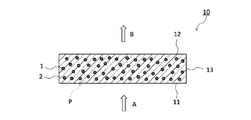
- FIG. 1 is a schematic cross-sectional view showing a wavelength conversion member according to an embodiment of the present invention.
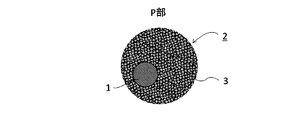
- FIG. 2 is an enlarged view of the P portion of the wavelength conversion member shown in FIG.
- the wavelength conversion member 10 includes a matrix 2 and an inorganic phosphor 1 contained in the matrix 2.
- the inorganic phosphor 1 is dispersed in the matrix 2.
- the wavelength conversion member 10 is made of a sintered body containing the inorganic phosphor 1 and the inorganic particles 3. That is, the matrix 2 is composed of an aggregate of the inorganic particles 3.
- the relative density of the wavelength conversion member 10 is 90% or more, preferably 92% or more, 95% or more, and particularly preferably 97% or more.
- the heat dissipation of the wavelength conversion member 10 is improved, and it becomes easy to suppress a decrease in emission intensity due to an increase in the output of the excitation light source. In addition, it becomes easy to suppress a decrease in luminous efficiency due to temperature quenching of the inorganic phosphor 1. If the relative density is too low, many pores are present inside the wavelength conversion member 10, and the heat dissipation property tends to decrease. Further, the excitation light A may be scattered too much in the pores, and the emission intensity of the wavelength conversion member 10 may decrease.
- the relative density can be calculated by apparent density / true density ⁇ 100 (%).
- apparent density a value measured by the Archimedes method can be used.
- the true density can be calculated by the following formula using the density and volume% of the constituent materials (inorganic phosphor 1 and inorganic particles 3 in this embodiment) of the wavelength conversion member 10. The same calculation can be performed when the constituent materials other than the inorganic phosphor 1 and the inorganic particles 3 are included.
- True density ⁇ (density of inorganic phosphor 1) x (volume% of inorganic phosphor 1) + (density of inorganic particles 3) x (volume% of inorganic particles 3) ⁇ / 100
- the thermal conductivity of the wavelength conversion member 10 is 10 W / m ⁇ K or more, 12 W / m ⁇ K or more, 15 W / m ⁇ K or more, 20 W / m ⁇ K or more, 25 W / m ⁇ K or more, especially 30 W / m. -It is preferably K or more.
- the thermal conductivity in the present invention means a value measured at room temperature (about 25 ° C.).
- the quantum efficiency of the wavelength conversion member 10 is 50% or more, preferably 60% or more, 70% or more, 80% or more, and particularly 85% or more.
- the wavelength conversion member 10 satisfying the above values can easily suppress a decrease in emission intensity due to an increase in the output of the excitation light source.
- the quantum efficiency refers to a value calculated by the following formula and can be measured using an absolute PL quantum yield device. The above value can be achieved, for example, by using the inorganic phosphor 1 having high quantum efficiency or by manufacturing the wavelength conversion member 10 by the manufacturing method described later.
- Quantum efficiency ⁇ (number of photons emitted from the sample as fluorescence) / (number of photons absorbed by the sample) ⁇ x 100 (%)
- the product of the thermal conductivity (W / m ⁇ K) and the quantum efficiency (%) of the wavelength conversion member 10 is preferably 500 or more, 1000 or more, 1500 or more, 1800 or more, 2000 or more, and particularly preferably 2200 or more.
- the wavelength conversion member 10 satisfying the above values has high heat dissipation and is easy to suppress a decrease in emission intensity due to an increase in the output of the excitation light source.
- the porosity of the wavelength conversion member 10 is preferably 10% or less, 8% or less, 5% or less, 3% or less, and particularly preferably 2% or less.
- the average pore diameter of the pores is preferably 1 ⁇ m or less, 800 nm or less, 500 nm or less, and particularly preferably 300 nm or less. This makes it easier to improve the heat dissipation of the wavelength conversion member 10.
- the porosity can be measured by using a mercury intrusion method or a nitrogen adsorption / desorption method. Specifically, it means a value obtained by dividing the adsorption amount measured by the above-mentioned method by the sample volume and then multiplying by 100.
- the average pore diameter means the pore diameter of the maximum peak value in the pore diameter distribution measured by the mercury intrusion method or the nitrogen adsorption / desorption method. If measurement data cannot be obtained by the mercury intrusion method or the nitrogen adsorption / desorption method, the pores may be closed and independent. In such a case, the average pore diameter can be confirmed by observing the cross section of the wavelength conversion member 10 using an electron microscope. Specifically, for example, the following method can be mentioned. First, an image is acquired by SEM observation (magnification 1000 times) to obtain a plurality of cross-sectional images (for example, 2 to 10) of the wavelength conversion member 10.
- the pore diameter which is the peak value in the size distribution of the pores is defined as the average pore diameter, and the area ratio is defined as the porosity. Finally, the average pore diameter and porosity obtained for each image are taken.
- the shape of the wavelength conversion member 10 is not particularly limited, and may be, for example, a rectangular shape, a substantially disk shape, a spherical shape, a hemispherical shape, or a hemispherical dome shape.
- An antireflection film or a bandpass filter may be provided on the first main surface 11 and / or the second main surface 12 of the wavelength conversion member 10.
- the fluorescence trapped inside the wavelength conversion member 10 can be reduced, and the heat generation due to the fluorescence reabsorption by the inorganic phosphor 1 can be suppressed, so that the decrease in the emission intensity can be easily suppressed.
- a reflective layer may be provided on the side surface 13 of the wavelength conversion member 10. As a result, it becomes easy to suppress the leakage of the excitation light A and the fluorescence from the side surface 13 to the outside, so that the intensity of the excitation light A required to obtain the desired emission intensity can be reduced, and the emission intensity can be reduced. It becomes easier to suppress.
- the wavelength conversion member 10 of the present invention can be used in either a so-called transmission type or a so-called reflection type.
- the transmission type as shown in FIG. 1, the excitation light A is incident from the first main surface 11 side. A part of the incident excitation light A is wavelength-converted by the inorganic phosphor 1 into fluorescence having a wavelength different from that of the excitation light A. Then, the excitation light A and the fluorescent composite light B are emitted from the second main surface 12 side.
- the so-called reflective type will be described later.
- the inorganic phosphor 1 is preferably a phosphor having an excitation band at a wavelength of 300 to 500 nm and an emission peak at a wavelength of 380 to 780 nm.
- oxide phosphors, nitride phosphors, oxynitride phosphors, chloride phosphors, acidified phosphors, halide phosphors, aluminate phosphors, halophosphate phosphors and the like can be used. Can be done. In particular, at least one selected from oxide phosphors, oxynitride phosphors and nitride phosphors is preferable.
- YAG yttrium aluminum garnet
- LuAG lutetium aluminum garnet
- SiAlON a group consisting of YAG and LuAG (lutetium aluminum garnet)
- CASN CASN
- a plurality of inorganic phosphors 1 may be mixed and used according to the chromaticity of the excitation light A and the desired synthetic light B.
- the inorganic phosphor 1 preferably has a quantum efficiency of 60% or more, 70% or more, 80% or more, and particularly 90% or more at the emission peak wavelength. This makes it easier to improve the quantum efficiency of the wavelength conversion member 10.
- the content of the inorganic phosphor 1 is 0.1 to 80% by volume, 1 to 50%, 2 to 30%, 3 to 20%, and particularly 5 to 15% when used in the so-called transmissive type. Is preferable. Further, when used in the so-called reflective type, the volume% is preferably 10 to 80%, 30 to 80%, 55 to 80%, and particularly preferably 65 to 80%. If the content of the inorganic phosphor 1 is too large, the thermal conductivity of the wavelength conversion member 10 tends to decrease. Further, due to the fluorescence reabsorption of the inorganic phosphor 1, the amount of transmitted light of the excitation light A is reduced, and it becomes difficult to adjust the chromaticity of the synthetic light B. On the other hand, if the content of the inorganic phosphor 1 is too small, it becomes difficult to obtain the desired emission intensity.
- the average particle size (D 50 ) of the inorganic phosphor 1 is preferably 0.1 to 25 ⁇ m, 1 to 20 ⁇ m, and particularly preferably 2 to 15 ⁇ m. If the average particle size (D 50 ) is too large, the emission color of the wavelength conversion member 10 tends to be non-uniform. On the other hand, if the average particle size (D 50 ) is too small, the inorganic phosphor 1 tends to aggregate during production, and the emission color of the wavelength conversion member 10 tends to be non-uniform.
- the matrix 2 is preferably made of an inorganic material having a higher thermal conductivity than the inorganic phosphor 1.
- the matrix 2 is preferably at least one selected from aluminum oxide, magnesium oxide, zinc oxide, yttrium oxide, aluminum nitride, aluminum nitride, and boron nitride, particularly magnesium oxide or aluminum nitride. It is preferable to have. This makes it easier to improve the heat dissipation of the wavelength conversion member 10, and makes it easier to suppress a decrease in emission intensity due to an increase in the output of the excitation light source.
- Magnesium oxide is particularly preferable because it absorbs less light in the visible wavelength range (400 to 780 nm) and makes it easier to suppress a decrease in emission intensity. These materials may be used alone or in combination. Further, a solid solution obtained by dissolving these materials in a desired ratio (for example, magnesium oxide-aluminum oxide solid solution) may be used.
- the heat dissipation of the wavelength conversion member 10 is improved, and it becomes easy to suppress a decrease in emission intensity due to an increase in the output of the excitation light source.
- the matrix 2 is composed of an aggregate of inorganic particles 3.
- the inorganic particles 3 mean the particles after firing the above-mentioned powder of the inorganic material (inorganic material powder).
- the average primary particle size (D 50 ) of the inorganic particles 3 is preferably 2 ⁇ m or less, 1 ⁇ m or less, 500 nm or less, 300 nm or less, 100 nm or less, 80 nm or less, and particularly preferably 50 nm or less. This makes it easier to improve the heat dissipation of the wavelength conversion member 10.
- the average particle size (D 50 ) of the inorganic particles 3 can be confirmed by observing the cross section of the wavelength conversion member 10 using an electron micrograph.
- the diameter is preferably 1 or more, 5 or more, 10 or more, 100 or more, 200 or more, 300 or more, 400 or more, and particularly preferably 420 or more.
- the average particle size) is preferably 1 or more, 5 or more, 10 or more, 100 or more, 200 or more, 300 or more, 400 or more, and particularly preferably 450 or more. This makes it easier to fire the wavelength conversion member 10 precisely, and makes it easier to improve heat dissipation.
- the wavelength conversion member 10 is produced by firing a mixture of the inorganic phosphor 1 and the inorganic material powder. At this time, it is preferable that the inorganic material powder suppresses grain growth and aggregation due to firing.
- the grain growth and agglomeration mean a state in which the average particle size of the inorganic particles 3 is larger than the average particle size of the inorganic material powder. When grain growth and aggregation occur, vacancies are likely to occur in the wavelength conversion member 10.
- the proportion of the inorganic material powder having an average primary particle size larger than 1 ⁇ m after firing is 50% or less, 20% or less, 10% or less, 5% or less, 3% or less, particularly 1% in terms of area ratio.
- the wavelength conversion member 10 can be easily fired precisely, and the heat dissipation can be easily improved.
- the average particle size of the inorganic particles 3 is measured by observing the cross section of the wavelength conversion member 10 using an electron micrograph and compared with the average particle size of the inorganic material powder. It can be confirmed by.
- the average particle size (D 50 ) of the inorganic material powder is preferably 1 ⁇ m or less, 500 nm or less, 300 nm or less, 100 nm or less, 80 nm or less, and particularly preferably 50 nm or less. This makes it easier to fire the wavelength conversion member 10 precisely, and makes it easier to improve heat dissipation. In addition, the inorganic phosphor 1 can be easily dispersed uniformly, and the emission color of the wavelength conversion member 10 can be easily made uniform.
- the lower limit of the average particle size is not particularly limited, but is actually 1 nm or more.
- the wavelength conversion member 10 of the present invention is preferably produced by firing a mixture of the inorganic material powder and the inorganic phosphor 1.
- a wavelength conversion member 10 made of a sintered body containing the inorganic phosphor 1 and the inorganic particles 3 can be obtained.
- Baking is preferably performed by a heating press.
- the press surface pressure can be appropriately adjusted according to the thickness of the target wavelength conversion member 10.
- it is preferably 1 MPa or more, 10 MPa or more, 30 MPa or more, 50 MPa or more, and particularly preferably 80 MPa or more.
- the upper limit is not particularly limited, but is preferably 120 MPa or less, particularly 100 MPa or less, in order to prevent damage to the press die.
- the maximum temperature during firing is preferably 1900 ° C or lower, 1800 ° C or lower, 1700 ° C or lower, 1600 ° C or lower, 1500 ° C or lower, 1400 ° C or lower, and particularly preferably 1300 ° C or lower.
- the temperature is preferably less than 1500 ° C and 1450 ° C or lower. If the maximum temperature at the time of firing is too high, the inorganic phosphor 1 is likely to be deteriorated by heat. In addition, the grain growth of the inorganic material powder is likely to proceed. On the other hand, if the maximum temperature at the time of firing is too low, it becomes difficult to fire the wavelength conversion member 10 precisely. Therefore, the maximum temperature at the time of firing is preferably 600 ° C. or higher, 700 ° C. or higher, and particularly preferably 800 ° C. or higher.
- the press holding time is preferably 0.1 to 20 hours, 0.5 to 15 hours, and particularly preferably 1 to 10 hours. If the press holding time is too long, the production efficiency tends to decrease. On the other hand, if the press holding time is too short, it becomes difficult to fire the wavelength conversion member 10 precisely.
- the atmosphere at the time of firing is preferably an inert atmosphere, a reducing atmosphere or a vacuum atmosphere. This makes it easier to suppress the deterioration of the inorganic phosphor 1. In addition, deterioration of the press die can be easily suppressed.
- an inert atmosphere it is preferable to use nitrogen gas or argon gas as the inert gas. From the viewpoint of running cost, it is preferable to use nitrogen gas.
- the reducing atmosphere it is preferable to use hydrogen gas as the reducing gas. From the viewpoint of safety, it is preferable to use a mixed gas of hydrogen gas and an inert gas.
- the atmosphere at the time of firing is a nitrogen atmosphere.
- the coloring of the matrix 2 can be suppressed, and the decrease in the emission intensity of the wavelength conversion member 10 can be further suppressed. If the matrix 2 is colored, heat is likely to be generated when the excitation light A is irradiated.
- the manufacturing method of the wavelength conversion member 10 is not limited to the heating press.
- a sintered body may be produced by pressurizing a mixture of the inorganic material powder and the inorganic phosphor 1 with a mold and firing the obtained premolded body.
- the preformed body may be encapsulated in a rubber mold to produce a sintered body by a hot isostatic pressing method.
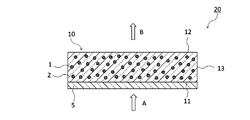
- FIG. 3 is a schematic cross-sectional view showing a light emitting element according to the first embodiment of the present invention.
- the light emitting element 20 in this embodiment includes a wavelength conversion member 10 and a substrate 5.
- the wavelength conversion member 10 is used in a so-called transmission type.
- the substrate 5 is formed on the first main surface 11 of the wavelength conversion member 10.
- the light emitting element 20 of the present invention has high thermal conductivity of the wavelength conversion member 10 itself, it has high heat dissipation and can suppress a decrease in light emission intensity due to an increase in the output of the excitation light source. Further, since the heat generated by irradiating the wavelength conversion member 10 with the excitation light A is released to the outside through the substrate 5, it is possible to further suppress the decrease in the emission intensity due to the increase in the output of the excitation light source. ..
- the substrate 5 preferably has a higher thermal conductivity than the wavelength conversion member 10. Specifically, it must be 10 W / m ⁇ K or more, 12 W / m ⁇ K or more, 15 W / m ⁇ K or more, 20 W / m ⁇ K or more, 25 W / m ⁇ K or more, especially 30 W / m ⁇ K or more. Is preferable. As a result, it is possible to further suppress a decrease in emission intensity due to an increase in the output of the excitation light source.
- the wavelength conversion member 10 is used in a so-called transmission type. Therefore, in the present embodiment, the substrate 5 is preferably a translucent substrate that transmits the excitation light A. Specifically, the substrate 5 preferably has a total light transmittance of 10% or more, 20% or more, 30% or more, particularly 40% or more at a wavelength of 400 to 800 nm.
- a translucent ceramic substrate such as aluminum oxide, zirconium oxide, aluminum nitride, silicon carbide, boron nitride, magnesium oxide, titanium oxide, niobium oxide, zinc oxide, and yttrium oxide.
- the thickness of the substrate 5 is preferably 0.05 to 1 mm, 0.07 to 0.8 mm, and particularly preferably 0.1 to 0.5 mm. If the thickness of the substrate 5 is too small, it becomes difficult to obtain the effect of improving the heat conduction characteristics of the substrate 5. On the other hand, if the thickness of the substrate 5 is too large, the light emitting element 20 tends to be large.
- the substrate 5 is formed on the first main surface 11 of the wavelength conversion member 10, but the substrate 5 is not limited to this.
- the substrate 5 may be formed on the second main surface 12 of the wavelength conversion member 10.
- the substrate 5 may be formed on both sides of the first main surface 11 and the second main surface 12 of the wavelength conversion member 10.
- the thicknesses of the two substrates 5 may be the same or different.
- the thickness of one substrate 5 for example, 0.2 mm or more, further 0.5 mm or more
- the thickness of the other substrate 5 is relatively small (for example, less than 0.2 mm, further 0. .1 mm or less) may be used.
- An antireflection film or a bandpass filter may be provided on the main surface of the substrate 5 on the side where the excitation light A is incident. Further, an antireflection film may be provided on the emission side of the excitation light A and the fluorescence of the substrate 5. As a result, it becomes easy to suppress a decrease in emission intensity. Further, a reflective layer may be provided on the side surface 13 of the wavelength conversion member 10 and the side surface of the substrate 5. As a result, it becomes easy to suppress the leakage of the excitation light A and the fluorescence from the side surface 13 and the side surface of the substrate 5, so that the emission intensity can be increased.
- FIG. 4 is a schematic cross-sectional view showing a light emitting element according to a second embodiment of the present invention.
- the light emitting element 21 in the present embodiment includes a wavelength conversion member 10 and a substrate 5H having a through hole H.
- the wavelength conversion member 10 is used in a so-called transmission type.
- the wavelength conversion member 10 is fixed in the through hole H of the substrate 5H.
- the wavelength conversion member 10 is preferably fixed to the substrate 5H by the adhesive layer 6.
- the adhesive layer 6 is made of, for example, adhesive glass.
- the adhesive glass is preferably at least one selected from, for example, silicate glass, borosilicate glass, tin phosphate glass, bismuthate glass and lead borosilicate glass.
- silicate glass borosilicate glass, tin phosphate glass, bismuthate glass and lead borosilicate glass.
- borosilicate-based glass and tin phosphate-based glass are particularly preferable because they have a relatively low softening point, can be sintered at a low temperature, and can suppress deterioration of the inorganic phosphor 1 during firing.
- the adhesive glass preferably has, for example, a total light transmittance of 10% or more, 20% or more, 30% or more, particularly 40% or more at a wavelength of 400 to 800 nm measured at a thickness of 1 mm.
- the adhesive layer 6 contains an inorganic material powder. In this way, the heat dissipation from the wavelength conversion member 10 to the substrate 5H can be improved. Further, since the adhesive layer 6 acts as a reflective layer at the interface between the wavelength conversion member 10 and the substrate 5H, it becomes easy to increase the intensity of the synthetic light B.
- the shape of the through hole H is not particularly limited, but may be, for example, a cylindrical shape, a conical shape, a polygonal prism shape, or a polygonal pyramid shape.
- the surface area of the surface on the exit side (that is, the second main surface 12 of the wavelength conversion member 10) is the surface on the incident side of the excitation light A (that is, that is).
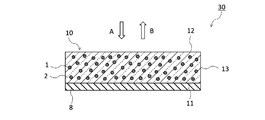
- FIG. 5 is a schematic cross-sectional view showing a light emitting element according to a third embodiment of the present invention.
- the light emitting element 30 in this embodiment includes a wavelength conversion member 10 and a reflection substrate 8. That is, in the present embodiment, the wavelength conversion member 10 is used in a so-called reflection type.
- the excitation light A is incident from the second main surface 12 side of the wavelength conversion member 10.
- a part of the incident excitation light A is wavelength-converted by the inorganic phosphor 1 into fluorescence having a wavelength different from that of the excitation light A.
- the excitation light A and the fluorescent composite light B are reflected by the reflection substrate 8 and emitted from the second main surface 12 side.
- the reflective substrate 8 is not particularly limited, and a metal, ceramic, or the like that reflects the excitation light A and the combined light B of the excitation light A and the fluorescence can be preferably used.
- the metal is preferably at least one selected from copper, aluminum, iron and silver.
- the ceramic is preferably at least one selected from aluminum oxide, magnesium oxide, zinc oxide, aluminum nitride and boron nitride. Further, as the ceramic, a porous ceramic may be used.
- the thermal conductivity of the reflective substrate 8 is 10 W / m ⁇ K or more, 12 W / m ⁇ K or more, 15 W / m ⁇ K or more, 20 W / m ⁇ K or more, 25 W / m ⁇ K or more, especially 30 W / m ⁇ K or more.
- the above is preferable. As a result, it is possible to further suppress a decrease in emission intensity due to an increase in the output of the excitation light source.
- the thickness of the reflective substrate 8 is preferably 2 mm or less, 1.5 mm or less, and particularly preferably 1 mm or less. If the thickness of the reflective substrate 8 is too large, the light emitting element 21 tends to be large.
- the lower limit of the thickness of the reflective substrate 8 is preferably 0.01 mm or more, 0.05 mm or more, 0.1 mm or more, 0.2 mm or more, and 0.5 mm or more. If the thickness of the reflective substrate 8 is too small, the reflection becomes insufficient, the excitation light A and the fluorescence pass through the reflective substrate 8, and the intensity of the synthetic light B emitted from the second main surface 12 side of the wavelength conversion member. May decrease.
- FIG. 6 is a schematic cross-sectional view showing a light emitting device according to an embodiment of the present invention.
- the light emitting device 50 in the present embodiment includes a wavelength conversion member 10 and an excitation light source 7.
- the wavelength conversion member 10 is used as a so-called transmission type wavelength conversion member.
- the excitation light source 7 is arranged so that the excitation light A is incident on the wavelength conversion member 10 from the first main surface 11 side.
- the excitation light A emitted from the excitation light source 7 is wavelength-converted by the wavelength conversion member 10 into fluorescence having a wavelength longer than that of the excitation light A.
- a part of the excitation light A passes through the wavelength conversion member 10. Therefore, the combined light B of the excitation light A and the fluorescence is emitted from the wavelength conversion member 10.
- white synthetic light B can be obtained.
- the light emitting element 20 shown in FIGS. 3 and 4 may be used instead of the wavelength conversion member 10.
- a so-called reflection type wavelength conversion member that is, the light emitting element 30 shown in FIG. 5 may be used.
- the excitation light source 7 is arranged so that the excitation light A is incident on the wavelength conversion member 10 from the second main surface 12 side.
- the excitation light source 7 is preferably an LED or LD. From the viewpoint of improving the light emission intensity of the light emitting device 50, it is particularly preferable to use an LD capable of emitting high intensity light. Since the light emitting device 50 using the LD irradiates a narrow irradiation range with high-intensity excitation light A, it is easy to improve the light emitting intensity, but on the other hand, a local temperature rise is likely to occur in the wavelength conversion member 10. As described above, since the wavelength conversion member 10 used in the light emitting device 50 of the present invention has high thermal conductivity itself, it has high heat dissipation and suppresses a decrease in light emission intensity due to an increase in the output of the excitation light source 7. can do.
- Tables 1 and 2 show examples (No. 4 to 10, 12 to 17, 19) and comparative examples (No. 1 to 3, 11, 18) of the present invention.
- Examples and comparative examples were prepared as follows. First, the inorganic phosphor and the inorganic material powder were mixed so as to have the contents shown in Tables 1 and 2 to obtain a mixture. The following materials were used for each material.
- Inorganic material powder MgO particles (thermal conductivity: about 45 W / m ⁇ K, average particle size: 0.05 ⁇ m, refractive index (nd): 1.74) Glass A (SiO 2 -B 2 O 3 based glass thermal conductivity:. To about 0.8W / m ⁇ K, the average particle size: 3 [mu] m, refractive index (nd): 1.58) AlN particles (thermal conductivity: about 180 W / m ⁇ K, average particle size: 0.6 ⁇ m, refractive index (nd) 2.2)
- the mixture obtained above was placed in a mold, fired under the conditions shown in Tables 1 and 2, and then slowly cooled to room temperature. As a result, a wavelength conversion member made of a sintered body of the mixture was produced.
- the excitation light intensity at which the fired body density, relative density, thermal conductivity, quantum efficiency, and conversion efficiency were 95% of the reference conversion efficiency was evaluated by the following method. The results are shown in Tables 1 and 2.
- Relative density was calculated by apparent density / true density x 100 (%).
- the apparent density was the calcined body density.
- the calcined body density was measured by the Archimedes method.
- the true density was defined as a value obtained by multiplying the density of the constituent elements (inorganic phosphors and inorganic particles) by the volume%, adding them, and then dividing by 100. Specifically, it was calculated by the following formula.
- True density ⁇ (density of inorganic phosphor) x (volume% of inorganic phosphor) + (density of inorganic particles) x (volume% of inorganic particles) ⁇ / 100
- Thermal conductivity was calculated by the following formula.
- the thermal diffusivity was measured at 25 ° C. by a laser flash method using a laser flash device (manufactured by NETZSCH).
- the specific heat was measured at 25 ° C. using a differential scanning calorimeter calorimeter (manufactured by Rigaku Co., Ltd.).
- Thermal conductivity fired body density x thermal diffusivity x specific heat
- Quantum efficiency was calculated using an absolute PL quantum yield device (manufactured by Hamamatsu Photonics) and the following formula.
- Quantum efficiency ⁇ (number of photons emitted from the sample as fluorescence) / (number of photons absorbed by the sample) ⁇ x 100 (%)
- the obtained wavelength conversion member was irradiated with excitation light while increasing the output of the excitation light source, and the excitation light source output in which the conversion efficiency decreased to 95% of the reference conversion efficiency was measured.
- the reference conversion efficiency is the conversion efficiency when the excitation light source output is 0.1 W.
- the excitation light was irradiated to one surface of the measurement sample from the blue LD light source.
- the luminous flux value was measured with a spectroscope (manufactured by Hamamatsu Photonics Co., Ltd.) by condensing the light transmitted through the measurement sample.
- the conversion efficiency was calculated using the following formula.
Landscapes
- Physics & Mathematics (AREA)
- Condensed Matter Physics & Semiconductors (AREA)
- General Physics & Mathematics (AREA)
- Electromagnetism (AREA)
- Optics & Photonics (AREA)
- Luminescent Compositions (AREA)
- Led Device Packages (AREA)
Priority Applications (4)
| Application Number | Priority Date | Filing Date | Title |
|---|---|---|---|
| JP2021567473A JPWO2021132212A1 (https=) | 2019-12-23 | 2020-12-22 | |
| CN202080071990.1A CN114556599A (zh) | 2019-12-23 | 2020-12-22 | 波长转换部件、发光元件和发光装置 |
| EP20905069.9A EP4083666A4 (en) | 2019-12-23 | 2020-12-22 | WAVELENGTH CONVERSION ELEMENT, LIGHT EMITTING ELEMENT AND LIGHT EMITTING DEVICE |
| US17/767,130 US12068439B2 (en) | 2019-12-23 | 2020-12-22 | Wavelength conversion member, light-emitting element, and light-emitting device |
Applications Claiming Priority (2)
| Application Number | Priority Date | Filing Date | Title |
|---|---|---|---|
| JP2019231049 | 2019-12-23 | ||
| JP2019-231049 | 2019-12-23 |
Publications (1)
| Publication Number | Publication Date |
|---|---|
| WO2021132212A1 true WO2021132212A1 (ja) | 2021-07-01 |
Family
ID=76574684
Family Applications (1)
| Application Number | Title | Priority Date | Filing Date |
|---|---|---|---|
| PCT/JP2020/047850 Ceased WO2021132212A1 (ja) | 2019-12-23 | 2020-12-22 | 波長変換部材、発光素子及び発光装置 |
Country Status (5)
| Country | Link |
|---|---|
| US (1) | US12068439B2 (https=) |
| EP (1) | EP4083666A4 (https=) |
| JP (1) | JPWO2021132212A1 (https=) |
| CN (1) | CN114556599A (https=) |
| WO (1) | WO2021132212A1 (https=) |
Citations (6)
| Publication number | Priority date | Publication date | Assignee | Title |
|---|---|---|---|---|
| JP2012190555A (ja) * | 2011-03-08 | 2012-10-04 | Sharp Corp | 焼結発光体、発光装置、照明装置、車両用前照灯、及び焼結発光体の作製方法 |
| JP2012211229A (ja) * | 2011-03-30 | 2012-11-01 | Covalent Materials Corp | 緑色蛍光体 |
| JP2016204561A (ja) * | 2015-04-24 | 2016-12-08 | 太平洋セメント株式会社 | 蛍光部材、その製造方法および発光装置 |
| JP2016204563A (ja) * | 2015-04-24 | 2016-12-08 | 太平洋セメント株式会社 | 蛍光部材、その製造方法および発光装置 |
| JP2018180271A (ja) * | 2017-04-13 | 2018-11-15 | 日本電気硝子株式会社 | 波長変換部材及び波長変換素子、並びにそれらを用いた発光装置 |
| WO2019078299A1 (ja) * | 2017-10-19 | 2019-04-25 | パナソニックIpマネジメント株式会社 | 波長変換体 |
Family Cites Families (9)
| Publication number | Priority date | Publication date | Assignee | Title |
|---|---|---|---|---|
| TW383508B (en) | 1996-07-29 | 2000-03-01 | Nichia Kagaku Kogyo Kk | Light emitting device and display |
| US9346395B2 (en) | 2011-03-08 | 2016-05-24 | Sharp Kabushiki Kaisha | Light-emitting apparatus, illumination system, vehicle headlamp, projector, and method for manufacturing light-emitting apparatus |
| WO2014080705A1 (ja) | 2012-11-22 | 2014-05-30 | シャープ株式会社 | 発光装置およびその製造方法、照明装置、ならびに前照灯 |
| JP2016027613A (ja) * | 2014-05-21 | 2016-02-18 | 日本電気硝子株式会社 | 波長変換部材及びそれを用いた発光装置 |
| JP6384146B2 (ja) * | 2014-06-25 | 2018-09-05 | セイコーエプソン株式会社 | 波長変換素子、光源装置、及びプロジェクター |
| JPWO2016063930A1 (ja) * | 2014-10-24 | 2017-08-03 | デンカ株式会社 | 波長変換体、それを用いた発光装置及び波長変換体の製造方法 |
| WO2018023125A1 (en) * | 2016-07-29 | 2018-02-01 | The Regents Of The University Of California | Ce:YAG/Al2O3 COMPOSITES FOR LASER-EXCITED SOLID-STATE WHITE LIGHTING |
| CN108863317B (zh) * | 2017-05-09 | 2021-03-16 | 中国科学院上海硅酸盐研究所 | 一种荧光复合陶瓷及其制备方法和应用 |
| US11447696B2 (en) * | 2019-07-22 | 2022-09-20 | Kanagawa Institute Of Industrial Science And Technology | Fluorescent member, its manufacturing method, and light-emitting apparatus |
-
2020
- 2020-12-22 JP JP2021567473A patent/JPWO2021132212A1/ja active Pending
- 2020-12-22 WO PCT/JP2020/047850 patent/WO2021132212A1/ja not_active Ceased
- 2020-12-22 EP EP20905069.9A patent/EP4083666A4/en active Pending
- 2020-12-22 US US17/767,130 patent/US12068439B2/en active Active
- 2020-12-22 CN CN202080071990.1A patent/CN114556599A/zh active Pending
Patent Citations (6)
| Publication number | Priority date | Publication date | Assignee | Title |
|---|---|---|---|---|
| JP2012190555A (ja) * | 2011-03-08 | 2012-10-04 | Sharp Corp | 焼結発光体、発光装置、照明装置、車両用前照灯、及び焼結発光体の作製方法 |
| JP2012211229A (ja) * | 2011-03-30 | 2012-11-01 | Covalent Materials Corp | 緑色蛍光体 |
| JP2016204561A (ja) * | 2015-04-24 | 2016-12-08 | 太平洋セメント株式会社 | 蛍光部材、その製造方法および発光装置 |
| JP2016204563A (ja) * | 2015-04-24 | 2016-12-08 | 太平洋セメント株式会社 | 蛍光部材、その製造方法および発光装置 |
| JP2018180271A (ja) * | 2017-04-13 | 2018-11-15 | 日本電気硝子株式会社 | 波長変換部材及び波長変換素子、並びにそれらを用いた発光装置 |
| WO2019078299A1 (ja) * | 2017-10-19 | 2019-04-25 | パナソニックIpマネジメント株式会社 | 波長変換体 |
Non-Patent Citations (1)
| Title |
|---|
| See also references of EP4083666A4 * |
Also Published As
| Publication number | Publication date |
|---|---|
| JPWO2021132212A1 (https=) | 2021-07-01 |
| EP4083666A1 (en) | 2022-11-02 |
| US20220376146A1 (en) | 2022-11-24 |
| EP4083666A4 (en) | 2024-01-17 |
| US12068439B2 (en) | 2024-08-20 |
| CN114556599A (zh) | 2022-05-27 |
Similar Documents
| Publication | Publication Date | Title |
|---|---|---|
| JP7268315B2 (ja) | 波長変換部材及びその製造方法、並びに発光装置 | |
| CN108291987B (zh) | 波长转换部件和波长转换元件以及使用它们的发光装置 | |
| JP6740616B2 (ja) | 波長変換部材及び発光デバイス | |
| TW201608005A (zh) | 波長轉換構件及使用其之發光裝置 | |
| JP6802983B2 (ja) | 波長変換部材及び波長変換素子、並びにそれらを用いた発光装置 | |
| JP2012185980A (ja) | 波長変換素子、それを備える光源およびその製造方法 | |
| JP2016225581A (ja) | 波長変換部材及びそれを用いた発光装置 | |
| WO2018225424A1 (ja) | 波長変換体及びその製造方法、並びに波長変換体を用いた発光装置 | |
| JP7469847B2 (ja) | 波長変換部材及びそれを用いた発光装置 | |
| TWI830902B (zh) | 波長轉換構件及其製造方法、與發光裝置 | |
| WO2019116916A1 (ja) | 波長変換部材及びその製造方法、並びに発光装置 | |
| WO2021132212A1 (ja) | 波長変換部材、発光素子及び発光装置 | |
| JP2023083288A (ja) | 波長変換部材及びそれを用いた発光装置 | |
| WO2019239850A1 (ja) | 波長変換部材及び波長変換素子、並びにそれらの製造方法、並びに発光装置 | |
| JP2018151610A (ja) | 波長変換部材及び発光デバイス | |
| JP7090842B2 (ja) | 波長変換部材及び発光装置 | |
| JP7614561B2 (ja) | 波長変換部材及びその製造方法、並びに発光装置 | |
| JP7322306B1 (ja) | セラミック蛍光体アレイ | |
| JP6561777B2 (ja) | 波長変換素子の製造方法並びに波長変換素子及び発光装置 | |
| JP2017111214A (ja) | 波長変換部材の製造方法 | |
| JP2019204104A (ja) | 波長変換素子及び発光装置 | |
| WO2018163691A1 (ja) | 波長変換部材及び発光デバイス |
Legal Events
| Date | Code | Title | Description |
|---|---|---|---|
| 121 | Ep: the epo has been informed by wipo that ep was designated in this application |
Ref document number: 20905069 Country of ref document: EP Kind code of ref document: A1 |
|
| ENP | Entry into the national phase |
Ref document number: 2021567473 Country of ref document: JP Kind code of ref document: A |
|
| NENP | Non-entry into the national phase |
Ref country code: DE |
|
| ENP | Entry into the national phase |
Ref document number: 2020905069 Country of ref document: EP Effective date: 20220725 |