WO2021111977A1 - レジスト下層膜形成用組成物 - Google Patents
レジスト下層膜形成用組成物 Download PDFInfo
- Publication number
- WO2021111977A1 WO2021111977A1 PCT/JP2020/044039 JP2020044039W WO2021111977A1 WO 2021111977 A1 WO2021111977 A1 WO 2021111977A1 JP 2020044039 W JP2020044039 W JP 2020044039W WO 2021111977 A1 WO2021111977 A1 WO 2021111977A1
- Authority
- WO
- WIPO (PCT)
- Prior art keywords
- group
- carbon atoms
- acid
- underlayer film
- resist underlayer
- Prior art date
- Legal status (The legal status is an assumption and is not a legal conclusion. Google has not performed a legal analysis and makes no representation as to the accuracy of the status listed.)
- Ceased
Links
- SWRYGPQTWXUHQU-UHFFFAOYSA-N C=CCN(C(N(CC(OCC1OC1)=O)C(N1CC(OCC2OC2)=O)=O)=O)C1=O Chemical compound C=CCN(C(N(CC(OCC1OC1)=O)C(N1CC(OCC2OC2)=O)=O)=O)C1=O SWRYGPQTWXUHQU-UHFFFAOYSA-N 0.000 description 1
- NADYEWVQIJRXJM-UHFFFAOYSA-N C=CCN(C(N(CC1OC1)C(N1CC2OC2)=O)=O)C1=O Chemical compound C=CCN(C(N(CC1OC1)C(N1CC2OC2)=O)=O)C1=O NADYEWVQIJRXJM-UHFFFAOYSA-N 0.000 description 1
- LNVUAKZMUGFKTQ-UHFFFAOYSA-N C=[O](CC1OC1)c1cccc(OCC2OC2)c1 Chemical compound C=[O](CC1OC1)c1cccc(OCC2OC2)c1 LNVUAKZMUGFKTQ-UHFFFAOYSA-N 0.000 description 1
- OUDIXVYFSNPVOP-UHFFFAOYSA-N CC(CCC([O](C)CC1OC1)=O)C(CCC(N(CC(OCC1[O](C)C1)=O)/C(/C)=[O]\C)=O)C(NC)=O Chemical compound CC(CCC([O](C)CC1OC1)=O)C(CCC(N(CC(OCC1[O](C)C1)=O)/C(/C)=[O]\C)=O)C(NC)=O OUDIXVYFSNPVOP-UHFFFAOYSA-N 0.000 description 1
- ZQUNCORWUKHVEM-UHFFFAOYSA-N CC(N(CC1OC1)C(N(CC=C)C(N(C)CC1OC1)=O)=O)=O Chemical compound CC(N(CC1OC1)C(N(CC=C)C(N(C)CC1OC1)=O)=O)=O ZQUNCORWUKHVEM-UHFFFAOYSA-N 0.000 description 1
- SNFCNTBEZSGXPZ-UHFFFAOYSA-N CCC(C)(CC)CC(CN(C(C(CC)(CC)C(N1CC(CN(C(N(CC=C)C(N2C(C)(CC)CC)=O)=O)C2=O)O)=O)=O)C1=O)O Chemical compound CCC(C)(CC)CC(CN(C(C(CC)(CC)C(N1CC(CN(C(N(CC=C)C(N2C(C)(CC)CC)=O)=O)C2=O)O)=O)=O)C1=O)O SNFCNTBEZSGXPZ-UHFFFAOYSA-N 0.000 description 1
- AGAXVJHWKZOJIV-UHFFFAOYSA-N CCC(C)COC(c(cc1)ccc1C(OCC1OC1)=O)=O Chemical compound CCC(C)COC(c(cc1)ccc1C(OCC1OC1)=O)=O AGAXVJHWKZOJIV-UHFFFAOYSA-N 0.000 description 1
- KQEJGXLRINKCST-UHFFFAOYSA-N CN(C(N(CC1OC1)C(N1CC2OC2)=O)=O)C1=O Chemical compound CN(C(N(CC1OC1)C(N1CC2OC2)=O)=O)C1=O KQEJGXLRINKCST-UHFFFAOYSA-N 0.000 description 1
- XFUOBHWPTSIEOV-UHFFFAOYSA-N O=C(C(CCCC1)C1C(OCC1OC1)=O)OCC1OC1 Chemical compound O=C(C(CCCC1)C1C(OCC1OC1)=O)OCC1OC1 XFUOBHWPTSIEOV-UHFFFAOYSA-N 0.000 description 1
- JRPRCOLKIYRSNH-UHFFFAOYSA-N O=C(c(cccc1)c1C(OCC1OC1)=O)OCC1OC1 Chemical compound O=C(c(cccc1)c1C(OCC1OC1)=O)OCC1OC1 JRPRCOLKIYRSNH-UHFFFAOYSA-N 0.000 description 1
- ZXOATMQSUNJNNG-UHFFFAOYSA-N O=C(c1cccc(C(OCC2OC2)=O)c1)OCC1OC1 Chemical compound O=C(c1cccc(C(OCC2OC2)=O)c1)OCC1OC1 ZXOATMQSUNJNNG-UHFFFAOYSA-N 0.000 description 1
Classifications
-
- G—PHYSICS
- G03—PHOTOGRAPHY; CINEMATOGRAPHY; ANALOGOUS TECHNIQUES USING WAVES OTHER THAN OPTICAL WAVES; ELECTROGRAPHY; HOLOGRAPHY
- G03F—PHOTOMECHANICAL PRODUCTION OF TEXTURED OR PATTERNED SURFACES, e.g. FOR PRINTING, FOR PROCESSING OF SEMICONDUCTOR DEVICES; MATERIALS THEREFOR; ORIGINALS THEREFOR; APPARATUS SPECIALLY ADAPTED THEREFOR
- G03F7/00—Photomechanical, e.g. photolithographic, production of textured or patterned surfaces, e.g. printing surfaces; Materials therefor, e.g. comprising photoresists; Apparatus specially adapted therefor
- G03F7/004—Photosensitive materials
- G03F7/09—Photosensitive materials characterised by structural details, e.g. supports, auxiliary layers
- G03F7/11—Photosensitive materials characterised by structural details, e.g. supports, auxiliary layers having cover layers or intermediate layers, e.g. subbing layers
-
- G—PHYSICS
- G03—PHOTOGRAPHY; CINEMATOGRAPHY; ANALOGOUS TECHNIQUES USING WAVES OTHER THAN OPTICAL WAVES; ELECTROGRAPHY; HOLOGRAPHY
- G03F—PHOTOMECHANICAL PRODUCTION OF TEXTURED OR PATTERNED SURFACES, e.g. FOR PRINTING, FOR PROCESSING OF SEMICONDUCTOR DEVICES; MATERIALS THEREFOR; ORIGINALS THEREFOR; APPARATUS SPECIALLY ADAPTED THEREFOR
- G03F7/00—Photomechanical, e.g. photolithographic, production of textured or patterned surfaces, e.g. printing surfaces; Materials therefor, e.g. comprising photoresists; Apparatus specially adapted therefor
- G03F7/004—Photosensitive materials
- G03F7/09—Photosensitive materials characterised by structural details, e.g. supports, auxiliary layers
- G03F7/091—Photosensitive materials characterised by structural details, e.g. supports, auxiliary layers characterised by antireflection means or light filtering or absorbing means, e.g. anti-halation, contrast enhancement
-
- C—CHEMISTRY; METALLURGY
- C08—ORGANIC MACROMOLECULAR COMPOUNDS; THEIR PREPARATION OR CHEMICAL WORKING-UP; COMPOSITIONS BASED THEREON
- C08G—MACROMOLECULAR COMPOUNDS OBTAINED OTHERWISE THAN BY REACTIONS ONLY INVOLVING UNSATURATED CARBON-TO-CARBON BONDS
- C08G59/00—Polycondensates containing more than one epoxy group per molecule; Macromolecules obtained by polymerising compounds containing more than one epoxy group per molecule using curing agents or catalysts which react with the epoxy groups
- C08G59/18—Macromolecules obtained by polymerising compounds containing more than one epoxy group per molecule using curing agents or catalysts which react with the epoxy groups ; e.g. general methods of curing
- C08G59/20—Macromolecules obtained by polymerising compounds containing more than one epoxy group per molecule using curing agents or catalysts which react with the epoxy groups ; e.g. general methods of curing characterised by the epoxy compounds used
- C08G59/22—Di-epoxy compounds
-
- C—CHEMISTRY; METALLURGY
- C08—ORGANIC MACROMOLECULAR COMPOUNDS; THEIR PREPARATION OR CHEMICAL WORKING-UP; COMPOSITIONS BASED THEREON
- C08G—MACROMOLECULAR COMPOUNDS OBTAINED OTHERWISE THAN BY REACTIONS ONLY INVOLVING UNSATURATED CARBON-TO-CARBON BONDS
- C08G59/00—Polycondensates containing more than one epoxy group per molecule; Macromolecules obtained by polymerising compounds containing more than one epoxy group per molecule using curing agents or catalysts which react with the epoxy groups
- C08G59/18—Macromolecules obtained by polymerising compounds containing more than one epoxy group per molecule using curing agents or catalysts which react with the epoxy groups ; e.g. general methods of curing
- C08G59/20—Macromolecules obtained by polymerising compounds containing more than one epoxy group per molecule using curing agents or catalysts which react with the epoxy groups ; e.g. general methods of curing characterised by the epoxy compounds used
- C08G59/22—Di-epoxy compounds
- C08G59/26—Di-epoxy compounds heterocyclic
-
- C—CHEMISTRY; METALLURGY
- C08—ORGANIC MACROMOLECULAR COMPOUNDS; THEIR PREPARATION OR CHEMICAL WORKING-UP; COMPOSITIONS BASED THEREON
- C08G—MACROMOLECULAR COMPOUNDS OBTAINED OTHERWISE THAN BY REACTIONS ONLY INVOLVING UNSATURATED CARBON-TO-CARBON BONDS
- C08G59/00—Polycondensates containing more than one epoxy group per molecule; Macromolecules obtained by polymerising compounds containing more than one epoxy group per molecule using curing agents or catalysts which react with the epoxy groups
- C08G59/18—Macromolecules obtained by polymerising compounds containing more than one epoxy group per molecule using curing agents or catalysts which react with the epoxy groups ; e.g. general methods of curing
- C08G59/40—Macromolecules obtained by polymerising compounds containing more than one epoxy group per molecule using curing agents or catalysts which react with the epoxy groups ; e.g. general methods of curing characterised by the curing agents used
- C08G59/4007—Curing agents not provided for by the groups C08G59/42 - C08G59/66
- C08G59/4014—Nitrogen containing compounds
- C08G59/4021—Ureas; Thioureas; Guanidines; Dicyandiamides
-
- C—CHEMISTRY; METALLURGY
- C08—ORGANIC MACROMOLECULAR COMPOUNDS; THEIR PREPARATION OR CHEMICAL WORKING-UP; COMPOSITIONS BASED THEREON
- C08G—MACROMOLECULAR COMPOUNDS OBTAINED OTHERWISE THAN BY REACTIONS ONLY INVOLVING UNSATURATED CARBON-TO-CARBON BONDS
- C08G59/00—Polycondensates containing more than one epoxy group per molecule; Macromolecules obtained by polymerising compounds containing more than one epoxy group per molecule using curing agents or catalysts which react with the epoxy groups
- C08G59/18—Macromolecules obtained by polymerising compounds containing more than one epoxy group per molecule using curing agents or catalysts which react with the epoxy groups ; e.g. general methods of curing
- C08G59/40—Macromolecules obtained by polymerising compounds containing more than one epoxy group per molecule using curing agents or catalysts which react with the epoxy groups ; e.g. general methods of curing characterised by the curing agents used
- C08G59/42—Polycarboxylic acids; Anhydrides, halides or low molecular weight esters thereof
- C08G59/4207—Polycarboxylic acids; Anhydrides, halides or low molecular weight esters thereof aliphatic
-
- C—CHEMISTRY; METALLURGY
- C08—ORGANIC MACROMOLECULAR COMPOUNDS; THEIR PREPARATION OR CHEMICAL WORKING-UP; COMPOSITIONS BASED THEREON
- C08G—MACROMOLECULAR COMPOUNDS OBTAINED OTHERWISE THAN BY REACTIONS ONLY INVOLVING UNSATURATED CARBON-TO-CARBON BONDS
- C08G59/00—Polycondensates containing more than one epoxy group per molecule; Macromolecules obtained by polymerising compounds containing more than one epoxy group per molecule using curing agents or catalysts which react with the epoxy groups
- C08G59/18—Macromolecules obtained by polymerising compounds containing more than one epoxy group per molecule using curing agents or catalysts which react with the epoxy groups ; e.g. general methods of curing
- C08G59/40—Macromolecules obtained by polymerising compounds containing more than one epoxy group per molecule using curing agents or catalysts which react with the epoxy groups ; e.g. general methods of curing characterised by the curing agents used
- C08G59/42—Polycarboxylic acids; Anhydrides, halides or low molecular weight esters thereof
- C08G59/423—Polycarboxylic acids; Anhydrides, halides or low molecular weight esters thereof containing an atom other than oxygen belonging to a functional groups to C08G59/42, carbon and hydrogen
-
- C—CHEMISTRY; METALLURGY
- C08—ORGANIC MACROMOLECULAR COMPOUNDS; THEIR PREPARATION OR CHEMICAL WORKING-UP; COMPOSITIONS BASED THEREON
- C08G—MACROMOLECULAR COMPOUNDS OBTAINED OTHERWISE THAN BY REACTIONS ONLY INVOLVING UNSATURATED CARBON-TO-CARBON BONDS
- C08G59/00—Polycondensates containing more than one epoxy group per molecule; Macromolecules obtained by polymerising compounds containing more than one epoxy group per molecule using curing agents or catalysts which react with the epoxy groups
- C08G59/18—Macromolecules obtained by polymerising compounds containing more than one epoxy group per molecule using curing agents or catalysts which react with the epoxy groups ; e.g. general methods of curing
- C08G59/40—Macromolecules obtained by polymerising compounds containing more than one epoxy group per molecule using curing agents or catalysts which react with the epoxy groups ; e.g. general methods of curing characterised by the curing agents used
- C08G59/44—Amides
-
- C—CHEMISTRY; METALLURGY
- C08—ORGANIC MACROMOLECULAR COMPOUNDS; THEIR PREPARATION OR CHEMICAL WORKING-UP; COMPOSITIONS BASED THEREON
- C08G—MACROMOLECULAR COMPOUNDS OBTAINED OTHERWISE THAN BY REACTIONS ONLY INVOLVING UNSATURATED CARBON-TO-CARBON BONDS
- C08G59/00—Polycondensates containing more than one epoxy group per molecule; Macromolecules obtained by polymerising compounds containing more than one epoxy group per molecule using curing agents or catalysts which react with the epoxy groups
- C08G59/18—Macromolecules obtained by polymerising compounds containing more than one epoxy group per molecule using curing agents or catalysts which react with the epoxy groups ; e.g. general methods of curing
- C08G59/40—Macromolecules obtained by polymerising compounds containing more than one epoxy group per molecule using curing agents or catalysts which react with the epoxy groups ; e.g. general methods of curing characterised by the curing agents used
- C08G59/50—Amines
- C08G59/52—Amino carboxylic acids
-
- C—CHEMISTRY; METALLURGY
- C08—ORGANIC MACROMOLECULAR COMPOUNDS; THEIR PREPARATION OR CHEMICAL WORKING-UP; COMPOSITIONS BASED THEREON
- C08G—MACROMOLECULAR COMPOUNDS OBTAINED OTHERWISE THAN BY REACTIONS ONLY INVOLVING UNSATURATED CARBON-TO-CARBON BONDS
- C08G59/00—Polycondensates containing more than one epoxy group per molecule; Macromolecules obtained by polymerising compounds containing more than one epoxy group per molecule using curing agents or catalysts which react with the epoxy groups
- C08G59/18—Macromolecules obtained by polymerising compounds containing more than one epoxy group per molecule using curing agents or catalysts which react with the epoxy groups ; e.g. general methods of curing
- C08G59/68—Macromolecules obtained by polymerising compounds containing more than one epoxy group per molecule using curing agents or catalysts which react with the epoxy groups ; e.g. general methods of curing characterised by the catalysts used
- C08G59/686—Macromolecules obtained by polymerising compounds containing more than one epoxy group per molecule using curing agents or catalysts which react with the epoxy groups ; e.g. general methods of curing characterised by the catalysts used containing nitrogen
-
- C—CHEMISTRY; METALLURGY
- C08—ORGANIC MACROMOLECULAR COMPOUNDS; THEIR PREPARATION OR CHEMICAL WORKING-UP; COMPOSITIONS BASED THEREON
- C08G—MACROMOLECULAR COMPOUNDS OBTAINED OTHERWISE THAN BY REACTIONS ONLY INVOLVING UNSATURATED CARBON-TO-CARBON BONDS
- C08G59/00—Polycondensates containing more than one epoxy group per molecule; Macromolecules obtained by polymerising compounds containing more than one epoxy group per molecule using curing agents or catalysts which react with the epoxy groups
- C08G59/18—Macromolecules obtained by polymerising compounds containing more than one epoxy group per molecule using curing agents or catalysts which react with the epoxy groups ; e.g. general methods of curing
- C08G59/68—Macromolecules obtained by polymerising compounds containing more than one epoxy group per molecule using curing agents or catalysts which react with the epoxy groups ; e.g. general methods of curing characterised by the catalysts used
- C08G59/688—Macromolecules obtained by polymerising compounds containing more than one epoxy group per molecule using curing agents or catalysts which react with the epoxy groups ; e.g. general methods of curing characterised by the catalysts used containing phosphorus
-
- C—CHEMISTRY; METALLURGY
- C08—ORGANIC MACROMOLECULAR COMPOUNDS; THEIR PREPARATION OR CHEMICAL WORKING-UP; COMPOSITIONS BASED THEREON
- C08G—MACROMOLECULAR COMPOUNDS OBTAINED OTHERWISE THAN BY REACTIONS ONLY INVOLVING UNSATURATED CARBON-TO-CARBON BONDS
- C08G65/00—Macromolecular compounds obtained by reactions forming an ether link in the main chain of the macromolecule
- C08G65/02—Macromolecular compounds obtained by reactions forming an ether link in the main chain of the macromolecule from cyclic ethers by opening of the heterocyclic ring
- C08G65/26—Macromolecular compounds obtained by reactions forming an ether link in the main chain of the macromolecule from cyclic ethers by opening of the heterocyclic ring from cyclic ethers and other compounds
- C08G65/2603—Macromolecular compounds obtained by reactions forming an ether link in the main chain of the macromolecule from cyclic ethers by opening of the heterocyclic ring from cyclic ethers and other compounds the other compounds containing oxygen
- C08G65/2615—Macromolecular compounds obtained by reactions forming an ether link in the main chain of the macromolecule from cyclic ethers by opening of the heterocyclic ring from cyclic ethers and other compounds the other compounds containing oxygen the other compounds containing carboxylic acid, ester or anhydride groups
-
- C—CHEMISTRY; METALLURGY
- C08—ORGANIC MACROMOLECULAR COMPOUNDS; THEIR PREPARATION OR CHEMICAL WORKING-UP; COMPOSITIONS BASED THEREON
- C08G—MACROMOLECULAR COMPOUNDS OBTAINED OTHERWISE THAN BY REACTIONS ONLY INVOLVING UNSATURATED CARBON-TO-CARBON BONDS
- C08G65/00—Macromolecular compounds obtained by reactions forming an ether link in the main chain of the macromolecule
- C08G65/02—Macromolecular compounds obtained by reactions forming an ether link in the main chain of the macromolecule from cyclic ethers by opening of the heterocyclic ring
- C08G65/26—Macromolecular compounds obtained by reactions forming an ether link in the main chain of the macromolecule from cyclic ethers by opening of the heterocyclic ring from cyclic ethers and other compounds
- C08G65/2618—Macromolecular compounds obtained by reactions forming an ether link in the main chain of the macromolecule from cyclic ethers by opening of the heterocyclic ring from cyclic ethers and other compounds the other compounds containing nitrogen
- C08G65/2621—Macromolecular compounds obtained by reactions forming an ether link in the main chain of the macromolecule from cyclic ethers by opening of the heterocyclic ring from cyclic ethers and other compounds the other compounds containing nitrogen containing amine groups
- C08G65/263—Macromolecular compounds obtained by reactions forming an ether link in the main chain of the macromolecule from cyclic ethers by opening of the heterocyclic ring from cyclic ethers and other compounds the other compounds containing nitrogen containing amine groups containing heterocyclic amine groups
-
- C—CHEMISTRY; METALLURGY
- C08—ORGANIC MACROMOLECULAR COMPOUNDS; THEIR PREPARATION OR CHEMICAL WORKING-UP; COMPOSITIONS BASED THEREON
- C08G—MACROMOLECULAR COMPOUNDS OBTAINED OTHERWISE THAN BY REACTIONS ONLY INVOLVING UNSATURATED CARBON-TO-CARBON BONDS
- C08G65/00—Macromolecular compounds obtained by reactions forming an ether link in the main chain of the macromolecule
- C08G65/02—Macromolecular compounds obtained by reactions forming an ether link in the main chain of the macromolecule from cyclic ethers by opening of the heterocyclic ring
- C08G65/26—Macromolecular compounds obtained by reactions forming an ether link in the main chain of the macromolecule from cyclic ethers by opening of the heterocyclic ring from cyclic ethers and other compounds
- C08G65/2636—Macromolecular compounds obtained by reactions forming an ether link in the main chain of the macromolecule from cyclic ethers by opening of the heterocyclic ring from cyclic ethers and other compounds the other compounds containing sulfur
-
- C—CHEMISTRY; METALLURGY
- C08—ORGANIC MACROMOLECULAR COMPOUNDS; THEIR PREPARATION OR CHEMICAL WORKING-UP; COMPOSITIONS BASED THEREON
- C08G—MACROMOLECULAR COMPOUNDS OBTAINED OTHERWISE THAN BY REACTIONS ONLY INVOLVING UNSATURATED CARBON-TO-CARBON BONDS
- C08G65/00—Macromolecular compounds obtained by reactions forming an ether link in the main chain of the macromolecule
- C08G65/02—Macromolecular compounds obtained by reactions forming an ether link in the main chain of the macromolecule from cyclic ethers by opening of the heterocyclic ring
- C08G65/26—Macromolecular compounds obtained by reactions forming an ether link in the main chain of the macromolecule from cyclic ethers by opening of the heterocyclic ring from cyclic ethers and other compounds
- C08G65/2642—Macromolecular compounds obtained by reactions forming an ether link in the main chain of the macromolecule from cyclic ethers by opening of the heterocyclic ring from cyclic ethers and other compounds characterised by the catalyst used
- C08G65/2669—Non-metals or compounds thereof
- C08G65/2672—Nitrogen or compounds thereof
-
- C—CHEMISTRY; METALLURGY
- C08—ORGANIC MACROMOLECULAR COMPOUNDS; THEIR PREPARATION OR CHEMICAL WORKING-UP; COMPOSITIONS BASED THEREON
- C08G—MACROMOLECULAR COMPOUNDS OBTAINED OTHERWISE THAN BY REACTIONS ONLY INVOLVING UNSATURATED CARBON-TO-CARBON BONDS
- C08G65/00—Macromolecular compounds obtained by reactions forming an ether link in the main chain of the macromolecule
- C08G65/02—Macromolecular compounds obtained by reactions forming an ether link in the main chain of the macromolecule from cyclic ethers by opening of the heterocyclic ring
- C08G65/26—Macromolecular compounds obtained by reactions forming an ether link in the main chain of the macromolecule from cyclic ethers by opening of the heterocyclic ring from cyclic ethers and other compounds
- C08G65/2642—Macromolecular compounds obtained by reactions forming an ether link in the main chain of the macromolecule from cyclic ethers by opening of the heterocyclic ring from cyclic ethers and other compounds characterised by the catalyst used
- C08G65/2669—Non-metals or compounds thereof
- C08G65/2675—Phosphorus or compounds thereof
-
- C—CHEMISTRY; METALLURGY
- C08—ORGANIC MACROMOLECULAR COMPOUNDS; THEIR PREPARATION OR CHEMICAL WORKING-UP; COMPOSITIONS BASED THEREON
- C08G—MACROMOLECULAR COMPOUNDS OBTAINED OTHERWISE THAN BY REACTIONS ONLY INVOLVING UNSATURATED CARBON-TO-CARBON BONDS
- C08G65/00—Macromolecular compounds obtained by reactions forming an ether link in the main chain of the macromolecule
- C08G65/02—Macromolecular compounds obtained by reactions forming an ether link in the main chain of the macromolecule from cyclic ethers by opening of the heterocyclic ring
- C08G65/30—Post-polymerisation treatment, e.g. recovery, purification, drying
-
- C—CHEMISTRY; METALLURGY
- C08—ORGANIC MACROMOLECULAR COMPOUNDS; THEIR PREPARATION OR CHEMICAL WORKING-UP; COMPOSITIONS BASED THEREON
- C08G—MACROMOLECULAR COMPOUNDS OBTAINED OTHERWISE THAN BY REACTIONS ONLY INVOLVING UNSATURATED CARBON-TO-CARBON BONDS
- C08G73/00—Macromolecular compounds obtained by reactions forming a linkage containing nitrogen with or without oxygen or carbon in the main chain of the macromolecule, not provided for in groups C08G12/00 - C08G71/00
- C08G73/06—Polycondensates having nitrogen-containing heterocyclic rings in the main chain of the macromolecule
-
- C—CHEMISTRY; METALLURGY
- C09—DYES; PAINTS; POLISHES; NATURAL RESINS; ADHESIVES; COMPOSITIONS NOT OTHERWISE PROVIDED FOR; APPLICATIONS OF MATERIALS NOT OTHERWISE PROVIDED FOR
- C09D—COATING COMPOSITIONS, e.g. PAINTS, VARNISHES OR LACQUERS; FILLING PASTES; CHEMICAL PAINT OR INK REMOVERS; INKS; CORRECTING FLUIDS; WOODSTAINS; PASTES OR SOLIDS FOR COLOURING OR PRINTING; USE OF MATERIALS THEREFOR
- C09D163/00—Coating compositions based on epoxy resins; Coating compositions based on derivatives of epoxy resins
-
- G—PHYSICS
- G03—PHOTOGRAPHY; CINEMATOGRAPHY; ANALOGOUS TECHNIQUES USING WAVES OTHER THAN OPTICAL WAVES; ELECTROGRAPHY; HOLOGRAPHY
- G03F—PHOTOMECHANICAL PRODUCTION OF TEXTURED OR PATTERNED SURFACES, e.g. FOR PRINTING, FOR PROCESSING OF SEMICONDUCTOR DEVICES; MATERIALS THEREFOR; ORIGINALS THEREFOR; APPARATUS SPECIALLY ADAPTED THEREFOR
- G03F7/00—Photomechanical, e.g. photolithographic, production of textured or patterned surfaces, e.g. printing surfaces; Materials therefor, e.g. comprising photoresists; Apparatus specially adapted therefor
- G03F7/004—Photosensitive materials
- G03F7/09—Photosensitive materials characterised by structural details, e.g. supports, auxiliary layers
- G03F7/094—Multilayer resist systems, e.g. planarising layers
Definitions
- the present invention relates to a composition for forming a resist underlayer film, and more specifically, to a composition for forming a resist underlayer film containing a condensation polymer obtained by reacting a monomer containing a pyrimidine trione structure or a triazine trione structure.
- Patent Document 1 and Patent Document 2 further describe that an antireflection film forming composition or a resist underlayer film forming composition for EUV lithography was prepared using the obtained solution containing the polymer.
- Polymers obtained by chemical synthesis are usually aggregates of molecules having different molecular weights (degrees of polymerization), and the molecular weights of such polymers are represented by average molecular weights such as weight average molecular weight Mw and number average molecular weight Mn. Therefore, the higher the content of the low molecular weight component in the polymer, the lower the average molecular weight of the polymer and the higher the polydispersity (Mw / Mn).
- an antireflection film forming composition prepared using the polymer or a resist underlayer film for EUV lithography is used.
- the forming composition is applied onto a substrate and baked to form a film, there is a problem that a large amount of sublimates derived from the above low molecular weight components are produced.
- This sublimated material causes contamination inside the baking device, specifically, the top plate directly above the heating plate on which the substrate is placed, and the inside of the exhaust duct.
- the inside of the baking device is contaminated with sublimated material, it is necessary to clean the inside of the device each time. Therefore, from the viewpoint of improving productivity, it is strongly required to reduce the amount of sublimated product produced.
- the present invention has been made in view of the above circumstances, and an object of the present invention is to provide a composition for forming a resist underlayer film capable of reducing the amount of sublimated products derived from low molecular weight components such as oligomers.
- the present inventors have included a low molecular weight component having a weight average molecular weight of 1,000 or less in the polymer contained in the composition for forming a resist underlayer film.
- the present invention has been completed by finding that the amount of sublimated product produced at the time of film formation of the resist underlayer film can be reduced by setting the amount to 10% by mass or less.
- the present invention provides the following composition for forming a resist underlayer film.
- Composition for formation ⁇ In formula (1), A represents a hydrogen atom, a methyl group or an ethyl group independently of each other, and Q 1 and Q 2 are formula (2) or formula (3) :.
- Q 3 represents an alkylene group having 1 to 10 carbon atoms, an alkaneylene group having 2 to 10 carbon atoms, a phenylene group, a naphthylene group or an anthrylene group, which may contain a sulfide bond or a disulfide bond.
- the naphthylene group and the anthrylene group are independent of each other, an alkyl group having 1 to 6 carbon atoms, a phenyl group, a halogen atom, an alkoxy group having 1 to 6 carbon atoms, a nitro group, a cyano group, a hydroxy group and 1 to 6 carbon atoms.
- R 1 represents a hydrogen atom, a halogen atom, an alkyl group having 1 to 6 carbon atoms, an alkenyl group having 3 to 6 carbon atoms, a benzyl group or a phenyl group independently of each other, and the above-mentioned alkyl group and alkenyl group.
- the group may be substituted with a halogen atom, a hydroxy group or a cyano group, the hydrogen atom on the aromatic ring may be substituted with a hydroxy group in the benzyl group, and the phenyl group has 1 to 1 carbon atoms. It may be substituted with a group selected from the group consisting of an alkyl group of 6 and a halogen atom, an alkoxy group having 1 to 6 carbon atoms, a nitro group, a cyano group, a hydroxy group and an alkylthio group having 1 to 6 carbon atoms.
- R 1s may be bonded to each other to form a ring having 3 to 6 carbon atoms;
- R 2 is a halogen atom, an alkyl group having 1 to 6 carbon atoms, an alkenyl group having 3 to 6 carbon atoms, and a benzyl.
- the phenyl group is an alkyl group having 1 to 6 carbon atoms, a halogen atom, an alkoxy group having 1 to 6 carbon atoms, a nitro group, a cyano group, a hydroxy group and an alkylthio group having 1 to 6 carbon atoms. It may be substituted with a group selected from the group consisting of.)] Represents.
- At least one of Q 1 and Q 2 shall include the structure represented by the equation (3).
- 4. A resist underlayer film obtained from the resist underlayer film forming composition according to any one of claims 1 to 3.
- 5. A polymer having a repeating unit represented by the following formula (1), wherein the content of a low molecular weight component having a weight average molecular weight of 1,000 or less is 10% by mass or less.
- A represents a hydrogen atom, a methyl group or an ethyl group independently of each other, and Q 1 and Q 2 are formula (2) or formula (3) :.
- Q 3 represents an alkylene group having 1 to 10 carbon atoms, an alkaneylene group having 2 to 10 carbon atoms, a phenylene group, a naphthylene group or an anthrylene group, which may contain a sulfide bond or a disulfide bond.
- the naphthylene group and the anthrylene group are independent of each other, an alkyl group having 1 to 6 carbon atoms, a phenyl group, a halogen atom, an alkoxy group having 1 to 6 carbon atoms, a nitro group, a cyano group, a hydroxy group and 1 to 6 carbon atoms.
- R 1 represents a hydrogen atom, a halogen atom, an alkyl group having 1 to 6 carbon atoms, an alkenyl group having 3 to 6 carbon atoms, a benzyl group or a phenyl group independently of each other, and the above-mentioned alkyl group and alkenyl group.
- the group may be substituted with a halogen atom, a hydroxy group or a cyano group, the hydrogen atom on the aromatic ring may be substituted with a hydroxy group in the benzyl group, and the phenyl group has 1 to 1 carbon atoms. It may be substituted with a group selected from the group consisting of an alkyl group of 6 and a halogen atom, an alkoxy group having 1 to 6 carbon atoms, a nitro group, a cyano group, a hydroxy group and an alkylthio group having 1 to 6 carbon atoms.
- R 1s may be bonded to each other to form a ring having 3 to 6 carbon atoms;
- R 2 is a halogen atom, an alkyl group having 1 to 6 carbon atoms, an alkenyl group having 3 to 6 carbon atoms, and a benzyl.
- the phenyl group is an alkyl group having 1 to 6 carbon atoms, a halogen atom, an alkoxy group having 1 to 6 carbon atoms, a nitro group, a cyano group, a hydroxy group and an alkylthio group having 1 to 6 carbon atoms. It may be substituted with a group selected from the group consisting of.)] Represents.
- at least one of Q 1 and Q 2 shall include the structure represented by the equation (3). ⁇
- the composition for forming a resist underlayer film according to the present invention the formation of sublimated substances at the time of film formation of the resist underlayer film is suppressed, so that the frequency of cleaning the inside of the apparatus can be reduced, and the production of the resist underlayer film can be produced. It can contribute to the improvement of productivity.
- the composition for forming a resist underlayer film according to the present invention contains a polymer having a repeating unit represented by the following formula (1) and an organic solvent, and has a weight average molecular weight in the polymer (hereinafter referred to as Mw). It is characterized in that the content of a low molecular weight component of 1,000 or less is 10% by mass or less.
- the low molecular weight component means a polymer having a repeating unit represented by the formula (1) such as an oligomer whose Mw does not exceed 1,000, and is unreacted. It shall not contain the monomer component or other components such as the catalyst used in the polymerization reaction.
- Mw is a polystyrene-equivalent value measured by gel permeation chromatography (GPC).
- A represents a hydrogen atom, a methyl group or an ethyl group independently of each other, and Q 1 and Q 2 represent the formula (2) or the formula (3).
- Q 3 represents an alkylene group having 1 to 10 carbon atoms, which may contain a sulfide bond or a disulfide bond, an alkenylene group having 2 to 10 carbon atoms, a phenylene group, a naphthylene group or an anthrylene group.
- the phenylene group, naphthylene group and anthrylene group are independent of each other, an alkyl group having 1 to 6 carbon atoms, a phenyl group, a halogen atom, an alkoxy group having 1 to 6 carbon atoms, a nitro group, a cyano group, a hydroxy group and a carbon.
- B represents a single bond or an alkylene group having 1 to 5 carbon atoms independently of each other.
- n is 0 or 1 independently of each other.
- m is 0 or 1 independently of each other.
- X is a group represented by the formula (4) or the formula (5).
- R 1 independently represents a hydrogen atom, a halogen atom, an alkyl group having 1 to 6 carbon atoms, an alkenyl group having 3 to 6 carbon atoms, a benzyl group or a phenyl group.
- the alkyl group and alkenyl group may be substituted with a halogen atom, a hydroxy group or a cyano group.
- the hydrogen atom on the aromatic ring may be substituted with a hydroxy group.
- the phenyl group is selected from the group consisting of an alkyl group having 1 to 6 carbon atoms, a halogen atom, an alkoxy group having 1 to 6 carbon atoms, a nitro group, a cyano group, a hydroxy group and an alkylthio group having 1 to 6 carbon atoms. It may be substituted with a group, or two R 1s may be bonded to each other to form a ring having 3 to 6 carbon atoms.
- R 2 represents a halogen atom, an alkyl group having 1 to 6 carbon atoms, an alkenyl group having 3 to 6 carbon atoms, a benzyl group or a phenyl group.
- the phenyl group is a group selected from the group consisting of an alkyl group having 1 to 6 carbon atoms, a halogen atom, an alkoxy group having 1 to 6 carbon atoms, a nitro group, a cyano group, a hydroxy group and an alkylthio group having 1 to 6 carbon atoms. It may be replaced with.
- At least one of Q 1 and Q 2 shall include the structure represented by the equation (3).
- the alkylene group having 1 to 10 carbon atoms may be linear, branched or cyclic, and examples thereof include methylene, ethylene, propylene, pentamethylene, cyclohexylene, 2-methylpropylene and 1-methylethylidene group. Be done.
- Examples of the alkylene group having 1 to 10 carbon atoms containing a sulfide bond or a disulfide bond include an alkylene group containing a sulfide bond or a disulfide bond represented by the following formula.
- the alkenylene group having 2 to 10 carbon atoms may be linear, branched, or cyclic, and examples thereof include ethenylene, propenylene, butenylene, pentenylene, hexenylene, heptenylene, octenylene, and nonenylene group.
- the alkyl group having 1 to 6 carbon atoms may be linear, branched or cyclic, and may be, for example, methyl, ethyl, n-propyl, i-propyl, n-butyl, i-butyl, t-butyl, etc. Examples thereof include n-pentyl, i-pentyl, neopentyl, n-hexyl, cyclopentyl and cyclohexyl groups.
- the alkoxy group having 1 to 6 carbon atoms may be linear, branched or cyclic, and examples thereof include methoxy, ethoxy, i-propoxy, n-pentyloxy, n-hexyloxy and cyclohexyloxy groups. ..
- the alkylthio group having 1 to 6 carbon atoms may be linear, branched or cyclic, and examples thereof include methylthio, ethylthio, i-propylthio, n-pentylthio and cyclohexylthio groups.
- halogen atom examples include a fluorine atom, a chlorine atom, a bromine atom, an iodine atom and the like.
- the two R 1 are bonded 3 carbon atoms which is formed by 1-6 ring, a cyclobutane ring, a cyclopentane ring, a cyclohexane ring, and the like.
- Mw is a polystyrene-equivalent value measured by gel permeation chromatography (GPC).
- Examples of the repeating unit represented by the formula (1) include those represented by the following formulas (1-1) to (1-4), but are not limited thereto.
- the content of the low molecular weight component having Mw of 1,000 or less in the polymer is 10% by mass or less, but from the viewpoint of further reducing the amount of sublimated product produced, it is preferably 5% by mass or less, preferably 3% by mass or less. Is more preferable, and 1% by mass or less is even more preferable.
- the Mw of the polymer is preferably 1,000 to 200,000, more preferably 2,000 to 100,000, and even more preferably 3,000 to, considering the coatability when producing a coating film. It is 50,000, more preferably 4,000 to 30,000, most preferably 5,000 to 20,000, and the polydispersity Mw / Mn of the polymer is preferably 10.5 or less, more preferably 2 .1 or less (Mn represents a number average molecular weight measured under the same conditions as Mw. The same shall apply hereinafter).
- the polymer with a reduced content of low molecular weight components described above can be synthesized by a method including the following first and second steps.
- the crude polymer means a polymer synthesized in the first step
- the purified polymer means a polymer obtained from a solution containing the crude polymer through the second step.
- the first step is a monomer represented by the following formula (a) (hereinafter, may be abbreviated as the component (a)) and a monomer represented by the following formula (b) (hereinafter, abbreviated as the component (b)). (Sometimes) is reacted in an organic solvent in the presence of a quaternary phosphonium salt or a quaternary ammonium salt to synthesize a crude polymer having a repeating unit represented by the following formula (1). ..
- component (a) examples include the following.
- Examples of the compound in which Q 1 is a group represented by the formula (2) include a diglycidyl ester compound and a diglycidyl ether compound.
- Examples of the diglycidyl ester compound include terephthalic acid diglycidyl ester, isophthalic acid diglycidyl ester, phthalic acid diglycidyl ester, 2,5-dimethylterephthalic acid diglycidyl ester, and 2,5-diethylterephthalic acid diglycidyl ester, 2.
- Examples of the diglycidyl ether compound include ethylene glycol diglycidyl ether, 1,3-propanediol diglycidyl ether, 1,4-butanediol diglycidyl ether, 1,5-pentanediol diglycidyl ether, and 1,6-hexane.
- Examples thereof include diol diglycidyl ether, 1,2-benzenediol diglycidyl ether, 1,3-benzenediol diglycidyl ether, 1,4-benzenediol diglycidyl ether, and 1,6-naphthalenediol diglycidyl ether.
- Examples of the compound in which Q 1 is a group represented by the formula (3) include a diglycidyl barbituric acid compound and a diglycidyl isocyanuric acid compound.
- Examples of the diglycidyl barbituric acid compound include 1,3-diglycidyl-5,5-diethylbarbituric acid, 1,3-diglycidyl-5-phenyl-5-ethylbarbituric acid, and 1,3-diglycidyl-5.
- Examples of the diglycidyl isocyanuric acid compound include monoallyl diglycidyl isocyanuric acid, monomethyl diglycidyl isocyanuric acid, monoethyl diglycidyl isocyanuric acid, monopropyl diglycidyl isocyanuric acid, monomethylthiomethyldiglycidyl isocyanuric acid, and monoisopropyl diglycidyl isocyanuric acid.
- Acids monomethoxymethyldiglycidyl isocyanuric acid, monobutyldiglycidyl isocyanuric acid, monomethoxyethoxymethyldiglycidyl isocyanuric acid, monophenyldiglycidyl isocyanuric acid, and monobromodiglycidyl isocyanuric acid, monoallyl isocyanuric acid diglycidyl ester, monomethylisocyanul. Acid diglycidyl ester and the like can be mentioned.
- component (b) examples include the following.
- Examples of the compound in which Q 2 is a group represented by the formula (2) include a dicarboxylic acid compound.
- dicarboxylic acid compound examples include terephthalic acid, isophthalic acid, phthalic acid, 2,5-dimethylterephthalic acid, 2,5-diethylterephthalic acid, 2,3,5,6-tetrachloroterephthalic acid, 2,3.
- Examples of the compound in which Q 2 is a group represented by the formula (3) include a barbituric acid compound and an isocyanuric acid compound.
- barbituric acid compound examples include barbituric acid, 5,5-dimethylbarbituric acid, 5,5-diethylbarbituric acid (also known as barbitar), 5-methyl-5-ethylbarbituric acid, 5,5.
- -Diallyl barbituric acid also known as arobarbiturate
- 5-ethyl-5-phenylbarbituric acid also known as phenobarbiturate
- 5-ethyl-5-isopentyl barbituric acid also known as amobarbitar
- 5,5 -Diallyl malonylurea 5-ethyl-5-isoamyl barbituric acid, 5-allyl-5-isobutylbarbituric acid, 5-allyl-5-isopropylbarbituric acid, 5- ⁇ -bromoallyl-5-sec-butylbarbiturate Touric acid, 5-ethyl-5- (1-methyl-1-butenyl) barbituric acid, 5-isopropyl-5- ⁇ -bromoallyl barbituric acid, 5- (1-cyclohexyl) -5-ethylmalonylurea, Examples include 5-ethyl-5- (1-methylbutyl) malonylurea,
- isocyanuric acid compound examples include monoallyl isocyanuric acid, monomethyl isocyanuric acid, monoethyl isocyanuric acid, monopropyl isocyanuric acid, monoisopropyl isocyanuric acid, monophenyl isocyanuric acid, monobenzyl isocyanuric acid, and monochloroisocyanuric acid.
- the components (a) and (b) exemplified above can usually be combined by selecting one kind of arbitrary compound from each, but the components (a) and (b) are not limited thereto. b) Multiple types of compounds may be selected and used for either or both of the components. However, at least one of the component (a) and the component (b) shall contain a compound having any skeleton selected from barbituric acid and isocyanuric acid.
- component (b) that can be preferably used in the present invention the following compounds can be exemplified, but the components are not limited thereto.
- Examples of the quaternary phosphonium salt include methyltriphenylphosphonium bromide, ethyltriphenylphosphonium bromide, butyltriphenylphosphonium bromide, hexyltriphenylphosphonium bromide, tetrabutylphosphonium bromide, benzyltriphenylphosphonium bromide, and methyltriphenylphosphonium chloride.
- ethyltriphenylphosphonium bromide and tetrabutylphosphonium bromide can be preferably used.
- Examples of the quaternary ammonium salt include tetramethylammonium fluoride, tetramethylammonium chloride, tetramethylammonium bromide, tetramethylammonium nitrate, tetramethylammonium sulfate, tetramethylammonium acetate, tetraethylammonium chloride, and tetraethylammonium bromide.
- the blending amount of the quaternary phosphonium salt and the quaternary ammonium salt is not particularly limited as long as the amount allows the reaction to proceed, but is preferably 0.1 with respect to the number of moles of the component (a). It is ⁇ 10.0%, more preferably 1.0 ⁇ 5.0%.
- the organic solvent used in the first step may be any solvent that does not affect the reaction, for example, benzene, toluene, xylene, ethyl lactate, butyl lactate, propylene glycol monomethyl ether, propylene glycol monomethyl ether acetate, cyclohexanone and N-.
- Methylpyrrolidone can be mentioned. These can be used individually by 1 type or in combination of 2 or more types.
- propylene glycol monomethyl ether is preferable in consideration of the use of the composition using the finally obtained polymer.
- the amount of the organic solvent used can be appropriately set according to the type and amount of each of the above components, and is not particularly limited.
- the total solid content concentration of each of the above components is preferably 5 to 40% by mass, more preferably 10 to 30% by mass, and even more preferably. It is 15 to 25% by mass.
- the solid content of the solid content concentration of the solution referred to here means a component other than the solvent constituting the solution.
- the reaction temperature in the first step is usually 200 ° C. or lower, preferably 150 ° C. or lower, more preferably 130 ° C. or lower, considering the boiling point of the organic solvent used.
- the lower limit of the reaction temperature is not particularly limited, but considering that the condensation reaction of the components (a) and (b) is completed quickly, the temperature is preferably 50 ° C. or higher, more preferably 60 ° C. or higher. .. Further, at the time of heating, reflux may be performed.
- the reaction time cannot be unconditionally specified because it depends on the reaction temperature and the reactivity of the raw material, but it is usually about 1 to 48 hours, and when the reaction temperature is 60 to 130 ° C., it is about 15 to 30 hours. is there.
- the solution containing the crude polymer obtained in the first step (hereinafter, crude polymer solution) is mixed with a poor solvent to precipitate a crude polymer having a repeating unit represented by the formula (1).
- This is a step of filtering, and the second step can remove low molecular weight components contained in the crude polymer.
- the crude polymer solution the reaction solution obtained in the first step may be used as it is, or the crude polymer isolated by an appropriate means such as drying may be dissolved in an appropriate solvent. .. In the latter case, the organic solvent used in the first step can be used as the solvent.
- a solvent having a low solubility of the polymer and dissolving a low molecular weight component can be used, and examples thereof include diethyl ether, cyclopentyl methyl ether, diisopropyl ether and isopropyl alcohol. These can be used individually by 1 type or in combination of 2 or more types. In the present invention, isopropyl alcohol can be preferably used.
- the mixing order is not particularly limited, and the crude polymer solution may be added to the poor solvent or the poor solvent may be added to the crude polymer solution.
- the method of adding the crude polymer solution to the poor solvent is preferred in consideration of removing more low molecular weight components.
- the two when they are mixed, they may be added gradually by dropping or the like, or the whole amount may be added all at once, but in consideration of reducing the content of the low molecular weight component in the purified polymer, dropping or the like is performed.
- the method of gradually adding is preferable.
- the amount of the poor solvent used with respect to the crude polymer solution is not particularly limited as long as the low molecular weight components do not precipitate and the polymer can be sufficiently precipitated, but the total mass of the crude polymer solution is used. On the other hand, it is preferably 2 to 30 times by mass, more preferably 5 to 20 times by mass, and even more preferably 5 to 15 times by mass.
- the temperature at the time of mixing may be appropriately set in the range from the melting point of the solvent to be used to the boiling point of the solvent, and is not particularly limited, but is usually about -20 to 50 ° C., and precipitation is formed. Considering ease of use and workability, 0 to 50 ° C. is preferable, and 0 to 30 ° C. is more preferable.
- stirring may be continued for a predetermined time in order to remove more low molecular weight components.
- the stirring time is preferably 10 minutes to 2 hours, more preferably 15 minutes to 1 hour.
- the precipitate filtered in the second step was dissolved again in the organic solvent used in the first step, and the obtained solution and the poor solvent were mixed. After that, a step of filtering the produced precipitate may be performed.
- 30% by mass or more, preferably 40% by mass or more, more preferably 70% by mass or more, and even more preferably 90% by mass or more of the low molecular weight components contained in the crude polymer can be removed.
- a polymer (purified polymer) having a low molecular weight component content of 10% by mass or less, preferably 5% by mass or less, more preferably 3% by mass or less, and even more preferably 1% by mass or less can be obtained. ..
- any solvent that can dissolve solids can be used without particular limitation.
- the composition for forming a resist underlayer film according to the present invention is used in a uniform solution state, it is recommended to use a solvent generally used in the lithography process in combination in consideration of its coating performance. To.
- organic solvent examples include ethylene glycol monomethyl ether, ethylene glycol monoethyl ether, methyl cellosolve acetate, ethyl cellosolve acetate, diethylene glycol monomethyl ether, diethylene glycol monoethyl ether, propylene glycol, propylene glycol monomethyl ether, and propylene glycol monoethyl ether.
- the solid content concentration of the resist underlayer film forming composition of the present invention is appropriately set in consideration of the viscosity and surface tension of the composition, the thickness of the thin film to be produced, and the like, but is usually 0.1. It is about 20.0% by mass, preferably 0.5 to 15.0% by mass, and more preferably 1.0 to 10.0% by mass.
- the solid content having a solid content concentration in the composition referred to here means a component other than the solvent contained in the composition for forming a resist underlayer film of the present invention.
- the composition for forming a resist underlayer film of the present invention is a cross-linking agent, an acid catalyst (organic acid) that promotes a cross-linking reaction, a surfactant, a light-absorbing agent, a rheology regulator, and an adhesion assist, as long as the effects of the present invention are not impaired. It may contain an arbitrary component such as an agent.
- the cross-linking agent is not particularly limited, but a compound having at least two cross-linking groups in the molecule can be preferably used.
- melamine compounds having a cross-linking group such as a methylol group and a methoxymethyl group and substituted urea compounds can be mentioned.
- it is a compound such as methoxymethylated glycol uryl or methoxymethylated melamine, and is, for example, tetramethoxymethyl glycol uryl, tetrabutoxymethyl glycol uryl, or hexamethoxymethyl melamine.
- compounds such as tetramethoxymethylurea and tetrabutoxymethylurea can also be mentioned.
- cross-linking agents can cause a cross-linking reaction by self-condensation.
- a cross-linking reaction can occur with a hydroxyl group in a polymer having a structure represented by the formula (1). Then, the underlayer film formed by such a cross-linking reaction becomes strong. Then, it becomes a lower layer film having low solubility in an organic solvent.
- These cross-linking agents may be used alone or in combination of two or more.
- the content thereof varies depending on the organic solvent used, the underlying substrate used, the required solution viscosity, the required film shape, and the like. From the viewpoint of film curability, the solid content is preferably 0.01 to 50% by mass, more preferably 0.1 to 40% by mass, and even more preferably 0.5 to 30% by mass.
- These cross-linking agents may cause a cross-linking reaction by self-condensation, but if cross-linking substituents are present in the polymer of the present invention, they can cause a cross-linking reaction with those cross-linking substituents.
- Acid catalysts include, for example, sulfonic acid compounds such as p-phenol sulfonic acid, p-toluene sulfonic acid, trifluoromethane sulfonic acid and pyridinium-p-toluene sulfonate; salicylic acid, 5-sulfosalicylic acid, citric acid, benzoic acid and hydroxy.
- Carboxylic acid compounds such as benzoic acid; 2,4,4,6-tetrabromocyclohexadienone, benzointosylate, 2-nitrobenzyltosylate, p-trifluoromethylbenzenesulfonic acid-2,4-dinitrobenzyl, phenyl Acid compounds that generate acid by heat or light, such as -bis (trichloromethyl) -s-triazine, and N-hydroxysuccinimide trifluoromethanesulfonate; diphenyliodonium hexafluorophosphate, diphenyliodonium trifluoromethanesulfonate, and bis (4-).
- Examples include iodonium salt-based acid generators such as tert-butylphenyl) iodonium trifluoromethanesulfonate; sulfonium salt-based acid generators such as triphenylsulfonium hexafluoroantimonate and triphenylsulfonium trifluoromethanesulfonate.
- iodonium salt-based acid generators such as tert-butylphenyl) iodonium trifluoromethanesulfonate
- sulfonium salt-based acid generators such as triphenylsulfonium hexafluoroantimonate and triphenylsulfonium trifluoromethanesulfonate.
- a sulfonic acid compound and a carboxylic acid compound can be preferably used.
- these acid catalysts may be used alone or in combination of two or more.
- the content thereof is preferably 0.0001 to 20% by mass, more preferably 0.01 in the solid content, from the viewpoint of sufficiently promoting the crosslinking reaction. It is ⁇ 15% by mass, and even more preferably 0.1 to 10% by mass.
- the surfactant is added for the purpose of further improving the coatability on the semiconductor substrate.
- the surfactant include polyoxyethylene alkyl ethers such as polyoxyethylene lauryl ether, polyoxyethylene stearyl ether, polyoxyethylene cetyl ether and polyoxyethylene oleyl ether; polyoxyethylene octylphenyl ether and polyoxyethylene.
- Polyoxyethylene alkylaryl ethers such as nonylphenyl ethers; polyoxyethylene polyoxypropylene block copolymers; sorbitan monolaurate, sorbitan monopalmitate, sorbitan monostearate, sorbitan monooleate, sorbitan trioleate and sorbitantri Polysorbate fatty acid esters such as stearates; polys such as polyoxyethylene sorbitan monolaurate, polyoxyethylene sorbitan monopalmitate, polyoxyethylene sorbitan monostearate, polyoxyethylene sorbitan trioleate and polyoxyethylene sorbitan tristearate.
- Nonionic surfactants such as oxyethylene sorbitan fatty acid esters; EFTOP [registered trademarks] EF301, EF303, EF352 (manufactured by Mitsubishi Materials Electronics Chemical Co., Ltd.), Megafuck [registered trademarks] F171, F173, same R-30, R-30N, R-40, R-40-LM (manufactured by DIC Co., Ltd.), Florard FC430, FC431 (manufactured by 3M Japan Co., Ltd.), Asahi Guard (registered trademark) AG710, Fluorophilic surfactants such as Surflon (registered trademark) S-382, SC101, SC102, SC103, SC104, SC105, SC106 (manufactured by AGC Co., Ltd.), organosiloxane polymer KP341 (Shinetsu Chemical Industry Co., Ltd. Made by Co., Ltd.). These surfactants may be used alone or in combination of two or more.
- the content thereof is preferably 0.0001 to 10% by mass, more preferably 0, based on the solid content, from the viewpoint of improving the coatability on the semiconductor substrate. It is 0.01 to 5% by mass.
- Examples of the light-absorbing agent include commercially available light-absorbing agents described in "Technology and Market of Industrial Dyes” (CMC Publishing) and “Dye Handbook” (edited by Society of Synthetic Organic Chemistry), for example, C.I. I. Disperse Yellow 1,3,4,5,7,8,13,23,31,49,50,51,54,60,64,66,68,79,82,88,90,93,102,114 and 124 C.
- I. D isperse Orange 1,5,13,25,29,30,31,44,57,72 and 73;
- C.I. I. Disperse Red 1,5,7,13,17,19,43,50,54,58,65,72,73,88,117,137,143,199 and 210; C.I.
- the content thereof is usually preferably 0.1 to 10% by mass, more preferably 0.1 to 5% by mass in the solid content.
- the rheology adjuster mainly improves the fluidity of the resist underlayer film forming composition, and particularly in the baking step, the resist underlayer film forming composition improves the film thickness uniformity of the resist underlayer film and the inside of the hole. It is added for the purpose of improving the filling property.
- the rheology modifier include phthalic acid derivatives such as dimethylphthalate, diethylphthalate, diisobutylphthalate, dihexylphthalate and butylisodecylphthalate; adipic acid such as dinormalbutyl adipate, diisobutyl adipate, diisooctyl adipate and octyldecyl adipate.
- maleic acid derivatives such as dinormal butyl malate, diethyl malate and dinonyl malate
- oleic acid derivatives such as methyl oleate, butyl oleate and tetrahydrofurfuryl oleate
- stearic acid derivatives such as normal butyl stearate and glyceryl stearate. Be done.
- the content thereof is 0.001 to 30% by mass in the solid content from the viewpoint of appropriately improving the fluidity of the resist underlayer film forming composition. Is preferable, and 0.001 to 10% by mass is more preferable.
- Adhesive aids include, for example, chlorosilanes such as trimethylchlorosilane, dimethylmethylolchlorosilane, methyldiphenylchlorosilane and chloromethyldimethylchlorosilane; trimethylmethoxysilane, dimethyldiethoxysilane, methyldimethoxysilane, dimethylmethylolethoxysilane, diphenyldimethoxy.
- Alkikusilanes such as silanes and phenyltriethoxysilanes; silazans such as hexamethyldisilazane, N, N'-bis (trimethylsilyl) urea, dimethyltrimethylsilylamine and trimethylsilylimidazoles; methyloltrichlorosilane, ⁇ -chloropropyltrimethoxy Silanes such as silane, ⁇ -aminopropyltriethoxysilane and ⁇ -glycidoxypropyltrimethoxysilane; benzotriazole, benzimidazole, indazole, imidazole, 2-mercaptobenzimidazole, 2-mercaptobenzothiazole, 2-mercaptobenzo Heterocyclic compounds such as oxazole, urazole, thiouracil, mercaptoimidazole and mercaptopyrimidine; ureas such as 1,1-dimethylurea and
- the content thereof is 0.01 to 5% by mass in the solid content from the viewpoint of further improving the adhesion between the semiconductor substrate or the resist and the underlayer film. It is preferable, more preferably 0.1 to 2% by mass.
- the underlayer film according to the present invention can be produced by applying the composition for forming a resist underlayer film on a semiconductor substrate and firing it.
- Examples of the semiconductor substrate include silicon wafers, germanium wafers, and compound semiconductor wafers such as gallium arsenide, indium phosphate, gallium nitride, indium nitride, and aluminum nitride.
- a semiconductor substrate having an inorganic film formed on its surface may be used.
- the inorganic film include a polysilicon film, a silicon oxide film, a silicon nitride film, a BPSG (Boro-Phospho Silicone Glass) film, a titanium nitride film, a titanium nitride film, a tungsten film, a gallium nitride film, and a gallium arsenide film.
- a polysilicon film a silicon oxide film, a silicon nitride film, a BPSG (Boro-Phospho Silicone Glass) film, a titanium nitride film, a titanium nitride film, a tungsten film, a gallium nitride film, and a gallium arsenide film.
- the inorganic film is a semiconductor substrate obtained by, for example, an ALD (atomic layer deposition) method, a CVD (chemical vapor deposition) method, a reactive sputtering method, an ion plating method, a vacuum deposition method, or a spin coating method (spin-on glass: SOG). Can be formed into.
- ALD atomic layer deposition
- CVD chemical vapor deposition
- reactive sputtering method a reactive sputtering method
- ion plating method ion plating method
- vacuum deposition method or a spin coating method (spin-on glass: SOG).
- spin-on glass: SOG spin-on glass
- the composition for forming a resist underlayer film of the present invention is applied onto such a semiconductor substrate by an appropriate coating method such as a spinner or a coater. Then, the resist underlayer film is formed by firing using a heating means such as a hot plate.
- the firing conditions are appropriately selected from a firing temperature of 100 to 400 ° C. and a firing time of 0.3 to 60 minutes.
- the firing temperature is preferably 120 to 350 ° C. and the firing time is 0.5 to 30 minutes, and more preferably the firing temperature is 150 to 300 ° C. and the firing time is 0.8 to 10 minutes.
- the firing temperature at the time of firing to be equal to or lower than the upper limit of the above range, a good thin film can be formed without the resist underlayer film being decomposed by heat.
- the film thickness of the resist underlayer film is, for example, 0.001 ⁇ m (1 nm) to 10 ⁇ m, preferably 0.002 ⁇ m (2 nm) to 1 ⁇ m, and more preferably 0.005 ⁇ m (5 nm) to 0.5 ⁇ m (500 nm).
- the photoresist layer is formed on the resist underlayer film.
- the photoresist layer can be formed by applying a photoresist composition solution onto the underlayer film and firing it by a well-known method.
- the photoresist is not particularly limited as long as it is sensitive to the light used for exposure. Both negative photoresists and positive photoresists can be used. Specific examples thereof include a positive photoresist composed of a novolak resin and a 1,2-naphthoquinonediazide sulfonic acid ester, a binder having a group that decomposes with an acid to increase the alkali dissolution rate, and a photoacid generator.
- Chemically amplified photoresist chemically amplified photoresist consisting of a low molecular weight compound that decomposes with an acid to increase the alkali dissolution rate of the photoresist, an alkali-soluble binder, and a photoacid generator, and acid decomposition with an acid to increase the alkali dissolution rate.
- Examples thereof include a chemically amplified photoresist composed of a binder having a group that increases the amount of acid, a low molecular weight compound that decomposes with an acid to increase the alkali dissolution rate of the photoresist, and a photoacid generator.
- photoresist for example, JSR Corporation product name V146G, Shipley Co., Ltd. product name APEX-E, Sumitomo Chemical Co., Ltd. product name PAR710, and Shin-Etsu Chemical Co., Ltd. ( Examples thereof include trade names AR2772 and SEPR430 manufactured by JSR Corporation. Also, for example, Proc. SPIE, Vol. 3999, 330-334 (2000), Proc. SPIE, Vol. 3999,357-364 (2000), and Proc. SPIE, Vol. Fluorine-containing atomic polymer-based photoresists as described in 3999,365-374 (2000) can be mentioned.
- exposure is performed through a predetermined mask.
- i-ray, KrF excimer laser, ArF excimer laser, EUV (extreme ultraviolet) or EB (electron beam) can be used.
- an alkaline developing solution is used, and for example, inorganic alkalis such as sodium hydroxide, potassium hydroxide, sodium carbonate, sodium silicate, sodium metasilicate and aqueous ammonia; Secondary amines such as monoamines, diethylamine and di-n-butylamine; tertiary amines such as triethylamine and methyldiethylamine; alcoholamines such as dimethylethanolamine and triethanolamine; tetramethylammonium hydroxide, tetraethylammonium Alkaline aqueous solutions of quaternary ammonium salts such as hydroxide and choline; cyclic amines such as pyrrole and piperidine can be used.
- inorganic alkalis such as sodium hydroxide, potassium hydroxide, sodium carbonate, sodium silicate, sodium metasilicate and aqueous ammonia
- Secondary amines such as monoamines, diethylamine and di-n-butyl
- an appropriate amount of an alcohol such as isopropyl alcohol or a nonionic surfactant may be added to the aqueous solution of the alkalis for use.
- an alcohol such as isopropyl alcohol or a nonionic surfactant
- a quaternary ammonium salt is preferable, and tetramethylammonium hydroxide and choline are more preferable.
- a surfactant or the like can be added to these developers.
- the developing conditions are appropriately selected from a developing temperature of 5 to 50 ° C. and a developing time of 10 to 300 seconds.
- the resist underlayer film is dry-etched using the formed resist pattern as a mask. At that time, if the inorganic film is formed on the surface of the semiconductor substrate used, the surface of the inorganic film is exposed, and if the inorganic film is not formed on the surface of the semiconductor substrate used, the semiconductor substrate is exposed. Expose the surface.
- a 20% by mass raw material solution was prepared. Next, this solution was heated under reflux at 130 ° C. and reacted for 24 hours to obtain a crude polymer solution.
- Cation exchange resin product name: Dawex [registered trademark] 550A, Muromachi Technos Co., Ltd.
- anion exchange resin product name: Amberlite [registered trademark] 15JWET, Organo Co., Ltd.
- ion exchange treatment is performed at room temperature for 4 hours to remove unreacted monomer components and the catalyst used in the reaction, which are used for GPC measurement and the second step. did.
- the obtained crude polymer had a Mw of 10,300 and a Mw / Mn of 5.8.
- the obtained precipitate was suction-filtered under reduced pressure using a Kiriyama funnel (40 ⁇ ) and a filter paper (5A).
- the obtained precipitate was dissolved again in 50 g of propylene glycol monomethyl ether, and the obtained polymer solution was added to 500 g of isopropyl alcohol (10 times by mass with respect to the reaction solution) over 30 minutes for reprecipitation, and further 30 minutes. Stirred.
- the obtained precipitate was suction-filtered under reduced pressure using a Kiriyama funnel (40 ⁇ ) and a filter paper (5A). It was dried at 60 ° C. using a vacuum dryer to obtain 8.1 g of the desired purified polymer.
- the obtained purified polymer had a Mw of 15,600 and a Mw / Mn of 1.9.
- a 20% by mass raw material solution was prepared. Next, this solution was heated under reflux at 70 ° C. and reacted for 24 hours to obtain a crude polymer solution.
- Cation exchange resin product name: Dawex [registered trademark] 550A, Muromachi Technos Co., Ltd.
- anion exchange resin product name: Amberlite [registered trademark] 15JWET, Organo Co., Ltd.
- ion exchange treatment is performed at room temperature for 4 hours to remove unreacted monomer components and the catalyst used in the reaction, which are used for GPC measurement and the second step. did.
- the obtained crude polymer had a Mw of 12,800 and a Mw / Mn of 5.9.
- the obtained precipitate was suction-filtered under reduced pressure using a Kiriyama funnel (40 ⁇ ) and a filter paper (5A).
- the obtained precipitate was dissolved again in 50 g of propylene glycol monomethyl ether, and the obtained polymer solution was added to 500 g of isopropyl alcohol (10 times by mass with respect to the reaction solution) over 30 minutes for reprecipitation, and further 30 minutes. Stirred.
- the obtained precipitate was suction-filtered under reduced pressure using a Kiriyama funnel (40 ⁇ ) and a filter paper (5A). It was dried at 60 ° C. using a vacuum dryer to obtain 8.5 g of the desired purified polymer.
- the obtained purified polymer had a Mw of 27,000 and a Mw / Mn of 2.1.
- a 20% by mass raw material solution was prepared. Next, this solution was heated under reflux at 130 ° C. and reacted for 24 hours to obtain a crude polymer solution.
- Cation exchange resin product name: Dawex [registered trademark] 550A, Muromachi Technos Co., Ltd.
- anion exchange resin product name: Amberlite [registered trademark] 15JWET, Organo Co., Ltd.
- ion exchange treatment is performed at room temperature for 4 hours to remove unreacted monomer components and the catalyst used in the reaction, which are used for GPC measurement and the second step. did.
- the obtained crude polymer had a Mw of 4,700 and a Mw / Mn of 3.8.
- the obtained precipitate was suction-filtered under reduced pressure using a Kiriyama funnel (40 ⁇ ) and a filter paper (5A).
- the obtained precipitate was dissolved again in 50 g of propylene glycol monomethyl ether, and the obtained polymer solution was added to 500 g of isopropyl alcohol (10 times by mass with respect to the reaction solution) over 30 minutes for reprecipitation, and further 30 minutes. Stirred.
- the obtained precipitate was suction-filtered under reduced pressure using a Kiriyama funnel (40 ⁇ ) and a filter paper (5A). It was dried at 60 ° C. using a vacuum dryer to obtain 7.9 g of the desired purified polymer.
- the obtained purified polymer had a Mw of 7,600 and a Mw / Mn of 1.5.
- a 40% by mass raw material solution was prepared. Next, this solution was heated under reflux at 130 ° C. and reacted for 24 hours to obtain a crude polymer solution.
- Cation exchange resin product name: Dawex [registered trademark] 550A, Muromachi Technos Co., Ltd.
- anion exchange resin product name: Amberlite [registered trademark] 15JWET, Organo Co., Ltd.
- ion exchange treatment is performed at room temperature for 4 hours to remove unreacted monomer components and the catalyst used in the reaction, which are used for GPC measurement and the second step. did.
- the obtained crude polymer had a Mw of 6,400 and a Mw / Mn of 3.6.
- the obtained precipitate was suction-filtered under reduced pressure using a Kiriyama funnel (40 ⁇ ) and a filter paper (5A).
- the obtained precipitate was dissolved again in 50 g of propylene glycol monomethyl ether, and the obtained polymer solution was added to 500 g of isopropyl alcohol (10 times by mass with respect to the reaction solution) over 30 minutes for reprecipitation, and further 30 minutes. Stirred.
- the obtained precipitate was suction-filtered under reduced pressure using a Kiriyama funnel (40 ⁇ ) and a filter paper (5A). It was dried at 60 ° C. using a vacuum dryer to obtain 16.9 g of the desired purified polymer.
- the obtained purified polymer had a Mw of 10,300 and a Mw / Mn of 1.8.
- Cation exchange resin product name: Dawex [registered trademark] 550A, Muromachi Technos Co., Ltd.
- anion exchange resin product name: Amberlite [registered trademark] 15JWET, Organo Co., Ltd.
- the obtained crude polymer had a Mw of 6,700 and a polydispersity of Mw / Mn of 5.4.
- the obtained precipitate was suction-filtered under reduced pressure using a Kiriyama funnel (40 ⁇ ) and a filter paper (5A).
- the obtained precipitate was dissolved again in 50 g of propylene glycol monomethyl ether, and the obtained polymer solution was added to 500 g of isopropyl alcohol (10 times by mass with respect to the reaction solution) over 30 minutes for reprecipitation, and further 30 minutes. Stirred.
- the obtained precipitate was suction-filtered under reduced pressure using a Kiriyama funnel (40 ⁇ ) and a filter paper (5A). It was dried at 60 ° C. using a vacuum dryer to obtain 5.1 g of the desired purified polymer.
- the obtained purified polymer had Mw of 10,000 and Mw / Mn of 3.8.
- Example 1-6 ⁇ First step> In a nitrogen atmosphere, in a 300 mL reaction flask, 16.5 g (0.071 mol) of phenobarbital (manufactured by Yashiro Pharmaceutical Co., Ltd.) as a component (a) and monoallyl diglycidyl isocyanurate (shikoku Kasei Kogyo) as a component (b).
- phenobarbital manufactured by Yashiro Pharmaceutical Co., Ltd.
- monoallyl diglycidyl isocyanurate shikoku Kasei Kogyo
- Cation exchange resin product name: Dawex [registered trademark] 550A, Muromachi Technos Co., Ltd.
- anion exchange resin product name: Amberlite [registered trademark] 15JWET, Organo Co., Ltd.
- the obtained crude polymer had a Mw of 33,400 and a Mw / Mn of 16.3.
- the obtained precipitate was suction-filtered under reduced pressure using a Kiriyama funnel (40 ⁇ ) and a filter paper (5A).
- the obtained precipitate was dissolved again in 50 g of propylene glycol monomethyl ether, and the obtained polymer solution was added to 500 g of isopropyl alcohol (10 times by mass with respect to the reaction solution) over 30 minutes for reprecipitation, and further 30 minutes. Stirred.
- the obtained precipitate was suction-filtered under reduced pressure using a Kiriyama funnel (40 ⁇ ) and a filter paper (5A). It was dried at 60 ° C. using a vacuum dryer to obtain 6.2 g of the desired purified polymer.
- the obtained purified polymer had a Mw of 46,200 and a Mw / Mn of 10.5.
- Example 1-7 ⁇ First step> In a nitrogen atmosphere, in a 300 mL reaction flask, 8.24 g (0.071 mol) of fumaric acid (manufactured by Tokyo Chemical Industry Co., Ltd.) as a component (a) and monoallyl diglycidyl isocyanurate (Shikoku Kasei) as a component (b). 20.0 g (0.071 mol) of product name MA-DGIC manufactured by Kogyo Co., Ltd., 1.617 g (0.0071 mol) of benzyltriethylammonium chloride (manufactured by Tokyo Chemical Industry Co., Ltd.), and propylene glycol monomethyl ether 122.
- the obtained precipitate was suction-filtered under reduced pressure using a Kiriyama funnel (40 ⁇ ) and a filter paper (5A).
- the obtained precipitate is dissolved again in 50 g of propylene glycol monomethyl ether, and the obtained polymer solution is added to 500 g of cyclopentyl methyl ether (10 times by mass with respect to the reaction solution) over 30 minutes to reprecipitate, and further 30 The mixture was stirred for a minute.
- the obtained precipitate was suction-filtered under reduced pressure using a Kiriyama funnel (40 ⁇ ) and a filter paper (5A). It was dried at 60 ° C. using a vacuum dryer to obtain 4.9 g of the desired purified polymer.
- the obtained purified polymer had Mw of 5,100 and Mw / Mn of 2.9.
- Example 2-2 To 0.97 g of the purified polymer obtained in Example 1-1, 0.24 g of tetramethoxymethyl glycol uryl (Nippon Cytec Industries Co., Ltd., trade name: POWDERLINK® 1174), 5-sulfosalicylic acid (Tokyo Chemical Industry Co., Ltd.) 0.024 g of Industrial Co., Ltd., 69.13 g of propylene glycol monomethyl ether, and 29.63 g of propylene glycol monomethyl ether acetate were added to prepare a solution. Then, it was filtered using a polyethylene microfilter having a pore size of 0.01 ⁇ m to prepare a composition for forming a resist underlayer film.
- tetramethoxymethyl glycol uryl Nippon Cytec Industries Co., Ltd., trade name: POWDERLINK® 1174
- 5-sulfosalicylic acid Tokyo Chemical Industry Co., Ltd.
- Example 2-3 To 0.97 g of the purified polymer obtained in Example 1-2, 0.24 g of tetramethoxymethyl glycol uryl (Nippon Cytec Industries Co., Ltd., trade name: POWDERLINK® 1174), p-phenolsulfonic acid (Tokyo). 0.024 g of Kasei Kogyo Co., Ltd., 69.13 g of propylene glycol monomethyl ether, and 29.63 g of propylene glycol monomethyl ether acetate were added to prepare a solution. Then, it was filtered using a polyethylene microfilter having a pore size of 0.01 ⁇ m to prepare a composition for forming a resist underlayer film.
- Example 2-4 To 0.97 g of the purified polymer obtained in Example 1-2, 0.24 g of tetramethoxymethyl glycol uryl (Nippon Cytec Industries Co., Ltd., trade name: POWDERLINK® 1174), 5-sulfosalicylic acid (Tokyo Chemical Industry Co., Ltd.) 0.024 g of Industrial Co., Ltd., 69.13 g of propylene glycol monomethyl ether, and 29.63 g of propylene glycol monomethyl ether acetate were added to prepare a solution. Then, it was filtered using a polyethylene microfilter having a pore size of 0.01 ⁇ m to prepare a composition for forming a resist underlayer film.
- tetramethoxymethyl glycol uryl Nippon Cytec Industries Co., Ltd., trade name: POWDERLINK® 1174
- 5-sulfosalicylic acid Tokyo Chemical Industry Co., Ltd.
- Example 2-5 To 0.97 g of the purified polymer obtained in Example 1-3, 0.24 g of tetramethoxymethyl glycol uryl (Nippon Cytec Industries Co., Ltd., trade name: POWDERLINK® 1174), p-phenolsulfonic acid (Tokyo). 0.024 g of Kasei Kogyo Co., Ltd., 69.13 g of propylene glycol monomethyl ether, and 29.63 g of propylene glycol monomethyl ether acetate were added to prepare a solution. Then, it was filtered using a polyethylene microfilter having a pore size of 0.01 ⁇ m to prepare a composition for forming a resist underlayer film.
- Example 2-6> To 0.97 g of the purified polymer obtained in Example 1-3, 0.24 g of tetramethoxymethyl glycol uryl (Nippon Cytec Industries Co., Ltd., trade name: POWDERLINK® 1174), 5-sulfosalicylic acid (Tokyo Chemical Industry Co., Ltd.) 0.024 g of Industrial Co., Ltd., 69.13 g of propylene glycol monomethyl ether, and 29.63 g of propylene glycol monomethyl ether acetate were added to prepare a solution. Then, it was filtered using a polyethylene microfilter having a pore size of 0.01 ⁇ m to prepare a composition for forming a resist underlayer film.
- tetramethoxymethyl glycol uryl Nippon Cytec Industries Co., Ltd., trade name: POWDERLINK® 1174
- 5-sulfosalicylic acid Tokyo Chemical Industry Co., Ltd.
- Example 2-7 To 0.97 g of the purified polymer obtained in Example 1-4, 0.24 g of tetramethoxymethyl glycol uryl (Nippon Cytec Industries Co., Ltd., trade name: POWDERLINK® 1174), p-phenolsulfonic acid (Tokyo). 0.024 g of Kasei Kogyo Co., Ltd., 69.13 g of propylene glycol monomethyl ether, and 29.63 g of propylene glycol monomethyl ether acetate were added to prepare a solution. Then, it was filtered using a polyethylene microfilter having a pore size of 0.01 ⁇ m to prepare a composition for forming a resist underlayer film.
- Example 2-8> To 0.97 g of the purified polymer obtained in Example 1-4, 0.24 g of tetramethoxymethyl glycol uryl (Nippon Cytec Industries Co., Ltd., trade name: POWDERLINK® 1174), 5-sulfosalicylic acid (Tokyo Chemical Industry Co., Ltd.) 0.024 g of Industrial Co., Ltd., 69.13 g of propylene glycol monomethyl ether, and 29.63 g of propylene glycol monomethyl ether acetate were added to prepare a solution. Then, it was filtered using a polyethylene microfilter having a pore size of 0.01 ⁇ m to prepare a composition for forming a resist underlayer film.
- tetramethoxymethyl glycol uryl Nippon Cytec Industries Co., Ltd., trade name: POWDERLINK® 1174
- 5-sulfosalicylic acid Tokyo Chemical Industry Co., Ltd.
- Example 2-9 To 0.97 g of the purified polymer obtained in Example 1-5, 0.24 g of tetramethoxymethyl glycol uryl (Nippon Cytec Industries Co., Ltd., trade name: POWDERLINK® 1174), p-phenolsulfonic acid (Tokyo). 0.024 g of Kasei Kogyo Co., Ltd., 69.13 g of propylene glycol monomethyl ether, and 29.63 g of propylene glycol monomethyl ether acetate were added to prepare a solution. Then, it was filtered using a polyethylene microfilter having a pore size of 0.01 ⁇ m to prepare a composition for forming a resist underlayer film.
- Example 2-10> To 0.97 g of the purified polymer obtained in Example 1-5, 0.24 g of tetramethoxymethyl glycol uryl (Nippon Cytec Industries Co., Ltd., trade name: POWDERLINK® 1174), 5-sulfosalicylic acid (Tokyo Chemical Industry Co., Ltd.) 0.024 g of Industrial Co., Ltd., 69.13 g of propylene glycol monomethyl ether, and 29.63 g of propylene glycol monomethyl ether acetate were added to prepare a solution. Then, it was filtered using a polyethylene microfilter having a pore size of 0.01 ⁇ m to prepare a composition for forming a resist underlayer film.
- tetramethoxymethyl glycol uryl Nippon Cytec Industries Co., Ltd., trade name: POWDERLINK® 1174
- 5-sulfosalicylic acid Tokyo Chemical Industry Co., Ltd.
- Example 2-11> To 0.97 g of the purified polymer obtained in Example 1-6, 0.24 g of tetramethoxymethyl glycol uryl (Nippon Cytec Industries Co., Ltd., trade name: POWDERLINK® 1174), p-phenolsulfonic acid (Tokyo). 0.024 g of Kasei Kogyo Co., Ltd., 69.13 g of propylene glycol monomethyl ether, and 29.63 g of propylene glycol monomethyl ether acetate were added to prepare a solution. Then, it was filtered using a polyethylene microfilter having a pore size of 0.01 ⁇ m to prepare a composition for forming a resist underlayer film.
- Example 2-12 To 0.97 g of the purified polymer obtained in Example 1-6, 0.24 g of tetramethoxymethyl glycol uryl (Nippon Cytec Industries Co., Ltd., trade name: POWDERLINK® 1174), 5-sulfosalicylic acid (Tokyo Chemical Industry Co., Ltd.) 0.024 g of Industrial Co., Ltd., 69.13 g of propylene glycol monomethyl ether, and 29.63 g of propylene glycol monomethyl ether acetate were added to prepare a solution. Then, it was filtered using a polyethylene microfilter having a pore size of 0.01 ⁇ m to prepare a composition for forming a resist underlayer film.
- tetramethoxymethyl glycol uryl Nippon Cytec Industries Co., Ltd., trade name: POWDERLINK® 1174
- 5-sulfosalicylic acid Tokyo Chemical Industry Co., Ltd.
- Example 2-13> To 0.97 g of the purified polymer obtained in Example 1-7, 0.24 g of tetramethoxymethyl glycol uryl (Nippon Cytec Industries Co., Ltd., trade name: POWDERLINK® 1174), p-phenolsulfonic acid (Tokyo). 0.024 g of Kasei Kogyo Co., Ltd., 69.13 g of propylene glycol monomethyl ether, and 29.63 g of propylene glycol monomethyl ether acetate were added to prepare a solution. Then, it was filtered using a polyethylene microfilter having a pore size of 0.01 ⁇ m to prepare a composition for forming a resist underlayer film.
- Example 2-14> To 0.97 g of the purified polymer obtained in Example 1-7, 0.24 g of tetramethoxymethyl glycol uryl (Nippon Cytec Industries Co., Ltd., trade name: POWDERLINK® 1174), 5-sulfosalicylic acid (Tokyo Chemical Industry Co., Ltd.) 0.024 g of Industrial Co., Ltd., 69.13 g of propylene glycol monomethyl ether, and 29.63 g of propylene glycol monomethyl ether acetate were added to prepare a solution. Then, it was filtered using a polyethylene microfilter having a pore size of 0.01 ⁇ m to prepare a composition for forming a resist underlayer film.
- tetramethoxymethyl glycol uryl Nippon Cytec Industries Co., Ltd., trade name: POWDERLINK® 1174
- 5-sulfosalicylic acid Tokyo Chemical Industry Co., Ltd.
- the composition for forming a resist underlayer film prepared in Examples 2-1 to 2-14 and Comparative Examples 1-1 to 1-14 was applied to a silicon wafer substrate having a diameter of 4 inches by a spin coater at 1,500 rpm, 60. It was applied in seconds.
- the wafer coated with the composition for forming a resist underlayer film is set in a sublimation quantity measuring device (see International Publication No. 2007/111147) integrated with a hot plate, baked for 120 seconds, and the sublimation is QCM (Quartz). Crystal Microbalance) sensor, that is, the crystal oscillator on which the electrode was formed was collected.
- the QCM sensor can measure a small amount of mass change by utilizing the property that the frequency of the crystal oscillator changes (decreases) according to the mass of the sublimated material when it adheres to the surface (electrode) of the crystal oscillator. ..
- the detailed measurement procedure is as follows.
- the hot plate of the sublimation quantity measuring device was heated to 205 ° C., the pump flow rate was set to 1 m 3 / s, and the device was left for the first 60 seconds to stabilize the device.
- the wafer coated with the resist underlayer film was immediately placed on the hot plate from the slide port, and the sublimated material was collected from the time point of 60 seconds to the time point of 120 seconds (60 seconds).
- the initial film thickness of the resist underlayer film formed on the wafer was 35 nm.
- the flow attachment (detection part) that connects the QCM sensor of the sublimation material measuring device and the collection funnel part was used without a nozzle. Therefore, the airflow flows in from the flow path (caliber: 32 mm) of the chamber unit having a distance of 30 mm from the sensor (crystal oscillator) without being throttled.
- the QCM sensor uses a material (AlSi) containing silicon and aluminum as main components as electrodes, and the diameter of the crystal oscillator (sensor diameter) is 14 mm, the electrode diameter on the surface of the crystal oscillator is 5 mm, and the resonance frequency is 9 MHz. Was used.
- the obtained frequency change was converted into grams from the eigenvalue of the crystal oscillator used for the measurement, and the amount of sublimated material on one wafer coated with the resist underlayer film was clarified.
- the results are shown in Table 4.
- X represents a film formed with a composition containing a crude polymer synthesized in the first step
- Y represents a film formed with a composition containing a purified polymer purified in the second step.
- Table 4 the effect of reprecipitation on the sublimated product depending on the presence or absence of the purification step can also be confirmed.
- the resist underlayer film obtained from the resist underlayer film forming composition containing the purified polymer in which the content of the low molecular weight component is reduced is the resist underlayer containing the crude polymer. It was obtained that the generation of sublimates was further suppressed as compared with the resist underlayer film (Comparative Examples 1-1 to 1-14) obtained from the film-forming composition.
Landscapes
- Chemical & Material Sciences (AREA)
- Organic Chemistry (AREA)
- Health & Medical Sciences (AREA)
- Chemical Kinetics & Catalysis (AREA)
- Medicinal Chemistry (AREA)
- Polymers & Plastics (AREA)
- Engineering & Computer Science (AREA)
- Architecture (AREA)
- Structural Engineering (AREA)
- Physics & Mathematics (AREA)
- General Physics & Mathematics (AREA)
- Life Sciences & Earth Sciences (AREA)
- Materials Engineering (AREA)
- Wood Science & Technology (AREA)
- Materials For Photolithography (AREA)
Abstract
Description
1. 下記式(1)で表される繰り返し単位を有するポリマーと、有機溶媒とを含み、上記ポリマー中の重量平均分子量1,000以下の低分子量成分の含有量が10質量%以下であるレジスト下層膜形成用組成物。
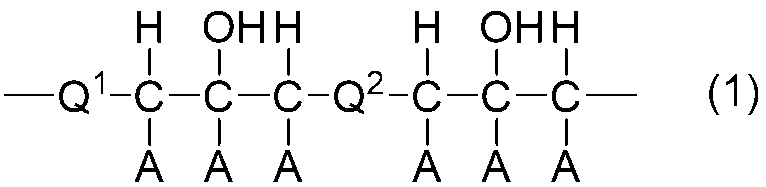
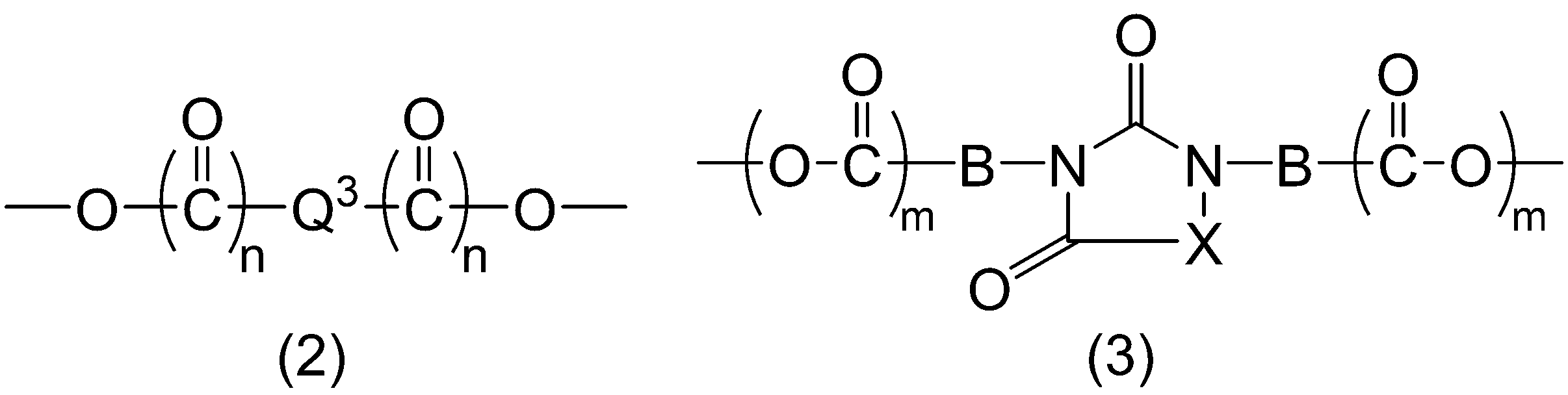

を表す。ただし、Q1およびQ2の少なくとも一方は式(3)で表される構造を含むものとする。}
2. 更に、架橋剤を含む請求項1記載のレジスト下層膜形成用組成物。
3. 更に、酸触媒を含む請求項1または2記載のレジスト下層膜形成用組成物。
4. 請求項1~3のいずれか1項記載のレジスト下層膜形成用組成物から得られるレジスト下層膜。
5. 下記式(1)で表される繰り返し単位を有するポリマーであり、当該ポリマー中の重量平均分子量1,000以下の低分子量成分の含有量が10質量%以下であるポリマー。

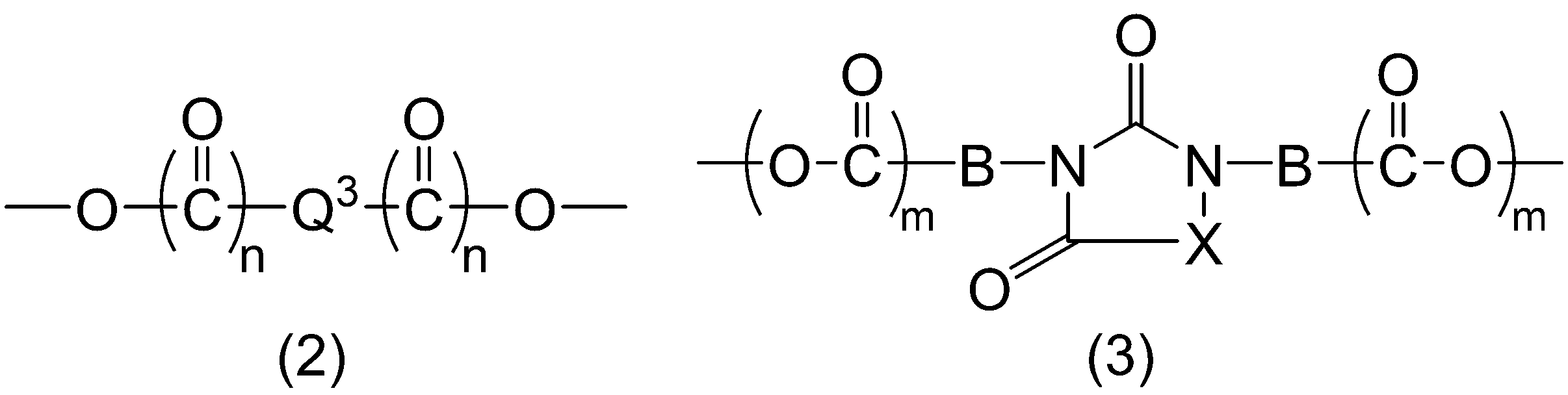
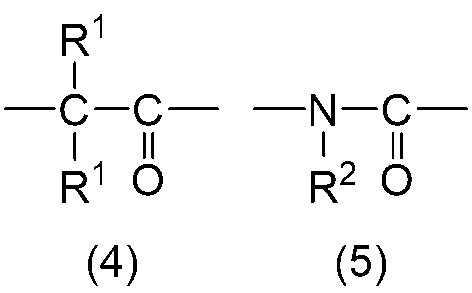
を表す。ただし、Q1およびQ2の少なくとも一方は式(3)で表される構造を含むものとする。}
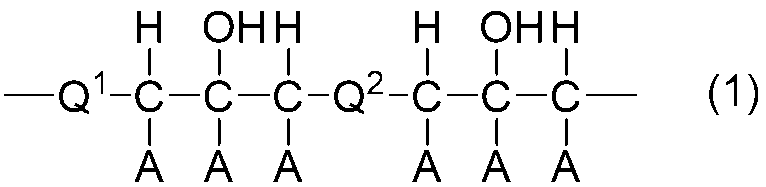

Bは、互いに独立して、単結合または炭素数1~5のアルキレン基を表す。
nは、互いに独立して、0または1である。
mは、互いに独立して、0または1である。
Xは、式(4)または式(5)で表される基である。
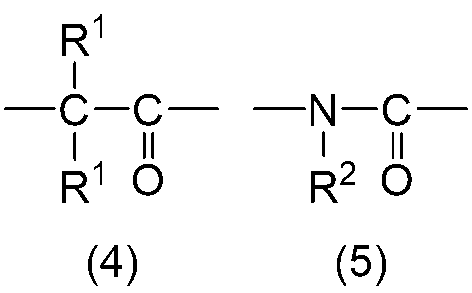

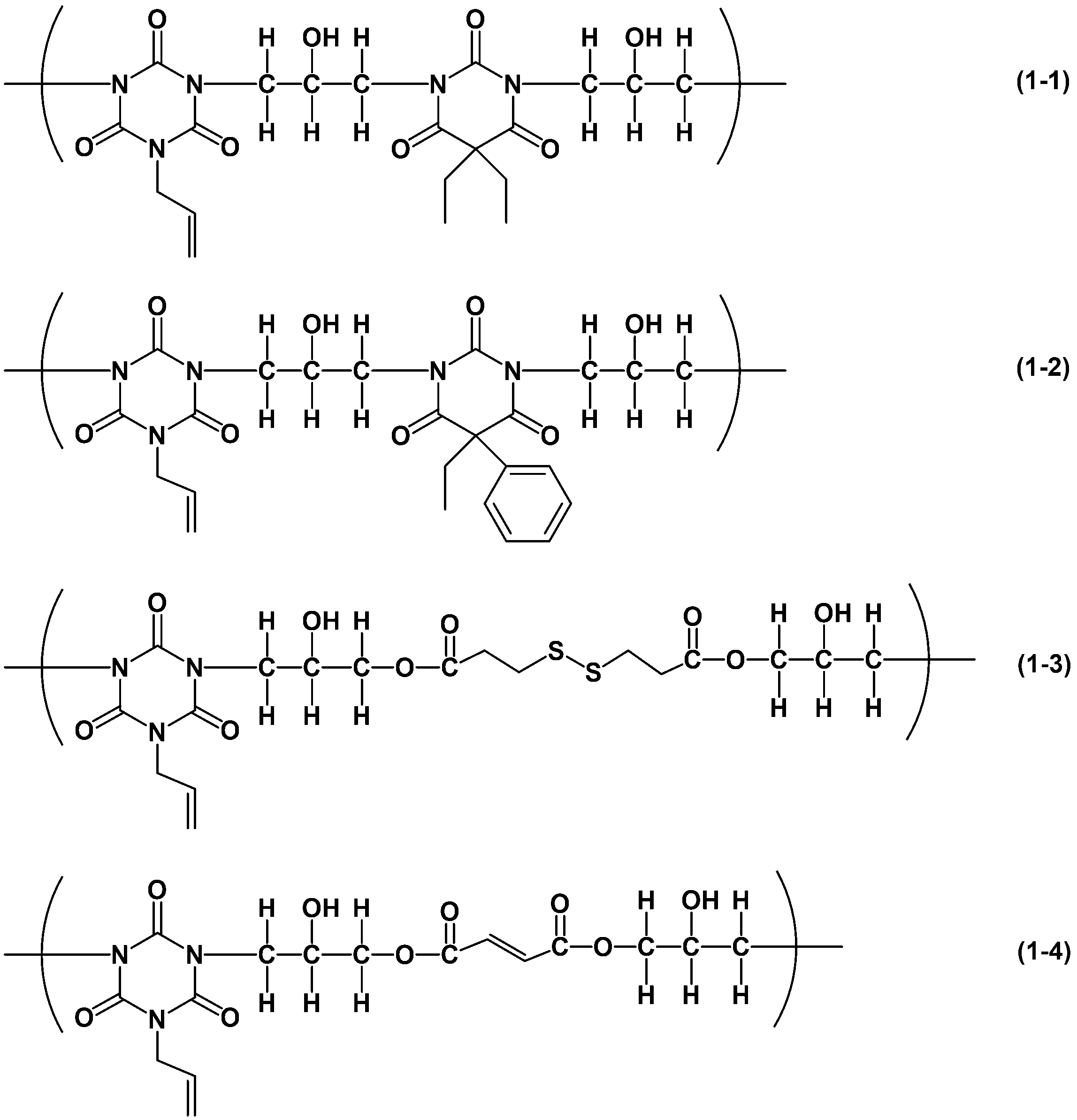
第1工程は、下記式(a)で表されるモノマー(以下、(a)成分と略記することもある)および下記式(b)で表されるモノマー(以下、(b)成分と略記することもある)を、有機溶媒中、第4級ホスホニウム塩または第4級アンモニウム塩の存在下で反応させて、下記式(1)で表される繰り返し単位を有する粗ポリマーを合成する工程である。

Q1が、式(2)で表される基である化合物としては、例えば、ジグリシジルエステル化合物およびジグリシジルエーテル化合物が挙げられる。
Q2が、式(2)で表される基である化合物としては、例えば、ジカルボン酸化合物が挙げられる。


第2工程は、第1工程で得られた粗ポリマーを含む溶液(以下、粗ポリマー溶液)と貧溶媒とを混合して、式(1)で表される繰り返し単位を有する粗ポリマーを沈殿させ、ろ別する工程であり、当該第2工程により、粗ポリマーに含まれる低分子量成分を除去することができる。ここで、上記粗ポリマー溶液としては、第1工程で得られた反応液をそのまま用いても、乾燥などの適宜な手段で単離した粗ポリマーを適宜な溶媒で溶解したものであってもよい。後者の場合、溶媒としては、第1工程で使用した有機溶媒を使用することができる。
粗ポリマーおよび精製ポリマーのMwおよびMw/Mnは、ゲルパーミエーションクロマトグラフィー(GPC)による測定で得られたクロマトグラムの各ピークから、検量線に基づいて算出した。測定条件は、以下のとおりである。
〈測定条件〉
装置:HLC-8320GPC(型番)(東ソー(株)製)
GPCカラム:GF-710HQ,GF-510HQ,GF-310HQ(昭和電工(株)製)
カラム温度:40℃
溶媒:0.12質量%臭化リチウム-1-水和物-ジメチルホルムアミド
流量:1.0mL/分
注入量:10μL
測定時間:60分
標準試料:ポリスチレン(昭和電工(株)製)
検出器:RI
[実施例1-1]
<第1工程>
窒素雰囲気下、200mL反応フラスコに、(a)成分であるバルビタール(八代製薬(株)製)15.0g(0.082mol)、(b)成分であるモノアリルジグリシジルイソシアヌル酸(四国化成工業(株)製)23.0g(0.082mol)、ベンジルトリエチルアンモニウムクロリド(東京化成工業(株)製)0.93g(0.00408mol)、およびプロピレングリコールモノメチルエーテル155.89gを仕込み、固形分濃度が20質量%の原料溶液を調製した。次いで、この溶液を130℃にて加熱還流を行い24時間反応させ、粗ポリマー溶液を得た。得られた粗ポリマー溶液に陽イオン交換樹脂(製品名:ダウエックス[登録商標]550A、ムロマチテクノス(株))、陰イオン交換樹脂(製品名:アンバーライト[登録商標]15JWET、オルガノ(株))をそれぞれ原料溶液の固形分と同量加えて、室温で4時間イオン交換処理を行うことで未反応のモノマー成分や反応に使用した触媒を除去し、これをGPC測定および第2工程に供した。
GPC測定の結果、得られた粗ポリマーのMwは10,300、Mw/Mnは5.8であった。
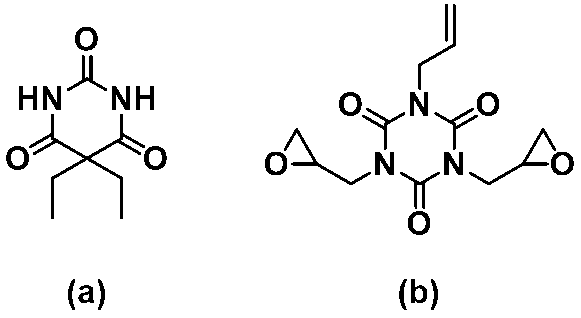
第1工程で得られた粗ポリマー溶液50gを、25℃に調整したイソプロピルアルコール500g(反応液に対して10質量倍)へ30分かけて加えて再沈殿させ、さらに30分間撹拌した。得られた沈殿物を、桐山ロート(40φ)およびろ紙(5A)を用いて減圧下で吸引ろ過した。得られた沈殿物を再度プロピレングリコールモノメチルエーテル50gに溶解し、得られたポリマー溶液を、イソプロピルアルコール500g(反応液に対して10質量倍)へ30分かけて加えて再沈殿させ、さらに30分撹拌した。得られた沈殿物を、桐山ロート(40φ)およびろ紙(5A)を用いて減圧下で吸引ろ過した。減圧乾燥機を用いて60℃で乾燥し、目的とする精製ポリマー8.1gを得た。
GPC測定の結果、得られた精製ポリマーのMwは15,600、Mw/Mnは1.9であった。
<第1工程>
窒素雰囲気下、200mL反応フラスコに、(a)成分であるバルビタール(八代製薬(株)製)15.0g(0.082mol)、(b)成分であるモノアリルジグリシジルイソシアヌル酸(四国化成工業(株)製)23.0g(0.082mol)、ベンジルトリエチルアンモニウムクロリド(東京化成工業(株)製)0.93g(0.00408mol)、およびプロピレングリコールモノメチルエーテル155.89gを仕込み、固形分濃度が20質量%の原料溶液を調製した。次いで、この溶液を70℃にて加熱還流を行い24時間反応させ、粗ポリマー溶液を得た。得られた粗ポリマー溶液に陽イオン交換樹脂(製品名:ダウエックス[登録商標]550A、ムロマチテクノス(株))、陰イオン交換樹脂(製品名:アンバーライト[登録商標]15JWET、オルガノ(株))をそれぞれ原料溶液の固形分と同量加えて、室温で4時間イオン交換処理を行うことで未反応のモノマー成分や反応に使用した触媒を除去し、これをGPC測定および第2工程に供した。
GPC測定の結果、得られた粗ポリマーのMwは12,800、Mw/Mnは5.9であった。
第1工程で得られた粗ポリマー溶液50gを、25℃に調整したイソプロピルアルコール500g(反応液に対して10質量倍)へ30分かけて加えて再沈殿させ、さらに30分間撹拌した。得られた沈殿物を、桐山ロート(40φ)およびろ紙(5A)を用いて減圧下で吸引ろ過した。得られた沈殿物を再度プロピレングリコールモノメチルエーテル50gに溶解し、得られたポリマー溶液を、イソプロピルアルコール500g(反応液に対して10質量倍)へ30分かけて加えて再沈殿させ、さらに30分撹拌した。得られた沈殿物を、桐山ロート(40φ)およびろ紙(5A)を用いて減圧下で吸引ろ過した。減圧乾燥機を用いて60℃で乾燥し、目的とする精製ポリマー8.5gを得た。
GPC測定の結果、得られた精製ポリマーのMwは27,000、Mw/Mnは2.1であった。
<第1工程>
窒素雰囲気下、200mL反応フラスコに、(a)成分であるバルビタール(八代製薬(株)製)18.1g(0.098mol)、(b)成分であるモノアリルジグリシジルイソシアヌル酸(四国化成工業(株)製)23.0g(0.082mol)、ベンジルトリエチルアンモニウムクロリド(東京化成工業(株)製)0.93g(0.00408mol)、およびプロピレングリコールモノメチルエーテル167.92gを仕込み、固形分濃度が20質量%の原料溶液を調製した。次いで、この溶液を130℃にて加熱還流を行い24時間反応させ、粗ポリマー溶液を得た。得られた粗ポリマー溶液に陽イオン交換樹脂(製品名:ダウエックス[登録商標]550A、ムロマチテクノス(株))、陰イオン交換樹脂(製品名:アンバーライト[登録商標]15JWET、オルガノ(株))をそれぞれ原料溶液の固形分と同量加えて、室温で4時間イオン交換処理を行うことで未反応のモノマー成分や反応に使用した触媒を除去し、これをGPC測定および第2工程に供した。
GPC測定の結果、得られた粗ポリマーのMwは4,700、Mw/Mnは3.8であった。
第1工程で得られた粗ポリマー溶液50gを、25℃に調整したイソプロピルアルコール500g(反応液に対して10質量倍)へ30分かけて加えて再沈殿させ、さらに30分間撹拌した。得られた沈殿物を、桐山ロート(40φ)およびろ紙(5A)を用いて減圧下で吸引ろ過した。得られた沈殿物を再度プロピレングリコールモノメチルエーテル50gに溶解し、得られたポリマー溶液を、イソプロピルアルコール500g(反応液に対して10質量倍)へ30分かけて加えて再沈殿させ、さらに30分撹拌した。得られた沈殿物を、桐山ロート(40φ)およびろ紙(5A)を用いて減圧下で吸引ろ過した。減圧乾燥機を用いて60℃で乾燥し、目的とする精製ポリマー7.9gを得た。
GPC測定の結果、得られた精製ポリマーのMwは7,600、Mw/Mnは1.5であった。
<第1工程>
窒素雰囲気下、200mL反応フラスコに、(a)成分であるバルビタール(八代製薬(株)製)18.1g(0.098mol)、(b)成分であるモノアリルジグリシジルイソシアヌル酸(四国化成工業(株)製)23.0g(0.082mol)、ベンジルトリエチルアンモニウムクロリド(東京化成工業(株)製)0.93g(0.00408mol)、およびプロピレングリコールモノメチルエーテル62.97gを仕込み、固形分濃度が40質量%の原料溶液を調製した。次いで、この溶液を130℃にて加熱還流を行い24時間反応させ、粗ポリマー溶液を得た。得られた粗ポリマー溶液に陽イオン交換樹脂(製品名:ダウエックス[登録商標]550A、ムロマチテクノス(株))、陰イオン交換樹脂(製品名:アンバーライト[登録商標]15JWET、オルガノ(株))をそれぞれ原料溶液の固形分と同量加えて、室温で4時間イオン交換処理を行うことで未反応のモノマー成分や反応に使用した触媒を除去し、これをGPC測定および第2工程に供した。
GPC測定の結果、得られた粗ポリマーのMwは6,400、Mw/Mnは3.6であった。
第1工程で得られた粗ポリマー溶液50gを、25℃に調整したイソプロピルアルコール500g(反応液に対して10質量倍)へ30分かけて加えて再沈殿させ、さらに30分間撹拌した。得られた沈殿物を、桐山ロート(40φ)およびろ紙(5A)を用いて減圧下で吸引ろ過した。得られた沈殿物を再度プロピレングリコールモノメチルエーテル50gに溶解し、得られたポリマー溶液を、イソプロピルアルコール500g(反応液に対して10質量倍)へ30分かけて加えて再沈殿させ、さらに30分撹拌した。得られた沈殿物を、桐山ロート(40φ)およびろ紙(5A)を用いて減圧下で吸引ろ過した。減圧乾燥機を用いて60℃で乾燥し、目的とする精製ポリマー16.9gを得た。
GPC測定の結果、得られた精製ポリマーのMwは10,300、Mw/Mnは1.8であった。
<第1工程>
窒素雰囲気下、300mL反応フラスコに、(a)成分である3,3’-ジチオジプロピオン酸(堺化学工業(株)製、商品名:DTDPA)14.9g(0.071mol)、(b)成分であるモノアリルジグリシジルイソシアヌレート(四国化成工業(株)製、製品名MA-DGIC)20.0g(0.071mol)、エチルトリフェニルホスホニウムブロミド(北興化学工業(株)製)1.318g(0.0071mol)、およびプロピレングリコールモノメチルエーテル122.57gを仕込み、固形分濃度が20質量%の原料溶液を調製した。次いで、この溶液を105℃にて加熱還流を行い24時間反応させ、粗ポリマー溶液を得た。得られた粗ポリマー溶液に陽イオン交換樹脂(製品名:ダウエックス[登録商標]550A、ムロマチテクノス(株))、陰イオン交換樹脂(製品名:アンバーライト[登録商標]15JWET、オルガノ(株))をそれぞれ原料溶液の固形分と同量加えて、室温で4時間イオン交換処理を行うことで未反応のモノマー成分や反応に使用した触媒を除去し、これをGPC測定および第2工程に供した。
GPC測定の結果、得られた粗ポリマーのMwは6,700、多分散度Mw/Mnは5.4であった。
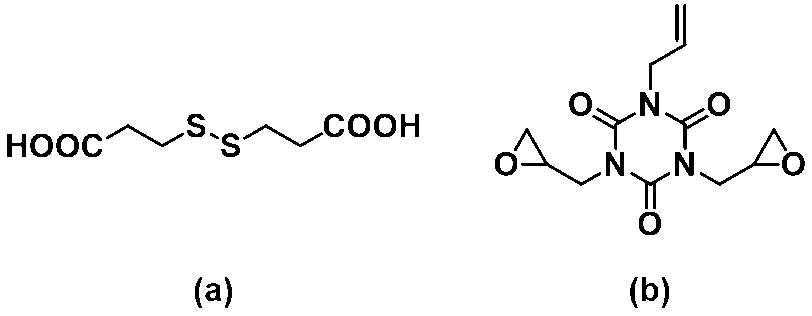
第1工程で得られた粗ポリマー溶液50gを、25℃に調整したシクロペンチルメチルエーテル500g(反応液に対して10質量倍)へ30分かけて加えて再沈殿させ、さらに30分間撹拌した。得られた沈殿物を、桐山ロート(40φ)およびろ紙(5A)を用いて減圧下で吸引ろ過した。得られた沈殿物を再度プロピレングリコールモノメチルエーテル50gに溶解し、得られたポリマー溶液を、イソプロピルアルコール500g(反応液に対して10質量倍)へ30分かけて加えて再沈殿させ、さらに30分撹拌した。得られた沈殿物を、桐山ロート(40φ)およびろ紙(5A)を用いて減圧下で吸引ろ過した。減圧乾燥機を用いて60℃で乾燥し、目的とする精製ポリマー5.1gを得た。
GPC測定の結果、得られた精製ポリマーのMwは10,000、Mw/Mnは3.8であった。
<第1工程>
窒素雰囲気下、300mL反応フラスコに、(a)成分であるフェノバルビタール(八代製薬(株)製)16.5g(0.071mol)、(b)成分であるモノアリルジグリシジルイソシアヌレート(四国化成工業(株)製、製品名MA-DGIC)20.0g(0.071mol)、テトラブチルホスホニウムブロミド(北興化学工業(株)製)1.977g(0.0053mol)、およびプロピレングリコールモノメチルエーテル153.87gを仕込み、固形分濃度が20質量%の原料溶液を調製した。次いで、この溶液を105℃にて加熱還流を行い24時間反応させ、粗ポリマー溶液を得た。得られた粗ポリマー溶液に陽イオン交換樹脂(製品名:ダウエックス[登録商標]550A、ムロマチテクノス(株))、陰イオン交換樹脂(製品名:アンバーライト[登録商標]15JWET、オルガノ(株))をそれぞれ原料溶液の固形分と同量加えて、室温で4時間イオン交換処理を行うことで未反応のモノマー成分や反応に使用した触媒を除去し、これをGPC測定および第2工程に供した。
GPC測定の結果、得られた粗ポリマーのMwは33,400、Mw/Mnは16.3であった。
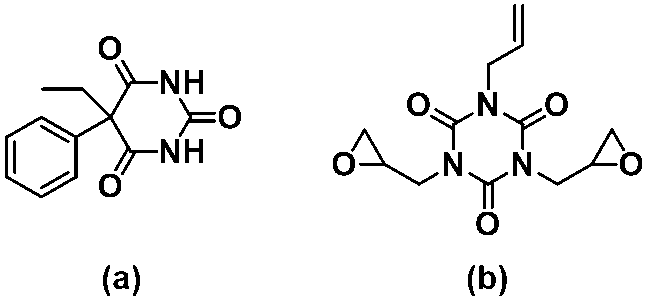
第1工程で得られた粗ポリマー溶液50gを、25℃に調整したイソプロピルアルコール500g(反応液に対して10質量倍)へ30分かけて加えて再沈殿させ、さらに30分間撹拌した。得られた沈殿物を、桐山ロート(40φ)およびろ紙(5A)を用いて減圧下で吸引ろ過した。得られた沈殿物を再度プロピレングリコールモノメチルエーテル50gに溶解し、得られたポリマー溶液を、イソプロピルアルコール500g(反応液に対して10質量倍)へ30分かけて加えて再沈殿させ、さらに30分撹拌した。得られた沈殿物を、桐山ロート(40φ)およびろ紙(5A)を用いて減圧下で吸引ろ過した。減圧乾燥機を用いて60℃で乾燥し、目的とする精製ポリマー6.2gを得た。
GPC測定の結果、得られた精製ポリマーのMwは46,200、Mw/Mnは10.5であった。
<第1工程>
窒素雰囲気下、300mL反応フラスコに、(a)成分であるフマル酸(東京化成工業(株)製)8.24g(0.071mol)、(b)成分であるモノアリルジグリシジルイソシアヌレート(四国化成工業(株)製、製品名MA-DGIC)20.0g(0.071mol)、ベンジルトリエチルアンモニウムクロリド(東京化成工業(株)製)1.617g(0.0071mol)、およびプロピレングリコールモノメチルエーテル122.57gを仕込み、固形分濃度が20質量%の原料溶液を調製した。次いで、この溶液を120℃にて加熱還流を行い8時間反応させ、粗ポリマー溶液を得た。得られた粗ポリマー溶液に陽イオン交換樹脂(製品名:ダウエックス[登録商標]550A、ムロマチテクノス(株))、陰イオン交換樹脂(製品名:アンバーライト[登録商標]15JWET、オルガノ(株))をそれぞれ原料溶液の固形分と同量加えて、室温で4時間イオン交換処理を行うことで未反応のモノマー成分や反応に使用した触媒を除去し、これをGPC測定および第2工程に供した。
GPC測定の結果、得られた粗ポリマーのMwは4,600、Mw/Mnは3.1であった。
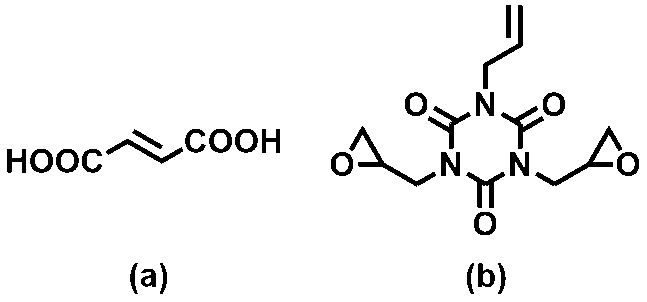
第1工程で得られた粗ポリマー溶液50gを、25℃に調整したシクロペンチルメチルエーテル500g(反応液に対して10質量倍)へ30分かけて加えて再沈殿させ、さらに30分間撹拌した。得られた沈殿物を、桐山ロート(40φ)およびろ紙(5A)を用いて減圧下で吸引ろ過した。得られた沈殿物を再度プロピレングリコールモノメチルエーテル50gに溶解し、得られたポリマー溶液を、シクロペンチルメチルエーテル500g(反応液に対して10質量倍)へ30分かけて加えて再沈殿させ、さらに30分撹拌した。得られた沈殿物を、桐山ロート(40φ)およびろ紙(5A)を用いて減圧下で吸引ろ過した。減圧乾燥機を用いて60℃で乾燥し、目的とする精製ポリマー4.9gを得た。
GPC測定の結果、得られた精製ポリマーのMwは5,100、Mw/Mnは2.9であった。
実施例1-1~1-7において、粗ポリマーおよび精製ポリマーに含まれるMwが1,000以下の低分子量成分の含有率を比較することにより、第2工程の実施の効果を調べた。
低分子量成分の含有率およびその減少率は、以下の手順で算出した。
(1)低分子量成分の含有率
横軸:溶出時間、縦軸:検出強度のGPCグラフにおいて、標準ポリスチレン(PS)換算におけるMw1,000以下の領域を積分し得られた値を全体領域の積分値を用いて除算することで算出した。
(2)低分子量成分の減少率
上記(1)で得られた低分子量成分の含有率から、以下の式により算出した。
[1-(精製ポリマーの低分子量成分含有率÷粗ポリマーの低分子量成分含有率)]×100(質量%)
結果を表1に示す。

<実施例2-1>
実施例1-1で得られた精製ポリマー0.97gに、テトラメトキシメチルグリコールウリル(日本サイテックインダストリーズ(株)、商品名:POWDERLINK〔登録商標〕1174)0.24g、p-フェノールスルホン酸(東京化成工業(株))0.024g、プロピレングリコールモノメチルエーテル69.13g、およびプロピレングリコールモノメチルエーテルアセテート29.63gを加え、溶液とした。その後、孔径0.01μmのポリエチレン製ミクロフィルターを用いてろ過し、レジスト下層膜形成用組成物を調製した。
実施例1-1で得られた精製ポリマー0.97gに、テトラメトキシメチルグリコールウリル(日本サイテックインダストリーズ(株)、商品名:POWDERLINK〔登録商標〕1174)0.24g、5-スルホサリチル酸(東京化成工業(株))0.024g、プロピレングリコールモノメチルエーテル69.13g、およびプロピレングリコールモノメチルエーテルアセテート29.63gを加え、溶液とした。その後、孔径0.01μmのポリエチレン製ミクロフィルターを用いてろ過し、レジスト下層膜形成用組成物を調製した。
実施例1-2で得られた精製ポリマー0.97gに、テトラメトキシメチルグリコールウリル(日本サイテックインダストリーズ(株)、商品名:POWDERLINK〔登録商標〕1174)0.24g、p-フェノールスルホン酸(東京化成工業(株))0.024g、プロピレングリコールモノメチルエーテル69.13g、およびプロピレングリコールモノメチルエーテルアセテート29.63gを加え、溶液とした。その後、孔径0.01μmのポリエチレン製ミクロフィルターを用いてろ過し、レジスト下層膜形成用組成物を調製した。
実施例1-2で得られた精製ポリマー0.97gに、テトラメトキシメチルグリコールウリル(日本サイテックインダストリーズ(株)、商品名:POWDERLINK〔登録商標〕1174)0.24g、5-スルホサリチル酸(東京化成工業(株))0.024g、プロピレングリコールモノメチルエーテル69.13g、およびプロピレングリコールモノメチルエーテルアセテート29.63gを加え、溶液とした。その後、孔径0.01μmのポリエチレン製ミクロフィルターを用いてろ過し、レジスト下層膜形成用組成物を調製した。
実施例1-3で得られた精製ポリマー0.97gに、テトラメトキシメチルグリコールウリル(日本サイテックインダストリーズ(株)、商品名:POWDERLINK〔登録商標〕1174)0.24g、p-フェノールスルホン酸(東京化成工業(株))0.024g、プロピレングリコールモノメチルエーテル69.13g、およびプロピレングリコールモノメチルエーテルアセテート29.63gを加え、溶液とした。その後、孔径0.01μmのポリエチレン製ミクロフィルターを用いてろ過し、レジスト下層膜形成用組成物を調製した。
実施例1-3で得られた精製ポリマー0.97gに、テトラメトキシメチルグリコールウリル(日本サイテックインダストリーズ(株)、商品名:POWDERLINK〔登録商標〕1174)0.24g、5-スルホサリチル酸(東京化成工業(株))0.024g、プロピレングリコールモノメチルエーテル69.13g、およびプロピレングリコールモノメチルエーテルアセテート29.63gを加え、溶液とした。その後、孔径0.01μmのポリエチレン製ミクロフィルターを用いてろ過し、レジスト下層膜形成用組成物を調製した。
実施例1-4で得られた精製ポリマー0.97gに、テトラメトキシメチルグリコールウリル(日本サイテックインダストリーズ(株)、商品名:POWDERLINK〔登録商標〕1174)0.24g、p-フェノールスルホン酸(東京化成工業(株))0.024g、プロピレングリコールモノメチルエーテル69.13g、およびプロピレングリコールモノメチルエーテルアセテート29.63gを加え、溶液とした。その後、孔径0.01μmのポリエチレン製ミクロフィルターを用いてろ過し、レジスト下層膜形成用組成物を調製した。
実施例1-4で得られた精製ポリマー0.97gに、テトラメトキシメチルグリコールウリル(日本サイテックインダストリーズ(株)、商品名:POWDERLINK〔登録商標〕1174)0.24g、5-スルホサリチル酸(東京化成工業(株))0.024g、プロピレングリコールモノメチルエーテル69.13g、およびプロピレングリコールモノメチルエーテルアセテート29.63gを加え、溶液とした。その後、孔径0.01μmのポリエチレン製ミクロフィルターを用いてろ過し、レジスト下層膜形成用組成物を調製した。
実施例1-5で得られた精製ポリマー0.97gに、テトラメトキシメチルグリコールウリル(日本サイテックインダストリーズ(株)、商品名:POWDERLINK〔登録商標〕1174)0.24g、p-フェノールスルホン酸(東京化成工業(株))0.024g、プロピレングリコールモノメチルエーテル69.13g、およびプロピレングリコールモノメチルエーテルアセテート29.63gを加え、溶液とした。その後、孔径0.01μmのポリエチレン製ミクロフィルターを用いてろ過し、レジスト下層膜形成用組成物を調製した。
実施例1-5で得られた精製ポリマー0.97gに、テトラメトキシメチルグリコールウリル(日本サイテックインダストリーズ(株)、商品名:POWDERLINK〔登録商標〕1174)0.24g、5-スルホサリチル酸(東京化成工業(株))0.024g、プロピレングリコールモノメチルエーテル69.13g、およびプロピレングリコールモノメチルエーテルアセテート29.63gを加え、溶液とした。その後、孔径0.01μmのポリエチレン製ミクロフィルターを用いてろ過し、レジスト下層膜形成用組成物を調製した。
実施例1-6で得られた精製ポリマー0.97gに、テトラメトキシメチルグリコールウリル(日本サイテックインダストリーズ(株)、商品名:POWDERLINK〔登録商標〕1174)0.24g、p-フェノールスルホン酸(東京化成工業(株))0.024g、プロピレングリコールモノメチルエーテル69.13g、およびプロピレングリコールモノメチルエーテルアセテート29.63gを加え、溶液とした。その後、孔径0.01μmのポリエチレン製ミクロフィルターを用いてろ過し、レジスト下層膜形成用組成物を調製した。
実施例1-6で得られた精製ポリマー0.97gに、テトラメトキシメチルグリコールウリル(日本サイテックインダストリーズ(株)、商品名:POWDERLINK〔登録商標〕1174)0.24g、5-スルホサリチル酸(東京化成工業(株))0.024g、プロピレングリコールモノメチルエーテル69.13g、およびプロピレングリコールモノメチルエーテルアセテート29.63gを加え、溶液とした。その後、孔径0.01μmのポリエチレン製ミクロフィルターを用いてろ過し、レジスト下層膜形成用組成物を調製した。
実施例1-7で得られた精製ポリマー0.97gに、テトラメトキシメチルグリコールウリル(日本サイテックインダストリーズ(株)、商品名:POWDERLINK〔登録商標〕1174)0.24g、p-フェノールスルホン酸(東京化成工業(株))0.024g、プロピレングリコールモノメチルエーテル69.13g、およびプロピレングリコールモノメチルエーテルアセテート29.63gを加え、溶液とした。その後、孔径0.01μmのポリエチレン製ミクロフィルターを用いてろ過し、レジスト下層膜形成用組成物を調製した。
実施例1-7で得られた精製ポリマー0.97gに、テトラメトキシメチルグリコールウリル(日本サイテックインダストリーズ(株)、商品名:POWDERLINK〔登録商標〕1174)0.24g、5-スルホサリチル酸(東京化成工業(株))0.024g、プロピレングリコールモノメチルエーテル69.13g、およびプロピレングリコールモノメチルエーテルアセテート29.63gを加え、溶液とした。その後、孔径0.01μmのポリエチレン製ミクロフィルターを用いてろ過し、レジスト下層膜形成用組成物を調製した。
実施例1-1の第1工程で得られた粗ポリマー溶液4.86gに、テトラメトキシメチルグリコールウリル(日本サイテックインダストリーズ(株)、商品名:POWDERLINK〔登録商標〕1174)0.24g、p-フェノールスルホン酸(東京化成工業(株))0.024g、プロピレングリコールモノメチルエーテル65.24g、およびプロピレングリコールモノメチルエーテルアセテート29.63gを加え、溶液とした。その後、孔径0.01μmのポリエチレン製ミクロフィルターを用いてろ過し、レジスト下層膜形成用組成物を調製した。
実施例1-1の第1工程で得られた粗ポリマー溶液4.86gに、テトラメトキシメチルグリコールウリル(日本サイテックインダストリーズ(株)、商品名:POWDERLINK〔登録商標〕1174)0.24g、5-スルホサリチル酸(東京化成工業(株))0.024g、プロピレングリコールモノメチルエーテル65.24g、およびプロピレングリコールモノメチルエーテルアセテート29.63gを加え、溶液とした。その後、孔径0.01μmのポリエチレン製ミクロフィルターを用いてろ過し、レジスト下層膜形成用組成物を調製した。
実施例1-2の第1工程で得られた粗ポリマー溶液4.86gに、テトラメトキシメチルグリコールウリル(日本サイテックインダストリーズ(株)、商品名:POWDERLINK〔登録商標〕1174)0.24g、p-フェノールスルホン酸(東京化成工業(株))0.024g、プロピレングリコールモノメチルエーテル65.24g、およびプロピレングリコールモノメチルエーテルアセテート29.63gを加え、溶液とした。その後、孔径0.01μmのポリエチレン製ミクロフィルターを用いてろ過し、レジスト下層膜形成用組成物を調製した。
実施例1-2の第1工程で得られた粗ポリマー溶液4.86gに、テトラメトキシメチルグリコールウリル(日本サイテックインダストリーズ(株)、商品名:POWDERLINK〔登録商標〕1174)0.24g、5-スルホサリチル酸(東京化成工業(株))0.024g、プロピレングリコールモノメチルエーテル65.24g、およびプロピレングリコールモノメチルエーテルアセテート29.63gを加え、溶液とした。その後、孔径0.01μmのポリエチレン製ミクロフィルターを用いてろ過し、レジスト下層膜形成用組成物を調製した。
実施例1-3の第1工程で得られた粗ポリマー溶液4.86gに、テトラメトキシメチルグリコールウリル(日本サイテックインダストリーズ(株)、商品名:POWDERLINK〔登録商標〕1174)0.24g、p-フェノールスルホン酸(東京化成工業(株))0.024g、プロピレングリコールモノメチルエーテル65.24g、およびプロピレングリコールモノメチルエーテルアセテート29.63gを加え、溶液とした。その後、孔径0.01μmのポリエチレン製ミクロフィルターを用いてろ過し、レジスト下層膜形成用組成物を調製した。
実施例1-3の第1工程で得られた粗ポリマー溶液4.86gに、テトラメトキシメチルグリコールウリル(日本サイテックインダストリーズ(株)、商品名:POWDERLINK〔登録商標〕1174)0.24g、5-スルホサリチル酸(東京化成工業(株))0.024g、プロピレングリコールモノメチルエーテル65.24g、およびプロピレングリコールモノメチルエーテルアセテート29.63gを加え、溶液とした。その後、孔径0.01μmのポリエチレン製ミクロフィルターを用いてろ過し、レジスト下層膜形成用組成物を調製した。
実施例1-4の第1工程で得られた粗ポリマー溶液4.86gに、テトラメトキシメチルグリコールウリル(日本サイテックインダストリーズ(株)、商品名:POWDERLINK〔登録商標〕1174)0.24g、p-フェノールスルホン酸(東京化成工業(株))0.024g、プロピレングリコールモノメチルエーテル65.24g、およびプロピレングリコールモノメチルエーテルアセテート29.63gを加え、溶液とした。その後、孔径0.01μmのポリエチレン製ミクロフィルターを用いてろ過し、レジスト下層膜形成用組成物を調製した。
実施例1-4の第1工程で得られた粗ポリマー溶液4.86gに、テトラメトキシメチルグリコールウリル(日本サイテックインダストリーズ(株)、商品名:POWDERLINK〔登録商標〕1174)0.24g、5-スルホサリチル酸(東京化成工業(株))0.024g、プロピレングリコールモノメチルエーテル65.24g、およびプロピレングリコールモノメチルエーテルアセテート29.63gを加え、溶液とした。その後、孔径0.01μmのポリエチレン製ミクロフィルターを用いてろ過し、レジスト下層膜形成用組成物を調製した。
実施例1-5の第1工程で得られた粗ポリマー溶液4.86gに、テトラメトキシメチルグリコールウリル(日本サイテックインダストリーズ(株)、商品名:POWDERLINK〔登録商標〕1174)0.24g、p-フェノールスルホン酸(東京化成工業(株))0.024g、プロピレングリコールモノメチルエーテル65.24g、およびプロピレングリコールモノメチルエーテルアセテート29.63gを加え、溶液とした。その後、孔径0.01μmのポリエチレン製ミクロフィルターを用いてろ過し、レジスト下層膜形成用組成物を調製した。
実施例1-5の第1工程で得られた粗ポリマー溶液4.86gに、テトラメトキシメチルグリコールウリル(日本サイテックインダストリーズ(株)、商品名:POWDERLINK〔登録商標〕1174)0.24g、5-スルホサリチル酸(東京化成工業(株))0.024g、プロピレングリコールモノメチルエーテル65.24g、およびプロピレングリコールモノメチルエーテルアセテート29.63gを加え、溶液とした。その後、孔径0.01μmのポリエチレン製ミクロフィルターを用いてろ過し、レジスト下層膜形成用組成物を調製した。
実施例1-6の第1工程で得られた粗ポリマー溶液4.86gに、テトラメトキシメチルグリコールウリル(日本サイテックインダストリーズ(株)、商品名:POWDERLINK〔登録商標〕1174)0.24g、p-フェノールスルホン酸(東京化成工業(株))0.024g、プロピレングリコールモノメチルエーテル65.24g、およびプロピレングリコールモノメチルエーテルアセテート29.63gを加え、溶液とした。その後、孔径0.01μmのポリエチレン製ミクロフィルターを用いてろ過し、レジスト下層膜形成用組成物を調製した。
実施例1-6の第1工程で得られた粗ポリマー溶液4.86gに、テトラメトキシメチルグリコールウリル(日本サイテックインダストリーズ(株)、商品名:POWDERLINK〔登録商標〕1174)0.24g、5-スルホサリチル酸(東京化成工業(株))0.024g、プロピレングリコールモノメチルエーテル65.24g、およびプロピレングリコールモノメチルエーテルアセテート29.63gを加え、溶液とした。その後、孔径0.01μmのポリエチレン製ミクロフィルターを用いてろ過し、レジスト下層膜形成用組成物を調製した。
実施例1-7の第1工程で得られた粗ポリマー溶液4.86gに、テトラメトキシメチルグリコールウリル(日本サイテックインダストリーズ(株)、商品名:POWDERLINK〔登録商標〕1174)0.24g、p-フェノールスルホン酸(東京化成工業(株))0.024g、プロピレングリコールモノメチルエーテル65.24g、およびプロピレングリコールモノメチルエーテルアセテート29.63gを加え、溶液とした。その後、孔径0.01μmのポリエチレン製ミクロフィルターを用いてろ過し、レジスト下層膜形成用組成物を調製した。
実施例1-7の第1工程で得られた粗ポリマー溶液4.86gに、テトラメトキシメチルグリコールウリル(日本サイテックインダストリーズ(株)、商品名:POWDERLINK〔登録商標〕1174)0.24g、5-スルホサリチル酸(東京化成工業(株))0.024g、プロピレングリコールモノメチルエーテル65.24g、およびプロピレングリコールモノメチルエーテルアセテート29.63gを加え、溶液とした。その後、孔径0.01μmのポリエチレン製ミクロフィルターを用いてろ過し、レジスト下層膜形成用組成物を調製した。
なお、表1中に記載の略号は下記のとおりである。
PSA:p-フェノールスルホン酸
5-SSA:5-スルホサリチル酸

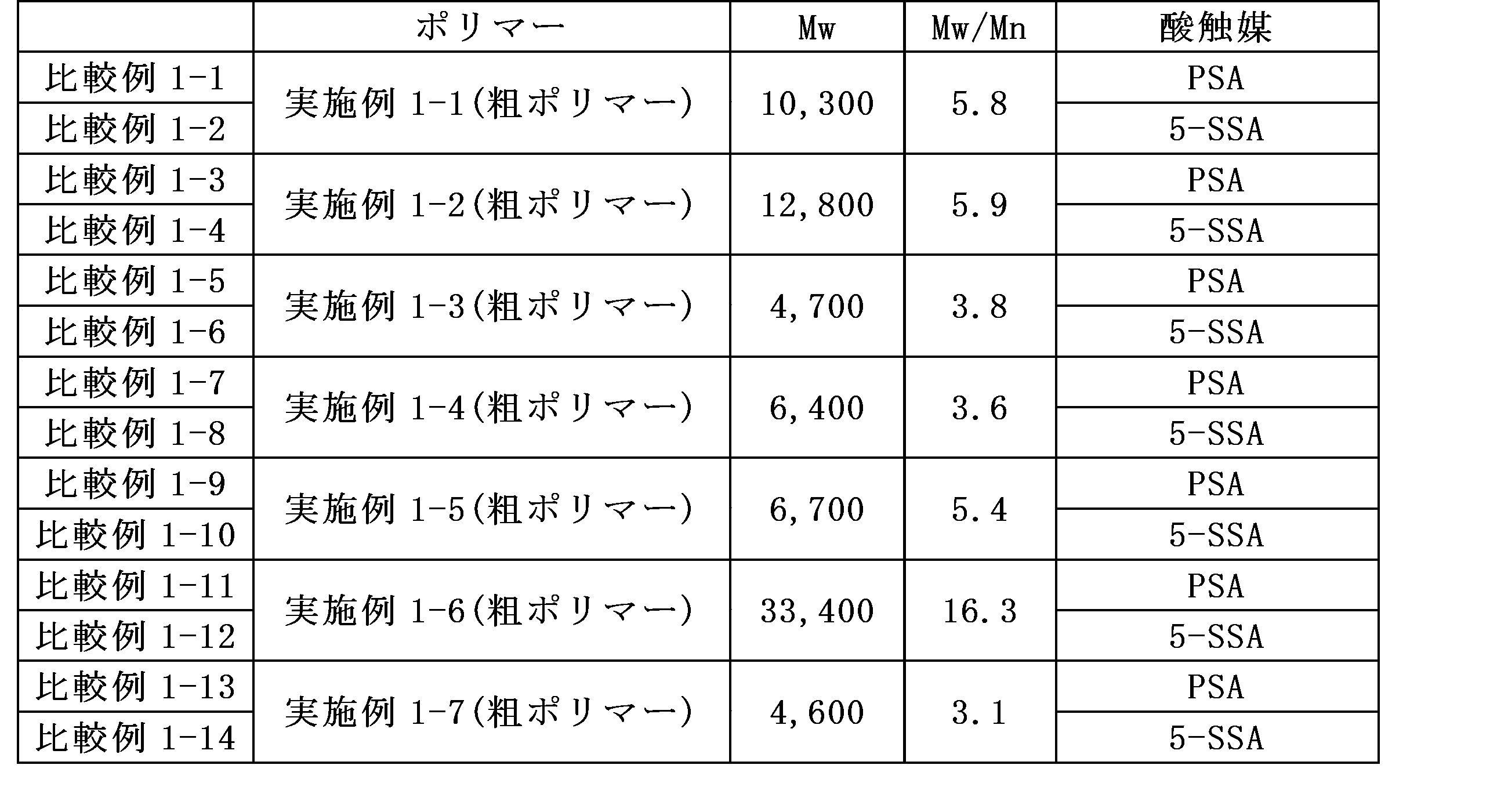
直径4インチのシリコンウエハー基板に、実施例2-1~2-14および比較例1-1~1-14で調製したレジスト下層膜形成用組成物を、スピンコーターにて、1,500rpm、60秒間で塗布した。レジスト下層膜形成用組成物が塗布されたウエハーを、ホットプレートが一体化した昇華物量測定装置(国際公開第2007/111147号参照)にセットして、120秒間ベークし、昇華物をQCM(Quartz Crystal Microbalance)センサー、すなわち電極が形成された水晶振動子に捕集した。QCMセンサーは、水晶振動子の表面(電極)に昇華物が付着するとその質量に応じて水晶振動子の周波数が変化する(下がる)性質を利用して、微量の質量変化を測定することができる。
表4中、Xは、第1工程で合成した粗ポリマーを含む組成物で成膜したものを表し、Yは第2工程で精製された精製ポリマーを含む組成物で成膜したものを表す。表4では再沈殿による精製工程の有無による昇華物への影響も確認できる。
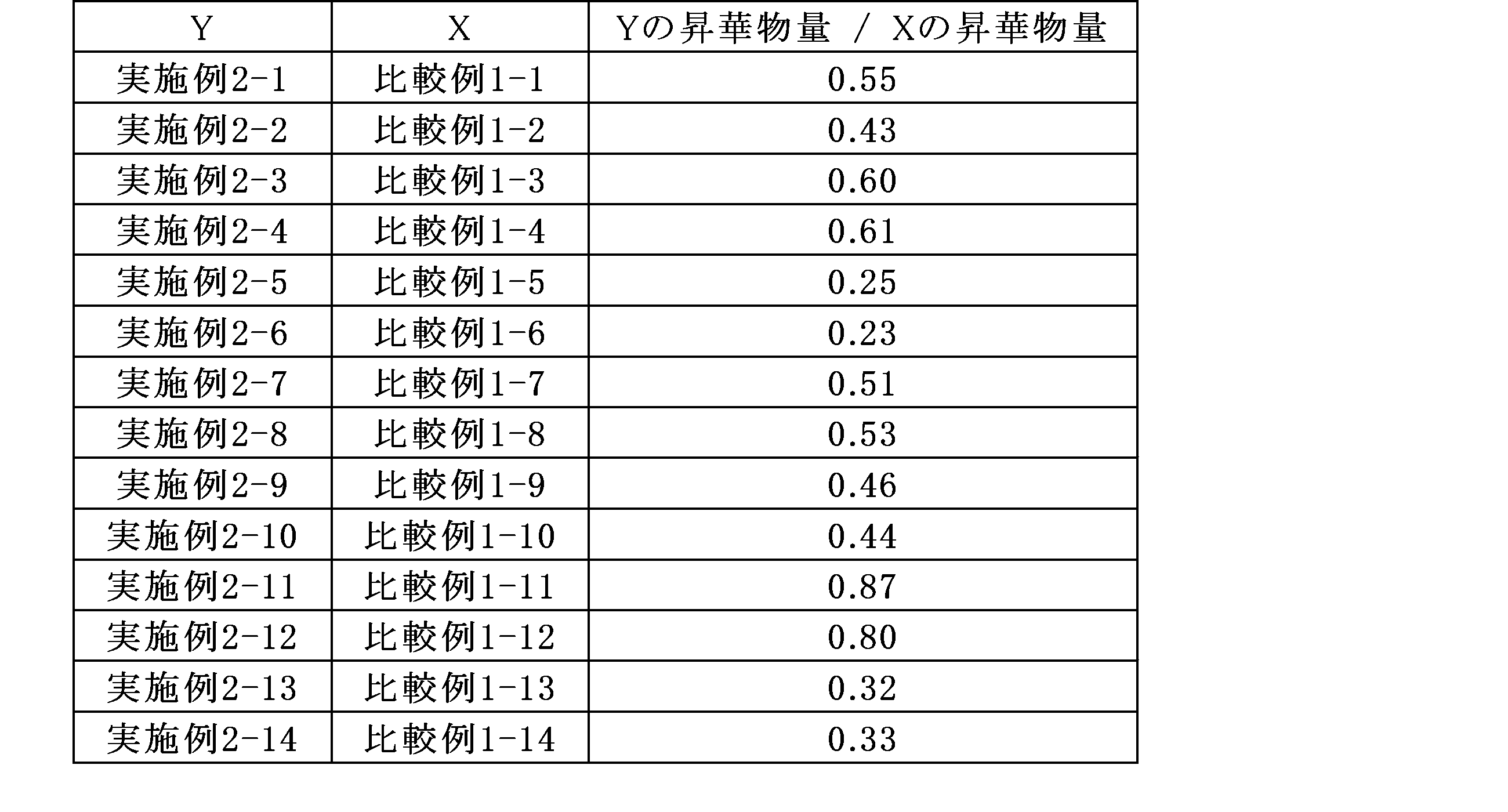
Claims (5)
- 下記式(1)で表される繰り返し単位を有するポリマーと、有機溶媒とを含み、上記ポリマー中の重量平均分子量1,000以下の低分子量成分の含有量が10質量%以下であるレジスト下層膜形成用組成物。

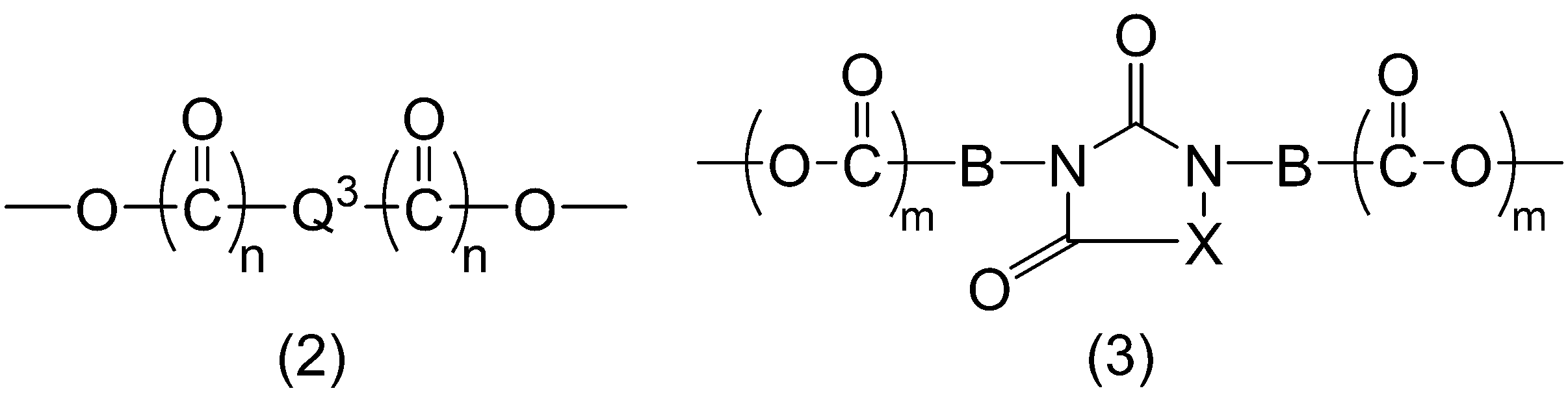
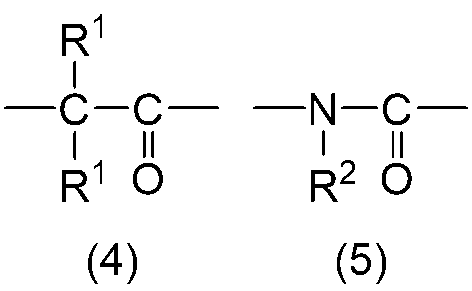
を表す。ただし、Q1およびQ2の少なくとも一方は式(3)で表される構造を含むものとする。} - 更に、架橋剤を含む請求項1記載のレジスト下層膜形成用組成物。
- 更に、酸触媒を含む請求項1または2記載のレジスト下層膜形成用組成物。
- 請求項1~3のいずれか1項記載のレジスト下層膜形成用組成物から得られるレジスト下層膜。
- 下記式(1)で表される繰り返し単位を有するポリマーであり、当該ポリマー中の重量平均分子量1,000以下の低分子量成分の含有量が10質量%以下であるポリマー。


を表す。ただし、Q1およびQ2の少なくとも一方は式(3)で表される構造を含むものとする。}
Priority Applications (4)
| Application Number | Priority Date | Filing Date | Title |
|---|---|---|---|
| KR1020227021920A KR102814976B1 (ko) | 2019-12-04 | 2020-11-26 | 레지스트 하층막 형성용 조성물 |
| JP2021562607A JP7830944B2 (ja) | 2019-12-04 | 2020-11-26 | レジスト下層膜形成用組成物 |
| US17/782,246 US20230029997A1 (en) | 2019-12-04 | 2020-11-26 | Composition for forming resist underlayer film |
| CN202080083998.XA CN114761876A (zh) | 2019-12-04 | 2020-11-26 | 用于形成抗蚀剂下层膜的组合物 |
Applications Claiming Priority (2)
| Application Number | Priority Date | Filing Date | Title |
|---|---|---|---|
| JP2019-219651 | 2019-12-04 | ||
| JP2019219651 | 2019-12-04 |
Publications (1)
| Publication Number | Publication Date |
|---|---|
| WO2021111977A1 true WO2021111977A1 (ja) | 2021-06-10 |
Family
ID=76221907
Family Applications (1)
| Application Number | Title | Priority Date | Filing Date |
|---|---|---|---|
| PCT/JP2020/044039 Ceased WO2021111977A1 (ja) | 2019-12-04 | 2020-11-26 | レジスト下層膜形成用組成物 |
Country Status (5)
| Country | Link |
|---|---|
| US (1) | US20230029997A1 (ja) |
| JP (1) | JP7830944B2 (ja) |
| KR (1) | KR102814976B1 (ja) |
| CN (1) | CN114761876A (ja) |
| WO (1) | WO2021111977A1 (ja) |
Cited By (1)
| Publication number | Priority date | Publication date | Assignee | Title |
|---|---|---|---|---|
| JP2023549846A (ja) * | 2020-11-20 | 2023-11-29 | サムスン エスディアイ カンパニー,リミテッド | レジスト下層膜用組成物およびこれを用いたパターン形成方法 |
Citations (3)
| Publication number | Priority date | Publication date | Assignee | Title |
|---|---|---|---|---|
| WO2011004721A1 (ja) * | 2009-07-07 | 2011-01-13 | 日産化学工業株式会社 | レジスト下層膜形成組成物及びそれを用いたレジストパターンの形成方法 |
| JP2017116803A (ja) * | 2015-12-25 | 2017-06-29 | 日産化学工業株式会社 | レジスト下層膜形成用組成物及びレジストパターンの形成方法 |
| JP2018173521A (ja) * | 2017-03-31 | 2018-11-08 | 信越化学工業株式会社 | レジスト下層膜材料、パターン形成方法、及びレジスト下層膜形成方法 |
Family Cites Families (5)
| Publication number | Priority date | Publication date | Assignee | Title |
|---|---|---|---|---|
| JP4702559B2 (ja) | 2004-04-09 | 2011-06-15 | 日産化学工業株式会社 | 縮合系ポリマーを有する半導体用反射防止膜 |
| JP5598489B2 (ja) * | 2011-03-28 | 2014-10-01 | 信越化学工業株式会社 | ビフェニル誘導体、レジスト下層膜材料、レジスト下層膜形成方法及びパターン形成方法 |
| KR20140050046A (ko) * | 2011-08-04 | 2014-04-28 | 닛산 가가쿠 고교 가부시키 가이샤 | 축합계 폴리머를 가지는 euv 리소그래피용 레지스트 하층막 형성조성물 |
| JP5859420B2 (ja) * | 2012-01-04 | 2016-02-10 | 信越化学工業株式会社 | レジスト下層膜材料、レジスト下層膜材料の製造方法、及び前記レジスト下層膜材料を用いたパターン形成方法 |
| JP2016141796A (ja) * | 2015-02-05 | 2016-08-08 | 信越化学工業株式会社 | ポリマー、レジスト材料及びパターン形成方法 |
-
2020
- 2020-11-26 KR KR1020227021920A patent/KR102814976B1/ko active Active
- 2020-11-26 JP JP2021562607A patent/JP7830944B2/ja active Active
- 2020-11-26 CN CN202080083998.XA patent/CN114761876A/zh active Pending
- 2020-11-26 WO PCT/JP2020/044039 patent/WO2021111977A1/ja not_active Ceased
- 2020-11-26 US US17/782,246 patent/US20230029997A1/en active Pending
Patent Citations (3)
| Publication number | Priority date | Publication date | Assignee | Title |
|---|---|---|---|---|
| WO2011004721A1 (ja) * | 2009-07-07 | 2011-01-13 | 日産化学工業株式会社 | レジスト下層膜形成組成物及びそれを用いたレジストパターンの形成方法 |
| JP2017116803A (ja) * | 2015-12-25 | 2017-06-29 | 日産化学工業株式会社 | レジスト下層膜形成用組成物及びレジストパターンの形成方法 |
| JP2018173521A (ja) * | 2017-03-31 | 2018-11-08 | 信越化学工業株式会社 | レジスト下層膜材料、パターン形成方法、及びレジスト下層膜形成方法 |
Cited By (2)
| Publication number | Priority date | Publication date | Assignee | Title |
|---|---|---|---|---|
| JP2023549846A (ja) * | 2020-11-20 | 2023-11-29 | サムスン エスディアイ カンパニー,リミテッド | レジスト下層膜用組成物およびこれを用いたパターン形成方法 |
| JP7627340B2 (ja) | 2020-11-20 | 2025-02-05 | サムスン エスディアイ カンパニー,リミテッド | レジスト下層膜用組成物およびこれを用いたパターン形成方法 |
Also Published As
| Publication number | Publication date |
|---|---|
| US20230029997A1 (en) | 2023-02-02 |
| CN114761876A (zh) | 2022-07-15 |
| JPWO2021111977A1 (ja) | 2021-06-10 |
| JP7830944B2 (ja) | 2026-03-17 |
| TW202136919A (zh) | 2021-10-01 |
| KR102814976B1 (ko) | 2025-06-02 |
| KR20220112265A (ko) | 2022-08-10 |
Similar Documents
| Publication | Publication Date | Title |
|---|---|---|
| CN103649835B (zh) | 具有缩合系聚合物的形成euv光刻用抗蚀剂下层膜的组合物 | |
| CN1965268B (zh) | 含有缩合类聚合物的半导体用防反射膜 | |
| JP5561494B2 (ja) | Euvリソグラフィー用レジスト下層膜形成組成物 | |
| TWI489217B (zh) | 電子線微影用光阻底層膜形成組成物 | |
| JP7268684B2 (ja) | レジスト下層膜形成組成物及びそれを用いたレジストパターンの形成方法 | |
| WO2006132088A1 (ja) | ナフタレン樹脂誘導体を含有するリソグラフィー用塗布型下層膜形成組成物 | |
| JP2025185145A (ja) | ポリマーの製造方法 | |
| TWI411622B (zh) | 包含有含氮芳香環構造之微影用形成防反射膜之組成物 | |
| EP1813987B1 (en) | Sulfonic-ester-containing composition for formation of antireflection film for lithography | |
| WO2020022086A1 (ja) | ヘテロ原子をポリマー主鎖中に含むレジスト下層膜形成組成物 | |
| JP7830944B2 (ja) | レジスト下層膜形成用組成物 | |
| JP2003345027A (ja) | リソグラフィー用反射防止膜形成組成物 | |
| TWI920049B (zh) | 阻劑下層膜形成用組成物 | |
| TWI917339B (zh) | 聚合物之製造方法 | |
| CN120883140A (zh) | 抗蚀剂下层膜形成用组合物 | |
| WO2025187721A1 (ja) | レジスト下層膜形成用組成物 | |
| WO2025173744A1 (ja) | レジスト下層膜形成用組成物 | |
| WO2025192513A1 (ja) | レジスト下層膜形成用組成物 | |
| WO2024204780A1 (ja) | レジスト下層膜形成用組成物 | |
| WO2025173766A1 (ja) | レジスト下層膜形成用組成物 | |
| WO2024181330A1 (ja) | レジスト下層膜形成用組成物 | |
| WO2025173662A1 (ja) | レジスト下層膜形成用組成物及びレジスト下層膜 |
Legal Events
| Date | Code | Title | Description |
|---|---|---|---|
| 121 | Ep: the epo has been informed by wipo that ep was designated in this application |
Ref document number: 20897326 Country of ref document: EP Kind code of ref document: A1 |
|
| ENP | Entry into the national phase |
Ref document number: 2021562607 Country of ref document: JP Kind code of ref document: A |
|
| ENP | Entry into the national phase |
Ref document number: 20227021920 Country of ref document: KR Kind code of ref document: A |
|
| NENP | Non-entry into the national phase |
Ref country code: DE |
|
| 122 | Ep: pct application non-entry in european phase |
Ref document number: 20897326 Country of ref document: EP Kind code of ref document: A1 |