WO2021111706A1 - ポリフェニレンエーテル溶融紡糸繊維及びその製造方法、並びに、紙及び布帛 - Google Patents
ポリフェニレンエーテル溶融紡糸繊維及びその製造方法、並びに、紙及び布帛 Download PDFInfo
- Publication number
- WO2021111706A1 WO2021111706A1 PCT/JP2020/035601 JP2020035601W WO2021111706A1 WO 2021111706 A1 WO2021111706 A1 WO 2021111706A1 JP 2020035601 W JP2020035601 W JP 2020035601W WO 2021111706 A1 WO2021111706 A1 WO 2021111706A1
- Authority
- WO
- WIPO (PCT)
- Prior art keywords
- polyphenylene ether
- melt
- spun
- fiber
- fibers
- Prior art date
- Legal status (The legal status is an assumption and is not a legal conclusion. Google has not performed a legal analysis and makes no representation as to the accuracy of the status listed.)
- Ceased
Links
Images
Classifications
-
- D—TEXTILES; PAPER
- D01—NATURAL OR MAN-MADE THREADS OR FIBRES; SPINNING
- D01F—CHEMICAL FEATURES IN THE MANUFACTURE OF ARTIFICIAL FILAMENTS, THREADS, FIBRES, BRISTLES OR RIBBONS; APPARATUS SPECIALLY ADAPTED FOR THE MANUFACTURE OF CARBON FILAMENTS
- D01F6/00—Monocomponent artificial filaments or the like of synthetic polymers; Manufacture thereof
- D01F6/58—Monocomponent artificial filaments or the like of synthetic polymers; Manufacture thereof from homopolycondensation products
- D01F6/66—Monocomponent artificial filaments or the like of synthetic polymers; Manufacture thereof from homopolycondensation products from polyethers
-
- D—TEXTILES; PAPER
- D01—NATURAL OR MAN-MADE THREADS OR FIBRES; SPINNING
- D01F—CHEMICAL FEATURES IN THE MANUFACTURE OF ARTIFICIAL FILAMENTS, THREADS, FIBRES, BRISTLES OR RIBBONS; APPARATUS SPECIALLY ADAPTED FOR THE MANUFACTURE OF CARBON FILAMENTS
- D01F9/00—Artificial filaments or the like of other substances; Manufacture thereof; Apparatus specially adapted for the manufacture of carbon filaments
- D01F9/08—Artificial filaments or the like of other substances; Manufacture thereof; Apparatus specially adapted for the manufacture of carbon filaments of inorganic material
- D01F9/12—Carbon filaments; Apparatus specially adapted for the manufacture thereof
- D01F9/14—Carbon filaments; Apparatus specially adapted for the manufacture thereof by decomposition of organic filaments
- D01F9/20—Carbon filaments; Apparatus specially adapted for the manufacture thereof by decomposition of organic filaments from polyaddition, polycondensation or polymerisation products
- D01F9/24—Carbon filaments; Apparatus specially adapted for the manufacture thereof by decomposition of organic filaments from polyaddition, polycondensation or polymerisation products from macromolecular compounds obtained otherwise than by reactions only involving carbon-to-carbon unsaturated bonds
-
- D—TEXTILES; PAPER
- D21—PAPER-MAKING; PRODUCTION OF CELLULOSE
- D21H—PULP COMPOSITIONS; PREPARATION THEREOF NOT COVERED BY SUBCLASSES D21C OR D21D; IMPREGNATING OR COATING OF PAPER; TREATMENT OF FINISHED PAPER NOT COVERED BY CLASS B31 OR SUBCLASS D21G; PAPER NOT OTHERWISE PROVIDED FOR
- D21H13/00—Pulp or paper, comprising synthetic cellulose or non-cellulose fibres or web-forming material
- D21H13/10—Organic non-cellulose fibres
- D21H13/20—Organic non-cellulose fibres from macromolecular compounds obtained otherwise than by reactions only involving carbon-to-carbon unsaturated bonds
Definitions
- the present invention relates to a polyphenylene ether melt-spun fiber containing a high content of a polyphenylene ether component, a method for producing the same, and paper and fabric.
- polyphenylene ether (hereinafter sometimes referred to as PPE) is excellent in heat resistance, flame retardancy, strength, chemical resistance, etc.
- PPE polyphenylene ether
- a molded product formed from polyphenylene ether is used in a wide range of fields.
- polyphenylene ether generally has a high melt viscosity
- melt molding is difficult when polyphenylene ether alone or polyphenylene ether has a high content.
- the melt viscosity has a large effect on the spinning / drawing state after being extruded from the nozzle, which is accompanied by many difficulties as compared with ordinary injection molding.
- the melt-spun fiber containing polyphenylene ether is obtained by melt-spinning a polymer alloy of, for example, a non-crystalline thermoplastic resin such as polyphenylene ether and a crystalline thermoplastic resin such as polypropylene (see, for example, Patent Document 1). ), Polyphenylene ether and linear low-density polyethylene, petroleum resin, or a processing aid containing a combination thereof, a fiber containing a flame retardant (see, for example, Patent Document 2), polyphenylene ether, and a reactivity with polyphenylene ether.
- a fiber made of a polyphenylene ether-based resin composition made of a copolymer having a functional group is known.
- various molding compositions containing two types of polyphenylene ether resins having specific intrinsic viscosities are known (see, for example, Patent Document 4).
- Patent Documents 1 and 2 the processability is improved by adding a crystalline thermoplastic resin such as polypropylene, a processing aid, or the like to the polyphenylene ether, the polyphenylene ether content is low, and the polyphenylene ether. It was not possible to take full advantage of the excellent features of. Further, in Patent Document 3, although the polyphenylene ether content is high, only thick fibers having a diameter of 0.14 mm are obtained, and the fluidity of the polyphenylene ether cannot be sufficiently improved, or the spinnability. Is considered to be in short supply.
- a crystalline thermoplastic resin such as polypropylene, a processing aid, or the like
- Patent Document 4 a highly fluid polyphenylene ether compound is obtained by containing two types of polyphenylene ether resins having different intrinsic viscosities.
- polyphenylene ether is used in the composition 75. It was contained in an amount of about% by weight or less, and there was no specific example in the case where the polyphenylene ether was contained in a higher content.
- Patent Document 4 by containing a large amount of flame retardant and glass fiber, not only flame retardancy but also fluidity and physical and mechanical properties are compatible. Such a resin composition. It was difficult to make a thing into a fiber.
- An object of the present invention is to enable melt spinning even when the content of polyphenylene ether is high, to obtain a polyphenylene ether melt-spun fiber having excellent properties such as mechanical strength, a method for producing the same, and the polyphenylene ether melt. It is an object of the present invention to provide papers and fabrics formed from spun fibers.
- the present invention is characterized in that the content of the polyphenylene ether component is 95% by mass or more of all the components forming the fiber, and the glass transition temperature is 180 ° C. or higher and 205 ° C. or lower. Regarding fibers.
- the single yarn fineness of the polyphenylene ether melt-spun fiber is 1.0 dtex or more and 100 dtex or less.
- the maximum point elongation of the polyphenylene ether melt-spun fiber is preferably 25% or more and 120% or less.
- the polyphenylene ether melt-spun fiber is a short fiber.
- the short fibers are flame-resistant short fibers.
- the present invention also relates to a paper formed from the polyphenylene ether melt-spun fiber.
- the paper is flame-resistant paper.
- the present invention also relates to a fabric formed from the polyphenylene ether melt-spun fiber.
- the cloth is a flame-resistant cloth.
- the present invention is a method for producing a polyphenylene ether melt-spun fiber.
- the present invention relates to a method for producing a polyphenylene ether melt-spun fiber, wherein the content of the polyphenylene ether component in the obtained polyphenylene ether melt-spun fiber is 95% by mass or more of all the components forming the fiber.
- the content of the polyphenylene ether component having a glass transition temperature of less than 170 ° C. is preferably 5% by mass or more in the polyphenylene ether component contained in the raw material resin composition.
- the spinning speed is preferably 100 to 1000 m / min.
- the temperature of the spinning nozzle is preferably 280 to 320 ° C.
- the present invention it is possible to provide a polyphenylene ether melt-spun fiber containing a polyphenylene ether component at a high content, and a paper and a cloth formed from the polyphenylene ether melt-spun fiber. Since the polyphenylene ether melt-spun fiber of the present invention contains a polyphenylene ether component at a high content, it is excellent in mechanical strength, flame retardancy, heat resistance, chemical resistance and the like.
- melt spinning is possible. Since the fluidity and spinnability are improved to some extent, it is possible to produce polyphenylene ether melt-spun fibers containing a high content of polyphenylene ether components.
- the polyphenylene ether melt-spun fiber of the present invention has a polyphenylene ether component content of 95% by mass or more in all the components forming the fiber, and a glass transition temperature of 180 ° C. or higher and 205 ° C. or lower. It is characterized by that.
- the content of the polyphenylene ether component is 95% by mass or more, preferably 98% by mass or more, based on substantially only the polyphenylene ether component (100% by mass) in the total components forming the fiber. Is more preferable.
- the content of the polyphenylene ether component in the polyphenylene ether melt-spun fiber is within the above range, not only the mechanical strength of the obtained fiber is excellent, but also heat resistance, chemical resistance, flame retardancy and the like are excellent. is there.
- Examples of the polyphenylene ether include the following general formula (1): (In the formula, R 1 and R 2 are each independently a hydrogen atom or a hydrocarbon group having 1 to 10 carbon atoms which may have a substituent, and R 3 is an independent substitution. Represents a hydrocarbon group having 1 to 10 carbon atoms which may have a group) Those having a repeating unit represented by.
- R 1 and R 2 in the general formula (1) include hydrogen atom, methyl group, ethyl group, propyl group, isopropyl group, n-butyl group, isobutyl group, t-butyl group, pentyl group and cyclopentyl.
- An alkyl group having 1 to 10 carbon atoms such as a group, a hexyl group, a cyclohexyl group, an octyl group and a decyl group, a phenyl group, a 4-methylphenyl group, a 1-naphthyl group, a 2-naphthyl group and the like having 6 to 10 carbon atoms.
- An aralkyl group having 7 to 10 carbon atoms such as an aryl group, a benzyl group, a 2-phenylethyl group, and a 1-phenylethyl group can also be mentioned.
- examples of the substituent include a halogen atom such as a fluorine atom and an alkoxy group such as a methoxy group.
- Specific examples of the hydrocarbon group having a substituent include a trifluoromethyl group and the like.
- R 1 and R 2 a hydrogen atom and a methyl group are preferable, and a hydrogen atom is more preferable.
- the R 3 in the general formula (1) for example, a methyl group, an ethyl group, a propyl group, an isopropyl group, n- butyl group, an isobutyl group, t- butyl group, a pentyl group, a cyclopentyl group, a hexyl group, cyclohexyl Alkyl group having 1 to 10 carbon atoms such as group, octyl group and decyl group, aryl group having 6 to 10 carbon atoms such as phenyl group, 4-methylphenyl group, 1-naphthyl group and 2-naphthyl group, benzyl group, An aralkyl group having 7 to 10 carbon atoms such as a 2-phenylethyl group and a 1-phenylethyl group can also be mentioned.
- examples of the substituent include a halogen atom such as a fluorine atom and an alkoxy group such as a methoxy group.
- Specific examples of the hydrocarbon group having a substituent include a trifluoromethyl group and the like.
- R 3 methyl group is preferred.
- repeating unit of the general formula (1) 2,6-dimethyl-1,4-phenylene ether, 2,6-diethyl-1,4-phenylene ether, 2-methyl-6-ethyl Repetitive units derived from -1,4-phenylene ether and 2,6-dipropyl-1,4-phenylene ether can be mentioned. Of these, repeating units derived from 2,6-dimethyl-1,4-phenylene ether are preferred.
- the polyphenylene ether As the polyphenylene ether, a homopolymer having the repeating unit of the general formula (1) or a copolymer containing two or more different repeating units of the general formula (1) is preferable. Further, the polyphenylene ether may contain a repeating unit other than the general formula (1) as long as the effect of the present invention is not impaired. The content of the repeating unit other than the general formula (1) is not particularly limited as long as the effect of the present invention is not impaired, but for example, it may be about 5 mol% or less in the copolymer. It is preferable, and it is more preferable that it is not contained.
- the polyphenylene ether melt-spun fiber of the present invention may contain a resin component other than the polyphenylene ether component.
- the resin component other than the polyphenylene ether component include polyamides such as styrene, polyethylene, polypropylene, polyamide 4, polyamide 6, polyamide 10, polyamide 11, polyamide 66, polyamide 6T, and polyamide 6T / 11, polyethylene terephthalate, and polybutylene terephthalate.
- polyester and polycarbonate examples include polyester and polycarbonate.
- the content thereof is preferably 5% by mass or less, more preferably 2% by mass or less, and further preferably not contained (0% by mass) in all the components forming the fiber.
- additives such as lubricants, plasticizers, antioxidants, ultraviolet absorbers, dulls, and antioxidants are added to the polyphenylene ether melt-spun fibers of the present invention as long as the effects of the present invention are not impaired. be able to.
- the addition amount thereof is preferably 5% by mass or less, more preferably 2% by mass or less, and further preferably not contained (0% by mass) in all the components forming the fiber.
- the method for producing the polyphenylene ether melt-spun fiber of the present invention is not particularly limited, but for example, it can be produced by the method for producing a polyphenylene ether melt-spun fiber described later.
- the glass transition temperature of the polyphenylene ether melt-spun fiber is preferably 180 ° C. or higher and 205 ° C. or lower, and preferably 190 ° C. or higher and 205 ° C. or lower.
- the glass transition point temperature is within the above range, it is possible to achieve both melt processability and heat resistance in a well-balanced manner.
- the maximum point stress of the polyphenylene ether melt-spun fiber is preferably 0.8 cN / dtex or more and 1.8 cN / dtex or less, and more preferably 0.9 cN / dtex or more and 1.5 cN / dtex or less. ..
- the maximum point elongation of the polyphenylene ether melt-spun fiber is preferably 25% or more and 120% or less, and more preferably 50% or more and 95% or less from the viewpoint of handleability.
- the maximum point stress and the maximum point elongation can be measured by the method described in Examples.
- the single yarn fineness of the polyphenylene ether melt-spun fiber is preferably 1.0 dtex or more and 100 dtex or less, and 1.0 dtex or more and 50 dtex or less for general heat-resistant filters and heat-resistant woven fabrics. Is more preferable, and 1.0 dtex or more and 30 dtex or less are further preferable. Such single yarn fineness can be appropriately set depending on the intended use. In the present invention, very fine fibers of 30 dtex or less can also be obtained.
- the polyphenylene ether melt-spun fiber has excellent high-temperature stability.
- the polyphenylene ether melt-spun fiber may be a long fiber or a short fiber.
- the method for producing a polyphenylene ether fused-spun fiber of the present invention includes a polyphenylene ether component having a glass transition temperature of less than 170 ° C. (hereinafter, also referred to as a low Tg polyphenylene ether component) and a glass transition.
- a step of melt-extruding a raw material resin composition containing a polyphenylene ether component having a temperature of 180 ° C. or higher hereinafter, also referred to as a high Tg polyphenylene ether component. It has a step of discharging the molten raw material resin composition from a spinning nozzle and spinning it.
- the content of the polyphenylene ether component in the obtained polyphenylene ether melt-spun fiber is 95% by mass or more of all the components forming the fiber.
- polyphenylene ether has a high melt viscosity, and it has been considered that melt spinning is difficult when the polyphenylene ether is contained in a high content or by itself.
- the raw material resin composition containing the polyphenylene ether component having a glass transition temperature of less than 170 ° C. and the polyphenylene ether component having a glass transition temperature of 180 ° C. or higher is used, the fluidity is such that melt spinning is possible. The spinnability is improved, and it is possible to produce molten spun fibers.
- each configuration of the present invention will be described.
- the polyphenylene ether as a raw material includes a homopolymer having the repeating unit of the general formula (1), a copolymer containing two or more different repeating units of the general formula (1), and the general formula (1). ) And a copolymer having a repeating unit other than the general formula (1) can be mentioned. Examples of the content of the repeating unit other than the general formula (1) in the copolymer include those described above. Among these, a homopolymer having the repeating unit of the general formula (1) is preferable.
- homopolymer having the repeating unit of the general formula (1) examples include poly (2,6-dimethyl-1,4-phenylene ether) and poly (2,6-diethyl-1,4-).
- Phenylene ether), poly (2-methyl-6-ethyl-1,4-phenylene ether), poly (2,6-dipropyl-1,4-phenylene ether) and the like can be mentioned.
- poly (2,6-dimethyl-1,4-phenylene ether) is preferable.
- poly (2,6-dimethyl-1,4-phenylene ether) a commercially available product can also be preferably used. Specifically, for example, PPO640, PPO646, PPOSA120 manufactured by SABIC Innovative Plastic, Asahi Kasei Chemicals Co., Ltd. ), Zylon S201A, Zylon S202A and the like.
- the glass transition temperature of the high Tg polyphenylene ether component which is the raw material, is 180 ° C. or higher, preferably 200 ° C. or higher, and more preferably 210 ° C. or higher.
- the upper limit of the glass transition temperature is not particularly limited, but is preferably 230 ° C. or lower.
- the glass transition temperature of the low Tg polyphenylene ether component which is the raw material, is less than 170 ° C., preferably 165 ° C. or lower, and more preferably 160 ° C. or lower.
- the lower limit of the glass transition temperature is not particularly limited, but is preferably 150 ° C. or higher.
- the content of the high Tg polyphenylene ether component is preferably 60% by mass or more, more preferably 70% by mass or more, and more preferably 80% by mass or more. It is more preferable that the amount is 90% by mass or more.
- the upper limit of the content of the high Tg polyphenylene ether component is preferably 95% by mass or less.
- the mechanical strength, heat resistance, chemical resistance, flame retardancy, etc. of the polyphenylene ether melt-spun fiber obtained by including the polyphenylene ether component having a high glass transition temperature (that is, high molecular weight) in the above range, etc. It is preferable because it is excellent in.
- the content of the low Tg polyphenylene ether component is preferably 40% by mass or less, more preferably 30% by mass or less, and 20% by mass or less of the polyphenylene ether component contained in the raw material resin composition. Is more preferable, and 10% by mass or less is particularly preferable.
- the lower limit of the content of the low Tg polyphenylene ether component is preferably 5% by mass or more.
- the polyphenylene ether component having a low glass transition temperature (that is, low molecular weight) in the above range by including the polyphenylene ether component having a low glass transition temperature (that is, low molecular weight) in the above range, the melt viscosity of the raw material resin composition tends to decrease, and the fluidity and spinnability tend to improve. Therefore, it is preferable.
- the raw material resin composition may contain a resin component and an additive other than the polyphenylene ether component in addition to the polyphenylene ether component.
- the resin components and additives other than the polyphenylene ether component are as described above.
- the content of the resin component / additive other than the polyphenylene ether component is preferably 5% by mass or less, more preferably 2% by mass or less, and not contained (0% by mass) in the raw material resin composition. ) Is even more preferable.
- melt extrusion can be performed by a method commonly used in the art, for example, melt extrusion can be performed using an extruder equipped with a cylinder and a screw.
- an extruder equipped with the cylinder and the screw a single-screw extruder or a twin-screw extruder that can be usually used in this field can be used.
- the raw material resin is in the form of powder, it is preferable to use a twin-screw extruder.
- the rotation speed and shape of the screw are not particularly limited, and the rotation speed and shape that can be normally used in this field can be appropriately adopted.
- the temperature inside the cylinder is, for example, preferably 250 to 320 ° C, more preferably 280 to 300 ° C. By setting the temperature inside the cylinder within the above range, the foaming phenomenon can be suppressed, which is preferable.
- the spinning nozzle is not particularly limited, and a nozzle usually used in this field can be used.
- the temperature of the spinning nozzle is preferably 280 to 320 ° C., more preferably 290 to 310 ° C. from the viewpoint of spinnability.
- the spinning speed can be appropriately set according to the required fineness and the like, but in order to stably obtain fibers having a fine fineness, it is preferably about 100 to 1000 m / min, and about 100 to 800 m / min. Is more preferable.
- the single-hole discharge rate of the spinning nozzle is preferably 1.0 g / min or less, more preferably 0.7 g / min or less, further preferably 0.5 g / min or less, and 0. It is particularly preferably 3 g / min or less.
- the lower limit of the single-hole discharge amount is not particularly limited, but is preferably 0.05 g / min or more, more preferably 0.1 g / min or more, and further preferably 0.12 g / min or more. preferable. It is preferable to set the single-hole discharge amount within the above range because polyphenylene ether fibers having a fine fineness can be obtained.
- the raw material resin composition is put into an extruder 2 provided with a cylinder and a screw from the hopper 1 of FIG. 1, the discharge rate of the melted raw material resin composition is measured by a gear pump 3, and a filter medium 4 composed of fine sand or the like is used. Is discharged from the spinning nozzle 5 to obtain molten spun fibers. Further, it is preferable to install a filter 6 made of a metal non-woven fabric or the like on the filter medium 4. By installing the filter 6, it is possible to remove rough foreign matter and prevent clogging of the filter medium 4, which is preferable.
- a heat insulating space 7 directly under the spinning nozzle 5 and introduce an inert gas such as nitrogen 8 into the region for spinning, from the viewpoint of suppressing nozzle clogging due to oxidative cross-linking, and heating. It is more preferable to introduce the heated inert gas with the torch 9.
- the temperature of the heated inert gas is preferably 100 to 500 ° C, more preferably 200 to 400 ° C.
- the single yarn fineness of the polyphenylene ether melt-spun fiber obtained by the production method of the present invention can be appropriately set according to the intended use of the fiber.
- the single yarn fineness of the polyphenylene ether melt-spun fiber is preferably 1.0 dtex or more and 100 dtex or less, and 1.0 dtex or more and 50 dtex or less for general heat-resistant filters and heat-resistant woven fabrics. More preferably, it is more preferably 1.0 dtex or more and 30 dtex or less. Further, according to the production method of the present invention, very fine fibers of 30 dtex or less can be obtained.
- a raw material resin composition containing a polyphenylene ether component having a glass transition temperature of less than 170 ° C. and a polyphenylene ether component having a glass transition temperature of 180 ° C. or higher is used, so that melt spinning is possible.
- the fluidity and spinnability are improved, and it is possible to produce a melt-spun fiber, and further, it is possible to manufacture a melt-spun fiber having the single yarn fineness.
- polyphenylene ether melt-spun short fibers The polyphenylene ether melt-spun short fibers of the present invention can be obtained, for example, by cutting the tow-shaped fibers by combining the polyphenylene ether melt-spun fibers.
- the length of the polyphenylene ether melt-spun short fiber of the present invention is not particularly limited and can be appropriately adjusted depending on the intended use, but is usually 1 to 500 mm, preferably 3 to 400 mm, and more preferably 5 to 300 mm. Is.
- the tensile strength of the polyphenylene ether melt-spun short fibers of the present invention is not particularly limited, but is usually 0.8 to 60 cN / dtex, preferably 0.85 to 50 cN / dtex, and more preferably 0.9 to 40 cN / dtex. Is. The tensile strength is measured according to JIS L1013 8.5.1.
- the tensile elongation of the polyphenylene ether melt-spun short fiber of the present invention is not particularly limited, but is usually 30 to 180%, preferably 40 to 160%, and more preferably 60 to 150%.
- the tensile elongation is measured according to JIS L1013 8.5.1.
- the equilibrium moisture content of the polyphenylene ether melt-spun short fibers of the present invention is not particularly limited, but is usually 0.01 to 1.5%, preferably 0.02 to 1.2%, and more preferably 0.03 to 0.03. It is 1.0%.
- the equilibrium moisture content is measured in accordance with JIS L1013.
- the high temperature shrinkage rate of the polyphenylene ether melt-spun short fiber of the present invention at 190 ° C. is not particularly limited, but is usually 0.1 to 6%, preferably 0.3 to 5%, and more preferably 0.5 to 4. %.
- the method for measuring the high temperature shrinkage rate at 190 ° C. is as described in Examples.
- the polyphenylene ether melt-spun short fiber of the present invention is preferably a flame-resistant short fiber.
- the flame-resistant short fibers are obtained by subjecting the polyphenylene ether melt-spun short fibers to a flame-resistant treatment.
- the polyphenylene ether melt-spun short fibers are heat-treated in air at 120 to 240 ° C. for 1 to 30 hours to insolubilize (infusible treatment), and then in air, 260 to 260 to It is carried out by heat-treating at 400 ° C. for 0.1 to 10 hours to make it flame-resistant (flame-resistant treatment).
- the polyphenylene ether melt-spun short fibers are treated in air at 120 to 240 ° C. for 1 to 30 hours.
- “in the air” is an environment that has not been particularly adjusted.
- the treatment temperature is 120 to 240 ° C., preferably 140 to 230 ° C., and more preferably 160 to 220 ° C.
- the treatment time is 1 to 30 hours, preferably 1.5 to 25 hours, and more preferably 2 to 20 hours.
- the infusibilization treatment as a flame resistance treatment, treatment is performed in air at 260 to 400 ° C. for 0.1 to 10 hours.
- the treatment temperature is 260 to 400 ° C., preferably 270 to 380 ° C., and more preferably 280 to 360 ° C.
- the treatment time is 0.1 to 10 hours, preferably 0.3 to 8 hours, and more preferably 0.5 to 6 hours.
- the fineness of the flame-resistant short fiber is not particularly limited and can be appropriately determined depending on the purpose for which the fiber is used. For example, it is preferably 100 dtex or less, more preferably 95 dtex or less, and 90 dtex or less. It is more preferable to have. When the fineness is within the above range, it becomes possible to process various shapes such as woven fabrics, knitted fabrics, short fiber non-woven fabrics, papers, and fabrics, which is preferable.
- the lower limit of the fineness is not particularly limited, but is preferably 0.1 dtex or more, and more preferably 0.2 dtex or more.
- the tensile strength of the flame-resistant short fibers is preferably 0.8 cN / dtex or more, more preferably 0.85 cN / dtex or more, and further preferably 0.90 cN / dtex or more.
- the upper limit of the tensile strength is not particularly limited, but is preferably 50 cN / dtex or less, and more preferably 40 cN / dtex or less.
- the polyphenylene ether melt-spun short fibers of the present invention can be used, for example, in paper, fabrics, heat-resistant binders, C / C composites, CFRP matrix resins, industrial brushes, brake materials, and the like.
- the paper of the present invention is formed from the polyphenylene ether melt-spun fiber.
- the paper can be produced by a general method, for example, by a wet papermaking method.
- a wet papermaking method for example, an aqueous slurry containing the polyphenylene ether melt-spun fiber may be prepared, and then the aqueous slurry may be subjected to a normal papermaking process.
- the aqueous slurry may contain a binder (for example, a water-soluble polymer fiber such as polyvinyl alcohol-based fiber, a heat-adhesive polymer fiber such as polyethylene terephthalate fiber (PET fiber)) and the like. If necessary, the fibers to be used may be beaten. Further, in order to improve the uniformity and crimping property of the paper, a hot pressing step may be added after the papermaking step.
- a binder for example, a water-soluble polymer fiber such as polyvinyl alcohol-based fiber, a heat-adhesive polymer fiber such as polyethylene terephthalate fiber (PET fiber)
- PET fiber polyethylene terephthalate fiber
- the length of the polyphenylene ether melt-spun fiber used for producing paper is not particularly limited, but is preferably 0.5 mm or more, more preferably 1 mm or more, and more preferably 1 mm or more, from the viewpoint of ensuring sufficient quality as paper. It is preferably 100 mm or less, more preferably 80 mm or less.
- the paper of the present invention has other fibers; various additives such as paper strength improver, filler, defoamer, dye, ultraviolet absorber, flame retardant; talc, kaolin, calcium carbonate, titanium dioxide, etc., depending on the purpose. It may contain various fillers such as. These raw materials are often added to the aqueous slurry, but may be appropriately attached by coating or the like.
- Fibers include, for example, general-purpose fibers such as polyolefin fibers, polyester fibers, polyamide fibers, cellulose fibers, and polysulphon fibers; aromatic paraaramids, polyarylketone fibers, and polysulphon fibers. Heat resistant fibers and the like can be mentioned.
- the proportion of the polyphenylene ether melt-spun fiber contained in the paper of the present invention is, for example, 50 to 100% by mass from the viewpoints of mechanical strength, flame retardancy, heat resistance, high temperature stability, chemical resistance and the like. It is preferably 55 to 98% by mass, more preferably 60 to 95% by mass, and even more preferably 65 to 90% by mass.
- the basis weight of the paper of the present invention is not particularly limited and can be appropriately adjusted according to the intended use of the paper, but is usually 5 to 800 g / cm 2 , preferably 7 to 700 g / cm 2 , and more preferably 10. It is ⁇ 600 g / cm 2 .
- the tensile strength of the paper of the present invention is not particularly limited, but is usually 1 to 300 N / cm, preferably 3 to 250 N / cm, and more preferably 5 to 200 N / cm.
- the tensile strength is measured according to JIS L1013 8.5.1.
- the tensile elongation of the paper of the present invention is not particularly limited, but is usually 0.1 to 100%, preferably 0.3 to 90%, and more preferably 0.5 to 80%.
- the tensile elongation is measured according to JIS L1013 8.5.1.
- the LOI value of the paper of the present invention is not particularly limited, but is usually 25 to 80, preferably 27 to 75, and more preferably 30 to 70.
- the LOI value is measured in accordance with the JIS L 1091 E method.
- the dielectric constant of the paper of the present invention is not particularly limited, but is usually 1.0 to 2.9, preferably 1.1 to 2.8, and more preferably 1.2 to 2.7.
- the equilibrium moisture content of the paper of the present invention is not particularly limited, but is usually 0.01 to 1.5%, preferably 0.02 to 1.2%, and more preferably 0.03 to 1.0%. is there.
- the equilibrium moisture content is measured in accordance with JIS L1013.
- the high temperature shrinkage rate of the paper of the present invention at 190 ° C. is not particularly limited, but is usually 0.1 to 20%, preferably 0.2 to 15%, and more preferably 0.3 to 10%.
- the method for measuring the high temperature shrinkage rate at 190 ° C. is as described in Examples.
- the paper of the present invention is preferably flame-resistant paper.
- the flame-resistant paper can be produced by the above-mentioned method using the polyphenylene ether melt-spun fiber that has been subjected to the flame-resistant treatment.
- the difference in weight loss rate between 150 ° C. and 400 ° C. is preferably 5.0% or less, more preferably 4.0% or less, and 3.5% or less. More preferred. When the difference in weight reduction rate is within the above range, deterioration of the polymer can be suppressed and durability can be improved, which is preferable. Further, the difference in the weight loss rate is preferably 0%, but usually there is a weight loss of about 0.1% or more, and in some cases, it is about 0.15% or more.
- the specific gravity of the flame-resistant paper is preferably 1.2 or more, more preferably 1.25 or more, and further preferably 1.3 or more. When the specific gravity is in the above range, the flame resistance of the paper is sufficiently advanced and the flame resistance is improved, which is preferable.
- the upper limit of the specific gravity is not particularly limited, but is preferably 2.0 or less, and more preferably 1.8 or less.
- the LOI value of the flame-resistant paper is preferably 30 or more, more preferably 30 or more, further preferably 32 or more, and particularly preferably 35 or more.
- the flame-resistant paper obtained is excellent in flame retardancy, which is preferable.
- the LOI value is the critical oxygen index, and the larger the LOI value, the better the flame retardancy. Therefore, the larger the LOI value is, the more preferable it is, and the upper limit value thereof is not particularly limited.
- the tensile elongation of the flame-resistant paper is preferably 5% or more, more preferably 7% or more, and further preferably 10% or more. It is preferable that the tensile elongation is in the above range because the workability can be improved.
- the upper limit of the tensile strength is not particularly limited, but is preferably 100% or less, and more preferably 80% or less.
- the strong retention rate of the flame-resistant paper at 400 ° C. is preferably 40% or more, more preferably 50% or more, and further preferably 60% or more. When the strong retention rate at 400 ° C. is within the above range, the durability when used at a high temperature is high, which is preferable.
- the upper limit of the strong retention rate at 400 ° C. is not particularly limited, but is preferably 100% or less, and more preferably 99% or less.
- the strong retention rate at 400 ° C. means the retention rate of strength after heat treatment at 400 ° C. for 10 minutes.
- the elongation retention rate of the flame-resistant paper at 400 ° C. is preferably 40% or more, more preferably 50% or more, and further preferably 55% or more. It is preferable that the elongation retention rate at 400 ° C. is within the above range because the durability when used at a high temperature is high.
- the upper limit of the elongation retention rate at 400 ° C. is not particularly limited, but is preferably 100% or less, and more preferably 99% or less.
- the elongation retention rate at 400 ° C. means the elongation retention rate after heat treatment at 400 ° C. for 10 minutes.
- the paper of the present invention can be used, for example, as a heat insulating material, a sound absorbing material, a heat resistant filter, a heat resistant insulating paper, an electromagnetic wave shielding material, and the like.
- the fabric of the present invention is formed from the polyphenylene ether melt-spun fiber.
- the fabric further includes total aromatic polyester fibers, polybenzoxazole (PBO) fibers, polybenzoimidazole (PBI) fibers, polybenzothiazole (PBTZ) fibers, polyimide (PI) fibers, polysulfonamide (PSA) fibers, and poly.
- Ether ether ketone (PEEK) fiber polyetherimide (PEI) fiber, polyarylate (PAr) fiber, melamine fiber, phenol fiber, fluorofiber, polyphenylene sulfide (PPS) fiber, cellulose fiber, polyolefin fiber, acrylic fiber, rayon It may contain one or more fibers selected from the group consisting of fibers, cotton fibers, animal hair fibers, polyurethane fibers, polyvinyl chloride fibers, polyvinylidene chloride fibers, acetate fibers, and polycarbonate fibers.
- the proportion of the polyphenylene ether melt-spun fiber contained in the fabric of the present invention is, for example, 50 to 100% by mass from the viewpoints of mechanical strength, flame retardancy, heat resistance, high temperature stability, chemical resistance and the like. It is preferably 55 to 98% by mass, more preferably 60 to 95% by mass, and even more preferably 65 to 90% by mass.
- the fabric of the present invention may contain additives such as flame retardants, ultraviolet absorbers, reflectors, organic dyes, organic pigments, and inorganic pigments, if necessary.
- the fabric of the present invention can be produced by a general method. For example, a spun yarn of the above fibers is mixed to obtain a spun yarn, and then a twill weave is used with a single yarn or a twin yarn using a rapier loom or the like. , A method of weaving into a structure such as plain weave.
- the texture of the fabric of the present invention is not particularly limited and can be appropriately adjusted depending on the intended use of the fabric, but is usually 10 to 3000 g / cm 2 , preferably 20 to 2500 g / cm 2 , and more preferably 30. It is ⁇ 2000 g / cm 2 .
- the LOI value of the fabric of the present invention is not particularly limited, but is usually 25 to 80, preferably 27 to 75, and more preferably 30 to 70.
- the LOI value is measured in accordance with the JIS L 1091 E method.
- the high temperature shrinkage rate of the fabric of the present invention at 190 ° C. is not particularly limited, but is usually 0.1 to 20%, preferably 0.2 to 15%, and more preferably 0.3 to 10%.
- the method for measuring the high temperature shrinkage rate at 190 ° C. is as described in Examples.
- the fabric of the present invention is preferably a flame-resistant fabric.
- the flame-resistant fabric may be produced by the above method using the flame-resistant polyphenylene ether melt-spun fiber, or the fabric may be produced by the above method using the polyphenylene ether melt-spun fiber. After that, the produced fabric may be subjected to the flameproofing treatment to be produced.
- the difference in weight loss rate between 150 ° C. and 400 ° C. is preferably 5.0% or less, more preferably 4.0% or less, and 3.5% or less. More preferred. When the difference in weight reduction rate is within the above range, deterioration of the polymer can be suppressed and durability can be improved, which is preferable. Further, the difference in the weight loss rate is preferably 0%, but usually there is a weight loss of about 0.1% or more, and in some cases, it is about 0.15% or more.
- the specific gravity of the flame-resistant fabric is preferably 1.2 or more, more preferably 1.25 or more, and further preferably 1.3 or more. When the specific gravity is in the above range, the fabric is sufficiently flame-resistant and the flame resistance is improved, which is preferable.
- the upper limit of the specific gravity is not particularly limited, but is preferably 2.0 or less, and more preferably 1.8 or less.
- the LOI value of the flame-resistant fabric is preferably 30 or more, more preferably 30 or more, further preferably 32 or more, and particularly preferably 35 or more.
- the LOI value is the critical oxygen index, and the larger the LOI value, the better the flame retardancy. Therefore, the larger the LOI value is, the more preferable it is, and the upper limit value thereof is not particularly limited.
- the tensile elongation of the flame-resistant fabric is preferably 5% or more, more preferably 7% or more, and further preferably 10% or more. It is preferable that the tensile elongation is in the above range because the workability can be improved.
- the upper limit of the tensile strength is not particularly limited, but is preferably 100% or less, and more preferably 80% or less.
- the strong retention rate of the flame-resistant fabric at 400 ° C. is preferably 40% or more, more preferably 50% or more, and further preferably 60% or more. When the strong retention rate at 400 ° C. is within the above range, the durability when used at a high temperature is high, which is preferable.
- the upper limit of the strong retention rate at 400 ° C. is not particularly limited, but is preferably 100% or less, and more preferably 99% or less.
- the strong retention rate at 400 ° C. means the retention rate of strength after heat treatment at 400 ° C. for 10 minutes.
- the elongation retention rate of the flame-resistant fabric at 400 ° C. is preferably 40% or more, more preferably 50% or more, and further preferably 55% or more. It is preferable that the elongation retention rate at 400 ° C. is within the above range because the durability when used at a high temperature is high.
- the upper limit of the elongation retention rate at 400 ° C. is not particularly limited, but is preferably 100% or less, and more preferably 99% or less.
- the elongation retention rate at 400 ° C. means the elongation retention rate after heat treatment at 400 ° C. for 10 minutes.
- the fabric of the present invention can be used, for example, as a heat insulating material, work clothes (for fire fighting, racing, aviators), heat-resistant gloves, disaster prevention hoods, interior materials for transportation equipment, heat-resistant clothing, electromagnetic wave shielding materials, and the like. it can.
- Example 1 Poly (2,6-dimethyl-1,4-phenylene ether) (PPO640, glass transition temperature (Tg): 221 ° C., manufactured by SABIC Innovative Plastic) 90 parts by mass, poly (2,6-dimethyl-1,4- A mixture of 10 parts by mass of phenylene ether) (PPOSA120, glass transition temperature (Tg): 159 ° C., manufactured by SABIC Innovative Plastic) was used in a twin-screw extruder manufactured by Technobel Co., Ltd. (product name: KZW15TW-30MG). Extruded.
- the cylinder has four zones, the cylinders are set to cylinders 1, 2, 3 and 4, respectively from the hopper side, the cylinders 1 to 4 and the cylinder head portion are set to 280 ° C., and the screw.
- the rotation speed was set to 200 rpm.
- a gear pump is installed downstream of the extruder to measure the discharge rate of the polymer, and a nozzle (nozzle hole diameter: 0.) is passed through a metal non-woven fabric filter (product name: NF-07, manufactured by Nippon Seisen Co., Ltd.). Extruded to 5 mm, nozzle hole land length: 1 mm, number of nozzle holes: 24) (total discharge amount: 5.8 g / min, single hole discharge amount: 0.242 g / min). A surface heater was placed directly below the nozzle, and the nozzle temperature was set to 300 ° C. A 60 mm heat insulating space was provided directly under the nozzle, and nitrogen heated to 300 ° C. was continuously introduced into this area.
- the polymer discharged from the nozzle was wound at a spinning speed of 100 m / min.
- the obtained melt-spun fiber has a fineness of 577.1 dtex, a single yarn fineness of 24.0 dtex, a maximum point stress of 0.93 cN / dtex, a maximum point elongation of 93.9%, and a glass transition point temperature of 203 ° C. there were.
- Table 1 shows the fiber physical characteristics of the obtained fibers.
- Examples 2-7 A melt-spun fiber was obtained in the same manner as in Example 1 except that the composition of the raw material resin composition, the screw rotation speed, the nozzle form, and the spinning conditions were changed as shown in Table 1. Table 1 shows the fiber physical characteristics of the obtained fibers.
- Comparative Example 1 In Comparative Example 1, the same as in Example 7 except that only poly (2,6-dimethyl-1,4-phenylene ether) (PPO640, glass transition temperature (Tg): 221 ° C., manufactured by SABIC Innovative Plastic) was used. An attempt was made to produce molten spun fibers in a similar manner, but the viscosity was too high to extrude the polymer from the gear pump, resulting in the destruction of the gear pump.
- PPO640 poly (2,6-dimethyl-1,4-phenylene ether)
- Tg glass transition temperature
- Comparative Example 2 A mixture of 80 parts by mass of poly (2,6-dimethyl-1,4-phenylene ether) (PPO640, manufactured by SABIC Innovative Plastic) and 20 parts by mass of polystyrene (679, manufactured by PS Japan Corporation) was used. Melt spinning was performed in the same manner as in Example 1 except that the nozzle form and spinning conditions were changed as shown in Table 1, but the spinnability was very poor and the single-hole discharge rate was up to 0.242 g / min. By raising the fiber, a fiber having a single yarn fineness of 78.4 dtex was finally obtained at a spinning speed of 30 m / min. Table 1 shows the fiber physical characteristics of the obtained fibers.
- PPO640 poly (2,6-dimethyl-1,4-phenylene ether)
- polystyrene 679, manufactured by PS Japan Corporation
- PPE (646) in Table 1 is poly (2,6-dimethyl-1,4-phenylene ether) (PPO646, glass transition temperature (Tg): 221 ° C., manufactured by SABIC Innovative Plastic).
- PPE (640) is a poly (2,6-dimethyl-1,4-phenylene ether) (PPO640, glass transition temperature (Tg): 220 ° C., manufactured by SABIC Innovative Plastic), "PPE (SA120)”.
- low Tg polyphenylene ether was used as a raw material even though the polyphenylene ether was contained in a high content, so that a molten spun fiber was obtained.
- the melt-spun fibers obtained in the examples were excellent in maximum point stress and maximum point elongation.
- fine fibers having a single yarn fineness of 15 dtex or less were obtained, and in Example 5, the single yarn fineness was 3.4 dtex by setting the spinning speed to 700 m / min. Very fine fibers are obtained.
- Comparative Example 1 the melt-spun fiber could not be obtained. It is considered that this is because in Comparative Example 1, since the low Tg polyphenylene ether was not contained, the melt viscosity was too high to extrude the polymer from the gear pump. In Comparative Example 2, although polystyrene was blended with poly (2,6-dimethyl-1,4-phenylene ether), the spinnability was very poor, and only very thick fibers could be obtained. It was. In addition, the obtained fibers had low strength, elongation, and glass transition temperature.
- Example 8 The melt-spun fibers obtained in Example 1 were combined to form a tow-shaped fiber, which was cut into a fiber length of 50 mm with a guillotine cutter to obtain short fibers.
- Example 9 The melt-spun fibers obtained in Example 1 were combined to form a tow-shaped fiber, which was cut into a fiber length of 50 mm with a guillotine cutter to obtain short fibers.
- the obtained short fibers are heat-treated in the order of 200 ° C. ⁇ 120 min, 210 ° C. ⁇ 20 min, 220 ° C. ⁇ 20 min, 250 ° C. ⁇ 120 min, 280 ° C. ⁇ 120 min, 320 ° C. ⁇ 120 min in an air atmosphere to prepare flame-resistant short fibers. did.
- Example 10 ⁇ Paper formed from polyphenylene ether melt-spun fibers> Example 10 The melt-spun fibers obtained in Example 1 were combined to form a tow-shaped fiber, which was cut into a fiber length of 5 mm with a guillotine cutter to obtain short fibers. Wet papermaking was performed using the obtained short fibers. At the time of papermaking, a surfactant "Meikasurf MK-37" manufactured by Meisei Chemical Works, Ltd. was used. The obtained paper was taken on aluminum foil and washed with about 5 L of ion-exchanged water using a spray.
- Dielectric constant A sample having a thickness of 50 ⁇ m was measured by the cavity resonator method (TM mode) in accordance with JIS C2565 using a dielectric constant measuring device manufactured by AT Co., Ltd. The frequency was measured at 10 GHz. The sample size is 3 mm wide and 80 mm long.
- Example 11 The paper produced in Example 10 is heat-treated in the order of 200 ° C. ⁇ 120 min, 210 ° C. ⁇ 20 min, 220 ° C. ⁇ 20 min, 250 ° C. ⁇ 120 min, 280 ° C. ⁇ 120 min, 320 ° C. ⁇ 120 min in an air atmosphere to obtain a flameproof paper. Made.
- Dielectric constant A sample having a thickness of 50 ⁇ m was measured by the cavity resonator method (TM mode) in accordance with JIS C2565 using a dielectric constant measuring device manufactured by AT Co., Ltd. The frequency was measured at 10 GHz. The sample size is 3 mm wide and 80 mm long.
- Example 12 Weaving was performed using the melt-spun fibers obtained in Example 1 to obtain a plain woven fabric having a basis weight of 150 g / m 2.
- LOI value Measured according to the JIS L 1091 E method. The oxygen index was determined when combustion continued for 50 mm or more, and propane gas was used as the heat source for the igniter.
- Example 13 The plain woven fabric produced in Example 12 is heat-treated in the order of 200 ° C. ⁇ 120 min, 210 ° C. ⁇ 20 min, 220 ° C. ⁇ 20 min, 250 ° C. ⁇ 120 min, 280 ° C. ⁇ 120 min, 320 ° C. ⁇ 120 min in an air atmosphere to make the fabric flame resistant.
- Example 13 The plain woven fabric produced in Example 12 is heat-treated in the order of 200 ° C. ⁇ 120 min, 210 ° C. ⁇ 20 min, 220 ° C. ⁇ 20 min, 250 ° C. ⁇ 120 min, 280 ° C. ⁇ 120 min, 320 ° C. ⁇ 120 min in an air atmosphere to make the fabric flame resistant.
- Example 13 The plain woven fabric produced in Example 12 is heat-treated in the order of 200 ° C. ⁇ 120 min, 210 ° C. ⁇ 20 min, 220 ° C. ⁇ 20 min, 250 ° C. ⁇ 120 min, 280
Landscapes
- Chemical & Material Sciences (AREA)
- Chemical Kinetics & Catalysis (AREA)
- General Chemical & Material Sciences (AREA)
- Engineering & Computer Science (AREA)
- Textile Engineering (AREA)
- Artificial Filaments (AREA)
- Inorganic Fibers (AREA)
- Woven Fabrics (AREA)
- Compositions Of Macromolecular Compounds (AREA)
Abstract
本発明の目的は、ポリフェニレンエーテルが高含有量の場合であっても溶融紡糸が可能となり、機械的強度等の優れた特性を有するポリフェニレンエーテル溶融紡糸繊維及びその製造方法、並びに、紙及び布帛を提供することにある。本発明は、ポリフェニレンエーテル成分の含有量が繊維を形成する全成分中95質量%以上であり、ガラス転移点温度が180℃以上、205℃以下であることを特徴とするポリフェニレンエーテル溶融紡糸繊維に関する。
Description
本発明は、ポリフェニレンエーテル成分を高含有量で含有するポリフェニレンエーテル溶融紡糸繊維及びその製造方法、並びに、紙及び布帛に関する。
ポリフェニレンエーテル(以下、PPEと表記することもある)は、耐熱性、難燃性、強度、耐薬品性等に優れるため、ポリフェニレンエーテルから形成される成形体は幅広い分野で利用されている。しかしながら、ポリフェニレンエーテルは、一般的に高い溶融粘度を有しているため、ポリフェニレンエーテル単独やポリフェニレンエーテルが高含有量の場合には溶融成形は難しい。特に溶融紡糸して繊維とする場合、ノズルから押出された後の紡糸・延伸状態に溶融粘度が与える影響が大きく、通常の射出成形と比べて多くの困難性を伴うものであった。
ポリフェニレンエーテルを含む溶融紡糸繊維としては、例えば、ポリフェニレンエーテル等の非結晶性熱可塑性樹脂とポリプロピレン等の結晶性熱可塑性樹脂とのポリマーアロイを溶融紡糸して得られるもの(例えば、特許文献1参照)、ポリフェニレンエーテルと直鎖状低密度ポリエチレン、石油樹脂、又はそれらの組合せを含む加工助剤、難燃剤を含む繊維(例えば、特許文献2参照)、ポリフェニレンエーテルと、ポリフェニレンエーテルと反応性を有する官能基をもつ共重合体からなるポリフェニレンエーテル系樹脂組成物からなる繊維(例えば、特許文献3参照)が知られている。また、特定の固有粘度を有する2種のポリフェニレンエーテル樹脂を含む各種成形用の組成物が知られている(例えば、特許文献4参照)。
しかしながら、特許文献1、2においては、ポリフェニレンエーテルに、ポリプロピレン等の結晶性熱可塑性樹脂、加工助剤等を添加して加工性を向上させたものであり、ポリフェニレンエーテル含有量が低く、ポリフェニレンエーテルの優れた特徴を活かしきれないものであった。さらに、特許文献3においては、ポリフェニレンエーテル含有率が高いものの、径が0.14mmの太い繊維しか得られていないものであって、ポリフェニレンエーテルの流動性を十分に向上できていないか、紡糸性が不足しているものと考えられる。一般に細い繊維を得るためには、流動性と紡糸性の両立が必要であり、ポリフェニレンエーテル含有率の高いものでそれらを両立することは困難を極めるものである。また、特許文献3の具体例において得られている繊維は伸び率が20%と低く、取り扱い性に懸念のあるものであった。特許文献4においては、固有粘度が異なる2種のポリフェニレンエーテル樹脂を含むことによって、流動性の高いポリフェニレンエーテル配合物を得るものであるが、具体的な例示においては、ポリフェニレンエーテルを組成物中75重量%以下程度で含有するものであって、ポリフェニレンエーテルをさらに高含有量で含む場合の具体的な例示はないものであった。また、特許文献4の具体的例示においては、難燃剤とガラス繊維を多く含むことで、難燃性の他、流動性と物理的及び機械的性質を両立しているが、このような樹脂組成物を繊維とすることは困難であった。
本発明の目的は、ポリフェニレンエーテルが高含有量の場合であっても溶融紡糸が可能となり、機械的強度等の優れた特性を有するポリフェニレンエーテル溶融紡糸繊維及びその製造方法、並びに、前記ポリフェニレンエーテル溶融紡糸繊維から形成された紙及び布帛を提供することにある。
本発明者らは、ポリフェニレンエーテル溶融紡糸繊維について鋭意検討を行った結果、以下のポリフェニレンエーテル溶融紡糸繊維及びその製造方法、並びに、紙及び布帛により、上記課題が解決できることを見出し、本発明を完成するに至った。
すなわち、本発明は、ポリフェニレンエーテル成分の含有量が繊維を形成する全成分中95質量%以上であり、ガラス転移点温度が180℃以上、205℃以下であることを特徴とするポリフェニレンエーテル溶融紡糸繊維に関する。
前記ポリフェニレンエーテル溶融紡糸繊維の単糸繊度が1.0dtex以上、100dtex以下であることが好ましい。
前記ポリフェニレンエーテル溶融紡糸繊維の最大点伸度が25%以上、120%以下であることが好ましい。
前記ポリフェニレンエーテル溶融紡糸繊維が、短繊維であることが好ましい。
前記短繊維が、耐炎化短繊維であることが好ましい。
また、本発明は、前記ポリフェニレンエーテル溶融紡糸繊維から形成された紙、に関する。
前記紙が、耐炎化紙であることが好ましい。
また、本発明は、前記ポリフェニレンエーテル溶融紡糸繊維から形成された布帛、に関する。
前記布帛が、耐炎化布帛であることが好ましい。
また、本発明は、ポリフェニレンエーテル溶融紡糸繊維の製造方法であって、
ガラス転移点温度が170℃未満のポリフェニレンエーテル成分、及びガラス転移温度が180℃以上のポリフェニレンエーテル成分を含む原料樹脂組成物を溶融押出する工程、
前記溶融した原料樹脂組成物を紡糸ノズルから吐出させて紡糸する工程を有し、
得られたポリフェニレンエーテル溶融紡糸繊維におけるポリフェニレンエーテル成分の含有量が、繊維を形成する全成分中95質量%以上であることを特徴とするポリフェニレンエーテル溶融紡糸繊維の製造方法に関する。
ガラス転移点温度が170℃未満のポリフェニレンエーテル成分、及びガラス転移温度が180℃以上のポリフェニレンエーテル成分を含む原料樹脂組成物を溶融押出する工程、
前記溶融した原料樹脂組成物を紡糸ノズルから吐出させて紡糸する工程を有し、
得られたポリフェニレンエーテル溶融紡糸繊維におけるポリフェニレンエーテル成分の含有量が、繊維を形成する全成分中95質量%以上であることを特徴とするポリフェニレンエーテル溶融紡糸繊維の製造方法に関する。
前記ガラス転移点温度が170℃未満のポリフェニレンエーテル成分の含有量が、原料樹脂組成物に含まれるポリフェニレンエーテル成分中に5質量%以上であることが好ましい。
紡糸速度が、100~1000m/分であることが好ましい。
前記紡糸ノズルの温度が、280~320℃であることが好ましい。
前記紡糸ノズルの直下の領域に、不活性ガスを導入して紡糸することが好ましい。
本発明においては、ポリフェニレンエーテル成分を高含有率で含むポリフェニレンエーテル溶融紡糸繊維、並びに、前記ポリフェニレンエーテル溶融紡糸繊維から形成された紙及び布帛を提供することができる。本発明のポリフェニレンエーテル溶融紡糸繊維は、ポリフェニレンエーテル成分を高含有率で含むため、機械的強度、難燃性、耐熱性、耐薬品性等に優れている。
また、本発明の製造方法によると、ガラス転移点温度が170℃未満のポリフェニレンエーテル成分、及びガラス転移温度が180℃以上のポリフェニレンエーテル成分を含む原料樹脂組成物を用いるため、溶融紡糸が可能な程度に流動性・紡糸性が向上するため、ポリフェニレンエーテル成分を高含有率で含むポリフェニレンエーテル溶融紡糸繊維の製造を可能とするものである。
1.ポリフェニレンエーテル溶融紡糸繊維
本発明のポリフェニレンエーテル溶融紡糸繊維は、ポリフェニレンエーテル成分の含有量が繊維を形成する全成分中95質量%以上であり、ガラス転移点温度が180℃以上、205℃以下であることを特徴とする。
本発明のポリフェニレンエーテル溶融紡糸繊維は、ポリフェニレンエーテル成分の含有量が繊維を形成する全成分中95質量%以上であり、ガラス転移点温度が180℃以上、205℃以下であることを特徴とする。
本発明においては、ポリフェニレンエーテル成分の含有量が、繊維を形成する全成分中95質量%以上であり、98質量%以上であることが好ましく、実質的にポリフェニレンエーテル成分のみ(100質量%)からなることがより好ましい。ポリフェニレンエーテル溶融紡糸繊維における前記ポリフェニレンエーテル成分の含有量が前記範囲にあることで、得られた繊維の機械的強度に優れるのみならず、耐熱性、耐薬品性、難燃性等に優れるものである。
前記ポリフェニレンエーテルとしては、例えば、下記一般式(1):

(式中、R1、R2は、それぞれ独立に、水素原子、又は、置換基を有していてもよい炭素数1~10の炭化水素基であり、R3は、それぞれ独立に、置換基を有していてもよい炭素数1~10の炭化水素基を表す)
で表される繰り返し単位を有するものを挙げることができる。
で表される繰り返し単位を有するものを挙げることができる。
前記一般式(1)中のR1、R2としては、例えば、水素原子、メチル基、エチル基、プロピル基、イソプロピル基、n-ブチル基、イソブチル基、t-ブチル基、ペンチル基、シクロペンチル基、ヘキシル基、シクロヘキシル基、オクチル基、デシル基等の炭素数1~10のアルキル基、フェニル基、4-メチルフェニル基、1-ナフチル基、2-ナフチル基等の炭素数6~10のアリール基、ベンジル基、2-フェニルエチル基、1-フェニルエチル基等の炭素数7~10のアラルキル基等も挙げることができる。
前記炭化水素基が置換基を有する場合、その置換基としては、フッ素原子等のハロゲン原子、メトキシ基等のアルコキシ基等が挙げられる。置換基を有する炭化水素基の具体例としては、例えば、トリフルオロメチル基等を挙げることができる。
これらの中でも、R1、R2としては、水素原子、メチル基が好ましく、水素原子であることがより好ましい。
前記一般式(1)中のR3としては、例えば、メチル基、エチル基、プロピル基、イソプロピル基、n-ブチル基、イソブチル基、t-ブチル基、ペンチル基、シクロペンチル基、ヘキシル基、シクロヘキシル基、オクチル基、デシル基等の炭素数1~10のアルキル基、フェニル基、4-メチルフェニル基、1-ナフチル基、2-ナフチル基等の炭素数6~10のアリール基、ベンジル基、2-フェニルエチル基、1-フェニルエチル基等の炭素数7~10のアラルキル基等も挙げることができる。
前記炭化水素基が置換基を有する場合、その置換基としては、フッ素原子等のハロゲン原子、メトキシ基等のアルコキシ基が挙げられる。置換基を有する炭化水素基の具体例としては、例えば、トリフルオロメチル基等を挙げることができる。
これらの中でも、R3としては、メチル基が好ましい。
前記一般式(1)の繰り返し単位としては、具体的には、2,6-ジメチル-1,4-フェニレンエーテル、2,6-ジエチル-1,4-フェニレンエーテル、2-メチル-6-エチル-1,4-フェニレンエーテル、2,6-ジプロピル-1,4-フェニレンエーテルから誘導される繰り返し単位を挙げることができる。これらの中でも、2,6-ジメチル-1,4-フェニレンエーテルから誘導される繰り返し単位が好ましい。
前記ポリフェニレンエーテルとしては、前記一般式(1)の繰り返し単位を有する単独重合体、又は異なる2種以上の一般式(1)の繰り返し単位を含有する共重合体が好ましい。また、前記ポリフェニレンエーテルには、本発明の効果を損なわない範囲で、前記一般式(1)以外の繰り返し単位を含むことができる。このような一般式(1)以外の繰り返し単位の含有量は、本発明の効果を損なわない範囲であれば特に限定されないが、例えば、前記共重合体中に5モル%以下程度であることが好ましく、含まないことがより好ましい。
本発明のポリフェニレンエーテル溶融紡糸繊維には、前記ポリフェニレンエーテル成分以外の樹脂成分を含むことができる。ポリフェニレンエーテル成分以外の樹脂成分としては、スチレン、ポリエチレン、ポリプロピレンやポリアミド4、ポリアミド6、ポリアミド10、ポリアミド11、ポリアミド66、ポリアミド6T、ポリアミド6T/11等のポリアミド、ポリエチレンテレフタレート、ポリブチレンテレフタレート等のポリエステル、ポリカーボネート等を挙げることができる。但し、その含有量は、繊維を形成する全成分中5質量%以下であることが好ましく、2質量%以下であることがより好ましく、含まない(0質量%)ことがさらに好ましい。
また、本発明のポリフェニレンエーテル溶融紡糸繊維には、本発明の効果を損なわない範囲で、滑剤、可塑剤、酸化防止剤、紫外線吸収剤、ダル剤、静電防止剤等の添加剤も添加することができる。但し、その添加量は、繊維を形成する全成分中5質量%以下であることが好ましく、2質量%以下であることがより好ましく、含まない(0質量%)ことがさらに好ましい。
本発明のポリフェニレンエーテル溶融紡糸繊維の製造方法は特に限定されるものではないが、例えば、後述のポリフェニレンエーテル溶融紡糸繊維の製造方法により製造することもできる。
ポリフェニレンエーテル溶融紡糸繊維のガラス転移点温度は、180℃以上、205℃以下であり、190℃以上、205℃以下であることが好ましい。ガラス転移点温度が前記範囲にあることで、溶融加工性と耐熱性をバランス良く両立させることができる。
前記ポリフェニレンエーテル溶融紡糸繊維の最大点応力は、0.8cN/dtex以上、1.8cN/dtex以下であることが好ましく、0.9cN/dtex以上、1.5cN/dtex以下であることがより好ましい。また、前記ポリフェニレンエーテル溶融紡糸繊維の最大点伸度は、取り扱い性から、25%以上、120%以下であることが好ましく、50%以上、95%以下であることがより好ましい。最大点応力、最大点伸度は、実施例に記載の方法により測定することができる。
前記ポリフェニレンエーテル溶融紡糸繊維の単糸繊度は、一般的な耐熱フィルターや耐熱織物等の用途であれば、1.0dtex以上、100dtex以下であることが好ましく、1.0dtex以上、50dtex以下であることがより好ましく、1.0dtex以上、30dtex以下であることがさらに好ましい。このような単糸繊度については、用いる用途によって適宜設定することができる。本発明においては、30dtex以下の非常に細い繊維も得ることができるものである。
前記ポリフェニレンエーテル溶融紡糸繊維は、高温安定性に優れるものである。前記ポリフェニレンエーテル溶融紡糸繊維は、長繊維であってもよく、短繊維であってもよい。
2.ポリフェニレンエーテル溶融紡糸繊維の製造方法
本発明のポリフェニレンエーテル溶融紡糸繊維の製造方法は、ガラス転移点温度が170℃未満のポリフェニレンエーテル成分(以下、低Tgポリフェニレンエーテル成分ということもある)、及びガラス転移温度が180℃以上のポリフェニレンエーテル成分(以下、高Tgポリフェニレンエーテル成分ということもある)を含む原料樹脂組成物を溶融押出する工程、
前記溶融した原料樹脂組成物を紡糸ノズルから吐出させて紡糸する工程を有し、
得られたポリフェニレンエーテル溶融紡糸繊維におけるポリフェニレンエーテル成分の含有量が、繊維を形成する全成分中95質量%以上であることを特徴とする。
本発明のポリフェニレンエーテル溶融紡糸繊維の製造方法は、ガラス転移点温度が170℃未満のポリフェニレンエーテル成分(以下、低Tgポリフェニレンエーテル成分ということもある)、及びガラス転移温度が180℃以上のポリフェニレンエーテル成分(以下、高Tgポリフェニレンエーテル成分ということもある)を含む原料樹脂組成物を溶融押出する工程、
前記溶融した原料樹脂組成物を紡糸ノズルから吐出させて紡糸する工程を有し、
得られたポリフェニレンエーテル溶融紡糸繊維におけるポリフェニレンエーテル成分の含有量が、繊維を形成する全成分中95質量%以上であることを特徴とする。
一般的に、ポリフェニレンエーテルは、高い溶融粘度を有しており、ポリフェニレンエーテルを高含有で含む場合や、それ単独では溶融紡糸が難しいとされていた。本発明においては、ガラス転移点温度が170℃未満のポリフェニレンエーテル成分、及びガラス転移温度が180℃以上のポリフェニレンエーテル成分を含む原料樹脂組成物を用いるため、溶融紡糸が可能な程度に流動性・紡糸性が向上し、溶融紡糸繊維の製造も可能としたものである。以下、本発明の各構成について説明する。
原料であるポリフェニレンエーテルとしては、前記一般式(1)の繰り返し単位を有する単独重合体、又は異なる2種以上の一般式(1)の繰り返し単位を含有する共重合体や、前記一般式(1)の繰り返し単位と一般式(1)以外の繰り返し単位を有する共重合体を挙げることができる。前記共重合体における一般式(1)以外の繰り返し単位の含有量としては、前述のものを挙げることができる。これらの中でも、前記一般式(1)の繰り返し単位を有する単独重合体が好ましい。
前記一般式(1)の繰り返し単位を有する単独重合体としては、具体的には、ポリ(2,6-ジメチル-1,4-フェニレンエーテル)、ポリ(2,6-ジエチル-1,4-フェニレンエーテル)、ポリ(2-メチル-6-エチル-1,4-フェニレンエーテル)、ポリ(2,6-ジプロピル-1,4-フェニレンエーテル)等を挙げることができるが、これらの中でも、ポリ(2,6-ジメチル-1,4-フェニレンエーテル)が好ましい。
前記ポリ(2,6-ジメチル-1,4-フェニレンエーテル)としては、市販品も好適に用いることができ、具体的は、例えば、SABIC Innovative Plastic製のPPO640、PPO646、PPOSA120、旭化成ケミカルズ(株)製のザイロンS201A、ザイロンS202A等を挙げることができる。
前記原料である高Tgポリフェニレンエーテル成分のガラス転移点温度は、180℃以上であり、200℃以上であることが好ましく、210℃以上であることさらに好ましい。また、ガラス転移点温度の上限値は特に限定されないが、230℃以下であることが好ましい。原料である高Tgポリフェニレンエーテル成分のガラス転移点温度が前記範囲にあることで、高い耐熱性を有するポリフェニレンエーテル溶融紡糸繊維が得られるため、好ましい。
前記原料である低Tgポリフェニレンエーテル成分のガラス転移点温度は、170℃未満であり、165℃以下であることが好ましく、160℃以下であることより好ましい。また、ガラス転移点温度の下限値は特に限定されないが、150℃以上であることが好ましい。原料である低Tgポリフェニレンエーテル成分のガラス転移点温度が前記範囲にあることで、原料樹脂組成物の溶融粘度が低下して、流動性・紡糸性が向上する。
原料樹脂組成物中に含まれるポリフェニレンエーテル成分中、前記高Tgポリフェニレンエーテル成分の含有量は、60質量%以上であることが好ましく、70質量%以上であることがより好ましく、80質量%以上であることがさらに好ましく、90質量%以上であることが特に好ましい。前記高Tgポリフェニレンエーテル成分の含有量の上限値は、95質量%以下であることが好ましい。本発明においては、ガラス転移点温度が高い(すなわち高分子量)ポリフェニレンエーテル成分を前記範囲で含むことで、得られるポリフェニレンエーテル溶融紡糸繊維の機械的強度、耐熱性、耐薬品性、難燃性等に優れるため、好ましい。
また、低Tgポリフェニレンエーテル成分の含有量は、原料樹脂組成物中に含まれるポリフェニレンエーテル成分中、40質量%以下であることが好ましく、30質量%以下であることがより好ましく、20質量%以下であることがさらに好ましく、10質量%以下であることが特に好ましい。前記低Tgポリフェニレンエーテル成分の含有量の下限値は、5質量%以上であることが好ましい。本発明においては、ガラス転移点温度が低い(すなわち低分子量)ポリフェニレンエーテル成分を前記範囲で含むことで、原料樹脂組成物の溶融粘度が低下して、流動性・紡糸性が向上する傾向にあるため、好ましい。
また、原料樹脂組成物には、前記ポリフェニレンエーテル成分と共に、ポリフェニレンエーテル成分以外の樹脂成分や添加剤を含むことができる。ポリフェニレンエーテル成分以外の樹脂成分や添加剤としては、前述の通りである。また、ポリフェニレンエーテル成分以外の樹脂成分・添加剤の含有量は、原料樹脂組成物中に5質量%以下であることが好ましく、2質量%以下であることがより好ましく、含まない(0質量%)ことがさらに好ましい。
溶融押出は、本分野において通常用いることができる方法で行うことができ、例えば、シリンダー及びスクリューを備えた押出機を使用して溶融押出をすることができる。前記シリンダー及びスクリューを備えた押出機としては、本分野で通常用いることができる単軸押出機や二軸押出機を用いることができる。原料樹脂が粉体状である場合は二軸押出機を用いることが好ましい。
前記スクリューの回転数やスクリューの形状としては、特に限定されるものではなく、本分野で通常用いることができる回転数や形状を適宜採用することができる。
シリンダー内の温度は、低すぎると樹脂の流動性が悪く、高すぎると流動性は改善されるものの、樹脂の熱分解による発泡現象が発生するため、そのバランスが取れる加工温度を選択する必要がある。シリンダー内の温度としては、例えば、250~320℃であることが好ましく、280~300℃であることがより好ましい。シリンダー内の温度を前記範囲にすることで、発泡現象を抑制することができるため、好ましい。
前記紡糸ノズルとしては、特に限定されるものではなく、本分野において通常用いられる程度のものを用いることができる。
前記紡糸ノズルの温度は、紡糸性の観点から、280~320℃であることが好ましく、290~310℃であることがより好ましい。
紡糸速度は、求められる繊度等に応じて適宜設定することができるが、細繊度の繊維を安定して得るためには、100~1000m/分程度であることが好ましく、100~800m/分程度であることがより好ましい。
前記紡糸ノズルの単孔吐出量は、1.0g/分以下であることが好ましく、0.7g/分以下であることがより好ましく、0.5g/分以下であることがさらに好ましく、0.3g/分以下であることが特に好ましい。また、単孔吐出量の下限は特に限定されないが、0.05g/分以上であることが好ましく、0.1g/分以上であることがより好ましく、0.12g/分以上であることがさらに好ましい。単孔吐出量を前記範囲にすることで、細繊度のポリフェニレンエーテル繊維を得ることができるため好ましい。
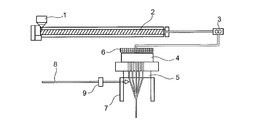
ポリフェニレンエーテル溶融紡糸繊維を製造する場合の一例を、図1を用いて説明する。原料樹脂組成物を図1のホッパー1からシリンダー及びスクリューを備えた押出機2に投入し、溶融した原料樹脂組成物はギアポンプ3により吐出速度を計量し、微細なサンドなどで構成された濾材4を通過して紡糸ノズル5から吐出されて、溶融紡糸繊維を得ることができる。また、濾材4上には、金属不織布などで構成されたフィルター6を設置することが好ましい。フィルター6を設置することで、あらかじ異物を除去することができ、前記濾材4の目詰まり等を防ぐことができるため好ましい。
また、紡糸ノズル5の直下には、保温スペース7を設け、当該領域に、窒素等の不活性ガスを導入8して紡糸することが、酸化的架橋によるノズル詰まりの抑制の観点から好ましく、加熱トーチ9により、加熱した不活性化ガスを導入することがより好ましい。加熱した不活性ガスの温度は、100~500℃であることが好ましく、200~400℃であることがより好ましい。
本発明の製造方法により得られたポリフェニレンエーテル溶融紡糸繊維の単糸繊度は、繊維の使用用途に応じて適宜設定することができる。例えば、前記ポリフェニレンエーテル溶融紡糸繊維の単糸繊度は、一般的な耐熱フィルターや耐熱織物等の用途であれば、1.0dtex以上、100dtex以下であることが好ましく、1.0dtex以上、50dtex以下であることがより好ましく、1.0dtex以上、30dtex以下であることがさらに好ましい。また、本発明の製造方法によれば、30dtex以下の非常に細い繊維を得ることができるものである。これは、本発明においては、ガラス転移点温度が170℃未満のポリフェニレンエーテル成分、及びガラス転移温度が180℃以上のポリフェニレンエーテル成分を含む原料樹脂組成物を用いるため、溶融紡糸が可能な程度に流動性・紡糸性が向上し、溶融紡糸繊維の製造を可能としたものであり、さらには、前記単糸繊度を有する溶融紡糸の製造も可能としたものである。
3.ポリフェニレンエーテル溶融紡糸短繊維
本発明のポリフェニレンエーテル溶融紡糸短繊維は、例えば、前記ポリフェニレンエーテル溶融紡糸繊維を合糸してトウ状にした繊維をカットすることにより得ることができる。
本発明のポリフェニレンエーテル溶融紡糸短繊維は、例えば、前記ポリフェニレンエーテル溶融紡糸繊維を合糸してトウ状にした繊維をカットすることにより得ることができる。
本発明のポリフェニレンエーテル溶融紡糸短繊維の長さは特に制限されず、用途に応じて適宜調整することができるが、通常、1~500mmであり、好ましくは3~400mm、より好ましくは5~300mmである。
本発明のポリフェニレンエーテル溶融紡糸短繊維の引張強度は特に制限されないが、通常、0.8~60cN/dtexであり、好ましくは0.85~50cN/dtex、より好ましくは0.9~40cN/dtexである。なお、引張強度は、JIS L1013 8.5.1に準拠して測定する。
本発明のポリフェニレンエーテル溶融紡糸短繊維の引張伸度は特に制限されないが、通常、30~180%であり、好ましくは40~160%、より好ましくは60~150%である。なお、引張伸度は、JIS L1013 8.5.1に準拠して測定する。
本発明のポリフェニレンエーテル溶融紡糸短繊維の平衡水分率は特に制限されないが、通常、0.01~1.5%であり、好ましくは0.02~1.2%、より好ましくは0.03~1.0%である。なお、平衡水分率は、JIS L1013に準拠して測定する。
本発明のポリフェニレンエーテル溶融紡糸短繊維の190℃における高温収縮率は特に制限されないが、通常、0.1~6%であり、好ましくは0.3~5%、より好ましくは0.5~4%である。なお、190℃における高温収縮率の測定方法は実施例の記載による。
本発明のポリフェニレンエーテル溶融紡糸短繊維は、耐炎化短繊維であることが好ましい。
前記耐炎化短繊維は、前記ポリフェニレンエーテル溶融紡糸短繊維に耐炎化処理を施すことにより得られる。耐炎化処理は、例えば、前記ポリフェニレンエーテル溶融紡糸短繊維を、空気中で、120~240℃で、1~30時間熱処理して不融化し(不融化処理)、その後、空気中で、260~400℃で、0.1~10時間熱処理して耐炎化する(耐炎化処理)ことにより行う。
前記不融化処理では、前記ポリフェニレンエーテル溶融紡糸短繊維を、空気中で、120~240℃で、1~30時間処理をする。ここで、空気中とは、特に調整されていない環境のことである。また、処理温度は、120~240℃であり、140~230℃であることが好ましく、160~220℃であることがより好ましい。また、処理時間は、1~30時間であり、1.5~25時間であることが好ましく、2~20時間であることがより好ましい。前記処理時間及び処理温度とすることで、引き続き行う耐炎化処理において、ポリフェニレンエーテル溶融紡糸短繊維が溶融してしまうことなく、適切な耐炎化処理を施すことができる。
前記不融化処理の後に、耐炎化処理として、空気中で、260~400℃で、0.1~10時間処理をする。空気中とは、特に調整されていない環境のことである。また、処理温度は、260~400℃であり、270~380℃であることが好ましく、280~360℃であることがより好ましい。また、処理時間は、0.1~10時間であり、0.3~8時間であることが好ましく、0.5~6時間であることがより好ましい。前記処理時間及び処理温度とすることで、ポリフェニレンエーテル溶融紡糸短繊維にC=O結合構造が形成され、非常に高い難燃性、耐炎性、耐熱性等を示す耐炎化された短繊維が得られる。
前記耐炎化短繊維の繊度は、特に限定されず、繊維が使用される目的に応じて適宜決定できるが、例えば、100dtex以下であることが好ましく、95dtex以下であることがより好ましく、90dtex以下であることがさらに好ましい。繊度が前記範囲にあることで、織物、編物、短繊維不織布、紙、布帛など、様々な形状に加工することができるようになるため好ましい。また、繊度の下限値は特に限定されるものではないが、0.1dtex以上であることが好ましく、0.2dtex以上であることがより好ましい。
前記耐炎化短繊維の引張強度は、0.8cN/dtex以上であることが好ましく、0.85cN/dtex以上であることがより好ましく、0.90cN/dtex以上であることがさらに好ましい。引張強度が前記範囲にあることで、繊維としての扱い性が良好になるため好ましい。また、引張強度の上限値は特に限定されるものではないが、50cN/dtex以下であることが好ましく、40cN/dtex以下であることがより好ましい。
本発明のポリフェニレンエーテル溶融紡糸短繊維は、例えば、紙、布帛、耐熱バインダー、C/Cコンポジット、CFRPマトリックス樹脂、産業用ブラシ、及びブレーキ材等に用いることができる。
<ポリフェニレンエーテル溶融紡糸繊維から形成された紙>
本発明の紙は、前記ポリフェニレンエーテル溶融紡糸繊維から形成されるものである。前記紙は、一般的な方法で製造することができ、例えば、湿式抄紙法により製造することができる。湿式抄紙法では、例えば、前記ポリフェニレンエーテル溶融紡糸繊維を含む水性スラリーを作製し、ついでこの水性スラリーを通常の抄紙工程に供すればよい。水性スラリーは、バインダー(例えば、ポリビニルアルコール系繊維などの水溶性ポリマー繊維、ポリエチレンテレフタレート繊維(PET繊維)などの熱接着性ポリマー繊維)などを含んでいてもよい。なお、必要に応じて使用する繊維に対して叩解処理を行ってもよい。また、紙の均一性や圧着性を高めるために、抄紙工程後に熱プレス工程を加えてもよい。
本発明の紙は、前記ポリフェニレンエーテル溶融紡糸繊維から形成されるものである。前記紙は、一般的な方法で製造することができ、例えば、湿式抄紙法により製造することができる。湿式抄紙法では、例えば、前記ポリフェニレンエーテル溶融紡糸繊維を含む水性スラリーを作製し、ついでこの水性スラリーを通常の抄紙工程に供すればよい。水性スラリーは、バインダー(例えば、ポリビニルアルコール系繊維などの水溶性ポリマー繊維、ポリエチレンテレフタレート繊維(PET繊維)などの熱接着性ポリマー繊維)などを含んでいてもよい。なお、必要に応じて使用する繊維に対して叩解処理を行ってもよい。また、紙の均一性や圧着性を高めるために、抄紙工程後に熱プレス工程を加えてもよい。
紙の製造に用いる前記ポリフェニレンエーテル溶融紡糸繊維の長さは特に制限されないが、紙としての品質を十分なものにする観点から、好ましくは0.5mm以上、より好ましくは1mm以上であり、また、好ましくは100mm以下、より好ましくは80mm以下である。
本発明の紙は、目的に応じて、他の繊維;紙力向上剤、定着剤、消泡剤、染料、紫外線吸収剤、難燃剤等の各種添加剤;タルク、カオリン、炭酸カルシウム、二酸化チタン等の各種充填材を含んでいてもよい。これらの原料は、水性スラリー中に加えられることが多いが、適宜コーティングなどにより付着させてもよい。
他の繊維としては、例えば、ポリオレフィン系繊維、ポリエステル系繊維、ポリアミド系繊維、セルロース系繊維、及びポリスルフォン系繊維等の汎用繊維;芳香族パラアラミド、ポリアリールケトン系繊維、及びポリスルフォン繊維などの耐熱性繊維などが挙げられる。
本発明の紙に含まれる前記ポリフェニレンエーテル溶融紡糸繊維の割合は、機械的強度、難燃性、耐熱性、高温安定性、耐薬品性等の観点から、例えば、50~100質量%であり、好ましくは55~98質量%、より好ましくは60~95質量%、さらに好ましくは65~90質量%である。
本発明の紙の目付けは特に制限されず、紙の用途に応じて適宜調整することができるが、通常、5~800g/cm2であり、好ましくは7~700g/cm2、より好ましくは10~600g/cm2である。
本発明の紙の引張強度は特に制限されないが、通常、1~300N/cmであり、好ましくは3~250N/cm、より好ましくは5~200N/cmである。なお、引張強度は、JIS L1013 8.5.1に準拠して測定する。
本発明の紙の引張伸度は特に制限されないが、通常、0.1~100%であり、好ましくは0.3~90%、より好ましくは0.5~80%である。なお、引張伸度は、JIS L1013 8.5.1に準拠して測定する。
本発明の紙のLOI値は特に制限されないが、通常、25~80であり、好ましくは27~75、より好ましくは30~70である。なお、LOI値は、JIS L 1091 E法に準拠して測定する。
本発明の紙の誘電率は特に制限されないが、通常、1.0~2.9であり、好ましくは1.1~2.8、より好ましくは1.2~2.7である。
本発明の紙の平衡水分率は特に制限されないが、通常、0.01~1.5%であり、好ましくは0.02~1.2%、より好ましくは0.03~1.0%である。なお、平衡水分率は、JIS L1013に準拠して測定する。
本発明の紙の190℃における高温収縮率は特に制限されないが、通常、0.1~20%であり、好ましくは0.2~15%、より好ましくは0.3~10%である。なお、190℃における高温収縮率の測定方法は実施例の記載による。
本発明の紙は、耐炎化紙であることが好ましい。耐炎化紙は、前記耐炎化処理が施されたポリフェニレンエーテル溶融紡糸繊維を用いて、前記方法により製造することができる。
前記耐炎化紙は、150℃と400℃の重量減少率の差が5.0%以下であることが好ましく、4.0%以下であることがより好ましく、3.5%以下であることがさらに好ましい。重量減少率の差が前記範囲にあることで、ポリマーの劣化が抑制され、耐久性を向上することができるため好ましい。また、重量減少率の差は、望ましくは0%であるが、通常0.1%以上程度の重量減少があり、0.15%以上程度である場合もある。
前記耐炎化紙の比重は、1.2以上であることが好ましく、1.25以上であることがより好ましく、1.3以上であることがさらに好ましい。比重が前記範囲にあることで、紙の耐炎化が十分に進行し、耐炎性が向上するため好ましい。また、比重の上限値は特に限定されるものではないが、2.0以下であることが好ましく、1.8以下であることがより好ましい。
前記耐炎化紙のLOI値は、30以上であることが好ましく、30を超えることがより好ましく、32以上であることがさらに好ましく、35以上であることが特に好ましい。LOI値が前記範囲にあることで、得られた耐炎化紙の難燃性が優れるため好ましい。ここで、LOI値とは、限界酸素指数のことであり、LOI値が大きい程、難燃性に優れるものである。従って、LOI値は大きければ大きい程好ましいものであり、その上限値は特に限定されないものである。
前記耐炎化紙の引張伸度は、5%以上であることが好ましく、7%以上であることがより好ましく、10%以上であることがさらに好ましい。引張伸度が前記範囲にあることで、加工性を向上させることができるため好ましい。また、引張強度の上限値は特に限定されるものではないが、100%以下であることが好ましく、80%以下であることがより好ましい。
前記耐炎化紙の400℃での強力保持率は、40%以上であることが好ましく、50%以上であることがより好ましく、60%以上であることがさらに好ましい。400℃での強力保持率が前記範囲にあることで、高温で使用した際の耐久性が高いため好ましい。また、400℃での強力保持率の上限値は特に限定されるものではないが、100%以下であることが好ましく、99%以下であることがより好ましい。ここで、400℃での強力保持率とは、400℃で10分の熱処理を行った後の強度の保持率をいう。
前記耐炎化紙の400℃での伸度保持率は、40%以上であることが好ましく、50%以上であることがより好ましく、55%以上であることがさらに好ましい。400℃での伸度保持率が前記範囲にあることで、高温で使用した際の耐久性が高いため好ましい。また、400℃での伸度保持率の上限値は特に限定されるものではないが、100%以下であることが好ましく、99%以下であることがより好ましい。ここで、400℃での伸度保持率とは、400℃で10分の熱処理を行った後の伸度の保持率をいう。
本発明の紙は、例えば、断熱材、吸音材、耐熱フィルター、耐熱性絶縁紙、及び電磁波シールド材等に用いることができる。
<ポリフェニレンエーテル溶融紡糸繊維から形成された布帛>
本発明の布帛は、前記ポリフェニレンエーテル溶融紡糸繊維から形成されるものである。前記布帛は、さらに、全芳香族ポリエステル繊維、ポリベンゾオキサゾール(PBO)繊維、ポリベンゾイミダゾール(PBI)繊維、ポリベンゾチアゾール(PBTZ)繊維、ポリイミド(PI)繊維、ポリスルホンアミド(PSA)繊維、ポリエーテルエーテルケトン(PEEK)繊維、ポリエーテルイミド(PEI)繊維、ポリアリレート(PAr)繊維、メラミン繊維、フェノール繊維、フッ素系繊維、ポリフェニレンスルフィド(PPS)繊維、セルロース繊維、ポリオレフィン繊維、アクリル繊維、レーヨン繊維、コットン繊維、獣毛繊維、ポリウレタン繊維、ポリ塩化ビニル繊維、ポリ塩化ビニリデン繊維、アセテート繊維、及びポリカーボネート繊維からなる群より選択される一種以上の繊維を含んでいてもよい。
本発明の布帛は、前記ポリフェニレンエーテル溶融紡糸繊維から形成されるものである。前記布帛は、さらに、全芳香族ポリエステル繊維、ポリベンゾオキサゾール(PBO)繊維、ポリベンゾイミダゾール(PBI)繊維、ポリベンゾチアゾール(PBTZ)繊維、ポリイミド(PI)繊維、ポリスルホンアミド(PSA)繊維、ポリエーテルエーテルケトン(PEEK)繊維、ポリエーテルイミド(PEI)繊維、ポリアリレート(PAr)繊維、メラミン繊維、フェノール繊維、フッ素系繊維、ポリフェニレンスルフィド(PPS)繊維、セルロース繊維、ポリオレフィン繊維、アクリル繊維、レーヨン繊維、コットン繊維、獣毛繊維、ポリウレタン繊維、ポリ塩化ビニル繊維、ポリ塩化ビニリデン繊維、アセテート繊維、及びポリカーボネート繊維からなる群より選択される一種以上の繊維を含んでいてもよい。
本発明の布帛に含まれる前記ポリフェニレンエーテル溶融紡糸繊維の割合は、機械的強度、難燃性、耐熱性、高温安定性、耐薬品性等の観点から、例えば、50~100質量%であり、好ましくは55~98質量%、より好ましくは60~95質量%、さらに好ましくは65~90質量%である。
本発明の布帛は、必要に応じて難燃剤、紫外線吸収剤、反射剤、有機染料、有機顔料、及び無機顔料などの添加剤を含んでいてもよい。
本発明の布帛は、一般的な方法で製造することができ、例えば、上記繊維の紡績糸を混綿して紡績糸を得た後、単糸または双糸にてレピア織機などを用いて、綾織、平織などの組織に製織する方法が挙げられる。
本発明の布帛の目付けは特に制限されず、布帛の用途に応じて適宜調整することができるが、通常、10~3000g/cm2であり、好ましくは20~2500g/cm2、より好ましくは30~2000g/cm2である。
本発明の布帛のLOI値は特に制限されないが、通常、25~80であり、好ましくは27~75、より好ましくは30~70である。なお、LOI値は、JIS L 1091 E法に準拠して測定する。
本発明の布帛の190℃における高温収縮率は特に制限されないが、通常、0.1~20%であり、好ましくは0.2~15%、より好ましくは0.3~10%である。なお、190℃における高温収縮率の測定方法は実施例の記載による。
本発明の布帛は、耐炎化布帛であることが好ましい。耐炎化布帛は、前記耐炎化処理が施されたポリフェニレンエーテル溶融紡糸繊維を用いて、前記方法により製造してもよく、あるいは、前記ポリフェニレンエーテル溶融紡糸繊維を用いて、前記方法により布帛を作製し、その後、作製した布帛に前記耐炎化処理を施して製造してもよい。
前記耐炎化布帛は、150℃と400℃の重量減少率の差が5.0%以下であることが好ましく、4.0%以下であることがより好ましく、3.5%以下であることがさらに好ましい。重量減少率の差が前記範囲にあることで、ポリマーの劣化が抑制され、耐久性を向上することができるため好ましい。また、重量減少率の差は、望ましくは0%であるが、通常0.1%以上程度の重量減少があり、0.15%以上程度である場合もある。
前記耐炎化布帛の比重は、1.2以上であることが好ましく、1.25以上であることがより好ましく、1.3以上であることがさらに好ましい。比重が前記範囲にあることで、布帛の耐炎化が十分に進行し、耐炎性が向上するため好ましい。また、比重の上限値は特に限定されるものではないが、2.0以下であることが好ましく、1.8以下であることがより好ましい。
前記耐炎化布帛のLOI値は、30以上であることが好ましく、30を超えることがより好ましく、32以上であることがさらに好ましく、35以上であることが特に好ましい。LOI値が前記範囲にあることで、得られた耐炎化布帛の難燃性が優れるため好ましい。ここで、LOI値とは、限界酸素指数のことであり、LOI値が大きい程、難燃性に優れるものである。従って、LOI値は大きければ大きい程好ましいものであり、その上限値は特に限定されないものである。
前記耐炎化布帛の引張伸度は、5%以上であることが好ましく、7%以上であることがより好ましく、10%以上であることがさらに好ましい。引張伸度が前記範囲にあることで、加工性を向上させることができるため好ましい。また、引張強度の上限値は特に限定されるものではないが、100%以下であることが好ましく、80%以下であることがより好ましい。
前記耐炎化布帛の400℃での強力保持率は、40%以上であることが好ましく、50%以上であることがより好ましく、60%以上であることがさらに好ましい。400℃での強力保持率が前記範囲にあることで、高温で使用した際の耐久性が高いため好ましい。また、400℃での強力保持率の上限値は特に限定されるものではないが、100%以下であることが好ましく、99%以下であることがより好ましい。ここで、400℃での強力保持率とは、400℃で10分の熱処理を行った後の強度の保持率をいう。
前記耐炎化布帛の400℃での伸度保持率は、40%以上であることが好ましく、50%以上であることがより好ましく、55%以上であることがさらに好ましい。400℃での伸度保持率が前記範囲にあることで、高温で使用した際の耐久性が高いため好ましい。また、400℃での伸度保持率の上限値は特に限定されるものではないが、100%以下であることが好ましく、99%以下であることがより好ましい。ここで、400℃での伸度保持率とは、400℃で10分の熱処理を行った後の伸度の保持率をいう。
本発明の布帛は、例えば、断熱材、作業衣(消防用、レース用、飛行士用)、耐熱手袋、防災頭巾、輸送機器の内装材、耐熱性衣料、及び電磁波シールド材等に用いることができる。
以下、実施例及び比較例を示して本発明をより具体的に説明するが、本発明は以下の実施例によって限定されるものではない。なお、以下の実施例における物性等の評価方法は以下の通りである。
(1)繊度、単糸繊度
JIS L-1095 9.4.1に記載の方法で測定した。単糸繊度は繊度をフィラメント数で割り返して算出した。
JIS L-1095 9.4.1に記載の方法で測定した。単糸繊度は繊度をフィラメント数で割り返して算出した。
(2)最大点応力、最大点伸度
JIS L1013 8.5.1に準拠して測定した。最高荷重時の応力を最大点応力とし、最高荷重時の伸び率を最大点伸度とした。
JIS L1013 8.5.1に準拠して測定した。最高荷重時の応力を最大点応力とし、最高荷重時の伸び率を最大点伸度とした。
(3)ガラス転移点温度
TAインスツルメンツ(株)製の示差走査熱量分析計(型式:DSC-Q100)を用いて、繊維2mgを、窒素雰囲気下において30℃から250℃まで、昇温速度10℃/分にて測定し、ガラス転移温度以下のベースラインの延長線と遷移部における最大傾斜を示す接線との交点の温度をガラス転移温度(Tg)とした。
TAインスツルメンツ(株)製の示差走査熱量分析計(型式:DSC-Q100)を用いて、繊維2mgを、窒素雰囲気下において30℃から250℃まで、昇温速度10℃/分にて測定し、ガラス転移温度以下のベースラインの延長線と遷移部における最大傾斜を示す接線との交点の温度をガラス転移温度(Tg)とした。
<ポリフェニレンエーテル溶融紡糸繊維>
実施例1
ポリ(2,6-ジメチル-1,4-フェニレンエーテル)(PPO640、ガラス転移点温度(Tg):221℃、SABIC Innovative Plastic製)90質量部、ポリ(2,6-ジメチル-1,4-フェニレンエーテル)(PPOSA120、ガラス転移点温度(Tg):159℃、SABIC Innovative Plastic製)10質量部を配合したものを、(株)テクノベル製2軸押出機(製品名:KZW15TW-30MG)を用いて押出した。前記2軸押出機は、シリンダーが4ゾーンを有しており、ホッパー側からシリンダーをそれぞれ、シリンダー1、2、3、4とし、シリンダー1~4およびシリンダーヘッド部は280℃に設定し、スクリュー回転数は200rpmに設定した。
実施例1
ポリ(2,6-ジメチル-1,4-フェニレンエーテル)(PPO640、ガラス転移点温度(Tg):221℃、SABIC Innovative Plastic製)90質量部、ポリ(2,6-ジメチル-1,4-フェニレンエーテル)(PPOSA120、ガラス転移点温度(Tg):159℃、SABIC Innovative Plastic製)10質量部を配合したものを、(株)テクノベル製2軸押出機(製品名:KZW15TW-30MG)を用いて押出した。前記2軸押出機は、シリンダーが4ゾーンを有しており、ホッパー側からシリンダーをそれぞれ、シリンダー1、2、3、4とし、シリンダー1~4およびシリンダーヘッド部は280℃に設定し、スクリュー回転数は200rpmに設定した。
押出機の下流には、ギアポンプを設置してポリマーの吐出速度を計量し、金属不織布フィルター(製品名:NF-07、日本精線(株)製)を介してノズル(ノズル孔直径:0.5mm、ノズル孔ランド長:1mm、ノズル孔数:24個)へ押し出した(総吐出量:5.8g/分、単孔吐出量:0.242g/分)。ノズル直下には面ヒータを配置し、ノズル温度が300℃となるように設定した。ノズル直下には60mmの保温スペースを設け、この領域に300℃に加熱した窒素を連続的に導入した。ノズルから吐出されたポリマーを紡糸速度100m/分にて巻き取った。得られた溶融紡糸繊維の繊度は、577.1dtex、単糸繊度は24.0dtex、最大点応力は0.93cN/dtex、最大点伸度は93.9%、ガラス転移点温度は203℃であった。得られた繊維の繊維物性を表1に示す。
実施例2~7
原料樹脂組成物の組成、スクリュー回転数、ノズルの形態、紡糸条件を表1に記載のように変更した以外は実施例1と同様にして溶融紡糸繊維を得た。得られた繊維の繊維物性を表1に示す。
原料樹脂組成物の組成、スクリュー回転数、ノズルの形態、紡糸条件を表1に記載のように変更した以外は実施例1と同様にして溶融紡糸繊維を得た。得られた繊維の繊維物性を表1に示す。
比較例1
比較例1では、ポリ(2,6-ジメチル-1,4-フェニレンエーテル)(PPO640、ガラス転移点温度(Tg):221℃、SABIC Innovative Plastic製)のみを用いた以外は、実施例7と同様の方法で溶融紡糸繊維を製造しようとしたが、粘度が高すぎてギアポンプからポリマーを押出すことができず、ギアポンプの破壊を招いた。
比較例1では、ポリ(2,6-ジメチル-1,4-フェニレンエーテル)(PPO640、ガラス転移点温度(Tg):221℃、SABIC Innovative Plastic製)のみを用いた以外は、実施例7と同様の方法で溶融紡糸繊維を製造しようとしたが、粘度が高すぎてギアポンプからポリマーを押出すことができず、ギアポンプの破壊を招いた。
比較例2
ポリ(2,6-ジメチル-1,4-フェニレンエーテル)(PPO640、SABIC Innovative Plastic製)を80質量部、ポリスチレン(679、PSジャパン(株)製)20質量部を配合したものを使用し、ノズル形態、紡糸条件を表1に記載のように変更した以外は実施例1と同様にして溶融紡糸を行ったが、可紡性が非常に悪く、単孔吐出量を0.242g/分まで上げることで、ようやく紡糸速度30m/分にて単糸繊度78.4dtexの繊維を得ることができた。得られた繊維の繊維物性を表1に示す。
ポリ(2,6-ジメチル-1,4-フェニレンエーテル)(PPO640、SABIC Innovative Plastic製)を80質量部、ポリスチレン(679、PSジャパン(株)製)20質量部を配合したものを使用し、ノズル形態、紡糸条件を表1に記載のように変更した以外は実施例1と同様にして溶融紡糸を行ったが、可紡性が非常に悪く、単孔吐出量を0.242g/分まで上げることで、ようやく紡糸速度30m/分にて単糸繊度78.4dtexの繊維を得ることができた。得られた繊維の繊維物性を表1に示す。
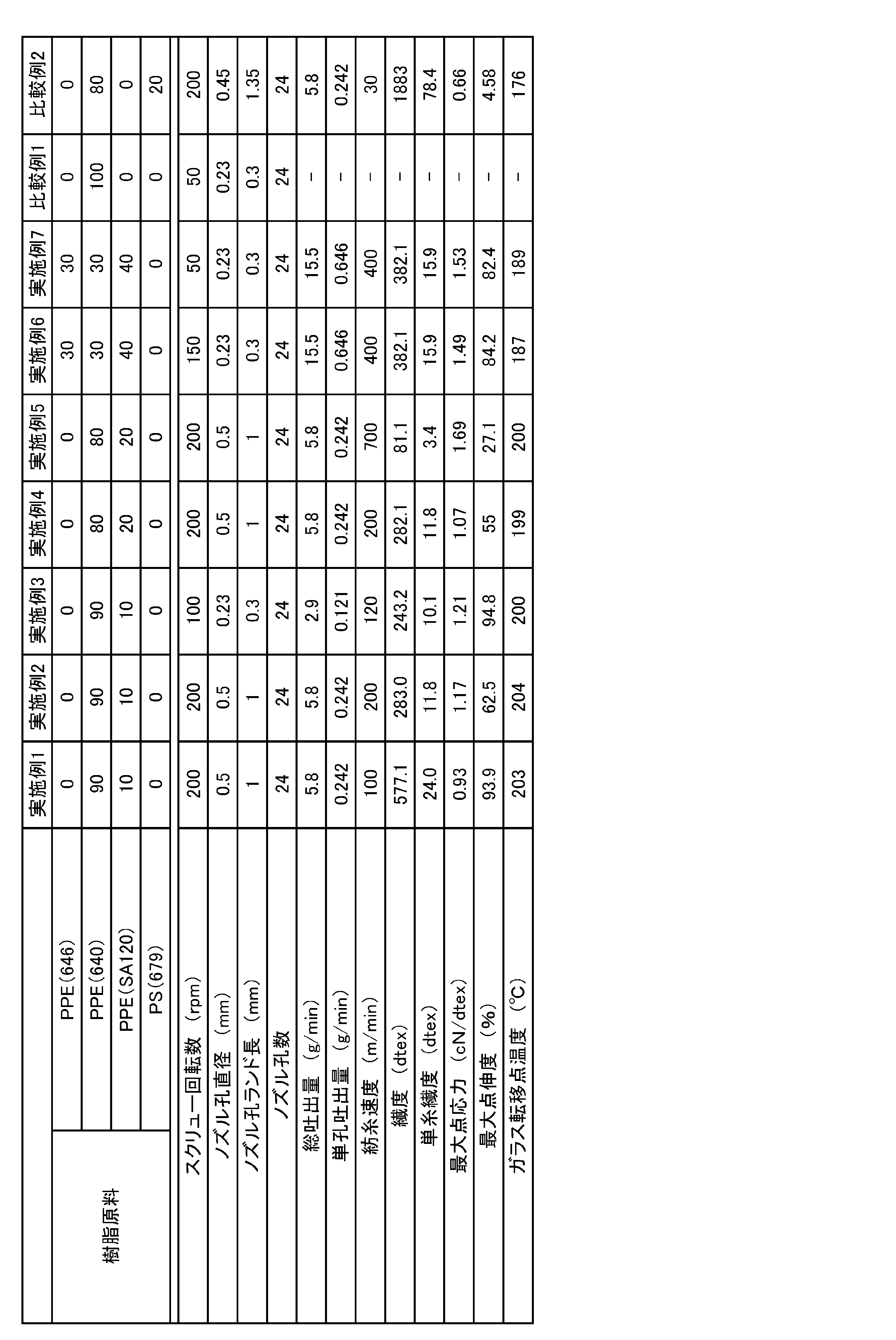
なお、表1中の「PPE(646)」は、ポリ(2,6-ジメチル-1,4-フェニレンエーテル)(PPO646、ガラス転移点温度(Tg):221℃、SABIC Innovative Plastic製)を、「PPE(640)」は、ポリ(2,6-ジメチル-1,4-フェニレンエーテル)(PPO640、ガラス転移点温度(Tg):220℃、SABIC Innovative Plastic製)を、「PPE(SA120)」は、ポリ(2,6-ジメチル-1,4-フェニレンエーテル)(PPOSA120、ガラス転移点温度(Tg):159℃、SABIC Innovative Plastic製)を、「PS(679)」は、ポリスチレン(679、PSジャパン(株)製)を表す。
表1に示すように、本発明の実施例では、ポリフェニレンエーテルを高含有量で含むにも関わらず、原料として、低Tgポリフェニレンエーテルを使用しているため、溶融紡糸繊維が得られた。実施例で得られた溶融紡糸繊維は、最大点応力、最大点伸度に優れていた。また、実施例2~5では、単糸繊度が15dtex以下の細い繊維が得られており、さらに実施例5においては、紡糸速度を700m/minとすることで、単糸繊度が3.4dtexの非常に細い繊維を得られている。
それに対して、比較例1では、溶融紡糸繊維を得ることができなかった。これは、比較例1では、低Tgポリフェニレンエーテルを含まないため、溶融粘度が高すぎてギアポンプからポリマーを押出すことができなかったためだと考えられる。比較例2では、ポリ(2,6-ジメチル-1,4-フェニレンエーテル)にポリスチレンを配合しているにも関わらず、可紡性が非常に悪く、非常に太い繊維しか得ることができなかった。また、得られた繊維は、強度、伸度、ガラス転移点温度とも低いものであった。
<ポリフェニレンエーテル溶融紡糸短繊維>
実施例8
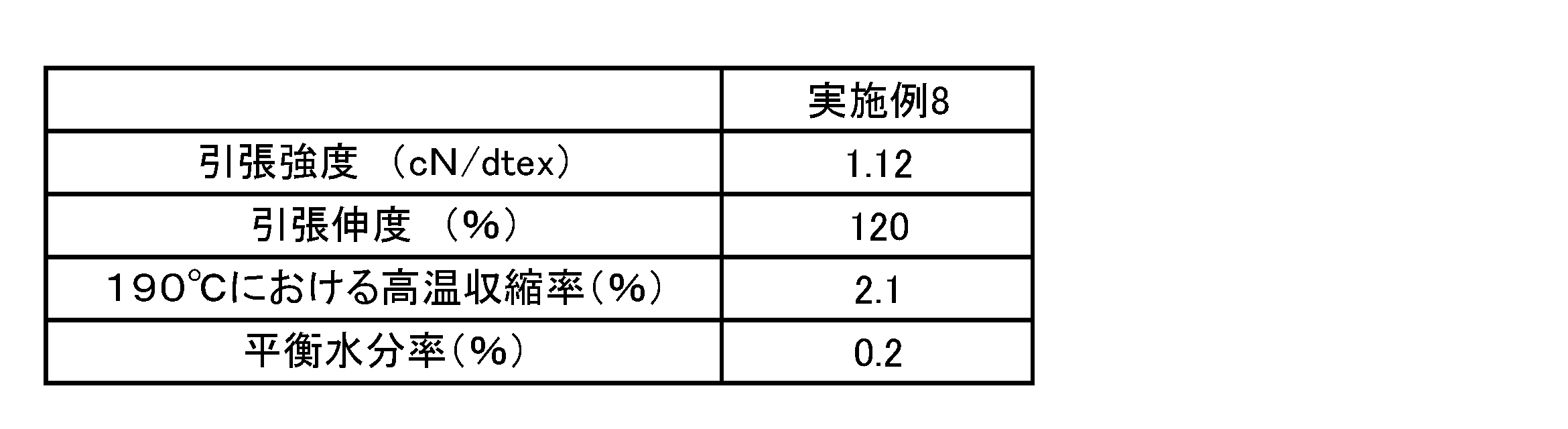
実施例1で得られた溶融紡糸繊維を合糸してトウ状にした繊維を、ギロチンカッターで50mmの繊維長にカットして短繊維を得た。
実施例8
実施例1で得られた溶融紡糸繊維を合糸してトウ状にした繊維を、ギロチンカッターで50mmの繊維長にカットして短繊維を得た。
(1)引張強度、引張伸度
JIS L1013 8.5.1に準拠して測定した。最高荷重時の応力を引張強度とし、最高荷重時の伸び率を引張伸度とした。
JIS L1013 8.5.1に準拠して測定した。最高荷重時の応力を引張強度とし、最高荷重時の伸び率を引張伸度とした。
(2)高温収縮率
5cmに切り出した短繊維を、末端を固定しない状態で190℃に保たれた空気恒温槽中で10分間保持した後の繊維長(Xcm)から、次式を用いて算出した。ただし、5cmの短繊維が取れない場合は、適宜長さを変えて測定しても良い。
高温収縮率(%)=<X/5>×100
(5cmの短繊維が取れない場合は<X/処理前の長さ>×100)
5cmに切り出した短繊維を、末端を固定しない状態で190℃に保たれた空気恒温槽中で10分間保持した後の繊維長(Xcm)から、次式を用いて算出した。ただし、5cmの短繊維が取れない場合は、適宜長さを変えて測定しても良い。
高温収縮率(%)=<X/5>×100
(5cmの短繊維が取れない場合は<X/処理前の長さ>×100)
(3)平衡水分率
JIS L1013に準拠し、サンプルを120℃の雰囲気中で絶乾した後、温度20℃かつ相対湿度65%RHにおいて72時間調整し、絶乾状態でのサンプルの質量に対するサンプル中に含まれる水分率を算出し、これを百分率(%)にて表した。
JIS L1013に準拠し、サンプルを120℃の雰囲気中で絶乾した後、温度20℃かつ相対湿度65%RHにおいて72時間調整し、絶乾状態でのサンプルの質量に対するサンプル中に含まれる水分率を算出し、これを百分率(%)にて表した。
<耐炎化短繊維>
実施例9
実施例1で得られた溶融紡糸繊維を合糸してトウ状にした繊維を、ギロチンカッターで50mmの繊維長にカットして短繊維を得た。得られた短繊維を空気雰囲気下で200℃×120min、210℃×20min、220℃×20min、250℃×120min、280℃×120min、320℃×120minの順に熱処理して耐炎化短繊維を作製した。
実施例9
実施例1で得られた溶融紡糸繊維を合糸してトウ状にした繊維を、ギロチンカッターで50mmの繊維長にカットして短繊維を得た。得られた短繊維を空気雰囲気下で200℃×120min、210℃×20min、220℃×20min、250℃×120min、280℃×120min、320℃×120minの順に熱処理して耐炎化短繊維を作製した。
(1)引張強度、引張伸度
JIS L1013 8.5.1に準拠して測定した。最高荷重時の応力を引張強度とし、最高荷重時の伸び率を引張伸度とした。
JIS L1013 8.5.1に準拠して測定した。最高荷重時の応力を引張強度とし、最高荷重時の伸び率を引張伸度とした。
(2)高温収縮率
5cmに切り出した耐炎化短繊維を、末端を固定しない状態で190℃に保たれた空気恒温槽中で10分間保持した後の繊維長(Xcm)から、次式を用いて算出した。ただし、5cmの耐炎化短繊維が取れない場合は、適宜長さを変えて測定しても良い。
高温収縮率(%)=<X/5>×100
(5cmの耐炎化短繊維が取れない場合は<X/処理前の長さ>×100)
5cmに切り出した耐炎化短繊維を、末端を固定しない状態で190℃に保たれた空気恒温槽中で10分間保持した後の繊維長(Xcm)から、次式を用いて算出した。ただし、5cmの耐炎化短繊維が取れない場合は、適宜長さを変えて測定しても良い。
高温収縮率(%)=<X/5>×100
(5cmの耐炎化短繊維が取れない場合は<X/処理前の長さ>×100)
(3)平衡水分率
JIS L1013に準拠し、サンプルを120℃の雰囲気中で絶乾した後、温度20℃かつ相対湿度65%RHにおいて72時間調整し、絶乾状態でのサンプルの質量に対するサンプル中に含まれる水分率を算出し、これを百分率(%)にて表した。
JIS L1013に準拠し、サンプルを120℃の雰囲気中で絶乾した後、温度20℃かつ相対湿度65%RHにおいて72時間調整し、絶乾状態でのサンプルの質量に対するサンプル中に含まれる水分率を算出し、これを百分率(%)にて表した。
(4)発生ガス
STM E662に準拠して測定した。
STM E662に準拠して測定した。
(5)発煙量
BSS 7239に準拠して測定した。
BSS 7239に準拠して測定した。

<ポリフェニレンエーテル溶融紡糸繊維から形成された紙>
実施例10
実施例1で得られた溶融紡糸繊維を合糸してトウ状にした繊維を、ギロチンカッターで5mmの繊維長にカットして短繊維を得た。得られた短繊維を用いて湿式抄紙した。抄紙時に、明成化学工業株式会社製の界面活性剤「メイカサーフMK-37」を使用した。得られた抄紙をアルミ箔上に取り、スプレーを用いて、約5Lのイオン交換水にて洗浄した。そしてアルミ箔に挟み、温度210℃、線圧30kg/cm(25cm幅として計算)、1.0m/minのローラー速度にてカレンダープレスを実施して紙(目付:320g/cm2)を作製した。
実施例10
実施例1で得られた溶融紡糸繊維を合糸してトウ状にした繊維を、ギロチンカッターで5mmの繊維長にカットして短繊維を得た。得られた短繊維を用いて湿式抄紙した。抄紙時に、明成化学工業株式会社製の界面活性剤「メイカサーフMK-37」を使用した。得られた抄紙をアルミ箔上に取り、スプレーを用いて、約5Lのイオン交換水にて洗浄した。そしてアルミ箔に挟み、温度210℃、線圧30kg/cm(25cm幅として計算)、1.0m/minのローラー速度にてカレンダープレスを実施して紙(目付:320g/cm2)を作製した。
(1)引張強度、引張伸度
JIS L1013 8.5.1に準拠して測定した。幅25mm、長さ100mmのサンプルを用い、チャック間距離が50mm、引張速度は100mm/minで測定した。引張伸度は強度が最大となるときの伸度とした。
JIS L1013 8.5.1に準拠して測定した。幅25mm、長さ100mmのサンプルを用い、チャック間距離が50mm、引張速度は100mm/minで測定した。引張伸度は強度が最大となるときの伸度とした。
(2)LOI値
JIS L 1091 E法に準拠して測定した。酸素指数の決定は50mm以上燃焼し続けた時で、点火器の熱源はプロパンガスを用いた。
JIS L 1091 E法に準拠して測定した。酸素指数の決定は50mm以上燃焼し続けた時で、点火器の熱源はプロパンガスを用いた。
(3)誘電率
厚さ50μmのサンプルについて、(株)エーイーティー製誘電率測定装置を用い、JIS C2565に準拠して空洞共振器法(TMモード)にて測定した。周波数は10GHzにて測定した。サンプルサイズは幅3mm、長さ80mmである。
厚さ50μmのサンプルについて、(株)エーイーティー製誘電率測定装置を用い、JIS C2565に準拠して空洞共振器法(TMモード)にて測定した。周波数は10GHzにて測定した。サンプルサイズは幅3mm、長さ80mmである。
(4)平衡水分率
JIS L1013に準拠し、サンプルを120℃の雰囲気中で絶乾した後、温度20℃かつ相対湿度65%RHにおいて72時間調整し、絶乾状態でのサンプルの質量に対するサンプル中に含まれる水分率を算出し、これを百分率(%)にて表した。
JIS L1013に準拠し、サンプルを120℃の雰囲気中で絶乾した後、温度20℃かつ相対湿度65%RHにおいて72時間調整し、絶乾状態でのサンプルの質量に対するサンプル中に含まれる水分率を算出し、これを百分率(%)にて表した。
(5)高温収縮率
10cm角に切り出した紙を、末端を固定しない状態で190℃に保たれた空気恒温槽中で10分間保持した後の紙長(Xcm)から、次式を用いて算出した。
高温収縮率(%)=<X/10>×100
10cm角に切り出した紙を、末端を固定しない状態で190℃に保たれた空気恒温槽中で10分間保持した後の紙長(Xcm)から、次式を用いて算出した。
高温収縮率(%)=<X/10>×100
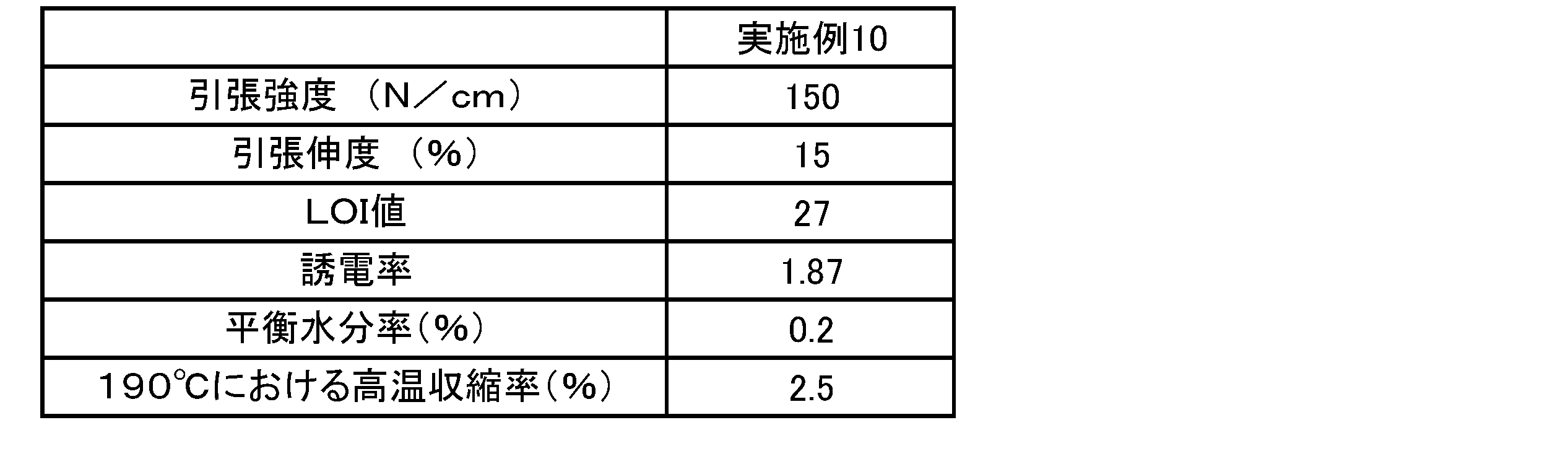
<耐炎化紙>
実施例11
実施例10で作製した紙を空気雰囲気下で200℃×120min、210℃×20min、220℃×20min、250℃×120min、280℃×120min、320℃×120minの順に熱処理して耐炎化紙を作製した。
実施例11
実施例10で作製した紙を空気雰囲気下で200℃×120min、210℃×20min、220℃×20min、250℃×120min、280℃×120min、320℃×120minの順に熱処理して耐炎化紙を作製した。
(1)引張強度、引張伸度
JIS L1013 8.5.1に準拠して測定した。幅25mm、長さ100mmのサンプルを用い、チャック間距離が50mm、引張速度は100mm/minで測定した。引張伸度は強度が最大となるときの伸度とした。
JIS L1013 8.5.1に準拠して測定した。幅25mm、長さ100mmのサンプルを用い、チャック間距離が50mm、引張速度は100mm/minで測定した。引張伸度は強度が最大となるときの伸度とした。
(2)発生ガス
STM E662に準拠して測定した。
STM E662に準拠して測定した。
(3)発煙量
BSS 7239に準拠して測定した。
BSS 7239に準拠して測定した。
(4)LOI値
JIS L 1091 E法に準拠して測定した。酸素指数の決定は50mm以上燃焼し続けた時で、点火器の熱源はプロパンガスを用いた。
JIS L 1091 E法に準拠して測定した。酸素指数の決定は50mm以上燃焼し続けた時で、点火器の熱源はプロパンガスを用いた。
(5)誘電率
厚さ50μmのサンプルについて、(株)エーイーティー製誘電率測定装置を用い、JIS C2565に準拠して空洞共振器法(TMモード)にて測定した。周波数は10GHzにて測定した。サンプルサイズは幅3mm、長さ80mmである。
厚さ50μmのサンプルについて、(株)エーイーティー製誘電率測定装置を用い、JIS C2565に準拠して空洞共振器法(TMモード)にて測定した。周波数は10GHzにて測定した。サンプルサイズは幅3mm、長さ80mmである。
(6)平衡水分率
JIS L1013に準拠し、サンプルを120℃の雰囲気中で絶乾した後、温度20℃かつ相対湿度65%RHにおいて72時間調整し、絶乾状態でのサンプルの質量に対するサンプル中に含まれる水分率を算出し、これを百分率(%)にて表した。
JIS L1013に準拠し、サンプルを120℃の雰囲気中で絶乾した後、温度20℃かつ相対湿度65%RHにおいて72時間調整し、絶乾状態でのサンプルの質量に対するサンプル中に含まれる水分率を算出し、これを百分率(%)にて表した。
(7)高温収縮率
10cm角に切り出した耐炎化紙を、末端を固定しない状態で190℃に保たれた空気恒温槽中で10分間保持した後の紙長(Xcm)から、次式を用いて算出した。
高温収縮率(%)=<X/10>×100
10cm角に切り出した耐炎化紙を、末端を固定しない状態で190℃に保たれた空気恒温槽中で10分間保持した後の紙長(Xcm)から、次式を用いて算出した。
高温収縮率(%)=<X/10>×100

<ポリフェニレンエーテル溶融紡糸繊維から形成された布帛>
実施例12
実施例1で得られた溶融紡糸繊維を用いて製織して、目付け150g/m2の平織物を得た。
実施例12
実施例1で得られた溶融紡糸繊維を用いて製織して、目付け150g/m2の平織物を得た。
(1)LOI値
JIS L 1091 E法に準拠して測定した。酸素指数の決定は50mm以上燃焼し続けた時で、点火器の熱源はプロパンガスを用いた。
JIS L 1091 E法に準拠して測定した。酸素指数の決定は50mm以上燃焼し続けた時で、点火器の熱源はプロパンガスを用いた。
(2)高温収縮率
10cm角に切り出した布帛を、末端を固定しない状態で190℃に保たれた空気恒温槽中で10分間保持した後の布帛長(Xcm)から、次式を用いて算出した。
高温収縮率(%)=<X/10>×100
10cm角に切り出した布帛を、末端を固定しない状態で190℃に保たれた空気恒温槽中で10分間保持した後の布帛長(Xcm)から、次式を用いて算出した。
高温収縮率(%)=<X/10>×100

<耐炎化布帛>
実施例13
実施例12で作製した平織物を空気雰囲気下で200℃×120min、210℃×20min、220℃×20min、250℃×120min、280℃×120min、320℃×120minの順に熱処理して耐炎化布帛を作製した。
実施例13
実施例12で作製した平織物を空気雰囲気下で200℃×120min、210℃×20min、220℃×20min、250℃×120min、280℃×120min、320℃×120minの順に熱処理して耐炎化布帛を作製した。
(1)発生ガス
STM E662に準拠して測定した。
STM E662に準拠して測定した。
(2)発煙量
BSS 7239に準拠して測定した。
BSS 7239に準拠して測定した。
(3)LOI値
JIS L 1091 E法に準拠して測定した。酸素指数の決定は50mm以上燃焼し続けた時で、点火器の熱源はプロパンガスを用いた。
JIS L 1091 E法に準拠して測定した。酸素指数の決定は50mm以上燃焼し続けた時で、点火器の熱源はプロパンガスを用いた。
(4)高温収縮率
10cm角に切り出した耐炎化布帛を、末端を固定しない状態で190℃に保たれた空気恒温槽中で10分間保持した後の布帛長(Xcm)から、次式を用いて算出した。
高温収縮率(%)=<X/10>×100
10cm角に切り出した耐炎化布帛を、末端を固定しない状態で190℃に保たれた空気恒温槽中で10分間保持した後の布帛長(Xcm)から、次式を用いて算出した。
高温収縮率(%)=<X/10>×100
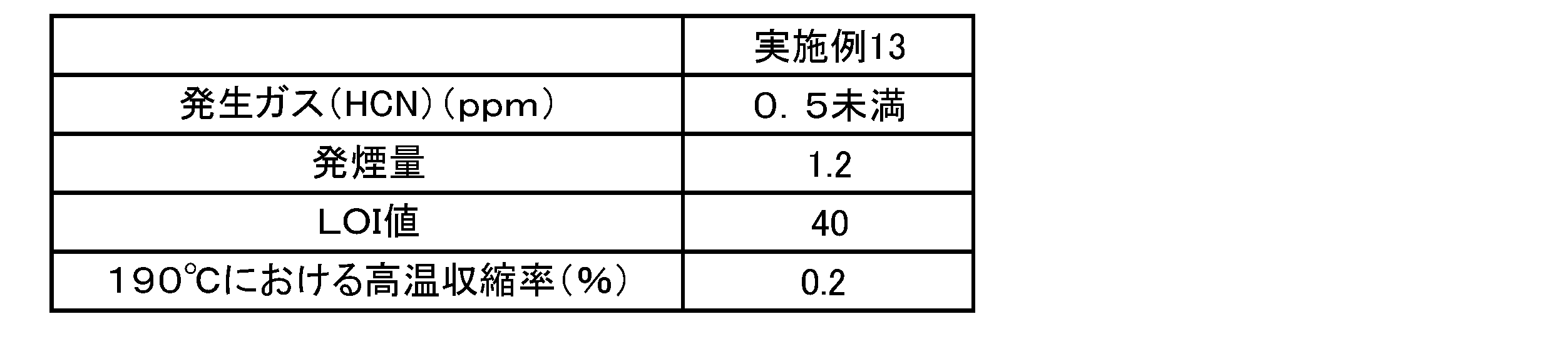
1 ホッパー
2 押出機
3 ギアポンプ
4 フィルター
5 紡糸ノズル
6 濾材
7 保温スペース
8 不活性ガスの導入
9 加熱トーチ
2 押出機
3 ギアポンプ
4 フィルター
5 紡糸ノズル
6 濾材
7 保温スペース
8 不活性ガスの導入
9 加熱トーチ
Claims (14)
- ポリフェニレンエーテル成分の含有量が繊維を形成する全成分中95質量%以上であり、ガラス転移点温度が180℃以上、205℃以下であることを特徴とするポリフェニレンエーテル溶融紡糸繊維。
- 単糸繊度が1.0dtex以上、100dtex以下であることを特徴とする請求項1に記載のポリフェニレンエーテル溶融紡糸繊維。
- 最大点伸度が25%以上、120%以下であることを特徴とする請求項1又は2に記載のポリフェニレンエーテル溶融紡糸繊維。
- 前記ポリフェニレンエーテル溶融紡糸繊維が、短繊維であることを特徴とする請求項1~3のいずれかに記載のポリフェニレンエーテル溶融紡糸繊維。
- 前記短繊維が、耐炎化短繊維であることを特徴とする請求項4に記載のポリフェニレンエーテル溶融紡糸繊維。
- 請求項1~5のいずれかに記載のポリフェニレンエーテル溶融紡糸繊維から形成された紙。
- 前記紙が、耐炎化紙であることを特徴とする請求項6に記載の紙。
- 請求項1~5のいずれかに記載のポリフェニレンエーテル溶融紡糸繊維から形成された布帛。
- 前記布帛が、耐炎化布帛であることを特徴とする請求項8に記載の布帛。
- ポリフェニレンエーテル溶融紡糸繊維の製造方法であって、
ガラス転移点温度が170℃未満のポリフェニレンエーテル成分、及びガラス転移温度が180℃以上のポリフェニレンエーテル成分を含む原料樹脂組成物を溶融押出する工程、
前記溶融した原料樹脂組成物を紡糸ノズルから吐出させて紡糸する工程を有し、
得られたポリフェニレンエーテル溶融紡糸繊維におけるポリフェニレンエーテル成分の含有量が、繊維を形成する全成分中95質量%以上であることを特徴とするポリフェニレンエーテル溶融紡糸繊維の製造方法。 - 前記ガラス転移点温度が170℃未満のポリフェニレンエーテル成分の含有量が、原料樹脂組成物に含まれるポリフェニレンエーテル成分中に5質量%以上であることを特徴とする請求項10に記載のポリフェニレンエーテル溶融紡糸繊維の製造方法。
- 紡糸速度が、100~1000m/分であることを特徴とする請求項10又は11に記載のポリフェニレンエーテル溶融紡糸繊維の製造方法。
- 前記紡糸ノズルの温度が、280~320℃であることを特徴とする請求項10~12のいずれかに記載のポリフェニレンエーテル溶融紡糸繊維の製造方法。
- 前記紡糸ノズルの直下の領域に、不活性ガスを導入して紡糸することを特徴とする請求項10~13のいずれかに記載のポリフェニレンエーテル溶融紡糸繊維の製造方法。
Priority Applications (1)
| Application Number | Priority Date | Filing Date | Title |
|---|---|---|---|
| JP2021562464A JP7554392B2 (ja) | 2019-12-03 | 2020-09-18 | ポリフェニレンエーテル溶融紡糸繊維及びその製造方法、並びに、紙及び布帛 |
Applications Claiming Priority (2)
| Application Number | Priority Date | Filing Date | Title |
|---|---|---|---|
| JP2019-218877 | 2019-12-03 | ||
| JP2019218877 | 2019-12-03 |
Publications (1)
| Publication Number | Publication Date |
|---|---|
| WO2021111706A1 true WO2021111706A1 (ja) | 2021-06-10 |
Family
ID=76221000
Family Applications (1)
| Application Number | Title | Priority Date | Filing Date |
|---|---|---|---|
| PCT/JP2020/035601 Ceased WO2021111706A1 (ja) | 2019-12-03 | 2020-09-18 | ポリフェニレンエーテル溶融紡糸繊維及びその製造方法、並びに、紙及び布帛 |
Country Status (2)
| Country | Link |
|---|---|
| JP (1) | JP7554392B2 (ja) |
| WO (1) | WO2021111706A1 (ja) |
Cited By (5)
| Publication number | Priority date | Publication date | Assignee | Title |
|---|---|---|---|---|
| JPWO2022201311A1 (ja) * | 2021-03-23 | 2022-09-29 | ||
| WO2023054495A1 (ja) * | 2021-09-29 | 2023-04-06 | 東洋紡株式会社 | 耐炎化ポリフェニレンエーテル成形体、耐炎化ポリフェニレンエーテル繊維成形体、炭素成形体、活性炭素成形体、及びこれらの製造方法 |
| WO2023100943A1 (ja) * | 2021-12-01 | 2023-06-08 | 旭化成株式会社 | 樹脂繊維シート、プリプレグ、及びプリプレグの製造方法 |
| US20230173456A1 (en) * | 2020-03-31 | 2023-06-08 | Toyobo Co., Ltd. | Infusibilized polyphenylene ether fiber, infusibilized polyphenylene ether formed body, carbon fiber, activated carbon fiber, carbon fiber formed body, activated carbon fiber formed body, and method for manufacturing same |
| EP4036157A4 (en) * | 2019-09-24 | 2024-05-22 | TOYOBO MC Corporation | EXTRUDED BODY MADE OF POLYPHENYLENE ETHER AND METHOD FOR PRODUCING AN EXTRUDED BODY MADE OF POLYPHENYLENE ETHER |
Citations (2)
| Publication number | Priority date | Publication date | Assignee | Title |
|---|---|---|---|---|
| JP2008069478A (ja) * | 2006-09-14 | 2008-03-27 | Asahi Kasei Fibers Corp | ポリフェニレンエーテル極細繊維およびその繊維集合体 |
| WO2013184161A1 (en) * | 2012-06-04 | 2013-12-12 | Sabic Innovative Plastics Ip B.V. | Poly(phenylene ether) fiber and method of making |
-
2020
- 2020-09-18 JP JP2021562464A patent/JP7554392B2/ja active Active
- 2020-09-18 WO PCT/JP2020/035601 patent/WO2021111706A1/ja not_active Ceased
Patent Citations (2)
| Publication number | Priority date | Publication date | Assignee | Title |
|---|---|---|---|---|
| JP2008069478A (ja) * | 2006-09-14 | 2008-03-27 | Asahi Kasei Fibers Corp | ポリフェニレンエーテル極細繊維およびその繊維集合体 |
| WO2013184161A1 (en) * | 2012-06-04 | 2013-12-12 | Sabic Innovative Plastics Ip B.V. | Poly(phenylene ether) fiber and method of making |
Cited By (14)
| Publication number | Priority date | Publication date | Assignee | Title |
|---|---|---|---|---|
| US12590182B2 (en) | 2019-09-24 | 2026-03-31 | Toyobo Mc Corporation | Polyphenylene ether melt extrusion formed body and method for producing polyphenylene ether melt extrusion formed body |
| EP4036157A4 (en) * | 2019-09-24 | 2024-05-22 | TOYOBO MC Corporation | EXTRUDED BODY MADE OF POLYPHENYLENE ETHER AND METHOD FOR PRODUCING AN EXTRUDED BODY MADE OF POLYPHENYLENE ETHER |
| US20230173456A1 (en) * | 2020-03-31 | 2023-06-08 | Toyobo Co., Ltd. | Infusibilized polyphenylene ether fiber, infusibilized polyphenylene ether formed body, carbon fiber, activated carbon fiber, carbon fiber formed body, activated carbon fiber formed body, and method for manufacturing same |
| JP7437628B2 (ja) | 2021-03-23 | 2024-02-26 | 東洋紡エムシー株式会社 | 耐炎化ポリフェニレンエーテル成形体、及び、耐炎化ポリフェニレンエーテル成形体の製造方法 |
| JPWO2022201311A1 (ja) * | 2021-03-23 | 2022-09-29 | ||
| CN117916414A (zh) * | 2021-09-29 | 2024-04-19 | 东洋纺Mc株式会社 | 耐火化聚苯醚成形体、耐火化聚苯醚纤维成形体、碳成形体、活性碳成形体及它们的制造方法 |
| JP7405306B2 (ja) | 2021-09-29 | 2023-12-26 | 東洋紡エムシー株式会社 | 耐炎化ポリフェニレンエーテル成形体、耐炎化ポリフェニレンエーテル繊維成形体、炭素成形体、活性炭素成形体、及びこれらの製造方法 |
| JPWO2023054495A1 (ja) * | 2021-09-29 | 2023-04-06 | ||
| CN117916414B (zh) * | 2021-09-29 | 2025-05-09 | 东洋纺Mc株式会社 | 耐火化聚苯醚成形体、耐火化聚苯醚纤维成形体、碳成形体、活性碳成形体及它们的制造方法 |
| WO2023054495A1 (ja) * | 2021-09-29 | 2023-04-06 | 東洋紡株式会社 | 耐炎化ポリフェニレンエーテル成形体、耐炎化ポリフェニレンエーテル繊維成形体、炭素成形体、活性炭素成形体、及びこれらの製造方法 |
| TWI828450B (zh) * | 2021-12-01 | 2024-01-01 | 日商旭化成股份有限公司 | 樹脂纖維片、預浸體、預浸體之製造方法、積層體、印刷配線板及半導體裝置 |
| JPWO2023100943A1 (ja) * | 2021-12-01 | 2023-06-08 | ||
| WO2023100943A1 (ja) * | 2021-12-01 | 2023-06-08 | 旭化成株式会社 | 樹脂繊維シート、プリプレグ、及びプリプレグの製造方法 |
| JP7738085B2 (ja) | 2021-12-01 | 2025-09-11 | 旭化成株式会社 | 樹脂繊維シート、プリプレグ、及びプリプレグの製造方法 |
Also Published As
| Publication number | Publication date |
|---|---|
| JPWO2021111706A1 (ja) | 2021-06-10 |
| JP7554392B2 (ja) | 2024-09-20 |
Similar Documents
| Publication | Publication Date | Title |
|---|---|---|
| JP7554392B2 (ja) | ポリフェニレンエーテル溶融紡糸繊維及びその製造方法、並びに、紙及び布帛 | |
| JP7355110B2 (ja) | ポリフェニレンエーテル溶融押出成形体、及び、ポリフェニレンエーテル溶融押出成形体の製造方法 | |
| JP7437624B2 (ja) | 耐炎化ポリフェニレンエーテル成形体、及び、耐炎化ポリフェニレンエーテル成形体の製造方法 | |
| EP2412850B1 (en) | Amorphous polyetherimide fiber and heat-resistant fabric | |
| RU2692845C1 (ru) | Пламегасящее нетканое полотно | |
| US20080302495A1 (en) | Articles comprising fibres and/or fibrids, fibres and fibrids and process for obtaining them | |
| KR102524943B1 (ko) | 불융화 폴리페닐렌에테르 섬유, 불융화 폴리페닐렌에테르 성형체, 탄소 섬유, 활성 탄소 섬유, 탄소 섬유 성형체, 활성 탄소 섬유 성형체, 및 그의 제조 방법 | |
| TW201546341A (zh) | 聚酯黏合纖維 | |
| CN102301046A (zh) | 高性能纤维 | |
| WO2023136139A1 (ja) | ポリフェニレンエーテル繊維及び補強繊維を含む不織布、ポリフェニレンエーテル及び補強繊維を含む成型体、並びにそれらの製造方法 | |
| JP4900234B2 (ja) | ポリエーテルエーテルケトンモノフィラメントおよびその製造法、およびポリエーテルエーテルケトンモノフィラメントからなるフィルター | |
| CN117916414B (zh) | 耐火化聚苯醚成形体、耐火化聚苯醚纤维成形体、碳成形体、活性碳成形体及它们的制造方法 | |
| WO2023136141A1 (ja) | 耐炎化ポリフェニレンエーテル繊維及び補強繊維を含む耐炎化不織布、耐炎化ポリフェニレンエーテル及び補強繊維を含む耐炎化成型体、並びにそれらの製造方法 | |
| CN110100050B (zh) | 聚酯粘合剂纤维 | |
| KR102534975B1 (ko) | 탄소 섬유를 포함하는 습식 부직포 및 이의 제조방법 | |
| JP7437628B2 (ja) | 耐炎化ポリフェニレンエーテル成形体、及び、耐炎化ポリフェニレンエーテル成形体の製造方法 | |
| JP2004285536A (ja) | 耐熱性湿式不織布 | |
| KR930009832B1 (ko) | 태양열 선택 흡수 특성을 갖는 합성섬유의 제조방법 | |
| KR20220110907A (ko) | 폴리이미드를 이용한 고내열성 백필터 제조용 부직포 구조체 및 그 제조방법 | |
| WO2021177168A1 (ja) | ポリエーテルイミド系繊維およびその製造方法、ならびにこれを用いた繊維製品および複合材料 |
Legal Events
| Date | Code | Title | Description |
|---|---|---|---|
| 121 | Ep: the epo has been informed by wipo that ep was designated in this application |
Ref document number: 20897162 Country of ref document: EP Kind code of ref document: A1 |
|
| ENP | Entry into the national phase |
Ref document number: 2021562464 Country of ref document: JP Kind code of ref document: A |
|
| NENP | Non-entry into the national phase |
Ref country code: DE |
|
| 122 | Ep: pct application non-entry in european phase |
Ref document number: 20897162 Country of ref document: EP Kind code of ref document: A1 |