WO2021095627A1 - エポキシ樹脂組成物、プリプレグおよび繊維強化複合材料 - Google Patents
エポキシ樹脂組成物、プリプレグおよび繊維強化複合材料 Download PDFInfo
- Publication number
- WO2021095627A1 WO2021095627A1 PCT/JP2020/041333 JP2020041333W WO2021095627A1 WO 2021095627 A1 WO2021095627 A1 WO 2021095627A1 JP 2020041333 W JP2020041333 W JP 2020041333W WO 2021095627 A1 WO2021095627 A1 WO 2021095627A1
- Authority
- WO
- WIPO (PCT)
- Prior art keywords
- epoxy resin
- component
- resin composition
- epoxy
- molecular weight
- Prior art date
- Legal status (The legal status is an assumption and is not a legal conclusion. Google has not performed a legal analysis and makes no representation as to the accuracy of the status listed.)
- Ceased
Links
Images



Classifications
-
- C—CHEMISTRY; METALLURGY
- C08—ORGANIC MACROMOLECULAR COMPOUNDS; THEIR PREPARATION OR CHEMICAL WORKING-UP; COMPOSITIONS BASED THEREON
- C08G—MACROMOLECULAR COMPOUNDS OBTAINED OTHERWISE THAN BY REACTIONS ONLY INVOLVING UNSATURATED CARBON-TO-CARBON BONDS
- C08G59/00—Polycondensates containing more than one epoxy group per molecule; Macromolecules obtained by polymerising compounds containing more than one epoxy group per molecule using curing agents or catalysts which react with the epoxy groups
- C08G59/18—Macromolecules obtained by polymerising compounds containing more than one epoxy group per molecule using curing agents or catalysts which react with the epoxy groups ; e.g. general methods of curing
- C08G59/20—Macromolecules obtained by polymerising compounds containing more than one epoxy group per molecule using curing agents or catalysts which react with the epoxy groups ; e.g. general methods of curing characterised by the epoxy compounds used
- C08G59/22—Di-epoxy compounds
- C08G59/24—Di-epoxy compounds carbocyclic
- C08G59/245—Di-epoxy compounds carbocyclic aromatic
-
- C—CHEMISTRY; METALLURGY
- C08—ORGANIC MACROMOLECULAR COMPOUNDS; THEIR PREPARATION OR CHEMICAL WORKING-UP; COMPOSITIONS BASED THEREON
- C08G—MACROMOLECULAR COMPOUNDS OBTAINED OTHERWISE THAN BY REACTIONS ONLY INVOLVING UNSATURATED CARBON-TO-CARBON BONDS
- C08G59/00—Polycondensates containing more than one epoxy group per molecule; Macromolecules obtained by polymerising compounds containing more than one epoxy group per molecule using curing agents or catalysts which react with the epoxy groups
- C08G59/18—Macromolecules obtained by polymerising compounds containing more than one epoxy group per molecule using curing agents or catalysts which react with the epoxy groups ; e.g. general methods of curing
- C08G59/20—Macromolecules obtained by polymerising compounds containing more than one epoxy group per molecule using curing agents or catalysts which react with the epoxy groups ; e.g. general methods of curing characterised by the epoxy compounds used
- C08G59/32—Epoxy compounds containing three or more epoxy groups
- C08G59/3227—Compounds containing acyclic nitrogen atoms
-
- C—CHEMISTRY; METALLURGY
- C08—ORGANIC MACROMOLECULAR COMPOUNDS; THEIR PREPARATION OR CHEMICAL WORKING-UP; COMPOSITIONS BASED THEREON
- C08G—MACROMOLECULAR COMPOUNDS OBTAINED OTHERWISE THAN BY REACTIONS ONLY INVOLVING UNSATURATED CARBON-TO-CARBON BONDS
- C08G59/00—Polycondensates containing more than one epoxy group per molecule; Macromolecules obtained by polymerising compounds containing more than one epoxy group per molecule using curing agents or catalysts which react with the epoxy groups
- C08G59/18—Macromolecules obtained by polymerising compounds containing more than one epoxy group per molecule using curing agents or catalysts which react with the epoxy groups ; e.g. general methods of curing
- C08G59/40—Macromolecules obtained by polymerising compounds containing more than one epoxy group per molecule using curing agents or catalysts which react with the epoxy groups ; e.g. general methods of curing characterised by the curing agents used
- C08G59/50—Amines
- C08G59/5033—Amines aromatic
-
- C—CHEMISTRY; METALLURGY
- C08—ORGANIC MACROMOLECULAR COMPOUNDS; THEIR PREPARATION OR CHEMICAL WORKING-UP; COMPOSITIONS BASED THEREON
- C08J—WORKING-UP; GENERAL PROCESSES OF COMPOUNDING; AFTER-TREATMENT NOT COVERED BY SUBCLASSES C08B, C08C, C08F, C08G or C08H
- C08J5/00—Manufacture of articles or shaped materials containing macromolecular substances
- C08J5/04—Reinforcing macromolecular compounds with loose or coherent fibrous material
- C08J5/0405—Reinforcing macromolecular compounds with loose or coherent fibrous material with inorganic fibres
- C08J5/042—Reinforcing macromolecular compounds with loose or coherent fibrous material with inorganic fibres with carbon fibres
-
- C—CHEMISTRY; METALLURGY
- C08—ORGANIC MACROMOLECULAR COMPOUNDS; THEIR PREPARATION OR CHEMICAL WORKING-UP; COMPOSITIONS BASED THEREON
- C08J—WORKING-UP; GENERAL PROCESSES OF COMPOUNDING; AFTER-TREATMENT NOT COVERED BY SUBCLASSES C08B, C08C, C08F, C08G or C08H
- C08J5/00—Manufacture of articles or shaped materials containing macromolecular substances
- C08J5/04—Reinforcing macromolecular compounds with loose or coherent fibrous material
- C08J5/10—Reinforcing macromolecular compounds with loose or coherent fibrous material characterised by the additives used in the polymer mixture
-
- C—CHEMISTRY; METALLURGY
- C08—ORGANIC MACROMOLECULAR COMPOUNDS; THEIR PREPARATION OR CHEMICAL WORKING-UP; COMPOSITIONS BASED THEREON
- C08J—WORKING-UP; GENERAL PROCESSES OF COMPOUNDING; AFTER-TREATMENT NOT COVERED BY SUBCLASSES C08B, C08C, C08F, C08G or C08H
- C08J5/00—Manufacture of articles or shaped materials containing macromolecular substances
- C08J5/24—Impregnating materials with prepolymers which can be polymerised in situ, e.g. manufacture of prepregs
- C08J5/241—Impregnating materials with prepolymers which can be polymerised in situ, e.g. manufacture of prepregs using inorganic fibres
- C08J5/243—Impregnating materials with prepolymers which can be polymerised in situ, e.g. manufacture of prepregs using inorganic fibres using carbon fibres
-
- C—CHEMISTRY; METALLURGY
- C08—ORGANIC MACROMOLECULAR COMPOUNDS; THEIR PREPARATION OR CHEMICAL WORKING-UP; COMPOSITIONS BASED THEREON
- C08J—WORKING-UP; GENERAL PROCESSES OF COMPOUNDING; AFTER-TREATMENT NOT COVERED BY SUBCLASSES C08B, C08C, C08F, C08G or C08H
- C08J5/00—Manufacture of articles or shaped materials containing macromolecular substances
- C08J5/24—Impregnating materials with prepolymers which can be polymerised in situ, e.g. manufacture of prepregs
- C08J5/249—Impregnating materials with prepolymers which can be polymerised in situ, e.g. manufacture of prepregs characterised by the additives used in the prepolymer mixture
-
- C—CHEMISTRY; METALLURGY
- C08—ORGANIC MACROMOLECULAR COMPOUNDS; THEIR PREPARATION OR CHEMICAL WORKING-UP; COMPOSITIONS BASED THEREON
- C08K—Use of inorganic or non-macromolecular organic substances as compounding ingredients
- C08K5/00—Use of organic ingredients
- C08K5/04—Oxygen-containing compounds
- C08K5/05—Alcohols; Metal alcoholates
- C08K5/053—Polyhydroxylic alcohols
-
- C—CHEMISTRY; METALLURGY
- C08—ORGANIC MACROMOLECULAR COMPOUNDS; THEIR PREPARATION OR CHEMICAL WORKING-UP; COMPOSITIONS BASED THEREON
- C08K—Use of inorganic or non-macromolecular organic substances as compounding ingredients
- C08K5/00—Use of organic ingredients
- C08K5/04—Oxygen-containing compounds
- C08K5/07—Aldehydes; Ketones
-
- C—CHEMISTRY; METALLURGY
- C08—ORGANIC MACROMOLECULAR COMPOUNDS; THEIR PREPARATION OR CHEMICAL WORKING-UP; COMPOSITIONS BASED THEREON
- C08K—Use of inorganic or non-macromolecular organic substances as compounding ingredients
- C08K5/00—Use of organic ingredients
- C08K5/16—Nitrogen-containing compounds
- C08K5/17—Amines; Quaternary ammonium compounds
- C08K5/18—Amines; Quaternary ammonium compounds with aromatically bound amino groups
-
- C—CHEMISTRY; METALLURGY
- C08—ORGANIC MACROMOLECULAR COMPOUNDS; THEIR PREPARATION OR CHEMICAL WORKING-UP; COMPOSITIONS BASED THEREON
- C08K—Use of inorganic or non-macromolecular organic substances as compounding ingredients
- C08K5/00—Use of organic ingredients
- C08K5/16—Nitrogen-containing compounds
- C08K5/20—Carboxylic acid amides
-
- C—CHEMISTRY; METALLURGY
- C08—ORGANIC MACROMOLECULAR COMPOUNDS; THEIR PREPARATION OR CHEMICAL WORKING-UP; COMPOSITIONS BASED THEREON
- C08K—Use of inorganic or non-macromolecular organic substances as compounding ingredients
- C08K7/00—Use of ingredients characterised by shape
- C08K7/02—Fibres or whiskers
-
- C—CHEMISTRY; METALLURGY
- C08—ORGANIC MACROMOLECULAR COMPOUNDS; THEIR PREPARATION OR CHEMICAL WORKING-UP; COMPOSITIONS BASED THEREON
- C08J—WORKING-UP; GENERAL PROCESSES OF COMPOUNDING; AFTER-TREATMENT NOT COVERED BY SUBCLASSES C08B, C08C, C08F, C08G or C08H
- C08J2363/00—Characterised by the use of epoxy resins; Derivatives of epoxy resins
Definitions
- the present invention relates to an epoxy resin composition preferably used for a fiber-reinforced composite material for aerospace applications, general industrial applications, sports applications, etc., and a prepreg and a fiber-reinforced composite material using the epoxy resin composition. ..
- the present invention is a prepreg composed of the epoxy resin composition of the present invention and reinforcing fibers.
- Examples of the epoxy resin of the component [A] include diaminodiphenylmethane type, diaminodiphenylsulfone type, aminophenol type, bisphenol type, metaxylene diamine type, 1,3-bisaminomethylcyclohexane type, isocyanurate type, and hydantin type. , Phenol novolac type, orthocresol novolac type, trishydroxyphenylmethane type, tetraphenylol ethane type and other epoxy resins. Of these, diaminodiphenylmethane-type, aminophenol-type, and bisphenol-type epoxy resins are particularly preferably used because they have a good balance of physical properties.
- diaminodiphenylmethane type epoxy resin examples include ELM434 (manufactured by Sumitomo Chemical Co., Ltd.), "Araldite (registered trademark)” MY720 (manufactured by Huntsman Advanced Materials Co., Ltd.), and "Araldite (registered trademark)” MY721.
- Examples of commercially available diaminodiphenyl sulfone type epoxy resins include TG3DAS (manufactured by Mitsui Kagaku Fine Co., Ltd.).
- aminophenol type epoxy resins include ELM120 (manufactured by Sumitomo Chemical Co., Ltd.), ELM100 (manufactured by Sumitomo Chemical Co., Ltd.), "jER (registered trademark)” 630 (manufactured by Mitsubishi Chemical Co., Ltd.), and "Araldite”.
- bisphenol A type epoxy resins include "EPON (registered trademark)” 825 (manufactured by Mitsubishi Chemical Corporation), “Epicron (registered trademark)” 850 (manufactured by DIC Corporation), and “Epototo (registered trademark)”. "YD-128 (manufactured by Toto Kasei Co., Ltd.), and DER-331 and DER-332 (manufactured by Dow Chemical Corporation) and the like can be mentioned.
- bisphenol F-type epoxy resins include "Araldite (registered trademark)” GY282 (manufactured by Huntsman Advanced Materials), “jER (registered trademark)” 806, “jER (registered trademark)” 807, and “jER”. (Registered trademark) “1750 (above, manufactured by Mitsubishi Chemical Corporation),” Epicron (registered trademark) “830 (manufactured by DIC Co., Ltd.) and” Epototo (registered trademark) "YD-170 (manufactured by Toto Kasei Co., Ltd.) ) And so on.
- the component [B] in the present invention is an aromatic diamine.
- Polyamines containing aromatic diamines in the group have a plurality of amino groups capable of reacting with epoxy groups and function as a curing agent.
- aromatic polyamines, especially aromatic diamines are excellent as curing agents in that they can impart high mechanical properties and heat resistance to the cured epoxy resin.
- 2,2'-diethyldiaminodiphenylmethane 2,4-diethyl-6-methyl-m-phenylenediamine, 4,6-diethyl-2-methyl-m-phenylenediamine, 4 , Diethyltoluenediamine such as 6-diethyl-m-phenylenediamine, 4,4'-methylenebis (N-methylaniline), 4,4'-methylenebis (N-ethylaniline), 4,4'-methylenebis (N-) sec-butylaniline), N, N'-di-sec-butyl-p-phenylenediamine, 4,4'-diaminodiphenylmethane, 3,3'-diaminodiphenylsulfone, 4,4'-diaminodiphenylsulfone, 3, 3'-diisopropyl-4,4'-diaminodiphenylmethane, 3,
- aromatic diamines include Seika Cure S (manufactured by Wakayama Seika Kogyo Co., Ltd.), MDA-220 (manufactured by Mitsui Chemicals Co., Ltd.), and "jER Cure (registered trademark)" WA (manufactured by Mitsubishi Chemicals Co., Ltd.).
- the ratio H / E of the number of moles E of the epoxy group of the component [A] to the number of moles H of the active hydrogen of the aromatic diamine is 0.50 or more and 1.30 or less. (Condition (1)), preferably 0.70 or more and 1.20 or less, more preferably 0.80 or more and 1.10 or less.
- H / E a crosslinked structure can be appropriately formed by the reaction between the epoxy resin and the aromatic diamine, and a cured resin product having excellent strength and elongation can be obtained.
- the component [C] described later is easily held in the crosslinked structure, and the elastic modulus, strength, and elongation can be improved. Be done.
- the total number of moles E of the epoxy group of the component [A] and at least one of 3,3'-diaminodiphenyl sulfone and 4,4'-diaminodiphenyl sulfone. ((Total number of moles of at least one of 3,3'-diaminodiphenyl sulfone and 4,4'-diaminodiphenyl sulfone) / E) is preferably 0.50 or more and 1.30 or less.
- the component [C] is a compound having a boiling point of 130 ° C. or higher and a molecular weight m of 50 or more and 250 or less, having no epoxy group in the molecule, and substantially having an epoxy resin curing ability. It is a compound that does not.
- compounds such as amines and phenols that can undergo an addition reaction with an epoxy resin, acid anhydrides that can copolymerize with an epoxy resin, imidazole that can be a self-polymerization reaction initiator of an epoxy resin, an aromatic urea compound, and a tertiary amine compound are used.
- It is a compound having an epoxy resin curable ability and does not correspond to a compound having no epoxy resin curable ability.
- the component [C] exists in the gap portion of the crosslinked structure without being incorporated into the crosslinked structure, and the state is maintained even after curing. As a result, the elastic modulus of the obtained cured epoxy resin product is increased. Further, surprisingly, the inventor has found that by blending the component [C], not only a high elastic modulus but also a high elongation and high strength epoxy resin cured product can be obtained. The reason for this is not clear, but the inventor thinks as follows. The component [C] does not have an epoxy group in the molecule and has substantially no curability of the epoxy resin, so that it does not react with the epoxy resin or the aromatic diamine forming the crosslinked structure.
- the boiling point of the component [C] is 130 ° C. or higher, more preferably 180 ° C. or higher, volatilization of the component [C] when the epoxy resin composition is cured can be suppressed, and the mechanical properties are excellent.
- a cured resin product or a fiber-reinforced composite material can be obtained. Further, it is possible to suppress the generation of voids and the deterioration of mechanical properties in the obtained fiber-reinforced composite material.
- the boiling point is a value at normal pressure (101 kPa). If the boiling point at normal pressure cannot be measured, the converted boiling point converted to 101 kPa in the boiling point conversion chart can be used.
- the component [C] is preferably a compound having at least one functional group selected from the group consisting of an amide group, a ketone group and a hydroxyl group in the molecule.
- the component [C] has the above-mentioned highly polar functional group in the molecule, the hydroxyl group in the crosslinked structure formed from the component [A] and the component [B] and the component [C] A strong intermolecular interaction acts between them, and the component [C] is easily held in the voids of the crosslinked structure, so that a particularly excellent effect of improving elongation and strength can be obtained.
- Examples of such a component [C] include amides such as N-methylformamide, N-methylacetamide, 2-pyrrolidone, N-methylpropionamide, N-ethylacetamide, N-methylacetanilide, and N, N'-diphenylacetamide. , And diols such as ethanediol, propanediol, butanediol, pentanediol, hexanediol, and heptanediol. These compounds may be used alone or in combination as appropriate.
- the theoretical cross-linking point molecular weight M is a value derived by calculation from each component constituting the epoxy resin composition, and the mass W of the total resin cured product obtained by curing the epoxy resin composition is the total resin. It is a value divided by the number N of cross-linking points of the cured product. That is, it is considered that the larger M is, the larger the void size in the crosslinked structure is.
- the mass W of the cured total resin means the total mass of all the epoxy resin components and the polyamine components contained in the epoxy resin composition, and other components are not included in the calculation.
- the theoretical crosslink point-to-point molecular weight M is obtained by the calculation described below.
- the epoxy resin composition contains k-type (k is an integer) epoxy resin component
- the amount of the i-th (i is an integer from 1 to k) epoxy resin component is determined as ai (unit). : G).
- l species if (l is an integer), and the polyamine component of these j th the amount of polyamine (j is an integer of 1 ⁇ l) b j (unit: g) of
- the mass W (unit: g) of the cured product of all resin is calculated by the formula (1).
- E i be the epoxy equivalent of the i-th epoxy resin component
- x i be the number of epoxy groups contained in one molecule of the i-th epoxy resin component.
- H j be the active hydrogen equivalent of the j-th polyamine component
- y j be the number of active hydrogens contained in one molecule of the j-th polyamine component.
- the number N of cross-linking points contained in the cured product is different depending on whether the compounding ratio of the epoxy resin and the polyamine is stoichiometric, the polyamine is excessive, or the epoxy resin is excessive.
- Which method to use is determined by the compounding ratio index ⁇ , which represents the compounding ratio of the epoxy resin and the polyamine, which is determined by the formula (2).
- the compounding ratio of the epoxy resin and the polyamine is a stoichiometric amount
- the number N of the cross-linking points is calculated by the formula (3).
- the number N of the cross-linking points represents the number of cross-linking points generated by the reaction of all the epoxy groups that can react with the active hydrogen of all the polyamines.
- the polyamine is more than the stoichiometric amount, and the number N of cross-linking points can be obtained by the formula (4).
- the epoxy resin is more than the stoichiometric amount, and the number N of cross-linking points is calculated by the formula (5).
- E i ⁇ x i and H j ⁇ y j represent the average molecular weight of the i-th epoxy resin component and the average molecular weight of the j-th polyamine component, respectively.
- (x i- 2) represents the number of cross-linking points generated when all the epoxy groups in one molecule of the i-th epoxy resin component react with the active hydrogen of the polyamine and are incorporated into the cross-linking structure.
- (y j- 2) represents the number of cross-linking points generated when all the active hydrogens in one molecule of the j-th polyamine react with the epoxy group and are incorporated into the cross-linking structure.
- epoxy resin 1 epoxy group: 3 pieces, epoxy equivalent: 98 g / eq
- epoxy resin 2 epoxy equivalent: 135 g / eq
- polyamine 1 active hydrogen
- the theoretical crosslink-to-point molecular weight M of the cured resin composition of the epoxy resin composition consisting of 4 pieces and active hydrogen equivalent: 45 g / eq) 44.7 g will be determined.
- the mass W of the cured product of all resin is 144.7 g according to the formula (1).
- ⁇ obtained from the formula (2) is 1, the number N of the cross-linking points of the all resin cured product is calculated to be 0.803 by the formula (3). Therefore, the molecular weight M between the theoretical cross-linking points of the cured resin product is determined to be 180 by the formula (6).
- the viscosity of the resin composition of the present invention when held at 70 ° C. for 2 hours is 5.0 times or less the initial viscosity at 70 ° C. (condition (4)).
- a ratio also referred to as “viscosity increase ratio”
- the step of kneading the resin composition and the resin composition In the step of impregnating the reinforcing fiber with the material, the change in viscosity of the resin composition becomes small, and the pot life can be lengthened. Further, it is possible to reduce the variation in the flow amount of the resin composition during molding, suppress the variation in the resin content contained in the fiber-reinforced composite material, and obtain a fiber-reinforced composite material having stable dimensions and mechanical properties. ..
- the viscosity increase ratio is effectively suppressed by using a solid aromatic diamine of the component [B], particularly at least one of 3,3'-diaminodiphenyl sulfone and 4,4'-diaminodiphenyl sulfone. be able to.
- the epoxy resin composition of the present invention is excellent in elastic modulus, strength, and elongation, and is suitably used as a matrix resin of a fiber-reinforced composite material. That is, the fiber-reinforced composite material of the present invention comprises a cured product of the epoxy resin composition of the present invention and reinforcing fibers.
- Methods for obtaining a fiber-reinforced composite material include a method of impregnating a reinforcing fiber with a resin composition in a molding process such as a hand lay-up method, an RTM method, a filament winding method, and a drawing molding method, or a method of preliminarily converting a resin composition into a reinforcing fiber.
- a method of molding the impregnated prepreg by an autoclave method or a press molding method.
- the prepreg of the present invention comprises the epoxy resin composition of the present invention and reinforcing fibers.
- the reinforcing fiber used for the prepreg of the present invention and the fiber-reinforced composite material of the present invention carbon fiber, graphite fiber, aramid fiber, glass fiber and the like can be preferably mentioned, but carbon fiber is particularly preferable.
- the form and arrangement of the reinforcing fibers are not limited, and for example, fibrous structures such as long fibers aligned in one direction, a single tow, a woven fabric, a knit, and a braid are used.
- the reinforcing fibers two or more types of carbon fibers, glass fibers, aramid fibers, boron fibers, PBO fibers, high-strength polyethylene fibers, alumina fibers, silicon carbide fibers and the like may be used in combination.
- a method of directly impregnating the reinforcing fibers with a resin composition whose viscosity has been reduced by heating or a method of first producing a release paper sheet with a resin film in which the resin composition is once coated on a release paper or the like. Then, a method can be used in which a resin film is laminated on the reinforcing fiber side from both sides or one side of the reinforcing fiber, and the reinforcing fiber is impregnated with the resin composition by heating and pressurizing.
- the fiber-reinforced composite material of the present invention can be produced, for example, by laminating the above-mentioned prepreg of the present invention in a predetermined form and pressurizing and heating to cure the resin.
- a method of applying heat and pressure a press molding method, an autoclave molding method, a bagging molding method, a lapping tape method, an internal pressure molding method and the like are adopted.
- the unit "part" of the composition ratio means a mass part unless otherwise specified.
- the various characteristics (physical properties) were measured in an environment with a temperature of 23 ° C. and a relative humidity of 50% unless otherwise specified.
- Component [C] A compound having a boiling point of 130 ° C. or higher and a molecular weight m of 50 to 250, which does not have an epoxy group in the molecule and has a substantially curable ability of an epoxy resin. A compound that does not exist.
- Viscosity measurement of resin composition Using a dynamic viscoelastic device ARES-G2 (manufactured by TA Instruments Co., Ltd.), a flat parallel plate with a diameter of 40 mm is used for the upper and lower measurement jigs, and the upper and lower parts are measured.
- the epoxy resin composition is set so that the distance between the jigs is 1 mm, the initial viscosity of the epoxy resin composition at 70 ° C. in the twist mode (measurement frequency: 0.5 Hz), and 2 at 70 ° C. when set in the apparatus.
- the viscosities when held for a long time were measured. Further, the viscosity when held at 70 ° C. for 2 hours was divided by the initial viscosity at 70 ° C. to obtain the viscosity increase ratio.
- the ratio H / E of the number of moles H of active hydrogen of the component [B] to the number E of moles of the epoxy group of the component [A] was 1.00.
- the ratio C / E of the number of moles C of the component [C] to the number of moles E of the epoxy group of the component [A] was 0.10.
- the theoretical cross-linking molecular weight M of the epoxy resin composition composed of the component [A] and the component [B] is 216
- the molecular weight m of the component [C] is 62
- the m / M is 0.29. there were.
- Examples 2 to 12 The respective components [A], [B] and [C] were blended in the same procedure as in Example 1 above according to the blending ratios in Tables 1 and 2, to obtain a resin composition.
- Comparative Example 1 the component [C] was not mixed. Comparing Comparative Example 1 and Example 1, the elastic modulus, strength, and elongation of the cured resin product are improved by blending the component [C], and the strength and elongation are particularly dramatic. It can be seen that it has improved.
- Comparative Example 2 also does not contain the component [C]. Comparing Comparative Example 2 and Example 6, it can be seen that the elastic modulus and strength of the cured resin product are dramatically improved by blending the component [C].
- Comparative Example 3 ethanol was blended instead of the component [C]. Ethanol does not satisfy the condition that the boiling point of the component [C] is 130 ° C. or higher and that the molecular weight m is 50 or more and 250 or less. Comparing Comparative Example 3 and Example 1, the elastic modulus of the cured resin obtained by blending the component [C] satisfying the requirements that the boiling point is 130 ° C. or higher and the molecular weight m is 50 or higher and 250 or lower. It can be seen that the strength and elongation are improved.
- Comparative Example 5 glycidol was blended instead of the component [C]. Glycidol has an epoxy group in the molecule. Comparing Comparative Example 5 and Example 1, it can be seen that the elastic modulus, strength, and elongation of the obtained cured resin product are improved because the component [C] does not have an epoxy group in the molecule.
- Comparative Examples 6 and 7 the ratio H / E of the number of moles E of the epoxy group of the component [A] to the number of moles H of the active hydrogen of the component [B] is 0.50 or more and 1.30 or less. Does not meet the condition. Comparing Comparative Examples 6 and 7 with Example 1, it can be seen that the strength of the obtained cured resin product is improved by satisfying the above conditions.
- Comparative Example 8 the condition that the ratio C / E of the number of moles E of the epoxy group of the component [A] to the number of moles C of the component [C] is 0.01 or more and 0.20 or less is satisfied. Absent. Comparing Comparative Example 8 and Example 1, it can be seen that the elastic modulus, strength, and elongation of the obtained cured resin product are improved by satisfying the above conditions.
- Comparative Example 9 the ratio m / M of the theoretical cross-linking molecular weight M of the epoxy resin composition composed of the component [A] and the component [B] to the molecular weight m of the component [C] is 0.10 or more. The condition that it is 0.60 or less is not satisfied. Comparing Comparative Example 9 and Example 1, it can be seen that the elastic modulus, strength, and elongation of the obtained cured resin product are improved by satisfying the above conditions.
- Comparative Example 10 does not satisfy the condition that the viscosity of the epoxy resin composition when held at 70 ° C. for 2 hours is 5.0 times or less of the initial viscosity at 70 ° C. Therefore, the composition has a large increase in viscosity in the step of mixing the epoxy resin and has a short pot life. Comparing Comparative Example 10 and Example 1, it can be seen that the pot life of the obtained resin composition is long and the handleability is excellent by satisfying the above conditions.
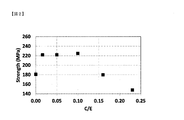
- Example 2 when Example 2, Example 5, Example 6, Example 7, Comparative Example 1, and Comparative Example 8 are compared, they are the same component [A], component [B], and component [C]. It is an epoxy resin composition containing, and only the blending amount of the component [C] is different.
- the relationship between the ratio C / E of the number of moles C of the component [C] to the number of moles E of the epoxy group of the component [A] and the elastic modulus is shown in FIG. 1, and the relationship with the strength is shown in FIG. From FIGS. 1 and 2, it can be seen that in the epoxy resin composition of the present invention, when 0.01 ⁇ C / E ⁇ 0.20, a cured product having excellent elastic modulus, strength, and elongation can be obtained.
- Example 1, Example 2, Example 3, Example 4, Comparative Example 1, and Comparative Example 9 are epoxy resin compositions containing the same component [A] and component [B] in the same compounding ratio. Yes, the type of component [C] is different or not used.
- the relationship between m / M and elastic modulus is shown in FIG. 3, and the relationship with strength is shown in FIG. From the comparison of Example 1, Example 2, Example 3, Example 4, Comparative Example 1 and Comparative Example 9 in FIGS. 3 and 4, in the resin composition of the present invention, 0.10 ⁇ m / M ⁇ 0. It can be seen that the relationship of 60 makes it possible to obtain a cured product having excellent elastic modulus and strength of the cured resin product. Further, it can be seen that when the relationship of 0.30 ⁇ m / M ⁇ 0.50 is satisfied, a cured product having particularly excellent elastic modulus, strength and elongation can be obtained.
Landscapes
- Chemical & Material Sciences (AREA)
- Health & Medical Sciences (AREA)
- Chemical Kinetics & Catalysis (AREA)
- Medicinal Chemistry (AREA)
- Polymers & Plastics (AREA)
- Organic Chemistry (AREA)
- Engineering & Computer Science (AREA)
- Materials Engineering (AREA)
- Manufacturing & Machinery (AREA)
- Inorganic Chemistry (AREA)
- Epoxy Resins (AREA)
- Reinforced Plastic Materials (AREA)
Priority Applications (4)
| Application Number | Priority Date | Filing Date | Title |
|---|---|---|---|
| US17/772,574 US12338315B2 (en) | 2019-11-15 | 2020-11-05 | Epoxy resin composition, prepreg, and fiber reinforced composite material |
| JP2020570072A JP7647102B2 (ja) | 2019-11-15 | 2020-11-05 | エポキシ樹脂組成物、プリプレグおよび繊維強化複合材料 |
| CN202080079172.6A CN114729108B (zh) | 2019-11-15 | 2020-11-05 | 环氧树脂组合物、预浸料及纤维增强复合材料 |
| EP20887472.7A EP4059975A4 (en) | 2019-11-15 | 2020-11-05 | EPOXY RESIN COMPOSITION, PREPREG AND FIBER REINFORCED COMPOSITE MATERIAL |
Applications Claiming Priority (2)
| Application Number | Priority Date | Filing Date | Title |
|---|---|---|---|
| JP2019-206896 | 2019-11-15 | ||
| JP2019206896 | 2019-11-15 |
Publications (1)
| Publication Number | Publication Date |
|---|---|
| WO2021095627A1 true WO2021095627A1 (ja) | 2021-05-20 |
Family
ID=75912890
Family Applications (1)
| Application Number | Title | Priority Date | Filing Date |
|---|---|---|---|
| PCT/JP2020/041333 Ceased WO2021095627A1 (ja) | 2019-11-15 | 2020-11-05 | エポキシ樹脂組成物、プリプレグおよび繊維強化複合材料 |
Country Status (6)
| Country | Link |
|---|---|
| US (1) | US12338315B2 (https=) |
| EP (1) | EP4059975A4 (https=) |
| JP (1) | JP7647102B2 (https=) |
| CN (1) | CN114729108B (https=) |
| TW (1) | TWI861279B (https=) |
| WO (1) | WO2021095627A1 (https=) |
Citations (7)
| Publication number | Priority date | Publication date | Assignee | Title |
|---|---|---|---|---|
| JP2008095013A (ja) * | 2006-10-13 | 2008-04-24 | Fujikura Ltd | エポキシ系接着剤、カバーレイ、プリプレグ、金属張積層板、プリント配線基板 |
| JP2010077176A (ja) * | 2008-09-24 | 2010-04-08 | Fuji Kasei Kogyo Co Ltd | 氷点下で硬化可能な水性エマルションエポキシド組成物 |
| JP2014227473A (ja) | 2013-05-23 | 2014-12-08 | 東レ株式会社 | 複合材料用エポキシ樹脂組成物、繊維強化複合材料およびそれらの製造方法 |
| JP2017535652A (ja) * | 2014-11-20 | 2017-11-30 | ダウ グローバル テクノロジーズ エルエルシー | 促進剤組成物 |
| JP2018095675A (ja) | 2016-12-08 | 2018-06-21 | 三菱ケミカル株式会社 | エポキシ樹脂組成物、並びにこれを用いた成形品、プリプレグ及び繊維強化プラスチック |
| US20190134926A1 (en) * | 2017-11-08 | 2019-05-09 | Cytec Industries Inc. | Composites with interlaminar toughening particles and method of making the same |
| WO2019181402A1 (ja) | 2018-03-20 | 2019-09-26 | 東レ株式会社 | プリプレグおよび繊維強化複合材料 |
Family Cites Families (4)
| Publication number | Priority date | Publication date | Assignee | Title |
|---|---|---|---|---|
| JP2009155431A (ja) * | 2007-12-26 | 2009-07-16 | Sumitomo Bakelite Co Ltd | 液状封止樹脂組成物、半導体装置および半導体装置の製造方法 |
| JP2014167103A (ja) * | 2013-01-29 | 2014-09-11 | Toray Ind Inc | エポキシ樹脂組成物、プリプレグおよび繊維強化複合材料 |
| RU2726406C2 (ru) * | 2016-01-26 | 2020-07-14 | Торэй Индастриз, Инк. | Композиция эпоксидной смолы, препрег и композитный материал, армированный волокном |
| CN109265655B (zh) * | 2018-09-04 | 2020-12-25 | 北京化工大学 | 一种快速固化树脂体系及制备方法 |
-
2020
- 2020-11-05 JP JP2020570072A patent/JP7647102B2/ja active Active
- 2020-11-05 CN CN202080079172.6A patent/CN114729108B/zh active Active
- 2020-11-05 EP EP20887472.7A patent/EP4059975A4/en active Pending
- 2020-11-05 US US17/772,574 patent/US12338315B2/en active Active
- 2020-11-05 WO PCT/JP2020/041333 patent/WO2021095627A1/ja not_active Ceased
- 2020-11-11 TW TW109139276A patent/TWI861279B/zh active
Patent Citations (7)
| Publication number | Priority date | Publication date | Assignee | Title |
|---|---|---|---|---|
| JP2008095013A (ja) * | 2006-10-13 | 2008-04-24 | Fujikura Ltd | エポキシ系接着剤、カバーレイ、プリプレグ、金属張積層板、プリント配線基板 |
| JP2010077176A (ja) * | 2008-09-24 | 2010-04-08 | Fuji Kasei Kogyo Co Ltd | 氷点下で硬化可能な水性エマルションエポキシド組成物 |
| JP2014227473A (ja) | 2013-05-23 | 2014-12-08 | 東レ株式会社 | 複合材料用エポキシ樹脂組成物、繊維強化複合材料およびそれらの製造方法 |
| JP2017535652A (ja) * | 2014-11-20 | 2017-11-30 | ダウ グローバル テクノロジーズ エルエルシー | 促進剤組成物 |
| JP2018095675A (ja) | 2016-12-08 | 2018-06-21 | 三菱ケミカル株式会社 | エポキシ樹脂組成物、並びにこれを用いた成形品、プリプレグ及び繊維強化プラスチック |
| US20190134926A1 (en) * | 2017-11-08 | 2019-05-09 | Cytec Industries Inc. | Composites with interlaminar toughening particles and method of making the same |
| WO2019181402A1 (ja) | 2018-03-20 | 2019-09-26 | 東レ株式会社 | プリプレグおよび繊維強化複合材料 |
Non-Patent Citations (1)
| Title |
|---|
| See also references of EP4059975A4 |
Also Published As
| Publication number | Publication date |
|---|---|
| TWI861279B (zh) | 2024-11-11 |
| US12338315B2 (en) | 2025-06-24 |
| JP7647102B2 (ja) | 2025-03-18 |
| CN114729108A (zh) | 2022-07-08 |
| CN114729108B (zh) | 2024-12-13 |
| EP4059975A1 (en) | 2022-09-21 |
| US20230037333A1 (en) | 2023-02-09 |
| TW202128815A (zh) | 2021-08-01 |
| EP4059975A4 (en) | 2023-11-29 |
| JPWO2021095627A1 (https=) | 2021-05-20 |
Similar Documents
| Publication | Publication Date | Title |
|---|---|---|
| JP5768893B2 (ja) | エポキシ樹脂組成物及びこれを用いたフィルム、プリプレグ、繊維強化プラスチック | |
| JP6497027B2 (ja) | エポキシ樹脂組成物、樹脂硬化物、プリプレグおよび繊維強化複合材料 | |
| JP6555006B2 (ja) | エポキシ樹脂組成物、樹脂硬化物、プリプレグおよび繊維強化複合材料 | |
| JP2016132709A (ja) | エポキシ樹脂組成物、プリプレグおよび繊維強化複合材料 | |
| JP6771885B2 (ja) | エポキシ樹脂組成物、プリプレグおよび繊維強化複合材料 | |
| JP2017020004A (ja) | エポキシ樹脂組成物、プリプレグおよび繊維強化複合材料 | |
| WO2023176935A1 (ja) | Rtm用エポキシ樹脂組成物、樹脂硬化物、繊維強化複合材料およびその製造方法 | |
| JP2018135496A (ja) | 繊維強化複合材料用2液型エポキシ樹脂組成物および繊維強化複合材料 | |
| JP7823570B2 (ja) | エポキシ樹脂組成物、プリプレグおよび繊維強化複合材料 | |
| JP7775710B2 (ja) | エポキシ樹脂組成物、プリプレグおよび繊維強化複合材料 | |
| WO2021095628A1 (ja) | エポキシ樹脂組成物、プリプレグおよび繊維強化複合材料 | |
| JP7647102B2 (ja) | エポキシ樹脂組成物、プリプレグおよび繊維強化複合材料 | |
| JP6421897B1 (ja) | エポキシ樹脂組成物、プリプレグ、繊維強化複合材料およびその製造方法 | |
| JP7622437B2 (ja) | エポキシ樹脂組成物、プリプレグおよび繊維強化複合材料 | |
| JP7707805B2 (ja) | プリプレグおよび繊維強化複合材料 | |
| JP7622436B2 (ja) | エポキシ樹脂組成物、プリプレグおよび繊維強化複合材料 | |
| TWI914487B (zh) | 環氧樹脂組成物、預浸體及纖維強化複合材料 | |
| JP2020019932A (ja) | エポキシ樹脂組成物、プリプレグおよび繊維強化複合材料 | |
| JP7585671B2 (ja) | 繊維強化複合材料用エポキシ樹脂組成物、プリプレグおよび繊維強化複合材料 | |
| JP2022039266A (ja) | エポキシ樹脂組成物、中間基材、トウプレグ、および繊維強化複合材料 | |
| JP2019218540A (ja) | エポキシ樹脂組成物、プリプレグおよび繊維強化複合材料 |
Legal Events
| Date | Code | Title | Description |
|---|---|---|---|
| ENP | Entry into the national phase |
Ref document number: 2020570072 Country of ref document: JP Kind code of ref document: A |
|
| 121 | Ep: the epo has been informed by wipo that ep was designated in this application |
Ref document number: 20887472 Country of ref document: EP Kind code of ref document: A1 |
|
| DPE1 | Request for preliminary examination filed after expiration of 19th month from priority date (pct application filed from 20040101) | ||
| NENP | Non-entry into the national phase |
Ref country code: DE |
|
| ENP | Entry into the national phase |
Ref document number: 2020887472 Country of ref document: EP Effective date: 20220615 |
|
| WWG | Wipo information: grant in national office |
Ref document number: 17772574 Country of ref document: US |