WO2021024946A1 - デジタル音声処理装置、デジタル音声処理方法、及びデジタル音声処理プログラム - Google Patents
デジタル音声処理装置、デジタル音声処理方法、及びデジタル音声処理プログラム Download PDFInfo
- Publication number
- WO2021024946A1 WO2021024946A1 PCT/JP2020/029491 JP2020029491W WO2021024946A1 WO 2021024946 A1 WO2021024946 A1 WO 2021024946A1 JP 2020029491 W JP2020029491 W JP 2020029491W WO 2021024946 A1 WO2021024946 A1 WO 2021024946A1
- Authority
- WO
- WIPO (PCT)
- Prior art keywords
- sample
- value
- correction value
- minimum
- maximum
- Prior art date
- Legal status (The legal status is an assumption and is not a legal conclusion. Google has not performed a legal analysis and makes no representation as to the accuracy of the status listed.)
- Ceased
Links
Images







Classifications
-
- G—PHYSICS
- G10—MUSICAL INSTRUMENTS; ACOUSTICS
- G10L—SPEECH ANALYSIS TECHNIQUES OR SPEECH SYNTHESIS; SPEECH RECOGNITION; SPEECH OR VOICE PROCESSING TECHNIQUES; SPEECH OR AUDIO CODING OR DECODING
- G10L21/00—Speech or voice signal processing techniques to produce another audible or non-audible signal, e.g. visual or tactile, in order to modify its quality or its intelligibility
- G10L21/02—Speech enhancement, e.g. noise reduction or echo cancellation
- G10L21/0316—Speech enhancement, e.g. noise reduction or echo cancellation by changing the amplitude
- G10L21/0324—Details of processing therefor
- G10L21/0332—Details of processing therefor involving modification of waveforms
-
- G—PHYSICS
- G10—MUSICAL INSTRUMENTS; ACOUSTICS
- G10L—SPEECH ANALYSIS TECHNIQUES OR SPEECH SYNTHESIS; SPEECH RECOGNITION; SPEECH OR VOICE PROCESSING TECHNIQUES; SPEECH OR AUDIO CODING OR DECODING
- G10L21/00—Speech or voice signal processing techniques to produce another audible or non-audible signal, e.g. visual or tactile, in order to modify its quality or its intelligibility
- G10L21/02—Speech enhancement, e.g. noise reduction or echo cancellation
- G10L21/0316—Speech enhancement, e.g. noise reduction or echo cancellation by changing the amplitude
-
- G—PHYSICS
- G10—MUSICAL INSTRUMENTS; ACOUSTICS
- G10K—SOUND-PRODUCING DEVICES; METHODS OR DEVICES FOR PROTECTING AGAINST, OR FOR DAMPING, NOISE OR OTHER ACOUSTIC WAVES IN GENERAL; ACOUSTICS NOT OTHERWISE PROVIDED FOR
- G10K15/00—Acoustics not otherwise provided for
- G10K15/04—Sound-producing devices
-
- G—PHYSICS
- G10—MUSICAL INSTRUMENTS; ACOUSTICS
- G10L—SPEECH ANALYSIS TECHNIQUES OR SPEECH SYNTHESIS; SPEECH RECOGNITION; SPEECH OR VOICE PROCESSING TECHNIQUES; SPEECH OR AUDIO CODING OR DECODING
- G10L19/00—Speech or audio signals analysis-synthesis techniques for redundancy reduction, e.g. in vocoders; Coding or decoding of speech or audio signals, using source filter models or psychoacoustic analysis
- G10L19/02—Speech or audio signals analysis-synthesis techniques for redundancy reduction, e.g. in vocoders; Coding or decoding of speech or audio signals, using source filter models or psychoacoustic analysis using spectral analysis, e.g. transform vocoders or subband vocoders
-
- G—PHYSICS
- G10—MUSICAL INSTRUMENTS; ACOUSTICS
- G10L—SPEECH ANALYSIS TECHNIQUES OR SPEECH SYNTHESIS; SPEECH RECOGNITION; SPEECH OR VOICE PROCESSING TECHNIQUES; SPEECH OR AUDIO CODING OR DECODING
- G10L25/00—Speech or voice analysis techniques not restricted to a single one of groups G10L15/00 - G10L21/00
- G10L25/78—Detection of presence or absence of voice signals
-
- G—PHYSICS
- G10—MUSICAL INSTRUMENTS; ACOUSTICS
- G10L—SPEECH ANALYSIS TECHNIQUES OR SPEECH SYNTHESIS; SPEECH RECOGNITION; SPEECH OR VOICE PROCESSING TECHNIQUES; SPEECH OR AUDIO CODING OR DECODING
- G10L25/00—Speech or voice analysis techniques not restricted to a single one of groups G10L15/00 - G10L21/00
- G10L25/78—Detection of presence or absence of voice signals
- G10L2025/783—Detection of presence or absence of voice signals based on threshold decision
Definitions
- the present disclosure relates to a digital audio processing device for processing a digital audio signal, a digital audio processing method, and a digital audio processing program.
- Patent Document 1 describes a digital audio processing device that processes a digital audio signal as follows to improve sound quality.
- the digital audio processing device detects the sample interval between the maximum sample having the maximum value and the minimum value having the minimum value of the waveform of the digital audio signal.
- the digital audio processing device adds a correction value obtained by multiplying the difference value between the maximum sample and the adjacent sample by a coefficient of less than 1 to the samples adjacent to the sample before and after the maximum sample, and from the samples adjacent to the sample before and after the minimum sample. ,
- the correction value obtained by multiplying the difference value between the minimum sample and the adjacent sample by a coefficient less than 1 is subtracted.
- Patent Document 3 describes a configuration in which both even harmonics and odd harmonics are added to a digital voice signal.
- the digital audio processing device described in Patent Document 3 has only one of a waveform portion in which the sample value increases from the minimum sample to the maximum sample and a waveform portion in which the sample value decreases from the maximum sample to the minimum sample. Add or subtract the correction value to the sample of. With this configuration, both even harmonics and odd harmonics are added to the digital voice signal.
- both the waveform portion in which the sample value is increasing and the waveform portion in which the sample value is decreasing are corrected, and both even harmonics and odd harmonics are added to the digital audio signal. It is an object of the present invention to provide a digital audio processing device, a digital audio processing method, and a digital audio processing program capable of providing the same.
- the digital audio signal is configured with a maximum sample detection unit that calculates a maximum value in a sample constituting the input digital audio signal and detects the maximum sample having the maximum value.
- a minimum sample detection unit that calculates the minimum value of the sample to be sampled and detects the minimum sample having the minimum value, and a waveform portion in which the sample value of the sample constituting the digital audio signal rises from the minimum sample to the maximum sample.
- the waveform inclination determination unit that determines whether the sample value is a waveform portion in which the sample value decreases from the maximum sample to the minimum sample, and the sample interval between the minimum sample and the maximum sample adjacent in the time direction are counted.
- a counter a coefficient selection unit that selects an even harmonic overtone coefficient and an odd harmonic overtone coefficient according to the sample interval counted by the counter, and an even harmonic overtone addition unit and an odd harmonic overtone that add an even harmonic overtone to the digital audio signal.
- a digital audio processing device including an odd harmonic overtone addition unit to be added, and a harmonic overtone addition unit for adding and outputting a harmonic component composed of even harmonics and odd harmonics to the digital audio signal.
- the samples constituting the digital audio signal rise from the first minimum sample to the first maximum sample, and descend from the first maximum sample to the second minimum sample.
- the even-numbered harmonic addition unit executes either the first even-numbered harmonic addition processing or the second even-numbered harmonic addition processing.
- the even-numbered harmonic addition unit is subjected to the first even-numbered harmonic addition processing by the first minimum to the first adjacent sample which is the next sample following the first minimum sample.
- the first correction value multiplied by the even harmonic coefficient is added, and the second adjacent sample and the first maximum sample are combined with each other from the second adjacent sample one sample before the first maximum sample.
- the second correction value obtained by multiplying the difference value of 2 by the coefficient for even harmonics of the first number is subtracted, and the first maximum is added to the third adjacent sample which is the next sample following the first maximum sample.
- a third correction value multiplied by an even harmonic coefficient is added, and the fourth adjacent sample and the second minimum sample are combined with each other from the fourth adjacent sample one sample before the second minimum sample.
- the even harmonics are added to the digital audio signal by subtracting the fourth correction value obtained by multiplying the difference value of 4 by the second even harmonic coefficient.
- the even harmonic addition unit subtracts the first correction value from the first adjacent sample as the second even harmonic addition processing, and the second adjacent sample is subjected to the above. A second correction value is added, the third correction value is subtracted from the third adjacent sample, and the fourth correction value is added to the fourth adjacent sample, thereby adding the fourth correction value to the digital audio signal. Add even harmonics.
- the odd-numbered harmonic addition unit is a fifth of the first minimum sample and the fifth adjacent sample one sample before the first minimum sample from the first minimum sample. Coefficient for the first odd-numbered harmonics selected by the coefficient selection unit according to the third sample interval between the first minimum sample and the second maximum sample immediately before the first minimum sample.
- the fifth correction value multiplied by is subtracted, and the coefficient for the second odd-numbered harmonics selected by the coefficient selection unit according to the first sample interval is added to the first maximum sample and the second difference value.
- a sixth correction value multiplied by is added, and a third odd-numbered harmonic coefficient selected by the coefficient selection unit according to the second sample interval is added to the fourth difference value from the second minimum sample.
- the maximum value in the sample constituting the input digital audio signal is calculated, the maximum sample having the maximum value is detected, and the minimum value in the sample constituting the digital audio signal is detected. Is calculated to detect a very small sample having a minimum value, and the sample constituting the digital audio signal is a waveform part in which the sample value rises from the minimum sample to the maximum sample, or from the maximum sample to the minimum sample.
- a digital audio processing method is provided that determines whether the sample value is a waveform portion in which the value decreases, and counts the sample interval between the minimum sample and the maximum sample that are adjacent to each other in the time direction.
- the sample constituting the digital audio signal rises from the first minimum sample to the first maximum sample, and descends from the first maximum sample to the second minimum sample. Then, either the first even harmonic addition process or the second even harmonic addition process is executed.
- the first even harmonic addition processing the first minimal sample and the first adjacent sample are added to the first adjacent sample which is the next sample following the first minimal sample.
- a first correction value obtained by multiplying the first difference value of and the first even harmonic coefficient selected according to the first sample interval between the first minimum sample and the first maximum sample.
- the first even harmonic coefficient is added to the second difference value between the second adjacent sample and the first maximum sample from the second adjacent sample one sample before the first maximum sample.
- the second correction value multiplied by is subtracted, and the first maximum sample and the third adjacent sample are added to the third adjacent sample which is the next sample following the first maximum sample.
- a third correction value obtained by multiplying the difference value by a second even harmonic coefficient selected according to the second sample interval between the first maximum sample and the second minimum sample is added, and the first correction value is added.
- a fourth value obtained by multiplying the fourth difference value between the fourth adjacent sample and the second minimum sample by the second even harmonic coefficient from the fourth adjacent sample one sample before the second minimum sample is added.
- the first correction value is subtracted from the first adjacent sample, and the second correction value is added to the second adjacent sample.
- the third correction value is subtracted from the third adjacent sample, and the fourth correction value is added to the fourth adjacent sample to add even harmonics to the digital audio signal.
- the above-mentioned digital voice processing method is applied to a fifth difference value between the first minimum sample and a fifth adjacent sample one sample before the first minimum sample from the first minimum sample. Subtract the fifth correction value multiplied by the first odd harmonic overtone coefficient selected according to the third sample interval between the first minimum sample and the second maximum sample immediately before the first minimum sample. A sixth correction value obtained by multiplying the first maximum sample by the second difference value and the second odd harmonic overtone coefficient selected according to the first sample interval is added, and the second minimum is added. By subtracting the seventh correction value obtained by multiplying the fourth difference value by the third odd harmonic overtone coefficient selected according to the second sample interval from the sample, the odd harmonics are added to the digital audio signal. Executes the odd harmonic addition process to be added.
- a step of calculating the maximum value in the sample constituting the input digital audio signal and detecting the maximum sample having the maximum value and the digital audio signal are configured.
- a step of determining whether the sample value is a waveform part in which the sample value decreases from the maximum sample to the minimum sample, and a step of counting the sample interval between the minimum sample and the maximum sample adjacent in the time direction are executed.
- a digital audio processing program is provided.
- the samples constituting the digital audio signal rise from the first minimum sample to the first maximum sample, and then descend from the first maximum sample to the second minimum sample.
- the computer is made to execute either the first even harmonic addition step or the second even harmonic addition step.
- the above-mentioned digital voice processing program performs the first even-numbered harmonic addition step on a computer, and the first minimal sample and the first minimal sample are added to a first adjacent sample which is a next sample following the first minimal sample.
- the first difference value from the adjacent sample of is multiplied by the first even harmonic coefficient selected according to the first sample interval between the first minimum sample and the first maximum sample.
- the first step of adding the correction value and the second difference value between the second adjacent sample and the first maximum sample from the second adjacent sample one sample before the first maximum sample.
- the first maximum sample and the third maximum sample are added to the step of subtracting the second correction value multiplied by the even harmonic coefficient of, and the third adjacent sample which is the next sample following the first maximum sample.
- the even harmonics are added to the digital audio signal by executing the step of subtracting the fourth correction value multiplied by the even harmonic coefficient.
- a step of subtracting the first correction value from the first adjacent sample and the second step of adding the second even harmonic to the second adjacent sample are performed.
- a step of adding the correction value, a step of subtracting the third correction value from the third adjacent sample, and a step of adding the fourth correction value to the fourth adjacent sample are executed. Even harmonics are added to the digital audio signal.
- the digital voice processing program tells the computer a fifth difference value between the first minimal sample and the fifth adjacent sample one sample before the first minimal sample from the first minimal sample.
- the fifth correction value multiplied by the first odd harmonic overtone coefficient selected according to the third sample interval between the first minimum sample and the second maximum sample immediately before the first minimum sample.
- the odd harmonic addition step of adding the odd harmonics to the digital audio signal is executed.
- the waveforms of both the waveform portion in which the sample value is increasing and the waveform portion in which the sample value is decreasing are corrected.
- Both even harmonics and odd harmonics can be added to the digital audio signal.
- FIG. 1 is a block diagram showing a digital audio processing device of one embodiment.
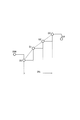
- FIG. 2 is a waveform diagram showing an example of a digital voice signal input to the digital voice processing device of one embodiment.
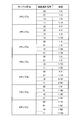
- FIG. 3 is a diagram showing an example of a coefficient table showing the coefficients set for each sample interval between the maximum sample and the minimum sample.
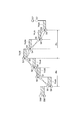
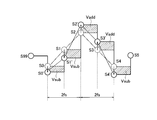
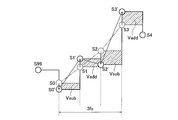
- FIG. 4 is a waveform diagram showing the first even harmonic addition processing and the odd harmonic addition processing when the sample interval is 3 fs.
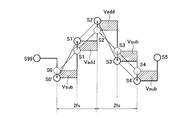
- FIG. 5 is a waveform diagram showing a second even harmonic addition process and an odd harmonic addition process when the sample interval is 3 fs.
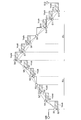
- FIG. 6 is a waveform diagram showing the first even harmonic addition processing and the odd harmonic addition processing when the sample interval is 6 fs.
- FIG. 1 is a block diagram showing a digital audio processing device of one embodiment.
- FIG. 2 is a waveform diagram showing an example of a digital voice signal input to the digital voice processing device of one embodiment.
- FIG. 3 is a diagram showing an example of
- FIG. 7 is a waveform diagram showing a second even harmonic addition process and an odd harmonic addition process when the sample interval is 6 fs.
- FIG. 8 is a waveform diagram showing the first even harmonic addition processing and the odd harmonic addition processing when the sample interval is 2 fs.
- FIG. 9 is a waveform diagram showing a second even harmonic addition process and an odd harmonic addition process when the sample interval is 2 fs.
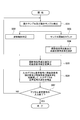
- FIG. 10 is a flowchart showing a process executed by the digital audio processing device of the embodiment, a digital audio processing method of the embodiment, and a process of the digital audio processing program of the embodiment causing the computer to execute the process.
- FIG. 10 is a flowchart showing a process executed by the digital audio processing device of the embodiment, a digital audio processing method of the embodiment, and a process of the digital audio processing program of the embodiment causing the computer to execute the process.
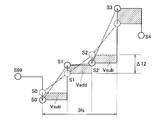
- FIG. 11A is a waveform diagram showing an example of a waveform having a sample interval of 3 fs in which a reversal phenomenon occurs due to correction of a digital audio signal.
- FIG. 11B is a waveform diagram showing a state in which the reversal phenomenon is generated by correcting the waveform shown in FIG. 11A with a sample interval of 3 fs.
- FIG. 12A is a waveform diagram showing an example of a waveform having a sample interval of 4 fs in which a reversal phenomenon occurs due to correction of a digital audio signal.
- FIG. 12B is a waveform diagram showing a state in which the reversal phenomenon is generated by correcting the waveform shown in FIG. 12A with a sample interval of 4 fs.
- FIG. 12A is a waveform diagram showing an example of a waveform having a sample interval of 4 fs in which a reversal phenomenon occurs due to correction of a digital audio signal.
- FIG. 12B is
- FIG. 13 is a flowchart showing a first example of processing for avoiding the reversal phenomenon when the sample interval is a waveform of 3 fs.
- FIG. 14 is a flowchart showing a second example of the process of avoiding the reversal phenomenon when the sample interval is a waveform of 3 fs.
- FIG. 15A is a waveform diagram showing a first example of a state in which the reversal phenomenon is avoided by the process shown in FIG. 13 or 14.
- FIG. 15B is a waveform diagram showing a second example of a state in which the reversal phenomenon is avoided by the process shown in FIG. 13 or 14.
- FIG. 15A is a waveform diagram showing a first example of a state in which the reversal phenomenon is avoided by the process shown in FIG. 13 or 14.
- FIG. 15B is a waveform diagram showing a second example of a state in which the reversal phenomenon is avoided by the process shown in FIG. 13 or 14.
- FIG. 13 is
- FIG. 16 is a flowchart showing a process of avoiding the reversal phenomenon when the sample interval is a waveform of 4 fs or more.
- FIG. 17A is a waveform diagram showing a first example of a state in which the reversal phenomenon is avoided by the processing shown in FIG.
- FIG. 17B is a waveform diagram showing a second example of a state in which the reversal phenomenon is avoided by the processing shown in FIG.
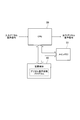
- FIG. 18 is a block diagram showing a configuration example of a microcomputer that executes a digital voice processing program of one embodiment.
- the digital audio processing device 100 of one embodiment includes a maximum sample detection unit 11, a minimum sample detection unit 12, a waveform inclination determination unit 13, a counter 14, a coefficient selection unit 15, a coefficient table holding unit 16, and a harmonic component.
- the additional portion 17 is provided.
- the harmonic component addition unit 17 includes an even harmonic addition unit 171 and an odd harmonic addition unit 172.
- the digital audio processing device 100 may be configured by hardware including a circuit, may be configured by software, or may be a mixture of hardware and software.
- the digital audio processing device 100 may be configured by an integrated circuit.
- a digital audio signal having a predetermined number of quantization bits and a predetermined sampling frequency is input to the maximum sample detection unit 11 and the minimum sample detection unit 12.
- the maximum sample detection unit 11 detects a maximum sample having a maximum value by determining the magnitude relationship of adjacent samples in the input digital audio signal.
- the minimum sample detection unit 12 similarly detects a minimum sample having a minimum value. The maximum sample and the minimum sample are supplied to the waveform inclination determination unit 13 and the counter 14.
- the waveform inclination determination unit 13 determines whether the sample value is an increasing waveform portion or a decreasing sample value based on the order in which the maximum sample and the minimum sample are input. If the maximum sample is input next to the minimum sample, the waveform inclination determination unit 13 determines that the waveform portion between the minimum sample and the maximum sample is a waveform portion in which the sample value increases. If the minimum sample is input next to the maximum sample, the waveform inclination determination unit 13 determines that the waveform portion between the maximum sample and the minimum sample is a waveform portion in which the sample value decreases. The determination result by the waveform inclination determination unit 13 is supplied to the harmonic component addition unit 17.
- the counter 14 detects the sample interval between the minimum sample and the maximum sample.
- FIG. 2 shows an example of a waveform of a digital voice signal input to the digital voice processing device 100.
- sample S0 is a minimum sample
- sample S3 is a maximum sample.
- the sample interval between the minimum sample S0 and the maximum sample S3 shown in FIG. 2 is 3.
- the distance between the minimum sample S0 and the maximum sample S3 shown in FIG. 2 is 3 fs.
- the sample interval between the minimum sample and the maximum sample is the sample interval between the minimum sample and the maximum sample in the waveform portion where the sample value is increasing, and the maximum sample and the minimum sample in the waveform portion where the sample value is decreasing. Includes both with and sample spacing.
- the sample interval detected by the counter 14 is supplied to the coefficient selection unit 15.
- a coefficient selection signal set by the user is input to the coefficient selection unit 15.
- the coefficient table holding unit 16 holds a coefficient table as shown in FIG.
- the coefficient table shows the coefficients used when generating a correction value to be added to or subtracted from the sample described later, depending on the sample interval and the coefficient selection signal.
- a coefficient of 1/2 to 1/128 is set as the sample interval from 2 samples to 8 samples corresponding to the coefficient selection signals “00”, “01”, “10”, and “11”. There is.
- Each coefficient shown in FIG. 3 is an example, and is not limited to the coefficient shown in FIG.
- the maximum sample interval is not limited to 8 samples.
- the coefficient selection signals “00”, “01”, “10”, and “11” function as level selection signals for selecting the level of the correction value.
- the coefficient selection signal "00" is set, the degree of correction of the digital audio signal is maximized, and if the coefficient selection signal "11" is set, the degree of correction of the digital audio signal is minimum. It is not essential to adjust the correction value by selecting the coefficient with the coefficient selection signal, but it is preferable that the correction value can be adjusted. If the coefficient is not selected by the coefficient selection signal, one of the coefficient selection signals "00", “01”, “10", and "11" should be set in the coefficient table. Just do it.
- the coefficient shown in FIG. 3 is an even harmonic overtone coefficient used by the even harmonic overtone addition unit 171 when adding an even harmonic overtone to the digital audio signal, and is used by the odd harmonic overtone addition unit 172 when adding an odd overtone to the digital audio signal. This is a coefficient for odd harmonics.
- the even harmonic coefficient and the odd harmonic coefficient may be the same coefficient, or may be different coefficients.
- the coefficient selection unit 15 uses the even harmonic overtone addition unit 171 and the odd harmonic addition unit 172 from the coefficient table based on the sample interval and the coefficient selection signal supplied from the counter 14.
- the odd harmonic overtone coefficient used is read out and supplied to the even harmonic overtone addition unit 171 and the odd harmonic overtone addition unit 172, respectively.
- the solid line or the broken line circle indicates a sample
- the sample shown by the broken line is the sample before correction
- the sample shown by the solid line is the sample after correction.
- the sample interval between the minimum sample S0 and the maximum sample S3 and the sample interval between the maximum sample S3 and the minimum sample S6 are both 3 fs. It is assumed that the coefficient selection signal is set to "00".
- the even harmonic addition unit 171 adds a correction value Vadd obtained by multiplying the difference value between the minimum sample S0 and the sample S1 by a coefficient to the sample S1 immediately after the minimum sample S0.
- the sample S1 is corrected to the sample S1'by adding the correction value Vadd.
- the even harmonic addition unit 171 subtracts a correction value Vsub obtained by multiplying the difference value between the sample S2 and the maximum sample S3 by a coefficient from the sample S2 immediately before the maximum sample S3.
- Sample S2 is corrected to sample S2'by subtracting the correction value Vsub.
- the correction value Vadd added to the sample S1 is 1/2 of the difference value between the minimum sample S0 and the sample S1
- the correction value Vsub subtracted from the sample S2 is 1/1 of the difference value between the sample S2 and the maximum sample S3. It is 2.
- the even harmonic addition unit 171 adds a correction value Vadd obtained by multiplying the difference value between the maximum sample S3 and the sample S4 by a coefficient to the sample S4 immediately after the maximum sample S3.
- the sample S4 is corrected to the sample S4'by adding the correction value Vadd.
- the even harmonic addition unit 171 subtracts a correction value Vsub obtained by multiplying the difference value between the sample S5 and the minimum sample S6 by a coefficient from the sample S5 immediately before the minimum sample S6.
- Sample S5 is corrected to sample S5'by subtracting the correction value Vsub.
- the correction value Vadd added to the sample S4 is 1/2 of the difference value between the maximum sample S3 and the sample S4, and the correction value Vsub subtracted from the sample S5 is 1/1 of the difference value between the sample S5 and the minimum sample S6. It is 2.
- the odd harmonic addition unit 172 subtracts the correction value Vsub, which is obtained by multiplying the difference value between the minimum sample S0 and the previous sample S99 by a coefficient, from the minimum sample S0.
- the minimum sample S0 is corrected to the minimum sample S0'by subtracting the correction value Vsub. Assuming that the sample interval between the minimum sample S0 and the maximum sample adjacent to the front side of the minimum sample S0 is 3 fs, the correction value Vsub subtracted from the minimum sample S0 is 1 / of the difference value between the sample S99 and the minimum sample S0. It is 2.
- the odd harmonic addition unit 172 adds a correction value Vadd obtained by multiplying the difference value between the sample S2 and the maximum sample S3 by a coefficient to the maximum sample S3.
- the maximum sample S3 is corrected to the maximum sample S3'by adding the correction value Vadd.
- the correction value Vadd added to the maximum sample S3 is 1/2 of the difference value between the sample S2 and the maximum sample S3.
- the odd harmonic addition unit 172 subtracts the correction value Vsub obtained by multiplying the difference value between the minimum sample S6 and the previous sample S5 by a coefficient from the minimum sample S6.
- the minimum sample S6 is corrected to the minimum sample S6'by subtracting the correction value Vsub.
- the correction value Vsub subtracted from the minimum sample S6 is 1/2 of the difference value between the minimum sample S6 and the sample S5.
- the waveform shown by the alternate long and short dash line becomes the waveform shown by the solid line. It will be corrected.
- the even harmonic addition unit 171 and the odd harmonic addition unit 172 correct the digital audio signal in the same manner after the sample S7. As a result, harmonic components including even harmonics and odd harmonics are added to the digital audio signal.
- the harmonic component addition unit 17 may correct the digital audio signal by adding the correction value Vadd or subtracting the correction value Vsub to the sample to be corrected. Similarly, it is assumed that the coefficient selection signal is set to "00".
- the even harmonic addition unit 171 subtracts the correction value Vsub, which is obtained by multiplying the difference value between the minimum sample S0 and the sample S1 by a coefficient, from the sample S1.
- Sample S1 is corrected to sample S1'by subtracting the correction value Vsub.
- the even harmonic addition unit 171 adds a correction value Vadd obtained by multiplying the difference value between the sample S2 and the maximum sample S3 by a coefficient to the sample S2.
- the sample S2 is corrected to the sample S2'by adding the correction value Vadd.
- the correction value Vsub subtracted from the sample S1 is 1/2 of the difference value between the minimum sample S0 and the sample S1
- the correction value Vadd added to the sample S2 is 1/1 of the difference value between the sample S2 and the maximum sample S3. It is 2.
- the even harmonic addition unit 171 subtracts the correction value Vsub obtained by multiplying the difference value between the maximum sample S3 and the sample S4 by a coefficient from the sample S4.
- Sample S4 is corrected to sample S4'by subtracting the correction value Vsub.
- the even harmonic addition unit 171 adds a correction value Vadd obtained by multiplying the difference value between the sample S5 and the minimum sample S6 by a coefficient to the sample S5.
- Sample S5 is corrected to sample S5'by adding the correction value Vadd.
- the correction value Vsub subtracted from the sample S4 is 1/2 of the difference value between the maximum sample S3 and the sample S4, and the correction value Vadd added to the sample S5 is 1/1 of the difference value between the sample S5 and the minimum sample S6. It is 2.
- the odd harmonic addition unit 172 subtracts the correction value Vsub, which is obtained by multiplying the difference value between the sample S99 and the minimum sample S0 by a coefficient, from the minimum sample S0.
- the minimum sample S0 is corrected to the minimum sample S0'by subtracting the correction value Vsub. Assuming that the sample interval between the minimum sample S0 and the maximum sample adjacent to the front side of the minimum sample S0 is 3 fs, the correction value Vsub subtracted from the minimum sample S0 is 1 / of the difference value between the minimum sample S0 and the sample S99. It is 2.
- the odd harmonic addition unit 172 adds a correction value Vadd obtained by multiplying the difference value between the sample S2 and the maximum sample S3 by a coefficient to the maximum sample S3.
- the maximum sample S3 is corrected to the maximum sample S3'by adding the correction value Vadd.
- the correction value Vadd added to the maximum sample S3 is 1/2 of the difference value between the sample S2 and the maximum sample S3.
- the odd harmonic addition unit 172 subtracts the correction value Vsub obtained by multiplying the difference value between the sample S5 and the minimum sample S6 by the coefficient from the minimum sample S6.
- the minimum sample S6 is corrected to the minimum sample S6'by subtracting the correction value Vsub.
- the correction value Vsub subtracted from the minimum sample S6 is 1/2 of the difference value between the sample S5 and the minimum sample S6.
- the waveform shown by the alternate long and short dash line becomes the waveform shown by the solid line. It will be corrected.
- the even harmonic addition unit 171 and the odd harmonic addition unit 172 correct the digital audio signal in the same manner after the sample S7. As a result, harmonic components including even harmonics and odd harmonics are added to the digital audio signal.
- the digital audio processing device 100 obtains a digital audio signal by correcting the waveforms of both the waveform portion in which the sample value increases and the waveform portion in which the sample value decreases. Harmonic components including both even harmonics and odd harmonics can be added.
- the sample one before the minimum sample, the sample one after the minimum sample, and the sample one before the maximum sample may be used as the sample to be corrected.
- the even harmonic addition unit 171 includes a sample two before and two samples after the minimum sample, a sample two before the maximum sample, and a sample.
- the second sample may be added to the sample to be corrected.
- FIG. 6 will explain the operation when the even harmonic addition unit 171 sets a total of 4 samples, 2 samples before and after the minimum sample and 2 samples before and after the maximum sample, as the samples to be corrected.
- FIG. 6 corresponds to an addition method in which the even harmonic addition method shown in FIG. 4 is extended to four samples.
- the correction value and the corrected sample are shown only for the samples in the range from the minimum sample S0 to the next minimum sample S12.
- the even harmonic addition unit 171 adds a correction value Vadd obtained by multiplying the difference value between the minimum sample S0 and the sample S1 by a coefficient to the sample S1, and multiplies the sample S2 by the difference value between the sample S1 and the sample S2. Add the correction value Vadd. Samples S1 and S2 are corrected to samples S1'and S2', respectively, by adding the correction value Vadd. Further, the even harmonic addition unit 171 subtracts a correction value Vsub obtained by multiplying the difference value between the sample S4 and the sample S5 by a coefficient from the sample S4, and subtracts a coefficient from the sample S5 to the difference value between the sample S5 and the maximum sample S6. Subtract the correction value Vsub multiplied by. Samples S4 and S5 are corrected to samples S4'and S5', respectively, by subtracting the correction value Vsub.
- the even harmonic addition unit 171 adds a correction value Vadd obtained by multiplying the difference value between the maximum sample S6 and the sample S7 by a coefficient to the sample S7, and adds a coefficient to the difference value between the sample S7 and the sample S8 to the sample S8. Add the correction value Vadd multiplied by. Samples S7 and S8 are corrected to samples S7'and S8', respectively, by adding the correction value Vadd. Further, the even harmonic addition unit 171 subtracts a correction value Vsub obtained by multiplying the difference value between the sample S10 and the sample S11 by a coefficient from the sample S10, and subtracts a coefficient from the sample S11 to the difference value between the sample S11 and the minimum sample S12. Subtract the correction value Vsub multiplied by. Samples S10 and S11 are corrected to samples S10'and S11', respectively, by subtracting the correction value Vsub.
- the odd harmonic addition unit 172 subtracts the correction value Vsub, which is obtained by multiplying the difference value between the sample S99 and the minimum sample S0 by a coefficient, from the minimum sample S0.
- the minimum sample S0 is corrected to the minimum sample S0'by subtracting the correction value Vsub.
- the odd harmonic addition unit 172 adds a correction value Vadd obtained by multiplying the difference value between the sample S5 and the maximum sample S6 by a coefficient to the maximum sample S6.
- the maximum sample S6 is corrected to the maximum sample S6'by adding the correction value Vadd.
- the odd harmonic addition unit 172 subtracts a correction value Vsub obtained by multiplying the difference value between the sample S11 and the minimum sample S12 by a coefficient from the minimum sample S12.
- the minimum sample S12 is corrected to the minimum sample S12'by subtracting the correction value Vsub.
- the waveform shown by the alternate long and short dash line becomes the waveform shown by the solid line. It will be corrected.
- the harmonic component addition unit 17 may correct the digital audio signal by adding the correction value Vadd or subtracting the correction value Vsub to the sample to be corrected.
- FIG. 7 corresponds to an addition method in which the even harmonic addition method shown in FIG. 5 is extended to 4 samples.
- the even harmonic addition unit 171 subtracts the correction value Vsub obtained by multiplying the difference value between the minimum sample S0 and the sample S1 by the coefficient from the sample S1, and multiplies the difference value between the sample S1 and the sample S2 by the coefficient from the sample S2. Subtract the correction value Vsub. Samples S1 and S2 are corrected to samples S1'and S2', respectively, by subtracting the correction value Vsub. Further, the even harmonic addition unit 171 adds a correction value Vadd obtained by multiplying the difference value between the sample S4 and the sample S5 by a coefficient to the sample S4, and adds a coefficient to the difference value between the sample S5 and the maximum sample S6 to the sample S5. Add the correction value Vadd multiplied by. Samples S4 and S5 are corrected to samples S4'and S5', respectively, by adding the correction value Vadd.
- the even harmonic addition unit 171 subtracts a correction value Vsub obtained by multiplying the difference value between the maximum sample S6 and the sample S7 by a coefficient from the sample S7, and subtracts a coefficient from the sample S8 to the difference value between the sample S7 and the sample S8. Subtract the correction value Vsub multiplied by. Further, the even harmonic addition unit 171 adds a correction value Vadd obtained by multiplying the difference value between the sample S10 and the sample S11 by a coefficient to the sample S10, and adds a coefficient to the difference value between the sample S11 and the minimum sample S12 to the sample S11. Add the correction value Vadd multiplied by. Samples S7 and S8 are corrected to samples S7'and S8', respectively, by subtracting the correction value Vsub. Samples S10 and S11 are corrected to samples S10'and S11', respectively, by adding the correction value Vadd.
- the odd harmonic addition unit 172 subtracts the correction value Vsub, which is obtained by multiplying the difference value between the sample S99 and the minimum sample S0 by a coefficient, from the minimum sample S0.
- the minimum sample S0 is corrected to the minimum sample S0'by subtracting the correction value Vsub.
- the odd harmonic addition unit 172 adds a correction value Vadd obtained by multiplying the difference value between the sample S5 and the maximum sample S6 by a coefficient to the maximum sample S6.
- the maximum sample S6 is corrected to the maximum sample S6'by adding the correction value Vadd.
- the odd harmonic addition unit 172 subtracts a correction value Vsub obtained by multiplying the difference value between the sample S11 and the minimum sample S12 by a coefficient from the minimum sample S12.
- the minimum sample S12 is corrected to the minimum sample S12'by subtracting the correction value Vsub.
- the waveform shown by the alternate long and short dash line becomes the waveform shown by the solid line. It will be corrected.
- the even harmonic addition unit 171 may add the correction value Vadd or subtract the correction value Vsub with three or more samples before and after the minimum sample as the samples to be corrected.
- the number of samples to be corrected is a design matter. As the sample interval increases, the number of samples to be corrected may be increased.
- the even harmonic addition unit 171 corrects the digital audio signal as shown in FIG. 8 or 9 when the sample interval is 2 fs.
- FIG. 8 corresponds to the method of adding even harmonics shown in FIG.
- the even harmonic addition unit 171 subtracts a correction value Vsub obtained by multiplying the difference value between the sample S1 and the maximum sample S2 by a coefficient from the sample S1.
- Sample S1 is corrected to sample S1'by subtracting the correction value Vsub.
- the even harmonic addition unit 171 adds a correction value Vadd obtained by multiplying the difference value between the maximum sample S2 and the sample S3 by a coefficient to the sample S3.
- Sample S3 is corrected to sample S3'by adding the correction value Vadd.
- the odd harmonic addition unit 172 subtracts the correction value Vsub, which is obtained by multiplying the difference value between the sample S99 and the minimum sample S0 by a coefficient, from the minimum sample S0.
- the minimum sample S0 is corrected to the minimum sample S0'by subtracting the correction value Vsub.
- the odd harmonic addition unit 172 adds a correction value Vadd obtained by multiplying the difference value between the sample S1 and the maximum sample S2 by a coefficient to the maximum sample S2.
- the maximum sample S2 is corrected to the maximum sample S2'by adding the correction value Vadd.
- the odd harmonic addition unit 172 subtracts a correction value Vsub obtained by multiplying the difference value between the sample S3 and the minimum sample S4 by a coefficient from the minimum sample S4.
- the minimum sample S4 is corrected to the minimum sample S4'by subtracting the correction value Vsub.
- FIG. 9 corresponds to the method of adding even harmonics shown in FIG.
- the even harmonic addition unit 171 adds a correction value Vadd obtained by multiplying the difference value between the sample S1 and the maximum sample S2 by a coefficient to the sample S1.
- the sample S1 is corrected to the sample S1'by adding the correction value Vadd.
- the even harmonic addition unit 171 subtracts a correction value Vsub obtained by multiplying the difference value between the maximum sample S2 and the sample S3 by a coefficient from the sample S3.
- Sample S3 is corrected to sample S3'by subtracting the correction value Vsub.
- the operation of the odd harmonic addition unit 172 is the same as that in FIG.
- the operation of the digital audio processing device 100 to process a digital audio signal having a sample interval of 3 fs or more is summarized as follows. It is assumed that the samples constituting the digital audio signal rise from the first minimum sample to the first maximum sample and then descend from the first maximum sample to the second minimum sample.
- the minimum sample S0 is the first minimum sample
- the maximum sample S3 is the first maximum sample
- the minimum sample S6 is the second minimum sample.
- the minimum sample S0 is the first minimum sample
- the maximum sample S6 is the first maximum sample
- the minimum sample S12 is the second minimum sample.
- the even harmonic addition unit 171 executes either the first even harmonic addition process or the second even harmonic addition process.
- the first even harmonic addition process is as follows.
- the even harmonic addition unit 171 is added to the first adjacent sample, which is the next sample following the first minimal sample, to the first difference value between the first minimal sample and the first adjacent sample, and to the first even number.
- the first correction value multiplied by the overtone coefficient is added.
- the first even harmonic coefficient is selected by the coefficient selection unit 15 according to the first sample interval between the first minimum sample and the first maximum sample.
- the even harmonic addition unit 171 has a coefficient for the first even harmonic overtone in the second difference value between the second adjacent sample and the first maximum sample from the second adjacent sample one sample before the first maximum sample. Subtract the second correction value multiplied by.
- the even harmonic addition unit 171 is added to the third adjacent sample, which is the next sample following the first maximum sample, to the third difference value between the first maximum sample and the third adjacent sample, and to the second even number. Add the third correction value multiplied by the overtone coefficient.
- the second even harmonic coefficient is selected by the coefficient selection unit 15 according to the second sample interval between the first maximum sample and the second minimum sample.
- the second even harmonic overtone coefficient may be the same coefficient as the first even harmonic overtone coefficient, or may be a different coefficient.
- the even harmonic addition unit 171 has a coefficient for the second even harmonic overtone in the fourth difference value between the fourth adjacent sample and the second minimum sample from the fourth adjacent sample one sample before the second minimum sample. Subtract the fourth correction value multiplied by.
- the second even harmonic addition process is as follows.
- the even harmonic addition unit 171 subtracts the first correction value from the first adjacent sample, and adds the second correction value to the second adjacent sample.
- the even harmonic addition unit 171 subtracts the third correction value from the third adjacent sample, and adds the fourth correction value to the fourth adjacent sample.
- the odd harmonic addition unit 172 executes the next odd harmonic addition process.
- the odd-numbered harmonic overtone addition unit 172 is used for the first odd-numbered harmonic overtone by setting the fifth difference value between the first minimum sample and the fifth adjacent sample one sample before the first minimum sample from the first minimum sample. Subtract the fifth correction value multiplied by the coefficient.
- the first odd harmonic overtone coefficient is selected by the coefficient selection unit 15 according to the third sample interval between the first minimum sample and the second maximum sample immediately before the first minimum sample.
- the odd harmonic addition unit 172 adds a sixth correction value obtained by multiplying the second difference value by the second odd harmonic coefficient to the first maximum sample.
- the second odd harmonic overtone coefficient is selected by the coefficient selection unit 15 according to the first sample interval.
- the second odd harmonic coefficient is the same as the first even harmonic coefficient.
- the odd harmonic addition unit 172 subtracts the seventh correction value obtained by multiplying the fourth difference value by the third odd harmonic coefficient from the second minimum sample.
- the third odd harmonic overtone coefficient is selected by the coefficient selection unit 15 according to the second sample interval.
- the third odd harmonic coefficient is the same as the second even harmonic coefficient.
- the harmonic component addition unit 17 having the even harmonic addition unit 171 and the odd harmonic addition unit 172 adds harmonic components including even harmonics and odd harmonics to the input digital audio signal and outputs the signal.
- a digital voice processing method which is a process executed by the digital voice processing device 100, will be described with reference to the flowchart shown in FIG.
- the maximum sample detection unit 11 and the minimum sample detection unit 12 detect the maximum sample and the minimum sample in step S01. ..
- the waveform inclination determination unit 13 determines whether the sample constituting the digital audio signal is a waveform portion in which the sample value increases from the minimum sample to the maximum sample, or the sample value changes from the maximum sample to the minimum sample. It is determined whether the waveform part is descending.
- step S04 the coefficient selection unit 15 selects an even harmonic coefficient and an odd harmonic coefficient according to the sample interval counted by the counter 14.
- step S05 the even harmonic addition unit 171 and the odd harmonic addition unit 172 calculate the correction values Vadd and Vsub which are the correction values for even harmonics, and calculate the correction values Vadd and Vsub which are the correction values for odd harmonics.
- step S06 the even harmonic addition unit 171 and the odd harmonic addition unit 172 correct the waveform of the digital audio signal by adding or subtracting the even harmonic correction value and the odd harmonic correction value to the digital audio signal.
- the digital audio processing device 100 determines in step S07 whether or not the input of the digital audio signal is completed. If the input of the digital audio signal is not completed (NO), the digital audio processing device 100 repeats the processes of steps S01 to S07. If the input of the digital audio signal is completed (YES), the digital audio processing device 100 ends the processing.
- the correction value Vadd is added to the sample S1 among the samples S1 and S2 adjacent to each other, and the correction value Vsub is obtained from the sample S2. Subtract. Therefore, depending on the relationship between the magnitude of the correction value Vadd and the magnitude of the correction value Vsub, a reversal phenomenon may occur in which the magnitude relationship between the sample S1'and the sample S2' is reversed. Similarly, in the second even harmonic addition process shown in FIG. 5, a reversal phenomenon may occur in which the magnitude relationship between the sample S4'and the sample S5' is reversed.
- FIGS. 11A and 11B the case where the magnitude relationship between the sample S1'and the sample S2' is reversed will be described by taking the first even harmonic addition process as an example.
- the difference value between the minimum sample S0 and the sample S1 is ⁇ 01
- the difference value between the sample S1 and the sample S2 is ⁇ 12
- the difference value between the sample S2 and the maximum sample S3 is ⁇ 23.
- the difference value ⁇ 23 is significantly larger than the difference values ⁇ 01 and ⁇ 12.
- FIG. 11B shows a case where the coefficient is halved. Therefore, the waveform in which the sample value increases from the sample S1 to the sample S2 becomes the waveform in which the sample value decreases from the sample S1'to the sample S2'. Since such a reversal phenomenon of the sample values of the sample S1'and the sample S2' damages the original waveform before correction, it is desirable to avoid the occurrence of the reversal phenomenon.
- the reversal phenomenon may occur even when the sample interval is 4 fs or more.
- the difference value between the minimum sample S0 and the sample S1 is ⁇ 01
- the difference value between the sample S1 and the sample S2 is ⁇ 12
- the difference value between the sample S2 and the sample S3 is ⁇ 23
- the value is ⁇ 34.
- the difference value ⁇ 01 is significantly larger than the difference value ⁇ 12
- the difference value ⁇ 34 is significantly larger than the difference value ⁇ 23.
- a reversal phenomenon may occur in which the correction value Vadd added to the sample S1 is larger than the difference value ⁇ 12 and the sample value of the sample S1'is larger than the sample value of the sample S2. Further, a reversal phenomenon may occur in which the correction value Vsub subtracted from the sample S3 is larger than the difference value ⁇ 23 and the sample value of the sample S3'is smaller than the sample value of the sample S2.
- FIG. 12B shows a case where the coefficient is halved.
- the sample interval is 4 fs or more, it is desirable to avoid the occurrence of a reversal phenomenon in which the sample value of the correction sample to which the correction value Vadd is added becomes larger than the sample value of the next sample. Further, it is desirable to avoid the occurrence of a reversal phenomenon in which the sample value of the correction sample from which the correction value Vsub is subtracted becomes smaller than the sample value of the sample one sample before.
- the even harmonic addition unit 171 should execute the first even harmonic addition processing as follows when the sample interval is 3 fs and the first adjacent sample and the second adjacent sample are adjacent to each other.
- the even harmonic addition unit 171 is a sample of a first correction sample in which the first correction value is added to the first adjacent sample and a second correction sample in which the second correction value is subtracted from the second adjacent sample.
- the first correction value and the second correction value are limited so that the magnitude relationship of the values is not reversed.
- the even harmonic addition unit 171 may execute the second even harmonic addition processing as follows.
- the even harmonic addition unit 171 is a sample of a third correction sample in which the third correction value is subtracted from the third adjacent sample and a fourth correction sample in which the fourth correction value is added to the fourth adjacent sample.
- the third correction value and the fourth correction value are limited so that the magnitude relationship of the values is not reversed.
- the digital audio processing device 100 executes steps S05 and S06 of FIG. 10 so as to include the process shown in FIG. 13 in order to avoid the occurrence of the reversal phenomenon when the sample interval is 3 fs. Is good.
- FIG. 13 is a first example of the process of avoiding the reversal phenomenon when the sample interval is a waveform of 3 fs, and the first even harmonic addition process is taken as an example. The same applies to the process for avoiding the occurrence of the reversal phenomenon in the second even harmonic addition process.
- step S501 the even harmonic addition unit 171 calculates the difference value ⁇ 01 between the minimum sample S0 and the sample S1, the difference value ⁇ 12 between the sample S1 and the sample S2, and the difference value ⁇ 23 between the sample S2 and the maximum sample S3.
- the even harmonic addition unit 171 calculates the maximum correction values Vaddmax and Vsubmax in step S502, and calculates the correction values Vadd and Vsub in step S503.
- the order of step S502 and step S503 may be reversed.
- the maximum correction values Vaddmax and Vsubmax are set to 1/2 of the difference value ⁇ 12.
- the maximum correction values Vaddmax and Vsubmax may be values less than 1/2 of the difference value ⁇ 12.
- the even harmonic addition unit 171 determines in step S601 whether or not the correction value Vadd exceeds the maximum correction value Vaddmax. If the correction value Vadd does not exceed the maximum correction value Vaddmax (NO), the even harmonic addition unit 171 selects the correction value Vadd in step S602 and shifts the process to step S604. If the correction value Vadd exceeds the maximum correction value Vaddmax (YES), the even harmonic addition unit 171 selects the maximum correction value Vaddmax in step S603 and shifts the process to step S604.
- step S604 the even harmonic addition unit 171 determines whether or not the correction value Vsub exceeds the maximum correction value Vsubmax. If the correction value Vsub does not exceed the maximum correction value Vaddmax (NO), the even harmonic addition unit 171 selects the correction value Vsub in step S605 and shifts the process to step S607. If the correction value Vsub exceeds the maximum correction value Vsubmax (YES), the even harmonic addition unit 171 selects the maximum correction value Vsubmax in step S606 and shifts the process to step S607.
- step S607 the even harmonic addition unit 171 adds the correction value Vadd or the maximum correction value Vaddmax to the sample S1, and subtracts the correction value Vsub or the maximum correction value Vsubmax from the sample S2.
- the maximum correction values Vaddmax and Vsubmax may be set to values obtained by dividing the difference value ⁇ 12 by the ratio of the difference value ⁇ 01 and the difference value ⁇ 23.
- the maximum correction value Vaddmax is calculated by ( ⁇ 01 ⁇ ⁇ 12) / ( ⁇ 01 + ⁇ 23), and the maximum correction value Vsubmax is calculated by ( ⁇ 23 ⁇ ⁇ 12) / ( ⁇ 01 + ⁇ 23). In this way, the correction values Vadd and Vsub do not exceed the value obtained by dividing the difference value ⁇ 12 by the ratio of the difference value ⁇ 01 and the difference value ⁇ 23, so that the occurrence of the reversal phenomenon is avoided.
- the correction value Vadd when the correction value Vadd is small and the correction value Vsub is large, the added value of the correction value Vadd and the correction value Vsub may not exceed the difference value ⁇ 12. In this case, the reversal phenomenon does not actually occur. If the correction value Vadd exceeds the maximum correction value Vaddmax regardless of whether or not the reversal phenomenon actually occurs, the correction value Vadd is limited to the maximum correction value Vaddmax, and the correction value Vsub exceeds the maximum correction value Vsubmax. If so, the correction value Vsub is limited to the maximum correction value Vsubmax.
- FIG. 14 is a second example of the process of avoiding the reversal phenomenon when the sample interval is a waveform of 3 fs, and the first even harmonic addition process is taken as an example. The same applies to the process for avoiding the occurrence of the reversal phenomenon in the second even harmonic addition process.
- Steps S501 to S503 in FIG. 14 are the same as steps S501 to S503 in FIG. Also in FIG. 14, the maximum correction values Vaddmax and Vsubmax may be 1/2 of the difference value ⁇ 12, or may be a value obtained by dividing the difference value ⁇ 12 by the ratio of the difference value ⁇ 01 and the difference value ⁇ 23.
- the even harmonic addition unit 171 determines in step S611 whether or not the added value of the correction value Vadd and the correction value Vsub exceeds the difference value ⁇ 12. When the added value exceeds the difference value ⁇ 12, it means that a reversal phenomenon occurs. If the added value does not exceed the difference value ⁇ 12 (NO), the even harmonic addition unit 171 selects the correction values Vadd and Vsub in step S612. Subsequently, in step S614, the even harmonic addition unit 171 adds the correction value Vadd to the sample S1 and subtracts the correction value Vsub from the sample S2.
- step S611 If the added value exceeds the difference value ⁇ 12 in step S611 (YES), the even harmonic addition unit 171 selects the maximum correction values Vaddmax and Vsubmax in step S613. Subsequently, in step S615, the even harmonic addition unit 171 adds the maximum correction value Vaddmax to the sample S1 and subtracts the maximum correction value Vsubmax from the sample S2.
- FIG. 15A shows a case where the occurrence of the reversal phenomenon is avoided by the process shown in FIG. 13 or 14.
- the waveform before correction shown in FIG. 15A is the same as the waveform shown in FIG. 11A.
- FIG. 15A shows a case where the maximum correction values Vaddmax and Vsubmax are 1/2 of the difference value ⁇ 12. In this case, the samples S1'and S2'have the same value, and the waveform becomes flat.
- FIG. 15B shows a case where the maximum correction values Vaddmax and Vsubmax are set to values less than 1/2 of the difference value ⁇ 12. In this case, since the sample S1'is smaller than the sample S2', the inclined waveform is maintained.
- the even harmonic addition unit 171 is described as follows. The occurrence of the reversal phenomenon may be avoided in this way.
- the even harmonic addition unit 171 is a sample of a first correction sample in which the first correction value is added to the first adjacent sample and a second correction sample in which the second correction value is subtracted from the second adjacent sample. The first correction value and the second correction value are limited so that the magnitude relationship of the values is not reversed.
- the even harmonic addition unit 171 reverses as follows. It is sufficient to avoid the occurrence of the phenomenon.
- the even harmonic addition unit 171 is a sample of a third correction sample in which the third correction value is subtracted from the third adjacent sample and a fourth correction sample in which the fourth correction value is added to the fourth adjacent sample.
- the third correction value and the fourth correction value are limited so that the magnitude relationship of the values is not reversed.
- the digital audio processing device 100 preferably executes steps S05 and S06 of FIG. 10 so as to include the process shown in FIG.
- FIG. 16 shows a case where the even harmonic addition unit 171 adds the correction value Vadd or subtracts the correction value Vsub only to the two samples sandwiching the minimum sample and the two samples sandwiching the maximum sample.
- FIG. 16 shows an example of the first even harmonic addition processing. The same applies to the process for avoiding the occurrence of the reversal phenomenon in the second even harmonic addition process.
- Sn be the maximum sample
- S (n-1) be the sample immediately before the maximum sample Sn
- S (n-2) be the sample two before.
- the difference value between the sample S (n-2) and the sample S (n-1) is ⁇ (n-2, n-1), and the difference value between the sample S (n-1) and the maximum sample Sn is ⁇ (.
- the even harmonic addition unit 171 has a difference value ⁇ 01 between the minimum sample S0 and the sample S1, a difference value ⁇ 12 between the sample S1 and the sample S2, and the sample S (n-2) and the sample S ( The difference value ⁇ (n-2, n-1) from n-1) and the difference value ⁇ (n-1, n) between the sample S (n-1) and the maximum sample Sn are calculated.
- step S512 the even harmonic addition unit 171 sets the difference value ⁇ 12 to the maximum correction value Vaddmax, and sets the difference value ⁇ (n-2, n-1) to the maximum correction value Vsubmax.
- the even harmonic addition unit 171 calculates the correction values Vadd and Vsub in step S513.
- the order of step S512 and step S513 may be reversed. Multiply the difference value ⁇ 12 by a value less than 1 to set a value smaller than the difference value ⁇ 12 to the maximum correction value Vaddmax, and multiply the difference value ⁇ (n-2, n-1) by a value less than 1 to obtain the difference value ⁇ ( A value smaller than n-2, n-1) may be set as the maximum correction value Vsubmax.
- step S621 the even harmonic addition unit 171 determines whether or not the correction value Vadd exceeds the maximum correction value Vaddmax. If the correction value Vadd does not exceed the maximum correction value Vaddmax (NO), the even harmonic addition unit 171 selects the correction value Vadd in step S622 and shifts the process to step S624. If the correction value Vadd exceeds the maximum correction value Vaddmax (YES), the even harmonic addition unit 171 selects the maximum correction value Vaddmax in step S623 and shifts the process to step S624.
- the even harmonic addition unit 171 determines in step S624 whether or not the correction value Vsub exceeds the maximum correction value Vsubmax. If the correction value Vsub does not exceed the maximum correction value Vsubmax (NO), the even harmonic addition unit 171 selects the correction value Vsub in step S625 and shifts the process to step S627. If the correction value Vsub exceeds the maximum correction value Vsubmax (YES), the even harmonic addition unit 171 selects the maximum correction value Vsubmax in step S626 and shifts the process to step S627.
- step S627 the even harmonic addition unit 171 adds the correction value Vadd or the maximum correction value Vaddmax to the sample S1, and subtracts the correction value Vsub or the maximum correction value Vsubmax from the sample S2.
- FIG. 17A shows a case where the difference value ⁇ 12 is set to the maximum correction value Vaddmax and the difference value ⁇ 23 is set to the maximum correction value Vsubmax.
- the sample S1', the sample S2, and the sample S3' have the same value, and the waveform becomes flat.
- FIG. 17B shows a case where a value smaller than the difference value ⁇ 12 is set to the maximum correction value Vaddmax and a value smaller than the difference value ⁇ 23 is set to the maximum correction value Vsubmax.
- the sample S1' has a value smaller than that of the sample S2 and the sample S3'has a value larger than that of the sample S2, the inclined waveform is maintained.
- the even harmonic addition unit 171 executes the first even harmonic addition processing when the first sample interval is 4 fs or more, the occurrence of the reversal phenomenon may be avoided as follows.
- the even harmonic addition unit 171 limits the first correction value so that the sample value of the first correction sample does not become larger than the sample value of the next sample following the first adjacent sample. Further, the even harmonic addition unit 171 limits the second correction value so that the sample value of the second correction sample is not smaller than the sample value of the sample one sample before the second adjacent sample.
- the even harmonic addition unit 171 executes the second even harmonic addition processing when the second sample interval is 4 fs or more, the occurrence of the reversal phenomenon may be avoided as follows.
- the even harmonic addition unit 171 limits the third correction value so that the sample value of the third correction sample does not become smaller than the sample value of the next sample following the third adjacent sample. Further, the even harmonic addition unit 171 limits the fourth correction value so that the sample value of the fourth correction sample does not become larger than the sample value of the sample one sample before the fourth adjacent sample.
- the even harmonic addition unit 171 adds the correction value Vadd to the two four samples sandwiching the minimum sample and the two four samples sandwiching the maximum sample, or the correction value.
- the even harmonic addition unit 171 may avoid the occurrence of the reversal phenomenon as follows.
- the even harmonic addition unit 171 limits the first correction value so that the sample value of the correction sample S1'does not become larger than the sample value of the next correction sample S2'.
- the even harmonic addition unit 171 limits the second correction value so that the sample value of the correction sample S5'is not smaller than the sample value of the correction sample S4' one sample before.
- the even harmonic addition unit 171 limits the third correction value so that the sample value of the correction sample S7'is not smaller than the sample value of the next correction sample S8'.
- the even harmonic addition unit 171 limits the fourth correction value so that the sample value of the correction sample S11'is not larger than the sample value of the correction sample S10' one sample before.
- the even harmonic addition unit 171 sets the correction value so that it does not become larger or smaller than the sample value of the correction sample adjacent to each sample to be corrected. You can limit it.
- the digital audio processing device 100 shown in FIG. 1 can be realized by the central processing unit (CPU) of the microcomputer executing a digital audio processing program.
- the CPU 50, the main memory 55, and the storage medium 60 are connected by a bus.
- the storage medium 60 is an arbitrary non-temporary storage medium such as a hard disk drive, an optical disk, or a semiconductor memory.
- a digital audio processing program is stored in the storage medium 60.
- the digital voice processing program may be transmitted from an external server via a communication line such as the Internet and stored in the storage medium 60.
- the CPU 50 loads the digital voice processing program stored in the storage medium 60 into the main memory 55.
- the CPU 50 executes the processing shown in FIG. 10 by executing each instruction described in the digital voice processing program loaded in the main memory 55.
- the CPU 50 includes either one of the first even harmonic addition step corresponding to the first even harmonic addition processing described above and the second even harmonic addition step corresponding to the second even harmonic addition processing, and the odd number described above.
- the odd-numbered overtone addition step corresponding to the overtone addition process is executed.
- the CPU 50 limits the first correction value and the second correction value so as to avoid the occurrence of the reversal phenomenon, which corresponds to the process shown in FIG. 13 or 14.
- the CPU 50 performs a step of limiting the first correction value and the second correction value, or the third correction value and the fourth correction, which correspond to the process shown in FIG. It is preferable to provide a step to limit the value.
- the present invention is not limited to the present embodiment described above, and can be variously modified without departing from the gist of the present invention.
Landscapes
- Engineering & Computer Science (AREA)
- Physics & Mathematics (AREA)
- Multimedia (AREA)
- Acoustics & Sound (AREA)
- Signal Processing (AREA)
- Audiology, Speech & Language Pathology (AREA)
- Human Computer Interaction (AREA)
- Health & Medical Sciences (AREA)
- Computational Linguistics (AREA)
- Quality & Reliability (AREA)
- Spectroscopy & Molecular Physics (AREA)
- Compression, Expansion, Code Conversion, And Decoders (AREA)
- Analogue/Digital Conversion (AREA)
Priority Applications (2)
| Application Number | Priority Date | Filing Date | Title |
|---|---|---|---|
| CN202080047936.3A CN114051638B (zh) | 2019-08-08 | 2020-07-31 | 数字声音处理装置、数字声音处理方法及数字声音处理程序 |
| US17/574,625 US11842746B2 (en) | 2019-08-08 | 2022-01-13 | Digital audio processing with even and odd harmonic component addition |
Applications Claiming Priority (2)
| Application Number | Priority Date | Filing Date | Title |
|---|---|---|---|
| JP2019146149A JP7251400B2 (ja) | 2019-08-08 | 2019-08-08 | デジタル音声処理装置、デジタル音声処理方法、及びデジタル音声処理プログラム |
| JP2019-146149 | 2019-08-08 |
Related Child Applications (1)
| Application Number | Title | Priority Date | Filing Date |
|---|---|---|---|
| US17/574,625 Continuation US11842746B2 (en) | 2019-08-08 | 2022-01-13 | Digital audio processing with even and odd harmonic component addition |
Publications (1)
| Publication Number | Publication Date |
|---|---|
| WO2021024946A1 true WO2021024946A1 (ja) | 2021-02-11 |
Family
ID=74502679
Family Applications (1)
| Application Number | Title | Priority Date | Filing Date |
|---|---|---|---|
| PCT/JP2020/029491 Ceased WO2021024946A1 (ja) | 2019-08-08 | 2020-07-31 | デジタル音声処理装置、デジタル音声処理方法、及びデジタル音声処理プログラム |
Country Status (4)
| Country | Link |
|---|---|
| US (1) | US11842746B2 (https=) |
| JP (1) | JP7251400B2 (https=) |
| CN (1) | CN114051638B (https=) |
| WO (1) | WO2021024946A1 (https=) |
Citations (5)
| Publication number | Priority date | Publication date | Assignee | Title |
|---|---|---|---|---|
| JP3401171B2 (ja) * | 1997-10-22 | 2003-04-28 | 日本ビクター株式会社 | 音声情報処理方法、音声情報処理装置、音声情報の記録媒体への記録方法 |
| JP3659489B2 (ja) * | 2000-12-20 | 2005-06-15 | 日本ビクター株式会社 | デジタル音声処理装置及びコンピュータプログラム記録媒体 |
| JP2008275876A (ja) * | 2007-04-27 | 2008-11-13 | Victor Co Of Japan Ltd | デジタル音声処理装置及びデジタル音声処理プログラム |
| JP4985570B2 (ja) * | 2008-07-08 | 2012-07-25 | 株式会社Jvcケンウッド | ディジタル音響信号処理方法及び処理装置 |
| JP2019086637A (ja) * | 2017-11-07 | 2019-06-06 | 株式会社Jvcケンウッド | デジタル音声処理装置、デジタル音声処理方法、及びデジタル音声処理プログラム |
Family Cites Families (8)
| Publication number | Priority date | Publication date | Assignee | Title |
|---|---|---|---|---|
| US4646612A (en) * | 1984-07-24 | 1987-03-03 | Nippon Gakki Seizo Kabushiki Kaisha | Musical tone signal generating apparatus employing sampling of harmonic coefficients |
| US4991485A (en) * | 1985-04-08 | 1991-02-12 | Kabushiki Kaisha Kawai Gakki Seisakusho | Scaling of each harmonic coefficient for electronic musical instrument |
| JPH0642149B2 (ja) * | 1985-04-08 | 1994-06-01 | 株式会社河合楽器製作所 | 電子楽器 |
| EP1569225A1 (en) * | 1997-10-22 | 2005-08-31 | Victor Company Of Japan, Limited | Audio information processing method, audio information processing apparatus, and method of recording audio information on recording medium |
| JP3888239B2 (ja) * | 2002-06-20 | 2007-02-28 | 日本ビクター株式会社 | デジタル音声処理方法及び装置、並びにコンピュータプログラム |
| JP4123486B2 (ja) * | 2006-10-02 | 2008-07-23 | 日本ビクター株式会社 | デジタル音声処理方法及びデジタル音声処理装置、並びにコンピュータプログラム |
| JP5392057B2 (ja) * | 2009-12-22 | 2014-01-22 | 株式会社Jvcケンウッド | 音声処理装置、音声処理方法および音声処理プログラム |
| US20160044429A1 (en) * | 2014-07-10 | 2016-02-11 | InAuth, Inc. | Computing device identification using device-specific distortions of a discontinuous audio waveform |
-
2019
- 2019-08-08 JP JP2019146149A patent/JP7251400B2/ja active Active
-
2020
- 2020-07-31 CN CN202080047936.3A patent/CN114051638B/zh active Active
- 2020-07-31 WO PCT/JP2020/029491 patent/WO2021024946A1/ja not_active Ceased
-
2022
- 2022-01-13 US US17/574,625 patent/US11842746B2/en active Active
Patent Citations (5)
| Publication number | Priority date | Publication date | Assignee | Title |
|---|---|---|---|---|
| JP3401171B2 (ja) * | 1997-10-22 | 2003-04-28 | 日本ビクター株式会社 | 音声情報処理方法、音声情報処理装置、音声情報の記録媒体への記録方法 |
| JP3659489B2 (ja) * | 2000-12-20 | 2005-06-15 | 日本ビクター株式会社 | デジタル音声処理装置及びコンピュータプログラム記録媒体 |
| JP2008275876A (ja) * | 2007-04-27 | 2008-11-13 | Victor Co Of Japan Ltd | デジタル音声処理装置及びデジタル音声処理プログラム |
| JP4985570B2 (ja) * | 2008-07-08 | 2012-07-25 | 株式会社Jvcケンウッド | ディジタル音響信号処理方法及び処理装置 |
| JP2019086637A (ja) * | 2017-11-07 | 2019-06-06 | 株式会社Jvcケンウッド | デジタル音声処理装置、デジタル音声処理方法、及びデジタル音声処理プログラム |
Also Published As
| Publication number | Publication date |
|---|---|
| JP2021026164A (ja) | 2021-02-22 |
| US11842746B2 (en) | 2023-12-12 |
| JP7251400B2 (ja) | 2023-04-04 |
| CN114051638B (zh) | 2025-05-06 |
| CN114051638A (zh) | 2022-02-15 |
| US20220139416A1 (en) | 2022-05-05 |
Similar Documents
| Publication | Publication Date | Title |
|---|---|---|
| WO2002054387A1 (en) | Noise removing method and device | |
| US11335356B2 (en) | Digital audio processing device, digital audio processing method, and digital audio processing program | |
| US8259961B2 (en) | Audio processing apparatus and program | |
| CN103380628A (zh) | 音频处理装置、音频处理方法和程序 | |
| WO2021024946A1 (ja) | デジタル音声処理装置、デジタル音声処理方法、及びデジタル音声処理プログラム | |
| WO2015166981A1 (ja) | ピッチ情報生成装置、ピッチ情報生成方法、プログラム、及びコンピュータ読み取り可能な記録媒体 | |
| JP4440865B2 (ja) | 計測装置 | |
| TW201123936A (en) | Audio volume controlling circuit and method thereof | |
| WO2006123495A1 (ja) | ハウリング制御装置および音響装置 | |
| WO2006043367A1 (ja) | ハウリング抑圧装置 | |
| JP6341812B2 (ja) | 測定装置および信号種類判別方法 | |
| JP6729186B2 (ja) | 音声処理プログラム、音声処理方法及び音声処理装置 | |
| US20220294425A1 (en) | Filter circuit | |
| JP6542705B2 (ja) | 発話検出装置、発話検出方法、プログラム、記録媒体 | |
| JP2005217769A (ja) | デジタルリミッタ回路 | |
| JP2009229151A (ja) | パルス計測用デジタルフィルタ | |
| JP2011109283A (ja) | デジタルフィルタ | |
| JP5605071B2 (ja) | ディジタルフィルタの係数設定方法、係数設定装置、及び係数設定プログラム、並びにディジタルフィルタを用いた音場補正方法 | |
| CN107889022A (zh) | 噪音抑制装置以及噪音抑制方法 | |
| JP6256293B2 (ja) | デジタル音声処理装置、デジタル音声処理方法、デジタル音声処理プログラム | |
| JPH04286965A (ja) | 実効値測定装置 | |
| WO2020162242A1 (ja) | 情報処理装置および情報処理方法 | |
| CN112312270A (zh) | 基于计算机声卡的音频频响和相位测试方法及装置 | |
| JP2008158855A (ja) | 相関演算器及び相関演算方法 | |
| JP2019169840A (ja) | デジタル音声信号処理装置およびそのプログラム |
Legal Events
| Date | Code | Title | Description |
|---|---|---|---|
| 121 | Ep: the epo has been informed by wipo that ep was designated in this application |
Ref document number: 20849565 Country of ref document: EP Kind code of ref document: A1 |
|
| NENP | Non-entry into the national phase |
Ref country code: DE |
|
| 122 | Ep: pct application non-entry in european phase |
Ref document number: 20849565 Country of ref document: EP Kind code of ref document: A1 |
|
| WWG | Wipo information: grant in national office |
Ref document number: 202080047936.3 Country of ref document: CN |