WO2021024906A1 - 短鎖脂肪酸エステルを担持する親水-疎水性共重合体 - Google Patents
短鎖脂肪酸エステルを担持する親水-疎水性共重合体 Download PDFInfo
- Publication number
- WO2021024906A1 WO2021024906A1 PCT/JP2020/029239 JP2020029239W WO2021024906A1 WO 2021024906 A1 WO2021024906 A1 WO 2021024906A1 JP 2020029239 W JP2020029239 W JP 2020029239W WO 2021024906 A1 WO2021024906 A1 WO 2021024906A1
- Authority
- WO
- WIPO (PCT)
- Prior art keywords
- group
- hydrophilic
- formula
- hydrophobic
- prevention
- Prior art date
- Legal status (The legal status is an assumption and is not a legal conclusion. Google has not performed a legal analysis and makes no representation as to the accuracy of the status listed.)
- Ceased
Links
Images















Classifications
-
- C—CHEMISTRY; METALLURGY
- C08—ORGANIC MACROMOLECULAR COMPOUNDS; THEIR PREPARATION OR CHEMICAL WORKING-UP; COMPOSITIONS BASED THEREON
- C08F—MACROMOLECULAR COMPOUNDS OBTAINED BY REACTIONS ONLY INVOLVING CARBON-TO-CARBON UNSATURATED BONDS
- C08F290/00—Macromolecular compounds obtained by polymerising monomers on to polymers modified by introduction of aliphatic unsaturated end or side groups
- C08F290/02—Macromolecular compounds obtained by polymerising monomers on to polymers modified by introduction of aliphatic unsaturated end or side groups on to polymers modified by introduction of unsaturated end groups
- C08F290/06—Polymers provided for in subclass C08G
- C08F290/062—Polyethers
-
- C—CHEMISTRY; METALLURGY
- C08—ORGANIC MACROMOLECULAR COMPOUNDS; THEIR PREPARATION OR CHEMICAL WORKING-UP; COMPOSITIONS BASED THEREON
- C08G—MACROMOLECULAR COMPOUNDS OBTAINED OTHERWISE THAN BY REACTIONS ONLY INVOLVING UNSATURATED CARBON-TO-CARBON BONDS
- C08G65/00—Macromolecular compounds obtained by reactions forming an ether link in the main chain of the macromolecule
- C08G65/02—Macromolecular compounds obtained by reactions forming an ether link in the main chain of the macromolecule from cyclic ethers by opening of the heterocyclic ring
- C08G65/32—Polymers modified by chemical after-treatment
- C08G65/329—Polymers modified by chemical after-treatment with organic compounds
- C08G65/337—Polymers modified by chemical after-treatment with organic compounds containing other elements
-
- A—HUMAN NECESSITIES
- A61—MEDICAL OR VETERINARY SCIENCE; HYGIENE
- A61K—PREPARATIONS FOR MEDICAL, DENTAL OR TOILETRY PURPOSES
- A61K31/00—Medicinal preparations containing organic active ingredients
- A61K31/185—Acids; Anhydrides, halides or salts thereof, e.g. sulfur acids, imidic, hydrazonic or hydroximic acids
- A61K31/19—Carboxylic acids, e.g. valproic acid
-
- A—HUMAN NECESSITIES
- A61—MEDICAL OR VETERINARY SCIENCE; HYGIENE
- A61K—PREPARATIONS FOR MEDICAL, DENTAL OR TOILETRY PURPOSES
- A61K47/00—Medicinal preparations characterised by the non-active ingredients used, e.g. carriers or inert additives; Targeting or modifying agents chemically bound to the active ingredient
- A61K47/50—Medicinal preparations characterised by the non-active ingredients used, e.g. carriers or inert additives; Targeting or modifying agents chemically bound to the active ingredient the non-active ingredient being chemically bound to the active ingredient, e.g. polymer-drug conjugates
- A61K47/51—Medicinal preparations characterised by the non-active ingredients used, e.g. carriers or inert additives; Targeting or modifying agents chemically bound to the active ingredient the non-active ingredient being chemically bound to the active ingredient, e.g. polymer-drug conjugates the non-active ingredient being a modifying agent
- A61K47/56—Medicinal preparations characterised by the non-active ingredients used, e.g. carriers or inert additives; Targeting or modifying agents chemically bound to the active ingredient the non-active ingredient being chemically bound to the active ingredient, e.g. polymer-drug conjugates the non-active ingredient being a modifying agent the modifying agent being an organic macromolecular compound, e.g. an oligomeric, polymeric or dendrimeric molecule
- A61K47/58—Medicinal preparations characterised by the non-active ingredients used, e.g. carriers or inert additives; Targeting or modifying agents chemically bound to the active ingredient the non-active ingredient being chemically bound to the active ingredient, e.g. polymer-drug conjugates the non-active ingredient being a modifying agent the modifying agent being an organic macromolecular compound, e.g. an oligomeric, polymeric or dendrimeric molecule obtained by reactions only involving carbon-to-carbon unsaturated bonds, e.g. poly[meth]acrylate, polyacrylamide, polystyrene, polyvinylpyrrolidone, polyvinylalcohol or polystyrene sulfonic acid resin
-
- A—HUMAN NECESSITIES
- A61—MEDICAL OR VETERINARY SCIENCE; HYGIENE
- A61K—PREPARATIONS FOR MEDICAL, DENTAL OR TOILETRY PURPOSES
- A61K47/00—Medicinal preparations characterised by the non-active ingredients used, e.g. carriers or inert additives; Targeting or modifying agents chemically bound to the active ingredient
- A61K47/50—Medicinal preparations characterised by the non-active ingredients used, e.g. carriers or inert additives; Targeting or modifying agents chemically bound to the active ingredient the non-active ingredient being chemically bound to the active ingredient, e.g. polymer-drug conjugates
- A61K47/51—Medicinal preparations characterised by the non-active ingredients used, e.g. carriers or inert additives; Targeting or modifying agents chemically bound to the active ingredient the non-active ingredient being chemically bound to the active ingredient, e.g. polymer-drug conjugates the non-active ingredient being a modifying agent
- A61K47/56—Medicinal preparations characterised by the non-active ingredients used, e.g. carriers or inert additives; Targeting or modifying agents chemically bound to the active ingredient the non-active ingredient being chemically bound to the active ingredient, e.g. polymer-drug conjugates the non-active ingredient being a modifying agent the modifying agent being an organic macromolecular compound, e.g. an oligomeric, polymeric or dendrimeric molecule
- A61K47/59—Medicinal preparations characterised by the non-active ingredients used, e.g. carriers or inert additives; Targeting or modifying agents chemically bound to the active ingredient the non-active ingredient being chemically bound to the active ingredient, e.g. polymer-drug conjugates the non-active ingredient being a modifying agent the modifying agent being an organic macromolecular compound, e.g. an oligomeric, polymeric or dendrimeric molecule obtained otherwise than by reactions only involving carbon-to-carbon unsaturated bonds, e.g. polyureas or polyurethanes
- A61K47/60—Medicinal preparations characterised by the non-active ingredients used, e.g. carriers or inert additives; Targeting or modifying agents chemically bound to the active ingredient the non-active ingredient being chemically bound to the active ingredient, e.g. polymer-drug conjugates the non-active ingredient being a modifying agent the modifying agent being an organic macromolecular compound, e.g. an oligomeric, polymeric or dendrimeric molecule obtained otherwise than by reactions only involving carbon-to-carbon unsaturated bonds, e.g. polyureas or polyurethanes the organic macromolecular compound being a polyoxyalkylene oligomer, polymer or dendrimer, e.g. PEG, PPG, PEO or polyglycerol
-
- A—HUMAN NECESSITIES
- A61—MEDICAL OR VETERINARY SCIENCE; HYGIENE
- A61K—PREPARATIONS FOR MEDICAL, DENTAL OR TOILETRY PURPOSES
- A61K47/00—Medicinal preparations characterised by the non-active ingredients used, e.g. carriers or inert additives; Targeting or modifying agents chemically bound to the active ingredient
- A61K47/50—Medicinal preparations characterised by the non-active ingredients used, e.g. carriers or inert additives; Targeting or modifying agents chemically bound to the active ingredient the non-active ingredient being chemically bound to the active ingredient, e.g. polymer-drug conjugates
- A61K47/69—Medicinal preparations characterised by the non-active ingredients used, e.g. carriers or inert additives; Targeting or modifying agents chemically bound to the active ingredient the non-active ingredient being chemically bound to the active ingredient, e.g. polymer-drug conjugates the conjugate being characterised by physical or galenical forms, e.g. emulsion, particle, inclusion complex, stent or kit
- A61K47/6921—Medicinal preparations characterised by the non-active ingredients used, e.g. carriers or inert additives; Targeting or modifying agents chemically bound to the active ingredient the non-active ingredient being chemically bound to the active ingredient, e.g. polymer-drug conjugates the conjugate being characterised by physical or galenical forms, e.g. emulsion, particle, inclusion complex, stent or kit the form being a particulate, a powder, an adsorbate, a bead or a sphere
- A61K47/6927—Medicinal preparations characterised by the non-active ingredients used, e.g. carriers or inert additives; Targeting or modifying agents chemically bound to the active ingredient the non-active ingredient being chemically bound to the active ingredient, e.g. polymer-drug conjugates the conjugate being characterised by physical or galenical forms, e.g. emulsion, particle, inclusion complex, stent or kit the form being a particulate, a powder, an adsorbate, a bead or a sphere the form being a solid microparticle having no hollow or gas-filled cores
- A61K47/6929—Medicinal preparations characterised by the non-active ingredients used, e.g. carriers or inert additives; Targeting or modifying agents chemically bound to the active ingredient the non-active ingredient being chemically bound to the active ingredient, e.g. polymer-drug conjugates the conjugate being characterised by physical or galenical forms, e.g. emulsion, particle, inclusion complex, stent or kit the form being a particulate, a powder, an adsorbate, a bead or a sphere the form being a solid microparticle having no hollow or gas-filled cores the form being a nanoparticle, e.g. an immuno-nanoparticle
- A61K47/6931—Medicinal preparations characterised by the non-active ingredients used, e.g. carriers or inert additives; Targeting or modifying agents chemically bound to the active ingredient the non-active ingredient being chemically bound to the active ingredient, e.g. polymer-drug conjugates the conjugate being characterised by physical or galenical forms, e.g. emulsion, particle, inclusion complex, stent or kit the form being a particulate, a powder, an adsorbate, a bead or a sphere the form being a solid microparticle having no hollow or gas-filled cores the form being a nanoparticle, e.g. an immuno-nanoparticle the material constituting the nanoparticle being a polymer
-
- A—HUMAN NECESSITIES
- A61—MEDICAL OR VETERINARY SCIENCE; HYGIENE
- A61P—SPECIFIC THERAPEUTIC ACTIVITY OF CHEMICAL COMPOUNDS OR MEDICINAL PREPARATIONS
- A61P1/00—Drugs for disorders of the alimentary tract or the digestive system
- A61P1/04—Drugs for disorders of the alimentary tract or the digestive system for ulcers, gastritis or reflux esophagitis, e.g. antacids, inhibitors of acid secretion, mucosal protectants
-
- A—HUMAN NECESSITIES
- A61—MEDICAL OR VETERINARY SCIENCE; HYGIENE
- A61P—SPECIFIC THERAPEUTIC ACTIVITY OF CHEMICAL COMPOUNDS OR MEDICINAL PREPARATIONS
- A61P1/00—Drugs for disorders of the alimentary tract or the digestive system
- A61P1/16—Drugs for disorders of the alimentary tract or the digestive system for liver or gallbladder disorders, e.g. hepatoprotective agents, cholagogues, litholytics
-
- A—HUMAN NECESSITIES
- A61—MEDICAL OR VETERINARY SCIENCE; HYGIENE
- A61P—SPECIFIC THERAPEUTIC ACTIVITY OF CHEMICAL COMPOUNDS OR MEDICINAL PREPARATIONS
- A61P3/00—Drugs for disorders of the metabolism
- A61P3/04—Anorexiants; Antiobesity agents
-
- A—HUMAN NECESSITIES
- A61—MEDICAL OR VETERINARY SCIENCE; HYGIENE
- A61P—SPECIFIC THERAPEUTIC ACTIVITY OF CHEMICAL COMPOUNDS OR MEDICINAL PREPARATIONS
- A61P35/00—Antineoplastic agents
-
- C—CHEMISTRY; METALLURGY
- C08—ORGANIC MACROMOLECULAR COMPOUNDS; THEIR PREPARATION OR CHEMICAL WORKING-UP; COMPOSITIONS BASED THEREON
- C08F—MACROMOLECULAR COMPOUNDS OBTAINED BY REACTIONS ONLY INVOLVING CARBON-TO-CARBON UNSATURATED BONDS
- C08F293/00—Macromolecular compounds obtained by polymerisation on to a macromolecule having groups capable of inducing the formation of new polymer chains bound exclusively at one or both ends of the starting macromolecule
- C08F293/005—Macromolecular compounds obtained by polymerisation on to a macromolecule having groups capable of inducing the formation of new polymer chains bound exclusively at one or both ends of the starting macromolecule using free radical "living" or "controlled" polymerisation, e.g. using a complexing agent
-
- C—CHEMISTRY; METALLURGY
- C08—ORGANIC MACROMOLECULAR COMPOUNDS; THEIR PREPARATION OR CHEMICAL WORKING-UP; COMPOSITIONS BASED THEREON
- C08F—MACROMOLECULAR COMPOUNDS OBTAINED BY REACTIONS ONLY INVOLVING CARBON-TO-CARBON UNSATURATED BONDS
- C08F8/00—Chemical modification by after-treatment
- C08F8/14—Esterification
-
- C—CHEMISTRY; METALLURGY
- C08—ORGANIC MACROMOLECULAR COMPOUNDS; THEIR PREPARATION OR CHEMICAL WORKING-UP; COMPOSITIONS BASED THEREON
- C08G—MACROMOLECULAR COMPOUNDS OBTAINED OTHERWISE THAN BY REACTIONS ONLY INVOLVING UNSATURATED CARBON-TO-CARBON BONDS
- C08G65/00—Macromolecular compounds obtained by reactions forming an ether link in the main chain of the macromolecule
- C08G65/02—Macromolecular compounds obtained by reactions forming an ether link in the main chain of the macromolecule from cyclic ethers by opening of the heterocyclic ring
- C08G65/26—Macromolecular compounds obtained by reactions forming an ether link in the main chain of the macromolecule from cyclic ethers by opening of the heterocyclic ring from cyclic ethers and other compounds
-
- C—CHEMISTRY; METALLURGY
- C08—ORGANIC MACROMOLECULAR COMPOUNDS; THEIR PREPARATION OR CHEMICAL WORKING-UP; COMPOSITIONS BASED THEREON
- C08G—MACROMOLECULAR COMPOUNDS OBTAINED OTHERWISE THAN BY REACTIONS ONLY INVOLVING UNSATURATED CARBON-TO-CARBON BONDS
- C08G65/00—Macromolecular compounds obtained by reactions forming an ether link in the main chain of the macromolecule
- C08G65/02—Macromolecular compounds obtained by reactions forming an ether link in the main chain of the macromolecule from cyclic ethers by opening of the heterocyclic ring
- C08G65/32—Polymers modified by chemical after-treatment
- C08G65/329—Polymers modified by chemical after-treatment with organic compounds
- C08G65/334—Polymers modified by chemical after-treatment with organic compounds containing sulfur
-
- C—CHEMISTRY; METALLURGY
- C08—ORGANIC MACROMOLECULAR COMPOUNDS; THEIR PREPARATION OR CHEMICAL WORKING-UP; COMPOSITIONS BASED THEREON
- C08G—MACROMOLECULAR COMPOUNDS OBTAINED OTHERWISE THAN BY REACTIONS ONLY INVOLVING UNSATURATED CARBON-TO-CARBON BONDS
- C08G65/00—Macromolecular compounds obtained by reactions forming an ether link in the main chain of the macromolecule
- C08G65/02—Macromolecular compounds obtained by reactions forming an ether link in the main chain of the macromolecule from cyclic ethers by opening of the heterocyclic ring
- C08G65/32—Polymers modified by chemical after-treatment
- C08G65/329—Polymers modified by chemical after-treatment with organic compounds
- C08G65/334—Polymers modified by chemical after-treatment with organic compounds containing sulfur
- C08G65/3344—Polymers modified by chemical after-treatment with organic compounds containing sulfur containing oxygen in addition to sulfur
-
- C—CHEMISTRY; METALLURGY
- C08—ORGANIC MACROMOLECULAR COMPOUNDS; THEIR PREPARATION OR CHEMICAL WORKING-UP; COMPOSITIONS BASED THEREON
- C08G—MACROMOLECULAR COMPOUNDS OBTAINED OTHERWISE THAN BY REACTIONS ONLY INVOLVING UNSATURATED CARBON-TO-CARBON BONDS
- C08G65/00—Macromolecular compounds obtained by reactions forming an ether link in the main chain of the macromolecule
- C08G65/02—Macromolecular compounds obtained by reactions forming an ether link in the main chain of the macromolecule from cyclic ethers by opening of the heterocyclic ring
- C08G65/32—Polymers modified by chemical after-treatment
- C08G65/329—Polymers modified by chemical after-treatment with organic compounds
- C08G65/334—Polymers modified by chemical after-treatment with organic compounds containing sulfur
- C08G65/3344—Polymers modified by chemical after-treatment with organic compounds containing sulfur containing oxygen in addition to sulfur
- C08G65/3346—Polymers modified by chemical after-treatment with organic compounds containing sulfur containing oxygen in addition to sulfur having sulfur bound to carbon and oxygen
-
- C—CHEMISTRY; METALLURGY
- C08—ORGANIC MACROMOLECULAR COMPOUNDS; THEIR PREPARATION OR CHEMICAL WORKING-UP; COMPOSITIONS BASED THEREON
- C08L—COMPOSITIONS OF MACROMOLECULAR COMPOUNDS
- C08L71/00—Compositions of polyethers obtained by reactions forming an ether link in the main chain; Compositions of derivatives of such polymers
- C08L71/02—Polyalkylene oxides
-
- C—CHEMISTRY; METALLURGY
- C08—ORGANIC MACROMOLECULAR COMPOUNDS; THEIR PREPARATION OR CHEMICAL WORKING-UP; COMPOSITIONS BASED THEREON
- C08F—MACROMOLECULAR COMPOUNDS OBTAINED BY REACTIONS ONLY INVOLVING CARBON-TO-CARBON UNSATURATED BONDS
- C08F2438/00—Living radical polymerisation
- C08F2438/03—Use of a di- or tri-thiocarbonylthio compound, e.g. di- or tri-thioester, di- or tri-thiocarbamate, or a xanthate as chain transfer agent, e.g . Reversible Addition Fragmentation chain Transfer [RAFT] or Macromolecular Design via Interchange of Xanthates [MADIX]
-
- C—CHEMISTRY; METALLURGY
- C08—ORGANIC MACROMOLECULAR COMPOUNDS; THEIR PREPARATION OR CHEMICAL WORKING-UP; COMPOSITIONS BASED THEREON
- C08G—MACROMOLECULAR COMPOUNDS OBTAINED OTHERWISE THAN BY REACTIONS ONLY INVOLVING UNSATURATED CARBON-TO-CARBON BONDS
- C08G2650/00—Macromolecular compounds obtained by reactions forming an ether link in the main chain of the macromolecule
- C08G2650/02—Macromolecular compounds obtained by reactions forming an ether link in the main chain of the macromolecule characterized by the type of post-polymerisation functionalisation
- C08G2650/04—End-capping
-
- C—CHEMISTRY; METALLURGY
- C08—ORGANIC MACROMOLECULAR COMPOUNDS; THEIR PREPARATION OR CHEMICAL WORKING-UP; COMPOSITIONS BASED THEREON
- C08L—COMPOSITIONS OF MACROMOLECULAR COMPOUNDS
- C08L2201/00—Properties
- C08L2201/54—Aqueous solutions or dispersions
-
- C—CHEMISTRY; METALLURGY
- C08—ORGANIC MACROMOLECULAR COMPOUNDS; THEIR PREPARATION OR CHEMICAL WORKING-UP; COMPOSITIONS BASED THEREON
- C08L—COMPOSITIONS OF MACROMOLECULAR COMPOUNDS
- C08L2203/00—Applications
- C08L2203/02—Applications for biomedical use
Definitions
- the present invention relates to a block copolymer or graft copolymer containing a hydrophobic portion carrying a short-chain fatty acid ester and a poly (ethylene glycol) chain as a hydrophilic portion, and its use as a nanomedicine material.
- Short-chain fatty acids such as acetic acid, propionic acid, butyric acid (or butyric acid) have various physiological functions such as immunosuppressive ability, liver fibrosis inhibitory ability, obesity inhibitory ability, and anticancer ability depending on the chain length. It has been reported to have (see, for example, Non-Patent Document 1,). Although the short-chain fatty acids having the above-mentioned physiological functions are produced from sugars by the intestinal flora, they are not always sufficient and are expected to be sufficiently supplied.
- short-chain fatty acids are not only limited in administration method due to their solubility and odor, but also metabolized quickly due to their low molecular weight, and their physiological functions are changed by association. Have difficulty. Therefore, although some of them are provided as supplements, it is no exaggeration to say that there is no effective administration method or preparation capable of exerting the physiological functions inherent in short-chain fatty acids.
- An object of the present invention is to provide a means for effectively administering and delivering short-chain fatty acids into a living body.
- the present inventors have conventionally carried a drug to a polymer compound which has an associative property and can self-assemble in an aqueous medium to modify the delivery property of the drug.
- a polymer compound which has an associative property and can self-assemble in an aqueous medium to modify the delivery property of the drug.
- Has been designed and proposed for example, WO 2009/133647, WO 2016/052463.
- the present inventors have conducted repeated studies on the assumption that if any polymerized drug system can be successfully used to achieve the above-mentioned object, it will contribute to the solution of the above-mentioned problems.
- Aspect 1 Hydrophilic-hydrophobic copolymer, (1) Equation I:
- R 1 is an unsubstituted or substituted linear or branched alkyl having 1 to 7 carbon atoms (when substituted).
- Substituents are unsubstituted or substituted phenyls, and the substituents on the substituted phenyls are one or more halogens, hydroxys, methyloxys), where the hydrogen atom is n30, if any. % Or less, preferably 20% or less, more preferably 10% or less, most preferably 0%, and n is an integer of 5 to 1000, preferably 10 to 1000, more preferably 15 to 1000, 30 to 1000.
- Equation IIa Represented by Hydrophobic segments derived from repeating units, and (2) hydrophilic segments containing poly (ethylene glycol) chains. Equation IIa:
- A is an unsubstituted or substituted C 1 -C 12 alkyloxy, substituents when substituted the formyl group, the formula R 'R "CH- group, phenylamino group or phenethylamino group, phenyl, methoxyphenyl group, wherein, R 'and R "C 1 -C 4 alkyloxy or R independently' and R" are -OCH 2 CH 2 O together -, - O ( CH 2 ) 3 O- or —O (CH 2 ) 4 O-, m is an integer of 2 to 500, preferably 10 to 300, more preferably 20 to 200.
- Ra is a hydrogen atom or a carboxy group
- B is A-CH 2 CH 2 , and A and m are as defined above, respectively.
- y is an integer of 1 to 300, preferably 2 to 150, more preferably 5 to 100.
- Aspect 2 Hydrophilic-hydrophobic copolymer of Aspect 1, which forms nanoparticles or nano-sized polymeric micelles by associating in water and self-assembling.
- Aspect 3 A hydrophilic-hydrophobic copolymer of Aspect 1 or 2. The copolymer containing the hydrophobic segment derived from the repeating unit represented by the formula (I) of the formula (1) and the hydrophilic segment of the formula IIa of the formula IIa of the formula (2) (i) is described in the formula BC:
- R, Ra , B, X, m, n, and y are as defined above, respectively. It is a graft copolymer represented by, Hydrophilic-hydrophobic copolymer.
- Aspect 4 Nanoparticles formed in an aqueous medium from the hydrophilic-hydrophobic copolymer of any of aspects 1-3.
- Aspect 5 A pharmaceutical preparation comprising the hydrophilic-sparse copolymer of any one of Aspects 1 to 3 or the nanoparticles of Aspect 4 as an active ingredient.
- Aspect 6 Prevention or treatment of cancer, suppression of obesity, prevention or treatment of ulcerative colitis, non-alcoholic fatty liver (or suppression of liver fibrosis), prevention or treatment of diabetes, enhancement of radiation in radiation therapy, or , A pharmaceutical formulation of embodiment 5 for use in the prevention or treatment of hyperammonemia.
- Aspect 7 Prevention or treatment of cancer, suppression of obesity, prevention or treatment of ulcerative colitis, non-alcoholic fatty liver, prevention or treatment of diabetes, enhancement of radiation in radiation therapy, prevention or prevention of hyperammonemia
- the hydrophilic-hydrophobic copolymer according to any one of aspects 1 to 3 for use in therapy.
- Aspect 8 Prevention or treatment of cancer, suppression of obesity, prevention or treatment of ulcerative colitis, non-alcoholic fatty liver (or suppression of liver fibrosis), prevention or treatment of diabetes, enhancement of radiation in radiation therapy, or , Nanoparticles of embodiment 4 for use in the prevention or treatment of hyperammonemia.
- a hydrophilic-hydrophobic copolymer according to any one of Aspects 1 to 3 is administered to a patient in need thereof to prevent or treat cancer, suppress obesity, ulcerative colitis, non-alcoholic fatty liver.
- a hydrophilic-hydrophobic copolymer according to any one of Aspect 4 is administered to a patient in need thereof to prevent or treat cancer, suppress obesity, prevent ulcerative colitis, and prevent non-alcoholic fatty liver.
- a method for treating, preventing or treating diabetes (or suppressing liver fibrosis), enhancing radiation in radiation therapy, suppressing liver fibrosis, or preventing or treating hyperammonemia is administered to a patient in need thereof to prevent or treat cancer, suppress obesity, prevent ulcerative colitis, and prevent non-alcoholic fatty liver.
- hydrophilic-hydrophobic copolymer of the present invention or its nanoparticles or high molecular weight micelles are administered to mammals including humans, they are delivered locally to the living body, and the short-chain fatty acid ester in the hydrophobic segment is locally delivered.
- the bond can be enzymatically hydrolyzed to release the corresponding short-chain fatty acid, which can eliminate or alleviate the problems associated with the administration of the short-chain fatty acid itself. Therefore, it is possible to provide a copolymer capable of efficiently exerting various physiological functions essentially possessed by short-chain fatty acids locally or systemically in a mammal, and nanoparticles thereof and a pharmaceutical preparation.
- Short-chain fatty acids can be produced from sugars by the intestinal flora of mammals, typically including acetic acid, propionic acid, butyric acid (or butyric acid).
- Branch-chain fatty acids such as isobutyric acid and isovaleric acid, which may be produced by the decomposition of proteins containing certain branched-chain amino acids, and even when they exert functions similar to these fatty acids.
- Examples of 1 include, but are not limited to, methyl, ethyl, propyl, isopropyl, butyl, isobutyl, heptyl, pentyl, 3-methylbutyl and the like. These groups may be substituted, and the substituents when substituted are preferably unsubstituted or substituted phenyls capable of binding to carbon atoms at the unbonded ends, and substituted phenyls. Substituents can be one or more halogens, hydroxys, methyloxys. Also, C x -C alkyl moiety described with xx alkyloxy, etc., it refers to an alkyl carbon atoms x number ⁇ xx number of linear or branched.
- R can be a hydrogen atom, where it is 30% or less, preferably 20% or less, more preferably 10% or less, most preferably 0% (absent) of the total number of repeating units of n.
- the degree of such preference is the degree to which the copolymer more reliably forms a hydrophobic domain or region when associating and self-assembling in water.
- the segment represented by formula IIa for providing a hydrophilic segment provides a hydrophilic block
- the hydrophobic segment represented by formula I can be a member of hydrophilic-hydrophobic block copolymers, which are hydrophobic blocks, or also
- Each repeating unit represented by the formula IIb that provides the hydrophilic segment can be a member of a hydrophilic-hydrophobic random copolymer that can randomly exist with each hydrophobic segment represented by the formula I. ..
- Random may, where appropriate, alternate, for example, when n in formula I and y in formula IIb are approximate numbers, or, for example, n pairs in formula I.
- y of formula IIb is 30 or more: 1
- the hydrophobic segment may be in a form in which a plurality of segments form a block.
- block copolymers and random copolymers contain a hydrophobic segment in the core and a hydrophilic segment in the shell by associating and self-assembling a plurality of copolymers in water.
- Other members can be included as long as they can form so-called core-shell type nanoparticles or polymer micelles.
- typical copolymers disclosed herein include the above-mentioned copolymers of formula BC or formula GC.
- the divalent linking group generally has a maximum of 34, preferably 18, and more preferably a maximum of 10 carbons.
- optionally means a group containing oxygen and nitrogen atoms.
- Specific examples of such a linking group include the following groups:
- nano size refers to nanoparticles or nano-sized polymer micelles, and the mean diameter is in the nanometer range when dynamic light scattering measurement (DLS) of nanoparticles or polymer micelles is performed in water.
- DLS dynamic light scattering measurement
- the average diameter is about 10 nm to about 2000 nm, preferably about 10 nm to about 500 nm, and more preferably about 25 nm to about 200 nm.
- hydrophilic-hydrophobic copolymer can be produced according to a production method known per se, with reference to the defined chemical structure. Conveniently, one of the following methods can be followed.
- copolymer represented by the typical formula BC defined by the above (1) and the above (2) (i) is as follows with reference to the above WO 2009/133647 and WO 2016/052463. It is convenient to manufacture in.
- the substituent is obtained by a reduction amination reaction between the formyl group of the compound corresponding to the formula IIa having a formyl group as the substituent and the corresponding amine. Can be introduced.
- a graft copolymer represented by a typical GC carries a short chain fatty acid ester of vinyl alcohol and a carboxy group or a protected group thereof or a halogen atom (Cl, Br, etc.) corresponding to the repeating unit of the formula I.
- the copolymer according to the present invention is amphipathic, and a water-soluble organic solvent such as N, N-dimethylformamide (DMF) or dimethylsulfoxide (DMSO) -containing aqueous solution is prepared.
- a water-soluble organic solvent such as N, N-dimethylformamide (DMF) or dimethylsulfoxide (DMSO) -containing aqueous solution is prepared.
- the copolymer itself is associated to form micelles by dialyzing water through a dialysis membrane having a constant molecular weight cut-off.
- the micelles or nanoparticles thus formed can be obtained as separated solids by, for example, freeze-drying, centrifugation, or the like.
- nanoparticles and nano-sized polymeric micelles are provided as solubilized or uniformly dispersed solutions or solutions in an aqueous medium (an aqueous solution that may optionally contain saline or a pH adjuster). Therefore, it can be an oral preparation in various forms including a parenteral preparation.
- an aqueous solution that may optionally contain saline or a pH adjuster.
- the nanoparticles of the present invention can also be provided as tablets, pills, or granules by utilizing the excipients and diluents commonly used in the art.
- Excipients or diluents are not limited, but are commonly used in the art, such as sodium chlorocarmellose, crystalline cellulose, hypromellose, sodium lauryl sulfate, magnesium stearate, macrogol 4000, titanium oxide, etc. Can be.
- compositions containing such nanoparticles as an active ingredient have the above-mentioned physiological functions inherent in the short-chain fatty acid itself, which are locally present in the living body of mammals including humans to which the nanoparticles are delivered. Can be demonstrated in. Since the optimum dose of such a pharmaceutical preparation varies depending on the disease and administration method for the purpose of treatment, the dose cannot be uniquely specified, but the dose can be obtained through small-scale clinical trials or the like. A specialist can make a decision based on data and the like.
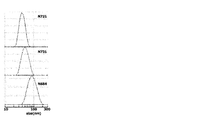
- Production Example 8 Preparation of self-assembled particles 2 Except for using the graft polymer (N741) synthesized in Production Example 6, the operation of Production Example 7 was repeated, and it was confirmed that particles having an average particle size of 153 nm were formed (see FIG. 6).
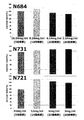
- Test Example 1 Cytotoxicity 1 In 96-well plates seeded with HepG2 cells for each 1x10 4, and adding each sample of the self-assembled particles prepared in Preparation Example 7, was incubated for 24 hours, it was added WST solution, 450 nm UV absorption after 2 hours was measured and compared with the control, and it was confirmed that there was almost no toxicity under the measured concentration (FIG. 7: Cytotoxicity of each nanoparticles of N684, N731 and N721 is shown).
- Test Example 2 Cytotoxicity 2
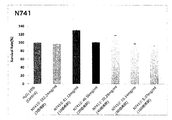
- the cytotoxicity of N741 was evaluated by repeating the operation of Test Example 1 except that the self-assembled particles prepared in Production Example 8 were used. The test results are shown in FIG. From FIG. 8, it can be seen that the nanoparticles of N741 do not show cytotoxicity in this test system.
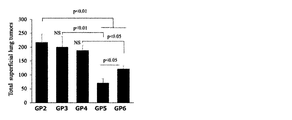
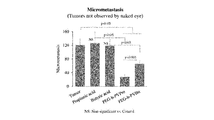
- Test Example 3 Cancer metastasis inhibitory effect 5-7 5-week-old BALB / c mice (male) in Group 1 were allowed to freely ingest each of the samples described in the following GP1 to GP6 administration groups. Two days later, dispensed caudal vein the 1x10 4 of B16F10 / B16F10 melanoma cells (obtained from Riken Cell Bank), was continued the water consumption of sample water.
- FIG. 10 shows the result of dissecting on the 11th day and confirming the number of cancers normally attached to the lung by macroscopic observation
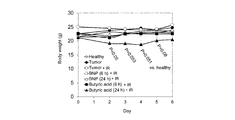
- FIG. 9 shows the change in body weight of the experimental animal under test.
- FIG. 10 shows the results of measuring the number of micrometastases that cannot be observed with the naked eye under a microscope. Similar to FIG. 10, it was confirmed that propionic acid nanoparticles (abbreviated as PEG-b-PVPro in the figure) extremely suppressed cancer metastasis.
- PEG-b-PVPro propionic acid nanoparticles
- FIG. 12 shows the H & E staining chart of the lung tissue chart (left) and the number of metastatic cancers obtained from the chart (right). Compared with the control, propionic acid nanoparticles and butyric acid nanoparticles showed a significant reduction in the number of cancers.
- FIG. 13 shows the H & E staining diagram (left) of the lung tissue chart and the area of metastatic cancer determined from the diagram (right). Propionic acid nanoparticles and butyric acid nanoparticles significantly reduced the area of cancer compared to controls and low molecular weight fatty acids.
- FIG. 14 shows the levels of ALT, AST, LDH and ALB in blood. In each case, it was confirmed that there was almost no damage to the liver or organs.
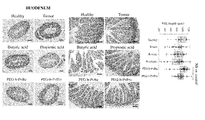
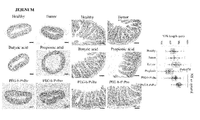
- FIGS. 15-18 show H & E staining diagrams of the small and large intestine tissues. Villi shortening was observed in the low molecular weight fatty acid group depending on the location, and it was confirmed that there was damage.
- Sample administration group GP1: Healthy group (n 5)
- GP2: Melanoma administration group (n 7)
- GP3: Melanoma administration group / 30 mM propionic acid free intake group (n 7)
- Test Example 4 Diet effect Five 4-week-old C57BL / 6J mice (male) in one group were fed solid feed D12492 (60% Fat, ultra-high fat feed) purchased from EPS Masshin Co., Ltd., and the following GP1 to Each sample described in each administration group of GP3 was given, and the body weight was measured. The results are shown in FIG.
- Test Example 5 Effect on ulcerative colitis Seven 7-week-old ICR mice (male) in one group were allowed to freely ingest 4% sodium dextran sulfate (DSS), and the following sample was orally administered once a day by sonde. After 10 days, the disease activity index (DAI) was measured and blood was evaluated. As shown in FIG. 20, butyric acid nanoparticles (denoted as BNP in the figure) were significantly reduced in the ulcerative colitis model, and a therapeutic effect was observed. In addition, as shown in FIG. 21, the white blood cell count was significantly increased in the ulcerative colitis model, whereas it was significantly suppressed in BNP.
- DAS disease activity index
- Sample administration group GP1 Free intake of tap water + tap water (0.65 mL) GP2: 4% DSS intake + tap water (0.65 mL) GP3: 4% DSS intake + butyric acid (2.32 mg / mL, 0.65 mL) GP4: 4% DSS intake + CNP (PEG-b-polystyrene) (10 mg / mL, 0.65 mL) GP5: 4% DSS intake + BNP (PEG-b-Poly (vinyl butyrate) (10 mg / mL, 0.65 mL)
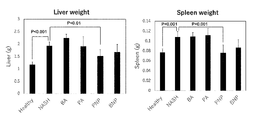
- Test Example 6 Effect on non-alcoholic steatohepatitis (NASH) 49 5-week-old C57BL / 6J mice (male) were fed with solid feed A06071302 (choline-deficient high-fat feed, methionine weight loss, 0) purchased from EPS Masushin Co., Ltd. (Addition of 1% methionine) was given by free intake, and after 4 weeks, the animals were randomly divided into 7 animals per group, and each sample described in each of the following GP1 to GP7 administration groups was administered by free intake. Data analysis was performed after 8 weeks.
- FIG. 22 shows the weight of the liver and spleen.
- Sample administration group GP1 Normal solid feed (Oriental yeast MF)
- GP2 Solid feed A06071302
- GP3 Solid feed A06071302 + butyric acid (65 mM)
- GP4 Solid feed A06071302 + propionic acid (50 mM)
- GP5 Solid feed A06071302 + butyric acid nanoparticles (10 mg / mL, polymer concentration 1 mM butyric acid equivalent 65 mM)
- GP6 Solid feed A06071302 + propionic acid nanoparticles (10 mg / mL, polymer concentration 1 mM propionic acid equivalent 50 mM)
- GP7 Solid feed A06071302 + polystyrene nanoparticles (10 mg / mL)
- Test Example 7 Cancer metastasis inhibitory effect # 2 5-7 7-8 week old C57BL / 6J mice (male) per group were obtained from Charles River Japan, Inc., Yokohama. These mice were bred under pathogenic conditions in a 12 hour dark / light cycle at controlled temperature (23 ⁇ 1 ° C.) and humidity (50 ⁇ 5%) with free feeding of standard solid feed. .. Mice were randomly divided into the following GP1 to GP6 administration groups, and each of the described samples was freely ingested. After one day, was injected caudal vein with 200 [mu] L B16F10 / B16F10 melanoma cells (physiological saline) per 2.5 ⁇ 10 5 (obtained from Riken Cell Bank). From 1 day before this tail injection to 11th, the end of the test, each sample was continuously fed to mice as a free drinking form. Plasma and other organs were harvested on day 11 and stored appropriately for each further analysis below.
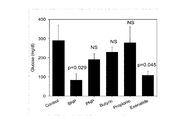
- Test Example 8 Effect on anti-diabetic test Animal management and use in this test and tests using all experimental animals disclosed in the present specification were carried out in strict accordance with the guidelines of the University of Tsukuba regarding the management and the like. Seven 7-8 week old C57BL / 6J mice (male) in one group were obtained from Charles River Japan, Inc. (Yokohama). These mice were bred under pathogenic conditions in a 12 hour dark / light cycle at controlled temperature (23 ⁇ 1 ° C.) and humidity (50 ⁇ 5%) with free feeding of standard solid feed. .. Mice were randomly divided into the following GP1 to GP6 administration groups, and each of the listed samples was fed freely for up to 36 days. One day later, a glucose tolerance test was performed.
- Sample administration group GP1 Exenatide (traditional antidiabetic drug), 1 ⁇ g (day 1-4), 2 ⁇ g (day 5-36) daily subcutaneous injection group GP2: 60 mM BNP (particles derived from N721: Production example) 7) Free intake group GP3: 60 mM PNP (particles derived from N721: see Production Example 7) Free intake group GP4: 30 mM Buty acid free intake group GP5: 30 mM Propionic acid free intake group. GP6: Control group (free water intake)
- the amount of sample consumed in the test is shown as the amount per mouse (mL), and the body weight of the mouse is shown as the average ⁇ SD value in FIG. 24, respectively.
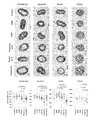
- the size of islets of Langerhans decreased in the diabetic model mice and the propionic acid-administered group, butyric acid-administered group, and PNP-administered group, but the islets of Langerhans were not atrophic in the BNP-administered group and the exenatide-administered group. It is shown to be maintained.
- Test Example 9 Effect as a radiation enhancer Part 1
- mice Five 5-7 week old C57BL / 6J mice in a group obtained in the same manner as in the above test were bred under the same conditions. 100 [mu] L (serum free DMEM) per 0.076 ⁇ 10 6 melanoma B16F10 cells were injected subcutaneously into the right thigh outer side of the mouse (day 7 before irradiation). After 1 week of cancer growth, mice were randomly divided into the following treatment groups. BNP 500 mg / kg was administered intraperitoneally (ip) of mice 1 day before irradiation and immediately after irradiation, and the radiation enhancing effect was confirmed (GP3 and GP4, respectively).
- Irradiation conditions were set at 10 Gy, 150 kV, 20 mA, Al filtration, and 330 mm intervals.
- Sample administration group GP1 Cancer symmetric group GP2: Cancer + irradiation (IR: 10 Gy) group GP3: BNP 500 mg / kg (1 day before irradiation) group GP4: BNP 500 mg / kg (0 day after irradiation) group
- Plasma and other organs were collected at the end of the study and stored appropriately for further analysis.
- the 10 Gy irradiation group has a tumor growth inhibitory effect, and even if BNP is administered before and after X-ray irradiation, the tumor size after 8 days is significantly smaller than that in the BNP non-administration group, confirming the radiation enhancing effect.
- Test Example 10 Effect as a radiation enhancer Part 2
- 100 [mu] L (serum free DMEM) per 0.076 ⁇ 10 6 melanoma B16F10 cells were injected subcutaneously into the right thigh outer side of the mouse (day 9 before irradiation).
- mice were randomly divided into the following treatment groups. Irradiation conditions were set at 10 Gy, 150 kV, 20 mA, Al + Cu (0.5 mm + 0.1 mm) filtration, and 330 mm intervals.
- FIG. 33 The data of the cancer growth profile by irradiation with 5 Gy after administration of butyric acid and NP in the melanoma xenograft model is shown in FIG. 33.
- Butyric acid and BNP were administered prior to irradiation.
- Weight loss was observed in the butyric acid administration group, and toxicity was observed. On the other hand, the BNP-administered group showed no weight loss and was not toxic.
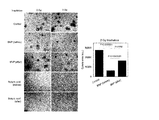
- Mouse melanoma B16F10 cells were purchased from Cell Bank (RIKEN, Japan). These cell lines were supplemented with 10% fetal bovine serum and an antibiotic mixture of 100 ng / mL penicillin-streptomycin-neomycin in Dalveco's modified Eagle's medium (DMEM; L-glutamine, 1 g / L glucose, sodium bicarbonate, Sigma- Aldrich, St Louis, MO, USA) was maintained at 37 ° C. under a humid atmosphere of 5% CO 2 . The results are shown in FIG. The growth inhibitory effect of spheroid cancer cells is clearly confirmed in the BNP-administered group.
- DMEM Dalveco's modified Eagle's medium
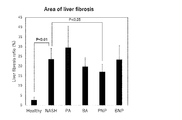
- Test Example 12 Effect on non-alcoholic steatohepatitis (NASH) Part 2 Forty-two 5-week-old C57BL / 6J mice (male) were fed a solid feed A06071302 (choline-deficient high-fat feed, methionine reduction, 0.1% methionine addition) purchased from EPS Masushin Co., Ltd. by free intake. After 4 weeks, the animals were randomly divided into 7 animals per group, and were divided into the following healthy groups (Healthy) (no solid feed A06071302), NASH, butyric acid (BA), propionic acid (PA), PNP, and BNP 6 groups. Each sample described in the above was administered by free ingestion (prepared to a concentration of 65 mM for PA in the PA and PNP groups and 50 mM for BA in the BA and BNP groups). Data analysis was performed after 8 weeks.
- NASH non-alcoholic steatohepatitis
- the liver weight (left figure) is significantly heavier in the NASH group than in the healthy group, causing inflammation.
- the PNP-administered group has a significantly lighter liver weight than the NASH group and suppresses inflammation.
- the spleen weight (left figure) was significantly increased in the NASH group and significantly decreased in the PNP-administered group compared to the healthy group.
- the graph shows the error bars based on the mean value and standard deviation of the oil droplet structure area of each group.
- the t-test is performed to check for statistically significant differences between the mean values, and there is a statistically significant difference at P ⁇ 0.05.
- the amount of oil droplets in the liver increased significantly in the NASH group compared to the healthy group (fatty liver condition).
- the amount of oil droplets in the PNP-administered group was significantly smaller than that in the NASH group.
- the graph shows error bars based on the mean value and standard deviation of the fibrotic tissue area of each group.
- the T-test is performed to check for statistically significant differences between the mean values, and there is a statistically significant difference at p ⁇ 0.05.
- the amount of liver fibrosis is significantly higher in the NASH group than in the healthy group.
- the amount of liver fibrosis in the PNP-administered group was significantly smaller than that in the NASH group.
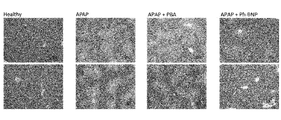
- Test Example 13 Anti-ammonemia effect Twenty-four 6-week-old C57BL / 6N mice (male) were randomly divided into 4 groups, and samples were orally administered by sonde over 4 days (1.22 mmol once a day). -4 PBA / kg). In the administration group 2GP-4GP, acetaminophen (acetyl-p-aminophenol; APAP; 300 mg / kg) was intraperitoneally administered on the 4th day to cause acute liver injury and hyperammonemia, and on the 5th day. It was dissected and evaluated.
- acetaminophen acetyl-p-aminophenol
- APAP 300 mg / kg
- Sample administration group 1GP: Saline 2GP: APAP + water 3GP: APAP + 4-phenylbutyric acid (200mg / kg, 1.22 mmol-4PBA / kg) 4GP: APAP + Ph-BNP (200 mg / kg, 1.22 mmol-4PBA / kg)
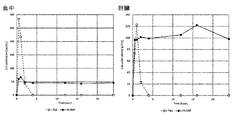
- Test Example 15 Pharmacokinetic test According to the method of Production Examples 1 to 8 described above, the corresponding modification is carried out according to a conventional method, and PEG-b-poly (vinyl butyric acid) having a benzene ring at the ⁇ terminal of PEG (the following formula left). (See.) And PEG-b-poly (vinyl4-phenylbutyric acid) (see the formula on the right), 125 I was introduced by the chloramine method, purified twice on a PD-10 column, and unreacted iodine was added. Sorted.
- mice in which N932 was freely ingested from a water bottle were collected from blood, liver and gastrointestinal tract, and their gamma ray intensities were measured by a scintillation detector. The results are shown in FIG. 42 (left). From the figure, it was confirmed that N932 was almost completely localized in the gastrointestinal tract.
- N930 was orally administered by force with a sonde, and the gamma ray intensity of major organs was measured 24 hours later.
- the results are shown in FIG. 42 (right). From this figure, it can be confirmed that 4-phenylbutyric acid is widely distributed in the digestive tract, blood, liver, kidney, etc., and is hydrolyzed in the digestive tract and taken up in the circulatory system.
- Sample administration group 1GP: Saline (control, 3 animals)
Landscapes
- Health & Medical Sciences (AREA)
- Chemical & Material Sciences (AREA)
- Medicinal Chemistry (AREA)
- Chemical Kinetics & Catalysis (AREA)
- Organic Chemistry (AREA)
- General Chemical & Material Sciences (AREA)
- Animal Behavior & Ethology (AREA)
- Veterinary Medicine (AREA)
- Public Health (AREA)
- General Health & Medical Sciences (AREA)
- Pharmacology & Pharmacy (AREA)
- Life Sciences & Earth Sciences (AREA)
- Engineering & Computer Science (AREA)
- Polymers & Plastics (AREA)
- Bioinformatics & Cheminformatics (AREA)
- Nuclear Medicine, Radiotherapy & Molecular Imaging (AREA)
- Epidemiology (AREA)
- Gastroenterology & Hepatology (AREA)
- Diabetes (AREA)
- Hematology (AREA)
- Obesity (AREA)
- Child & Adolescent Psychology (AREA)
- Nanotechnology (AREA)
- Immunology (AREA)
- Medicinal Preparation (AREA)
- Acyclic And Carbocyclic Compounds In Medicinal Compositions (AREA)
- Graft Or Block Polymers (AREA)
- Other Resins Obtained By Reactions Not Involving Carbon-To-Carbon Unsaturated Bonds (AREA)
- Pharmaceuticals Containing Other Organic And Inorganic Compounds (AREA)
Priority Applications (6)
| Application Number | Priority Date | Filing Date | Title |
|---|---|---|---|
| AU2020324649A AU2020324649B8 (en) | 2019-08-05 | 2020-07-30 | Hydrophilic-hydrophobic copolymer carrying short-chain fatty acid ester |
| JP2021537269A JP7548586B2 (ja) | 2019-08-05 | 2020-07-30 | 短鎖脂肪酸エステルを担持する親水-疎水性共重合体 |
| EP20848934.4A EP4011444A4 (en) | 2019-08-05 | 2020-07-30 | Hydrophilic-hydrophobic copolymer carrying short-chain fatty acid ester |
| CA3152003A CA3152003A1 (en) | 2019-08-05 | 2020-07-30 | Hydrophilic-hydrophobic copolymer carrying short chain fatty acid ester |
| CN202080069272.0A CN114430756B (zh) | 2019-08-05 | 2020-07-30 | 担载短链脂肪酸酯的亲水-疏水性共聚物 |
| US17/631,593 US20220332876A1 (en) | 2019-08-05 | 2020-07-30 | Hydrophilic-hydrophobic copolymer carrying short chain fatty acid ester |
Applications Claiming Priority (2)
| Application Number | Priority Date | Filing Date | Title |
|---|---|---|---|
| JP2019143619 | 2019-08-05 | ||
| JP2019-143619 | 2019-08-05 |
Publications (1)
| Publication Number | Publication Date |
|---|---|
| WO2021024906A1 true WO2021024906A1 (ja) | 2021-02-11 |
Family
ID=74503809
Family Applications (1)
| Application Number | Title | Priority Date | Filing Date |
|---|---|---|---|
| PCT/JP2020/029239 Ceased WO2021024906A1 (ja) | 2019-08-05 | 2020-07-30 | 短鎖脂肪酸エステルを担持する親水-疎水性共重合体 |
Country Status (7)
| Country | Link |
|---|---|
| US (1) | US20220332876A1 (https=) |
| EP (1) | EP4011444A4 (https=) |
| JP (1) | JP7548586B2 (https=) |
| CN (1) | CN114430756B (https=) |
| AU (1) | AU2020324649B8 (https=) |
| CA (1) | CA3152003A1 (https=) |
| WO (1) | WO2021024906A1 (https=) |
Cited By (1)
| Publication number | Priority date | Publication date | Assignee | Title |
|---|---|---|---|---|
| WO2025069980A1 (ja) | 2023-09-28 | 2025-04-03 | 国立大学法人筑波大学 | ジクロロ酢酸を側鎖に担持する親水-疎水性共重合体及びそれらの医療用途 |
Citations (8)
| Publication number | Priority date | Publication date | Assignee | Title |
|---|---|---|---|---|
| JPH0616752A (ja) * | 1992-04-16 | 1994-01-25 | Huels Ag | 水性プラスチック分散液の製造方法 |
| JPH0616747A (ja) * | 1992-06-29 | 1994-01-25 | Kuraray Co Ltd | 分散安定剤および水性分散液 |
| JP2007185494A (ja) * | 2005-11-29 | 2007-07-26 | Cordis Corp | 両親媒性コポリマー組成物 |
| WO2009133647A1 (ja) | 2008-05-02 | 2009-11-05 | 国立大学法人筑波大学 | 高分子化環状二トロキシドラジカル化合物およびその使用 |
| WO2016052463A1 (ja) | 2014-09-30 | 2016-04-07 | 国立大学法人筑波大学 | ポリ(エチレングリコール)-b-ポリ(ハロメチルスチレン)並びにその誘導体及び製造方法 |
| WO2018135592A1 (ja) * | 2017-01-19 | 2018-07-26 | 国立大学法人筑波大学 | 側鎖に環状ニトロキシドラジカルとトリアルコキシシリルを含む共重合体およびその使用 |
| JP2019001786A (ja) * | 2017-06-19 | 2019-01-10 | 国立大学法人 筑波大学 | 感染症治療薬 |
| WO2019208617A1 (ja) * | 2018-04-27 | 2019-10-31 | 国立大学法人筑波大学 | ソラフェニブの経口デリバリー用組成物及びその使用 |
Family Cites Families (2)
| Publication number | Priority date | Publication date | Assignee | Title |
|---|---|---|---|---|
| US6616946B1 (en) * | 1999-11-15 | 2003-09-09 | Biocure, Inc. | Triblock copolymer hollow particles for agent delivery by permeability change |
| JP7136807B2 (ja) * | 2017-04-17 | 2022-09-13 | ザ・ユニバーシティ・オブ・シカゴ | ヒトの健康及び疾患の治療用途向けの短鎖脂肪酸の腸への送達用ポリマー材料 |
-
2020
- 2020-07-30 CA CA3152003A patent/CA3152003A1/en active Pending
- 2020-07-30 AU AU2020324649A patent/AU2020324649B8/en not_active Expired - Fee Related
- 2020-07-30 WO PCT/JP2020/029239 patent/WO2021024906A1/ja not_active Ceased
- 2020-07-30 JP JP2021537269A patent/JP7548586B2/ja active Active
- 2020-07-30 US US17/631,593 patent/US20220332876A1/en not_active Abandoned
- 2020-07-30 EP EP20848934.4A patent/EP4011444A4/en active Pending
- 2020-07-30 CN CN202080069272.0A patent/CN114430756B/zh active Active
Patent Citations (8)
| Publication number | Priority date | Publication date | Assignee | Title |
|---|---|---|---|---|
| JPH0616752A (ja) * | 1992-04-16 | 1994-01-25 | Huels Ag | 水性プラスチック分散液の製造方法 |
| JPH0616747A (ja) * | 1992-06-29 | 1994-01-25 | Kuraray Co Ltd | 分散安定剤および水性分散液 |
| JP2007185494A (ja) * | 2005-11-29 | 2007-07-26 | Cordis Corp | 両親媒性コポリマー組成物 |
| WO2009133647A1 (ja) | 2008-05-02 | 2009-11-05 | 国立大学法人筑波大学 | 高分子化環状二トロキシドラジカル化合物およびその使用 |
| WO2016052463A1 (ja) | 2014-09-30 | 2016-04-07 | 国立大学法人筑波大学 | ポリ(エチレングリコール)-b-ポリ(ハロメチルスチレン)並びにその誘導体及び製造方法 |
| WO2018135592A1 (ja) * | 2017-01-19 | 2018-07-26 | 国立大学法人筑波大学 | 側鎖に環状ニトロキシドラジカルとトリアルコキシシリルを含む共重合体およびその使用 |
| JP2019001786A (ja) * | 2017-06-19 | 2019-01-10 | 国立大学法人 筑波大学 | 感染症治療薬 |
| WO2019208617A1 (ja) * | 2018-04-27 | 2019-10-31 | 国立大学法人筑波大学 | ソラフェニブの経口デリバリー用組成物及びその使用 |
Non-Patent Citations (2)
| Title |
|---|
| See also references of EP4011444A4 |
| TAKASHI SAKATAHIROHUMI ICHIKAWA: "Physiological Actions of Short-Chain Fatty Acids", JOURNAL OF JAPAN OIL CHEMISTS' SOCIETY, vol. 46, 1997, pages 1205 - 1212 |
Cited By (1)
| Publication number | Priority date | Publication date | Assignee | Title |
|---|---|---|---|---|
| WO2025069980A1 (ja) | 2023-09-28 | 2025-04-03 | 国立大学法人筑波大学 | ジクロロ酢酸を側鎖に担持する親水-疎水性共重合体及びそれらの医療用途 |
Also Published As
| Publication number | Publication date |
|---|---|
| CN114430756B (zh) | 2025-07-11 |
| US20220332876A1 (en) | 2022-10-20 |
| CN114430756A (zh) | 2022-05-03 |
| CA3152003A1 (en) | 2021-02-11 |
| AU2020324649B1 (en) | 2025-07-17 |
| JPWO2021024906A1 (https=) | 2021-02-11 |
| AU2020324649A1 (en) | 2022-03-17 |
| EP4011444A1 (en) | 2022-06-15 |
| JP7548586B2 (ja) | 2024-09-10 |
| AU2020324649B8 (en) | 2025-08-07 |
| EP4011444A4 (en) | 2023-10-25 |
Similar Documents
| Publication | Publication Date | Title |
|---|---|---|
| US9193756B2 (en) | Adrenomedullin production enhancer | |
| EP3031456A1 (en) | Application of andrographolide in the preparation of a pharmaceutical for treatment of inflammatory bowel disease, andrographolide enteric targeting micropellet, and method for preparation thereof | |
| US20070141173A1 (en) | Medicament comprising noble metal fine particles | |
| JP7649505B2 (ja) | 放射線防護のための薬物複合体及びその製造方法と使用 | |
| WO2021024906A1 (ja) | 短鎖脂肪酸エステルを担持する親水-疎水性共重合体 | |
| WO2015043688A1 (en) | Prodrugs of monomethyl fumarate (mmf) | |
| JP2009531379A (ja) | 鉄代謝機能障害を治療するためのストロビルリンの使用 | |
| CN102743336A (zh) | 姜黄素壳聚糖硬脂酸嫁接物胶束的制备方法及其应用 | |
| CN1935812B (zh) | 金属富勒醇及其在制备抑制肿瘤生长药物中的应用 | |
| US20230055593A1 (en) | Pharmaceutical composition containing b-lapachone as active ingredient for prevention or treatment of cholestatic liver disease | |
| CH665637A5 (fr) | 5-(3-n-butyloxalylaminophenyl)tetrazole comme agent antiasthmatique, composition le contenant et procede de preparation de la composition. | |
| WO2014184198A1 (fr) | Composition orale a base de (+)-catechine | |
| EP1117370A1 (en) | CONTROLLED RELEASE FROM COPOLYMERS OF ACRYLIC OR METHACRYLIC ACID/L-DOPA, ACRYLIC OR METHACRYLIC ACID/L-$g(a)-METHYL DOPA, ACRYLIC OR METHACRYLIC ACID/CARBIDOPA AND THEIR COMBINATIONS | |
| CN1369266A (zh) | 一种免疫抑制药物及其制备方法和应用 | |
| RU2829636C1 (ru) | Фармацевтическая композиция на основе 5-пентилрезорцинола для лечения воспалительных заболеваний кишечника | |
| CN119033796B (zh) | 一种人参皂苷Rg3载药系统及其制备方法和应用 | |
| CN119258037B (zh) | 基于pB和ASD偶联物纳米粒子的制备方法及应用 | |
| US20260053772A1 (en) | Pharmaceutical composition containing b-lapachone as active ingredient for prevention or treatment of cholestatic liver disease | |
| WO2025069980A1 (ja) | ジクロロ酢酸を側鎖に担持する親水-疎水性共重合体及びそれらの医療用途 | |
| CN1872852A (zh) | 小檗碱衍生物及其制备方法和其药物组合物与用途 | |
| CN116478430A (zh) | 一种具有过氧化氢敏感性的共价环糊精骨架及其制备方法 | |
| WO2025053156A1 (ja) | N-アシルエタノールアミン又はその同族体若しくは類似体を側鎖に有する反復単位とポリ(エチレングリコール)セグメントを含む共重合体並びに当該共重合体のナノ粒子及びその用途 | |
| CN120242042A (zh) | 一种富勒烯纳米复合材料的制备方法及其应用 | |
| CN121401453A (zh) | 兼具线粒体靶向与荧光示踪功能的乳酰苯丙氨酸脂质体及其应用 | |
| TWI527828B (zh) | 新穎的三萜化合物及其用途 |
Legal Events
| Date | Code | Title | Description |
|---|---|---|---|
| 121 | Ep: the epo has been informed by wipo that ep was designated in this application |
Ref document number: 20848934 Country of ref document: EP Kind code of ref document: A1 |
|
| ENP | Entry into the national phase |
Ref document number: 2021537269 Country of ref document: JP Kind code of ref document: A |
|
| NENP | Non-entry into the national phase |
Ref country code: DE |
|
| ENP | Entry into the national phase |
Ref document number: 3152003 Country of ref document: CA |
|
| ENP | Entry into the national phase |
Ref document number: 2020848934 Country of ref document: EP Effective date: 20220307 |
|
| ENP | Entry into the national phase |
Ref document number: 2020324649 Country of ref document: AU Date of ref document: 20200730 Kind code of ref document: A |
|
| WWG | Wipo information: grant in national office |
Ref document number: 202080069272.0 Country of ref document: CN |