WO2021010472A1 - 立方晶窒化硼素焼結体および切削工具 - Google Patents
立方晶窒化硼素焼結体および切削工具 Download PDFInfo
- Publication number
- WO2021010472A1 WO2021010472A1 PCT/JP2020/027899 JP2020027899W WO2021010472A1 WO 2021010472 A1 WO2021010472 A1 WO 2021010472A1 JP 2020027899 W JP2020027899 W JP 2020027899W WO 2021010472 A1 WO2021010472 A1 WO 2021010472A1
- Authority
- WO
- WIPO (PCT)
- Prior art keywords
- phase
- boron nitride
- sintered body
- cubic boron
- cbn
- Prior art date
- Legal status (The legal status is an assumption and is not a legal conclusion. Google has not performed a legal analysis and makes no representation as to the accuracy of the status listed.)
- Ceased
Links
Images





Classifications
-
- B—PERFORMING OPERATIONS; TRANSPORTING
- B23—MACHINE TOOLS; METAL-WORKING NOT OTHERWISE PROVIDED FOR
- B23B—TURNING; BORING
- B23B27/00—Tools for turning or boring machines; Tools of a similar kind in general; Accessories therefor
- B23B27/14—Cutting tools of which the bits or tips or cutting inserts are of special material
- B23B27/16—Cutting tools of which the bits or tips or cutting inserts are of special material with exchangeable cutting bits or cutting inserts, e.g. able to be clamped
-
- B—PERFORMING OPERATIONS; TRANSPORTING
- B23—MACHINE TOOLS; METAL-WORKING NOT OTHERWISE PROVIDED FOR
- B23B—TURNING; BORING
- B23B27/00—Tools for turning or boring machines; Tools of a similar kind in general; Accessories therefor
- B23B27/14—Cutting tools of which the bits or tips or cutting inserts are of special material
- B23B27/18—Cutting tools of which the bits or tips or cutting inserts are of special material with cutting bits or tips or cutting inserts rigidly mounted, e.g. by brazing
- B23B27/20—Cutting tools of which the bits or tips or cutting inserts are of special material with cutting bits or tips or cutting inserts rigidly mounted, e.g. by brazing with diamond bits or cutting inserts
-
- C—CHEMISTRY; METALLURGY
- C04—CEMENTS; CONCRETE; ARTIFICIAL STONE; CERAMICS; REFRACTORIES
- C04B—LIME, MAGNESIA; SLAG; CEMENTS; COMPOSITIONS THEREOF, e.g. MORTARS, CONCRETE OR LIKE BUILDING MATERIALS; ARTIFICIAL STONE; CERAMICS; REFRACTORIES; TREATMENT OF NATURAL STONE
- C04B35/00—Shaped ceramic products characterised by their composition; Ceramics compositions; Processing powders of inorganic compounds preparatory to the manufacturing of ceramic products
- C04B35/515—Shaped ceramic products characterised by their composition; Ceramics compositions; Processing powders of inorganic compounds preparatory to the manufacturing of ceramic products based on non-oxide ceramics
- C04B35/56—Shaped ceramic products characterised by their composition; Ceramics compositions; Processing powders of inorganic compounds preparatory to the manufacturing of ceramic products based on non-oxide ceramics based on carbides or oxycarbides
- C04B35/5607—Shaped ceramic products characterised by their composition; Ceramics compositions; Processing powders of inorganic compounds preparatory to the manufacturing of ceramic products based on non-oxide ceramics based on carbides or oxycarbides based on refractory metal carbides
- C04B35/5611—Shaped ceramic products characterised by their composition; Ceramics compositions; Processing powders of inorganic compounds preparatory to the manufacturing of ceramic products based on non-oxide ceramics based on carbides or oxycarbides based on refractory metal carbides based on titanium carbides
- C04B35/5618—Shaped ceramic products characterised by their composition; Ceramics compositions; Processing powders of inorganic compounds preparatory to the manufacturing of ceramic products based on non-oxide ceramics based on carbides or oxycarbides based on refractory metal carbides based on titanium carbides based on titanium aluminium carbides
-
- C—CHEMISTRY; METALLURGY
- C04—CEMENTS; CONCRETE; ARTIFICIAL STONE; CERAMICS; REFRACTORIES
- C04B—LIME, MAGNESIA; SLAG; CEMENTS; COMPOSITIONS THEREOF, e.g. MORTARS, CONCRETE OR LIKE BUILDING MATERIALS; ARTIFICIAL STONE; CERAMICS; REFRACTORIES; TREATMENT OF NATURAL STONE
- C04B35/00—Shaped ceramic products characterised by their composition; Ceramics compositions; Processing powders of inorganic compounds preparatory to the manufacturing of ceramic products
- C04B35/515—Shaped ceramic products characterised by their composition; Ceramics compositions; Processing powders of inorganic compounds preparatory to the manufacturing of ceramic products based on non-oxide ceramics
- C04B35/58—Shaped ceramic products characterised by their composition; Ceramics compositions; Processing powders of inorganic compounds preparatory to the manufacturing of ceramic products based on non-oxide ceramics based on borides, nitrides, i.e. nitrides, oxynitrides, carbonitrides or oxycarbonitrides or silicides
- C04B35/583—Shaped ceramic products characterised by their composition; Ceramics compositions; Processing powders of inorganic compounds preparatory to the manufacturing of ceramic products based on non-oxide ceramics based on borides, nitrides, i.e. nitrides, oxynitrides, carbonitrides or oxycarbonitrides or silicides based on boron nitride
- C04B35/5831—Shaped ceramic products characterised by their composition; Ceramics compositions; Processing powders of inorganic compounds preparatory to the manufacturing of ceramic products based on non-oxide ceramics based on borides, nitrides, i.e. nitrides, oxynitrides, carbonitrides or oxycarbonitrides or silicides based on boron nitride based on cubic boron nitrides or Wurtzitic boron nitrides, including crystal structure transformation of powder
-
- C—CHEMISTRY; METALLURGY
- C04—CEMENTS; CONCRETE; ARTIFICIAL STONE; CERAMICS; REFRACTORIES
- C04B—LIME, MAGNESIA; SLAG; CEMENTS; COMPOSITIONS THEREOF, e.g. MORTARS, CONCRETE OR LIKE BUILDING MATERIALS; ARTIFICIAL STONE; CERAMICS; REFRACTORIES; TREATMENT OF NATURAL STONE
- C04B35/00—Shaped ceramic products characterised by their composition; Ceramics compositions; Processing powders of inorganic compounds preparatory to the manufacturing of ceramic products
- C04B35/622—Forming processes; Processing powders of inorganic compounds preparatory to the manufacturing of ceramic products
- C04B35/626—Preparing or treating the powders individually or as batches ; preparing or treating macroscopic reinforcing agents for ceramic products, e.g. fibres; mechanical aspects section B
- C04B35/62605—Treating the starting powders individually or as mixtures
- C04B35/6261—Milling
- C04B35/62615—High energy or reactive ball milling
-
- C—CHEMISTRY; METALLURGY
- C04—CEMENTS; CONCRETE; ARTIFICIAL STONE; CERAMICS; REFRACTORIES
- C04B—LIME, MAGNESIA; SLAG; CEMENTS; COMPOSITIONS THEREOF, e.g. MORTARS, CONCRETE OR LIKE BUILDING MATERIALS; ARTIFICIAL STONE; CERAMICS; REFRACTORIES; TREATMENT OF NATURAL STONE
- C04B35/00—Shaped ceramic products characterised by their composition; Ceramics compositions; Processing powders of inorganic compounds preparatory to the manufacturing of ceramic products
- C04B35/622—Forming processes; Processing powders of inorganic compounds preparatory to the manufacturing of ceramic products
- C04B35/626—Preparing or treating the powders individually or as batches ; preparing or treating macroscopic reinforcing agents for ceramic products, e.g. fibres; mechanical aspects section B
- C04B35/62605—Treating the starting powders individually or as mixtures
- C04B35/62645—Thermal treatment of powders or mixtures thereof other than sintering
- C04B35/6268—Thermal treatment of powders or mixtures thereof other than sintering characterised by the applied pressure or type of atmosphere, e.g. in vacuum, hydrogen or a specific oxygen pressure
-
- C—CHEMISTRY; METALLURGY
- C04—CEMENTS; CONCRETE; ARTIFICIAL STONE; CERAMICS; REFRACTORIES
- C04B—LIME, MAGNESIA; SLAG; CEMENTS; COMPOSITIONS THEREOF, e.g. MORTARS, CONCRETE OR LIKE BUILDING MATERIALS; ARTIFICIAL STONE; CERAMICS; REFRACTORIES; TREATMENT OF NATURAL STONE
- C04B35/00—Shaped ceramic products characterised by their composition; Ceramics compositions; Processing powders of inorganic compounds preparatory to the manufacturing of ceramic products
- C04B35/622—Forming processes; Processing powders of inorganic compounds preparatory to the manufacturing of ceramic products
- C04B35/626—Preparing or treating the powders individually or as batches ; preparing or treating macroscopic reinforcing agents for ceramic products, e.g. fibres; mechanical aspects section B
- C04B35/628—Coating the powders or the macroscopic reinforcing agents
-
- C—CHEMISTRY; METALLURGY
- C04—CEMENTS; CONCRETE; ARTIFICIAL STONE; CERAMICS; REFRACTORIES
- C04B—LIME, MAGNESIA; SLAG; CEMENTS; COMPOSITIONS THEREOF, e.g. MORTARS, CONCRETE OR LIKE BUILDING MATERIALS; ARTIFICIAL STONE; CERAMICS; REFRACTORIES; TREATMENT OF NATURAL STONE
- C04B35/00—Shaped ceramic products characterised by their composition; Ceramics compositions; Processing powders of inorganic compounds preparatory to the manufacturing of ceramic products
- C04B35/622—Forming processes; Processing powders of inorganic compounds preparatory to the manufacturing of ceramic products
- C04B35/626—Preparing or treating the powders individually or as batches ; preparing or treating macroscopic reinforcing agents for ceramic products, e.g. fibres; mechanical aspects section B
- C04B35/628—Coating the powders or the macroscopic reinforcing agents
- C04B35/62886—Coating the powders or the macroscopic reinforcing agents by wet chemical techniques
-
- C—CHEMISTRY; METALLURGY
- C04—CEMENTS; CONCRETE; ARTIFICIAL STONE; CERAMICS; REFRACTORIES
- C04B—LIME, MAGNESIA; SLAG; CEMENTS; COMPOSITIONS THEREOF, e.g. MORTARS, CONCRETE OR LIKE BUILDING MATERIALS; ARTIFICIAL STONE; CERAMICS; REFRACTORIES; TREATMENT OF NATURAL STONE
- C04B35/00—Shaped ceramic products characterised by their composition; Ceramics compositions; Processing powders of inorganic compounds preparatory to the manufacturing of ceramic products
- C04B35/622—Forming processes; Processing powders of inorganic compounds preparatory to the manufacturing of ceramic products
- C04B35/626—Preparing or treating the powders individually or as batches ; preparing or treating macroscopic reinforcing agents for ceramic products, e.g. fibres; mechanical aspects section B
- C04B35/628—Coating the powders or the macroscopic reinforcing agents
- C04B35/62889—Coating the powders or the macroscopic reinforcing agents with a discontinuous coating layer
-
- C—CHEMISTRY; METALLURGY
- C04—CEMENTS; CONCRETE; ARTIFICIAL STONE; CERAMICS; REFRACTORIES
- C04B—LIME, MAGNESIA; SLAG; CEMENTS; COMPOSITIONS THEREOF, e.g. MORTARS, CONCRETE OR LIKE BUILDING MATERIALS; ARTIFICIAL STONE; CERAMICS; REFRACTORIES; TREATMENT OF NATURAL STONE
- C04B35/00—Shaped ceramic products characterised by their composition; Ceramics compositions; Processing powders of inorganic compounds preparatory to the manufacturing of ceramic products
- C04B35/622—Forming processes; Processing powders of inorganic compounds preparatory to the manufacturing of ceramic products
- C04B35/626—Preparing or treating the powders individually or as batches ; preparing or treating macroscopic reinforcing agents for ceramic products, e.g. fibres; mechanical aspects section B
- C04B35/63—Preparing or treating the powders individually or as batches ; preparing or treating macroscopic reinforcing agents for ceramic products, e.g. fibres; mechanical aspects section B using additives specially adapted for forming the products, e.g.. binder binders
- C04B35/6303—Inorganic additives
-
- C—CHEMISTRY; METALLURGY
- C04—CEMENTS; CONCRETE; ARTIFICIAL STONE; CERAMICS; REFRACTORIES
- C04B—LIME, MAGNESIA; SLAG; CEMENTS; COMPOSITIONS THEREOF, e.g. MORTARS, CONCRETE OR LIKE BUILDING MATERIALS; ARTIFICIAL STONE; CERAMICS; REFRACTORIES; TREATMENT OF NATURAL STONE
- C04B35/00—Shaped ceramic products characterised by their composition; Ceramics compositions; Processing powders of inorganic compounds preparatory to the manufacturing of ceramic products
- C04B35/622—Forming processes; Processing powders of inorganic compounds preparatory to the manufacturing of ceramic products
- C04B35/626—Preparing or treating the powders individually or as batches ; preparing or treating macroscopic reinforcing agents for ceramic products, e.g. fibres; mechanical aspects section B
- C04B35/63—Preparing or treating the powders individually or as batches ; preparing or treating macroscopic reinforcing agents for ceramic products, e.g. fibres; mechanical aspects section B using additives specially adapted for forming the products, e.g.. binder binders
- C04B35/638—Removal thereof
-
- C—CHEMISTRY; METALLURGY
- C04—CEMENTS; CONCRETE; ARTIFICIAL STONE; CERAMICS; REFRACTORIES
- C04B—LIME, MAGNESIA; SLAG; CEMENTS; COMPOSITIONS THEREOF, e.g. MORTARS, CONCRETE OR LIKE BUILDING MATERIALS; ARTIFICIAL STONE; CERAMICS; REFRACTORIES; TREATMENT OF NATURAL STONE
- C04B35/00—Shaped ceramic products characterised by their composition; Ceramics compositions; Processing powders of inorganic compounds preparatory to the manufacturing of ceramic products
- C04B35/622—Forming processes; Processing powders of inorganic compounds preparatory to the manufacturing of ceramic products
- C04B35/64—Burning or sintering processes
- C04B35/645—Pressure sintering
-
- C—CHEMISTRY; METALLURGY
- C04—CEMENTS; CONCRETE; ARTIFICIAL STONE; CERAMICS; REFRACTORIES
- C04B—LIME, MAGNESIA; SLAG; CEMENTS; COMPOSITIONS THEREOF, e.g. MORTARS, CONCRETE OR LIKE BUILDING MATERIALS; ARTIFICIAL STONE; CERAMICS; REFRACTORIES; TREATMENT OF NATURAL STONE
- C04B41/00—After-treatment of mortars, concrete, artificial stone or ceramics; Treatment of natural stone
- C04B41/009—After-treatment of mortars, concrete, artificial stone or ceramics; Treatment of natural stone characterised by the material treated
-
- C—CHEMISTRY; METALLURGY
- C04—CEMENTS; CONCRETE; ARTIFICIAL STONE; CERAMICS; REFRACTORIES
- C04B—LIME, MAGNESIA; SLAG; CEMENTS; COMPOSITIONS THEREOF, e.g. MORTARS, CONCRETE OR LIKE BUILDING MATERIALS; ARTIFICIAL STONE; CERAMICS; REFRACTORIES; TREATMENT OF NATURAL STONE
- C04B41/00—After-treatment of mortars, concrete, artificial stone or ceramics; Treatment of natural stone
- C04B41/80—After-treatment of mortars, concrete, artificial stone or ceramics; Treatment of natural stone of only ceramics
- C04B41/81—Coating or impregnation
-
- C—CHEMISTRY; METALLURGY
- C04—CEMENTS; CONCRETE; ARTIFICIAL STONE; CERAMICS; REFRACTORIES
- C04B—LIME, MAGNESIA; SLAG; CEMENTS; COMPOSITIONS THEREOF, e.g. MORTARS, CONCRETE OR LIKE BUILDING MATERIALS; ARTIFICIAL STONE; CERAMICS; REFRACTORIES; TREATMENT OF NATURAL STONE
- C04B41/00—After-treatment of mortars, concrete, artificial stone or ceramics; Treatment of natural stone
- C04B41/80—After-treatment of mortars, concrete, artificial stone or ceramics; Treatment of natural stone of only ceramics
- C04B41/81—Coating or impregnation
- C04B41/85—Coating or impregnation with inorganic materials
- C04B41/87—Ceramics
-
- B—PERFORMING OPERATIONS; TRANSPORTING
- B22—CASTING; POWDER METALLURGY
- B22F—WORKING METALLIC POWDER; MANUFACTURE OF ARTICLES FROM METALLIC POWDER; MAKING METALLIC POWDER; APPARATUS OR DEVICES SPECIALLY ADAPTED FOR METALLIC POWDER
- B22F5/00—Manufacture of workpieces or articles from metallic powder characterised by the special shape of the product
- B22F2005/001—Cutting tools, earth boring or grinding tool other than table ware
-
- B—PERFORMING OPERATIONS; TRANSPORTING
- B23—MACHINE TOOLS; METAL-WORKING NOT OTHERWISE PROVIDED FOR
- B23B—TURNING; BORING
- B23B27/00—Tools for turning or boring machines; Tools of a similar kind in general; Accessories therefor
- B23B27/14—Cutting tools of which the bits or tips or cutting inserts are of special material
-
- C—CHEMISTRY; METALLURGY
- C04—CEMENTS; CONCRETE; ARTIFICIAL STONE; CERAMICS; REFRACTORIES
- C04B—LIME, MAGNESIA; SLAG; CEMENTS; COMPOSITIONS THEREOF, e.g. MORTARS, CONCRETE OR LIKE BUILDING MATERIALS; ARTIFICIAL STONE; CERAMICS; REFRACTORIES; TREATMENT OF NATURAL STONE
- C04B2235/00—Aspects relating to ceramic starting mixtures or sintered ceramic products
- C04B2235/02—Composition of constituents of the starting material or of secondary phases of the final product
- C04B2235/30—Constituents and secondary phases not being of a fibrous nature
- C04B2235/32—Metal oxides, mixed metal oxides, or oxide-forming salts thereof, e.g. carbonates, nitrates, (oxy)hydroxides, chlorides
- C04B2235/3217—Aluminum oxide or oxide forming salts thereof, e.g. bauxite, alpha-alumina
-
- C—CHEMISTRY; METALLURGY
- C04—CEMENTS; CONCRETE; ARTIFICIAL STONE; CERAMICS; REFRACTORIES
- C04B—LIME, MAGNESIA; SLAG; CEMENTS; COMPOSITIONS THEREOF, e.g. MORTARS, CONCRETE OR LIKE BUILDING MATERIALS; ARTIFICIAL STONE; CERAMICS; REFRACTORIES; TREATMENT OF NATURAL STONE
- C04B2235/00—Aspects relating to ceramic starting mixtures or sintered ceramic products
- C04B2235/02—Composition of constituents of the starting material or of secondary phases of the final product
- C04B2235/30—Constituents and secondary phases not being of a fibrous nature
- C04B2235/32—Metal oxides, mixed metal oxides, or oxide-forming salts thereof, e.g. carbonates, nitrates, (oxy)hydroxides, chlorides
- C04B2235/3231—Refractory metal oxides, their mixed metal oxides, or oxide-forming salts thereof
- C04B2235/3232—Titanium oxides or titanates, e.g. rutile or anatase
-
- C—CHEMISTRY; METALLURGY
- C04—CEMENTS; CONCRETE; ARTIFICIAL STONE; CERAMICS; REFRACTORIES
- C04B—LIME, MAGNESIA; SLAG; CEMENTS; COMPOSITIONS THEREOF, e.g. MORTARS, CONCRETE OR LIKE BUILDING MATERIALS; ARTIFICIAL STONE; CERAMICS; REFRACTORIES; TREATMENT OF NATURAL STONE
- C04B2235/00—Aspects relating to ceramic starting mixtures or sintered ceramic products
- C04B2235/02—Composition of constituents of the starting material or of secondary phases of the final product
- C04B2235/30—Constituents and secondary phases not being of a fibrous nature
- C04B2235/34—Non-metal oxides, non-metal mixed oxides, or salts thereof that form the non-metal oxides upon heating, e.g. carbonates, nitrates, (oxy)hydroxides, chlorides
- C04B2235/3409—Boron oxide, borates, boric acids, or oxide forming salts thereof, e.g. borax
-
- C—CHEMISTRY; METALLURGY
- C04—CEMENTS; CONCRETE; ARTIFICIAL STONE; CERAMICS; REFRACTORIES
- C04B—LIME, MAGNESIA; SLAG; CEMENTS; COMPOSITIONS THEREOF, e.g. MORTARS, CONCRETE OR LIKE BUILDING MATERIALS; ARTIFICIAL STONE; CERAMICS; REFRACTORIES; TREATMENT OF NATURAL STONE
- C04B2235/00—Aspects relating to ceramic starting mixtures or sintered ceramic products
- C04B2235/02—Composition of constituents of the starting material or of secondary phases of the final product
- C04B2235/30—Constituents and secondary phases not being of a fibrous nature
- C04B2235/38—Non-oxide ceramic constituents or additives
- C04B2235/3817—Carbides
-
- C—CHEMISTRY; METALLURGY
- C04—CEMENTS; CONCRETE; ARTIFICIAL STONE; CERAMICS; REFRACTORIES
- C04B—LIME, MAGNESIA; SLAG; CEMENTS; COMPOSITIONS THEREOF, e.g. MORTARS, CONCRETE OR LIKE BUILDING MATERIALS; ARTIFICIAL STONE; CERAMICS; REFRACTORIES; TREATMENT OF NATURAL STONE
- C04B2235/00—Aspects relating to ceramic starting mixtures or sintered ceramic products
- C04B2235/02—Composition of constituents of the starting material or of secondary phases of the final product
- C04B2235/30—Constituents and secondary phases not being of a fibrous nature
- C04B2235/38—Non-oxide ceramic constituents or additives
- C04B2235/3817—Carbides
- C04B2235/3839—Refractory metal carbides
- C04B2235/3843—Titanium carbides
-
- C—CHEMISTRY; METALLURGY
- C04—CEMENTS; CONCRETE; ARTIFICIAL STONE; CERAMICS; REFRACTORIES
- C04B—LIME, MAGNESIA; SLAG; CEMENTS; COMPOSITIONS THEREOF, e.g. MORTARS, CONCRETE OR LIKE BUILDING MATERIALS; ARTIFICIAL STONE; CERAMICS; REFRACTORIES; TREATMENT OF NATURAL STONE
- C04B2235/00—Aspects relating to ceramic starting mixtures or sintered ceramic products
- C04B2235/02—Composition of constituents of the starting material or of secondary phases of the final product
- C04B2235/30—Constituents and secondary phases not being of a fibrous nature
- C04B2235/38—Non-oxide ceramic constituents or additives
- C04B2235/3852—Nitrides, e.g. oxynitrides, carbonitrides, oxycarbonitrides, lithium nitride, magnesium nitride
- C04B2235/3856—Carbonitrides, e.g. titanium carbonitride, zirconium carbonitride
-
- C—CHEMISTRY; METALLURGY
- C04—CEMENTS; CONCRETE; ARTIFICIAL STONE; CERAMICS; REFRACTORIES
- C04B—LIME, MAGNESIA; SLAG; CEMENTS; COMPOSITIONS THEREOF, e.g. MORTARS, CONCRETE OR LIKE BUILDING MATERIALS; ARTIFICIAL STONE; CERAMICS; REFRACTORIES; TREATMENT OF NATURAL STONE
- C04B2235/00—Aspects relating to ceramic starting mixtures or sintered ceramic products
- C04B2235/02—Composition of constituents of the starting material or of secondary phases of the final product
- C04B2235/30—Constituents and secondary phases not being of a fibrous nature
- C04B2235/38—Non-oxide ceramic constituents or additives
- C04B2235/3852—Nitrides, e.g. oxynitrides, carbonitrides, oxycarbonitrides, lithium nitride, magnesium nitride
- C04B2235/386—Boron nitrides
-
- C—CHEMISTRY; METALLURGY
- C04—CEMENTS; CONCRETE; ARTIFICIAL STONE; CERAMICS; REFRACTORIES
- C04B—LIME, MAGNESIA; SLAG; CEMENTS; COMPOSITIONS THEREOF, e.g. MORTARS, CONCRETE OR LIKE BUILDING MATERIALS; ARTIFICIAL STONE; CERAMICS; REFRACTORIES; TREATMENT OF NATURAL STONE
- C04B2235/00—Aspects relating to ceramic starting mixtures or sintered ceramic products
- C04B2235/02—Composition of constituents of the starting material or of secondary phases of the final product
- C04B2235/30—Constituents and secondary phases not being of a fibrous nature
- C04B2235/38—Non-oxide ceramic constituents or additives
- C04B2235/3852—Nitrides, e.g. oxynitrides, carbonitrides, oxycarbonitrides, lithium nitride, magnesium nitride
- C04B2235/3865—Aluminium nitrides
-
- C—CHEMISTRY; METALLURGY
- C04—CEMENTS; CONCRETE; ARTIFICIAL STONE; CERAMICS; REFRACTORIES
- C04B—LIME, MAGNESIA; SLAG; CEMENTS; COMPOSITIONS THEREOF, e.g. MORTARS, CONCRETE OR LIKE BUILDING MATERIALS; ARTIFICIAL STONE; CERAMICS; REFRACTORIES; TREATMENT OF NATURAL STONE
- C04B2235/00—Aspects relating to ceramic starting mixtures or sintered ceramic products
- C04B2235/02—Composition of constituents of the starting material or of secondary phases of the final product
- C04B2235/30—Constituents and secondary phases not being of a fibrous nature
- C04B2235/38—Non-oxide ceramic constituents or additives
- C04B2235/3852—Nitrides, e.g. oxynitrides, carbonitrides, oxycarbonitrides, lithium nitride, magnesium nitride
- C04B2235/3865—Aluminium nitrides
- C04B2235/3869—Aluminium oxynitrides, e.g. AlON, sialon
-
- C—CHEMISTRY; METALLURGY
- C04—CEMENTS; CONCRETE; ARTIFICIAL STONE; CERAMICS; REFRACTORIES
- C04B—LIME, MAGNESIA; SLAG; CEMENTS; COMPOSITIONS THEREOF, e.g. MORTARS, CONCRETE OR LIKE BUILDING MATERIALS; ARTIFICIAL STONE; CERAMICS; REFRACTORIES; TREATMENT OF NATURAL STONE
- C04B2235/00—Aspects relating to ceramic starting mixtures or sintered ceramic products
- C04B2235/02—Composition of constituents of the starting material or of secondary phases of the final product
- C04B2235/30—Constituents and secondary phases not being of a fibrous nature
- C04B2235/38—Non-oxide ceramic constituents or additives
- C04B2235/3852—Nitrides, e.g. oxynitrides, carbonitrides, oxycarbonitrides, lithium nitride, magnesium nitride
- C04B2235/3873—Silicon nitrides, e.g. silicon carbonitride, silicon oxynitride
- C04B2235/3882—Beta silicon nitrides
-
- C—CHEMISTRY; METALLURGY
- C04—CEMENTS; CONCRETE; ARTIFICIAL STONE; CERAMICS; REFRACTORIES
- C04B—LIME, MAGNESIA; SLAG; CEMENTS; COMPOSITIONS THEREOF, e.g. MORTARS, CONCRETE OR LIKE BUILDING MATERIALS; ARTIFICIAL STONE; CERAMICS; REFRACTORIES; TREATMENT OF NATURAL STONE
- C04B2235/00—Aspects relating to ceramic starting mixtures or sintered ceramic products
- C04B2235/02—Composition of constituents of the starting material or of secondary phases of the final product
- C04B2235/30—Constituents and secondary phases not being of a fibrous nature
- C04B2235/38—Non-oxide ceramic constituents or additives
- C04B2235/3852—Nitrides, e.g. oxynitrides, carbonitrides, oxycarbonitrides, lithium nitride, magnesium nitride
- C04B2235/3886—Refractory metal nitrides, e.g. vanadium nitride, tungsten nitride
-
- C—CHEMISTRY; METALLURGY
- C04—CEMENTS; CONCRETE; ARTIFICIAL STONE; CERAMICS; REFRACTORIES
- C04B—LIME, MAGNESIA; SLAG; CEMENTS; COMPOSITIONS THEREOF, e.g. MORTARS, CONCRETE OR LIKE BUILDING MATERIALS; ARTIFICIAL STONE; CERAMICS; REFRACTORIES; TREATMENT OF NATURAL STONE
- C04B2235/00—Aspects relating to ceramic starting mixtures or sintered ceramic products
- C04B2235/02—Composition of constituents of the starting material or of secondary phases of the final product
- C04B2235/30—Constituents and secondary phases not being of a fibrous nature
- C04B2235/48—Organic compounds becoming part of a ceramic after heat treatment, e.g. carbonising phenol resins
-
- C—CHEMISTRY; METALLURGY
- C04—CEMENTS; CONCRETE; ARTIFICIAL STONE; CERAMICS; REFRACTORIES
- C04B—LIME, MAGNESIA; SLAG; CEMENTS; COMPOSITIONS THEREOF, e.g. MORTARS, CONCRETE OR LIKE BUILDING MATERIALS; ARTIFICIAL STONE; CERAMICS; REFRACTORIES; TREATMENT OF NATURAL STONE
- C04B2235/00—Aspects relating to ceramic starting mixtures or sintered ceramic products
- C04B2235/02—Composition of constituents of the starting material or of secondary phases of the final product
- C04B2235/50—Constituents or additives of the starting mixture chosen for their shape or used because of their shape or their physical appearance
- C04B2235/54—Particle size related information
- C04B2235/5418—Particle size related information expressed by the size of the particles or aggregates thereof
- C04B2235/5436—Particle size related information expressed by the size of the particles or aggregates thereof micrometer sized, i.e. from 1 to 100 micron
-
- C—CHEMISTRY; METALLURGY
- C04—CEMENTS; CONCRETE; ARTIFICIAL STONE; CERAMICS; REFRACTORIES
- C04B—LIME, MAGNESIA; SLAG; CEMENTS; COMPOSITIONS THEREOF, e.g. MORTARS, CONCRETE OR LIKE BUILDING MATERIALS; ARTIFICIAL STONE; CERAMICS; REFRACTORIES; TREATMENT OF NATURAL STONE
- C04B2235/00—Aspects relating to ceramic starting mixtures or sintered ceramic products
- C04B2235/02—Composition of constituents of the starting material or of secondary phases of the final product
- C04B2235/50—Constituents or additives of the starting mixture chosen for their shape or used because of their shape or their physical appearance
- C04B2235/54—Particle size related information
- C04B2235/5418—Particle size related information expressed by the size of the particles or aggregates thereof
- C04B2235/5445—Particle size related information expressed by the size of the particles or aggregates thereof submicron sized, i.e. from 0,1 to 1 micron
-
- C—CHEMISTRY; METALLURGY
- C04—CEMENTS; CONCRETE; ARTIFICIAL STONE; CERAMICS; REFRACTORIES
- C04B—LIME, MAGNESIA; SLAG; CEMENTS; COMPOSITIONS THEREOF, e.g. MORTARS, CONCRETE OR LIKE BUILDING MATERIALS; ARTIFICIAL STONE; CERAMICS; REFRACTORIES; TREATMENT OF NATURAL STONE
- C04B2235/00—Aspects relating to ceramic starting mixtures or sintered ceramic products
- C04B2235/65—Aspects relating to heat treatments of ceramic bodies such as green ceramics or pre-sintered ceramics, e.g. burning, sintering or melting processes
- C04B2235/656—Aspects relating to heat treatments of ceramic bodies such as green ceramics or pre-sintered ceramics, e.g. burning, sintering or melting processes characterised by specific heating conditions during heat treatment
- C04B2235/6567—Treatment time
-
- C—CHEMISTRY; METALLURGY
- C04—CEMENTS; CONCRETE; ARTIFICIAL STONE; CERAMICS; REFRACTORIES
- C04B—LIME, MAGNESIA; SLAG; CEMENTS; COMPOSITIONS THEREOF, e.g. MORTARS, CONCRETE OR LIKE BUILDING MATERIALS; ARTIFICIAL STONE; CERAMICS; REFRACTORIES; TREATMENT OF NATURAL STONE
- C04B2235/00—Aspects relating to ceramic starting mixtures or sintered ceramic products
- C04B2235/70—Aspects relating to sintered or melt-casted ceramic products
- C04B2235/74—Physical characteristics
- C04B2235/76—Crystal structural characteristics, e.g. symmetry
- C04B2235/762—Cubic symmetry, e.g. beta-SiC
-
- C—CHEMISTRY; METALLURGY
- C04—CEMENTS; CONCRETE; ARTIFICIAL STONE; CERAMICS; REFRACTORIES
- C04B—LIME, MAGNESIA; SLAG; CEMENTS; COMPOSITIONS THEREOF, e.g. MORTARS, CONCRETE OR LIKE BUILDING MATERIALS; ARTIFICIAL STONE; CERAMICS; REFRACTORIES; TREATMENT OF NATURAL STONE
- C04B2235/00—Aspects relating to ceramic starting mixtures or sintered ceramic products
- C04B2235/70—Aspects relating to sintered or melt-casted ceramic products
- C04B2235/80—Phases present in the sintered or melt-cast ceramic products other than the main phase
- C04B2235/85—Intergranular or grain boundary phases
-
- C—CHEMISTRY; METALLURGY
- C04—CEMENTS; CONCRETE; ARTIFICIAL STONE; CERAMICS; REFRACTORIES
- C04B—LIME, MAGNESIA; SLAG; CEMENTS; COMPOSITIONS THEREOF, e.g. MORTARS, CONCRETE OR LIKE BUILDING MATERIALS; ARTIFICIAL STONE; CERAMICS; REFRACTORIES; TREATMENT OF NATURAL STONE
- C04B35/00—Shaped ceramic products characterised by their composition; Ceramics compositions; Processing powders of inorganic compounds preparatory to the manufacturing of ceramic products
- C04B35/622—Forming processes; Processing powders of inorganic compounds preparatory to the manufacturing of ceramic products
-
- C—CHEMISTRY; METALLURGY
- C04—CEMENTS; CONCRETE; ARTIFICIAL STONE; CERAMICS; REFRACTORIES
- C04B—LIME, MAGNESIA; SLAG; CEMENTS; COMPOSITIONS THEREOF, e.g. MORTARS, CONCRETE OR LIKE BUILDING MATERIALS; ARTIFICIAL STONE; CERAMICS; REFRACTORIES; TREATMENT OF NATURAL STONE
- C04B41/00—After-treatment of mortars, concrete, artificial stone or ceramics; Treatment of natural stone
- C04B41/45—Coating or impregnating, e.g. injection in masonry, partial coating of green or fired ceramics, organic coating compositions for adhering together two concrete elements
- C04B41/50—Coating or impregnating, e.g. injection in masonry, partial coating of green or fired ceramics, organic coating compositions for adhering together two concrete elements with inorganic materials
- C04B41/5025—Coating or impregnating, e.g. injection in masonry, partial coating of green or fired ceramics, organic coating compositions for adhering together two concrete elements with inorganic materials with ceramic materials
-
- C—CHEMISTRY; METALLURGY
- C22—METALLURGY; FERROUS OR NON-FERROUS ALLOYS; TREATMENT OF ALLOYS OR NON-FERROUS METALS
- C22C—ALLOYS
- C22C26/00—Alloys containing diamond or cubic or wurtzitic boron nitride, fullerenes or carbon nanotubes
- C22C2026/003—Cubic boron nitrides only
Definitions
- the present disclosure relates to a cubic boron nitride sintered body and a cutting tool.
- This application claims priority based on Japanese Patent Application No. 2019-133023, which is a Japanese patent application filed on July 18, 2019. All the contents of the Japanese patent application are incorporated herein by reference.
- Patent Document 1 discloses a cubic boron nitride sintered body.
- the cubic boron nitride sintered body of the present disclosure includes cubic boron nitride particles, a bonded phase and an intervening phase.
- the cubic boron nitride particles occupy 20% by volume or more and 80% by volume or less of the cubic boron nitride sintered body.
- the total volume ratio of the bonded phase and the intervening phase is a value obtained by subtracting the volume ratio of the cubic boron nitride particles from 100% by volume when the volume ratio of the cubic boron nitride sintered body is 100% by volume.
- the bound phase comprises one or more components selected from the group consisting of compounds and solid solutions. Each of the compound and the solid solution contains a first element and a second element.
- the first element is one or more selected from the group consisting of nitrogen, carbon, boron and oxygen.
- the second element is one or more selected from the group consisting of Group 4 elements, Group 5 elements, Group 6 elements and aluminum in the periodic table.
- the intervening phase is intervening between the cubic boron nitride particles and the bound phase.
- the intervening phase contains aluminum, nitrogen, boron and oxygen.
- the sum of the average atomic concentration of aluminum contained in the intervening phase and the average atomic concentration of nitrogen contained in the intervening phase is 50.0 atomic% or more.
- the ratio of the average atomic concentration of nitrogen contained in the intervening phase to the average atomic concentration of boron contained in the intervening phase exceeds 1.00.
- FIG. 1 is an example of a cross-sectional image of the cBN sintered body in the present embodiment.
- FIG. 2 shows the mapping result of Al in the image of FIG.
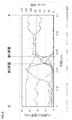
- FIG. 3 is a graph showing the results of line analysis.
- FIG. 4 is a graph showing the atomic concentration distribution of Al in FIG.
- FIG. 5 is a graph showing the atomic concentration distribution of N in FIG.
- FIG. 6 is a graph showing the atomic concentration distribution of B in FIG.
- FIG. 7 is a graph showing the atomic concentration distribution of O in FIG.
- FIG. 8 is a graph showing the atomic concentration distribution of C in FIG.
- FIG. 9 is a flowchart showing a method for producing the cBN sintered body in the present embodiment.
- FIG. 9 is a flowchart showing a method for producing the cBN sintered body in the present embodiment.
- FIG. 10 is an example of a reflected electron image of the cBN sintered body.
- FIG. 11 is an image obtained by reading the reflected electron image of FIG. 10 into image processing software.
- FIG. 12 is a diagram illustrating a concentration cross-sectional graph.
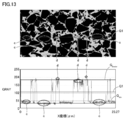
- FIG. 13 is a diagram for explaining a method of defining a black region and a bound phase.
- FIG. 14 is a diagram for explaining the boundary between the black region and the bound phase.
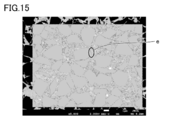
- FIG. 15 is an image obtained by binarizing the reflected electron image of FIG.
- Cubic boron nitride (cBN) sintered bodies are used in cutting tools.
- a cutting tool containing a cBN sintered body is also referred to as a "cBN tool".
- the cBN sintered body contains cBN particles and a bonded phase.
- the cBN particles form the skeleton of the cBN sintered body.
- the bonded phase includes a ceramic material.
- the ceramic material includes, for example, titanium nitride (TiN) and the like.
- the cBN tool is used for cutting hardened steel.
- Hardened steel is used, for example, in automobile parts (gears, shafts and bearings).
- the life of the cBN tool tends to be unstable.
- the life of the cBN tool tends to be shortened especially in the cutting of high-strength hardened steel.
- High-strength hardened steel is formed by dispersing hard particles inside the hardened steel.
- the surface of the cBN tool is scraped by the hard particles contained in the high-strength hardened steel. This can cause the cBN particles to fall off.
- the cBN particles form the skeleton of the cBN sintered body. Sudden defects may occur in the cBN sintered body due to a part of the skeleton falling off.
- the wear of the flank may rapidly progress due to a part of the skeleton falling off. As a result, the cutting resistance increases rapidly and defects may occur.
- a cBN tool is often used in cutting of high-strength hardened steel at a cutting speed of, for example, 150 m / min or less.
- the purpose of this disclosure is to improve the life of the cBN tool.
- the cubic boron nitride sintered body contains cubic boron nitride particles, a bonded phase and an intervening phase.
- the cubic boron nitride particles occupy 20% by volume or more and 80% by volume or less of the cubic boron nitride sintered body.
- the total volume ratio of the bonded phase and the intervening phase is a value obtained by subtracting the volume ratio of the cubic boron nitride particles from 100% by volume when the volume ratio of the cubic boron nitride sintered body is 100% by volume.
- the bound phase comprises one or more components selected from the group consisting of compounds and solid solutions. Each of the compound and the solid solution contains a first element and a second element.
- the first element is one or more selected from the group consisting of nitrogen, carbon, boron and oxygen.
- the second element is one or more selected from the group consisting of Group 4 elements, Group 5 elements, Group 6 elements and aluminum in the periodic table.
- the intervening phase is intervening between the cubic boron nitride particles and the bonded phase.
- the intervening phase contains aluminum, nitrogen, boron and oxygen.
- the sum of the average atomic concentration of aluminum contained in the intervening phase and the average atomic concentration of nitrogen contained in the intervening phase is 50.0 atomic% or more.
- the ratio of the average atomic concentration of nitrogen contained in the intervening phase to the average atomic concentration of boron contained in the intervening phase exceeds 1.00.
- the cracks selectively pass through the interface between the cBN particles and the bound phase.
- Brittle substances are scattered at the interface between the cBN particles and the bonded phase. It is believed that brittle materials can be the origin of cracks or the propagation path of cracks.
- the brittle substance can be, for example, TiB 2 , AlB 2 , Al 2 O 3, or the like.
- the brittle material is believed to be derived from cBN particles and binder (precursor of binding phase).
- an intervening phase is interposed between the cBN particles and the bonded phase in place of the above-mentioned brittle substance.
- the intervening phase has a specific composition. That is, the intervening phase contains aluminum (Al), nitrogen (N), boron (B) and oxygen (O).
- the main components of the intervening phase are Al and N. That is, the total of the average value of the atomic concentration of Al contained in the intervening phase and the average value of the atomic concentration of N contained in the intervening phase is 50.0 atomic% or more. Hereinafter, in the present specification, the total is also referred to as “total concentration (Al + N) ".
- the intervening phase may have metallic ductility.
- the intervening phase can absorb external stress due to its metallic ductility. It is considered that the generation of cracks and the propagation of cracks are suppressed by the absorption of stress in the intervening phase.
- the ratio of the average value of the atomic concentration of N contained in the intervening phase to the average value of the atomic concentration of B contained in the intervening phase exceeds 1.00.
- the ratio is also referred to as "concentration ratio (N / B) ".
- the intervening phase when the atomic concentration of N is higher than the atomic concentration of B, the adhesion between the cBN particles and the bonded phase can be improved. As a result, the shedding of cBN particles can be suppressed.
- the fracture resistance of the cBN sintered body can be improved by synergizing the stress absorbing action of the intervening phase and the improving action of the intervening phase. As a result, the life of the cBN tool can be improved.
- the intervening phase may further contain carbon.
- the atomic concentration of aluminum has a single maximum value.
- the ratio of the average value of the atomic concentration of carbon to the average value of the atomic concentration of aluminum may be 0.01 or more and 0.30 or less.
- the ratio of the average value of the atomic concentration of carbon (C) to the average value of the atomic concentration of Al is also referred to as “concentration ratio (C / Al) ”.
- the intervening phase of the present disclosure contains components derived from the binder.
- metal elements other than Al for example, Ti, W, etc.
- metal elements other than Al may diffuse into the intervening phase, so that the adhesion between the cBN particles and the bond phase may decrease.
- the cubic boron nitride particles may occupy 35% by volume or more and less than 75% by volume of the cubic boron nitride sintered body.
- volume ratio of cBN particles The higher the volume ratio of cBN particles, the better the fracture resistance tends to be. On the other hand, the higher the volume ratio of the cBN particles, the lower the wear resistance tends to be.
- the volume ratio of the cBN particles is 35% by volume or more and less than 75% by volume, the contact probability between the cBN particles can be moderate inside the cBN sintered body. As a result, the fracture resistance and wear resistance of the cBN sintered body can be improved.
- the bonded phase may contain titanium.
- the bonded phase may further comprise one or more selected from the group consisting of zirconium, niobium, molybdenum, hafnium, tantalum and tungsten.
- the strength of the bonded phase and the toughness of the bonded phase can be improved. It is considered that the solid solution strengthening is caused by Nb or the like.
- the high strength and high toughness of the bonded phase can improve the wear resistance and fracture resistance of the cBN sintered body.
- the average value of the thickness of the intervening phase may be 5 nm or more and 100 nm or less.
- the life of the cBN tool can be improved.
- the average value of the thickness of the intervening phase may be 5 nm or more and 20 nm or less.
- the life of the cBN tool can be further improved.
- Oxygen may be dissolved in the components contained in the bonded phase.
- An oxide layer is formed on the surface of the cBN particles.
- the oxide layer has a thickness of several nm.
- the oxide layer is considered to contain B 2 O 3 and the like.
- nitrides such as TiN and TiCN have been used as the binder.
- a brittle substance TiB 2, etc.
- the above-mentioned intervening phase is formed instead of the brittle substance.
- oxides can be used as a raw material for binders. It is considered that a trace amount of oxygen is dissolved in the bonded phase of the final product due to the use of oxide as the raw material of the binder (precursor of the bonded phase).
- the cutting tool of the present disclosure includes the cubic boron nitride sintered body described in any one of (1) to (7) above.
- the cutting tool of the present disclosure that is, the cBN tool, can have a long life, for example, in machining high-strength hardened steel.
- the cutting tool described in (8) above may be a coated cutting tool.
- Cover cutting tools include coatings. The coating covers at least a part of the surface of the cubic boron nitride sintered body.
- the life of the cBN tool can be improved.
- FIG. 1 is an example of a cross-sectional image of the cBN sintered body in the present embodiment.
- the cubic boron nitride (cBN) sintered body includes cubic boron nitride (cBN) particles 11, a bonding phase 12 and an intervening phase 13.
- the intervening phase 13 is interposed between the cBN particles 11 and the binding phase 12.
- the cBN sintered body may consist substantially of only the cBN particles 11, the bonding phase 12 and the intervening phase 13.
- FIG. 1 shows the interface between the cBN particles 11 and the bonding phase 12.
- the intervening phase 13 is specified by the following procedure.
- a cross-sectional sample is collected from the cBN sintered body by a FIB (focused ion beam) device.
- a cross-section sample is observed by STEM.
- the observation magnification is, for example, about 500,000 times.
- HAADF images are taken at each of the five randomly selected locations.
- element mapping is carried out at each of the five locations by EDX (energy dispersive x-ray spectroscopy) attached to STEM. It should be noted that although the number of shooting locations is set to 5 here, the 5 locations are merely examples. The number of imaging locations can be sufficient to obtain average tissue information. If the number of photographed areas is too small, average tissue information may not be obtained if peculiar areas are included in the randomly selected areas.
- FIG. 2 shows the mapping result of Al in the image of FIG. Al is uniformly distributed at the interface between the cBN particles 11 and the bonding phase 12.
- the EDX line analysis is performed in a direction substantially orthogonal to the direction in which the interface between the cBN particles 11 and the bonding phase 12 extends. That is, the multi-element simultaneous analysis is performed on the straight line (AB) connecting the points A and B in FIG.
- the length of the straight line is 0.1004 ⁇ m.
- the distance between adjacent measurement points is 0.0024 ⁇ m.
- the number of measurement points is 43 points.
- the direction substantially orthogonal to the direction in which the interface between the cBN particles 11 and the bonding phase 12 extends corresponds to the thickness direction of the intervening phase 13.
- FIG. 3 is a graph showing the results of line analysis.
- the intervening phase 13 of this embodiment is considered to consist of a non-stoichiometric compound.
- the intervening phase 13 contains Al, N, B and O.
- the intervening phase 13 may consist substantially only of Al, N, B and O.
- the intervening phase 13 may further contain, for example, C and the like.
- FIG. 4 is a graph showing the atomic concentration distribution of Al in FIG.
- FIG. 5 is a graph showing the atomic concentration distribution of N in FIG.
- FIG. 6 is a graph showing the atomic concentration distribution of B in FIG.
- FIG. 7 is a graph showing the atomic concentration distribution of O in FIG.
- FIG. 8 is a graph showing the atomic concentration distribution of C in FIG.
- the atomic concentration of Al has a single maximum value.
- two positions where the atomic concentration of Al becomes half the maximum value are specified.
- the position closer to point A is defined as the interface between the cBN particles 11 and the intervening phase 13.
- the interface between the cBN particles 11 and the intervening phase 13 is also referred to as a “first interface”.
- the position closer to point B is defined as the interface between the intervening phase 13 and the coupling phase 12.
- the interface between the intervening phase 13 and the bonding phase 12 is also referred to as a “second interface”.
- the region from the first interface to the second interface is the intervening phase 13.
- the measurement points included in the intervening phase 13 are specified. In the examples of FIGS. 1 to 8, the thickness of the intervening phase 13 is 9.6 nm. Five measurement points are included in the intervening phase 13. The number of measurement points included in the intervening phase 13 changes according to the thickness of the intervening phase 13.
- the atomic concentration of Al at each of the five measurement points included in the intervening phase 13 is averaged.
- the average value of the atomic concentration of Al can be obtained.
- the average value of the atomic concentration of N, the average value of the atomic concentration of B, and the average value of the atomic concentration of C are obtained, respectively.
- the "mean value” indicates an arithmetic mean unless otherwise specified.
- Total concentration (Al + N) the sum of the average value of the atomic concentration of Al and the average value of the atomic concentration of N (that is, “total concentration (Al + N) ") is 50.0 atomic% or more. .. That is, the main components of the intervening phase 13 are Al and N. Therefore, it is considered that the intervening phase 13 can absorb the stress from the outside.
- the total concentration (Al + N) is valid up to the first decimal place.
- the second and lower decimal places are rounded off.
- the total concentration (Al + N) may be, for example, 50.0 atomic% or more and 75.2 atomic% or less.
- the total concentration (Al + N) may be, for example, 60.5 atomic% or more and 65.0 atomic% or less.
- the concentration ratio (N / B) is effective up to the second decimal place.
- the third and lower decimal places are rounded off.
- the concentration ratio (N / B) may be, for example, 1.21 or more and 3.90 or less.
- the concentration ratio (N / B) may be, for example, 1.70 or more and 3.10 or less.
- the concentration ratio (N / B) may be, for example, 2.00 or more and 2.50 or less.
- the ratio of the average value of the atomic concentration of C to the average value of the atomic concentration of Al is, for example, 0.01 or more and 0. It may be 30 or less.
- concentration ratio (C / Al) is, for example, 0.01 or more and 0. It may be 30 or less.
- the concentration ratio (C / Al) is effective up to the second decimal place.
- the third and lower decimal places are rounded off.
- the concentration ratio (C / Al) may be, for example, 0.03 or more and 0.28 or less.
- the concentration ratio (C / Al) may be, for example, 0.03 or more and 0.26 or less.
- the concentration ratio (C / Al) may be, for example, 0.03 or more and 0.18 or less.
- the concentration ratio (C / Al) may be, for example, 0.18 or more and 0.30 or less.
- the thickness of the intervening phase 13 is the distance between the first interface and the second interface on the straight line (AB).
- the thickness is measured at, for example, 5 points.
- the average of the thicknesses at the five locations is the "average value of the thickness". Only the integer part of the average thickness is valid. The numbers after the decimal point are rounded off.
- the average value of the thickness may be, for example, 4 nm or more and 120 nm or less.
- the average value of the thickness may be, for example, 5 nm or more and 100 nm or less.
- the average value of the thickness may be, for example, 5 nm or more and 50 nm or less.
- the average value of the thickness may be, for example, 5 nm or more and 20 nm or less.
- the life of the cBN tool can be further improved.
- the average value of the thickness may be, for example, 7 nm or more and 11 nm or less.
- the average value of the thickness may be, for example, 11 nm or more and 20 nm or less.
- the binding phase 12 binds the cBN particles 11 to each other.
- the bonding phase 12 and the intervening phase 13 occupy the rest of the cBN particles 11. That is, the total of the bonding phase 12 and the intervening phase 13 occupies the balance of the cBN particles 11 in the cBN sintered body.
- the total volume ratio of the bonded phase 12 and the intervening phase 13 is a value obtained by subtracting the volume ratio of the cBN particles 11 from 100% by volume when the volume ratio of the cBN sintered body is 100% by volume.
- the total of the bonded phase 12 and the intervening phase 13 may occupy, for example, 20% by volume or more and 80% by volume or less of the cBN sintered body.
- Bonding phase 12 contains one or more components.
- the binding phase 12 may consist of substantially only one component.
- the binding phase 12 may consist of two or more components.
- the component contained in the binding phase 12 includes one or more selected from the group consisting of a compound and a solid solution. That is, the binding phase 12 contains one or more components selected from the group consisting of compounds and solid solutions.
- the binding phase 12 may consist substantially of the compound alone.
- the binding phase 12 may consist substantially only of a solid solution.
- the binding phase 12 may contain both a compound and a solid solution.
- the composition of the binding phase 12 can be specified by, for example, XRD (x-ray diffraction) and EDX.
- the compound and solid solution contained in the bonding phase 12 both contain the first element and the second element.
- the compound and the solid solution independently contain the first element and the second element, respectively.
- the combination of the first element and the second element contained in the compound and the combination of the first element and the second element contained in the solid solution may be the same or different.
- the first element is a non-metallic element.
- the first element is one or more selected from the group consisting of nitrogen (N), carbon (C), boron (B) and oxygen (O). That is, the compound and the solid solution may be a nitride, a carbide, a boride, or an oxide.
- the compound and the solid solution may be, for example, a carbide and a nitride. That is, the compound and the solid solution may be, for example, a carbonitride.
- the second element is a metal element.
- the second element is one or more selected from the group consisting of Group 4 elements, Group 5 elements, Group 6 elements and Al in the periodic table.
- the Group 4 element may be, for example, one or more selected from the group consisting of titanium (Ti), zirconium (Zr) and hafnium (Hf).
- the Group 5 element may be, for example, one or more selected from the group consisting of vanadium (V), niobium (Nb) and tantalum (Ta).
- the Group 6 element may be, for example, one or more selected from the group consisting of chromium (Cr), molybdenum (Mo) and tungsten (W).
- the bonding phase 12 may contain Ti.
- the binding phase 12 may further contain one or more selected from the group consisting of Zr, Nb, Mo, Hf, Ta and W. This can improve the strength of the bound phase and the toughness of the bound phase.
- the binding phase is one or more selected from the group consisting of, for example, TiCN, TiNbN, TiB 2 , Al compounds (for example, Al 2 O 3 , AlN, etc.), TiNbCN, TiZrCN, TimoCN, TiNbZrCN, TiHfCN, TiTaCN, and TiWCN. May include.
- composition formula in this specification should not be limited to the atomic ratio shown in the formula.
- the composition formula should be understood to include any previously known atomic ratio.
- the composition formula should be understood to include, for example, non-stoichiometric ratios.
- the composition formula in this specification shows not only the composition of a compound but also the composition of a solid solution.
- the solid solution may be an invasion type solid solution or a substitution type solid solution.
- Oxygen (O) may be dissolved in the components contained in the bonding phase 12.
- the oxygen that is solid-solved may be oxygen derived from the raw material of the binder (precursor of the bonding phase 12).
- the solid solution of oxygen can improve the strength of the bound phase 12 and the toughness of the bound phase 12.
- the solid solution of oxygen can be detected, for example, by the EDX attached to the STEM.
- the solidly dissolved oxygen may occupy, for example, 1.0 atomic% or more and 5.0 atomic% or less in the bonded phase 12.
- the cBN particles 11 form the skeleton of the cBN sintered body.
- the cBN particles 11 include cBN.
- the cBN particles 11 may contain, for example, a small amount of impurities and the like.
- the cBN particles 11 may contain, for example, a trace amount of wurtzite boron nitride (wBN) or the like.
- the cBN particles 11 may consist substantially of cBN only.
- the cBN particles 11 occupy 20% by volume or more and 80% by volume or less of the cBN sintered body.
- the volume ratio of the cBN particles 11 is valid only in the integer part. The numbers after the decimal point are rounded off. The method for measuring the volume ratio will be described later. If the volume ratio of the cBN particles 11 is less than 20% by volume, the cBN tool cannot be expected to have a sufficient life. Since the cBN particles 11 play the role of the skeleton of the cBN sintered body, it is considered that the fracture resistance is lowered if the contact probability between the cBN particles 11 is excessively low. If the volume ratio of the cBN particles 11 exceeds 80% by volume, the cBN tool cannot be expected to have a sufficient life.
- the volume ratio of the cBN particles 11 may be, for example, 35% by volume or more and less than 75% by volume. In this range, the contact probability between the cBN particles 11 can be moderate. As a result, the effect of the intervening phase 13 interposed between the cBN particles 11 and the bonding phase 12 is enhanced, and the fracture resistance and abrasion resistance of the cBN sintered body can be improved.
- the volume ratio of the cBN particles 11 may be, for example, 45% by volume or more and 70% by volume or less.
- the volume ratio of the cBN particles 11 may be, for example, 45% by volume or more and 60% by volume or less.
- the cBN particles 11 may have an average particle size of, for example, 0.1 ⁇ m or more and 10 ⁇ m or less.
- the cBN particles 11 may have an average particle size of, for example, 1 ⁇ m or more and 5 ⁇ m or less.
- the “particle size of the cBN particles 11” indicates the equivalent circle diameter of the cBN particles 11 in the cross-sectional image of the cBN sintered body.
- the "average particle size of the cBN particles 11" is, for example, an arithmetic average of the particle sizes of 10 or more cBN particles 11.
- Ten or more cBN particles 11 are randomly extracted from the cross-sectional image of the cBN sintered body.
- the volume ratio of cBN particles can be measured by SEM (scanning electron microscope).
- SEM scanning electron microscope
- JSM-7800F manufactured by JEOL Ltd.
- a device having the same function as the device may be used.
- the method for measuring the volume ratio of cBN particles is as follows.
- the cBN sintered body is cut at an arbitrary position.
- the cut surface is subjected to, for example, CP (cross section polisher) processing or the like.
- This prepares a cross-section sample.
- the cross-section sample is observed by the reflected electron mode of the SEM. As a result, a reflected electron image is obtained.
- the observation magnification can be, for example, about 5000 times.
- the region where the cBN particles are present is the black region
- the region where the bonded phase is present is the gray region or the white region.
- the binarization process using image analysis software (“WinROOF” manufactured by Mitani Corporation) is executed for the reflected electron image.
- the area ratio of the pixels derived from the dark field (pixels derived from the cBN particles) to the area of the measurement field of view is calculated.
- the calculated area ratio is considered to be the volume ratio of the cBN particles.
- the volume ratio of the coupled phase is calculated by calculating the area ratio of the pixels derived from the bright field (pixels derived from the coupled phase) to the area of the measured visual field from the image after the binarization process. May be good.
- FIG. 10 is an example of a reflected electron image of the cBN sintered body.
- the reflected electron image is read into the image processing software.
- the read image is shown in FIG.
- an arbitrary line Q1 is set in the read image.
- the GRAY value is read by measuring the concentration along the line Q1.
- a graph having the line Q1 as the X coordinate and the GRAY value as the Y coordinate (hereinafter, also referred to as a “concentration cross-section graph”) is produced.
- a reflected electron image of the cBN sintered body and a density cross-sectional graph of the reflected electron image are shown in FIG.
- the upper image is a backscattered electron image
- the lower graph is a density cross-sectional graph.
- the width of the backscattered electron image and the width of the X coordinate of the density cross-sectional graph (23.27 ⁇ m) are the same. Therefore, the distance from the left end of the line Q1 in the backscattered electron image to a specific position on the line Q1 is indicated by the value of the X coordinate of the density cross-section graph.
- the black region is, for example, the portion indicated by the ellipse of reference numeral c in the reflected electron image of FIG.
- the GRAY value of each of the three black regions is read from the density cross-sectional graph.
- the GRAY value of each of the three black regions is taken as the average value of the GRAY values of each of the three portions surrounded by the ellipse of reference numeral c in the density cross-sectional graph of FIG.
- the average value of the GRAY values of each of the three locations is calculated.
- the average value is taken as the GRAY value of cBN (hereinafter, also referred to as “G cbn ”).
- the bound phase is, for example, the portion represented by the ellipse of reference numeral d in the reflected electron image of FIG.
- the GRAY value of each of the three bonded phases is read from the concentration cross-sectional graph.
- the GRAY value of each of the three bonded phases is taken as the average value of the GRAY values at each of the three portions surrounded by the ellipse of reference numeral d in the concentration cross-sectional graph of FIG.
- the average value of the GRAY values of each of the three locations is calculated.
- the average value is taken as the GRAY value of the binding phase (hereinafter, also referred to as “G bindr ”).
- the GRAY value represented by (G cbn + G binder ) / 2 is defined as the GRAY value at the interface between the black region (cBN particles) and the bound phase.
- the GRAY value G cbn of the black region (cBN particles) is indicated by the line G cbn .
- the GRAY value G bindr of the bound phase is indicated by the line G bindr .
- the GRAY value indicated by (G cbn + G binder ) / 2 is indicated by the line G1.
- the values of the X coordinate and the Y coordinate at the interface between the black region (cBN particles) and the bound phase can be read. ..
- the interface between the black region (cBN particles) and the bonded phase is the portion indicated by the ellipse of reference numeral e.
- the interface between the black region (cBN particles) and the bonded phase is the portion indicated by the arrow e.
- the X-coordinate and Y-coordinate values of the arrow e correspond to the X-coordinate and Y-coordinate values at the interface between the black region (cBN particle) and the bonding phase.
- the interface can be set arbitrarily. In the example of FIG. 14, the portion including the interface is shown as an ellipse e.
- the binarization process is executed by setting the values of the X coordinate and the Y coordinate at the interface between the black region (cBN particles) and the bonding phase as threshold values.
- the image after the binarization process is shown in FIG. In FIG. 15, the area surrounded by the dotted line is the area subjected to the binarization process.
- the image after the binarization process may include a white region in addition to the bright field (gray region) and the dark field (black region).
- the white region is a region displayed in white in the image before the binarization treatment.
- the area ratio of the pixels derived from the dark field (pixels derived from the cBN particles) to the area of the measurement field of view is calculated.
- the calculated area ratio is considered to be the volume ratio of the cBN particles.
- the volume ratio of the coupled phase may be calculated by calculating the area ratio of the pixels derived from the bright visual field (pixels derived from the coupled phase) to the area of the measurement visual field.
- FIG. 9 is a flowchart showing a method for producing the cBN sintered body in the present embodiment.
- the method for producing the cBN sintered body of the present embodiment includes "(A) preparation of binder", "(B) preparation of raw material powder” and "(C) sintering".
- a binder having a specific composition may be used so that an intervening phase is formed.
- the surface of the cBN particles may be modified so that an intervening phase is formed.
- a binder having a specific composition may be used and the surface of the cBN particles may be modified.
- the binder is prepared by mixing the first material and the second material.
- the binder is a precursor of the bonding phase.
- the mixing ratio of the first material and the second material can be appropriately changed depending on the composition of the target bonding phase.
- the first material is a material that is the main component of the bonded phase.
- the first material is also referred to as the "main binder".
- the first material may contain, for example, one or more selected from the group consisting of TiC, TiN and TiCN.
- the first material is less likely to cause mutual diffusion of elements with the second material described later. This is because the mutual diffusion of the elements is unlikely to occur, so that the reaction between the second material and the cBN particles is promoted, and the formation of the intervening phase is promoted.
- the first material may have a composition represented by, for example, "Formula (I): TiMCN".
- M is one or more selected from the group consisting of Zr, Nb, Mo, Hf, Ta and W.
- the first material may be prepared by forcibly dissolving M (Nb, etc.) in TiCN or the like. It is considered that the crystal structure is distorted as a result of the solid solution of M. Therefore, it is considered that mutual diffusion of elements with the second material is unlikely to occur at the time of sintering.
- the first material having the composition of the above formula (I) is prepared, for example, by the following procedure.
- a mixed powder is prepared by mixing TiO 2 powder, M (Nb or the like) oxide powder, and carbon powder.
- the mixed powder is heat treated in a reducing atmosphere.
- the reducing atmosphere may be, for example, a nitrogen atmosphere.
- the heat treatment temperature may be, for example, 1800 ° C. or higher and 2200 ° C. or lower.
- the heat treatment time may be, for example, about 60 minutes.
- the heat treatment can produce a single-phase compound having the composition of the above formula (I). Further, for example, a wet grinding method is used to adjust the average particle size of the single-phase compound.
- the heat treatment temperature at the time of synthesizing a general first material is 1500 ° C. or less. This temperature is close to the sintering temperature (about 1200 ° C to 1800 ° C).
- the above-mentioned first material is heat-treated at a temperature of, for example, 1800 ° C. or higher and 2200 ° C. or lower. That is, the first material in the present embodiment can be heat-treated at a temperature equal to or higher than the sintering temperature. By heat-treating at a temperature equal to or higher than the sintering temperature in advance, element diffusion from the first material can be suppressed during actual sintering.
- Oxide is used as a raw material for the above first material. Oxygen contained in the raw material can contribute to strengthening the solid solution of the bonded phase by dissolving it in the constituent components of the bonded phase.
- the second material is a component that binds the first material and cBN particles.
- the second material is also referred to as a "secondary binder".
- an intermetallic compound such as Ti, Al, TiAl, TiAl 3 has been used as a second material.
- the second material in the present embodiment is at least one selected from the group consisting of carbides such as Ti 2 AlC, nitrides such as Ti 2 AlN, and carbonitrides such as Ti 2 AlCN. May include.
- oxides such as B 2 O 3 are present on the surface of the cBN particles.
- Carbides such as Ti 2 AlC, nitrides such as Ti 2 AlN and carbonitrides such as Ti 2 AlCN are expected to promote the decomposition of oxides (B 2 O 3 etc.) during sintering.
- the oxygen produced by the decomposition of the oxide can be reduced by the carbon contained in the carbides and carbonitrides. Since carbon monoxide (CO) and carbon dioxide (CO 2 ) generated by the reduction reaction are gases, they can be easily discharged to the outside of the system.
- CO carbon monoxide
- CO 2 carbon dioxide
- it is expected that the wettability of the surface of the cBN particles will be improved by diffusing carbon on the surface of the cBN particles in the process of the reduction reaction. Due to the improved wettability, Al is thinly and uniformly distributed on the surface of the cBN particles. As a result, it is expected that the adhesion between the cBN particles and the bound phase will be improved
- carbon can prevent metal elements other than Al from diffusing into the intervening phase. This is expected to improve the adhesion between the cBN particles and the bound phase.
- Ti 2 AlC is prepared, for example, by the following procedure.
- a mixed powder is prepared by mixing Ti powder, Al powder and TiC powder.
- the mixed powder is heat treated in a vacuum atmosphere.
- the heat treatment temperature may be, for example, about 1500 ° C.
- the heat treatment time may be, for example, about 30 minutes.
- the heat treatment can produce, for example, a single-phase compound of Ti 2 AlC. Further, for example, a wet grinding method is used to adjust the average particle size of the single-phase compound.
- the raw material powder is prepared by mixing the cBN particles and the binder.
- wet mixing can mix the cBN particles with the binder.
- the medium in the wet mixing may be, for example, ethanol or the like.
- the raw material powder may be naturally dried.
- the mixed powder may be degassed. In the degassing treatment, the raw material powder can be heated to a temperature of 900 ° C. or higher, for example, in a vacuum atmosphere.
- the surface of the cBN particles may be modified prior to the preparation of the raw material powder. It is expected that the formation of the intervening phase is promoted by modifying the surface of the cBN particles.
- An oxide layer is formed on the surface of the cBN particles.
- the oxide layer can be, for example, crystalline or amorphous.
- the oxide layer may have a composition such as B 2 O 3 or the like. It is considered that the oxide layer is formed by adsorbing water and oxygen on the surface of the cBN particles when the cBN particles are washed and exposed to the atmosphere.
- the oxide layer has a variation in its thickness. The variation in the thickness of the oxide layer is considered to affect the diffusion of B and N during sintering. As a result, it is considered that a brittle substance is produced.
- the surface of the cBN particles may be modified so that the thickness of the oxide layer becomes uniform. Further, the surface of the cBN particles may be modified so that the organic material is modified on the surface of the cBN particles.
- the cBN particles may come into contact with the organic material in supercritical water.
- the organic material may be, for example, hexylamine, paraffin and the like.
- supercritical water it is expected that the thick part of the oxide layer is selectively dissolved and the thickness of the oxide layer becomes uniform.
- carbon having a reducing action will be introduced into the surface of the cBN particles by modifying the surface of the cBN particles with an organic material.
- the surface of the cBN particles may be modified by irradiating the surface of the cBN particles with plasma.
- the cBN sintered body is produced by sintering the raw material powder.
- the raw material powder after the degassing treatment is filled in the capsule. If the raw material powder is left in the air after the degassing treatment, moisture and oxygen in the air can be adsorbed on the raw material powder. Therefore, it is desirable that the raw material powder is immediately filled in the capsule after the degassing treatment.
- the capsule may be made of Ta, for example.
- the capsule is sealed with a metal sealant.
- a belt type ultra-high pressure high temperature generator is used for the sintering operation.
- the sealed capsule is set in a belt-type ultra-high pressure and high temperature generator.
- the raw material powder is sintered by the belt type ultra-high pressure and high temperature generator.
- the pressure at the time of sintering may be, for example, 5.5 GPa or more and 8 GPa or less.
- the temperature at the time of sintering may be, for example, 1200 ° C. or higher and lower than 1800 ° C.
- the pressure at the time of sintering is 6 GPa or more and 7 GPa or less and the temperature at the time of sintering is 1400 ° C. or more and 1600 ° C. or less, for example, the balance between the manufacturing cost and the performance is good.
- the organic material is decomposed by heating during sintering. It is considered that the gas generated by the decomposition of the organic material uniformly permeates into the gaps of the green compact (raw material powder). Some of the decomposed organic material may remain on the surface of the cBN particles.
- the cutting tool of the present embodiment includes the cBN sintered body of the present embodiment.
- the cBN sintered body functions as a cutting edge.
- the cutting tool may consist substantially only of the cBN sintered body.
- the cutting tool may further include a configuration other than the cBN sintered body.
- the cutting tool may include a base metal made of cemented carbide.
- the cBN sintered body may be installed at the cutting edge of the base metal.
- the cutting tool of this embodiment may be a coated cutting tool.
- Cover cutting tools include coatings.
- the coating covers at least a part of the surface of the cBN sintered body.
- the coating includes, for example, a ceramic material.
- the shape of the cBN tool should not be particularly limited.
- the cBN tool may be, for example, a cutting edge replaceable tip (for drill, end mill, milling, turning, etc.), metal saw, gear cutting tool, reamer, tap, tool bit or the like.
- Sample 22 was produced from Sample 1 shown in Table 1 below. Samples 1 to 19 are examples. Samples 20 to 22 are comparative examples.
- TiCN was prepared as the first material. TiCN had an average particle size of 0.5 ⁇ m.
- a mixed powder was prepared by mixing Ti powder, Al powder and TiC powder.
- the mixed powder was heat treated. The heat treatment conditions are as follows.
- the heat treatment formed a single-phase compound.
- the monophase compound is believed to have a composition of approximately Ti 2 AlC.
- the monophase compound was pulverized by a ball mill method. As a result, the second material was prepared.
- the second material had an average particle size of 0.5 ⁇ m.
- a binder was prepared by mixing the first material and the second material.
- CBN particles were prepared.
- the cBN particles had an average particle size of 3 ⁇ m.
- the cBN particles and the binder were mixed by a ball mill. As a result, the raw material powder was prepared.
- the capsule was filled with raw material powder.
- the capsule was made of Ta.
- the capsule was sealed with a metal sealant.
- the sealed capsule was set in a belt-type ultra-high pressure high temperature generator.
- the raw material powder was sintered by a belt-type ultra-high pressure and high temperature generator.
- the sintering conditions are as follows. From the above, the cBN sintered body according to Sample 1 was produced.
- Sample 2 A supercritical water nanoparticle synthesis tester (product name "MOMI supermini”, manufactured by Aitec Co., Ltd.) was prepared. The tester produced supercritical water. The conditions for producing supercritical water are as follows.
- Hexylamine was prepared as an organic material.
- cBN particles were prepared.
- the cBN particles had an average particle size of 3 ⁇ m.
- hexylamine and cBN particles were continuously charged into supercritical water.
- the content of hexylamine was 10% by mass.
- the content of cBN particles was 10% by mass.
- the oxide layer (B 2 O 3 ) was reduced on the surface of the cBN particles.
- carbon from the organic material was modified on the surface of the cBN particles. Carbon is considered to form a very thin and uniform film on the surface of the cBN particles.
- GC-MS gas chromatography-mass spectrometry
- an organic substance (modifying material) modifying the surface of cBN particles was identified, and at the same time, the modifying material was quantified.
- the amount of carbon modification was calculated from the molecular formula of the modifying material and the amount of modification of the modifying material.
- the modified amount of carbon was 529 ppm. From the above, modified cBN particles were prepared.
- Sample 3 By performing the same operation as in Sample 2, the cBN according to Sample 3 is carried out, except that the content of hexylamine in the mixture consisting of supercritical water, hexylamine and cBN particles is changed to 1% by mass. A sintered body was produced. In Sample 3, the amount of carbon modified was 48 ppm.
- Sample 8 TiNbCN was used as the first material in the production of Sample 8.
- the first material was prepared by the following procedure.
- a mixed powder was prepared by mixing the TiO 2 powder, the Nb 2 O 3 powder, and the carbon powder.
- the mixed powder was heat treated. The heat treatment conditions are as follows.
- a single-phase compound was formed by heat treatment.
- the monophase compound was pulverized by a ball mill method.
- the first material was prepared.
- the first material had an average particle size of 0.5 ⁇ m.
- the cBN sintered body according to the sample 8 was produced by carrying out the same operation as the sample 4 except that the first material (TiNbCN) obtained above was used.
- Sample 9 The cBN sintered body according to Sample 9 was produced by carrying out the same operation as that of Sample 8 except that the sintering conditions were changed to 30 minutes.
- Sample 10 The cBN sintered body according to Sample 10 was produced by carrying out the same operation as that of Sample 8 except that Ti 2 AlN was used as the second binder.
- Ti 2 AlN in this sample was synthesized by the following procedure.
- a mixed powder was prepared by mixing Ti powder, Al powder and TiN powder.
- Ti 2 AlN was synthesized by heat-treating the mixed powder.
- the heat treatment conditions are as follows.
- Sample 11 The cBN sintered body according to Sample 11 was produced by carrying out the same operation as that of Sample 8 except that Ti 2 AlN was used as the second binder.
- Ti 2 AlN in this sample was synthesized by the following procedure.
- a mixed powder was prepared by mixing Ti powder, Al powder and TiN powder.
- Ti 2 AlN was synthesized by heat-treating the mixed powder.
- the heat treatment conditions are as follows.
- TiNbN in this sample was synthesized by the following procedure.
- a mixed powder was prepared by mixing TiN powder (manufactured by Nippon Shinkinzoku Co., Ltd.) and NbN powder (manufactured by Nippon Shinkinzokusha).
- TiNbN was synthesized by heat-treating the mixed powder.
- the heat treatment conditions are as follows. After the heat treatment, the TiNbN powder was pulverized.
- Sample 13 The cBN sintered body according to Sample 13 was produced by carrying out the same operation as that of Sample 10, except that Ti 2 AlN synthesized at the following mixing ratio was used.
- the cBN sintered body according to Sample 14 was produced by carrying out the same operation as that of Sample 8 except that the composition of the first material was changed.
- the cBN sintered body according to Sample 15 was produced by carrying out the same operation as that of Sample 8 except that the composition of the first material was changed.
- the cBN sintered body according to Sample 16 was produced by carrying out the same operation as that of Sample 8 except that the composition of the first material was changed.
- the cBN sintered body according to Sample 17 was produced by carrying out the same operation as that of Sample 8 except that the composition of the first material was changed.
- the cBN sintered body according to Sample 18 was produced by carrying out the same operation as that of Sample 8 except that the composition of the first material was changed.
- the cBN sintered body according to Sample 19 was produced by carrying out the same operation as that of Sample 8 except that the composition of the first material was changed.
- the cBN sintered body according to Sample 20 was produced by performing the same operation as in Sample 2 except that the mixing ratio of the modified cBN particles and the binder was changed.
- the cBN sintered body according to Sample 21 was produced by carrying out the same operation as in Sample 2 except that the mixing ratio of the modified cBN particles and the binder was changed.
- Sample 22 The cBN sintered body according to Sample 22 was produced by carrying out the same operation as that of Sample 1 except that Ti 2 AlN was used as the second material.
- a cBN tool was manufactured.
- a cutting test of the cBN tool was carried out. The conditions of the cutting test are as follows.
- Hardened steel SKD11 high-strength hardened steel
- hardness 60HRC hardness 60HRC
- V-shaped groove is formed on the outer circumference.
- the life of the cBN tool was measured.
- the results are shown in Table 1 below.
- the measurement procedure is as follows.
- the size of chipping was measured at the cutting edge each time a 0.1 km cut was performed.
- the size of chipping was defined as the size of the chip in the direction of the main component force.
- the direction of the main component force is based on the position of the cutting edge ridge line before the start of cutting.
- the life was defined as the distance when the chipping size at the cutting edge was 0.1 mm or more.
- Samples 1 to 19 contained an intervening phase. Sample 22 did not contain an intervening phase. Samples 1 to 19 had a longer life than sample 22. It is considered that the intervening phase suppressed the occurrence of cracks and the propagation of cracks.
- Sample 20 contained an intervening phase. However, the sample 20 had a short life. It is probable that the volume ratio of the cBN particles was less than 20% by volume.
- Sample 21 contained an intervening phase. However, sample 21 had a short life. It is probable that the volume ratio of the cBN particles exceeded 80% by volume.
- the cubic boron nitride sintered body Includes cubic boron nitride particles, bound phase and intervening phase
- the cubic boron nitride particles occupy 20% by volume or more and 80% by volume or less of the cubic boron nitride sintered body.
- the sum of the bonded phase and the intervening phase occupies the balance of the cubic boron nitride particles in the cubic boron nitride sintered body.
- the bound phase contains one or more components and contains
- the component contained in the binding phase contains one or more selected from the group consisting of a compound and a solid solution. Each of the compound and the solid solution contains a first element and a second element.
- the first element is one or more selected from the group consisting of nitrogen, carbon, boron and oxygen.
- the second element is one or more selected from the group consisting of Group 4 elements, Group 5 elements, Group 6 elements and aluminum in the periodic table.
- the intervening phase is interposed between the cubic boron nitride particles and the bonded phase.
- the intervening phase contains aluminum, nitrogen, boron and oxygen.
- the sum of the average atomic concentration of aluminum contained in the intervening phase and the average atomic concentration of nitrogen contained in the intervening phase is 50.0 atomic% or more.
- the ratio of the average atomic concentration of nitrogen contained in the intervening phase to the average atomic concentration of boron contained in the intervening phase exceeds 1.00.
- Cubic boron nitride sintered body is one or more selected from the group consisting of nitrogen, carbon, boron and oxygen.
- the second element is one or more selected from the group consisting of Group 4 elements, Group 5 elements, Group 6 elements and aluminum in the periodic table.
Landscapes
- Chemical & Material Sciences (AREA)
- Engineering & Computer Science (AREA)
- Ceramic Engineering (AREA)
- Manufacturing & Machinery (AREA)
- Materials Engineering (AREA)
- Structural Engineering (AREA)
- Organic Chemistry (AREA)
- Inorganic Chemistry (AREA)
- Mechanical Engineering (AREA)
- Crystallography & Structural Chemistry (AREA)
- Physics & Mathematics (AREA)
- Thermal Sciences (AREA)
- Chemical Kinetics & Catalysis (AREA)
- General Chemical & Material Sciences (AREA)
- Cutting Tools, Boring Holders, And Turrets (AREA)
- Ceramic Products (AREA)
Priority Applications (6)
| Application Number | Priority Date | Filing Date | Title |
|---|---|---|---|
| US17/625,363 US12410103B2 (en) | 2019-07-18 | 2020-07-17 | Cubic boron nitride sintered material and cutting tool |
| KR1020227000996A KR102823688B1 (ko) | 2019-07-18 | 2020-07-17 | 입방정 질화붕소 소결체 및 절삭 공구 |
| CN202080051120.8A CN114206806A (zh) | 2019-07-18 | 2020-07-17 | 立方晶氮化硼烧结体以及切削工具 |
| JP2021514634A JP6969030B2 (ja) | 2019-07-18 | 2020-07-17 | 立方晶窒化硼素焼結体および切削工具 |
| EP20840150.5A EP4000777B1 (en) | 2019-07-18 | 2020-07-17 | Cubic boron nitride sintered compact, and cutting tool |
| JP2021174399A JP7614070B2 (ja) | 2019-07-18 | 2021-10-26 | 立方晶窒化硼素焼結体および切削工具 |
Applications Claiming Priority (2)
| Application Number | Priority Date | Filing Date | Title |
|---|---|---|---|
| JP2019133023 | 2019-07-18 | ||
| JP2019-133023 | 2019-07-18 |
Publications (1)
| Publication Number | Publication Date |
|---|---|
| WO2021010472A1 true WO2021010472A1 (ja) | 2021-01-21 |
Family
ID=74209880
Family Applications (1)
| Application Number | Title | Priority Date | Filing Date |
|---|---|---|---|
| PCT/JP2020/027899 Ceased WO2021010472A1 (ja) | 2019-07-18 | 2020-07-17 | 立方晶窒化硼素焼結体および切削工具 |
Country Status (6)
| Country | Link |
|---|---|
| US (1) | US12410103B2 (https=) |
| EP (1) | EP4000777B1 (https=) |
| JP (2) | JP6969030B2 (https=) |
| KR (1) | KR102823688B1 (https=) |
| CN (1) | CN114206806A (https=) |
| WO (1) | WO2021010472A1 (https=) |
Citations (7)
| Publication number | Priority date | Publication date | Assignee | Title |
|---|---|---|---|---|
| JPS61141672A (ja) * | 1984-12-14 | 1986-06-28 | 三菱マテリアル株式会社 | 切削工具用立方晶窒化硼素基焼結体の製造法 |
| JP2006169080A (ja) * | 2004-12-20 | 2006-06-29 | Sumitomo Electric Ind Ltd | 立方晶窒化硼素多結晶体の製造方法 |
| JP2007070148A (ja) * | 2005-09-06 | 2007-03-22 | National Institute For Materials Science | 高純度立方晶窒化ホウ素焼結体の製造法 |
| JP2013234237A (ja) * | 2012-05-08 | 2013-11-21 | Shin-Etsu Chemical Co Ltd | 有機修飾無機充填材の製造方法及び有機修飾無機充填材、並びに熱伝導性シリコーン組成物 |
| JP2015044259A (ja) | 2013-08-27 | 2015-03-12 | 三菱マテリアル株式会社 | 耐欠損性にすぐれた立方晶窒化硼素焼結体切削工具 |
| JP2019065513A (ja) * | 2017-09-29 | 2019-04-25 | 三菱マテリアル株式会社 | 掘削チップ、掘削工具、および掘削チップの製造方法 |
| JP2019133023A (ja) | 2018-01-31 | 2019-08-08 | 株式会社タムラ製作所 | 感光性樹脂組成物 |
Family Cites Families (12)
| Publication number | Priority date | Publication date | Assignee | Title |
|---|---|---|---|---|
| JPS61197469A (ja) * | 1985-02-26 | 1986-09-01 | 三菱マテリアル株式会社 | 切削工具用立方晶窒化硼素基焼結材料の製造方法 |
| JP3866305B2 (ja) * | 1994-10-27 | 2007-01-10 | 住友電工ハードメタル株式会社 | 工具用複合高硬度材料 |
| WO2007010670A1 (ja) | 2005-07-15 | 2007-01-25 | Sumitomo Electric Hardmetal Corp. | 複合焼結体 |
| AU2006307587A1 (en) * | 2005-10-28 | 2007-05-03 | Element Six (Production) (Pty) Ltd | Cubic boron nitride compact |
| KR101252332B1 (ko) * | 2006-06-12 | 2013-04-08 | 스미또모 덴꼬오 하드메탈 가부시끼가이샤 | 복합 소결체 |
| JP5305056B1 (ja) * | 2012-05-16 | 2013-10-02 | 三菱マテリアル株式会社 | 立方晶窒化ほう素基焼結体製切削工具 |
| US9950962B2 (en) * | 2013-10-22 | 2018-04-24 | Tungaloy Corporation | Cubic boron nitride sintered body and coated cubic boron nitride sintered body |
| JP6650106B2 (ja) * | 2014-11-27 | 2020-02-19 | 三菱マテリアル株式会社 | 立方晶窒化ほう素基焼結体および立方晶窒化ほう素基焼結体製切削工具 |
| MX2017000970A (es) * | 2015-05-29 | 2017-05-01 | Sumitomo Electric Hardmetal Corp | Cuerpo sinterizado y herramienta de corte. |
| US20180117678A1 (en) * | 2016-03-30 | 2018-05-03 | Sumitomo Electric Hardmetal Corp. | Surface-coated cubic boron nitride sintered material, and cutting tool including the same |
| US11383300B2 (en) * | 2017-10-30 | 2022-07-12 | Sumitomo Electric Industries, Ltd. | Sintered material and cutting tool including the same |
| JP2024141672A (ja) * | 2023-03-29 | 2024-10-10 | 株式会社カネカ | バクテリオファージ回収用組成物 |
-
2020
- 2020-07-17 US US17/625,363 patent/US12410103B2/en active Active
- 2020-07-17 EP EP20840150.5A patent/EP4000777B1/en active Active
- 2020-07-17 KR KR1020227000996A patent/KR102823688B1/ko active Active
- 2020-07-17 WO PCT/JP2020/027899 patent/WO2021010472A1/ja not_active Ceased
- 2020-07-17 JP JP2021514634A patent/JP6969030B2/ja active Active
- 2020-07-17 CN CN202080051120.8A patent/CN114206806A/zh active Pending
-
2021
- 2021-10-26 JP JP2021174399A patent/JP7614070B2/ja active Active
Patent Citations (7)
| Publication number | Priority date | Publication date | Assignee | Title |
|---|---|---|---|---|
| JPS61141672A (ja) * | 1984-12-14 | 1986-06-28 | 三菱マテリアル株式会社 | 切削工具用立方晶窒化硼素基焼結体の製造法 |
| JP2006169080A (ja) * | 2004-12-20 | 2006-06-29 | Sumitomo Electric Ind Ltd | 立方晶窒化硼素多結晶体の製造方法 |
| JP2007070148A (ja) * | 2005-09-06 | 2007-03-22 | National Institute For Materials Science | 高純度立方晶窒化ホウ素焼結体の製造法 |
| JP2013234237A (ja) * | 2012-05-08 | 2013-11-21 | Shin-Etsu Chemical Co Ltd | 有機修飾無機充填材の製造方法及び有機修飾無機充填材、並びに熱伝導性シリコーン組成物 |
| JP2015044259A (ja) | 2013-08-27 | 2015-03-12 | 三菱マテリアル株式会社 | 耐欠損性にすぐれた立方晶窒化硼素焼結体切削工具 |
| JP2019065513A (ja) * | 2017-09-29 | 2019-04-25 | 三菱マテリアル株式会社 | 掘削チップ、掘削工具、および掘削チップの製造方法 |
| JP2019133023A (ja) | 2018-01-31 | 2019-08-08 | 株式会社タムラ製作所 | 感光性樹脂組成物 |
Also Published As
| Publication number | Publication date |
|---|---|
| JPWO2021010472A1 (ja) | 2021-09-13 |
| KR20220035111A (ko) | 2022-03-21 |
| JP6969030B2 (ja) | 2021-11-24 |
| JP7614070B2 (ja) | 2025-01-15 |
| EP4000777A1 (en) | 2022-05-25 |
| EP4000777B1 (en) | 2025-09-03 |
| CN114206806A (zh) | 2022-03-18 |
| US20220250990A1 (en) | 2022-08-11 |
| EP4000777A4 (en) | 2022-08-31 |
| JP2022020697A (ja) | 2022-02-01 |
| KR102823688B1 (ko) | 2025-06-20 |
| US12410103B2 (en) | 2025-09-09 |
Similar Documents
| Publication | Publication Date | Title |
|---|---|---|
| CN110573475B (zh) | 烧结体以及包含该烧结体的切削工具 | |
| CN114096501B (zh) | 立方晶氮化硼烧结体以及切削工具 | |
| CN114096502B (zh) | 立方晶氮化硼烧结体及其制造方法 | |
| JP6908798B2 (ja) | 立方晶窒化硼素焼結体 | |
| CN114144391B (zh) | 立方晶氮化硼烧结体 | |
| CN114144393B (zh) | 立方晶氮化硼烧结体 | |
| JP6969030B2 (ja) | 立方晶窒化硼素焼結体および切削工具 | |
| CN114144392B (zh) | 立方晶氮化硼烧结体 | |
| JP6912685B2 (ja) | 立方晶窒化硼素焼結体 |
Legal Events
| Date | Code | Title | Description |
|---|---|---|---|
| 121 | Ep: the epo has been informed by wipo that ep was designated in this application |
Ref document number: 20840150 Country of ref document: EP Kind code of ref document: A1 |
|
| ENP | Entry into the national phase |
Ref document number: 2021514634 Country of ref document: JP Kind code of ref document: A |
|
| NENP | Non-entry into the national phase |
Ref country code: DE |
|
| ENP | Entry into the national phase |
Ref document number: 2020840150 Country of ref document: EP Effective date: 20220218 |
|
| WWG | Wipo information: grant in national office |
Ref document number: 2020840150 Country of ref document: EP |
|
| WWG | Wipo information: grant in national office |
Ref document number: 17625363 Country of ref document: US |