WO2021010213A1 - 車両用通知制御装置及び車両用通知制御方法 - Google Patents
車両用通知制御装置及び車両用通知制御方法 Download PDFInfo
- Publication number
- WO2021010213A1 WO2021010213A1 PCT/JP2020/026440 JP2020026440W WO2021010213A1 WO 2021010213 A1 WO2021010213 A1 WO 2021010213A1 JP 2020026440 W JP2020026440 W JP 2020026440W WO 2021010213 A1 WO2021010213 A1 WO 2021010213A1
- Authority
- WO
- WIPO (PCT)
- Prior art keywords
- vehicle
- state
- occupant
- notification
- behavior change
- Prior art date
- Legal status (The legal status is an assumption and is not a legal conclusion. Google has not performed a legal analysis and makes no representation as to the accuracy of the status listed.)
- Ceased
Links
Images


Classifications
-
- B—PERFORMING OPERATIONS; TRANSPORTING
- B60—VEHICLES IN GENERAL
- B60W—CONJOINT CONTROL OF VEHICLE SUB-UNITS OF DIFFERENT TYPE OR DIFFERENT FUNCTION; CONTROL SYSTEMS SPECIALLY ADAPTED FOR HYBRID VEHICLES; ROAD VEHICLE DRIVE CONTROL SYSTEMS FOR PURPOSES NOT RELATED TO THE CONTROL OF A PARTICULAR SUB-UNIT
- B60W50/00—Details of control systems for road vehicle drive control not related to the control of a particular sub-unit, e.g. process diagnostic or vehicle driver interfaces
- B60W50/08—Interaction between the driver and the control system
- B60W50/14—Means for informing the driver, warning the driver or prompting a driver intervention
-
- B—PERFORMING OPERATIONS; TRANSPORTING
- B60—VEHICLES IN GENERAL
- B60W—CONJOINT CONTROL OF VEHICLE SUB-UNITS OF DIFFERENT TYPE OR DIFFERENT FUNCTION; CONTROL SYSTEMS SPECIALLY ADAPTED FOR HYBRID VEHICLES; ROAD VEHICLE DRIVE CONTROL SYSTEMS FOR PURPOSES NOT RELATED TO THE CONTROL OF A PARTICULAR SUB-UNIT
- B60W30/00—Purposes of road vehicle drive control systems not related to the control of a particular sub-unit, e.g. of systems using conjoint control of vehicle sub-units
- B60W30/14—Adaptive cruise control
- B60W30/16—Control of distance between vehicles, e.g. keeping a distance to preceding vehicle
-
- B—PERFORMING OPERATIONS; TRANSPORTING
- B60—VEHICLES IN GENERAL
- B60W—CONJOINT CONTROL OF VEHICLE SUB-UNITS OF DIFFERENT TYPE OR DIFFERENT FUNCTION; CONTROL SYSTEMS SPECIALLY ADAPTED FOR HYBRID VEHICLES; ROAD VEHICLE DRIVE CONTROL SYSTEMS FOR PURPOSES NOT RELATED TO THE CONTROL OF A PARTICULAR SUB-UNIT
- B60W40/00—Estimation or calculation of non-directly measurable driving parameters for road vehicle drive control systems not related to the control of a particular sub unit, e.g. by using mathematical models
- B60W40/08—Estimation or calculation of non-directly measurable driving parameters for road vehicle drive control systems not related to the control of a particular sub unit, e.g. by using mathematical models related to drivers or passengers
-
- B—PERFORMING OPERATIONS; TRANSPORTING
- B60—VEHICLES IN GENERAL
- B60W—CONJOINT CONTROL OF VEHICLE SUB-UNITS OF DIFFERENT TYPE OR DIFFERENT FUNCTION; CONTROL SYSTEMS SPECIALLY ADAPTED FOR HYBRID VEHICLES; ROAD VEHICLE DRIVE CONTROL SYSTEMS FOR PURPOSES NOT RELATED TO THE CONTROL OF A PARTICULAR SUB-UNIT
- B60W40/00—Estimation or calculation of non-directly measurable driving parameters for road vehicle drive control systems not related to the control of a particular sub unit, e.g. by using mathematical models
- B60W40/10—Estimation or calculation of non-directly measurable driving parameters for road vehicle drive control systems not related to the control of a particular sub unit, e.g. by using mathematical models related to vehicle motion
-
- B—PERFORMING OPERATIONS; TRANSPORTING
- B60—VEHICLES IN GENERAL
- B60W—CONJOINT CONTROL OF VEHICLE SUB-UNITS OF DIFFERENT TYPE OR DIFFERENT FUNCTION; CONTROL SYSTEMS SPECIALLY ADAPTED FOR HYBRID VEHICLES; ROAD VEHICLE DRIVE CONTROL SYSTEMS FOR PURPOSES NOT RELATED TO THE CONTROL OF A PARTICULAR SUB-UNIT
- B60W60/00—Drive control systems specially adapted for autonomous road vehicles
- B60W60/001—Planning or execution of driving tasks
-
- B—PERFORMING OPERATIONS; TRANSPORTING
- B60—VEHICLES IN GENERAL
- B60W—CONJOINT CONTROL OF VEHICLE SUB-UNITS OF DIFFERENT TYPE OR DIFFERENT FUNCTION; CONTROL SYSTEMS SPECIALLY ADAPTED FOR HYBRID VEHICLES; ROAD VEHICLE DRIVE CONTROL SYSTEMS FOR PURPOSES NOT RELATED TO THE CONTROL OF A PARTICULAR SUB-UNIT
- B60W2540/00—Input parameters relating to occupants
- B60W2540/229—Attention level, e.g. attentive to driving, reading or sleeping
Definitions
- This disclosure relates to a vehicle notification control device and a vehicle notification control method.
- Patent Document 1 when the change in the behavior of the vehicle due to automatic driving is the same as the change in the behavior corresponding to the characteristics of the occupant and the image of the occupant is as per the image, the content of the change in the behavior of the vehicle is not notified to the occupant. If the degree is not the same, a technique for notifying the occupant of the content of the change in the behavior of the vehicle is disclosed. Further, according to Patent Document 1, when the occupant is looking aside or taking a nap, the behavior of the vehicle corresponding to the characteristics of the occupant is the same as the change in the behavior of the vehicle due to automatic driving. The technology for notifying the occupants of the details of the change is disclosed. That is, in the technique disclosed in Patent Document 1, when the occupant is looking aside or taking a nap, the condition for notifying the occupant of the content of the change in the behavior of the vehicle is relaxed.
- Patent Document 1 when the occupant is looking aside or taking a nap, the condition for notifying the occupant of the content of the change in the behavior of the vehicle is uniformly relaxed. However, even if the state of the occupant is classified into a state in which the vehicle is not conscious of traveling, the necessity of notifying the change in the behavior of the vehicle may differ depending on the type of state. For example, if the vehicle is not easily affected by the change in the behavior of the vehicle, the occupant feels unnecessary to notify the change in the behavior of the vehicle even if the vehicle is classified as a state in which the vehicle is not conscious of running. Probability is high. Therefore, in the technique disclosed in Patent Document 1, there is a possibility that unnecessary notifications for the occupant will increase.
- One purpose of this disclosure is to allow the occupants to be notified of future behavioral changes during autonomous driving, while providing unnecessary notifications to the occupants even when the occupants are not aware of the vehicle's driving. It is an object of the present invention to provide a vehicle notification control device and a vehicle notification control method that can suppress an increase.
- the vehicle notification control device of the present disclosure is used in a vehicle capable of automatic driving, and has an occupant state specifying unit that distinguishes and specifies a plurality of types of states of the occupants of the vehicle, and during automatic driving.
- the behavior change specifying part that specifies the future behavior change of the vehicle and the behavior change specified by the behavior change specifying part during automatic driving of the vehicle satisfy the notification condition that is the condition related to the behavior change, the behavior change.
- the notification processing unit is provided with a notification processing unit for notifying the vehicle, and the notification processing unit is a type of state in which the state of the occupant specified by the occupant state specifying unit is classified into a state in which the vehicle is not conscious of traveling.
- the notification conditions differ depending on the type of this state.
- the vehicle notification control method of the present disclosure is a vehicle notification control method used in a vehicle capable of autonomous driving, in which a plurality of types of vehicle occupant states are distinguished and specified. Identify future behavioral changes of the vehicle during autonomous driving, and if the specified behavioral changes satisfy the notification condition, which is a condition for behavioral changes, during automatic driving of the vehicle, notify the behavioral changes. Even if the state of the occupant to be specified is a type of state that is classified as a state in which the vehicle is not conscious of traveling, the notification conditions are different depending on the type of this state.
- the notification condition which is a condition related to the behavior change
- the notification conditions are different depending on the type of this state, so that the occupant can drive the vehicle.
- the vehicle is not conscious, it is possible to switch the presence or absence of notification of the behavior change according to the type of the occupant's condition.
- the vehicle system 1 shown in FIG. 1 is used in a vehicle capable of automatic driving, and has an HCU (Human Machine Interface Control Unit) 2, a locator 3, a map database (hereinafter, map DB) 4, and a peripheral monitoring sensor 5. , Vehicle control ECU 6, vehicle status sensor 7, automatic driving device 8, indoor camera 9, and notification device 10. It is assumed that the HCU 2, the locator 3, the map DB 4, the vehicle control ECU 6, the vehicle status sensor 7, and the automatic driving device 8 are connected to, for example, an in-vehicle LAN.
- the vehicle using the vehicle system 1 is referred to as a own vehicle.
- the own vehicle may be a vehicle capable of automatic driving.
- automation level there may be a plurality of levels as defined by SAE, for example.
- the automation level is classified into levels 0 to 5 as follows, for example, in the definition of SAE.
- Level 0 is the level at which the driver performs all driving tasks without the intervention of the system.
- the driving tasks are, for example, steering and acceleration / deceleration.
- Level 0 corresponds to so-called manual operation.
- Level 1 is the level at which the system supports either steering or acceleration / deceleration.
- Level 2 is the level at which the system supports both steering and acceleration / deceleration.
- Levels 1 and 2 correspond to so-called driving support.
- Level 3 is a level at which the system can perform all driving tasks in a specific place such as a highway, and the driver performs driving operations in an emergency. At level 3, the driver is required to be able to respond promptly when the system requests a change of driving. Level 3 corresponds to so-called conditional automatic driving. Level 4 is a level at which the system can perform all driving tasks except under specific circumstances such as unresponsive roads and extreme environments. Level 4 corresponds to so-called highly automated driving. Level 5 is the level at which the system can perform all driving tasks in any environment. Level 5 corresponds to so-called fully automatic operation. Levels 3 to 5 correspond to so-called automatic driving.
- the automatic driving that can be carried out by the own vehicle may be, for example, automatic driving with an automation level of level 3 or automatic driving with an automation level of level 4 or higher.
- the automation level may be switchable.
- the own vehicle may be able to switch between automatic driving at automation level 3 or higher and manual driving at level 0.
- the case where the own vehicle performs automatic driving at least at the automation level 3 or higher will be described as an example.
- the locator 3 is equipped with a GNSS (Global Navigation Satellite System) receiver and an inertial sensor.
- the GNSS receiver receives positioning signals from a plurality of positioning satellites.
- the inertial sensor includes, for example, a gyro sensor and an acceleration sensor.
- the locator 3 sequentially positions the vehicle position of the own vehicle (hereinafter referred to as the own vehicle position) on which the locator 3 is mounted by combining the positioning signal received by the GNSS receiver and the measurement result of the inertial sensor.
- the position of the own vehicle shall be represented by, for example, the coordinates of latitude and longitude.
- the position of the own vehicle may be determined by using the mileage obtained from the signals sequentially output from the vehicle speed sensor mounted on the own vehicle.
- the map DB4 is a non-volatile memory and stores map data such as link data, node data, road shape, and structures.
- the map data may be a three-dimensional map composed of point clouds of road shapes and feature points of structures.
- the locator 3 uses the three-dimensional map and the feature points of the road shape and structure without using a GNSS receiver.
- the position of the own vehicle may be specified by using the detection result of a peripheral monitoring sensor 5 such as a LIDAR (Light Detection and Ringing / Laser Imaging Detection and Ringing) or an external camera for detecting the point cloud.
- the three-dimensional map may be generated by REM (Road Experience Management) based on the captured image.
- the peripheral monitoring sensor 5 is an autonomous sensor that monitors the surrounding environment of the own vehicle.
- the peripheral monitoring sensor 5 is used for moving objects such as pedestrians, animals other than humans, vehicles other than the own vehicle, and stationary objects such as guardrails, curbs, and trees around the own vehicle. Used for recognition. In addition, it is also used for recognizing road markings such as traveling lane markings around the vehicle.
- Peripheral monitoring sensors 5 include, for example, an external camera that captures a predetermined range around the vehicle, a millimeter-wave radar that transmits exploration waves to a predetermined range around the vehicle, sonar, and a range-finding sensor such as LIDAR.
- the vehicle control ECU 6 is an electronic control device that controls the running of the own vehicle. Examples of the traveling control include acceleration / deceleration control and / or steering control.
- the vehicle control ECU 6 includes a steering ECU that performs steering control, a power unit control ECU that performs acceleration / deceleration control, a brake ECU, and the like.
- the vehicle control ECU 6 performs travel control by outputting control signals to each travel control device such as an electronically controlled throttle, a brake actuator, and an EPS (Electric Power Steering) motor mounted on the own vehicle.
- EPS Electronic Power Steering
- the vehicle state sensor 7 is a group of sensors for detecting various states of the own vehicle.
- the vehicle condition sensor 7 includes a vehicle speed sensor, a steering sensor, an acceleration sensor, a yaw rate sensor, and the like.
- the vehicle speed sensor detects the vehicle speed of the own vehicle.
- the steering sensor detects the steering angle of the own vehicle.
- the acceleration sensor detects accelerations such as front-rear acceleration and lateral acceleration of the own vehicle.
- the acceleration sensor may also detect deceleration, which is acceleration in the negative direction.
- the yaw rate sensor detects the angular velocity of the own vehicle.
- the automatic driving device 8 includes, for example, a processor, a memory, an I / O, and a bus connecting these, and executes a process related to automatic driving by executing a control program stored in the memory.
- the memory referred to here is a non-transitory tangible storage medium that stores programs and data that can be read by a computer non-temporarily. Further, the non-transitional substantive storage medium is realized by a semiconductor memory, a magnetic disk, or the like.
- the automatic driving device 8 performs a driving environment recognition process for recognizing the driving environment of the own vehicle from the vehicle position acquired from the locator 3, the map data acquired from the map DB 4, the sensing information acquired from the peripheral monitoring sensor 5, and the like.
- the driving environment recognition process the position, shape, and moving state of an object around the own vehicle are recognized, and a virtual space that reproduces the actual driving environment is generated.
- the traveling environment recognition process the distance of the own vehicle to the peripheral vehicle, the relative speed of the peripheral vehicle with respect to the own vehicle, and the like may be recognized as the traveling environment from the sensing information acquired from the peripheral monitoring sensor 5. Further, in the traveling environment recognition process, it is sufficient to recognize the lighting state of the direction indicator lights of the surrounding vehicles. Further, when the position information and the speed information of the surrounding vehicles and the like can be acquired via the communication module, the driving environment may be recognized by using these information as well.
- the automatic driving device 8 performs processing related to the driving operation on behalf of the driver by using the driving environment recognized by the driving environment recognition process, the state of the own vehicle detected by the vehicle state sensor 7, and the like. That is, the automatic operation is performed.
- the automatic driving device 8 generates a traveling plan for driving the own vehicle by automatic driving by using the traveling environment recognized by the traveling environment recognition process. For example, as a medium- to long-term travel plan, a route search process is performed to generate a recommended route from the position of the own vehicle to the destination.
- a short-term driving plan for driving according to the medium- to long-term driving plan steering for changing lanes, acceleration / deceleration for speed adjustment, steering and braking for avoiding obstacles, etc. are executed. It is determined. That is, future behavior changes are determined.
- the travel plan may be generated by, for example, machine learning.
- the automatic driving device 8 evaluates the safety of the generated travel plan.
- the automatic driving device 8 may evaluate the safety of the driving plan by using a mathematical formula model that formulates the concept of safe driving. ..
- a mathematical formula model for example, an RSS (Responsibility Sensitive Safety) model can be used.
- RSS Response Sensitive Safety
- the distance between the own vehicle and surrounding obstacles is calculated by a preset mathematical formula model, which is a reference distance for evaluating the safety between vehicles (hereinafter referred to as “safety distance”). Safety may be evaluated based on whether or not the above is true.
- the distance between the own vehicle and the surrounding obstacles may be the distance in the front-rear direction of the own vehicle or the distance in the left-right direction of the own vehicle.
- Peripheral obstacles include, for example, stationary objects such as pedestrians and falling objects on the road, in addition to vehicles around the vehicle.
- the automatic driving device 8 may evaluate that the generated travel plan is safe. On the other hand, when the distance between the own vehicle and the surrounding obstacles is less than the safe distance, the automatic driving device 8 may evaluate that the generated travel plan is not safe. The automatic driving device 8 may use the traveling plan evaluated as having safety for automatic driving. On the other hand, the automatic driving device 8 may modify the traveling plan evaluated as having no safety to the traveling plan evaluated as having safety and use it for automatic driving.
- the automatic driving device 8 automatically causes the vehicle control ECU 6 to perform acceleration / deceleration and / or steering of the own vehicle in accordance with a driving plan evaluated as having safety, thereby causing the driver to act for the driving operation. Let them drive.
- the indoor camera 9 sequentially captures a predetermined range in the interior of the own vehicle.
- the indoor camera 9 may be configured to use a DSM (Driver Status Monitor) camera that monitors the driver of the own vehicle.
- the DSM is composed of a near-infrared light source, a near-infrared camera, a control unit for controlling them, and the like.
- the indoor camera 9 may have a configuration in which only the driver of the own vehicle is targeted for photographing, or an occupant other than the driver of the own vehicle may also be targeted for photographing.
- the indoor image taken by the indoor camera 9 is output to the HCU 2.
- the notification device 10 notifies the occupants of the own vehicle according to the instructions of the HCU2.
- Examples of the notification device 10 include indicators such as indicators and displays that give notification by display.
- Examples of the notification device 10 include a voice output device such as a speaker that gives notification by voice.
- Examples of the notification device 10 include an oscillator that notifies by vibration.
- the oscillator may be provided at a position in the vehicle that comes into contact with the occupant. For example, it may be provided on the seat, steering wheel, or the like of the own vehicle. When an oscillator is used as the notification device 10 and an occupant other than the driver is also subject to notification, for example, the oscillator may be provided on the seat.
- the HCU2 is mainly composed of a microcomputer equipped with a processor, a memory, an I / O, and a bus connecting these, and by executing a control program stored in the memory, a notification about a change in the behavior of the own vehicle during automatic driving is notified.
- Various processes such as processing related to (hereinafter, behavior notification related processing) are executed. Executing this control program by the processor corresponds to executing the vehicle notification control method corresponding to the control program.
- the memory referred to here is a non-transitory tangible storage medium that stores programs and data that can be read by a computer non-temporarily. Further, the non-transitional substantive storage medium is realized by a semiconductor memory, a magnetic disk, or the like.
- HCU2 corresponds to a vehicle notification control device. The details of the processing in HCU2 will be described below.
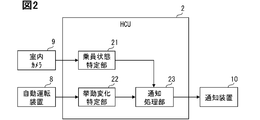
- the HCU 2 includes an occupant state specifying unit 21, a behavior change specifying unit 22, and a notification processing unit 23 as functional blocks.
- a part or all of the functions executed by HCU2 may be configured in hardware by one or a plurality of ICs or the like.
- a part or all of the functional blocks included in the HCU 2 may be realized by a combination of software execution by a processor and hardware members.
- the occupant state specifying unit 21 sequentially acquires indoor images taken by the indoor camera 51.
- the occupant state specifying unit 21 distinguishes and identifies a plurality of types of occupant states of the own vehicle from the indoor images acquired sequentially.
- the occupant state specifying unit 21 may distinguish and specify a plurality of types of occupants of the own vehicle by extracting the feature amount for each state to be the target of the occupant from the indoor image by the image recognition technology.
- the occupant state specifying unit 21 may be able to distinguish and identify a plurality of types of occupant states of the own vehicle by pattern recognition, machine learning, or the like.
- the occupant's state is roughly classified into a state in which the vehicle is focused on driving (hereinafter, a concentrated driving state) and a state in which the vehicle is not focused on driving (hereinafter, a non-concentrated driving state).
- a concentrated driving state a state in which the vehicle is focused on driving
- a non-concentrated driving state a state in which the vehicle is not focused on driving
- Examples of the traveling concentration state include a state in which the occupant is gazing at the front of the own vehicle.
- the state in which the occupant is gazing at the front of the vehicle is specified, for example, based on the fact that the time when the occupant's line of sight deviates from the front of the vehicle is less than the specified time for distinguishing the presence or absence of gaze. Just do it.
- the non-concentrated driving state include a state that does not correspond to the concentrated driving state. An example of a non-concentrated driving state will be described below.
- the occupant state specifying unit 21 identifies at least a state in which the occupant is holding an object and a state in which the occupant is not holding an object as a non-traveling concentrated state. This is because even if the occupant's state is classified as a non-concentrated state, the magnitude of the influence of the change in the behavior of the own vehicle differs depending on whether the occupant is holding the object or not holding the object. This is because it is considered.
- the influence of the change in the behavior of the own vehicle is greater when the occupant is holding the object than when the occupant is not holding the object.
- the states corresponding to the state of the occupant not grasping the object include the state of the occupant talking, the occupant looking aside, and the occupant drowsiness. ..
- the occupant state specifying unit 21 may specify that the occupant is in a conversation state, for example, based on the fact that the number of openings of the occupant within a predetermined period becomes a certain number or more.
- the occupant state specifying unit 21 may specify that the occupant is in an inattentive state, for example, based on the fact that the occupant's line of sight deviates from the front of the vehicle for a certain period of time or longer.
- the occupant state specifying unit 21 may specify that the occupant is in a drowsy state, for example, based on the degree of opening of the occupant's eyes.
- the occupant state specifying unit 21 identifies at least a state in which the occupant is gripping the liquid and a state in which the occupant is not gripping the solid as a non-traveling concentrated state. This is because even if the occupant's state is classified as a non-concentrated state, the magnitude of the influence of the change in the behavior of the own vehicle differs depending on whether the occupant is holding the liquid or holding the solid. This is because it can be considered.
- the liquid is more likely to move due to the change in the behavior of the vehicle than the solid. Therefore, the state in which the occupant is holding the liquid is due to the change in the behavior of the vehicle. The impact is expected to be greater.
- "During liquid gripping" means, for example, that the occupant is gripping the liquid contained in the container.
- the state of gripping the liquid and the state of gripping the solid may be divided into the states of gripping the object.
- the state corresponding to the state of the occupant holding the liquid includes a state in which the occupant is holding a drink.
- the occupant state specifying unit 21 may specify that the occupant is holding a drink based on the shape, display, and the like characteristic of the drink container.
- the state corresponding to the state of the occupant holding the solid body is the state in which the occupant holds a mobile terminal such as a smartphone, a notebook PC, or a tablet terminal. , Holding a paper medium in hand, holding solid food in hand, etc.
- the occupant state specifying unit 21 may specify that the mobile terminal is being held in the hand based on the shape, display, and the like characteristic of the mobile terminal.
- the occupant state specifying unit 21 may specify that the paper medium is held in the hand based on the shape, the display object, and the like characteristic of the paper medium.
- the occupant state specifying unit 21 may specify that the person is holding the solid food in his / her hand, based on the shape, the display, and the like characteristic of the solid food.
- the behavior change specifying unit 22 identifies future behavior changes of the own vehicle during automatic driving.
- the behavior change specifying unit 22 may acquire a short-term running plan determined by the automatic driving device 8 and specify this short-term running plan as a future behavior change of the own vehicle.
- the behavior change specifying unit 22 may specify a short-term travel plan evaluated as having safety by the automatic driving device 8 as a future behavior change of the own vehicle.
- the short-term travel plan evaluated by the automatic driving device 8 as having safety may include a modified version of the traveling plan evaluated by the automatic driving device 8 as having safety. That is, the behavior change specifying unit 22 evaluates the distance between the vehicle and the obstacles around the vehicle during automatic driving, and evaluates the safety between the objects calculated by a preset mathematical formula model.
- the change in the behavior of the own vehicle required to maintain the safe distance which is the reference for the driving, may be specified as the future change in the behavior of the own vehicle during automatic driving.
- the behavior change specifying unit 22 may be configured to predict future behavior changes of the own vehicle not included in the traveling plan based on the short-term traveling plan determined by the automatic driving device 8.
- the behavior change specified by the behavior change specifying unit 22 may be, for example, the magnitude of the behavior change.
- the magnitude of the behavior change is, for example, the front-rear acceleration / deceleration, which is the front-rear acceleration / deceleration of the own vehicle, the lateral acceleration / deceleration, which is the left-right direction (that is, the lateral direction) of the own vehicle, and the vertical adjustment / deceleration of the own vehicle. There are vertical acceleration / deceleration, angular speed of own vehicle, etc.
- the behavior change specified by the behavior change specifying unit 22 may be the difference between the behavior change of the vehicle corresponding to the characteristics of the occupant and the behavior change of the vehicle due to automatic driving described in Patent Document 1.
- the description of the behavior change specified by the behavior change specifying unit 22 will be continued by taking the case of the magnitude of the behavior change as an example.
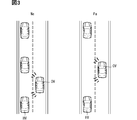
- FIG. 3 is a diagram for explaining the magnitude of deceleration in the front-rear direction of the own vehicle, which is required when a vehicle around the own vehicle is predicted to enter the front of the traveling lane of the own vehicle.
- the HV in FIG. 3 indicates the own vehicle
- the OV indicates a peripheral vehicle that is about to enter in front of the traveling lane of the own vehicle.
- the distance between the own vehicle HV and the peripheral vehicle OV is closer in Ne than in the case of Fa in FIG.
- the automatic driving device 8 when the automatic driving device 8 generates a short-term travel plan, the short-term travel is performed so that the deceleration of the own vehicle in the front-rear direction becomes larger in the case of Ne in FIG. 3 than in the case of Fa in FIG.
- the plan will be generated. Therefore, when it is predicted that a vehicle in the vicinity of the own vehicle will enter the traveling lane of the own vehicle, the behavior change specifying unit 22 increases the magnitude of the behavior change as the distance between the own vehicle and the surrounding vehicle in the own vehicle becomes shorter. As a result, the front-rear deceleration will be largely specified.
- a vehicle in the vicinity of the own vehicle enters in front of the driving lane of the own vehicle, it recognizes the driving environment in which the direction indicator light on the driving lane side of the own vehicle is blinking among the direction indicator lights of the surrounding vehicles.
- the configuration should be such that it is predicted from the fact that it is done.
- the behavior change specifying unit 22 specifies the front-rear deceleration as the magnitude of the behavior change as the curvature of the curved road in front of the own vehicle increases.
- the behavior change specifying unit 22 determines the curvature of the curved road in front of the own vehicle. The larger the size, the larger the size can be predicted and specified.
- the behavior change specifying unit 22 may specify the magnitude of the behavior change by predicting that the vertical acceleration increases as the step of the unevenness in front of the own vehicle increases.
- the result recognized by the traveling environment recognition process by the automatic driving device 8 may be used.
- the vertical acceleration of the own vehicle when crossing the uneven step in front of the own vehicle is estimated from the rate of change in the pitch direction of the preceding vehicle of the own vehicle recognized by the driving environment recognition process by the automatic driving device 8.
- the configuration may be such that the magnitude of the behavior change is specified.
- the behavior change specifying unit 22 specifies the front-rear deceleration very greatly in response to a sudden event such as a pedestrian jumping out.
- the behavior change specifying unit 22 suppresses unnecessary processing by, for example, not performing processing during manual driving.
- the notification processing unit 23 When the behavior change specified by the behavior change specifying unit 22 satisfies the condition related to the behavior change (hereinafter referred to as the notification condition) during the automatic driving of the own vehicle, the notification processing unit 23 notifies the notification about the behavior change. It is performed from the device 10.
- the notification condition is a threshold value for distinguishing the presence or absence of the notification according to the magnitude of the behavior change. Is.
- the notification condition may be a threshold value for distinguishing the presence or absence of the notification by the difference in the behavior change.
- the notification processing unit 23 notifies the behavior change when the magnitude of the behavior change specified by the behavior change specifying unit 22 is equal to or greater than the threshold value as the notification condition, while the notification processing unit 23 notifies the behavior change when the magnitude is less than the threshold value. , Do not notify about the behavior change. According to this, it is possible to switch the presence or absence of notification about the behavior change according to the magnitude of the behavior change.
- the threshold value as the notification condition may be set for each type of behavior change, for example, for each of the front-rear deceleration, the lateral acceleration, and the vertical acceleration.
- the notification about the behavior change may be a notification notifying the occurrence of the behavior change, or a notification not only the occurrence of the behavior change but also the content of the behavior change.
- the configuration may be such that the occurrence of the behavior change is notified by starting the notification.
- the content of the behavior change may be notified by display, voice, or the like.
- the direction and magnitude of the behavior change may be notified by switching the location and size of operating the plurality of oscillators arranged at different locations on the sheet. ..
- the notification processing unit 23 has different notification conditions according to the type of the occupant state specified by the occupant state specifying unit 21.
- the notification condition is better when the state of the occupant specified by the occupant state specifying unit 21 is a state classified into a traveling concentrated state than when the occupant state is a non-driving concentrated state.
- the stricter notification condition indicates that the threshold value as the notification condition is set higher.
- the threshold value as a notification condition when the occupant state specified by the occupant state specifying unit 21 is a traveling concentration state is set as the first threshold value.
- the threshold value as the notification condition in the non-driving concentrated state is the second to fourth threshold values described later.
- the occupants are more aware of the driving of their own vehicle than in the case of non-concentrated driving. Therefore, as compared with the case of the non-concentrated state of running, even if the behavior change is larger, the situation where the response to the behavior change is delayed and the posture is lost is less likely to occur. Therefore, the magnitude of the behavior change that is annoying when the notification about the behavior change is given becomes larger than that in the case of the non-driving concentration state.
- the notification conditions are stricter than in the non-concentrated driving state, so that it is possible to suppress an increase in notifications unnecessary for the occupant.
- the notification processing unit 23 makes the notification conditions different according to the type of this state. Even if the occupant's state is classified as a non-concentrated state, the necessity of notifying the change in the behavior of the own vehicle may differ depending on the type of state. For example, if the vehicle is not easily affected by changes in the behavior of the vehicle, it is highly likely that the occupants will feel that the notification of the change in the behavior of the vehicle is unnecessary even if the vehicle is classified as a non-concentrated state. .. On the other hand, in the case of a state classified as a non-concentrated state, it is possible to suppress an increase in unnecessary notifications for the occupant by changing the notification conditions according to the type of this state. become.
- the notification processing unit 23 is more likely to handle an occupant's object than a occupant's state in which the occupant's state specified by the occupant state specifying unit 21 is classified as a non-driving concentrated state. It is preferable that the notification conditions are stricter in the non-grasping state.
- the threshold value as a notification condition when the state of the occupant specified by the occupant state specifying unit 21 is a state in which the object is not gripped is set as the second threshold value. Further, the threshold value as the notification condition when the object is being grasped is the third to fourth threshold value described later.
- the influence of the change in the behavior of the own vehicle is greater when the occupant is in the state of grasping the object than in the case where the occupant is not grasping the object. Therefore, in the case of the state in which the object is not gripped, the magnitude of the behavior change that is annoying when the notification of the behavior change is given is larger than in the case of the state in which the object is being gripped.
- the notification conditions are stricter when the object is not being grasped than when the object is being grasped, so that it is possible to suppress an increase in unnecessary notifications for the occupant. It will be possible.
- the notification processing unit 23 is more likely to handle an occupant's object than when the occupant's state specified by the occupant's state specifying unit 21 is classified as a non-driving concentrated state and the occupant is holding the liquid. It is preferable that the notification conditions are stricter in the non-grasping state.
- a threshold value as a notification condition when the state of the occupant specified by the occupant state specifying unit 21 is a state of being gripped by a solid is set as a third threshold value. Further, the threshold value as a notification condition when the liquid is being grasped is set to the fourth threshold value.
- the notification conditions are stricter in the state of holding the solid than in the state of holding the liquid, so that it is possible to suppress an increase in notifications unnecessary for the occupant. become.
- the notification processing unit 23 has stricter notification conditions as the state of the occupant specified by the occupant state specifying unit 21 is less likely to be affected by the behavior change. ..
- the state may be classified as a state in which the occupant is holding a solid, or the notification conditions may differ depending on the type of solid.
- the notification conditions may be stricter than when the solid being gripped is a mobile terminal.
- the notification conditions may be stricter for foods in which the solid being gripped is less likely to spill than in the case of foods in which the solid being gripped is more likely to spill.
- the notification condition may be relaxed when the occupant's condition is liable to collapse due to changes in the behavior of the elderly, children, etc.
- the notification processing unit 23 When the magnitude of the behavior change specified by the behavior change specifying unit 22 is equal to or greater than the predetermined upper limit value, the notification processing unit 23 does not care about the type of the occupant state specified by the occupant state specifying unit 21. It is preferable to notify the behavior change.
- the upper limit value referred to here is the magnitude of the behavioral change in which it is considered preferable to hold the occupant even when the occupant is in a concentrated driving state, and is a value that can be arbitrarily set. It is assumed that the upper limit value is at least a value larger than the threshold value as the notification condition described above.
- the magnitude of the behavior change specified by the behavior change specifying unit 22 is less than this upper limit value, as described above, the type of the occupant state specified by the occupant state specifying unit 21 and the magnitude of the behavior change It is preferable to switch the presence or absence of notification of the change in behavior depending on the situation.
- the presence or absence of notification is switched according to the type of occupant's condition, and the type of occupant's condition is changed. Regardless of the type of occupant's condition, it is possible to notify the change in behavior when it is preferable to hold the occupant.
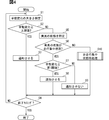
- the flowchart of FIG. 4 may be configured to start when a switch for starting the internal combustion engine or the motor generator of the own vehicle (hereinafter, power switch) is turned on.
- the configuration may be added to the condition that the automatic driving of the own vehicle is performed.
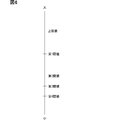
- the upper limit value, the first threshold value, the second threshold value, the third threshold value, and the fourth threshold value are used in order from the largest value. Suppose there is.
- step S1 the behavior change specifying unit 22 specifies the magnitude of the future behavior change of the own vehicle during automatic driving.
- step S2 if the magnitude of the behavior change specified in S1 is equal to or greater than the upper limit value (YES in S2), the process proceeds to step S3. On the other hand, when the magnitude of the behavior change specified in S1 is less than the upper limit value (NO in S2), the process proceeds to step S5.
- the behavior change specifying unit 22 specifies the magnitude of a plurality of types of behavior changes such as front-rear deceleration, lateral acceleration, and vertical acceleration, it may be compared with the upper limit values set for each type of behavior change.
- the magnitude of the behavior change is assumed to be greater than or equal to the upper limit value, and when all types are less than the upper limit value, the magnitude of the behavior change is less than the upper limit value. It should be assumed that it was.
- step S3 the notification processing unit 23 causes the notification device 10 to notify the behavior change whose size is equal to or greater than the upper limit value in S2. This notification may be intended for all occupants who can be notified by the notification device 10.
- step S4 when it is the end timing of the behavior notification related processing (YES in S4), the behavior notification related processing is terminated. On the other hand, if it is not the end timing of the behavior notification related processing (NO in S4), the process returns to S1 and the processing is repeated.
- the end timing of the behavior notification related processing there is a case where the power switch of the own vehicle is turned off, a case where the operation is switched to the manual operation, and the like.
- step S5 the occupant state specifying unit 21 identifies the occupant's state.
- step S6 if the state of the occupant specified by the occupant state specifying unit 21 is a traveling concentration state (YES in S6), the process proceeds to step S7.
- step S10 when the occupant state specified by the occupant state specifying unit 21 is in a state classified as a non-driving concentrated state (NO in S6), the process proceeds to step S10.
- step S7 if the magnitude of the behavior change specified in S1 is equal to or greater than the first threshold value (YES in S7), the process proceeds to step S8. On the other hand, when the magnitude of the behavior change specified in S1 is less than the first threshold value (NO in S7), the process proceeds to step S9.
- the behavior change specifying unit 22 specifies the magnitude of a plurality of types of behavior changes such as front-rear deceleration, lateral acceleration, and vertical acceleration, it may be compared with the threshold values set for each type of behavior change.
- the magnitude of the behavior change is assumed to be greater than or equal to the threshold value, and when all types are less than the threshold value, the magnitude of the behavior change is less than the threshold value. And it is sufficient. The same applies to the subsequent comparison with the second to fourth threshold values as notification conditions.
- step S8 the notification processing unit 23 causes the notification device 10 to notify the occupant identified as the traveling concentration state in S5 about the behavior change whose magnitude is equal to or greater than the first threshold value in S7, and in step S4. Move on to.
- step S9 the notification processing unit 23 does not notify the occupant identified as the traveling concentration state in S5 about the behavior change whose magnitude is less than the first threshold value in S7 from the notification device 10, and steps S9. Move on to S4.
- step S10 processing in a non-running concentrated state is performed, and the process proceeds to step S4.
- step S4 an example of the flow of processing in a non-running concentrated state will be described with reference to the flowchart of FIG.
- step S101 if the state of the occupant specified in S5 is a state in which an object is being grasped among the states classified as a non-traveling concentrated state (YES in S101), the process proceeds to step S105. On the other hand, when the state of the occupant specified in S5 is a state in which the object is not being gripped among the states classified as the non-traveling concentrated state (NO in S101), the process proceeds to step S102.
- step S102 if the magnitude of the behavior change specified in S1 is equal to or greater than the second threshold value (YES in S102), the process proceeds to step S103. On the other hand, when the magnitude of the behavior change specified in S1 is less than the second threshold value (NO in S102), the process proceeds to step S104.
- step S103 the notification processing unit 23 causes the notification device 10 to notify the occupant identified in S5 that the object is not being grasped about the behavior change whose size is equal to or greater than the second threshold value in S102.
- step S4. the notification processing unit 23 causes the notification device 10 to notify the occupant identified in S5 that the object is not being grasped about the behavior change whose size is less than the second threshold value in S102. Instead, the process proceeds to step S4.
- step S105 if the state of the occupant specified in S5 is the state of gripping the liquid among the states of gripping the object classified as the non-concentrated running state (YES in S105), the process proceeds to step S107. .. On the other hand, when the state of the occupant specified in S5 is the state of holding a solid object among the states of holding an object classified as a non-concentrated running state (NO in S105), the process proceeds to step S106.
- step S106 if the magnitude of the behavior change specified in S1 is equal to or greater than the third threshold value (YES in S106), the process proceeds to step S107. On the other hand, when the magnitude of the behavior change specified in S1 is less than the third threshold value (NO in S106), the process proceeds to step S108.
- step S107 the notification processing unit 23 causes the notification device 10 to notify the occupant identified in S5 that the solid is being gripped about the behavior change whose magnitude is equal to or greater than the third threshold value in S106.
- step S108 the notification processing unit 23 does not notify the occupant identified in S5 that the solid is being gripped about the behavior change whose magnitude is less than the third threshold value in S106 from the notification device 10. , Step S4.
- step S109 if the magnitude of the behavior change specified in S1 is equal to or greater than the fourth threshold value (YES in S109), the process proceeds to step S110. On the other hand, when the magnitude of the behavior change specified in S1 is less than the fourth threshold value (NO in S109), the process proceeds to step S111.
- step S110 the notification processing unit 23 causes the notification device 10 to notify the occupant identified in S5 that the liquid is being grasped about the behavior change whose size is equal to or greater than the fourth threshold value in S109.
- the process proceeds to step S4.
- step S111 the notification processing unit 23 does not notify the occupant identified in S5 that the solid is being gripped about the behavior change whose size is less than the fourth threshold value in S109 from the notification device 10. , Step S4.
- a configuration is shown in which the magnitude of the behavior change is compared with the notification condition to switch the presence or absence of notification of the behavior change, but this is not always the case. Even if a vehicle other than the magnitude of the behavior change is used as the future behavior change of the own vehicle, the notification condition is stricter so that the vehicle is less likely to be affected by the behavior change, and the presence or absence of notification about the behavior change is switched. And it is sufficient.
- ⁇ Summary of Embodiment 1> For example, in the case of automatic driving so as to keep the distance to the surrounding vehicles in the front-rear direction and the lateral direction of the own vehicle at the above-mentioned safe distance, when the traffic volume increases, the number of interrupting vehicles increases, and sudden braking and steering increase. Conceivable. During automatic driving, it is considered that the frequency of non-concentrated driving in which the occupants including the driver are not conscious of the driving of the vehicle will increase. If sudden braking or steering occurs while the occupant is in a non-concentrated state, the occupant may lose his or her posture.
- the notification condition which is a condition related to the behavior change
- the notification about the behavior change is given. It will be possible to notify the occupants of future behavioral changes during autonomous driving. Therefore, it becomes difficult for the occupant to lose his / her posture by preparing for future behavior changes.
- the notification condition is not uniformly relaxed, but the behavior change is changed according to the type of the occupant's state. It is possible to switch the presence or absence of notification. For example, even in a type of state classified as a non-concentrated state, the notification condition becomes stricter as the state is less susceptible to changes in behavior. Therefore, it is possible to notify the occupant only when the behavior change becomes larger and the occupant's condition requires notification. As a result, it is possible to notify the occupant of future behavioral changes during autonomous driving, while suppressing an increase in unnecessary notifications for the occupant even when the occupant is not aware of the vehicle's driving. Will be possible.
- the behavior change specifying unit 22 is set to a safety distance as a reference for evaluating the safety between the own vehicle and the obstacles around the own vehicle calculated by a preset mathematical formula model.
- the safety distance may be calculated using a model other than the mathematical formula model.
- the behavior change of the own vehicle when traveling according to this traveling plan is specified as the future behavior change of the own vehicle during automatic driving. It may be configured to be used.
- the configuration in which the automatic driving device 8 and the HCU 2 are separate bodies is shown, but the present invention is not necessarily limited to this.
- an electronic control device that has the functions of both the automatic driving device 8 and the HCU 2 may be used.
- the behavior change specifying unit 22 may be configured to specify the future behavior change of the own vehicle by generating a short-term driving plan in the same manner as the automatic driving device 8 of the first embodiment.
- the configuration in which the automatic driving device 8 and the vehicle control ECU 6 are separate bodies is shown, the present invention is not necessarily limited to this.
- the automatic driving device 8 may also have the function of the vehicle control ECU 6.
- the automatic driving device 8 may also have the function of the locator 3.
- control unit and the method thereof described in the present disclosure may be realized by a dedicated computer constituting a processor programmed to execute one or a plurality of functions embodied by a computer program.
- the apparatus and method thereof described in the present disclosure may be realized by a dedicated hardware logic circuit.
- the apparatus and method thereof described in the present disclosure may be realized by one or more dedicated computers configured by a combination of a processor that executes a computer program and one or more hardware logic circuits.
- the computer program may be stored in a computer-readable non-transitional tangible recording medium as an instruction executed by the computer.
Landscapes
- Engineering & Computer Science (AREA)
- Automation & Control Theory (AREA)
- Transportation (AREA)
- Mechanical Engineering (AREA)
- Human Computer Interaction (AREA)
- Physics & Mathematics (AREA)
- Mathematical Physics (AREA)
- Traffic Control Systems (AREA)
- Control Of Driving Devices And Active Controlling Of Vehicle (AREA)
Priority Applications (1)
| Application Number | Priority Date | Filing Date | Title |
|---|---|---|---|
| US17/647,933 US12151698B2 (en) | 2019-07-16 | 2022-01-13 | Notification control device for vehicle and notification control method for vehicle |
Applications Claiming Priority (2)
| Application Number | Priority Date | Filing Date | Title |
|---|---|---|---|
| JP2019-131255 | 2019-07-16 | ||
| JP2019131255A JP7230717B2 (ja) | 2019-07-16 | 2019-07-16 | 車両用通知制御装置及び車両用通知制御方法 |
Related Child Applications (1)
| Application Number | Title | Priority Date | Filing Date |
|---|---|---|---|
| US17/647,933 Continuation US12151698B2 (en) | 2019-07-16 | 2022-01-13 | Notification control device for vehicle and notification control method for vehicle |
Publications (1)
| Publication Number | Publication Date |
|---|---|
| WO2021010213A1 true WO2021010213A1 (ja) | 2021-01-21 |
Family
ID=74210697
Family Applications (1)
| Application Number | Title | Priority Date | Filing Date |
|---|---|---|---|
| PCT/JP2020/026440 Ceased WO2021010213A1 (ja) | 2019-07-16 | 2020-07-06 | 車両用通知制御装置及び車両用通知制御方法 |
Country Status (3)
| Country | Link |
|---|---|
| US (1) | US12151698B2 (enExample) |
| JP (1) | JP7230717B2 (enExample) |
| WO (1) | WO2021010213A1 (enExample) |
Cited By (1)
| Publication number | Priority date | Publication date | Assignee | Title |
|---|---|---|---|---|
| US20240367320A1 (en) * | 2022-01-18 | 2024-11-07 | Abb Schweiz Ag | Method and Apparatus for Implementing a Safety Configuration |
Families Citing this family (5)
| Publication number | Priority date | Publication date | Assignee | Title |
|---|---|---|---|---|
| KR20220052430A (ko) * | 2020-10-20 | 2022-04-28 | 현대자동차주식회사 | 자율주행차량의 거동 제어 장치 및 그 방법 |
| DE102021000919B3 (de) * | 2021-02-22 | 2022-06-15 | Technische Universität Ilmenau | Fahrzeugzustandsregelungssystem, Straßenfahrzeug und Verfahren zur Fahrzeugzustandsregelung zur Emissionslimitierung |
| WO2022219681A1 (ja) * | 2021-04-12 | 2022-10-20 | 日産自動車株式会社 | 制動制御方法及び制動制御装置 |
| CN119053976A (zh) * | 2022-04-19 | 2024-11-29 | 大学共同利用机关法人信息与系统研究机构 | 安全规则生成装置、导航系统、安全规则生成方法、导航方法以及程序 |
| DE102022003536B3 (de) | 2022-09-27 | 2023-12-28 | Mercedes-Benz Group AG | Benachrichtigungsmanagementverfahren für eine fahrzeugbasierte Mensch-Maschine-Schnittstelle und Fahrzeug mit einem Benachrichtigungsmanagementsystem |
Citations (5)
| Publication number | Priority date | Publication date | Assignee | Title |
|---|---|---|---|---|
| JPH10166895A (ja) * | 1996-12-09 | 1998-06-23 | Mitsubishi Electric Corp | 車両用追従走行制御装置 |
| JP2016141220A (ja) * | 2015-01-30 | 2016-08-08 | 富士通テン株式会社 | 情報提供方法、情報提供装置、情報提供システムおよび車両 |
| JP2017107502A (ja) * | 2015-12-11 | 2017-06-15 | トヨタ自動車株式会社 | 車載警告システム |
| WO2017168541A1 (ja) * | 2016-03-29 | 2017-10-05 | 本田技研工業株式会社 | 自動運転制御装置 |
| JP2018097804A (ja) * | 2016-12-16 | 2018-06-21 | パナソニックIpマネジメント株式会社 | 情報処理システム、情報処理方法、およびプログラム |
Family Cites Families (12)
| Publication number | Priority date | Publication date | Assignee | Title |
|---|---|---|---|---|
| US10210761B2 (en) * | 2013-09-30 | 2019-02-19 | Sackett Solutions & Innovations, LLC | Driving assistance systems and methods |
| US9487139B1 (en) * | 2015-05-15 | 2016-11-08 | Honda Motor Co., Ltd. | Determining a driver alert level for a vehicle alert system and method of use |
| JP2017001532A (ja) * | 2015-06-10 | 2017-01-05 | 富士重工業株式会社 | 車両の走行制御装置 |
| US20170072850A1 (en) * | 2015-09-14 | 2017-03-16 | Pearl Automation Inc. | Dynamic vehicle notification system and method |
| JP6641916B2 (ja) * | 2015-11-20 | 2020-02-05 | オムロン株式会社 | 自動運転支援装置、自動運転支援システム、自動運転支援方法および自動運転支援プログラム |
| JP6540983B2 (ja) * | 2016-03-16 | 2019-07-10 | 本田技研工業株式会社 | 車両制御システム、車両制御方法、および車両制御プログラム |
| JP2017165296A (ja) * | 2016-03-17 | 2017-09-21 | 株式会社日立製作所 | 自動運転制御システム |
| US11254327B2 (en) * | 2016-08-16 | 2022-02-22 | Ford Global Technologies, Llc | Methods and apparatus to present anticipated vehicle maneuvers to a passenger |
| JP6388017B2 (ja) | 2016-11-24 | 2018-09-12 | マツダ株式会社 | 自動ブレーキシステム |
| CN111132886B (zh) * | 2017-05-08 | 2023-05-16 | 乔伊森安全系统收购有限责任公司 | 乘员监测系统与车辆控制系统的集成 |
| JP2019159711A (ja) * | 2018-03-12 | 2019-09-19 | 矢崎総業株式会社 | 覚醒度維持装置 |
| KR102598953B1 (ko) * | 2018-09-28 | 2023-11-06 | 현대자동차주식회사 | 차량 제어 장치, 그를 포함한 시스템 및 그 방법 |
-
2019
- 2019-07-16 JP JP2019131255A patent/JP7230717B2/ja active Active
-
2020
- 2020-07-06 WO PCT/JP2020/026440 patent/WO2021010213A1/ja not_active Ceased
-
2022
- 2022-01-13 US US17/647,933 patent/US12151698B2/en active Active
Patent Citations (5)
| Publication number | Priority date | Publication date | Assignee | Title |
|---|---|---|---|---|
| JPH10166895A (ja) * | 1996-12-09 | 1998-06-23 | Mitsubishi Electric Corp | 車両用追従走行制御装置 |
| JP2016141220A (ja) * | 2015-01-30 | 2016-08-08 | 富士通テン株式会社 | 情報提供方法、情報提供装置、情報提供システムおよび車両 |
| JP2017107502A (ja) * | 2015-12-11 | 2017-06-15 | トヨタ自動車株式会社 | 車載警告システム |
| WO2017168541A1 (ja) * | 2016-03-29 | 2017-10-05 | 本田技研工業株式会社 | 自動運転制御装置 |
| JP2018097804A (ja) * | 2016-12-16 | 2018-06-21 | パナソニックIpマネジメント株式会社 | 情報処理システム、情報処理方法、およびプログラム |
Cited By (1)
| Publication number | Priority date | Publication date | Assignee | Title |
|---|---|---|---|---|
| US20240367320A1 (en) * | 2022-01-18 | 2024-11-07 | Abb Schweiz Ag | Method and Apparatus for Implementing a Safety Configuration |
Also Published As
| Publication number | Publication date |
|---|---|
| JP2021014235A (ja) | 2021-02-12 |
| JP7230717B2 (ja) | 2023-03-01 |
| US20220135065A1 (en) | 2022-05-05 |
| US12151698B2 (en) | 2024-11-26 |
Similar Documents
| Publication | Publication Date | Title |
|---|---|---|
| US10421465B1 (en) | Advanced driver attention escalation using chassis feedback | |
| JP7230717B2 (ja) | 車両用通知制御装置及び車両用通知制御方法 | |
| JP7424327B2 (ja) | 車両用表示制御装置、車両用表示制御システム、及び車両用表示制御方法 | |
| JP6611957B2 (ja) | 情報出力制御装置および情報出力制御方法 | |
| US11587461B2 (en) | Context-sensitive adjustment of off-road glance time | |
| JP6733293B2 (ja) | 情報処理装置 | |
| JP6714552B2 (ja) | 車両制御装置 | |
| CN111587197A (zh) | 利用驾驶模式识别来调节电动车辆的动力总成 | |
| US20200282984A1 (en) | Vehicle driving control system | |
| CN110371018B (zh) | 使用其他车辆车灯的信息改善车辆行为 | |
| WO2022025087A1 (ja) | 経路確認装置および経路確認方法 | |
| TW202443509A (zh) | 用於警示駕駛員的警示模態選擇 | |
| JP2020091790A (ja) | 自動運転システム | |
| JP2018101199A (ja) | 運転支援装置 | |
| JP7139902B2 (ja) | 報知装置 | |
| JP6906175B2 (ja) | 運転支援方法およびそれを利用した運転支援装置、自動運転制御装置、車両、プログラム、運転支援システム | |
| CN113428148B (zh) | 车辆控制装置及车辆控制方法 | |
| CN109844833A (zh) | 驾驶切换判定装置、驾驶切换判定方法以及用于驾驶切换判定的程序 | |
| JP2018165692A (ja) | 運転支援方法およびそれを利用した運転支援装置、自動運転制御装置、車両、プログラム、提示システム | |
| CN118254799A (zh) | 用于控制具有车道支持系统的车辆的方法和系统 | |
| US20190300016A1 (en) | Automated driving system | |
| JP2023062506A (ja) | 車両の制御装置、制御方法、制御プログラム | |
| WO2018168099A1 (ja) | 集中度判定装置、集中度判定方法及び集中度判定のためのプログラム | |
| JP7670009B2 (ja) | 車両用制御装置及び車両用制御方法 | |
| JP7405124B2 (ja) | 車両用制御装置及び車両用制御方法 |
Legal Events
| Date | Code | Title | Description |
|---|---|---|---|
| 121 | Ep: the epo has been informed by wipo that ep was designated in this application |
Ref document number: 20840628 Country of ref document: EP Kind code of ref document: A1 |
|
| NENP | Non-entry into the national phase |
Ref country code: DE |
|
| 122 | Ep: pct application non-entry in european phase |
Ref document number: 20840628 Country of ref document: EP Kind code of ref document: A1 |