WO2020262326A1 - 積層体、及びパッケージの製造方法 - Google Patents
積層体、及びパッケージの製造方法 Download PDFInfo
- Publication number
- WO2020262326A1 WO2020262326A1 PCT/JP2020/024470 JP2020024470W WO2020262326A1 WO 2020262326 A1 WO2020262326 A1 WO 2020262326A1 JP 2020024470 W JP2020024470 W JP 2020024470W WO 2020262326 A1 WO2020262326 A1 WO 2020262326A1
- Authority
- WO
- WIPO (PCT)
- Prior art keywords
- polyester film
- laminate
- less
- layer
- film
- Prior art date
- Legal status (The legal status is an assumption and is not a legal conclusion. Google has not performed a legal analysis and makes no representation as to the accuracy of the status listed.)
- Ceased
Links
Images
Classifications
-
- B—PERFORMING OPERATIONS; TRANSPORTING
- B32—LAYERED PRODUCTS
- B32B—LAYERED PRODUCTS, i.e. PRODUCTS BUILT-UP OF STRATA OF FLAT OR NON-FLAT, e.g. CELLULAR OR HONEYCOMB, FORM
- B32B27/00—Layered products comprising a layer of synthetic resin
- B32B27/36—Layered products comprising a layer of synthetic resin comprising polyesters
Definitions
- the present invention relates to a method for manufacturing a laminate and a package.
- a laminate including a biaxially stretched PET (polyethylene terephthalate) film having excellent heat resistance and toughness as a base film and a polyolefin film such as polyethylene or polypropylene as a sealant layer is known (for example).
- Patent Document 1 A laminate (soft packaging material) including a biaxially stretched PET (polyethylene terephthalate) film having excellent heat resistance and toughness as a base film and a polyolefin film such as polyethylene or polypropylene as a sealant layer is known (for example).
- the obtained package may not withstand high temperature heat sterilization treatment.
- the present invention has been made in view of the above circumstances, and an object of the present invention is to provide a laminate capable of high-temperature heat sterilization treatment when packaged even when a polyester film is mainly used. .. It is also an object of the present invention to provide a method for manufacturing a package using the laminate.
- One aspect of the present invention is a laminate having a base material layer containing a crystalline polyester film, an adhesive layer, and a sealant layer in this order.
- the sealant layer contains the polyester film, and FT-IR analysis is performed by a reflection method.
- a laminated body in which the crystallinity of the polyester film obtained from the following formula is greater than 15% and 70% or less.
- the absorbance at I 1409 is the wave number 1409cm -1
- I 1370 is the absorbance at the wave number 1370 cm -1
- I 1340 denotes a absorbances at wave numbers of 1340 cm -1
- 1409cm -1 normalization band
- 1370cm - 1 cis-conformerband (derived from the amorphous phase)
- 1340 cm -1 trans-conformerband (trans-coordinated absorption zone: derived from the crystalline phase).
- the total mass of the components other than the polyester component may be 10% by mass or less with respect to the total mass of the laminate.
- the thickness of the sealant layer may be 15 ⁇ m or more.
- the crystalline polyester film may be provided with a vapor-deposited layer of an inorganic oxide on at least one surface.
- the amount of water vapor permeation may be 10 g / m 2 ⁇ day or less.
- the oxygen permeation amount may be 5 cc / m 2 ⁇ day or less.
- the laminate of the present invention may be for a boiled retort pouch.
- One aspect of the present invention provides a method for manufacturing a package, comprising a step of performing heat sealing with the sealant layers of the laminated body facing each other to obtain a package filled with the contents.
- the heat seal temperature in the heat seal may be 140 ° C. or higher.
- the present invention it is possible to provide a laminate capable of high-temperature heat sterilization treatment (for example, boil / retort treatment) when it is packaged even when a polyester film is mainly used. Further, according to the present invention, it is possible to provide a method for manufacturing a package using the laminate.
- high-temperature heat sterilization treatment for example, boil / retort treatment
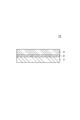
- FIG. 1 shows a schematic cross-sectional view of a laminated body according to an embodiment.
- FIG. 1 shows a schematic cross-sectional view of a laminated body according to an embodiment.
- the laminate 10 according to one embodiment includes a base material layer 1, an adhesive layer 2, and a sealant layer 3 in this order.
- the base material layer is a support film and includes a crystalline polyester film.
- the base material layer may be made of a crystalline polyester film.
- the crystalline polyester film may be a stretched film or a non-stretched film.
- the crystallinity of the crystalline polyester film can be 40% or more.
- the melting point of the crystalline polyester film may be 250 ° C. or higher, and may be 255 ° C. or higher.
- Crystalline polyester can be obtained, for example, by polycondensing diols and dicarboxylic acid.
- diols examples include aliphatic diols and alicyclic diols.
- examples thereof include compounds such as tetramethylene glycol, pentamethylene glycol, hexamethylene glycol, octamethylene glycol, nonamethylene glycol, decamethylene glycol, neopentyl glycol, 1,4-butanediol, and 1,4-cyclohexanedimethanol. These compounds may be used alone or in combination of two or more.
- dicarboxylic acid examples include aliphatic dicarboxylic acid, alicyclic dicarboxylic acid, aromatic dicarboxylic acid, and the like. , Azelaic acid, sebacic acid, nonandicarboxylic acid, decandicarboxylic acid, undecandicarboxylic acid, dodecandicarboxylic acid, maleic acid, fumaric acid, mesaconic acid, citraconic acid, itaconic acid, isophthalic acid, terephthalic acid, n-dodecylsuccinic acid, Examples thereof include compounds such as n-dedosenylsuccinic acid, cyclohexanedicarboxylic acid, anhydrides of these acids or lower alkyl esters. These compounds may be used alone or in combination of two or more.
- Polybutylene terephthalate, polybutylene terephthalate, polyethylene terephthalate and the like can be used as the crystalline polyester from the viewpoint of fully exhibiting the function as the base material layer of the packaging material.
- the base material layer may be provided with a vapor-deposited layer of an inorganic oxide on at least one surface from the viewpoint of improving the gas barrier property against water vapor or oxygen, for example.
- a vapor-deposited layer of the inorganic oxide By using the vapor-deposited layer of the inorganic oxide, a high barrier property can be obtained with a very thin layer within a range that does not affect the recyclability of the laminated body.
- the inorganic oxide include aluminum oxide, silicon oxide, magnesium oxide, tin oxide and the like. From the viewpoint of transparency and barrier property, the inorganic oxide may be selected from the group consisting of aluminum oxide, silicon oxide, and magnesium oxide.
- the thickness of the thin-film deposition layer of the inorganic oxide can be, for example, 5 nm or more and 100 nm or less, and may be 10 nm or more and 50 nm or less. When the thickness is 5 nm or more, the barrier property is easily exhibited, and when the thickness is 100 nm or less, the flexibility of the laminated body is easily maintained.
- the thin-film deposition layer can be formed by, for example, a physical vapor deposition method, a chemical vapor deposition method, or the like.
- the base material layer may contain a plurality of crystalline polyester films, in which case each crystalline polyester film may be the same or different.
- each crystalline polyester film may be the same or different.
- at least one layer of the crystalline polyester film may be provided with a vapor-deposited layer of an inorganic oxide on the surface thereof.
- the thickness of the base material layer can be, for example, 5 ⁇ m to 1 mm or less, may be 5 to 800 ⁇ m, and may be 5 to 500 ⁇ m.
- the total thickness thereof may be within the above range.
- Adhesive layer for example, a two-component curable polyurethane in which a bifunctional or higher functional aromatic or aliphatic isocyanate compound is allowed to act as a curing agent on a main agent such as polyester polyol, polyether polyol, or acrylic polyol.
- a main agent such as polyester polyol, polyether polyol, or acrylic polyol.
- system adhesives include system adhesives.
- the adhesive layer can be formed by applying the adhesive component on the base material layer and then drying it.
- a polyurethane-based adhesive is used, after coating, for example, by aging at 40 ° C. for 4 days or more, the reaction between the hydroxyl group of the main agent and the isocyanate group of the curing agent proceeds, and strong adhesion becomes possible.
- the thickness of the adhesive layer can be 2 to 50 ⁇ m from the viewpoint of adhesiveness, followability, processability, etc., and may be 3 to 20 ⁇ m.
- the sealant layer is a layer that imparts sealing properties by heat sealing in the laminated body, and includes a polyester film.
- the sealant layer may be made of a polyester film.
- the crystallinity is greater than 15%, the amorphous portion becomes difficult to flow at the glass transition temperature Tg or higher of the polyester, so that the sealant layers can be prevented from being fused by the heat sterilization treatment. Further, when the crystallinity is 70% or less, it is possible to prevent the melting point of the polyester from becoming too high, and it is possible to maintain a wide sealable temperature range. From this point of view, the crystallinity can be 16% or more, may be 17.5% or more, may be 20% or more, and may be 25% or more. The crystallinity can be 60% or less, 55% or less, and 50% or less.
- FT-IR analysis by the reflection method on the polyester film can be performed, for example, as follows.
- the sealing surface of the polyester film used as the sealant layer is brought into contact with the prism, and the absorbance is measured with a single reflection ATR measuring device.
- As the prism ZnSe, Ge, or the like can be used.
- the absorbance of each peak is based on the straight line connecting the absorbance at the wave number at which the peak with a wave number of 1409 cm -1 starts to rise from the high wave number side of the absorption spectrum and the absorbance at the wave number at which the peak with a wave number of 1340 cm -1 starts to rise from the low wave number side. Calculate as 0 points).
- the crystallinity of the polyester film can be adjusted by changing the type of monomer used for copolymerization. Further, by changing the cooling rate when forming the polyester film, the degree of crystallization progress can be adjusted and the crystallinity can be adjusted. Further, the crystallinity can be adjusted by subjecting the formed polyester film to heat treatment. In addition, the crystallinity can be adjusted by changing the film forming conditions such as the heat fixing temperature and the stretching ratio.
- the polyester film can be obtained, for example, by polycondensing diols and a dicarboxylic acid. Examples of the diols and dicarboxylic acids include the compounds exemplified in the above-mentioned base material layer.
- Polybutylene terephthalate, polybutylene terephthalate, polyethylene terephthalate, etc. can be used as the polyester from the viewpoint of fully exhibiting the function of the packaging material as a sealant layer.
- the sealant layer may contain a plurality of polyester films, in which case each polyester film may be the same or different.
- each polyester film may be the same or different.
- at least the polyester film on the innermost layer side when used as a packaging bag may have the above crystallinity.
- additives such as flame retardants, slip agents, anti-blocking agents, antioxidants, light stabilizers, and tackifiers may be added to the polyester film constituting the sealant layer.
- the thickness of the sealant layer can be 15 ⁇ m or more, may be 15 to 100 ⁇ m, or may be 20 to 60 ⁇ m from the viewpoint of ensuring excellent strength and filling suitability. If the thickness of the sealant layer is less than 15 ⁇ m, the sealing strength tends to be insufficient depending on the size of the laminate and the amount of the contents. In addition, the mass ratio of the adhesive or ink in the laminate tends to be high. When the sealant layer contains a plurality of polyester films, the total thickness thereof may be within the above range.
- the glass transition temperature Tg of the polyester film constituting the sealant layer can be 30 to 90 ° C, and may be 50 to 80 ° C.
- the glass transition temperature Tg can be determined by differential scanning calorimetry (DSC) measurement under the conditions of a measurement temperature of 20 to 300 ° C. and a heating rate of 10 ° C./min.
- the seal strength measured in accordance with JIS K7127 may be 1N / 15 mm or less.
- the fact that the seal strength is 1 N / 15 mm or less means that the sealant layers are unlikely to be fused to each other at a portion other than the seal portion by heat treatment at a temperature of about 120 ° C. (for example, heat sterilization treatment). From this point of view, the seal strength may be 0.5 N / 15 mm or less, and may be 0.3 N / 15 mm or less.
- the seal strength measured in accordance with JIS K7127 may be 10 N / 15 mm or more.
- the fact that the seal strength is 10 N / 15 mm or more means that the sealant layers of the seal portion are appropriately fused by heat treatment at a temperature of about 190 ° C. (for example, heat seal) to provide sufficient pressure resistance and impact resistance. It means that it is easy to obtain.
- the seal strength may be 12.5 N / 15 mm or more, and may be 15 N / 15 mm or more. From the viewpoint of the seal strength (JIS Z0238) required for the retort packaging material, the seal strength may be 23 N / 15 mm or more.
- the seal strength between the sealant layers measured according to JIS K7127 after being immersed in hot water at 120 ° C. for 5 seconds with the sealant layers in close contact with each other may be 1N / 15 mm or less. From the viewpoint that the sealant layers are difficult to fuse with each other at a portion other than the seal portion, the seal strength may be 0.5 N / 15 mm or less, and may be 0.3 N / 15 mm or less.
- the amount of water vapor permeation of the laminate can be 10 g / m 2 ⁇ day or less.
- the oxygen permeation amount of the laminated body can be 5 cc / m 2 ⁇ day or less. This protects the contents from deterioration due to water vapor and oxygen, and facilitates long-term quality maintenance. From this point of view, the water vapor permeation amount may be less 7.5g / m 2 ⁇ day, which may be less 5g / m 2 ⁇ day.
- the oxygen permeation amount may be less 4cc / m 2 ⁇ day, which may be less 3cc / m 2 ⁇ day.
- all the films constituting the laminate can be polyester films.
- Such a laminate can be said to be a packaging material (monomaterial) made of a single material having excellent recyclability.
- the total mass of the components other than the polyester component can be 10% by mass or less, and may be 7.5% by mass or less, based on the total mass of the laminate. , 5.0% by mass or less.
- the method for producing the laminate is a method for producing the laminate including a base material layer containing a crystalline polyester film, an adhesive layer, and a sealant layer in this order.
- the method for producing the laminated body includes a step of laminating the base material layer and the sealant layer containing the crystalline polyester film via the adhesive layer.
- the laminating method is not particularly limited, but for example, a dry laminating method can be used.
- a polyester film having a crystallinity of more than 15% and 70% or less is used as the sealant layer.
- the laminate thus obtained can be heat sterilized at a high temperature when packaged as described above.
- the package manufacturing method includes a step of performing heat sealing in a state where the sealant layers of the laminate manufactured by the above manufacturing method face each other to obtain a package filled with the contents. More specifically, the process can include a step of manufacturing a packaging bag using a laminate, a step of filling the contents in the packaging bag, and a step of sealing the packaging bag.
- the packaging bag can be obtained, for example, by heat-sealing the three sides of the laminated body with the sealant layers of the laminated body facing each other. The package can then be obtained by filling the contents from the remaining unheat-sealed side and finally heat-sealing the remaining side.
- the heat seal temperature can be 140 ° C. or higher, 165 ° C. or higher, or 190 ° C. or higher.
- the upper limit of the heat seal temperature can be 240 ° C. or lower from the viewpoint of suppressing deterioration of the base material layer.
- Examples of the contents include liquid substances such as soup, solid substances such as simmered dishes, and solid-liquid mixtures of liquid substances such as curry and solid substances.
- the above-mentioned laminate can be heat-sterilized at a high temperature when it is packaged, and can be suitably used for boiled retort pouch applications.
- Polyester film A A resin for forming a polyester film was prepared using 88 mol% of terephthalic acid and 12 mol% of isophthalic acid as the dicarboxylic acid component and 100 mol% of ethylene glycol as the diol component as starting materials. This resin was extruded to a thickness of 30 ⁇ m by a casting method and cooled on a cooling roll set to a surface temperature of 30 ° C. to obtain an unstretched polyester sealant film (heat seal PET: HSPET). The polyester film A was obtained by passing this film through a roll-to-roll type drying oven. At that time, the temperature of the drying oven was set to 170 ° C., and the transport speed was adjusted so that the film was heated for 1 minute.
- Polyester film A' A polyester film A'was obtained in the same manner as the polyester film A except that the resin was extruded to a thickness of 12 ⁇ m by a casting method.
- Polyester film B The unstretched polyester sealant film produced in the process of obtaining the polyester film A was designated as the polyester film B.
- Polyester film C A resin for forming a polyester film was prepared using 95 mol% of terephthalic acid and 5 mol% of isophthalic acid as the dicarboxylic acid component and 100 mol% of ethylene glycol as the diol component as starting materials. Except for this, a polyester film C was obtained in the same manner as the polyester film A.
- Polyester film D A resin for forming a polyester film was prepared using 85 mol% of terephthalic acid and 15 mol% of isophthalic acid as the dicarboxylic acid component and 100 mol% of ethylene glycol as the diol component as starting materials. This resin was extruded to a thickness of 30 ⁇ m by a casting method and cooled on a cooling roll set to a surface temperature of 30 ° C. to obtain an unstretched polyester sealant film. This was designated as polyester film D.
- Polyester film E A polyester film E was obtained in the same manner as the polyester film C, except that the transport speed was adjusted so that the film was heated for 3 minutes.
- FT-IR analysis was performed on each polyester film by the reflection method, and the crystallinity of the polyester film was measured by the following formula.
- FT-IR analysis was performed on a commercially available A-PET film and a commercially available crystalline stretched PET film by a reflection method, and the absorbances I 1340 , I 1370 , and I 1409 were substituted into the following equation 1 and p1 by a simultaneous equation. , P2 was calculated.
- FT-IR analysis was performed on the produced polyester film by the reflection method, and the absorbances I 1340 and I 1409 and the p1 obtained above were substituted into the following formula 2 to calculate the crystallinity.
- the FT-IR analysis by the reflection method on the polyester film was carried out as follows.
- the sealing surface of the polyester film used as the sealant layer was brought into contact with the prism, and the absorbance was measured with a single reflection ATR measuring device. Ge was used as the prism.
- the absorbance of each peak is based on the straight line connecting the absorbance at the wave number at which the peak with a wave number of 1409 cm -1 starts to rise from the high wave number side of the absorption spectrum and the absorbance at the wave number at which the peak with a wave number of 1340 cm -1 starts to rise from the low wave number side. It was calculated as 0 point).
- the glass transition temperature Tg of the polyester film was determined by differential scanning calorimetry (DSC) measurement under the conditions of a measurement temperature of 20 to 300 ° C. and a heating rate of 10 ° C./min.
- Example 1 As a base film, a stretched PET film having a thickness of 12 ⁇ m, which is a crystalline polyester film, was prepared, and a silica-deposited film was provided as a barrier layer on one surface of the stretched PET film to obtain a barrier film. The silica-deposited surface of this barrier film and the polyester film A were laminated by a dry laminating method to obtain a laminated body. A general urethane resin adhesive was used as the adhesive used for the dry laminate. The amount of the urethane resin adhesive applied after drying was adjusted to 3 g / m 2 (thickness 3 ⁇ m).
- Example 2 A laminate was obtained in the same manner as in Example 1 except that the polyester film B was used instead of the polyester film A.
- Example 3 A laminate was obtained in the same manner as in Example 1 except that the polyester film C was used instead of the polyester film A.
- Example 4 A stretched PET film having a thickness of 12 ⁇ m, which is a crystalline polyester film, was further laminated on the barrier film, a polyester film A'was used instead of the polyester film A, and the amount of the urethane resin adhesive applied after drying.
- a laminate was obtained in the same manner as in Example 1 except that the amount was adjusted to 4 g / m 2 (thickness 4 ⁇ m).
- the urethane resin adhesive was also used in laminating the stretched PET film.
- Example 5 A laminate was obtained in the same manner as in Example 1 except that a PVDC (polyvinylidene chloride) coated PET film (the base film was a crystalline polyester film) was used instead of the barrier film.
- a PVDC polyvinylidene chloride coated PET film
- the oxygen permeability and water vapor permeability of the laminate were measured according to JIS K7126B.
- test results were evaluated according to the following criteria. Judgment criteria: Evaluation A No fusion of the sealant layer occurred except at the seal portion even after the boiling and retort treatment. No bag rupture occurred. Evaluation B When the boil retort treatment was performed, the sealant layer was fused except for the seal portion. No bag rupture occurred. C evaluation Even after the boiling and retort treatment, the sealant layer was not fused except for the seal portion, but the bag was broken.
- the mass ratio of the polyester component was calculated based on the total mass of the materials constituting the laminate.
- the laminate according to the present invention can be subjected to high-temperature heat sterilization treatment (boil / retort treatment) when packaged, and substantially all of its constituent films can be made of polyester film.
- a laminate can be said to be a packaging material (monomaterial) composed of a single material, and excellent recyclability is expected.
Landscapes
- Laminated Bodies (AREA)
- Wrappers (AREA)
Priority Applications (1)
| Application Number | Priority Date | Filing Date | Title |
|---|---|---|---|
| JP2021526989A JPWO2020262326A1 (https=) | 2019-06-25 | 2020-06-22 |
Applications Claiming Priority (2)
| Application Number | Priority Date | Filing Date | Title |
|---|---|---|---|
| JP2019117695 | 2019-06-25 | ||
| JP2019-117695 | 2019-06-25 |
Publications (1)
| Publication Number | Publication Date |
|---|---|
| WO2020262326A1 true WO2020262326A1 (ja) | 2020-12-30 |
Family
ID=74061370
Family Applications (1)
| Application Number | Title | Priority Date | Filing Date |
|---|---|---|---|
| PCT/JP2020/024470 Ceased WO2020262326A1 (ja) | 2019-06-25 | 2020-06-22 | 積層体、及びパッケージの製造方法 |
Country Status (2)
| Country | Link |
|---|---|
| JP (1) | JPWO2020262326A1 (https=) |
| WO (1) | WO2020262326A1 (https=) |
Cited By (5)
| Publication number | Priority date | Publication date | Assignee | Title |
|---|---|---|---|---|
| JP2021024109A (ja) * | 2019-07-31 | 2021-02-22 | 大日本印刷株式会社 | 積層体および包装体 |
| JP2022114171A (ja) * | 2021-01-26 | 2022-08-05 | Pacraft株式会社 | シール装置 |
| WO2023074473A1 (ja) | 2021-11-01 | 2023-05-04 | 東洋紡株式会社 | 包装材料用樹脂積層体 |
| WO2023085011A1 (ja) | 2021-11-12 | 2023-05-19 | 東洋紡株式会社 | 包装材料用樹脂積層体 |
| US20230347632A1 (en) * | 2020-06-19 | 2023-11-02 | Proampac Holdings Inc. | Recycle-ready retortable laminated polyester-based films |
Citations (2)
| Publication number | Priority date | Publication date | Assignee | Title |
|---|---|---|---|---|
| JP2013500908A (ja) * | 2009-07-30 | 2013-01-10 | グラフィック パッケージング インターナショナル インコーポレイテッド | 低結晶度サセプタフィルム |
| WO2017164190A1 (ja) * | 2016-03-22 | 2017-09-28 | 株式会社クラレ | シーラントフィルム及びその製造方法 |
-
2020
- 2020-06-22 JP JP2021526989A patent/JPWO2020262326A1/ja active Pending
- 2020-06-22 WO PCT/JP2020/024470 patent/WO2020262326A1/ja not_active Ceased
Patent Citations (2)
| Publication number | Priority date | Publication date | Assignee | Title |
|---|---|---|---|---|
| JP2013500908A (ja) * | 2009-07-30 | 2013-01-10 | グラフィック パッケージング インターナショナル インコーポレイテッド | 低結晶度サセプタフィルム |
| WO2017164190A1 (ja) * | 2016-03-22 | 2017-09-28 | 株式会社クラレ | シーラントフィルム及びその製造方法 |
Cited By (7)
| Publication number | Priority date | Publication date | Assignee | Title |
|---|---|---|---|---|
| JP2021024109A (ja) * | 2019-07-31 | 2021-02-22 | 大日本印刷株式会社 | 積層体および包装体 |
| US20230347632A1 (en) * | 2020-06-19 | 2023-11-02 | Proampac Holdings Inc. | Recycle-ready retortable laminated polyester-based films |
| JP2022114171A (ja) * | 2021-01-26 | 2022-08-05 | Pacraft株式会社 | シール装置 |
| WO2023074473A1 (ja) | 2021-11-01 | 2023-05-04 | 東洋紡株式会社 | 包装材料用樹脂積層体 |
| KR20240101935A (ko) | 2021-11-01 | 2024-07-02 | 도요보 가부시키가이샤 | 포장 재료용 수지 적층체 |
| WO2023085011A1 (ja) | 2021-11-12 | 2023-05-19 | 東洋紡株式会社 | 包装材料用樹脂積層体 |
| KR20240101936A (ko) | 2021-11-12 | 2024-07-02 | 도요보 가부시키가이샤 | 포장 재료용 수지 적층체 |
Also Published As
| Publication number | Publication date |
|---|---|
| JPWO2020262326A1 (https=) | 2020-12-30 |
Similar Documents
| Publication | Publication Date | Title |
|---|---|---|
| WO2020262326A1 (ja) | 積層体、及びパッケージの製造方法 | |
| JP7624164B2 (ja) | 包装材料用積層体および包装材料 | |
| JP7439492B2 (ja) | ポリエステルフィルムの選定方法、積層体の製造方法、パッケージの製造方法、及び積層体 | |
| TWI752179B (zh) | 具備了含有呋喃二甲酸單元的聚酯膜與熱封性樹脂層的積層體及包裝袋 | |
| JP7632408B2 (ja) | 包装材料用積層体および包装材料 | |
| JP2024059746A (ja) | 包装材料用積層体および包装材料 | |
| CN108472860A (zh) | 双轴拉伸聚酯薄膜、层叠体和包装用袋 | |
| JP2025013642A (ja) | ガスバリア性積層体、包装材料用積層体および包装材料 | |
| JP7468054B2 (ja) | 積層体 | |
| JP6706428B2 (ja) | 積層体 | |
| TW202019687A (zh) | 積層膜 | |
| JPH09254346A (ja) | 多層ポリエステルシートおよびそれを加工してなる包装容器 | |
| JP2024050807A (ja) | ヒートシール性積層体、包装材料用積層体、および包装材料 | |
| JP6885395B2 (ja) | 真空断熱材用積層体 | |
| JP7681252B2 (ja) | 印刷樹脂フィルム、該印刷樹脂フィルムを備える積層体及び該積層体を備える包装容器、並びにポリエステルフィルムを備える積層体及び該積層体を備える包装容器 | |
| EP4063116A1 (en) | Vapor deposition resin film, laminate provided with vapor deposition resin film, and packaging container provided with laminate | |
| WO2020241272A1 (ja) | ポリエステルフィルムの選定方法、積層体の製造方法、パッケージの製造方法、及び積層体 | |
| WO2021125098A1 (ja) | 積層体 | |
| JP3981862B2 (ja) | 積層2軸配向ポリエステルフィルム及びその製造方法 | |
| JP2021143246A (ja) | シーラントフィルム、積層体及び包装体 | |
| JP6547817B2 (ja) | ポリエステル樹脂組成物の積層体 | |
| KR100845629B1 (ko) | 다층 지방족 폴리에스터 필름 | |
| JP7750344B2 (ja) | 積層体 | |
| JP7663311B2 (ja) | バリア性フィルムおよびバリア性包装体 | |
| JP2024020870A (ja) | 包装袋、フィルムの選定方法及びフィルムの評価方法 |
Legal Events
| Date | Code | Title | Description |
|---|---|---|---|
| 121 | Ep: the epo has been informed by wipo that ep was designated in this application |
Ref document number: 20832251 Country of ref document: EP Kind code of ref document: A1 |
|
| ENP | Entry into the national phase |
Ref document number: 2021526989 Country of ref document: JP Kind code of ref document: A |
|
| NENP | Non-entry into the national phase |
Ref country code: DE |
|
| 122 | Ep: pct application non-entry in european phase |
Ref document number: 20832251 Country of ref document: EP Kind code of ref document: A1 |