WO2020250975A1 - マウスピース及びマウスピースの製造方法 - Google Patents
マウスピース及びマウスピースの製造方法 Download PDFInfo
- Publication number
- WO2020250975A1 WO2020250975A1 PCT/JP2020/023024 JP2020023024W WO2020250975A1 WO 2020250975 A1 WO2020250975 A1 WO 2020250975A1 JP 2020023024 W JP2020023024 W JP 2020023024W WO 2020250975 A1 WO2020250975 A1 WO 2020250975A1
- Authority
- WO
- WIPO (PCT)
- Prior art keywords
- mouthpiece
- orthodontic aligner
- teeth
- angle
- laminated
- Prior art date
- Legal status (The legal status is an assumption and is not a legal conclusion. Google has not performed a legal analysis and makes no representation as to the accuracy of the status listed.)
- Ceased
Links
Images






Classifications
-
- A—HUMAN NECESSITIES
- A61—MEDICAL OR VETERINARY SCIENCE; HYGIENE
- A61C—DENTISTRY; APPARATUS OR METHODS FOR ORAL OR DENTAL HYGIENE
- A61C7/00—Orthodontics, i.e. obtaining or maintaining the desired position of teeth, e.g. by straightening, evening, regulating, separating, or by correcting malocclusions
- A61C7/08—Mouthpiece-type retainers or positioners, e.g. for both the lower and upper arch
-
- B—PERFORMING OPERATIONS; TRANSPORTING
- B33—ADDITIVE MANUFACTURING TECHNOLOGY
- B33Y—ADDITIVE MANUFACTURING, i.e. MANUFACTURING OF THREE-DIMENSIONAL [3D] OBJECTS BY ADDITIVE DEPOSITION, ADDITIVE AGGLOMERATION OR ADDITIVE LAYERING, e.g. BY 3D PRINTING, STEREOLITHOGRAPHY OR SELECTIVE LASER SINTERING
- B33Y80/00—Products made by additive manufacturing
-
- B—PERFORMING OPERATIONS; TRANSPORTING
- B29—WORKING OF PLASTICS; WORKING OF SUBSTANCES IN A PLASTIC STATE IN GENERAL
- B29C—SHAPING OR JOINING OF PLASTICS; SHAPING OF MATERIAL IN A PLASTIC STATE, NOT OTHERWISE PROVIDED FOR; AFTER-TREATMENT OF THE SHAPED PRODUCTS, e.g. REPAIRING
- B29C64/00—Additive manufacturing, i.e. manufacturing of three-dimensional [3D] objects by additive deposition, additive agglomeration or additive layering, e.g. by 3D printing, stereolithography or selective laser sintering
- B29C64/10—Processes of additive manufacturing
- B29C64/106—Processes of additive manufacturing using only liquids or viscous materials, e.g. depositing a continuous bead of viscous material
- B29C64/124—Processes of additive manufacturing using only liquids or viscous materials, e.g. depositing a continuous bead of viscous material using layers of liquid which are selectively solidified
-
- B—PERFORMING OPERATIONS; TRANSPORTING
- B29—WORKING OF PLASTICS; WORKING OF SUBSTANCES IN A PLASTIC STATE IN GENERAL
- B29C—SHAPING OR JOINING OF PLASTICS; SHAPING OF MATERIAL IN A PLASTIC STATE, NOT OTHERWISE PROVIDED FOR; AFTER-TREATMENT OF THE SHAPED PRODUCTS, e.g. REPAIRING
- B29C64/00—Additive manufacturing, i.e. manufacturing of three-dimensional [3D] objects by additive deposition, additive agglomeration or additive layering, e.g. by 3D printing, stereolithography or selective laser sintering
- B29C64/30—Auxiliary operations or equipment
- B29C64/386—Data acquisition or data processing for additive manufacturing
-
- B—PERFORMING OPERATIONS; TRANSPORTING
- B29—WORKING OF PLASTICS; WORKING OF SUBSTANCES IN A PLASTIC STATE IN GENERAL
- B29C—SHAPING OR JOINING OF PLASTICS; SHAPING OF MATERIAL IN A PLASTIC STATE, NOT OTHERWISE PROVIDED FOR; AFTER-TREATMENT OF THE SHAPED PRODUCTS, e.g. REPAIRING
- B29C64/00—Additive manufacturing, i.e. manufacturing of three-dimensional [3D] objects by additive deposition, additive agglomeration or additive layering, e.g. by 3D printing, stereolithography or selective laser sintering
- B29C64/40—Structures for supporting 3D objects during manufacture and intended to be sacrificed after completion thereof
-
- B—PERFORMING OPERATIONS; TRANSPORTING
- B33—ADDITIVE MANUFACTURING TECHNOLOGY
- B33Y—ADDITIVE MANUFACTURING, i.e. MANUFACTURING OF THREE-DIMENSIONAL [3D] OBJECTS BY ADDITIVE DEPOSITION, ADDITIVE AGGLOMERATION OR ADDITIVE LAYERING, e.g. BY 3D PRINTING, STEREOLITHOGRAPHY OR SELECTIVE LASER SINTERING
- B33Y10/00—Processes of additive manufacturing
-
- B—PERFORMING OPERATIONS; TRANSPORTING
- B33—ADDITIVE MANUFACTURING TECHNOLOGY
- B33Y—ADDITIVE MANUFACTURING, i.e. MANUFACTURING OF THREE-DIMENSIONAL [3D] OBJECTS BY ADDITIVE DEPOSITION, ADDITIVE AGGLOMERATION OR ADDITIVE LAYERING, e.g. BY 3D PRINTING, STEREOLITHOGRAPHY OR SELECTIVE LASER SINTERING
- B33Y50/00—Data acquisition or data processing for additive manufacturing
Definitions
- the present invention relates to a mouthpiece and a method for manufacturing a mouthpiece, which is manufactured by a laminated molding apparatus and is mounted in the oral cavity so as to cover teeth.
- Patent Documents 1 and 2 A method of manufacturing a mouthpiece using a laminated molding device is known (see, for example, Patent Documents 1 and 2).
- Patent Document 1 describes a configuration in which an orthodontic aligner is manufactured with a 3D printer based on the patient's dentition data. As a result, it is not necessary to directly shape the aligner to produce a male mold as in the existing aligner, the process is shortened, and the cost is also reduced.
- Patent Document 2 describes a configuration in which a bite sprint is produced by a 3D printer based on the patient's dentition data. As a result, it is possible to obtain a bite sprint that can accurately set the normal positional relationship between the maxilla and the mandible after the upper and lower jaw osteotomy in a patient with jaw deformity.
- JP-A-2018-94245 Japanese Unexamined Patent Publication No. 2006-81747
- the remaining stacking marks differ depending on the modeling direction (stacking direction).
- the modeling direction stacking direction
- annular lamination marks such as annual rings are formed on the surface of the completed modeled object.
- This annular stacking mark is always formed at any position of the modeled object when the mouthpiece-shaped modeled object is manufactured. The inventors have found that when the annular stacking marks are formed on the anterior teeth, the aesthetics are greatly impaired.
- the natural teeth have almost no regular ring pattern.
- the annular stacking marks tend to reflect light diffusely, and the translucency of natural teeth cannot be obtained. Therefore, when a mouthpiece or the like having an annular layered mark formed on the front tooth portion is attached, a sense of discomfort is given.
- the aesthetics of the anterior teeth affect the facial appearance. Therefore, when the aesthetics of the anterior teeth are deteriorated, the QOL (Quality of Life) of the patient is greatly reduced.
- Patent Document 1 and Patent Document 2 do not describe the stacking direction (modeling direction) in which the orthodontic aligner and the bite sprint are manufactured by the 3D printer. Therefore, the aligner described in Patent Document 1 and the bite sprint described in Patent Document 2 have a problem that annular laminated marks are formed on the front tooth portion.
- an object of the present invention is to provide a method for manufacturing a mouthpiece that can prevent the formation of annular laminated marks on the anterior teeth.
- the method for manufacturing a mouthpiece of the present invention is a method for manufacturing a mouthpiece that is manufactured by a laminated molding apparatus and is mounted in the oral cavity so as to cover teeth. It is characterized in that a cured layer is laminated on the buccal side portion covering the buccal side surface of the anterior teeth so that an annular stacking mark is not formed.
- the mouthpiece of the present invention is a mouthpiece that is mounted in the oral cavity so as to cover the teeth, and has no annular stacking marks on the buccal side portion that covers the buccal side surface of the anterior teeth. It is characterized by that.
- the mouthpiece and the method for manufacturing the mouthpiece of the present invention configured in this way can prevent the formation of annular laminated marks on the front teeth.
- the mouthpiece in Example 1 is applied to an orthodontic aligner that is placed in the oral cavity so as to cover the teeth of the lower jaw.
- FIG. 1 is an exploded perspective view showing an orthodontic aligner and a mandible according to the first embodiment.
- FIG. 2 is a cross-sectional view of a molar tooth showing a state in which the orthodontic aligner of Example 1 is attached to a tooth model at an orthodontic target position in three-dimensional data.
- the configuration of the orthodontic aligner of Example 1 will be described.
- the tooth 10 shows the one before orthodontics
- the tooth model 10A shows the one at the orthodontic target position.
- the portion of the orthodontic aligner 20 that covers the anterior teeth 14 is referred to as the anterior teeth portion 24.
- the orthodontic aligner 20 is formed by a laminated modeling device based on three-dimensional data created so as to be in close contact with the tooth model 10A at the orthodontic target position.
- the orthodontic aligner 20 is attached to the tooth 10 before orthodontics, and corrects the tooth 10 to be corrected to the correction target position.
- the tooth 10 has a crown composed of an occlusal surface 11, a buccal side surface 12, and a lingual side surface 13.
- the tooth 10 is supported by the gingiva 15 surrounding the root of the tooth 10.
- the occlusal surface 11 is the end of the upper and lower teeth on the occlusal side, and refers to the occlusal surface of the molars.
- the tooth model 10A has an occlusal surface model 11A corresponding to the occlusal surface 11, a buccal lateral model 12A corresponding to the buccal lateral surface 12, and a lingual lateral model corresponding to the lingual lateral surface 13 in the molar portion. It is composed of 13A.
- the tooth model 10A is composed of a buccal lateral model 12A corresponding to the buccal lateral surface 12 and a lingual lateral model 13A corresponding to the lingual lateral surface 13 in the anterior tooth portion.
- the orthodontic aligner 20 is formed in a concave groove shape at the occlusal portion 21, the buccal side portion 22, and the lingual side portion 23 in the molar tooth portion.
- the orthodontic aligner 20 is formed in a concave groove shape on the buccal side portion 22 and the lingual side portion 23 in the anterior tooth portion.
- the orthodontic aligner 20 is removable to the crown of the lower jaw.
- the orthodontic aligner 20 is formed in a groove shape so as to cover the crowns of all the teeth 10 of the lower jaw.
- the occlusal portion 21 is formed in a shape along the occlusal surface model 11A of the tooth model 10A. That is, the occlusal portion 21 is formed in a shape that covers the occlusal surface model 11A.
- the buccal side portion 22 is formed in a shape along the buccal side surface model 12A of the tooth model 10A. That is, the buccal side portion 22 is formed in a shape that covers the buccal side surface model 12A.
- the lingual side portion 23 is formed in a shape along the lingual side surface model 13A of the tooth model 10A. That is, the lingual side portion 23 is formed so as to cover the lingual side surface model 13A.
- the orthodontic aligner 20 configured in this way is attached so as to cover the crowns of all the teeth 10 of the lower jaw.
- the tooth 10 to which the orthodontic aligner 20 is attached is corrected to the correction target position.
- a plurality of orthodontic aligners 20 are prepared, and the teeth 10 are stepwise corrected to the final orthodontic target position.
- One orthodontic aligner 20 is formed into a shape capable of orthodontic by moving the tooth 10 by, for example, about 0.25 [mm].
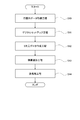
- FIG. 3 is a flowchart illustrating a method for manufacturing the orthodontic aligner 20 according to the first embodiment.
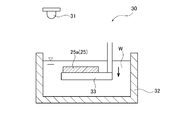
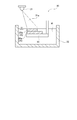
- 4 to 6 are diagrams for explaining the laminated molding process of the first embodiment.
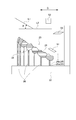
- FIG. 7 is a side view showing a modeled object produced in the laminated modeling process of Example 1.
- a method for manufacturing the orthodontic aligner 20 of Example 1 will be described.
- a three-dimensional scanner is used to scan the oral cavity of the patient to acquire three-dimensional data in the oral cavity.
- step S11 the three-dimensional data in the oral cavity acquired in the oral data acquisition step is analyzed by a computer, and the three-dimensional data of the tooth model 10A at the correction target position is created.
- step S11 the three-dimensional data in the oral cavity acquired in the oral data acquisition step is analyzed by a computer, and the three-dimensional data of the tooth model 10A at the correction target position is created.
- step S11 the three-dimensional data in the oral cavity acquired in the oral data acquisition step is analyzed by a computer, and the three-dimensional data of the tooth model 10A at the correction target position is created.
- step S11 the three-dimensional data of the tooth model 10A at the correction target position is created.
- step S12 the three-dimensional data of the orthodontic aligner 20 is created based on the three-dimensional data of the tooth model 10A of the orthodontic target position created in the digital setup step.
- Support may be added to the created three-dimensional data of the orthodontic aligner 20 as needed.
- the shape, thickness, density, angle, presence / absence of branching, etc. of the support are appropriately adjusted according to the size, angle, and overhang portion of the three-dimensional data.
- the orthodontic aligner 20 is manufactured by the laminated modeling device based on the three-dimensional data of the orthodontic aligner 20 created in the three-dimensional data creation step.
- the laminated molding apparatus 30 includes a container 32 containing a liquid photocurable resin W and a movable stage 33 configured to be movable in the vertical direction in the container 32.
- the ultraviolet laser device 31 for irradiating the ultraviolet laser light 31a is provided.
- the photocurable resin W contains, for example, a radically polymerizable compound such as a (meth) acrylic monomer, a polymerizable monomer containing a cationically polymerizable compound such as an epoxy compound, and a photopolymerization initiator. Can be used.
- the upper surface of the movable stage 33 is at a predetermined distance from the liquid surface of the photocurable resin W (for example, 0.01 [mm]). It is arranged so that it is located only below.
- the ultraviolet laser device 31 scans the thin layer of the photocurable resin W on the movable stage 33 with the ultraviolet laser light 31a in a predetermined pattern based on the three-dimensional data of the orthodontic aligner 20.
- the first hardened layer (an example of the hardened layer 25) 25a having the outer shape of the tooth 10 is formed.
- the movable stage 33 moves downward by a predetermined distance (for example, 0.01 [mm]). As a result, a thin layer of the photocurable resin W is formed on the first cured layer 25a.
- the ultraviolet laser device 31 applies the ultraviolet laser light 31a to the thin layer of the photocurable resin W on the first cured layer 25a based on the three-dimensional data of the orthodontic aligner 20. Scan with a predetermined pattern. As a result, a second hardened layer (an example of the hardened layer 25) 25b having the outer shape of the tooth 10 is formed.
- the occlusal plane in the orthodontic aligner 20 covering the occlusal surface 11 of the tooth 10 is defined as the occlusal plane S1.
- the occlusal plane refers to a reference plane defined as a plane including the midpoint (incisor point) between the mesial corners of the left and right central incisors and the distal buccal cusp apex of the left and right first molars. That is, the occlusal plane S1 is a plane parallel to the alignment direction of the portion of the orthodontic aligner 20 that covers each tooth 10.
- the vertical plane including the anteroposterior direction D of the orthodontic aligner 20 is defined as the vertical plane S2.
- the line of intersection between the occlusal plane S1 and the vertical plane S2 is the first line of intersection L1.
- the line of intersection between the vertical plane S2 and the horizontal plane S3 is defined as the second line of intersection L2.
- the angle formed by the first line of intersection L1 and the second line of intersection L2 is defined as the angle ⁇ .
- the cured layers 25 are laminated in the vertical direction at an angle ⁇ .
- step S14 the support 26 is removed from the orthodontic aligner 20 using a tool such as nippers. After removing the support 26, the marks on the support 26 may be polished.
- step S14 some or all unreacted substances, for example, unpolymerized monomers, are removed from the produced orthodontic aligner 20.
- the orthodontic aligner 20 is manufactured.
- orthodontic aligners molded at various angles will be described.
- the anterior tooth portion 24 of the orthodontic aligner 20 covering the central incisor 10a of the anterior tooth 14 is referred to as the central incisor portion 20a.
- the anterior tooth portion 24 of the orthodontic aligner 20 that covers the lateral incisor 10b of the anterior tooth 14 is referred to as the lateral incisor portion 20b.
- the anterior tooth portion 24 of the orthodontic aligner 20 that covers the canine 10c of the anterior tooth 14 is referred to as the canine portion 20c.
- an annular stacking mark M1 is formed at the upper ends of the central incisor portion 20a and the lateral incisor portion 20b.
- the annular stacking mark M1 is completely invisible when the central incisor portion 20a and the lateral incisor portion 20b are viewed from the front.
- a linear stacking mark N1 is formed substantially horizontally on the buccal side portion 22 of the central incisor portion 20a and the lateral incisor portion 20b.
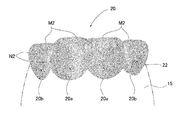
- an annular stacking mark M2 is formed at the upper ends of the central incisor portion 20a and the lateral incisor portion 20b.
- the annular stacking marks M2 are almost invisible when the central incisor portion 20a and the lateral incisor portion 20b are viewed from the front.
- a linear stacking mark N2 is formed substantially horizontally on the buccal side portion 22 of the central incisor portion 20a and the lateral incisor portion 20b.
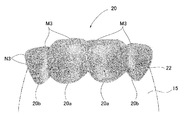
- annular stacking mark M3 is formed at the upper ends of the central incisor portion 20a and the lateral incisor portion 20b.
- the annular stacking marks M3 are slightly visible above the central incisors 20a and the lateral incisors 20b when the central incisors 20a and the lateral incisors 20b are viewed from the front, but are inconspicuous. ..
- a curved stacking mark N3 is formed from the upper part to the lower part of the buccal side portion 22 of the central incisor portion 20a and the lateral incisor portion 20b.
- annular stacking marks M4 are formed on the buccal side surface 12 of the central incisor portion 20a and the lateral incisor portion 20b.
- the annular stacking marks M4 are clearly visible on the entire surface of the buccal side portion 22 of the central incisor portion 20a and the lateral incisor portion 20b when the central incisor portion 20a and the lateral incisor portion 20b are viewed from the front. It is in a state.
- the orthodontic aligner 20 is shaped so that the angle ⁇ is 0 to 60 °, 120 to 240 °, or 300 to 360 °.
- the orthodontic aligner 20 is shaped so that the angle ⁇ is 0 to 30 °, 150 to 210 °, or 330 to 360 °.
- the orthodontic aligner 20 is hardened so that no annular stacking marks are formed on the buccal side portion 22 covering the buccal side surface 12 of the anterior teeth (central incisor portion 20a, lateral incisor portion 20b, canine portion 20c).
- the layers 25 are laminated and manufactured.
- the method for manufacturing the mouthpiece (orthodontic aligner 20) of Example 1 is a mouthpiece (orthodontic aligner 20) manufactured by the laminated molding apparatus 30 and mounted in the oral cavity so as to cover the teeth 10.
- the mouthpiece (orthodontic aligner 20) is formed on the buccal side portion 22 covering the buccal side surface 12 of the anterior teeth (middle incision tooth 10a, side incision tooth 10b, canine tooth 10c).
- the hardened layer 25 is laminated so as not to form the above (FIG. 7).
- the buccal side portion 22 covering the buccal side surface 12 of the anterior teeth (central incisors 10a, lateral incisors 10b, canines 10c) of the mouthpiece (orthodontic aligner 20) is prevented from forming an annular stacking mark. can do. Therefore, when the mouthpiece (orthodontic aligner 20) is attached to the oral cavity, it is possible to prevent others from seeing the annular stacking marks. As a result, it is possible to improve the aesthetics when the mouthpiece (orthodontic aligner 20) is attached to the oral cavity.
- annular stacking mark is formed on the buccal side portion 22 covering the buccal side surface 12 of the anterior teeth (middle incisors 10a, side incisors 10b, canines 10c) of the mouthpiece (orthodontic aligner 20).
- a step corresponding to the stacking pitch is formed on the buccal side portion 22 where the annular stacking marks are formed. Therefore, when the mouthpiece (orthodontic aligner 20) is attached to the oral cavity, a foreign body sensation becomes noticeable.
- the mouthpiece (orthodontic aligner 20) is annular to the buccal side 22 covering the buccal side surface 12 of the anterior teeth (central incisors 10a, lateral incisors 10b, canines 10c).
- the cured layers 25 are laminated so that no stacking marks are formed. Therefore, the buccal side portion 22 on which the annular stacking marks are formed can have a step smaller than the step corresponding to the stacking pitch. As a result, it is possible to suppress a foreign body sensation when the mouthpiece (orthodontic aligner 20) is attached to the oral cavity.
- the first intersection line L1 between the occlusal plane S1 of the mouthpiece (orthodontic aligner 20) and the vertical plane S2 including the anteroposterior direction D is 0 to 60 °, 120 to 240 °, or 300 to 360 °.
- the cured layer 25 is manufactured by laminating in the vertical direction (FIG. 10).
- the buccal side portion 22 covering the buccal side surface 12 of the anterior teeth (central incisors 10a, lateral incisors 10b, canines 10c) of the mouthpiece (orthodontic aligner 20) is prevented from forming an annular stacking mark. can do. Therefore, it is possible to improve the aesthetics when the mouthpiece (orthodontic aligner 20) is attached to the oral cavity.
- the first intersection line L1 between the occlusal plane S1 of the mouthpiece (orthodontic aligner 20) and the vertical plane S2 including the anteroposterior direction D is 0 to 30 °, 150 to 210 °, or 330 to 360 °.
- the cured layer 25 is manufactured by laminating in the vertical direction (FIG. 9).
- a substantially linear stacking mark is formed on the buccal side portion 22 covering the buccal side surface 12 of the anterior teeth (central incisors 10a, lateral incisors 10b, canines 10c) of the mouthpiece (orthodontic aligner 20). be able to. Therefore, it is possible to improve the aesthetics when the mouthpiece (orthodontic aligner 20) is attached to the oral cavity.
- the mouthpiece (orthodontic aligner 20) of Example 1 is a mouthpiece (orthodontic aligner 20) that is mounted in the oral cavity so as to cover the teeth 10, and is an anterior tooth (intermediate incisor 10a, side).
- the buccal side portion 22 covering the buccal side surface 12 of the incisal tooth 10b and the canine tooth 10c) does not have an annular stacking mark (FIGS. 8 and 9).
- the buccal side portion 22 covering the buccal side surface 12 of the anterior teeth (central incisors 10a, lateral incisors 10b, canines 10c) of the mouthpiece (orthodontic aligner 20) is prevented from forming an annular stacking mark. can do. Therefore, when the mouthpiece (orthodontic aligner 20) is attached to the oral cavity, it is possible to prevent others from seeing the annular stacking marks. As a result, it is possible to improve the aesthetics when the mouthpiece (orthodontic aligner 20) is attached to the oral cavity.
- the method for manufacturing the mouthpiece and the mouthpiece of Example 2 is different from the method for manufacturing the mouthpiece and the mouthpiece of Example 1 in that the angle ⁇ at which the orthodontic aligner is formed is different in the laminated molding step. ..
- FIG. 12 is a side view showing a modeled object produced in the laminated modeling process of Example 2.
- a method for manufacturing an orthodontic aligner according to Example 2 will be described.
- the same or equivalent parts as those described in the above examples will be described using the same terms or the same reference numerals.
- the orthodontic aligner 20 has the cured layer 25 in the direction D1 perpendicular to the occlusal plane S1 and has a predetermined laminating pitch (0.01 [mm] in Example 2).
- the orthodontic aligner 20 is modeled by the stacking modeling device 30 with the stacking direction set to the occlusal plane S1 and the direction D1.
- the orthodontic aligner 20 is formed with a support 26 for supporting the orthodontic aligner 20 on the side opposite to the occlusal portion 21 which is the occlusal surface of the orthodontic aligner 20 in the direction D1 perpendicular to the occlusal plane S1. Tooth.
- FIG. 13 is a cross-sectional view of the hardened layer of the orthodontic aligner of Example 2.
- the operation of the orthodontic aligner of Example 2 and the method for manufacturing the orthodontic aligner will be described.
- the cured layer 25 is laminated in the vertical direction D1 on the occlusal plane S1 of the mouthpiece (orthodontic aligner 20) (FIG. 12).
- the buccal side portion 22 covering the buccal side surface 12 of the anterior teeth (central incisors 10a, lateral incisors 10b, canines 10c) of the mouthpiece (orthodontic aligner 20) is prevented from forming an annular stacking mark. can do. Therefore, when the mouthpiece (orthodontic aligner 20) is attached to the oral cavity, it is possible to prevent others from seeing the annular stacking marks. As a result, it is possible to improve the aesthetics when the mouthpiece (orthodontic aligner 20) is attached to the oral cavity.
- the area of the cured layer 25 can be increased. Therefore, the strength of the mouthpiece (orthodontic aligner 20) in the direction D1 perpendicular to the occlusal plane S1 can be increased.
- the area of each layer becomes small, and the strength of the mouthpiece in the direction D1 perpendicular to the occlusal plane S1 becomes low.
- the strength of the modeled object formed by the laminated modeling apparatus 30 is higher in the direction perpendicular to the stacking direction than in the strength in the stacking direction.
- the stacking direction is the direction D1 perpendicular to the occlusal plane S1
- the tensile strength and the compressive strength in the horizontal direction with respect to the occlusal plane S1 can be improved.
- the buccal portion 22 of the anterior tooth portion 24 covering the anterior tooth 14 of the tooth 10 can improve the tensile strength and the compressive strength in the horizontal direction with respect to the occlusal plane S1. Therefore, it is possible to improve the strength of the front tooth portion 24, which is repeatedly subjected to loads such as bending, stretching, and twisting when the mouthpiece (orthodontic aligner 20) is attached and detached.
- the compressive strength in the laminated direction can be increased as the number of times of lamination increases.
- the cured layer 25 is laminated in the vertical direction D1 on the occlusal plane S1 of the mouthpiece (orthodontic aligner 20)
- the buccal side portion 22 is laminated more frequently than when laminated in a direction other than the above. can do. Therefore, the compression strength of the buccal side portion 22 can be made higher than that in the case of laminating in directions other than the above.
- the mouthpiece (orthodontic aligner 20) of Example 2 is formed in a concave groove shape so as to cover all the teeth of the upper jaw or the teeth of the lower jaw. (Fig. 2).
- the cured layer 25 can be made into an annular shape to have a closed shape. Therefore, the strength of the mouthpiece (orthodontic aligner 20) can be increased.
- the mouthpiece (orthodontic aligner 20) is the mouthpiece (orthodontic aligner 20) in the direction D1 perpendicular to the occlusal plane S1.
- a support 26 for supporting the mouthpiece (orthodontic aligner 20) is formed on the opposite side of the occlusal portion 21 (FIG. 12).
- the mouthpiece (orthodontic aligner 20) of Example 2 is a mouthpiece (orthodontic aligner 20) that is mounted in the oral cavity so as to cover the teeth 10, and is a mouthpiece (orthodontic aligner 20). 20) has a stacking mark in the direction D1 perpendicular to the occlusal plane S1 (FIG. 12).
- the buccal side portion 22 covering the buccal side surface 12 of the anterior teeth (central incisors 10a, lateral incisors 10b, canines 10c) of the mouthpiece (orthodontic aligner 20) is prevented from forming an annular stacking mark. can do. Therefore, when the mouthpiece (orthodontic aligner 20) is attached to the oral cavity, it is possible to prevent others from seeing the annular stacking marks. As a result, it is possible to improve the aesthetics when the mouthpiece (orthodontic aligner 20) is attached to the oral cavity.
- the area of the cured layer 25 can be increased. Therefore, the strength of the mouthpiece (orthodontic aligner 20) in the direction D1 perpendicular to the occlusal plane S1 can be increased.
- the shaped orthodontic aligner 20 and the orthodontic aligner 20 shaped at an angle ⁇ 90 ° shown in FIG. 11 and the teeth shaped in the width direction perpendicular to the front-back direction D in the stacking direction D2 shown in FIG.
- An aligner 20 for row correction was prepared.
- the average value was calculated for each item, and when the average value exceeded 2, it was evaluated that the aesthetics were good.
- the orthodontic aligner 20 in which the stacking direction D2 was formed in the width direction perpendicular to the front-rear direction D had a stacking step of 3.2, a transparency of 3.8, and an unnaturalness of 3.2.
- the cured layer is in a posture in which the angle ⁇ formed by the first line of intersection L1 and the second line of intersection L2 is 0 to 60 °, 120 to 240 °, or 300 to 360 °.
- the stacking direction D2 may be the width direction perpendicular to the front-rear direction D.
- the stacking direction may be a direction inclined with respect to the width direction perpendicular to the front-rear direction D.
- the laminated molding apparatus 30 is shown as an example of a hanging type stereolithography apparatus using a photocurable resin that is cured by ultraviolet rays.
- the laminated stereolithography apparatus may be a lifting type stereolithography apparatus using a photocurable resin, or a projection method in which the photocurable resin is cured and laminated using the light of a projector.
- it may be an inkjet method in which a liquid ultraviolet curable resin is sprayed and cured by illuminating the ultraviolet rays to be laminated, or a stereolithography method in which heat-soluble resins are stacked one layer at a time.
- a powder sintering method may be used in which a powdered material is subjected to a high-power laser beam to be sintered.
- Example 1 and Example 2 an example in which the orthodontic aligner 20 is formed in a concave groove shape covering the crown is shown.
- the orthodontic aligner may have a shape that covers the crown and the gingiva, or the crown and the floor portion.
- Example 1 and Example 2 an example was shown in which the orthodontic aligner 20 was formed in a concave groove shape so as to cover the crowns of all the teeth 10 of the lower jaw.
- the orthodontic aligner may be formed in a groove shape so as to cover the crown of some teeth.
- Example 1 and Example 2 an example in which the present invention is applied to the orthodontic aligner 20 to be attached to the crown of the lower jaw is shown. However, the present invention can be applied to an orthodontic aligner to be attached to the crown of the maxilla.
- Example 1 and Example 2 an example in which the present invention is applied to an orthodontic aligner 20 mounted in the oral cavity so as to cover the tooth 10 is shown.
- the present invention is not limited to the orthodontic aligner, and the mouthpiece for preventing bruxism, the mouthpiece for treating jaw joint disease and sleep apnea syndrome, the mouthpiece for whitening, and the mouth for indirect bonding. It can also be applied to pieces and sports mouthpieces. Further, the mouthpiece of the present invention shall include a device worn so as to cover the teeth.
Landscapes
- Health & Medical Sciences (AREA)
- Chemical & Material Sciences (AREA)
- Engineering & Computer Science (AREA)
- Manufacturing & Machinery (AREA)
- Materials Engineering (AREA)
- Dentistry (AREA)
- Oral & Maxillofacial Surgery (AREA)
- Epidemiology (AREA)
- Life Sciences & Earth Sciences (AREA)
- Animal Behavior & Ethology (AREA)
- General Health & Medical Sciences (AREA)
- Public Health (AREA)
- Veterinary Medicine (AREA)
- Dental Tools And Instruments Or Auxiliary Dental Instruments (AREA)
Priority Applications (4)
| Application Number | Priority Date | Filing Date | Title |
|---|---|---|---|
| EP20821760.4A EP3984496B1 (en) | 2019-06-12 | 2020-06-11 | Mouthpiece and mouthpiece manufacturing method |
| US17/618,195 US12090022B2 (en) | 2019-06-12 | 2020-06-11 | Mouthpiece and mouthpiece manufacturing method |
| CN202080042905.9A CN113905686B (zh) | 2019-06-12 | 2020-06-11 | 齿套以及齿套的制造方法 |
| JP2021526133A JP7807917B2 (ja) | 2019-06-12 | 2020-06-11 | マウスピース及びマウスピースの製造方法 |
Applications Claiming Priority (4)
| Application Number | Priority Date | Filing Date | Title |
|---|---|---|---|
| JP2019-109887 | 2019-06-12 | ||
| JP2019109887 | 2019-06-12 | ||
| JP2019109886 | 2019-06-12 | ||
| JP2019-109886 | 2019-06-12 |
Publications (1)
| Publication Number | Publication Date |
|---|---|
| WO2020250975A1 true WO2020250975A1 (ja) | 2020-12-17 |
Family
ID=73781478
Family Applications (1)
| Application Number | Title | Priority Date | Filing Date |
|---|---|---|---|
| PCT/JP2020/023024 Ceased WO2020250975A1 (ja) | 2019-06-12 | 2020-06-11 | マウスピース及びマウスピースの製造方法 |
Country Status (5)
| Country | Link |
|---|---|
| US (1) | US12090022B2 (https=) |
| EP (1) | EP3984496B1 (https=) |
| JP (1) | JP7807917B2 (https=) |
| CN (1) | CN113905686B (https=) |
| WO (1) | WO2020250975A1 (https=) |
Families Citing this family (4)
| Publication number | Priority date | Publication date | Assignee | Title |
|---|---|---|---|---|
| WO2020198331A1 (en) | 2019-03-25 | 2020-10-01 | Align Technology, Inc. | Various structured supports for 3d printed aligners/mouth pieces |
| US12064313B2 (en) * | 2021-02-16 | 2024-08-20 | Ormco Corporation | Orthodontic appliance with bite structures and methods of making same |
| DE102022118781A1 (de) * | 2022-07-27 | 2024-02-01 | Ca-Digital Gmbh | Virtuelles Modell einer Schiene |
| TWI907201B (zh) * | 2024-12-10 | 2025-12-01 | 張俊彥 | 產生三維咬合墊高模型的裝置、產生三維咬合墊高物的方法及其電腦程式產品 |
Citations (5)
| Publication number | Priority date | Publication date | Assignee | Title |
|---|---|---|---|---|
| JP2006081747A (ja) | 2004-09-16 | 2006-03-30 | Osaka Univ | バイトスプリントの製造方法 |
| US20130323665A1 (en) * | 2012-06-05 | 2013-12-05 | Paul D. Dinh | Orthodontic aligners, methods of using such aligners, and additive manufacturing methods and apparatus for making and using such aligners |
| JP2017094495A (ja) * | 2015-11-18 | 2017-06-01 | 富士フイルム株式会社 | サポート部材設計装置、方法、プログラム、構造体形成装置及び構造体の製造方法 |
| JP2018094245A (ja) | 2016-12-15 | 2018-06-21 | 岡本化学工業株式会社 | 歯科矯正用アライナー及びその製造方法 |
| WO2019023009A1 (en) * | 2017-07-25 | 2019-01-31 | 3M Innovative Properties Company | PHOTOPOLYMERIZABLE COMPOSITIONS COMPRISING A URETHANE COMPONENT AND A REACTIVE DILUENT, ARTICLES AND METHODS |
Family Cites Families (14)
| Publication number | Priority date | Publication date | Assignee | Title |
|---|---|---|---|---|
| US5732715A (en) * | 1996-06-25 | 1998-03-31 | Safe-T-Gard Corporation | Mouthpiece |
| DE10111704B4 (de) * | 2001-03-12 | 2008-06-12 | Ivoclar Vivadent Ag | Verfahren zur Herstellung eines Kunststoffteils |
| CA2381831C (en) * | 2002-04-16 | 2010-09-21 | Itzhak Shoher | Method of forming a dental coping in a single heat treatment from a composite material of at least two layers and to a multilayered composite material for forming a dental crown |
| JP2004344623A (ja) * | 2003-05-23 | 2004-12-09 | Shiyoufuu:Kk | 歯科用構造物自動作製装置 |
| CN101878004A (zh) * | 2007-11-28 | 2010-11-03 | 3M创新有限公司 | Smc冠壳 |
| EP2404590B1 (de) | 2010-07-08 | 2019-06-12 | Ivoclar Vivadent AG | Lichthärtende Keramikschlicker für die stereolithographische Herstellung von hochfesten Keramiken |
| MY170727A (en) | 2013-03-28 | 2019-08-27 | Univ Malaya | A multilayered dental ceramic crown |
| ITMI20132131A1 (it) * | 2013-12-19 | 2015-06-20 | Heraeus Kulzer Gmbh | Procedimento di stratificazione sopra un'interfaccia sagomata per la realizzazione di sovrastrutture di tipo migliorato per protesi e sovrastruttura per protesi dentale realizzata con questo procedimento |
| US9717568B1 (en) * | 2014-05-14 | 2017-08-01 | Loren S. Adell | Dental device fabrication on a 3-D printed arch model |
| US11045282B2 (en) | 2015-07-07 | 2021-06-29 | Align Technology, Inc. | Direct fabrication of aligners with interproximal force coupling |
| CN106175950B (zh) * | 2016-06-28 | 2018-06-22 | 华南理工大学 | 一种数字化面投影成形陶瓷牙冠桥制备方法 |
| KR102102566B1 (ko) | 2016-06-30 | 2020-04-21 | 디더블유에스 에스.알.엘. | 치과용 보철물을 제조하기 위한 방법 및 시스템 |
| CN107139456B (zh) * | 2017-05-17 | 2019-08-20 | 上海联泰科技股份有限公司 | 三维物体数据的分层方法、3d打印方法及设备 |
| WO2020198331A1 (en) * | 2019-03-25 | 2020-10-01 | Align Technology, Inc. | Various structured supports for 3d printed aligners/mouth pieces |
-
2020
- 2020-06-11 JP JP2021526133A patent/JP7807917B2/ja active Active
- 2020-06-11 EP EP20821760.4A patent/EP3984496B1/en active Active
- 2020-06-11 US US17/618,195 patent/US12090022B2/en active Active
- 2020-06-11 WO PCT/JP2020/023024 patent/WO2020250975A1/ja not_active Ceased
- 2020-06-11 CN CN202080042905.9A patent/CN113905686B/zh active Active
Patent Citations (5)
| Publication number | Priority date | Publication date | Assignee | Title |
|---|---|---|---|---|
| JP2006081747A (ja) | 2004-09-16 | 2006-03-30 | Osaka Univ | バイトスプリントの製造方法 |
| US20130323665A1 (en) * | 2012-06-05 | 2013-12-05 | Paul D. Dinh | Orthodontic aligners, methods of using such aligners, and additive manufacturing methods and apparatus for making and using such aligners |
| JP2017094495A (ja) * | 2015-11-18 | 2017-06-01 | 富士フイルム株式会社 | サポート部材設計装置、方法、プログラム、構造体形成装置及び構造体の製造方法 |
| JP2018094245A (ja) | 2016-12-15 | 2018-06-21 | 岡本化学工業株式会社 | 歯科矯正用アライナー及びその製造方法 |
| WO2019023009A1 (en) * | 2017-07-25 | 2019-01-31 | 3M Innovative Properties Company | PHOTOPOLYMERIZABLE COMPOSITIONS COMPRISING A URETHANE COMPONENT AND A REACTIVE DILUENT, ARTICLES AND METHODS |
Non-Patent Citations (1)
| Title |
|---|
| See also references of EP3984496A4 |
Also Published As
| Publication number | Publication date |
|---|---|
| JPWO2020250975A1 (https=) | 2020-12-17 |
| EP3984496C0 (en) | 2026-03-25 |
| JP7807917B2 (ja) | 2026-01-28 |
| EP3984496A4 (en) | 2023-01-18 |
| CN113905686B (zh) | 2024-02-23 |
| EP3984496B1 (en) | 2026-03-25 |
| EP3984496A1 (en) | 2022-04-20 |
| US12090022B2 (en) | 2024-09-17 |
| CN113905686A (zh) | 2022-01-07 |
| US20220168070A1 (en) | 2022-06-02 |
Similar Documents
| Publication | Publication Date | Title |
|---|---|---|
| JP7807917B2 (ja) | マウスピース及びマウスピースの製造方法 | |
| CN106714726B (zh) | 齿弓调整矫正器 | |
| US10973612B2 (en) | Dental appliance binding structure | |
| US20210236242A1 (en) | Dental appliances with repositioning jaw elements | |
| EP3984497B1 (en) | METHOD FOR MANUFACTURING AN ORAL APPLIANCE | |
| JP2013081785A (ja) | 歯列矯正アライナー器具の直接製造 | |
| US11684462B2 (en) | Dental prosthesis | |
| JP2014133134A (ja) | 歯列矯正アライナー器具の直接製造 | |
| CN1257703C (zh) | 一种牙颌畸形矫正器 | |
| CN214805563U (zh) | 无托槽隐形矫治器 | |
| JP2024029092A (ja) | 義歯、基準義歯及び義歯の作製方法 | |
| JP5931515B2 (ja) | 歯列補正具および歯列補正具の製造方法 | |
| CN114144142A (zh) | 具有支撑体的增材制造的义齿基托 | |
| TW202202102A (zh) | 齒科矯正具、其製造裝置及方法 | |
| WO2020250974A1 (ja) | 歯列矯正用アライナー及びその製造方法 | |
| JP2022169352A (ja) | アライナーを製造する方法 | |
| JP2022169351A (ja) | 歯列矯正用のアライナー | |
| KR20160144850A (ko) | 플라스틱 치아교정장치의 제조방법 | |
| WO2025056156A1 (en) | A method of manufacturing an orthodontic aligner and a system for manufacturing an orthodontic aligner | |
| JP6612558B2 (ja) | 上顎基準義歯床及び上顎基準義歯並びに義歯作製キット及びこれを用いる義歯作製方法 | |
| GB2618519A (en) | A method of manufacturing an orthodontic aligner and a system for manufacturing an orthodontic aligner | |
| WO2022044929A1 (ja) | 歯科造形物の画像データ作成方法、歯科造形物の画像データ作成装置、歯科造形物の画像データ作成プログラム、歯科造形物の製造方法及び歯科造形物 | |
| JP2022060705A (ja) | 歯列矯正装置のアタッチメント、及び歯列矯正装置 | |
| JP2006255128A (ja) | 模型歯牙位置調節具 |
Legal Events
| Date | Code | Title | Description |
|---|---|---|---|
| 121 | Ep: the epo has been informed by wipo that ep was designated in this application |
Ref document number: 20821760 Country of ref document: EP Kind code of ref document: A1 |
|
| ENP | Entry into the national phase |
Ref document number: 2021526133 Country of ref document: JP Kind code of ref document: A |
|
| NENP | Non-entry into the national phase |
Ref country code: DE |
|
| ENP | Entry into the national phase |
Ref document number: 2020821760 Country of ref document: EP Effective date: 20220112 |
|
| WWG | Wipo information: grant in national office |
Ref document number: 2020821760 Country of ref document: EP |