WO2020250414A1 - 波長変換部材及びその使用、バックライトユニット、並びに画像表示装置 - Google Patents
波長変換部材及びその使用、バックライトユニット、並びに画像表示装置 Download PDFInfo
- Publication number
- WO2020250414A1 WO2020250414A1 PCT/JP2019/023636 JP2019023636W WO2020250414A1 WO 2020250414 A1 WO2020250414 A1 WO 2020250414A1 JP 2019023636 W JP2019023636 W JP 2019023636W WO 2020250414 A1 WO2020250414 A1 WO 2020250414A1
- Authority
- WO
- WIPO (PCT)
- Prior art keywords
- wavelength conversion
- meth
- conversion member
- acrylate
- compound
- Prior art date
- Legal status (The legal status is an assumption and is not a legal conclusion. Google has not performed a legal analysis and makes no representation as to the accuracy of the status listed.)
- Ceased
Links
Images


Classifications
-
- C—CHEMISTRY; METALLURGY
- C09—DYES; PAINTS; POLISHES; NATURAL RESINS; ADHESIVES; COMPOSITIONS NOT OTHERWISE PROVIDED FOR; APPLICATIONS OF MATERIALS NOT OTHERWISE PROVIDED FOR
- C09K—MATERIALS FOR MISCELLANEOUS APPLICATIONS, NOT PROVIDED FOR ELSEWHERE
- C09K11/00—Luminescent materials, e.g. electroluminescent or chemiluminescent
- C09K11/08—Luminescent materials, e.g. electroluminescent or chemiluminescent containing inorganic luminescent materials
- C09K11/56—Luminescent materials, e.g. electroluminescent or chemiluminescent containing inorganic luminescent materials containing sulfur
- C09K11/562—Chalcogenides
- C09K11/565—Chalcogenides with zinc cadmium
-
- C—CHEMISTRY; METALLURGY
- C09—DYES; PAINTS; POLISHES; NATURAL RESINS; ADHESIVES; COMPOSITIONS NOT OTHERWISE PROVIDED FOR; APPLICATIONS OF MATERIALS NOT OTHERWISE PROVIDED FOR
- C09K—MATERIALS FOR MISCELLANEOUS APPLICATIONS, NOT PROVIDED FOR ELSEWHERE
- C09K11/00—Luminescent materials, e.g. electroluminescent or chemiluminescent
- C09K11/02—Use of particular materials as binders, particle coatings or suspension media therefor
-
- C—CHEMISTRY; METALLURGY
- C09—DYES; PAINTS; POLISHES; NATURAL RESINS; ADHESIVES; COMPOSITIONS NOT OTHERWISE PROVIDED FOR; APPLICATIONS OF MATERIALS NOT OTHERWISE PROVIDED FOR
- C09K—MATERIALS FOR MISCELLANEOUS APPLICATIONS, NOT PROVIDED FOR ELSEWHERE
- C09K11/00—Luminescent materials, e.g. electroluminescent or chemiluminescent
- C09K11/08—Luminescent materials, e.g. electroluminescent or chemiluminescent containing inorganic luminescent materials
- C09K11/88—Luminescent materials, e.g. electroluminescent or chemiluminescent containing inorganic luminescent materials containing selenium, tellurium or unspecified chalcogen elements
- C09K11/881—Chalcogenides
- C09K11/883—Chalcogenides with zinc or cadmium
-
- G—PHYSICS
- G02—OPTICS
- G02B—OPTICAL ELEMENTS, SYSTEMS OR APPARATUS
- G02B5/00—Optical elements other than lenses
- G02B5/20—Filters
- G02B5/206—Filters comprising particles embedded in a solid matrix
-
- G—PHYSICS
- G02—OPTICS
- G02F—OPTICAL DEVICES OR ARRANGEMENTS FOR THE CONTROL OF LIGHT BY MODIFICATION OF THE OPTICAL PROPERTIES OF THE MEDIA OF THE ELEMENTS INVOLVED THEREIN; NON-LINEAR OPTICS; FREQUENCY-CHANGING OF LIGHT; OPTICAL LOGIC ELEMENTS; OPTICAL ANALOGUE/DIGITAL CONVERTERS
- G02F1/00—Devices or arrangements for the control of the intensity, colour, phase, polarisation or direction of light arriving from an independent light source, e.g. switching, gating or modulating; Non-linear optics
- G02F1/01—Devices or arrangements for the control of the intensity, colour, phase, polarisation or direction of light arriving from an independent light source, e.g. switching, gating or modulating; Non-linear optics for the control of the intensity, phase, polarisation or colour
- G02F1/13—Devices or arrangements for the control of the intensity, colour, phase, polarisation or direction of light arriving from an independent light source, e.g. switching, gating or modulating; Non-linear optics for the control of the intensity, phase, polarisation or colour based on liquid crystals, e.g. single liquid crystal display cells
- G02F1/133—Constructional arrangements; Operation of liquid crystal cells; Circuit arrangements
- G02F1/1333—Constructional arrangements; Manufacturing methods
- G02F1/1335—Structural association of cells with optical devices, e.g. polarisers or reflectors
- G02F1/133509—Filters, e.g. light shielding masks
- G02F1/133514—Colour filters
-
- G—PHYSICS
- G02—OPTICS
- G02F—OPTICAL DEVICES OR ARRANGEMENTS FOR THE CONTROL OF LIGHT BY MODIFICATION OF THE OPTICAL PROPERTIES OF THE MEDIA OF THE ELEMENTS INVOLVED THEREIN; NON-LINEAR OPTICS; FREQUENCY-CHANGING OF LIGHT; OPTICAL LOGIC ELEMENTS; OPTICAL ANALOGUE/DIGITAL CONVERTERS
- G02F1/00—Devices or arrangements for the control of the intensity, colour, phase, polarisation or direction of light arriving from an independent light source, e.g. switching, gating or modulating; Non-linear optics
- G02F1/01—Devices or arrangements for the control of the intensity, colour, phase, polarisation or direction of light arriving from an independent light source, e.g. switching, gating or modulating; Non-linear optics for the control of the intensity, phase, polarisation or colour
- G02F1/13—Devices or arrangements for the control of the intensity, colour, phase, polarisation or direction of light arriving from an independent light source, e.g. switching, gating or modulating; Non-linear optics for the control of the intensity, phase, polarisation or colour based on liquid crystals, e.g. single liquid crystal display cells
- G02F1/133—Constructional arrangements; Operation of liquid crystal cells; Circuit arrangements
- G02F1/1333—Constructional arrangements; Manufacturing methods
- G02F1/1335—Structural association of cells with optical devices, e.g. polarisers or reflectors
- G02F1/1336—Illuminating devices
- G02F1/133614—Illuminating devices using photoluminescence, e.g. phosphors illuminated by UV or blue light
-
- B—PERFORMING OPERATIONS; TRANSPORTING
- B82—NANOTECHNOLOGY
- B82Y—SPECIFIC USES OR APPLICATIONS OF NANOSTRUCTURES; MEASUREMENT OR ANALYSIS OF NANOSTRUCTURES; MANUFACTURE OR TREATMENT OF NANOSTRUCTURES
- B82Y20/00—Nanooptics, e.g. quantum optics or photonic crystals
-
- B—PERFORMING OPERATIONS; TRANSPORTING
- B82—NANOTECHNOLOGY
- B82Y—SPECIFIC USES OR APPLICATIONS OF NANOSTRUCTURES; MEASUREMENT OR ANALYSIS OF NANOSTRUCTURES; MANUFACTURE OR TREATMENT OF NANOSTRUCTURES
- B82Y30/00—Nanotechnology for materials or surface science, e.g. nanocomposites
-
- B—PERFORMING OPERATIONS; TRANSPORTING
- B82—NANOTECHNOLOGY
- B82Y—SPECIFIC USES OR APPLICATIONS OF NANOSTRUCTURES; MEASUREMENT OR ANALYSIS OF NANOSTRUCTURES; MANUFACTURE OR TREATMENT OF NANOSTRUCTURES
- B82Y40/00—Manufacture or treatment of nanostructures
-
- C—CHEMISTRY; METALLURGY
- C08—ORGANIC MACROMOLECULAR COMPOUNDS; THEIR PREPARATION OR CHEMICAL WORKING-UP; COMPOSITIONS BASED THEREON
- C08J—WORKING-UP; GENERAL PROCESSES OF COMPOUNDING; AFTER-TREATMENT NOT COVERED BY SUBCLASSES C08B, C08C, C08F, C08G or C08H
- C08J2333/00—Characterised by the use of homopolymers or copolymers of compounds having one or more unsaturated aliphatic radicals, each having only one carbon-to-carbon double bond, and only one being terminated by only one carboxyl radical, or of salts, anhydrides, esters, amides, imides, or nitriles thereof; Derivatives of such polymers
- C08J2333/04—Characterised by the use of homopolymers or copolymers of compounds having one or more unsaturated aliphatic radicals, each having only one carbon-to-carbon double bond, and only one being terminated by only one carboxyl radical, or of salts, anhydrides, esters, amides, imides, or nitriles thereof; Derivatives of such polymers esters
- C08J2333/06—Characterised by the use of homopolymers or copolymers of compounds having one or more unsaturated aliphatic radicals, each having only one carbon-to-carbon double bond, and only one being terminated by only one carboxyl radical, or of salts, anhydrides, esters, amides, imides, or nitriles thereof; Derivatives of such polymers esters of esters containing only carbon, hydrogen, and oxygen, the oxygen atom being present only as part of the carboxyl radical
- C08J2333/10—Homopolymers or copolymers of methacrylic acid esters
-
- G—PHYSICS
- G02—OPTICS
- G02B—OPTICAL ELEMENTS, SYSTEMS OR APPARATUS
- G02B2207/00—Coding scheme for general features or characteristics of optical elements and systems of subclass G02B, but not including elements and systems which would be classified in G02B6/00 and subgroups
- G02B2207/101—Nanooptics
-
- G—PHYSICS
- G02—OPTICS
- G02B—OPTICAL ELEMENTS, SYSTEMS OR APPARATUS
- G02B5/00—Optical elements other than lenses
- G02B5/20—Filters
- G02B5/207—Filters comprising semiconducting materials
-
- G—PHYSICS
- G02—OPTICS
- G02F—OPTICAL DEVICES OR ARRANGEMENTS FOR THE CONTROL OF LIGHT BY MODIFICATION OF THE OPTICAL PROPERTIES OF THE MEDIA OF THE ELEMENTS INVOLVED THEREIN; NON-LINEAR OPTICS; FREQUENCY-CHANGING OF LIGHT; OPTICAL LOGIC ELEMENTS; OPTICAL ANALOGUE/DIGITAL CONVERTERS
- G02F1/00—Devices or arrangements for the control of the intensity, colour, phase, polarisation or direction of light arriving from an independent light source, e.g. switching, gating or modulating; Non-linear optics
- G02F1/01—Devices or arrangements for the control of the intensity, colour, phase, polarisation or direction of light arriving from an independent light source, e.g. switching, gating or modulating; Non-linear optics for the control of the intensity, phase, polarisation or colour
- G02F1/13—Devices or arrangements for the control of the intensity, colour, phase, polarisation or direction of light arriving from an independent light source, e.g. switching, gating or modulating; Non-linear optics for the control of the intensity, phase, polarisation or colour based on liquid crystals, e.g. single liquid crystal display cells
- G02F1/133—Constructional arrangements; Operation of liquid crystal cells; Circuit arrangements
- G02F1/1333—Constructional arrangements; Manufacturing methods
- G02F1/1335—Structural association of cells with optical devices, e.g. polarisers or reflectors
- G02F1/1336—Illuminating devices
- G02F1/133615—Edge-illuminating devices, i.e. illuminating from the side
-
- G—PHYSICS
- G02—OPTICS
- G02F—OPTICAL DEVICES OR ARRANGEMENTS FOR THE CONTROL OF LIGHT BY MODIFICATION OF THE OPTICAL PROPERTIES OF THE MEDIA OF THE ELEMENTS INVOLVED THEREIN; NON-LINEAR OPTICS; FREQUENCY-CHANGING OF LIGHT; OPTICAL LOGIC ELEMENTS; OPTICAL ANALOGUE/DIGITAL CONVERTERS
- G02F2201/00—Constructional arrangements not provided for in groups G02F1/00 - G02F7/00
- G02F2201/50—Protective arrangements
- G02F2201/503—Arrangements improving the resistance to shock
Definitions
- the present disclosure relates to a wavelength conversion member and its use, a backlight unit, and an image display device.
- a backlight unit is provided in an image display device such as a liquid crystal display device.
- the backlight unit includes a wavelength conversion member including a phosphor that emits light from a light source.
- the wavelength conversion member in the backlight unit is used by inserting it between various members such as a diffuser plate, a light guide plate, a reflective film, and a brightness increasing film.
- a diffuser plate for diffusing light from a point light source on the back surface and converting it into a surface light source is mounted, and a wavelength conversion member is arranged so as to face the diffuser plate.
- a light guide plate for guiding light incident from a side light source is used, and a wavelength conversion member may be arranged facing the light guide plate. is there.
- the wavelength conversion member is not incorporated in close contact with other adjacent members, but is movably arranged between the other members. Therefore, when vibration, impact, or the like is applied to the image display device, the wavelength conversion member may collide with another member, causing scratches on the surface of the wavelength conversion member.
- the light guide plate generally has irregularities on the surface, and when the wavelength conversion member is arranged to face the light guide plate, the surface of the wavelength conversion member is likely to be scratched.
- the wavelength conversion layer of the coating material having a coating material arranged on one surface side or both surface sides of the wavelength conversion layer and arranged on one surface side of the wavelength conversion layer.
- the arithmetic mean roughness Ra of the surfaces on the non-opposing sides is 5 ⁇ m or more and the maximum height Rz is 30 ⁇ m to 250 ⁇ m, or the wavelength conversion of the covering material arranged on both surface sides of the wavelength conversion layer.
- the wavelength conversion member according to ⁇ 1> wherein the arithmetic mean roughness Ra of at least one of the surfaces not facing the layer is 5 ⁇ m or more and the maximum height Rz is 30 ⁇ m to 250 ⁇ m.
- the coating material has a barrier property against at least one of oxygen and water.
- the phosphor includes a quantum dot phosphor.
- the quantum dot phosphor contains a compound containing at least one of Cd and In.
- the wavelength conversion layer contains the phosphor, a thiol compound, at least one selected from the group consisting of a (meth) acrylic compound and a (meth) allyl compound, and a photopolymerization initiator.
- the wavelength conversion member according to any one of ⁇ 1> to ⁇ 5> which comprises a cured product of the resin composition.
- ⁇ 9> The backlight unit according to ⁇ 8>, wherein the arithmetic average roughness Ra of the surface of the light guide plate facing the wavelength conversion member is 30 ⁇ m or more.
- the light guide plate has a surface having an arithmetic average roughness Ra of 30 ⁇ m or more, and the arithmetic average roughness Ra of the wavelength conversion member is 5 ⁇ m or more.
- a surface having a maximum height Rz of 30 ⁇ m to 250 ⁇ m is arranged to face a surface having an arithmetic mean roughness Ra of the light guide plate of 30 ⁇ m or more.
- a wavelength conversion member having excellent impact resistance and its use, a backlight unit using the same, and an image display device are provided.
- the present invention is not limited to the following embodiments.
- the components including element steps and the like are not essential unless otherwise specified.
- the numerical range indicated by using "-" includes the numerical values before and after "-" as the minimum value and the maximum value, respectively.
- the upper limit value or the lower limit value described in one numerical range may be replaced with the upper limit value or the lower limit value of another numerical range described stepwise. ..
- each component may contain a plurality of applicable substances.
- the content of each component means the total content of the plurality of substances present in the composition unless otherwise specified.
- a plurality of types of particles corresponding to each component may be contained.
- the particle size of each component means a value for a mixture of the plurality of particles present in the composition unless otherwise specified.
- the term “layer” or “membrane” is used only in a part of the region in addition to the case where the layer or the membrane is formed in the entire region when the region in which the layer or the membrane exists is observed. The case where it is formed is also included.
- laminated refers to stacking layers, and two or more layers may be bonded or the two or more layers may be removable.
- (meth) acryloyl group means at least one of acryloyl group and methacrylic acid group
- “(meth) acrylic” means at least one of acrylic and methacrylic
- “(meth) acrylate” is acrylate.
- the wavelength conversion member of the present disclosure has a wavelength conversion layer containing a phosphor, and has a surface having an arithmetic mean roughness Ra of 5 ⁇ m or more and a maximum height Rz of 30 ⁇ m to 250 ⁇ m.
- arithmetic mean roughness Ra of 5 ⁇ m or more and maximum height Rz of 30 ⁇ m to 250 ⁇ m may be referred to as "specific surface roughness”.
- the wavelength conversion member of the present disclosure may be composed of a wavelength conversion layer, or may include other components such as a coating material described later, if necessary.
- the "plane" of the wavelength conversion member represents the main surface of the wavelength conversion member.
- the wavelength conversion layer according to the present disclosure may be a cured product of a resin composition described later.
- the wavelength conversion member of the present disclosure has excellent impact resistance. The reason is not clear, but each has a specific surface roughness, so that the contact area with other members facing each other can be reduced when the backlight unit is used, and the surface of the wavelength conversion member is scratched. It is thought that can be suppressed.
- the shape of the wavelength conversion member is not particularly limited, and examples thereof include a film shape and a lens shape.
- the wavelength conversion member is preferably in the form of a film.
- the location of the surface having a specific surface roughness in the wavelength conversion member is not particularly limited.
- the shape of the wavelength conversion member is, for example, a film
- at least one surface of the film-like wavelength conversion member may have a specific surface roughness, and both surfaces may have a specific surface roughness. ..
- the surface having a specific surface roughness may be the surface of the wavelength conversion layer, or when the wavelength conversion member includes a coating material described later, the surface of the coating material. It may be.
- the surface of the wavelength conversion member facing the light guide plate satisfies at least the specific surface roughness.
- the surface of the light guide plate is provided with irregularities, and when vibration or shock is applied to the backlight unit, the surface of the wavelength conversion member is easily scratched.
- the surface of the wavelength conversion member facing the light guide plate satisfies the specific surface roughness, the impact resistance of the surface is enhanced and the occurrence of scratches can be suppressed.
- the wavelength conversion member and the optical film do not adhere to each other optically. From the viewpoint of suppressing optical adhesion, the surface of the wavelength conversion member on the side facing the optical film preferably has a surface roughness, and may satisfy a specific surface roughness.
- the method for producing the wavelength conversion member so as to have a specific surface roughness is not particularly limited. For example, this can be done by adjusting the particle size and content of the filler that may be contained in the wavelength conversion layer or the coating material, and the amount of the resin applied.
- the material of the filler is not particularly limited, and may be an inorganic filler or an organic filler. From the viewpoint of impact resistance, the filler is preferably an organic filler.
- the arithmetic average roughness Ra is 5 ⁇ m or more, preferably 7 ⁇ m or more, and more preferably 9 ⁇ m or more from the viewpoint of impact resistance.
- the upper limit of the arithmetic average roughness Ra is not particularly limited, and the arithmetic average roughness Ra may be 50 ⁇ m or less.
- the maximum height Rz is 30 ⁇ m to 250 ⁇ m, preferably 40 ⁇ m to 200 ⁇ m, more preferably 50 ⁇ m to 190 ⁇ m, and further preferably 60 ⁇ m to 180 ⁇ m. When the maximum height Rz is 30 ⁇ m or more, the impact resistance tends to be excellent.
- the maximum height Rz is 250 ⁇ m or less, it is possible to reduce the influence that the arithmetic average roughness Ra becomes an apparently large value due to the large maximum height Rz in the calculation of the arithmetic average roughness Ra. it can.
- the arithmetic mean height Sa is not particularly limited, and from the viewpoint of impact resistance, it is preferably 5 ⁇ m or more, more preferably 7 ⁇ m or more, and 9 ⁇ m or more. More preferred.
- the upper limit of the arithmetic mean height Sa is not particularly limited, and the arithmetic mean height Sa may be 50 ⁇ m or less.
- the maximum height Sz is not particularly limited, and from the viewpoint of impact resistance, it is preferably 30 ⁇ m to 250 ⁇ m, more preferably 40 ⁇ m to 200 ⁇ m, and 50 ⁇ m to 190 ⁇ m. More preferably, it is particularly preferably 60 ⁇ m to 180 ⁇ m.
- the arithmetic mean roughness Ra refers to a value measured using a 3D microscope (for example, Olympus Corporation, model OLS4100, magnification 10 times).
- the analysis range is line roughness with a length of 1289 ⁇ m.
- the analysis parameter is the roughness parameter
- the cutoff is ⁇ C; none, ⁇ S; none, ⁇ f; none.
- ⁇ C, ⁇ S, and ⁇ f are methods for calculating the contour curve for calculating Ra.
- the contour curve includes a cross-section curve, a roughness curve, and a waviness curve.
- the cross-sectional curve is a curve obtained by applying a low-frequency filter having a cutoff value of ⁇ S to the measured cross-sectional curve.
- the roughness curve is a contour curve obtained by blocking long wavelength components from the cross-sectional curve by a high-frequency filter having a cutoff value of ⁇ C.
- the waviness curve is a contour curve obtained by sequentially applying a contour curve filter having cutoff values ⁇ f and ⁇ C to the cross-sectional curve. The long wavelength component is blocked by the ⁇ f contour curve filter, and the short wavelength component is blocked by the ⁇ C contour curve filter.
- the maximum height Rz refers to a value measured using a 3D microscope (for example, Olympus Corporation, model OLS4100, magnification 10 times).
- the analysis range is line roughness with a length of 1289 ⁇ m.
- the analysis parameter is the roughness parameter
- the cutoff is ⁇ C; none, ⁇ S; none, ⁇ f; none.
- Rz can be calculated at the same time as Ra is calculated.
- the arithmetic mean height Sa refers to a value measured using a 3D microscope (for example, Olympus Corporation, model OLS4100, magnification 10 times).
- the analysis range is a surface roughness of 1282 ⁇ m ⁇ 1279 ⁇ m.
- the analysis parameter is the roughness parameter
- the cutoff is ⁇ C; none, ⁇ S; none, ⁇ f; none.
- the arithmetic mean height Sz refers to a value measured using a 3D microscope (for example, Olympus Corporation, model OLS4100, magnification 10 times).
- the analysis range is a surface roughness of 1282 ⁇ m ⁇ 1279 ⁇ m.
- the analysis parameter is the roughness parameter
- the cutoff is ⁇ C; none, ⁇ S; none, ⁇ f; none. Sz can be calculated at the same time as Sa is calculated.
- the average thickness of the wavelength conversion member is, for example, preferably 50 ⁇ m to 500 ⁇ m, more preferably 65 ⁇ m to 450 ⁇ m, and even more preferably 80 ⁇ m to 400 ⁇ m.
- the average thickness of the wavelength conversion member is 50 ⁇ m or more, the wavelength conversion efficiency tends to be further improved, and when the average thickness is 500 ⁇ m or less, when the wavelength conversion member is applied to the backlight unit, the backlight unit is used. There is a tendency to make it thinner.
- the average thickness of the wavelength conversion member is obtained as, for example, an arithmetic mean value of the thicknesses of any three points measured using a micrometer.
- the total light transmittance of the wavelength conversion member is preferably 75% or less, more preferably 70% or less, and further preferably 65% or less.
- the total light transmittance of the wavelength conversion member can be measured according to the measurement method of JIS K 7136: 2000.
- the haze of the wavelength conversion member is preferably 90% or more, more preferably 95% or more, and further preferably 98% or more.
- the haze of the wavelength conversion member can be measured according to the measurement method of JIS K 7136: 2000.
- the wavelength conversion member has a wavelength conversion layer containing a phosphor and has a surface having an arithmetic mean roughness Ra of 17 ⁇ m or more.
- the wavelength conversion member according to the embodiment has excellent impact resistance.
- the arithmetic average roughness Ra is 17 ⁇ m or more, preferably 19 ⁇ m or more, and more preferably 21 ⁇ m or more from the viewpoint of impact resistance.
- the upper limit of the arithmetic average roughness Ra is not particularly limited, and the arithmetic average roughness Ra may be 50 ⁇ m or less.
- the maximum height Rz is not particularly limited, and is preferably 30 ⁇ m to 250 ⁇ m, more preferably 40 ⁇ m to 200 ⁇ m, further preferably 50 ⁇ m to 190 ⁇ m, and 60 ⁇ m. It is particularly preferably about 180 ⁇ m.
- the maximum height Rz is 30 ⁇ m or more, the impact resistance tends to be excellent.
- the maximum height Rz is 250 ⁇ m or less, it is possible to reduce the influence that the arithmetic average roughness Ra becomes an apparently large value due to the large maximum height Rz in the calculation of the arithmetic average roughness Ra. it can.
- the details of the wavelength conversion member according to the embodiment other than the arithmetic mean roughness Ra and the maximum height Rz can be applied to the details of the wavelength conversion member having the specific surface roughness described above.
- the wavelength conversion member may have a covering material arranged on one surface side or both surface sides of the wavelength conversion layer.
- the wavelength conversion layer of the coating material arranged on one surface side of the wavelength conversion layer, the surface on the side not facing the wavelength conversion layer, or the coating material arranged on both surface sides of the wavelength conversion layer. At least one of the surfaces not facing the surface may satisfy the specific surface roughness.
- the average thickness of the covering material is, for example, preferably 10 ⁇ m to 200 ⁇ m, more preferably 12 ⁇ m to 170 ⁇ m, and even more preferably 15 ⁇ m to 150 ⁇ m.
- the average thickness of the covering material is obtained, for example, as an arithmetic mean value of the thicknesses of any three points measured using a micrometer.
- the arithmetic average roughness Ra of the covering material is 5 ⁇ m or more, and preferably 7 ⁇ m or more from the viewpoint of impact resistance. , 9 ⁇ m or more is more preferable.
- the upper limit of the arithmetic average roughness Ra is not particularly limited, and the arithmetic average roughness Ra may be 50 ⁇ m or less.
- the maximum height Rz of the coating material is 30 ⁇ m to 250 ⁇ m, preferably 40 ⁇ m to 200 ⁇ m, and 50 ⁇ m to 190 ⁇ m.
- the maximum height Rz is 30 ⁇ m or more, the impact resistance tends to be excellent. Further, when the maximum height Rz is 250 ⁇ m or less, it is possible to reduce the influence that the arithmetic average roughness Ra becomes an apparently large value due to the large maximum height Rz in the calculation of the arithmetic average roughness Ra. it can.
- the material of the covering material is not particularly limited, and polyester such as polyethylene terephthalate (PET) and polyethylene naphthalate (PEN), polyolefin such as polyethylene (PE) and polypropylene (PP), polyamide such as nylon, and ethylene-vinyl alcohol co-weight. It may be coalescence (EVOH) or the like. From the viewpoint of availability, the material of the coating material is preferably at least one selected from the group consisting of polyethylene terephthalate and polypropylene.
- the covering material may be one provided with a barrier layer for enhancing the barrier function (also referred to as a barrier film). Examples of the barrier layer include an inorganic layer containing an inorganic substance such as alumina and silica.
- the coating material preferably has a barrier property against at least one of oxygen and water, and more preferably has a barrier property against both oxygen and water, from the viewpoint of suppressing a decrease in the luminous efficiency of the phosphor.
- the coating material having a barrier property against at least one of oxygen and water is not particularly limited, and a known coating material such as a barrier film having an inorganic layer can be used.
- Oxygen permeability of the dressing is preferably 1.0mL / (m 2 ⁇ 24h ⁇ atm) or less, more preferably 0.8mL / (m 2 ⁇ 24h ⁇ atm) or less, 0 and more preferably .6mL / (m 2 ⁇ 24h ⁇ atm) or less.
- the oxygen permeability of the coating material can be measured using an oxygen permeability measuring device (for example, MOCON, OX-TRAN) under the conditions of a temperature of 23 ° C. and a relative humidity of 90%.
- the water vapor permeability of the dressing for example, more that that 1 ⁇ 10 is 0 g / (m 2 ⁇ 24h ) or less preferably, 8 ⁇ 10 -1 g / ( m 2 ⁇ 24h) or less preferably, and more preferably 6 ⁇ 10 -1 g / (m 2 ⁇ 24h) or less.
- the water vapor permeability of the coating material can be measured using a water vapor permeability measuring device (for example, MOCON, AQUATRAN) under the conditions of a temperature of 40 ° C. and a relative humidity of 100%.
- the wavelength conversion member of the present disclosure includes a wavelength conversion layer.
- the wavelength conversion layer contains a phosphor.
- the wavelength conversion layer may further contain a cured resin product, or may have a phosphor contained in the cured resin product. Further, the wavelength conversion layer may further contain a light diffusing material.
- the wavelength conversion layer contains a phosphor that emits light when irradiated with light from a light source.
- the type of the phosphor is not particularly limited, and examples thereof include an organic phosphor and an inorganic phosphor.
- the organic phosphor include a naphthalimide compound and a perylene compound.
- the inorganic phosphor include Y 3 O 3 : Eu, YVO 4 : Eu, Y 2 O 2 : Eu, 3.5 MgO / 0.5 MgF 2 , GeO 2 : Mn, (Y ⁇ Cd) BO 2 : Eu, etc.
- Red light emitting inorganic fluorescent material ZnS: Cu ⁇ Al, (Zn ⁇ Cd) S: Cu ⁇ Al, ZnS: Cu ⁇ Au ⁇ Al, Zn 2 SiO 4 : Mn, ZnSiO 4 : Mn, ZnS: Ag ⁇ Cu, ( Zn ⁇ Cd) S: Cu, ZnS: Cu, GdOS: Tb, LaOS: Tb, YSiO 4 : Ce ⁇ Tb, ZnGeO 4 : Mn, GeMgAlO: Tb, SrGaS: Eu 2+ , ZnS: Cu ⁇ Co, MgO ⁇ nB 2 O 3 : Green luminescent inorganic phosphors such as Ge ⁇ Tb, LaOBr: Tb ⁇ Tm, La 2 O 2 S: Tb, ZnS: Ag, GaWO 4 , Y 2 SiO 6 : Ce, ZnS: Ag ⁇ Ga ⁇ Cl , Ca 2 B 4 OC
- a quantum dot phosphor is preferable from the viewpoint of excellent color reproducibility of the image display device.
- the quantum dot phosphor is not particularly limited, and examples thereof include particles containing at least one selected from the group consisting of group II-VI compounds, group III-V compounds, group IV-VI compounds, and group IV compounds. From the viewpoint of luminous efficiency, the quantum dot phosphor preferably contains a compound containing at least one of Cd and In.
- II-VI group compounds include CdSe, CdTe, CdS, ZnS, ZnSe, ZnTe, ZnO, HgS, HgSe, HgTe, CdSeS, CdSeTe, CdSte, ZnSeS, ZnSeTe, ZnSte, HgSeS, ZnS.
- Group III-V compounds include GaN, GaP, GaAs, GaSb, AlN, AlP, AlAs, AlSb, InN, InP, InAs, InSb, COLP, GaNAs, PLACSb, GaPAs, GaPSb, AlNP, AlNAs, AlNSb.
- IV-VI group compounds include SnS, SnSe, SnTe, PbS, PbSe, PbTe, SnSeS, SnSeTe, SnSte, PbSeS, PbSeTe, PbSTe, SnPbS, SnPbSe, SnPbSne, SnPbSe, SnPbSe .
- Group IV compound include Si, Ge, SiC, and SiGe.
- the quantum dot phosphor may have a core-shell structure.
- the band gap of the compound constituting the shell By making the band gap of the compound constituting the shell wider than the band gap of the compound constituting the core, it is possible to further improve the quantum efficiency of the quantum dot phosphor.
- the core and shell combination include CdSe / ZnS, InP / ZnS, PbSe / PbS, CdSe / CdS, CdTe / CdS, and CdTe / ZnS.
- the quantum dot phosphor may have a so-called core multi-shell structure in which the shell has a multi-layer structure.
- the quantum efficiency of the quantum dot phosphor can be further improved. Is possible.
- the wavelength conversion layer may contain one kind of quantum dot phosphor alone, or may contain two or more kinds of quantum dot phosphors in combination. May be good.
- Examples of a mode in which two or more types of quantum dot phosphors are contained in combination include a mode in which two or more types of quantum dot phosphors having different components but the same average particle size are contained, and a mode in which components having different average particle sizes are contained. Examples thereof include an embodiment containing two or more types of quantum dot phosphors, and an embodiment containing two or more types of quantum dot phosphors having different components and average particle diameters.
- the emission center wavelength of the quantum dot phosphor can be changed by changing at least one of the component and the average particle size of the quantum dot phosphor.
- the wavelength conversion layer contains a quantum dot phosphor G having an emission center wavelength in the green wavelength region of 520 nm to 560 nm and a quantum dot phosphor R having an emission center wavelength in the red wavelength region of 600 nm to 680 nm. You may be doing it.
- the wavelength conversion layer containing the quantum dot phosphor G and the quantum dot phosphor R is irradiated with excitation light in the blue wavelength range of 430 nm to 480 nm, the quantum dot phosphor G and the quantum dot phosphor R are green, respectively. Light and red light are emitted. As a result, white light can be obtained by the green light and red light emitted from the quantum dot phosphor G and the quantum dot phosphor R and the blue light transmitted through the cured product.
- the content of the phosphor in the wavelength conversion layer is preferably, for example, 0.01% by mass to 1.0% by mass, and 0.05% by mass to 0.5% by mass, based on the entire wavelength conversion layer. Is more preferable, and 0.1% by mass to 0.5% by mass is further preferable.
- 0.01% by mass or more with respect to the entire wavelength conversion layer a sufficient wavelength conversion function tends to be obtained, and when the content of the phosphor is 0.01% by mass or less. , The aggregation of the phosphor tends to be suppressed.
- the wavelength conversion layer may further contain a cured resin product.
- the wavelength conversion layer may be a layer in which the above-mentioned phosphor is contained in the cured resin product.
- the cured resin product preferably contains a sulfide structure.
- the cured resin composition containing a sulfide structure is obtained by curing a resin composition containing, for example, a thiol compound described later and a polymerizable compound having a carbon-carbon double bond that causes an enthiol reaction with a thiol group of the thiol compound. Obtainable.
- the cured resin product preferably contains an alicyclic structure or an aromatic ring structure.
- the cured resin product having an alicyclic structure or an aromatic ring structure can be obtained, for example, by curing a resin composition containing a polymer having an alicyclic structure or an aromatic ring structure as a polymerizable compound described later.
- the cured resin product preferably contains an alkyleneoxy group.
- the polarity of the cured resin product increases, and non-polar oxygen tends to be difficult to dissolve in the components in the cured product.
- the flexibility of the cured resin product tends to increase and the adhesion to the coating material tends to improve.
- the cured resin containing an alkyleneoxy group can be obtained, for example, by curing a resin composition containing a polymerizable compound having an alkyleneoxy group, which will be described later.
- the wavelength conversion layer may be a cured product of a composition containing a phosphor, a polymerizable compound, and a photopolymerization initiator (hereinafter, also simply referred to as a resin composition).
- the resin composition preferably contains a phosphor, a thiol compound, at least one selected from the group consisting of a (meth) acrylic compound and a (meth) allyl compound, and a photopolymerization initiator.
- the resin composition may optionally contain other components. Hereinafter, each component of the resin composition will be described in detail.
- the resin composition contains a phosphor.
- the details of the phosphor are as described above.
- the quantum dot phosphor may be used in the state of a quantum dot phosphor dispersion liquid dispersed in a dispersion medium.
- the dispersion medium for dispersing the quantum dot phosphor include various organic solvents, silicone compounds, and monofunctional (meth) acrylate compounds.
- the quantum dots may be used in the state of a quantum dot phosphor dispersion liquid with a dispersant, if necessary.
- the organic solvent that can be used as the dispersion medium is not particularly limited unless precipitation and aggregation of the quantum dot phosphor are confirmed, and acetonitrile, methanol, ethanol, acetone, 1-propanol, ethyl acetate, butyl acetate, etc. Examples thereof include toluene and hexane.
- silicone compounds that can be used as a dispersion medium include straight silicone oils such as dimethyl silicone oil, methylphenyl silicone oil, and methylhydrogen silicone oil; amino-modified silicone oil, epoxy-modified silicone oil, carboxy-modified silicone oil, and carbinol-modified silicone. Oil, mercapto-modified silicone oil, heterogeneous functional group-modified silicone oil, polyether-modified silicone oil, methylstyryl-modified silicone oil, hydrophilic special-modified silicone oil, higher alkoxy-modified silicone oil, higher fatty acid-modified silicone oil, fluorine-modified silicone oil, etc. Modified silicone oil and the like.
- the monofunctional (meth) acrylate compound that can be used as a dispersion medium is not particularly limited as long as it is liquid at room temperature (25 ° C.), and is a monofunctional (meth) acrylate compound having an alicyclic structure (preferably). Examples thereof include isobornyl (meth) acrylate and dicyclopentanyl (meth) acrylate), methoxypolyethylene glycol (meth) acrylate, phenoxypolyethylene glycol (meth) acrylate, and ethoxylated o-phenylphenol (meth) acrylate.
- dispersant used as needed examples include polyether amine (JEFFAMINE M-1000, Huntsman Corporation), oleic acid and the like.
- the mass-based ratio of the quantum dot phosphor to the quantum dot phosphor dispersion liquid is preferably 1% by mass to 20% by mass, and more preferably 1% by mass to 10% by mass.
- the content of the quantum dot phosphor dispersion liquid in the resin composition is the total amount of the resin composition when the mass-based ratio of the quantum dot phosphor to the quantum dot phosphor dispersion liquid is 1% by mass to 20% by mass. On the other hand, for example, it is preferably 1% by mass to 10% by mass, more preferably 4% by mass to 10% by mass, and further preferably 4% by mass to 7% by mass.
- the content of the quantum dot phosphor in the resin composition is preferably, for example, 0.01% by mass to 1.0% by mass, preferably 0.05% by mass or more, based on the total amount of the resin composition. It is more preferably 0.5% by mass, and further preferably 0.1% by mass to 0.5% by mass.
- the content of the quantum dot phosphor is 0.01% by mass or more, sufficient emission intensity tends to be obtained when the cured product is irradiated with excitation light, and the content of the quantum dot phosphor is 1.0. When it is mass% or less, the aggregation of the quantum dot phosphor tends to be suppressed.
- the resin composition contains a polymerizable compound.
- the polymerizable compound contained in the resin composition is not particularly limited, and examples thereof include a thiol compound, a (meth) acrylic compound, and a (meth) allyl compound.
- the (meth) allyl compound means a compound having a (meth) allyl group in the molecule
- the (meth) acrylic compound means a compound having a (meth) acryloyl group in the molecule.
- Compounds having both a (meth) allyl group and a (meth) acryloyl group in the molecule shall be classified as (meth) allyl compounds for convenience.
- the resin composition is selected from the group consisting of a thiol compound, a (meth) acrylic compound and a (meth) allyl compound as a polymerizable compound at least. It is preferable to include one kind.
- a cured product obtained by curing a resin composition containing a thiol compound as a polymerizable compound and at least one selected from the group consisting of a (meth) acrylic compound and a (meth) allyl compound has a thiol group and ( A sulfide structure (RSR', R and R'represents an organic group) formed by an entthiol reaction with a carbon-carbon double bond of a meta) acryloyl group or a (meth) allyl group.
- RSR', R and R' represents an organic group formed by an entthiol reaction with a carbon-carbon double bond of a meta) acryloyl group or a (meth) allyl group.
- the thiol compound may be a monofunctional thiol compound having one thiol group in one molecule, or a polyfunctional thiol compound having two or more thiol groups in one molecule.
- the thiol compound contained in the resin composition may be only one kind or two or more kinds.
- the thiol compound may or may not have a polymerizable group other than the thiol group (for example, (meth) acryloyl group, (meth) allyl group) in the molecule.
- a compound containing a thiol group and a polymerizable group other than the thiol group in the molecule shall be classified as a "thiol compound”.
- the monofunctional thiol compound examples include hexanethiol, 1-heptanethiol, 1-octanethiol, 1-nonanthiol, 1-decanethiol, 3-mercaptopropionic acid, methyl mercaptopropionate, and methoxybutyl mercaptopropionate.
- Examples thereof include octyl mercaptopropionate, tridecyl mercaptopropionate, 2-ethylhexyl-3-mercaptopropionate, n-octyl-3-mercaptopropionate and the like.
- polyfunctional thiol compound examples include ethylene glycol bis (3-mercaptopropionate), diethylene glycol bis (3-mercaptopropionate), tetraethylene glycol bis (3-mercaptopropionate), 1,2-.
- the thiol compound preferably contains a polyfunctional thiol compound.
- the ratio of the polyfunctional thiol compound to the total amount of the thiol compound is, for example, preferably 80% by mass or more, more preferably 90% by mass or more, and further preferably 100% by mass.
- the thiol compound may be in the state of a thioether oligomer that has reacted with the (meth) acrylic compound.
- the thioether oligomer can be obtained by addition polymerization of a thiol compound and a (meth) acrylic compound in the presence of a polymerization initiator.
- the content of the thiol compound in the resin composition is preferably, for example, 5% by mass to 80% by mass, and 15% by mass, based on the total amount of the resin composition. It is more preferably to 70% by mass, and further preferably 20% by mass to 60% by mass.
- the content of the thiol compound is 5% by mass or more, the adhesion of the wavelength conversion layer to the coating material tends to be further improved, and when the content of the thiol compound is 80% by mass or less, the wavelength conversion layer of the wavelength conversion layer. Heat resistance and moisture heat resistance tend to be further improved.
- the (meth) acrylic compound may be a monofunctional (meth) acrylic compound having one (meth) acryloyl group in one molecule, and two or more (meth) acrylic compounds in one molecule. It may be a polyfunctional (meth) acrylic compound having an acryloyl group.
- the (meth) acrylic compound contained in the resin composition may be one kind or two or more kinds.
- the monofunctional (meth) acrylic compound examples include (meth) acrylic acid; methyl (meth) acrylate, n-butyl (meth) acrylate, isobutyl (meth) acrylate, 2-ethylhexyl (meth) acrylate, and isononyl (meth).
- Alkyl (meth) acrylate having an alkyl group having 1 to 18 carbon atoms such as acrylate, n-octyl (meth) acrylate, lauryl (meth) acrylate, and stearyl (meth) acrylate; benzyl (meth) acrylate, phenoxyethyl ( A (meth) acrylate compound having an aromatic ring such as a meta) acrylate; an alkoxyalkyl (meth) acrylate such as butoxyethyl (meth) acrylate; an aminoalkyl (meth) acrylate such as N, N-dimethylaminoethyl (meth) acrylate; Diethylene glycol monoethyl ether (meth) acrylate, triethylene glycol monobutyl ether (meth) acrylate, tetraethylene glycol monomethyl ether (meth) acrylate, hexaethylene glycol monomethyl ether (meth) acrylate
- N-Isopropyl (meth) acrylamide N, N-dimethylaminopropyl (meth) acrylamide, N, N-diethyl (meth) acrylamide, 2-hydroxyethyl (meth) acrylamide and other (meth) acrylamide compounds; Be done.
- polyfunctional (meth) acrylic compound examples include 1,4-butanediol di (meth) acrylate, 1,6-hexanediol di (meth) acrylate, and 1,9-nonanediol di (meth) acrylate.
- Polyalkylene glycol di (meth) acrylate Polyalkylene glycol di (meth) acrylate such as polyethylene glycol di (meth) acrylate and polypropylene glycol di (meth) acrylate; Trimethylol propantri (meth) acrylate, Trimethylol propantri with ethylene oxide (meth) Tri (meth) acrylate compounds such as meth) acrylate and tris (2-acryloyloxyethyl) isocyanurate; ethylene oxide-added pentaerythritol tetra (meth) acrylate, trimethylolpropanetetra (meth) acrylate, pentaerythritol tetra (meth) acrylate and the like.
- Tetra (meth) acrylate compounds tricyclodecanedimethanol di (meth) acrylate, cyclohexanedimethanol di (meth) acrylate, 1,3-adamantan dimethanol di (meth) acrylate, hydrogenated bisphenol A (poly) ethoxydi ( Meta) acrylate, hydrogenated bisphenol A (poly) propoxydi (meth) acrylate, hydrogenated bisphenol F (poly) ethoxydi (meth) acrylate, hydrogenated bisphenol F (poly) propoxydi (meth) acrylate, hydrogenated bisphenol S (poly) Examples thereof include (meth) acrylate compounds having an alicyclic structure such as ethoxydi (meth) acrylate and hydrogenated bisphenol S (poly) propoxydi (meth) acrylate.
- the (meth) acrylic compound is preferably a (meth) acrylate compound having an alicyclic structure or an aromatic ring structure from the viewpoint of further improving the heat resistance and moisture heat resistance of the cured product.
- the alicyclic structure or aromatic ring structure include an isobornyl skeleton, a tricyclodecane skeleton, and a bisphenol skeleton.
- the (meth) acrylic compound may be one having an alkyleneoxy group or a bifunctional (meth) acrylic compound having an alkyleneoxy group.
- alkyleneoxy group for example, an alkyleneoxy group having 2 to 4 carbon atoms is preferable, an alkyleneoxy group having 2 or 3 carbon atoms is more preferable, and an alkyleneoxy group having 2 carbon atoms is further preferable.
- the alkyleneoxy group contained in the (meth) acrylic compound may be one type or two or more types.
- the alkyleneoxy group-containing compound may be a polyalkyleneoxy group-containing compound having a polyalkyleneoxy group containing a plurality of alkyleneoxy groups.
- the number of alkyleneoxy groups in one molecule is preferably 2 to 30, more preferably 2 to 20, and 3 to 20.
- the number is more preferably 10, and particularly preferably 3 to 5.
- the (meth) acrylic compound When the (meth) acrylic compound has an alkyleneoxy group, it preferably has a bisphenol structure. As a result, the heat resistance of the cured product tends to be superior.
- the bisphenol structure include a bisphenol A structure and a bisphenol F structure, and among them, the bisphenol A structure is preferable.
- (meth) acrylic compound having an alkyleneoxy group examples include alkoxyalkyl (meth) acrylates such as butoxyethyl (meth) acrylate; diethylene glycol monoethyl ether (meth) acrylate, and triethylene glycol monobutyl ether (meth) acrylate.
- alkoxyalkyl (meth) acrylates such as butoxyethyl (meth) acrylate; diethylene glycol monoethyl ether (meth) acrylate, and triethylene glycol monobutyl ether (meth) acrylate.
- Examples thereof include bisphenol type di (meth) acrylate compounds such as ethoxylated bisphenol A type di (meth) acrylate, propoxylated bisphenol A type di (meth) acrylate, and propoxylated ethoxylated bisphenol A type di (meth) acrylate; ..
- the alkyleneoxy group-containing compound ethoxylated bisphenol A type di (meth) acrylate, propoxylated bisphenol A type di (meth) acrylate and propoxylated ethoxylated bisphenol A type di (meth) acrylate are preferable, and ethoxylated bisphenol Type A di (meth) acrylate is more preferred.
- the content of the (meth) acrylic compound in the resin composition is, for example, 40% by mass to 90% by mass with respect to the total amount of the resin composition. It may be 50% by mass to 80% by mass.
- the (meth) allyl compound may be a monofunctional (meth) allyl compound having one (meth) allyl group in one molecule, and two or more (meth) allyl compounds in one molecule. It may be a polyfunctional (meth) allyl compound having an allyl group.
- the (meth) allyl compound contained in the resin composition may be only one kind or two or more kinds.
- the (meth) allyl compound may or may not have a polymerizable group (for example, (meth) acryloyl group) other than the (meth) allyl group in the molecule.
- a polymerizable group for example, (meth) acryloyl group
- compounds having a polymerizable group other than the (meth) allyl group in the molecule shall be classified as "(meth) allyl compound”.
- the monofunctional (meth) allyl compound examples include (meth) allyl acetate, (meth) allyl n-propionate, (meth) allyl benzoate, (meth) allyl phenyl acetate, (meth) allyl phenoxyacetic acid, and (meth). Examples thereof include allyl methyl ether and (meth) allyl glycidyl ether.
- polyfunctional (meth) allyl compound examples include di (meth) allyl benzenedicarboxylate, di (meth) allyl cyclohexanedicarboxylate, di (meth) allylmaleate, di (meth) allyl adipate, and di (meth).
- Examples of the (meth) allyl compound include compounds having an isocyanurate skeleton such as tri (meth) allyl isocyanurate, tri (meth) allyl cyanurate, and benzenedicarboxylic acid di (meth) from the viewpoint of heat resistance and moisture heat resistance of the cured product.
- At least one selected from the group consisting of allyl and di (meth) allyl cyclohexanedicarboxylic acid is preferable, a compound having an isocyanurate skeleton is more preferable, and tri (meth) allyl isocyanurate is further preferable.
- the content of the (meth) allyl compound in the resin composition is, for example, 10% by mass to 50% by mass with respect to the total amount of the resin composition. It may be 15% by mass to 45% by mass.
- the polymerizable compound may include a thioether oligomer as a thiol compound and a (meth) allyl compound (preferably a polyfunctional (meth) allyl compound).
- the polymerizable compound contains a thioether oligomer and a (meth) allyl compound as a thiol compound and a quantum dot phosphor is used as the phosphor
- the quantum dot phosphor is in a state of a dispersion liquid dispersed in a silicone compound as a dispersion medium. Is preferable.
- the polymerizable compound comprises a thiol compound that is not in the form of a thioether oligomer and a (meth) acrylic compound (preferably a polyfunctional (meth) acrylic compound, more preferably a bifunctional (meth) acrylic compound). It may include.
- the quantum dot phosphor is a (meth) acrylic as a dispersion medium. It is preferably in the form of a compound, preferably a monofunctional (meth) acrylic compound, more preferably a dispersion dispersed in isobornyl (meth) acrylate.
- the type of photopolymerization initiator contained in the resin composition is not particularly limited, and examples thereof include compounds that generate radicals when irradiated with active energy rays such as ultraviolet rays.
- the photopolymerization initiator include benzophenone, N, N'-tetraalkyl-4,4'-diaminobenzophenone, 2-benzyl-2-dimethylamino-1- (4-morpholinophenyl) -butanone-1, 2-Methyl-1- [4- (methylthio) phenyl] -2-morpholino-propanone-1, 4,4'-bis (dimethylamino) benzophenone (also referred to as "Michler ketone”), 4,4'-bis (Diethylamino) benzophenone, 4-methoxy-4'-dimethylaminobenzophenone, 1-hydroxycyclohexylphenylketone, 1- (4-isopropylphenyl) -2-hydroxy-2-methylpropan-1-one, 1- (4- (4-) Aromatic ketone compounds such as (2-hydroxyethoxy) -phenyl) -2-hydroxy-2-methyl-1-propane-1-one,
- the photopolymerization initiator is preferably at least one selected from the group consisting of an acylphosphine oxide compound, an aromatic ketone compound, and an oxime ester compound, from the acylphosphine oxide compound and the aromatic ketone compound. At least one selected from the above group is more preferable, and an acylphosphine oxide compound is further preferable.
- the content of the photopolymerization initiator in the resin composition is preferably, for example, 0.1% by mass to 5% by mass, preferably 0.1% by mass to 3% by mass, based on the total amount of the resin composition. It is more preferably 0.1% by mass to 1.5% by mass.
- the content of the photopolymerization initiator is 0.1% by mass or more, the sensitivity of the resin composition tends to be sufficient, and when the content of the photopolymerization initiator is 5% by mass or less, the resin The influence on the hue of the composition and the decrease in storage stability tend to be suppressed.
- the resin composition may further contain a light diffusing material.
- the light diffusing material include titanium oxide, barium sulfate, zinc oxide, calcium carbonate and the like.
- titanium oxide is preferable from the viewpoint of light scattering efficiency.
- the titanium oxide may be rutile-type titanium oxide or anatase-type titanium oxide, and is preferably rutile-type titanium oxide.
- the average particle size of the light diffusing material is preferably 0.1 ⁇ m to 1 ⁇ m, more preferably 0.2 ⁇ m to 0.8 ⁇ m, and even more preferably 0.2 ⁇ m to 0.5 ⁇ m.
- the average particle size of the light diffusing material can be measured as follows. When the light diffusing material is contained in the resin composition, the extracted light diffusing material is dispersed in purified water containing a surfactant to obtain a dispersion liquid.
- the value when the integration from the small diameter side is 50% ( The median diameter (D50)) is defined as the average particle size of the light diffusing material.
- the resin composition can be obtained by diluting the resin composition with a liquid medium, precipitating the light diffusing material by centrifugation or the like, and distributing the light diffusing material.
- the average particle size of the light diffusing material in the cured product obtained by curing the resin composition containing the light diffusing material is the equivalent particle diameter (major axis) of 50 particles by observing the particles using a scanning electron microscope.
- the geometric mean of the minor axis) can be calculated and calculated as the arithmetic mean value.
- the light diffusing material preferably has an organic substance layer containing an organic substance on at least a part of the surface thereof.
- the organic substances contained in the organic substance layer include organic silane, organosiloxane, fluorosilane, organic phosphonate, organic phosphoric acid compound, organic phosphinate, organic sulfonic acid compound, carboxylic acid, carboxylic acid ester, carboxylic acid derivative, amide, and hydrocarbon.
- the organic substance contained in the organic substance layer preferably contains a polyol, an organic silane, and the like, and more preferably contains at least one of the polyol and the organic silane.
- organic silanes include octyltriethoxysilane, nonyltriethoxysilane, decyltriethoxysilane, dodecyltriethoxysilane, tridecyltriethoxysilane, tetradecyltriethoxysilane, pentadecyltriethoxysilane, and hexadecyltriethoxysilane.
- Examples thereof include silane, heptadecyltriethoxysilane, and octadecyltriethoxysilane.
- organosiloxane examples include polydimethylsiloxane (PDMS) terminated with a trimethylsilyl group, polymethylhydrosiloxane (PMHS), polysiloxane induced by functionalization of PMHS with an olefin (by hydrosilylation), and the like.
- organic phosphonates include n-octylphosphonic acid and its ester, n-decylphosphonic acid and its ester, 2-ethylhexylphosphonic acid and its ester, and camphyl phosphonic acid and its ester.
- organic phosphoric acid compound examples include organic acidic phosphate, organic pyrophosphate, organic polyphosphate, organic metaphosphate, salts thereof and the like.
- organic phosphinate examples include n-hexylphosphinic acid and its ester, n-octylphosphinic acid and its ester, di-n-hexylphosphinic acid and its ester, and di-n-octylphosphinic acid and its ester. Can be mentioned.
- organic sulfonic acid compound examples include alkyl sulfonic acids such as hexyl sulfonic acid, octyl sulfonic acid, and 2-ethylhexyl sulfonic acid, these alkyl sulfonic acids, metal ions such as sodium, calcium, magnesium, aluminum, and titanium, and ammonium. Examples thereof include salts with ions and organic ammonium ions such as triethanolamine.
- carboxylic acid include maleic acid, malonic acid, fumaric acid, benzoic acid, phthalic acid, stearic acid, oleic acid, linoleic acid and the like.
- carboxylic acid ester examples include the above carboxylic acid, ethylene glycol, propylene glycol, trimethylolpropane, diethanolamine, triethanolamine, glycerol, hexanetriol, erythritol, mannitol, sorbitol, pentaerythritol, bisphenol A, hydroquinone, and flo.
- Specific examples of the amide include stearic acid amide, oleic acid amide, and erucic acid amide.
- polystyrene resin and its copolymer examples include a copolymer of polyethylene, polypropylene, ethylene and one or more compounds selected from propylene, butylene, vinyl acetate, acrylate, acrylamide and the like.
- polyol examples include glycerol, trimethylolethane, trimethylolpropane and the like.
- alkanolamines include diethanolamine and triethanolamine.
- the organic dispersant include high molecular weight organic dispersants having functional groups such as citric acid, polyacrylic acid, polymethacrylic acid, anionic, cationic, biphasic and nonionic.
- the light diffusing material may have a metal oxide layer containing a metal oxide on at least a part of the surface thereof.
- the metal oxide contained in the metal oxide layer include silicon dioxide, aluminum oxide, zirconia, phosphoria, and boria.
- the metal oxide layer may be one layer or two or more layers.
- the light diffusing material has two metal oxide layers, it preferably contains a first metal oxide layer containing silicon dioxide and a second metal oxide layer containing aluminum oxide.
- the light diffusing material has a metal oxide layer, the dispersibility of the light diffusing material in the cured product tends to be improved.
- the metal oxide layer and the organic material layer are provided on the surface of the light diffusing material in the order of the metal oxide layer and the organic material layer.
- the light diffusing material has an organic substance layer and two metal oxide layers, a first metal oxide layer containing silicon dioxide and a second metal oxide layer containing aluminum oxide are formed on the surface of the light diffusing material. It is preferable that the first metal oxide layer, the second metal oxide layer, and the organic material layer are provided in this order (the organic material layer is the outermost layer).
- the content of the light diffusing material in the wavelength conversion layer formed by curing the light diffusing material is, for example, 0.1% by mass to 1% by mass with respect to the total amount of the wavelength conversion layer. It is preferably 0.0% by mass, more preferably 0.2% by mass to 1.0% by mass, and even more preferably 0.3% by mass to 1.0% by mass.
- the resin composition may further contain a liquid medium.
- the liquid medium means a medium in a liquid state at room temperature (25 ° C.).
- liquid medium examples include acetone, methyl ethyl ketone, methyl-n-propyl ketone, methyl isopropyl ketone, methyl-n-butyl ketone, methyl isobutyl ketone, methyl-n-pentyl ketone, methyl-n-hexyl ketone, diethyl ketone, and the like.
- Ketone solvents such as dipropyl ketone, diisobutyl ketone, trimethylnonanone, cyclohexanone, cyclopentanone, methylcyclohexanone, 2,4-pentandione, acetonylacetone; diethyl ether, methyl ethyl ether, methyl-n-propyl ether, diisopropyl Ether, tetrahydrofuran, methyl tetrahydrofuran, dioxane, dimethyl dioxane, ethylene glycol dimethyl ether, ethylene glycol diethyl ether, ethylene glycol di-n-propyl ether, ethylene glycol di-n-butyl ether, diethylene glycol dimethyl ether, diethylene glycol diethyl ether, diethylene glycol methyl ethyl ether, Diethylene glycol methyl-n-propyl ether, diethylene glycol methyl-n-butyl ether
- Solvents methanol, ethanol, n-propanol, isopropanol, n-butanol, isobutanol, sec-butanol, t-butanol, n-pentanol, isopentanol, 2-methylbutanol, sec-pentanol, t-pentanol , 3-methoxybutanol, n-hexanol, 2-methylpentanol, sec-hexanol, 2-ethylbutanol, sec-heptanol, n-octanol, 2-ethylhexanol, sec-octanol, n-nonyl alcohol, n-decanol , Se-undecyl alcohol, trimethylnonyl alcohol, sec-tetradecyl alcohol, sec-heptadecyl alcohol, cyclohexanol, methylcyclohexanol,
- Glycol monoether solvent such as terpene solvent such as terpinene, terpineol, milsen, aloosimene, limonene, dipentene, pinen, carboxylic, ossimen, ferlandrene; straight silicone oil such as dimethyl silicone oil, methylphenyl silicone oil, methylhydrogen silicone oil; Amino-modified silicone oil, epoxy-modified silicone oil, cal Boxy-modified silicone oil, carbinol-modified silicone oil, mercapto-modified silicone oil, heterologous functional group-modified silicone oil, polyether-modified silicone oil, methylstyryl-modified silicone oil, hydrophilic special-modified silicone oil, higher alkoxy-modified silicone oil, higher fatty acid Modified silicone oils such as modified silicone oils and fluorine-modified silicone oils; butanoic acid, pentanoic acid, hexanoic acid, heptanic acid, octanoic acid, non
- the content of the liquid medium in the resin composition is preferably, for example, 1% by mass to 10% by mass, and 4% by mass, based on the total amount of the resin composition. It is more preferably about 10% by mass, and even more preferably 4% by mass to 7% by mass.
- the resin composition may further contain components other than the above-mentioned components.
- the resin composition may further contain components such as a polymerization inhibitor, a silane coupling agent, a surfactant, an adhesion imparting agent, and an antioxidant.
- a polymerization inhibitor such as a silane coupling agent, a surfactant, an adhesion imparting agent, and an antioxidant.
- a surfactant such as sodium silane coupling agent, sodium metabisulfite, sodium metabisulfite, sodium metabisulfite, sodium metabisulfite, sodium metabisulfite, sodium metabisulfite, sodium metabisulfite, sodium metabisulfite, sodium metabisulfite, sodium metabisulfite, sodium metabisulfite, sodium metabisulfite, sodium metabisulfite, sodium metabisulfite, sodium metabisulfite, sodium metabisulfite, sodium metabisulfite, sodium metabisulfite, sodium metabisulfite, sodium metabisulfite
- the resin composition can be prepared by mixing a phosphor, a polymerizable compound, a photopolymerization initiator, and if necessary, other components by a conventional method.
- the wavelength conversion layer may be one obtained by curing one kind of resin composition, or may be one obtained by curing two or more kinds of resin compositions.
- the wavelength conversion layer has different emission characteristics from the first cured product layer obtained by curing the resin composition containing the first phosphor and the first phosphor.
- a resin composition containing a second phosphor may be laminated with a second cured product layer obtained by curing the resin composition.
- the average thickness of the wavelength conversion layer is not particularly limited, and is preferably, for example, 50 ⁇ m to 200 ⁇ m, more preferably 50 ⁇ m to 150 ⁇ m, and even more preferably 80 ⁇ m to 120 ⁇ m.
- the average thickness of the wavelength conversion layer is 50 ⁇ m or more, the wavelength conversion efficiency tends to be further improved, and when the average thickness of the wavelength conversion layer is 200 ⁇ m or less, when the wavelength conversion member is applied to the backlight unit described later. In addition, there is a tendency that the backlight unit can be made thinner.
- the average thickness of the wavelength conversion layer is obtained as, for example, an arithmetic mean value of the thicknesses of any three points measured using a micrometer.
- the wavelength conversion layer can be obtained, for example, by forming a coating film, a molded product, or the like of a resin composition, performing a drying treatment as necessary, and then irradiating with active energy rays such as ultraviolet rays.
- the wavelength and irradiation amount of the active energy rays can be appropriately set according to the composition of the resin composition. In one aspect, it is irradiated with ultraviolet rays having a wavelength of 280 nm ⁇ 400 nm at an irradiation amount of 100mJ / cm 2 ⁇ 5000mJ / cm 2.
- Examples of the ultraviolet source include low-pressure mercury lamps, medium-pressure mercury lamps, high-pressure mercury lamps, ultra-high-pressure mercury lamps, carbon arc lamps, metal halide lamps, xenon lamps, chemical lamps, black light lamps, microwave-excited mercury lamps, and the like.
- the wavelength conversion member may be provided in the backlight unit and the image display device described later.
- the wavelength conversion member of the present disclosure is particularly suitable for applications where it is arranged to face the light guide plate. Since the wavelength conversion member of the present disclosure has excellent impact resistance, for example, even if a light guide plate having a surface having an arithmetic average roughness Ra of 30 ⁇ m or more, 40 ⁇ m or more, or 50 ⁇ m or more is used so as to face the surface, there are scratches. It tends to be difficult to attach.
- FIG. 1 shows an example of the schematic configuration of the wavelength conversion member.
- the wavelength conversion member of the present disclosure is not limited to the configuration shown in FIG.
- the wavelength conversion member 10 shown in FIG. 1 has a wavelength conversion layer 11 which is a film-like cured product, and film-like coating materials 12A and 12B provided on both sides of the wavelength conversion layer 11.
- the types and average thicknesses of the covering material 12A and the covering material 12B may be the same or different.
- the specific surface roughness (not shown) on one or both of the surfaces of the covering materials 12A and 12B arranged on both surface sides of the wavelength conversion layer 11 and not facing the wavelength conversion layer 11. Meet.
- the covering material 12B is arranged to face the light guide plate, it is preferable that the surface of the covering material 12B on the side not facing the wavelength conversion layer 11 satisfies the specific surface roughness.
- the wavelength conversion member having the configuration shown in FIG. 1 can be manufactured by, for example, the following manufacturing method.
- a resin composition for forming a wavelength conversion layer is applied to the surface of a film-like coating material (hereinafter, also referred to as "first coating material") that is continuously conveyed to form a coating film.
- first coating material a film-like coating material
- the method of applying the resin composition is not particularly limited, and examples thereof include a die coating method, a curtain coating method, an extrusion coating method, a rod coating method, and a roll coating method.
- a film-like coating material (hereinafter, also referred to as “second coating material”) that is continuously conveyed is attached onto the coating film of the resin composition.
- the coating film is cured and a cured product layer is formed by irradiating the active energy rays from the side of the first coating material and the second coating material that can transmit the active energy rays. Then, by cutting out to a specified size, a wavelength conversion member having the configuration shown in FIG. 1 can be obtained.
- the coating film is irradiated with the active energy ray before the second coating material is bonded, and the cured product layer is formed. May be formed.
- the backlight unit of the present disclosure includes a light source and a wavelength conversion member of the present disclosure.
- the backlight unit is preferably a multi-wavelength light source from the viewpoint of improving color reproducibility.
- blue light having an emission center wavelength in the wavelength range of 430 nm to 480 nm and having an emission intensity peak having a half-value width of 100 nm or less, and emission center wavelength in the wavelength range of 520 nm to 560 nm.
- the light unit can be mentioned.
- the half-value width of the emission intensity peak means the peak width at a height of 1/2 of the peak height.
- the emission center wavelength of the blue light emitted by the backlight unit is preferably in the range of 440 nm to 475 nm.
- the emission center wavelength of the green light emitted by the backlight unit is preferably in the range of 520 nm to 545 nm.
- the emission center wavelength of the red light emitted by the backlight unit is preferably in the range of 610 nm to 640 nm.
- the half-value width of each emission intensity peak of the blue light, green light, and red light emitted by the backlight unit is preferably 80 nm or less, preferably 50 nm or less. It is more preferably 40 nm or less, particularly preferably 30 nm or less, and extremely preferably 25 nm or less.
- the light source of the backlight unit for example, a light source that emits blue light having a emission center wavelength in the wavelength range of 430 nm to 480 nm can be used.
- the light source include an LED (Light Emitting Diode) and a laser.
- the wavelength conversion member preferably includes at least a quantum dot phosphor R that emits red light and a quantum dot phosphor G that emits green light.
- white light can be obtained from the red light and green light emitted from the wavelength conversion member and the blue light transmitted through the wavelength conversion member.
- the light source of the backlight unit for example, a light source that emits ultraviolet light having a emission center wavelength in the wavelength range of 300 nm to 430 nm can be used.
- the light source include LEDs and lasers.
- the wavelength conversion member preferably includes a quantum dot phosphor B that is excited by excitation light and emits blue light, together with a quantum dot phosphor R and a quantum dot phosphor G. As a result, white light can be obtained from the red light, green light, and blue light emitted from the wavelength conversion member.
- the backlight unit of the present disclosure may be an edge light type or a direct type.
- Fig. 2 shows an example of the schematic configuration of the edge light type backlight unit.
- the backlight unit 20 shown in FIG. 2 includes a light source 21 for emitting the blue light L B, a light guide plate 22 to be emitted guiding the blue light L B emitted from the light source 21, the light guide plate 22 and disposed to face
- the wavelength conversion member 10 is provided with a retroreflective member 23 arranged to face the light source plate 22 via the wavelength conversion member 10, and a reflection plate 24 arranged to face the wavelength conversion member 10 via the light guide plate 22. ..
- Wavelength conversion member 10 emits the red light L R and the green light L G part of the blue light L B as the excitation light, the red light L and R and the green light L G, the blue light was not the excitation light L B is emitted.
- the red light L R, the green light L G, and the blue light L B, the white light L W is emitted from the retroreflective member 23.
- the image display device of the present disclosure includes the backlight unit of the present disclosure described above.
- the image display device is not particularly limited, and examples thereof include a liquid crystal display device such as a television, a personal computer, and a mobile phone.
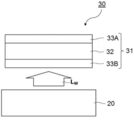
- FIG. 3 shows an example of the schematic configuration of the liquid crystal display device.
- the liquid crystal display device 30 shown in FIG. 3 includes a backlight unit 20 and a liquid crystal cell unit 31 arranged to face the backlight unit 20.
- the liquid crystal cell unit 31 has a configuration in which the liquid crystal cell 32 is arranged between the polarizing plate 33A and the polarizing plate 33B.
- the drive method of the liquid crystal cell 32 is not particularly limited, and is a TN (Twisted Nematic) method, an STN (Super Twisted Nematic) method, a VA (Vertical Birefringence) method, an IPS (In-Plane-Switching) method, and an OCB (Optical Bending) method.
- TN Transmission Nematic
- STN Super Twisted Nematic
- VA Very Birefringence
- IPS In-Plane-Switching
- OCB Optical Bending
- the use of the wavelength conversion member in one embodiment of the present disclosure is the use of a wavelength conversion member that is arranged to face the light guide plate, wherein the light guide plate has a surface having an arithmetic mean roughness Ra of 30 ⁇ m or more, and the wavelength conversion member.
- a surface having an arithmetic average roughness Ra of 5 ⁇ m or more and a maximum height Rz of 30 ⁇ m to 250 ⁇ m is arranged to face a surface of the light guide plate having an arithmetic average roughness Ra of 30 ⁇ m or more.
- the wavelength conversion member of the present disclosure has excellent impact resistance, even if a light guide plate having a surface having an arithmetic average roughness Ra of 30 ⁇ m or more, 40 ⁇ m or more, or 50 ⁇ m or more is used so as to face the surface, scratches will occur. It tends to be difficult to attach.
- the light guide plate 22 has a surface having an arithmetic average roughness Ra of 30 ⁇ m or more (not shown), and the light guide plate has a surface having an arithmetic average roughness Ra of 30 ⁇ m or more.
- the surfaces of the wavelength conversion member 10 having an arithmetic average roughness Ra of 5 ⁇ m or more and a maximum height Rz of 30 ⁇ m to 250 ⁇ m may be arranged to face each other.
- Example 1 [Manufacturing of wavelength conversion member] The materials shown below were mixed to prepare a resin composition.
- Base resin 1 Tricyclodecanedimethanol diacrylate (Sartmer Co., Ltd., trade name “SR833NS”) 68.1% by mass
- Base resin 2 Pentaerythritol tetrakis (3-mercaptopropionic acid) (Evans Chemetics LP, trade name “PETMP”) 22.6% by mass
- Light diffusing material Titanium oxide particles (The Chemours Company, trade name “Typure R-706”) 2.8% by mass Photopolymerization initiator ...
- IGM Resins 2,4,6-trimethylbenzoyl-diphenyl-phosphine oxide 0.5% by mass Additive: Acetic acid (Kanto Chemical Co., Inc.) 0.5% by mass Quantum dot phosphor 1 ...
- the obtained resin composition was applied as a coating material to the anti-matte surface of a barrier film having a thickness of 72 ⁇ m to form a coating film.
- the same coating material as above was placed on this coating film.
- ultraviolet rays were irradiated using an ultraviolet irradiation device (Igraphics Co., Ltd.) (irradiation amount: 1000 mJ / cm 2 ) to cure the resin composition, and coating materials were arranged on both sides of the wavelength conversion layer.
- the wavelength conversion member of the above was manufactured.
- Each wavelength conversion member obtained above was cut into dimensions of 210 mm in width and 300 mm in length to prepare a measurement sample.
- Arithmetic mean roughness Ra, arithmetic mean height Sa, and maximum height (Rz, Sz) were measured on the obtained sample, and a vibration test was performed by the following method. The results are shown in Table 2.
- the wavelength conversion member was cut into A4 size and installed in a frame made of plastic corrugated cardboard. Further, a SUS plate (A4 size, weight 1.8 kg) was installed as a weight on the wavelength conversion member. Assuming a foreign substance, 10 glass beads having an average particle size of 0.2 mm were installed between the light guide plate and the wavelength conversion member.
- the vibration test was xy biaxial vibration, and the vibration was swept from 10 Hz to 60 Hz in 10 minutes, and this was set as one cycle, and four cycles were carried out. After the vibration test was carried out, the appearance was visually confirmed, and the level (Lv) was determined as shown in Table 1 based on the frequency of occurrence of scratches. It should be noted that Lv0 and Lv1 were judged to be acceptable because the scratches were fine or not. On the other hand, Lv2 and Lv3 were clearly scratched and the judgment was rejected.
- Examples 2 to 6 Comparative Examples 1 to 7>
- the type of the coating material was changed to a coating material having a different surface roughness, and evaluation was performed by the same method as in Example 1. The results are shown in Tables 2 and 3.
Landscapes
- Chemical & Material Sciences (AREA)
- Physics & Mathematics (AREA)
- Engineering & Computer Science (AREA)
- Organic Chemistry (AREA)
- Materials Engineering (AREA)
- Nonlinear Science (AREA)
- Optics & Photonics (AREA)
- General Physics & Mathematics (AREA)
- Inorganic Chemistry (AREA)
- Crystallography & Structural Chemistry (AREA)
- Mathematical Physics (AREA)
- Liquid Crystal (AREA)
- Planar Illumination Modules (AREA)
- Optical Filters (AREA)
- Manufacturing & Machinery (AREA)
- Health & Medical Sciences (AREA)
- Chemical Kinetics & Catalysis (AREA)
- Medicinal Chemistry (AREA)
- Polymers & Plastics (AREA)
Abstract
波長変換部材は、蛍光体を含む波長変換層を有し、算術平均粗さRaが5μm以上かつ最大高さRzが30μm~250μmである面を有する。
Description
本開示は、波長変換部材及びその使用、バックライトユニット、並びに画像表示装置に関する。
液晶表示装置等の画像表示装置には、バックライトユニットが設けられる。バックライトユニットは、光源からの光で発光する蛍光体を含む波長変換部材を備える。
画像表示装置の分野においては、ディスプレイの色再現性を向上させることが求められている。色再現性を向上させる手段として、特表2013-544018号公報及び国際公開第2016/052625号に記載のように、量子ドット蛍光体を含む波長変換部材が注目を集めている。
通常、バックライトユニットにおける波長変換部材は、拡散板、導光板、反射フィルム、輝度上昇フィルム等の各種部材間に挿入して用いられる。例えば、テレビに搭載されるバックライトユニットでは、背面の点光源からの光を拡散させて面光源に変換するための拡散板が搭載され、波長変換部材は当該拡散板に対向して配置されることがある。また、パソコン等のモニターに搭載されるバックライトユニットでは、側面の光源から入射した光を導光するための導光板が用いられ、波長変換部材は当該導光板に対向して配置されることがある。
波長変換部材は、隣り合う他部材と密着した状態で組み込まれるわけではなく、他部材との間に可動的に配置されている。そのため、画像表示装置に振動、衝撃等が加わると、波長変換部材が他部材とぶつかることによって、波長変換部材の表面にキズが生じることがあった。特に、導光板は一般的に表面に凹凸を有しており、波長変換部材が導光板に対向して配置される場合には波長変換部材の表面にキズが生じやすい。
上記事情に鑑み、本開示は、耐衝撃性に優れる波長変換部材及びその使用、これを用いたバックライトユニット、並びに画像表示装置を提供することを目的とする。
前記課題を達成するための具体的手段は以下の通りである。
<1> 蛍光体を含む波長変換層を有し、算術平均粗さRaが5μm以上かつ最大高さRzが30μm~250μmである面を有する、波長変換部材。
<2> 前記波長変換層の一方の面側又は両方の面側に配置される被覆材を有し、前記波長変換層の一方の面側に配置される前記被覆材の、前記波長変換層とは対向しない側の面の算術平均粗さRaが5μm以上かつ最大高さRzが30μm~250μmであるか、又は前記波長変換層の両方の面側に配置される前記被覆材の、前記波長変換層とは対向しない側の面の少なくとも一方の算術平均粗さRaが5μm以上かつ最大高さRzが30μm~250μmである、<1>に記載の波長変換部材。
<3> 前記被覆材が酸素及び水の少なくとも一方に対するバリア性を有する<2>に記載の波長変換部材。
<4> 前記蛍光体が、量子ドット蛍光体を含む<1>~<3>のいずれか1項に記載の波長変換部材。
<5> 前記量子ドット蛍光体が、Cd及びInの少なくとも一方を含む化合物を含有する<4>に記載の波長変換部材。
<6> 前記波長変換層が、前記蛍光体と、チオール化合物と、(メタ)アクリル化合物及び(メタ)アリル化合物からなる群より選択される少なくとも1種と、光重合開始剤と、を含有する樹脂組成物の硬化物を含む、<1>~<5>のいずれか1項に記載の波長変換部材。
<7> <1>~<6>のいずれか1項に記載の波長変換部材と、光源と、を備えるバックライトユニット。
<8> 前記波長変換部材と対向配置される導光板をさらに備える、<7>に記載のバックライトユニット。
<9> 前記導光板の、前記波長変換部材と対向する面の算術平均粗さRaが30μm以上である、<8>に記載のバックライトユニット。
<10> <7>~<9>のいずれか1項に記載のバックライトユニットを備える画像表示装置。
<11> 導光板に対向配置させる波長変換部材の使用であって、前記導光板が算術平均粗さRaが30μm以上の面を有し、前記波長変換部材の前記算術平均粗さRaが5μm以上かつ最大高さRzが30μm~250μmである面を、前記導光板の算術平均粗さRaが30μm以上の面に対向配置させる、<1>~<8>のいずれか1項に記載の波長変換部材の使用。
<1> 蛍光体を含む波長変換層を有し、算術平均粗さRaが5μm以上かつ最大高さRzが30μm~250μmである面を有する、波長変換部材。
<2> 前記波長変換層の一方の面側又は両方の面側に配置される被覆材を有し、前記波長変換層の一方の面側に配置される前記被覆材の、前記波長変換層とは対向しない側の面の算術平均粗さRaが5μm以上かつ最大高さRzが30μm~250μmであるか、又は前記波長変換層の両方の面側に配置される前記被覆材の、前記波長変換層とは対向しない側の面の少なくとも一方の算術平均粗さRaが5μm以上かつ最大高さRzが30μm~250μmである、<1>に記載の波長変換部材。
<3> 前記被覆材が酸素及び水の少なくとも一方に対するバリア性を有する<2>に記載の波長変換部材。
<4> 前記蛍光体が、量子ドット蛍光体を含む<1>~<3>のいずれか1項に記載の波長変換部材。
<5> 前記量子ドット蛍光体が、Cd及びInの少なくとも一方を含む化合物を含有する<4>に記載の波長変換部材。
<6> 前記波長変換層が、前記蛍光体と、チオール化合物と、(メタ)アクリル化合物及び(メタ)アリル化合物からなる群より選択される少なくとも1種と、光重合開始剤と、を含有する樹脂組成物の硬化物を含む、<1>~<5>のいずれか1項に記載の波長変換部材。
<7> <1>~<6>のいずれか1項に記載の波長変換部材と、光源と、を備えるバックライトユニット。
<8> 前記波長変換部材と対向配置される導光板をさらに備える、<7>に記載のバックライトユニット。
<9> 前記導光板の、前記波長変換部材と対向する面の算術平均粗さRaが30μm以上である、<8>に記載のバックライトユニット。
<10> <7>~<9>のいずれか1項に記載のバックライトユニットを備える画像表示装置。
<11> 導光板に対向配置させる波長変換部材の使用であって、前記導光板が算術平均粗さRaが30μm以上の面を有し、前記波長変換部材の前記算術平均粗さRaが5μm以上かつ最大高さRzが30μm~250μmである面を、前記導光板の算術平均粗さRaが30μm以上の面に対向配置させる、<1>~<8>のいずれか1項に記載の波長変換部材の使用。
本開示によれば、耐衝撃性に優れる波長変換部材及びその使用、これを用いたバックライトユニット、並びに画像表示装置が提供される。
以下、本発明を実施するための形態について詳細に説明する。但し、本発明は以下の実施形態に限定されるものではない。以下の実施形態において、その構成要素(要素ステップ等も含む)は、特に明示した場合を除き、必須ではない。数値及びその範囲についても同様であり、本発明を制限するものではない。
本開示において「~」を用いて示された数値範囲には、「~」の前後に記載される数値がそれぞれ最小値及び最大値として含まれる。
本開示中に段階的に記載されている数値範囲において、一つの数値範囲で記載された上限値又は下限値は、他の段階的な記載の数値範囲の上限値又は下限値に置き換えてもよい。また、本開示中に記載されている数値範囲において、その数値範囲の上限値又は下限値は、実施例に示されている値に置き換えてもよい。
本開示において各成分は該当する物質を複数種含んでいてもよい。組成物中に各成分に該当する物質が複数種存在する場合、各成分の含有率は、特に断らない限り、組成物中に存在する当該複数種の物質の合計の含有率を意味する。
本開示において各成分に該当する粒子は複数種含まれていてもよい。組成物中に各成分に該当する粒子が複数種存在する場合、各成分の粒子径は、特に断らない限り、組成物中に存在する当該複数種の粒子の混合物についての値を意味する。
本開示において「層」又は「膜」との語には、当該層又は膜が存在する領域を観察したときに、当該領域の全体に形成されている場合に加え、当該領域の一部にのみ形成されている場合も含まれる。
本開示において「積層」との語は、層を積み重ねることを示し、二以上の層が結合されていてもよく、二以上の層が着脱可能であってもよい。
本開示において「(メタ)アクリロイル基」とは、アクリロイル基及びメタクリロイル基の少なくとも一方を意味し、「(メタ)アクリル」はアクリル及びメタクリルの少なくとも一方を意味し、「(メタ)アクリレート」はアクリレート及びメタクリレートの少なくとも一方を意味し、「(メタ)アリル」はアリル及びメタリルの少なくとも一方を意味する。
本開示において実施形態を図面を参照して説明する場合、当該実施形態の構成は図面に示された構成に限定されない。また、各図における部材の大きさは概念的なものであり、部材間の大きさの相対的な関係はこれに限定されない。また、各図面において、実質的に同じ機能を有する部材には、全図面同じ符号を付与し、重複する説明は省略する場合がある。
本開示において「~」を用いて示された数値範囲には、「~」の前後に記載される数値がそれぞれ最小値及び最大値として含まれる。
本開示中に段階的に記載されている数値範囲において、一つの数値範囲で記載された上限値又は下限値は、他の段階的な記載の数値範囲の上限値又は下限値に置き換えてもよい。また、本開示中に記載されている数値範囲において、その数値範囲の上限値又は下限値は、実施例に示されている値に置き換えてもよい。
本開示において各成分は該当する物質を複数種含んでいてもよい。組成物中に各成分に該当する物質が複数種存在する場合、各成分の含有率は、特に断らない限り、組成物中に存在する当該複数種の物質の合計の含有率を意味する。
本開示において各成分に該当する粒子は複数種含まれていてもよい。組成物中に各成分に該当する粒子が複数種存在する場合、各成分の粒子径は、特に断らない限り、組成物中に存在する当該複数種の粒子の混合物についての値を意味する。
本開示において「層」又は「膜」との語には、当該層又は膜が存在する領域を観察したときに、当該領域の全体に形成されている場合に加え、当該領域の一部にのみ形成されている場合も含まれる。
本開示において「積層」との語は、層を積み重ねることを示し、二以上の層が結合されていてもよく、二以上の層が着脱可能であってもよい。
本開示において「(メタ)アクリロイル基」とは、アクリロイル基及びメタクリロイル基の少なくとも一方を意味し、「(メタ)アクリル」はアクリル及びメタクリルの少なくとも一方を意味し、「(メタ)アクリレート」はアクリレート及びメタクリレートの少なくとも一方を意味し、「(メタ)アリル」はアリル及びメタリルの少なくとも一方を意味する。
本開示において実施形態を図面を参照して説明する場合、当該実施形態の構成は図面に示された構成に限定されない。また、各図における部材の大きさは概念的なものであり、部材間の大きさの相対的な関係はこれに限定されない。また、各図面において、実質的に同じ機能を有する部材には、全図面同じ符号を付与し、重複する説明は省略する場合がある。
≪波長変換部材≫
本開示の波長変換部材は、蛍光体を含む波長変換層を有し、算術平均粗さRaが5μm以上かつ最大高さRzが30μm~250μmである面を有する。
以下、「5μm以上の算術平均粗さRaかつ30μm~250μmの最大高さRz」を「特定表面粗さ」と称することがある。
本開示の波長変換部材は、波長変換層により構成されていてもよいし、必要に応じて後述する被覆材等のその他の構成要素を含んでいてもよい。
本開示において、波長変換部材の「面」とは、波長変換部材の主面を表す。
本開示に係る波長変換層は、後述する樹脂組成物の硬化物であってもよい。
本開示の波長変換部材は、蛍光体を含む波長変換層を有し、算術平均粗さRaが5μm以上かつ最大高さRzが30μm~250μmである面を有する。
以下、「5μm以上の算術平均粗さRaかつ30μm~250μmの最大高さRz」を「特定表面粗さ」と称することがある。
本開示の波長変換部材は、波長変換層により構成されていてもよいし、必要に応じて後述する被覆材等のその他の構成要素を含んでいてもよい。
本開示において、波長変換部材の「面」とは、波長変換部材の主面を表す。
本開示に係る波長変換層は、後述する樹脂組成物の硬化物であってもよい。
本開示の波長変換部材は、耐衝撃性に優れる。その理由は明確ではないが、それぞれ特定表面粗さを有することにより、バックライトユニットとしたときに対向する他部材との接触面積を減らすことができ、波長変換部材の表面にキズが発生することを抑制できると考えられる。
波長変換部材の形状は特に制限されず、フィルム状、レンズ状等が挙げられる。波長変換部材を後述するバックライトユニットに適用する場合には、波長変換部材はフィルム状であることが好ましい。
波長変換部材における、特定表面粗さを有する面の存在する箇所は特に限定されるものではない。波長変換部材の形状が例えばフィルム状である場合、フィルム状の波長変換部材における少なくとも一方の面が特定表面粗さを有すればよく、両方の面が特定表面粗さを有していてもよい。
波長変換部材の形状が例えばフィルム状である場合、特定表面粗さを有する面は、波長変換層の表面であってもよいし、波長変換部材が後述する被覆材を含む場合、被覆材の表面であってもよい。
波長変換部材の形状が例えばフィルム状である場合、特定表面粗さを有する面は、波長変換層の表面であってもよいし、波長変換部材が後述する被覆材を含む場合、被覆材の表面であってもよい。
バックライトユニットとしたときに波長変換部材が導光板に対向して配置される場合、波長変換部材の当該導光板に対向する側の面が少なくとも特定表面粗さを満たしていることが好ましい。一般的に導光板の表面には凹凸が設けられており、バックライトユニットに振動又は衝撃が加わると波長変換部材の表面にキズがつきやすい。波長変換部材の導光板に対向する側の面が特定表面粗さを満たしていると、当該面の耐衝撃性が高まり、キズの発生を抑制することができる。
また、波長変換部材が光学フィルムに対向して配置される場合、波長変換部材と光学フィルムとは光学密着しないことが好ましい。光学密着を抑制する観点からは、波長変換部材の光学フィルムに対向する側の面は表面粗さを有していることが好ましく、特定表面粗さを満たすものであってもよい。
また、波長変換部材が光学フィルムに対向して配置される場合、波長変換部材と光学フィルムとは光学密着しないことが好ましい。光学密着を抑制する観点からは、波長変換部材の光学フィルムに対向する側の面は表面粗さを有していることが好ましく、特定表面粗さを満たすものであってもよい。
特定表面粗さを有するように波長変換部材を作製する方法は特に制限されない。例えば、波長変換層又は被覆材に含まれてもよいフィラーの粒径及び含有量、並びに樹脂の付与量を調整することによって行うことができる。
フィラーの材質は特に制限されず、無機フィラーであっても有機フィラーであってもよい。耐衝撃性の観点からは、フィラーは有機フィラーであることが好ましい。
フィラーの材質は特に制限されず、無機フィラーであっても有機フィラーであってもよい。耐衝撃性の観点からは、フィラーは有機フィラーであることが好ましい。
本開示の波長変換部材において、算術平均粗さRaは5μm以上であり、耐衝撃性の観点から、7μm以上であることが好ましく、9μm以上であることがより好ましい。算術平均粗さRaの上限値は特に制限されず、算術平均粗さRaは50μm以下であってもよい。
本開示の波長変換部材において、最大高さRzは30μm~250μmであり、40μm~200μmであることが好ましく、50μm~190μmであることがより好ましく、60μm~180μmであることがさらに好ましい。最大高さRzが30μm以上であると、耐衝撃性に優れる傾向にある。また、最大高さRzが250μm以下であると、算術平均粗さRaの算出上、最大高さRzが大きいことによって算術平均粗さRaが見かけ上大きい値となってしまう影響を低減することができる。
本開示の波長変換部材において、最大高さRzは30μm~250μmであり、40μm~200μmであることが好ましく、50μm~190μmであることがより好ましく、60μm~180μmであることがさらに好ましい。最大高さRzが30μm以上であると、耐衝撃性に優れる傾向にある。また、最大高さRzが250μm以下であると、算術平均粗さRaの算出上、最大高さRzが大きいことによって算術平均粗さRaが見かけ上大きい値となってしまう影響を低減することができる。
本開示の波長変換部材において、算術平均高さSaは特に制限されず、耐衝撃性の観点からは、5μm以上であることが好ましく、7μm以上であることがより好ましく、9μm以上であることがさらに好ましい。算術平均高さSaの上限値は特に制限されず、算術平均高さSaは50μm以下であってもよい。
本開示の波長変換部材において、最大高さSzは特に制限されず、耐衝撃性の観点からは、30μm~250μmであることが好ましく、40μm~200μmであることがより好ましく、50μm~190μmであることがさらに好ましく、60μm~180μmであることが特に好ましい。
本開示において、算術平均粗さRaは、3D顕微鏡(例えば、オリンパス株式会社、型式OLS4100、倍率10倍)を用いて測定される値をいう。解析範囲は、1289μm長さでの線粗さとする。解析方法は、解析パラメーターを粗さパラメーターとし、カットオフはλC;なし、λS;なし、λf;なしとする。
ここで、λC、λS、λfは、Raを算出するための輪郭曲線の算出方法である。輪郭曲線には、断面曲線、粗さ曲線及びうねり曲線がある。断面曲線は、測定断面曲線にカットオフ値λSの低域フィルタを適用して得られる曲線である。粗さ曲線は、カットオフ値λCの高域フィルタによって、断面曲線から長波長成分を遮断して得た輪郭曲線である。うねり曲線は、断面曲線にカットオフ値λf及びλCの輪郭曲線フィルタを順次かけることによって得られる輪郭曲線である。λf輪郭曲線フィルタによって長波長成分を遮断し、λC輪郭曲線フィルタによって短波長成分を遮断している。
ここで、λC、λS、λfは、Raを算出するための輪郭曲線の算出方法である。輪郭曲線には、断面曲線、粗さ曲線及びうねり曲線がある。断面曲線は、測定断面曲線にカットオフ値λSの低域フィルタを適用して得られる曲線である。粗さ曲線は、カットオフ値λCの高域フィルタによって、断面曲線から長波長成分を遮断して得た輪郭曲線である。うねり曲線は、断面曲線にカットオフ値λf及びλCの輪郭曲線フィルタを順次かけることによって得られる輪郭曲線である。λf輪郭曲線フィルタによって長波長成分を遮断し、λC輪郭曲線フィルタによって短波長成分を遮断している。
本開示において、最大高さRzは、3D顕微鏡(例えば、オリンパス株式会社、型式OLS4100、倍率10倍)を用いて測定される値をいう。解析範囲は、1289μm長さでの線粗さとする。解析方法は、解析パラメーターを粗さパラメーターとし、カットオフはλC;なし、λS;なし、λf;なしとする。Ra算出と同時にRzも算出することができる。
本開示において算術平均高さSaは、3D顕微鏡(例えば、オリンパス株式会社、型式OLS4100、倍率10倍)を用いて測定される値をいう。解析範囲は、1282μm×1279μmでの面粗さとする。解析方法は、解析パラメーターを粗さパラメーターとし、カットオフはλC;なし、λS;なし、λf;なしとする。
本開示において算術平均高さSzは、3D顕微鏡(例えば、オリンパス株式会社、型式OLS4100、倍率10倍)を用いて測定される値をいう。解析範囲は、1282μm×1279μmでの面粗さとする。解析方法は、解析パラメーターを粗さパラメーターとし、カットオフはλC;なし、λS;なし、λf;なしとする。Sa算出と同時にSzも算出することができる。
波長変換部材の平均厚みは、例えば、50μm~500μmであることが好ましく、65μm~450μmであることがより好ましく、80μm~400μmであることがさらに好ましい。波長変換部材の平均厚みが50μm以上であると、波長変換効率がより向上する傾向にあり、平均厚みが500μm以下であると、波長変換部材をバックライトユニットに適用した場合に、バックライトユニットをより薄型化できる傾向にある。
波長変換部材の平均厚みは、例えば、マイクロメータを用いて測定した任意の3箇所の厚みの算術平均値として求められる。
波長変換部材の平均厚みは、例えば、マイクロメータを用いて測定した任意の3箇所の厚みの算術平均値として求められる。
光の利用効率をより向上させる観点から、波長変換部材の全光線透過率は75%以下であることが好ましく、70%以下であることがより好ましく、65%以下であることがさらに好ましい。波長変換部材の全光線透過率は、JIS K 7136:2000の測定法に準拠して測定することができる。
また、光の利用効率をより向上させる観点から、波長変換部材のヘーズは90%以上であることが好ましく、95%以上であることがより好ましく、98%以上であることがさらに好ましい。波長変換部材のヘーズは、JIS K 7136:2000の測定法に準拠して測定することができる。
本開示のさらなる一実施形態において、波長変換部材は、蛍光体を含む波長変換層を有し、算術平均粗さRaが17μm以上の面を有する。当該実施形態に係る波長変換部材は耐衝撃性に優れる。
当該実施形態に係る波長変換部材において、算術平均粗さRaは17μm以上であり、耐衝撃性の観点から、19μm以上であることが好ましく、21μm以上であることがより好ましい。算術平均粗さRaの上限値は特に制限されず、算術平均粗さRaは50μm以下であってもよい。
当該実施形態に係る波長変換部材において、最大高さRzは特に制限されず、30μm~250μmであることが好ましく、40μm~200μmであることがより好ましく、50μm~190μmであることがさらに好ましく、60μm~180μmであることが特に好ましい。最大高さRzが30μm以上であると、耐衝撃性に優れる傾向にある。また、最大高さRzが250μm以下であると、算術平均粗さRaの算出上、最大高さRzが大きいことによって算術平均粗さRaが見かけ上大きい値となってしまう影響を低減することができる。
当該実施形態に係る波長変換部材の、上記算術平均粗さRa及び最大高さRz以外の詳細は、前述の特定表面粗さを有する波長変換部材の詳細を適用することができる。
当該実施形態に係る波長変換部材において、算術平均粗さRaは17μm以上であり、耐衝撃性の観点から、19μm以上であることが好ましく、21μm以上であることがより好ましい。算術平均粗さRaの上限値は特に制限されず、算術平均粗さRaは50μm以下であってもよい。
当該実施形態に係る波長変換部材において、最大高さRzは特に制限されず、30μm~250μmであることが好ましく、40μm~200μmであることがより好ましく、50μm~190μmであることがさらに好ましく、60μm~180μmであることが特に好ましい。最大高さRzが30μm以上であると、耐衝撃性に優れる傾向にある。また、最大高さRzが250μm以下であると、算術平均粗さRaの算出上、最大高さRzが大きいことによって算術平均粗さRaが見かけ上大きい値となってしまう影響を低減することができる。
当該実施形態に係る波長変換部材の、上記算術平均粗さRa及び最大高さRz以外の詳細は、前述の特定表面粗さを有する波長変換部材の詳細を適用することができる。
<被覆材>
波長変換部材は、波長変換層の一方の面側又は両方の面側に配置される被覆材を有してもよい。この場合、波長変換層の一方の面側に配置される被覆材の、波長変換層とは対向しない側の面、又は波長変換層の両方の面側に配置される被覆材の、波長変換層とは対向しない側の面の少なくとも一方が、特定表面粗さを満たすものであってよい。
波長変換部材は、波長変換層の一方の面側又は両方の面側に配置される被覆材を有してもよい。この場合、波長変換層の一方の面側に配置される被覆材の、波長変換層とは対向しない側の面、又は波長変換層の両方の面側に配置される被覆材の、波長変換層とは対向しない側の面の少なくとも一方が、特定表面粗さを満たすものであってよい。
被覆材の平均厚みは、例えば、10μm~200μmであることが好ましく、12μm~170μmであることがより好ましく、15μm~150μmであることがさらに好ましい。平均厚みが10μm以上であると、バリア性等の機能が充分なものとなる傾向にあり、平均厚みが200μm以下であると、光透過率の低下が抑えられる傾向にある。
被覆材の平均厚みは、例えば、マイクロメータを用いて測定した任意の3箇所の厚みの算術平均値として求められる。
被覆材の平均厚みは、例えば、マイクロメータを用いて測定した任意の3箇所の厚みの算術平均値として求められる。
本開示の波長変換部材において、被覆材が特定表面粗さを有するものである場合、被覆材の算術平均粗さRaは5μm以上であり、耐衝撃性の観点から、7μm以上であることが好ましく、9μm以上であることがより好ましい。算術平均粗さRaの上限値は特に制限されず、算術平均粗さRaは50μm以下であってもよい。
本開示の波長変換部材において、被覆材が特定表面粗さを有するものである場合、被覆材の最大高さRzは30μm~250μmであり、40μm~200μmであることが好ましく、50μm~190μmであることがより好ましく、60μm~180μmであることがさらに好ましい。最大高さRzが30μm以上であると、耐衝撃性に優れる傾向にある。また、最大高さRzが250μm以下であると、算術平均粗さRaの算出上、最大高さRzが大きいことによって算術平均粗さRaが見かけ上大きい値となってしまう影響を低減することができる。
本開示の波長変換部材において、被覆材が特定表面粗さを有するものである場合、被覆材の最大高さRzは30μm~250μmであり、40μm~200μmであることが好ましく、50μm~190μmであることがより好ましく、60μm~180μmであることがさらに好ましい。最大高さRzが30μm以上であると、耐衝撃性に優れる傾向にある。また、最大高さRzが250μm以下であると、算術平均粗さRaの算出上、最大高さRzが大きいことによって算術平均粗さRaが見かけ上大きい値となってしまう影響を低減することができる。
被覆材の材質は特に制限されず、ポリエチレンテレフタレート(PET)、ポリエチレンナフタレート(PEN)等のポリエステル、ポリエチレン(PE)、ポリプロピレン(PP)等のポリオレフィン、ナイロン等のポリアミド、エチレン-ビニルアルコール共重合体(EVOH)などであってもよい。入手容易性の観点からは、被覆材の材質はポリエチレンテレフタレート及びポリプロピレンからなる群より選択される少なくとも1つが好ましい。
被覆材は、バリア機能を高めるためのバリア層を備えたもの(バリアフィルムともいう)であってもよい。バリア層としては、アルミナ、シリカ等の無機物を含む無機層が挙げられる。
被覆材は、バリア機能を高めるためのバリア層を備えたもの(バリアフィルムともいう)であってもよい。バリア層としては、アルミナ、シリカ等の無機物を含む無機層が挙げられる。
被覆材は、蛍光体の発光効率の低下を抑える観点から、酸素及び水の少なくとも一方に対するバリア性を有することが好ましく、酸素及び水の両方に対するバリア性を有することがより好ましい。酸素及び水の少なくとも一方に対するバリア性を有する被覆材としては特に制限されず、無機層を有するバリアフィルム等の公知の被覆材を用いることができる。
被覆材の酸素透過率は、例えば、1.0mL/(m2・24h・atm)以下であることが好ましく、0.8mL/(m2・24h・atm)以下であることがより好ましく、0.6mL/(m2・24h・atm)以下であることがさらに好ましい。被覆材の酸素透過率は、酸素透過率測定装置(例えば、MOCON社、OX-TRAN)を用いて、温度23℃かつ相対湿度90%の条件で測定することができる。
また、被覆材の水蒸気透過率は、例えば、1×100g/(m2・24h)以下であることが好ましく、8×10-1g/(m2・24h)以下であることがより好ましく、6×10-1g/(m2・24h)以下であることがさらに好ましい。被覆材の水蒸気透過率は、水蒸気透過率測定装置(例えば、MOCON社、AQUATRAN)を用いて、温度40℃かつ相対湿度100%の条件で測定することができる。
<波長変換層>
本開示の波長変換部材は波長変換層を含む。波長変換層は、蛍光体を含む。波長変換層は、樹脂硬化物をさらに含んでもよく、蛍光体が樹脂硬化物に含まれた状態であってもよい。また、波長変換層は光拡散材をさらに含んでもよい。
本開示の波長変換部材は波長変換層を含む。波長変換層は、蛍光体を含む。波長変換層は、樹脂硬化物をさらに含んでもよく、蛍光体が樹脂硬化物に含まれた状態であってもよい。また、波長変換層は光拡散材をさらに含んでもよい。
〔蛍光体〕
波長変換層は、光源から光を照射されることで発光する蛍光体を含む。蛍光体の種類は特に限定されるものではなく、例えば、有機蛍光体及び無機蛍光体を挙げることができる。
有機蛍光体としては、ナフタルイミド化合物、ペリレン化合物等が挙げられる。
無機蛍光体としては、Y3O3:Eu、YVO4:Eu、Y2O2:Eu、3.5MgO・0.5MgF2、GeO2:Mn、(Y・Cd)BO2:Eu等の赤色発光無機蛍光体、ZnS:Cu・Al、(Zn・Cd)S:Cu・Al、ZnS:Cu・Au・Al、Zn2SiO4:Mn、ZnSiO4:Mn、ZnS:Ag・Cu、(Zn・Cd)S:Cu、ZnS:Cu、GdOS:Tb、LaOS:Tb、YSiO4:Ce・Tb、ZnGeO4:Mn、GeMgAlO:Tb、SrGaS:Eu2+、ZnS:Cu・Co、MgO・nB2O3:Ge・Tb、LaOBr:Tb・Tm、La2O2S:Tb等の緑色発光無機蛍光体、ZnS:Ag、GaWO4、Y2SiO6:Ce、ZnS:Ag・Ga・Cl、Ca2B4OCl:Eu2+、BaMgAl4O3:Eu2+等の青色発光無機蛍光体、量子ドット蛍光体などが挙げられる。
波長変換層は、光源から光を照射されることで発光する蛍光体を含む。蛍光体の種類は特に限定されるものではなく、例えば、有機蛍光体及び無機蛍光体を挙げることができる。
有機蛍光体としては、ナフタルイミド化合物、ペリレン化合物等が挙げられる。
無機蛍光体としては、Y3O3:Eu、YVO4:Eu、Y2O2:Eu、3.5MgO・0.5MgF2、GeO2:Mn、(Y・Cd)BO2:Eu等の赤色発光無機蛍光体、ZnS:Cu・Al、(Zn・Cd)S:Cu・Al、ZnS:Cu・Au・Al、Zn2SiO4:Mn、ZnSiO4:Mn、ZnS:Ag・Cu、(Zn・Cd)S:Cu、ZnS:Cu、GdOS:Tb、LaOS:Tb、YSiO4:Ce・Tb、ZnGeO4:Mn、GeMgAlO:Tb、SrGaS:Eu2+、ZnS:Cu・Co、MgO・nB2O3:Ge・Tb、LaOBr:Tb・Tm、La2O2S:Tb等の緑色発光無機蛍光体、ZnS:Ag、GaWO4、Y2SiO6:Ce、ZnS:Ag・Ga・Cl、Ca2B4OCl:Eu2+、BaMgAl4O3:Eu2+等の青色発光無機蛍光体、量子ドット蛍光体などが挙げられる。
蛍光体としては、画像表示装置の色再現性に優れる観点から、量子ドット蛍光体が好ましい。
量子ドット蛍光体としては特に制限されず、II-VI族化合物、III-V族化合物、IV-VI族化合物、及びIV族化合物からなる群より選択される少なくとも1種を含む粒子が挙げられる。発光効率の観点からは、量子ドット蛍光体は、Cd及びInの少なくとも一方を含む化合物を含むことが好ましい。
量子ドット蛍光体としては特に制限されず、II-VI族化合物、III-V族化合物、IV-VI族化合物、及びIV族化合物からなる群より選択される少なくとも1種を含む粒子が挙げられる。発光効率の観点からは、量子ドット蛍光体は、Cd及びInの少なくとも一方を含む化合物を含むことが好ましい。
II-VI族化合物の具体例としては、CdSe、CdTe、CdS、ZnS、ZnSe、ZnTe、ZnO、HgS、HgSe、HgTe、CdSeS、CdSeTe、CdSTe、ZnSeS、ZnSeTe、ZnSTe、HgSeS、HgSeTe、HgSTe、CdZnS、CdZnSe、CdZnTe、CdHgS、CdHgSe、CdHgTe、HgZnS、HgZnSe、HgZnTe、CdZnSeS、CdZnSeTe、CdZnSTe、CdHgSeS、CdHgSeTe、CdHgSTe、HgZnSeS、HgZnSeTe、HgZnSTe等が挙げられる。
III-V族化合物の具体例としては、GaN、GaP、GaAs、GaSb、AlN、AlP、AlAs、AlSb、InN、InP、InAs、InSb、GaNP、GaNAs、GaNSb、GaPAs、GaPSb、AlNP、AlNAs、AlNSb、AlPAs、AlPSb、InNP、InNAs、InNSb、InPAs、InPSb、GaAlNP、GaAlNAs、GaAlNSb、GaAlPAs、GaAlPSb、GaInNP、GaInNAs、GaInNSb、GaInPAs、GaInPSb、InAlNP、InAlNAs、InAlNSb、InAlPAs、InAlPSb等が挙げられる。
IV-VI族化合物の具体例としては、SnS、SnSe、SnTe、PbS、PbSe、PbTe、SnSeS、SnSeTe、SnSTe、PbSeS、PbSeTe、PbSTe、SnPbS、SnPbSe、SnPbTe、SnPbSSe、SnPbSeTe、SnPbSTe等が挙げられる。
IV族化合物の具体例としては、Si、Ge、SiC、SiGe等が挙げられる。
III-V族化合物の具体例としては、GaN、GaP、GaAs、GaSb、AlN、AlP、AlAs、AlSb、InN、InP、InAs、InSb、GaNP、GaNAs、GaNSb、GaPAs、GaPSb、AlNP、AlNAs、AlNSb、AlPAs、AlPSb、InNP、InNAs、InNSb、InPAs、InPSb、GaAlNP、GaAlNAs、GaAlNSb、GaAlPAs、GaAlPSb、GaInNP、GaInNAs、GaInNSb、GaInPAs、GaInPSb、InAlNP、InAlNAs、InAlNSb、InAlPAs、InAlPSb等が挙げられる。
IV-VI族化合物の具体例としては、SnS、SnSe、SnTe、PbS、PbSe、PbTe、SnSeS、SnSeTe、SnSTe、PbSeS、PbSeTe、PbSTe、SnPbS、SnPbSe、SnPbTe、SnPbSSe、SnPbSeTe、SnPbSTe等が挙げられる。
IV族化合物の具体例としては、Si、Ge、SiC、SiGe等が挙げられる。
量子ドット蛍光体としては、コアシェル構造を有するものであってもよい。コアを構成する化合物のバンドギャップよりもシェルを構成する化合物のバンドギャップを広くすることで、量子ドット蛍光体の量子効率をより向上させることが可能となる。コア及びシェルの組み合わせ(コア/シェル)としては、CdSe/ZnS、InP/ZnS、PbSe/PbS、CdSe/CdS、CdTe/CdS、CdTe/ZnS等が挙げられる。
また、量子ドット蛍光体としては、シェルが多層構造である、いわゆるコアマルチシェル構造を有するものであってもよい。バンドギャップの広いコアにバンドギャップの狭いシェルを1層又は2層以上積層し、さらにこのシェルの上にバンドギャップの広いシェルを積層することで、量子ドット蛍光体の量子効率をさらに向上させることが可能となる。
波長変換層が量子ドット蛍光体を含有する場合、波長変換層は、1種類の量子ドット蛍光体を単独で含有していてもよく、2種類以上の量子ドット蛍光体を組み合わせて含有していてもよい。2種類以上の量子ドット蛍光体を組み合わせて含有する態様としては、例えば、成分は異なるものの平均粒子径を同じくする量子ドット蛍光体を2種類以上含有する態様、平均粒子径は異なるものの成分を同じくする量子ドット蛍光体を2種類以上含有する態様、並びに成分及び平均粒子径の異なる量子ドット蛍光体を2種類以上含有する態様が挙げられる。量子ドット蛍光体の成分及び平均粒子径の少なくとも一方を変更することで、量子ドット蛍光体の発光中心波長を変更することができる。
例えば、波長変換層は、520nm~560nmの緑色の波長域に発光中心波長を有する量子ドット蛍光体Gと、600nm~680nmの赤色の波長域に発光中心波長を有する量子ドット蛍光体Rとを含有していてもよい。量子ドット蛍光体Gと量子ドット蛍光体Rとを含有する波長変換層に対して430nm~480nmの青色の波長域の励起光を照射すると、量子ドット蛍光体G及び量子ドット蛍光体Rからそれぞれ緑色光及び赤色光が発光される。その結果、量子ドット蛍光体G及び量子ドット蛍光体Rから発光される緑色光及び赤色光と、硬化物を透過する青色光とにより、白色光を得ることができる。
波長変換層中の蛍光体の含有率は、波長変換層全体に対して、例えば、0.01質量%~1.0質量%であることが好ましく、0.05質量%~0.5質量%であることがより好ましく、0.1質量%~0.5質量%であることが更に好ましい。蛍光体の含有率が波長変換層全体に対して0.01質量%以上であると、充分な波長変換機能が得られる傾向にあり、蛍光体の含有率が0.01質量%以下であると、蛍光体の凝集が抑えられる傾向にある。
〔樹脂硬化物〕
波長変換層は、樹脂硬化物をさらに含んでもよい。波長変換層は、上述の蛍光体が樹脂硬化物に含まれた状態の層であってもよい。
波長変換層は、樹脂硬化物をさらに含んでもよい。波長変換層は、上述の蛍光体が樹脂硬化物に含まれた状態の層であってもよい。
樹脂硬化物の他部材(被覆材等)に対する密着性、及び硬化時の体積収縮によるシワの発生の抑制の観点からは、樹脂硬化物はスルフィド構造を含有することが好ましい。スルフィド構造を含有する樹脂硬化物は、例えば、後述するチオール化合物と、当該チオール化合物のチオール基とエンチオール反応を生じる炭素炭素二重結合を有する重合性化合物と、を含む樹脂組成物を硬化させて得ることができる。
波長変換層の耐熱性及び耐湿熱性の観点からは、樹脂硬化物は脂環式構造又は芳香環構造を含有することが好ましい。脂環式構造又は芳香環構造を有する樹脂硬化物は、例えば、後述する重合性化合物として脂環式構造又は芳香環構造を有するものを含む樹脂組成物を硬化させて得ることができる。
蛍光体と酸素との接触を抑制する観点からは、樹脂硬化物はアルキレンオキシ基を含有することが好ましい。樹脂硬化物がアルキレンオキシ基を含有すると、樹脂硬化物の極性が増大し、非極性の酸素が硬化物中の成分に溶解しにくくなる傾向にある。また、樹脂硬化物の柔軟性が増して被覆材との密着性が向上する傾向にある。
アルキレンオキシ基を含有する樹脂硬化物は、例えば、後述する重合性化合物としてアルキレンオキシ基を有するものを含む樹脂組成物を硬化させて得ることができる。
-樹脂組成物-
波長変換層は、蛍光体と、重合性化合物と、光重合開始剤と、を含む組成物(以下、単に樹脂組成物ともいう)の硬化物であってもよい。樹脂組成物は、蛍光体と、チオール化合物と、(メタ)アクリル化合物及び(メタ)アリル化合物からなる群より選択される少なくとも1種と、光重合開始剤と、を含有することが好ましい。樹脂組成物は、任意でその他の成分を含有していてもよい。
以下、樹脂組成物の各成分について詳述する。
波長変換層は、蛍光体と、重合性化合物と、光重合開始剤と、を含む組成物(以下、単に樹脂組成物ともいう)の硬化物であってもよい。樹脂組成物は、蛍光体と、チオール化合物と、(メタ)アクリル化合物及び(メタ)アリル化合物からなる群より選択される少なくとも1種と、光重合開始剤と、を含有することが好ましい。樹脂組成物は、任意でその他の成分を含有していてもよい。
以下、樹脂組成物の各成分について詳述する。
(蛍光体)
樹脂組成物は、蛍光体を含有する。蛍光体の詳細は、上述のとおりである。
樹脂組成物は、蛍光体を含有する。蛍光体の詳細は、上述のとおりである。
蛍光体として量子ドット蛍光体を用いる場合、量子ドット蛍光体は、分散媒体に分散された量子ドット蛍光体分散液の状態で用いてもよい。量子ドット蛍光体を分散する分散媒体としては、各種有機溶剤、シリコーン化合物、及び単官能(メタ)アクリレート化合物が挙げられる。量子ドットは、必要に応じて分散剤を用いて量子ドット蛍光体分散液の状態で用いてもよい。
分散媒体として使用可能な有機溶剤としては、量子ドット蛍光体の沈降及び凝集が確認されなければ特に限定されるものではなく、アセトニトリル、メタノール、エタノール、アセトン、1-プロパノール、酢酸エチル、酢酸ブチル、トルエン、ヘキサン等が挙げられる。
分散媒体として使用可能なシリコーン化合物としては、ジメチルシリコーンオイル、メチルフェニルシリコーンオイル、メチルハイドロジェンシリコーンオイル等のストレートシリコーンオイル;アミノ変性シリコーンオイル、エポキシ変性シリコーンオイル、カルボキシ変性シリコーンオイル、カルビノール変性シリコーンオイル、メルカプト変性シリコーンオイル、異種官能基変性シリコーンオイル、ポリエーテル変性シリコーンオイル、メチルスチリル変性シリコーンオイル、親水性特殊変性シリコーンオイル、高級アルコキシ変性シリコーンオイル、高級脂肪酸変性シリコーンオイル、フッ素変性シリコーンオイル等の変性シリコーンオイルなどが挙げられる。
分散媒体として使用可能な単官能(メタ)アクリレート化合物としては、室温(25℃)において液体であれば特に限定されるものではなく、脂環式構造を有する単官能(メタ)アクリレート化合物(好ましくはイソボルニル(メタ)アクリレート、及びジシクロペンタニル(メタ)アクリレート)、メトキシポリエチレングリコール(メタ)アクリレート、フェノキシポリエチレングリコール(メタ)アクリレート、エトキシ化o-フェニルフェノール(メタ)アクリレート等が挙げられる。
必要に応じて用いられる分散剤としては、ポリエーテルアミン(JEFFAMINE M-1000、HUNTSMAN社)、オレイン酸等が挙げられる。
量子ドット蛍光体分散液に占める量子ドット蛍光体の質量基準の割合は、1質量%~20質量%であることが好ましく、1質量%~10質量%であることがより好ましい。
樹脂組成物中の量子ドット蛍光体分散液の含有率は、量子ドット蛍光体分散液に占める量子ドット蛍光体の質量基準の割合が1質量%~20質量%である場合、樹脂組成物の全量に対して、例えば、1質量%~10質量%であることが好ましく、4質量%~10質量%であることがより好ましく、4質量%~7質量%であることがさらに好ましい。
また、樹脂組成物中の量子ドット蛍光体の含有率は、樹脂組成物の全量に対して、例えば、0.01質量%~1.0質量%であることが好ましく、0.05質量%~0.5質量%であることがより好ましく、0.1質量%~0.5質量%であることがさらに好ましい。量子ドット蛍光体の含有率が0.01質量%以上であると、硬化物に励起光を照射する際に充分な発光強度が得られる傾向にあり、量子ドット蛍光体の含有率が1.0質量%以下であると、量子ドット蛍光体の凝集が抑えられる傾向にある。
また、樹脂組成物中の量子ドット蛍光体の含有率は、樹脂組成物の全量に対して、例えば、0.01質量%~1.0質量%であることが好ましく、0.05質量%~0.5質量%であることがより好ましく、0.1質量%~0.5質量%であることがさらに好ましい。量子ドット蛍光体の含有率が0.01質量%以上であると、硬化物に励起光を照射する際に充分な発光強度が得られる傾向にあり、量子ドット蛍光体の含有率が1.0質量%以下であると、量子ドット蛍光体の凝集が抑えられる傾向にある。
(重合性化合物)
樹脂組成物は、重合性化合物を含有する。樹脂組成物に含まれる重合性化合物は特に制限されず、チオール化合物、(メタ)アクリル化合物、(メタ)アリル化合物等が挙げられる。なお、(メタ)アリル化合物は、分子中に(メタ)アリル基を有する化合物を意味し、(メタ)アクリル化合物は、分子中に(メタ)アクリロイル基を有する化合物を意味する。分子中に(メタ)アリル基及び(メタ)アクリロイル基の両方を有する化合物は、便宜上、(メタ)アリル化合物に分類するものとする。
樹脂組成物は、重合性化合物を含有する。樹脂組成物に含まれる重合性化合物は特に制限されず、チオール化合物、(メタ)アクリル化合物、(メタ)アリル化合物等が挙げられる。なお、(メタ)アリル化合物は、分子中に(メタ)アリル基を有する化合物を意味し、(メタ)アクリル化合物は、分子中に(メタ)アクリロイル基を有する化合物を意味する。分子中に(メタ)アリル基及び(メタ)アクリロイル基の両方を有する化合物は、便宜上、(メタ)アリル化合物に分類するものとする。
波長変換層の他部材(被覆材等)に対する密着性の観点からは、樹脂組成物は重合性化合物としてチオール化合物と、(メタ)アクリル化合物及び(メタ)アリル化合物からなる群より選択される少なくとも1種と、を含むことが好ましい。
重合性化合物としてチオール化合物と、(メタ)アクリル化合物及び(メタ)アリル化合物からなる群より選択される少なくとも1種と、を含む樹脂組成物を硬化して得られる硬化物は、チオール基と(メタ)アクリロイル基又は(メタ)アリル基の炭素炭素二重結合との間でエンチオール反応が進行して形成されるスルフィド構造(R-S-R’、R及びR’は有機基を表す)を含む。これにより、波長変換層と被覆材との密着性が向上する傾向にある。また、波長変換層の光学特性がより向上する傾向にある。
以下、チオール化合物、(メタ)アクリル化合物、及び(メタ)アリル化合物について詳述する。
以下、チオール化合物、(メタ)アクリル化合物、及び(メタ)アリル化合物について詳述する。
A.チオール化合物
チオール化合物は、1分子中に1個のチオール基を有する単官能チオール化合物であってもよく、1分子中に2個以上のチオール基を有する多官能チオール化合物であってもよい。樹脂組成物に含まれるチオール化合物は、1種のみでも2種以上であってもよい。
チオール化合物は、1分子中に1個のチオール基を有する単官能チオール化合物であってもよく、1分子中に2個以上のチオール基を有する多官能チオール化合物であってもよい。樹脂組成物に含まれるチオール化合物は、1種のみでも2種以上であってもよい。
チオール化合物は、分子中にチオール基以外の重合性基(例えば、(メタ)アクリロイル基、(メタ)アリル基)を有していても、有していなくてもよい。
本開示において分子中にチオール基と、チオール基以外の重合性基を含む化合物は、「チオール化合物」に分類するものとする。
本開示において分子中にチオール基と、チオール基以外の重合性基を含む化合物は、「チオール化合物」に分類するものとする。
単官能チオール化合物の具体例としては、ヘキサンチオール、1-ヘプタンチオール、1-オクタンチオール、1-ノナンチオール、1-デカンチオール、3-メルカプトプロピオン酸、メルカプトプロピオン酸メチル、メルカプトプロピオン酸メトキシブチル、メルカプトプロピオン酸オクチル、メルカプトプロピオン酸トリデシル、2-エチルヘキシル-3-メルカプトプロピオネート、n-オクチル-3-メルカプトプロピオネート等が挙げられる。
多官能チオール化合物の具体例としては、エチレングリコールビス(3-メルカプトプロピオネート)、ジエチレングリコールビス(3-メルカプトプロピオネート)、テトラエチレングリコールビス(3-メルカプトプロピオネート)、1,2-プロピレングリコールビス(3-メルカプトプロピオネート)、ジエチレングリコールビス(3-メルカプトブチレート)、1,4-ブタンジオールビス(3-メルカプトプロピオネート)、1,4-ブタンジオールビス(3-メルカプトブチレート)、1,8-オクタンジオールビス(3-メルカプトプロピオネート)、1,8-オクタンジオールビス(3-メルカプトブチレート)、ヘキサンジオールビスチオグリコレート、トリメチロールプロパントリス(3-メルカプトプロピオネート)、トリメチロールプロパントリス(3-メルカプトブチレート)、トリメチロールプロパントリス(3-メルカプトイソブチレート)、トリメチロールプロパントリス(2-メルカプトイソブチレート)、トリメチロールプロパントリスチオグリコレート、トリス-[(3-メルカプトプロピオニルオキシ)-エチル]-イソシアヌレート、トリメチロールエタントリス(3-メルカプトブチレート)、ペンタエリスリトールテトラキス(3-メルカプトプロピオネート)、ペンタエリスリトールテトラキス(3-メルカプトブチレート)、ペンタエリスリトールテトラキス(3-メルカプトイソブチレート)、ペンタエリスリトールテトラキス(2-メルカプトイソブチレート)、ジペンタエリスリトールヘキサキス(3-メルカプトプロピオネート)、ジペンタエリスリトールヘキサキス(2-メルカプトプロピオネート)、ジペンタエリスリトールヘキサキス(3-メルカプトブチレート)、ジペンタエリスリトールヘキサキス(3-メルカプトイソブチレート)、ジペンタエリスリトールヘキサキス(2-メルカプトイソブチレート)、ペンタエリスリトールテトラキスチオグリコレート、ジペンタエリスリトールヘキサキスチオグリコレート等が挙げられる。
波長変換層と被覆材との密着性、耐熱性、及び耐湿熱性をより向上させる観点からは、チオール化合物は、多官能チオール化合物を含むことが好ましい。チオール化合物の全量に対する多官能チオール化合物の割合は、例えば、80質量%以上であることが好ましく、90質量%以上であることがより好ましく、100質量%であることがさらに好ましい。
チオール化合物は、(メタ)アクリル化合物と反応したチオエーテルオリゴマーの状態であってもよい。チオエーテルオリゴマーは、チオール化合物と(メタ)アクリル化合物とを重合開始剤の存在下で付加重合させることにより得ることができる。
樹脂組成物がチオール化合物を含有する場合、樹脂組成物中のチオール化合物の含有率は、樹脂組成物の全量に対して、例えば、5質量%~80質量%であることが好ましく、15質量%~70質量%であることがより好ましく、20質量%~60質量%であることがさらに好ましい。
チオール化合物の含有率が5質量%以上であると、波長変換層の被覆材との密着性がより向上する傾向にあり、チオール化合物の含有率が80質量%以下であると、波長変換層の耐熱性及び耐湿熱性がより向上する傾向にある。
チオール化合物の含有率が5質量%以上であると、波長変換層の被覆材との密着性がより向上する傾向にあり、チオール化合物の含有率が80質量%以下であると、波長変換層の耐熱性及び耐湿熱性がより向上する傾向にある。
B.(メタ)アクリル化合物
(メタ)アクリル化合物は、1分子中に1個の(メタ)アクリロイル基を有する単官能(メタ)アクリル化合物であってもよく、1分子中に2個以上の(メタ)アクリロイル基を有する多官能(メタ)アクリル化合物であってもよい。樹脂組成物に含まれる(メタ)アクリル化合物は、1種でも2種以上であってもよい。
(メタ)アクリル化合物は、1分子中に1個の(メタ)アクリロイル基を有する単官能(メタ)アクリル化合物であってもよく、1分子中に2個以上の(メタ)アクリロイル基を有する多官能(メタ)アクリル化合物であってもよい。樹脂組成物に含まれる(メタ)アクリル化合物は、1種でも2種以上であってもよい。
単官能(メタ)アクリル化合物の具体例としては、(メタ)アクリル酸;メチル(メタ)アクリレート、n-ブチル(メタ)アクリレート、イソブチル(メタ)アクリレート、2-エチルヘキシル(メタ)アクリレート、イソノニル(メタ)アクリレート、n-オクチル(メタ)アクリレート、ラウリル(メタ)アクリレート、ステアリル(メタ)アクリレート等のアルキル基の炭素数が1~18であるアルキル(メタ)アクリレート;ベンジル(メタ)アクリレート、フェノキシエチル(メタ)アクリレート等の芳香環を有する(メタ)アクリレート化合物;ブトキシエチル(メタ)アクリレート等のアルコキシアルキル(メタ)アクリレート;N,N-ジメチルアミノエチル(メタ)アクリレート等のアミノアルキル(メタ)アクリレート;ジエチレングリコールモノエチルエーテル(メタ)アクリレート、トリエチレングリコールモノブチルエーテル(メタ)アクリレート、テトラエチレングリコールモノメチルエーテル(メタ)アクリレート、ヘキサエチレングリコールモノメチルエーテル(メタ)アクリレート、オクタエチレングリコールモノメチルエーテル(メタ)アクリレート、ノナエチレングリコールモノメチルエーテル(メタ)アクリレート、ジプロピレングリコールモノメチルエーテル(メタ)アクリレート、ヘプタプロピレングリコールモノメチルエーテル(メタ)アクリレート、テトラエチレングリコールモノエチルエーテル(メタ)アクリレート等のポリアルキレングリコールモノアルキルエーテル(メタ)アクリレート;ヘキサエチレングリコールモノフェニルエーテル(メタ)アクリレート等のポリアルキレングリコールモノアリールエーテル(メタ)アクリレート;シクロヘキシル(メタ)アクリレート、ジシクロペンタニル(メタ)アクリレート、イソボルニル(メタ)アクリレート、メチレンオキシド付加シクロデカトリエン(メタ)アクリレート等の脂環構造を有する(メタ)アクリレート化合物;(メタ)アクリロイルモルホリン、テトラヒドロフルフリル(メタ)アクリレート等の複素環を有する(メタ)アクリレート化合物;ヘプタデカフルオロデシル(メタ)アクリレート等のフッ化アルキル(メタ)アクリレート;2-ヒドロキシエチル(メタ)アクリレート、3-ヒドロキシプロピル(メタ)アクリレート、4-ヒドロキシブチル(メタ)アクリレート、トリエチレングリコールモノ(メタ)アクリレート、テトラエチレングリコールモノ(メタ)アクリレート、ヘキサエチレングリコールモノ(メタ)アクリレート、オクタプロピレングリコールモノ(メタ)アクリレート等の水酸基を有する(メタ)アクリレート化合物;グリシジル(メタ)アクリレート等のグリシジル基を有する(メタ)アクリレート化合物;2-(2-(メタ)アクリロイルオキシエチルオキシ)エチルイソシアネート、2-(メタ)アクリロイルオキシエチルイソシアネート等のイソシアネート基を有する(メタ)アクリレート化合物;テトラエチレングリコールモノ(メタ)アクリレート、ヘキサエチレングリコールモノ(メタ)アクリレート、オクタプロピレングリコールモノ(メタ)アクリレート等のポリアルキレングリコールモノ(メタ)アクリレート;(メタ)アクリルアミド、N,N-ジメチル(メタ)アクリルアミド、N-イソプロピル(メタ)アクリルアミド、N,N-ジメチルアミノプロピル(メタ)アクリルアミド、N,N-ジエチル(メタ)アクリルアミド、2-ヒドロキシエチル(メタ)アクリルアミド等の(メタ)アクリルアミド化合物;などが挙げられる。
多官能(メタ)アクリル化合物の具体例としては、1,4-ブタンジオールジ(メタ)アクリレート、1,6-ヘキサンジオールジ(メタ)アクリレート、1,9-ノナンジオールジ(メタ)アクリレート等のアルキレングリコールジ(メタ)アクリレート;ポリエチレングリコールジ(メタ)アクリレート、ポリプロピレングリコールジ(メタ)アクリレート等のポリアルキレングリコールジ(メタ)アクリレート;トリメチロールプロパントリ(メタ)アクリレート、エチレンオキシド付加トリメチロールプロパントリ(メタ)アクリレート、トリス(2-アクリロイルオキシエチル)イソシアヌレート等のトリ(メタ)アクリレート化合物;エチレンオキシド付加ペンタエリスリトールテトラ(メタ)アクリレート、トリメチロールプロパンテトラ(メタ)アクリレート、ペンタエリスリトールテトラ(メタ)アクリレート等のテトラ(メタ)アクリレート化合物;トリシクロデカンジメタノールジ(メタ)アクリレート、シクロヘキサンジメタノールジ(メタ)アクリレート、1,3-アダマンタンジメタノールジ(メタ)アクリレート、水添ビスフェノールA(ポリ)エトキシジ(メタ)アクリレート、水添ビスフェノールA(ポリ)プロポキシジ(メタ)アクリレート、水添ビスフェノールF(ポリ)エトキシジ(メタ)アクリレート、水添ビスフェノールF(ポリ)プロポキシジ(メタ)アクリレート、水添ビスフェノールS(ポリ)エトキシジ(メタ)アクリレート、水添ビスフェノールS(ポリ)プロポキシジ(メタ)アクリレート等の脂環構造を有する(メタ)アクリレート化合物などが挙げられる。
(メタ)アクリル化合物は、硬化物の耐熱性及び耐湿熱性をより向上させる観点からは、脂環構造又は芳香環構造を有する(メタ)アクリレート化合物が好ましい。脂環構造又は芳香環構造としては、イソボルニル骨格、トリシクロデカン骨格、ビスフェノール骨格等が挙げられる。
(メタ)アクリル化合物は、アルキレンオキシ基を有するものであってもよく、アルキレンオキシ基を有する2官能(メタ)アクリル化合物であってもよい。
アルキレンオキシ基としては、例えば、炭素数が2~4のアルキレンオキシ基が好ましく、炭素数が2又は3のアルキレンオキシ基がより好ましく、炭素数が2のアルキレンオキシ基がさらに好ましい。
(メタ)アクリル化合物が有するアルキレンオキシ基は、1種でも2種以上であってもよい。
(メタ)アクリル化合物が有するアルキレンオキシ基は、1種でも2種以上であってもよい。
アルキレンオキシ基含有化合物は、複数個のアルキレンオキシ基を含むポリアルキレンオキシ基を有するポリアルキレンオキシ基含有化合物であってもよい。
(メタ)アクリル化合物がアルキレンオキシ基を有する場合、一分子中のアルキレンオキシ基の数は、2個~30個であることが好ましく、2個~20個であることがより好ましく、3個~10個であることがさらに好ましく、3個~5個であることが特に好ましい。
(メタ)アクリル化合物がアルキレンオキシ基を有する場合、ビスフェノール構造を有することが好ましい。これにより、硬化物の耐熱性により優れる傾向にある。ビスフェノール構造としては、例えば、ビスフェノールA構造及びビスフェノールF構造が挙げられ、中でも、ビスフェノールA構造が好ましい。
アルキレンオキシ基を有する(メタ)アクリル化合物の具体例としては、ブトキシエチル(メタ)アクリレート等のアルコキシアルキル(メタ)アクリレート;ジエチレングリコールモノエチルエーテル(メタ)アクリレート、トリエチレングリコールモノブチルエーテル(メタ)アクリレート、テトラエチレングリコールモノメチルエーテル(メタ)アクリレート、ヘキサエチレングリコールモノメチルエーテル(メタ)アクリレート、オクタエチレングリコールモノメチルエーテル(メタ)アクリレート、ノナエチレングリコールモノメチルエーテル(メタ)アクリレート、ジプロピレングリコールモノメチルエーテル(メタ)アクリレート、ヘプタプロピレングリコールモノメチルエーテル(メタ)アクリレート、テトラエチレングリコールモノエチルエーテル(メタ)アクリレート等のポリアルキレングリコールモノアルキルエーテル(メタ)アクリレート;ヘキサエチレングリコールモノフェニルエーテル(メタ)アクリレート等のポリアルキレングリコールモノアリールエーテル(メタ)アクリレート;テトラヒドロフルフリル(メタ)アクリレート等の複素環を有する(メタ)アクリレート化合物;トリエチレングリコールモノ(メタ)アクリレート、テトラエチレングリコールモノ(メタ)アクリレート、ヘキサエチレングリコールモノ(メタ)アクリレート、オクタプロピレングリコールモノ(メタ)アクリレート等の水酸基を有する(メタ)アクリレート化合物;グリシジル(メタ)アクリレート等のグリシジル基を有する(メタ)アクリレート化合物;ポリエチレングリコールジ(メタ)アクリレート、ポリプロピレングリコールジ(メタ)アクリレート等のポリアルキレングリコールジ(メタ)アクリレート;エチレンオキシド付加トリメチロールプロパントリ(メタ)アクリレート等のトリ(メタ)アクリレート化合物;エチレンオキシド付加ペンタエリスリトールテトラ(メタ)アクリレート等のテトラ(メタ)アクリレート化合物;エトキシ化ビスフェノールA型ジ(メタ)アクリレート、プロポキシ化ビスフェノールA型ジ(メタ)アクリレート、プロポキシ化エトキシ化ビスフェノールA型ジ(メタ)アクリレート等のビスフェノール型ジ(メタ)アクリレート化合物;などが挙げられる。
アルキレンオキシ基含有化合物としては、中でも、エトキシ化ビスフェノールA型ジ(メタ)アクリレート、プロポキシ化ビスフェノールA型ジ(メタ)アクリレート及びプロポキシ化エトキシ化ビスフェノールA型ジ(メタ)アクリレートが好ましく、エトキシ化ビスフェノールA型ジ(メタ)アクリレートがより好ましい。
アルキレンオキシ基含有化合物としては、中でも、エトキシ化ビスフェノールA型ジ(メタ)アクリレート、プロポキシ化ビスフェノールA型ジ(メタ)アクリレート及びプロポキシ化エトキシ化ビスフェノールA型ジ(メタ)アクリレートが好ましく、エトキシ化ビスフェノールA型ジ(メタ)アクリレートがより好ましい。
樹脂組成物が(メタ)アクリル化合物を含有する場合、樹脂組成物中の(メタ)アクリル化合物の含有率は、樹脂組成物の全量に対して、例えば、40質量%~90質量%であってもよく、50質量%~80質量%であってもよい。
C.(メタ)アリル化合物
(メタ)アリル化合物は、1分子中に1個の(メタ)アリル基を有する単官能(メタ)アリル化合物であってもよく、1分子中に2個以上の(メタ)アリル基を有する多官能(メタ)アリル化合物であってもよい。樹脂組成物に含まれる(メタ)アリル化合物は、1種のみでも2種以上であってもよい。
(メタ)アリル化合物は、1分子中に1個の(メタ)アリル基を有する単官能(メタ)アリル化合物であってもよく、1分子中に2個以上の(メタ)アリル基を有する多官能(メタ)アリル化合物であってもよい。樹脂組成物に含まれる(メタ)アリル化合物は、1種のみでも2種以上であってもよい。
(メタ)アリル化合物は、分子中に(メタ)アリル基以外の重合性基(例えば、(メタ)アクリロイル基)を有していても、有していなくてもよい。
本開示において分子中に(メタ)アリル基以外の重合性基を有する化合物(ただし、チオール化合物を除く)は、「(メタ)アリル化合物」に分類するものとする。
本開示において分子中に(メタ)アリル基以外の重合性基を有する化合物(ただし、チオール化合物を除く)は、「(メタ)アリル化合物」に分類するものとする。
単官能(メタ)アリル化合物の具体例としては、(メタ)アリルアセテート、(メタ)アリルn-プロピオネート、(メタ)アリルベンゾエート、(メタ)アリルフェニルアセテート、(メタ)アリルフェノキシアセテート、(メタ)アリルメチルエーテル、(メタ)アリルグリシジルエーテル等が挙げられる。
多官能(メタ)アリル化合物の具体例としては、ベンゼンジカルボン酸ジ(メタ)アリル、シクロヘキサンジカルボン酸ジ(メタ)アリル、ジ(メタ)アリルマレエート、ジ(メタ)アリルアジペート、ジ(メタ)アリルフタレート、ジ(メタ)アリルイソフタレート、ジ(メタ)アリルテレフタレート、グリセリンジ(メタ)アリルエーテル、トリメチロールプロパンジ(メタ)アリルエーテル、ペンタエリスリトールジ(メタ)アリルエーテル、1,3-ジ(メタ)アリル-5-グリシジルイソシアヌレート、トリ(メタ)アリルシアヌレート、トリ(メタ)アリルイソシアヌレート、トリ(メタ)アリルトリメリテート、テトラ(メタ)アリルピロメリテート、1,3,4,6-テトラ(メタ)アリルグリコールウリル、1,3,4,6-テトラ(メタ)アリル-3a-メチルグリコールウリル、1,3,4,6-テトラ(メタ)アリル-3a,6a-ジメチルグリコールウリル等が挙げられる。
(メタ)アリル化合物としては、硬化物の耐熱性及び耐湿熱性の観点から、トリ(メタ)アリルイソシアヌレート等のイソシアヌレート骨格を有する化合物、トリ(メタ)アリルシアヌレート、ベンゼンジカルボン酸ジ(メタ)アリル、及びシクロヘキサンジカルボン酸ジ(メタ)アリルからなる群より選択される少なくとも1種が好ましく、イソシアヌレート骨格を有する化合物がより好ましく、トリ(メタ)アリルイソシアヌレートがさらに好ましい。
樹脂組成物が(メタ)アリル化合物を含有する場合、樹脂組成物中の(メタ)アリル化合物の含有率は、樹脂組成物の全量に対して、例えば、10質量%~50質量%であってもよく、15質量%~45質量%であってもよい。
ある実施態様では、重合性化合物はチオール化合物としてチオエーテルオリゴマーと、(メタ)アリル化合物(好ましくは、多官能(メタ)アリル化合物)とを含むものであってもよい。
重合性化合物がチオール化合物としてチオエーテルオリゴマーと(メタ)アリル化合物とを含み、蛍光体として量子ドット蛍光体を使用する場合、量子ドット蛍光体は、分散媒体としてシリコーン化合物に分散された分散液の状態であることが好ましい。
ある実施態様では、重合性化合物はチオール化合物としてチオエーテルオリゴマーの状態ではないものと、(メタ)アクリル化合物(好ましくは多官能(メタ)アクリル化合物、より好ましくは2官能(メタ)アクリル化合物)とを含むものであってもよい。
重合性化合物がチオール化合物としてチオエーテルオリゴマーの状態ではないものと、(メタ)アクリル化合物とを含み、蛍光体として量子ドット蛍光体を使用する場合、量子ドット蛍光体は、分散媒体として(メタ)アクリル化合物、好ましくは、単官能(メタ)アクリル化合物、より好ましくはイソボルニル(メタ)アクリレートに分散された分散液の状態であることが好ましい。
(光重合開始剤)
樹脂組成物に含まれる光重合開始剤の種類は特に制限されず、紫外線等の活性エネルギー線の照射によりラジカルを発生する化合物が挙げられる。
樹脂組成物に含まれる光重合開始剤の種類は特に制限されず、紫外線等の活性エネルギー線の照射によりラジカルを発生する化合物が挙げられる。
光重合開始剤の具体例としては、ベンゾフェノン、N,N’-テトラアルキル-4,4’-ジアミノベンゾフェノン、2-ベンジル-2-ジメチルアミノ-1-(4-モルホリノフェニル)-ブタノン-1、2-メチル-1-[4-(メチルチオ)フェニル]-2-モルホリノ-プロパノン-1、4,4’-ビス(ジメチルアミノ)ベンゾフェノン(「ミヒラーケトン」とも称される)、4,4’-ビス(ジエチルアミノ)ベンゾフェノン、4-メトキシ-4’-ジメチルアミノベンゾフェノン、1-ヒドロキシシクロヘキシルフェニルケトン、1-(4-イソプロピルフェニル)-2-ヒドロキシ-2-メチルプロパン-1-オン、1-(4-(2-ヒドロキシエトキシ)-フェニル)-2-ヒドロキシ-2-メチル-1-プロパン-1-オン、2-ヒドロキシ-2-メチル-1-フェニルプロパン-1-オン等の芳香族ケトン化合物;アルキルアントラキノン、フェナントレンキノン等のキノン化合物;ベンゾイン、アルキルベンゾイン等のベンゾイン化合物;ベンゾインアルキルエーテル、ベンゾインフェニルエーテル等のベンゾインエーテル化合物;ベンジルジメチルケタール等のベンジル誘導体;2-(o-クロロフェニル)-4,5-ジフェニルイミダゾール二量体、2-(o-クロロフェニル)-4,5-ジ(m-メトキシフェニル)イミダゾール二量体、2-(o-フルオロフェニル)-4,5-ジフェニルイミダゾール二量体、2-(o-メトキシフェニル)-4,5-ジフェニルイミダゾール二量体、2,4-ジ(p-メトキシフェニル)-5-フェニルイミダゾール二量体、2-(2,4-ジメトキシフェニル)-4,5-ジフェニルイミダゾール二量体等の2,4,5-トリアリールイミダゾール二量体;9-フェニルアクリジン、1,7-(9,9’-アクリジニル)ヘプタン等のアクリジン誘導体;1,2-オクタンジオン1-[4-(フェニルチオ)-2-(O-ベンゾイルオキシム)]、エタノン1-[9-エチル-6-(2-メチルベンゾイル)-9H-カルバゾール-3-イル]-1-(O-アセチルオキシム)等のオキシムエステル化合物;7-ジエチルアミノ-4-メチルクマリン等のクマリン化合物;2,4-ジエチルチオキサントン等のチオキサントン化合物;2,4,6-トリメチルベンゾイル-ジフェニル-ホスフィンオキサイド、2,4,6-トリメチルベンゾイル-フェニル-エトキシ-ホスフィンオキサイド等のアシルホスフィンオキサイド化合物;などが挙げられる。樹脂組成物は、1種類の光重合開始剤を単独で含有していてもよく、2種類以上の光重合開始剤を組み合わせて含有していてもよい。
光重合開始剤としては、硬化性の観点から、アシルホスフィンオキサイド化合物、芳香族ケトン化合物、及びオキシムエステル化合物からなる群より選択される少なくとも1種が好ましく、アシルホスフィンオキサイド化合物及び芳香族ケトン化合物からなる群より選択される少なくとも1種がより好ましく、アシルホスフィンオキサイド化合物がさらに好ましい。
樹脂組成物中の光重合開始剤の含有率は、樹脂組成物の全量に対して、例えば、0.1質量%~5質量%であることが好ましく、0.1質量%~3質量%であることがより好ましく、0.1質量%~1.5質量%であることがさらに好ましい。光重合開始剤の含有率が0.1質量%以上であると、樹脂組成物の感度が充分なものとなる傾向にあり、光重合開始剤の含有率が5質量%以下であると、樹脂組成物の色相への影響及び保存安定性の低下が抑えられる傾向にある。
(光拡散材)
光変換効率向上の観点から、樹脂組成物は、光拡散材をさらに含有していてもよい。光拡散材の具体例としては、酸化チタン、硫酸バリウム、酸化亜鉛、炭酸カルシウム等が挙げられる。これらの中でも、光散乱効率の観点から酸化チタンであることが好ましい。酸化チタンはルチル型酸化チタンであってもアナターゼ型酸化チタンであってもよく、ルチル型酸化チタンであることが好ましい。
光変換効率向上の観点から、樹脂組成物は、光拡散材をさらに含有していてもよい。光拡散材の具体例としては、酸化チタン、硫酸バリウム、酸化亜鉛、炭酸カルシウム等が挙げられる。これらの中でも、光散乱効率の観点から酸化チタンであることが好ましい。酸化チタンはルチル型酸化チタンであってもアナターゼ型酸化チタンであってもよく、ルチル型酸化チタンであることが好ましい。
光拡散材の平均粒子径は、0.1μm~1μmであることが好ましく、0.2μm~0.8μmであることがより好ましく、0.2μm~0.5μmであることがさらに好ましい。
本開示において光拡散材の平均粒子径は、以下のようにして測定することができる。
光拡散材が樹脂組成物に含まれている場合、抽出した光拡散材を、界面活性剤を含んだ精製水に分散させ、分散液を得る。この分散液を用いてレーザー回折式粒度分布測定装置(例えば、株式会社島津製作所、SALD-3000J)で測定される体積基準の粒度分布において、小径側からの積算が50%となるときの値(メジアン径(D50))を光拡散材の平均粒子径とする。樹脂組成物から光拡散材を抽出する方法としては、例えば、樹脂組成物を液状媒体で希釈し、遠心分離処理等により光拡散材を沈澱させて分収することで得ることができる。
光拡散材を含む樹脂組成物を硬化して得られる硬化物中における光拡散材の平均粒子径は、走査型電子顕微鏡を用いた粒子の観察により、50個の粒子について円相当径(長径と短径の幾何平均)を算出し、その算術平均値として求めることができる。
本開示において光拡散材の平均粒子径は、以下のようにして測定することができる。
光拡散材が樹脂組成物に含まれている場合、抽出した光拡散材を、界面活性剤を含んだ精製水に分散させ、分散液を得る。この分散液を用いてレーザー回折式粒度分布測定装置(例えば、株式会社島津製作所、SALD-3000J)で測定される体積基準の粒度分布において、小径側からの積算が50%となるときの値(メジアン径(D50))を光拡散材の平均粒子径とする。樹脂組成物から光拡散材を抽出する方法としては、例えば、樹脂組成物を液状媒体で希釈し、遠心分離処理等により光拡散材を沈澱させて分収することで得ることができる。
光拡散材を含む樹脂組成物を硬化して得られる硬化物中における光拡散材の平均粒子径は、走査型電子顕微鏡を用いた粒子の観察により、50個の粒子について円相当径(長径と短径の幾何平均)を算出し、その算術平均値として求めることができる。
樹脂組成物中で光拡散材が凝集するのを抑制する観点から、光拡散材は、表面の少なくとも一部に有機物を含む有機物層を有することが好ましい。有機物層に含まれる有機物としては、有機シラン、オルガノシロキサン、フルオロシラン、有機ホスホネート、有機リン酸化合物、有機ホスフィネート、有機スルホン酸化合物、カルボン酸、カルボン酸エステル、カルボン酸の誘導体、アミド、炭化水素ワックス、ポリオレフィン、ポリオレフィンのコポリマー、ポリオール、ポリオールの誘導体、アルカノールアミン、アルカノールアミンの誘導体、有機分散剤等が挙げられる。
有機物層に含まれる有機物は、ポリオール、有機シラン等を含むことが好ましく、ポリオール又は有機シランの少なくとも一方を含むことがより好ましい。
有機シランの具体例としては、オクチルトリエトキシシラン、ノニルトリエトキシシラン、デシルトリエトキシシラン、ドデシルトリエトキシシラン、トリデシルトリエトキシシラン、テトラデシルトリエトキシシラン、ペンタデシルトリエトキシシラン、ヘキサデシルトリエトキシシラン、ヘプタデシルトリエトキシシラン、オクタデシルトリエトキシシラン等が挙げられる。
オルガノシロキサンの具体例としては、トリメチルシリル基で終端されたポリジメチルシロキサン(PDMS)、ポリメチルヒドロシロキサン(PMHS)、PMHSのオレフィンによる官能化(ヒドロシリル化による)により誘導されるポリシロキサン等が挙げられる。
有機ホスホネートの具体例としては、例えば、n-オクチルホスホン酸及びそのエステル、n-デシルホスホン酸及びそのエステル、2-エチルヘキシルホスホン酸及びそのエステル並びにカンフィル(camphyl)ホスホン酸及びそのエステルが挙げられる。
有機リン酸化合物の具体例としては、有機酸性ホスフェート、有機ピロホスフェート、有機ポリホスフェート、有機メタホスフェート、これらの塩等が挙げられる。
有機ホスフィネートの具体例としては、例えば、n-ヘキシルホスフィン酸及びそのエステル、n-オクチルホスフィン酸及びそのエステル、ジ-n-ヘキシルホスフィン酸及びそのエステル並びにジ-n-オクチルホスフィン酸及びそのエステルが挙げられる。
有機スルホン酸化合物の具体例としては、ヘキシルスルホン酸、オクチルスルホン酸、2-エチルヘキシルスルホン酸等のアルキルスルホン酸、これらアルキルスルホン酸と、ナトリウム、カルシウム、マグネシウム、アルミニウム、チタン等の金属イオン、アンモニウムイオン、トリエタノールアミン等の有機アンモニウムイオンなどとの塩が挙げられる。
カルボン酸の具体例としては、マレイン酸、マロン酸、フマル酸、安息香酸、フタル酸、ステアリン酸、オレイン酸、リノール酸等が挙げられる。
カルボン酸エステルの具体例としては、上記カルボン酸と、エチレングリコール、プロピレングリコール、トリメチロールプロパン、ジエタノールアミン、トリエタノールアミン、グリセロール、ヘキサントリオール、エリトリトール、マンニトール、ソルビトール、ペンタエリトリトール、ビスフェノールA、ヒドロキノン、フロログルシノール等のヒドロキシ化合物との反応により生成するエステル及び部分エステルが挙げられる。
アミドの具体例としては、ステアリン酸アミド、オレイン酸アミド、エルカ酸アミド等が挙げられる。
ポリオレフィン及びそのコポリマーの具体例としては、ポリエチレン、ポリプロピレン、エチレンと、プロピレン、ブチレン、酢酸ビニル、アクリレート、アクリルアミド等から選択される1種又は2種以上の化合物との共重合体などが挙げられる。
ポリオールの具体例としては、グリセロール、トリメチロールエタン、トリメチロールプロパン等が挙げられる。
アルカノールアミンの具体例としては、ジエタノールアミン、トリエタノールアミン等が挙げられる。
有機分散剤の具体例としては、クエン酸、ポリアクリル酸、ポリメタクリル酸、陰イオン性、陽イオン性、双性、非イオン性等の官能基をもつ高分子有機分散剤などが挙げられる。
樹脂組成物中における光拡散材の凝集が抑制されると、硬化物中における光拡散材の分散性が向上する傾向にある。
有機物層に含まれる有機物は、ポリオール、有機シラン等を含むことが好ましく、ポリオール又は有機シランの少なくとも一方を含むことがより好ましい。
有機シランの具体例としては、オクチルトリエトキシシラン、ノニルトリエトキシシラン、デシルトリエトキシシラン、ドデシルトリエトキシシラン、トリデシルトリエトキシシラン、テトラデシルトリエトキシシラン、ペンタデシルトリエトキシシラン、ヘキサデシルトリエトキシシラン、ヘプタデシルトリエトキシシラン、オクタデシルトリエトキシシラン等が挙げられる。
オルガノシロキサンの具体例としては、トリメチルシリル基で終端されたポリジメチルシロキサン(PDMS)、ポリメチルヒドロシロキサン(PMHS)、PMHSのオレフィンによる官能化(ヒドロシリル化による)により誘導されるポリシロキサン等が挙げられる。
有機ホスホネートの具体例としては、例えば、n-オクチルホスホン酸及びそのエステル、n-デシルホスホン酸及びそのエステル、2-エチルヘキシルホスホン酸及びそのエステル並びにカンフィル(camphyl)ホスホン酸及びそのエステルが挙げられる。
有機リン酸化合物の具体例としては、有機酸性ホスフェート、有機ピロホスフェート、有機ポリホスフェート、有機メタホスフェート、これらの塩等が挙げられる。
有機ホスフィネートの具体例としては、例えば、n-ヘキシルホスフィン酸及びそのエステル、n-オクチルホスフィン酸及びそのエステル、ジ-n-ヘキシルホスフィン酸及びそのエステル並びにジ-n-オクチルホスフィン酸及びそのエステルが挙げられる。
有機スルホン酸化合物の具体例としては、ヘキシルスルホン酸、オクチルスルホン酸、2-エチルヘキシルスルホン酸等のアルキルスルホン酸、これらアルキルスルホン酸と、ナトリウム、カルシウム、マグネシウム、アルミニウム、チタン等の金属イオン、アンモニウムイオン、トリエタノールアミン等の有機アンモニウムイオンなどとの塩が挙げられる。
カルボン酸の具体例としては、マレイン酸、マロン酸、フマル酸、安息香酸、フタル酸、ステアリン酸、オレイン酸、リノール酸等が挙げられる。
カルボン酸エステルの具体例としては、上記カルボン酸と、エチレングリコール、プロピレングリコール、トリメチロールプロパン、ジエタノールアミン、トリエタノールアミン、グリセロール、ヘキサントリオール、エリトリトール、マンニトール、ソルビトール、ペンタエリトリトール、ビスフェノールA、ヒドロキノン、フロログルシノール等のヒドロキシ化合物との反応により生成するエステル及び部分エステルが挙げられる。
アミドの具体例としては、ステアリン酸アミド、オレイン酸アミド、エルカ酸アミド等が挙げられる。
ポリオレフィン及びそのコポリマーの具体例としては、ポリエチレン、ポリプロピレン、エチレンと、プロピレン、ブチレン、酢酸ビニル、アクリレート、アクリルアミド等から選択される1種又は2種以上の化合物との共重合体などが挙げられる。
ポリオールの具体例としては、グリセロール、トリメチロールエタン、トリメチロールプロパン等が挙げられる。
アルカノールアミンの具体例としては、ジエタノールアミン、トリエタノールアミン等が挙げられる。
有機分散剤の具体例としては、クエン酸、ポリアクリル酸、ポリメタクリル酸、陰イオン性、陽イオン性、双性、非イオン性等の官能基をもつ高分子有機分散剤などが挙げられる。
樹脂組成物中における光拡散材の凝集が抑制されると、硬化物中における光拡散材の分散性が向上する傾向にある。
光拡散材は、表面の少なくとも一部に金属酸化物を含む金属酸化物層を有していてもよい。金属酸化物層に含まれる金属酸化物としては、二酸化ケイ素、酸化アルミニウム、ジルコニア、ホスホリア(phosphoria)、ボリア(boria)等が挙げられる。金属酸化物層は一層であっても二層以上であってもよい。光拡散材が二層の金属酸化物層を有する場合、二酸化ケイ素を含む第一金属酸化物層及び酸化アルミニウムを含む第二金属酸化物層を含むものであることが好ましい。
光拡散材が金属酸化物層を有することで、硬化物中における光拡散材の分散性が向上する傾向にある。
光拡散材が金属酸化物層を有することで、硬化物中における光拡散材の分散性が向上する傾向にある。
光拡散材が有機物を含む有機物層と金属酸化物層とを有する場合、光拡散材の表面に、金属酸化物層及び有機物層が、金属酸化物層及び有機物層の順に設けられることが好ましい。
光拡散材が有機物層と二層の金属酸化物層とを有するものである場合、光拡散材の表面に、二酸化ケイ素を含む第一金属酸化物層、酸化アルミニウムを含む第二金属酸化物層及び有機物層が、第一金属酸化物層、第二金属酸化物層及び有機物層の順に設けられる(有機物層が最外層となる)ことが好ましい。
光拡散材が有機物層と二層の金属酸化物層とを有するものである場合、光拡散材の表面に、二酸化ケイ素を含む第一金属酸化物層、酸化アルミニウムを含む第二金属酸化物層及び有機物層が、第一金属酸化物層、第二金属酸化物層及び有機物層の順に設けられる(有機物層が最外層となる)ことが好ましい。
樹脂組成物が光拡散材を含有する場合、これを硬化して形成される波長変換層における光拡散材の含有率は、波長変換層の全量に対して、例えば、0.1質量%~1.0質量%であることが好ましく、0.2質量%~1.0質量%であることがより好ましく、0.3質量%~1.0質量%であることがさらに好ましい。
(液状媒体)
樹脂組成物は、液状媒体をさらに含有していてもよい。液状媒体とは、室温(25℃)において液体の状態の媒体をいう。
樹脂組成物は、液状媒体をさらに含有していてもよい。液状媒体とは、室温(25℃)において液体の状態の媒体をいう。
液状媒体の具体例としては、アセトン、メチルエチルケトン、メチル-n-プロピルケトン、メチルイソプロピルケトン、メチル-n-ブチルケトン、メチルイソブチルケトン、メチル-n-ペンチルケトン、メチル-n-ヘキシルケトン、ジエチルケトン、ジプロピルケトン、ジイソブチルケトン、トリメチルノナノン、シクロヘキサノン、シクロペンタノン、メチルシクロヘキサノン、2,4-ペンタンジオン、アセトニルアセトン等のケトン溶剤;ジエチルエーテル、メチルエチルエーテル、メチル-n-プロピルエーテル、ジイソプロピルエーテル、テトラヒドロフラン、メチルテトラヒドロフラン、ジオキサン、ジメチルジオキサン、エチレングリコールジメチルエーテル、エチレングリコールジエチルエーテル、エチレングリコールジ-n-プロピルエーテル、エチレングリコールジ-n-ブチルエーテル、ジエチレングリコールジメチルエーテル、ジエチレングリコールジエチルエーテル、ジエチレングリコールメチルエチルエーテル、ジエチレングリコールメチル-n-プロピルエーテル、ジエチレングリコールメチル-n-ブチルエーテル、ジエチレングリコールジ-n-プロピルエーテル、ジエチレングリコールジ-n-ブチルエーテル、ジエチレングリコールメチル-n-ヘキシルエーテル、トリエチレングリコールジメチルエーテル、トリエチレングリコールジエチルエーテル、トリエチレングリコールメチルエチルエーテル、トリエチレングリコールメチル-n-ブチルエーテル、トリエチレングリコールジ-n-ブチルエーテル、トリエチレングリコールメチル-n-ヘキシルエーテル、テトラエチレングリコールジメチルエーテル、テトラエチレングリコールジエチルエーテル、テトラエチレングリコールメチルエチルエーテル、テトラエチレングリコールメチル-n-ブチルエーテル、テトラエチレングリコールジ-n-ブチルエーテル、テトラエチレングリコールメチル-n-ヘキシルエーテル、プロピレングリコールジメチルエーテル、プロピレングリコールジエチルエーテル、プロピレングリコールジ-n-プロピルエーテル、プロピレングリコールジ-n-ブチルエーテル、ジプロピレングリコールジメチルエーテル、ジプロピレングリコールジエチルエーテル、ジプロピレングリコールメチルエチルエーテル、ジプロピレングリコールメチル-n-ブチルエーテル、ジプロピレングリコールジ-n-プロピルエーテル、ジプロピレングリコールジ-n-ブチルエーテル、ジプロピレングリコールメチル-n-ヘキシルエーテル、トリプロピレングリコールジメチルエーテル、トリプロピレングリコールジエチルエーテル、トリプロピレングリコールメチルエチルエーテル、トリプロピレングリコールメチル-n-ブチルエーテル、トリプロピレングリコールジ-n-ブチルエーテル、トリプロピレングリコールメチル-n-ヘキシルエーテル、テトラプロピレングリコールジメチルエーテル、テトラプロピレングリコールジエチルエーテル、テトラプロピレングリコールメチルエチルエーテル、テトラプロピレングリコールメチル-n-ブチルエーテル、テトラプロピレングリコールジ-n-ブチルエーテル、テトラプロピレングリコールメチル-n-ヘキシルエーテル等のエーテル溶剤;プロピレンカーボネート、エチレンカーボネート、ジエチルカーボネート等のカーボネート溶剤;酢酸メチル、酢酸エチル、酢酸n-プロピル、酢酸イソプロピル、酢酸n-ブチル、酢酸イソブチル、酢酸sec-ブチル、酢酸n-ペンチル、酢酸sec-ペンチル、酢酸3-メトキシブチル、酢酸メチルペンチル、酢酸2-エチルブチル、酢酸2-エチルヘキシル、酢酸2-(2-ブトキシエトキシ)エチル、酢酸ベンジル、酢酸シクロヘキシル、酢酸メチルシクロヘキシル、酢酸ノニル、アセト酢酸メチル、アセト酢酸エチル、酢酸ジエチレングリコールメチルエーテル、酢酸ジエチレングリコールモノエチルエーテル、酢酸ジプロピレングリコールメチルエーテル、酢酸ジプロピレングリコールエチルエーテル、ジ酢酸グリコール、酢酸メトキシトリエチレングリコール、プロピオン酸エチル、プロピオン酸n-ブチル、プロピオン酸イソアミル、シュウ酸ジエチル、シュウ酸ジ-n-ブチル、乳酸メチル、乳酸エチル、乳酸n-ブチル、乳酸n-アミル、エチレングリコールメチルエーテルプロピオネート、エチレングリコールエチルエーテルプロピオネート、エチレングリコールメチルエーテルアセテート、エチレングリコールエチルエーテルアセテート、プロピレングリコールメチルエーテルアセテート、プロピレングリコールエチルエーテルアセテート、プロピレングリコールプロピルエーテルアセテート、γ-ブチロラクトン、γ-バレロラクトン等のエステル溶剤;アセトニトリル、N-メチルピロリジノン、N-エチルピロリジノン、N-プロピルピロリジノン、N-ブチルピロリジノン、N-ヘキシルピロリジノン、N-シクロヘキシルピロリジノン、N,N-ジメチルホルムアミド、N,N-ジメチルアセトアミド、ジメチルスルホキシド等の非プロトン性極性溶剤;メタノール、エタノール、n-プロパノール、イソプロパノール、n-ブタノール、イソブタノール、sec-ブタノール、t-ブタノール、n-ペンタノール、イソペンタノール、2-メチルブタノール、sec-ペンタノール、t-ペンタノール、3-メトキシブタノール、n-ヘキサノール、2-メチルペンタノール、sec-ヘキサノール、2-エチルブタノール、sec-ヘプタノール、n-オクタノール、2-エチルヘキサノール、sec-オクタノール、n-ノニルアルコール、n-デカノール、sec-ウンデシルアルコール、トリメチルノニルアルコール、sec-テトラデシルアルコール、sec-ヘプタデシルアルコール、シクロヘキサノール、メチルシクロヘキサノール、ベンジルアルコール、エチレングリコール、1,2-プロピレングリコール、1,3-ブチレングリコール、ジエチレングリコール、ジプロピレングリコール、トリエチレングリコール、トリプロピレングリコール等のアルコール溶剤;エチレングリコールモノメチルエーテル、エチレングリコールモノエチルエーテル、エチレングリコールモノフェニルエーテル、ジエチレングリコールモノメチルエーテル、ジエチレングリコールモノエチルエーテル、ジエチレングリコールモノ-n-ブチルエーテル、ジエチレングリコールモノ-n-ヘキシルエーテル、トリエチレングリコールモノエチルエーテル、テトラエチレングリコールモノ-n-ブチルエーテル、プロピレングリコールモノメチルエーテル、ジプロピレングリコールモノメチルエーテル、ジプロピレングリコールモノエチルエーテル、トリプロピレングリコールモノメチルエーテル等のグリコールモノエーテル溶剤;テルピネン、テルピネオール、ミルセン、アロオシメン、リモネン、ジペンテン、ピネン、カルボン、オシメン、フェランドレン等のテルペン溶剤;ジメチルシリコーンオイル、メチルフェニルシリコーンオイル、メチルハイドロジェンシリコーンオイル等のストレートシリコーンオイル;アミノ変性シリコーンオイル、エポキシ変性シリコーンオイル、カルボキシ変性シリコーンオイル、カルビノール変性シリコーンオイル、メルカプト変性シリコーンオイル、異種官能基変性シリコーンオイル、ポリエーテル変性シリコーンオイル、メチルスチリル変性シリコーンオイル、親水性特殊変性シリコーンオイル、高級アルコキシ変性シリコーンオイル、高級脂肪酸変性シリコーンオイル、フッ素変性シリコーンオイル等の変性シリコーンオイル;ブタン酸、ペンタン酸、ヘキサン酸、ヘプタン酸、オクタン酸、ノナン酸、デカン酸、ウンデカン酸、ドデカン酸、トリデカン酸、テトラデカン酸、ペンタデカン酸、ヘキサデカン酸、ヘプタデカン酸、オクタデカン酸、ノナデカン酸、イコサン酸、エイコセン酸等の炭素数4以上の飽和脂肪族モノカルボン酸;オレイン酸、エライジン酸、リノール酸、パルミトレイン酸等の炭素数8以上の不飽和脂肪族モノカルボン酸;などが挙げられる。樹脂組成物が液状媒体を含有する場合、樹脂組成物は、1種類の液状媒体を単独で含有していてもよく、2種類以上の液状媒体を組み合わせて含有していてもよい。
樹脂組成物が液状媒体を含有する場合、樹脂組成物中の液状媒体の含有率は、樹脂組成物の全量に対して、例えば、1質量%~10質量%であることが好ましく、4質量%~10質量%であることがより好ましく、4質量%~7質量%であることがさらに好ましい。
(その他の成分)
樹脂組成物は、上述した成分以外の成分をさらに含有していてもよい。例えば、樹脂組成物は、重合禁止剤、シランカップリング剤、界面活性剤、密着付与剤、酸化防止剤などの成分をさらに含有していてもよい。各成分は、1種を単独で用いても2種以上を併用してもよい。
樹脂組成物は、上述した成分以外の成分をさらに含有していてもよい。例えば、樹脂組成物は、重合禁止剤、シランカップリング剤、界面活性剤、密着付与剤、酸化防止剤などの成分をさらに含有していてもよい。各成分は、1種を単独で用いても2種以上を併用してもよい。
(樹脂組成物の調製方法)
樹脂組成物は、蛍光体、重合性化合物、光重合開始剤、及び必要に応じてその他の成分を常法により混合することで調製することができる。
樹脂組成物は、蛍光体、重合性化合物、光重合開始剤、及び必要に応じてその他の成分を常法により混合することで調製することができる。
波長変換層は、1種類の樹脂組成物を硬化したものであってもよく、2種類以上の樹脂組成物を硬化したものであってもよい。例えば、波長変換部材がフィルム状である場合、波長変換層は、第1の蛍光体を含有する樹脂組成物を硬化した第1の硬化物層と、第1の蛍光体とは発光特性が異なる第2の蛍光体を含有する樹脂組成物を硬化した第2の硬化物層とが積層されたものであってもよい。
波長変換層の平均厚みは特に制限されず、例えば、50μm~200μmであることが好ましく、50μm~150μmであることがより好ましく、80μm~120μmであることがさらに好ましい。波長変換層の平均厚みが50μm以上であると、波長変換効率がより向上する傾向にあり、波長変換層の平均厚みが200μm以下であると、後述するバックライトユニットに波長変換部材を適用した場合に、バックライトユニットをより薄型化できる傾向にある。波長変換層の平均厚みは、例えば、マイクロメータを用いて測定した任意の3箇所の厚みの算術平均値として求められる。
波長変換層は、例えば、樹脂組成物の塗膜、成形体等を形成し、必要に応じて乾燥処理を行った後、紫外線等の活性エネルギー線を照射することにより得ることができる。活性エネルギー線の波長及び照射量は、樹脂組成物の組成に応じて適宜設定することができる。一態様では、280nm~400nmの波長の紫外線を100mJ/cm2~5000mJ/cm2の照射量で照射する。紫外線源としては、低圧水銀灯、中圧水銀灯、高圧水銀灯、超高圧水銀灯、カーボンアーク灯、メタルハライドランプ、キセノンランプ、ケミカルランプ、ブラックライトランプ、マイクロウェーブ励起水銀灯等が挙げられる。
(波長変換部材の用途)
波長変換部材は、後述のバックライトユニット、及び画像表示装置に備えられるものであってもよい。本開示の波長変換部材は、導光板に対向して配置される用途に特に好適である。本開示の波長変換部材は耐衝撃性に優れるため、例えば算術平均粗さRaが30μm以上、40μm以上、又は50μm以上の面を有する導光板の、当該面に対向配置して用いても、キズがつきにくい傾向にある。
波長変換部材は、後述のバックライトユニット、及び画像表示装置に備えられるものであってもよい。本開示の波長変換部材は、導光板に対向して配置される用途に特に好適である。本開示の波長変換部材は耐衝撃性に優れるため、例えば算術平均粗さRaが30μm以上、40μm以上、又は50μm以上の面を有する導光板の、当該面に対向配置して用いても、キズがつきにくい傾向にある。
波長変換部材の概略構成の一例を図1に示す。但し、本開示の波長変換部材は図1の構成に限定されるものではない。
図1に示す波長変換部材10は、フィルム状の硬化物である波長変換層11と、波長変換層11の両面に設けられたフィルム状の被覆材12A及び12Bと、を有する。被覆材12A及び被覆材12Bの種類及び平均厚みは、それぞれ同一であっても異なっていてもよい。
波長変換部材10では、波長変換層11の両方の面側に配置される被覆材12A及び12Bの波長変換層11とは対向しない側の面の一方又は両方において特定表面粗さ(図示せず)を満たしている。なお、例えば、被覆材12Bが導光板に対向して配置される場合には、被覆材12Bの波長変換層11とは対向しない側の面において特定表面粗さを満たしていることが好ましい。
波長変換部材10では、波長変換層11の両方の面側に配置される被覆材12A及び12Bの波長変換層11とは対向しない側の面の一方又は両方において特定表面粗さ(図示せず)を満たしている。なお、例えば、被覆材12Bが導光板に対向して配置される場合には、被覆材12Bの波長変換層11とは対向しない側の面において特定表面粗さを満たしていることが好ましい。
図1に示す構成の波長変換部材は、例えば、以下のような製造方法により製造することができる。
まず、連続搬送されるフィルム状の被覆材(以下、「第1の被覆材」ともいう。)の表面に波長変換層形成用の樹脂組成物を付与し、塗膜を形成する。樹脂組成物の付与方法は特に制限されず、ダイコーティング法、カーテンコーティング法、エクストルージョンコーティング法、ロッドコーティング法、ロールコーティング法等が挙げられる。
次いで、樹脂組成物の塗膜の上に、連続搬送されるフィルム状の被覆材(以下、「第2の被覆材」ともいう。)を貼り合わせる。
次いで、第1の被覆材及び第2の被覆材のうち活性エネルギー線を透過可能な被覆材側から活性エネルギー線を照射することにより、塗膜を硬化し、硬化物層を形成する。その後、規定のサイズに切り出すことにより、図1に示す構成の波長変換部材を得ることができる。
なお、第1の被覆材及び第2の被覆材のいずれも活性エネルギー線を透過可能でない場合には、第2の被覆材を貼り合わせる前に塗膜に活性エネルギー線を照射し、硬化物層を形成してもよい。
≪バックライトユニット≫
本開示のバックライトユニットは、光源と、本開示の波長変換部材と、を有する。
本開示のバックライトユニットは、光源と、本開示の波長変換部材と、を有する。
バックライトユニットとしては、色再現性を向上させる観点から、多波長光源化されたものが好ましい。好ましい一態様としては、430nm~480nmの波長域に発光中心波長を有し、半値幅が100nm以下である発光強度ピークを有する青色光と、520nm~560nmの波長域に発光中心波長を有し、半値幅が100nm以下である発光強度ピークを有する緑色光と、600nm~680nmの波長域に発光中心波長を有し、半値幅が100nm以下である発光強度ピークを有する赤色光と、を発光するバックライトユニットを挙げることができる。なお、発光強度ピークの半値幅とは、ピーク高さの1/2の高さにおけるピーク幅を意味する。
色再現性をより向上させる観点から、バックライトユニットが発光する青色光の発光中心波長は、440nm~475nmの範囲であることが好ましい。同様の観点から、バックライトユニットが発光する緑色光の発光中心波長は、520nm~545nmの範囲であることが好ましい。また、同様の観点から、バックライトユニットが発光する赤色光の発光中心波長は、610nm~640nmの範囲であることが好ましい。
また、色再現性をより向上させる観点から、バックライトユニットが発光する青色光、緑色光、及び赤色光の各発光強度ピークの半値幅は、いずれも80nm以下であることが好ましく、50nm以下であることがより好ましく、40nm以下であることがさらに好ましく、30nm以下であることが特に好ましく、25nm以下であることが極めて好ましい。
バックライトユニットの光源としては、例えば、430nm~480nmの波長域に発光中心波長を有する青色光を発光する光源を用いることができる。光源としては、例えば、LED(Light Emitting Diode)及びレーザーが挙げられる。青色光を発光する光源を用いる場合、波長変換部材は、少なくとも、赤色光を発光する量子ドット蛍光体R及び緑色光を発光する量子ドット蛍光体Gを含むことが好ましい。これにより、波長変換部材から発光される赤色光及び緑色光と、波長変換部材を透過した青色光とにより、白色光を得ることができる。
また、バックライトユニットの光源としては、例えば、300nm~430nmの波長域に発光中心波長を有する紫外光を発光する光源を用いることもできる。光源としては、例えば、LED及びレーザーが挙げられる。紫外光を発光する光源を用いる場合、波長変換部材は、量子ドット蛍光体R及び量子ドット蛍光体Gとともに、励起光により励起され青色光を発光する量子ドット蛍光体Bを含むことが好ましい。これにより、波長変換部材から発光される赤色光、緑色光、及び青色光により、白色光を得ることができる。
本開示のバックライトユニットは、エッジライト方式であっても直下型方式であってもよい。
エッジライト方式のバックライトユニットの概略構成の一例を図2に示す。
図2に示すバックライトユニット20は、青色光LBを出射する光源21と、光源21から出射された青色光LBを導光して出射させる導光板22と、導光板22と対向配置される波長変換部材10と、波長変換部材10を介して導光板22と対向配置される再帰反射性部材23と、導光板22を介して波長変換部材10と対向配置される反射板24とを備える。波長変換部材10は、青色光LBの一部を励起光として赤色光LR及び緑色光LGを発光し、赤色光LR及び緑色光LGと、励起光とならなかった青色光LBとを出射する。この赤色光LR、緑色光LG、及び青色光LBにより、再帰反射性部材23から白色光LWが出射される。
≪画像表示装置≫
本開示の画像表示装置は、上述した本開示のバックライトユニットを備える。画像表示装置としては特に制限されず、例えば、テレビ、パソコン、携帯電話等の液晶表示装置が挙げられる。
本開示の画像表示装置は、上述した本開示のバックライトユニットを備える。画像表示装置としては特に制限されず、例えば、テレビ、パソコン、携帯電話等の液晶表示装置が挙げられる。
液晶表示装置の概略構成の一例を図3に示す。
図3に示す液晶表示装置30は、バックライトユニット20と、バックライトユニット20と対向配置される液晶セルユニット31とを備える。液晶セルユニット31は、液晶セル32が偏光板33Aと偏光板33Bとの間に配置された構成とされる。
液晶セル32の駆動方式は特に制限されず、TN(Twisted Nematic)方式、STN(Super Twisted Nematic)方式、VA(Vertical Alignment)方式、IPS(In-Plane-Switching)方式、OCB(Optically Compensated Birefringence)方式等が挙げられる。
≪波長変換部材の使用≫
本開示の一実施形態における波長変換部材の使用は、導光板に対向配置させる波長変換部材の使用であって、導光板が算術平均粗さRaが30μm以上の面を有し、波長変換部材の算術平均粗さRaが5μm以上かつ最大高さRzが30μm~250μmである面を、導光板の算術平均粗さRaが30μm以上の面に対向配置させる。本開示の波長変換部材は耐衝撃性に優れるため、算術平均粗さRaが30μm以上、40μm以上、又は50μm以上の面を有する導光板の、当該面に対向配置して用いても、キズがつきにくい傾向にある。
本開示の一実施形態における波長変換部材の使用は、導光板に対向配置させる波長変換部材の使用であって、導光板が算術平均粗さRaが30μm以上の面を有し、波長変換部材の算術平均粗さRaが5μm以上かつ最大高さRzが30μm~250μmである面を、導光板の算術平均粗さRaが30μm以上の面に対向配置させる。本開示の波長変換部材は耐衝撃性に優れるため、算術平均粗さRaが30μm以上、40μm以上、又は50μm以上の面を有する導光板の、当該面に対向配置して用いても、キズがつきにくい傾向にある。
例えば、図2に示すバックライトユニット20において、導光板22は算術平均粗さRaが30μm以上(図示せず)の面を有し、導光板の当該算術平均粗さRaが30μm以上である面に、波長変換部材10の算術平均粗さRaが5μm以上かつ最大高さRzが30μm~250μmである面を対向配置させてもよい。
以下、本開示を実施例により具体的に説明するが、本発明はこれらの実施例に限定されるものではない。
<実施例1>
〔波長変換部材の作製〕
下記に示す材料を混合して、樹脂組成物を調製した。
〔波長変換部材の作製〕
下記に示す材料を混合して、樹脂組成物を調製した。
ベース樹脂1…トリシクロデカンジメタノールジアクリレート(サートマー株式会社、商品名「SR833NS」)68.1質量%
ベース樹脂2…ペンタエリスリトールテトラキス(3-メルカプトプロピオン酸)(Evans Chemetics LP社、商品名「PETMP」)22.6質量%
光拡散材…酸化チタン粒子(ケマーズ株式会社、商品名「タイピュアR-706」)2.8質量%
光重合開始剤…2,4,6-トリメチルベンゾイル-ジフェニル-ホスフィンオキサイド(IGM Resins、商品名「SBPI-718」)0.5質量%
添加剤…酢酸(関東化学株式会社)0.5質量%
量子ドット蛍光体1…緑色光を発光するCdSeからなるコアとZnSからなるシェルとを有する量子ドット蛍光体(ピーク波長:526nm、半値幅:21nm、分散媒体:イソボルニルアクリレート、量子ドット蛍光体濃度:10質量%、Nanosys社)3.2質量%
量子ドット蛍光体2…赤色光を発光するInPからなるコアとZnSからなるシェルとを有する量子ドット蛍光体(ピーク波長:625nm、半値幅:46nm、分散媒体:イソボルニルアクリレート、量子ドット蛍光体濃度:10質量%、Nanosys社)2.3質量%
ベース樹脂2…ペンタエリスリトールテトラキス(3-メルカプトプロピオン酸)(Evans Chemetics LP社、商品名「PETMP」)22.6質量%
光拡散材…酸化チタン粒子(ケマーズ株式会社、商品名「タイピュアR-706」)2.8質量%
光重合開始剤…2,4,6-トリメチルベンゾイル-ジフェニル-ホスフィンオキサイド(IGM Resins、商品名「SBPI-718」)0.5質量%
添加剤…酢酸(関東化学株式会社)0.5質量%
量子ドット蛍光体1…緑色光を発光するCdSeからなるコアとZnSからなるシェルとを有する量子ドット蛍光体(ピーク波長:526nm、半値幅:21nm、分散媒体:イソボルニルアクリレート、量子ドット蛍光体濃度:10質量%、Nanosys社)3.2質量%
量子ドット蛍光体2…赤色光を発光するInPからなるコアとZnSからなるシェルとを有する量子ドット蛍光体(ピーク波長:625nm、半値幅:46nm、分散媒体:イソボルニルアクリレート、量子ドット蛍光体濃度:10質量%、Nanosys社)2.3質量%
得られた樹脂組成物を、被覆材として厚み72μmのバリアフィルムの反マット面に塗布して塗膜を形成した。この塗膜上に、上記と同じ被覆材を配置した。次いで、紫外線照射装置(アイグラフィックス株式会社)を用いて紫外線を照射し(照射量:1000mJ/cm2)、樹脂組成物を硬化させて、波長変換層の両面に被覆材が配置された状態の波長変換部材を作製した。
上記で得られた各波長変換部材を、幅210mm、長さ300mmの寸法に裁断して測定サンプルを作製した。得られたサンプルに対し、算術平均粗さRa、算術平均高さSa、及び最大高さ(Rz、Sz)の測定、並びに振動試験を以下の方法で実施した。結果を表2に示す。
〔算術平均粗さRa、及び算術平均高さSaの測定〕
3D顕微鏡(オリンパス株式会社、型式OLS4100、倍率10倍)を用いて測定を実施した。
算術平均粗さ(線粗さ)Raの解析範囲は、1289μm長さとし、算術平均高さ(面粗さ)Saの解析範囲は、1282μm×1279μmとした。解析方法は、解析パラメーターを粗さパラメーターとし、カットオフはλC;なし、λS;なし、λf;なしとした。
3D顕微鏡(オリンパス株式会社、型式OLS4100、倍率10倍)を用いて測定を実施した。
算術平均粗さ(線粗さ)Raの解析範囲は、1289μm長さとし、算術平均高さ(面粗さ)Saの解析範囲は、1282μm×1279μmとした。解析方法は、解析パラメーターを粗さパラメーターとし、カットオフはλC;なし、λS;なし、λf;なしとした。
〔最大高さRz、及び最大高さSzの測定〕
3D顕微鏡(オリンパス株式会社、型式OLS4100、倍率10倍)を用いて測定を実施した。
最大高さRzの解析範囲は、1289μm長さとし、最大高さSaの解析範囲は、1282μm×1279μmとした。解析方法は、解析パラメーターを粗さパラメーターとし、カットオフはλC;なし、λS;なし、λf;なしとした。なお、Ra算出と同時にRzも算出される。
3D顕微鏡(オリンパス株式会社、型式OLS4100、倍率10倍)を用いて測定を実施した。
最大高さRzの解析範囲は、1289μm長さとし、最大高さSaの解析範囲は、1282μm×1279μmとした。解析方法は、解析パラメーターを粗さパラメーターとし、カットオフはλC;なし、λS;なし、λf;なしとした。なお、Ra算出と同時にRzも算出される。
〔振動試験〕
振動試験機(アイデックス株式会社製BF-50UD)上に、導光板(Hisense製TV NU8800Uから取り出した導光板;算術平均粗さRa=79.5μm、算術平均高さSa=81.6μm、導光板の形状は山形のストライプ状であるため、Raはストライプを直行するように測定した)の凹凸が上面に来るように固定した。さらに、導光板の上に、A4より縦、横ともに20mm大きい枠をプラスチック製段ボールで作製し固定し振動試験テストキットを作製した。
波長変換部材をA4サイズにカットし、プラスチック段ボールで作製した枠内に設置した。さらに、波長変換部材の上にSUS板(A4サイズ、重量1.8kg)をおもりとして設置した。なお、異物を想定として、平均粒径0.2mmのガラスビーズ10個を導光板と波長変換部材との間に設置した。振動試験は、x-y二軸振動とし、振動は、10Hz~60Hzに10分でスイープさせこれを1サイクルとし、4サイクル実施した。上記振動試験実施後に、目視で外観を確認し、キズの発生頻度に基づいて表1の通りレベル(Lv)を判定した。なお、Lv0、及びLv1はキズがないかキズが微細であり判定を合格とした。一方Lv2、及びLv3は明らかにキズが発生しており判定を不合格とした。
振動試験機(アイデックス株式会社製BF-50UD)上に、導光板(Hisense製TV NU8800Uから取り出した導光板;算術平均粗さRa=79.5μm、算術平均高さSa=81.6μm、導光板の形状は山形のストライプ状であるため、Raはストライプを直行するように測定した)の凹凸が上面に来るように固定した。さらに、導光板の上に、A4より縦、横ともに20mm大きい枠をプラスチック製段ボールで作製し固定し振動試験テストキットを作製した。
波長変換部材をA4サイズにカットし、プラスチック段ボールで作製した枠内に設置した。さらに、波長変換部材の上にSUS板(A4サイズ、重量1.8kg)をおもりとして設置した。なお、異物を想定として、平均粒径0.2mmのガラスビーズ10個を導光板と波長変換部材との間に設置した。振動試験は、x-y二軸振動とし、振動は、10Hz~60Hzに10分でスイープさせこれを1サイクルとし、4サイクル実施した。上記振動試験実施後に、目視で外観を確認し、キズの発生頻度に基づいて表1の通りレベル(Lv)を判定した。なお、Lv0、及びLv1はキズがないかキズが微細であり判定を合格とした。一方Lv2、及びLv3は明らかにキズが発生しており判定を不合格とした。
<実施例2~6、比較例1~7>
被覆材の種類を表面粗さの異なる被覆材にそれぞれ変更し、実施例1と同様の方法により評価を行った。結果を表2及び表3に示す。
被覆材の種類を表面粗さの異なる被覆材にそれぞれ変更し、実施例1と同様の方法により評価を行った。結果を表2及び表3に示す。

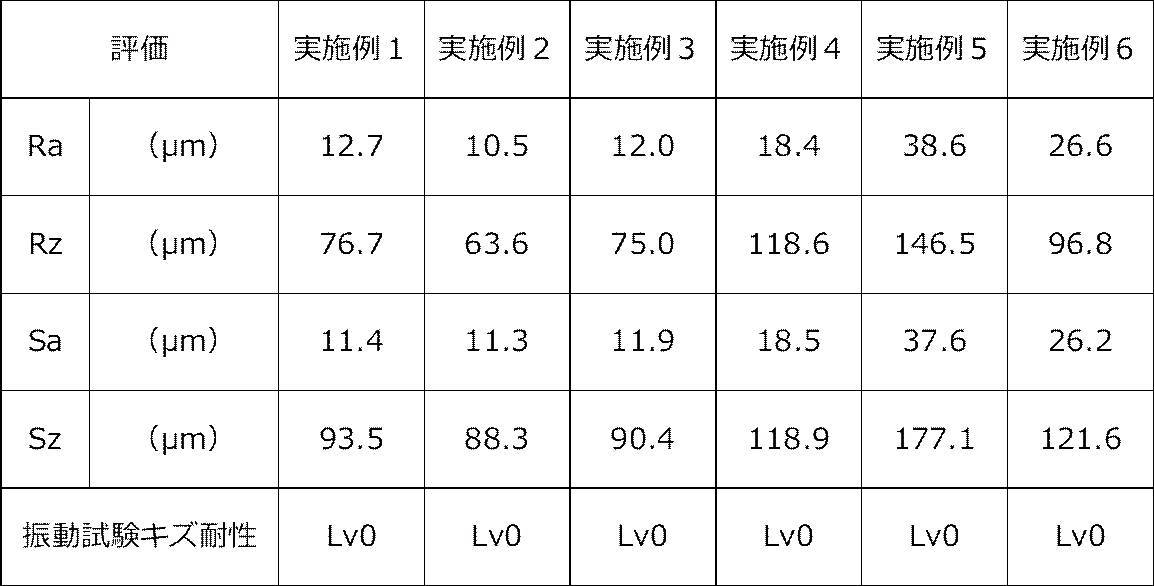
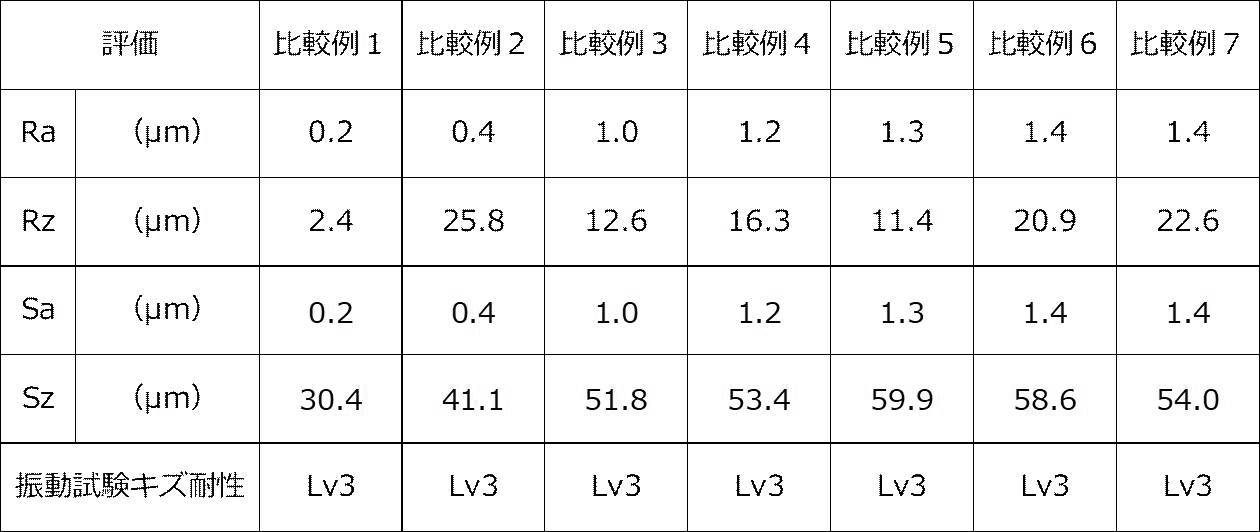
表2、3に示されるように、Raが5μm以上かつRzが30μm~250μmの面を有する実施例1~6では、これらの表面粗さを満たさない比較例1~7と比べて耐衝撃性に優れていた。
本明細書に記載された全ての文献、特許出願、及び技術規格は、個々の文献、特許出願、及び技術規格が参照により取り込まれることが具体的かつ個々に記された場合と同程度に、本明細書中に参照により取り込まれる。
10…波長変換部材
11…波長変換層
12A…被覆材
12B…被覆材
20…バックライトユニット
21…光源
22…導光板
23…再帰反射性部材
24…反射板
30…液晶表示装置
31…液晶セルユニット
32…液晶セル
33A…偏光板
33B…偏光板
LB…青色光
LR…赤色光
LG…緑色光
LW…白色光
11…波長変換層
12A…被覆材
12B…被覆材
20…バックライトユニット
21…光源
22…導光板
23…再帰反射性部材
24…反射板
30…液晶表示装置
31…液晶セルユニット
32…液晶セル
33A…偏光板
33B…偏光板
LB…青色光
LR…赤色光
LG…緑色光
LW…白色光
Claims (11)
- 蛍光体を含む波長変換層を有し、
算術平均粗さRaが5μm以上かつ最大高さRzが30μm~250μmである面を有する、波長変換部材。 - 前記波長変換層の一方の面側又は両方の面側に配置される被覆材を有し、
前記波長変換層の一方の面側に配置される前記被覆材の、前記波長変換層とは対向しない側の面の算術平均粗さRaが5μm以上かつ最大高さRzが30μm~250μmであるか、又は
前記波長変換層の両方の面側に配置される前記被覆材の、前記波長変換層とは対向しない側の面の少なくとも一方の算術平均粗さRaが5μm以上かつ最大高さRzが30μm~250μmである、
請求項1に記載の波長変換部材。 - 前記被覆材が酸素及び水の少なくとも一方に対するバリア性を有する請求項2に記載の波長変換部材。
- 前記蛍光体が、量子ドット蛍光体を含む請求項1~請求項3のいずれか1項に記載の波長変換部材。
- 前記量子ドット蛍光体が、Cd及びInの少なくとも一方を含む化合物を含有する請求項4に記載の波長変換部材。
- 前記波長変換層が、
前記蛍光体と、
チオール化合物と、
(メタ)アクリル化合物及び(メタ)アリル化合物からなる群より選択される少なくとも1種と、
光重合開始剤と、
を含有する樹脂組成物の硬化物を含む、請求項1~請求項5のいずれか1項に記載の波長変換部材。 - 請求項1~請求項6のいずれか1項に記載の波長変換部材と、光源と、を備えるバックライトユニット。
- 前記波長変換部材と対向配置される導光板をさらに備える、請求項7に記載のバックライトユニット。
- 前記導光板の、前記波長変換部材と対向する面の算術平均粗さRaが30μm以上である、請求項8に記載のバックライトユニット。
- 請求項7~請求項9のいずれか1項に記載のバックライトユニットを備える画像表示装置。
- 導光板に対向配置させる波長変換部材の使用であって、
前記導光板が算術平均粗さRaが30μm以上の面を有し、
前記波長変換部材の前記算術平均粗さRaが5μm以上かつ最大高さRzが30μm~250μmである面を、前記導光板の算術平均粗さRaが30μm以上の面に対向配置させる、
請求項1~請求項8のいずれか1項に記載の波長変換部材の使用。
Priority Applications (4)
| Application Number | Priority Date | Filing Date | Title |
|---|---|---|---|
| CN201980093859.2A CN113557456A (zh) | 2019-06-14 | 2019-06-14 | 波长转换构件及其应用、背光单元和图像显示装置 |
| PCT/JP2019/023636 WO2020250414A1 (ja) | 2019-06-14 | 2019-06-14 | 波長変換部材及びその使用、バックライトユニット、並びに画像表示装置 |
| US17/437,034 US20220179138A1 (en) | 2019-06-14 | 2019-06-14 | Wavelength conversion member and utilization thereof, backlight unit and image display device |
| JP2020547238A JP6798655B1 (ja) | 2019-06-14 | 2019-06-14 | 波長変換部材及びその使用、バックライトユニット、並びに画像表示装置 |
Applications Claiming Priority (1)
| Application Number | Priority Date | Filing Date | Title |
|---|---|---|---|
| PCT/JP2019/023636 WO2020250414A1 (ja) | 2019-06-14 | 2019-06-14 | 波長変換部材及びその使用、バックライトユニット、並びに画像表示装置 |
Publications (1)
| Publication Number | Publication Date |
|---|---|
| WO2020250414A1 true WO2020250414A1 (ja) | 2020-12-17 |
Family
ID=73646888
Family Applications (1)
| Application Number | Title | Priority Date | Filing Date |
|---|---|---|---|
| PCT/JP2019/023636 Ceased WO2020250414A1 (ja) | 2019-06-14 | 2019-06-14 | 波長変換部材及びその使用、バックライトユニット、並びに画像表示装置 |
Country Status (4)
| Country | Link |
|---|---|
| US (1) | US20220179138A1 (ja) |
| JP (1) | JP6798655B1 (ja) |
| CN (1) | CN113557456A (ja) |
| WO (1) | WO2020250414A1 (ja) |
Citations (6)
| Publication number | Priority date | Publication date | Assignee | Title |
|---|---|---|---|---|
| JP2014114446A (ja) * | 2012-11-16 | 2014-06-26 | Toray Ind Inc | ポリオルガノシロキサン組成物、その硬化物、蛍光体シート、その製造方法、発光デバイスおよびその製造方法 |
| WO2016076322A1 (ja) * | 2014-11-14 | 2016-05-19 | 凸版印刷株式会社 | 光学フィルム、それを用いた光学バリアフィルム、色変換フィルム、及びバックライトユニット |
| WO2016186158A1 (ja) * | 2015-05-20 | 2016-11-24 | 東レ株式会社 | 照明装置、及び表示装置 |
| JP2017161938A (ja) * | 2017-05-30 | 2017-09-14 | 大日本印刷株式会社 | 光波長変換シート、これを備えるバックライト装置、および画像表示装置 |
| WO2018074132A1 (ja) * | 2016-10-21 | 2018-04-26 | 日本電気硝子株式会社 | 波長変換部材、発光デバイス及び波長変換部材の製造方法 |
| WO2019077752A1 (ja) * | 2017-10-20 | 2019-04-25 | 日立化成株式会社 | バックライトユニット、画像表示装置及び波長変換部材 |
Family Cites Families (6)
| Publication number | Priority date | Publication date | Assignee | Title |
|---|---|---|---|---|
| JP6243872B2 (ja) * | 2014-05-19 | 2017-12-06 | 富士フイルム株式会社 | 量子ドット含有積層体の製造方法、量子ドット含有積層体、バックライトユニット、液晶表示装置および量子ドット含有組成物 |
| JP2016103461A (ja) * | 2014-11-14 | 2016-06-02 | 富士フイルム株式会社 | 波長変換部材及びそれを備えたバックライトユニット、液晶表示装置 |
| JP6363526B2 (ja) * | 2015-02-02 | 2018-07-25 | 富士フイルム株式会社 | 波長変換部材及びそれを備えたバックライトユニット、液晶表示装置、波長変換部材の製造方法 |
| JP6543216B2 (ja) * | 2016-05-19 | 2019-07-10 | Dowaメタルテック株式会社 | Snめっき材およびその製造方法 |
| KR20180032063A (ko) * | 2016-09-21 | 2018-03-29 | 서울반도체 주식회사 | 발광 다이오드 패키지 및 발광 다이오드 모듈 |
| US10541353B2 (en) * | 2017-11-10 | 2020-01-21 | Cree, Inc. | Light emitting devices including narrowband converters for outdoor lighting applications |
-
2019
- 2019-06-14 CN CN201980093859.2A patent/CN113557456A/zh not_active Withdrawn
- 2019-06-14 WO PCT/JP2019/023636 patent/WO2020250414A1/ja not_active Ceased
- 2019-06-14 US US17/437,034 patent/US20220179138A1/en not_active Abandoned
- 2019-06-14 JP JP2020547238A patent/JP6798655B1/ja not_active Expired - Fee Related
Patent Citations (6)
| Publication number | Priority date | Publication date | Assignee | Title |
|---|---|---|---|---|
| JP2014114446A (ja) * | 2012-11-16 | 2014-06-26 | Toray Ind Inc | ポリオルガノシロキサン組成物、その硬化物、蛍光体シート、その製造方法、発光デバイスおよびその製造方法 |
| WO2016076322A1 (ja) * | 2014-11-14 | 2016-05-19 | 凸版印刷株式会社 | 光学フィルム、それを用いた光学バリアフィルム、色変換フィルム、及びバックライトユニット |
| WO2016186158A1 (ja) * | 2015-05-20 | 2016-11-24 | 東レ株式会社 | 照明装置、及び表示装置 |
| WO2018074132A1 (ja) * | 2016-10-21 | 2018-04-26 | 日本電気硝子株式会社 | 波長変換部材、発光デバイス及び波長変換部材の製造方法 |
| JP2017161938A (ja) * | 2017-05-30 | 2017-09-14 | 大日本印刷株式会社 | 光波長変換シート、これを備えるバックライト装置、および画像表示装置 |
| WO2019077752A1 (ja) * | 2017-10-20 | 2019-04-25 | 日立化成株式会社 | バックライトユニット、画像表示装置及び波長変換部材 |
Also Published As
| Publication number | Publication date |
|---|---|
| JPWO2020250414A1 (ja) | 2021-09-13 |
| US20220179138A1 (en) | 2022-06-09 |
| CN113557456A (zh) | 2021-10-26 |
| JP6798655B1 (ja) | 2020-12-09 |
Similar Documents
| Publication | Publication Date | Title |
|---|---|---|
| JP6782419B2 (ja) | 波長変換部材、バックライトユニット、画像表示装置、波長変換用樹脂組成物及び波長変換用樹脂硬化物 | |
| EP3767345A1 (en) | Wavelength conversion member, backlight unit, image display device and curable composition | |
| EP3761077A1 (en) | Wavelength conversion member, backlight unit, image display device, curable composition and cured product | |
| JPWO2019189270A1 (ja) | 波長変換部材、バックライトユニット、及び画像表示装置 | |
| JP2019174562A (ja) | 波長変換部材、バックライトユニット及び画像表示装置 | |
| JP6658990B1 (ja) | 波長変換部材、バックライトユニット、画像表示装置及び硬化性組成物 | |
| JPWO2019189269A1 (ja) | 波長変換部材、バックライトユニット、及び画像表示装置 | |
| WO2022208663A1 (ja) | 波長変換部材、バックライトユニット、画像表示装置及び硬化性組成物 | |
| JP2020101804A (ja) | 波長変換部材、バックライトユニット、画像表示装置及び硬化性組成物 | |
| EP3761076A1 (en) | Wavelength conversion member, backlight unit, image display device and curable composition | |
| JP6798655B1 (ja) | 波長変換部材及びその使用、バックライトユニット、並びに画像表示装置 | |
| JP6702515B2 (ja) | 波長変換部材、バックライトユニット、画像表示装置及び硬化性組成物 | |
| WO2021106556A1 (ja) | 波長変換部材及びその製造方法、バックライトユニット、並びに画像表示装置 | |
| JP2021043462A (ja) | 波長変換部材及びその使用、バックライトユニット、並びに画像表示装置 | |
| WO2020208754A1 (ja) | 波長変換部材、バックライトユニット、及び画像表示装置 | |
| WO2021152737A1 (ja) | 波長変換部材、バックライトユニット、及び画像表示装置 | |
| WO2021152739A1 (ja) | 波長変換部材、バックライトユニット、及び画像表示装置 | |
| WO2021152738A1 (ja) | 波長変換部材、バックライトユニット、及び画像表示装置 | |
| WO2021084603A1 (ja) | 波長変換用樹脂組成物、波長変換用樹脂硬化物、波長変換部材、バックライトユニット及び画像表示装置 | |
| WO2019186730A1 (ja) | 波長変換部材、バックライトユニット、画像表示装置及び硬化性組成物 | |
| JP2021015284A (ja) | 波長変換部材、バックライトユニット、画像表示装置、波長変換用樹脂組成物及び波長変換用樹脂硬化物 |
Legal Events
| Date | Code | Title | Description |
|---|---|---|---|
| ENP | Entry into the national phase |
Ref document number: 2020547238 Country of ref document: JP Kind code of ref document: A |
|
| 121 | Ep: the epo has been informed by wipo that ep was designated in this application |
Ref document number: 19932860 Country of ref document: EP Kind code of ref document: A1 |
|
| NENP | Non-entry into the national phase |
Ref country code: DE |
|
| 122 | Ep: pct application non-entry in european phase |
Ref document number: 19932860 Country of ref document: EP Kind code of ref document: A1 |