WO2020246471A1 - 研磨液、分散体、研磨液の製造方法及び研磨方法 - Google Patents
研磨液、分散体、研磨液の製造方法及び研磨方法 Download PDFInfo
- Publication number
- WO2020246471A1 WO2020246471A1 PCT/JP2020/021800 JP2020021800W WO2020246471A1 WO 2020246471 A1 WO2020246471 A1 WO 2020246471A1 JP 2020021800 W JP2020021800 W JP 2020021800W WO 2020246471 A1 WO2020246471 A1 WO 2020246471A1
- Authority
- WO
- WIPO (PCT)
- Prior art keywords
- polishing
- polishing liquid
- cmp
- abrasive grains
- mass
- Prior art date
- Legal status (The legal status is an assumption and is not a legal conclusion. Google has not performed a legal analysis and makes no representation as to the accuracy of the status listed.)
- Ceased
Links
Images

Classifications
-
- C—CHEMISTRY; METALLURGY
- C09—DYES; PAINTS; POLISHES; NATURAL RESINS; ADHESIVES; COMPOSITIONS NOT OTHERWISE PROVIDED FOR; APPLICATIONS OF MATERIALS NOT OTHERWISE PROVIDED FOR
- C09K—MATERIALS FOR MISCELLANEOUS APPLICATIONS, NOT PROVIDED FOR ELSEWHERE
- C09K3/00—Materials not provided for elsewhere
- C09K3/14—Anti-slip materials; Abrasives
- C09K3/1454—Abrasive powders, suspensions and pastes for polishing
- C09K3/1463—Aqueous liquid suspensions
-
- C—CHEMISTRY; METALLURGY
- C09—DYES; PAINTS; POLISHES; NATURAL RESINS; ADHESIVES; COMPOSITIONS NOT OTHERWISE PROVIDED FOR; APPLICATIONS OF MATERIALS NOT OTHERWISE PROVIDED FOR
- C09G—POLISHING COMPOSITIONS; SKI WAXES
- C09G1/00—Polishing compositions
- C09G1/02—Polishing compositions containing abrasives or grinding agents
-
- B—PERFORMING OPERATIONS; TRANSPORTING
- B24—GRINDING; POLISHING
- B24B—MACHINES, DEVICES, OR PROCESSES FOR GRINDING OR POLISHING; DRESSING OR CONDITIONING OF ABRADING SURFACES; FEEDING OF GRINDING, POLISHING, OR LAPPING AGENTS
- B24B37/00—Lapping machines or devices; Accessories
-
- B—PERFORMING OPERATIONS; TRANSPORTING
- B24—GRINDING; POLISHING
- B24B—MACHINES, DEVICES, OR PROCESSES FOR GRINDING OR POLISHING; DRESSING OR CONDITIONING OF ABRADING SURFACES; FEEDING OF GRINDING, POLISHING, OR LAPPING AGENTS
- B24B57/00—Devices for feeding, applying, grading or recovering grinding, polishing or lapping agents
- B24B57/02—Devices for feeding, applying, grading or recovering grinding, polishing or lapping agents for feeding of fluid, sprayed, pulverised, or liquefied grinding, polishing or lapping agents
-
- C—CHEMISTRY; METALLURGY
- C09—DYES; PAINTS; POLISHES; NATURAL RESINS; ADHESIVES; COMPOSITIONS NOT OTHERWISE PROVIDED FOR; APPLICATIONS OF MATERIALS NOT OTHERWISE PROVIDED FOR
- C09K—MATERIALS FOR MISCELLANEOUS APPLICATIONS, NOT PROVIDED FOR ELSEWHERE
- C09K3/00—Materials not provided for elsewhere
- C09K3/14—Anti-slip materials; Abrasives
-
- C—CHEMISTRY; METALLURGY
- C09—DYES; PAINTS; POLISHES; NATURAL RESINS; ADHESIVES; COMPOSITIONS NOT OTHERWISE PROVIDED FOR; APPLICATIONS OF MATERIALS NOT OTHERWISE PROVIDED FOR
- C09K—MATERIALS FOR MISCELLANEOUS APPLICATIONS, NOT PROVIDED FOR ELSEWHERE
- C09K3/00—Materials not provided for elsewhere
- C09K3/14—Anti-slip materials; Abrasives
- C09K3/1409—Abrasive particles per se
-
- C—CHEMISTRY; METALLURGY
- C09—DYES; PAINTS; POLISHES; NATURAL RESINS; ADHESIVES; COMPOSITIONS NOT OTHERWISE PROVIDED FOR; APPLICATIONS OF MATERIALS NOT OTHERWISE PROVIDED FOR
- C09K—MATERIALS FOR MISCELLANEOUS APPLICATIONS, NOT PROVIDED FOR ELSEWHERE
- C09K3/00—Materials not provided for elsewhere
- C09K3/14—Anti-slip materials; Abrasives
- C09K3/1454—Abrasive powders, suspensions and pastes for polishing
-
- H—ELECTRICITY
- H10—SEMICONDUCTOR DEVICES; ELECTRIC SOLID-STATE DEVICES NOT OTHERWISE PROVIDED FOR
- H10P—GENERIC PROCESSES OR APPARATUS FOR THE MANUFACTURE OR TREATMENT OF DEVICES COVERED BY CLASS H10
- H10P52/00—Grinding, lapping or polishing of wafers, substrates or parts of devices
-
- H—ELECTRICITY
- H10—SEMICONDUCTOR DEVICES; ELECTRIC SOLID-STATE DEVICES NOT OTHERWISE PROVIDED FOR
- H10P—GENERIC PROCESSES OR APPARATUS FOR THE MANUFACTURE OR TREATMENT OF DEVICES COVERED BY CLASS H10
- H10P95/00—Generic processes or apparatus for manufacture or treatments not covered by the other groups of this subclass
- H10P95/06—Planarisation of inorganic insulating materials
- H10P95/062—Planarisation of inorganic insulating materials involving a dielectric removal step
-
- B—PERFORMING OPERATIONS; TRANSPORTING
- B82—NANOTECHNOLOGY
- B82Y—SPECIFIC USES OR APPLICATIONS OF NANOSTRUCTURES; MEASUREMENT OR ANALYSIS OF NANOSTRUCTURES; MANUFACTURE OR TREATMENT OF NANOSTRUCTURES
- B82Y30/00—Nanotechnology for materials or surface science, e.g. nanocomposites
-
- B—PERFORMING OPERATIONS; TRANSPORTING
- B82—NANOTECHNOLOGY
- B82Y—SPECIFIC USES OR APPLICATIONS OF NANOSTRUCTURES; MEASUREMENT OR ANALYSIS OF NANOSTRUCTURES; MANUFACTURE OR TREATMENT OF NANOSTRUCTURES
- B82Y40/00—Manufacture or treatment of nanostructures
-
- H—ELECTRICITY
- H10—SEMICONDUCTOR DEVICES; ELECTRIC SOLID-STATE DEVICES NOT OTHERWISE PROVIDED FOR
- H10P—GENERIC PROCESSES OR APPARATUS FOR THE MANUFACTURE OR TREATMENT OF DEVICES COVERED BY CLASS H10
- H10P52/00—Grinding, lapping or polishing of wafers, substrates or parts of devices
- H10P52/40—Chemomechanical polishing [CMP]
- H10P52/403—Chemomechanical polishing [CMP] of conductive or resistive materials
Definitions
- the present invention relates to a polishing liquid, a dispersion, a method for producing a polishing liquid, and a polishing method.
- CMP chemical mechanical polishing
- a laminate having a substrate having a surface having irregularities formed in advance for example, a substrate
- a film containing an insulating material laminated on the substrate hereinafter, also referred to as "insulating film”
- insulating film a film containing the barrier material
- barrier film a film containing the barrier material
- a metal film for wiring is deposited on the entire barrier film so as to embed the recess (groove).
- the unnecessary metal film for wiring other than the recess and the barrier film under the metal film are removed by CMP to form the embedded wiring.
- Such a wiring forming method is called a damascene method (see, for example, Patent Document 1 below).
- tungsten materials such as tungsten and tungsten alloys have come to be used for wiring metal films.
- a wiring forming method by the damascene method using a film containing a tungsten material (hereinafter, also referred to as “tungsten film”), for example, a first polishing step of polishing most of the tungsten film and a tungsten film and a barrier film are used.
- a method including a second polishing step for polishing is common, and in some cases, a third polishing step (finish polishing step) for polishing the tungsten film, the barrier film, and the insulating film is carried out.
- Patent Document 1 discloses a polishing liquid for CMP that can be used in the above method (particularly, the first polishing step).
- the CMP polishing liquid used in the first polishing step not only has an excellent polishing speed of the tungsten material for improving the throughput, but also has excellent flatness in the subsequent second polishing step, or is insulated.
- the ratio of the polishing rate of the tungsten material to the polishing rate of the insulating material (polishing rate of the tungsten material / polishing rate of the insulating material) to prevent the film from being polished and thinned so that the insulation between the wires becomes too low.
- it is required to be excellent in the "polishing rate ratio").
- the present invention manufactures a polishing solution for CMP, a dispersion for the polishing solution, and the polishing solution capable of polishing a tungsten material at an excellent polishing rate and with high selectivity for an insulating material. It is an object of the present invention to provide a method and a polishing method using the polishing liquid.
- One aspect of the present invention is a polishing liquid for CMP containing abrasive grains containing silica and a liquid medium, and the D50 of the abrasive grains is 150 nm or less in the mass-based particle size distribution obtained by the centrifugation method.
- the D90 of the abrasive grains is 100 nm or more, the difference between D90 and D50 is 21 nm or more, and the content of the abrasive grains is 1.0% by mass or more based on the total amount of the polishing solution.
- the tungsten material can be polished at an excellent polishing rate and with high selectivity for the insulating material. That is, according to the polishing liquid on the side surface, the polishing rate of the tungsten material and the polishing rate ratio (polishing rate of the tungsten material / polishing rate of the insulating material) can be highly compatible.
- the content of abrasive grains may be 5.0% by mass or less based on the total amount of the polishing liquid.
- the D50 of the abrasive grains may be 50 nm or more.
- the D90 of the abrasive grains may be 200 nm or less.
- the polishing liquid may further contain an oxidizing agent.
- This oxidizing agent may contain hydrogen peroxide.
- the polishing liquid may further contain an iron ion feeder.
- the iron ion feeder may contain at least one selected from the group consisting of iron nitrate and iron nitrate hydrate.
- the polishing liquid may further contain an organic acid.
- the ratio of the number of molecules of the dissociated organic acid to one iron ion atom may be 2.0 or more.
- the organic acid may be a divalent or trivalent organic acid having no carbon-carbon unsaturated bond and is selected from the group consisting of malonic acid, succinic acid, adipic acid, glutaric acid, malic acid and citric acid. It may contain at least one of them.
- the polishing liquid may further contain an anticorrosive agent.
- This anticorrosive agent may contain an azole compound which does not have a thiol group and / or a carbon-carbon unsaturated bond, is represented by the following formula (1), and has a thiol group and / or a carbon-carbon unsaturated bond. May include compounds that do not. H 2 N-X-COOH (1) [In the formula (1), X represents a hydrocarbon group having 1 or more carbon atoms, which may have a substituent. ]
- the anticorrosive agent preferably contains at least one selected from the group consisting of 1,2,4-triazole, 4-amino-1,2,4-triazole, glycine and 6-aminocaproic acid.
- the pH of the polishing liquid may be 4.0 or less, and may be 2.0 or more.
- the polishing liquid is used to polish at least a second portion of a substrate having a first portion made of an insulating material and a second portion made of a tungsten material provided on the first portion. It may be a polishing liquid to be used.
- Another aspect of the present invention is a dispersion used in a polishing liquid for CMP, which contains abrasive grains containing silica and a liquid medium, and has abrasive grains in a mass-based particle size distribution obtained by a centrifugation method.
- the D50 of the above is 150 nm or less
- the D90 of the abrasive grains is 100 nm or more
- the difference between D90 and D50 is 21 nm or more.
- a polishing liquid for CMP capable of highly achieving both the polishing rate of the tungsten material and the polishing rate ratio (polishing rate of the tungsten material / polishing rate of the insulating material) can be obtained.
- Another aspect of the present invention is a method for producing a polishing liquid for CMP, which comprises a step of mixing abrasive grains containing silica and a liquid medium, and in a mass-based particle size distribution obtained by a centrifugation method, polishing is performed.
- the D50 of the grains is 150 nm or less
- the D90 of the abrasive grains is 100 nm or more
- the difference between D90 and D50 is 21 nm or more.
- the content of the abrasive grains is based on the total amount of the polishing liquid.
- the present invention relates to a method for producing a polishing liquid for CMP, in which abrasive grains are blended so as to be 1.0% by mass or more. According to the polishing liquid obtained by this method, the tungsten material can be polished at an excellent polishing rate and with high selectivity for the insulating material.
- Another aspect of the present invention is a step of preparing a substrate having a first portion made of an insulating material and a second portion made of a tungsten material provided on the first portion, and a second.
- the present invention relates to a method for polishing a substrate, which comprises a step of polishing at least a second portion by relatively moving the polishing pad and the substrate. According to this method, the tungsten material can be polished at an excellent polishing rate and with high selectivity for the insulating material.
- a polishing solution for CMP capable of polishing a tungsten material, a dispersion for the polishing solution, and the polishing solution can be produced at an excellent polishing rate and with high selectivity for an insulating material.
- a method and a polishing method using the polishing liquid can be provided.
- FIG. 1 is a schematic cross-sectional view showing a polishing method of one embodiment.
- the "polishing speed of the material A” and the “polishing speed with respect to the material A” mean the speed at which the substance composed of the material A is removed by polishing.
- the numerical range indicated by using “-” indicates a range including the numerical values before and after "-" as the minimum value and the maximum value, respectively.
- the upper limit value or the lower limit value of the numerical range of one step may be replaced with the upper limit value or the lower limit value of the numerical range of another step.
- the materials exemplified in the present specification may be used alone or in combination of two or more.
- pH is defined as the pH when the temperature of the object to be measured is 25 ° C.
- the polishing liquid of the present embodiment is a polishing liquid (polishing liquid for CMP) used in the chemical mechanical polishing (CMP) method, and contains abrasive grains containing silica and a liquid medium.
- the content of abrasive grains containing silica is 1.0% by mass or more based on the total amount of the polishing liquid.
- the D50 of the abrasive grains is 150 nm or less
- the D90 of the abrasive grains is 100 nm or more
- the difference between D90 and D50 is 21 nm or more.
- D50 is the particle size when the relative weight of the particles integrated from the small particle size side is 50% of the total particle weight
- D90 is the particle size when the relative weight integrated from the small particle size side is 90% of the total particle weight. It is the particle size when it becomes.
- D50 and D90 are measured at 25 ° C. using an apparatus (product name: DC24000) manufactured by Nippon Lucas Co., Ltd., which is a centrifugal particle size distribution meter, and are obtained from the obtained particle size distribution.
- the abrasive grains containing silica before being mixed with the polishing liquid may be measured, or the abrasive grains containing silica in the polishing liquid may be measured.
- the abrasive grains themselves containing silica are used, they may be diluted with water to the same degree as the abrasive grains concentration in the polishing liquid for measurement.
- the polishing liquid of the present embodiment there is an effect that the tungsten material can be polished at an excellent polishing rate and with high selectivity for the insulating material. It is a very surprising result that the above effect can be obtained by setting the particle size of the abrasive grains containing silica in the above specific range. This is because, in general, it is necessary to increase the average particle size of the abrasive grains to some extent in order to obtain a high polishing rate for the tungsten material, but in this case, the polishing rate for the insulating material also tends to be high.
- the polishing rate for the tungsten material is also reduced.
- the high polishing rate for the tungsten material and the low polishing rate for the insulating material are contradictory events, and it has been considered difficult to achieve both of them by adjusting the particle size of the abrasive grains.
- the present inventors set D50 to 150 nm or less, D90 to 100 nm or more, and further, when the amount of abrasive grains containing silica was 1.0% by mass or more.
- the tungsten material can be polished at an excellent polishing rate, and the polishing rate of the insulating material is suppressed to obtain a high polishing rate ratio. Found to be obtained.
- the polishing liquid for CMP has stable performance such as polishing speed (long pot life) for a long time (for example, about one week). It is rare.
- an adjusting agent such as polyethyleneimine or polyacrylamide may be used in order to increase the polishing rate ratio, but such an adjusting agent tends to agglomerate abrasive grains and the storage stability of the polishing liquid. May be reduced.
- the polishing liquid of the present embodiment since an excellent polishing rate ratio can be obtained, it is not necessary to use the above-mentioned adjusting agent, and a longer pot life can be easily obtained.
- the pH of the polishing liquid for CMP is preferably 4.0 or less, more preferably 3 from the viewpoint that the etching rate of the tungsten material does not become too high and that the effect of the present invention is more prominently exhibited. It is 0.8 or less, more preferably 3.6 or less.
- the pH of the polishing liquid for CMP may be 3.4 or less, 3.2 or less, 3.0 or less, or 2.8 or less. If the etching rate of the tungsten material is too high, it becomes difficult to flatten the surface after polishing, and it becomes difficult to achieve both a high polishing rate and flatness.
- the pH of the polishing liquid for CMP is preferably 2.0 or more, more preferably 2.2 or more, and further, from the viewpoint of suppressing the occurrence of corrosion on the polishing apparatus and the like and suppressing the etching rate on the tungsten material. It is preferably 2.5 or more. From these viewpoints, the pH of the polishing liquid for CMP may be 2.0 to 4.0, 2.2 to 3.8 or 2.5 to 3.6. The pH of the polishing liquid for CMP can be measured by the method described in Examples.
- the polishing liquid for CMP of the present embodiment may further contain abrasive grains containing silica and other components other than the liquid medium.
- abrasive grains containing silica examples include oxidizing agents, iron ion feeders, organic acids, anticorrosive agents, pH adjusters and the like.
- abrasive grain examples include amorphous silica, crystalline silica, fused silica, spherical silica, synthetic silica, hollow silica, colloidal silica and the like.
- colloidal silica is preferable from the viewpoint that defects such as scratches are less likely to occur on the polished surface of the object to be polished and the flatness of the surface to be polished can be further improved.
- the content of silica in the abrasive grains containing silica may be 80% by mass or more, 90% by mass or more, or 95% by mass or more from the viewpoint that the polishing speed required for polishing can be easily obtained. It may be 98% by mass or more, and may be 99% by mass or more.
- the abrasive grains containing silica may contain a component other than silica, or may be substantially composed of silica. When the abrasive grains containing silica contain components other than silica, the outermost surface of the abrasive grains containing silica is composed of silica (for example, the surface of the abrasive grains is not coated with other components such as ceria). Is preferable.
- the polishing liquid contains abrasive grains other than abrasive grains containing silica
- the content of silica based on the entire abrasive grains may be in the above range.
- the D50 of the abrasive grains containing silica is preferably 115 nm or less, more preferably 105 nm or less, still more preferably 100 nm or less, from the viewpoint of obtaining a better polishing rate for the tungsten material.
- D50 may be 95 nm or less, 90 nm or less, 85 nm or less, or 80 nm or less.
- D50 is preferably 50 nm or more, more preferably 60 nm or more, still more preferably 70 nm or more, from the viewpoint of obtaining a better polishing rate for the tungsten material.
- D50 may be 75 nm or more, 80 nm or more, 85 nm or more, or 90 nm or more. From these viewpoints, D50 may be, for example, 50 to 150 nm, 60 to 115 nm, or 70 to 100 nm.
- the abrasive grain D90 containing silica is preferably 105 nm or more from the viewpoint that the polishing rate for the insulating material can be further suppressed and a higher polishing rate ratio can be obtained.
- D90 may be 110 nm or more, 115 nm or more, or 120 nm or more.
- D90 has a viewpoint that a better polishing rate for a tungsten material can be obtained, and a viewpoint that defects such as scratches are less likely to occur on the polished surface of the object to be polished, and the flatness of the surface to be polished can be further improved. Therefore, it is preferably 200 nm or less, more preferably 180 nm or less, and further preferably 160 nm or less.
- D90 may be 140 nm or less or 125 nm or less. From these viewpoints, D90 may be, for example, 100 to 200 nm, 105 to 180 nm, and 110 to 160 nm.
- the difference between the above D90 and the above D50 (D90-D50) is preferably 22 nm or more from the viewpoint of obtaining a higher polishing rate ratio.
- the difference (D90-D50) may be 25 nm or more, 30 nm or more, 35 nm or more, 40 nm or more, 45 nm or more, or 50 nm or more.
- the difference (D90-D50) is preferably 90 nm or less, more preferably 60 nm or less, and further preferably 55 nm or less from the viewpoint of obtaining a higher polishing rate ratio.
- the difference (D90-D50) may be 50 nm or less, 45 nm or less, or 40 nm or less. From these points of view, the difference (D90-D50) may be, for example, 22-90 nm, 30-60 nm or 35-55 nm.
- the content of abrasive grains containing silica is preferably 1.2% by mass or more, more preferably 1.5% by mass, based on the total mass of the polishing liquid, from the viewpoint of obtaining a better polishing rate with respect to the tungsten material. It is 1.9% by mass or more, more preferably 1.9% by mass or more, and particularly preferably 2.3% by mass or more. If the content of abrasive grains containing silica exceeds 5.0% by mass, it becomes difficult to obtain the effect of improving the polishing rate on the tungsten material. Therefore, the content of abrasive grains containing silica is based on the total mass of the polishing liquid. It may be 5.0% by mass or less.
- the content of abrasive grains containing silica is, for example, 1.0 to 5.0% by mass, 1.2 to 4.0% by mass, and 1.5 to 1.5 to 5.0% by mass based on the total mass of the polishing liquid. It may be 3.0% by mass, 1.9 to 3.0% by mass, or 2.3 to 3.0% by mass.
- the polishing liquid may contain abrasive grains other than silica-containing abrasive grains as long as the effects of the present invention are not impaired.
- the liquid medium is not particularly limited, but water such as deionized water and ultrapure water is preferable.
- the content of the liquid medium may be the balance of the polishing liquid excluding the content of other constituent components, and is not particularly limited.
- the oxidant contributes to the improvement of the polishing rate of the tungsten material. That is, when the polishing liquid contains an oxidizing agent, the polishing rate of the tungsten material tends to be further improved.
- the oxidizing agent examples include hydrogen peroxide (H 2 O 2 ), potassium periodate, ammonium persulfate, hypochlorous acid, ozone water and the like. These may be used individually by 1 type, and may be used in combination of 2 or more type. As the oxidizing agent, hydrogen peroxide is preferably used because it is relatively stable even after addition and there is no concern about contamination by halides or the like.
- the content of the oxidizing agent is preferably 0.1% by mass or more, more preferably 1.0% by mass or more, based on the total mass of the polishing liquid, from the viewpoint that the effect of improving the polishing rate can be easily obtained. , More preferably 2% by mass or more.
- the content of the oxidizing agent is preferably 10.0% by mass or less, more preferably 7.0% by mass or less, based on the total mass of the polishing liquid, from the viewpoint of easily suppressing the etching rate of the tungsten material. , More preferably 5.0% by mass or less.
- the iron ion feeder supplies iron ions into the polishing liquid for CMP.
- the iron ion is preferably a ferric ion.
- the iron ion feeder is, for example, a salt of iron, and may exist in a state of being dissociated between iron ions and an anion component derived from the iron ion feeder in the polishing liquid. That is, the polishing liquid containing the iron ion feeder contains iron ions.
- the polishing liquid for CMP contains an iron ion feeder, that is, when the polishing liquid for CMP contains iron ions, the polishing rate of the tungsten material tends to be further improved.
- the iron ion feeder may function as an oxidizing agent, but a compound corresponding to both the iron ion feeder and the oxidizing agent shall be regarded as an iron ion feeder in the present specification.
- the iron ion feeder may be an inorganic salt or an organic salt.
- the inorganic salt containing iron ions include iron nitrate, iron sulfate, iron borate, iron chloride, iron bromide, iron iodide, iron phosphate, iron fluoride and the like.
- Organic salts containing iron ions include iron triate, iron dioxide, iron acetate, iron propionate, iron oxalate, iron malonate, iron succinate, iron malate, iron glutarate, iron tartrate, and lactic acid. Examples include iron and iron citrate.
- These inorganic salts and organic salts may contain ligands such as ammonium and water, and may be hydrates and the like.
- the iron ion feeder may be used alone or in combination of two or more.
- iron nitrate and iron nitrates are preferable from the viewpoint of relatively little contamination of the polishing apparatus and the substrate, low cost and easy availability.
- the content of the iron ion feeder may be adjusted so that the content of iron ions in the polishing liquid is within the following range.
- the iron ion content is preferably 0.0003% by mass or more, more preferably 0.0005% by mass or more, based on the total mass of the polishing liquid, from the viewpoint of further improving the polishing rate of the tungsten material. , More preferably 0.001% by mass or more.
- the iron ion content is less likely to cause decomposition and alteration of the oxidizing agent and the like, and it is easy to suppress a change in the polishing rate for the tungsten material after the CMP polishing liquid is stored at room temperature (for example, 25 ° C.) ( That is, from the viewpoint of (excellent in pot life), it is preferably 0.1% by mass or less, more preferably 0.05% by mass or less, and further preferably 0.01% by mass, based on the total mass of the polishing liquid. It is as follows. From these viewpoints, the iron ion content is, for example, 0.0003 to 0.1% by mass, 0.0005 to 0.05% by mass, or 0.001 to 0.01 based on the total mass of the polishing liquid. It may be% by mass.
- the oxidizing agent contained in the polishing liquid tends to be kept in a stable state, and the effect of improving the polishing speed on the tungsten material tends to be stably exhibited.
- the oxidizing agent is decomposed by the iron ions, and other additives (for example, anticorrosive agents) are altered during the decomposition of the oxidizing agent, so that the polishing liquid is decomposed.
- the pot life tends to decrease, but when the polishing liquid contains an organic acid, the decomposition of the oxidizing agent can be suppressed.
- an organic acid in the polishing liquid containing an oxidizing agent it is preferable to use an organic acid in the polishing liquid containing iron ions and an oxidizing agent.
- the organic acid may be contained in the polishing liquid as a pH adjuster.
- dissociation means that the proton (H +) is separated from at least one acid group (for example, carboxy group (-COOH)) of the organic acid in the polishing solution, and the acid group is an anionic group (for example, -COO). - ) Means that it exists in the state of).
- a carboxy group is preferable from the viewpoint of facilitating the above effect.
- the organic acid does not have a carbon-carbon unsaturated bond from the viewpoint that the oxidizing agent can be more stably maintained and the polishing rate of the tungsten material can be more stabilized.
- the reason why the stability of the oxidant is improved by the fact that the organic acid does not have a carbon-carbon unsaturated bond is not clear, but since the reactivity of the carbon-carbon unsaturated bond is relatively high, the organic acid is carbon. -It is considered that one of the reasons is that the unsaturated carbon bond does not cause alteration due to the reaction with the oxidizing agent in the polishing liquid.
- the organic acid is preferably a divalent or trivalent organic acid.
- divalent or trivalent means the number of acid groups contained in the organic acid.
- iron ions are chelated by a plurality of acid groups (for example, two or more dissociated acid groups) of the organic acid, which makes it easier to keep the oxidant more stable. Tend.
- an organic acid having a dissociation rate of 1% or more at pH 2.5 is preferably used.
- Such an organic acid is particularly suitable when the pH of the polishing liquid is 2.0 to 4.0. Since the dissociated organic acid is effective for chelating iron ions, the required amount of the organic acid can be reduced when the dissociation rate is 1% or more. From this point of view, the dissociation rate of the organic acid at pH 2.5 is more preferably 3% or more, still more preferably 10% or more.
- the organic acid is preferably a divalent or trivalent organic acid having no carbon-carbon unsaturated bond, having a dissociation rate of 1% or more at pH 2.5, and being carbon-carbon unsaturated.
- a divalent or trivalent organic acid having no bond is more preferable.
- preferable organic acids include malonic acid (dissociation rate at pH 2.5: 41.4%), succinic acid (dissociation rate at pH 2.5: 3.1%), and glutaric acid (dissociation rate at pH 2.5). : 1.4%), adipic acid (dissociation rate at pH 2.5: 1.7%), malonic acid (dissociation rate at pH 2.5: 15.4%), citric acid (dissociation rate at pH 2.5: 19) .0%) and the like.
- One of these organic acids may be used alone, or two or more thereof may be used in combination.
- the ratio of the number of molecules of the dissociated organic acid to one atom of iron ion is preferably 2.0 or more, more preferably 4 or more, from the viewpoint of sufficiently chelating the iron ion and enhancing the stability of the oxidizing agent. , More preferably 6 or more.
- the number of molecules of the dissociated organic acid can be calculated from the dissociation rate of the organic acid.
- the dissociation rate of the organic acid can be calculated based on the pH of the polishing solution and the acid dissociation constant of the organic acid.
- the content of the organic acid is such that the ratio of the number of dissociated organic acids to one atom of the iron ion is within the above-mentioned range from the viewpoint of sufficiently chelating the iron ion of the organic acid and enhancing the stability of the oxidizing agent. It is preferable to be adjusted.
- the iron ion content is 0.001% by mass
- the pH of the polishing solution is 2.5
- the dissociation rate of malonic acid at pH 2.5 is 41.4%. Therefore, the blending amount of malonic acid is preferably 0.009% by mass (two molecules of malonic acid dissociated with respect to one iron ion atom) or more.
- the above-mentioned compounding amount is calculated by calculating the molar amount of iron ions from the atomic weight and compounding amount of iron ions, assuming that the molecular weight of malonic acid is 104.06 and the atomic weight of iron ions is 55.85. It was calculated from the dissociation rate and molecular weight, and the mixing ratio of malonic acid to 1 atom of iron ion.
- the polishing liquid may contain an anticorrosive agent from the viewpoint of suppressing the etching rate of the tungsten material.
- an anticorrosive agent a general azole-based anticorrosive agent, a compound represented by the following formula (1), or the like can be used.
- an azole compound having no thiol group or carbon-carbon unsaturated bond or a compound represented by the following formula (1) is preferable, and the thiol group and carbon-carbon unsaturated bond are preferable.
- An azole compound having no bond or a compound represented by the following formula (1) is more preferable.
- the etching rate tends to increase and the pot life also tends to decrease. There is.
- the cause of this is not clear, but one of the causes is that the oxidizing agent and the anticorrosive agent are altered by the reaction of the oxidizing agent in the polishing solution with the thiol group and / or the carbon-carbon unsaturated bond site. Conceivable.
- the polishing liquid when the polishing liquid contains an oxidizing agent that reacts with a thiol group and / or a carbon-carbon unsaturated bond site, the polishing liquid does not have a thiol group or a carbon-carbon unsaturated bond.
- H 2 N-X-COOH (1) [In the formula, X represents a hydrocarbon group having 1 or more carbon atoms, which may have a substituent. ]
- the hydrocarbon group may be linear or branched.
- the hydrocarbon group may be saturated or unsaturated, but is preferably saturated (has no carbon-carbon unsaturated bond).
- the number of carbon atoms of the hydrocarbon group may be, for example, 1 to 16.
- the substituent may be, for example, a group containing a halogen atom or a complex atom, but is preferably not a thiol group.
- the hydrocarbon group is preferably a linear or branched alkylene group, more preferably a linear alkylene group.
- Anticorrosive agents include glycine, 6-aminohexanoic acid, 1,2,4-triazole, 1H-tetrazole, 1,2,4-triazole-3-carbosamide, 3-amino-1,2,4-triazole, 4 -Amino-1,2,4-triazole, 5-methyltetrazole, 5-amino-1H-tetrazole, 1H-tetrazole-1-acetic acid, 1,5-pentamethylenetetrazole, 3,5-diamino-1,2, Examples thereof include 4-triazole, 1H-1,2,3-triazole, 1,2,4-triazolecarboxylic acid ethyl ester, 1,2,4-triazole-3-carboxylate methyl and derivatives thereof.
- glycine, 6-aminohexanoic acid, 1,2,4-triazole and 4-amino-1,2,4-triazole are preferable from the viewpoint of easily suppressing the etching rate of the
- the content of the anticorrosive agent is preferably 0.003% by mass or more, more preferably 0.005% by mass or more, based on the total mass of the polishing liquid, from the viewpoint of suppressing the etching rate of the tungsten film. It is more preferably 0.01% by mass or more, and particularly preferably 0.02% by mass or more.
- the content of the anticorrosive agent is preferably 0.5% by mass or less, more preferably 0.%, based on the total mass of the polishing liquid, from the viewpoint of avoiding the difficulty in obtaining the effect of increasing the polishing rate of the tungsten material. It is 3% by mass or less, more preferably 0.2% by mass or less. From these viewpoints, it is 0.003 to 0.5% by mass, 0.005 to 0.3% by mass, 0.01% by mass to 0.3% by mass, or 0.02% by mass to 0.2% by mass. You can.
- PH regulator As the pH adjuster, known organic acids, inorganic acids, organic bases, and inorganic bases can be used.
- organic acid oxalic acid, malonic acid, tartaric acid, succinic acid, glutaric acid, adipic acid, pimelic acid, suberic acid, malic acid, citric acid, butanetetracarboxylic acid and the like
- inorganic acid sulfuric acid, nitric acid, phosphoric acid, hydrochloric acid and the like can be used. Two or more of these organic acids and inorganic acids may be used in combination.
- organic base methylamine, ethylamine, propylamine, monoethanolamine, tetramethylammonium hydroxide and the like can be used.
- inorganic base ammonia, sodium hydroxide, potassium hydroxide and the like can be used. Two or more of these organic bases and inorganic bases may be combined.
- the polishing liquid may contain components other than those described above as long as the effects of the present invention are not impaired.
- the polishing liquid may contain an anionic surfactant such as polyacrylic acid, a cationic surfactant such as polyethyleneimine, and a modifier such as a nonionic surfactant such as polyglycerin and polyacrylamide. ..
- the polishing liquid of the present embodiment contains abrasive grains containing silica, an oxidizing agent, an organic acid, and water, and the D50 of the abrasive grains is 50 to 115 nm, and the D90 of the abrasive grains is 100. It is ⁇ 200 nm, the difference between the above D90 and the above D50 (D90-D50) is 21 nm or more, and the content of abrasive grains containing silica is 1.0 to 5.0 based on the total mass of the polishing liquid.
- a CMP polishing liquid having a mass% of mass and a pH of 2.0 to 4.0 is preferable, a CMP polishing liquid in which the abrasive grains containing silica are colloidal silica is more preferable, and an iron ion feeder is further contained.
- a polishing liquid for CMP is more preferable.
- the polishing liquid described above can be widely used as a polishing liquid used for CMP, but is particularly suitable as a polishing liquid for CMP for polishing a tungsten material.
- a polishing liquid for CMP for polishing a tungsten material.
- at least a second portion of a substrate for example, a substrate
- the polishing liquid may be used to polish the first portion in addition to the second portion.
- the first portion may be, for example, a part or all of a film (insulating film) containing an insulating material.
- the insulating material include a silicon-based insulating material and an organic polymer-based insulating material.
- silicon oxide for example, silicon dioxide obtained by using tetraethyl orthosilicate (TEOS)
- silicon nitride silicon dioxide obtained by using tetraethyl orthosilicate (TEOS)
- TEOS tetraethyl orthosilicate
- silicon nitride, tetraethoxysilane, fluorosilicate glass, trimethylsilane, and dimethoxydimethylsilane are obtained as starting materials.
- Organosilicate glass, silicon oxynitride, hydride silsesquioxane, silicon carbide, silicon nitride and the like can be mentioned.
- the organic polymer-based insulating material include all-aromatic low-dielectric-
- the second part may be, for example, a part or all of a film (tungsten film) containing a tungsten material.
- tungsten film containing a tungsten material.
- the tungsten material include tungsten, tungsten nitride, tungsten silicide, and tungsten alloy.
- the content of tungsten in the tungsten material is preferably 80% by mass or more, more preferably 90% by mass or more, and further preferably 95% by mass or more.
- the substrate may further include a third portion made of a barrier material between the first portion and the second portion.
- the polishing liquid may be used to polish the third portion in addition to the second portion (further, the first portion).
- the third portion may be, for example, a part or all of a film (barrier film) containing a barrier material.
- the barrier material include tantalum, tantalum nitride, titanium, titanium nitride and the like.
- Examples of the substrate as described above include a substrate applied to the wiring formation process by the damascene method.
- the CMP polishing liquid of the above embodiment is suitable for the CMP polishing liquid used in the wiring forming process by the damascene method.
- the polishing liquid for CMP may be stored or transported in the state of a dispersion containing the above-mentioned abrasive grains and a liquid medium.
- the dispersion may be one obtained by removing a part of the liquid medium from the above-mentioned polishing liquid for CMP and concentrating it, or may be one obtained by diluting the above-mentioned polishing liquid for CMP with a liquid medium.
- the polishing liquid for CMP may be stored or transported in a state in which a part of the liquid medium is removed and concentrated, or may be stored or transported in a state diluted by the liquid medium.
- the dispersion may not contain abrasive grains containing silica and other components (additives) other than the liquid medium.
- the polishing liquid for CMP is composed of a first liquid (a liquid containing abrasive grains containing silica and a liquid medium) and a second liquid (a liquid containing an additive and a liquid medium). It may be stored or transported in a separate set of polishing solutions. In this case, the first liquid and the second liquid may be mixed and used at the time of use. Further, the polishing liquid for CMP may be stored or transported in a state of being separated into abrasive grains and a liquid medium. In this case, the abrasive grains and the liquid medium may be mixed and used at the time of use.
- the method for producing a polishing liquid for CMP of the present embodiment includes, for example, a step of mixing abrasive grains containing silica and a liquid medium.
- the abrasive grains containing silica are blended so that the content of the abrasive grains containing silica is 1.0% by mass or more based on the total amount of the polishing liquid.
- the silica-containing abrasive grains used in the above step have a D50 of 150 nm or less, a D90 of 100 nm or more, and a difference (D90-D50) between D90 and D50 of 21 nm or more.
- the abrasive grains are dispersed in water so as to have a concentration similar to that of the abrasive grains in the polishing solution to obtain an aqueous dispersion, and the above-mentioned method is applied to the dispersion. Can be measured with. According to the method of this embodiment, the above-mentioned polishing liquid can be obtained.
- the blending amount of the abrasive grains containing silica may be adjusted so that the content of the abrasive grains containing silica in the polishing liquid is within the above range. Further, the preferable range of the difference between D50, D90 and D90 and D50 of the abrasive grains containing silica is the same as the preferable range described for the above-mentioned polishing liquid.
- components other than abrasive grains containing silica may be further mixed.
- the blending amount of these components may be adjusted so that the content of each component in the polishing liquid is within the above-mentioned range.
- the polishing liquid for CMP of the present embodiment may be obtained by diluting or concentrating a dispersion prepared in advance by mixing abrasive grains containing silica and a liquid medium. Further, the CMP polishing liquid of the present embodiment is a mixture of a first liquid containing silica-containing abrasive grains and a liquid medium and a second liquid containing an additive and a liquid medium, which are prepared in advance. It may be obtained by combining.
- the polishing method of the present embodiment includes a step of removing a material to be polished (for example, a tungsten material) by CMP using the polishing liquid of the above embodiment.
- a substrate such as a substrate
- the polishing apparatus is generally provided with, for example, a polishing surface plate to which a polishing pad (polishing cloth) is attached and a motor or the like whose rotation speed can be changed, and a holder (head) for holding a substrate. Polishing equipment can be used.
- the polishing pad is not particularly limited, but a general non-woven fabric, polyurethane foam, porous fluororesin, or the like can be used.
- the polishing method of the present embodiment is, for example, a step of preparing a substrate provided with a material to be polished (preparation step), a step of arranging the substrate on a polishing pad (arrangement step), and a step of arranging the substrate using a polishing liquid. It includes a polishing process (polishing process).
- polishing process polishing process
- a substrate 100 including 2 and a third portion 3 provided between the first portion 1 and the second portion 2 is prepared (preparation step).
- the second portion 2 is made of a tungsten material and is deposited to fill the recesses formed by the first and third portions.
- the third portion 3 is made of a barrier material and is formed so as to follow the unevenness of the surface of the first portion 1.
- the substrate 100 is arranged on the polishing pad 10 so that the surface of the second portion 2 opposite to the first portion 1 and the polishing pad 10 face each other. (Placement process).
- the polishing liquid for CMP of the above embodiment is supplied between the polishing pad 10 and the base 100, and the polishing pad 10 and the base 100 are relatively moved.
- the second portion 2 and the third portion 3 may be removed until the first portion 1 is exposed, or over-polishing may be performed to excessively polish the first portion 1.
- over-polishing the flatness of the surface to be polished after polishing can be improved.
- the substrate 200 shown in FIG. 1C can be obtained.
- the polishing conditions are not particularly limited, but it is preferable that the rotation speed of the polishing surface plate is 200 rpm or less so that the substrate does not pop out.
- the polishing pressure is preferably 3 to 100 kPa.
- the polishing pressure is more preferably 5 to 50 kPa from the viewpoint that the uniformity of the polishing rate in the polishing surface becomes good and good flatness is obtained.
- polishing pad In order to carry out CMP with the surface condition of the polishing pad always the same, it is preferable to carry out the conditioning step of the polishing pad before and / or during polishing.
- a dresser with diamond particles is used to condition the polishing pad with a liquid containing at least water. Subsequently, it is preferable to carry out the polishing method of the present embodiment and further carry out a substrate cleaning step.
- silica particles (colloidal silica) having D50 and D90 shown in Table 1 as abrasive grains containing silica A, B, C, D, E, F, G, H, I, J And K were used.
- the silica particles D50 and D90 shown in Table 1 were measured at 25 ° C. using an apparatus (product name: DC24000) manufactured by Nippon Lucas Co., Ltd., which is a centrifugal particle size distribution meter.
- a measurement sample obtained by diluting the silica particles with pure water so that the abrasive grain concentration (silica particle concentration) was 0.5 to 3.0% by mass was used.
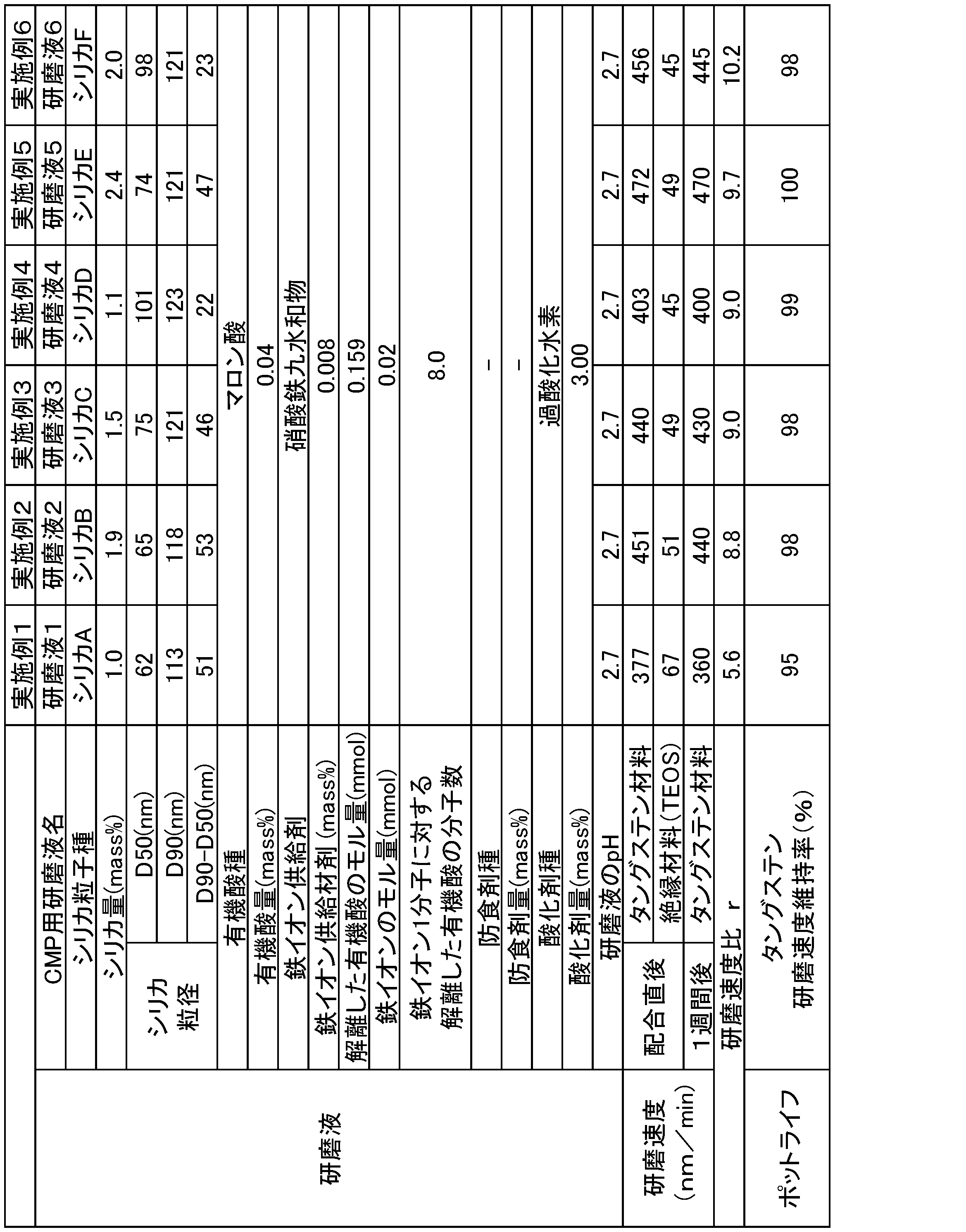
- Example 1 Malonic acid, iron nitrate nineahydrate and silica particles (silica particles A) were mixed with deionized water. Next, hydrogen peroxide was added to obtain a polishing liquid 1 for CMP. As shown in Table 2, the blending amount of each component is 0.04% by mass of malonic acid in the polishing liquid, 0.008% by mass of iron nitrate nineahydrate, and the content of silica particles A. The amount was adjusted to 1.0% by mass and the content of hydrogen peroxide was adjusted to 3.0% by mass.
- Example 2 Except that the silica particles shown in Table 2 were used instead of the silica particles A, and the blending amount of the silica particles was adjusted so that the content of the silica particles in the polishing liquid was the value shown in Table 2. , CMP polishing liquids 2 to 6 were prepared in the same manner as in Example 2.
- Polishing liquids 7 to 8 for CMP were prepared in the same manner as in Example 5 except that the organic acid was the organic acid shown in Table 3 and the blending amount of the organic acid was the blending amount shown in Table 3.
- Example 9 Same as in Example 3 except that maleic acid was used instead of malonic acid and the blending amount of maleic acid was adjusted so that the content of maleic acid in the polishing liquid was 0.10% by mass. To prepare a polishing liquid 9 for CMP.
- Example 10 A polishing liquid 7 for CMP was prepared in the same manner as in Example 3 except that the amount of iron nitrate nineahydrate was 0.04% by mass.
- Polishing solutions 11 to 12 for CMP were prepared in the same manner as in Example 3 except that the anticorrosive agent was used as the anticorrosive agent shown in Table 3 and the blending amount of the anticorrosive agent was set as the blending amount shown in Table 3.
- the dissociation rate of the organic acid in the polishing solution was determined based on the following formula, and the ratio of the number of molecules of the dissociated organic acid to one atom of iron ion was calculated.
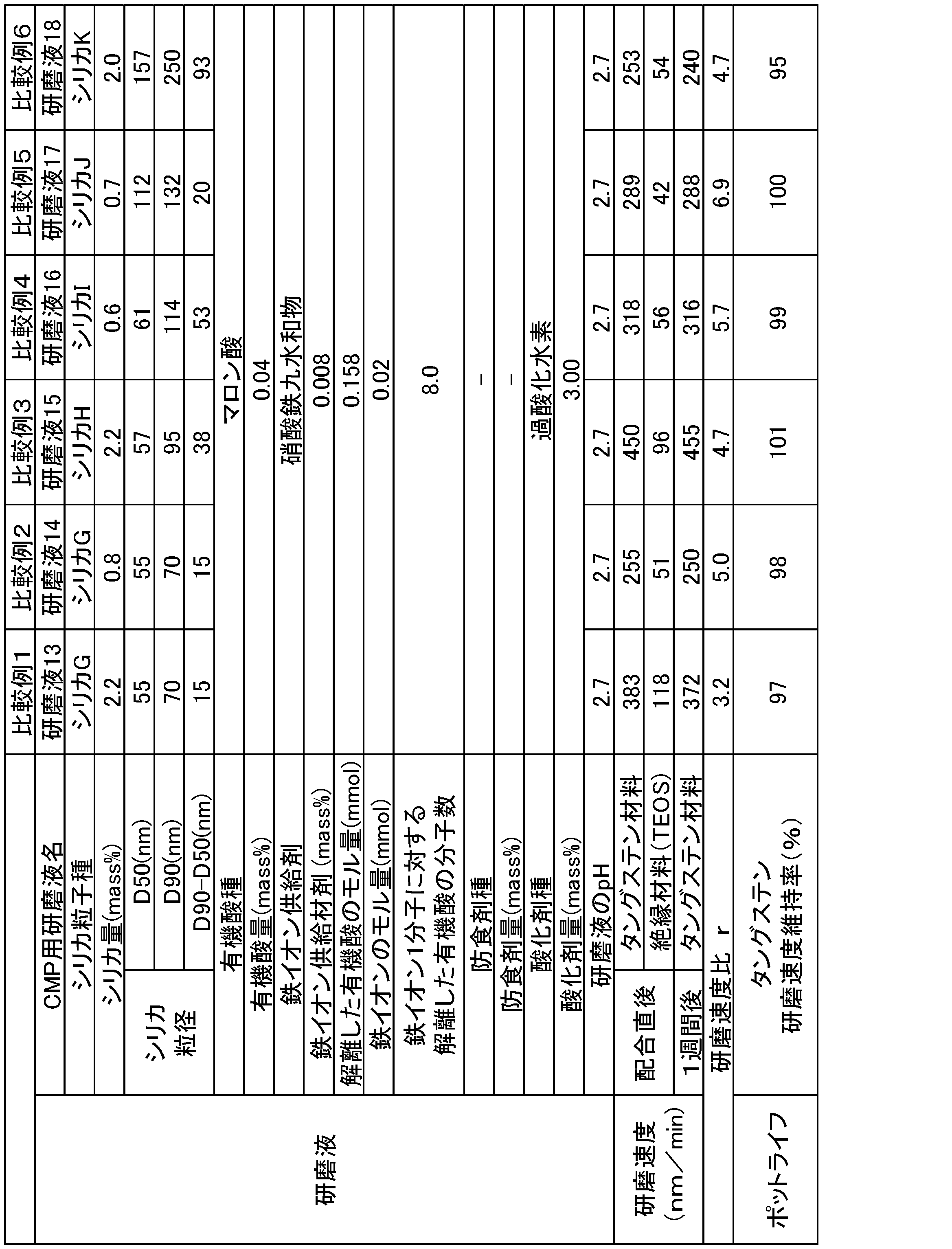
- polishing rates of the tungsten material and the insulating material were measured using the polishing solutions 1 to 18 for CMP.
- the polishing rate was measured by polishing the following evaluation substrate under the following polishing conditions.
- Substrate for polishing speed evaluation Substrate with tungsten film: 12-inch tungsten film substrate with 700 nm thick tungsten formed on a silicon substrate
- Substrate with insulating film TEOS (tetraethoxysilane) with a thickness of 1000 nm formed on a silicon substrate 12 inch TEOS film substrate
- Polishing pad IC1010 (Nitta Haas Co., Ltd.) Polishing pressure: 20.7 kPa Surface plate rotation speed: 93 rpm Head rotation speed: 87 rpm Amount of polishing liquid supplied for CMP: 300 ml Tungsten film polishing time: 30 seconds Insulating film (TEOS film) polishing time: 60 seconds
- the polishing rate of the tungsten material was obtained by converting the film thickness difference between before and after CMP of the tungsten film from the electric resistance value using a resistance measuring instrument VR-120 / 08S (manufactured by Hitachi Kokusai Denki Co., Ltd.). The results are shown in Tables 2-4. In CMP under the same conditions, the polishing rate of the tungsten material is preferably 350 nm / min or more.
- the polishing rate of the insulating material was measured by measuring the difference in film thickness of the insulating film (TEOS film) before and after CMP using an optical film thickness meter F50 (manufactured by Philmetrics). The results are shown in Tables 2-4.
- the polishing rate of the insulating material is preferably 80 nm / min or less.
- the ratio r of the polishing rate of the tungsten material to the polishing rate of the insulating material is preferably 5.0 or more.
- the maintenance rate of the polishing rate of the tungsten material is the polishing rate (R1) of the tungsten material measured immediately after preparing the polishing solution for CMP (within 12 hours) and the polishing solution for CMP stored at room temperature (25 ° C.) for 1 week. From the polishing rate (R2) of the tungsten material measured in the same manner as in 1 above, it was calculated by the following formula. The results are shown in Tables 2-4.
Landscapes
- Chemical & Material Sciences (AREA)
- Organic Chemistry (AREA)
- Engineering & Computer Science (AREA)
- Materials Engineering (AREA)
- Mechanical Engineering (AREA)
- Mechanical Treatment Of Semiconductor (AREA)
- Finish Polishing, Edge Sharpening, And Grinding By Specific Grinding Devices (AREA)
Abstract
Description
H2N-X-COOH (1)
[式(1)中、Xは、置換基を有していてもよい、炭素数が1以上の炭化水素基を示す。]
本実施形態の研磨液は、化学機械研磨(CMP)法に用いられる研磨液(CMP用研磨液)であり、シリカを含む砥粒と液状媒体とを含有する。このCMP用研磨液において、シリカを含む砥粒の含有量は、研磨液の全量を基準として、1.0質量%以上である。また、遠心分離法によって得られる質量基準の粒度分布において、砥粒のD50は150nm以下であり、砥粒のD90は100nm以上であり、D90とD50との差は21nm以上である。
シリカを含む砥粒としては、例えば、無定形シリカ、結晶性シリカ、溶融シリカ、球状シリカ、合成シリカ、中空シリカ、コロイダルシリカ等が挙げられる。これらの中でも、研磨対象の研磨後の表面にスクラッチ等の欠陥を生じさせにくくなり、被研磨面の平坦性をより向上させることができる観点から、コロイダルシリカが好ましい。
液状媒体としては、特に制限はないが、脱イオン水、超純水等の水が好ましい。液状媒体の含有量は、他の構成成分の含有量を除いた研磨液の残部でよく、特に限定されない。
酸化剤は、タングステン材料の研磨速度の向上に寄与する。すなわち、研磨液が酸化剤を含有する場合、タングステン材料の研磨速度がより向上する傾向がある。
鉄イオン供給剤は、CMP用研磨液中に鉄イオンを供給する。鉄イオンは、好ましくは第二鉄イオンである。鉄イオン供給剤は、例えば、鉄の塩であり、研磨液中では、鉄イオンと、鉄イオン供給剤由来のアニオン成分とに解離した状態で存在してよい。すなわち、鉄イオン供給剤を含有する研磨液は、鉄イオンを含む。CMP用研磨液が鉄イオン供給剤を含有する場合、すなわち、CMP用研磨液が鉄イオンを含む場合、タングステン材料の研磨速度がより向上する傾向がある。なお、鉄イオン供給剤は、酸化剤として機能する場合があるが、鉄イオン供給剤及び酸化剤の両方に該当する化合物は、本明細書では、鉄イオン供給剤に該当するものとする。
研磨液が有機酸を含む場合、研磨液に含まれる酸化剤が安定した状態で保たれやすくなり、タングステン材料に対する研磨速度の向上効果が安定的に奏される傾向がある。特に、鉄イオンと酸化剤とを含む研磨液では、酸化剤が鉄イオンによって分解され、また、酸化剤の分解の際に他の添加剤(例えば防食剤)が変質することで、研磨液のポットライフが減少する傾向があるが、研磨液が有機酸を含む場合には、上記酸化剤の分解を抑制することができる。そのため、本実施形態では、酸化剤を含む研磨液において有機酸を用いることが好ましく、鉄イオンと酸化剤とを含む研磨液において有機酸を用いることがより好ましい。なお、有機酸は、pH調整剤として研磨液に含有されてもよい。
研磨液は、タングステン材料のエッチング速度を抑制する観点から、防食剤を含んでいてもよい。防食剤としては、一般的なアゾール系防食剤、下記式(1)で表される化合物等を使用することができる。ただし、ポットライフが低下することを防ぐ観点から、チオール基又は炭素-炭素不飽和結合を有しない、アゾール化合物又は下記式(1)で表される化合物が好ましく、チオール基及び炭素-炭素不飽和結合を有しない、アゾール化合物又は下記式(1)で表される化合物がより好ましい。チオール基及び/又は炭素-炭素不飽和結合を有する、アゾール化合物又は下記式(1)で表される化合物を用いた場合、エッチング速度が上昇してしまう傾向があり、さらにポットライフも低下する傾向がある。この原因は明らかではないが、研磨液中の酸化剤がチオール基及び/又は炭素-炭素不飽和結合部位と反応することで、酸化剤及び防食剤が変質してしまうことが原因の一つとして考えられる。したがって、本実施形態では、研磨液がチオール基及び/又は炭素-炭素不飽和結合部位と反応する酸化剤を含む場合において、研磨液が、チオール基又は炭素-炭素不飽和結合を有しないアゾール化合物、下記式(1)で表され、且つ、チオール基又は炭素-炭素不飽和結合を有しない化合物、チオール基及び炭素-炭素不飽和結合を有しないアゾール化合物、並びに、下記式(1)で表され、且つ、チオール基及び炭素-炭素不飽和結合を有しない化合物からなる群より選択される少なくとも一種を含むことが好ましい。
H2N-X-COOH (1)
[式中、Xは、置換基を有していてもよい、炭素数が1以上の炭化水素基を示す。]
pH調整剤としては、既知の有機酸、無機酸、有機塩基、無機塩基を用いることができる。
研磨液は、本発明の効果を阻害しない限りにおいて、上述した成分以外の他の成分を含んでいてもよい。例えば、研磨液は、ポリアクリル酸等の陰イオン性界面活性剤、ポリエチレンイミン等のカチオン性界面活性剤、ポリグリセリン、ポリアクリルアミド等のノニオン性界面活性剤などの調整剤を含んでいてもよい。
本実施形態のCMP用研磨液の製造方法は、例えば、シリカを含む砥粒と液状媒体とを混合する工程とを備える。上記工程では、シリカを含む砥粒の含有量が、研磨液の全量を基準として、1.0質量%以上となるようにシリカを含む砥粒を配合する。上記工程で使用するシリカを含む砥粒のD50は150nm以下であり、D90は100nm以上であり、D90とD50との差(D90-D50)は21nm以上である。D90及びD50は、上記砥粒を、研磨液中での砥粒濃度と同程度の濃度となるように水中に分散させて水分散液とし、当該分散液に対して上述した方法を適用することで測定することができる。本実施形態の方法によれば、上述した研磨液を得ることができる。
本実施形態の研磨方法は、上記実施形態の研磨液を用いて、被研磨材料(例えばタングステン材料等)をCMPによって除去する工程を備える。本実施形態の研磨方法では、例えば、被研磨材料を備える基体(基板等)を、研磨装置を用いて研磨する。研磨装置としては、例えば、研磨パッド(研磨布)が貼り付けられ、回転数が変更可能なモータ等が取り付けられた研磨定盤と、基体を保持するホルダー(ヘッド)とを備える、一般的な研磨装置を使用することができる。研磨パッドとしては、特に制限はないが、一般的な不織布、発泡ポリウレタン、多孔質フッ素樹脂等を使用することができる。
以下の実施例及び比較例では、シリカを含む砥粒として、表1に示すD50及びD90を有するシリカ粒子(コロイダルシリカ)A、B、C、D、E、F、G、H、I、J及びKを用いた。なお、表1に示すシリカ粒子のD50及びD90は、遠心式の粒度分布計である日本ルフト社製の装置(製品名:DC24000)を用いて、25℃で測定した。測定には、シリカ粒子を、砥粒濃度(シリカ粒子濃度)が0.5~3.0質量%となるように純水で希釈して得た測定サンプルを用いた。

脱イオン水に、マロン酸、硝酸鉄九水和物及びシリカ粒子(シリカ粒子A)を配合した。次いで、過酸化水素を加えてCMP用研磨液1を得た。各成分の配合量は表2に示す通り、研磨液中でのマロン酸の含有量が0.04質量%、硝酸鉄九水和物の含有量が0.008質量%、シリカ粒子Aの含有量が1.0質量%、過酸化水素の含有量が3.0質量%となるように調整した。
シリカ粒子Aに代えて表2に示すシリカ粒子を用いたこと、及び、研磨液中のシリカ粒子の含有量が表2に示す値となるように、シリカ粒子の配合量を調整したこと以外は、実施例2と同様にして、CMP用研磨液2~6を作製した。
有機酸を表3に示す有機酸とし、有機酸の配合量を表3に示す配合量としたこと以外は、実施例5と同様にして、CMP用研磨液7~8を作製した。
マロン酸に代えてマレイン酸を用いたこと、及び、研磨液中のマレイン酸の含有量が0.10質量%となるようにマレイン酸の配合量を調整したこと以外は、実施例3と同様にして、CMP用研磨液9を作製した。
硝酸鉄九水和物量を0.04質量%としたこと以外は、実施例3と同様にして、CMP用研磨液7を作製した。
防食剤を表3に示す防食剤とし、防食剤の配合量を表3に示す配合量としたこと以外は、実施例3と同様にして、CMP用研磨液11~12を作製した。
シリカ粒子Aに代えて表4に示すシリカ粒子を用いたこと、及び、研磨液中のシリカ粒子の含有量が表4に示す値となるように、シリカ粒子の配合量を調整したこと以外は、実施例1と同様にして、CMP用研磨液13~18を作製した。
(粒度分布測定)
CMP用研磨液1~18中のシリカ粒子のD50及びD90を、遠心式の粒度分布計である日本ルフト社製の装置(製品名:DC24000)を用いて、25℃で測定した。結果を表2~4に示す。
CMP用研磨液1~18のpHを下記の条件で測定した。結果を表2~4に示す。
[測定条件]
測定温度:25℃
測定装置:株式会社堀場製作所の製品名:Model(F-51)
測定方法:フタル酸塩pH標準液(pH:4.01)と、中性リン酸塩pH標準液(pH:6.86)と、ホウ酸塩pH標準液(pH:9.18)とをpH標準液として用い、pHメーターを3点校正した後、pHメーターの電極を研磨剤に入れて、2分間以上経過して安定した後のpHを上記測定装置により測定した。
以下の式に基づき研磨液中での有機酸の解離率を求め、鉄イオンの1原子に対する解離した有機酸の分子数の比を算出した。
有機酸の乖離率(%)=100×A
A=(K1/B)×(1/(1+K1/B+K1×K2/B^2))
B=10^(-pH)
K1,K2=有機酸の解離定数
CMP用研磨液1~18を用いて、タングステン材料及び絶縁材料の研磨速度を測定した。研磨速度の測定は、以下の評価用基板を以下の研磨条件で研磨することにより行った。
タングステン膜を有する基板:シリコン基板上に厚さ700nmのタングステンが製膜された、12インチタングステン膜基板
絶縁膜を有する基板:シリコン基板上に厚さ1000nmのTEOS(テトラエトキシシラン)が製膜された、12インチTEOS膜基板
研磨パッド:IC1010(ニッタ・ハース株式会社)
研磨圧力:20.7kPa
定盤回転数:93rpm
ヘッド回転数:87rpm
CMP用研磨液供給量:300ml
タングステン膜の研磨時間:30秒
絶縁膜(TEOS膜)の研磨時間:60秒
ポットライフの指標として、CMP用研磨液を室温で1週間保管した後のタングステン材料の研磨速度の維持率を評価した。タングステン材料の研磨速度の維持率は、CMP用研磨液を調製した直後(12時間以内)に測定したタングステン材料の研磨速度(R1)と、室温(25℃)で1週間保管したCMP用研磨液で同様に測定したタングステン材料の研磨速度(R2)から、下記式により求めた。結果を表2~4に示す。なお、タングステン材料の研磨速度の維持率は、95%以上であることが好ましい。
タングステン研磨速度維持率(%)=100×R1/R2

Claims (21)
- シリカを含む砥粒と液状媒体とを含有するCMP用研磨液であって、
遠心分離法によって得られる質量基準の粒度分布において、前記砥粒のD50が150nm以下であり、前記砥粒のD90が100nm以上であり、前記D90と前記D50との差が21nm以上であり、
前記砥粒の含有量が、前記研磨液の全量を基準として、1.0質量%以上である、CMP用研磨液。 - 前記砥粒の含有量が、前記研磨液の全量を基準として、5.0質量%以下である、請求項1に記載のCMP用研磨液。
- 前記D50が50nm以上である、請求項1又は2に記載のCMP用研磨液。
- 前記D90が200nm以下である、請求項1~3のいずれか一項に記載のCMP用研磨液。
- 酸化剤を更に含有する、請求項1~4のいずれか一項に記載のCMP用研磨液。
- 前記酸化剤が過酸化水素を含む、請求項5に記載のCMP用研磨液。
- 鉄イオン供給剤を更に含有する、請求項1~6のいずれか一項に記載のCMP用研磨液。
- 前記鉄イオン供給剤が、硝酸鉄及び硝酸鉄の水和物からなる群より選択される少なくとも一種を含む、請求項7に記載のCMP用研磨液。
- 有機酸を更に含有し、鉄イオン1原子に対する解離した前記有機酸の分子数の比が2.0以上である、請求項7又は8に記載のCMP用研磨液。
- 前記有機酸が、炭素-炭素不飽和結合を有しない、2価又は3価の有機酸である、請求項9に記載のCMP用研磨液。
- 前記有機酸が、マロン酸、コハク酸、アジピン酸、グルタル酸、リンゴ酸及びクエン酸からなる群より選択される少なくとも一種を含む、請求項9又は10に記載のCMP用研磨液。
- 防食剤を更に含有する、請求項1~11のいずれか一項に記載のCMP用研磨液。
- 前記防食剤が、チオール基及び/又は炭素-炭素不飽和結合を有しないアゾール化合物を含む、請求項12に記載のCMP用研磨液。
- 前記防食剤が、下記式(1)で表され、且つ、チオール基及び/又は炭素-炭素不飽和結合を有しない化合物を含む、請求項12又は13に記載のCMP用研磨液。
H2N-X-COOH (1)
[式(1)中、Xは、置換基を有していてもよい、炭素数が1以上の炭化水素基を示す。] - 前記防食剤が、1,2,4-トリアゾール、4-アミノ-1,2,4-トリアゾール、グリシン及び6-アミノヘキサン酸からなる群より選択される少なくとも一種を含む、請求項12~14のいずれか一項に記載のCMP用研磨液。
- pHが4.0以下である、請求項1~15のいずれか一項に記載のCMP用研磨液。
- pHが2.0以上である、請求項1~16のいずれか一項に記載のCMP用研磨液。
- 絶縁材料からなる第1の部分と、当該第1の部分上に設けられた、タングステン材料からなる第2の部分とを備える基体の、少なくとも前記第2の部分を研磨するために用いられる、請求項1~17のいずれか一項に記載のCMP用研磨液。
- CMP用研磨液に用いられる分散体であって、
シリカを含む砥粒と液状媒体とを含有し、
遠心分離法によって得られる質量基準の粒度分布において、前記砥粒のD50が150nm以下であり、前記砥粒のD90が100nm以上であり、前記D90と前記D50との差が21nm以上である、分散体。 - シリカを含む砥粒と液状媒体とを混合する工程を備える、CMP用研磨液の製造方法であって、
遠心分離法によって得られる質量基準の粒度分布において、前記砥粒のD50が150nm以下であり、前記砥粒のD90が100nm以上であり、前記D90と前記D50との差が21nm以上であり、
前記工程では、前記砥粒の含有量が、前記研磨液の全量を基準として、1.0質量%以上となるように前記砥粒を配合する、CMP用研磨液の製造方法。 - 絶縁材料からなる第1の部分と、当該第1の部分上に設けられた、タングステン材料からなる第2の部分とを備える基体を用意する工程と、
前記第2の部分における前記第1の部分とは反対側の表面と研磨パッドとが対向するように、前記基体を前記研磨パッド上に配置する工程と、
前記研磨パッドと前記基体との間に請求項1~17のいずれか一項に記載の研磨液を供給すると共に、前記研磨パッドと前記基体とを相対的に動かすことにより少なくとも前記第2の部分を研磨する工程と、を有する、基体の研磨方法。
Priority Applications (7)
| Application Number | Priority Date | Filing Date | Title |
|---|---|---|---|
| CN202080019999.8A CN113874464A (zh) | 2019-06-04 | 2020-06-02 | 研磨液、分散体、研磨液的制造方法及研磨方法 |
| JP2021524860A JP7259953B2 (ja) | 2019-06-04 | 2020-06-02 | 研磨液、分散体、研磨液の製造方法及び研磨方法 |
| US17/439,230 US12378438B2 (en) | 2019-06-04 | 2020-06-02 | Polishing solution, dispersion, polishing solution production method, and polishing method |
| KR1020257003720A KR20250022258A (ko) | 2019-06-04 | 2020-06-02 | 연마액, 분산체, 연마액의 제조 방법 및 연마 방법 |
| SG11202110583QA SG11202110583QA (en) | 2019-06-04 | 2020-06-02 | Polishing solution, dispersion, polishing solution production method, and polishing method |
| KR1020217029596A KR20210126712A (ko) | 2019-06-04 | 2020-06-02 | 연마액, 분산체, 연마액의 제조 방법 및 연마 방법 |
| JP2023060633A JP7501711B2 (ja) | 2019-06-04 | 2023-04-04 | 研磨液、分散体、研磨液の製造方法及び研磨方法 |
Applications Claiming Priority (2)
| Application Number | Priority Date | Filing Date | Title |
|---|---|---|---|
| PCT/JP2019/022144 WO2020245904A1 (ja) | 2019-06-04 | 2019-06-04 | 研磨液、分散体、研磨液の製造方法及び研磨方法 |
| JPPCT/JP2019/022144 | 2019-06-04 |
Publications (1)
| Publication Number | Publication Date |
|---|---|
| WO2020246471A1 true WO2020246471A1 (ja) | 2020-12-10 |
Family
ID=73652278
Family Applications (2)
| Application Number | Title | Priority Date | Filing Date |
|---|---|---|---|
| PCT/JP2019/022144 Ceased WO2020245904A1 (ja) | 2019-06-04 | 2019-06-04 | 研磨液、分散体、研磨液の製造方法及び研磨方法 |
| PCT/JP2020/021800 Ceased WO2020246471A1 (ja) | 2019-06-04 | 2020-06-02 | 研磨液、分散体、研磨液の製造方法及び研磨方法 |
Family Applications Before (1)
| Application Number | Title | Priority Date | Filing Date |
|---|---|---|---|
| PCT/JP2019/022144 Ceased WO2020245904A1 (ja) | 2019-06-04 | 2019-06-04 | 研磨液、分散体、研磨液の製造方法及び研磨方法 |
Country Status (7)
| Country | Link |
|---|---|
| US (1) | US12378438B2 (ja) |
| JP (2) | JP7259953B2 (ja) |
| KR (2) | KR20250022258A (ja) |
| CN (1) | CN113874464A (ja) |
| SG (1) | SG11202110583QA (ja) |
| TW (1) | TWI759753B (ja) |
| WO (2) | WO2020245904A1 (ja) |
Families Citing this family (3)
| Publication number | Priority date | Publication date | Assignee | Title |
|---|---|---|---|---|
| CN116200129A (zh) * | 2022-12-30 | 2023-06-02 | 宁波平恒电子材料有限公司 | 一种钨抛光液及其制备方法 |
| CN118617296A (zh) * | 2023-03-03 | 2024-09-10 | 长鑫存储技术有限公司 | 一种半导体结构的制备方法及半导体结构 |
| KR20250059910A (ko) * | 2023-10-25 | 2025-05-07 | 에스케이엔펄스 주식회사 | 반도체 공정용 연마 조성물 및 이를 이용한 기판의 제조방법 |
Citations (7)
| Publication number | Priority date | Publication date | Assignee | Title |
|---|---|---|---|---|
| JP2001323254A (ja) * | 2000-05-12 | 2001-11-22 | Kao Corp | 研磨液組成物 |
| US20040162006A1 (en) * | 2003-02-14 | 2004-08-19 | Duen-Wu Hua | Abrasives for copper CMP and methods for making |
| WO2012036087A1 (ja) * | 2010-09-15 | 2012-03-22 | 旭硝子株式会社 | 研磨剤および研磨方法 |
| CN102533123A (zh) * | 2010-12-28 | 2012-07-04 | 上海华明高技术(集团)有限公司 | 用于抛光半导体晶片的化学机械抛光液 |
| JP2014018923A (ja) * | 2012-07-19 | 2014-02-03 | Hitachi Chemical Co Ltd | Cmp用研磨液、cmp用スラリー及び研磨方法 |
| JP2017190450A (ja) * | 2016-03-31 | 2017-10-19 | バーサム マテリアルズ ユーエス,リミティド ライアビリティ カンパニー | 複合粒子、その精製方法及び使用 |
| US20190127607A1 (en) * | 2017-10-27 | 2019-05-02 | Versum Materials Us, Llc | Composite Particles, Method of Refining and Use Thereof |
Family Cites Families (15)
| Publication number | Priority date | Publication date | Assignee | Title |
|---|---|---|---|---|
| US6068787A (en) * | 1996-11-26 | 2000-05-30 | Cabot Corporation | Composition and slurry useful for metal CMP |
| US6083419A (en) | 1997-07-28 | 2000-07-04 | Cabot Corporation | Polishing composition including an inhibitor of tungsten etching |
| US6454820B2 (en) * | 2000-02-03 | 2002-09-24 | Kao Corporation | Polishing composition |
| MY118582A (en) | 2000-05-12 | 2004-12-31 | Kao Corp | Polishing composition |
| JP3997152B2 (ja) * | 2002-12-26 | 2007-10-24 | 花王株式会社 | 研磨液組成物 |
| US7294576B1 (en) | 2006-06-29 | 2007-11-13 | Cabot Microelectronics Corporation | Tunable selectivity slurries in CMP applications |
| EP2071615B1 (en) * | 2006-10-06 | 2012-07-18 | JSR Corporation | Aqueous dispersion for chemical mechanical polishing and chemical mechanical polishing method for semiconductor device |
| US9238754B2 (en) | 2014-03-11 | 2016-01-19 | Cabot Microelectronics Corporation | Composition for tungsten CMP |
| JP6603234B2 (ja) | 2014-03-12 | 2019-11-06 | キャボット マイクロエレクトロニクス コーポレイション | タングステン材料のcmp用組成物及び方法 |
| US9127187B1 (en) | 2014-03-24 | 2015-09-08 | Cabot Microelectronics Corporation | Mixed abrasive tungsten CMP composition |
| KR102732305B1 (ko) * | 2014-06-25 | 2024-11-21 | 씨엠씨 머티리얼즈 엘엘씨 | 텅스텐 화학적-기계적 연마 조성물 |
| EP3261114B1 (en) * | 2015-02-19 | 2021-01-13 | Fujimi Incorporated | Composition for silicon wafer polishing and polishing method |
| WO2017130749A1 (ja) | 2016-01-28 | 2017-08-03 | 株式会社フジミインコーポレーテッド | 研磨用組成物 |
| CN110099977B (zh) * | 2016-11-09 | 2021-05-11 | 福吉米株式会社 | 研磨用组合物及硅晶圆的研磨方法 |
| WO2019083847A1 (en) | 2017-10-25 | 2019-05-02 | Saint-Gobain Ceramics & Plastics, Inc. | COMPOSITION FOR THE IMPLEMENTATION OF MATERIAL REMOVAL OPERATIONS AND METHOD FOR FORMING THE SAME |
-
2019
- 2019-06-04 WO PCT/JP2019/022144 patent/WO2020245904A1/ja not_active Ceased
-
2020
- 2020-06-02 WO PCT/JP2020/021800 patent/WO2020246471A1/ja not_active Ceased
- 2020-06-02 CN CN202080019999.8A patent/CN113874464A/zh active Pending
- 2020-06-02 US US17/439,230 patent/US12378438B2/en active Active
- 2020-06-02 SG SG11202110583QA patent/SG11202110583QA/en unknown
- 2020-06-02 JP JP2021524860A patent/JP7259953B2/ja active Active
- 2020-06-02 KR KR1020257003720A patent/KR20250022258A/ko active Pending
- 2020-06-02 KR KR1020217029596A patent/KR20210126712A/ko not_active Ceased
- 2020-06-02 TW TW109118499A patent/TWI759753B/zh active
-
2023
- 2023-04-04 JP JP2023060633A patent/JP7501711B2/ja active Active
Patent Citations (7)
| Publication number | Priority date | Publication date | Assignee | Title |
|---|---|---|---|---|
| JP2001323254A (ja) * | 2000-05-12 | 2001-11-22 | Kao Corp | 研磨液組成物 |
| US20040162006A1 (en) * | 2003-02-14 | 2004-08-19 | Duen-Wu Hua | Abrasives for copper CMP and methods for making |
| WO2012036087A1 (ja) * | 2010-09-15 | 2012-03-22 | 旭硝子株式会社 | 研磨剤および研磨方法 |
| CN102533123A (zh) * | 2010-12-28 | 2012-07-04 | 上海华明高技术(集团)有限公司 | 用于抛光半导体晶片的化学机械抛光液 |
| JP2014018923A (ja) * | 2012-07-19 | 2014-02-03 | Hitachi Chemical Co Ltd | Cmp用研磨液、cmp用スラリー及び研磨方法 |
| JP2017190450A (ja) * | 2016-03-31 | 2017-10-19 | バーサム マテリアルズ ユーエス,リミティド ライアビリティ カンパニー | 複合粒子、その精製方法及び使用 |
| US20190127607A1 (en) * | 2017-10-27 | 2019-05-02 | Versum Materials Us, Llc | Composite Particles, Method of Refining and Use Thereof |
Also Published As
| Publication number | Publication date |
|---|---|
| JP2023090715A (ja) | 2023-06-29 |
| US12378438B2 (en) | 2025-08-05 |
| KR20210126712A (ko) | 2021-10-20 |
| JP7501711B2 (ja) | 2024-06-18 |
| TWI759753B (zh) | 2022-04-01 |
| US20220145132A1 (en) | 2022-05-12 |
| JPWO2020246471A1 (ja) | 2021-12-09 |
| CN113874464A (zh) | 2021-12-31 |
| TW202106846A (zh) | 2021-02-16 |
| WO2020245904A1 (ja) | 2020-12-10 |
| JP7259953B2 (ja) | 2023-04-18 |
| SG11202110583QA (en) | 2021-12-30 |
| KR20250022258A (ko) | 2025-02-14 |
Similar Documents
| Publication | Publication Date | Title |
|---|---|---|
| JP7501711B2 (ja) | 研磨液、分散体、研磨液の製造方法及び研磨方法 | |
| TWI387643B (zh) | 形成金屬線用之cmp漿料組成物 | |
| JP4644434B2 (ja) | 研磨用組成物 | |
| JP5312887B2 (ja) | 研磨液 | |
| JP2011003665A (ja) | 化学機械研磨用水系分散体およびそれを用いた化学機械研磨方法 | |
| CN101490203A (zh) | 用于介电膜的提高速率的化学机械抛光组合物 | |
| JP2007258451A (ja) | 金属用研磨液 | |
| JP6915678B2 (ja) | 研磨剤、研磨剤用貯蔵液及び研磨方法 | |
| EP1909312A1 (en) | Abrasive and process for producing semiconductor integrated-circuit unit | |
| CN104449396A (zh) | 低缺陷化学机械抛光组合物 | |
| JP2008227098A (ja) | 金属用研磨液 | |
| WO2011016323A1 (ja) | 化学機械研磨用水系分散体およびそれを用いた化学機械研磨方法 | |
| JP2008244316A (ja) | 金属用研磨液及び研磨方法 | |
| JP7532962B2 (ja) | Cmp用研磨液、貯蔵液及び研磨方法 | |
| TWI900722B (zh) | Cmp用研磨液、貯藏液及研磨方法 | |
| US20250101260A1 (en) | Cmp polishing solution, storage solution, and polishing method | |
| JP2009206316A (ja) | 研磨液 | |
| JP7491397B2 (ja) | 研磨液及び研磨方法 | |
| JP2008166568A (ja) | 研磨液 | |
| JP2010153790A (ja) | 化学機械研磨用水系分散体およびそれを用いた化学機械研磨方法、ならびに化学機械研磨用水系分散体の製造方法 | |
| JP2008109081A (ja) | 研磨用組成物及び研磨方法 | |
| JP2007220759A (ja) | 金属用研磨液及びそれを用いた化学的機械的研磨方法 | |
| KR20080029778A (ko) | 연마용 조성물 및 연마 방법 |
Legal Events
| Date | Code | Title | Description |
|---|---|---|---|
| 121 | Ep: the epo has been informed by wipo that ep was designated in this application |
Ref document number: 20819495 Country of ref document: EP Kind code of ref document: A1 |
|
| ENP | Entry into the national phase |
Ref document number: 2021524860 Country of ref document: JP Kind code of ref document: A |
|
| ENP | Entry into the national phase |
Ref document number: 20217029596 Country of ref document: KR Kind code of ref document: A |
|
| NENP | Non-entry into the national phase |
Ref country code: DE |
|
| 32PN | Ep: public notification in the ep bulletin as address of the adressee cannot be established |
Free format text: NOTING OF LOSS OF RIGHTS PURSUANT TO RULE 112(1) EPC (EPO FORM 1205A DATED 07.03.2022) |
|
| 122 | Ep: pct application non-entry in european phase |
Ref document number: 20819495 Country of ref document: EP Kind code of ref document: A1 |
|
| WWD | Wipo information: divisional of initial pct application |
Ref document number: 1020257003720 Country of ref document: KR |
|
| WWP | Wipo information: published in national office |
Ref document number: 1020257003720 Country of ref document: KR |
|
| WWG | Wipo information: grant in national office |
Ref document number: 17439230 Country of ref document: US |