WO2020246405A1 - パターン形成用組成物、硬化膜、積層体、パターンの製造方法および半導体素子の製造方法 - Google Patents
パターン形成用組成物、硬化膜、積層体、パターンの製造方法および半導体素子の製造方法 Download PDFInfo
- Publication number
- WO2020246405A1 WO2020246405A1 PCT/JP2020/021513 JP2020021513W WO2020246405A1 WO 2020246405 A1 WO2020246405 A1 WO 2020246405A1 JP 2020021513 W JP2020021513 W JP 2020021513W WO 2020246405 A1 WO2020246405 A1 WO 2020246405A1
- Authority
- WO
- WIPO (PCT)
- Prior art keywords
- group
- pattern
- forming composition
- mass
- less
- Prior art date
- Legal status (The legal status is an assumption and is not a legal conclusion. Google has not performed a legal analysis and makes no representation as to the accuracy of the status listed.)
- Ceased
Links
Classifications
-
- G—PHYSICS
- G03—PHOTOGRAPHY; CINEMATOGRAPHY; ANALOGOUS TECHNIQUES USING WAVES OTHER THAN OPTICAL WAVES; ELECTROGRAPHY; HOLOGRAPHY
- G03F—PHOTOMECHANICAL PRODUCTION OF TEXTURED OR PATTERNED SURFACES, e.g. FOR PRINTING, FOR PROCESSING OF SEMICONDUCTOR DEVICES; MATERIALS THEREFOR; ORIGINALS THEREFOR; APPARATUS SPECIALLY ADAPTED THEREFOR
- G03F7/00—Photomechanical, e.g. photolithographic, production of textured or patterned surfaces, e.g. printing surfaces; Materials therefor, e.g. comprising photoresists; Apparatus specially adapted therefor
- G03F7/004—Photosensitive materials
- G03F7/0045—Photosensitive materials with organic non-macromolecular light-sensitive compounds not otherwise provided for, e.g. dissolution inhibitors
-
- G—PHYSICS
- G03—PHOTOGRAPHY; CINEMATOGRAPHY; ANALOGOUS TECHNIQUES USING WAVES OTHER THAN OPTICAL WAVES; ELECTROGRAPHY; HOLOGRAPHY
- G03F—PHOTOMECHANICAL PRODUCTION OF TEXTURED OR PATTERNED SURFACES, e.g. FOR PRINTING, FOR PROCESSING OF SEMICONDUCTOR DEVICES; MATERIALS THEREFOR; ORIGINALS THEREFOR; APPARATUS SPECIALLY ADAPTED THEREFOR
- G03F7/00—Photomechanical, e.g. photolithographic, production of textured or patterned surfaces, e.g. printing surfaces; Materials therefor, e.g. comprising photoresists; Apparatus specially adapted therefor
- G03F7/004—Photosensitive materials
-
- G—PHYSICS
- G03—PHOTOGRAPHY; CINEMATOGRAPHY; ANALOGOUS TECHNIQUES USING WAVES OTHER THAN OPTICAL WAVES; ELECTROGRAPHY; HOLOGRAPHY
- G03F—PHOTOMECHANICAL PRODUCTION OF TEXTURED OR PATTERNED SURFACES, e.g. FOR PRINTING, FOR PROCESSING OF SEMICONDUCTOR DEVICES; MATERIALS THEREFOR; ORIGINALS THEREFOR; APPARATUS SPECIALLY ADAPTED THEREFOR
- G03F7/00—Photomechanical, e.g. photolithographic, production of textured or patterned surfaces, e.g. printing surfaces; Materials therefor, e.g. comprising photoresists; Apparatus specially adapted therefor
- G03F7/004—Photosensitive materials
- G03F7/027—Non-macromolecular photopolymerisable compounds having carbon-to-carbon double bonds, e.g. ethylenic compounds
- G03F7/028—Non-macromolecular photopolymerisable compounds having carbon-to-carbon double bonds, e.g. ethylenic compounds with photosensitivity-increasing substances, e.g. photoinitiators
- G03F7/029—Inorganic compounds; Onium compounds; Organic compounds having hetero atoms other than oxygen, nitrogen or sulfur
-
- C—CHEMISTRY; METALLURGY
- C08—ORGANIC MACROMOLECULAR COMPOUNDS; THEIR PREPARATION OR CHEMICAL WORKING-UP; COMPOSITIONS BASED THEREON
- C08F—MACROMOLECULAR COMPOUNDS OBTAINED BY REACTIONS ONLY INVOLVING CARBON-TO-CARBON UNSATURATED BONDS
- C08F2/00—Processes of polymerisation
- C08F2/46—Polymerisation initiated by wave energy or particle radiation
- C08F2/48—Polymerisation initiated by wave energy or particle radiation by ultraviolet or visible light
- C08F2/50—Polymerisation initiated by wave energy or particle radiation by ultraviolet or visible light with sensitising agents
-
- G—PHYSICS
- G03—PHOTOGRAPHY; CINEMATOGRAPHY; ANALOGOUS TECHNIQUES USING WAVES OTHER THAN OPTICAL WAVES; ELECTROGRAPHY; HOLOGRAPHY
- G03F—PHOTOMECHANICAL PRODUCTION OF TEXTURED OR PATTERNED SURFACES, e.g. FOR PRINTING, FOR PROCESSING OF SEMICONDUCTOR DEVICES; MATERIALS THEREFOR; ORIGINALS THEREFOR; APPARATUS SPECIALLY ADAPTED THEREFOR
- G03F7/00—Photomechanical, e.g. photolithographic, production of textured or patterned surfaces, e.g. printing surfaces; Materials therefor, e.g. comprising photoresists; Apparatus specially adapted therefor
- G03F7/0002—Lithographic processes using patterning methods other than those involving the exposure to radiation, e.g. by stamping
-
- G—PHYSICS
- G03—PHOTOGRAPHY; CINEMATOGRAPHY; ANALOGOUS TECHNIQUES USING WAVES OTHER THAN OPTICAL WAVES; ELECTROGRAPHY; HOLOGRAPHY
- G03F—PHOTOMECHANICAL PRODUCTION OF TEXTURED OR PATTERNED SURFACES, e.g. FOR PRINTING, FOR PROCESSING OF SEMICONDUCTOR DEVICES; MATERIALS THEREFOR; ORIGINALS THEREFOR; APPARATUS SPECIALLY ADAPTED THEREFOR
- G03F7/00—Photomechanical, e.g. photolithographic, production of textured or patterned surfaces, e.g. printing surfaces; Materials therefor, e.g. comprising photoresists; Apparatus specially adapted therefor
- G03F7/004—Photosensitive materials
- G03F7/027—Non-macromolecular photopolymerisable compounds having carbon-to-carbon double bonds, e.g. ethylenic compounds
-
- G—PHYSICS
- G03—PHOTOGRAPHY; CINEMATOGRAPHY; ANALOGOUS TECHNIQUES USING WAVES OTHER THAN OPTICAL WAVES; ELECTROGRAPHY; HOLOGRAPHY
- G03F—PHOTOMECHANICAL PRODUCTION OF TEXTURED OR PATTERNED SURFACES, e.g. FOR PRINTING, FOR PROCESSING OF SEMICONDUCTOR DEVICES; MATERIALS THEREFOR; ORIGINALS THEREFOR; APPARATUS SPECIALLY ADAPTED THEREFOR
- G03F7/00—Photomechanical, e.g. photolithographic, production of textured or patterned surfaces, e.g. printing surfaces; Materials therefor, e.g. comprising photoresists; Apparatus specially adapted therefor
- G03F7/004—Photosensitive materials
- G03F7/027—Non-macromolecular photopolymerisable compounds having carbon-to-carbon double bonds, e.g. ethylenic compounds
- G03F7/028—Non-macromolecular photopolymerisable compounds having carbon-to-carbon double bonds, e.g. ethylenic compounds with photosensitivity-increasing substances, e.g. photoinitiators
- G03F7/031—Organic compounds not covered by group G03F7/029
-
- G—PHYSICS
- G03—PHOTOGRAPHY; CINEMATOGRAPHY; ANALOGOUS TECHNIQUES USING WAVES OTHER THAN OPTICAL WAVES; ELECTROGRAPHY; HOLOGRAPHY
- G03F—PHOTOMECHANICAL PRODUCTION OF TEXTURED OR PATTERNED SURFACES, e.g. FOR PRINTING, FOR PROCESSING OF SEMICONDUCTOR DEVICES; MATERIALS THEREFOR; ORIGINALS THEREFOR; APPARATUS SPECIALLY ADAPTED THEREFOR
- G03F7/00—Photomechanical, e.g. photolithographic, production of textured or patterned surfaces, e.g. printing surfaces; Materials therefor, e.g. comprising photoresists; Apparatus specially adapted therefor
- G03F7/20—Exposure; Apparatus therefor
- G03F7/2002—Exposure; Apparatus therefor with visible light or UV light, through an original having an opaque pattern on a transparent support, e.g. film printing, projection printing; by reflection of visible or UV light from an original such as a printed image
- G03F7/2004—Exposure; Apparatus therefor with visible light or UV light, through an original having an opaque pattern on a transparent support, e.g. film printing, projection printing; by reflection of visible or UV light from an original such as a printed image characterised by the use of a particular light source, e.g. fluorescent lamps or deep UV light
-
- H—ELECTRICITY
- H10—SEMICONDUCTOR DEVICES; ELECTRIC SOLID-STATE DEVICES NOT OTHERWISE PROVIDED FOR
- H10P—GENERIC PROCESSES OR APPARATUS FOR THE MANUFACTURE OR TREATMENT OF DEVICES COVERED BY CLASS H10
- H10P50/00—Etching of wafers, substrates or parts of devices
- H10P50/69—Etching of wafers, substrates or parts of devices using masks for semiconductor materials
- H10P50/691—Etching of wafers, substrates or parts of devices using masks for semiconductor materials for Group V materials or Group III-V materials
- H10P50/693—Etching of wafers, substrates or parts of devices using masks for semiconductor materials for Group V materials or Group III-V materials characterised by their size, orientation, disposition, behaviour or shape, in horizontal or vertical plane
- H10P50/695—Etching of wafers, substrates or parts of devices using masks for semiconductor materials for Group V materials or Group III-V materials characterised by their size, orientation, disposition, behaviour or shape, in horizontal or vertical plane characterised by the process involved to create the mask, e.g. lift-off masks or sidewalls or to modify the mask
-
- H—ELECTRICITY
- H10—SEMICONDUCTOR DEVICES; ELECTRIC SOLID-STATE DEVICES NOT OTHERWISE PROVIDED FOR
- H10P—GENERIC PROCESSES OR APPARATUS FOR THE MANUFACTURE OR TREATMENT OF DEVICES COVERED BY CLASS H10
- H10P76/00—Manufacture or treatment of masks on semiconductor bodies, e.g. by lithography or photolithography
-
- B—PERFORMING OPERATIONS; TRANSPORTING
- B82—NANOTECHNOLOGY
- B82Y—SPECIFIC USES OR APPLICATIONS OF NANOSTRUCTURES; MEASUREMENT OR ANALYSIS OF NANOSTRUCTURES; MANUFACTURE OR TREATMENT OF NANOSTRUCTURES
- B82Y40/00—Manufacture or treatment of nanostructures
Definitions
- the present invention relates to a pattern-forming composition for imprinting, a cured film, a laminate, a pattern manufacturing method, and a semiconductor element manufacturing method.
- the imprint method is a technique for transferring a fine pattern to a plastic material by pressing a mold (generally also called a mold or stamper) on which a pattern is formed. Since it is possible to easily produce a precise fine pattern by using the imprint method, it is expected to be applied in various fields in recent years. In particular, nanoimprint technology for forming nano-order level fine patterns is drawing attention.
- the imprint method is roughly classified into a thermal imprint method and an optical imprint method according to the transfer method.
- a fine pattern is formed by pressing a mold against a thermoplastic resin heated to a glass transition temperature (hereinafter, sometimes referred to as “Tg”) or higher, and then releasing the mold after cooling.
- Tg glass transition temperature
- This method has advantages such as being able to select various materials, but also has problems such as requiring high pressure during pressing and the smaller the pattern size, the more likely the dimensional accuracy is lowered due to heat shrinkage or the like. ..
- the mold is photo-cured while being pressed against the photo-curable pattern-forming composition, and then the mold is released. This method does not require high-pressure application or high-temperature heating, and has the advantage that fine patterns can be formed with high accuracy because dimensional fluctuations are small before and after curing.
- a pattern-forming composition is applied onto a substrate, and then a mold made of a light-transmitting material such as quartz is pressed against the substrate (Patent Document 1).
- the pattern-forming composition is cured by light irradiation in a state where the mold is pressed, and then the mold is released to prepare a cured product to which the target pattern is transferred.
- Ultraviolet rays are usually used as the irradiation light for curing the pattern-forming composition
- the light source lamps that radiate the ultraviolet rays are high-pressure mercury lamps, ultra-high-pressure mercury lamps, low-pressure mercury lamps, xenon lamps, and metal halide lamps.
- Xenon lamps and ultraviolet LEDs are used.
- NIL nanoimprint lithography
- the method of performing microfabrication on a substrate such as a wafer using the transferred imprint pattern as a mask is called nanoimprint lithography (NIL), and is being developed as a next-generation lithography technology.
- the pattern-forming composition used for NIL has a high etching selectivity with the object to be processed (high etching resistance) and can form ultrafine and high-aspect ratio patterns (high resolution). Gender) is required.
- a photopolymerization initiator may be added to the pattern-forming composition in order to ensure reactivity with light (Patent Documents 1 to 4).
- a radical polymerization initiator, a cationic polymerization initiator, etc. are used, but from the viewpoint of throughput (productivity), a radical polymerization initiator that is highly reactive and the curing reaction proceeds in a shorter time. Is often selected. Further, in order to further promote the reaction, addition of a sensitizer and the like has been studied (Patent Documents 5 to 7).
- the aspect ratio of the pattern becomes large, so that the problem of pattern collapse (collapse defect) due to insufficient curing becomes remarkable. Become. Further, it has been found this time that the unreacted polymerizable compound remaining in the pattern-forming composition may adhere to the mold surface to induce a pattern collapse defect.
- the present invention has been made in view of the above problems, and an object of the present invention is to provide a pattern-forming composition capable of suppressing the occurrence of collapse defects even in high-resolution pattern formation.
- Another object of the present invention is to provide a method for producing a cured film, a laminate, a pattern, and a method for producing a semiconductor element to which the above-mentioned pattern forming composition is applied.
- the above problem can be solved by using a polymerizable compound having a specific structure and two types of photopolymerization initiators each having a specific structure. Specifically, the above problem was solved by the following means ⁇ 1>, preferably by the means after ⁇ 2>.
- ⁇ 1> A polymerizable compound containing an aromatic ring and not containing a hydroxyl group, (B) a photopolymerization initiator containing an aromatic ring and not containing a hydroxyl group, and photopolymerization represented by the formula (In-1) (C).
- Equation (In-1) In equation (In-1) Ar represents an aromatic ring-containing group having an aromatic ring substituted with at least one substituent, at least one of the substituents is an electron-donating group, and at least one of the substituents is directly linked to the aromatic ring. -O- is contained, and at least one of the above-mentioned substituents contains a hydroxyl group. R 1 represents an aliphatic hydrocarbon group substituted with at least one hydroxyl group. ⁇ 2> Cb / Cc, which is the mass ratio of the content Cb of the photopolymerization initiator of (B) to the content Cc of the photopolymerization initiator of (C), is 0.5 to 5.
- the content of the photopolymerization initiator of (B) is 0.5 to 8% by mass with respect to the polymerizable compound of (A).
- the content of the photopolymerization initiator of (C) is 0.5 to 5% by mass with respect to the polymerizable compound of (A).
- ⁇ 5> The pattern-forming composition according to any one of ⁇ 1> to ⁇ 4>, which comprises a compound represented by the following formula (In-2) as the photopolymerization initiator of (C); Equation (In-2):
- L 1 and L 2 independently represent a single-bonded or divalent linking group
- L 3 represents an n + 1-valent linking group
- R 11 is a p + 1-valent aliphatic hydrocarbon group.
- R 12 represents a monovalent substituent
- k, m and n each independently represent an integer of 0 to 2
- m + n is 1 to 3
- k + m + n is 1 to 5
- p is 1.
- ⁇ 6> The pattern-forming composition according to any one of ⁇ 1> to ⁇ 5>, which comprises a compound represented by the following formula (In-3) as the photopolymerization initiator of (C); Equation (In-3):
- L 1 and L 2 independently represent a single-bonded or divalent linking group
- L 3 represents an n + 1-valent linking group
- R 11 is a p + 1-valent aliphatic hydrocarbon group.
- R 12 represents a monovalent substituent
- k, m and n each independently represent an integer of 0 to 2
- m + n is 1 to 3
- k + m + n is 1 to 5
- p is 1.
- the molecular weight of the photopolymerization initiator of (C) is 170 to 330.
- the Hansen solubility parameter distance ⁇ HSP between the photopolymerization initiator (B) and the photopolymerization initiator (C) is 4 or more.
- the photopolymerization initiator of (B) contains an acylphosphine oxide-based compound.
- the content of the total solid content in the pattern-forming composition is 90% by mass or more with respect to the entire pattern-forming composition.
- ⁇ 12> Virtually solvent-free, The pattern-forming composition according to ⁇ 11>.
- (D) contains a release agent, The pattern-forming composition according to any one of ⁇ 1> to ⁇ 12>.
- the release agent contains a compound containing a hydroxyl group, The pattern-forming composition according to ⁇ 13>.
- the release agent contains a compound that does not contain a hydroxyl group, The pattern-forming composition according to ⁇ 13> or ⁇ 14>.
- ⁇ 16> A cured film formed from the pattern-forming composition according to any one of ⁇ 1> to ⁇ 15>.
- ⁇ 17> A laminate comprising a layered film composed of the pattern-forming composition according to any one of ⁇ 1> to ⁇ 15> and a substrate for forming the layered film.
- the pattern-forming composition according to any one of ⁇ 1> to ⁇ 15> is applied onto a substrate or a mold, and the pattern-forming composition is irradiated with light while being sandwiched between the mold and the substrate.
- a method of manufacturing a pattern including. ⁇ 19> A method for manufacturing a semiconductor device, which comprises the manufacturing method according to ⁇ 18> as a step. ⁇ 20> Including etching the substrate using the pattern as a mask, The method for manufacturing a semiconductor device according to ⁇ 19>.
- the pattern-forming composition of the present invention can suppress the occurrence of collapse defects even in high-resolution pattern formation. Then, the semiconductor element can be efficiently manufactured by the method for manufacturing the cured film, the laminate, the pattern and the method for manufacturing the semiconductor element of the present invention.
- the numerical range represented by the symbol "-" in the present specification means a range including the numerical values before and after "-" as the lower limit value and the upper limit value, respectively.
- process means not only an independent process but also a process that cannot be clearly distinguished from other processes as long as the intended action of the process can be achieved.
- substitutions and non-substituents mean that those having a substituent as well as those having no substituent are included.
- alkyl group when simply described as “alkyl group”, this includes both an alkyl group having no substituent (unsubstituted alkyl group) and an alkyl group having a substituent (substituted alkyl group).
- alkyl group when simply described as “alkyl group”, this means that it may be chain-like or cyclic, and in the case of chain-like, it may be linear or branched.
- exposure means not only drawing using light but also drawing using particle beams such as an electron beam and an ion beam, unless otherwise specified.
- energy rays used for drawing include emission line spectra of mercury lamps, far ultraviolet rays typified by excimer lasers, active rays such as extreme ultraviolet rays (EUV light) and X-rays, and particle beams such as electron beams and ion beams. Be done.
- light includes not only light having wavelengths in the ultraviolet, near-ultraviolet, far-ultraviolet, visible, and infrared regions, and electromagnetic waves, but also radiation. Radiation includes, for example, microwaves, electron beams, extreme ultraviolet rays (EUV), and X-rays. Further, laser light such as a 248 nm excimer laser, a 193 nm excimer laser, and a 172 nm excimer laser can also be used. As these lights, monochrome light (single wavelength light) that has passed through an optical filter may be used, or light containing a plurality of wavelengths (composite light) may be used.
- (meth) acrylate means both “acrylate” and “methacrylate”, or either
- (meth) acrylic means both “acrylic” and “methacrylic", or
- (meth) acryloyl means both “acryloyl” and “methacrylic”, or either.
- the solid content in the composition means a component excluding the solvent, and the concentration of the solid content in the composition is other than other substances excluding the solvent with respect to the total mass of the composition, unless otherwise specified. It is represented by the mass percentage of the components.
- the temperature is 23 ° C. and the atmospheric pressure is 101325 Pa (1 atm).
- the weight average molecular weight (Mw) and the number average molecular weight (Mn) are shown as polystyrene-equivalent values according to gel permeation chromatography (GPC measurement) unless otherwise specified.
- GPC measurement gel permeation chromatography
- Mw and Mn for example, HLC-8220 (manufactured by Tosoh Corporation) is used, and guard columns HZ-L, TSKgel Super HZM-M, TSKgel Super HZ4000, TSKgel are used as columns. It can be obtained by using Super HZ3000 and TSKgel Super HZ2000 (manufactured by Tosoh Corporation).
- the measurement is carried out using THF (tetrahydrofuran) as the eluent.
- a UV ray (ultraviolet) wavelength 254 nm detector is used for detection in GPC measurement.
- each layer constituting the laminated body when the positional relationship of each layer constituting the laminated body is described as "upper” or “lower", the other layer is on the upper side or the lower side of the reference layer among the plurality of layers of interest. All you need is. That is, a third layer or element may be further interposed between the reference layer and the other layer, and the reference layer and the other layer need not be in contact with each other.
- the direction in which the layers are stacked on the base material is referred to as "upper", or if there is a photosensitive layer, the direction from the base material to the photosensitive layer is referred to as "upper”.
- the opposite direction is referred to as "down”. It should be noted that such a vertical setting is for convenience in the present specification, and in an actual embodiment, the "upward" direction in the present specification may be different from the vertical upward direction.
- imprint preferably refers to a pattern transfer having a size of 1 nm to 10 mm, and more preferably refers to a pattern transfer (nanoimprint) having a size of about 10 nm to 100 ⁇ m.
- the pattern-forming composition of the present invention contains (A) a polymerizable compound containing an aromatic ring and not containing a hydroxyl group (hereinafter, also referred to as “polymerizable compound (A)”) and (B) an aromatic ring.
- a photopolymerization initiator containing no hydroxyl group hereinafter, also referred to as “photopolymerization initiator (B)” and a photopolymerization initiator represented by the formula (C) (In-1) (hereinafter, “photopolymerization initiator”).
- Agent (C) ”) is included, and the viscosity of the component obtained by removing the solvent from the pattern-forming composition at 23 ° C. is 300 mPa ⁇ s or less.
- Ar represents an aromatic ring-containing group having an aromatic ring substituted with at least one substituent, at least one of the substituents is an electron-donating group, and at least one of the substituents is directly linked to the aromatic ring.
- -O- is contained, and at least one of the above-mentioned substituents contains a hydroxyl group.
- R 1 represents an aliphatic hydrocarbon group substituted with at least one hydroxyl group.
- the pattern-forming composition contains the above-mentioned polymerizable compound (A), photopolymerization initiator (B) and photopolymerization initiator (C), the occurrence of pattern collapse defects can be suppressed.
- the polymerization compound (A) does not contain a hydroxyl group, so that the adhesion of the polymerizable compound to the mold surface is suppressed.
- the photopolymerization initiator (B) has the same partial structure as the polymerizable compound (A) (a structure containing an aromatic ring and not containing a hydroxyl group), the photopolymerization initiator (B) and the polymerizable compound It is considered that the compatibility with (A) is improved and the overall curing of the pattern-forming composition is promoted. Further, since the photopolymerization initiator (C) has a specific hydrophilic moiety, the photopolymerization initiator (C) is likely to be unevenly distributed near the surface of the pattern-forming composition, and the aromatic ring-containing group is present.
- active species such as radicals are efficiently generated from the photopolymerization initiator (C) during exposure, and curing of the pattern-forming composition near the mold surface is promoted. Conceivable. As a result, the polymerization reaction in the pattern-forming composition can be efficiently promoted, and the adhesion of the unreacted polymerizable compound to the mold can be suppressed. Therefore, even in the formation of a high-resolution pattern, collapse defects occur. Is thought to be able to suppress.
- the pattern-forming composition of the present invention contains a polymerizable compound having a polymerizable group, which contains an aromatic ring and does not contain a hydroxyl group (polymerizable compound (A)).
- the polymerizable compound (A) is preferably a radically polymerizable compound. Since the polymerizable compound (A) has an aromatic ring, the etching resistance during imprint lithography is improved, and because it does not contain a hydroxyl group, the polymerizable compound (A) adheres to the mold surface which tends to be hydrophilic. Is suppressed.
- the polymerizable compound (A) can have a substituent such as a hydrocarbon group (for example, an alkyl group and an aryl group) or a halogen atom as long as it does not contain a hydroxyl group. This will be described in detail below.
- a substituent such as a hydrocarbon group (for example, an alkyl group and an aryl group) or a halogen atom as long as it does not contain a hydroxyl group. This will be described in detail below.
- the aromatic ring contained in the polymerizable compound (A) may be a monocyclic ring or a polycyclic ring, and when it is a polycyclic ring, a plurality of rings may be condensed.
- the aromatic ring may be an aromatic ring having a hydrocarbon ring skeleton or an aromatic ring having a heterocyclic skeleton containing heteroatoms such as N, O and S, and an aromatic ring having a hydrocarbon ring skeleton is preferable.
- the number of carbon atoms is preferably 6 to 22, more preferably 6 to 18, and even more preferably 6 to 10.
- the aromatic ring of the hydrocarbon ring skeleton is preferably, for example, a benzene ring, a naphthalene ring, an anthracene ring, a phenanthrene ring or a fluorene ring, more preferably a benzene ring or a naphthalene ring, and preferably a benzene ring. More preferred.
- the aromatic ring of the heterocyclic skeleton is preferably, for example, a thiophene ring, a furan ring, or a dibenzofuran ring.
- the polymerizable compound (A) may be a monofunctional polymerizable compound having one polymerizable group or a polyfunctional polymerizable compound having two or more polymerizable groups.
- the pattern-forming composition preferably contains a polyfunctional polymerizable compound (A), and contains both a polyfunctional polymerizable compound (A) and a monofunctional polymerizable compound (A). Is more preferable.
- the polyfunctional polymerizable compound (A) preferably contains at least one of a bifunctional polymerizable compound and a trifunctional polymerizable compound, and more preferably contains a bifunctional polymerizable compound.
- the polymerizable group of the polymerizable compound (A) contains an ethylenically unsaturated bond such as a vinyl group, an allyl group, a vinylphenyl group, a (meth) acryloyl group, a (meth) acryloyloxy group, and a (meth) acryloylamino group. It is preferably a group.
- a (meth) acryloyl group, a (meth) acryloyloxy group, and a (meth) acryloylamino group are preferable, and an acryloyl group, an acryloyloxy group, and an acryloylamino group are more preferable.
- the polymerizable compound (A) is preferably a compound represented by the following formula (2-A).
- R 25 is a q-valent organic group having an aromatic ring
- R 22 is a hydrogen atom or a methyl group
- q is an integer of 1 or more. That is, when q is 1, the polymerizable compound (A) is a monofunctional polymerizable compound, and when q is 2 or more, the polymerizable compound (A) is a polyfunctional polymerizable compound.
- the molecular weight of the polymerizable compound (A) is preferably less than 2000, more preferably 1500 or less, further preferably 1000 or less, and may be 800 or less, further 500 or less.
- the lower limit is preferably 100 or more.
- the polymerizable compound (A) may or may not contain a silicon atom.
- the polymerizable compound containing a silicon atom is, for example, a polymerizable compound having a silicone skeleton.
- Examples of the polymerizable compound having a silicone skeleton include silicone acrylate X-22-1602 manufactured by Shin-Etsu Chemical Co., Ltd.
- the content of the polymerizable compound (A) is preferably 40 to 90% by mass with respect to the entire pattern-forming composition.
- the upper limit of this numerical range is more preferably 85% by mass or less, and even more preferably 80% by mass or less. Further, the lower limit of this numerical value range is more preferably 45% by mass or more, and further preferably 50% by mass or more.
- the content of the polymerizable compound (A) is preferably 30 to 95% by mass with respect to the total polymerizable compound.
- the upper limit of this numerical range is more preferably 90% by mass or less, further preferably 85% by mass or less, and particularly preferably 80% by mass or less.
- the lower limit of this numerical range is more preferably 50% by mass or more, further preferably 60% by mass or more, and particularly preferably 70% by mass or more.
- the pattern-forming composition may contain only one type of the polymerizable compound (A), or may contain two or more types. When two or more kinds are contained, it is preferable that the total amount thereof is within the above range.
- Polyfunctional polymerizable compound (A) >>> The number of polymerizable groups contained in the polyfunctional polymerizable compound (A) is 2 or more, preferably 2 to 7, more preferably 2 to 4, further preferably 2 or 3, and even more preferably 2.
- the viscosity of the polyfunctional polymerizable compound (A) at 23 ° C. is preferably 200 mPa ⁇ s or less, more preferably 150 mPa ⁇ s or less, further preferably 100 mPa ⁇ s or less, and even more preferably 80 mPa ⁇ s or less.
- the lower limit value is not particularly specified, but can be, for example, 1 mPa ⁇ s or more.
- the polyfunctional polymerizable compound (A) preferably satisfies the above formula (2-A).
- q is preferably an integer of 2 or more and 7 or less, more preferably an integer of 2 or more and 4 or less, further preferably 2 or 3. Is more preferable.
- R 25 is preferably a divalent to 7-valent organic group having an aromatic ring, more preferably a 2- to 4-valent organic group, and even more preferably a divalent or trivalent organic group. It is more preferably a valent organic group.
- R 25 is preferably a hydrocarbon group having an aromatic ring. The number of carbon atoms of the hydrocarbon group is preferably 2 to 20, more preferably 2 to 10.
- R 25 is a divalent organic group, it is preferable that R 25 is an organic group represented by the following formula (1-2-A).
- Z 11 and Z 12 are preferably single bonds, -O-, -Alk-, or -Alk-O-, respectively.
- Alk represents an alkylene group (preferably 1 to 12 carbon atoms, more preferably 1 to 6 carbon atoms, further preferably 1 to 3 carbon atoms), and may have a substituent as long as the effects of the present invention are not impaired. , It is preferable that it is not substituted.
- substituent include the following substituent T (excluding the group containing a hydroxyl group).
- the asterisk in the chemical formula represents a bond.
- the substituent T is a halogen atom, a cyano group, a nitro group, a hydrocarbon group, a heteroaryl group, -ORt 1 , -CORt 1 , -COORt 1 , -OCORt 1 , -NRt 1 Rt 2 , -.
- Rt 1 and Rt 2 independently represent a hydrogen atom, a hydrocarbon group, or a heteroaryl group, respectively. When Rt 1 and Rt 2 are hydrocarbon groups, they may be bonded to each other to form a ring.
- examples of the halogen atom include a fluorine atom, a chlorine atom, a bromine atom and an iodine atom.
- examples of the hydrocarbon group include an alkyl group, an alkenyl group, an alkynyl group, and an aryl group.
- the number of carbon atoms of the alkyl group is preferably 1 to 10, more preferably 1 to 5, and even more preferably 1 or 2.
- the alkyl group may be linear, branched or cyclic, preferably linear or branched.
- the alkenyl group preferably has 2 to 10 carbon atoms, more preferably 2 to 5 carbon atoms, and particularly preferably 2 or 3 carbon atoms.
- the alkenyl group may be linear, branched or cyclic, preferably linear or branched.
- the alkynyl group preferably has 2 to 10 carbon atoms, and more preferably 2 to 5 carbon atoms.
- the alkynyl group may be linear or branched, preferably linear or branched.
- the aryl group preferably has 6 to 10 carbon atoms, more preferably 6 to 8 carbon atoms, and even more preferably 6 to 7 carbon atoms.
- the heteroaryl group may be monocyclic or polycyclic.
- the heteroaryl group is preferably a monocyclic ring or a polycyclic ring having 2 to 4 rings.
- the number of heteroatoms constituting the ring of the heteroaryl group is preferably 1 to 3.
- the hetero atom constituting the ring of the heteroaryl group is preferably a nitrogen atom, an oxygen atom or a sulfur atom.
- the number of carbon atoms constituting the ring of the heteroaryl group is preferably 3 to 10, more preferably 3 to 8, and even more preferably 3 to 5.
- the hydrocarbon group and the heteroaryl group as the substituent T may have yet another substituent or may be unsubstituted.
- the above-mentioned substituent T can be mentioned.
- the substituents of Z 11 and Z 12 are preferably, for example, a fluorine atom, a chlorine atom, a bromine atom, a methyl group, an ethyl group, a propyl group, a butyl group, a phenyl group, a naphthyl group, a thienyl group and a frill group.
- Methyl group, ethyl group, propyl group and phenyl group are preferable.
- the phenyl group, the naphthyl group, the thienyl group and the frill group may be bonded via an alkylene group having 1 to 3 carbon atoms.
- R 19 is a divalent linking group having an aromatic ring.
- the linking group is preferably a linking group selected from the following formulas (10-1) to (10-9) or a combination thereof. Above all, R 19 is more preferably a linking group of the formula (10-7).
- R 201 to R 217 are arbitrary substituents. However, at least one of R 201 and R 202 , at least one of R 203 and R 204 , at least one of R 205 and R 206 , at least one of R 207 to R 210 , and at least one of R 211 and R 212 .
- R213 is a group having an aromatic ring. These substituents are independently, for example, an alkyl group (preferably 1 to 12 carbon atoms, more preferably 1 to 6 carbon atoms, still more preferably 1 to 3 carbon atoms), and an arylalkyl group (preferably 7 to 21 carbon atoms).
- R 201 and R 202 , R 203 and R 204 , R 205 and R 206 , R 207 and R 208 , R 209 and R 210 , R 211 when there are multiple, R 212 when there are multiple, R 213 when there are multiple , R 214 when there are a plurality, R 215 when there are a plurality, R 216 when there are a plurality, and R 217 when there are a plurality of them may be combined with each other to form a ring.
- Ar is an arylene group (preferably 6 to 22 carbon atoms, more preferably 6 to 18 carbon atoms, still more preferably 6 to 10 carbon atoms), and specifically, a phenylene group, a naphthalene diyl group, an anthracene diyl group, a phenanthrene diyl group, Examples include the full orange yl group.
- HCy is a heteroaryl group (preferably 1 to 12 carbon atoms, more preferably 1 to 6 carbon atoms, still more preferably 2 to 5 carbon atoms), and a 5-membered ring or a 6-membered ring is more preferable.
- Specific examples of the heterocycles constituting hCy include thiophene ring, furan ring, dibenzofuran ring, carbazole ring, indol ring, tetrahydropyran ring, tetrahydrofuran ring, pyrrole ring, pyridine ring, pyrazole ring, imidazole ring, benzimidazole ring, and the like.
- Examples thereof include a triazole ring, a thiazole ring, an oxazole ring, a pyrrolidone ring and a morpholin ring, and among them, a thiophene ring, a furan ring and a dibenzofuran ring are preferable.
- Z 3 is a single bond or linking group.
- the linking group include an alkylene group in which an oxygen atom, a sulfur atom and a fluorine atom may be substituted (preferably having 1 to 12 carbon atoms, more preferably 1 to 6 carbon atoms, further preferably 1 to 3 carbon atoms).
- N and m are natural numbers of 100 or less, preferably 1 to 12, more preferably 1 to 6, and even more preferably 1 to 3.
- P is an integer of 0 or more and less than or equal to the maximum number that can be substituted for each ring.
- the upper limit value is preferably half or less of the maximum number of substitutables, more preferably 4 or less, and further preferably 2 or less.
- the polyfunctional polymerizable compound (A) is preferably represented by the following formula (2-1-A).
- RC is a hydrogen atom or a methyl group.
- R 19 , Z 11 and Z 12 are synonymous with R 19 , Z 11 and Z 12 in the formula (1-2-A), respectively, and the preferable range is also the same.
- the type of atoms constituting the polyfunctional polymerizable compound (A) used in the present invention is not particularly specified, but it may be composed only of atoms selected from carbon atoms, oxygen atoms, hydrogen atoms and halogen atoms. It is preferably composed of only atoms selected from carbon atoms, oxygen atoms and hydrogen atoms.
- Examples of the polyfunctional polymerizable compound (A) preferably used in the present invention include the following compounds. Further, the polymerizable compounds described in JP-A-2014-170949 can also be used, and their contents are included in the present specification.
- the content of the polyfunctional polymerizable compound (A) is preferably 20 to 60% by mass with respect to the entire pattern-forming composition.
- the upper limit of this numerical range is more preferably 55% by mass or less, further preferably 50% by mass or less, and particularly preferably 45% by mass or less.
- the lower limit of this numerical range is more preferably 25% by mass or more, further preferably 30% by mass or more, and particularly preferably 35% by mass or more.
- the content of the polyfunctional polymerizable compound (A) is preferably 25 to 65% by mass with respect to the total polymerizable compound.
- the upper limit of this numerical range is more preferably 60% by mass or less, further preferably 55% by mass or less, and particularly preferably 50% by mass or less.
- the lower limit of this numerical value range is more preferably 30% by mass or more, further preferably 35% by mass or more, and particularly preferably 40% by mass or more.
- the pattern-forming composition may contain only one type of the polyfunctional polymerizable compound (A), or may contain two or more types. When two or more kinds are contained, it is preferable that the total amount thereof is within the above range.
- the monofunctional polymerizable compound (A) that can be used in the present invention is preferably liquid at 23 ° C.
- the compound that is liquid at 23 ° C. means a compound that has fluidity at 23 ° C., for example, a compound having a viscosity at 23 ° C. of 100,000 mPa ⁇ s or less.
- the viscosity of the monofunctional polymerizable compound (A) at 23 ° C. is preferably 100 mPa ⁇ s or less, more preferably 10 mPa ⁇ s or less, further preferably 8 mPa ⁇ s or less, and even more preferably 6 mPa ⁇ s or less.
- the lower limit value is not particularly specified, but can be, for example, 1 mPa ⁇ s or more.
- the monofunctional polymerizable compound (A) is preferably a monofunctional (meth) acrylic monomer. Further, the monofunctional polymerizable compound (A) is more preferably a monofunctional (meth) acrylate in which q is 1 in the above formula (2-A), and is a monofunctional acrylate in which R 22 is a hydrogen atom. It is more preferable to have.
- the type of atoms constituting the monofunctional polymerizable compound (A) is not particularly specified, but it is preferably composed of only atoms selected from carbon atoms, oxygen atoms, hydrogen atoms and halogen atoms, and carbon atoms. , More preferably composed of only atoms selected from oxygen and hydrogen atoms.
- the monofunctional polymerizable compound (A) preferably has a plastic structure.
- at least one of the monofunctional polymerizable compound (A) contains the following group (1-A).
- (1-A) A group containing at least one of an alkyl chain and an alkenyl chain and an aromatic ring and having a total carbon number of 7 or more (hereinafter, also simply referred to as “group of (1-A)”).
- the alkyl chain and the alkenyl chain in the group (1-A) may be linear, branched, or cyclic, and are preferably linear or branched. Further, the group (1-A) preferably has the alkyl chain and / or the alkenyl chain at the end of the monofunctional polymerizable compound (A), that is, as an alkyl group and / or an alkenyl group. With such a structure, the releasability can be further improved.
- the alkyl chain and the alkenyl chain may independently contain an ether group (—O—) in the chain, but it is preferable that the alkyl chain and the alkenyl chain do not contain an ether group from the viewpoint of improving releasability.
- the total number of carbon atoms in the group (1-A) is preferably 35 or less, and more preferably 10 or less.
- the aromatic ring in the group (1-A) is preferably a 3- to 8-membered monocyclic ring or a polycyclic ring, and is preferably a monocyclic ring.
- the number of rings constituting the polycycle is preferably two or three.
- the aromatic ring is preferably a 6-membered ring.
- a benzene ring and a naphthalene ring are preferable, and a benzene ring is particularly preferable.
- the monofunctional polymerizable compound (A) is as follows.
- the monofunctional polymerizable compound (A) is not limited to the following compounds.
- the polymerizable compounds described in JP-A-2014-170949 can also be used, and their contents are included in the present specification.
- the content of the monofunctional polymerizable compound (A) is preferably 0 to 50% by mass with respect to the entire pattern-forming composition.
- the upper limit of this numerical range is more preferably 45% by mass or less, further preferably 40% by mass or less, and particularly preferably 35% by mass or less.
- the lower limit of this numerical range is more preferably 5% by mass or more, further preferably 15% by mass or more, and particularly preferably 20% by mass or more.
- the content of the monofunctional polymerizable compound (A) is preferably 0 to 55% by mass with respect to the total polymerizable compound.
- the upper limit of this numerical range is more preferably 50% by mass or less, further preferably 45% by mass or less, and particularly preferably 40% by mass or less.
- the lower limit of this numerical range is more preferably 10% by mass or more, further preferably 20% by mass or more, and particularly preferably 25% by mass or more.
- the pattern-forming composition may contain only one type of monofunctional polymerizable compound (A), or may contain two or more types. When two or more kinds are contained, it is preferable that the total amount thereof is within the above range.
- the pattern-forming composition of the present invention is a polymerizable compound other than the polymerizable compound (A), such as a polymerizable compound containing no aromatic ring and a polymerizable compound containing a hydroxyl group (hereinafter, simply "another polymerizable compound”). Also referred to as.).
- A polymerizable compound other than the polymerizable compound (A)
- another polymerizable compound such as a polymerizable compound containing no aromatic ring and a polymerizable compound containing a hydroxyl group.
- polymerizable compounds may have an aromatic ring.
- the aromatic ring contained in the other polymerizable compound may be a monocyclic ring or a polycyclic ring, and when it is a polycyclic ring, a plurality of rings may be condensed.
- this aromatic ring is the same as the aromatic ring of the polymerizable compound (A), and is preferably a benzene ring, a naphthalene ring, an anthracene ring, a phenanthrene ring, a fluorene ring, or the like, and is preferably a benzene ring or a naphthalene ring. Is more preferable, and a benzene ring is further preferable.
- the content of the polymerizable compound containing a hydroxyl group is preferably 5% by mass or less, and more preferably 1% by mass or less, based on the total amount of the polymerizable compound. It is more preferably 0.5% by mass or less, and particularly preferably 0.1% by mass or less.
- the lower limit of this content is preferably zero, and may be about 0.05% by mass.
- the content of the polymerizable compound containing a hydroxyl group and containing an aromatic ring is preferably 5% by mass or less, more preferably 1% by mass or less, based on the total amount of the polymerizable compound. It is more preferably 5% by mass or less, and particularly preferably 0.1% by mass or less.
- the lower limit of this content is preferably zero, and may be about 0.05% by mass.
- the content of the polymerizable compound containing a hydroxyl group and not containing an aromatic ring is preferably 5% by mass or less, more preferably 1% by mass or less, based on the total amount of the polymerizable compound. It is more preferably 5% by mass or less, and particularly preferably 0.1% by mass or less.
- the lower limit of this content is preferably zero, and may be about 0.05% by mass.
- the other polymerizable compound may be a monofunctional polymerizable compound having one polymerizable group or a polyfunctional polymerizable compound having two or more polymerizable groups.
- the pattern-forming composition may contain other polyfunctional polymerizable compounds, or may contain both polyfunctional other polymerizable compounds and monofunctional other polymerizable compounds.
- the other polyfunctional polymerizable compound preferably contains at least one of a bifunctional polymerizable compound and a trifunctional polymerizable compound, and more preferably contains a bifunctional polymerizable compound.
- the polymerizable groups of other polymerizable compounds are ethylenically unsaturated bond-containing groups such as vinyl group, allyl group, vinylphenyl group, (meth) acryloyl group, (meth) acryloyloxy group, and (meth) acryloylamino group. Is preferable.
- a (meth) acryloyl group, a (meth) acryloyloxy group, and a (meth) acryloylamino group are preferable, and an acryloyl group, an acryloyloxy group, and an acryloylamino group are more preferable.
- the other polymerizable compound is preferably a compound represented by the following formula (2).
- R 21 is a q-valent organic group
- R 22 is a hydrogen atom or a methyl group
- q is an integer of 1 or more. That is, when q is 1, the other polymerizable compound is a monofunctional polymerizable compound, and when q is 2 or more, the other polymerizable compound is a polyfunctional polymerizable compound.
- the molecular weight of the other polymerizable compound is preferably less than 2000, more preferably 1500 or less, further preferably 1000 or less, and may be 800 or less, further 500 or less.
- the lower limit is preferably 100 or more.
- polymerizable compounds may or may not contain silicon atoms.
- the polymerizable compound containing a silicon atom is, for example, a polymerizable compound having a silicone skeleton.
- examples of the polymerizable compound having a silicone skeleton include silicone acrylate X-22-1602 manufactured by Shin-Etsu Chemical Co., Ltd.
- the content of the other polymerizable compound is preferably 5 to 70% by mass with respect to the entire pattern-forming composition.
- the upper limit of this numerical range is more preferably 50% by mass or less, further preferably 40% by mass or less, and particularly preferably 30% by mass or less. Further, the lower limit of this numerical range is more preferably 10% by mass or more, further preferably 15% by mass or more, and particularly preferably 18% by mass or more.
- the content of the other polymerizable compound is preferably 30 to 95% by mass with respect to the total polymerizable compound.
- the upper limit of this numerical range is more preferably 90% by mass or less, further preferably 85% by mass or less, and particularly preferably 80% by mass or less.
- the lower limit of this numerical range is more preferably 50% by mass or more, further preferably 60% by mass or more, and particularly preferably 70% by mass or more.
- the pattern-forming composition may contain only one type of other polymerizable compound, or may contain two or more types. When two or more kinds are contained, it is preferable that the total amount thereof is within the above range.
- the number of polymerizable groups contained in the other polyfunctional polymerizable compound is 2 or more, preferably 2 to 7, more preferably 2 to 4, further preferably 2 or 3, and even more preferably 2.
- the viscosity of the other polyfunctional polymerizable compound at 23 ° C. is preferably 200 mPa ⁇ s or less, more preferably 150 mPa ⁇ s or less, further preferably 100 mPa ⁇ s or less, and even more preferably 80 mPa ⁇ s or less.
- the lower limit value is not particularly specified, but can be, for example, 1 mPa ⁇ s or more.
- the other polyfunctional polymerizable compound satisfies the above formula (2).
- the balance between adhesion, releasability and stability over time is improved in imprinting, and the pattern-forming composition is comprehensively easier to handle.
- q is preferably an integer of 2 or more and 7 or less, more preferably an integer of 2 or more and 4 or less, further preferably 2 or 3, and even more preferably 2. ..
- R 21 is preferably a divalent to 7-valent organic group, more preferably a divalent to tetravalent organic group, further preferably a divalent or trivalent organic group, and a divalent organic group. Is more preferable.
- R 21 is preferably a hydrocarbon group. The number of carbon atoms of the hydrocarbon group is preferably 2 to 20, more preferably 2 to 10.
- R 21 is a divalent organic group, it is preferable that R 21 is an organic group represented by the following formula (1-2).
- Z 1 and Z 2 are preferably single bonds, -O-, -Alk-, or -Alk-O-, respectively.
- Alk represents an alkylene group (preferably 1 to 12 carbon atoms, more preferably 1 to 6 carbon atoms, further preferably 1 to 3 carbon atoms), and may have a substituent as long as the effects of the present invention are not impaired. , It is preferable that it is not substituted. Examples of the substituent include the above-mentioned Substituent T.
- the substituents of Z 1 and Z 2 are preferably, for example, a fluorine atom, a chlorine atom, a bromine atom, a methyl group, an ethyl group, a propyl group, a butyl group, a phenyl group, a naphthyl group, a thienyl group and a frill group.
- Methyl group, ethyl group, propyl group and phenyl group are preferable.
- the phenyl group, the naphthyl group, the thienyl group and the frill group may be bonded via an alkylene group having 1 to 3 carbon atoms.
- R 9 is a divalent linking group.
- the linking group is preferably a linking group selected from the following formulas (9-1) to (9-10) or a combination thereof. Of these, a linking group selected from the formulas (9-1) to (9-3), (9-7), and (9-8) is preferable.
- R 101 to R 117 are arbitrary substituents. These substituents are independently, for example, an alkyl group (preferably 1 to 12 carbon atoms, more preferably 1 to 6 carbon atoms, still more preferably 1 to 3 carbon atoms), and an arylalkyl group (preferably 7 to 21 carbon atoms). , 7-15 is more preferred, 7-11 is more preferred), aryl groups (6-22 carbon atoms are preferred, 6-18 are more preferred, 6-10 are more preferred), thienyl groups, frill groups, (meth).
- substituents are independently, for example, an alkyl group (preferably 1 to 12 carbon atoms, more preferably 1 to 6 carbon atoms, still more preferably 1 to 3 carbon atoms), and an arylalkyl group (preferably 7 to 21 carbon atoms). , 7-15 is more preferred, 7-11 is more preferred), aryl groups (6-22 carbon atoms are preferred, 6-18 are more preferred, 6-10 are more preferred), thienyl groups, frill groups, (me
- R 114 when there are a plurality, R 115 when there are a plurality, R 116 when there are a plurality, and R 117 when there are a plurality of them may be combined with each other to form a ring.
- Ar is an arylene group (preferably 6 to 22 carbon atoms, more preferably 6 to 18 carbon atoms, still more preferably 6 to 10 carbon atoms), and specifically, a phenylene group, a naphthalene diyl group, an anthracene diyl group, a phenanthrene diyl group, Examples include the full orange yl group.
- HCy is a heteroaryl group (preferably 1 to 12 carbon atoms, more preferably 1 to 6 carbon atoms, still more preferably 2 to 5 carbon atoms), and a 5-membered ring or a 6-membered ring is more preferable.
- Specific examples of the heterocycles constituting hCy include thiophene ring, furan ring, dibenzofuran ring, carbazole ring, indol ring, tetrahydropyran ring, tetrahydrofuran ring, pyrrole ring, pyridine ring, pyrazole ring, imidazole ring, benzimidazole ring, and the like.
- Examples thereof include a triazole ring, a thiazole ring, an oxazole ring, a pyrrolidone ring and a morpholin ring, and among them, a thiophene ring, a furan ring and a dibenzofuran ring are preferable.
- Z 3 is a single bond or linking group.
- the linking group include an alkylene group in which an oxygen atom, a sulfur atom and a fluorine atom may be substituted (preferably having 1 to 12 carbon atoms, more preferably 1 to 6 carbon atoms, further preferably 1 to 3 carbon atoms).
- N and m are natural numbers of 100 or less, preferably 1 to 12, more preferably 1 to 6, and even more preferably 1 to 3.
- P is an integer of 0 or more and less than or equal to the maximum number that can be substituted for each ring.
- the upper limit value is preferably half or less of the maximum number of substitutables, more preferably 4 or less, and further preferably 2 or less.
- polyfunctional polymerizable compounds are preferably represented by the following formula (2-1).
- RC is a hydrogen atom or a methyl group.
- R 9 , Z 1 and Z 2 are synonymous with R 9 , Z 1 and Z 2 in the formula (1-2), respectively, and the preferable range is also the same.
- the type of atom constituting the other polyfunctional polymerizable compound used in the present invention is not particularly specified, but it is preferably composed of only an atom selected from a carbon atom, an oxygen atom, a hydrogen atom and a halogen atom. It is more preferable that it is composed only of atoms selected from carbon atoms, oxygen atoms and hydrogen atoms.
- Examples of other polyfunctional polymerizable compounds preferably used in the present invention include the following compounds. Further, the polymerizable compounds described in JP-A-2014-170949 can also be used, and their contents are included in the present specification.
- the content of the other polyfunctional polymerizable compound is preferably 0 to 50% by mass with respect to the entire pattern-forming composition.
- the upper limit of this numerical range is more preferably 45% by mass or less, further preferably 40% by mass or less, and particularly preferably 35% by mass or less. Further, the lower limit of this numerical range may be 5% by mass or more, or 10% by mass or more.
- the content of the other polyfunctional polymerizable compound is preferably 0 to 55% by mass with respect to the total polymerizable compound.
- the upper limit of this numerical range is more preferably 50% by mass or less, further preferably 45% by mass or less, and particularly preferably 40% by mass or less. Further, the lower limit of this numerical range may be 5% by mass or more, or 10% by mass or more.
- the pattern-forming composition may contain only one type of other polyfunctional polymerizable compound, or may contain two or more types. When two or more kinds are contained, it is preferable that the total amount thereof is within the above range.
- Other monofunctional polymerizable compounds are preferably liquid at 23 ° C. By using a compound that is liquid at 23 ° C. as another monofunctional polymerizable compound, the amount of solvent used in the pattern-forming composition can be reduced.
- the viscosity of the other monofunctional polymerizable compound at 23 ° C. is preferably 100 mPa ⁇ s or less, more preferably 10 mPa ⁇ s or less, further preferably 8 mPa ⁇ s or less, and even more preferably 6 mPa ⁇ s or less.
- the lower limit value is not particularly specified, but can be, for example, 1 mPa ⁇ s or more.
- the other monofunctional polymerizable compound is preferably a monofunctional (meth) acrylic monomer. Further, the other monofunctional polymerizable compound is more preferably a monofunctional (meth) acrylate in which q is 1 in the above formula (2), and is a monofunctional acrylate in which R 22 is a hydrogen atom. More preferred.
- the type of atom constituting the other monofunctional polymerizable compound is not particularly specified, but it is preferably composed of only an atom selected from a carbon atom, an oxygen atom, a hydrogen atom and a halogen atom, and the carbon atom, More preferably, it is composed only of atoms selected from oxygen atoms and hydrogen atoms.
- Other monofunctional polymerizable compounds preferably have a plastic structure.
- at least one of the other monofunctional polymerizable compounds contains one group selected from the group consisting of the following (1) to (3).
- (1) A group containing at least one of an alkyl chain and an alkenyl chain and at least one of an alicyclic structure and an aromatic ring structure and having a total carbon number of 7 or more (hereinafter, referred to as "group of (1)").
- a group containing an alkyl chain having 4 or more carbon atoms (hereinafter, may be referred to as “group of (2)”); and (3) A group containing an alkenyl chain having 4 or more carbon atoms (hereinafter, “(3)) Is sometimes called “the basis of”);
- the alkyl chain and the alkenyl chain in the groups (1) to (3) above may be linear, branched, or cyclic, and are preferably linear or branched independently of each other. Further, the groups (1) to (3) preferably have the above alkyl chain and / or alkenyl chain at the end of the monofunctional polymerizable compound, that is, as an alkyl group and / or an alkenyl group. With such a structure, the releasability can be further improved.
- the alkyl chain and the alkenyl chain may independently contain an ether group (—O—) in the chain, but it is preferable that the alkyl chain and the alkenyl chain do not contain an ether group from the viewpoint of improving releasability.
- the total number of carbon atoms in the group (1) above is preferably 35 or less, and more preferably 10 or less.
- cyclic structure a monocyclic or polycyclic ring having 3 to 8 members is preferable.
- the number of rings constituting the polycycle is preferably two or three.
- the cyclic structure is more preferably a 5-membered ring or a 6-membered ring, and even more preferably a 6-membered ring. Also, a single ring is more preferable.
- a cyclohexane ring, a benzene ring and a naphthalene ring are more preferable, and a benzene ring is particularly preferable.
- the cyclic structure is preferably an aromatic ring structure.
- the number of cyclic structures in the group (1) may be one or two or more, but one or two is preferable, and one is more preferable.
- the group of (2) above is a group containing an alkyl chain having 4 or more carbon atoms, and is preferably a group consisting only of an alkyl chain having 4 or more carbon atoms (that is, an alkyl group).
- the number of carbon atoms in the alkyl chain is preferably 7 or more, and more preferably 9 or more.
- the upper limit of the number of carbon atoms of the alkyl chain is not particularly limited, but can be, for example, 25 or less.
- a compound in which some carbon atoms of the alkyl chain are replaced with silicon atoms can also be exemplified as other monofunctional polymerizable compounds.
- the group of (3) above is a group containing an alkenyl chain having 4 or more carbon atoms, and is preferably a group consisting of only an alkenyl chain having 4 or more carbon atoms (that is, an alkylene group).
- the carbon number of the alkenyl chain is preferably 7 or more, and more preferably 9 or more.
- the upper limit of the number of carbon atoms in the alkenyl chain is not particularly limited, but can be, for example, 25 or less.
- the other monofunctional polymerizable compound is a compound in which any one or more of the groups (1) to (3) above and the polymerizable group are bonded directly or via a linking group. It is more preferable that the compound is such that any one of the groups (1) to (3) above is directly bonded to the polymerizable group.
- the other monofunctional polymerizable compound preferably has any one or more of the groups (1) to (3) as R 21 in the above formula (2).
- the content of the other monofunctional polymerizable compound is preferably 5 to 40% by mass with respect to the entire pattern-forming composition.
- the upper limit of this numerical range is more preferably 35% by mass or less, further preferably 30% by mass or less, and particularly preferably 25% by mass or less.
- the lower limit of this numerical range is more preferably 10% by mass or more, further preferably 15% by mass or more, and particularly preferably 25% by mass or more.
- the content of the other monofunctional polymerizable compound is preferably 10 to 40% by mass with respect to the total polymerizable compound.
- the upper limit of this numerical range is more preferably 35% by mass or less, further preferably 35% by mass or less, and particularly preferably 30% by mass or less. Further, the lower limit of this numerical range is more preferably 10% by mass or more, further preferably 15% by mass or more, and particularly preferably 20% by mass or more.
- the pattern-forming composition may contain only one type of other monofunctional polymerizable compound, or may contain two or more types. When two or more kinds are contained, it is preferable that the total amount thereof is within the above range.
- the total polymerizable compound obtained by adding the above-mentioned polymerizable compound (A) and the above-mentioned other polymerizable compounds may consist only of the polyfunctional polymerizable compound, and may be a monofunctional polymerizable compound. It may consist of only, but preferably contains both a polyfunctional polymerizable compound and a monofunctional polymerizable compound.
- the content of the polyfunctional polymerizable compound in the total polymerizable compound is preferably 25 to 90% by mass with respect to the entire pattern-forming composition.
- the upper limit of this numerical range is more preferably 80% by mass or less, further preferably 70% by mass or less, particularly preferably 60% by mass or less, and further preferably 50% by mass or less. .. Further, the lower limit of this numerical value range is more preferably 30% by mass or more, further preferably 35% by mass or more, and particularly preferably 40% by mass or more.
- the content of the polyfunctional polymerizable compound in the total polymerizable compound is preferably 25 to 90% by mass with respect to the total polymerizable compound.
- the upper limit of this numerical range is more preferably 80% by mass or less, further preferably 70% by mass or less, particularly preferably 60% by mass or less, and further preferably 50% by mass or less. .. Further, the lower limit of this numerical value range is more preferably 30% by mass or more, further preferably 35% by mass or more, and particularly preferably 40% by mass or more.
- the content of the monofunctional polymerizable compound in the total polymerizable compound is preferably 5 to 70% by mass with respect to the entire pattern-forming composition.
- the upper limit of this numerical range is more preferably 65% by mass or less, further preferably 60% by mass or less, and particularly preferably 55% by mass or less.
- the lower limit of this numerical range is more preferably 10% by mass or more, further preferably 30% by mass or more, particularly preferably 40% by mass or more, and preferably 45% by mass or more. More preferred.
- the content of the monofunctional polymerizable compound in the total polymerizable compound is preferably 5 to 70% by mass with respect to the total polymerizable compound.
- the upper limit of this numerical range is more preferably 65% by mass or less, further preferably 60% by mass or less, and particularly preferably 55% by mass or less.
- the lower limit of this numerical range is more preferably 10% by mass or more, further preferably 30% by mass or more, particularly preferably 40% by mass or more, and preferably 45% by mass or more. More preferred.
- the pattern-forming composition of the present invention may contain only one type of various polymerizable compounds, or may contain two or more types. When two or more kinds are contained, it is preferable that the total amount thereof is within the above range.
- Db / Da which is the mass ratio of the content Db of the monofunctional polymerizable compound to the content Da of the polyfunctional polymerizable compound
- Db / Da is preferably 0.05 to 0.6.
- the upper limit of this numerical range is more preferably 0.5 or less, further preferably 0.4 or less, and particularly preferably 0.3 or less. Further, the lower limit of this numerical range is more preferably 0.06 or more, further preferably 0.08 or more, and particularly preferably 0.1 or more. As a result, the occurrence of collapse defects can be further suppressed in the formation of high-resolution patterns.
- preferable compounding examples of the polymerizable compound are as follows, for example.
- Formulation Example 1 (when a monofunctional polymerizable compound (A) is contained) ..
- Polyfunctional polymerizable compound (A) 30 to 50% by mass ..
- Formulation Example 2 (when the monofunctional polymerizable compound (A) is not contained) ..
- a monofunctional polymerizable compound other than the above monofunctional polymerizable compound may be used as long as the gist of the present invention is not deviated, and the polymerizable compound described in JP-A-2014-170949.
- monofunctional polymerizable compounds are exemplified, and these contents are included in the present specification.
- the pattern-forming composition of the present invention comprises a photopolymerization initiator (photopolymerization initiator (B)) containing an aromatic ring and no hydroxyl group, and a photopolymerization initiator represented by the above formula (In-1). It contains a photopolymerization initiator (C)).
- the photopolymerization initiator (B) has excellent compatibility with the polymerizable compound (A) due to its common structure with the polymerizable compound (A), and is easily uniformly distributed in the pattern-forming composition. As a result, it is considered that it mainly contributes to the promotion of curing of the entire composition.
- the photopolymerization initiator (C) contains a hydroxyl group and is likely to be unevenly distributed on the surface of the pattern-forming composition, it is considered that it mainly contributes to the curing of the composition near the mold surface.
- the pattern-forming composition of the present invention contains a photopolymerization initiator other than the photopolymerization initiator (B) and the photopolymerization initiator (C) (hereinafter, also simply referred to as "another photopolymerization initiator”). It can also be included. From the viewpoint of suppressing the occurrence of pattern collapse defects, it is preferable that the pattern-forming composition does not contain such other photopolymerization initiators.
- the total content of the photopolymerization initiator is preferably 0.01 to 10% by mass with respect to the total solid content in the pattern-forming composition.
- the upper limit of this numerical range is preferably 7.0% by mass or less, more preferably 5.5% by mass or less, and further preferably 4.5% by mass or less.
- the lower limit of this numerical value range is preferably 0.1% by mass or more, more preferably 0.5% by mass or more, and further preferably 1.0% by mass or more.
- the photopolymerization initiator (B) is preferably a photoradical polymerization initiator.
- the photoradical polymerization initiator is not particularly limited as long as it is a compound that generates an active species that polymerizes the above-mentioned polymerizable compound by light irradiation. Specific examples of such a photopolymerization initiator include the compounds described in paragraph No. 0091 of JP-A-2008-105414.
- the molecular weight of the photopolymerization initiator (B) is preferably 170 to 600.
- the upper limit of this numerical range is more preferably 500 or less, and further preferably 450 or less. Further, the lower limit of this numerical range is more preferably 200 or more, and further preferably 250 or more.
- the aromatic ring of the photopolymerization initiator (B) may be the same as or different from that of the polymerizable compound (A). From the viewpoint of improving the solubility or compatibility of the photopolymerization initiator (B), the aromatic ring of the photopolymerization initiator (B) is preferably the same as the aromatic ring of the polymerizable compound (A). ..
- the aromatic ring of the photopolymerization initiator (B) has, for example, a ring structure similar to that of the aromatic ring of the polymerizable compound (A), and may be monocyclic or polycyclic, and may be polycyclic. In some cases, it may be condensed.
- the aromatic ring contained in the photopolymerization initiator (B) may be a heterocycle containing heteroatoms such as N, O and S, but preferably has a hydrocarbon ring skeleton, and is a benzene ring or a naphthalene ring. More preferably, it is further preferably a benzene ring.
- the number of aromatic rings contained in the photopolymerization initiator (B) is preferably 1 to 5, more preferably 1 to 4, and further preferably 2 or 3 in units of a single ring. preferable.
- the pattern-forming composition of the present invention contains an acetophenone compound (a compound having an acetophenone skeleton) and an acylphosphine oxide compound (acylphosphine oxide) as the photopolymerization initiator (B). It is preferable to contain at least one of a skeleton-based compound) and an oxime ester-based compound (a compound having an oxime ester skeleton), and more preferably to include at least one of an acylphosphine oxide-based compound and an oxime ester-based compound. It is more preferable to contain an acylphosphine oxide-based compound.
- Examples of preferable initiators as the photopolymerization initiator (B) include, for example, Irgacure OXE01, Irgacure OXE02, Irgacure OXE04, Irgacure TPO, Irgacure TPO-L, Irgacure 369, Irgacure 369, Irgacure 369 BASF), and Polymer TPO-H, Polymer TPO-L, Polymer 369, Polymer 369E, Polymer 379EG, Polymer 651, Polymer 819 (hereinafter, IGM Resins, etc.).
- an oxime compound having a fluorine atom can be used as the photopolymerization initiator.
- Specific examples of the oxime compound having a fluorine atom are described in the compounds described in JP-A-2010-262028, compounds 24, 36-40 described in JP-A-2014-500852, and JP-A-2013-164471. Compound (C-3) and the like. These contents are incorporated in the present specification.
- the maximum extinction coefficient of the photopolymerization initiator (B) at a wavelength of 300 to 500 nm is preferably 0.1 to 1,000 L / (g ⁇ cm).
- the upper limit of this numerical range is preferably 1,000 L / (g ⁇ cm) or less, more preferably 500 L / (g ⁇ cm) or less, and preferably 100 L / (g ⁇ cm) or less. More preferred.
- the lower limit of this numerical range is preferably 0.1 L / (g ⁇ cm) or more, more preferably 1.0 L / (g ⁇ cm) or more, and 10 L / (g ⁇ cm) or more. Is more preferable.
- the content of the photopolymerization initiator (B) is preferably 0.01 to 10% by mass with respect to the total solid content in the pattern-forming composition.
- the upper limit of this numerical range is more preferably 7.0% by mass or less, further preferably 5.0% by mass or less, and particularly preferably 3.0% by mass or less.
- the lower limit of this numerical range is more preferably 0.5% by mass or more, further preferably 1.0% by mass or more, and particularly preferably 1.5% by mass or more.
- the content of the photopolymerization initiator (B) is preferably 0.3 to 12% by mass with respect to the total polymerizable compound.
- the upper limit of this numerical range is more preferably 9.0% by mass or less, further preferably 6.0% by mass or less, and particularly preferably 3.0% by mass or less.
- the lower limit of this numerical range is more preferably 0.8% by mass or more, further preferably 1.6% by mass or more, and particularly preferably 1.8% by mass or more.
- the content of the photopolymerization initiator (B) is preferably 0.5 to 15% by mass with respect to the polymerizable compound (A).
- the upper limit of this numerical range is more preferably 10% by mass or less, further preferably 7.0% by mass or less, and particularly preferably 4.0% by mass or less.
- the lower limit of this numerical range is more preferably 1.0% by mass or more, further preferably 2.0% by mass or more, and particularly preferably 2.5% by mass or more.
- the pattern-forming composition of the present invention may contain only one type of photopolymerization initiator (B), or may contain two or more types. When two or more kinds are contained, it is preferable that the total amount thereof is within the above range.
- the photopolymerization initiator (C) represented by the above formula (In-1) is preferably a photoradical polymerization initiator.
- the photoradical polymerization initiator is not particularly limited as long as it is a compound that generates an active species that polymerizes the above-mentioned polymerizable compound by light irradiation. Specific examples of such a photopolymerization initiator include the compounds described in paragraph No. 0091 of JP-A-2008-105414.
- the molecular weight of the photopolymerization initiator (C) is preferably 170 to 330.
- the upper limit of this numerical range is more preferably 320 or less, and even more preferably 310 or less. Further, the lower limit of this numerical range is more preferably 180 or more, and further preferably 190 or more.
- the aromatic ring contained in the aromatic ring-containing group in the formula (In-1) may be a monocyclic ring or a polycyclic ring, and when it is a polycyclic ring, a plurality of rings may be condensed. ..
- This aromatic ring may be an aromatic ring having a hydrocarbon ring skeleton or an aromatic ring having a heterocyclic skeleton containing heteroatoms such as N, O and S.
- the number of carbon atoms is preferably 6 to 22, more preferably 6 to 18, and even more preferably 6 to 10.
- the aromatic ring of the hydrocarbon ring skeleton is preferably, for example, a benzene ring, a naphthalene ring, an anthracene ring, a phenanthrene ring or a fluorene ring, more preferably a benzene ring or a naphthalene ring, and further preferably a benzene ring.
- the aromatic ring of the heterocyclic skeleton is preferably, for example, a thiophene ring, a furan ring or a dibenzofuran ring.
- At least one of the substituents of the aromatic ring in the formula (In-1) is an electron donating group, and at least one of the substituents is directly linked to the aromatic ring -O.
- the electron-donating group is not particularly limited as long as it can generate an active species such as a radical from the photopolymerization initiator (C), but the electron-donating group has -O- directly linked to the aromatic ring. Is preferable.
- the number of "-O- directly linked to the aromatic ring" contained in the substituent of the aromatic ring is preferably 1 to 3, more preferably 1 or 2, and even more preferably 1.
- the number of hydroxyl groups contained in the substituent of the aromatic ring is preferably 1 to 4, more preferably 1 to 3, and may be 1 or 2.
- the electron donating group is preferably a group represented by the following formula (S-1), for example.
- L 3 represents an n + 1 valent linking group, and n represents an integer of 0 to 2.
- n represents an integer of 0 to 2.
- one end of L 3 is a hydrogen atom.
- the asterisk "*" represents a bond with an aromatic ring.
- the carbon number of the alkylene group as L 3 is more preferably 1 to 3, and even more preferably 1 or 2.
- the number of carbon atoms of the alkenylene group is more preferably 2 or 3, and even more preferably 2.
- the arylene group may be monocyclic or polycyclic, preferably monocyclic or bicyclic, and more preferably monocyclic.
- One ring constituting the arylene group is preferably a 6-membered ring.
- the linking group L 3 the same components may be more selective.
- the linking group L 3 is, for example, may have a substituent such as substituents T mentioned above, may be unsubstituted.
- n is preferably 1 or 2, and preferably 1.
- each electron donating group may be the same as or different from each other.
- the number of the electron donating groups in the formula (In-1) is preferably 1 to 3, more preferably 1 or 2, and even more preferably 1.
- a substituent other than the group having —O— directly connected to the aromatic ring may have a hydroxyl group.
- the aromatic ring in the formula (In-1) may have a group represented by the following formula (S-2) as a substituent.
- L 5 represents a single bond, or a divalent linking group containing no -O- directly linked to the aromatic ring.
- the asterisk "*" represents the bond with the aromatic ring.
- distal portion that binds to the aromatic ring of the linking group L 2 is an alkylene group is preferably an alkenylene group and an arylene group.
- the carbon number of the alkylene group as L 5 is more preferably 1 to 3, and even more preferably 1 or 2.
- the number of carbon atoms of the alkenylene group is more preferably 2 or 3, and even more preferably 2.
- the arylene group may be monocyclic or polycyclic, preferably monocyclic or bicyclic, and more preferably monocyclic.
- One ring constituting the arylene group is preferably a 6-membered ring.
- the linking group L 5 the same components may be more selective.
- the linking group and L 5, for example may have a substituent such as substituents T mentioned above, may be unsubstituted.
- the pattern-forming composition of the present invention preferably contains an acetophenone-based compound as the photopolymerization initiator (C), and more preferably contains a compound represented by the following formula (In-2).
- L 1 and L 2 independently represent a single-bonded or divalent linking group
- L 3 represents an n + 1-valent linking group
- R 11 is a p + 1-valent aliphatic hydrocarbon group
- R 12 represents a monovalent substituent
- k, m and n each independently represent an integer of 0 to 2
- m + n is 1 to 3
- k + m + n is 1 to 5
- p is 1.
- (HO ) n -L 3 -O- groups are preferably functions as an electron-donating group in the present invention.
- the carbon number of the alkylene group is more preferably 1 to 3, and further preferably 1 or 2.
- the number of carbon atoms of the alkenylene group is more preferably 2 or 3, and even more preferably 2.
- the arylene group may be monocyclic or polycyclic, preferably monocyclic or bicyclic, and more preferably monocyclic.
- One ring constituting the arylene group is preferably a 6-membered ring.
- distal portion that binds to the aromatic ring of the linking group L 2 is an alkylene group is preferably an alkenylene group and an arylene group.
- a plurality of the same components may be selected for the linking group.
- the linking group can have a substituent such as the above-mentioned substituent T, and may be unsubstituted.
- the divalent aliphatic hydrocarbon group is preferably a linear or branched alkylene group having 1 to 10 carbon atoms, and is a linear or branched alkylene group having 1 to 5 carbon atoms. More preferably, it is a linear or branched alkylene group having 1 to 3 carbon atoms.
- R 11 is preferably a methylene group, an ethylene group, a linear or branched propylene group, and more preferably a branched propylene group.
- R 11 can have a substituent such as the above-mentioned substituent T, and may be unsubstituted.
- k is preferably 0 or 1, more preferably 0. m may be 1 or 2, but more preferably 0. n is preferably 1 or 2, and more preferably 1. p is preferably 1 or 2, more preferably 1.
- the pattern-forming composition contains a compound represented by the following formula (In-3) as the photopolymerization initiator (C).
- a compound represented by the following formula (In-3) as the photopolymerization initiator (C).
- L 1 , L 2 , L 3 , R 11 , R 12 , k, m, n and p are synonymous with the symbols in formula (In-2), respectively.
- a preferred embodiment of the photopolymerization initiator (C) represented by the formula (In-2) or the formula (In-3) is as follows.
- Examples of a commercially available commercially available initiator as the photopolymerization initiator (C) include, for example, Irgacure 2959 (manufactured by BASF) and Omnirad 2959 (manufactured by IGM Resins).
- the content of the photopolymerization initiator (C) is preferably 0.01 to 8.0% by mass with respect to the total solid content in the pattern-forming composition.
- the upper limit of this numerical range is more preferably 5.0% by mass or less, further preferably 4.0% by mass or less, and particularly preferably 3.0% by mass or less.
- the lower limit of this numerical range is more preferably 0.5% by mass or more, further preferably 1.0% by mass or more, and particularly preferably 1.5% by mass or more.
- the content of the photopolymerization initiator (C) is preferably 0.2 to 9.0% by mass with respect to the total polymerizable compound.
- the upper limit of this numerical range is more preferably 7.0% by mass or less, further preferably 5.0% by mass or less, and particularly preferably 3.0% by mass or less.
- the lower limit of this numerical range is more preferably 0.8% by mass or more, further preferably 1.6% by mass or more, and particularly preferably 1.8% by mass or more.
- the content of the photopolymerization initiator (C) is preferably 0.5 to 10% by mass with respect to the polymerizable compound (A).
- the upper limit of this numerical range is more preferably 8% by mass or less, further preferably 6.0% by mass or less, and particularly preferably 4.0% by mass or less.
- the lower limit of this numerical range is more preferably 1.0% by mass or more, further preferably 2.0% by mass or more, and particularly preferably 2.5% by mass or more.
- Cb / Cc which is the mass ratio of the content Cb of the photopolymerization initiator (B) to the content Cc of the photopolymerization initiator (C), is 0.1 to 8.0. preferable.
- the upper limit of this numerical range is more preferably 5.0% by mass or less, further preferably 4.0% by mass or less, and particularly preferably 2.0% by mass or less.
- the lower limit of this numerical range is more preferably 0.5% by mass or more, further preferably 0.6% by mass or more, and particularly preferably 0.7% by mass or more.
- the pattern-forming composition of the present invention may contain only one type of photopolymerization initiator (C), or may contain two or more types. When two or more kinds are contained, it is preferable that the total amount thereof is within the above range.
- the Hansen solubility parameter distance ⁇ HSP between the photopolymerization initiator (B) and the photopolymerization initiator (C) is preferably 4 or more.
- the photopolymerization initiator (C) can be efficiently unevenly distributed on the surface of the pattern-forming composition.
- ⁇ HSP is more preferably 5 or more, and even more preferably 6 or more.
- the upper limit of the above ⁇ HSP is not particularly limited, but is practically 20 or less, and may be 15 or less.
- ⁇ HSP is derived by the following mathematical formula (1).
- ⁇ HSP [4.0 ⁇ ( ⁇ D 2 + ⁇ P 2 + ⁇ H 2 )] 0.5 Formula (1)
- ⁇ D Difference between the dispersion term component (d component 1) of the Hansen solubility parameter vector of the photopolymerization initiator (B) and the dispersion term component (d component 2) of the Hansen solubility parameter vector of the photopolymerization initiator (C) ( d component 1-d component 2).
- ⁇ P Difference between the polar term component (p component 1) of the Hansen solubility parameter vector of the photopolymerization initiator (B) and the polar term component (p component 2) of the Hansen solubility parameter vector of the photopolymerization initiator (C) ( p component 1-p component 2).
- ⁇ H The hydrogen bond term component (h component 1) of the Hansen solubility parameter vector of the photopolymerization initiator (B) and the hydrogen bond term component (h component 2) of the Hansen solubility parameter vector of the photopolymerization initiator (C). Difference (h component 1-h component 2).
- the other photopolymerization initiator is preferably a photoradical polymerization initiator.
- the photoradical polymerization initiator is not particularly limited as long as it is a compound that generates an active species that polymerizes the above-mentioned polymerizable compound by light irradiation. Specific examples of such a photopolymerization initiator include the compounds described in paragraph No. 0091 of JP-A-2008-105414.
- the molecular weight of the other photopolymerization initiator is preferably 100 to 600.
- the upper limit of this numerical range is more preferably 550 or less, and further preferably 550 or less. Further, the lower limit of this numerical range is more preferably 130 or more, and further preferably 150 or more.
- the other photopolymerization initiator is preferably an acetophenone-based compound, an acylphosphine oxide-based compound, or an oxime ester-based compound from the viewpoint of curing sensitivity and absorption characteristics.
- examples of commercially available initiators that can be used as other photopolymerization initiators include Irgacure 127, Irgacure 1173 (manufactured by BASF), Omnirad 127, Omnirad 1173 (manufactured by IGM Resins), and the like.
- the pattern-forming composition of the present invention may contain a sensitizer.
- the molecular weight of the sensitizer in the present invention is preferably less than 2000, more preferably 1000 or less, further preferably 800 or less, further preferably 600 or less, and 550 or less. Is particularly preferable, and may be 500 or less.
- the lower limit is preferably 100 or more, more preferably 200 or more, and even more preferably 250 or more.
- the sensitizer is preferably a compound represented by the following formula (PS-3a) or the following formula (PS-3b), for example. This makes it possible to further suppress pattern defects.
- X 51 and X 52 are each independently -S- or -NR 55 - represents, R 55 is a substituted hydrogen atom or a monovalent Represents a group, R 56 represents a monovalent substituent, and m represents an integer of 0-4.
- At least one of X 51 and X 52 is preferably —S—, and more preferably both are —S—. Further, the X 51 and X 52, one is -S-, the other is -NR 55 - may be.
- the monovalent substituent as R 55 is preferably, for example, the above-mentioned Substituent T, and more preferably the Substituent shown below.
- R 56 is preferably, for example, the above-mentioned substituent T, and is preferably an alkyl group having 1 to 10 carbon atoms, an alkenyl group having 2 to 10 carbon atoms, an aryl group having 10 or less carbon atoms, or a heteroaryl group having 10 or less ring members. Is more preferable.
- the number of carbon atoms of the alkyl group as R 56 is preferably 1 to 5, and more preferably 2 to 4.
- the alkyl group is preferably a methyl group, an ethyl group, an n-propyl group, an isopropyl group, an n-butyl group or a t-butyl group, and is an isopropyl group, an n-butyl group or a t-butyl group. More preferably, it is further preferably a t-butyl group.
- the above alkyl group can have a substituent and may be unsubstituted.
- the carbon number of the alkenyl group is preferably 2 to 5, and more preferably 2 to 4.
- the alkenyl group is preferably, for example, an ethenyl (vinyl) group, an n-propenyl group, an isopropenyl group, an n-butenyl group or a t-butenyl group, and is an ethenyl group, an n-propenyl group or an isopropenyl group. More preferably, it is more preferably an isopropenyl group.
- the alkenyl group can have a substituent and may be unsubstituted.
- the aryl group may be monocyclic or polycyclic, preferably monocyclic or bicyclic, and more preferably monocyclic.
- the one ring constituting the aryl group is preferably a 6-membered ring.
- the aryl group is preferably a phenyl group or a naphthyl group.
- Y 11 , Y 12 , Y 13 , Y 14 and Y 15 are independently oxygen atoms or sulfur atoms, and Y 21. , Y 22, Y 24 and Y 25 are each independently, -CR 70 R 71 -, - O -, - NR 72 - or a -S-, R 70 ⁇ R 72 is a hydrogen atom or a monovalent Represents a substituent, R 57 represents a monovalent substituent, n represents an integer from 0 to 4, p and q are 0 or 1, respectively, p + q satisfies 1 or 2, v and w are 0, respectively.
- v + w satisfies 1 or 2.
- p + q + v + w is 3 or 4
- p + q + v + w is 2 or 3.
- p + q may be 1 or 2, but it is preferably 2.
- v + w may be 1 or 2, but is preferably 2.
- At least one of Y 11 , Y 12 and Y 13 is preferably an oxygen atom, more preferably at least two are oxygen atoms, and Y 11 and Y 13 are oxygen atoms. More preferred.
- Y 11 , Y 12 and Y 13 there is an embodiment in which all of Y 11 , Y 12 and Y 13 are oxygen atoms, or an embodiment in which Y 11 and Y 13 are oxygen atoms and Y 12 is a sulfur atom. preferable.
- R 70 to R 72 are the same as the monovalent substituents as R 55 .
- R 70 to R 72 are preferably hydrogen atoms, methyl groups or ethyl groups, respectively.
- p + q may be 1 or 2, but it is preferably 2.
- v + w may be 1 or 2, but it is preferably 1.
- At least one of Y 14 and Y 15 is preferably an oxygen atom, and more preferably both of them are oxygen atoms.
- Y 24 and Y 25 are, as in the case of Y 21 and Y 22, -O -, - NR 72 - or is preferably -S-, -O- or -NR 72 - more preferably , -NR 72- is even more preferred.
- R 70 to R 72 are the same as in the case of the formula (PS-3a).
- R 57 in the formula (PS-3b) is preferably the above-mentioned substituent T, which is an alkyl group having 1 to 10 carbon atoms, an alkenyl group having 2 to 10 carbon atoms, and 10 or less carbon atoms. It is more preferable that the aryl group is a heteroaryl group having 10 or less ring members.
- the specific content of R 57 is the same as that of R 56 .
- N in the formula (PS-3b) is preferably 0 to 3, more preferably 0 or 1, and may be 0. When n is 2 or more, the plurality of R 57s may be the same or different.
- the following shows preferred embodiments of the sensitizer according to the pattern-forming composition of the present invention.
- the sensitizer preferably exhibits an extinction coefficient of 25.0 L / (g ⁇ cm) or more in the wavelength range of 400 nm or more. That is, for the absorption spectrum characteristics of the sensitizing dye, there is a wavelength region lambda 25 showing the 25.0L / (g ⁇ cm) or higher extinction coefficient, at least a portion of the wavelength region lambda 25 is in a wavelength range of more than 400nm Is preferable. As a result, the sensitizer can efficiently absorb light of 400 nm or more, and pattern defects can be further suppressed.
- the lower limit wavelength of this wavelength region ⁇ 25 is preferably 445 nm or less, and more preferably 440 nm or less. Further, the lower limit wavelength of this wavelength region ⁇ 25 is preferably 380 nm or more, more preferably 390 nm or more, and further preferably 400 nm or more.
- the content of the sensitizer is preferably 0.0001 to 3% by mass with respect to the total solid content. This content is more preferably 1.5% by mass or less, further preferably 1.0% by mass or less, and particularly preferably 0.8% by mass or less. Further, the content is more preferably 0.001% by mass or more, further preferably 0.01% by mass or more, and particularly preferably 0.05% by mass or more. Further, Cs / Ci, which is the mass ratio of the content Cs of the sensitizer to the content Ci of the entire photopolymerization initiator, is preferably 0.0002 to 1.5. The mass ratio Cs / Ci is more preferably 1.0 or less, further preferably 0.5 or less, and particularly preferably 0.3 or less.
- this mass ratio is more preferably 0.0005 or more, further preferably 0.002 or more, further preferably 0.01 or more, and particularly preferably 0.02 or more. ..
- the sensitizers are used alone or in combination of two or more, and when two or more sensitizers are used, the total amount thereof is preferably included in the above range.
- the pattern-forming composition of the present invention may contain a mold release agent.
- the type of mold release agent used in the present invention is not particularly defined as long as it does not deviate from the gist of the present invention.
- the release agent is an additive having a function of segregating at the interface with the mold and promoting separation from the mold.
- the pattern-forming composition of the present invention has (a) a surfactant, (b) at least one hydroxyl group at the terminal, or a non-polyalkylene glycol structure in which the hydroxyl group is etherified as a mold release agent. It is preferable to contain at least one polymerizable compound (hereinafter, also referred to as “non-polymerizable compound having releasability”) and (c) a polymerizable compound having a fluorine atom.
- the release agent in the pattern forming composition may be only one type or two or more types.
- the total content thereof is preferably 0.1 to 20% by mass, more preferably 0.5 to 10% by mass, and further preferably 1 to 5% by mass with respect to the total solid content. preferable.
- two or more types of release agents it is preferable that the total amount thereof is included in the above range.
- surfactant for the release agent, any of nonionic surfactant, anionic surfactant, cationic surfactant and amphoteric surfactant may be used.
- the surfactant preferably contains at least one of a nonionic surfactant and an anionic surfactant from the viewpoint of compatibility with other components and releasability, and contains a nonionic surfactant. Is preferable.
- a nonionic surfactant is a compound having at least one hydrophobic portion and at least one nonionic hydrophilic moiety.
- the hydrophobic part and the hydrophilic part may be at the end of the molecule or inside, respectively.
- the hydrophobic portion is composed of a hydrophobic group selected from a hydrocarbon group, a fluorine-containing group, and a Si-containing group, and the number of carbon atoms in the hydrophobic portion is preferably 1 to 25, more preferably 2 to 15, and further 4 to 10. Preferably, 5 to 8 are more preferable.
- the nonionic hydrophilic part includes an alcoholic hydroxyl group, a phenolic hydroxyl group, an ether group (preferably a polyoxyalkylene group or a cyclic ether group), an amide group, an imide group, a ureido group, a urethane group, a cyano group, a sulfonamide group, or a lactone group. It is preferable to have at least one group selected from the group consisting of a lactam group and a cyclocarbonate group.
- the nonionic surfactant may be a hydrocarbon-based, fluorine-based, Si-based, or fluorine-based or Si-based nonionic surfactant, but a fluorine-based or Si-based surfactant is more preferable, and a fluorine-based surfactant is preferable. Is even more preferable.
- fluorine-based and Si-based surfactant means a substance having both requirements of both a fluorine-based surfactant and a Si-based surfactant.
- fluorine-based nonionic surfactants include Florard FC-4430 and FC-4431 manufactured by Sumitomo 3M Co., Ltd., Surflon S-241, S-242, S-243, S-650 and Mitsubishi manufactured by AGC Seimi Chemical Co., Ltd. Material Denshi Kasei Co., Ltd. F-Top EF-PN31M-03, EF-PN31M-04, EF-PN31M-05, EF-PN31M-06, MF-100, OMNOVA Polyfox PF-636, PF-6320, PF -656, PF-6520, Neos Surfactant 250, 251, 222F, 212M, DFX-18, Daikin Industries, Ltd.
- anionic surfactants include alkyl ether phosphates, polyoxyalkylene alkyl ether phosphates, alkyl alcohol phosphates, alkyl benzene sulfonates, alkyl alcohol sulfates, and polyoxyalkylene alkyl ethers. Sulfate and the like can be mentioned.
- cationic surfactants include tetraalkylammonium halides, alkylpyridinium halides, alkylimidazoline halides and the like.
- amphoteric surfactant include alkyl betaine and lecithin.
- the content of the surfactant is preferably 0.1 to 10% by mass, preferably 0.2 to 5% by mass, based on the total solid content in the composition. More preferably by mass, 0.5 to 5% by mass.
- the pattern-forming composition may contain only one type of surfactant, or may contain two or more types of surfactants. When two or more kinds are contained, it is preferable that the total amount thereof is within the above range.
- the non-polymerizable compound having releasability has at least one hydroxyl group at the terminal or has a polyalkylene glycol structure in which the hydroxyl group is etherified. Although not particularly limited, it is preferable that it contains substantially no fluorine atom and silicon atom.
- the non-polymerizable compound means a compound having no polymerizable group.
- substantially free of fluorine atoms and silicon atoms means that, for example, the total content of fluorine atoms and silicon atoms is 1% by mass or less, and the fluorine atoms and silicon atoms are included. It is preferable not to have it at all.
- compatibility with the polymerizable compound is improved, and particularly in a pattern-forming composition that does not substantially contain a solvent, coating uniformity, pattern-forming property at the time of imprint, The line edge roughness after dry etching is improved.
- a polyalkylene glycol structure contained in the non-polymerizable compound having releasability a polyalkylene glycol structure containing an alkylene group having 1 to 6 carbon atoms is preferable, and a polyethylene glycol structure, a polypropylene glycol structure, a polybutylene glycol structure, or these
- the mixed structure of is more preferable, a polyethylene glycol structure, a polypropylene glycol structure, or a mixed structure thereof is further preferable, and a polypropylene glycol structure is more preferable.
- the non-polymerizable compound may be composed substantially only of a polyalkylene glycol structure except for the substituent at the terminal.
- substantially means that the components other than the polyalkylene glycol structure are 5% by mass or less of the whole, preferably 1% by mass or less.
- the non-polymerizable compound having releasability it is preferable to contain a compound having substantially only a polypropylene glycol structure.
- the polyalkylene glycol structure preferably has 3 to 100 alkylene glycol constituent units, more preferably 4 to 50 units, still more preferably 5 to 30 units, and 6 It is more preferable to have up to 20 pieces.
- the non-polymerizable compound having releasability has at least one hydroxyl group at the terminal or the hydroxyl group is etherified.
- the remaining terminal may be a hydroxyl group, or the hydrogen atom of the terminal hydroxyl group may be substituted.
- an alkyl group that is, a polyalkylene glycol alkyl ether
- an acyl group that is, a polyalkylene glycol ester
- Compounds having a plurality of (preferably two or three) polyalkylene glycol chains via a linking group can also be preferably used.
- non-polymerizable compound having releasability are polyethylene glycol, polypropylene glycol (for example, manufactured by Fujifilm Wako Pure Chemical Industries, Ltd.), these mono or dimethyl ether, mono or dibutyl ether, mono or dioctyl ether, mono or Dicetyl ether, monostearic acid ester, monooleic acid ester, polyoxyethylene glyceryl ether, polyoxypropylene glyceryl ether, polyoxyethylene lauryl ether, and trimethyl ethers thereof.
- the weight average molecular weight of the non-polymerizable compound having releasability is preferably 150 to 6000, more preferably 200 to 3000, further preferably 250 to 2000, and even more preferably 300 to 1200.
- Examples of commercially available non-polymerizable compounds having releasability that can be used in the present invention include Orfin E1010 (manufactured by Nisshin Chemical Industry Co., Ltd.) and Brij35 (manufactured by Kishida Chemical Co., Ltd.).
- the content of the non-polymerizable compound having releasability is preferably 0.1% by mass or more based on the total solid content. , 0.5% by mass or more is more preferable, 1.0% by mass or more is further preferable, and 2% by mass or more is further preferable.
- the content is preferably 20% by mass or less, more preferably 10% by mass or less, and further preferably 5% by mass or less.
- the pattern-forming composition may contain only one non-polymerizable compound having releasability, or may contain two or more non-polymerizable compounds. When two or more kinds are contained, it is preferable that the total amount thereof is within the above range.
- the polymerizable compound having a fluorine atom as the release agent in the present invention preferably has a polymerizable group and a functional group containing a fluorine atom.
- the type of the polymerizable group is not particularly limited, but for example, an ethylenically unsaturated bond-containing group and an epoxy group are preferable, and an ethylenically unsaturated bond-containing group is preferable.
- an ethylenically unsaturated bond-containing group for example, a vinyl group, an ethynyl group, a (meth) acryloyl group or a (meth) acryloyloxy group is preferable, and a (meth) acryloyl group and a (meth) acryloyloxy group are preferable. More preferably, acryloyl group and acryloyloxy group are further preferable.
- a fluorine-containing group selected from a fluoroalkyl group and a fluoroalkyl ether group is preferable.
- the fluoroalkyl group preferably has a fluoroalkyl group having 2 or more carbon atoms, more preferably a fluoroalkyl group having 4 or more carbon atoms, and the upper limit of the carbon number is not particularly specified, but is 20 or less. Is preferable, 8 or less is more preferable, and 6 or less is further preferable. Most preferably, it is a fluoroalkyl group having 4 to 6 carbon atoms.
- the fluoroalkyl group may be a trifluoromethyl group, a pentafluoroethyl group, a heptafluoropropyl group, a hexafluoroisopropyl group, a nonafluorobutyl group, a tridecafluorohexyl group, or a heptadecafluorooctyl group.
- the fluoroalkyl group preferably has a trifluoromethyl group at the terminal or side chain.
- the fluoroalkyl ether group is preferably, for example, a perfluoroethyleneoxy group or a perfluoropropyleneoxy group. Further, the fluoroalkyl ether group has a trifluoromethyl group at the end or a trifluoromethyl group as a side chain as in-(CF (CF 3 ) CF 2 O)-as in the case of a fluoroalkyl group. It is also preferable to have.
- the polymerizable compound having a fluorine atom is also described in paragraphs 0021-0043 of JP-A-2011-124554, and these contents are incorporated in the present specification.
- the content of the polymerizable compound having a fluorine atom is preferably 0.1% by mass or more based on the total solid content. 5% by mass or more is more preferable, 1.0% by mass or more is further preferable, and 2% by mass or more is further preferable. The content is preferably 20% by mass or less, more preferably 10% by mass or less, and further preferably 5% by mass or less.
- the pattern-forming composition may contain only one type of polymerizable compound having a fluorine atom, or may contain two or more types. When two or more kinds are contained, it is preferable that the total amount thereof is within the above range.
- the release agent is not particularly limited, and the release agent containing a hydroxyl group and the release agent not containing a hydroxyl group may be used separately, or both of them may be combined. May be used.
- the mold release agent containing a hydroxyl group tends to be unevenly distributed on the surface of the pattern forming composition, and easily comes into contact with the mold surface when the mold is pressed. ..
- the photopolymerization initiator (C) it is possible to prevent the photopolymerization initiator (C) from being excessively unevenly distributed on the mold surface, so that curing progresses more than necessary on the mold surface and the mold release is rather hindered. That is, by unevenly distributing the release agent containing a hydroxyl group, the degree of curing of the pattern forming composition in the vicinity of the mold surface can be adjusted.
- the degree of curing it is preferable to use a release agent containing a hydroxyl group and a release agent not containing a hydroxyl group in combination as the release agent, and adjust the addition amount of each.
- the pattern-forming composition may be in a mode that does not substantially contain a release agent containing a hydroxyl group.
- substantially free means that the content of the release agent containing a hydroxyl group in the pattern-forming composition is 0.1% by mass or less.
- the content of the release agent containing a hydroxyl group is preferably 8% by mass or less, more preferably 5% by mass or less, based on the pattern-forming composition.
- the pattern-forming composition of the present invention may contain a sensitizer, an antioxidant, an ultraviolet absorber, a solvent, a polymer and the like.
- a sensitizer an antioxidant, an ultraviolet absorber, a solvent, a polymer and the like.
- an ultraviolet absorber an ultraviolet absorber
- a solvent a solvent
- a polymer a polymer and the like.
- Each of these compounds in the pattern-forming composition may be only one kind or two or more kinds.
- the description in paragraphs 0061 to 0064 of JP2014-170949A can be referred to, and these contents are incorporated in the present specification.
- the pattern-forming composition of the present invention may contain a solvent.
- the solvent include propylene glycol monomethyl ether acetate, cyclohexanone, 2-heptanone, gamma-butyrolactone, propylene glycol monomethyl ether, and ethyl lactate.
- the content thereof is preferably 1 to 20% by mass of the composition. Only one type of solvent may be contained, or two or more types may be contained. When two or more kinds are contained, it is preferable that the total amount thereof is within the above range.
- the pattern-forming composition may be configured to be substantially free of solvent.
- the fact that the pattern-forming composition does not substantially contain a solvent means that the content of the solvent in the pattern-forming composition is 5% by mass or less.
- the content of the solvent is preferably 3% by mass or less, more preferably 1% by mass or less, based on the pattern-forming composition.
- the pattern-forming composition of the present invention may contain a polymer.
- the polymer is, for example, a component having a weight average molecular weight of 2000 or more, and preferably a component having a weight average molecular weight of more than 2000.
- substantially free of polymer means that the content of the polymer is 5% by mass or less, preferably 3% by mass or less, and more preferably 1% by mass or less.
- the viscosity of the component excluding the solvent from the composition at 23 ° C. is preferably 50 mPa ⁇ s or less. Further, the viscosity is preferably 25 mPa ⁇ s or less, more preferably 20 mPa ⁇ s or less, particularly preferably 15 mPa ⁇ s or less, and even more preferably 10 mPa ⁇ s or less.
- the lower limit of the viscosity is not particularly specified, but can be, for example, 5 mPa ⁇ s or more. Within such a range, the pattern-forming composition of the present invention can easily enter the mold, and the mold filling time can be shortened.
- the method for measuring the viscosity is not particularly limited, and is appropriately selected from known methods.
- the viscosity for example, using an E-type rotational viscometer RE85L manufactured by Toki Sangyo Co., Ltd. and a standard cone rotor (1 ° 34'x R24), the temperature of the sample cup was adjusted to 23 ° C. at an appropriate rotation speed. Can be measured.
- As an appropriate rotation speed when the above standard cone rotor is used the conditions described in Examples described later can be used.
- the unit of viscosity is mPa ⁇ s. Other details regarding the measurement are in accordance with JISZ8803: 2011. Two samples are prepared for each level and measured three times each. The arithmetic mean value of a total of 6 times is adopted as the evaluation value.
- the surface tension of the component obtained by removing the solvent from the composition at 23 ° C. is preferably 25 to 40 mN / m. This surface tension is more preferably 38 mN / m or less, further preferably 36 mN / m or less, and particularly preferably 35 mN / m or less. Further, the surface tension is more preferably 27 mN / m or more, and further preferably 28 mN / m or more.
- the Onishi parameter of the component obtained by removing the solvent from the composition is preferably 4.0 or less, more preferably 3.9 or less, further preferably 3.8 or less, and 3.6 or less.
- the following is more preferable, and 3.5 or less is particularly preferable.
- the lower limit of the Onishi parameter is not specified, but can be, for example, 2.8 or more.
- the maximum extinction coefficient of the component excluding the solvent from the composition in the wavelength range of 400 nm or more and 500 nm or less is preferably 1.0 L / (g ⁇ cm) or less.
- the maximum extinction coefficient is more preferably 0.8 L / (g ⁇ cm) or less, more preferably 0.6 L / (g ⁇ cm) or less, thereby deepening the pattern-forming composition. The light reaches up to, and the collapse defect of the pattern can be further suppressed.
- the elastic modulus of the cured film formed from the pattern-forming composition of the present invention is preferably 3.5 GPa or less, more preferably 3.0 GPa or less, and even more preferably 2.5 GPa or less. ..
- the lower limit of the elastic modulus is preferably 1.0 GPa or more, and more preferably 1.5 GPa or more. By setting it in such a range, it is possible to further improve the releasability and suppress the pattern collapse.
- the glass transition temperature Tg of the cured film formed from the pattern-forming composition of the present invention is preferably 90 ° C. or higher, more preferably 95 ° C. or higher, and even more preferably 100 ° C. or higher.
- the upper limit of Tg is not particularly determined, but it is practically about 200 ° C. or lower. Within such a range, the above-mentioned effect of the present invention can be more effectively exhibited, and pattern disconnection after etching can be suppressed more effectively.
- the pattern-forming composition of the present invention is prepared by blending raw materials (each material described above) in a predetermined ratio. After mixing the raw materials, it is preferable to carry out the filtration treatment using a filter. Filtration with a filter is preferably performed after mixing the raw materials of the pattern-forming composition.
- Filtration is effective even with a one-step filter, but filtration with a two-step or higher filter is more preferable.
- Filtration by two or more stages of filters means that two or more filters are arranged in series for filtration. In the present invention, filtration with a 1 to 4 stage filter is preferable, and filtration with a 2 to 4 stage filter is more preferable.
- the component (material component) constituting the material of the filter contains a resin.
- the resin is not particularly limited, and a known material for the filter can be used.
- a preferred embodiment of a component (material component) constituting the material of the filter is a polymer in which at least one of the neutral groups is grafted (grafted polymer).
- the neutral group is preferably at least one selected from a hydroxyl group and a carboxy group, and more preferably a hydroxyl group.
- the grafted polymer is preferably a grafted polyolefin, more preferably a grafted polyethylene. The description of the grafted polymer can be taken into account in WO 2016/08729, the contents of which are incorporated herein by reference.
- the pore size of the filter used in the present invention is preferably 100 nm or less, more preferably 20 nm or less, further preferably 12 nm or less, further preferably 8 nm or less, and may be 5 nm or less. Impurities can be reduced more effectively by setting the pore size of the filter to 100 nm or less.
- the lower limit of the pore diameter of the filter is not particularly defined, but is preferably 1 nm or more, for example.
- a filter having a pore diameter of 100 to 7 nm (preferably a filter having a pore diameter of 20 to 7 nm) is used for the first stage filtration, and a filter having a pore diameter of less than 7 nm is used for the second stage filtration (preferably a filter having a pore diameter of 20 to 7 nm).
- a filter having a pore diameter of less than 7 nm and 1 nm or more) can be preferably used.
- the difference in pore diameter from the immediately preceding stage such as the first stage and the second stage, the second stage and the third stage, etc. is preferably 1 to 8 nm.
- a conventionally known storage container can be used as the storage container for the pattern-forming composition of the present invention.
- the inner wall of the container is made of a multi-layer bottle composed of 6 types and 6 layers of resin, and 6 types of resin are formed into a 7-layer structure. It is also preferable to use a bottle of plastic. Examples of such a container include the container described in Japanese Patent Application Laid-Open No. 2015-123351.
- the pattern-forming composition of the present invention is applied in a layered manner on a substrate to form a layered film, and then is cured by exposure described later to become a cured product.
- the laminate containing the substrate and the layered film before curing corresponds to the laminate of the present invention
- the cured product corresponds to the cured film of the present invention.
- the layered film may be a continuous film such as that formed by a spin coating method, or may be a discontinuous film such as that formed by an inkjet method.
- the pattern-forming composition of the present invention is used for producing a patterned cured product (hereinafter, also simply referred to as "pattern”) by an optical imprint method.
- the pattern forming composition of the present invention is applied on a substrate or a mold, and the pattern forming composition is irradiated with light in a state where the pattern forming composition is sandwiched between the mold and the substrate. Including that.
- the method of applying the pattern-forming composition on the substrate or the mold is not particularly limited. Regarding this application method, the description in paragraph 0102 of JP-A-2010-109092 (corresponding US application is US Patent Application Publication No. 2011/0199592) can be referred to, and these contents are incorporated in the present specification.
- the spin coating method and the inkjet method are preferable as the application method.
- the substrate is not particularly limited.
- the description in paragraph 0103 of JP-A-2010-109092 (corresponding US application is US Patent Application Publication No. 2011/0199592) can be referred to, and these contents are incorporated in the present specification.
- Specific examples of the material of the glass substrate include aluminosilicate glass, aluminoborosilicate glass, and bariumborosilicate glass.
- a silicon substrate is preferable as the substrate.
- the mold is not particularly limited. Regarding the mold, the description of paragraphs 0105 to 0109 of JP-A-2010-109092 (corresponding US application is the specification of US Patent Application Publication No. 2011/0199592) can be referred to, and these contents are incorporated in the present specification.
- the quartz mold is preferable as the mold.
- the mold pattern (line width) used in the present invention preferably has a size of 50 nm or less.
- the aspect ratio (depth / width) of the pattern recess (region filled with the pattern forming composition) of the mold is not particularly limited, and if the pattern forming composition of the present invention is applied, the aspect ratio can be increased. Even if the pattern is 2.5 or more, or even 5 or more, the pattern can be efficiently formed while suppressing pattern defects.
- the step of pressure contacting with the substrate or the mold can be preferably performed in a rare gas atmosphere, a reduced pressure atmosphere, or a reduced pressure rare gas atmosphere.
- the decompressed atmosphere means a state in the space observed at a pressure lower than the atmospheric pressure (101325 Pa), and is preferably 1000 Pa or less, more preferably 100 Pa or less, still more preferably 1 Pa or less.
- a rare gas is used, helium is preferable.
- the exposure amount is preferably in the range of 5 mJ / cm 2 to 1000 mJ / cm 2 .
- the light used to cure the pattern-forming composition of the present invention is not particularly limited, and examples thereof include high-energy ionizing radiation, light or radiation having wavelengths in the near-ultraviolet, far-ultraviolet, visible, and infrared regions. Be done.
- a high-energy ionizing radiation source for example, an electron beam accelerated by an accelerator such as a cockcroft type accelerator, a bandegraph type accelerator, a liner accelerator, a betatron, or a cyclotron is industrially most convenient and economically used.
- an accelerator such as a cockcroft type accelerator, a bandegraph type accelerator, a liner accelerator, a betatron, or a cyclotron is industrially most convenient and economically used.
- other radiation such as radioisotopes, ⁇ -rays, X-rays, ⁇ -rays, neutrons, and protons emitted from nuclear reactors can also be used.
- the ultraviolet source examples include an ultraviolet fluorescent lamp, a low-pressure mercury lamp, a high-pressure mercury lamp, an ultra-high-pressure mercury lamp, a xenon lamp, a carbon arc lamp, and a solar lamp.
- Radiation includes, for example, microwaves and EUV.
- an LED, a semiconductor laser light, or a laser light used in fine processing of a semiconductor such as a 248 nm KrF excimer laser light or a 193 nm ArF excimer laser can also be suitably used in the present invention.
- monochrome light may be used, or light having a plurality of different wavelengths (mixed light) may be used.
- the light that can be used for exposure is, for example, light having a wavelength of 200 to 450 nm.
- examples of the irradiation light at the time of exposure include ultraviolet rays such as g-line (wavelength 436 nm) and i-line (wavelength 365 nm).
- the exposure using the i-line may be performed while cutting light having a wavelength shorter than 300 nm, as described in Japanese Patent No. 10-2017-0122130.
- the exposure illuminance is preferably in the range of 1 mW / cm 2 to 10,000 mW / cm 2 .
- the exposure time can be shortened by setting the mW / cm 2 or more, so the productivity can be improved, and the deterioration of the characteristics of the permanent film due to side reactions can be suppressed by setting the mW / cm 2 or less. ..
- the exposure amount is preferably in the range of 5 mJ / cm 2 to 10000 mJ / cm 2 . If it is less than 5 mJ / cm 2 , the exposure margin becomes narrow, photocuring becomes insufficient, and problems such as adhesion of unreacted substances to the mold are likely to occur.
- the oxygen concentration may be controlled to less than 100 mg / L by flowing an inert gas such as nitrogen or argon in order to prevent the inhibition of radical polymerization by oxygen.
- the pattern forming method of the present invention may include a step of curing the layered film made of the pattern forming composition by light irradiation and then, if necessary, applying heat to the cured pattern to further cure the layered film. Good.
- the temperature at which the composition of the present invention is heat-cured after light irradiation is, for example, preferably 150 to 280 ° C, more preferably 200 to 250 ° C.
- the time for applying heat is preferably 5 to 60 minutes, more preferably 15 to 45 minutes.
- pulse exposure is an exposure method of a method in which light irradiation and pause are repeated in a short cycle (for example, millisecond level or less).
- the pulse width is preferably 100 nanoseconds (ns) or less, more preferably 50 nanoseconds or less, and even more preferably 30 nanoseconds or less.
- the lower limit of the pulse width is not particularly limited, but may be 1 femtosecond (fs) or more, and may be 10 femtoseconds or more.
- the frequency is preferably 1 kHz or higher, more preferably 2 kHz or higher, and even more preferably 4 kHz or higher.
- the upper limit of the frequency is preferably 50 kHz or less, more preferably 20 kHz or less, and further preferably 10 kHz or less.
- Maximum instantaneous intensity is preferably at 5000 W / cm 2 or more, more preferably 10000 W / cm 2 or more, further preferably 20000W / cm 2 or more.
- the upper limit of the maximum instantaneous intensity is preferably at 100000W / cm 2 or less, more preferably 80000W / cm 2 or less, and more preferably 50000W / cm 2 or less.
- the pulse width is the time during which light is irradiated in the pulse period.
- the frequency is the number of pulse cycles per second. Further, the maximum instantaneous illuminance is the average illuminance within the time during which the light is irradiated in the pulse period.
- the pulse cycle is a cycle in which light irradiation and pause in pulse exposure are one cycle.
- the pattern-forming composition of the present invention may use the underlayer film-forming composition or the liquid film-forming composition, and provide the underlayer film or the liquid film between the substrate and the pattern-forming composition layer. That is, the pattern-forming composition (and by extension, the pattern of the present invention) may be provided directly on the surface of the substrate or the mold, or may be provided on the substrate or the mold with one or more layers. The lower layer film and the liquid film will be described in detail later.
- the pattern manufacturing method of the present invention can form a fine pattern at low cost and with high accuracy by an optical imprint method (more preferably, an optical nanoimprint method). Therefore, what was formed by using the conventional photolithography technique can be formed with higher accuracy and lower cost. As an example, it is used in the manufacture of semiconductor devices. That is, the present invention also discloses a method for manufacturing a semiconductor device, including the method for manufacturing a pattern of the present invention. More specifically, the pattern of the present invention is preferably used as an etching resist (etching mask).
- etching resist etching mask
- the pattern obtained by the pattern manufacturing method of the present invention has excellent etching resistance and can be preferably used as an etching resist for dry etching using fluorocarbon or the like.
- the pattern formed by the pattern manufacturing method of the present invention (that is, the cured film formed by using the pattern forming composition) is used as a permanent film used for LCDs and the like, and as an etching resist for semiconductor processing. can do.
- the pattern of the present invention to form a grid pattern on the glass substrate of the LCD, it is possible to inexpensively manufacture a polarizing plate having a large screen size (for example, 55 inches, more than 60 inches) with less reflection and absorption.
- a polarizing plate described in JP-A-2015-132825 and International Publication No. 2011/132649 can be manufactured.
- 1 inch is 25.4 mm.
- the pattern-forming composition is bottling, transported, and stored in a container such as a gallon bottle or a coated bottle after production.
- a container such as a gallon bottle or a coated bottle after production.
- inactive nitrogen or argon is contained in the container for the purpose of preventing deterioration. You may replace it with.
- the temperature may be normal temperature, but the temperature may be controlled in the range of ⁇ 20 ° C. to 0 ° C. in order to prevent deterioration of the pattern-forming composition. Of course, it is preferable to block light at a level at which the reaction does not proceed.
- the pattern of the present invention includes a recording medium such as a magnetic disk, a light receiving element such as a solid-state image sensor, a light emitting element such as an LED or an organic EL, an optical device such as an LCD, a diffraction lattice, a relief hologram, and an optical waveguide.
- a recording medium such as a magnetic disk
- a light receiving element such as a solid-state image sensor
- a light emitting element such as an LED or an organic EL
- an optical device such as an LCD, a diffraction lattice, a relief hologram, and an optical waveguide.
- Optical components such as optical filters and microlens arrays, thin film transistors, organic transistors, color filters, antireflection films, polarizing plates, polarizing elements, optical films, flat panel display members such as pillars, nanobiodevices, immunoanalytical chips, deoxyribo It can be preferably used for producing a guide pattern for forming a fine pattern (directed self-assembury, DSA) using a nucleic acid (DNA) separation chip, a microreactor, a photonic liquid crystal display, and self-assembly of a block copolymer.
- DSA nucleic acid
- the pattern formed by the pattern manufacturing method of the present invention is also useful as an etching resist (mask for lithography).
- a silicon substrate silicon wafer, etc.
- the pattern manufacturing method of the present invention is used on the substrate, for example, nano.
- a micro-order fine pattern is formed.
- the present invention is particularly advantageous in that a nano-order fine pattern can be formed, and a pattern having a size of 100 nm or less, further 50 nm or less, particularly 30 nm or less can be formed.
- the lower limit of the size of the pattern formed by the pattern manufacturing method of the present invention is not particularly specified, but can be, for example, 1 nm or more.
- the shape of the pattern is not particularly specified, but for example, a form including at least one shape of a line, a hole and a pillar is exemplified.
- a desired pattern can be formed on the substrate by etching with an etching gas such as hydrogen fluoride in the case of wet etching and CF 4 in the case of dry etching.
- the pattern has particularly good etching resistance to dry etching. That is, the pattern obtained by the production method of the present invention is preferably used as an etching mask.
- the present invention also discloses a method for manufacturing a semiconductor device that performs etching using the pattern obtained by the manufacturing method of the present invention as a mask.
- the underlayer film is obtained by applying the underlayer film forming composition onto a substrate by the same method as the pattern forming composition, and then curing the composition.
- each component of the composition for forming an underlayer film will be described.
- the composition for forming an underlayer film of the present invention contains a curable component.
- the curable component is a component constituting the underlayer film, and may be either a high molecular weight component (for example, a molecular weight of more than 1000) or a low molecular weight component (for example, a molecular weight of less than 1000).
- Specific examples include resins and cross-linking agents. Of these, only one type may be used, or two or more types may be used.
- the total content of the curable component in the composition for forming an underlayer film is not particularly limited, but is preferably 50% by mass or more in the total solid content, and more preferably 70% by mass or more in the total solid content. It is preferable that it is 80% by mass or more in the total solid content.
- the upper limit is not particularly limited, but is preferably 99.9% by mass or less.
- the concentration of the curable component in the underlayer film forming composition is not particularly limited, but is preferably 0.01% by mass or more, and more preferably 0.05% by mass or more. , 0.1% by mass or more is more preferable.
- the upper limit is preferably 10% by mass or less, more preferably 5% by mass or less, further preferably 1% by mass or less, and further preferably less than 1% by mass.
- the resin used in the present invention preferably has at least one of a radically polymerizable group and a polar group, and more preferably has both a radically polymerizable group and a polar group.
- an underlayer film having excellent strength can be obtained. Further, by having a polar group, the adhesion to the substrate is improved. Further, when a cross-linking agent is blended, the cross-linked structure formed after curing becomes stronger, and the strength of the obtained underlayer film can be improved.
- the radically polymerizable group preferably contains an ethylenically unsaturated bond-containing group.
- the ethylenically unsaturated bond-containing group include (meth) acryloyl group (preferably (meth) acryloyloxy group, (meth) acryloylamino group), vinyl group, vinyloxy group, allyl group, methylallyl group, and propenyl group.
- Butenyl group, vinylphenyl group, cyclohexenyl group, (meth) acryloyl group and vinyl group are preferable, (meth) acryloyl group is more preferable, and (meth) acryloyloxy group is further preferable.
- Et The ethylenically unsaturated bond-containing group defined here is referred to as Et.
- the polar group is at least one of an acyloxy group, a carbamoyloxy group, a sulfonyloxy group, an acyl group, an alkoxycarbonyl group, an acylamino group, a carbamoyl group, an alkoxycarbonylamino group, a sulfonamide group, a phosphoric acid group, a carboxy group and a hydroxyl group. It is preferably a species, more preferably at least one of an alcoholic hydroxyl group, a phenolic hydroxyl group and a carboxy group, and even more preferably an alcoholic hydroxyl group or a carboxy group.
- the polar group defined here is referred to as a polar group Po.
- the polar group is preferably a nonionic group.
- the resin in the underlayer film forming composition may further contain a cyclic ether group.
- the cyclic ether group include an epoxy group and an oxetanyl group, and an epoxy group is preferable.
- the cyclic ether group defined here is referred to as a cyclic ether group Cyt.
- the resin examples include (meth) acrylic resin, vinyl resin, novolak resin, phenol resin, melamine resin, urea resin, epoxy resin, and polyimide resin, and at least one of (meth) acrylic resin, vinyl resin, and novolak resin. It is preferable to have.
- the weight average molecular weight of the resin is preferably 4000 or more, more preferably 6000 or more, and further preferably 8000 or more.
- the upper limit is preferably 1,000,000 or less, and may be 500,000 or less.
- the resin preferably has at least one structural unit of the following formulas (1) to (3).
- R 1 and R 2 are independently hydrogen atoms or methyl groups, respectively.
- R 21 and R 3 are independent substituents.
- L 1 , L 2 and L 3 are independently single bonds or linking groups, respectively.
- n2 is an integer from 0 to 4.
- n3 is an integer from 0 to 3.
- Q 1 is an ethylenically unsaturated bond-containing group, or a cyclic ether group.
- Q 2 is an ethylenically unsaturated bond-containing group, a cyclic ether group, or a polar group.
- R 1 and R 2 are preferably methyl groups.
- R 21s When there are a plurality of R 21s , they may be connected to each other to form an annular structure.
- linkage means not only a mode of bonding and continuity, but also a mode of condensing (condensing) by losing some atoms.
- an oxygen atom, a sulfur atom, and a nitrogen atom (amino group) may be contained in the connecting cyclic structure.
- the cyclic structure formed includes an aliphatic hydrocarbon ring (the one exemplified below is referred to as ring Cf) (for example, cyclopropyl group, cyclobutyl group, cyclopentyl group, cyclohexyl group, cyclopropenyl group, cyclobutenyl group, cyclopentenyl group. Group, cyclohexenyl group, etc.), aromatic hydrocarbon ring (the one exemplified below is referred to as ring Cr) (benzene ring, naphthalene ring, anthracene ring, phenanthrene ring, etc.), nitrogen-containing heterocycle (exemplified below).
- ring Cf aliphatic hydrocarbon ring
- ring Cr aromatic hydrocarbon ring
- nitrogen-containing heterocycle exemplified below.
- ring Cn for example, pyrrol ring, imidazole ring, pyrazole ring, pyridine ring, pyrrolin ring, pyrrolidine ring, imidazolidine ring, pyrazolidine ring, piperidine ring, piperazine ring, morpholin ring, etc.
- oxygen-containing hetero Rings examples below are referred to as ring Co
- sulfur-containing heterocycle examples below are rings.
- Cs thiophene ring, thiirane ring, thietan ring, tetrahydrothiophene ring, tetrahydrothiopyran ring, etc.
- R 3 When R 3 which are a plurality, it may form a cyclic structure via connection to each other.
- Examples of the cyclic structure formed include Cf, ring Cr, ring Cn, ring Co, and ring Cs.
- L 1 , L 2 and L 3 are independently single-bonded or a linking group L described later.
- a single bond or an alkylene group defined by a linking group L or a (oligo) alkyleneoxy group is preferable, and an alkylene group is more preferable.
- the linking group L preferably has a polar group Po as a substituent.
- the alkylene group has a hydroxyl group as a substituent.
- "(oligo) alkyleneoxy group” means a divalent linking group having one or more "alkyleneoxy” which is a constituent unit.
- the carbon number of the alkylene chain in the structural unit may be the same or different for each structural unit.
- N2 is preferably 0 or 1, more preferably 0.
- n3 is preferably 0 or 1, more preferably 0.
- Q 1 is an ethylenically unsaturated bond-containing group Et are preferred.
- Q 2 is preferably a polar group, preferably an alkyl group having an alcoholic hydroxyl group.
- the above resin may further contain at least one of the following structural units (11), (21) and (31).
- the constituent unit (11) is preferably combined with the constituent unit (1)
- the constituent unit (21) is preferably combined with the constituent unit (2)
- the constituent unit (31) is preferably combined.
- R 11 and R 22 are independently hydrogen atoms or methyl groups, respectively.
- R 17 is a substituent.
- R 27 is a substituent.
- n21 is an integer from 0 to 5.
- R 31 is a substituent and n 31 is an integer of 0 to 3.
- R 11 and R 22 are preferably methyl groups.
- R 17 is preferably a group containing a polar group or a group containing a cyclic ether group.
- R 17 is a group containing a polar group, it is preferably a group containing the above-mentioned polar group Po, and it is either the above-mentioned polar group Po or a substituent T substituted with the above-mentioned polar group Po. Is more preferable.
- R 17 is a group containing a cyclic ether group, it is preferably a group containing the above-mentioned cyclic ether group Cyt, and more preferably a substituent T substituted with the above-mentioned cyclic ether group Cyt.
- R 27 is preferably a substituent and at least one of R 27 is preferably a polar group.
- the substituent the substituent T is preferable.
- n21 is preferably 0 or 1, more preferably 0.
- R 27 When R 27 is in plurality, they may form a cyclic structure via connection to each other. Examples of the cyclic structure formed include ring Cf, ring Cr, ring Cn, ring Co, and ring Cs.
- R 31 is preferably a substituent T.
- n31 is an integer of 0 to 3, preferably 0 or 1, more preferably 0.
- R 31 may form a cyclic structure via connection to each other. Examples of the cyclic structure formed include ring Cf, ring Cr, ring Cn, ring Co, and ring Cs.
- an alkylene group preferably 1 to 24 carbon atoms, more preferably 1 to 12 carbon atoms, further preferably 1 to 6 carbon atoms
- an alkenylene group preferably 2 to 12 carbon atoms, 2 to 6 carbon atoms
- (oligo) alkyleneoxy group the number of carbon atoms of the alkylene group in one structural unit is preferably 1 to 12, more preferably 1 to 6, further preferably 1 to 3; the number of repetitions is 1 to 50 is preferable, 1 to 40 is more preferable, 1 to 30 is more preferable
- an arylene group (6 to 22 carbon atoms is preferable, 6 to 18 is more preferable, 6 to 10 is more preferable
- an oxygen atom preferably 1 to 24 carbon atoms, more preferably 1 to 12 carbon atoms, further preferably 1 to 6 carbon atoms
- an alkenylene group preferably 2 to 12 carbon atoms, 2 to 6 carbon atoms
- (oligo) alkyleneoxy group the number of carbon atoms of the alkylene
- alkylene group, alkenylene group and alkyleneoxy group may have the above-mentioned substituent T.
- the alkylene group may have a hydroxyl group.
- the linking chain length of the linking group L is preferably 1 to 24, more preferably 1 to 12, and even more preferably 1 to 6.
- the alkylene group, alkenylene group, and (oligo) alkyleneoxy group defined by the linking group L may be chain or cyclic, and may be linear or branched.
- the atom constituting the linking group L preferably contains a carbon atom, a hydrogen atom, and if necessary, a hetero atom (at least one selected from an oxygen atom, a nitrogen atom, and a sulfur atom).
- the number of carbon atoms in the linking group is preferably 1 to 24, more preferably 1 to 12, and even more preferably 1 to 6.
- the hydrogen atom may be determined according to the number of carbon atoms and the like.
- the number of heteroatoms is preferably 0 to 12, more preferably 0 to 6, and even more preferably 0 to 3, independently of the oxygen atom, nitrogen atom, and sulfur atom.
- the above resin may be synthesized by a conventional method.
- the resin having the structural unit of the formula (1) can be appropriately synthesized by a known method related to addition polymerization of olefins.
- the resin having the structural unit of the formula (2) can be appropriately synthesized by a known method related to addition polymerization of styrene.
- the resin having the structural unit of the formula (3) can be appropriately synthesized by a known method for synthesizing a phenol resin.
- the above resin may be used alone or in combination of two or more.
- cross-linking agent in the composition for forming an underlayer film is not particularly limited as long as it promotes curing by a cross-linking reaction.
- the cross-linking agent preferably forms a cross-linked structure by reacting with the polar group of the resin. By using such a cross-linking agent, the resin is bonded more firmly, and a stronger film can be obtained.
- cross-linking agent examples include epoxy compounds (compounds having an epoxy group), oxetanyl compounds (compounds having an oxetanyl group), alkoxymethyl compounds (compounds having an alkoxymethyl group), methylol compounds (compounds having a methylol group), and blocks.
- examples thereof include isocyanate compounds (compounds having a blocked isocyanate group), and alkoxymethyl compounds (compounds having an alkoxymethyl group) are preferable because they can form strong bonds at low temperatures.
- composition for forming a lower layer film of the present invention may contain other components in addition to the above components.
- thermoacid generator even if it contains one or more kinds of solvent, thermoacid generator, alkylene glycol compound, polymerization initiator, polymerization inhibitor, antioxidant, leveling agent, thickener, surfactant and the like. Good.
- solvent thermoacid generator
- alkylene glycol compound polymerization initiator
- polymerization inhibitor polymerization inhibitor
- antioxidant leveling agent
- thickener thickener
- surfactant surfactant and the like.
- each component described in JP2013-036027A, JP2014-090133A, and JP2013-189537A can be used.
- the description in the above publication can be taken into consideration.
- the composition for forming an underlayer film preferably contains a solvent (hereinafter, also referred to as “solvent for underlayer film”).
- the solvent is, for example, a compound that is liquid at 23 ° C. and has a boiling point of 250 ° C. or lower.
- the composition for forming the lower layer film preferably contains the solvent for the lower layer film in an amount of 99.0% by mass or more, more preferably 99.2% by mass or more, and may contain 99.4% by mass or more. That is, the composition for forming an underlayer film preferably has a total solid content concentration of 1% by mass or less, more preferably 0.8% by mass or less, and further preferably 0.6% by mass or less. ..
- the lower limit is preferably more than 0% by mass, more preferably 0.001% by mass or more, further preferably 0.01% by mass or more, and 0.1% by mass or more. Is even more preferable.
- the solvent for forming the underlayer film may contain only one type or two or more types of the solvent. When two or more kinds are contained, it is preferable that the total amount thereof is within the above range.
- the boiling point of the solvent for the underlayer film is preferably 230 ° C. or lower, more preferably 200 ° C. or lower, further preferably 180 ° C. or lower, further preferably 160 ° C. or lower, and 130 ° C. or lower. Is even more preferable. It is practical that the lower limit is 23 ° C, but it is more practical that it is 60 ° C or higher. By setting the boiling point in the above range, the solvent can be easily removed from the underlayer film, which is preferable.
- the solvent for the underlayer film is preferably an organic solvent.
- the solvent is preferably a solvent having at least one of an ester group, a carbonyl group, a hydroxyl group and an ether group. Of these, it is preferable to use an aprotic polar solvent.
- solvents for the underlayer film are alkoxyalcohol, propylene glycol monoalkyl ether carboxylate, propylene glycol monoalkyl ether, lactic acid ester, acetate ester, alkoxypropionic acid ester, chain ketone, cyclic ketone, lactone, and alkylene.
- carbonates are mentioned, with propylene glycol monoalkyl ethers and lactones being particularly preferred.
- thermoacid generator is a compound in which an acid is generated by heating and cross-linking is promoted by the action of the acid. By using in combination with the above-mentioned cross-linking agent, a stronger underlayer film can be obtained.
- an organic onium salt compound in which a cation component and an anion component are paired is usually used.
- the cation component include organic sulfonium, organic oxonium, organic ammonium, organic phosphonium, and organic iodonium.
- anionic component e.g., BF 4-, B (C 6 F 5) 4-, SbF 6-, AsF 6-, PF 6-, CF 3 SO 3 -, C 4 F 9 SO 3 - Ya (CF 3 SO 2) 3 C - and the like.
- thermoacid generator is preferably 0.01 to 10 parts by mass, more preferably 0.1 to 5 parts by mass with respect to 100 parts by mass of the cross-linking agent. Only one type of thermoacid generator may be used, or two or more types may be used. When two or more kinds are used, it is preferable that the total amount thereof is within the above range.
- the composition for forming a lower layer film may contain a polymerization initiator, and preferably contains at least one of a thermal polymerization initiator and a photopolymerization initiator.
- a polymerization initiator By including the polymerization initiator, the reaction of the polymerizable group contained in the composition for forming the underlayer film is promoted, and the adhesion is improved.
- a photopolymerization initiator is preferable from the viewpoint of improving the cross-linking reactivity with the pattern-forming composition.
- the photopolymerization initiator a radical polymerization initiator and a cationic polymerization initiator are preferable, and a radical polymerization initiator is more preferable.
- a plurality of types of photopolymerization initiators may be used in combination.
- a known compound can be arbitrarily used.
- halogenated hydrocarbon derivatives for example, compounds having a triazine skeleton, compounds having an oxadiazole skeleton, compounds having a trihalomethyl group, etc.
- acylphosphine compounds such as acylphosphine oxide, hexaarylbiimidazole, oxime.
- Oxime compounds such as derivatives, organic peroxides, thio compounds, ketone compounds, aromatic onium salts, ketooxime ethers, aminoacetophenone compounds, hydroxyacetophenones, azo compounds, azide compounds, metallocene compounds, organic boron compounds, iron arene complexes. And so on.
- the description in paragraphs 0165 to 0182 of JP-A-2016-0273557 can be referred to, and the contents thereof are incorporated in the present specification.
- acylphosphine compound examples include 2,4,6-trimethylbenzoyl-diphenyl-phosphine oxide.
- a commercially available initiator can be used as the photopolymerization initiator.
- examples of such initiators are, for example, similar to commercially available initiators exemplified as initiators that can be used in pattern-forming compositions.
- the content of the photopolymerization initiator used in the underlayer film forming composition is, for example, 0.0001 to 5% by mass, preferably 0.0005 to 3% by mass, based on the total solid content when blended. Yes, more preferably 0.01 to 1% by mass. When two or more kinds of photopolymerization initiators are used, the total amount thereof is within the above range.
- a liquid film on the lower layer film it is also preferable to form a liquid film on the lower layer film by using a liquid film forming composition containing a radically polymerizable compound which is liquid at 23 ° C. and 1 atm.
- the liquid film is obtained by applying the liquid film forming composition on a substrate by the same method as the pattern forming composition, and then drying the composition.
- the viscosity of the liquid film forming composition is preferably 1000 mPa ⁇ s or less, more preferably 800 mPa ⁇ s or less, further preferably 500 mPa ⁇ s or less, and preferably 100 mPa ⁇ s or less. More preferred.
- the lower limit of the viscosity is not particularly limited, but can be, for example, 1 mPa ⁇ s or more.
- the method for measuring the viscosity is not particularly limited and is appropriately selected from known methods, and is measured according to, for example, the method described above.
- the liquid film forming composition contains a radically polymerizable compound (polymerizable compound A) that is liquid at 23 ° C. and 1 atm.
- the viscosity of the radically polymerizable compound A at 23 ° C. is preferably 1 to 100,000 mPa ⁇ s.
- the lower limit is preferably 5 mPa ⁇ s or more, and more preferably 11 mPa ⁇ s or more.
- the upper limit is preferably 1000 mPa ⁇ s or less, and more preferably 600 mPa ⁇ s or less.
- the radically polymerizable compound A may be a monofunctional radically polymerizable compound having only one radically polymerizable group in one molecule, or a polyfunctional radical having two or more radically polymerizable groups in one molecule. It may be a polymerizable compound. A monofunctional radical polymerizable compound and a polyfunctional radical polymerizable compound may be used in combination. Among them, the radically polymerizable compound A contained in the liquid film forming composition preferably contains a polyfunctional radically polymerizable compound for the reason of suppressing pattern collapse, and has 2 to 5 radically polymerizable groups in one molecule.
- a radically polymerizable compound containing more preferably to contain a radically polymerizable compound containing 2 to 4 radically polymerizable groups in one molecule, and a radical containing two radically polymerizable groups in one molecule. It is particularly preferable to contain a polymerizable compound.
- the radically polymerizable compound A includes an aromatic ring (preferably 6 to 22 carbon atoms, more preferably 6 to 18 carbon atoms, further preferably 6 to 10 carbon atoms) and an alicyclic ring (preferably 3 to 24 carbon atoms, 3 to 18 carbon atoms). It is more preferable to contain at least one of 3 to 6), and it is further preferable to contain an aromatic ring.
- the aromatic ring is preferably a benzene ring.
- the molecular weight of the radically polymerizable compound A is preferably 100 to 900.
- Examples of the radically polymerizable group contained in the radically polymerizable compound A include ethylenically unsaturated bond-containing groups such as a vinyl group, an allyl group, and a (meth) acryloyl group, and a (meth) acryloyl group is preferable.
- the radically polymerizable compound A is also preferably a compound represented by the following formula (I-1).
- L 20 is a 1 + q2 valent linking group, for example, a 1 + q2 valent group having an alkane structure (preferably having 1 to 12 carbon atoms, more preferably 1 to 6), and a group having an alkene structure.
- a 1 + q2 valent group having an alkane structure preferably having 1 to 12 carbon atoms, more preferably 1 to 6
- a group having an alkene structure Preferably 2 to 12 carbon atoms, more preferably 2 to 6
- a group having an aryl structure preferably 6 to 22 carbon atoms, more preferably 6 to 18 carbon atoms, still more preferably 6 to 10 carbon atoms.
- a group having a heteroaryl structure (1 to 22 carbon atoms are preferable, 1 to 18 is more preferable, and 1 to 10 is even more preferable.
- hetero atom examples include a nitrogen atom, a sulfur atom and an oxygen atom, and a 5-membered ring. , 6-membered ring, 7-membered ring is preferable), or a linking group containing a group combining these.
- group in which two aryl groups are combined include a group having a structure such as biphenyl, diphenylalkane, biphenylene, and indene.
- Examples of the combination of the heteroaryl structure group and the aryl structure group include groups having a structure such as indole, benzimidazole, quinoxaline, and carbazole.
- L 20 is preferably a linking group containing at least one selected from an aryl structure group and a heteroaryl structure group, and more preferably a linking group containing an aryl structure group.
- R 21 and R 22 independently represent a hydrogen atom or a methyl group, respectively.
- L 21 and L 22 independently represent a single bond or the linking group L, respectively, and are preferably a single bond or an alkylene group.
- L 20 and L 21 or L 22 may be combined with or without the linking group L to form a ring.
- L 20 , L 21 and L 22 may have the above-mentioned substituent T.
- a plurality of substituents T may be bonded to form a ring. When there are a plurality of substituents T, they may be the same or different from each other.
- Q2 is an integer of 0 to 5, preferably an integer of 0 to 3, more preferably an integer of 0 to 2, further preferably 0 or 1, and particularly preferably 1.
- Examples of the radically polymerizable compound A include the compounds described in paragraphs 0017 to 0024 and Examples of JP-A-2014-090133, the compounds described in paragraphs 0024 to 0089 of JP-A-2015-009171, and JP-A-2015-070145.
- the compounds described in paragraphs 0023 to 0037 of JPA and the compounds described in paragraphs 0012 to 0039 of International Publication No. 2016/152597 can also be used.
- the content of the radically polymerizable compound A in the liquid film forming composition is preferably 0.01% by mass or more, more preferably 0.05% by mass or more, and 0.1% by mass or more. It is more preferable to have.
- the upper limit is preferably 10% by mass or less, more preferably 5% by mass or less, and further preferably 1% by mass or less.
- the content of the radically polymerizable compound A in the solid content of the liquid film forming composition is preferably 50% by mass or more, more preferably 75% by mass or more, and more preferably 90% by mass or more. More preferred.
- the upper limit may be 100% by mass. Only one type of the radically polymerizable compound A may be used, or two or more types may be used. When two or more kinds are used, it is preferable that the total amount thereof is within the above range.
- the solid content of the liquid film forming composition is substantially composed of only the radically polymerizable compound A.
- the content of the radically polymerizable compound A in the solid content of the liquid film forming composition is 99.9% by mass. This means that the content is more preferably 99.99% by mass or more, and further preferably composed of only the polymerizable compound A.
- the liquid film forming composition preferably contains a solvent (hereinafter, may be referred to as "liquid film solvent").
- solvent for the liquid film
- the liquid film forming composition preferably contains a liquid film solvent in an amount of 90% by mass or more, more preferably 99% by mass or more, and may contain 99.99% by mass or more.
- the boiling point of the solvent for a liquid film is preferably 230 ° C. or lower, more preferably 200 ° C. or lower, further preferably 180 ° C. or lower, further preferably 160 ° C. or lower, and 130 ° C. or lower. Is even more preferable. It is practical that the lower limit is 23 ° C, but it is more practical that it is 60 ° C or higher. By setting the boiling point in the above range, the solvent can be easily removed from the liquid film, which is preferable.
- the liquid film forming composition may contain a radical polymerization initiator.
- the radical polymerization initiator include a thermal radical polymerization initiator and a photoradical polymerization initiator, and a photoradical polymerization initiator is preferable.
- the photoradical polymerization initiator a known compound can be arbitrarily used. For example, halogenated hydrocarbon derivatives (for example, compounds having a triazine skeleton, compounds having an oxadiazole skeleton, compounds having a trihalomethyl group, etc.), acylphosphine compounds, hexaarylbiimidazole compounds, oxime compounds, organic peroxides.
- Examples thereof include substances, thio compounds, ketone compounds, aromatic onium salts, acetophenone compounds, azo compounds, azide compounds, metallocene compounds, organic boron compounds, iron arene complexes and the like.
- the description in paragraphs 0165 to 0182 of JP-A-2016-0273557 can be referred to, and the contents thereof are incorporated in the present specification.
- acetophenone compounds, acylphosphine compounds, and oxime compounds are preferable.
- a commercially available initiator can also be used as the radical polymerization initiator.
- examples of such initiators are, for example, similar to commercially available initiators exemplified as initiators that can be used in pattern-forming compositions.
- the solid content of the liquid film forming composition is preferably 0.1 to 10% by mass, more preferably 1 to 8% by mass, and 2 to 5% by mass. Is more preferable.
- the total amount thereof is preferably in the above range.
- liquid film forming composition may contain one or more kinds of polymerization inhibitors, antioxidants, leveling agents, thickeners, surfactants and the like.
- the kit of the present invention includes a combination of the above-mentioned pattern forming composition for forming a pattern (cured film) for imprinting and a lower layer film forming composition for forming an underlayer film for imprinting. ..
- the composition for forming an underlayer film preferably contains the above resin having a radically polymerizable group and an organic solvent.
- the kit of the present invention preferably contains a liquid film-forming composition containing a polymerizable compound that is liquid at 23 ° C. and 1 atm.
- composition for pattern formation For Examples and Comparative Examples in Tables 1 to 3 below, the components shown in each table are mixed at the blending ratios shown in each table, and 4-hydroxy-2,2,6,6-tetramethyl is further used as a polymerization inhibitor.
- a composition was prepared by adding piperidine-1-oxyl-free radical (manufactured by Tokyo Kasei Co., Ltd.) so as to be 200 mass ppm (0.02 mass%) with respect to the entire polymerizable compound.
- each of the above compositions is filtered using a composite filter in which a polytetrafluoroethylene (PTFE) filter having a pore size of 0.1 ⁇ m, a nylon filter having a pore size of 0.02 ⁇ m, and a PTFE filter having a pore size of 0.003 ⁇ m are connected in this order.
- a composition for pattern formation was prepared.
- the unit of the compounding ratio of the polymerizable compound, the photopolymerization initiator, the release agent and the sensitizer in the table is parts by mass.
- “Cb / Cc" in the table is a mass ratio of the content Cb of the photopolymerization initiator (B) to the content Cc of the photopolymerization initiator (C).
- A Polymerizable compound containing an aromatic ring and not containing a hydroxyl group >> A-1: Phenylethylene glycol diacrylate (molecular weight 246). A-2: A compound having the following structure (molecular weight 246). A-3: Benzyl acrylate (molecular weight 162).
- B Photopolymerization initiator containing an aromatic ring and not containing a hydroxyl group
- B-1 A compound having the following structure (molecular weight 418, d component 19.7, p component 8.6, h component 6.1, Omnirad 819, manufactured by IGM Resins).
- B-2 A compound having the following structure (molecular weight 348, d component 20, p component 9.3, h component 6.2, Omnirad TPO, manufactured by IGM Resins).
- B-3 A compound having the following structure (molecular weight 316, d component 19.3, p component 9.1, h component 6.2, Omnirad TPO-L, manufactured by IGM Resins).
- B-4 A compound having the following structure (molecular weight 445, d component 18.7, p component 8.5, h component 1.7, Irgature OXE01, manufactured by BASF).
- Photopolymerization initiator represented by formula (In-1) >> C-1: A compound having the following structure (molecular weight 224, d component 18.7, p component 10.8, h component 12.5, Irgacure 2959, manufactured by BASF). C-2: A compound having the following structure (molecular weight 284, d component 18.3, p component 12.8, h component 15.9). C-3: A compound having the following structure (molecular weight 284, d component 18.2, p component 12.6, h component 13.9).
- D-1 A compound having the following structure (molecular weight 164, d component 18.4, p component 7.5, h component 8.1, Omnirad 1173, manufactured by IGM Resins).
- D-2 A compound having the following structure (molecular weight 340, d component 19.2, p component 9.5, h component 7.4, Omnirad 127, manufactured by IGM Resins).
- D-3 A compound having the following structure (molecular weight 222, d component 18.3, p component 7.8, h component 7.1).
- Viscosity >> For each of the pattern-forming compositions of Examples 1 to 20 and Comparative Examples 1 to 8, a RE-80L type rotational viscometer manufactured by Toki Sangyo Co., Ltd. was used under a temperature condition of 23 ⁇ 0.2 ° C. The viscosity (unit: mPa ⁇ s) of the pattern-forming composition before curing was measured. The viscosities of the components obtained by removing the solvent from the pattern-forming compositions in Examples 21 and 22 were substituted by the measured viscosities of the compositions of Examples 1 and 16, respectively. The rotation speed at the time of measurement was adjusted as shown in Table 4 below according to the viscosity.
- ⁇ HSP was calculated using the Hansen solubility parameter of another photopolymerization initiator instead of the Hansen solubility parameter of the photopolymerization initiator (C).
- Example 6 of JP2014-024322A The composition for forming an adhesion layer shown in Example 6 of JP2014-024322A was spin-coated on a silicon wafer and heated for 1 minute using a hot plate at 220 ° C. to obtain an adhesion layer having a thickness of 5 nm. Was formed. Then, in Examples 1 to 20 and Comparative Examples 1 to 8, the above-mentioned pattern-forming composition was applied onto the above-mentioned adhesion layer by using an inkjet device (inverter printer DMP-2831 manufactured by FUJIFILM Dimatix). Further, in Examples 21 and 22, the pattern-forming composition was applied onto the adhesion layer at 1500 rpm using a spin coating device, and then heated at 60 ° C.
- inkjet device inverter printer DMP-2831 manufactured by FUJIFILM Dimatix
- the imprint mold was pressed against the silicon wafer from the pattern-forming composition side.
- the mold used is a quartz mold with a line width of 13 nm, a depth of 40 nm and a pitch of 26 nm.
- the mold surface was exposed to light using an ultra-high pressure mercury lamp, and the mold was released to obtain a pattern made of a cured product of the pattern-forming composition.
- the illuminance at a wavelength of 313 nm is 500 mW / cm 2 , and the exposure time is 0.1 seconds.
- reaction rate at 0.5 seconds after exposure was measured by total internal reflection measurement method (ATR) using FT-IR (Nicoleti S50R manufactured by Thermo Fisher) having a RapidScan function.
- ATR total internal reflection measurement method
- FT-IR Nicoleti S50R manufactured by Thermo Fisher
- the pattern-forming composition was exposed to ultraviolet rays.
- the illuminance at a wavelength of 313 nm is 500 mW / cm 2 , and the exposure time is 0.1 seconds.
- reaction rate of the polymerizable group contained in the polymerizable compound in the pattern-forming composition at 0.5 seconds after the exposure was measured using the FT-IR apparatus.
- peak area represents the peak area of the FT-IR spectrum in the region of 1650 to 1600 cm -1 .
- the reactivity was evaluated according to the reaction rate according to the following evaluation criteria.
- ⁇ Reaction rate (%) [(Peak area before exposure)-(Peak area 0.5 seconds after exposure)] / [Peak area before exposure] x 100 ⁇ Measurement conditions by FT-IR device ⁇ ⁇ Measurement wave number range: 3500-400cm -1 ⁇ ⁇ Wavenumber resolution: 32 cm -1 ⁇ ⁇ Number of high-speed scans: 100 spectra / sec ⁇ Evaluation criteria ⁇ ⁇ A: 90% ⁇ reaction rate ⁇ ⁇ B: 85% ⁇ reaction rate ⁇ 90% ⁇ ⁇ C: 75% ⁇ reaction rate ⁇ 85% ⁇ ⁇ D: Reaction rate ⁇ 75%
- the exposure conditions were an illuminance of 500 mW / cm 2 at 313 nm and an exposure time of 0.1 seconds.
- the force required for mold release (mold release force F, unit: N) when the quartz mold was released from the pattern was measured, and the releasability was evaluated as follows according to the measured values. ..
- the release force was measured according to the method of the comparative example described in paragraph Nos. 0102 to 0107 of JP2011-206977A.
- the mold surface is exposed from the mold surface using an ultra-high pressure mercury lamp under the condition of an exposure amount of 100 mJ / cm 2 , and the mold is released to form a pattern (hereinafter, also referred to as a sample) made of a cured product of the pattern-forming composition. .) was obtained.
- the series of steps from coating to mold release by the above-mentioned inkjet was repeated 20 times on the above-mentioned silicon wafer at different locations.
- the number of defects in the first and 20th samples was measured using a defect inspection device (KLA2835, manufactured by KLA Tencor), and the number of defects D (unit: pieces) was confirmed. Then, the difference ⁇ D obtained by subtracting the number of defects in the first time from the number of defects in the 20th time was evaluated according to the following criteria. Normally, ⁇ D is a positive value, but when ⁇ D is a negative value, it is treated as substantially zero.
- ⁇ A: ⁇ D 0 (no increase in defects)
- ⁇ C 3 pieces ⁇ ⁇ D ⁇ 10 pieces
- ⁇ D 10 pieces ⁇ ⁇ D
- a predetermined pattern corresponding to the semiconductor circuit was formed by using the pattern forming composition according to each embodiment. Then, using this pattern as an etching mask, each silicon wafer was dry-etched, and each of the semiconductor elements was manufactured using the silicon wafer. There was no problem in the performance of any of the semiconductor elements.
Landscapes
- Physics & Mathematics (AREA)
- General Physics & Mathematics (AREA)
- Spectroscopy & Molecular Physics (AREA)
- Chemical & Material Sciences (AREA)
- Engineering & Computer Science (AREA)
- Nanotechnology (AREA)
- Health & Medical Sciences (AREA)
- Crystallography & Structural Chemistry (AREA)
- Polymers & Plastics (AREA)
- Organic Chemistry (AREA)
- Chemical Kinetics & Catalysis (AREA)
- Condensed Matter Physics & Semiconductors (AREA)
- Manufacturing & Machinery (AREA)
- Medicinal Chemistry (AREA)
- Inorganic Chemistry (AREA)
- Exposure Of Semiconductors, Excluding Electron Or Ion Beam Exposure (AREA)
- Polymerisation Methods In General (AREA)
- Processes Of Treating Macromolecular Substances (AREA)
- Laminated Bodies (AREA)
- Addition Polymer Or Copolymer, Post-Treatments, Or Chemical Modifications (AREA)
- Shaping Of Tube Ends By Bending Or Straightening (AREA)
Abstract
Description
<1>
(A)芳香環を含有し水酸基を含有しない重合性化合物と、(B)芳香環を含有し水酸基を含有しない光重合開始剤と、(C)式(In-1)で表される光重合開始剤とを含むインプリント用のパターン形成用組成物であって、
パターン形成用組成物から溶剤を除いた成分の23℃における粘度が300mPa・s以下である、パターン形成用組成物;
式(In-1):

Arは、少なくとも1つの置換基で置換された芳香環を有する芳香環含有基を表し、上記置換基の少なくとも1つは電子供与性基であり、上記置換基の少なくとも1つに芳香環に直結した-O-が含まれ、上記置換基の少なくとも1つに水酸基が含まれ、
R1は、少なくとも1つの水酸基で置換された脂肪族炭化水素基を表す。
<2>
(C)の光重合開始剤の含有量Ccに対する(B)の光重合開始剤の含有量Cbの質量比であるCb/Ccが、0.5~5である、
<1>に記載のパターン形成用組成物。
<3>
(B)の光重合開始剤の含有量が、(A)の重合性化合物に対して0.5~8質量%である、
<1>または<2>に記載のパターン形成用組成物。
<4>
(C)の光重合開始剤の含有量が、(A)の重合性化合物に対して0.5~5質量%である、
<1>~<3>のいずれか1つに記載のパターン形成用組成物。
<5>
(C)の光重合開始剤として、下記式(In-2)で表される化合物を含む、<1>~<4>のいずれか1つに記載のパターン形成用組成物;
式(In-2):
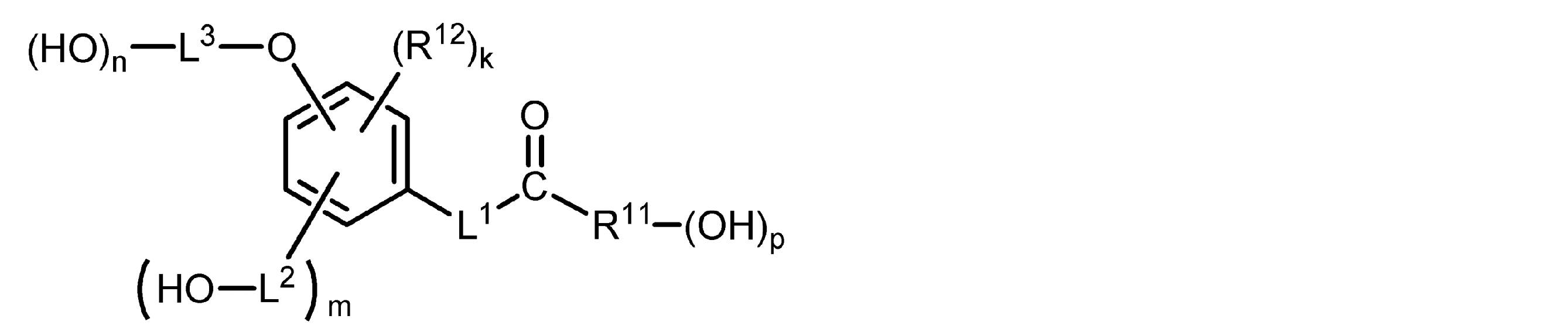
<6>
(C)の光重合開始剤として、下記式(In-3)で表される化合物を含む、<1>~<5>のいずれか1つに記載のパターン形成用組成物;
式(In-3):

<5>に記載のパターン形成用組成物。
<7>
(C)の光重合開始剤の分子量が170~330である、
<1>~<6>のいずれか1つに記載のパターン形成用組成物。
<8>
(B)の光重合開始剤と(C)の光重合開始剤の間のハンセン溶解度パラメータ距離ΔHSPが4以上である、
<1>~<7>のいずれか1つに記載のパターン形成用組成物。
<9>
(B)の光重合開始剤として、アシルフォスフィンオキサイド系化合物を含む、
<1>~<8>のいずれか1つに記載のパターン形成用組成物。
<10>
(A)の重合性化合物の含有量が、全重合性化合物に対し30~90質量%である、<1>~<9>のいずれか1つに記載のパターン形成用組成物。
<11>
パターン形成用組成物中の全固形分の含有量が、パターン形成用組成物全体に対し90質量%以上である、
<1>~<10>のいずれか1つに記載のパターン形成用組成物。
<12>
実質的に溶剤を含まない、
<11>に記載のパターン形成用組成物。
<13>
さらに、(D)離型剤を含む、
<1>~<12>のいずれか1つに記載のパターン形成用組成物。
<14>
離型剤が、水酸基を含有する化合物を含む、
<13>に記載のパターン形成用組成物。
<15>
離型剤が、水酸基を含有しない化合物を含む、
<13>または<14>に記載のパターン形成用組成物。
<16>
<1>~<15>のいずれか1つに記載のパターン形成用組成物から形成された硬化膜。
<17>
<1>~<15>のいずれか1つに記載のパターン形成用組成物からなる層状膜と、層状膜を形成するための基板とを含む積層体。
<18>
<1>~<15>のいずれか1つに記載のパターン形成用組成物を、基板上またはモールド上に適用し、パターン形成用組成物を、モールドと基板で挟んだ状態で光照射することを含むパターンの製造方法。
<19>
<18>に記載の製造方法を工程として含む、半導体素子の製造方法。
<20>
パターンをマスクとして基板のエッチングを行うことを含む、
<19>に記載の半導体素子の製造方法。
本発明のパターン形成用組成物は、(A)芳香環を含有し水酸基を含有しない重合性化合物(以下、「重合性化合物(A)」ともいう。)と、(B)芳香環を含有し水酸基を含有しない光重合開始剤(以下、「光重合開始剤(B)」ともいう。)と、(C)式(In-1)で表される光重合開始剤(以下、「光重合開始剤(C)」ともいう。)とを含み、パターン形成用組成物から溶剤を除いた成分の23℃における粘度が300mPa・s以下である。

Arは、少なくとも1つの置換基で置換された芳香環を有する芳香環含有基を表し、上記置換基の少なくとも1つは電子供与性基であり、上記置換基の少なくとも1つに芳香環に直結した-O-が含まれ、上記置換基の少なくとも1つに水酸基が含まれ、
R1は、少なくとも1つの水酸基で置換された脂肪族炭化水素基を表す。
本発明のパターン形成用組成物は、重合性基を有する重合性化合物であって、芳香環を含有し水酸基を含有しない重合性化合物(重合性化合物(A))を含む。この重合性化合物(A)は、ラジカル重合性化合物であることが好ましい。重合性化合物(A)が、芳香環を有することでインプリントリソグラフィー時のエッチング耐性が向上し、水酸基を含有しないことで、親水性の傾向があるモールド表面への重合性化合物(A)の付着が抑制される。一方、重合性化合物(A)は、水酸基を含有しなければ、炭化水素基(例えば、アルキル基およびアリール基など)やハロゲン原子などの置換基を有することができる。以下詳細に説明する。

多官能の重合性化合物(A)が有する重合性基の数は、2以上であり、2~7が好ましく、2~4がより好ましく、2または3がさらに好ましく、2が一層好ましい。




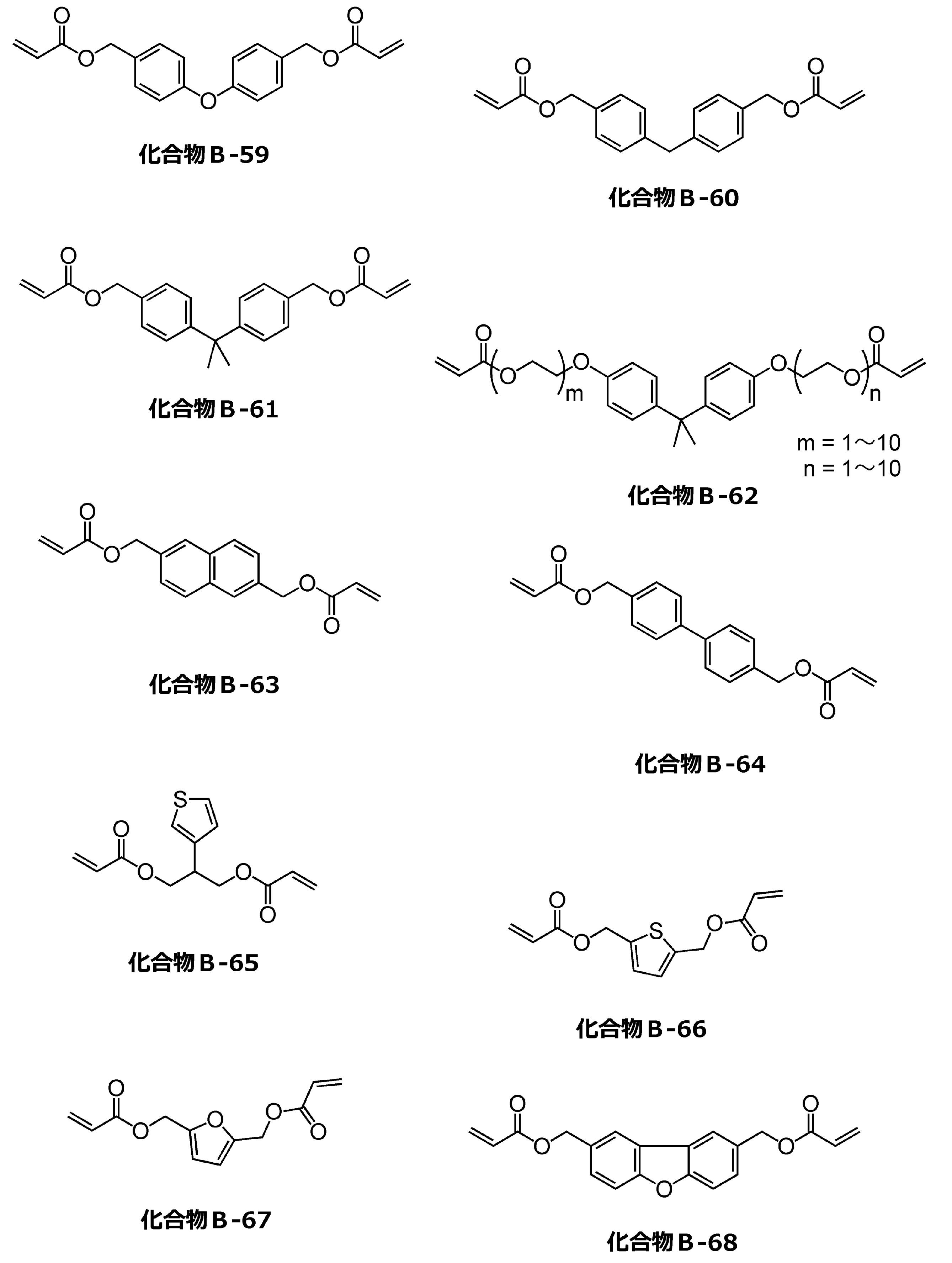
本発明で用いることができる単官能の重合性化合物(A)は、23℃で液体であることが好ましい。本発明において、23℃で液体である化合物とは、23℃で流動性を有する化合物を意味し、例えば23℃での粘度が100000mPa・s以下である化合物である。単官能の重合性化合物(A)として23℃で液体の化合物を用いることにより、パターン形成用組成物に使用する溶剤の量を減らすことができる。
(1-A)アルキル鎖およびアルケニル鎖の少なくとも一方と、芳香環とを含み、かつ、合計炭素数が7以上である基(以下、単に「(1-A)の基」ともいう)。
このような構成とすることにより、パターン形成用組成物中に含まれる単官能の重合性化合物(A)の添加量を減らしつつ、硬化膜の弾性率を効率良く低下させることが可能になる。さらに、モールドとの界面エネルギーが低減し、離型力の低減効果(離型性の向上効果)を大きくすることができる。

本発明のパターン形成用組成物は、芳香環を含有しない重合性化合物および水酸基を含有する重合性化合物など、重合性化合物(A)以外の重合性化合物(以下、単に「他の重合性化合物」ともいう。)を含むこともできる。これにより、パターン形成用組成物から溶剤を除いた成分の粘度およびその組成物中の固形分の粘度の調整などが容易となる。

多官能の他の重合性化合物が有する重合性基の数は、2以上であり、2~7が好ましく、2~4がより好ましく、2または3がさらに好ましく、2が一層好ましい。

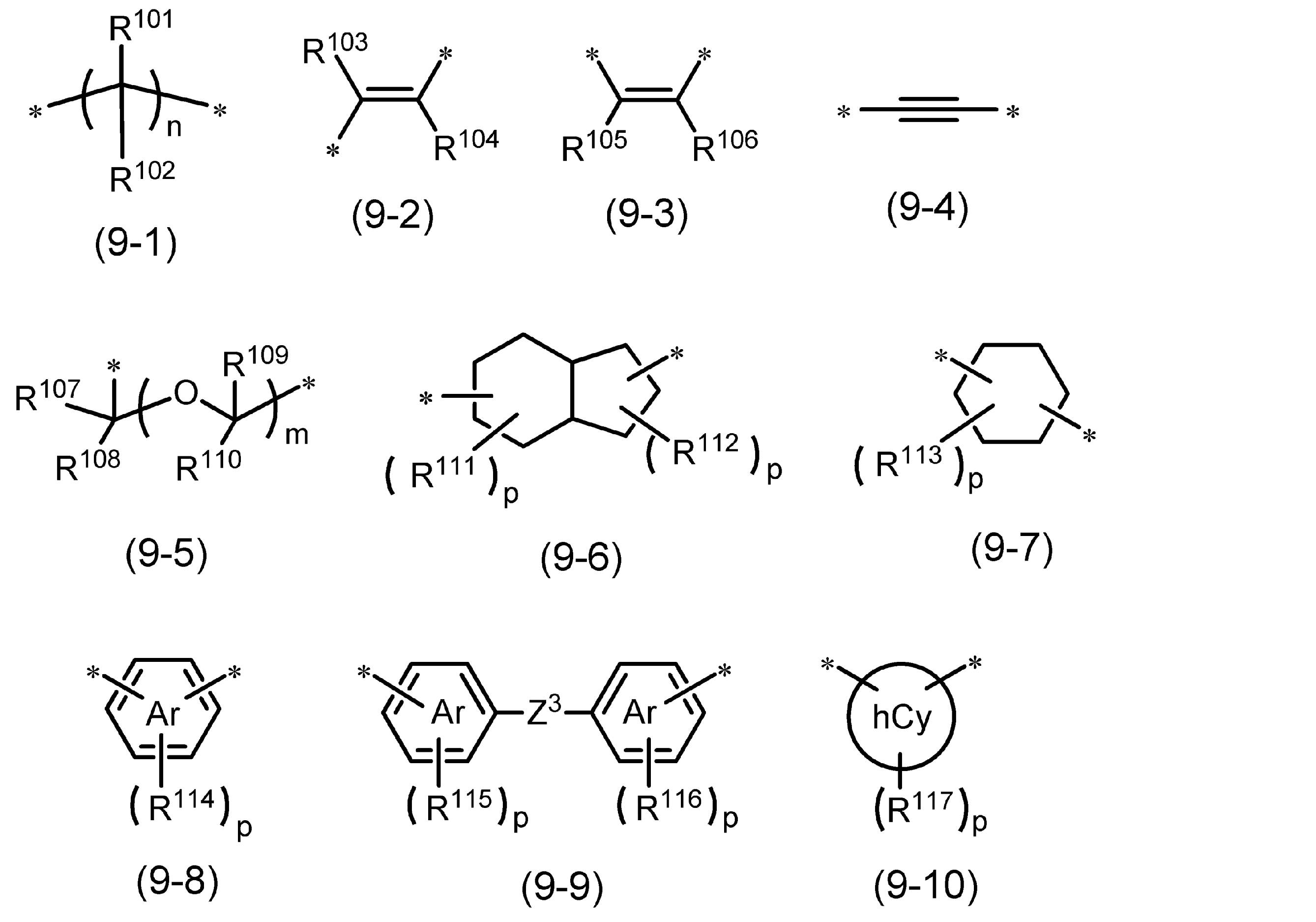

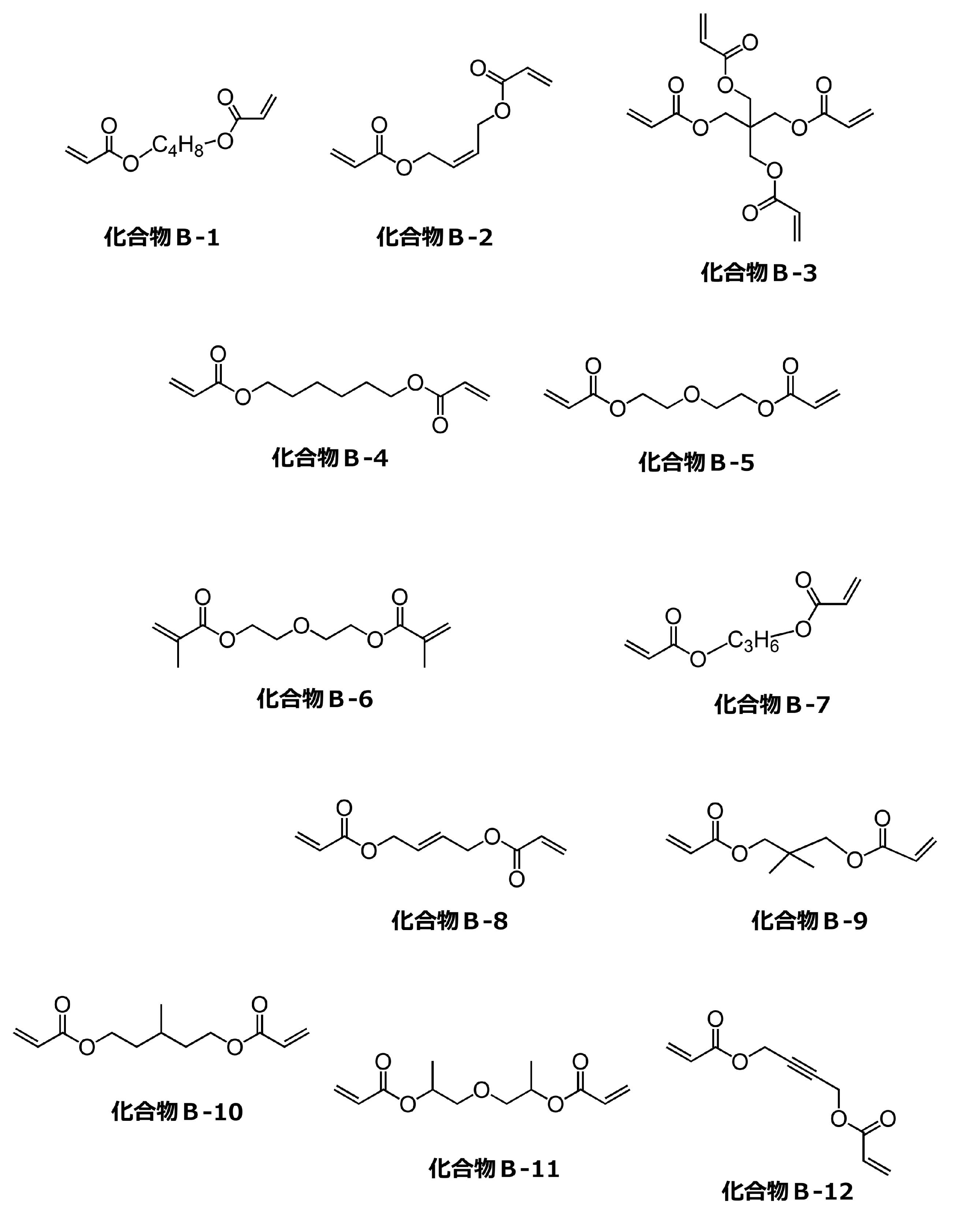
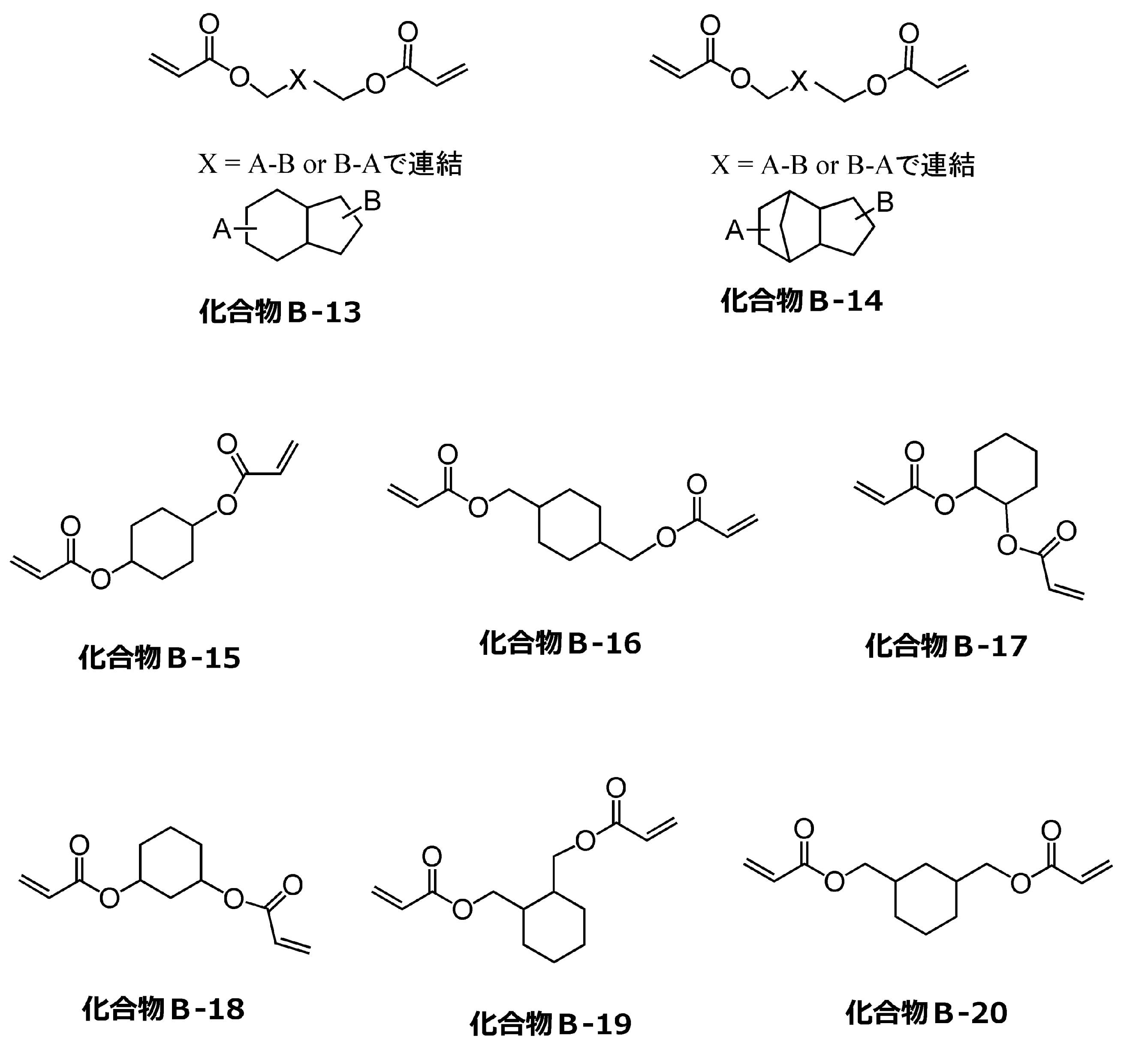
本発明で用いることができる単官能の他の重合性化合物は、23℃で液体であることが好ましい。単官能の他の重合性化合物として23℃で液体の化合物を用いることにより、パターン形成用組成物に使用する溶剤の量を減らすことができる。
(1)アルキル鎖およびアルケニル鎖の少なくとも一方と、脂環構造および芳香環構造の少なくとも一方とを含み、かつ、合計炭素数が7以上である基(以下、「(1)の基」ということがある);
(2)炭素数4以上のアルキル鎖を含む基(以下、「(2)の基」ということがある);ならびに
(3)炭素数4以上のアルケニル鎖を含む基(以下、「(3)の基」ということがある);
このような構成とすることにより、パターン形成用組成物中に含まれる単官能の他の重合性化合物の添加量を減らしつつ、硬化膜の弾性率を効率良く低下させることが可能になる。さらに、モールドとの界面エネルギーが低減し、離型力の低減効果(離型性の向上効果)を大きくすることができる。
上記(1)の基における合計炭素数は35以下であることが好ましく、10以下であることがより好ましい。
上記(2)の基は、炭素数4以上のアルキル鎖を含む基であり、炭素数4以上のアルキル鎖のみからなる基(すなわち、アルキル基)であることが好ましい。アルキル鎖の炭素数は、7以上であることが好ましく、9以上であることがより好ましい。アルキル鎖の炭素数の上限値については、特に限定されるものでは無いが、例えば、25以下とすることができる。なお、アルキル鎖の一部の炭素原子がケイ素原子に置き換わった化合物も単官能の他の重合性化合物として例示できる。
上記(3)の基は、炭素数4以上のアルケニル鎖を含む基であり、炭素数4以上のアルケニル鎖のみからなる基(すなわち、アルキレン基)であることが好ましい。アルケニル鎖の炭素数は、7以上であることが好ましく、9以上であることがより好ましい。アルケニル鎖の炭素数の上限値については、特に限定されるものでは無いが、例えば、25以下とすることができる。
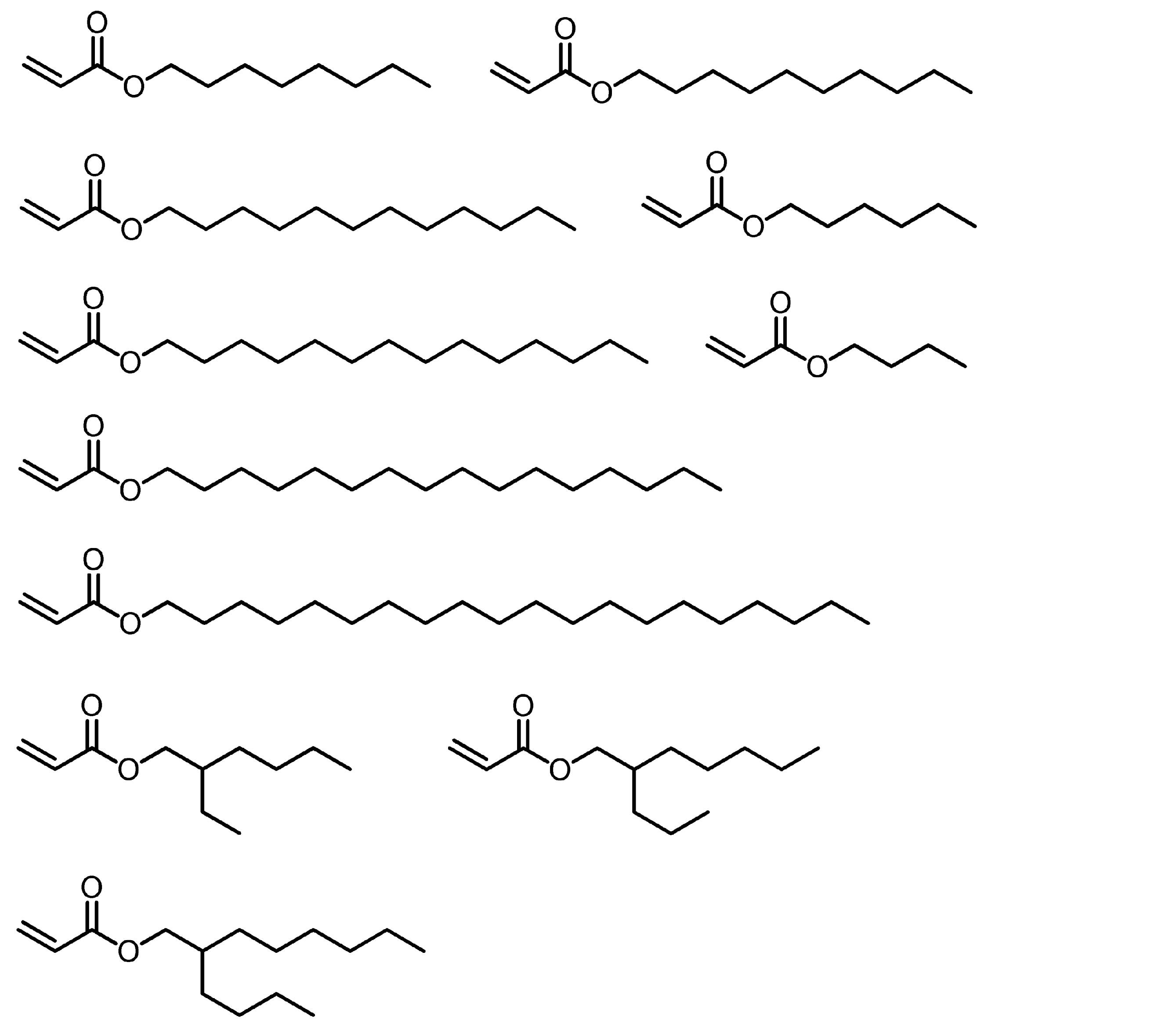
・配合例1(単官能の重合性化合物(A)を含む場合)
・・多官能の重合性化合物(A) 30~50質量%
・・単官能の重合性化合物(A) 20~40質量%
・・単官能の他の重合性化合物 10~30質量%
・配合例2(単官能の重合性化合物(A)を含まない場合)
・・多官能の重合性化合物(A) 40~60質量%
・・多官能の他の重合性化合物 20~40質量%
・・単官能の他の重合性化合物 5~20質量%
本発明のパターン形成用組成物は、芳香環を含有し水酸基を含有しない光重合開始剤(光重合開始剤(B))と、上記式(In-1)で表される光重合開始剤(光重合開始剤(C))とを含む。光重合開始剤(B)は、その構造の重合性化合物(A)との共通性から、重合性化合物(A)との相溶性に優れ、パターン形成用組成物中で均一に分布しやすい。その結果、主に組成物全体の硬化促進に寄与すると考えられる。一方、光重合開始剤(C)は、水酸基を含有することにより、パターン形成用組成物の表面に偏在しやすいため、主にモールド表面近傍の組成物の硬化に寄与すると考えられる。
光重合開始剤(B)は、光ラジカル重合開始剤であることが好ましい。光ラジカル重合開始剤としては、光照射により上述の重合性化合物を重合する活性種を発生する化合物であれば、特に制限されない。このような光重合開始剤の具体的な例としては、例えば、特開2008-105414号公報の段落番号0091に記載の化合物が挙げられる。
上記式(In-1)で表される光重合開始剤(C)は、光ラジカル重合開始剤であることが好ましい。光ラジカル重合開始剤としては、光照射により上述の重合性化合物を重合する活性種を発生する化合物であれば、特に制限されない。このような光重合開始剤の具体的な例としては、例えば、特開2008-105414号公報の段落番号0091に記載の化合物が挙げられる。


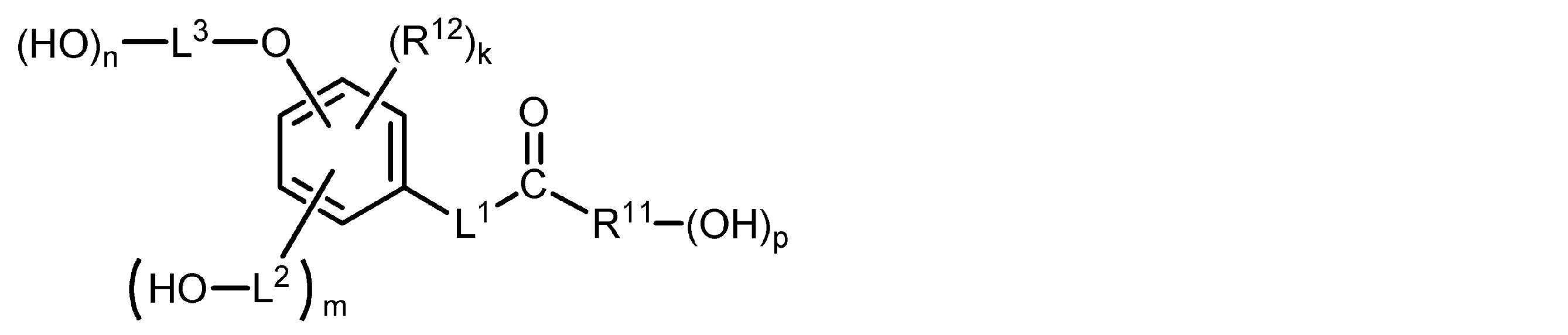

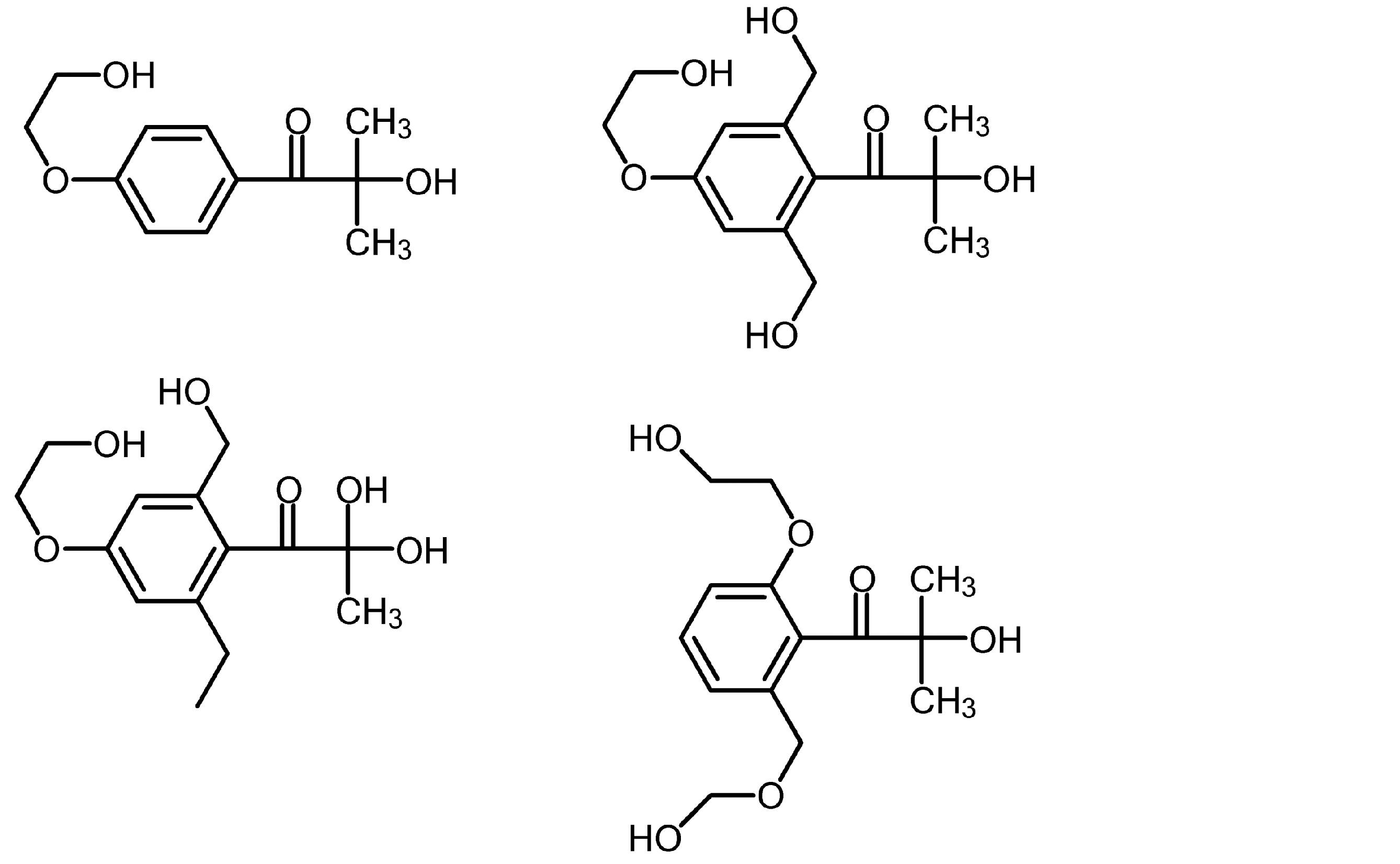
本発明のパターン形成用組成物において、光重合開始剤(B)と光重合開始剤(C)の間のハンセン溶解度パラメータ距離ΔHSPは4以上であることが好ましい。これにより、光重合開始剤(C)のパターン形成用組成物表面への偏在を効率よく生じさせることができる。ΔHSPは、5以上であることがより好ましく、6以上であることがさらに好ましい。上記ΔHSPの上限は、特段制限されないが、20以下が実際的であり、15以下でもよい。ΔHSPは下記数式(1)により導かれる。
ΔHSP=[4.0×(ΔD2+ΔP2+ΔH2)]0.5 数式(1)
ΔD:光重合開始剤(B)のハンセン溶解度パラメータベクトルの分散項成分(d成分1)と、光重合開始剤(C)のハンセン溶解度パラメータベクトルの分散項成分(d成分2)との差(d成分1-d成分2)。
ΔP:光重合開始剤(B)のハンセン溶解度パラメータベクトルの極性項成分(p成分1)と、光重合開始剤(C)のハンセン溶解度パラメータベクトルの極性項成分(p成分2)との差(p成分1-p成分2)。
ΔH:光重合開始剤(B)のハンセン溶解度パラメータベクトルの水素結合項成分(h成分1)と、光重合開始剤(C)のハンセン溶解度パラメータベクトルの水素結合項成分(h成分2)との差(h成分1-h成分2)。
他の光重合開始剤は、光ラジカル重合開始剤であることが好ましい。光ラジカル重合開始剤としては、光照射により上述の重合性化合物を重合する活性種を発生する化合物であれば、特に制限されない。このような光重合開始剤の具体的な例としては、例えば、特開2008-105414号公報の段落番号0091に記載の化合物が挙げられる。
本発明のパターン形成用組成物は、増感剤を含むことができる。本発明における増感剤の分子量は、2000未満であることが好ましく、1000以下であることがより好ましく、800以下であることがさらに好ましく、600以下であることが一層好ましく、550以下であることが特に好ましく、500以下であってもよい。下限値は、100以上であることが好ましく、200以上であることがより好ましく、250以上であることがさらに好ましい。
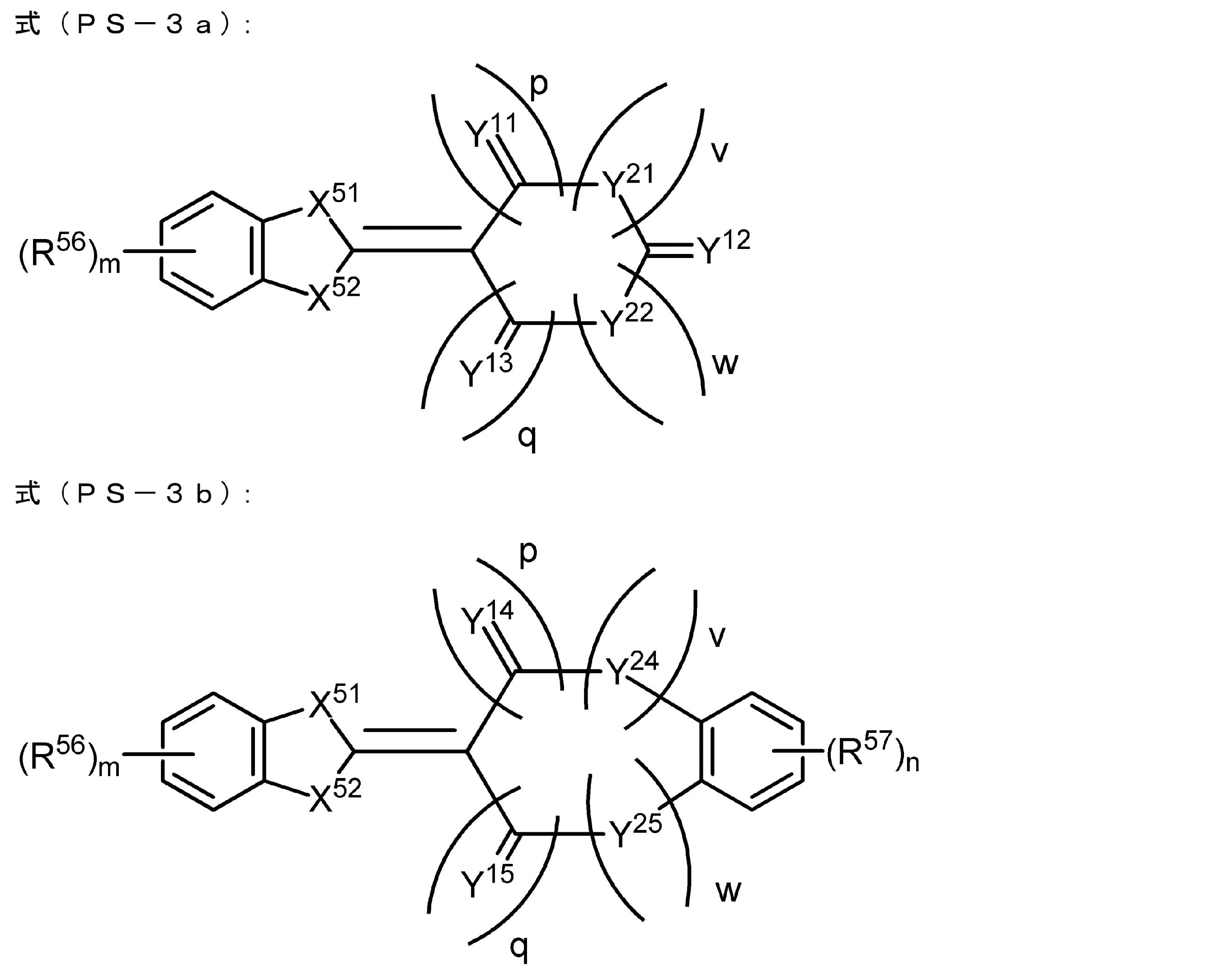
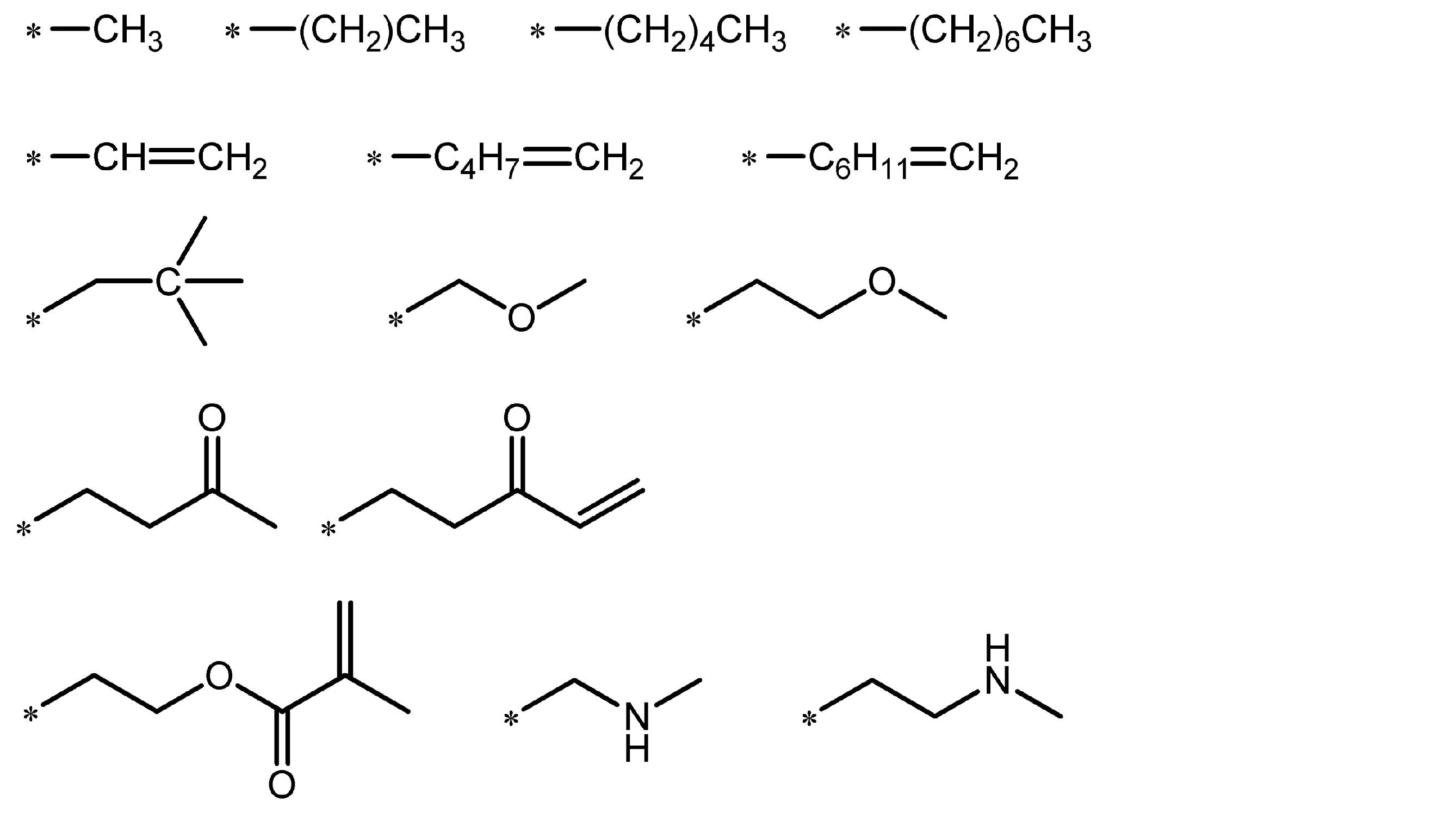

本発明のパターン形成用組成物は、離型剤を含んでいてもよい。
離型剤用の界面活性剤としては、ノニオン性界面活性剤、アニオン性界面活性剤、カチオン性界面活性剤および両性界面活性剤のいずれを使用してもよい。そして、界面活性剤は、他の成分との相溶性や離型性の点から、ノニオン性界面活性剤およびアニオン性界面活性剤の少なくとも1種を含むことが好ましく、ノニオン性界面活性剤を含むことが好ましい。
本発明のパターン形成用組成物において、離型性を有する非重合性化合物は、末端に少なくとも1つの水酸基を有するか、または、水酸基がエーテル化されたポリアルキレングリコール構造を有していれば、特に制限されないが、さらに、フッ素原子およびケイ素原子を実質的に含有しないことが好ましい。ここで、非重合性化合物とは、重合性基を持たない化合物をいう。また、非重合性化合物について、フッ素原子およびケイ素原子を実質的に含有しないとは、例えば、フッ素原子およびケイ素原子の合計含有率が1質量%以下であることを表し、フッ素原子およびケイ素原子を全く有していないことが好ましい。フッ素原子およびケイ素原子を有さないことにより、重合性化合物との相溶性が向上し、特に溶剤を実質的に含有しないパターン形成用組成物において、塗布均一性、インプリント時のパターン形成性、ドライエッチング後のラインエッジラフネスが良好となる。
本発明における離型剤としての、フッ素原子を有する重合性化合物は、重合性基と、フッ素原子を含む官能基を有することが好ましい。
本発明のパターン形成用組成物では、離型剤は特に制限されず、水酸基を含有する離型剤と水酸基を含有しない離型剤とをそれぞれ別々に使用してもよく、これらの両方を組み合わせて使用してもよい。例えば、水酸基を含有する離型剤を使用した場合には、水酸基を含有する離型剤がパターン形成用組成物の表面に偏在しやすくなり、モールドを押し当てる際にモールド表面に接触しやすくなる。その結果、モールド表面に光重合開始剤(C)が過剰に偏在することにより、モールド表面で必要以上に硬化が進行し、モールドの離型がかえって妨げられることを抑制することができる。つまり、水酸基を含有する離型剤を偏在させることで、モールド表面近傍におけるパターン形成用組成物の硬化度合を調整することができる。このような硬化度合の調整に際し、離型剤として、水酸基を含有する離型剤および水酸基を含有しない離型剤を併用し、それぞれの添加量を調整することが好ましい。なお、パターン形成用組成物は、水酸基を含有する離型剤を実質的に含まない態様でもよい。ここで、「実質的に含まない」とは、パターン形成用組成物に対する水酸基を含有する離型剤の含有量が0.1質量%以下であることをいう。水酸基を含有する離型剤の含有量は、パターン形成用組成物に対し8質量%以下であることが好ましく、5質量%以下であることがより好ましい。

本発明のパターン形成用組成物は、上記の成分のほか、増感剤、酸化防止剤、紫外線吸収剤、溶剤、ポリマー等を含んでいてもよい。パターン形成用組成物中のこれらの化合物は、それぞれ、1種のみでもよく、2種以上でもよい。これらの詳細については、特開2014-170949号公報の段落0061~0064の記載を参酌でき、これらの内容は本明細書に組み込まれる。
本発明のパターン形成用組成物は溶剤を含んでいてもよい。溶剤としては、プロピレングリコールモノメチルエーテルアセテート、シクロヘキサノン、2-ヘプタノン、ガンマブチロラクトン、プロピレングリコールモノメチルエーテル、乳酸エチルが例示される。溶剤を含む場合、その含有量は、組成物の1~20質量%であることが好ましい。溶剤は1種のみ含んでいてもよいし、2種以上含んでいてもよい。2種以上含む場合、それらの合計量が上記範囲となることが好ましい。
また、本発明では、パターン形成用組成物が実質的に溶剤を含まない構成とすることもできる。パターン形成用組成物が溶剤を実質的に含まないとは、パターン形成用組成物に対する溶剤の含有量が5質量%以下であることをいう。溶剤の含有量は、パターン形成用組成物に対し3質量%以下であることが好ましく、1質量%以下であることがより好ましい。
本発明のパターン形成用組成物は、ポリマーを含んでいてもよい。ポリマーとは、例えば、重量平均分子量が2000以上の成分であり、2000超の成分であることが好ましい。
本発明のパターン形成用組成物において、その組成物から溶剤を除いた成分の23℃における粘度は、50mPa・s以下であることが好ましい。さらに、この粘度は、25mPa・s以下であることが好ましく、20mPa・s以下であることがより好ましく、15mPa・s以下であることが特に好ましく、10mPa・s以下であることが一層好ましい。粘度の下限値としては、特に定めるものでは無いが、例えば、5mPa・s以上とすることができる。このような範囲とすることにより、本発明のパターン形成用組成物がモールド内に入り込みやすくなり、モールド充填時間を短くできる。
本発明のパターン形成用組成物は、原料(上記で説明した各材料)を所定の割合となるように配合して調製される。原料を混合した後、フィルターを用いて濾過処理を行うことが好ましい。フィルターによる濾過はパターン形成用組成物の原料を混合した後に実施することが好ましい。
本発明のパターン形成用組成物の収容容器としては従来公知の収容容器を用いることができる。また、収容容器としては、原材料や組成物中への不純物混入を抑制することを目的に、容器内壁を6種6層の樹脂で構成された多層ボトルや、6種の樹脂を7層構造にしたボトルを使用することも好ましい。このような容器としては例えば特開2015-123351号公報に記載の容器が挙げられる。
本発明のパターン形成用組成物は、基板上に層状に適用されて層状膜となり、その後、後述する露光により硬化され硬化物となる。ここで、上記基板と、硬化前の上記層状膜とを含む積層体が本発明の積層体に相当し、上記硬化物が本発明の硬化膜に相当する。上記層状膜は、例えばスピンコート法で形成されたような連続膜でもよく、例えばインクジェット法で形成されたような不連続膜でもよい。本発明のパターン形成用組成物は、光インプリント法によるパターン状の硬化物(以下、単に「パターン」ともいう。)の製造に用いられる。
さらに、露光に際しては、酸素によるラジカル重合の阻害を防ぐため、窒素やアルゴンなどの不活性ガスを流して、酸素濃度を100mg/L未満に制御してもよい。
上述のように本発明のパターン製造方法によって形成されたパターン(すなわち、パターン形成用組成物を用いて形成した硬化膜)は、LCDなどに用いられる永久膜や、半導体加工用のエッチングレジストとして使用することができる。また、本発明のパターンを利用してLCDのガラス基板にグリッドパターンを形成し、反射や吸収が少なく、大画面サイズ(例えば55インチ、60インチ超)の偏光板を安価に製造することが可能である。例えば、特開2015-132825号公報や国際公開第2011/132649号に記載の偏光板が製造できる。なお、1インチは25.4mmである。
上記のとおり、基板とパターン形成用組成物層の間に下層膜を設けることにより、基板とパターン形成用組成物層の密着性が向上するなどの効果が得られる。本発明において、下層膜は、パターン形成用組成物と同様の手法により、下層膜形成用組成物を基板上に適用し、その後、組成物を硬化することにより得られる。以下、下層膜形成用組成物の各成分について説明する。
下層膜形成用組成物中の樹脂は、公知の樹脂を広く用いることができる。本発明で用いる樹脂は、ラジカル重合性基および極性基の少なくとも一方を有することが好ましく、ラジカル重合性基および極性基の両方を有することがより好ましい。
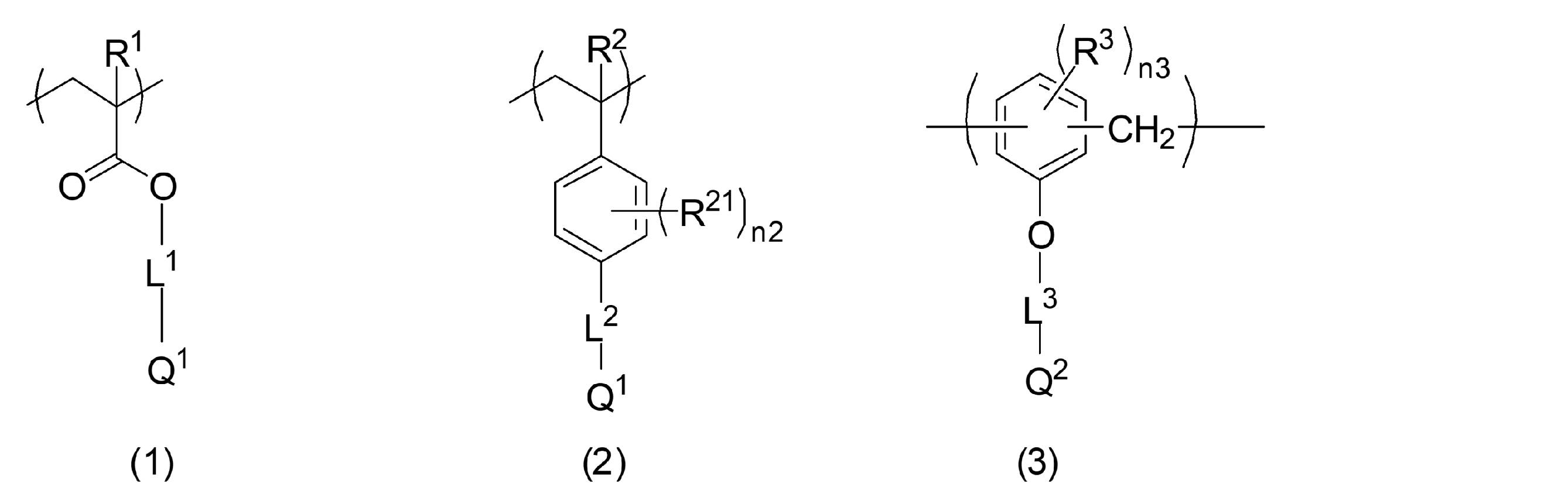
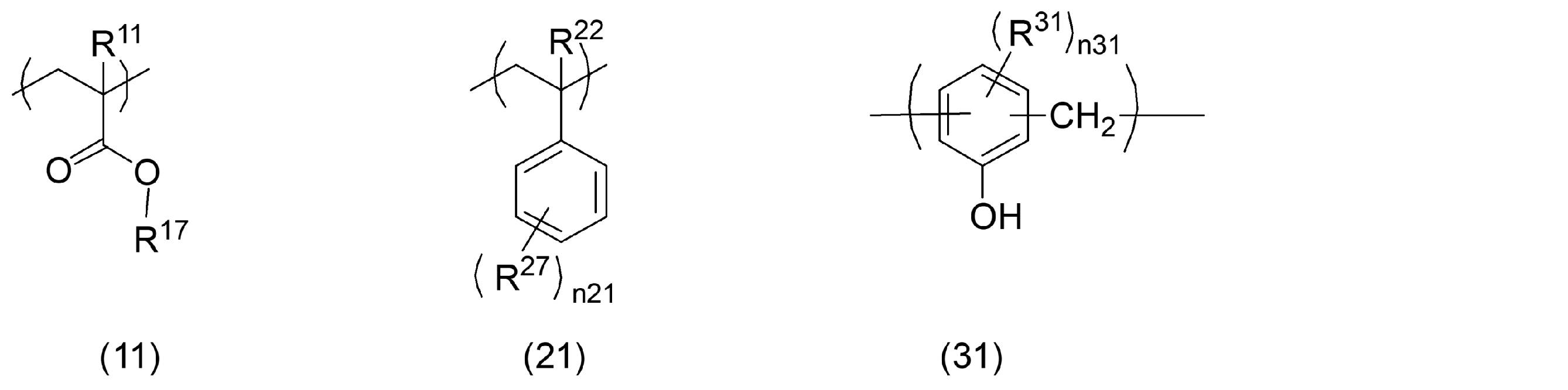
下層膜形成用組成物中の架橋剤は、架橋反応により硬化を進行させるものであれば、特に限定はない。本発明では、架橋剤は、樹脂が有する極性基との反応によって、架橋構造を形成するものが好ましい。このような架橋剤を用いることにより、樹脂がより強固に結合し、より強固な膜が得られる。
本発明の下層膜形成用組成物は、上記成分に加え、他の成分を含んでいてもよい。
本発明では、下層膜形成用組成物は、特に、溶剤(以下、「下層膜用溶剤」ともいう。)を含むことが好ましい。溶剤は例えば、23℃で液体であって沸点が250℃以下の化合物が好ましい。下層膜形成用組成物は、下層膜用溶剤を99.0質量%以上含むことが好ましく、99.2質量%以上含むことがより好ましく、99.4質量%以上であってもよい。すなわち、下層膜形成用組成物は、全固形分濃度が1質量%以下であることが好ましく、0.8質量%以下であることがより好ましく、0.6質量%以下であることがさらに好ましい。また、下限値は、0質量%超であることが好ましく、0.001質量%以上であることがより好ましく、0.01質量%以上であることがさらに好ましく、0.1質量%以上であることが一層好ましい。溶剤の割合を上記の範囲とすることで、膜形成時の膜厚を薄く保ち、エッチング加工時のパターン形成性が向上する。
熱酸発生剤は、加熱によって酸が発生し、酸の作用によって架橋を進行させる化合物である。上記架橋剤と併用することにより、より強度の高い下層膜を得ることができる。
熱酸発生剤としては、通常はカチオン成分とアニオン成分とが対になった有機オニウム塩化合物が用いられる。上記カチオン成分としては、例えば、有機スルホニウム、有機オキソニウム、有機アンモニウム、有機ホスホニウムや有機ヨードニウムを挙げることができる。また、上記アニオン成分としては、例えば、BF4-、B(C6F5)4-、SbF6-、AsF6-、PF6-、CF3SO3 -、C4F9SO3 -や(CF3SO2)3C-を挙げることができる。
下層膜形成用組成物は、重合開始剤を含んでいてもよく、熱重合開始剤および光重合開始剤の少なくとも1種を含むことが好ましい。重合開始剤を含むことにより、下層膜形成用組成物に含まれる重合性基の反応が促進し、密着性が向上する。パターン形成用組成物との架橋反応性を向上させる観点から光重合開始剤が好ましい。光重合開始剤としては、ラジカル重合開始剤、カチオン重合開始剤が好ましく、ラジカル重合開始剤がより好ましい。また、本発明において、光重合開始剤は複数種を併用してもよい。
また、本発明において、23℃、1気圧で液体であるラジカル重合性化合物を含む液膜形成用組成物を用いて、下層膜の上に液膜を形成することも好ましい。本発明において、液膜は、パターン形成用組成物と同様の手法により、液膜形成用組成物を基板上に適用し、その後、組成物を乾燥させることにより得られる。このような液膜を形成することにより、基板とパターン形成用組成物との密着性がさらに向上し、パターン形成用組成物の基板上での濡れ性も向上するという効果がある。以下、液膜形成用組成物について説明する。
液膜形成用組成物は、23℃、1気圧で液体であるラジカル重合性化合物(重合性化合物A)を含有する。

液膜形成用組成物は溶剤(以下、「液膜用溶剤」ということがある)を含むことが好ましい。液膜用溶剤としては、上述した下層膜用溶剤の項で説明したものが挙げられ、これらを用いることができる。液膜形成用組成物は、液膜用溶剤を90質量%以上含むことが好ましく、99質量%以上含むことがより好ましく、99.99質量%以上であってもよい。
液膜形成用組成物はラジカル重合開始剤を含んでいてもよい。ラジカル重合開始剤としては、熱ラジカル重合開始剤および光ラジカル重合開始剤が挙げられ、光ラジカル重合開始剤であることが好ましい。光ラジカル重合開始剤としては、公知の化合物を任意に使用できる。例えば、ハロゲン化炭化水素誘導体(例えば、トリアジン骨格を有する化合物、オキサジアゾール骨格を有する化合物、トリハロメチル基を有する化合物など)、アシルフォスフィン化合物、ヘキサアリールビイミダゾール化合物、オキシム化合物、有機過酸化物、チオ化合物、ケトン化合物、芳香族オニウム塩、アセトフェノン化合物、アゾ化合物、アジド化合物、メタロセン化合物、有機ホウ素化合物、鉄アレーン錯体などが挙げられる。これらの詳細については、特開2016-027357号公報の段落0165~0182の記載を参酌でき、この内容は本明細書に組み込まれる。この中でもアセトフェノン化合物、アシルフォスフィン化合物、オキシム化合物が好ましい。
液膜形成用組成物は、上記の他、重合禁止剤、酸化防止剤、レベリング剤、増粘剤、界面活性剤等を1種または2種以上含んでいてもよい。
本発明のキットは、インプリント用のパターン(硬化膜)を形成するための上記パターン形成用組成物と、インプリント用の下層膜を形成するための下層膜形成用組成物との組み合わせを含む。本発明のキットを使用することにより、離型性に優れるインプリントを実施することが可能となる。下層膜形成用組成物は、特に、ラジカル重合性基を有する上記樹脂と、有機溶剤を含むことが好ましい。さらに、本発明のキットは、23℃、1気圧で液体である重合性化合物を含む液膜形成用組成物を含むことが好ましい。
下記表1~3中の実施例および比較例について、各表に示す成分を、各表に示す配合割合で混合し、さらに重合禁止剤として4-ヒドロキシ-2,2,6,6-テトラメチルピペリジン-1-オキシルフリーラジカル(東京化成社製)を重合性化合物全体に対して200質量ppm(0.02質量%)となるように加えることにより、組成物を調製した。そして、孔径0.1μmのポリテトラフルオロエチレン(PTFE)製フィルター、孔径0.02μmナイロン製フィルターおよび孔径0.003μmPTFE製フィルターをこの順に連結した複合フィルターを用いて、上記組成物のそれぞれを濾過し、パターン形成用組成物を調製した。なお、表中の重合性化合物、光重合開始剤、離型剤および増感剤の配合割合の単位は、質量部である。また、表中の「Cb/Cc」は、光重合開始剤(C)の含有量Ccに対する光重合開始剤(B)の含有量Cbの質量比である。

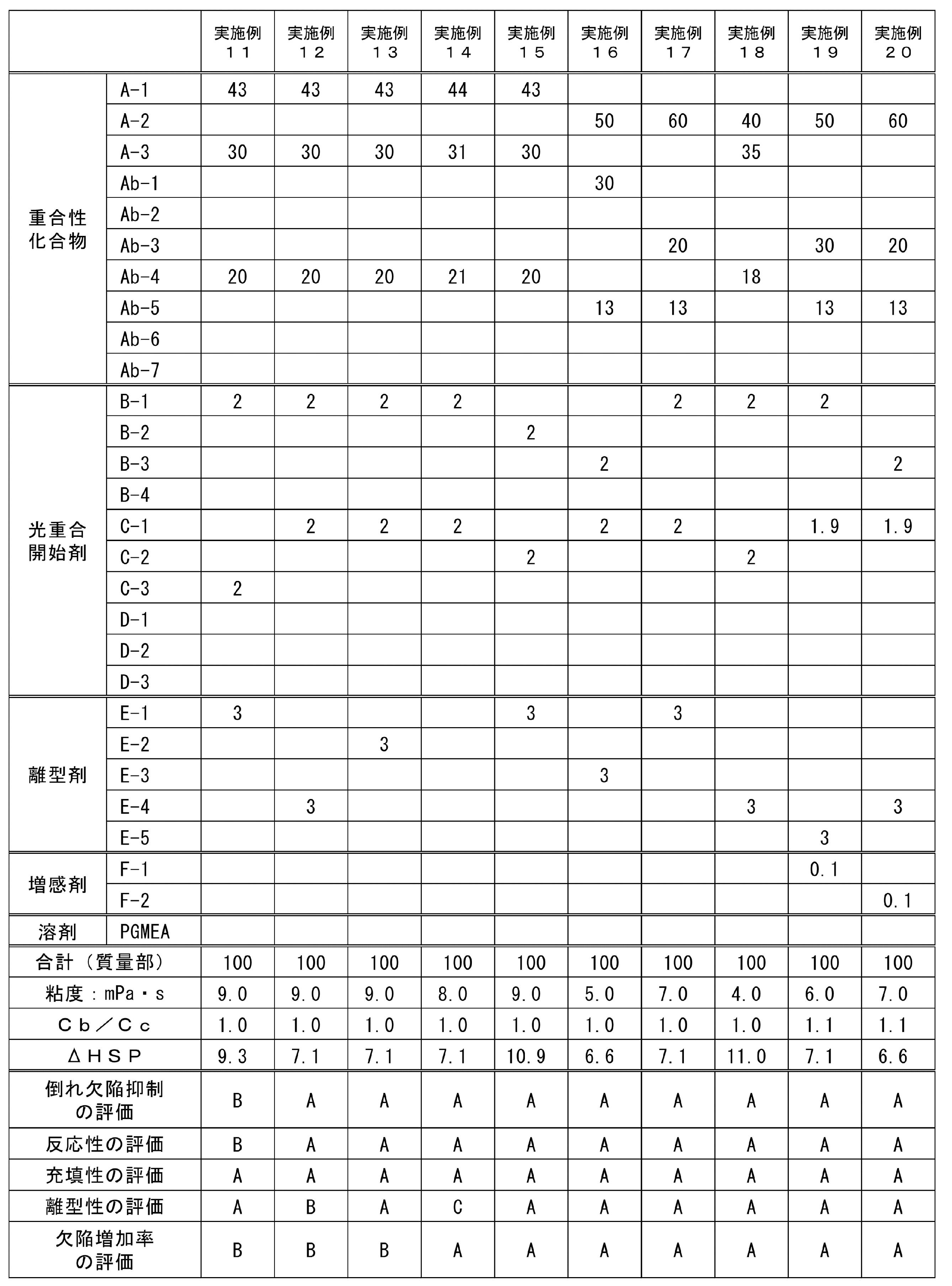

各原料の仕様は、下記のとおりである。
A-1:フェニルエチレングリコールジアクリレート(分子量246)。
A-2:下記構造を有する化合物(分子量246)。
A-3:ベンジルアクリレート(分子量162)。

Ab-1:ネオペンチルグリコールジアクリレート(分子量212)。
Ab-2:下記構造を有する化合物(分子量262)。
Ab-3:下記構造を有する化合物(分子量196)。
Ab-4:イソボルニルアクリレート(分子量208)。
Ab-5:下記構造を有する化合物(分子量240)。
Ab-6:下記構造を有する化合物(分子量192)。
Ab-7:ペンタエリスリトールテトラアクリレート(分子量352)。

B-1:下記構造を有する化合物(分子量418、d成分19.7、p成分8.6、h成分6.1、Omnirad 819、IGM Resins社製)。
B-2:下記構造を有する化合物(分子量348、d成分20、p成分9.3、h成分6.2、Omnirad TPO、IGM Resins社製)。
B-3:下記構造を有する化合物(分子量316、d成分19.3、p成分9.1、h成分6.2、Omnirad TPO-L、IGM Resins社製)。
B-4:下記構造を有する化合物(分子量445、d成分18.7、p成分8.5、h成分1.7、Irgacure OXE01、BASF社製)。

C-1:下記構造を有する化合物(分子量224、d成分18.7、p成分10.8、h成分12.5、Irgacure 2959、BASF社製)。
C-2:下記構造を有する化合物(分子量284、d成分18.3、p成分12.8、h成分15.9)。
C-3:下記構造を有する化合物(分子量284、d成分18.2、p成分12.6、h成分13.9)。

D-1:下記構造を有する化合物(分子量164、d成分18.4、p成分7.5、h成分8.1、Omnirad 1173、IGM Resins社製)。
D-2:下記構造を有する化合物(分子量340、d成分19.2、p成分9.5、h成分7.4、Omnirad 127、IGM Resins社製)。
D-3:下記構造を有する化合物(分子量222、d成分18.3、p成分7.8、h成分7.1)。
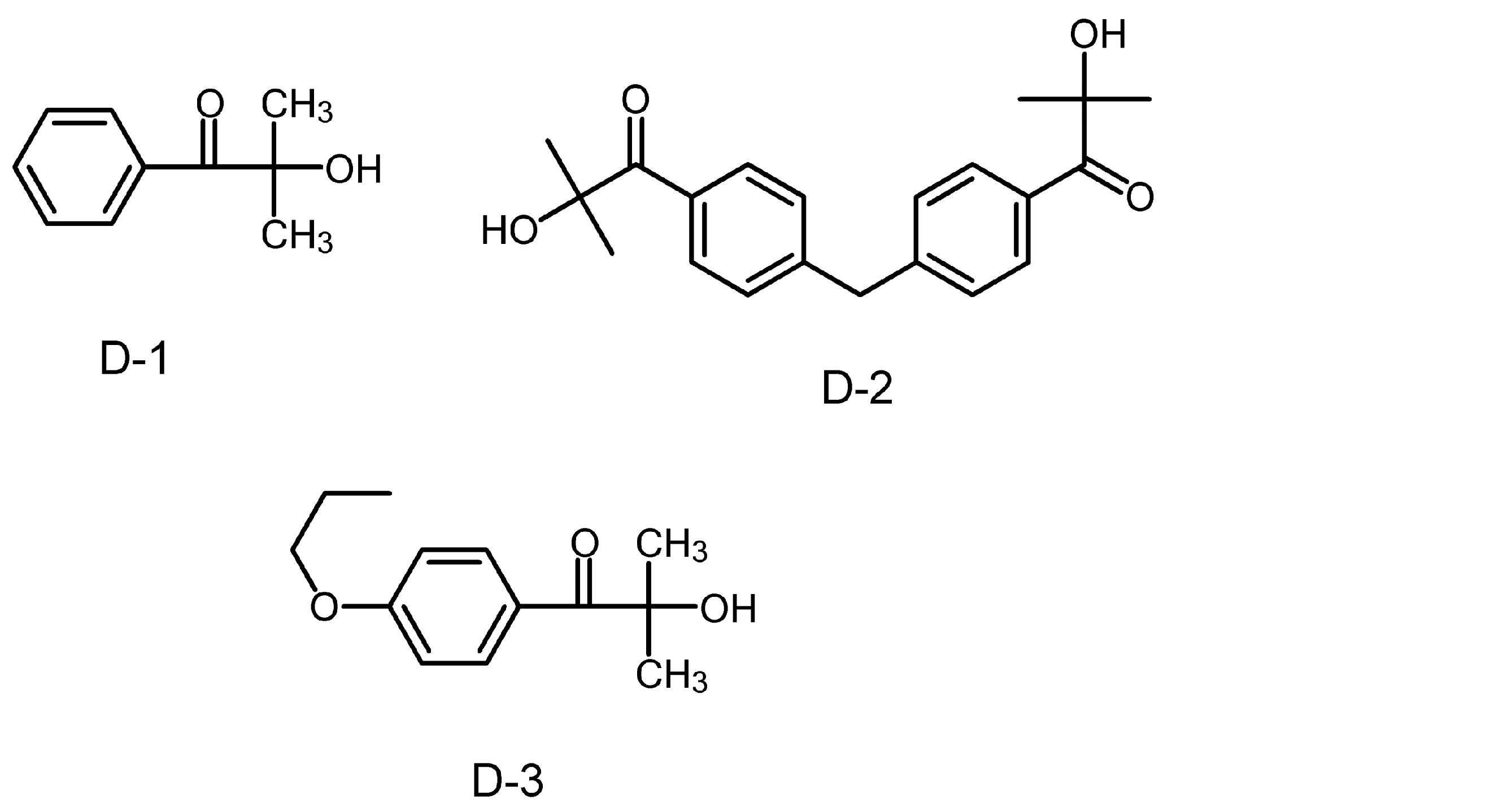
E-1~E-5:下記構造を有する化合物。

F-1,F-2:下記構造を有する化合物

各原料ならびに実施例および比較例の各パターン形成用組成物について、必要に応じて、下記特性の測定を行った。
実施例1~20および比較例1~8の各パターン形成用組成物について、東機産業(株)製のRE-80L型回転粘度計を用い、23±0.2℃の温度条件下で、硬化前のパターン形成用組成物の粘度(単位:mPa・s)を測定した。なお、実施例21および22におけるパターン形成用組成物から溶剤を除いた成分の粘度は、それぞれ実施例1および16の組成物の粘度測定値によって代用した。測定時の回転速度は、粘度に応じて下記表4のとおり調整した。
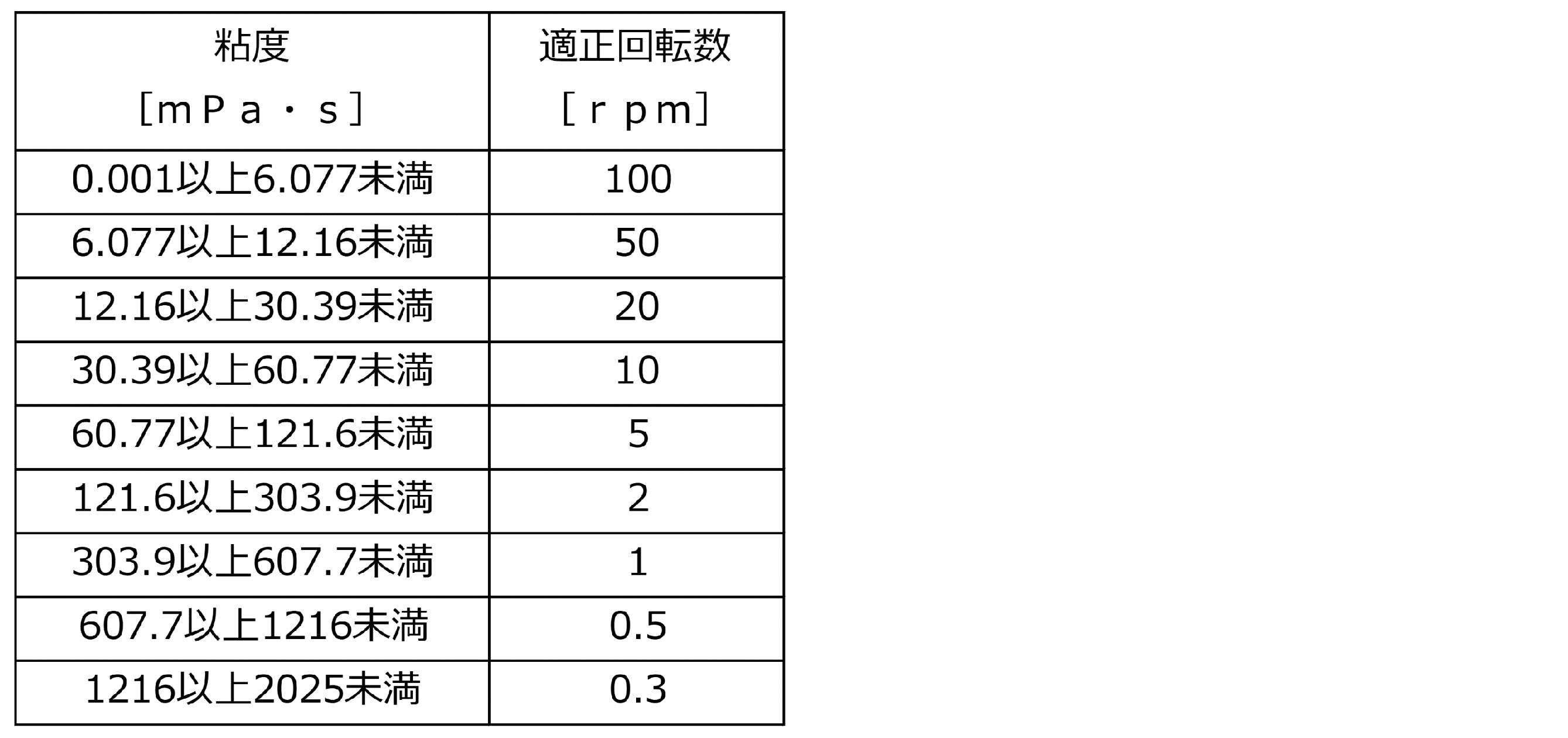
実施例および比較例に係る光重合開始剤(B)と(C)について、ハンセン溶解度パラメータおよび沸点をHSP計算ソフトHSPiPにて計算した。具体的には、まず、各光重合開始剤の分子式をSMILES形式にて上記ソフトに入力することで、ハンセン溶解度パラメータベクトルの各成分を算出した。次に、ハンセン溶解度パラメータ距離(ΔHSP)については、各化合物のハンセン溶解度パラメータの各成分(d成分、p成分、h成分)からそれぞれΔD、ΔP、ΔHを求め、上記した数式(1)にあてはめることで算出した。また、同ソフトにより計算した沸点を考慮して、下層膜形成の際の温度条件を設定した。なお、比較例1および2については、光重合開始剤(C)のハンセン溶解度パラメータに代えて、他の光重合開始剤のハンセン溶解度パラメータを使用したΔHSPを算出した。
上記実施例および比較例の各パターン形成用組成物について、下記項目の評価を行った。なお、超高圧水銀ランプの照度は、ウシオ電機社製の紫外線積算光量計UIT-250を用いて測定した。
シリコンウェハ上に、特開2014-024322号公報の実施例6に示された密着層形成用組成物をスピンコートし、220℃のホットプレートを用いて1分間加熱し、厚さ5nmの密着層を形成した。そして、実施例1~20および比較例1~8については、インクジェット装置(FUJIFILM Dimatix社製インクジェットプリンター DMP-2831)を用いて、上記パターン形成用組成物を上記密着層上に適用した。また、実施例21および22については、スピンコート装置を用いて上記パターン形成用組成物を上記密着層上に1500rpmで塗布し、その後、ホットプレートを用いて60℃で30秒間加熱することで、適用を行なった。その後、ヘリウム雰囲気下で、上記パターン形成用組成物側からインプリント用モールドをシリコンウェハに押し当てた。使用したモールドは、線幅13nm、深さ40nmおよびピッチ26nmのライン/スペースを有する石英モールドである。その後、モールド面から超高圧水銀ランプを用いて露光し、モールドを離型することにより、パターン形成用組成物の硬化物からなるパターンを得た。露光条件については、波長313nmでの照度が500mW/cm2であり、露光時間が0.1秒である。
・欠陥発生率R(%)=
[SEM観察の結果、パターンの倒れ欠陥が確認された場所の総数]
/[SEM観察を行った場所の総数(本実施例の場合には500)]
×100
・評価基準
・・A:R=0(つまり、パターン倒れ欠陥は確認されなかった。)
・・B:0%<R≦1%
・・C:1%<R≦10%
・・D:10%<R
RapidScan機能を有するFT-IR(ThermoFisher製NicoletiS50R)を用いて全反射測定法(ATR)により、パターン形成用組成物の硬化の反応速度(露光後0.5秒時の反応率)を測定した。まず、パターン形成用組成物をダイヤモンド製プリズム上に1μL滴下し、スライドガラスをパターン形成用組成物の上からプリズム上にかぶせた。その後、超高圧水銀ランプを用いて、パターン形成用組成物に紫外線を当てて露光した。露光条件については、波長313nmでの照度が500mW/cm2であり、露光時間が0.1秒である。
・反応率(%)=
[(露光前のピーク面積)―(露光後0.5秒時のピーク面積)]
/[露光前のピーク面積]×100
・FT-IR装置による測定の条件
・・測定波数範囲:3500~400cm-1
・・波数分解能:32cm-1
・・高速スキャン回数:100スペクトル/秒
・評価基準
・・A:90%≦反応率
・・B:85%≦反応率<90%
・・C:75%≦反応率<85%
・・D:反応率<75%
上記倒れ欠陥抑制の評価の場合と同様の方法により、シリコンウェハ上に、密着層を形成し、上記パターン形成用組成物を上記密着層上に適用し、上記パターン形成用組成物側からインプリント用モールドをシリコンウェハに押し当てた。ただし、使用したモールドは、開口部の半径が1μmの円で深さが2μmの凹型ピラー構造を有する石英モールドである。
上記モールドの凹部内におけるパターン形成用組成物の充填の様子をカメラにて観察し、充填の完了に要する時間を測定した。そして、その時間に応じて下記のとおり、充填性を評価した。
・A:3秒未満
・B:3秒以上5秒未満
・C:5秒以上10秒未満
・D:10秒以上
上記倒れ欠陥抑制の評価の場合と同様の方法により、シリコンウェハ上に、密着層を形成し、各パターン形成用組成物を上記密着層上に適用した。その後、ヘリウム雰囲気下で、上記パターン形成用組成物側からインプリント用モールドをシリコンウェハに押し当てた。使用したモールドは、線幅20nm、深さ50nmおよびピッチ40nmのライン/スペースを有する石英モールドである。その後、モールド面から超高圧水銀ランプを用いて露光し、モールドを離型することにより、パターン形成用組成物の硬化物からなるパターンを得た。露光条件は、313nmでの照度が500mW/cm2で露光時間は0.1秒とした。
上記パターン形成において、石英モールドをパターンから離型する際の離型に必要な力(離型力F、単位:N)を測定し、その測定値に応じて下記のとおり離型性を評価した。離型力の測定は、特開2011-206977号公報の段落番号0102~0107に記載の比較例の方法に準じて行った。
・A:F≦15N
・B:15N<F≦18N
・C:18N<F≦20N
上記倒れ欠陥抑制の評価の場合と同様の方法により、シリコンウェハ上に、密着層を形成し、各パターン形成用組成物を上記密着層上に適用した。その後、ヘリウム雰囲気下で、パターン形成用組成物にインプリント用モールドを押し当てた。使用したモールドは、線幅30nm、深さ75nmおよびピッチ60nmのライン/スペースを有する石英モールドである。その後、モールド面から超高圧水銀ランプを用いて、露光量100mJ/cm2の条件で露光し、モールドを離型することにより、パターン形成用組成物の硬化物からなるパターン(以下、サンプルともいう。)を得た。上記インクジェットによる塗布から離型までの一連の工程を、上記シリコンウェハ上で場所を変えて20回繰り返し実施した。
・A:ΔD=0個(欠陥増加なし)
・B:1個≦ΔD<3個
・C:3個≦ΔD<10個
・D:10個≦ΔD
各実施例および比較例の評価結果を上記表1~3に示す。この結果から、本発明のパターン形成用組成物を用いることにより、高解像性のパターン形成においても、欠陥の発生が抑制されたインプリント法を実施できることがわかった。
Claims (20)
- (A)芳香環を含有し水酸基を含有しない重合性化合物と、(B)芳香環を含有し水酸基を含有しない光重合開始剤と、(C)式(In-1)で表される光重合開始剤とを含むインプリント用のパターン形成用組成物であって、
前記パターン形成用組成物から溶剤を除いた成分の23℃における粘度が300mPa・s以下である、パターン形成用組成物;
式(In-1):

Arは、少なくとも1つの置換基で置換された芳香環を有する芳香環含有基を表し、前記置換基の少なくとも1つは電子供与性基であり、前記置換基の少なくとも1つに前記芳香環に直結した-O-が含まれ、前記置換基の少なくとも1つに水酸基が含まれ、
R1は、少なくとも1つの水酸基で置換された脂肪族炭化水素基を表す。 - 前記(C)の光重合開始剤の含有量Ccに対する前記(B)の光重合開始剤の含有量Cbの質量比であるCb/Ccが、0.5~5である、
請求項1に記載のパターン形成用組成物。 - 前記(B)の光重合開始剤の含有量が、前記(A)の重合性化合物に対して0.5~8質量%である、
請求項1または2に記載のパターン形成用組成物。 - 前記(C)の光重合開始剤の含有量が、前記(A)の重合性化合物に対して0.5~5質量%である、
請求項1~3のいずれか1項に記載のパターン形成用組成物。 - 前記(C)の光重合開始剤として、下記式(In-2)で表される化合物を含む、請求項1~4のいずれか1項に記載のパターン形成用組成物;
式(In-2):
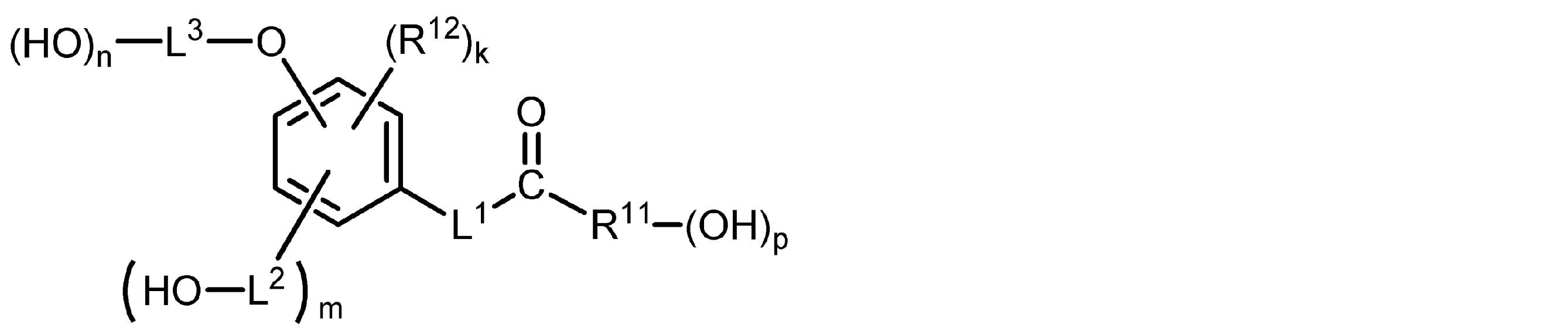
- 前記(C)の光重合開始剤として、下記式(In-3)で表される化合物を含む、請求項1~5のいずれか1項に記載のパターン形成用組成物;
式(In-3):
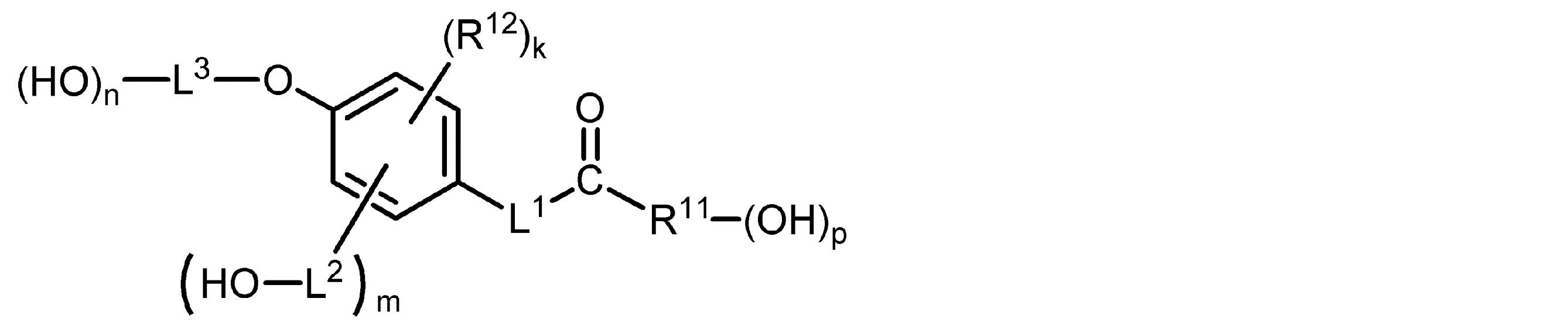
請求項5に記載のパターン形成用組成物。 - 前記(C)の光重合開始剤の分子量が170~330である、
請求項1~6のいずれか1項に記載のパターン形成用組成物。 - 前記(B)の光重合開始剤と前記(C)の光重合開始剤の間のハンセン溶解度パラメータ距離ΔHSPが4以上である、
請求項1~7のいずれか1項に記載のパターン形成用組成物。 - 前記(B)の光重合開始剤として、アシルフォスフィンオキサイド系化合物を含む、
請求項1~8のいずれか1項に記載のパターン形成用組成物。 - 前記(A)の重合性化合物の含有量が、全重合性化合物に対し30~90質量%である、請求項1~9のいずれか1項に記載のパターン形成用組成物。
- 前記パターン形成用組成物中の全固形分の含有量が、前記パターン形成用組成物全体に対し90質量%以上である、
請求項1~10のいずれか1項に記載のパターン形成用組成物。 - パターン形成用組成物に対する溶剤の含有量が5質量%以下である
請求項11に記載のパターン形成用組成物。 - さらに、(D)離型剤を含む、
請求項1~12のいずれか1項に記載のパターン形成用組成物。 - 前記離型剤が、水酸基を含有する化合物を含む、
請求項13に記載のパターン形成用組成物。 - 前記離型剤が、水酸基を含有しない化合物を含む、
請求項13または14に記載のパターン形成用組成物。 - 請求項1~15のいずれか1項に記載のパターン形成用組成物から形成された硬化膜。
- 請求項1~15のいずれか1項に記載のパターン形成用組成物からなる層状膜と、前記層状膜を形成するための基板とを含む積層体。
- 請求項1~15のいずれか1項に記載のパターン形成用組成物を、基板上またはモールド上に適用し、前記パターン形成用組成物を、前記モールドと前記基板で挟んだ状態で光照射することを含むパターンの製造方法。
- 請求項18に記載の製造方法を工程として含む、半導体素子の製造方法。
- 前記パターンをマスクとして前記基板のエッチングを行うことを含む、
請求項19に記載の半導体素子の製造方法。
Priority Applications (3)
| Application Number | Priority Date | Filing Date | Title |
|---|---|---|---|
| KR1020217039721A KR102668935B1 (ko) | 2019-06-07 | 2020-06-01 | 패턴 형성용 조성물, 경화막, 적층체, 패턴의 제조 방법 및 반도체 소자의 제조 방법 |
| JP2021524823A JP7281542B2 (ja) | 2019-06-07 | 2020-06-01 | パターン形成用組成物、硬化膜、積層体、パターンの製造方法および半導体素子の製造方法 |
| US17/542,499 US20220091503A1 (en) | 2019-06-07 | 2021-12-06 | Composition for forming pattern, cured film, laminate, pattern producing method, and method for manufacturing semiconductor element |
Applications Claiming Priority (2)
| Application Number | Priority Date | Filing Date | Title |
|---|---|---|---|
| JP2019107130 | 2019-06-07 | ||
| JP2019-107130 | 2019-06-07 |
Related Child Applications (1)
| Application Number | Title | Priority Date | Filing Date |
|---|---|---|---|
| US17/542,499 Continuation US20220091503A1 (en) | 2019-06-07 | 2021-12-06 | Composition for forming pattern, cured film, laminate, pattern producing method, and method for manufacturing semiconductor element |
Publications (1)
| Publication Number | Publication Date |
|---|---|
| WO2020246405A1 true WO2020246405A1 (ja) | 2020-12-10 |
Family
ID=73651968
Family Applications (1)
| Application Number | Title | Priority Date | Filing Date |
|---|---|---|---|
| PCT/JP2020/021513 Ceased WO2020246405A1 (ja) | 2019-06-07 | 2020-06-01 | パターン形成用組成物、硬化膜、積層体、パターンの製造方法および半導体素子の製造方法 |
Country Status (5)
| Country | Link |
|---|---|
| US (1) | US20220091503A1 (ja) |
| JP (1) | JP7281542B2 (ja) |
| KR (1) | KR102668935B1 (ja) |
| TW (1) | TWI871329B (ja) |
| WO (1) | WO2020246405A1 (ja) |
Cited By (2)
| Publication number | Priority date | Publication date | Assignee | Title |
|---|---|---|---|---|
| WO2023243484A1 (ja) * | 2022-06-13 | 2023-12-21 | キヤノン株式会社 | 硬化性組成物、反転パターン形成方法、膜形成方法及び物品製造方法 |
| WO2024116787A1 (ja) * | 2022-11-29 | 2024-06-06 | キヤノン株式会社 | 硬化性組成物、膜形成方法、および物品製造方法 |
Citations (5)
| Publication number | Priority date | Publication date | Assignee | Title |
|---|---|---|---|---|
| JP2008105414A (ja) * | 2006-09-27 | 2008-05-08 | Fujifilm Corp | 光ナノインプリントリソグラフィ用硬化性組成物およびそれを用いたパターン形成方法 |
| JP2013179159A (ja) * | 2012-02-28 | 2013-09-09 | Fujifilm Corp | インプリント用硬化性組成物、パターン形成方法及びパターン |
| JP2013225625A (ja) * | 2012-04-23 | 2013-10-31 | Tokuyama Corp | 光硬化性ナノインプリント用組成物およびパターンの形成方法 |
| JP2014170949A (ja) * | 2008-07-10 | 2014-09-18 | Fujifilm Corp | インプリント用硬化性組成物、パターン形成方法およびパターン |
| JP2015070145A (ja) * | 2013-09-30 | 2015-04-13 | 富士フイルム株式会社 | 光インプリント用硬化性組成物、パターン形成方法、微細パターン、および半導体デバイスの製造方法 |
Family Cites Families (13)
| Publication number | Priority date | Publication date | Assignee | Title |
|---|---|---|---|---|
| JPS6092200U (ja) | 1983-11-30 | 1985-06-24 | 三菱重工業株式会社 | 原子炉燃料収容用容器 |
| US8076386B2 (en) | 2004-02-23 | 2011-12-13 | Molecular Imprints, Inc. | Materials for imprint lithography |
| JP4937806B2 (ja) | 2007-03-24 | 2012-05-23 | 株式会社ダイセル | ナノインプリント用光硬化性樹脂組成物 |
| JP5665329B2 (ja) * | 2009-03-09 | 2015-02-04 | 富士フイルム株式会社 | インプリント用硬化性組成物、パターン形成方法およびパターン |
| JP5671302B2 (ja) * | 2009-11-10 | 2015-02-18 | 富士フイルム株式会社 | インプリント用硬化性組成物、パターン形成方法およびパターン |
| JP5710553B2 (ja) * | 2011-08-25 | 2015-04-30 | 富士フイルム株式会社 | インプリント用硬化性組成物、パターン形成方法およびパターン |
| KR20150013477A (ko) * | 2012-05-25 | 2015-02-05 | 소켄 케미칼 앤드 엔지니어링 캄파니, 리미티드 | 임프린트용 광 경화성 수지 조성물, 그 제조 방법 및 구조체 |
| EP2911184B1 (en) * | 2012-10-22 | 2019-07-24 | Soken Chemical & Engineering Co., Ltd. | Photocurable resin composition for imprinting, method for producing mold for imprinting, and mold for imprinting |
| JP6080813B2 (ja) | 2013-08-30 | 2017-02-15 | キヤノン株式会社 | 光インプリント用組成物、これを用いた、膜の製造方法、光学部品の製造方法、回路基板の製造方法、電子部品の製造方法 |
| JP2017085148A (ja) | 2013-08-30 | 2017-05-18 | キヤノン株式会社 | 光インプリント用組成物、これを用いた、膜の製造方法、光学部品の製造方法、回路基板の製造方法、電子部品の製造方法 |
| JP6475819B2 (ja) | 2015-03-20 | 2019-02-27 | 富士フイルム株式会社 | インプリント用硬化性組成物、硬化物、パターン形成方法、リソグラフィー方法、パターンおよびリソグラフィー用マスク |
| KR20180108721A (ko) * | 2016-02-29 | 2018-10-04 | 후지필름 가부시키가이샤 | 패턴 적층체의 제조 방법, 반전 패턴의 제조 방법 및 패턴 적층체 |
| WO2018027073A1 (en) * | 2016-08-03 | 2018-02-08 | Board Of Regents, The University Of Texas System | Wafer-scale programmable films for semiconductor planarization and for imprint lithography |
-
2020
- 2020-06-01 WO PCT/JP2020/021513 patent/WO2020246405A1/ja not_active Ceased
- 2020-06-01 JP JP2021524823A patent/JP7281542B2/ja active Active
- 2020-06-01 KR KR1020217039721A patent/KR102668935B1/ko active Active
- 2020-06-02 TW TW109118477A patent/TWI871329B/zh active
-
2021
- 2021-12-06 US US17/542,499 patent/US20220091503A1/en not_active Abandoned
Patent Citations (5)
| Publication number | Priority date | Publication date | Assignee | Title |
|---|---|---|---|---|
| JP2008105414A (ja) * | 2006-09-27 | 2008-05-08 | Fujifilm Corp | 光ナノインプリントリソグラフィ用硬化性組成物およびそれを用いたパターン形成方法 |
| JP2014170949A (ja) * | 2008-07-10 | 2014-09-18 | Fujifilm Corp | インプリント用硬化性組成物、パターン形成方法およびパターン |
| JP2013179159A (ja) * | 2012-02-28 | 2013-09-09 | Fujifilm Corp | インプリント用硬化性組成物、パターン形成方法及びパターン |
| JP2013225625A (ja) * | 2012-04-23 | 2013-10-31 | Tokuyama Corp | 光硬化性ナノインプリント用組成物およびパターンの形成方法 |
| JP2015070145A (ja) * | 2013-09-30 | 2015-04-13 | 富士フイルム株式会社 | 光インプリント用硬化性組成物、パターン形成方法、微細パターン、および半導体デバイスの製造方法 |
Cited By (2)
| Publication number | Priority date | Publication date | Assignee | Title |
|---|---|---|---|---|
| WO2023243484A1 (ja) * | 2022-06-13 | 2023-12-21 | キヤノン株式会社 | 硬化性組成物、反転パターン形成方法、膜形成方法及び物品製造方法 |
| WO2024116787A1 (ja) * | 2022-11-29 | 2024-06-06 | キヤノン株式会社 | 硬化性組成物、膜形成方法、および物品製造方法 |
Also Published As
| Publication number | Publication date |
|---|---|
| US20220091503A1 (en) | 2022-03-24 |
| TWI871329B (zh) | 2025-02-01 |
| KR102668935B1 (ko) | 2024-05-24 |
| JPWO2020246405A1 (ja) | 2020-12-10 |
| KR20220004192A (ko) | 2022-01-11 |
| TW202108352A (zh) | 2021-03-01 |
| JP7281542B2 (ja) | 2023-05-25 |
Similar Documents
| Publication | Publication Date | Title |
|---|---|---|
| JP2020528951A (ja) | 新規のレジスト下層膜形成用重合体、これを含むレジスト下層膜形成用組成物およびこれを用いた半導体素子の製造方法 | |
| KR102339571B1 (ko) | 키트, 임프린트용 하층막 형성 조성물, 적층체, 이들을 이용한 제조 방법 | |
| WO2020246405A1 (ja) | パターン形成用組成物、硬化膜、積層体、パターンの製造方法および半導体素子の製造方法 | |
| US20210388134A1 (en) | Curable composition for imprinting, kit, pattern producing method, and method for manufacturing semiconductor element | |
| JP7253042B2 (ja) | パターン形成用組成物、キット、硬化膜、積層体、パターンの製造方法、および半導体素子の製造方法 | |
| KR102350796B1 (ko) | 신규한 레지스트 하층막 형성용 중합체, 이를 포함하는 레지스트 하층막 형성용 조성물 및 이를 이용한 반도체 소자의 제조방법 | |
| WO2022065359A1 (ja) | ナノインプリント用中間層形成用組成物の製造方法、積層体の製造方法、インプリントパターンの製造方法及びデバイスの製造方法 | |
| JPWO2019065526A1 (ja) | インプリント用下層膜形成用組成物、キット、インプリント用硬化性組成物、積層体、積層体の製造方法、硬化物パターンの製造方法および回路基板の製造方法 | |
| US12109752B2 (en) | Composition for forming underlayer film in imprinting method, kit, pattern producing method, laminate, and method for manufacturing semiconductor element | |
| TWI904233B (zh) | 壓印圖案形成用組成物的製造方法、硬化物的製造方法、壓印圖案的製造方法及元件的製造方法 | |
| WO2022163597A1 (ja) | インプリントパターン形成用組成物、硬化物、インプリントパターンの製造方法、デバイス及びデバイスの製造方法 | |
| KR102383361B1 (ko) | 임프린트용 경화성 조성물, 경화물, 패턴 제조 방법, 리소그래피 방법, 패턴, 및 임프린트용 중합성 조성물 | |
| TWI831947B (zh) | 圖案形成用組成物、套組、圖案的製造方法、圖案以及半導體元件的製造方法 | |
| JP7638824B2 (ja) | インプリント用硬化性組成物、硬化物、インプリントパターンの製造方法及びデバイスの製造方法 | |
| JP7385683B2 (ja) | インプリントパターン形成用組成物、硬化物、インプリントパターンの製造方法及びデバイスの製造方法 | |
| JP7709336B2 (ja) | インプリント用硬化性組成物、塗布膜、膜の製造方法、硬化物、インプリントパターンの製造方法及びデバイスの製造方法 | |
| TWI904329B (zh) | 壓印用硬化性組成物、硬化物、壓印圖案的製造方法及元件的製造方法 | |
| KR102770053B1 (ko) | 경화성 조성물, 키트, 중간층, 적층체, 임프린트 패턴의 제조 방법 및 디바이스의 제조 방법 | |
| CN118818898A (zh) | 有机膜形成用组合物、有机膜形成方法和图案形成方法 | |
| WO2024262499A1 (ja) | パターン反転用光硬化性組成物、及びこれを用いた電子デバイス又は光デバイスの製造方法 |
Legal Events
| Date | Code | Title | Description |
|---|---|---|---|
| 121 | Ep: the epo has been informed by wipo that ep was designated in this application |
Ref document number: 20819488 Country of ref document: EP Kind code of ref document: A1 |
|
| ENP | Entry into the national phase |
Ref document number: 2021524823 Country of ref document: JP Kind code of ref document: A |
|
| ENP | Entry into the national phase |
Ref document number: 20217039721 Country of ref document: KR Kind code of ref document: A |
|
| NENP | Non-entry into the national phase |
Ref country code: DE |
|
| 122 | Ep: pct application non-entry in european phase |
Ref document number: 20819488 Country of ref document: EP Kind code of ref document: A1 |