WO2020240705A1 - フラボノイド配糖体の分解方法、フラボノイドの製造方法、及び、オートクレーブ内での溶液の冷却方法 - Google Patents
フラボノイド配糖体の分解方法、フラボノイドの製造方法、及び、オートクレーブ内での溶液の冷却方法 Download PDFInfo
- Publication number
- WO2020240705A1 WO2020240705A1 PCT/JP2019/021136 JP2019021136W WO2020240705A1 WO 2020240705 A1 WO2020240705 A1 WO 2020240705A1 JP 2019021136 W JP2019021136 W JP 2019021136W WO 2020240705 A1 WO2020240705 A1 WO 2020240705A1
- Authority
- WO
- WIPO (PCT)
- Prior art keywords
- autoclave
- solution
- cooling
- pressure
- compressed gas
- Prior art date
- Legal status (The legal status is an assumption and is not a legal conclusion. Google has not performed a legal analysis and makes no representation as to the accuracy of the status listed.)
- Ceased
Links
Images

Classifications
-
- B—PERFORMING OPERATIONS; TRANSPORTING
- B01—PHYSICAL OR CHEMICAL PROCESSES OR APPARATUS IN GENERAL
- B01J—CHEMICAL OR PHYSICAL PROCESSES, e.g. CATALYSIS OR COLLOID CHEMISTRY; THEIR RELEVANT APPARATUS
- B01J3/00—Processes of utilising sub-atmospheric or super-atmospheric pressure to effect chemical or physical change of matter; Apparatus therefor
- B01J3/04—Pressure vessels, e.g. autoclaves
-
- C—CHEMISTRY; METALLURGY
- C07—ORGANIC CHEMISTRY
- C07D—HETEROCYCLIC COMPOUNDS
- C07D311/00—Heterocyclic compounds containing six-membered rings having one oxygen atom as the only hetero atom, condensed with other rings
- C07D311/02—Heterocyclic compounds containing six-membered rings having one oxygen atom as the only hetero atom, condensed with other rings ortho- or peri-condensed with carbocyclic rings or ring systems
- C07D311/04—Benzo[b]pyrans, not hydrogenated in the carbocyclic ring
- C07D311/22—Benzo[b]pyrans, not hydrogenated in the carbocyclic ring with oxygen or sulfur atoms directly attached in position 4
- C07D311/26—Benzo[b]pyrans, not hydrogenated in the carbocyclic ring with oxygen or sulfur atoms directly attached in position 4 with aromatic rings attached in position 2 or 3
- C07D311/28—Benzo[b]pyrans, not hydrogenated in the carbocyclic ring with oxygen or sulfur atoms directly attached in position 4 with aromatic rings attached in position 2 or 3 with aromatic rings attached in position 2 only
- C07D311/30—Benzo[b]pyrans, not hydrogenated in the carbocyclic ring with oxygen or sulfur atoms directly attached in position 4 with aromatic rings attached in position 2 or 3 with aromatic rings attached in position 2 only not hydrogenated in the hetero ring, e.g. flavones
Definitions
- the present invention relates to a method for decomposing flavonoid glycosides, a method for producing flavonoids, and a method for cooling a solution in an autoclave.
- Flavonoids are a group of naturally occurring organic compounds, and are contained in flowers, leaves, roots, stems, fruits, seeds, etc. of various plants, including citrus fruits and legumes. Flavonoids have different characteristics and actions depending on the type, but most of them have a strong antioxidant action.
- polymethoxyflavone which is a flavonoid contained in citrus fruits, is known to have an antioxidant effect, a carcinogenic inhibitory effect, an antibacterial effect, an antiviral effect, an antiallergic effect, a melanin production inhibitory effect, a blood glucose level suppressing effect, and the like. It is expected to be applied to various uses such as pharmaceuticals, health foods, and cosmetics.
- the conventional flavonoid production method has a problem that the yield of flavonoids is low. Therefore, it is required to develop a production method capable of improving the yield of flavonoids.
- the peel of citrus fruits contains a larger amount of flavonoid glycosides in addition to flavonoids, but if this can be recovered as flavonoids, the yield of flavonoids can be improved.
- the method of decomposing flavonoid glycosides into flavonoids include a method of reacting flavonoid glycosides with an acid such as hydrochloric acid. However, this method has a problem that the used acid may remain and be mixed in the product, and a side reaction product of the acid and flavonoid may be generated.
- Examples of the method for removing impurities such as acids and by-products include a method for separating and purifying flavonoids in decomposition products by liquid chromatography, but there are problems that the cost is high and the production efficiency is poor. Therefore, a new method for decomposing flavonoid glycosides without using an acid is required.
- the present invention has been made in view of the above-mentioned problems of the prior art, and is a flavonoid glycoside capable of efficiently decomposing flavonoid glycosides into flavonoids without using an acid and improving the yield of flavonoids. It is an object of the present invention to provide a decomposition method and a method for producing flavonoids.
- an autoclave is used.
- the autoclave is, for example, sterilized to kill pathogens in medicine and biochemistry for the purpose of performing special chemical reactions such as pressurization / heating reactions and supercritical and subcritical solution reactions in the chemical industry.
- special chemical reactions such as pressurization / heating reactions and supercritical and subcritical solution reactions in the chemical industry.
- it is used in engineering for the purpose of forming composite materials such as carbon fiber reinforced plastics and curing concrete such as artificial slate. In this way, autoclaves are used in various fields according to their purposes.
- the heat capacity of the autoclave tank increases as the processing volume increases, so that the time required for raising the temperature to the autoclave processing temperature and the removal of the autoclave processing object from the tank after the treatment is completed.
- the cooling time of the autoclave becomes very long.
- the autoclave is cooled by exhausting the high-pressure steam in the tank, conducting heat in the tank and boiling the solution in the tank, but in the autoclave treatment of supercritical and subcritical solutions, the boiling point of the solution at normal pressure.
- the pressure is reduced during cooling after the treatment, the solution boils violently and scatters, contaminating the inside of the tank and significantly lowering the yield.
- the present invention has been made in view of the above-mentioned problems of the prior art, and when cooling a solution treated by using an autoclave, a decrease in yield can be suppressed and a cooling time can be significantly shortened. It is an object of the present invention to provide a method of cooling a solution within.
- the present invention comprises a hydrothermal treatment step of decomposing the flavonoid glycosides into flavonoids by hydrothermally treating the raw material solution containing the flavonoid glycosides in an autoclave, and the raw material solution is water. It has a cooling step of cooling the solution obtained by heat treatment, and in the cooling step, the pressure in the autoclave is maintained above the saturated vapor pressure of the solution by introducing the compressed gas into the autoclave.
- a method for decomposing flavonoid glycosides which cools the above solution.
- flavonoid glycosides can be efficiently decomposed into flavonoids by hydrothermal treatment without using an acid. Further, by using this method, flavonoids can be efficiently produced at low cost.
- the present inventors have found that in the method of decomposing flavonoid glycosides by hydrothermal treatment, a phenomenon occurs in which the solution suddenly boils and scatters when the solution is cooled and depressurized after the hydrothermal treatment. Scattering of this solution is one of the causes of the decrease in flavonoid yield.
- the present inventors introduced a compressed gas into the autoclave and cooled it while maintaining the pressure in the autoclave above the saturated vapor pressure of the solution. It was found that the yield of the product can be greatly improved. By cooling the solution by this method, the sudden boiling and scattering of the solution can be sufficiently suppressed, and the yield of flavonoids can be greatly improved.
- the cooling time can be significantly shortened as compared with the case of natural cooling.
- the saturated vapor pressure of a solution means the saturated vapor pressure of a solution at each time.
- the temperature of the solution gradually decreases with the passage of time, so that the saturated vapor pressure of the solution also gradually decreases with the passage of time.
- the pressure in the autoclave may be maintained within the range of 100.5% or more and 300% or less of the saturated vapor pressure of the solution.
- the pressure in the autoclave may be set to 100.5% or more of the saturated vapor pressure of the solution, it is possible to sufficiently suppress the sudden boiling of the solution even when the pressure in the tank of the autoclave becomes non-uniform.
- the pressure in the autoclave is set to 300% or less of the saturated vapor pressure of the solution, it is not necessary to increase the pressure resistance of the autoclave tank more than necessary, so that the equipment cost can be suppressed and it is economical.
- the compressed gas may be continuously or intermittently introduced into the autoclave at a rate of 5% / min or more and 200% / min or less of the tank volume of the autoclave.
- the inside of the autoclave tank is cooled by the introduced compressed gas, and the solution is also cooled by cooling the inside of the tank, so the introduction rate of the compressed gas is 5% / minute or more of the tank volume.
- the compressed gas may be introduced continuously or intermittently.
- the compressed gas may be composed of at least one gas selected from the group consisting of air, nitrogen, oxygen and carbon dioxide. Since the chemical reaction may still continue in the solution immediately after the heating and pressurizing treatment in the autoclave, it is preferable to use a gas suitable for the reaction. Generally, air can be used, but if the solution is easily oxidized and you want to prevent oxidation, it is preferable to use nitrogen or carbon dioxide, and if you want to maintain the oxidation reaction, etc., use oxygen. You can also.
- the pressure of the compressed gas to be introduced may be in the range of 100.5% or more and 300% or less of the saturated vapor pressure of the solution at the time of introducing the compressed gas.
- the pressure in the autoclave can be easily adjusted within the range of 100.5% or more and 300% or less of the saturated vapor pressure of the solution, and the above-mentioned effect can be obtained.
- the solution in the autoclave may be cooled to the boiling point or lower under normal pressure of the solution.
- the solution in the autoclave may be cooled to below its boiling point under normal pressure, it is possible to prevent the solution from suddenly boiling when it is taken out of the autoclave.
- the hydrothermal treatment may be performed by supplying steam from the outside into the autoclave.
- the temperature inside the autoclave can be raised and raised in a short time, and a hydrothermal treatment environment can be easily formed and maintained.
- the pressure in the autoclave may be 0.2 to 1.6 MPa and the temperature may be 120 to 200 ° C.
- the flavonoid glycoside may contain a sudachitin glycoside and / or a demethoxysudachitin glycoside. According to the above decomposition method, sudachitin glycosides and demethoxysudachitin glycosides can be decomposed particularly efficiently.
- the present invention also comprises a method for producing flavonoids, which comprises a decomposition step of decomposing flavonoid glycosides by the decomposition method of the present invention and an extraction step of extracting flavonoids from the decomposition products obtained in the decomposition step. provide. According to such a production method, flavonoids can be produced in high yield, at low cost and efficiently.
- the present invention is also a method of cooling a solution heated and pressurized in the autoclave, and by introducing a compressed gas into the autoclave, the pressure in the autoclave is maintained above the saturated vapor pressure of the solution. While providing a method of cooling a solution in an autoclave, comprising a cooling step of cooling the solution.
- the solution when the heated and pressurized solution is cooled in the autoclave, the solution does not suddenly boil and scatter, so that the decrease in yield can be suppressed and the cooling time is significantly extended. Can be shortened to. This is because the compressed gas is introduced into the autoclave and cooling is performed while maintaining the pressure in the autoclave above the saturated vapor pressure of the solution. By introducing the compressed gas, it is possible to maintain the pressure in the autoclave and cool it in a short time at the same time.
- flavonoid glycosides can be efficiently decomposed into flavonoids without using an acid, and the yield of flavonoids can be improved.
- a method for decomposing flavonoid glycosides and flavonoids A manufacturing method can be provided. Further, according to the present invention, when cooling a solution treated using an autoclave, it is possible to provide a method for cooling the solution in the autoclave, which can suppress a decrease in yield and significantly shorten the cooling time. Can be done.
- the numerical range indicated by using “-" indicates a range including the numerical values before and after "-" as the minimum value and the maximum value, respectively.
- the upper limit value or the lower limit value of the numerical range of one step can be arbitrarily combined with the upper limit value or the lower limit value of the numerical range of another step.
- the upper limit value or the lower limit value of the numerical range may be replaced with the value shown in the examples.
- “A or B” may include either A or B, or both.
- the materials exemplified in the present specification may be used alone or in combination of two or more.
- the method for decomposing the flavonoid glycoside includes a hydrothermal treatment step of decomposing the flavonoid glycoside into flavonoids by hydrothermally treating the raw material solution containing the flavonoid glycoside in an autoclave, and the raw material solution.
- a cooling step of cooling the solution obtained by hydrothermal treatment and in the cooling step, by introducing a compressed gas into the autoclave, the pressure in the autoclave is equal to or higher than the saturated vapor pressure of the solution. It is a method of cooling the above solution while maintaining the temperature.
- Flavonoid glycosides are hydrophilic compounds having a structure in which flavonoids and sugars are bound by glycosidic bonds. Flavonoids, which are the source of flavonoid glycosides, are aromatic compounds having a phenylchroman skeleton as a basic structure. Kind and the like. Among these, the flavonoid may be polymethoxyflavone, which is a flavon.
- polymethoxyflavones examples include sudachitin, demethoxysudachitin, nobiletin, tangeretin, pentamethoxyflavones, tetramethoxyflavones, and heptamethoxyflavones.
- the polymethoxyflavone may be sudachitin or demethoxysudachitin.
- the sugar that is the source of the flavonoid glycoside is not particularly limited, and examples thereof include known sugars that can form a glycoside by binding to the flavonoid described above by a glycosidic bond.
- the raw material liquid to be subjected to hydrothermal treatment is a raw material containing flavonoid glycosides dissolved or dispersed in water.
- the raw material may contain components other than flavonoid glycosides. Examples of other components include flavonoids, water-soluble dietary fiber, poorly soluble dietary fiber, sugars and the like.
- the raw material liquid may contain a solvent other than water. Examples of the solvent other than water include alcohol.
- the content of flavonoid glycosides in the raw material is preferably 0.1% by mass or more, more preferably 0.25 to 30% by mass, and 0.5 to 0.5 to 30% by mass, based on the total solid content of the raw material. It is more preferably 5% by mass.
- the content of flavonoid glycosides is preferably 0.25 parts by mass or more, preferably 0.5 to 100 parts by mass, based on 1 part by mass of the flavonoid content. Is more preferable, and 5 to 50 parts by mass is further preferable.
- the concentration of the raw material in the raw material liquid is preferably 1 to 30% by mass, more preferably 3 to 20% by mass, and further preferably 5 to 10% by mass, based on the total amount of the raw material liquid. ..
- concentration of the raw material is 1% by mass or more, the yield of decomposition products increases, so that the amount of flavonoids obtained by one decomposition treatment tends to increase.
- concentration is 30% by mass or less, flavonoid glycosides tend to increase. There is a tendency that the decomposition of the above can be performed more reliably and efficiently.
- the raw material may be a dry powder obtained from citrus fruits, or may be a dry powder obtained from the peel of citrus fruits.
- citrus fruits include sudachi, satsuma mandarin, ponkan, and shikuwasa.
- the citrus fruits may be sudachi containing a large amount of polymethoxyflavones such as sudachitin and demethoxysudachitin, and their glycosides.
- Hydrothermal treatment can be performed by enclosing the raw material liquid in an autoclave and heating it at a temperature exceeding 100 ° C. while keeping it sealed. By heating the raw material liquid in the autoclave, the inside of the autoclave becomes a heating and pressurizing environment, and hydrothermal treatment (hydrothermal synthesis) is performed. The hydrothermal treatment may be performed while stirring the raw material liquid. Further, the hydrothermal treatment may be performed by supplying steam from the outside into the autoclave. For example, by supplying saturated steam at high temperature and high pressure into the autoclave, the inside of the autoclave becomes a heating and pressurizing environment, and hydrothermal synthesis is performed.
- the autoclave is not particularly limited, and may be either a vertical type or a horizontal type.
- the raw material liquid When a vertical autoclave is used, the raw material liquid may be directly filled in the tank, or the raw material liquid may be placed in a raw material container and placed on a table. When the raw material liquid is put into the raw material container, water may be put in the autoclave tank separately from the raw material liquid.
- hydrothermal treatment can be performed by, for example, the following method.
- FIG. 1 is a schematic cross-sectional view showing an example of an autoclave (horizontal circulation type autoclave) used in the above disassembly method.
- a cylindrical muffle furnace 3 having both ends open is arranged in a cylindrical pressure vessel (tank) 2 provided with a door (sealed door) 1 that can be sealed at one end.
- An air passage 4 is formed between the inner wall of the pressure vessel 2 and the outer wall of the muffle furnace 3.
- one end of the muffle furnace 3 is connected to the circulation fan 8 via the cooler 6, the heater 5, and the air passage 9.
- the circulation fan 8 is attached to a rotating shaft of a motor 7 arranged outside the end of the pressure vessel 2 on the opposite side of the closed door 1.
- a movable table 12 is arranged inside the muffle furnace 3, and a raw material container 11 filled with the raw material liquid 10 is placed on the movable table 12.
- a boiler 13 for supplying steam is connected to the pressure vessel 2 via a pipe provided with a valve 14. Further, a pipe provided with a pressure gauge 15 and a pressure valve 16 is connected to the pressure vessel 2 in order to adjust the internal pressure.
- the raw material container 11 is not particularly limited as long as it can withstand the temperature and pressure during hydrothermal treatment and the amount of impurities mixed in the raw material liquid 10 is small.
- metal such as stainless steel, titanium and its alloy, and glass.
- a tank-shaped, bottle-shaped, cup-shaped, tray-shaped, or drum-shaped container made of a resin such as polytetrafluoroethylene can be used.
- at least the inner surface of the container may be coated with a chemically stable material having heat resistance and pressure resistance such as enamel and polytetrafluoroethylene.
- the steam supplied from the boiler 13 into the pressure vessel 2 circulates in the autoclave 100 along the arrow in FIG. That is, the water vapor is sent out to the air passage 4 by the circulation fan 8 and heads for the closed door 1, then flows into the muffle furnace 3 and flows around the raw material container 11, and passes through the cooler 6, the heater 5, and the air passage 9. It is sucked by the circulation fan 8 and sent out to the air passage 4 again.
- the amount of water vapor supplied is adjusted by operating the valve 14 so that the inside of the autoclave 100 has a predetermined temperature and pressure.
- the temperature inside the autoclave 100 may be adjusted by the heater 5 and the cooler 6. Further, the pressure in the autoclave 100 may be adjusted by opening and closing the pressure valve 16.
- the reaction conditions of the hydrothermal treatment are not particularly limited, but can be, for example, 0.5 to 20 hours at 110 to 300 ° C.
- the reaction temperature is preferably 120 to 200 ° C., more preferably 120 to 190 ° C., and even more preferably 140 to 185 ° C.
- the reaction time is preferably 0.5 to 20 hours, more preferably 1 to 10 hours. When the reaction time is 0.5 hours or more, the reaction tends to proceed more easily, and when the reaction time is 20 hours or less, the progress of the reaction and the cost tend to be easily balanced.
- the pressure in the autoclave during hydrothermal treatment may be the saturated vapor pressure corresponding to the above reaction temperature or higher, but from the viewpoint of the pressure resistance of the apparatus, it is 3 times or less the saturated vapor pressure at the maximum temperature used. It may be twice or less.
- the pressure in the autoclave during the hydrothermal treatment can be, for example, 0.2 to 1.6 MPa.
- flavonoid glycosides can be efficiently decomposed into flavonoids (more specifically, flavonoids and sugars).
- a cooling step of cooling the solution obtained by hydrothermally treating the raw material liquid is performed.
- the compressed gas is introduced into the autoclave to cool the solution while maintaining the pressure in the autoclave above the saturated vapor pressure of the solution at each time. More specifically, as shown in FIG. 1, the compressed gas is introduced from the compressor 17 into the pressure vessel 2 (inside the tank) of the autoclave 100. The introduced compressed air circulates in the autoclave 100 along the arrow in FIG. Further, the pressure in the autoclave 100 is maintained above the saturated vapor pressure of the solution at each time by adjusting the pressure of the compressed air by the compressor 17 and adjusting the introduction speed of the compressed air by operating the valve 18. It becomes.
- the pressure in the autoclave in the cooling step is preferably 100.5% or more and 300% or less of the saturated vapor pressure of the solution at that time.
- the pressure in the autoclave may be 200% or less or 150% or less of the saturated vapor pressure of the solution at each time.
- the rate of introduction of the compressed gas into the autoclave tank in the cooling step is preferably 5% / min or more of the volume of the autoclave, and there is no particular limitation on the upper limit, but the higher the rate of introduction of the compressed gas, the faster the cooling rate.
- the introduction speed of the compressed gas can be appropriately selected according to the cooling rate and the amount of money.
- the introduction rate of the compressed gas may be 50% / min or more of the tank volume, or 100% / min or more.
- the introduction rate of the compressed gas may be 200% / min or less of the tank volume.
- the introduction speed of the compressed gas By setting the introduction speed of the compressed gas to 200% / min or less of the tank volume, the wind speed in the tank becomes too high and the container containing the solution moves and falls, or the solution in the container is blown off by the wind. It is possible to prevent problems from occurring.
- the introduction rate of the compressed gas may be 150% / min or less of the tank volume, or 120% / min or less.
- the compressed gas may be introduced continuously or intermittently. Further, in order to adjust the pressure in the autoclave, the gas in the autoclave may be discharged. The gas in the autoclave may also be discharged continuously or intermittently. The introduction of the compressed gas and the discharge of the gas in the autoclave may be performed at the same time or may be performed separately in time. For example, the pressure in the autoclave may be maintained within a predetermined range by intermittently discharging the gas in the autoclave while continuously introducing the compressed gas. By flowing the compressed gas in the autoclave by such a method, the temperature of the solution can be efficiently lowered.
- the pressure of the compressed gas to be introduced may be in the range of 100.5% or more and 300% or less of the saturated vapor pressure of the solution at the time of introducing the compressed gas.
- the pressure in the autoclave can be easily adjusted within the range of 100.5% or more and 300% or less of the saturated vapor pressure of the solution, and the above-mentioned effect can be obtained.
- the pressure of the compressed gas to be introduced may be 110% or more and 200% or less of the saturated vapor pressure of the solution at the time of introducing the compressed gas, or 120% or more and 150% or less. Good.
- the type of compressed gas is not particularly limited, but since the chemical reaction of the solution may still continue immediately after the completion of the hydrothermal treatment step, it is preferable to use a gas suitable for the reaction.
- the compressed gas may consist of at least one gas selected from the group consisting of air, nitrogen, oxygen and carbon dioxide. Generally, air can be used as the compressed gas, but it is preferable to use nitrogen or carbon dioxide when the solution is easily oxidized and the oxidation is to be prevented, and oxygen is used when the oxidation reaction or the like is to be maintained. Can also be used.
- the cooling time can be further shortened by using the cooling water pipe, shower, cooler, etc. introduced in the tank at the time of cooling.
- a lid may be arranged at the opening of the raw material container from the viewpoint of preventing impurities from being mixed in from the outside.
- arranging the lid it is necessary to arrange the raw material container so as not to be sealed by providing a gap between the raw material container and the lid.
- By arranging the lid for example, when cooling water or the like is ejected by a shower to cool the inside of the tank, it is possible to prevent the cooling water from being mixed into the raw material container.
- the temperature of the solution in the autoclave after the cooling step is not particularly limited, but the solution in the autoclave may be cooled to the boiling point or lower under normal pressure of the solution. By cooling the solution to below its boiling point under normal pressure, it is possible to prevent the solution from suddenly boiling when it is taken out of the autoclave.
- the pressure in the autoclave may be gradually reduced as the temperature of the solution decreases, or the solution may be cooled while maintaining a constant pressure, and then the pressure in the autoclave may be rapidly reduced. ..
- the solution after the cooling step can be cooled to room temperature by natural cooling after being taken out from the autoclave. Thereby, a decomposition product of flavonoid glycoside (glycoside decomposition product) can be obtained.
- the cooling method in the cooling step described above is not limited to the method for decomposing flavonoid glycosides, and can be widely applied as a cooling method for cooling a solution heated and pressurized in an autoclave.
- the above cooling method is also applicable to general ether and ester hydrolysis reactions.
- the method for producing flavonoids according to the present embodiment includes a decomposition step of decomposing flavonoid glycosides and an extraction step of extracting flavonoids from the decomposition products obtained in the decomposition step.
- the decomposition step is a step of decomposing the flavonoid glycoside by the method for decomposing the flavonoid glycoside according to the present embodiment described above.
- flavonoids are extracted from the decomposition products obtained in the decomposition process.
- the decomposition products include sugars, flavonoid glycosides remaining without decomposition, water-soluble and sparingly soluble celluloses, and decomposition products thereof.
- flavonoids are hydrophobic, whereas sugars, flavonoid glycosides, water-soluble celluloses and their decomposition products are hydrophilic. Therefore, flavonoids are contained in a high concentration in the components insoluble in the aqueous solution after the hydrothermal treatment, and the flavonoids can be concentrated by separating the aqueous solution and the insoluble matter after the hydrothermal treatment.
- the water-insoluble component is further dissolved in a solvent that dissolves the flavonoid, for example, ethanol, ethyl acetate, hexane, toluene, etc., and a mixed solvent thereof, and the insoluble matter is removed by filtration or the like to further extract the flavonoid.
- a solvent that dissolves the flavonoid for example, ethanol, ethyl acetate, hexane, toluene, etc.
- a mixed solvent thereof for example, ethanol, ethyl acetate, hexane, toluene, etc.
- the insoluble matter is removed by filtration or the like to further extract the flavonoid.
- a high-concentration flavonoid can be obtained.
- flavonoids can be efficiently produced in high yield.
- the flavonoid produced by the production method of the present embodiment may be polymethoxyflavone, sudachitin and / or demethoxysudachitin.
- the production method of the present embodiment is suitable for producing polymethoxyflavones, particularly sudachitin and demethoxysudachitin, and the yield thereof can be greatly improved.
- the autoclave 100 shown in FIG. 1 includes one circulation fan 8, but an autoclave including a plurality of circulation fans may be used.
- circulation fans when circulation fans are installed at a plurality of locations in the muffle furnace 3, the temperature in the muffle furnace 3 is likely to be uniform, and even when a plurality of raw material liquids are accommodated, the temperature of each raw material liquid is likely to be uniform. ..
- the autoclave 100 shown in FIG. 1 includes a cooler 6 and a heater 5, but one or both of them may not be provided.
- the flavonoid glycoside decomposition method and the solution cooling method in the autoclave may include a natural cooling step of naturally cooling the inside of the autoclave before the above-mentioned cooling step.
- the natural cooling step for example, the cooling time can be shortened by naturally cooling to a range where a compressor having a compression capacity less than the saturated vapor pressure of the solution immediately after the treatment can be used, and then performing high-pressure cooling.
- the natural cooling step may be performed for 10 minutes or more immediately after the completion of the hydrothermal treatment step (heating and pressurizing treatment in the autoclave), or may be performed for 10 to 60 minutes.
- the natural cooling step may be carried out until the temperature of the solution becomes 95% or less of the temperature of the solution immediately after the hydrothermal treatment step (heating and pressurizing treatment in the autoclave) is completed, and until it reaches 70 to 95%. You may go.
- Example 1 Sudachi peel extract powder (manufactured by Ikeda Yakuso Co., Ltd.), which has a sudachitin content of 1000 mass ppm and a sugar-derived sudachitin content of 9000 mass ppm, is dissolved / dispersed in ultrapure water so as to have a content of 5 mass%.
- An aqueous dispersion was prepared. 15L stainless steel tank (manufactured by Nitto Metal Industry Co., Ltd., container depth: 27 cm) and 1L polytetrafluoroethylene (PTFE) bottle (manufactured by AS ONE Corporation, trade name: Big Boy wide mouth 1000 ml, container depth 20 cm) ), The predetermined amount shown in Table 1 was added.
- PTFE polytetrafluoroethylene
- Samples 1 to 3 shown in Table 1 were housed in a circulating hot air autoclave tank volume 2m 3 (KK Ashida Seisakusho), 1 hour, and glycoside decomposing sudachi peel extract aqueous dispersion at 180 ° C. ..
- saturated steam at 180 ° C is supplied from the boiler into the tank (pressure vessel) of the autoclave, and the amount of steam supplied and the pressure valve so that the pressure in the tank becomes 1 MPa, which is the saturated steam pressure of water at 180 ° C. I went while adjusting.
- the tank pressure of 1 MPa (tank temperature 180 ° C., solution temperature 180 ° C.) is cooled by natural cooling for 10 minutes, and when it reaches 0.73 MPa (tank temperature 165 ° C., solution temperature 165 ° C.).
- compressed air with a pressure of 1 MPa was introduced into the tank by opening a valve.
- the introduction rate of compressed air was 7.5% / min of the tank volume.
- the gas in the tank is intermittently discharged while continuously introducing compressed air into the tank so that the pressure in the tank is maintained in the range of about 0.75 to 1 MPa.
- the inside of the tank and the solution temperature were cooled to 100 ° C.
- the time required for cooling was 1 hour.
- the introduction of compressed air was stopped, the closed door of the autoclave was opened, samples 1 to 3 were taken out, and the solution in the container was naturally cooled to room temperature (25 ° C.).
- the solution and solid content in each container are depressurized using a diaphragm pump using a hydrophilic PTFE membrane filter (Merck-Millipore, trade name: Omnipore 0.2 ⁇ m JG) with an opening of 0.2 ⁇ m. It was filtered.
- the separated solution contains the decomposed sugars derived from glycosides, and the solids contain a high concentration of decomposed sudachitin. Therefore, the obtained solids are put into a 200 cc glass beaker. It was put in and dried in an oven at 120 ° C. for 5 hours to obtain a powdery glycoside decomposition product.
- the glycoside decomposition product was dispersed in ethanol to prepare a 5% by mass dispersion, and treated at 60 ° C. for 1 hour under reflux to extract sudachitin in ethanol. Then, the dispersion is filtered under reduced pressure using a diaphragm pump using a hydrophilic PTFE membrane filter (Merck-Millipore, trade name: Omnipore 0.2 ⁇ m JG) with a mesh opening of 0.2 ⁇ m, and the sudachitin solution is dissolved.
- Got The sudachitin solution was vacuum dried using a diaphragm pump under heating at 60 ° C. to obtain a powdered sudachitin concentrated powder.
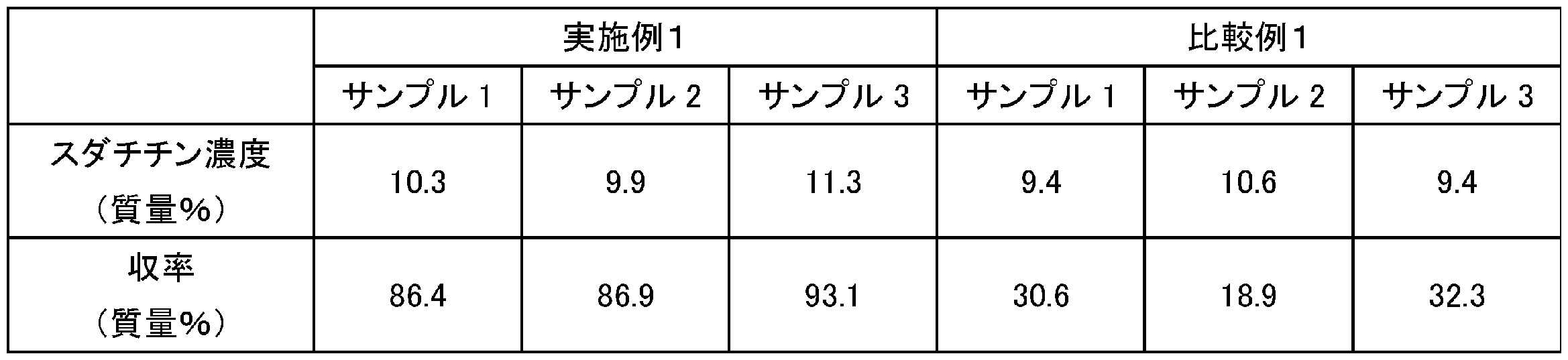
- the yield of sudachitin was determined from the mass of the sudachitin concentrated powder and the sudachitin concentration. The yield indicates the ratio of the mass of sudachitin contained in the obtained concentrated sudachitin powder to the total mass of sudachitin and glycoside-derived sudachitin in the sample before the decomposition treatment. The results are shown in Table 2.
Landscapes
- Chemical & Material Sciences (AREA)
- Organic Chemistry (AREA)
- Chemical Kinetics & Catalysis (AREA)
- Saccharide Compounds (AREA)
Abstract
Description
本実施形態に係るフラボノイド配糖体の分解方法は、フラボノイド配糖体を含む原料液をオートクレーブ内で水熱処理することで、上記フラボノイド配糖体をフラボノイドに分解する水熱処理工程と、上記原料液が水熱処理されて得られた溶液を冷却する冷却工程と、を有し、上記冷却工程において、圧縮気体を上記オートクレーブ内に導入することで、上記オートクレーブ内の圧力を上記溶液の飽和蒸気圧以上に維持しながら、上記溶液を冷却する方法である。
本実施形態に係るフラボノイドの製造方法は、フラボノイド配糖体を分解する分解工程と、分解工程で得られた分解生成物からフラボノイドを抽出する抽出工程と、を含む。分解工程は、上述した本実施形態に係るフラボノイド配糖体の分解方法によりフラボノイド配糖体を分解する工程である。
スダチチン含有量1000質量ppm、配糖体由来スダチチン含有量9000質量ppmであるスダチ果皮エキス粉(池田薬草株式会社製)を超純水に5質量%となるように溶解/分散させ、スダチ果皮エキス水分散液を作製した。この水分散液を15Lステンレスタンク(日東金属工業株式会社製、容器深さ:27cm)及び1Lポリテトラフルオロエチレン(PTFE)ボトル(アズワン株式会社製、商品名:ビッグボーイ広口1000ml、容器深さ20cm)に表1に示す所定量投入した。

分解処理後、自然冷却等を行うことなく、直ちに圧力弁を全開にして減圧を行ったこと以外は実施例1と同様にして配糖体分解物及びスダチチン濃縮粉末を得た。減圧速度は180kPa/分であった。
(スダチチン濃縮粉末のスダチチン濃度測定)
各実施例及び比較例で得られたスダチチン濃縮粉末のスダチチン濃度は、以下の方法で測定した。まず、スダチチン濃縮粉末0.1gを希釈倍率500となるようにエタノールに溶解/分散させ、孔径0.1μmのPTFEフィルターでろ過して、エタノール溶液を得た。このエタノール溶液について、高速液体クロマトグラフィー(HPLC)により成分分析を行った。標準物質に市販のスダチチン標準精製試料を用いて検量線を作成し、それを用いてスダチチン濃縮粉末のスダチチン濃度を概算した。HPLC装置には、日立ハイテク製「クロムマスター」を用いた。結果を表2に示す。
スダチチン濃縮粉末の質量及びスダチチン濃度から、スダチチンの収率を求めた。収率は、分解処理前のサンプル中のスダチチン及び配糖体由来スダチチンの質量の合計に対する、得られたスダチチン濃縮粉末に含まれるスダチチンの質量の割合を示す。結果を表2に示す。
Claims (16)
- フラボノイド配糖体を含む原料液をオートクレーブ内で水熱処理することで、前記フラボノイド配糖体をフラボノイドに分解する水熱処理工程と、
前記原料液が水熱処理されて得られた溶液を冷却する冷却工程と、を有し、
前記冷却工程において、圧縮気体を前記オートクレーブ内に導入することで、前記オートクレーブ内の圧力を前記溶液の飽和蒸気圧以上に維持しながら、前記溶液を冷却する、フラボノイド配糖体の分解方法。 - 前記冷却工程において、前記オートクレーブ内の圧力を、前記溶液の飽和蒸気圧の100.5%以上300%以下の範囲内に維持する、請求項1に記載の分解方法。
- 前記冷却工程において、前記圧縮気体を、前記オートクレーブの槽容積の5%/分以上200%/分以下の速度で連続的に又は断続的に前記オートクレーブ内に導入する、請求項1又は2に記載の分解方法。
- 前記圧縮気体が、空気、窒素、酸素及び二酸化炭素からなる群より選択される少なくとも1種の気体からなる、請求項1~3のいずれか一項に記載の分解方法。
- 導入する前記圧縮気体の圧力を、当該圧縮気体を導入する時点での前記溶液の飽和蒸気圧の100.5%以上300%以下の範囲内とする、請求項1~4のいずれか一項に記載の分解方法。
- 前記冷却工程により、前記オートクレーブ内における前記溶液を、当該溶液の常圧下での沸点以下まで冷却する、請求項1~5のいずれか一項に記載の分解方法。
- 前記水熱処理は、前記オートクレーブ内に外部から水蒸気を供給することで行われる、請求項1~6のいずれか一項に記載の分解方法。
- 前記水熱処理工程において、前記オートクレーブ内の圧力が0.2~1.6MPaであり、温度が120~200℃である、請求項1~7のいずれか一項に記載の分解方法。
- 前記フラボノイド配糖体がスダチチン配糖体及び/又はデメトキシスダチチン配糖体を含む、請求項1~8のいずれか一項に記載の分解方法。
- 請求項1~9のいずれか一項に記載の分解方法によりフラボノイド配糖体を分解する分解工程と、
前記分解工程で得られた分解生成物からフラボノイドを抽出する抽出工程と、
を含む、フラボノイドの製造方法。 - オートクレーブ内で加熱及び加圧された溶液を冷却する方法であって、
圧縮気体を前記オートクレーブ内に導入することで、前記オートクレーブ内の圧力を前記溶液の飽和蒸気圧以上に維持しながら、前記溶液を冷却する冷却工程を有する、オートクレーブ内での溶液の冷却方法。 - 前記冷却工程において、前記オートクレーブ内の圧力を、前記溶液の飽和蒸気圧の100.5%以上300%以下の範囲内に維持する、請求項11に記載の冷却方法。
- 前記冷却工程において、前記圧縮気体を、前記オートクレーブの槽容積の5%/分以上200%/分以下の速度で連続的に又は断続的に前記オートクレーブ内に導入する、請求項11又は12に記載の冷却方法。
- 前記圧縮気体が、空気、窒素、酸素及び二酸化炭素からなる群より選択される少なくとも1種の気体からなる、請求項11~13のいずれか一項に記載の冷却方法。
- 導入する前記圧縮気体の圧力を、当該圧縮気体を導入する時点での前記溶液の飽和蒸気圧の100.5%以上300%以下の範囲内とする、請求項11~14のいずれか一項に記載の冷却方法。
- 前記冷却工程により、前記オートクレーブ内における前記溶液を、当該溶液の常圧下での沸点以下まで冷却する、請求項11~15のいずれか一項に記載の冷却方法。
Priority Applications (3)
| Application Number | Priority Date | Filing Date | Title |
|---|---|---|---|
| JP2021521629A JP7306452B2 (ja) | 2019-05-28 | 2019-05-28 | フラボノイド配糖体の分解方法、及び、フラボノイドの製造方法 |
| PCT/JP2019/021136 WO2020240705A1 (ja) | 2019-05-28 | 2019-05-28 | フラボノイド配糖体の分解方法、フラボノイドの製造方法、及び、オートクレーブ内での溶液の冷却方法 |
| JP2023079932A JP7513156B2 (ja) | 2019-05-28 | 2023-05-15 | オートクレーブ内での溶液の冷却方法 |
Applications Claiming Priority (1)
| Application Number | Priority Date | Filing Date | Title |
|---|---|---|---|
| PCT/JP2019/021136 WO2020240705A1 (ja) | 2019-05-28 | 2019-05-28 | フラボノイド配糖体の分解方法、フラボノイドの製造方法、及び、オートクレーブ内での溶液の冷却方法 |
Publications (1)
| Publication Number | Publication Date |
|---|---|
| WO2020240705A1 true WO2020240705A1 (ja) | 2020-12-03 |
Family
ID=73553152
Family Applications (1)
| Application Number | Title | Priority Date | Filing Date |
|---|---|---|---|
| PCT/JP2019/021136 Ceased WO2020240705A1 (ja) | 2019-05-28 | 2019-05-28 | フラボノイド配糖体の分解方法、フラボノイドの製造方法、及び、オートクレーブ内での溶液の冷却方法 |
Country Status (2)
| Country | Link |
|---|---|
| JP (2) | JP7306452B2 (ja) |
| WO (1) | WO2020240705A1 (ja) |
Citations (3)
| Publication number | Priority date | Publication date | Assignee | Title |
|---|---|---|---|---|
| WO2008155890A1 (ja) * | 2007-06-21 | 2008-12-24 | J-Oil Mills, Inc. | 配糖体アグリコンの製造方法 |
| JP2014073455A (ja) * | 2012-10-04 | 2014-04-24 | Kimura Chem Plants Co Ltd | 圧力調整機構およびそれを備えた高圧処理装置 |
| WO2014141465A1 (ja) * | 2013-03-15 | 2014-09-18 | テルモ株式会社 | 医療器具の滅菌方法及び滅菌制御装置 |
Family Cites Families (1)
| Publication number | Priority date | Publication date | Assignee | Title |
|---|---|---|---|---|
| JP4867884B2 (ja) * | 2007-10-05 | 2012-02-01 | 三菱化学株式会社 | 液化アンモニアの充填方法、および、窒化物結晶の製造方法 |
-
2019
- 2019-05-28 JP JP2021521629A patent/JP7306452B2/ja active Active
- 2019-05-28 WO PCT/JP2019/021136 patent/WO2020240705A1/ja not_active Ceased
-
2023
- 2023-05-15 JP JP2023079932A patent/JP7513156B2/ja active Active
Patent Citations (3)
| Publication number | Priority date | Publication date | Assignee | Title |
|---|---|---|---|---|
| WO2008155890A1 (ja) * | 2007-06-21 | 2008-12-24 | J-Oil Mills, Inc. | 配糖体アグリコンの製造方法 |
| JP2014073455A (ja) * | 2012-10-04 | 2014-04-24 | Kimura Chem Plants Co Ltd | 圧力調整機構およびそれを備えた高圧処理装置 |
| WO2014141465A1 (ja) * | 2013-03-15 | 2014-09-18 | テルモ株式会社 | 医療器具の滅菌方法及び滅菌制御装置 |
Non-Patent Citations (1)
| Title |
|---|
| LI-JUAN DU, QING-HAN GAO, XIAO-LONG JI, YU-JIE MA, FANG-YI XU, MIN WANG: "Comparison of Flavonoids, Phenolic Acids, and Antioxidant Activity of Explosion-Puffed and Sun-Dried Jujubes ( Ziziphus jujuba Mill.)", JOURNAL OF AGRICULTURAL AND FOOD CHEMISTRY, vol. 61, no. 48, 2013, pages 11840 - 11847, XP055763900 * |
Also Published As
| Publication number | Publication date |
|---|---|
| JPWO2020240705A1 (ja) | 2020-12-03 |
| JP7513156B2 (ja) | 2024-07-09 |
| JP2023099643A (ja) | 2023-07-13 |
| JP7306452B2 (ja) | 2023-07-11 |
Similar Documents
| Publication | Publication Date | Title |
|---|---|---|
| EP2881155B1 (en) | Pressurised low polarity water extraction apparatus and methods of use | |
| Both et al. | Mass transfer enhancement for solid–liquid extractions | |
| JP7581625B2 (ja) | 配糖体の分解方法及びアグリコンの製造方法 | |
| JP7306452B2 (ja) | フラボノイド配糖体の分解方法、及び、フラボノイドの製造方法 | |
| JP7264244B2 (ja) | フラボノイド配糖体の分解方法及びフラボノイドの製造方法 | |
| JP7419673B2 (ja) | フラボノイド配糖体の分解方法及びフラボノイドの製造方法 | |
| JP7567475B2 (ja) | フラボノイド配糖体の分解方法及びフラボノイドの製造方法 | |
| JP7383906B2 (ja) | フラボノイド配糖体の分解方法及びフラボノイドの製造方法 | |
| JP7687341B2 (ja) | フラボノイド配糖体の分解方法及びフラボノイドの製造方法 | |
| JP2020193168A (ja) | フラボノイド配糖体の分解方法及びフラボノイドの製造方法 | |
| US12195436B2 (en) | Method for decomposing flavonoid glycoside and method for producing flavonoid | |
| CN105038972A (zh) | 瓜蒌籽油超临界萃取工艺 | |
| JP7600524B2 (ja) | 配糖体の分解方法、アグリコンの製造方法及びスフィンゴ糖脂質の分解方法 | |
| KR20060093145A (ko) | 초임계유체 추출공정을 이용한 포도씨기름의 제조 방법 | |
| Anuara et al. | Optimising ultrasound-assisted extraction of phenolic compounds from ginger: a review | |
| JP2020193171A (ja) | フラボノイド配糖体の分解方法及びフラボノイドの製造方法 | |
| JP7484190B2 (ja) | 配糖体の分解方法及びアグリコンの製造方法 | |
| Nor et al. | Effect of extraction time and temperature on total flavonoids and coumarins content of Petai Belalang (Leucaena leucocephala) seeds | |
| CN109467545B (zh) | 一种从刺梨皮中提取原花青素的方法 | |
| EP4206214A1 (en) | Method for producing phytosterol starting material | |
| WO2023095568A1 (ja) | オリーブ葉からのヒドロキシチロソール製造方法、及びヒドロキシチロソール含有組成物 | |
| TW202017913A (zh) | 類黃酮類的製造方法 | |
| KR101807547B1 (ko) | 식물 소재로부터 유효성분의 고효율 추출방법 | |
| CN111000881A (zh) | 一种富含黄酮的巴西酒神菊属型蜂胶软胶囊及其制备方法 |
Legal Events
| Date | Code | Title | Description |
|---|---|---|---|
| 121 | Ep: the epo has been informed by wipo that ep was designated in this application |
Ref document number: 19931477 Country of ref document: EP Kind code of ref document: A1 |
|
| ENP | Entry into the national phase |
Ref document number: 2021521629 Country of ref document: JP Kind code of ref document: A |
|
| NENP | Non-entry into the national phase |
Ref country code: DE |
|
| 32PN | Ep: public notification in the ep bulletin as address of the adressee cannot be established |
Free format text: NOTING OF LOSS OF RIGHTS PURSUANT TO RULE 112(1) EPC (EPO FORM 1205A DATED 11.03.2022) |
|
| 122 | Ep: pct application non-entry in european phase |
Ref document number: 19931477 Country of ref document: EP Kind code of ref document: A1 |