WO2020195994A1 - パターン形成用組成物、キット、パターンの製造方法、パターン、および、半導体素子の製造方法 - Google Patents
パターン形成用組成物、キット、パターンの製造方法、パターン、および、半導体素子の製造方法 Download PDFInfo
- Publication number
- WO2020195994A1 WO2020195994A1 PCT/JP2020/011328 JP2020011328W WO2020195994A1 WO 2020195994 A1 WO2020195994 A1 WO 2020195994A1 JP 2020011328 W JP2020011328 W JP 2020011328W WO 2020195994 A1 WO2020195994 A1 WO 2020195994A1
- Authority
- WO
- WIPO (PCT)
- Prior art keywords
- group
- pattern
- forming composition
- preferable
- atom
- Prior art date
- Legal status (The legal status is an assumption and is not a legal conclusion. Google has not performed a legal analysis and makes no representation as to the accuracy of the status listed.)
- Ceased
Links
Classifications
-
- C—CHEMISTRY; METALLURGY
- C08—ORGANIC MACROMOLECULAR COMPOUNDS; THEIR PREPARATION OR CHEMICAL WORKING-UP; COMPOSITIONS BASED THEREON
- C08F—MACROMOLECULAR COMPOUNDS OBTAINED BY REACTIONS ONLY INVOLVING CARBON-TO-CARBON UNSATURATED BONDS
- C08F20/00—Homopolymers and copolymers of compounds having one or more unsaturated aliphatic radicals, each having only one carbon-to-carbon double bond, and only one being terminated by only one carboxyl radical or a salt, anhydride, ester, amide, imide or nitrile thereof
- C08F20/02—Monocarboxylic acids having less than ten carbon atoms, Derivatives thereof
- C08F20/10—Esters
-
- G—PHYSICS
- G03—PHOTOGRAPHY; CINEMATOGRAPHY; ANALOGOUS TECHNIQUES USING WAVES OTHER THAN OPTICAL WAVES; ELECTROGRAPHY; HOLOGRAPHY
- G03F—PHOTOMECHANICAL PRODUCTION OF TEXTURED OR PATTERNED SURFACES, e.g. FOR PRINTING, FOR PROCESSING OF SEMICONDUCTOR DEVICES; MATERIALS THEREFOR; ORIGINALS THEREFOR; APPARATUS SPECIALLY ADAPTED THEREFOR
- G03F7/00—Photomechanical, e.g. photolithographic, production of textured or patterned surfaces, e.g. printing surfaces; Materials therefor, e.g. comprising photoresists; Apparatus specially adapted therefor
- G03F7/0002—Lithographic processes using patterning methods other than those involving the exposure to radiation, e.g. by stamping
-
- C—CHEMISTRY; METALLURGY
- C08—ORGANIC MACROMOLECULAR COMPOUNDS; THEIR PREPARATION OR CHEMICAL WORKING-UP; COMPOSITIONS BASED THEREON
- C08F—MACROMOLECULAR COMPOUNDS OBTAINED BY REACTIONS ONLY INVOLVING CARBON-TO-CARBON UNSATURATED BONDS
- C08F220/00—Copolymers of compounds having one or more unsaturated aliphatic radicals, each having only one carbon-to-carbon double bond, and only one being terminated by only one carboxyl radical or a salt, anhydride ester, amide, imide or nitrile thereof
- C08F220/02—Monocarboxylic acids having less than ten carbon atoms; Derivatives thereof
- C08F220/10—Esters
- C08F220/22—Esters containing halogen
-
- B—PERFORMING OPERATIONS; TRANSPORTING
- B29—WORKING OF PLASTICS; WORKING OF SUBSTANCES IN A PLASTIC STATE IN GENERAL
- B29C—SHAPING OR JOINING OF PLASTICS; SHAPING OF MATERIAL IN A PLASTIC STATE, NOT OTHERWISE PROVIDED FOR; AFTER-TREATMENT OF THE SHAPED PRODUCTS, e.g. REPAIRING
- B29C59/00—Surface shaping of articles, e.g. embossing; Apparatus therefor
- B29C59/02—Surface shaping of articles, e.g. embossing; Apparatus therefor by mechanical means, e.g. pressing
-
- C—CHEMISTRY; METALLURGY
- C08—ORGANIC MACROMOLECULAR COMPOUNDS; THEIR PREPARATION OR CHEMICAL WORKING-UP; COMPOSITIONS BASED THEREON
- C08F—MACROMOLECULAR COMPOUNDS OBTAINED BY REACTIONS ONLY INVOLVING CARBON-TO-CARBON UNSATURATED BONDS
- C08F222/00—Copolymers of compounds having one or more unsaturated aliphatic radicals, each having only one carbon-to-carbon double bond, and at least one being terminated by a carboxyl radical and containing at least one other carboxyl radical in the molecule; Salts, anhydrides, esters, amides, imides, or nitriles thereof
- C08F222/10—Esters
- C08F222/1006—Esters of polyhydric alcohols or polyhydric phenols
- C08F222/102—Esters of polyhydric alcohols or polyhydric phenols of dialcohols, e.g. ethylene glycol di(meth)acrylate or 1,4-butanediol dimethacrylate
-
- C—CHEMISTRY; METALLURGY
- C08—ORGANIC MACROMOLECULAR COMPOUNDS; THEIR PREPARATION OR CHEMICAL WORKING-UP; COMPOSITIONS BASED THEREON
- C08F—MACROMOLECULAR COMPOUNDS OBTAINED BY REACTIONS ONLY INVOLVING CARBON-TO-CARBON UNSATURATED BONDS
- C08F222/00—Copolymers of compounds having one or more unsaturated aliphatic radicals, each having only one carbon-to-carbon double bond, and at least one being terminated by a carboxyl radical and containing at least one other carboxyl radical in the molecule; Salts, anhydrides, esters, amides, imides, or nitriles thereof
- C08F222/10—Esters
- C08F222/1006—Esters of polyhydric alcohols or polyhydric phenols
- C08F222/102—Esters of polyhydric alcohols or polyhydric phenols of dialcohols, e.g. ethylene glycol di(meth)acrylate or 1,4-butanediol dimethacrylate
- C08F222/1025—Esters of polyhydric alcohols or polyhydric phenols of dialcohols, e.g. ethylene glycol di(meth)acrylate or 1,4-butanediol dimethacrylate of aromatic dialcohols
-
- C—CHEMISTRY; METALLURGY
- C08—ORGANIC MACROMOLECULAR COMPOUNDS; THEIR PREPARATION OR CHEMICAL WORKING-UP; COMPOSITIONS BASED THEREON
- C08F—MACROMOLECULAR COMPOUNDS OBTAINED BY REACTIONS ONLY INVOLVING CARBON-TO-CARBON UNSATURATED BONDS
- C08F222/00—Copolymers of compounds having one or more unsaturated aliphatic radicals, each having only one carbon-to-carbon double bond, and at least one being terminated by a carboxyl radical and containing at least one other carboxyl radical in the molecule; Salts, anhydrides, esters, amides, imides, or nitriles thereof
- C08F222/10—Esters
- C08F222/26—Esters of unsaturated alcohols
-
- G—PHYSICS
- G03—PHOTOGRAPHY; CINEMATOGRAPHY; ANALOGOUS TECHNIQUES USING WAVES OTHER THAN OPTICAL WAVES; ELECTROGRAPHY; HOLOGRAPHY
- G03F—PHOTOMECHANICAL PRODUCTION OF TEXTURED OR PATTERNED SURFACES, e.g. FOR PRINTING, FOR PROCESSING OF SEMICONDUCTOR DEVICES; MATERIALS THEREFOR; ORIGINALS THEREFOR; APPARATUS SPECIALLY ADAPTED THEREFOR
- G03F9/00—Registration or positioning of originals, masks, frames, photographic sheets or textured or patterned surfaces, e.g. automatically
- G03F9/70—Registration or positioning of originals, masks, frames, photographic sheets or textured or patterned surfaces, e.g. automatically for microlithography
- G03F9/7003—Alignment type or strategy, e.g. leveling, global alignment
- G03F9/7042—Alignment for lithographic apparatus using patterning methods other than those involving the exposure to radiation, e.g. by stamping or imprinting
-
- H—ELECTRICITY
- H10—SEMICONDUCTOR DEVICES; ELECTRIC SOLID-STATE DEVICES NOT OTHERWISE PROVIDED FOR
- H10P—GENERIC PROCESSES OR APPARATUS FOR THE MANUFACTURE OR TREATMENT OF DEVICES COVERED BY CLASS H10
- H10P50/00—Etching of wafers, substrates or parts of devices
- H10P50/60—Wet etching
- H10P50/64—Wet etching of semiconductor materials
- H10P50/642—Chemical etching
-
- H—ELECTRICITY
- H10—SEMICONDUCTOR DEVICES; ELECTRIC SOLID-STATE DEVICES NOT OTHERWISE PROVIDED FOR
- H10P—GENERIC PROCESSES OR APPARATUS FOR THE MANUFACTURE OR TREATMENT OF DEVICES COVERED BY CLASS H10
- H10P50/00—Etching of wafers, substrates or parts of devices
- H10P50/71—Etching of wafers, substrates or parts of devices using masks for conductive or resistive materials
-
- H—ELECTRICITY
- H10—SEMICONDUCTOR DEVICES; ELECTRIC SOLID-STATE DEVICES NOT OTHERWISE PROVIDED FOR
- H10P—GENERIC PROCESSES OR APPARATUS FOR THE MANUFACTURE OR TREATMENT OF DEVICES COVERED BY CLASS H10
- H10P76/00—Manufacture or treatment of masks on semiconductor bodies, e.g. by lithography or photolithography
Definitions
- the imprint method is a technique for transferring a fine pattern to a plastic material by pressing a mold (generally also called a mold or stamper) on which a pattern is formed. Since it is possible to easily produce a precise fine pattern by using the imprint method, it is expected to be applied in various fields in recent years. In particular, nanoimprint technology for forming nano-order level fine patterns is drawing attention.
- a metal device such as an inkjet device may be used, and the influence of the pattern-forming composition on the metal (corrosion, etc.) is small. Is desired.
- ⁇ 2> Contains at least one halide ion selected from chloride ion, bromide ion and iodide ion.
- the total content of the halide ions is 0.05 to 1000 mass ppm with respect to the total solid content of the pattern forming composition.
- the pattern-forming composition according to ⁇ 1>. ⁇ 3> The molecular weight of the organic halogen compound is 130 to 550.
- the organic halogen compound contains a chlorine atom
- ⁇ 6> At least one atom is bonded to an alkylene group in an organic halogen compound.
- ⁇ 7> At least one atom is linked to a ring structure or an olefin structure via the alkylene group.
- the organic halogen compound has a ring structure.
- the organic halogen compound includes a compound represented by the following formula (D1).
- ⁇ 14> In addition, it contains a release agent having a hydrophilic group, The pattern-forming composition according to any one of ⁇ 1> to ⁇ 13>.
- ⁇ 16> A pattern formed by using the pattern-forming composition according to any one of ⁇ 1> to ⁇ 14>.
- ⁇ 17> The pattern-forming composition according to any one of ⁇ 1> to ⁇ 14> is applied onto a substrate or a mold, and the pattern-forming composition is irradiated with light while being sandwiched between the mold and the substrate.
- (meth) acrylate means both “acrylate” and “methacrylate”, or either
- (meth) acrylic means both “acrylic” and “methacrylic", or
- (meth) acryloyl means both “acryloyl” and “methacrylic”, or either.
- the solid content in the composition means other components excluding the solvent
- the content or concentration of the total solid content in the composition is the other components excluding the solvent with respect to the total mass of the composition. It is represented by the mass percentage of the components.
- the stability of the pattern-forming composition with time (such as releasability when a time-lapse liquid is used) is improved. improves.
- the polarity of the halogen atom in the organic halogen compound and the trace amount of halide ions present due to liberation from the organic halogen compound, etc. are the active points generated on the mold surface due to repeated use of the mold. It is presumed that the inactivation suppresses the pattern-forming composition from adhering to the mold.
- the "active site” refers to a group having polarity generated on the outermost surface of the mold due to ultraviolet light irradiated during curing of the pattern-forming composition or separation from the pattern-forming composition.
- the ring structure of the organic halogen compound may be any of an aliphatic ring, an aromatic ring and a heterocycle (including both aromatic and non-aromatic), and more preferably an aliphatic ring or an aromatic ring. , It is more preferably an aromatic ring.
- the aliphatic ring is preferably cycloalkane or cycloalkene, and more preferably cycloalkane.
- the aromatic ring may be a monocyclic ring or a polycyclic ring, and is preferably a monocyclic ring or a condensed ring, and more preferably a monocyclic ring.
- examples of the halogen atom include a fluorine atom, a chlorine atom, a bromine atom, and an iodine atom.
- examples of the hydrocarbon group include an alkyl group, an alkenyl group, an alkynyl group, and an aryl group.
- the number of carbon atoms of the alkyl group is preferably 1 to 10, more preferably 1 to 5, and even more preferably 1 or 2.
- the alkyl group may be linear, branched or cyclic, preferably linear or branched, more preferably branched.
- the alkenyl group preferably has 2 to 10 carbon atoms, more preferably 2 to 5 carbon atoms, and particularly preferably 2 or 3 carbon atoms.
- the ring structure A is the ring structure described above, and in particular, a ring structure such as a cyclopentane ring, a cyclohexane ring, a benzene ring, a naphthalene ring, a fluorene ring, a biphenyl structure, a diphenylmethane structure, a diphenyl ether structure, or a bisphenylfluorene. Is preferable.
- the ring structure A may have the above-mentioned substituent T.
- It is a hydrogen group.
- the hydrocarbon group related to the combination thereof is, for example, an alkyleneoxy group (preferably having 1 to 12 carbon atoms, more preferably 1 to 6 carbon atoms, further preferably 1 to 3 carbon atoms), and an alkylene sulfide group (having 1 to 3 carbon atoms).
- L 1 is preferably a single bond, a linear or branched alkylene group, or a linear or branched alkenylene group. More preferably, L 1 is a single bond, a linear or branched alkylene group having 1 to 5 carbon atoms, or a linear or branched alkenylene group having 2 to 6 carbon atoms. In particular, L 1 is preferably a alkylene group having 1 to 5 carbon atoms in a single bond, a straight chain or a branch, and more preferably an alkylene group having 1 to 3 carbon atoms in a single bond, a linear bond or a branch. , Single bond, methylene group or ethylene group is more preferable, and methylene group is particularly preferable.
- L 2 is preferably a divalent linking group, and more preferably, for example, a linking group similar to the divalent linking group described for L 1 . That is, L 2 as a linking group is, for example, an alkylene group (preferably 1 to 20 carbon atoms, more preferably 1 to 10 carbon atoms), an alkenylene group (preferably 2 to 12 carbon atoms). 2 to 6 are more preferable, and 2 to 3 are more preferable.), -O-, -S-, a sulfonyl group, a carbonyl group, a thiocarbonyl group, -NR N- , and a hydrocarbon group according to a combination thereof. is there.
- L 2 as a linking group is, for example, an alkylene group (preferably 1 to 20 carbon atoms, more preferably 1 to 10 carbon atoms), an alkenylene group (preferably 2 to 12 carbon atoms). 2 to 6 are more preferable, and 2 to 3 are more preferable.), -O-, -
- L 2 is a single bond or a linear or branched alkylene group, a linear or branched alkenylene group, a linear or branched alkyleneoxy group, or a linear or branched oligoalkyleneoxy group.
- L 2 as a linking group is a linear or branched alkylene group having 1 to 5 carbon atoms, a linear or branched alkenylene group having 2 to 6 carbon atoms, and a linear or branched alkyleneoxy group having 1 to 5 carbon atoms.
- an oligoalkyleneoxy group (the number of carbon atoms of the alkylene group in one structural unit is 1 to 3, and the number of repetitions is 2 or 3).
- L 1, X and m are the A, respectively L 1, X and m synonymous in the formula (D1).
- the ring structure A is preferably an aliphatic ring or an aromatic ring, and more preferably an aromatic ring.
- the ring structure A is preferably a ring structure such as a cyclopentane ring, a cyclohexane ring, a benzene ring, a naphthalene ring, a fluorene ring, a biphenyl structure, a diphenylmethane structure, a diphenyl ether structure, or a bisphenylfluorene.
- the ring structure A may have the above-mentioned substituent T.
- an alkyleneoxy group (the number of carbon atoms is preferably 1 to 12, 3 to 10 is more preferable, and 4 to 8 is more preferable), and an alkylene sulfide.
- a group (preferably 1 to 12 carbon atoms, more preferably 3 to 10 carbon atoms, further preferably 4 to 8 carbon atoms) and an oligoalkyleneoxy group (the alkylene group in one structural unit has 1 to 12 carbon atoms).
- 1 to 6 is more preferable, 1 to 3 is more preferable, the number of repetitions is 2 to 10, more preferably 2 to 5, and even more preferably 2 or 3).
- the organic group RD does not have a structure containing an oxygen atom, a nitrogen atom or a sulfur atom, and is composed only of a hydrocarbon chain. Further, the organic group RD may have the above-mentioned substituent T.
- the organic group RD is a linear or branched alkyl group, a linear or branched alkenyl group, a linear or branched alkynyl group, a linear or branched alkylene group, a linear or branched alkenylene group, or a direct group. It is preferably a chain or branched alkynylene group, a linear or branched alkyleneoxy group, or a linear or branched oligoalkyleneoxy group.
- the organic group RD is a linear or branched alkyl group having 3 to 18 carbon atoms, a linear or branched alkenyl group having 3 to 10 carbon atoms, a linear or branched alkynyl group having 3 to 10 carbon atoms, or a direct group.
- the organic group RD is a linear or branched alkyl group having 4 to 15 carbon atoms, a linear or branched alkenyl group having 4 to 8 carbon atoms, and a linear or branched alkylene group having 4 to 15 carbon atoms.
- An alkenylene group having 4 to 8 carbon atoms in a linear or branched group, an alkyleneoxy group having 4 to 8 carbon atoms in a linear or branched form, or an oligoalkyleneoxy group (the number of carbon atoms in an alkylene group in one structural unit is It is preferably 1 to 3 and the number of repetitions is 2.), It is preferably a linear alkyl group having 4 to 10 carbon atoms, a straight chain alkenyl group having 4 to 8 carbon atoms, and a straight chain having 4 carbon atoms.
- the organic halogen compound in the present invention is stable to the light of a mercury lamp (for example, light having a wavelength of 300 to 450 nm).
- a mercury lamp for example, light having a wavelength of 300 to 450 nm.
- "Stable with respect to the light of a mercury lamp” means that decomposition such as generation of ions and radicals due to irradiation of the light of a mercury lamp is unlikely to occur.
- an organic halogen compound is dissolved in an organic solvent typified by propylene glycol monomethyl ether acetate to prepare a 0.1% by mass solution, and the solution is placed in a quartz optical cell having an optical path length of 1 cm and brought into close proximity.
- the decomposition rate of the organic halogen compound becomes less than 1%.
- the decomposition rate can be estimated from, for example, the amount of change in the absorption spectrum.
- the organic halogen compound is preferably stable to light having an exposure amount of at least 1 mJ / cm 2 , more preferably stable to light having an exposure amount of 2 mJ / cm 2 or more, and has an exposure amount of 5 mJ / cm 2. It is more preferable that the light is stable. Further, it is sufficient that the organic halogen compound is practically stable with respect to light having an exposure of 10 mJ / cm 2 or less.
- the organic halogen compound in the present invention preferably does not contain atoms other than chlorine atom (Cl), bromine atom (Br) and iodine atom (I) among the atoms after the third cycle in the element period table, and carbon atom, More preferably, it is composed only of atoms selected from the group consisting of hydrogen atom, oxygen atom, chlorine atom, bromine atom and iodine atom.
- the organic halogen compound in the present invention preferably does not have a siloxy group.
- the organic halogen compound does not have a siloxy group
- the siloxy group is bonded to the mold surface to increase the amount of deposits on the mold surface, and residual defects are generated when dry etching is performed using the formed pattern as a mask. Etc. can be suppressed.
- organic halogen compounds are as follows. However, in the present invention, the organic halogen compound is not limited to the compounds shown below.
- the content of the organic halogen compound (including the organic halogen compound in the ionic state) is 0.001 to 1.0% by mass with respect to the total solid content in the pattern-forming composition.
- the upper limit of this numerical range is more preferably 0.8% by mass or less, further preferably 0.5% by mass or less, and particularly preferably 0.05% by mass or less.
- the lower limit of this numerical range is more preferably 0.005% by mass or more, further preferably 0.008% by mass or more, and particularly preferably 0.01% by mass or more.
- the organic halogen compound may be used alone or in combination of two or more. When two or more kinds of organic halogen compounds are used in combination, the total amount thereof is preferably within the above range.
- the pattern-forming composition of the present invention preferably contains a predetermined halide ion.
- the halide ion in the present invention preferably contains at least one halide ion selected from chloride ion (Cl ⁇ ), bromide ion (Br ⁇ ) and iodide ion (I ⁇ ).
- Halide ions can be obtained, for example, by liberating from the organic halogen compounds.
- the total content of chloride ion, bromide ion and iodide ion is preferably 0.005 to 1100 mass ppm with respect to the total solid content in the composition.
- the upper limit of this numerical range is more preferably 1000 mass ppm or less, further preferably 500 mass ppm or less, and particularly preferably 100 mass ppm or less.
- the lower limit of this numerical range is more preferably 0.05 mass ppm or more, further preferably 1 mass ppm or more, and particularly preferably 10 mass ppm or more.
- the halide ion may be used alone or in combination of two or more. When two or more kinds of halide ions are used in combination, the total amount thereof is preferably within the above range.
- the pattern-forming composition of the present invention preferably contains water.
- the presence of water in the composition creates an environment in which halide ions are more likely to be liberated from the organic halogen compound.
- the water content is preferably 0.001 to 1.5% by mass with respect to the total amount of the pattern-forming composition.
- the upper limit of this numerical range is more preferably 1.0% by mass or less, further preferably 0.5% by mass or less, and particularly preferably 0.1% by mass or less.
- the lower limit of this numerical range is more preferably 0.01% by mass or more, further preferably 0.03% by mass or more, and particularly preferably 0.04% by mass or more.
- the water content is within the above range, the influence of corrosion of imprinting equipment and devices such as piping and imprint heads in the imprinting device due to the presence of halide ions is further suppressed. it can.
- the water content is within the above range, it is possible to suppress the precipitation of a small amount of metal ions contained in the pattern-forming composition, and it is possible to induce pattern defects during etching processing using the pattern as a mask. Can be suppressed.
- the method of adjusting the amount of water is not particularly limited.
- the amount of water can be adjusted by a method of stirring the pattern-forming composition in an atmosphere containing water, a method of adding pure water as a raw material to the pattern-forming composition, or the like.
- the pattern-forming composition of the present invention contains a polymerizable compound having a polymerizable group.
- This polymerizable compound is preferably a radically polymerizable compound.
- the polymerizable compound may be a monofunctional polymerizable compound having one polymerizable group or a polyfunctional polymerizable compound having two or more polymerizable groups.
- the pattern-forming composition of the present invention preferably contains a polyfunctional polymerizable compound, and more preferably contains both a polyfunctional polymerizable compound and a monofunctional polymerizable compound.
- the polyfunctional polymerizable compound preferably contains at least one of a bifunctional polymerizable compound and a trifunctional polymerizable compound, and more preferably contains at least one of the bifunctional polymerizable compounds.
- the polymerizable group of the polymerizable compound includes ethylenically unsaturated bond-containing groups such as vinyl group, allyl group, vinylphenyl group, (meth) acryloyl group, (meth) acryloyloxy group, and (meth) acryloylamino group. Be done.
- a (meth) acryloyl group, a (meth) acryloyloxy group, and a (meth) acryloylamino group are preferable, and an acryloyl group, an acryloyloxy group, and an acryloylamino group are more preferable.
- the molecular weight of the polymerizable compound in the present invention is preferably less than 2000, more preferably 1500 or less, further preferably 1000 or less, and may be 800 or less.
- the lower limit is preferably 100 or more.
- the polymerizable compound in the present invention may or may not contain a silicon atom.
- the case where the polymerizable compound is a polymerizable compound having a silicone skeleton is exemplified.
- the case where the polymerizable compound is a polymerizable compound containing no silicon atom is exemplified.
- the polymerizable compound having a silicone skeleton include silicone acrylate X-22-1602 manufactured by Shin-Etsu Chemical Co., Ltd.
- the content of the polymerizable compound of the present invention is preferably 40% by mass or more, more preferably 60% by mass or more, and further preferably 70% by mass or more, based on the entire pattern-forming composition. It is preferably 80% by mass or more, and more preferably 90% by mass or more.
- the content of the polymerizable compound of the present invention is preferably 99.9% by mass or less, more preferably 99% by mass or less, and 98% by mass or less, based on the entire pattern-forming composition. It is more preferable to have.
- the pattern-forming composition of the present invention may contain only one type of polymerizable compound, or may contain two or more types. When two or more types are contained, it is preferable that the total amount thereof is within the above range.
- the polymerizable compound preferably contains a partial structure obtained by removing halogen atoms from an organic halogen compound. As a result, the compatibility between the polymerizable compound and the organic halogen compound is further improved.
- the polymerizable compound may be decomposed with time by hydrolysis of the resin or the like.
- the content of the decomposition product of the polymerizable compound at the time of use is preferably 500 mass ppm or less, preferably 200 mass ppm or less, based on the pattern-forming composition. Is more preferable, and 100 mass ppm or less is further preferable.
- the lower limit of this numerical range is not particularly limited, but is, for example, 1 mass ppm or more.
- the content of the decomposition product of the polymerizable compound can be estimated, for example, by the content of (meth) acrylic acid when the polymerizable compound has a (meth) acryloyl group and a (meth) acryloyloxy group.
- the number of polymerizable groups contained in the polyfunctional polymerizable compound is 2 or more, preferably 2 to 7. 2 to 4 are more preferable, 2 or 3 is more preferable, and 2 is more preferable.
- the polyfunctional polymerizable compound preferably contains a compound represented by the following formula (2).
- R 21 is a q-valent organic group
- R 22 is a hydrogen atom or a methyl group
- q is an integer of 2 or more.
- q is preferably an integer of 2 or more and 7 or less, more preferably an integer of 2 or more and 4 or less, further preferably 2 or 3, and even more preferably 2.
- R 21 is preferably a divalent to 7-valent organic group, more preferably a divalent to tetravalent organic group, further preferably a divalent or trivalent organic group, and a divalent organic group. Is more preferable.
- R 21 is preferably a hydrocarbon group having at least one linear, branched and cyclic structure. The hydrocarbon group preferably has 2 to 20 carbon atoms, and more preferably 2 to 10 carbon atoms.
- R 21 is a divalent organic group, it is preferable that R 21 is an organic group represented by the following formula (1-2).
- Z 1 and Z 2 are preferably single bonds, -O-, -Alk-, or -Alk-O-, respectively.
- Alk represents an alkylene group (preferably 1 to 12 carbon atoms, more preferably 1 to 6 carbon atoms, further preferably 1 to 3 carbon atoms), and may have a substituent as long as the effects of the present invention are not impaired.
- substituent include the above-mentioned substituent T (excluding the substituent containing a chlorine atom, a bromine atom and an iodine atom).
- the asterisk in the chemical formula represents a bond.
- R 9 is a single bond or divalent linking group.
- the linking group is preferably a linking group selected from the following formulas (9-1) to (9-10) or a combination thereof. Of these, a linking group selected from the formulas (9-1) to (9-3), (9-7), and (9-8) is preferable.
- R 101 to R 117 are arbitrary substituents. Among them, an alkyl group (preferably 1 to 12 carbon atoms, more preferably 1 to 6 carbon atoms, further preferably 1 to 3 carbon atoms) and an arylalkyl group (preferably 7 to 21 carbon atoms, more preferably 7 to 15 carbon atoms, 7 to 11 carbon atoms).
- an alkyl group preferably 1 to 12 carbon atoms, more preferably 1 to 6 carbon atoms, further preferably 1 to 3 carbon atoms
- an arylalkyl group preferably 7 to 21 carbon atoms, more preferably 7 to 15 carbon atoms, 7 to 11 carbon atoms.
- aryl group preferably 6 to 22 carbon atoms, more preferably 6 to 18 carbon atoms, further preferably 6 to 10
- thienyl group frill group
- a (meth) acryloyloxyalkyl group (the alkyl group preferably has 1 to 24 carbon atoms, more preferably 1 to 12 carbon atoms, still more preferably 1 to 6 carbon atoms) is preferable.
- Ar is an arylene group (preferably 6 to 22 carbon atoms, more preferably 6 to 18 carbon atoms, further preferably 6 to 10 carbon atoms), and specifically, a phenylene group, a naphthalene diyl group, an anthracene diyl group, a phenanthrene diyl group, Examples include the full orange yl group.
- HCy is a heterocyclic group (preferably 1 to 12 carbon atoms, more preferably 1 to 6 carbon atoms, further preferably 2 to 5 carbon atoms), and a 5-membered ring or a 6-membered ring is more preferable.
- heterocycles constituting hCy include a thiophene ring, a furan ring, a dibenzofuran ring, a carbazole ring, an indole ring, a tetrahydropyran ring, a tetrahydrofuran ring, a pyrrole ring, a pyridine ring, a pyrazole ring, an imidazole ring, and a benzoimidazole ring.
- Examples thereof include a triazole ring, a thiazole ring, an oxazole ring, a pyrrolidone ring and a morpholin ring, and among them, a thiophene ring, a furan ring and a dibenzofuran ring are preferable.
- Z 3 is a single bond or linking group.
- the linking group include an alkylene group in which an oxygen atom, a sulfur atom, and a fluorine atom may be substituted (preferably having 1 to 12 carbon atoms, more preferably 1 to 6 carbon atoms, still more preferably 1 to 3 carbon atoms).
- N and m are natural numbers of 100 or less, preferably 1 to 12, more preferably 1 to 6, and even more preferably 1 to 3.
- P is an integer of 0 or more and less than or equal to the maximum number that can be substituted for each ring.
- the upper limit value is preferably half or less of the maximum number of substitutables, more preferably 4 or less, and further preferably 2 or less.
- the polyfunctional polymerizable compound is preferably represented by the following formula (2-1).
- RC is a hydrogen atom or a methyl group.
- R 9 , Z 1 and Z 2 are synonymous with R 9 , Z 1 and Z 2 in the formula (1-2), respectively, and the preferable range is also the same.
- the type of atoms constituting the polyfunctional polymerizable compound used in the present invention is not particularly specified, but it is preferably composed of only atoms selected from carbon atoms, oxygen atoms, hydrogen atoms and fluorine atoms, and carbon atoms. , More preferably composed of only atoms selected from oxygen and hydrogen atoms.
- a polyfunctional polymerizable compound having a fluorine atom and having a mold release property also functions as a release agent described later.
- Examples of the polyfunctional polymerizable compound preferably used in the present invention include the following compounds.
- the polymerizable compounds described in JP-A-2014-170949 are mentioned, and their contents are included in the present specification.
- the content of the polyfunctional polymerizable compound used in the present invention is preferably 30 to 99% by mass, more preferably 50 to 95% by mass, and more preferably 75, based on the total amount of the polymerizable compound in the composition. It is more preferably to 90% by mass, and may be 80 to 90% by mass.
- the pattern-forming composition may contain only one type of polyfunctional polymerizable compound, or may contain two or more types. When two or more types are contained, it is preferable that the total amount thereof is within the above range.
- the type of the monofunctional polymerizable compound is not particularly defined as long as it does not deviate from the gist of the present invention.
- the monofunctional polymerizable compound used in the present invention preferably has a cyclic structure or has a linear or branched hydrocarbon chain having 4 or more carbon atoms. In the present invention, only one type of monofunctional polymerizable compound may be contained, or two or more types may be contained.
- the monofunctional polymerizable compound used in the present invention is preferably liquid at 25 ° C.
- the compound liquid at 25 ° C. means a compound having fluidity at 25 ° C., for example, a compound having a viscosity at 25 ° C. of 1 to 100,000 mPa ⁇ s.
- the viscosity of the monofunctional polymerizable compound at 25 ° C. is, for example, more preferably 10 to 20000 mPa ⁇ s, and even more preferably 100 to 15000 mPa ⁇ s.
- the pattern-forming composition can be configured to be substantially free of solvent.
- substantially free of solvent means, for example, that the content of the solvent in the pattern-forming composition of the present invention is 5% by mass or less.
- the content of the solvent is preferably 3% by mass or less, more preferably 1% by mass or less, based on the pattern-forming composition.
- the viscosity of the monofunctional polymerizable compound used in the present invention at 25 ° C. is preferably 100 mPa ⁇ s or less, more preferably 10 mPa ⁇ s or less, further preferably 8 mPa ⁇ s or less, and even more preferably 6 mPa ⁇ s or less.
- the lower limit value is not particularly specified, but can be, for example, 1 mPa ⁇ s or more.
- the monofunctional polymerizable compound used in the present invention is preferably a monofunctional (meth) acrylic monomer, and more preferably a monofunctional acrylate.
- the type of atoms constituting the monofunctional polymerizable compound used in the present invention is not particularly specified, but it is preferably composed of only atoms selected from carbon atoms, oxygen atoms, hydrogen atoms and fluorine atoms, and carbon atoms. , More preferably composed of only atoms selected from oxygen and hydrogen atoms.
- a monofunctional polymerizable compound having a releasable property by having a fluorine atom also functions as a release agent described later.
- a group containing an alkyl chain having 4 or more carbon atoms (hereinafter, may be referred to as “group of (2)”); and (3) A group containing an alkenyl chain having 4 or more carbon atoms (hereinafter, “(3)) Is sometimes called “the basis of”);
- the alkyl chain and the alkenyl chain in the groups (1) to (3) above may be linear, branched, or cyclic, and are preferably linear or branched independently of each other. Further, the groups (1) to (3) have at least one of the above alkyl chain and alkenyl chain at the end of the monofunctional polymerizable compound, that is, at least one of the alkyl group and alkenyl group at the end thereof. Is preferable. With such a structure, the releasability can be further improved.
- the alkyl chain and the alkenyl chain may each independently contain an ether group (—O—) in the chain, but it is preferable that the alkyl chain and the alkenyl chain do not contain an ether group from the viewpoint of improving releasability.
- the total number of carbon atoms in the group (1) above is preferably 35 or less. It is more preferably 10 or less.
- cyclic structure a monocycle having 3 to 8 membered rings or a polycyclic ring obtained by combining these monocycles is preferable.
- the number of rings constituting the polycycle is preferably two or three.
- the annular structure is more preferably a 5-membered ring or a 6-membered ring, and even more preferably a 6-membered ring. Also, a single ring is more preferable.
- a cyclohexane ring, a benzene ring and a naphthalene ring are more preferable, and a benzene ring is particularly preferable.
- the cyclic structure is preferably an aromatic ring structure.
- the number of cyclic structures in the group (1) may be one or two or more, but one or two is preferable, and one is more preferable. In the case of a fused ring, the condensed ring is considered as one cyclic structure.
- the group of (2) above is a group containing an alkyl chain having 4 or more carbon atoms, and is preferably a group consisting of only an alkyl chain having 4 or more carbon atoms (that is, an alkyl group).
- the number of carbon atoms in the alkyl chain is preferably 7 or more, and more preferably 9 or more.
- the upper limit of the number of carbon atoms of the alkyl chain is not particularly limited, but can be, for example, 25 or less.
- a compound in which some carbon atoms of the alkyl chain are replaced with silicon atoms can also be exemplified as a monofunctional polymerizable compound.
- the group of (3) above is a group containing an alkenyl chain having 4 or more carbon atoms, and is preferably a group consisting only of an alkenyl chain having 4 or more carbon atoms (that is, an alkylene group).
- the carbon number of the alkenyl chain is preferably 7 or more, and more preferably 9 or more.
- the upper limit of the number of carbon atoms in the alkenyl chain is not particularly limited, but can be, for example, 25 or less.
- the monofunctional polymerizable compound used in the present invention is preferably a compound in which any one or more of the groups (1) to (3) above and the polymerizable group are bonded directly or via a linking group.
- a compound in which any one of the groups (1) to (3) above is directly bonded to a polymerizable group is more preferable.
- the monofunctional polymerizable compound is as follows. However, in the present invention, the monofunctional polymerizable compound is not limited to the following compounds.
- the photoradical polymerization initiator for example, a commercially available initiator can be used. As these examples, for example, those described in paragraph No. 0091 of JP-A-2008-105414 can be preferably adopted. Of these, acetophenone-based compounds, acylphosphine oxide-based compounds, and oxime ester-based compounds are preferable from the viewpoint of curing sensitivity and absorption characteristics.
- Irgacure registered trademark
- Irgacure 184 Irgacure 2959
- Irgacure 127 Irgacure 907
- Irgacure 369 Irgacure 379
- Lucyrin® TPO Irgacure 819
- Irgacure OXE-01 Irgacure OXE-02.
- Irgacure 651, Irgacure 754 and the like aboveve, manufactured by BASF
- Omnirad 369 Omnirad 651
- V-601 manufactured by Fujifilm Wako Pure Chemical Industries, Ltd.
- the surfactant for the release agent a nonionic surfactant is preferable.
- the surfactant is preferably not a compound containing a halogen atom other than the fluorine atom (particularly, a chlorine atom, a bromine atom and an iodine atom) (for example, a silane coupling agent containing a chlorine atom).
- a nonionic surfactant is a compound having at least one hydrophobic portion and at least one nonionic hydrophilic moiety.
- the hydrophobic part and the hydrophilic part may be at the end of the molecule or inside, respectively.
- the hydrophobic portion is composed of a hydrophobic group selected from a hydrocarbon group, a fluorine-containing group, and a Si-containing group, and the number of carbon atoms in the hydrophobic portion is preferably 1 to 25, more preferably 2 to 15, and further 4 to 10. It is preferable, 5 to 8 is more preferable.
- Non-polymerizable compound with releasability if the non-polymerizable compound having releasability has at least one hydroxyl group at the terminal or has a polyalkylene glycol structure in which the hydroxyl group is etherified, although not particularly limited, it is preferable that the fluorine atom and the silicon atom are not substantially contained.
- the non-polymerizable compound means a compound having no polymerizable group.
- a polyalkylene glycol structure contained in the non-polymerizable compound having releasability a polyalkylene glycol structure containing an alkylene group having 1 to 6 carbon atoms is preferable, and a polyethylene glycol structure, a polypropylene glycol structure, a polybutylene glycol structure, or these
- the mixed structure of is more preferable, a polyethylene glycol structure, a polypropylene glycol structure, or a mixed structure thereof is further preferable, and a polypropylene glycol structure is more preferable.
- the content of the non-polymerizable compound having releasability is preferably 0.1% by mass or more based on the total solid content. , 0.5% by mass or more is more preferable, 1.0% by mass or more is further preferable, and 2% by mass or more is further preferable.
- the content is preferably 20% by mass or less, more preferably 10% by mass or less, and further preferably 5% by mass or less.
- the polymerizable compound having a fluorine atom as the release agent in the present invention preferably has a polymerizable group and a functional group containing a fluorine atom.
- the content of the polymerizable compound having a fluorine atom is preferably 0.1% by mass or more based on the total solid content. 5% by mass or more is more preferable, 1.0% by mass or more is further preferable, and 2% by mass or more is further preferable. The content is preferably 20% by mass or less, more preferably 10% by mass or less, and further preferably 5% by mass or less.
- the pattern-forming composition may contain only one type of polymerizable compound having a fluorine atom, or may contain two or more types. When two or more types are contained, it is preferable that the total amount thereof is within the above range.
- the pattern-forming composition of the present invention may contain a sensitizer, an antioxidant, an ultraviolet absorber, a solvent, a polymer, and the like.
- a sensitizer an antioxidant, an ultraviolet absorber, a solvent, a polymer, and the like.
- an ultraviolet absorber an ultraviolet absorber
- a solvent a solvent
- a polymer a polymer, and the like.
- Each of these compounds in the pattern-forming composition may be only one kind or two or more kinds.
- the description in paragraphs 0061 to 0064 of JP2014-170949A can be referred to, and these contents are incorporated in the present specification.
- the pattern-forming composition of the present invention may be in a mode that does not contain a silane coupling agent. As a result, it is possible to prevent the silane coupling agent from binding to the mold surface and increasing the amount of deposits on the mold surface.
- the Onishi parameter of the pattern-forming composition of the present invention is preferably 4.0 or less, more preferably 3.9 or less, further preferably 3.8 or less, further preferably 3.6 or less, and particularly preferably 3.5 or less. preferable.
- the lower limit of the Onishi parameter is not specified, but can be, for example, 2.8 or more.
- the component (material component) constituting the material of the filter contains a resin.
- the resin is not particularly limited, and a known material for the filter can be used.
- a preferred embodiment of a component (material component) constituting the material of the filter is a polymer in which at least one of the neutral groups is grafted (grafted polymer).
- the neutral group is preferably at least one selected from a hydroxyl group and a carboxy group, and more preferably a hydroxyl group.
- the grafted polymer is preferably a grafted polyolefin, more preferably a grafted polyethylene. The description of the grafted polymer can be taken into account in WO 2016/081729, the contents of which are incorporated herein by reference.
- the pore size of the filter used in the present invention is preferably 100 nm or less, more preferably 20 nm or less, further preferably 12 nm or less, further preferably 8 nm or less, and may be 5 nm or less. Impurities can be reduced more effectively by setting the pore size of the filter to 100 nm or less.
- the lower limit of the pore diameter of the filter is not particularly defined, but is preferably 1 nm or more, for example.
- a filter having a pore diameter of 100 to 7 nm (preferably a filter having a pore diameter of 20 to 7 nm) is used for the first stage filtration, and a filter having a pore diameter of less than 7 nm is used for the second stage filtration (preferably a filter having a pore diameter of 20 to 7 nm).
- a filter having a pore diameter of less than 7 nm and 1 nm or more) can be preferably used.
- the difference in pore diameter from the immediately preceding stage such as the first stage and the second stage, the second stage and the third stage, etc. is preferably 1 to 8 nm.
- a conventionally known storage container can be used as the storage container for the pattern-forming composition of the present invention.
- the inner wall of the container is made of a multi-layer bottle composed of 6 types and 6 layers of resin, and 6 types of resin are formed into a 7-layer structure. It is also preferable to use a bottle of plastic. Examples of such a container include the container described in JP-A-2015-123351.
- the pattern forming composition of the present invention is applied on a substrate or a mold, and the pattern forming composition is irradiated with light in a state where the pattern forming composition is sandwiched between the mold and the substrate. Including that.
- the method of applying the pattern-forming composition on the substrate or the mold is not particularly limited. Regarding this application method, the description in paragraph 0102 of JP-A-2010-109092 (corresponding US application is US Patent Application Publication No. 2011/0199592) can be referred to, and these contents are incorporated in the present specification.
- the spin coating method and the inkjet method are preferable as the application method.
- the mold is not particularly limited. Regarding the mold, the description in paragraphs 0105 to 0109 of JP-A-2010-109092 (corresponding US application is the specification of US Patent Application Publication No. 2011/0199592) can be referred to, and these contents are incorporated in the present specification.
- the quartz mold is preferable as the mold.
- the mold pattern (line width) used in the present invention preferably has a size of 50 nm or less.
- the step of pressure contacting with the substrate or the mold can be preferably performed in a rare gas atmosphere, a reduced pressure atmosphere, or a reduced pressure rare gas atmosphere.
- the decompressed atmosphere means a state in the space observed at a pressure lower than the atmospheric pressure (101325 Pa), and is preferably 1000 Pa or less, more preferably 100 Pa or less, still more preferably 1 Pa or less.
- a rare gas is used, helium is preferable.
- the exposure amount is preferably in the range of 5 mJ / cm 2 to 1000 mJ / cm 2 .
- the pattern-forming composition of the present invention is further heated and cured after light irradiation.
- the underlayer film or the liquid film forming composition may be used to provide the underlayer film or the liquid film between the substrate and the pattern forming composition layer. That is, the pattern-forming composition (and by extension, the pattern of the present invention) may be provided directly on the surface of the substrate or the mold, or may be provided on the substrate or the mold with one or more layers. The lower layer film and the liquid film will be described in detail later.
- the pattern obtained by the pattern manufacturing method of the present invention has excellent etching resistance and can be preferably used as an etching resist for dry etching using fluorocarbon or the like.
- the pattern formed by the pattern manufacturing method of the present invention can be used as a permanent film used for LCDs and the like, and as an etching resist for semiconductor processing. Further, by using the pattern of the present invention to form a grid pattern on the glass substrate of the LCD, it is possible to inexpensively manufacture a polarizing plate having a large screen size (for example, 55 inches, more than 60 inches) with less reflection and absorption. Is.
- the polarizing plates described in JP-A-2015-132825 and International Publication No. 2011/132649 can be manufactured. In addition, 1 inch is 25.4 mm.
- Optical components such as optical filters and microlens arrays, thin film transistors, organic transistors, color filters, antireflection films, polarizing plates, polarizing elements, optical films, flat panel display members such as pillars, nanobiodevices, immunoanalytical chips, deoxyribo It can be preferably used for producing a guide pattern for forming a fine pattern (directed self-assembury, DSA) using a nucleic acid (DNA) separation chip, a microreactor, a photonic liquid crystal display, and self-assembly of a block copolymer.
- DSA nucleic acid
- the lower limit of the size of the pattern formed by the pattern manufacturing method of the present invention is not particularly specified, but can be, for example, 1 nm or more.
- the shape of the pattern is not particularly specified, but for example, a form including at least one shape of a line, a hole and a pillar is exemplified.
- a desired pattern can be formed on the substrate by etching with an etching gas such as hydrogen fluoride in the case of wet etching and CF 4 in the case of dry etching.
- the pattern has particularly good etching resistance to dry etching. That is, the pattern obtained by the production method of the present invention is preferably used as an etching mask.
- the present invention also discloses a method for manufacturing a semiconductor device that performs etching using the pattern obtained by the manufacturing method of the present invention as a mask.
- the underlayer film is obtained by applying the underlayer film forming composition onto a substrate by the same method as the pattern forming composition, and then curing the composition.
- each component of the underlayer film forming composition will be described.
- the composition for forming an underlayer film of the present invention contains a curable component.
- the curable component is a component constituting the underlayer film, and may be either a high molecular weight component (for example, a molecular weight of more than 1000) or a low molecular weight component (for example, a molecular weight of less than 1000).
- Specific examples include resins and cross-linking agents. Of these, only one type may be used, or two or more types may be used.
- the total content of the curable component in the composition for forming an underlayer film is not particularly limited, but is preferably 50% by mass or more in the total solid content, and more preferably 70% by mass or more in the total solid content. It is preferable that it is 80% by mass or more in the total solid content.
- the upper limit is not particularly limited, but is preferably 99.9% by mass or less.
- the concentration of the curable component in the composition for forming an underlayer film is not particularly limited, but is preferably 0.01% by mass or more, and more preferably 0.05% by mass or more. , 0.1% by mass or more is more preferable.
- the upper limit is preferably 10% by mass or less, more preferably 5% by mass or less, further preferably 1% by mass or less, and further preferably less than 1% by mass.
- the polar group is at least one of an acyloxy group, a carbamoyloxy group, a sulfonyloxy group, an acyl group, an alkoxycarbonyl group, an acylamino group, a carbamoyl group, an alkoxycarbonylamino group, a sulfonamide group, a phosphoric acid group, a carboxy group and a hydroxyl group. It is preferably a species, more preferably at least one of an alcoholic hydroxyl group, a phenolic hydroxyl group and a carboxy group, and even more preferably an alcoholic hydroxyl group or a carboxy group.
- the polar group defined here is referred to as a polar group Po.
- the polar group is preferably a nonionic group.
- the resin in the underlayer film forming composition may further contain a cyclic ether group.
- the cyclic ether group include an epoxy group and an oxetanyl group, and an epoxy group is preferable.
- the cyclic ether group defined here is referred to as a cyclic ether group Cyt.
- the weight average molecular weight of the resin is preferably 4000 or more, more preferably 6000 or more, and further preferably 8000 or more.
- the upper limit is preferably 1,000,000 or less, and may be 500,000 or less.
- the resin preferably has at least one structural unit of the following formulas (1) to (3).
- R 1 and R 2 are independently hydrogen atoms or methyl groups, respectively.
- R 21 and R 3 are independent substituents.
- L 1 , L 2 and L 3 are independently single bonds or linking groups, respectively.
- n2 is an integer from 0 to 4.
- n3 is an integer from 0 to 3.
- Q 1 is an ethylenically unsaturated bond-containing group, or a cyclic ether group.
- Q 2 is an ethylenically unsaturated bond-containing group, a cyclic ether group, or a polar group.
- R 1 and R 2 are preferably methyl groups.
- R 21s When there are a plurality of R 21s , they may be connected to each other to form an annular structure.
- linkage means not only a mode of bonding and continuity, but also a mode of condensing (condensing) by losing some atoms.
- an oxygen atom, a sulfur atom, and a nitrogen atom (amino group) may be contained in the cyclic structure to be connected.
- the cyclic structure formed includes an aliphatic hydrocarbon ring (the one exemplified below is referred to as ring Cf) (for example, cyclopropyl group, cyclobutyl group, cyclopentyl group, cyclohexyl group, cyclopropenyl group, cyclobutenyl group, cyclopentenyl group. Group, cyclohexenyl group, etc.), aromatic hydrocarbon ring (the one exemplified below is referred to as ring Cr) (benzene ring, naphthalene ring, anthracene ring, phenanthrene ring, etc.), nitrogen-containing heterocycle (exemplified below).
- ring Cf aliphatic hydrocarbon ring
- ring Cr aromatic hydrocarbon ring
- nitrogen-containing heterocycle exemplified below.
- ring Cn for example, pyrrol ring, imidazole ring, pyrazole ring, pyridine ring, pyrrolin ring, pyrrolidine ring, imidazolidine ring, pyrazolidine ring, piperidine ring, piperazine ring, morpholin ring, etc.
- Rings (examples below are referred to as ring Co) (furan ring, pyran ring, oxylan ring, oxetane ring, tetrahydrofuran ring, tetrahydropyran ring, dioxane ring, etc.), sulfur-containing heterocycle (examples below are rings).
- Cs thiophene ring, tiyran ring, thietan ring, tetrahydrothiophene ring, tetrahydrothiopyran ring, etc.
- R 3 When R 3 which are a plurality, it may form a cyclic structure via connection to each other.
- Examples of the cyclic structure formed include Cf, ring Cr, ring Cn, ring Co, and ring Cs.
- L 1 , L 2 and L 3 are independently single-bonded or a linking group L described later.
- a single bond or an alkylene group defined by a linking group L or a (oligo) alkyleneoxy group is preferable, and an alkylene group is more preferable.
- the linking group L preferably has a polar group Po as a substituent.
- the alkylene group has a hydroxyl group as a substituent.
- "(oligo) alkyleneoxy group” means a divalent linking group having one or more "alkyleneoxy” which is a constituent unit.
- the carbon number of the alkylene chain in the structural unit may be the same or different for each structural unit.
- N2 is preferably 0 or 1, more preferably 0.
- n3 is preferably 0 or 1, more preferably 0.
- Q 1 is an ethylenically unsaturated bond-containing group Et are preferred.
- Q 2 is preferably a polar group, preferably an alkyl group having an alcoholic hydroxyl group.
- the above resin may further contain at least one of the following structural units (11), (21) and (31).
- the structural unit (11) is preferably combined with the structural unit (1)
- the structural unit (21) is preferably combined with the structural unit (2)
- the structural unit (31) is preferable.
- R 11 and R 22 are independently hydrogen atoms or methyl groups, respectively.
- R 17 is a substituent.
- R 27 is a substituent.
- n21 is an integer from 0 to 5.
- R 31 is a substituent and n 31 is an integer of 0 to 3.
- R 11 and R 22 are preferably methyl groups.
- R 17 is preferably a group containing a polar group or a group containing a cyclic ether group.
- R 17 is a group containing a polar group, it is preferably a group containing the above-mentioned polar group Po, and it is either the above-mentioned polar group Po or the above-mentioned substituent T substituted with the above-mentioned polar group Po. Is more preferable.
- R 17 is a group containing a cyclic ether group, it is preferably a group containing the above-mentioned cyclic ether group Cyt, and more preferably a substituent T substituted with the above-mentioned cyclic ether group Cyt.
- R 27 is preferably a substituent and at least one of R 27 is preferably a polar group.
- the substituent the substituent T is preferable.
- n21 is preferably 0 or 1, more preferably 0.
- R 27 When R 27 is in plurality, they may form a cyclic structure via connection to each other. Examples of the ring structure formed include ring Cf, ring Cr, ring Cn, ring Co, and ring Cs.
- R 31 is preferably a substituent T.
- n31 is an integer of 0 to 3, preferably 0 or 1, more preferably 0.
- R 31 may form a cyclic structure via connection to each other. Examples of the ring structure formed include ring Cf, ring Cr, ring Cn, ring Co, and ring Cs.
- an alkylene group preferably 1 to 24 carbon atoms, more preferably 1 to 12 carbon atoms, further preferably 1 to 6 carbon atoms
- an alkenylene group preferably 2 to 12 carbon atoms, 2 to 6 carbon atoms
- (oligo) alkyleneoxy group the number of carbon atoms of the alkylene group in one structural unit is preferably 1 to 12, more preferably 1 to 6, further preferably 1 to 3; the number of repetitions is 1 to 50 is preferable, 1 to 40 is more preferable, 1 to 30 is more preferable
- an arylene group (6 to 22 carbon atoms is preferable, 6 to 18 is more preferable, 6 to 10 is more preferable
- an oxygen atom preferably 1 to 24 carbon atoms, more preferably 1 to 12 carbon atoms, further preferably 1 to 6 carbon atoms
- an alkenylene group preferably 2 to 12 carbon atoms, 2 to 6 carbon atoms
- (oligo) alkyleneoxy group the number of carbon atoms of the alkylene
- alkylene group, alkenylene group and alkyleneoxy group may have the above-mentioned substituent T.
- the alkylene group may have a hydroxyl group.
- the linking chain length of the linking group L is preferably 1 to 24, more preferably 1 to 12, and even more preferably 1 to 6.
- the alkylene group, alkenylene group, and (oligo) alkyleneoxy group defined by the linking group L may be chain or cyclic, and may be linear or branched.
- the atom constituting the linking group L preferably contains a carbon atom, a hydrogen atom, and if necessary, a hetero atom (at least one selected from an oxygen atom, a nitrogen atom, and a sulfur atom).
- the number of carbon atoms in the linking group is preferably 1 to 24, more preferably 1 to 12, and even more preferably 1 to 6.
- the hydrogen atom may be determined according to the number of carbon atoms and the like.
- the number of heteroatoms is preferably 0 to 12, more preferably 0 to 6, and even more preferably 0 to 3, independently of the oxygen atom, nitrogen atom, and sulfur atom.
- the above resin may be synthesized by a conventional method.
- the resin having the structural unit of the formula (1) can be appropriately synthesized by a known method related to addition polymerization of olefins.
- the resin having the structural unit of the formula (2) can be appropriately synthesized by a known method related to addition polymerization of styrene.
- the resin having the structural unit of the formula (3) can be appropriately synthesized by a known method for synthesizing a phenol resin.
- the above resin may be used alone or in combination of two or more.
- cross-linking agent in the composition for forming an underlayer film is not particularly limited as long as it promotes curing by a cross-linking reaction.
- the cross-linking agent preferably forms a cross-linked structure by reacting with the polar group of the resin. By using such a cross-linking agent, the resin is bonded more firmly and a stronger film can be obtained.
- cross-linking agent examples include epoxy compounds (compounds having an epoxy group), oxetanyl compounds (compounds having an oxetanol group), alkoxymethyl compounds (compounds having an alkoxymethyl group), methylol compounds (compounds having a methylol group), and blocks.
- examples thereof include isocyanate compounds (compounds having a blocked isocyanate group), and alkoxymethyl compounds (compounds having an alkoxymethyl group) are preferable because they can form strong bonds at low temperatures.
- composition for forming a lower layer film of the present invention may contain other components in addition to the above components.
- thermoacid generator even if it contains one or more kinds of solvent, thermoacid generator, alkylene glycol compound, polymerization initiator, polymerization inhibitor, antioxidant, leveling agent, thickener, surfactant and the like. Good.
- solvent thermoacid generator
- alkylene glycol compound polymerization initiator
- polymerization inhibitor polymerization inhibitor
- antioxidant leveling agent
- thickener thickener
- surfactant surfactant and the like.
- each component described in JP2013-036027A, JP2014-090133A, and JP2013-189537A can be used.
- the description in the above publication can be taken into consideration.
- the composition for forming an underlayer film preferably contains a solvent (hereinafter, also referred to as “solvent for underlayer film”).
- the solvent is, for example, a compound that is liquid at 23 ° C. and has a boiling point of 250 ° C. or lower.
- the composition for forming the lower layer film preferably contains the solvent for the lower layer film in an amount of 99.0% by mass or more, more preferably 99.2% by mass or more, and may contain 99.4% by mass or more. That is, the composition for forming an underlayer film preferably has a total solid content concentration of 1% by mass or less, more preferably 0.8% by mass or less, and further preferably 0.6% by mass or less. ..
- the lower limit is preferably more than 0% by mass, more preferably 0.001% by mass or more, further preferably 0.01% by mass or more, and 0.1% by mass or more. Is even more preferable.
- the solvent for forming the underlayer film may contain only one type or two or more types of the solvent. When two or more types are contained, it is preferable that the total amount thereof is within the above range.
- the boiling point of the solvent for the underlayer film is preferably 230 ° C. or lower, more preferably 200 ° C. or lower, further preferably 180 ° C. or lower, further preferably 160 ° C. or lower, and 130 ° C. or lower. Is even more preferable. It is practical that the lower limit is 23 ° C, but it is more practical that it is 60 ° C or higher. By setting the boiling point in the above range, the solvent can be easily removed from the underlayer film, which is preferable.
- the solvent for the underlayer film is preferably an organic solvent.
- the solvent is preferably a solvent having at least one of an ester group, a carbonyl group, a hydroxyl group and an ether group. Of these, it is preferable to use an aprotic polar solvent.
- solvents for the underlayer film are alkoxyalcohol, propylene glycol monoalkyl ether carboxylate, propylene glycol monoalkyl ether, lactic acid ester, acetate ester, alkoxypropionic acid ester, chain ketone, cyclic ketone, lactone, and alkylene.
- carbonates are mentioned, with propylene glycol monoalkyl ethers and lactones being particularly preferred.
- thermoacid generator is a compound in which an acid is generated by heating and cross-linking is promoted by the action of the acid. By using in combination with the above-mentioned cross-linking agent, a stronger underlayer film can be obtained.
- an organic onium salt compound in which a cation component and an anion component are paired is usually used.
- the cation component include organic sulfonium, organic oxonium, organic ammonium, organic phosphonium, and organic iodonium.
- anionic component e.g., BF 4-, B (C 6 F 5) 4-, SbF 6-, AsF 6-, PF 6-, CF 3 SO 3 -, C 4 F 9 SO 3 - Ya (CF 3 SO 2) 3 C - and the like.
- thermoacid generator The content of the thermoacid generator is preferably 0.01 to 10 parts by mass, more preferably 0.1 to 5 parts by mass with respect to 100 parts by mass of the cross-linking agent. Only one type of thermoacid generator may be used, or two or more types may be used. When two or more types are used, the total amount thereof is preferably in the above range.
- the composition for forming a lower layer film may contain a polymerization initiator, and preferably contains at least one of a thermal polymerization initiator and a photopolymerization initiator.
- a polymerization initiator By including the polymerization initiator, the reaction of the polymerizable group contained in the composition for forming the underlayer film is promoted, and the adhesion tends to be improved.
- a photopolymerization initiator is preferable from the viewpoint of improving the cross-linking reactivity with the pattern-forming composition.
- the photopolymerization initiator a radical polymerization initiator and a cationic polymerization initiator are preferable, and a radical polymerization initiator is more preferable.
- a plurality of types of photopolymerization initiators may be used in combination.
- a known compound can be arbitrarily used as the photoradical polymerization initiator.
- halogenated hydrocarbon derivatives for example, compounds having a triazine skeleton, compounds having an oxadiazole skeleton, compounds having a trihalomethyl group, etc.
- acylphosphine compounds such as acylphosphine oxide, hexaarylbiimidazole, oxime derivatives and the like.
- the description in paragraphs 0165 to 0182 of JP-A-2016-0273557 can be referred to, and the contents thereof are incorporated in the present specification.
- acylphosphine compound examples include 2,4,6-trimethylbenzoyl-diphenyl-phosphine oxide. Further, commercially available products such as IRGACURE-819, IRGACURE1173, and IRGACURE-TPO (trade names: all manufactured by BASF) can be used.
- the content of the photopolymerization initiator used in the underlayer film forming composition is, for example, 0.0001 to 5% by mass, preferably 0.0005 to 3% by mass, based on the total solid content when blended. Yes, more preferably 0.01 to 1% by mass. When two or more kinds of photopolymerization initiators are used, the total amount thereof is within the above range.
- a liquid film on the lower layer film it is also preferable to form a liquid film on the lower layer film by using a liquid film forming composition containing a radically polymerizable compound which is liquid at 23 ° C. and 1 atm.
- the liquid film is obtained by applying the liquid film forming composition on a substrate by the same method as the pattern forming composition, and then drying the composition.
- the viscosity of the liquid film forming composition is preferably 1000 mPa ⁇ s or less, more preferably 800 mPa ⁇ s or less, further preferably 500 mPa ⁇ s or less, and preferably 100 mPa ⁇ s or less. More preferred.
- the lower limit of the viscosity is not particularly limited, but can be, for example, 1 mPa ⁇ s or more. Viscosity is measured according to the method below.
- Viscosity is measured by adjusting the temperature of the sample cup to 23 ° C using an E-type rotational viscometer RE85L manufactured by Toki Sangyo Co., Ltd. and a standard cone rotor (1 ° 34'x R24). The unit is mPa ⁇ s. Other details regarding the measurement are in accordance with JISZ8803: 2011. Two samples are prepared for each level and measured three times each. The arithmetic mean value of a total of 6 times is adopted as the evaluation value.
- the liquid film forming composition contains a radically polymerizable compound (polymerizable compound A) that is liquid at 23 ° C. and 1 atm.
- the viscosity of the radically polymerizable compound A at 23 ° C. is preferably 1 to 100,000 mPa ⁇ s.
- the lower limit is preferably 5 mPa ⁇ s or more, and more preferably 11 mPa ⁇ s or more.
- the upper limit is preferably 1000 mPa ⁇ s or less, and more preferably 600 mPa ⁇ s or less.
- the radically polymerizable compound A may be a monofunctional radically polymerizable compound having only one radically polymerizable group in one molecule, or a polyfunctional radical having two or more radically polymerizable groups in one molecule. It may be a polymerizable compound. A monofunctional radical polymerizable compound and a polyfunctional radical polymerizable compound may be used in combination. Among them, the radically polymerizable compound A contained in the liquid film forming composition preferably contains a polyfunctional radically polymerizable compound for the reason of suppressing pattern collapse, and has 2 to 5 radically polymerizable groups in one molecule.
- radical-polymerizable compound containing more preferably to contain a radical-polymerizable compound containing 2 to 4 radical-polymerizable groups in one molecule, and a radical containing two radical-polymerizable groups in one molecule. It is particularly preferable to contain a polymerizable compound.
- the radically polymerizable compound A includes an aromatic ring (preferably 6 to 22 carbon atoms, more preferably 6 to 18 carbon atoms, further preferably 6 to 10 carbon atoms) and an alicyclic ring (preferably 3 to 24 carbon atoms, 3 to 18 carbon atoms). It is more preferable to contain at least one of 3 to 6), and it is further preferable to contain an aromatic ring.
- the aromatic ring is preferably a benzene ring.
- the molecular weight of the radically polymerizable compound A is preferably 100 to 900.
- Examples of the radically polymerizable group contained in the radically polymerizable compound A include ethylenically unsaturated bond-containing groups such as a vinyl group, an allyl group, and a (meth) acryloyl group, and a (meth) acryloyl group is preferable.
- the radically polymerizable compound A is also preferably a compound represented by the following formula (I-1).
- L 20 is a 1 + q2 valent linking group, for example, a 1 + q2 valent group having an alcan structure (preferably 1 to 12 carbon atoms, more preferably 1 to 6 carbon atoms), and a group having an alken structure. (Preferably 2 to 12 carbon atoms, more preferably 2 to 6 carbon atoms), aryl structure group (preferably 6 to 22 carbon atoms, more preferably 6 to 18 carbon atoms, further preferably 6 to 10 carbon atoms).
- a 1 + q2 valent group having an alcan structure preferably 1 to 12 carbon atoms, more preferably 1 to 6 carbon atoms
- aryl structure group preferably 6 to 22 carbon atoms, more preferably 6 to 18 carbon atoms, further preferably 6 to 10 carbon atoms.
- a group having a heteroaryl structure (preferably 1 to 22 carbon atoms, more preferably 1 to 18 carbon atoms, still more preferably 1 to 10 carbon atoms, and examples of the heteroatom include a nitrogen atom, a sulfur atom, and an oxygen atom. , 6-membered ring, 7-membered ring is preferable), or a linking group containing a group combining these.
- Examples of the group in which two aryl groups are combined include a group having a structure such as biphenyl, diphenylalkane, biphenylene, and indene.
- Examples of the combination of the heteroaryl structure group and the aryl structure group include groups having a structure such as indole, benzimidazole, quinoxaline, and carbazole.
- L 20 is preferably a linking group containing at least one selected from an aryl structure group and a heteroaryl structure group, and more preferably a linking group containing an aryl structure group.
- R 21 and R 22 independently represent a hydrogen atom or a methyl group, respectively.
- L 21 and L 22 independently represent a single bond or the linking group L, respectively, and are preferably a single bond or an alkylene group.
- Q2 is an integer of 0 to 5, preferably an integer of 0 to 3, more preferably an integer of 0 to 2, further preferably 0 or 1, and particularly preferably 1.
- Examples of the radically polymerizable compound A include the compounds described in paragraphs 0017 to 0024 and Examples of JP-A-2014-090133, the compounds described in paragraphs 0024 to 0089 of JP-A-2015-009171, and JP-A-2015-070145.
- the compounds described in paragraphs 0023 to 0037 of JPA and the compounds described in paragraphs 0012 to 0039 of International Publication No. 2016/152597 can also be used.
- the content of the radically polymerizable compound A in the liquid film forming composition is preferably 0.01% by mass or more, more preferably 0.05% by mass or more, and 0.1% by mass or more. It is more preferable to have.
- the upper limit is preferably 10% by mass or less, more preferably 5% by mass or less, and further preferably 1% by mass or less.
- the content of the radically polymerizable compound A in the solid content of the liquid film forming composition is preferably 50% by mass or more, more preferably 75% by mass or more, and more preferably 90% by mass or more. More preferred.
- the upper limit may be 100% by mass. Only one type of the radically polymerizable compound A may be used, or two or more types may be used. When two or more types are used, the total amount thereof is preferably in the above range.
- the solid content of the liquid film forming composition is substantially composed of only the radically polymerizable compound A.
- the content of the radically polymerizable compound A in the solid content of the liquid film forming composition is 99.9% by mass. This means that the content is more preferably 99.99% by mass or more, and further preferably composed of only the polymerizable compound A.
- the liquid film forming composition preferably contains a solvent (hereinafter, may be referred to as "liquid film solvent").
- solvent for the liquid film
- the liquid film forming composition preferably contains a liquid film solvent in an amount of 90% by mass or more, more preferably 99% by mass or more, and may contain 99.99% by mass or more.
- the liquid film forming composition may contain a radical polymerization initiator.
- the radical polymerization initiator include a thermal radical polymerization initiator and a photoradical polymerization initiator, and a photoradical polymerization initiator is preferable.
- the photoradical polymerization initiator a known compound can be arbitrarily used. For example, halogenated hydrocarbon derivatives (for example, compounds having a triazine skeleton, compounds having an oxadiazole skeleton, compounds having a trihalomethyl group, etc.), acylphosphine compounds, hexaarylbiimidazole compounds, oxime compounds, organic peroxides.
- the solid content of the liquid film forming composition is preferably 0.1 to 10% by mass, more preferably 1 to 8% by mass, and 2 to 5% by mass. Is more preferable.
- the total amount thereof is preferably in the above range.
- liquid film forming composition may contain one or more kinds of polymerization inhibitors, antioxidants, leveling agents, thickeners, surfactants and the like.
- the kit of the present invention includes a combination of the above-mentioned pattern forming composition for forming a pattern (cured film) for imprinting and a lower layer film forming composition for forming an underlayer film for imprinting. ..
- the composition for forming an underlayer film preferably contains the above resin having a radically polymerizable group and an organic solvent.
- the kit of the present invention preferably contains, as a composition of the combination, a composition for forming a liquid film containing a polymerizable compound which is liquid at 23 ° C. and 1 atm.
- composition for pattern formation For each Example and each Comparative Example, the polymerizable compound, photopolymerization initiator, sensitizer, mold release agent and organic halogen compound shown in the table below were mixed at the compounding ratio shown in the table below, and further used as a polymerization inhibitor 4 -Hydroxy-2,2,6,6-tetramethylpiperidin-1-oxylfree radical (manufactured by Tokyo Kasei Co., Ltd.) was added to 100 to 300% by mass (0.01 to 0.03% by mass) of the polymerizable compound. The composition was prepared by adding so that.
- ultrapure water manufactured by Fujifilm Wako Pure Chemical Industries, Ltd.
- UPE high molecular weight polyethylene
- nylon filter with a pore size of 0.005 ⁇ m
- filter made of 0.001 ⁇ m UPE with a pore size each of the above compositions is filtered in multiple stages to form a pattern for imprinting.
- Composition was prepared. The unit of the compounding ratio of the polymerizable compound, the photopolymerization initiator, the release agent and the organic halogen compound in the table is parts by mass.
- the halide ion concentration was measured by using an ion chromatography method. Specifically, it is as follows. For each of the Examples and Comparative Examples, 1 mL of the pattern-forming composition was weighed and dissolved in 6 mL of MIBK (methyl isobutyl ketone). Then, 7 mL of MilliQ water was added, and liquid separation extraction was performed. The aqueous layer was taken out, carried out filtration, then a chloride ion (Cl -) under the following conditions using the ion chromatography system (DIONEX Co.
- MIBK methyl isobutyl ketone
- B-1 to B-3 Compounds having the following structures (photopolymerization initiators).
- B-4 or B-5 A compound having the following structure (sensitizer).
- the mold used is a quartz mold with a line width of 30 nm, a depth of 75 nm and a pitch of 60 nm with a line and space. Then, the mold surface is exposed to light using an ultra-high pressure mercury lamp under the condition of an exposure amount of 100 mJ / cm 2 , and the mold is released to form a pattern (hereinafter referred to as a sample) made of a cured product of the pattern-forming composition. ) was obtained. The series of steps from coating to mold release by the above-mentioned inkjet was repeated 20 times on the above-mentioned silicon wafer at different locations.
- the 20th imprinted sample was introduced into a defect inspection device (KLA2930, manufactured by KLA Tencor), and the number of defects DD (Defective Density, unit: piece / cm 2 ) was confirmed. Then, the number of defects DD was evaluated according to the following criteria.
- the composition for forming an adhesion layer shown in Example 6 of JP2014-024322A is spin-coated on a silicon wafer and heated for 1 minute using a hot plate at 220 ° C. to form an adhesion layer having a thickness of 5 nm. did.
- a pattern-forming composition after forced aging was applied onto the adhesion layer by an inkjet method using an inkjet device (inverter printer DMP-2831 manufactured by FUJIFILM Dimatix). Then, the imprint mold was pressed against the pattern-forming composition under a helium atmosphere.
- the mold used is a quartz mold with a line width of 15 nm, a depth of 30 nm and a pitch of 60 nm with a line and space. Then, the mold surface was exposed to light using an ultra-high pressure mercury lamp under the condition of an exposure amount of 100 mJ / cm 2 , and the mold was released to obtain a pattern made of a cured product of the pattern-forming composition. The series of steps from coating to mold release by the above-mentioned inkjet was repeated 20 times on the above-mentioned silicon wafer at different locations.
- the imprint pattern forming composition was filled in 100 mL in a dealkalis-treated glass bottle (capacity 100 mL), a 1 cm square stainless steel piece (SUS304) was placed therein, and the mixture was left in a constant temperature bath set at 60 ⁇ 2 ° C. for 30 days. Then, the stainless steel piece was taken out and washed with acetone. The degree of corrosion of the cleaned stainless steel pieces was confirmed with an optical microscope, and the corrosiveness of the metal was evaluated as follows according to the state. Observation with an optical microscope was performed at 100 locations with a field of view of 1000 ⁇ m square. -A: No metal corrosion was confirmed.
- -B Metal corrosion was confirmed in the area of less than 1% of the metal surface.
- -C Corrosion of the metal was confirmed in the region of 1% or more and less than 5% of the metal surface.
- -D Metal corrosion was confirmed in 5% or more of the metal surface.
Landscapes
- Chemical & Material Sciences (AREA)
- Chemical Kinetics & Catalysis (AREA)
- Health & Medical Sciences (AREA)
- Medicinal Chemistry (AREA)
- Polymers & Plastics (AREA)
- Organic Chemistry (AREA)
- Physics & Mathematics (AREA)
- General Physics & Mathematics (AREA)
- Engineering & Computer Science (AREA)
- Mechanical Engineering (AREA)
- Exposure Of Semiconductors, Excluding Electron Or Ion Beam Exposure (AREA)
- Shaping Of Tube Ends By Bending Or Straightening (AREA)
- Addition Polymer Or Copolymer, Post-Treatments, Or Chemical Modifications (AREA)
- Polymerisation Methods In General (AREA)
- General Chemical & Material Sciences (AREA)
- Exposure And Positioning Against Photoresist Photosensitive Materials (AREA)
Abstract
Description
<1>
重合性化合物と、光重合開始剤と、塩素原子、臭素原子およびヨウ素原子からなる群より選択される少なくとも1つの原子を含む有機ハロゲン化合物とを含有するパターン形成用組成物であって、
有機ハロゲン化合物が、水銀ランプの光に対し安定な化合物であり、
有機ハロゲン化合物の含有量が、パターン形成用組成物中の全固形分に対し0.001~1.0質量%である、インプリント用のパターン形成用組成物。
<2>
塩化物イオン、臭化物イオンおよびヨウ化物イオンから選択される少なくとも1つのハロゲン化物イオンを含み、
上記ハロゲン化物イオンの合計の含有量が、パターン形成用組成物の全固形分に対し0.05~1000質量ppmである、
<1>に記載のパターン形成用組成物。
<3>
有機ハロゲン化合物の分子量が、130~550である、
<1>または<2>に記載のパターン形成用組成物。
<4>
さらに、パターン形成用組成物に対し0.01~1.0質量%の割合で水分を含有する、
<1>~<3>のいずれか1つに記載のパターン形成用組成物。
<5>
有機ハロゲン化合物が、塩素原子を含む、
<1>~<4>のいずれか1つに記載のパターン形成用組成物。
<6>
上記少なくとも1つの原子が、有機ハロゲン化合物中のアルキレン基に結合している、
<1>~<5>のいずれか1つに記載のパターン形成用組成物。
<7>
上記少なくとも1つの原子が、上記アルキレン基を介して環構造またはオレフィン構造に連結している、
<6>に記載のパターン形成用組成物。
<8>
有機ハロゲン化合物が、環構造を有する、
<1>~<7>のいずれか1つに記載のパターン形成用組成物。
<9>
有機ハロゲン化合物として、下記式(D1)で表される化合物を含む、
<8>に記載のパターン形成用組成物;
式(D1):
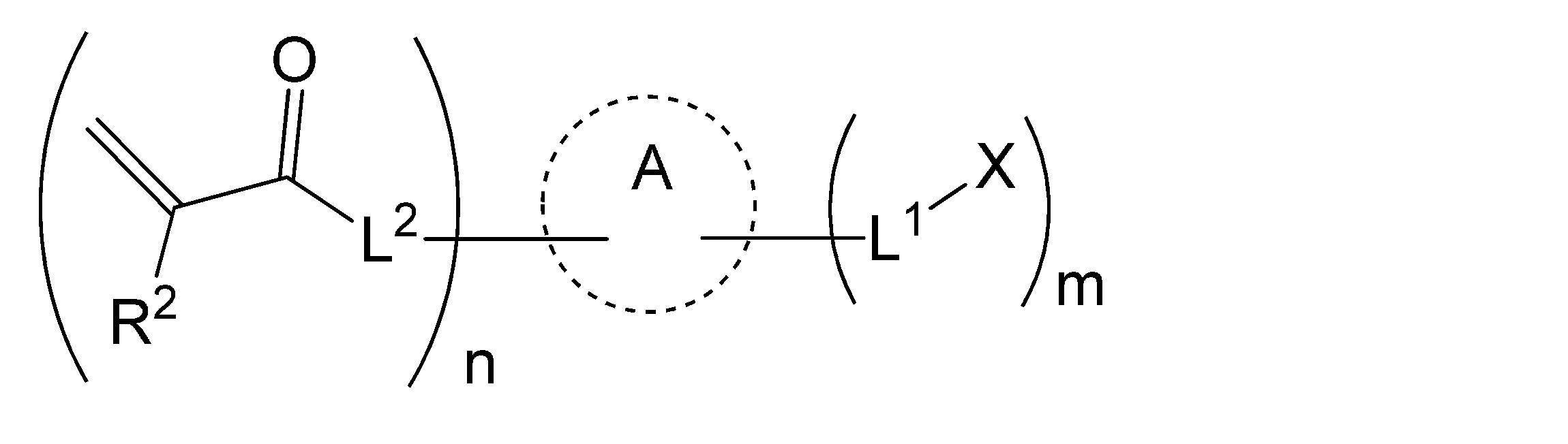
<10>
有機ハロゲン化合物が、重合性基を有する、
<1>~<9>のいずれか1つに記載のパターン形成用組成物。
<11>
重合性化合物が、有機ハロゲン化合物からハロゲン原子を除いた部分構造を含む、
<1>~<10>のいずれか1つに記載のパターン形成用組成物。
<12>
重合性化合物が、(メタ)アクリロイル基を有する、
<1>~<11>のいずれか1つに記載のパターン形成用組成物。
<13>
水以外の溶剤を実質的に含まない、
<1>~<12>のいずれか1つに記載のパターン形成用組成物。
<14>
さらに、親水性基を有する離型剤を含有する、
<1>~<13>のいずれか1つに記載のパターン形成用組成物。
<15>
<1>~<14>のいずれか1つに記載のパターン形成用組成物と、
インプリント用の下層膜を形成するための下層膜形成用組成物とを、組み合わせの構成物として含むキット。
<16>
<1>~<14>のいずれか1つに記載のパターン形成用組成物を用いて形成したパターン。
<17>
<1>~<14>のいずれか1つに記載のパターン形成用組成物を、基板上またはモールド上に適用し、パターン形成用組成物を、モールドと基板で挟んだ状態で光照射することを含むパターンの製造方法。
<18>
<17>に記載の製造方法を工程として含む、半導体素子の製造方法。
<19>
上記パターンをマスクとしてエッチングを行うことを含む、
<18>に記載の半導体素子の製造方法。
本発明のインプリント用のパターン形成用組成物は、重合性化合物と、光重合開始剤と、塩素原子、臭素原子およびヨウ素原子からなる群より選択される少なくとも1つの原子を含む有機ハロゲン化合物とを含有し、有機ハロゲン化合物は、水銀ランプの光に対し安定な化合物であり、有機ハロゲン化合物の含有量は、パターン形成用組成物中の全固形分に対し0.001~1.0質量%である。
本発明のパターン形成用組成物が含有する有機ハロゲン化合物は、塩素原子、臭素原子およびヨウ素原子からなる群より選択される少なくとも1つの原子を含む有機化合物である。有機ハロゲン化合物は、イオンの状態、つまり、有機ハロゲン化合物からハロゲン化物イオンが遊離した状態で存在してもよい。ハロゲン原子は、塩素原子および臭素原子の少なくとも1つを含むことが好ましく、塩素原子を含むことがより好ましい。塩素原子および臭素原子は、有機ハロゲン化合物中において極性を持ちやすく、さらに、有機ハロゲン化合物から安定に遊離しやすいためである。これにより、有機ハロゲン化合物からハロゲン化物イオンが効率的に遊離し、パターン形成用組成物の経時安定性がより向上する。
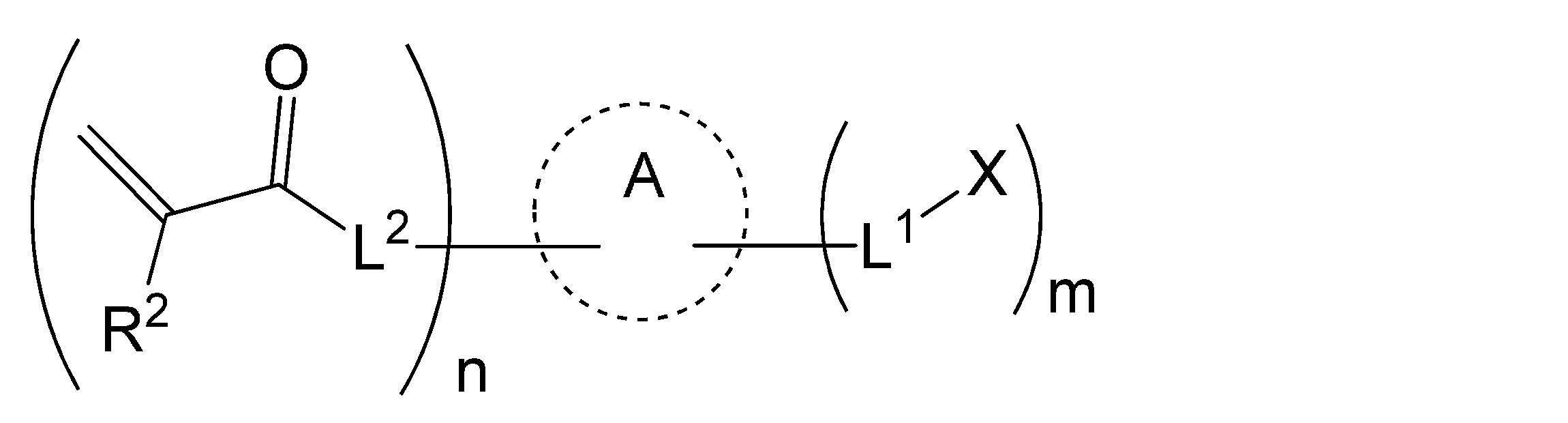


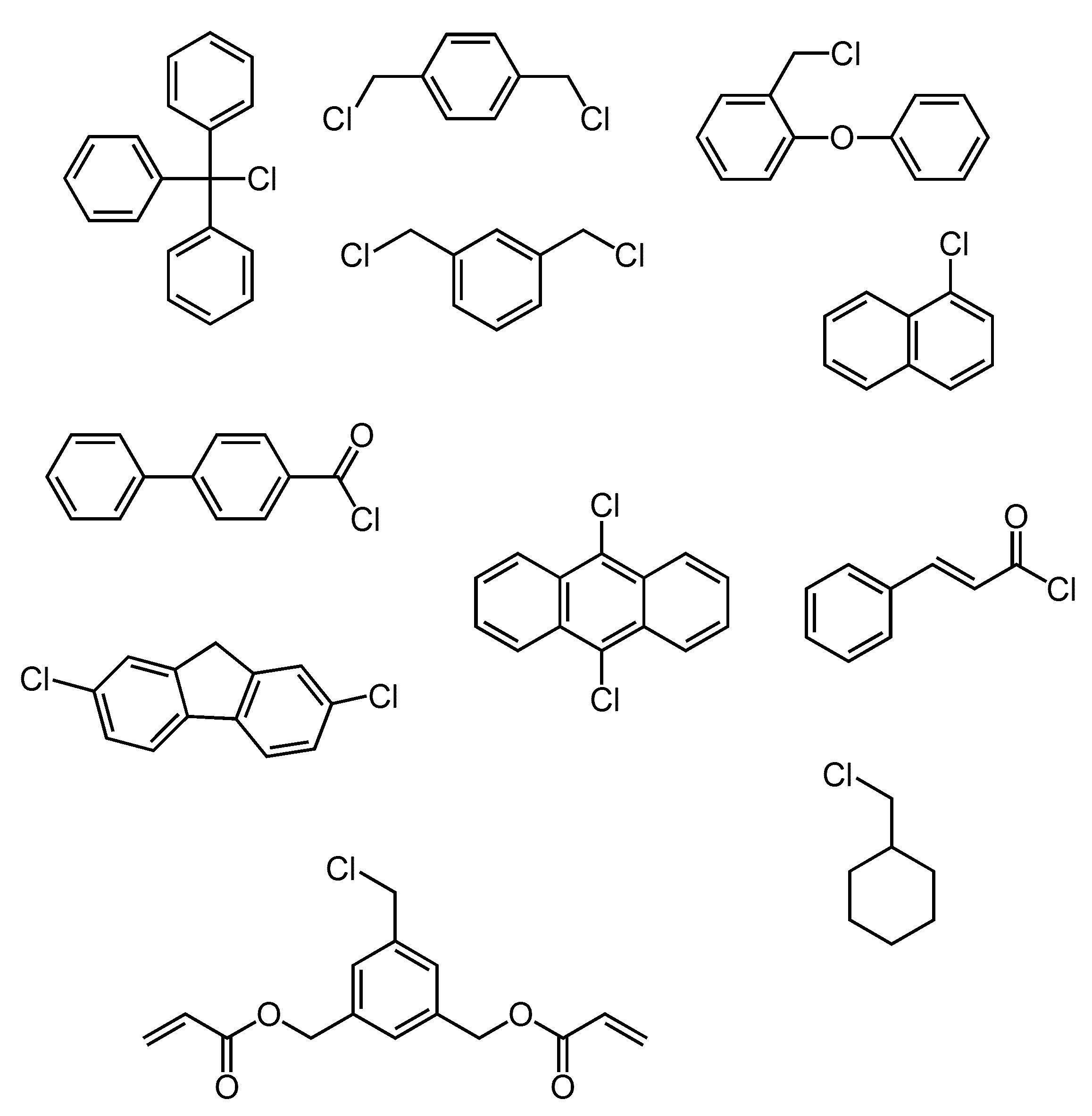
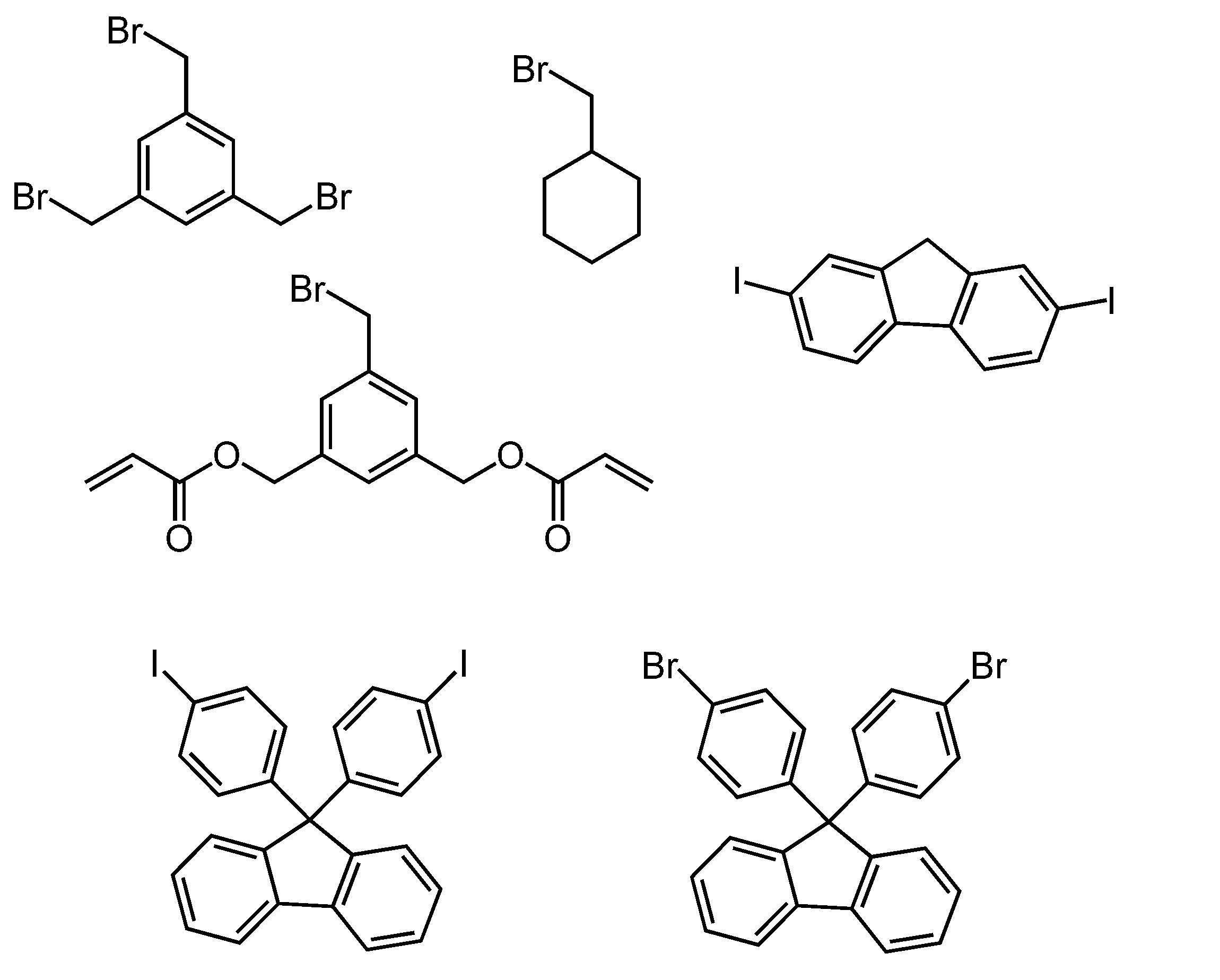

本発明のパターン形成用組成物は、所定のハロゲン化物イオンを含むことが好ましい。本発明におけるハロゲン化物イオンは、塩化物イオン(Cl-)、臭化物イオン(Br-)およびヨウ化物イオン(I-)から選択される少なくとも1つのハロゲン化物イオンを含むことが好ましい。これにより、インプリント用のパターン形成用組成物の経時安定性がより向上する。ハロゲン化物イオンは、例えば、上記有機ハロゲン化合物から遊離することで得られる。また、塩化物イオン、臭化物イオンおよびヨウ化物イオンの合計の含有量は、組成物中の全固形分に対し0.005~1100質量ppmであることが好ましい。この数値範囲の上限は、1000質量ppm以下であることがより好ましく、500質量ppm以下であることがさらに好ましく、100質量ppm以下であることが特に好ましい。また、この数値範囲の下限は、0.05質量ppm以上であることがより好ましく、1質量ppm以上であることがさらに好ましく、10質量ppm以上であることが特に好ましい。上記ハロゲン化物イオンの合計の含有量が上記下限以上であることにより、パターン形成用組成物の経時安定性がより向上する。さらに、ハロゲン化物イオンの含有量が上記上限以下であることにより、インプリント用機器内の配管やインクジェットヘッド内の金属部品とパターン形成用組成物が接触した場合であっても、金属部品表面に形成されたバリアー層の点状欠損から腐食が陥入する孔食(ピッティングコロージョン)が生じにくくなり、金属部品の腐食がより効果的に抑制される。
本発明のパターン形成用組成物は、水分を含むことが好ましい。組成物中に水分が存在することにより、有機ハロゲン化合物からハロゲン化物イオンがより遊離しやすい環境が形成される。水分の含有量は、パターン形成用組成物の全量に対して、0.001~1.5質量%であることが好ましい。この数値範囲の上限は、1.0質量%以下であることがより好ましく、0.5質量%以下であることがさらに好ましく、0.1質量%以下であることが特に好ましい。また、この数値範囲の下限は、0.01質量%以上であることがより好ましく、0.03質量%以上であることがさらに好ましく、0.04質量%以上であることが特に好ましい。水分の含有量が上記範囲内であることにより、パターン形成用組成物の経時安定性がより向上する。さらに、水分の含有量が上記範囲内であることにより、ハロゲン化物イオンの存在によって、インプリント装置内の配管やインプリントヘッド等のインプリント用の機器および機材が腐食する等の影響もより抑制できる。水分の含有量が上記範囲内であることにより、パターン形成用組成物中に僅かに含まれる金属イオンが析出することを抑制でき、パターンをマスクとしたエッチング加工時にパターンの欠陥が誘発することを抑制できる。
本発明のパターン形成用組成物は、上記のとおり、重合性基を有する重合性化合物を含む。この重合性化合物は、ラジカル重合性化合物であることが好ましい。
本発明において、パターン形成用組成物が重合性化合物として多官能重合性化合物を含む場合には、多官能重合性化合物が有する重合性基の数は、2以上であり、2~7が好ましく、2~4がより好ましく、2または3がさらに好ましく、2が一層好ましい。




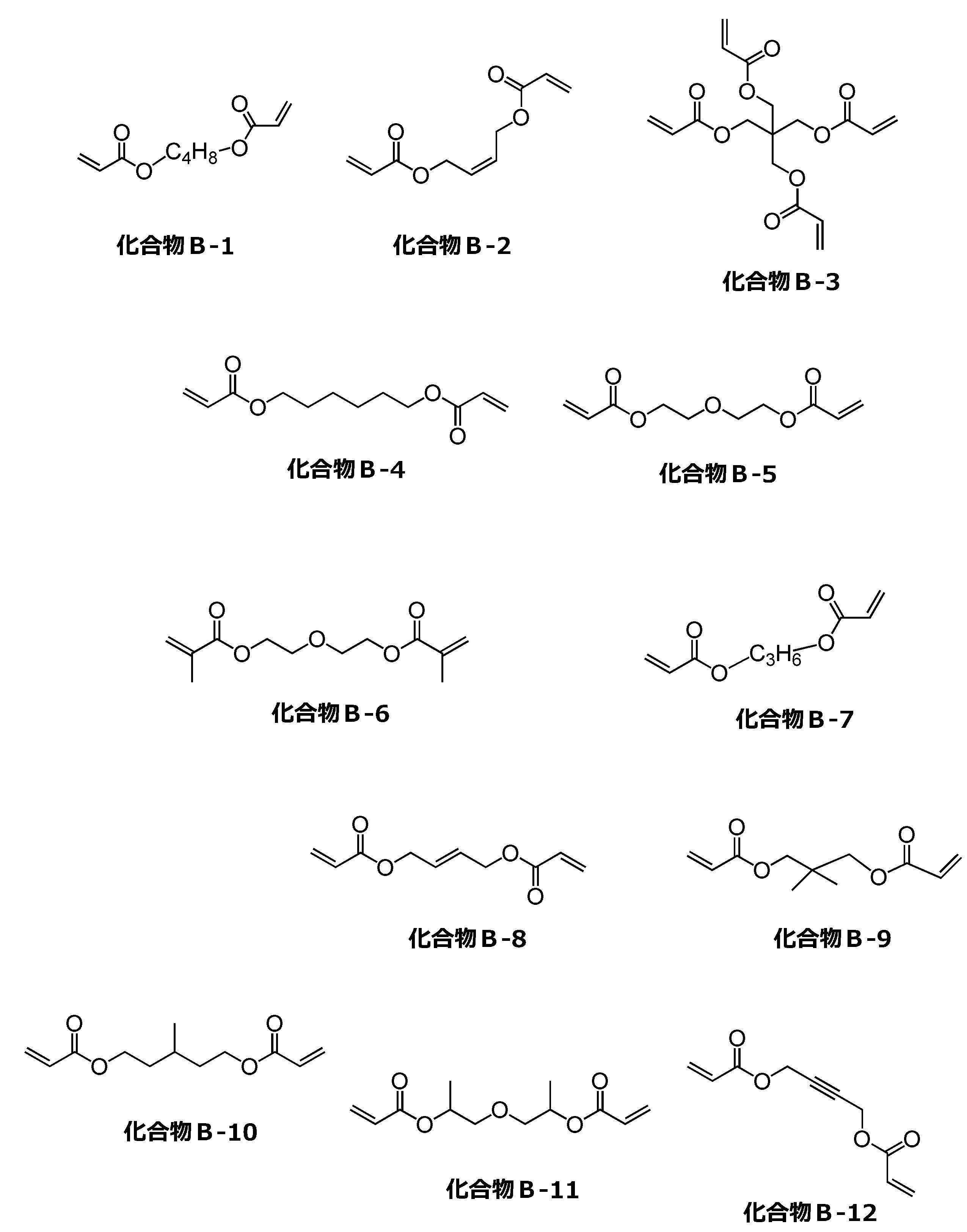

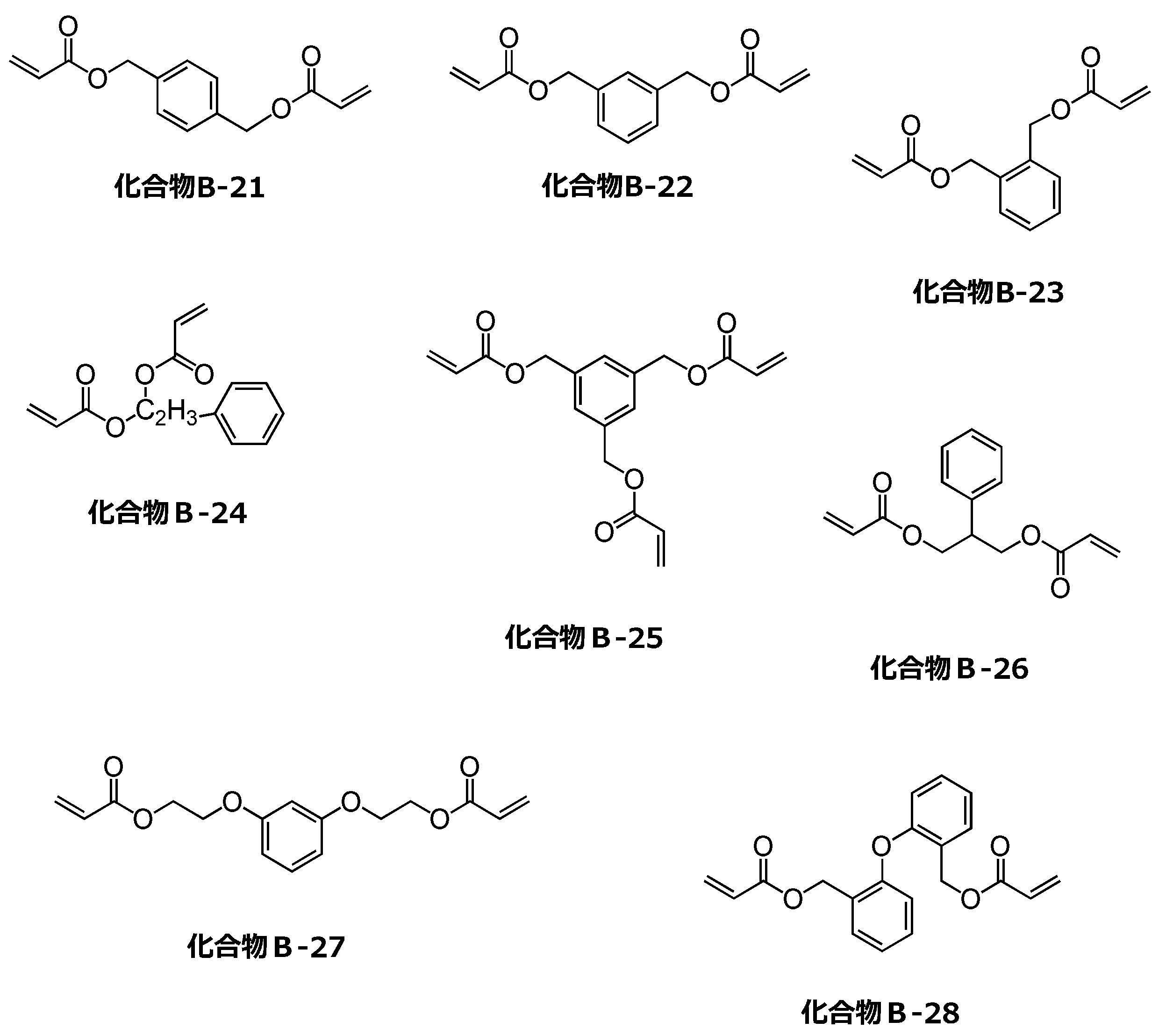

本発明において、パターン形成用組成物が重合性化合物として単官能重合性化合物を含む場合には、単官能重合性化合物の種類は本発明の趣旨を逸脱しない限り特に定めるものではない。本発明で用いる単官能重合性化合物は、環状構造を有するか、炭素数4以上の直鎖または分岐の炭化水素鎖を有することが好ましい。本発明では単官能重合性化合物を1種のみ含んでいてもよいし、2種以上含んでいてもよい。
(1)アルキル鎖およびアルケニル鎖の少なくとも一方と、脂環構造および芳香環構造の少なくとも一方とを含み、かつ、合計炭素数が7以上である基(以下、「(1)の基」ということがある);
(2)炭素数4以上のアルキル鎖を含む基(以下、「(2)の基」ということがある);ならびに
(3)炭素数4以上のアルケニル鎖を含む基(以下、「(3)の基」ということがある);
このような構成とすることにより、パターン形成用組成物中に含まれる単官能重合性化合物の添加量を減らしつつ、硬化膜の弾性率を効率良く低下させることが可能になる。さらに、モールドとの界面エネルギーが低減し、離型力の低減効果(離型性の向上効果)を大きくすることができる。
上記(1)の基における合計炭素数は35以下であることが好ましく。10以下であることがより好ましい。
上記(2)の基は、炭素数4以上のアルキル鎖を含む基であり、炭素数4以上のアルキル鎖のみからなる基(すなわち、アルキル基)であることが好ましい。アルキル鎖の炭素数は、7以上であることが好ましく、9以上であることがより好ましい。アルキル鎖の炭素数の上限値については、特に限定されるものでは無いが、例えば、25以下とすることができる。なお、アルキル鎖の一部の炭素原子がケイ素原子に置き換わった化合物も単官能重合性化合物として例示できる。
上記(3)の基は、炭素数4以上のアルケニル鎖を含む基であり、炭素数4以上のアルケニル鎖のみからなる基(すなわち、アルキレン基)であることが好ましい。アルケニル鎖の炭素数は、7以上であることが好ましく、9以上であることがより好ましい。アルケニル鎖の炭素数の上限値については、特に限定されるものでは無いが、例えば、25以下とすることができる。
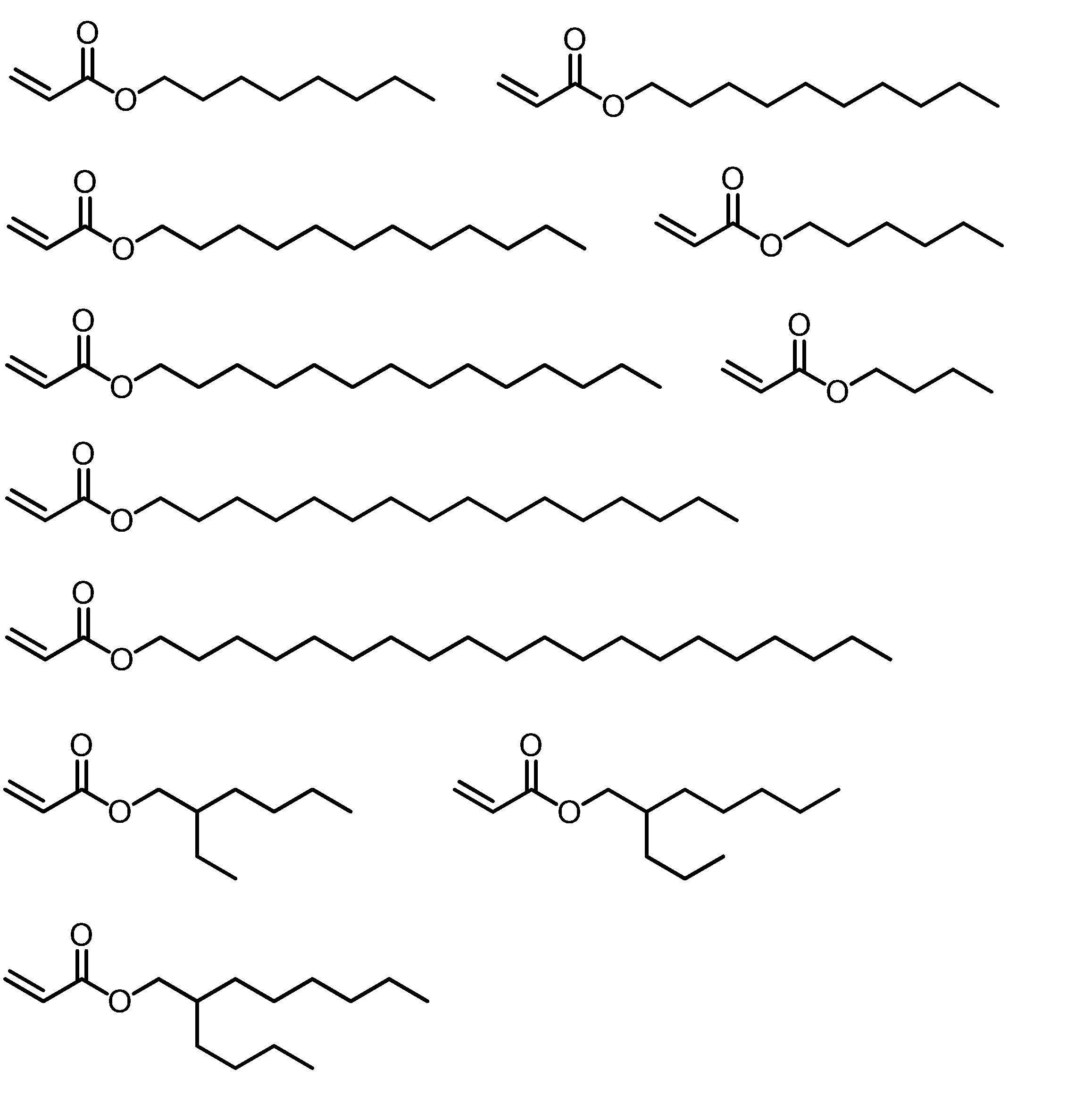

本発明のパターン形成用組成物は、光重合開始剤を含む。さらに、光重合開始剤は、光ラジカル重合開始剤であることが好ましい。本発明で用いられる光ラジカル重合開始剤としては、光照射により上述の重合性化合物を重合する活性種を発生する化合物であればいずれのものでも用いることができる。
本発明のパターン形成用組成物は、離型剤を含んでいてもよい。
離型剤用の界面活性剤としては、ノニオン性界面活性剤が好ましい。一方、界面活性剤は、フッ素原子以外のハロゲン原子(特に、塩素原子、臭素原子およびヨウ素原子)を含む化合物(例えば、塩素原子を含むシランカップリング剤など)でないことが好ましい。
本発明のパターン形成用組成物において、離型性を有する非重合性化合物は、末端に少なくとも1つの水酸基を有するか、または、水酸基がエーテル化されたポリアルキレングリコール構造を有していれば、特に制限されないが、さらに、フッ素原子およびケイ素原子を実質的に含有しないことが好ましい。ここで、非重合性化合物とは、重合性基を持たない化合物をいう。また、非重合性化合物について、フッ素原子およびケイ素原子を実質的に含有しないとは、例えば、フッ素原子およびケイ素原子の合計含有率が1質量%以下であることを表し、フッ素原子およびケイ素原子を全く有していないことが好ましい。フッ素原子およびケイ素原子を有さないことにより、重合性化合物との相溶性が向上し、特に溶剤を実質的に含有しないパターン形成用組成物において、塗布均一性、インプリント時のパターン形成性、ドライエッチング後のラインエッジラフネスが良好となる。
本発明における離型剤としての、フッ素原子を有する重合性化合物は、重合性基と、フッ素原子を含む官能基を有することが好ましい。
<<その他の成分>>
本発明のパターン形成用組成物は、上記の成分のほか、増感剤、酸化防止剤、紫外線吸収剤、溶剤、ポリマー等を含んでいてもよい。パターン形成用組成物中のこれらの化合物は、それぞれ、1種のみでもよく、2種以上でもよい。これらの詳細については、特開2014-170949号公報の段落0061~0064の記載を参酌でき、これらの内容は本明細書に組み込まれる。
本発明のパターン形成用組成物は溶剤を含んでいてもよい。溶剤としては、プロピレングリコールモノメチルエーテルアセテート、シクロヘキサノン、2-ヘプタノン、ガンマブチロラクトン、プロピレングリコールモノメチルエーテル、乳酸エチルが例示される。溶剤を含む場合、その含有量は、組成物の1~20質量%であることが好ましい。溶剤は1種のみ含んでいてもよいし、2種以上含んでいてもよい。2種以上含む場合、それらの合計量が上記範囲となることが好ましい。
また、本発明では、実質的に水以外の溶剤を含まない構成とすることもできる。溶剤を実質的に含まないとは、溶剤の含有量が5質量%以下であることをいい、3質量%以下であることが好ましく、1質量%以下であることがより好ましい。
本発明のパターン形成用組成物は、ポリマーを含んでいてもよい。ポリマーとは、例えば、重量平均分子量が2000以上の成分であり、2000超の成分であることが好ましい。
本発明のパターン形成用組成物は、25℃における粘度が、12mPa・s以下であることが好ましく、11mPa・s以下がより好ましく、10mPa・s以下がさらに好ましく、9mPa・s以下が一層好ましく、8mPa・s以下がより一層好ましい。粘度の下限値としては、特に定めるものでは無いが、例えば、5mPa・s以上とすることができる。このような範囲とすることにより、本発明のパターン形成用組成物がモールド内に入り込みやすくなり、モールド充填時間を短くできる。また、さらに、パターン形成性およびスループットを向上させることも可能になる。
本発明のパターン形成用組成物は、原料(上記で説明した各材料)を所定の割合となるように配合して調製される。原料を混合した後、フィルターを用いて濾過処理を行うことが好ましい。フィルターによる濾過はパターン形成用組成物の原料を混合した後に実施することが好ましい。
本発明のパターン形成用組成物の収容容器としては従来公知の収容容器を用いることができる。また、収容容器としては、原材料や組成物中への不純物混入を抑制することを目的に、容器内壁を6種6層の樹脂で構成された多層ボトルや、6種の樹脂を7層構造にしたボトルを使用することも好ましい。このような容器としては例えば特開2015-123351号公報に記載の容器が挙げられる。
本発明のパターン形成用組成物は、硬化物として用いられる。より具体的には、本発明のパターン形成用組成物は、光インプリント法によるパターン状の硬化物(以下、単に「パターン」ともいう。)の製造に用いられる。
上述のように本発明のパターン製造方法によって形成されたパターンは、LCDなどに用いられる永久膜や、半導体加工用のエッチングレジストとして使用することができる。また、本発明のパターンを利用してLCDのガラス基板にグリッドパターンを形成し、反射や吸収が少なく、大画面サイズ(例えば55インチ、60インチ超)の偏光板を安価に製造することが可能である。例えば、特開2015-132825号公報や国際公開第2011/132649号に記載の偏光板が製造できる。なお、1インチは25.4mmである。
上記のとおり、基板とパターン形成用組成物層の間に下層膜を設けることにより、基板とパターン形成用組成物層の密着性が向上するなどの効果が得られる。本発明において、下層膜は、パターン形成用組成物と同様の手法により、下層膜形成用組成物を基板上に適用し、その後、組成物を硬化することにより得られる。以下、下層膜形成用組成物の各成分について説明する。
下層膜形成用組成物中の樹脂は、公知の樹脂を広く用いることができる。本発明で用いる樹脂は、ラジカル重合性基および極性基の少なくとも一方を有することが好ましく、ラジカル重合性基および極性基の両方を有することがより好ましい。


下層膜形成用組成物中の架橋剤は、架橋反応により硬化を進行させるものであれば、特に限定はない。本発明では、架橋剤は、樹脂が有する極性基との反応によって、架橋構造を形成するものが好ましい。このような架橋剤を用いることにより、樹脂がより強固に結合し、より強固な膜が得られる。
本発明の下層膜形成用組成物は、上記成分に加え、他の成分を含んでいてもよい。
本発明では、下層膜形成用組成物は、特に、溶剤(以下、「下層膜用溶剤」ともいう。)を含むことが好ましい。溶剤は例えば、23℃で液体であって沸点が250℃以下の化合物が好ましい。下層膜形成用組成物は、下層膜用溶剤を99.0質量%以上含むことが好ましく、99.2質量%以上含むことがより好ましく、99.4質量%以上であってもよい。すなわち、下層膜形成用組成物は、全固形分濃度が1質量%以下であることが好ましく、0.8質量%以下であることがより好ましく、0.6質量%以下であることがさらに好ましい。また、下限値は、0質量%超であることが好ましく、0.001質量%以上であることがより好ましく、0.01質量%以上であることがさらに好ましく、0.1質量%以上であることが一層好ましい。溶剤の割合を上記の範囲とすることで、膜形成時の膜厚を薄く保ち、エッチング加工時のパターン形成性が向上する傾向にある。
熱酸発生剤は、加熱によって酸が発生し、酸の作用によって架橋を進行させる化合物である。上記架橋剤と併用することにより、より強度の高い下層膜を得ることができる。
熱酸発生剤としては、通常はカチオン成分とアニオン成分とが対になった有機オニウム塩化合物が用いられる。上記カチオン成分としては、例えば、有機スルホニウム、有機オキソニウム、有機アンモニウム、有機ホスホニウムや有機ヨードニウムを挙げることができる。また、上記アニオン成分としては、例えば、BF4-、B(C6F5)4-、SbF6-、AsF6-、PF6-、CF3SO3 -、C4F9SO3 -や(CF3SO2)3C-を挙げることができる。
下層膜形成用組成物は、重合開始剤を含んでいてもよく、熱重合開始剤および光重合開始剤の少なくとも1種を含むことが好ましい。重合開始剤を含むことにより、下層膜形成用組成物に含まれる重合性基の反応が促進し、密着性が向上する傾向にある。パターン形成用組成物との架橋反応性を向上させる観点から光重合開始剤が好ましい。光重合開始剤としては、ラジカル重合開始剤、カチオン重合開始剤が好ましく、ラジカル重合開始剤がより好ましい。また、本発明において、光重合開始剤は複数種を併用してもよい。
また、本発明において、23℃、1気圧で液体であるラジカル重合性化合物を含む液膜形成用組成物を用いて、下層膜の上に液膜を形成することも好ましい。本発明において、液膜は、パターン形成用組成物と同様の手法により、液膜形成用組成物を基板上に適用し、その後、組成物を乾燥させることにより得られる。このような液膜を形成することにより、基板とパターン形成用組成物との密着性がさらに向上し、パターン形成用組成物の基板上での濡れ性も向上するという効果がある。以下、液膜形成用組成物について説明する。
液膜形成用組成物は、23℃、1気圧で液体であるラジカル重合性化合物(重合性化合物A)を含有する。

液膜形成用組成物は溶剤(以下、「液膜用溶剤」ということがある)を含むことが好ましい。液膜用溶剤としては、上述した下層膜用溶剤の項で説明したものが挙げられ、これらを用いることができる。液膜形成用組成物は、液膜用溶剤を90質量%以上含むことが好ましく、99質量%以上含むことがより好ましく、99.99質量%以上であってもよい。
液膜形成用組成物はラジカル重合開始剤を含んでいてもよい。ラジカル重合開始剤としては、熱ラジカル重合開始剤および光ラジカル重合開始剤が挙げられ、光ラジカル重合開始剤であることが好ましい。光ラジカル重合開始剤としては、公知の化合物を任意に使用できる。例えば、ハロゲン化炭化水素誘導体(例えば、トリアジン骨格を有する化合物、オキサジアゾール骨格を有する化合物、トリハロメチル基を有する化合物など)、アシルホスフィン化合物、ヘキサアリールビイミダゾール化合物、オキシム化合物、有機過酸化物、チオ化合物、ケトン化合物、芳香族オニウム塩、アセトフェノン化合物、アゾ化合物、アジド化合物、メタロセン化合物、有機ホウ素化合物、鉄アレーン錯体などが挙げられる。これらの詳細については、特開2016-027357号公報の段落0165~0182の記載を参酌でき、この内容は本明細書に組み込まれる。この中でもアセトフェノン化合物、アシルホスフィン化合物、オキシム化合物が好ましい。市販品としては、IRGACURE-OXE01、IRGACURE-OXE02、IRGACURE-127、IRGACURE-819、IRGACURE-379、IRGACURE-369、IRGACURE-754、IRGACURE-1800、IRGACURE-651、IRGACURE-907、IRGACURE-TPO、IRGACURE-1173等(以上、BASF社製)、Omnirad 184、Omnirad TPO H、Omnirad 819、Omnirad 1173(以上、IGM Resins B.V.製)が挙げられる。
液膜形成用組成物は、上記の他、重合禁止剤、酸化防止剤、レベリング剤、増粘剤、界面活性剤等を1種または2種以上含んでいてもよい。
本発明のキットは、インプリント用のパターン(硬化膜)を形成するための上記パターン形成用組成物と、インプリント用の下層膜を形成するための下層膜形成用組成物との組み合わせを含む。本発明のキットを使用することにより、離型性に優れるインプリントを実施することが可能となる。下層膜形成用組成物は、特に、ラジカル重合性基を有する上記樹脂と、有機溶剤を含むことが好ましい。さらに、本発明のキットは、組み合わせの構成物として、23℃、1気圧で液体である重合性化合物を含む液膜形成用組成物を含むことが好ましい。
各実施例および各比較例について、下記表に示す重合性化合物、光重合開始剤、増感剤、離型剤および有機ハロゲン化合物を下記表に示す配合比で混合し、さらに重合禁止剤として4-ヒドロキシ-2,2,6,6-テトラメチルピペリジン-1-オキシルフリーラジカル(東京化成社製)を重合性化合物に対して100~300質量ppm(0.01~0.03質量%)となるように加えることにより、組成物を調製した。また、水分含有量を調整するため、一部の組成物には、超純水(富士フイルム和光純薬株式会社製)を添加した。孔径0.02μmの高分子量ポリエチレン(UPE)製フィルター、孔径0.005μmナイロン製フィルターおよび孔径0.001μmUPE製フィルターを用いて、上記組成物のそれぞれを多段階で濾過し、インプリント用のパターン形成用組成物を調製した。なお、表中の重合性化合物、光重合開始剤、離型剤および有機ハロゲン化合物の配合比の単位は、質量部である。
ハロゲン化物イオン濃度の測定は、イオンクロマト法を用いて測定した。具体的には次のとおりである。実施例および比較例のそれぞれについて、1mLのパターン形成用組成物を秤量し、MIBK(メチルイソブチルケトン)6mLに溶解した。その後、MilliQ水7mLを加え、分液抽出を行った。次いで、水層を取り出し、フィルター濾過を実施し、その後、イオンクロマトグラフィーシステム(DIONEX社製IC-320)を用いて下記条件にて塩化物イオン(Cl-)、臭化物イオン(Br-)およびヨウ化物イオン(I-)の合計の濃度を定量した。
・カラム:IonPacAS11-HC
・溶離液:KOH
・流量:1.5mL/min
・注入量:20μL
・カラム温度:35℃
調製した各パターン形成用組成物の水分含有量は、カールフィッシャー水分測定装置を用いて測定した。
実施例および比較例の各パターン形成用組成物を脱アルカリ処理ガラス瓶(容量100mL)に100mL充填し、60±2℃に設定した恒温槽内で30日間放置することにより、各パターン形成用組成物を強制的に経時させた。
・カラム:Mightysil RP-18GP
・溶離液:10mM酢酸アンモニウムメタノール溶液/10mM酢酸アンモニウム水溶液
・流量:0.2mL/min
・注入量:2μL

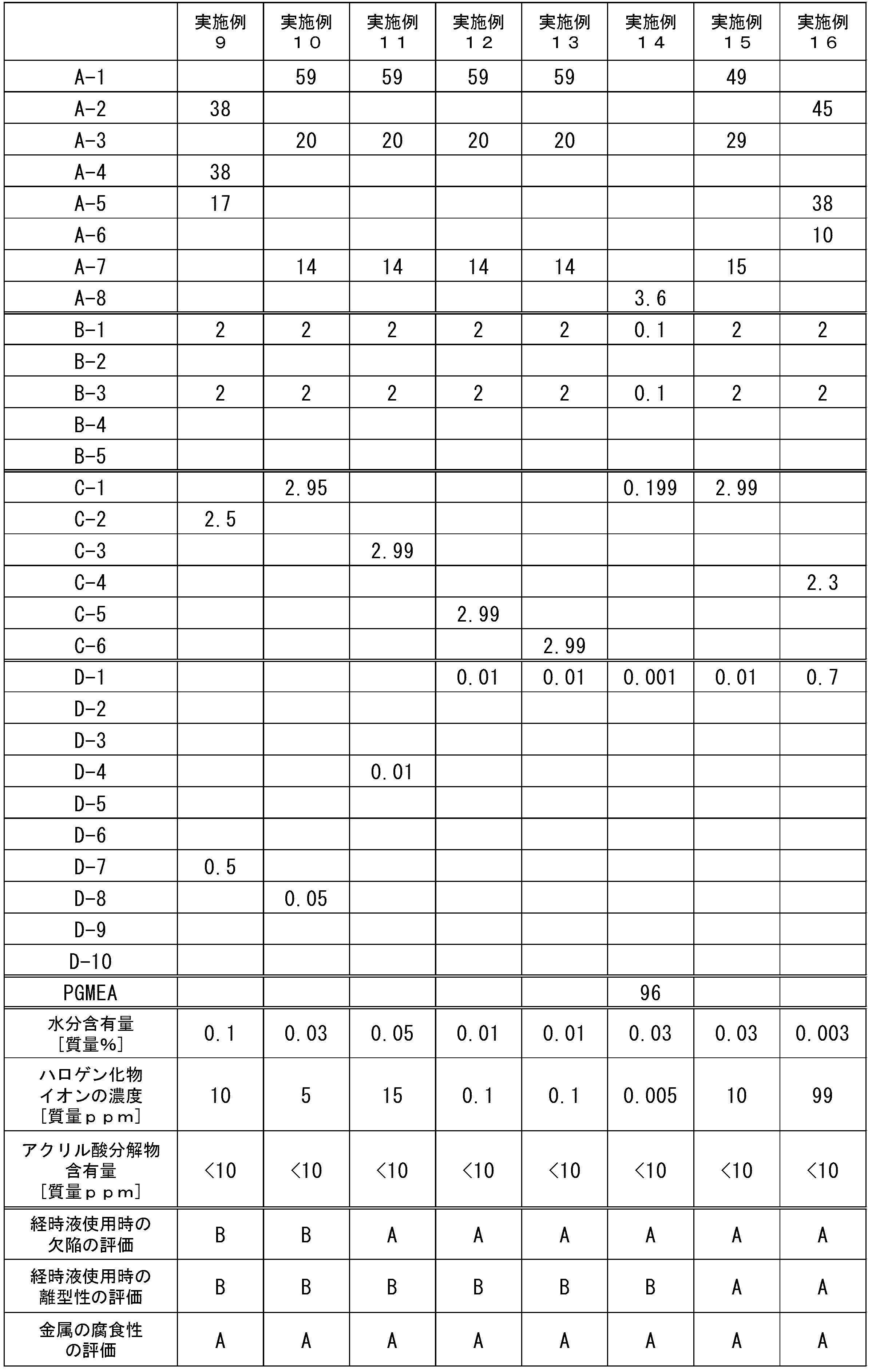

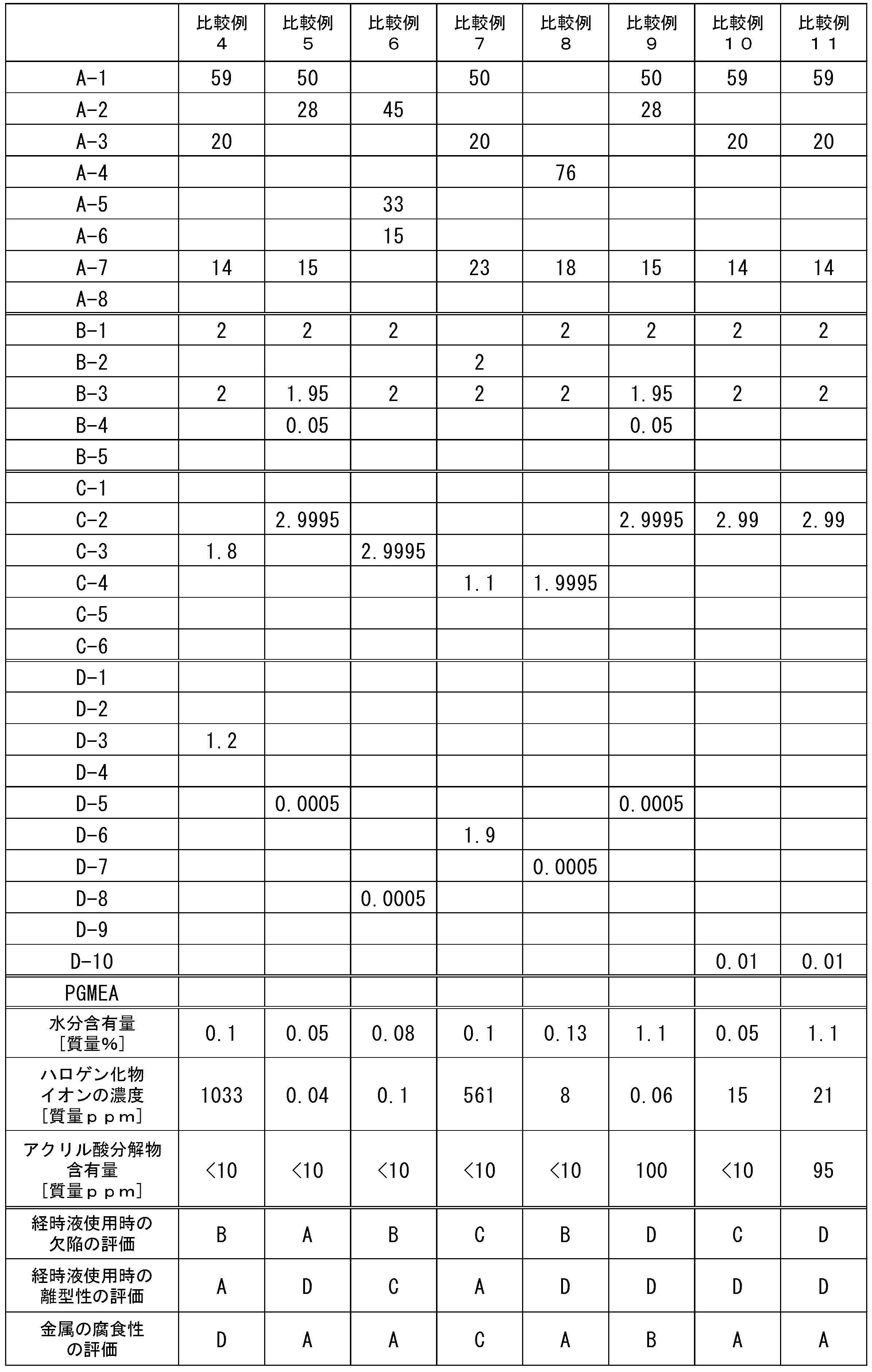
各原料の仕様は、下記のとおりである。
A-1~A-7:下記構造を有する化合物。
A-8:シリコーン樹脂X-40-9225(信越化学工業社製)と2-ヒドロキシエチルアクリレートより合成したシリコーンアクリレート樹脂。重量平均分子量は2500であり、重合性基当量は250である。

B-1~B-3:下記構造を有する化合物(光重合開始剤)。
B-4またはB-5:下記構造を有する化合物(増感剤)。

C-1~C-6:下記構造を有する化合物。
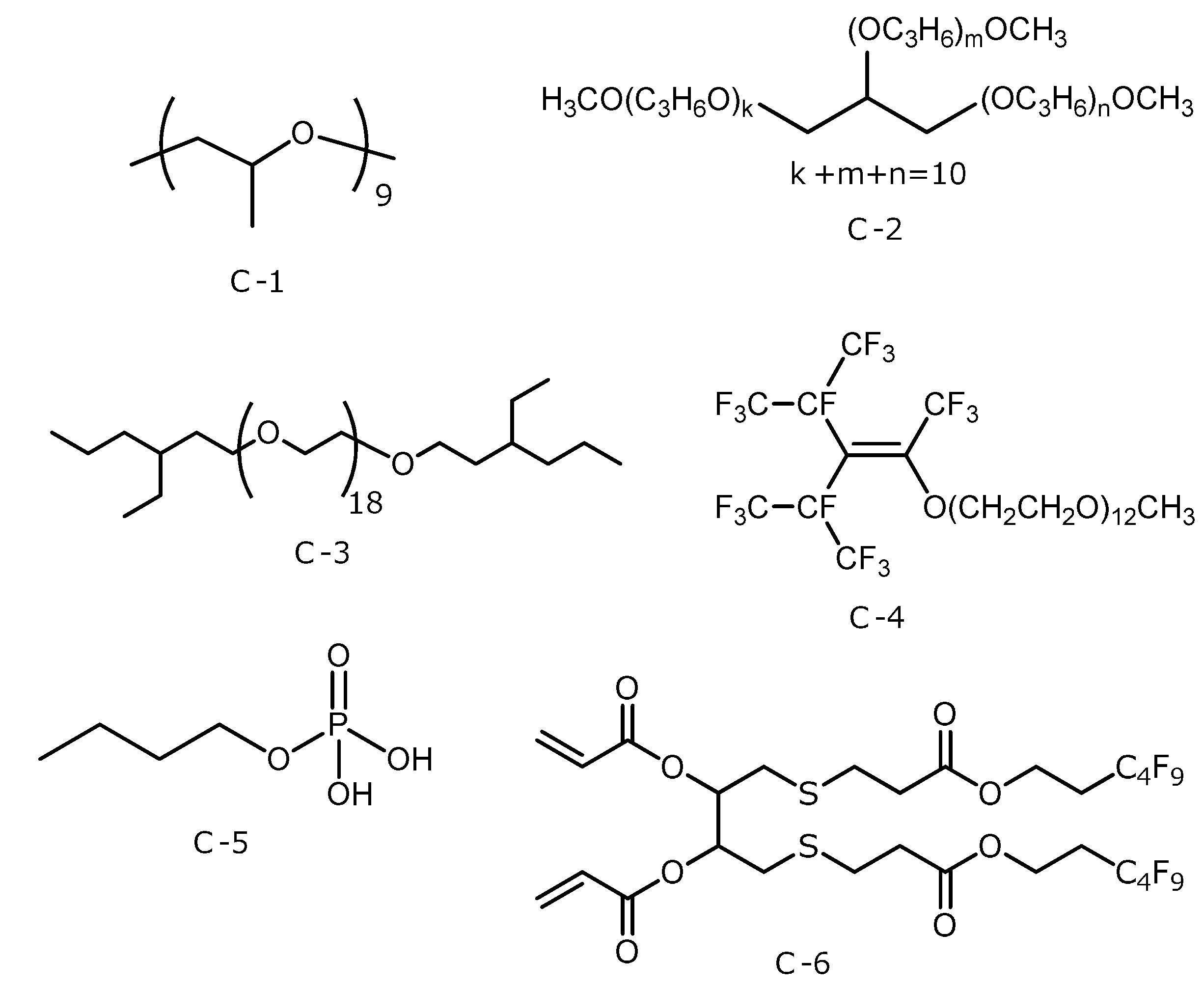
D-1~D-10:下記構造を有する化合物。
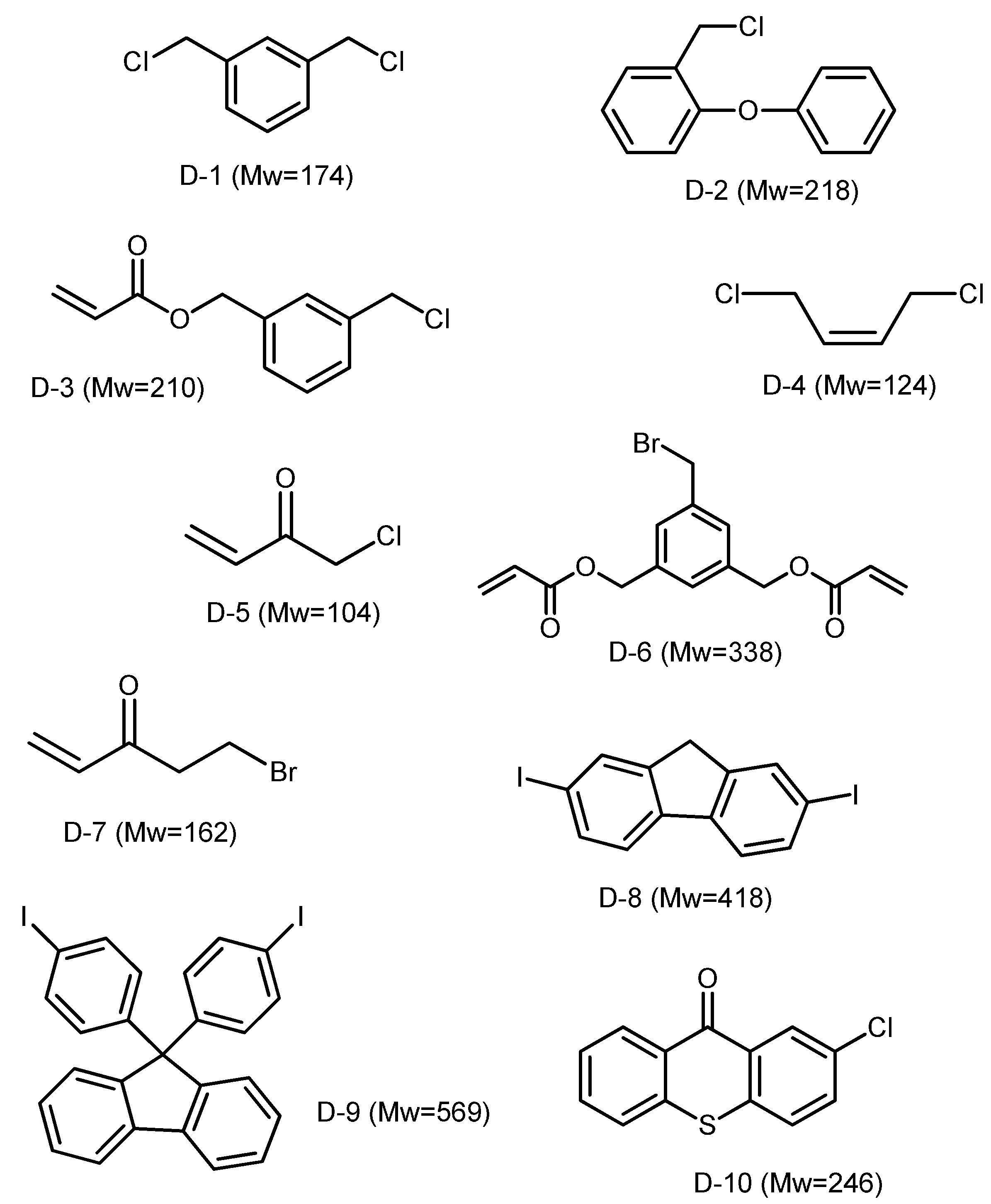
PGMEA:プロピレングリコールモノメチルエーテルアセテート
実施例および比較例の各パターン形成用組成物の経時安定性を評価するために、まず、上記のとおり、各パターン形成用組成物に強制的な経時を付与した。次に、その経時液を使用して形成したパターンの欠陥、経時液の離型性、および、経時液が金属に及ぼす腐食性の各項目について、下記のとおり評価した。そして、これらの項目を総合的に考慮し、全ての項目においてCおよびDの評価がないパターン形成用組成物について、インプリント用機器の基材となる金属への影響が少なく、経時安定性に優れていると評価した。
シリコンウェハ上に、特開2014-024322号公報の実施例6に示す密着層形成用組成物をスピンコートし、220℃のホットプレートを用いて1分間加熱し、厚さ5nmの密着層を形成した。上記密着層上にインクジェット装置(FUJIFILM Dimatix社製インクジェットプリンター DMP-2831)を用いて、強制経時後のパターン形成用組成物をインクジェット法により適用した。その後、ヘリウム雰囲気下で、パターン形成用組成物にインプリント用モールドを押し当てた。使用したモールドは、線幅30nm、深さ75nmおよびピッチ60nmのライン・アンド・スペースを有する石英モールドである。その後、モールド面から超高圧水銀ランプを用いて、露光量100mJ/cm2の条件で露光し、モールドを離型することにより、パターン形成用組成物の硬化物からなるパターン(以下、サンプルという。)を得た。上記インクジェットによる塗布から離型までの一連の工程を、上記シリコンウェハ上で場所を変えて20回繰り返し実施した。
・A:DD<1個/cm2
・B:1個/cm2≦DD<50個/cm2
・C:50個/cm2≦DD<100個/cm2
・D:100個/cm2≦DD
シリコンウェハ上に、特開2014-024322号公報の実施例6に示す密着層形成用組成物をスピンコートし、220℃のホットプレートを用いて1分間加熱し、厚さ5nmの密着層を形成した。上記密着層上にインクジェット装置(FUJIFILM Dimatix社製インクジェットプリンター DMP-2831)を用いて、強制経時後のパターン形成用組成物をインクジェット法により適用した。その後、ヘリウム雰囲気下で、パターン形成用組成物にインプリント用モールドを押し当てた。使用したモールドは、線幅15nm、深さ30nmおよびピッチ60nmのライン・アンド・スペースを有する石英モールドである。その後、モールド面から超高圧水銀ランプを用いて、露光量100mJ/cm2の条件で露光し、モールドを離型することにより、パターン形成用組成物の硬化物からなるパターンを得た。上記インクジェットによる塗布から離型までの一連の工程を、上記シリコンウェハ上で場所を変えて20回繰り返し実施した。
離型力の上昇率=
[15~20回目の離型力の平均値]/[1~5回目の離型力の平均値]
・A:離型力の上昇率≦5.0%
・B:5.0%<離型力の上昇率≦10%
・C:10%<離型力の上昇率≦20%
・D:20%<離型力の上昇率
上記インプリント用パターン形成用組成物を脱アルカリ処理ガラス瓶(容量100mL)に100mL充填し、1cm四方のステンレス片(SUS304)を入れて60±2℃に設定した恒温槽にて30日間放置した。その後、ステンレス片を取り出し、アセトンで洗浄した。洗浄後のステンレス片について、腐食の度合を光学顕微鏡にて確認し、その状態に応じて下記のとおり金属の腐食性を評価した。光学顕微鏡による観察は、1000μm四方の視野で100カ所において行った。
・A:金属の腐食が確認されなかった。
・B:金属表面の1%未満の領域に金属の腐食が確認された。
・C:金属表面の1%以上5%未満の領域に金属の腐食が確認された。
・D:金属表面の5%以上の領域に金属の腐食が確認された。
各項目の評価結果は、上記表1~4のとおりである。これらの結果から、本発明のパターン形成用組成物は、所定の有機ハロゲン化合物を含有することにより、モールドを繰り返し使用するインプリントに対しても経時安定性が向上することが分かった。
Claims (19)
- 重合性化合物と、光重合開始剤と、塩素原子、臭素原子およびヨウ素原子からなる群より選択される少なくとも1つの原子を含む有機ハロゲン化合物とを含有するパターン形成用組成物であって、
前記有機ハロゲン化合物が、水銀ランプの光に対し安定な化合物であり、
前記有機ハロゲン化合物の含有量が、パターン形成用組成物中の全固形分に対し0.001~1.0質量%である、インプリント用のパターン形成用組成物。 - 塩化物イオン、臭化物イオンおよびヨウ化物イオンから選択される少なくとも1つのハロゲン化物イオンを含み、
前記ハロゲン化物イオンの合計の含有量が、パターン形成用組成物の全固形分に対し0.05~1000質量ppmである、
請求項1に記載のパターン形成用組成物。 - 前記有機ハロゲン化合物の分子量が、130~550である、
請求項1または2に記載のパターン形成用組成物。 - さらに、前記パターン形成用組成物に対し0.01~1.0質量%の割合で水分を含有する、
請求項1~3のいずれか1項に記載のパターン形成用組成物。 - 前記有機ハロゲン化合物が、塩素原子を含む、
請求項1~4のいずれか1項に記載のパターン形成用組成物。 - 前記少なくとも1つの原子が、前記有機ハロゲン化合物中のアルキレン基に結合している、
請求項1~5のいずれか1項に記載のパターン形成用組成物。 - 前記少なくとも1つの原子が、前記アルキレン基を介して環構造またはオレフィン構造に連結している、
請求項6に記載のパターン形成用組成物。 - 前記有機ハロゲン化合物が、環構造を有する、
請求項1~7のいずれか1項に記載のパターン形成用組成物。 - 前記有機ハロゲン化合物として、下記式(D1)で表される化合物を含む、
請求項8に記載のパターン形成用組成物;
式(D1):

- 前記有機ハロゲン化合物が、重合性基を有する、
請求項1~9のいずれか1項に記載のパターン形成用組成物。 - 前記重合性化合物が、前記有機ハロゲン化合物からハロゲン原子を除いた部分構造を含む、
請求項1~10のいずれか1項に記載のパターン形成用組成物。 - 前記重合性化合物が、(メタ)アクリロイル基を有する、
請求項1~11のいずれか1項に記載のパターン形成用組成物。 - 水以外の溶剤を実質的に含まない、
請求項1~12のいずれか1項に記載のパターン形成用組成物。 - さらに、親水性基を有する離型剤を含有する、
請求項1~13のいずれか1項に記載のパターン形成用組成物。 - 請求項1~14のいずれか1項に記載のパターン形成用組成物と、
インプリント用の下層膜を形成するための下層膜形成用組成物とを、組み合わせの構成物として含むキット。 - 請求項1~14のいずれか1項に記載のパターン形成用組成物を用いて形成したパターン。
- 請求項1~14のいずれか1項に記載のパターン形成用組成物を、基板上またはモールド上に適用し、前記パターン形成用組成物を、前記モールドと前記基板で挟んだ状態で光照射することを含むパターンの製造方法。
- 請求項17に記載の製造方法を工程として含む、半導体素子の製造方法。
- 前記パターンをマスクとしてエッチングを行うことを含む、
請求項18に記載の半導体素子の製造方法。
Priority Applications (3)
| Application Number | Priority Date | Filing Date | Title |
|---|---|---|---|
| JP2021509070A JP7219807B2 (ja) | 2019-03-22 | 2020-03-16 | パターン形成用組成物、キット、パターンの製造方法、パターン、および、半導体素子の製造方法 |
| KR1020217029960A KR102698137B1 (ko) | 2019-03-22 | 2020-03-16 | 패턴 형성용 조성물, 키트, 패턴의 제조 방법, 패턴, 및, 반도체 소자의 제조 방법 |
| US17/476,481 US12497469B2 (en) | 2019-03-22 | 2021-09-16 | Composition for forming pattern, kit, pattern producing method, pattern, and method for manufacturing semiconductor element |
Applications Claiming Priority (2)
| Application Number | Priority Date | Filing Date | Title |
|---|---|---|---|
| JP2019054557 | 2019-03-22 | ||
| JP2019-054557 | 2019-03-22 |
Related Child Applications (1)
| Application Number | Title | Priority Date | Filing Date |
|---|---|---|---|
| US17/476,481 Continuation US12497469B2 (en) | 2019-03-22 | 2021-09-16 | Composition for forming pattern, kit, pattern producing method, pattern, and method for manufacturing semiconductor element |
Publications (1)
| Publication Number | Publication Date |
|---|---|
| WO2020195994A1 true WO2020195994A1 (ja) | 2020-10-01 |
Family
ID=72608696
Family Applications (1)
| Application Number | Title | Priority Date | Filing Date |
|---|---|---|---|
| PCT/JP2020/011328 Ceased WO2020195994A1 (ja) | 2019-03-22 | 2020-03-16 | パターン形成用組成物、キット、パターンの製造方法、パターン、および、半導体素子の製造方法 |
Country Status (5)
| Country | Link |
|---|---|
| US (1) | US12497469B2 (ja) |
| JP (1) | JP7219807B2 (ja) |
| KR (1) | KR102698137B1 (ja) |
| TW (1) | TWI831947B (ja) |
| WO (1) | WO2020195994A1 (ja) |
Cited By (1)
| Publication number | Priority date | Publication date | Assignee | Title |
|---|---|---|---|---|
| JP2024510380A (ja) * | 2021-02-11 | 2024-03-07 | ゼトス アーゲー | 改良された退色性 |
Citations (5)
| Publication number | Priority date | Publication date | Assignee | Title |
|---|---|---|---|---|
| JP2007069301A (ja) * | 2005-09-06 | 2007-03-22 | Nippon Telegr & Teleph Corp <Ntt> | ナノインプリント方法及びナノインプリント装置 |
| JP2011187824A (ja) * | 2010-03-10 | 2011-09-22 | Fujifilm Corp | 微細パターン製造方法、微細パターン付き基板、微細パターン付き基板を含む光源装置および画像表示装置 |
| WO2013154112A1 (ja) * | 2012-04-10 | 2013-10-17 | ダイキン工業株式会社 | インプリント用樹脂モールド材料組成物 |
| JP2015112781A (ja) * | 2013-12-11 | 2015-06-22 | 旭化成イーマテリアルズ株式会社 | 機能転写体及び機能層の転写方法 |
| JP2017073512A (ja) * | 2015-10-09 | 2017-04-13 | 旭化成株式会社 | レジスト組成物 |
Family Cites Families (5)
| Publication number | Priority date | Publication date | Assignee | Title |
|---|---|---|---|---|
| US8076386B2 (en) | 2004-02-23 | 2011-12-13 | Molecular Imprints, Inc. | Materials for imprint lithography |
| JP5968933B2 (ja) | 2008-12-03 | 2016-08-10 | 富士フイルム株式会社 | インプリント用硬化性組成物、パターン形成方法およびパターン |
| CN103076719B (zh) * | 2011-10-26 | 2019-08-09 | 日立化成株式会社 | 感光性树脂组合物、感光性元件、抗蚀图案的形成方法及印刷配线板的制造方法 |
| JP2016164961A (ja) | 2014-10-30 | 2016-09-08 | キヤノン株式会社 | 液体吐出装置、ナノインプリント装置、ナノインプリント用液体収容タンク、硬化物パターンの製造方法、光学部品の製造方法、回路基板の製造方法、インプリント用モールドの製造方法 |
| JP6475819B2 (ja) | 2015-03-20 | 2019-02-27 | 富士フイルム株式会社 | インプリント用硬化性組成物、硬化物、パターン形成方法、リソグラフィー方法、パターンおよびリソグラフィー用マスク |
-
2020
- 2020-03-16 JP JP2021509070A patent/JP7219807B2/ja active Active
- 2020-03-16 KR KR1020217029960A patent/KR102698137B1/ko active Active
- 2020-03-16 WO PCT/JP2020/011328 patent/WO2020195994A1/ja not_active Ceased
- 2020-03-17 TW TW109108810A patent/TWI831947B/zh active
-
2021
- 2021-09-16 US US17/476,481 patent/US12497469B2/en active Active
Patent Citations (5)
| Publication number | Priority date | Publication date | Assignee | Title |
|---|---|---|---|---|
| JP2007069301A (ja) * | 2005-09-06 | 2007-03-22 | Nippon Telegr & Teleph Corp <Ntt> | ナノインプリント方法及びナノインプリント装置 |
| JP2011187824A (ja) * | 2010-03-10 | 2011-09-22 | Fujifilm Corp | 微細パターン製造方法、微細パターン付き基板、微細パターン付き基板を含む光源装置および画像表示装置 |
| WO2013154112A1 (ja) * | 2012-04-10 | 2013-10-17 | ダイキン工業株式会社 | インプリント用樹脂モールド材料組成物 |
| JP2015112781A (ja) * | 2013-12-11 | 2015-06-22 | 旭化成イーマテリアルズ株式会社 | 機能転写体及び機能層の転写方法 |
| JP2017073512A (ja) * | 2015-10-09 | 2017-04-13 | 旭化成株式会社 | レジスト組成物 |
Cited By (2)
| Publication number | Priority date | Publication date | Assignee | Title |
|---|---|---|---|---|
| JP2024510380A (ja) * | 2021-02-11 | 2024-03-07 | ゼトス アーゲー | 改良された退色性 |
| JP7850733B2 (ja) | 2021-02-11 | 2026-04-23 | ゼトス アーゲー | 改良された退色性 |
Also Published As
| Publication number | Publication date |
|---|---|
| US20220002450A1 (en) | 2022-01-06 |
| JPWO2020195994A1 (ja) | 2021-12-23 |
| KR102698137B1 (ko) | 2024-08-23 |
| JP7219807B2 (ja) | 2023-02-08 |
| KR20210132100A (ko) | 2021-11-03 |
| TW202039684A (zh) | 2020-11-01 |
| TWI831947B (zh) | 2024-02-11 |
| US12497469B2 (en) | 2025-12-16 |
Similar Documents
| Publication | Publication Date | Title |
|---|---|---|
| JP7518911B2 (ja) | ナノインプリント用中間層形成用組成物の製造方法、積層体の製造方法、インプリントパターンの製造方法及びデバイスの製造方法 | |
| US20210388134A1 (en) | Curable composition for imprinting, kit, pattern producing method, and method for manufacturing semiconductor element | |
| KR102668935B1 (ko) | 패턴 형성용 조성물, 경화막, 적층체, 패턴의 제조 방법 및 반도체 소자의 제조 방법 | |
| US20230219280A1 (en) | Method for producing composition for forming imprint pattern, method for producing cured substance, imprint pattern producing method, and method for manufacturing device | |
| JP7253042B2 (ja) | パターン形成用組成物、キット、硬化膜、積層体、パターンの製造方法、および半導体素子の製造方法 | |
| WO2020195994A1 (ja) | パターン形成用組成物、キット、パターンの製造方法、パターン、および、半導体素子の製造方法 | |
| US12109752B2 (en) | Composition for forming underlayer film in imprinting method, kit, pattern producing method, laminate, and method for manufacturing semiconductor element | |
| WO2022163597A1 (ja) | インプリントパターン形成用組成物、硬化物、インプリントパターンの製造方法、デバイス及びデバイスの製造方法 | |
| JP7385683B2 (ja) | インプリントパターン形成用組成物、硬化物、インプリントパターンの製造方法及びデバイスの製造方法 | |
| JP7638824B2 (ja) | インプリント用硬化性組成物、硬化物、インプリントパターンの製造方法及びデバイスの製造方法 | |
| TWI819083B (zh) | 壓印用硬化性組成物、圖案的製造方法、半導體元件的製造方法及硬化物 | |
| JP7199510B2 (ja) | インプリント用の下層膜形成用組成物、下層膜形成用組成物の製造方法、キット、パターン製造方法、および半導体素子の製造方法 | |
| KR102770053B1 (ko) | 경화성 조성물, 키트, 중간층, 적층체, 임프린트 패턴의 제조 방법 및 디바이스의 제조 방법 | |
| JP7709336B2 (ja) | インプリント用硬化性組成物、塗布膜、膜の製造方法、硬化物、インプリントパターンの製造方法及びデバイスの製造方法 | |
| KR102386490B1 (ko) | 임프린트용 경화성 조성물, 경화물 패턴의 제조 방법, 회로 기판의 제조 방법 및 경화물 | |
| WO2022176778A1 (ja) | インプリント用硬化性組成物、硬化物、インプリントパターンの製造方法及びデバイスの製造方法 |
Legal Events
| Date | Code | Title | Description |
|---|---|---|---|
| 121 | Ep: the epo has been informed by wipo that ep was designated in this application |
Ref document number: 20779204 Country of ref document: EP Kind code of ref document: A1 |
|
| ENP | Entry into the national phase |
Ref document number: 2021509070 Country of ref document: JP Kind code of ref document: A |
|
| ENP | Entry into the national phase |
Ref document number: 20217029960 Country of ref document: KR Kind code of ref document: A |
|
| NENP | Non-entry into the national phase |
Ref country code: DE |
|
| 122 | Ep: pct application non-entry in european phase |
Ref document number: 20779204 Country of ref document: EP Kind code of ref document: A1 |