WO2020184649A1 - 溶媒和物及び溶媒和物の製造方法 - Google Patents
溶媒和物及び溶媒和物の製造方法 Download PDFInfo
- Publication number
- WO2020184649A1 WO2020184649A1 PCT/JP2020/010725 JP2020010725W WO2020184649A1 WO 2020184649 A1 WO2020184649 A1 WO 2020184649A1 JP 2020010725 W JP2020010725 W JP 2020010725W WO 2020184649 A1 WO2020184649 A1 WO 2020184649A1
- Authority
- WO
- WIPO (PCT)
- Prior art keywords
- group
- general formula
- integer
- ring
- solvate
- Prior art date
- Legal status (The legal status is an assumption and is not a legal conclusion. Google has not performed a legal analysis and makes no representation as to the accuracy of the status listed.)
- Ceased
Links
Images


Classifications
-
- C—CHEMISTRY; METALLURGY
- C07—ORGANIC CHEMISTRY
- C07D—HETEROCYCLIC COMPOUNDS
- C07D221/00—Heterocyclic compounds containing six-membered rings having one nitrogen atom as the only ring hetero atom, not provided for by groups C07D211/00 - C07D219/00
- C07D221/02—Heterocyclic compounds containing six-membered rings having one nitrogen atom as the only ring hetero atom, not provided for by groups C07D211/00 - C07D219/00 condensed with carbocyclic rings or ring systems
- C07D221/04—Ortho- or peri-condensed ring systems
- C07D221/18—Ring systems of four or more rings
-
- C—CHEMISTRY; METALLURGY
- C07—ORGANIC CHEMISTRY
- C07D—HETEROCYCLIC COMPOUNDS
- C07D241/00—Heterocyclic compounds containing 1,4-diazine or hydrogenated 1,4-diazine rings
- C07D241/36—Heterocyclic compounds containing 1,4-diazine or hydrogenated 1,4-diazine rings condensed with carbocyclic rings or ring systems
- C07D241/38—Heterocyclic compounds containing 1,4-diazine or hydrogenated 1,4-diazine rings condensed with carbocyclic rings or ring systems with only hydrogen or carbon atoms directly attached to the ring nitrogen atoms
Definitions
- the present invention relates to a solvate and a method for producing a solvate.
- a glass material has been used for the optical member of an imaging module such as a camera, a video camera or a mobile phone with a camera, a videophone or a doorphone with a camera.
- an imaging module such as a camera, a video camera or a mobile phone with a camera, a videophone or a doorphone with a camera.
- Glass materials have various optical properties and have been preferably used because of their excellent environmental resistance, but they have drawbacks that they are not easy to reduce in weight and size, and have poor workability and productivity.
- the cured resin product can be mass-produced and has excellent workability, so that it has come to be used for various optical members.
- Patent Document 1 discloses that a cured product having a low Abbe number can be molded from a curable composition containing a compound having a heteroatom-containing skeleton similar to a diphenylfluorene skeleton.
- An object of the present invention is to provide a material capable of increasing the light transmittance of a product as a material that can be used for manufacturing an optical member such as a lens.
- the purity of a phenol compound having a heteroatom-containing skeleton similar to the diphenylfluorene skeleton as described in Patent Document 1 is determined with a specific solvent. It has been found that it can be easily raised by using a solvate. Further, they have found that a highly pure curable monomer can be produced using such a phenol compound as an intermediate. Furthermore, it has been found that the solvate is highly soluble in a solvent such as tetrahydrofuran, the reaction system becomes a homogeneous system, and a product having high purity can be obtained.
- the present invention has been completed based on this finding. That is, the present invention provides the following ⁇ 1> to ⁇ 9>.
- the solvent constituting the solvate contains a nitrogen atom-containing organic compound and contains.
- the nitrogen atom-containing organic compound may contain an oxygen atom, and may contain an oxygen atom.
- the value obtained by dividing the number of carbon atoms in the nitrogen atom-containing organic compound by the sum of the number of nitrogen atoms and the number of oxygen atoms is 5 or less.
- X and Y are independently oxygen, sulfur, nitrogen or carbon atoms, except that at least one of X and Y is a nitrogen atom;
- R 3 to R 6 each independently represent a substituent;
- q and r are independently integers from 0 to 4;
- q is an integer of 2-4, the plurality of R 3s may be the same or different, and the plurality of R 3s may be combined with each other to form a ring;
- r is an integer of 2-4, the plurality of R 4s may be the same
- R 3 , R 4 , R 5 and R 7 each independently represent a substituent; q and r are independently integers from 0 to 4; v is an integer of 0-4 and s is an integer of 0-2; When q is an integer of 2-4, the plurality of R 3s may be the same or different, and the plurality of R 3s may be combined with each other to form a ring; When r is an integer of 2-4, the plurality of R 4s may be the same or different, and the plurality of R 4s may be combined with each other to form a ring; If v is an integer of 2 to 4, the plurality of R 5 may be different even in the same, the plurality of R 5 combine with each other without forming a ring; When s is 2, the two R 7s may be the same or different, and the two R 7s may combine with each other to form a ring.
- ⁇ 3> The solvate according to ⁇ 1> or ⁇ 2>, wherein the compound represented by the
- R 3 , R 4 , R 5 and R 8 each independently represent a substituent; q and r are independently integers from 0 to 4; v is an integer of 0-4 and t is an integer of 0-4; When q is an integer of 2-4, the plurality of R 3s may be the same or different, and the plurality of R 3s may be combined with each other to form a ring; When r is an integer of 2-4, the plurality of R 4s may be the same or different, and the plurality of R 4s may be combined with each other to form a ring; If v is an integer of 2 to 4, the plurality of R 5 may be different even in the same, the plurality of R 5 combine with each other without forming a ring; When t is an integer of 2 to 4, the plurality of R 8s may be the same or different.
- the nitrogen atom-containing organic compound is at least one selected from the group consisting of pyridine, pyrimidine, pyrazine, a compound represented by the general formula B, and a compound represented by the general formula C ⁇ 1.
- Re , R f , and R g are hydrocarbon groups that may independently have hydrogen atoms or substituents, respectively. Re and R g , or Re and R f, may combine with each other to form a ring structure.
- R h is a hydrocarbon group which may have a hydrogen atom or a substituent.
- the nitrogen atom-containing organic compound is at least one selected from the group consisting of N, N'-dimethylformamide, N, N-dimethylacetamide, N-methylpyrrolidone, and N-ethylpyrrolidone.
- ⁇ 7> The solvation according to any one of ⁇ 1> to ⁇ 6>, wherein the content of the nitrogen atom-containing organic compound is 10 to 200 mol% with respect to 100 mol% of the compound represented by the general formula 1.
- Stuff. ⁇ 8> The method for producing a solvate according to any one of ⁇ 1> to ⁇ 7>.
- a production method comprising crystallization of a compound represented by the general formula 1 using the nitrogen atom-containing organic compound as a solvent.
- the compound represented by the general formula 1 is dissolved in a solvent composed of the above nitrogen atom-containing organic compound, and then contains any one or more selected from the group consisting of methyl acetate, ethyl acetate, and butyl acetate.
- the production method according to ⁇ 8> which comprises adding a solvent and precipitating the above-mentioned solvent mixture.
- the present invention provides a solvate capable of providing a compound represented by the general formula 1 that can be used for manufacturing an optical member such as a lens with high purity, and a method for producing the solvate.
- the solvate of the present invention can be used as a raw material for forming a cured product that can be used for an optical member or the like, or as an intermediate for producing a curable monomer for forming the cured product. Since the solvate of the present invention has high solubility in a solvent such as tetrahydrofuran, when it is used as a production intermediate, it enables a reaction in a homogeneous system, and a curable monomer can be produced with high purity and high yield. Can be done.
- the numerical range represented by using “-” means a range including the numerical values before and after "-" as the lower limit value and the upper limit value.
- the monomer in the present invention is distinguished from an oligomer and a polymer, and refers to a compound having a weight average molecular weight of 1000 or less.
- the solvate of the present invention is a solvate of a compound (phenolic compound) represented by the general formula 1, and comprises a compound represented by the general formula 1 and a solvent.
- the compound represented by the general formula 1 may be one kind or two or more kinds, but is usually one kind.
- the solvent may be one kind or two or more kinds, and one kind is preferable.
- the compound represented by the general formula 1 can be obtained with high purity by using a solvate with the following specific solvent.
- the above solvate can be isolated as a crystal of high purity, but it may be amorphous, and the state or shape of the solvate of the present invention is not particularly limited.
- the solvate of the present invention is preferably crystalline.
- the solvent constituting the solvate contains a nitrogen atom-containing organic compound having a molecular weight of 200 or less.
- the nitrogen atom-containing organic compound is a compound whose structural formula is composed of a carbon atom, a hydrogen atom and a nitrogen atom (N).
- the nitrogen atom-containing organic compound may further contain an oxygen atom.
- the value obtained by dividing the number of carbon atoms in the nitrogen atom-containing organic compound by the sum of the number of nitrogen atoms and the number of oxygen atoms is 5 or less. That is, the solvent constituting the solvate of the present invention includes a compound represented by the following molecular formula.
- a, b, and d are integers of 1 or more, c is an integer of 0 or more, and a / (b + c) ⁇ 5 is satisfied.
- the molecular weight of the nitrogen atom-containing organic compound is 200 or less, preferably 180 or less, and more preferably 160 or less. Further, the above value obtained by dividing the number of carbon atoms in the nitrogen atom-containing organic compound by the sum of the number of nitrogen atoms and the number of oxygen atoms is preferably less than 5. That is, in the above molecular formula, it is preferable that a / (b + c) ⁇ 5.
- nitrogen atom-containing organic compound examples include pyridine, pyrimidine, pyrazine, a compound represented by the general formula B, and a compound represented by the general formula C.
- Re , R f , and R g are each independently a hydrocarbon group which may have a hydrogen atom or a substituent, and Re and R g , or Re and R f are each other. They may be combined to form a ring structure. It is preferable that Re and R f are hydrocarbon groups that may have a substituent, and it is also preferable that Re and R g are bonded to each other to form a ring structure.
- R h is a hydrocarbon group which may have a hydrogen atom or a substituent. Examples of the substituent include an alkyl group such as a methyl group and an ethyl group.
- hydrocarbon group which may have a substituent in the general formula B and the general formula C
- an unsubstituted hydrocarbon group is preferable.
- the hydrocarbon group include a branched or linear alkyl group having 1 to 5 carbon atoms, a cycloalkyl group having 1 to 6 carbon atoms, a phenyl group, or a combination thereof, and a branched or direct group having 1 to 3 carbon atoms.
- the alkyl group of the chain is preferable, and the methyl group or the ethyl group is preferable.
- examples of the ring structure formed by bonding Re and R g to each other include a pyrrolidinone ring and the like.
- the ring structure formed by bonding Re and R f to each other include a pyrrolidine ring, a piperazine ring, and a morpholine ring. It is preferable that Re and R f are groups of the same type.
- Examples of the nitrogen atom-containing organic compound shown below are N, N-dimethylformamide (1.5), N, N-dimethylacetamide (2), N, N-dimethylpropionamide (2.5). , N, N-diethylpropionamide (3.5), 2-pyrrolidone (2), N-methylpyrrolidone (2.5), N-ethylpyrrolidone (3), morpholine (2), N-methylmoriphorin ( 2.5), pyridine (5), pyrimidine (2), pyrazine (2) and the like.
- the value in parentheses is a value (a / (b + c)) obtained by dividing the number of carbon atoms in the compound by the sum of the number of nitrogen atoms and the number of oxygen atoms.
- N, N-dimethylformamide, N, N-dimethylacetamide, N-methylpyrrolidone, and N-ethylpyrrolidone are preferable, and N, N-dimethylacetamide, N-methylpyrrolidone, and N-ethylpyrrolidone are more preferable. preferable.
- the content of the nitrogen atom-containing organic compound in the solvent mixture of the present invention varies depending on the type of the compound represented by the general formula 1 and the type of the nitrogen atom-containing organic compound, and is not particularly limited, but the compound 100 represented by the general formula 1 It may be 300 mol% or less with respect to mol%, and is preferably 10 to 200 mol%.
- the solvent in the solvate of the present invention preferably does not contain an organic compound having a nitrogen atom other than the above-mentioned nitrogen atom-containing organic compound.
- the solvent in the solvate of the present invention may contain an organic compound having no nitrogen atom.
- Examples of the organic compound having no nitrogen atom include organic compounds that are liquid at room temperature and are generally used as a solvent, and are not particularly limited. Specific examples include methyl acetate, ethyl acetate, and butyl acetate.
- X and Y are independently oxygen atoms, sulfur atoms, nitrogen atoms or carbon atoms, except that at least one of X and Y is a nitrogen atom.
- the carbon atom to which R 6 is not bonded may be a CH by bonding a hydrogen atom.
- the carbon atom to which R 6 is not bonded may be a CH by bonding a hydrogen atom.
- R 3 to R 6 each independently represent a substituent.
- q and r are independently integers from 0 to 4.
- v is an integer from 0 to 4
- q is an integer of 2-4
- the plurality of R 3s may be the same or different, and the plurality of R 3s may be combined with each other to form a ring;
- r is an integer of 2-4, the plurality of R 4s may be the same or different, and the plurality of R 4s may be combined with each other to form a ring;
- v is an integer of 2 to 4
- the plurality of R 5 may be different even in the same, the plurality of R 5 combine with each other without forming a ring;
- w is an integer of 2 to 5
- the plurality of R 6s may be the same or different,
- X and Y are preferably nitrogen atoms or carbon atoms independently of each other. Further, it is more preferable that both X and Y are nitrogen atoms.
- the substituent represented by R 3 to R 6 is not particularly limited, and for example, a halogen atom, an alkyl halide group, an alkyl group, an alkenyl group, an acyl group, an alkoxycarbonyl group, a hydroxy group and a hydroxyalkyl group.
- a halogen atom an alkyl halide group, an alkyl group, an alkenyl group, an acyl group, an alkoxycarbonyl group, a hydroxy group and a hydroxyalkyl group.
- Examples thereof include a group, an alkoxy group, an aryl group, a heteroaryl group, a cycloalkyl group, and a cyano group.
- examples of the halogen atom include a fluorine atom, a chlorine atom, a bromine atom and an iodine atom.
- alkyl group means a linear or branched alkyl group.
- alkyl group methyl group, ethyl group, propyl group, isopropyl group, butyl group, isobutyl group, sec-butyl group, tert-butyl group, pentyl group, 1-methylbutyl group, 3-methylbutyl group, hexyl group, 1 -Methylpentyl group, 4-methylpentyl group, heptyl group, 1-methylhexyl group, 5-methylhexyl group, 2-ethylhexyl group, octyl group, 1-methylheptyl group, nonyl group, 1-methyloctyl group, decyl Examples thereof include a group, an undecyl group, a dodecyl group, a tridecyl group, a tetradecyl group, a pentadecyl group, a hexadecyl group, a heptadecyl group, an o
- alkyl group in the group containing an alkyl group alkyl halide group, alkoxy group, alkoxycarbonyl group, acyl group, etc.
- alkyl group a methyl group or an ethyl group is preferable.
- examples of the alkenyl group include a vinyl group and an allyl group.
- the aryl group represents a monovalent group obtained by removing one arbitrary hydrogen atom from the aromatic hydrocarbon ring.
- an aryl group having 6 to 14 carbon atoms is preferable, and examples thereof include a phenyl group, a biphenyl group, a 1-naphthyl group, a 2-naphthyl group, a 1-anthrasenyl group, a 2-anthrasenyl group and a 3-anthrasenyl group.
- the heteroaryl group represents a monovalent group obtained by removing one arbitrary hydrogen atom from an aromatic heterocycle.
- heteroaryl groups include frill group, thienyl group, pyrrolyl group, imidazolyl group, isothiazolyl group, isooxazolyl group, pyridyl group, pyrazinyl group, quinolyl group, benzofuranyl group (preferably 2-benzofuranyl group), benzothiazolyl group (preferably 2-benzofuranyl group).
- a 2-benzothiazolyl group), a benzoxazolyl group (preferably a 2-benzoxazolyl group) and the like can be mentioned.
- the cycloalkyl group represents a monovalent group obtained by removing one arbitrary hydrogen atom from a cycloalkane.
- examples of the cycloalkyl group include a cyclobutyl group, a cycloventyl group, a cyclohexyl group and the like.
- the substituent represented by R 3 to R 6 is preferably a halogen atom, an alkyl group, an alkoxy group, an aryl group or a cyano group, and is a halogen atom, an alkyl group having 1 to 5 carbon atoms, and an alkoxy group having 1 to 5 carbon atoms.
- a phenyl group or a cyano group is more preferable, and a halogen atom, a methyl group, a methoxy group, a phenyl group or a cyano group is particularly preferable.
- R 3 and R 4 are independently methyl groups or methoxy groups, respectively.
- the plurality of R 3s or the plurality of R 4s may each form a ring, and in this case, a ring to be substituted and a fused ring may be formed.
- R 5 is preferably a halogen atom, a methyl group or a methoxy group.
- R 6 is preferably a halogen atom, a methyl group, a methoxy group or a cyano group. It is more preferred more R 6 is a group forming a ring and fused ring to replace. It is preferable that the substituents represented by R 3 to R 6 are not polymerizable groups.
- q and r are each independently preferably an integer of 0 to 3, more preferably an integer of 0 to 2, and even more preferably 0.
- v is preferably an integer of 0 to 3, more preferably an integer of 0 to 2, and even more preferably 0.
- w is preferably an integer of 0 to 3, and more preferably an integer of 0 to 2.
- the plurality of R 3s may be the same or different. Multiple R 3 may be bonded to each other to form a ring, but preferably a plurality of R 3 not bound to each other to form a ring.
- a plurality of R 4s may be the same or different.
- a plurality of R 4 may be bonded to each other to form a ring, but is preferably a plurality of R 4 is not bonded to each other to form a ring.
- the plurality of R 5s may be the same or different. Further, a plurality of R 5 are not connected to each other to form a ring.
- the plurality of R 6s may be the same or different, and the plurality of R 6s may be combined with each other to form a ring.
- w is an integer of 2-5, it is preferred that a plurality of R 6, taken together, is a group which forms a ring and fused ring to replace.
- the fused ring may further have a substituent, and in this case, as the substituent, the substituent listed as R 6 can be exemplified as a preferable substituent.
- Bonded plurality of R 6 to each other is a group that forms a ring and fused ring to be substituted; preferably the ring number to form a fused ring is 4 or less, preferably 3 or less, with 2 It is preferable to have.
- the number of rings forming the fused ring within the above range, it becomes easy to suppress the coloring of the cured product containing the compound.
- the compound represented by the general formula 1 is preferably a compound represented by the general formula 2.
- R 7 represents a substituent. Examples of the substituent include the substituents listed as the substituents represented by R 3 to R 6 above.
- s represents an integer of 0 to 2, and is preferably 2.
- the two R 7s may be the same or different. Further, the two R 7s may be connected to each other to form a ring.
- R 7 is preferably a cyano group, a phenyl group, a halogen atom, a methyl group or a methoxy group, and more preferably a cyano group or a phenyl group.
- the compound represented by the general formula 1 is more preferably a compound represented by the following general formula 3.
- R 3 to R 5 in the general formula 3 are the same as the definitions and preferred ranges of R 3 to R 5 in the general formula 1.
- the definitions and preferred ranges of q, r, and v in General Formula 3 are the same as the definitions and preferred ranges of q, r, and v in General Formula 1, respectively.
- R 8 represents a substituent. Examples of the substituent include the substituents listed as the substituents represented by R 3 to R 6 above.
- t is an integer of 0 to 4.
- the plurality of R 8s may be the same or different.
- the plurality of R 8s are not connected to each other to form a ring.
- R 8 is preferably a halogen atom, a methoxycarbonyl group, a methyl group or a methoxy group, more preferably a halogen atom or a methyl group, and even more preferably a methyl group.
- t is preferably 0 to 2. Further, in the general formula 3, it is more preferable that v is 0 and t is 1 or 2, and it is further preferable that v is 0 and t is 2.
- the substitution position of R 8 when t is 1 is preferably the 6th or 7th position of the formed quinoxaline ring, and the substitution position of R 8 when t is 2 is the 6th position of the formed quinoxaline ring. And 7th place are preferable.
- the compounds c2, c8, and c10 are a mixture of compounds in which a substituent is bonded to the 6- or 7-position of the quinoxaline ring.
- the compound represented by the general formula 1 can be produced, for example, by the method described in WO2017 / 115649. That is, it can be produced by condensing the compound represented by the general formula 4 and the compound represented by the general formula 5 and / or the general formula 6.
- the above condensation reaction is preferably carried out in a solvent containing an acid catalyst and a thiol compound.
- the solvent mixture of the present invention is crystallized by dissolving the compound represented by the general formula 1 in a solvent containing the above-mentioned nitrogen atom-containing organic compound having a molecular weight of 200 or less, preferably a solvent composed of the nitrogen atom-containing organic compound. It can be manufactured by performing. Usually, the compound represented by the general formula 1 can be dissolved in a solvent composed of a nitrogen atom-containing organic compound, and then a poor solvent can be added to precipitate the solvate of the present invention. Examples of poor solvents include methyl acetate, ethyl acetate, and butyl acetate. As the compound represented by the general formula 1 used for producing the solvate of the present invention, for example, the crude crystals of the product obtained by the above-mentioned method for producing the compound represented by the general formula 1 may be used as they are. Good.
- the compound represented by the general formula 1 can be derived into a compound having a side chain having a polymerizable group by utilizing a hydroxy group in its structure, and is useful as an intermediate for producing a curable monomer.
- a cured product of a composition containing a curable monomer derived from a compound represented by the general formula 1 can be preferably used for an optical member such as a lens.
- the compound represented by the general formula 1 can be used as it is as a component of a curable composition for producing an optical member such as a lens.
- the compound represented by the general formula 1 can isolate a crystal having high purity as a solvate with the solvent containing the above-mentioned nitrogen atom-containing organic compound.
- the solvate obtained as crystals has high solubility in a solvent such as tetrahydrofuran, and when used as a production intermediate, it enables a reaction in a uniform system, and a curable monomer with high purity and high yield can be obtained. Can be manufactured. Therefore, using the solvate of the present invention, an optical member such as a lens having high light transmittance can be easily manufactured.
- Example 2 A solvate in which N-methylpyrrolidone was solvated with compound c3 was obtained in the same manner except that N, N-dimethylacetamide of Example 1 was changed to N-methylpyrrolidone.
- 1 H-NMR measurement (300 MHz, DMSO-d 6 ) of the solvate revealed that N-dimethylpyrrolidone was 140 mol% when the compound c3 was 100 mol%.
- Example 3 A solvate in which N-ethylpyrrolidone was solvated with compound c3 was obtained in the same manner except that N, N-dimethylacetamide in Example 1 was changed to N-ethylpyrrolidone.
- Example 4 A solvate in which pyridine and ethyl acetate were solvated with compound c3 was obtained in the same manner except that N, N-dimethylacetamide of Example 1 was changed to pyridine.
- 1 H-NMR measurement 300 MHz, DMSO-d 6
- the compound c3 was 100 mol%
- pyridine was 26.5 mol%
- ethyl acetate was 6.8 mol%. It was.
- Example 5 A solvate in which morpholine and ethyl acetate were solvated with compound c3 was obtained in the same manner except that N, N-dimethylacetamide of Example 1 was changed to morpholine.
- 1 H-NMR measurement (300 MHz, DMSO-d 6 ) of the solvate revealed that when the compound c3 was 100 mol%, morpholine was 100 mol% and ethyl acetate was 90 mol%.
- Example 6 A solvate in which N, N-dimethylacetamide was solvated with compound c9 was obtained in the same manner except that compound c3 of Example 1 was changed to compound c9. 1 H-NMR measurement (300 MHz, DMSO-d 6 ) of the solvate revealed that N, N-dimethylacetamide was 100 mol% when the compound c9 was 100 mol%.
- Example 7 A solvate in which N, N-dimethylacetamide was solvated with compound c2 was obtained in the same manner except that compound c3 of Example 1 was changed to compound c2.
- 1 H-NMR measurement (300 MHz, DMSO-d 6 ) of the solvate revealed that N, N-dimethylacetamide was 100 mol% when the compound c2 was 100 mol%.
- Example 8 A solvate in which N, N-dimethylacetamide was solvated with compound c10 was obtained in the same manner except that compound c3 of Example 1 was changed to compound c10. 1 H-NMR measurement (300 MHz, DMSO-d 6 ) of the solvate revealed that N, N-dimethylacetamide was 185 mol% when the compound c10 was 100 mol%.
- Example 9 A solvate in which N, N-dimethylacetamide was solvated in compound c1 was obtained in the same manner except that compound c3 in Example 1 was changed to compound c1.
- 1 H-NMR measurement 300 MHz, DMSO-d 6
- N, N-dimethylacetamide 100 mol% when the compound c1 was 100 mol%.
- Example 10 Compound c3 was dissolved by adding 4 mL of N, N-dimethylacetamide to 2 g of compound c3 and stirring at 60 ° C. for 1 hour. Then, 16 mL of water was added, and the mixture was stirred at 50 ° C. for 2 hours and then at 25 ° C. for 1 hour. The precipitate was collected by filtration, washed with 10 mL of water, and dried at 60 ° C. to obtain a solvate in which N, N-dimethylacetamide was solvated with compound c3.
- 1 H-NMR measurement 300 MHz, DMSO-d 6 ) of the solvate revealed that N, N-dimethylacetamide was 6.8 mol% when the compound c3 was 100 mol%.
- Comparative Example 3 1 H-NMR measurement (300 MHz, 300 MHz) was performed on the sample obtained by the same method as in Comparative Example 2 except that N, N, N', N'-tetraethylmalonamide was changed to N, N-dimethyldecaneamide. DMSO-d 6 ) was performed, but N, N-dimethyldecaneamide was not observed.
- Comparative Example 4 1 H-NMR measurement (300 MHz, DMSO-d) was performed on the filtrate obtained by the same method as in Comparative Example 2 except that N, N, N', N'-tetraethylmalonamide was changed to 1-methylpiperidine. 6 ) was performed, but 1-methylpiperidine was not observed.
- Comparative Example 5 1 H-NMR measurement (300 MHz, DMSO-d 6 ) was carried out on the filtrate obtained by the same method as in Comparative Example 2 except that N, N, N', N'-tetraethylmaronamide was changed to triethylamine. However, no triethylamine was observed.
- HPLC Purity Crystal purity was measured under the following conditions using high performance liquid chromatography (SPD-10AV VP) manufactured by Shimadzu Corporation. When the crystals were solvated, the peak derived from the solvent was subtracted, and then the HPLC purity was calculated.
- Column: TSKgel ODS-100Z 5 ⁇ m (4.6 mm ⁇ x 150 mm) (manufactured by Tosoh Corporation) Column temperature: 40 ° C Eluent: Acetonitrile: pure water: phosphoric acid (volume ratio) 700: 300: 1 Flow velocity: 1.0 ml / min Detection wavelength: 254 nm Injection volume: 10 ⁇ L Sample concentration: Dilute with eluent to 5 mg / 50 ml
- Tetrahydrofuran solubility Tetrahydrofuran was mixed with 50 mg of crystals of Examples 1 to 10 and Comparative Examples 1 to 6 to evaluate the solubility of the crystals at room temperature.
- A Completely dissolve in W in less than 25 mL of tetrahydrofuran.
- C Does not dissolve in W in 50 mL of tetrahydrofuran.
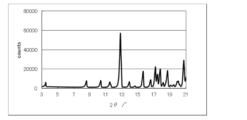
- FIGS. 1 to 5 The XRD measurement results of the unsolvated compound c3 and the solvated Examples 1, 3 and 10 and the compound c3 of Comparative Example 1 are shown in FIGS. 1 to 5. In addition, in any of FIGS. 1 to 5, it was shown up to 21 ° where a characteristic peak was observed.
Landscapes
- Chemical & Material Sciences (AREA)
- Organic Chemistry (AREA)
- Plural Heterocyclic Compounds (AREA)
- Organic Low-Molecular-Weight Compounds And Preparation Thereof (AREA)
Abstract
光透過率が高いレンズ等の光学部材を製造することができる材料として、一般式1で表される化合物の溶媒和物であって、溶媒が、分子量が200以下である窒素原子含有有機化合物を含み、窒素原子含有有機化合物中の炭素原子の数を窒素原子の数と酸素原子の数との和で割った値が5以下である溶媒和物が提供される; 式中、X及びYはそれぞれ独立に、ヘテロ原子又は炭素原子であり、ただし、X及びYの少なくとも1つは窒素原子であり、ZはX-C=C-Yとともに5~7員環を形成する原子群であって、炭素原子及びヘテロ原子から選択される少なくとも1種を含む原子群を表し、R3~R6は、置換基を表し、q及びrは0~4の整数であり、vは0~4の整数であり、wは0以上の整数である。
Description
本発明は、溶媒和物及び溶媒和物の製造方法に関する。
従来、カメラ、ビデオカメラあるいはカメラ付携帯電話、テレビ電話あるいはカメラ付ドアホンなどの撮像モジュールの光学部材にはガラス材料が用いられていた。ガラス材料は様々な光学特性を備えており、環境耐性に優れるため好ましく用いられてきたが、軽量化や小型化が容易ではなく、加工性や生産性が悪いという欠点を有していた。これに対し、樹脂硬化物は、大量生産が可能であり、加工性にも優れているため、様々な光学部材に用いられるようになってきている。
近年、撮像モジュールの小型化に伴い、撮像モジュールに用いられる光学部材を小型化することが求められているが、光学部材を小型化していくと、色収差の問題が生じる。そこで、樹脂硬化物を用いた光学部材においては、硬化性組成物の原料モノマーや添加物によりアッベ数を調整して色収差の補正を行うことが検討されている。
例えば、特許文献1には、ジフェニルフルオレン骨格に類似するヘテロ原子含有骨格を有する化合物を含む硬化性組成物から、低アッベ数である硬化物を成形できることが開示されている。
特許文献1に記載の硬化物等の製造において、原料化合物の純度が高いと硬化物の光透過率が高く、レンズなどの光学部材としてより好ましい。
本発明は、レンズ等の光学部材の製造に用いることができる材料として、製造物の光透過率を上げることを可能とする材料を提供することを課題とする。
本発明は、レンズ等の光学部材の製造に用いることができる材料として、製造物の光透過率を上げることを可能とする材料を提供することを課題とする。
本発明者が上記課題の解決のため、鋭意検討を重ねていたところ、特許文献1に記載のようなジフェニルフルオレン骨格に類似するヘテロ原子含有骨格を有するフェノール化合物の純度を、特定の溶媒との溶媒和物とすることにより、容易に上げることができることを見出した。また、このようなフェノール化合物を中間体として純度の高い硬化性モノマーが製造できることを見出した。さらに、上記溶媒和物のテトラヒドロフランなどの溶媒への溶解性が高く、反応系が均一系となって、純度の高い生成物が得られることを見出した。本発明はこの知見に基づき、完成されたものである。
すなわち、本発明は以下の<1>~<9>を提供するものである。
すなわち、本発明は以下の<1>~<9>を提供するものである。
<1>一般式1で表される化合物の溶媒和物であって、
上記溶媒和物を構成する溶媒が、窒素原子含有有機化合物を含み、
上記窒素原子含有有機化合物は酸素原子を含んでいてもよく、
上記窒素原子含有有機化合物中の炭素原子の数を窒素原子の数と酸素原子の数との和で割った値が5以下であり、
上記窒素原子含有有機化合物の分子量が200以下である、上記溶媒和物;
上記溶媒和物を構成する溶媒が、窒素原子含有有機化合物を含み、
上記窒素原子含有有機化合物は酸素原子を含んでいてもよく、
上記窒素原子含有有機化合物中の炭素原子の数を窒素原子の数と酸素原子の数との和で割った値が5以下であり、
上記窒素原子含有有機化合物の分子量が200以下である、上記溶媒和物;
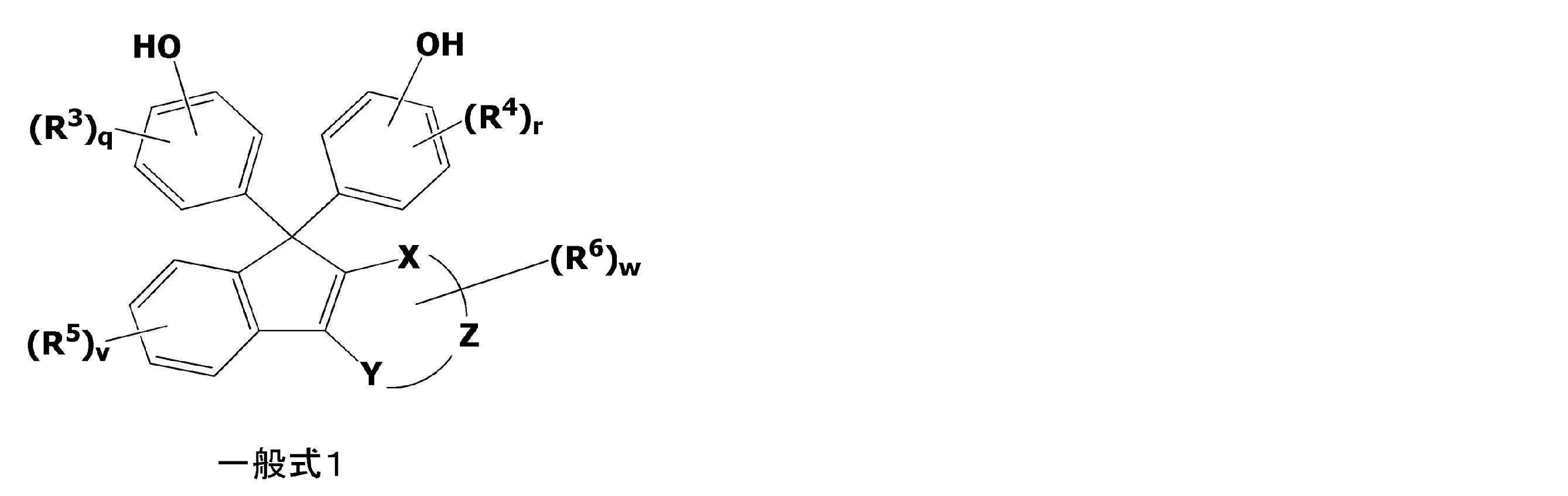
一般式1中、X及びYはそれぞれ独立に、酸素原子、イオウ原子、窒素原子又は炭素原子であり、ただし、X及びYの少なくとも1つは窒素原子であり;
ZはX-C=C-Yとともに5~7員環を形成する原子群であって、炭素原子及びヘテロ原子から選択される少なくとも1種を含む原子群を表し;
R3~R6はそれぞれ独立に、置換基を表し;
q及びrはそれぞれ独立に、0~4の整数であり;
vは0~4の整数であり、wは0以上の整数であり、wの最大数は、X-C=C-YとZが形成する環に置換可能な置換基の最大数であり;
qが2~4の整数である場合、複数のR3は同じであっても異なっていてもよく、複数のR3は互いに結合して環を形成してもよく;
rが2~4の整数である場合、複数のR4は同じであっても異なっていてもよく、複数のR4は互いに結合して環を形成してもよく;
vが2~4の整数である場合、複数のR5は同じであっても異なっていてもよく、複数のR5は互いに連結して環を形成せず;
wが2~5の整数である場合、複数のR6は同じであっても異なっていてもよく、複数のR6は互いに結合して環を形成してもよい。
<2>一般式1で表される化合物が一般式2で表される化合物である<1>に記載の溶媒和物;
ZはX-C=C-Yとともに5~7員環を形成する原子群であって、炭素原子及びヘテロ原子から選択される少なくとも1種を含む原子群を表し;
R3~R6はそれぞれ独立に、置換基を表し;
q及びrはそれぞれ独立に、0~4の整数であり;
vは0~4の整数であり、wは0以上の整数であり、wの最大数は、X-C=C-YとZが形成する環に置換可能な置換基の最大数であり;
qが2~4の整数である場合、複数のR3は同じであっても異なっていてもよく、複数のR3は互いに結合して環を形成してもよく;
rが2~4の整数である場合、複数のR4は同じであっても異なっていてもよく、複数のR4は互いに結合して環を形成してもよく;
vが2~4の整数である場合、複数のR5は同じであっても異なっていてもよく、複数のR5は互いに連結して環を形成せず;
wが2~5の整数である場合、複数のR6は同じであっても異なっていてもよく、複数のR6は互いに結合して環を形成してもよい。
<2>一般式1で表される化合物が一般式2で表される化合物である<1>に記載の溶媒和物;

一般式2中、R3、R4、R5、R7はそれぞれ独立に、置換基を表し;
q及びrはそれぞれ独立に、0~4の整数であり;
vは0~4の整数であり、sは0~2の整数であり;
qが2~4の整数である場合、複数のR3は同じであっても異なっていてもよく、複数のR3は互いに結合して環を形成してもよく;
rが2~4の整数である場合、複数のR4は同じであっても異なっていてもよく、複数のR4は互いに結合して環を形成してもよく;
vが2~4の整数である場合、複数のR5は同じであっても異なっていてもよく、複数のR5は互いに連結して環を形成せず;
sが2である場合、2つのR7は同じであっても異なっていてもよく、2つのR7は互いに結合して環を形成してもよい。
<3>一般式1で表される化合物が一般式3で表される化合物である<1>又は<2>に記載の溶媒和物;
q及びrはそれぞれ独立に、0~4の整数であり;
vは0~4の整数であり、sは0~2の整数であり;
qが2~4の整数である場合、複数のR3は同じであっても異なっていてもよく、複数のR3は互いに結合して環を形成してもよく;
rが2~4の整数である場合、複数のR4は同じであっても異なっていてもよく、複数のR4は互いに結合して環を形成してもよく;
vが2~4の整数である場合、複数のR5は同じであっても異なっていてもよく、複数のR5は互いに連結して環を形成せず;
sが2である場合、2つのR7は同じであっても異なっていてもよく、2つのR7は互いに結合して環を形成してもよい。
<3>一般式1で表される化合物が一般式3で表される化合物である<1>又は<2>に記載の溶媒和物;
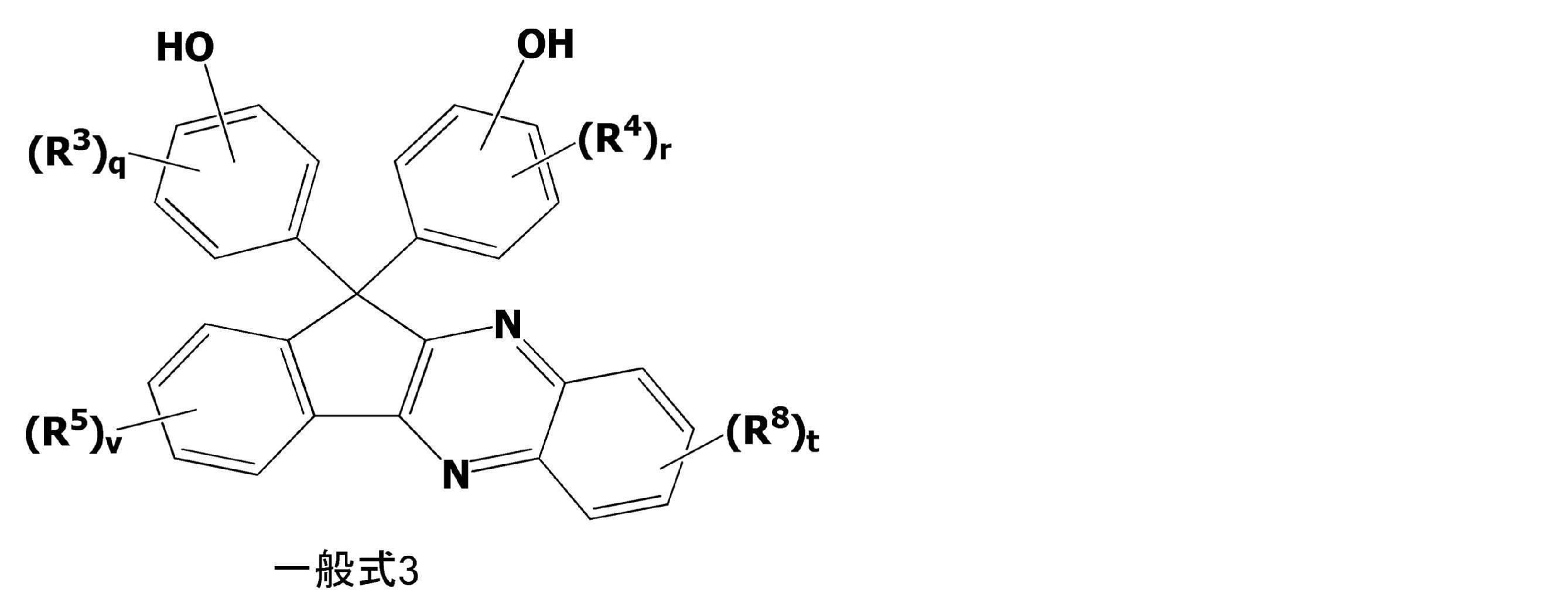
一般式3中、R3、R4、R5、R8はそれぞれ独立に、置換基を表し;
q及びrはそれぞれ独立に、0~4の整数であり;
vは0~4の整数であり、tは0~4の整数であり;
qが2~4の整数である場合、複数のR3は同じであっても異なっていてもよく、複数のR3は互いに結合して環を形成してもよく;
rが2~4の整数である場合、複数のR4は同じであっても異なっていてもよく、複数のR4は互いに結合して環を形成してもよく;
vが2~4の整数である場合、複数のR5は同じであっても異なっていてもよく、複数のR5は互いに連結して環を形成せず;
tが2~4の整数である場合、複数のR8は同じであっても異なっていてもよい。
<4>上記窒素原子含有有機化合物がピリジン、ピリミジン、ピラジン、一般式Bで表される化合物、及び一般式Cで表される化合物からなる群より選択されるいずれか1種以上である<1>~<3>のいずれかに記載の溶媒和物。
q及びrはそれぞれ独立に、0~4の整数であり;
vは0~4の整数であり、tは0~4の整数であり;
qが2~4の整数である場合、複数のR3は同じであっても異なっていてもよく、複数のR3は互いに結合して環を形成してもよく;
rが2~4の整数である場合、複数のR4は同じであっても異なっていてもよく、複数のR4は互いに結合して環を形成してもよく;
vが2~4の整数である場合、複数のR5は同じであっても異なっていてもよく、複数のR5は互いに連結して環を形成せず;
tが2~4の整数である場合、複数のR8は同じであっても異なっていてもよい。
<4>上記窒素原子含有有機化合物がピリジン、ピリミジン、ピラジン、一般式Bで表される化合物、及び一般式Cで表される化合物からなる群より選択されるいずれか1種以上である<1>~<3>のいずれかに記載の溶媒和物。
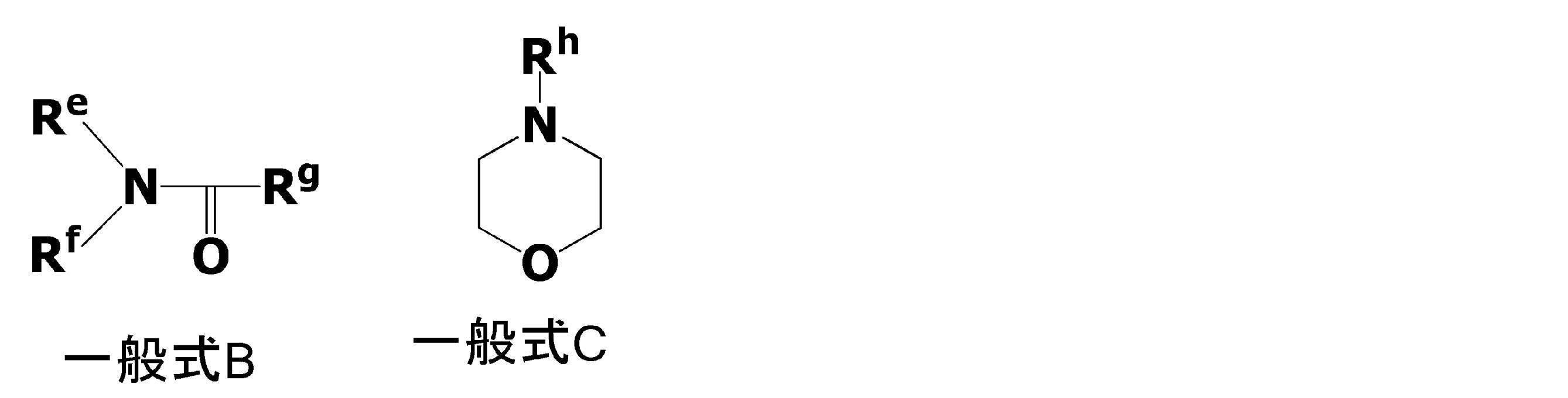
一般式B中、Re、Rf、Rgはそれぞれ独立して水素原子又は置換基を有してもよい炭化水素基であり、
Re及びRg、又はRe及びRfは互いに結合し、環構造を形成してもよく、
一般式C中、Rhは水素原子又は置換基を有してもよい炭化水素基である。
<5>上記窒素原子含有有機化合物中の炭素原子の数を窒素原子の数と酸素原子の数との和で割った上記値が5未満である<1>~<4>のいずれかに記載の溶媒和物。
<6>上記窒素原子含有有機化合物が、N,N’-ジメチルホルムアミド、N,N-ジメチルアセトアミド、N-メチルピロリドン、及びN-エチルピロリドンからなる群より選択されるいずれか1種以上である<1>~<5>のいずれかに記載の溶媒和物。
<7>窒素原子含有有機化合物の含有量が、一般式1で表される化合物100モル%に対して、10~200モル%である<1>~<6>のいずれかに記載の溶媒和物。
<8><1>~<7>のいずれかに記載の溶媒和物の製造方法であって、
上記窒素原子含有有機化合物を溶媒として一般式1で表される化合物を晶析することを含む製造方法。
<9>一般式1で表される化合物を上記窒素原子含有有機化合物からなる溶媒に溶解させた後、酢酸メチル、酢酸エチル、及び酢酸ブチルからなる群より選択されるいずれか1種以上を含む溶媒を添加し、上記溶媒和物を析出させることを含む、<8>に記載の製造方法。
Re及びRg、又はRe及びRfは互いに結合し、環構造を形成してもよく、
一般式C中、Rhは水素原子又は置換基を有してもよい炭化水素基である。
<5>上記窒素原子含有有機化合物中の炭素原子の数を窒素原子の数と酸素原子の数との和で割った上記値が5未満である<1>~<4>のいずれかに記載の溶媒和物。
<6>上記窒素原子含有有機化合物が、N,N’-ジメチルホルムアミド、N,N-ジメチルアセトアミド、N-メチルピロリドン、及びN-エチルピロリドンからなる群より選択されるいずれか1種以上である<1>~<5>のいずれかに記載の溶媒和物。
<7>窒素原子含有有機化合物の含有量が、一般式1で表される化合物100モル%に対して、10~200モル%である<1>~<6>のいずれかに記載の溶媒和物。
<8><1>~<7>のいずれかに記載の溶媒和物の製造方法であって、
上記窒素原子含有有機化合物を溶媒として一般式1で表される化合物を晶析することを含む製造方法。
<9>一般式1で表される化合物を上記窒素原子含有有機化合物からなる溶媒に溶解させた後、酢酸メチル、酢酸エチル、及び酢酸ブチルからなる群より選択されるいずれか1種以上を含む溶媒を添加し、上記溶媒和物を析出させることを含む、<8>に記載の製造方法。
本発明により、レンズ等の光学部材の製造に用いることができる一般式1で表される化合物を高純度で提供することができる溶媒和物、及び上記溶媒和物の製造方法が提供される。本発明の溶媒和物は光学部材等に用いることができる硬化物形成のための原料として、又は上記硬化物形成のための硬化性モノマーの製造中間体として用いることができる。本発明の溶媒和物はテトラヒドロフランなどの溶媒への溶解性も高いため、製造中間体として用いた場合に均一系での反応が可能となり、高純度かつ高収率で硬化性モノマーを製造することができる。
以下において、本発明について詳細に説明する。以下に記載する構成要件の説明は、代表的な実施形態や具体例に基づいてなされることがあるが、本発明はそのような実施形態に限定されない。
本明細書において「~」を用いて表される数値範囲は「~」の前後に記載される数値を下限値及び上限値として含む範囲を意味する。本発明におけるモノマーは、オリゴマー及びポリマーと区別され、重量平均分子量が1000以下の化合物をいう。
<溶媒和物>
本発明の溶媒和物は一般式1で表される化合物(フェノール化合物)の溶媒和物であり、一般式1で表される化合物と溶媒とからなる。本発明の溶媒和物において、一般式1で表される化合物は1種であっても2種以上であってもよいが、通常1種である。本発明の溶媒和物において溶媒は1種であっても2種以上であってもよく、1種であることが好ましい。
本発明の溶媒和物は一般式1で表される化合物(フェノール化合物)の溶媒和物であり、一般式1で表される化合物と溶媒とからなる。本発明の溶媒和物において、一般式1で表される化合物は1種であっても2種以上であってもよいが、通常1種である。本発明の溶媒和物において溶媒は1種であっても2種以上であってもよく、1種であることが好ましい。
本発明者らは、一般式1で表される化合物が、下記の特定の溶媒との溶媒和物とすることにより、高い純度で得られることを見出した。典型的には、上記の溶媒和物は、純度の高い結晶として単離することができるが、アモルファスとなることもあり、本発明の溶媒和物の状態又は形状は特に限定されない。本発明の溶媒和物は結晶であることが好ましい。
[溶媒]
本発明の溶媒和物においては、溶媒和物を構成する溶媒が、分子量が200以下である窒素原子含有有機化合物を含む。窒素原子含有有機化合物とはその構造式が炭素原子、水素原子及び窒素原子(N)を含んで構成される化合物である。窒素原子含有有機化合物はさらに酸素原子を含んでいてもよい。上記窒素原子含有有機化合物中の炭素原子の数を窒素原子の数と酸素原子の数との和で割った値が5以下である。すなわち、本発明の溶媒和物を構成する溶媒は下記分子式で表される化合物を含む。
本発明の溶媒和物においては、溶媒和物を構成する溶媒が、分子量が200以下である窒素原子含有有機化合物を含む。窒素原子含有有機化合物とはその構造式が炭素原子、水素原子及び窒素原子(N)を含んで構成される化合物である。窒素原子含有有機化合物はさらに酸素原子を含んでいてもよい。上記窒素原子含有有機化合物中の炭素原子の数を窒素原子の数と酸素原子の数との和で割った値が5以下である。すなわち、本発明の溶媒和物を構成する溶媒は下記分子式で表される化合物を含む。

上記窒素原子含有有機化合物の分子量は200以下であり、180以下であることが好ましく、160以下であることがより好ましい。また、窒素原子含有有機化合物中の炭素原子の数を上記窒素原子の数と酸素原子の数との和で割った上記値は5未満であることが好ましい。すなわち、上記分子式において、a/(b+c)<5であることが好ましい。
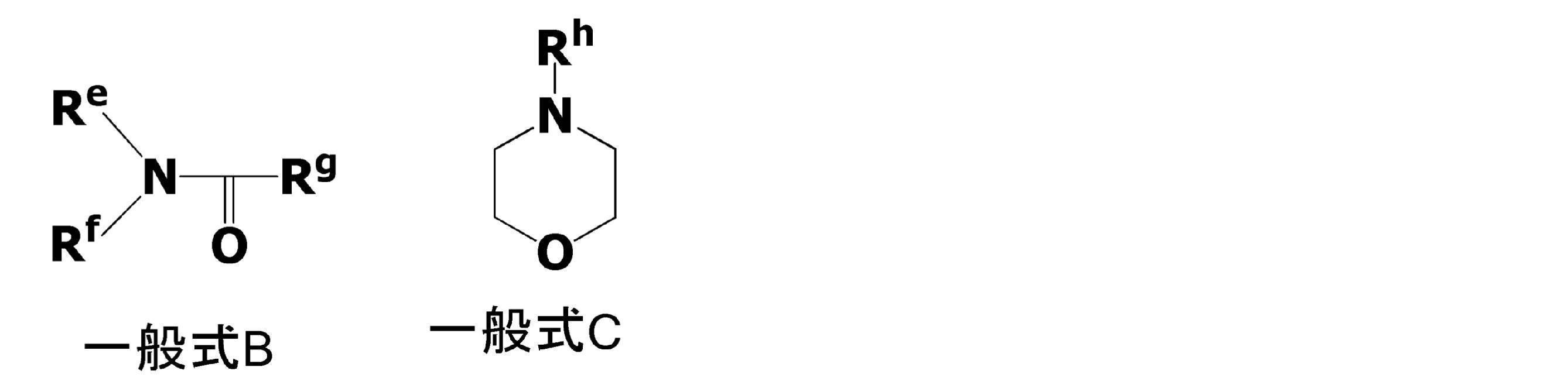
上記窒素原子含有有機化合物の例としては、ピリジン、ピリミジン、ピラジン、一般式Bで表される化合物、及び一般式Cで表される化合物が挙げられる。
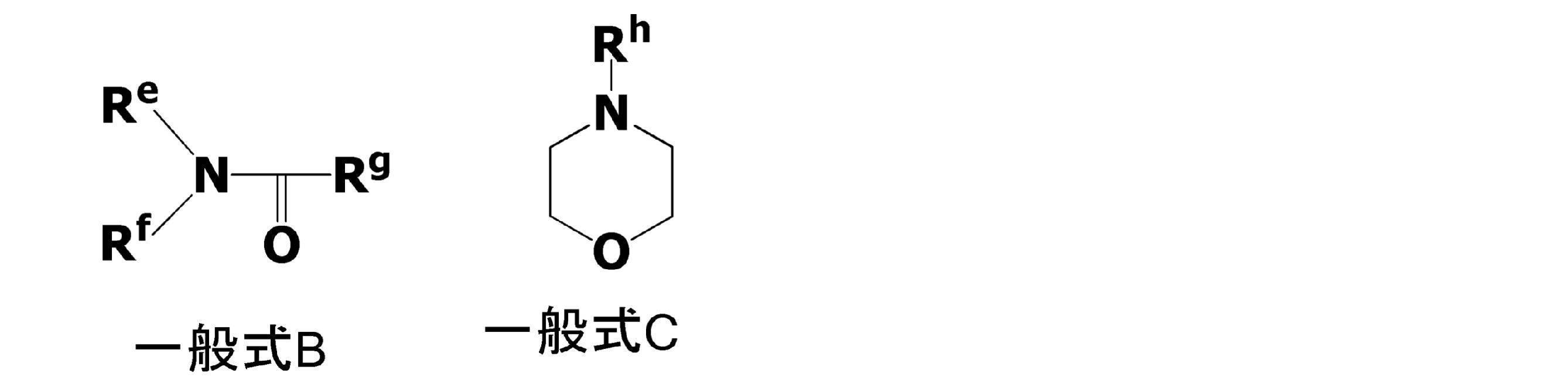
一般式B中、Re、Rf、Rgはそれぞれ独立して、水素原子又は置換基を有してもよい炭化水素基であり、ReとRg、又はReとRfは互いに結合し、環構造を形成してもよい。Re、Rfは置換基を有してもよい炭化水素基であることが好ましく、ReとRgが互いに結合し、環構造を形成することも好ましい。一般式C中、Rhは水素原子又は置換基を有してもよい炭化水素基である。
上記置換基としては、メチル基、エチル基などのアルキル基が挙げられる。一般式B及び一般式Cにおける置換基を有してもよい炭化水素基としては、無置換の炭化水素基が好ましい。炭化水素基としては、炭素数1~5の分岐又は直鎖のアルキル基、炭素数1~6のシクロアルキル基、フェニル基、又はこれらの組み合わせが挙げられ、炭素数1~3の分岐又は直鎖のアルキル基が好ましく、メチル基又はエチル基が好ましい。一般式Bにおいて、ReとRgとが互いに結合して形成する環構造としては、ピロリジノン環などが挙げられる。また、ReとRfとが互いに結合して形成する環構造としては、ピロリジン環、ピペラジン環、モルホリン環などが挙げられる。Re及びRfは同一種の基であることが好ましい。
上記置換基としては、メチル基、エチル基などのアルキル基が挙げられる。一般式B及び一般式Cにおける置換基を有してもよい炭化水素基としては、無置換の炭化水素基が好ましい。炭化水素基としては、炭素数1~5の分岐又は直鎖のアルキル基、炭素数1~6のシクロアルキル基、フェニル基、又はこれらの組み合わせが挙げられ、炭素数1~3の分岐又は直鎖のアルキル基が好ましく、メチル基又はエチル基が好ましい。一般式Bにおいて、ReとRgとが互いに結合して形成する環構造としては、ピロリジノン環などが挙げられる。また、ReとRfとが互いに結合して形成する環構造としては、ピロリジン環、ピペラジン環、モルホリン環などが挙げられる。Re及びRfは同一種の基であることが好ましい。
上記窒素原子含有有機化合物の例としては以下に構造を示す、N,N-ジメチルホルムアミド(1.5)、N,N-ジメチルアセトアミド(2)、N,N-ジメチルプロピオンアミド(2.5)、N,N-ジエチルプロピオンアミド(3.5)、2-ピロリドン(2)、N-メチルピロリドン(2.5)、N-エチルピロリドン(3)、モルホリン(2)、N-メチルモリホリン(2.5)、ピリジン(5)、ピリミジン(2)、ピラジン(2)などが挙げられる。なお、括弧内の値は、化合物中の炭素原子の数を上記窒素原子の数と酸素原子の数との和で割った値(a/(b+c))である。
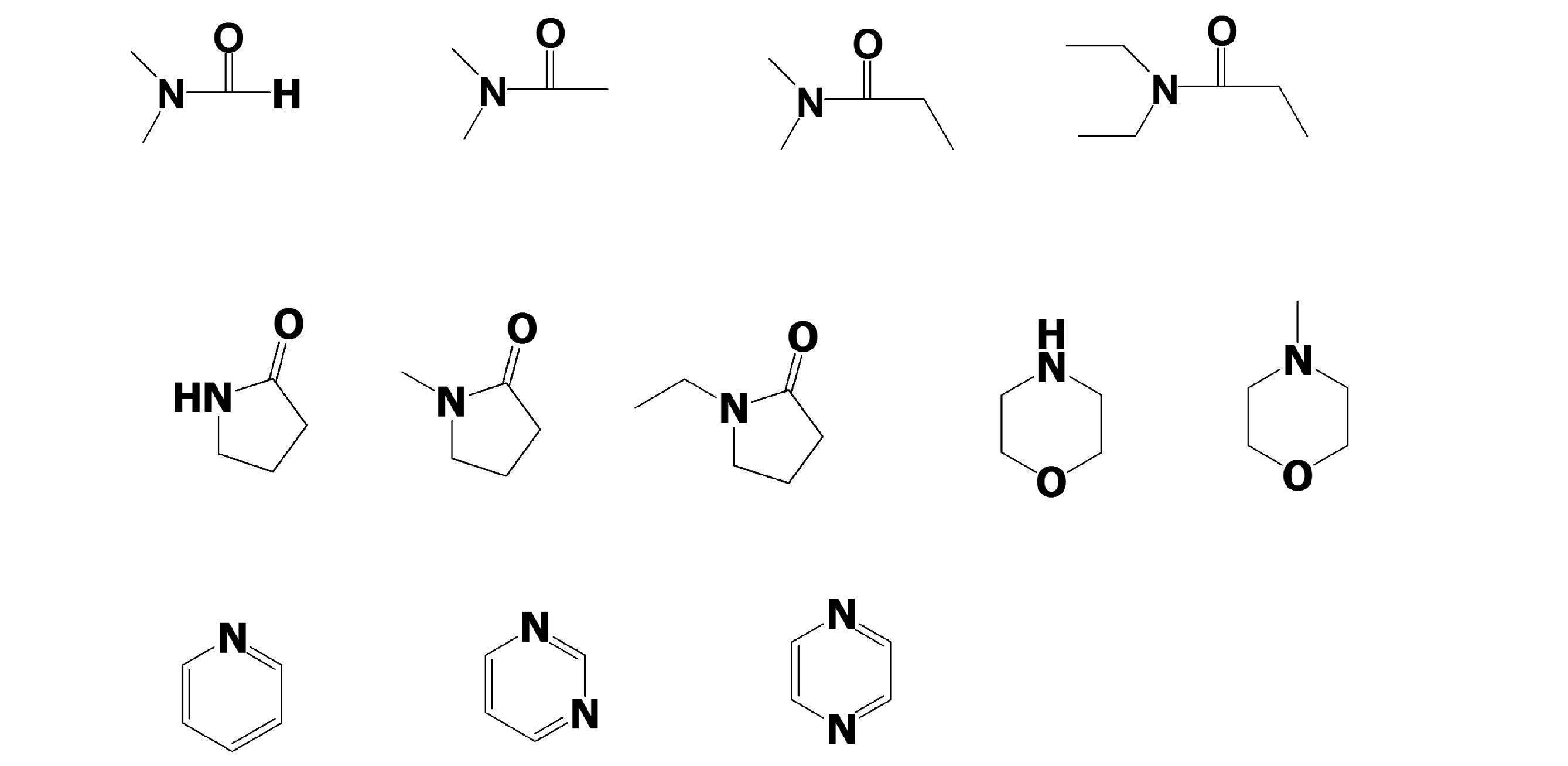
このなかで、N,N-ジメチルホルムアミド、N,N-ジメチルアセトアミド、N-メチルピロリドン、及びN-エチルピロリドンが好ましく、N,N-ジメチルアセトアミド、N-メチルピロリドン、及びN-エチルピロリドンがより好ましい。
本発明の溶媒和物における窒素原子含有有機化合物の含有量は、一般式1で表される化合物及び窒素原子含有有機化合物の種類により異なり、特に限定されないが、一般式1で表される化合物100モル%に対して、300モル%以下であればよく、10~200モル%であることが好ましい。
本発明の溶媒和物における溶媒は、上記の窒素原子含有有機化合物以外の窒素原子を有する有機化合物を含んでいないことが好ましい。本発明の溶媒和物における溶媒は、窒素原子を有していない有機化合物を含んでいてもよい。窒素原子を有していない有機化合物としては、常温で液体である有機化合物であって一般的に溶媒として用いられる化合物が挙げられ、特に限定されない。具体例としては、酢酸メチル、酢酸エチル、及び酢酸ブチルが挙げられる。
[一般式1で表される化合物]

一般式1中、X及びYはそれぞれ独立に、酸素原子、イオウ原子、窒素原子又は炭素原子であり、ただし、X及びYの少なくとも1つは窒素原子である。X及びYにおいて、R6が結合していない炭素原子は水素原子が結合してCHとなっていればよい。
ZはX-C=C-Yとともに5~7員環を形成する原子群であって、炭素原子及びヘテロ原子から選択される少なくとも1種を含む原子群を表す。Zにおいて、R6が結合していない炭素原子は水素原子が結合してCHとなっていればよい。
ZはX-C=C-Yとともに5~7員環を形成する原子群であって、炭素原子及びヘテロ原子から選択される少なくとも1種を含む原子群を表す。Zにおいて、R6が結合していない炭素原子は水素原子が結合してCHとなっていればよい。
R3~R6はそれぞれ独立に、置換基を表す。q及びrはそれぞれ独立に、0~4の整数である。vは0~4の整数であり、wは0以上の整数であり、wの最大数は、X-C=C-YとZが形成する環に置換可能な置換基の最大数であり;
qが2~4の整数である場合、複数のR3は同じであっても異なっていてもよく、複数のR3は互いに結合して環を形成してもよく;
rが2~4の整数である場合、複数のR4は同じであっても異なっていてもよく、複数のR4は互いに結合して環を形成してもよく;
vが2~4の整数である場合、複数のR5は同じであっても異なっていてもよく、複数のR5は互いに連結して環を形成せず;
wが2~5の整数である場合、複数のR6は同じであっても異なっていてもよく、複数のR6は互いに結合して環を形成してもよい。
qが2~4の整数である場合、複数のR3は同じであっても異なっていてもよく、複数のR3は互いに結合して環を形成してもよく;
rが2~4の整数である場合、複数のR4は同じであっても異なっていてもよく、複数のR4は互いに結合して環を形成してもよく;
vが2~4の整数である場合、複数のR5は同じであっても異なっていてもよく、複数のR5は互いに連結して環を形成せず;
wが2~5の整数である場合、複数のR6は同じであっても異なっていてもよく、複数のR6は互いに結合して環を形成してもよい。
一般式1中、X及びYはそれぞれ独立に、窒素原子又は炭素原子であることが好ましい。また、X及びYの両方が窒素原子であることがより好ましい。
一般式1中、ZはX-C=C-Yとともに5又は6員環を形成する原子群であることが好ましく、6員環を形成する原子群であることがより好ましい。また、Zは炭素原子及びヘテロ原子から選択される少なくとも1種を含む原子群であればよく、炭素原子を含む原子群であることが好ましく、炭素原子からなる原子群であることがより好ましい。
一般式1中、ZはX-C=C-Yとともに5又は6員環を形成する原子群であることが好ましく、6員環を形成する原子群であることがより好ましい。また、Zは炭素原子及びヘテロ原子から選択される少なくとも1種を含む原子群であればよく、炭素原子を含む原子群であることが好ましく、炭素原子からなる原子群であることがより好ましい。
一般式1中、R3~R6が表す置換基としては特に制限はないが、例えば、ハロゲン原子、ハロゲン化アルキル基、アルキル基、アルケニル基、アシル基、アルコキシカルボニル基、ヒドロキシ基、ヒドロキシアルキル基、アルコキシ基、アリール基、ヘテロアリール基、シクロアルキル基、シアノ基などを挙げることができる。
本明細書において、ハロゲン原子としてはフッ素原子、塩素原子、臭素原子、ヨウ素原子が挙げられる。
本明細書において、アルキル基というときは、直鎖もしくは分岐のアルキル基を表す。アルキル基としては、メチル基、エチル基、プロピル基、イソプロピル基、ブチル基、イソブチル基、sec-ブチル基、tert-ブチル基、ペンチル基、1-メチルブチル基、3-メチルブチル基、ヘキシル基、1-メチルペンチル基、4-メチルペンチル基、ヘプチル基、1-メチルヘキシル基、5-メチルヘキシル基、2-エチルヘキシル基、オクチル基、1-メチルヘプチル基、ノニル基、1-メチルオクチル基、デシル基、ウンデシル基、ドデシル基、トリデシル基、テトラデシル基、ペンタデシル基、ヘキサデシル基、ヘプタデシル基、オクタデシル基、ノナデシル基、エイコシル基等が挙げられる。アルキル基を含む基(ハロゲン化アルキル基、アルコキシ基、アルコキシカルボニル基、アシル基等)中のアルキル基についても同様である。アルキル基としては、メチル基又はエチル基が好ましい。
本明細書において、アルキル基というときは、直鎖もしくは分岐のアルキル基を表す。アルキル基としては、メチル基、エチル基、プロピル基、イソプロピル基、ブチル基、イソブチル基、sec-ブチル基、tert-ブチル基、ペンチル基、1-メチルブチル基、3-メチルブチル基、ヘキシル基、1-メチルペンチル基、4-メチルペンチル基、ヘプチル基、1-メチルヘキシル基、5-メチルヘキシル基、2-エチルヘキシル基、オクチル基、1-メチルヘプチル基、ノニル基、1-メチルオクチル基、デシル基、ウンデシル基、ドデシル基、トリデシル基、テトラデシル基、ペンタデシル基、ヘキサデシル基、ヘプタデシル基、オクタデシル基、ノナデシル基、エイコシル基等が挙げられる。アルキル基を含む基(ハロゲン化アルキル基、アルコキシ基、アルコキシカルボニル基、アシル基等)中のアルキル基についても同様である。アルキル基としては、メチル基又はエチル基が好ましい。
本明細書において、アルケニル基としては、ビニル基、アリル基等が挙げられる。
本明細書において、アリール基は、芳香族炭化水素環から、任意の水素原子を1つ除いて得られる1価の基を表す。アリール基としては、炭素数6~14のアリール基が好ましく、例としては、フェニル基、ビフェニル基、1-ナフチル基、2-ナフチル基、1-アントラセニル基、2-アントラセニル基、3-アントラセニル基、4-アントラセニル基、9-アントラセニル基、1-フェナントリル基、2-フェナントリル基、3-フェナントリル基、4-フェナントリル基、9-フェナントリル基等が挙げられる。これらのうち、フェニル基が好ましい。
本明細書において、ヘテロアリール基は、芳香族複素環から、任意の水素原子を1つ除いて得られる1価の基を表す。ヘテロアリール基の例としては、フリル基、チエニル基、ピロリル基、イミダゾリル基、イソチアゾリル基、イソオキサゾリル基、ピリジル基、ピラジニル基、キノリル基、ベンゾフラニル基(好ましくは、2-ベンゾフラニル基)、ベンゾチアゾリル基(好ましくは2-ベンゾチアゾリル基)、ベンゾオキサゾリル基(好ましくは2-ベンゾオキサゾリル基)等が挙げられる。
本明細書において、シクロアルキル基は、シクロアルカンから、任意の水素原子を1つ除いて得られる1価の基を表す。シクロアルキル基の例としては、シクロブチル基、シクロベンチル基、シクロヘキシル基等が挙げられる。
R3~R6が表す置換基はハロゲン原子、アルキル基、アルコキシ基、アリール基又はシアノ基であることが好ましく、ハロゲン原子、炭素数1~5のアルキル基、炭素数1~5のアルコキシ基、フェニル基又はシアノ基であることがより好ましく、ハロゲン原子、メチル基、メトキシ基、フェニル基又はシアノ基であることが特に好ましい。
中でも、R3及びR4はそれぞれ独立にメチル基又はメトキシ基であることが好ましい。なお、複数のR3もしくは複数のR4は各々環を形成してもよく、この場合、置換する環と縮合環を形成してもよい。R5はハロゲン原子、メチル基又はメトキシ基であることが好ましい。R6はハロゲン原子、メチル基、メトキシ基又はシアノ基であることが好ましい。また、複数のR6は置換する環と縮合環を形成する基であることがより好ましい。
R3~R6が表す置換基は重合性基ではないことが好ましい。
R3~R6が表す置換基は重合性基ではないことが好ましい。
一般式1中、q及びrはそれぞれ独立に、0~3の整数であることが好ましく、0~2の整数であることがより好ましく、0であることがさらに好ましい。vは0~3の整数であることが好ましく、0~2の整数であることがより好ましく、0であることがさらに好ましい。wは0~3の整数であることが好ましく、0~2の整数であることがより好ましい。
qが2~4の整数である場合、複数のR3は同じであっても異なっていてもよい。複数のR3は互いに結合して環を形成してもよいが、複数のR3は互いに結合して環を形成していないことが好ましい。rが2~4の整数である場合、複数のR4は同じであっても異なっていてもよい。複数のR4は互いに結合して環を形成してもよいが、複数のR4は互いに結合して環を形成していないことが好ましい。
vが2~4の整数である場合、複数のR5は同じであっても異なっていてもよい。また、複数のR5は互いに連結して環を形成しない。
vが2~4の整数である場合、複数のR5は同じであっても異なっていてもよい。また、複数のR5は互いに連結して環を形成しない。
wが2~5の整数である場合、複数のR6は同じであっても異なっていてもよく、複数のR6は互いに結合して環を形成してもよい。中でも、wが2~5の整数である場合、複数のR6は互いに結合して、置換する環と縮合環を形成する基であることが好ましい。縮合環はさらに置換基を有していてもよく、この場合、置換基としては、R6として挙げた置換基を好ましい置換基として例示できる。
複数のR6が互いに結合して、置換する環と縮合環を形成する基である場合、縮合環を形成する環数は4以下であることが好ましく、3以下であることが好ましく、2であることが好ましい。縮合環を形成する環数を上記範囲とすることにより、化合物を含む硬化物の着色を抑制し易くなる。
一般式1で表される化合物は、一般式2で表される化合物であることが好ましい。

一般式2におけるR3~R5の定義及び好ましい範囲は、一般式1におけるR3~R5の定義及び好ましい範囲とそれぞれ同様である。
一般式2におけるq、r、及びvの定義及び好ましい範囲は、一般式1におけるq、r、及びvの定義及び好ましい範囲とそれぞれ同様である。
一般式2中、R7は置換基を表す。置換基としては、上記R3~R6が表す置換基として挙げた置換基が挙げられる。一般式2において、sは0~2の整数を表し、2であることが好ましい。sが2であるとき、2つのR7は同じであっても異なっていてもよい。また、2つのR7は互いに連結して環を形成していてもよい。R7はシアノ基、フェニル基、ハロゲン原子、メチル基又はメトキシ基であることが好ましく、シアノ基又はフェニル基であることがより好ましい。
一般式2におけるq、r、及びvの定義及び好ましい範囲は、一般式1におけるq、r、及びvの定義及び好ましい範囲とそれぞれ同様である。
一般式2中、R7は置換基を表す。置換基としては、上記R3~R6が表す置換基として挙げた置換基が挙げられる。一般式2において、sは0~2の整数を表し、2であることが好ましい。sが2であるとき、2つのR7は同じであっても異なっていてもよい。また、2つのR7は互いに連結して環を形成していてもよい。R7はシアノ基、フェニル基、ハロゲン原子、メチル基又はメトキシ基であることが好ましく、シアノ基又はフェニル基であることがより好ましい。
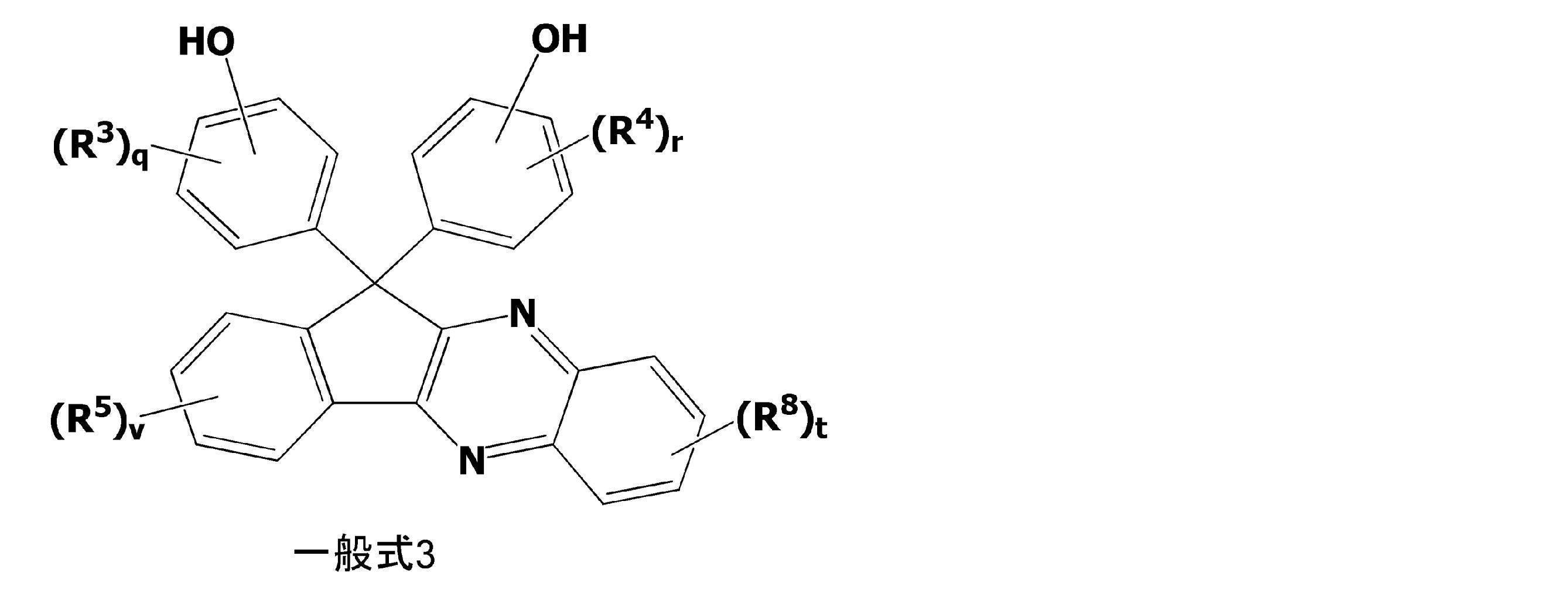
一般式1で表される化合物は、下記一般式3で表される化合物であることがより好ましい。
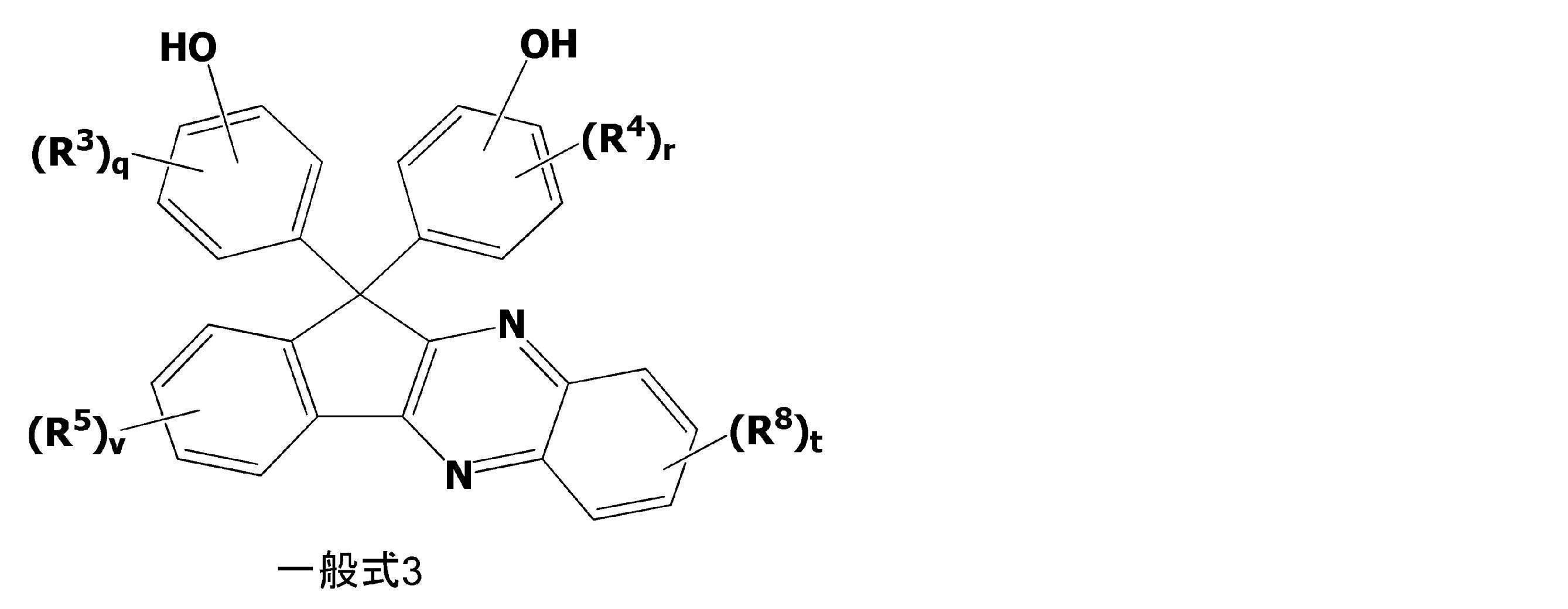
一般式3におけるR3~R5の定義及び好ましい範囲は、一般式1におけるR3~R5の定義及び好ましい範囲とそれぞれ同様である。
一般式3におけるq、r、及びvの定義及び好ましい範囲は、一般式1におけるq、r、及びvの定義及び好ましい範囲とそれぞれ同様である。
一般式3中、R8は置換基を表す。置換基としては、上記R3~R6が表す置換基として挙げた置換基が挙げられる。一般式3において、tは0~4の整数である。tが2~4の整数である場合、複数のR8は同じであっても異なっていてもよい。ここで複数のR8は互いに連結して環を形成しない。
一般式3におけるq、r、及びvの定義及び好ましい範囲は、一般式1におけるq、r、及びvの定義及び好ましい範囲とそれぞれ同様である。
一般式3中、R8は置換基を表す。置換基としては、上記R3~R6が表す置換基として挙げた置換基が挙げられる。一般式3において、tは0~4の整数である。tが2~4の整数である場合、複数のR8は同じであっても異なっていてもよい。ここで複数のR8は互いに連結して環を形成しない。
R8はハロゲン原子、メトキシカルボニル基、メチル基又はメトキシ基であることが好ましく、ハロゲン原子、メチル基であることがより好ましく、メチル基であることがさらに好ましい。
tは0~2であることが好ましい。また、一般式3においては、vが0であり、かつtが1又は2であることがより好ましく、vが0であり、かつtが2であることがさらに好ましい。tが1であるときのR8の置換位置は形成されているキノキサリン環の6位又は7位が好ましく、tが2であるときのR8の置換位置は形成されているキノキサリン環の6位及び7位が好ましい。
以下において、本発明に好ましく用いられる一般式1で表される化合物の具体例を列挙するが、本発明は以下の化合物に限定されるものではない。なお、以下の化合物においてMeはメチル基を表す。


上記化合物c2、c8、c10は、キノキサリン環の6位又は7位に置換基が結合している化合物の混合物である。
一般式1で表される化合物は、例えば、WO2017/115649に記載の方法で製造することができる。すなわち、一般式4で表される化合物と一般式5及び/又は一般式6で表される化合物とを縮合させて製造することができる。上記の縮合反応は酸触媒及びチオール化合物を含む溶媒中で行うことが好ましい。
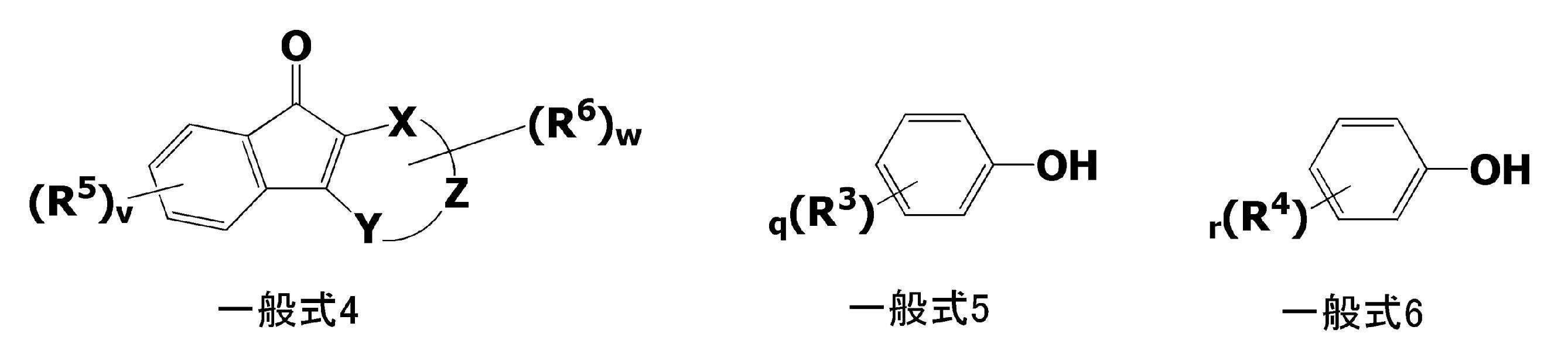
一般式4、一般式5、一般式6中、X、Y、Z、R3~R6、q、r、v、wの定義はそれぞれ一般式1における定義と同様である。
[溶媒和物の合成方法]
本発明の溶媒和物は、一般式1で表される化合物を上記の分子量が200以下である窒素原子含有有機化合物を含む溶媒、好ましくは窒素原子含有有機化合物からなる溶媒に溶解して晶析を行うことにより製造することができる。通常、一般式1で表される化合物を窒素原子含有有機化合物からなる溶媒に溶解させた後、貧溶媒を加えて本発明の溶媒和物を析出させることができる。貧溶媒の例としては、酢酸メチル、酢酸エチル、及び酢酸ブチルが挙げられる。本発明の溶媒和物の製造に用いる一般式1で表される化合物としては、例えば、上述の一般式1で表される化合物の製造方法で得られた生成物の粗結晶をそのまま用いてもよい。
本発明の溶媒和物は、一般式1で表される化合物を上記の分子量が200以下である窒素原子含有有機化合物を含む溶媒、好ましくは窒素原子含有有機化合物からなる溶媒に溶解して晶析を行うことにより製造することができる。通常、一般式1で表される化合物を窒素原子含有有機化合物からなる溶媒に溶解させた後、貧溶媒を加えて本発明の溶媒和物を析出させることができる。貧溶媒の例としては、酢酸メチル、酢酸エチル、及び酢酸ブチルが挙げられる。本発明の溶媒和物の製造に用いる一般式1で表される化合物としては、例えば、上述の一般式1で表される化合物の製造方法で得られた生成物の粗結晶をそのまま用いてもよい。
[溶媒和物の用途]
一般式1で表される化合物はその構造中のヒドロキシ基を利用して重合性基を有する側鎖を有する化合物に誘導することができ、硬化性モノマーの製造中間体として有用である。WO2017/115649にも記載されているように、一般式1で表される化合物から誘導される硬化性モノマーを含む組成物の硬化物はレンズなどの光学部材に好ましく用いることができる。また、一般式1で表される化合物はそのままレンズなどの光学部材を製造するための硬化性組成物の一成分として用いることができる。上述のように、一般式1で表される化合物は上記の窒素原子含有有機化合物を含む溶媒との溶媒和物として純度の高い結晶を単離することができる。また、結晶として得られた溶媒和物はテトラヒドロフランなどの溶媒への溶解度が高く、製造中間体として用いた場合に均一系での反応が可能となり、高純度かつ高収率での硬化性モノマーを製造することができる。したがって、本発明の溶媒和物を用いて、光透過率の高いレンズなどの光学部材を容易に製造することができる。
一般式1で表される化合物はその構造中のヒドロキシ基を利用して重合性基を有する側鎖を有する化合物に誘導することができ、硬化性モノマーの製造中間体として有用である。WO2017/115649にも記載されているように、一般式1で表される化合物から誘導される硬化性モノマーを含む組成物の硬化物はレンズなどの光学部材に好ましく用いることができる。また、一般式1で表される化合物はそのままレンズなどの光学部材を製造するための硬化性組成物の一成分として用いることができる。上述のように、一般式1で表される化合物は上記の窒素原子含有有機化合物を含む溶媒との溶媒和物として純度の高い結晶を単離することができる。また、結晶として得られた溶媒和物はテトラヒドロフランなどの溶媒への溶解度が高く、製造中間体として用いた場合に均一系での反応が可能となり、高純度かつ高収率での硬化性モノマーを製造することができる。したがって、本発明の溶媒和物を用いて、光透過率の高いレンズなどの光学部材を容易に製造することができる。
以下に実施例と比較例を挙げて本発明の特徴をさらに具体的に説明する。以下の実施例に示す材料、使用量、割合、処理内容、処理手順等は、本発明の趣旨を逸脱しない限り適宜変更することができる。したがって、本発明の範囲は以下に示す具体例により限定的に解釈されるべきものではない。
<合成例>
合成例1(化合物c3):
4,5-ジメチル-1,2-フェニレンジアミン26.6g及びニンヒドリン35.6gに対して、トルエン150mL、エタノール125mL、酢酸100mLを加えて70℃で3時間反応させた。反応溶液を室温まで冷却したのち、析出した結晶を濾取し、エタノールで洗浄、乾燥することで、中間体c2Aを47g得た。
1H-NMR(300MHz,CDCl3):δ2.49ppm(s、3H)、2.51ppm(s、3H)、7.52-7.58ppm(t,1H)、7.71-7.76ppm(t,1H)、7.85-7.95ppm(m,3H)、8.02-8.08ppm(d,1H)
合成例1(化合物c3):
4,5-ジメチル-1,2-フェニレンジアミン26.6g及びニンヒドリン35.6gに対して、トルエン150mL、エタノール125mL、酢酸100mLを加えて70℃で3時間反応させた。反応溶液を室温まで冷却したのち、析出した結晶を濾取し、エタノールで洗浄、乾燥することで、中間体c2Aを47g得た。
1H-NMR(300MHz,CDCl3):δ2.49ppm(s、3H)、2.51ppm(s、3H)、7.52-7.58ppm(t,1H)、7.71-7.76ppm(t,1H)、7.85-7.95ppm(m,3H)、8.02-8.08ppm(d,1H)
中間体c2Aを22gとフェノール32gとをメタンスルホン酸20mL及びアセトニトリル20mLに溶解させた。反応溶液を加温し、90℃に保ちつつ、3-メルカプトプロピオン酸0.3mLを滴下した。3時間攪拌後、アセトニトリル200mL及び水100mLを添加し、反応溶液を40℃で2時間撹拌した。析出した結晶を濾取し、アセトニトリル:水=1v:1v混合液200mLで洗浄後、乾燥することで化合物c3を22g得た。
1H-NMR(300MHz,DMSO-d6):δ2.47ppm(s、3H)、2.49ppm(s、3H)、6.61-6.67ppm(d,4H)、6.95-7.01ppm(d,4H)、7.52-7.62ppm(m,3H)、7.84ppm(s,1H)、7.93ppm(s,1H)、8.12-8.14ppm(d,1H)、9.40ppm(bs,2H)
1H-NMR(300MHz,DMSO-d6):δ2.47ppm(s、3H)、2.49ppm(s、3H)、6.61-6.67ppm(d,4H)、6.95-7.01ppm(d,4H)、7.52-7.62ppm(m,3H)、7.84ppm(s,1H)、7.93ppm(s,1H)、8.12-8.14ppm(d,1H)、9.40ppm(bs,2H)
合成例2(化合物c1):
4,5-ジメチル-1,2-フェニレンジアミンをo-フェニレンジアミンに変更した以外は化合物c3の合成と同様の方法で化合物c1を28g得た。
1H-NMR(300MHz,DMSO-d6):δ6.61-6.68ppm(d、4H)、6.95-7.01ppm(d、4H)、7.50-7.70ppm(m、3H)、7.72-7.90ppm(m、2H)、8.00-8.08ppm(d、1H)、8.12-8.25ppm(m、2H)、9.41ppm(bs、2H)
4,5-ジメチル-1,2-フェニレンジアミンをo-フェニレンジアミンに変更した以外は化合物c3の合成と同様の方法で化合物c1を28g得た。
1H-NMR(300MHz,DMSO-d6):δ6.61-6.68ppm(d、4H)、6.95-7.01ppm(d、4H)、7.50-7.70ppm(m、3H)、7.72-7.90ppm(m、2H)、8.00-8.08ppm(d、1H)、8.12-8.25ppm(m、2H)、9.41ppm(bs、2H)
合成例3(化合物c2):
4,5-ジメチル-1,2-フェニレンジアミンを3,4-ジアミノトルエンに変更した以外は化合物c3の合成と同様の方法で化合物c2を26g得た。
1H-NMR(300MHz,DMSO-d6):δ2.50ppm(s、3H)、6.61-6.67ppm(d、4H)、6.95-7.01ppm(d、4H)、7.52-7.64ppm(m、4H)、7.84-8.14ppm(m、2H)、8.14-8.20ppm(d、1H)、9.40ppm(bs、2H)
4,5-ジメチル-1,2-フェニレンジアミンを3,4-ジアミノトルエンに変更した以外は化合物c3の合成と同様の方法で化合物c2を26g得た。
1H-NMR(300MHz,DMSO-d6):δ2.50ppm(s、3H)、6.61-6.67ppm(d、4H)、6.95-7.01ppm(d、4H)、7.52-7.64ppm(m、4H)、7.84-8.14ppm(m、2H)、8.14-8.20ppm(d、1H)、9.40ppm(bs、2H)
合成例4(化合物c9):
4,5-ジメチル-1,2-フェニレンジアミンを4,5-ジクロロ-1,2-フェニレンジアミンに変更した以外は化合物c3の合成と同様の方法で化合物c9を21g得た。
1H-NMR(300MHz,DMSO-d6):δ6.61-6.68ppm(d、4H)、6.95-7.01ppm(d、4H)、7.52-7.70ppm(m、3H)、8.14-8.20ppm(d、1H)、8.39ppm(s、1H)、8.45ppm(s、1H)、9.44ppm(bs、2H)
4,5-ジメチル-1,2-フェニレンジアミンを4,5-ジクロロ-1,2-フェニレンジアミンに変更した以外は化合物c3の合成と同様の方法で化合物c9を21g得た。
1H-NMR(300MHz,DMSO-d6):δ6.61-6.68ppm(d、4H)、6.95-7.01ppm(d、4H)、7.52-7.70ppm(m、3H)、8.14-8.20ppm(d、1H)、8.39ppm(s、1H)、8.45ppm(s、1H)、9.44ppm(bs、2H)
合成例2(化合物c10):
4,5-ジメチル-1,2-フェニレンジアミンを3,4-ジアミノ安息香酸メチルに変更した以外は化合物c3の合成と同様の方法で化合物c10を21g得た。
1H-NMR(300MHz,DMSO-d6):δ3.94ppm(s、3H)、6.61-6.67ppm(d、4H)、6.95-7.01ppm(d、4H)、7.50-7.75ppm(m、3H)、8.19-8.30ppm(m、3H)、8.52-8.60ppm(m、1H)、9.43ppm(bs、2H)
4,5-ジメチル-1,2-フェニレンジアミンを3,4-ジアミノ安息香酸メチルに変更した以外は化合物c3の合成と同様の方法で化合物c10を21g得た。
1H-NMR(300MHz,DMSO-d6):δ3.94ppm(s、3H)、6.61-6.67ppm(d、4H)、6.95-7.01ppm(d、4H)、7.50-7.75ppm(m、3H)、8.19-8.30ppm(m、3H)、8.52-8.60ppm(m、1H)、9.43ppm(bs、2H)
実施例1
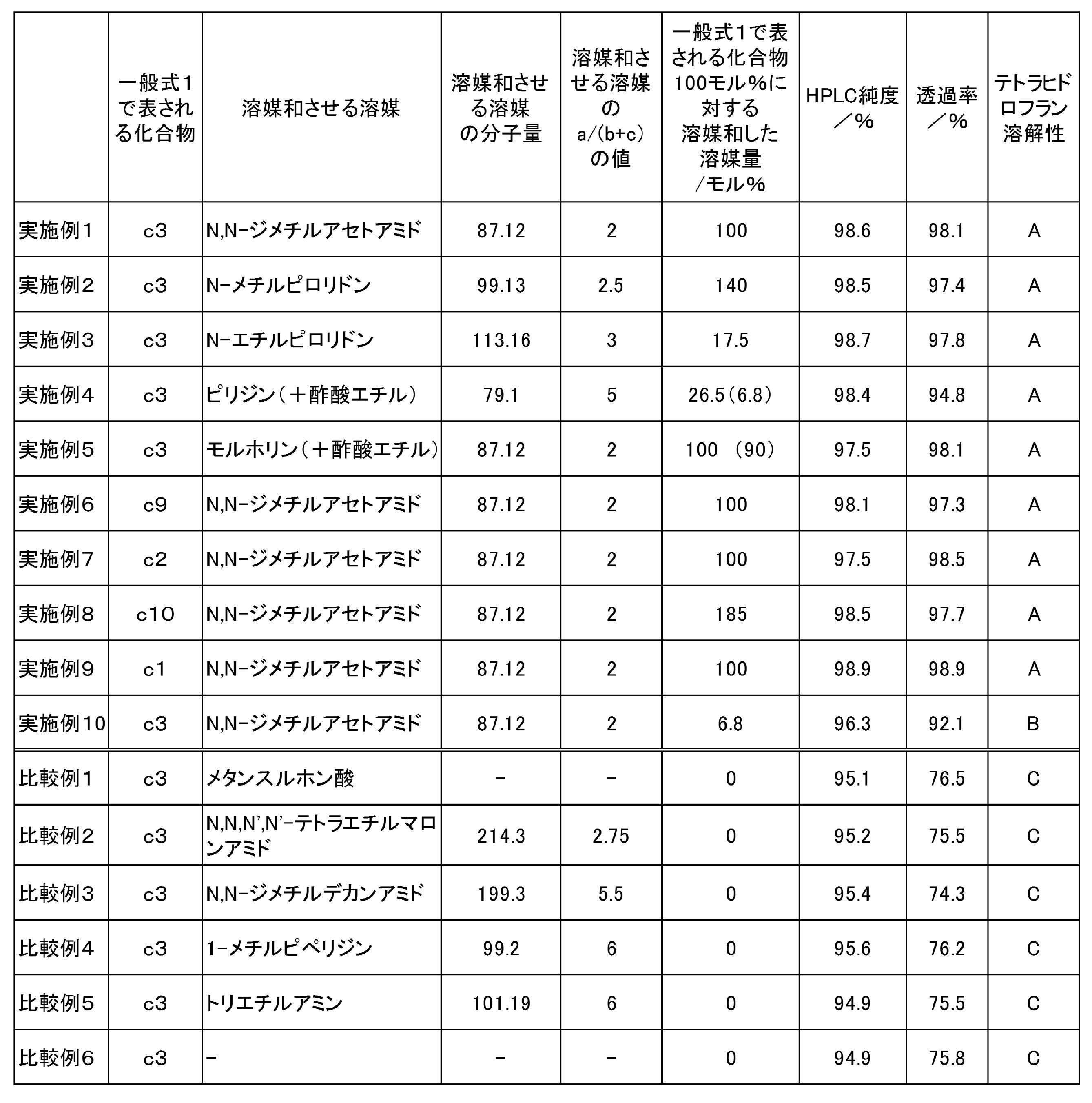
2gの化合物c3にN,N-ジメチルアセトアミドを4mL加え、60℃で1時間撹拌させることにより、化合物c3を溶解させた。次いで、酢酸エチル8mL及びノルマルヘキサン8mLを加え、50℃で2時間撹拌した後、25℃で1時間撹拌した。析出物を濾取し、酢酸エチル:ノルマルヘキサン=1:1混合液10mLで洗浄後、60℃で乾燥することで、N,N-ジメチルアセトアミドが化合物c3に溶媒和した溶媒和物を得た。溶媒和物の1H-NMR測定(300MHz、DMSO-d6)を行ったところ、化合物c3を100モル%としたとき、N,N-ジメチルアセトアミドは100モル%であった。
2gの化合物c3にN,N-ジメチルアセトアミドを4mL加え、60℃で1時間撹拌させることにより、化合物c3を溶解させた。次いで、酢酸エチル8mL及びノルマルヘキサン8mLを加え、50℃で2時間撹拌した後、25℃で1時間撹拌した。析出物を濾取し、酢酸エチル:ノルマルヘキサン=1:1混合液10mLで洗浄後、60℃で乾燥することで、N,N-ジメチルアセトアミドが化合物c3に溶媒和した溶媒和物を得た。溶媒和物の1H-NMR測定(300MHz、DMSO-d6)を行ったところ、化合物c3を100モル%としたとき、N,N-ジメチルアセトアミドは100モル%であった。
実施例2
実施例1のN,N-ジメチルアセトアミドをN-メチルピロリドンに変更した以外は同様の方法で、N-メチルピロリドンが化合物c3に溶媒和した溶媒和物を得た。溶媒和物の1H-NMR測定(300MHz、DMSO-d6)を行ったところ、化合物c3を100モル%としたとき、N-ジメチルピロリドンは140モル%であった。
実施例1のN,N-ジメチルアセトアミドをN-メチルピロリドンに変更した以外は同様の方法で、N-メチルピロリドンが化合物c3に溶媒和した溶媒和物を得た。溶媒和物の1H-NMR測定(300MHz、DMSO-d6)を行ったところ、化合物c3を100モル%としたとき、N-ジメチルピロリドンは140モル%であった。
実施例3
実施例1のN,N-ジメチルアセトアミドをN-エチルピロリドンに変更した以外は同様の方法で、N-エチルピロリドンが化合物c3に溶媒和した溶媒和物を得た。溶媒和物の1H-NMR測定(300MHz、DMSO-d6)を行ったところ、化合物c3を100モル%としたとき、N-エチルピロリドンは17.5モル%であった。
実施例1のN,N-ジメチルアセトアミドをN-エチルピロリドンに変更した以外は同様の方法で、N-エチルピロリドンが化合物c3に溶媒和した溶媒和物を得た。溶媒和物の1H-NMR測定(300MHz、DMSO-d6)を行ったところ、化合物c3を100モル%としたとき、N-エチルピロリドンは17.5モル%であった。
実施例4
実施例1のN,N-ジメチルアセトアミドをピリジンに変更した以外は同様の方法で、ピリジン及び酢酸エチルが化合物c3に溶媒和した溶媒和物を得た。溶媒和物の1H-NMR測定(300MHz、DMSO-d6)を行ったところ、化合物c3を100モル%としたとき、ピリジンは26.5モル%、酢酸エチルは6.8モル%であった。
実施例1のN,N-ジメチルアセトアミドをピリジンに変更した以外は同様の方法で、ピリジン及び酢酸エチルが化合物c3に溶媒和した溶媒和物を得た。溶媒和物の1H-NMR測定(300MHz、DMSO-d6)を行ったところ、化合物c3を100モル%としたとき、ピリジンは26.5モル%、酢酸エチルは6.8モル%であった。
実施例5
実施例1のN,N-ジメチルアセトアミドをモルホリンに変更した以外は同様の方法で、モルホリン及び酢酸エチルが化合物c3に溶媒和した溶媒和物を得た。溶媒和物の1H-NMR測定(300MHz、DMSO-d6)を行ったところ、化合物c3を100モル%としたとき、モルホリンは100モル%、酢酸エチルは90モル%であった。
実施例1のN,N-ジメチルアセトアミドをモルホリンに変更した以外は同様の方法で、モルホリン及び酢酸エチルが化合物c3に溶媒和した溶媒和物を得た。溶媒和物の1H-NMR測定(300MHz、DMSO-d6)を行ったところ、化合物c3を100モル%としたとき、モルホリンは100モル%、酢酸エチルは90モル%であった。
実施例6
実施例1の化合物c3を化合物c9に変更した以外は同様の方法で、N,N-ジメチルアセトアミドが化合物c9に溶媒和した溶媒和物を得た。溶媒和物の1H-NMR測定(300MHz、DMSO-d6)を行ったところ、化合物c9を100モル%としたとき、N,N-ジメチルアセトアミドは100モル%であった。
実施例1の化合物c3を化合物c9に変更した以外は同様の方法で、N,N-ジメチルアセトアミドが化合物c9に溶媒和した溶媒和物を得た。溶媒和物の1H-NMR測定(300MHz、DMSO-d6)を行ったところ、化合物c9を100モル%としたとき、N,N-ジメチルアセトアミドは100モル%であった。
実施例7
実施例1の化合物c3を化合物c2に変更した以外は同様の方法で、N,N-ジメチルアセトアミドが化合物c2に溶媒和した溶媒和物を得た。溶媒和物の1H-NMR測定(300MHz、DMSO-d6)を行ったところ、化合物c2を100モル%としたとき、N,N-ジメチルアセトアミドは100モル%であった。
実施例1の化合物c3を化合物c2に変更した以外は同様の方法で、N,N-ジメチルアセトアミドが化合物c2に溶媒和した溶媒和物を得た。溶媒和物の1H-NMR測定(300MHz、DMSO-d6)を行ったところ、化合物c2を100モル%としたとき、N,N-ジメチルアセトアミドは100モル%であった。
実施例8
実施例1の化合物c3を化合物c10に変更した以外は同様の方法で、N,N-ジメチルアセトアミドが化合物c10に溶媒和した溶媒和物を得た。溶媒和物の1H-NMR測定(300MHz、DMSO-d6)を行ったところ、化合物c10を100モル%としたとき、N,N-ジメチルアセトアミドは185モル%であった。
実施例1の化合物c3を化合物c10に変更した以外は同様の方法で、N,N-ジメチルアセトアミドが化合物c10に溶媒和した溶媒和物を得た。溶媒和物の1H-NMR測定(300MHz、DMSO-d6)を行ったところ、化合物c10を100モル%としたとき、N,N-ジメチルアセトアミドは185モル%であった。
実施例9
実施例1の化合物c3を化合物c1に変更した以外は同様の方法で、N,N-ジメチルアセトアミドが化合物c1に溶媒和した溶媒和物を得た。溶媒和物の1H-NMR測定(300MHz、DMSO-d6)を行ったところ、化合物c1を100モル%としたとき、N,N-ジメチルアセトアミドは100モル%であった。
実施例1の化合物c3を化合物c1に変更した以外は同様の方法で、N,N-ジメチルアセトアミドが化合物c1に溶媒和した溶媒和物を得た。溶媒和物の1H-NMR測定(300MHz、DMSO-d6)を行ったところ、化合物c1を100モル%としたとき、N,N-ジメチルアセトアミドは100モル%であった。
実施例10
2gの化合物c3にN,N-ジメチルアセトアミドを4mL加え、60℃で1時間撹拌することにより、化合物c3を溶解させた。次いで、水16mLを加え、50℃で2時間撹拌した後、25℃で1時間撹拌した。析出物を濾取し、水10mLで洗浄後、60℃で乾燥することで、N,N-ジメチルアセトアミドが化合物c3に溶媒和した溶媒和物を得た。溶媒和物の1H-NMR測定(300MHz、DMSO-d6)を行ったところ、化合物c3を100モル%としたとき、N,N-ジメチルアセトアミドは6.8モル%であった。
2gの化合物c3にN,N-ジメチルアセトアミドを4mL加え、60℃で1時間撹拌することにより、化合物c3を溶解させた。次いで、水16mLを加え、50℃で2時間撹拌した後、25℃で1時間撹拌した。析出物を濾取し、水10mLで洗浄後、60℃で乾燥することで、N,N-ジメチルアセトアミドが化合物c3に溶媒和した溶媒和物を得た。溶媒和物の1H-NMR測定(300MHz、DMSO-d6)を行ったところ、化合物c3を100モル%としたとき、N,N-ジメチルアセトアミドは6.8モル%であった。
比較例1
2gの化合物c3にメタンスルホン酸を4mL加え、60℃で1時間撹拌することにより、化合物c3を溶解させた。次いで、水6mL及びアセトニトリル10mLを加え、50℃で2時間撹拌した後、25℃で1時間撹拌した。析出物を濾取し、水:アセトニトリル=1:1混合液10mLで洗浄後、60℃で乾燥した。1H-NMR測定(300MHz、DMSO-d6)を行ったところ、化合物c3を100モル%としたとき、メタンスルホン酸は0モル%であった。
2gの化合物c3にメタンスルホン酸を4mL加え、60℃で1時間撹拌することにより、化合物c3を溶解させた。次いで、水6mL及びアセトニトリル10mLを加え、50℃で2時間撹拌した後、25℃で1時間撹拌した。析出物を濾取し、水:アセトニトリル=1:1混合液10mLで洗浄後、60℃で乾燥した。1H-NMR測定(300MHz、DMSO-d6)を行ったところ、化合物c3を100モル%としたとき、メタンスルホン酸は0モル%であった。
比較例2
2gの化合物c3にN,N,N’,N’-テトラエチルマロンアミドを4mL加え、60℃で1時間撹拌させたが、化合物c3がN,N,N’,N’-テトラエチルマロンアミドに溶解しなかった。次いで、酢酸エチル8mL及びノルマルヘキサン8mLを加え、50℃で2時間撹拌した後、25℃で1時間撹拌した。撹拌後の不溶物を濾取し、酢酸エチル:ノルマルヘキサン=1:1混合液10mLで洗浄後、60℃で乾燥することで得られた濾取物の1H-NMR測定(300MHz、DMSO-d6)を行ったが、N,N,N’,N’-テトラエチルマロンアミドは観測されなかった。
2gの化合物c3にN,N,N’,N’-テトラエチルマロンアミドを4mL加え、60℃で1時間撹拌させたが、化合物c3がN,N,N’,N’-テトラエチルマロンアミドに溶解しなかった。次いで、酢酸エチル8mL及びノルマルヘキサン8mLを加え、50℃で2時間撹拌した後、25℃で1時間撹拌した。撹拌後の不溶物を濾取し、酢酸エチル:ノルマルヘキサン=1:1混合液10mLで洗浄後、60℃で乾燥することで得られた濾取物の1H-NMR測定(300MHz、DMSO-d6)を行ったが、N,N,N’,N’-テトラエチルマロンアミドは観測されなかった。
比較例3
N,N,N’,N’-テトラエチルマロンアミドをN,N-ジメチルデカンアミドに変更した以外は比較例2と同様の方法で得られた濾取物について、1H-NMR測定(300MHz、DMSO-d6)を行ったがN,N-ジメチルデカンアミドは観測されなかった。
N,N,N’,N’-テトラエチルマロンアミドをN,N-ジメチルデカンアミドに変更した以外は比較例2と同様の方法で得られた濾取物について、1H-NMR測定(300MHz、DMSO-d6)を行ったがN,N-ジメチルデカンアミドは観測されなかった。
比較例4
N,N,N’,N’-テトラエチルマロンアミドを1-メチルピペリジンに変更した以外は比較例2と同様の方法で得られた濾取物について、1H-NMR測定(300MHz、DMSO-d6)を行ったが1-メチルピペリジンは観測されなかった。
N,N,N’,N’-テトラエチルマロンアミドを1-メチルピペリジンに変更した以外は比較例2と同様の方法で得られた濾取物について、1H-NMR測定(300MHz、DMSO-d6)を行ったが1-メチルピペリジンは観測されなかった。
比較例5
N,N,N’,N’-テトラエチルマロンアミドをトリエチルアミンに変更した以外は比較例2と同様の方法で得られた濾取物について、1H-NMR測定(300MHz、DMSO-d6)を行ったがトリエチルアミンは観測されなかった。
N,N,N’,N’-テトラエチルマロンアミドをトリエチルアミンに変更した以外は比較例2と同様の方法で得られた濾取物について、1H-NMR測定(300MHz、DMSO-d6)を行ったがトリエチルアミンは観測されなかった。
比較例6
合成例1で得られた化合物c3をそのままで使用した。
合成例1で得られた化合物c3をそのままで使用した。
(評価方法)
HPLC純度
島津製作所(株)製の高速液体クロマトグラフィー(SPD-10AV VP)を用い、下記条件にて結晶の純度を測定した。なお、結晶が溶媒和している場合は、溶媒由来のピークは差し引いてから、HPLC純度を算出した。
カラム:TSKgel ODS-100Z 5μm(4.6mmφ×150mm)(東ソー(株)製)
カラム温度:40℃
溶離液:
アセトニトリル:純水:リン酸(体積比)
=700:300:1
流速:1.0ml/min
検出波長:254nm
注入量:10μL
サンプル濃度:5mg/50mlとなるように溶離液で希釈
HPLC純度
島津製作所(株)製の高速液体クロマトグラフィー(SPD-10AV VP)を用い、下記条件にて結晶の純度を測定した。なお、結晶が溶媒和している場合は、溶媒由来のピークは差し引いてから、HPLC純度を算出した。
カラム:TSKgel ODS-100Z 5μm(4.6mmφ×150mm)(東ソー(株)製)
カラム温度:40℃
溶離液:
アセトニトリル:純水:リン酸(体積比)
=700:300:1
流速:1.0ml/min
検出波長:254nm
注入量:10μL
サンプル濃度:5mg/50mlとなるように溶離液で希釈
透過率測定
島津製作所(株)製の分光光度計(UV-2550)を用い、下記条件にて波長450nmにおける結晶の透過率を測定した。450nmにおける透過率が高いほど、結晶の黄色の着色が少ないことを示す。
セル:角型石英セル(光路長:1cm)
サンプル濃度:50.0mg/50mLとなるように結晶をN,N-ジメチルアセトアミド溶液で希釈
ブランク:N,N-ジメチルアセトアミド溶液
島津製作所(株)製の分光光度計(UV-2550)を用い、下記条件にて波長450nmにおける結晶の透過率を測定した。450nmにおける透過率が高いほど、結晶の黄色の着色が少ないことを示す。
セル:角型石英セル(光路長:1cm)
サンプル濃度:50.0mg/50mLとなるように結晶をN,N-ジメチルアセトアミド溶液で希釈
ブランク:N,N-ジメチルアセトアミド溶液
テトラヒドロフラン溶解性:
実施例1~10、比較例1~6の結晶50mgに対し、テトラヒドロフランを混合し、室温における結晶の溶解性を評価した。結晶中に含まれる溶媒量を差し引いた値をW(単位=mg)としたとき、
A: Wに対し、25mL未満のテトラヒドロフランで完全に溶解する。
B: Wに対し、25mL未満のテトラヒドロフランで完全に溶解しないが、25mL以上、50mL未満でテトラヒドロフランに溶解する。
C: Wに対し、50mLのテトラヒドロフランで溶解しない。
実施例1~10、比較例1~6の結晶50mgに対し、テトラヒドロフランを混合し、室温における結晶の溶解性を評価した。結晶中に含まれる溶媒量を差し引いた値をW(単位=mg)としたとき、
A: Wに対し、25mL未満のテトラヒドロフランで完全に溶解する。
B: Wに対し、25mL未満のテトラヒドロフランで完全に溶解しないが、25mL以上、50mL未満でテトラヒドロフランに溶解する。
C: Wに対し、50mLのテトラヒドロフランで溶解しない。
<XRDの測定>
株式会社リガク社製のX線回折装置(SmartLab)を用いて、実施例及び比較例で得られた結晶の粉末X線回折(XRD)測定を行った。
管球: CuKα
出力: 40kV30mA
測定範囲: 2θ=3~80°
サンプリング間隔: 0.02°
測定速度: 5°/分
株式会社リガク社製のX線回折装置(SmartLab)を用いて、実施例及び比較例で得られた結晶の粉末X線回折(XRD)測定を行った。
管球: CuKα
出力: 40kV30mA
測定範囲: 2θ=3~80°
サンプリング間隔: 0.02°
測定速度: 5°/分
溶媒和していない化合物c3、ならびに溶媒和している実施例1,3,10,及び比較例1の化合物c3のXRD測定結果を図1~5に示す。なお、図1~5のいずれにおいても特徴的なピークが見られる21°までを示した。
図1及び図2(実施例1)の比較により、溶媒和していない化合物c3の粉末X線回折測定結果と異なるプロファイルを示し、結晶形が異なっていることがわかる。さらに図1及び図3(実施例3)を比較しても、溶媒和していない化合物c3の粉末X線回折測定結果と比較し、2θ=3.5°付近のピークが消失しており、異なる結晶形をとっていることがわかる。図1及び図4(実施例10)を比較すると、溶媒和していない化合物c3の粉末X線回折測定結果と比較し、同一の回折ピーク位置を有するが、ピーク強度比が異なり、異なる結晶形をとっていることがわかる。図1及び図5(比較例1)を比較すると、溶媒和していない化合物c3の粉末X線回折測定結果と同様のプロファイルを示し、結晶形が同一であることがわかる。
Claims (9)
- 一般式1で表される化合物の溶媒和物であって、
前記溶媒和物を構成する溶媒が、窒素原子含有有機化合物を含み、
前記窒素原子含有有機化合物は酸素原子を含んでいてもよく、
前記窒素原子含有有機化合物中の炭素原子の数を窒素原子の数と酸素原子の数との和で割った値が5以下であり、
前記窒素原子含有有機化合物の分子量が200以下である、前記溶媒和物;

ZはX-C=C-Yとともに5~7員環を形成する原子群であって、炭素原子及びヘテロ原子から選択される少なくとも1種を含む原子群を表し;
R3~R6はそれぞれ独立に、置換基を表し;
q及びrはそれぞれ独立に、0~4の整数であり;
vは0~4の整数であり、wは0以上の整数であり、wの最大数は、X-C=C-YとZが形成する環に置換可能な置換基の最大数であり;
qが2~4の整数である場合、複数のR3は同じであっても異なっていてもよく、複数のR3は互いに結合して環を形成してもよく;
rが2~4の整数である場合、複数のR4は同じであっても異なっていてもよく、複数のR4は互いに結合して環を形成してもよく;
vが2~4の整数である場合、複数のR5は同じであっても異なっていてもよく、複数のR5は互いに連結して環を形成せず;
wが2~5の整数である場合、複数のR6は同じであっても異なっていてもよく、複数のR6は互いに結合して環を形成してもよい。 - 一般式1で表される化合物が一般式2で表される化合物である請求項1に記載の溶媒和物;

q及びrはそれぞれ独立に、0~4の整数であり;
vは0~4の整数であり、sは0~2の整数であり;
qが2~4の整数である場合、複数のR3は同じであっても異なっていてもよく、複数のR3は互いに結合して環を形成してもよく;
rが2~4の整数である場合、複数のR4は同じであっても異なっていてもよく、複数のR4は互いに結合して環を形成してもよく;
vが2~4の整数である場合、複数のR5は同じであっても異なっていてもよく、複数のR5は互いに連結して環を形成せず;
sが2である場合、2つのR7は同じであっても異なっていてもよく、2つのR7は互いに結合して環を形成してもよい。 - 一般式1で表される化合物が一般式3で表される化合物である請求項1又は2に記載の溶媒和物;
q及びrはそれぞれ独立に、0~4の整数であり;
vは0~4の整数であり、tは0~4の整数であり;
qが2~4の整数である場合、複数のR3は同じであっても異なっていてもよく、複数のR3は互いに結合して環を形成してもよく;
rが2~4の整数である場合、複数のR4は同じであっても異なっていてもよく、複数のR4は互いに結合して環を形成してもよく;
vが2~4の整数である場合、複数のR5は同じであっても異なっていてもよく、複数のR5は互いに連結して環を形成せず;
tが2~4の整数である場合、複数のR8は同じであっても異なっていてもよい。 - 前記窒素原子含有有機化合物がピリジン、ピリミジン、ピラジン、一般式Bで表される化合物、及び一般式Cで表される化合物からなる群より選択されるいずれか1種以上である請求項1~3のいずれか一項に記載の溶媒和物。
Re及びRg、又はRe及びRfは互いに結合し、環構造を形成してもよく、
一般式C中、Rhは水素原子又は置換基を有してもよい炭化水素基である。 - 前記窒素原子含有有機化合物中の炭素原子の数を窒素原子の数と酸素原子の数との和で割った前記値が5未満である請求項1~4のいずれか一項に記載の溶媒和物。
- 前記窒素原子含有有機化合物が、N,N’-ジメチルホルムアミド、N,N-ジメチルアセトアミド、N-メチルピロリドン、及びN-エチルピロリドンからなる群より選択されるいずれか1種以上である請求項1~5のいずれか一項に記載の溶媒和物。
- 窒素原子含有有機化合物の含有量が、一般式1で表される化合物100モル%に対して、10~200モル%である請求項1~6のいずれか一項に記載の溶媒和物。
- 請求項1~7のいずれか一項に記載の溶媒和物の製造方法であって、
前記窒素原子含有有機化合物を溶媒として一般式1で表される化合物を晶析することを含む製造方法。 - 一般式1で表される化合物を前記窒素原子含有有機化合物からなる溶媒に溶解させた後、酢酸メチル、酢酸エチル、及び酢酸ブチルからなる群より選択されるいずれか1種以上を含む溶媒を添加し、前記溶媒和物を析出させることを含む、請求項8に記載の製造方法。
Priority Applications (2)
| Application Number | Priority Date | Filing Date | Title |
|---|---|---|---|
| CN202080018301.0A CN113508107A (zh) | 2019-03-13 | 2020-03-12 | 溶剂化物及溶剂化物的制造方法 |
| JP2021505121A JP7252315B2 (ja) | 2019-03-13 | 2020-03-12 | 溶媒和物及び溶媒和物の製造方法 |
Applications Claiming Priority (2)
| Application Number | Priority Date | Filing Date | Title |
|---|---|---|---|
| JP2019046213 | 2019-03-13 | ||
| JP2019-046213 | 2019-03-13 |
Publications (1)
| Publication Number | Publication Date |
|---|---|
| WO2020184649A1 true WO2020184649A1 (ja) | 2020-09-17 |
Family
ID=72426664
Family Applications (1)
| Application Number | Title | Priority Date | Filing Date |
|---|---|---|---|
| PCT/JP2020/010725 Ceased WO2020184649A1 (ja) | 2019-03-13 | 2020-03-12 | 溶媒和物及び溶媒和物の製造方法 |
Country Status (3)
| Country | Link |
|---|---|
| JP (1) | JP7252315B2 (ja) |
| CN (1) | CN113508107A (ja) |
| WO (1) | WO2020184649A1 (ja) |
Cited By (2)
| Publication number | Priority date | Publication date | Assignee | Title |
|---|---|---|---|---|
| WO2023145663A1 (ja) * | 2022-01-28 | 2023-08-03 | 富士フイルム株式会社 | 溶媒和物及び溶媒和物の製造方法 |
| KR102960670B1 (ko) | 2022-01-28 | 2026-05-04 | 후지필름 가부시키가이샤 | 용매화물 및 용매화물의 제조 방법 |
Citations (4)
| Publication number | Priority date | Publication date | Assignee | Title |
|---|---|---|---|---|
| WO2017115649A1 (ja) * | 2015-12-28 | 2017-07-06 | 富士フイルム株式会社 | 化合物、硬化性組成物、硬化物、光学部材及びレンズ |
| WO2017146022A1 (ja) * | 2016-02-23 | 2017-08-31 | 富士フイルム株式会社 | ポリカーボネート樹脂、成形体、光学部材及びレンズ |
| WO2018168233A1 (ja) * | 2017-03-15 | 2018-09-20 | 富士フイルム株式会社 | 硬化性組成物、硬化物、光学部材及びレンズ |
| WO2019035461A1 (ja) * | 2017-08-18 | 2019-02-21 | 富士フイルム株式会社 | 化合物、硬化性組成物、硬化物、光学部材及びレンズ |
Family Cites Families (1)
| Publication number | Priority date | Publication date | Assignee | Title |
|---|---|---|---|---|
| JP4216563B2 (ja) * | 2002-10-17 | 2009-01-28 | Jfeケミカル株式会社 | フルオレニリデンジアリルフェノールの精製方法 |
-
2020
- 2020-03-12 JP JP2021505121A patent/JP7252315B2/ja active Active
- 2020-03-12 WO PCT/JP2020/010725 patent/WO2020184649A1/ja not_active Ceased
- 2020-03-12 CN CN202080018301.0A patent/CN113508107A/zh active Pending
Patent Citations (4)
| Publication number | Priority date | Publication date | Assignee | Title |
|---|---|---|---|---|
| WO2017115649A1 (ja) * | 2015-12-28 | 2017-07-06 | 富士フイルム株式会社 | 化合物、硬化性組成物、硬化物、光学部材及びレンズ |
| WO2017146022A1 (ja) * | 2016-02-23 | 2017-08-31 | 富士フイルム株式会社 | ポリカーボネート樹脂、成形体、光学部材及びレンズ |
| WO2018168233A1 (ja) * | 2017-03-15 | 2018-09-20 | 富士フイルム株式会社 | 硬化性組成物、硬化物、光学部材及びレンズ |
| WO2019035461A1 (ja) * | 2017-08-18 | 2019-02-21 | 富士フイルム株式会社 | 化合物、硬化性組成物、硬化物、光学部材及びレンズ |
Non-Patent Citations (1)
| Title |
|---|
| ASAHARA, TERUZO, KOUDANSHIYA KK: "Solvent Handbook", 1985, pages 47 - 51 * |
Cited By (3)
| Publication number | Priority date | Publication date | Assignee | Title |
|---|---|---|---|---|
| WO2023145663A1 (ja) * | 2022-01-28 | 2023-08-03 | 富士フイルム株式会社 | 溶媒和物及び溶媒和物の製造方法 |
| KR20240096720A (ko) | 2022-01-28 | 2024-06-26 | 후지필름 가부시키가이샤 | 용매화물 및 용매화물의 제조 방법 |
| KR102960670B1 (ko) | 2022-01-28 | 2026-05-04 | 후지필름 가부시키가이샤 | 용매화물 및 용매화물의 제조 방법 |
Also Published As
| Publication number | Publication date |
|---|---|
| JPWO2020184649A1 (ja) | 2021-12-16 |
| CN113508107A (zh) | 2021-10-15 |
| JP7252315B2 (ja) | 2023-04-04 |
Similar Documents
| Publication | Publication Date | Title |
|---|---|---|
| JP5522447B2 (ja) | アゾ−ホウ素錯体化合物およびその製造方法 | |
| TW201544503A (zh) | 二酸酐與聚醯亞胺 | |
| CN108137933B (zh) | 夹氧杂蒽化合物、及包含该夹氧杂蒽化合物的着色剂 | |
| WO2020184649A1 (ja) | 溶媒和物及び溶媒和物の製造方法 | |
| KR101644228B1 (ko) | 퍼릴렌 비스이미드계 화합물 및 이를 포함하는 염료 | |
| JP5009486B2 (ja) | 透明性に優れた耐熱性エポキシ樹脂の製造方法 | |
| JP5130521B2 (ja) | 複素多環系フェナジン化合物 | |
| TW200531994A (en) | Color filter for electrical display device | |
| TWI881069B (zh) | 多環芳烴化合物、其結晶及其製造方法 | |
| CN113549083B (zh) | 酞菁类化合物、其制备方法和滤光片 | |
| JP2025520737A (ja) | オキシムエステル光開始剤、その製造方法及びその使用 | |
| JP6159415B2 (ja) | 含臭素n−フェニルジアクリルイミド誘導体及びその製造方法 | |
| EP0611751B1 (en) | Preparation of 1-amino-1-cyanamido-2,2-dicyanoethylene, sodium salt | |
| CN102272115B (zh) | 具有二噁烷结构的二元醇化合物及其制造方法 | |
| CN103145708B (zh) | 制备表吲哚二酮及其衍生物的方法 | |
| JP5773123B2 (ja) | 5位にイミノ基を有するアジン系化合物の製造方法。 | |
| JP5008332B2 (ja) | アジン系化合物 | |
| WO2022049952A1 (ja) | 環状グアナミン化合物 | |
| JPS63104955A (ja) | スルホニルイソチオ尿素の製造方法 | |
| JP4965450B2 (ja) | キノフタロン化合物 | |
| JP6815603B2 (ja) | ジナフトチオフェン誘導体及びその製造方法 | |
| WO2023145663A1 (ja) | 溶媒和物及び溶媒和物の製造方法 | |
| CN108473431B (zh) | 2-氨基烟酸苄酯衍生物的制造方法 | |
| JP5044180B2 (ja) | 5,6−ベンゾクマリン化合物 | |
| WO2022039144A1 (ja) | 縮環構造を有するカルボン酸又はカルボン酸エステル化合物及びその製造方法並びに化合物の使用 |
Legal Events
| Date | Code | Title | Description |
|---|---|---|---|
| 121 | Ep: the epo has been informed by wipo that ep was designated in this application |
Ref document number: 20770659 Country of ref document: EP Kind code of ref document: A1 |
|
| ENP | Entry into the national phase |
Ref document number: 2021505121 Country of ref document: JP Kind code of ref document: A |
|
| NENP | Non-entry into the national phase |
Ref country code: DE |
|
| 122 | Ep: pct application non-entry in european phase |
Ref document number: 20770659 Country of ref document: EP Kind code of ref document: A1 |