WO2020184368A1 - 飲料組成物 - Google Patents
飲料組成物 Download PDFInfo
- Publication number
- WO2020184368A1 WO2020184368A1 PCT/JP2020/009359 JP2020009359W WO2020184368A1 WO 2020184368 A1 WO2020184368 A1 WO 2020184368A1 JP 2020009359 W JP2020009359 W JP 2020009359W WO 2020184368 A1 WO2020184368 A1 WO 2020184368A1
- Authority
- WO
- WIPO (PCT)
- Prior art keywords
- beverage
- mass
- packaged
- results
- tea
- Prior art date
- Legal status (The legal status is an assumption and is not a legal conclusion. Google has not performed a legal analysis and makes no representation as to the accuracy of the status listed.)
- Ceased
Links
Classifications
-
- A—HUMAN NECESSITIES
- A23—FOODS OR FOODSTUFFS; TREATMENT THEREOF, NOT COVERED BY OTHER CLASSES
- A23L—FOODS, FOODSTUFFS OR NON-ALCOHOLIC BEVERAGES, NOT OTHERWISE PROVIDED FOR; PREPARATION OR TREATMENT THEREOF
- A23L2/00—Non-alcoholic beverages; Dry compositions or concentrates therefor; Preparation or treatment thereof
-
- A—HUMAN NECESSITIES
- A23—FOODS OR FOODSTUFFS; TREATMENT THEREOF, NOT COVERED BY OTHER CLASSES
- A23F—COFFEE; TEA; THEIR SUBSTITUTES; MANUFACTURE, PREPARATION, OR INFUSION THEREOF
- A23F3/00—Tea; Tea substitutes; Preparations thereof
- A23F3/16—Tea extraction; Tea extracts; Treating tea extract; Making instant tea
-
- A—HUMAN NECESSITIES
- A23—FOODS OR FOODSTUFFS; TREATMENT THEREOF, NOT COVERED BY OTHER CLASSES
- A23L—FOODS, FOODSTUFFS OR NON-ALCOHOLIC BEVERAGES, NOT OTHERWISE PROVIDED FOR; PREPARATION OR TREATMENT THEREOF
- A23L2/00—Non-alcoholic beverages; Dry compositions or concentrates therefor; Preparation or treatment thereof
- A23L2/52—Adding ingredients
-
- A—HUMAN NECESSITIES
- A23—FOODS OR FOODSTUFFS; TREATMENT THEREOF, NOT COVERED BY OTHER CLASSES
- A23L—FOODS, FOODSTUFFS OR NON-ALCOHOLIC BEVERAGES, NOT OTHERWISE PROVIDED FOR; PREPARATION OR TREATMENT THEREOF
- A23L33/00—Modifying nutritive qualities of foods; Dietetic products; Preparation or treatment thereof
- A23L33/10—Modifying nutritive qualities of foods; Dietetic products; Preparation or treatment thereof using additives
- A23L33/105—Plant extracts, their artificial duplicates or their derivatives
Definitions
- the present invention relates to a beverage composition.
- Non-polymer catechins are one of the polyphenol compounds contained in tea leaves of the genus Camellia, and have various physiological activities, so their application to foods and drinks is attracting attention.
- the demand for tea beverages is increasing because they can be easily ingested as a lifestyle, but there is a tendency for tea beverages that have a rich original aroma of tea, have a strong sweetness, and have less bitterness and astringency. ..
- Patent Document 1 a tea beverage having an improved original sweetness of tea can be obtained by adding a certain amount of ethanol to a tea beverage having a reduced caffeine content. Further, the non-polymer catechin-containing beverage is heated in a state where the non-polymer catechins and ethanol coexist in a specific amount, the beverage is filled in a container and sealed, and then the packaged beverage is gradually cooled. As a result, it has been reported that a packaged beverage having a rich tea-flavored aroma can be obtained (Patent Document 2).
- Patent Document 3 a packaged tea beverage that complements the flavor and taste of a tea beverage and can maintain the flavor and taste for a long period of time can be obtained.
- astragalin is one of the polyphenol compounds contained in persimmon leaves and mulberry leaves, and has been reported to have an antiallergic effect. Focusing on such physiological effects of astragalin, its application to foods and drinks is being studied. For example, one or more sugars selected from the group consisting of fructose, galactose, lactose and glucose in astragalin. It has been reported that the absorption of astragalin is improved by blending the above (Patent Document 4). Further, a blended tea beverage in which a mulberry leaf extract, a brown rice extract and a green tea extract are mixed has also been proposed (Patent Document 5).
- Patent Document 1 Japanese Patent Application Laid-Open No. 2015-122968
- Patent Document 2 Japanese Patent Application Laid-Open No. 2016-1243416
- Patent Document 3 Japanese Patent Application Laid-Open No. 2016-154500
- Patent Document 4 Japanese Patent Application Laid-Open No. 2002-291441
- Patent Document 5 Japanese Unexamined Patent Publication No. 2007-228632
- the present invention describes the following components (A), (B) and (C); (A) Non-polymer catechins 0.030 to 0.10% by mass Contains (B) one or more selected from ethanol, propylene glycol and glycerin, and (C) astragalin.
- the mass ratio [(B) / (A)] of the component (A) to the component (B) is 0.060 to 2.0.
- a beverage composition having a mass ratio [(C) / (A)] of a component (C) to a component (A) of 1.0 ⁇ 10 -3 to 20 ⁇ 10 -3 .
- a beverage composition enriched with non-polymer catechins can be expected to enhance the physiological effect, but since non-polymer catechins have an astringent taste, there is a limit to increasing the concentration of non-polymer catechins. is there.
- the present invention relates to a beverage composition in which astringency is suppressed while fortifying non-polymer catechins.
- the present inventors have conducted intensive studies to identify a beverage composition fortified with non-polymer catechins as astragaline known as an astringent substance with respect to non-polymer catechins. It has been found that a beverage composition in which astringency is suppressed can be obtained while fortifying non-polymer catechins by containing each of the above alcohols in a constant amount ratio.
- the beverage composition of the present invention contains non-polymer catechins as the component (A).
- non-polymeric catechins refers to non-gallatechins such as catechin, gallocatechin, epicatechin and epigallocatechin, and catechin gallate, gallocatechin gallate, epicatechin gallate and epigallocatechin gallate. It is a general term for gallate bodies such as catechin gallate. In the present invention, at least one of the above eight types of non-polymer catechins may be contained.
- the origin of the component (A) is not particularly limited as long as it is usually used in the field of food and drink, and may be, for example, a chemically synthesized product or a product extracted from a plant containing non-polymer catechins. Good.
- the beverage composition of the present invention has a content of the component (A) of 0.030 to 0.10% by mass, preferably 0.035% by mass or more, preferably 0, from the viewpoint of strengthening non-polymer catechins. .045% by mass or more is more preferable, 0.052% by mass or more is further preferable, and 0.095% by mass or less is preferable, 0.088% by mass or less is more preferable, and 0.086% by mass is preferable from the viewpoint of suppressing astringency. % Or less is more preferable.
- the content of the component (A) is preferably 0.035 to 0.095% by mass, more preferably 0.045 to 0.088% by mass in the beverage composition of the present invention. More preferably, it is 0.052 to 0.086% by mass.
- the content of the component (A) is defined based on the total amount of the above eight types of non-polymer catechins. Further, the content of the component (A) can be measured by an analysis method suitable for the condition of the measurement sample among the commonly known measurement methods, and can be analyzed by, for example, liquid chromatography. is there. Specifically, the method described in the examples described later can be mentioned. At the time of measurement, appropriate treatment is performed as necessary, such as freeze-drying the sample to match the detection range of the device and removing impurities in the sample to match the separability of the device. May be given.
- the type of the component (A) of the packaged tea beverage of the present invention is not particularly limited, but from the viewpoint of suppressing astringency, the proportion of gallate in the non-polymer catechins (gallate mass) is 0 to 85 mass. %, More preferably 20 to 75% by mass, further preferably 30 to 65% by mass, even more preferably 35 to 60% by mass, and even more preferably 40 to 55% by mass.
- the "gallate form ratio" refers to the mass ratio of the above four types of gallate form to eight kinds of non-polymer catechins.
- the beverage composition of the present invention contains one or more selected from ethanol, propylene glycol and glycerin as the component (B). These three types of alcohols may be contained alone or in any combination of two or more, but from the viewpoint of suppressing astringency, propylene glycol is preferably contained.
- the content of the component (B) in the beverage composition of the present invention is preferably 0.0020% by mass or more, more preferably 0.0030% by mass or more, and 0.0060% by mass or more from the viewpoint of suppressing astringency. More preferably, 0.0075% by mass or more is further preferable, and from the viewpoint of suppressing offensive odor, 0.20% by mass or less is preferable, 0.15% by mass or less is more preferable, and 0.12% by mass or less is further preferable. 0.080% by mass or less is even more preferable, and 0.060% by mass or less is particularly preferable.
- the content of the component (B) is preferably 0.0020 to 0.20% by mass, more preferably 0.0030 to 0.15% by mass in the beverage composition of the present invention.
- the content of the component (B) is the total content of ethanol, propylene glycol and glycerin.
- the content of the component (B) can be analyzed by a commonly known method. Specifically, the method described in the examples described later can be mentioned.
- the beverage composition of the present invention contains astragalin as the component (C).
- "astragalin” as used herein is a compound in which glucose is bound to the 3-position of kaempferol.
- the component (C) may be derived from a raw material or newly added.
- the origin of the component (C) is not particularly limited as long as it is usually used in the field of food and drink, and may be, for example, a chemically synthesized product or one extracted from a plant containing astragalin.
- Examples of commercially available product of component (C) include Kaempferol 3-beta-D-glucopyranoside (manufactured by Sigma-Aldrich Japan Co., Ltd.).
- the content of the component (C) in the beverage composition of the present invention is preferably 0.50 mass ppm or more, more preferably 0.70 mass ppm or more, and 0.90 mass ppm or more from the viewpoint of suppressing astringency. More preferably, 1.1 mass ppm or more is further preferable, 1.5 mass ppm or more is further preferable, 2.5 mass ppm or more is particularly preferable, 20 mass ppm or less is preferable, and 15 mass ppm or less is more preferable. It is preferably 8.0 mass ppm or less, and more preferably 8.0 mass ppm or less.
- the range of the content of the component (C) is preferably 0.50 to 20% by mass, more preferably 0.70 to 15% by mass, and even more preferably 0.70 to 15% by mass in the beverage composition of the present invention. It is 0.90 to 15 mass ppm, more preferably 1.1 to 15 mass ppm, even more preferably 1.5 to 15 mass ppm, and even more preferably 2.5 to 8.0 mass ppm. It is ppm.
- the content of the component (C) can be measured by an analysis method suitable for the condition of the measurement sample among the commonly known measurement methods, and can be analyzed by, for example, liquid chromatography. is there. Specifically, the method described in the examples described later can be mentioned. At the time of measurement, appropriate treatment is performed as necessary, such as freeze-drying the sample to match the detection range of the device and removing impurities in the sample to match the separability of the device. May be given.
- the beverage composition of the present invention has a mass ratio [(B) / (A)] of the component (A) to the component (B) of 0.060 to 2.0, but is 0 from the viewpoint of suppressing astringency. .070 or more is preferable, 0.090 or more is more preferable, 0.10 or more is further preferable, and from the viewpoint of suppressing offensive odors, 1.8 or less is preferable, 1.6 or less is more preferable, and 1.4 or less is further preferable. Preferably, 1.2 or less is even more preferable, and 1.0 or less is particularly preferable.
- the range of the mass ratio [(B) / (A)] is preferably 0.070 to 1.8, more preferably 0.090 to 1.6, and further preferably 0.10 to 1. It is 0.4, more preferably 0.10 to 1.2, and even more preferably 0.10 to 1.0.
- the beverage composition of the present invention has a mass ratio [(C) / (A)] of the component (A) to the component (C) of 1.0 ⁇ 10 -3 to 20 ⁇ 10 -3 , but has an astringent taste. From the viewpoint of suppression, 1.1 ⁇ 10 -3 or more is preferable, 1.3 ⁇ 10 -3 or more is more preferable, 1.5 ⁇ 10 -3 or more is further preferable, and 18 ⁇ 10 -3 or less is preferable. 15 ⁇ 10 -3 or less is more preferable, and 12 ⁇ 10 -3 or less is further preferable.
- the range of the mass ratio [(C) / (A)] is preferably 1.1 ⁇ 10 -3 to 18 ⁇ 10 -3 , and more preferably 1.3 ⁇ 10 -3 to 15 ⁇ 10 ⁇ . It is 3 , and more preferably 1.5 ⁇ 10 -3 to 12 ⁇ 10 -3 .
- the mass ratio [(C) / (A)] shall be calculated by aligning the units of the contents of the component (A) and the component (C).
- the beverage composition of the present invention contains one kind of additives such as sweeteners, acidulants, vitamins, minerals, esters, emulsifiers, preservatives, seasonings, fruit juice extracts, vegetable extracts, honey extracts, and quality stabilizers, if desired.
- additives such as sweeteners, acidulants, vitamins, minerals, esters, emulsifiers, preservatives, seasonings, fruit juice extracts, vegetable extracts, honey extracts, and quality stabilizers, if desired.
- it can contain two or more kinds.
- the content of the additive can be appropriately set within a range that does not impair the object of the present invention.
- the beverage composition of the present invention may be, for example, liquid or solid, and may take an appropriate form.
- the form of the beverage may be not only RTD (straight beverage) but also concentrated reduced beverage, jelly-like, concentrated liquid, slurry-like form and the like.
- RTD straight beverage
- the term "RTD" as used herein refers to a beverage that can be drunk as it is without being diluted.
- the solid content concentration is not particularly limited as long as the beverage can be sucked from the mouthpiece or straw provided in the container, and can be appropriately selected.
- the beverage composition of the present invention When the beverage composition of the present invention is solid, its shape is not particularly limited as long as it is solid at room temperature (20 ° C. ⁇ 15 ° C.), and powdery, granular, tablet, rod, plate, etc. It can have various shapes such as a block shape.
- the solid content in the solid beverage composition of the present invention is usually 95% by mass or more, preferably 97% by mass or more.
- the upper limit of the solid content is not particularly limited and may be 100% by mass.
- the term "solid content” as used herein refers to the mass of the residue obtained by drying the sample in an electric constant temperature dryer at 105 ° C. for 3 hours to remove volatile substances.
- the beverage composition of the present invention When the beverage composition of the present invention is in the form of a concentrate or a solid, it is diluted with water so that the content of the above-mentioned component (A) is within the above range to obtain an RTD (straight beverage).
- the mass ratio [(B) / (A)] and the mass ratio [(C) / (A)] may satisfy the above requirements.
- the beverage composition of the present invention may be a tea beverage or an acidic beverage.
- tea beverage refers to a beverage containing tea leaves of the genus Camellia as a tea raw material.
- tea leaves of the genus Camellia include C. sinensis.var.sinensis (including Camellia seeds), C. sinensis.var. Assamica and tea leaves (Camellia sinensis) selected from hybrids thereof. Tea leaves can be classified into non-fermented tea, semi-fermented tea, and fermented tea according to the processing method.
- the tea leaves of the genus Camellia one kind or two or more kinds can be used. Further, the tea leaves may be fired.
- non-fermented tea examples include green tea such as sencha, deep-steamed sencha, roasted tea,nadoha, gyokuro, kabusecha, sardine tea, potted tea, kukicha, bar tea, and mecha.
- semi-fermented tea examples include oolong tea such as Tieguanyin, color species, golden katsura, and Wuyi tea.
- fermented tea examples include black teas such as Darjeeling, Assam and Sri Lanka. Above all, it is preferable to use unfermented tea or semi-fermented tea as a tea raw material, and unfermented tea is more preferable, because it is easy to enjoy the effects of the present invention.
- a tea raw material other than Camellia tea leaves grains or tea leaves other than Camellia may be used.
- grains include barley, wheat, pigeon barley, rye, swallow barley, bare barley and other wheat; brown rice and other rice; soybeans, black soybeans, buckwheat, green beans, red beans, shrimp, sage, lacquer, pea, ryokuto and the like.
- Beans Millets such as buckwheat, corn, white sesame, black sesame, millet, Japanese millet, millet, and kinuwa can be mentioned.
- tea leaves other than the genus Camellia examples include ginkgo leaves, persimmon leaves, loquat leaves, mulberry leaves, kuko leaves, tochu leaves, komatsuna, louis boss, kumazasa, dokudami, amachazuru, watermelon, and tsukimisou. Examples include ground-ivy, kawaraketsumei, gymnema sylvestre, yellow tea (walnut family), sweet tea (rosaceae), and kidachi aloe. In addition, herbs such as chamomile, hibiscus, peppermint, lemongrass, lemon peel, lemon balm, rose hips and rosemary can also be used. As for tea leaves other than Camellia, one kind or two or more kinds can be used.
- green tea beverage or oolong tea beverage is preferable as the tea beverage, and green tea beverage is more preferable, from the viewpoint that the effect of the present invention can be easily enjoyed.
- the tea beverage is a green tea beverage
- a green tea beverage that uses the most green tea leaves among all tea raw materials is more preferable, and a green tea beverage that uses only green tea leaves as a tea raw material is further preferable.
- the extraction method for example, known methods such as kneader extraction, stirring extraction (batch extraction), countercurrent extraction (drip extraction), and column extraction can be adopted. Further, the extraction conditions are not particularly limited and can be appropriately selected depending on the extraction method.
- the pH (20 ° C.) is usually 5 to 7, but from the viewpoint of flavor balance, 5.1 or more is preferable, 5.3 or more is more preferable, and 5. 5 or more is more preferable, 6.7 or less is preferable, 6.5 or less is more preferable, and 6.4 or less is further preferable.
- the pH range is preferably 5.1 to 6.7, more preferably 5.3 to 6.5, and even more preferably 5.5 to 6.4.
- the pH is measured by a pH meter after adjusting the temperature to 20 ° C.
- the “acidic beverage” refers to a beverage having a pH (20 ° C.) of 2 or more and less than 5.
- the pH (20 ° C.) of the acidic beverage is preferably 2.5 or more, more preferably 3 or more, preferably 4.5 or less, still more preferably 4 or less.
- the pH range is preferably 2.5 to 4.5, more preferably 3 to 4.
- acidic beverages for example, beverages acidified by adding carbon dioxide gas and / or acidulant, beverages to which fruit juice, fruit vinegar or grain vinegar is added, and milk components are fermented with bifidus bacteria, lactic acid bacteria, or the like.
- the acidulant include organic acids such as citric acid, lactic acid, acetic acid, fumaric acid, malic acid, gluconic acid and succinic acid and / or salts thereof.
- the beverage composition of the present invention is an acidic beverage
- it may be a carbonated acidic beverage or a non-carbonated acidic beverage
- the non-carbonated acidic beverage is preferable in that the effects of the present invention can be easily enjoyed.
- Suitable non-carbonated acidic beverages include fruit juice beverages, vegetable beverages, sports beverages, jelly beverages, whey beverages and the like.
- sports drink as used herein is a soft drink for the purpose of efficiently replenishing water, electrolytes, minerals, and energy lost due to sweating during exercise, daily life, etc., and sodium.
- the beverage composition of the present invention when the beverage composition of the present invention is a sports beverage, it contains 0.010% by mass or more of sodium as the component (D) in the beverage composition.
- the content of the component (D) in the sports beverage is preferably 0.013% by mass or more, more preferably 0.015% by mass or more, further preferably 0.018% by mass or more, and 0. .020% by mass or more is more preferable, and from the viewpoint of saltiness, 0.080% by mass or less is more preferable, 0.060% by mass or less is more preferable, 0.055% by mass or less is further preferable, and 0.050% by mass is preferable. The following is more preferable.
- the content of the component (D) is preferably 0.013 to 0.080% by mass, more preferably 0.015 to 0.060% by mass in the beverage composition of the present invention. , More preferably 0.018 to 0.055% by mass, and even more preferably 0.020 to 0.050% by mass.
- the content of the component (D) can be analyzed by a commonly known method. Specifically, the method described in the examples described later can be mentioned.
- the beverage composition of the present invention is RTD, it may be a packaged beverage.
- the container is not particularly limited as long as it is an ordinary packaging container, and examples thereof include a molded container containing polyethylene terephthalate as a main component (so-called PET bottle), a metal can, a paper container compounded with a metal foil or a plastic film, and a bottle. Can be mentioned.
- the beverage composition of the present invention when it is RTD, it may be sterilized by heating.
- the heat sterilization method is not particularly limited as long as it meets the conditions stipulated in the applicable regulations (Food Sanitation Law in Japan).
- tea beverages are filled in containers and packaging and sterilized after being sealed or sealed, or sterilized with a sterilizer equipped with a self-recording thermometer or sterilized with a filter etc. After filling, it may be sealed or sealed. More specifically, a retort sterilization method, a high-temperature short-time sterilization method (HTST method), an ultra-high-temperature sterilization method (UHT method), and the like can be mentioned.
- HTST method high-temperature short-time sterilization method
- UHT method ultra-high-temperature sterilization method
- heat sterilization can be performed by heating the temperature of the central part of the container at 85 ° C. for 30 minutes, or by a method having an effect equal to or higher than this.
- heat sterilization can be performed under conditions where the F0 value is 0.005 to 40, preferably 0.006 to 35, and more preferably 0.007 to 30.
- the "F0 value" in the present specification is a value for evaluating the heat sterilization effect when the beverage composition is heat sterilized, and the heating time (minutes) when standardized to the reference temperature (121.1 ° C.). ) Corresponds to.
- the F0 value is calculated by multiplying the case fatality rate (1 at 121.1 ° C.) with respect to the temperature inside the container by the heating time (minutes).
- the case fatality rate can be obtained from the case fatality rate table (Masao Fujimaki et al., "Food Industry", Seiseisha Koseikaku, 1985, p. 1049).
- To calculate the F0 value commonly used area calculation methods, official methods, etc. can be adopted (see, for example, Tanigawa et al. ⁇ Canning Manufacturing >> page 220, Hoshisha Koseikaku).
- an appropriate heating temperature and heating time may be determined from a fatality rate curve obtained in advance.
- the beverage composition of the present invention can be produced by an appropriate method, and for example, the components (A), (B) and (C), if necessary, other components may be blended, and the component (A) content, and It can be manufactured by adjusting the mass ratio [(B) / (A)] and the mass ratio [(C) / (A)].
- the mobile phase A solution is a distilled aqueous solution containing 0.1 mol / L of acetic acid
- the B solution is an acetonitrile solution containing 0.1 mol / L of acetic acid
- the flow velocity is 1 mL / min
- the sample injection amount is 10 ⁇ L
- the UV detector wavelength is The condition is 280 nm.
- the gradient conditions are as follows.
- Concentration gradient condition (% by volume) Time A liquid concentration B liquid concentration 0 minutes 97% 3% 5 minutes 97% 3% 37 minutes 80% 20% 43 minutes 80% 20% 43.5 minutes 0% 100% 48.5 minutes 0% 100% 49 minutes 97% 3% 60 minutes 97% 3%
- the sample solution is filtered through a filter (0.45 ⁇ m), and a column [Cadenza CD-C18 (particle size 3 ⁇ m, 4.6 mm ⁇ ⁇ ) is used using a high performance liquid chromatograph (model LC-20 Temperature, manufactured by Shimadzu Corporation). 150 mm, Imtaket)] was attached, and the procedure was performed by the gradient method at a column temperature of 40 ° C.
- the mobile phase C solution was a buffer solution containing 0.05% by mass of acetic acid, and the D solution was an acetonitrile solution.
- the flow rate was 1 mL / min, the sample injection amount was 10 ⁇ L, and the UV detector wavelength was 360 nm.
- the conditions for the gradient are as follows.
- Concentration gradient condition (% by volume) Hours (minutes) Solution C concentration Solution D concentration 0 85% 15% 20 80% 20% 35 10% 90% 50 10% 90% 50.1 85% 15% 60 85% 15%
- a solution with a known concentration is prepared using a standard product of astragalin, and a calibration curve is prepared by subjecting it to high performance liquid chromatography analysis, and astragalin in the sample solution is quantified using astragalin as an index. It was.
- pH measurement 30 mL of the sample was weighed in a 50 mL beaker, and the temperature was adjusted to 20 ° C. using a pH meter (HORIBA compact pH meter, manufactured by HORIBA, Ltd.) for measurement.
- a pH meter HORIBA compact pH meter, manufactured by HORIBA, Ltd.
- Atomic absorption spectrophotometer AA-7000 (manufactured by Shimadzu Corporation) -Frame: Air-acetylene-Measurement wavelength: 589.0 nm
- Reference example 1 The tea extract I obtained in Production Example 1 and ion-exchanged water were mixed at the ratios shown in Table 2, then adjusted with baking soda to a pH of 5.8, and then the total amount was adjusted with ion-exchanged water.
- the green tea beverage was obtained by adjusting the pH to 100% by mass.
- the obtained green tea beverage was filled in a PET bottle having a capacity of 200 mL and sterilized by heating (post-mix method). The sterilization conditions were 85 ° C. for 30 minutes, and the F0 value was 0.0074. Then, the obtained packaged green tea beverage was analyzed. The results are shown in Table 2.
- Comparative Example 2 Further, a packaged green tea beverage was prepared by the same operation as in Reference Example 1 except that the tea extract II and ethanol were blended in the ratios shown in Table 2. The obtained packaged green tea beverage was analyzed in the same manner as in Reference Example 1. The results are shown in Table 2.
- tea extract II and astragalin reagent (Kaempferol 3-beta-D-glucopyranoside, 97% by mass of astragalin, the same applies hereinafter) manufactured by Sigma-Aldrich Japan Co., Ltd. were blended in the ratio shown in Table 2. Except for this, a packaged green tea beverage was prepared by the same operation as in Reference Example 1. The obtained packaged green tea beverage was analyzed in the same manner as in Reference Example 1. The results are shown in Table 2.
- Comparative Example 5 Further, a packaged green tea beverage was prepared by the same operation as in Reference Example 1 except that the tea extract II, ethanol, and astragalin reagent were blended in the ratios shown in Table 2. The obtained packaged green tea beverage was analyzed in the same manner as in Reference Example 1. The results are shown in Table 2.
- a packaged green tea beverage was prepared by the same operation as in Reference Example 1 except that the tea extract II, ethanol, and the astragalin reagent were blended in the ratios shown in Table 2.
- the obtained packaged green tea beverage was analyzed in the same manner as in Reference Example 1. The results are shown in Table 2.
- Sensory evaluation 1 Four expert panels conducted sensory tests on the "astringency" of each of the packaged green tea beverages obtained in Examples 1 to 6, Comparative Examples 1 to 5, and Reference Example 1. The sensory test was performed according to the following procedure. First, a "standard astringent green tea beverage” was prepared by blending the amount of tea extract II shown in Table 1 with the packaged green tea beverage of Reference Example 1 and adjusting the intensity of "astringency” in 9 stages. .. Then, four expert panels agreed to give the scores shown in Table 1 for each concentration of "green tea beverage in a standard astringent container”. Next, each specialized panel ingested in order from the "green tea beverage packed in astringent standard container” with the highest score, and memorized the strength of "astringency”.
- each specialized panel ingested each packaged green tea beverage, evaluated the degree of "astringency”, and determined the one with the closest "astringency” from the "astringency standard packaged green tea beverages". Then, based on the scores decided by each specialized panel, the final score was decided in "0.5" increments by consultation. The results are shown in Table 2. The score means that the smaller the value, the stronger the "astringency” is felt.
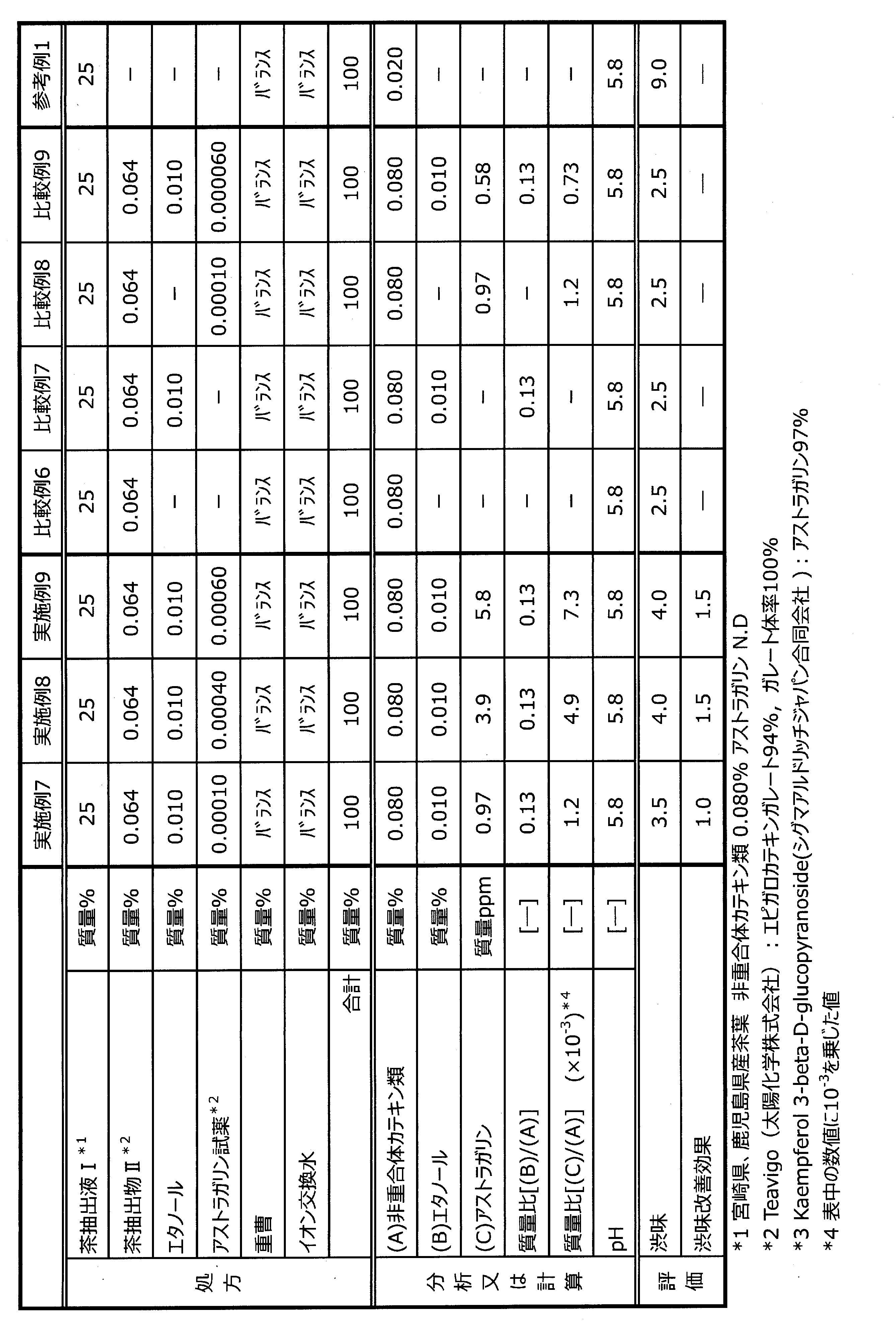
- Example 7 A packaged green tea beverage was prepared by the same operation as in Example 2 except that the tea extract II was blended in the ratio shown in Table 3. The obtained packaged green tea beverage was analyzed in the same manner as in Example 2, and a sensory test was conducted based on the sensory evaluation 1. The results are shown in Table 3 together with the results of Reference Example 1.
- Example 8 A packaged green tea beverage was prepared by the same operation as in Example 4 except that the tea extract II was blended in the ratio shown in Table 3. The obtained packaged green tea beverage was analyzed in the same manner as in Example 4, and a sensory test was conducted based on the sensory evaluation 1. The results are shown in Table 3 together with the results of Reference Example 1.
- Example 9 A packaged green tea beverage was prepared by the same operation as in Example 5 except that the tea extract II was blended in the ratio shown in Table 3. The obtained packaged green tea beverage was analyzed in the same manner as in Example 5, and a sensory test was conducted based on the sensory evaluation 1. The results are shown in Table 3 together with the results of Reference Example 1.
- Comparative Example 6 A packaged green tea beverage was prepared by the same operation as in Comparative Example 1 except that the tea extract II was blended in the ratio shown in Table 3. The obtained packaged green tea beverage was analyzed in the same manner as in Comparative Example 1, and a sensory test was conducted based on the sensory evaluation 1. The results are shown in Table 3 together with the results of Reference Example 1.
- Comparative Example 7 A packaged green tea beverage was prepared by the same operation as in Comparative Example 2 except that the tea extract II was blended in the ratio shown in Table 3. The obtained packaged green tea beverage was analyzed in the same manner as in Comparative Example 2, and a sensory test was conducted based on the sensory evaluation 1. The results are shown in Table 3 together with the results of Reference Example 1.
- Comparative Example 8 A packaged green tea beverage was prepared by the same operation as in Comparative Example 3 except that the tea extract II was blended in the ratio shown in Table 3. The obtained packaged green tea beverage was analyzed in the same manner as in Comparative Example 3, and a sensory test was conducted based on the sensory evaluation 1. The results are shown in Table 3 together with the results of Reference Example 1.
- Comparative Example 9 A packaged green tea beverage was prepared by the same operation as in Example 1 except that the tea extract II was blended in the ratio shown in Table 3. The obtained packaged green tea beverage was analyzed in the same manner as in Example 1, and a sensory test was conducted based on the sensory evaluation 1. The results are shown in Table 3 together with the results of Reference Example 1.
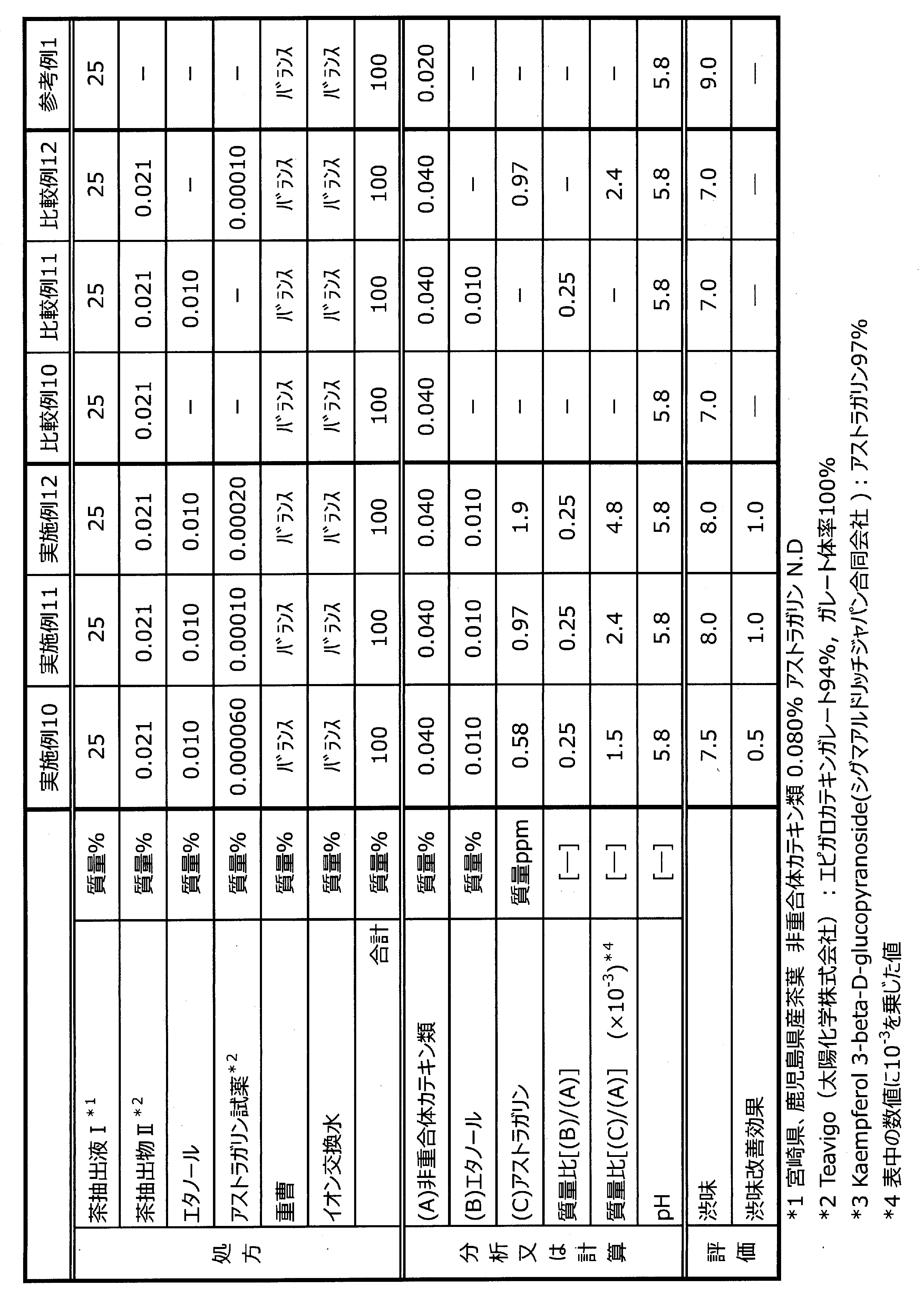
- Example 10 A packaged green tea beverage was prepared by the same operation as in Example 1 except that the tea extract II was blended in the ratio shown in Table 4. The obtained packaged green tea beverage was analyzed in the same manner as in Example 1, and a sensory test was conducted based on the sensory evaluation 1. The results are shown in Table 4 together with the results of Reference Example 1.
- Example 11 A packaged green tea beverage was prepared by the same operation as in Example 2 except that the tea extract II was blended in the ratio shown in Table 4. The obtained packaged green tea beverage was analyzed in the same manner as in Example 2, and a sensory test was conducted based on the sensory evaluation 1. The results are shown in Table 4 together with the results of Reference Example 1.
- Example 12 A packaged green tea beverage was prepared by the same operation as in Example 3 except that the tea extract II was blended in the ratio shown in Table 4. The obtained packaged green tea beverage was analyzed in the same manner as in Example 3, and a sensory test was conducted based on the sensory evaluation 1. The results are shown in Table 4 together with the results of Reference Example 1.
- Comparative Example 10 A packaged green tea beverage was prepared by the same operation as in Comparative Example 1 except that the tea extract II was blended in the ratio shown in Table 4. The obtained packaged green tea beverage was analyzed in the same manner as in Comparative Example 1, and a sensory test was conducted based on the sensory evaluation 1. The results are shown in Table 4 together with the results of Reference Example 1.
- Comparative Example 11 A packaged green tea beverage was prepared by the same operation as in Comparative Example 2 except that the tea extract II was blended in the ratio shown in Table 4. The obtained packaged green tea beverage was analyzed in the same manner as in Comparative Example 2, and a sensory test was conducted based on the sensory evaluation 1. The results are shown in Table 4 together with the results of Reference Example 1.
- Comparative Example 12 A packaged green tea beverage was prepared by the same operation as in Comparative Example 3 except that the tea extract II was blended in the ratio shown in Table 4. The obtained packaged green tea beverage was analyzed in the same manner as in Comparative Example 3, and a sensory test was conducted based on the sensory evaluation 1. The results are shown in Table 4 together with the results of Reference Example 1.
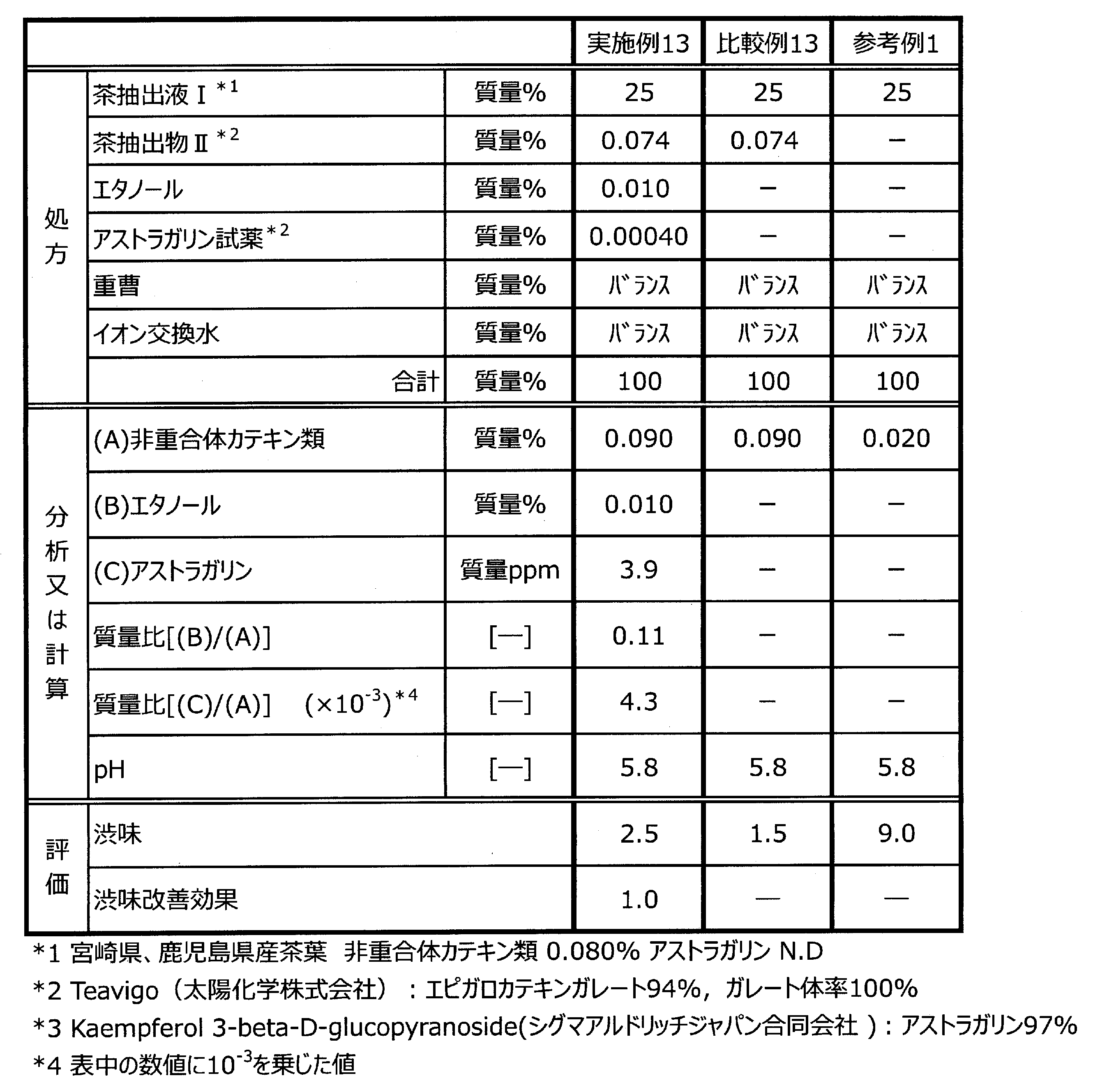
- Example 13 A packaged green tea beverage was prepared by the same operation as in Example 4 except that the tea extract II was blended in the ratio shown in Table 5. The obtained packaged green tea beverage was analyzed in the same manner as in Example 4, and a sensory test was conducted based on the sensory evaluation 1. The results are shown in Table 5 together with the results of Reference Example 1.
- Comparative Example 13 A packaged green tea beverage was prepared by the same operation as in Comparative Example 1 except that the tea extract II was blended in the ratio shown in Table 5. The obtained packaged green tea beverage was analyzed in the same manner as in Comparative Example 1, and a sensory test was conducted based on the sensory evaluation 1. The results are shown in Table 5 together with the results of Reference Example 1.
- tea extract III (catechin hydrate, manufactured by Cayman Chemical Co., Ltd., catechin 98% by mass, gallate content 0% by mass, the same applies hereinafter) was added and shown in Table 6.
- a packaged green tea beverage was prepared by the same operation as in Example 8 except that the gallate mass was shown.
- Each of the obtained packaged green tea beverages was analyzed in the same manner as in Example 8.
- the sensory evaluation was performed based on the sensory evaluation 1. The results of the analysis and sensory evaluation are shown in Table 6 together with the results of Example 8, Comparative Examples 6 and 7, and Reference Example 1.
- Comparative Examples 14, 16, 18 A heat-sterilized packaged green tea beverage was prepared by the same operation as in Comparative Example 6 except that the tea extract III was further added to the tea extract II to obtain the gallate content shown in Table 6. Each of the obtained heat-sterilized packaged green tea beverages was analyzed in the same manner as in Comparative Example 6, and a sensory test was conducted based on the sensory evaluation 1. The results are shown in Table 6 together with the results of Example 8, Comparative Examples 6 and 7, and Reference Example 1.
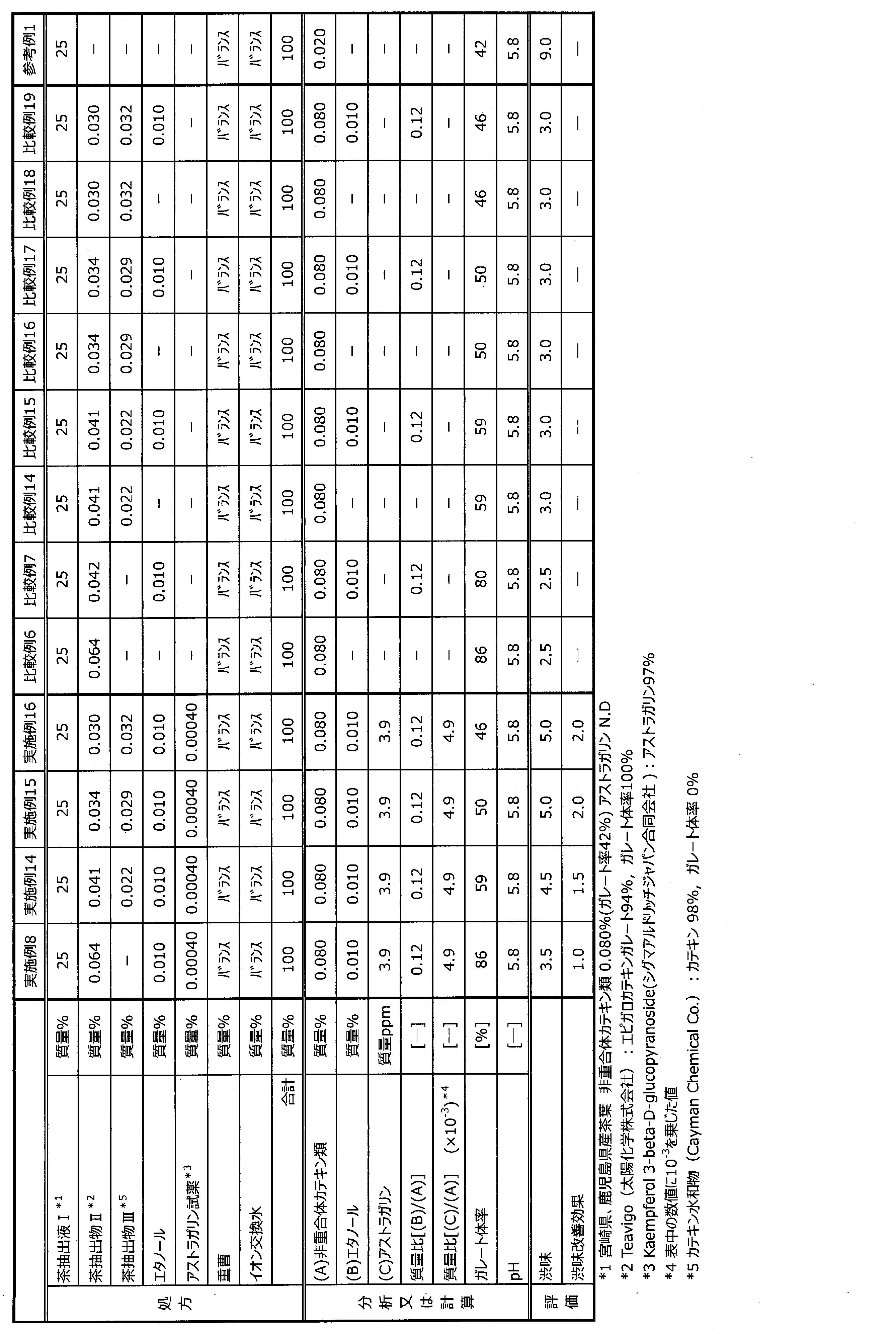
- Comparative Examples 15, 17, 19 A heat-sterilized packaged green tea beverage was prepared by the same operation as in Comparative Example 7 except that the tea extract III was further added to the tea extract II to obtain the gallate content shown in Table 7. Each of the obtained heat-sterilized packaged green tea beverages was analyzed in the same manner as in Comparative Example 7, and a sensory test was conducted based on the sensory evaluation 1. The results are shown in Table 6 together with the results of Example 8, Comparative Examples 6 and 7, and Reference Example 1.
- Examples 17-19 and Comparative Example 20 A packaged green tea beverage was prepared by the same operation as in Example 2 except that ethanol was blended in the ratio shown in Table 7.
- the obtained packaged green tea beverage was analyzed in the same manner as in Example 2, and a sensory test was conducted based on the sensory evaluation 1. The results are shown in Table 7 together with the results of Example 2, Comparative Examples 1 to 3, and Reference Example 1.
- Examples 20 and 21 A packaged green tea beverage was prepared by the same operation as in Example 10 except that ethanol was blended in the ratio shown in Table 8. The obtained packaged green tea beverage was analyzed in the same manner as in Example 10, and a sensory test was conducted based on the sensory evaluation 1. The results are shown in Table 8 together with the results of Example 10, Comparative Examples 10 to 12, and Reference Example 1.
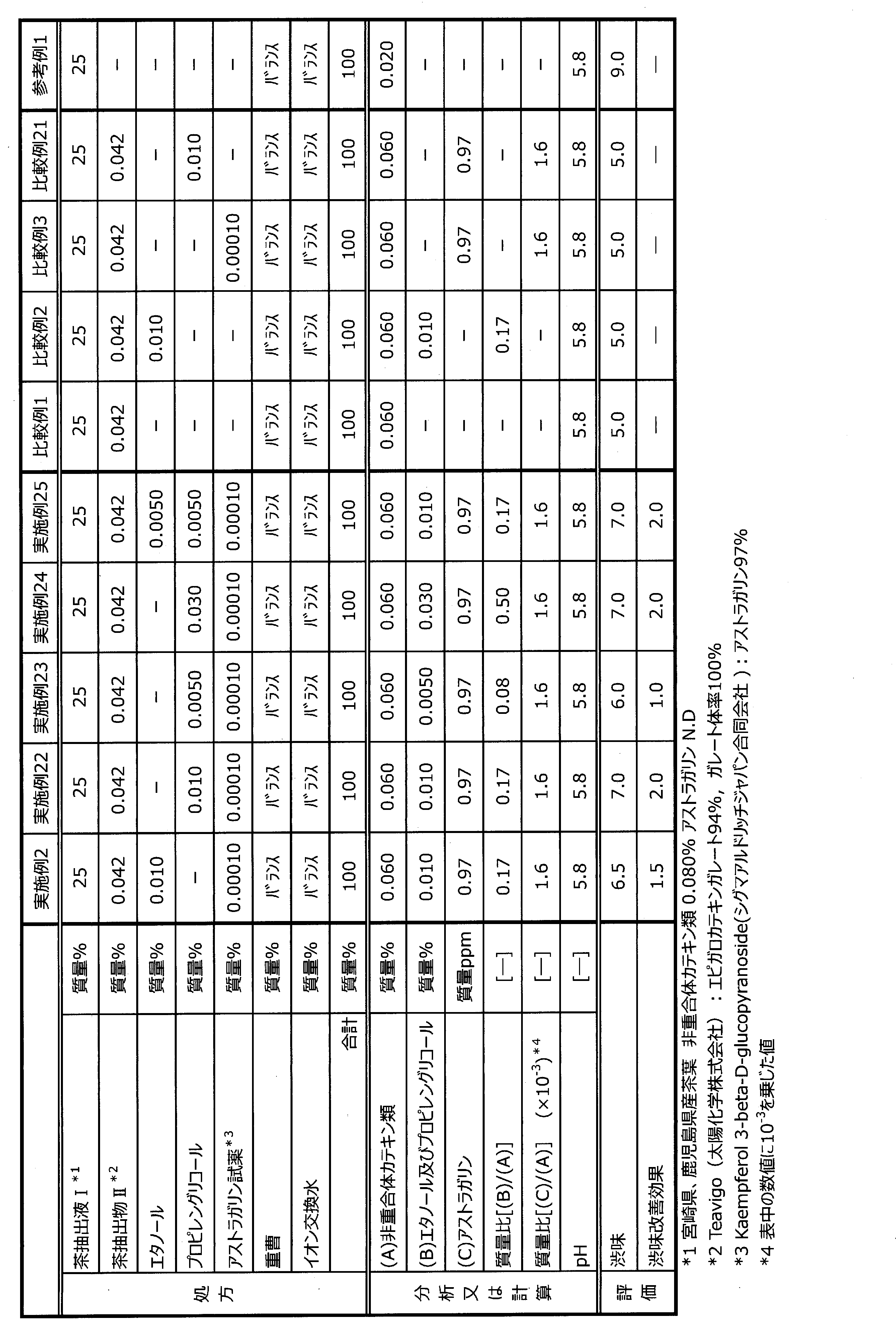
- Examples 22-24 A packaged green tea beverage was prepared by the same operation as in Example 2 except that propylene glycol was blended in the ratio shown in Table 9 instead of ethanol.
- the obtained packaged green tea beverage was analyzed in the same manner as in Example 2, and a sensory test was conducted based on the sensory evaluation 1. The results are shown in Table 9 together with the results of Example 2, Comparative Examples 1 to 3, and Reference Example 1.
- Example 25 A packaged green tea beverage was prepared by the same operation as in Example 2 except that ethanol and propylene glycol were blended in the proportions shown in Table 9 instead of ethanol.
- the obtained packaged green tea beverage was analyzed in the same manner as in Example 2, and a sensory test was conducted based on the sensory evaluation 1. The results are shown in Table 9 together with the results of Example 2, Comparative Examples 1 to 3, and Reference Example 1.
- Comparative Example 21 A packaged green tea beverage was prepared by the same operation as in Comparative Example 1 except that propylene glycol was blended in the ratio shown in Table 9. The obtained packaged green tea beverage was analyzed in the same manner as in Comparative Example 1, and a sensory test was conducted based on the sensory evaluation 1. The results are shown in Table 9 together with the results of Example 2, Comparative Examples 1 to 3, and Reference Example 1.
- Examples 26-28 A packaged green tea beverage was prepared by the same operation as in Example 2 except that glycerin was blended in the ratio shown in Table 10 instead of ethanol.
- the obtained packaged green tea beverage was analyzed in the same manner as in Example 2, and a sensory test was conducted based on the sensory evaluation 1. The results are shown in Table 10 together with the results of Example 2, Comparative Examples 1 to 3, and Reference Example 1.
- Example 29 A packaged green tea beverage was prepared by the same operation as in Example 2 except that ethanol and glycerin were blended in the proportions shown in Table 10 instead of ethanol.
- the obtained packaged green tea beverage was analyzed in the same manner as in Example 2, and a sensory test was conducted based on the sensory evaluation 1. The results are shown in Table 10 together with the results of Example 2, Comparative Examples 1 to 3, and Reference Example 1.
- Comparative Example 22 A packaged green tea beverage was prepared by the same operation as in Comparative Example 1 except that glycerin was blended in the ratio shown in Table 10. The obtained packaged green tea beverage was analyzed in the same manner as in Comparative Example 1, and a sensory test was conducted based on the sensory evaluation 1. The results are shown in Table 10 together with the results of Example 2, Comparative Examples 1 to 3, and Reference Example 1.
- a non-carbonated acidic beverage was prepared by diluting a commercially available powdered beverage (Pocarisette, powder for 1 L, Otsuka Pharmaceutical Co., Ltd.) with ion-exchanged water so that the total amount became 1 L.
- the obtained non-carbonated acidic beverage was filled in a PET bottle having a capacity of 200 mL and sterilized by heating (post-mix method) to obtain a packaged non-carbonated acidic beverage.
- the sterilization conditions were 85 ° C. for 30 minutes, and the F0 value was 0.0074.
- the obtained packaged non-carbonated acidic beverage was analyzed.
- the obtained packaged non-carbonated acidic beverage was analyzed. The results are shown in Table 12.
- Comparative Example 23 Further, a packaged non-carbonated acidic beverage was prepared by the same operation as in Reference Example 2 except that the tea extract II was blended in the ratio shown in Table 12. Then, the obtained packaged non-carbonated acidic beverage was analyzed in the same manner as in Reference Example 2. The results are shown in Table 12.
- Comparative Example 24 Further, a packaged non-carbonated acidic beverage was prepared by the same operation as in Reference Example 2 except that the tea extract II and ethanol were blended in the ratio shown in Table 12. The obtained packaged non-carbonated acidic beverage was analyzed in the same manner as in Reference Example 2. The results are shown in Table 12.
- Comparative Example 25 Further, a packaged non-carbonated acidic beverage was prepared by the same operation as in Reference Example 2 except that the tea extract II and propylene glycol were blended in the ratio shown in Table 12. The obtained packaged non-carbonated acidic beverage was analyzed in the same manner as in Reference Example 2. The results are shown in Table 12.
- Comparative Example 26 Further, a packaged non-carbonated acidic beverage was prepared by the same operation as in Reference Example 2 except that the tea extract II and glycerin were blended in the ratio shown in Table 12. The obtained packaged non-carbonated acidic beverage was analyzed in the same manner as in Reference Example 2. The results are shown in Table 12.
- Comparative Example 27 Further, a packaged non-carbonated acidic beverage was prepared by the same operation as in Reference Example 2 except that the tea extract II and the astragalin reagent were blended in the ratio shown in Table 12. The obtained packaged non-carbonated acidic beverage was analyzed in the same manner as in Reference Example 2. The results are shown in Table 12.
- Example 30 Further, a packaged non-carbonic acid beverage was prepared by the same operation as in Reference Example 2 except that the tea extract II, ethanol and the astragalin reagent were blended in the ratios shown in Table 12. The obtained packaged non-carbonated acidic beverage was analyzed in the same manner as in Reference Example 2. The results are shown in Table 12.
- Example 31 Further, a packaged non-carbonic acid beverage was prepared by the same operation as in Reference Example 2 except that tea extract II, propylene glycol, and astragalin reagent were blended in the ratios shown in Table 12. The obtained packaged non-carbonated acidic beverage was analyzed in the same manner as in Reference Example 2. The results are shown in Table 12.
- Example 32 Further, a packaged non-carbonated acidic beverage was prepared by the same operation as in Reference Example 2 except that tea extract II, glycerin, and astragalin reagent were blended in the ratios shown in Table 12. The obtained packaged non-carbonated acidic beverage was analyzed in the same manner as in Reference Example 2. The results are shown in Table 12.
- Sensory evaluation 2 Four expert panels conducted sensory tests on the "astringency" of each of the packaged non-carbonated acidic beverages obtained in Examples 30 to 32, Comparative Examples 23 to 27, and Reference Example 2. The sensory test was performed according to the following procedure. First, the "astringent standard packaged non-carbonated acidic beverage" in which the amount of tea extract II shown in Table 11 was added to the packaged non-carbonated acidic beverage of Reference Example 2 and the intensity of "astringency" was adjusted in 10 steps. was prepared. Then, four expert panels agreed to give the scores shown in Table 11 for each concentration of "astringent standard packaged non-carbonated acidic beverage".
- each specialized panel ingested in order from the "astringent standard packaged non-carbonated acidic beverage" with the highest score, and memorized the strength of the "astringent taste”.
- each specialized panel ingests each packaged non-carbonated acidic beverage, evaluates the degree of "astringency”, and selects the one with the closest "astringency” from the "astringent standard packaged non-carbonated acidic beverage”. Decided. Then, based on the scores decided by each specialized panel, the final score was decided in "0.5" increments by consultation. The results are shown in Table 12. The score means that the smaller the value, the stronger the "astringency" is felt.
- Comparative Example 28 Further, a packaged non-carbonated acidic beverage was prepared by the same operation as in Reference Example 3 except that the tea extract II was blended in the ratio shown in Table 14. Then, the obtained packaged non-carbonated acidic beverage was analyzed. The results are shown in Table 14.
- Comparative Example 29 Further, a packaged non-carbonated acidic beverage was prepared by the same operation as in Reference Example 4 except that Extract II was blended in the ratio shown in Table 14. Then, the obtained packaged non-carbonated acidic beverage was analyzed. The results are shown in Table 14.
- Example 33 Further, a packaged non-carbonic acid beverage was prepared by the same operation as in Reference Example 3 except that the tea extract II, ethanol and the astragalin reagent were blended in the ratio shown in Table 14. The obtained packaged non-carbonated acidic beverage was analyzed in the same manner as in Reference Example 3. The results are shown in Table 14.
- Example 34 Further, a packaged non-carbonated acidic beverage was prepared by the same operation as in Reference Example 4 except that the tea extract II, ethanol and the astragalin reagent were blended in the ratio shown in Table 14. The obtained packaged non-carbonated acidic beverage was analyzed in the same manner as in Reference Example 4. The results are shown in Table 14.
- Sensory evaluation 3 Four expert panels conducted sensory tests on the "astringency" of each of the packaged non-carbonated acidic beverages obtained in Examples 33 and 34, Comparative Examples 28 and 29, and Reference Examples 3 and 4. The sensory test was performed according to the following procedure. First, the “astringent standard packaged non-carbonated acidic beverage” in which the intensity of “astringency” was adjusted in 10 stages by blending the amount of tea extract II shown in Table 13 with the packaged non-carbonated acidic beverage of Reference Example 3 was prepared. Then, four expert panels agreed to give the scores shown in Table 13 for each concentration of "astringent standard packaged non-carbonated acidic beverage".
- each specialized panel ingests in order from the "astringent standard packaged non-carbonated acidic beverage" with the highest score, and memorizes the strength of the "astringent taste”.
- each specialized panel ingests each packaged green tea beverage, evaluates the degree of "astringency”, and determines the one with the closest "astringency” from the "astringent standard packaged non-carbonated acidic beverage”. .. Then, based on the scores decided by each specialized panel, the final score was decided in "0.5" increments by consultation. The results are shown in Table 14. The score means that the smaller the value, the stronger the "astringency" is felt.
- Examples 35-37 A packaged non-carbonated acidic beverage was prepared by the same operation as in Example 33 except that the salt was blended in the ratio shown in Table 15. The obtained packaged non-carbonated acidic beverage was analyzed in the same manner as in Example 33, and a sensory test was conducted based on the sensory evaluation 3. The results are shown in Table 15 together with the results of Example 33, Comparative Example 28 and Reference Example 3.
- Comparative Example 30 Further, a packaged jelly beverage was prepared by the same operation as in Reference Example 5 except that the tea extract II was blended in the ratio shown in Table 17. Then, the obtained packaged jelly beverage was analyzed. The results are shown in Table 17.
- Example 38 Further, a packaged jelly beverage was prepared by the same operation as in Reference Example 5 except that the tea extract II, ethanol, and the astragalin reagent were blended in the ratios shown in Table 17. The obtained packaged jelly beverage was analyzed in the same manner as in Reference Example 5. The results are shown in Table 17.
- Sensory evaluation 4 Four expert panels conducted a sensory test on the "astringency" of each of the packaged jelly beverages obtained in Example 38, Comparative Example 30 and Reference Example 5. The sensory test was performed according to the following procedure. First, a "standard astringent jelly beverage” was prepared by blending the amount of tea extract II shown in Table 16 with the packaged jelly beverage of Reference Example 5 and adjusting the intensity of "astringency” in 10 stages. .. Then, four expert panels agreed to give the scores shown in Table 16 for each concentration of "standard astringent jelly drink”. Next, each specialized panel ingested in order from the "astringent standard containerized jelly drink” with the highest score, and memorized the strength of the "astringent taste”.
- each specialized panel ingested each packaged jelly beverage, evaluated the degree of "astringency”, and determined the one with the closest "astringency” from the "astringency standard packaged jelly beverages". Then, based on the scores decided by each specialized panel, the final score was decided in "0.5" increments by consultation. The results are shown in Table 17. The score means that the smaller the value, the stronger the "astringency” is felt.
Landscapes
- Life Sciences & Earth Sciences (AREA)
- Chemical & Material Sciences (AREA)
- Engineering & Computer Science (AREA)
- Food Science & Technology (AREA)
- Polymers & Plastics (AREA)
- Health & Medical Sciences (AREA)
- Nutrition Science (AREA)
- Botany (AREA)
- Mycology (AREA)
- Tea And Coffee (AREA)
- Coloring Foods And Improving Nutritive Qualities (AREA)
- Jellies, Jams, And Syrups (AREA)
- Non-Alcoholic Beverages (AREA)
Abstract
次の成分(A)、(B)及び(C); (A)非重合体カテキン類 0.030~0.10質量% (B)エタノール、プロピレングリコール及びグリセリンから選択される1種以上、及び (C)アストラガリン を含有し、成分(A)と成分(B)との質量比[(B)/(A)]が0.060~2.0であり、成分(C)と成分(A)との質量比[(C)/(A)]が1.0×10-3~20×10-3である、飲料組成物。
Description
本発明は、飲料組成物に関する。
非重合体カテキン類は、Camellia属の茶葉に含まれるポリフェノール化合物の1種であり、様々な生理活性を有することから、飲食品への応用が注目されている。中でも、生活習慣として手軽に摂取できることから、茶飲料の需要が増大しているが、茶本来の香りが豊かで、甘味が引き立ち、苦味や渋味が抑えられた茶飲料が好まれる傾向がある。
従来、カフェイン含有量を低減させた茶飲料に、一定量のエタノールを含有させることにより、茶本来の甘味が改善された茶飲料が得られることが報告されている(特許文献1)。また、非重合体カテキン類含有飲料を、非重合体カテキン類とエタノールとを特定量共存させた状態で加熱し、当該飲料を容器に充填して密封した後、容器詰飲料を徐々に冷却することで、茶風味の香り立ちの豊かな容器詰飲料が得られるとの報告もある(特許文献2)。更に、茶飲料にメチルメチオニンスルホニウム塩を特定量添加するか、あるいは茶飲料にエタノール又はプロピレングリコールを特定量添加して、該茶飲料を特定条件にて加熱殺菌をすることで、加熱殺菌により低下する茶飲料の香味及び旨味を補完し、その香味及び旨味を長期間持続できる容器詰茶飲料が得られることも報告されている(特許文献3)。
一方、アストラガリンは、柿の葉や桑の葉に含まれるポリフェノール化合物の1種であり、抗アレルギー作用を有することが報告されている。このようなアストラガリンの生理作用に着目し、飲食品への応用が検討されており、例えば、アストラガリンに、果糖、ガラクトース、乳糖及びブドウ糖からなる群から選ばれる糖の1種又は2種以上を配合することで、アストラガリンの吸収性が向上することが報告されている(特許文献4)。また、桑葉抽出エキス、玄米エキス及び緑茶エキスを混合したブレンド茶飲料も提案されている(特許文献5)。
(特許文献1)特開2015-122968号公報
(特許文献2)特開2016-123416号公報
(特許文献3)特開2016-154500号公報
(特許文献4)特開2002-291441号公報
(特許文献5)特開2007-282632号公報
(特許文献2)特開2016-123416号公報
(特許文献3)特開2016-154500号公報
(特許文献4)特開2002-291441号公報
(特許文献5)特開2007-282632号公報
本発明は、次の成分(A)、(B)及び(C);
(A)非重合体カテキン類 0.030~0.10質量%
(B)エタノール、プロピレングリコール及びグリセリンから選択される1種以上、及び(C)アストラガリン
を含有し、
成分(A)と成分(B)との質量比[(B)/(A)]が0.060~2.0であり、
成分(C)と成分(A)との質量比[(C)/(A)]が1.0×10-3~20×10-3である、飲料組成物を提供するものである。
(A)非重合体カテキン類 0.030~0.10質量%
(B)エタノール、プロピレングリコール及びグリセリンから選択される1種以上、及び(C)アストラガリン
を含有し、
成分(A)と成分(B)との質量比[(B)/(A)]が0.060~2.0であり、
成分(C)と成分(A)との質量比[(C)/(A)]が1.0×10-3~20×10-3である、飲料組成物を提供するものである。
非重合体カテキン類を強化した飲料組成物とすれば、生理効果の増強が期待できるが、非重合体カテキン類は渋味を有することから、非重合体カテキン類の高濃度化には限界がある。
本発明は、非重合体カテキン類を強化しつつも、渋味が抑制された飲料組成物に関する。
本発明は、非重合体カテキン類を強化しつつも、渋味が抑制された飲料組成物に関する。
本発明者らは上記課題に鑑み、鋭意研究を重ねた結果、非重合体カテキン類を強化した飲料組成物に、非重合体カテキン類に対して、渋味物質として知られるアストラガリンと、特定のアルコールを、それぞれ一定の量比で含有させることで、非重合体カテキン類を強化しつつも、渋味が抑制された飲料組成物が得られることを見出した。
本発明によれば、非重合体カテキン類を強化しつつも、渋味が抑制された飲料組成物を提供することができる。
本発明の飲料組成物は、成分(A)として非重合体カテキン類を含有する。ここで、本明細書において「(A)非重合体カテキン類」とは、カテキン、ガロカテキン、エピカテキン及びエピガロカテキン等の非ガレート体と、カテキンガレート、ガロカテキンガレート、エピカテキンガレート及びエピガロカテキンガレート等のガレート体を併せての総称である。本発明においては、上記8種の非重合体カテキン類のうち少なくとも1種を含有すればよい。なお、成分(A)は、飲食品の分野において通常使用されているものであれば由来は特に限定されず、例えば、化学合成品でも、非重合体カテキン類を含有する植物から抽出したものでもよい。
本発明の飲料組成物は、成分(A)の含有量が0.030~0.10質量%であるが、非重合体カテキン類の強化の観点から、0.035質量%以上が好ましく、0.045質量%以上がより好ましく、0.052質量%以上が更に好ましく、また渋味抑制の観点から、0.095質量%以下が好ましく、0.088質量%以下がより好ましく、0.086質量%以下が更に好ましい。成分(A)の含有量の範囲としては、本発明の飲料組成物中に、好ましくは0.035~0.095質量%であり、より好ましくは0.045~0.088質量%であり、更に好ましくは0.052~0.086質量%である。なお、成分(A)の含有量は、上記8種の非重合体カテキン類の合計量に基づいて定義される。また、成分(A)の含有量は、通常知られている測定法のうち測定試料の状況に適した分析法により測定することが可能であり、例えば、液体クロマトグラフィーで分析することが可能である。具体的には、後掲の実施例に記載の方法が挙げられる。なお、測定の際には装置の検出域に適合させるため、試料を凍結乾燥したり、装置の分離能に適合させるため試料中の夾雑物を除去したりする等、必要に応じて適宜処理を施してもよい。
本発明の容器詰茶飲料は、成分(A)の種類に特に限定はないが、渋味抑制の観点から、非重合体カテキン類中のガレート体の割合(ガレート体率)が0~85質量%であることが好ましく、20~75質量%がより好ましく、30~65質量%が更に好ましく、35~60質量%がより更に好ましく、40~55質量%が殊更に好ましい。ここで、本明細書において「ガレート体率」とは、非重合体カテキン類8種に対する上記ガレート体4種の質量比率をいう。
本発明の飲料組成物は、成分(B)としてエタノール、プロピレングリコール及びグリセリンから選択される1種以上を含有する。これら3種のアルコールは、単独で含有しても、2以上を任意に組み合わせて含有してもよいが、渋味抑制の観点から、プロピレングリコールを含有することが好ましい。
本発明の飲料組成物中の成分(B)の含有量は、渋味抑制の観点から、0.0020質量%以上が好ましく、0.0030質量%以上がより好ましく、0.0060質量%以上が更に好ましく、0.0075質量%以上がより更に好ましく、また異臭抑制の観点から、0.20質量%以下が好ましく、0.15質量%以下がより好ましく、0.12質量%以下が更に好ましく、0.080質量%以下がより更に好ましく、0.060質量%以下が殊更に好ましい。かかる成分(B)の含有量の範囲としては、本発明の飲料組成物中に、好ましくは0.0020~0.20質量%であり、より好ましくは0.0030~0.15質量%であり、更に好ましくは0.0060~0.12質量%であり、より更に好ましくは0.0075~0.080質量%であり、殊更に好ましくは0.0075~0.060質量%である。なお、本明細書において成分(B)の含有量は、エタノール、プロピレングリコール及びグリセリンの合計含有量とする。また、成分(B)の含有量は、通常知られている方法により分析することが可能である。具体的には、後掲の実施例に記載の方法が挙げられる。
本発明の飲料組成物は、成分(C)としてアストラガリンを含有する。ここで、本明細書において「アストラガリン」とは、ケンフェロールの3位にグルコースが結合した化合物である。成分(C)は、原料に由来するものでも、新たに加えられたものでもよい。また、成分(C)は、飲食品の分野において通常使用されているものであれば由来は特に限定されず、例えば、化学合成品でも、アストラガリンを含有する植物から抽出したものでもよい。成分(C)の市販品としては、例えば、Kaempferol 3-beta-D-glucopyranoside(シグマアルドリッチジャパン合同社製)等を挙げることができる。
本発明の飲料組成物中の成分(C)の含有量は、渋味抑制の観点から、0.50質量ppm以上が好ましく、0.70質量ppm以上がより好ましく、0.90質量ppm以上が更に好ましく、1.1質量ppm以上がより更に好ましく、1.5質量ppm以上がより更に好ましく、2.5質量ppm以上が殊更に好ましく、そして20質量ppm以下が好ましく、15質量ppm以下がより好ましく、8.0質量ppm以下が更に好ましい。かかる成分(C)の含有量の範囲としては、本発明の飲料組成物中に、好ましくは0.50~20質量ppmであり、より好ましくは0.70~15質量ppmであり、更に好ましくは0.90~15質量ppmであり、より更に好ましくは1.1~15質量ppmであり、より更に好ましくは1.5~15質量ppmであり、殊更に好ましくは2.5~8.0質量ppmである。なお、成分(C)の含有量は、通常知られている測定法のうち測定試料の状況に適した分析法により測定することが可能であり、例えば、液体クロマトグラフィーで分析することが可能である。具体的には、後掲の実施例に記載の方法が挙げられる。なお、測定の際には装置の検出域に適合させるため、試料を凍結乾燥したり、装置の分離能に適合させるため試料中の夾雑物を除去したりする等、必要に応じて適宜処理を施してもよい。
本発明の飲料組成物は、成分(A)と成分(B)との質量比[(B)/(A)]が0.060~2.0であるが、渋味抑制の観点から、0.070以上が好ましく、0.090以上がより好ましく、0.10以上が更に好ましく、また異臭抑制の観点から、1.8以下が好ましく、1.6以下がより好ましく、1.4以下が更に好ましく、1.2以下がより更に好ましく、1.0以下が殊更に好ましい。かかる質量比[(B)/(A)]の範囲としては、好ましくは0.070~1.8であり、より好ましくは0.090~1.6であり、更に好ましくは0.10~1.4であり、より更に好ましくは0.10~1.2であり、殊更に好ましくは0.10~1.0である。
本発明の飲料組成物は、成分(A)と成分(C)との質量比[(C)/(A)]が1.0×10-3~20×10-3であるが、渋味抑制の観点から、1.1×10-3以上が好ましく、1.3×10-3以上がより好ましく、1.5×10-3以上が更に好ましく、そして18×10-3以下が好ましく、15×10-3以下がより好ましく、12×10-3以下が更に好ましい。かかる質量比[(C)/(A)]の範囲としては、好ましくは1.1×10-3~18×10-3であり、より好ましくは1.3×10-3~15×10-3であり、更に好ましくは1.5×10-3~12×10-3である。なお、質量比[(C)/(A)]は、成分(A)と成分(C)の含有量の単位を揃えて算出するものとする。
本発明の飲料組成物は、所望により、甘味料、酸味料、ビタミン、ミネラル、エステル、乳化剤、保存料、調味料、果汁エキス、野菜エキス、花蜜エキス、品質安定剤等の添加剤を1種又は2種以上を含有することができる。添加剤の含有量は、本発明の目的を損なわない範囲内で適宜設定することができる。
本発明の飲料組成物は、例えば、液状でも、固形状でもよく、適宜の形態を採り得る。
例えば、本発明の飲料組成物が液状である場合、飲料の形態は、RTD(ストレート飲料)のみならず、濃縮還元飲料、ゼリー状、濃縮液状、スラリー状等の形態でもよい。中でも、利便性の観点から、RTD(ストレート飲料)が好ましい。ここで、本明細書において「RTD」とは、希釈せずにそのまま飲用できる飲料をいう。ゼリー状である場合、容器に備え付けられた吸い口やストローから飲料を吸引できれば、その固形分濃度は特に限定されず、適宜選択可能である。また、本発明の飲料組成物が固形状である場合、常温(20℃±15℃)において固体であればその形状は特に限定されず、粉末状、顆粒状、錠状、棒状、板状、ブロック状等の種々の形状とすることができる。本発明の固形状飲料組成物中の固形分量は通常95質量%以上、好ましくは97質量%以上である。なお、かかる固形分量の上限は特に限定されず、100質量%であってもよい。ここで、本明細書において「固形分量」とは、試料を105℃の電気恒温乾燥機で3時間乾燥して揮発物質を除いた残分の質量をいう。
なお、本発明の飲料組成物が濃縮物又は固形物の形態である場合、前述の成分(A)の含有量が上記範囲内となるように水で希釈してRTD(ストレート飲料)としたときに、質量比[(B)/(A)]及び質量比[(C)/(A)]が上記要件を満たせばよい。
例えば、本発明の飲料組成物が液状である場合、飲料の形態は、RTD(ストレート飲料)のみならず、濃縮還元飲料、ゼリー状、濃縮液状、スラリー状等の形態でもよい。中でも、利便性の観点から、RTD(ストレート飲料)が好ましい。ここで、本明細書において「RTD」とは、希釈せずにそのまま飲用できる飲料をいう。ゼリー状である場合、容器に備え付けられた吸い口やストローから飲料を吸引できれば、その固形分濃度は特に限定されず、適宜選択可能である。また、本発明の飲料組成物が固形状である場合、常温(20℃±15℃)において固体であればその形状は特に限定されず、粉末状、顆粒状、錠状、棒状、板状、ブロック状等の種々の形状とすることができる。本発明の固形状飲料組成物中の固形分量は通常95質量%以上、好ましくは97質量%以上である。なお、かかる固形分量の上限は特に限定されず、100質量%であってもよい。ここで、本明細書において「固形分量」とは、試料を105℃の電気恒温乾燥機で3時間乾燥して揮発物質を除いた残分の質量をいう。
なお、本発明の飲料組成物が濃縮物又は固形物の形態である場合、前述の成分(A)の含有量が上記範囲内となるように水で希釈してRTD(ストレート飲料)としたときに、質量比[(B)/(A)]及び質量比[(C)/(A)]が上記要件を満たせばよい。
本発明の飲料組成物は、茶飲料でも、酸性飲料でもよい。ここで、本明細書において「茶飲料」とは、Camellia属の茶葉を茶原料として含む飲料をいう。
Camellia属の茶葉としては、例えば、C.sinensis.var.sinensis(やぶきた種を含む)、C.sinensis.var.assamica及びそれらの雑種から選択される茶葉(Camellia sinensis)が挙げられる。茶葉は、その加工方法により、不発酵茶、半発酵茶、発酵茶に分類することができる。Camellia属の茶葉は、1種又は2種以上を使用することができる。また茶葉は火入れ加工が施されていてもよい。
不発酵茶としては、例えば、煎茶、深蒸し煎茶、焙じ茶、番茶、玉露、かぶせ茶、碾茶、釜入り茶、茎茶、棒茶、芽茶等の緑茶が挙げられる。また、半発酵茶としては、例えば、鉄観音、色種、黄金桂、武夷岩茶等の烏龍茶が挙げられる。更に、発酵茶としては、ダージリン、アッサム、スリランカ等の紅茶が挙げられる。中でも、本発明の効果を享受しやすい点で、茶原料として不発酵茶又は半発酵茶を使用することが好ましく、不発酵茶が更に好ましい。
Camellia属の茶葉としては、例えば、C.sinensis.var.sinensis(やぶきた種を含む)、C.sinensis.var.assamica及びそれらの雑種から選択される茶葉(Camellia sinensis)が挙げられる。茶葉は、その加工方法により、不発酵茶、半発酵茶、発酵茶に分類することができる。Camellia属の茶葉は、1種又は2種以上を使用することができる。また茶葉は火入れ加工が施されていてもよい。
不発酵茶としては、例えば、煎茶、深蒸し煎茶、焙じ茶、番茶、玉露、かぶせ茶、碾茶、釜入り茶、茎茶、棒茶、芽茶等の緑茶が挙げられる。また、半発酵茶としては、例えば、鉄観音、色種、黄金桂、武夷岩茶等の烏龍茶が挙げられる。更に、発酵茶としては、ダージリン、アッサム、スリランカ等の紅茶が挙げられる。中でも、本発明の効果を享受しやすい点で、茶原料として不発酵茶又は半発酵茶を使用することが好ましく、不発酵茶が更に好ましい。
また、Camellia属の茶葉以外の茶原料として、穀物やCamellia属以外の茶葉を使用してもよい。穀物としては、例えば、大麦、小麦、ハト麦、ライ麦、燕麦、裸麦等の麦;玄米等の米;大豆、黒大豆、ソラマメ、インゲン豆、小豆、エビスクサ、ササゲ、ラッカセイ、エンドウ、リョクトウ等の豆;ソバ、トウモロコシ、白ゴマ、黒ゴマ、粟、稗、黍、キヌワ等の雑穀を挙げることができる。また、Camellia属以外の茶葉としては、例えば、イチョウの葉、柿の葉、ビワの葉、桑の葉、クコの葉、杜仲の葉、小松菜、ルイボス、クマザサ、ドクダミ、アマチャヅル、スイカズラ、ツキミソウ、カキドオシ、カワラケツメイ、ギムネマ・シルベスタ、黄杞茶(クルミ科)、甜茶(バラ科)、キダチアロエ等が挙げられる。更に、カモミール、ハイビスカス、ペパーミント、レモングラス、レモンピール、レモンバーム、ローズヒップ、ローズマリー等のハーブも用いることができる。Camellia属以外の茶葉は、1種又は2種以上を使用することができる。
中でも、本発明の効果を享受しやすい点から、茶飲料としては緑茶飲料又は烏龍茶飲料が好ましく、緑茶飲料が更に好ましい。茶飲料が緑茶飲料である場合、全茶原料中で緑茶葉を最も多く使用する緑茶飲料がより好ましく、茶原料として緑茶葉のみを使用する緑茶飲料が更に好ましい。なお、抽出方法としては、例えば、ニーダー抽出、攪拌抽出(バッチ抽出)、向流抽出(ドリップ抽出)、カラム抽出等の公知の方法を採用することができる。また、抽出条件は特に限定されず、抽出方法により適宜選択することができる。
本発明の飲料組成物が茶飲料である場合、pH(20℃)は通常5~7であるが、風味バランスの観点から、5.1以上が好ましく、5.3以上がより好ましく、5.5以上が更に好ましく、そして6.7以下が好ましく、6.5以下がより好ましく、6.4以下が更に好ましい。かかるpHの範囲としては、好ましくは5.1~6.7であり、より好ましくは5.3~6.5であり、更に好ましくは5.5~6.4である。なお、本明細書においてpHは、20℃に温度調整をしてpHメータにより測定するものとする。
また、本明細書において「酸性飲料」とは、pH(20℃)が2以上5未満である飲料をいう。酸性飲料のpH(20℃)は、好ましくは2.5以上、更に好ましくは3以上であって、好ましくは4.5以下、更に好ましくは4以下である。かかるpHの範囲としては、好ましくは2.5~4.5、更に好ましくは3~4である。このような酸性飲料として、例えば、炭酸ガス及び/又は酸味料を添加することで酸性化した飲料、果汁、果実酢又は穀物酢を添加した飲料、乳成分をビフィズス菌や乳酸菌等で発酵することで酸性化した飲料を挙げることができる。酸味料としては、例えば、クエン酸、乳酸、酢酸、フマル酸、リンゴ酸、グルコン酸、コハク酸等の有機酸及び/又はその塩が挙げられる。
本発明の飲料組成物が酸性飲料である場合、炭酸酸性飲料でも、非炭酸酸性飲料でもよいが、本発明の効果を享受しやすい点で、非炭酸酸性飲料が好ましい。好適な非炭酸酸性飲料として、果汁飲料、野菜飲料、スポーツ飲料、ゼリー飲料、乳清飲料等を挙げることができる。ここで、本明細書において「スポーツ飲料」とは、運動や日常生活等で発汗等によって失われた水分、電解質、ミネラル、エネルギーを効率よく補給することを目的とした清涼飲料水であり、ナトリウム濃度が0.010質量%以上の酸性飲料をいう。
本発明の飲料組成物がスポーツ飲料である場合、飲料組成物中の成分(D)としてナトリウム濃度を0.010質量%以上含有する。スポーツ飲料中の成分(D)の含有量は、渋味抑制の観点から、0.013質量%以上が好ましく、0.015質量%以上がより好ましく、0.018質量%以上が更に好ましく、0.020質量%以上がより更に好ましく、また塩味の観点から、0.080質量%以下が好ましく、0.060質量%以下がより好ましく、0.055質量%以下が更に好ましく、0.050質量%以下がより更好ましい。かかる成分(D)の含有量の範囲としては、本発明の飲料組成物中に、好ましくは0.013~0.080質量%であり、より好ましくは0.015~0.060質量%であり、更に好ましくは0.018~0.055質量%であり、より更に好ましくは0.020~0.050質量%である。なお、成分(D)の含有量は、通常知られている方法により分析することが可能である。具体的には、後掲の実施例に記載の方法が挙げられる。
本発明の飲料組成物がRTDである場合、容器詰飲料でもよい。容器としては通常の包装容器であれば特に限定されず、例えば、ポリエチレンテレフタレートを主成分とする成形容器(いわゆるPETボトル)、金属缶、金属箔やプラスチックフィルムと複合された紙容器、瓶等が挙げられる。
また、本発明の飲料組成物がRTDである場合、加熱殺菌済でもよい。加熱殺菌方法としては、適用されるべき法規(日本にあっては食品衛生法)に定められた条件に適合するものであれば特に限定されない。例えば、茶飲料を容器包装に充填し、密栓若しくは密封した後殺菌するか、又は自記温度計をつけた殺菌器等で殺菌したもの若しくはろ過器等で除菌したものを自動的に容器包装に充填した後、密栓若しくは密封すればよい。より具体的には、レトルト殺菌法、高温短時間殺菌法(HTST法)、超高温殺菌法(UHT法)等を挙げることができる。
また、加熱殺菌は、容器内の中心部の温度を85℃で30分間加熱する方法、又はこれと同等以上の効力を有する方法で行うことができる。例えば、F0値が0.005~40、好ましくは0.006~35、更に好ましくは0.007~30となる条件で加熱殺菌することができる。ここで、本明細書において「F0値」とは、飲料組成物を加熱殺菌した場合の加熱殺菌効果を評価する値で、基準温度(121.1℃)に規格化した場合の加熱時間(分)に相当する。F0値は、容器内温度に対する致死率(121.1℃で1)に、加熱時間(分)を乗じて算出される。致死率は致死率表(藤巻正生ら、「食品工業」、恒星社厚生閣、1985年、1049頁)から求めることができる。F0値を算出するには、一般的に用いられる面積計算法、公式法等を採用することができる(例えば谷川ら《缶詰製造学》頁220、恒星社厚生閣 参照)。本発明において、F0値を所定の値になるよう設定するには、例えば、予め得た致死率曲線から、適当な加熱温度・加熱時間を決定すればよい。
本発明の飲料組成物は適宜の方法で製造することができるが、例えば、成分(A)、(B)及び(C)、必要により他の成分を配合し、成分(A)含有量、並びに質量比[(B)/(A)]及び質量比[(C)/(A)]を調整して製造することができる。
1.非重合体カテキン類の分析
純水で溶解希釈した試料を、高速液体クロマトグラフ(型式SCL-10AVP、島津製作所製)を用い、オクタデシル基導入液体クロマトグラフ用パックドカラム(L-カラムODS、4.6mmφ×250mm 粒子径5μm:財団法人 化学物質評価研究機構製)を装着し、カラム温度35℃でグラジエント法により測定する。移動相A液は酢酸を0.1mol/L含有する蒸留水溶液、B液は酢酸を0.1mol/L含有するアセトニトリル溶液とし、流速は1mL/分、試料注入量は10μL、UV検出器波長は280nmの条件で行う。なお、グラジエント条件は以下の通りである。
純水で溶解希釈した試料を、高速液体クロマトグラフ(型式SCL-10AVP、島津製作所製)を用い、オクタデシル基導入液体クロマトグラフ用パックドカラム(L-カラムODS、4.6mmφ×250mm 粒子径5μm:財団法人 化学物質評価研究機構製)を装着し、カラム温度35℃でグラジエント法により測定する。移動相A液は酢酸を0.1mol/L含有する蒸留水溶液、B液は酢酸を0.1mol/L含有するアセトニトリル溶液とし、流速は1mL/分、試料注入量は10μL、UV検出器波長は280nmの条件で行う。なお、グラジエント条件は以下の通りである。
濃度勾配条件(体積%)
時間 A液濃度 B液濃度
0分 97% 3%
5分 97% 3%
37分 80% 20%
43分 80% 20%
43.5分 0% 100%
48.5分 0% 100%
49分 97% 3%
60分 97% 3%
時間 A液濃度 B液濃度
0分 97% 3%
5分 97% 3%
37分 80% 20%
43分 80% 20%
43.5分 0% 100%
48.5分 0% 100%
49分 97% 3%
60分 97% 3%
2.エタノールの分析
エタノールの分析は、次に示すガスクロマトグラフ法にしたがって行う。
分析機器は、GC-14B(島津製作所社製)を使用する。
分析機器の装置構成は次の通りである。
・検出器 :FID
・カラム :Gaskuropack55、80~100mesh、φ3.2mm×3.1m
エタノールの分析は、次に示すガスクロマトグラフ法にしたがって行う。
分析機器は、GC-14B(島津製作所社製)を使用する。
分析機器の装置構成は次の通りである。
・検出器 :FID
・カラム :Gaskuropack55、80~100mesh、φ3.2mm×3.1m
分析条件は次の通りである。
・温度 :試料注入口及び検出機250℃、カラム130℃
・ガス圧力:ヘリウム(キャリアガス)140kPa、水素60kPa、空気50kPa
・注入量 :2μL
・温度 :試料注入口及び検出機250℃、カラム130℃
・ガス圧力:ヘリウム(キャリアガス)140kPa、水素60kPa、空気50kPa
・注入量 :2μL
以下の手順にて分析用試料を調製する。
検体5gを量りとり、これに水を加えて25mLに定容する。その溶液をディスクろ過し、試料溶液とする。調製した試料溶液をガスクロマトグラフ分析に供する。
検体5gを量りとり、これに水を加えて25mLに定容する。その溶液をディスクろ過し、試料溶液とする。調製した試料溶液をガスクロマトグラフ分析に供する。
3.プロピレングリコール及びグリセリンの分析
プロピレングリコール及びグリセリンの分析は、次に示すガスクロマトグラフ法にしたがって行う。分析機器は、GCMS-QP2020(島津製作所社製)を使用する。分析機器の装置構成は次の通りである。
・検出器 :MS
・カラム :InertCap WAX一HT(30m(長さ)、0.25mm(内径)、0.25μm(膜厚))
プロピレングリコール及びグリセリンの分析は、次に示すガスクロマトグラフ法にしたがって行う。分析機器は、GCMS-QP2020(島津製作所社製)を使用する。分析機器の装置構成は次の通りである。
・検出器 :MS
・カラム :InertCap WAX一HT(30m(長さ)、0.25mm(内径)、0.25μm(膜厚))
分析条件は次の通りである。
・カラム温度 :40℃(3min)→20℃/min→250℃(10min)
・カラム圧力 :定流量モード(49kPa)
・カラム流量 :1mL/min(He)
・注入口温度 :250℃
・注入方式 :スプリット(5:1)
・検出器 :MS
・イオン源温度:230℃
・イオン化方法:EI(70eV)
・スキャン範囲:m/z10~800
・定量イオン :プロピレングリコール m/z76
グリセリン m/z61
・カラム温度 :40℃(3min)→20℃/min→250℃(10min)
・カラム圧力 :定流量モード(49kPa)
・カラム流量 :1mL/min(He)
・注入口温度 :250℃
・注入方式 :スプリット(5:1)
・検出器 :MS
・イオン源温度:230℃
・イオン化方法:EI(70eV)
・スキャン範囲:m/z10~800
・定量イオン :プロピレングリコール m/z76
グリセリン m/z61
以下の手順にて分析用試料を調製する。
検体5gを量りとり、これにテトラヒドロフランを加えて25mLに定容する。その溶液を0.2μmメンブレンフィルターでろ過し、ろ液lμLをGC/MSに注入する。定量はプロピレングリコール、グリセリンをTHFで希釈して濃度既知の溶液を調製する。そして、その溶液標品のピーク面積と調製濃度から検量線を作成し、試料のプロピレングリコール及びグリセリン含有量を求める。なお、定量は測定される定量イオンのピーク面積を用いる。
検体5gを量りとり、これにテトラヒドロフランを加えて25mLに定容する。その溶液を0.2μmメンブレンフィルターでろ過し、ろ液lμLをGC/MSに注入する。定量はプロピレングリコール、グリセリンをTHFで希釈して濃度既知の溶液を調製する。そして、その溶液標品のピーク面積と調製濃度から検量線を作成し、試料のプロピレングリコール及びグリセリン含有量を求める。なお、定量は測定される定量イオンのピーク面積を用いる。
4.アストラガリンの分析
試料溶液をフィルター(0.45μm)で濾過し、高速液体クロマトグラフ(型式LC-20 Prominence,島津製作所製)を用い、カラム〔Cadenza CD-C18(粒子径 3μm,4.6mmφ×150mm,Imtakt)〕を装着し、カラム温度40℃にてグラジエント法により行った。移動相C液は酢酸を0.05質量%含有する緩衝溶液、D液はアセトニトリル溶液とし、流速は1mL/分、試料注入量は10μL、UV検出器波長は360nmの条件で行った。なお、グラジエントの条件は、以下のとおりである。
試料溶液をフィルター(0.45μm)で濾過し、高速液体クロマトグラフ(型式LC-20 Prominence,島津製作所製)を用い、カラム〔Cadenza CD-C18(粒子径 3μm,4.6mmφ×150mm,Imtakt)〕を装着し、カラム温度40℃にてグラジエント法により行った。移動相C液は酢酸を0.05質量%含有する緩衝溶液、D液はアセトニトリル溶液とし、流速は1mL/分、試料注入量は10μL、UV検出器波長は360nmの条件で行った。なお、グラジエントの条件は、以下のとおりである。
濃度勾配条件(体積%)
時間(分) C液濃度 D液濃度
0 85% 15%
20 80% 20%
35 10% 90%
50 10% 90%
50.1 85% 15%
60 85% 15%
時間(分) C液濃度 D液濃度
0 85% 15%
20 80% 20%
35 10% 90%
50 10% 90%
50.1 85% 15%
60 85% 15%
また、アストラガリンの標準品を用いて濃度既知の溶液を調製し、高速液体クロマトグラフ分析に供することにより検量線を作成し、アストラガリンを指標として、前記試料溶液中のアストラガリンの定量を行った。
5.pH測定
検体30mLを50mLのビーカーに量り取り、pHメータ(HORIBA コンパクトpHメータ、堀場製作所製)を用いて、20℃に温度調整をして測定した。
検体30mLを50mLのビーカーに量り取り、pHメータ(HORIBA コンパクトpHメータ、堀場製作所製)を用いて、20℃に温度調整をして測定した。
6.ナトリウムイオンの測定
試料2gに10%塩酸5mLを加え、水浴上で蒸発乾固する。さらに10%塩酸5mLを加え、加温した後、全量をメスフラスコに濾過し、水で定容する。1%塩酸を用いて、検量線の範囲内に入るように、適当な濃度に希釈し、20000ppmのストロンチウム液2.5mLを加え、定容したものを試験溶液とする。原子吸光光度計を用いて、試験溶液の吸光度を測定し、あらかじめ作成した検量線からナトリウムの定量を行う。
試料2gに10%塩酸5mLを加え、水浴上で蒸発乾固する。さらに10%塩酸5mLを加え、加温した後、全量をメスフラスコに濾過し、水で定容する。1%塩酸を用いて、検量線の範囲内に入るように、適当な濃度に希釈し、20000ppmのストロンチウム液2.5mLを加え、定容したものを試験溶液とする。原子吸光光度計を用いて、試験溶液の吸光度を測定し、あらかじめ作成した検量線からナトリウムの定量を行う。
・原子吸光光度計:AA-7000(島津製作所製)
・フレーム:空気-アセチレン
・測定波長:589.0nm
・フレーム:空気-アセチレン
・測定波長:589.0nm
製造例1
茶抽出液Iの製造
煎茶葉(宮崎県産、鹿児島県産)30gを90℃の熱水2000gに投入し、3分間抽出を行い、茶殻を除去した後、液温20℃まで冷却し、茶抽出液Iを得た。得られた茶抽出液Iは、非重合体カテキン類の含有量が80mg/100mLであった。なお、アストラガリンは検出されなかった。
茶抽出液Iの製造
煎茶葉(宮崎県産、鹿児島県産)30gを90℃の熱水2000gに投入し、3分間抽出を行い、茶殻を除去した後、液温20℃まで冷却し、茶抽出液Iを得た。得られた茶抽出液Iは、非重合体カテキン類の含有量が80mg/100mLであった。なお、アストラガリンは検出されなかった。
参考例1
製造例1で得られた茶抽出液Iと、イオン交換水とを表2に示す割合で配合し、次いで重曹でpHが5.8となるように調整し、次いでイオン交換水にて全量を100質量%に調整して緑茶飲料を得た。次いで、得られた緑茶飲料を容量200mLのPETボトルに充填し加熱殺菌した(ポストミックス方式)。殺菌条件は、85℃、30分で行い、F0値は0.0074であった。そして、得られた容器詰緑茶飲料について分析を行った。その結果を表2に示す。
製造例1で得られた茶抽出液Iと、イオン交換水とを表2に示す割合で配合し、次いで重曹でpHが5.8となるように調整し、次いでイオン交換水にて全量を100質量%に調整して緑茶飲料を得た。次いで、得られた緑茶飲料を容量200mLのPETボトルに充填し加熱殺菌した(ポストミックス方式)。殺菌条件は、85℃、30分で行い、F0値は0.0074であった。そして、得られた容器詰緑茶飲料について分析を行った。その結果を表2に示す。
比較例1、4
更に、茶抽出物II(Teavigo、太陽化学社製、エピガロカテキンガレート94質量%、ガレート体率100質量%、以下、同様である。)を表2に示す割合で配合したこと以外は、参考例1と同様の操作により容器詰緑茶飲料を調製した。そして、得られた容器詰緑茶飲料について分析を行った。その結果を表2に示す。
更に、茶抽出物II(Teavigo、太陽化学社製、エピガロカテキンガレート94質量%、ガレート体率100質量%、以下、同様である。)を表2に示す割合で配合したこと以外は、参考例1と同様の操作により容器詰緑茶飲料を調製した。そして、得られた容器詰緑茶飲料について分析を行った。その結果を表2に示す。
比較例2
更に、茶抽出物IIと、エタノールを表2に示す割合で配合したこと以外は、参考例1と同様の操作により容器詰緑茶飲料を調製した。得られた容器詰緑茶飲料について参考例1と同様に分析を行った。その結果を表2に示す。
更に、茶抽出物IIと、エタノールを表2に示す割合で配合したこと以外は、参考例1と同様の操作により容器詰緑茶飲料を調製した。得られた容器詰緑茶飲料について参考例1と同様に分析を行った。その結果を表2に示す。
比較例3
更に、茶抽出物IIと、アストラガリン試薬(シグマアルドリッチジャパン合同社製、Kaempferol 3-beta-D-glucopyranoside、アストラガリン97質量%、以下、同様である。)を表2に示す割合で配合したこと以外は、参考例1と同様の操作により容器詰緑茶飲料を調製した。得られた容器詰緑茶飲料について参考例1と同様に分析を行った。その結果を表2に示す。
更に、茶抽出物IIと、アストラガリン試薬(シグマアルドリッチジャパン合同社製、Kaempferol 3-beta-D-glucopyranoside、アストラガリン97質量%、以下、同様である。)を表2に示す割合で配合したこと以外は、参考例1と同様の操作により容器詰緑茶飲料を調製した。得られた容器詰緑茶飲料について参考例1と同様に分析を行った。その結果を表2に示す。
比較例5
更に、茶抽出物IIとエタノール、アストラガリン試薬を表2に示す割合で配合したこと以外は、参考例1と同様の操作により容器詰緑茶飲料を調製した。得られた容器詰緑茶飲料について参考例1と同様に分析を行った。その結果を表2に示す。
更に、茶抽出物IIとエタノール、アストラガリン試薬を表2に示す割合で配合したこと以外は、参考例1と同様の操作により容器詰緑茶飲料を調製した。得られた容器詰緑茶飲料について参考例1と同様に分析を行った。その結果を表2に示す。
実施例1~6
更に、茶抽出物IIと、エタノールと、アストラガリン試薬を表2に示す割合で配合したこと以外は、参考例1と同様の操作により容器詰緑茶飲料を調製した。得られた容器詰緑茶飲料について参考例1と同様に分析を行った。その結果を表2に示す。
更に、茶抽出物IIと、エタノールと、アストラガリン試薬を表2に示す割合で配合したこと以外は、参考例1と同様の操作により容器詰緑茶飲料を調製した。得られた容器詰緑茶飲料について参考例1と同様に分析を行った。その結果を表2に示す。
官能評価1
実施例1~6、比較例1~5及び参考例1で得られた各容器詰緑茶飲料の「渋味」について専門パネル4名が官能試験を行った。官能試験は、次の手順で行った。先ず、参考例1の容器詰緑茶飲料に表1に示す量の茶抽出物IIを配合して「渋味」の強さを9段階に調整した「渋味標準容器詰緑茶飲料」を調製した。そして、専門パネル4名が各濃度の「渋味標準容器詰緑茶飲料」について、表1に示す評点とすることを合意した。次いで、各専門パネルが評点の数値が高い「渋味標準容器詰緑茶飲料」から順に摂取し、「渋味」の強さを記憶した。次いで、各専門パネルが各容器詰緑茶飲料を摂取し、「渋味」の程度を評価し、「渋味標準容器詰緑茶飲料」の中から「渋味」が最も近いものを決定した。そして、各専門パネルが決定した評点に基づいて、協議により「0.5」刻みで最終評点を決定した。その結果を表2に示す。なお、評点は、数値が小さいほど、「渋味」が強く感じられることを意味する。
実施例1~6、比較例1~5及び参考例1で得られた各容器詰緑茶飲料の「渋味」について専門パネル4名が官能試験を行った。官能試験は、次の手順で行った。先ず、参考例1の容器詰緑茶飲料に表1に示す量の茶抽出物IIを配合して「渋味」の強さを9段階に調整した「渋味標準容器詰緑茶飲料」を調製した。そして、専門パネル4名が各濃度の「渋味標準容器詰緑茶飲料」について、表1に示す評点とすることを合意した。次いで、各専門パネルが評点の数値が高い「渋味標準容器詰緑茶飲料」から順に摂取し、「渋味」の強さを記憶した。次いで、各専門パネルが各容器詰緑茶飲料を摂取し、「渋味」の程度を評価し、「渋味標準容器詰緑茶飲料」の中から「渋味」が最も近いものを決定した。そして、各専門パネルが決定した評点に基づいて、協議により「0.5」刻みで最終評点を決定した。その結果を表2に示す。なお、評点は、数値が小さいほど、「渋味」が強く感じられることを意味する。

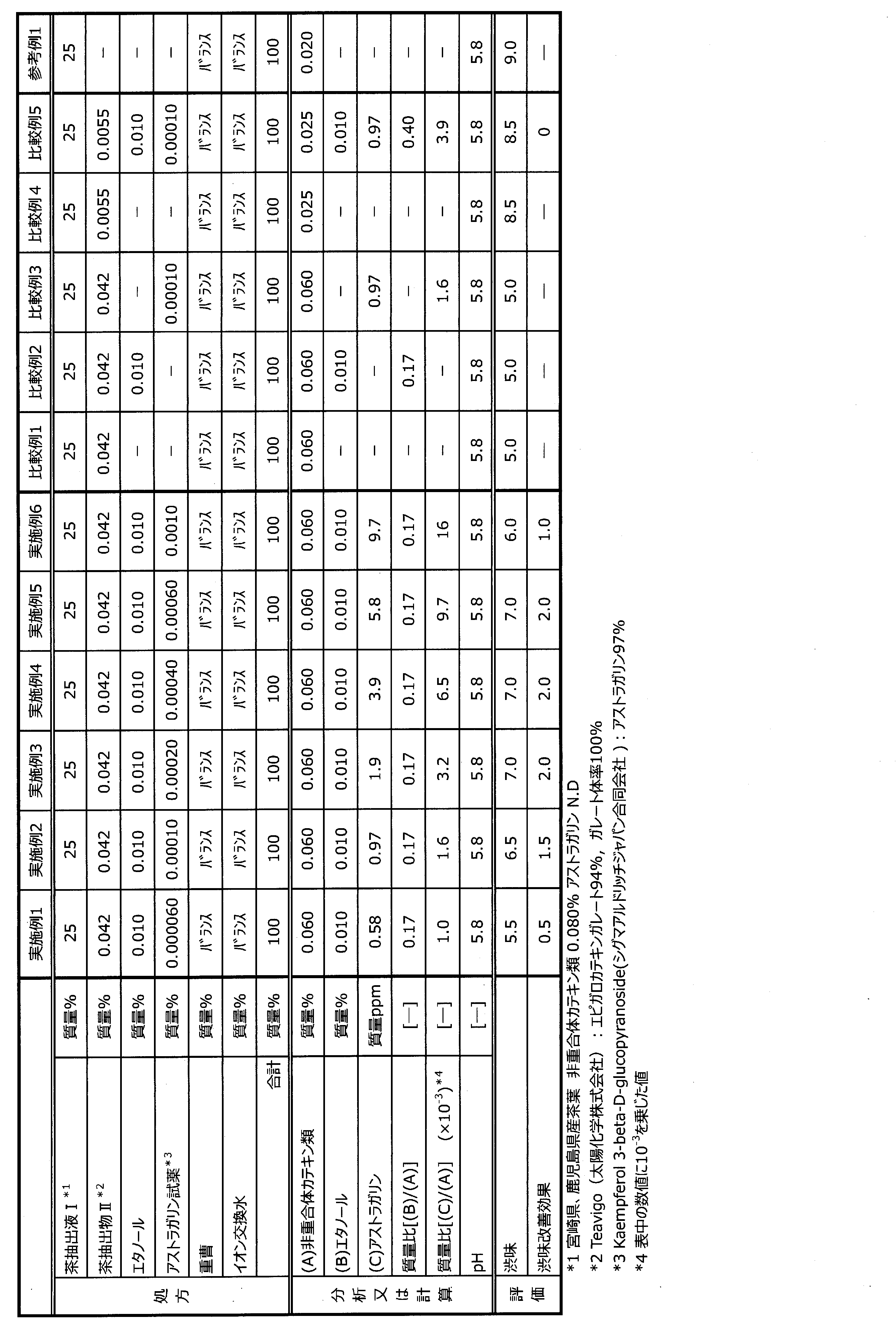
比較例5に示す通り、非重合体カテキン類濃度が低い場合にはエタノール、アストラガリンによる渋味改善効果は確認できなかった。これに対し、実施例1~6に示す通り、非重合体カテキン類を強化した飲料組成物において、エタノール、アストラガリンによる渋味改善効果が特異的に奏されることがわかる。
実施例7
茶抽出物IIを表3に示す割合で配合したこと以外は、実施例2と同様の操作により容器詰緑茶飲料を調製した。得られた容器詰緑茶飲料について実施例2と同様に分析を行い、官能評価1に基づいて官能試験を行った。その結果を、参考例1の結果とともに表3に示す。
茶抽出物IIを表3に示す割合で配合したこと以外は、実施例2と同様の操作により容器詰緑茶飲料を調製した。得られた容器詰緑茶飲料について実施例2と同様に分析を行い、官能評価1に基づいて官能試験を行った。その結果を、参考例1の結果とともに表3に示す。
実施例8
茶抽出物IIを表3に示す割合で配合したこと以外は、実施例4と同様の操作により容器詰緑茶飲料を調製した。得られた容器詰緑茶飲料について実施例4と同様に分析を行い、官能評価1に基づいて官能試験を行った。その結果を、参考例1の結果とともに 表3に示す。
茶抽出物IIを表3に示す割合で配合したこと以外は、実施例4と同様の操作により容器詰緑茶飲料を調製した。得られた容器詰緑茶飲料について実施例4と同様に分析を行い、官能評価1に基づいて官能試験を行った。その結果を、参考例1の結果とともに 表3に示す。
実施例9
茶抽出物IIを表3に示す割合で配合したこと以外は、実施例5と同様の操作により容器詰緑茶飲料を調製した。得られた容器詰緑茶飲料について実施例5と同様に分析を行い、官能評価1に基づいて官能試験を行った。その結果を、参考例1の結果とともに表3に示す。
茶抽出物IIを表3に示す割合で配合したこと以外は、実施例5と同様の操作により容器詰緑茶飲料を調製した。得られた容器詰緑茶飲料について実施例5と同様に分析を行い、官能評価1に基づいて官能試験を行った。その結果を、参考例1の結果とともに表3に示す。
比較例6
茶抽出物IIを表3に示す割合で配合したこと以外は、比較例1と同様の操作により容器詰緑茶飲料を調製した。得られた容器詰緑茶飲料について比較例1と同様に分析を行い、官能評価1に基づいて官能試験を行った。その結果を、参考例1の結果とともに表3に示す。
茶抽出物IIを表3に示す割合で配合したこと以外は、比較例1と同様の操作により容器詰緑茶飲料を調製した。得られた容器詰緑茶飲料について比較例1と同様に分析を行い、官能評価1に基づいて官能試験を行った。その結果を、参考例1の結果とともに表3に示す。
比較例7
茶抽出物IIを表3に示す割合で配合したこと以外は、比較例2と同様の操作により容器詰緑茶飲料を調製した。得られた容器詰緑茶飲料について比較例2と同様に分析を行い、官能評価1に基づいて官能試験を行った。その結果を、参考例1の結果とともに表3に示す。
茶抽出物IIを表3に示す割合で配合したこと以外は、比較例2と同様の操作により容器詰緑茶飲料を調製した。得られた容器詰緑茶飲料について比較例2と同様に分析を行い、官能評価1に基づいて官能試験を行った。その結果を、参考例1の結果とともに表3に示す。
比較例8
茶抽出物IIを表3に示す割合で配合したこと以外は、比較例3と同様の操作により容器詰緑茶飲料を調製した。得られた容器詰緑茶飲料について比較例3と同様に分析を行い、官能評価1に基づいて官能試験を行った。その結果を、参考例1の結果とともに表3に示す。
茶抽出物IIを表3に示す割合で配合したこと以外は、比較例3と同様の操作により容器詰緑茶飲料を調製した。得られた容器詰緑茶飲料について比較例3と同様に分析を行い、官能評価1に基づいて官能試験を行った。その結果を、参考例1の結果とともに表3に示す。
比較例9
茶抽出物IIを表3に示す割合で配合したこと以外は、実施例1と同様の操作により容器詰緑茶飲料を調製した。得られた容器詰緑茶飲料について実施例1と同様に分析を行い、官能評価1に基づいて官能試験を行った。その結果を、参考例1の結果とともに 表3に示す。
茶抽出物IIを表3に示す割合で配合したこと以外は、実施例1と同様の操作により容器詰緑茶飲料を調製した。得られた容器詰緑茶飲料について実施例1と同様に分析を行い、官能評価1に基づいて官能試験を行った。その結果を、参考例1の結果とともに 表3に示す。
実施例10
茶抽出物IIを表4に示す割合で配合したこと以外は、実施例1と同様の操作により容器詰緑茶飲料を調製した。得られた容器詰緑茶飲料について実施例1と同様に分析を行い、官能評価1に基づいて官能試験を行った。その結果を、参考例1の結果とともに表4に示す。
茶抽出物IIを表4に示す割合で配合したこと以外は、実施例1と同様の操作により容器詰緑茶飲料を調製した。得られた容器詰緑茶飲料について実施例1と同様に分析を行い、官能評価1に基づいて官能試験を行った。その結果を、参考例1の結果とともに表4に示す。
実施例11
茶抽出物IIを表4に示す割合で配合したこと以外は、実施例2と同様の操作により容器詰緑茶飲料を調製した。得られた容器詰緑茶飲料について実施例2と同様に分析を行い、官能評価1に基づいて官能試験を行った。その結果を、参考例1の結果とともに表4に示す。
茶抽出物IIを表4に示す割合で配合したこと以外は、実施例2と同様の操作により容器詰緑茶飲料を調製した。得られた容器詰緑茶飲料について実施例2と同様に分析を行い、官能評価1に基づいて官能試験を行った。その結果を、参考例1の結果とともに表4に示す。
実施例12
茶抽出物IIを表4に示す割合で配合したこと以外は、実施例3と同様の操作により容器詰緑茶飲料を調製した。得られた容器詰緑茶飲料について実施例3と同様に分析を行い、官能評価1に基づいて官能試験を行った。その結果を、参考例1の結果とともに表4に示す。
茶抽出物IIを表4に示す割合で配合したこと以外は、実施例3と同様の操作により容器詰緑茶飲料を調製した。得られた容器詰緑茶飲料について実施例3と同様に分析を行い、官能評価1に基づいて官能試験を行った。その結果を、参考例1の結果とともに表4に示す。
比較例10
茶抽出物IIを表4に示す割合で配合したこと以外は、比較例1と同様の操作により容器詰緑茶飲料を調製した。得られた容器詰緑茶飲料について比較例1と同様に分析を行い、官能評価1に基づいて官能試験を行った。その結果を、参考例1の結果とともに表4に示す。
茶抽出物IIを表4に示す割合で配合したこと以外は、比較例1と同様の操作により容器詰緑茶飲料を調製した。得られた容器詰緑茶飲料について比較例1と同様に分析を行い、官能評価1に基づいて官能試験を行った。その結果を、参考例1の結果とともに表4に示す。
比較例11
茶抽出物IIを表4に示す割合で配合したこと以外は、比較例2と同様の操作により容器詰緑茶飲料を調製した。得られた容器詰緑茶飲料について比較例2と同様に分析を行い、官能評価1に基づいて官能試験を行った。その結果を、参考例1の結果とともに表4に示す。
茶抽出物IIを表4に示す割合で配合したこと以外は、比較例2と同様の操作により容器詰緑茶飲料を調製した。得られた容器詰緑茶飲料について比較例2と同様に分析を行い、官能評価1に基づいて官能試験を行った。その結果を、参考例1の結果とともに表4に示す。
比較例12
茶抽出物IIを表4に示す割合で配合したこと以外は、比較例3と同様の操作により容器詰緑茶飲料を調製した。得られた容器詰緑茶飲料について比較例3と同様に分析を行い、官能評価1に基づいて官能試験を行った。その結果を、参考例1の結果とともに表4に示す。
茶抽出物IIを表4に示す割合で配合したこと以外は、比較例3と同様の操作により容器詰緑茶飲料を調製した。得られた容器詰緑茶飲料について比較例3と同様に分析を行い、官能評価1に基づいて官能試験を行った。その結果を、参考例1の結果とともに表4に示す。
実施例13
茶抽出物IIを表5に示す割合で配合したこと以外は、実施例4と同様の操作により容器詰緑茶飲料を調製した。得られた容器詰緑茶飲料について実施例4と同様に分析を行い、官能評価1に基づいて官能試験を行った。その結果を、参考例1の結果とともに表5に示す。
茶抽出物IIを表5に示す割合で配合したこと以外は、実施例4と同様の操作により容器詰緑茶飲料を調製した。得られた容器詰緑茶飲料について実施例4と同様に分析を行い、官能評価1に基づいて官能試験を行った。その結果を、参考例1の結果とともに表5に示す。
比較例13
茶抽出物IIを表5に示す割合で配合したこと以外は、比較例1と同様の操作により容器詰緑茶飲料を調製した。得られた容器詰緑茶飲料について比較例1と同様に分析を行い、官能評価1に基づいて官能試験を行った。その結果を、参考例1の結果とともに 表5に示す。
茶抽出物IIを表5に示す割合で配合したこと以外は、比較例1と同様の操作により容器詰緑茶飲料を調製した。得られた容器詰緑茶飲料について比較例1と同様に分析を行い、官能評価1に基づいて官能試験を行った。その結果を、参考例1の結果とともに 表5に示す。
実施例14~16
茶抽出物IIに加え、更に茶抽出物III(カテキン水和物、Cayman Chemical社製.、カテキン98質量%、ガレート体率0質量%、以下、同様である。)を配合して表6に示すガレート体率としたこと以外は、実施例8と同様の操作により、容器詰緑茶飲料を調製した。得られた各容器詰緑茶飲料について実施例8と同様に分析を行った。また、官能評価は、官能評価1に基づいて行った。分析及び官能評価の結果を、実施例8、比較例6、7及び参考例1の結果とともに表6に示す。
茶抽出物IIに加え、更に茶抽出物III(カテキン水和物、Cayman Chemical社製.、カテキン98質量%、ガレート体率0質量%、以下、同様である。)を配合して表6に示すガレート体率としたこと以外は、実施例8と同様の操作により、容器詰緑茶飲料を調製した。得られた各容器詰緑茶飲料について実施例8と同様に分析を行った。また、官能評価は、官能評価1に基づいて行った。分析及び官能評価の結果を、実施例8、比較例6、7及び参考例1の結果とともに表6に示す。
比較例14、16、18
茶抽出物IIに加え、更に茶抽出物IIIを配合して表6に示すガレート体率としたこと以外は、比較例6と同様の操作により加熱殺菌済容器詰緑茶飲料を調製した。得られた各加熱殺菌済容器詰緑茶飲料について比較例6と同様に分析を行い、官能評価1に基づいて官能試験を行った。その結果を、実施例8、比較例6、7及び参考例1の結果とともに表6に示す。
茶抽出物IIに加え、更に茶抽出物IIIを配合して表6に示すガレート体率としたこと以外は、比較例6と同様の操作により加熱殺菌済容器詰緑茶飲料を調製した。得られた各加熱殺菌済容器詰緑茶飲料について比較例6と同様に分析を行い、官能評価1に基づいて官能試験を行った。その結果を、実施例8、比較例6、7及び参考例1の結果とともに表6に示す。
比較例15、17、19
茶抽出物IIに加え、更に茶抽出物IIIを配合して表7に示すガレート体率としたこと以外は、比較例7と同様の操作により加熱殺菌済容器詰緑茶飲料を調製した。得られた各加熱殺菌済容器詰緑茶飲料について比較例7と同様に分析を行い、官能評価1に基づいて官能試験を行った。その結果を、実施例8、比較例6、7及び参考例1の結果とともに表6に示す。
茶抽出物IIに加え、更に茶抽出物IIIを配合して表7に示すガレート体率としたこと以外は、比較例7と同様の操作により加熱殺菌済容器詰緑茶飲料を調製した。得られた各加熱殺菌済容器詰緑茶飲料について比較例7と同様に分析を行い、官能評価1に基づいて官能試験を行った。その結果を、実施例8、比較例6、7及び参考例1の結果とともに表6に示す。
実施例17~19及び比較例20
エタノールを表7に示す割合で配合したこと以外は、実施例2と同様の操作により容器詰緑茶飲料を調製した。得られた容器詰緑茶飲料について実施例2と同様に分析を行い、官能評価1に基づいて官能試験を行った。その結果を、実施例2、比較例1~3及び参考例1の結果とともに表7に示す。
エタノールを表7に示す割合で配合したこと以外は、実施例2と同様の操作により容器詰緑茶飲料を調製した。得られた容器詰緑茶飲料について実施例2と同様に分析を行い、官能評価1に基づいて官能試験を行った。その結果を、実施例2、比較例1~3及び参考例1の結果とともに表7に示す。

実施例20、21
エタノールを表8に示す割合で配合したこと以外は、実施例10と同様の操作により容器詰緑茶飲料を調製した。得られた容器詰緑茶飲料について実施例10と同様に分析を行い、官能評価1に基づいて官能試験を行った。その結果を、実施例10、比較例10~12及び参考例1の結果とともに表8に示す。
エタノールを表8に示す割合で配合したこと以外は、実施例10と同様の操作により容器詰緑茶飲料を調製した。得られた容器詰緑茶飲料について実施例10と同様に分析を行い、官能評価1に基づいて官能試験を行った。その結果を、実施例10、比較例10~12及び参考例1の結果とともに表8に示す。

実施例22~24
エタノールの代わりに、プロピレングリコールを表9に示す割合で配合したこと以外は、実施例2と同様の操作により容器詰緑茶飲料を調製した。得られた容器詰緑茶飲料について実施例2と同様に分析を行い、官能評価1に基づいて官能試験を行った。その結果を、実施例2、比較例1~3及び参考例1の結果とともに表9に示す。
エタノールの代わりに、プロピレングリコールを表9に示す割合で配合したこと以外は、実施例2と同様の操作により容器詰緑茶飲料を調製した。得られた容器詰緑茶飲料について実施例2と同様に分析を行い、官能評価1に基づいて官能試験を行った。その結果を、実施例2、比較例1~3及び参考例1の結果とともに表9に示す。
実施例25
エタノールの代わりに、エタノール及びプロピレングリコールを表9に示す割合で配合したこと以外は、実施例2と同様の操作により容器詰緑茶飲料を調製した。得られた容器詰緑茶飲料について実施例2と同様に分析を行い、官能評価1に基づいて官能試験を行った。その結果を、実施例2、比較例1~3及び参考例1の結果とともに表9に示す。
エタノールの代わりに、エタノール及びプロピレングリコールを表9に示す割合で配合したこと以外は、実施例2と同様の操作により容器詰緑茶飲料を調製した。得られた容器詰緑茶飲料について実施例2と同様に分析を行い、官能評価1に基づいて官能試験を行った。その結果を、実施例2、比較例1~3及び参考例1の結果とともに表9に示す。
比較例21
プロピレングリコールを表9に示す割合で配合したこと以外は、比較例1と同様の操作により容器詰緑茶飲料を調製した。得られた容器詰緑茶飲料について比較例1と同様に分析を行い、官能評価1に基づいて官能試験を行った。その結果を、実施例2、比較例1~3及び参考例1の結果とともに表9に示す。
プロピレングリコールを表9に示す割合で配合したこと以外は、比較例1と同様の操作により容器詰緑茶飲料を調製した。得られた容器詰緑茶飲料について比較例1と同様に分析を行い、官能評価1に基づいて官能試験を行った。その結果を、実施例2、比較例1~3及び参考例1の結果とともに表9に示す。
実施例26~28
エタノールの代わりに、グリセリンを表10に示す割合で配合したこと以外は、実施例2と同様の操作により容器詰緑茶飲料を調製した。得られた容器詰緑茶飲料について実施例2と同様に分析を行い、官能評価1に基づいて官能試験を行った。その結果を、実施例2、比較例1~3及び参考例1の結果とともに表10に示す。
エタノールの代わりに、グリセリンを表10に示す割合で配合したこと以外は、実施例2と同様の操作により容器詰緑茶飲料を調製した。得られた容器詰緑茶飲料について実施例2と同様に分析を行い、官能評価1に基づいて官能試験を行った。その結果を、実施例2、比較例1~3及び参考例1の結果とともに表10に示す。
実施例29
エタノールの代わりに、エタノール及びグリセリンを表10に示す割合で配合したこと以外は、実施例2と同様の操作により容器詰緑茶飲料を調製した。得られた容器詰緑茶飲料について実施例2と同様に分析を行い、官能評価1に基づいて官能試験を行った。その結果を、実施例2、比較例1~3及び参考例1の結果とともに表10に示す。
エタノールの代わりに、エタノール及びグリセリンを表10に示す割合で配合したこと以外は、実施例2と同様の操作により容器詰緑茶飲料を調製した。得られた容器詰緑茶飲料について実施例2と同様に分析を行い、官能評価1に基づいて官能試験を行った。その結果を、実施例2、比較例1~3及び参考例1の結果とともに表10に示す。
比較例22
グリセリンを表10に示す割合で配合したこと以外は、比較例1と同様の操作により容器詰緑茶飲料を調製した。得られた容器詰緑茶飲料について比較例1と同様に分析を行い、官能評価1に基づいて官能試験を行った。その結果を、実施例2、比較例1~3及び参考例1の結果とともに表10に示す。
グリセリンを表10に示す割合で配合したこと以外は、比較例1と同様の操作により容器詰緑茶飲料を調製した。得られた容器詰緑茶飲料について比較例1と同様に分析を行い、官能評価1に基づいて官能試験を行った。その結果を、実施例2、比較例1~3及び参考例1の結果とともに表10に示す。
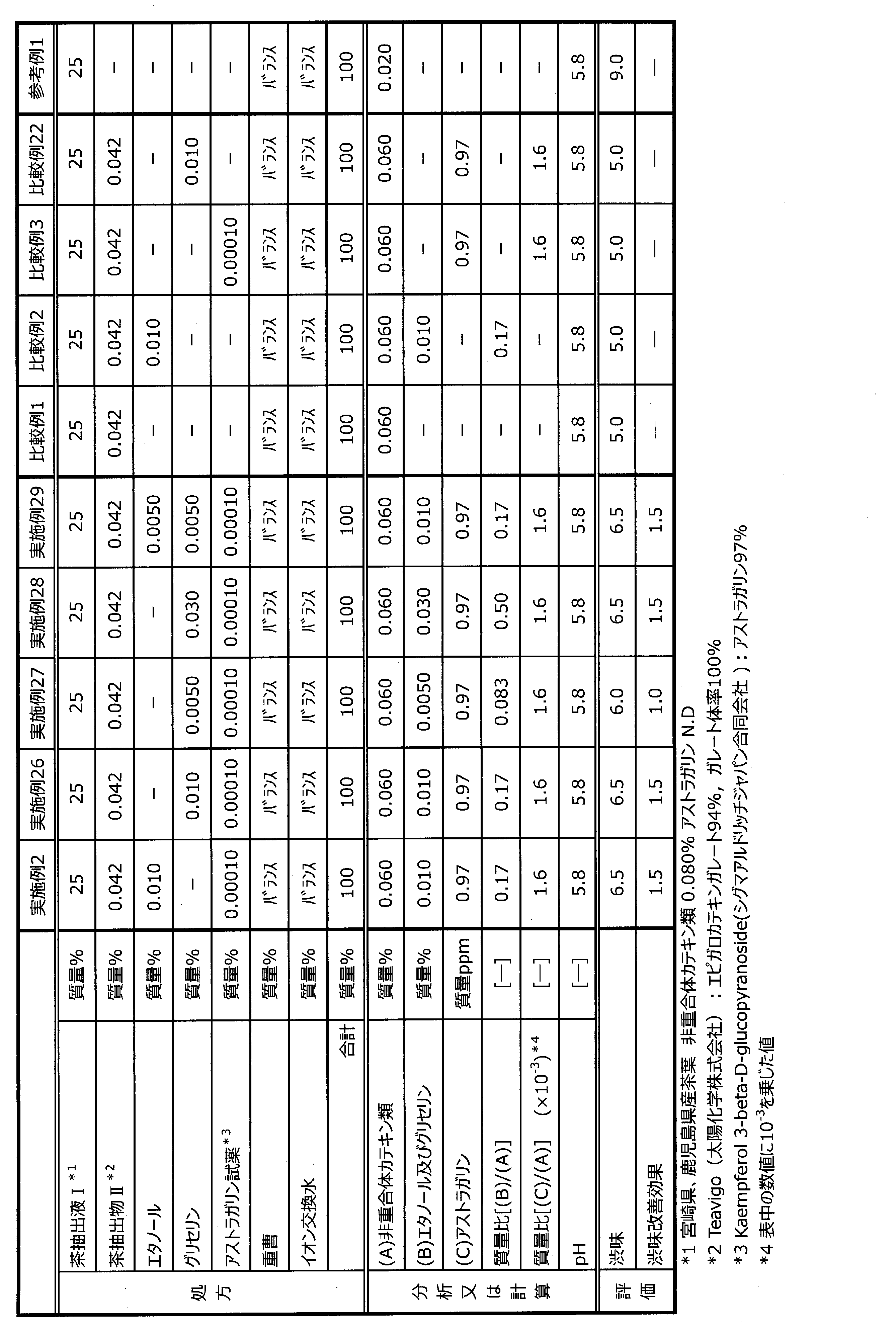
参考例2
市販粉末飲料(ポカリスエット、1L用粉末、大塚製薬株式会社)をイオン交換水にて全量が1Lとなるように希釈して非炭酸酸性飲料を調製した。次いで、得られた非炭酸酸性飲料を容量200mLのPETボトルに充填し、加熱殺菌し(ポストミックス方式、)容器詰非炭酸酸性飲料を得た。殺菌条件は、85℃、30分で行い、F0値は0.0074であった。そして、得られた容器詰非炭酸酸性飲料について分析を行った。そして、得られた容器詰非炭酸酸性飲料について分析を行った。その結果を表12に示す。
市販粉末飲料(ポカリスエット、1L用粉末、大塚製薬株式会社)をイオン交換水にて全量が1Lとなるように希釈して非炭酸酸性飲料を調製した。次いで、得られた非炭酸酸性飲料を容量200mLのPETボトルに充填し、加熱殺菌し(ポストミックス方式、)容器詰非炭酸酸性飲料を得た。殺菌条件は、85℃、30分で行い、F0値は0.0074であった。そして、得られた容器詰非炭酸酸性飲料について分析を行った。そして、得られた容器詰非炭酸酸性飲料について分析を行った。その結果を表12に示す。
比較例23
更に、茶抽出物IIを表12に示す割合で配合したこと以外は、参考例2と同様の操作により容器詰非炭酸酸性飲料を調製した。そして、得られた容器詰非炭酸酸性飲料について参考例2と同様に分析を行った。その結果を表12に示す。
更に、茶抽出物IIを表12に示す割合で配合したこと以外は、参考例2と同様の操作により容器詰非炭酸酸性飲料を調製した。そして、得られた容器詰非炭酸酸性飲料について参考例2と同様に分析を行った。その結果を表12に示す。
比較例24
更に、茶抽出物IIと、エタノールを表12に示す割合で配合したこと以外は、参考例2と同様の操作により容器詰非炭酸酸性飲料を調製した。得られた容器詰非炭酸酸性飲料について参考例2と同様に分析を行った。その結果を表12に示す。
更に、茶抽出物IIと、エタノールを表12に示す割合で配合したこと以外は、参考例2と同様の操作により容器詰非炭酸酸性飲料を調製した。得られた容器詰非炭酸酸性飲料について参考例2と同様に分析を行った。その結果を表12に示す。
比較例25
更に、茶抽出物IIと、プロピレングリコールを表12に示す割合で配合したこと以外は、参考例2と同様の操作により容器詰非炭酸酸性飲料を調製した。得られた容器詰非炭酸酸性飲料について参考例2と同様に分析を行った。その結果を表12に示す。
更に、茶抽出物IIと、プロピレングリコールを表12に示す割合で配合したこと以外は、参考例2と同様の操作により容器詰非炭酸酸性飲料を調製した。得られた容器詰非炭酸酸性飲料について参考例2と同様に分析を行った。その結果を表12に示す。
比較例26
更に、茶抽出物IIと、グリセリンを表12に示す割合で配合したこと以外は、参考例2と同様の操作により容器詰非炭酸酸性飲料を調製した。得られた容器詰非炭酸酸性飲料について参考例2と同様に分析を行った。その結果を表12に示す。
更に、茶抽出物IIと、グリセリンを表12に示す割合で配合したこと以外は、参考例2と同様の操作により容器詰非炭酸酸性飲料を調製した。得られた容器詰非炭酸酸性飲料について参考例2と同様に分析を行った。その結果を表12に示す。
比較例27
更に、茶抽出物IIと、アストラガリン試薬を表12に示す割合で配合したこと以外は、参考例2と同様の操作により容器詰非炭酸酸性飲料を調製した。得られた容器詰非炭酸酸性飲料について参考例2と同様に分析を行った。その結果を表12に示す。
更に、茶抽出物IIと、アストラガリン試薬を表12に示す割合で配合したこと以外は、参考例2と同様の操作により容器詰非炭酸酸性飲料を調製した。得られた容器詰非炭酸酸性飲料について参考例2と同様に分析を行った。その結果を表12に示す。
実施例30
更に、茶抽出物IIと、エタノールと、アストラガリン試薬を表12に示す割合で配合したこと以外は、参考例2と同様の操作により容器詰非炭酸酸性飲料を調製した。得られた容器詰非炭酸酸性飲料について参考例2と同様に分析を行った。その結果を表12に示す。
更に、茶抽出物IIと、エタノールと、アストラガリン試薬を表12に示す割合で配合したこと以外は、参考例2と同様の操作により容器詰非炭酸酸性飲料を調製した。得られた容器詰非炭酸酸性飲料について参考例2と同様に分析を行った。その結果を表12に示す。
実施例31
更に、茶抽出物IIと、プロピレングリコールと、アストラガリン試薬を表12に示す割合で配合したこと以外は、参考例2と同様の操作により容器詰非炭酸酸性飲料を調製した。得られた容器詰非炭酸酸性飲料について参考例2と同様に分析を行った。その結果を表12に示す。
更に、茶抽出物IIと、プロピレングリコールと、アストラガリン試薬を表12に示す割合で配合したこと以外は、参考例2と同様の操作により容器詰非炭酸酸性飲料を調製した。得られた容器詰非炭酸酸性飲料について参考例2と同様に分析を行った。その結果を表12に示す。
実施例32
更に、茶抽出物IIと、グリセリンと、アストラガリン試薬を表12に示す割合で配合したこと以外は、参考例2と同様の操作により容器詰非炭酸酸性飲料を調製した。得られた容器詰非炭酸酸性飲料について参考例2と同様に分析を行った。その結果を表12に示す。
更に、茶抽出物IIと、グリセリンと、アストラガリン試薬を表12に示す割合で配合したこと以外は、参考例2と同様の操作により容器詰非炭酸酸性飲料を調製した。得られた容器詰非炭酸酸性飲料について参考例2と同様に分析を行った。その結果を表12に示す。
官能評価2
実施例30~32、比較例23~27及び参考例2で得られた各容器詰非炭酸酸性飲料の「渋味」について専門パネル4名が官能試験を行った。官能試験は、次の手順で行った。先ず、参考例2の容器詰非炭酸酸性飲料に表11に示す量の茶抽出物IIを配合して「渋味」の強さを10段階に調整した「渋味標準容器詰非炭酸酸性飲料」を調製した。そして、専門パネル4名が各濃度の「渋味標準容器詰非炭酸酸性飲料」について、表11に示す評点とすることを合意した。次いで、各専門パネルが評点の数値が高い「渋味標準容器詰非炭酸酸性飲料」から順に摂取し、「渋味」の強さを記憶した。次いで、各専門パネルが各容器詰非炭酸酸性飲料を摂取し、「渋味」の程度を評価し、「渋味標準容器詰非炭酸酸性飲料」の中から「渋味」が最も近いものを決定した。そして、各専門パネルが決定した評点に基づいて、協議により「0.5」刻みで最終評点を決定した。その結果を表12に示す。なお、評点は、数値が小さいほど、「渋味」が強く感じられることを意味する。
実施例30~32、比較例23~27及び参考例2で得られた各容器詰非炭酸酸性飲料の「渋味」について専門パネル4名が官能試験を行った。官能試験は、次の手順で行った。先ず、参考例2の容器詰非炭酸酸性飲料に表11に示す量の茶抽出物IIを配合して「渋味」の強さを10段階に調整した「渋味標準容器詰非炭酸酸性飲料」を調製した。そして、専門パネル4名が各濃度の「渋味標準容器詰非炭酸酸性飲料」について、表11に示す評点とすることを合意した。次いで、各専門パネルが評点の数値が高い「渋味標準容器詰非炭酸酸性飲料」から順に摂取し、「渋味」の強さを記憶した。次いで、各専門パネルが各容器詰非炭酸酸性飲料を摂取し、「渋味」の程度を評価し、「渋味標準容器詰非炭酸酸性飲料」の中から「渋味」が最も近いものを決定した。そして、各専門パネルが決定した評点に基づいて、協議により「0.5」刻みで最終評点を決定した。その結果を表12に示す。なお、評点は、数値が小さいほど、「渋味」が強く感じられることを意味する。

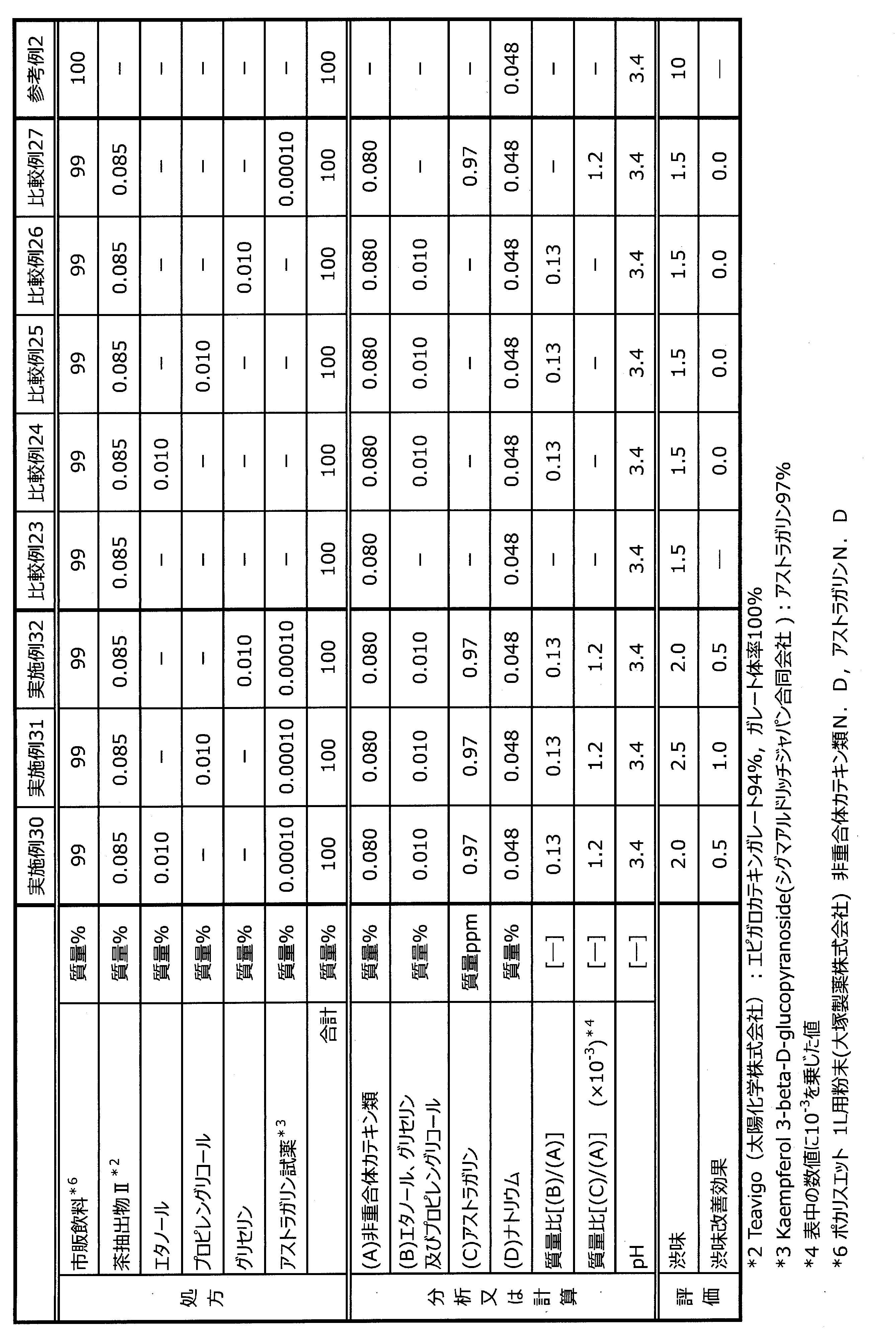
参考例3、4
酸味料(クエン酸)以外の表14に示す各成分をイオン交換水にて配合し、次いで酸味料で所定のpHになるように調整した後、イオン交換水にて全量を100質量%に調整して非炭酸酸性飲料を得た。次いで、得られた非炭酸酸性飲料を容量200mLのPETボトルに充填し、加熱殺菌し(ポストミックス方式、)容器詰非炭酸酸性飲料を得た。殺菌条件は、85℃、30分で行い、F0値は0.0074であった。そして、得られた容器詰非炭酸酸性飲料について分析を行った。そして、得られた容器詰非炭酸酸性飲料について分析を行った。その結果を表14に示す。
酸味料(クエン酸)以外の表14に示す各成分をイオン交換水にて配合し、次いで酸味料で所定のpHになるように調整した後、イオン交換水にて全量を100質量%に調整して非炭酸酸性飲料を得た。次いで、得られた非炭酸酸性飲料を容量200mLのPETボトルに充填し、加熱殺菌し(ポストミックス方式、)容器詰非炭酸酸性飲料を得た。殺菌条件は、85℃、30分で行い、F0値は0.0074であった。そして、得られた容器詰非炭酸酸性飲料について分析を行った。そして、得られた容器詰非炭酸酸性飲料について分析を行った。その結果を表14に示す。
比較例28
更に、茶抽出物IIを表14に示す割合で配合したこと以外は、参考例3と同様の操作により容器詰非炭酸酸性飲料を調製した。そして、得られた容器詰非炭酸酸性飲料について分析を行った。その結果を表14に示す。
更に、茶抽出物IIを表14に示す割合で配合したこと以外は、参考例3と同様の操作により容器詰非炭酸酸性飲料を調製した。そして、得られた容器詰非炭酸酸性飲料について分析を行った。その結果を表14に示す。
比較例29
更に、抽出物IIを表14に示す割合で配合したこと以外は、参考例4と同様の操作により容器詰非炭酸酸性飲料を調製した。そして、得られた容器詰非炭酸酸性飲料について分析を行った。その結果を表14に示す。
更に、抽出物IIを表14に示す割合で配合したこと以外は、参考例4と同様の操作により容器詰非炭酸酸性飲料を調製した。そして、得られた容器詰非炭酸酸性飲料について分析を行った。その結果を表14に示す。
実施例33
更に、茶抽出物IIと、エタノールと、アストラガリン試薬を表14に示す割合で配合したこと以外は、参考例3と同様の操作により容器詰非炭酸酸性飲料を調製した。得られた容器詰非炭酸酸性飲料について参考例3と同様に分析を行った。その結果を表14に示す。
更に、茶抽出物IIと、エタノールと、アストラガリン試薬を表14に示す割合で配合したこと以外は、参考例3と同様の操作により容器詰非炭酸酸性飲料を調製した。得られた容器詰非炭酸酸性飲料について参考例3と同様に分析を行った。その結果を表14に示す。
実施例34
更に、茶抽出物IIと、エタノールと、アストラガリン試薬を表14に示す割合で配合したこと以外は、参考例4と同様の操作により容器詰非炭酸酸性飲料を調製した。得られた容器詰非炭酸酸性飲料について参考例4と同様に分析を行った。その結果を表14に示す。
更に、茶抽出物IIと、エタノールと、アストラガリン試薬を表14に示す割合で配合したこと以外は、参考例4と同様の操作により容器詰非炭酸酸性飲料を調製した。得られた容器詰非炭酸酸性飲料について参考例4と同様に分析を行った。その結果を表14に示す。
官能評価3
実施例33、34、比較例28、29及び参考例3、4で得られた各容器詰非炭酸酸性飲料の「渋味」について専門パネル4名が官能試験を行った。官能試験は、次の手順で行った。先ず、参考例3の容器詰非炭酸酸性飲料に表13に示す量の茶抽出物IIを配合して「渋味」の強さを10段階に調整した「渋味標準容器詰非炭酸酸性飲料」を調製した。そして、専門パネル4名が各濃度の「渋味標準容器詰非炭酸酸性飲料」について、表13に示す評点とすることを合意した。次いで、各専門パネルが評点の数値が高い「渋味標準容器詰非炭酸酸性飲料」から順に摂取し、「渋味」の強さを記憶する。次いで、各専門パネルが各容器詰緑茶飲料を摂取し、「渋味」の程度を評価し、「渋味標準容器詰非炭酸酸性飲料」の中から「渋味」が最も近いものを決定する。そして、各専門パネルが決定した評点に基づいて、協議により「0.5」刻みで最終評点を決定した。その結果を表14に示す。なお、評点は、数値が小さいほど、「渋味」が強く感じられることを意味する。
実施例33、34、比較例28、29及び参考例3、4で得られた各容器詰非炭酸酸性飲料の「渋味」について専門パネル4名が官能試験を行った。官能試験は、次の手順で行った。先ず、参考例3の容器詰非炭酸酸性飲料に表13に示す量の茶抽出物IIを配合して「渋味」の強さを10段階に調整した「渋味標準容器詰非炭酸酸性飲料」を調製した。そして、専門パネル4名が各濃度の「渋味標準容器詰非炭酸酸性飲料」について、表13に示す評点とすることを合意した。次いで、各専門パネルが評点の数値が高い「渋味標準容器詰非炭酸酸性飲料」から順に摂取し、「渋味」の強さを記憶する。次いで、各専門パネルが各容器詰緑茶飲料を摂取し、「渋味」の程度を評価し、「渋味標準容器詰非炭酸酸性飲料」の中から「渋味」が最も近いものを決定する。そして、各専門パネルが決定した評点に基づいて、協議により「0.5」刻みで最終評点を決定した。その結果を表14に示す。なお、評点は、数値が小さいほど、「渋味」が強く感じられることを意味する。
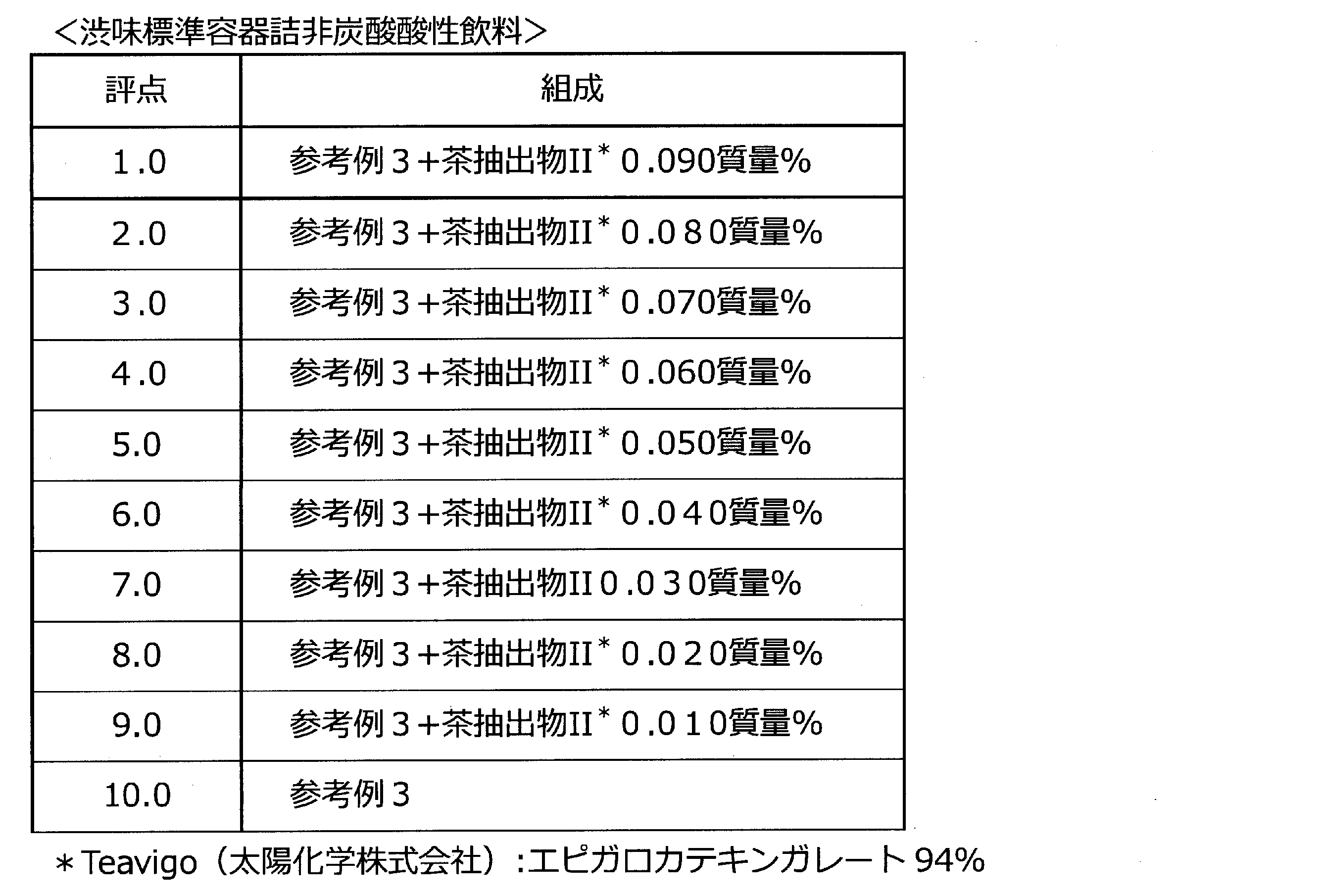

実施例35~37
食塩を表15に示す割合で配合したこと以外は、実施例33と同様の操作により容器詰非炭酸酸性飲料を調製した。得られた容器詰非炭酸酸性飲料について実施例33と同様に分析を行い、官能評価3に基づいて官能試験を行った。その結果を、実施例33、比較例28及び参考例3の結果とともに表15に示す。
食塩を表15に示す割合で配合したこと以外は、実施例33と同様の操作により容器詰非炭酸酸性飲料を調製した。得られた容器詰非炭酸酸性飲料について実施例33と同様に分析を行い、官能評価3に基づいて官能試験を行った。その結果を、実施例33、比較例28及び参考例3の結果とともに表15に示す。
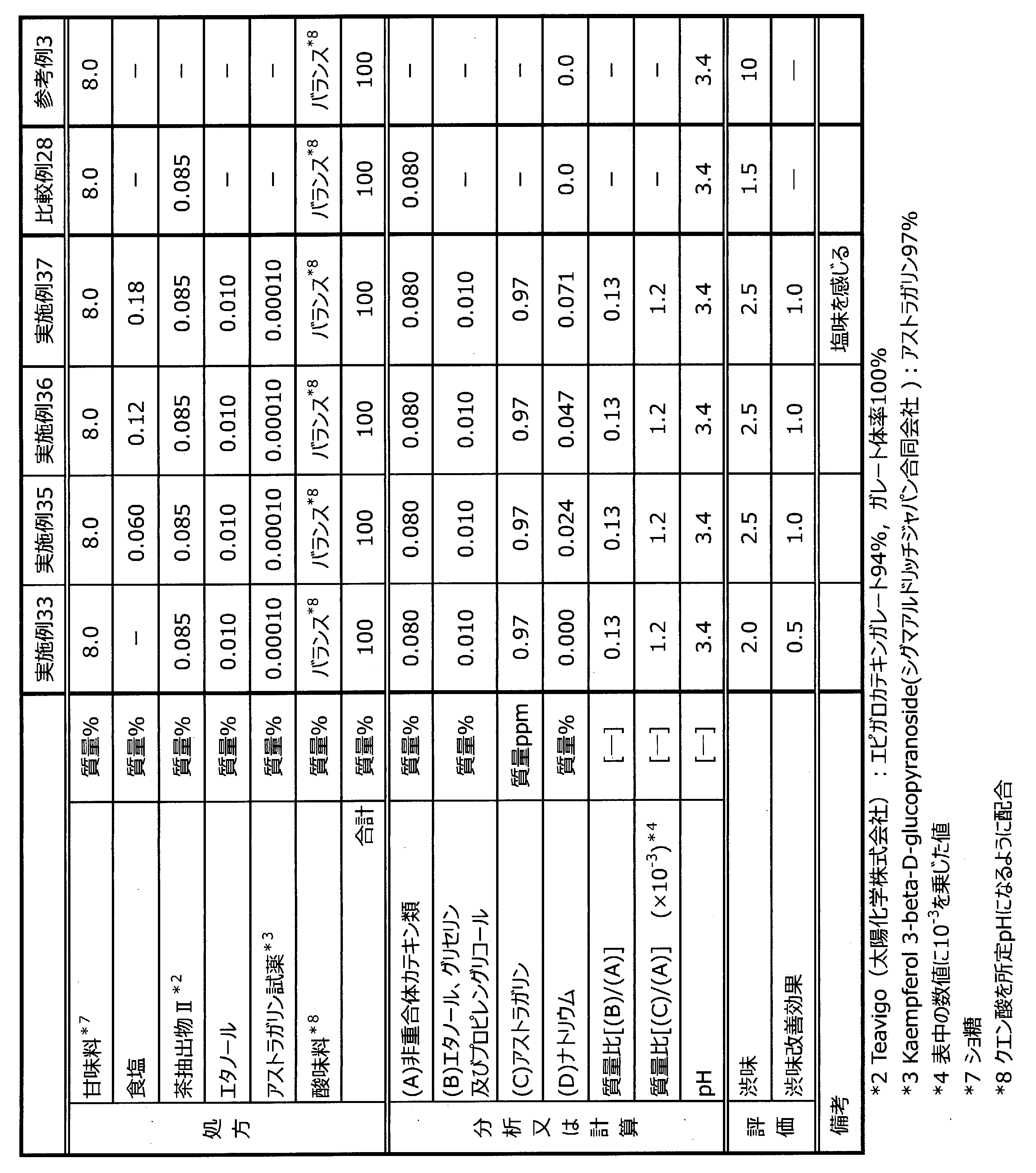
参考例5
酸味料以外の表17に示す各成分を配合後、10分間撹拌して溶解させた。その後、酸味料でpH3.8になるように調整し、耐熱性容器に充填してゼリー飲料を得た。次いで、得られたゼリー飲料を加熱殺菌(85℃、30分、F0値:0.0074)して容器詰ゼリー飲料を得た。そして、得られた容器詰ゼリー飲料について分析を行った。その結果を表17に示す。
酸味料以外の表17に示す各成分を配合後、10分間撹拌して溶解させた。その後、酸味料でpH3.8になるように調整し、耐熱性容器に充填してゼリー飲料を得た。次いで、得られたゼリー飲料を加熱殺菌(85℃、30分、F0値:0.0074)して容器詰ゼリー飲料を得た。そして、得られた容器詰ゼリー飲料について分析を行った。その結果を表17に示す。
比較例30
更に、茶抽出物IIを表17に示す割合で配合したこと以外は、参考例5と同様の操作により容器詰ゼリー飲料を調製した。そして、得られた容器詰ゼリー飲料について分析を行った。その結果を表17に示す。
更に、茶抽出物IIを表17に示す割合で配合したこと以外は、参考例5と同様の操作により容器詰ゼリー飲料を調製した。そして、得られた容器詰ゼリー飲料について分析を行った。その結果を表17に示す。
実施例38
更に、茶抽出物IIと、エタノールと、アストラガリン試薬を表17に示す割合で配合したこと以外は、参考例5と同様の操作により容器詰ゼリー飲料を調製した。得られた容器詰ゼリー飲料について参考例5と同様に分析を行った。その結果を表17に示す。
更に、茶抽出物IIと、エタノールと、アストラガリン試薬を表17に示す割合で配合したこと以外は、参考例5と同様の操作により容器詰ゼリー飲料を調製した。得られた容器詰ゼリー飲料について参考例5と同様に分析を行った。その結果を表17に示す。
官能評価4
実施例38、比較例30及び参考例5で得られた各容器詰ゼリー飲料の「渋味」について専門パネル4名が官能試験を行った。官能試験は、次の手順で行った。先ず、参考例5の容器詰ゼリー飲料に表16に示す量の茶抽出物IIを配合して「渋味」の強さを10段階に調整した「渋味標準容器詰ゼリー飲料」を調製した。そして、専門パネル4名が各濃度の「渋味標準容器詰ゼリー飲料」について、表16に示す評点とすることを合意した。次いで、各専門パネルが評点の数値が高い「渋味標準容器詰ゼリー飲料」から順に摂取し、「渋味」の強さを記憶した。次いで、各専門パネルが各容器詰ゼリー飲料を摂取し、「渋味」の程度を評価し、「渋味標準容器詰ゼリー飲料」の中から「渋味」が最も近いものを決定した。そして、各専門パネルが決定した評点に基づいて、協議により「0.5」刻みで最終評点を決定した。その結果を表17に示す。なお、評点は、数値が小さいほど、「渋味」が強く感じられることを意味する。
実施例38、比較例30及び参考例5で得られた各容器詰ゼリー飲料の「渋味」について専門パネル4名が官能試験を行った。官能試験は、次の手順で行った。先ず、参考例5の容器詰ゼリー飲料に表16に示す量の茶抽出物IIを配合して「渋味」の強さを10段階に調整した「渋味標準容器詰ゼリー飲料」を調製した。そして、専門パネル4名が各濃度の「渋味標準容器詰ゼリー飲料」について、表16に示す評点とすることを合意した。次いで、各専門パネルが評点の数値が高い「渋味標準容器詰ゼリー飲料」から順に摂取し、「渋味」の強さを記憶した。次いで、各専門パネルが各容器詰ゼリー飲料を摂取し、「渋味」の程度を評価し、「渋味標準容器詰ゼリー飲料」の中から「渋味」が最も近いものを決定した。そして、各専門パネルが決定した評点に基づいて、協議により「0.5」刻みで最終評点を決定した。その結果を表17に示す。なお、評点は、数値が小さいほど、「渋味」が強く感じられることを意味する。
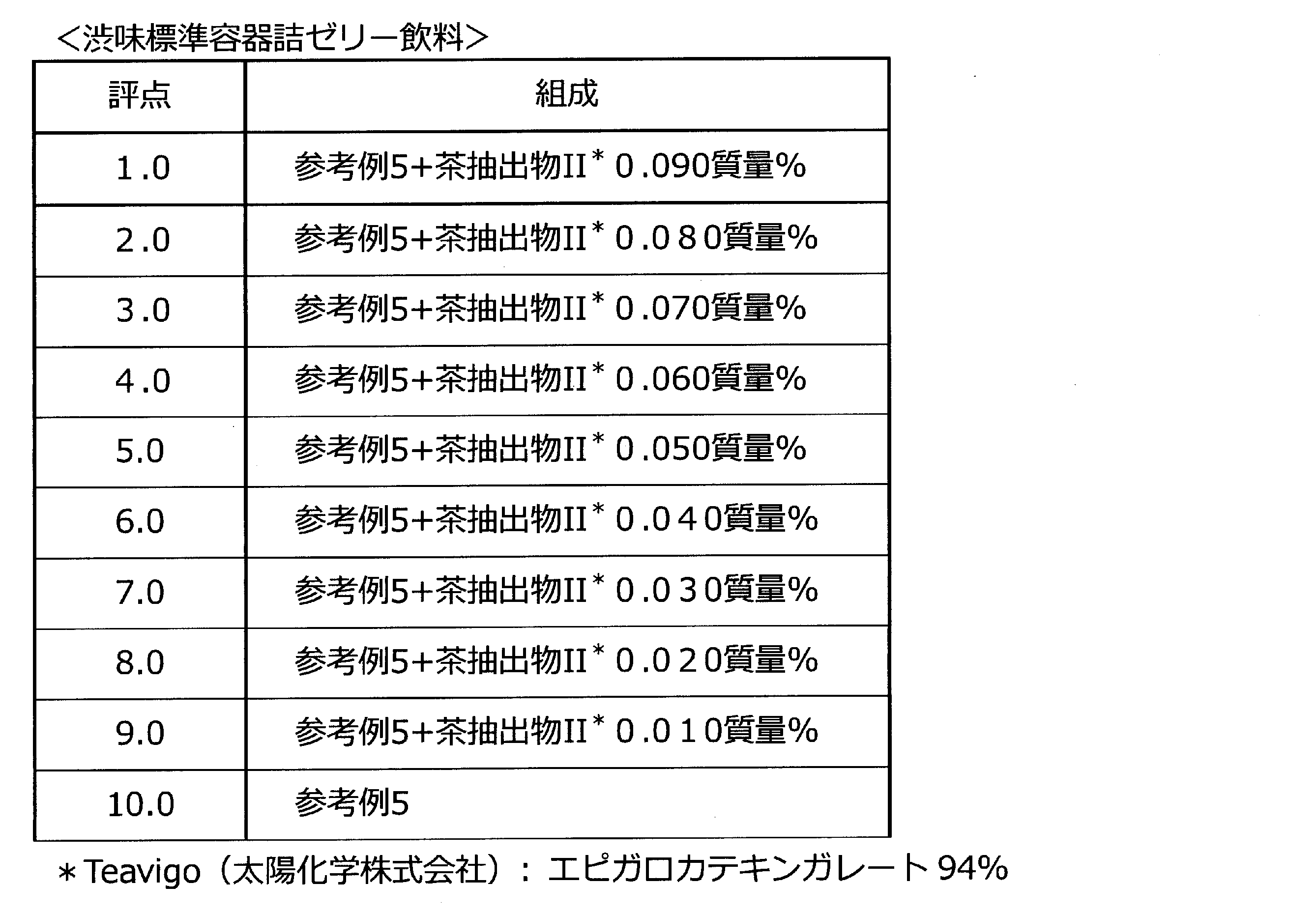

表2~10、12、14、15、17から、非重合体カテキン類に対してアストラガリンと、特定のアルコールを、それぞれ一定の量比で含有させることで、非重合体カテキン類を強化しつつも、渋味が抑制された飲料組成物が得られることがわかる。
Claims (5)
- 次の成分(A)、(B)及び(C);
(A)非重合体カテキン類 0.030~0.10質量%
(B)エタノール、プロピレングリコール及びグリセリンから選択される1種以上、及び
(C)アストラガリン
を含有し、
成分(A)と成分(B)との質量比[(B)/(A)]が0.060~2.0であり、
成分(C)と成分(A)との質量比[(C)/(A)]が1.0×10-3~20×10-3である、飲料組成物。 - 成分(A)の含有量が0.045~0.088質量%である、請求項1記載の飲料組成物。
- 成分(B)の含有量が0.0020~0.20質量%である、請求項1又は2記載の飲料組成物。
- 成分(C)の含有量が0.50~20質量ppmである、請求項1~3のいずれか1項に記載の飲料組成物。
- 茶飲料又は酸性飲料である、請求項1~4のいずれか1項に記載の飲料組成物。
Priority Applications (2)
| Application Number | Priority Date | Filing Date | Title |
|---|---|---|---|
| KR1020217032686A KR102400682B1 (ko) | 2019-03-13 | 2020-03-05 | 음료 조성물 |
| CN202080020776.3A CN113573591B (zh) | 2019-03-13 | 2020-03-05 | 饮料组合物 |
Applications Claiming Priority (4)
| Application Number | Priority Date | Filing Date | Title |
|---|---|---|---|
| JP2019046442 | 2019-03-13 | ||
| JP2019-046442 | 2019-03-13 | ||
| JP2019-107100 | 2019-06-07 | ||
| JP2019107100 | 2019-06-07 |
Publications (1)
| Publication Number | Publication Date |
|---|---|
| WO2020184368A1 true WO2020184368A1 (ja) | 2020-09-17 |
Family
ID=72427453
Family Applications (1)
| Application Number | Title | Priority Date | Filing Date |
|---|---|---|---|
| PCT/JP2020/009359 Ceased WO2020184368A1 (ja) | 2019-03-13 | 2020-03-05 | 飲料組成物 |
Country Status (5)
| Country | Link |
|---|---|
| JP (1) | JP6782866B1 (ja) |
| KR (1) | KR102400682B1 (ja) |
| CN (1) | CN113573591B (ja) |
| TW (1) | TWI825287B (ja) |
| WO (1) | WO2020184368A1 (ja) |
Families Citing this family (1)
| Publication number | Priority date | Publication date | Assignee | Title |
|---|---|---|---|---|
| WO2023059083A1 (ko) | 2021-10-06 | 2023-04-13 | 솔브레인 주식회사 | 전해액 및 이를 포함하는 이차전지 |
Citations (2)
| Publication number | Priority date | Publication date | Assignee | Title |
|---|---|---|---|---|
| JP2002291441A (ja) * | 2001-03-30 | 2002-10-08 | Sunstar Inc | アストラガリン含有食品 |
| JP2007282632A (ja) * | 2006-03-24 | 2007-11-01 | Shimane Pref Gov | 植物乾燥エキスの製造方法 |
Family Cites Families (7)
| Publication number | Priority date | Publication date | Assignee | Title |
|---|---|---|---|---|
| CN101309597B (zh) * | 2005-11-14 | 2012-07-25 | 花王株式会社 | 液体调味剂 |
| JP6266339B2 (ja) | 2013-12-25 | 2018-01-24 | キリン株式会社 | エタノール含有茶飲料 |
| CN104886679A (zh) * | 2014-03-06 | 2015-09-09 | 王跃进 | 柿叶茶果醋饮料 |
| CN106455636A (zh) * | 2014-06-25 | 2017-02-22 | 花王株式会社 | 容器装饮料 |
| JP6704727B2 (ja) | 2014-12-26 | 2020-06-03 | 花王株式会社 | 容器詰飲料の製造方法 |
| JP6514911B2 (ja) | 2015-02-25 | 2019-05-15 | キリン株式会社 | 優れた香味と旨味が持続する容器詰茶飲料の製造方法 |
| JP6777572B2 (ja) * | 2017-03-23 | 2020-10-28 | 花王株式会社 | 茶飲料 |
-
2020
- 2020-03-05 JP JP2020037651A patent/JP6782866B1/ja active Active
- 2020-03-05 KR KR1020217032686A patent/KR102400682B1/ko active Active
- 2020-03-05 WO PCT/JP2020/009359 patent/WO2020184368A1/ja not_active Ceased
- 2020-03-05 CN CN202080020776.3A patent/CN113573591B/zh active Active
- 2020-03-11 TW TW109107970A patent/TWI825287B/zh active
Patent Citations (2)
| Publication number | Priority date | Publication date | Assignee | Title |
|---|---|---|---|---|
| JP2002291441A (ja) * | 2001-03-30 | 2002-10-08 | Sunstar Inc | アストラガリン含有食品 |
| JP2007282632A (ja) * | 2006-03-24 | 2007-11-01 | Shimane Pref Gov | 植物乾燥エキスの製造方法 |
Non-Patent Citations (3)
| Title |
|---|
| LIU, YAN ET AL.: "Effects of brewing conditions on the phytochemical composition, sensory qualities and antioxidant activity of green tea infusion: A study using response surface methodology", FOOD CHEMISTRY, vol. 269, 2018, pages 24 - 34, XP055738685, DOI: 10.1016/j.foodchem.2018.06.130 * |
| ROSTAGNO, M. A. ET AL.: "Fast and simultaneous determination of phenolic compounds and caffeine in teas, mate, instant coffee, soft drink and energetic drink by high-performance liquid chromatography using a fused-core column", ANALYTICA CHIMICA ACTA, vol. 685, no. 2, 2011, pages 204 - 211, XP027563036 * |
| TSURUDAGA, YOKO ET AL.: "Differences in the Ascorbic Acid, Astragalin, and Polyphenol Contents, and the DPPH Radical Scavenging Activity of 22 Commercial Persimmon Leaf Tea Products", JOURNAL OF HOME ECONOMICS OF JAPAN, vol. 62, no. 7, 2011, pages 437 - 444, XP055738693, DOI: 10.11428/jhej.62.437 * |
Also Published As
| Publication number | Publication date |
|---|---|
| KR102400682B1 (ko) | 2022-05-20 |
| TW202100022A (zh) | 2021-01-01 |
| CN113573591A (zh) | 2021-10-29 |
| JP2020198871A (ja) | 2020-12-17 |
| JP6782866B1 (ja) | 2020-11-11 |
| CN113573591B (zh) | 2024-06-14 |
| KR20210132198A (ko) | 2021-11-03 |
| TWI825287B (zh) | 2023-12-11 |
Similar Documents
| Publication | Publication Date | Title |
|---|---|---|
| JP6648347B2 (ja) | 容器詰緑茶飲料 | |
| JP6948900B2 (ja) | 粉末飲料 | |
| JP7030170B2 (ja) | 茶飲料 | |
| JP6782866B1 (ja) | 飲料組成物 | |
| JP6496373B2 (ja) | 飲料組成物 | |
| JP7323278B2 (ja) | 茶飲料 | |
| JP2018157792A (ja) | 茶飲料 | |
| JP6719436B2 (ja) | 加熱殺菌済容器詰茶飲料 | |
| JP6212675B1 (ja) | 茶飲料 | |
| JP6782865B2 (ja) | 容器詰茶飲料 | |
| JP6785740B2 (ja) | 茶飲料 | |
| JP2020054390A (ja) | 容器詰緑茶飲料 | |
| JP7208070B2 (ja) | 容器詰茶飲料 | |
| JP6745258B2 (ja) | 飲料組成物 | |
| JP6745259B2 (ja) | 飲料組成物 | |
| JP7742221B2 (ja) | 経口用組成物 | |
| JP7320992B2 (ja) | 飲料組成物 | |
| JP2019080589A (ja) | 飲料組成物 | |
| JP2025067652A (ja) | 茶飲料組成物 | |
| JP2024079400A (ja) | 茶飲料組成物 | |
| JP2024079399A (ja) | 茶飲料組成物 | |
| JP2018134069A (ja) | 茶飲料 |
Legal Events
| Date | Code | Title | Description |
|---|---|---|---|
| 121 | Ep: the epo has been informed by wipo that ep was designated in this application |
Ref document number: 20768910 Country of ref document: EP Kind code of ref document: A1 |
|
| NENP | Non-entry into the national phase |
Ref country code: DE |
|
| ENP | Entry into the national phase |
Ref document number: 20217032686 Country of ref document: KR Kind code of ref document: A |
|
| 122 | Ep: pct application non-entry in european phase |
Ref document number: 20768910 Country of ref document: EP Kind code of ref document: A1 |