WO2020179833A1 - Api提供システム及びapi提供方法 - Google Patents
Api提供システム及びapi提供方法 Download PDFInfo
- Publication number
- WO2020179833A1 WO2020179833A1 PCT/JP2020/009223 JP2020009223W WO2020179833A1 WO 2020179833 A1 WO2020179833 A1 WO 2020179833A1 JP 2020009223 W JP2020009223 W JP 2020009223W WO 2020179833 A1 WO2020179833 A1 WO 2020179833A1
- Authority
- WO
- WIPO (PCT)
- Prior art keywords
- api
- software
- robot
- functions
- user
- Prior art date
- Legal status (The legal status is an assumption and is not a legal conclusion. Google has not performed a legal analysis and makes no representation as to the accuracy of the status listed.)
- Ceased
Links
Images

Classifications
-
- G—PHYSICS
- G06—COMPUTING OR CALCULATING; COUNTING
- G06Q—INFORMATION AND COMMUNICATION TECHNOLOGY [ICT] SPECIALLY ADAPTED FOR ADMINISTRATIVE, COMMERCIAL, FINANCIAL, MANAGERIAL OR SUPERVISORY PURPOSES; SYSTEMS OR METHODS SPECIALLY ADAPTED FOR ADMINISTRATIVE, COMMERCIAL, FINANCIAL, MANAGERIAL OR SUPERVISORY PURPOSES, NOT OTHERWISE PROVIDED FOR
- G06Q50/00—Information and communication technology [ICT] specially adapted for implementation of business processes of specific business sectors, e.g. utilities or tourism
- G06Q50/10—Services
Definitions
- the present invention relates to an API providing system and an API providing method.
- RPA robotic process automation
- the RPA can perform the processing registered not only on the software installed in the user terminal but also on the browser and the cloud by simply registering the processing procedure of the work performed by the human from the operation screen. Since the software robot that executes RPA can perform quick and accurate processing, the introduction of RPA can improve productivity, solve the shortage of human resources, and reduce costs. Further, since the RPA itself does not require coding technology and does not require programming, even a user who has no previous programming experience can use the RPA.
- Patent Document 1 a technique relating to a method of providing a user with an application of a service that can be configured by order has been disclosed (see Patent Document 1).
- Patent Document 1 the best quality component is interfaced with an application of a business service through an application programming interface (hereinafter referred to as "API"), and the developer refers to the component when developing the application. It is disclosed that a catalog of APIs will be provided. However, a system that efficiently provides a user with a software robot having a plurality of functions according to the needs of the user has not yet been disclosed.
- API application programming interface
- the present invention has been made in view of the above, and an object of the present invention is to efficiently provide a software robot having a plurality of functions to a user.
- the present invention is a system that provides a user with a software robot that executes a plurality of functions.
- the software robot is provided to the user by an API, and the software robot calls the API to perform the plurality of functions.
- the API providing system that executes.
- the software robot is created based on the request of the user, and the software robot is provided to the user via the robot marketplace with the API implemented.
- the software robot calls at least a part of the plurality of functions by calling an API corresponding to at least a part of the plurality of functions from an external API marketplace in which APIs developed externally are collected. It is preferable to execute the function of.
- the present invention is a method of providing a software robot for executing a plurality of functions to the user, and software in which a step of accepting a request from the user and a plurality of APIs corresponding to the plurality of functions are implemented.
- the present invention relates to an API providing method, which comprises a step of providing a robot to the user by an API.
- the software robot is provided to the user via the robot marketplace.
- a software robot having a plurality of functions can be efficiently provided to a user.
- API providing system according to the embodiment of the present invention will be described with reference to the drawings. First, the overall configuration of the API providing system will be described.
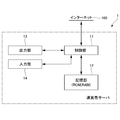
- the API providing system has an operator server 1 and a robot marketplace 20.
- the API providing system is communicably connected to the user terminal 2 and the external API marketplace 30 via the Internet 100.
- the robot marketplace 20 is a software robot marketplace established by the operator server 1.
- the external API marketplace 30 is a marketplace where various APIs developed externally are collected. The various APIs developed externally may be directly connected via the Internet 100 without going through the external API marketplace 30.
- the operator server 1 has a control unit 11, a storage unit 12, an output unit 13 including a display for output, and an input unit 14 including a keyboard and a mouse for input.
- the control unit 11 controls the entire system according to a control program, and includes a CPU.
- the storage unit 12 is composed of a storage medium such as a ROM or HDD in which a control program or the like is stored, or a RAM or the like in which data is temporarily stored.
- the ROM, HDD, and RAM as the storage unit 12 may include those used as auxiliary.
- the operator of the API providing system opens the robot marketplace 20 by the operator server 1.
- the operator receives the user's request transmitted from the user terminal 2 via the operator server 1 or the robot marketplace 20.
- the operator creates a software robot that executes the function requested by the user in a form in which the corresponding API is implemented, and provides the software robot to the robot marketplace 20 via the operator server 1.
- the software robot may be created by a partner company other than the operator.
- the user terminal 2 is a terminal such as a computer device owned by a user of the API providing system (hereinafter, may be simply referred to as a "user"), and like the operator server 1, a control unit, a storage unit, an output unit, and an input. It has a part, etc.
- the user requests the operator to create a software robot having a desired function via the user terminal 2, and receives the software robot completed by the API.
- API is an interface that connects software and makes it easy to use some of the functions of the operating system (OS), application software, or web applications from external application software.
- OS operating system
- API is usually provided as a set of functions and codes.
- the robot marketplace 20 is a marketplace established by the operator server 1 and in which a wide variety of software robots are provided to users.
- the software robot is provided to the user in the form of implementing the corresponding API.
- the robot marketplace 20 is a cloud service, and when a user uses it, a usage fee is incurred, and the usage fee is passed to the operator server 1.
- a software robot 10d (X, Y, Z) having a plurality of functions (X), (Y), (Z) is uploaded.
- the software robot 10d (X, Y, Z) is provided to the user by an API implemented in the software robot 10d (X, Y, Z).
- software robots and software having various functions of software robots provided to users are uploaded to the robot marketplace 20.
- 10a having the function (X) and 10b having the function (Y) are uploaded.
- 10a and 10b may be software robots or software.
- the robot marketplace 20 may have a function such as a bulletin board in addition to the above, and the user may be able to convey his / her request to the operator via the robot marketplace 20.
- the "software robot” is a robot on software, and refers to a robot that can memorize and execute computer operations performed by using a keyboard or mouse designated by a human being, for example.
- the software robot according to the present embodiment can execute a specific function possessed by other software robots or software by calling an API other than the above.
- “Software” includes application programs for executing specific functions of a computer, system software for managing hardware and providing basic processing, and the like.
- the software robot provided to the user executes a plurality of functions by calling a plurality of APIs corresponding to the plurality of functions.
- the software robot 10d (X, Y, Z) functions by calling APIs 10a and 10b having functions (X) and functions (Y) existing in the robot marketplace 20. (X) and (Y) are executed.
- the software robot 10d (X, Y, Z) has a function (Z) that does not exist in the robot marketplace 20, and functions (Z) by calling the API of the software 10c that exists in the external API marketplace 30. Z) can be executed.
- the external API marketplace 30 aggregates and manages a huge amount of APIs implemented in software and the like.
- the operator can also easily use the necessary API by paying the usage fee. For example, as shown in FIG. 1, the operator pays an API usage fee for software 10c having a function (Z) that does not exist in the robot marketplace 20. As a result, the operator can use the function (Z) of the software 10c by calling the API.
- the robot 10d (X, Y, Z) can be configured and provided to the user so that the API implemented in the software 10c of the external API marketplace 30 corresponding to the function (Z) can be called.
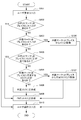
- step S101 the user request (X, Y, Z) is transmitted to the operator server 1 or the robot marketplace 20 via the user terminal 2.
- the user request (X, Y, Z) automatically accesses the hotel search sites operated by companies X, Y, and Z when the user inputs an item, and obtains the result.
- the software robots (X, Y, Z) that output by the method specified by the user are provided.
- step S102 the control unit 11 determines whether or not the robot marketplace 20 has a software robot (X, Y, Z) having all the plurality of functions corresponding to the user request. For example, each function of the software robot and software existing in the robot marketplace 20 is converted into data and stored in the storage unit 12 in advance. Next, each function of the software robot (X, Y, Z) is input by the operator via the input unit 14. The control unit 11 receives the input content and determines whether or not there is a software robot (X, Y, Z) in the robot marketplace 20 in light of the data. If S102 is YES, the process proceeds to S110, and software robots (X, Y, Z) are provided to the user by API. If S102 is NO, the process proceeds to S103.
- a software robot X, Y, Z
- step S103 the control unit 11 determines whether or not the external API marketplace 30 has software or the like having all the plurality of functions (X, Y, Z). For example, when each function such as software existing in the external API marketplace 30 is converted into data in advance, the control unit 11 accesses the above data and compares the input content in S102 with the above data to determine whether the external API marketplace is available. It is determined whether or not there is a software robot in 30. If S103 is YES, the process proceeds to S104. If S103 is NO, the process proceeds to S105.
- step S104 the control unit 11 purchases and acquires APIs corresponding to the functions (X, Y, Z) from the external API marketplace 30.
- This API enables a software robot that connects to the application software of a hotel search site operated by company X, company Y, and company Z and acquires a predetermined result by a script instruction to operate on the user terminal 2.
- the control unit 11 acquires the API created externally from the external API marketplace 30 via the Internet 100. This may be any one that can be directly connected to the application software of the hotel search site operated by company X, company Y, and company Z, respectively. In some cases, direct cooperation may be made without going through the external API marketplace 30.
- S110 the process proceeds to S110.
- step S105 the control unit 11 determines whether or not all the software robots or software having the respective functions (X), (Y), and (Z) are present in the robot marketplace 20. The above determination is made by the same method as the method in S102 and S103. If S105 is YES, the process proceeds to S109. If S105 is NO, the process proceeds to S106.
- step S106 the control unit 11 determines whether or not the external API marketplace 30 has software or the like having at least one of the missing functions that does not exist in the robot marketplace 20. The above determination is made by the same method as the method in S102, S103 and S105. If S106 is YES, the process proceeds to S107. If S106 is NO, the process proceeds to S108.
- step S107 the control unit 11 purchases and acquires an API corresponding to the missing function (X), (Y), or (Z) from the external API marketplace 30. After S107 is executed, the process proceeds to S109. If all the functions (X), (Y), and (Z) are not prepared even if S107 is executed, the process proceeds to S108.
- step S108 the operator develops software or a software robot having the missing functions (X), (Y), or (Z) and uploads it to the robot marketplace 20 with the API implemented. After S108 is executed, the process proceeds to S109.
- step S109 the operator creates a software robot that executes a plurality of functions (X, Y, Z) by implementing the API.
- a plurality of functions (X, Y, Z) are executed by calling a plurality of APIs corresponding to each function. Some of the plurality of functions may be executed by calling the API from the external API marketplace 30.
- step S110 the control unit 11 or the operator uploads a software robot that executes a plurality of functions (X, Y, Z) to the robot marketplace 20 and provides the user with an API.
- Step S110 includes a step of notifying the requested user that the completed software robot 10d has been uploaded to the robot marketplace 20.
- the step described as being executed by the control unit 11 may be executed by a person such as an operator.
- the user requests, for example, the software robot 10d corresponding to the hotel search site operated by each of the companies X, Y, and Z from the robot marketplace 20.
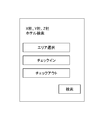
- the software robot 10d is provided in the manner shown in FIG.
- the user activates the software robot 10d, selects an area to stay in, specifies check-in and check-out dates, and then presses the search button.
- the software robot 10d automatically acquires the results from the hotel search sites operated by companies X, Y, and Z, and outputs the results sorted by a specified predetermined method, for example, in order of amount. Can be output to the user by displaying or printing.
- the software robot is provided to the user by the API, and the software robot calls the API to execute a plurality of functions.
- the software robot is configured so that a plurality of functions can be combined by the API, so that the operator of the API providing system can reduce the development cost of the software robot and the period required for the development.
- the software robot is provided to the user by the API, the user does not need to store the software robot on the user terminal 2 owned by the user, and the software robot having a desired function can be executed by the API. Excellent convenience.
- the software robot is provided with an API based on the user's request and provided to the user via the robot marketplace 20.
- the user can obtain a software robot in which the API corresponding to the desired function is implemented via the robot marketplace 20, so that the convenience of the user can be further improved.
- the software robot calls the API corresponding to at least a part of the plurality of functions from the external API marketplace 30 to execute at least a part of the above-mentioned plurality of functions.
- the operator of the API providing system can create a software robot by combining the functions of the software robot owned by the operator with the functions existing in the external API marketplace, and thus the development cost of the software robot. And the time required for development can be further reduced.
- the step of accepting a request from the user and a software robot in which a plurality of APIs corresponding to the multiple functions are implemented are provided to the user by the API. And shall have. As a result, it is possible to reduce the development cost and the cost and period required for providing the software robot corresponding to the request from the user.
- the software robot that executes a plurality of functions is provided to the user via the robot marketplace 20.
- the convenience of the user can be improved, and the cost required for providing the software robot can be reduced.
- steps S102 and S105 for determining whether or not a software robot or software having at least a part of the plurality of functions exists in the robot marketplace 20, and based on the request from the user Existing in the robot marketplace 20 and steps S103 and S106 for determining whether or not a software robot or software having at least a part of the functions not existing in the robot marketplace 20 exists in the external API marketplace 30. And a step S107 of acquiring the API of the software robot or the software having the function not to be performed.
- the operator of the API providing system can externally obtain the functions that the own software does not own and can combine the functions that the own own software has by using the API, so that the development cost of the software robot and the cost required for providing the software robot can be increased. And the period can be further reduced.
- a software robot that implements API and supports hotel search is illustrated, but the present invention is not limited to this, and applications in all fields including the Web and ERP can be automated. It is especially effective when used for inventory management, order management, finance (accounting) work, and routine office work related to human resources.
- the software robot 10d has been described as calling the APIs of 10a, 10b, and 10c having a single function, respectively, but the present invention is not limited to the above.
- the software robot 10d may be able to call software having a plurality of functions or an API corresponding to a part of the functions of the software robot. For example, it may be possible to call only the API corresponding to the function (X) to the software robot having the functions (W) and (X).
Landscapes
- Business, Economics & Management (AREA)
- Tourism & Hospitality (AREA)
- Health & Medical Sciences (AREA)
- Economics (AREA)
- General Health & Medical Sciences (AREA)
- Human Resources & Organizations (AREA)
- Marketing (AREA)
- Primary Health Care (AREA)
- Strategic Management (AREA)
- Physics & Mathematics (AREA)
- General Business, Economics & Management (AREA)
- General Physics & Mathematics (AREA)
- Engineering & Computer Science (AREA)
- Theoretical Computer Science (AREA)
- Stored Programmes (AREA)
Priority Applications (1)
| Application Number | Priority Date | Filing Date | Title |
|---|---|---|---|
| JP2021503627A JPWO2020179833A1 (enExample) | 2019-03-07 | 2020-03-04 |
Applications Claiming Priority (2)
| Application Number | Priority Date | Filing Date | Title |
|---|---|---|---|
| JP2019-041869 | 2019-03-07 | ||
| JP2019041869 | 2019-03-07 |
Publications (1)
| Publication Number | Publication Date |
|---|---|
| WO2020179833A1 true WO2020179833A1 (ja) | 2020-09-10 |
Family
ID=72338353
Family Applications (1)
| Application Number | Title | Priority Date | Filing Date |
|---|---|---|---|
| PCT/JP2020/009223 Ceased WO2020179833A1 (ja) | 2019-03-07 | 2020-03-04 | Api提供システム及びapi提供方法 |
Country Status (2)
| Country | Link |
|---|---|
| JP (1) | JPWO2020179833A1 (enExample) |
| WO (1) | WO2020179833A1 (enExample) |
Citations (3)
| Publication number | Priority date | Publication date | Assignee | Title |
|---|---|---|---|---|
| JP2004527805A (ja) * | 1999-08-23 | 2004-09-09 | アセラ,インコーポレイティド | 部品の標準化されたセットから注文により構成可能なビジネスのアプリケーションを提供する方法および装置 |
| US8954988B1 (en) * | 2013-10-15 | 2015-02-10 | International Business Machines Corporation | Automated assessment of terms of service in an API marketplace |
| JP2016173844A (ja) * | 2010-05-19 | 2016-09-29 | グーグル インコーポレイテッド | バグクリアリングハウス |
-
2020
- 2020-03-04 JP JP2021503627A patent/JPWO2020179833A1/ja active Pending
- 2020-03-04 WO PCT/JP2020/009223 patent/WO2020179833A1/ja not_active Ceased
Patent Citations (3)
| Publication number | Priority date | Publication date | Assignee | Title |
|---|---|---|---|---|
| JP2004527805A (ja) * | 1999-08-23 | 2004-09-09 | アセラ,インコーポレイティド | 部品の標準化されたセットから注文により構成可能なビジネスのアプリケーションを提供する方法および装置 |
| JP2016173844A (ja) * | 2010-05-19 | 2016-09-29 | グーグル インコーポレイテッド | バグクリアリングハウス |
| US8954988B1 (en) * | 2013-10-15 | 2015-02-10 | International Business Machines Corporation | Automated assessment of terms of service in an API marketplace |
Also Published As
| Publication number | Publication date |
|---|---|
| JPWO2020179833A1 (enExample) | 2020-09-10 |
Similar Documents
| Publication | Publication Date | Title |
|---|---|---|
| US8090611B2 (en) | System, method, and computer program product for enabling workflow applications | |
| WO2020006076A1 (en) | Method and system for automating web processes utilizing an abstractable underlying platform layer | |
| US11625243B2 (en) | Micro-application creation and execution | |
| US11010138B2 (en) | System and method for programmatically converting interface specification to generic plug-in code | |
| US20090100431A1 (en) | Dynamic business process prioritization based on context | |
| CN104050275A (zh) | 项目评审方法和系统 | |
| JP2005522755A (ja) | 承認の要求のための承認処理の定義(definition) | |
| US20070005623A1 (en) | Process oriented message driven workflow programming model | |
| US20090099880A1 (en) | Dynamic business process prioritization based on context | |
| JP5477971B2 (ja) | フォーム入力の部分的問合せ方法、その方法に使用されるコンピュータ・プログラム、及びそのプログラムを搭載した処理装置 | |
| WO2020179833A1 (ja) | Api提供システム及びapi提供方法 | |
| KR100967692B1 (ko) | 서비스로 제공되는 소프트웨어 기반의 비즈니스 프로세스관리시스템 | |
| US20170351979A1 (en) | Deploying dispatch form with implied workflows to mobile devices | |
| JP2014002619A (ja) | 情報処理装置及びその制御方法とプログラム | |
| JP4093033B2 (ja) | サービス部品選択支援方法 | |
| JPH1185694A (ja) | サーバー間連携業務運用システム | |
| JP2024151792A (ja) | 情報処理方法、プログラム、及び情報処理装置 | |
| JP7504531B1 (ja) | Aiによるシステム運用業務の支援方法 | |
| KR20030020213A (ko) | 온라인 네트워크 상의 커뮤니티에 근거한 웹 프로젝트제작 및 관리 시스템과 그에 따른 웹 프로젝트 제작 및관리방법 | |
| JP3990369B2 (ja) | サーバ装置及び中継システム | |
| Brara et al. | Introduction to SAP Fiori | |
| KR20250066617A (ko) | 디자인 코딩 시에 프로그램 소스를 직접 인쿠르드할 수 있는 홈페이지 제작 시스템 | |
| US20040039994A1 (en) | System and process for communication between Java server pages and servlets | |
| JP2001184200A (ja) | アプリケーションフレームワーク生成方法および装置およびアプリケーションフレームワーク生成プログラムを記録したコンピュータ読み取り可能な記録媒体 | |
| Xu et al. | Membership portal and service provisioning system for an infrastructure of Hubs: Managed e-Hub |
Legal Events
| Date | Code | Title | Description |
|---|---|---|---|
| 121 | Ep: the epo has been informed by wipo that ep was designated in this application |
Ref document number: 20766157 Country of ref document: EP Kind code of ref document: A1 |
|
| ENP | Entry into the national phase |
Ref document number: 2021503627 Country of ref document: JP Kind code of ref document: A |
|
| NENP | Non-entry into the national phase |
Ref country code: DE |
|
| 122 | Ep: pct application non-entry in european phase |
Ref document number: 20766157 Country of ref document: EP Kind code of ref document: A1 |